Sketchbook ideas drawings are at their best when you take your pencil case to a park bench and just watch for ten minutes. You do not need a grand view, you need one small thing happening: a dog going after a frisbee, a toddler flinging bread at a swan, a couple sharing one pair of headphones. Every page below is a little slice of park life you can start and finish in a single sitting, even if you only have your lunch break.
Work through them in any order, though they run roughly from quick and forgiving to a touch more ambitious. Grab a fineliner, a light watercolor set or a few markers, and let the cream of your paper show through. By the end you will have a whole afternoon of park days living on your pages.
Using these images: free for personal projects such as printing, coloring, cards, journals and gifts. Handmade items that include them may be sold up to 30 pieces per design. More than that is commercial use and is not permitted, and neither is selling or sharing the images themselves or passing them off as your own. Please ask before any other use.
Start with the blanket, since everything else sits on top of it. Draw a simple square in fineliner, then add a gingham or stripe pattern with a ruler-free wobble, it reads better loose than perfectly straight. Keep the folds soft where the blanket dips at the corners.
Once the blanket is down, scatter the picnic across it: a jug of lemonade, a bowl of strawberries, maybe a half-eaten sandwich. Draw each object as a simple shape first, circle for the jug body, triangle cluster for strawberries, before adding handles and seeds.
If this is your first time arranging a still life like this, overlap two or three items so the eye has a path to follow instead of objects floating separately. The easiest fix for a crowded picnic is to leave one corner of the blanket empty.
Wash the strawberries in a warm red and let a little white paper show through as highlight, no mixing needed. If you do not have watercolor on hand, a red marker with a lighter pink layered on top gives the same pop.
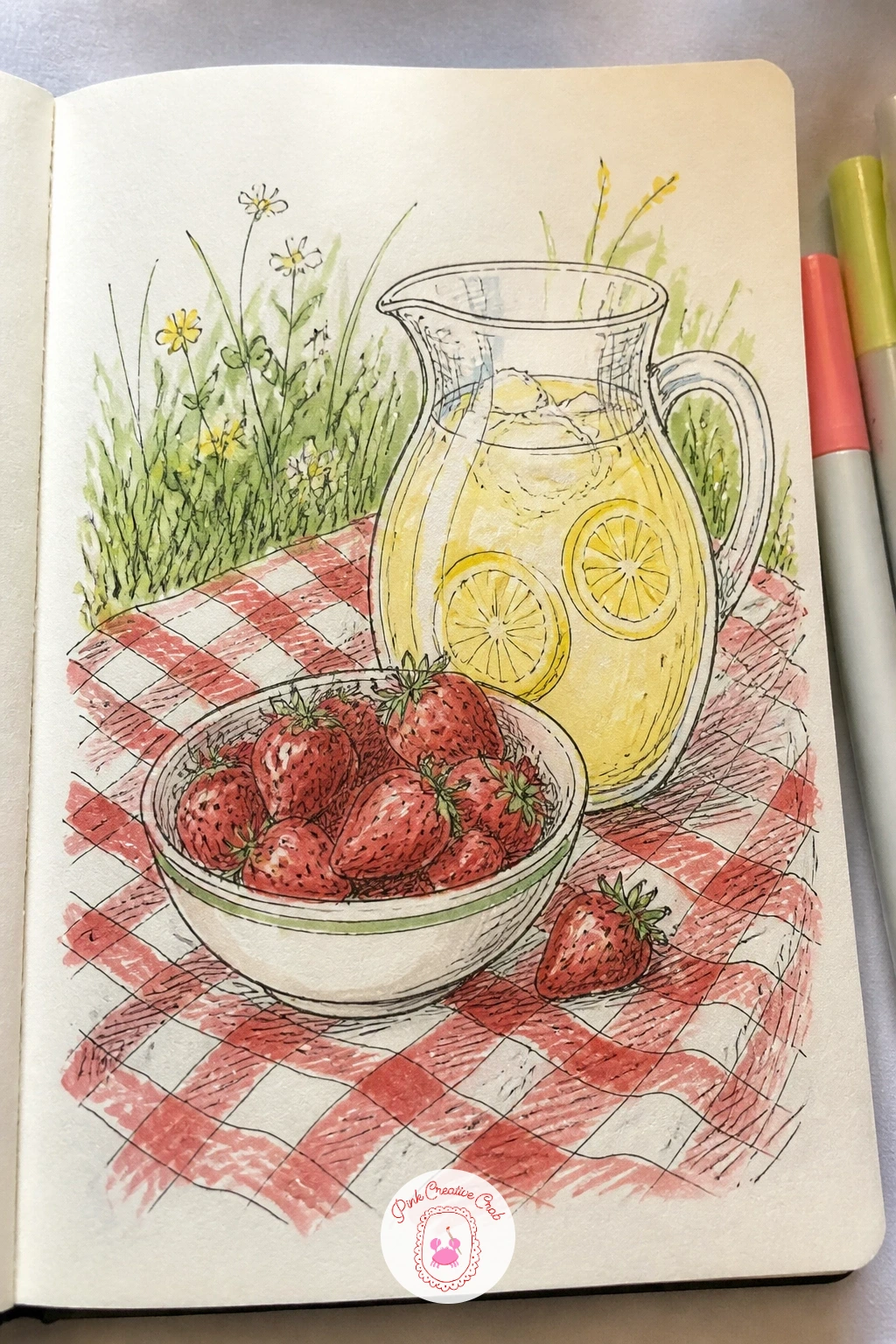
Palette: Cadmium Red,Lemon Yellow,Sap Green,Warm Grey
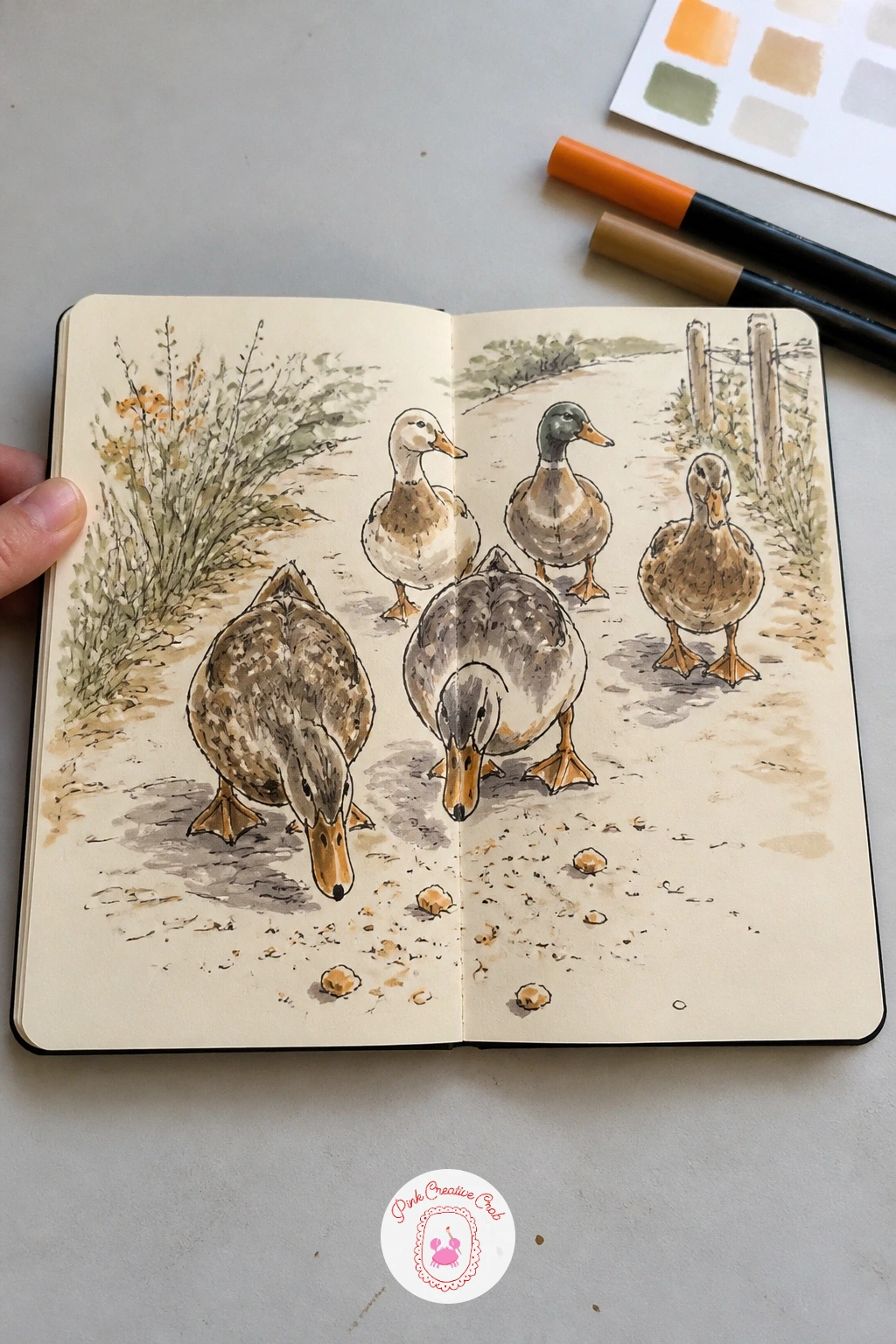
Ducks chasing bread crumbs give you movement without needing a whole landscape behind them. Sketch three or four duck bodies as ovals tilted toward one spot on the ground, where an unseen hand has just thrown crumbs. Angle the necks and beaks all toward that point so the scene reads instantly.
Draw the lead duck with its wings slightly lifted, caught mid-waddle, then add the others a beat behind in simpler poses. Keep legs thin and slightly bent, that is what sells the waddle rather than a stiff standing bird.
Compare the size of the ducks against each other rather than guessing each one from scratch, the closest duck should be noticeably larger than the ones behind it, which keeps the little flock feeling grounded on the path.
Finish with a wash of soft brown and cream for the feathers and a dab of orange for the beaks and feet. A fine white gel pen adds a crumb trail across the ground once the watercolor has dried.
You Will Need
- white gel pen
Palette: Raw Umber,Cream,Burnt Orange,Payne’s Grey
A girl reading under an oak tree works best when you build the tree first and tuck the figure into its shade afterward. Rough in the trunk as a slightly curved vertical, then let the canopy spread out in a loose cloud shape well above the page’s centre line, leaving room below for her.
Draw the girl sitting cross legged or with knees drawn up, back against the trunk, book held low so her face tilts gently downward. Simple shapes work fine here: an oval for the head, soft curves for shoulders and knees, no need for exact anatomy.
The oak canopy is where beginners often tighten up and draw every leaf. Resist that: dab clusters of green with a slightly dry brush instead, letting some cream paper show through, it reads as foliage from a normal reading distance far better than outlined leaves.
If you only have a short break, sketch just the girl and a few branches reaching in from the edge, that quick version still tells the whole story. One useful habit for today: squint at your reference or the scene in front of you to find just three shade values in the tree, light, mid and dark, and stop there.
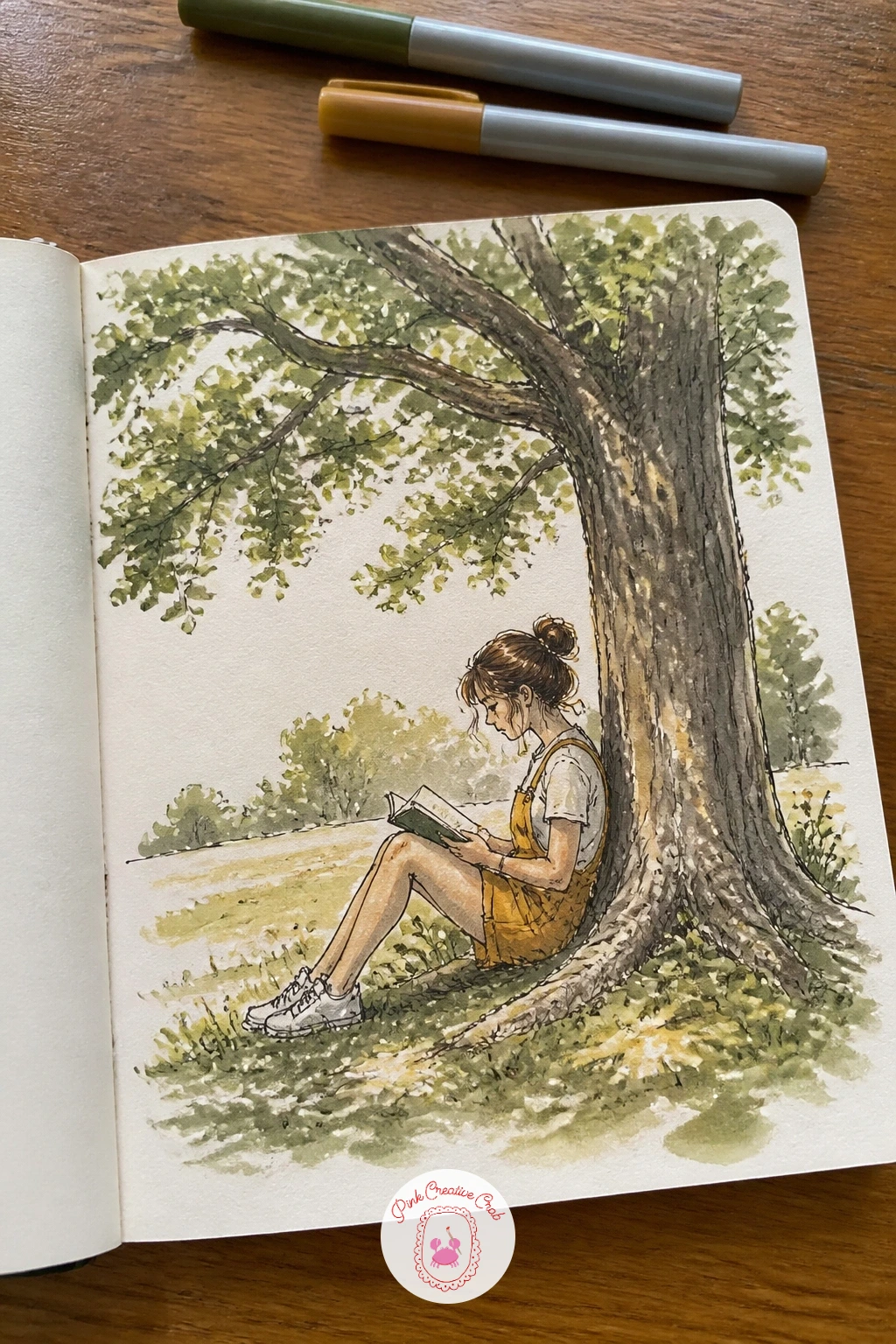
Palette: Hooker’s Green,Burnt Sienna,Soft Ochre,Dusty Pink
Kids flying a kite ask you to think about where the eye naturally travels, which here is straight up the kite string into the sky. Place the two children low in the frame, running or looking upward, and let the kite itself sit high and small near the top edge with plenty of open sky around it.
Draw the kite as a simple diamond with a tail of small triangle flags, this reads clearly even at a small size. The string connecting child to kite is the hardest part: keep it a single loose curve rather than a ruler-straight line, string never stays perfectly taut outdoors.
Give one child a slight forward lean and bent knee to suggest running, and the other standing still watching, this contrast in posture does more work than any detail on their faces. If figures feel stiff, compare the length of an arm to the length of the torso next to it before committing to the line.
Colour the kite in two bold marker shades for contrast against a pale blue-washed sky. A quick ten-minute version can skip the children entirely and show just the kite and string against clouds.
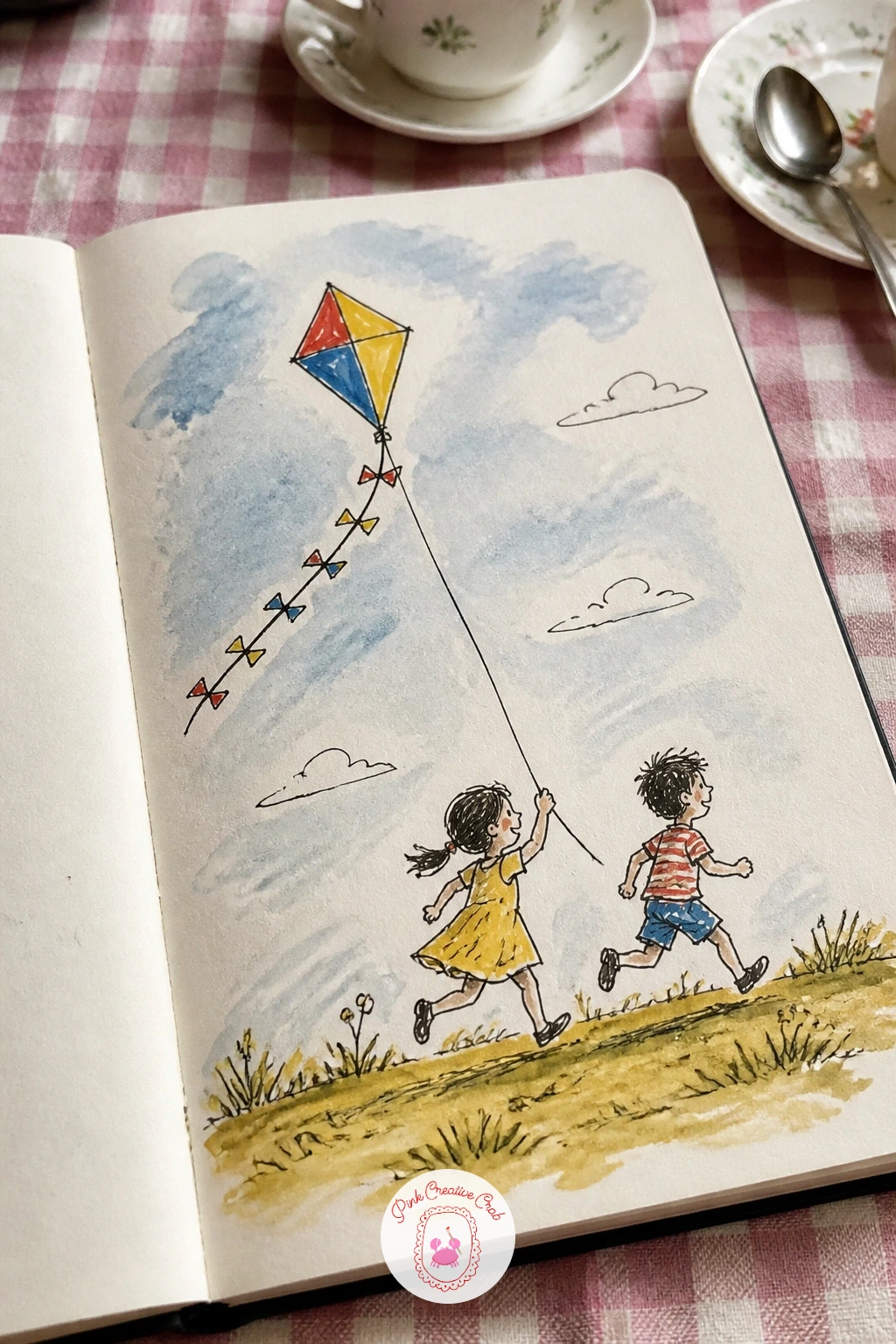
Palette: Sky Blue,Poppy Red,Sunflower Yellow,Grass Green
Try drawing the kite string as two curves instead of one, it gives a bit of slack and sag that makes the wind feel real.
A dog catching a frisbee is one of the liveliest park moments you can put on a page, so let the whole pose lean into that energy. Start with the spine as a single curved line stretching from nose to tail, all four legs and the head follow from that one gesture line.
Draw the frisbee first as a simple ellipse hanging just above the dog’s open mouth, then build the leaping body underneath it: front legs reaching up, back legs trailing behind, ears flopped backward from the speed. Keep the whole silhouette diagonal rather than upright, that diagonal is what reads as a jump rather than a stand.
Fur texture is the easy place to overwork a drawing. Use short flicking fineliner strokes only along the edges of the body, chest, tail, ear tips, and leave the middle of the body as a flat wash of colour, your eye fills in the rest.
A golden or brown marker base with darker brown fineliner strokes on top gives a quick coat without fuss. If you want a calmer version, swap the jump for the dog sitting with the frisbee held proudly in its mouth.
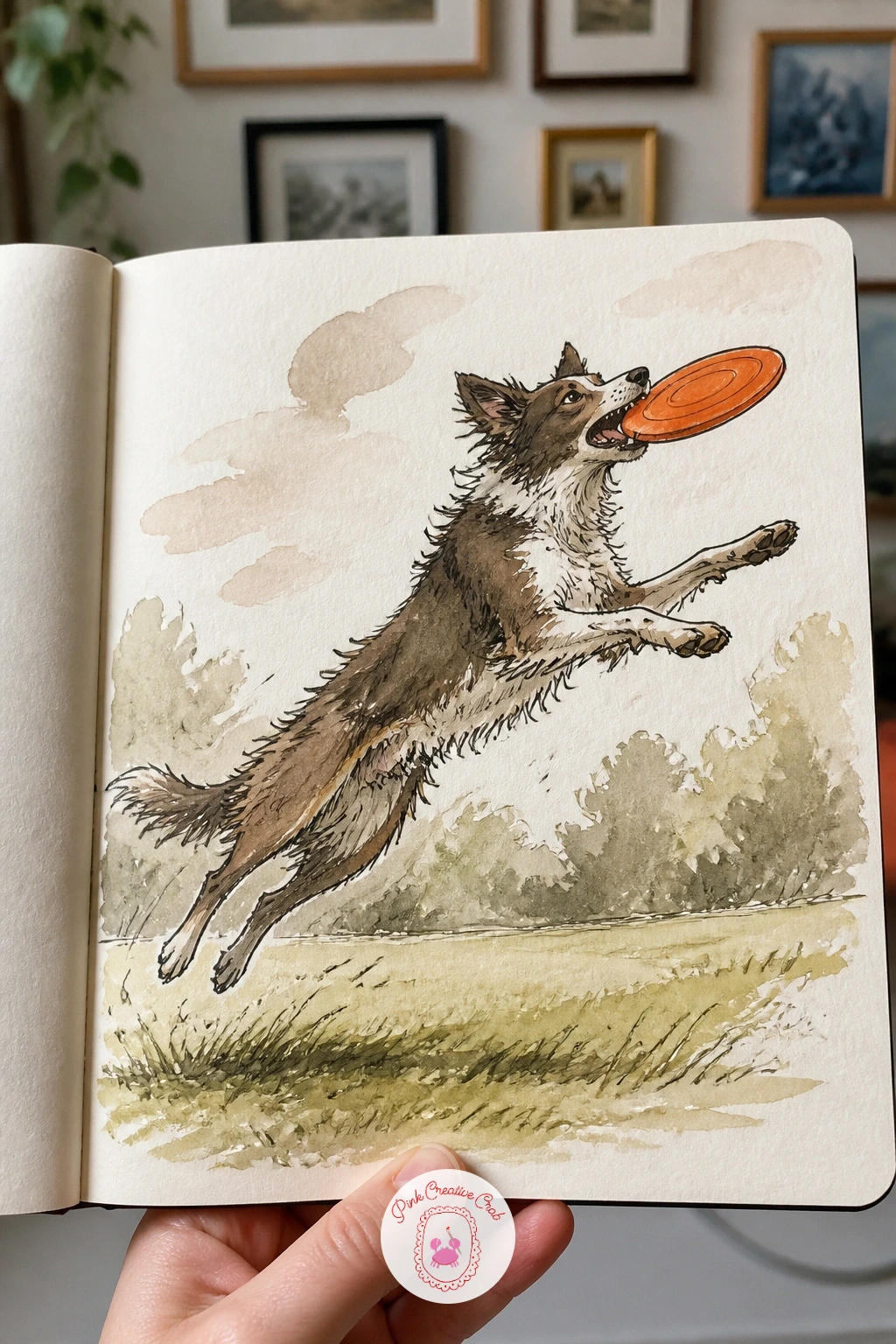
Palette: Golden Ochre,Burnt Umber,Sky Blue,Bright Orange
A rowing boat on the pond is a nice change of pace after busier scenes, since it lets the water do most of the talking. Draw the boat’s hull as a simple curved trough shape sitting low on the horizon line of the pond, with one or two figures as soft rounded shapes inside it holding thin oar lines out to each side.
Eye level matters most here: if you draw the pond from a bench at normal sitting height, the far shore sits as a fairly flat band not far above the boat, and the water stretches wide in front of you rather than up a steep slope. That low eye line is what makes a pond feel calm and close.
For the water, lay down a flat blue-grey wash first, then once it has dried, add a few short horizontal fineliner lines near the boat to suggest ripples spreading outward. Too many ripple lines everywhere makes the water look busy, so keep them concentrated near the hull.
If the sky is overcast in your scene, let that light come from above and slightly behind, so the boat and figures sit a touch darker underneath, which grounds them nicely on the water. For an easier version today, skip the ripples entirely and let the flat wash carry the whole pond.
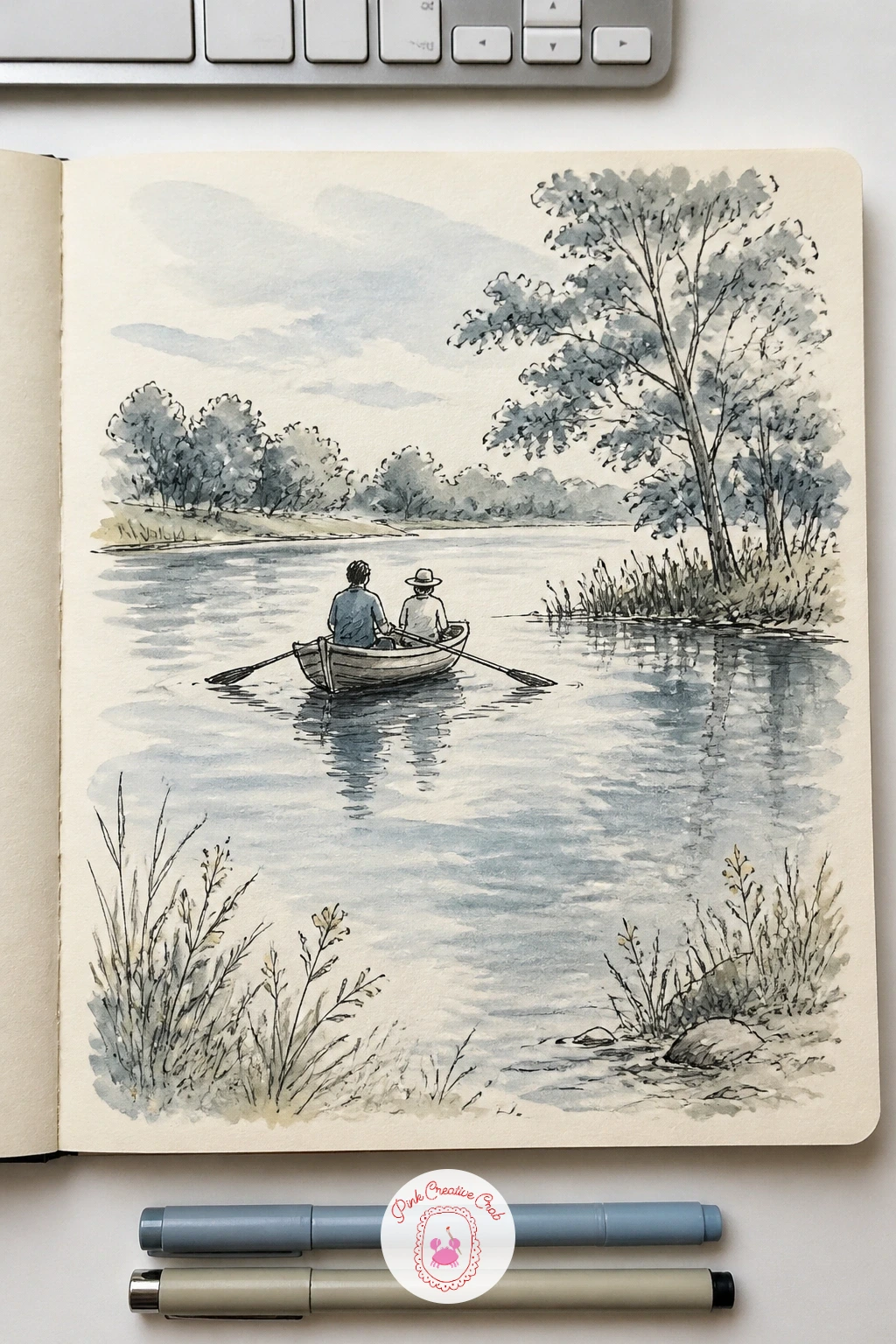
Palette: Payne’s Grey,Cerulean Blue,Warm Grey,Soft Green
An ice cream cart with a queue gives you a nice excuse to draw a handful of different little figures in one go. Start with the cart itself, a simple box shape with a striped umbrella on top and a small serving window, then build the queue as a row of people standing at slightly different heights and angles so nobody looks like a repeated cut-out.
Vary each figure with one small change: a hand on a hip, a child tugging a parent’s sleeve, someone checking their phone. You do not need faces beyond a simple dot or two, posture alone tells the whole queue story.
The striped umbrella is the fun detail to push further if you want a more involved version: alternate two marker colours along each panel and let the stripes curve slightly to follow the umbrella’s dome, flat straight stripes look pasted on rather than three dimensional.
A quicker ten-minute version keeps the cart and just two people waiting rather than a full queue. Either way, finish with one bold-coloured ice cream cone held up in someone’s hand, it gives the eye something sweet to land on.
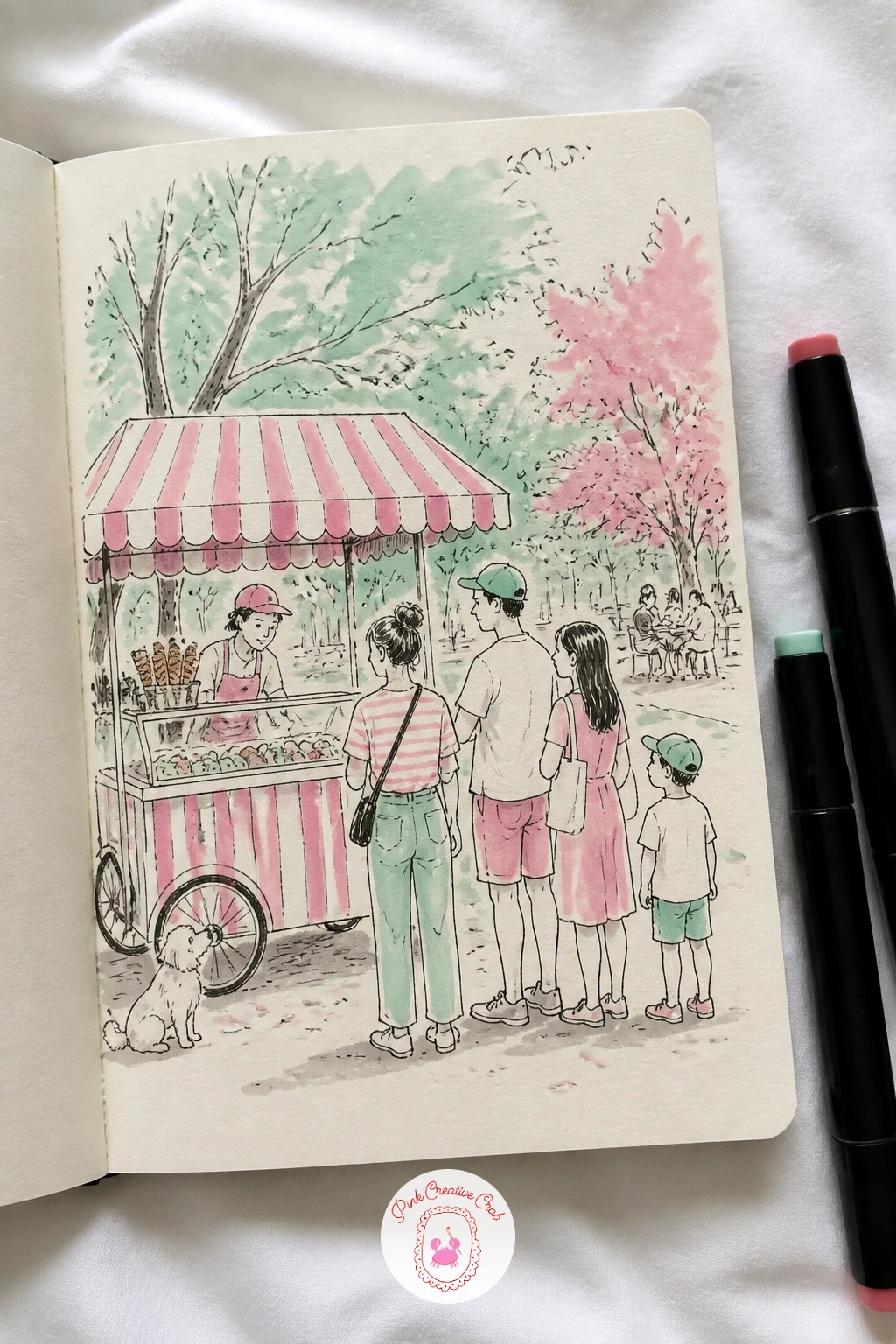
Palette: Bubblegum Pink,Mint Green,Cream,Chocolate Brown
A couple sharing headphones on a bench is a quiet, warm little scene that rewards a slower hand. Draw the bench first as a simple set of horizontal slats on two legs, then seat the two figures close together, shoulders touching, one earbud cord running between them.
Keep both figures relaxed: slightly slouched shoulders, one leg crossed over the other, heads tilted toward each other rather than straight ahead. This small lean is what makes the pair feel like a couple rather than two strangers who happen to share a bench.
Hands and feet are the easiest place for this scene to go wrong, so simplify them deliberately: mitten-shaped hands resting in laps, shoes as simple rounded wedges, nothing needs more detail than that at this stage. If a hand looks off, cover it with a sleeve or a coffee cup instead of erasing and redrawing endlessly.
Wash in soft warm tones for the clothing and let the bench stay a plain brown, no need for wood grain detail. For a quicker version, draw just their upper bodies and the bench back, cropping out the legs entirely still tells the story.
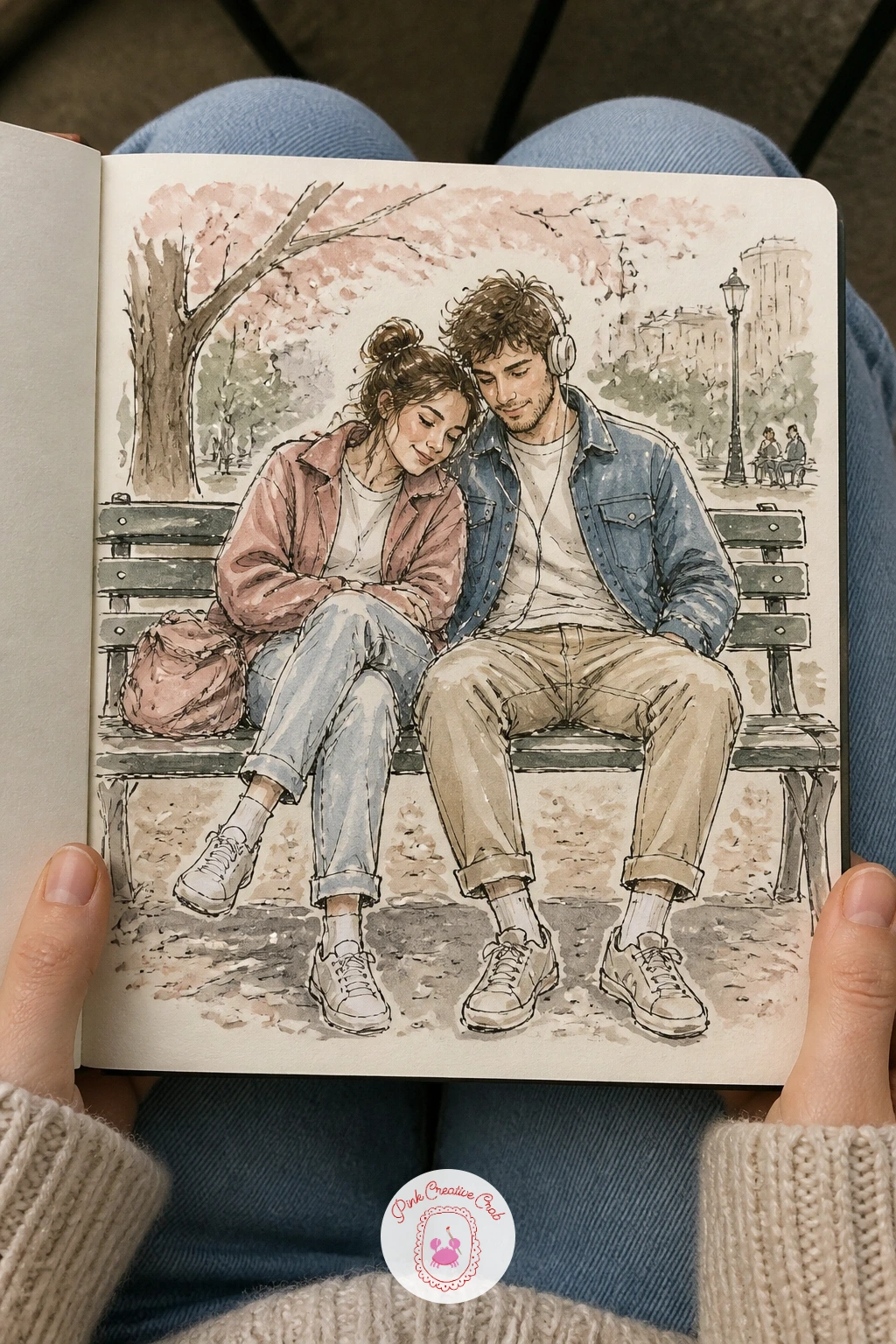
Palette: Dusty Rose,Soft Denim,Warm Brown,Cream
A toddler feeding swans pairs a very small figure against a large elegant bird, and that size difference is most of the charm. Draw the swan first, an elongated S-curve for the neck rising from a rounded body, then place the toddler much smaller beside it, arm outstretched with a piece of bread held between finger and thumb.
Toddlers read best as round rather than angular: a round head, round tummy under a little coat, short stubby legs. Avoid giving the figure adult proportions, the head should look large compared to the body, that is what makes it read as a child from across the page.
The swan’s neck is the one line worth practising a few times on scrap paper before committing, since a slightly wrong curve can make the whole bird look awkward. Picture the letter S lying on its side and trace a looser version of that shape.
White gel pen over a light grey watercolor base gives the swan’s feathers a nice soft sheen without much fuss. If you do not have gel pen, simply leave the swan’s body as bare white paper and outline it in fineliner only.
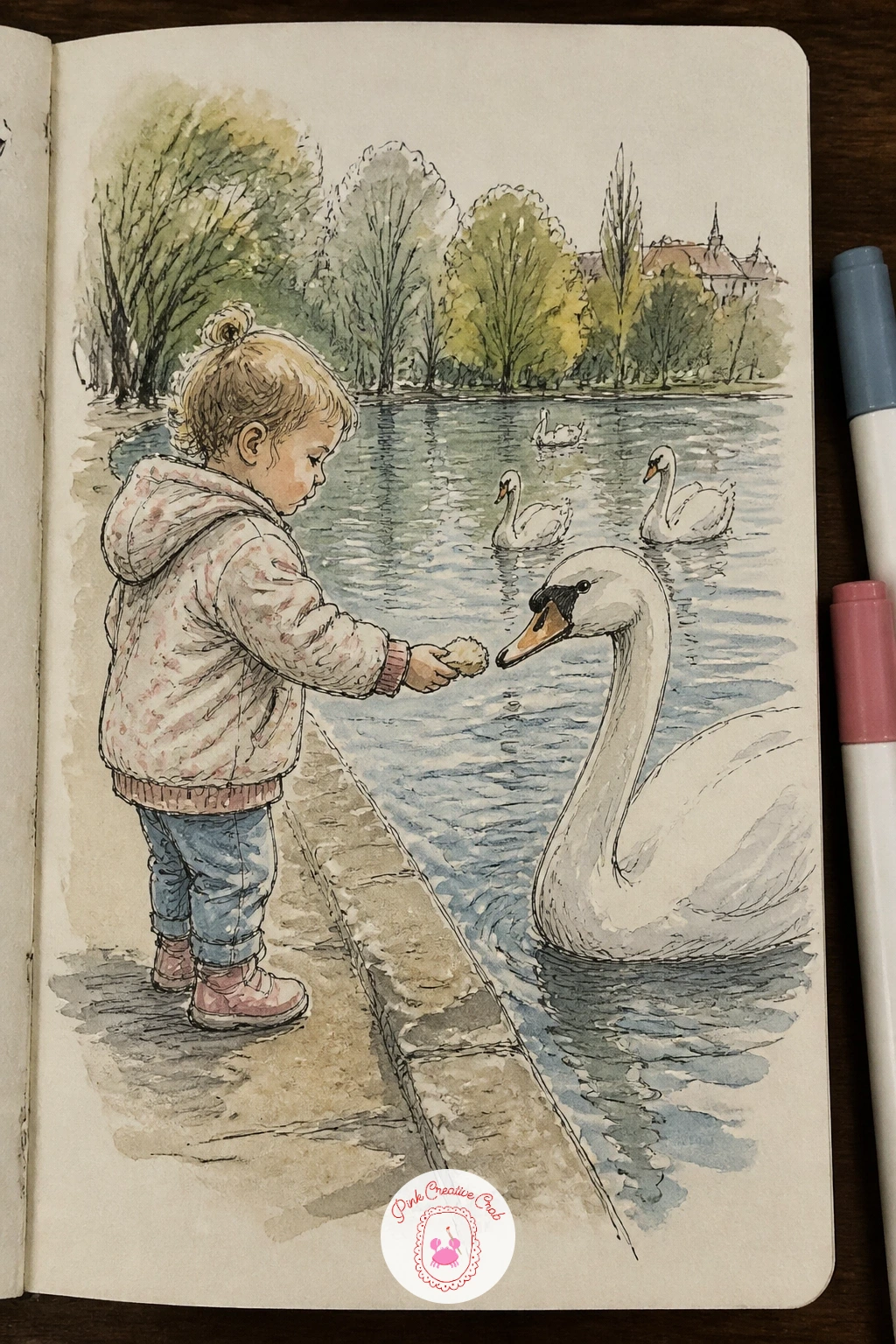
You Will Need
- white gel pen
Palette: Light Grey,Soft Orange,Baby Blue,Cream
A jogger with a pug is a fun contrast in pace, a stretched-out running figure paired with a small dog trotting as fast as its legs allow. Draw the jogger’s body leaning slightly forward with one leg extended ahead and the other bent behind, arms pumping at the elbow, this lean is what reads as motion rather than a standing pose.
The pug trots a little behind on a short leash, body low to the ground with legs in a quick scurry. Keep its face simple: a few wrinkle lines across the forehead and a round snout are enough to read as a pug without overworking the features.
Compare the jogger’s leg length to their torso before finalising the pose, runners often get drawn with legs too short, which flattens the sense of stride. A slightly longer leg than feels natural usually looks more correct on the page.
Leash and lead work well as a single loose curved line with a little slack in it rather than pulled taut. Finish with a quick wash of athletic colours, a bright top for the jogger and warm fawn for the pug, and you have a lively ten-minute page.
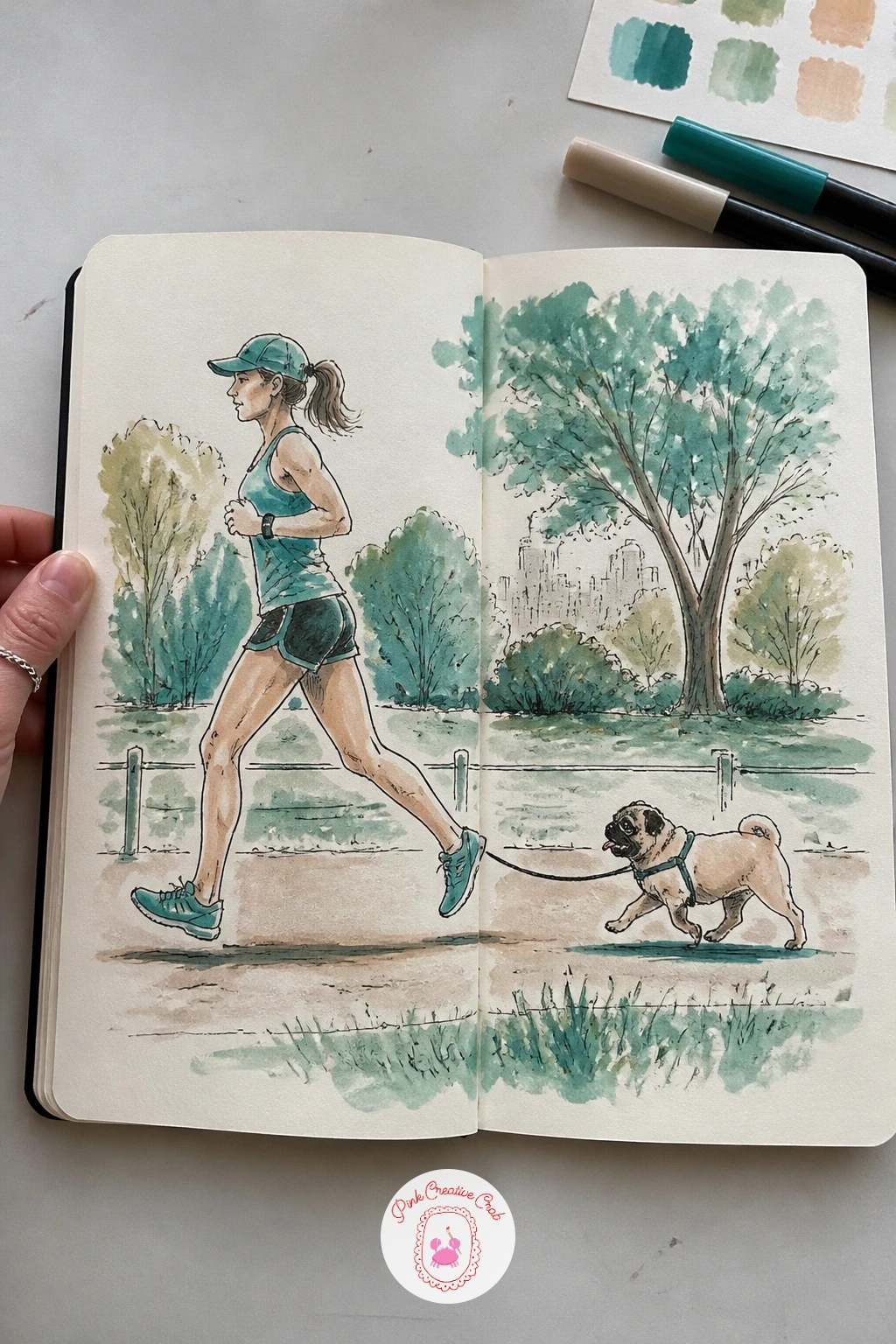
Palette: Fawn,Charcoal Grey,Bright Teal,Cream
A bandstand with a small brass band is more ambitious than most pages here, so give yourself a little more time for this one. Start with the bandstand’s domed roof and the ring of thin posts holding it up, drawn with a slight curve so the structure feels round rather than flat.
Inside, place three or four musicians at different heights and angles, one standing with a trumpet raised, another seated with a drum, keeping each figure simple: round heads, rectangular torsos, instruments as basic geometric shapes, a circle for a drum, a curved tube for a horn.
Light in an outdoor bandstand usually comes from above and slightly to one side, so keep the shaded side of the roof and the figures under it a touch darker in your wash, this single light decision makes the whole structure sit together convincingly.
Gold and brass tones on the instruments against the cooler grey of the bandstand roof give a nice bit of sparkle without needing fine detail, just a dab of yellow-gold where metal would catch the light. For a simpler version today, draw just the bandstand roof and one musician rather than the full group.
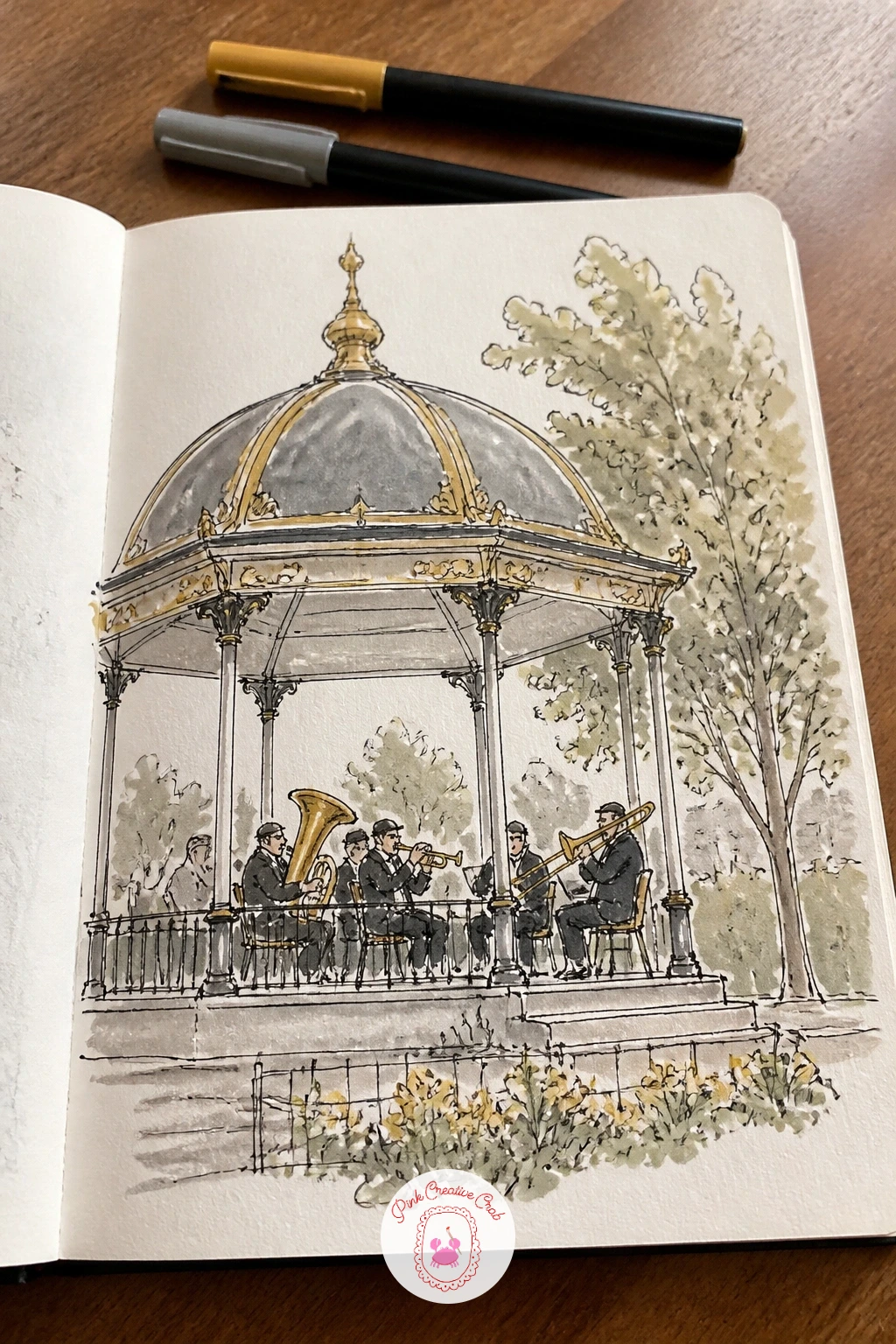
Palette: Antique Gold,Slate Grey,Forest Green,Cream
A picnic basket raided by a squirrel turns an ordinary still life into a tiny story, which makes it an easy one to enjoy drawing. Start with the basket itself, a simple woven rectangle with a looped handle, lid tipped open at an angle as if just pushed aside.
Perch the squirrel on the rim, back arched, tail curled high, front paws clutching something stolen, a strawberry or a corner of bread works well. Squirrel tails are the fun part: draw the tail as a large soft puff rather than a thin line, it should look nearly as big as the squirrel’s body.
Basket weave texture can easily become repetitive and flat if you draw every strand. Instead, suggest the weave with short diagonal fineliner marks only along the top edge and a few spots on the sides, leaving the rest as a plain wash of brown, the eye completes the pattern.
A warm tan wash for the basket and a soft grey-brown for the squirrel keeps the palette calm so the stolen strawberry’s red pops. If you want a quicker version, just draw the squirrel’s head and paws peeking over the basket rim.
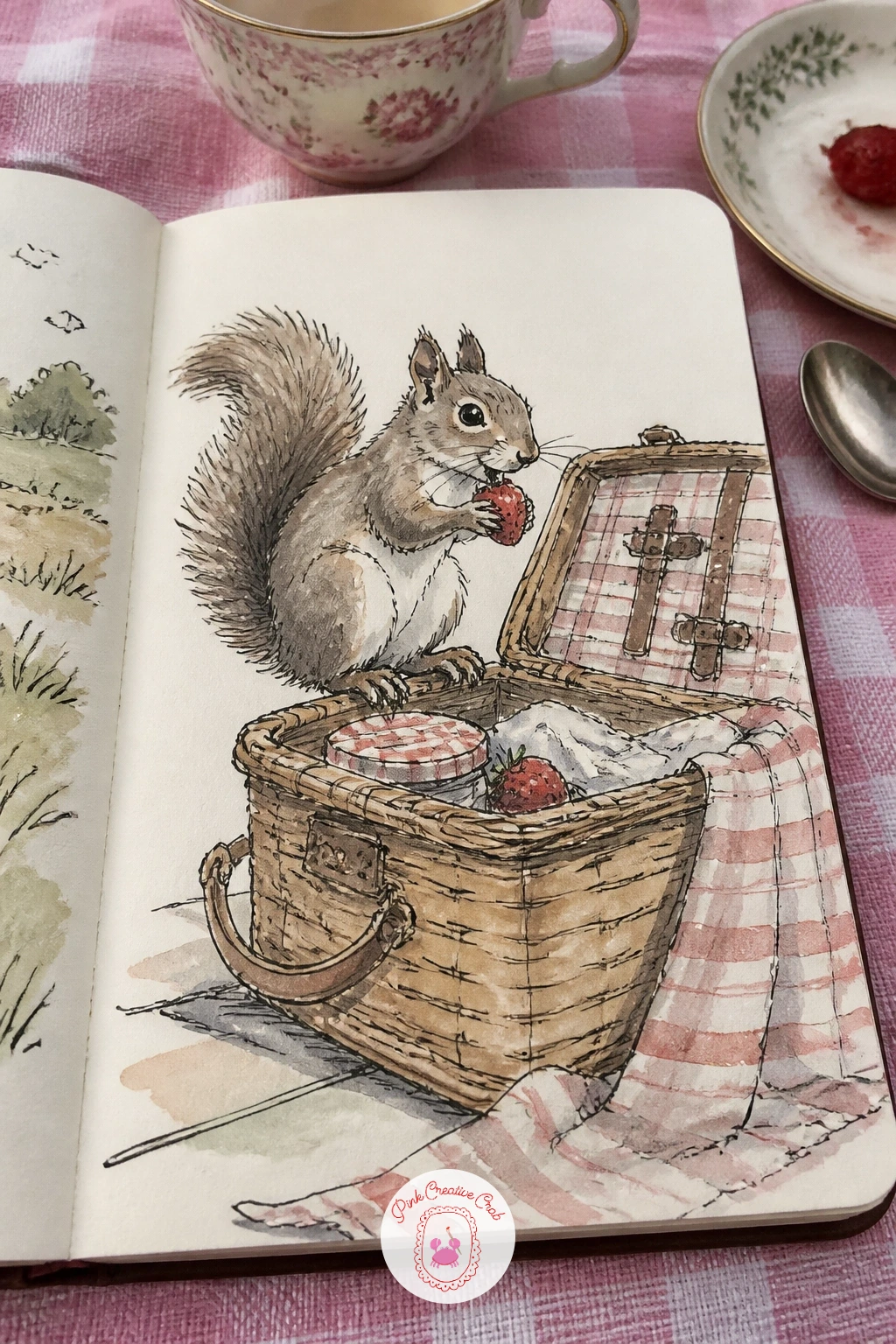
Palette: Warm Tan,Grey Brown,Cadmium Red,Cream
Friends playing badminton gives you two figures locked in a single moment, which makes the composition fairly simple once you settle on the pose. Draw both players facing each other across an implied net, one mid-swing with racket raised high and the other crouched low, ready to return, and let the shuttlecock sit as a tiny shape between them.
Exaggerate the swinging player’s lean, back foot lifted slightly, arm fully extended, this stretch is what sells the action far more than an accurate racket shape. The crouching player, by contrast, stays compact with bent knees, a nice visual contrast between the two poses.
Rackets and shuttlecocks are small enough to lose definition fast, so draw them last once the bodies are settled, a simple oval frame with thin crossed strings is plenty for the racket, and a small cone shape works for the shuttlecock.
Bright sporty colours for the outfits against plain green grass make this page feel cheerful without much blending. For a calmer variation next time, try the same pose with tennis rackets instead and a low net strung between two posts.
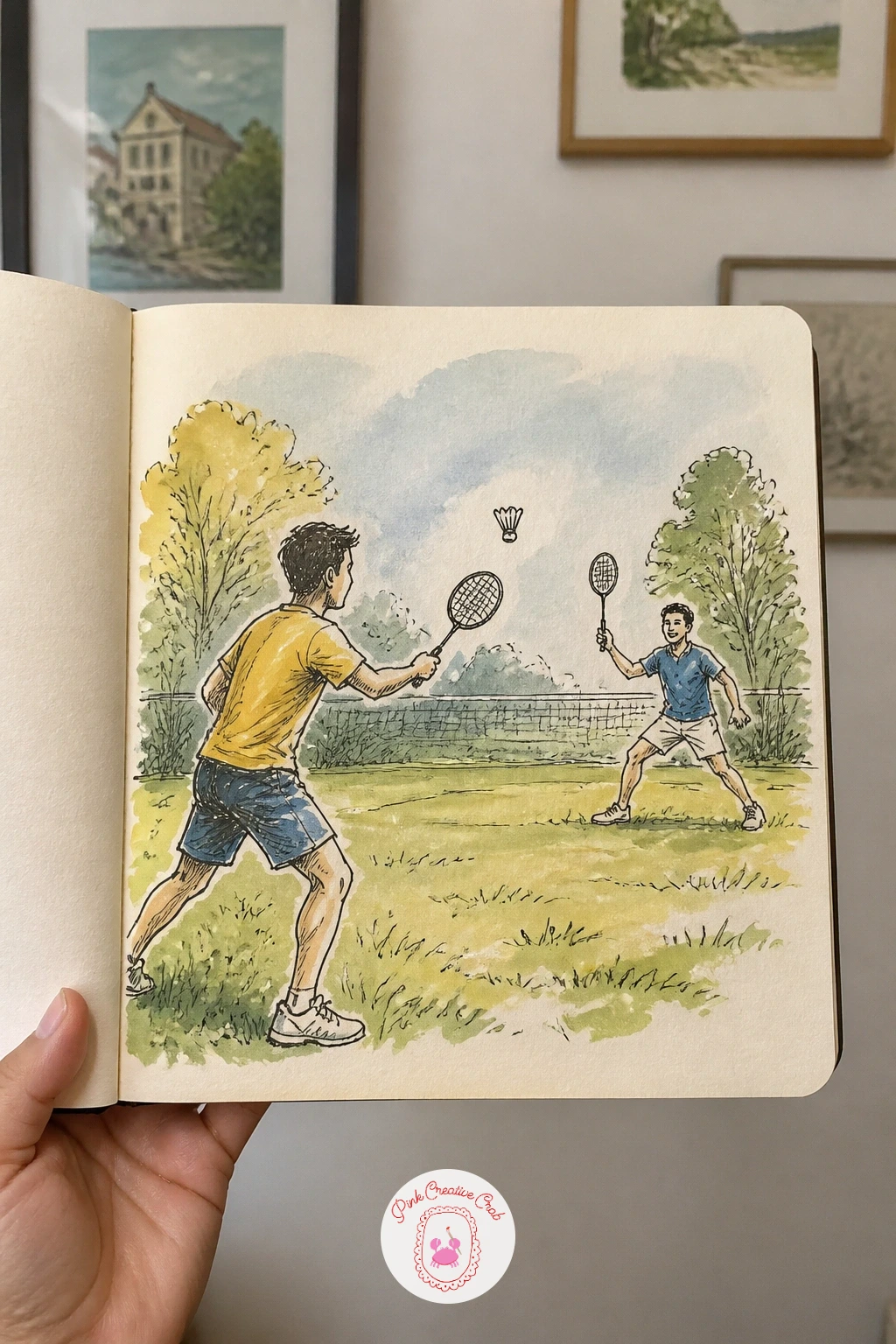
Palette: Bright Yellow,Cobalt Blue,Grass Green,White
A hammock between two trees is a relaxed subject that rewards a loose, unhurried hand, fitting for the lazy mood it shows. Start with the two tree trunks as the frame of the whole page, placed well apart, then let the hammock hang as a deep curved line slung between them, sagging lowest in the middle where a figure rests.
Draw the person lying in the hammock as a simple elongated shape, knees slightly bent, one arm trailing over the side, following the same curve as the hammock fabric itself. Letting the body echo the hammock’s sag rather than lying perfectly straight is what makes the pose convincing.
Fabric folds along the hammock’s edge are the detail worth taking slowly: a few soft curved lines radiating from where the body’s weight presses down, rather than straight parallel lines, suggest the give in the material.
A striped hammock in two alternating colours adds a cheerful pop against plain green grass below. For a shorter session, skip the figure and draw the empty hammock swaying gently between the trees instead.
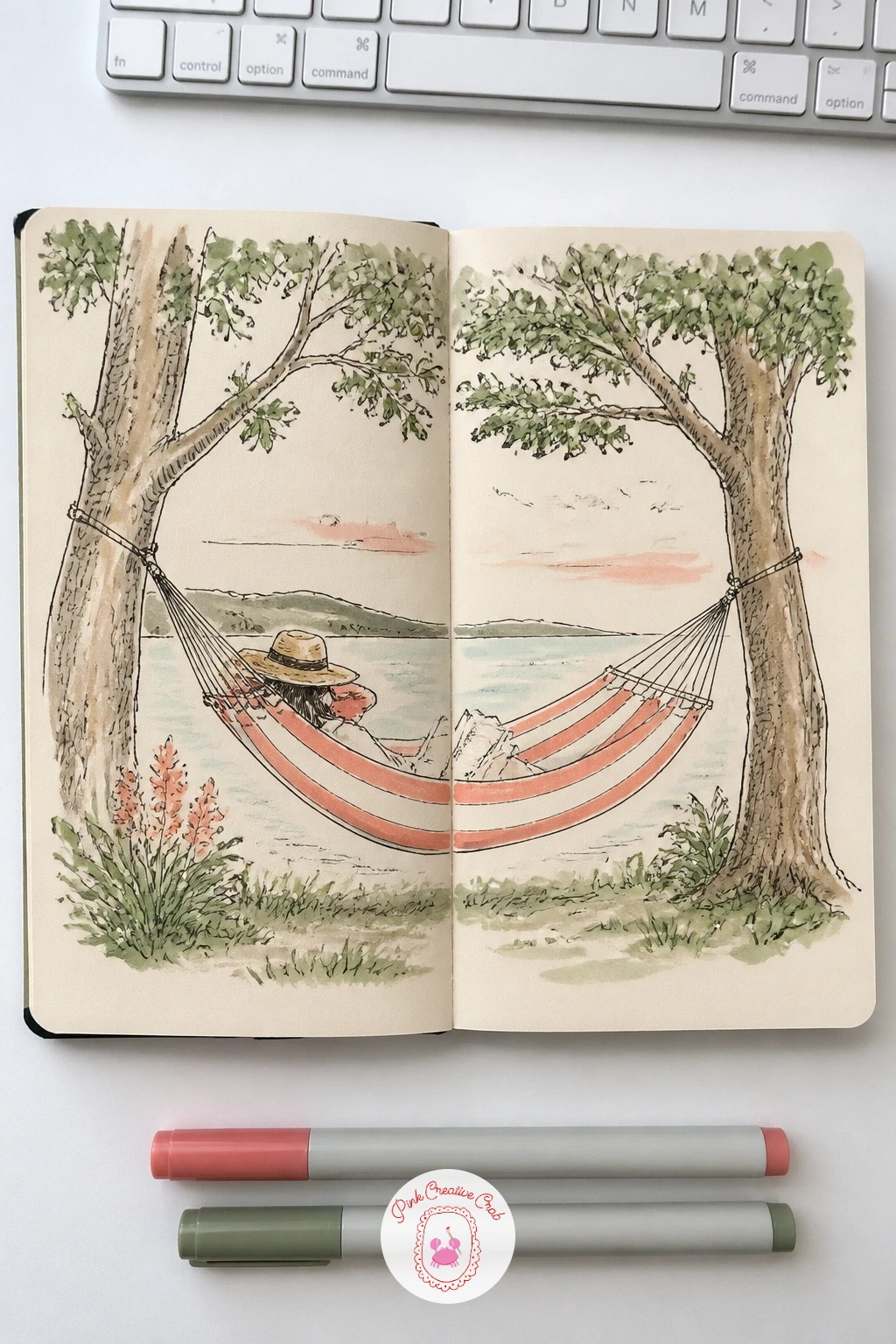
Palette: Coral,Cream,Forest Green,Burnt Sienna
A pram under blossom trees pairs a simple rounded object with one of the prettiest backdrops the park offers each spring. Draw the pram first, a soft rounded basket shape on slim wheels, parked beneath a tree whose branches you sketch as a few thin curving lines reaching up and out of frame.
Blossom is where this page comes alive: dab small clusters of pale pink with a slightly dry brush along the branch lines rather than painting a solid canopy, leaving plenty of cream paper visible between clusters so the petals feel light and scattered, even drifting down near the pram.
Keep the pram itself fairly plain and let the blossom do the decorative work, a busy pram pattern competing with busy blossom will fight for attention. A single soft fabric colour on the pram hood is enough.
If you want to add a figure, a parent standing just beside the pram, hand resting on the handle, finishes the scene without crowding it. A quick swap if pink is not to hand: white blossom with a pale green wash reads just as spring-like.
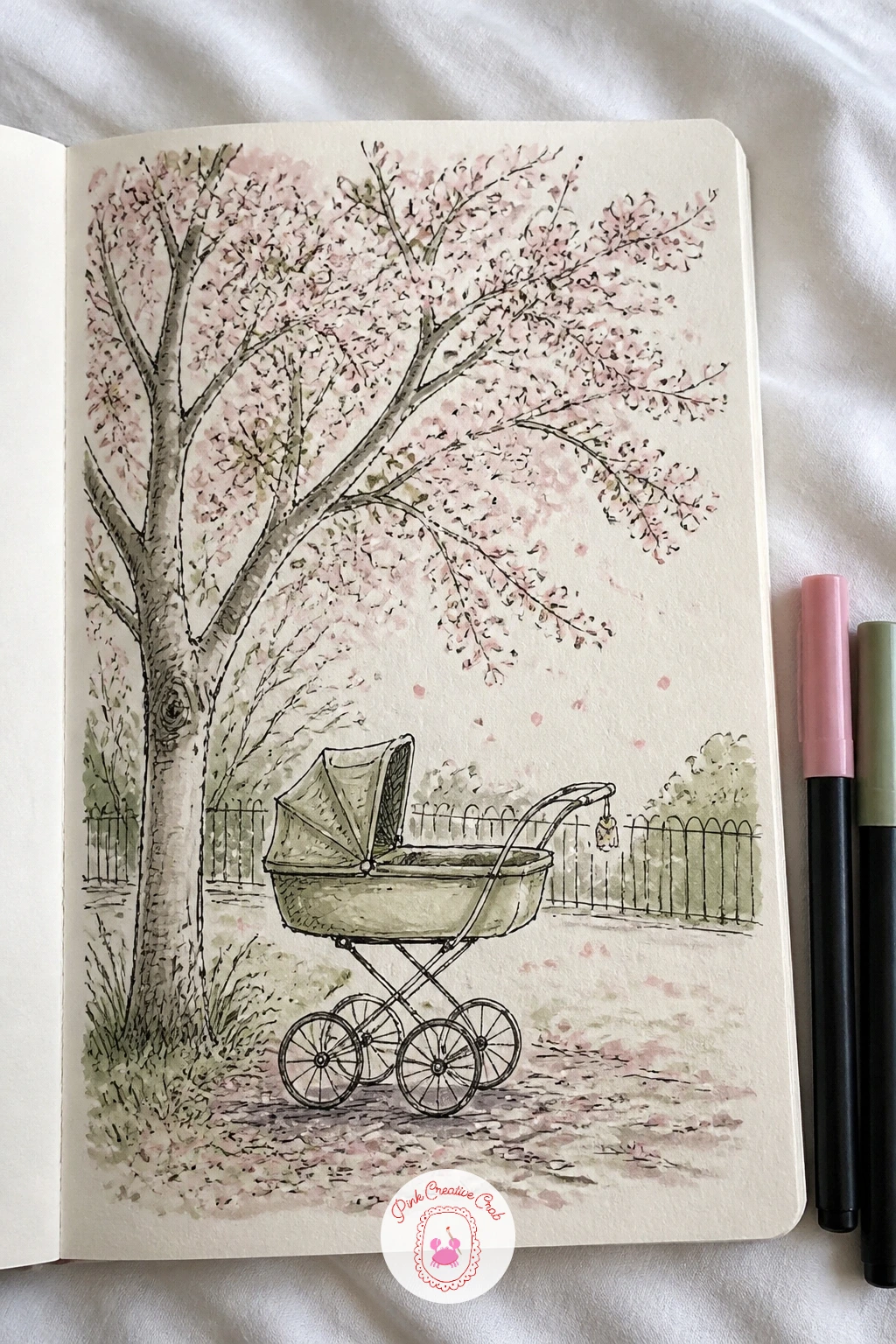
Palette: Blossom Pink,Soft Sage,Warm Grey,Cream
Try flicking the brush slightly as you dab the blossom clusters, the irregular edge looks far more natural than a neat round dot.
A painter at an easel by the water lets you draw a scene within a scene, which is a satisfying little trick for a sketchbook page. Set the easel up facing the pond, legs splayed in a simple tripod, canvas shown from the side as a thin rectangle, and the painter standing or seated just behind it with one arm raised toward the canvas.
Think about where the light falls before you commit to shading: if the sun sits behind the painter, their own shadow stretches forward across the grass toward the viewer, and the side of the canvas facing you stays in gentler light, a nice bit of logic that makes the whole page feel considered.
The canvas itself does not need a finished painting on it, a few quick dashes of colour suggesting a sketched-in pond view is plenty, overworking this tiny detail steals time from the rest of the page.
Keep the painter’s outfit loose and comfortable, a smock or an apron with a paint-smudged look painted on with a few quick dabs. For a simpler version, crop the scene to just the easel and canvas, implying the painter stepped just out of frame.
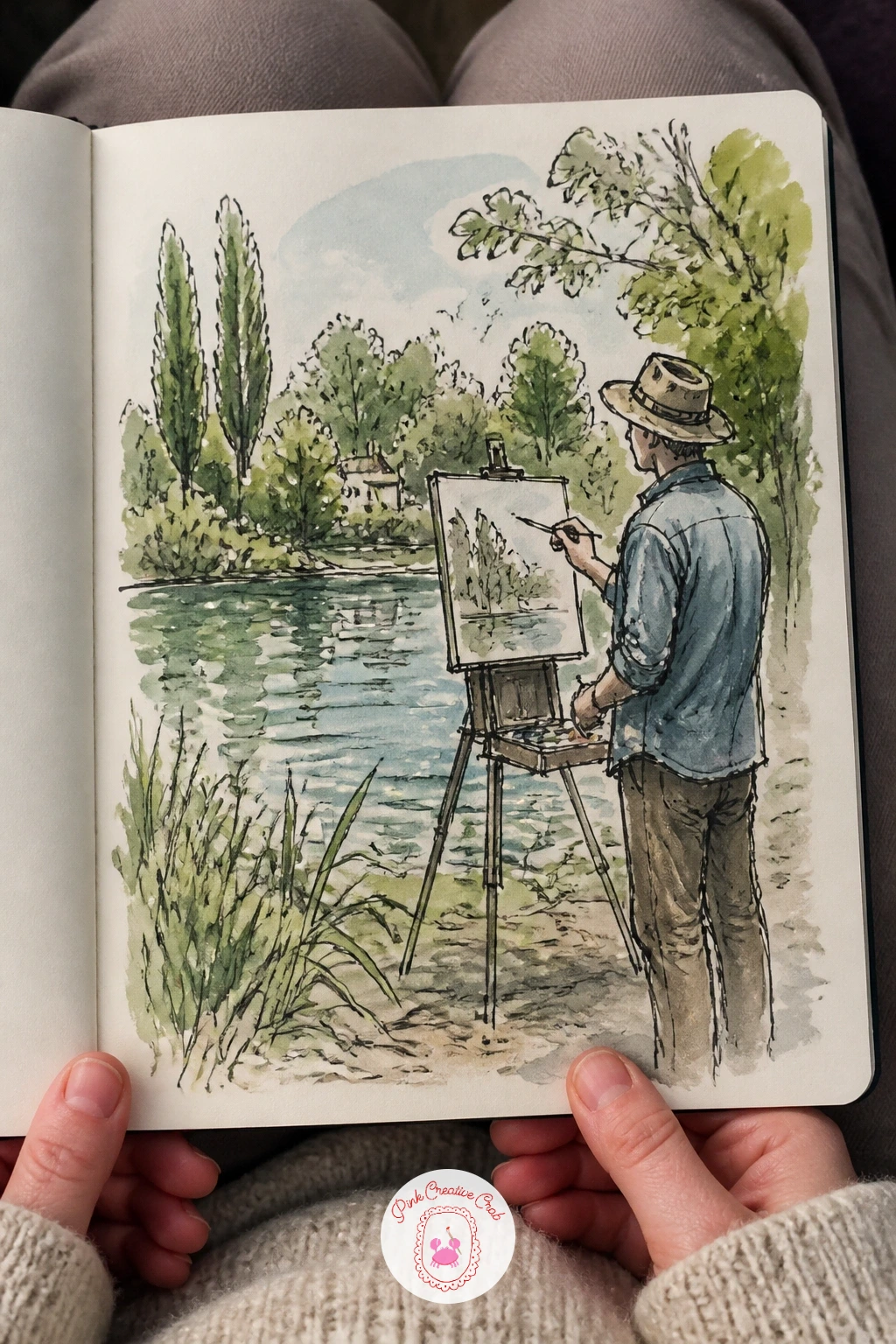
Palette: Cerulean Blue,Burnt Sienna,Soft Green,Cream
A croquet game on the lawn is a nice quiet contrast to some of the busier action scenes, built mostly from simple geometric pieces scattered across green. Draw a row of small wire hoops first, each a thin curved arch pressed into the grass, spaced unevenly across the page to suggest the course winding away from the viewer.
Add two or three players next, one bent forward mid-swing with a mallet, others standing nearby watching, and place a few brightly coloured balls near the hoops, each a simple circle in a different solid colour, red, yellow, blue.
Compare the size of the hoops in the foreground against those further back, the closer hoops should sit noticeably larger and lower on the page, which is what gives the lawn its sense of stretching into the distance.
Mallets are easy to overcomplicate, keep them as a simple long handle with a short crossbar head, no more detail needed. A quicker version today could show just one hoop and one ball mid-roll toward it.
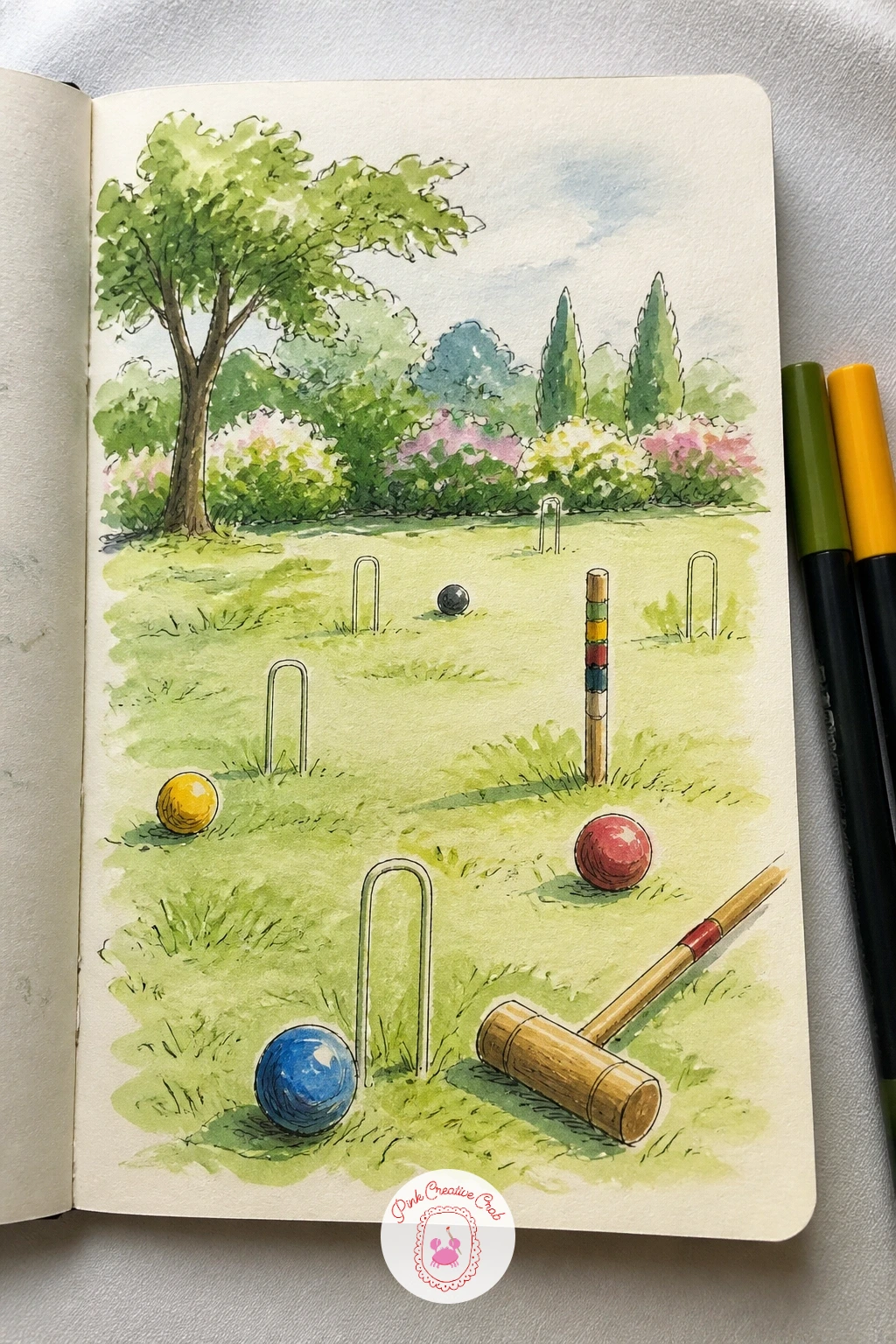
Palette: Grass Green,Poppy Red,Sunflower Yellow,Sky Blue
A bike leaning on a lamppost is a calm, object-focused page after a run of busy figures, and a good one for practising clean linework. Draw the lamppost first as a single tall vertical with a simple lantern shape on top, then lean the bike’s frame against it at a gentle diagonal, front wheel turned slightly inward where it rests against the post.
Bicycle wheels trip people up more than anything else in this scene. Rather than drawing every spoke, lightly pencil a circle, then add just six or eight straight lines radiating from the centre hub, spaced roughly evenly, it reads as a full wheel without the fuss of a precise count.
A wicker basket on the front, with a few flowers spilling out, adds a lovely cottage-park feel and gives you a soft organic shape to contrast with all the bike’s straight lines and circles.
Keep the bike frame in one confident colour and let the lamppost stay a plain dark grey or black, this contrast keeps the bike as the clear focus of the page. If you are short on time, the bike alone against a plain background still makes a charming quick study.
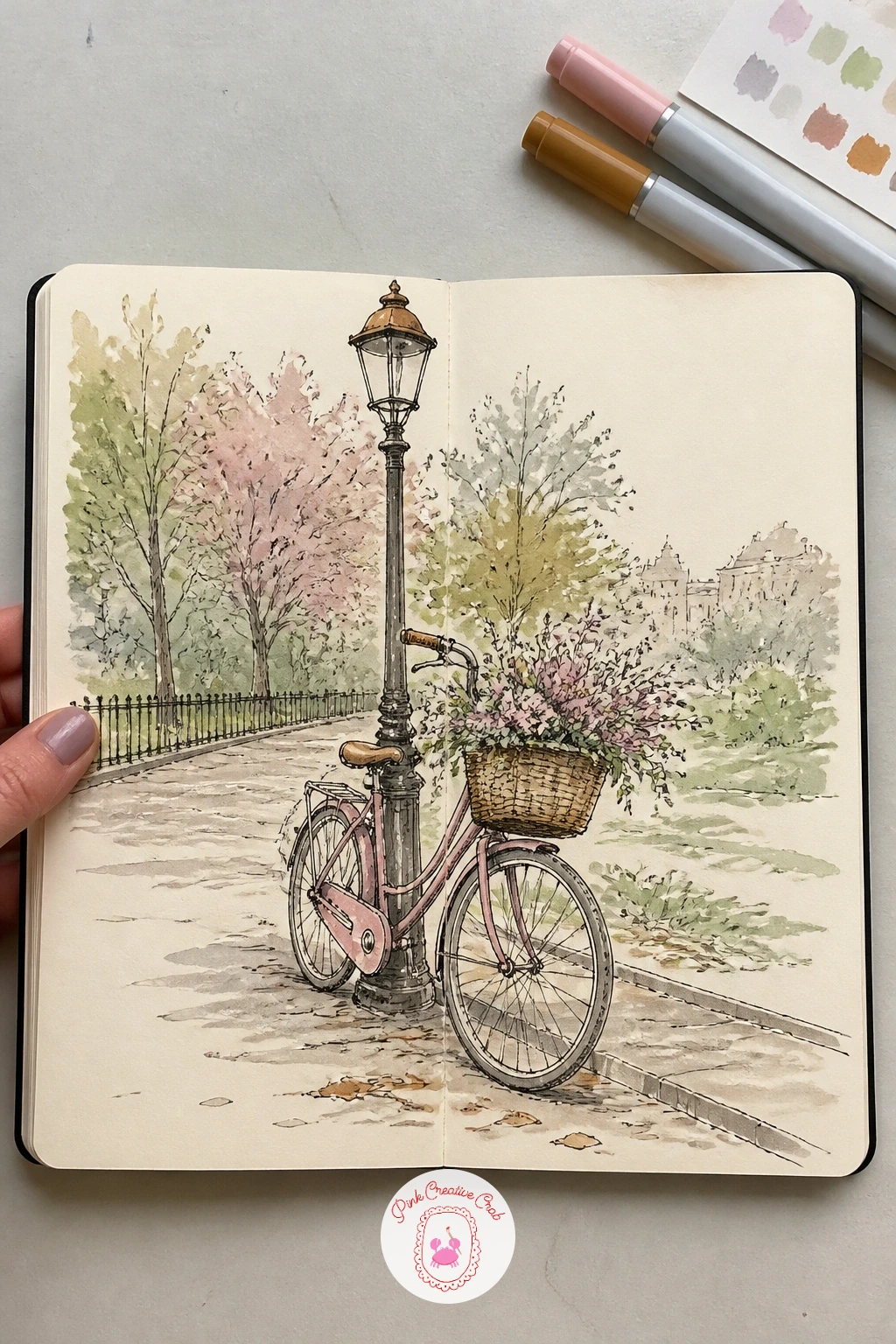
Palette: Charcoal Grey,Rust Red,Blossom Pink,Cream
Geese crossing the path is a fun little traffic-jam moment, a line of birds holding up anyone walking by, and it builds nicely on the duck drawing from earlier in this list with a slightly larger, more confident bird. Draw a row of four or five geese in a loose single file, necks held upright and slightly forward, legs mid-stride at different points so the line feels like it is actually moving rather than standing still.
Give the lead goose a slightly open beak, as if honking at someone to wait, this one small detail adds personality to the whole group without extra drawing elsewhere.
For a loose, quick texture on the feathers, try a dry brush loaded with very little water and grey paint, dragged lightly across the body shapes, it leaves a broken, feathery texture far faster than drawing individual feather lines.
Keep the path itself simple, a pale strip of beige or grey running across the lower third of the page, with grass on either side. If grey paint is not in your kit, a soft brown dry-brushed the same way gives a similar feathered effect.
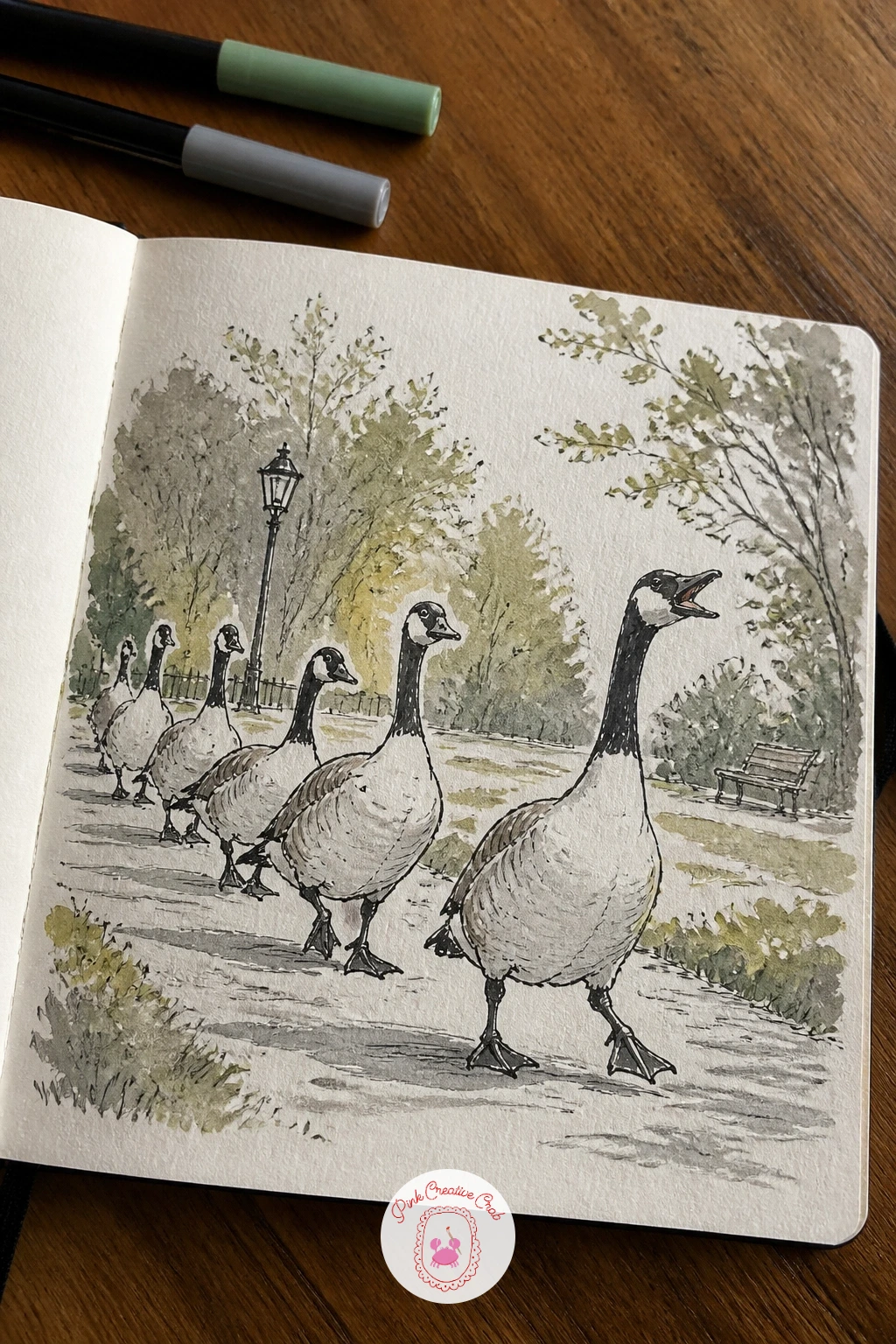
Palette: Slate Grey,Burnt Orange,Soft Beige,Grass Green
A sun hat blowing into the pond captures one of those small comic accidents that make a sketchbook page memorable. Draw the hat mid-flight, brim curved upward on one side as if caught by a gust, positioned just above the pond’s surface where it is about to land, with a ribbon trailing behind it in a loose curved line.
Add a figure reaching after it from the pond’s edge, one arm outstretched, body leaning forward off balance, this slightly exaggerated lean is what makes the moment read as urgent rather than posed.
The water around the point of impact is where you can have some fun with edges: let the pond’s flat colour wash bleed slightly where the hat will land, then once mostly dry, drop in a little extra water right at that spot so the pigment blooms outward, mimicking a ripple forming.
A straw-coloured hat with a bright ribbon stands out nicely against the cooler pond tones. For a simpler version, skip the reaching figure and just show the hat tumbling through the air above the water.
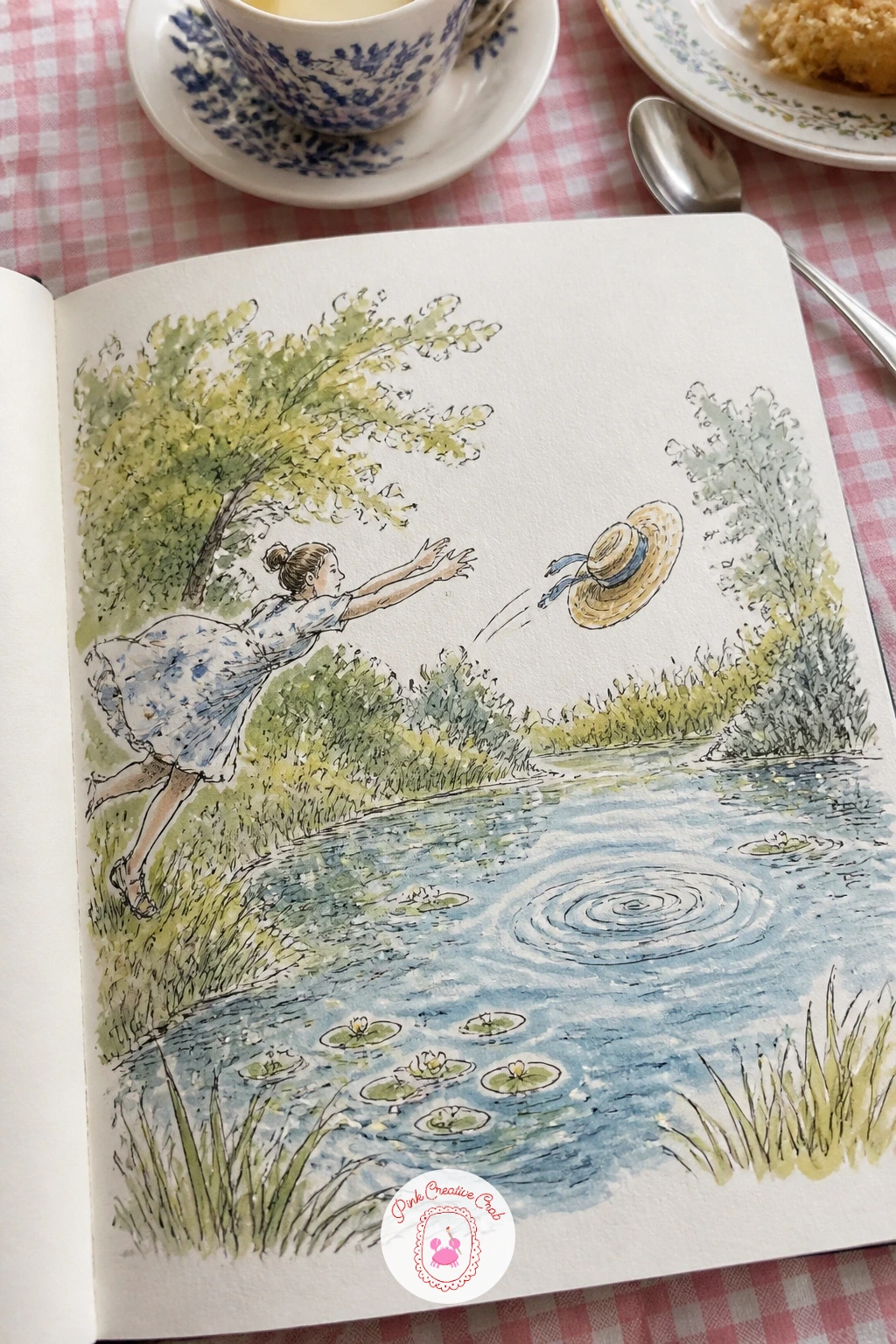
Palette: Straw Yellow,Poppy Red,Cerulean Blue,Payne’s Grey
Dropping clean water into a damp wash is called lifting and blooming, keep a dry tissue nearby to blot if the bloom spreads further than you want.
Gardeners planting tulip beds is a satisfying subject because the rows of flowers give you an easy rhythm to repeat across the page. Draw one or two gardeners kneeling low, trowel in hand, bodies curved forward over a bed of freshly turned soil, then fill the bed itself with a row of simple tulip shapes, a tall stem topped with a rounded cup shape.
Vary the tulips slightly rather than drawing identical copies, tilt a few heads left or right and stagger their heights, this small variation is what keeps a row of flowers from looking stamped rather than planted.
Soil texture is an easy place to overdo detail. A flat brown wash with just a few short dark fineliner dashes scattered on top reads as freshly dug earth without needing to render every clump.
Bright reds, pinks and yellows for the tulips against the dark soil and green stems give this page real pop. If you want a quicker page today, draw just the row of tulips in bloom and leave the gardeners out entirely, implying they have just finished and walked off.
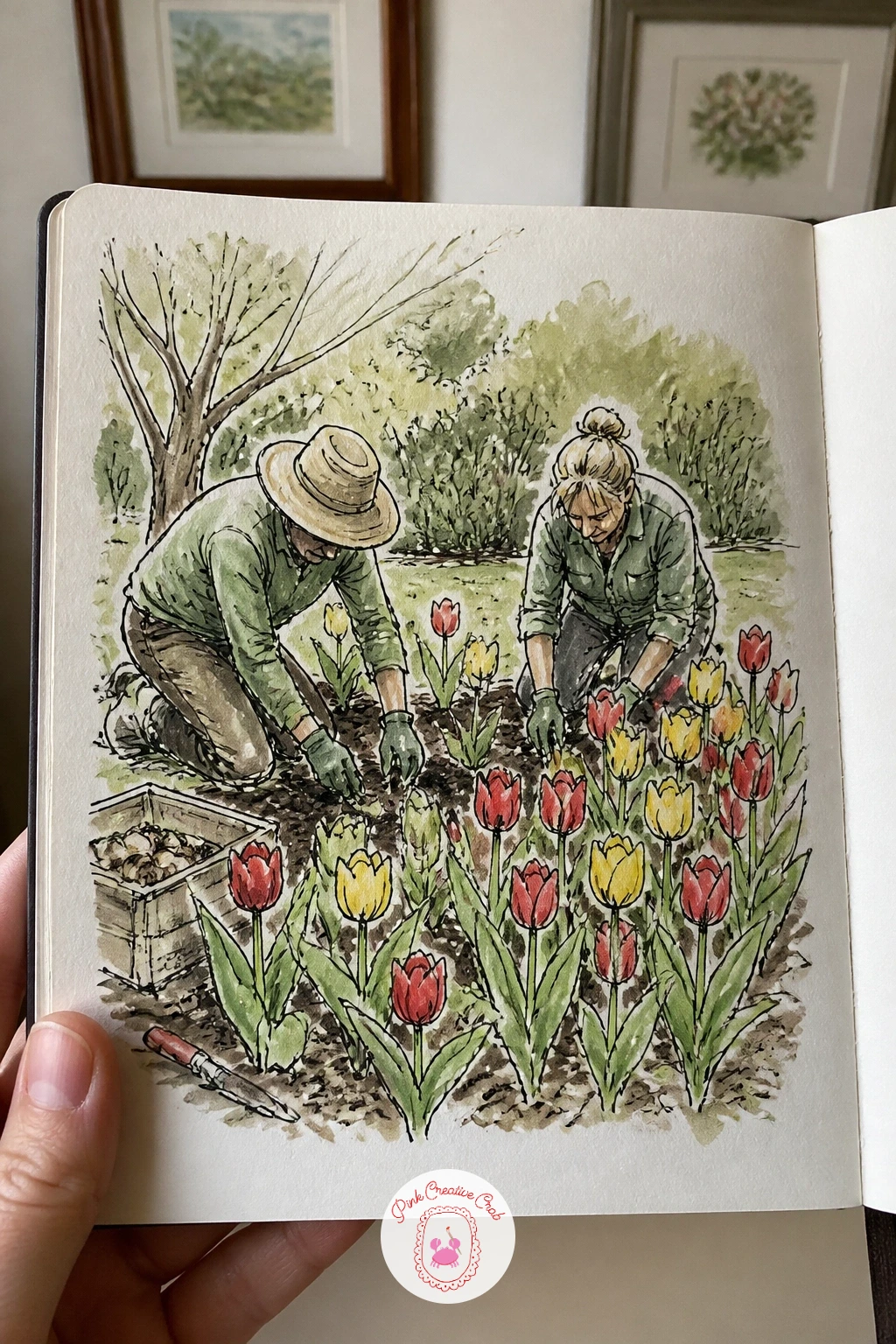
Palette: Tulip Red,Tulip Yellow,Soil Brown,Grass Green
A boy sailing a toy boat is a sweet small-scale companion to the rowing boat page from earlier, this time shrunk down to a pond-side toy rather than a full-sized vessel. Draw the boy crouched at the pond’s edge, one hand reaching toward a tiny sailboat bobbing a short distance out on the water, a simple triangular sail catching an invisible breeze.
Keep the boat itself small and simple, a thin hull with one mast and one triangular sail is plenty, resist the urge to add rigging detail that will only disappear at this scale.
The boy’s crouched pose is where proportion matters most: compare his bent knee height to his seated hip height before finalising the line, a crouch drawn too tall looks like standing, and one drawn too low looks like sitting on the ground.
Wash the sail in a bright solid colour so it stands out clearly against the pond, and keep the water a flat calm blue-grey with just a couple of ripple lines near the hull. A quicker version today could show just the boat alone, bobbing on the water with the boy implied just outside the frame.
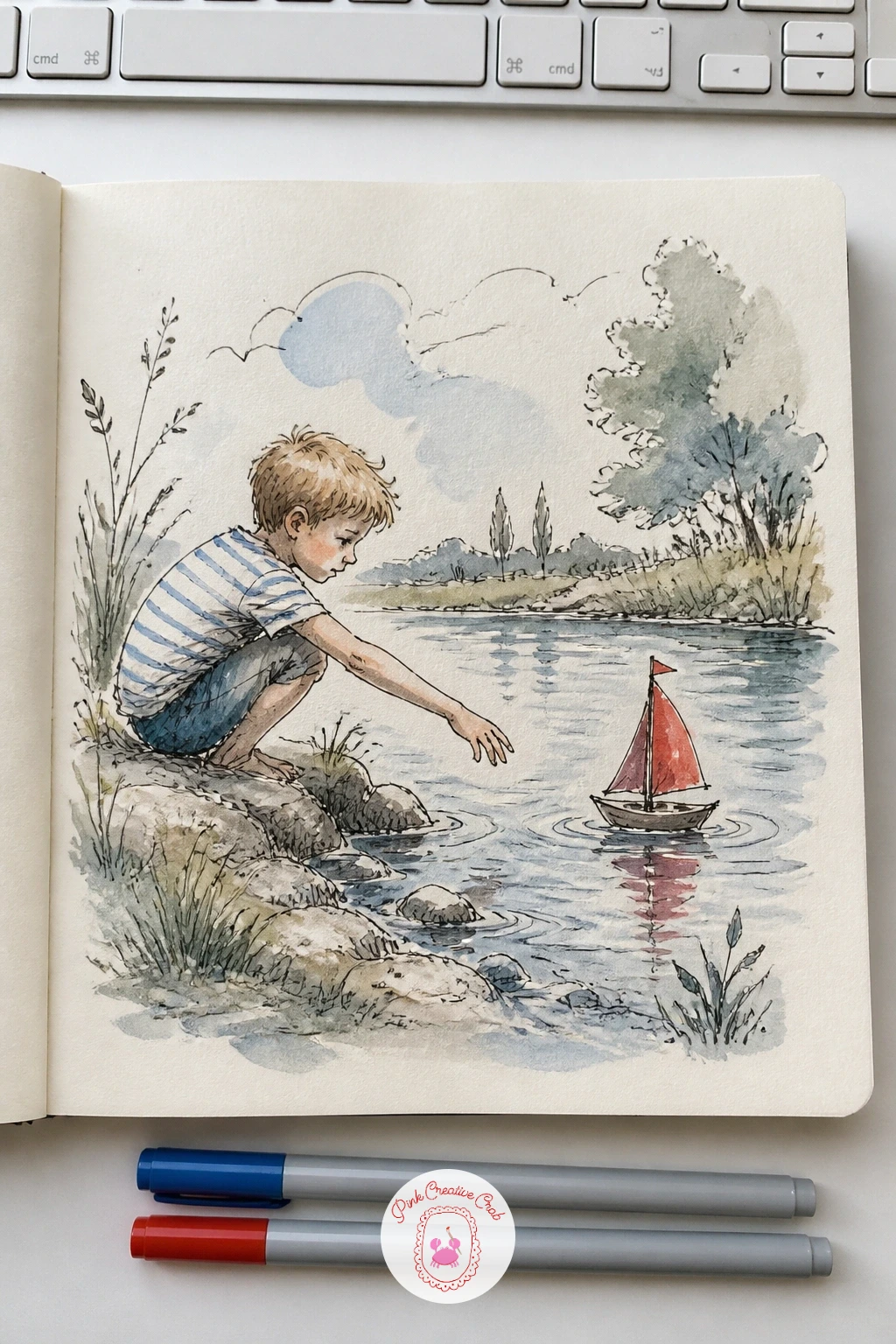
Palette: Bright Red,Cerulean Blue,Soft Grey,Cream
A turtle on a log is one of the calmest subjects on this list, a nice slow page after the boy and his boat. Draw the log first, a simple horizontal cylinder lying half submerged at the pond’s edge, then perch the turtle on top, shell drawn as a domed oval with a small head and legs poking out from underneath.
The shell pattern is the fun detail to build up: lightly pencil a rough hexagon grid across the dome first, then ink over just a few of the lines rather than the whole grid, an irregular, partial pattern looks far more natural than a perfectly even one.
Keep the turtle’s head and legs quite small compared to the shell, beginners often draw them too large, which makes the whole creature look less like a turtle and more like a strange lizard. The shell should clearly dominate the silhouette.
A mossy green-brown for the shell against the warmer brown of the log keeps the two shapes distinct from each other. If you want a bolder version next time, try two or three turtles stacked along the same log, each a slightly different size.
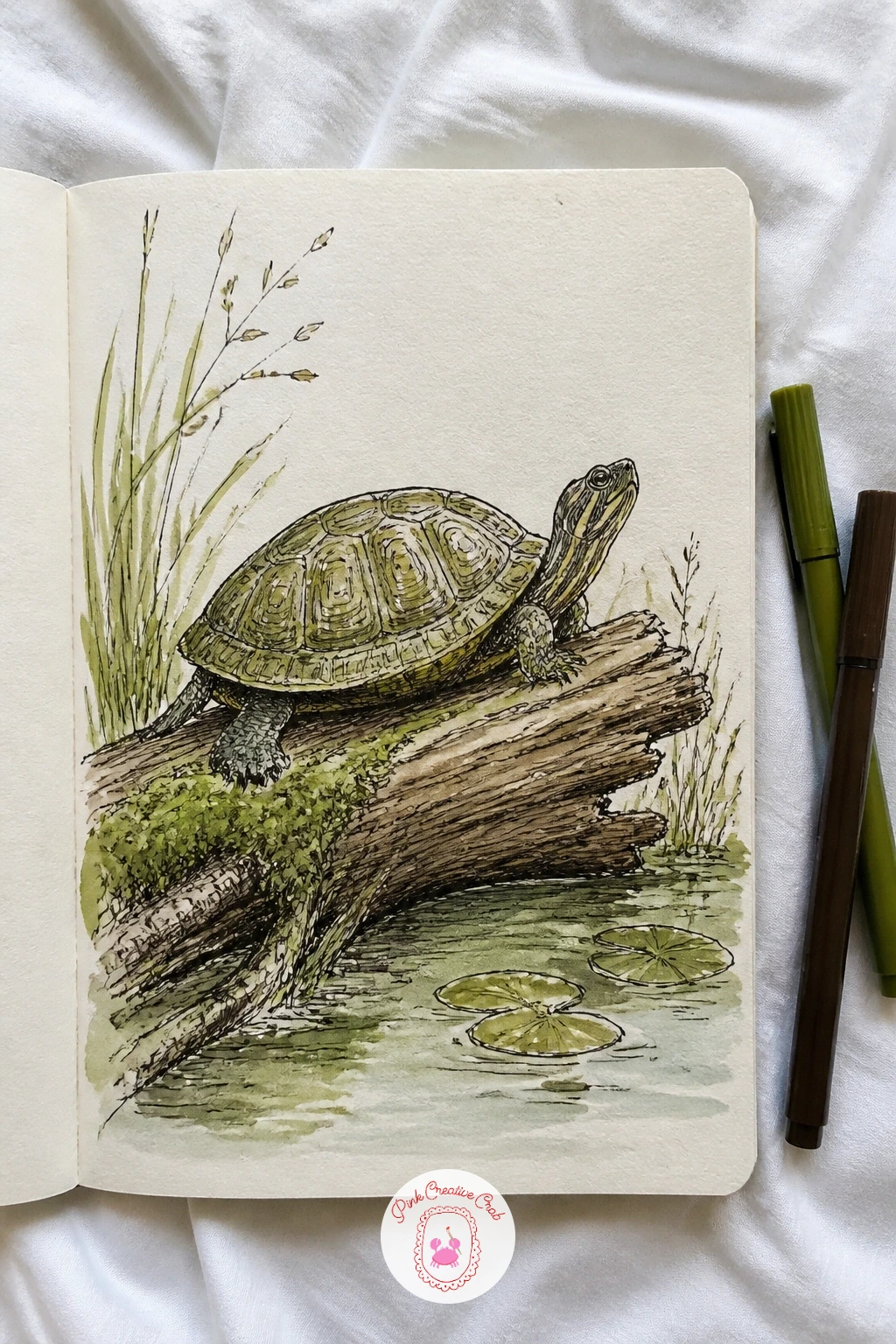
Palette: Moss Green,Burnt Sienna,Olive,Cream
A coffee kiosk queue echoes the ice cream cart earlier in this list, but swaps the sunny mood for something a little cosier, good for a cooler morning page. Draw the kiosk as a simple wooden box with a small awning overhead, a chalkboard menu propped beside the serving window, then line up a handful of figures waiting, each wrapped in slightly different layers, scarves, coats, one holding an umbrella.
Stagger the queue in a gentle curve rather than a straight line, it feels more natural and lets you overlap figures slightly, which is an easy way to suggest a fuller queue without drawing every person in full.
Steam rising from a cup in someone’s hand is a lovely small addition: a few soft wavy fineliner lines drawn loosely upward, left uncoloured, read instantly as warmth against a cooler background.
Warm browns and creams for the kiosk and coffee cups sit nicely against cooler coat colours on the queue. For a quicker page, draw just the kiosk window and one customer being handed their cup.
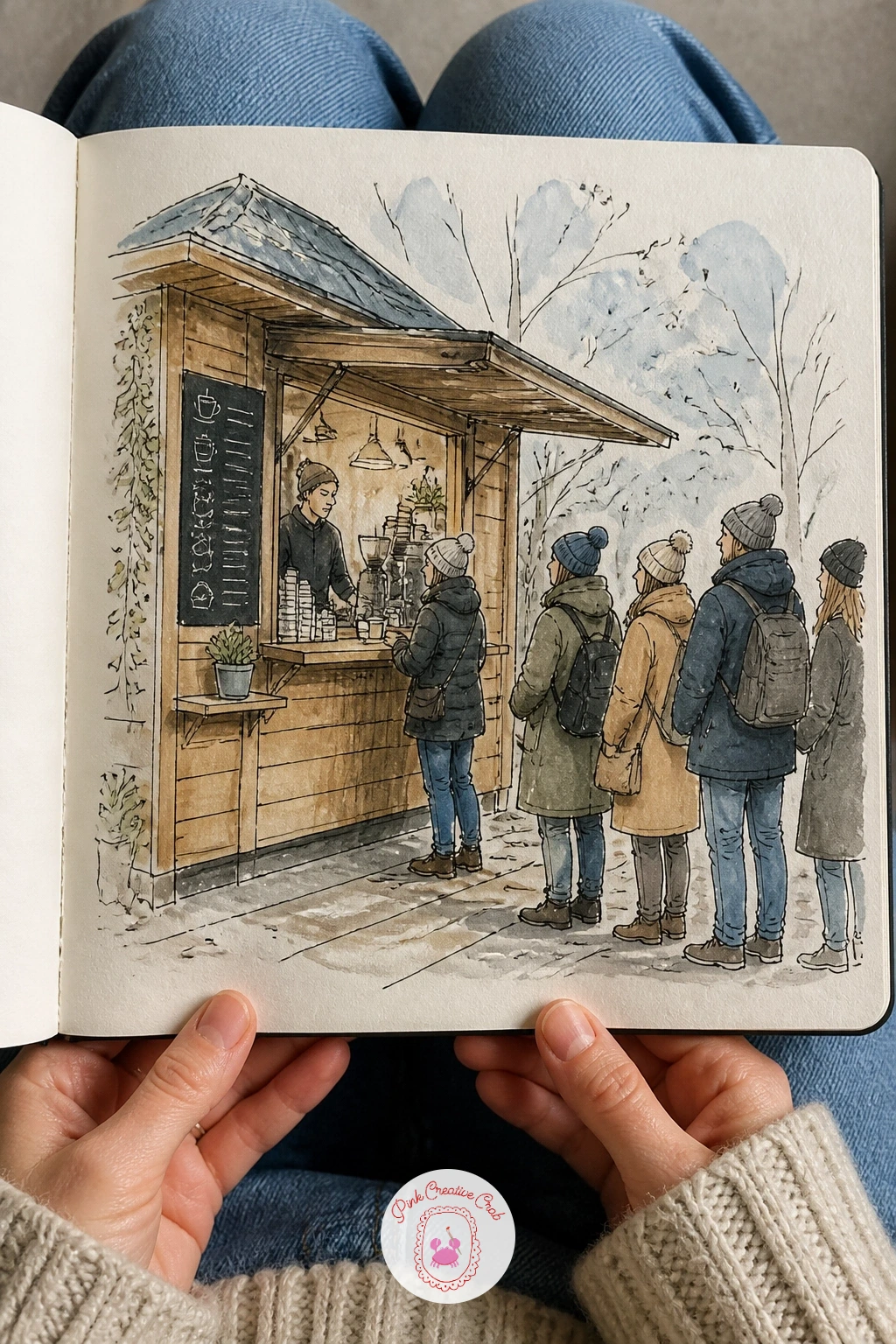
Palette: Coffee Brown,Cream,Denim Blue,Rust Red
Sunbathers on striped deck chairs bring back the bright, relaxed mood of the picnic blanket page, this time with the figures lying flat rather than sitting up. Draw the deck chair frame first, a simple folding X-shape of wooden struts, then stretch the striped fabric seat across it at a slight diagonal to suggest the reclining angle.
Lay the sunbather across the chair with knees slightly bent and one arm shading their eyes or resting across their forehead, this small gesture does a lot to suggest bright sunshine without needing to render harsh shadows elsewhere on the page.
If the sun sits high overhead in your scene, shadows stay short and fall almost straight down from each chair leg, a useful shortcut that saves you from working out a complicated shadow angle.
Alternate two bold colours for the deck chair stripes, and keep the sunbather’s skin tone in one flat warm wash with no heavy shading, bright midday light tends to flatten detail rather than add it. For variety across a page of several chairs, change the stripe colours on each one.
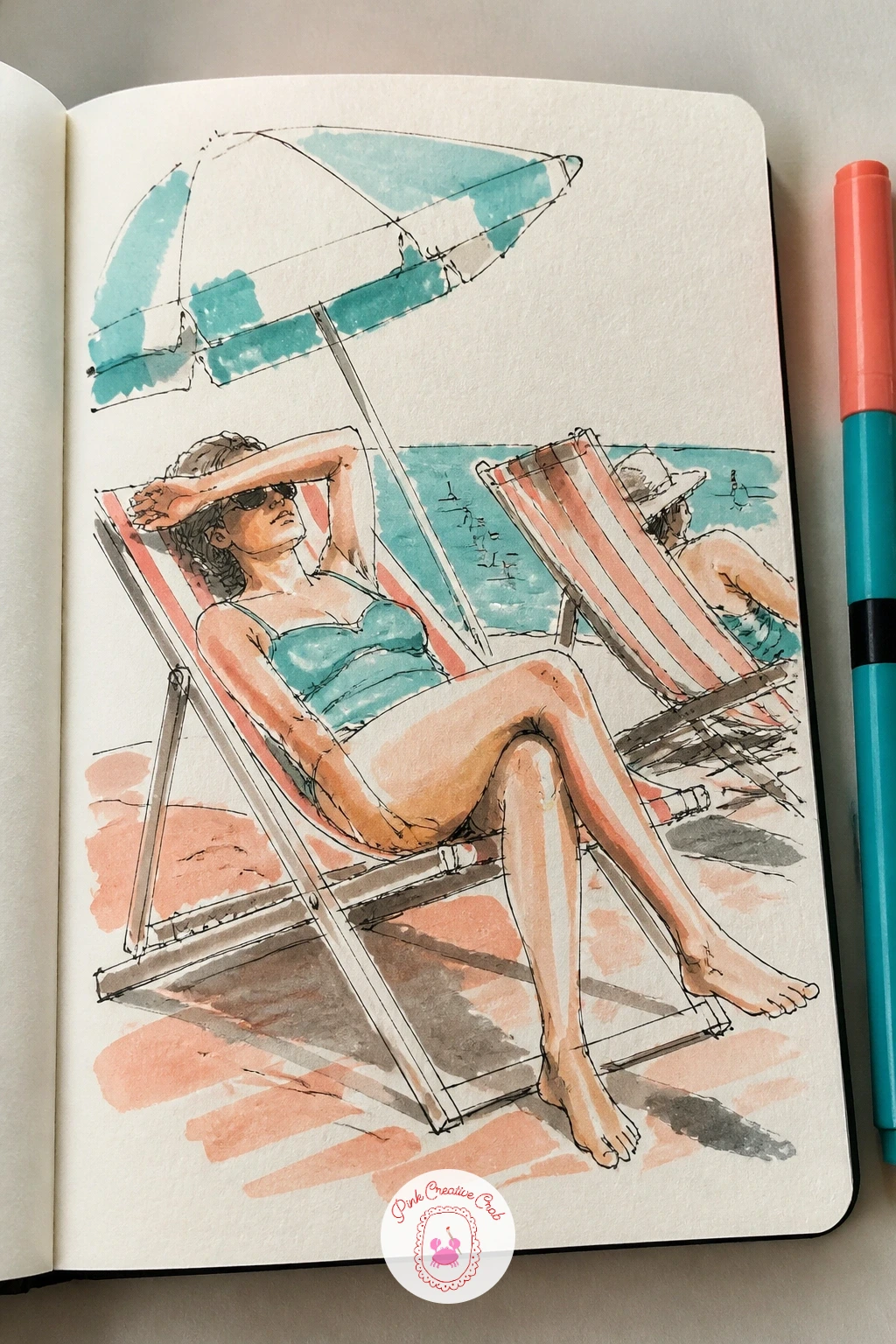
Palette: Coral,Turquoise,Sand Beige,Warm Skin Tone
Kids rolling down a grassy hill is pure energy, so let the drawing feel a little wild rather than neat. Sketch the hill first as one long sweeping diagonal line across the page, then tumble two or three children down it in curled-up balls, arms and legs tucked close to the body, limbs pointing in different directions to suggest the spin of the roll.
Draw each child at a different point along the hill and at a slightly different angle, this staggering is what makes the tumbling read as continuous motion rather than a lineup of still poses.
Hair and clothing flying outward from the body is the detail that really sells the speed: a few loose flicked lines trailing away from a head or a hem, left mostly uncoloured, do more than careful shading ever could here.
Keep the grass a single confident green wash rather than individual blades, with maybe a slightly darker shade pooled at the base of the hill. A quicker version today could show just one child mid-roll rather than a whole group.
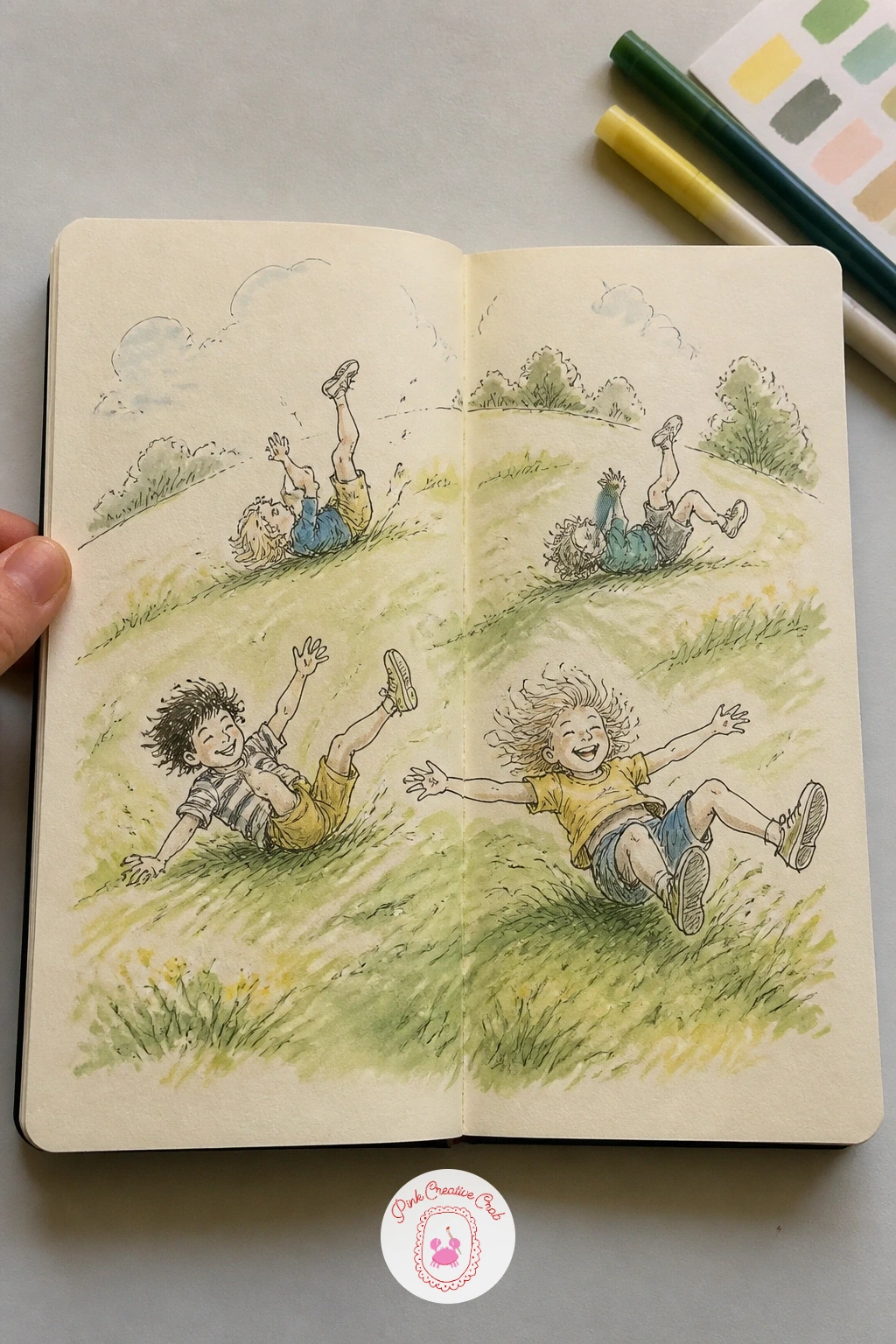
Palette: Grass Green,Sky Blue,Bright Yellow,Warm Skin Tone
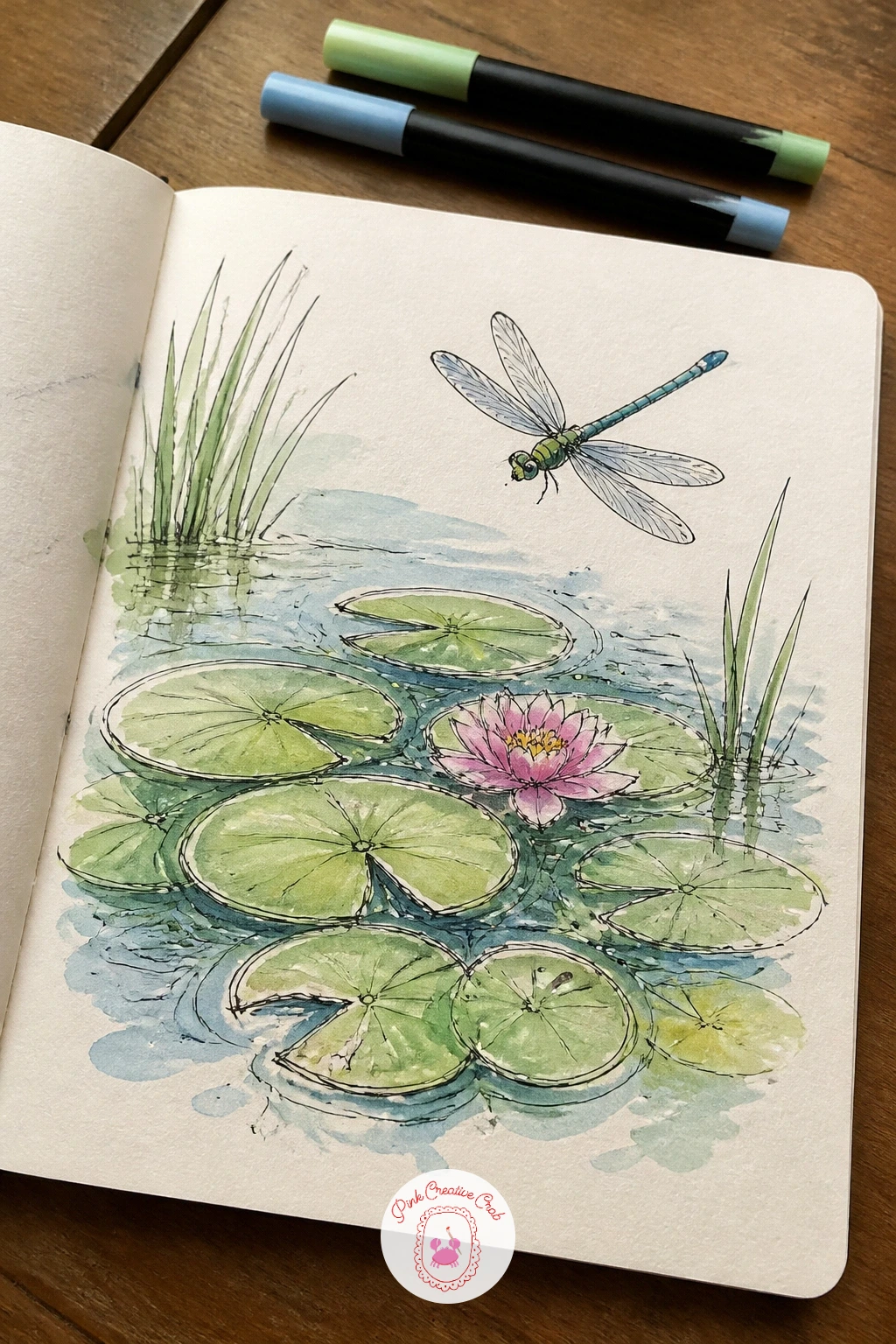
A dragonfly over lily pads is a quieter, more delicate page after all that rolling, good for slowing your hand back down. Draw a cluster of three or four lily pads floating on the pond’s surface first, simple rounded shapes with a notch cut into one edge, overlapping slightly so they feel like they are drifting together.
Add the dragonfly hovering just above them, body a long thin segmented line and wings as four simple elongated ovals, two on each side, angled slightly differently so it looks caught mid-hover rather than stuck flat.
Wings are the part worth the lightest touch you can manage: use a very pale wash, almost just tinted water, or leave them as bare paper outlined in fineliner, heavy colour here makes the wings look solid rather than see-through.
A single pink or white lily flower tucked among the pads adds a lovely focal point of colour. If you do not want to tackle the dragonfly’s wings in paint, a very fine white gel pen traced over a light wash gives a similar delicate sparkle.
You Will Need
- white gel pen
Palette: Lily Pad Green,Soft Pink,Pale Blue,Cream
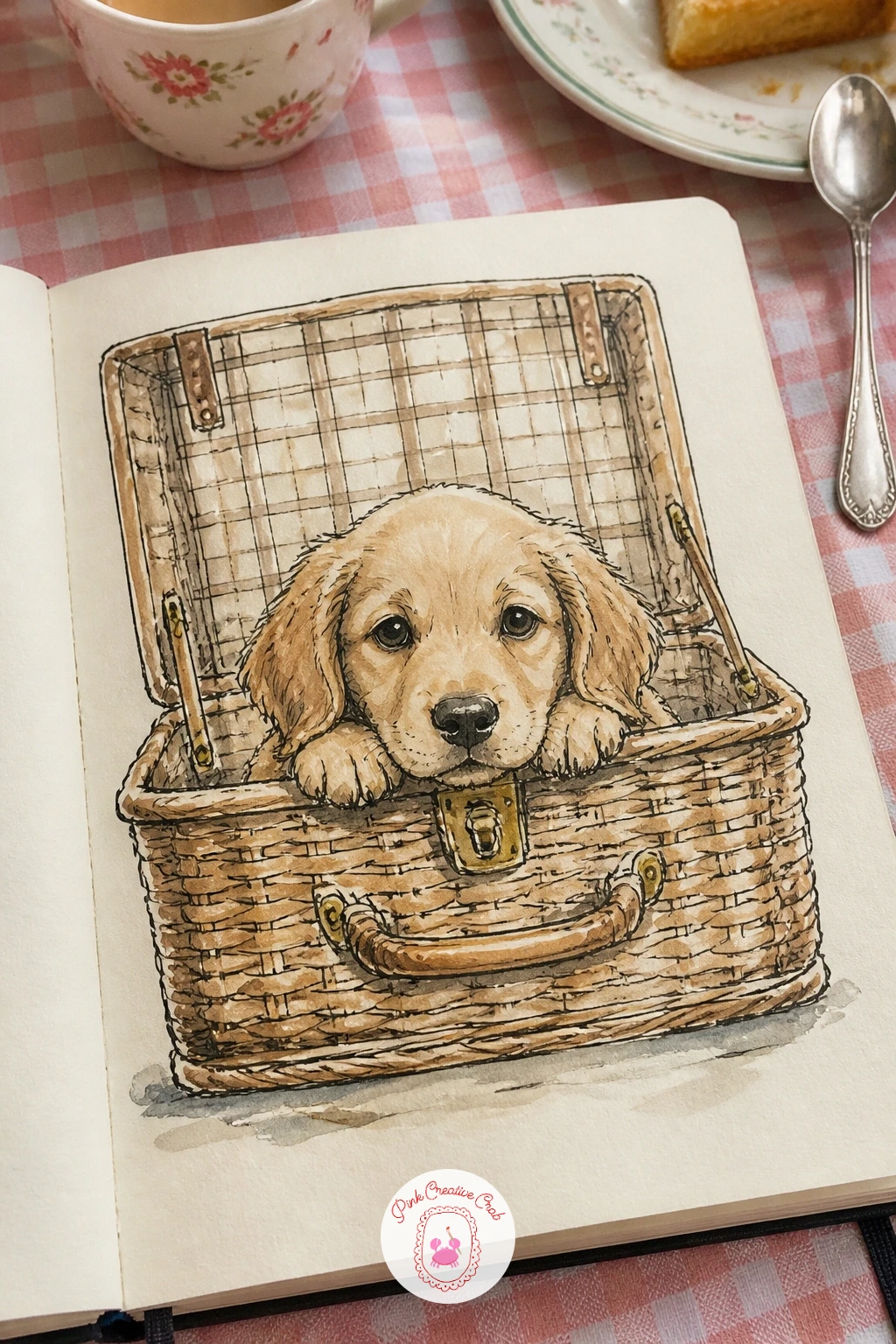
A puppy in a picnic basket is an easy one to fall in love with, and it ties back nicely to the raided basket page earlier in this list, though here the basket holds a far more welcome visitor. Draw the basket as a simple open rectangle first, lid propped open, then nestle the puppy inside, chin resting on the rim and paws draped over the edge.
Exaggerate the puppy’s head slightly larger than strictly accurate against its small body, this classic trick instantly reads as young and appealing, the same proportion trick illustrators lean on again and again for baby animals.
Ears are where a lot of character lives on a puppy: floppy ears hanging down on either side of the face, drawn with a soft curved line rather than anything pointed, give an immediate sense of softness and youth.
A warm golden or spotted coat against the woven basket’s tan keeps the palette cohesive and cosy. For a bolder next attempt, try two puppies sharing the same basket, peeking out at slightly different heights.
Palette: Golden Tan,Warm Brown,Cream,Soft Red
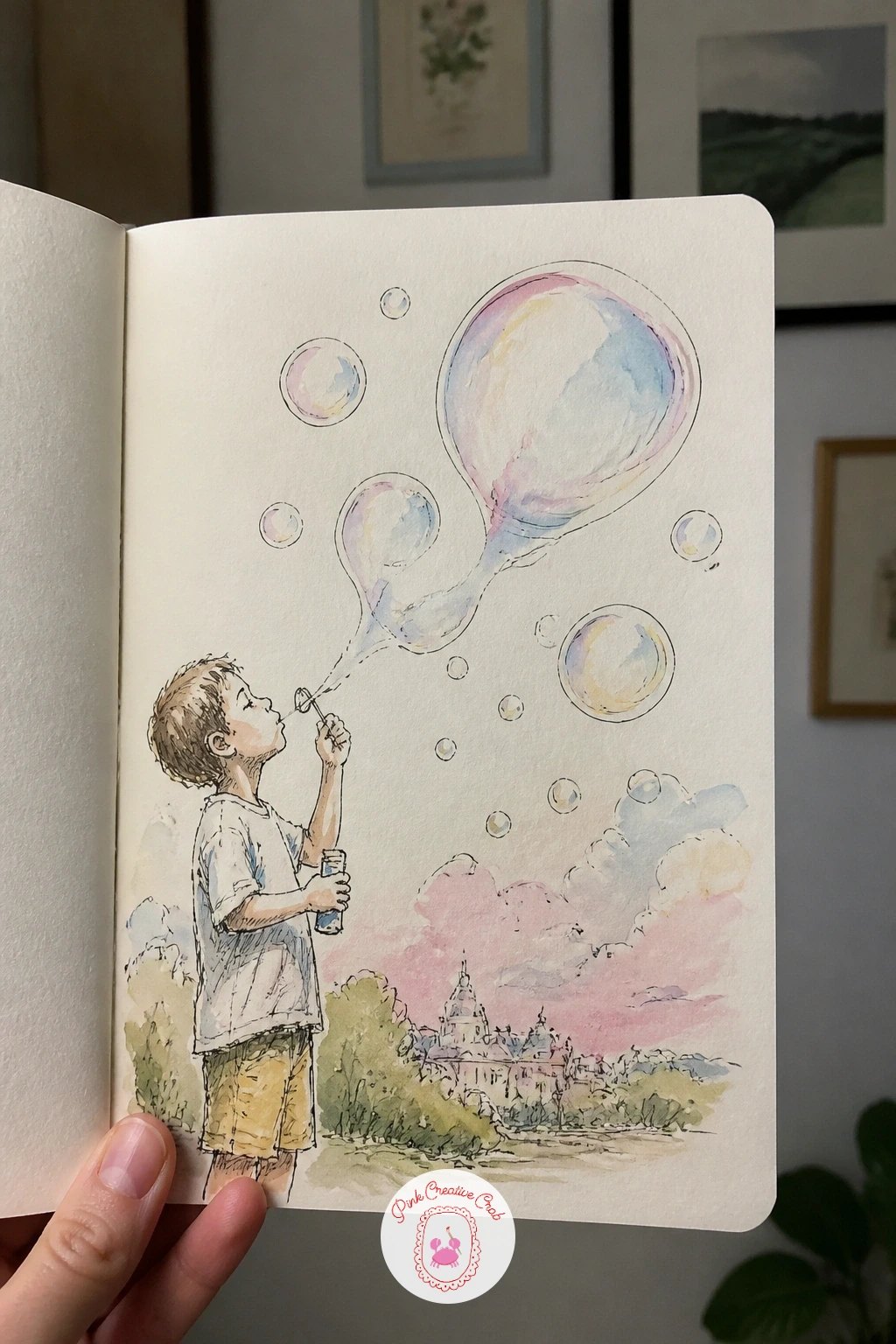
Giant soap bubbles in the air bring a playful, slightly surreal note to the page, a nice one to pair with the quieter dragonfly or turtle pages elsewhere in your sketchbook. Draw one large bubble and several smaller ones drifting around it at varying heights, each a simple circle, no need for perfect roundness, a slightly wobbly outline actually suits a floating soap film better than a geometric one.
Add a child or two below with a bubble wand raised, caught mid-blow or reaching up to pop one, this small figure gives the bubbles scale and a reason for being there.
The rainbow sheen on a bubble’s surface is the fun technical bit: drop a very pale wash of pink, blue and yellow into the circle while the paper is still wet, letting the colours bleed softly into each other rather than mixing to mud, then leave a small bright circle of bare white paper as the shine.
Keep most of the bubbles mostly uncoloured so the one or two rainbow ones stand out clearly. If wet-on-wet blending feels tricky today, a pale circular smudge of coloured pencil achieves a similar soft sheen.
Palette: Pale Pink,Pale Blue,Pale Yellow,White
Wet-on-wet blending needs the paper properly damp but not pooling, test the sheen on a scrap corner first if you are unsure how your paper behaves.
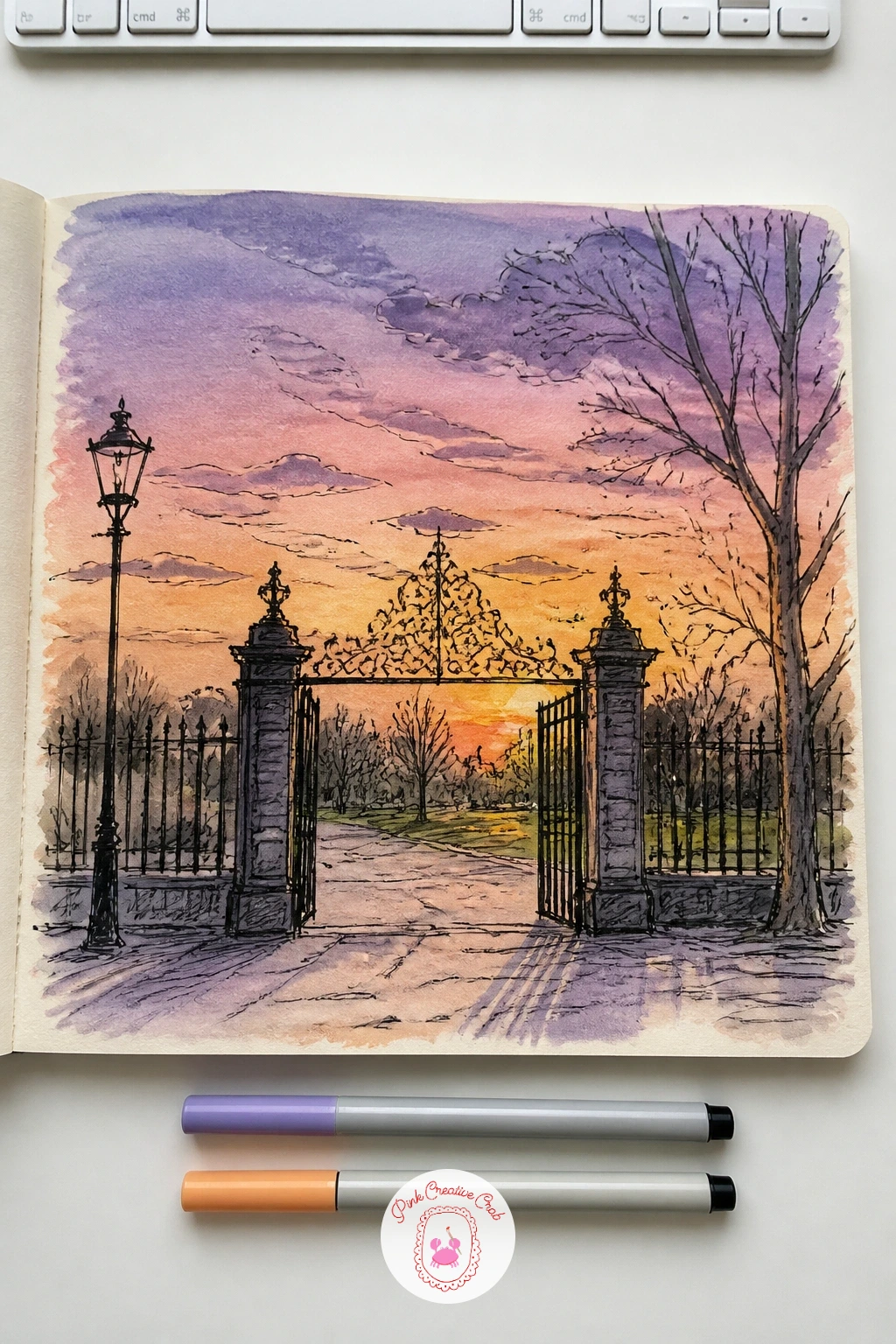
A sunset over the park gates makes a lovely closing page for a day spent sketching, built mostly from soft layered colour rather than detailed drawing. Start with the gate itself as a simple silhouette, two posts and a curved or arched top, drawn small and dark against a sky that takes up most of the page.
Build the sky in horizontal bands of colour from top to bottom, cooler purples and blues higher up fading down through warm orange and pink nearer the horizon, blending the edges where the bands meet while the paint is still wet so the transition stays soft rather than striped.
Keep everything in front of the sky, the gate, any trees or benches nearby, as flat dark silhouettes with no internal detail, this is what makes a sunset page work, strong contrast between a glowing sky and solid dark shapes in front of it.
A single bird or two as small dark V-shapes cutting across the sky adds scale and a bit of quiet movement to finish the page. If you are short on time, the glowing sky and gate silhouette alone, with nothing else, still makes a complete and striking page.
Palette: Deep Purple,Sunset Orange,Soft Pink,Charcoal Black
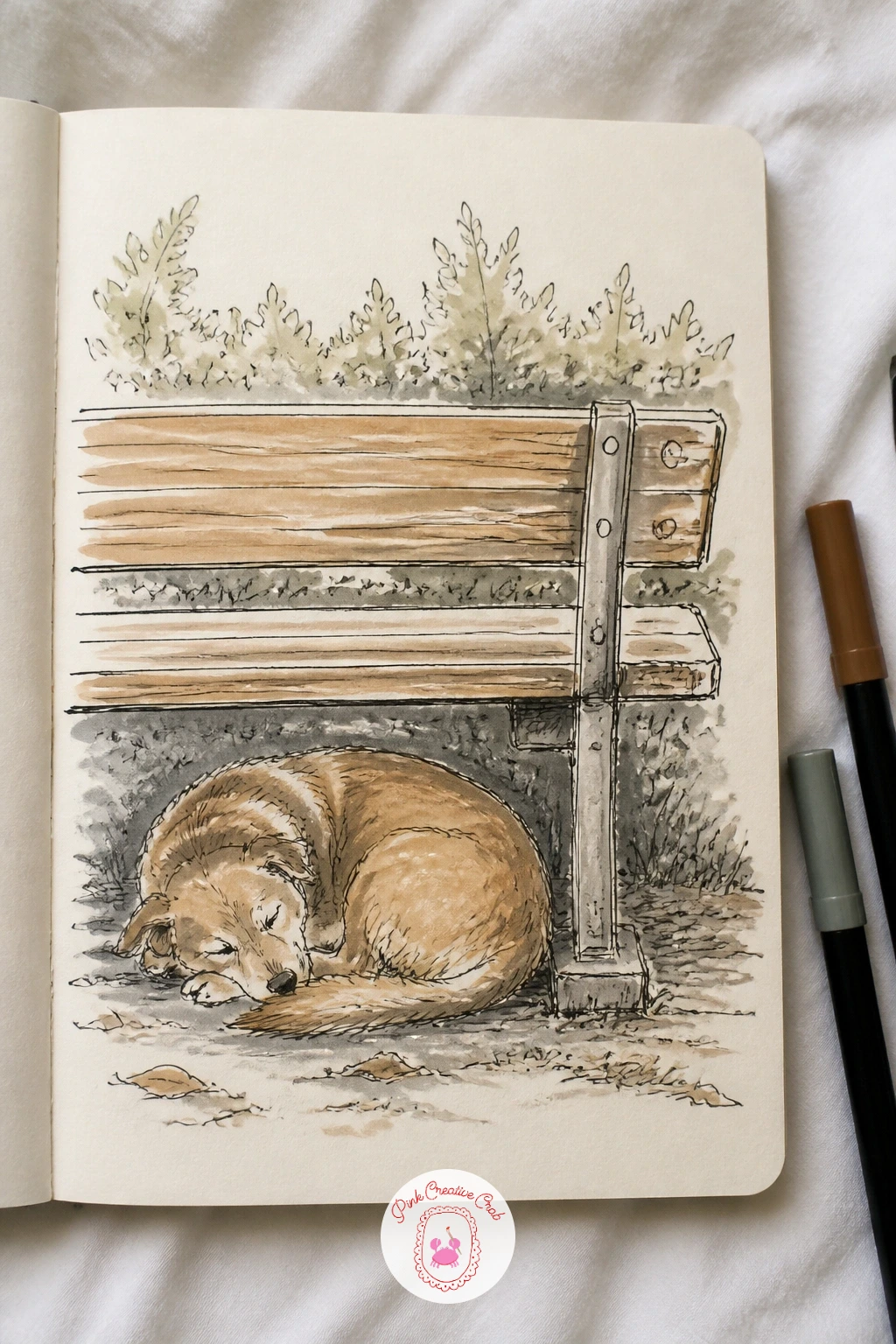
A dog napping under a bench is a gentle, almost cosy subject, good for a slower afternoon in the sketchbook. Draw the bench first, simple horizontal slats on sturdy legs, then tuck the dog beneath it, curled into a loose round shape with its nose tucked near its tail, half in shade from the bench above.
A curled sleeping dog is mostly one continuous curved outline rather than separate limbs, let the back, tail and head flow into a single soft loop, with just a hint of a paw or ear poking out to break up the shape slightly.
The shade cast by the bench slats is a nice chance to practise a light touch of shadow: a few soft grey stripes crossing the dog’s body where the slats block the light above, keeping the rest of the dog in warmer, lighter tones.
A warm brown or cream coat colour with cool grey shadow stripes reads calmly and clearly. For a quicker version, skip the striped shadow entirely and just give the whole dog a single soft grey wash underneath the bench.
Palette: Warm Brown,Cream,Cool Grey,Charcoal Grey
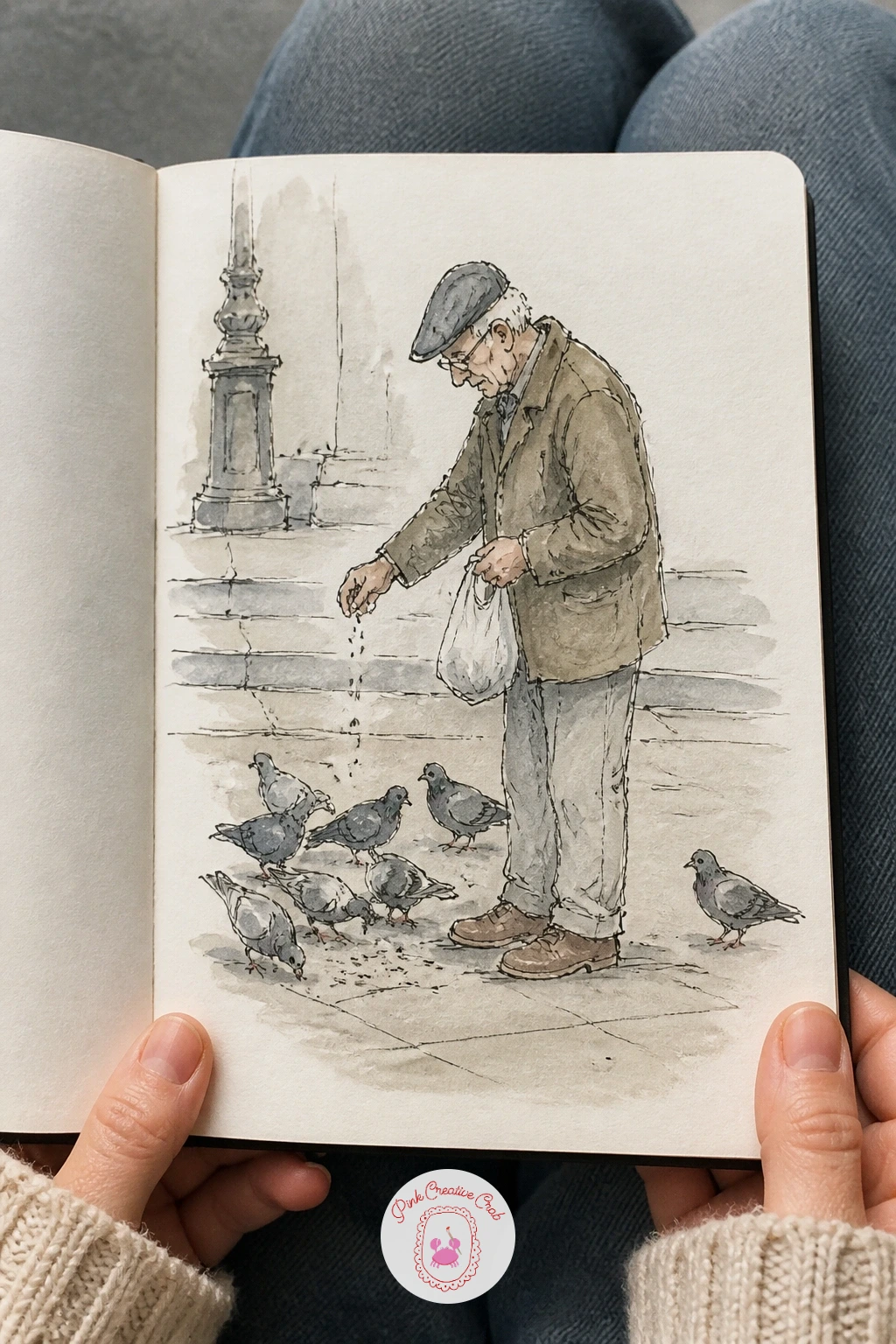
An old man feeding pigeons is a warm, familiar park moment that works well as one of the more character-driven pages in your sketchbook. Draw the man seated on a low bench or standing with a slight stoop, one hand extended with seed scattered from it, and surround his feet with a small cluster of pigeons pecking at the ground in different poses.
Give him a few small signs of age without overdoing it, a slightly hunched posture, a flat cap, hands drawn as simple rounded mitten shapes rather than detailed fingers, these cues read instantly without needing careful portrait work.
Vary the pigeons around him in size and angle, one close and large in the foreground, others smaller and further back, this size comparison between birds is what gives the small flock a sense of depth rather than looking pasted flat on the ground.
Muted greys and browns for both the man and the pigeons keep this a calm, understated page, with maybe one small spot of colour on his scarf or cap. For a faster version, draw just his hand and a couple of pigeons close around it.
Palette: Slate Grey,Warm Brown,Muted Blue,Cream
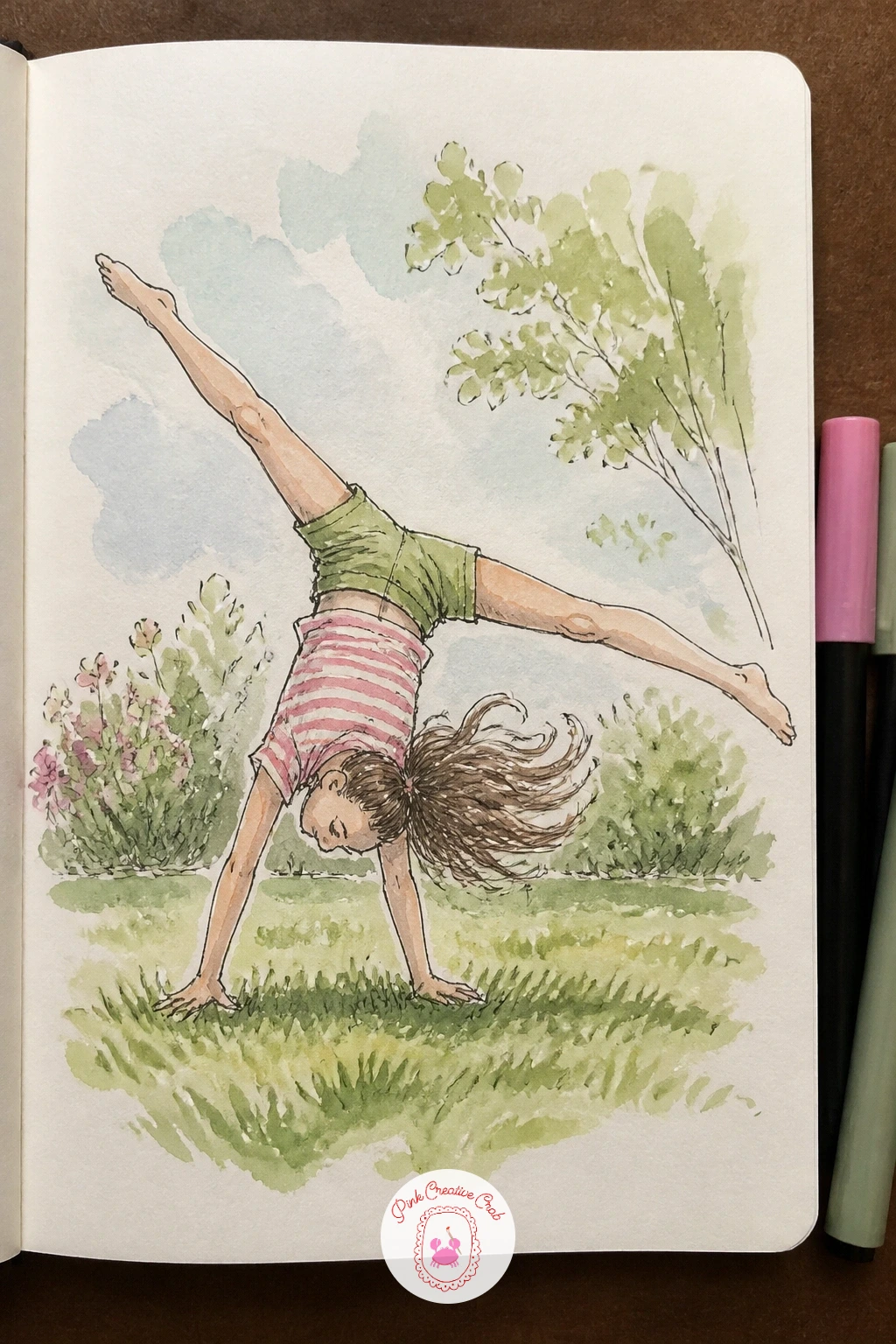
A girl doing a cartwheel closes this list with one last burst of energy, a good challenge to end your park sketchbook on. Picture the body as a wheel shape turning around a central point: hands planted on the grass, legs extended straight up and outward in a wide X, this geometric way of thinking about the pose makes an otherwise tricky action far easier to get right.
Draw the torso first along a diagonal line through the centre of that imagined wheel, then build the limbs outward from it at roughly equal lengths on either side, comparing each limb to the one opposite before finalising the lines keeps the whole pose balanced rather than lopsided.
Hair and clothing flying outward from the motion, much like the tumbling children earlier in this list, finish the sense of speed, a few loose flicked lines trailing from the head and hem are enough.
Keep the background simple, flat grass and maybe one tree, so the cartwheeling figure stays the clear star of the page. One concrete tip for today: draw this pose small and quick first in pencil to check the balance before committing to fineliner.
Palette: Grass Green,Bright Pink,Warm Skin Tone,Sky Blue
What to Do Next
Pick whichever idea matches the mood you are in today, pack a fineliner, a light watercolor set and this list, and head to a bench. Start on a single page in your sketchbook, let the first marks be loose, and remember that an unfinished corner never ruined a good park sketch. For more quick-finish pages, the mini sketchbook ideas and picnic drawing lessons pair nicely with everything above.
Frequently Asked Questions
What paper works best for sketchbook ideas drawings with watercolor touches?
A cream-toned watercolor sketchbook around 300gsm handles both fineliner and light washes without buckling. Thinner cartridge paper can warp once wet, so if that is all you have, keep your washes very light and let each one dry before adding more.
Do I need to draw these park scenes from real life?
No, working from memory or imagination is perfectly fine for every idea on this list. A quick look at reference photos of ducks, dogs or deck chairs beforehand helps with proportion, then you can draw the scene freely without copying exactly.
How do I stop my park figures from looking stiff?
Start every figure from one curved gesture line for the spine before adding limbs or clothing. That single sweeping line carries the lean, the stride or the slouch, and stiffness usually comes from building a figure out of straight lines first.
What is the easiest idea on this list for a first attempt?
The picnic blanket with strawberries and lemonade is the gentlest start, since it is mostly simple still-life shapes with no tricky proportions. Ducks chasing bread crumbs and a dog napping under a bench are nearly as forgiving for a first outdoor page.
Can I use markers instead of watercolor for these ideas?
Yes, dual tip alcohol markers work well over fineliner and dry fast, which suits sketching on a bench outdoors. Use the broad tip for flat colour areas and the fine tip for small details like beaks, leashes or shadow stripes.
Have any thoughts?
Share your reaction or leave a quick response — we’d love to hear what you think!
-
 0
-
0
-
0
-
0
-
0
-
0


