A sloth drawing is the most forgiving animal drawing you can pick up today: the shapes are round and slow, the face is already smiling, and nothing about a sloth needs to look fast or precise. That slowness is exactly the point here, so every idea on this list is one sloth caught mid moment, doing one gentle thing and doing it very, very slowly.
Grab a fineliner and whatever alcohol markers you have in mossy green and warm brown, and work through these in any order. Some are a single sloth floating on the page, others drop it into a tiny scene with a frog, a cupcake or a rope swing, but every single one is sized to fill your page and finish in one sitting.
Using these images: free for personal projects such as printing, coloring, cards, journals and gifts. Handmade items that include them may be sold up to 30 pieces per design. More than that is commercial use and is not permitted, and neither is selling or sharing the images themselves or passing them off as your own. Please ask before any other use.
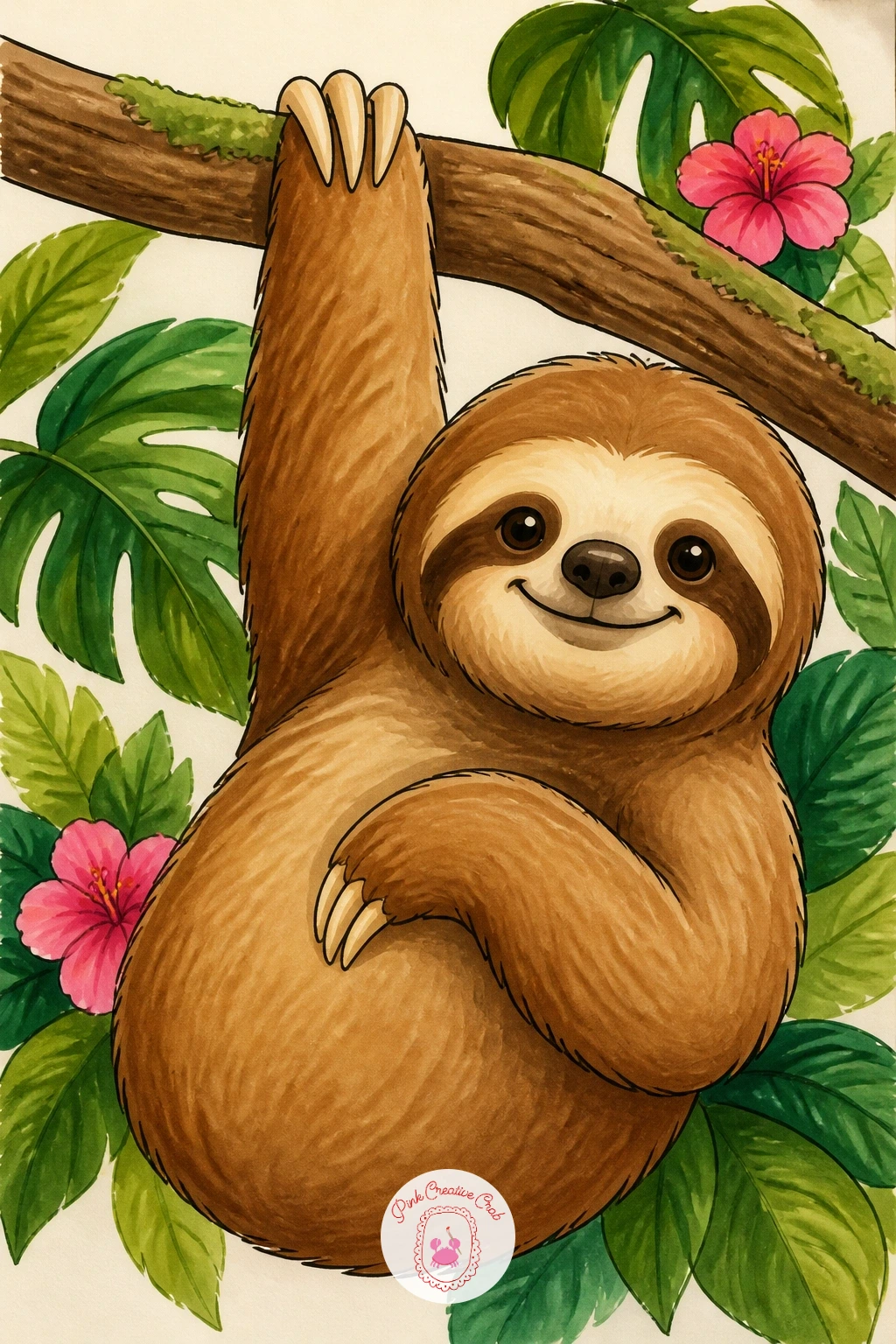
Start with the easiest pose in the whole list: a sloth hanging from a branch by one arm, smiling. Draw a thick horizontal branch first, then hang a simple pear shaped body below it with one long arm reaching up to hook over the wood and the other arm resting against the belly.
Fineliner the outline first, keeping the face round with two small dot eyes, a dark nose and a wide closed mouth curved up at both ends. Block in the fur with a light brown marker, then drop a darker brown into the arms and around the face edges while the first layer is still fresh so the two blend into each other.
If the arm looks too stiff, round off the elbow and let the hand curl rather than hook sharply, since sloths have soft curved joints everywhere. No alcohol markers on hand yet, colored pencils layered the same way, light to dark, work just as well.
Keep the branch thicker than feels natural, a too thin branch is the most common thing that throws this pose off.
Palette: Light Brown,Warm Umber,Mossy Green,Bark Grey
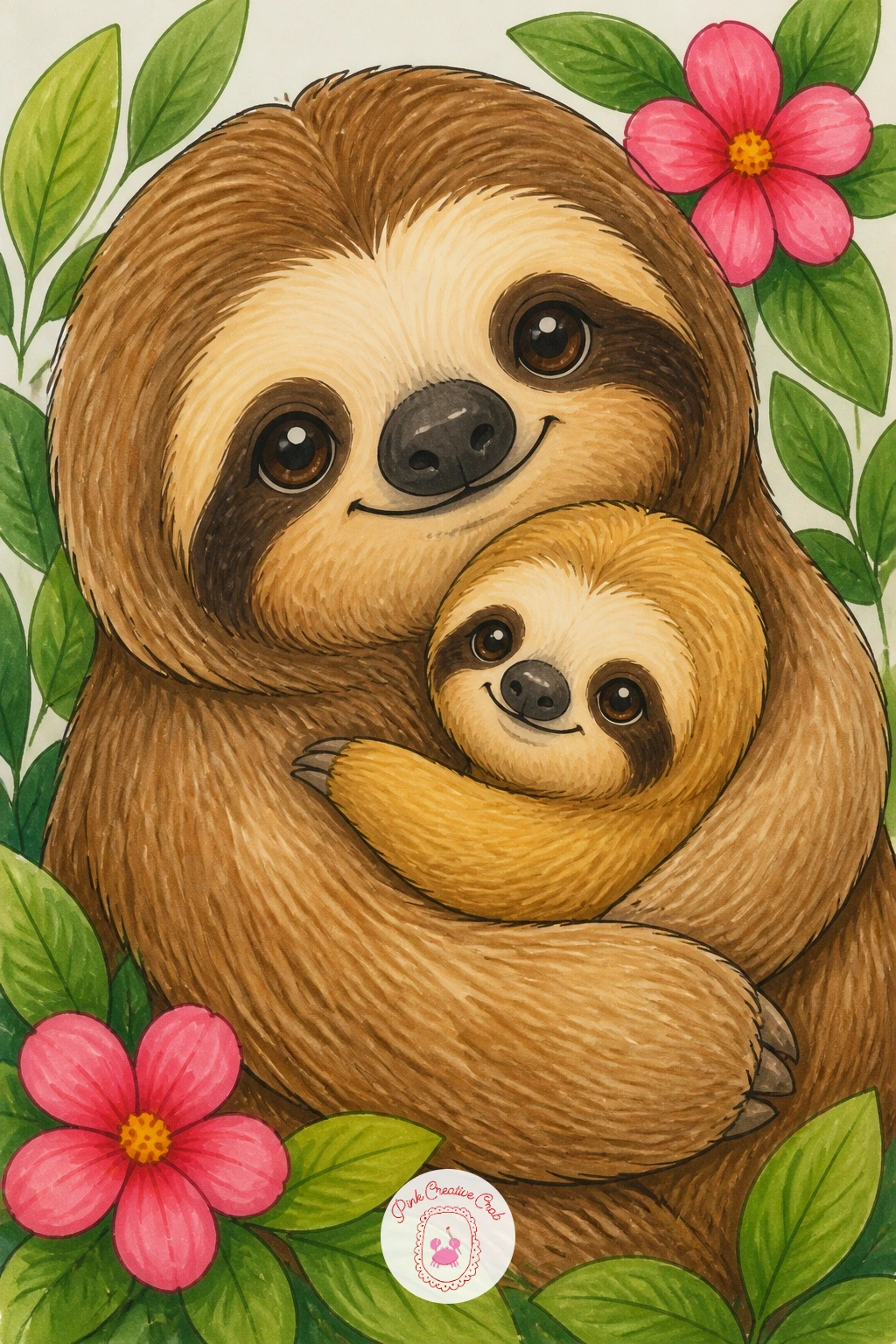
Move from one sloth to two with a baby sloth clinging to its mother’s belly, a pose built entirely from stacked ovals. Draw the mother first as a large rounded body facing forward, arms wrapped gently inward, then tuck a much smaller oval baby against her chest with tiny arms hooked around her fur.
Here is where a size check saves the whole drawing: the baby’s head should measure about a third the width of the mother’s head, so sketch both heads as light circles before you commit to fur or faces. Ink the mother’s outline first, then the baby’s, keeping the baby’s lines a touch lighter so it reads as smaller and softer.
Color the mother in a warm mid brown and leave the baby a shade lighter and more golden, which helps the two shapes separate even when they overlap closely. If markers bleed where the fur lines meet, a thin white gel pen traced along the overlap afterward cleans the edge right back up.
Draw the mother’s face calm and half lidded, since a sleepy expression sells the gentleness of the whole scene.
You Will Need
- white gel pen
Palette: Warm Brown,Golden Tan,Mossy Green,Soft Cream
After drawing two sloths close together, give one a rest: a sloth asleep in a hammock strung between two tree trunks. Draw the hammock first as a simple curved sling, then nestle the sloth’s body inside it so the hammock fabric dips lower in the middle where the weight sits.
Work outline to color in this order: hammock curve, two trunk posts, then the sloth folded into a loose C shape with both arms tucked under its chin. Keep the face simple, closed eyes as two curved lines and a small smiling mouth, since a sleeping face needs almost no detail to read as peaceful.
The hammock fabric is the easy place to add a bit of pattern, a few thin stripes in a contrasting color break up what would otherwise be a plain shape. If your markers are running dry, colored pencil stripes over a flat marker base still look crisp.
Give the hammock rope slightly uneven loops rather than a perfect curve, since a too neat hammock reads as stiff instead of sagging under a sleepy body.
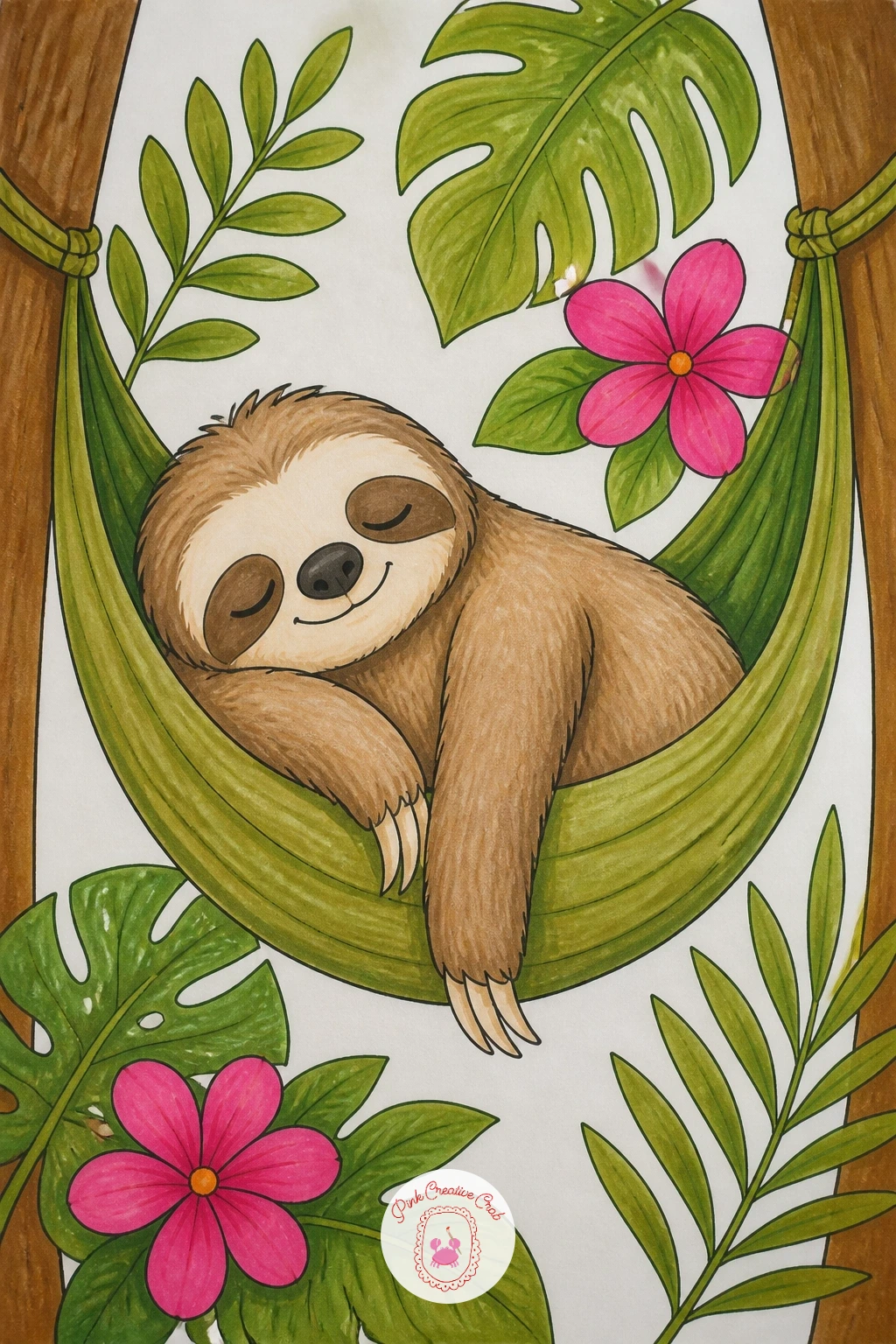
Palette: Mossy Green,Warm Brown,Hot Pink,Bark Grey
Try the hammock in a bold striped pattern, hot pink and cream, for a beach cabana feel that still fits the jungle palette.
Bring in the hot pink of this whole palette with a sloth eating a hibiscus flower, held up to its open mouth in one paw. Draw the sloth’s head and shoulders first, tilted slightly toward the flower, then add the hibiscus bloom as five rounded petals around a long thin stamen reaching out past them.
Ink the sloth before the flower so you can erase any stray pencil guidelines without disturbing the petals. Color the face and fur in warm brown, then switch fully to hot pink for the flower, building it from a pale pink base layer with a deeper magenta added only at the petal centers where they fold inward.
Petals are where beginners tend to overwork the shape into something stiff and symmetrical, so let two petals overlap slightly and vary their curves rather than drawing five identical ovals. No pink marker in your set, a red and a touch of white blended together gets close enough.
Draw the mouth slightly open with the flower just touching the lips, since the gap sells the idea of a very slow, very happy bite.
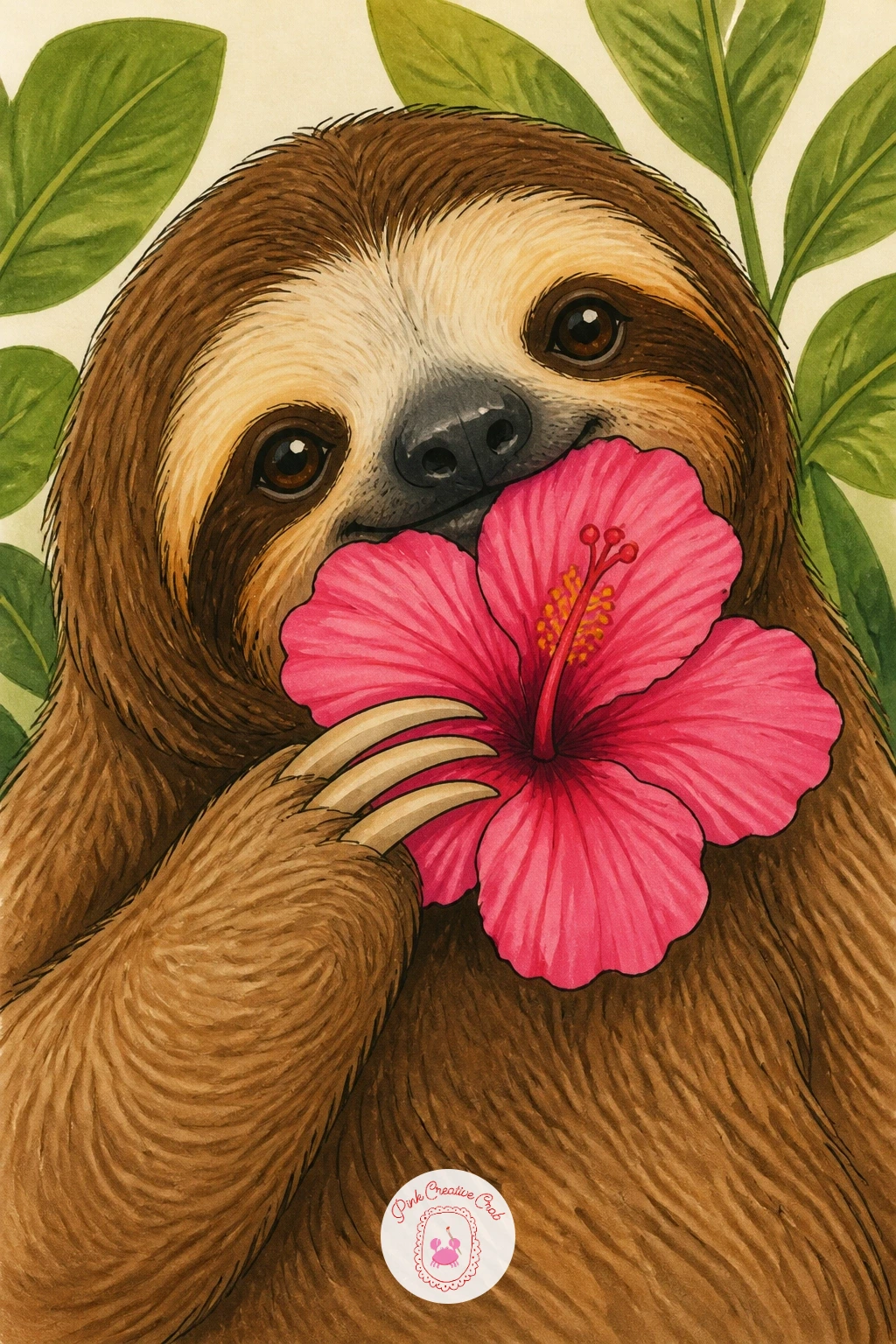
Palette: Hot Pink,Pale Pink,Warm Brown,Mossy Green
Give the sloth somewhere to go, slowly, with a sloth crossing a jungle path very slowly, drawn low to the ground on all fours. This is the first full body pose on the list, so set the eye level low, roughly at the sloth’s own shoulder height, which makes the path stretch out ahead of it rather than looking like a flat strip under its feet.
Draw the body first as a long low oval between four short curved legs, claws turned slightly inward, then add the path as two converging lines that meet toward the top of the page to suggest distance. Fill the path in a warm tan and keep it lighter than the jungle around it so the eye reads it as open ground.
Shade the far end of the path a touch darker and the near end lighter, since that simple shift in value does more to suggest depth here than any extra line work would. If your paper won’t take a wide wash evenly, stipple the color on with the marker tip instead of dragging it in one long stroke.
One concrete tip: draw the sloth’s head turned slightly toward the viewer rather than straight ahead, it keeps the pose from feeling like a plain side view.
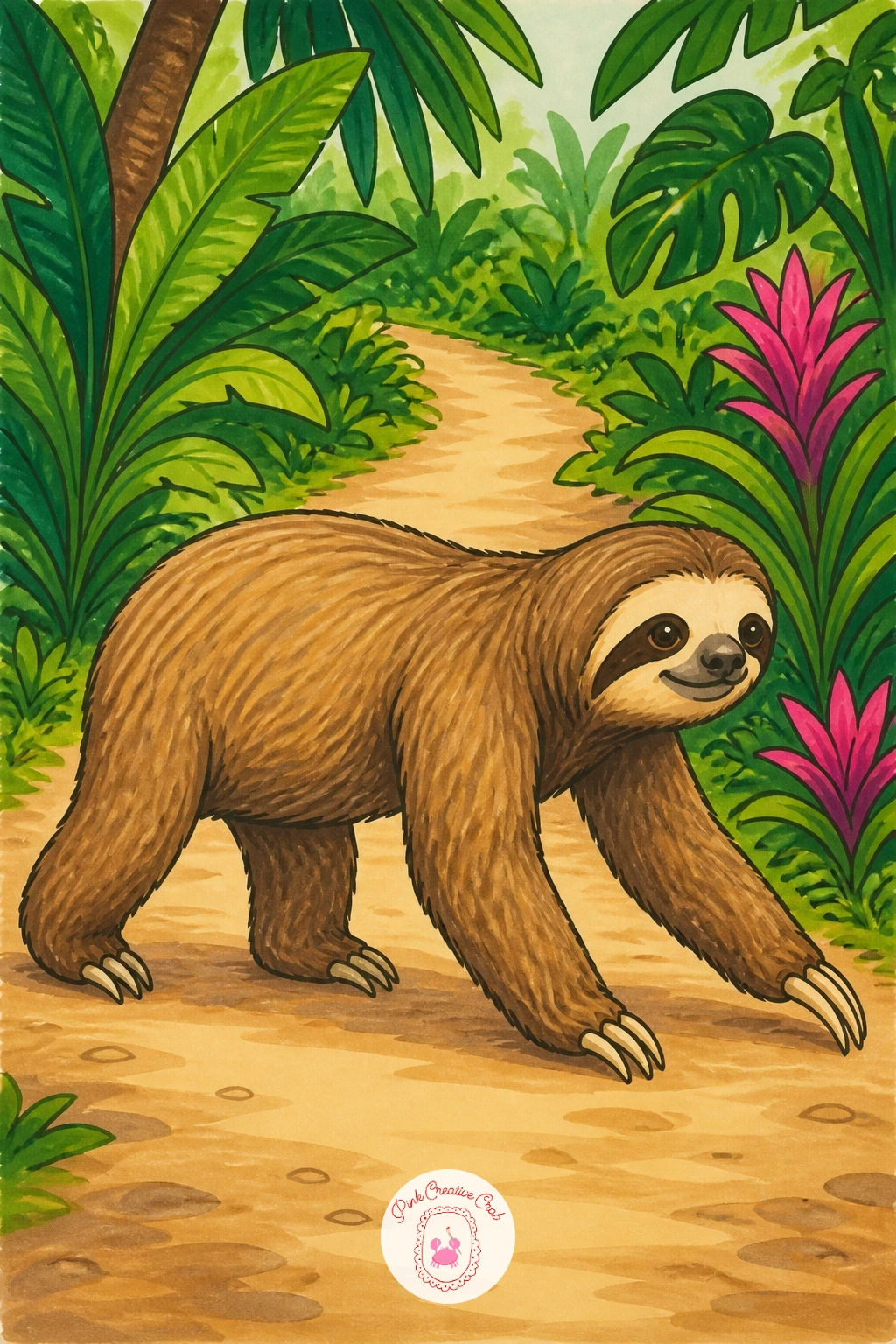
Palette: Warm Brown,Tan,Mossy Green,Dark Umber
Return to a close up pose with a sloth hugging a tree trunk, both arms wrapped fully around the bark. Draw the trunk first as a wide vertical shape filling most of the page, then wrap the sloth’s arms around it so they disappear slightly behind the curve of the wood on the far side.
Texture is the whole job in this one. Ink the bark in short vertical and diagonal fineliner strokes rather than one smooth outline, then let your marker follow the same direction so the color picks up a woodgrain feel instead of sitting flat.
Where bark texture gets busy and muddy, go back in with a kneaded eraser dabbed gently over the darkest marker areas to lift a few lighter streaks back out, which reads as light catching the ridges. A brown colored pencil over dry marker does the same streaking trick if erasing doesn’t lift enough color.
Keep the sloth’s face pressed close to the bark with eyes half closed, since the hug reads far more affectionate than a pose with the face pulled away to look at the viewer.
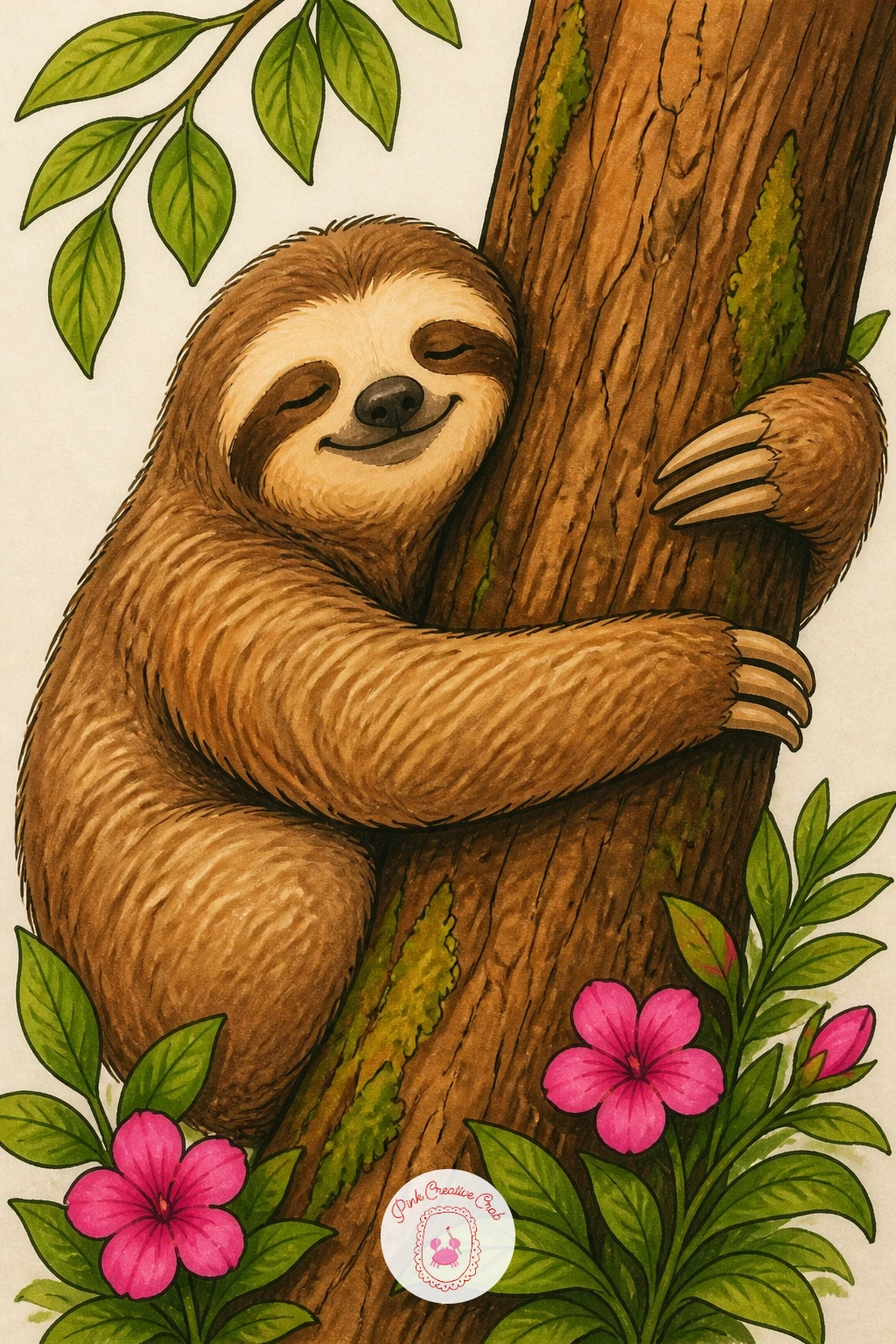
You Will Need
- kneaded eraser
Palette: Dark Umber,Warm Brown,Bark Grey,Mossy Green
After all that bark, lighten the mood with a sloth wearing a flower crown, a simple head and shoulders portrait dressed up for a party. Draw the head large and centered, then sketch the crown as a ring of five or six small blooms sitting just above the eyebrow line, following the curve of the skull rather than sitting flat like a hat.
Ink the face and ears before the crown so the flowers can overlap the fur edge naturally. Color the face in warm brown first, then build the crown from two or three flower colors, hot pink, cream and a touch of pale yellow, so no single bloom repeats right next to another of the same shade.
If the crown starts looking like a pile of identical dots, vary the flower sizes slightly and let one or two tilt rather than face straight out, which is how a real woven crown actually sits. No yellow marker handy, a cream base with a light orange pencil center gets the same cheerful look.
Give the sloth closed, happy eyes rather than open ones here, it fits the slow sleepy charm better than an alert expression would.
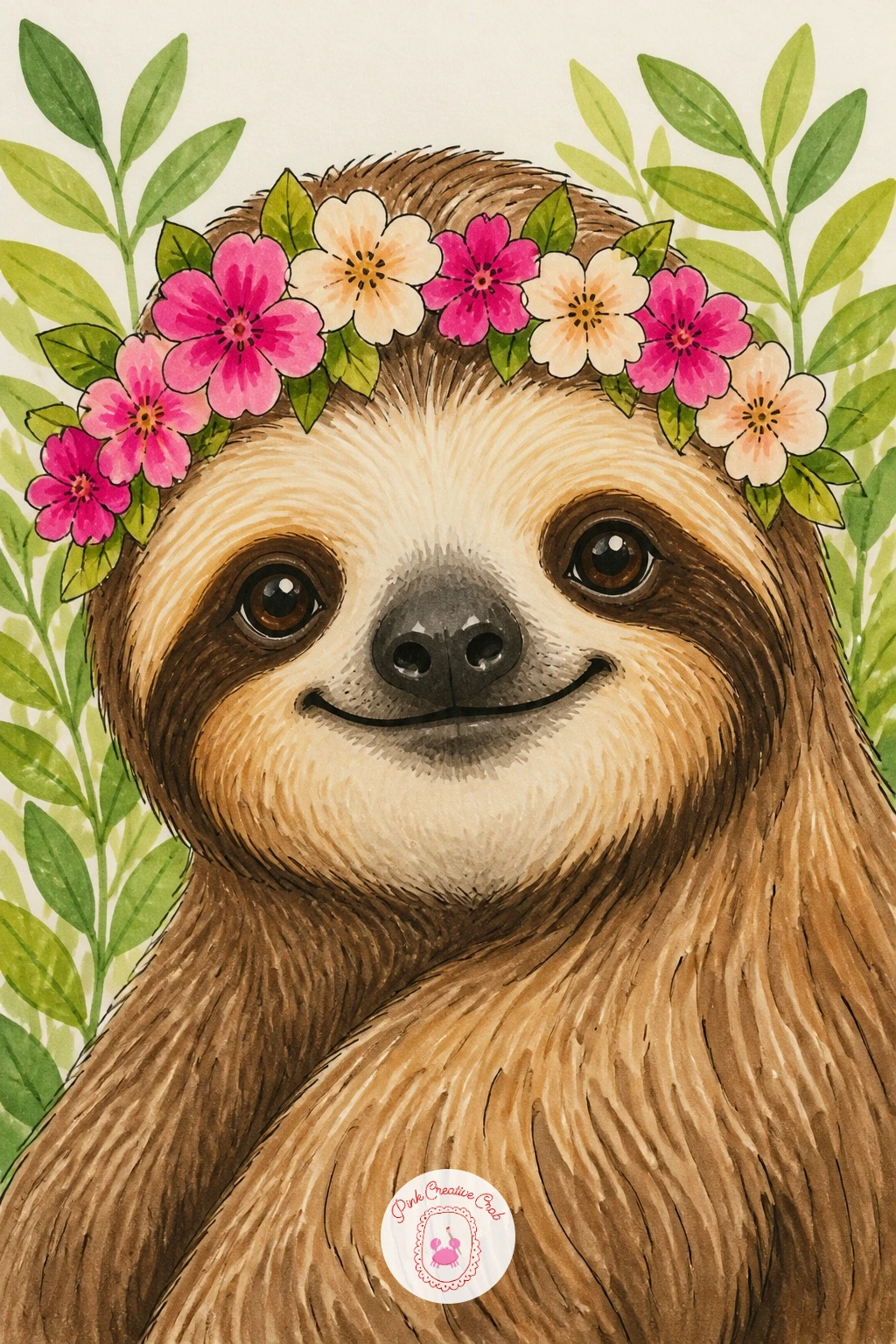
Palette: Warm Brown,Hot Pink,Cream,Pale Yellow
For a quicker piece, try a sloth half asleep holding a coffee cup, drawn from the chest up with one paw curled around a small mug. In ten minutes you can get the whole thing down: head, shoulders, the mug shape, and a flat color pass in warm brown and a single mug color, done.
Spend a longer forty minute sitting adding steam curling up from the cup in a thin wavy line, a pattern on the mug itself, and a second lighter marker layer blended into the fur around the ears and chin to soften the edges. That extra pass is what turns a flat sketch into something with real roundness.
Draw the eyelids drooping almost shut and one eyebrow slightly raised, which is the single expression that sells “half asleep” better than any other detail in this pose. Keep the mug small relative to the paw, since sloth hands are naturally large and a too small cup will look like it belongs to a different animal.
If you only have one brown marker, use it at full strength for the mug’s shadow side and watered down or pressed lightly for the fur, getting two values from one pen.
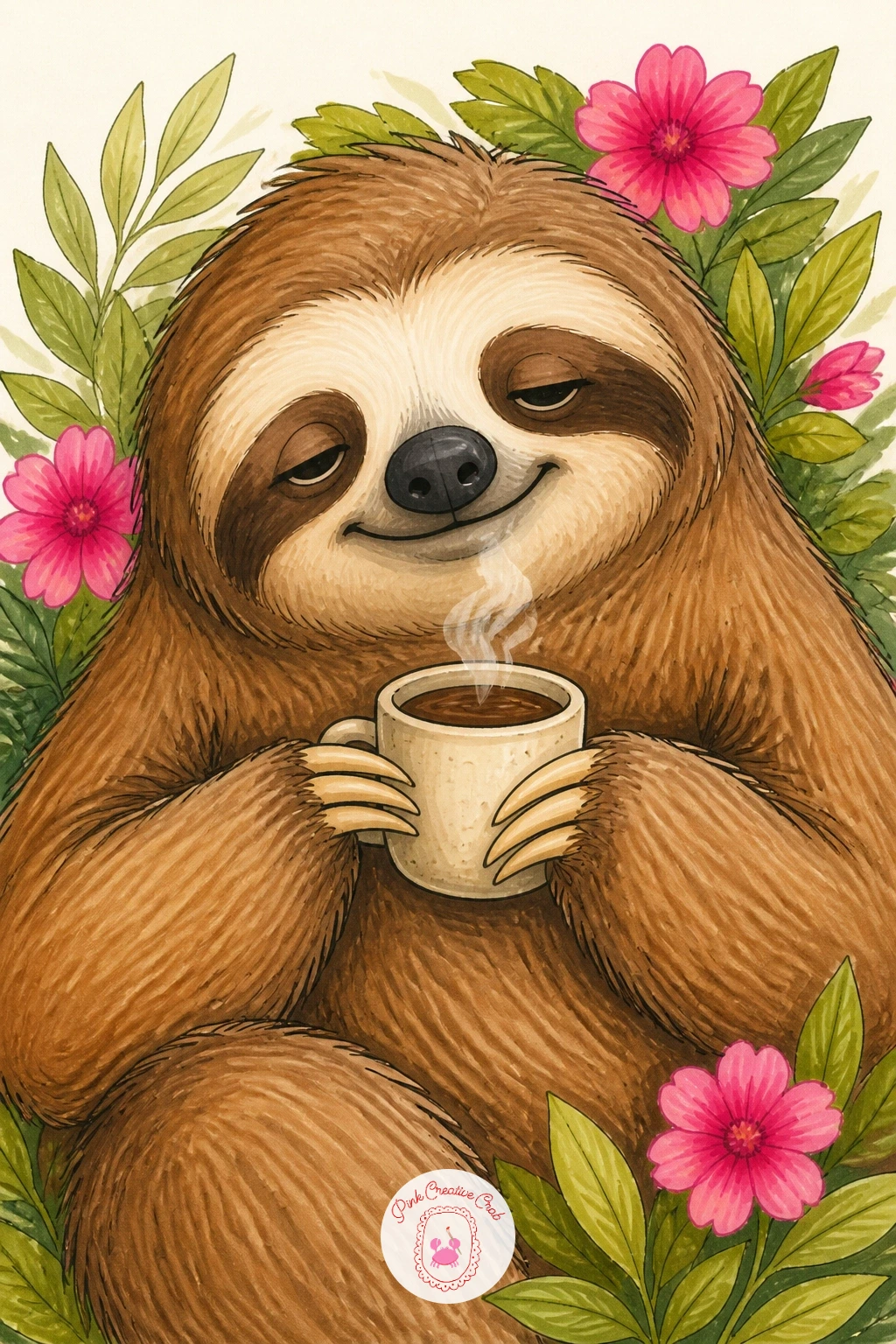
Palette: Warm Brown,Cream,Soft Grey,Mossy Green
Lean fully into the jungle theme with a sloth with moss growing in its fur, a detail real sloths actually carry. Draw the full body first in your usual warm brown, then decide on two or three patches, shoulder, back and one arm work well, where moss will sit before you add a single green mark.
Layer the moss in short overlapping dashes of mossy green rather than a solid block of color, since real moss reads as clumpy and uneven, never flat. Push the dashes slightly darker where they sit closer to the body and lighter where they reach outward, which gives the patches a bit of lift off the fur.
The mistake to watch for is moss that looks painted on top rather than growing through, so let a few brown fur lines poke up between the green dashes instead of covering every bit of brown completely. A fine tip marker in a second green shade is the easiest swap if your main green runs out mid patch.
Give the sloth a calm, slightly smug expression, since the moss works best as a quiet joke rather than anything the sloth seems bothered by.
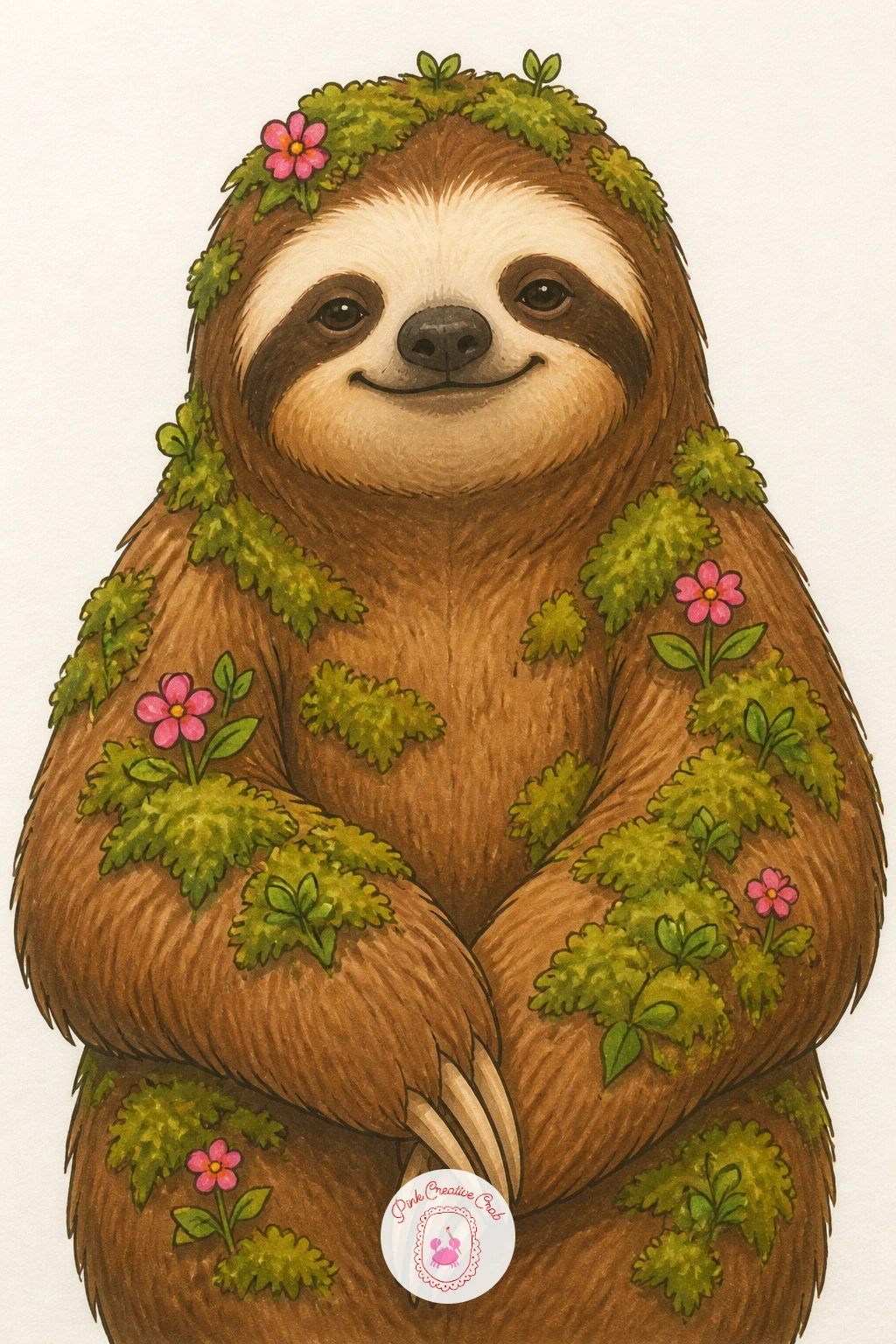
Palette: Warm Brown,Mossy Green,Deep Moss,Soft Cream
Sloths are surprisingly good swimmers, so try a sloth swimming across a river, arms stretched out in a slow breaststroke above the waterline. Draw the head and shoulders breaking the surface first, then the waterline itself as one confident horizontal curve, with the rest of the body implied below it rather than fully drawn.
Here the light source matters: put a soft highlight along the top of the head and shoulders to show the sun sitting high overhead, and let the water below fall into shadow a shade or two darker than the sky color reflected on its surface. That single light choice is what makes the water look wet instead of flat blue.
Ripple lines are the easy way to lose this drawing to clutter, so keep them to a few curved lines trailing behind the arms rather than covering the whole river surface. If blending blue and green markers gets muddy, lay the lighter color first and the darker ripple lines on top once the first layer is fully dry.
Keep the sloth’s expression calm rather than straining, since even swimming, this sloth is still moving at its own unhurried pace.
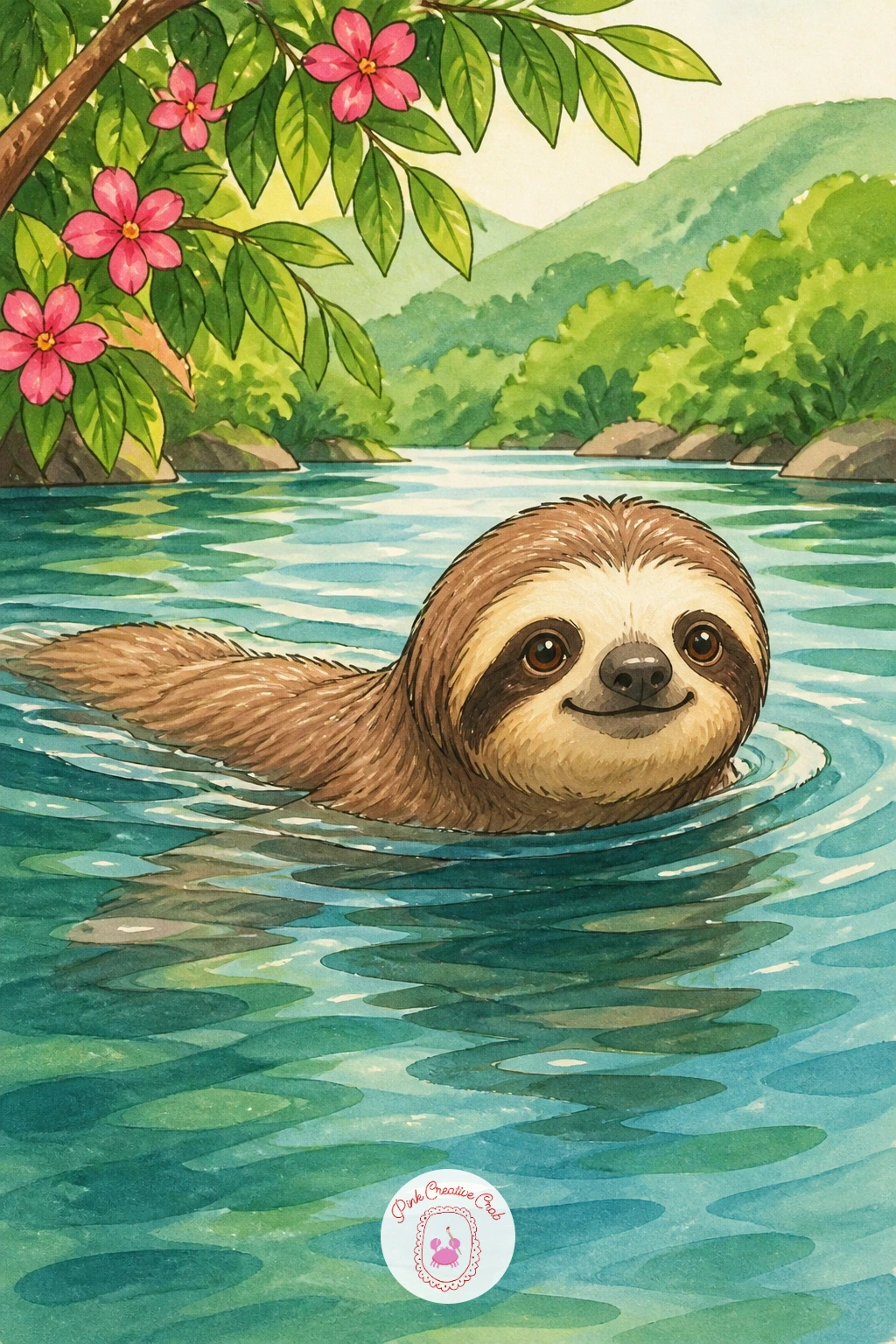
Palette: River Blue,Mossy Green,Warm Brown,Soft Cream
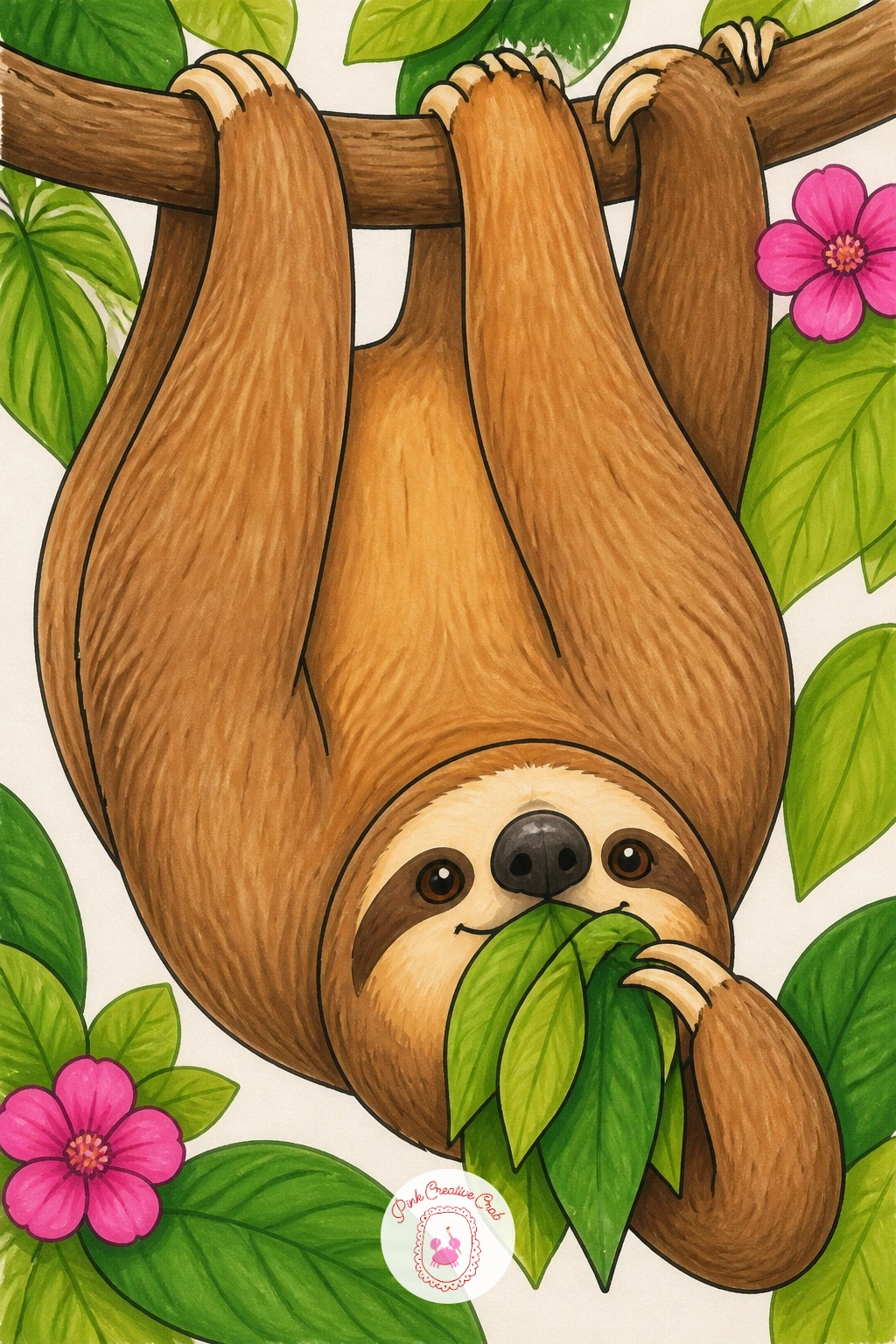
Flip the usual pose with a sloth upside down eating leaves, hanging by both feet from a branch with its head lower than its body. Draw the branch across the top of the page first, then the two hooked feet gripping it, letting the body hang straight down with the head tilted back slightly toward a cluster of leaves.
Working upside down compositions is easiest if you turn your actual paper around to ink the face right side up, then rotate it back once the features sit correctly. Color the leaves in two greens, a lighter one for the leaves nearest the mouth and a deeper shade further back, so the bunch reads as layered rather than one flat clump.
Arms are the part that go wrong here, since a hanging sloth’s arms should drape loosely downward rather than reaching anywhere, so let them hang relaxed at the sloth’s sides. No second green on hand, a yellow marker glazed thinly over your main green shifts it lighter for that front layer of leaves.
Draw the cheeks slightly puffed and one leaf held between the teeth, since that small detail does a lot of work to show the eating in progress.
Palette: Warm Brown,Mossy Green,Light Green,Bark Grey
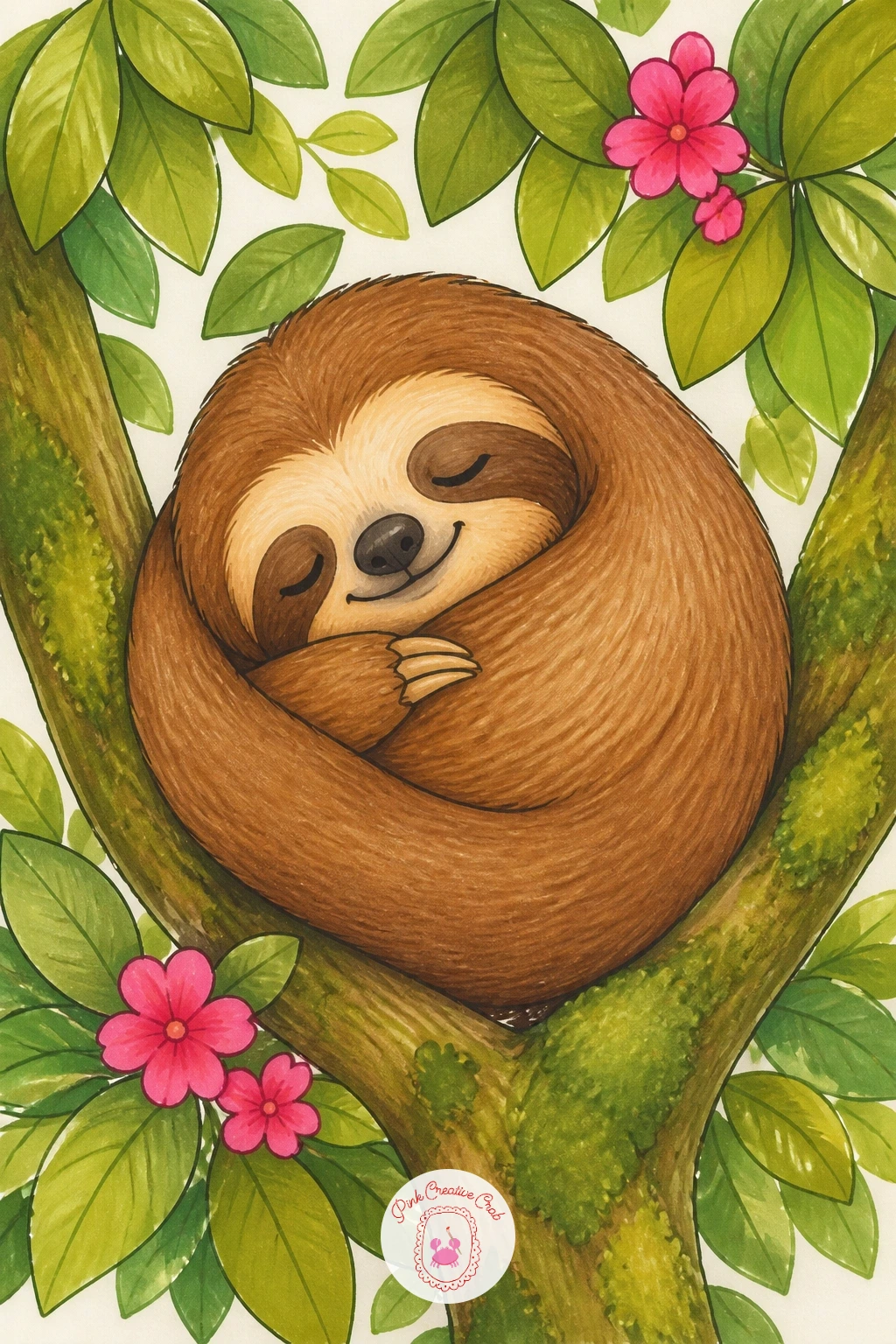
Pull back slightly for a sloth curled into a ball in the treetops, drawn small and round against a wider leafy backdrop. Build the sloth from one large rounded shape first, knees tucked to the chest and arms wrapped around the shins, then nestle it into a fork where two branches meet.
This is a good one to practice loose, varied mark making on the leaves around it, since a dense treetop reads better with leaves of several sizes overlapping than with every leaf drawn the same. Go big and simple in the background shapes, saving your tightest detail for the curled sloth itself so the eye lands there first.
If the surrounding leaves start to overpower the sloth, add one ring of slightly darker green directly behind the curled shape, a basic trick for pushing a subject forward against a busy backdrop. Watercolor or soft pastel dabbed loosely behind a marker sloth works too if you want the background looser than the subject.
Keep the sloth’s face tucked in, eyes closed, chin resting on its own knees, since full visibility of the face isn’t needed for this one to read as peaceful and curled up safe.
Palette: Warm Brown,Mossy Green,Deep Moss,Light Green
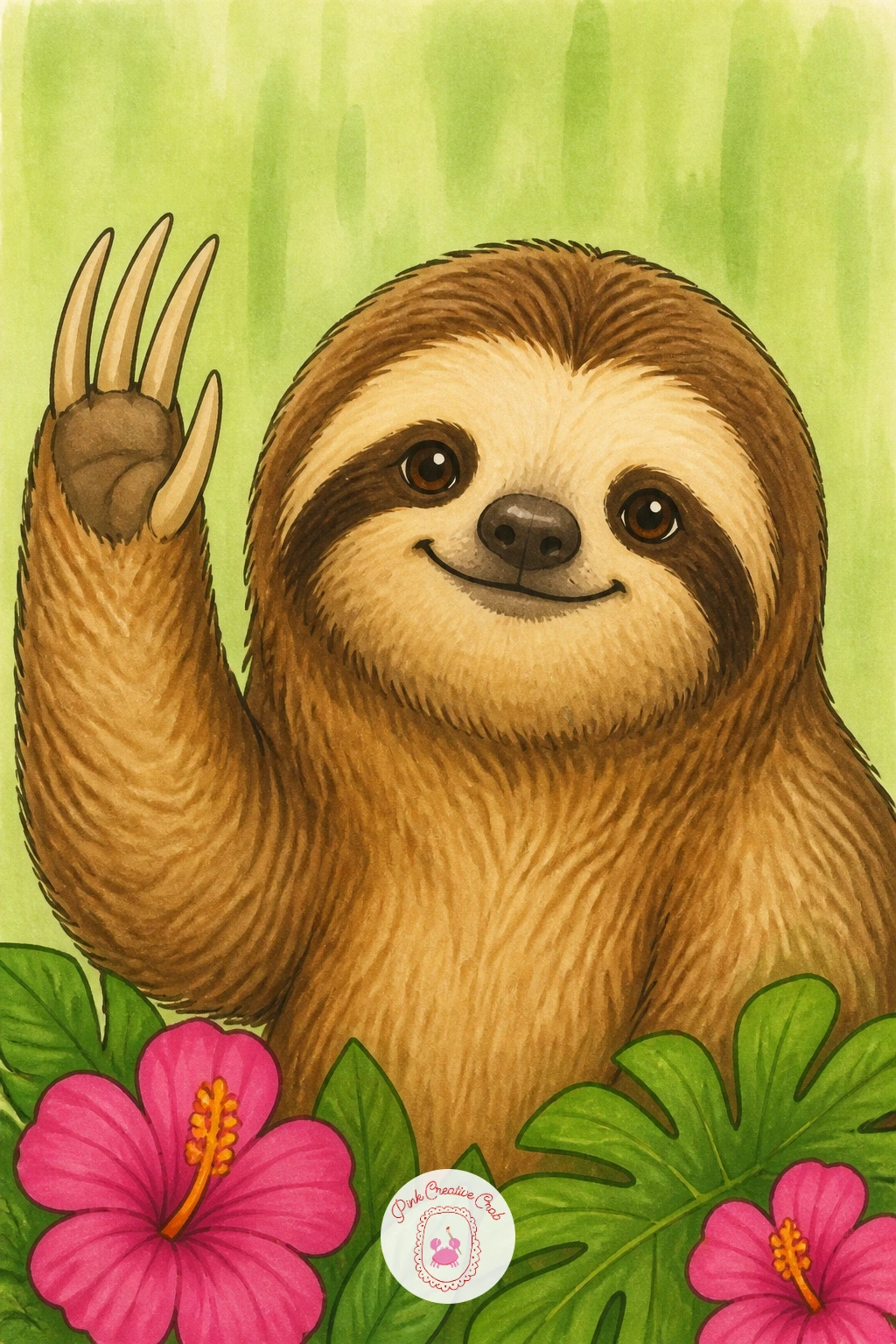
Keep it simple again with a sloth waving very slowly, one paw raised in a gentle greeting straight to the viewer. Draw the body facing forward, head slightly tilted, then raise one arm with the paw open and fingers spread loosely rather than in a tight fist, which reads as a far friendlier wave.
A quick measuring trick helps the raised arm sit correctly: the paw at the top of the wave should land roughly level with the top of the head, not higher, or the pose starts to look alarmed instead of calm. Check that against your pencil sketch before inking.
Color the face with a soft smile and both eyes open and round, since this is one of the few poses on the list where full alertness actually suits the mood. If your marker tip is getting worn and leaving streaky color, switch to small circular motions instead of long strokes to even it back out.
Add a couple of small motion lines beside the raised paw, short and curved, to suggest the wave is still mid motion even though everything about it is unhurried.
Palette: Warm Brown,Cream,Mossy Green,Soft Grey
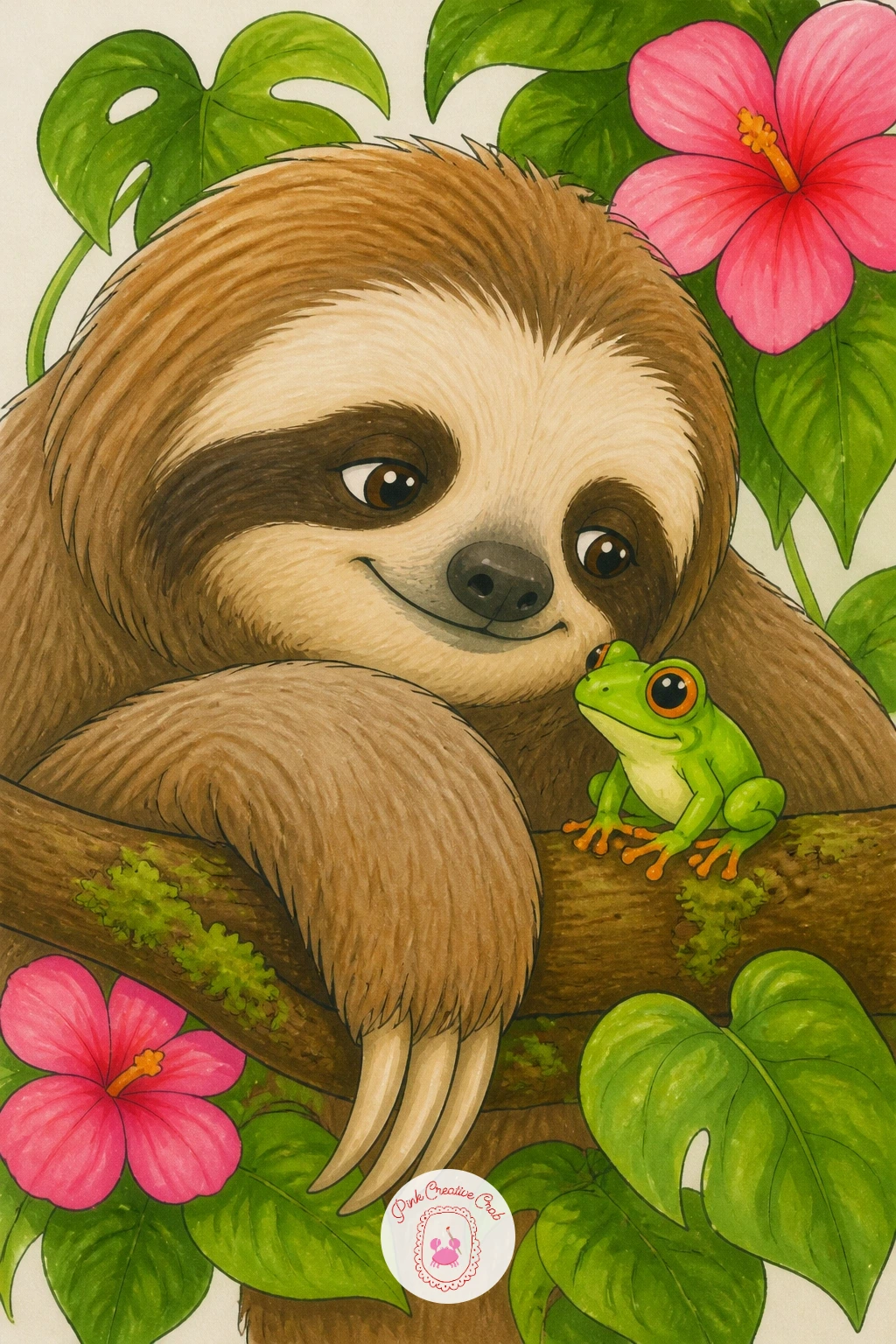
Pair the sloth up with a sloth with a little green frog friend, perched together on the same branch. Draw the sloth first as the larger shape, then add the frog small and round beside its paw or shoulder, keeping the frog no bigger than the sloth’s own head so the scale stays believable.
If you have a bright marker to spare, try this frog in a poison dart frog yellow green rather than plain green, since the saturated color against the sloth’s muted brown is what makes the pairing pop on the page. Ink the frog’s big round eyes and smooth rounded body last, after the sloth is fully outlined, so you can judge exactly how much space it needs.
Shiny wet skin is the trick worth learning here: leave one small unmarked highlight on the frog’s back and one on its eye, a tiny white gap left clean of any color, which does more to suggest a glossy wet surface than any amount of extra shading would.
Give the sloth a slightly curious glance down toward the frog, since eye contact between the two is what turns two separate animals into one friendly scene.
You Will Need
- white gel pen
Palette: Warm Brown,Frog Green,Mossy Green,Cream
Bring in a bit of celebration with a sloth hanging from party bunting, one arm hooked over a string of small triangular flags. Draw the bunting string first, sagging in a gentle curve across the top of the page, then hang the sloth’s body below it exactly as you would from a branch, just with cloth instead of bark under the paw.
Alternate the bunting flags between two or three colors, hot pink, cream and mossy green work well with the rest of this palette, and keep the triangles slightly uneven in size rather than perfectly matched, which looks more like real hung fabric than a printed graphic.
If the string looks too stiff and straight once inked, add a touch more sag right where the sloth’s weight pulls on it, since a flat string under a hanging animal breaks the illusion of weight fastest. A dotted line for the string, rather than solid, is an easy fix if a solid line looks too heavy against the flags.
Keep the sloth’s expression delighted rather than sleepy here, a small open mouthed smile fits the party mood better than the usual half lidded calm.
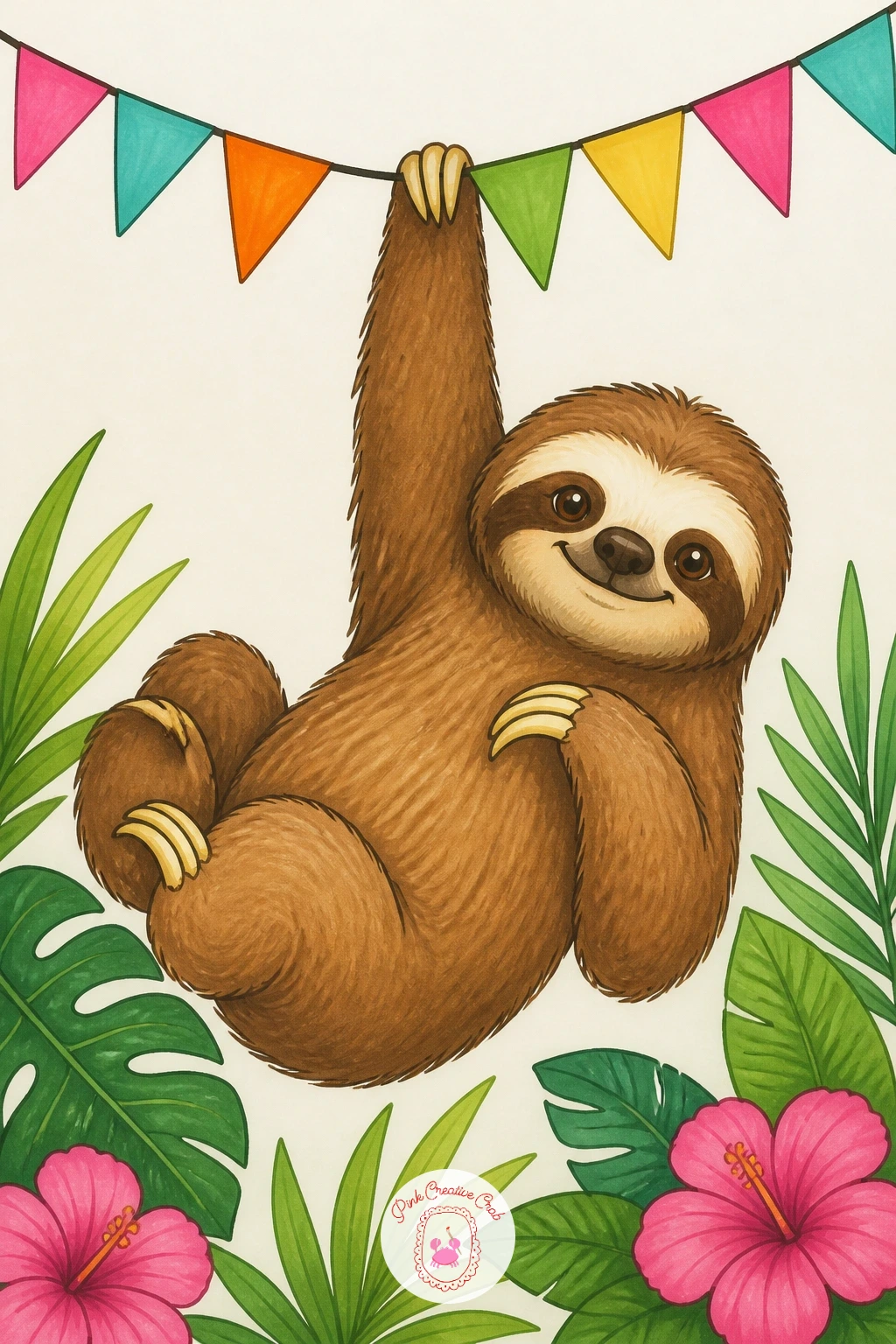
Palette: Hot Pink,Cream,Mossy Green,Warm Brown
Settle into a cozier mood with a sloth reading under a leaf umbrella in the rain, holding one giant leaf overhead like a parasol while a small book rests in its other paw. Draw the leaf first, large and slightly domed, then tuck the sloth’s head and shoulders underneath it with the book held close to the chest.
Rain is the detail that makes this scene work, so add a scatter of short straight diagonal lines falling around the leaf, keeping them sparse and evenly spaced rather than filling the whole background, which would turn the drawing grey and busy instead of gentle.
The leaf itself is a good spot to practice vein lines radiating out from a central stem, drawn lightly in fineliner before color goes down, since they give the big leaf shape some structure without needing extra shading. If your green marker looks flat on the leaf, a slightly darker green traced along just the vein lines lifts the whole shape.
Keep the sloth’s expression peaceful and absorbed in the book, eyes looking down rather than out at the viewer, since that small choice is what sells quiet concentration.
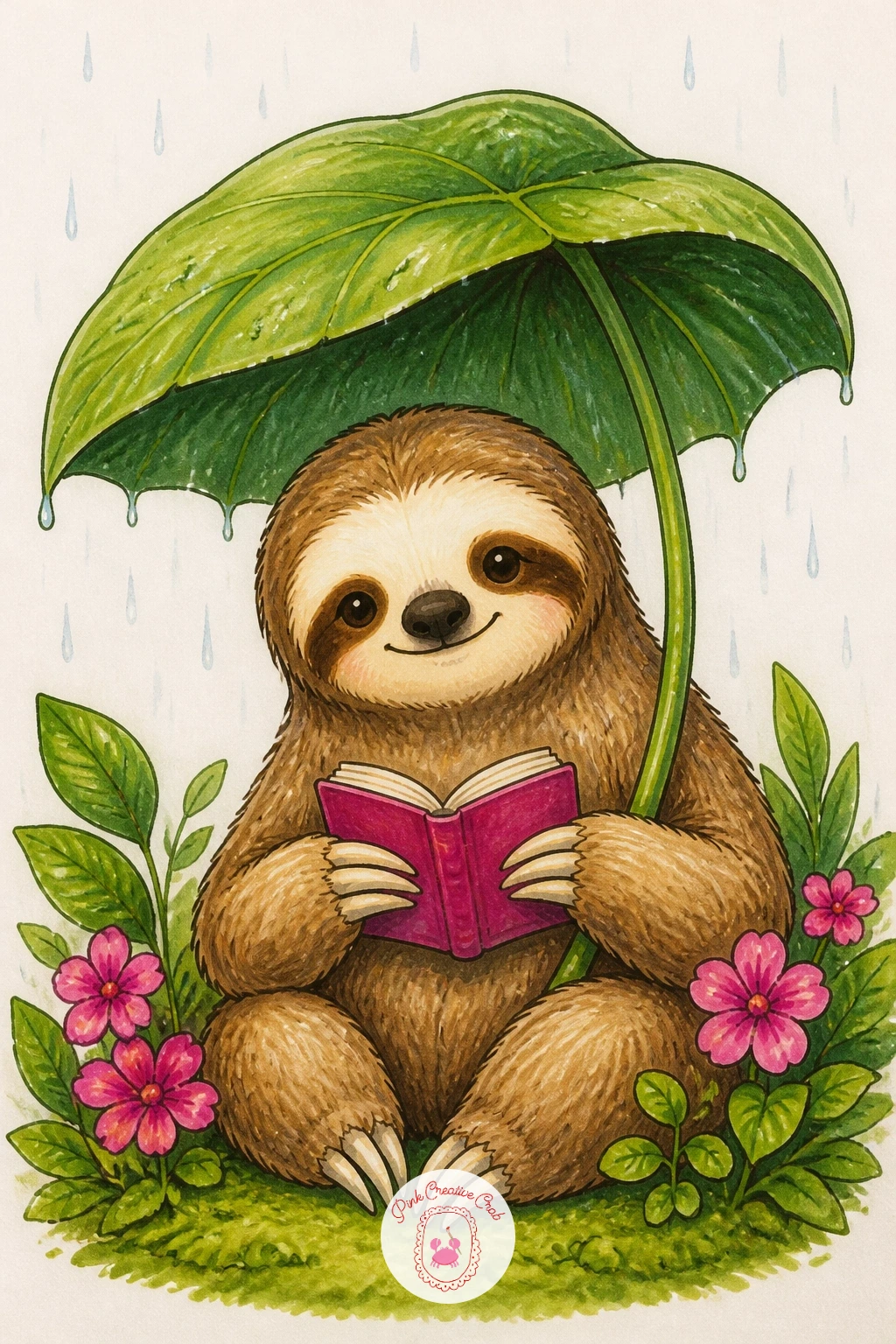
Palette: Mossy Green,Deep Moss,Warm Brown,Soft Grey
This idea pairs well with the leaf drawing practice in Butterfly Drawing Pencil: 15 Fun Ideas for Beginners, where veined wings use the same radiating line trick.
Switch to something delicate with a sloth blowing a dandelion, cheeks puffed and seeds drifting off into the air. Draw the sloth’s face first, mouth rounded into a small O and cheeks slightly rounder than usual, then add the dandelion stem held in one paw with the fluffy seed head just in front of the mouth.
The seeds are the whole charm of this one, so draw them as a loose scatter of tiny lines with a small dot at the end of each, trailing away from the dandelion in the direction the sloth is blowing, getting sparser and further apart the further they travel from the flower.
Keep the dandelion head itself unevenly round rather than a perfect circle, since real seed heads are a little lopsided, and that slight asymmetry is more convincing than a tidy sphere. If your fineliner tip is too thick for fine seed lines, a mechanical pencil or a fine gel pen gets a cleaner hair thin line.
One concrete tip: leave a few seeds still attached to the head and only some airborne, since a dandelion blown completely bare in one breath looks less believable than one caught mid scatter.
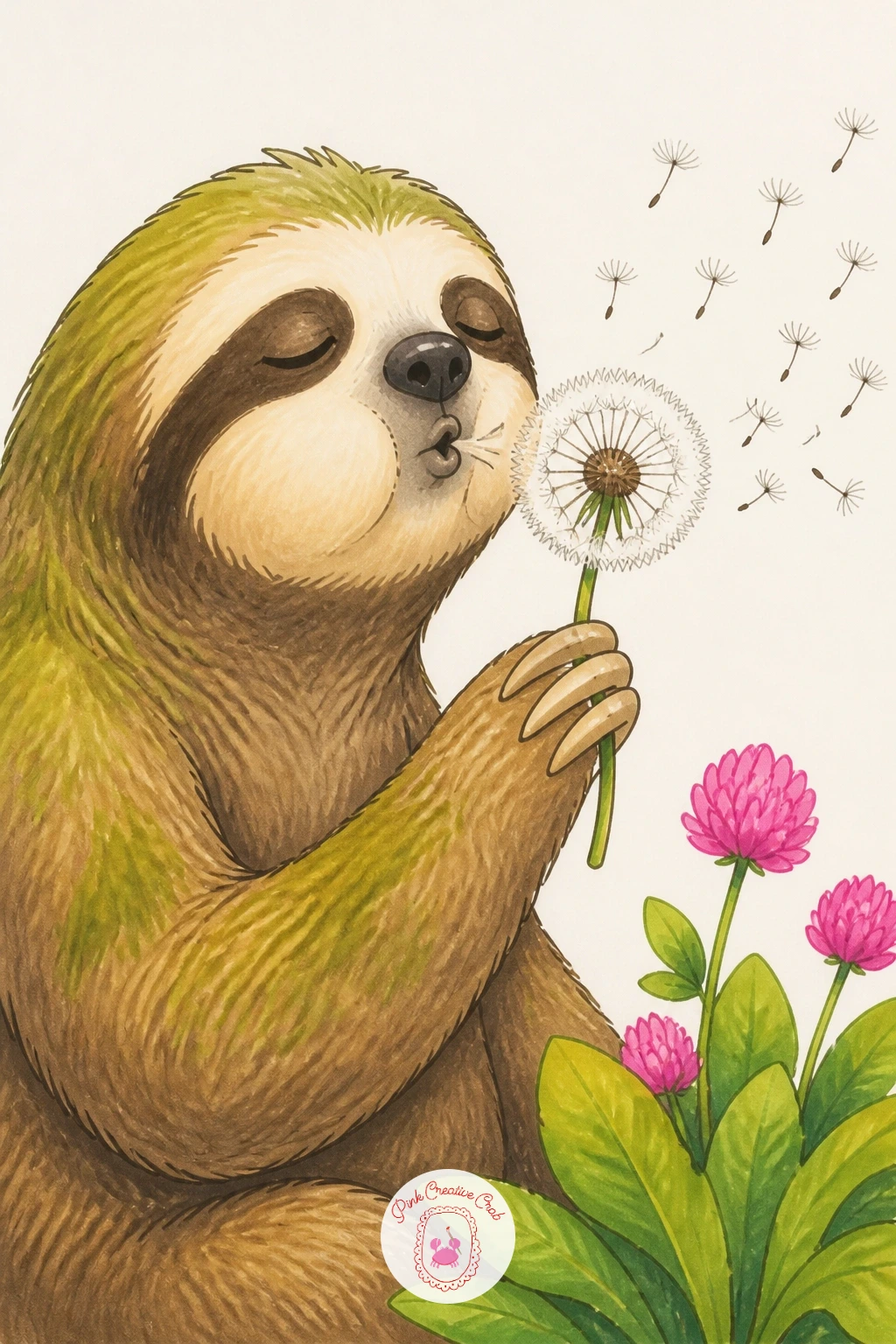
Palette: Warm Brown,Soft Cream,Mossy Green,Soft Grey
For a softer story moment, try a baby sloth being fed at a rescue center, cradled in a blanket while a small bottle is held to its mouth. Draw the baby sloth small and curled, limbs tucked in close, then wrap a simple folded blanket shape around its body before adding a hand and bottle entering from one side of the frame.
Only the hand and forearm need to appear, drawn plainly without much detail, since the baby sloth should stay the clear focus of the piece rather than sharing attention with a full figure. Color the blanket in a solid, gentle shade, cream or soft pink works well, kept flatter and simpler than the sloth’s own shaded fur so the eye settles on the baby first.
Big, round, half closed eyes are the detail that makes a baby sloth read as a baby rather than a small adult, so draw them larger in proportion to the head than you would for any of the adult poses on this list. A soft pastel pencil blended lightly over the cheeks adds warmth if your markers feel too flat for this gentler scene.
Keep the whole composition close and cropped in, since tightening the frame around the baby and the bottle makes the moment feel intimate rather than distant.
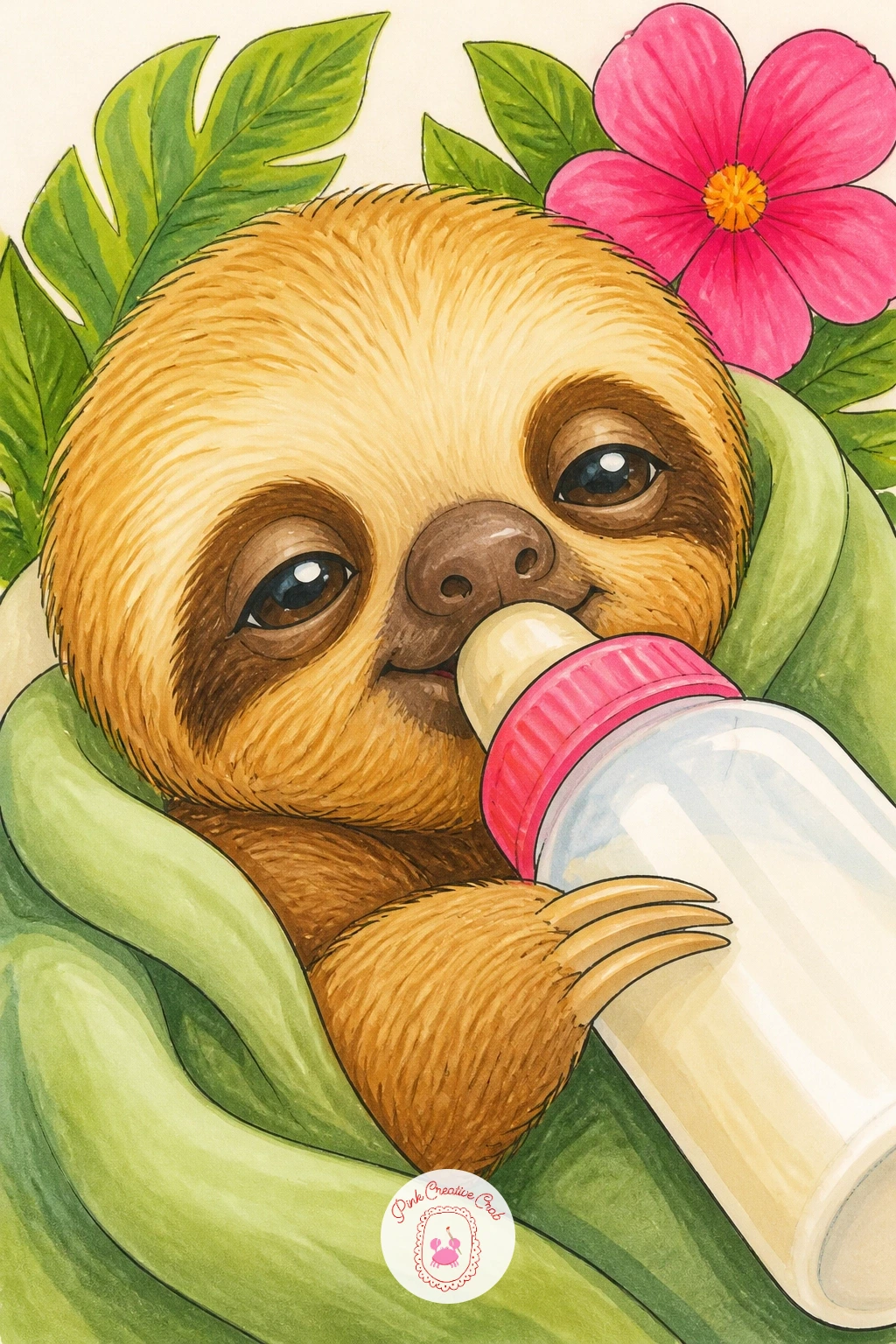
Palette: Golden Tan,Soft Pink,Cream,Warm Brown
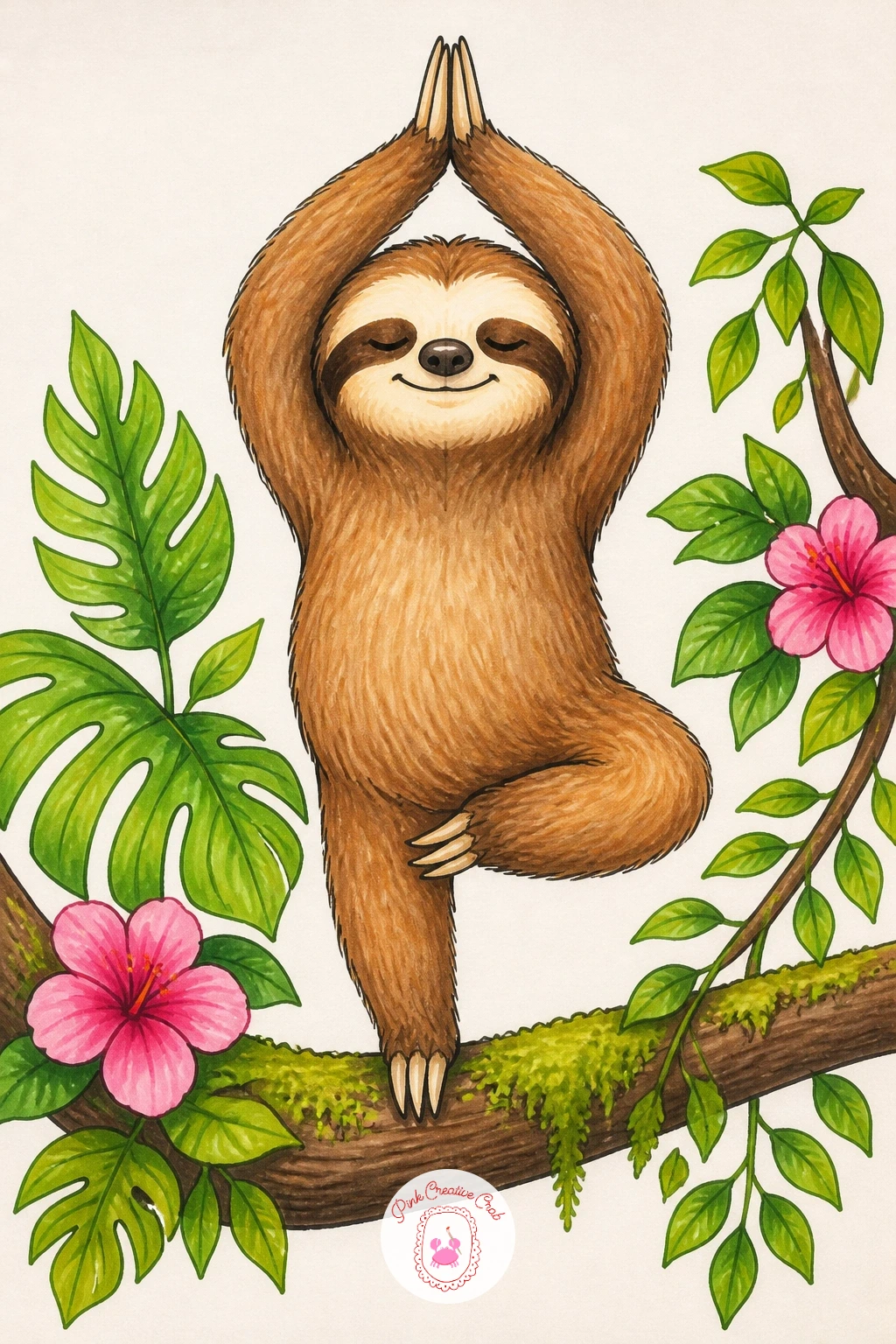
Have a little fun with a sloth doing yoga on a branch, balanced in a simple pose with one leg lifted and both arms stretched overhead. Draw the branch as a stable horizontal base first, then build the sloth’s pose around it, keeping the standing leg’s foot gripping the branch firmly while the other leg bends and lifts to one side.
Balance is the whole challenge here, so sketch a light vertical guideline straight down through the head and standing foot before you ink anything, checking that the sloth’s center of weight actually sits over its gripping foot rather than floating off to one side.
Arms reaching straight overhead can look stiff if drawn perfectly parallel, so angle them slightly apart and let the fingers curl softly rather than pointing straight up like two sticks. If the pose still feels tense once inked, loosen the shoulders by rounding them more and dropping them slightly lower.
Give the sloth a serene, closed eyed expression to match the pose, since a sloth doing yoga with wide alert eyes undercuts the whole joke of taking it slow.
Palette: Warm Brown,Mossy Green,Soft Cream,Bark Grey
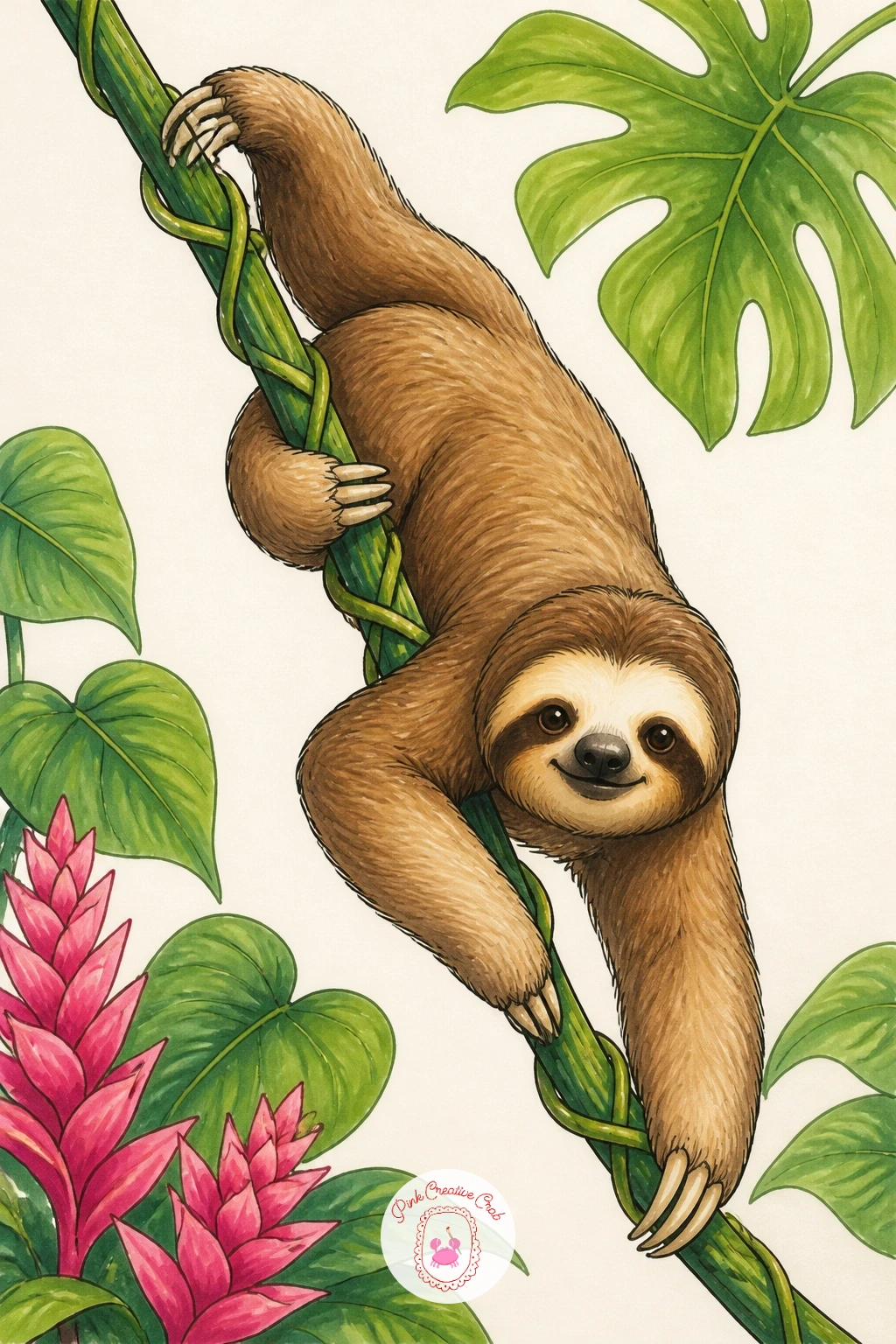
Add a little variety in species with a two-toed sloth climbing down a vine, noticeably different from the three-toed poses earlier in that its face reads rounder and its claws number only two per paw. Draw a long diagonal vine first, running corner to corner across the page, then have the sloth gripping it with both pairs of claws clearly visible and spaced wider apart than a three-toed sloth’s.
Add a lighter patch of fur around the face, since two-toed sloths often show a pale mask shape there, which also gives you a nice excuse to blend a cream highlight into the otherwise brown palette. Keep the body angled along the diagonal of the vine rather than hanging straight down, which makes the climbing action clearer than a vertical pose would.
If the two-claw detail gets fiddly at a small size, draw the claws slightly larger and more separated than feels accurate, since a touch of exaggeration reads more clearly than anatomically tight, tiny claws ever will in a simple marker drawing.
One concrete tip: leave the vine leaves sparse along its length, two or three clusters rather than a leaf at every inch, so the diagonal line itself stays the clearest shape in the piece.
Palette: Warm Brown,Cream,Mossy Green,Deep Moss
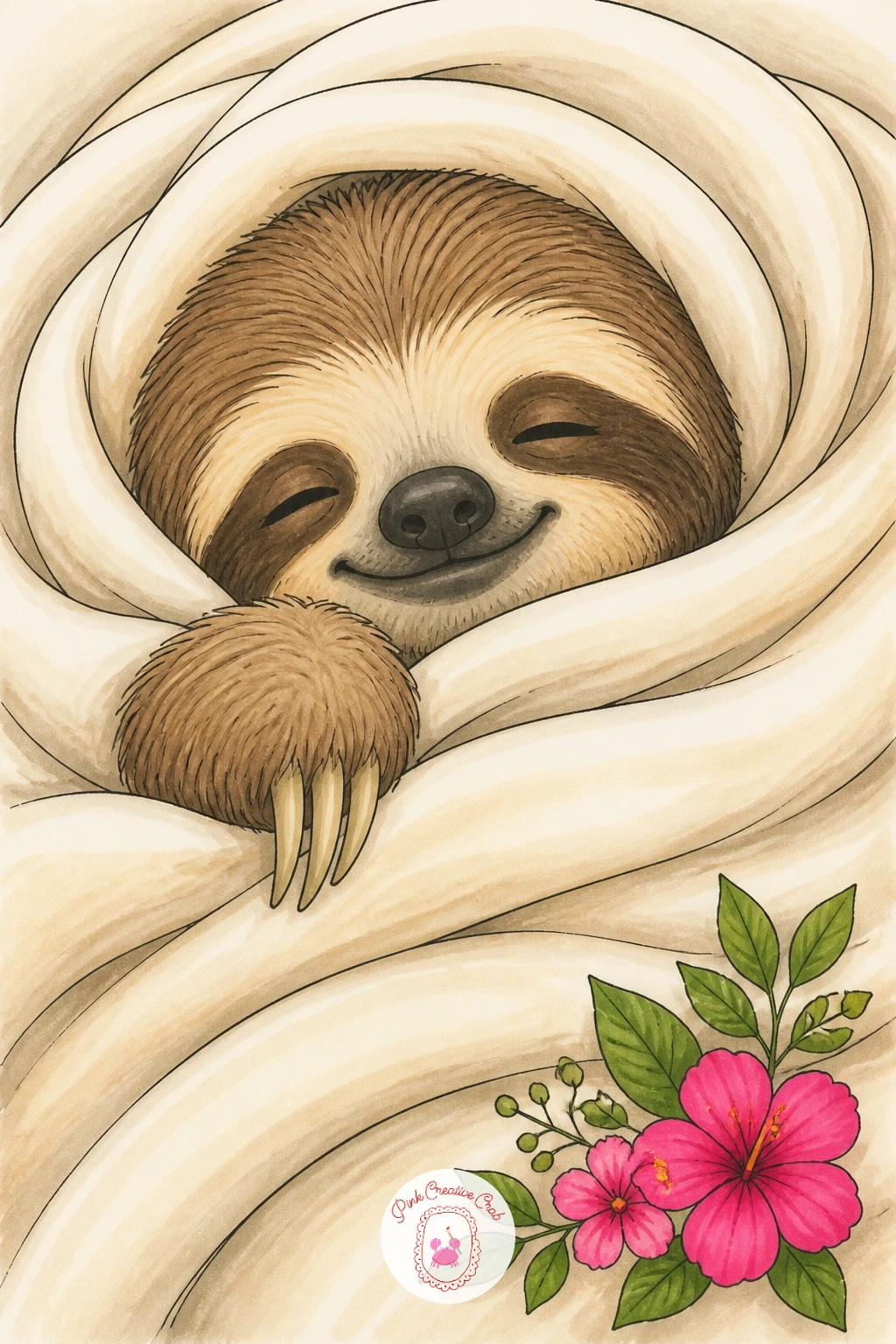
Go cozy with a sloth snuggled in a blanket, only the head and one paw peeking out from a thick folded wrap. Draw the blanket first as a soft rounded mound filling most of the page, then nestle the sloth’s face into one corner of it, tucking the body shape entirely out of sight beneath the folds.
Folds are the whole texture lesson here: use a dry brush style drag with your marker, pulling the tip lightly across the paper so some paper shows through in streaks, which reads as the soft nap of blanket fabric catching light unevenly. Darker folds sit in the creases where the blanket dips, lighter marker stays on the raised rounded parts.
If the dry brush streaks come out too scratchy, go back over them once with a light even layer to soften the contrast, or swap to a soft watercolor pencil blended with a damp brush for an even gentler texture. Keep the blanket pattern simple, a plain color or a few wide stripes, so it doesn’t compete with the cozy face peeking out.
Draw the sloth’s eyes drooping and one paw curled loosely near its chin, since that tiny gesture completes the feeling of total comfort.
Palette: Soft Cream,Warm Brown,Soft Grey,Mossy Green
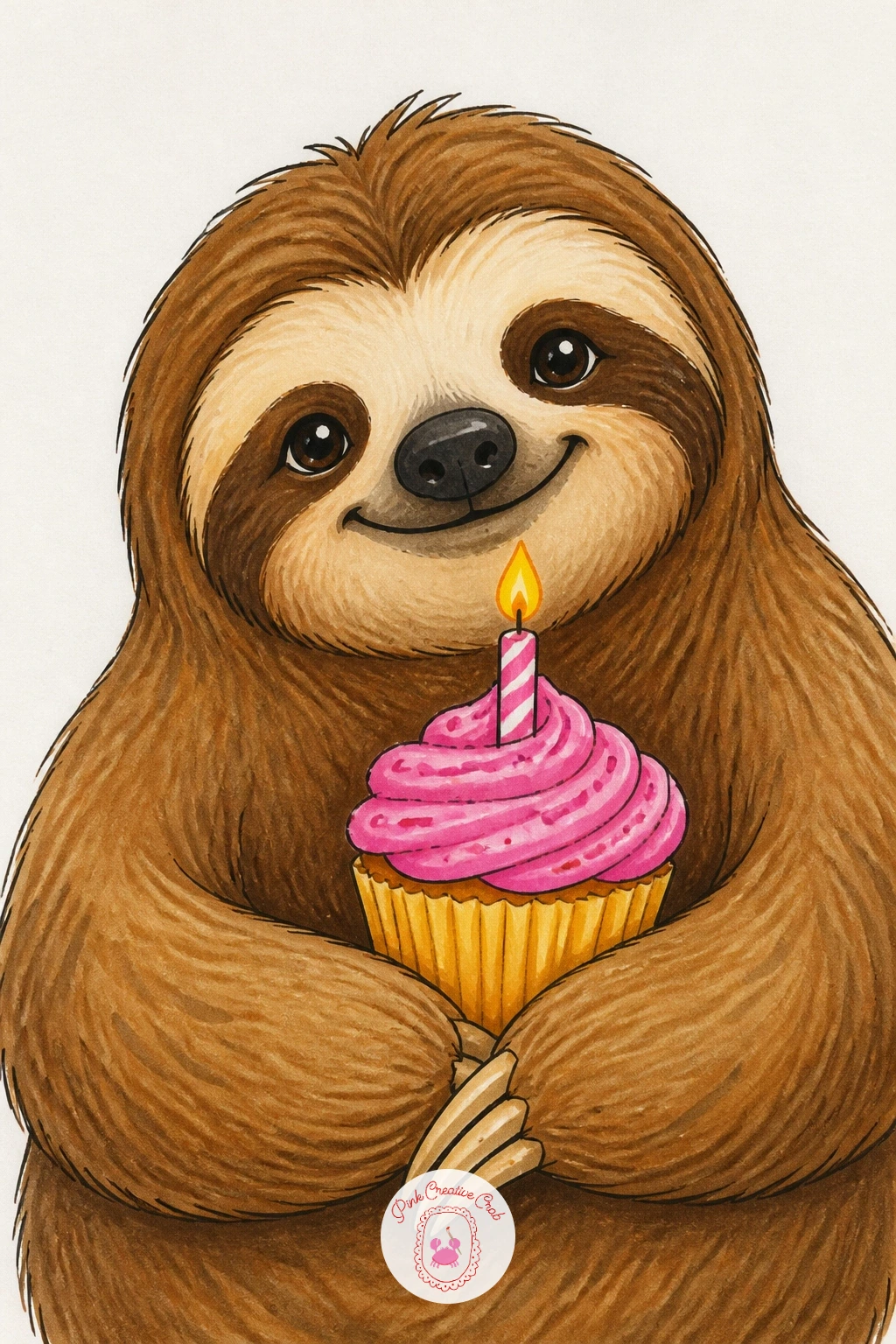
Keep the party going with a sloth with a birthday cupcake, holding it close with both paws and one candle lit on top. Draw the sloth’s upper body first, then the cupcake sized generously in its paws, since a cupcake drawn too small will disappear against those large rounded hands.
Build the cupcake from the bottom up: the paper wrapper in simple vertical pleats, then a swirl of frosting on top, finishing with a single thin candle and a small teardrop flame. Color the wrapper and frosting in two contrasting shades, hot pink frosting against a cream wrapper reads cheerfully against the rest of the palette.
Frosting swirls are easy to overwork into a tight spiral that looks mechanical, so keep the swirl loose with only two or three turns and uneven thickness along its length. If your pink marker streaks unevenly on the frosting, let it, since a slightly streaky frosting texture actually looks more like real buttercream than a flat fill would.
Give the sloth a wide closed mouth smile with eyes crinkled at the corners, the clearest happy expression on this whole list, perfect for a celebration piece.
Palette: Hot Pink,Cream,Warm Brown,Pale Yellow
Pick up the pace, just slightly, with a sloth on a rope swing, seated on a wooden plank mid arc between two unseen trees. Draw the rope and plank first as a simple triangle shape, then seat the sloth on the plank with both arms wrapped around the ropes on either side rather than gripping overhead.
A quick version of this scene takes about ten minutes: outline, flat brown fill on the sloth, a flat tan on the plank, done, and it still reads perfectly well as a finished little drawing. Give it forty minutes instead and add rope texture in short diagonal fineliner marks along both ropes, a gradient of blue sky behind fading lighter toward the horizon, and a cast shadow beneath the swing to ground it.
The arc of motion is easy to lose if the rope hangs perfectly straight, so angle both rope lines slightly, as if the swing is mid movement rather than hanging still. If you are short on blue marker for the sky, leave the background white and let the brown and tan carry the whole piece instead.
Keep the sloth’s legs dangling loosely rather than tucked under the seat, since relaxed dangling legs suit the whole unhurried mood of this list.
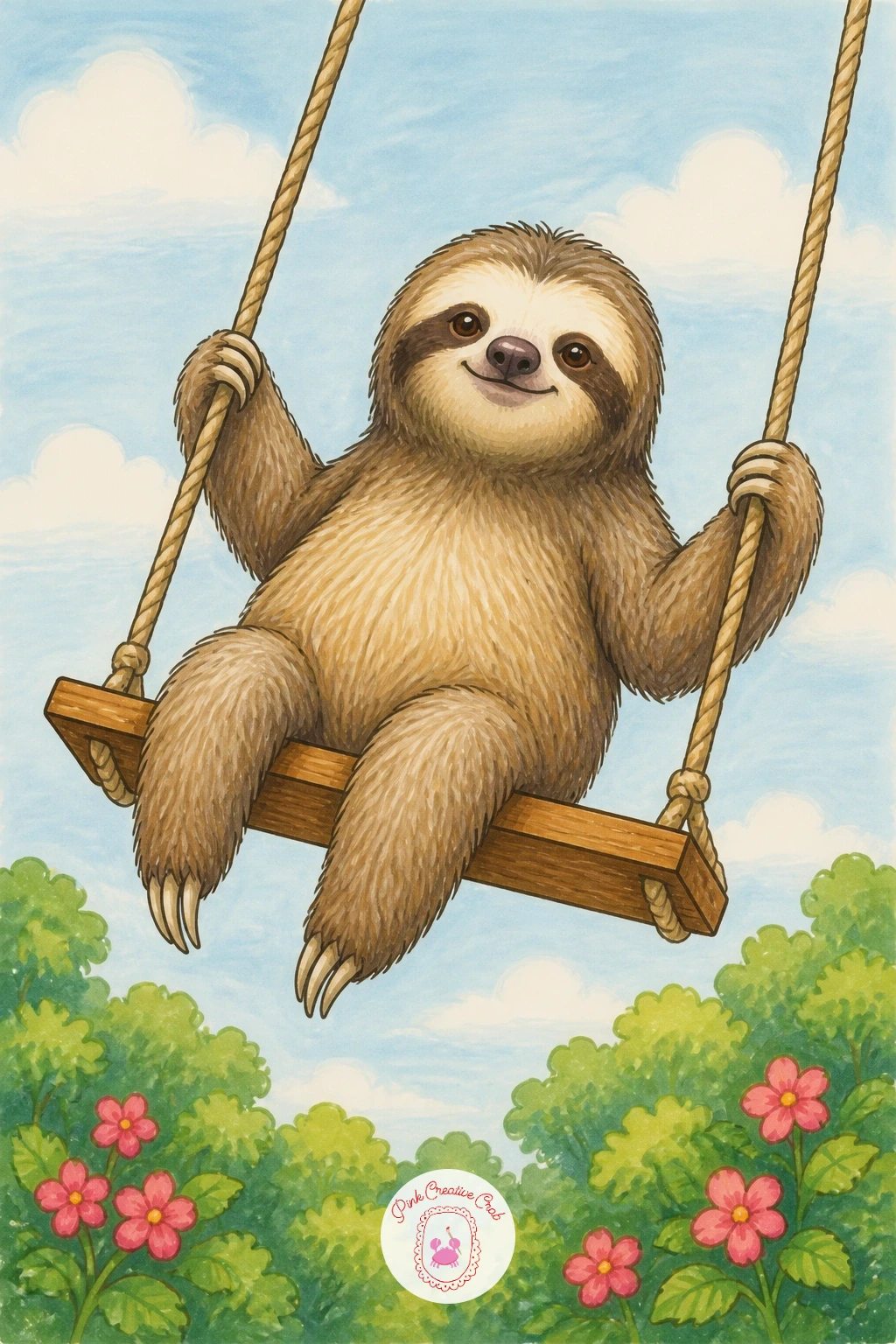
Palette: Warm Brown,Tan,Sky Blue,Mossy Green
Have some fun pairing two slow animals with a sloth riding on the back of a turtle, perched calmly on the shell as if the ride could take all day. Draw the turtle’s domed shell first, divided into simple hexagonal plates, then seat the sloth centered on top with its arms resting loosely rather than gripping for balance.
Scale is worth checking before you ink: the turtle’s shell should be roughly as long as the sloth’s body is tall, which keeps the pairing believable rather than making the turtle look like a toy. Shell plates are the fun detail to render, each one shaded slightly differently so the dome reads as curved rather than flat, darker toward the outer edges and lighter at the center top where light would catch it.
If the hexagon pattern feels fiddly to keep even, draw it loosely freehand rather than measuring each plate, since a little irregularity actually looks more natural on a shell than a perfectly gridded pattern would. Green and brown markers blended across the shell plates keep it in the same palette as the sloth itself.
Draw both animals with the same slow, contented expression, since the joke of this pairing works best when neither one looks in any hurry at all.
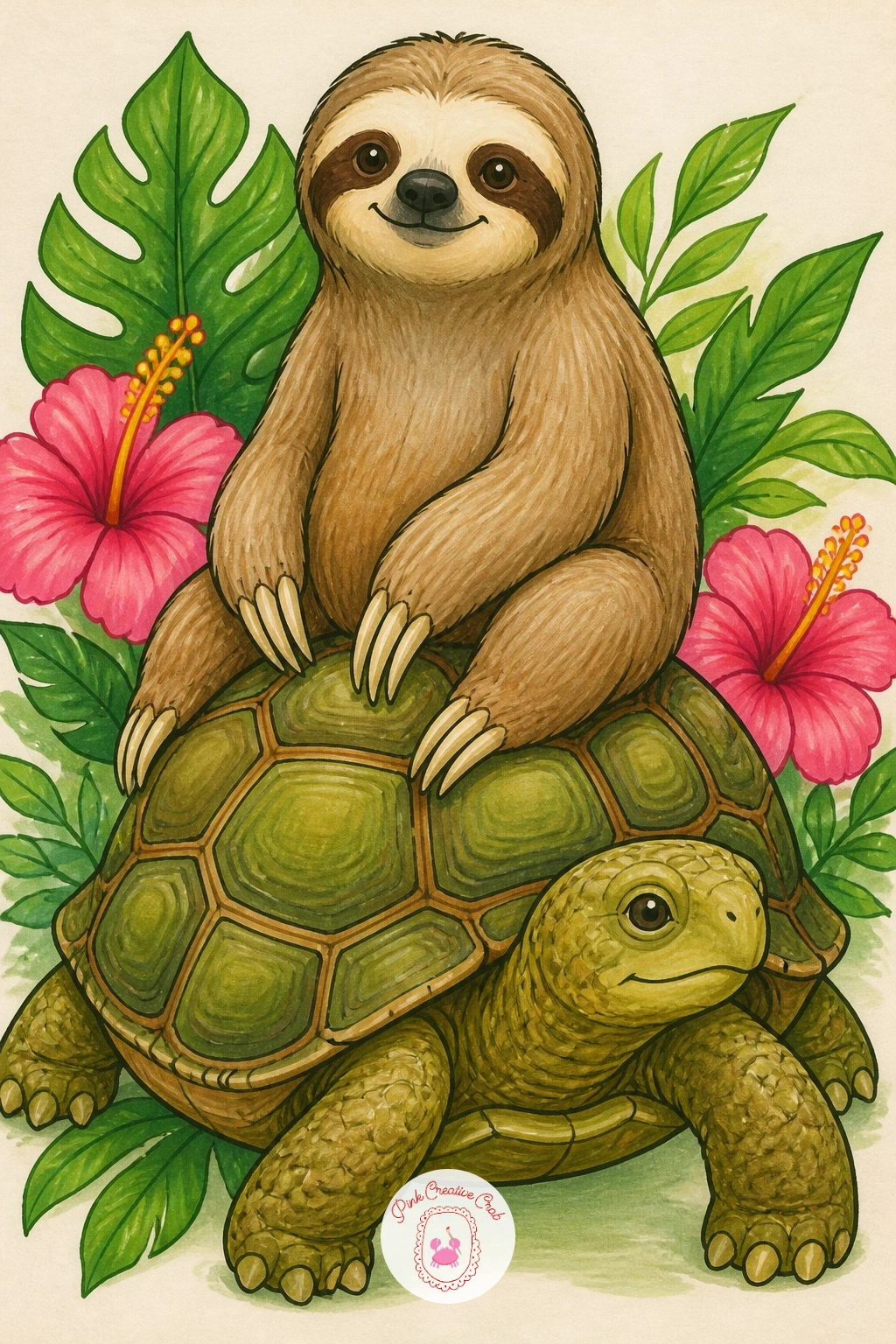
Palette: Warm Brown,Mossy Green,Deep Moss,Soft Cream
Zoom right into the face for a sloth mid yawn, mouth stretched wide open and eyes squeezed shut. Draw the head large, filling most of the page, then build the open mouth as a wide rounded oval with the top lip pulled up and the bottom jaw dropped low, leaving plenty of room inside for the tongue shape.
Check the mouth against the rest of the face before inking fully: a yawn this big should take up close to half the total face height, which feels exaggerated on paper but reads as exactly right once colored in, since a timid small yawn barely registers as one at all. Eyes squeezed into tight curved lines, eyebrows pulled up and in, finish the expression.
The inside of the mouth is an easy spot to flatten out, so shade it in two tones, a mid pink further back in shadow and a lighter pink near the front teeth, with the tongue a shade deeper pink than both. If pink markers are limited, a single pink blended with a touch of brown gets both the shadow and the tongue tones from one pen.
One concrete tip: add a single small motion line or two near the top of the head, as if a stretch is happening along with the yawn, which makes the whole face feel more alive.
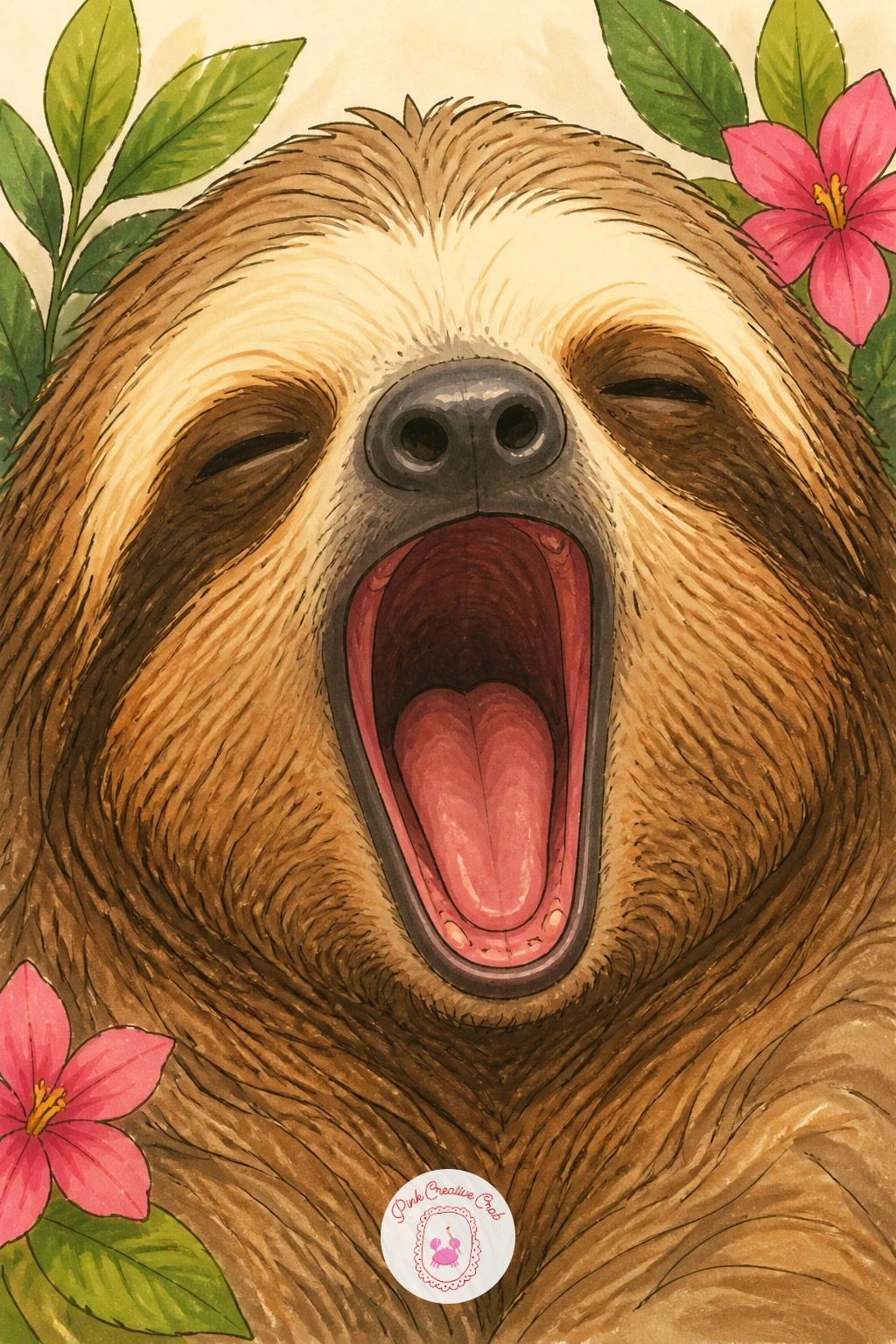
Palette: Warm Brown,Soft Pink,Deep Pink,Cream
Bring the sloth into the modern day with a sloth wearing headphones, head tilted slightly as if caught enjoying a slow song. Draw the head and ear position first, then fit a simple rounded headphone band over the top, with the ear cups sized generously since sloth ears sit low and are often barely visible under fur.
Keep the headphones in a flat solid color, black, cream or even hot pink to match the rest of the palette, and contrast it clearly against the fur so the accessory reads instantly rather than blending in. A thin highlight line along the curve of the band, left unmarked white, is enough to suggest shiny plastic without any extra shading work.
If the headphone band looks too thin and wiry once inked, thicken it slightly and round the corners where it meets the ear cups, since a chunkier band suits the whole soft rounded style of these drawings better than a sharp, realistic one would.
Give the sloth closed eyes and a small content smile, head tilted a touch to one side, since that tilt is what suggests it is actually listening rather than just wearing the headphones for show.
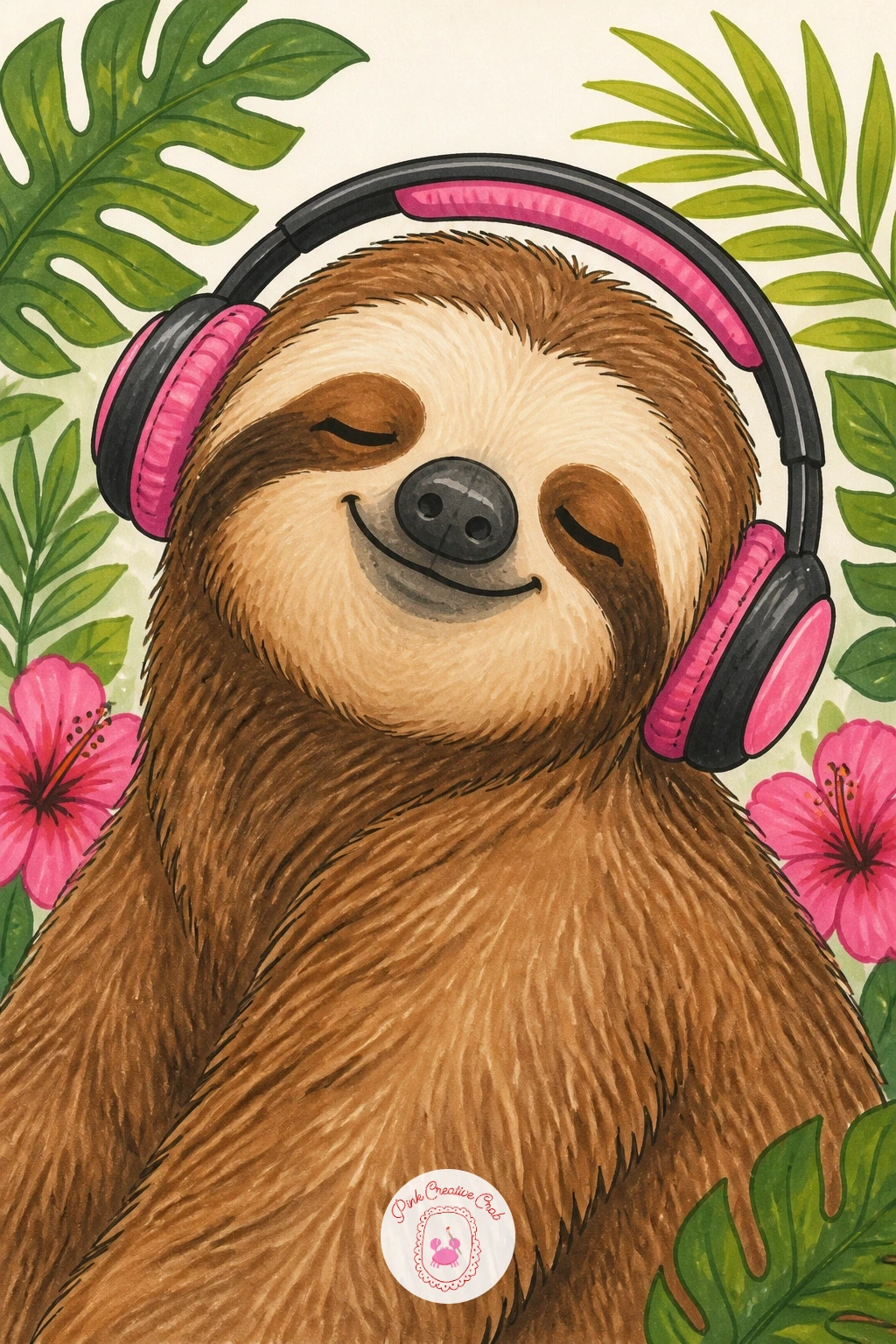
Palette: Warm Brown,Charcoal Black,Hot Pink,Cream
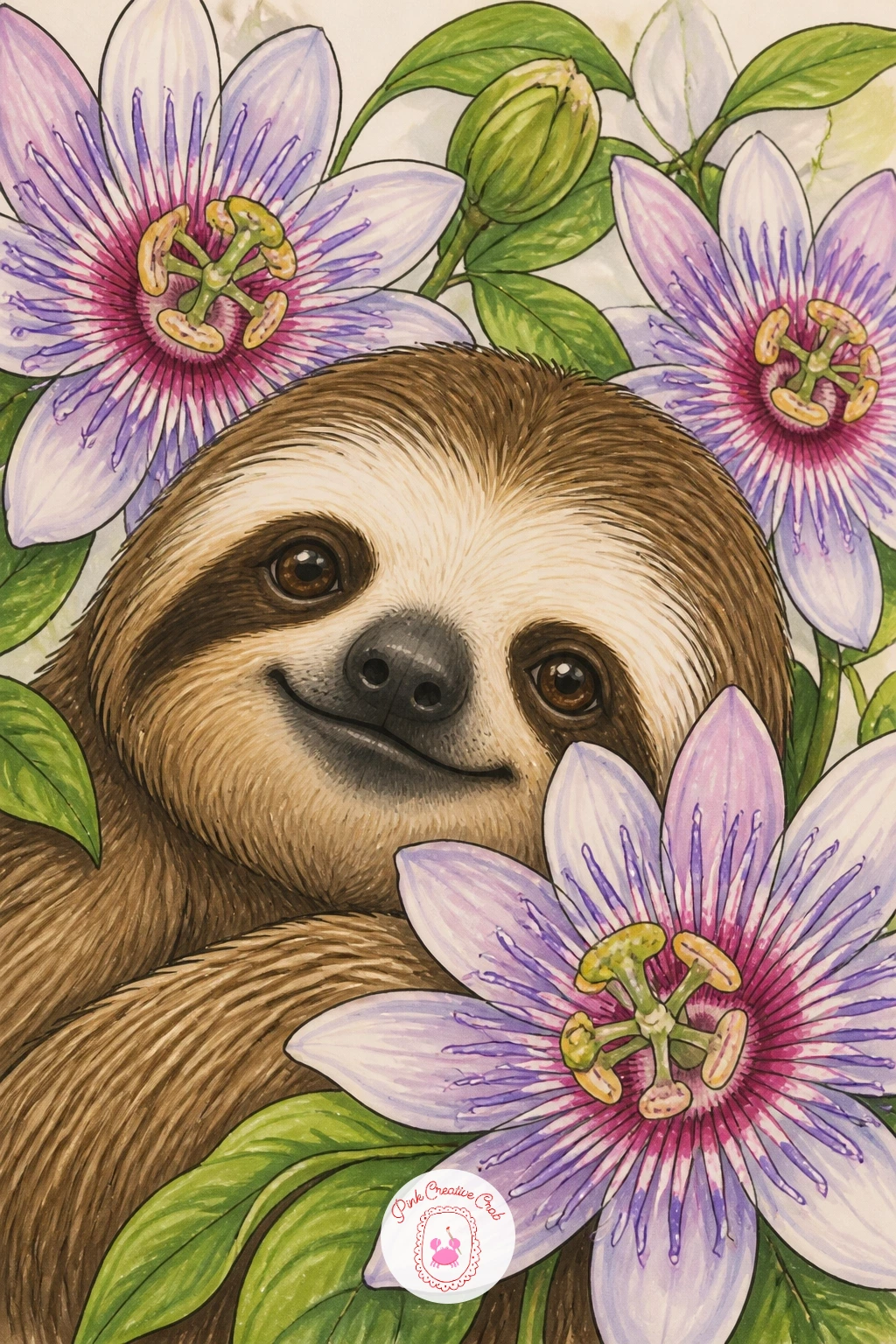
Return to the jungle flowers with a sloth among passion flowers, its face framed by a few of the distinctive fringed blooms. Draw the sloth’s head and shoulders first, then add two or three passion flowers around it, each built from a flat ring of narrow petals with a smaller crown of thin fringed filaments sitting on top.
The fringe is the fiddly part, so draw it as short, slightly uneven lines radiating from the center rather than trying to make every filament identical, which is both faster and more convincing. Color the petals pale lavender or white, then pick out the fringe and center in hot pink and deep purple, a strong contrast against both the pale petals and the sloth’s warm brown fur.
If the flowers start competing too hard with the sloth’s face for attention, pull one or two further back in the composition and only let one bloom sit close enough to overlap the fur, which keeps a clear focal point. Watercolor washed loosely under the marker petals adds a soft glow if you want the flowers a touch dreamier.
Keep the sloth’s gaze turned slightly toward the nearest flower, since that small glance ties the whole scene together.
Palette: Pale Lavender,Hot Pink,Deep Purple,Warm Brown
If you enjoy drawing fringed, layered petal shapes, the flower lessons in 12 Ideas to Drawing Watercolor Romantic Flowers use a very similar build-up from ring to fringe to center.
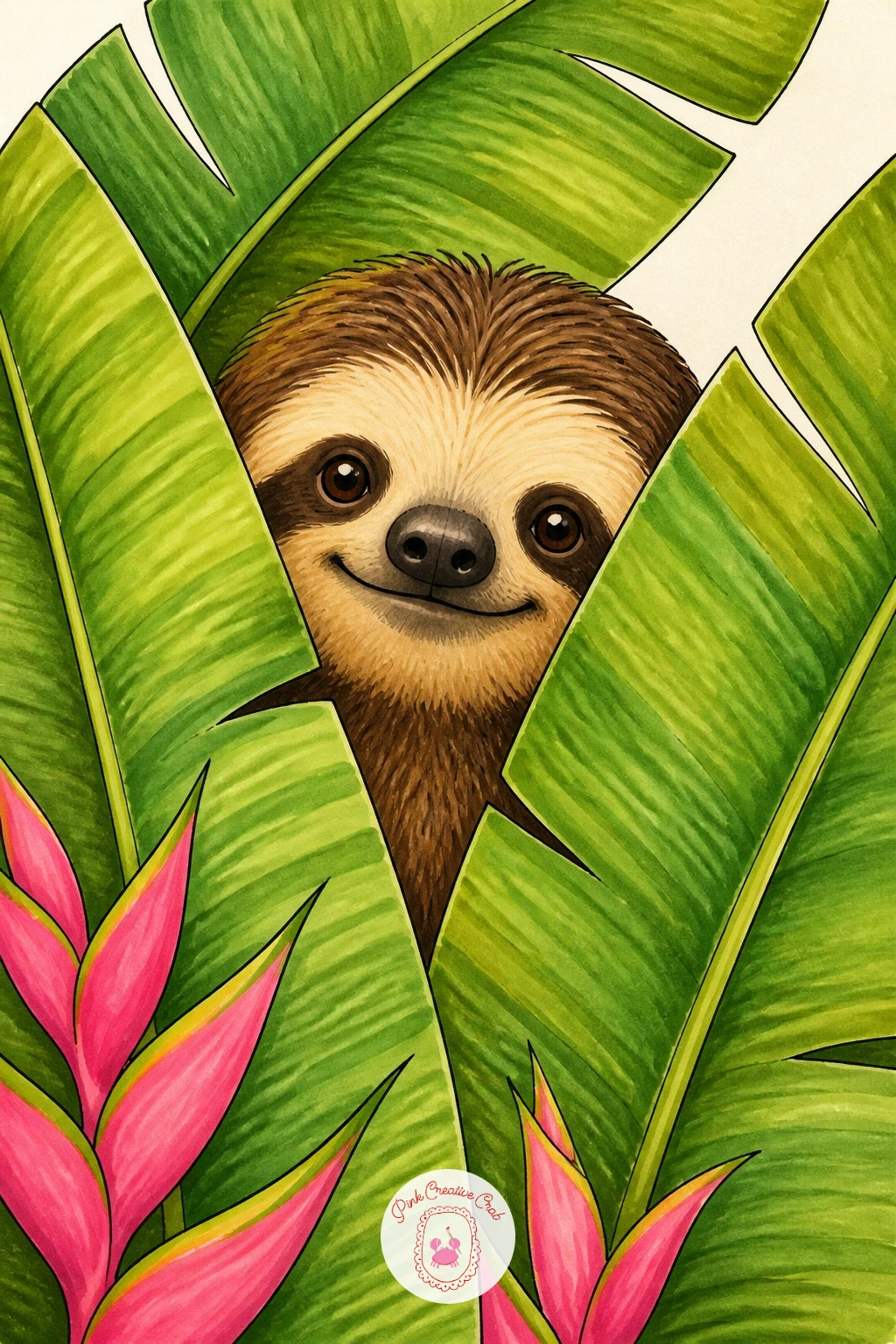
Nearly at the end of the list, slow back down with a sloth peeking through banana leaves, only the face and one paw visible through a gap in the greenery. Draw two or three large banana leaves first, their long smooth shapes overlapping to leave one natural gap, then fit the sloth’s face into that gap so the leaves frame it like a window.
Banana leaves are a nice shape to practice confident single strokes: pull the marker along the full length of each leaf in one smooth pass rather than several short choppy ones, which keeps the surface looking glossy rather than patchy. A darker green vein line straight down the center of each leaf, added once the base color is dry, finishes the shape without extra work.
If a leaf edge ends up torn looking from catching the marker unevenly, that’s actually in character, since real banana leaves often show small natural tears and splits along their length, so there is no need to fix it fully.
Keep the sloth’s expression curious, eyes wide and alert rather than drowsy, since peeking through a gap reads as a small moment of attention rather than the usual sleepy calm.
Palette: Mossy Green,Deep Moss,Warm Brown,Soft Cream
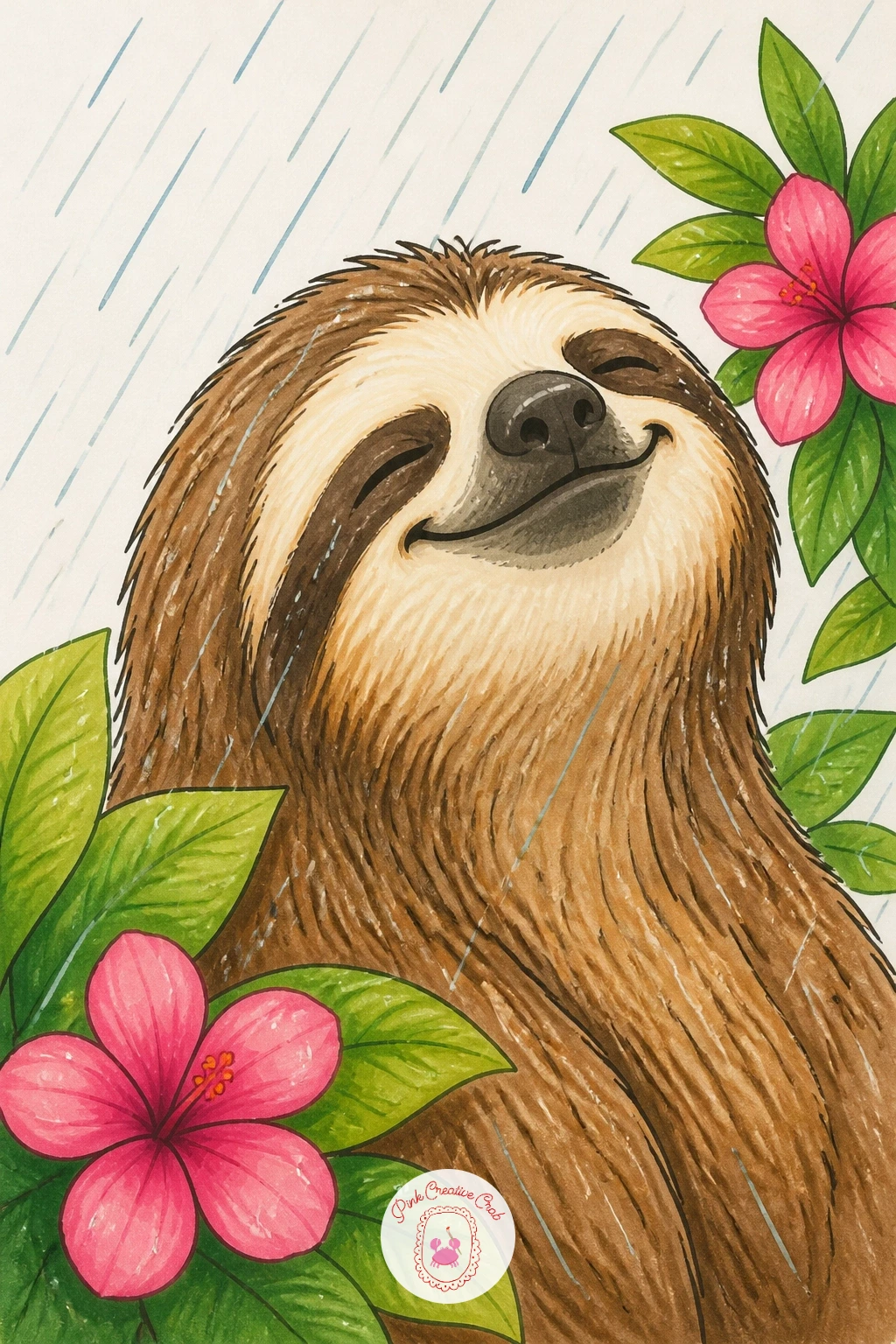
Close the list exactly where the mood lives best: a sloth smiling in the rain, face turned slightly upward and perfectly content to get wet. Draw the head and shoulders first, tilted back just enough to catch the rain on the face, then add the rain itself as short, evenly spaced diagonal lines falling across the whole page rather than clustered only near the sloth.
Vary once more, since you’ve drawn rain earlier in this list too: here, let a few larger drops sit directly on the sloth’s fur and face, rendered as tiny unmarked highlights surrounded by a thin dark outline, which reads as water beading on the surface rather than soaking straight through. That small shift gives this rain a different feel from a softly falling drizzle elsewhere.
If the diagonal rain lines start looking too uniform and mechanical, vary their length and spacing slightly across the page, since real rain never falls in a perfect, even grid. A fine white gel pen flicked lightly over dry marker is an easy way to add a few extra droplet highlights at the very end.
Give the sloth closed, happy eyes and a wide open mouthed smile, the most joyful expression on the whole list, a fitting note to end on.
You Will Need
- white gel pen
Palette: Warm Brown,Soft Grey,Mossy Green,Soft Cream
What to Do Next
Pick whichever sloth caught your eye first, whether that’s the simple hanging pose or the birthday cupcake, and start with a light pencil sketch on marker paper before you commit to fineliner. One finished sloth today is plenty, you can always come back down this list for the next one.
Frequently Asked Questions
What is the easiest way to start a sloth drawing?
Start with simple rounded shapes for the head and body before adding any fur or face detail. Sketch lightly in pencil first, check the proportions, then go over the final lines with fineliner and add color last.
What markers work best for a sloth drawing?
Alcohol-based markers blend most smoothly for soft rounded fur and give the cleanest color transitions. Layer light colors first and add darker brown or green on top while the first layer is still fresh so the two blend together.
How do you make a sloth’s face look happy instead of sleepy?
Keep the eyes open and rounded rather than half closed, and curve the mouth upward at both corners. A raised eyebrow or slightly tilted head also helps a face read as cheerful rather than drowsy.
Do I need to draw a background for every sloth drawing idea?
No, many of these ideas work well as just the sloth filling the page with little or no background at all. A branch, a few leaves or a simple color wash behind the subject is usually enough to set the scene.
What is the biggest mistake beginners make drawing sloth fur?
Overworking the fur with too many small lines, which makes the drawing look scratchy instead of soft. A flat marker base with just a few darker streaks blended in at the edges reads as fur far more convincingly.
Have any thoughts?
Share your reaction or leave a quick response — we’d love to hear what you think!
-
 0
-
0
-
0
-
0
-
0
-
0


