A cute squirrel drawing is one of those small projects that fits perfectly into an afternoon, and squirrels in autumn give you endless reasons to pick up your colored pencils. They stuff their cheeks, bury nuts, climb fences and nap in moss, and every one of those little moments makes a complete, satisfying picture.
Below you will find 28 squirrels caught mid-mischief, from a simple cheek-stuffed forager to a whole family tucked inside a tree trunk. Work through them in order if you like, starting easy and building confidence, or jump straight to the scene that makes you smile.
Using these images: free for personal projects such as printing, coloring, cards, journals and gifts. Handmade items that include them may be sold up to 30 pieces per design. More than that is commercial use and is not permitted, and neither is selling or sharing the images themselves or passing them off as your own. Please ask before any other use.
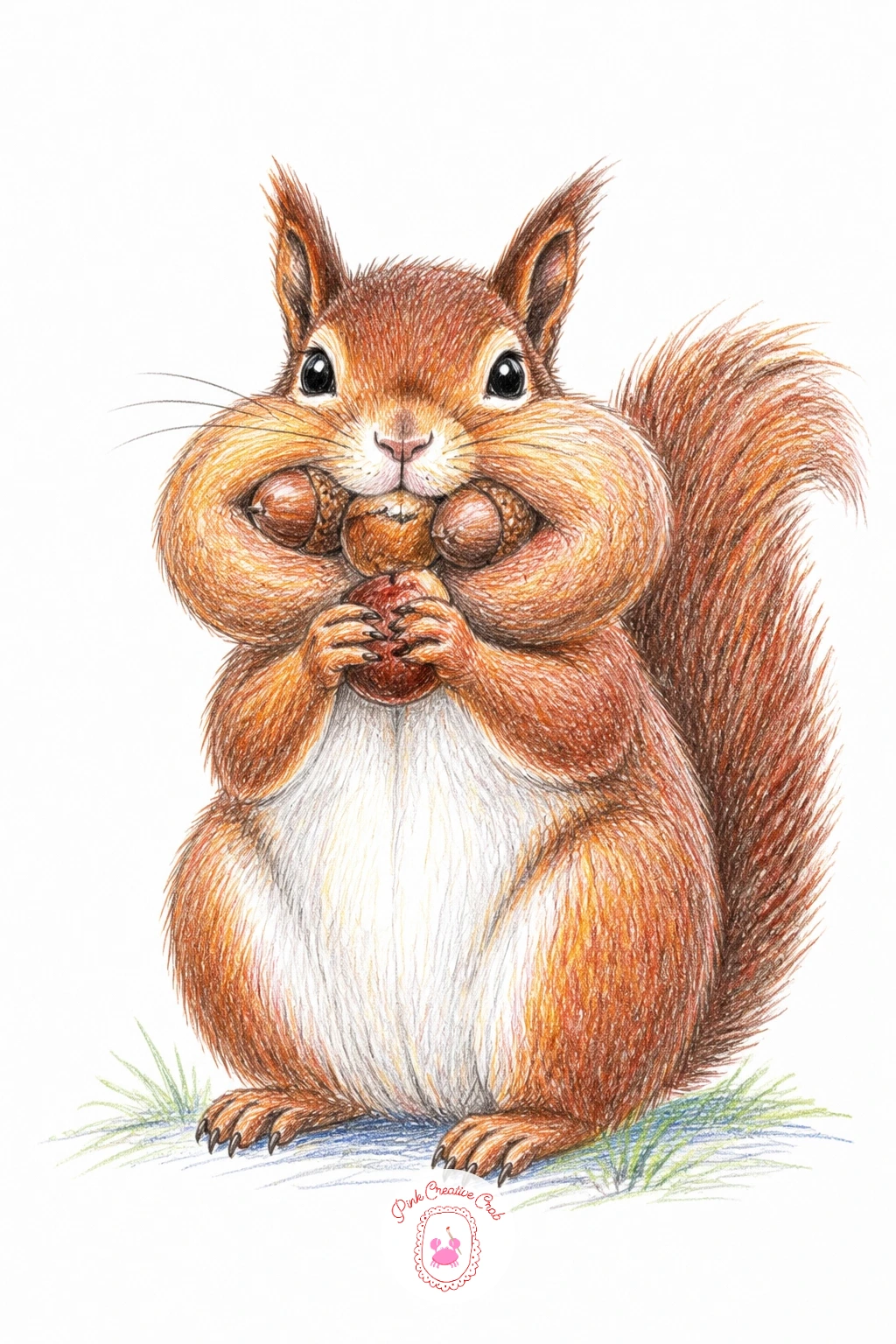
Start with the easiest squirrel in the whole list: one sitting upright with both cheeks bulging around a pair of acorns. Sketch the body as two overlapping circles, a smaller head on a rounder body, then round out the cheeks so they push past the jawline before you add the ears or tail.
Block in chestnut brown over the body with the pencil held loosely, letting strokes follow the direction the fur would grow, then layer rust into the shadowed side. Leave the belly paper-white or add the faintest warm grey.
The acorns are the easy win here: oval caps in a deeper brown sitting over tan bodies, each with a few short hatch marks for the cap texture. If the cheeks look flat, add a curved shadow line right where the cheek meets the jaw to push the bulge forward.
If you only have one brown pencil, use heavier pressure for the shadow side and barely any pressure for the lit side, the same pencil can carry both.
Palette: Chestnut Brown,Burnt Sienna,Cream,Dark Umber
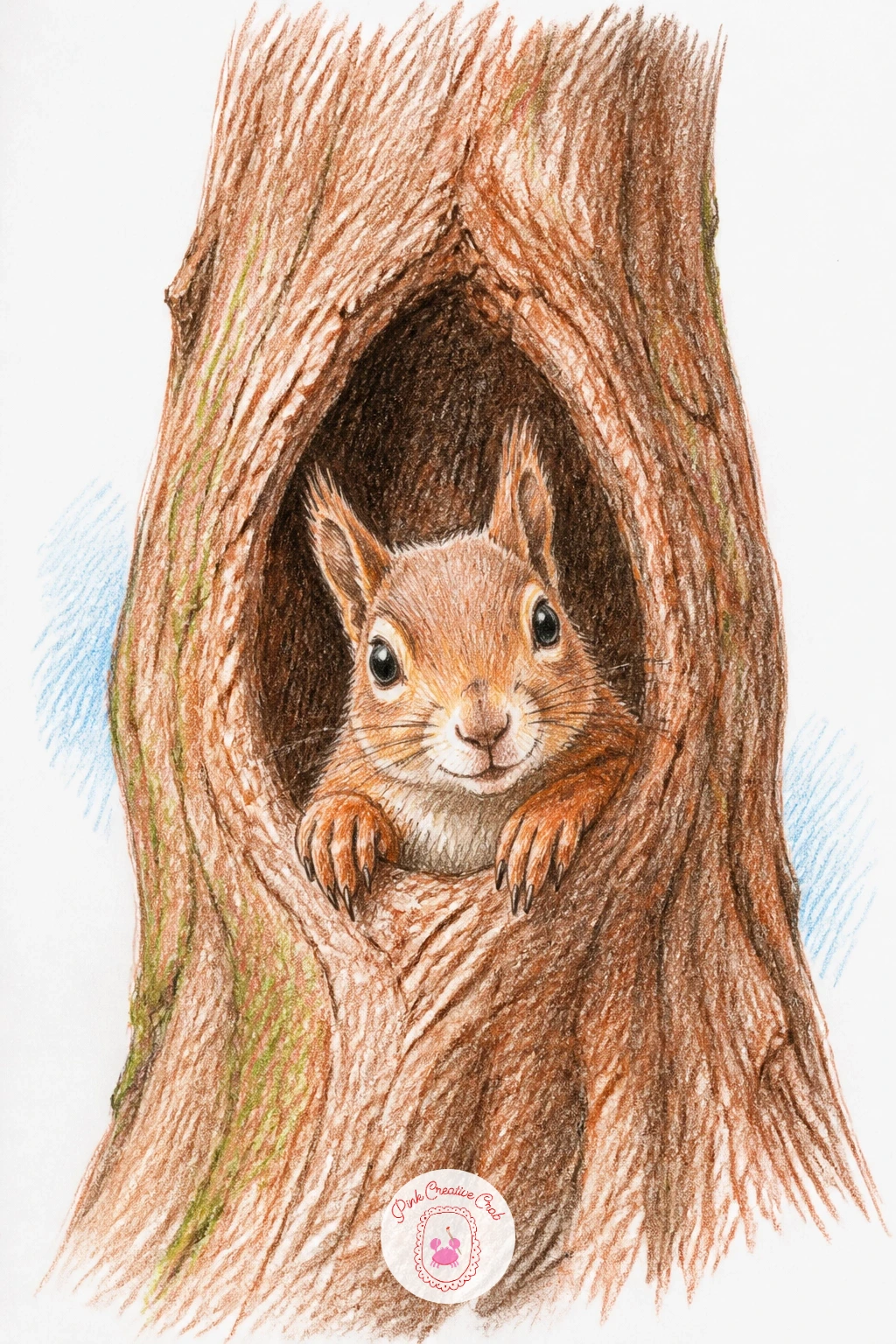
Here the trick is proportion: draw the hollow first as a rough dark oval in the trunk, then size the squirrel’s head and front paws so they fill about two thirds of that opening, any smaller and it reads as lost inside the hole rather than peeking through it.
Shade the trunk bark with vertical strokes in a warm grey-brown, keeping the area right around the hollow darkest so the opening reads as a real recess. Place the squirrel’s face just inside that dark ring, bright eyes and a pale muzzle catching the little light that reaches in.
Paws rest on the lower lip of the hollow, drawn slightly overlapping the bark edge so they look like they are gripping it rather than floating. If the face gets lost in the dark hollow, lighten the fur right around the eyes and nose so the features still pop forward.
No tree bark pencil on hand is fine: plain grey works, warmed with a light pass of rust along one edge.
Palette: Dark Umber,Warm Grey,Chestnut Brown,Cream
This one leans on perspective and light: set the eye level low, looking slightly up at the branch, so the squirrel feels perched above the reader rather than drawn straight on. Decide where the light comes from first, usually from one side, and keep that side of both the squirrel and the pine needles brighter throughout.
Build the body in true red squirrel colors, a brighter rust-orange than the common grey squirrel, with a pale cream belly. The ear tufts are the signature detail: two short upward flicks of fur at the top of each ear, drawn with quick light strokes rather than one solid shape.
Pine needles radiate out from the branch in small clustered groups, darker moss green on the shadow side and a lighter sage where the light hits. If the tufts disappear into the background, outline them faintly in a darker brown first so they stay visible against the pine.
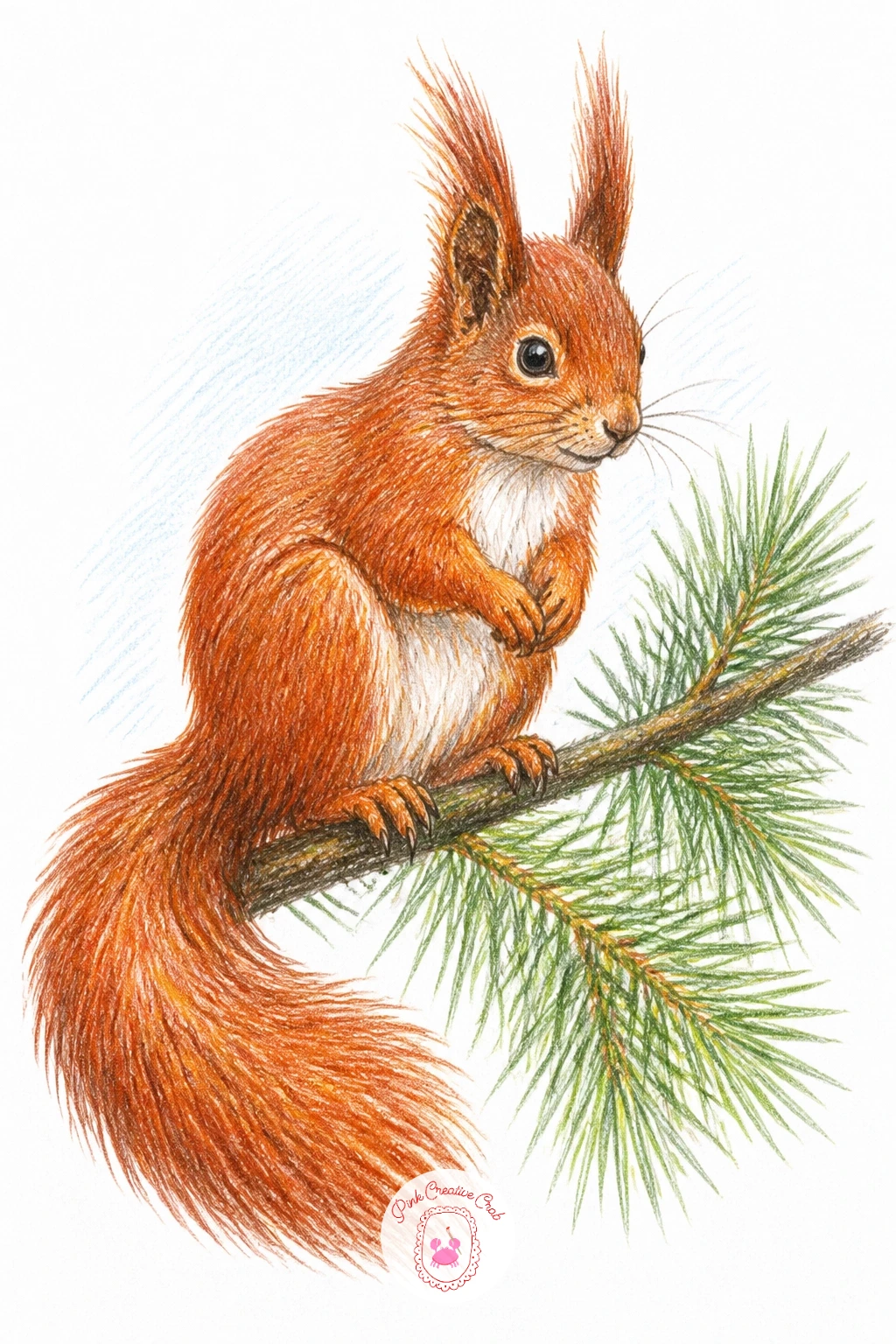
Palette: Burnt Sienna,Cream,Moss Green,Sage Green
Look at reference photos of actual red squirrels if this is new territory, their proportions and tuft shape differ more from grey squirrels than most people expect.
Follow on from the pine branch with a squirrel back on the ground, front paws pushing a nut down into a pile of leaves. Draw the body low and hunched, head tipped down toward the paws, this posture alone tells the whole story before you add a single leaf.
Work the squirrel’s fur first in chestnut and rust, then scatter the leaves around the paws in a loose fan, mixing ochre, rust and a little dried green so the pile does not read as one flat color. Overlap several leaves directly over the squirrel’s lower paws to show the nut disappearing into them.
If the leaf pile turns into a muddy blob, pull a kneaded eraser through a few spots to lift back small lighter leaf shapes, that single move adds instant variety. Swap any missing ochre pencil for yellow ochre mixed lightly with orange.
Keep the background bare white so the leaf pile stays the clear focal point.
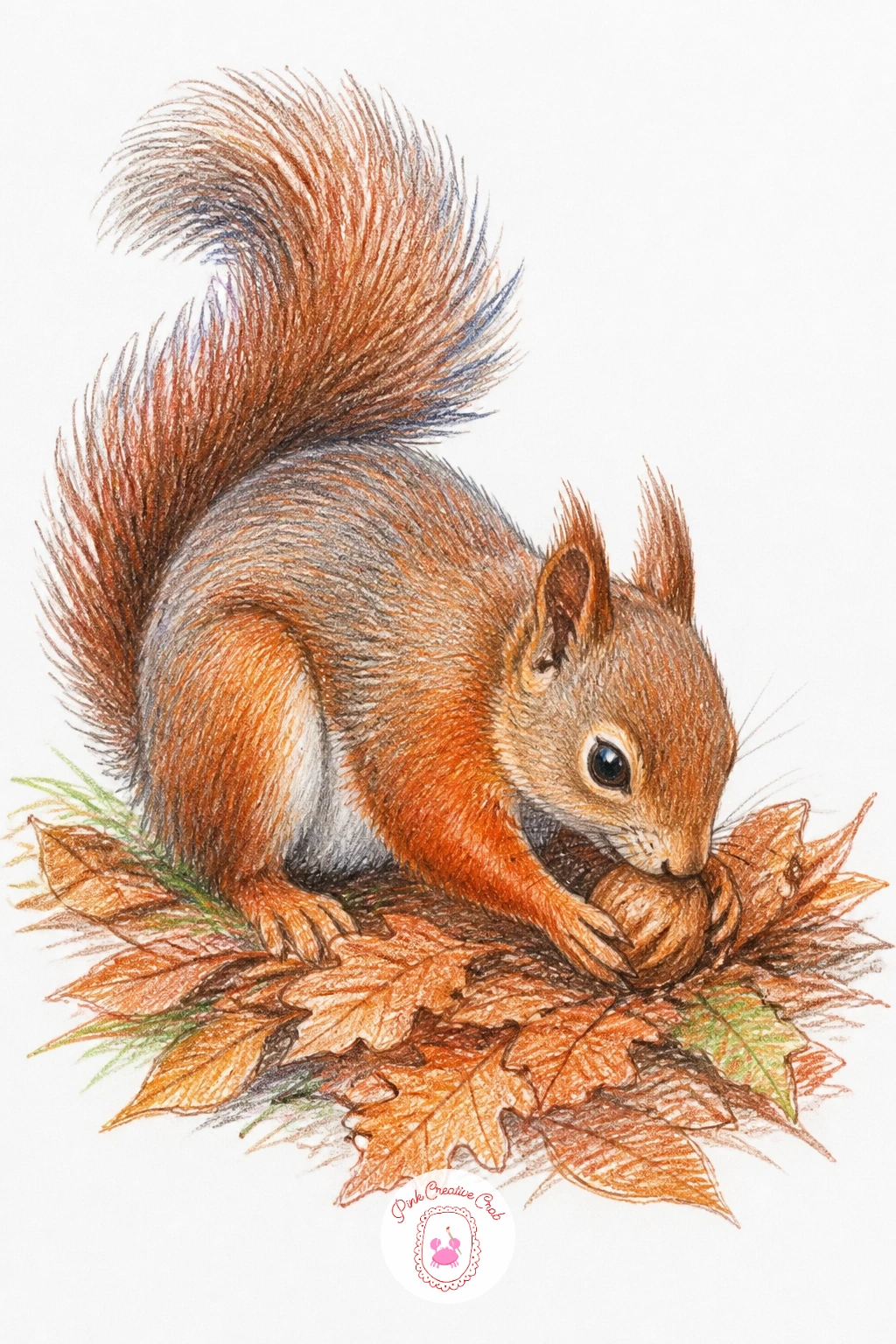
Palette: Chestnut Brown,Yellow Ochre,Burnt Sienna,Olive Green
Give this squirrel a storybook moment: standing upright on back legs, both paws raised to hold a red-capped mushroom overhead like a tiny umbrella. Draw the body first in a straight standing pose, then add the mushroom stem running down between the raised paws.
Shade the mushroom cap in a soft red with small white dots left bare for the classic spotted look, and keep the stem pale cream. A few straight diagonal lines in light grey across the page suggest falling rain without needing a full background.
The easy mistake is making the mushroom too small to look like real shelter, size the cap so it is at least as wide as the squirrel’s shoulders. If red cap mushrooms feel fussy, a plain brown cap works just as well and needs no spots at all.
Finish with a couple of raindrops bouncing off the cap edge for extra charm.
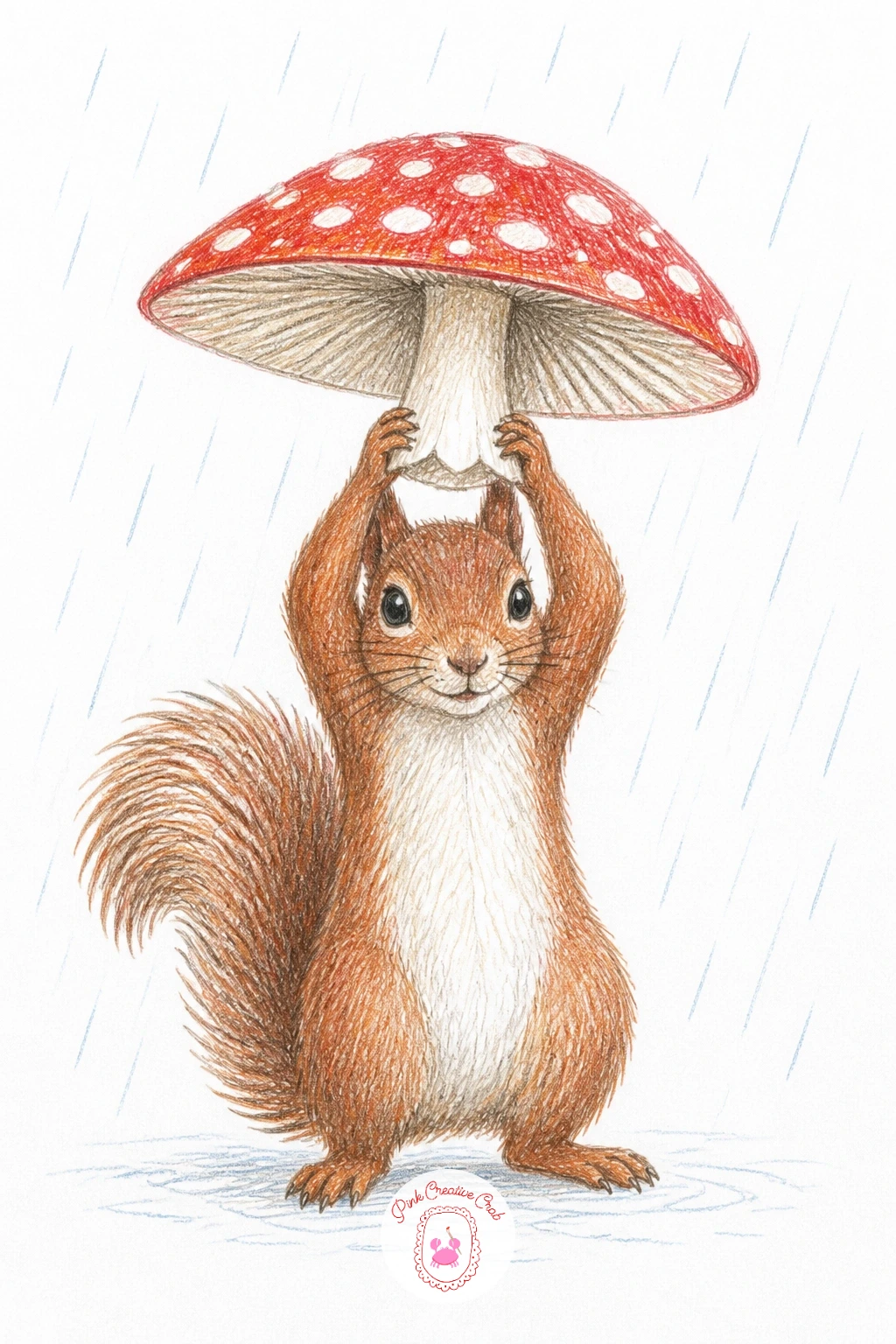
Palette: Red,Cream,Chestnut Brown,Soft Grey
Move into a tiny scene for this one: a squirrel sitting on the end of a wooden park bench, one peanut held in both front paws. Draw the bench slats first as a few simple horizontal lines with a short vertical armrest, then perch the squirrel at one end so it overlaps the top slat naturally.
Color the wood in warm grey-brown with visible pencil strokes running along the grain, keeping it lighter and looser than the squirrel so the attention stays on the animal. The peanut shell gets a slightly bumpy outline and a few short curved lines to suggest its ridges.
If the bench ends up competing with the squirrel for attention, pull back on its detail and let two or three strokes per slat do the job. No grey-brown pencil handy just means mixing a light pass of brown under a light pass of grey.
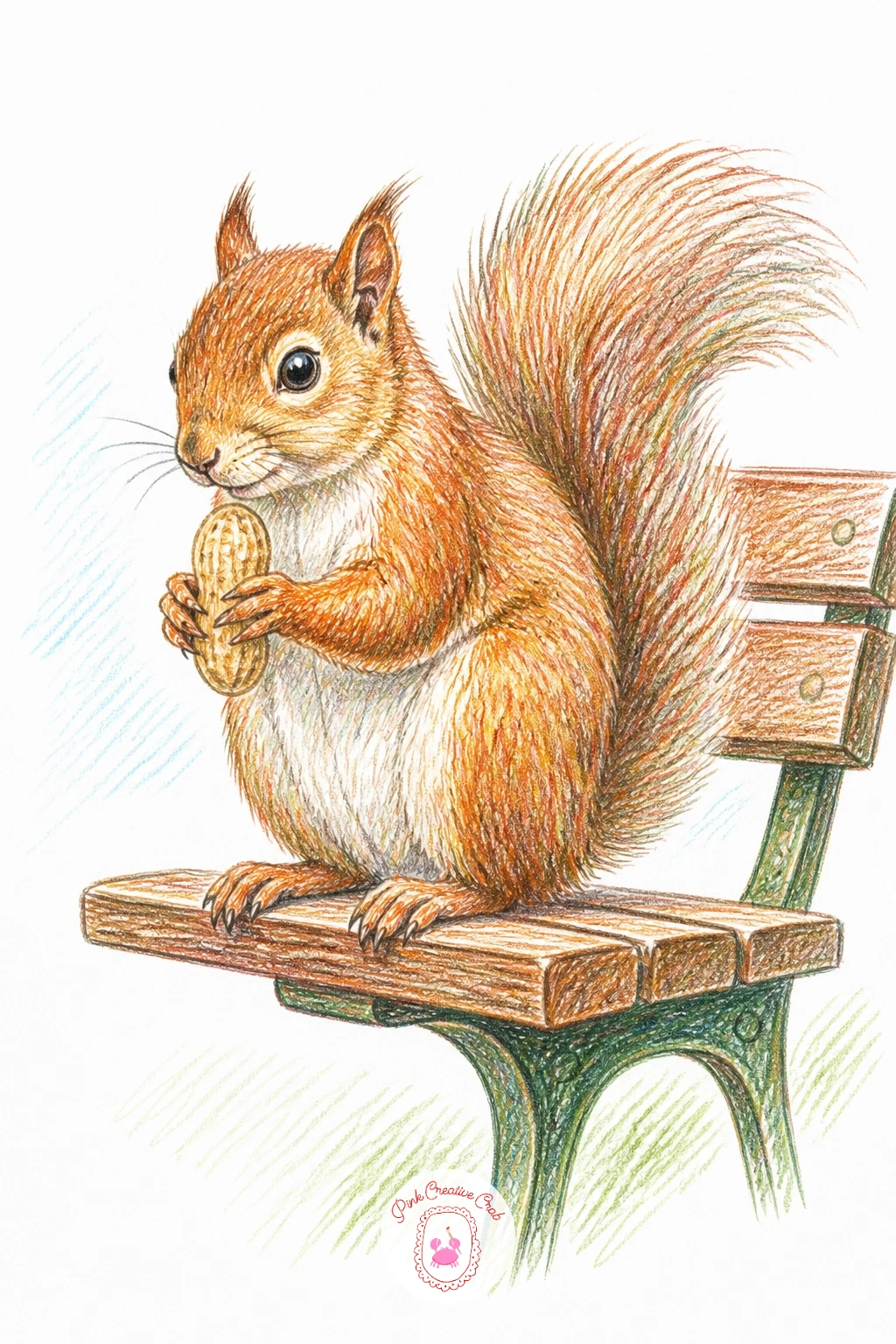
Palette: Warm Grey,Chestnut Brown,Cream,Tan
This pose asks for a little perspective thinking: the squirrel hangs with back feet gripping the feeder roof and the body curving down, head reaching toward the seed tray below, so the spine makes a clear C-shape rather than a straight line.
Draw the feeder first, a simple house shape with a peaked roof and a tube of seed, then hang the squirrel’s back feet over the roof edge before building the rest of the body downward. The tail arcs up and over the roof for balance, which also fills the top of the page nicely.
Fur strokes on the upside-down body should still follow the direction fur naturally grows, not the direction gravity pulls, or the squirrel looks oddly smeared. If the whole pose feels unstable on paper, lightly sketch a simple stick-figure spine first to check the curve before committing to the full body.
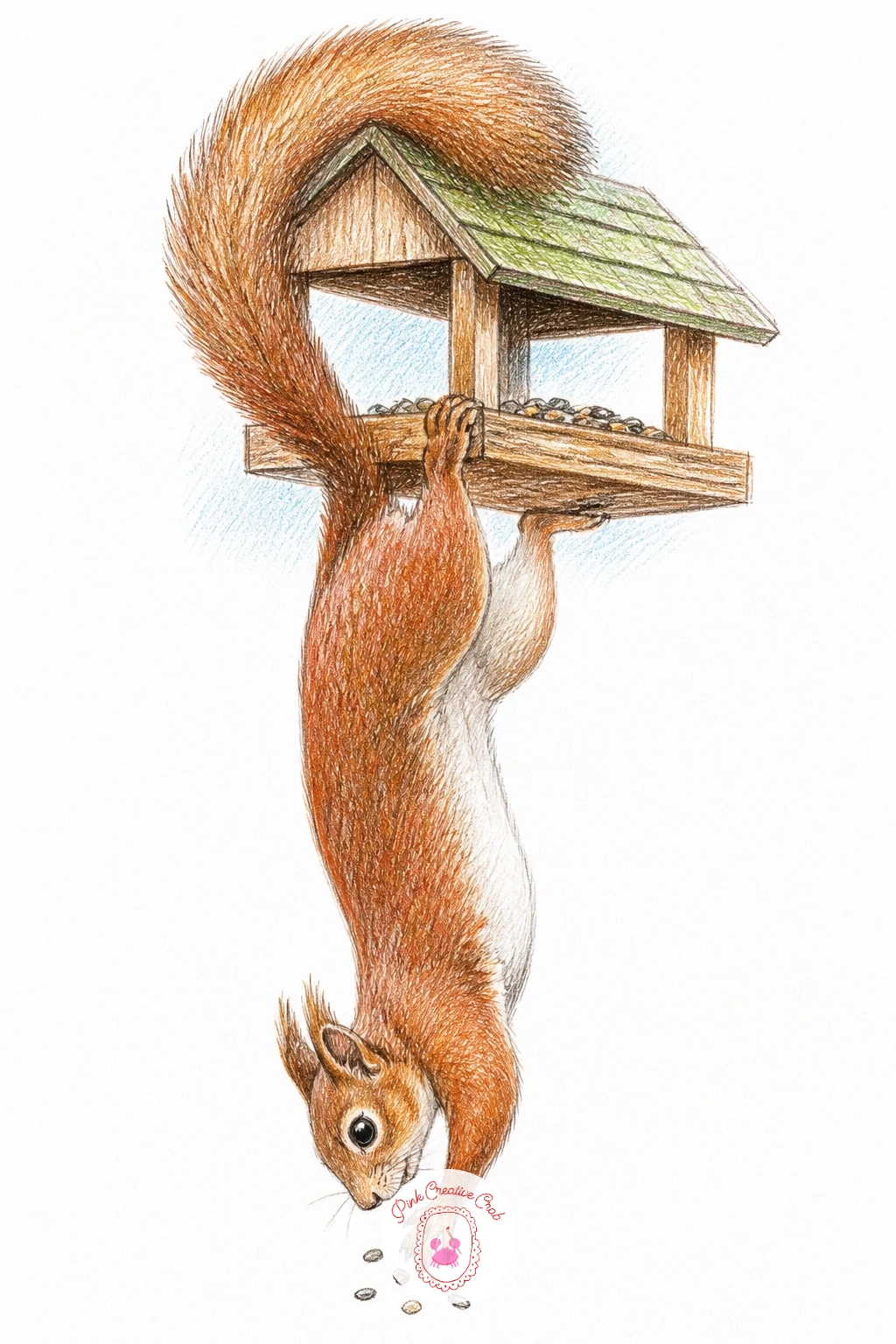
Palette: Chestnut Brown,Warm Grey,Burnt Sienna,Cream
Capture real mid-air motion by stretching the squirrel’s body into a long diagonal line, front paws reaching forward and back legs trailing behind, with the tail streaming out straight rather than curled. Sketch this stretched pose lightly first before any shading, since getting the diagonal right matters more here than any later detail.
Place one branch in the lower corner where the leap starts and a second branch in the opposite corner where it lands, leaving open white space between them for the squirrel to fly through. This negative space does more to sell the motion than any speed lines would.
Shade the body with strokes angled in the direction of the leap to reinforce the forward push. If the pose still reads as static, check that the back legs trail lower than the front paws, that height difference is what makes a jump look like a jump rather than a hover.
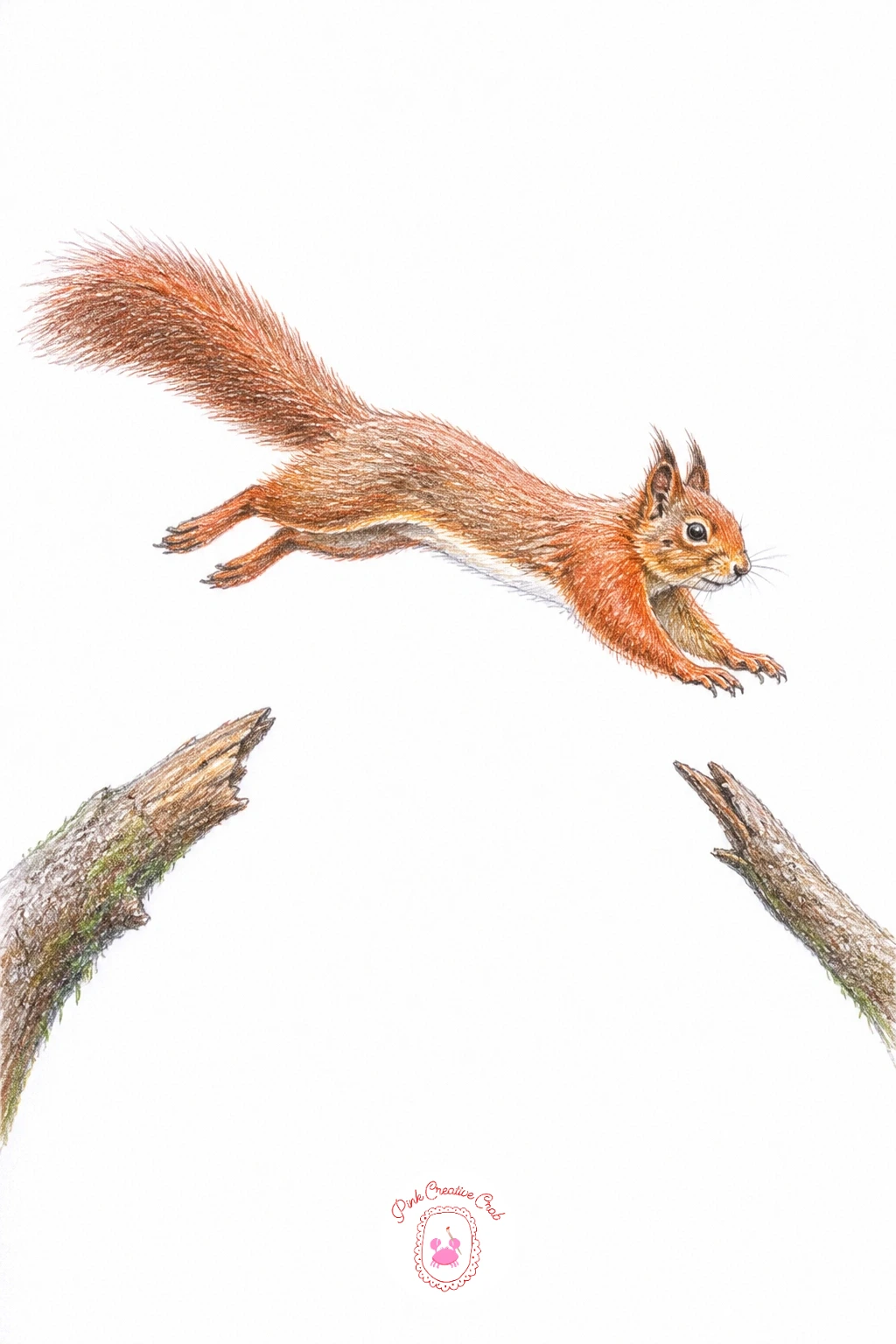
Palette: Chestnut Brown,Burnt Sienna,Moss Green,Cream
Give this squirrel a clear job: trotting forward with one large maple leaf held in its mouth, stem first, the leaf trailing back over its shoulder. Draw the leaf nearly as big as the squirrel’s own head so its purpose as nest material is obvious at a glance.
Color the leaf in warm rust and ochre with a few visible veins drawn as thin darker lines radiating from the stem, this is a quick spot for your best dry-brush style light strokes to suggest a papery, slightly curled edge. Keep the squirrel’s own coloring a notch cooler than the leaf so the two do not blend into one shape.
The running legs are where beginners tend to stiffen up, so angle the front and back legs oppositely, one forward, one back, to keep the trot believable. If maple leaves feel complex, a simple oak leaf shape carries the same idea with far fewer points.
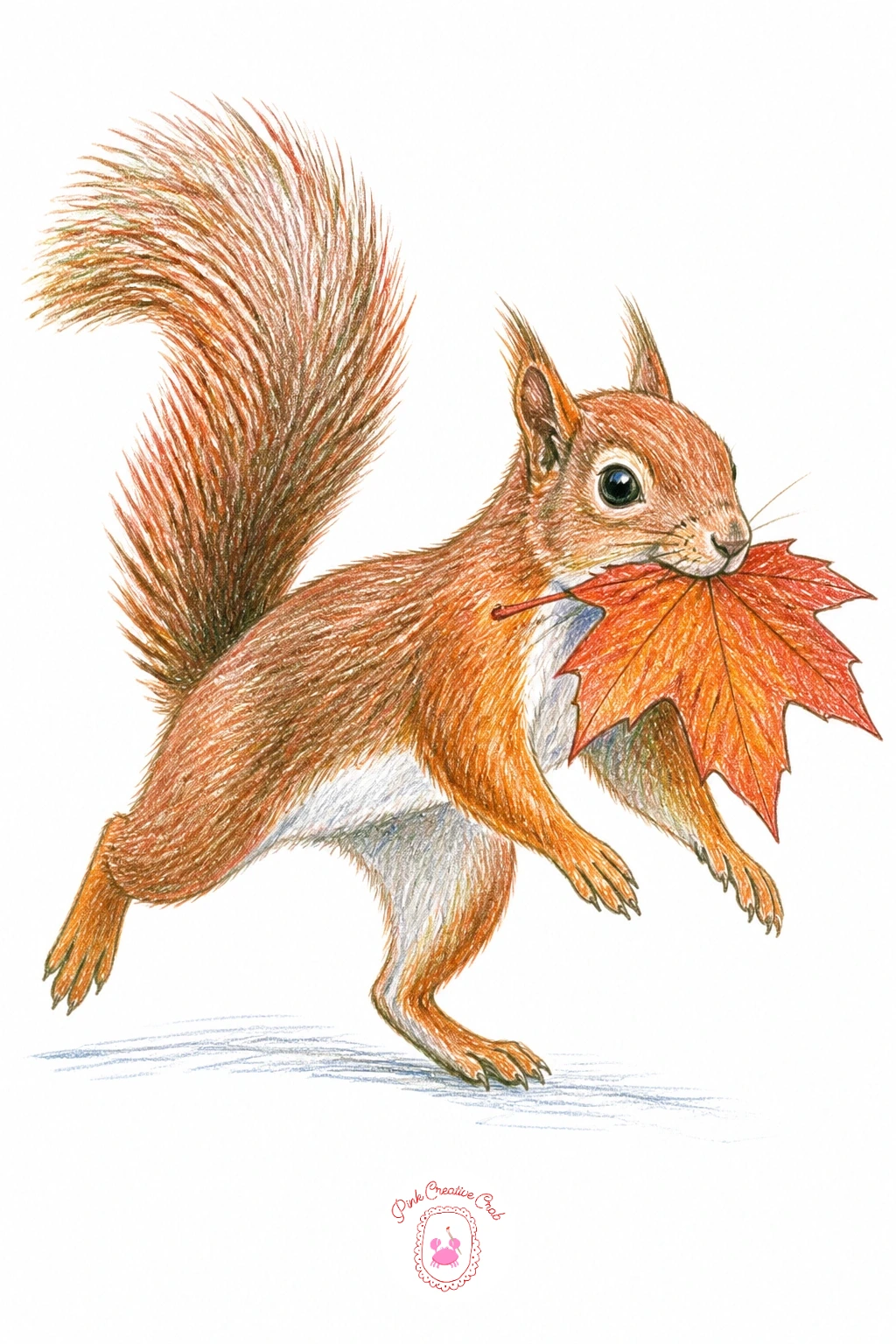
Palette: Burnt Sienna,Yellow Ochre,Chestnut Brown,Dark Umber
This is the quick ten-minute version of a busy little scene: a squirrel sitting upright, pinecone held sideways in both paws right up at its mouth, exactly like a cob of corn. In ten minutes you can get the seated body, the pinecone shape and basic shading done and still have a complete, charming drawing.
Spend the extra time in a forty-minute version adding individual pinecone scales, each one a small curved line with a touch of shadow tucked underneath, plus finer fur texture along the tail and a soft cast shadow beneath the squirrel’s haunches. Both versions work, the choice is just how much texture you want to chase.
Color the pinecone in warm brown with ochre highlights catching the raised scale edges. If the scales start to look like fish scales instead of pinecone scales, make them more elongated and slightly irregular rather than perfectly uniform.
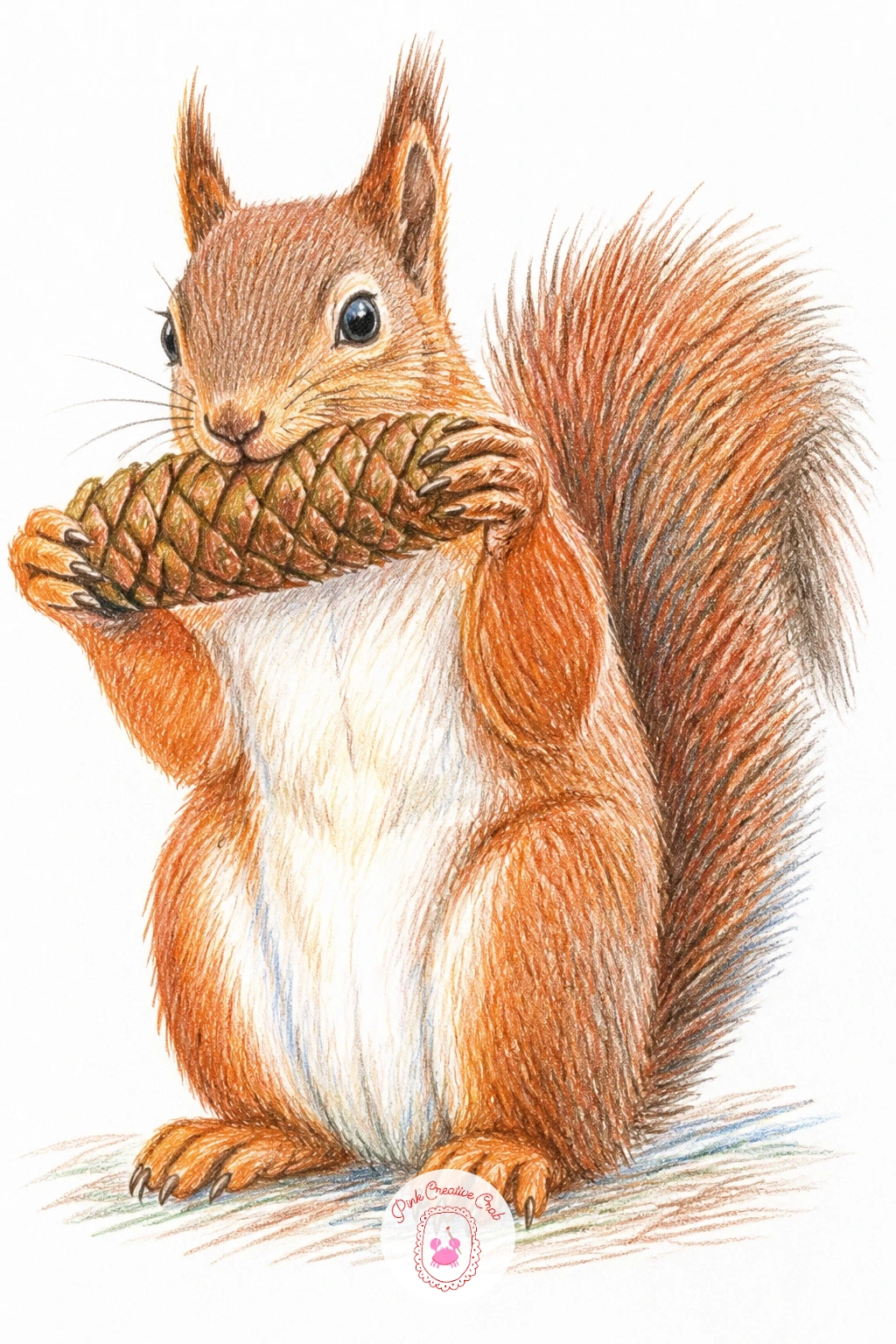
Palette: Chestnut Brown,Yellow Ochre,Dark Umber,Cream
After a page of action poses, slow down with a calm portrait: a squirrel sitting perfectly still, its big tail curled up and over its back in that classic resting silhouette. The tail is the real subject here, so give it more room on the page than the body itself.
Draw the tail as a series of overlapping fur clumps rather than one solid shape, each clump a loose teardrop with feathered edges, building from the base near the spine up and over in a smooth curve. Layer at least two tones of brown through it, lighter where it catches light near the top of the curve, darker underneath where it shadows the back.
If the tail ends up looking stiff or paddle-shaped, add more irregular feathered strokes along the outer edge rather than keeping a clean outline. Try varying this same pose next time with the tail curled the opposite direction for a mirrored companion piece.
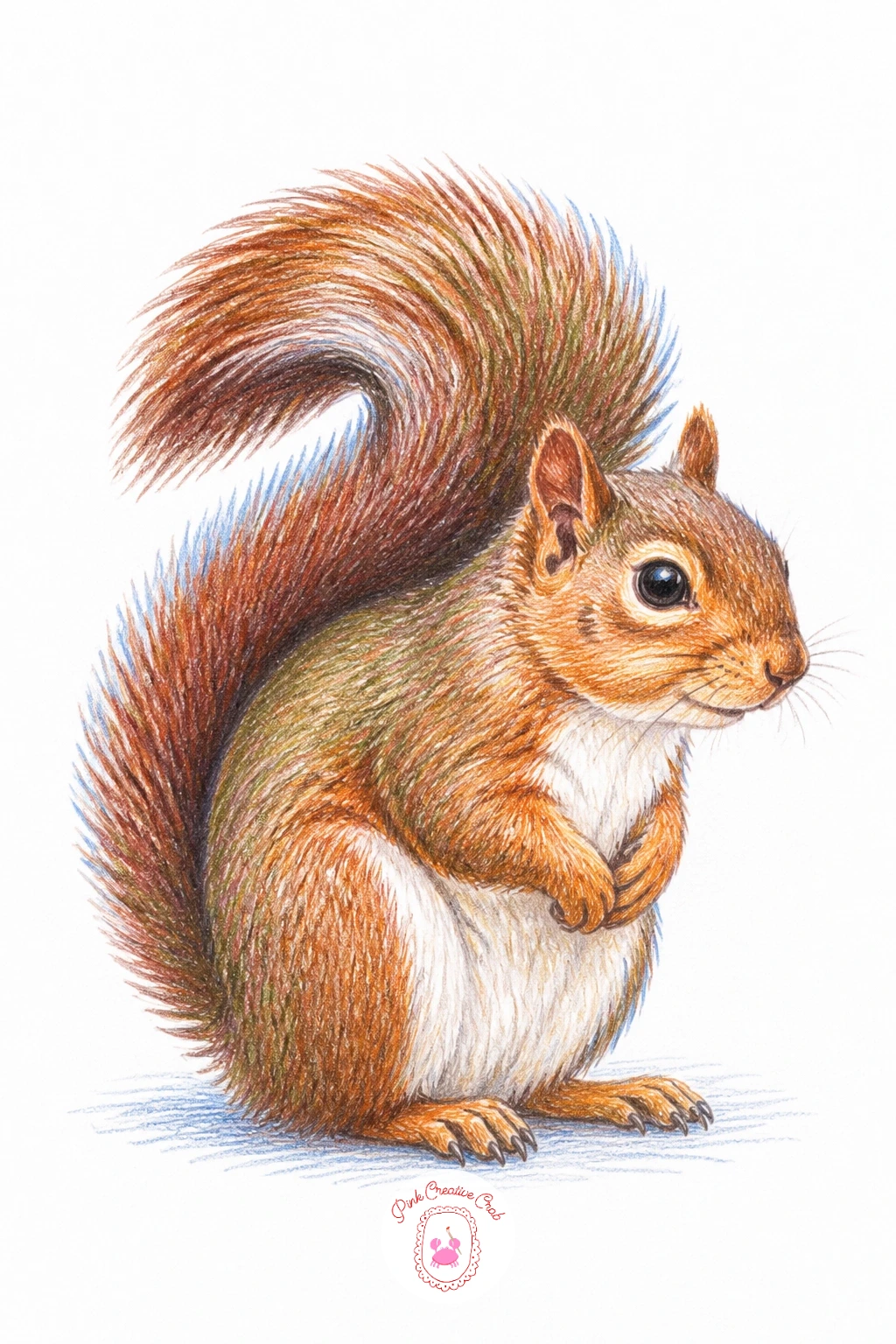
Palette: Chestnut Brown,Burnt Sienna,Cream,Dark Umber
Switch to something gentle: a single baby squirrel curled into a tight ball, eyes shut, tucked inside a small round nest of moss and twigs. Keep the body proportions rounder and the head larger relative to the body than an adult squirrel, that shift alone reads instantly as a baby.
Build the nest first as a loose circle of short overlapping strokes in moss green and soft brown, leaving the center slightly hollowed for the sleeping shape. Color the baby in a paler, softer brown than the adults elsewhere on this list, since young fur tends to look fluffier and less defined.
If the baby disappears into the nest, outline its curled back lightly first so the shape stays readable before you add the surrounding moss texture. No moss green pencil on hand just means mixing a light olive under a touch of yellow.
Finish with a few twig ends poking past the nest edge for scale.
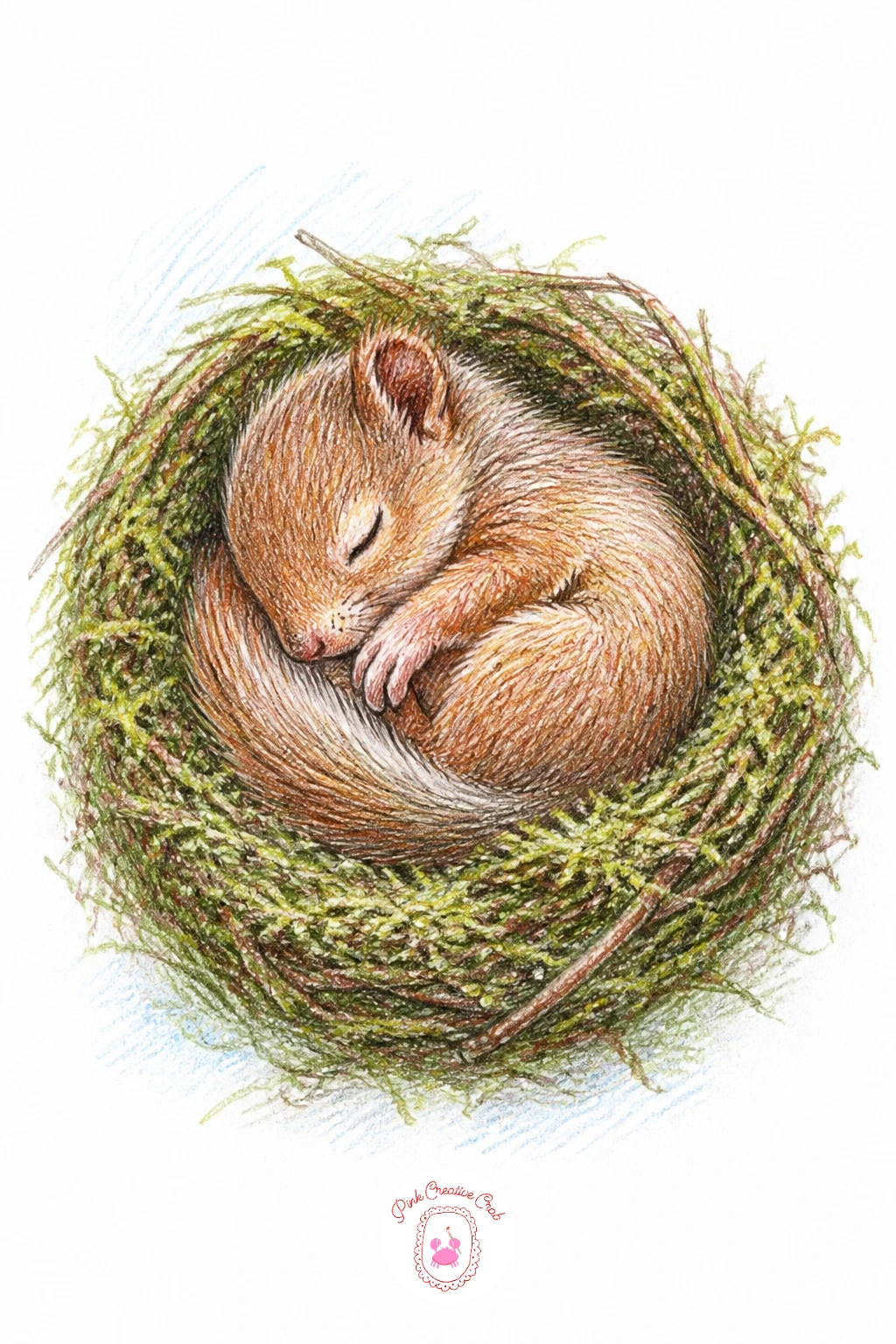
Palette: Moss Green,Tan,Soft Grey,Dark Umber
Build a small cozy scene here: a squirrel perched on top of a neat stack of split logs, tail draped down over one side. Draw the logs first as a simple grid of stacked ovals and rounds, each one with a slightly different ring pattern at its cut end, before placing the squirrel confidently on top.
Shade the log ends with concentric rings in warm brown and grey, keeping the bark sides rougher with vertical broken strokes. The squirrel itself can stay fairly simple in color since the wood texture carries most of the visual interest in this piece.
If the woodpile looks flat, darken the gaps between logs so each one reads as a separate rounded form rather than one solid block. Swap a formal log stack for a looser scattered pile of branches if straight stacking feels fiddly to draw.
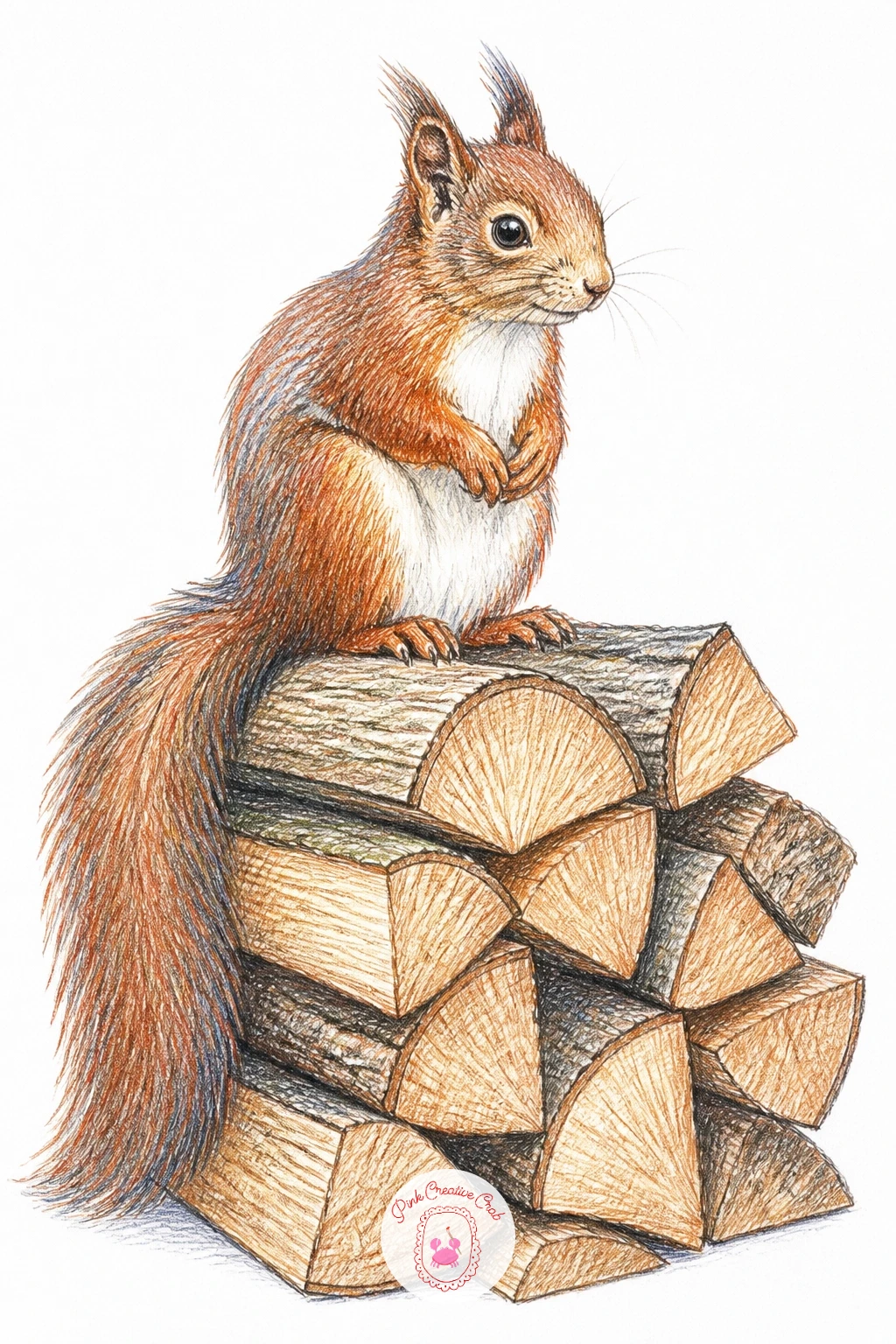
Palette: Warm Grey,Chestnut Brown,Tan,Dark Umber
Give this squirrel some comic energy: caught mid-grab on top of a checkered picnic blanket, a round cookie held in both paws and a few crumbs scattered beside it. Draw the blanket corner first as a simple triangle of alternating red and white squares, just enough to suggest the full blanket without drawing every square.
The cookie is an easy shape, a plain circle in warm tan with small dark dots for chocolate chips scattered unevenly across it. Pose the squirrel slightly hunched forward, shoulders raised, as if it just grabbed the cookie and is about to bolt, that tension is what sells the “stealing” moment.
If the checkered pattern turns into a blurry mess, space the squares further apart and keep the lines straight with a light ruler guide if needed. A plain red picnic cloth works fine too if checks feel too fiddly today.
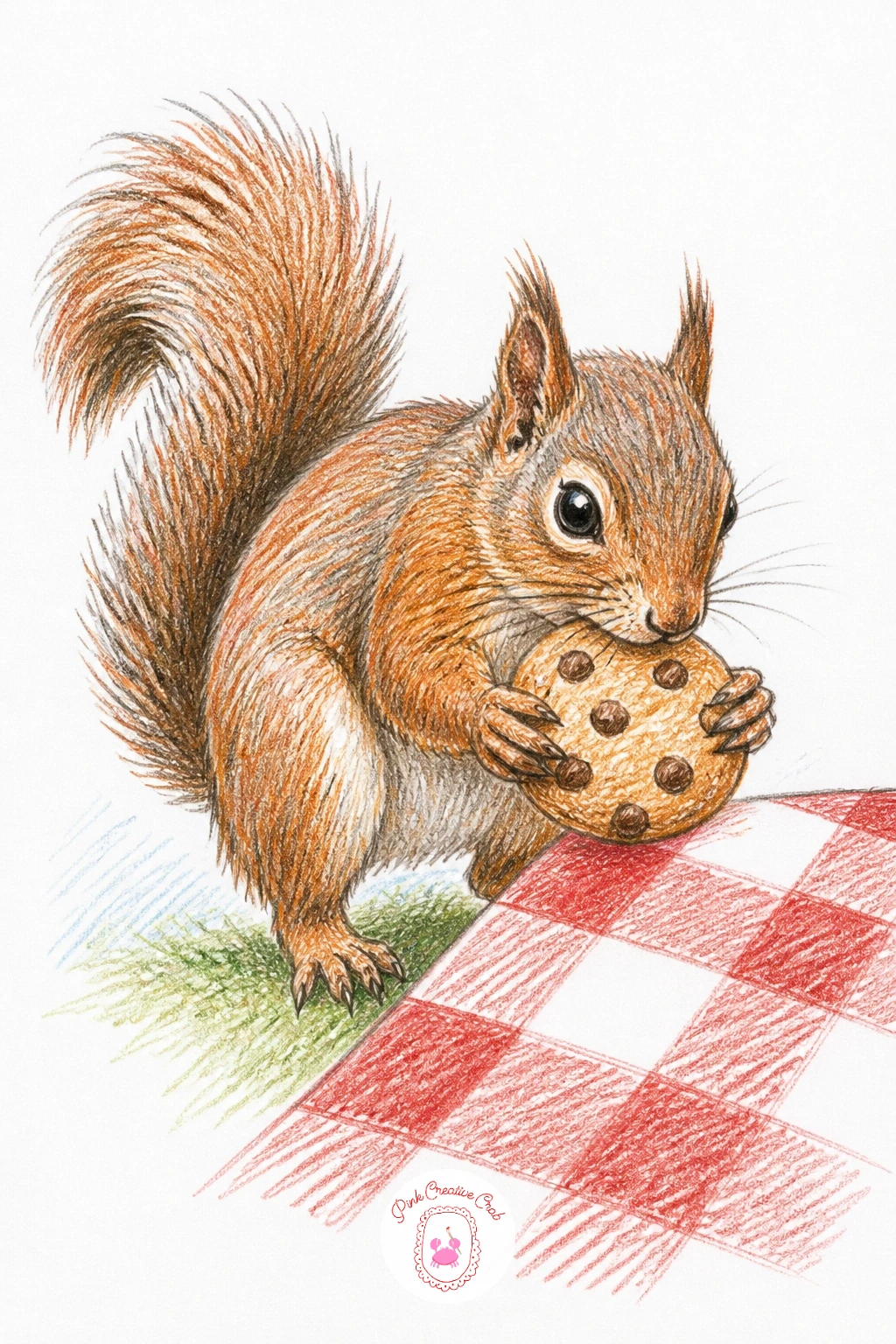
Palette: Red,Cream,Chestnut Brown,Dark Umber
Shift the season slightly with a squirrel standing in a dusting of snow, a single hazelnut held up in its front paws. Here the light and the ground color do most of the work: keep the squirrel’s fur a touch warmer and richer than usual so it pops forward against a cool, pale backdrop.
Leave most of the ground as bare white paper, adding only a thin band of pale blue-grey shadow beneath the squirrel’s feet and a scatter of small dot marks for falling or settled snow. This restraint is what makes snow scenes read as snow rather than as empty background.
Color the hazelnut shell in a warm tan with a darker cap, small and precise since it sits right at the squirrel’s chest where the eye lands first. If the snow dots look too even and artificial, vary their size and spacing noticeably rather than placing them in a tidy grid.
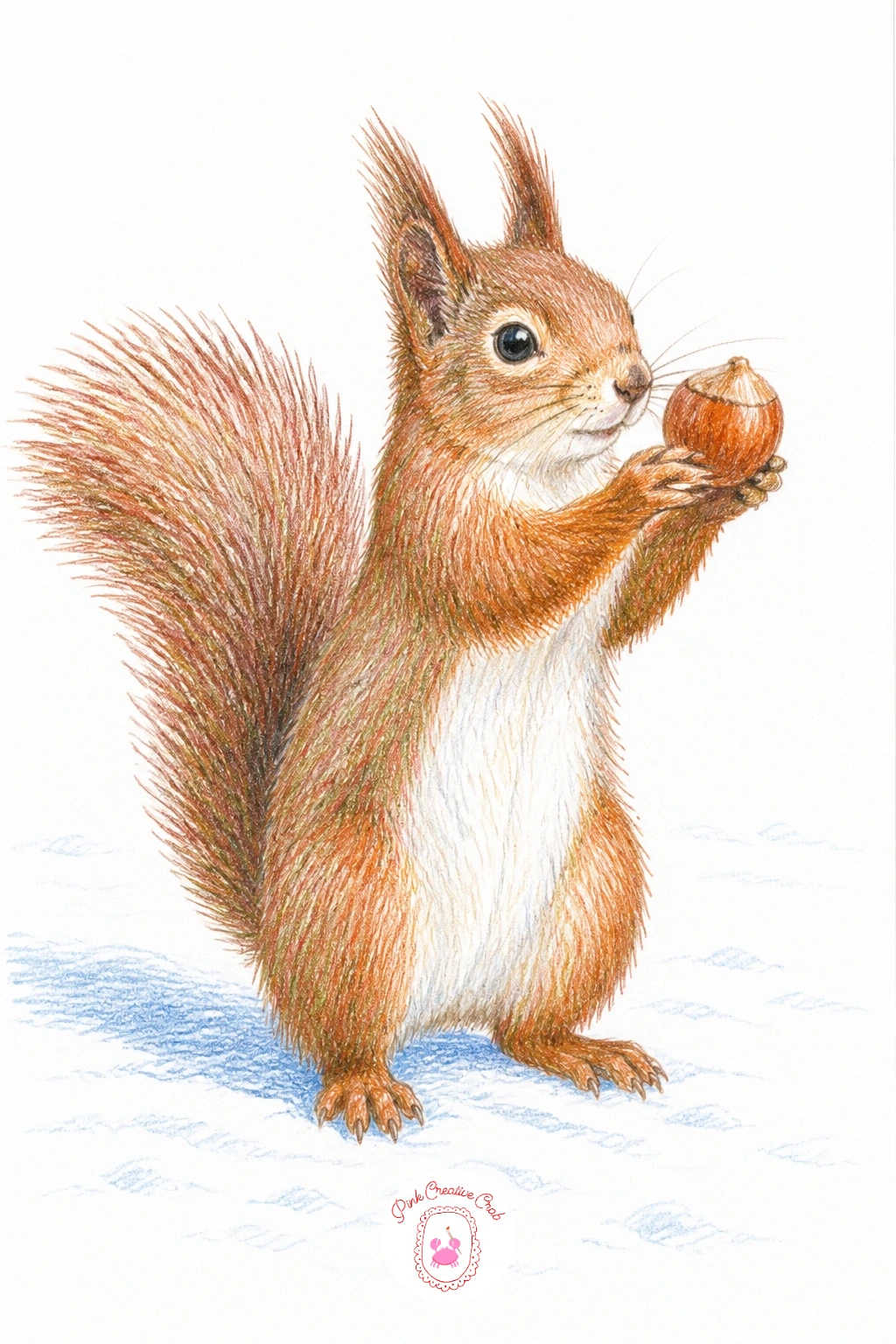
Palette: Chestnut Brown,Sky Blue,Tan,Soft Grey
Set the eye level at the squirrel’s own height for this one, roughly level with the top of the fence post, so the viewer meets its gaze directly rather than looking down on it. That single choice makes the “curious” expression land far better than a bird’s-eye view would.
Draw the fence post as a simple weathered cylinder with horizontal wood-grain lines, the squirrel sitting squarely on top with its head tilted slightly, one ear raised a touch higher than the other for that alert, questioning look. Keep the body otherwise still and upright.
Shade the wood in warm grey with a few darker knot marks, lighter than the squirrel so the eye goes to the face first. If the tilted head looks awkward, tilt the whole skull shape rather than just repositioning the ears, the tilt needs to run through the whole head.
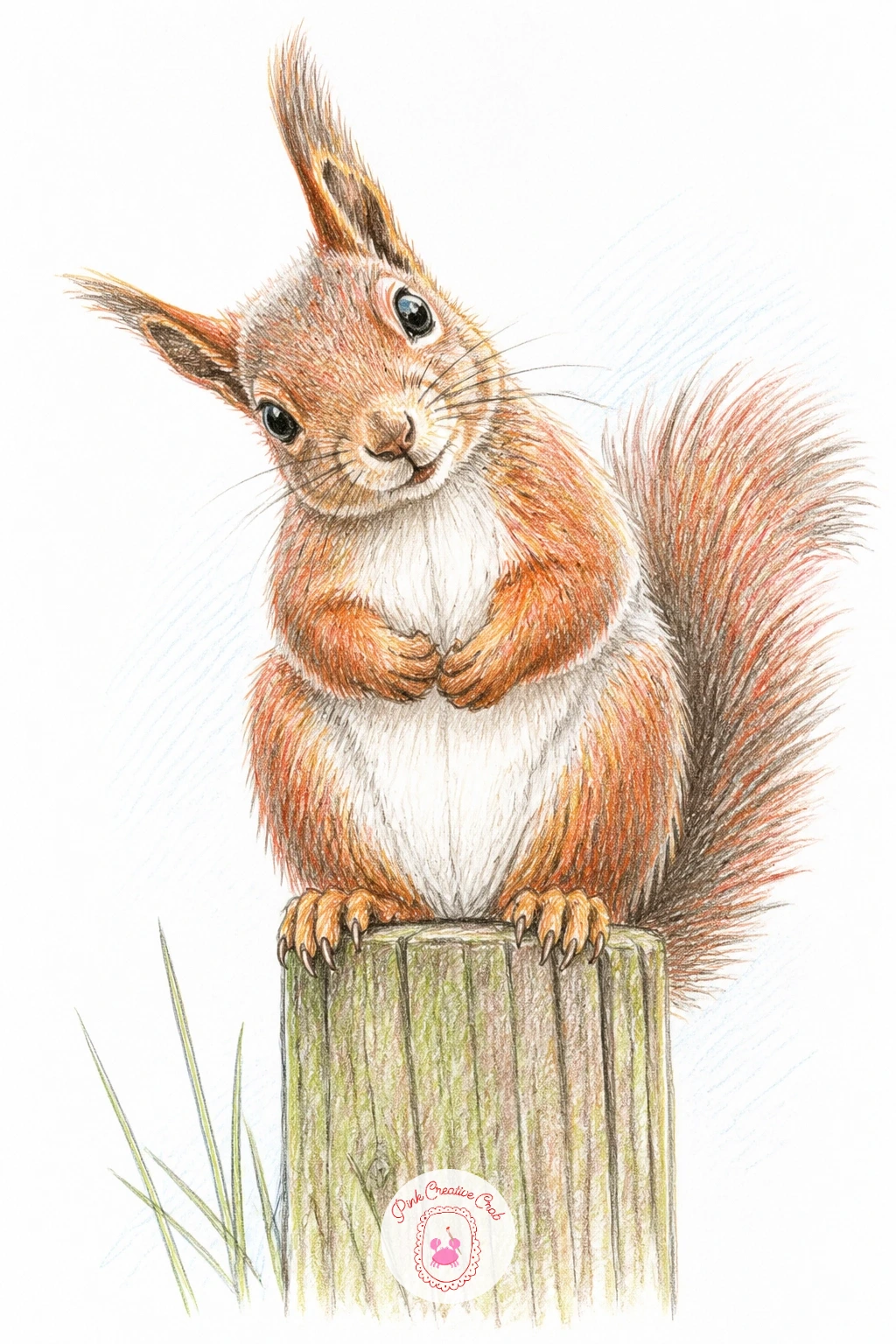
Palette: Warm Grey,Chestnut Brown,Cream,Dark Umber
Pair up two characters for this scene, a squirrel and a small bird sitting close together over a scatter of seeds on the ground. Draw the squirrel first since it is larger, seated with head bowed toward the seeds, then tuck the bird in beside it at a smaller scale so the size difference reads clearly.
Give the bird a simple rounded body, a sky blue or soft brown chest, and a small pointed beak reaching toward the same seed pile the squirrel pecks at. Scatter the seeds between them as small ovals in mixed browns so neither character looks like it is hoarding the pile alone.
If the two animals end up looking disconnected, overlap their shadows slightly or angle both heads toward the same seed to visually link them. A sparrow shape is the easiest bird to start with if you have not drawn birds before.
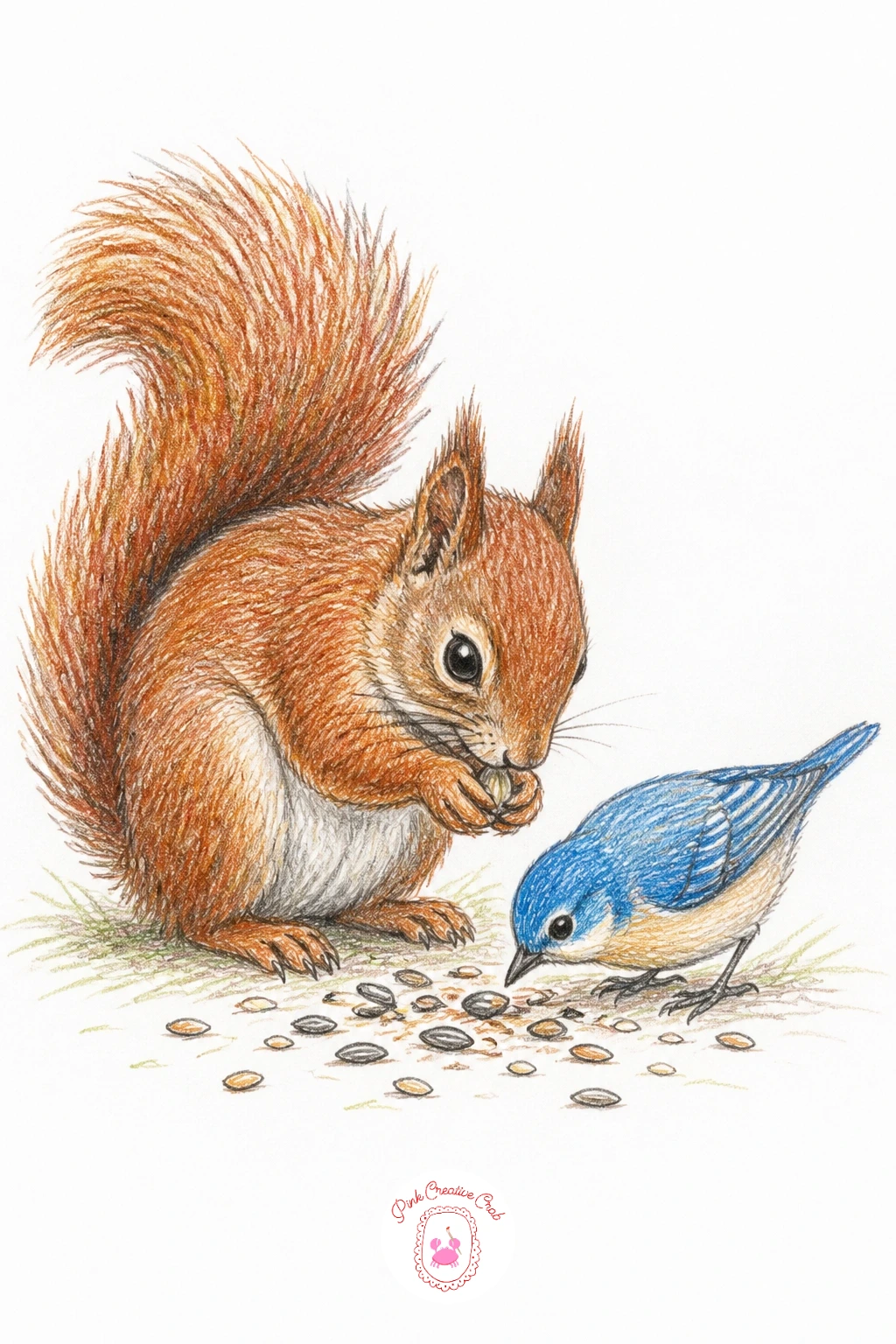
Palette: Chestnut Brown,Sky Blue,Tan,Cream
If birds feel tricky, the bird pencil drawing ideas page breaks the basic shapes down step by step.
Have some fun with scale here: a squirrel wrapping both arms around a walnut drawn noticeably oversized, nearly as big as its own torso, to play up the comic size mismatch. Measure the walnut against the squirrel’s head first, aiming for it to be at least twice the head’s width, before sketching the rest of the pose around it.
The walnut shell needs a craggy, bumpy outline rather than a smooth oval, built from small irregular lumps layered in warm tan and brown with a darker seam line down the middle where the two halves meet. The squirrel’s arms wrap around the front, paws just meeting or nearly meeting on the far side.
If the walnut looks too smooth and round, break up the outline with more small irregular bumps rather than a few large ones. Try this same oversized-prize joke next time with a giant mushroom or an oversized berry instead.
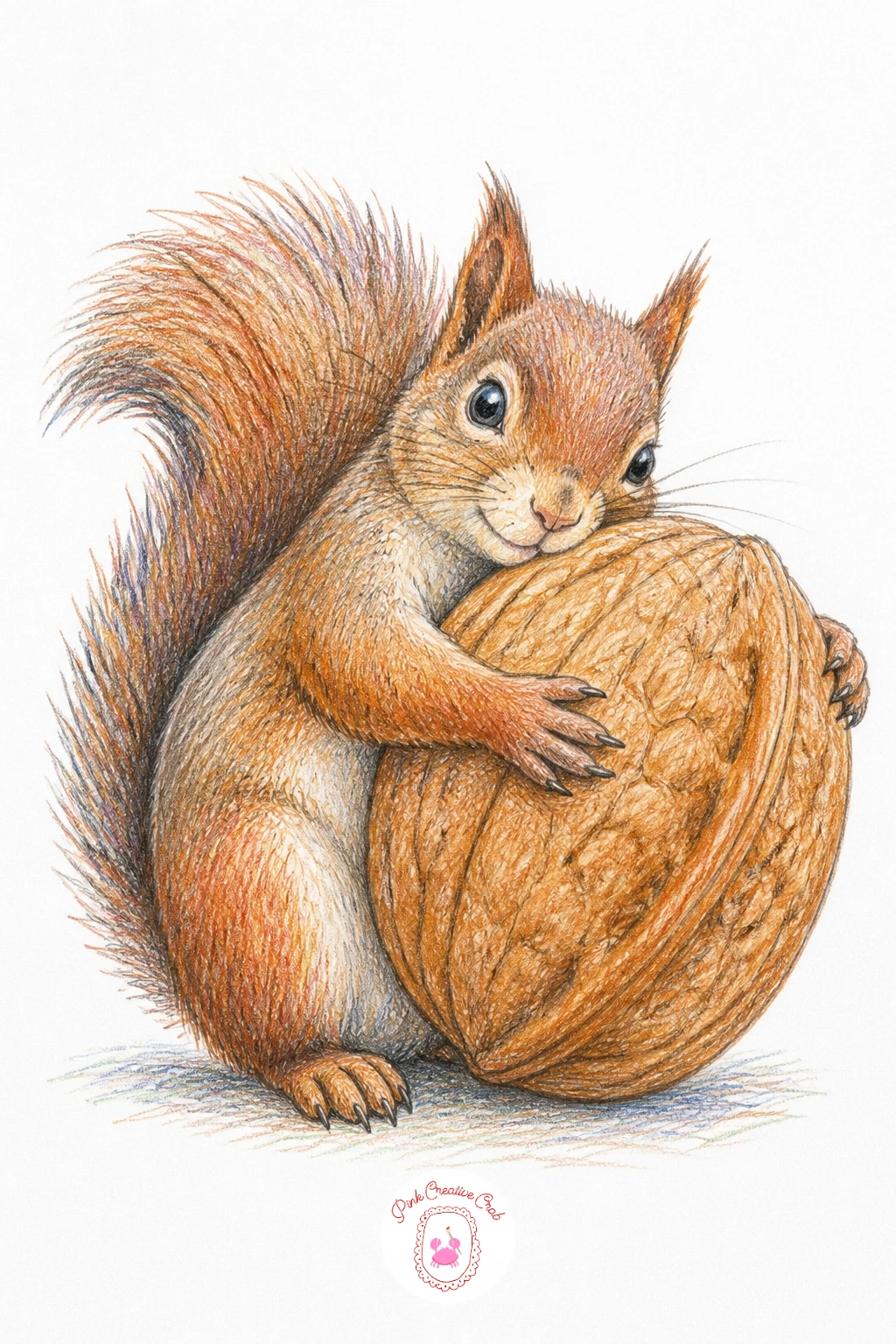
Palette: Tan,Chestnut Brown,Dark Umber,Cream
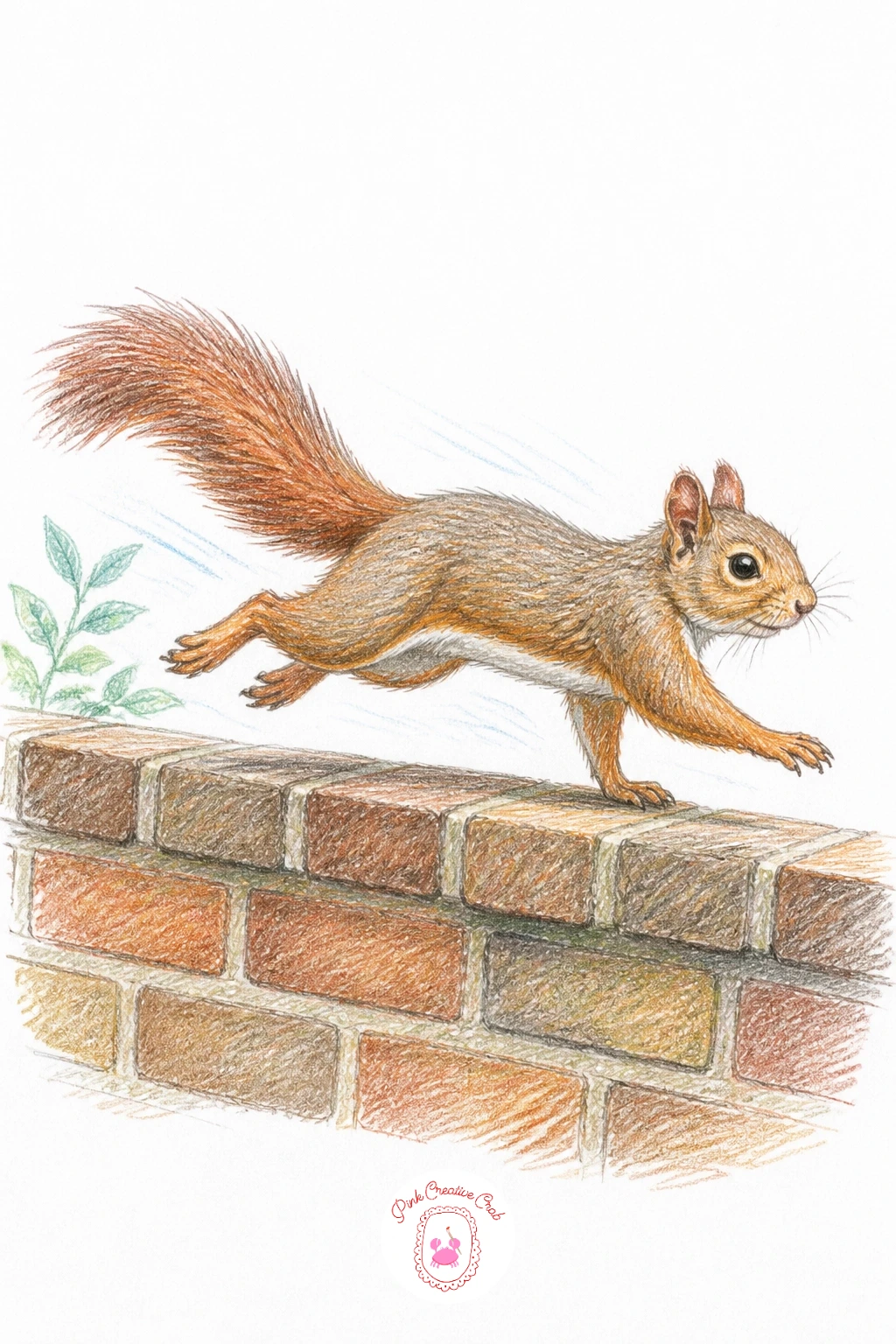
Capture speed along a flat surface: a squirrel mid-stride on top of a low brick or stone garden wall, body stretched horizontally with legs caught in a running position rather than a standing one. Sketch the wall as a simple horizontal band first, then run the squirrel along its top edge so the two feel locked together.
Texture the wall with small rectangular brick shapes or irregular stone shapes in warm grey and tan, kept looser and lighter than the squirrel so it recedes behind the animal. The squirrel’s tail should stream out behind at a low angle to reinforce the forward motion, echoing the running legs rather than curling calmly.
If the running pose looks like standing with messy legs, check that only one or two feet touch the wall at a time, full ground contact on all four reads as stationary. A plain stone ledge works just as well if brick patterns feel like too much detail today.
Palette: Warm Grey,Tan,Chestnut Brown,Burnt Sienna
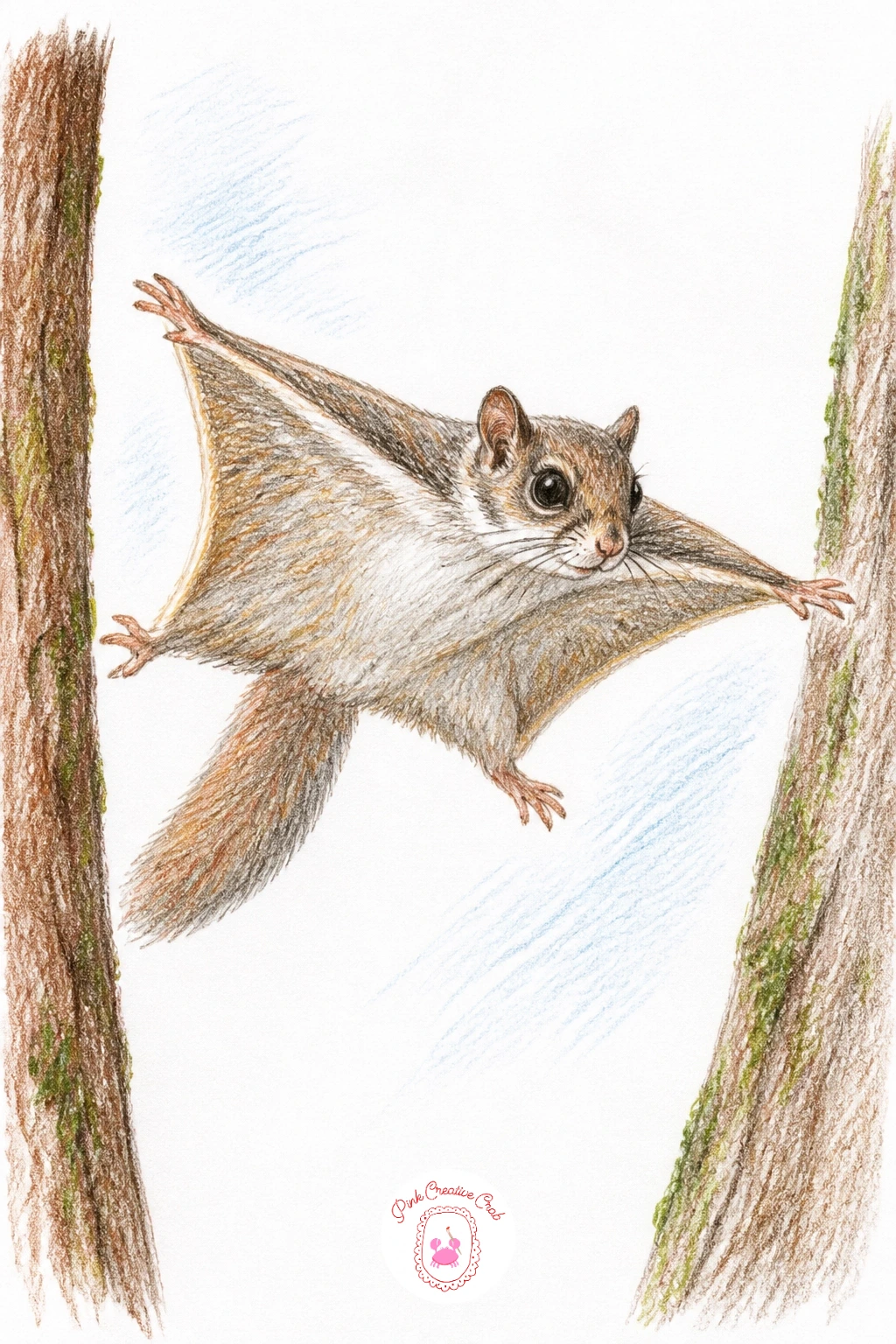
This is the most dramatic pose on the list, so take the proportion carefully: the gliding membrane between front and back legs needs to stretch wide enough on both sides that the squirrel reads instantly as airborne rather than simply falling. Measure the spread against the body length, aiming for the membrane to reach at least as wide as the body is long on each side.
Sketch the body first in a flattened, spread position, then add the membrane as a soft curved edge connecting wrist to ankle on each side, shading it slightly translucent with lighter strokes than the solid fur of the body. Two distant tree trunks in the background, one near each corner, give the glide somewhere to travel between.
If the membrane looks stiff or wing-like, round its outer edge more generously and keep the shading soft rather than sharply defined. Swap in just one tree trunk in a bottom corner if two feels like too much for today’s sitting.
Palette: Chestnut Brown,Warm Grey,Cream,Moss Green
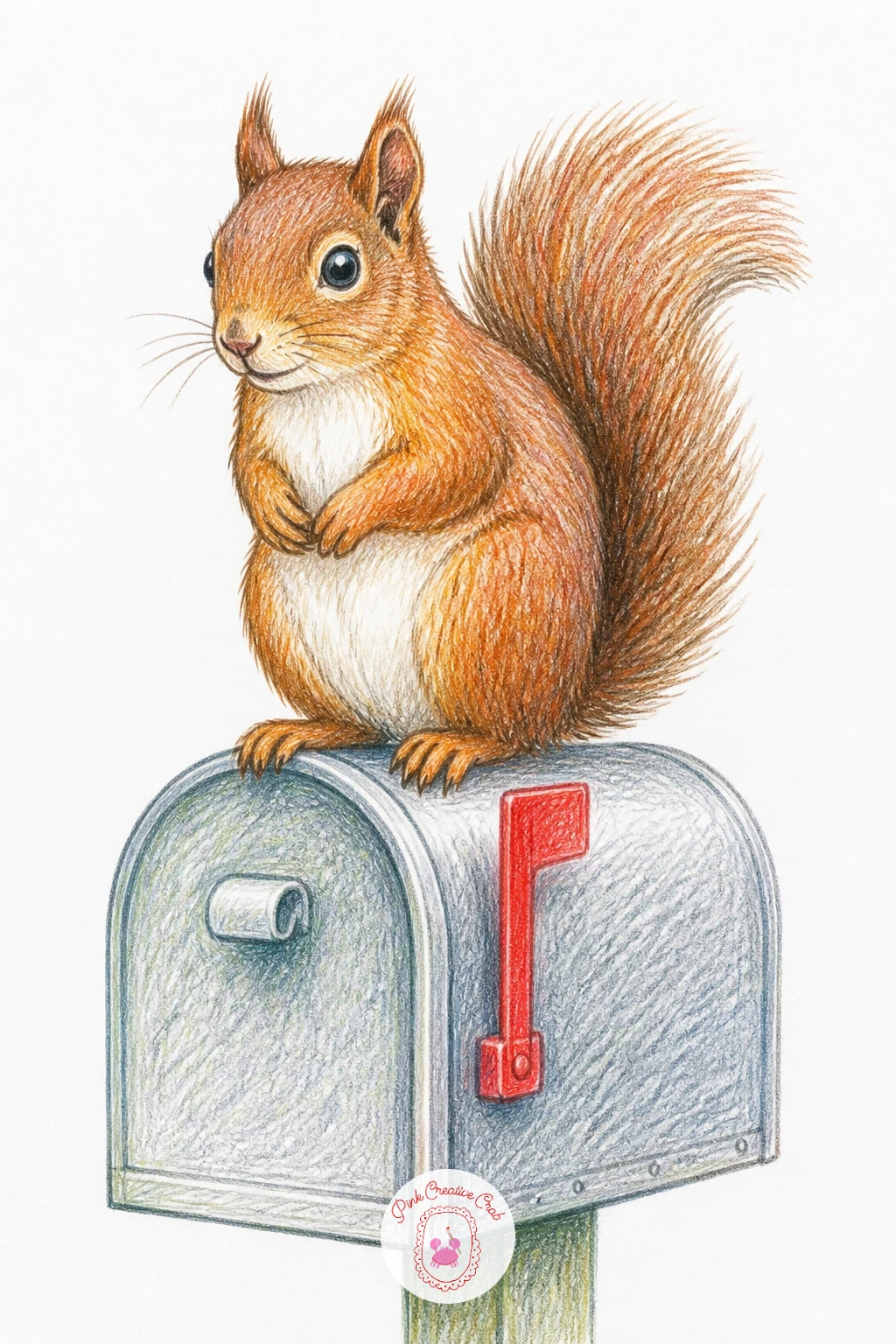
Set this one up as a small roadside scene: a squirrel balanced on the rounded top of a mailbox, body upright and alert as if checking for traffic or a passerby. Draw the mailbox first as a simple rounded rectangle on a thin post, keeping its color flat and plain so the squirrel stays the clear focal point.
A small red flag on the mailbox side adds a nice pop of color against all the browns elsewhere in the piece, just a thin rectangle at an angle. Shade the squirrel’s underside with a touch of shadow where it meets the curved mailbox top, that small contact shadow is what keeps it from floating above the surface.
If the mailbox looks too plain, add a couple of scuff marks or a faded number along its side for a lived-in feel. No red pencil on hand just means leaving the flag pale grey instead, it still reads fine.
Palette: Chestnut Brown,Warm Grey,Red,Cream
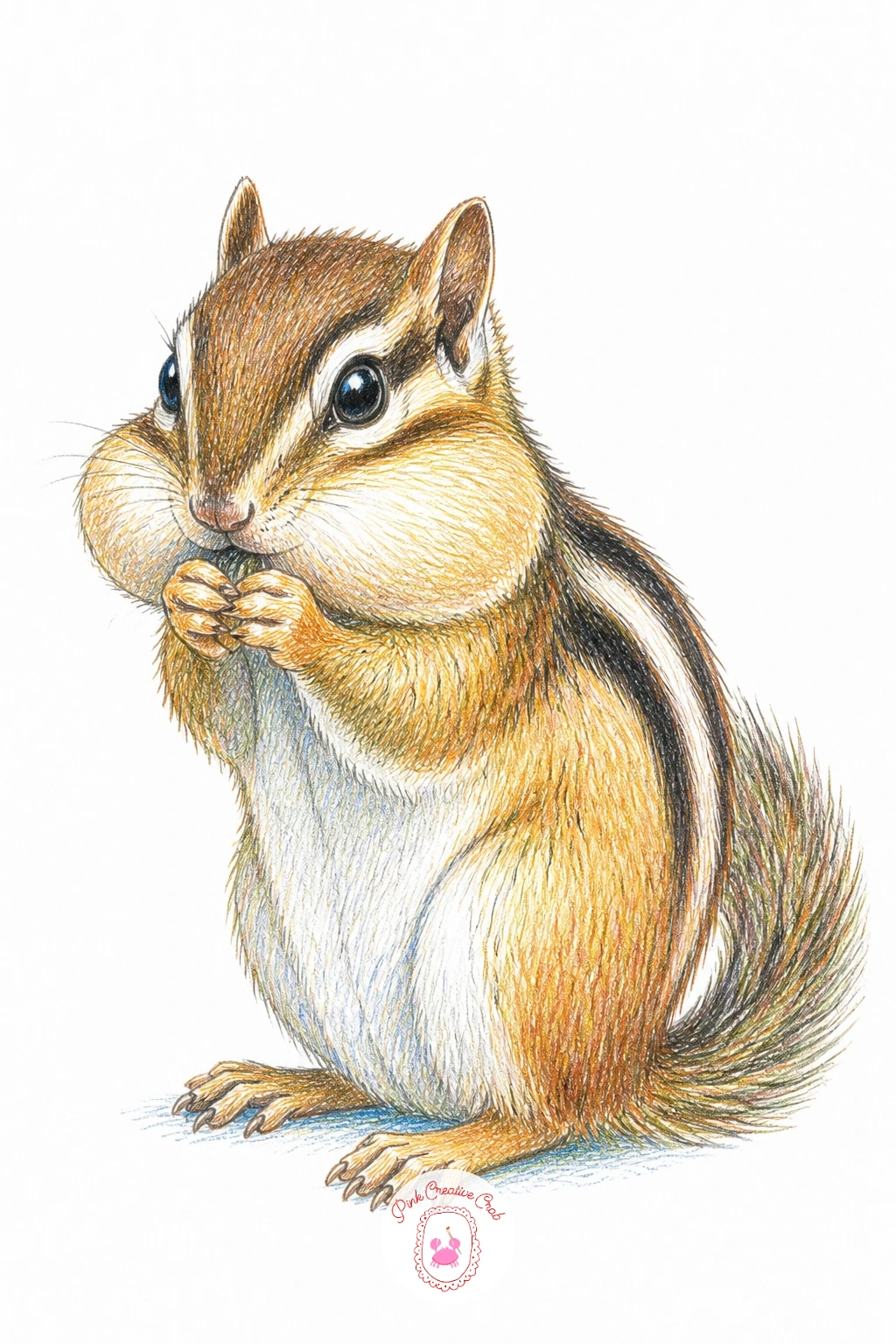
Bring in a cousin of the squirrel for variety: a chipmunk, smaller and more compact in build, with its signature back stripes and cheeks bulging full of seeds. Keep the body noticeably shorter and rounder than the squirrels elsewhere on this page, and skip the big bushy tail for a slimmer, less dramatic one.
The stripes are the defining feature, so draw two or three dark lines running from behind the ears down the back, with a paler stripe running between them, using crisp confident pencil strokes rather than soft blending. Cheeks bulge out to the sides just like the acorn-hoarding squirrel earlier, but on this smaller frame the effect looks even more exaggerated.
If the stripes look painted on rather than part of the fur, add a few short hatch marks crossing through them so they blend into the surrounding fur texture. A warm tan base coat under the stripes keeps the whole chipmunk feeling cohesive.
Palette: Tan,Dark Umber,Cream,Chestnut Brown
Place a squirrel somewhere unexpected: curled or seated inside a terracotta flowerpot as though it claimed the planter for a nap spot. Draw the pot first as a simple tapered cylinder with a slightly wider rim, shaded in warm terracotta with a band of darker shadow near the base where it meets the ground.
Fit the squirrel into the pot’s opening with its body compact and knees drawn up, tail draped over the rim on one side for a cozy, settled look. A few wilted or dried plant stems poking up behind the squirrel hint at the pot’s original purpose without needing full foliage.
If the squirrel looks too large for the pot or awkwardly perched on top rather than inside it, lower the body so its shoulders sit below the rim line. Swap terracotta for a plain grey stone pot if you do not have an orange-brown pencil to spare.
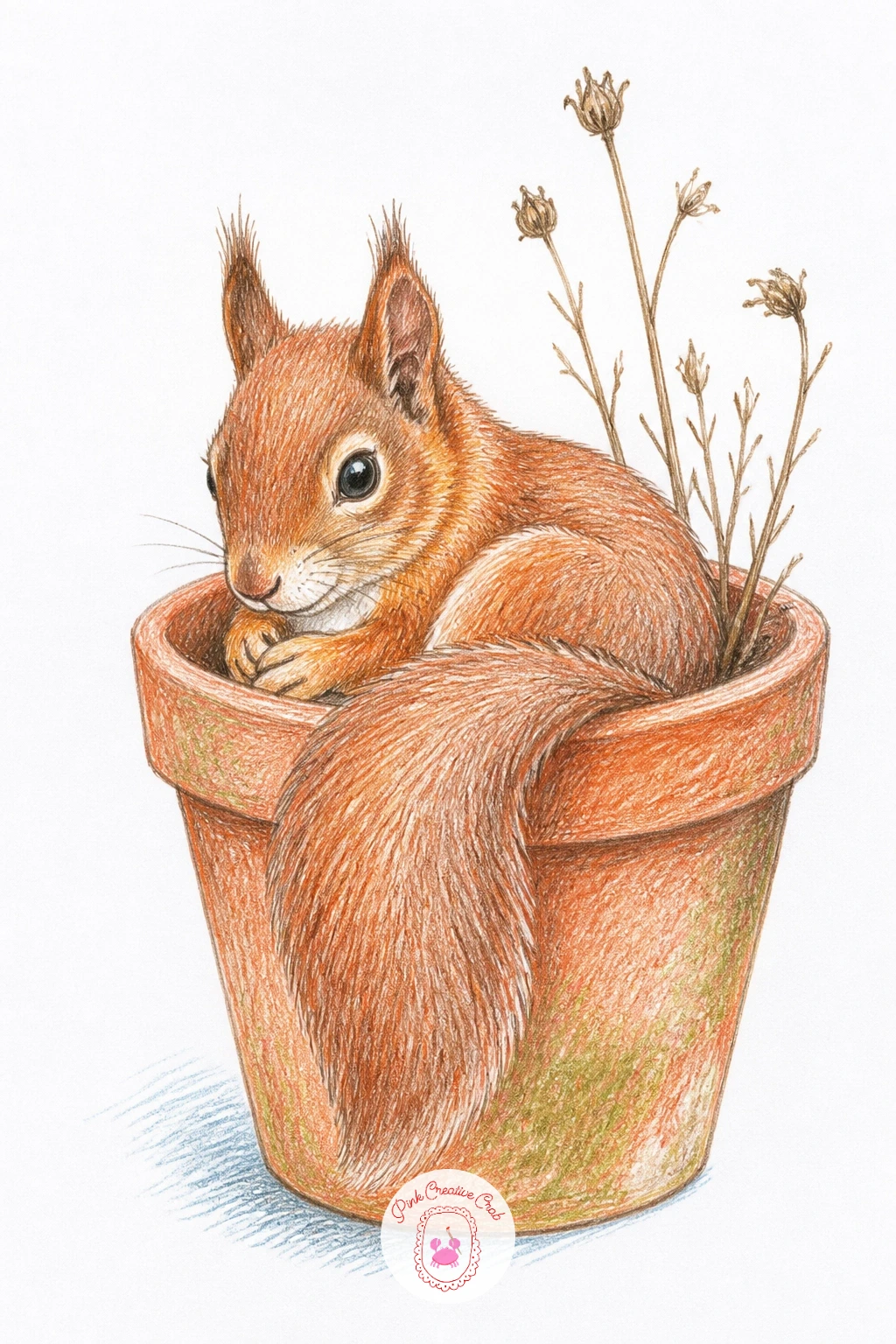
Palette: Burnt Sienna,Chestnut Brown,Olive Green,Cream
Pair a squirrel with a sunflower head nearly as tall as its own standing height, one paw resting against the thick stem for a natural, posed feel. Draw the sunflower first, a wide circular seed head in warm brown with short golden petals radiating around the edge, before placing the squirrel beside its base.
Seeds inside the head can stay simple, a scatter of small dark ovals rather than hundreds of individually drawn marks, with slightly more detail near the center where the eye naturally lands. The squirrel stands on back legs, front paw touching the stem, head tilted up toward the flower.
If the petals look too uniform and stiff, vary their length and angle slightly rather than spacing them with perfect symmetry. A smaller, half-open sunflower works fine too if a full bloom feels like a lot to tackle in one sitting.
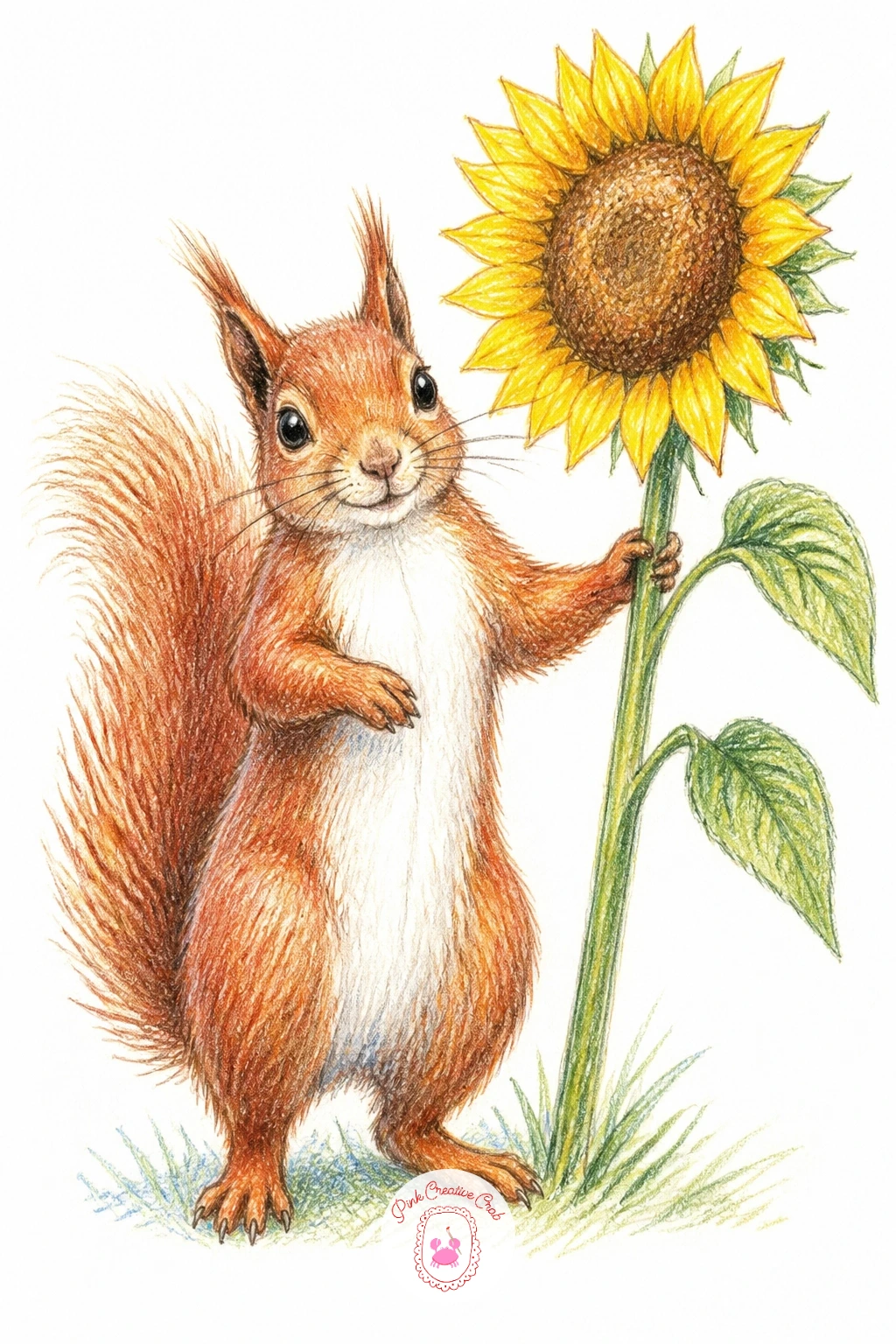
Palette: Yellow Ochre,Chestnut Brown,Dark Umber,Olive Green
Give this squirrel a playful task: sitting with a small unrolled paper map spread between its paws, tiny X marks scattered across it. Draw the map first as a simple curled rectangle, edges rolling slightly inward at the corners to show it was just unrolled, shaded in pale cream with a few thin lines suggesting paths or landmarks.
The squirrel leans forward over the map with a focused, studious posture, head bowed and one paw pointing at a mark. Keep the map details minimal, a handful of small X marks and maybe one wavy line for a path, since too much detail here will fight with the squirrel for attention.
If the map looks flat and lifeless, add a soft curved shadow underneath it where it lifts slightly off the ground. A torn edge or small fold crease also sells the paper feel without extra color needed.
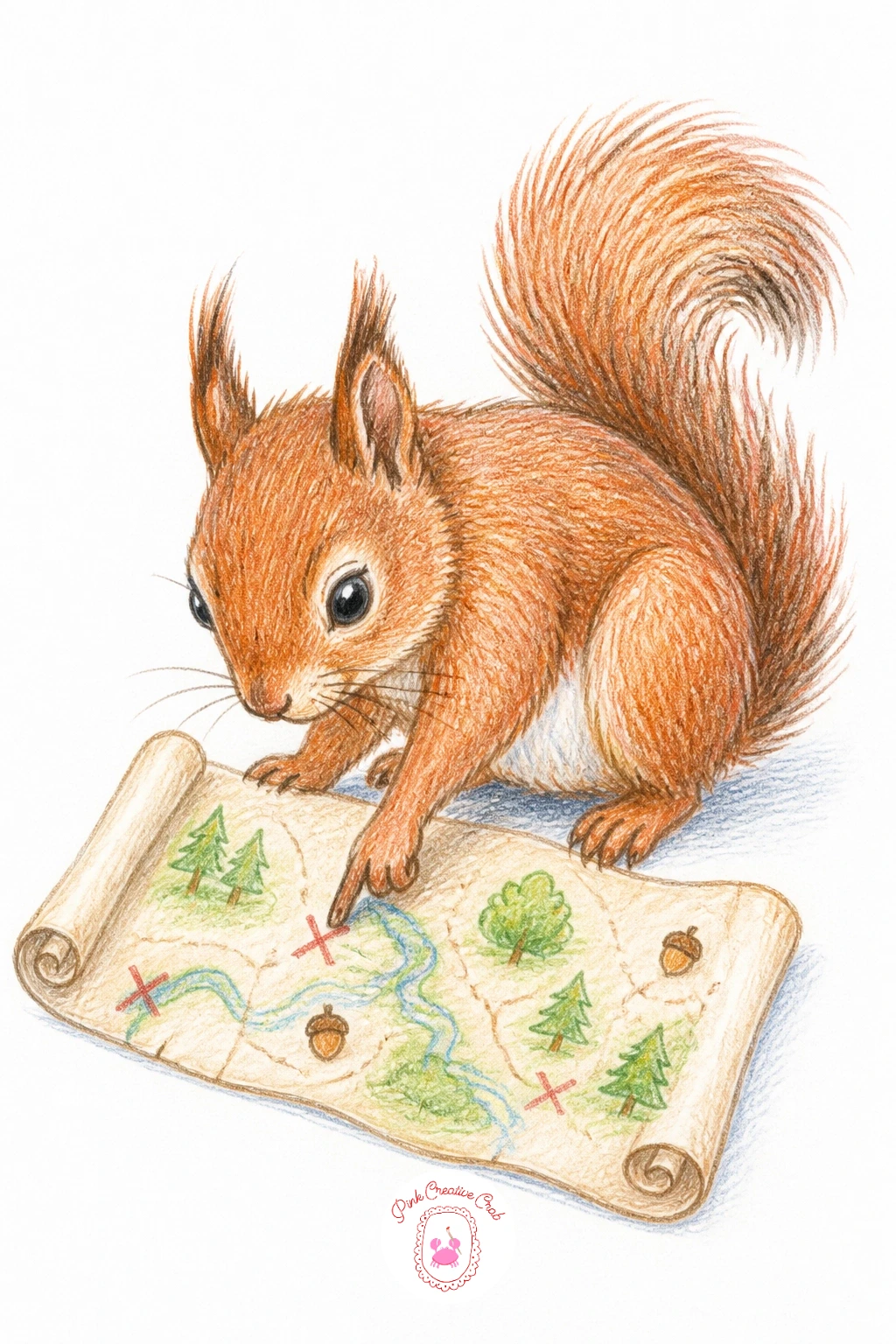
Palette: Cream,Chestnut Brown,Dark Umber,Warm Grey
Work on reflection for this quiet scene: a squirrel bent low over a small puddle, tongue or muzzle just touching the surface, with a faint mirrored reflection of its face showing in the water below. Draw the squirrel’s bent posture first, back arched and head dipped down, before adding the puddle beneath it.
Shade the puddle in a cool pale blue-grey, keeping most of it light since water reflects the sky more than it shows deep color, and sketch the reflection as a soft, slightly wavy echo of the squirrel’s head rather than a sharp mirror copy. A thin darker line along the puddle’s edge grounds it on the surface it sits on.
If the reflection looks too solid and confuses the eye, blur its edges more than the real squirrel’s edges so it clearly reads as a reflection rather than a second animal. Dirt or grass texture around the puddle edge is optional and can stay minimal.
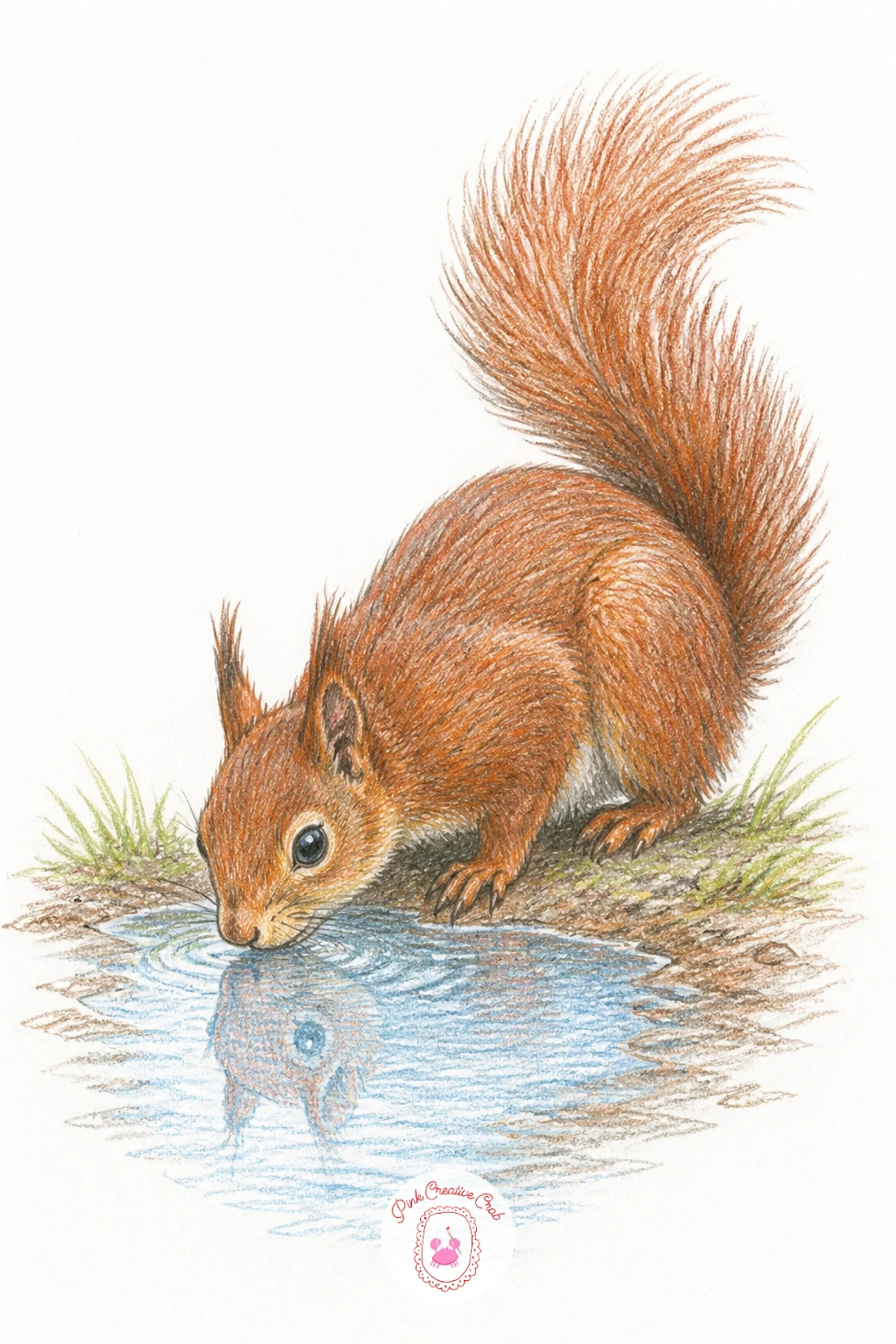
Palette: Sky Blue,Chestnut Brown,Soft Grey,Olive Green
Bring the scene right up close: a squirrel standing on a windowsill, one paw raised against the glass as if tapping to be let in, seen from inside looking out. Draw a simple window frame first, just the inner edges of the sill and a hint of the pane, then place the squirrel pressed close against the glass on the outside.
Shade the glass very lightly with a cool grey tint only where needed, keeping most of it bare white so the squirrel stays sharp and clear through it, as if seen clearly rather than through heavy fogged glass. The raised paw presses flat against the pane, fingers slightly splayed.
If the glass effect muddies the squirrel’s color, keep the tint restricted to the very edges of the pane and leave the center clear. A simple wooden sill with a couple of grain lines is enough framing, no need for curtains or a full room.
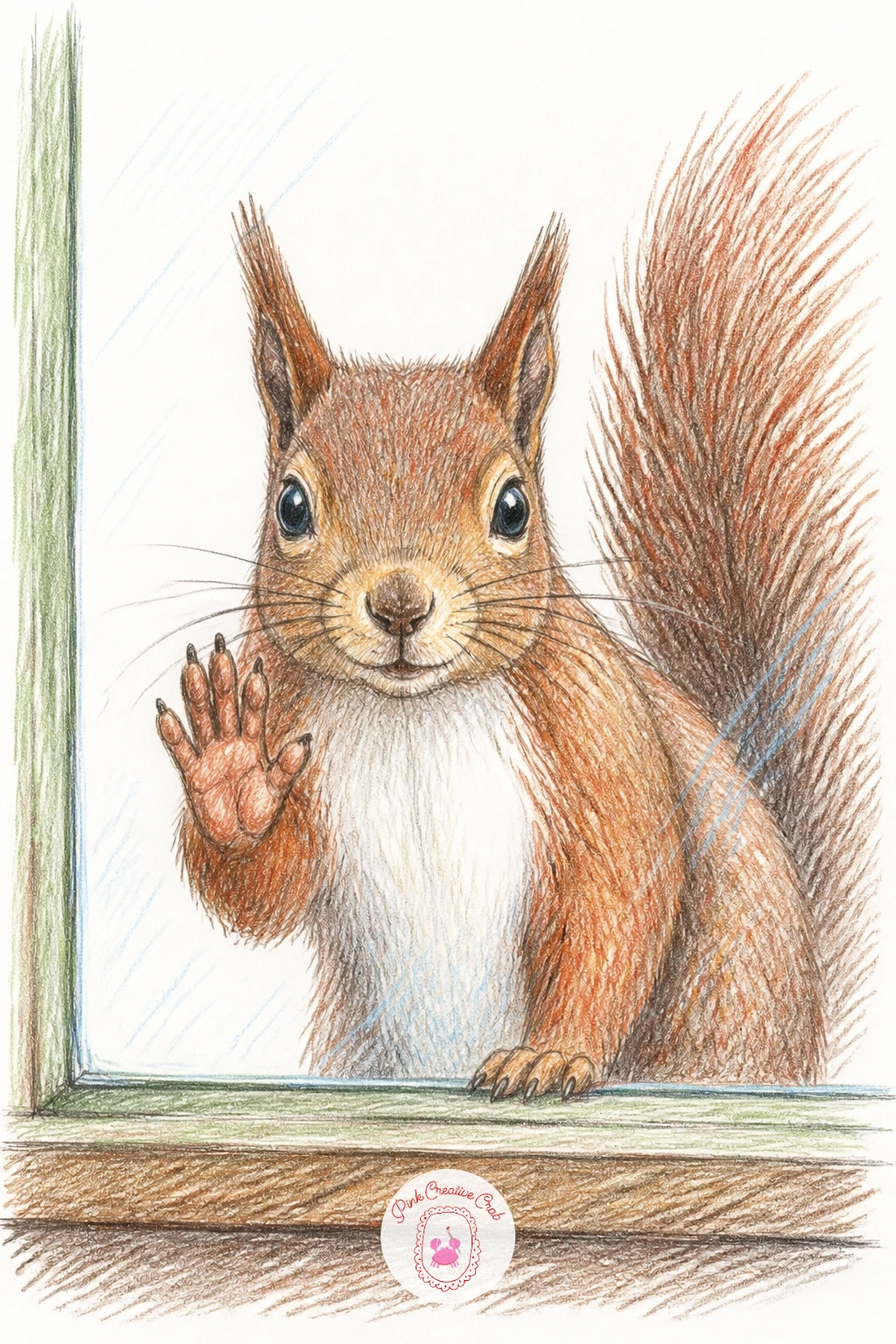
Palette: Chestnut Brown,Soft Grey,Sky Blue,Cream
Close the set with the most involved scene: a cross-section of a tree trunk showing a small squirrel family inside, parents and one or two young ones tucked into a cozy hollow furnished simply with a bed of leaves. Draw the trunk’s outer bark edge first as a rough vertical border, then carve out an open interior space on one side as if a slice of the wood has been removed to reveal the home.
Place the larger parent squirrels first to establish scale, then add one or two smaller young squirrels nestled beside them, keeping the whole group close together for warmth and intimacy. Line the floor of the hollow with a scatter of leaves and perhaps one or two stored acorns to suggest the family’s autumn preparations.
If the interior feels cramped or confusing, simplify to just two figures rather than a crowd, clarity matters more than a full family reunion. For a quick version, skip the bark cross-section entirely and just show the cozy group inside a simple rounded nest shape instead.
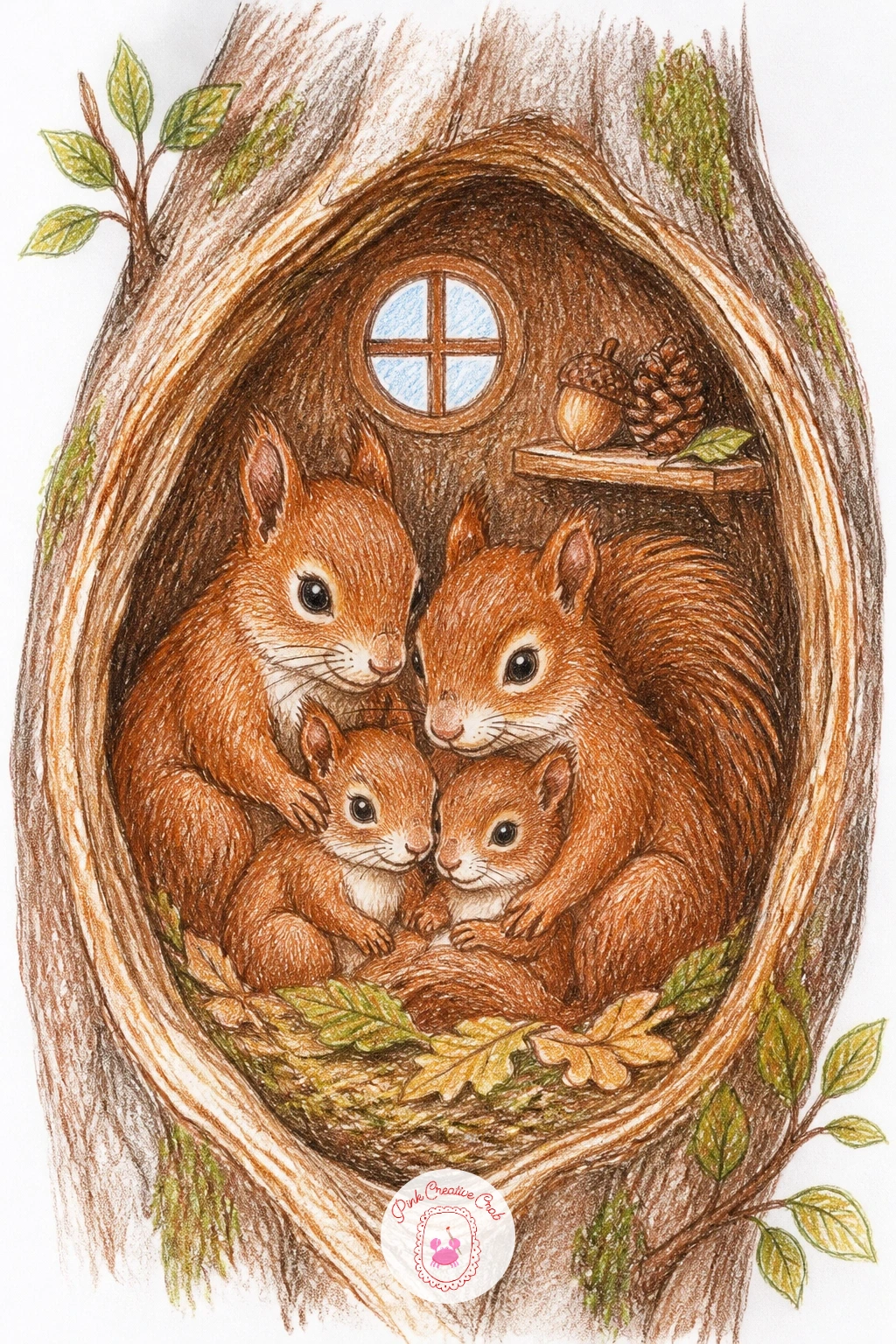
Palette: Dark Umber,Chestnut Brown,Tan,Moss Green
For more cozy interior scenes built the same way, the village scene drawing ideas page has similar cutaway tricks worth borrowing.
What to Do Next
Pick whichever squirrel matches your mood today, grab a sheet of smooth white paper and your warm browns, and work through the sketch before reaching for color. Keep the first few ideas on this list in reach if you want a confidence-building warm-up before tackling one of the busier scenes.
Frequently Asked Questions
What colored pencils work best for a cute squirrel drawing?
A warm brown, rust, cream and dark umber cover most squirrel fur convincingly. Add sky blue and moss green for backgrounds and props, and keep a kneaded eraser nearby for lifting highlights in the fur.
How do you make a squirrel drawing look soft and furry?
Short, light strokes following the direction fur grows build softness far better than one solid block of color. Layer two or three tones gradually, darkest in the shadows, and leave the lightest areas closest to bare paper.
What is the easiest part of a squirrel to get wrong?
The tail usually causes the most trouble, since a stiff outline makes it look paddle-shaped rather than fluffy. Build it from several overlapping feathered clumps instead of one smooth curve for a more natural result.
Do I need special paper for colored pencil squirrel drawings?
Smooth to lightly textured white drawing paper works well and keeps colors looking clean and fresh. Very rough watercolor paper fights the pencil and makes fine fur strokes harder to control.
How can I make a beginner squirrel drawing look less flat?
Decide where the light comes from before you start shading, then keep that side consistently lighter across the whole body. A single cast shadow beneath the squirrel’s feet also does a lot to ground it on the page.
Have any thoughts?
Share your reaction or leave a quick response — we’d love to hear what you think!
-
 0
-
0
-
0
-
0
-
0
-
0


