

Winter painting gives you everything a landscape needs in one subject: a quiet palette, soft light and a single strong focal point to build the whole canvas around. These scenes lean on classic cottages, frozen ponds and skaters, but with the kind of fresh lilac and icy blue shadow work that keeps a snow painting from going flat and chalky.
Below are 28 full scenes in oil, each sized for a small canvas you can finish in one sitting. Work through them in order if you like, from the simplest lane and pond to the busier street and canal scenes, or jump straight to the one that matches the picture already in your head.
Using these images: free for personal projects such as printing, coloring, cards, journals and gifts. Handmade items that include them may be sold up to 30 pieces per design. More than that is commercial use and is not permitted, and neither is selling or sharing the images themselves or passing them off as your own. Please ask before any other use.
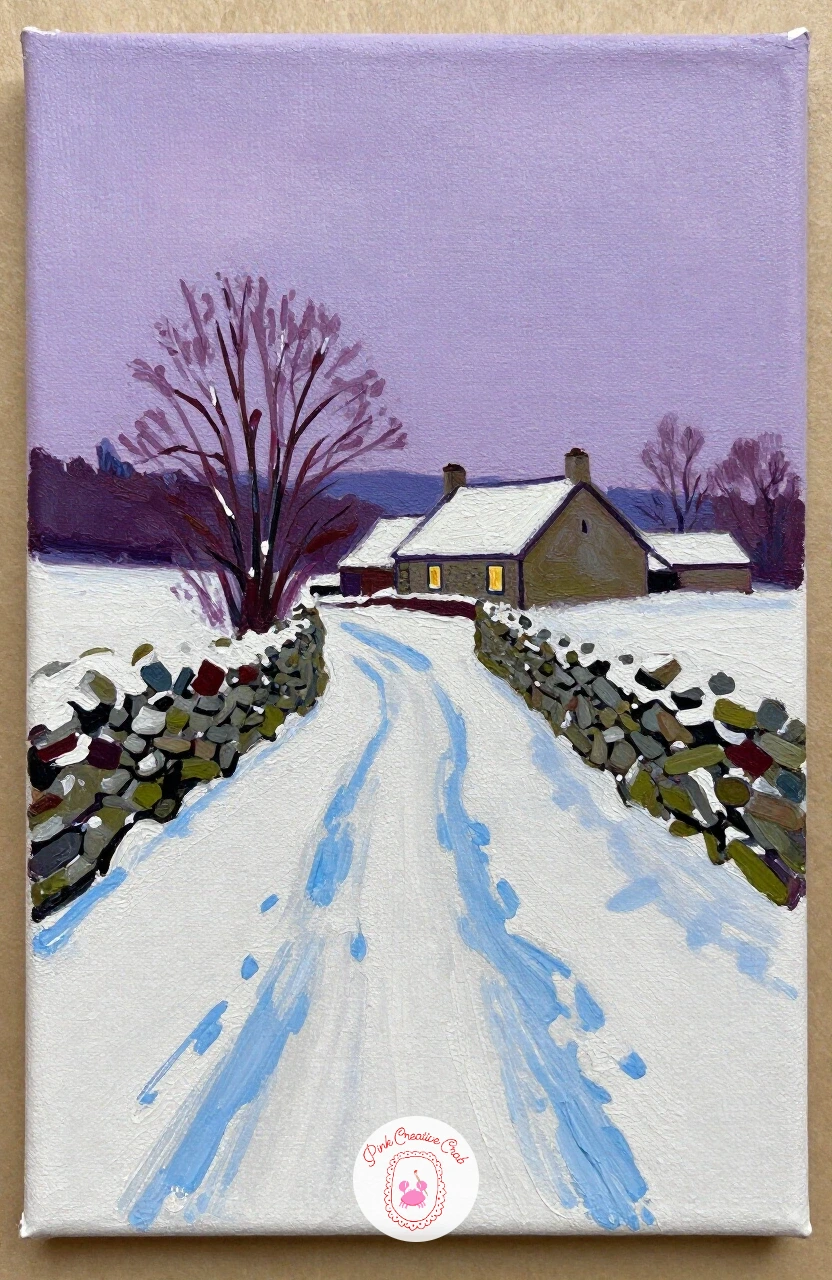
Start with a snowy lane running between two low stone walls toward a farmhouse set small in the distance. Block in the sky first with a thin wash of lilac white, then lay the walls as warm grey shapes before any snow goes down, since snow painted over dry stone reads far more convincingly than stone added on top of snow.
Use a palette knife for the wall tops where snow sits thick and crusted, then switch to a flat brush for the lane itself, pulling icy blue shadow diagonally across the white to show where the walls block the light. The farmhouse needs only a few strokes: a warm wall, a dark roof, one window lit in soft ochre.
Converging lines are what sell distance here. Keep the walls, the lane edges and the roofline all narrowing toward the same point near the farmhouse, and check that none of them accidentally widens again as it recedes, which is the easiest way this composition goes wrong.
If your canvas feels too empty, add a single set of footprints down the lane rather than more background detail.
You Will Need
- palette knife
Palette: Titanium White,Payne’s Grey,Cerulean Blue,Burnt Sienna
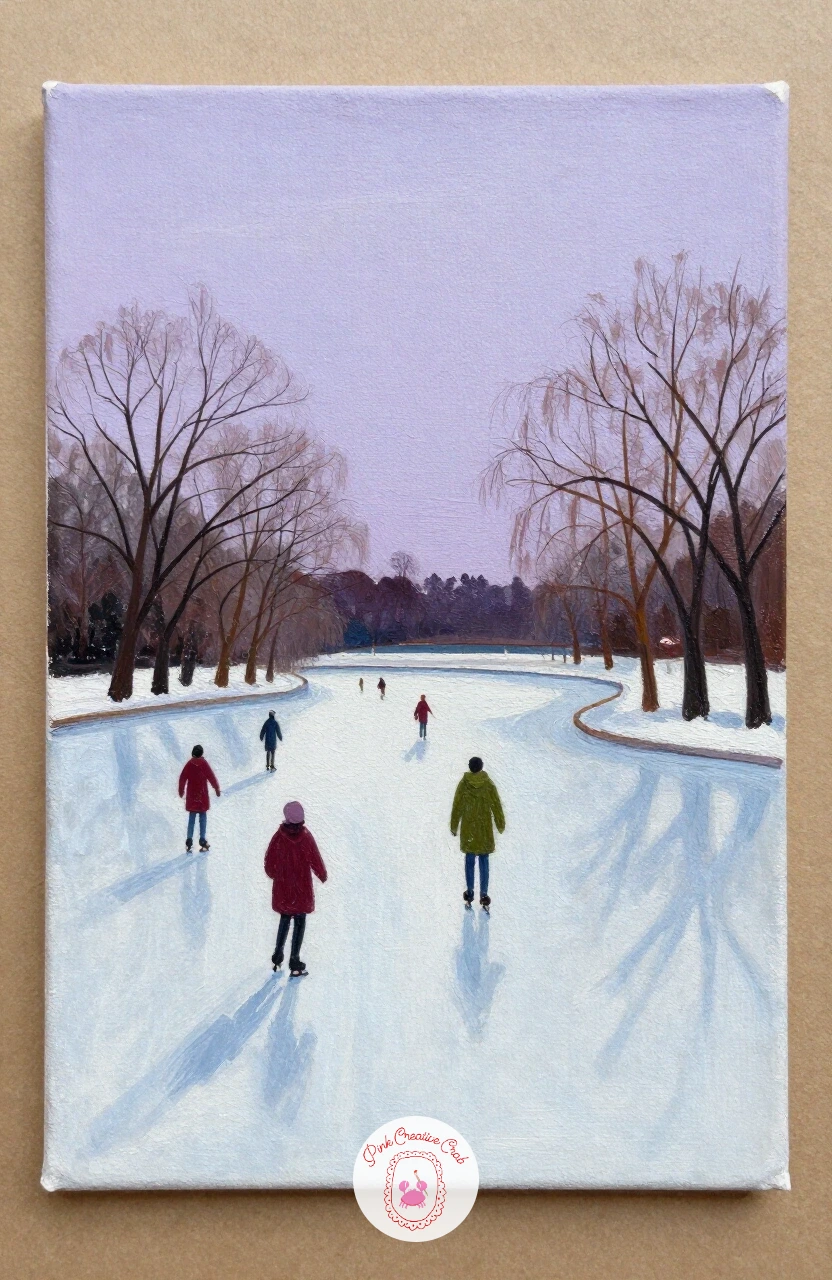
Move from the lane to open water for a pond scene with a handful of skaters circling under bare willow branches. Block the ice first as a pale grey-lilac oval, then paint the willows as soft, drooping dark shapes around its edge before you place a single skater, since the ice needs to exist as a surface before anyone can stand on it.
Keep the skaters small and gestural, just a coat colour and a lean of the body, two or three strokes each. This is where proportion matters most: measure each figure against the width of the pond rather than guessing, so nobody ends up giant next to a tiny willow or lost against the ice.
If a figure looks stiff, soften the back leg with a thin dry brush pass to suggest motion blur rather than redrawing the whole pose. Burgundy coats and moss green scarves read beautifully against the pale ice and are worth saving for this scene specifically.
Finish with a few scratched highlights along the ice using the brush handle, for the glassy shine real ice needs.
Palette: Lilac Grey,Payne’s Grey,Burgundy,Moss Green
Look at photos of real skaters for the lean of the body before you simplify. Even a loose gesture reads better when it starts from a true angle rather than an invented one.
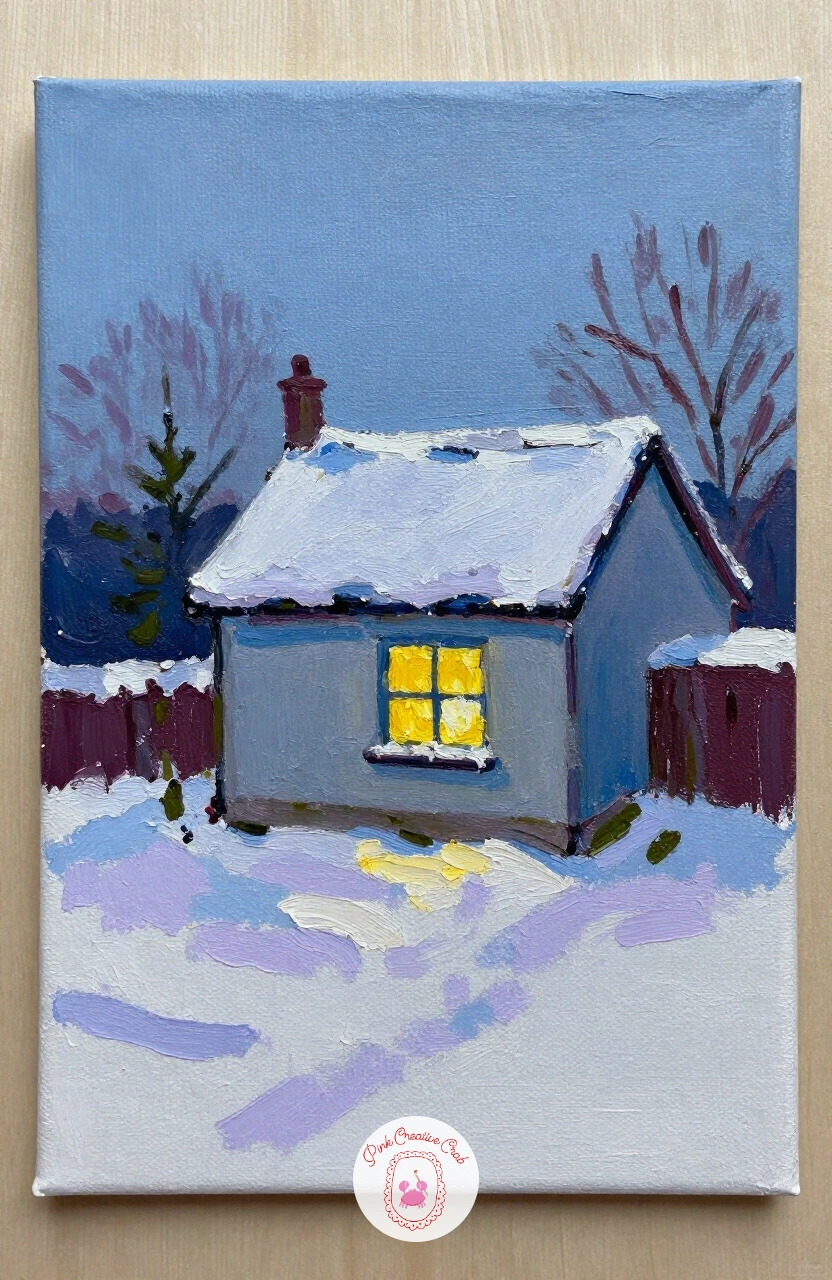
Give the eye one bright point to land on with a cottage window glowing against a blue, snow-heavy afternoon. Paint the whole scene in cool colour first, the snow, sky and cottage walls all in blues and lilacs, before you touch the window, so the warm light inside has something cold to push against.
This is where light direction decides everything. Pick one low afternoon sun off to one side, let it throw long blue shadows from the cottage across the snow, and keep that same light logic for the glow spilling from the window onto the sill outside.
Mix the window glow from cadmium yellow and a touch of white, kept thick and opaque, then drop it in last with a loaded brush in two or three confident strokes. Thin, scrubbed-in yellow looks washed out next to all that cool blue.
If the cottage feels flat, add one chimney with a thin grey wisp of smoke angled by the wind.
Palette: Ultramarine Blue,Lilac,Cadmium Yellow,Titanium White
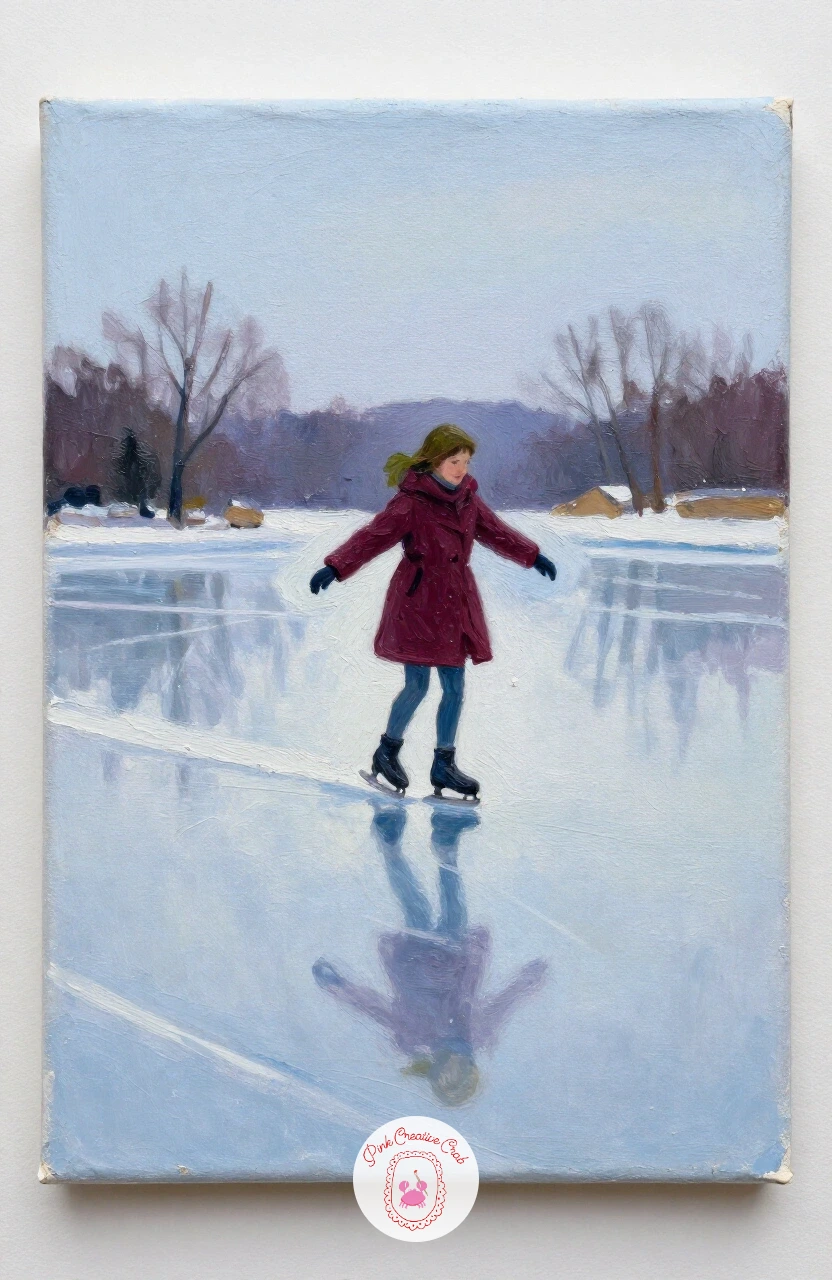
Pull back to a single figure for a quieter mood: a girl in a burgundy coat skating alone across mirror-smooth ice. Paint the ice first as a long pale plane with soft reflected colour from the sky, then place the figure a third of the way into the frame rather than dead centre, which keeps the empty ice doing real work instead of just filling space.
Her coat is the one note of strong colour in the whole scene, so mix the burgundy rich and a little dark, then keep everything else, hair, scarf, ice, muted around it. A few confident strokes for the coat’s shape and a thinner line for one leg extended behind her is enough to suggest glide.
The ten-minute version stops there: figure, ice, pale sky. The forty-minute version adds her soft reflection in the ice directly beneath her, slightly broken with a dry brush so it reads as ice and not glass.
If the pose feels frozen, angle her arms slightly unevenly, since perfectly symmetrical arms are what make a figure look stiff.
Palette: Burgundy,Titanium White,Cerulean Blue,Payne’s Grey
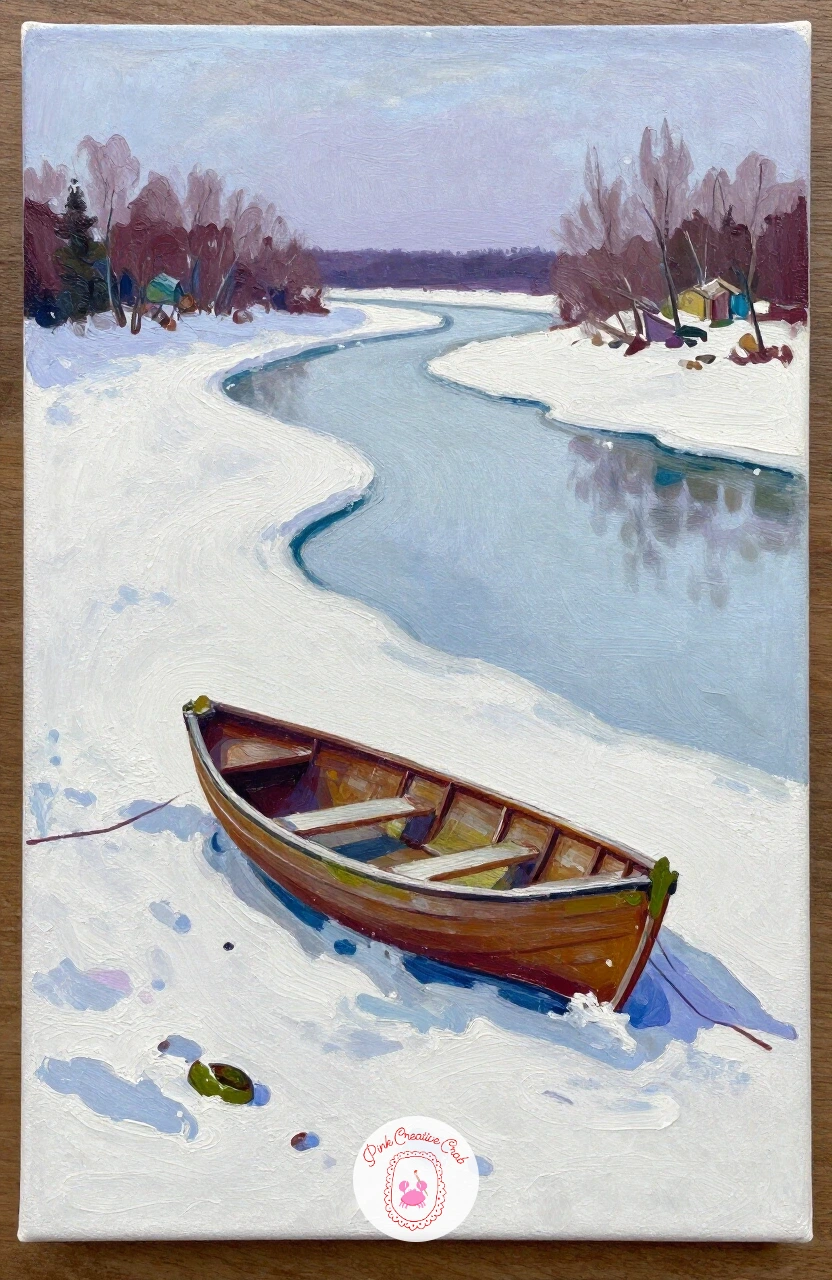
Shift from still ponds to a river bend where the water curves away and a wooden rowboat sits pulled up on the frozen bank. Lay the river’s shape first as a pale ribbon that bends and narrows toward the horizon, then build the bank around it, since the river’s curve is what gives this whole composition its sense of distance.
The rowboat is the focal point, so paint it in warmer, more saturated colour than anything around it, a weathered red-brown with a touch of burnt sienna, and keep its edges a little crisper than the soft snowbank it rests on. Everything else in the scene can stay looser.
If the ice on the river looks too flat, drag a dry, barely loaded brush sideways across it after the base colour has set up slightly, catching only the raised texture of the canvas for a convincing frozen sheen.
No red-brown on hand? A mix of burnt sienna and a touch of Payne’s grey gives the same weathered wood tone.
Palette: Burnt Sienna,Payne’s Grey,Titanium White,Cerulean Blue
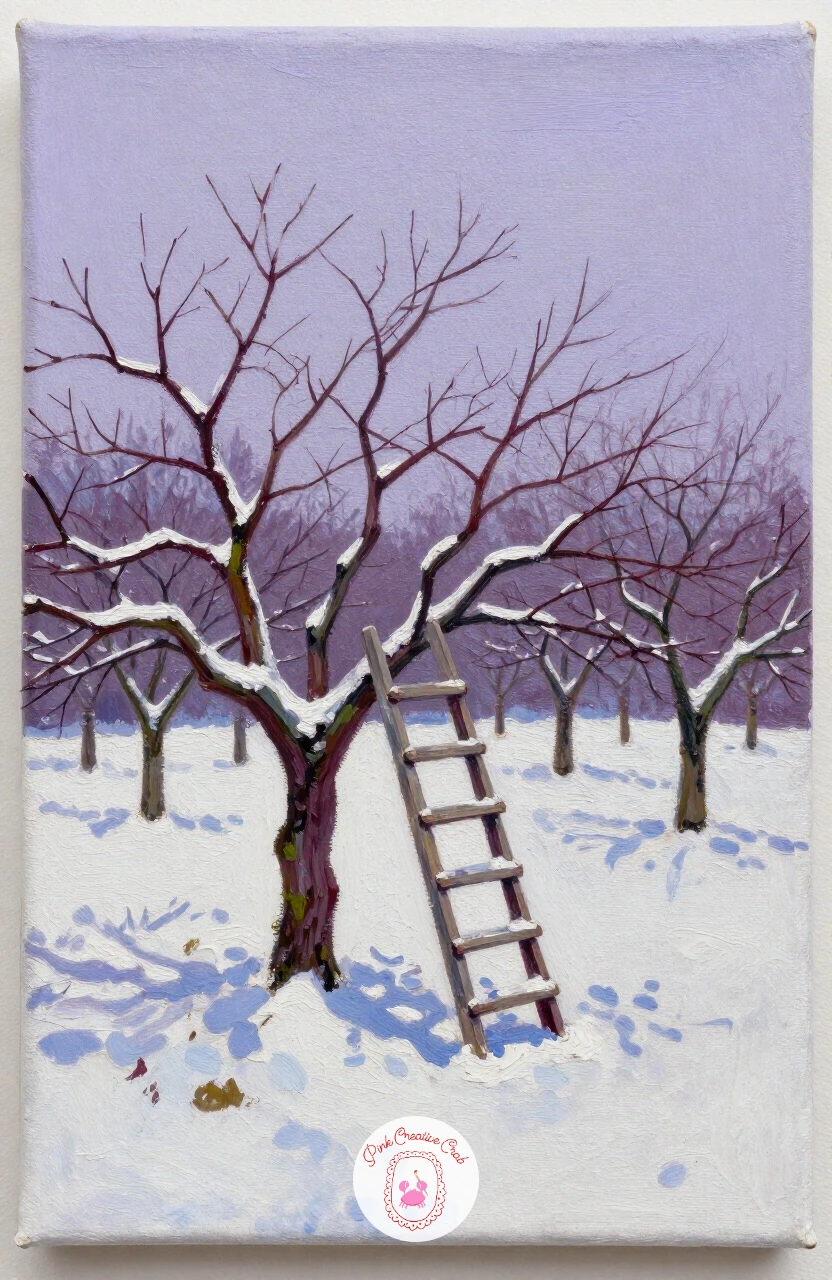
Move into an orchard where bare fruit trees stand in rows and one ladder leans against a trunk, left out since the last harvest. Paint the trees first as simple dark silhouettes with a few upward branches, spacing them unevenly so the orchard reads as real rather than planted in a perfect grid.
The ladder is a small but important shape: keep its rungs loose, just a few short strokes rather than a precise rendering, and tilt it slightly off the vertical so it looks genuinely leaned rather than drawn with a ruler. This single human touch is what turns a tree study into a scene with a story.
Snow collects differently on every branch, so vary your white, thick on the upper sides, barely a whisper on the undersides, using a palette knife for the heaviest clumps near the trunk.
If the orchard feels too busy, reduce it to three trees and let the ladder tree sit slightly forward of the other two.
You Will Need
- palette knife
Palette: Payne’s Grey,Titanium White,Burnt Umber,Lilac Grey
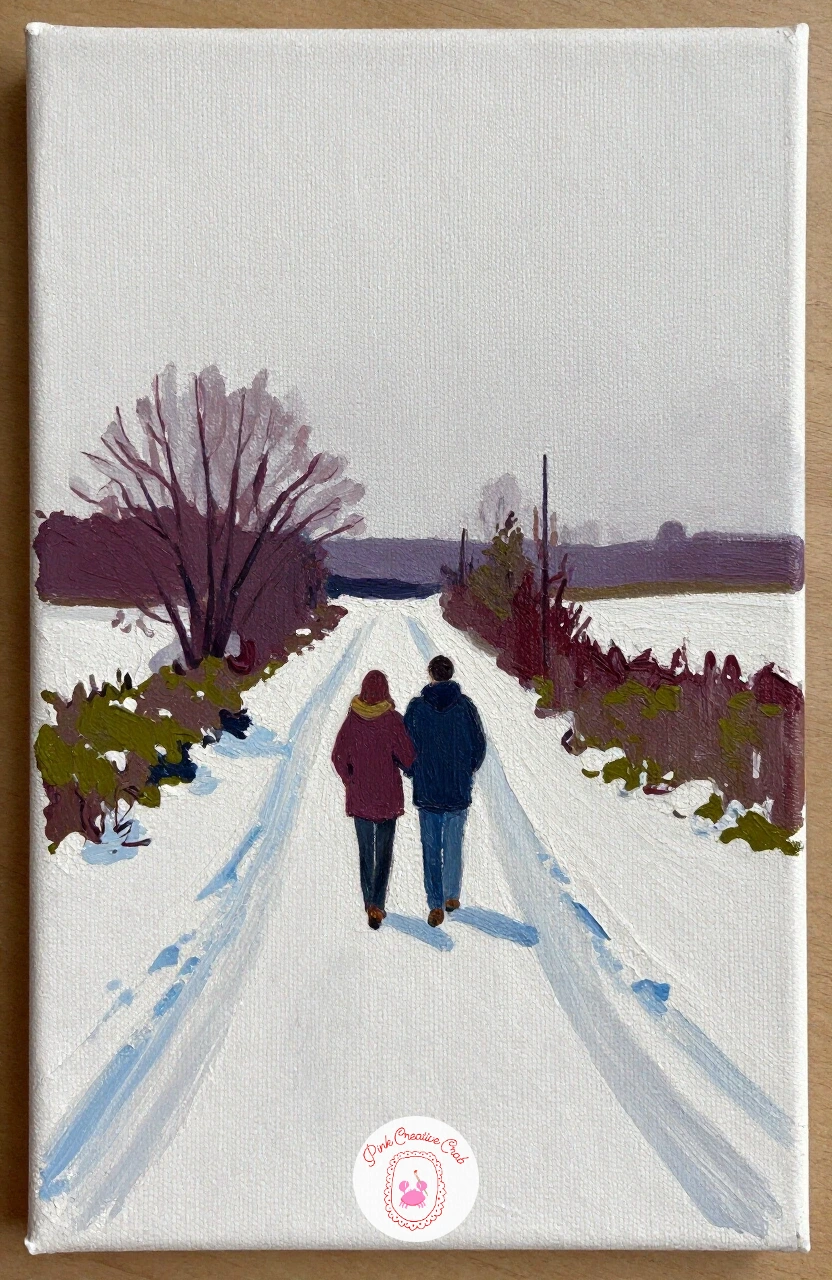
Bring two figures into a snowy lane, walking close together with arms linked, small against the wider scene. Block the lane and hedgerows first in soft greys and whites, then add the couple last as a single combined shape rather than two separate figures, since from a distance that is how two people walking arm in arm actually read.
Keep their coats in two different but related colours, perhaps a deep moss green and a warm burnt umber, so the pair reads as two people without needing any facial detail at all. A few short strokes for legs mid-stride is enough to suggest they are moving, not posed.
If they look too large for the lane, hold your brush at arm’s length and compare their height against the hedge beside them before committing to the paint, since figures are one of the easiest things to oversize in a landscape.
This pairs well with a quieter version of the same idea in winter oil painting ideas for beginners if you want a simpler lane to warm up on first.
Palette: Moss Green,Burnt Umber,Titanium White,Lilac Grey
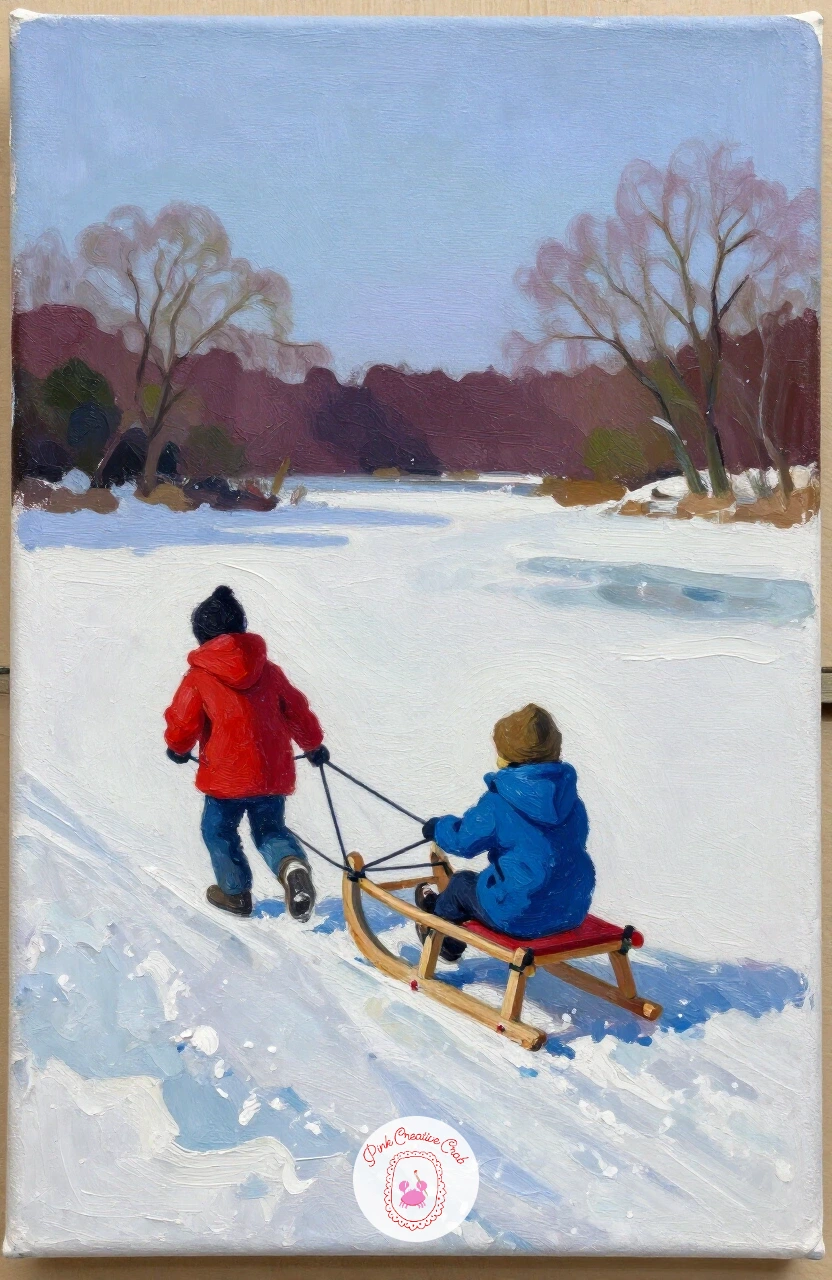
Bring some energy into the ice with two children pulling each other on a sled across the frozen pond. Sketch the sled’s path first as a loose curved line across the ice, since sleds rarely travel in a straight line, then build both figures around that curve, one pulling forward, one leaning back for balance.
This is a timing exercise as much as a painting one. Give yourself ten minutes for the quick version: ice, two simple figures, one sled, done in loose colour blocks. The forty-minute version adds flying snow kicked up behind the running child and a faint double track left by the sled runners.
Keep both coats bright, a red and a blue work well together against the pale ice, since children’s winter clothes are one place strong colour always looks natural rather than forced.
If the running figure looks flat-footed, lift the back foot slightly off the ice with a single curved stroke.
Palette: Cadmium Red,Cerulean Blue,Titanium White,Payne’s Grey
Give a small cottage real presence with blue shutters and a slide of snow caught mid-fall off the roof. Build the cottage first as simple geometric blocks, roof, walls, then shutters, before adding any snow at all, so the architecture stays solid underneath the white.
The falling snow is the trick here. Paint the roof’s snow cap first as a settled, thick shape, then pull a separate loose streak of white down and slightly outward from the eave with a dry, half-loaded brush, breaking the edge so it reads as snow in motion rather than snow stuck to the wall.
Blue shutters against warm cottage walls, perhaps a soft ochre or pale pink, give you the fresh colour contrast this whole style is built on. Keep the shutter blue a little more saturated than the icy shadow blue elsewhere in the painting so it stays a deliberate colour choice rather than blending into the shadows.
No dry brush on hand? A stiff fan brush does the same broken-edge job for falling snow.
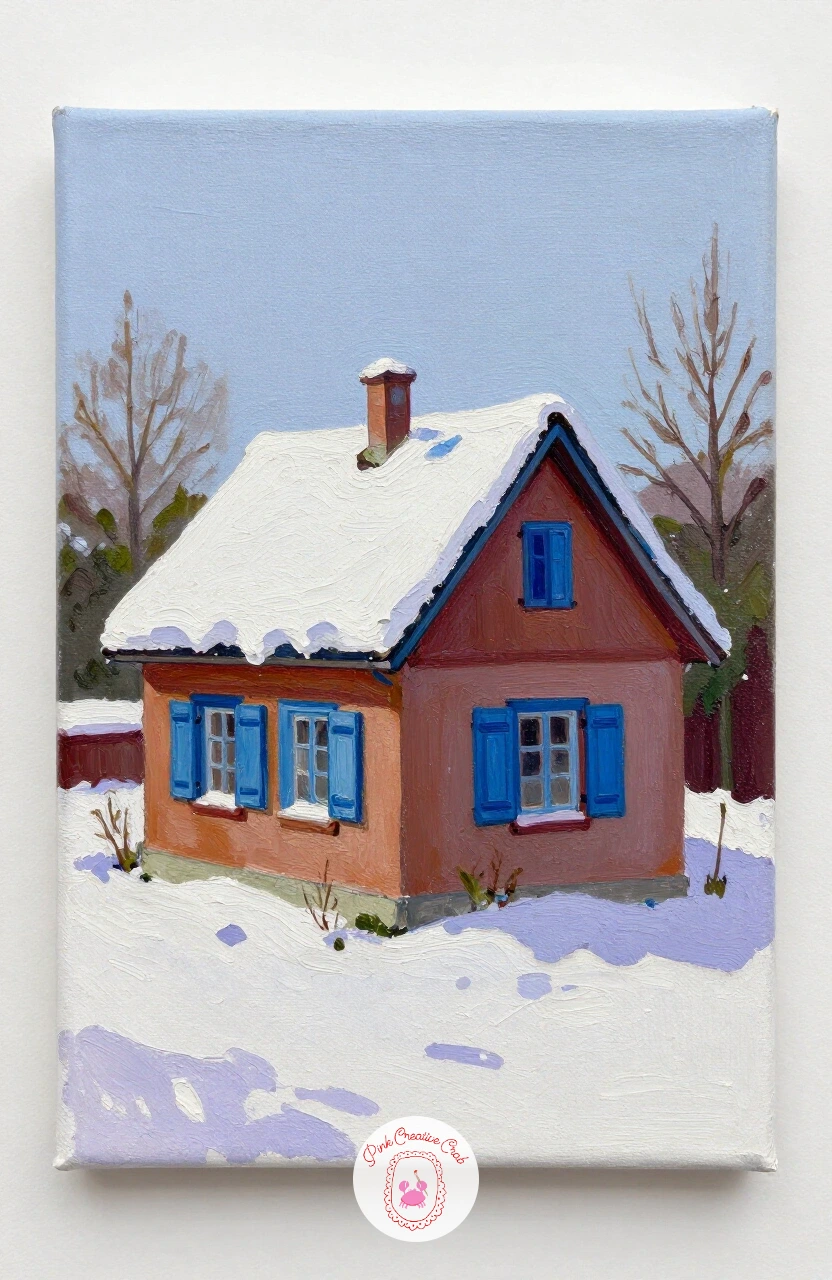
Palette: Cerulean Blue,Ochre,Titanium White,Payne’s Grey
Narrow the focus right down to a single garden gate with one robin perched on the latch. Paint the gate first as simple dark wooden posts and crossbars dusted with snow along their tops, then add the robin last, small and round, so it sits clearly on top of the gate rather than merging into it.
The robin’s colour is the whole point of this scene: a warm orange-red breast against cold blues and whites everywhere else. Mix that orange rich and keep it isolated to just the breast and a touch at the throat, with the rest of the bird in soft browns and greys.
If the bird looks too stiff or too large, hold a coin up against your reference photo and compare its size to the gate latch, since a robin is genuinely tiny and reads better undersized than oversized.
A faint path behind the gate leading off into soft white is enough background, nothing more is needed.
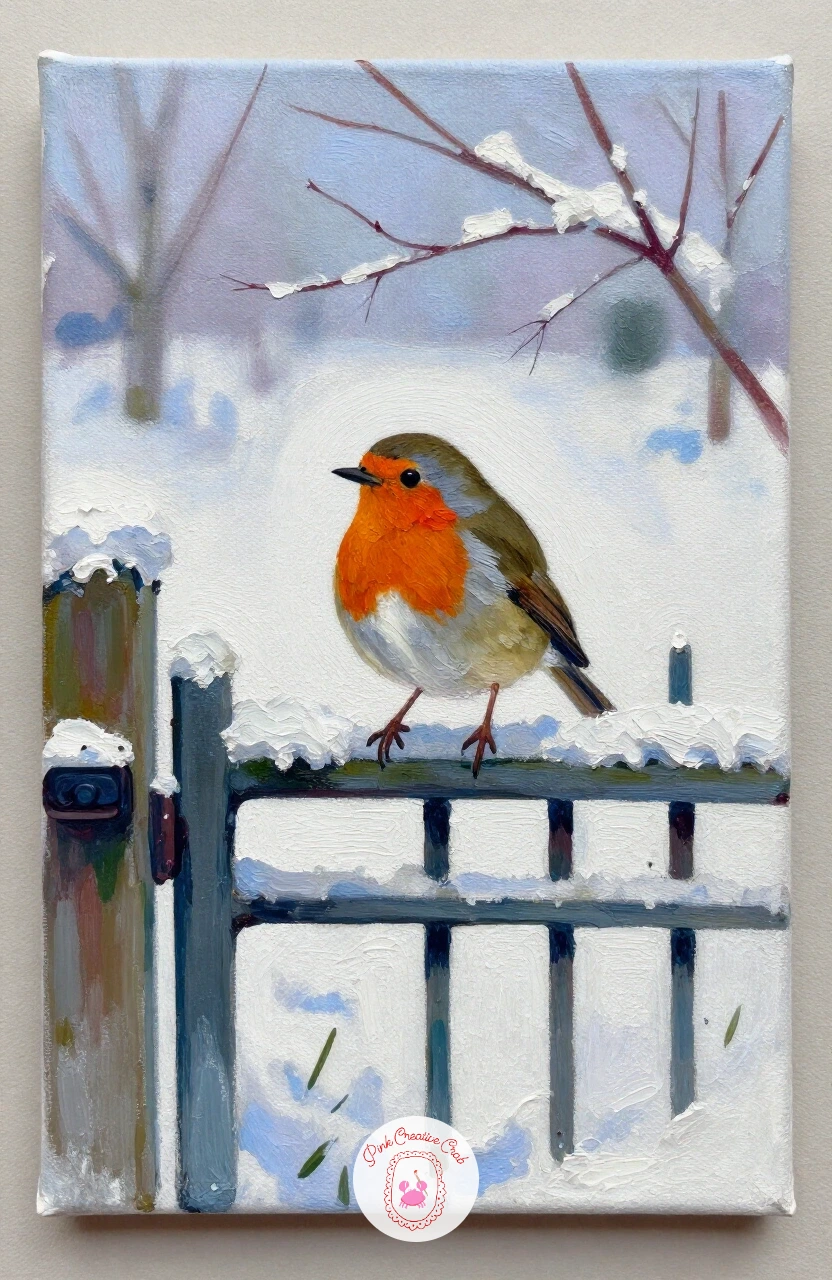
Palette: Burnt Orange,Burnt Umber,Titanium White,Payne’s Grey
Trade cottages for open land with a winter sunrise breaking over a frozen marsh full of dry reeds. Lay the sky first, since the whole painting’s light source comes from this single low sun, washing warm pink and gold along the horizon and letting it fade up into cooler lilac overhead.
The marsh ice should pick up that same warm colour wherever it faces the sun and stay cold blue everywhere it doesn’t, which is the fastest way to make a flat frozen surface feel lit from one direction rather than painted in flat grey.
Paint the reeds last, in clusters rather than individual stalks, using the very tip of a round brush dragged upward in short flicking strokes. Keep them dark against the lit sky and let a few catch the warm light along one edge.
If the marsh feels empty, add one or two birds as small dark marks low over the reeds.
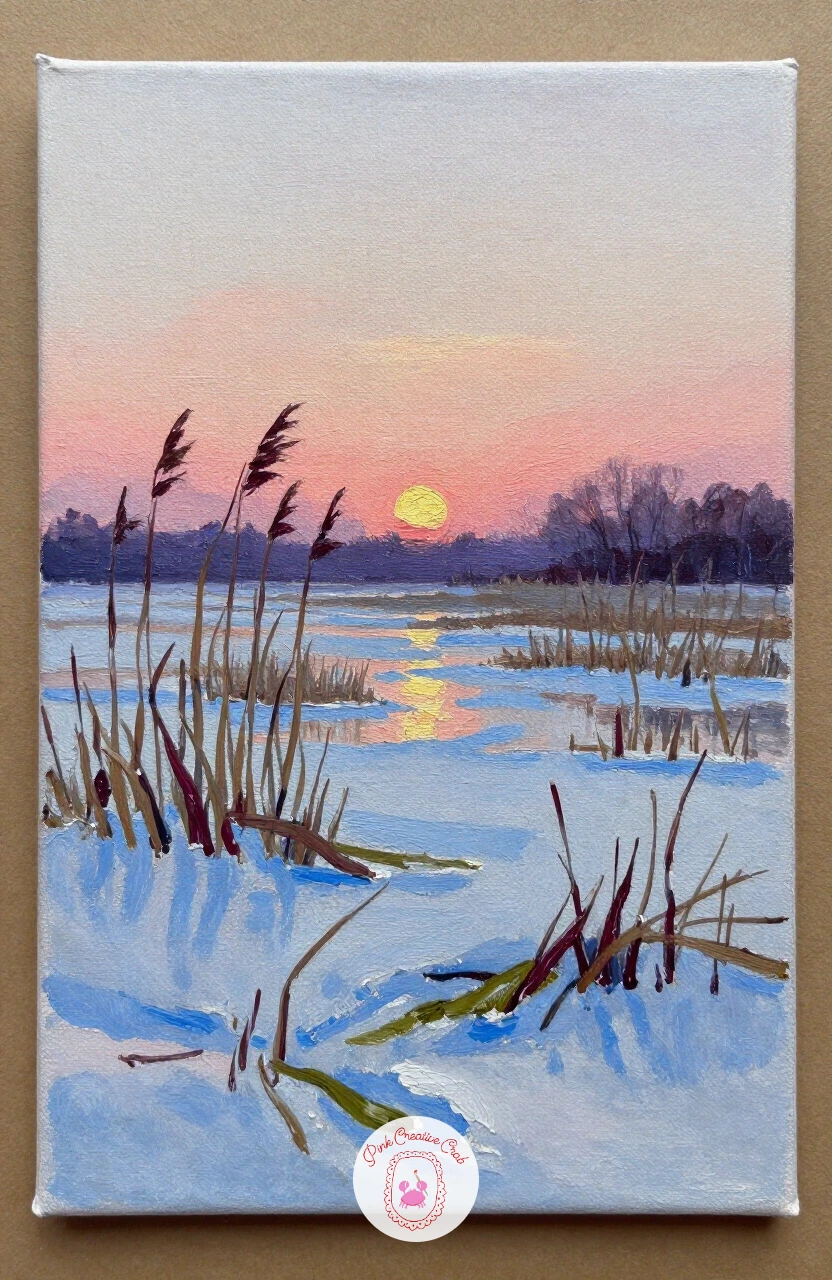
Palette: Rose Pink,Gold Ochre,Lilac,Burnt Umber
Bring a little elegance into the snow with a woman walking a pair of greyhounds dressed in coats through a quiet white field. Block her figure and the two dogs together as one connected group first, since the leads linking them should read as a single visual shape before you add any individual detail.
Greyhounds have a very particular long, lean silhouette, so take a moment to compare the length of the leg to the length of the body in your reference before painting, since shortening those legs even slightly turns a greyhound into a generic dog.
Their coats are a good place for a saturated accent colour, a deep burgundy or forest green, which also gives you a reason to repeat that colour in the woman’s scarf so the group feels visually tied together.
If their legs feel too thin and fragile on canvas, thicken them very slightly where they meet the body, since real legs taper rather than staying a single width throughout.
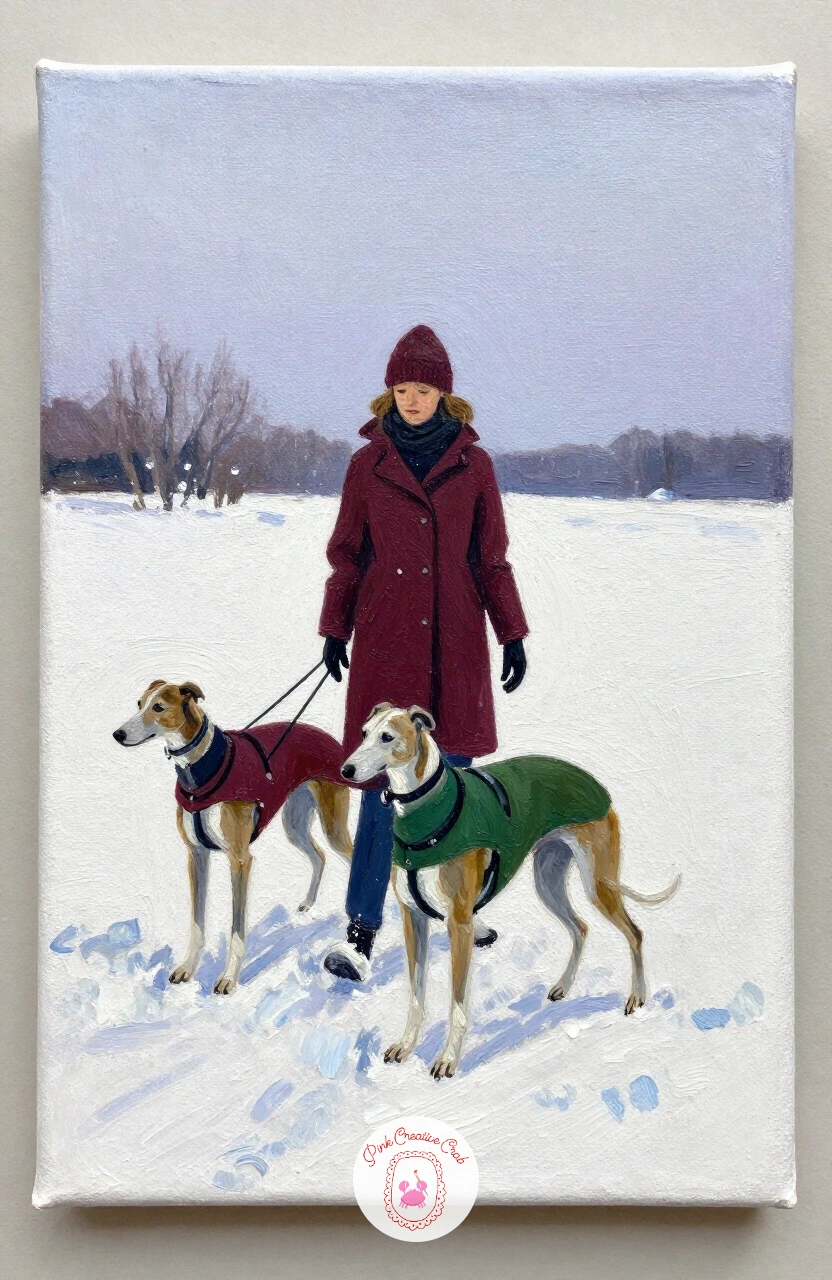
Palette: Burgundy,Forest Green,Titanium White,Payne’s Grey
Slow the pace right down with a single skater sitting on a snowy log by the pond’s edge, lacing up before stepping onto the ice. Paint the log and the snow banked against it first, then place the figure sitting low and compact, elbows in toward the boots, which is the natural shape a body makes when lacing skates.
This is a good scene for texture work. Load a palette knife with thick white for the snow piled along the top of the log, then scrape a dry brush lightly across the ice beyond to suggest its slightly rough, weathered surface rather than painting it perfectly smooth.
Keep the pond itself mostly empty, just a hint of the far bank and maybe one willow, so the whole painting’s attention stays on this one quiet, private moment rather than spreading out into a busy landscape.
If the figure reads as floating, make sure the log’s shadow falls clearly beneath where they sit.
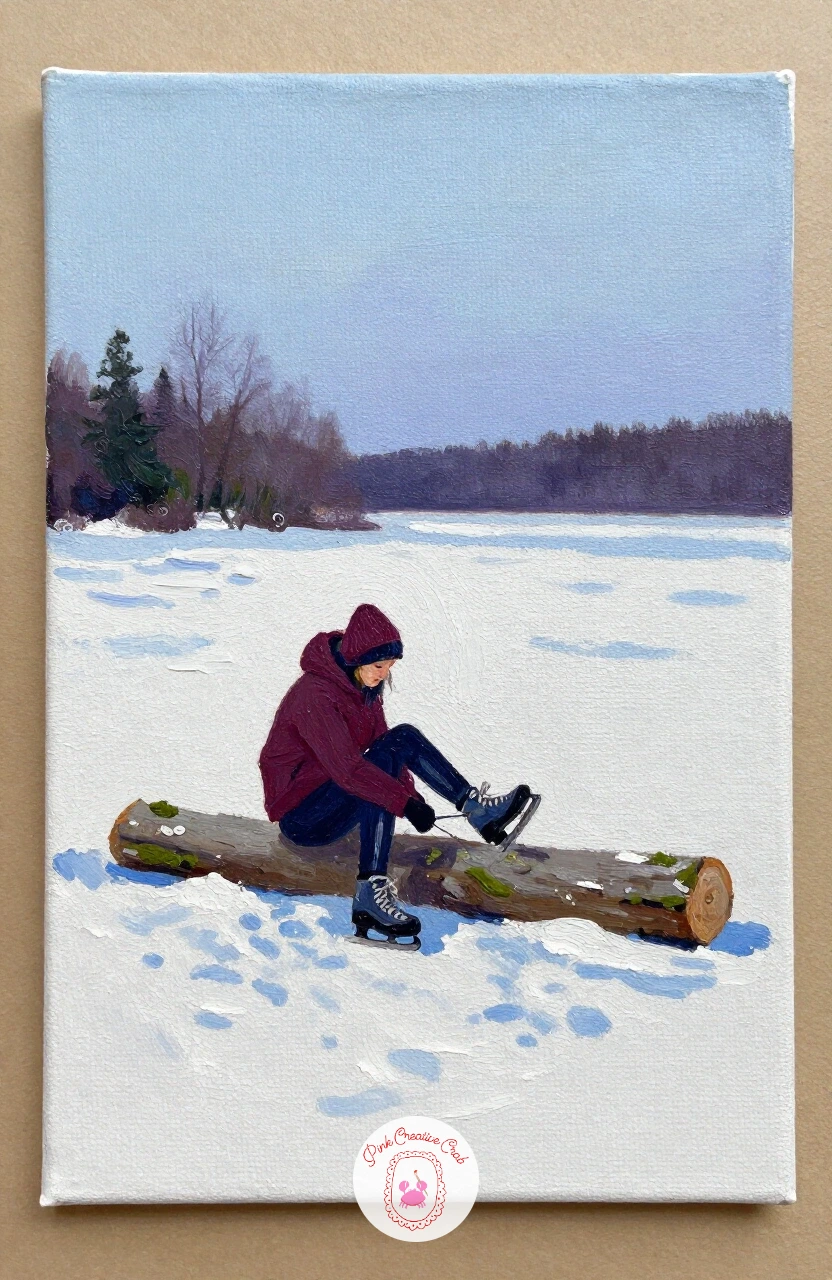
You Will Need
- palette knife
Palette: Burnt Umber,Titanium White,Cerulean Blue,Payne’s Grey
Add a working, lived-in feel with a country lane marked by a set of tire tracks and a row of fence posts leaning at slightly different angles. Paint the lane’s base snow first, then drag two parallel dark lines through it with a loaded flat brush for the tracks, letting them wobble slightly rather than staying perfectly straight.
Vary every fence post’s lean and height a little, since a perfectly uniform fence line looks built by a machine rather than weathered by years of frost heave and wind. Two or three posts can lean quite noticeably without breaking the scene’s believability.
The ten-minute version is just lane, tracks and posts under a plain sky. The forty-minute version adds a distant hedge line and one far-off tree to give the lane somewhere to lead the eye toward.
If the tracks look pasted on top, soften their edges slightly into the surrounding snow with a clean dry brush.
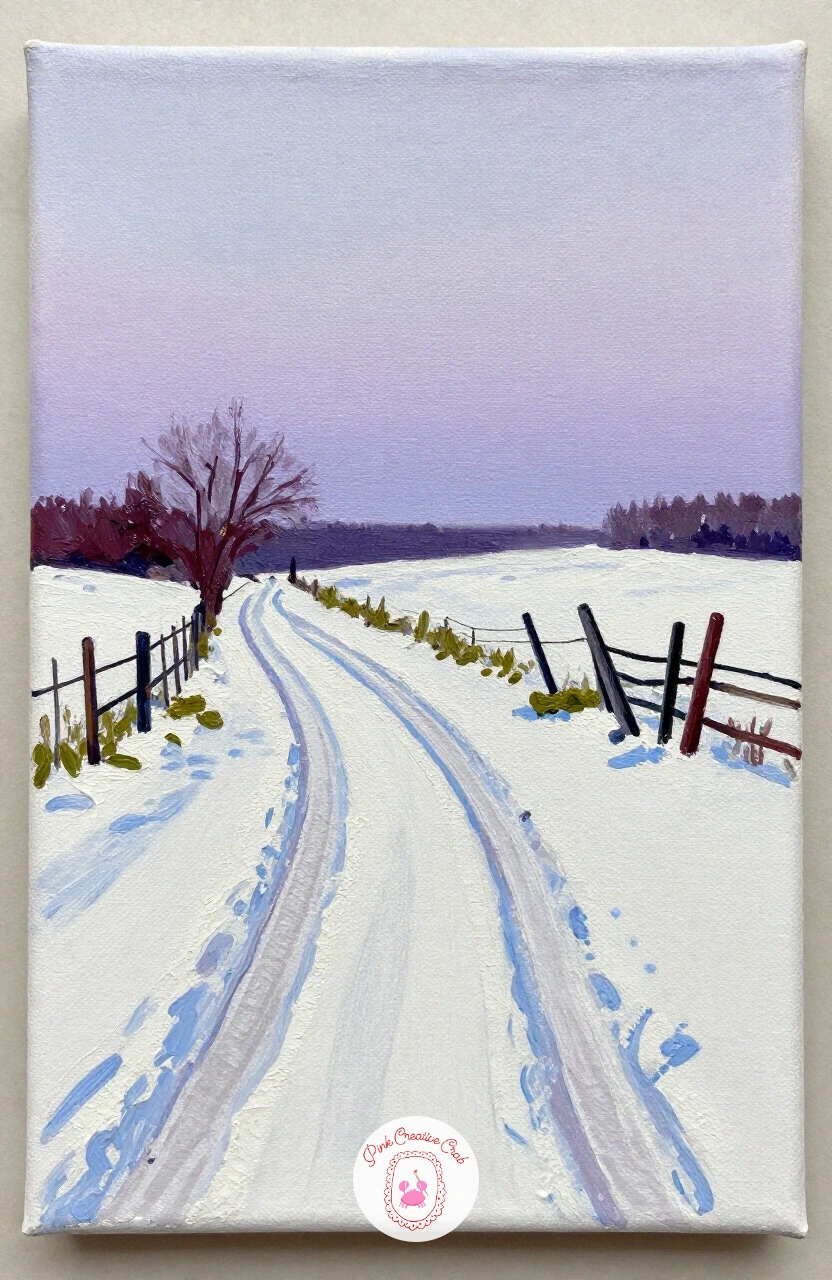
Palette: Payne’s Grey,Titanium White,Burnt Umber,Lilac Grey
Take the skating scene abroad with a frozen Dutch canal, a windmill standing at the bend and a few skaters scattered along the ice. Set the windmill first since it anchors the whole composition, keeping its sails at a slight angle rather than perfectly symmetrical, which makes it feel caught in a moment rather than posed like a model.
The canal itself should narrow as it recedes toward the windmill, with the skaters placed smaller the further back they sit, which is the simplest way to build real depth into a flat frozen surface. Keep their coats varied in colour so the eye has several small stops to travel between.
This scene rewards a wider colour range than most on this list: try a deep red coat near the front, a mustard one further back, with the windmill itself kept in soft browns so it doesn’t compete with the figures.
If you have painted the ice skating painting pond scene already, this is a good next step for a bigger, busier composition.
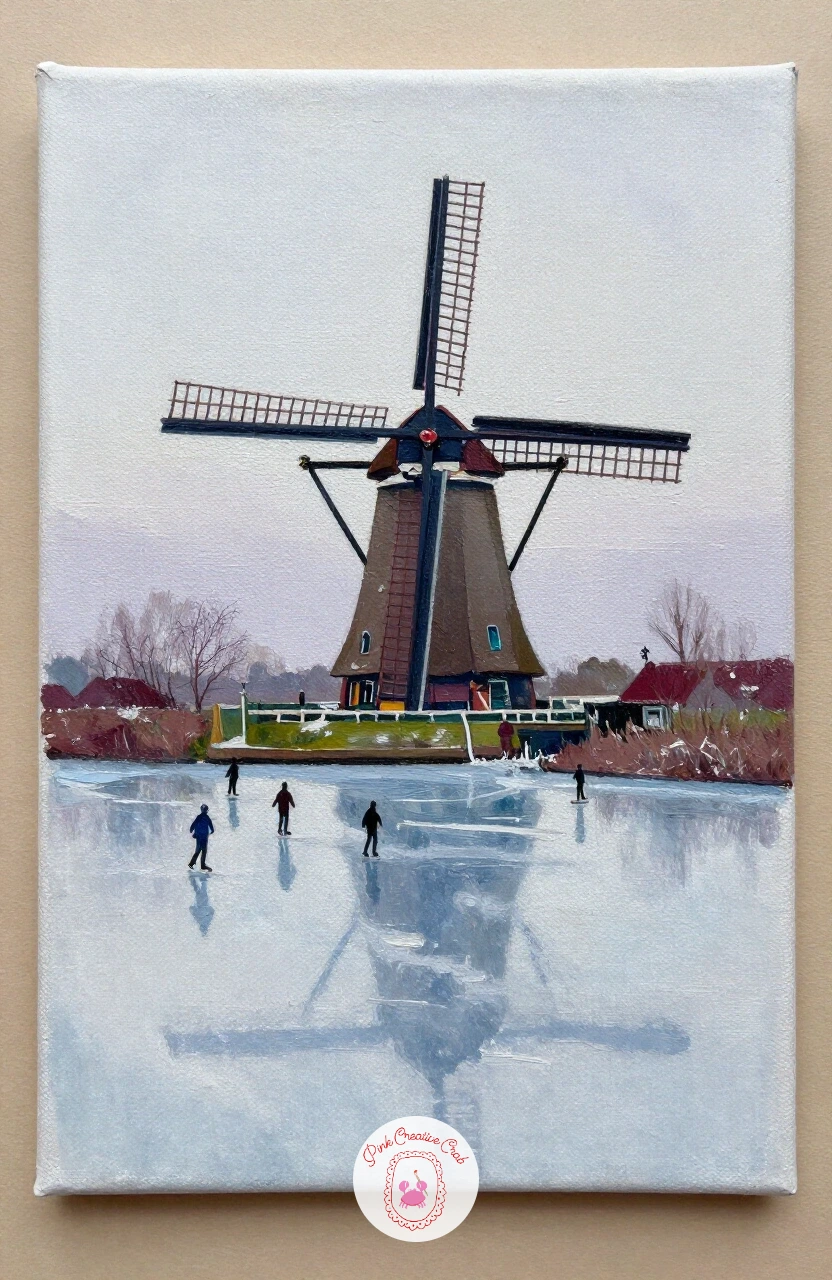
Palette: Burnt Sienna,Cadmium Red,Mustard Yellow,Cerulean Blue
Move into the garden itself with a cottage kitchen garden under snow, rows marked only by the odd bare stem and a wheelbarrow left standing between beds. Block the snow-covered rows first as a series of soft, gently rippled bands, since even buried under snow, planted rows keep a visible rhythm across the ground.
The wheelbarrow gives you one dark, solid shape to anchor the whole scene, so paint it with more contrast and a touch more detail than anything else, a hint of rust on the metal, snow piled in its bed. Everything else in the garden can stay softer and looser around it.
If the garden feels too flat, vary the thickness of your white across the rows, letting some older snow show a slightly grey, compacted tone compared to a fresher fall elsewhere.
A low stone or wood wall at the garden’s edge, just a few strokes, gives the whole scene a sense of being somewhere enclosed and tended rather than open field.
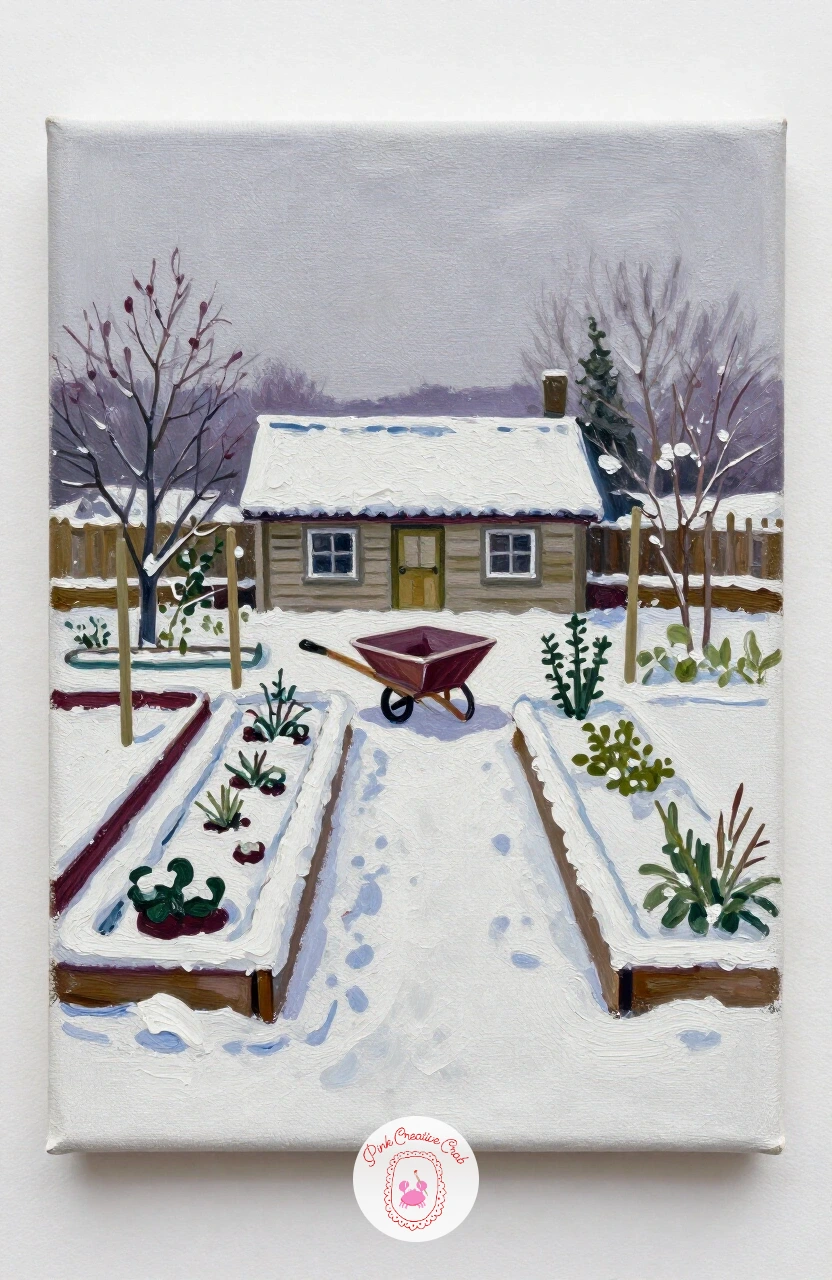
Palette: Titanium White,Payne’s Grey,Burnt Sienna,Moss Green
Open the scene up into a public space with a snowy park, a bandstand at its centre and a few small walkers crossing in the distance. Paint the bandstand’s structure first, keeping its roofline and supports simple geometric shapes under a cap of snow, since an ornate bandstand painted in full detail will fight with the simplicity everywhere else in the scene.
Place the walkers at varying distances and sizes to build depth across the open park, each one no more than a coat colour and a shape, with the nearest slightly more defined than the ones further back.
Keep the overall palette cool and quiet here, lilac and pale blue dominate, so that even one walker in a warmer colour, a mustard scarf or a burgundy coat, becomes the clear focal point against all that cold open space.
If the bandstand looks too small on the canvas, check it against the height of the nearest walker before adjusting, since that comparison keeps the scale honest.
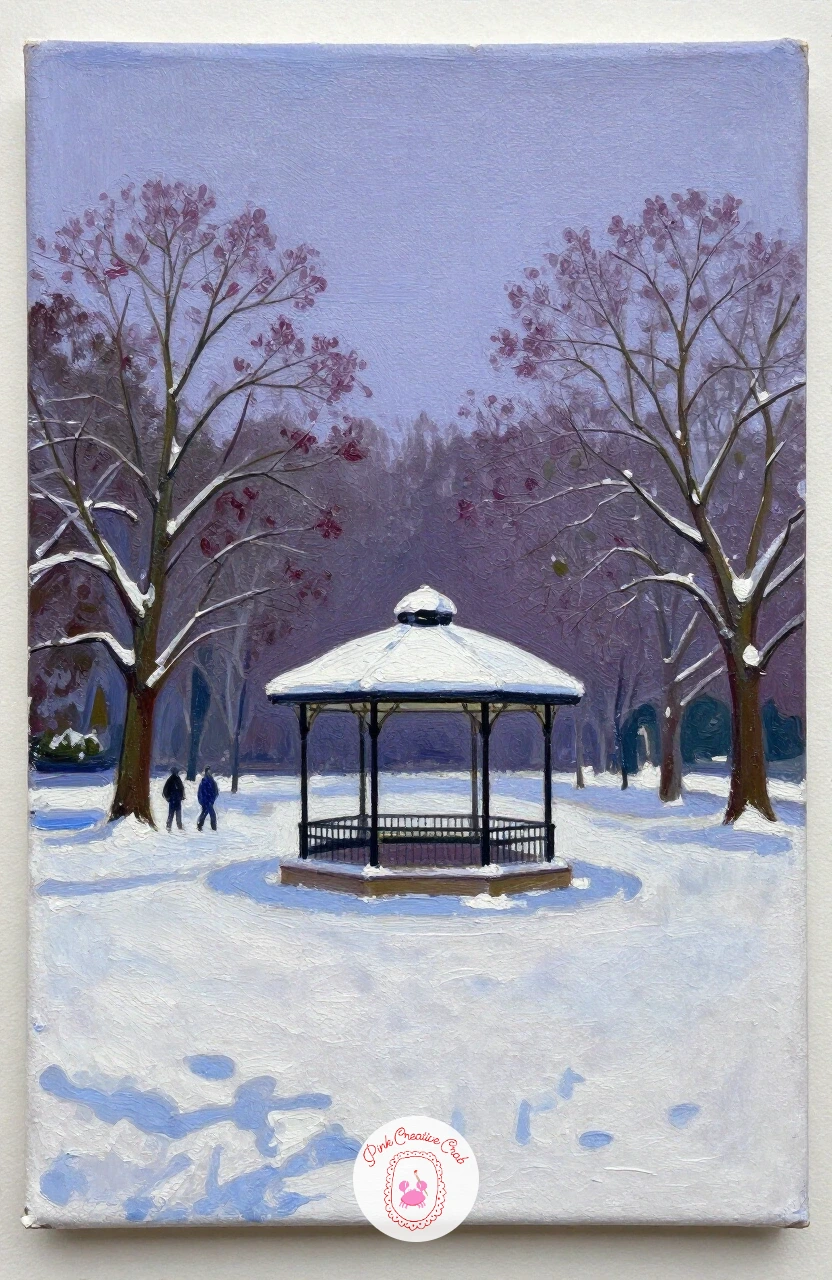
Palette: Lilac Grey,Cerulean Blue,Mustard Yellow,Titanium White
Take the winter palette to the coast with a beach scene, snow dusting the dunes and a dog running loose along the shoreline. Lay the sea first as a cool grey-green band, then build the snowy dunes above it in soft irregular mounds, letting patches of sand or dune grass show through where the snow is thinnest.
The running dog is your one moving focal point, so paint it mid-stride with legs extended rather than standing still, using quick confident strokes rather than careful outlining, since a dog caught running should look painted at speed too.
This unusual pairing of snow and sea works because the two textures contrast so well: keep the water loose and horizontal in its brushwork, the snow thicker and more varied in direction, so your eye can tell the two surfaces apart even from a distance.
If you don’t have a beach reference handy, any open stretch of shoreline photo works, since the focus here is really the snow-to-water transition rather than a specific place.
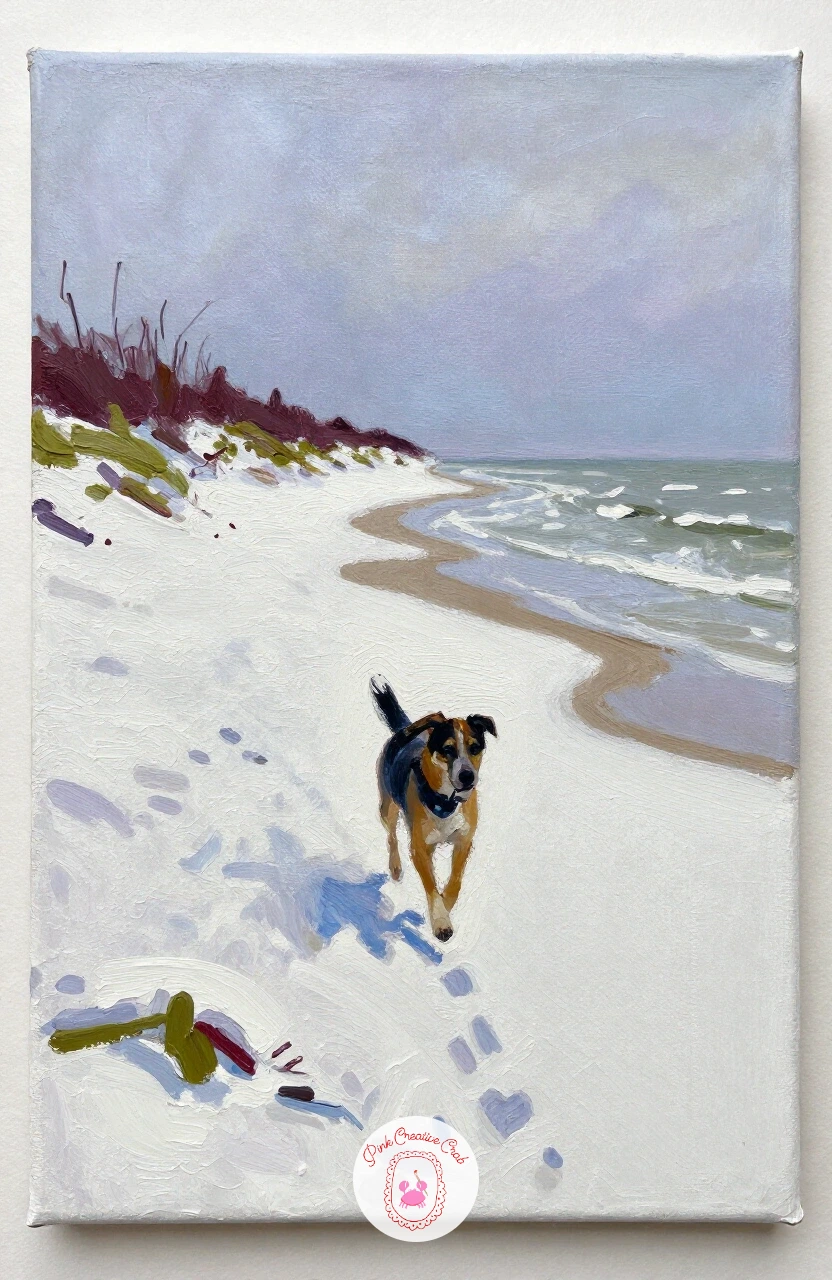
Palette: Grey Green,Titanium White,Burnt Umber,Lilac Grey
Build a strong contrast scene with a stone bridge capped in snow arching over a stream still dark and running underneath. Paint the stream first as a narrow band of deep, almost black-green water, since that darkness is what makes every white surface around it look brighter by comparison.
The bridge’s arch is the structural heart of this piece, so measure its curve carefully against the width of the stream before committing to paint, keeping the arch’s two sides symmetrical even as the snow sitting on top of it stays loose and irregular.
Use a palette knife for the thick ridge of snow along the bridge’s parapet, then soften its lower edge into the stonework with a dry brush so the snow looks settled rather than stuck on afterward.
If the water looks too flat and solid, drag a few thin pale streaks across it with a dry brush for a hint of current and reflected sky.
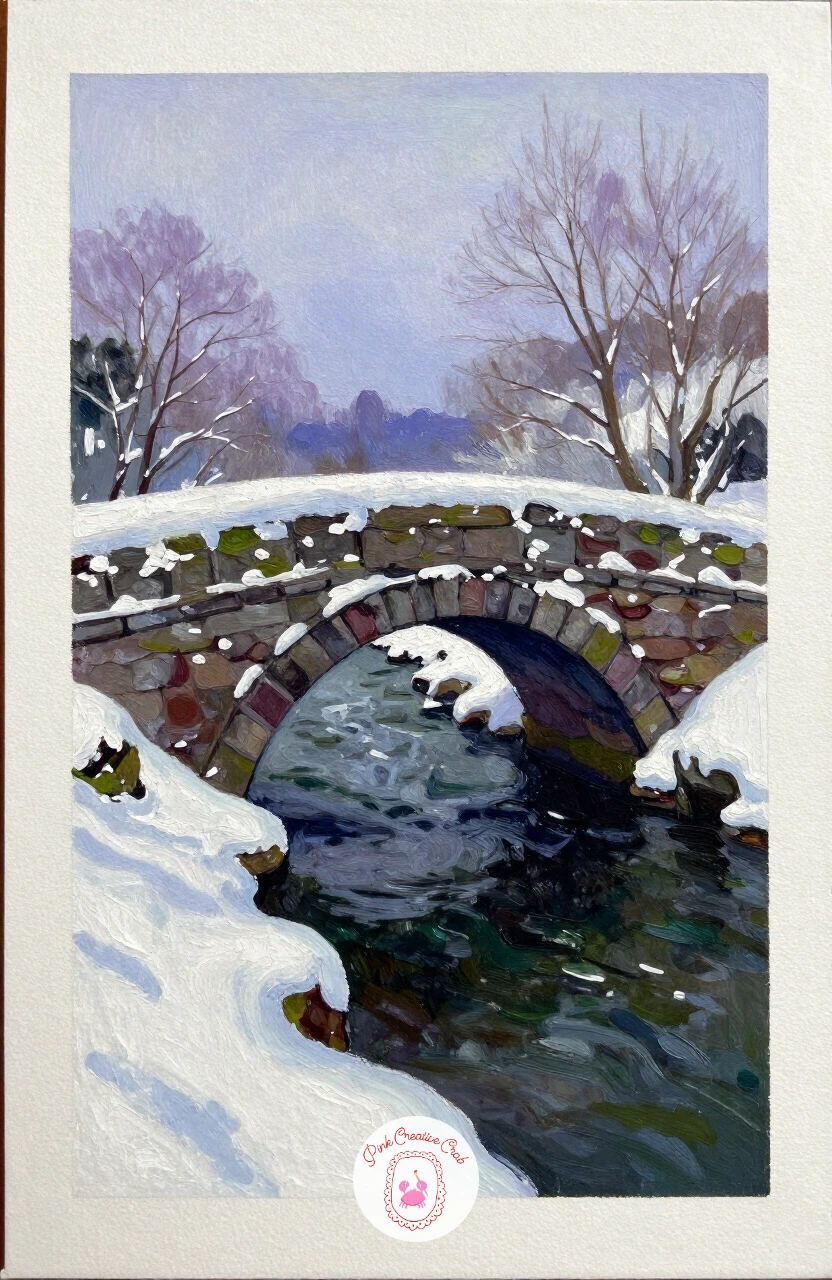
You Will Need
- palette knife
Palette: Dark Green,Titanium White,Payne’s Grey,Burnt Umber
Turn the viewpoint around for a cottage window seen from inside, a teapot resting on the sill and snowy hills stretching out beyond the glass. Paint the distant hills and sky first, kept softest and palest of everything in the scene, then build the window frame as a darker, more solid shape around that view, since the frame needs to read as clearly nearer than the landscape beyond it.
The teapot is your warm focal point against all that cool outdoor light, so give it a rich colour, a deep red or warm brown glaze, and a little reflected window light along one curved edge to root it on the sill.
This interior-exterior split is really a lesson in temperature: keep every colour inside the room warm, the sill, the teapot, any curtain edge, and everything beyond the glass cool, which does more to separate the two spaces than the window frame itself.
If you enjoy this kind of layered window scene, the pots and sill setups in tea cup drawing offer more variations to study, even though that one works in a different medium.
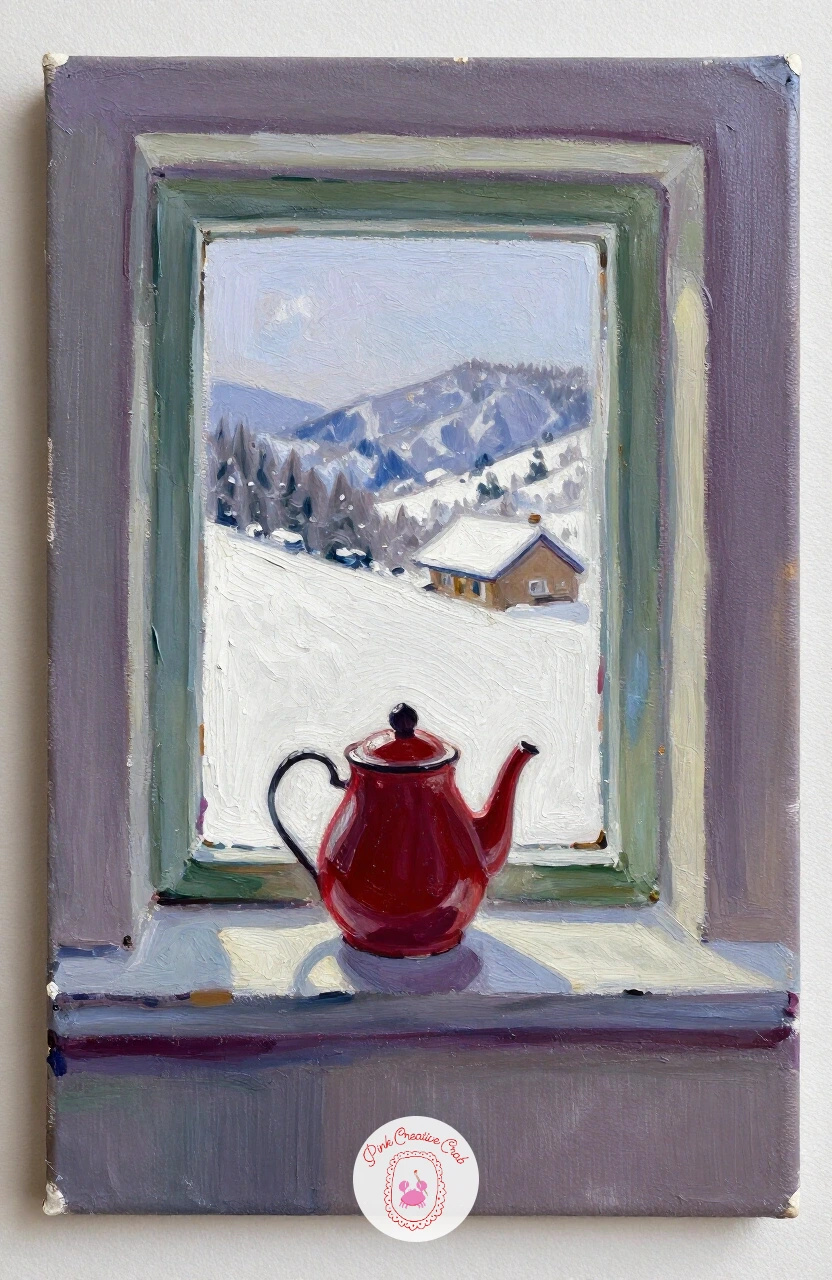
Palette: Cadmium Red,Burnt Umber,Titanium White,Cerulean Blue
Warm up the mood with a mother pulling a small toddler on a wooden sled down a quiet snowy lane. Place the two figures together as a single connected unit first, the rope between them drawn as one continuous curved line, since that line is what makes the whole relationship between the two figures read instantly.
Keep the toddler small and bundled, just a round shape in a bright coat with little visible beyond the hood, while the mother’s figure can carry slightly more detail in her coat and stride, since she is doing the visible work of pulling.
If the scale between the two figures looks off, compare the toddler’s head size against the mother’s torso before adjusting, since this is one of the fastest ways a figure pairing starts to look wrong on canvas.
A bright red sled against all that white and grey gives the eye one clear, warm anchor point low in the composition.
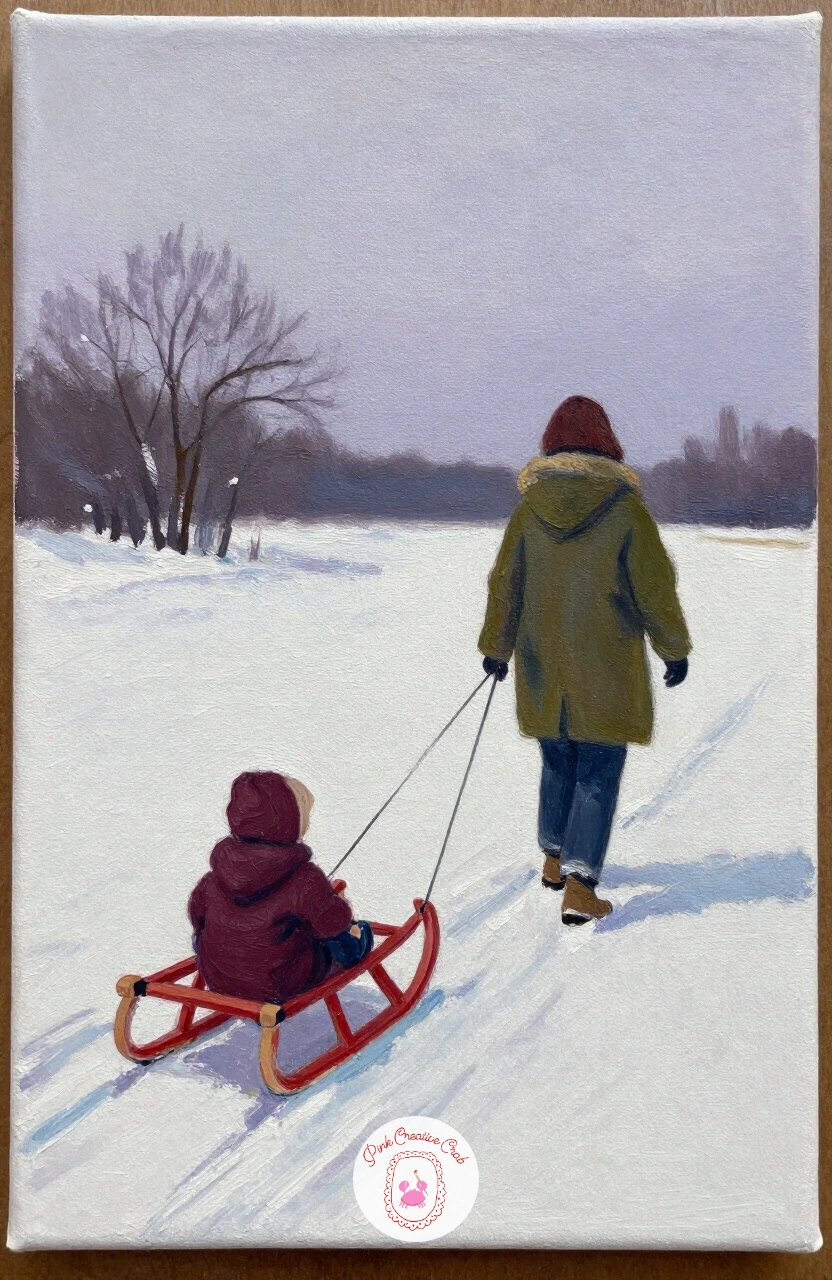
Palette: Cadmium Red,Burnt Umber,Titanium White,Lilac Grey
Return to stillness with a frozen pond, a weathered wooden pier reaching out over the ice and a pair of skates left forgotten on its boards. Build the pier first as strong horizontal planks receding toward the pond’s centre, since getting that perspective right early makes everything else in the scene easier to place correctly against it.
The skates are a small but telling detail, so give them real presence: laces undone and trailing, blades catching a thin highlight of reflected sky, painted last so they sit clearly on top of the pier’s planks rather than floating beside them.
This is a scene built entirely on absence rather than action, no skater, no movement, just the ice and the evidence someone was recently there, so keep the whole mood quiet: muted colour, soft light, nothing competing with those two small skates.
If the pier’s planks look too uniform, vary their tone slightly plank to plank, since real weathered wood never stays one even colour across its whole length.
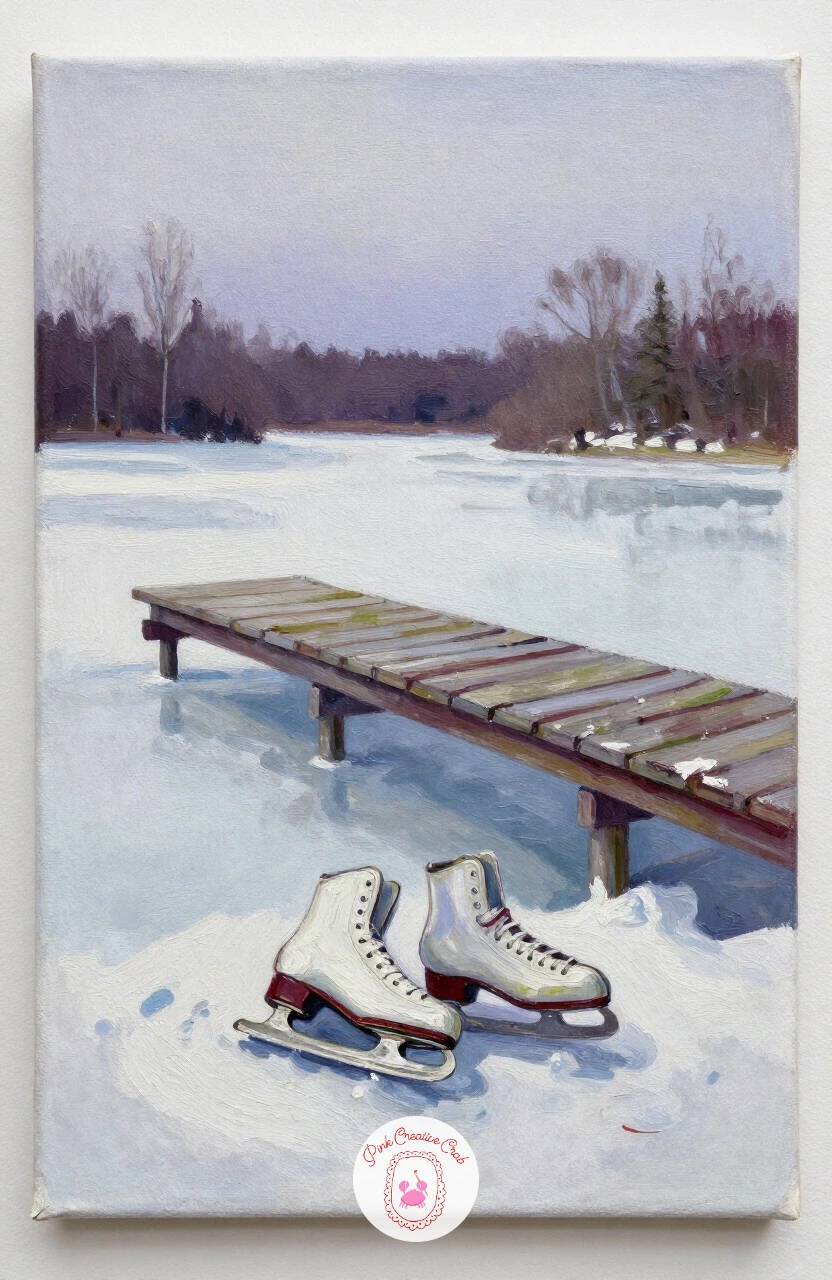
Palette: Burnt Umber,Titanium White,Cerulean Blue,Payne’s Grey
Scale the composition up with a hillside of terraced cottages, each with a thin curl of smoke rising from its chimney into the cold air. Build the hillside’s slope first, then stack the cottages along it in a loose staggered line rather than a perfectly even row, since real terraces follow the land’s contours unevenly.
Vary each cottage’s wall colour slightly, a soft pink next to a pale yellow next to a muted blue, which gives the whole hillside life without needing any additional detail in the windows or doors. This is where the fresh modern colour of this style really gets to shine against all that white snow.
Paint every chimney’s smoke in the same direction, drifting the same way across the whole row, since smoke blowing in different directions from house to house breaks the illusion of a single wind on a single day.
If the hillside feels too busy, reduce the number of visible cottages and let snow-covered roofline alone suggest a few more beyond the edge of the canvas.
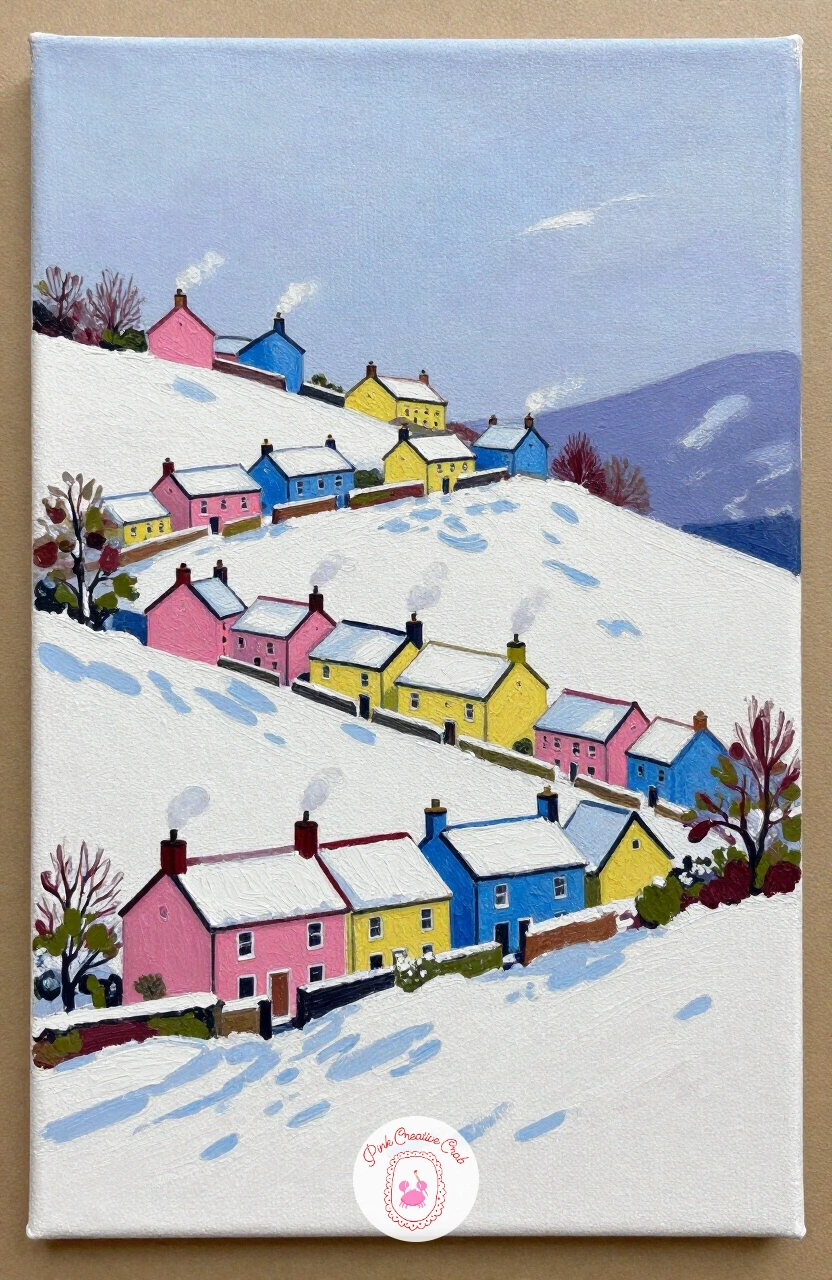
Palette: Rose Pink,Pale Yellow,Cerulean Blue,Titanium White
For more rooftop and chimney compositions at this scale, the terraced streets in Christmas village painting use a similar staggered layout worth studying.
Settle on a single structure again with a wooden boathouse standing at the edge of a frozen lake, caught in the soft pink light of late afternoon. Paint the sky and its pink glow first, letting that colour bounce faintly onto the snow and ice around the boathouse, since this whole scene depends on that one warm light source touching every cold surface a little.
Build the boathouse itself from simple weathered planks, keeping its door slightly ajar or its roofline a touch uneven, since a boathouse that looks too new or too square loses the sense of age this scene wants.
This is a good one to try as both a quick study and a longer sitting. Ten minutes gets you the boathouse silhouette and the pink sky behind it. Forty minutes adds reflected pink light caught in patches of open water near the ice’s edge and texture in the old wood grain.
If the pink feels too saturated once it’s down, knock it back slightly with a thin wash of white rather than repainting the whole sky.
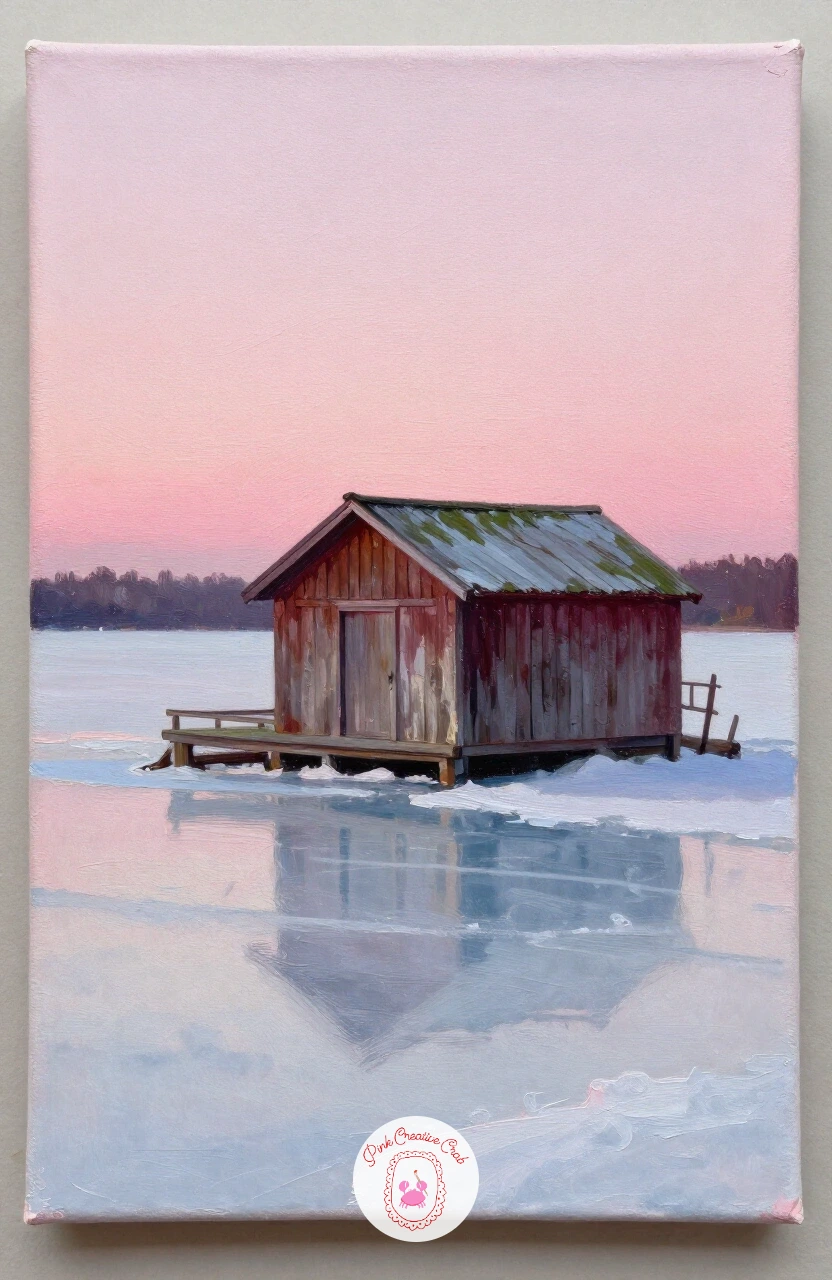
Palette: Rose Pink,Burnt Umber,Titanium White,Lilac
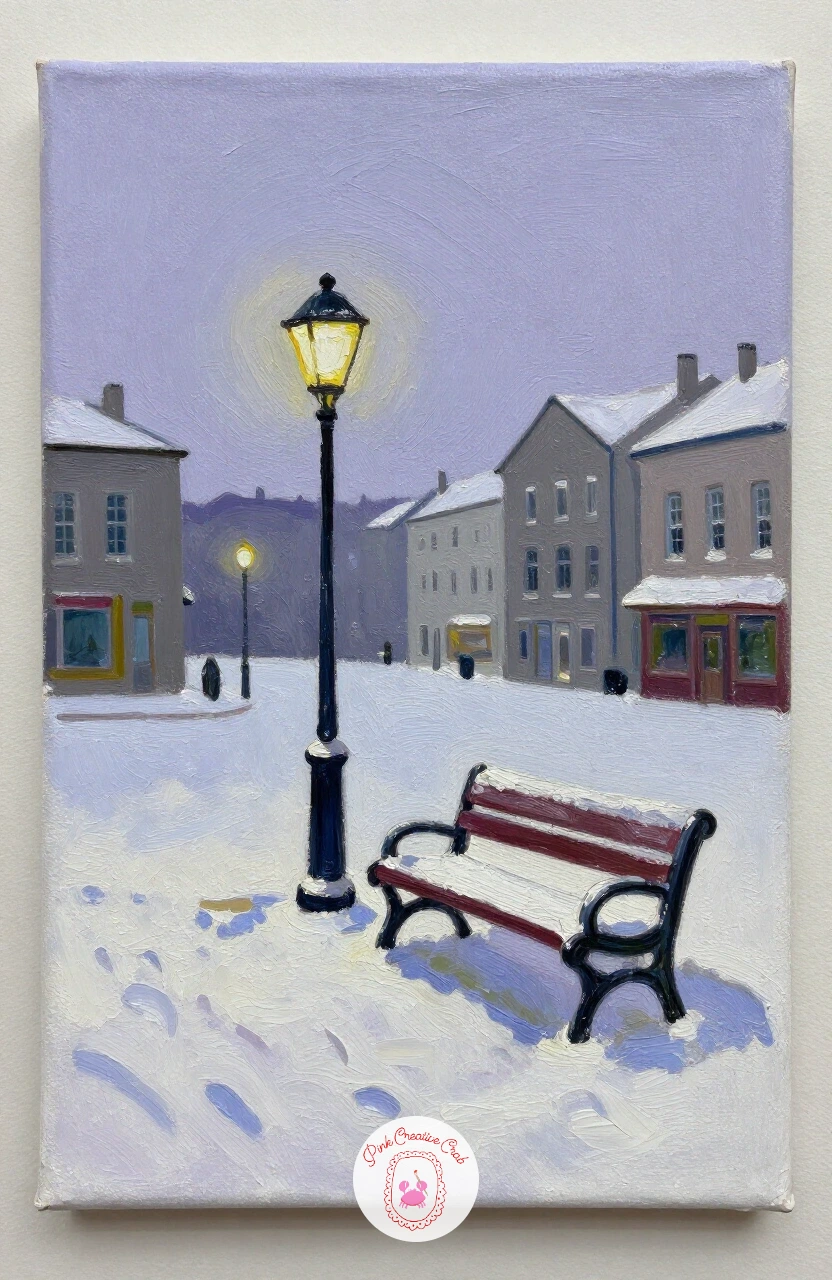
Bring the scene into town with a single street lamp and an empty bench standing together in a quiet snowy square. Paint the lamp first as the vertical anchor of the whole composition, its light pooling in a soft warm circle on the snow beneath it, since that pool of light is what gives the rest of the scene somewhere to sit in relation to.
The empty bench beside it does a lot of emotional work for very little paint: a few simple horizontal and vertical strokes, a light cap of snow along its back and seat, is all it needs. Resist the urge to add a figure here, since the emptiness is the point of this particular scene.
Keep the square itself simple, a faint suggestion of a building or two in the background kept soft and out of focus, so the lamp and bench stay the clear subject rather than competing with architecture.
If the lamp’s glow looks too pale against the snow, warm it slightly with a touch of cadmium orange mixed into the yellow.
Palette: Cadmium Yellow,Payne’s Grey,Titanium White,Lilac Grey
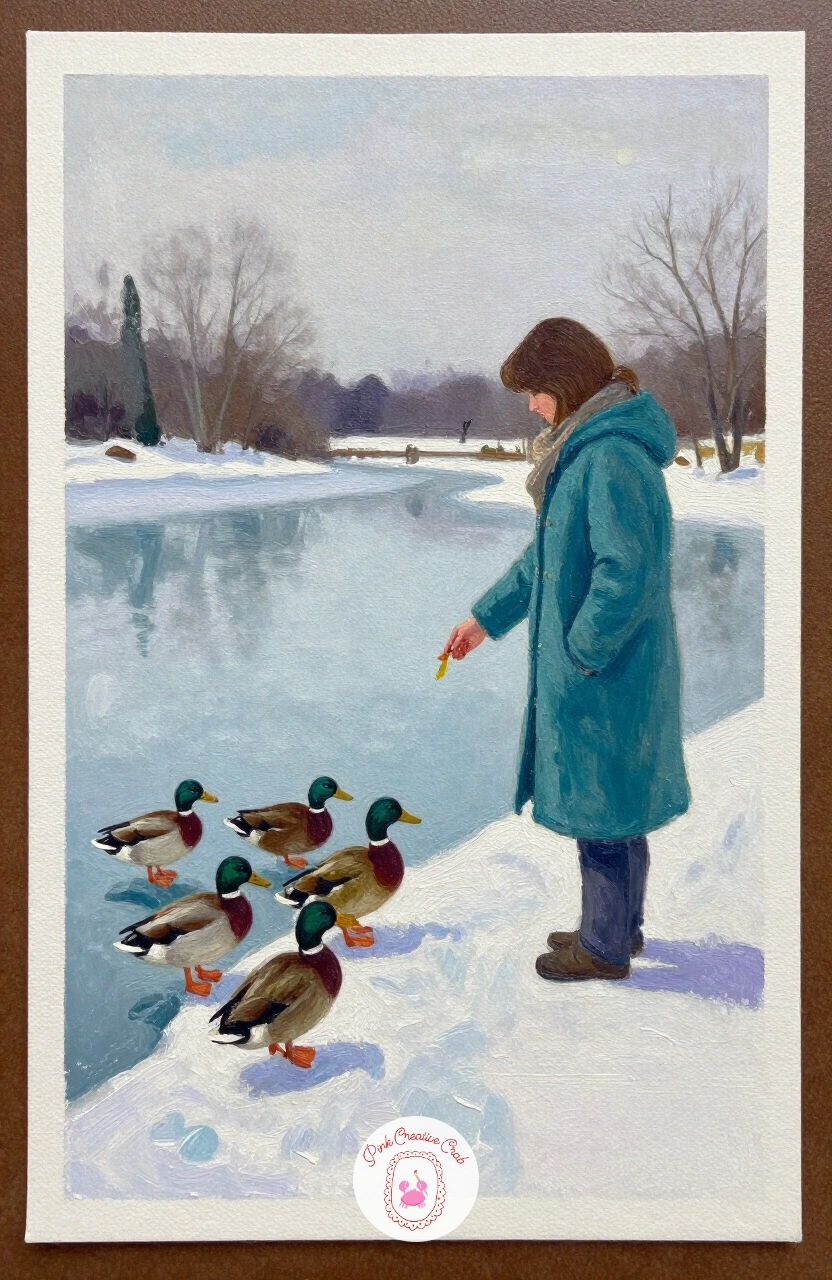
Give the pond one more quiet human moment with a woman in a long coat feeding ducks at its icy edge, where the water stays open just enough for a few birds to gather. Paint the open water first as a small dark patch within the surrounding white ice, since that contrast between frozen and unfrozen is really the subject of this whole scene.
Keep the ducks loose and simple, a few overlapping oval shapes with just a touch of colour at the head, clustered close around where her hand reaches out. Too much individual detail on each bird will fight with the quiet stillness everywhere else.
Her long coat gives you another chance for a rich, saturated colour against all that pale ice and open grey water, a deep teal or burgundy both work well here.
If the open water patch looks too perfectly round, break its edge slightly with jagged strokes, since real ice never melts back in a clean circle.
Palette: Teal,Burgundy,Payne’s Grey,Titanium White
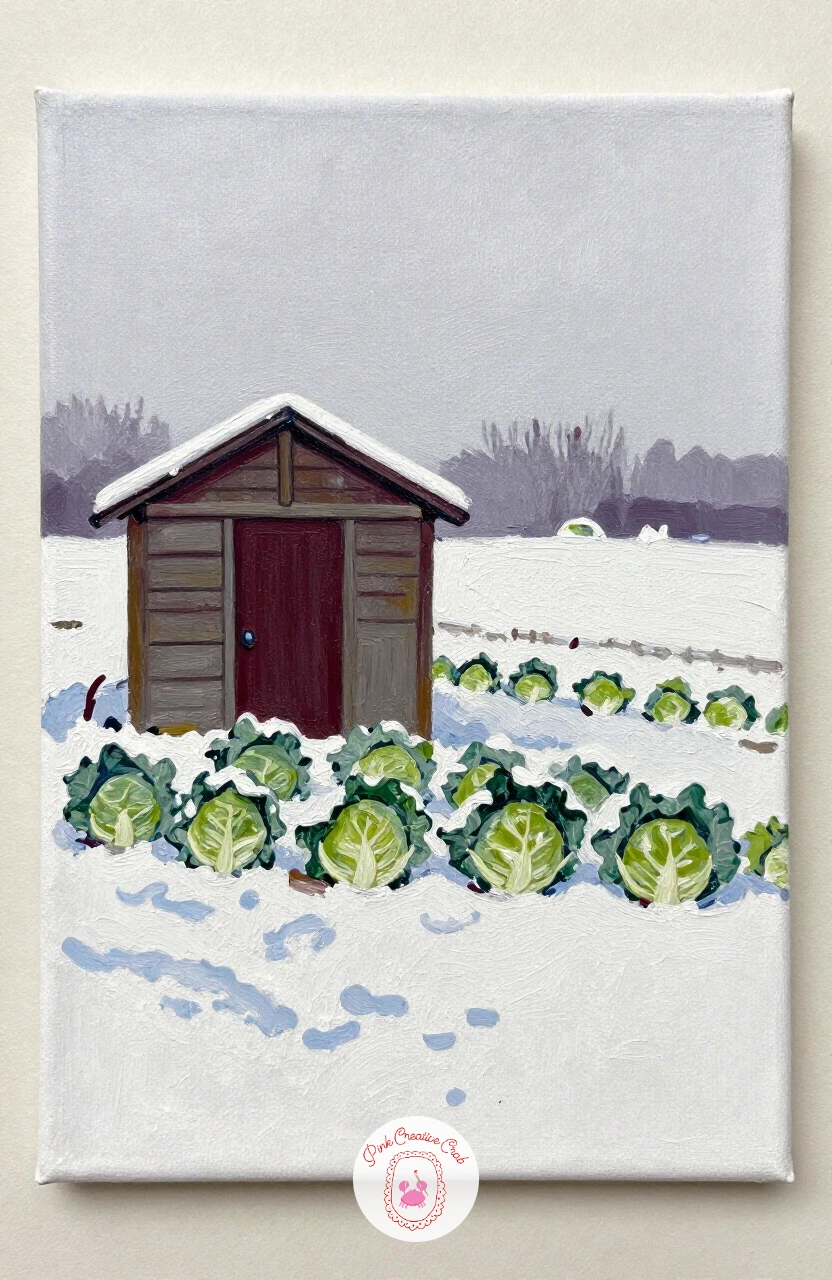
Bring a little humour and texture into the scene with a winter allotment, a small wooden shed standing at the back and a row of snow-capped cabbages still sitting in their bed. Build the shed first as a simple leaning structure, since allotment sheds are rarely square or new, then lay the cabbage rows in front of it as a series of rounded, slightly irregular lumps under their caps of snow.
Each cabbage is really just a textured dome, so use a palette knife to drag thick ridges of pale green-grey through each one before capping it in white, which gives you that crinkled cabbage leaf texture without any fine detail work at all.
If the allotment feels too tidy, add one leaning cane or an old bucket half-buried in snow beside the shed, since a working allotment always has a little clutter even under snow.
No palette knife handy? A stiff dry brush dabbed rather than stroked gives a similar textured effect on the cabbages.
You Will Need
- palette knife
Palette: Moss Green,Titanium White,Burnt Umber,Payne’s Grey
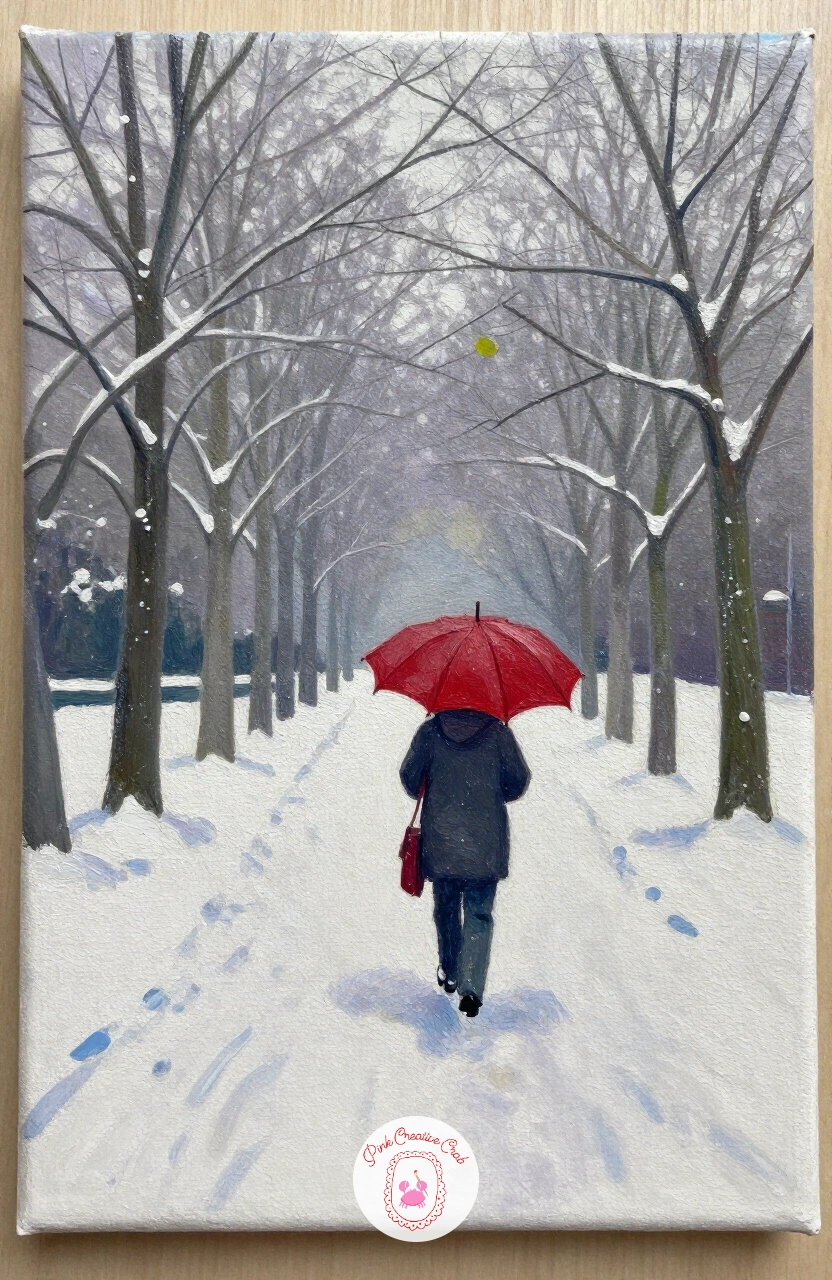
Close the series with a snowy park path and a single walker carrying a red umbrella against falling snow, the one bright shape in an otherwise soft, pale composition. Paint the path and surrounding trees first in a muted, almost monochrome range of greys and whites, since the entire scene is designed around that red umbrella being the only real colour the eye has to settle on.
Place the walker roughly a third of the way along the path, small enough that the path itself still feels like the main shape of the composition, with the umbrella tilted slightly to suggest wind rather than sitting perfectly upright.
Falling snow in front of the darker trees is easiest added last, flicking small dots of thick white across the dry canvas with a stiff brush or an old toothbrush for a fine scattered spray.
If the red feels too isolated against so much grey, echo a small hint of it elsewhere, a scarf tip or a single reflected touch on the path beneath the umbrella.
You Will Need
- toothbrush for splatter
Palette: Cadmium Red,Payne’s Grey,Titanium White,Lilac Grey
For more ideas built around one bright accent in a muted winter palette, the compositions in winter wonderland painting use the same single focal colour approach.
What to Do Next
Pick one scene that matches the mood you are after today, a quiet pier and forgotten skates for something still, or skaters and sleds if you want more movement, and start on a small canvas so the whole thing stays finishable in one sitting.
Frequently Asked Questions
What oil colours do I actually need for a winter painting palette?
A small palette of titanium white, Payne’s grey, cerulean blue, burnt umber or sienna, a cadmium red and a cadmium yellow covers nearly every scene above, mixed together for the lilac and icy shadow tones.
How do I stop snow looking grey and dull in oil paint?
Mix your white with a touch of blue or lilac for shadowed snow rather than grey alone, and keep any sunlit snow close to pure white so the contrast between warm light and cool shadow stays clear.
How long does a small winter oil painting take to finish?
A focused scene on a small canvas can be blocked in and finished in one sitting of one to two hours, especially the simpler single-subject ideas like a gate, a bench or a boathouse.
What size canvas works best for these winter scenes?
An eight by ten inch or nine by twelve inch canvas suits every idea on this list well, giving enough room for a clear focal point without the scene taking more than one sitting to finish.
Do I need to varnish a winter oil painting once it is dry?
A final varnish is optional but helps even out the sheen across thick and thin paint areas, and should only go on once the painting has cured fully, usually several months after finishing.
Have any thoughts?
Share your reaction or leave a quick response — we’d love to hear what you think!
-
 0
-
0
-
0
-
0
-
0
-
0


