Cute christmas card ideas work best when one small character carries the whole card, so this list keeps every picture to a single sweet moment you can paint in one sitting. Mice in knitted hats, bears sharing cocoa, a snowman family and a few cosy children fill thirty six card fronts, each with its own little story and no lettering to fuss over.
Everything below is built for loose watercolor with a few fine ink lines to hold the faces and small details steady. Work from the easiest scenes near the top toward the busier ones further down, and treat each card as a fresh, forgiving painting rather than something to get perfect on the first try.
Using these images: free for personal projects such as printing, coloring, cards, journals and gifts. Handmade items that include them may be sold up to 30 pieces per design. More than that is commercial use and is not permitted, and neither is selling or sharing the images themselves or passing them off as your own. Please ask before any other use.
Start the whole set with a mouse hanging a tiny wreath on its mouse-hole door, since the shapes are simple and forgiving for a first try. Pencil a rounded doorway in a tree trunk, a tiny mouse standing on back legs, and a small circle wreath held in its paws, then ink the outlines once you are happy with the proportions.
Paint the trunk in a thinned brown wash first, let it dry, then drop in a soft grey mouse body and a pine green wreath dotted with cherry red berries. Keep the mouse small against the doorway, maybe a third of the door’s height, so it reads as tiny and the scene stays charming rather than cramped.
If the ink lines bleed into wet paint, let the wash dry fully before you go back in with the pen. Swap the fine liner for a sharpened graphite pencil if you want a softer, sketchier line instead of a crisp one.
Keep the wreath loose and circular rather than perfectly round, a slightly uneven shape feels hand tied and more charming on a card front.
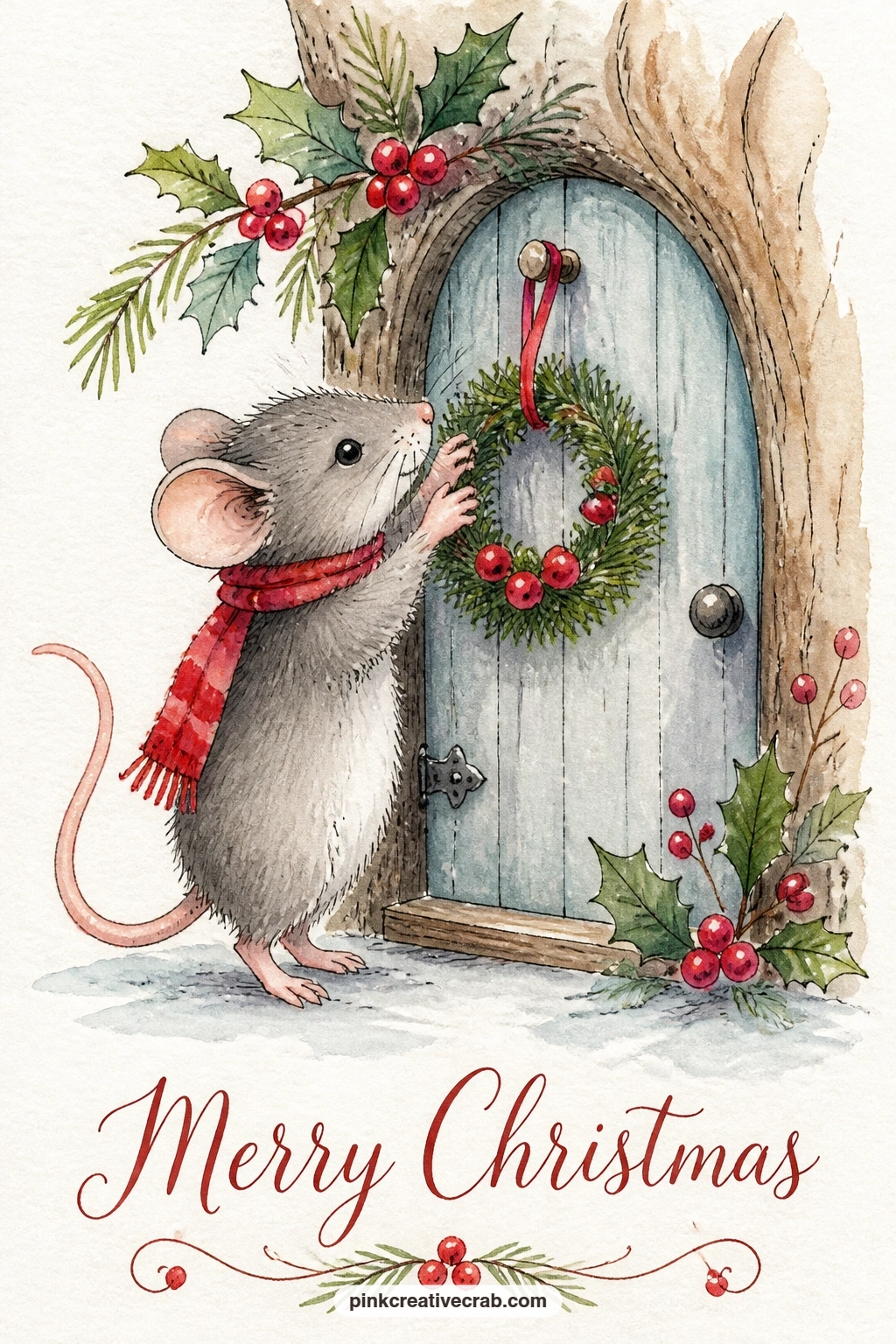
Palette: Burnt Umber,Payne’s Grey,Pine Green,Cherry Red
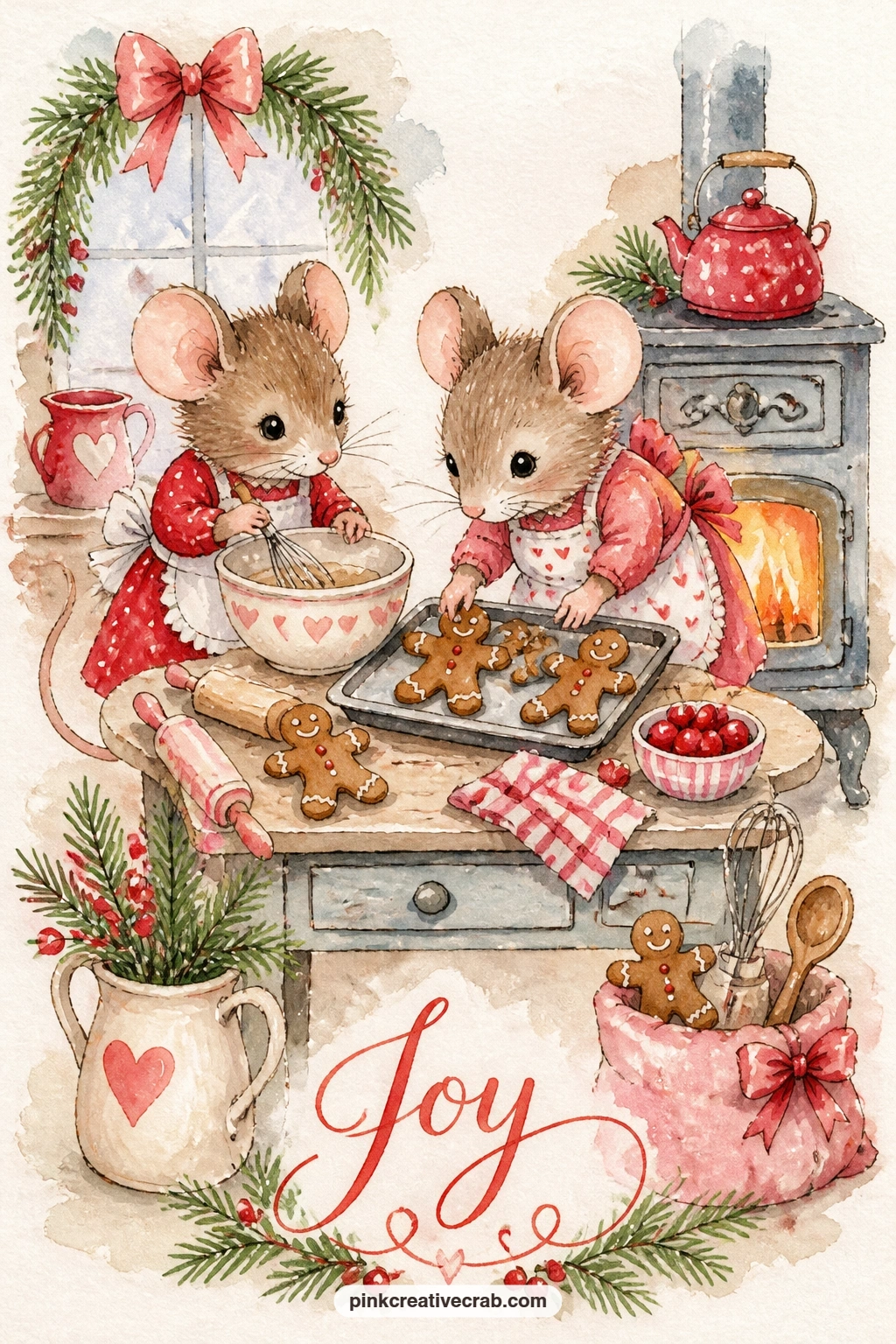
Move from one mouse to two mice baking gingerbread in a thimble-sized kitchen, a busier scene but still built from simple rounded shapes. Sketch a tiny stove, a rolling pin, and two mice in aprons facing each other across a small table, keeping limbs short and paws simple.
Block in the kitchen props first with light washes of brown and soft pink, then paint the mice over the top once the background is dry so their fur edges stay crisp against it. Add the gingerbread shapes last in a warm toasted brown with tiny cherry red dots for icing.
This is where beginners often crowd the page, so if the first sketch feels tight, erase one prop rather than squeezing everything in. A mini dropper of masking fluid over the flour dusting on the table keeps those white specks clean if you want that detail.
End with a single warm tip: keep the oven glow as one soft orange wash behind the stove door rather than painting individual flames, it reads warmer that way.
You Will Need
- masking fluid for the flour dusting
Palette: Burnt Sienna,Soft Pink,Cherry Red,Pale Blue
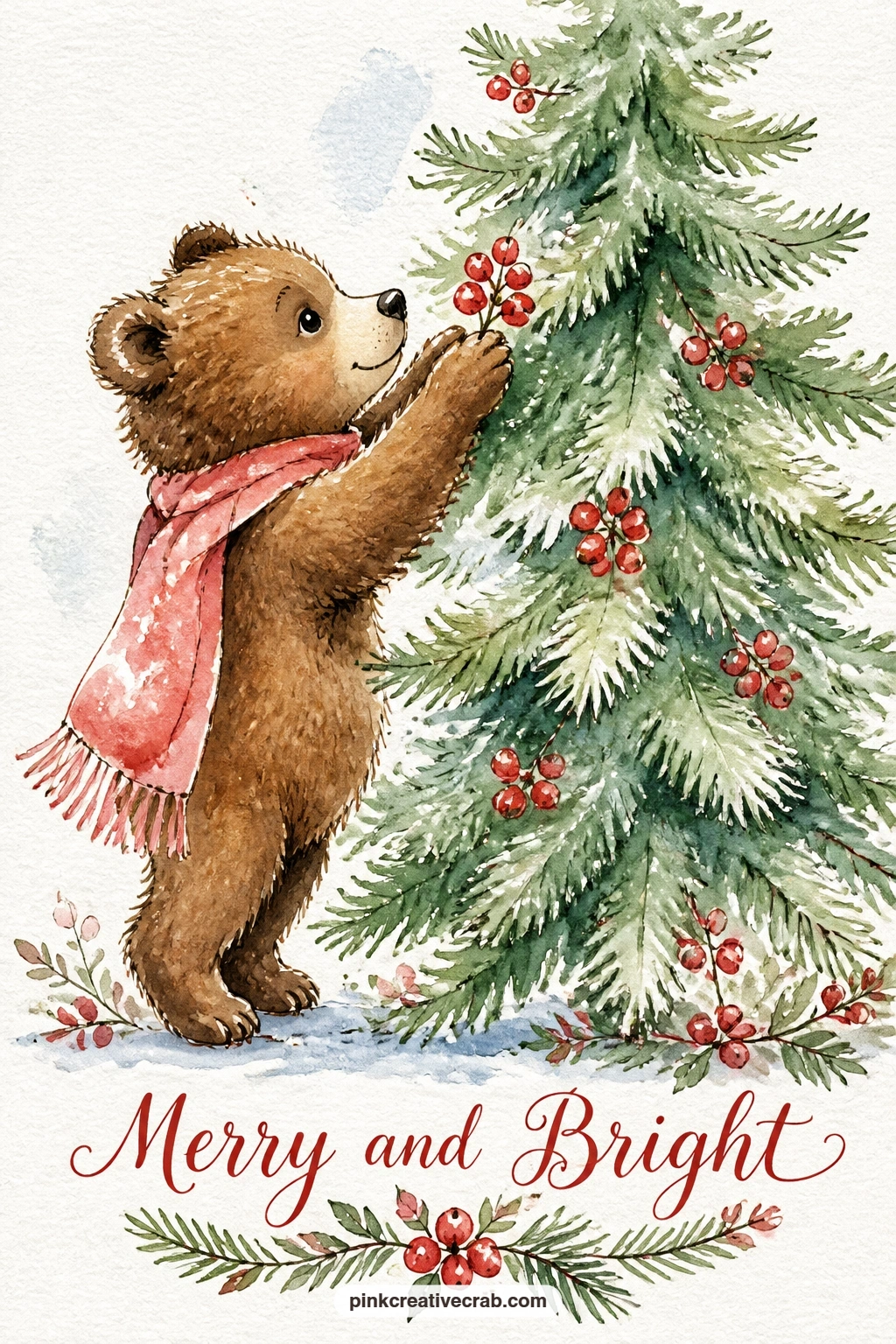
Bring in the bears next with a brown bear cub decorating a fir tree with red berries, a lovely subject for practising loose foliage. Draw the cub reaching up on its toes, then build the fir tree out of three or four overlapping triangular clusters rather than one solid green shape.
Paint the tree first in varied greens, dabbing the brush instead of stroking it so the branches look soft and textured, then let it dry before adding the cub in warm brown over the top. Drop in cherry red berries last with the tip of a small round brush, just dots, scattered rather than evenly spaced.
Watch the cub’s proportions here: the head is roughly a third of its whole body height, which keeps it looking young rather than like a grown bear. If your fir tree washes have dried patchy, that is fine, patchy green actually reads as needles rather than a mistake.
For more ways to paint bears at every size, the bear painting ideas collection has plenty of poses worth trying next.
Palette: Sap Green,Pine Green,Burnt Sienna,Cherry Red
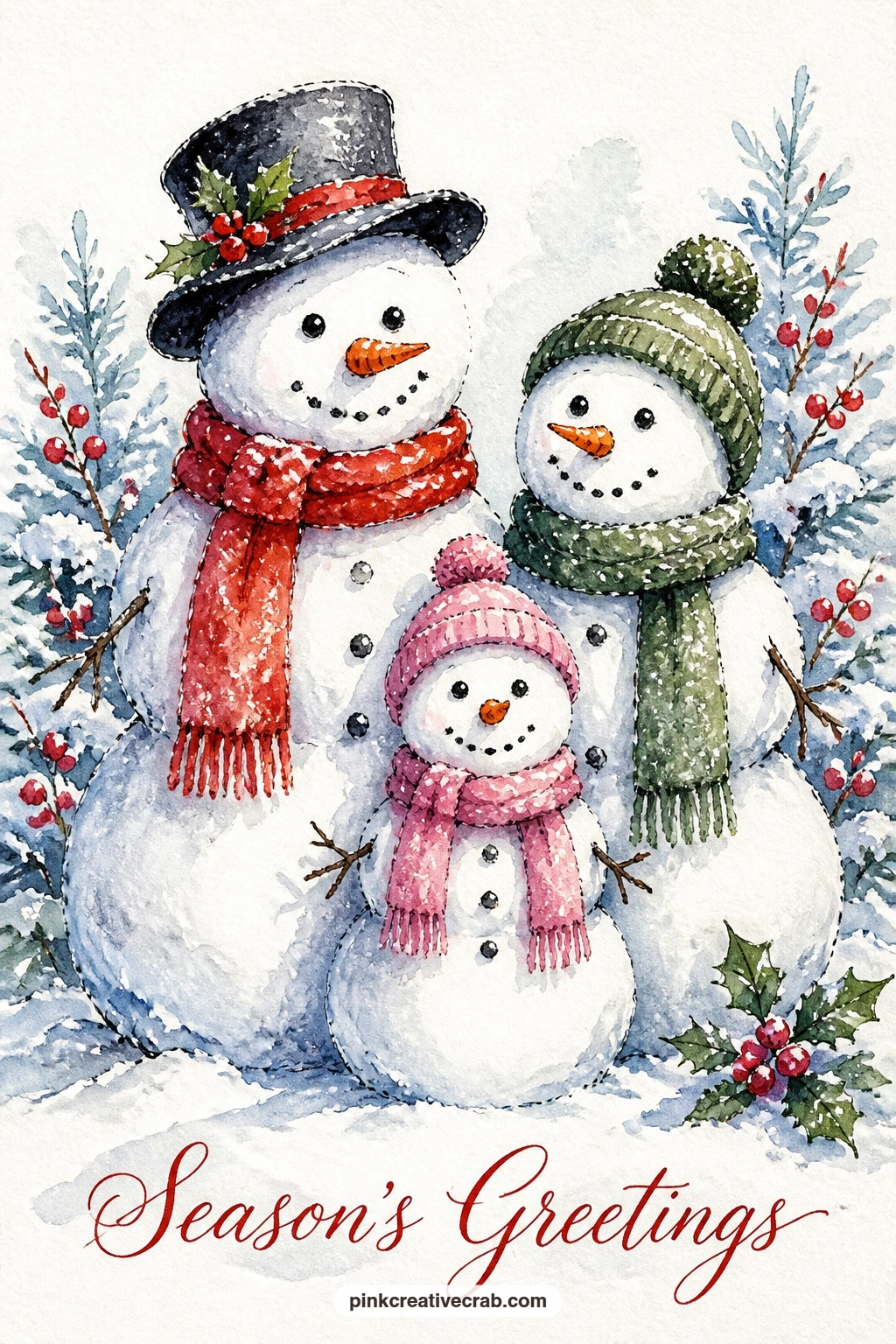
Give the humans a turn with a snowman family posing for a photo in a snowy garden, three snowmen in a neat row so the composition stays calm after the busier bear scene. Pencil three rounded snowman bodies of different heights, side by side, each with its own simple scarf colour.
Paint the bodies with a very pale blue grey wash first so they do not look flat white on white paper, then let that dry before inking in coal eyes, carrot noses and stick arms. Vary the scarves, one cherry red, one pine green, one soft pink, so each family member reads as an individual.
If the three bodies start looking identical, change the tilt of each head slightly, a small tilt reads as personality even with simple shapes. Swap gouache in for watercolor on the white highlights along the snow edges if you want them to sit more solidly.
Tiny stick arms work better thin and slightly bent than straight, straight sticks read as fence posts rather than arms.
Palette: Pale Blue,Cherry Red,Pine Green,Soft Pink
Look at the full snowman painting ideas list if you want more snowman poses and expressions to borrow for this family.
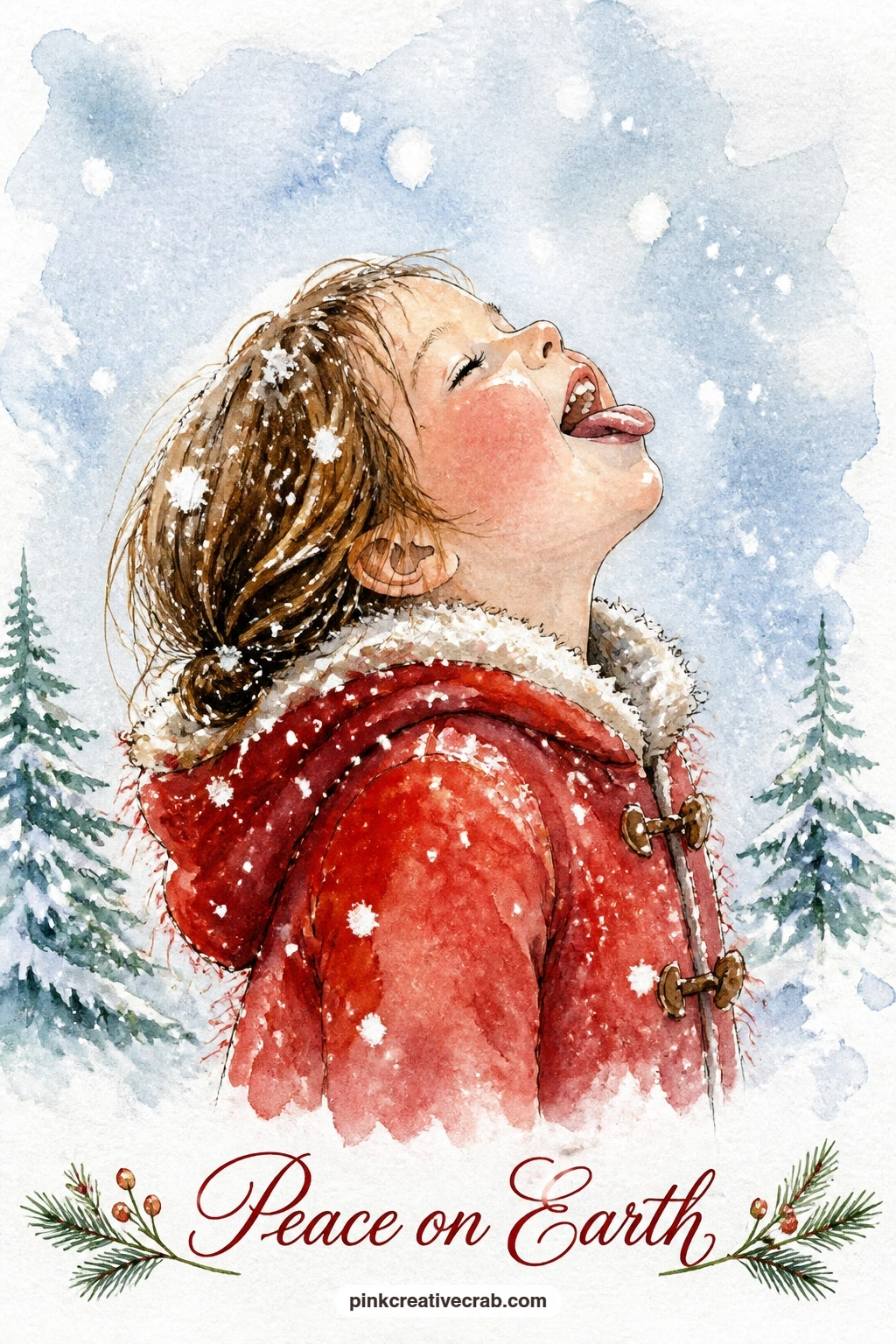
After the family group, zoom into one small moment with a little girl in a red coat catching snowflakes on her tongue, a single figure that lets you focus on her face. Sketch her tilted back slightly, mouth open, arms loose at her sides, with just a few falling snowflakes around her rather than a full flurry.
Paint the red coat as one confident wash first, since a hesitant patchy red coat loses the whole charm of the picture. Add her face and simple features once the coat is dry, keeping the eyes as two small closed curves to suggest the joy in her expression.
Her face is the thing to get right here: look at where the eye line sits roughly halfway down the head, not near the top, which keeps a child’s face looking young rather than adult. If red feels too bold for your card, a deep berry pink works as a gentler swap.
Scatter the snowflakes as tiny white dots with a fine brush loaded with white gouache rather than trying to paint each one with detail.
You Will Need
- white gouache for snowflakes
Palette: Cherry Red,Soft Pink,Pale Blue,Payne’s Grey
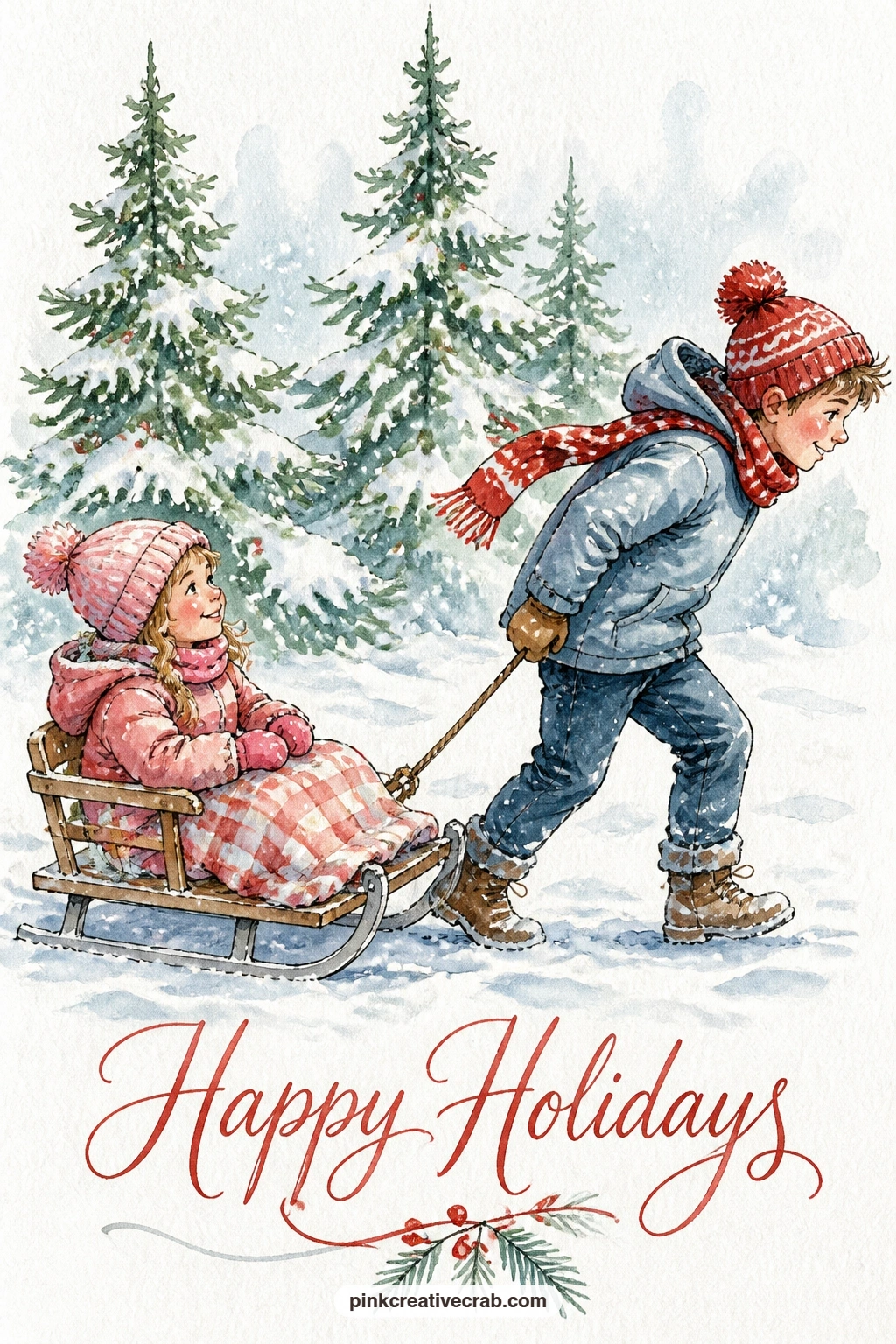
Keep the children’s theme going with a boy pulling his little sister on a wooden sled past snowy pines, which introduces a bit of motion to the page. Draw the sled low and horizontal, the sister seated with knees tucked, and the boy leaning forward with the rope in one hand.
Build the scene in layers: paint the far pines in a pale blue grey first so they recede, then the snow ground in white paper left bare, then the two children and sled in stronger colour on top. This layering from back to front is the trick that keeps a snowy scene from looking flat.
His leaning angle matters more than any other line in this picture, lean him too upright and the sled looks stationary. Tilt his whole body forward from the ankles, not just the head, and the pulling motion reads immediately.
A quick ten minute version keeps just the two children and the sled with no background pines at all, while the fuller version adds the receding tree line and a light snow texture with a dry brush.
Palette: Pale Blue,Cherry Red,Pine Green,Payne’s Grey
Slow the pace right down with a mouse asleep in a walnut shell bed under a patchwork quilt, a quiet still life style subject after the sled scene’s motion. Draw the walnut shell halves as the bed frame, a tiny mouse curled inside, and a small patchwork quilt made of four or five different coloured squares.
Paint the walnut shell in warm brown with a few darker lines for its natural ridges, then the quilt squares in your palette colours once the shell is dry so the edges stay separate. The sleeping mouse goes in last, just a curled grey shape with closed eyes, tucked mostly under the quilt.
The easiest place for this one to go wrong is the quilt squares looking too uniform, so vary their size slightly and let one or two overlap the mouse’s edge. If patchwork feels fussy, a single solid coloured blanket with one ink line for a fold works just as sweetly.
Leave the mouse’s face almost blank, just two tiny closed eye lines, since a sleeping face needs very little to read as peaceful.
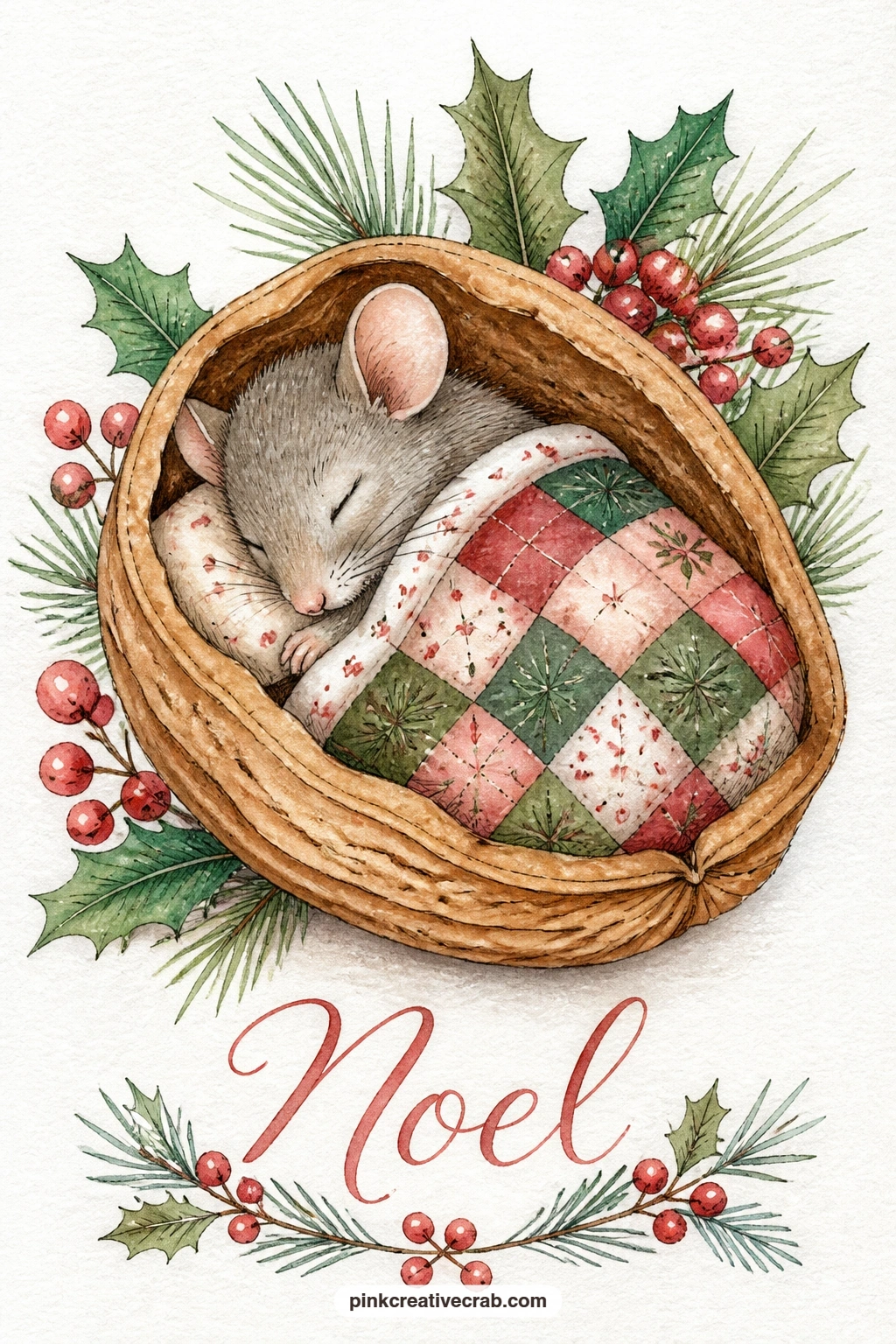
Palette: Burnt Sienna,Soft Pink,Pine Green,Pale Blue
Bring two bears together with a polar bear and a brown bear sharing a mug of cocoa, a nice pairing that lets you practise two very different fur colours side by side. Sketch them seated close together, each paw resting on the same oversized mug between them, with two tiny wisps of steam rising.
Paint the brown bear first in warm sienna, then once dry paint the polar bear using only the faintest grey blue shadow wash so it still reads as white against the paper. The shared mug gets a confident cherry red wash, the one strong colour note in the whole scene.
Where the eye level sits here matters: keep both bears’ eyes on the same horizontal line even though their bodies are different colours, which makes them feel like equals sharing the moment rather than one looming over the other. If you do not have a grey wash for the polar bear’s shadows, a very diluted pale blue does the same job.
Steam wisps work best as two or three thin curved ink lines, not painted, added last once everything else is dry.
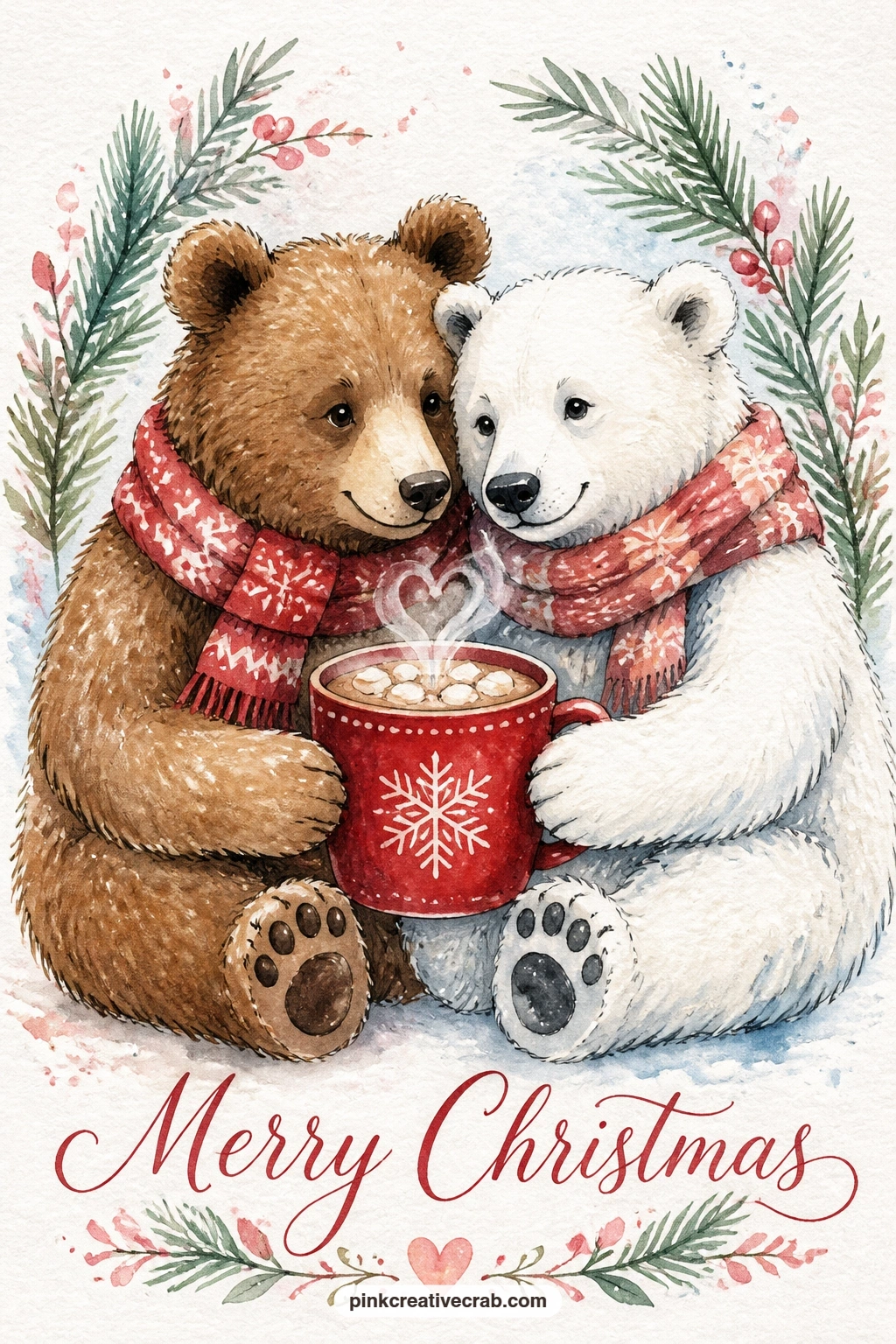
Palette: Burnt Sienna,Payne’s Grey,Cherry Red,Pale Blue
Return to the children with a group building a snowman with a stripy scarf in the front yard, a chance to paint several small figures working together. Sketch two or three children in different poses around a half built snowman, one patting snow, one holding the scarf, one standing back directing.
Build the snowman’s rounded body first in pale blue grey, then paint the children in a mix of coat colours so no two match exactly. The striped scarf is the fun detail here, alternate cherry red and pine green bands around the snowman’s neck with a dry brush for a slightly broken, knitted texture.
Group scenes often go wrong when every figure faces the same direction, so turn at least one child slightly toward another to create a sense of them actually working together. If three figures feels like too much for one sitting, drop to two children and keep the composition simpler.
Finish with one concrete tip: paint the snowman’s shadow as one soft blue grey puddle beneath it before adding any other details, it grounds the whole scene immediately.
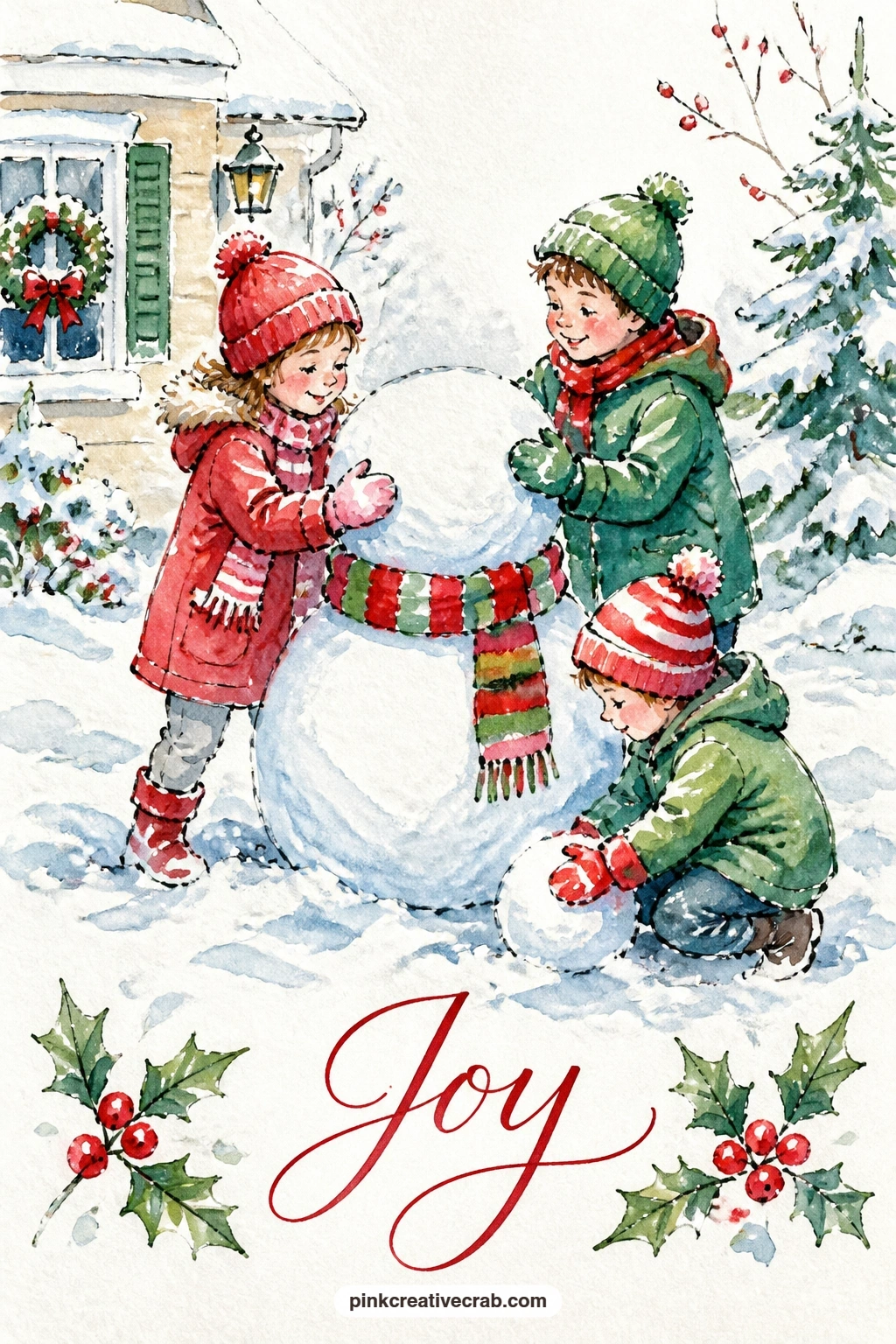
Palette: Pale Blue,Cherry Red,Pine Green,Soft Pink
Give the mice a bit of sport with a mouse skating on a frozen puddle in a red knitted hat, a fun small subject built almost entirely around one confident curved line. Sketch the mouse mid glide, one leg extended back, arms out for balance, standing on an irregular round puddle shape.
Paint the puddle first as a flat pale blue wash with a few white gouache streaks left dry for ice shine, then let it dry completely before painting the mouse on top so its skate blades stay crisp. The red knitted hat gets painted last with a tiny pom pom dabbed on with the brush tip.
The quick ten minute version is just the mouse and the puddle with no surroundings at all, while a fuller forty minute version adds a few cracked ice lines across the puddle and a light dusting of snow around its edge. If you are unsure painting ice, a cracked white gel pen line over dried blue wash reads convincingly without much skill.
Keep the extended back leg long and thin, a short stubby leg reads as standing still rather than skating.
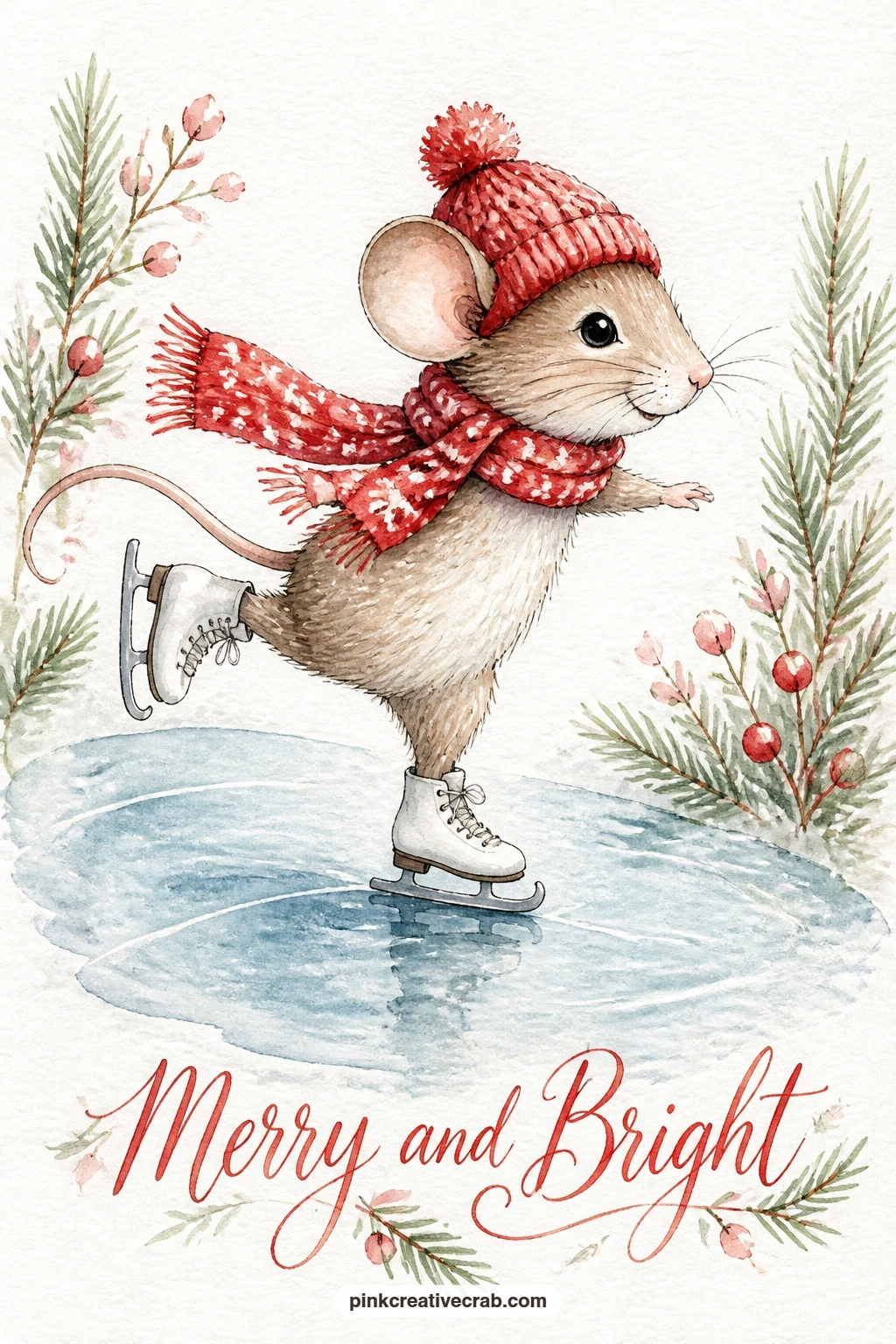
You Will Need
- white gel pen for ice shine
Palette: Pale Blue,Cherry Red,Payne’s Grey,Soft Pink
Scale the bears up to a family scene with a bear family carrying a Christmas tree home through the snow, three bears in a row each gripping part of the trunk. Sketch the tree diagonally across their shoulders first, since its angle sets the whole composition, then fit the three bears underneath at slightly different heights for a parent and two cubs feel.
Paint the tree in two green tones, a darker underside and lighter tips, before the bears so you are not painting around their fur edges. The bears go in warm sienna with a touch more grey in the shadowed one furthest from the light, which gives the group a sense of depth without much extra work.
Carrying scenes often look stiff if every paw sits at the same height on the trunk, so stagger the grip points slightly along its length. If three bears feels ambitious today, two bears carrying a smaller tree tells the same story just as sweetly.
Add one soft blue shadow trailing behind their feet in the snow, it is a small touch that makes the whole group feel like it is actually walking.
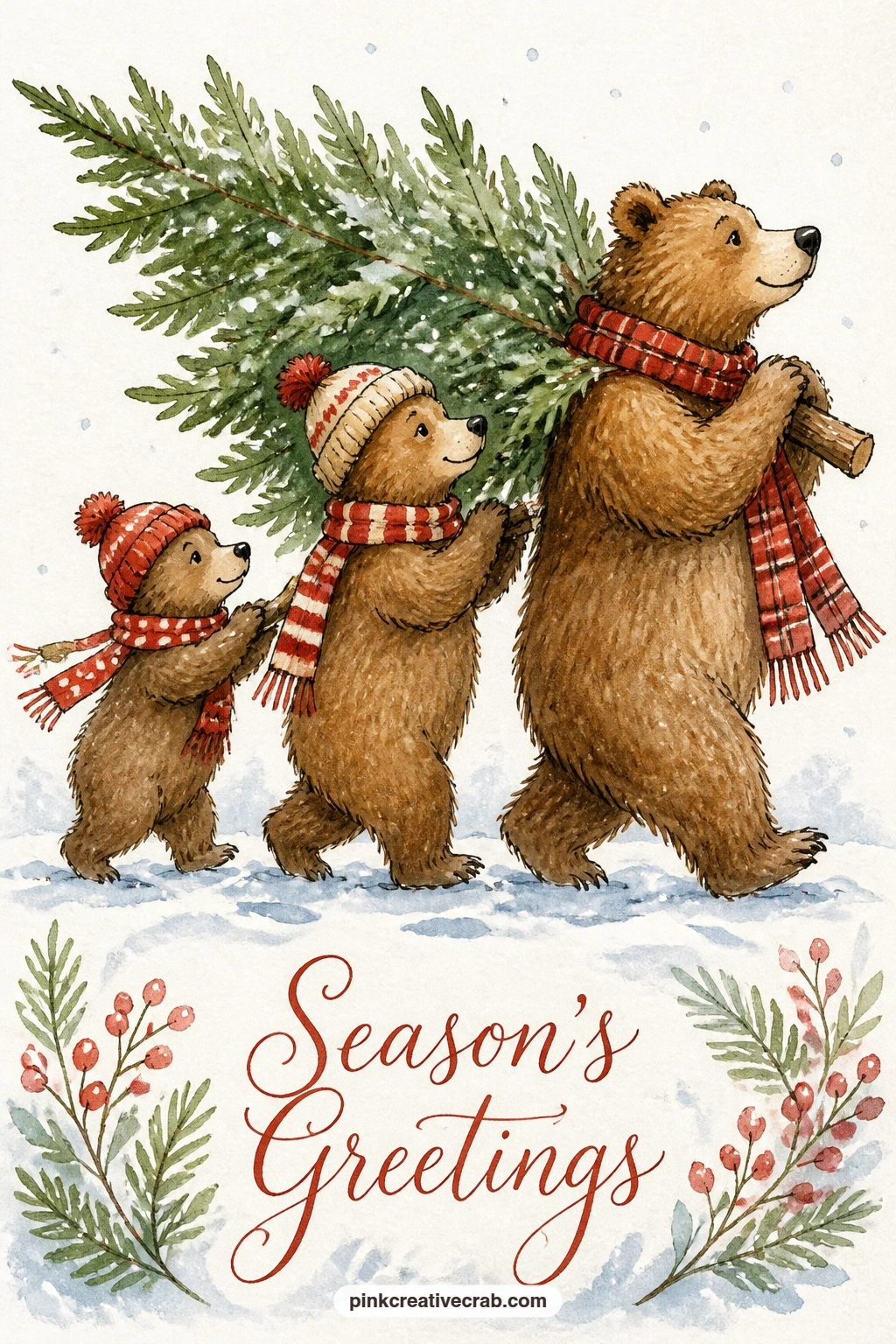
Palette: Pine Green,Sap Green,Burnt Sienna,Pale Blue
Bring the pace right back down with a little girl peeking through a frosty round window at the snow, a quiet portrait style subject with a built in frame. Draw a simple circular window shape first, then the girl’s face and hands pressed close to the glass from inside, with just her eyes and the top of her head visible over the sill if you want.
Paint the window frame in a soft wood brown, then leave the glass itself as bare white paper with only a thin pale blue wash around its edges for frost. The girl’s face sits in the centre, painted last and kept simple, two round cheeks and closed happy eyes looking out.
Frosty glass is easiest faked with a dry, almost empty brush dragged lightly around the window’s inner edge in white gouache once everything else is dry, rather than trying to paint individual ice crystals. If gouache is not to hand, a white crayon drawn before any paint touches the paper gives the same frosted resist effect.
Keep the outside snow scene beyond the glass very loose and soft, sharp detail out there competes with her face for attention.
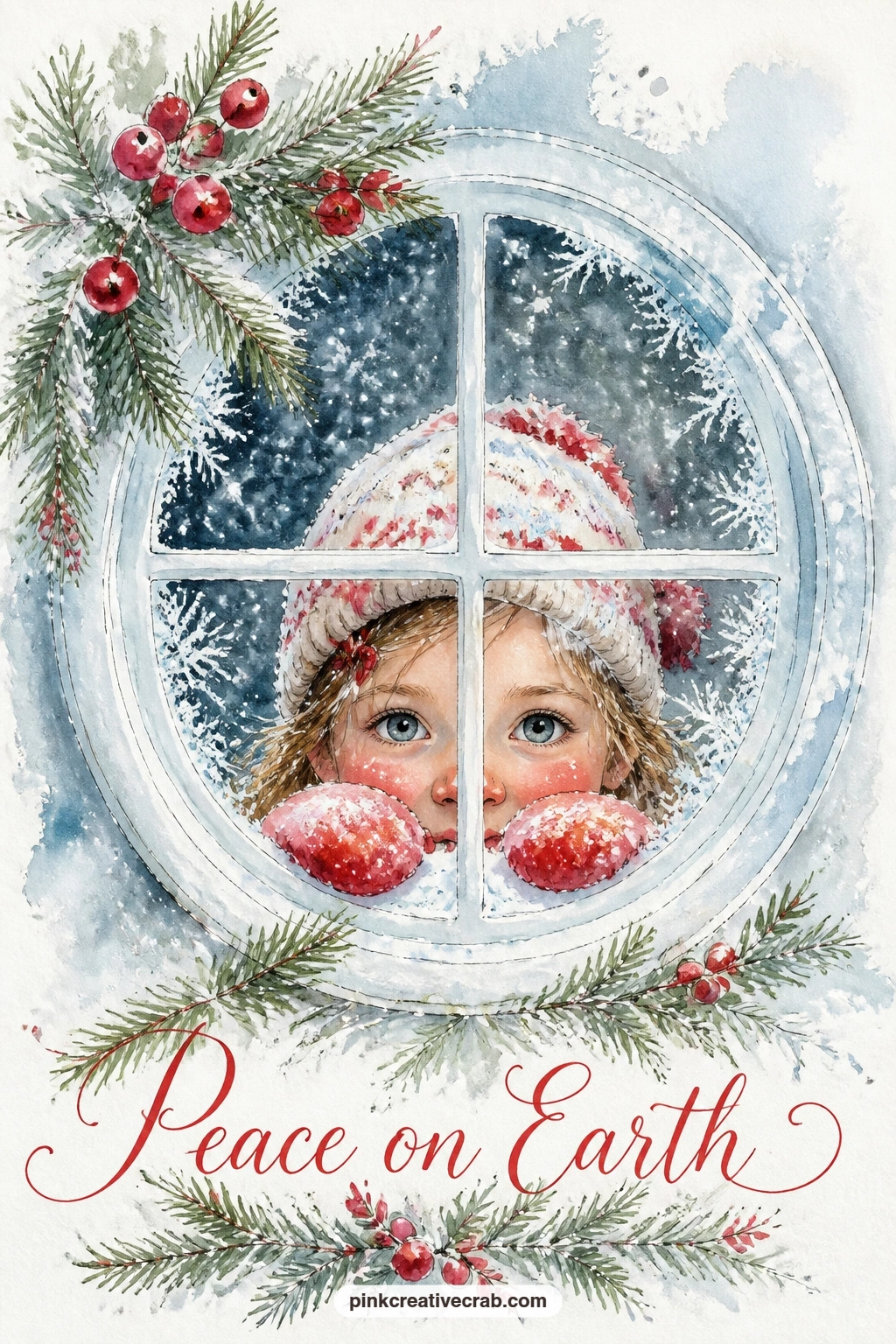
You Will Need
- white crayon or gouache for frost
Palette: Burnt Sienna,Pale Blue,Soft Pink,Payne’s Grey
Add a touch of whimsy with a mouse riding on a robin’s back over snowy rooftops, a lively airborne subject after the stillness of the last card. Sketch the robin mid flight with wings spread wide, the mouse sitting on its back gripping a bit of neck feather, and a row of small rooftops with snow caps beneath them.
Paint the robin’s red breast first, the brightest note in the picture, then its brown wings and the grey mouse rider once that dries. The rooftops go in last as simple triangular shapes in muted blue grey, kept small so they clearly sit far below the flying pair.
Wing position is the trick here: angle both wings slightly downward, as if mid beat rather than frozen flat out, and the whole bird reads as flying rather than gliding stiffly. If a flying pose feels tricky, perch the robin and mouse together on one single rooftop chimney instead for an easier equivalent.
Keep the rooftops noticeably smaller than the robin so the sense of height over the village comes through clearly.
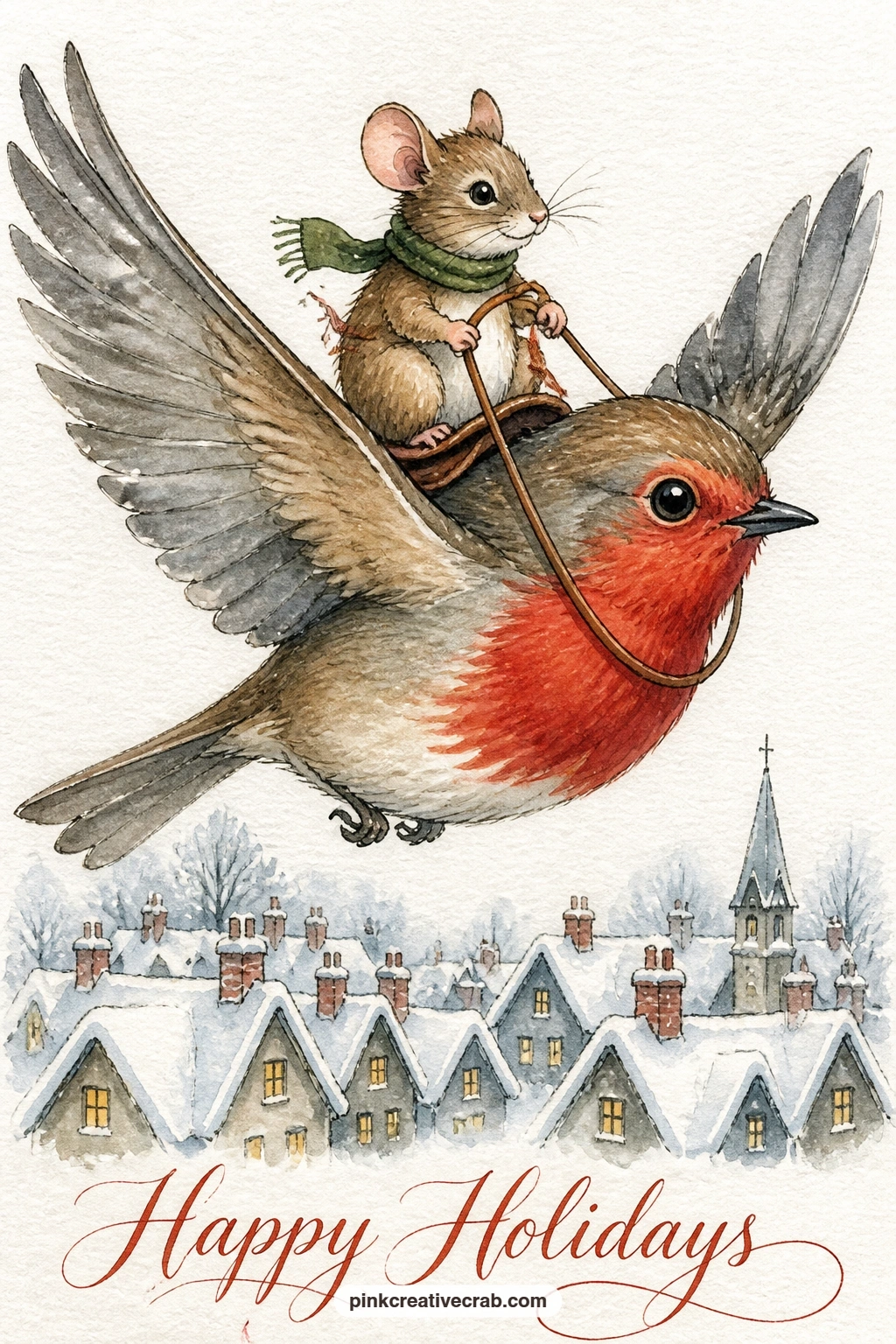
Palette: Cherry Red,Burnt Sienna,Payne’s Grey,Pale Blue
Switch to something close to home with a toddler in a reindeer onesie waddling past the Christmas tree, a small warm figure that works well as a standalone card front. Draw the toddler wide and round rather than tall, stubby felt antlers on the hood, arms out slightly for balance in that classic toddler walk.
Paint the onesie in warm brown first, then add the tree behind as a softer, looser green shape so it does not compete with the figure in front. Keep the toddler’s face minimal, two dot eyes and a small smile, since too much detail on a tiny face reads as older than intended.
Proportion is the whole picture here: a toddler’s head is close to a quarter of their total height, much larger in proportion than an older child’s, and getting that oversized head right is what makes the waddle feel believable. If felt antlers feel fiddly to draw small, a simple fabric headband with two round pom poms reads just as sweetly.
Round every edge of the onesie, no sharp corners anywhere, and the whole figure feels instantly softer and younger.
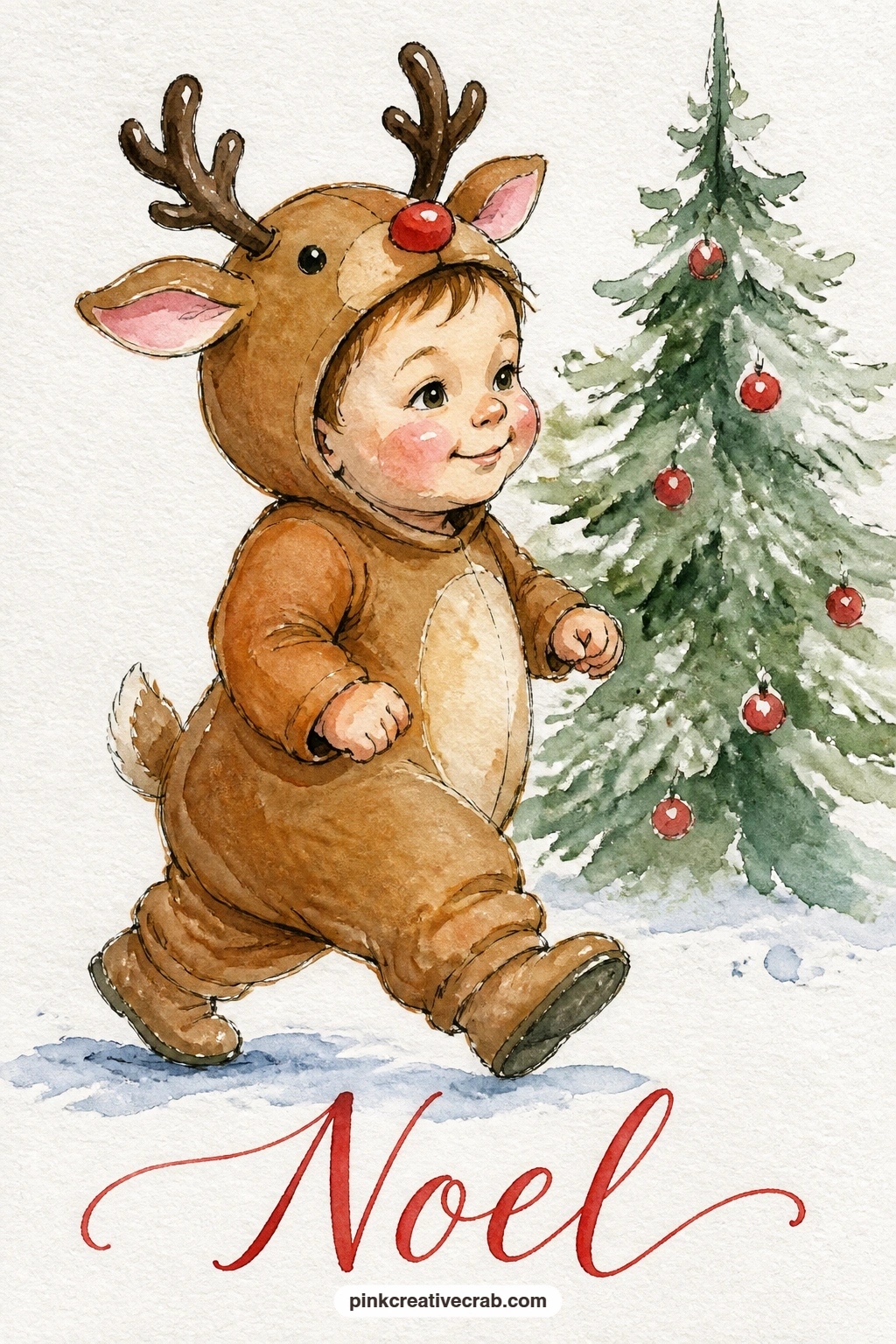
Palette: Burnt Sienna,Pine Green,Cherry Red,Soft Pink
Return to the snowman family with a snowman mom knitting a scarf for her snow baby, a gentle domestic scene that pairs nicely with the earlier family photo card. Sketch the mother snowman seated, knitting needles in her stick arms, a long striped scarf trailing from them, and a much smaller snow baby sitting beside her.
Paint both snowman bodies in the same pale blue grey wash so they read as family, then differentiate them with accessories rather than colour, a bonnet for her and a tiny bobble for the baby. The scarf gets painted in alternating stripes with a fine brush, letting each stripe dry before the next so they stay clean and separate.
Knitting needles are easiest drawn as two thin straight ink lines crossing at an angle rather than painted, added right at the end over dry paint. If a full scarf feels like too much stripe painting for one sitting, a single solid colour scarf still tells the story just fine.
Keep the baby snowman noticeably smaller, no more than half the mother’s height, to read clearly as a child.
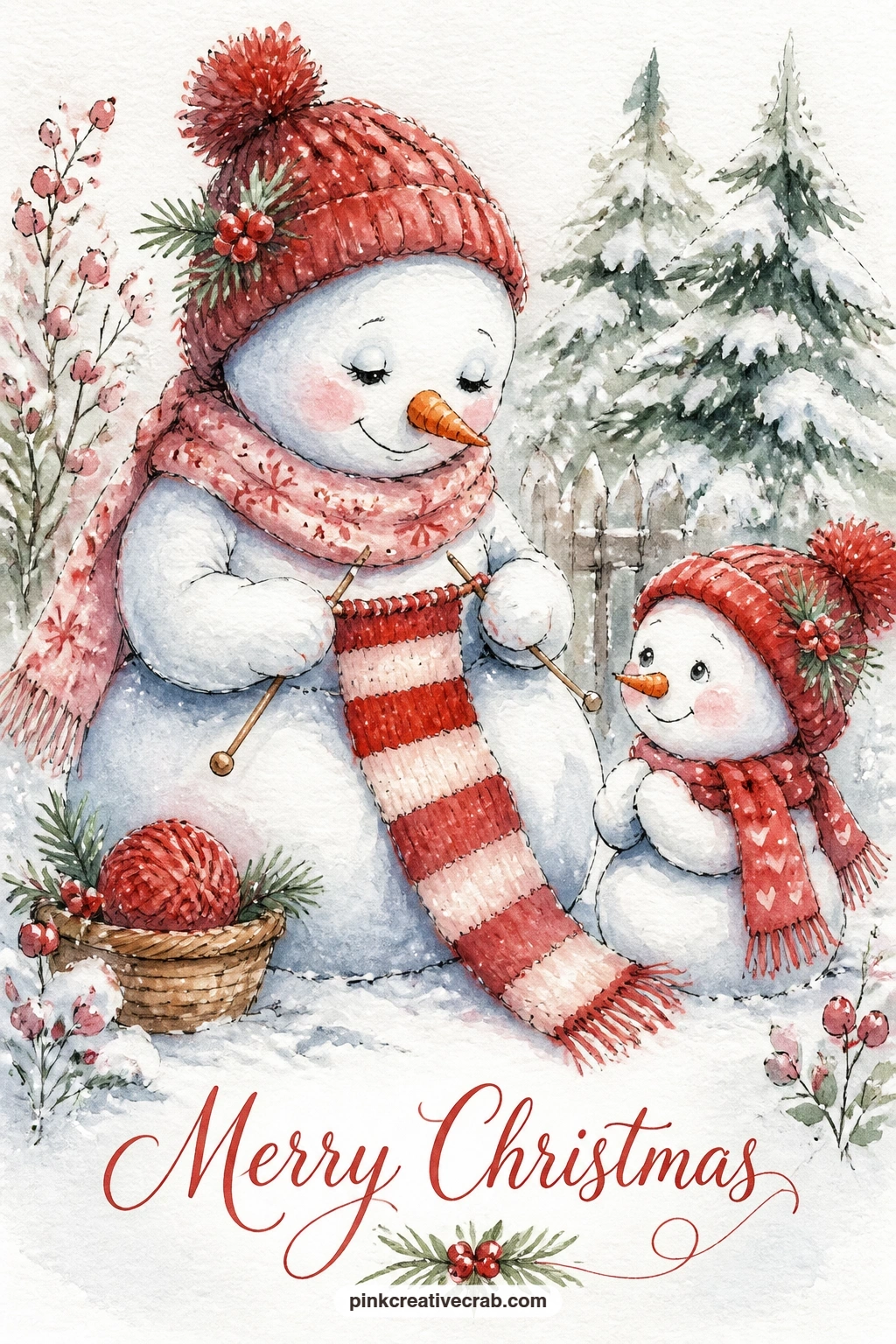
Palette: Pale Blue,Cherry Red,Pine Green,Soft Pink
Head back indoors with a bear cub asleep in a pile of presents under the tree, a cosy pile up subject after the open air snowman scene. Sketch three or four gift boxes of different sizes first, stacked loosely rather than neatly, then nestle the sleeping cub curled on top or tucked between them.
Paint each present in a different colour from your palette so the pile reads as varied rather than one blob, letting each box dry before its neighbour goes in so the edges stay distinct. The cub goes on last in warm sienna, curled small with closed eyes, painted so its shape slightly overlaps one or two of the boxes beneath it.
Overlap is the thing that sells this scene, if every box and the cub sit side by side with gaps between them the pile looks scattered rather than settled. Let the cub’s body genuinely rest into and slightly behind one box, with a ribbon line or two suggested by ink rather than paint.
A ten minute version keeps it to two presents and the cub, while the fuller version adds a third box and a hint of tree branches above.
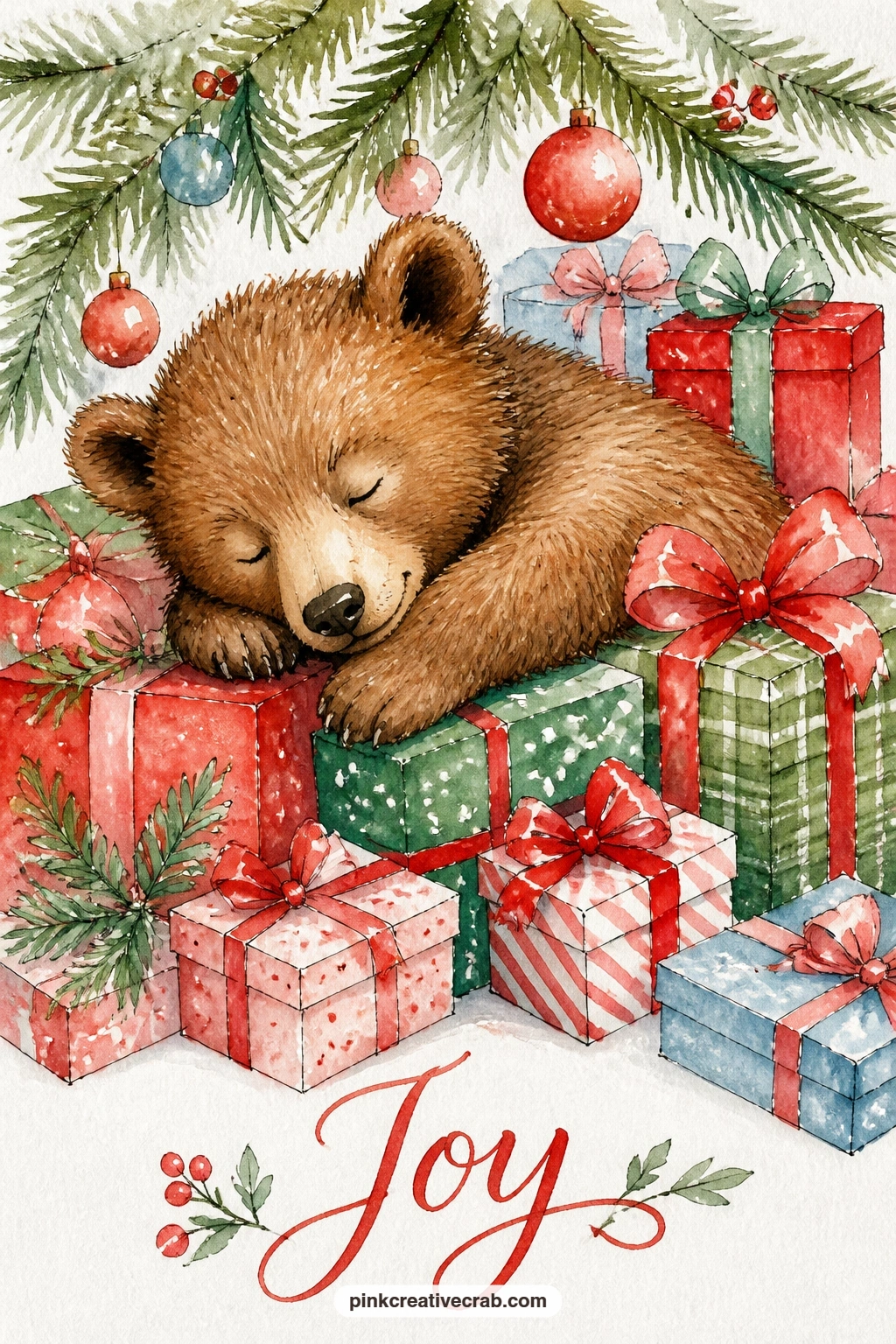
Palette: Cherry Red,Pine Green,Soft Pink,Burnt Sienna
Step into a classroom scene with kids hanging paper snowflakes in a classroom window, a nice change of setting with simple repeated shapes to practise. Sketch a window frame first, then two or three children on tiptoe or standing on a low stool, reaching up to tape snowflake shapes along the glass.
Paint the window and children in soft colours first, then add the paper snowflakes last as simple white shapes with thin ink lines for their cut pattern, since white on white paper needs that outline to read clearly. Keep each snowflake a slightly different size and simple design rather than identical, which feels more like real classroom craft.
This scene goes wrong fastest when the children all stand in a flat row facing forward, so vary their heights and have one reaching higher than the others on a stool. If drawing several figures feels like a lot for one sitting, two children instead of three keeps the same cosy feeling.
Outline the snowflakes with a fine white gel pen over a pale blue wash background if you want them to glow a little against the glass.
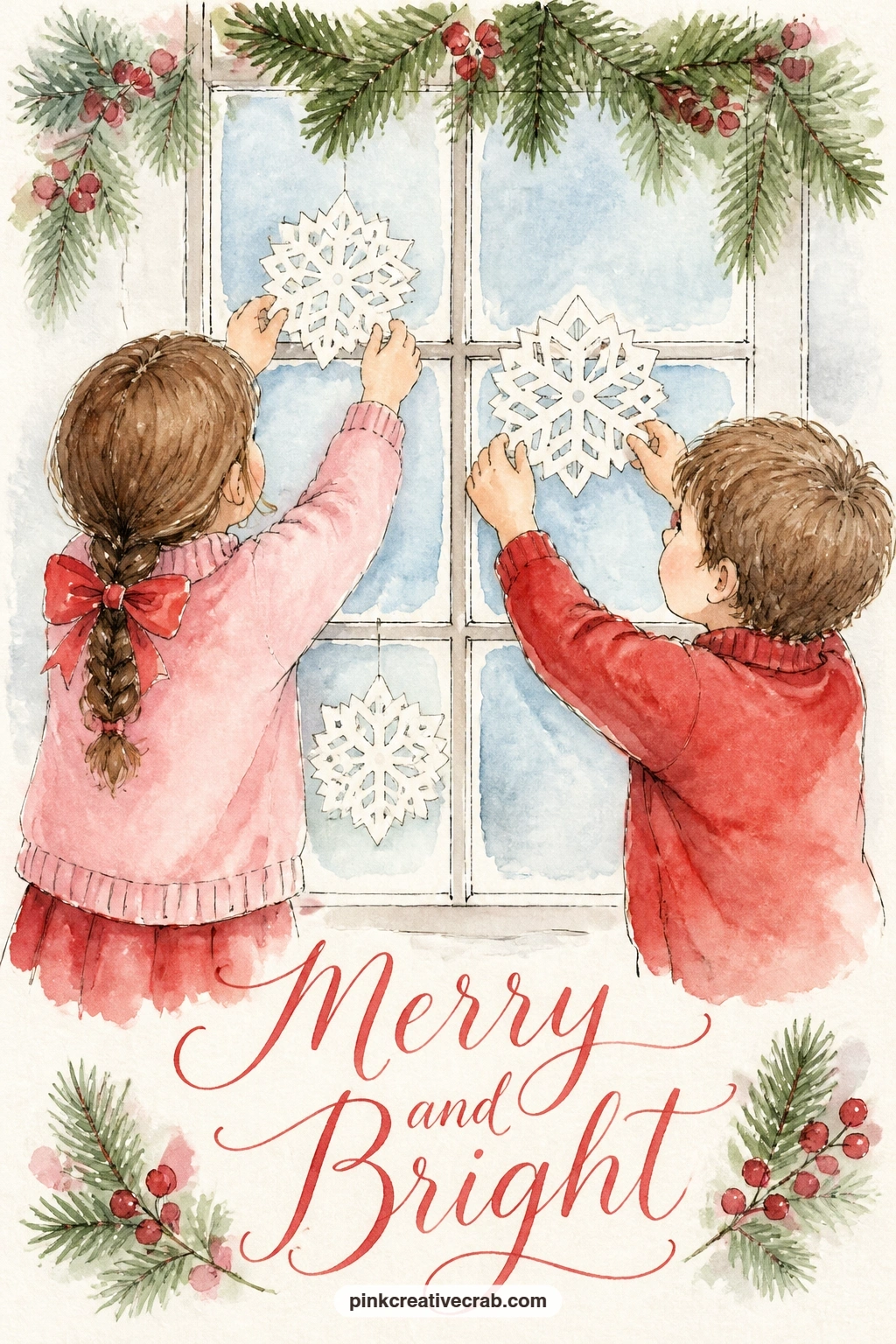
You Will Need
- white gel pen
Palette: Pale Blue,Soft Pink,Cherry Red,Payne’s Grey
Bring the mice back together with a mouse choir singing around a candle stub inside a teacup, a charming small group scene with its own tiny set. Sketch a single teacup first, wide enough to fit three or four tiny mice standing inside it around a short stub of candle, mouths open in simple round song shapes.
Paint the teacup in a soft colour with a thin gold or cream rim line, then fill in the mice once dry, varying their little scarves or hats slightly so the choir does not look cloned. The candle flame goes in last as one small warm orange dab with a tiny bit of yellow at its centre, the brightest point in the whole picture.
Four tiny faces singing can easily blur together, so keep their open mouths as simple as possible, just a small oval, and let the variety come from hat colour instead of expression. If a full teacup of mice feels fiddly, two mice singing beside a single candle on a dish works just as well.
Let the candle glow spread very softly into the cup’s inner rim with a damp brush while the orange is still wet, no hard edge needed.
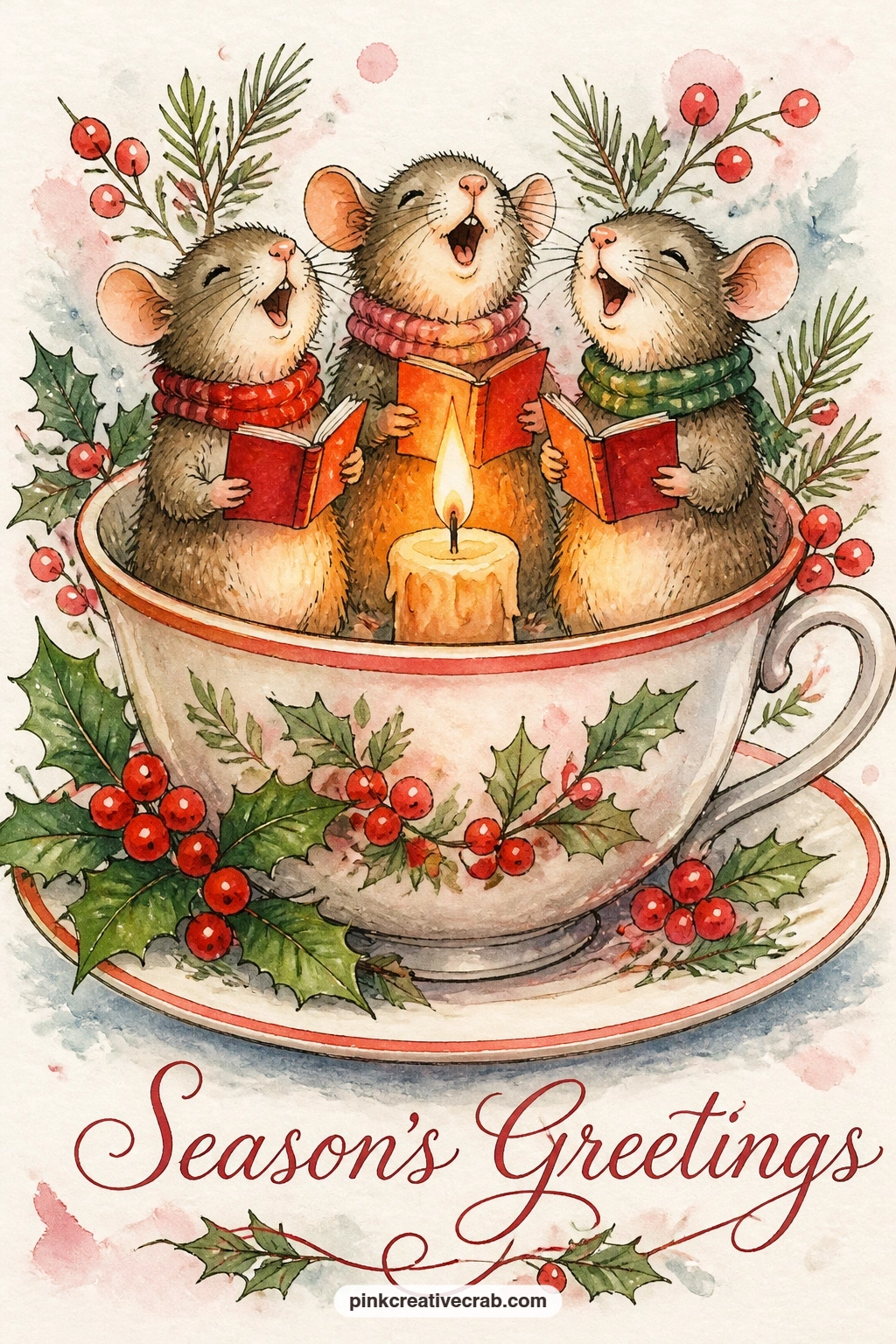
Palette: Burnt Sienna,Cherry Red,Soft Pink,Pine Green
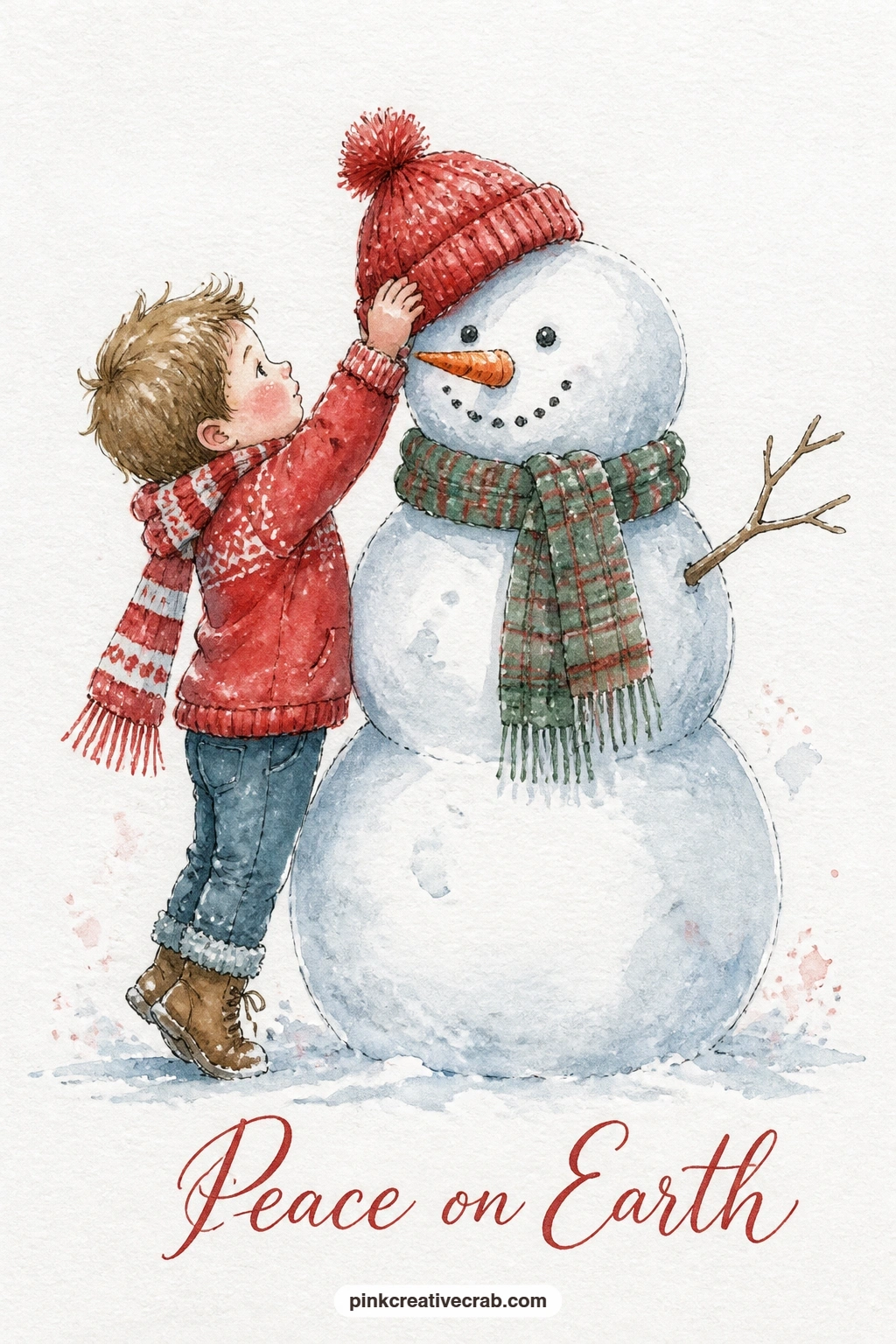
Follow the choir with something gentler, a little boy giving his snowman his own woolly hat, a small two character moment built on one simple gesture. Sketch the snowman first, standing a little taller than the boy, then the boy reaching up on tiptoe with a knitted hat held in both hands just above the snowman’s head.
Paint the snowman’s body in pale blue grey first since it covers the most area, then the boy in a warm coat colour once dry, keeping his pose slightly off balance on his toes to suggest effort. The hat itself gets the brightest colour in the scene, since it is the whole point of the picture and should draw the eye immediately.
Where the light comes from barely matters here, but keep both figures’ shadows falling the same direction on the snow beneath them, even a loose blue smudge, or the pair will look like they are standing in two different scenes. A single soft shadow shape under both feet ties them together instantly.
If tiptoe is tricky to draw convincingly, have the boy standing on a small snow mound instead, it solves the height difference just as well.
Palette: Pale Blue,Cherry Red,Burnt Sienna,Pine Green
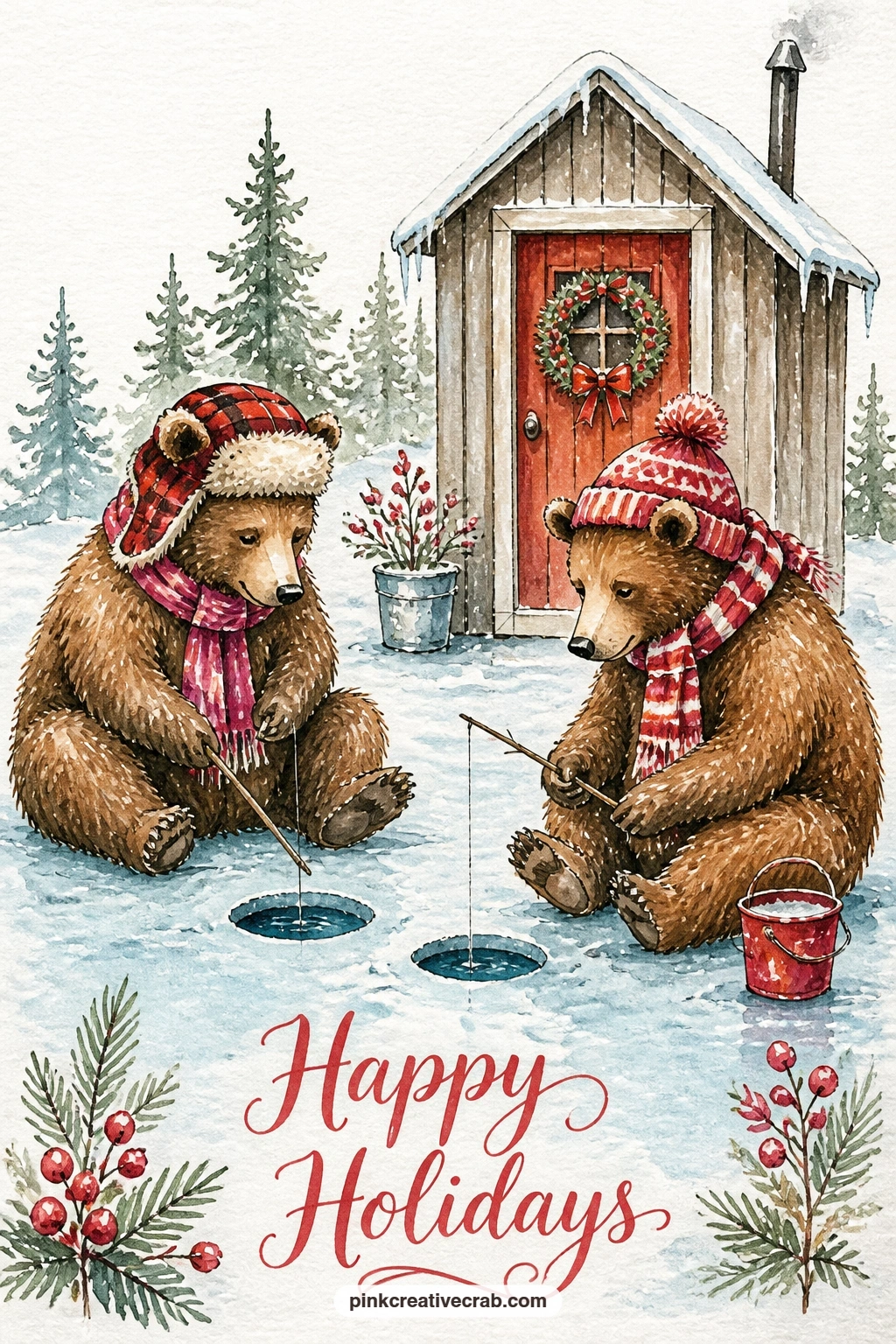
Move the bears outdoors again with two bears ice fishing beside a tiny hut on a frozen lake, a quiet companionable scene with a bit of structure to build. Sketch a small wooden fishing hut first, slightly off to one side, then two bears seated on the ice in front of it, each with a short fishing line disappearing into a round hole.
Paint the ice as a flat pale blue wash across most of the page, leaving the hut and bears for afterward, then build the hut in simple brown planks and the bears in warm sienna once everything underneath is dry. Keep the fishing holes as two small dark ovals with a thin ink ring, the only truly dark marks on the whole icy expanse.
This scene reads flattest when the ice has no variation at all, so once the main blue wash dries, drag a dry brush loaded with a touch more pale blue across a few areas for subtle texture without overworking it. If a hut feels like too much extra drawing, drop it and keep just the two bears and their fishing holes on the ice.
One straight ink line for each fishing rod, slightly bent at the tip, reads more convincingly than a painted line ever will.
Palette: Pale Blue,Burnt Sienna,Payne’s Grey,Pine Green
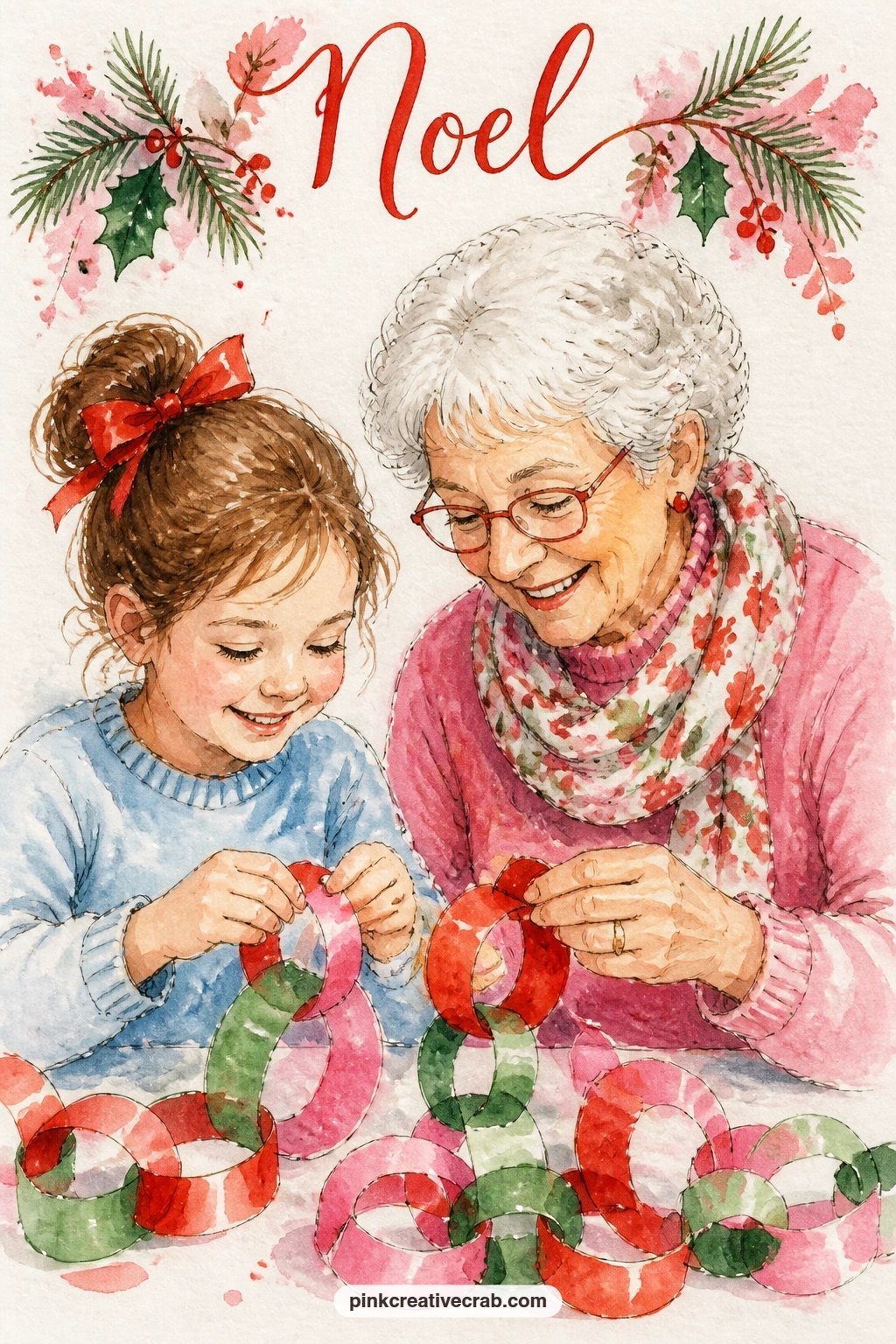
Bring the children indoors again with a girl and her grandma making paper chains at the kitchen table, a lovely two generation scene full of small coloured loops. Sketch grandma seated with the girl standing or kneeling beside her chair, both with a few paper loops already linked into a short chain between their hands.
Paint the two figures first in contrasting but complementary colours, a warmer tone for grandma’s cardigan and a brighter one for the girl’s jumper, then add the paper chain last as a series of small overlapping coloured ovals in cherry red, pine green and soft pink alternating down the table.
Hands linking paper loops are fiddly at this scale, so simplify them to soft rounded shapes gripping the chain rather than trying to draw individual fingers, which almost always reads better from a short distance. If two full figures feels like a lot, crop the scene to just their hands and the chain on the table for an easier equivalent.
A loose scatter of a few spare paper strips on the table around them suggests the activity without needing any extra figures.
For more cosy Christmas making scenes like this one, the Christmas junk journal page ideas have a similar warm, crafted feel.
Palette: Cherry Red,Pine Green,Soft Pink,Burnt Sienna
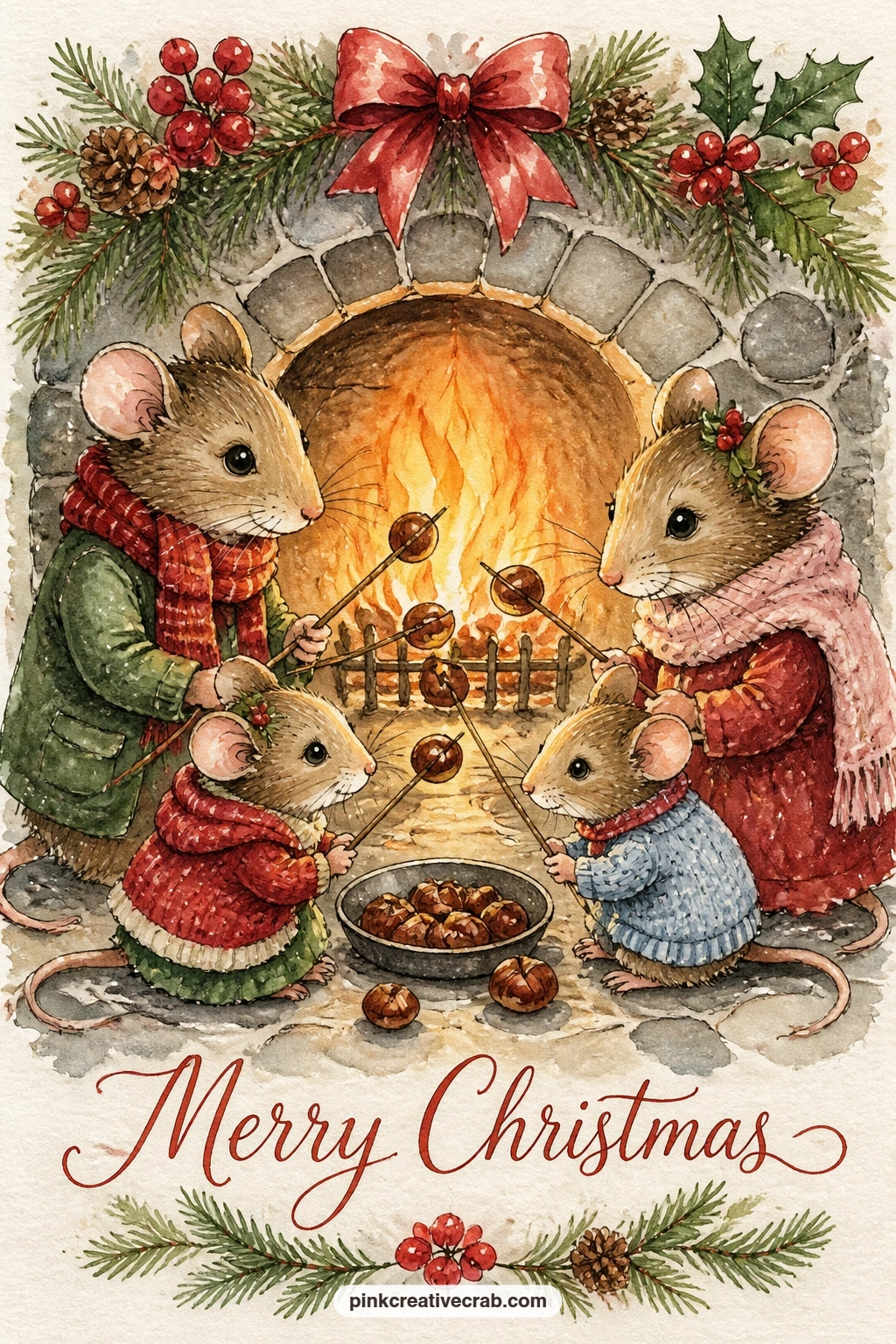
Keep the cosy indoor feeling going with a mouse family roasting chestnuts by a tiny hearth, a warm little scene built around one glowing centre. Sketch a small stone hearth first, a tiny pan of chestnuts over the flame, and two or three mice gathered close around it, some seated, one perhaps holding a long roasting fork.
Paint the fire itself first as the brightest point, warm orange with a touch of cherry red at its base, then build the stone hearth around it in cool grey once that dries so the heat glow reads by contrast. The mice go in last, each a simple grey shape, lit faintly on the side facing the fire with a thin warm wash.
That warm glow on the near side of each mouse is the detail that makes the whole scene feel lit by firelight rather than flat daylight, so keep the far side of each mouse slightly cooler and greyer by comparison. If painting fire feels daunting, a single glowing ember shape with a soft orange halo works just as well as full flames.
Group the mice a little unevenly around the hearth rather than in a tidy circle, it feels more like a real gathering.
Palette: Payne’s Grey,Cherry Red,Burnt Sienna,Soft Pink
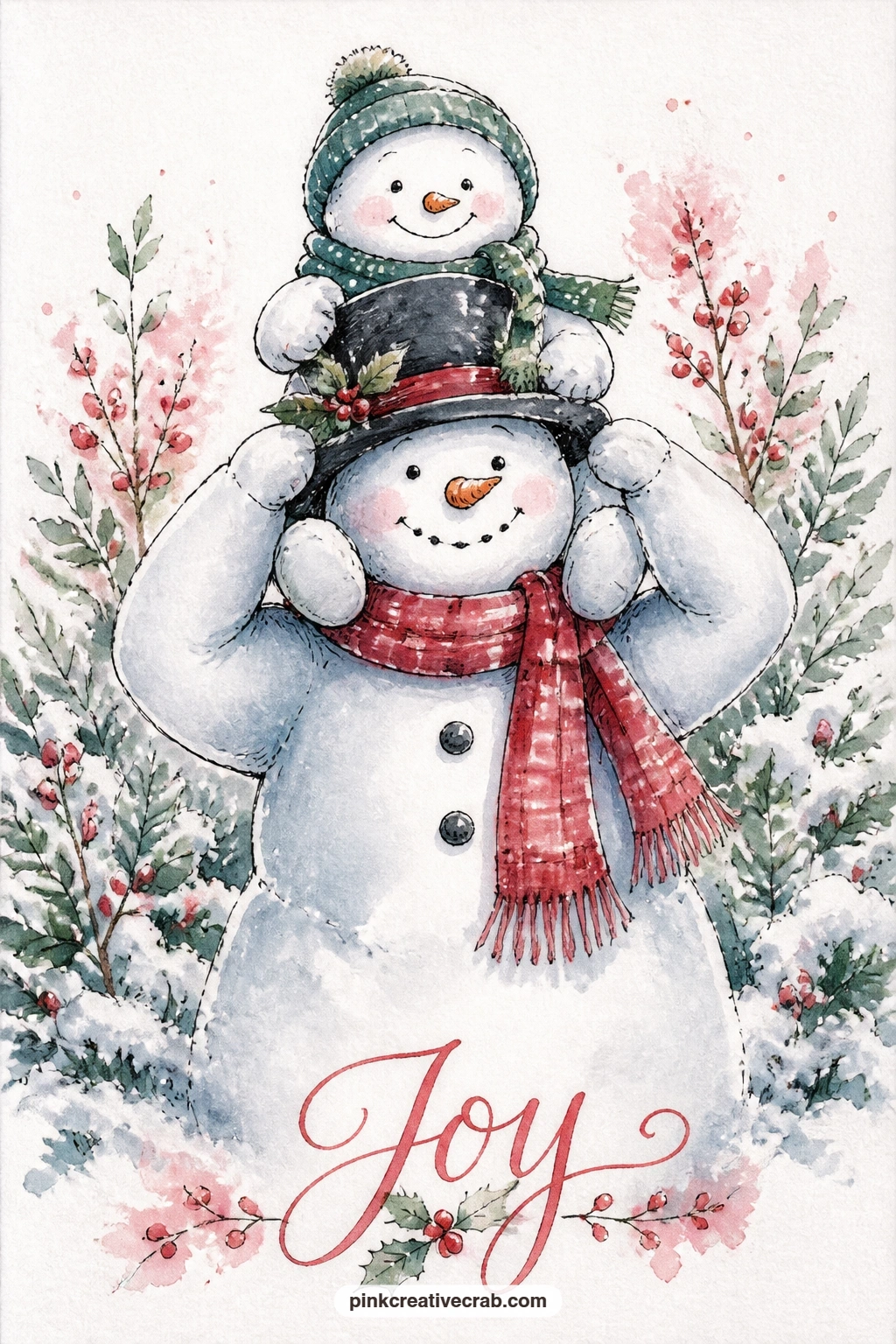
Return to the snowman family one more time with a snowman dad carrying a snow baby on his shoulders, a sweet pairing after the mother and baby scene earlier. Sketch the tallest snowman body first, then the tiny snow baby perched on top of his shoulders, its own stick arms raised as if holding on.
Paint both bodies in the same pale blue grey base so they read as family, then differentiate the baby with a smaller scarf colour and a simpler face, just two dot eyes. Keep the dad’s stick arms reaching up slightly behind the baby, as if steadying it, which does more to sell the carrying pose than anything else in the picture.
Height difference is everything in this one, the baby should sit at roughly a third of the dad’s total height, any taller and the piggyback reads oddly. If the shoulder perch feels tricky to balance visually, have the baby snowman nestled in the dad’s arms instead, held against his chest.
A single soft blue shadow beneath the dad’s feet, slightly longer than the figure, grounds the whole pair nicely in the snow.
Palette: Pale Blue,Cherry Red,Pine Green,Payne’s Grey
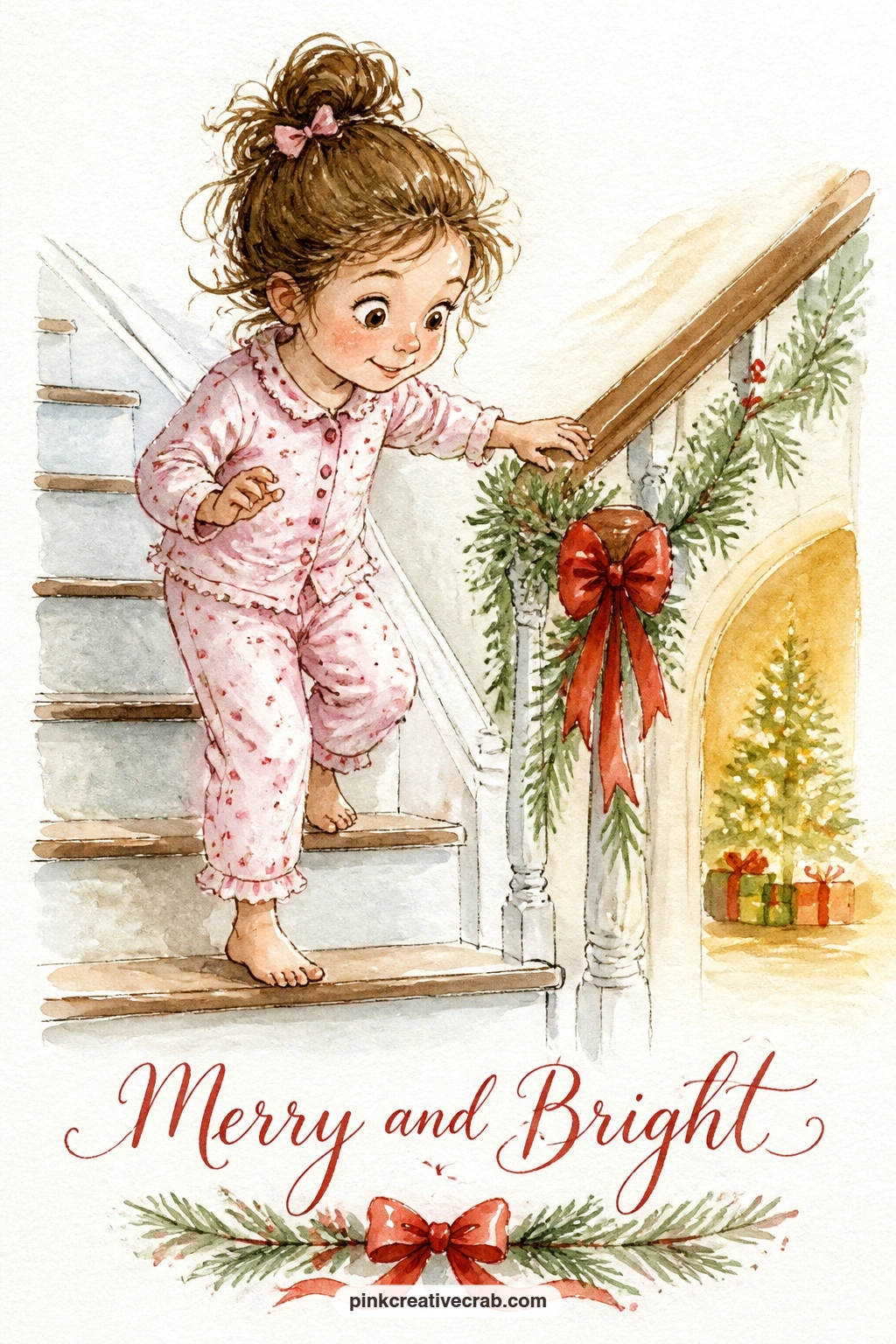
Build some gentle excitement with a little girl in pajamas tiptoeing downstairs on Christmas morning, a classic quiet moment that works beautifully with simple staging. Sketch a few stair steps diagonally across the lower half of the page, the girl mid step with one hand on the banister, eyes wide and a small excited smile.
Paint the stairs first in a soft wood brown, then the girl in a cosy pajama colour once dry, keeping her pose caught mid motion with one foot slightly raised rather than flat footed and static. A faint warm glow painted at the top or bottom edge of the scene suggests the tree lights waiting just out of sight without needing to paint the whole tree.
Her wide eyes are the whole story here, so keep them larger and rounder than a resting face, with the eyebrows lifted slightly above them, a tiny adjustment that reads instantly as excitement. If stairs feel tricky to draw in perspective, a single open doorway with warm light spilling through tells the same story just as well.
Leave her slippers a simple rounded shape with no detail, tiny feet need very little to read clearly.
Palette: Burnt Sienna,Soft Pink,Cherry Red,Pale Blue
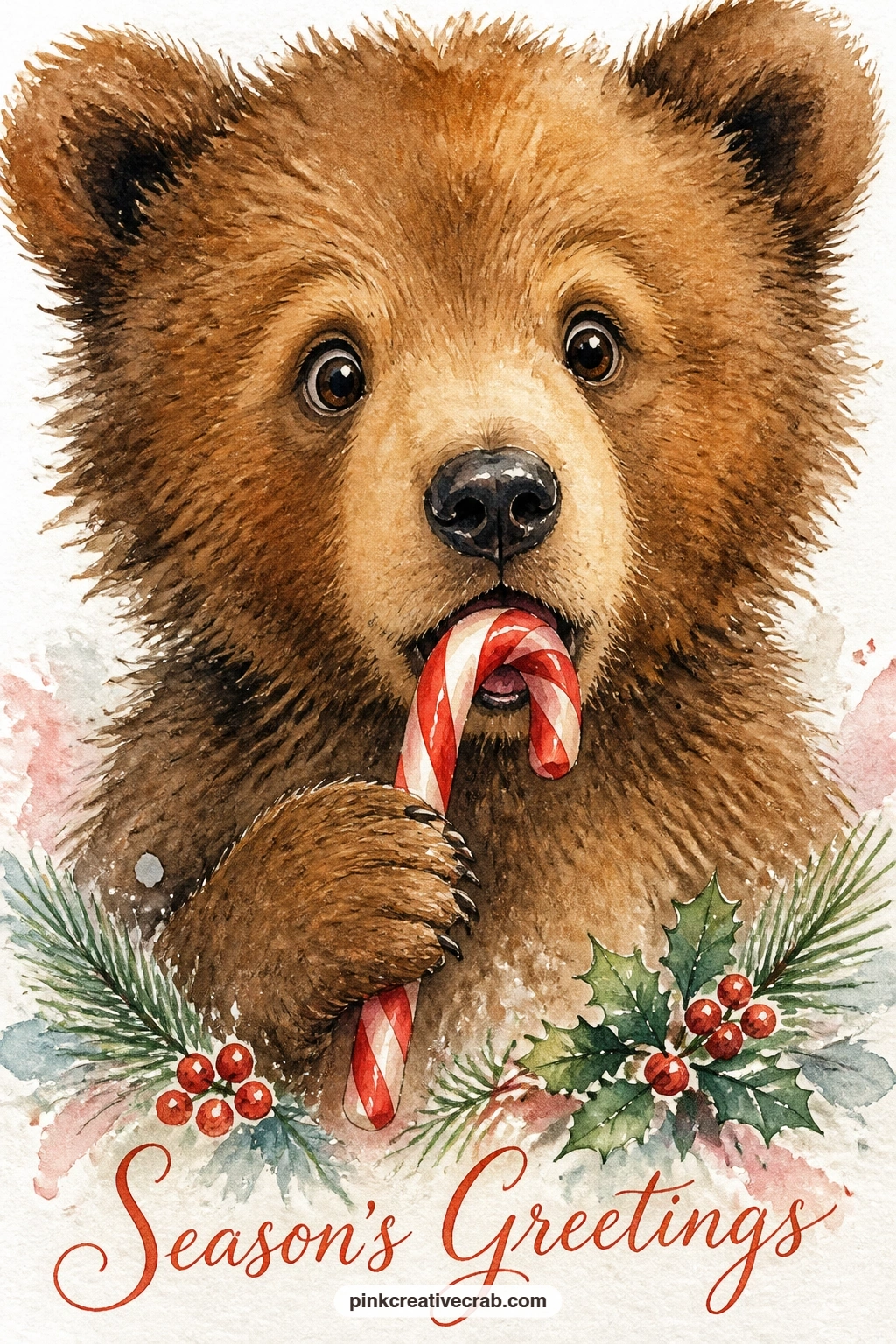
Bring in a bit of comedy with a bear cub tasting a candy cane for the very first time, a simple close up subject built almost entirely around one expression. Sketch the cub’s head and shoulders large in the frame, one paw holding a striped candy cane up near its mouth, eyes slightly scrunched in surprise.
Paint the cub’s fur in warm sienna first, leaving the candy cane as bare white paper until last, then add the cherry red stripes with a fine brush once the fur is completely dry so the white stays clean and bright. The expression carries the whole picture, so keep the mouth a small simple curve, either a tight pucker or a wide surprised circle, whichever feels more fun.
Getting that reaction right is mostly about the eyebrows, raise them slightly and bring them a touch closer together, and even a simple cub face reads as mid taste test. If stripes down a curved candy cane feel fiddly, a straight candy cane shape simplifies the whole painting without losing any charm.
A close, cropped composition like this one works well since the face has room to be the whole focus of the card.
Palette: Burnt Sienna,Cherry Red,Soft Pink,Payne’s Grey
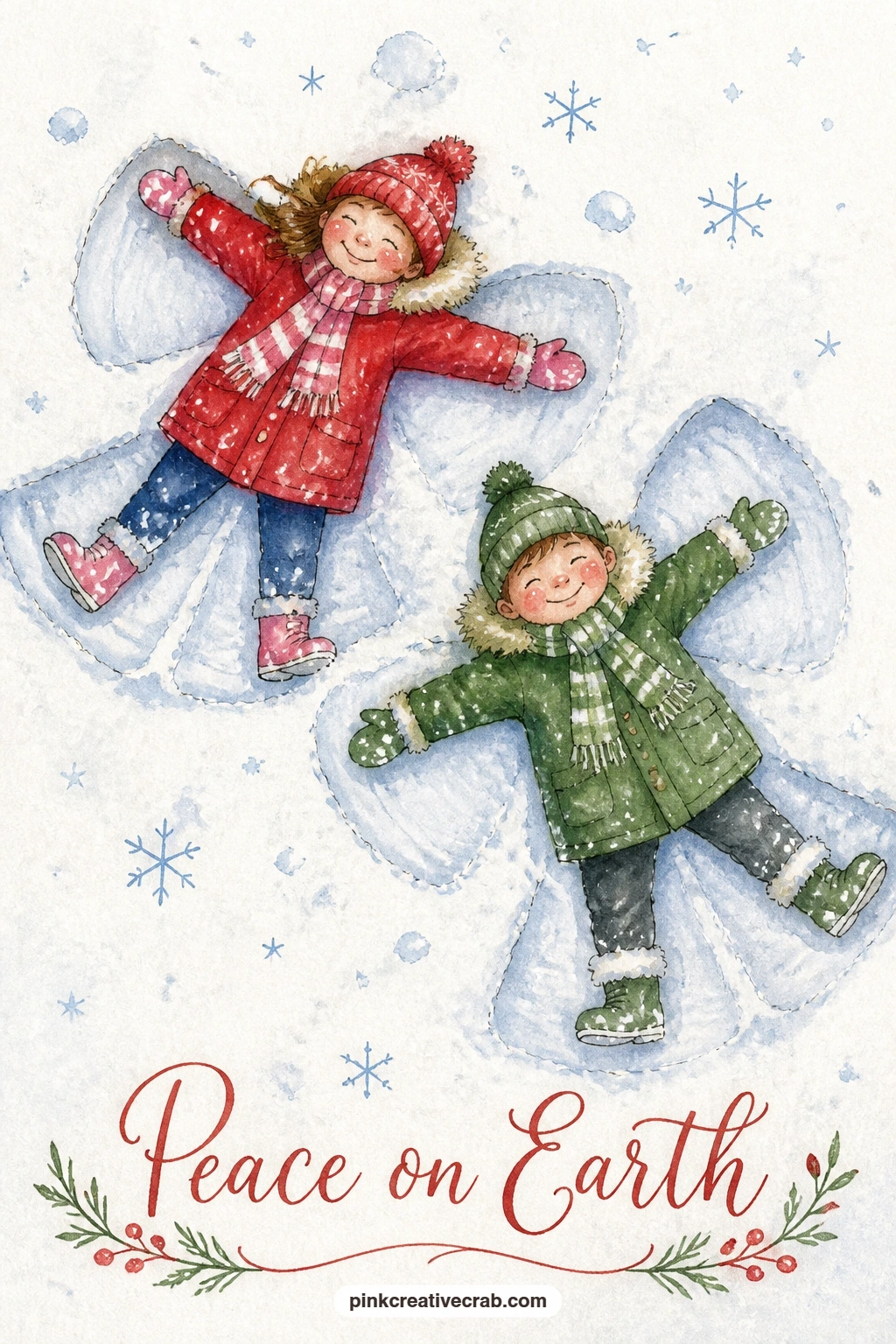
Open up the page again with children making snow angels in a snowy garden, a scene built from simple flat shapes seen from slightly above. Sketch two children lying on their backs, arms and legs spread into the beginnings of angel wing shapes, with the faint fanned marks already showing in the snow around them.
Paint the children’s coats in two different bright colours first, then the snow angel marks around them as soft curved pale blue grey lines, using a slightly dry brush so the lines look pressed into snow rather than drawn on top of it. Keep their faces turned up toward the sky, simple closed happy eyes, since a downward glance would not suit lying flat on their backs.
Working from slightly above, a bird’s eye angle, is what makes this pose read correctly, so keep both children’s whole bodies visible and roughly symmetrical rather than foreshortened as if standing. If two full figures feels ambitious, one child making a snow angel alone works just as sweetly and is a simpler shape to manage.
Let the angel wing marks fade softly at their outer edges rather than ending in a hard line, which keeps the snow looking undisturbed beyond them.
Palette: Cherry Red,Pine Green,Pale Blue,Soft Pink
Bring the mice back for a funny bit of scale with a mouse wrapping a present bigger than itself in brown paper, a subject that plays entirely on size contrast. Sketch a box noticeably larger than the mouse first, then the mouse beside or partly behind it, paws stretched to hold down a corner of brown paper that clearly outsizes it.
Paint the box in a warm brown paper wash first since it covers most of the page, then the mouse in grey once dry, keeping it small enough in proportion that the comedy of the size difference reads immediately. A single length of cherry red ribbon or string, painted as one continuous wavy line, ties the whole package together and gives the eye a path to follow across the page.
Scale is the entire joke here, so measure the box against the mouse before you ink anything, it should tower at least three or four times the mouse’s own height to really land. If a plain brown box feels dull, a few loosely painted brown paper creases and folds add texture without any extra drawing complexity.
Keep the mouse’s expression determined rather than distressed, a small focused frown sells the effort better than a worried one.
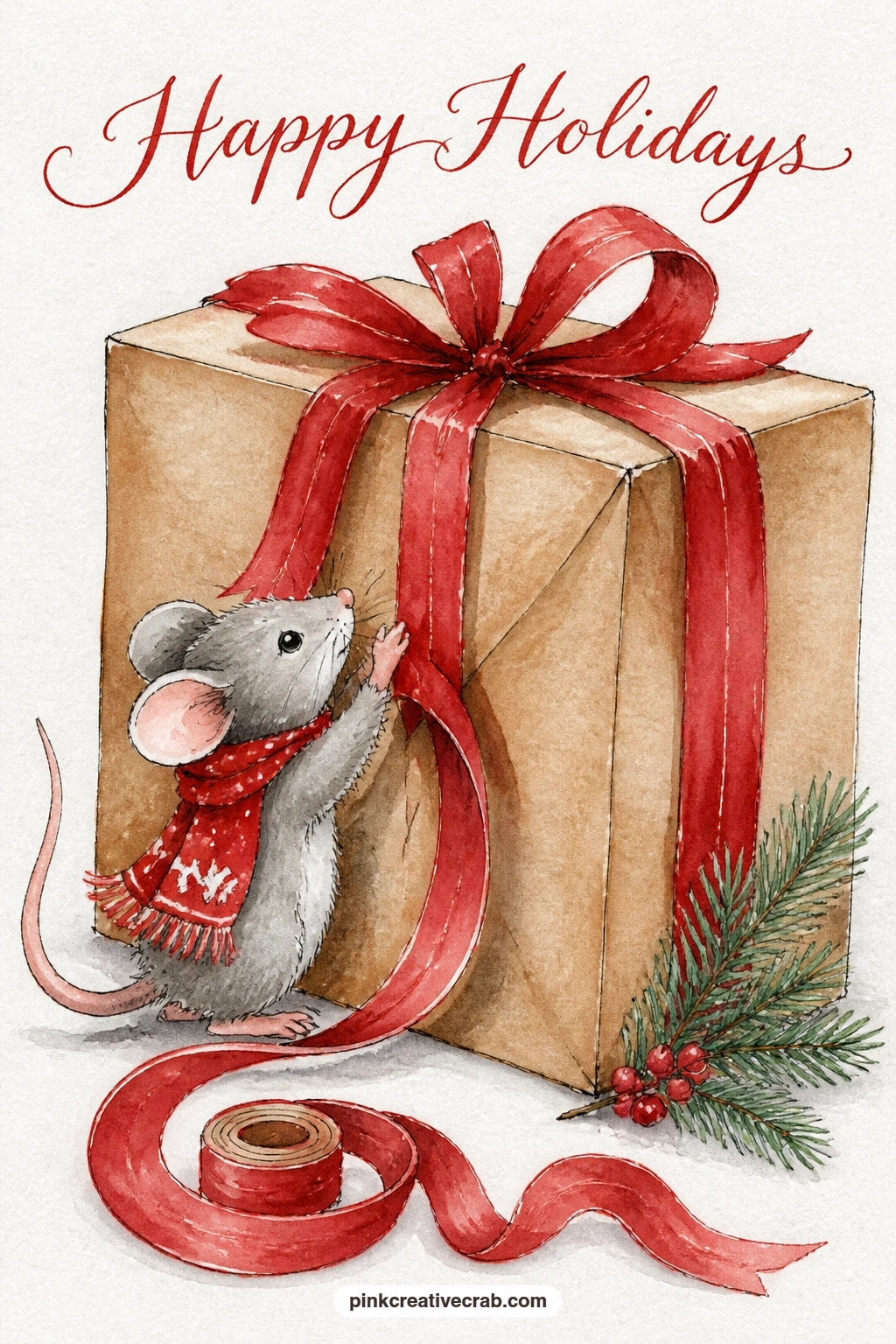
Palette: Burnt Sienna,Cherry Red,Payne’s Grey,Pine Green
Move into Christmas morning proper with siblings in matching pajamas unpacking a stocking on the rug, a cosy two figure scene full of small props to scatter. Sketch two children seated close together on the floor, one holding a half emptied stocking, small toys and an orange tumbling out around them.
Paint their matching pajamas in the same pattern or colour first, which is what reads as siblings at a glance more than facial similarity ever could. Scatter the spilled contents, a wooden toy, a small orange, a ribbon, last in a few accent colours so the pile feels varied without becoming cluttered.
Matching outfits are the quickest way to tell this story, so keep both pajama sets identical in colour and pattern even if the children’s poses differ. If a full stocking spill feels like too much detail for one sitting, keep it to just two or three spilled items instead of a whole scattered pile.
For more handmade card front ideas in this same cosy family mood, the Christmas card painting ideas list is worth a look.
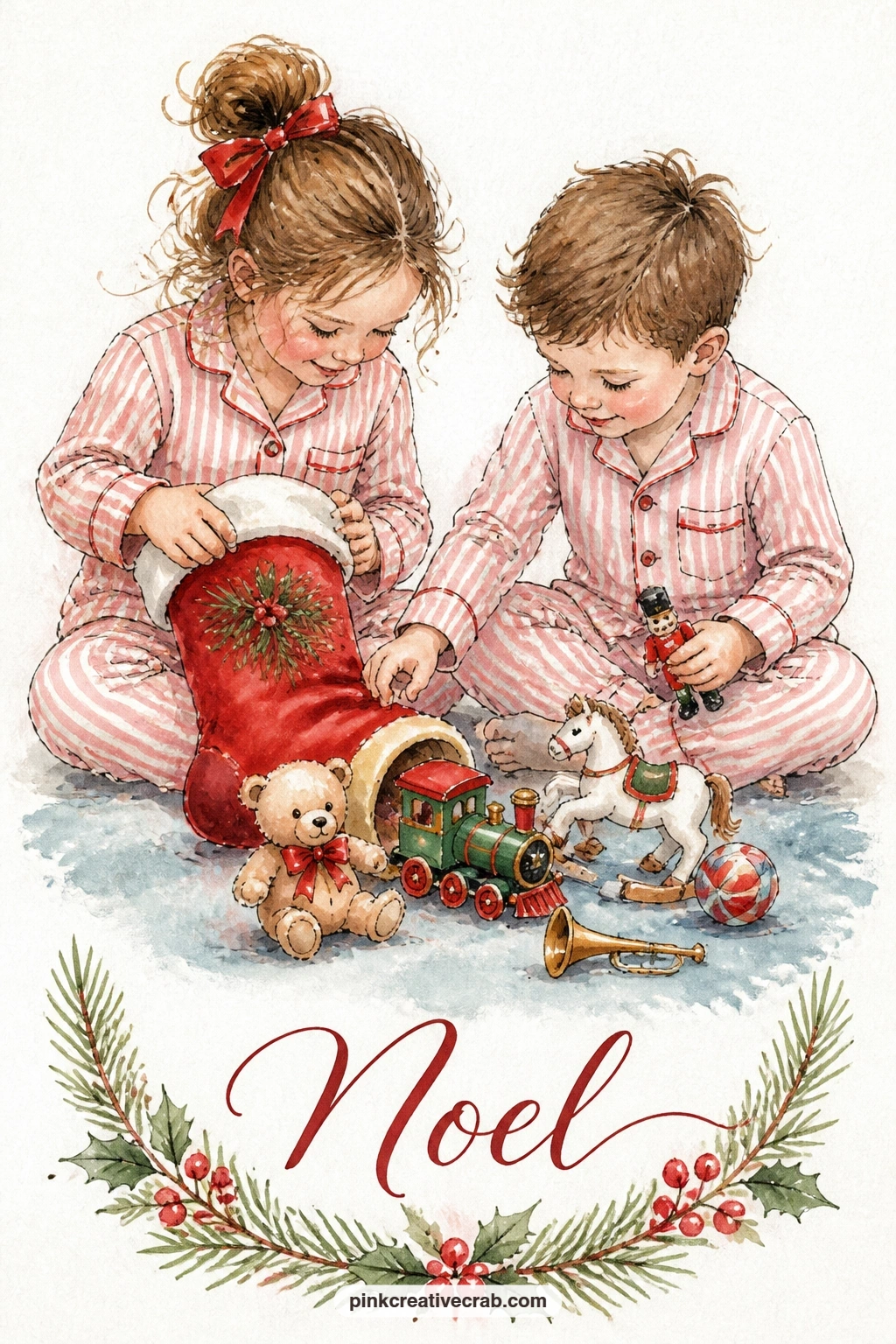
Palette: Soft Pink,Cherry Red,Burnt Sienna,Pine Green
Give the bears a quiet solo moment with a bear knitting socks in a rocking chair by the fire, a calm subject that lets the character’s pose carry everything. Sketch the rocking chair first, slightly tilted to suggest motion, then the bear seated in it with knitting needles and a half finished sock in its paws, a small ball of yarn resting on the floor nearby.
Paint the chair in warm wood tones first, then the bear in sienna over the top once dry, and finally the yarn and half finished sock in cherry red as the one bright note in an otherwise warm, muted scene. A soft orange glow suggested at one edge of the page stands in for the fire without needing to paint flames in full.
The rocking chair’s tilt is the detail to get right, angle the chair runners slightly rather than drawing them flat level, and the whole scene reads as gently rocking rather than static. If knitting needles feel fiddly at this scale, swap them for a simple book resting open on the bear’s lap instead.
Let the yarn ball unspool in one loose curved ink line trailing toward the bear’s paws, it adds motion without any extra painting.
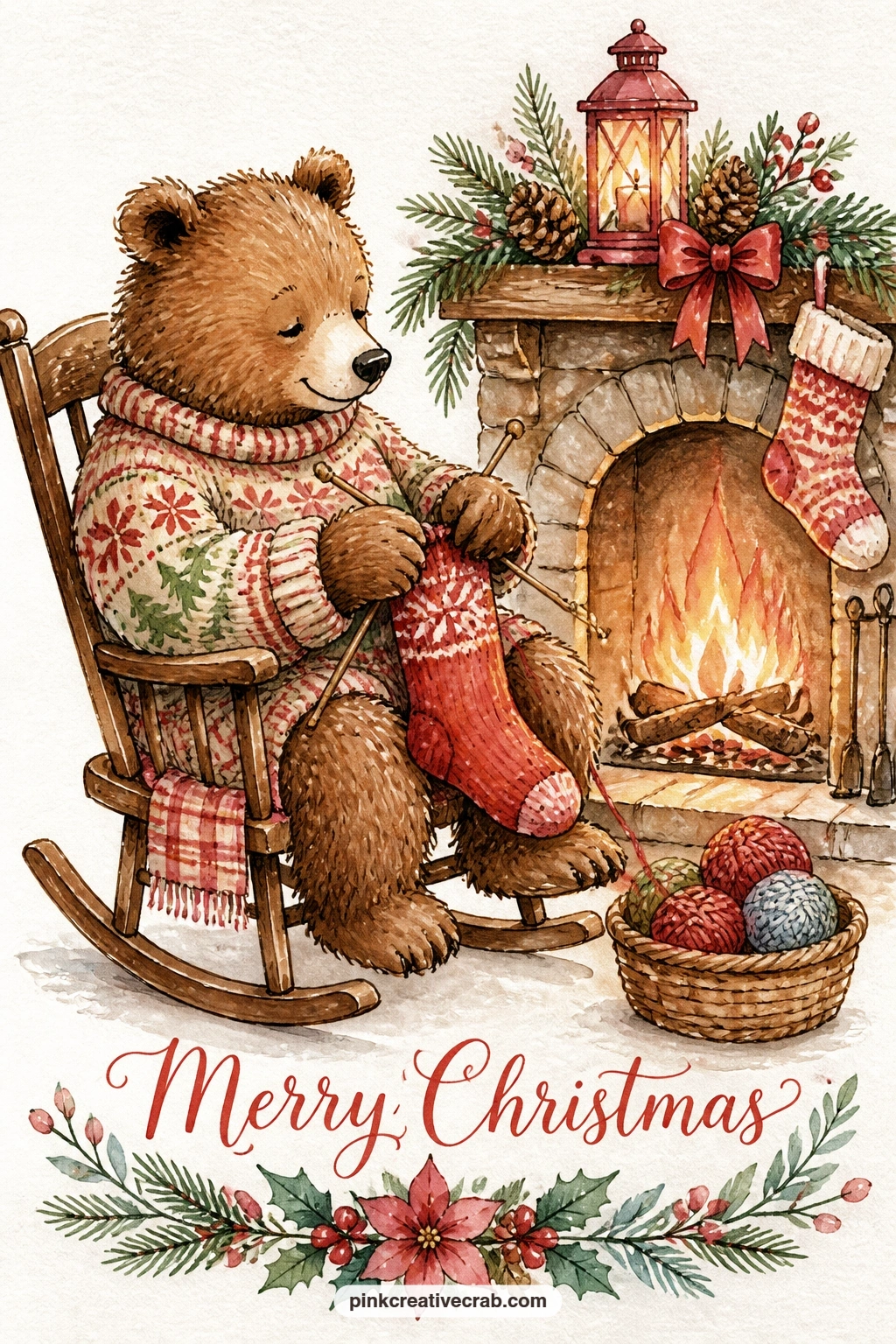
Palette: Burnt Sienna,Cherry Red,Payne’s Grey,Soft Pink
Bring the children back outside with a little girl leaving a cookie for a robin on the windowsill, a sweet small gesture with just two characters. Sketch the windowsill as a simple horizontal ledge first, the girl leaning out slightly from a window above or beside it, a small plate holding one round cookie, and a robin perched close by watching.
Paint the girl and her warm coat first, then the windowsill and plate once dry, and finish with the robin in its classic red breast and brown wings, placed just a little distance from the cookie as if approaching cautiously. Keep the cookie simple, one round shape with a few tiny ink dots for texture, since a plain round cookie reads clearly even at a small scale.
Look closely at where the robin’s eye line sits relative to the cookie, keeping its head turned slightly toward the plate rather than facing straight ahead, which makes the whole gesture of the scene click into place. If painting a bird’s feather detail feels daunting, a flat red breast shape with just a thin wing line is plenty at this size.
Give the girl a small scarf in a colour that echoes the robin’s red breast, it ties the two characters together visually.
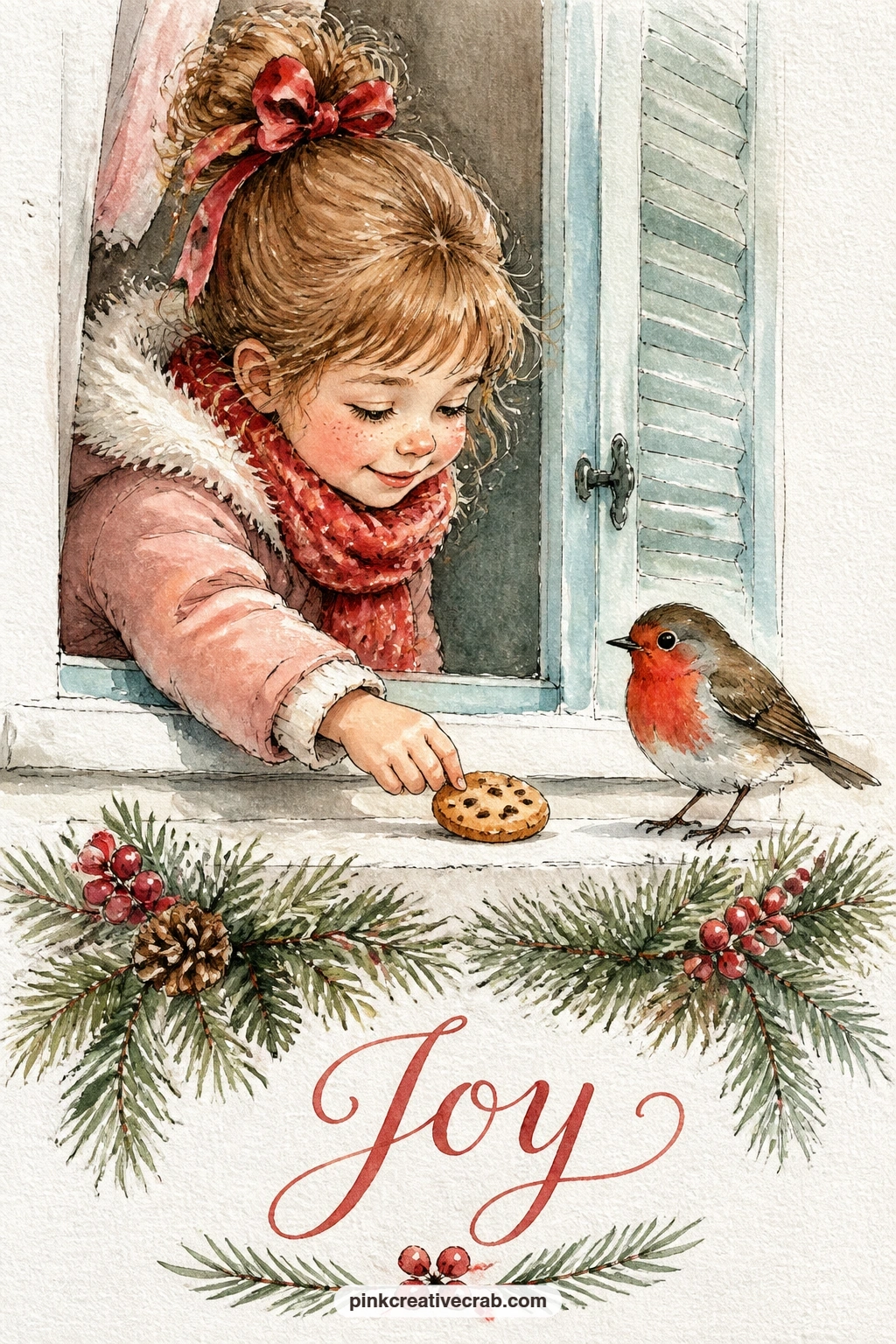
Palette: Cherry Red,Burnt Sienna,Soft Pink,Pale Blue
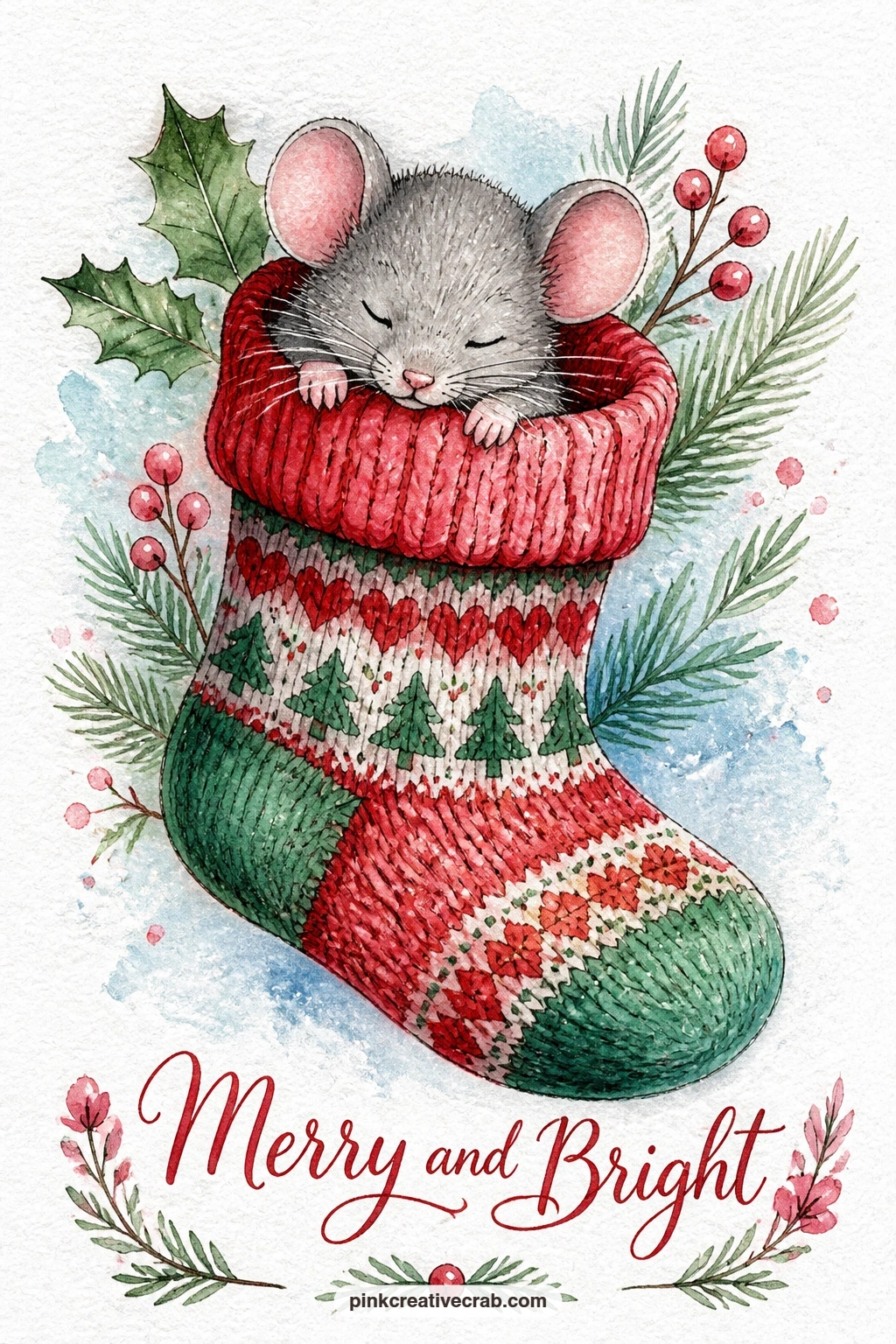
Return to the mice with a mouse curled up asleep inside a knitted Christmas stocking, a snug single subject that pairs nicely with the earlier walnut shell bed. Sketch the stocking shape first, wide at the top and curving down to a toe, then the mouse nestled inside with just its head and one paw peeking over the top edge.
Paint the stocking in cherry red with a pine green cuff band first, since the knit texture reads well as a slightly dry, broken brushstroke rather than a smooth even wash. Once that dries completely, add the sleeping mouse’s grey head and paw peeking over the rim, keeping the rest of its body implied rather than shown, tucked safely out of sight.
A swap worth knowing: if cherry red and pine green together feel like too much contrast for your card, a single warm cream stocking with a red cuff is a softer, equally charming alternative.
Keep the visible paw loose and relaxed, fingers slightly curled rather than gripping anything, which is the small detail that sells the sense of deep, cosy sleep.
Palette: Cherry Red,Pine Green,Payne’s Grey,Soft Pink
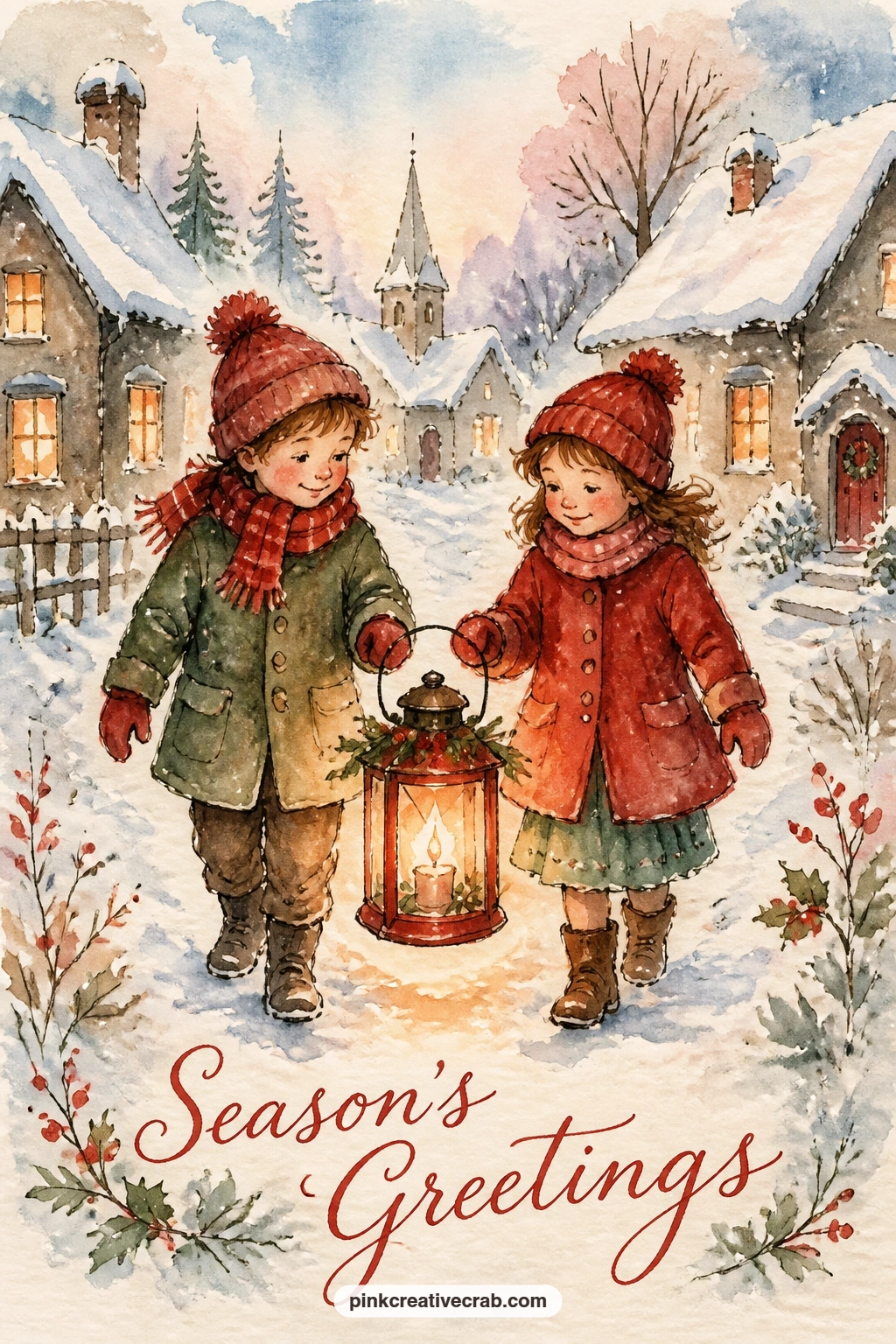
Take the children on a small outing with two kids carrying a lantern through a snowy village at dusk, a scene with a lovely built in light source to play with. Sketch the two children walking side by side first, one holding a small lantern between them, with a few simple rooftop shapes receding behind in the dusk light.
Paint the dusk sky first as a soft gradient from pale blue at the top to a warmer lavender pink near the horizon, letting the colours blend wet into wet. Once that is completely dry, paint the children and distant rooftops in silhouette-like darker tones, then drop in the lantern’s warm glow last, a small circle of orange with the faintest halo bleeding softly into the dusk around it.
That lantern glow is the whole light source for the scene, so keep every other light note in the picture cooler and dimmer by comparison, including the children’s own faces, which should sit mostly in soft shadow near the warm circle. If a full dusk sky gradient feels tricky to control, a flat pale blue sky with just the lantern glow still tells the story warmly enough.
Let the lantern light touch only the ground and figures nearest to it, fading out completely within a short distance for a convincing small glow.
Palette: Pale Blue,Soft Pink,Burnt Sienna,Cherry Red
If you enjoy painting small lit scenes like this, the Christmas festival drawing ideas have more market and village lighting to explore.
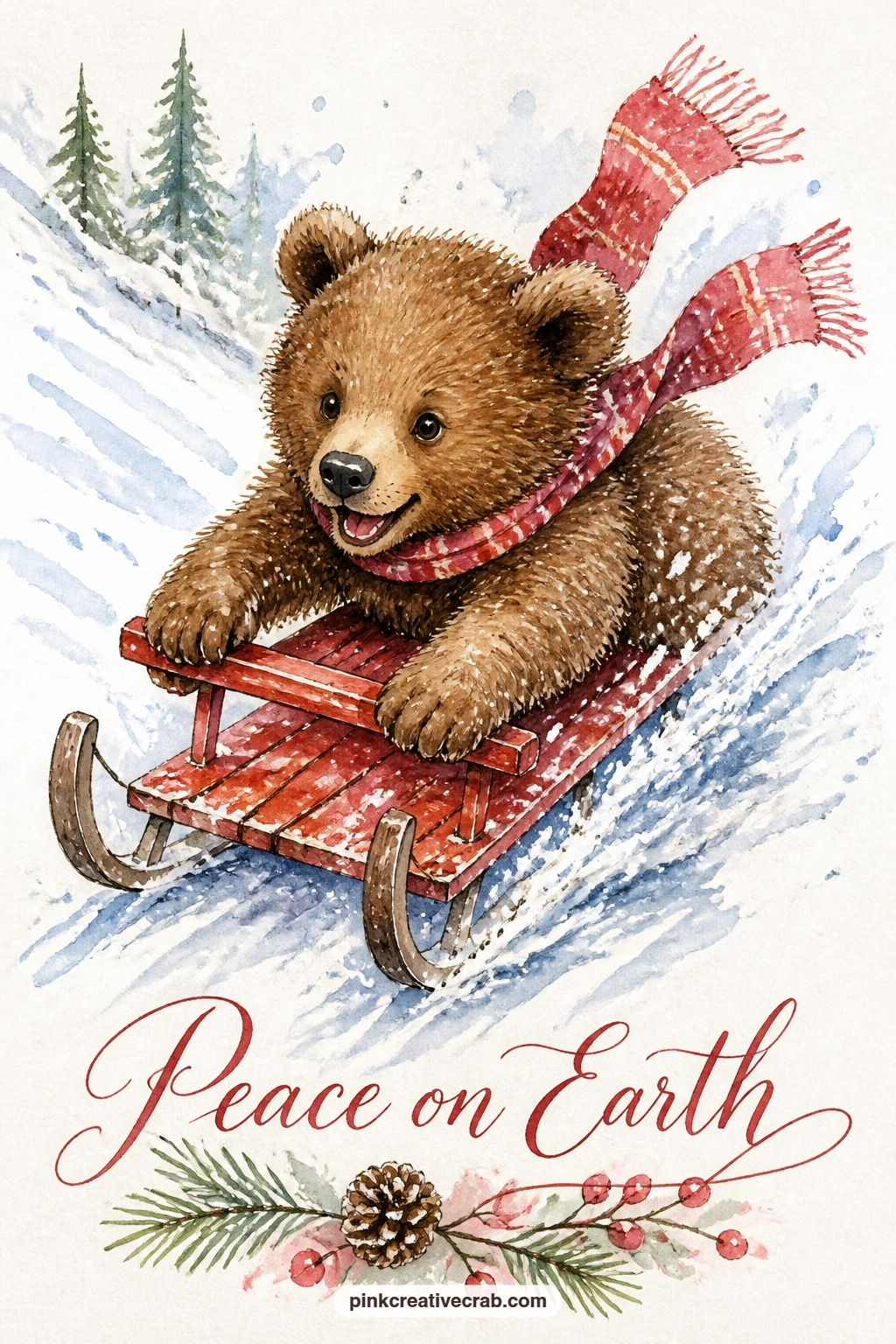
Bring back motion with a bear cub speeding down a hill on a red wooden sled, a joyful action subject that pairs well against the calmer lantern scene before it. Sketch the hill as one sweeping diagonal line first, the cub leaning back on the sled with arms raised, a small spray of snow kicked up behind the runners.
Paint the hill’s snow in pale blue grey shadow on one side to suggest the slope’s curve, then the cub and sled in warm sienna and cherry red once that base is dry. The snow spray behind the sled is the detail to get energetic, flick a loaded brush quickly rather than painting careful dots, letting the spatter land where it will.
Diagonal placement sells the speed here more than anything else, keep the whole sled and cub tilted along that hill line rather than level, and even a simple cub shape reads as flying downhill. For an easier version, slow the cub down to a gentle glide near the bottom of the hill rather than full speed at a steep angle.
Raised arms on the cub, rather than gripping the sled tightly, is what makes the whole pose feel thrilled rather than anxious.
You Will Need
- old toothbrush for snow spray
Palette: Cherry Red,Burnt Sienna,Pale Blue,Payne’s Grey
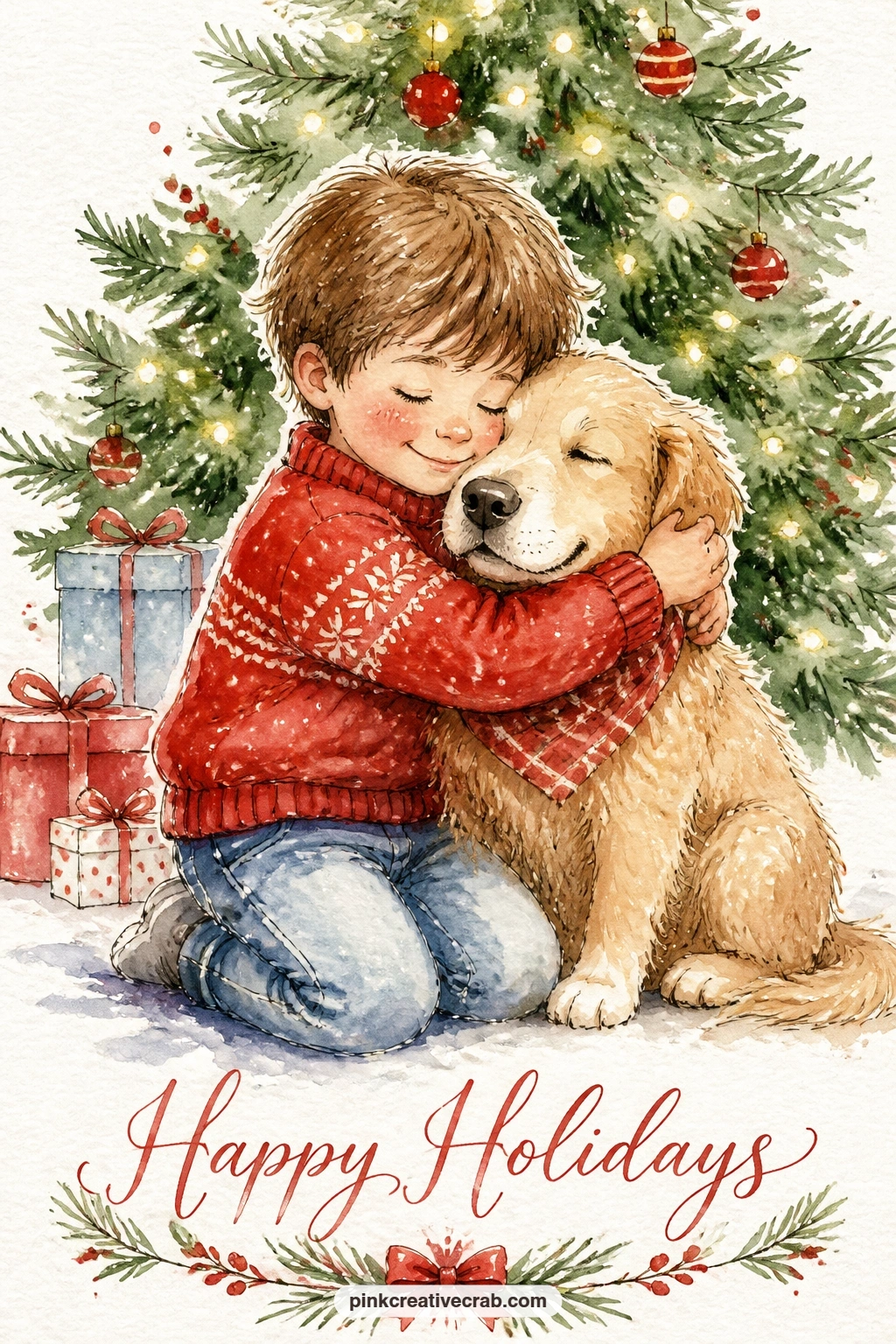
Bring warmth with a small boy hugging his dog under a twinkling tree, a tender close pairing that works beautifully as a single still moment. Sketch the boy kneeling or sitting with both arms wrapped around a medium sized dog, heads close together, with the tree rising softly behind them, a few scattered light dots among its branches.
Paint the boy and dog as one connected shape first, since their overlapping bodies should read as a single warm mass before any detail goes in, then separate their fur and clothing textures once that base dry wash has set. The tree lights go in last, a few small dabs of warm yellow and cherry red dotted loosely through the green, more effective scattered unevenly than in any tidy pattern.
Keeping the boy and dog’s heads close together, nearly touching, is what makes the hug read as genuinely affectionate rather than just two figures standing near each other. If a specific dog breed feels hard to capture, a simple rounded shape with floppy ears reads as a dog clearly enough at this scale without needing breed accuracy.
Dot the tree lights with the very tip of a round brush rather than a flat wash, which keeps them looking like individual bulbs rather than a blurred glow.
Palette: Pine Green,Burnt Sienna,Cherry Red,Soft Pink
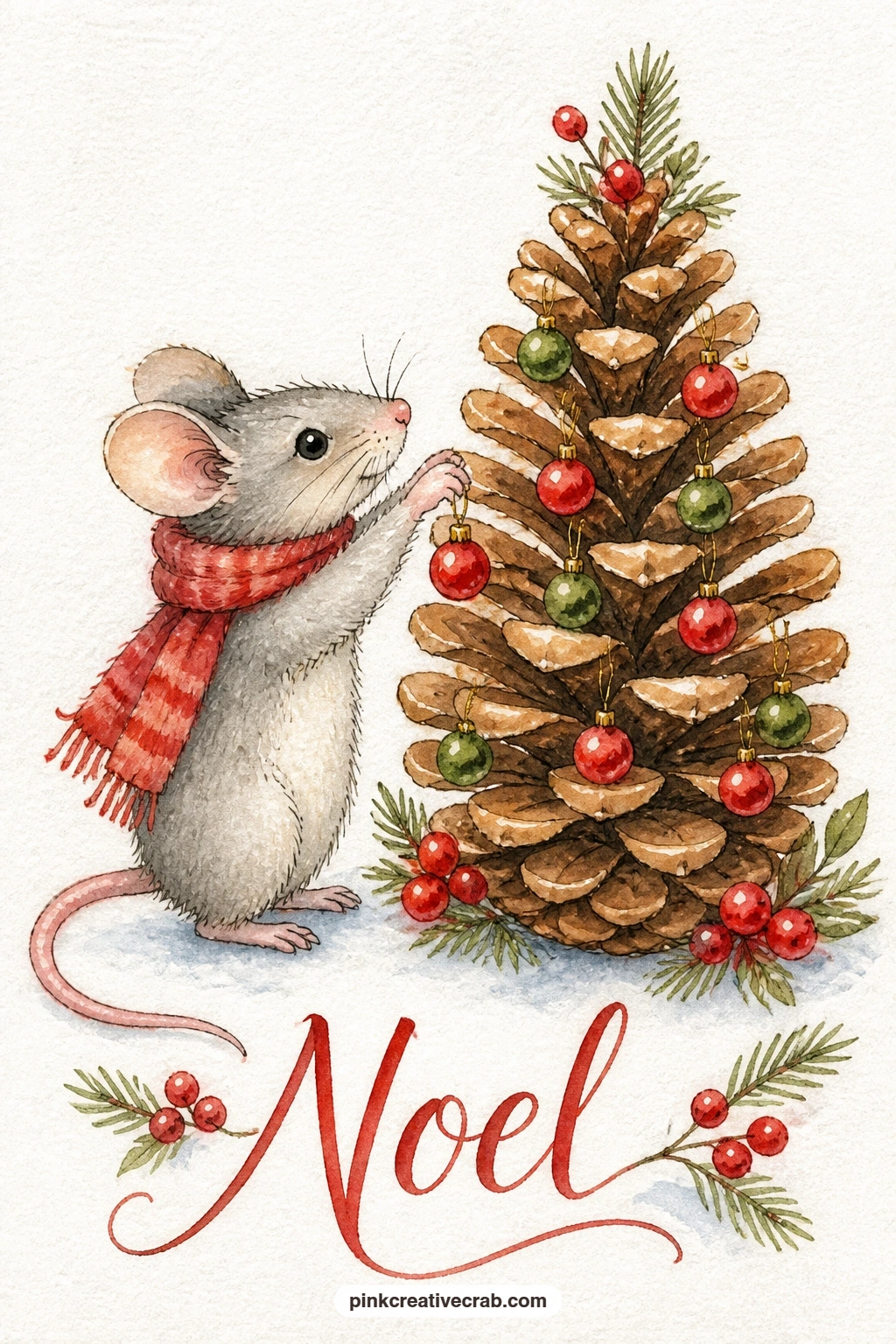
Bring the mice back one more time with a mouse decorating a pine cone as its own little tree, a charming small subject that plays on scale like the oversized present card earlier. Sketch a single pine cone standing upright first, then the mouse beside it reaching up with a tiny strip of ribbon or a few painted dot ornaments to add.
Paint the pine cone in warm sienna with darker brown lines defining its individual scales, working from the base upward so the layered texture builds naturally as you go. Once dry, add the mouse in grey and finish with a few tiny dabs of cherry red and pine green scattered across the cone’s scales as its makeshift ornaments.
Vary it next time by swapping the pine cone for a small twig stuck upright in a thimble of sand, or by having two mice decorate it together instead of one working alone, both keep the same charming scale joke while changing the composition slightly. If individual pine cone scales feel too fiddly to paint one by one, a rough textured dry brush pass over the whole shape suggests them just as well from a short distance.
Keep the mouse’s decorating gesture mid action, reaching rather than standing still, to give the small scene some life.
Palette: Burnt Sienna,Cherry Red,Pine Green,Payne’s Grey
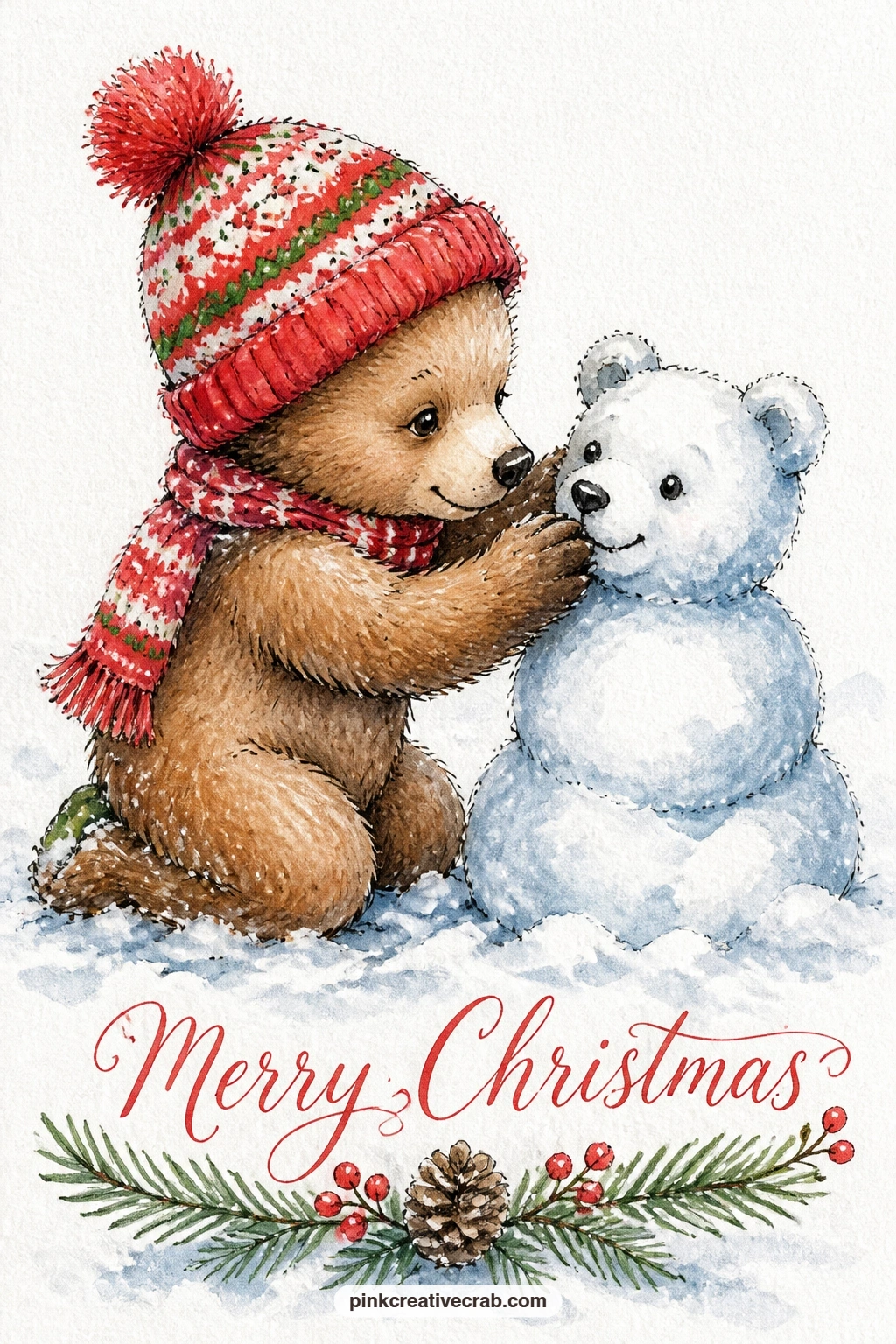
Close the whole list with a baby bear in a bobble hat building a tiny snow bear, a playful last card that mirrors the earlier children’s snowman scene but with a bear in charge this time. Sketch the baby bear first, kneeling with both paws pressed into a small rounded shape of packed snow, the beginnings of its own miniature snow bear taking form in front of it.
Paint the baby bear in warm sienna with a bright bobble hat as the one strong colour accent, then once dry paint the little snow creation in the same pale blue grey used throughout this whole list for consistent snowy surfaces. Keep the snow bear noticeably simpler and smaller than the real cub building it, just a rounded body and two tiny ears, almost like a sketch within the sketch.
That size and detail gap between the real cub and its snow creation is what makes the joke land, so resist adding too much detail to the snow bear even if you want to, plainer reads as more charming here. If a bobble hat feels fiddly at this scale, a simple knitted band without the pom pom still reads warmly.
Finish the whole set with one last practical tip: let this final card dry completely flat before packing any of today’s paintings away, damp watercolor paper curls if stacked too soon.
Palette: Burnt Sienna,Cherry Red,Pale Blue,Payne’s Grey
What to Do Next
Pick one idea that matches the time you have today, cut a card sized piece from your watercolor pad, and paint loosely from the first wash to the last ink line. Once one card feels finished, the next one on this list is already half planned in your head.
Frequently Asked Questions
What watercolor paper works best for small Christmas card paintings?
Cold press watercolor paper around 140lb weight works best, since it takes washes smoothly without buckling at card size. A pad pre cut to standard card dimensions saves trimming time for a whole batch.
How do you keep cute characters looking simple rather than cartoonish?
Keep facial features minimal, two dots or small curves for eyes and a short simple line for a mouth, rather than adding detailed expressions. Soft rounded body shapes with few sharp edges do most of the charm without extra drawing.
Can these ideas be painted without ink pen outlines?
Yes, every idea works with watercolor alone if you paint the shapes with clean edges and let colour boundaries define the forms. The ink only sharpens small details like eyes and whiskers, so skip it and the character still reads clearly.
How long does one of these card paintings take to finish?
Most of these ideas finish within thirty to forty minutes including drying time between layers. Simpler single character subjects near the top of the list often take closer to fifteen to twenty minutes.
What is the easiest way to turn a finished painting into an actual card?
Trim the dry painting to size and glue or tape it to the front of a folded blank card, or scan it and print copies onto cardstock for multiples. Leaving extra white paper around the subject while painting makes trimming far more forgiving.
Have any thoughts?
Share your reaction or leave a quick response — we’d love to hear what you think!
-
 0
-
0
-
0
-
0
-
0
-
0


