Reindeer drawing gives you one of the most rewarding subjects in winter nature painting: a shaggy, soft-edged animal standing in snow that is just as fun to paint as the creature itself. These pages let you mix loose, wet washes for drifts and misty valleys with a few confident ink lines for antlers, hooves and that watchful dark eye, so every piece feels both relaxed and alive.
Below you will find 33 calm winter moments, from a calf on wobbly legs to a whole herd crossing a frozen river, arranged from the simplest to the more involved. Pick whichever one is calling to you, get your paper damp, and you can have a finished reindeer picture before the kettle is cold.
Using these images: free for personal projects such as printing, coloring, cards, journals and gifts. Handmade items that include them may be sold up to 30 pieces per design. More than that is commercial use and is not permitted, and neither is selling or sharing the images themselves or passing them off as your own. Please ask before any other use.
Start with the calf, since getting its proportions right early saves the whole picture. Sketch two ovals in pencil, a small one for the calf’s body set low and a bigger one for the mother beside it, and check that the calf’s legs would only reach about two thirds of the way up her own leg if you compared them side by side. That size gap is what reads as newborn and wobbly rather than just small.
Once the pencil shapes feel right, wet the paper around both animals and drop in a pale icy blue and birch white wash for the snow, letting it bloom unevenly. Paint the mother first in soft chocolate brown, leaving her legs paler and drier so they read as sturdy, then paint the calf in a lighter wash with a slightly pinker brown.
The calf’s legs are the part most likely to go wrong, since too much confidence makes them look adult. Keep them thin, slightly splayed, and a touch uneven, then add ink only at the hooves and the eye once the paint is dry.
If you do not have a large brush for the snow wash, a damp cotton pad dabbed lightly over the area will soften edges almost as well.
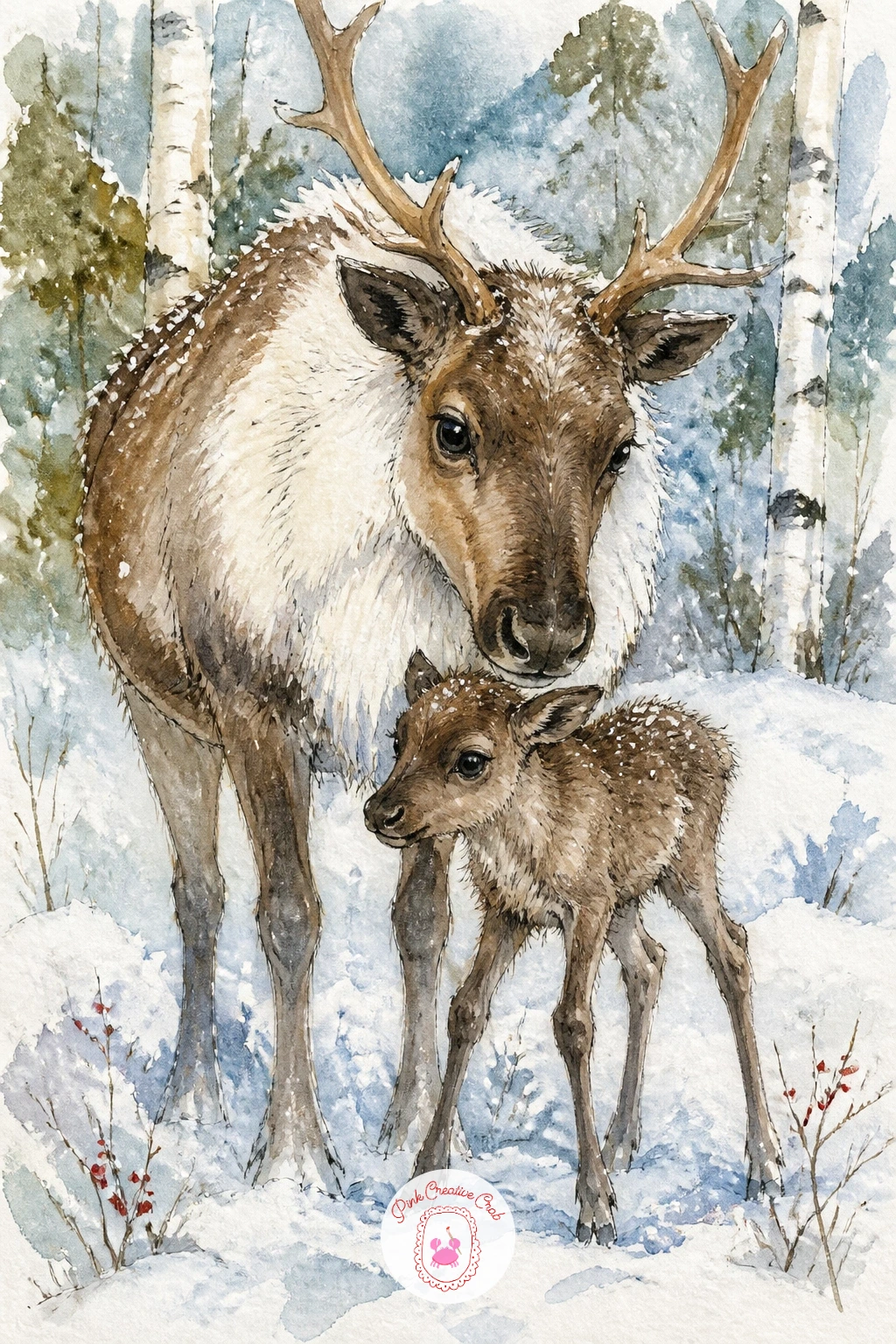
Palette: Icy Blue,Birch White,Soft Chocolate Brown,Payne’s Grey
Scraping snow for lichen is a lovely close-up moment, so let the hoof and lowered head take center stage. Pencil in the reindeer side-on with its neck stretched down and one front leg bent, hoof pressed into the snow, then rough in a shallow dug patch in front of it where the white gives way to pale moss green.
Paint the snow first with a loose icy blue and white wash, leaving a dry gap where the scraped patch will go. Once dry, paint the reindeer’s body in chocolate brown, working from the back toward the lowered head so the darkest fur sits near the neck crease.
The scraped patch is where beginners often overwork the detail. Keep it to a few dry-brush strokes of moss green and brown rather than drawn lichen shapes, then finish with ink on the hoof edge and eye.
If your paper buckles from the wet snow wash, tape the edges down before you start or switch to a slightly heavier weight paper.
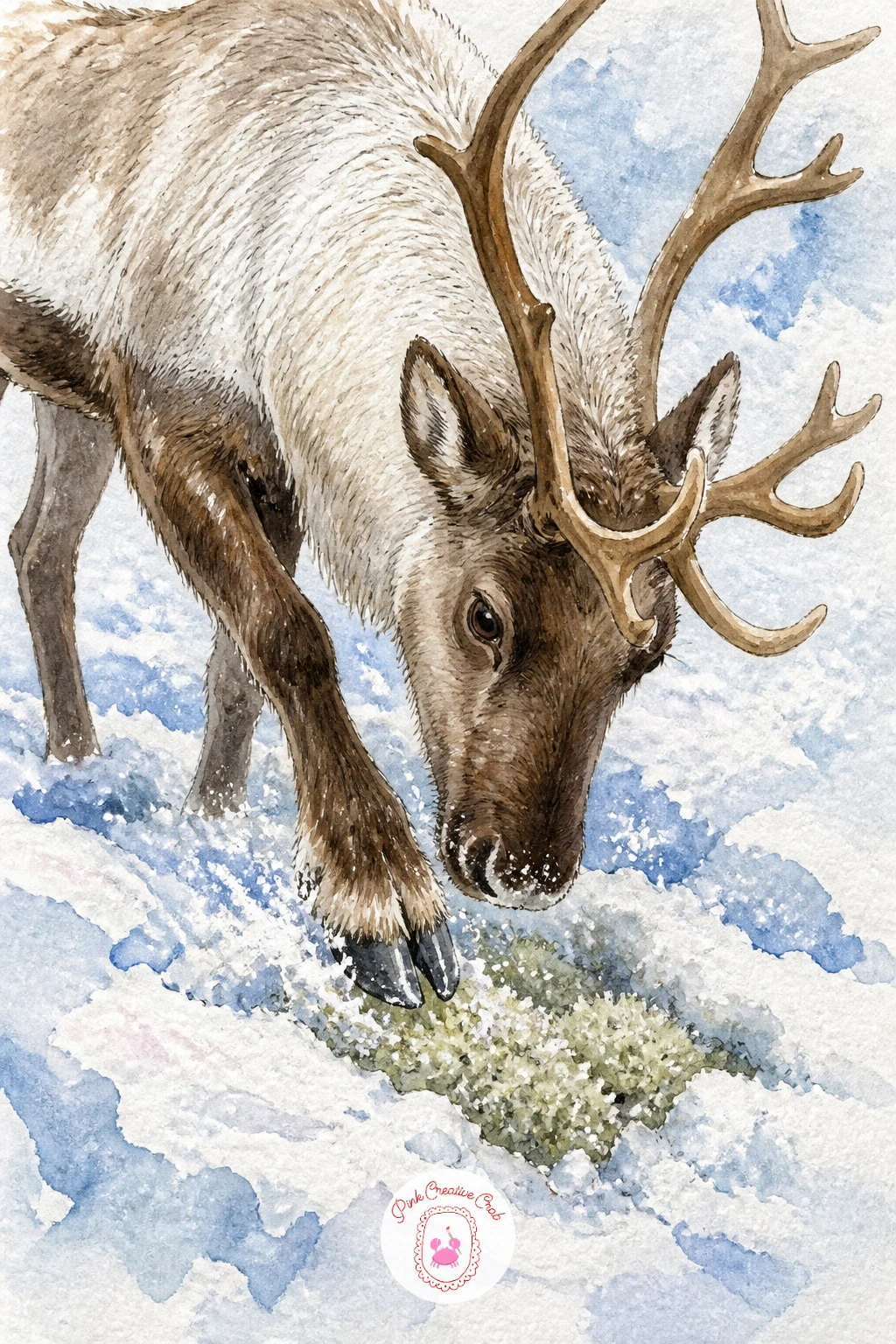
Palette: Moss Green,Soft Chocolate Brown,Icy Blue,Payne’s Grey
A line of reindeer crossing ice is really an exercise in repeating one simple silhouette at different sizes. Draw the nearest animal largest and most detailed, then sketch four or five smaller, simpler versions trailing in a diagonal line toward the far bank, each one just a few confident pencil marks.
Lay a flat wash of pale icy blue for the frozen river first, letting it dry completely so the ice reads smooth rather than snowy. Paint the nearest reindeer with full chocolate brown detail and a touch of cherry red reflected in its eye highlight, then grade the others into looser grey-brown silhouettes as they recede.
Where this scene usually goes wrong is making every animal the same size and tone, which flattens the distance. Keep shrinking and lightening each one, and let the furthest reindeer almost dissolve into the pale background.
Try this layout again sometime with the bird pencil drawing approach to a flock, since the same size-and-tone trick works for any line of animals moving across a page.
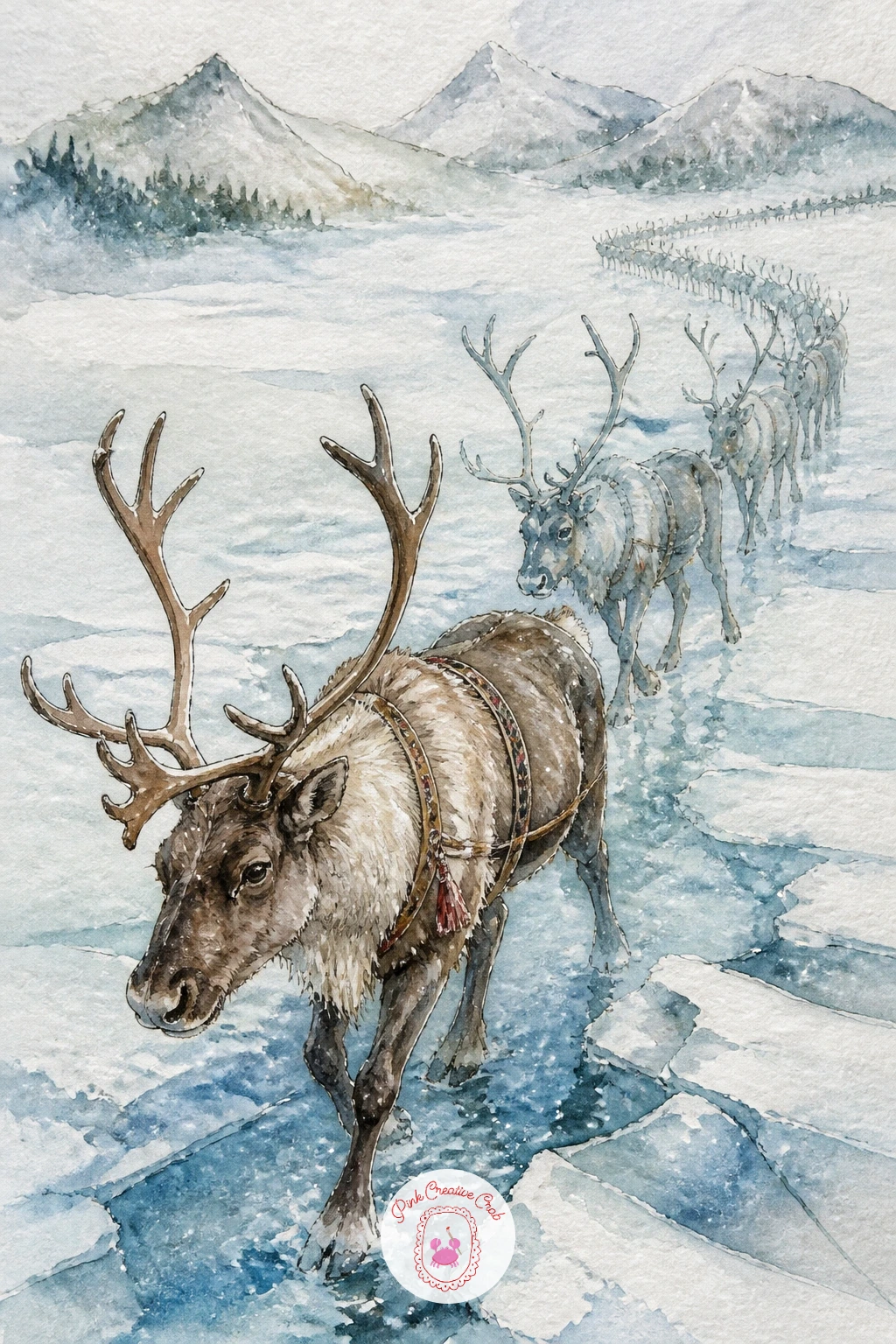
Palette: Icy Blue,Soft Chocolate Brown,Payne’s Grey,Cherry Red
This close portrait lives or dies on the eye and lashes, so draw the head large, filling most of the page, before you touch the forest. Block in the skull shape, the gentle curve of the muzzle, and a single dark almond eye, then pencil in a few short frost marks radiating from the lash line.
Paint the birch trunks behind the head first in pale washes of white and grey, keeping them simple vertical shapes with a few dark horizontal marks for bark. Once dry, paint the reindeer’s face in warm chocolate brown, leaving the muzzle and eye area for careful ink work.
The eye is where beginners rush. Leave a tiny unpainted dot for the catchlight, ring the eye in dark ink, then add the frost on the lashes last with a nearly dry white gouache or masking fluid dot so it sits crisp on top of the dry brown fur.
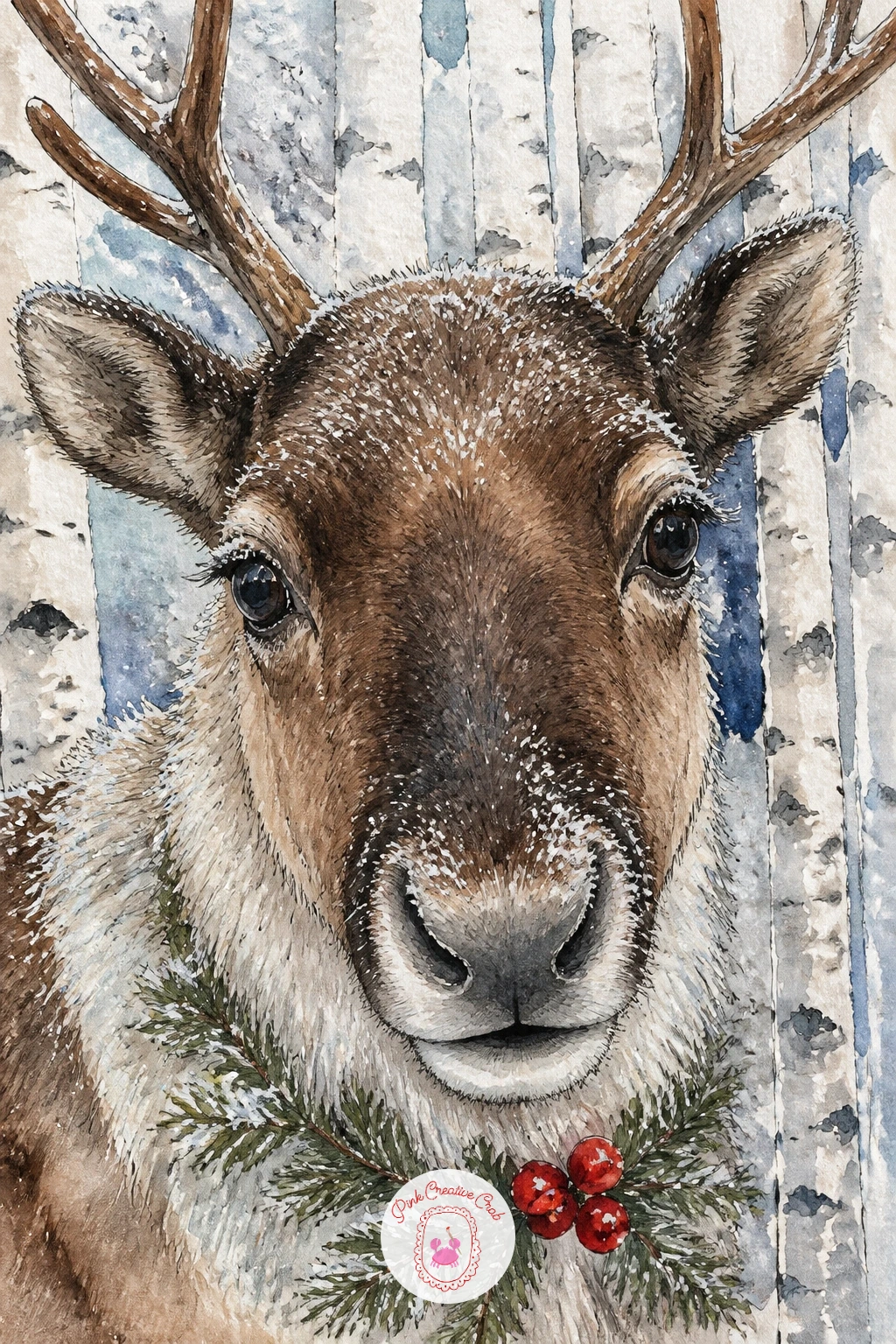
You Will Need
- white gouache or masking fluid for frost highlights
Palette: Soft Chocolate Brown,Birch White,Payne’s Grey,Icy Blue
A soft kneaded eraser dabbed over a dry pencil sketch can lift graphite into a soft frosty haze around the lashes before you even reach for paint.
Pushing antlers calls for two bodies locked together, so sketch them as one connected shape rather than two separate animals. Angle both heads toward each other, let the antler tines overlap in the middle, and keep the back legs braced and slightly apart for balance.
Wash in the snowy clearing behind them first with a pale icy blue and white mix, then paint the nearer reindeer in a slightly warmer brown and the further one a touch cooler and greyer so they separate visually even while their antlers tangle.
Overlapping antlers are the trickiest part, since too many lines turn to visual static. Paint the antler shapes as flat pale shapes first, then add only the essential ink tines once the paint is dry, simplifying rather than copying every branch.
If you want a quicker version, crop the scene tight to just the two heads and locked antlers and skip the full bodies entirely.
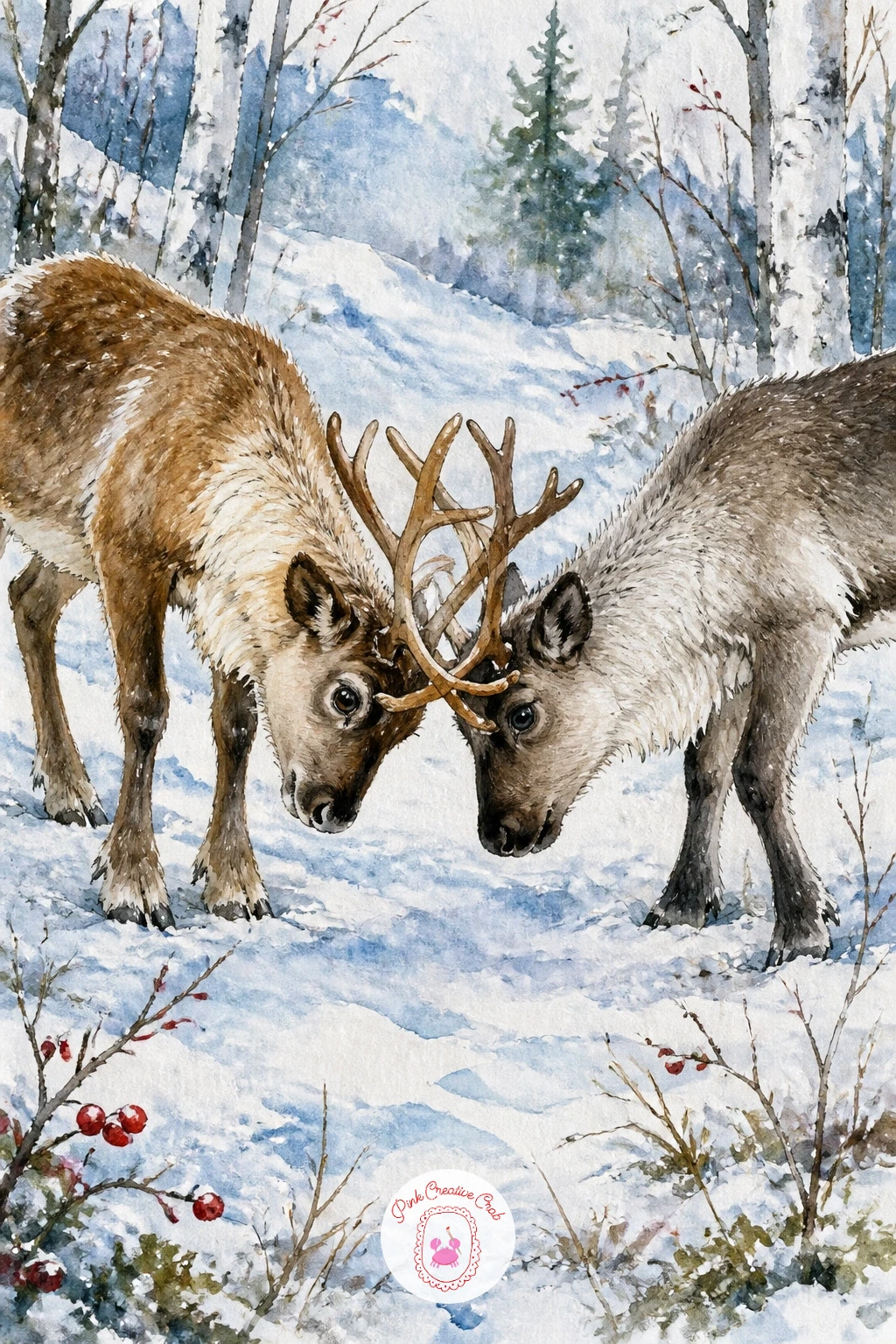
Palette: Soft Chocolate Brown,Icy Blue,Payne’s Grey,Birch White
A resting reindeer is a wonderful chance to paint a calm, rounded shape, so start by drawing the body as a single soft loaf shape with legs tucked beneath. Keep the head slightly lifted and the jaw relaxed mid-chew, with ears turned loosely to one side.
Paint the snow bed first, letting a cool icy blue shadow pool under the body to ground it. Then wash the body in chocolate brown, working wet into wet so the fur edges stay soft, and save a drier brush for the face and ears where the fur reads more crisply.
The jaw is easy to overwork trying to show chewing motion. One simple curved ink line under the muzzle and a small gap at the mouth is enough, so resist adding more lines than that.
For a quick ten minute version, paint just the head and curled-in front legs; the full forty minute version adds the long resting body and its snow shadow.
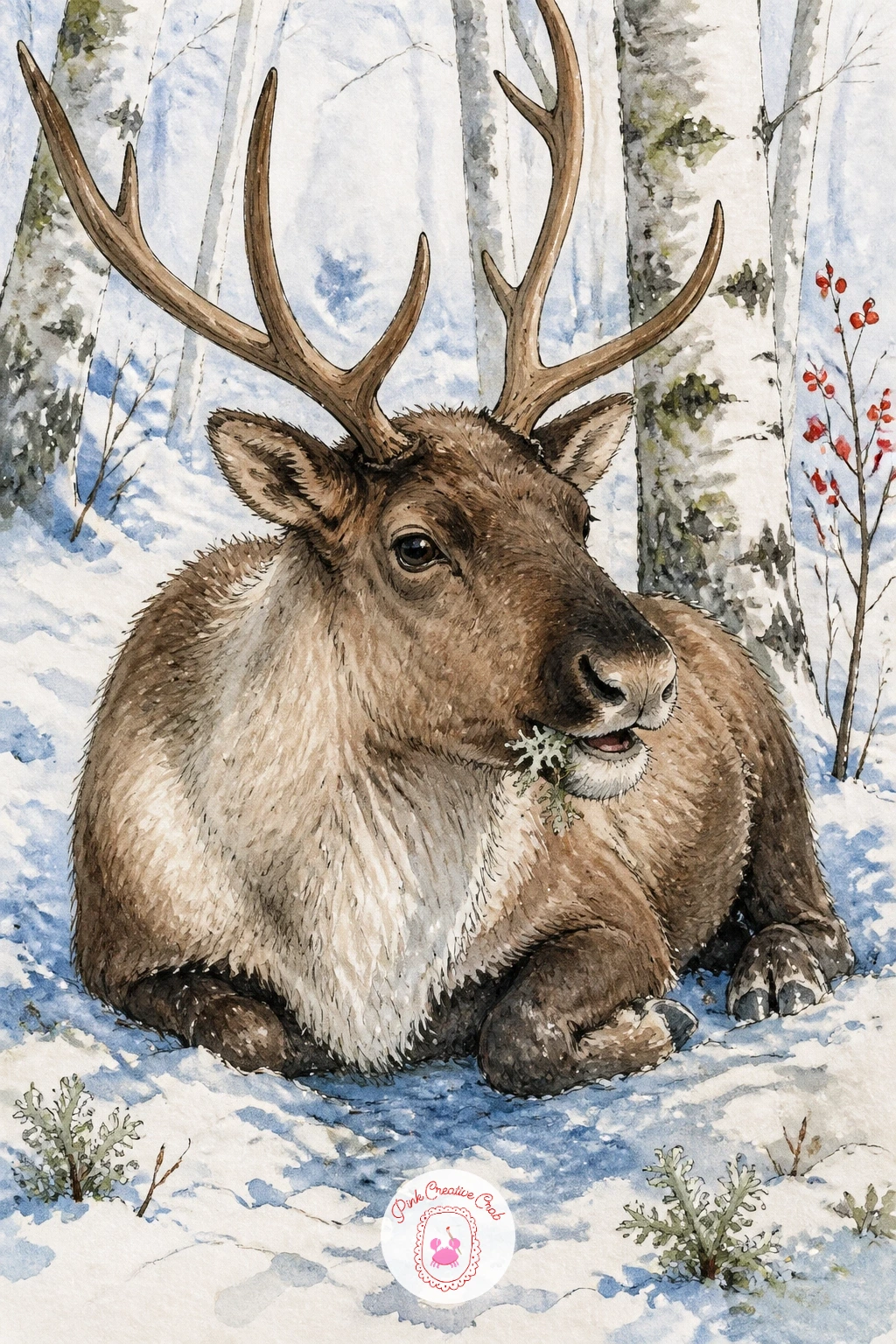
Palette: Soft Chocolate Brown,Icy Blue,Payne’s Grey,Birch White
Snow-laden pines give you a strong vertical frame, so plan the composition before any paint touches paper: two or three pine shapes close on either side, with the reindeer small and walking through the gap between them. This framing does most of the work of making the forest feel deep.
Paint the pines first with a dry brush dragged downward in dark moss green, then dab clumps of birch white along the top edges of the branches for snow load before the green fully dries, so it catches slightly and looks settled rather than painted on top.
The reindeer itself can stay simple here since the trees carry the scene. Keep its silhouette clean in mid-value chocolate brown with just a hint of ink for legs and antlers, and resist adding fur texture that would compete with the busy trees.
Next time, try this same framing with a village scene in place of the reindeer, since heavy snow on trees works the same way around any small figure.
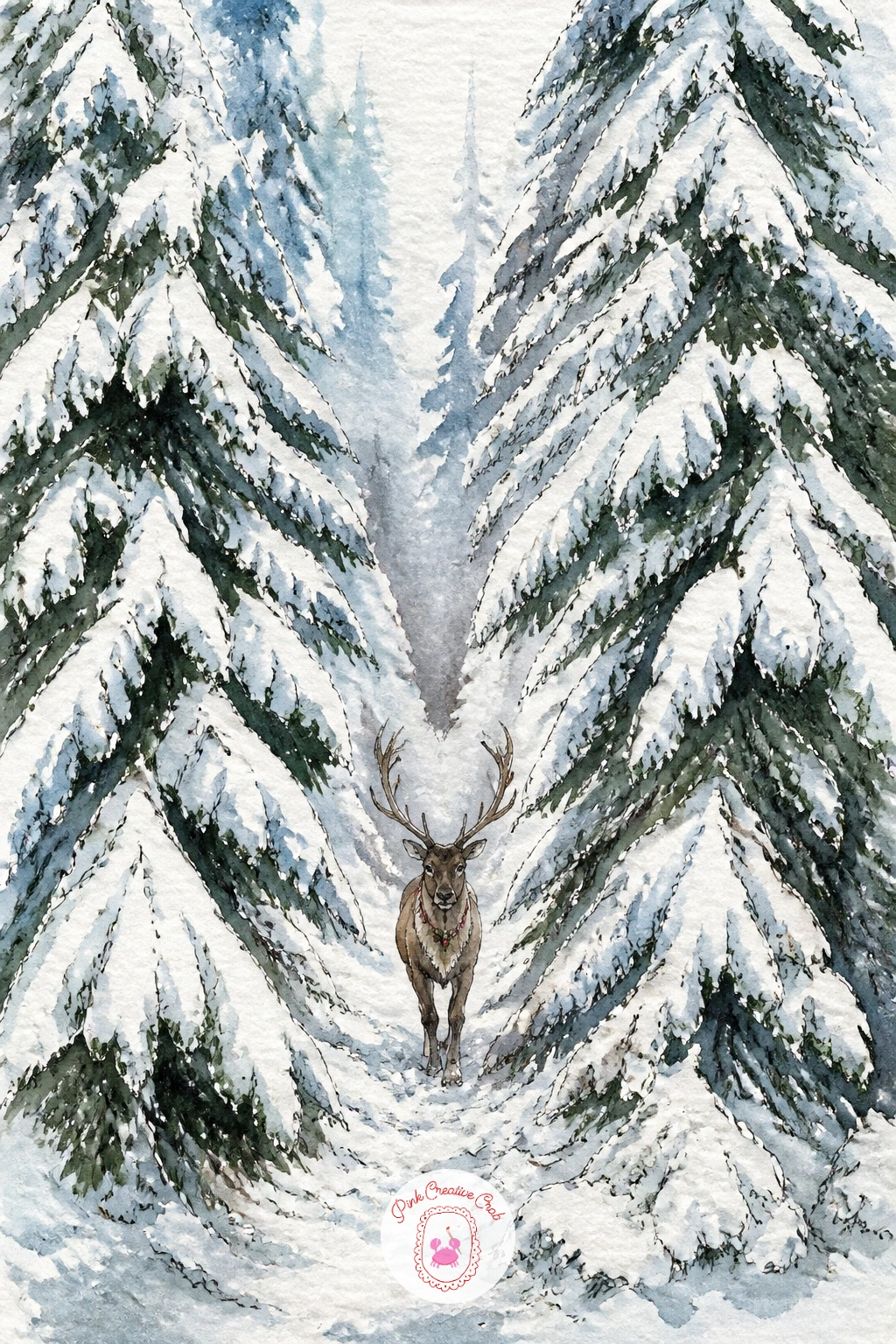
Palette: Moss Green,Birch White,Soft Chocolate Brown,Icy Blue
This is a tender, close moment, so draw the two heads nearly touching, noses almost overlapping, before working out the rest of the bodies. Tilt the calf’s head slightly up and the mother’s slightly down so the gesture of reaching toward each other reads clearly even in pencil.
Paint the background soft and pale first, a loose wash of icy blue and white, so the two faces stay the clear focus. Paint the mother in a fuller, darker chocolate brown and the calf lighter and pinker, then leave a small unpainted patch of snow on her nose for the calf to be “licking.”
Noses and muzzles are where this goes wrong if they are too stiff. Round every edge, avoid any hard straight lines on the muzzle, and add the nostril and mouth marks last in ink with a light, relaxed hand.
If your washes are drying too fast to blend the two heads softly, mist the paper lightly with water first or work on a slightly damp sheet.
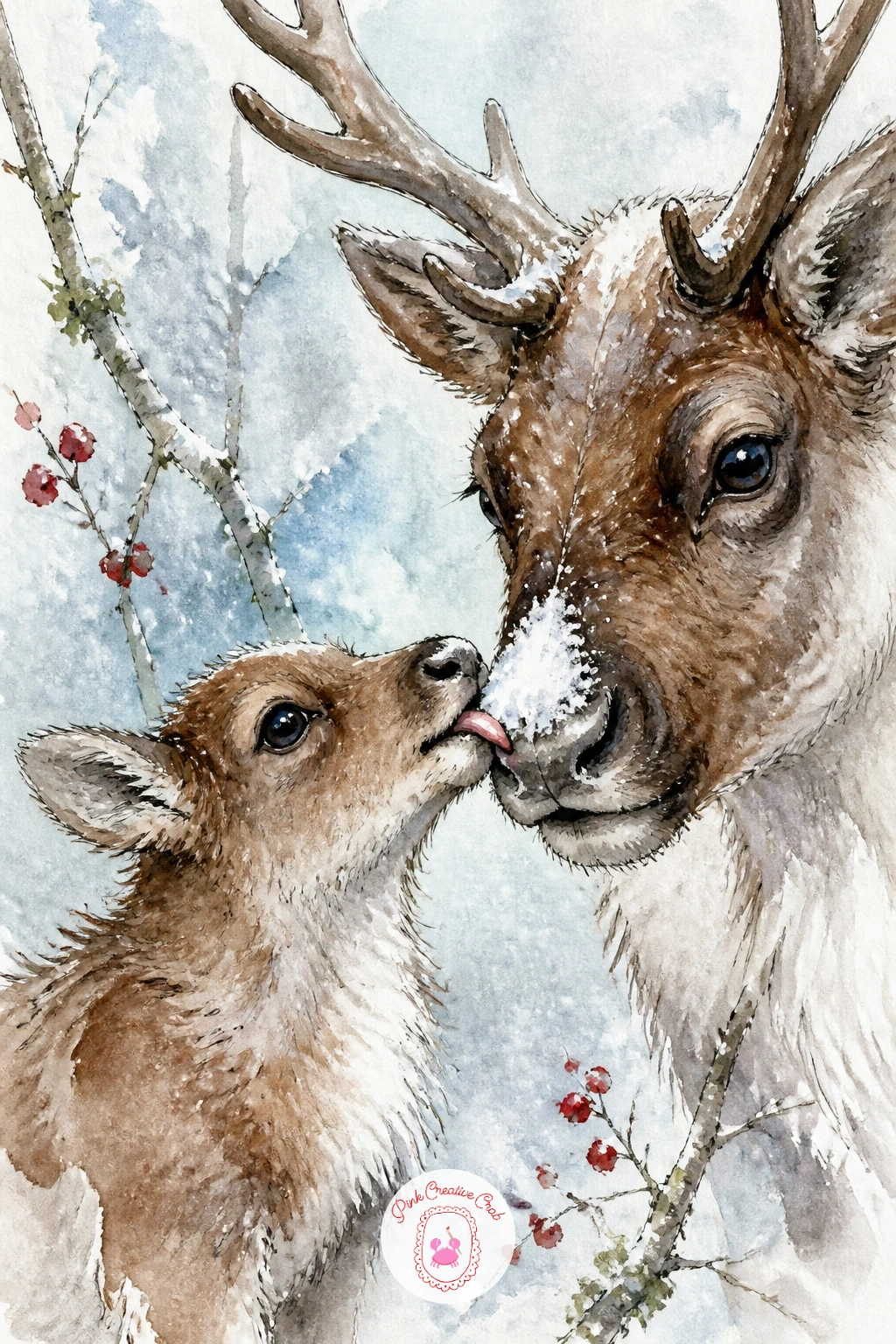
Palette: Soft Chocolate Brown,Birch White,Icy Blue,Payne’s Grey
This scene turns on where the light sits, so decide first that the sun rises low behind the misty valley, meaning the reindeer’s near side stays in shadow while its back and antlers catch a thin rim of warm light. Sketch the animal small and high on the page, standing on a simple curved hilltop.
Paint the sky and misty valley first in graded washes, pale cherry red and icy blue near the horizon fading up into cooler blue, letting the colors bleed softly where mist would sit. Once dry, paint the reindeer as a near-silhouette in dark chocolate brown and Payne’s grey, saving one thin unpainted edge along its back for the rim light.
Skipping that rim light is the most common miss here, since without it the animal just reads as a flat dark shape. A fine dry brushstroke of birch white along the spine and antler tips brings the whole sunrise moment together.
If mixing a graded sky wash feels tricky, paint the two colors as separate wet patches side by side and let them meet and blend on their own.
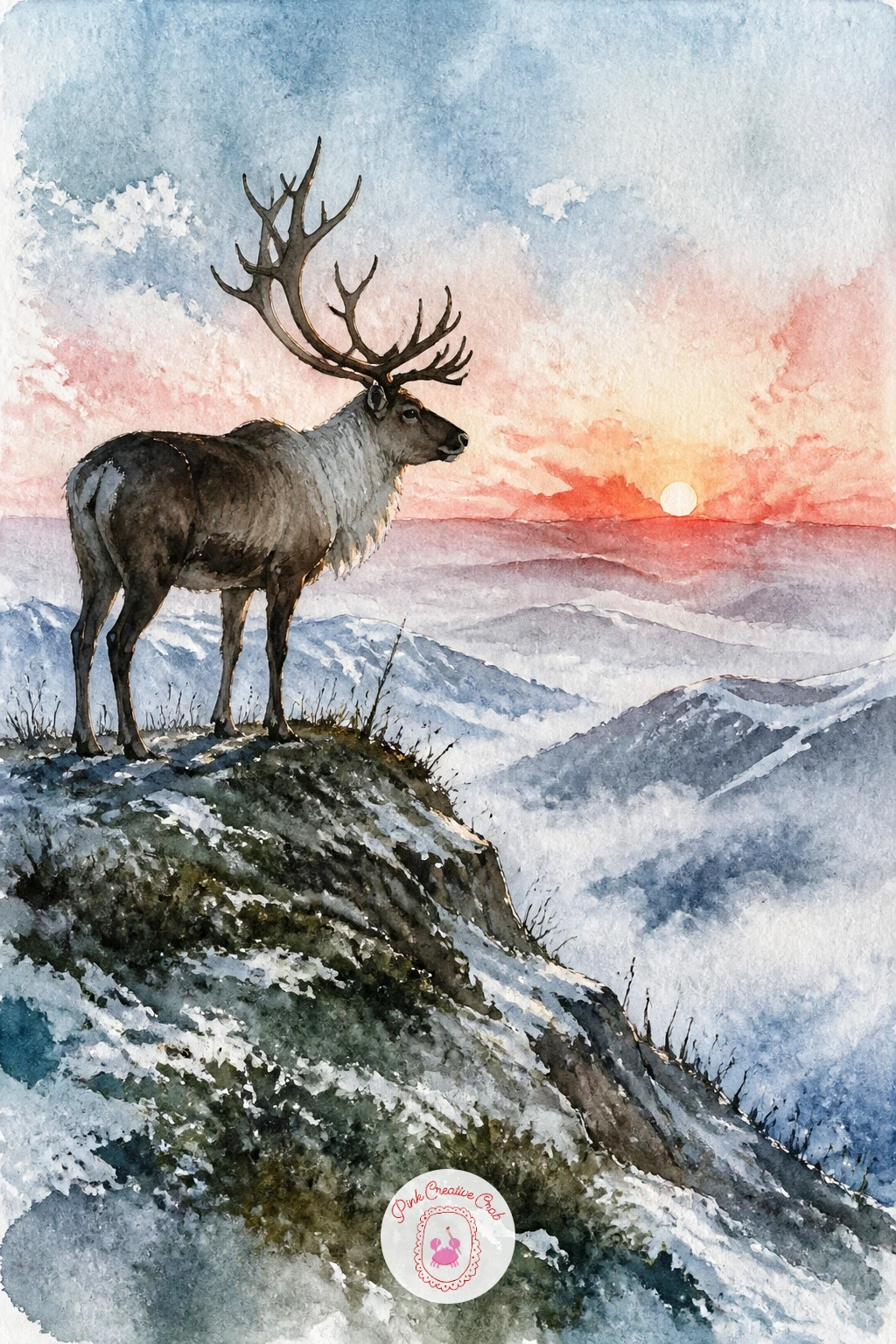
Palette: Cherry Red,Icy Blue,Payne’s Grey,Soft Chocolate Brown
Give this one a strong downward gesture, since the whole pose bends toward the hole in the ice. Sketch the head and neck stretching low, front legs slightly splayed for balance, and a simple dark oval cut into a flat icy blue sheet to mark the water hole.
Paint the ice first as a smooth, mostly flat wash so it contrasts with the textured snow around it, then drop in the dark water hole wet into wet so its edge softens naturally. Paint the reindeer last, keeping the lowered head and neck the darkest, richest brown in the whole piece since it is nearest the viewer.
The ice sheet often ends up looking like plain snow if you are not careful. Keep it flatter, cooler, and glassier than the surrounding drifts, and add one or two thin ink cracks radiating from the hole to sell the surface.
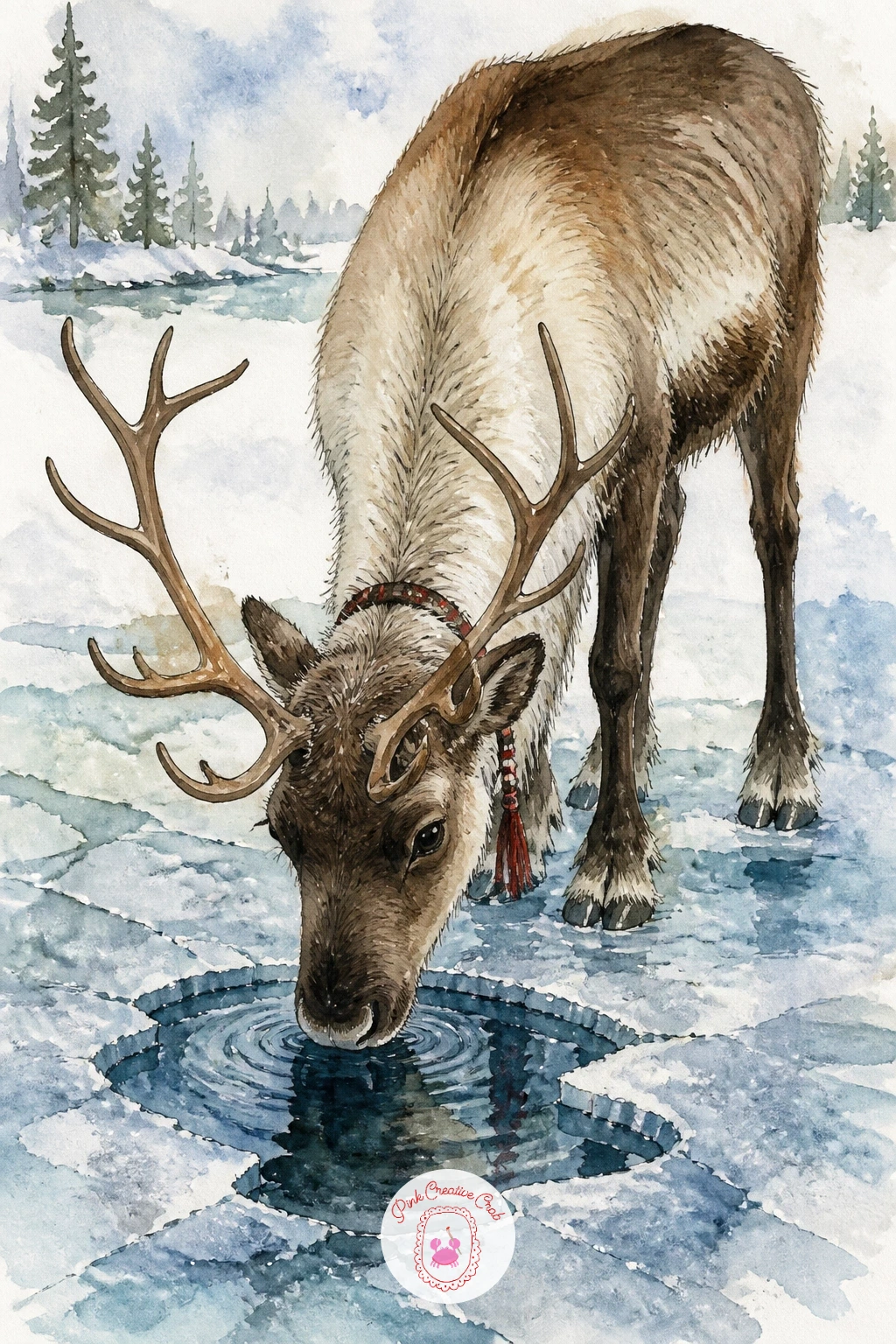
Palette: Icy Blue,Payne’s Grey,Soft Chocolate Brown,Birch White
Open tundra scenes work best wide and low, so give the sky two thirds of the page and let the reindeer herd sit as a loose scatter of small shapes along the bottom third. Sketch six or seven simple resting shapes, varying their angles so the herd feels settled rather than lined up.
Paint the sky first with soft washes of pale cherry pink fading into icy blue, letting the colors bloom freely since this is the biggest, loosest wash in the piece. Once dry, paint the tundra ground in a flat pale wash, then add the herd as small chocolate brown shapes, darkest in front and lighter toward the back.
Too much detail on the distant animals flattens this scene fast. Keep every reindeer body to two or three brushstrokes with no individual ink lines except on the nearest one or two.
Try the same big-sky, small-herd layout from the sketchbook pages approach if you want to practice it again at a smaller, looser scale.
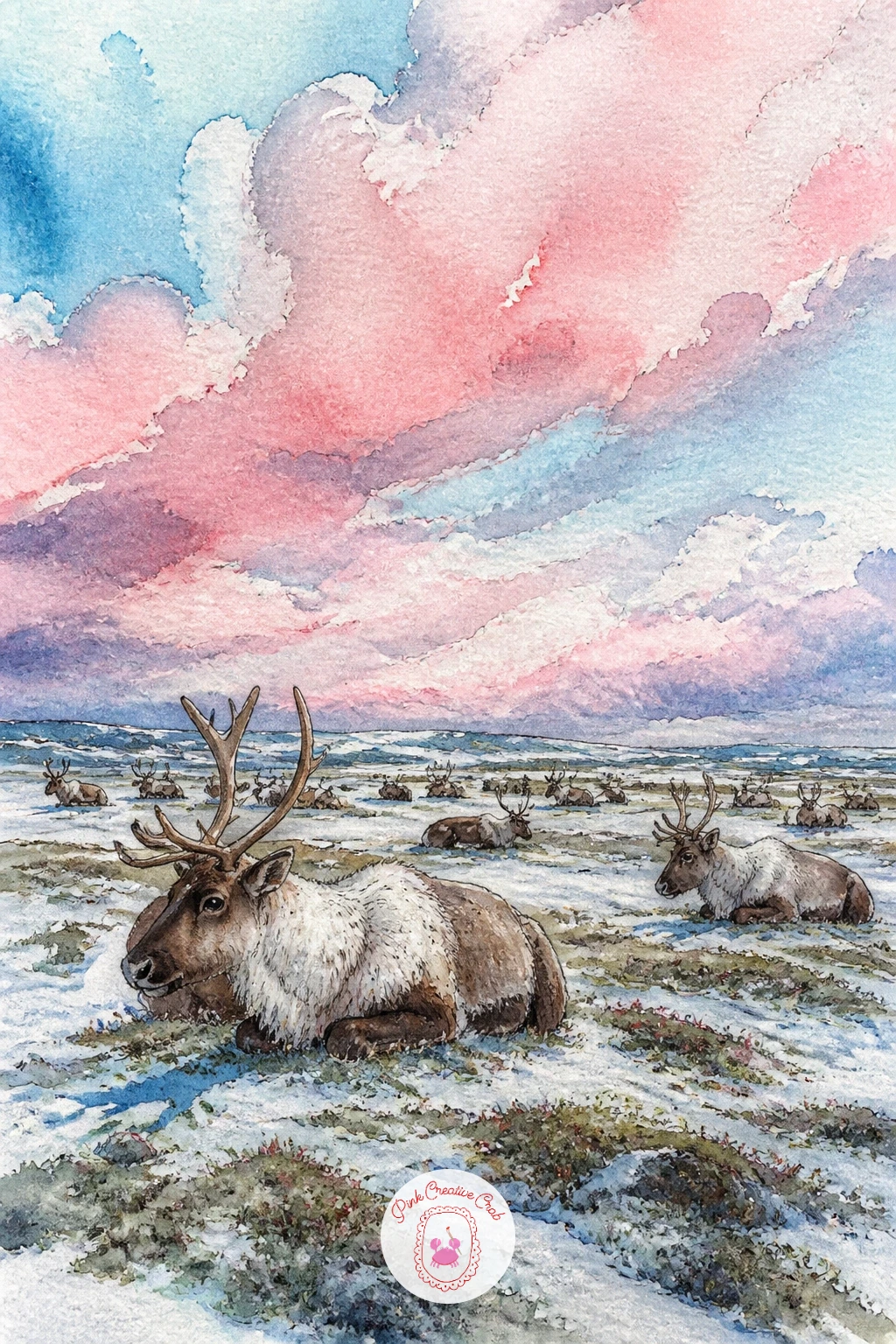
Palette: Cherry Red,Icy Blue,Soft Chocolate Brown,Birch White
The charm of this one is its slight lopsidedness, so exaggerate the asymmetry just a touch once you have the head drawn. Sketch one full antler branching upward as usual, then give the other side only a short, blunt stub where the antler has already dropped.
Paint the body in your usual chocolate brown wash, working head to tail as always, but pay close attention to keeping the head tilted very slightly toward the stub side, since a perfectly level head makes the asymmetry look like a drawing mistake rather than a real shed antler.
Ink detail matters more here than usual, since the stub needs a rougher, more textured edge than the smooth-branching full antler to read as recently shed rather than simply unfinished. Stipple a few short ink marks at the stub’s tip rather than one clean line.
If you would rather sketch quickly first, pencil just the two antler shapes side by side on scrap paper until the lopsided balance looks convincing before committing to the full figure.
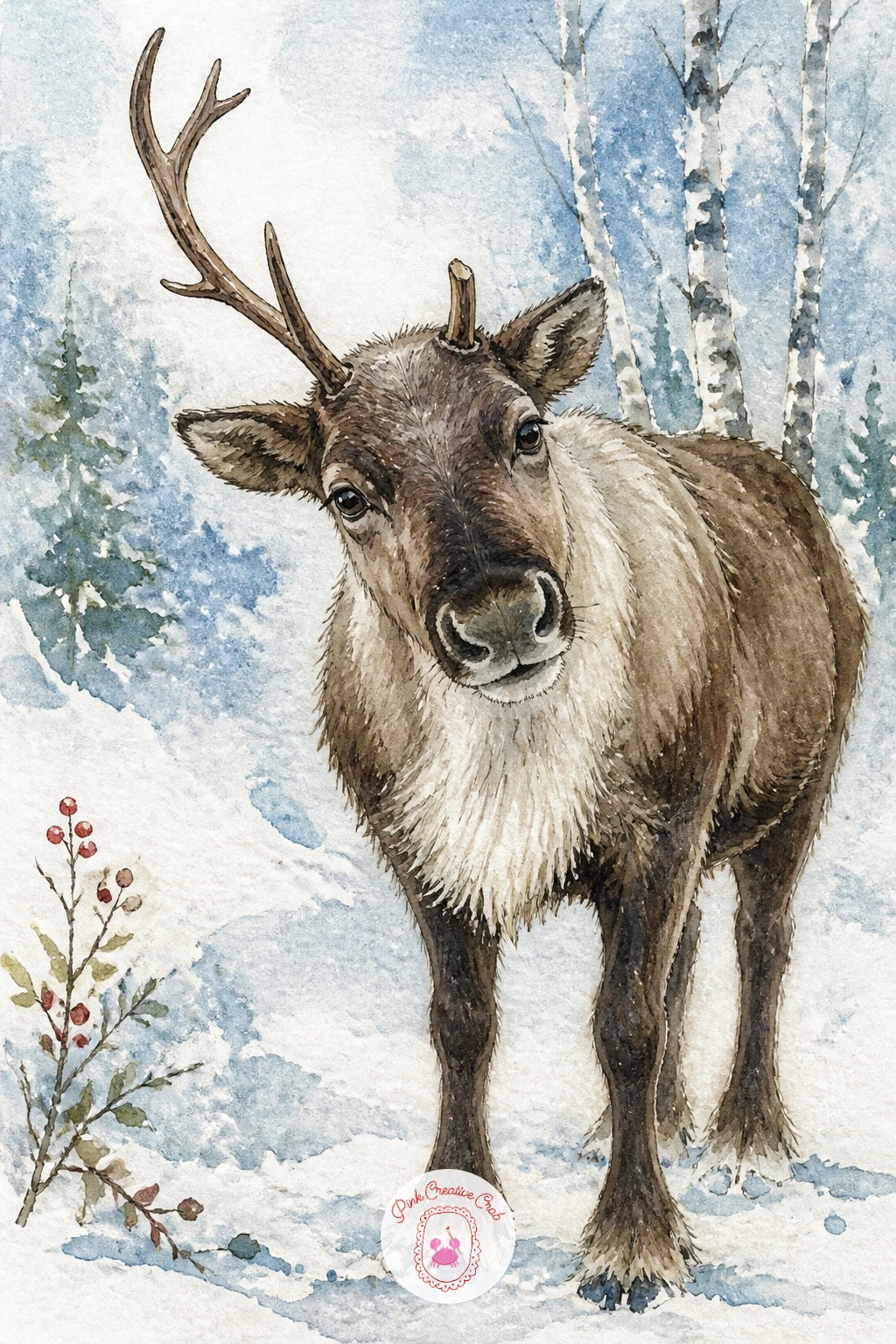
Palette: Soft Chocolate Brown,Payne’s Grey,Icy Blue,Birch White
A red cabin gives you the cherry red accent as the star of the piece, so place it confidently in the background, a simple rectangle with a steep roof and one small dark window, rather than tucking it away small. The reindeer grazes in front, head down, at roughly a third of the cabin’s height.
Paint the cabin first in a flat cherry red wash with a darker roof line, then let it dry completely before painting the snowy ground around it so the color stays crisp rather than muddying into the white. Paint the reindeer last in chocolate brown, keeping it loose and secondary to the cabin’s strong color.
Red can bleed and look pink if the wash goes on too wet. Mix the cherry red a little stronger than feels natural and apply it in one confident pass rather than building it up in weak layers.
If cherry red paint is not in your set, mix a touch of Payne’s grey into a bright red to dull it slightly toward this warmer, weathered tone.
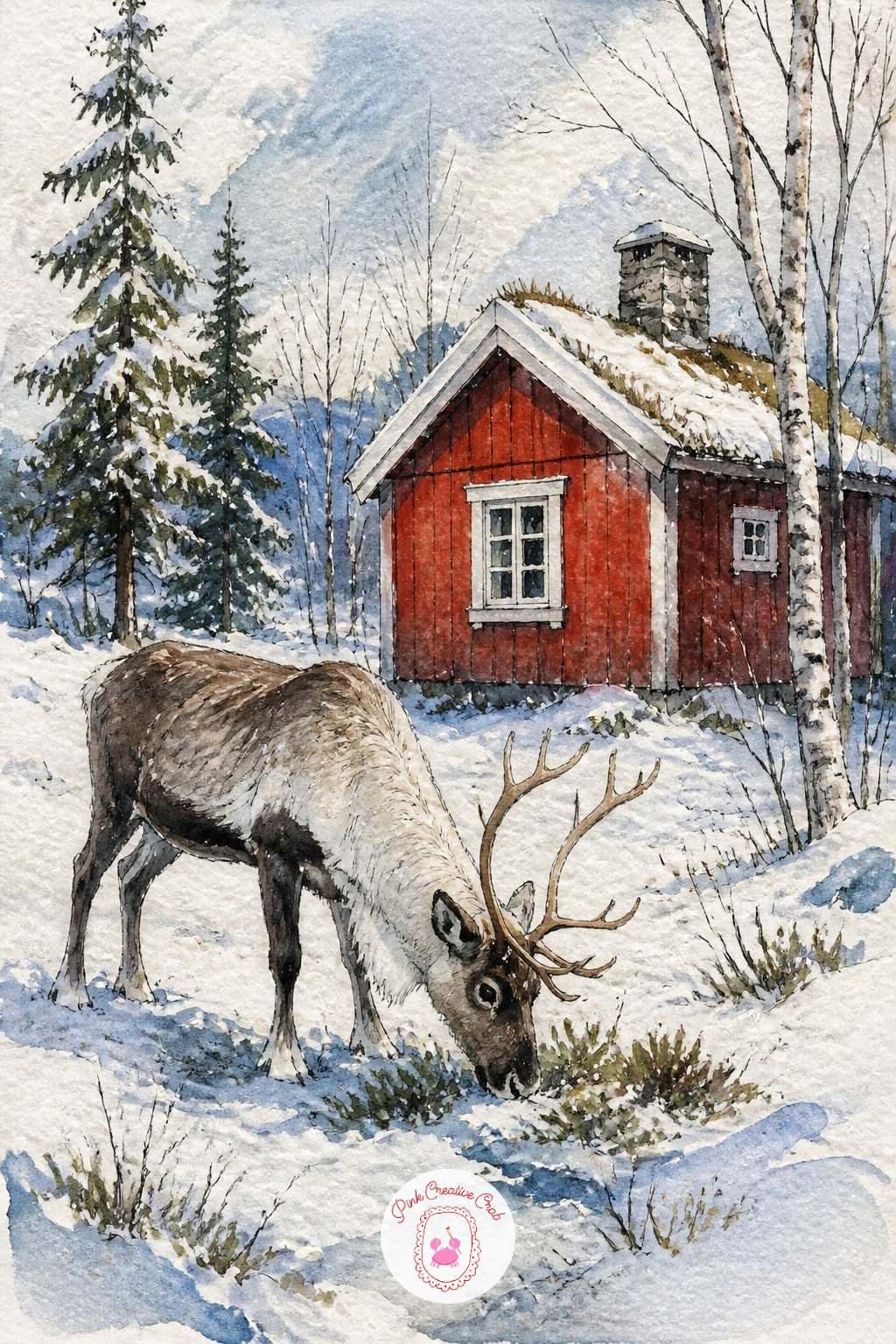
Palette: Cherry Red,Soft Chocolate Brown,Birch White,Moss Green
Steam breath is the whole point here, so plan for it before painting anything else: leave a soft, cloud-shaped gap of bare paper in front of the muzzle, slightly larger than you think you need, since paint can always be added but never fully removed.
Paint the reindeer’s head and shoulders first in chocolate brown, working the muzzle area carefully so the paint stops short of your reserved steam shape. Once dry, lift a little color from the edges of that gap with a clean damp brush to soften it, then add the faintest wash of icy blue grey into the steam cloud itself so it reads as cold air rather than empty paper.
Steam that looks too solid or too sharp-edged reads as smoke instead of breath. Keep its edges soft and slightly uneven, and let it fade to nothing rather than stopping abruptly.
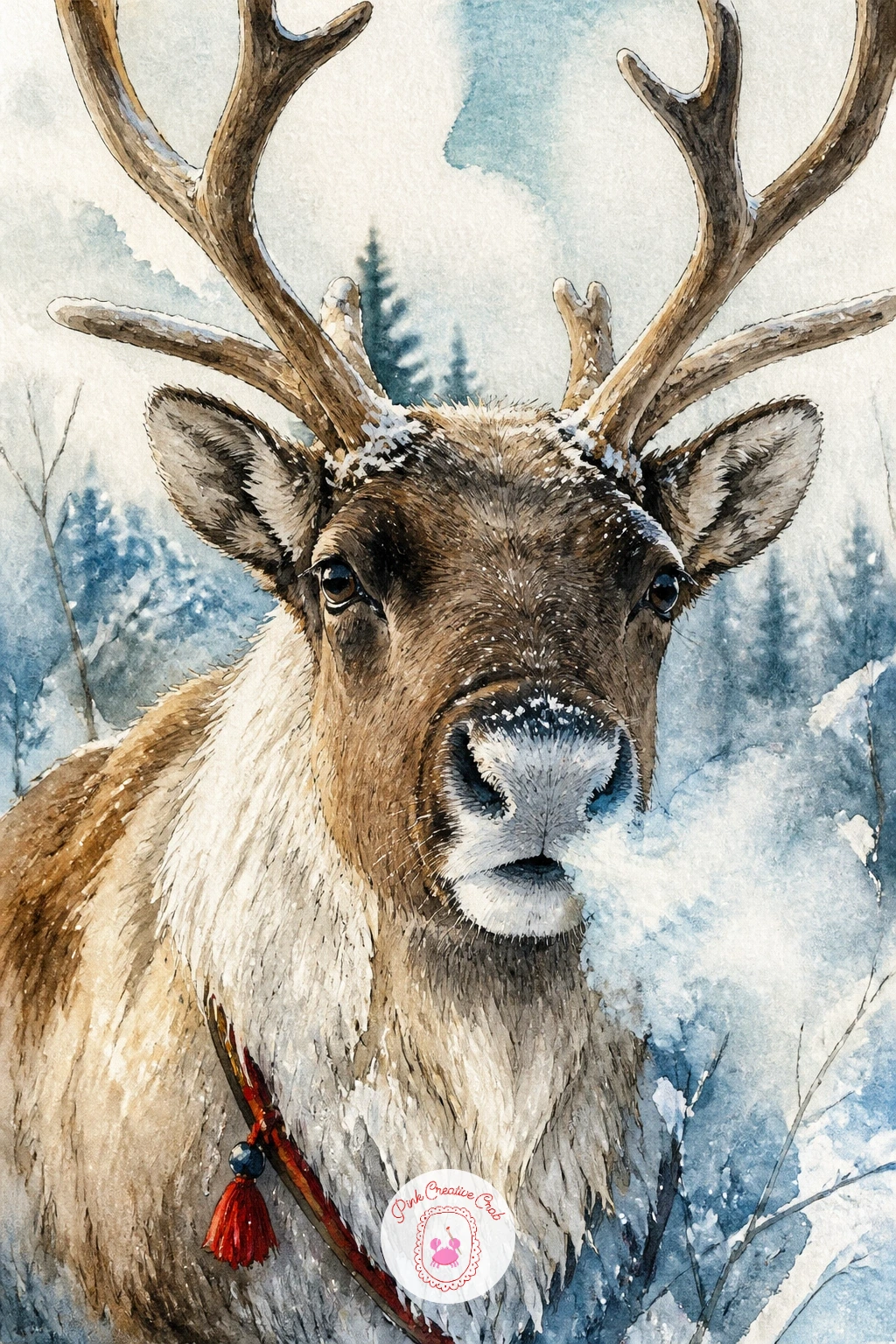
Palette: Soft Chocolate Brown,Icy Blue,Birch White,Payne’s Grey
A sleeping calf is a simple, rounded shape, so think of the whole body as one curled comma: head tucked down near the front legs, back arched gently, legs folded close underneath. Draw the snow hollow as a shallow dip around the body rather than a flat bed, since that dip is what makes the pose feel settled in.
Paint the hollow first with a cool icy blue shadow curving around where the body will sit, then paint the calf in a soft, lighter chocolate brown than you would use for an adult, since young fur reads paler and pinker.
Curled poses often end up stiff if the spine line is too straight. Keep the curve of the back loose and slightly uneven, and let one ear flop rather than standing alert, to sell the deep sleep.
For a faster version, paint only the curled body and hollow and skip the surrounding snow texture; the longer version adds soft falling snowflakes settling on the fur.
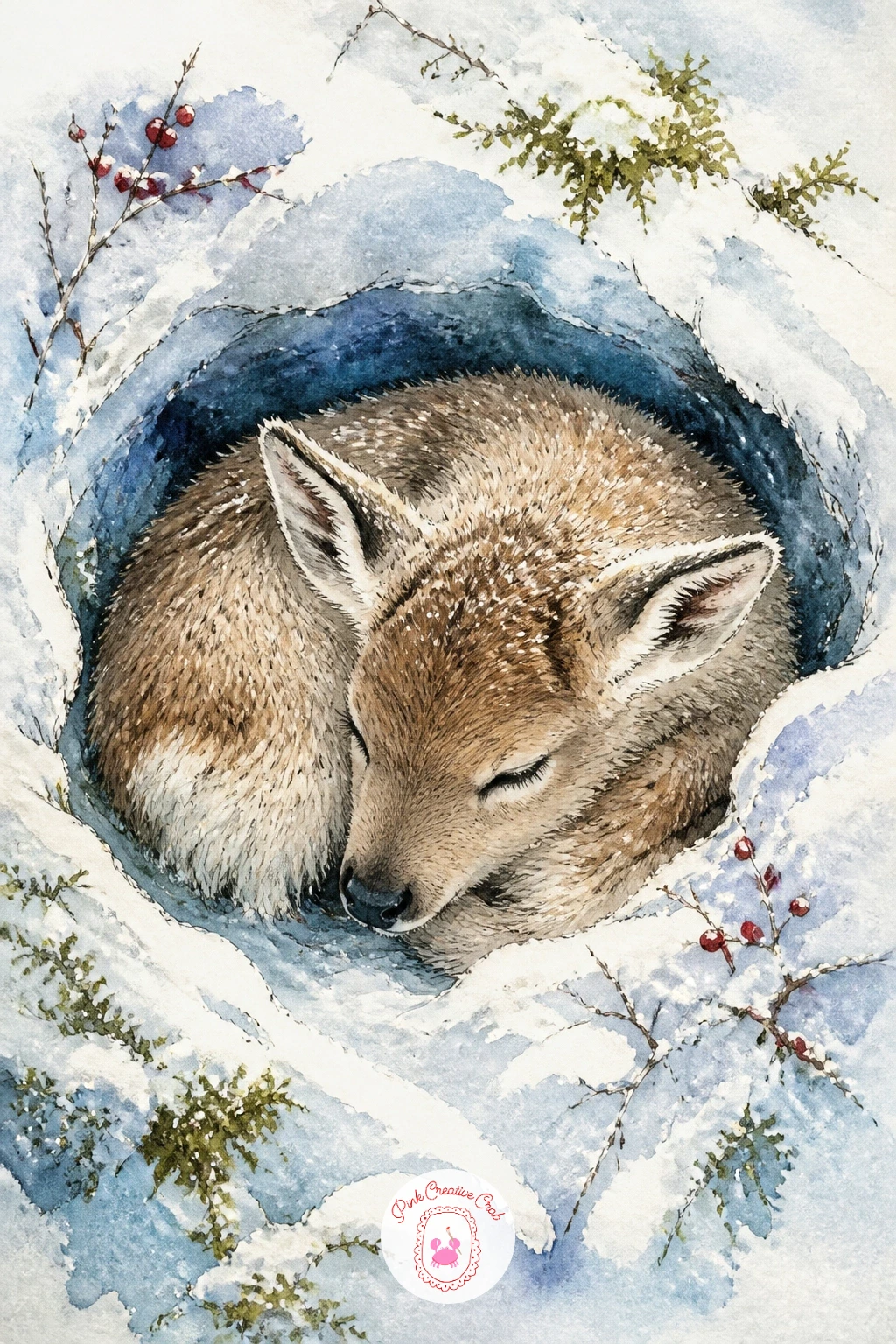
Palette: Soft Chocolate Brown,Icy Blue,Birch White,Payne’s Grey
This one plays with eye level, so decide the viewer is standing at the same height as the reindeer, peering through the forest rather than looking down on it. Draw several thin vertical birch trunks across the foreground, closer together on one side, with the reindeer’s head and shoulders just visible in a gap between them.
Paint the trunks first in pale birch white with thin dark horizontal bark marks, leaving gaps of bare paper between them for the reindeer to show through. Paint the reindeer partly behind the nearest trunks, letting one or two overlap its body so it reads as glimpsed rather than fully framed.
Trunks painted too evenly in size and spacing flatten the depth here. Vary their width and the gaps between them, and make the trunk nearest the viewer noticeably wider and darker than the rest.
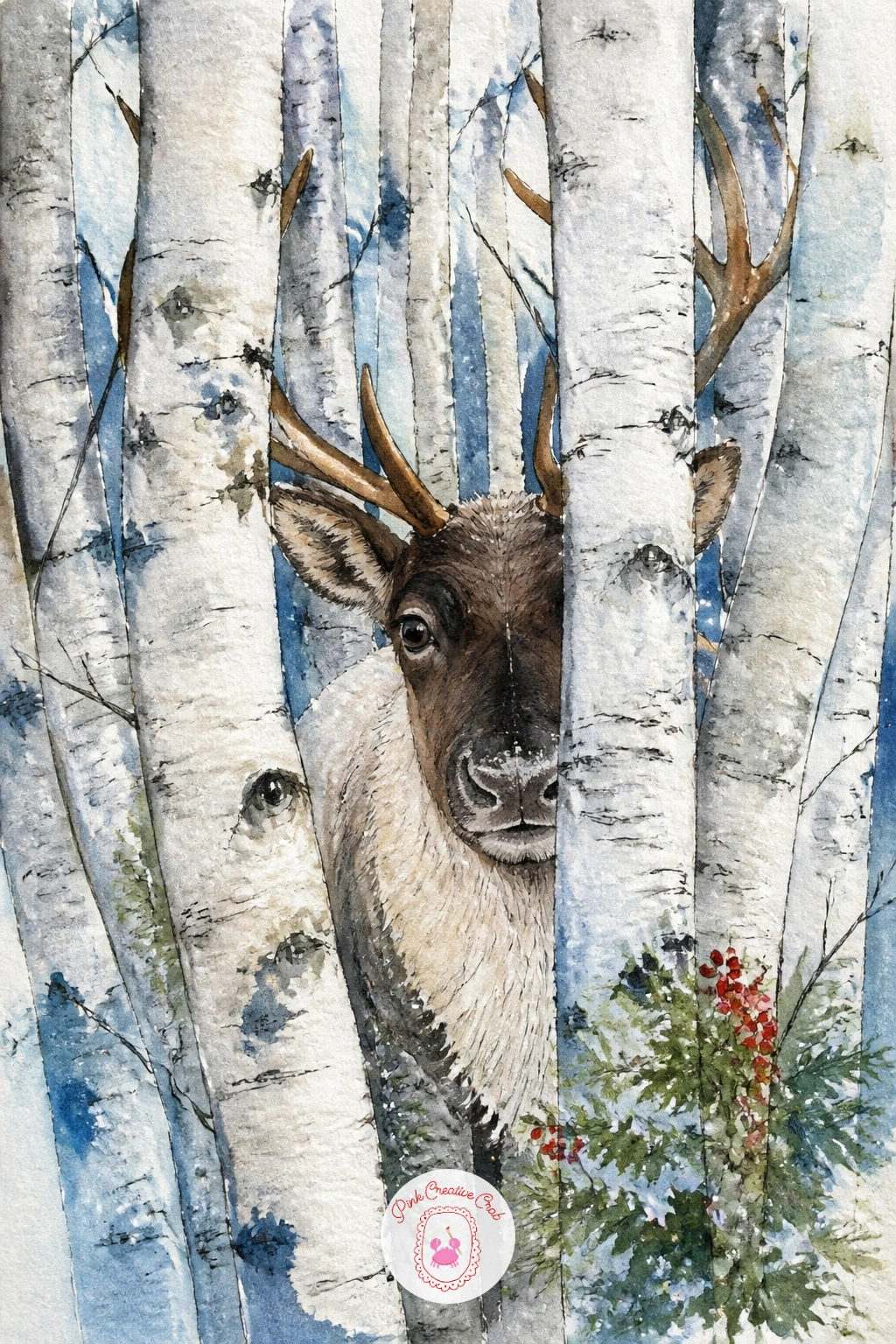
Palette: Birch White,Payne’s Grey,Soft Chocolate Brown,Icy Blue
Deep snow calls for hiding most of the legs, so sketch the reindeer with only the chest and head riding above a tall drift, legs implied rather than drawn in full. Push the drift up to chest height and give its surface a soft wavy edge rather than a flat line.
Paint the drift first in overlapping washes of icy blue and birch white, building it taller and more textured than your usual snow so it clearly reads as deep rather than just ground cover. Paint the visible chest and head in chocolate brown, then add a light dry-brush dusting of white across the lower chest where snow would cling as the animal pushes through.
Showing too much leg beneath the drift ruins the “wading” feeling. Keep legs mostly buried, with at most a hint of shape breaking the surface, and trust the high drift line to do the storytelling.
If you do not have masking fluid for the snow texture, a dry, nearly empty brush dragged quickly across the dried wash lifts a similar soft texture.
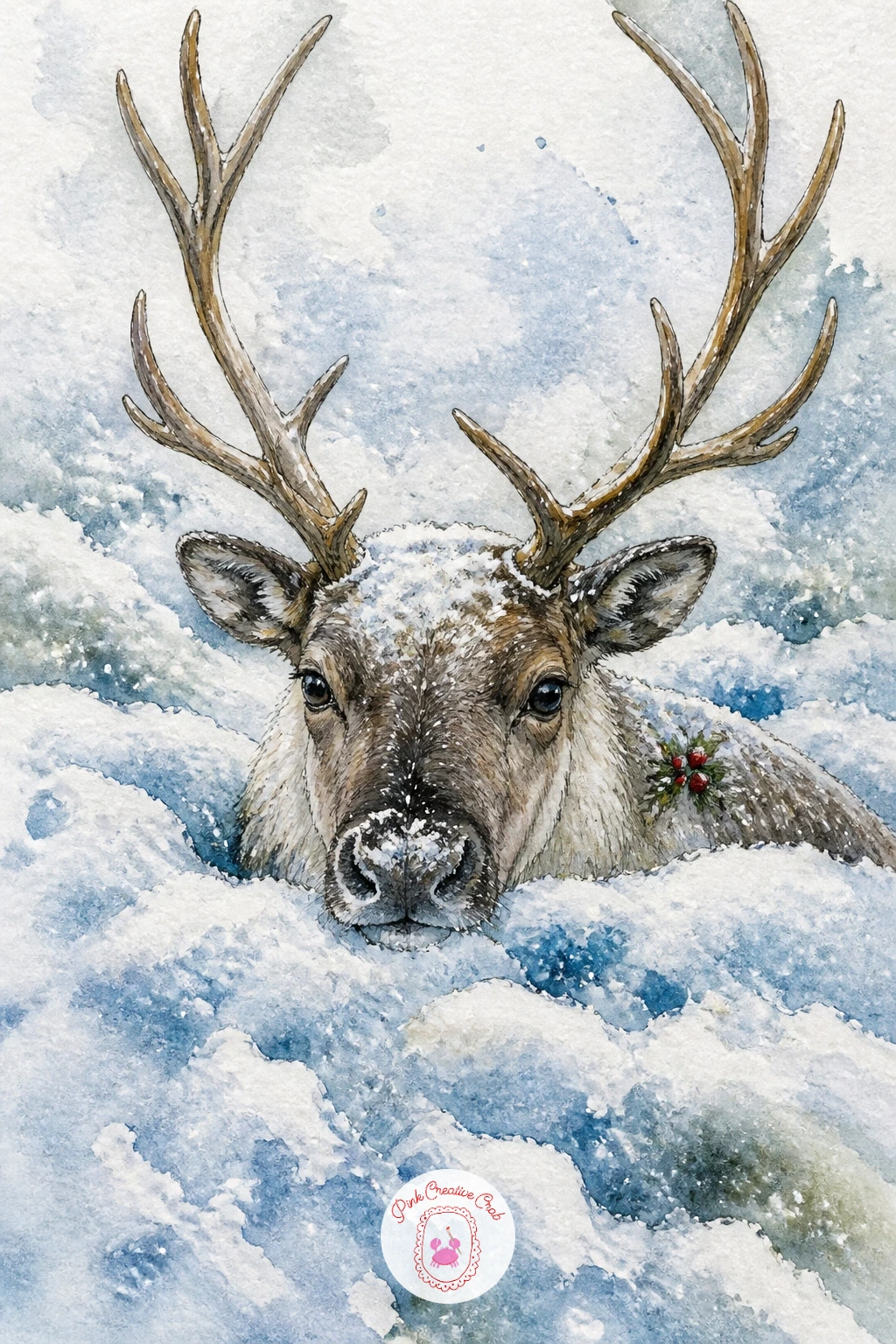
You Will Need
- masking fluid for snow texture (optional)
Palette: Icy Blue,Birch White,Soft Chocolate Brown,Payne’s Grey
Keep this one simple and close, focusing on the head and the little strand of pale moss green lichen hanging loose from the mouth. Draw the head mid-chew, jaw slightly open, with a thin wavy shape trailing from one side of the muzzle.
Paint the head first in your usual chocolate brown wash, leaving the mouth area a touch lighter so the lichen reads clearly against it. Once dry, paint the lichen strand in moss green with the tiniest dry-brush texture, then add a fine ink line along its edge so it does not disappear into the fur color.
A lichen strand painted too thick looks like a stick rather than dangling plant matter. Keep it thin and slightly curved, tapering to nothing at the tip, and resist outlining it too heavily.
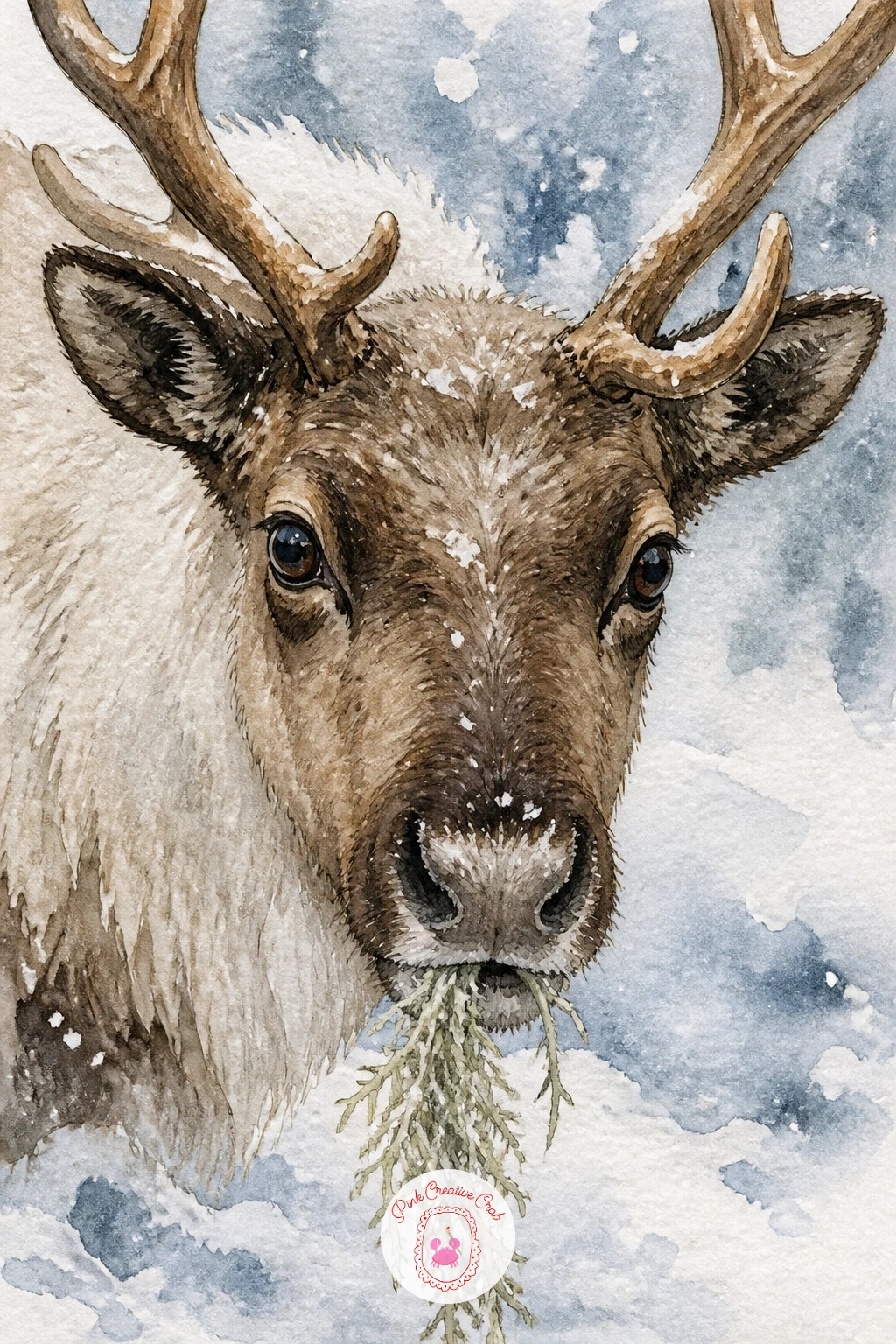
Palette: Moss Green,Soft Chocolate Brown,Payne’s Grey,Birch White
Reflections work best when the light source is settled first, since a dusk scene needs the sky and water to share the same warm, fading light. Sketch the reindeer standing at the lake’s edge, then sketch a softer, slightly stretched mirror version of it below the waterline.
Paint the sky and the ice-free patch of water in matching graded washes of cherry pink fading into Payne’s grey, so the reflection color echoes the sky above it. Paint the standing reindeer in full chocolate brown detail, then paint its reflection with the same brush but thinned paint and a few horizontal strokes to break the surface, keeping it noticeably softer and less detailed than the real animal.
A reflection painted as crisp as the subject above it breaks the illusion instantly. Keep every reflected edge looser, and let a band of frozen ice interrupt part of the reflection to remind the eye this is a half-frozen lake.
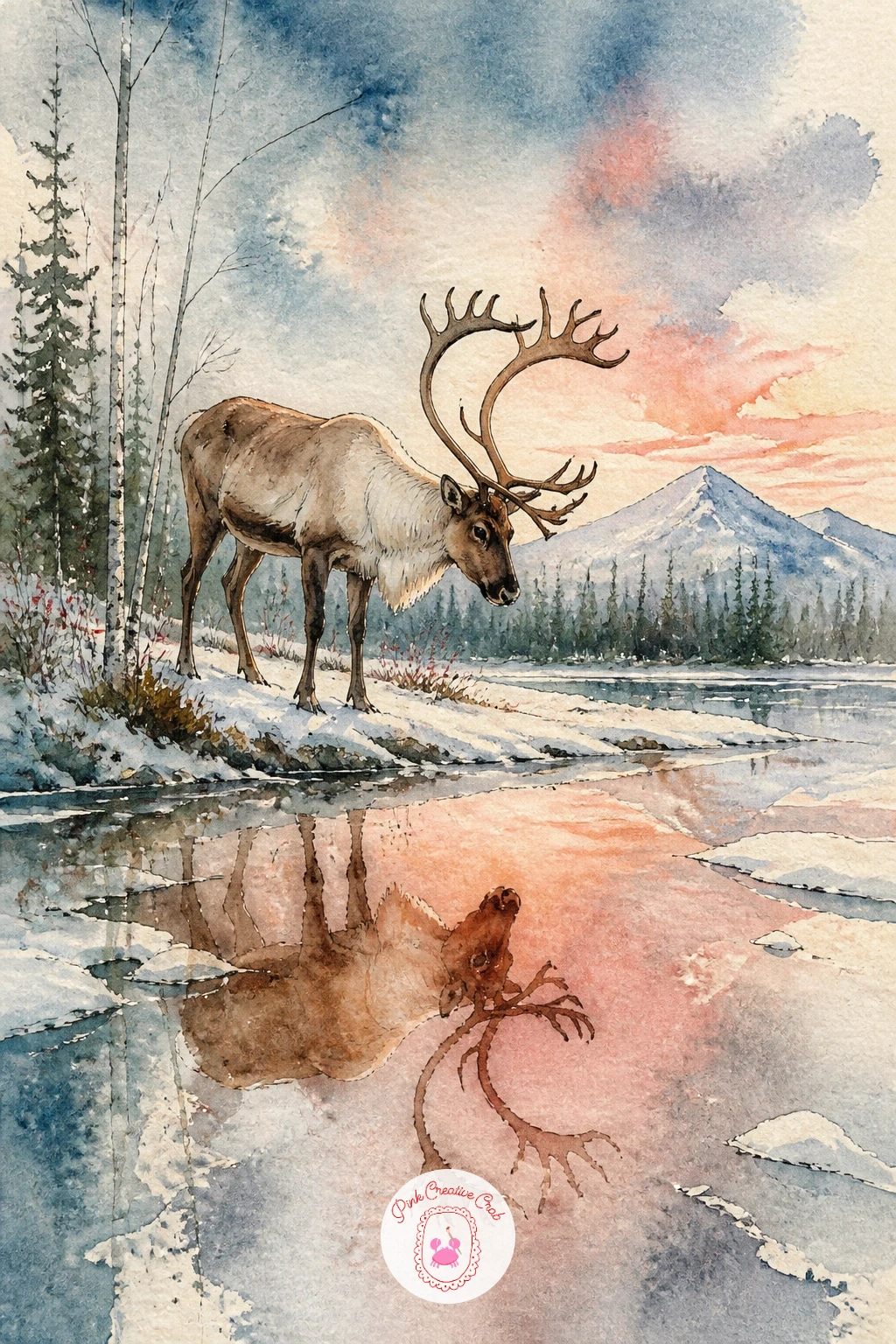
Palette: Cherry Red,Payne’s Grey,Soft Chocolate Brown,Icy Blue
Give the mother the taller, alert pose here and the calf the low, curled one, so the size and posture contrast tells the whole story without any extra detail. Stand her with head up and ears forward, legs squarely planted, while the calf curls small and low near her front legs.
Paint the calf first since it is the smaller, simpler shape, using the same pale soft brown as any resting calf. Then paint the mother taller and darker above it, keeping her posture upright and watchful with ink added to sharpen her ears and eye more than you would for a relaxed animal.
If the mother ends up looking relaxed rather than watchful, check her ears and head angle first. Ears pinned slightly forward and a level, lifted head read as alert far more than any other detail you could add.
This same tall-guardian, small-sleeper pairing works well again with the dogs in dog pencil drawing ideas if you want more practice with protective poses.
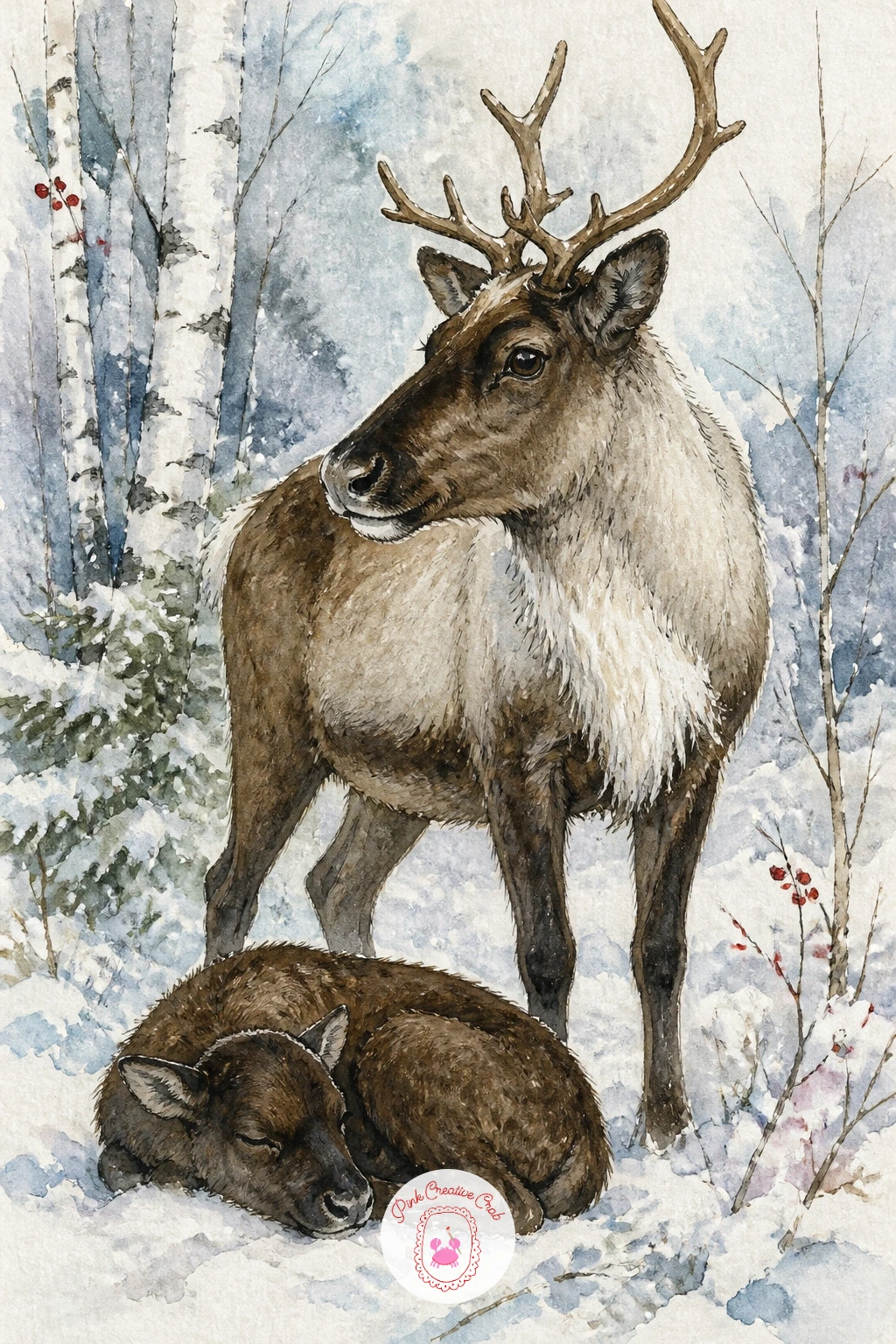
Palette: Soft Chocolate Brown,Payne’s Grey,Birch White,Icy Blue
Motion is the challenge here, so draw the body first with a slight blur built into the pencil sketch itself: a faint double line along the back and flanks where the coat is mid-shake, rather than one crisp outline. Loose flecks of snow fly outward from the shoulders and back.
Paint the body in chocolate brown with a fairly dry brush so the fur edges stay textured and slightly broken rather than smooth, which already suggests motion before you add anything else. Flick a loaded, nearly dry brush toward the edges of the body to scatter small marks of birch white snow flying off.
A perfectly smooth, static outline kills the sense of shaking immediately. Keep the silhouette slightly rough along the back and add a few quick ink lines radiating outward from the shoulders to reinforce the motion.
No toothbrush on hand for finer flecks? An old, dry stiff-bristled brush flicked with a fingernail gives a similar fine spray.
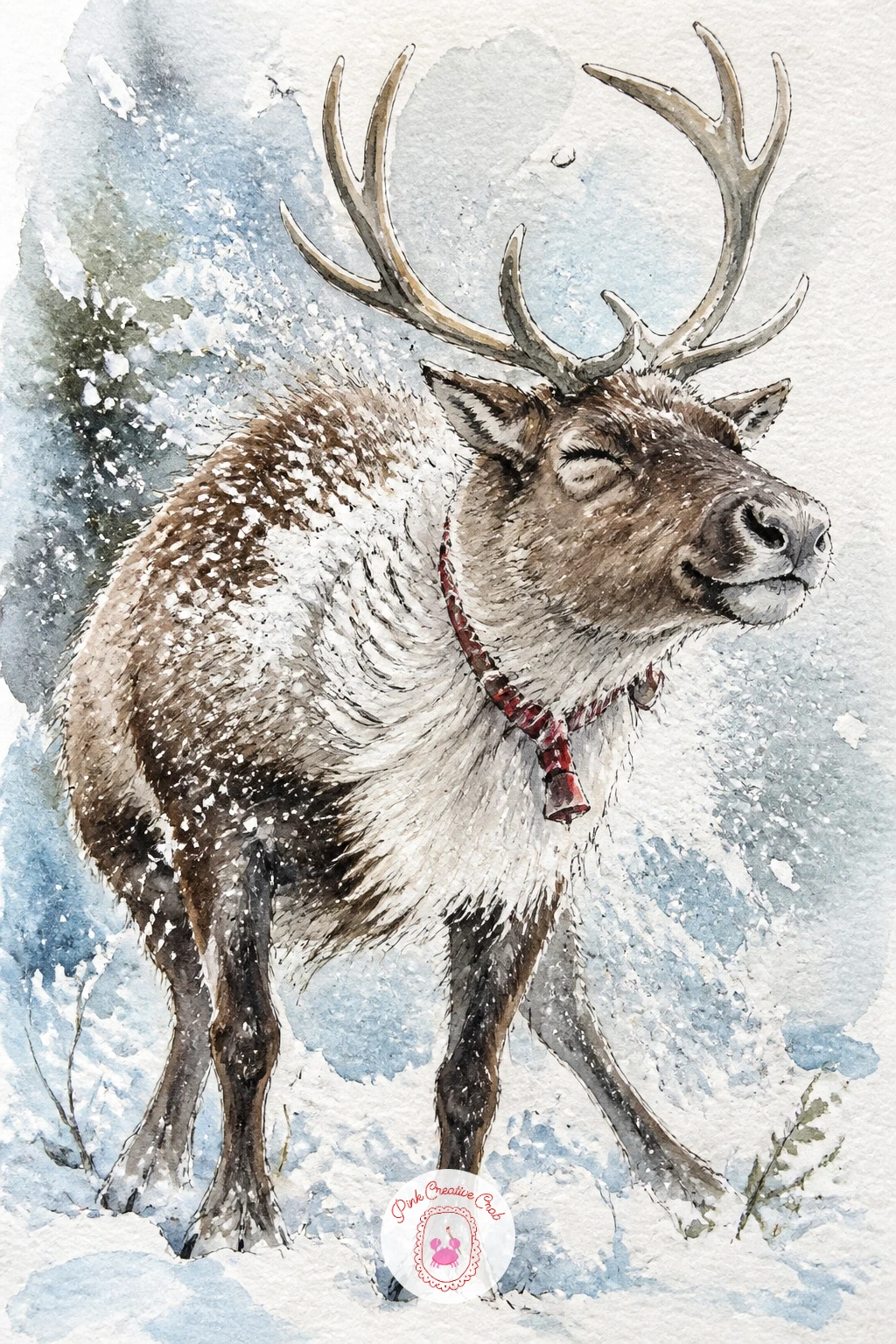
You Will Need
- toothbrush or stiff old brush for flicked snow spray
Palette: Soft Chocolate Brown,Birch White,Icy Blue,Payne’s Grey
Keep the eye level low and the sky huge for this one, since a ridge scene depends on the reindeer walking right along the horizon line with sky filling most of the page above them. Sketch four or five simple walking silhouettes along one gently curving line near the bottom third.
Paint the pale sky first in one smooth graded wash from icy blue at the top to a near-white glow near the ridge line, keeping it calm and even since it is the backdrop for everything else. Once dry, paint the ridge itself as a simple dark shape, then add the reindeer silhouettes in flat Payne’s grey-brown, no inner detail needed since they sit against the brightest part of the sky.
Adding detail to these distant silhouettes is the easy mistake to make. Keep every animal a single flat shape with perhaps one small ear and antler bump, letting the strong row shape carry the whole picture.
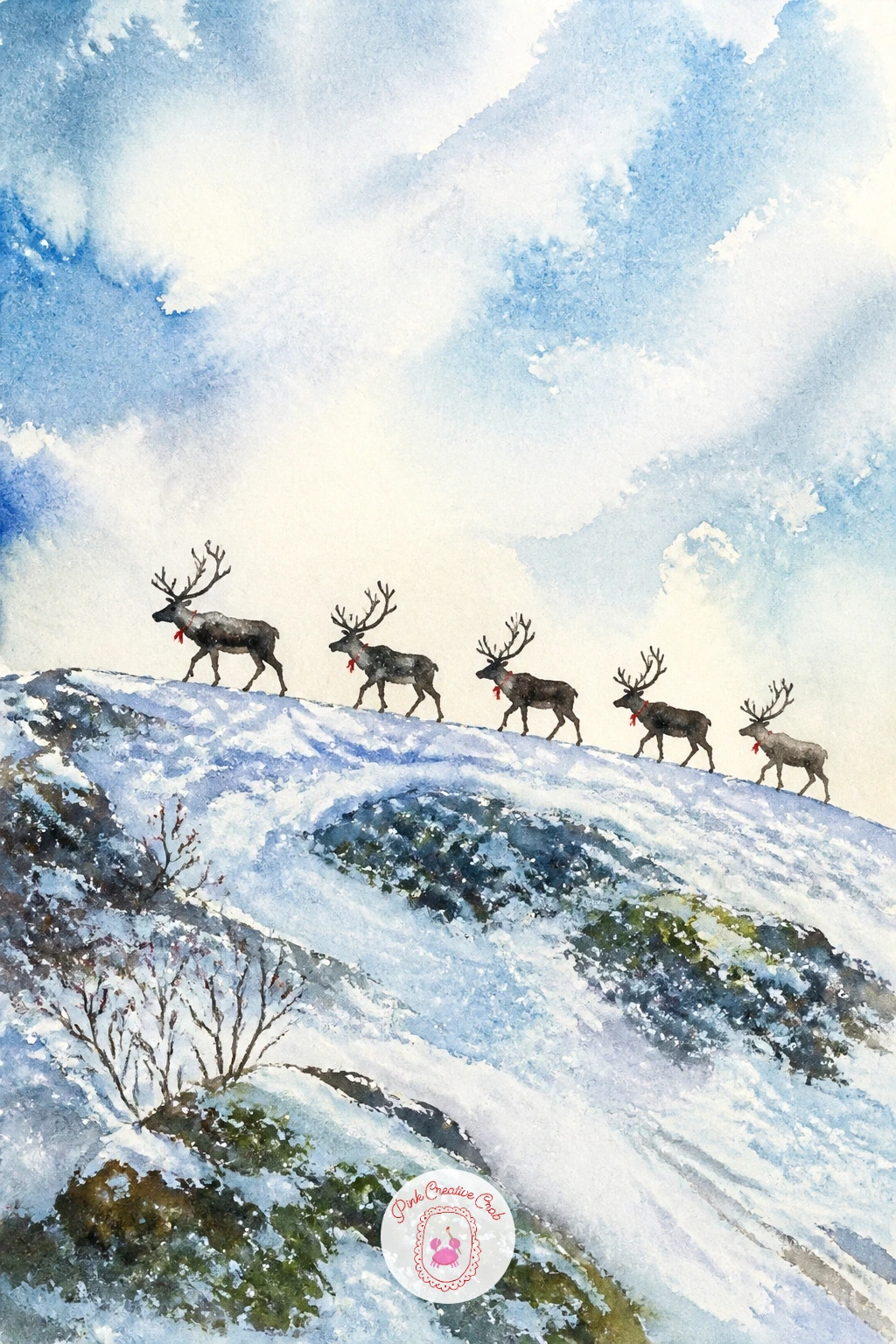
Palette: Icy Blue,Payne’s Grey,Birch White,Soft Chocolate Brown
A boulder gives you a nice solid shape to balance against the softer reindeer, so draw it first as a rounded, weighty form with a flat-ish top, dusted lightly with snow along its upper edges. Position the reindeer beside it with its head turned down and sideways to nibble at the moss patch.
Paint the boulder in a mix of Payne’s grey and a touch of moss green, keeping its surface mottled and uneven rather than smooth, since rock texture contrasts nicely with soft fur. Paint the reindeer in chocolate brown once the boulder is dry, overlapping its muzzle slightly onto the rock’s moss patch to connect the two shapes.
A boulder painted too smooth and round reads as a boring grey egg. Break its edges with a few angular facets and let some true grey-brown moss green patches show through unevenly rather than as one flat tint.
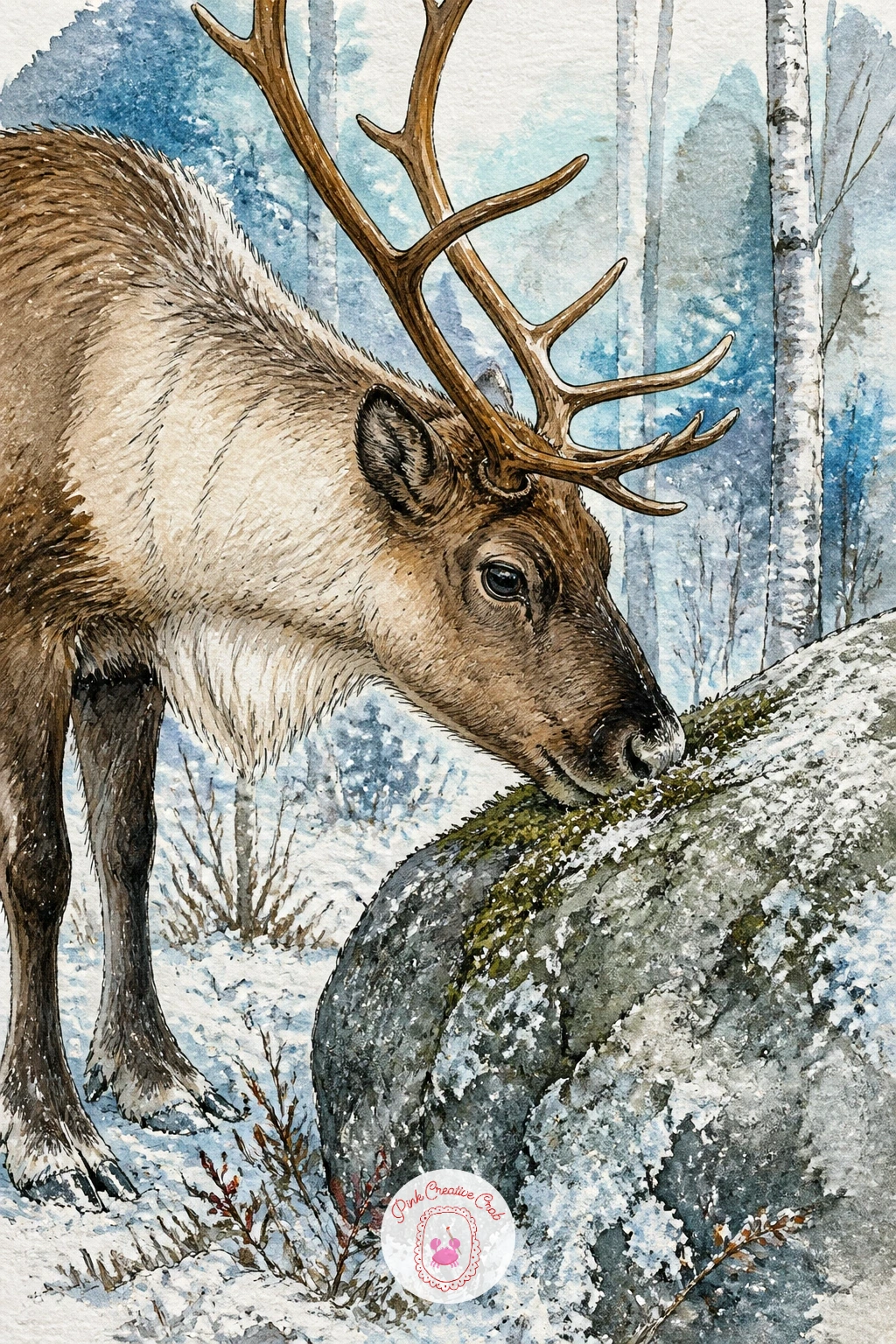
Palette: Payne’s Grey,Moss Green,Soft Chocolate Brown,Birch White
Scale is everything in this little scene, so compare sizes before you commit to ink: the seedling should stand no taller than the calf’s knee, small enough that the gesture of sniffing it reads as genuine curiosity about something new rather than browsing for food. Draw the calf with its head lowered and neck curved down toward the tiny tree.
Paint the snow ground first with a simple pale wash, then paint the calf in its usual lighter, pinker brown, keeping the head and neck the focal point of the pose. Paint the seedling last in a careful small dab of moss green with a few thin dark branches, since it needs to stay delicate against the larger animal.
Making the seedling too large is the easy error here, since it stops reading as “tiny” and starts looking like a normal young tree. Keep it genuinely small and slightly asymmetrical, more like a sprig than a sapling.
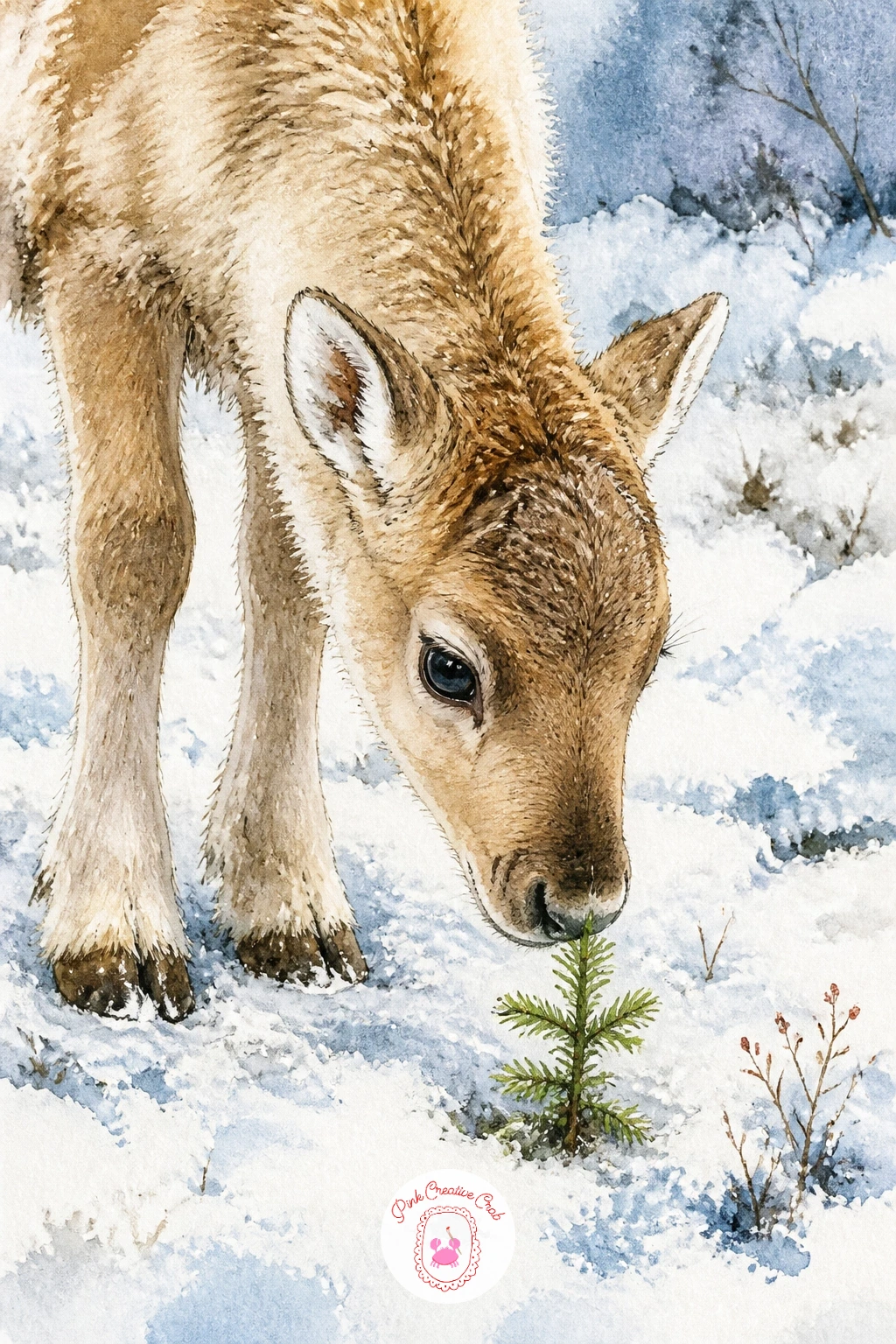
Palette: Moss Green,Soft Chocolate Brown,Birch White,Icy Blue
Give the antlers room to be the star here, so draw the reindeer standing tall and still, head level, with the full branching antler shape clearly visible against open sky rather than busy trees. Pencil in the antler branches carefully before adding any snowflakes, since they need a clean shape to land on.
Paint the sky and body first, keeping the antlers simply as unpainted or very pale shapes against the darker sky behind them. Once everything is dry, add snowflakes as small dots of birch white gouache or the tip of a fine brush, scattering more of them caught along the antler branches than falling freely elsewhere.
Snowflakes that are all the same size and evenly spaced look mechanical rather than natural. Vary their size, cluster a few close together, and leave larger gaps elsewhere, paying special attention to a few resting right where the antlers fork.
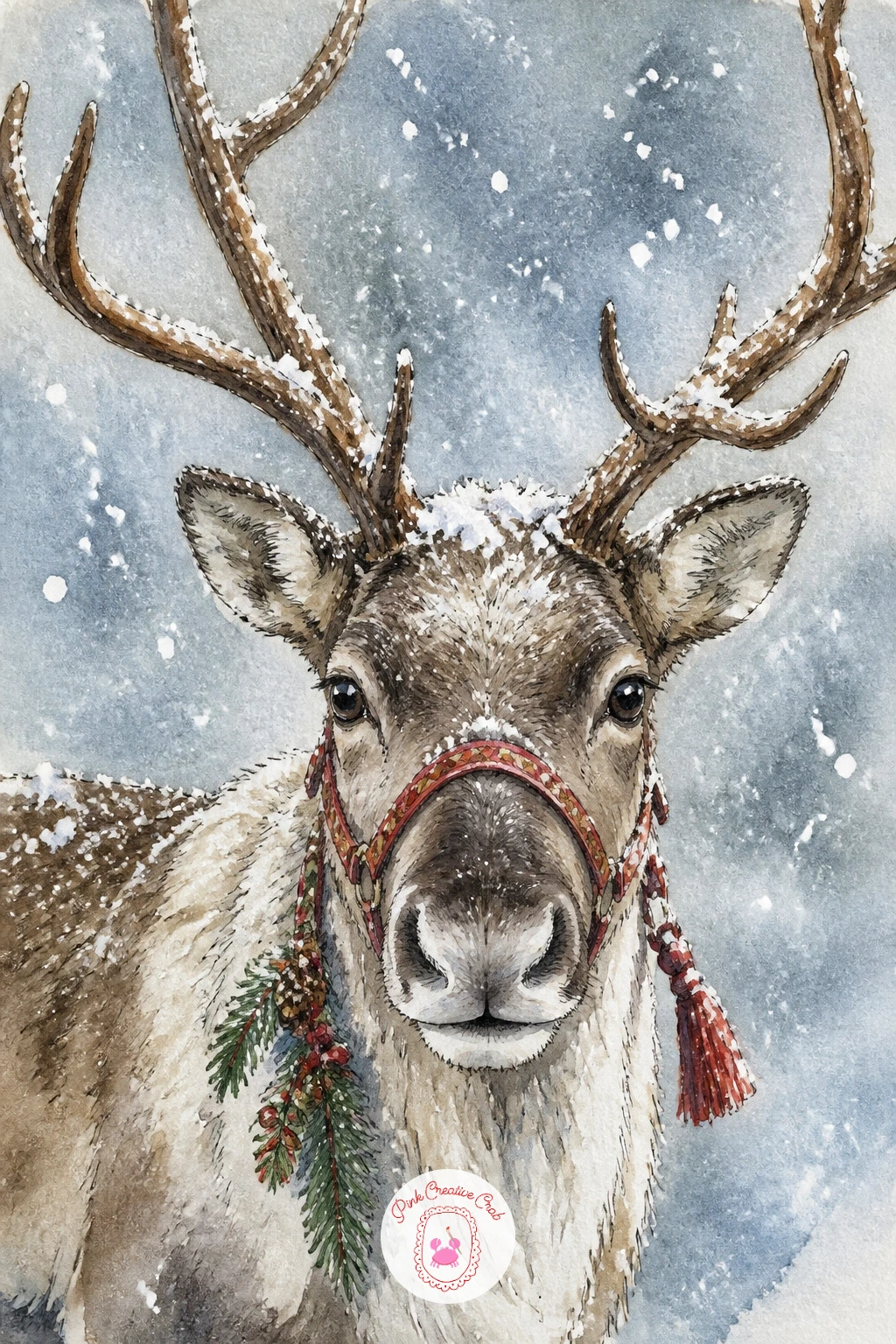
You Will Need
- white gouache or fine opaque white pen for snowflakes
Palette: Payne’s Grey,Birch White,Soft Chocolate Brown,Icy Blue
Give both calves energy through their legs, since a chase scene reads entirely through stride. Sketch the leading calf with legs stretched fully apart in a running pose and the second calf a stride behind, legs gathered more tightly, both bodies leaning slightly forward.
Paint the open meadow first in a simple pale wash with soft shadow patches for texture, then paint both calves in their lighter young brown, keeping the leading one slightly more detailed and the trailing one a touch softer in edge to suggest it is a beat behind.
Stiff, evenly spaced legs are what make a running pose look like standing still instead. Angle the legs unevenly, overlap one or two slightly, and let the trailing legs blur a touch with a damp brush while they are still wet.
If you want to practice dynamic leg poses further, the chasing figures in BFF drawing ideas use a similar leading-and-trailing trick for a running pair.
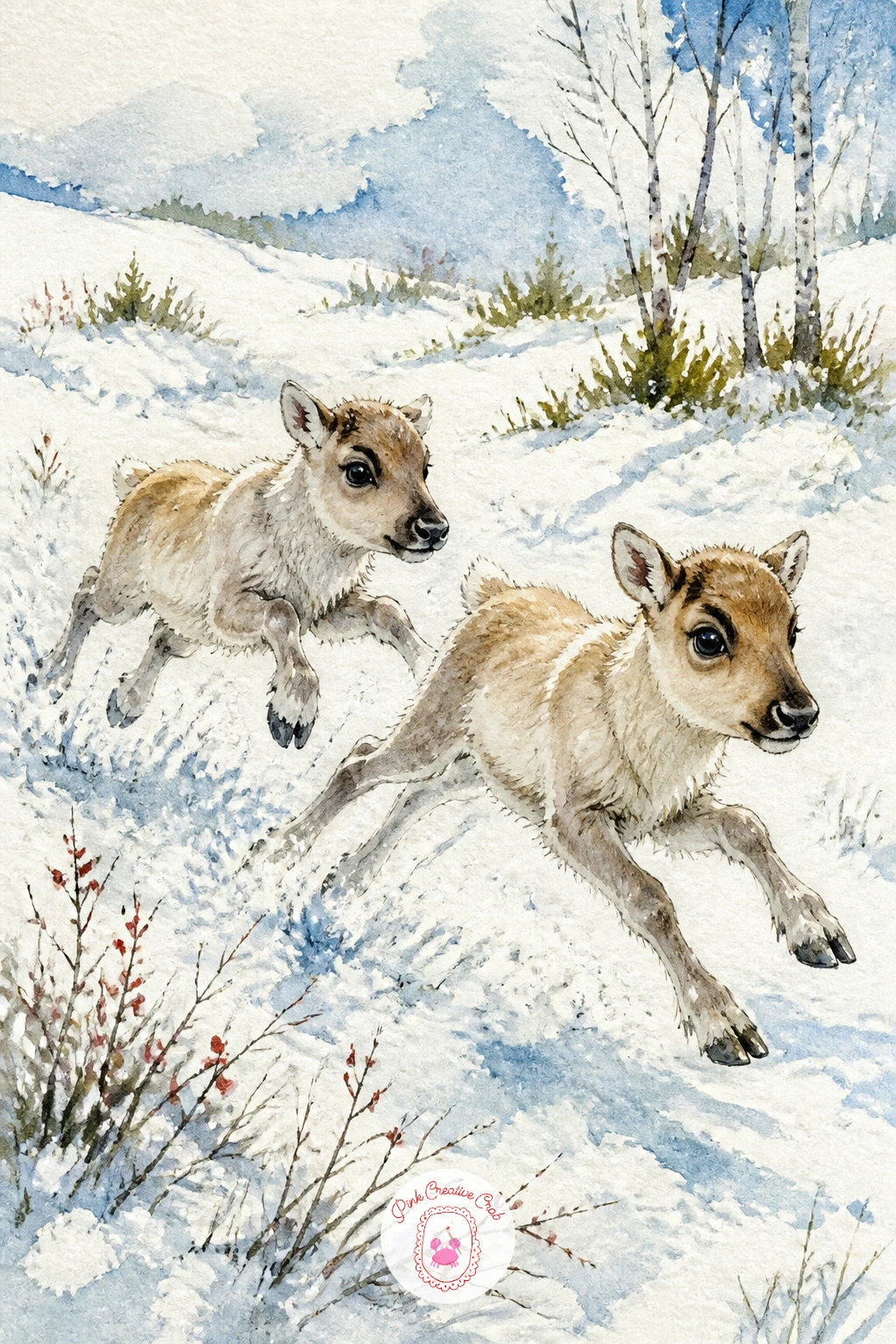
Palette: Soft Chocolate Brown,Birch White,Icy Blue,Payne’s Grey
A frozen waterfall gives you a strong vertical shape to balance against the reindeer’s horizontal trot, so place the falls tall in the background and keep the animal small and moving across the lower third of the page. Sketch its legs mid-trot, one pair forward and one back, for a sense of steady movement.
Paint the waterfall first using vertical strokes of icy blue and white, leaving thin streaks of bare paper for the brightest ice, and letting the colors run slightly to suggest frozen movement caught mid-fall. Once dry, paint the reindeer trotting past in chocolate brown, keeping its silhouette clean against the pale icy backdrop.
Painting the ice too flat loses the sense of a waterfall entirely. Keep the vertical strokes varied in width and let a few darker blue-grey streaks run through the ice to suggest depth and movement frozen in place.
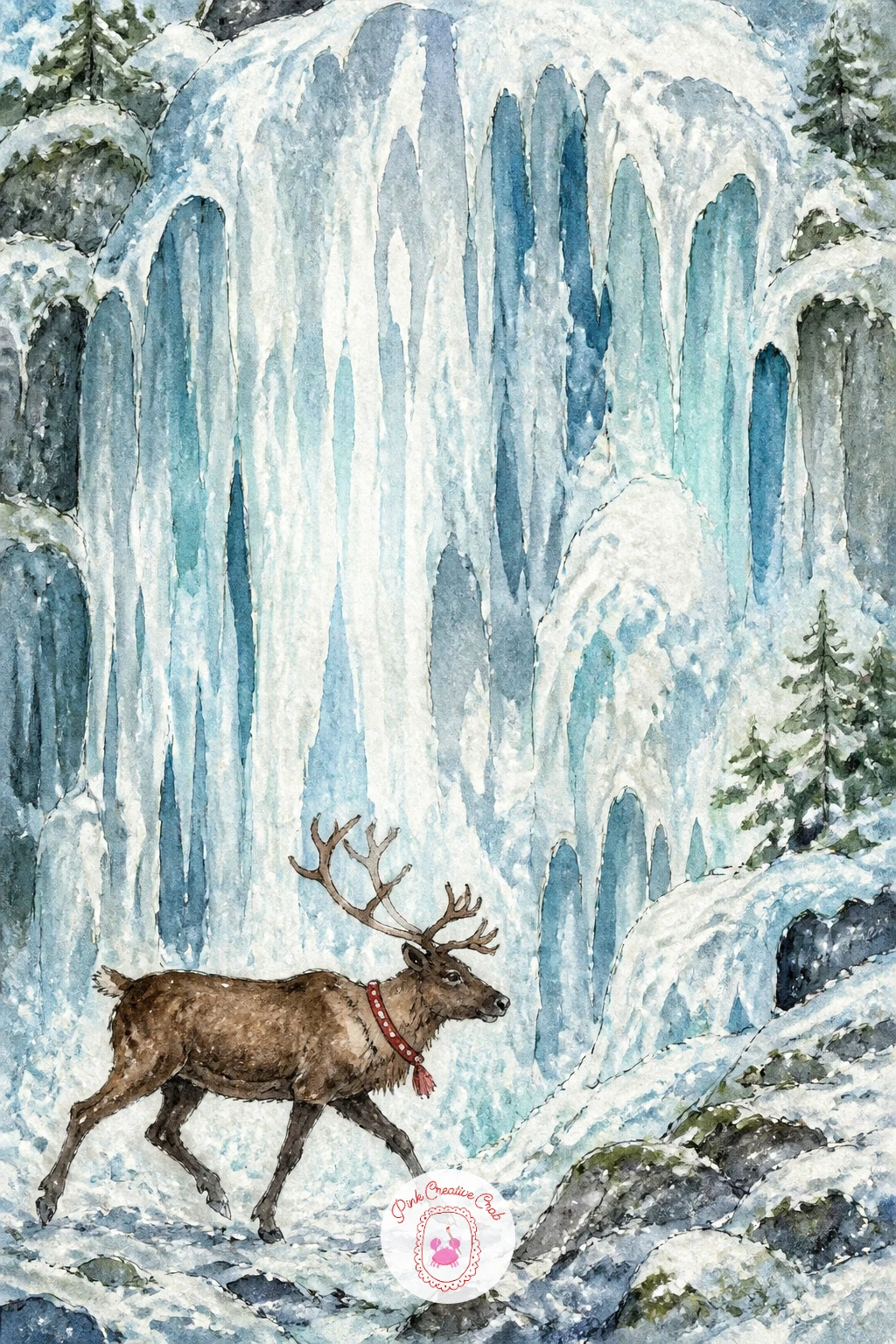
Palette: Icy Blue,Birch White,Soft Chocolate Brown,Payne’s Grey
This is a small, quiet gesture worth painting close and simple. Draw the head lowered all the way down, chin flat against the snow, eyes half closed, with the body curled behind it in a relaxed heap.
Paint the snow first with a soft wash directly under and around where the chin rests, letting it stay pale and slightly textured. Paint the head and chin area last in chocolate brown, leaving the very tip of the chin almost blending into the white snow rather than sharply outlined.
A hard line where chin meets snow breaks the sense of rest. Soften that edge while the paint is still damp by touching it gently with a clean, barely damp brush so it fades rather than stops abruptly.
For a quick version, paint just the head and chin resting in a small patch of snow; the longer version adds gentle falling snowflakes settling across the whole curled body.
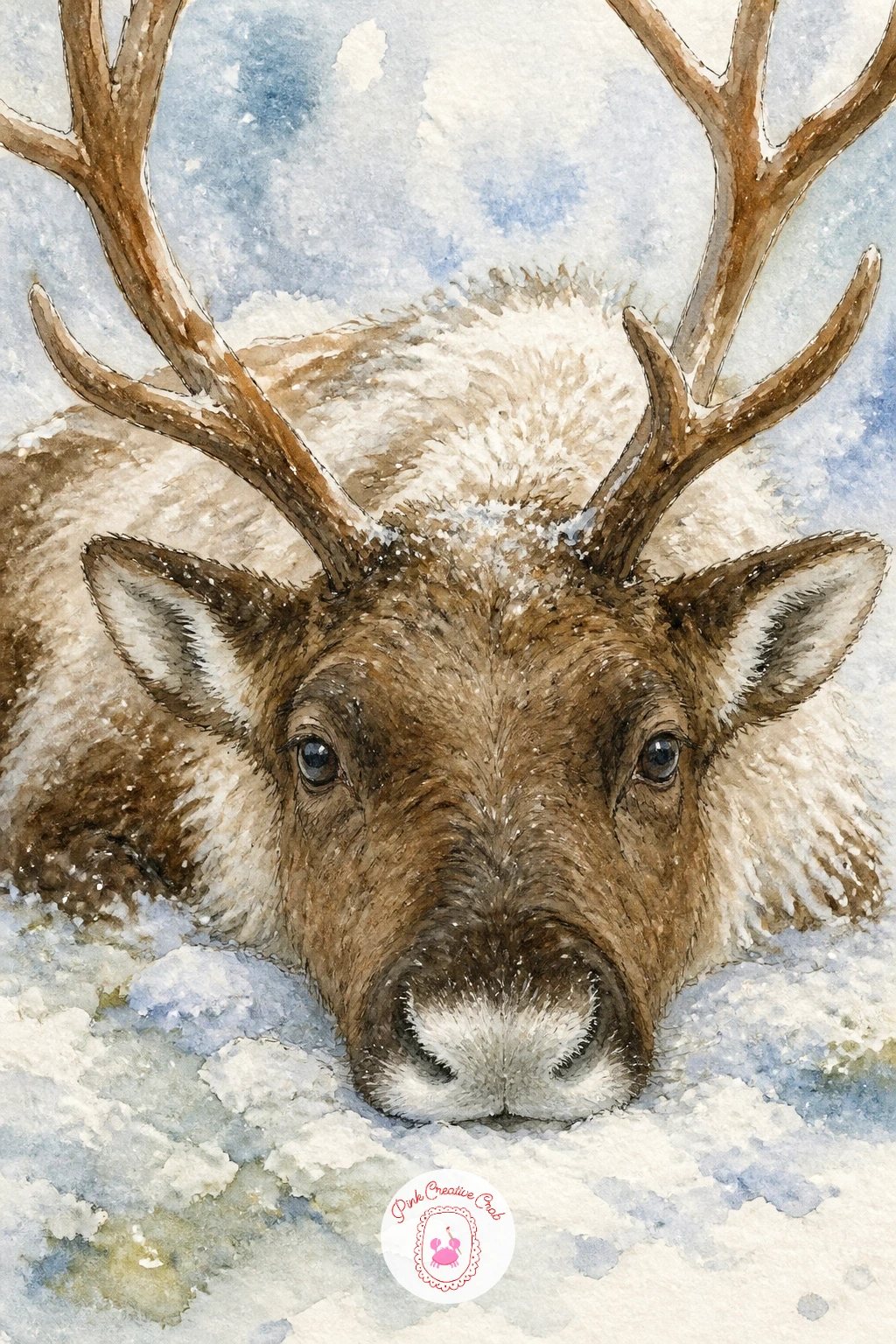
Palette: Soft Chocolate Brown,Birch White,Icy Blue,Payne’s Grey
A wooden hay rack gives you a strong central shape to build the herd around, so draw it first as a simple rectangular frame of crossed wooden slats, then arrange several reindeer heads reaching in toward it from different angles around the base.
Paint the hay itself in warm golden chocolate brown tones with dry-brush texture for loose strands, then paint the wooden rack in a darker, flatter brown around it. Paint the gathered reindeer last, varying their heights and head angles so the circle around the rack feels natural rather than staged.
Too many identical reindeer shapes around the rack looks repetitive fast. Vary each one’s pose, some heads down eating and others lifted and watching, and let a couple of bodies overlap slightly for a believable cluster.
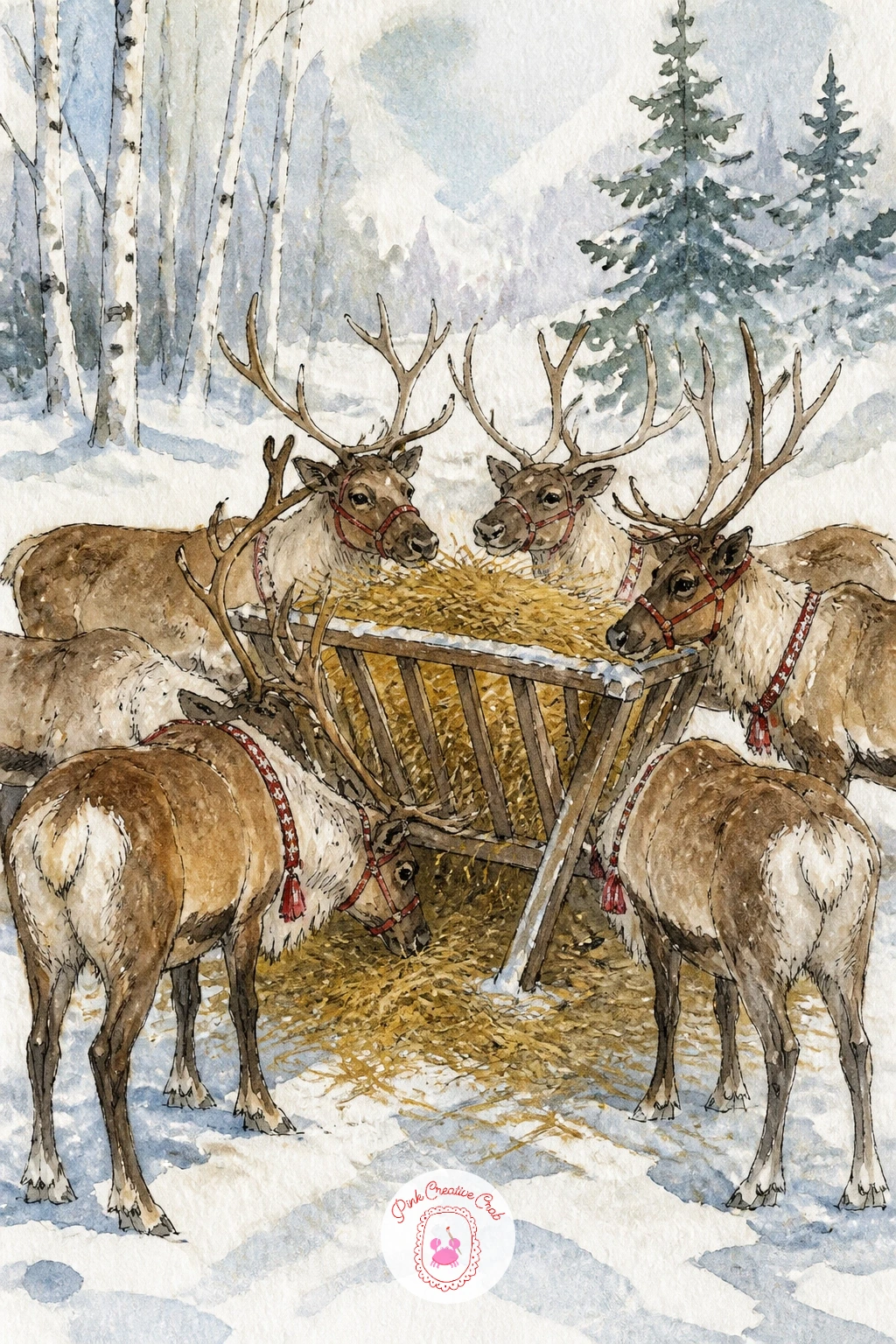
Palette: Soft Chocolate Brown,Payne’s Grey,Birch White,Moss Green
A low sun means a long shadow, so work out the light direction before anything else: the sun sits low on one side of the page, so the reindeer’s shadow should stretch far across the snow in the opposite direction, several times the length of the animal itself.
Paint the snow ground first in a pale wash, then paint the long shadow in a cool icy blue mixed with a touch of Payne’s grey, stretching it out at a shallow angle rather than straight down. Paint the reindeer last in warm chocolate brown, letting the side facing the sun stay noticeably lighter than the shadowed side.
A shadow that is too short or too blue-grey-neutral loses the late afternoon feeling. Keep it long, slightly warm in tone where it meets the light, and let it taper gently rather than ending in a hard line.
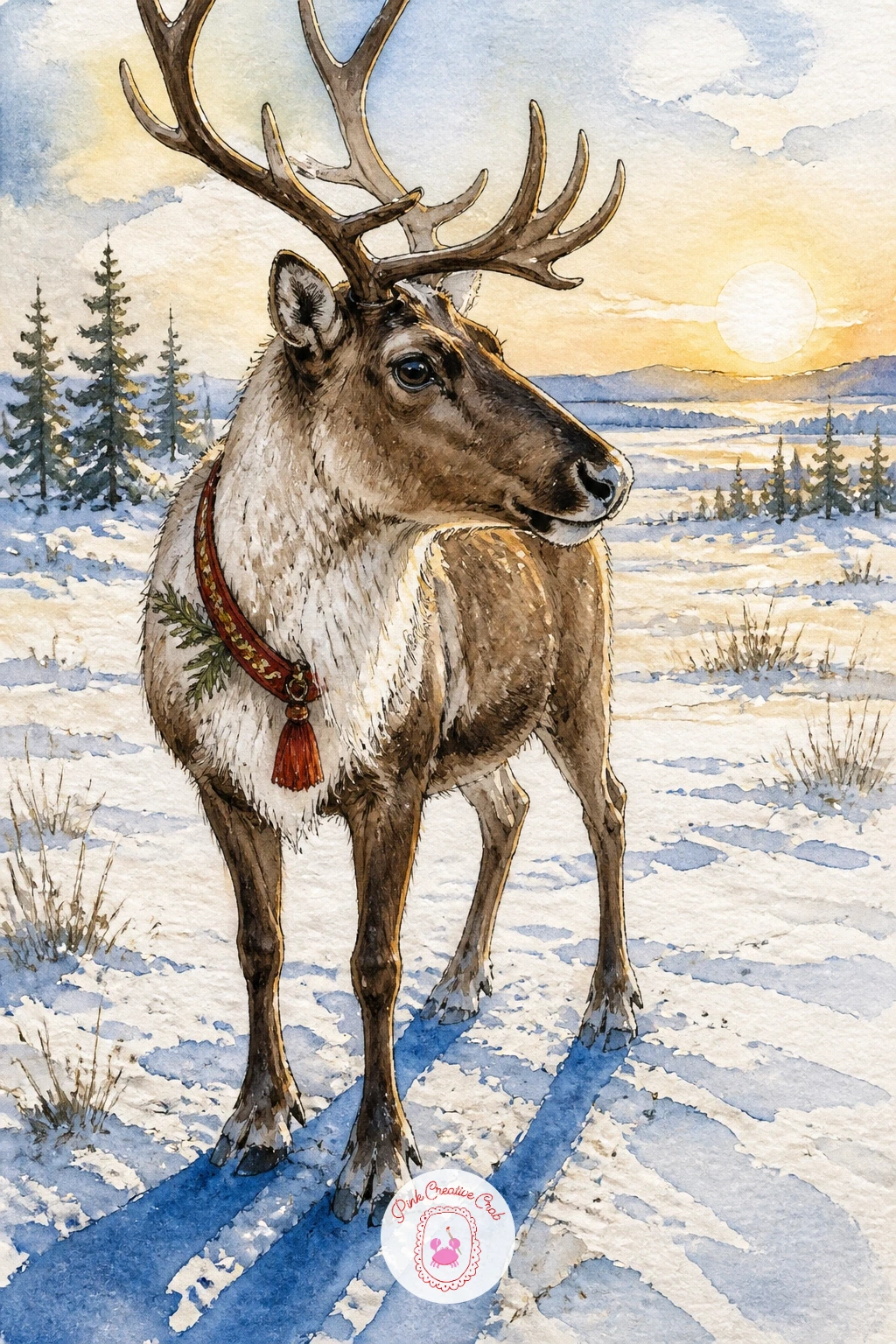
Palette: Icy Blue,Payne’s Grey,Soft Chocolate Brown,Birch White
Give this one a strong rocky foreground, since a fjord view depends on the reindeer standing on solid rock above open water. Draw a simple angled rock ledge in the foreground, the reindeer standing on it in profile, and the fjord stretching away below in the lower half of the page.
Paint the water first in a calm wash of icy blue and Payne’s grey, keeping it smoother and flatter than any snow in the piece, then paint the rocky ledge in textured grey-brown strokes. Paint the reindeer last, standing confidently on the rock edge in chocolate brown, with its silhouette clear against the pale water below.
Painting the water too choppy or textured fights the calm mood of this scene. Keep it nearly flat with just a few thin horizontal strokes for the suggestion of gentle movement.
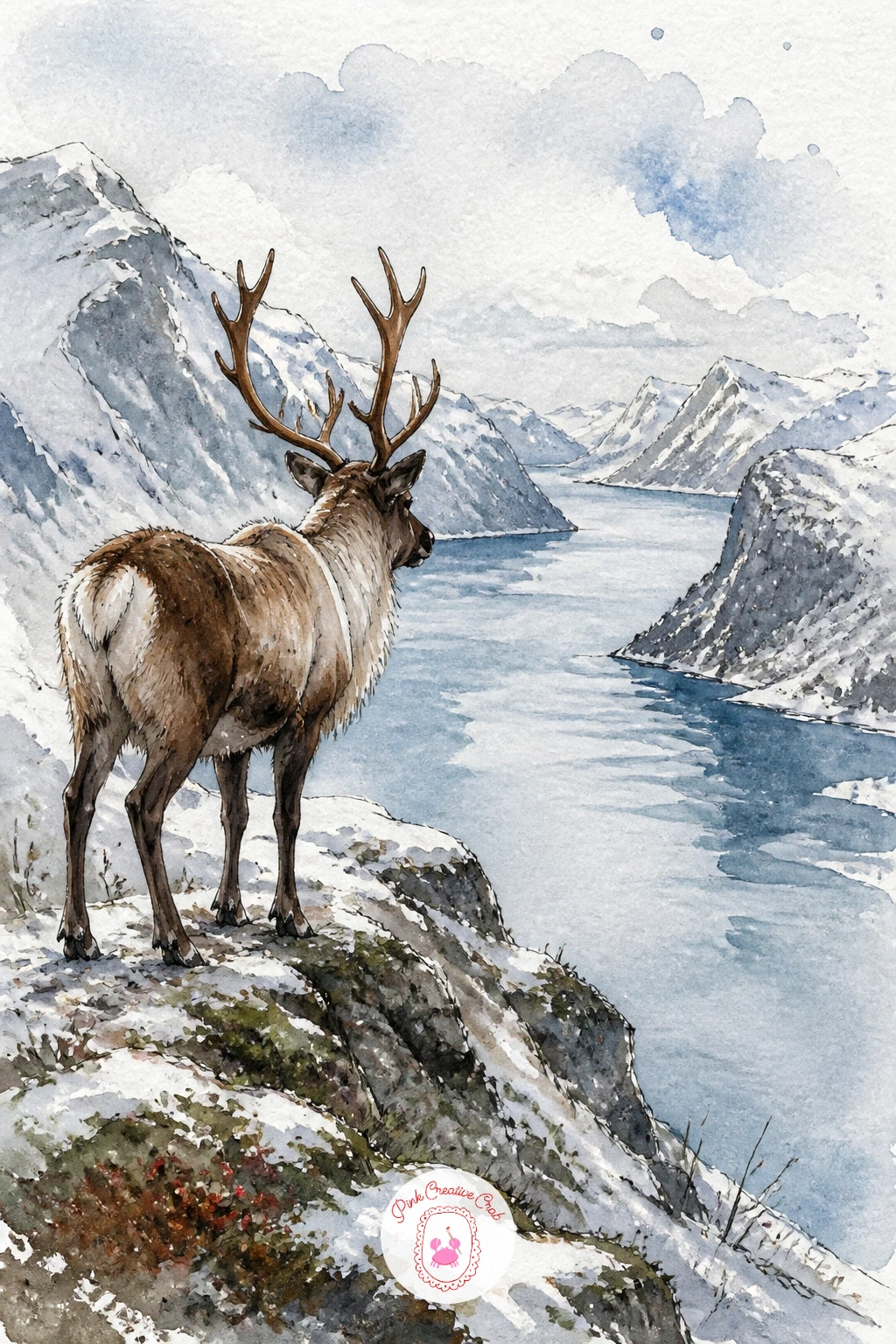
Palette: Icy Blue,Payne’s Grey,Soft Chocolate Brown,Birch White
A small bird perched on an antler adds scale and a gentle surprise, so draw the bird last after the antlers are settled, choosing one fork or tip to perch it on rather than the center of the rack where it would get lost. Keep the bird genuinely tiny, no larger than the reindeer’s ear.
Paint the reindeer first in your usual chocolate brown, finishing the antlers fully in ink before adding the bird, since the bird needs a settled perch to sit convincingly on. Paint the bird in two or three quick strokes of a contrasting color, a touch of cherry red works nicely against the pale antler, with the tiniest flick of ink for its eye and beak.
A bird painted too large competes with the reindeer instead of complementing it. Check its size against the ear one more time before adding any ink detail, and keep its pose simple, just a round body and a small pointed tail.
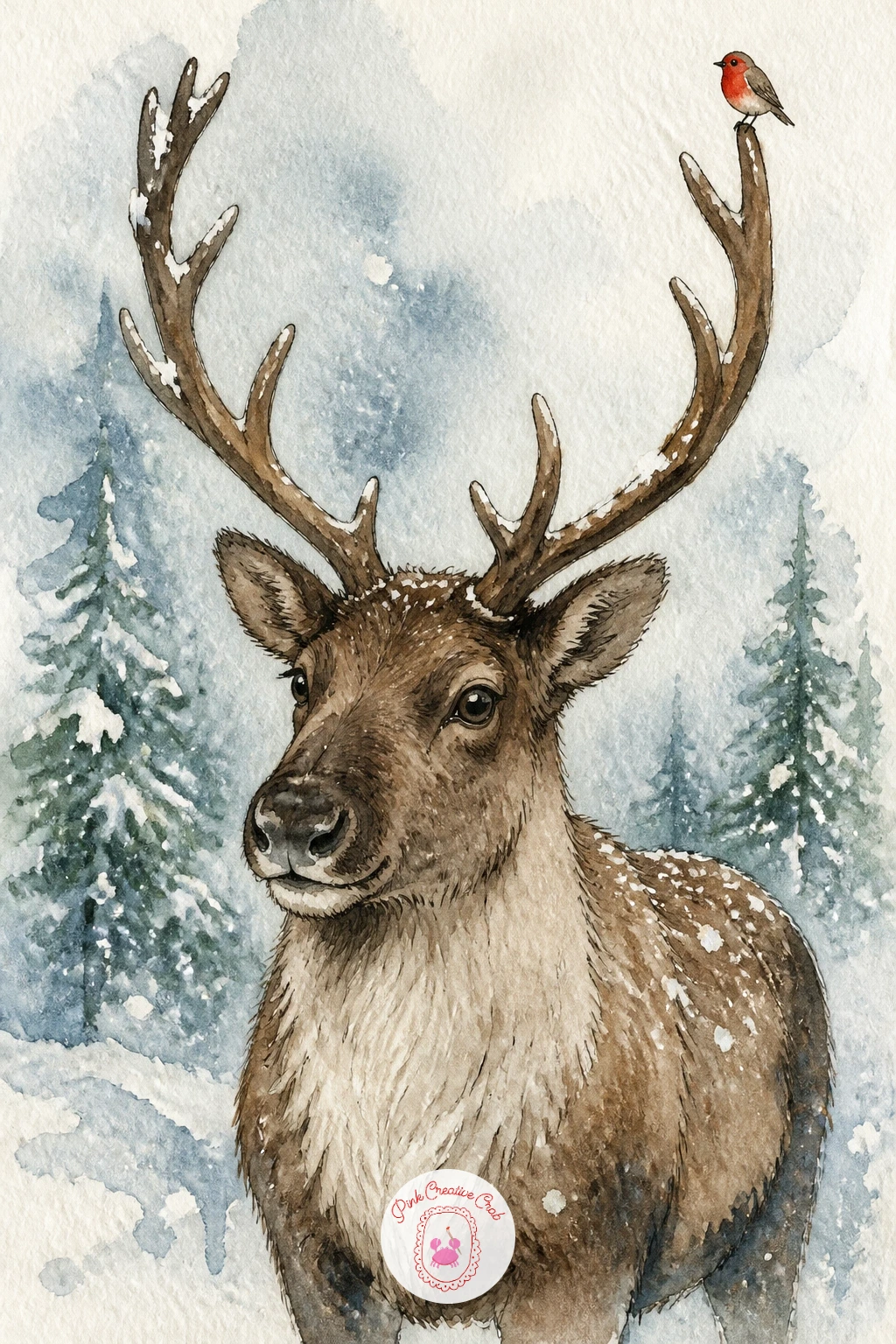
Palette: Soft Chocolate Brown,Cherry Red,Payne’s Grey,Birch White
This is a small story told almost entirely through the calf’s head angle, so draw it with its neck curved down and around, looking back at a trail of hoof prints behind it rather than ahead. The body should still face mostly forward, just the head twisted to look.
Paint the snow ground first, then stamp in a simple trail of small oval hoof prints using the edge of a flat brush dipped in pale icy blue shadow color, spacing them in a loose wandering line behind the calf. Paint the calf itself last in its lighter young brown, finishing the twisted neck and curious expression in ink.
Hoof prints painted too neat and evenly spaced look stamped rather than wandered. Vary their spacing and angle slightly, and let one or two overlap, since a calf’s early steps are rarely in a straight tidy line.
If a flat brush edge feels awkward for the prints, the side of a cut sponge or even a fingertip dipped lightly in paint makes a similarly soft oval mark.
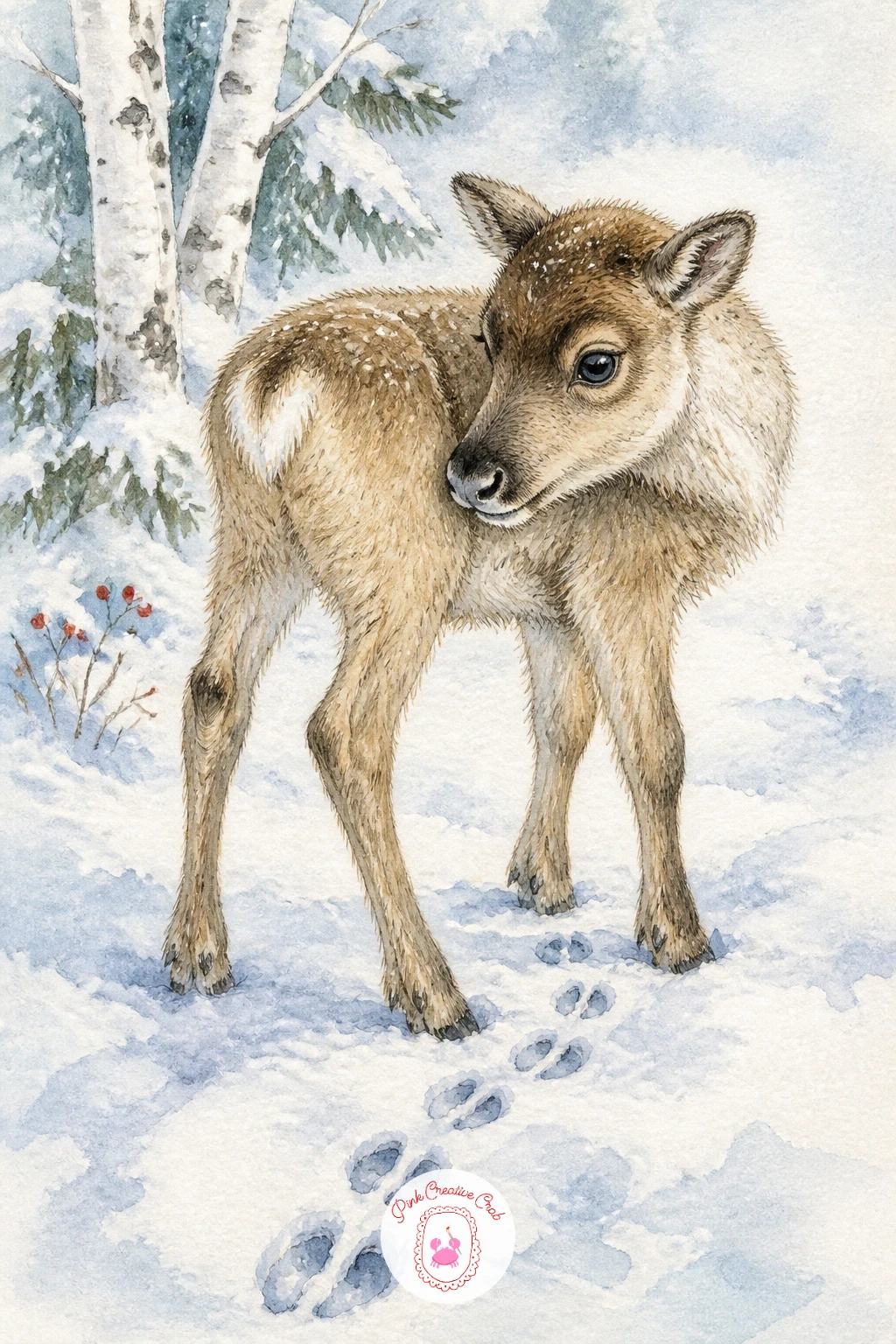
Palette: Soft Chocolate Brown,Icy Blue,Birch White,Payne’s Grey
What to Do Next
Choose whichever reindeer moment feels most inviting right now, wet a sheet of cold press watercolor paper, and let the first wash bloom before you reach for ink. One finished picture today is plenty of reason to come back for another tomorrow.
Frequently Asked Questions
What is the easiest way to start a reindeer drawing for watercolor?
Start with simple pencil ovals for the body and head before adding legs or antlers. Block in proportions loosely first, check the size relationships, then commit to ink and paint once the basic shapes feel balanced.
How do you paint reindeer fur so it looks soft rather than flat?
Paint wet into wet for the body so edges blend softly, then add a few dry-brush strokes once that layer dries for texture. Save crisp ink lines only for the eye, hooves and antler tips.
What colors give reindeer snow scenes that cold Nordic feeling?
Icy blue, birch white and Payne’s grey carry the cold, while soft chocolate brown and moss green keep the animal and ground feeling alive. A small cherry red accent, like a cabin or a bird, warms the whole scene.
How do you keep antlers from looking like a tangle of lines?
Paint the antler shape as one flat pale wash first, then add only a few essential ink branches once it is dry. Simplify the real branching pattern rather than copying every tine.
Can a beginner paint a whole reindeer herd convincingly?
Yes, by keeping distant animals as simple, flat, lighter shapes and only adding detail to the nearest one or two. Varying size and tone across the herd creates distance without extra drawing skill.
Have any thoughts?
Share your reaction or leave a quick response — we’d love to hear what you think!
-
 0
-
0
-
0
-
0
-
0
-
0


