Cool sketchbook ideas do not always need a complicated setup, and these ones prove it. Every page here puts an enormous, blissfully unbothered cat right on top of a miniature town, treating a church tower like a scratching post or a bridge like a nap spot, so the joke is built right into the composition before you draw a single whisker.
You will find twenty seven of these scenes below, starting with simple shapes you can finish fast and moving toward pages with a bit more going on. Grab a fineliner, a light watercolor set and some cream paper, and pick whichever cat makes you laugh first.
Using these images: free for personal projects such as printing, coloring, cards, journals and gifts. Handmade items that include them may be sold up to 30 pieces per design. More than that is commercial use and is not permitted, and neither is selling or sharing the images themselves or passing them off as your own. Please ask before any other use.
Start with the easiest pose in this whole set: a ginger cat sprawled flat across a row of rooftops, paws dangling over the gutters on either side. Pencil in a long, loose sausage shape for the body first, then build the little houses as simple triangles and rectangles underneath, letting the roofline dip wherever the cat’s weight presses down.
Ink the cat with a fineliner, keeping the outline soft and a bit wobbly so it reads as fur rather than a mannequin. Add the houses with straighter, more confident lines so the two textures contrast.
Where this usually goes wrong is scale: if the houses look too big, the joke disappears. Keep each house no taller than one of the cat’s paws, and if you are unsure, sketch the cat first and fit the town to it rather than the other way round.
Finish with a warm orange watercolor wash over the cat and leave the rooftops in cooler greys and reds, so your eye goes straight to the giant napping shape.
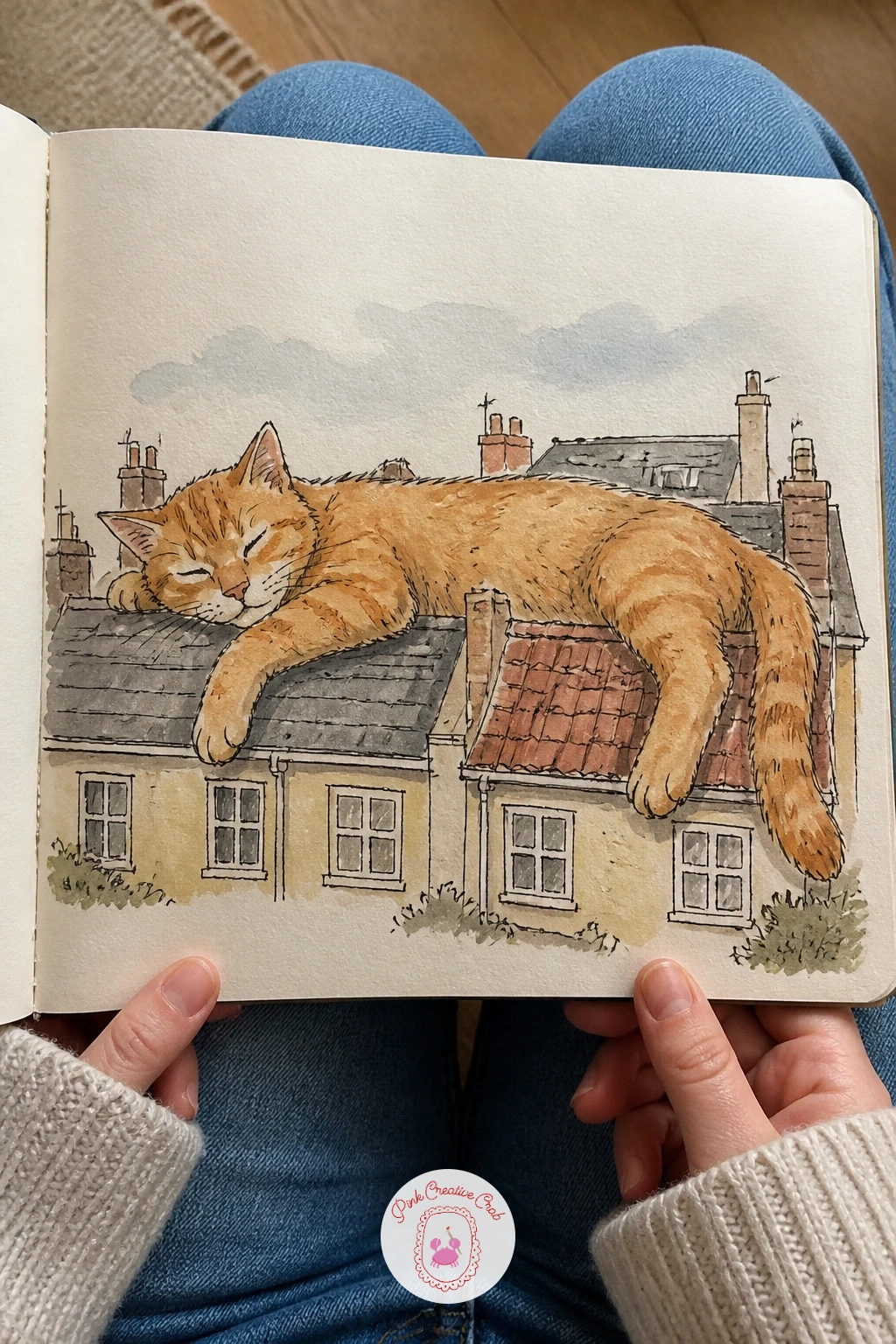
Palette: Burnt Sienna,Cadmium Orange,Payne’s Grey,Brick Red
Move on to a cat wearing a lighthouse the way a child wears a traffic cone: perched right on top, striped tower poking up between its ears. Draw the lighthouse first as a simple cylinder with a lamp room on top, then build the cat’s head and shoulders around it as if the tower were sitting in its lap.
Use a ruler or the edge of a card for the lighthouse’s straight sides so it stays crisp against the cat’s softer fur lines. This contrast between tool-drawn structure and freehand animal is what sells the whole joke, so do not freehand the stripes.
If proportions wobble, compare the lighthouse height to the width of the cat’s head: keeping the tower no taller than one head-width keeps it looking worn like a hat rather than simply standing nearby.
Paint the lighthouse in classic red and white bands, then wash the cat in a pale grey so the color pop stays on the tiny building.
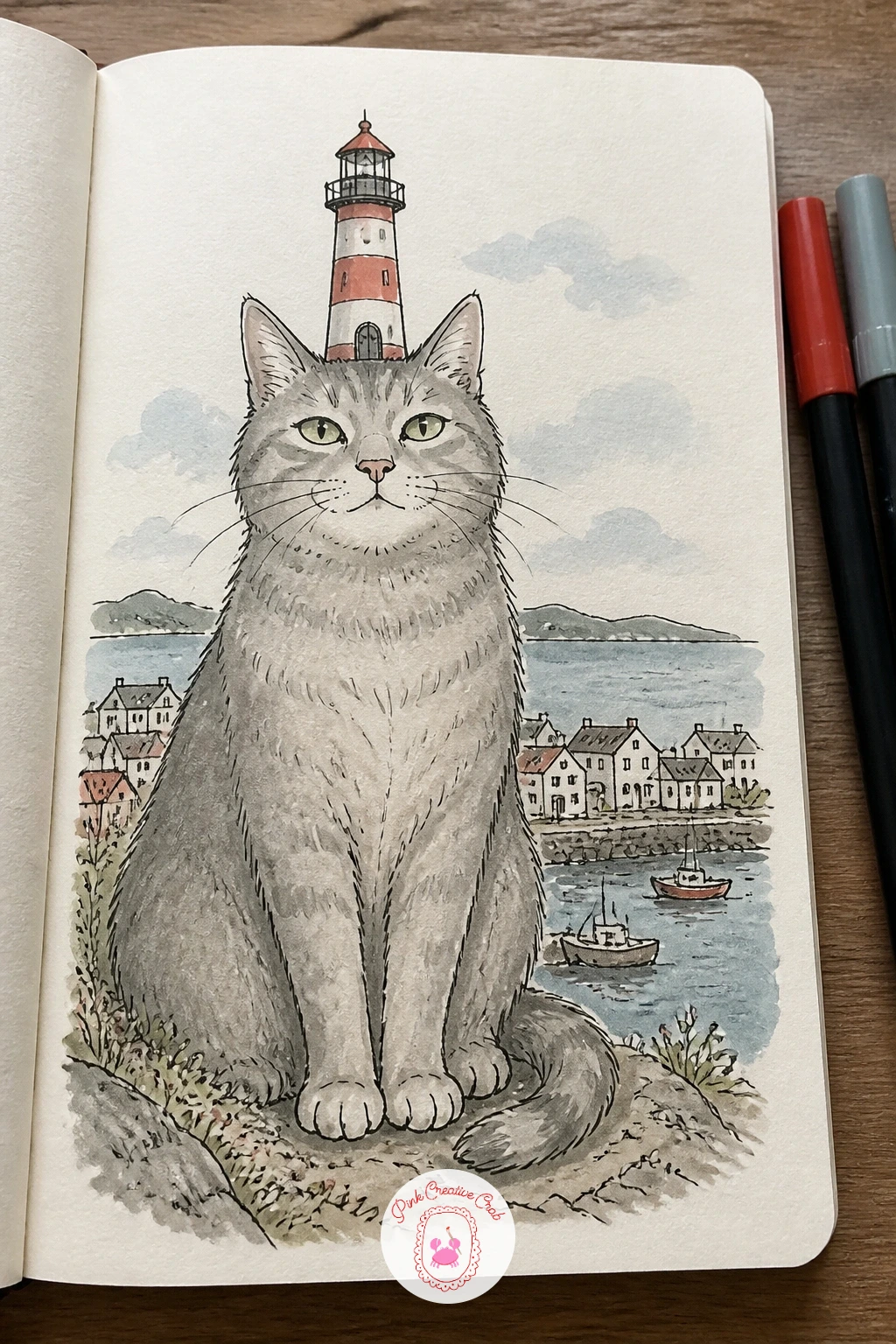
Palette: Cadmium Red,Titanium White,Cool Grey,Ultramarine Blue
Give the page some motion with a cat swatting a tram the way it would bat at a toy on a string. Sketch the tram first, a simple rounded rectangle on a track, then bring one huge paw swooping in from the edge of the page toward it, claws slightly out.
Work from the tram outward: ink its windows and wheels tight and neat, then let the paw’s outline loosen up with a few speed lines trailing behind it to show the swipe. This placement, where eye level sits low and close to the street, makes the paw feel like it is reaching right into the town rather than floating above it.
A common slip here is drawing the paw too stiff and flat. Curve the toes slightly and vary their lengths so it reads as a playful swat, not a stamp.
Color the tram in a cheerful yellow and keep the paw a soft tabby brown, with a faint grey shadow underneath to ground it on the page.
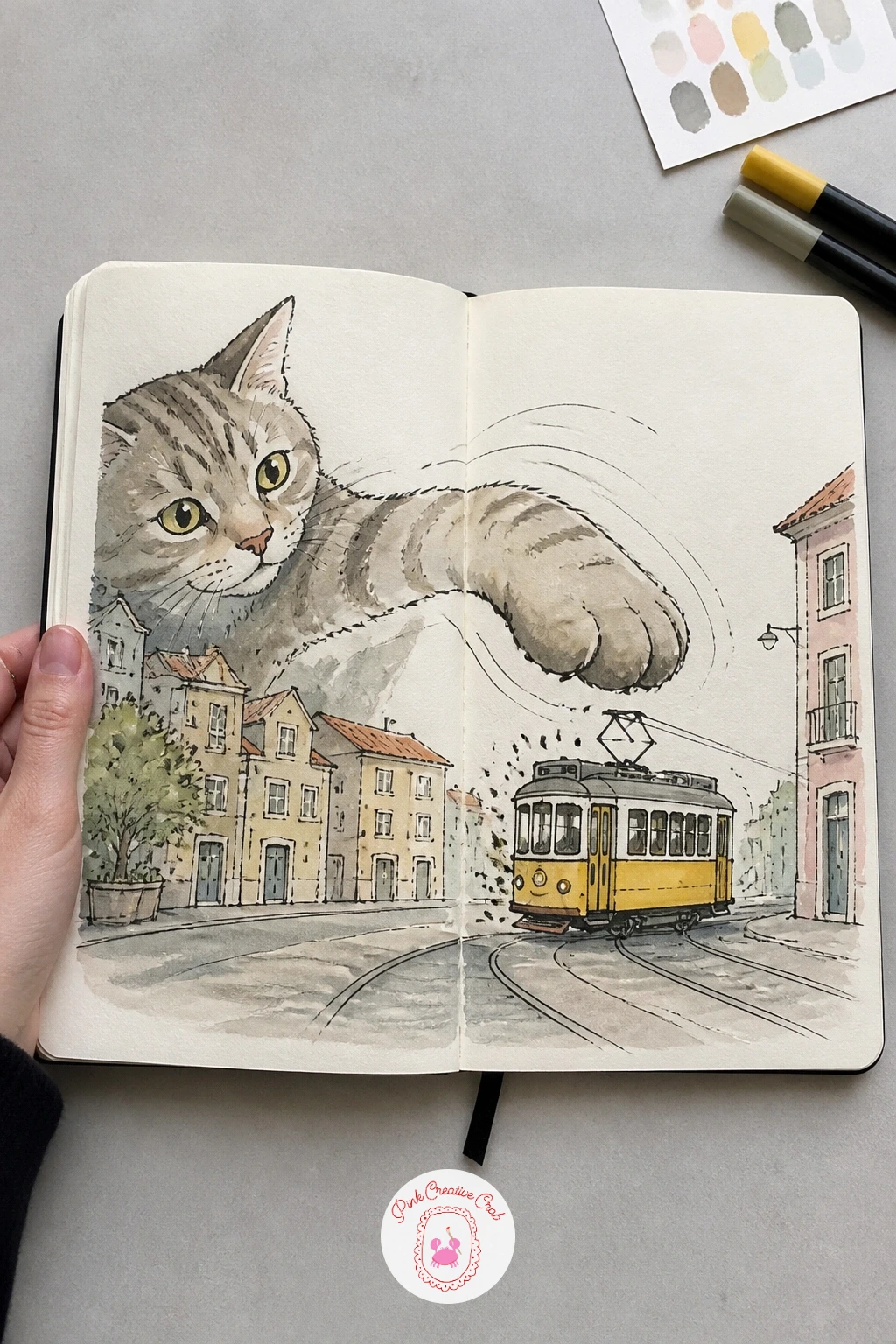
Palette: Naples Yellow,Raw Umber,Payne’s Grey,Soft Black
Add two or three short motion lines behind the paw in pencil before inking, then erase any that look too mechanical once the ink is dry.
Curl a cat around a church tower the way it would wrap itself around a table leg. Draw the tower first as a tall narrow rectangle with a pointed roof, then loop the cat’s body around its base in a soft C shape, tail tucked near the steeple.
Build the cat in stages: head and front paws first, then let the body curve away and come back round so it hugs the tower rather than just sitting beside it. Keep the tail long enough to wind up near the bell.
The trickiest part is making the curl look relaxed rather than tangled. Before inking, check that the body makes one smooth sweeping line from nose to tail tip, with no sharp kinks, the same way you would check a single confident gesture line in any life drawing.
Wash the tower in warm stone tones and leave the cat a soft charcoal grey, so the two shapes read clearly even from a distance.
If you enjoy pairing animals with small buildings, the mini sketchbook ideas of little houses make a good companion page.
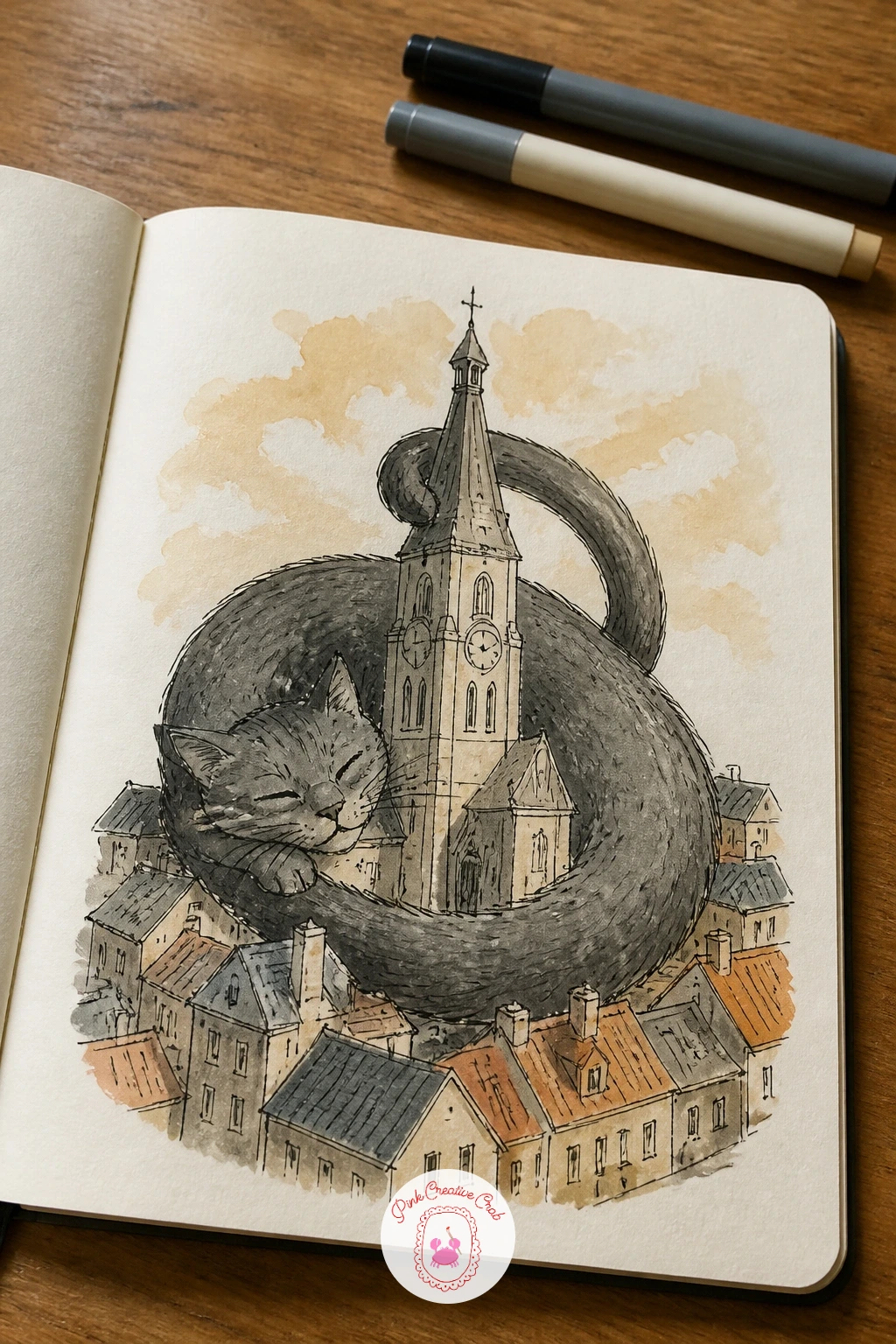
Palette: Raw Sienna,Charcoal Grey,Ivory Black,Soft Cream
Let a cat lap at a city fountain as if it were an ordinary water bowl, head bent low over the basin with the whole square arranged around it. Start with the fountain itself, a tiered circle shape with a simple statue on top, then bring the cat’s head down close with its tongue just touching the water.
Build the fountain with careful, evenly spaced circles for the tiers before you ink, since a wobbly fountain draws more attention than a wobbly cat here. Use a plate or coin to trace clean circles if freehand ellipses feel shaky.
Where this scene tends to fall apart is the water itself: keep ripples to two or three light curved lines rather than a tangle, so the surface still reads as still water.
Finish with a cool blue grey wash in the basin and warm beige stone around it, letting a touch of blue reflect faintly onto the cat’s chin fur.
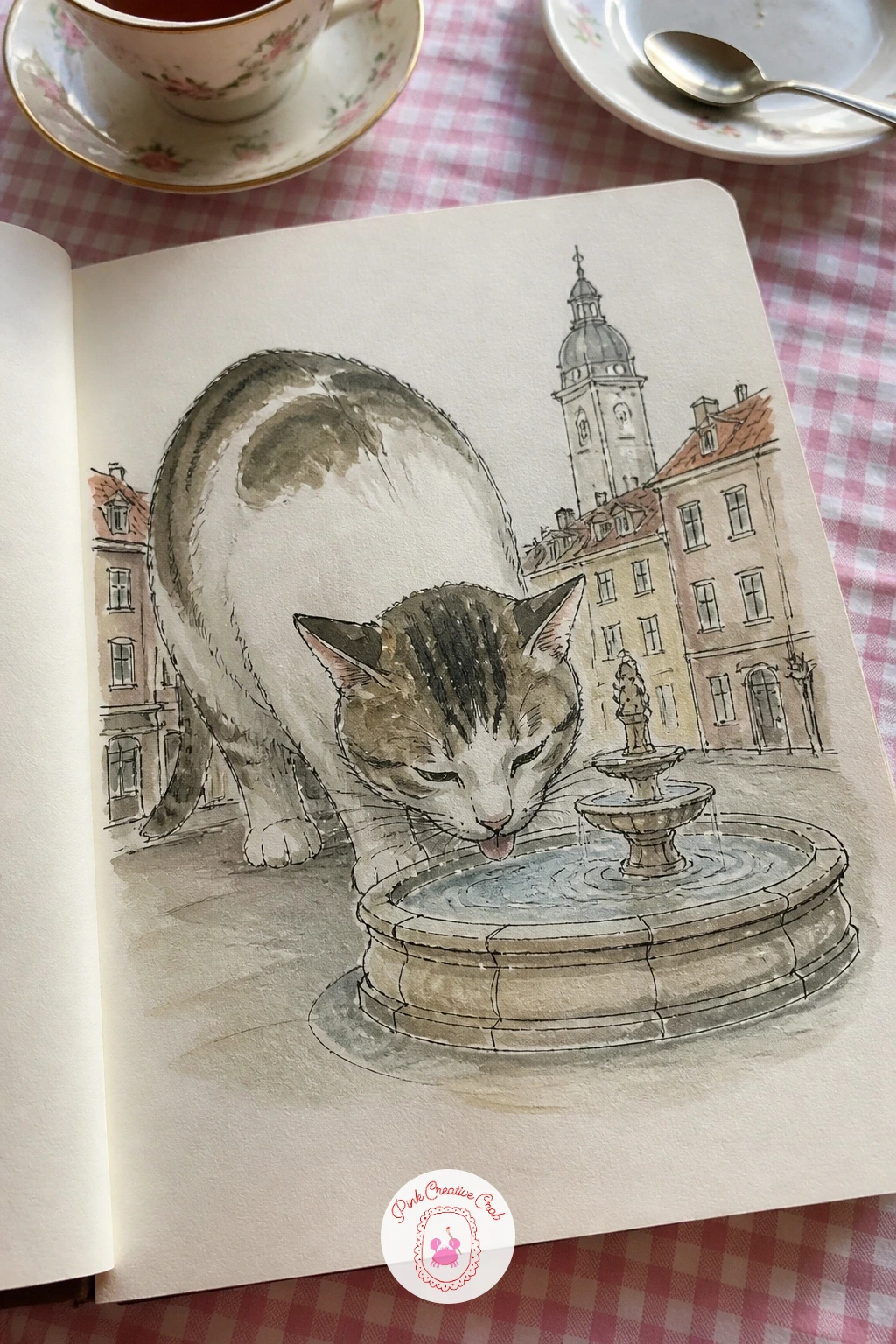
You Will Need
- a small circular object to trace the fountain tiers
Palette: Cerulean Blue,Beige,Stone Grey,Soft Black
Put the cat’s whole face up against a skyscraper the way it would press its nose to a fish tank. Here the eye level sits level with one high floor of the building, so the cat looks like it is crouched down at that exact height, which is what makes the scale joke work rather than just looking like a cat beside a tower.
Draw the skyscraper first as a tall grid of simple rectangles for windows, then bring one giant eye and the bridge of the nose right up against a single lit window, as if peering inside.
Keep most windows dark and only light the one the cat is looking into, since too many bright squares will compete with the face for attention.
If straight grid lines feel fussy, lightly rule the window grid in pencil first, ink only the lines you need, and let the cat’s fur stay loose and textured for contrast.
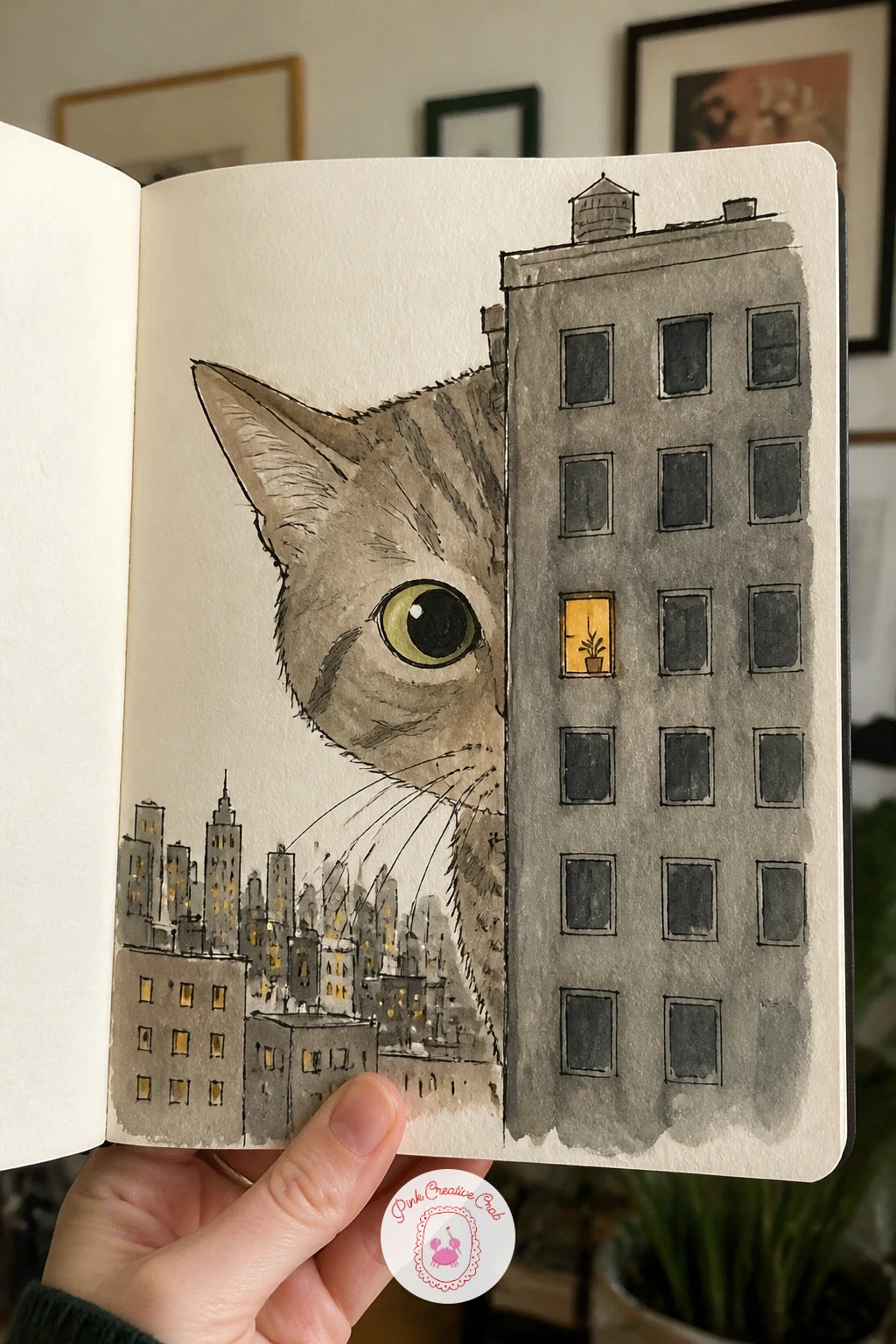
Palette: Slate Blue,Warm Yellow,Charcoal Grey,Soft Peach
Stretch a cat out along a bridge the way it would claim the back of a sofa. Sketch the bridge’s arches first, a simple row of curves over a river, then lay the cat’s body across the top so its belly dips slightly into the curve of the central arch.
Ink the bridge with clean, even arches, then let the cat’s outline sag and settle over it, with one paw drooping down toward the water on either side if there is room on the page.
A quick ten minute version keeps the river as a flat blue band and the bridge plain stone. Given forty minutes, add small boats passing underneath and a soft reflection of the cat’s shape wobbling in the water, which sells the scale even further.
Swap watercolor for a grey marker wash on the stone if you want a faster, flatter finish today.
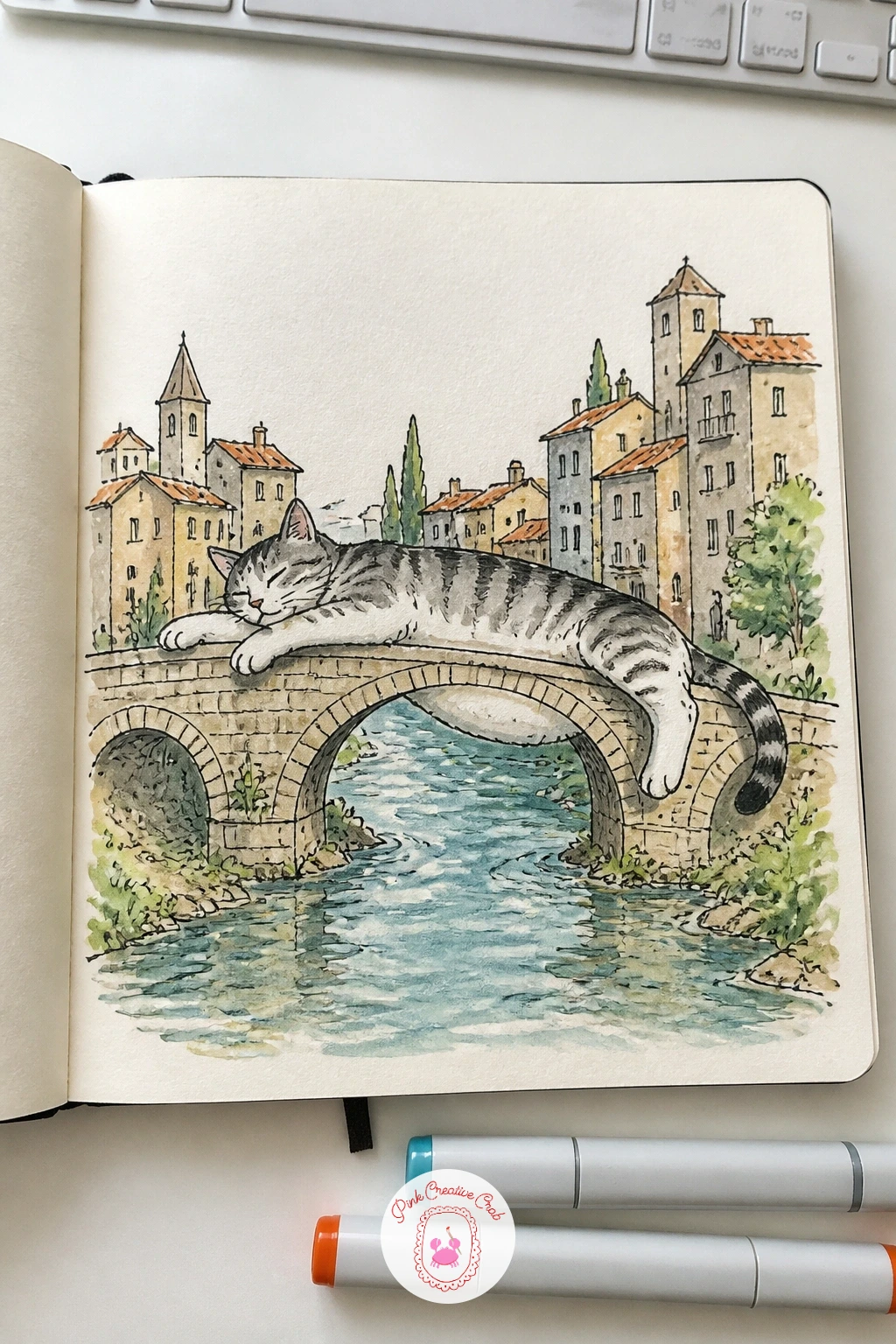
Palette: Stone Grey,River Blue,Warm Grey,Soft Black
Send a cat leaping after a cluster of hot air balloons the way it would chase a feather toy. Pencil three or four round balloon shapes drifting at different heights first, then add the cat mid leap below them, front paws reaching up and back legs still pushing off a rooftop.
Build the leap in stages: block in the body as a simple diagonal oval, then add legs stretched fully in opposite directions so the pose reads as motion rather than standing.
If the jump looks stiff, check that the cat’s spine curves slightly, the same gentle arc you would use for a cat mid-pounce in any reference photo, rather than a straight rigid line.
Paint each balloon a different bright color so they read instantly as separate shapes, and keep the cat in one warm solid tone so it stays the clear focus of the leap.
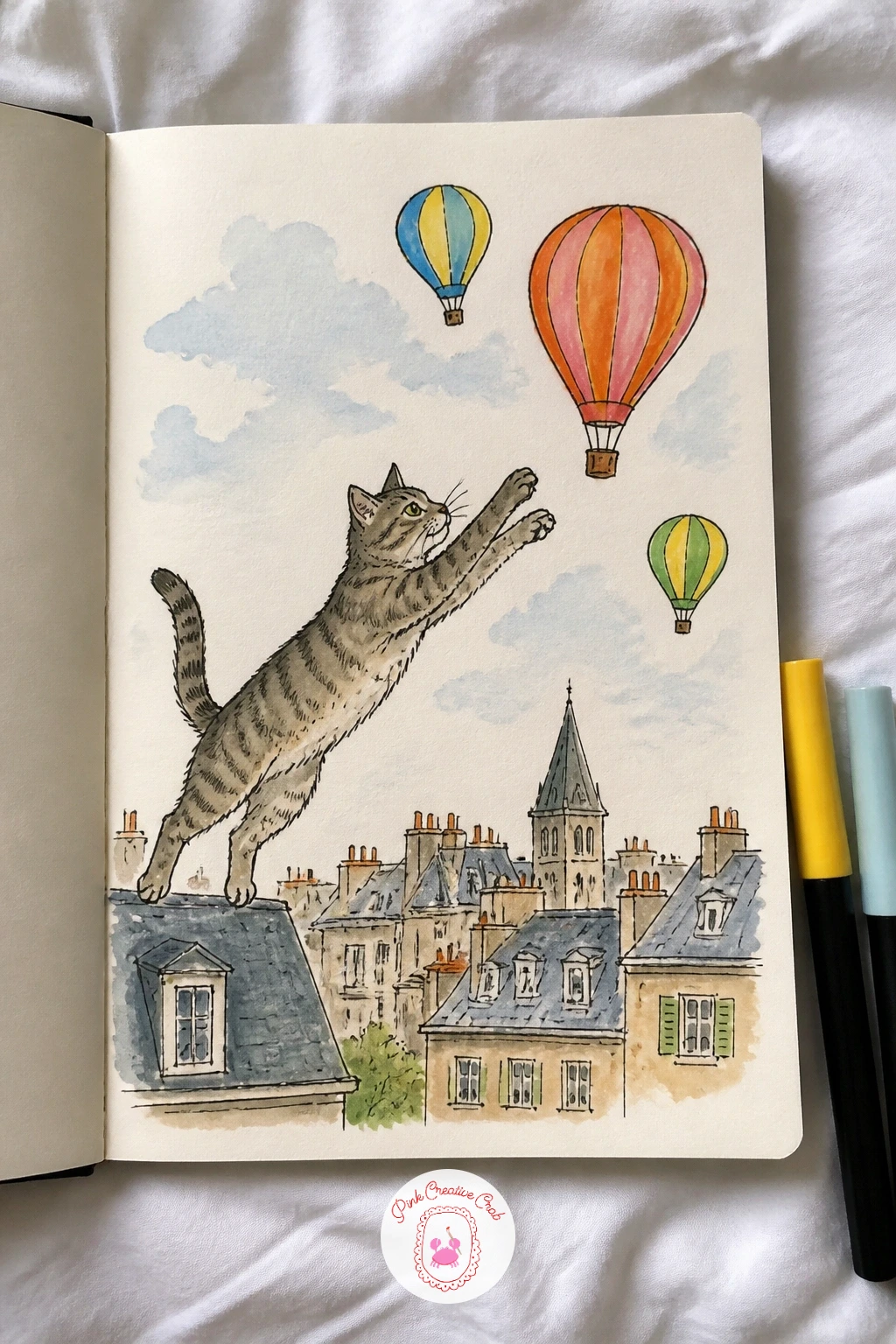
Palette: Poppy Red,Sunshine Yellow,Teal,Warm Tabby Brown
Bring in a single giant paw pressed flat across a street full of tiny cars, the way a cat blocks a hallway without a second thought. Draw the row of cars first, simple boxy shapes queued along a road, then lay the paw directly across the lane, pads splayed and claws relaxed.
Work the paw with a few confident curved lines for each toe and one larger shape for the pad, keeping detail minimal so it does not compete with the busy little cars behind it.
The usual mistake is making the paw look aggressive instead of oblivious. Soften the claws so they barely show and tilt the paw slightly, as if it landed there by accident mid-stretch.
Color the cars in a cheerful mix of reds and blues, and leave the paw a plain warm grey so your eye reads it as the obstacle immediately.
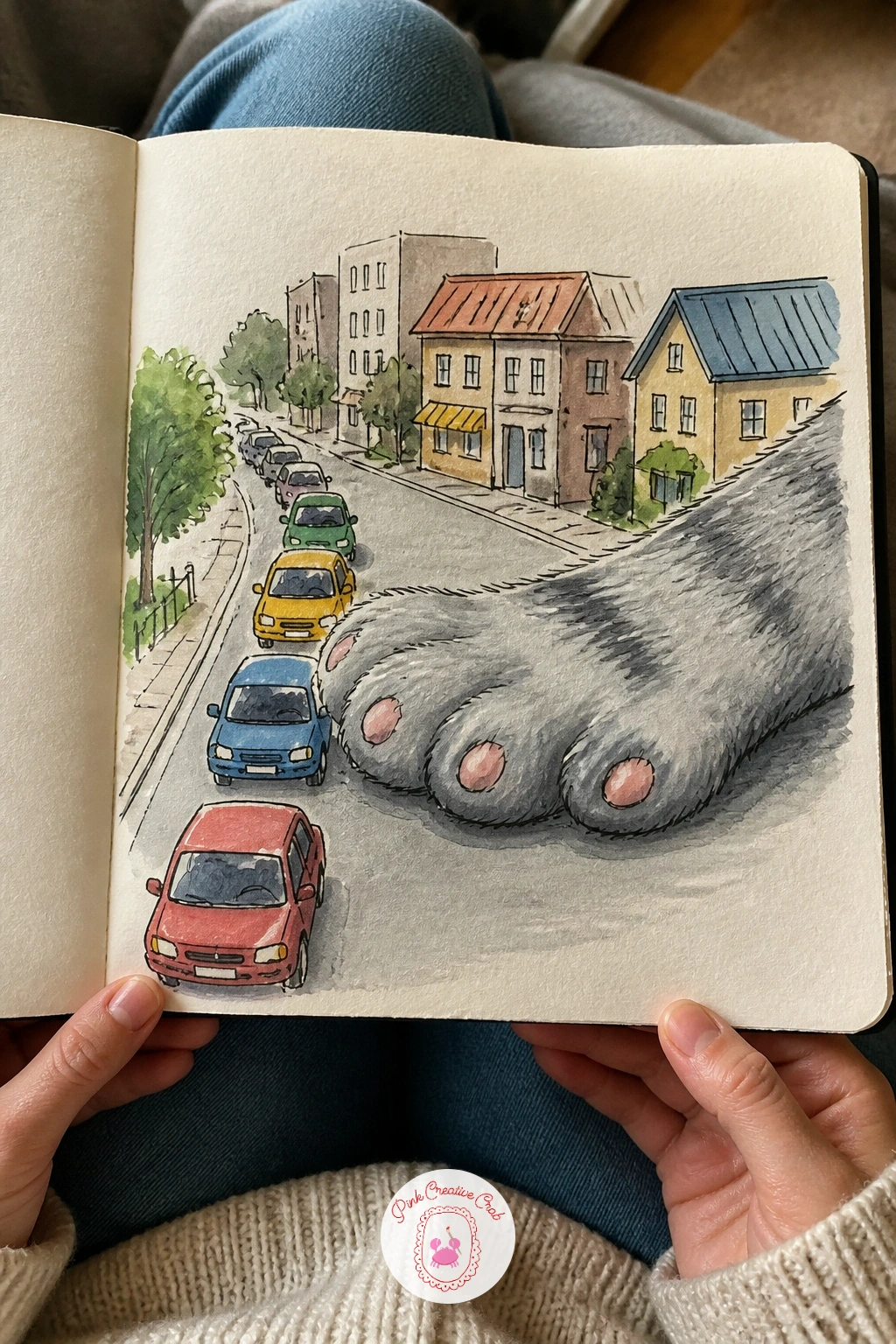
Palette: Warm Grey,Cadmium Red,Cobalt Blue,Soft Black
Let a cat take up an entire park the way it would claim a whole blanket, body rounded into a long gentle hill shape with tiny trees and paths scattered over its back. Start with one long smooth curve for the spine, then add trees, benches and a winding path as if they sit directly on the cat’s fur.
Measure the cat’s curve against the width of the page before inking: keeping the highest point of the back no more than a third of the way up the page stops the hill from looking like a separate mountain rather than a sleeping body.
Place a couple of tiny figures walking the path to sell the scale, drawn as the simplest possible stick shapes so they stay secondary to the cat.
Wash the whole body in soft greens where the grass would be, leaving warm fur tones only at the visible head and tail.
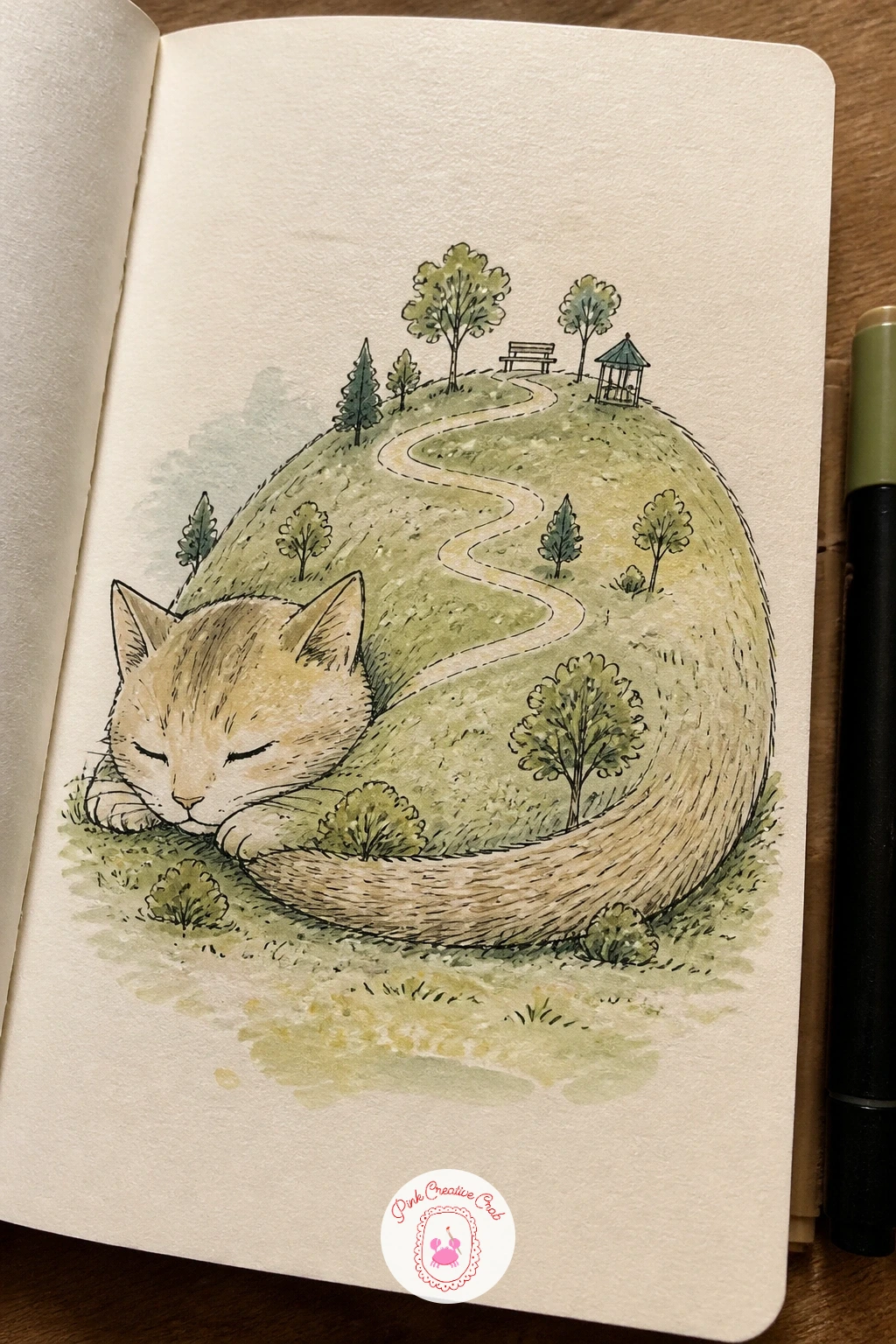
Palette: Sap Green,Olive,Warm Tan,Soft Black
Catch a cat mid-mischief, one paw knocking a water tower off balance the way it would send a glass off a counter. Sketch the tower first, a simple cylinder on stilted legs, tilted at an angle rather than upright, then add the paw making contact at its base.
Draw a few curved lines of water spilling from the top to show the moment of tipping, keeping them loose and a little chaotic compared to the tower’s straighter lines.
If the tilt looks wrong, draw a faint vertical guideline first to see exactly how far off-center the tower leans, the same trick you would use to check any leaning object before committing to ink.
Finish with a pale blue wash for the spilling water and warm wood tones on the tower’s legs, with the cat’s paw left a plain neutral tone so it does not distract from the spill.
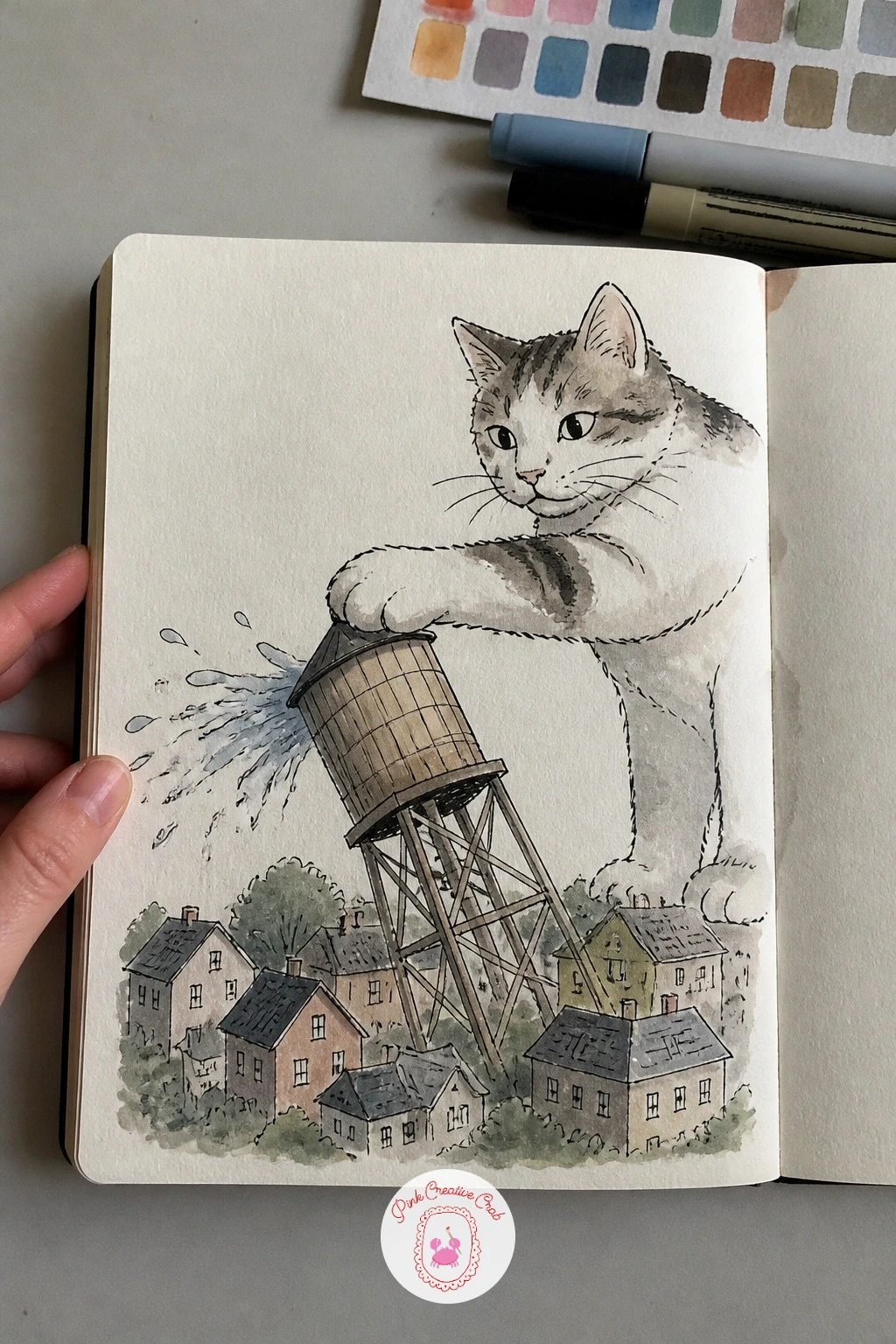
Palette: Sky Blue,Warm Wood Brown,Soft Black,Pale Grey
Arch a cat into a full-body stretch right over a train station roof, front paws reaching past one end of the platform and back legs trailing off the other. Begin with the station as a long low rectangle with a curved glass roof, then draw the cat’s stretched spine arcing high above it.
Build the stretch in one continuous line from front paws to back legs before adding any fur detail, the same single sweeping gesture you would use for any cat mid-stretch, so the pose stays believable under the extra scale.
A quick version keeps the station plain and the stretch simple. With more time, add a small train just pulling in underneath, tiny enough to tuck neatly beneath the cat’s belly.
Wash the station roof in cool glassy blues and let the cat stay a warm cream so the stretch reads clearly against the cooler background.
For more scenes that play with scale between animals and buildings, the cool sketchbook pages of robots running a tiny town are worth a look.
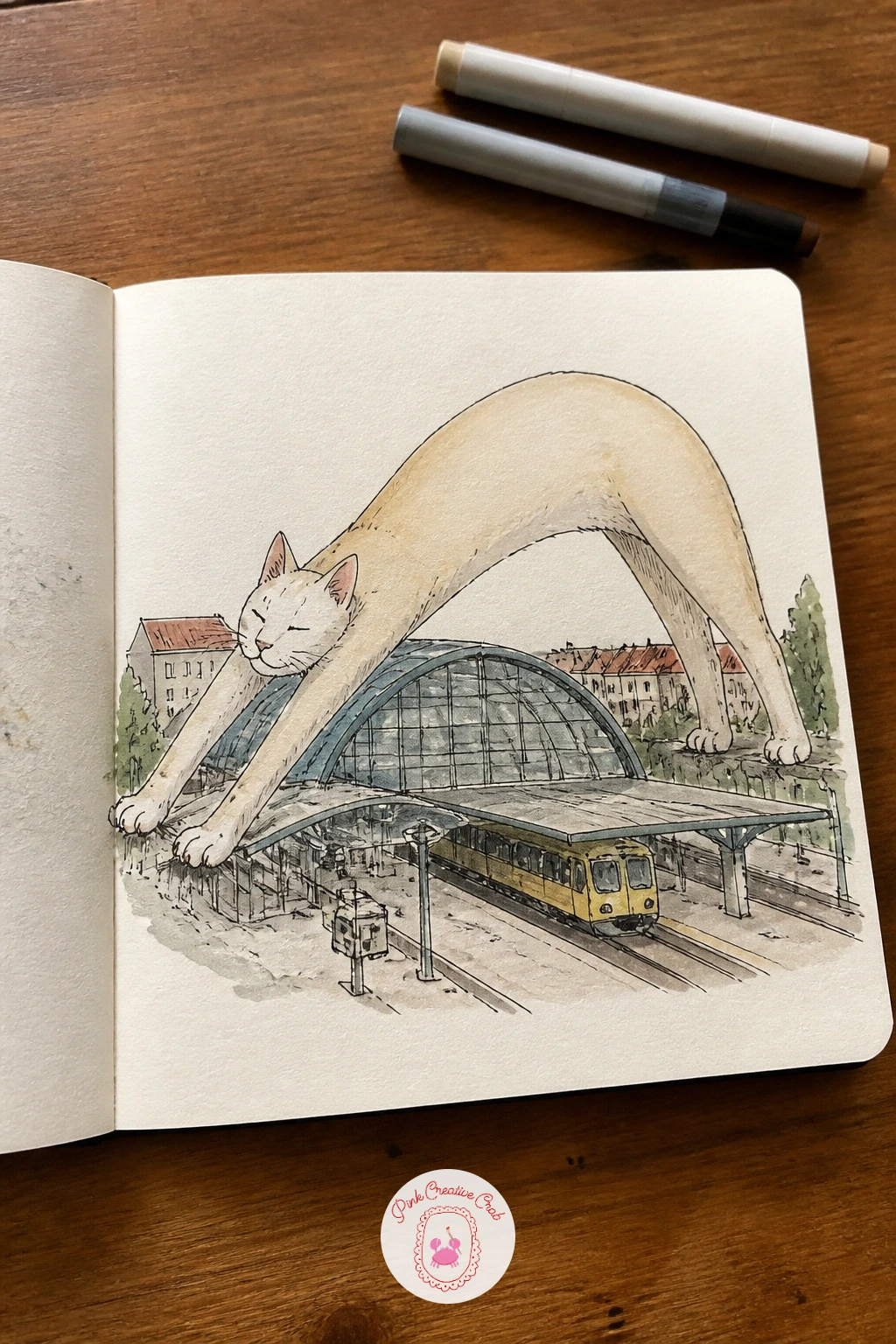
Palette: Cream White,Glass Blue,Warm Grey,Soft Black
Have a cat peek around the edge of a mountain village, one ear and one wide eye visible behind the peaks the way it would peer around a doorframe. Draw the mountains and small village rooftops first in simple triangular shapes, then tuck the curve of a giant head in just behind them, mostly hidden.
Since the light here comes from one side of the village, decide early whether it is early morning or late afternoon and keep every shadow, on roofs, on mountain slopes and on the visible fur, falling the same direction so the scene feels like one moment rather than several pasted together.
The easiest mistake is showing too much of the cat and losing the shy, peeking feeling. Keep it to one eye, part of the face and a single ear, with the rest cropped off by the mountain edge.
Paint the mountains in cool violets and greys, with warm golden light catching the cat’s visible fur and the village windows.
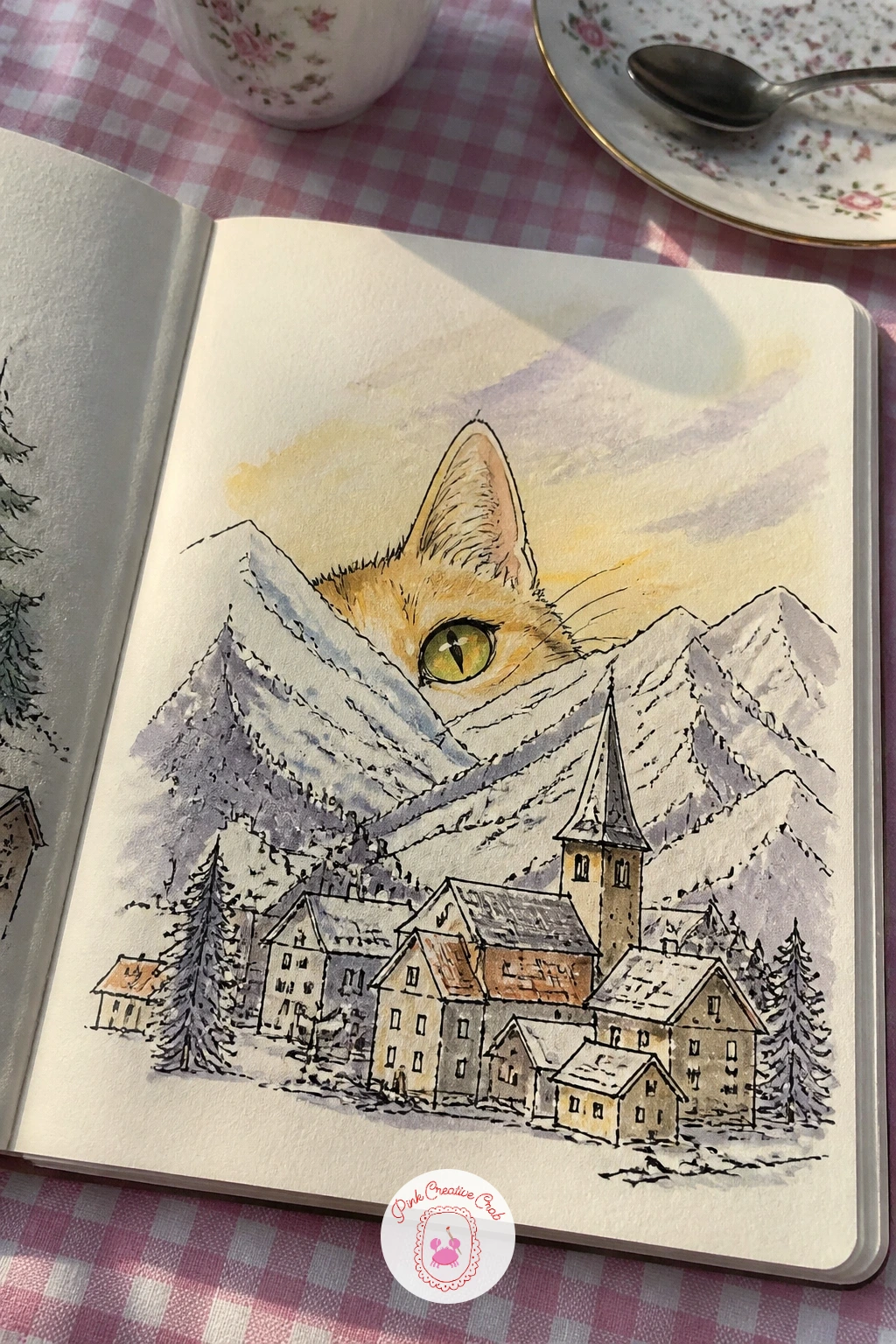
Palette: Dusty Violet,Cool Grey,Golden Ochre,Warm Tan
Give a cat a harbor full of sailboats to bat around like floating toys, one paw dipped into the water sending a little boat spinning. Sketch the harbor’s edge first, then add two or three small sailboats with simple triangular sails before bringing in the paw disturbing the water near them.
Draw a few curved ripple lines fanning out from where the paw touches the water, overlapping slightly so they read as movement rather than still rings.
If you have masking fluid, dab a little onto the boat sails and the brightest ripple highlights before washing in the water color, then peel it away once dry to reveal crisp white shapes without fussy painting around them.
Keep the water a deep, slightly uneven blue and the sails a cheerful white and red, with the cat’s paw left pale so it still reads clearly against the darker sea.
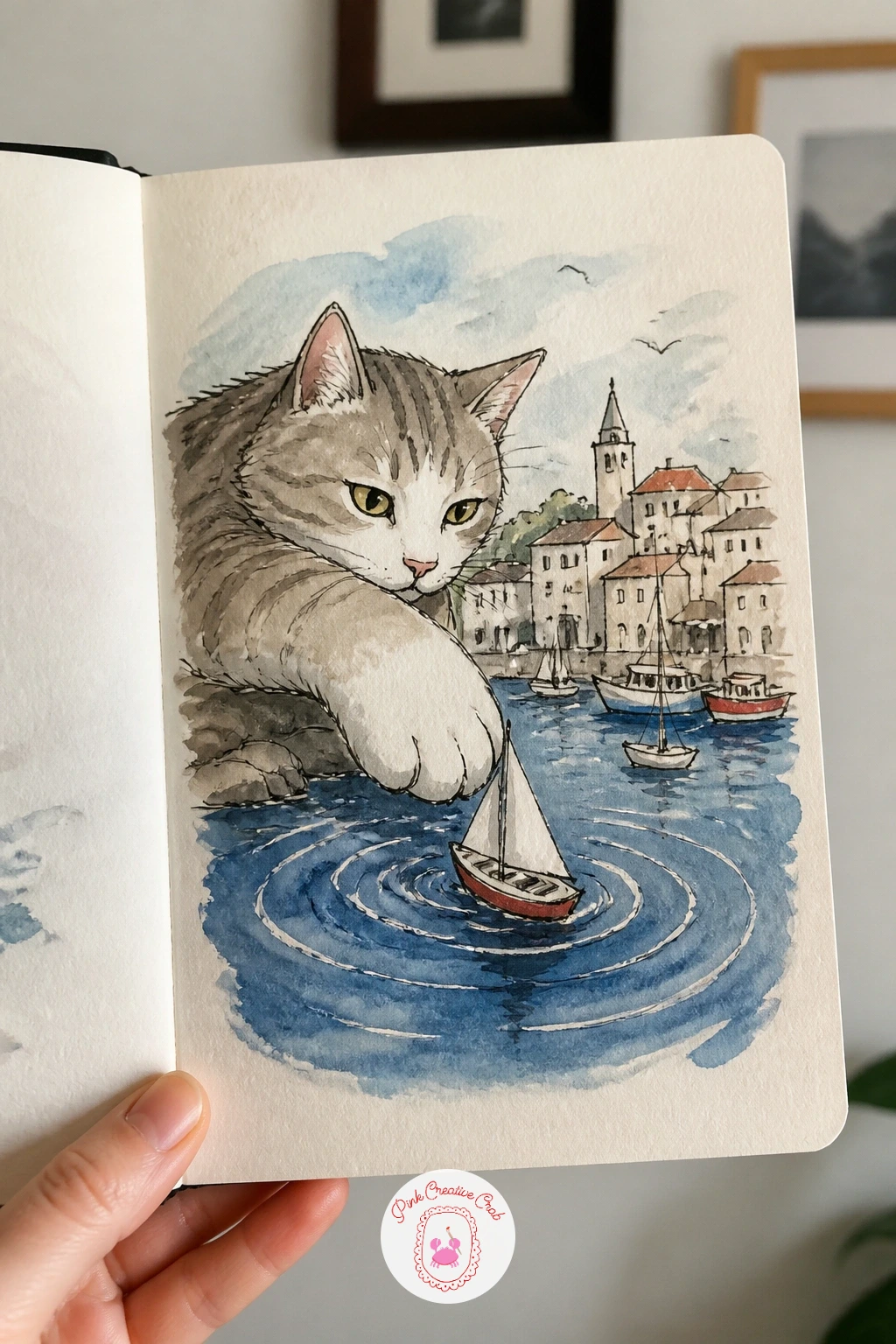
You Will Need
- masking fluid
Palette: Prussian Blue,White,Poppy Red,Pale Grey
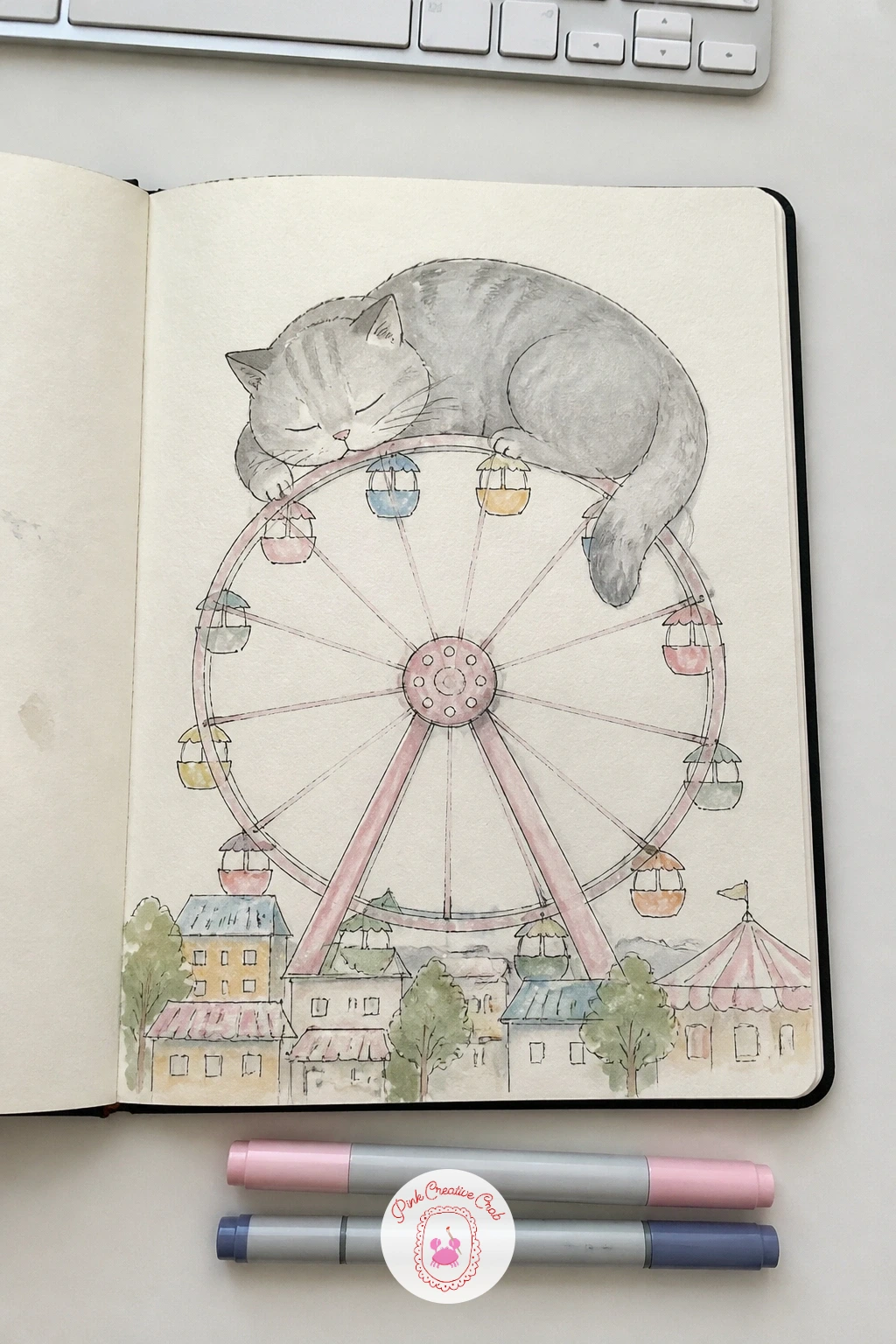
Settle a cat into the curve of a ferris wheel the way it would curl into a round cat bed. Draw the wheel first as a careful circle with evenly spaced spokes and tiny gondola cars, then drape the sleeping cat over the top arc so its body follows the wheel’s curve.
Trace the wheel’s outer circle with a plate or round lid before inking the spokes, since an uneven wheel will throw off the whole composition more than any wobble in the cat’s fur.
Space the gondola cars evenly around the rim using light pencil tick marks first, the same trick you would use to divide any circle evenly, then ink only once the spacing looks right.
Paint the wheel’s frame in a soft pastel color and let a few gondola cars stay bright accents, with the cat in a plain warm grey so it stays the calm center of a busy wheel.
You Will Need
- a round object to trace the ferris wheel
Palette: Pastel Pink,Mint Green,Warm Grey,Soft Black
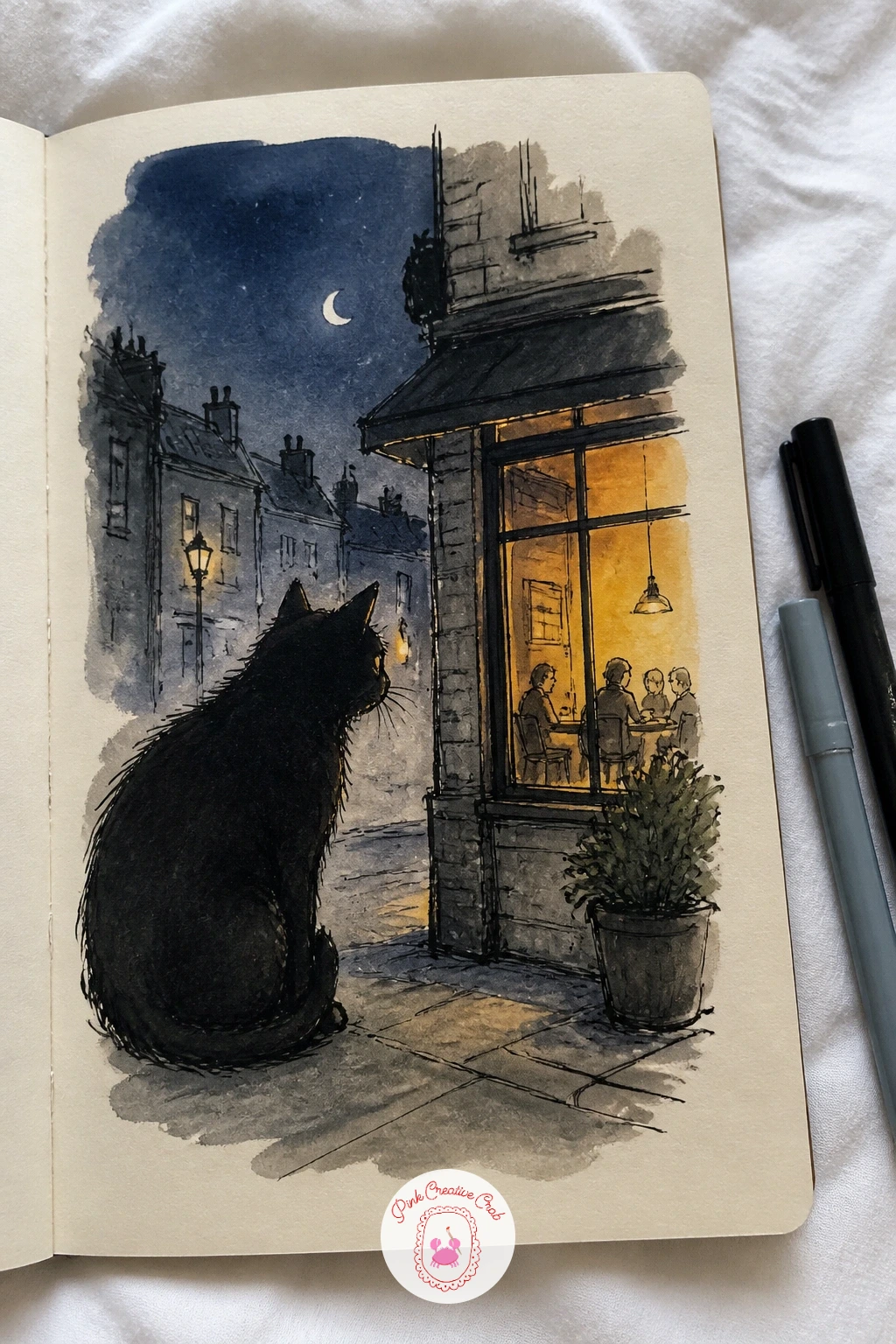
Turn the mood moodier with a black cat crouched low outside a small cafe, staring in through its one glowing window. Draw the cafe first as a simple square building with warm light pouring from a single window and door, then add the cat’s silhouette crouched close by, eyes catching the light.
Keep the cat almost entirely in silhouette, just a solid dark shape with two pale eyes, which makes the warm window glow the brightest and most interesting part of the page by contrast.
If pure black feels flat, add the faintest hint of blue or purple at the edges of the silhouette rather than leaving it a dead flat shape, so it still reads as fur in dim light.
Wash the window in warm yellow and orange, let the surrounding night stay a deep cool blue, and keep the cat’s eyes the only bright warm color on its whole body.
Palette: Ivory Black,Deep Indigo,Warm Amber,Soft Yellow
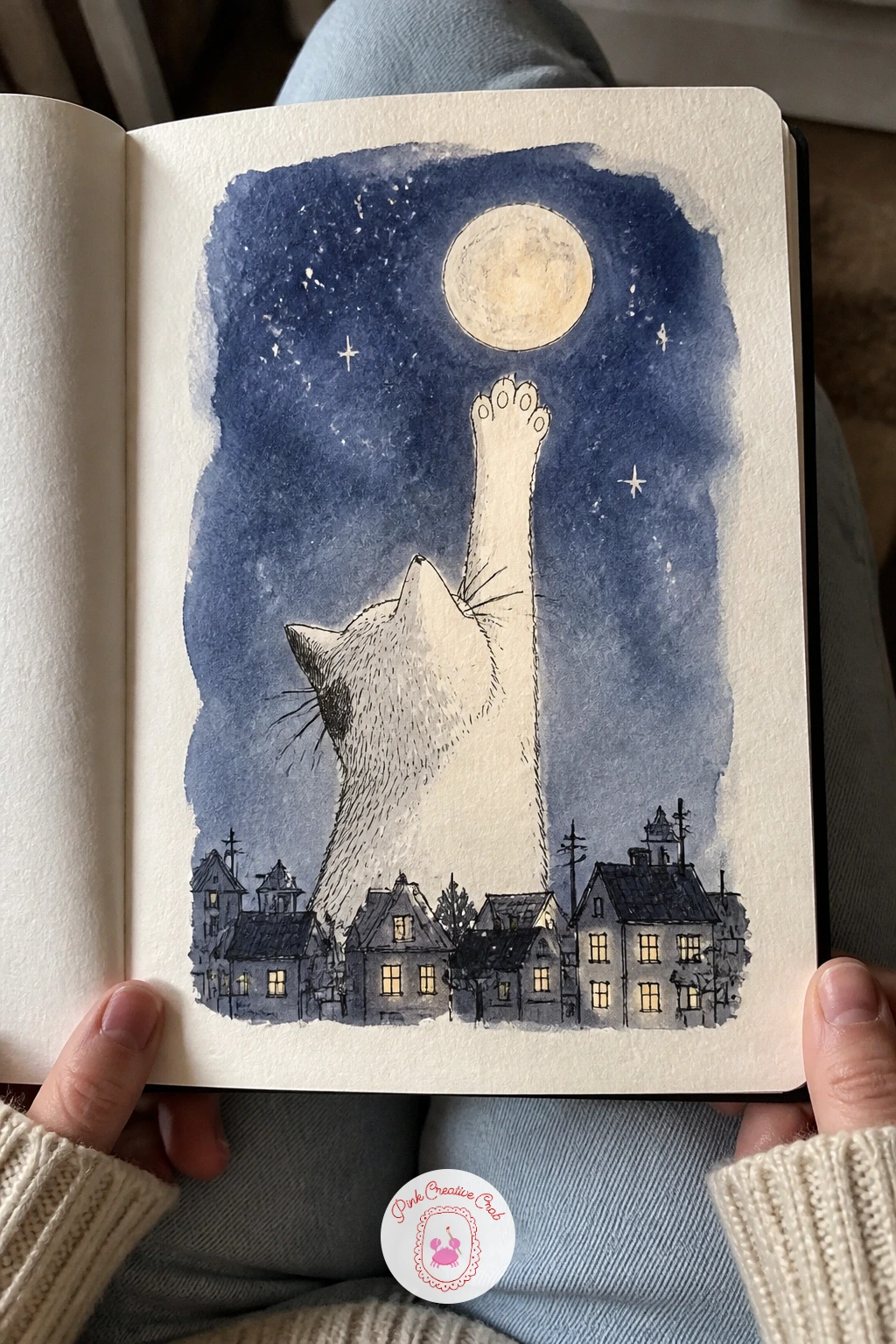
Reach a cat’s paw high above a sleepy little town toward a full moon the way it would bat at a light fixture. Sketch the town low across the bottom of the page first, small rooftops and a church spire or two, then bring one long paw stretching up from behind the buildings toward the moon.
Since the only light here comes from the moon itself, keep every rooftop edge lit faintly on the side facing it and dark on the other, and let the stretched paw catch a thin rim of pale light along one edge.
If the paw looks too short to feel like a real reach, extend the whole arm slightly past where feels comfortable and check it against the height of the moon before inking final lines.
Paint the sky in deep blues with a soft white moon glow, and keep the town mostly in silhouette so the paw and moon carry the page.
Palette: Midnight Blue,Soft White,Pale Yellow,Charcoal Grey
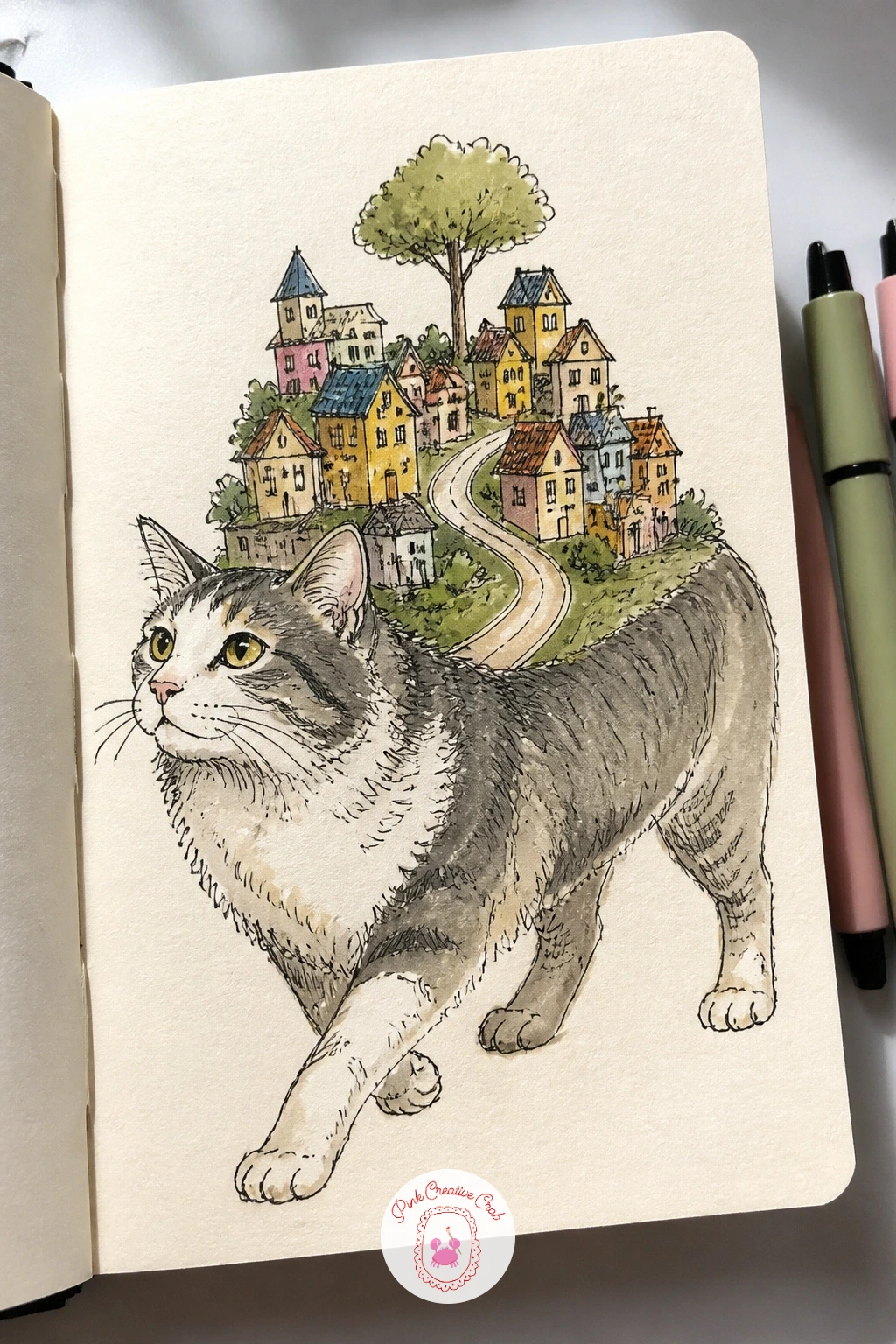
Flip the whole idea around and have a cat stroll along with an entire little town balanced on its back like a saddlebag. Draw the cat first in a simple walking pose, legs mid-stride, then build the cluster of houses, a small road and a tree or two directly along its spine and shoulders.
Work the town’s buildings slightly smaller toward the tail and slightly larger near the shoulders, which mimics how perspective would naturally shrink distant buildings and keeps the whole cluster feeling like one coherent little place rather than scattered stickers.
If the town looks like it is floating rather than sitting on the fur, add a few curved shadow lines where each building’s base meets the cat’s back.
Paint the houses in a cheerful mix of warm colors and keep the cat a plain solid tone so the town stays the clear focal point riding along.
Palette: Terracotta,Soft Yellow,Sage Green,Warm Grey,Soft Black
Drop a cat down into the middle of a football stadium as if it had simply wandered onto the pitch and sat, tail curled neatly around its paws while tiny stands circle around it. Draw the oval stadium bowl first, rows of seating as simple curved lines, then place the seated cat squarely in the center of the field.
Since the eye level here looks slightly down into the bowl, curve the rows of seats more sharply near the top of the page and flatten them near the bottom, the way any stadium bowl would look from a raised angle, which sells the sense of looking down into it.
A ten minute version leaves the stands as plain colored bands. With more time, add a scattering of tiny figures and a scoreboard for extra charm.
Paint the pitch bright green and the stands in alternating bands of two team colors for a cheerful, busy frame around the calm seated cat.
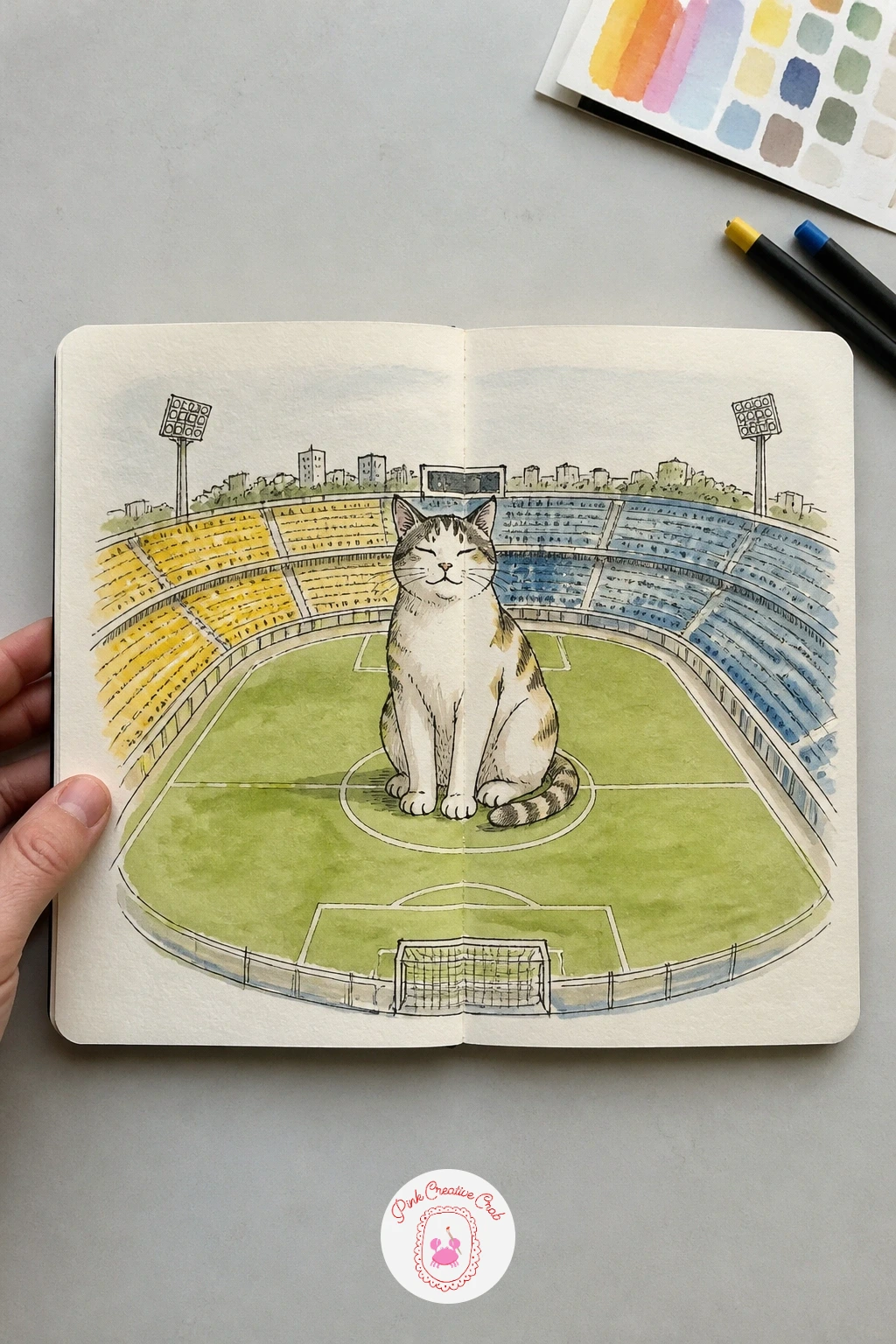
Palette: Grass Green,Royal Blue,Warm Red,Soft Black
Wrap a cat’s front legs fully around a small castle the way it would hug a scratching post, cheek resting against one turret. Draw the castle first with simple rectangular towers and a few flags, then bring both front paws around from either side to meet behind it, with the head leaning in close.
Use a kneaded eraser to soften a few of the fur lines along the cat’s cheek and chest once inked and lightly shaded in pencil, lifting graphite gently to suggest the fluffiest parts without redrawing them.
If the hug looks stiff, curve both front legs inward more than feels natural at first, the same exaggerated curl you would use for any affectionate hugging pose, so the castle looks properly squeezed.
Paint the castle in warm stone tones with colorful little flags, and keep the cat’s fur a soft, slightly textured grey so the eraser work shows through.
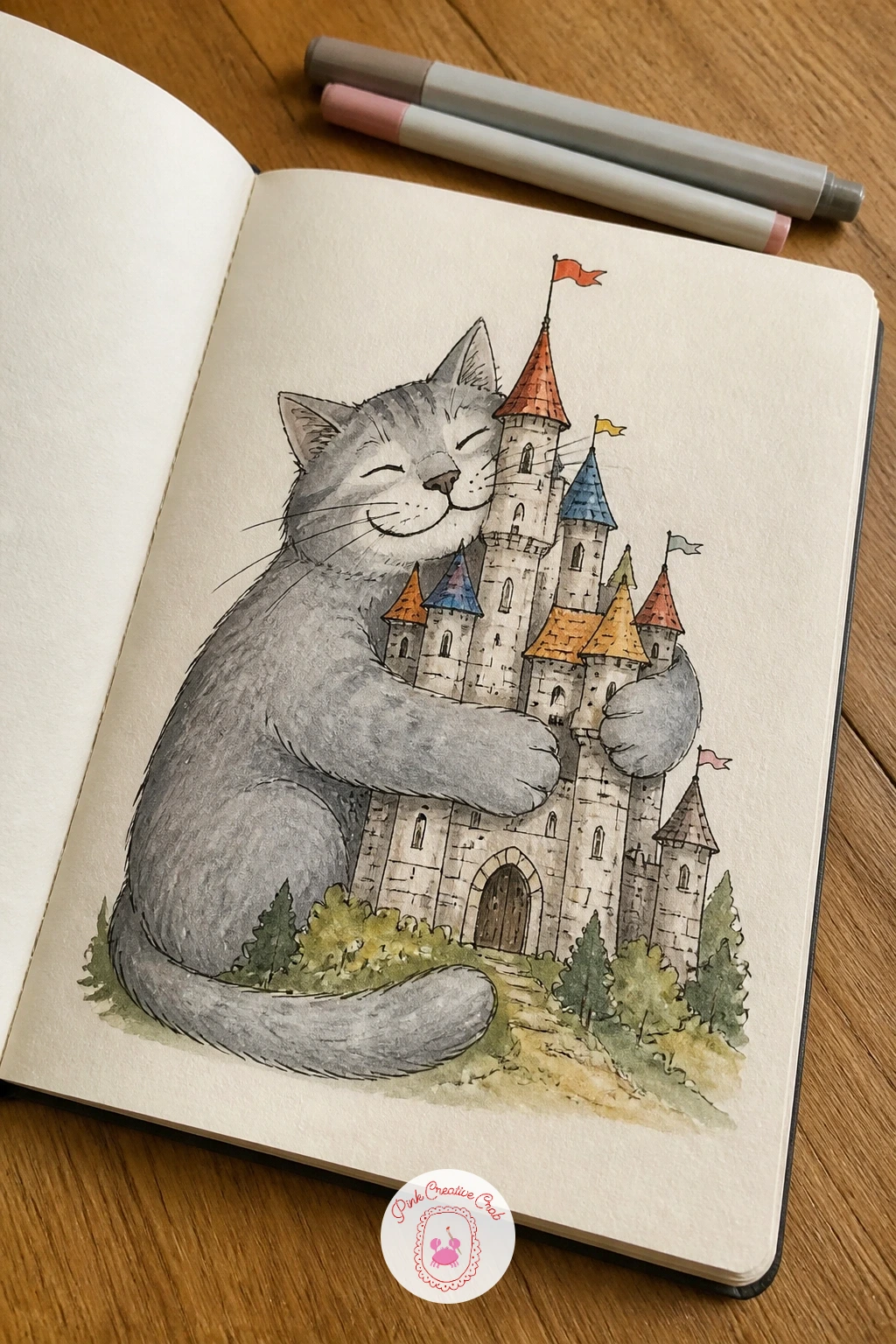
You Will Need
- a kneaded eraser
Palette: Warm Stone,Soft Grey,Flag Red,Flag Blue
Turn a cat’s long tail into a winding ski slope, with a few tiny skiers zig-zagging down its curve. Draw the tail first as one long smooth S curve across the page, then dot small skier figures along it at different points, each just a few confident pencil marks.
Shade the tail’s underside slightly darker than the top before inking final lines, the same light-and-shadow logic you would use for any rounded cylindrical shape, so the tail reads as rounded rather than flat like a ribbon.
The skiers are easy to overcomplicate. Keep each one to a simple triangle body, two ski lines and a dot for a head, repeated a few times down the slope.
Paint the tail in soft white and grey fur tones with blue shadows in the curves, and give each tiny skier a different bright jacket color for a cheerful scattered look.
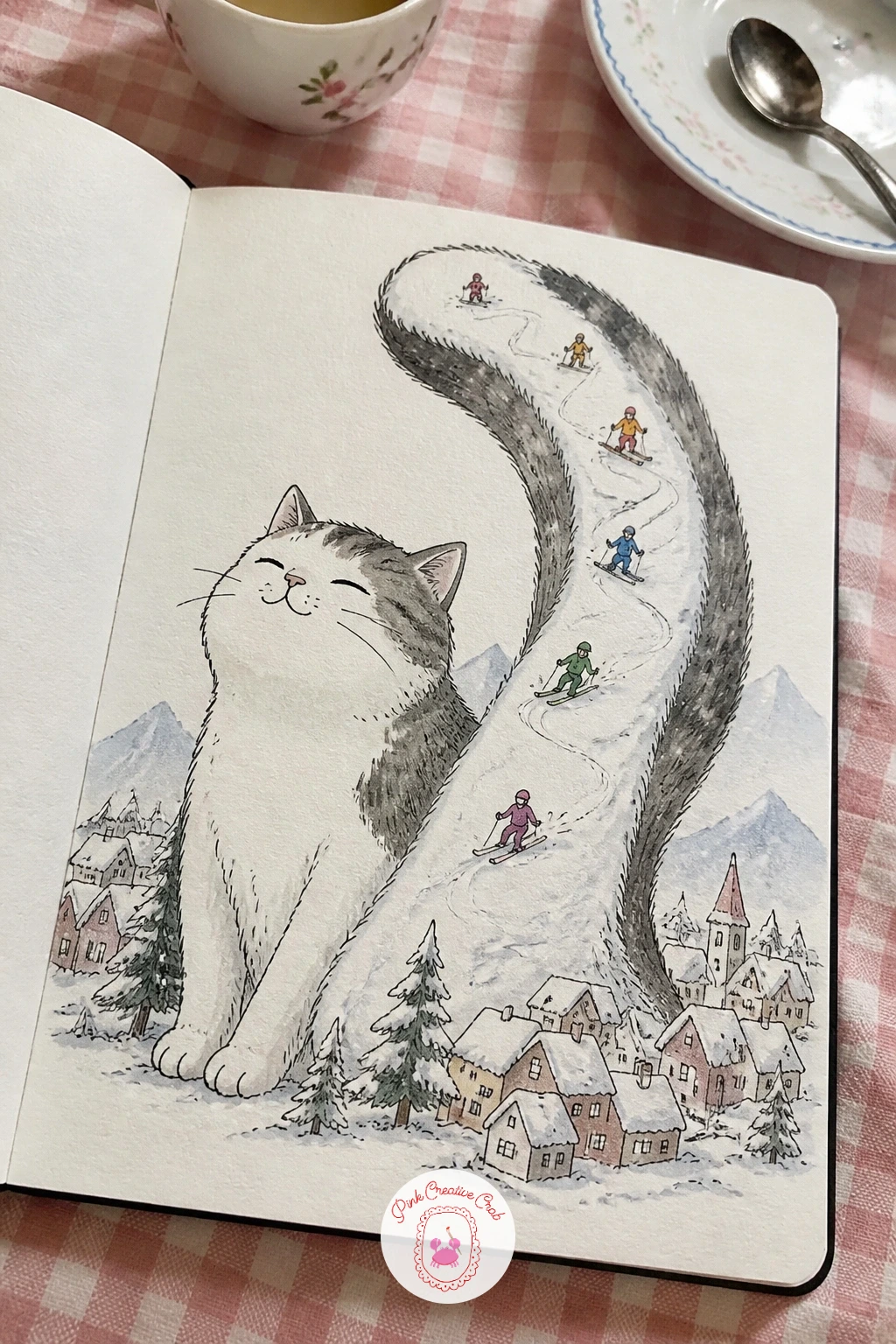
Palette: Soft White,Cool Grey,Sky Blue,Poppy Red
Bring a cat down to drink from a small village lake tucked among a handful of cottages, head bowed low with its tongue just touching the surface. Sketch the lake as a simple rounded shape first, cottages dotted along one edge, then add the cat’s head and front paws bent low beside the water.
For a quick ten minute page, keep the lake a flat blue shape with no reflections. Given forty minutes, add soft mirrored reflections of the cottages and trees wobbling across the water’s surface, which adds real atmosphere for not much extra effort.
If the water looks muddy after washing reflections in, lift a little color back out with a clean damp brush or paper towel while it is still wet, to keep a few pale highlights on the surface.
Paint the cottages in warm cream and terracotta tones against the lake’s cool blue, letting a hint of that blue reflect faintly on the cat’s chin.
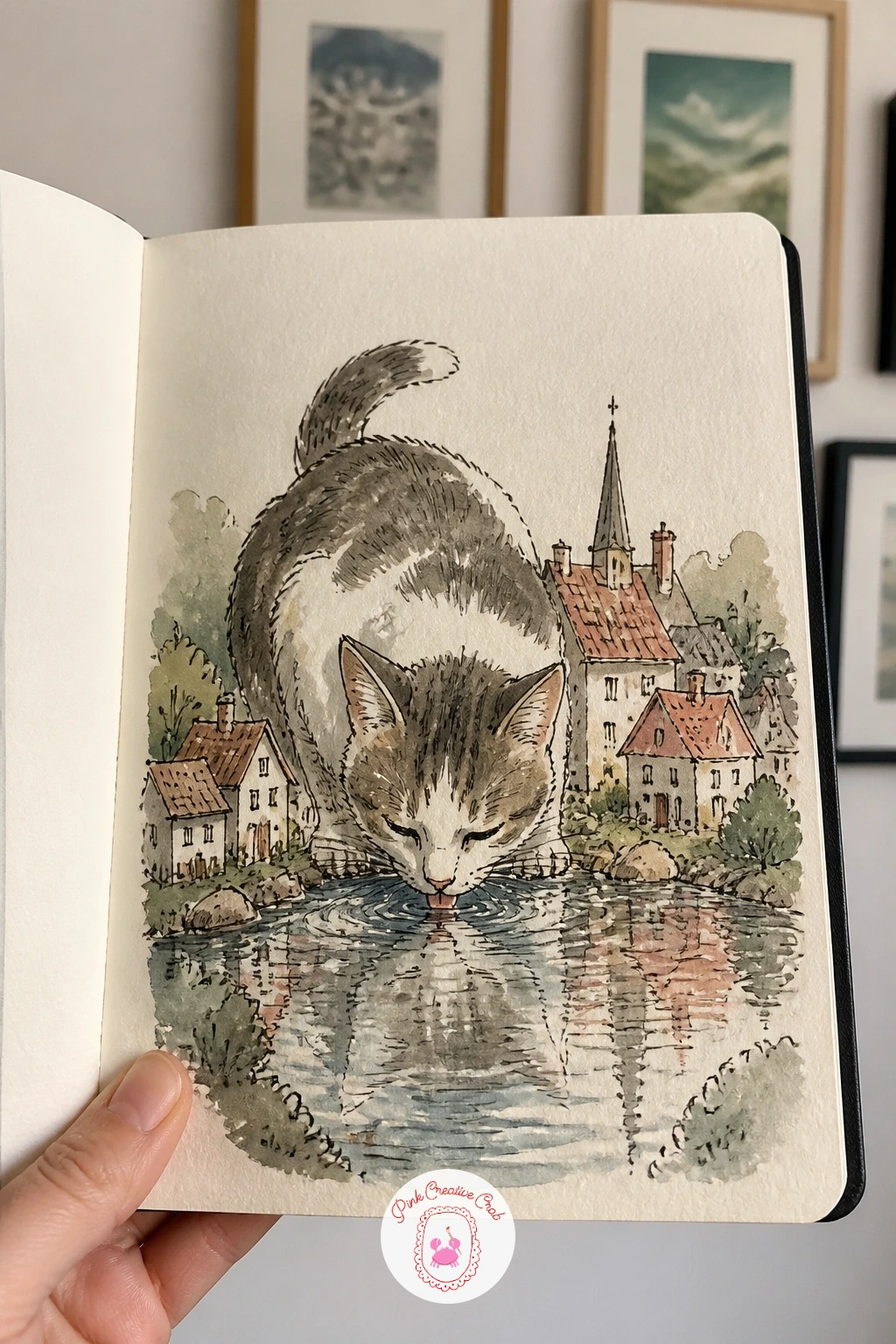
Palette: Lake Blue,Cream White,Terracotta,Sage Green
Switch to a playful kitten this time, small enough that a clock tower looks like a tall toy it has climbed and wrapped itself around rather than crushed. Draw the tower first as a tall narrow shape with a round clock face near the top, then coil the kitten’s smaller, rounder body around it in a loose spiral.
Keep the kitten’s proportions noticeably different from the adult cats elsewhere in this list: a bigger head relative to the body, shorter legs and a stubby tail, the same ratios you would use for any kitten reference compared to a grown cat, so it reads clearly as young.
If the spiral looks tangled, simplify to one loop around the tower rather than two, with the front paws hanging loosely over the clock face.
Paint the tower in cool stone tones with a crisp white clock face, and keep the kitten in soft, lighter fur colors than the other giant cats on the page.
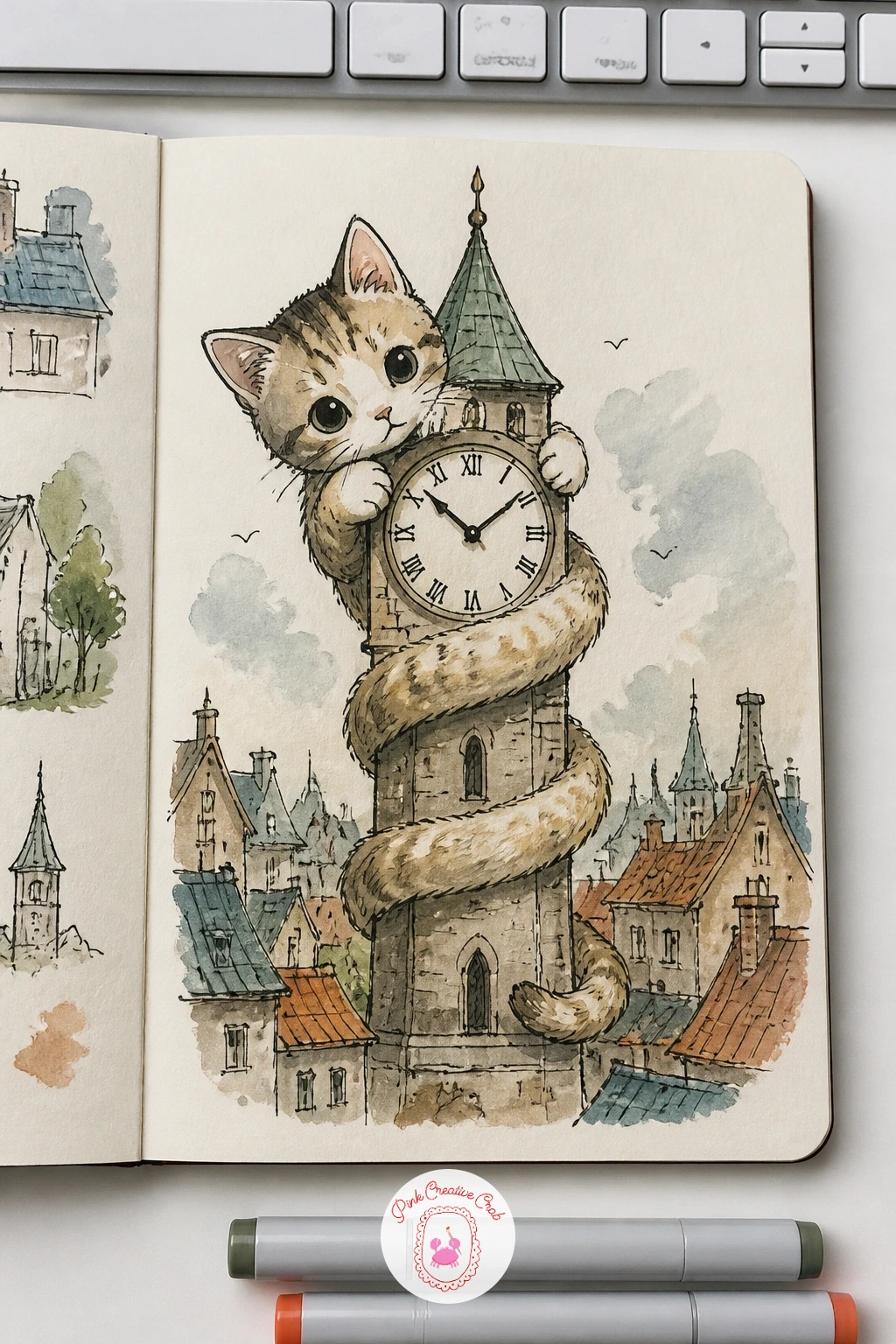
Palette: Stone Grey,Soft White,Pale Apricot,Soft Black
Give a cat a whole field of tulips to sniff the way it would investigate one flower on a windowsill, nose pressed down close among a cluster of blooms. Draw a loose row of simple tulip shapes first, a few rounded cups on stems, then bring the cat’s face down low beside them, eyes half closed.
Keep the tulip cluster to a modest handful of well-shaped blooms rather than a dense field of tiny stems, so each flower stays clear and the cat’s face remains the main subject rather than fighting with a busy background.
If the cat’s expression looks neutral instead of curious, narrow the eyes slightly and tilt the head a touch to one side, the small adjustment that usually reads as genuine sniffing interest.
Paint the tulips in a cheerful mix of pink, red and yellow, and keep the cat in a single warm solid tone so the colorful blooms stand out clearly around its face.
Readers who enjoy flowers alongside their sketchbook animals might also like the flower sketchbook ideas for beginners.
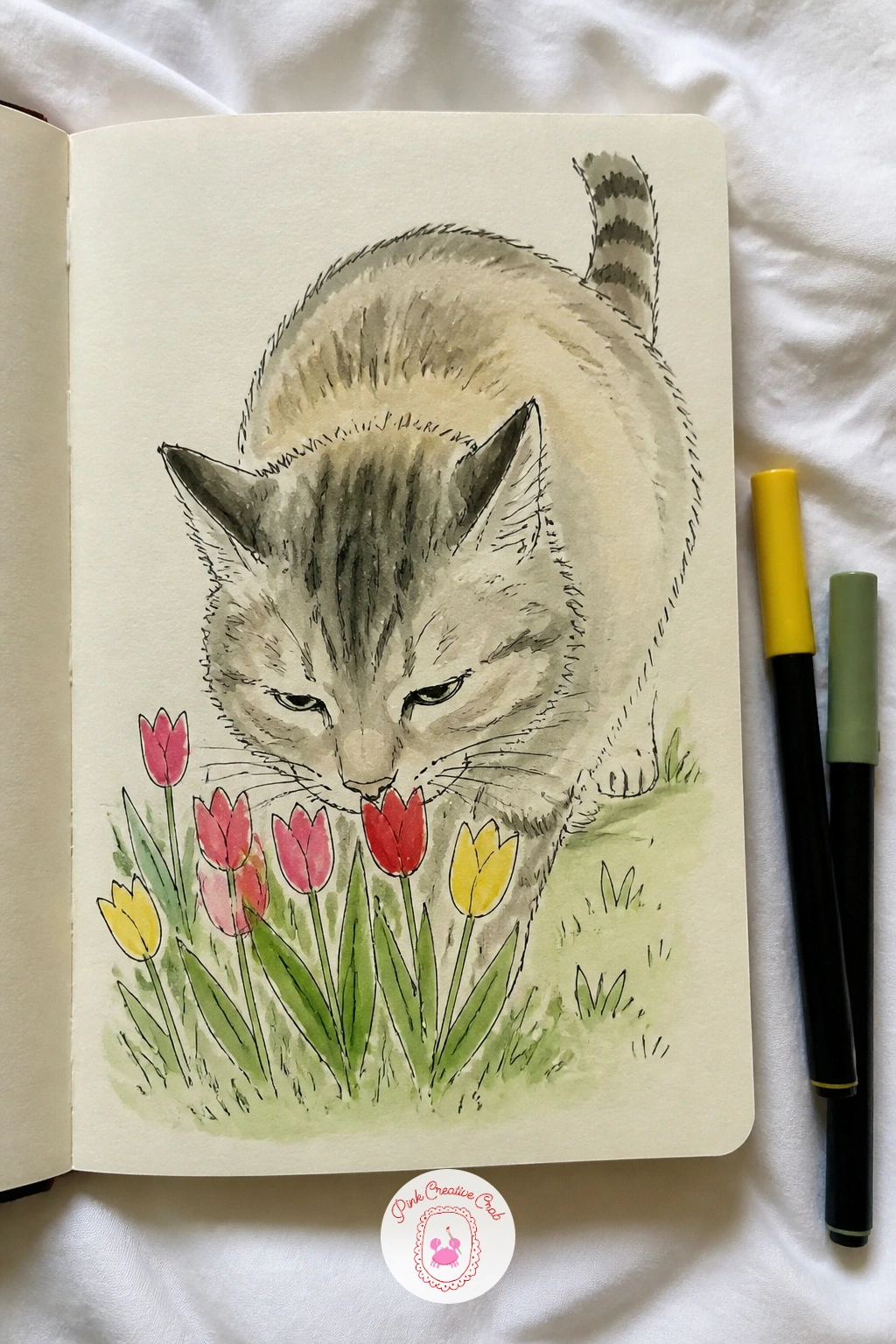
Palette: Tulip Pink,Tulip Red,Tulip Yellow,Sap Green,Warm Tabby Brown
Place a cat at the very end of a long wooden pier, legs dangling off the edge over the sea the way it would sit at the edge of a bed. Draw the pier first as a long simple line of planks leading out from a small shoreline town, then add the cat seated right at the tip, tail curled neatly beside it.
Compare the length of the pier to the cat’s body before committing to ink: the pier should stretch at least three or four cat-lengths back toward the shore so the distance, and the stillness of sitting right at the end of it, reads clearly.
If the dangling legs look awkward, let one paw hang slightly lower than the other rather than drawing them perfectly symmetrical, which reads as far more relaxed.
Paint the sea in soft blue greens with a little golden light catching the water near the horizon, and keep the pier a warm weathered brown.
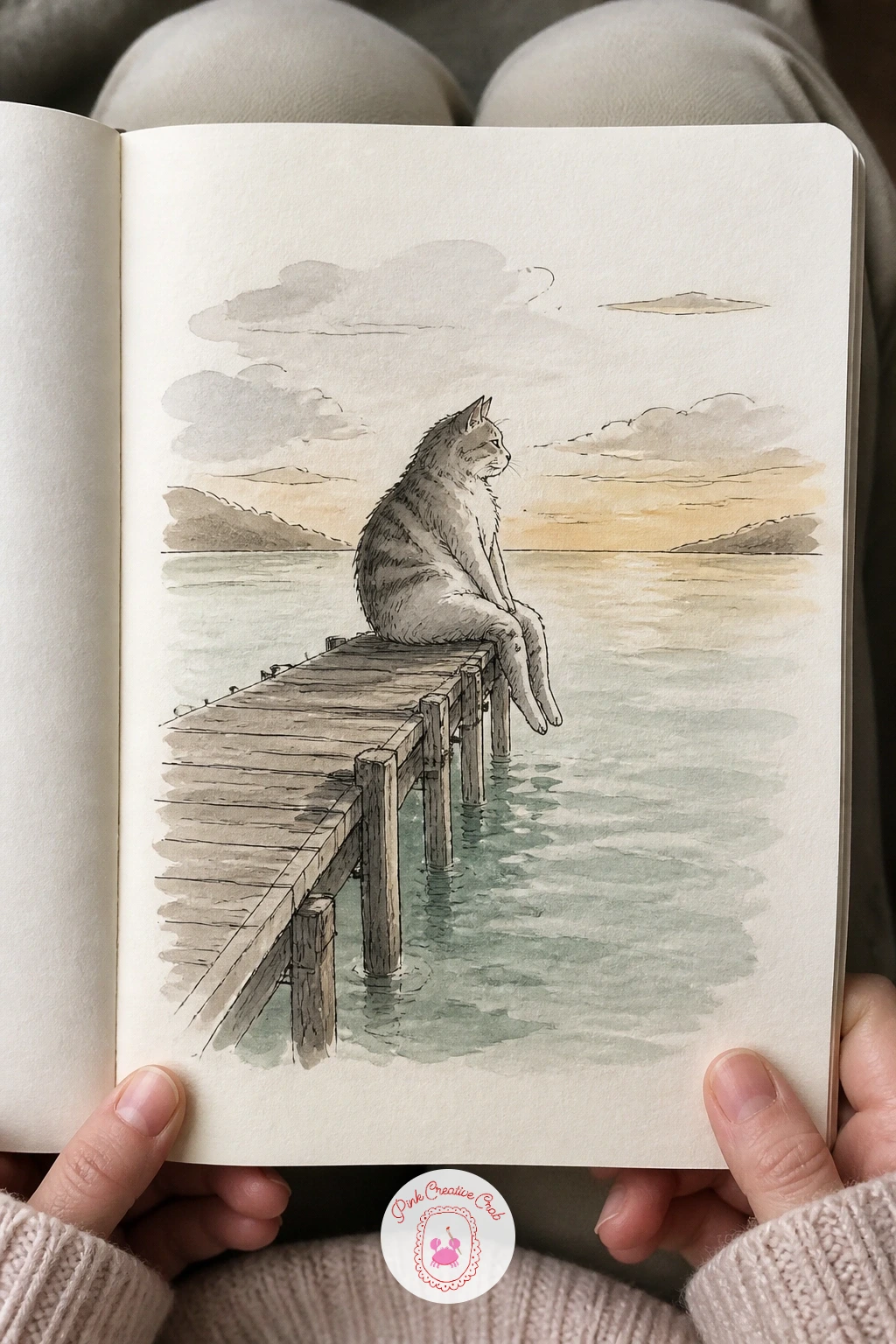
Palette: Sea Green,Golden Ochre,Weathered Brown,Soft Black
Have a cat crouch low and track a tiny plane crossing the sky above a small town, eyes wide and ears pricked the way it would watch a bird through a window. Sketch the town low across the bottom first, then add a small simple plane shape higher up with a thin trailing line behind it, and the cat’s head tilted up to follow it.
Angle both pupils and the whole head toward the plane’s direction of travel rather than straight ahead, since a shared gaze line is what makes a crouching cat look like it is actually tracking movement instead of simply staring up.
Keep the plane small and simple, just a basic fuselage and wing shapes, so it stays a minor detail compared to the cat’s expressive, focused face.
Paint the sky in a soft gradient of blue, leave the plane plain white, and give the cat’s eyes extra contrast so the intent focus reads clearly across the page.
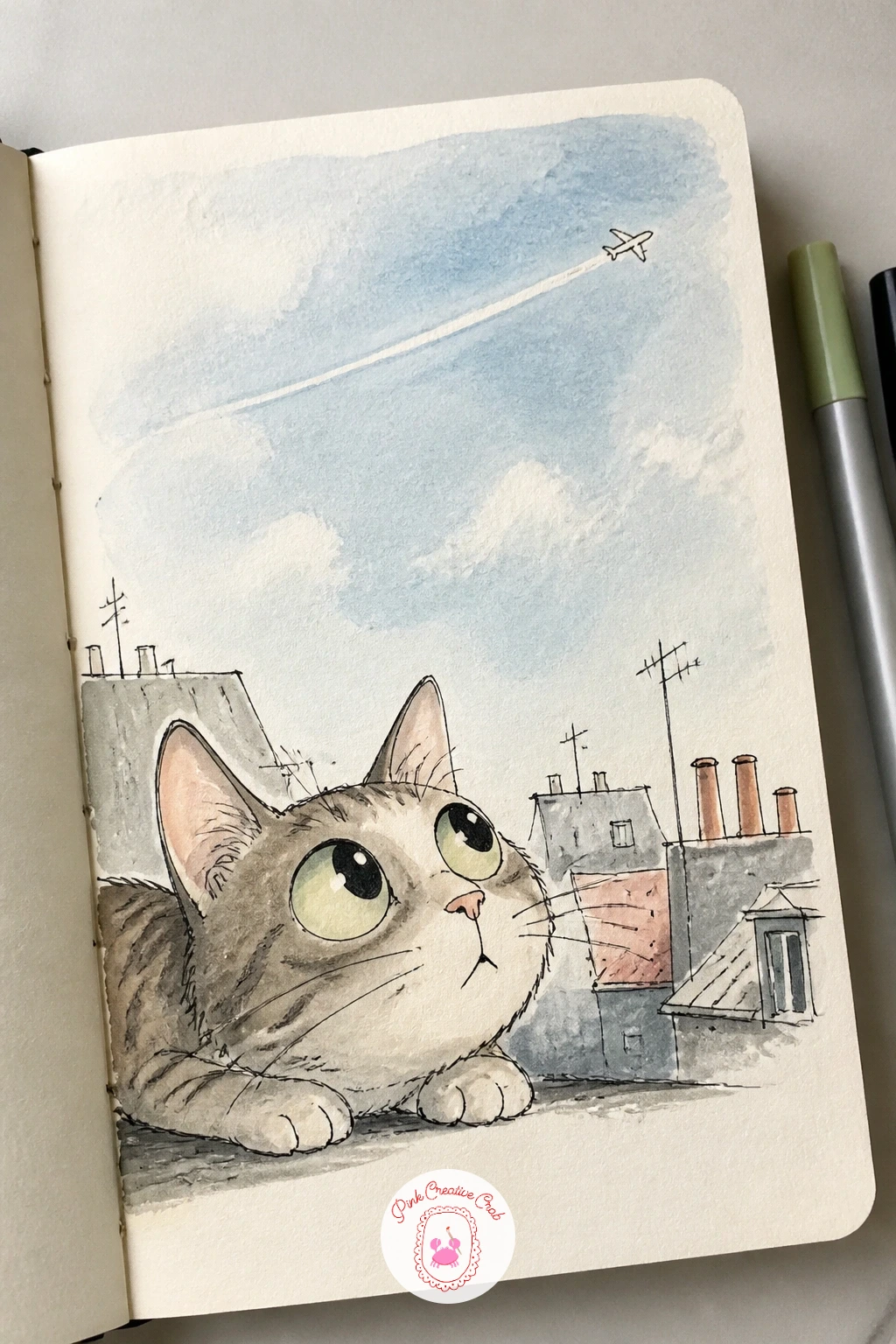
Palette: Sky Blue,Soft White,Warm Amber,Soft Black
Close the set with a cat fast asleep right in the middle of a town square, so comfortable that a small flock of pigeons has settled calmly across its back as if it were a statue or a bench. Draw the square’s surrounding buildings first, simple fronts lining the edges, then curl the sleeping cat in the center with a few pigeon shapes dotted along its spine and tail.
Keep the pigeons to a modest scattering, four or five at most, each a simple rounded body and small head, rather than a dense crowd, so every bird stays a clear, readable shape against the fur.
If the scene feels too busy once everything is inked, remove a pigeon or two and simplify one or two of the background buildings to plain flat fronts, letting the sleeping cat stay the calm center of the page.
Paint the buildings in warm muted tones, the pigeons in soft greys, and let the cat’s fur stay a gentle, relaxed cream to finish the set on a quiet note.
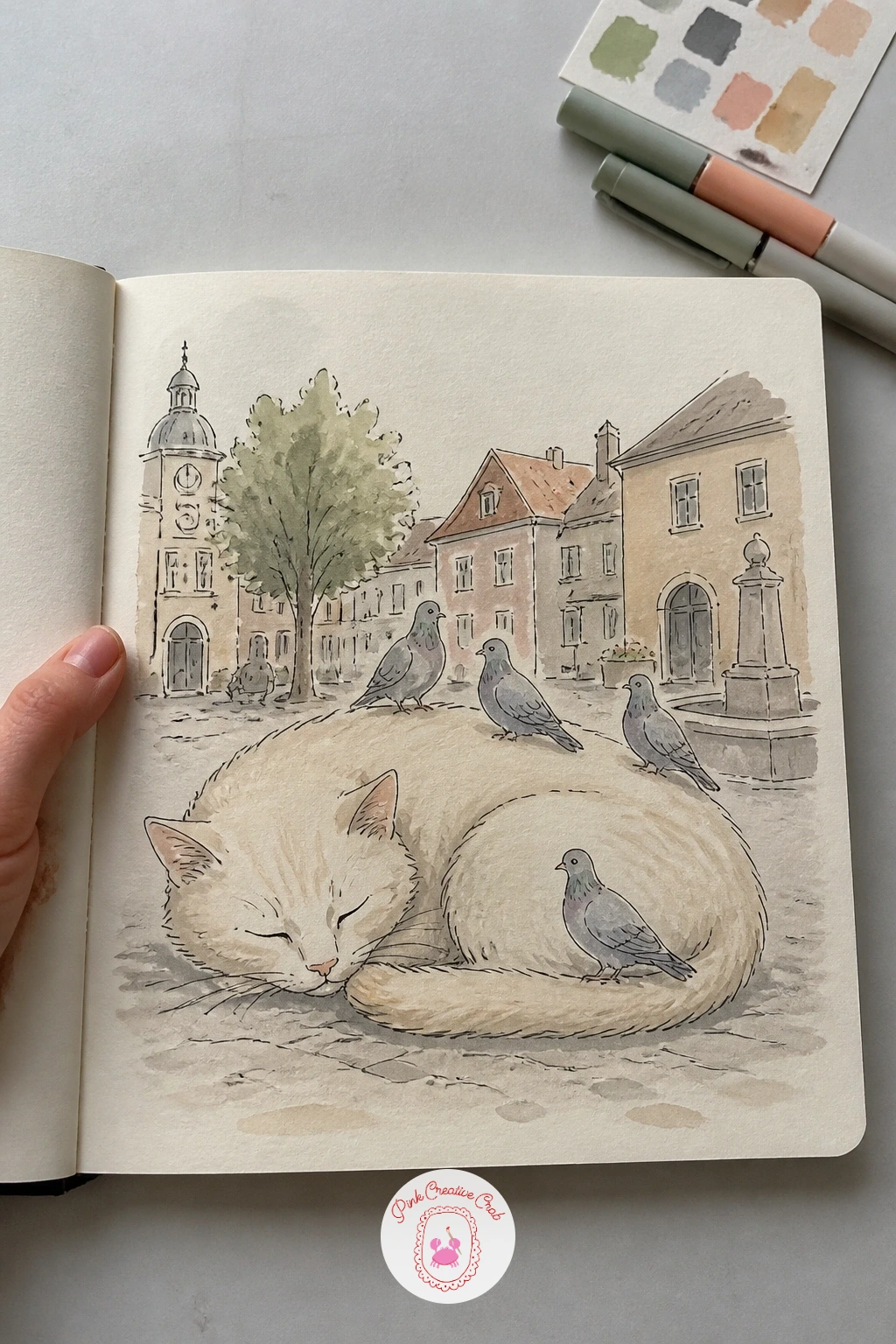
Palette: Warm Cream,Soft Grey,Dusty Rose,Muted Ochre
What to Do Next
Pick whichever cat made you laugh out loud while scrolling, since that is always the one worth drawing first. Start light in pencil on cream paper, settle the cat’s main shape before adding a single building, then bring out the fineliner and a small watercolor set once the pose feels right.
Frequently Asked Questions
What paper works best for these giant cat sketchbook pages?
A cream toned, slightly heavier sketchbook paper works best since it holds light watercolor washes without buckling too much and gives the fineliner a warm background to sit against.
Do I need to be good at drawing cats to try these ideas?
No, these poses rely on simple rounded body shapes rather than detailed anatomy, so basic oval and curve shapes for the body, head and tail get you most of the way there.
How do I keep the scale believable between the cat and the town?
Draw the cat’s main shape first, then build every building, bridge or boat to match its size, checking each new element against a part of the cat’s body before adding detail.
What if I do not have watercolor paint for these pages?
Alcohol markers or colored pencils work as a swap for watercolor, giving flatter but still cheerful color, though washes blend more softly for skies and water.
How long does one of these sketchbook pages usually take?
Simple poses like a napping cat take about ten to fifteen minutes in pencil and ink, while busier scenes with extra detail and full watercolor can take thirty to forty minutes.
Have any thoughts?
Share your reaction or leave a quick response — we’d love to hear what you think!
-
 0
-
0
-
0
-
0
-
0
-
0


