Table of Contents
- Robot Barista Frothing Milk
- Rusty Robot Gardener Watering Tulips
- Robot Librarian On a Rolling Ladder
- Tiny Mail Robot On a Bicycle
- Robot Baker Pulling Bread From the Oven
- Robot Florist Wrapping a Bouquet
- Robot Postal Clerk Stamping Letters
- Robot Greengrocer Stacking Oranges
- Robot Clockmaker At a Workbench
- Robot Crossing Guard Stopping Traffic
- Robot Beekeeper Checking a Hive
- Robot Fisherman On a Little Dock
- Robot Tailor Measuring a Jacket
- Robot Street Sweeper At Dawn
- Robot Barber Trimming a Hedge
- Robot Night Watchman With a Lantern
- Robot Barista’s Cousin, the Tea Pourer
- Robot Cobbler Fixing a Boot
- Robot Fruit Cart Vendor At the Corner
- Robot Shoe Shiner On a Box
- Robot Window Washer On a Platform
- Robot Newsstand Vendor At Sunrise
- Robot Ice Cream Vendor At the Cart
- Robot Train Conductor On the Platform
- Robot Puppeteer At a Tiny Theater
- Robot Locksmith At a Little Shop Counter
- Robot Weather Forecaster On a Rooftop
- Robot Candle Maker Dipping Wicks
- Robot Tulip Farmer On a Rolling Cart
- Robot Umbrella Repairman In the Rain
- Robot Chimney Sweep On a Rooftop Ledge
- Robot Balloon Seller In the Town Square
- Robot Glassblower At a Little Furnace
- Robot Carousel Operator At Dusk
- Frequently Asked Questions
Cool sketchbook pages do not need a complicated setup, just one good character with a job to do. Every idea here is a retro robot running some small corner of a tiny town: pouring coffee, watering tulips, sorting library books, delivering the mail. Pick one, grab your markers, and the whole page is done in one sitting.
This set suits anyone who likes a page that looks a little strange and a lot of fun, drawn in alcohol marker with a mint, orange and cream palette. No film robots, no game characters, just original little machines doing very human work in their own tiny scene.
Using these images: free for personal projects such as printing, coloring, cards, journals and gifts. Handmade items that include them may be sold up to 30 pieces per design. More than that is commercial use and is not permitted, and neither is selling or sharing the images themselves or passing them off as your own. Please ask before any other use.
Robot Barista Frothing Milk
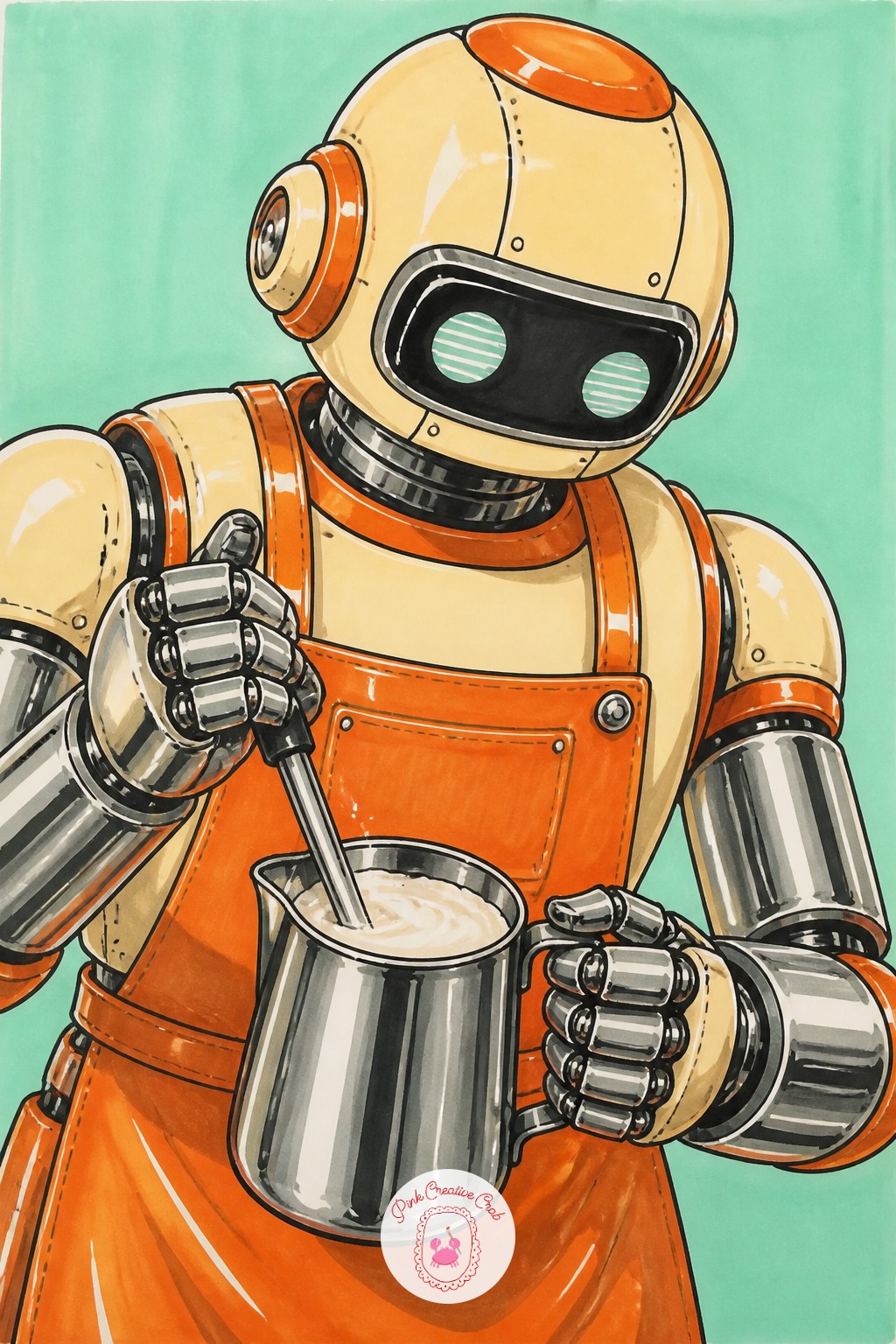
Start with a short, round pencil liner pen for this one, not your thinnest nib. A barista robot has smooth curved panels, and a fine 0.1 line looks scratchy on big rounded metal shapes, while a 0.3 or 0.5 holds its own against bold marker fills.
Block in the milk jug and steam wand first, then build the body around them, since the pour is the whole story of the page. Finish with white gel pen flecks of foam and a streak of steam, and keep the background a flat mint so the orange body panel pops.
Rusty Robot Gardener Watering Tulips
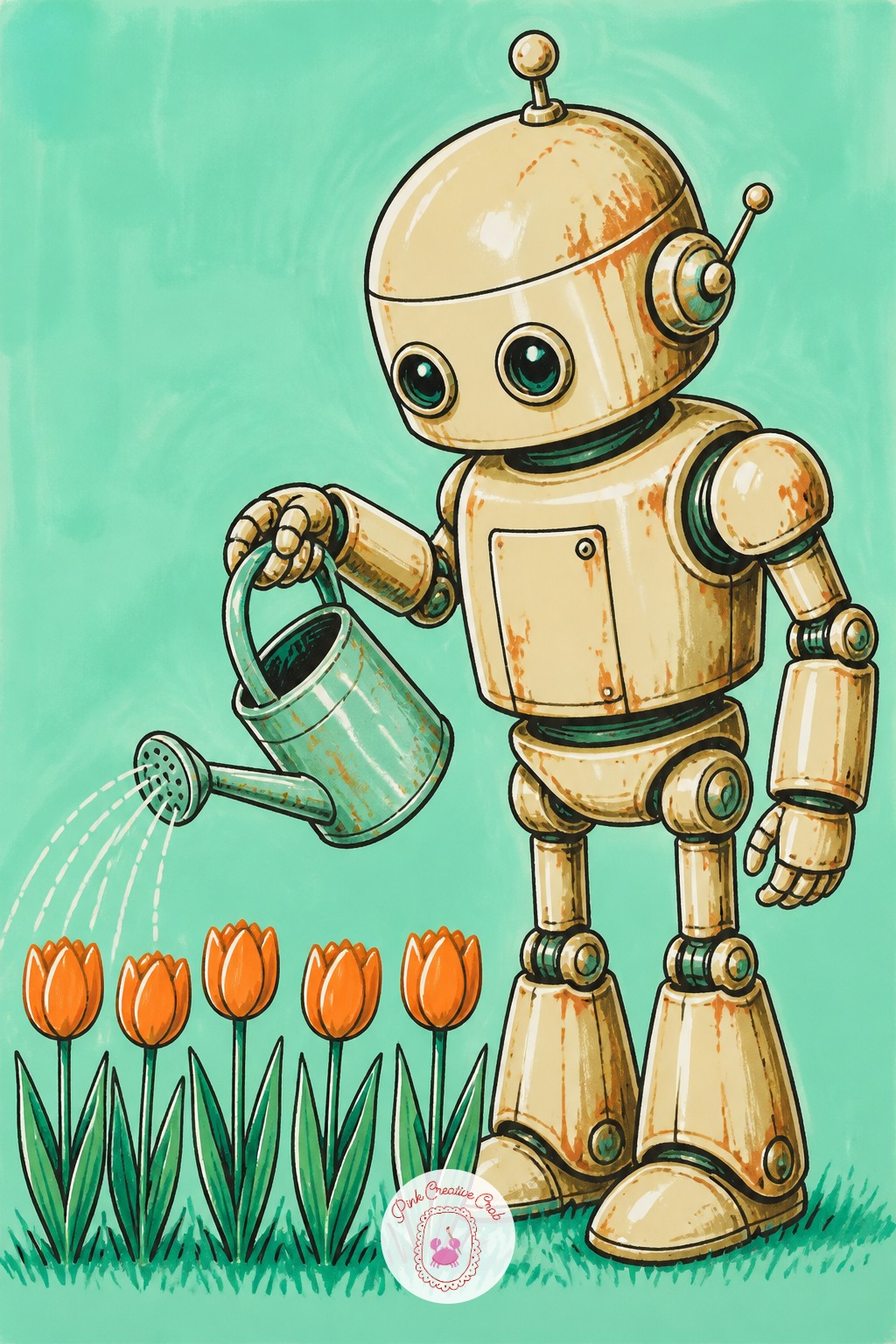
Lay down three marks before anything else: the watering can spout, the stream of water, and the row of tulip heads it is aimed at. Everything else, the robot’s body and the patch of garden, gets built around that line of action so the whole scene reads in one glance.
Save the rust patches for last, dabbing a warm orange-brown over the cream panels with the marker nearly dry so the texture stays rough. One tip: tilt the can a little more than feels natural, it reads as pouring much better than a level can does.
Robot Librarian On a Rolling Ladder
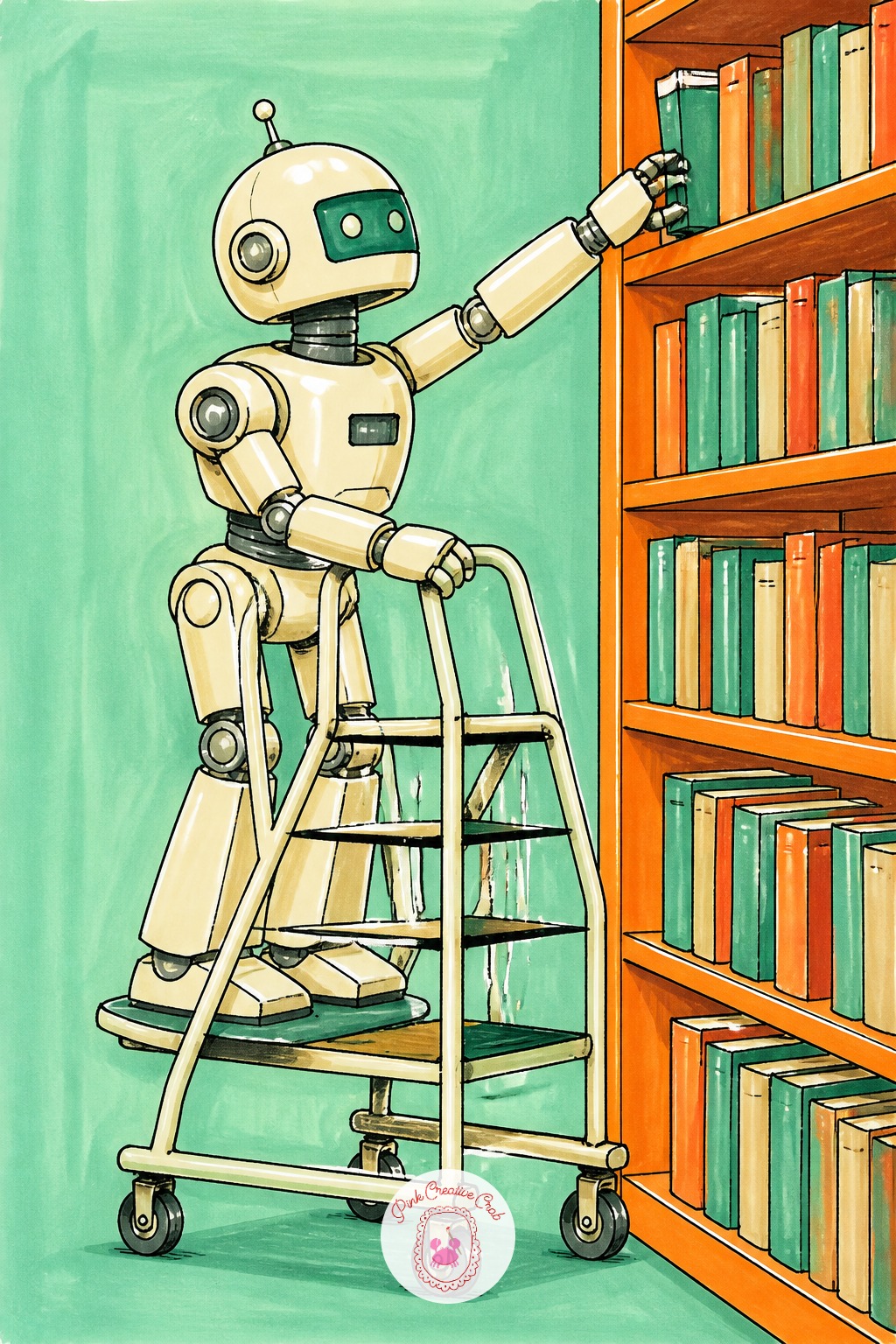
Measure the ladder against the robot’s own body first: make the robot about three heads tall and the ladder roughly four robot-heights, so it reads as a tall library shelf and not a stepstool. Keep the robot’s hand lined up with the shelf it is reaching toward, that single alignment sells the whole pose.
Books get simple rectangles in alternating mint and orange, nothing fussier. A fun one to try after this: swap the ladder for a spiral staircase next time and see how the proportions shift.
Tiny Mail Robot On a Bicycle
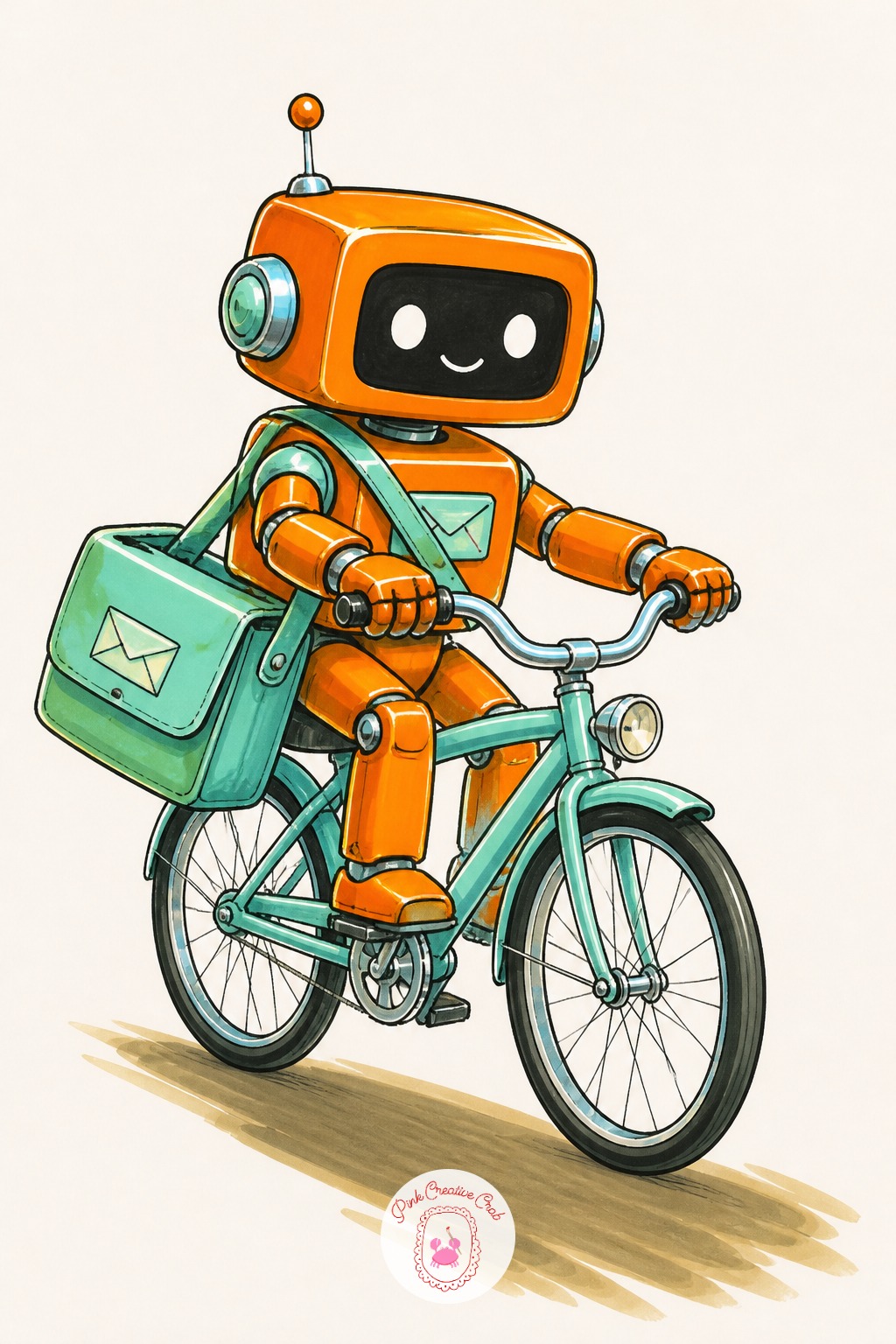
Light source first on this one: put the sun up in one corner and let every shadow fall the same direction, under the bicycle wheels and along one side of the robot’s body. That single choice is what makes a small flat page feel like it has a street in it.
The mailbag swings opposite the pedal that is down, which is a small detail worth getting right. Shade the shadowed side of the robot a touch darker mint and leave the sunlit side bright cream, done.
Robot Baker Pulling Bread From the Oven
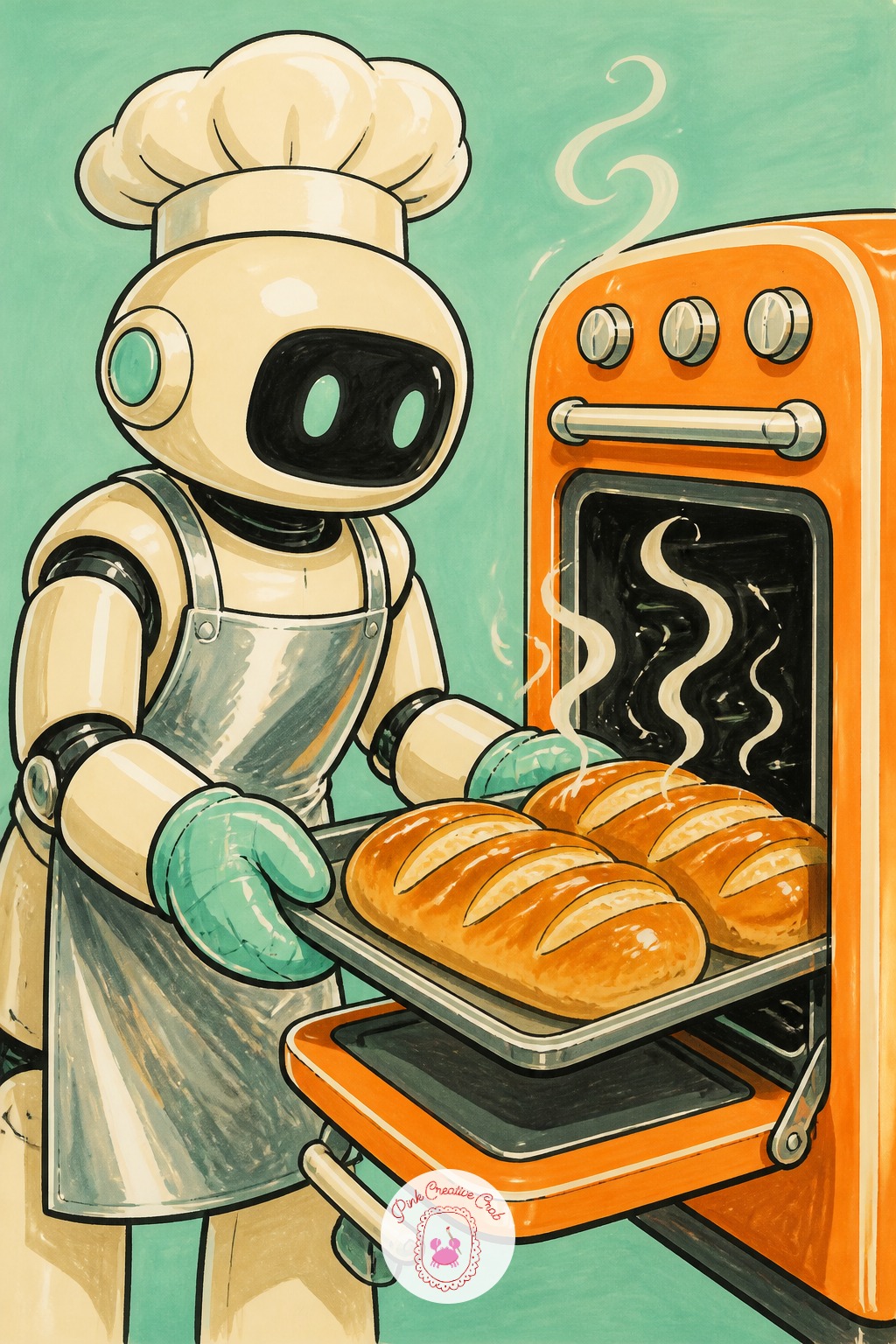
The usual mistake here is drawing the oven door flat on, which flattens the whole scene. Angle it open at roughly forty-five degrees instead, so the tray of loaves tilts toward the viewer and the robot’s arm has somewhere real to reach.
Steam lines in white gel pen above the bread sell the heat better than any shading trick. Halfway through, check that the robot’s apron sits in front of its body panels, not painted flat behind them, or the depth disappears.
Robot Florist Wrapping a Bouquet
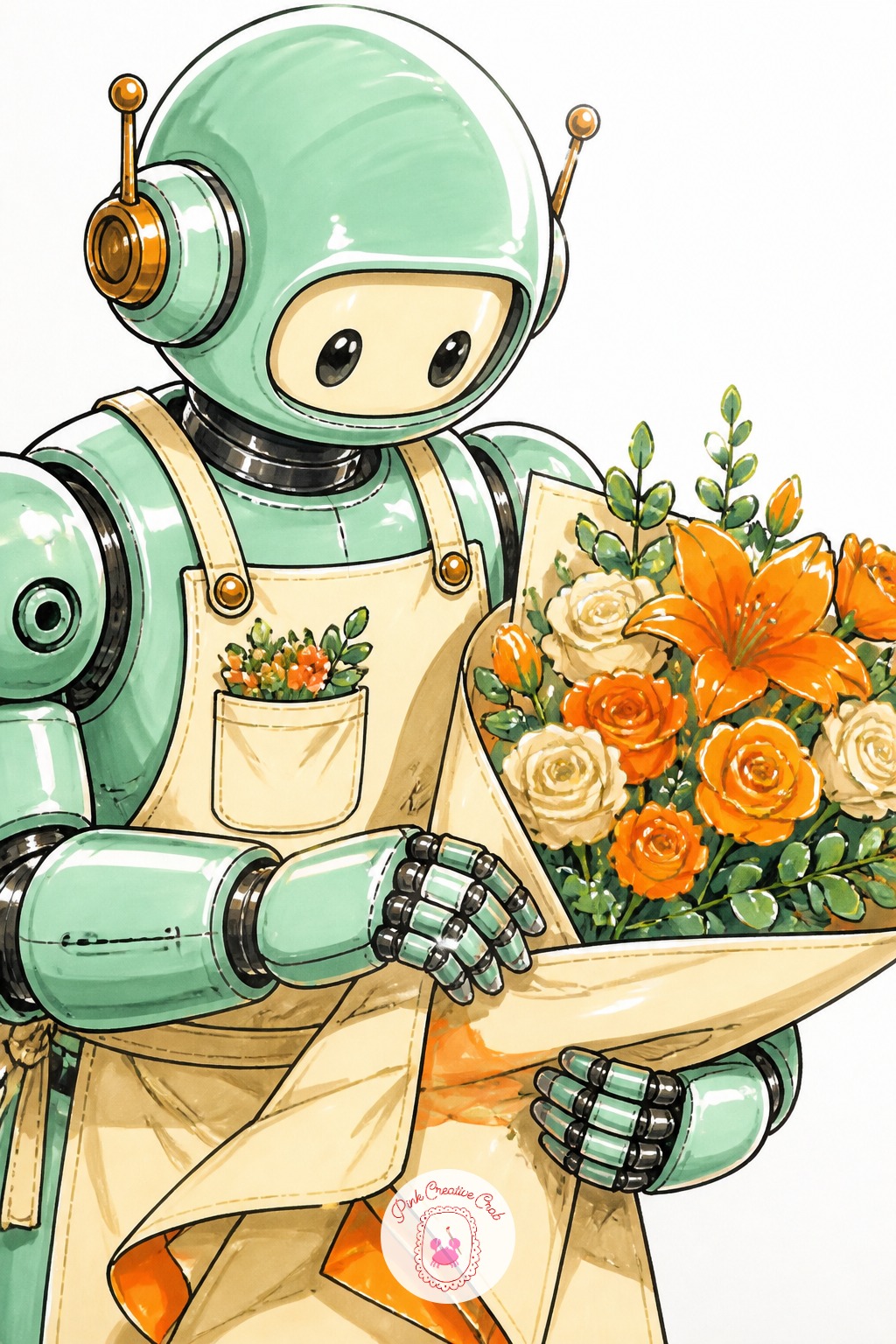
Ten minutes gets you the robot, the bouquet shape and a flat background, enough for a quick page. Forty minutes lets you add individual stems peeking from the paper wrap and a shelf of jars behind the robot, which turns a sketch into a small scene worth keeping.
Either way, wrap the paper cone before you draw a single flower, the cone’s angle decides how the blooms fan out above it. Keep the flowers simple circles in orange and cream, the wrap carries the detail.
Robot Postal Clerk Stamping Letters
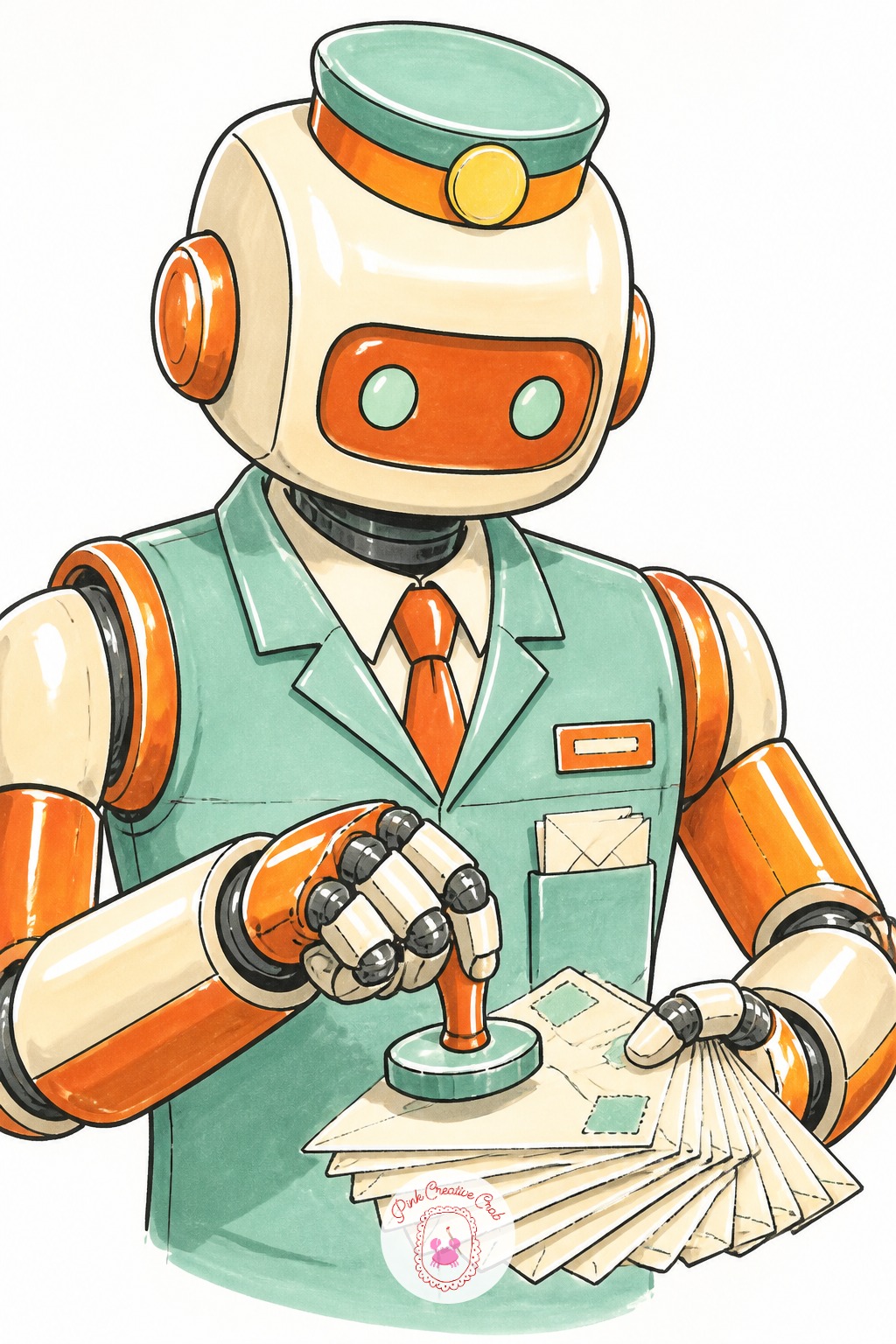
Compare the stamp to the robot’s hand span before drawing the counter: the stamp should look roughly a third the size of the robot’s palm, big enough to notice, small enough to read as a tool and not a prop floating loose.
Line the stack of letters up in a slight fan rather than a neat pile, it reads more alive on the page. If you enjoyed sketching this kind of everyday worker scene, the ideas in this flower sketchbook ideas post follow the same one-page, one-sitting approach.
Robot Greengrocer Stacking Oranges
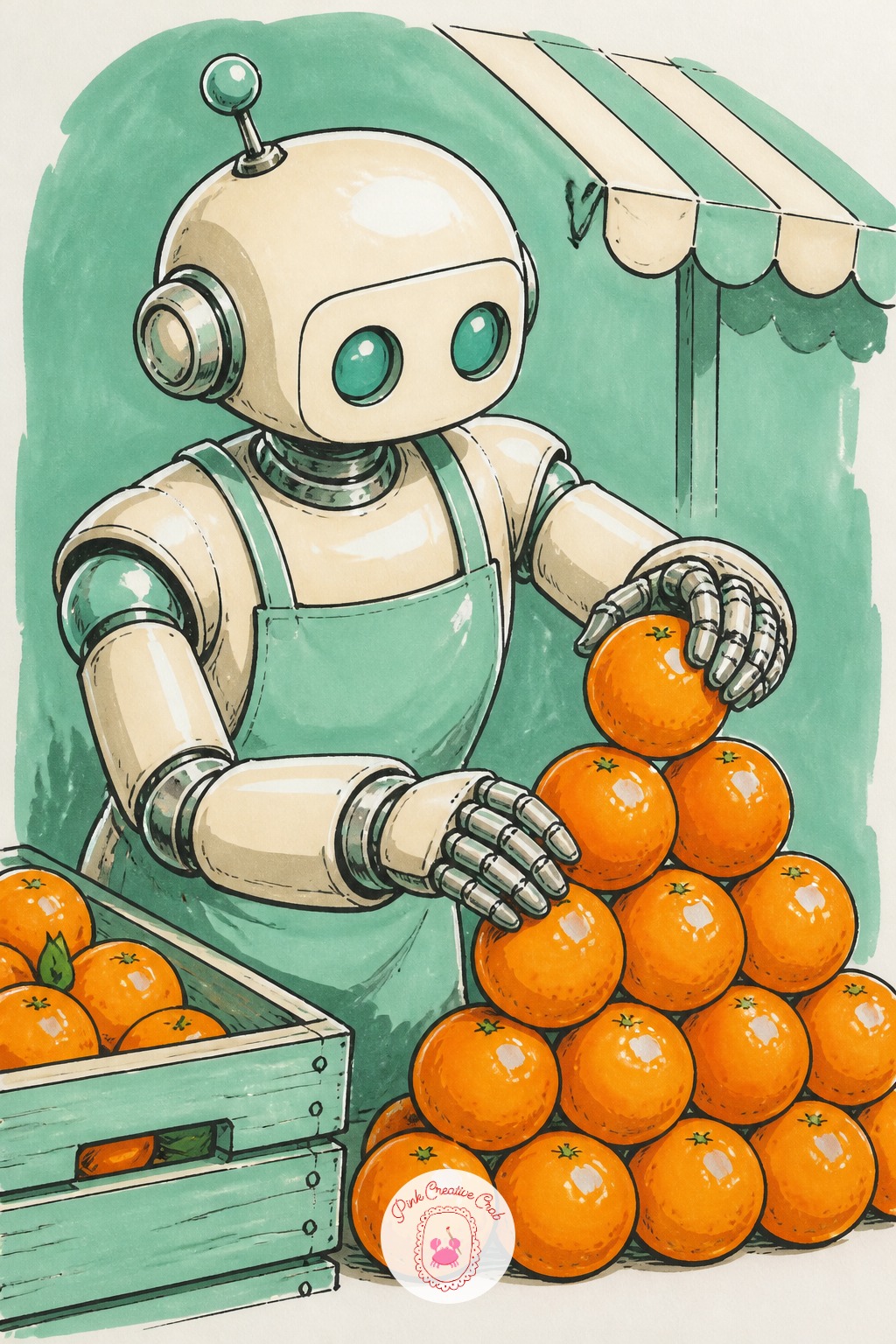
Dry brush your marker almost empty for the crate wood grain, dragging it sideways in short strokes so the texture stays rough and the fruit stays smooth by contrast. That one contrast, rough crate against smooth fruit, does most of the work of making the page feel finished.
Stack the oranges in a loose pyramid rather than a grid, a few rolling slightly out of line looks far more natural. Keep the robot’s apron a flat cream so it does not compete with all that orange.
Robot Clockmaker At a Workbench
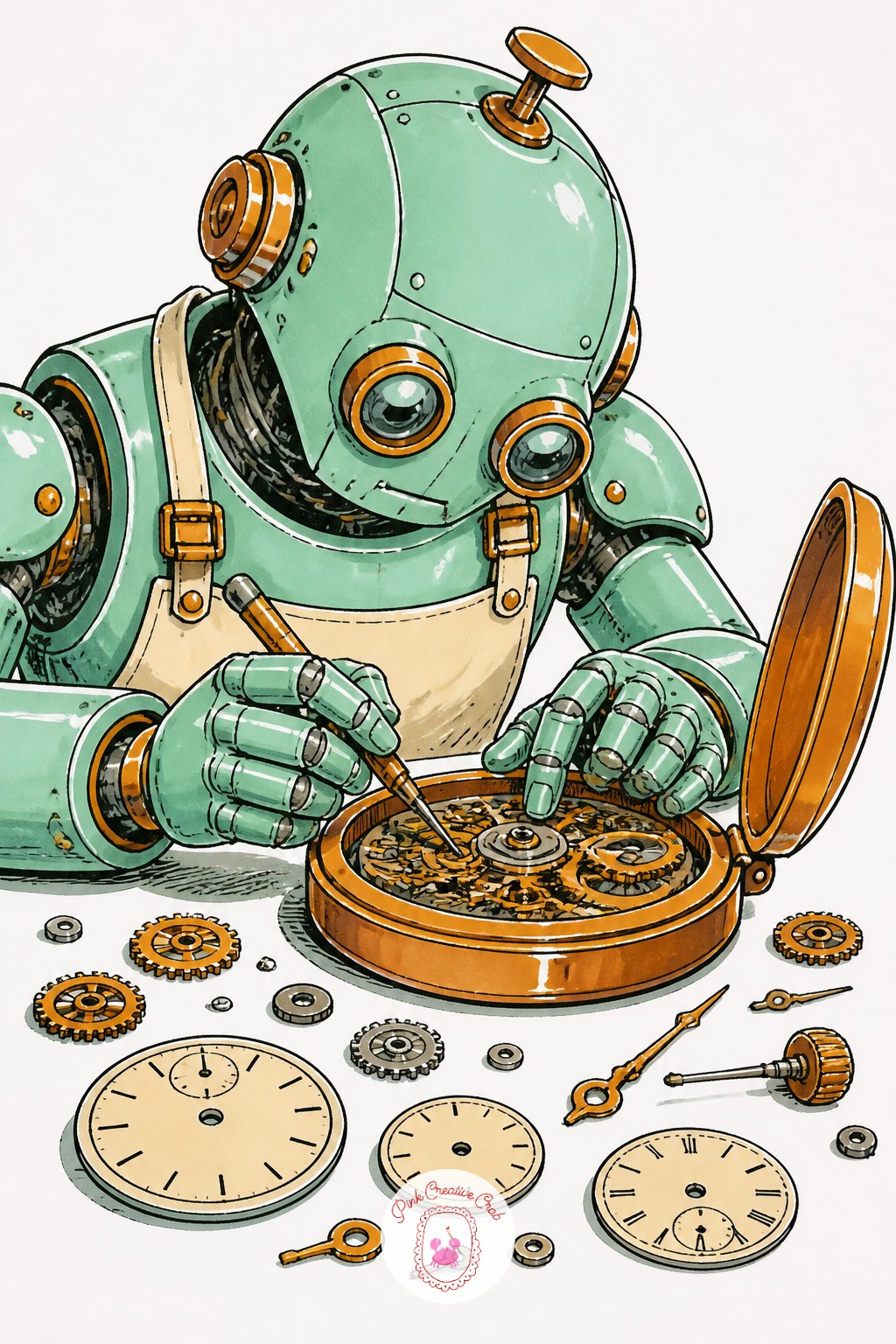
Build the bench first, then the robot leaning over it, since a workbench scene lives or dies on what sits where. Put the open clock case dead center, gears and small cream dials scattered to one side, tools lined along the other.
White gel pen dots make convincing tiny screws and gear teeth faster than trying to draw them in outline. One good habit to repeat: always leave one tool mid-air in the robot’s hand, it keeps the whole scene from going too still.
Robot Crossing Guard Stopping Traffic
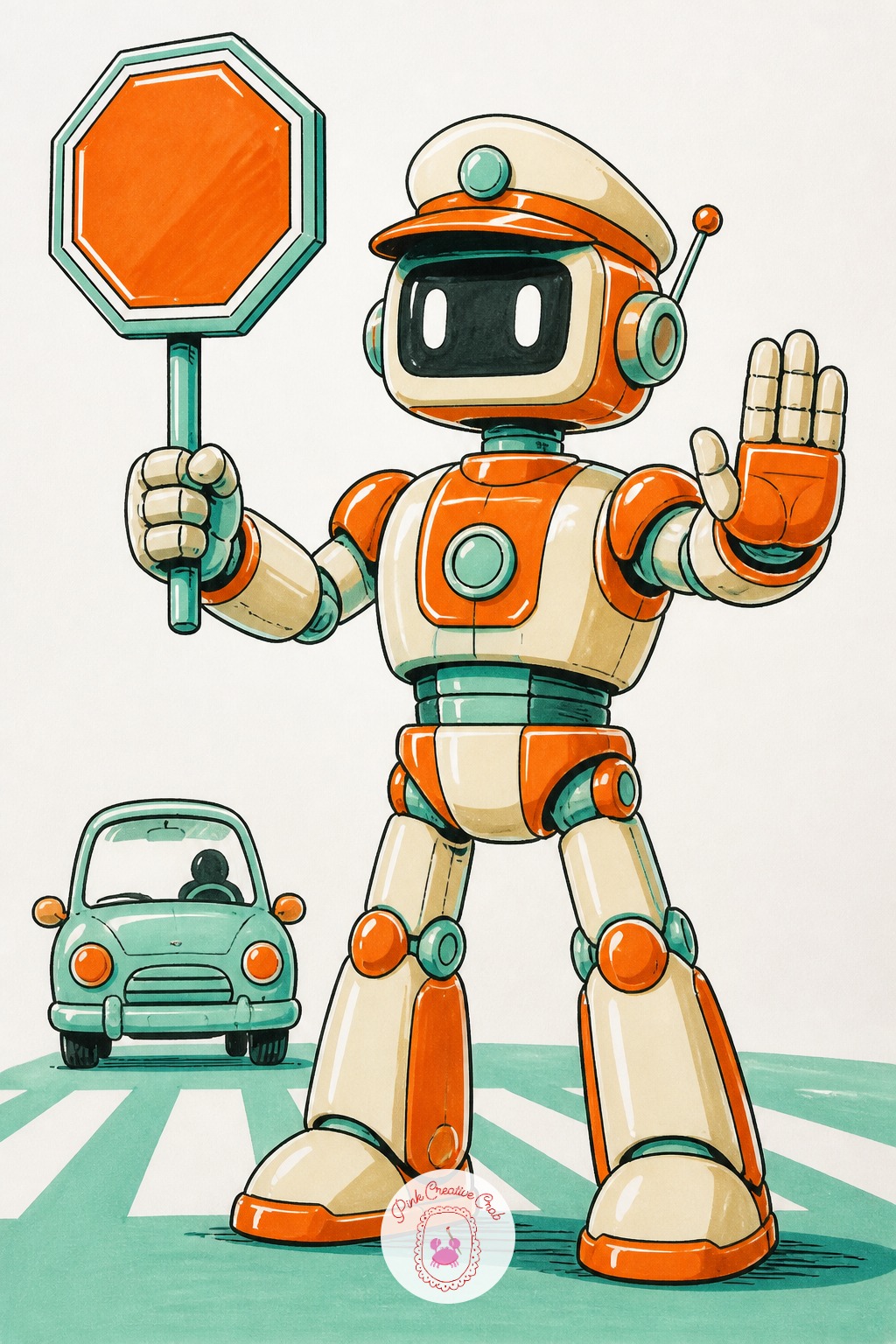
Eye level sits low on this one, right at the robot’s chest, which makes the stop sign loom up large and gives the scene real presence on a small page. Everything behind the robot, the tiny cars and crosswalk stripes, shrinks toward a horizon just above its head.
Keep the stop sign a flat bright orange octagon, no shading needed, it should read instantly even at thumbnail size. Quick tip: angle the robot’s free arm outward, a straight-down arm reads stiff and lifeless.
Robot Beekeeper Checking a Hive
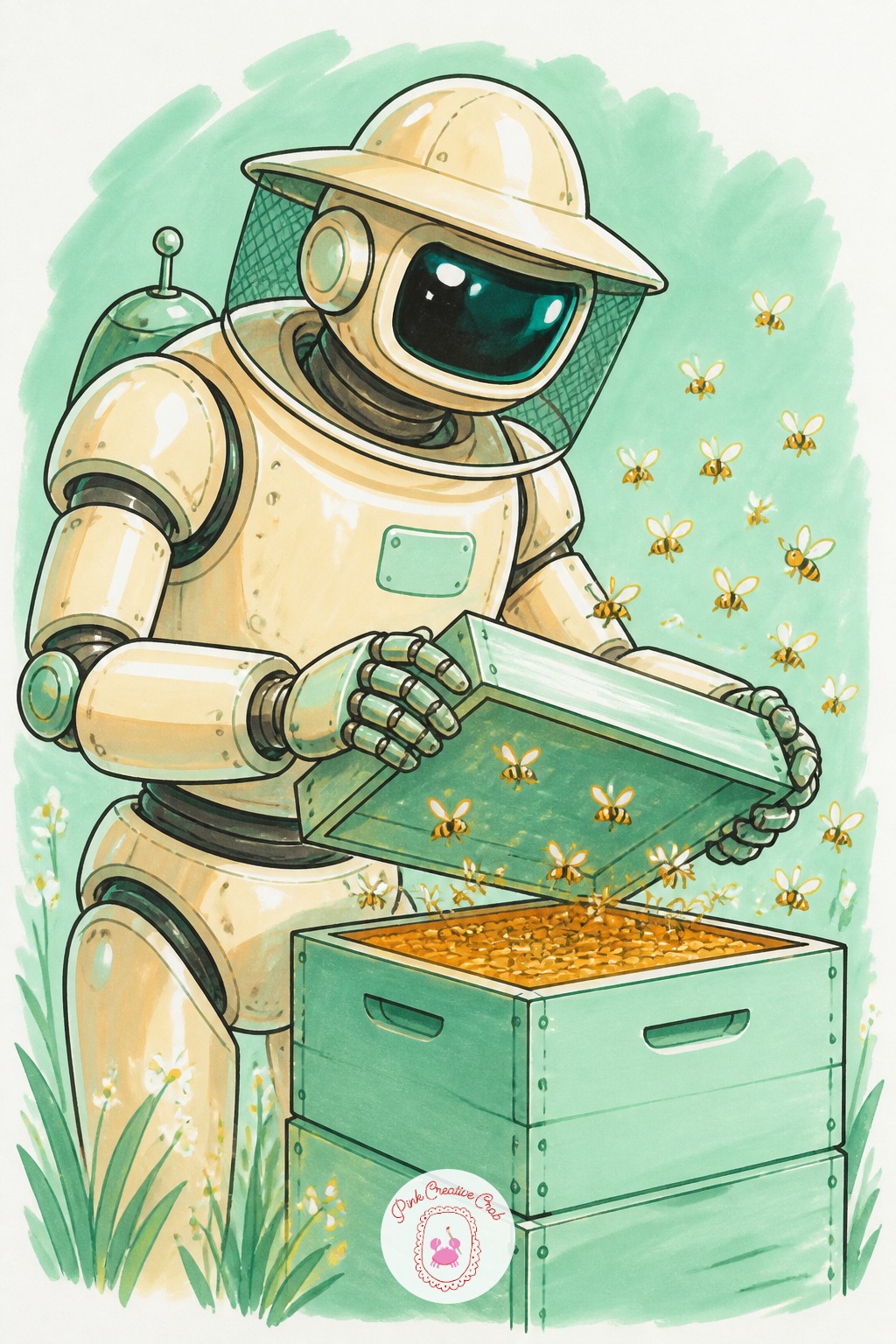
Three marks to start: the hive box, the robot’s visor, and the cloud of bee dots between them, since that triangle of shapes is the whole composition. Everything else, the grass and the robot’s body, fills in around those three anchors.
Bees are just small ovals with two curved lines for wings, repeated maybe eight or ten times in a loose cloud rather than a tidy row. Leave the smoke from the smoker tool as pale gray-white wisps so it does not fight with the mint and orange palette.
Robot Fisherman On a Little Dock
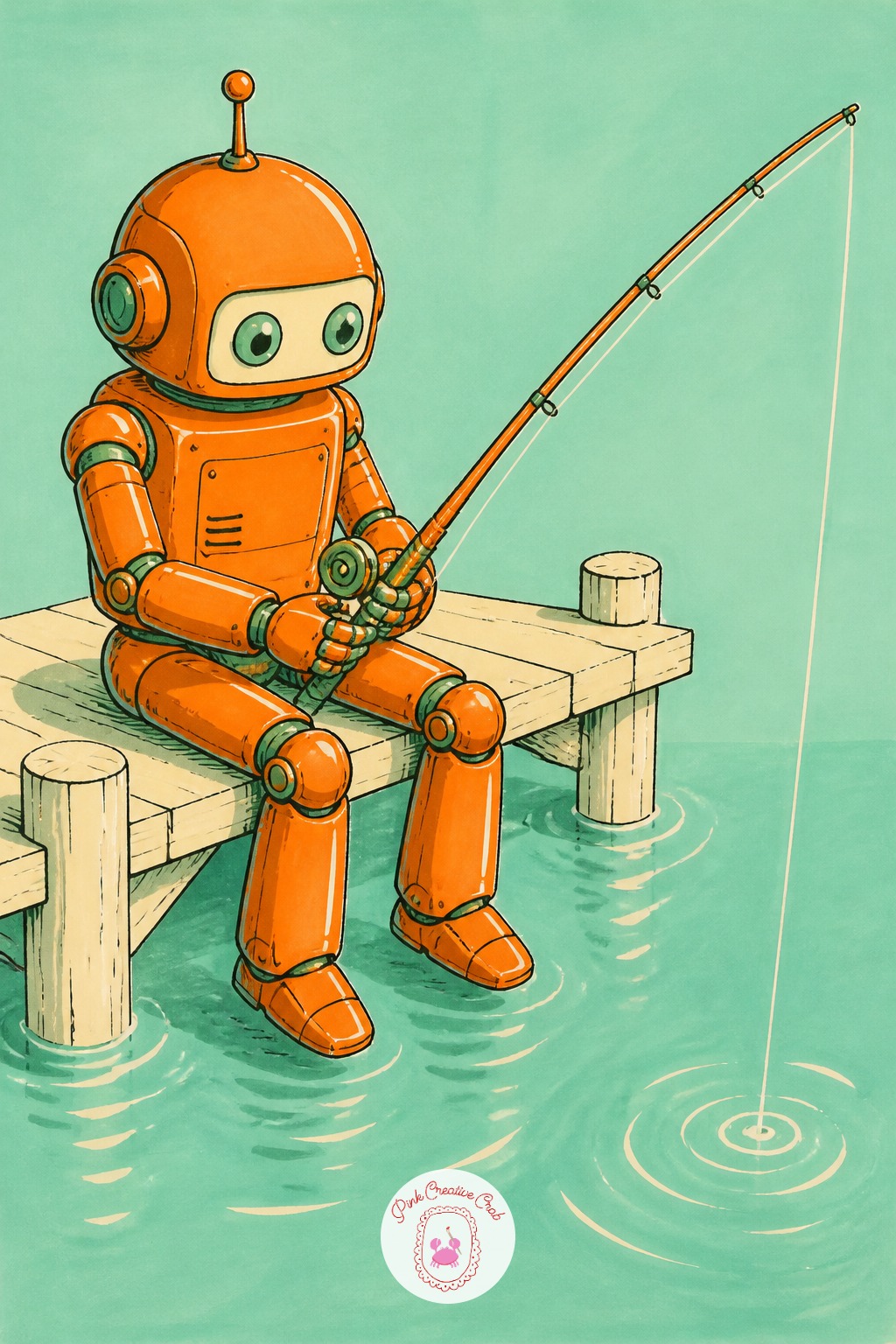
Compare the fishing rod to the robot’s height before drawing the water: the rod should stretch at least one and a half robot-heights beyond its hand, or it reads as a stick instead of a rod. Let the line dip into the water at a gentle angle, never straight down.
Ripples around the line are just a few curved parentheses in a lighter mint, nothing more detailed than that. Keep the dock planks running in one direction only, parallel lines read as wood far faster than any texture trick.
Robot Tailor Measuring a Jacket
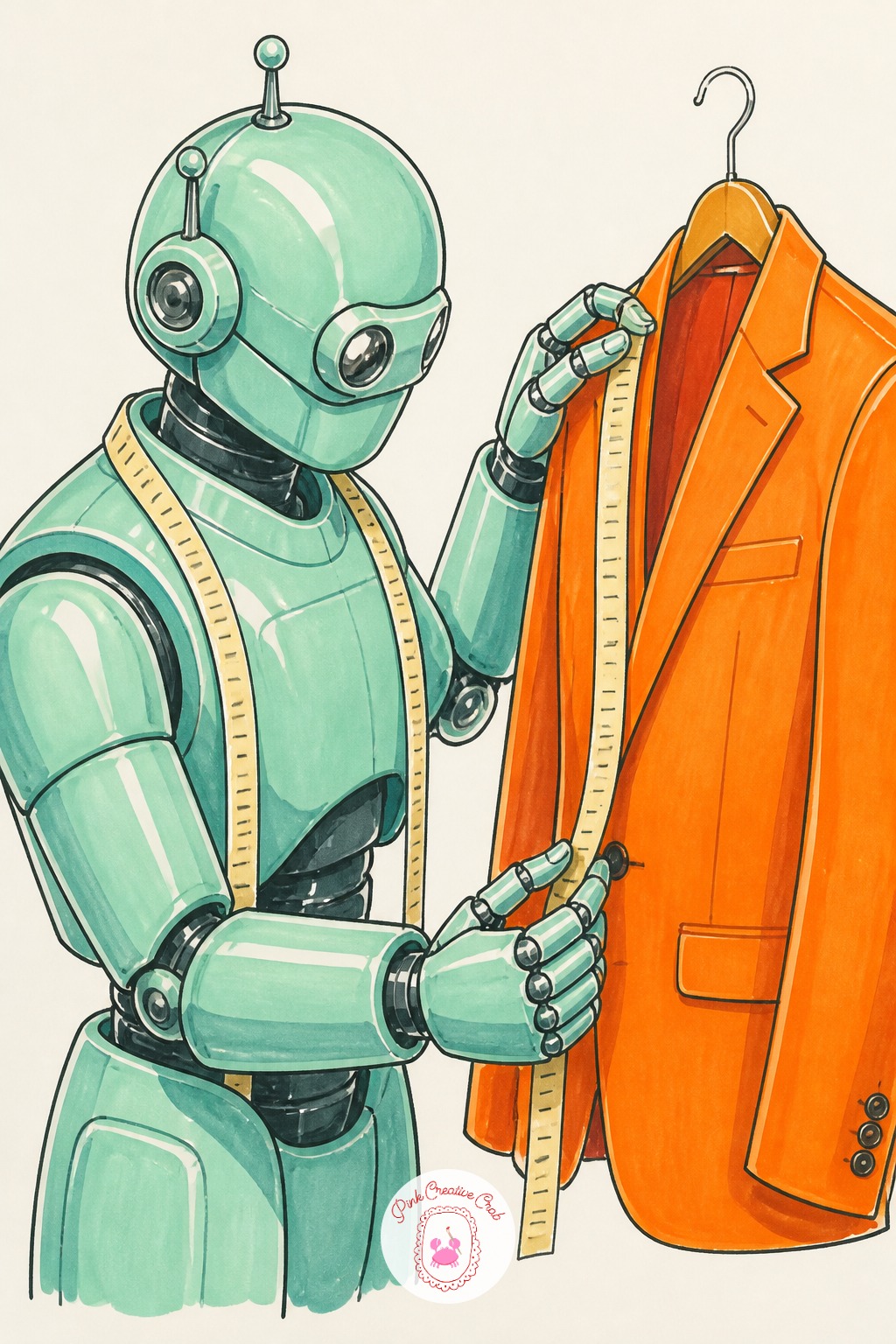
The usual mistake with a tailor scene is making the measuring tape stiff and straight, which looks more like a ruler. Let it droop in a soft curve between the robot’s two hands instead, with a little slack showing, and the whole gesture reads as measuring rather than holding a stick.
Pin the jacket to a simple hanger shape so the tailor has something to work on, and keep its buttons as small white gel pen dots. Fabric folds just need a few curved lines, resist adding more than four or five.
Robot Street Sweeper At Dawn
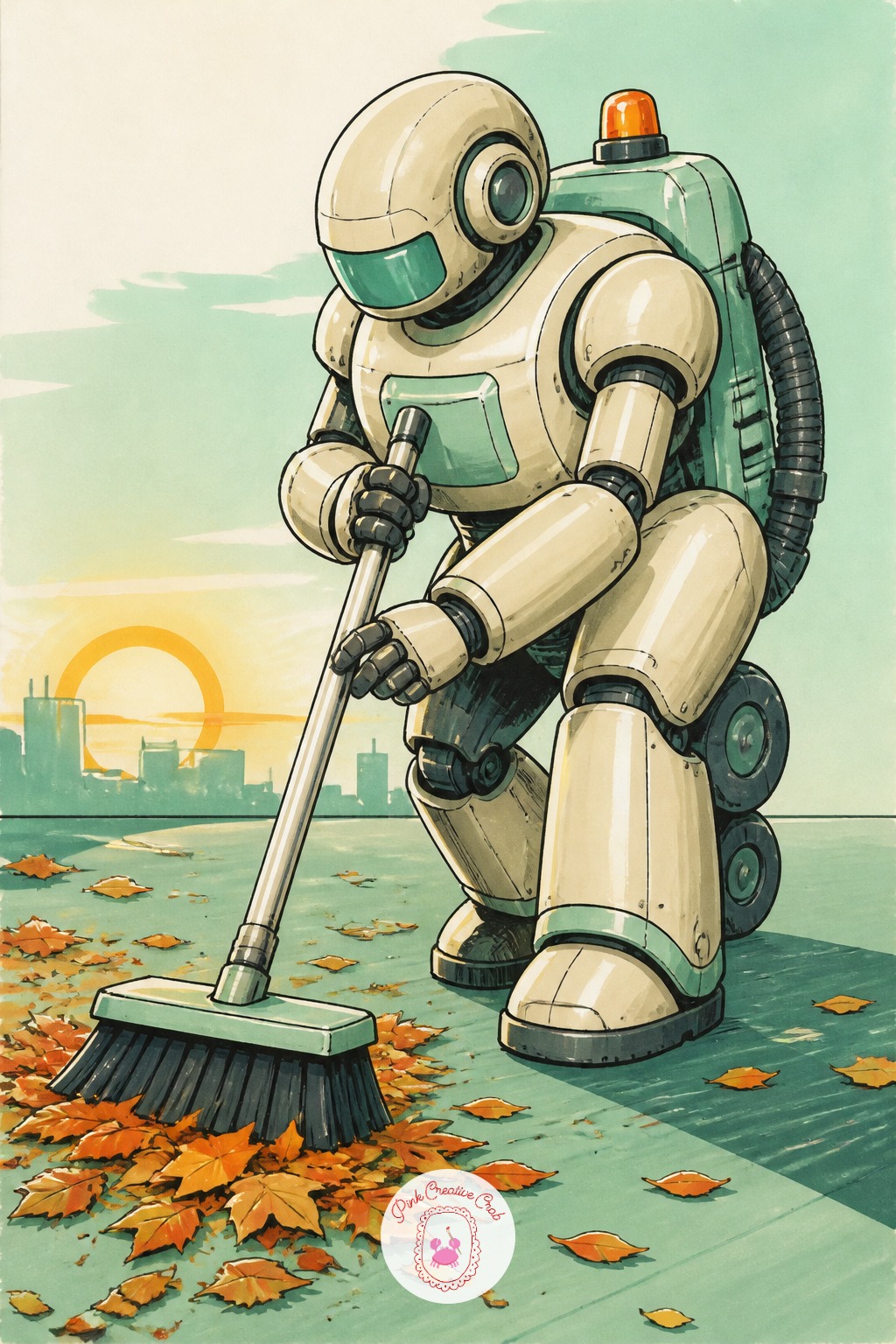
Light source comes from one low corner here, casting the robot’s broom and its own shadow long across the page. That long shadow is doing most of the storytelling, so spend real care getting its angle to match the light rather than guessing.
Little piles of swept leaves in cream and orange dot the ground where the broom has already passed. Ten minutes gets the robot and broom alone, forty minutes adds the row of sleepy shopfronts behind it.
Robot Barber Trimming a Hedge
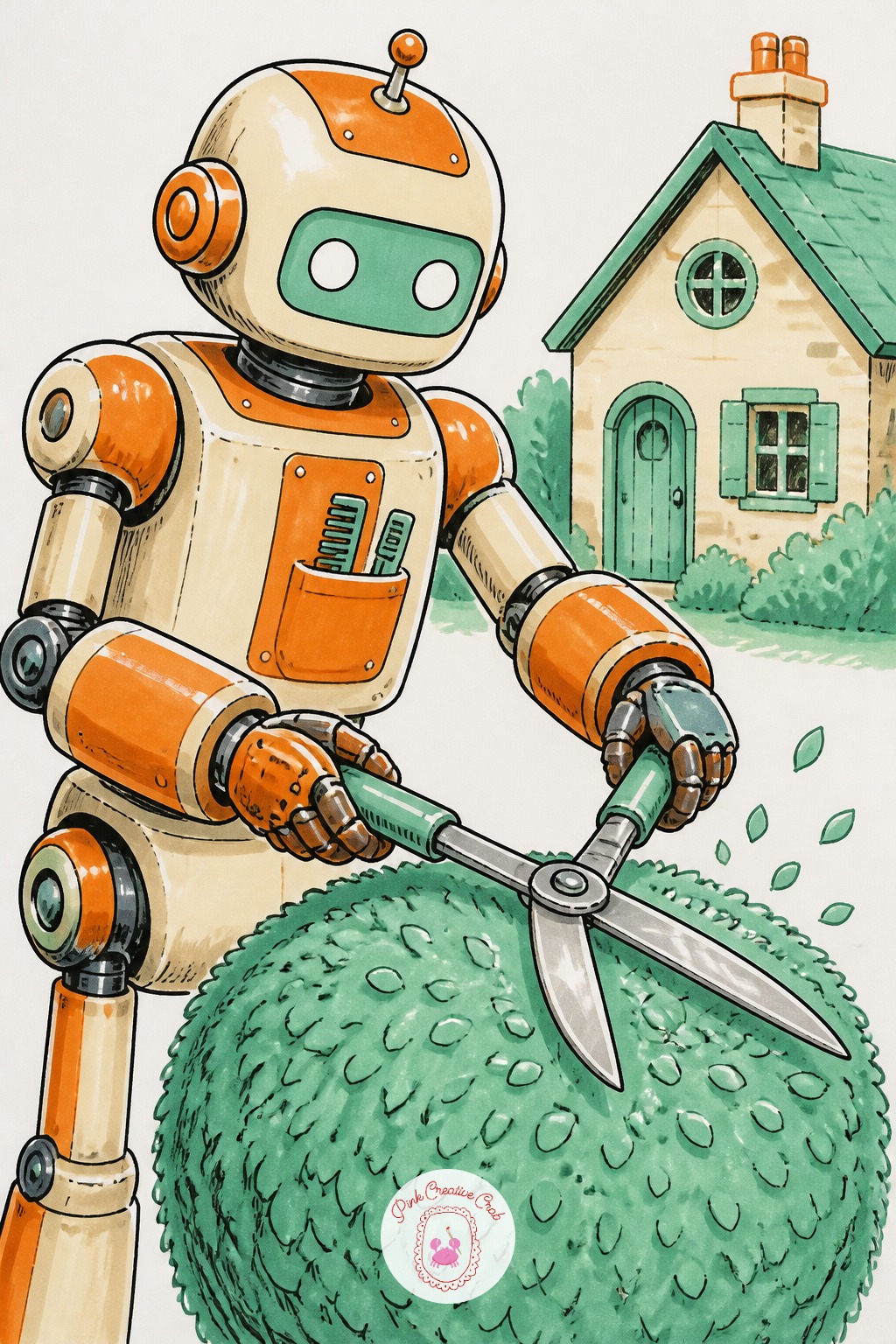
Robots doing yard work are an easy trap for sameness, so give this one a distinct job: shears in hand, trimming a hedge into a neat round shape rather than watering anything. Draw the hedge first as a rough circle, then carve one flat clipped section to show the work in progress.
Hedge texture comes from short scribbled marker strokes in two greens, never a smooth fill, or it stops looking like foliage. Keep the shears small and sharp looking, a single white gel pen line along each blade is enough shine.
Robot Night Watchman With a Lantern
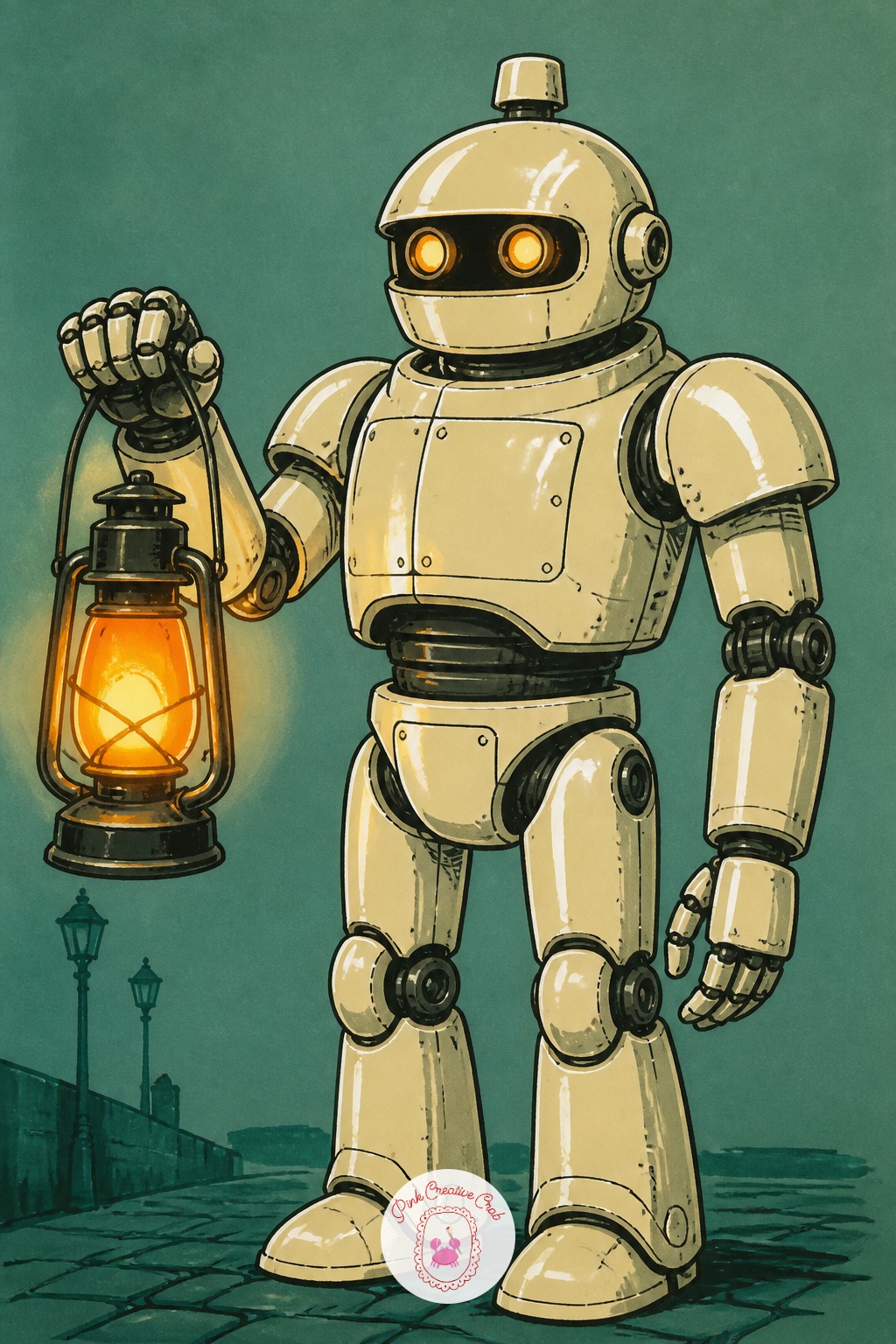
Light source is everything on this page: the lantern is the only bright spot, so everything around it fades to a darker mint the farther it sits from the glow. Draw the lantern’s halo first as a soft circle of cream before adding the robot or the street behind it.
Keep the robot’s own shadow short and pooling right under its feet, since a nearby light source casts a short shadow, not a long one. That single lighting choice turns a simple page into something that feels like actual nighttime.
Robot Barista’s Cousin, the Tea Pourer
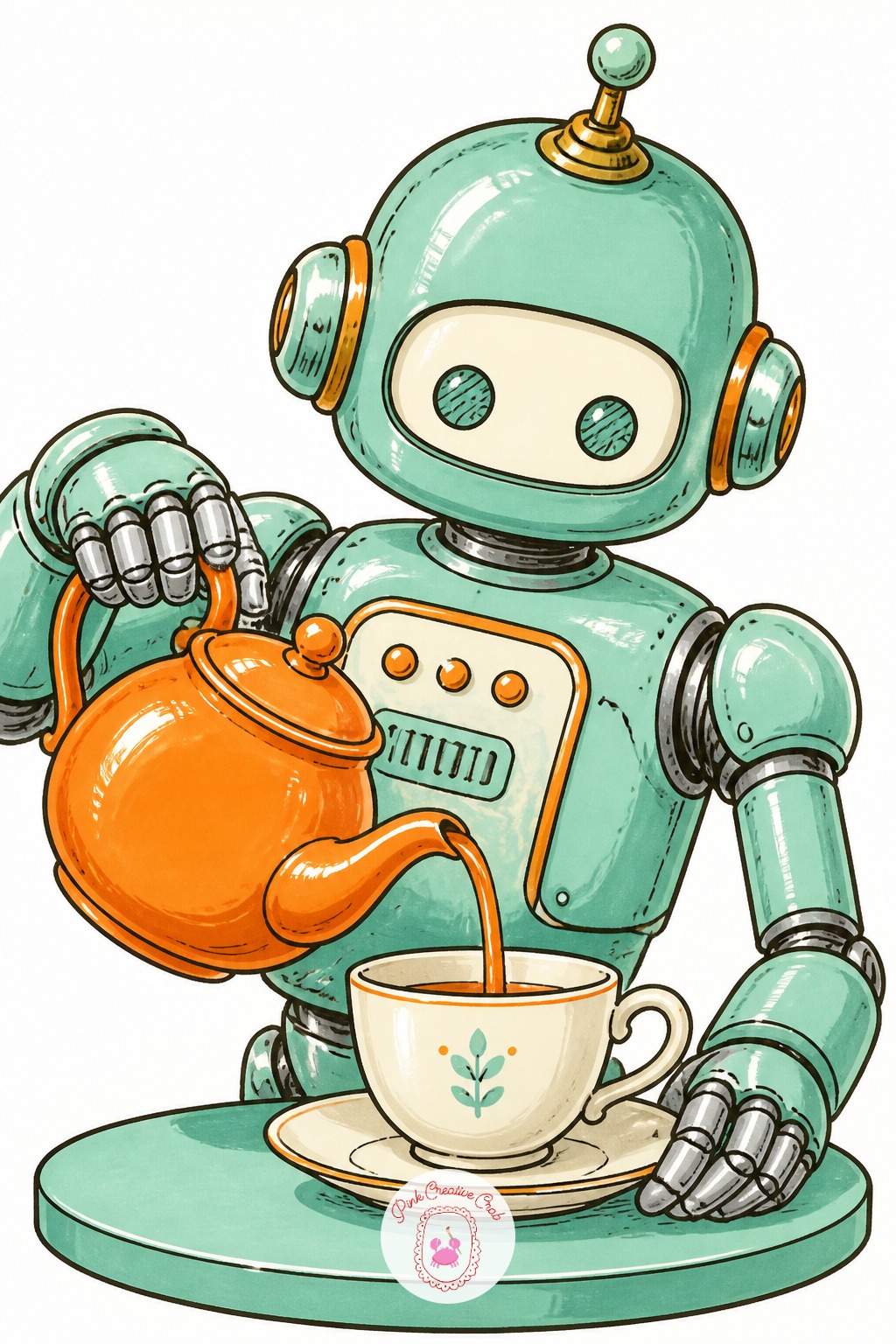
Start with the stream of tea pouring from the pot into the cup, since that curved line decides the tilt of everything else on the page. Build the pot’s angle to match it, then add the robot’s arm holding steady above.
A small steam curl in white gel pen above the cup finishes the warmth of the scene without any extra shading. Try this: next round, swap the teapot for a samovar shape and see how differently the whole page reads with just one object changed.
Robot Cobbler Fixing a Boot
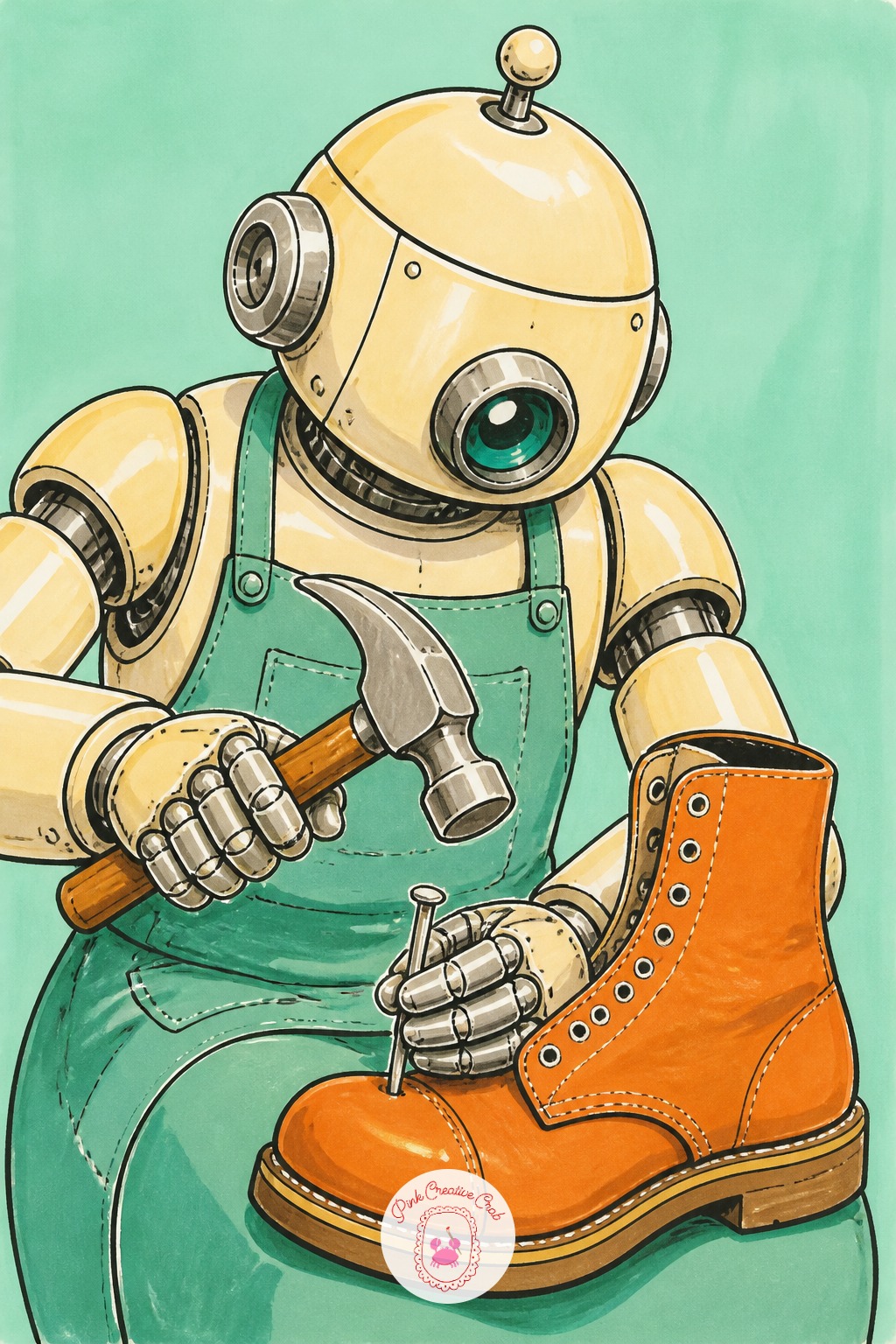
Use a fine liner for the stitching detail on the boot, since that is the one place on this page that benefits from a thin crisp line rather than a bold one. Everything else on the robot can stay in your usual thicker nib.
Tiny white gel pen dots along the boot’s seam read instantly as fresh stitches. Keep the hammer mid-swing rather than resting, a raised tool always makes a workshop scene feel busier than it actually is to draw.
Robot Fruit Cart Vendor At the Corner
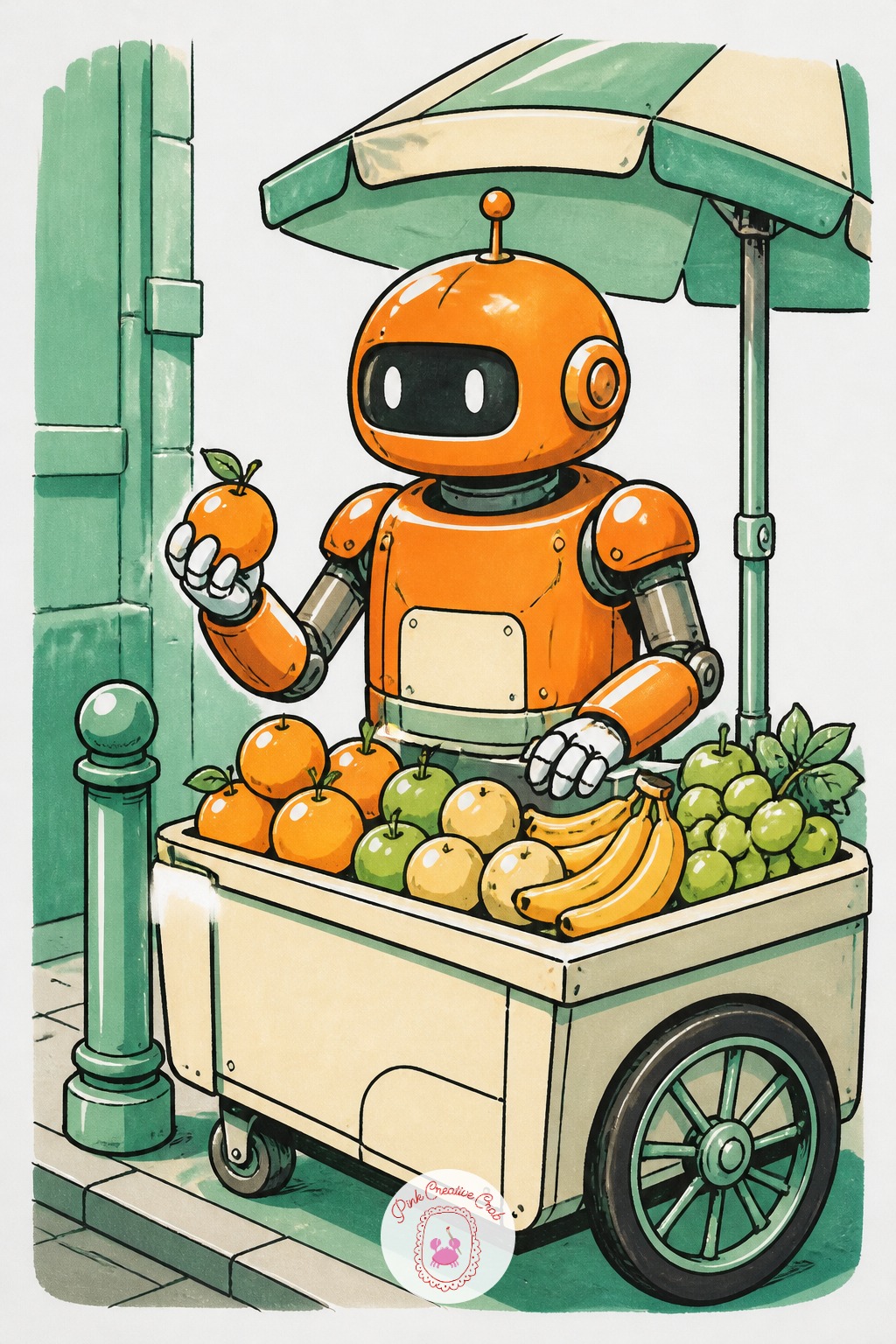
Compare the cart to the robot before drawing either: the cart should sit about chest high on the robot, low enough that it can reach over the top easily. Get that one proportion right and the whole scene feels believable.
Pile the fruit in mixed sizes, not identical circles, a few slightly squashed ovals among the round ones reads far more natural. If a tiny town full of workers appeals to you, the same bright, finish-today approach shows up in these food coloring pages with smiling snacks.
Robot Shoe Shiner On a Box
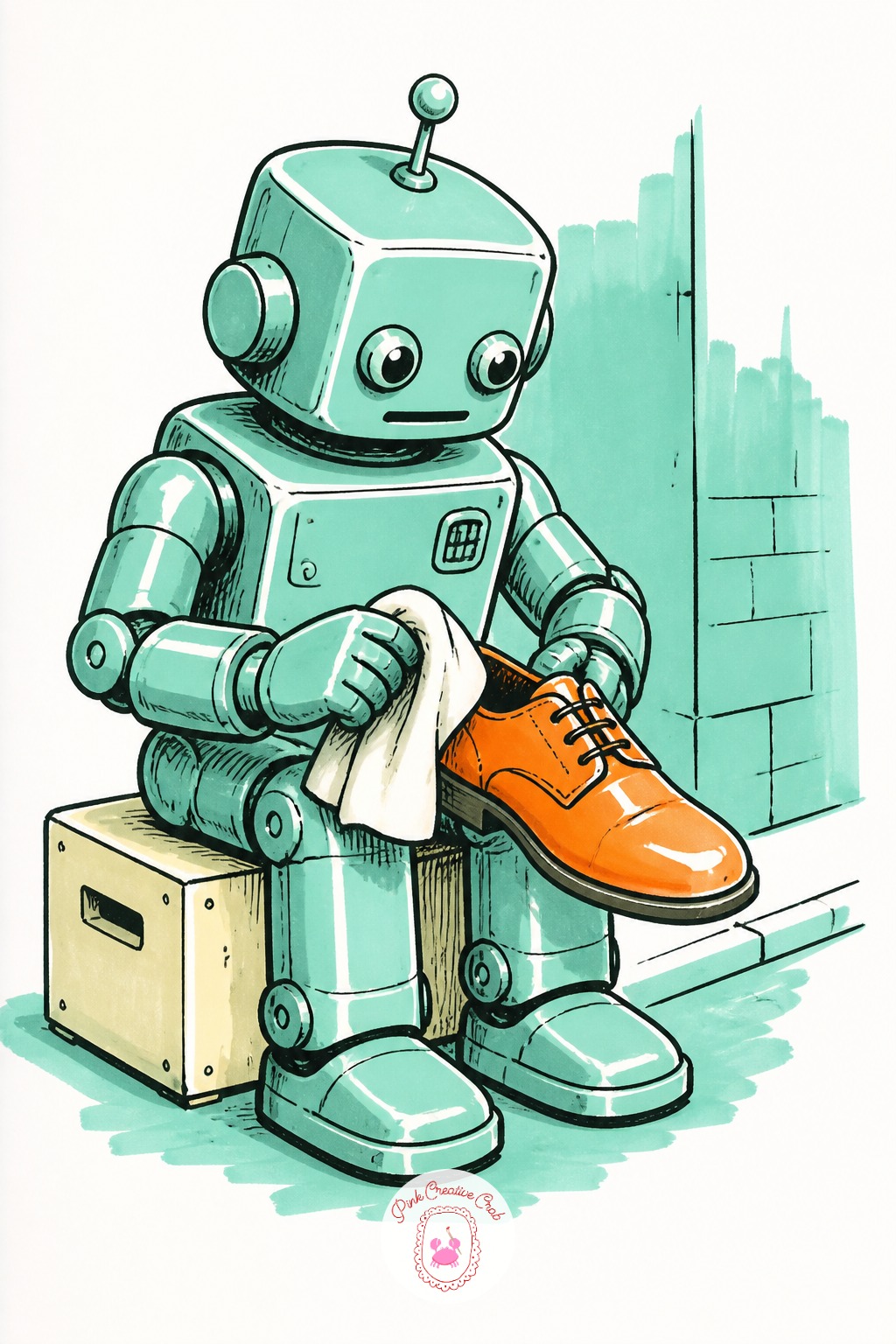
Eye level sits low again here, looking slightly up at the seated customer’s shoe to make the robot feel small and busy at street level. That low angle also hides most of the background, so you can skip drawing a full street scene and still have a complete page.
Keep the shine cloth mid-motion, a soft curved blur shape rather than a crisp rectangle, to suggest it moving fast. One white gel pen streak across the shoe toe is all the shine effect needs.
Robot Window Washer On a Platform
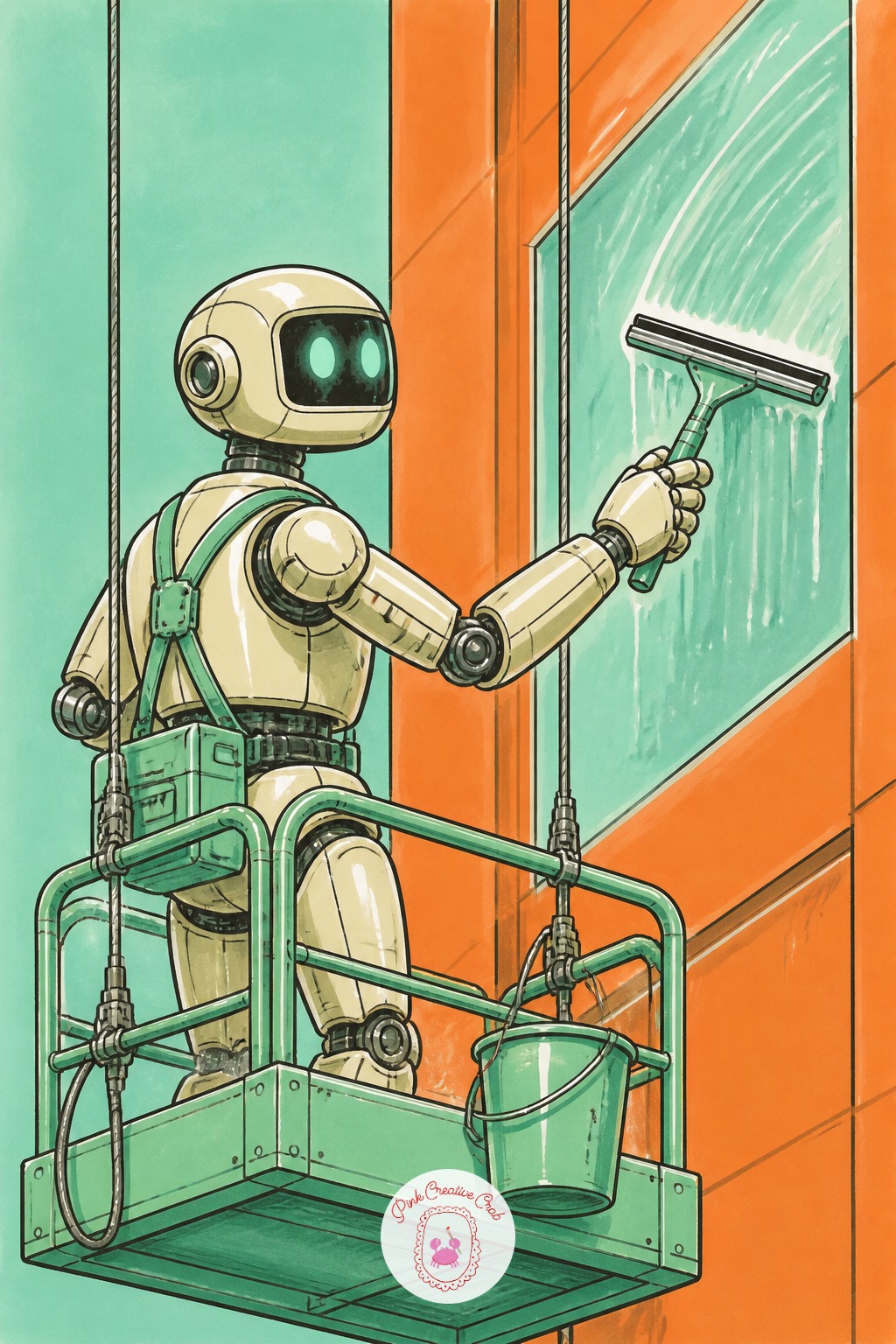
Perspective matters most here: put the horizon line low, near the bottom of the page, so the building front stretches up tall and the hanging platform feels like it is really suspended in the air. The window panes get smaller and tighter together as they rise, which sells the height.
Streak the squeegee’s path across one pane in a lighter cream to show where it has already cleaned. Keep the rope or cable holding the platform as one single clean line, nothing fussier reads as rope on a small page.
Robot Newsstand Vendor At Sunrise
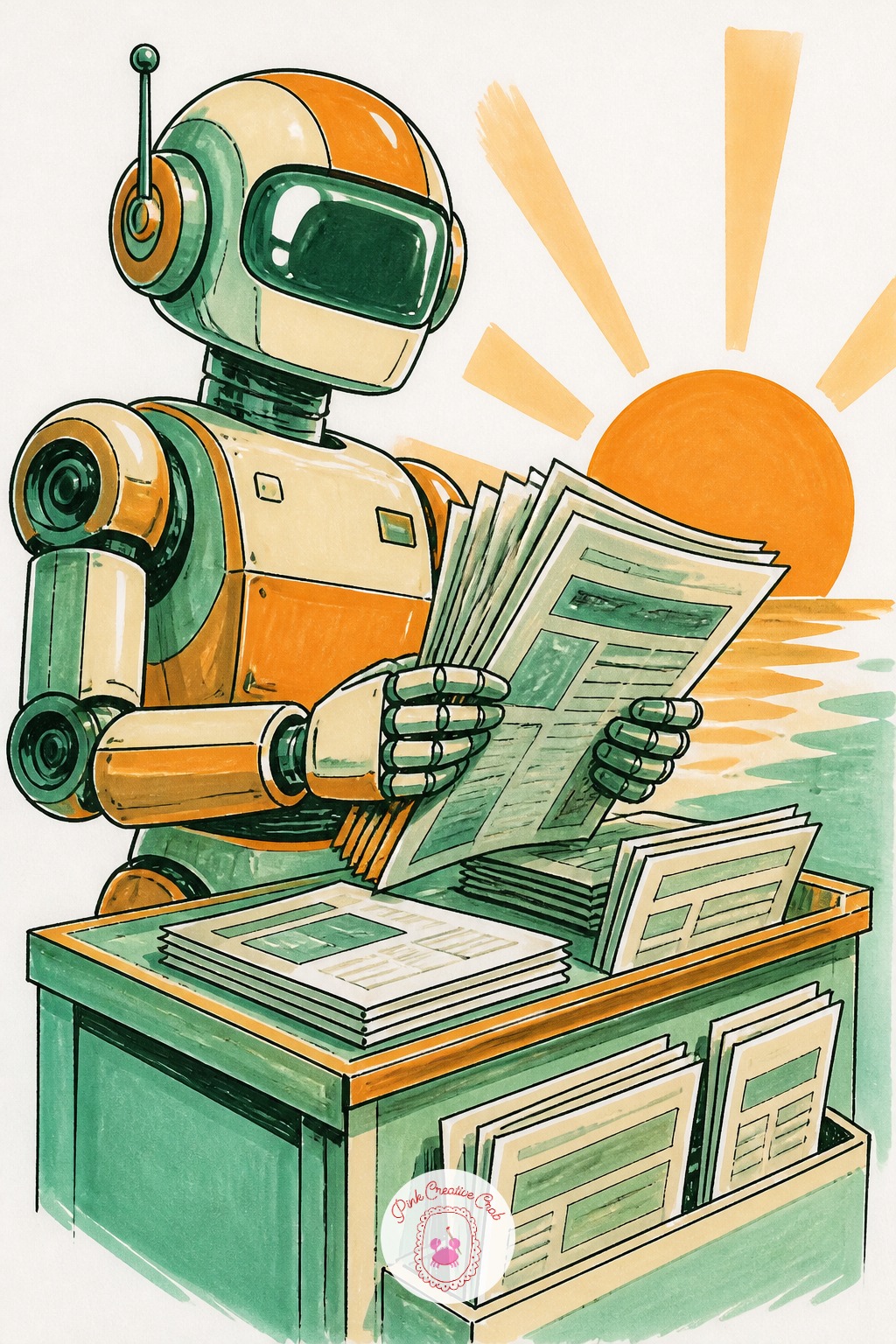
Build the stack of newspapers first, fanned slightly rather than squared off, since a too-neat stack looks printed rather than drawn. The robot’s hand rests on top of the stack, which anchors the whole composition in place.
Sunrise light means warm orange creeping across one side of everything, the newsstand roof, the robot’s visor, even the paper edges. Leave the opposite side in cooler mint shadow, and the time of day reads without a single extra line of explanation.
Robot Ice Cream Vendor At the Cart
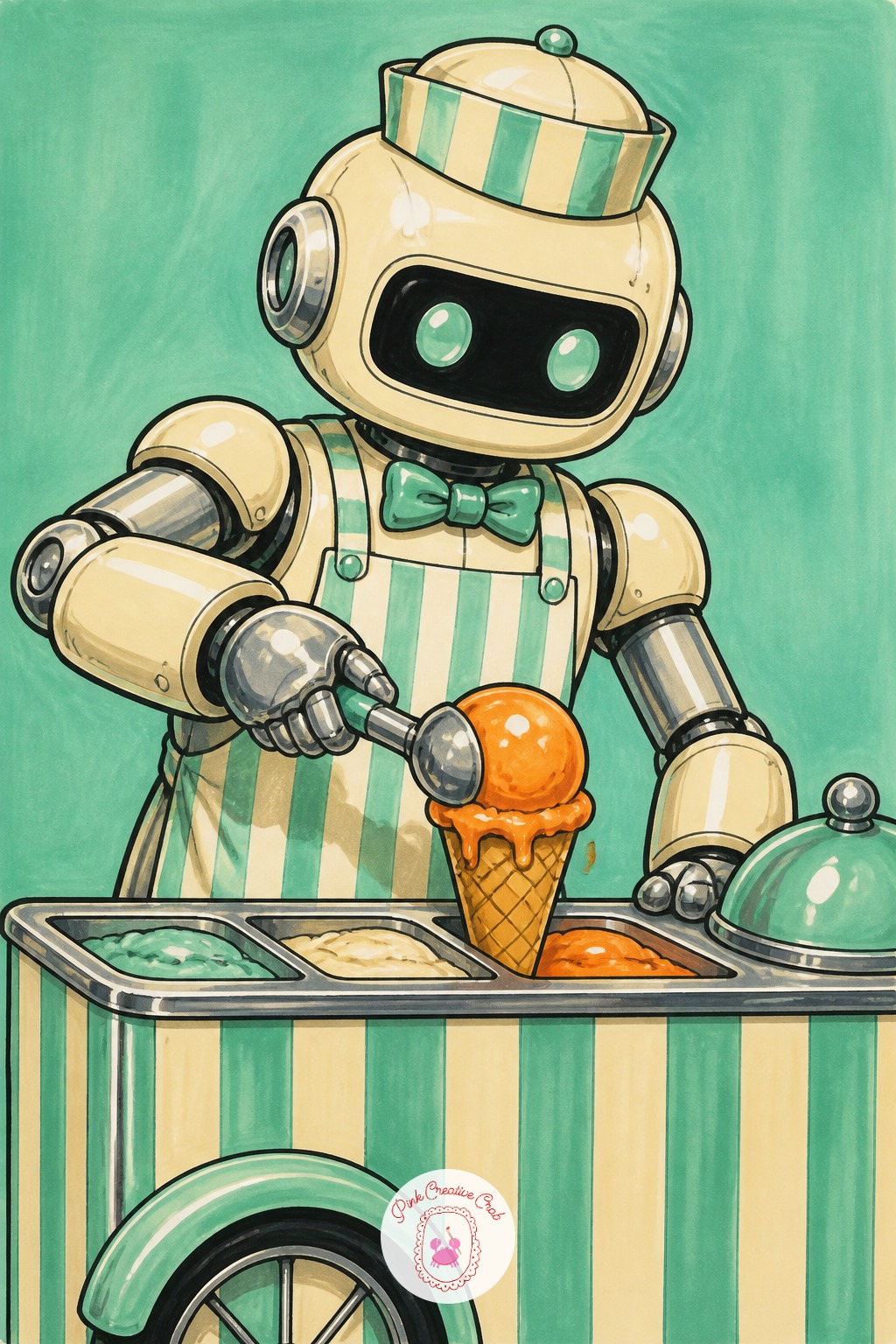
The usual mistake with ice cream scenes is drawing the scoop as a perfect sphere sitting stiffly on the cone, which looks pasted on rather than scooped. Give it a slightly flattened, swirled top edge instead, with one small drip line running down the cone, and it reads as freshly served.
Keep the cart’s awning striped in alternating mint and cream, a simple repeating pattern that takes seconds and adds a lot of charm. Finish with a single white gel pen sparkle on the scoop’s highest point.
Robot Train Conductor On the Platform
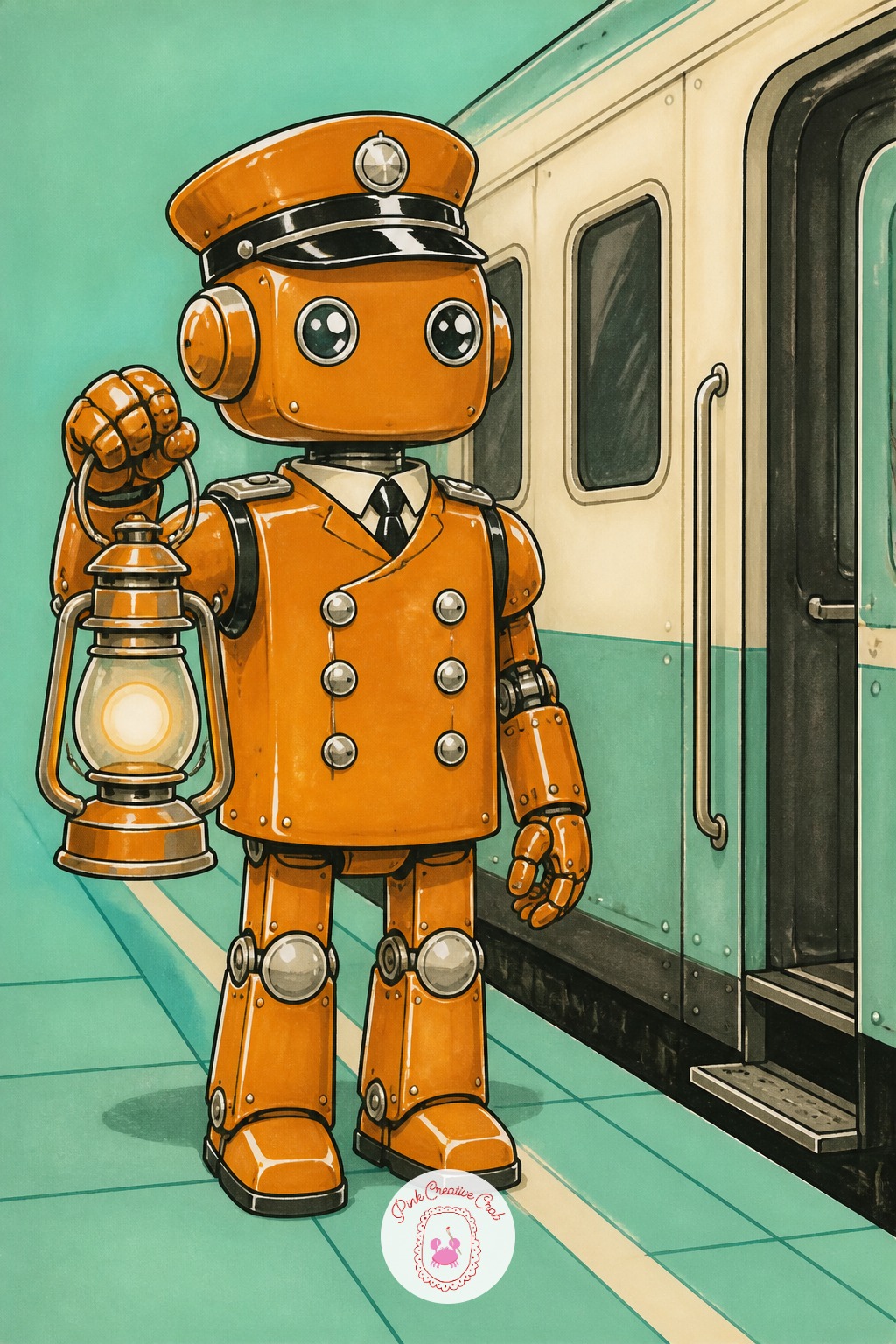
Measure the robot against the train car behind it: keep the robot roughly a third the height of the carriage door, which makes the train feel appropriately large without having to draw much of it at all. A sliver of carriage and one window is enough background.
The lantern or ticket punch in its hand should sit at chest height, held forward, which gives the pose purpose rather than looking like it is just standing there. Platform lines running straight back are the fastest way to suggest depth.
Robot Puppeteer At a Tiny Theater
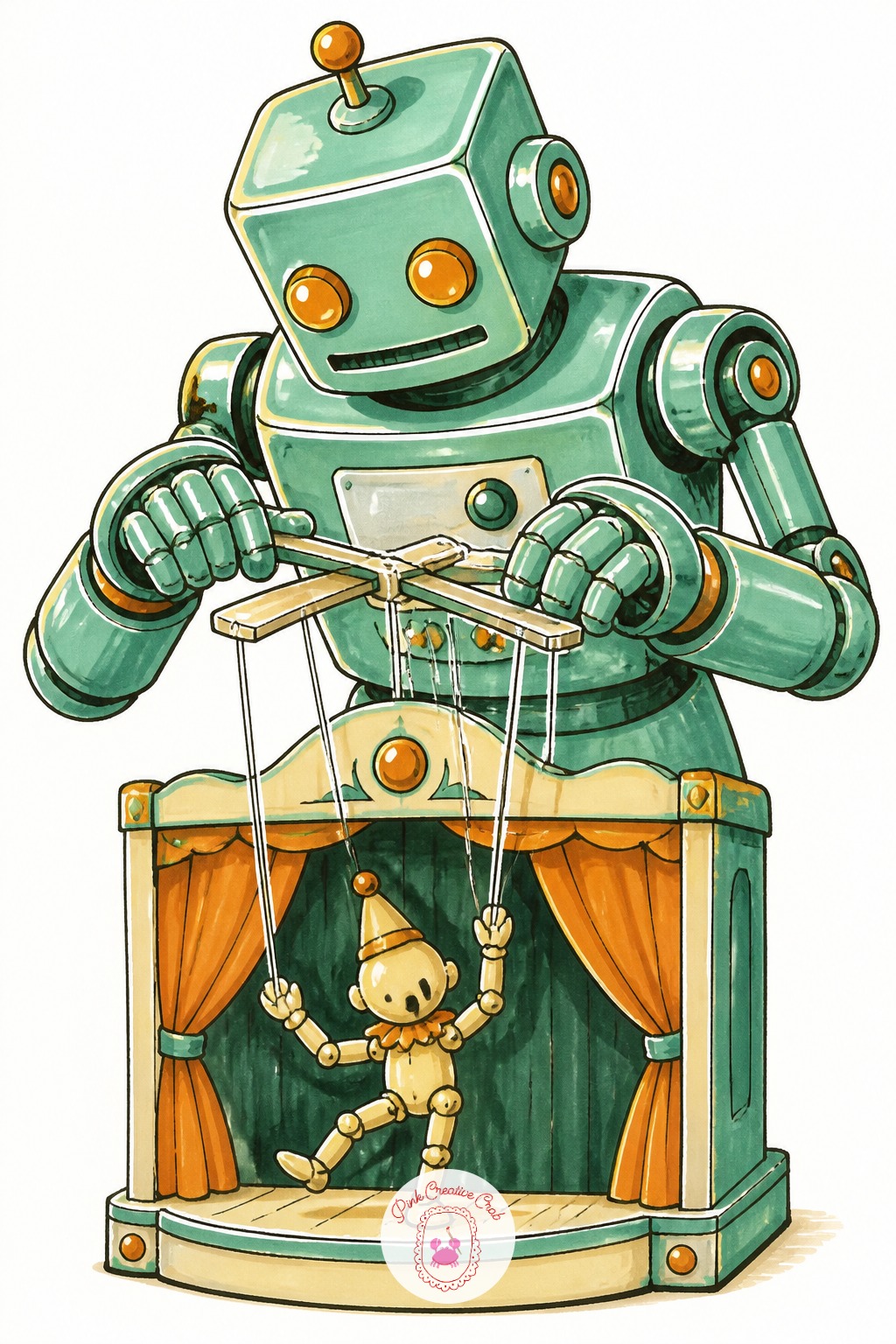
This one asks for a slightly more involved scene, so plan the layout before inking: puppet theater frame at the top third of the page, robot’s hands and control bar in the middle third, and a small audience hint, maybe two or three simple seated shapes, at the bottom.
Keep the puppet strings as thin, perfectly straight fine-liner lines, since any wobble there reads as a mistake rather than a style choice. The puppet itself can be as simple as a cream triangle body with an orange hat.
Robot Locksmith At a Little Shop Counter
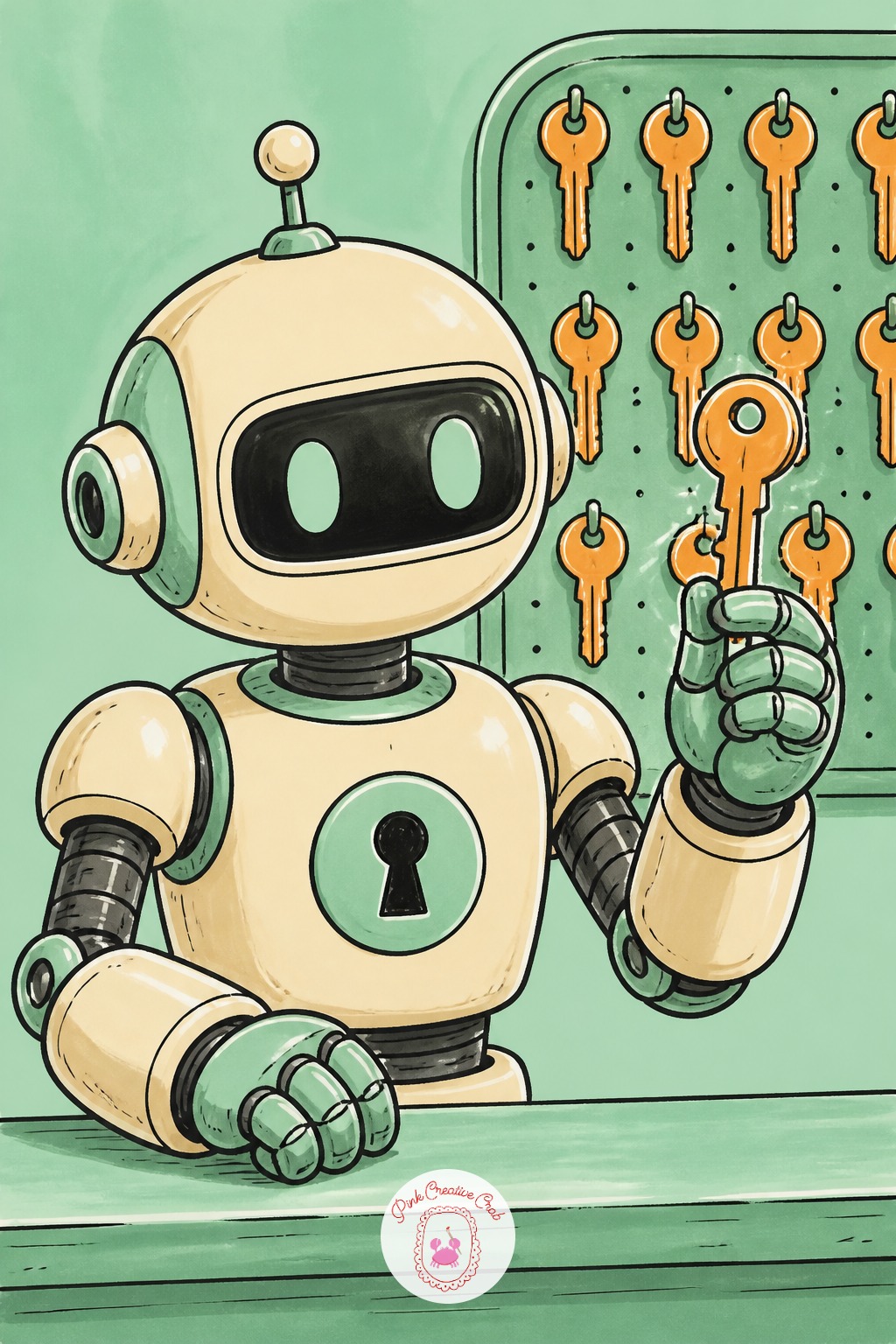
Key shapes are small and easy to fumble, so simplify hard: a key is just a thin rectangle shaft with two or three square notches and a loop at the top, repeated on a pegboard behind the robot in varying sizes.
Light a single key in the robot’s hand with a white gel pen edge to show it is the one actually being worked on, letting the pegboard keys stay flatter and duller by comparison. That contrast in finish tells the eye exactly where to look first.
Robot Weather Forecaster On a Rooftop
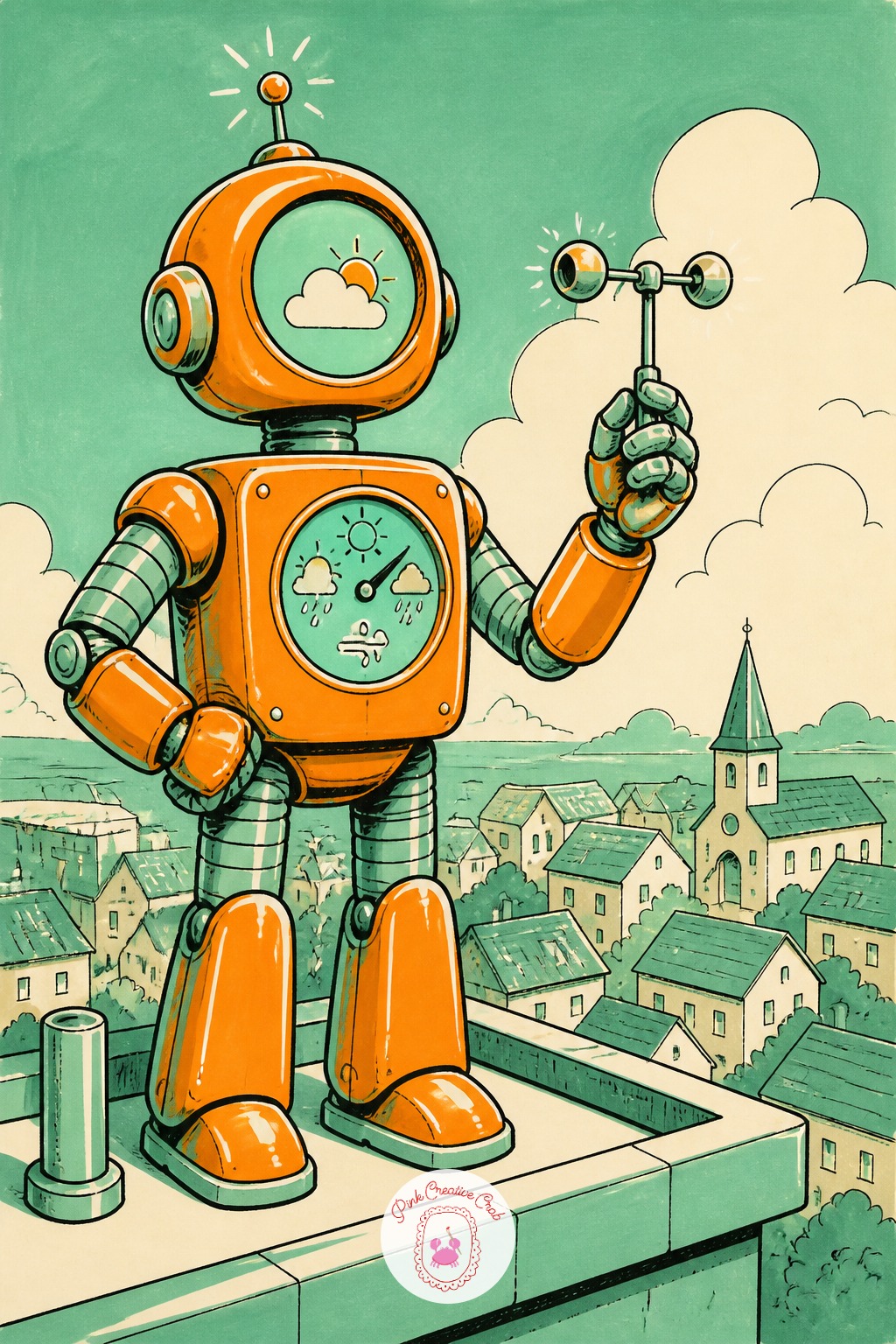
Eye level goes high here, looking down slightly over a rooftop railing so the little town spreads out small beneath the robot. That bird’s eye view is what makes a forecaster scene feel different from every other street-level idea on this list.
Keep distant rooftops as simple flat-topped triangles and rectangles in cream and mint, no detail needed since they are far away. The robot’s weather instrument, whether a dial or a little antenna, deserves the only white gel pen highlight on the page.
Robot Candle Maker Dipping Wicks
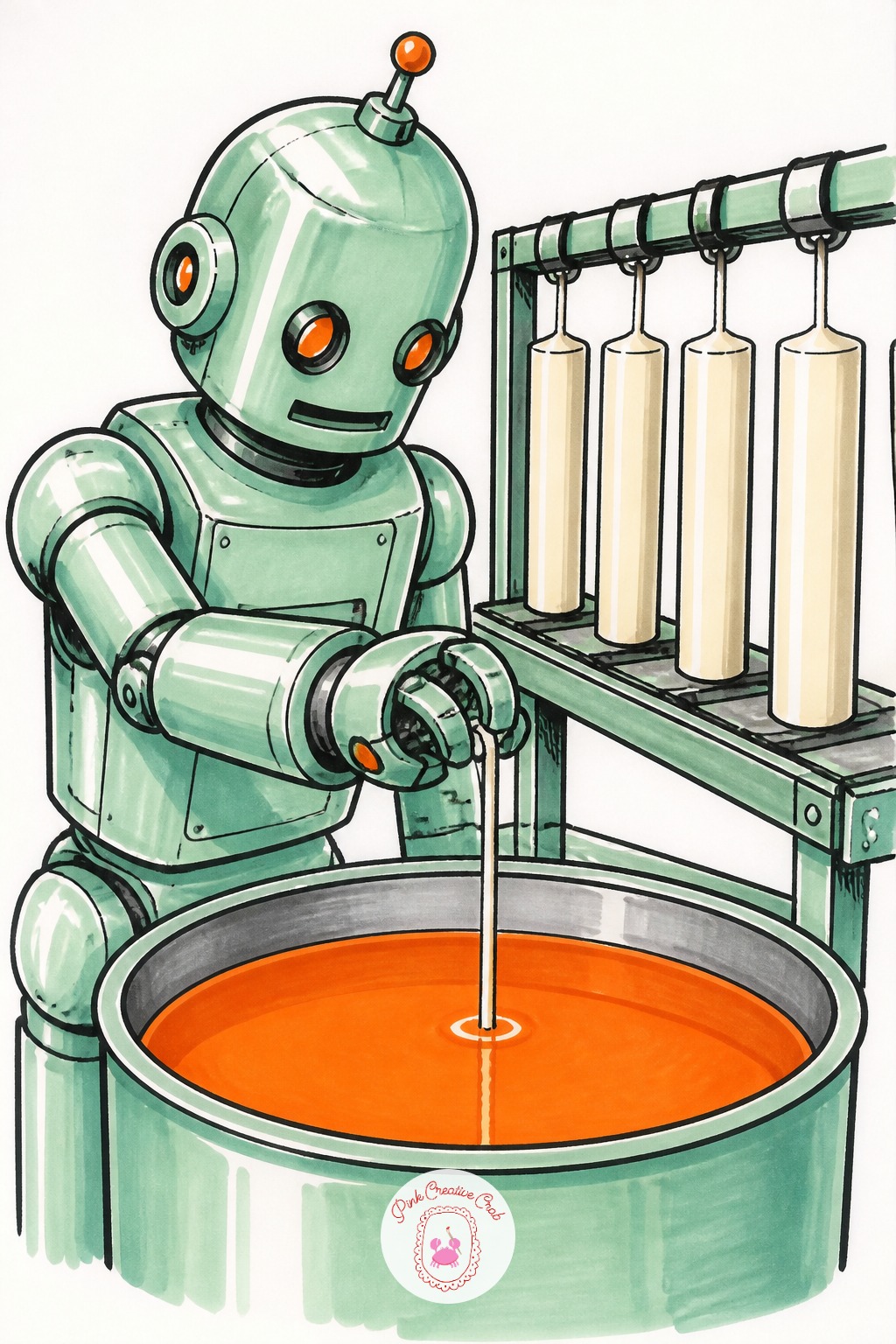
Ten minutes gives you the robot and the dipping vat alone, a complete little page on its own. Forty minutes adds a drying rack strung with four or five finished candles behind it, which turns the same idea into a fuller scene with almost no extra difficulty.
The dip itself is a thin vertical line of wax color running from the robot’s hand down into the vat, nothing more literal needed. Vary the candle colors along the drying rack between orange and cream so the row does not look repetitive.
Robot Tulip Farmer On a Rolling Cart
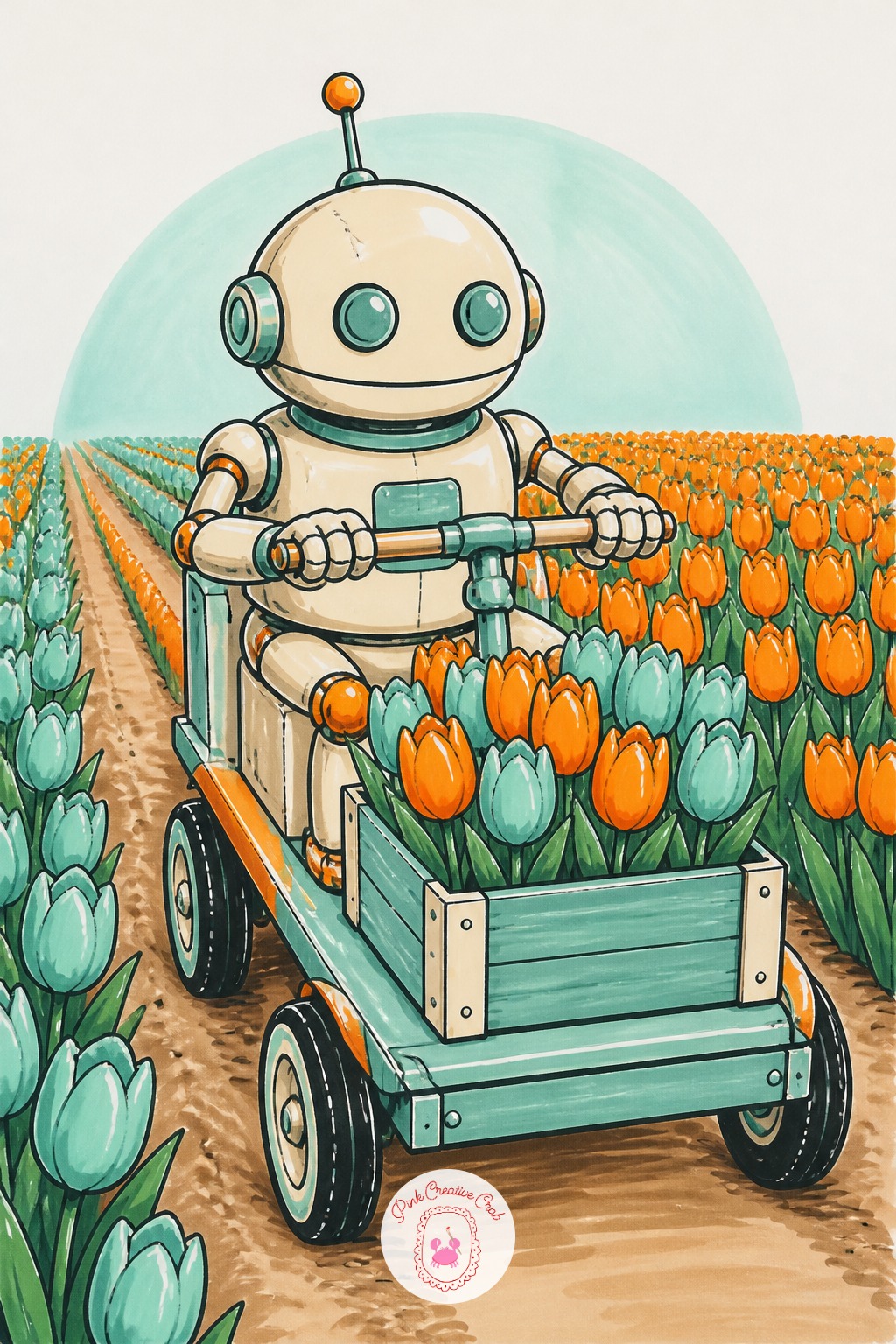
Proportion trick for this one: make the field rows recede by shrinking the tulip shapes as they move up the page and spacing them closer together near the top, the same trick that makes any field read as going back into distance.
Keep the cart’s wheels simple circles with a cross of spokes, nothing more detailed, since the real interest sits in the robot and the flowers. One thing worth trying: alternate the tulip rows mint and orange instead of all one color, it reads as planned farmland rather than a random patch.
Robot Umbrella Repairman In the Rain
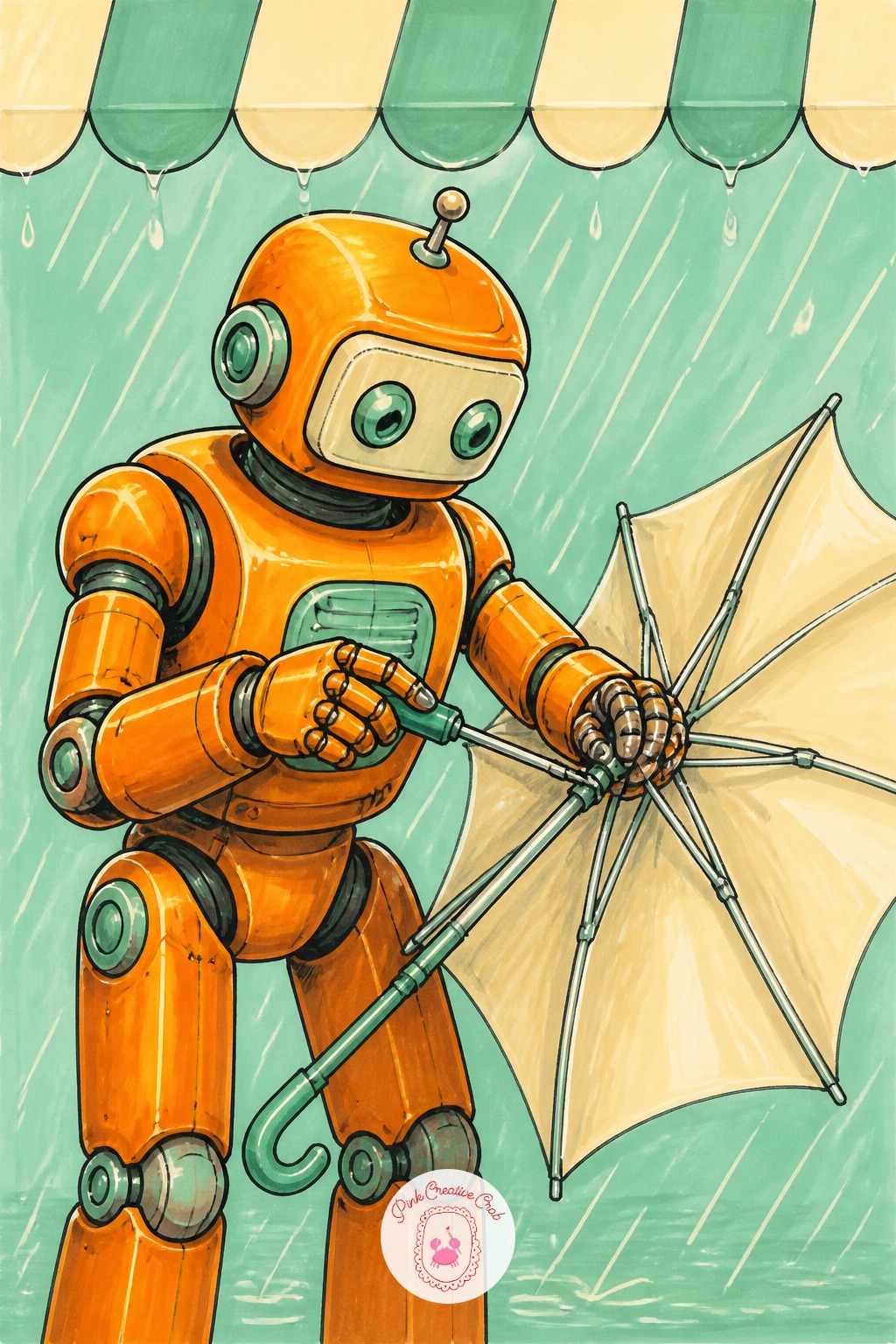
Rain is just straight diagonal lines in a pale mint, drawn all at the same angle across the whole page, never crossing each other. That consistency is what sells rain rather than scribbled clutter.
Keep the umbrella the robot is fixing half-open so you can show both the ribs and the fabric, a fully closed or fully open umbrella hides all the interesting structure. A single white gel pen streak along one wet metal rib finishes the effect without extra shading.
Robot Chimney Sweep On a Rooftop Ledge
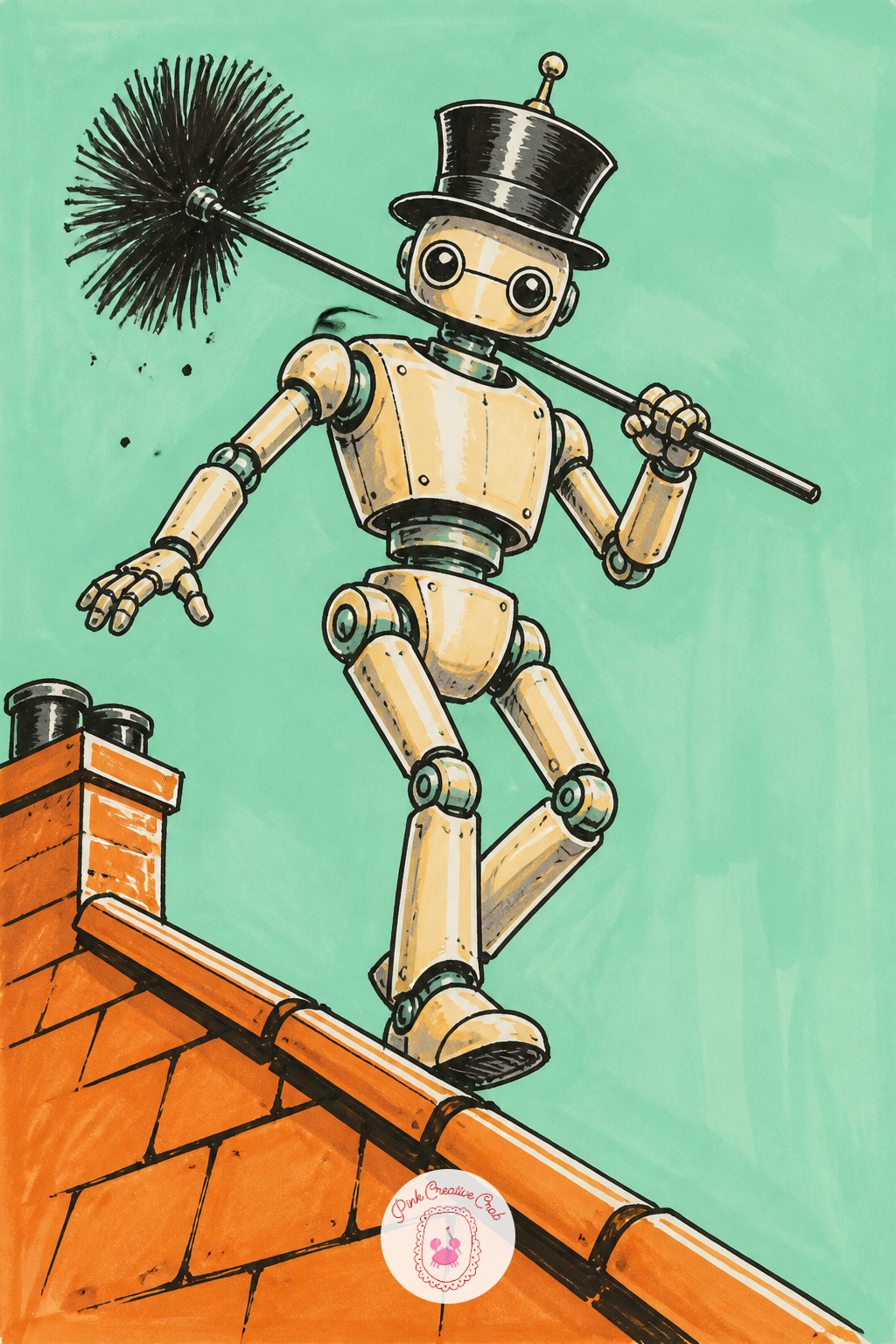
Balance is the trick here: place the robot’s feet right at the edge of a steep roofline, one foot slightly forward, so the pose reads as careful footing rather than standing flat on solid ground. That small adjustment does more than any shading to suggest height and risk.
Soot smudges from the brush are quick dry-brushed gray-mint marks along the chimney top, kept loose rather than outlined. Keep the brush itself bristling outward in several directions, a single clean line down the middle looks more like a stick than a sweeping tool.
Robot Balloon Seller In the Town Square
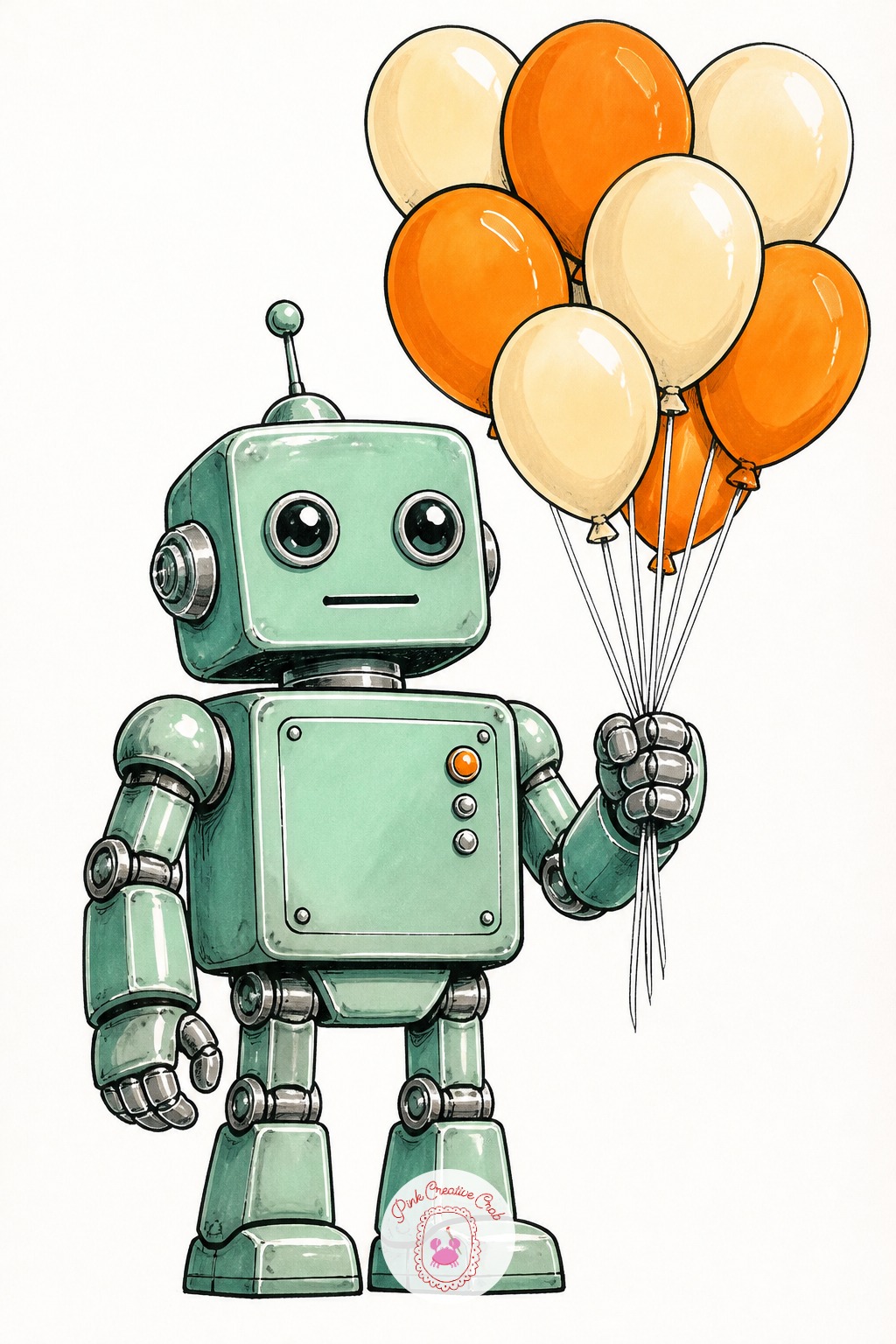
Cluster the balloons in overlapping circles rather than a neat row, letting two or three strings cross each other near the robot’s hand. That overlap is what keeps a bunch of circles from reading as a flat pattern instead of a bundle of balloons.
Vary the balloon sizes slightly too, since identical circles look stamped rather than drawn by hand. If patterned, layered color is what draws you to a page, the wing designs across these butterfly coloring pages work with the same kind of slow, repeating shapes.
Robot Glassblower At a Little Furnace
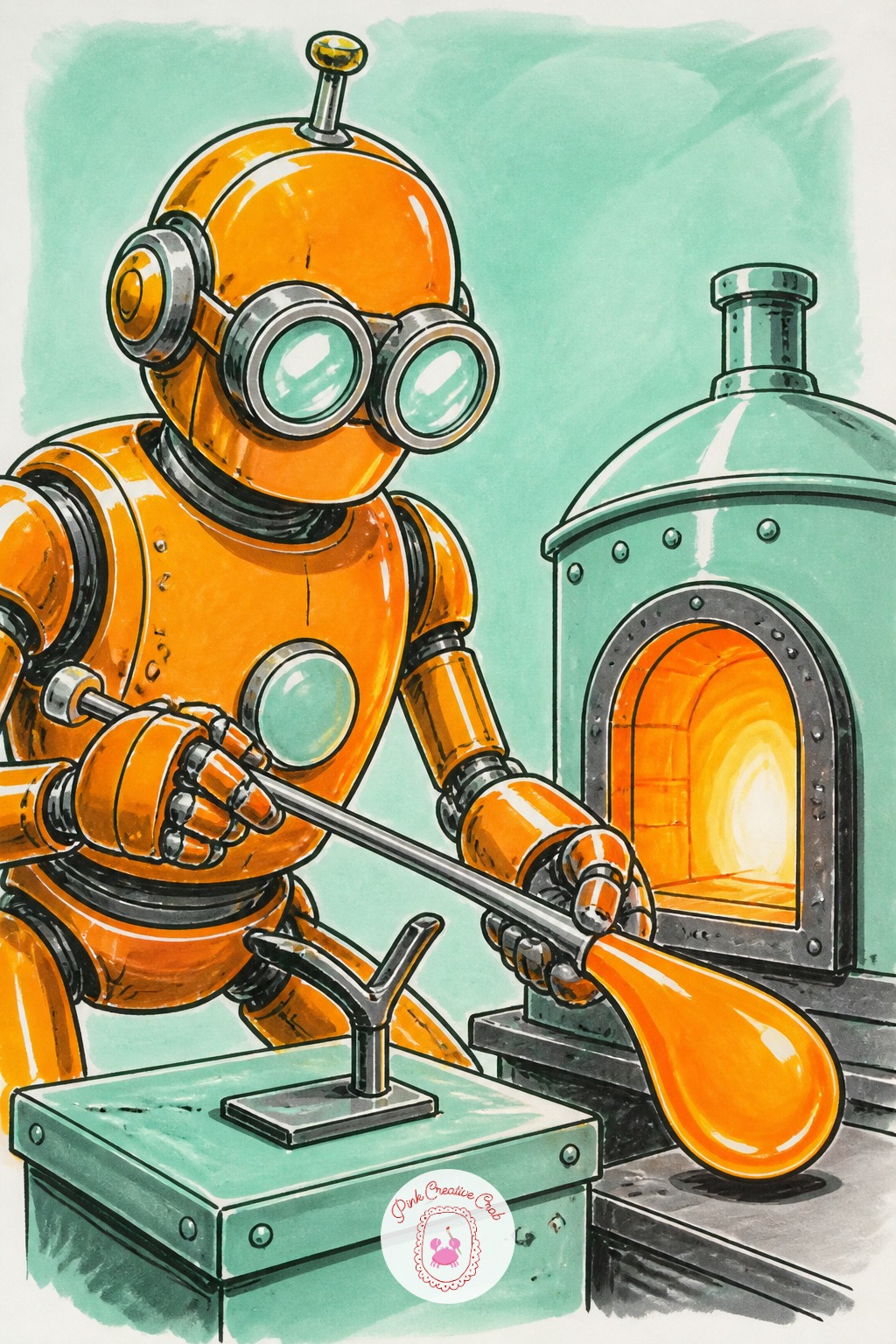
This is the most involved scene on the list, so simplify the furnace glow rather than trying to render real fire: a soft radial blend from bright orange at the center to cream at the edges, blended while the marker is still wet, reads as heat instantly.
Keep the glass piece on the end of the blowpipe a simple teardrop shape with one white gel pen highlight, resisting the urge to add facets or reflections. The robot’s goggles deserve a cream rim to separate them clearly from its darker face panel.
Robot Carousel Operator At Dusk
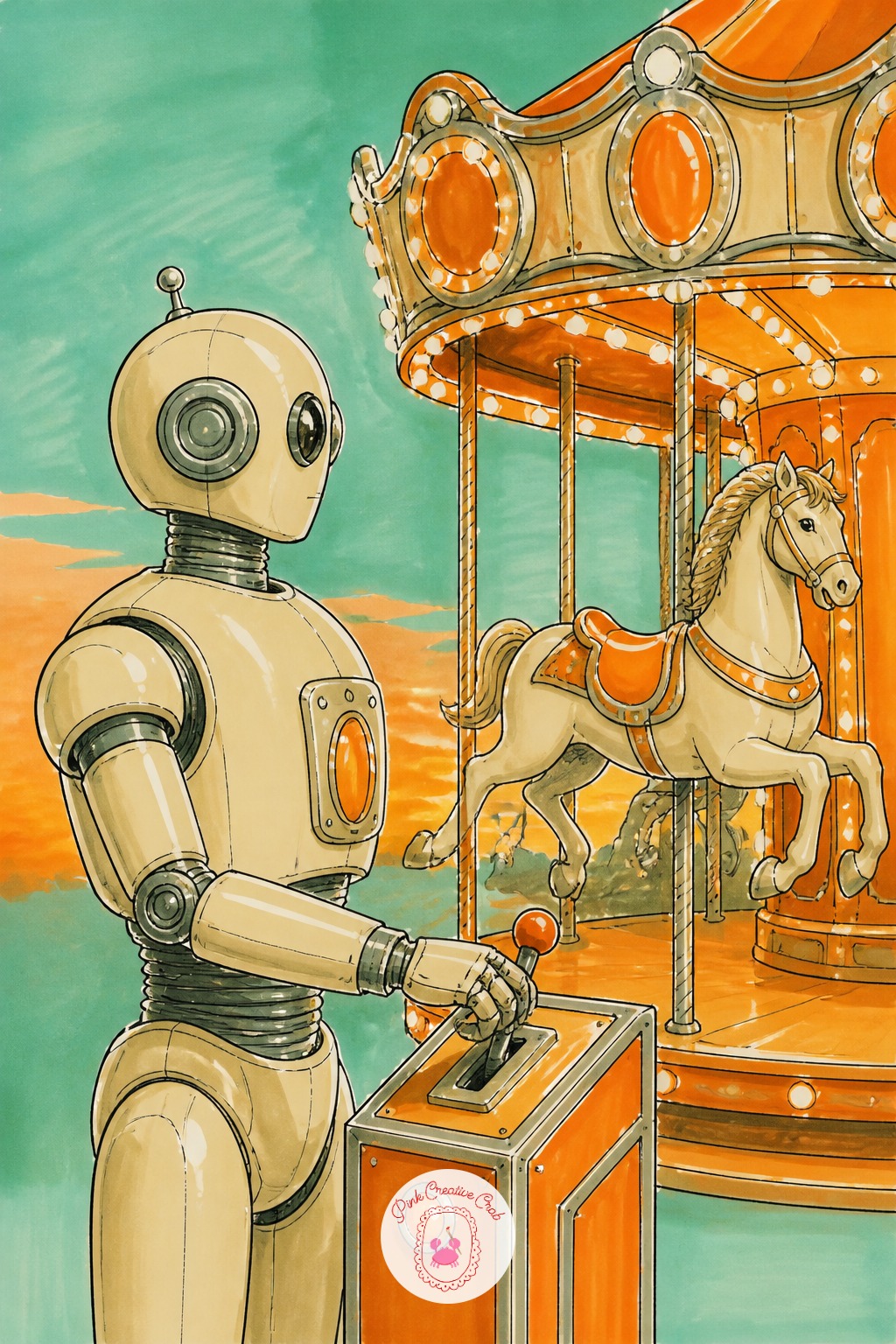
Light source sits inside the carousel itself here, a warm orange glow spilling outward onto the robot and the ground in front of it while everything behind fades into cooler mint dusk. That single glowing light source gives the whole page a focal point without needing a detailed background.
Keep one carousel horse visible mid-turn, caught at an angle rather than straight on, to suggest motion. A string of small white gel pen dots along the carousel’s edge reads instantly as string lights without drawing a single bulb in full.
What to Do Next
Pick whichever robot’s job sounds the most fun right now and start there, there is no order to follow. Open your sketchbook to a fresh page, pencil the character loosely first, then move straight into liner and marker while the idea is still fresh in your hand.
Frequently Asked Questions
What paper works best for alcohol marker sketchbook pages like these?
Use a sketchbook labelled for marker or mixed media, since plain printer or sketch paper lets alcohol marker bleed through and feather at the edges. Marker paper or a smooth bristol-style page keeps colors crisp and lets you blend without the ink spreading past your lines.
Do I need a huge marker set to get this mint, orange and cream palette?
No, three or four markers cover it well: one mint, one warm orange, one cream or pale yellow, and a gray for shadow mixing. A small focused set is actually easier to keep consistent across many pages than a huge collection you barely use.
How do I keep every robot looking different across so many pages?
Change one clear thing each time: the head shape, the number of visible joints, or a small accessory like an apron, visor or cap. Giving each robot one job-specific detail, a jug, a broom, a key, does more to vary the cast than redesigning the whole body each time.
My white gel pen highlights look patchy on marker, what is going wrong?
Gel pen needs fully dry marker underneath, so wait a minute or two before adding highlights. Shake the pen well and do a test stroke on scrap paper first, since gel pens skip on fresh ink and on paper with any wax or oil residue.
How long should one of these sketchbook pages actually take?
Most ideas here fit in twenty to forty minutes once the palette and pens are out. A simple version, robot plus one prop plus a flat background, takes about ten minutes, and extra scene details are only worth adding if time allows.
Have any thoughts?
Share your reaction or leave a quick response — we’d love to hear what you think!
-
 0
0 -
0
-
0
-
0
-
0
-
0


