Y2K painting ideas are the perfect excuse to pull out every pastel you own and paint the stuff that filled your childhood bedroom. Think glossy lip gloss tubes, beaded curtains, chunky sneakers and a phone with a charm swinging off the corner, all rendered in flat candy color on a small canvas.
Below are 27 of them, arranged from the simplest single object to the fuller little scenes, each one sized to finish in a single sitting. Grab your pinks, lilacs and chrome silver and scroll through until something makes you grin.
Using these images: free for personal projects such as printing, coloring, cards, journals and gifts. Handmade items that include them may be sold up to 30 pieces per design. More than that is commercial use and is not permitted, and neither is selling or sharing the images themselves or passing them off as your own. Please ask before any other use.
Start with the pink flip phone, since its rounded rectangle shape is the easiest way into this whole list. Sketch two stacked rounded rectangles in pencil on your canvas, one slightly narrower than the other for the hinge, then block in the body with a flat bubblegum pink before the screen and buttons go on top.
Paint the screen as a pale lilac rectangle with a tiny white highlight bar along one edge to suggest shine, and keep the buttons as small silver dots rather than painting each letter. The charm hanging off the bottom corner is just a thin chrome chain line with one small heart or star shape at the end, painted last so it sits crisply over the pink.
If the hinge line wobbles, widen it slightly and soften the edge with a dry brush rather than scrubbing it out, since a slightly thicker seam still reads as a flip phone. No fine liner on hand for the chain? A toothpick dipped in silver paint draws a line just as thin.
Finish today by outlining the whole phone in one confident dark grey line once the paint is dry, which instantly sharpens every shape.
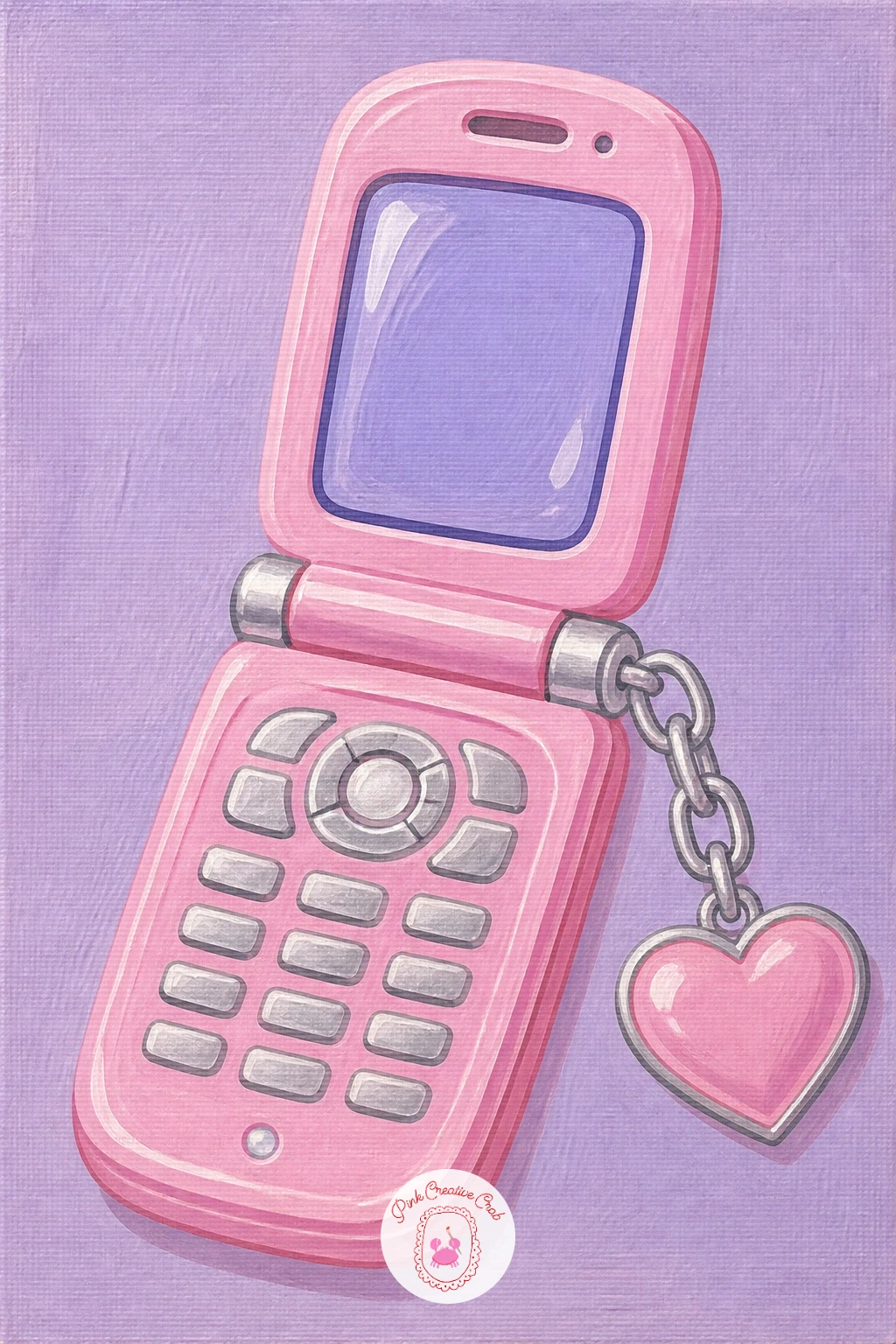
Palette: Bubblegum Pink,Pale Lilac,Silver Chrome,Soft White
Butterfly hair clips scattered loose give you a chance to practice painting several small shapes that still read as one composition. Lightly pencil five or six butterfly silhouettes of different sizes across the lower half of the canvas, overlapping a couple so they feel tossed down rather than arranged.
Block each wing pair in a different pastel, baby blue, lilac, and a pale yellow, keeping every wing a flat color with no gradient. Once dry, add a thin darker line down the center of each butterfly and a few short lines radiating out from it to suggest the clip hinge, then dot a tiny bead of silver paint where the clip mechanism would sit.
Measuring matters here: keep every clip roughly the same size relative to its neighbor by eyeballing one against the width of your thumb, so the scatter looks intentional rather than random. If a wing shape comes out lopsided, paint over it with background color and redraw it smaller, since smaller clips still fill the group nicely.
No vanity surface needed under them, a plain pale pink background keeps the focus on the clips.
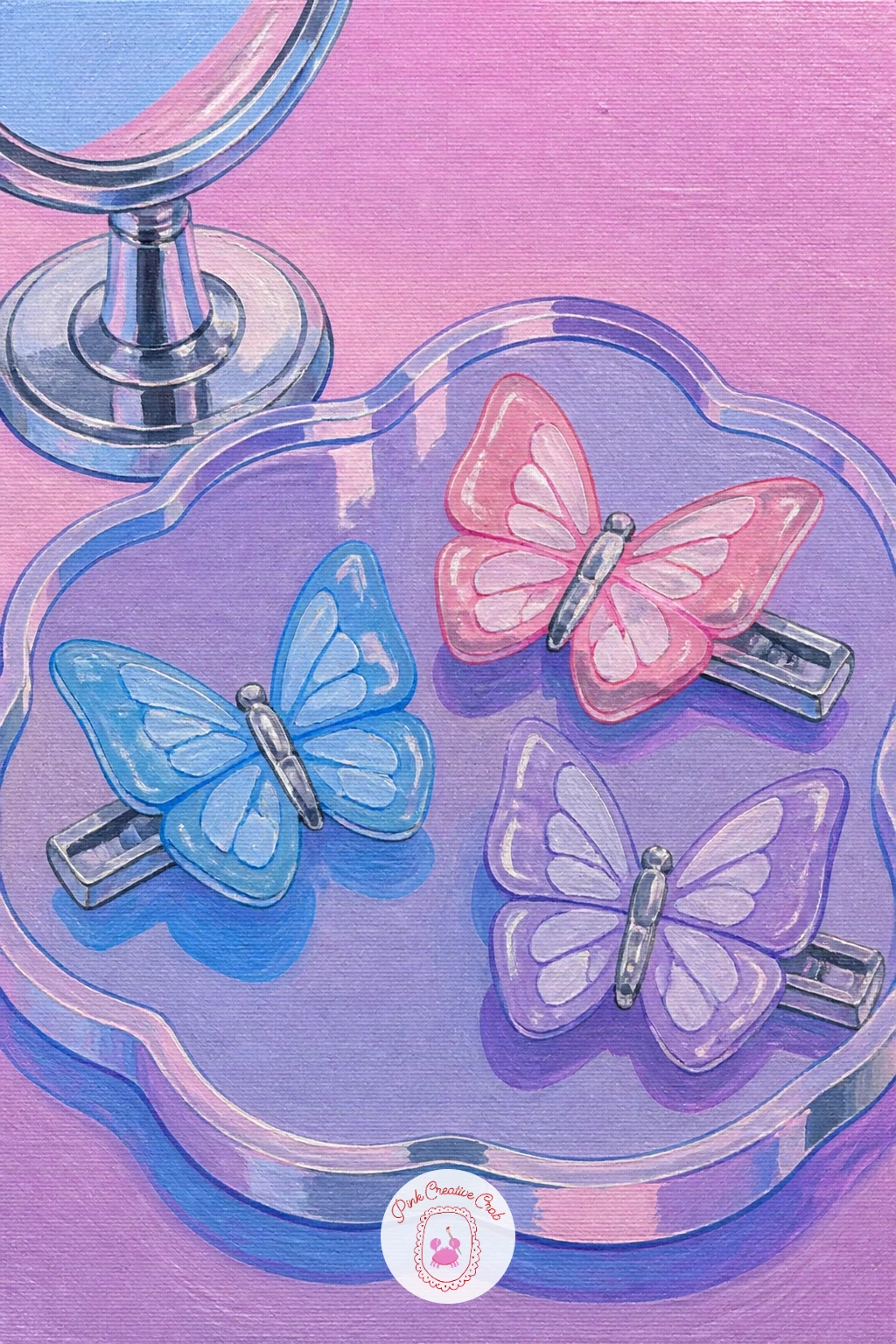
Palette: Baby Blue,Pale Lilac,Soft Yellow,Pale Pink
A portable CD player follows naturally from the clips because it is another rounded object built from simple stacked shapes. Draw a large circle for the lid and a slightly smaller rectangle beneath it for the base, then paint the whole body in a pearly lilac with a flat silver disc peeking from under the lid.
Work from back to front: the body first, then the disc with a few thin concentric lines in pale blue to suggest its shine, then the earbud cord last since it has to sit on top of everything else. Paint the wire as one continuous curved line in silver or white, looping it loosely off the edge of the canvas so it feels caught mid-movement rather than stiff.
The eye level question matters here, so set the player as if you are looking almost straight down on it, which flattens the lid into a clean oval and keeps the whole object simple to paint. If the cord line comes out shaky, thin your paint slightly and pull the brush in one smooth, unbroken stroke rather than inching along.
No fine brush handy? A cotton swab dipped in paint can draw a surprisingly clean cord line in a pinch.
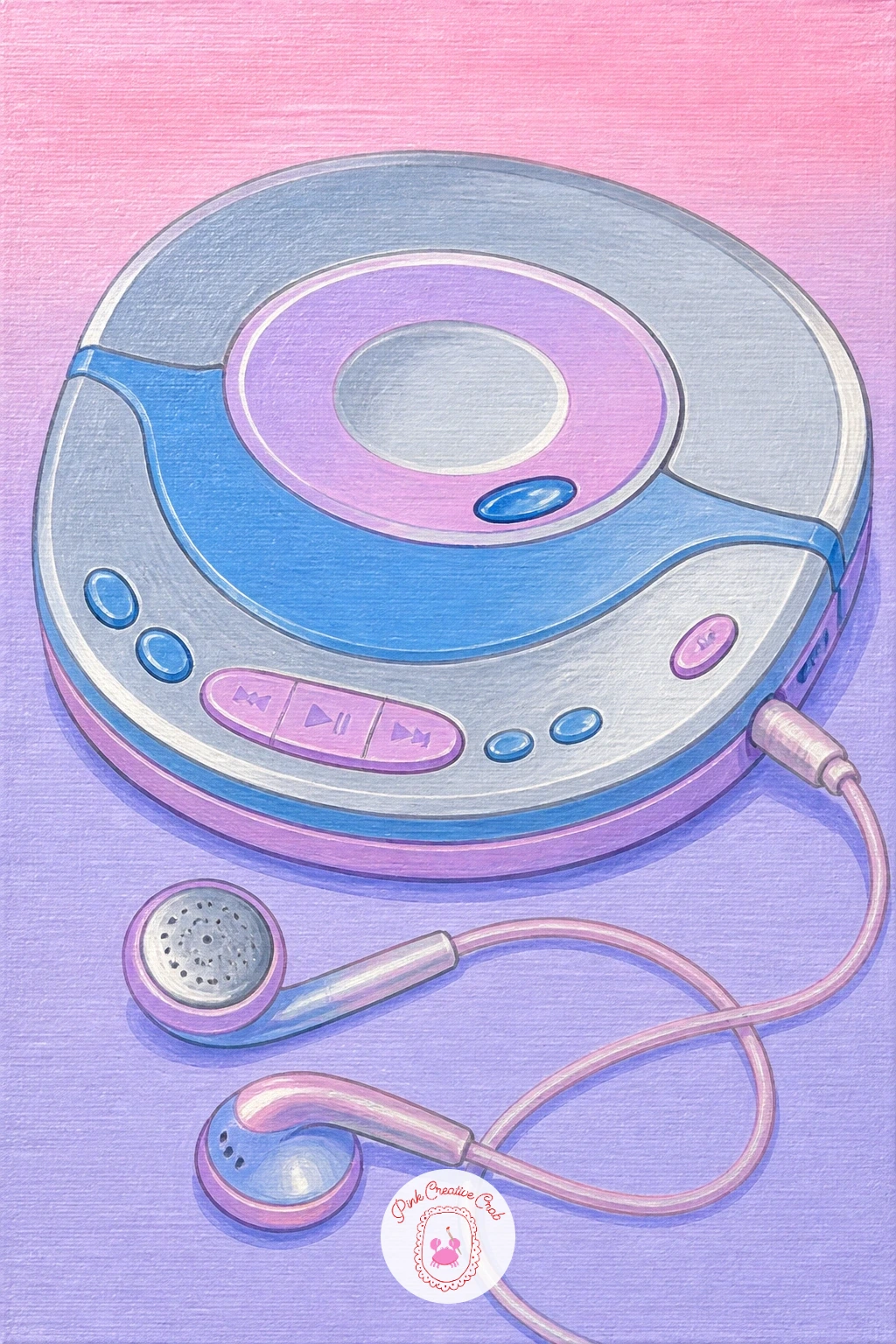
Palette: Pearl Lilac,Silver Chrome,Baby Blue,Soft White
Move from electronics to a tiny beauty still life with a lip gloss tube resting beside an open compact mirror. Pencil the tube as a tall thin cylinder with a rounded cap, and the compact as two overlapping circles, one for the base and one tilted open for the mirror lid.
Paint the gloss tube in a glossy pink with a single vertical white highlight stripe down one side to suggest the plastic shine, and keep the compact’s outer shell in silver chrome. The mirror surface inside gets a very pale blue-grey wash with one soft white streak across it, which is all you need to read as reflective glass.
This is the kind of small subject you can finish in about ten minutes with just the two flat colors and the highlight stripes. Given forty minutes, add a thin gold or silver rim around the compact’s edge and a tiny painted reflection of a blurred pink shape in the mirror for extra sparkle.
If the highlight stripe looks too harsh, soften one edge of it with a barely damp brush before the paint fully sets.
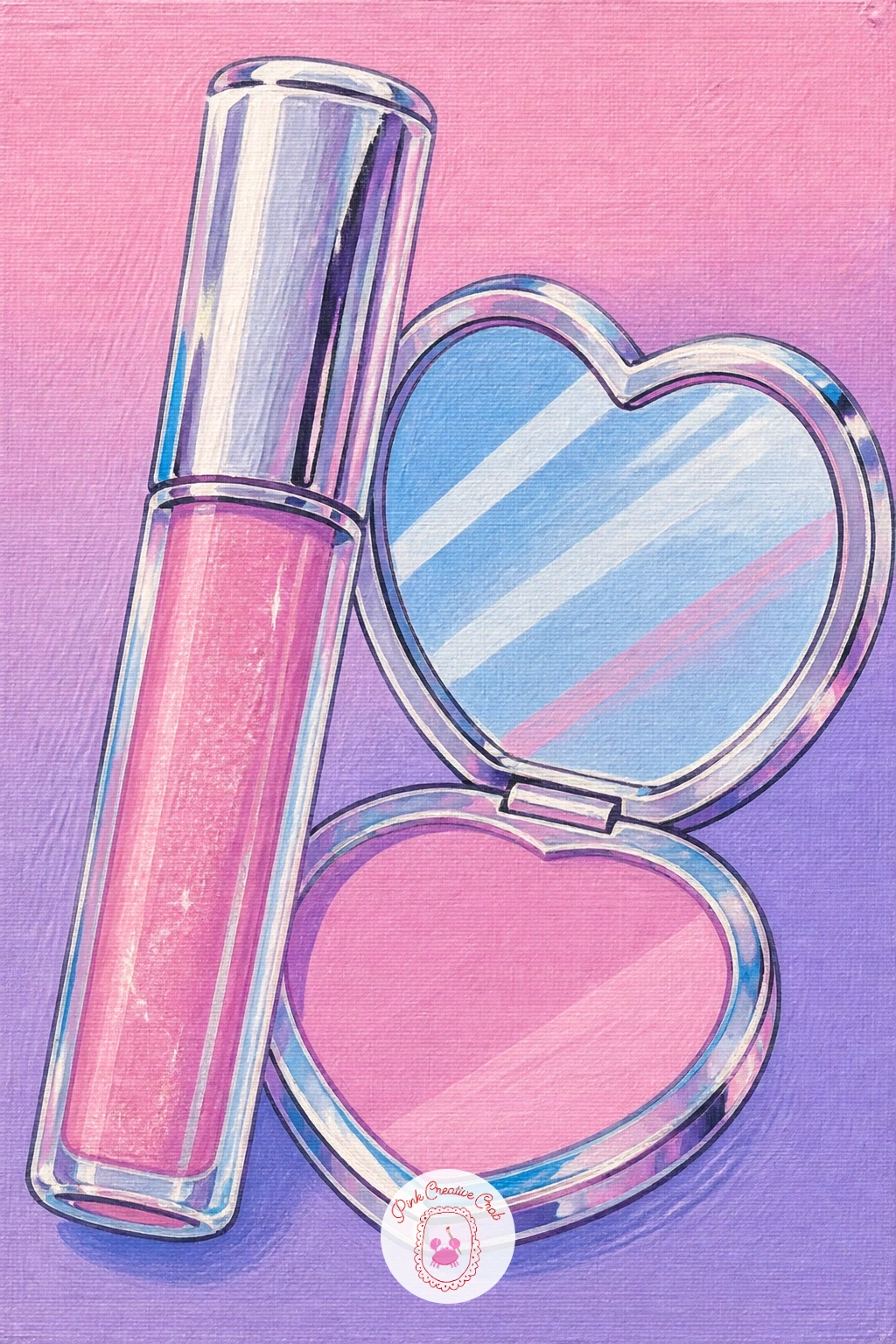
Palette: Glossy Pink,Silver Chrome,Pale Blue Grey,Soft White
Scale up to a small room scene with a lava lamp glowing beside a doorway hung with beaded curtains. Block in the background first as two flat color zones, a pale lilac wall and a baby blue section for the doorway, so the beaded curtain has a clear space to hang inside.
Paint the lava lamp body as a tall oval on a short cylindrical base, filling it with a soft gradient from pale pink at the bottom to lilac at the top, then dot in two or three rounded blobs in a deeper pink to suggest the floating wax. The beaded curtain is simply rows of small dots in alternating pink and silver, painted in loose vertical lines rather than a perfect grid.
Light matters most in this one: imagine the lamp as the only glow source and let the wall just behind it carry a faint warm pink halo, which instantly makes the lamp feel lit. If the beads start looking too stiff and even, vary their spacing slightly and let a few rows trail off unevenly at the bottom, since real curtains never hang perfectly straight.
If you enjoy building a small scene like this, the structure carries over nicely into any easy acrylic painting idea that leans on a few flat shapes.
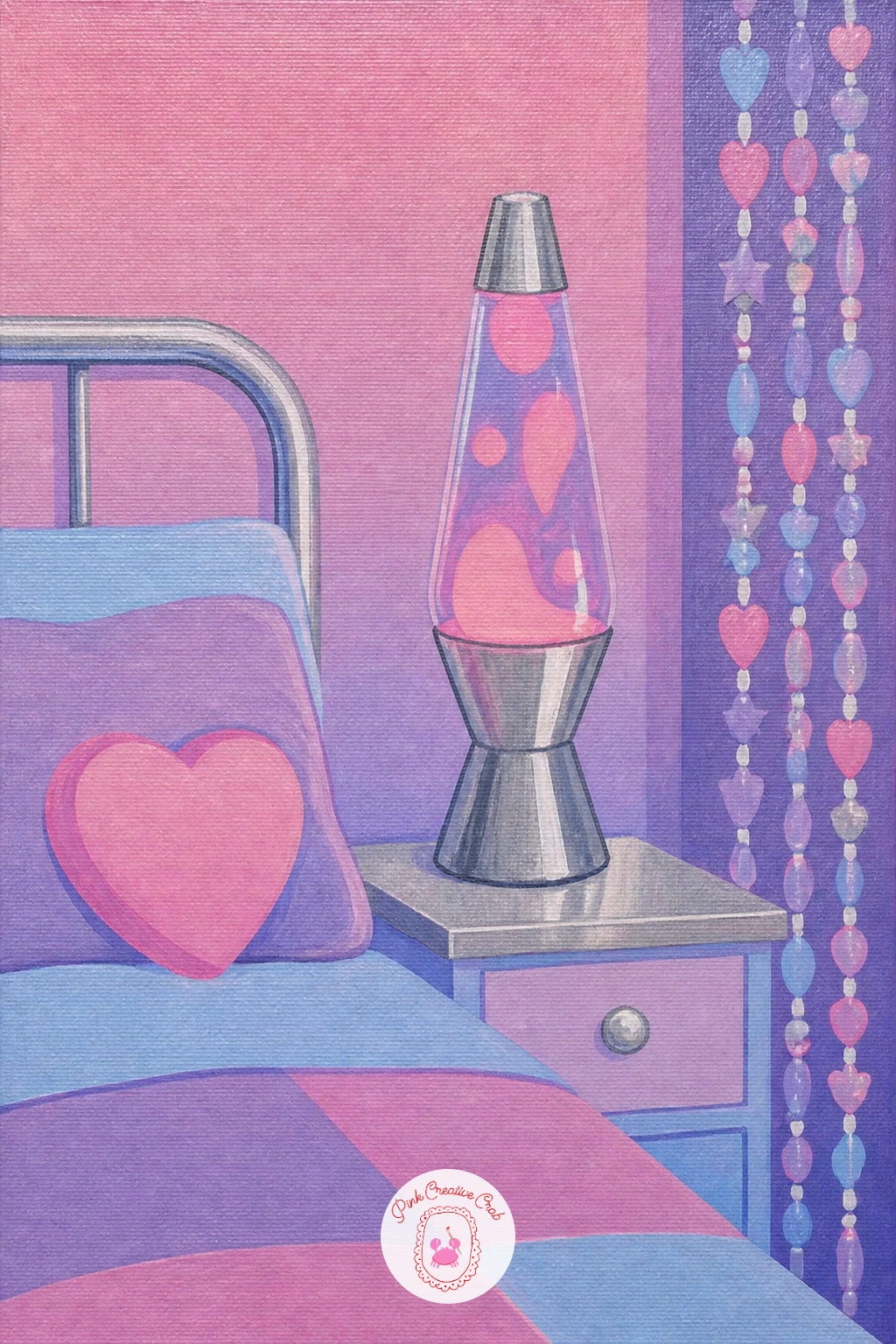
Palette: Pale Lilac,Baby Blue,Deep Pink,Silver Chrome
Try painting the lamp glow with a slightly damp brush stroke blended outward from the lamp body rather than a hard edge, so the light looks soft instead of pasted on.
Platform sandals give you a satisfying chunky shape to paint after the softer curtain scene. Pencil the pair sitting slightly apart and angled, one a touch more forward than the other, with a thick wedge sole and simple strap lines across the top.
Block the sole in a flat baby blue and the straps in a glossy lilac, painting the sole first since the straps overlap on top of it. The fluffy rug underneath is built from small, loose dabs of pale pink paint applied with the tip of a dry brush, overlapping the dabs slightly so the texture looks soft rather than speckled.
Keep the sandals roughly the same height as each other by measuring one sole against the other with your brush handle before committing to paint, since mismatched heights are the easiest way this subject goes wrong. If the strap lines look too flat, add one thin darker line along the lower edge of each strap to suggest a bit of shadow.
No stiff dry brush for the rug texture? A barely loaded old toothbrush dabbed gently works nearly as well.
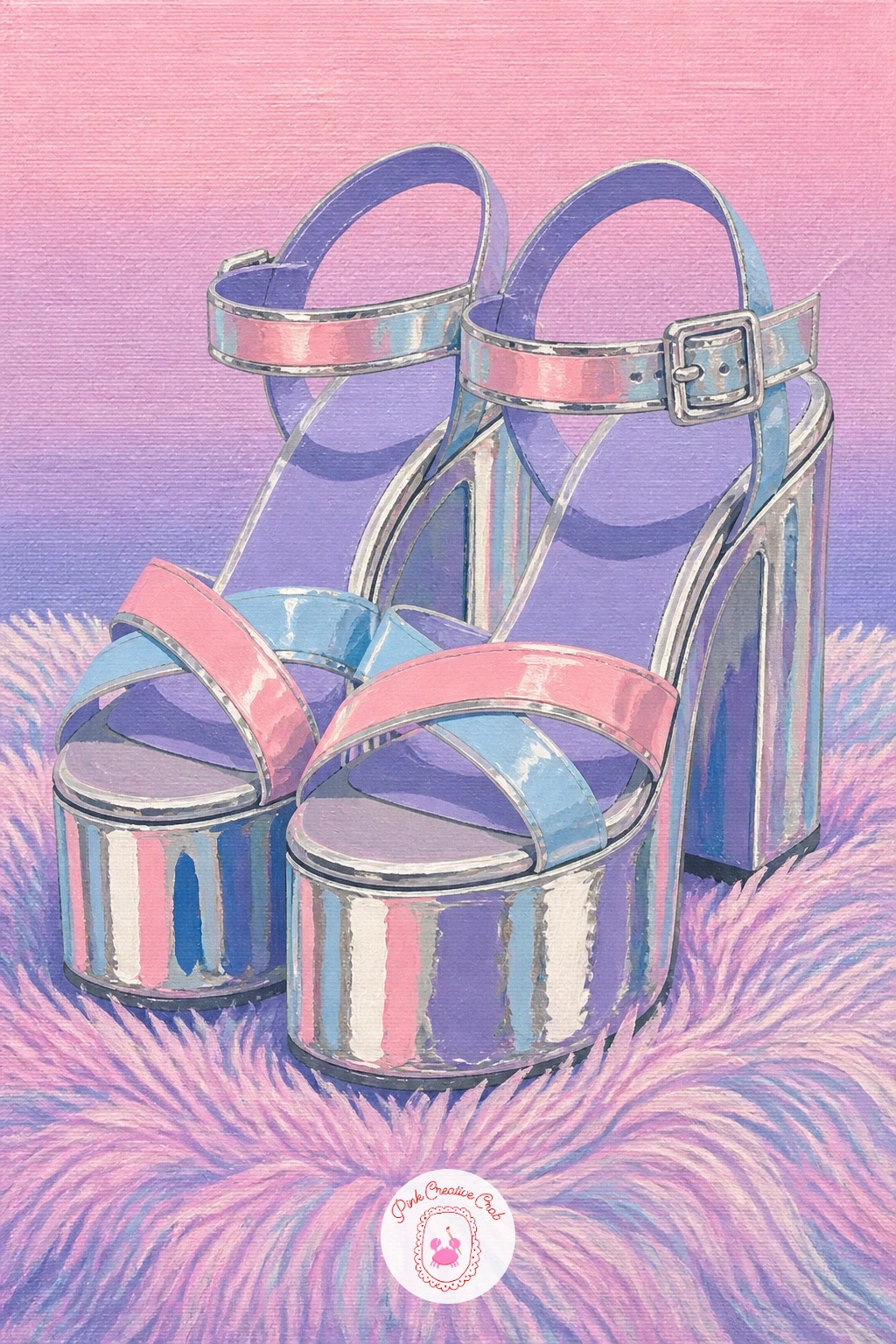
Palette: Baby Blue,Glossy Lilac,Pale Pink,Soft White
A disposable camera next to a small stack of photo prints makes a fun still life once you’ve warmed up on simpler shapes. Paint the camera body as a rounded rectangle in a flat lilac with a small silver circle for the lens and a tiny yellow flash square in one corner.
Lay the photo prints as two or three overlapping white rectangles fanned slightly beneath the camera, each with a thin pastel border to suggest the printed frame. Work the camera first, then the prints on top so their edges sit cleanly over the lower part of the camera body.
Inside each print, a few loose, abstract blobs of color are enough to suggest a tiny photo without painting a full scene, which keeps this subject quick and forgiving. If the prints start looking too plain, add one tiny painted date stamp in orange in the corner of a single print, a small detail that instantly reads as early 2000s.
No silver paint for the lens? A dab of white mixed with a touch of grey gives nearly the same metallic hint.
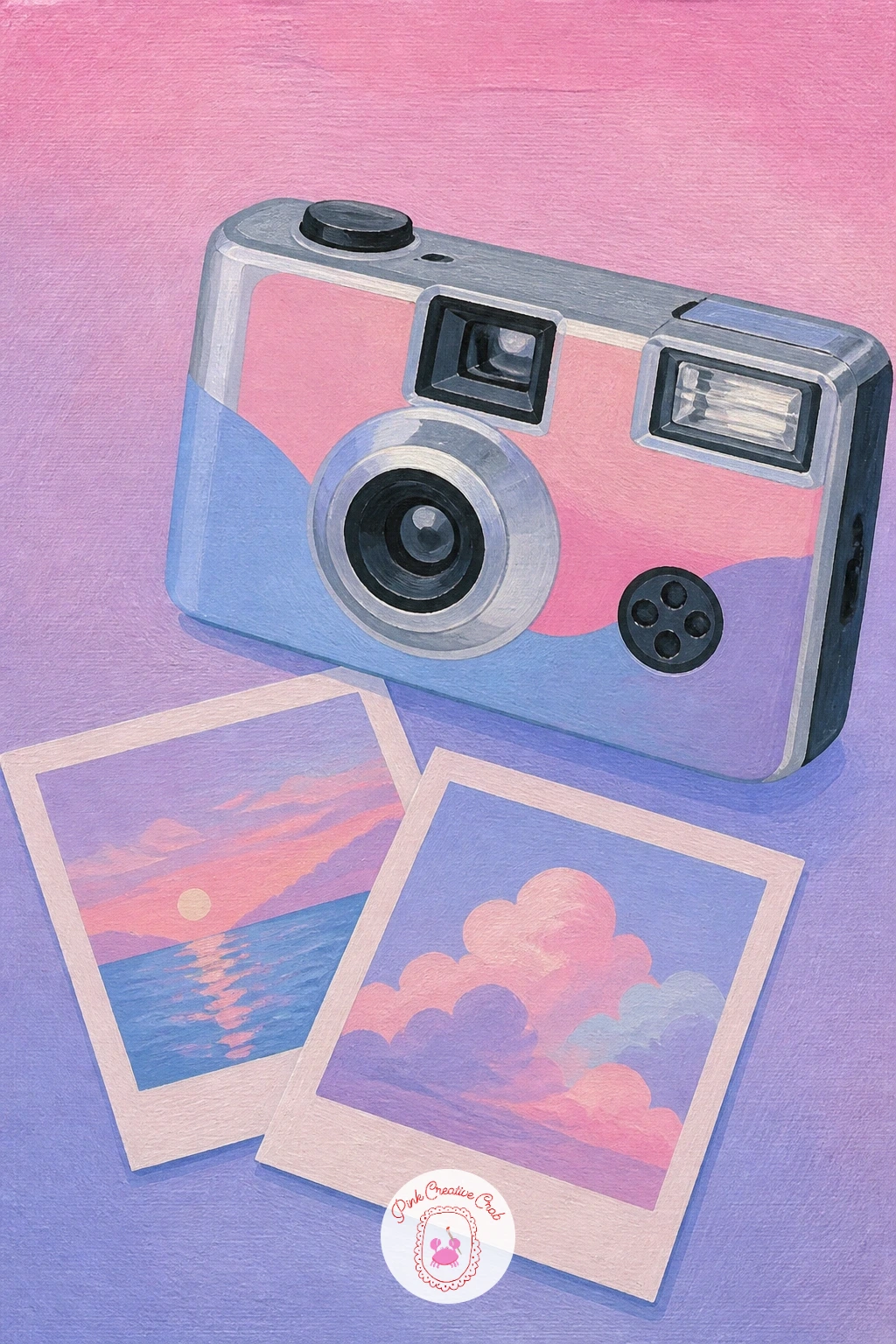
Palette: Lilac,Soft White,Pale Yellow,Orange Accent
A pastel gaming handheld resting on a bedspread lets you practice painting one object sitting in soft folds of fabric. Block the handheld’s body first as a rounded rectangle in baby blue, with a small lilac screen and tiny silver button dots, keeping every edge crisp and flat.
The bedspread beneath it is the real exercise: paint it as a few broad, flat shapes in pale pink and white rather than trying to render every wrinkle, using a slightly darker pink line to mark where one fold meets the next. Let the handheld sit a little off center on the spread so the folds have room to curve around it.
From directly above, the device reads as a flat rectangle with no real perspective to manage, which makes this an easy entry point if angled objects still feel tricky. If the fold lines start looking too busy, stop after three or four and leave the rest of the bedspread as flat color, since fewer folds read as calmer fabric.
Finish today by adding one tiny white highlight dot on the screen to suggest it is powered on.
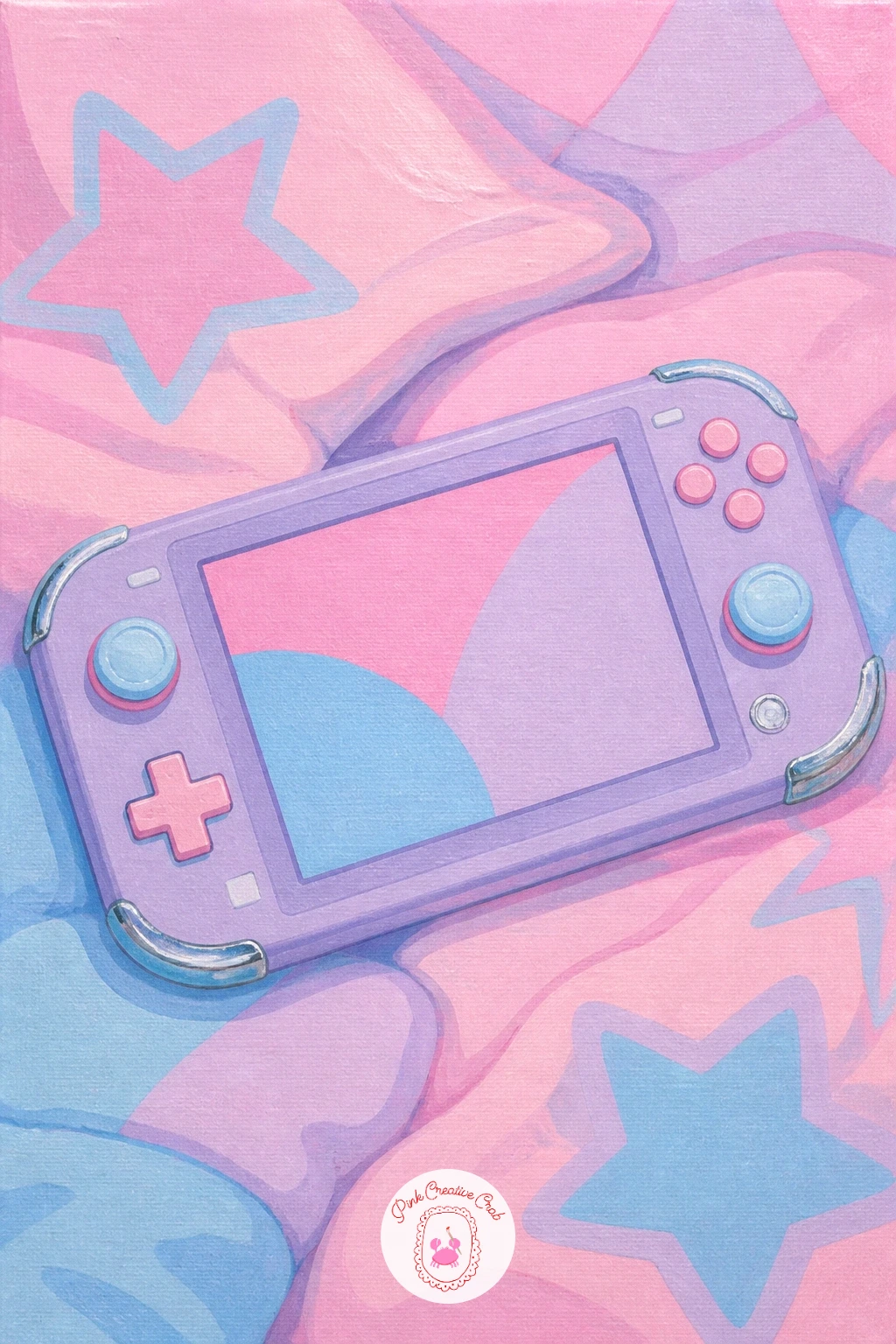
Palette: Baby Blue,Pale Lilac,Pale Pink,Silver Chrome
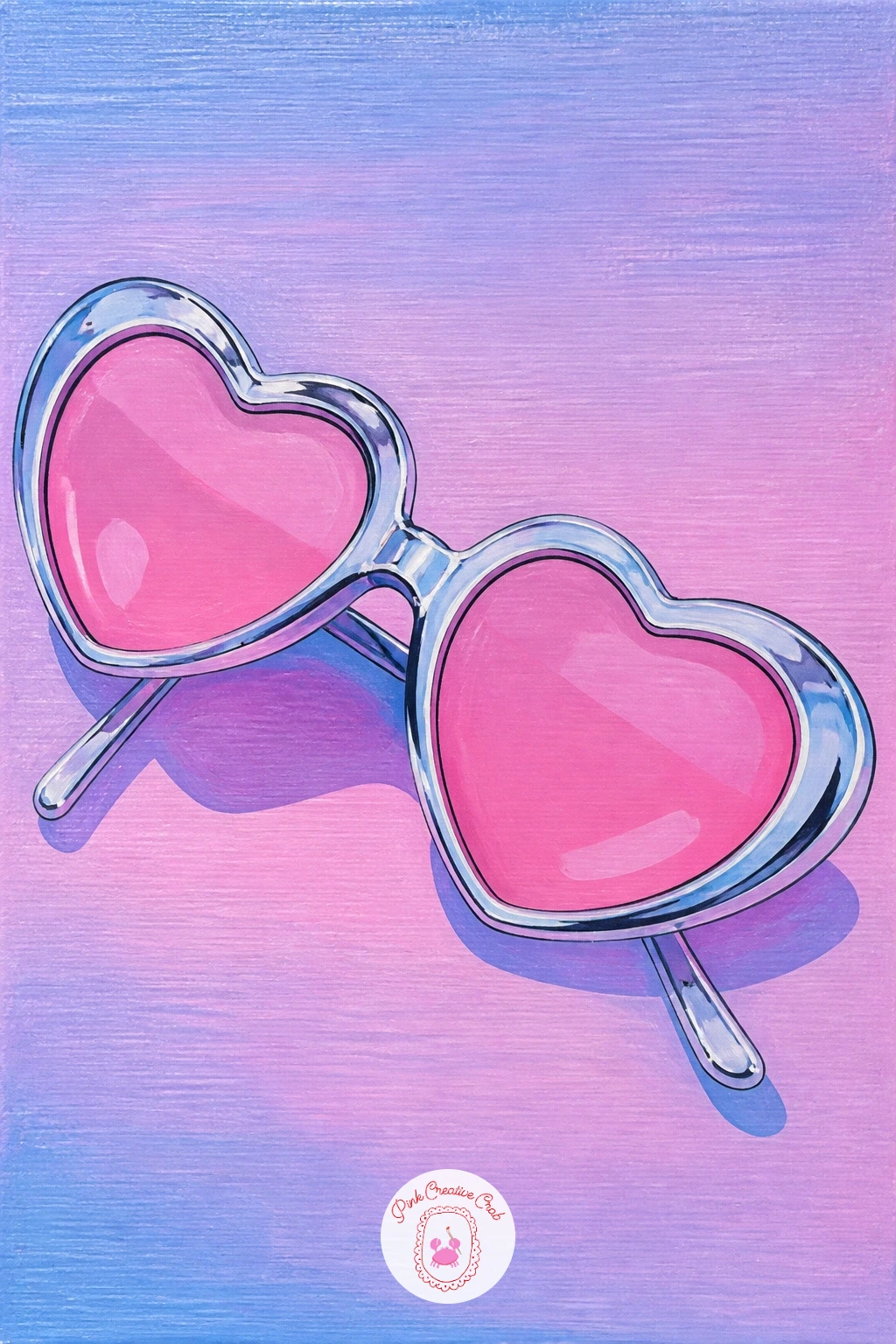
Heart-shaped sunglasses make a bold, graphic little still life once you want something punchier than fabric folds. Draw two heart outlines side by side connected by a thin bridge and two curved temple arms, keeping the hearts a touch wider than tall so they read clearly as sunglasses rather than valentines.
Fill each lens with a flat lilac tint and leave one small white streak across the top of each for shine, then paint the frame itself in a glossy pink outline thick enough to stand out against the lenses. Work the lenses first, frame second, so the outline sits crisply over the color beneath.
Keep both heart lenses the same size by tracing one with a small coin or bottle cap before switching to the other side, a quick trick that saves you from one heart reading bigger than its twin. If the bridge between the lenses looks too thin and fragile, widen it slightly, since a slightly chunkier bridge still reads as plastic frame.
No coin on hand for tracing? A bottle cap or even a large button works just as well.
You Will Need
- small coin or bottle cap for tracing
Palette: Glossy Pink,Pale Lilac,Soft White,Pale Sky Blue
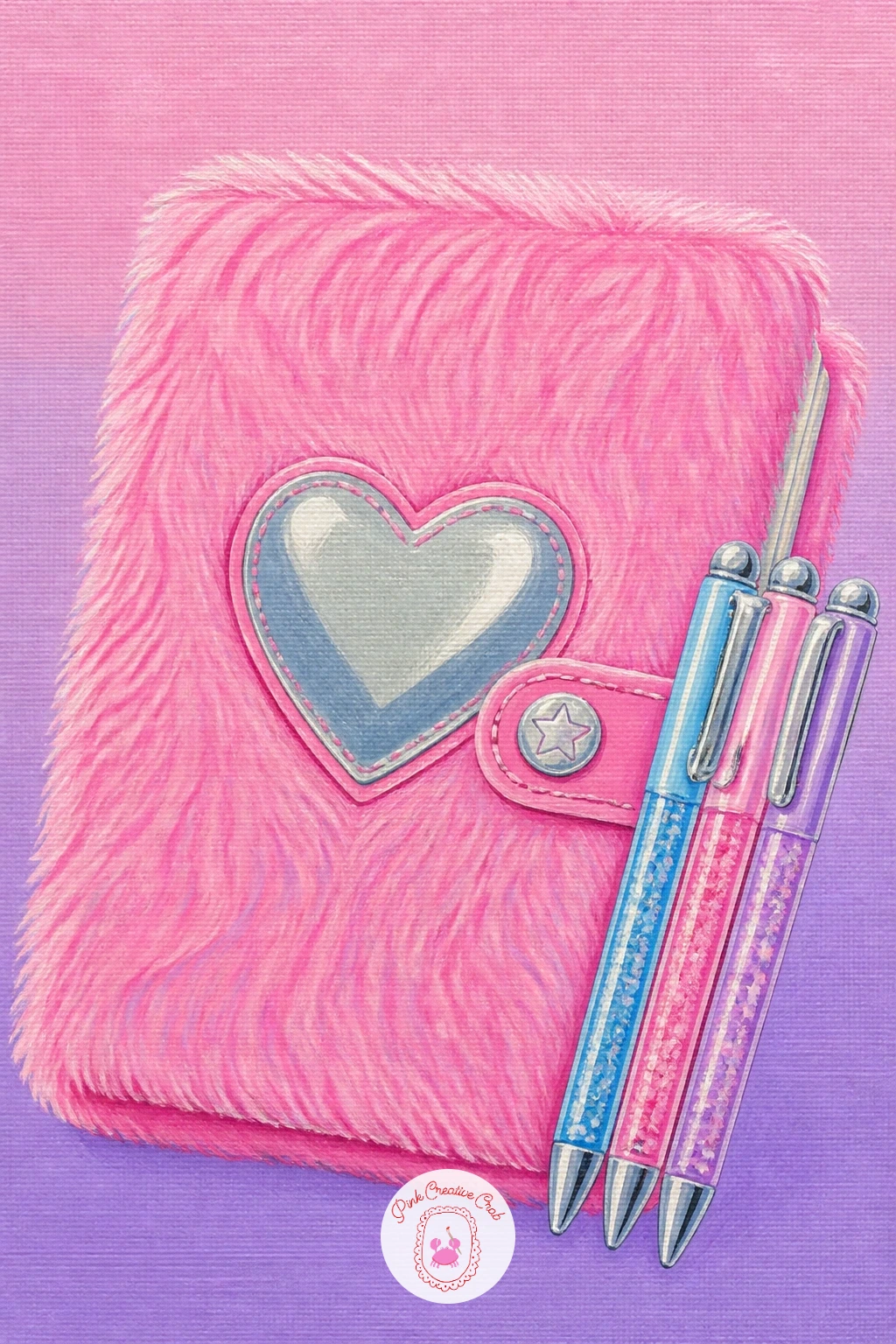
A fuzzy pink notebook with a scatter of gel pens beside it builds nicely on the flat shapes you’ve already practiced. Paint the notebook cover as a simple rectangle in a soft pink, then stipple a slightly deeper pink over the surface with the tip of a dry brush to suggest the fuzzy texture, working in small dabs rather than one smooth coat.
Lay three or four gel pens beside it as thin rounded rectangles, each a different pastel, lilac, baby blue, mint, so the little row of pens adds color variety next to the solid pink cover. Paint the notebook first and let it dry before adding the pens on top, which keeps their edges clean against the fuzzy texture.
If the stippled texture looks too heavy or clumped, go back in with a few dabs of the base pink to soften the darker spots, since fuzzy texture should still feel soft rather than spotty. No stiff dry brush? A sea sponge dabbed lightly gives a similar soft, textured surface.
Finish with one tiny silver star sticker shape painted in the corner of the cover for a bit of extra sparkle.
You Will Need
- small sea sponge, optional
Palette: Soft Pink,Deep Pink,Mint Accent,Baby Blue
A smoothie in a clear cup is a cheerful little subject once you want to paint something with a bit of transparency. Sketch a tall cup shape first, then paint the smoothie inside it as a flat band of pastel pink or lilac, leaving a thin sliver of white along one edge of the cup to suggest the glass catching light.
The curly straw is the fun part: paint it as one continuous looping line in a contrasting pastel, working slowly and lifting the brush between loops rather than trying to do it in one unbroken stroke. Add the straw after the cup and smoothie are fully dry so the loops sit crisply on top.
If the straw loops end up uneven, that’s fine, real curly straws are never perfectly symmetrical, but keep the line thickness consistent throughout so it still reads as one object. No steady hand for the loops? Lightly pencil the curls first and trace over them once you’re confident.
Top the smoothie with two or three small white dots for whipped cream and a tiny red dot for a cherry.
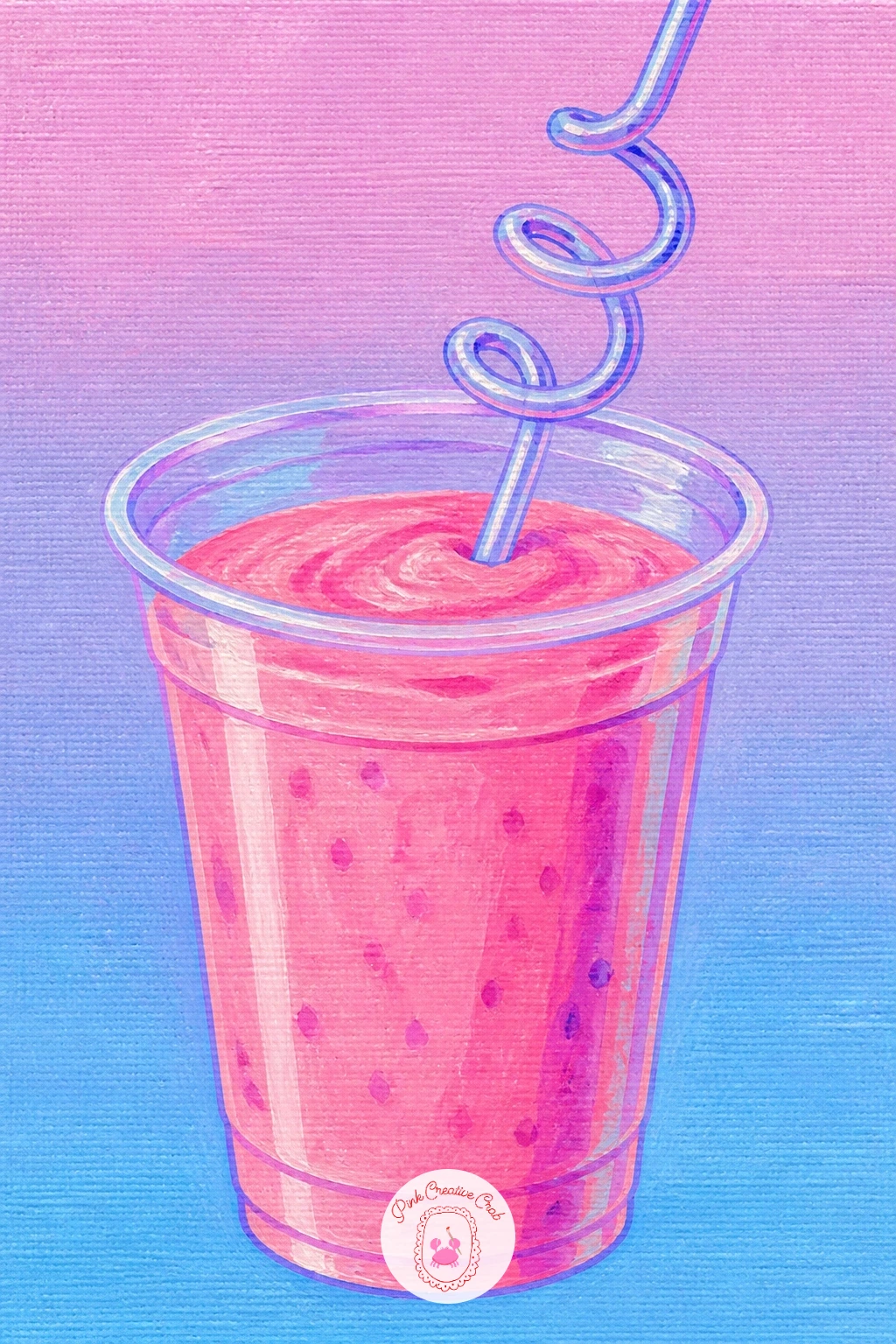
Palette: Pale Pink,Soft Lilac,Soft White,Cherry Red
A butterfly-covered denim jacket on a hanger gives you a bigger flat shape to fill with pattern. Paint the jacket silhouette first in a flat pale blue denim tone, keeping the collar and sleeve lines simple and slightly loose, then let it dry fully before adding any decoration on top.
Once dry, scatter five or six small butterfly shapes across the jacket in pink, lilac and white, varying their size slightly so a couple feel larger near the collar and smaller near the hem. The hanger itself is just a simple triangle shape in silver poking out above the collar.
Proportion is the trick here: hold your brush up against the canvas to compare the jacket’s width to its height before you commit to the denim block, since a jacket painted too narrow starts looking like a vest. If a butterfly lands awkwardly over a seam line, simply paint the seam over it afterward in a thin darker blue, since seams can bend around decoration realistically.
If you like painting butterflies, there are more shapes and wing patterns to borrow from in this butterfly design roundup.
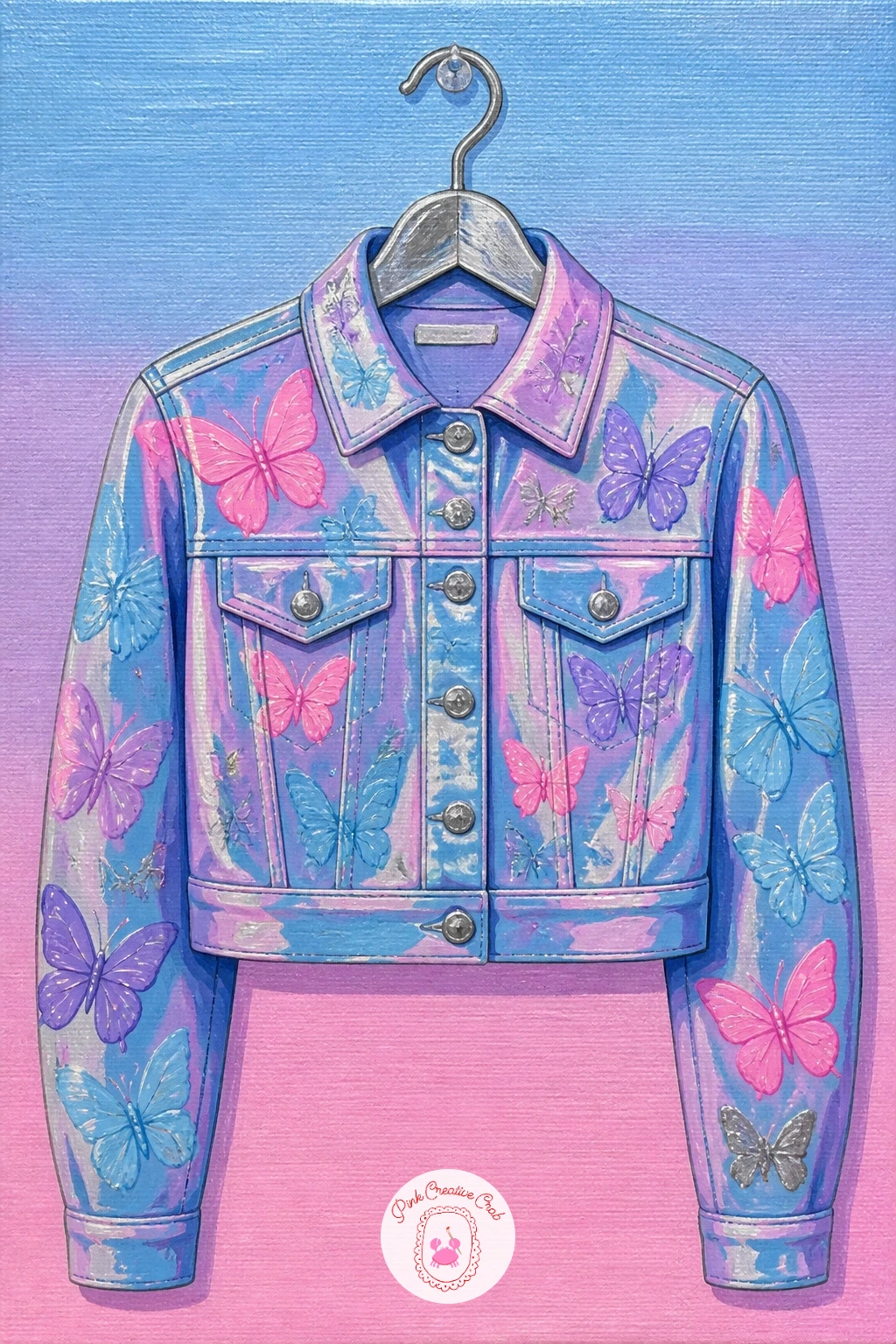
Palette: Denim Blue,Pale Pink,Lilac,Silver Chrome
A bubbly pastel desktop computer is a fun chance to paint one of the chunkiest shapes on this whole list. Block the monitor as a large rounded square in a translucent lilac, with the base and tower beneath it kept simple and slightly smaller so the monitor stays the star of the composition.
Paint the screen itself as a flat baby blue rectangle inside the monitor shell, then add two or three soft white swirl shapes across it to suggest the glossy bubble pattern these computers were known for. Work the monitor shell first, screen second, swirls last, so each layer sits cleanly on top of the one before.
Seen slightly from below, the monitor’s rounded top edge curves more dramatically, which makes the whole shape feel chunkier and more toy-like, a good choice if you want the computer to feel playful rather than realistic. If the swirls start looking too busy, two confident ones read better than five crowded ones.
No steady hand for the swirls? Paint them with the rounded end of a brush handle dipped in white for a cleaner, more even line.
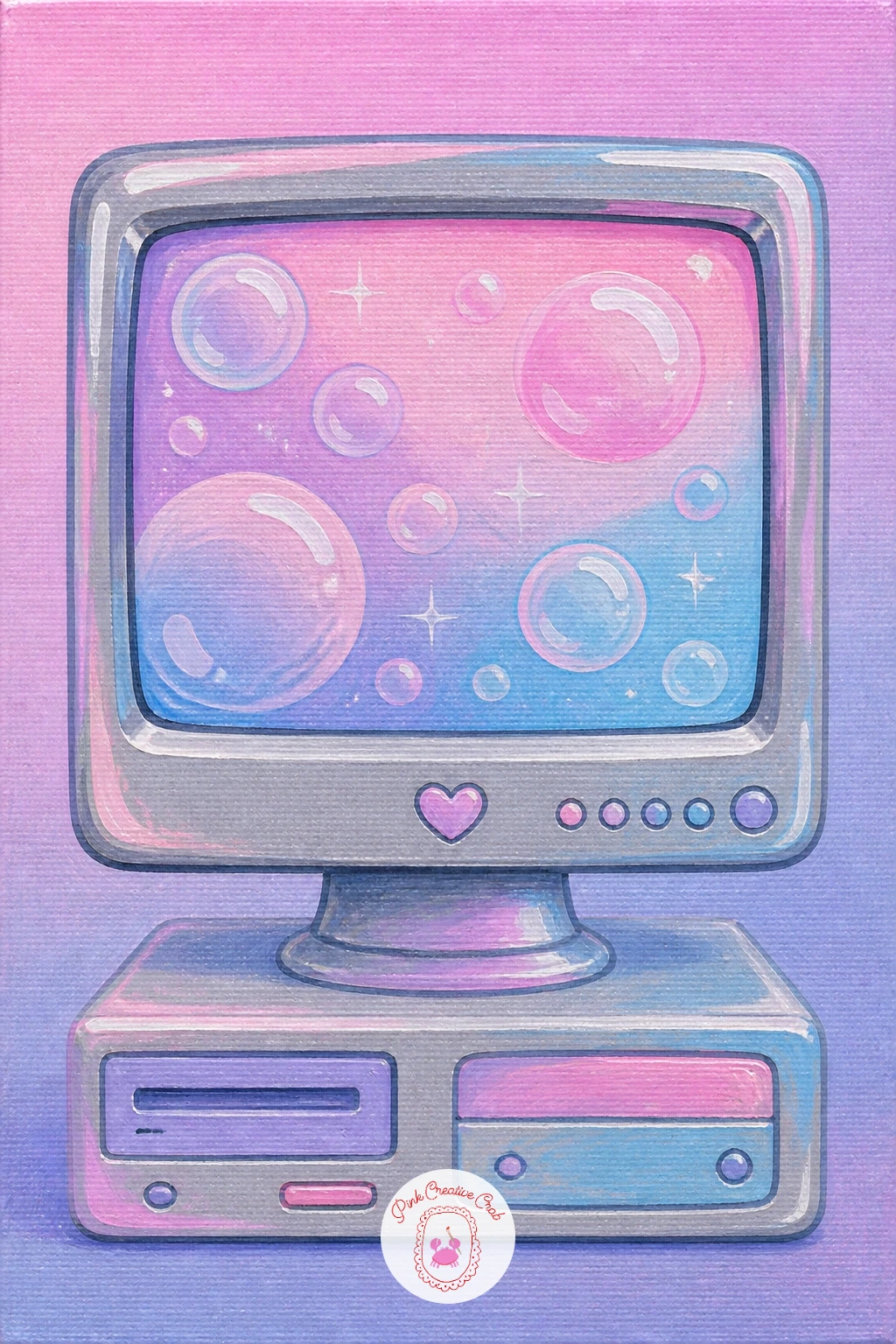
Palette: Translucent Lilac,Baby Blue,Soft White,Silver Chrome
A mall food court moment with a soft pretzel and a cup of lemonade is a cheerful little food still life. Paint the pretzel first as a looping knot shape in a warm golden tan, adding a scatter of tiny white dots across it for coarse salt once the base color is dry.
Set the lemonade cup beside it as a tall clear cup filled with a flat pale yellow, with a few small white circles near the top to suggest ice, and a striped straw poking out at an angle. Keep the background a simple flat pink or lilac rather than trying to paint the food court itself, which keeps the focus on the snack.
Light here comes from imagining a food court skylight overhead, so add one soft white highlight along the top curve of the pretzel and the top of the cup to suggest that overhead glow. If the pretzel knot shape looks tangled, simplify it to one clean loop crossing over itself twice rather than three or four crossings.
Swap the lemonade for pink frozen slush if you’d rather lean into a deeper pink in this piece.
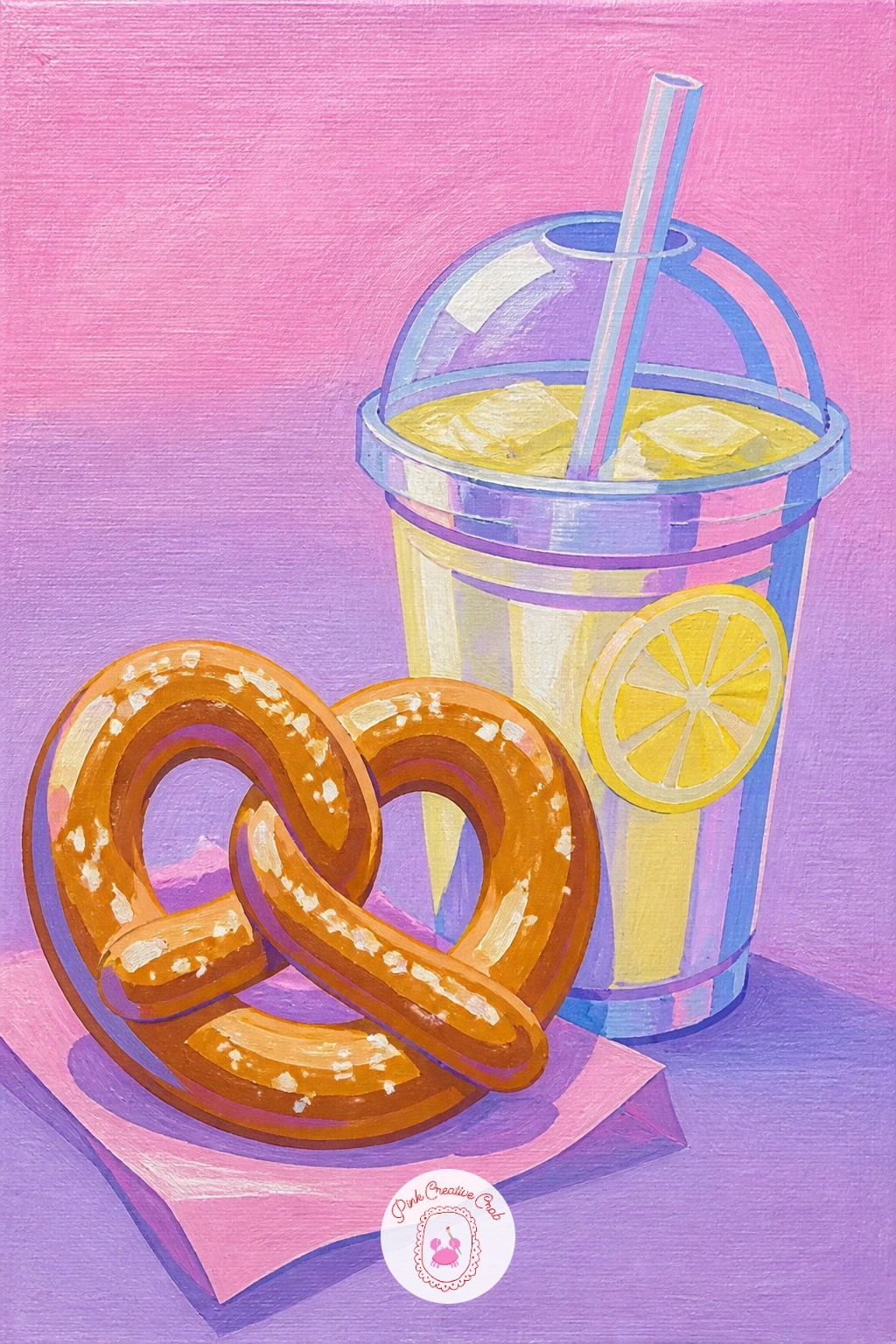
Palette: Golden Tan,Soft White,Pale Yellow,Pale Pink
A mirror selfie silhouette brings the flip phone back in a completely different composition, this time as a figure rather than an object. Paint a simple standing silhouette in a flat mid-tone pink or lilac, keeping the pose loose and the details minimal, just a rounded head shape, shoulders and one arm raised holding the phone up toward a mirror edge.
The mirror frame can be a simple rounded rectangle outline in silver around the edge of the canvas, with the background inside it a soft gradient from pale pink to lilac to suggest the reflective glass. Paint the background gradient first, then the silhouette on top, then the phone last as a small dark pink rectangle held at the figure’s shoulder.
Keep the raised arm roughly one head-length long by comparing it against the head shape before you paint it, since an arm that is too short or too long is the easiest way this figure looks off. If the silhouette feels stiff, angle the hips slightly to one side for a more relaxed pose.
No confidence with figures yet? Simplify the body down to a rounded triangle shape for the torso and it still reads clearly as a figure.
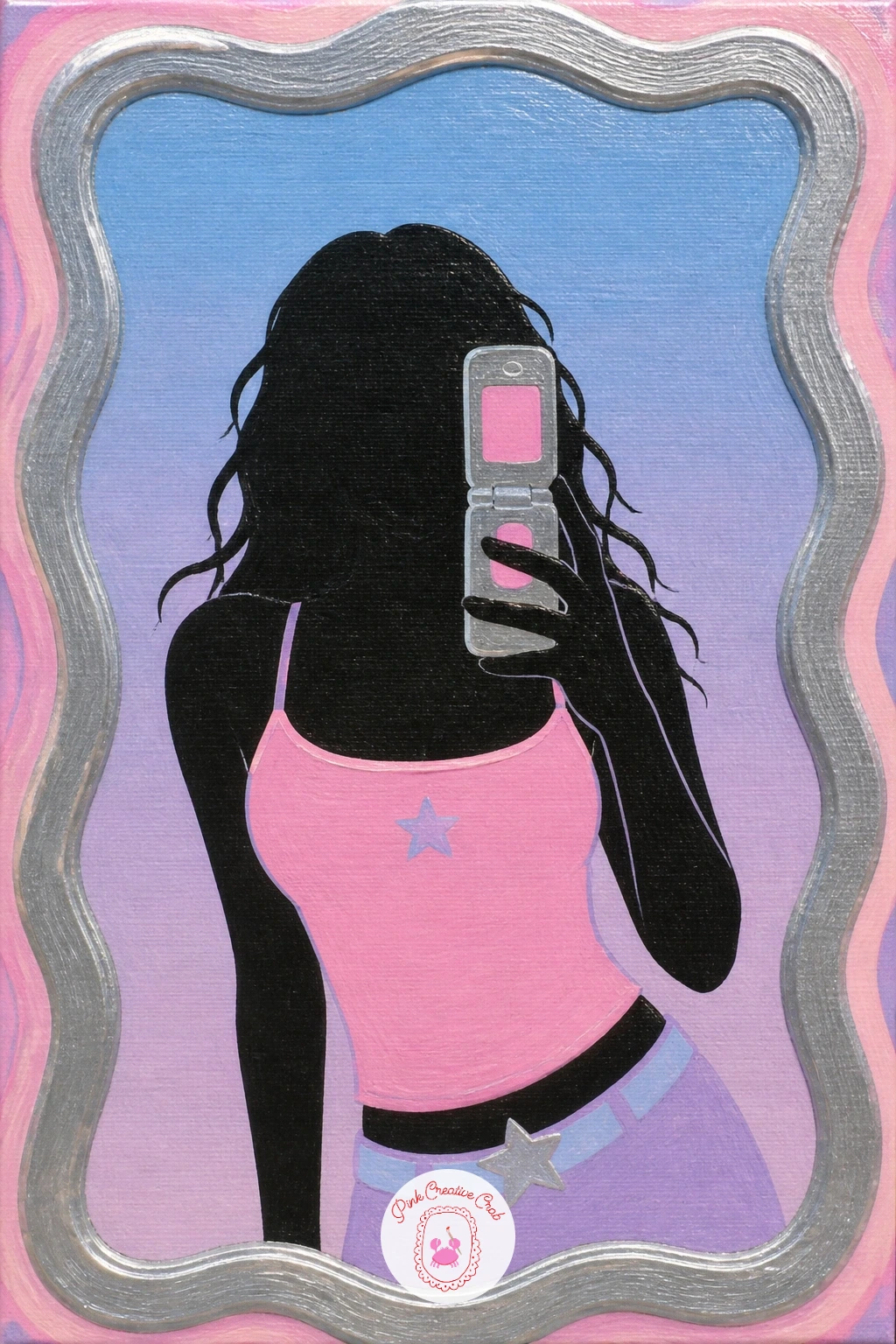
Palette: Mid Pink,Pale Lilac,Silver Chrome,Soft White
Chunky sneakers with pastel laces are a satisfying subject once you’re ready to paint something with a bit more volume. Block the sneaker shape first in two flat tones, a pale lilac body and a thicker white sole, keeping the sole noticeably taller than a regular shoe to capture that chunky silhouette.
Once the base shapes are dry, paint the laces as a zigzag pattern of thin lilac or pink lines crossing the tongue, working from the toe up toward the ankle so each crossing sits logically over the one before it. A thin baby blue line along the sole’s edge helps it pop against the white.
If you have more time, paint a second sneaker angled slightly behind the first, overlapping just enough to suggest a pair without doubling your work, which adds depth beyond the quick ten-minute single shoe. If the laces start looking too neat and mechanical, let one end trail loose off the side of the tongue for a more casual feel.
No white paint handy for the sole? A very pale grey mixed from white and a touch of blue reads just as crisp.
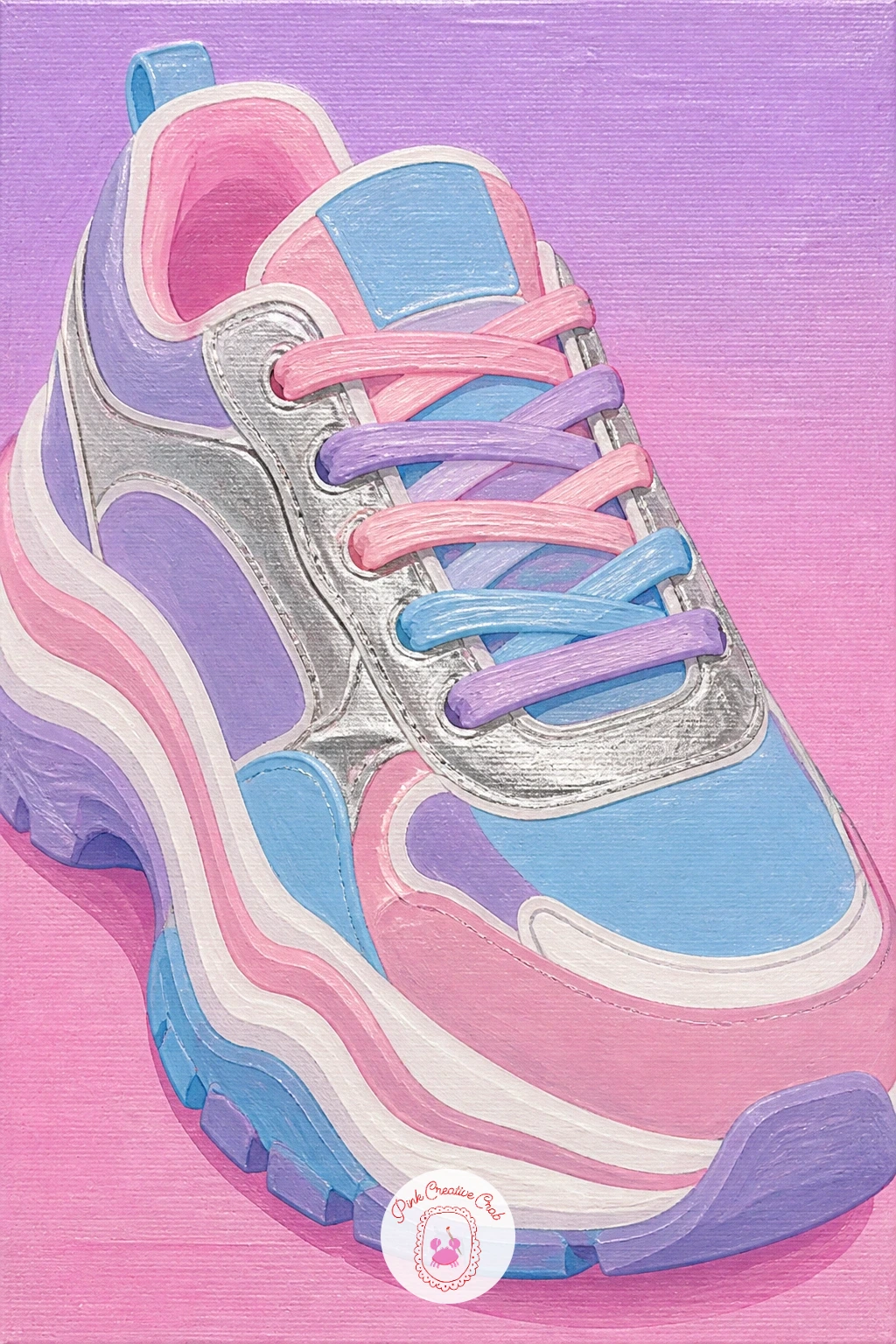
Palette: Pale Lilac,Soft White,Baby Blue,Pale Pink
A cherry keychain clipped to a mini backpack is a small, playful subject that builds on the round shapes you’ve painted already. Paint the backpack body first as a rounded rectangle in a flat baby blue, with a simple front pocket shape and a thin silver zipper line running across it.
The cherries hang from a small silver clip at the top strap, painted as two overlapping red circles joined by a thin green stem, with one tiny white highlight dot on each cherry to give them a glossy shine. Paint the backpack fully first, let it dry, then add the keychain clip and cherries on top so they sit forward in the composition.
Keep both cherries close in size by painting one, then holding your brush up to measure it before starting the second, since mismatched cherries are the easiest way this charm looks off balance. If the stem looks too stiff, curve it gently rather than painting it as a straight line.
No red on your palette? A mix of pink and a touch of orange makes a warm cherry red that still reads clearly.
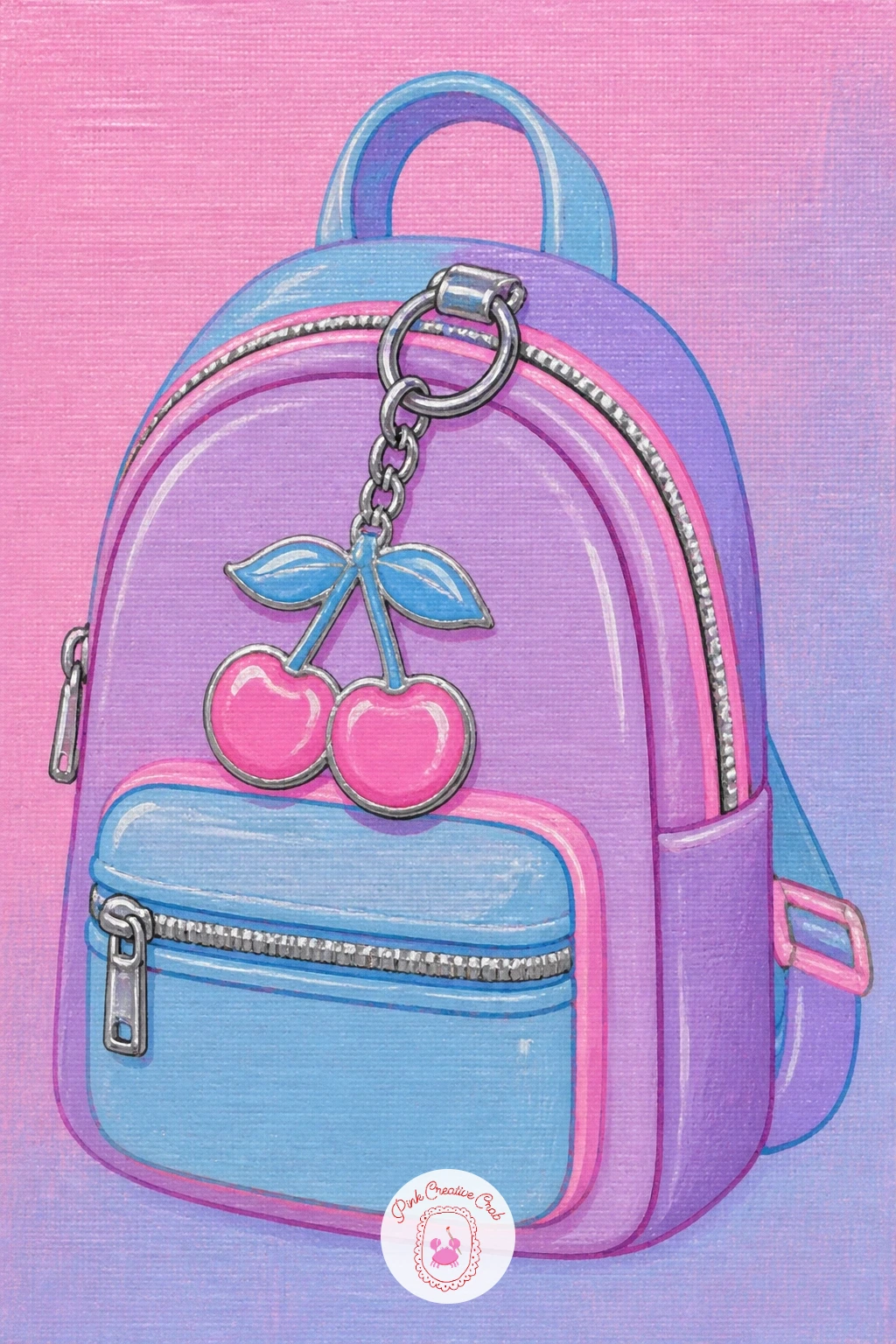
Palette: Baby Blue,Cherry Red,Leaf Green,Silver Chrome
A glitter bedroom wall scattered with star stickers is less about objects and more about surface, a nice change of pace after several still lifes. Paint the wall as one flat lilac rectangle filling most of the canvas, then once dry, speckle it lightly with tiny dots of white and silver paint using the tip of a stiff brush to suggest a glittery texture.
Add five or six small star shapes across the wall in baby blue and pale pink, keeping them simple five-point stars rather than detailed ones, scattered unevenly so some cluster together and others sit alone. Paint the speckled texture first, stars on top, so the stars read as sitting on the glitter rather than under it.
If the speckling starts looking too uniform, vary your pressure so some dots come out larger and some barely visible, since real glitter catches light unevenly. No stiff brush for speckling? An old toothbrush loaded lightly and flicked with your thumb gives a similarly scattered texture, just test the flick on scrap paper first.
Keep star sizes varied, with one or two noticeably larger than the rest, for a more natural scatter.
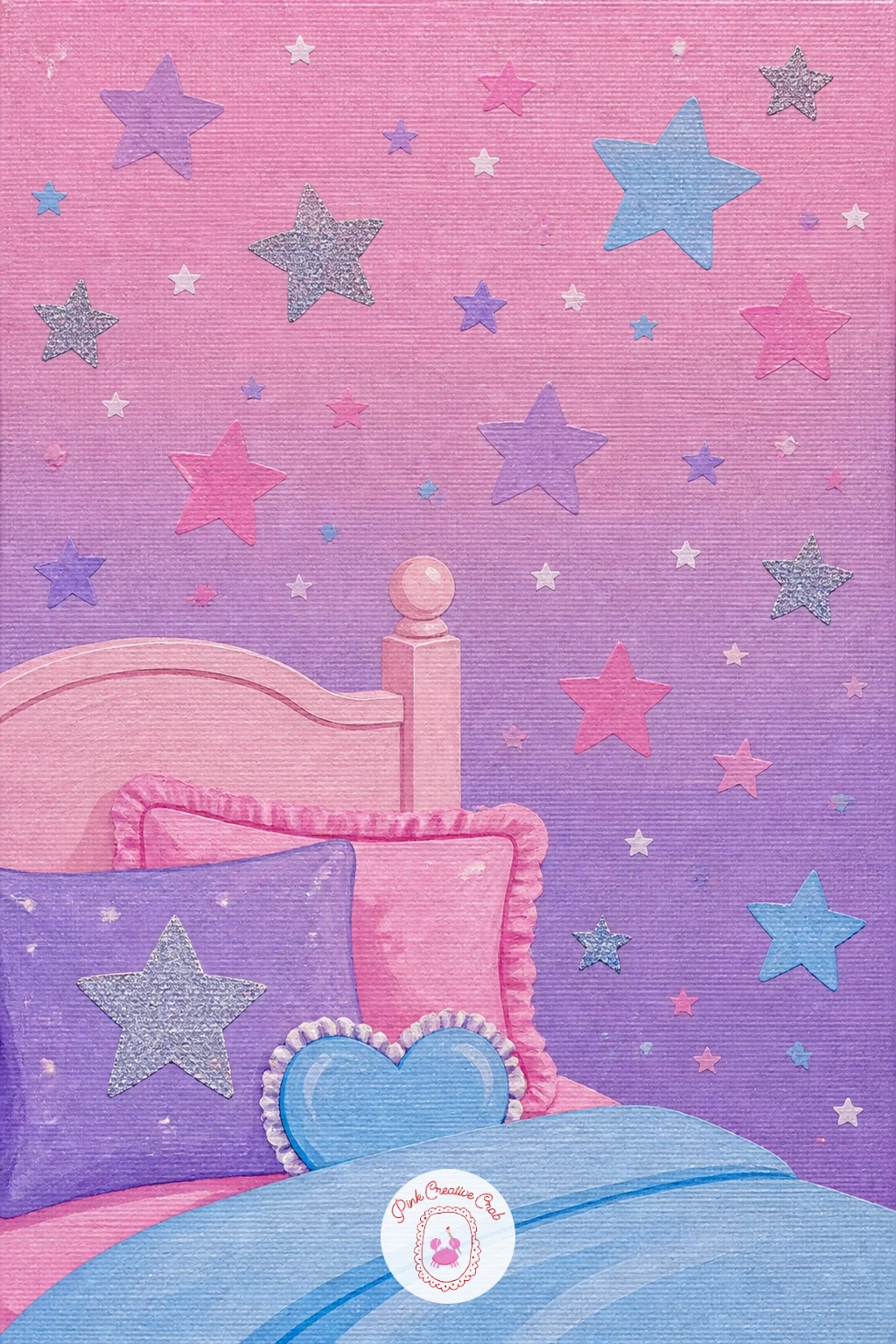
You Will Need
- old toothbrush for speckling
Palette: Pale Lilac,Soft White,Silver Chrome,Baby Blue
A pastel scooter leaning against a garden fence moves the list outdoors for a small change of scene. Paint the fence first as three or four simple vertical pickets in a flat pale blue, then the scooter leaning diagonally across them, its deck and handlebar post kept as clean, simple lines in lilac with two small round wheels in silver.
Keep the scooter’s lean believable by angling the handlebar post so it points roughly toward the same spot the wheels touch the ground, a quick trick that keeps the whole object looking like it’s actually resting against something rather than floating. Paint the fence first, scooter on top, so the deck overlaps the picket behind it convincingly.
A pale pastel sky background behind the fence keeps the whole scene glowing rather than busy, so resist adding grass detail or extra plants. If the wheels look flat, add one small white highlight arc on each to suggest roundness.
No silver paint for the wheels? A light grey works just as well and still reads as metal against the pastel scene.
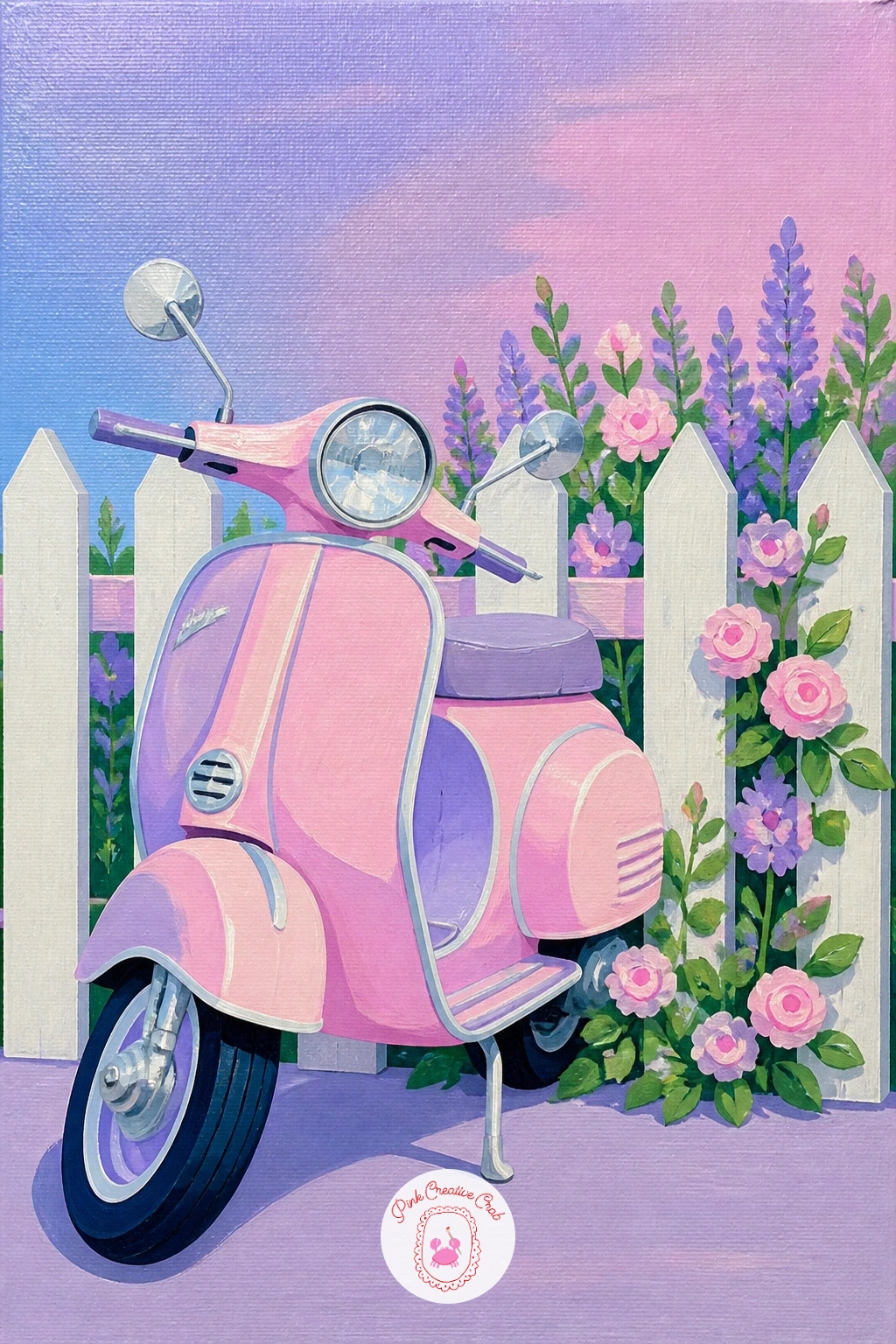
Palette: Baby Blue,Pale Lilac,Silver Chrome,Soft Pink Sky
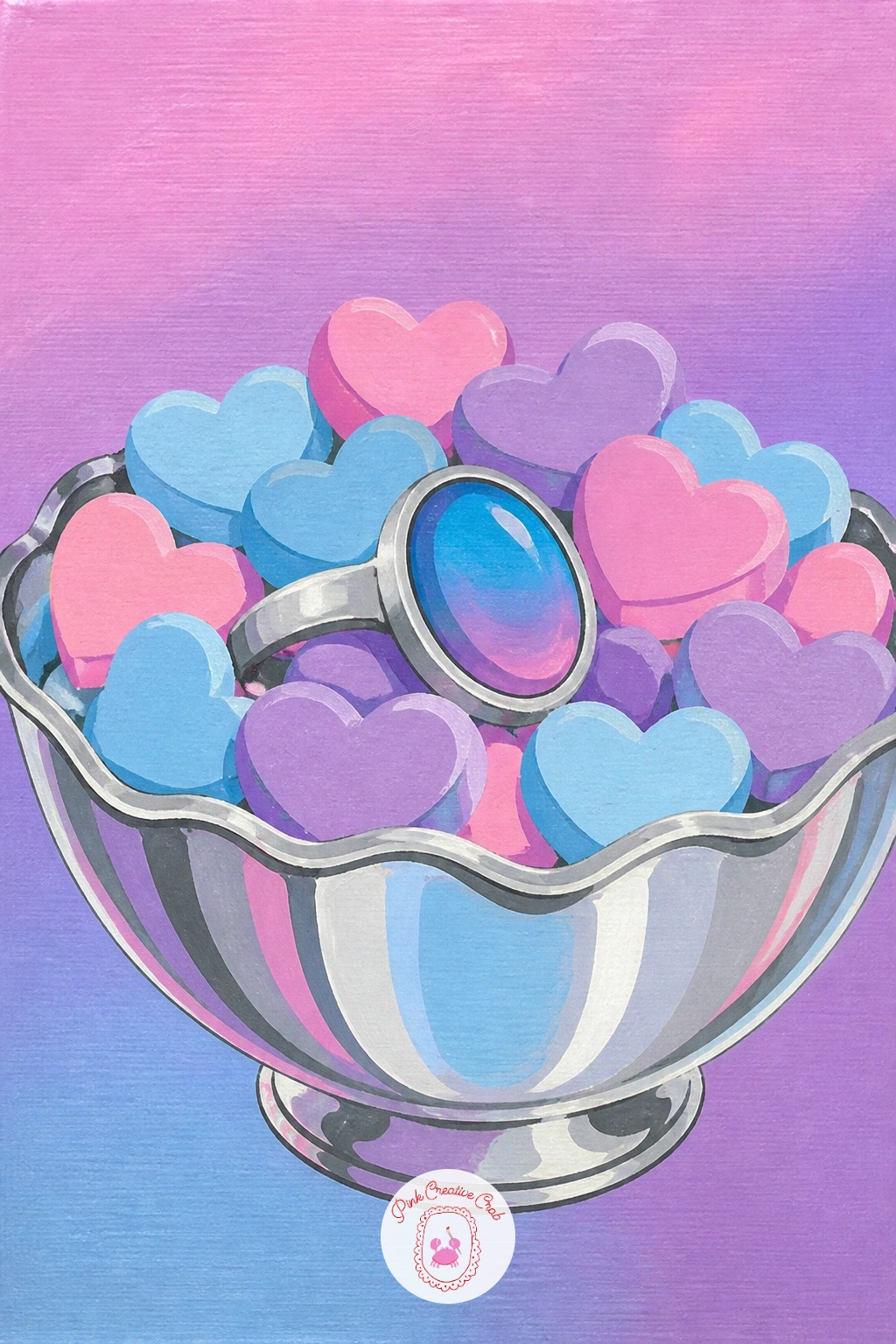
A bowl of candy hearts with a mood ring resting on the rim is a tiny, cheerful still life once you want something smaller in scale again. Paint the bowl first as a simple rounded shape in white or pale lilac, then fill it with a scatter of small oval candy shapes in pink, blue and lilac, each painted as one flat color dab.
The mood ring sits balanced on the bowl’s rim, a thin silver band with a single round stone painted in a soft color-shifting blend, pink fading into lilac across the stone. Paint the bowl and candies first, then the ring last so it sits clearly on top of the rim.
If the candy hearts start blurring together into one pink blob, alternate colors so no two touching candies share a shade, which keeps each one readable as a separate piece. No tiny brush for the candy dabs? The rounded end of a cotton swab dipped in paint makes neat small ovals quickly.
Try swapping the candy hearts for small gumdrops or jellybeans next time for a different scatter of shapes in the same bowl.
You Will Need
- cotton swab for small dabs, optional
Palette: Soft White,Pale Pink,Baby Blue,Lilac
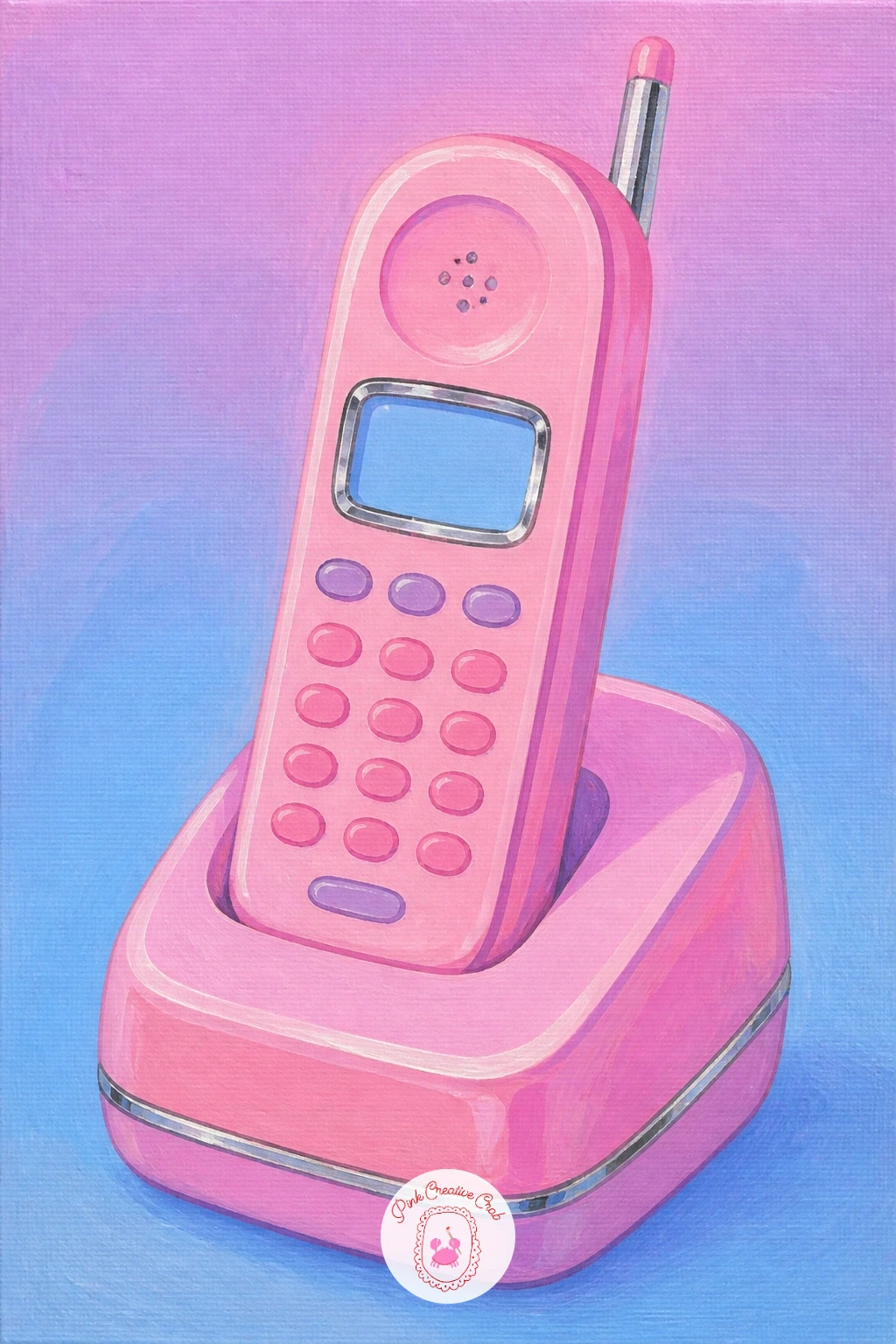
A pink cordless phone resting on a small nightstand is a calm, simple subject after the busier candy bowl. Paint the phone body first as a long rounded rectangle in a glossy pink, with a small antenna line poking up from the top corner and a tiny silver speaker grid of dots near the earpiece end.
The nightstand beneath it can be as simple as one flat lilac rectangle suggesting the tabletop, with a thin darker line along its front edge to give it a bit of form. Paint the nightstand surface first, phone on top, antenna last so it reads as the thinnest, final detail.
Keep the phone’s length roughly three times its width by measuring with your brush handle before committing to the shape, since a cordless phone drawn too short starts looking like a bar of soap. If the speaker dots look too mechanical, space them slightly unevenly for a softer, more hand-painted feel.
Finish by adding one small curled highlight line along the top edge of the phone to suggest its glossy plastic shell.
Palette: Glossy Pink,Pale Lilac,Silver Chrome,Soft White
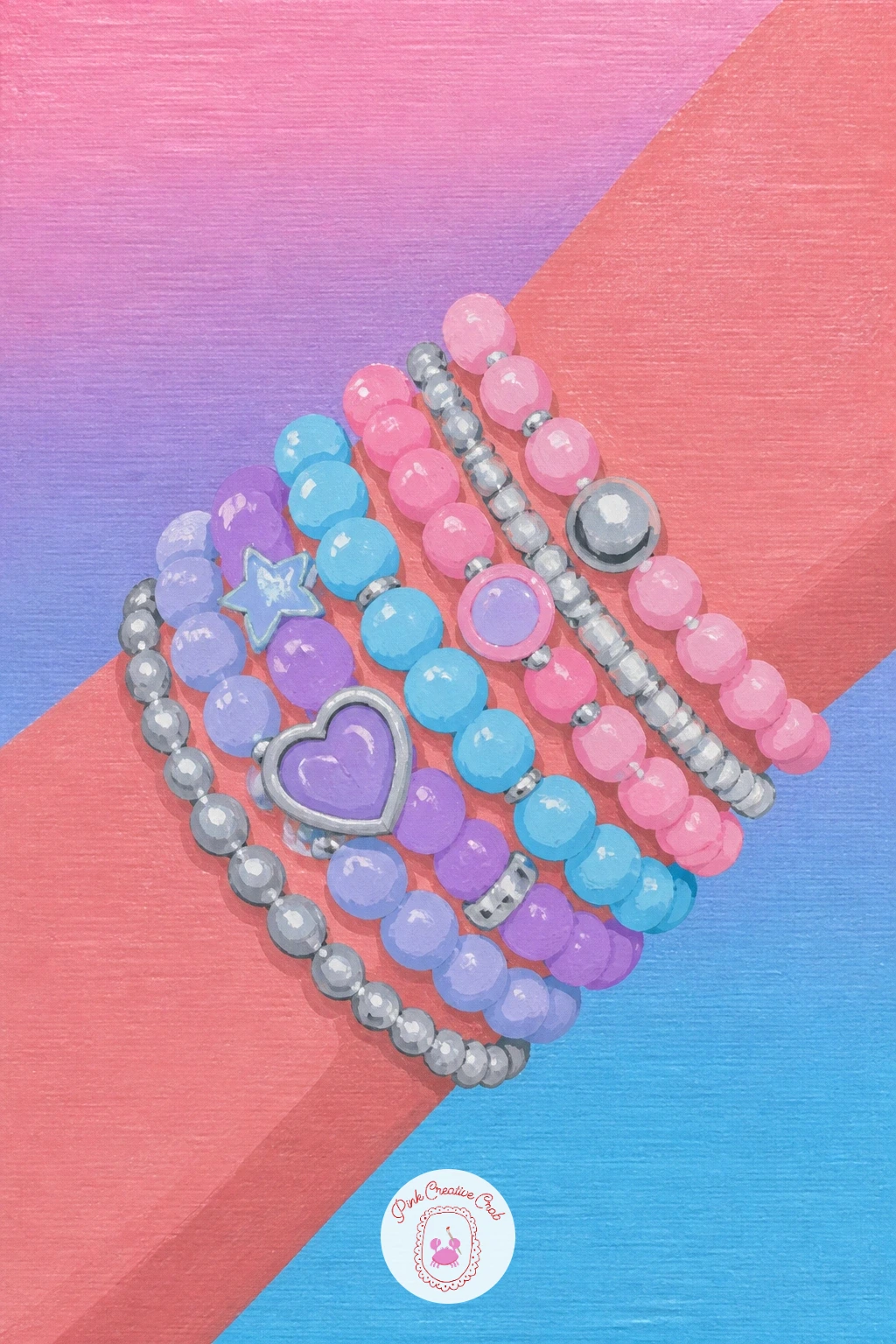
A beaded bracelet stack on a wrist is a close-up subject that rewards careful, patient dabbing. Paint a simple curved wrist shape first in a soft neutral tone, then build the bracelets as rows of small round beads in alternating pastel colors, each bead a single dot of paint placed close to its neighbors along the curve of the wrist.
Work one bracelet row at a time, letting each dry before adding the next so the colors stay distinct instead of smearing together. A thin silver line between two of the beaded rows suggests a chain-style bracelet mixed in with the beaded ones for variety.
The curve of the wrist is the trick to get right: lightly sketch two parallel curved guidelines first and keep every bead sitting between them, which stops the stack from drifting off the arm as you work outward. If beads start looking too perfectly round and stiff, flatten one side of a few slightly for a more natural, slightly irregular look.
No fine brush for small beads? The end of a pencil dipped in paint makes evenly sized dots quickly.
Palette: Pale Pink,Baby Blue,Lilac,Silver Chrome
A salon chair set up for frosted tips brings in a bit of nostalgic hair culture with a fun prop-filled scene. Paint the chair itself first as a simple rounded silhouette in chrome silver with a pale lilac seat cushion, keeping the whole shape low and wide so it reads clearly as salon furniture rather than a dining chair.
Beside it, a small rolling cart holds a few simple shapes, a foil roll suggested with a flat silver rectangle and a comb as one thin curved line with small teeth marks, both kept loose rather than detailed. Paint the chair and cart base shapes first, then the small prop details on top once everything else is dry.
Seen from a slightly low angle, the chair’s backrest rises tall and confident against the background, which gives the whole scene a bit more presence than a flat, straight-on view. If the cart’s props start feeling cluttered, keep only two items on it rather than three or four.
A soft pastel gradient background keeps the salon feeling bright rather than clinical.
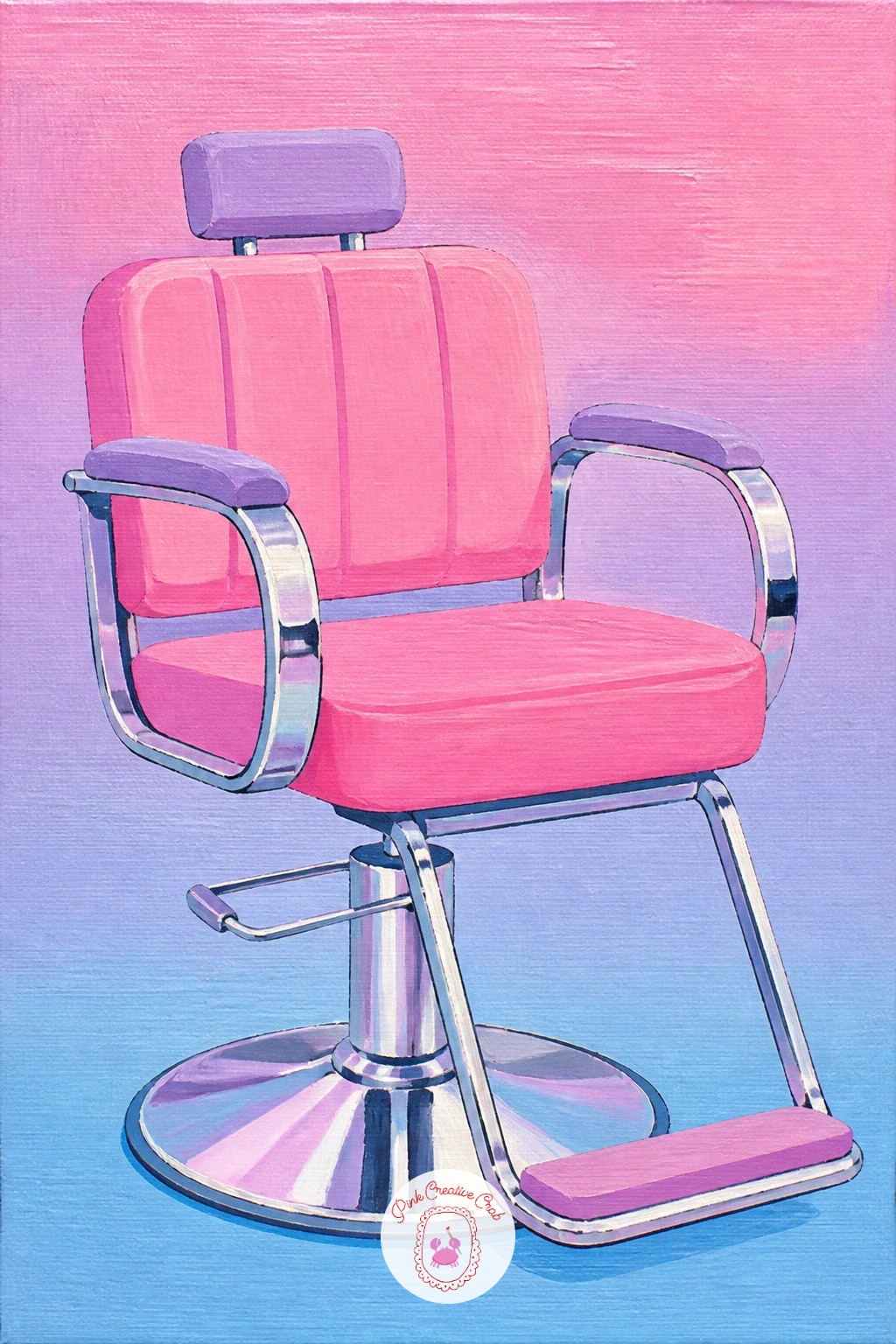
Palette: Silver Chrome,Pale Lilac,Baby Blue,Soft White
A VHS tape beside a small bowl of popcorn is a cozy little still life that sets up the sleepover scenes ahead. Paint the tape first as a simple black-edged rectangle with a pale lilac label patch on the front, keeping the label blank or adding just a couple of loose scribble lines rather than legible text.
The popcorn bowl sits beside it, a rounded bowl shape in baby blue filled with small irregular white and pale yellow blobs piled up and spilling slightly over the rim. Paint the tape fully first, then the bowl, then let a few popcorn pieces overlap the base of the tape for a sense of closeness between the two objects.
If the popcorn pile looks too uniform, vary the blob sizes noticeably, a few larger clumps mixed with smaller single pieces reads far more convincingly than evenly sized dots. No pale yellow on hand? White popcorn with just a few pieces tinted cream still works fine.
Swap the VHS tape for a stack of two tapes next time to build a slightly bigger version of this same still life.
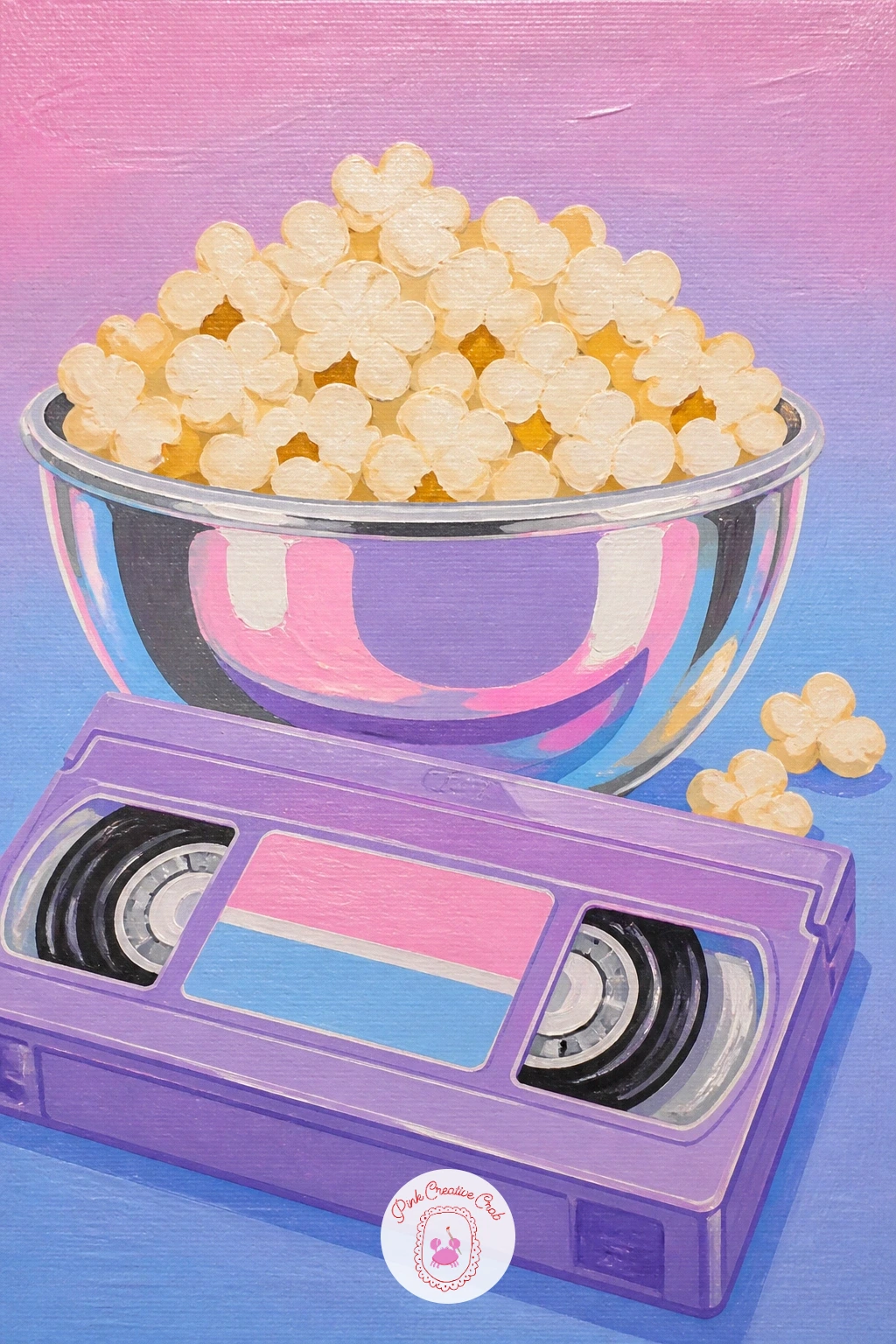
Palette: Pale Lilac,Baby Blue,Soft White,Cream Yellow
A pink and chrome boombox sitting on a lawn brings a bit of outdoor light into the list after several indoor still lifes. Paint the boombox body first as a wide rounded rectangle in glossy pink, with two large silver speaker circles on either side and a thin chrome handle arching over the top.
The lawn beneath it can stay simple, a flat strip of soft green across the bottom of the canvas with a few short dashed lines to suggest blades of grass, nothing more detailed than that. Paint the grass strip first, boombox on top, handle last so it reads as the topmost, thinnest shape in the composition.
Outdoor light sits differently than a bedroom lamp, so let the sun come from one upper corner and add a soft shadow beneath the boombox on the grass to ground it in the scene. If the speaker circles look flat, add one thin curved highlight line across the top of each to suggest their domed shape.
No green paint mixed yet? A touch of blue added to yellow makes a soft pastel lawn green quickly.
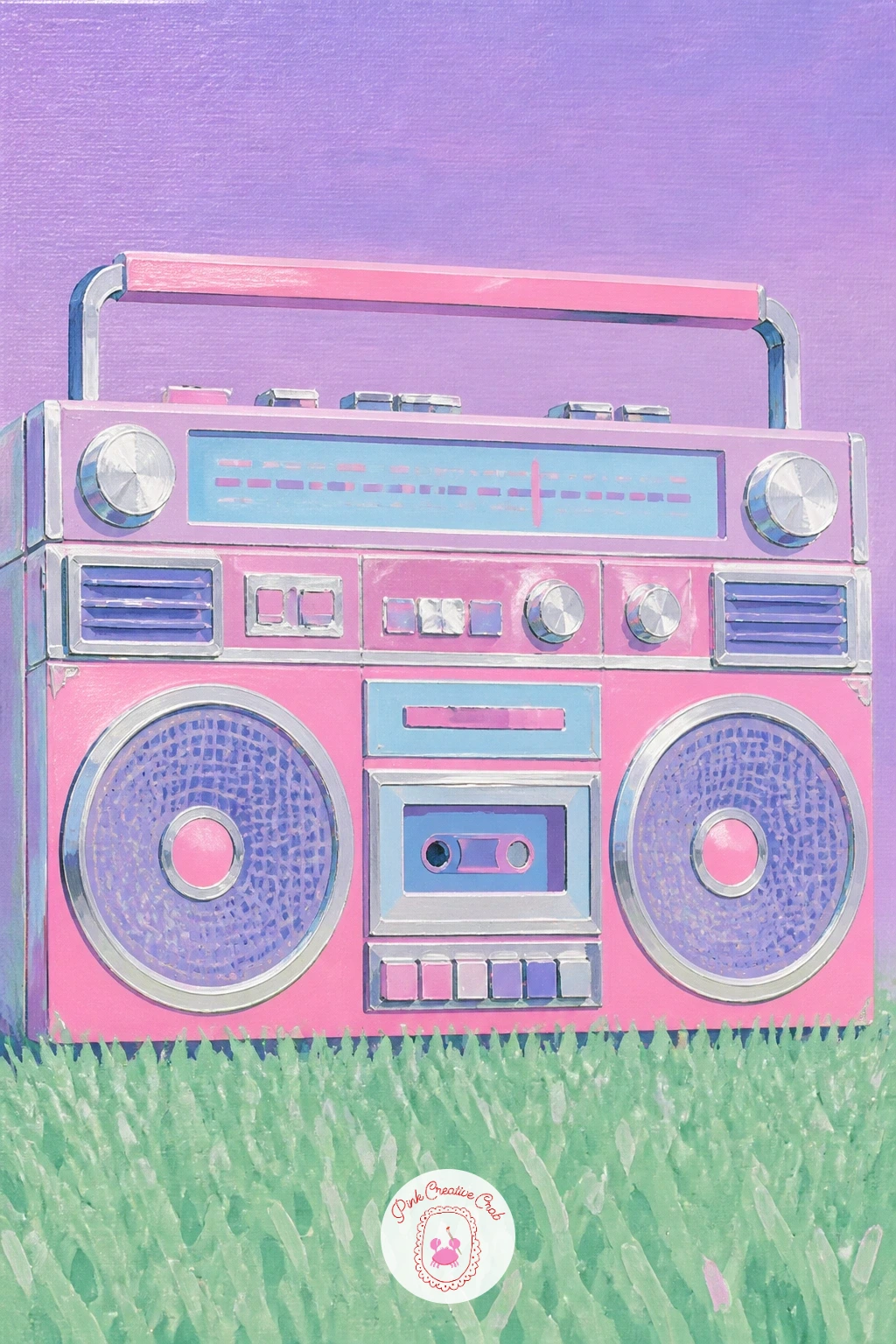
Palette: Glossy Pink,Silver Chrome,Soft Green,Pale Sky Blue
A sleepover scene with two sleeping bags and a couple of face masks laid out brings several ideas from this list together into one cozy composition. Paint the sleeping bags first as two long rounded shapes side by side, one in baby blue and one in lilac, each with a simple quilted pattern suggested by a few curved lines rather than a full grid.
Beside them, place two small round face mask shapes on a little tray, painted as flat pale green or pink circles with two small cutout holes for the eyes, kept simple and slightly cartoonish. Paint the sleeping bags fully first, then the tray and masks on top in the foreground so they feel closest to the viewer.
Keep the two sleeping bags close in size and length by measuring one against the other with your brush before you paint the second, since mismatched bags make the scene look lopsided. If the quilted lines start looking too busy, two or three curves per bag is plenty.
For more ideas on building a small cozy scene like this one, the winter morning drawing ideas use a similar approach to soft indoor light.
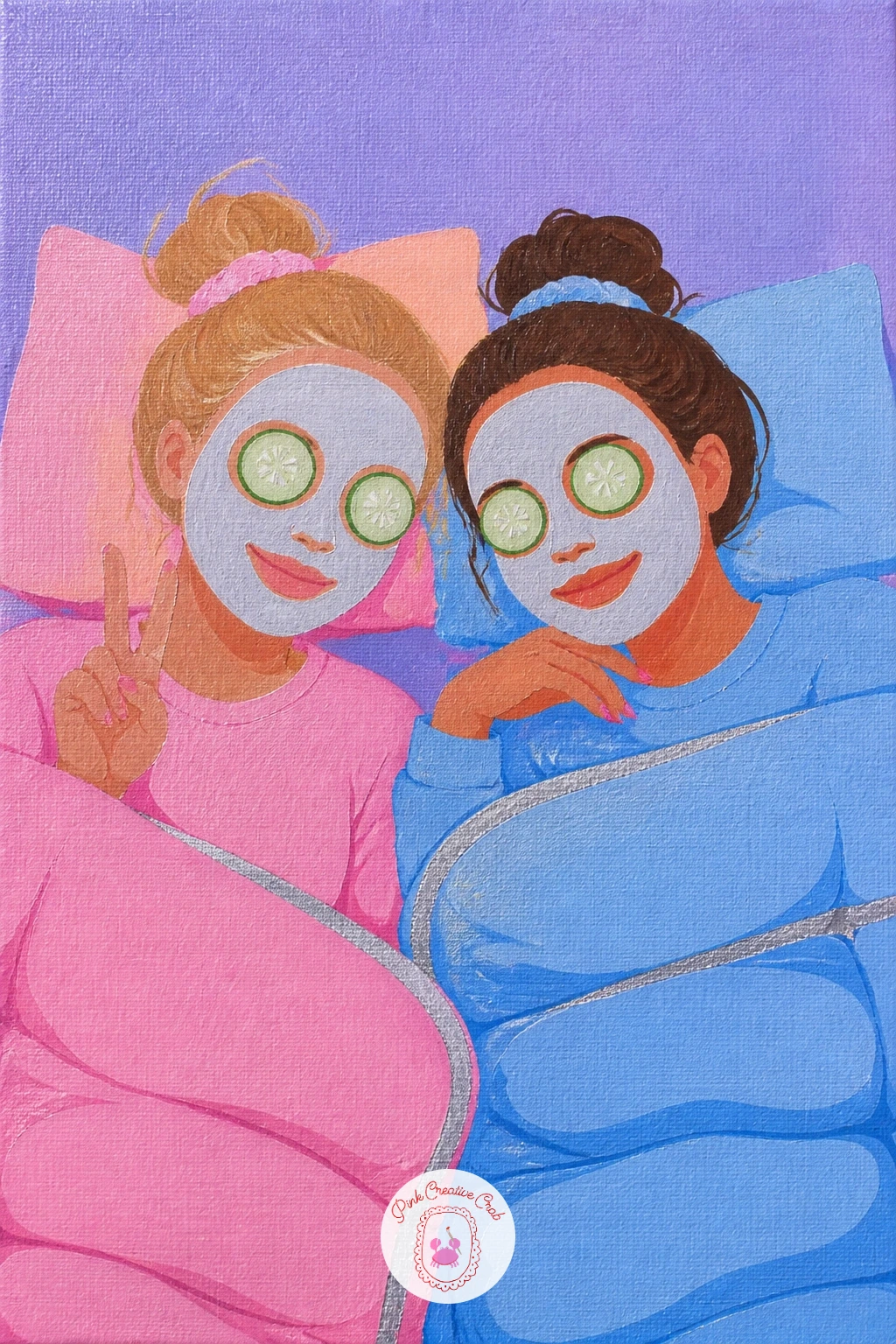
Palette: Baby Blue,Lilac,Soft Green,Pale Pink
A heart locket resting on a small velvet pillow makes a quiet, glowing finish to this whole list. Paint the pillow first as a soft rounded square in a deep lilac, using a slightly darker shade in the folded corners to suggest the velvet’s shadowed texture without overworking it.
The locket sits centered on top, a silver heart shape with a thin chain looping around it, painted last once the pillow is fully dry so its edges stay crisp against the fabric. A single small white highlight dot on the locket’s curve gives it a polished, jewelry-store shine.
Velvet reads best with soft, blended edges rather than hard lines, so once the pillow’s base color is down, go back in with a barely damp brush and gently blur the line between the lighter top and the darker folded corners. If the chain looks too stiff, loosen it into a gentle curve rather than a tight circle.
No deep lilac mixed yet? A dusty rose pillow works just as well under a silver locket for a slightly warmer finish.
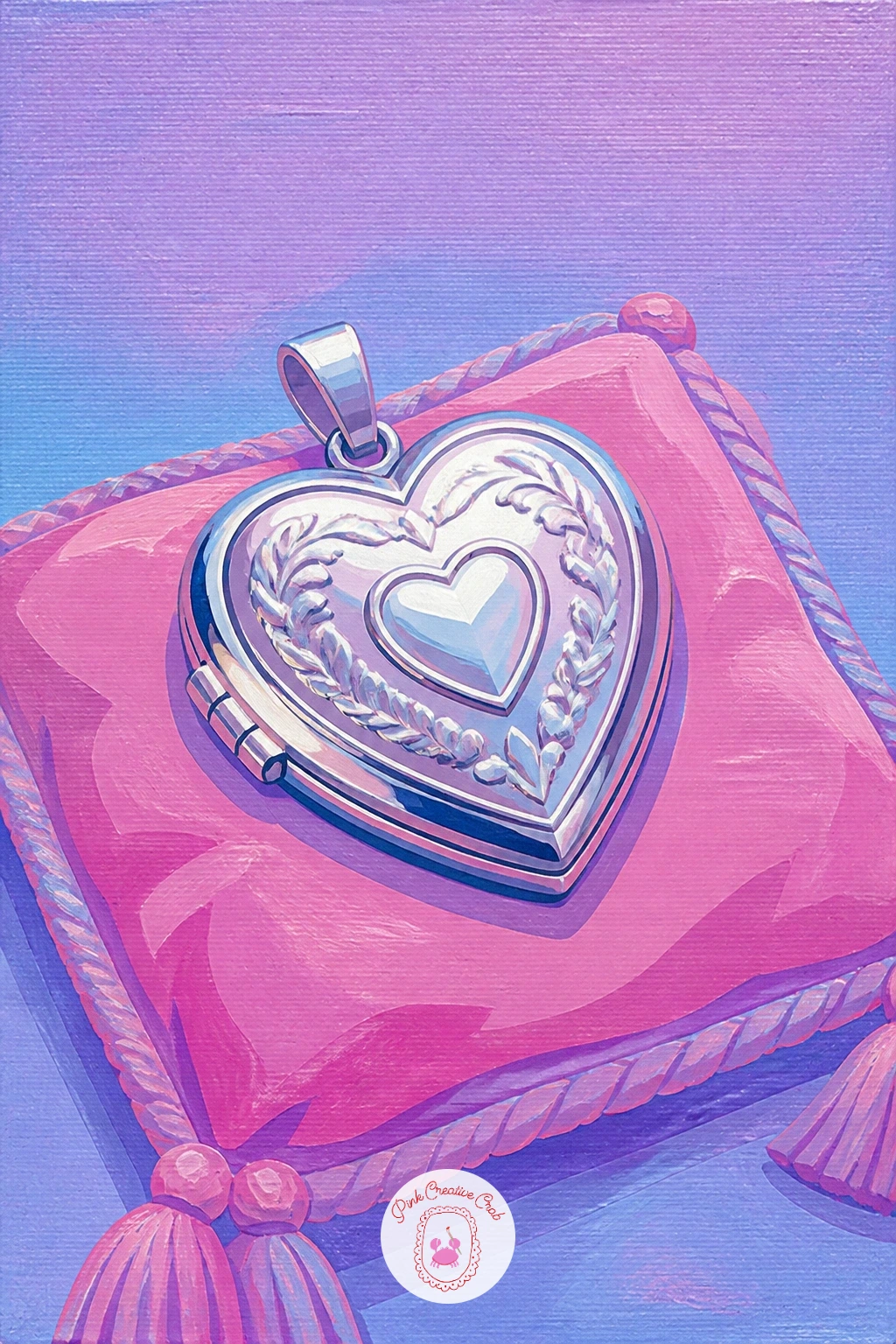
Palette: Deep Lilac,Silver Chrome,Soft White,Dusty Rose
What to Do Next
Pick whichever idea made you smile first, whether that’s the flip phone with its little charm or the glitter wall scattered with stars, and set up a small canvas with your pastel palette ready. Sketch the main shapes lightly in pencil before any paint touches the canvas, and let the rest of this list keep you busy for weeks of easy, glossy little paintings.
Frequently Asked Questions
What paint works best for y2k painting ideas on a small canvas?
Acrylic paint works best because it dries fast and gives flat, glossy color blocks without much blending. Student-grade acrylics in pastel tones cover a small canvas easily and let you layer details once the base dries.
How do I get that smooth, flat y2k look instead of a painterly texture?
Load your brush well and apply paint in a few confident, even strokes rather than scrubbing it in. Let each color block dry fully before adding the next shape on top, which keeps edges crisp instead of muddy.
What size canvas suits these y2k painting ideas?
A small canvas around eight by ten inches works well for most of these subjects, since the ideas are built from a few simple shapes rather than fine detail. Smaller canvases also finish faster in one sitting.
How do I mix the right pastel pink and lilac for this style?
Start with white and add a small amount of your pink or purple until the color lightens to a soft, chalky tone. Mix slightly more than you think you need, since matching a pastel shade a second time is tricky.
Can beginners really finish one of these y2k paintings in one sitting?
Yes, every idea on this list uses a handful of flat shapes and simple details that a beginner can complete in under an hour. Picking a smaller subject like the lip gloss tube or cherry keychain makes an especially quick first painting.
Have any thoughts?
Share your reaction or leave a quick response — we’d love to hear what you think!
-
 0
-
0
-
0
-
0
-
0
-
0


