Family painting gives you a reason to put the everyday moments on the wall instead of only the special occasions. A picnic under a tree, pancakes on a Sunday morning, a dog asleep at everyone’s feet: these are the scenes worth keeping, and acrylic on a small canvas turns them into something warm and finished fast.
Every idea below keeps faces simple, just a soft shape and a little color for cheeks, so you paint the feeling of the moment rather than a likeness. Scroll through all 29 and pick whichever one matches a memory you want hanging in your own house.
Using these images: free for personal projects such as printing, coloring, cards, journals and gifts. Handmade items that include them may be sold up to 30 pieces per design. More than that is commercial use and is not permitted, and neither is selling or sharing the images themselves or passing them off as your own. Please ask before any other use.
Start with the tree, since it sets the scale for everyone sitting under it. Block in a rounded canopy shape in two greens, a darker one at the base of the leaves and a lighter one near the top where light falls, then paint the trunk as a simple brown wedge once the canopy is dry.
Lay the blanket as a coral rectangle on the grass before you add any figures, so you know exactly how much space each family member gets. Paint the people as simple rounded shapes, a few seated, one maybe lying back, with faces kept to a soft dot or two and no real features.
If the canopy looks flat, break it into three or four overlapping leaf clusters instead of one solid shape, which gives it depth without any blending. If you do not have two greens, mix your green with a touch of white for the highlight areas and leave the tube color for shadow.
Keep the sky pale and let the tree and blanket carry the color today.
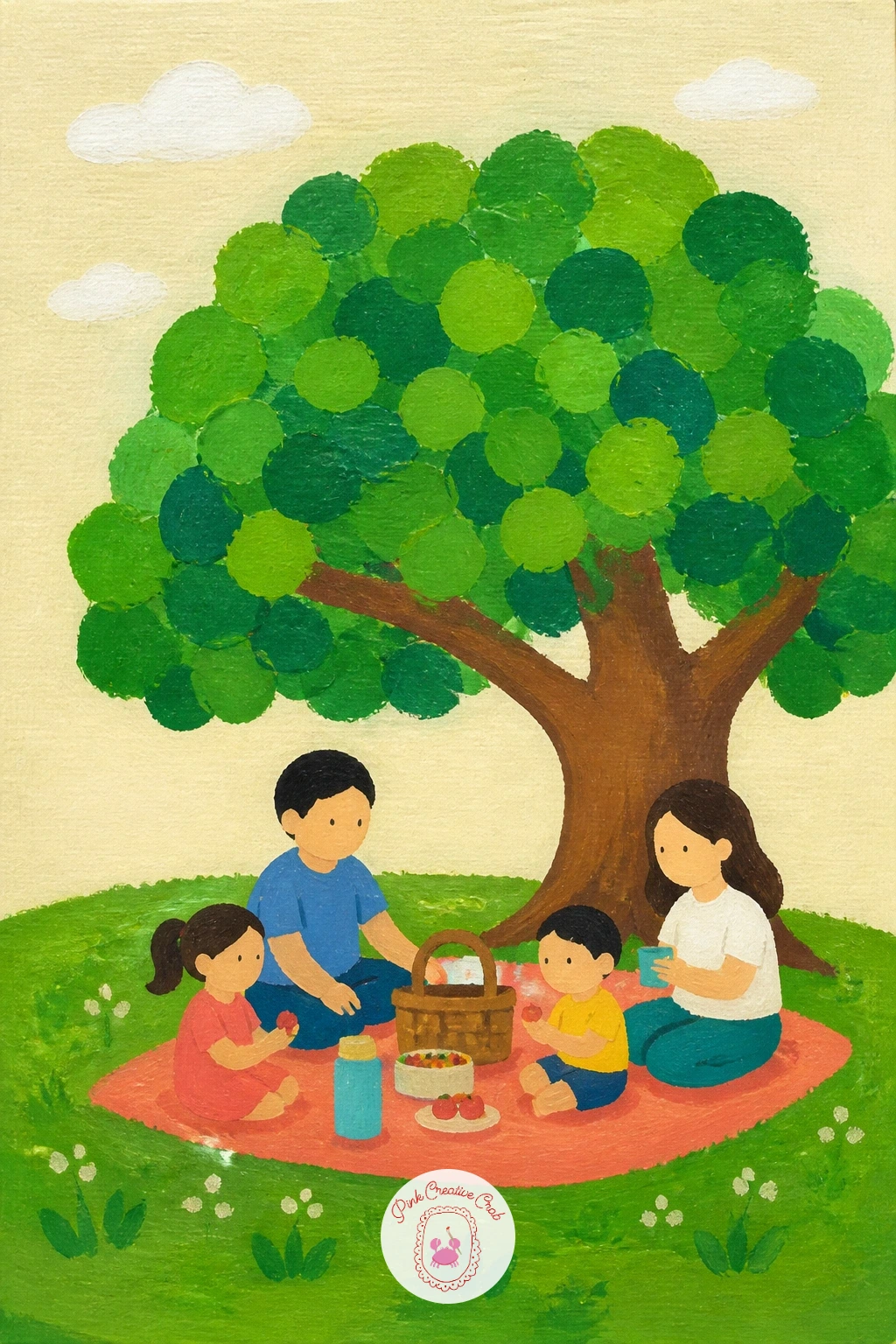
Palette: Sap Green,Titanium White,Coral,Burnt Umber
Work out the kitchen first as a few flat shapes: a counter edge, maybe a window square, nothing fussy. A light cream or soft blue wall keeps the background quiet so the dancing couple reads as the clear subject once they go in on top.
Paint the two adults as one connected shape where their arms meet, which reads as dancing even before you add faces. Keep their legs mid step, one bent, to suggest movement, then add the children off to the side as smaller rounded shapes with arms up, laughing.
Where the eye sits on the kids matters here, since if you paint them from a low angle looking up at the parents, the dancers feel bigger and more joyful in the frame. Keep the light coming from the window, so one side of the couple picks up a touch of warm cream while the other stays in the base color.
If you only have one brush size, use the edge of a flat brush to block in the counter cleanly rather than switching tools mid picture.
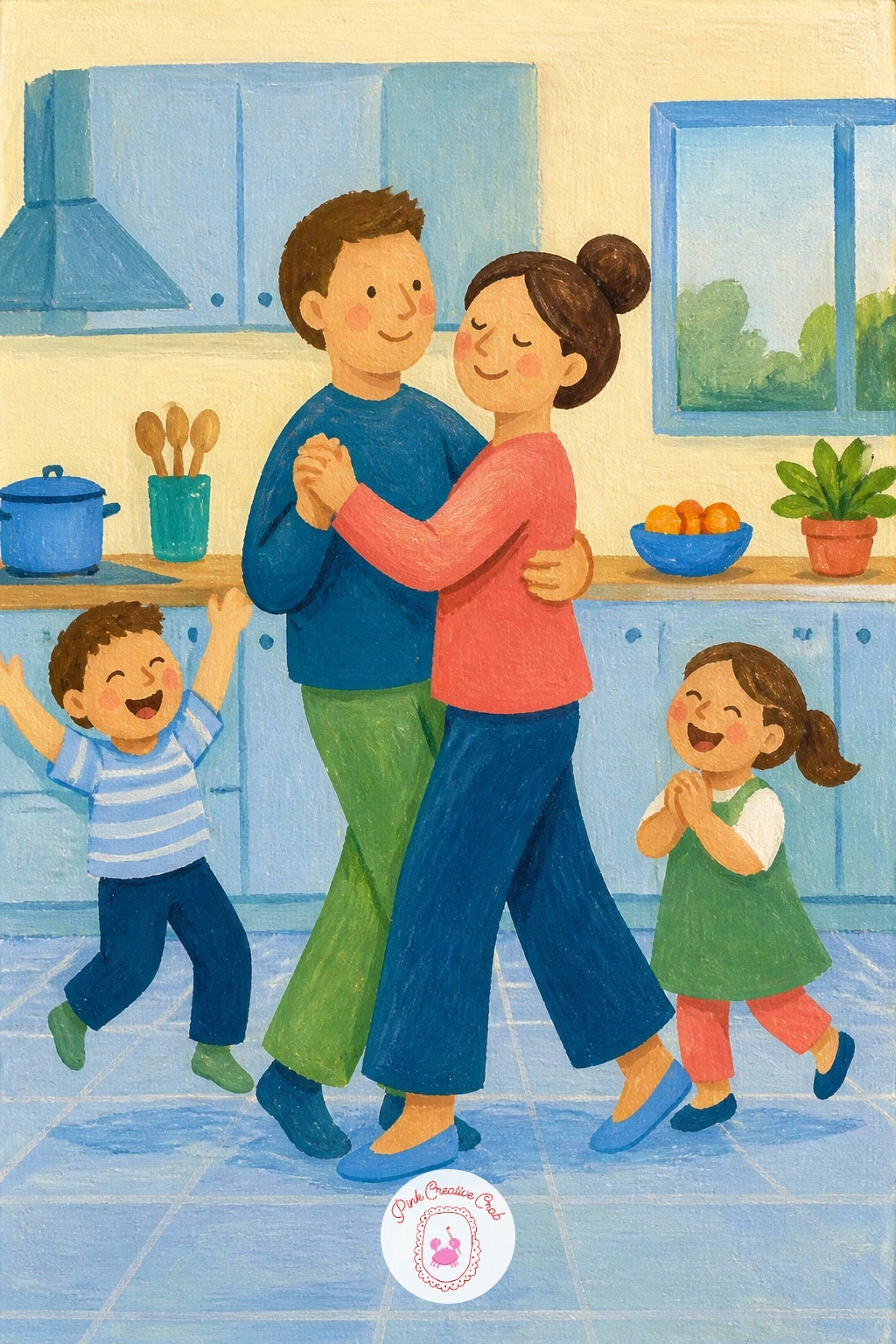
Palette: Cerulean Blue,Cream,Coral,Payne’s Grey
Lay the beach down in three flat bands before anyone enters the scene: pale sky, a strip of soft blue sea, and a wide band of sand in warm cream. Let the horizon line sit about a third of the way down the canvas so the sand has room for footprints and figures.
Paint the family as a row of connected rounded shapes, tallest to shortest, joined at the hands with a single curved line of darker paint. Keep every figure’s weight on the back foot so the row reads as walking rather than standing still.
Measuring the gap between each figure before you commit to paint saves this one, since family members who hold hands stand close together, not spread evenly across the canvas like a line of trees. Leave a little room on one side for the sea so the composition does not feel crowded.
Swap the sand for a pale coral wash if you want a sunset beach instead of a midday one.
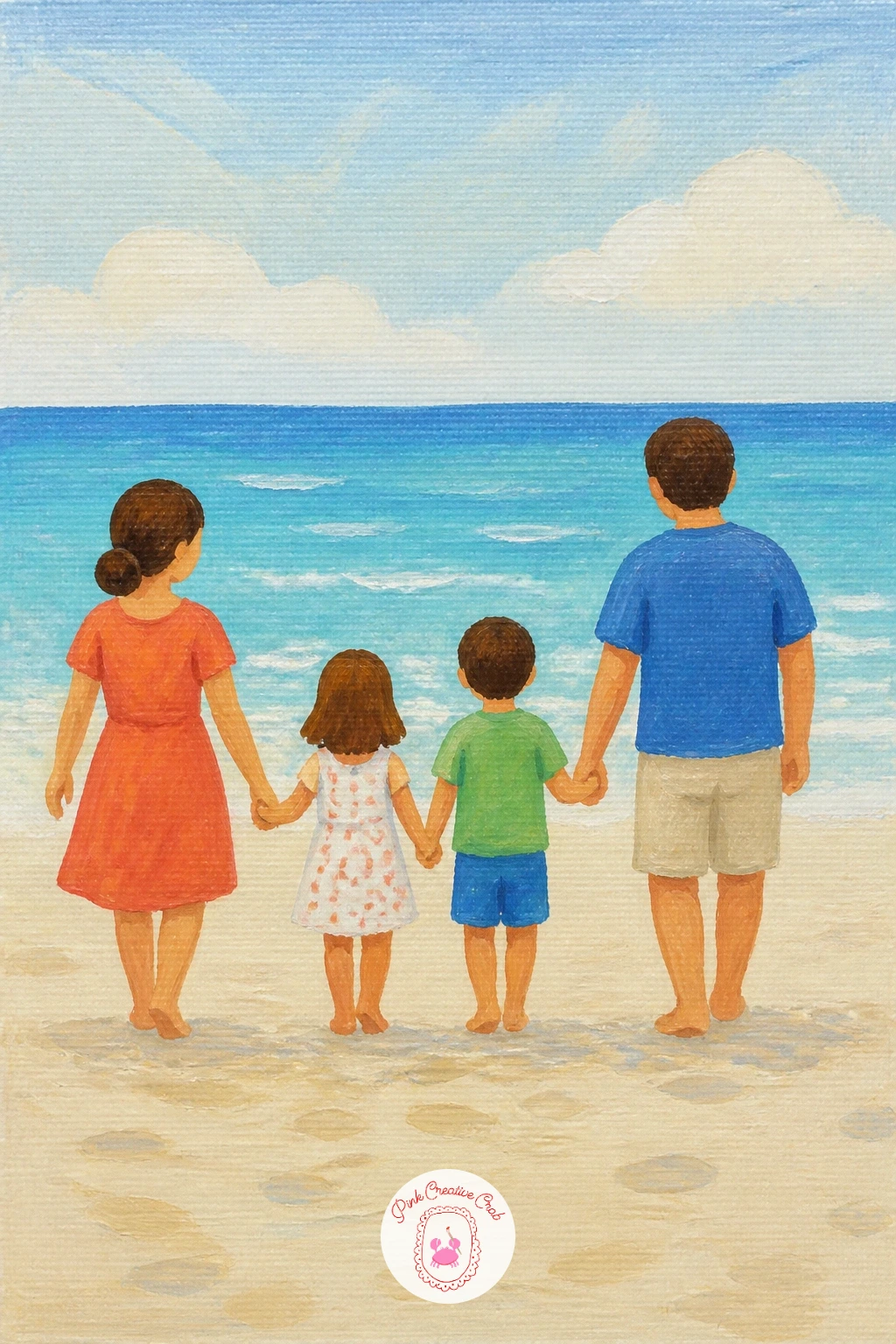
Palette: Cerulean Blue,Sand,Titanium White,Payne’s Grey
Look at a real beach photo for the line where wet sand turns dark near the water. One soft band of grey-brown there adds depth without extra effort.
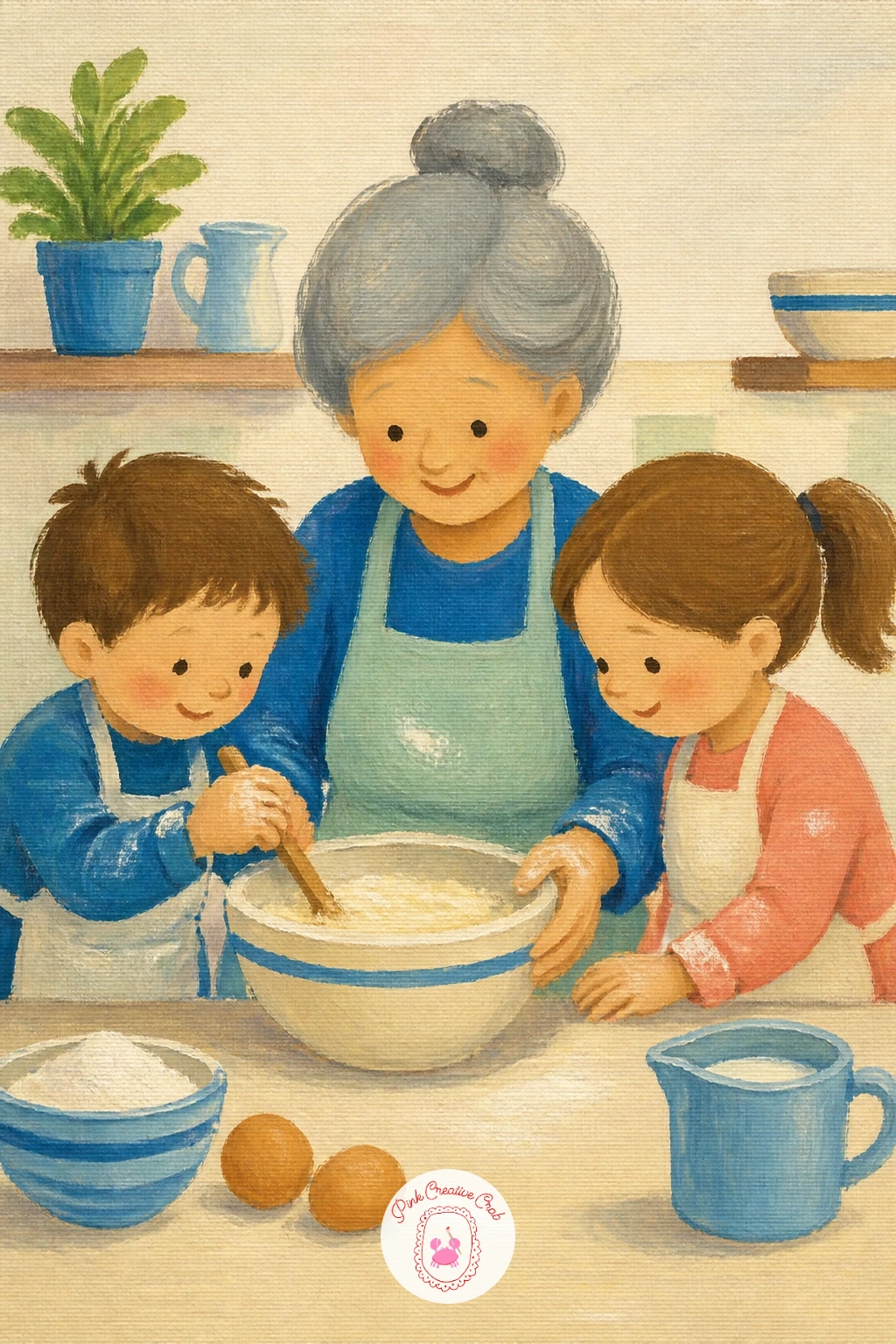
This scene follows naturally from a kitchen moment, but now the counter becomes the main stage. Block in a cream counter top first, then add a mixing bowl as a simple oval and a rolling pin as a thin rectangle, both painted before the figures go in on top.
Paint the grandmother a little taller and a little rounder through the shoulders than the children beside her, which reads as age and softness without any detail in the face. Give the grandchildren flour dust as a few small white dabs flicked on with a dry brush once their shapes are dry.
The dry brush trick matters here: load a stiff brush with a small amount of white, wipe most of it off on a paper towel, then drag it lightly across the counter and sleeves for a convincing dusting of flour rather than solid white blobs. If you want a shortcut, try the same scene with a cooking drawing approach in pencil first to work out the composition before you commit to paint.
Keep the bowl’s color warm, a soft coral or cream, so it echoes the overall palette instead of reading as pure white.
You Will Need
- dry brush for flour texture
Palette: Cream,Coral,Titanium White,Burnt Sienna
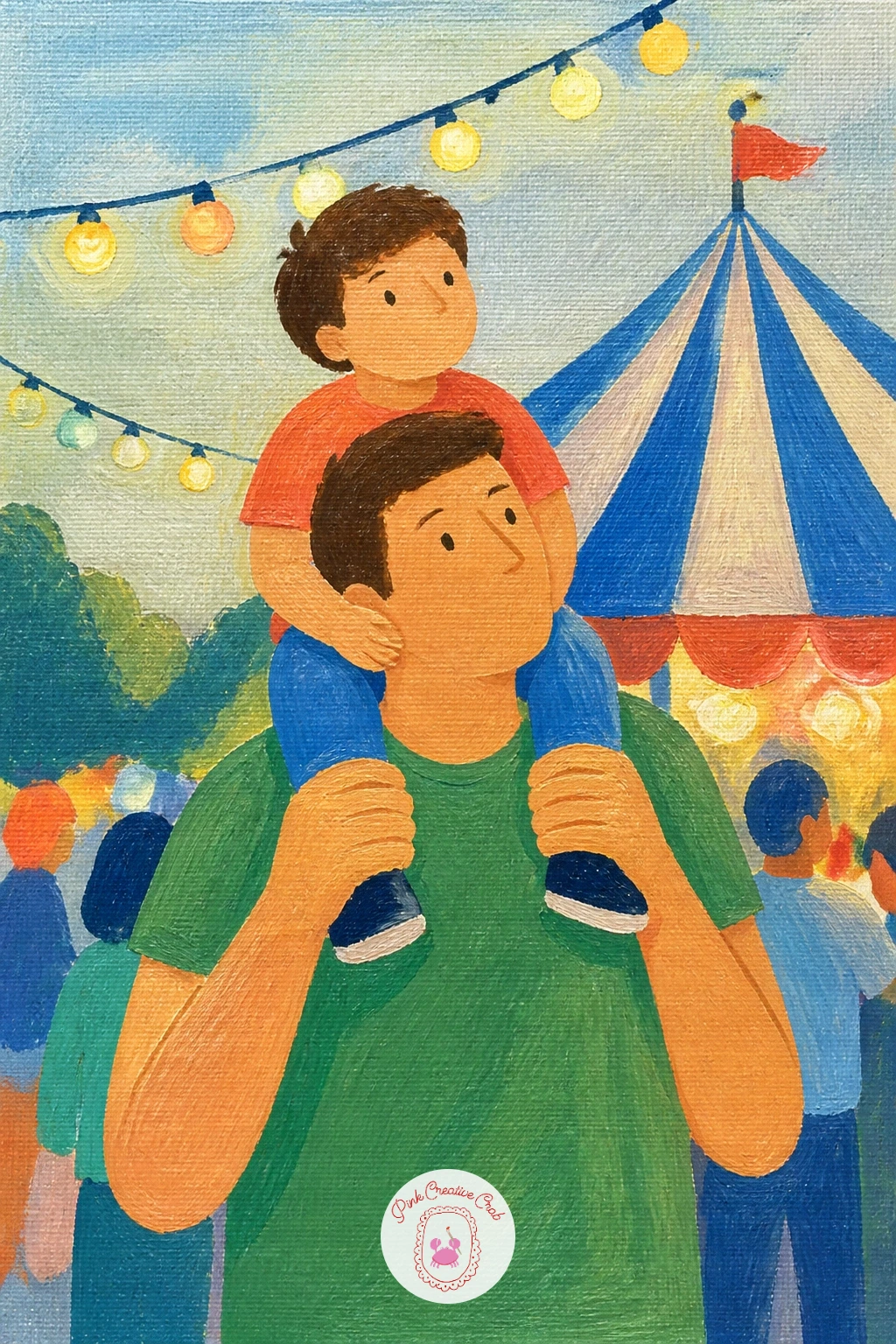
Build the fair behind them first as a few simple shapes: a striped tent triangle, a string of small round lights, a hint of a ferris wheel circle in the distance. Keep all of it loose and small so it stays background, not competition for the main figures.
Paint dad as the tallest shape in the canvas, legs planted wide for balance, then add the child sitting on his shoulders as a smaller rounded shape with arms raised. The join between the two bodies is the part that usually goes wrong, so paint dad’s shoulders slightly wider than you think you need, enough that the child’s legs have somewhere believable to rest.
Working in ten minutes, you can get the two figures and a simple string of lights finished and call it done. Given forty minutes, add the ferris wheel shape, a few more fairground lights, and a soft golden glow behind the whole scene using a thin cream wash over the dark sky.
If string lights feel fiddly, dot them in with the end of a paintbrush handle dipped in white instead of trying to paint each one freehand.
Palette: Coral,Payne’s Grey,Cream,Sap Green
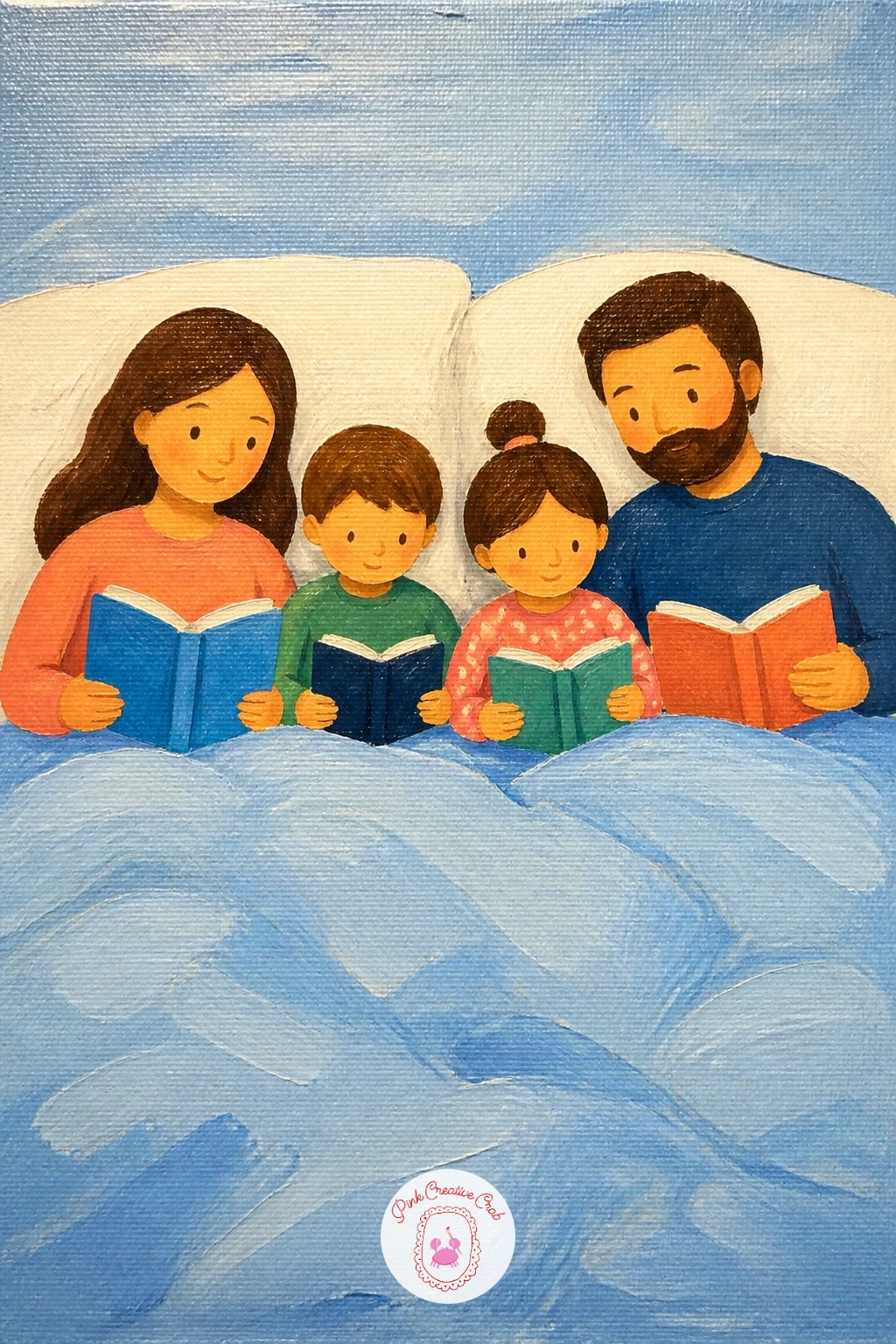
Lay the bed down as one large pale rectangle filling most of the lower canvas, since the bedding is the stage everyone sits on. A soft cream or pale blue quilt gives you room to pile pillows in slightly different shades without the scene turning busy.
Paint the family members propped against the pillows in a loose row, varying their heights and the angle of their shoulders so no two figures look identical. Give each one a small rectangle for a book held in their lap, which instantly reads as reading without needing any detail inside the book itself.
Eye level matters a lot here: paint this scene as if you are standing at the foot of the bed looking slightly down, which flattens the pillows into simple ovals and keeps the whole composition calm rather than tipping backward. Keep the lamp light, if you add one, coming from one bedside only, so one side of the group picks up a touch of warm cream.
If pillows feel tricky to shape, trace a coin or small lid lightly for the first one and freehand the rest to match its curve.
Palette: Cream,Cerulean Blue,Coral,Titanium White,Payne’s Grey
Start with the sand itself as a warm cream band across the lower third of the canvas, then build the castle as a stack of simple rectangles and a triangle flag on top, all painted before the children appear in front of it. Keep the castle small compared to the figures so the kids stay the clear focus.
Paint the siblings kneeling or crouched, their knees as simple rounded bumps against the sand, with a small bucket shape beside them tipped on its side. One sibling patting the castle with a flat hand reads clearly if you angle the arm diagonally rather than straight down.
Comparing heights before you paint saves this one: sit the siblings at slightly different sizes, since a scene with two identical figures reads as stiff rather than like real children at play. Leave the sea as a thin pale blue strip at the very top of the sand band to anchor the whole scene as a beach.
Swap the bucket for a simple spade shape if you want a bit more variety in the props.
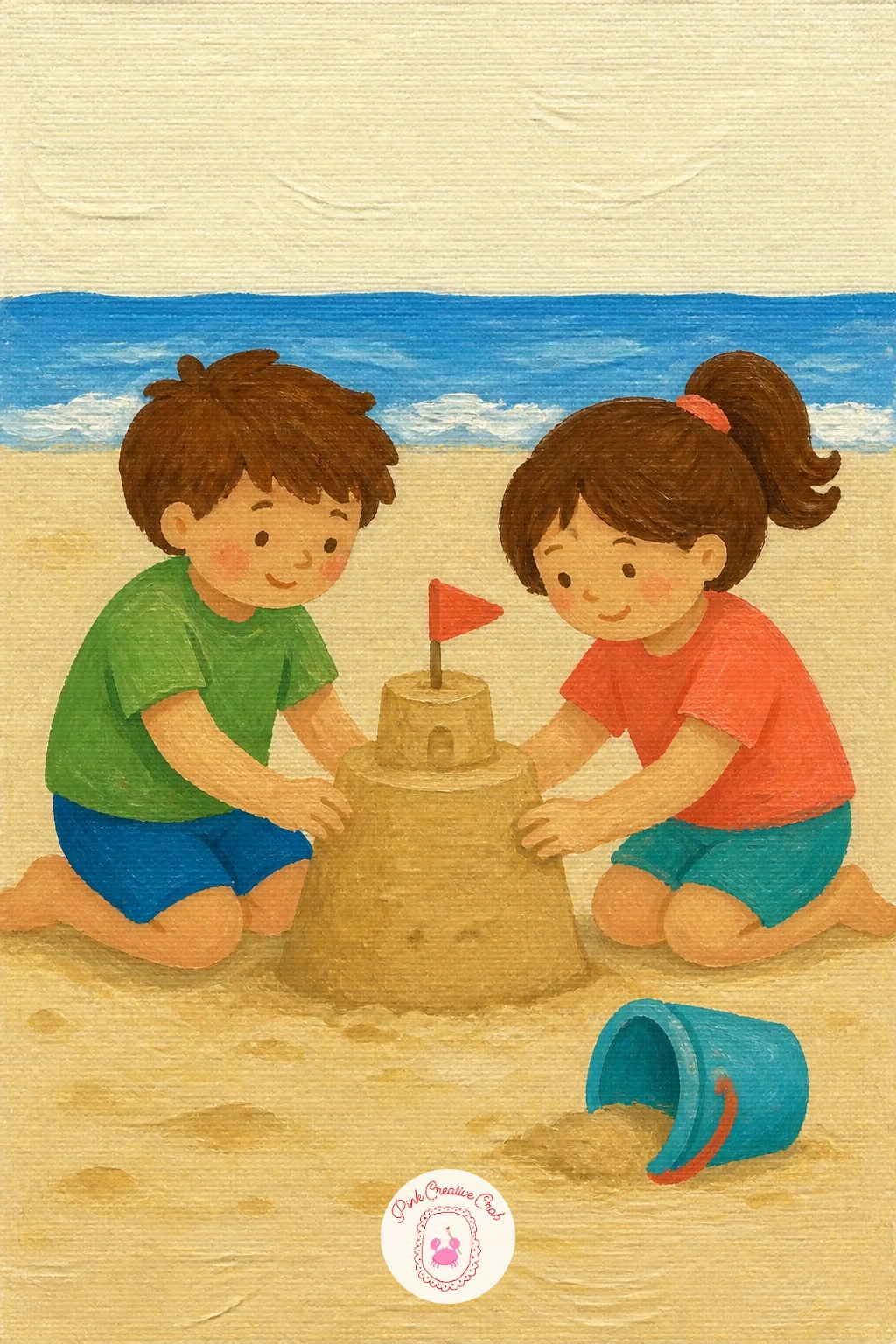
Palette: Sand,Coral,Cerulean Blue,Titanium White
Paint the sofa first as one large soft shape, rounded at the arms, in a muted blue or sage so it reads as upholstery rather than a hard rectangle. A cream throw blanket draped over one arm gives you a soft highlight area to work with later.
Paint mom reclined into the sofa cushions with the baby resting on her chest, both shapes overlapping into one gentle curved silhouette rather than two separate figures stacked awkwardly. Keep both faces turned slightly, eyes closed as two soft curved lines, which reads instantly as sleep without any real detail needed.
The edges of this piece carry most of the feeling, so once the base shapes are dry, soften the line where mom’s arm meets the baby’s back with a slightly damp flat brush, blending just that one edge so the two figures feel truly resting together rather than pasted on top of each other.
If you want a quicker version, skip the throw blanket and let the sofa color alone carry the whole background.
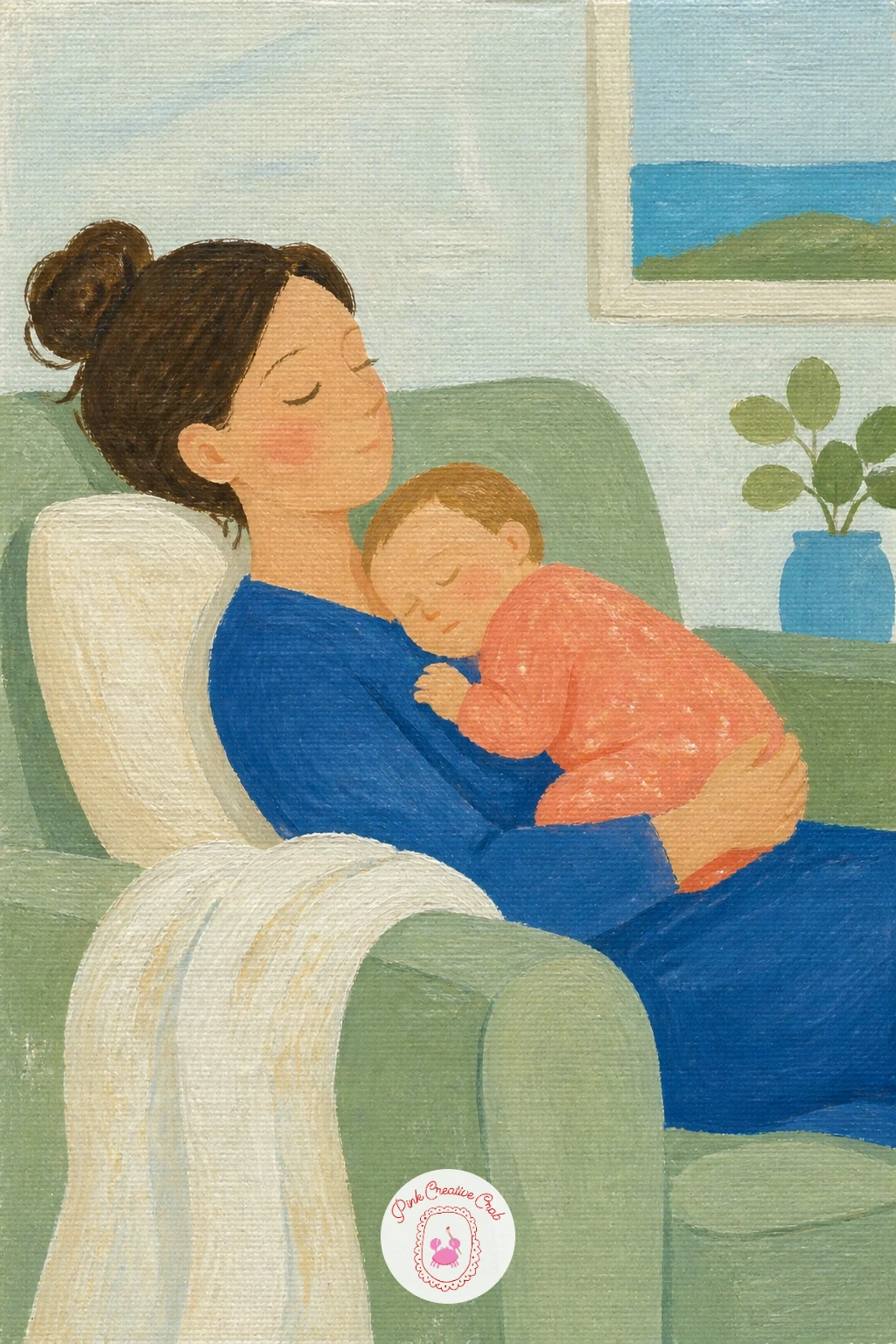
Palette: Sage Green,Cream,Coral,Payne’s Grey
Lay the road down as a pale grey band curving gently across the lower canvas, with soft green fields in flat blocks on either side. A few simple tree shapes along the horizon, just rounded green dabs on brown trunks, give the road somewhere to lead.
Paint the bikes as two simple circles for wheels joined by a thin frame line, then add a rider on each, leaning slightly forward with legs bent at the pedal. Space the family’s bikes at different distances along the road rather than in a straight line, which gives the painting depth without any real perspective drawing.
Wheels are the part that usually goes wrong, so use a small lid or coin to trace perfect circles rather than freehanding them, then paint the spokes afterward as a few thin crossing lines once the circle is dry. If a plate or lid is not handy, paint the wheel shape loosely and let a slightly imperfect circle read as charming rather than wrong.
Keep the road pale so the green fields and the riders carry the color.
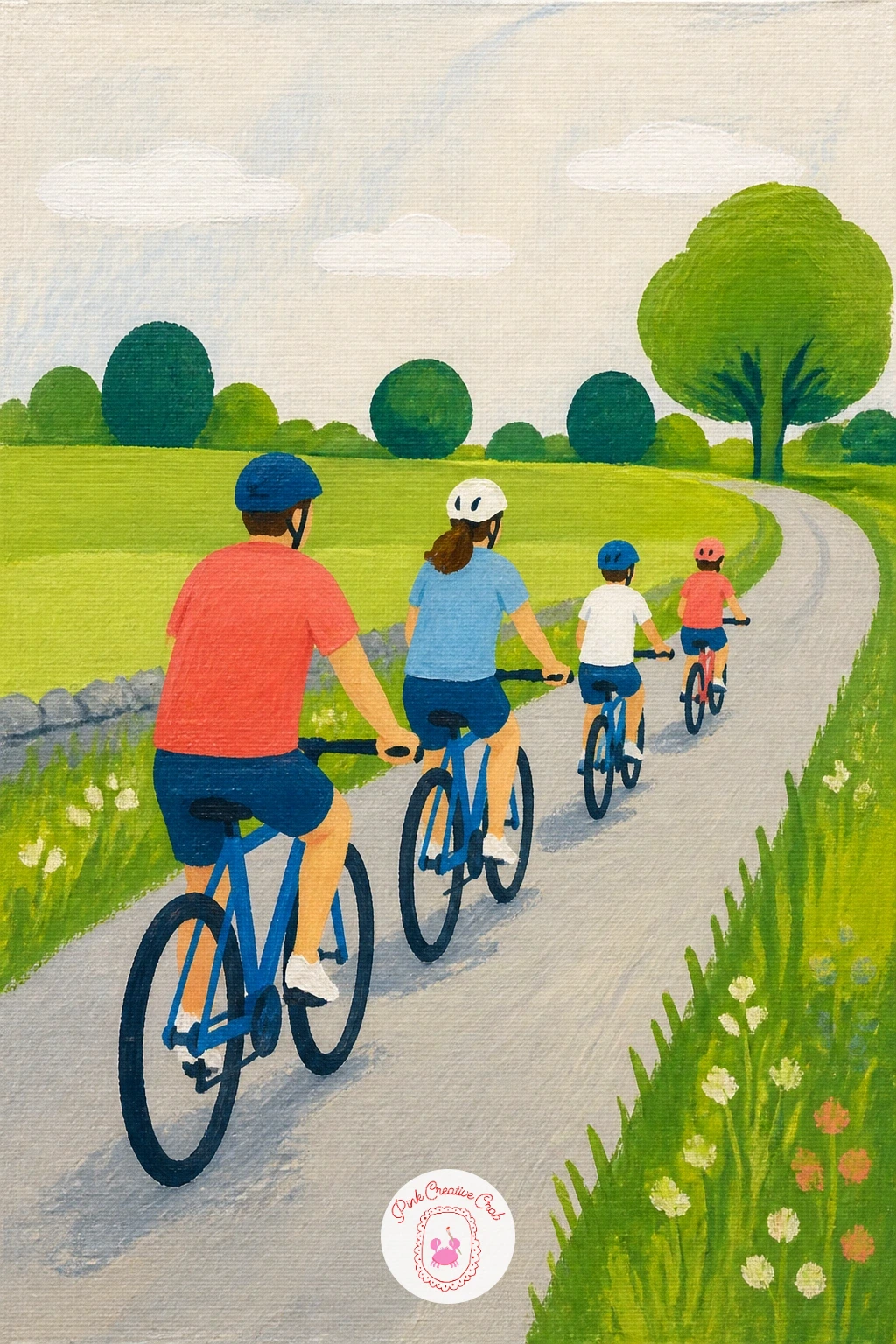
You Will Need
- small lid or coin to trace wheels
Palette: Sap Green,Payne’s Grey,Coral,Cream
Paint the table itself first as a simple oval or rectangle in warm cream, since it anchors every figure around it. A few plate shapes as small white circles and a bowl or two in the center give the table purpose before anyone sits down.
Work outward from the table to the chairs, placing each family member as a rounded seated shape with arms resting toward the center, some reaching for food, which reads as a shared meal rather than a formal portrait. Vary each person’s head tilt slightly so the group feels like they are mid conversation.
If the table looks flat once everyone is seated, add a thin shadow line along its front edge in a darker cream, which lifts it visually off the tablecloth and gives the whole scene a sense of weight. A warm wash across the whole background, cream fading to a soft coral near the edges, suggests evening light without painting an actual window.
Keep plates and bowls small and simple so the people stay the clear subject of the piece.
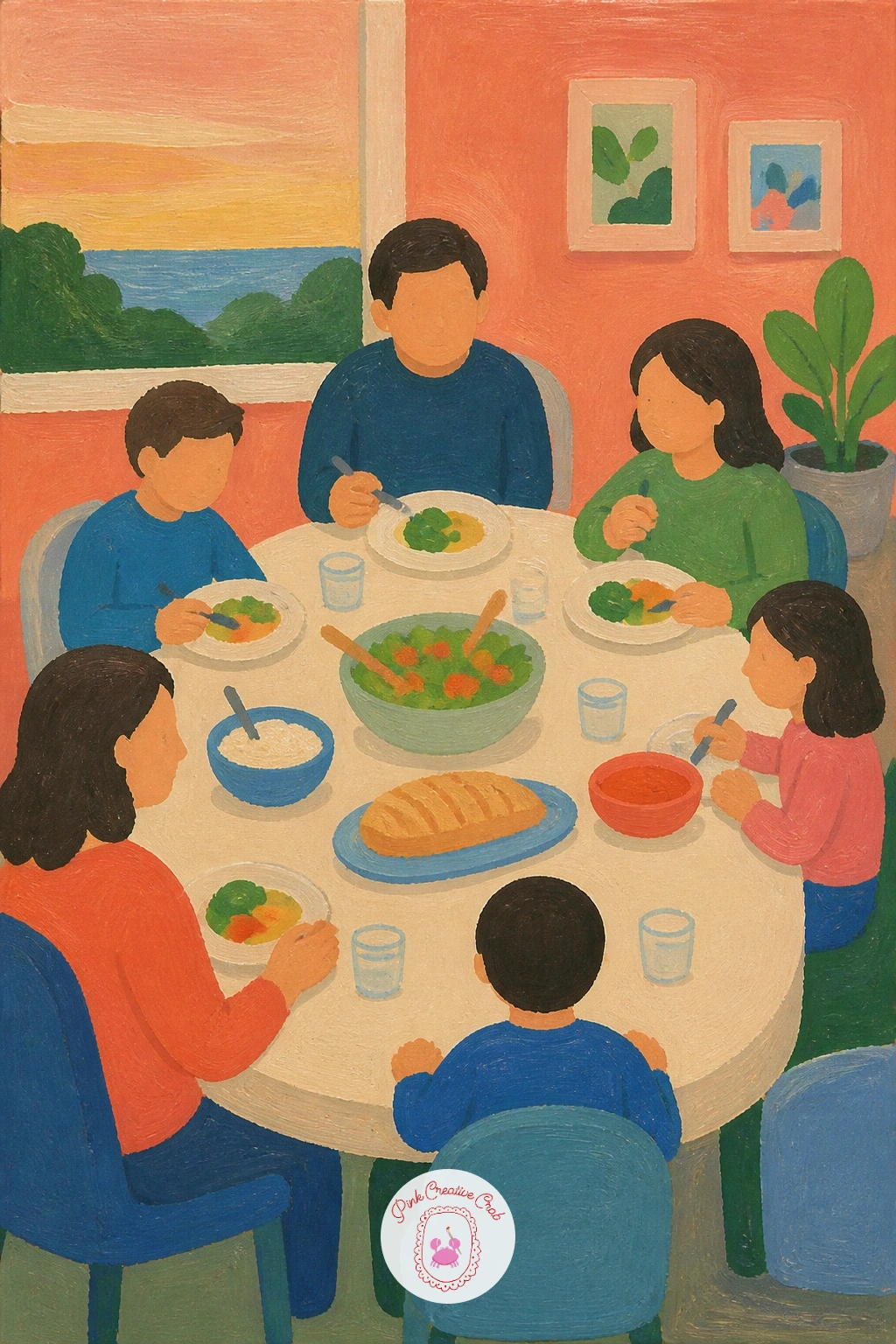
Palette: Cream,Coral,Burnt Sienna,Payne’s Grey
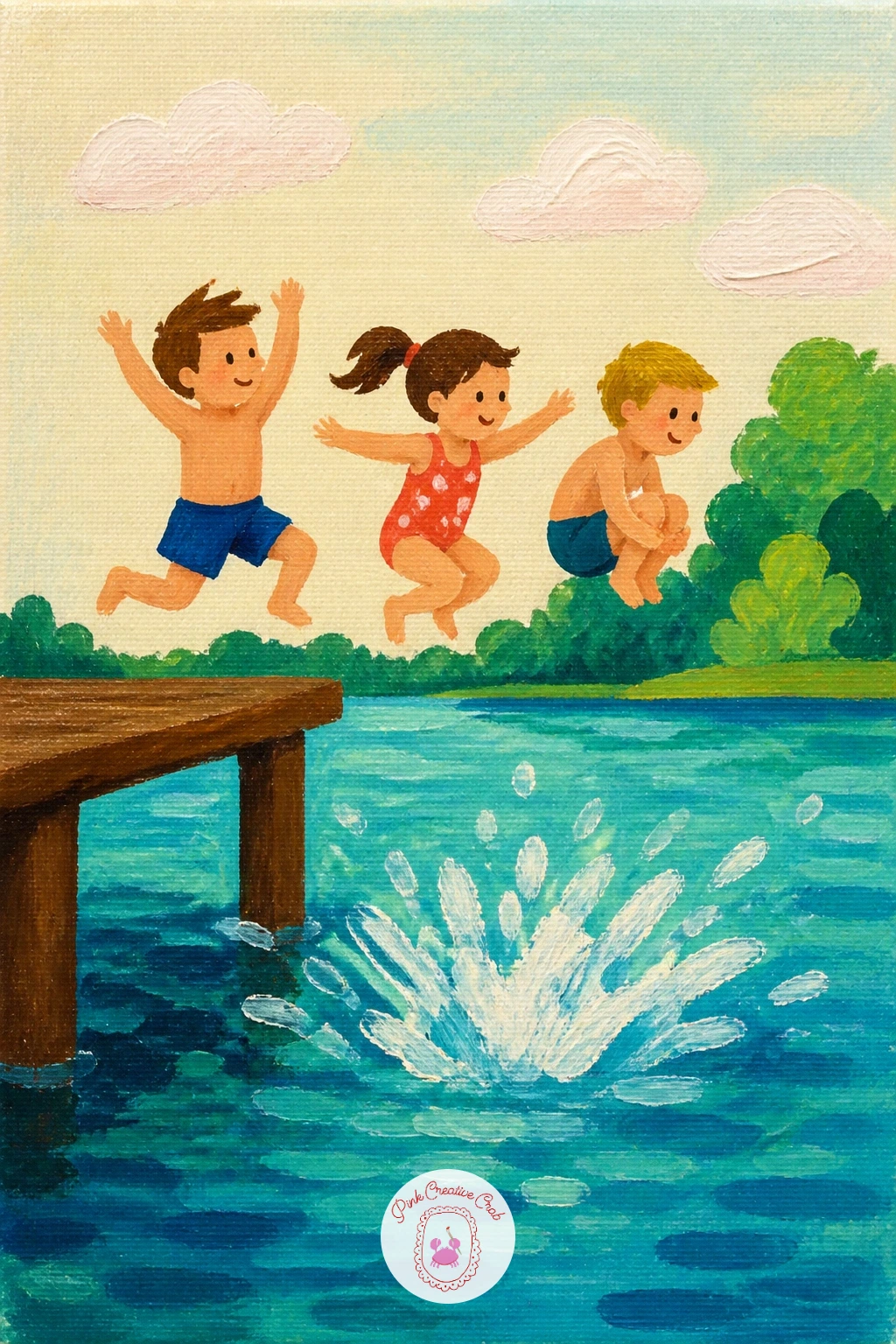
Lay the lake down first as a flat blue-green band filling most of the canvas, then add the wooden dock as a simple brown rectangle cutting across one side. Keep the water’s edge where it meets the dock crisp, since that line does most of the work of making it read as water.
Paint the kids mid jump, knees tucked up toward their chests, arms either hugging their legs or flung wide, which reads clearly as a cannonball even as a flat simple shape. Stagger two or three jumpers at slightly different heights above the water so the eye reads motion across the canvas rather than one static pose.
Splash marks save this one if the water looks too still: load an old toothbrush with white paint and flick the bristles with your thumb just below each jumping figure, which scatters a believable spray of droplets across the surface. Wipe the toothbrush and test the flick on scrap paper first so you control how much lands.
If a toothbrush is not available, dab small white commas with the tip of a round brush instead.
You Will Need
- old toothbrush for splatter
Palette: Teal,Burnt Sienna,Titanium White,Coral
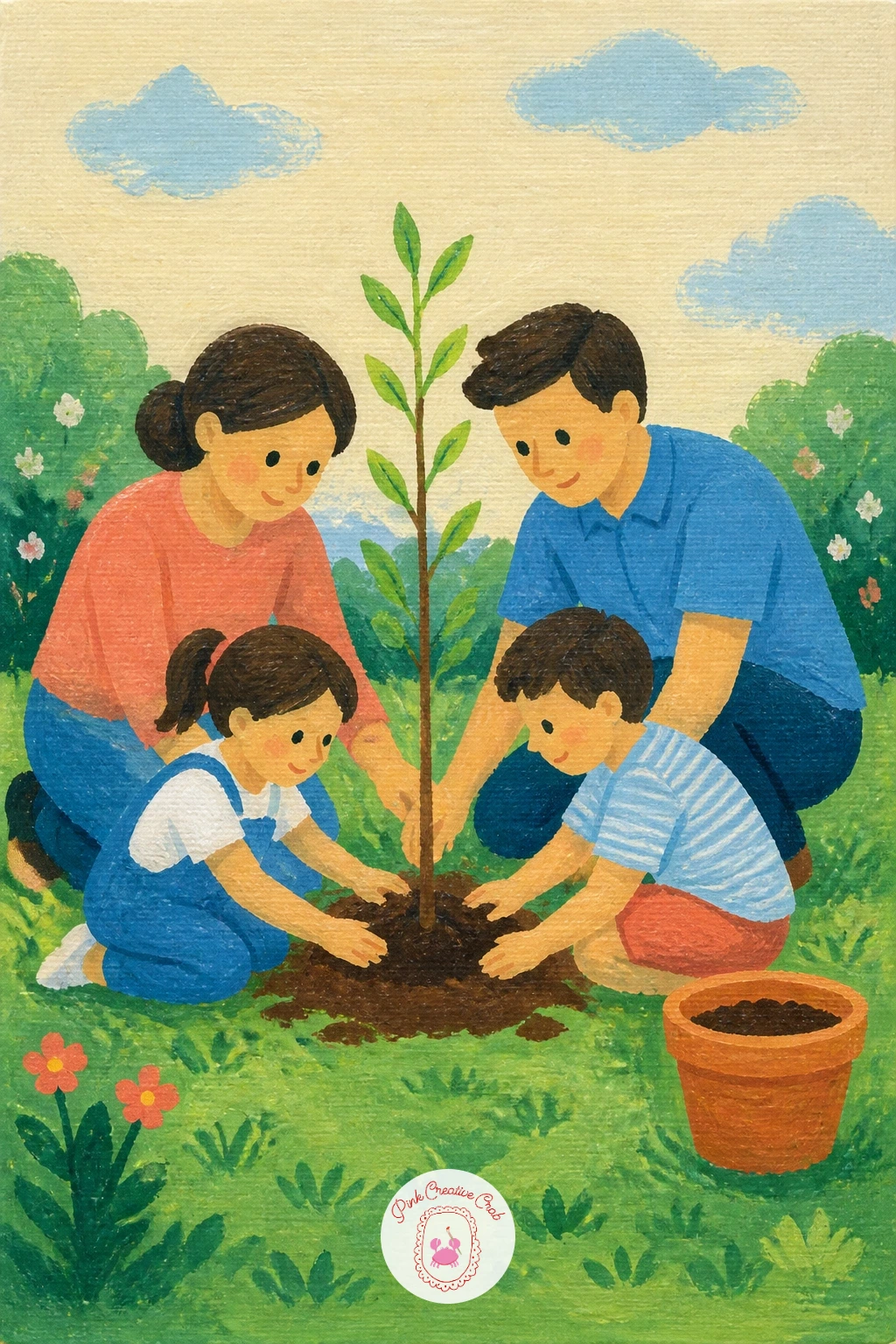
Dig in with the ground first, a warm brown mound where the hole sits, surrounded by flat green grass blocked in around it. The sapling itself is just a thin trunk with a small cluster of leaves, nowhere near the size of a full grown tree yet, which is the whole point of the scene.
Paint the family gathered around the hole, one adult holding the sapling upright while a child pats soil in with cupped hands, another family member standing with a watering can shape nearby. Keep everyone’s attention pointed down toward the hole, since that shared focus is what makes the scene read as one moment rather than separate figures.
This is a good one to make personal: next time, paint the same scene again years later with the sapling grown into a full canopy, same family poses, to hang the two side by side. For today, keep the sapling small and simple, just a stick with a few green dabs.
A terracotta pot shape beside the hole adds a nice warm color note if the rest of the palette feels too green.
Palette: Sap Green,Burnt Umber,Terracotta,Cream
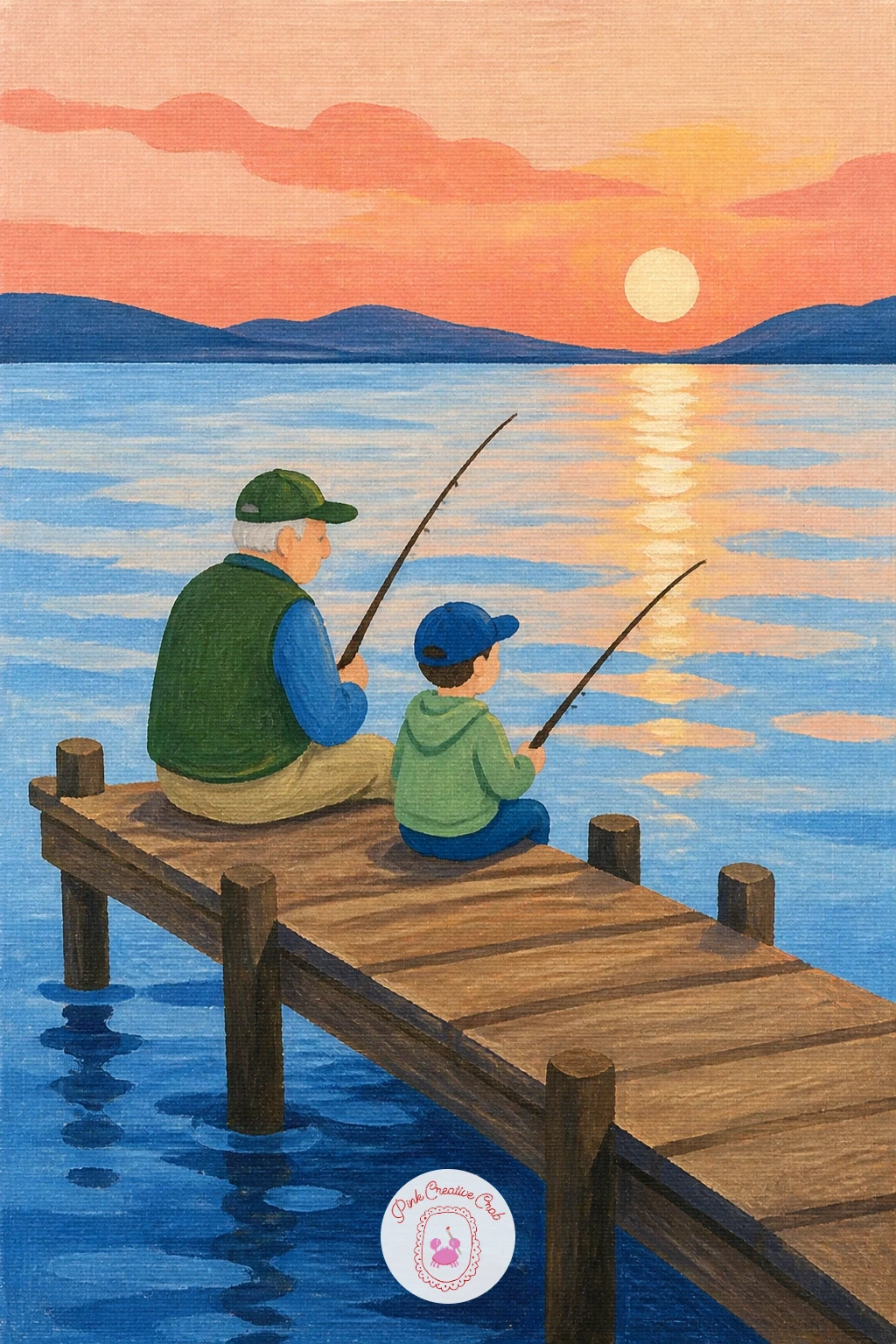
Lay the pier down as a simple wooden plank walkway cutting diagonally across the canvas, with calm blue water filling the space on either side. A diagonal pier, rather than a straight horizontal one, gives the whole composition more energy without any extra work.
Paint the grandfather seated on an upturned bucket or small stool, fishing rod held at an angle out over the water, with the grandchild standing close beside him holding a second smaller rod. Keep the fishing line as one single thin dark line from rod tip to water, which is enough to read clearly without fuss.
Where the light falls changes this scene a lot: paint it with a low warm sun behind the figures, just a soft coral glow near the horizon, and their shapes read as gentle silhouettes against the water, which suits a quiet fishing moment far better than flat daylight. Keep the water a touch darker where their silhouettes meet it, to ground them.
If rods feel fiddly at this size, use a ruler edge to guide one straight line for each rather than freehanding them shaky.
You Will Need
- ruler for fishing rod lines
Palette: Cerulean Blue,Burnt Umber,Coral,Payne’s Grey
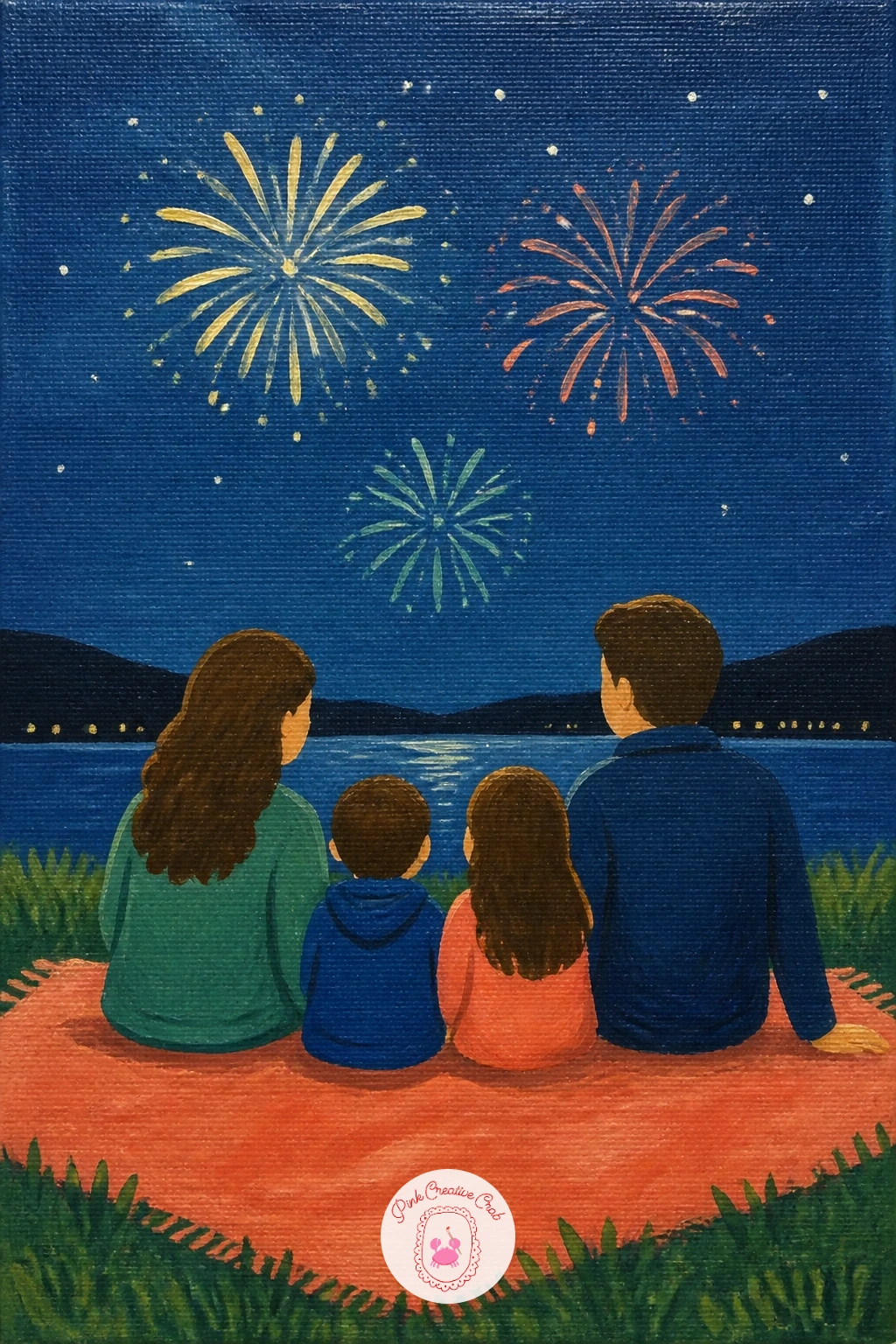
Start with a dark sky, nearly all of the canvas, in deep blue-grey, since the fireworks need a dark field to read against. Lay the family’s blanket down at the bottom edge as a simple coral rectangle, with the family seated on it in a loose row, heads all tipped back and up.
Paint the fireworks last, once the sky is fully dry, as a few bursts of thin curved lines radiating from small bright centers in white, coral and a soft yellow. Keep the bursts to two or three rather than filling the whole sky, since a few well placed ones read as more dramatic than a cluttered sky.
Lifting a little wet paint with a dry brush right after you lay the burst color creates a soft glow around each firework instead of a hard-edged shape, which is the texture trick that makes this scene feel like it is actually lighting up the night. Work fast before the paint sets if you want that soft halo.
If lifting feels tricky, a thin ring of white dry-brushed around each burst gives a similar glow.
Palette: Payne’s Grey,Coral,Titanium White,Yellow Ochre
This one follows naturally from the family bike ride, but now the focus narrows to just two figures and one bike. Paint a simple path or driveway in pale grey first, with a soft green lawn block on either side, keeping the background quiet so the action stays central.
Paint the child seated on the bike, both feet still near the pedals, wobbling slightly, which you can suggest just by tilting the whole bike shape a few degrees off upright. Paint dad’s hand reaching toward the back of the bike seat, his arm bent and his body leaning in the same direction as the bike’s tilt.
Measuring dad against the bike before you paint saves the proportions here: stand him roughly twice the bike’s height, with the child sitting at about half of dad’s height, which keeps the whole scene looking like a real size relationship rather than guesswork. A training wheel, left off on purpose, makes it clear this is the moment of letting go.
Keep the path simple so the tilt of the bike is the detail that carries the whole story.
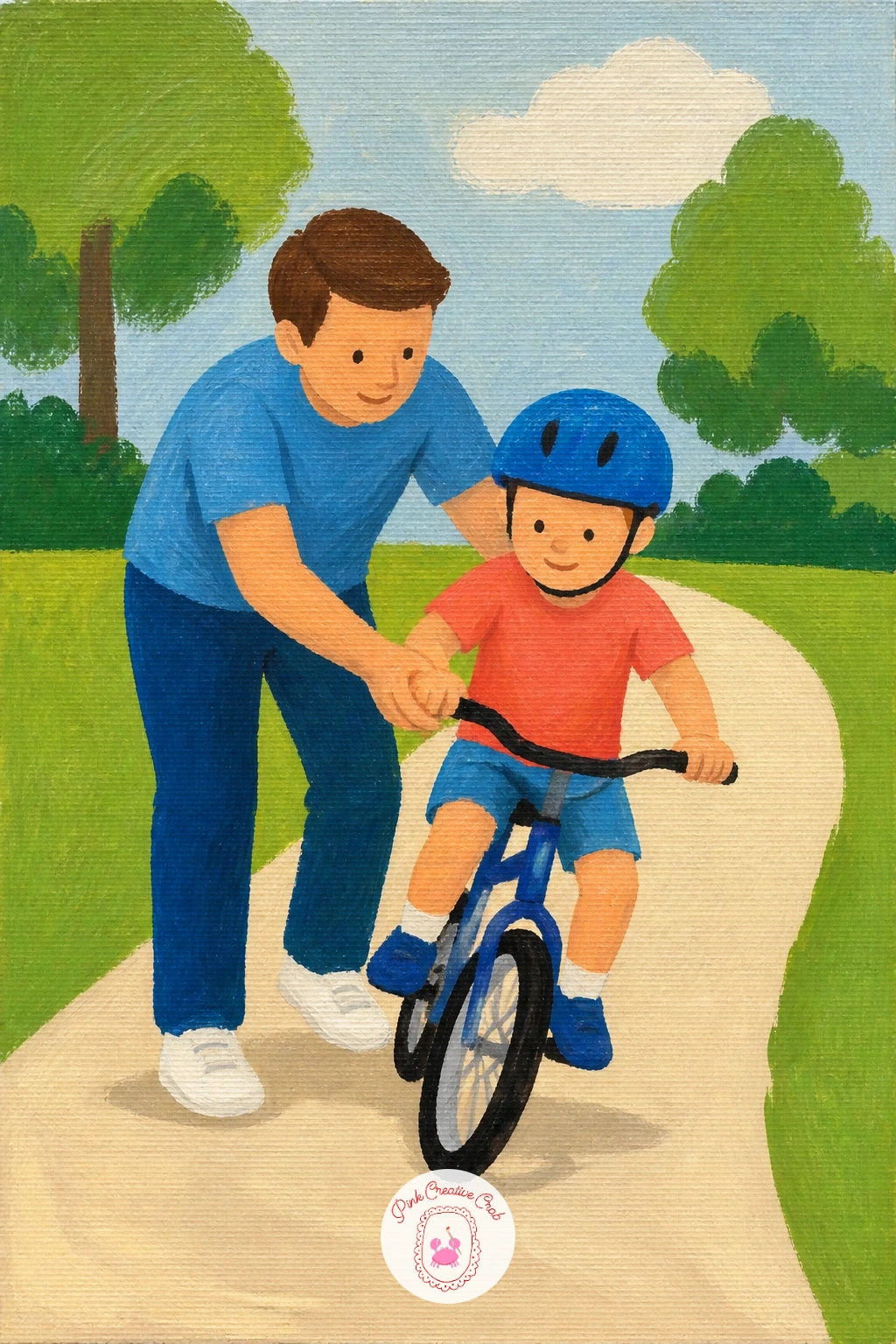
Palette: Sap Green,Payne’s Grey,Coral,Cream
Lay in the hillside as a few overlapping green shapes receding into a pale sky, with a thin brown path winding up through the middle. Keep the farthest hills paler and cooler in tone than the nearest one, which pushes the background back without any detailed brushwork.
Paint the family in a loose line along the path, each figure a little smaller than the one in front to suggest they are walking up and away from the viewer. Add the dog trotting just ahead or beside them as a simple four legged shape with a raised tail, which reads instantly as a happy dog on a walk.
If you want a quicker version, paint just the dog and one adult figure at the front of the path and call it finished in ten minutes. Given forty minutes, add the full family line, a small backpack shape on one figure’s back, and a bit more texture in the hillside greens using a stippled dry brush.
A simple walking stick shape on one adult adds personality without much extra effort.
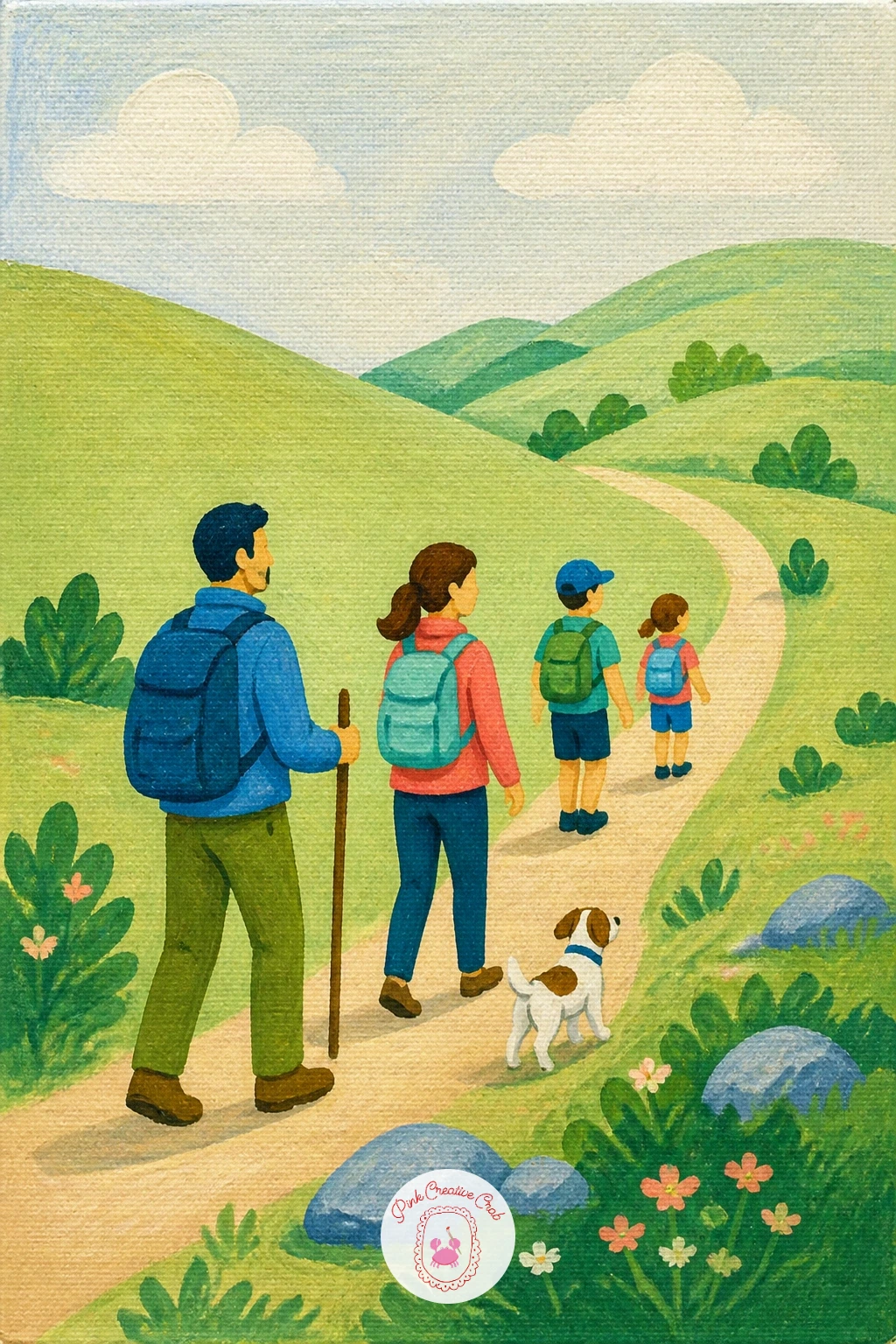
Palette: Sap Green,Burnt Umber,Cream,Payne’s Grey
Paint the two figures close together first, mom seated slightly behind and above the daughter, since the height difference is what makes the pose read clearly as braiding rather than two people just standing near each other. Keep both faces in soft profile or simply turned away, which suits this quiet pose better than front-facing features.
Build the daughter’s hair as one large flowing shape before you paint any braid detail, in a warm brown or soft black, then add the braid itself as a few diagonal strokes crossing over each other down its length. Mom’s hands rest at the top of the braid, painted as simple rounded shapes rather than detailed fingers.
The braid crossing pattern is the part that trips people up, so keep it to just three or four crossing strokes rather than trying to paint every strand, which reads as a braid from a normal viewing distance without looking fussy. A soft ribbon tied at the end in coral finishes the shape nicely.
If hair color feels tricky to mix, warm brown with a touch of burnt sienna gives a natural, friendly tone.
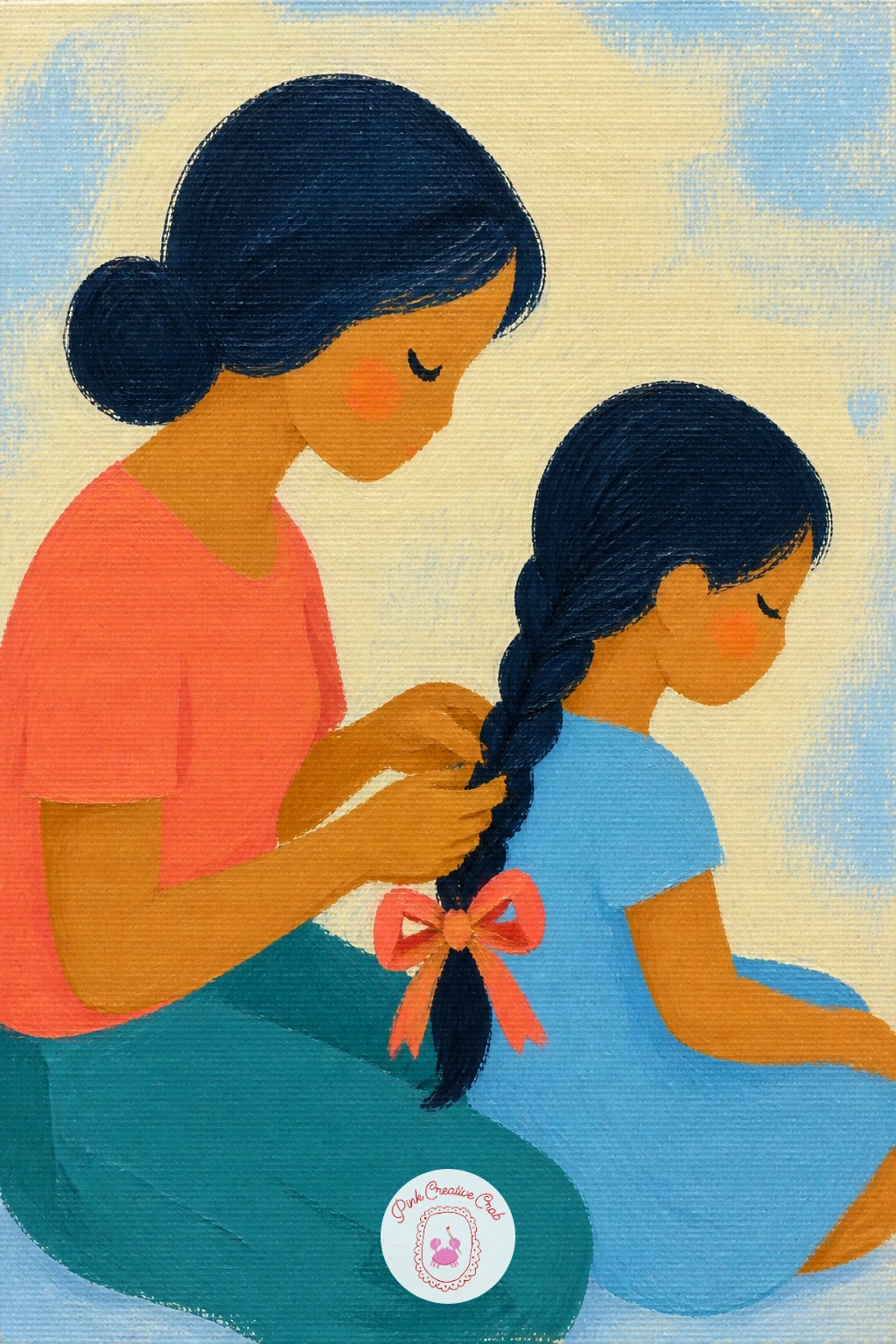
Palette: Burnt Sienna,Cream,Coral,Payne’s Grey
Paint the bed and room as a few flat pale shapes first, since this scene has enough energy in the figures that the background should stay calm and simple. A cream quilt and a soft blue wall behind keep the busy part of the painting contained to the people.
Paint each family member mid motion, one with a pillow raised overhead, another ducking with arms up to block, a third mid laugh with a pillow already swinging past. Scatter a few loose white feather shapes in the air around them, just small curved dashes, to suggest a pillow has already burst.
Diagonal poses are what sell the motion here, so tilt every figure’s shoulders or arms off the straight vertical, since a pillow fight painted with everyone standing straight up and down reads as stiff rather than playful. Keep the feathers sparse, five or six is plenty, rather than filling the whole sky with them.
If a figure’s pose feels flat, raise one of its feet slightly off the bed to suggest a bounce.
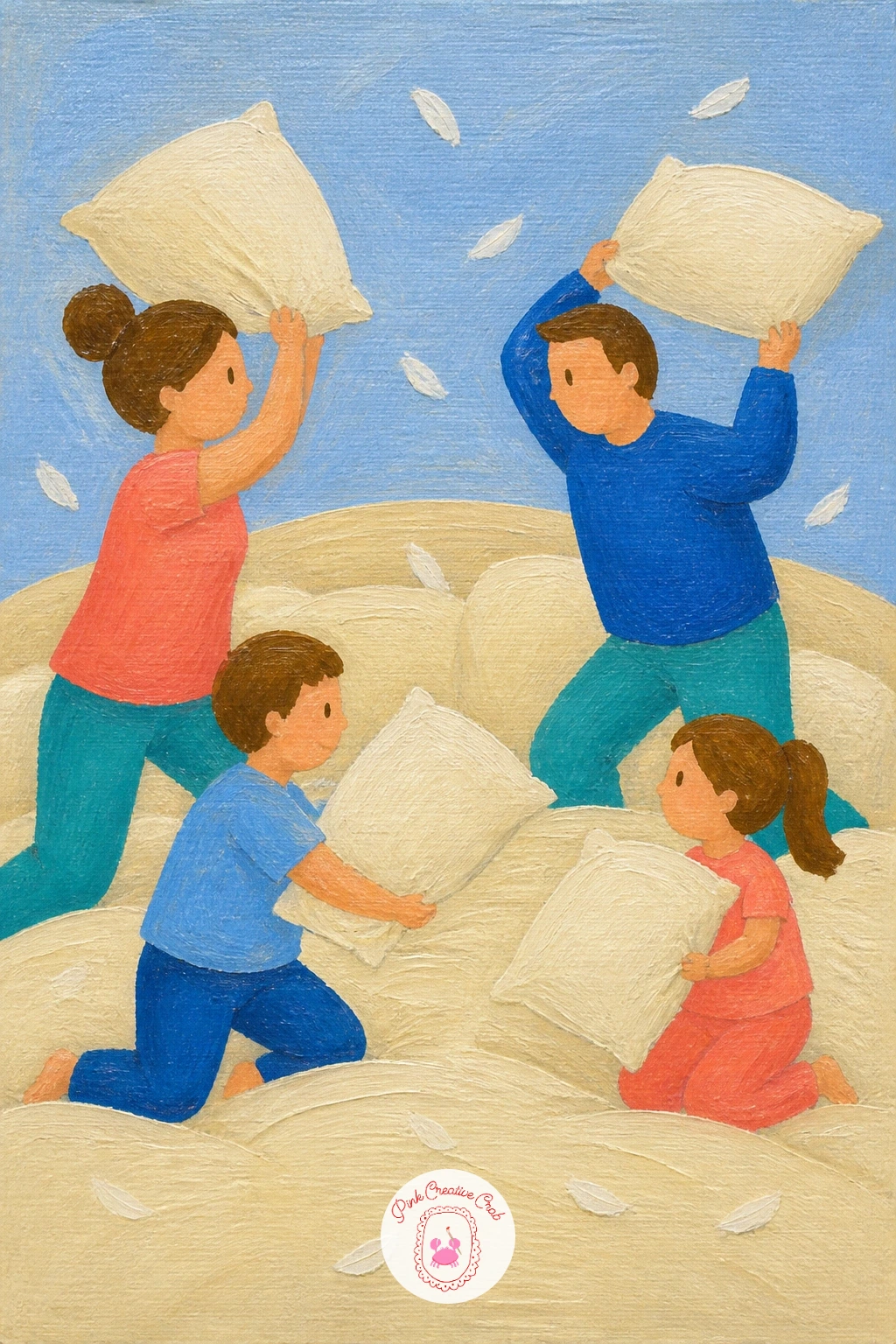
Palette: Cream,Cerulean Blue,Coral,Titanium White
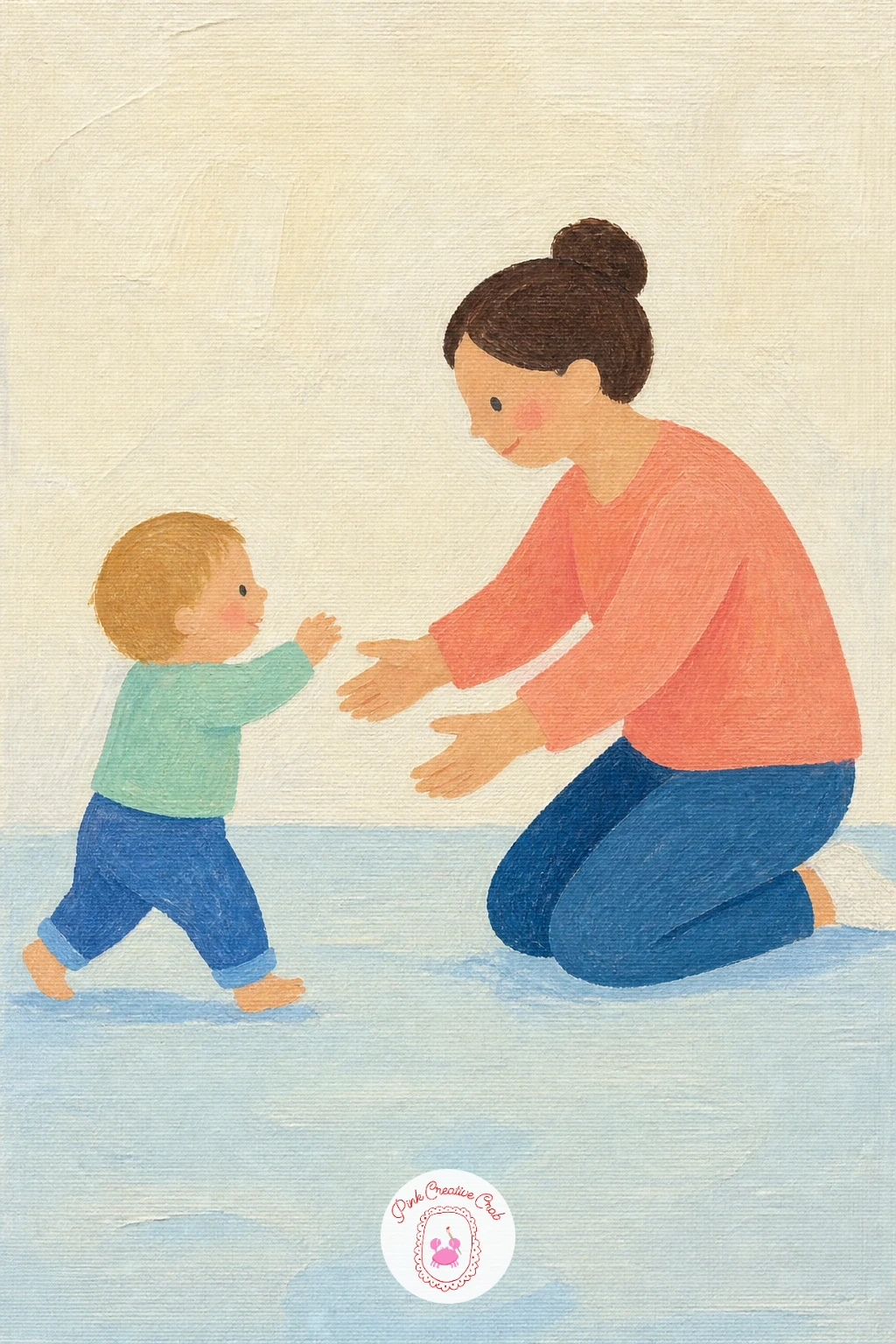
Keep the room almost bare for this one, just a pale floor and wall, so nothing competes with the two small figures at the center of it. Paint mom kneeling with both arms open wide, her whole body shape tilted slightly forward in welcome.
Paint the toddler a few steps away, standing with legs wide apart for balance and arms held out slightly for the same reason, which instantly reads as the wobble of a first step. Keep the toddler noticeably smaller than mom, since getting that size difference right is what makes the moment believable.
Comparing the two figures’ heights before committing to paint saves this one: a toddler standing should come up to roughly mom’s knee or lower thigh when she is kneeling, not halfway up her body. A single toy or small shoe shape dropped on the floor behind the toddler adds a nice detail without extra fuss.
If you want a softer feel, use a slightly damp brush to blur just the edge where the toddler’s feet meet the floor.
Palette: Cream,Coral,Cerulean Blue,Titanium White
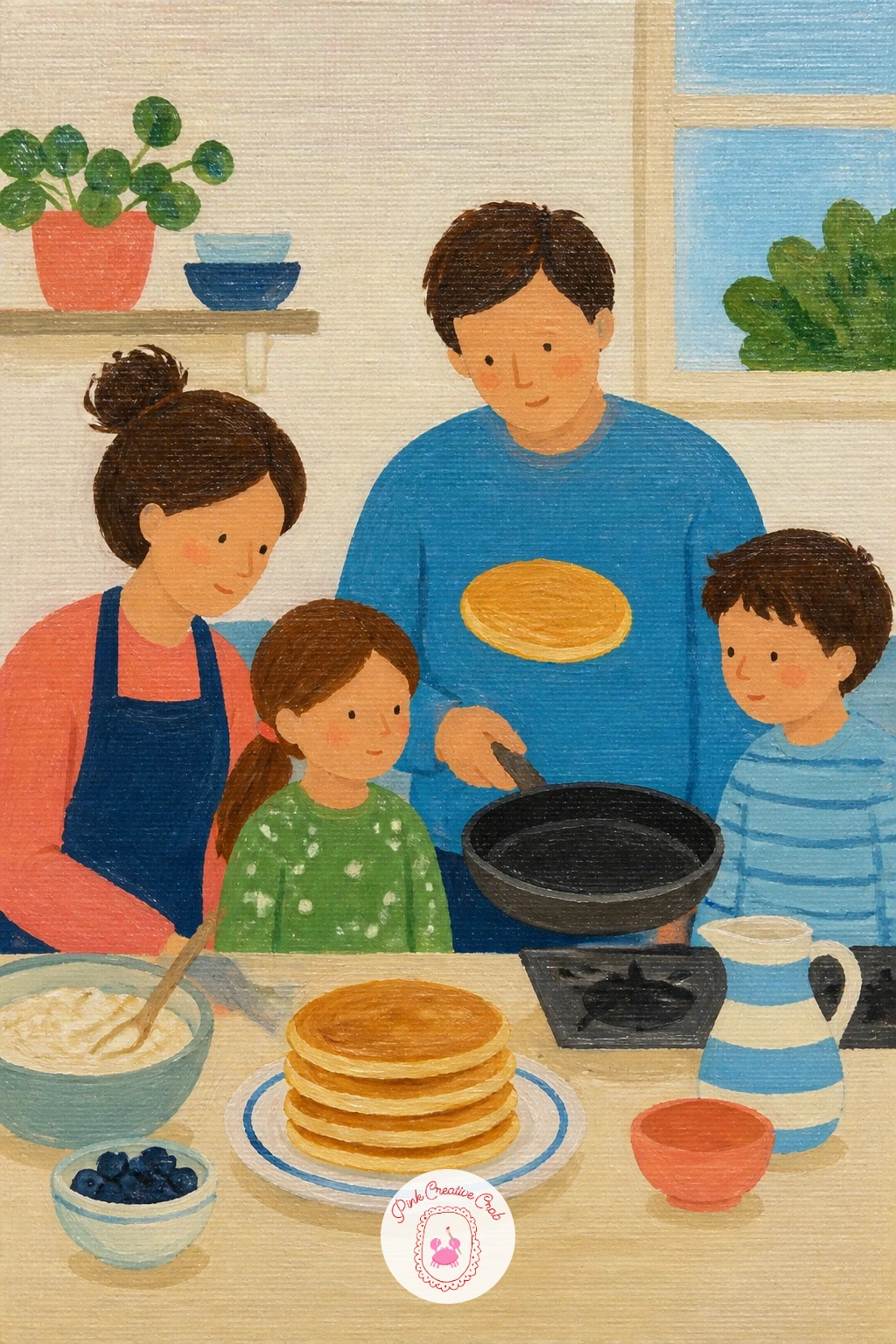
This scene moves the kitchen idea onto the breakfast table, so start with a cream counter and a stack of pancakes as a few stacked ovals, golden brown on top, cream at the edges. A small jug shape beside the stack suggests syrup without needing any fine detail.
Paint the family gathered around the counter, one figure flipping a pancake mid air over a simple black pan shape, the others reaching in with small plate shapes held up. Keep the flipping figure’s arm raised high and bent at the elbow, which is the single pose detail that makes the whole scene read as active rather than static.
A loose dry brush dab of golden brown on the pan’s edge suggests a little sizzle and browning without painting every bubble in the batter. If flipping a pancake mid air feels too tricky to pose convincingly, paint the stack already finished on a plate instead and keep everyone simply seated and reaching for it.
Keep the syrup jug’s color warm amber so it reads clearly against the cream counter.
Palette: Cream,Yellow Ochre,Coral,Payne’s Grey
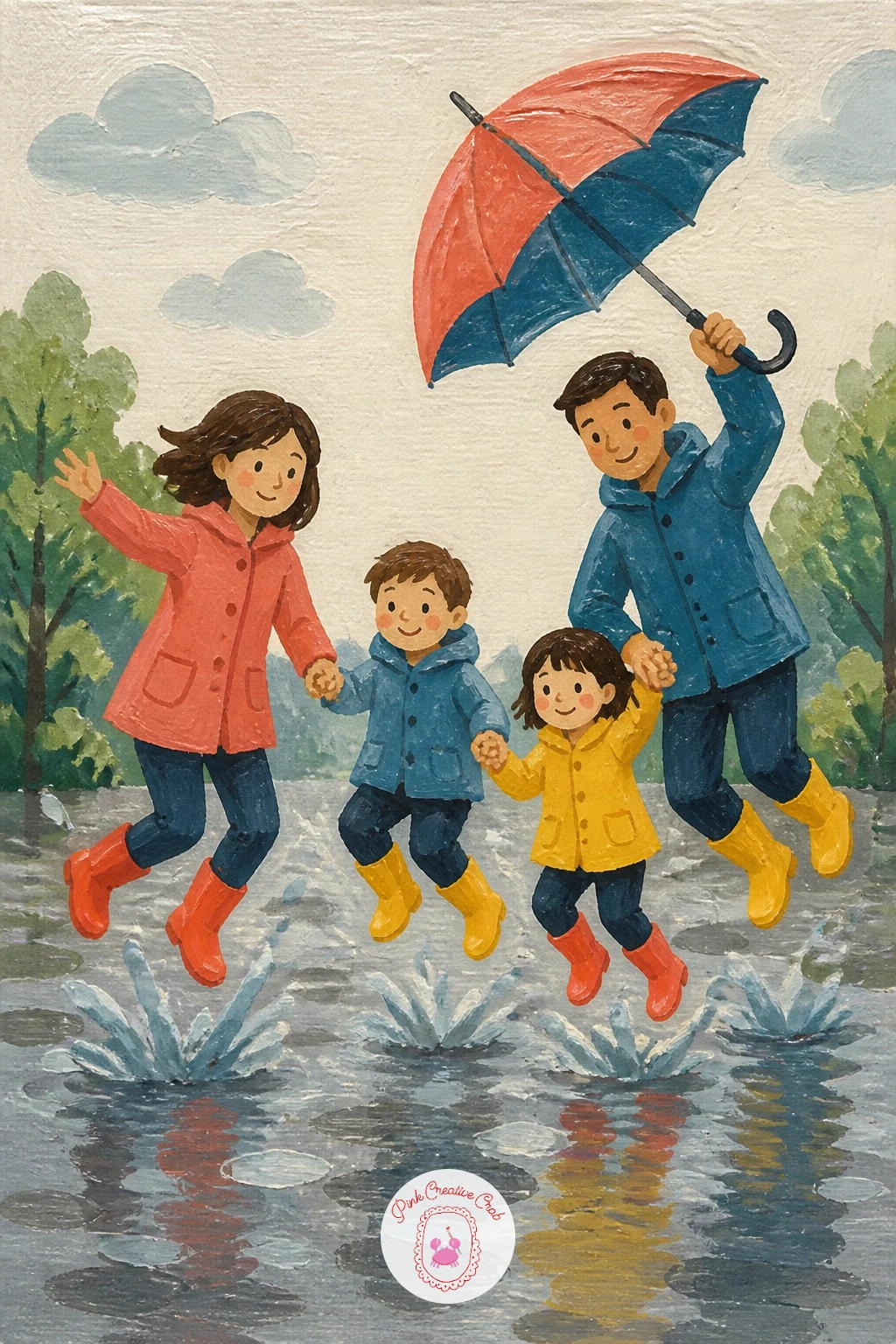
Paint the ground first as a wet grey pavement with a few oval puddle shapes scattered across it, each puddle a slightly darker reflection of the pale sky above. Keep the puddles simple flat ovals rather than trying to paint detailed reflections inside them.
Paint each family member mid jump into a puddle, knees bent and raised, rain boots in bright coral or yellow standing out clearly against the grey ground. A simple umbrella shape held by one figure, tilted at an angle, adds a nice diagonal to balance the jumping poses.
Splash marks make this scene: once the puddle and boots are dry, flick white paint from a loaded toothbrush just around each boot that is mid splash, which scatters a convincing spray of water droplets outward. Keep the splash contained close to each boot rather than letting it spread across the whole puddle.
If a toothbrush is not available, a few short white dashes painted with a fine brush around each boot gives a similar splash effect.
You Will Need
- old toothbrush for splatter
Palette: Payne’s Grey,Coral,Yellow Ochre,Titanium White
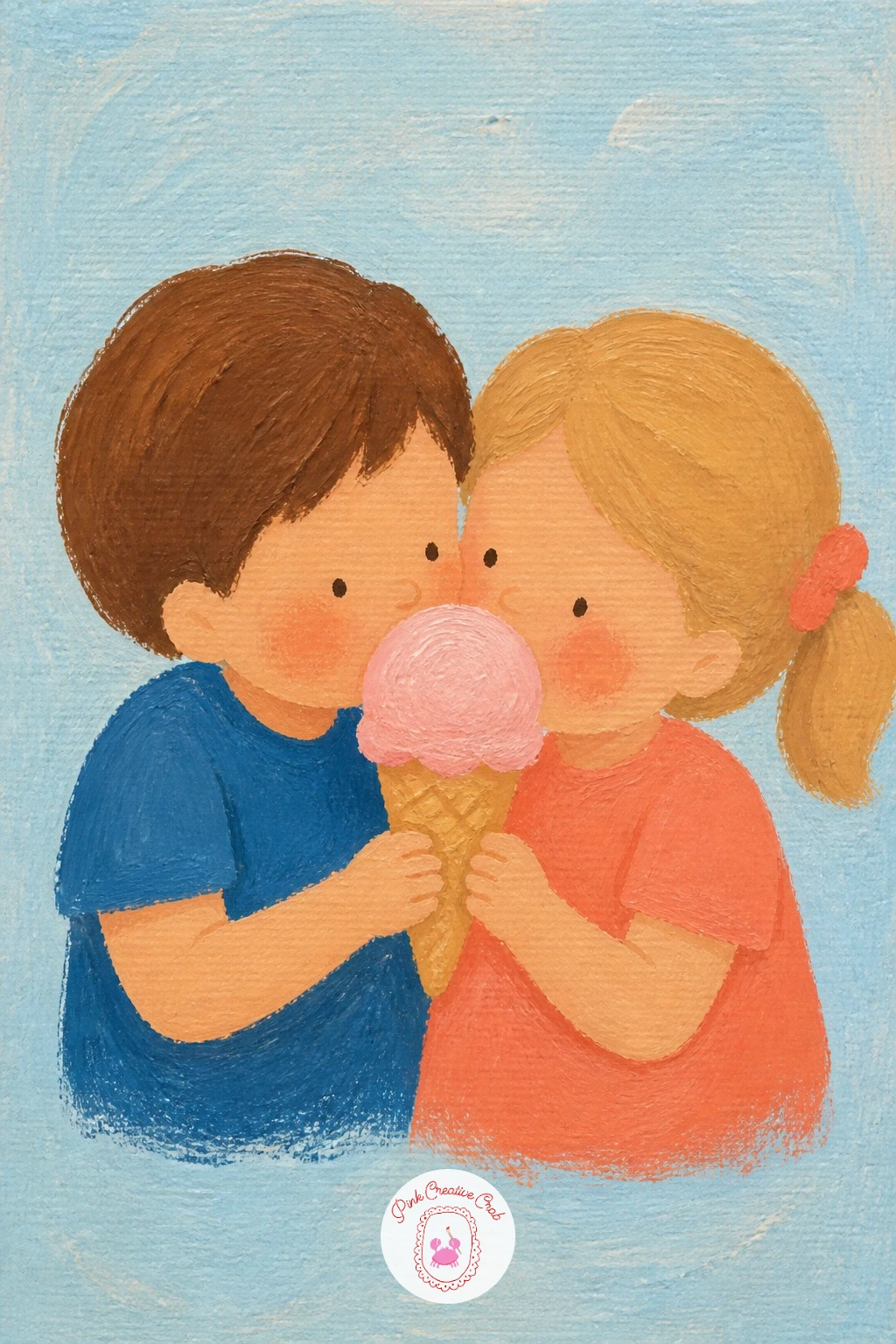
Keep the background almost bare for this one, a flat pale coral or cream, since two small figures and a cone are plenty on their own. Paint the cone first as a simple tan triangle with a rounded scoop of ice cream balanced on top in a soft pastel color.
Paint the two siblings standing close together, both leaning in toward the cone from opposite sides, heads tilted toward each other rather than straight on. Keep one sibling’s hand holding the cone steady and the other’s just reaching in, which reads clearly as sharing rather than two separate figures eating alone.
Melting ice cream is a nice texture trick here: once the scoop is dry, drag a small amount of the same pastel color downward in a thin trickle with a fine brush, then dab a drop at the bottom with the brush tip. Keep the drip to one thin line rather than several, so it reads as melting rather than messy.
If pastel colors feel too pale to photograph well, add a touch more pigment to the ice cream scoop than you think you need.
Palette: Cream,Coral,Pastel Pink,Burnt Sienna
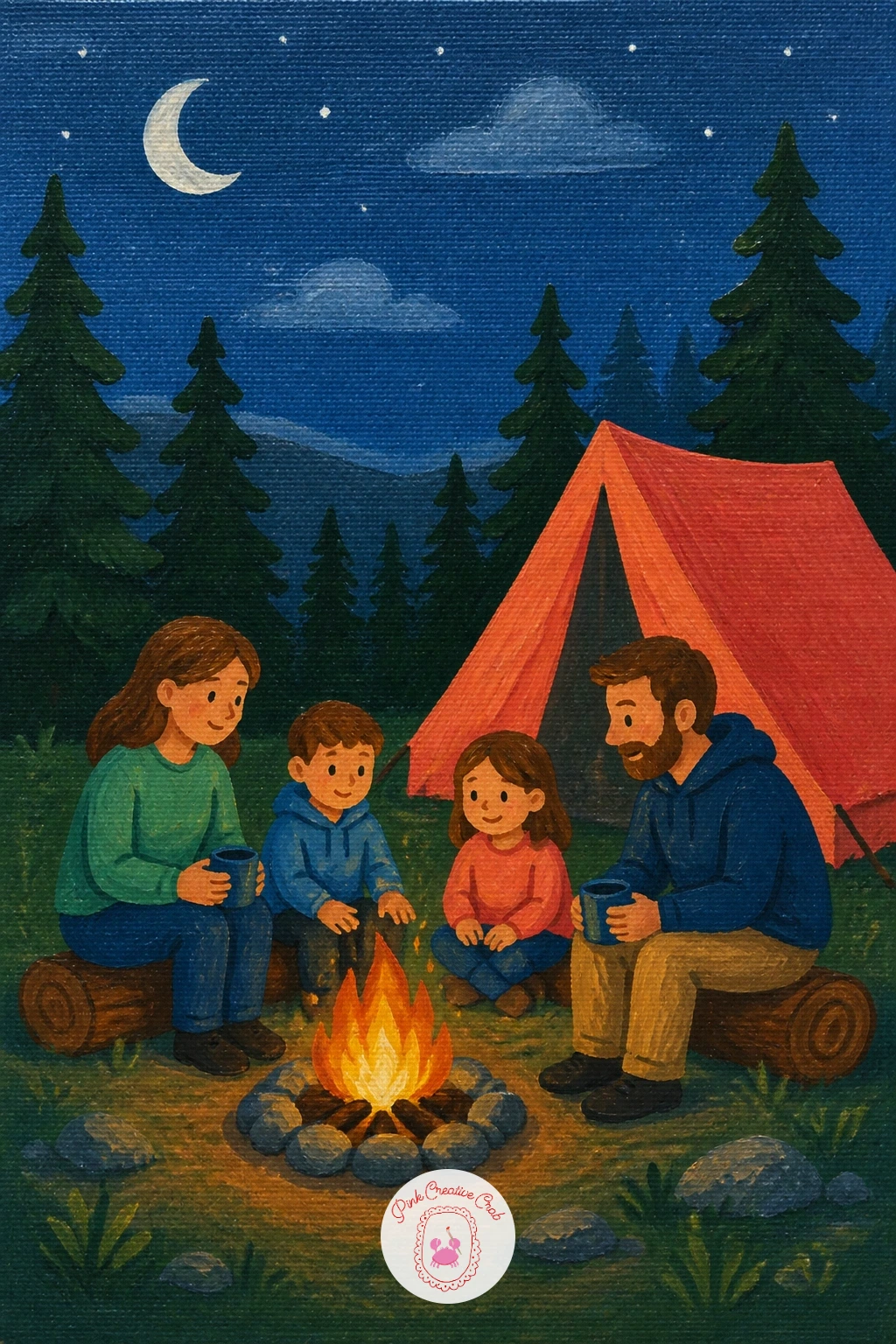
Lay the ground down first as a simple dark green field with a pale path of flattened grass leading up to the tent. Paint the tent itself as two triangles joined at a peak, in a warm coral or muted blue, which sits as the clear anchor shape of the whole composition.
Paint the family gathered just outside the tent flap, seated on a log or folding chairs painted as simple rectangles, with a small campfire shape glowing between them in orange and yellow. Keep the fire small, just a cluster of upward pointing triangle flames, rather than trying to paint realistic flickering flames.
Where the light sits changes everything in this scene: keep the fire as the main light source, which means the family’s faces and the inside edge of the tent should pick up a warm orange glow while the surrounding trees and sky stay in cool blue-grey shadow. That single contrast is what makes a campfire painting feel lit from within.
If you do not want to paint flames, a simple lantern shape hung on a stick works just as well as the light source.
Palette: Sap Green,Coral,Yellow Ochre,Payne’s Grey
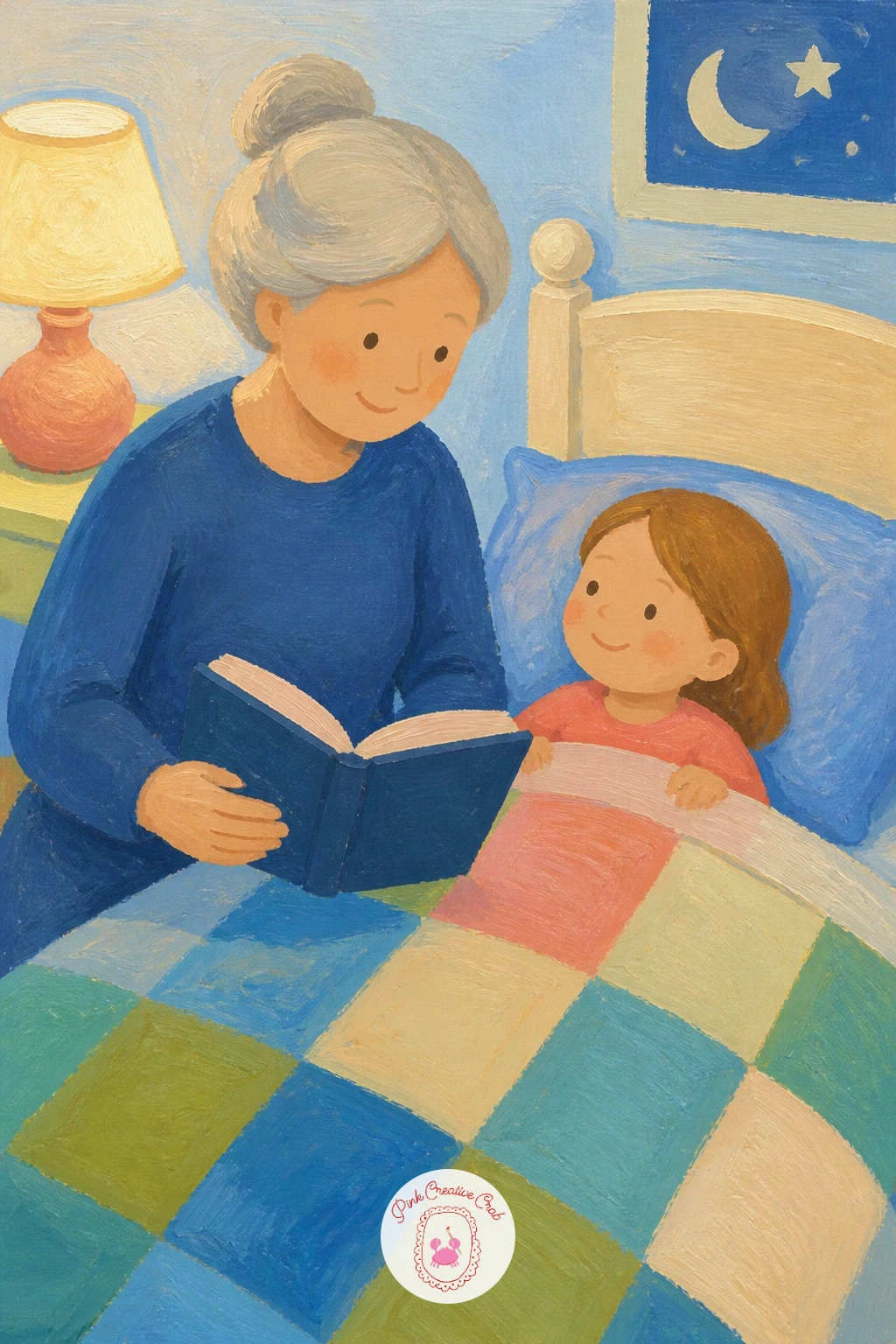
Paint the bedroom as a few quiet shapes first, a bed corner, a small lamp with a warm glow, nothing more, since the point of this scene is the closeness between two figures rather than a busy room. A soft pastel wall color keeps the whole thing calm.
Paint grandmother seated on the edge of the bed with a book shape open across her lap, the child tucked in beside her under the covers, head resting near her arm. Keep grandmother’s shoulders rounded and a little stooped, which reads as age gently without any wrinkles or detailed features needed.
The lamp’s glow is worth a little extra care: paint a soft circle of warm cream light around the lamp itself, fading out into the cooler wall color beyond it, which pulls the eye straight to the two figures reading together. Keep the rest of the room a shade or two darker than the lamp’s glow so the light reads as the only source.
If you want a simpler version, skip the lamp glow entirely and let the pastel wall color alone carry the cozy feeling.
Palette: Cream,Pastel Lavender,Payne’s Grey,Coral
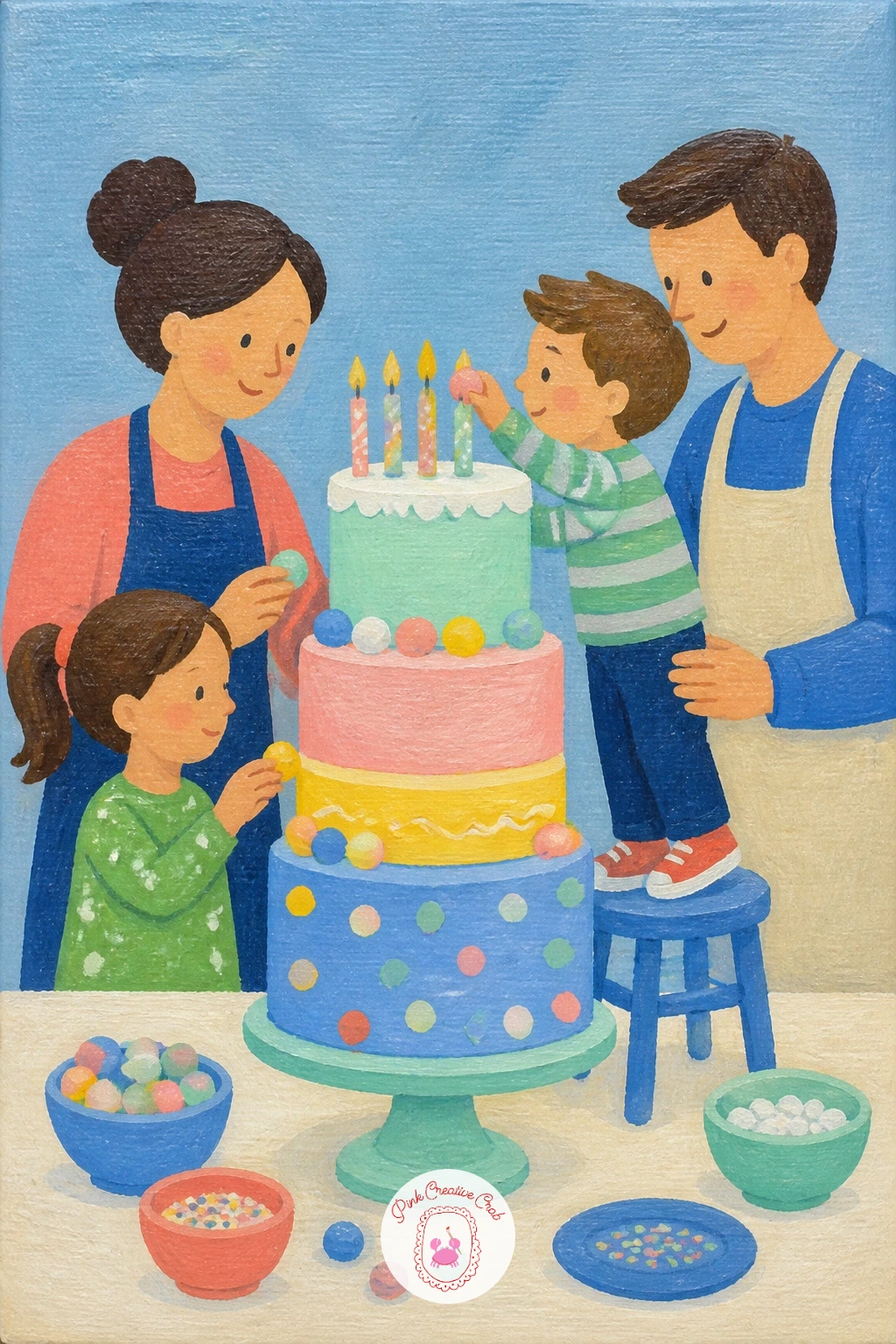
Paint the cake first as the clear center of the canvas, two or three stacked rounded tiers in soft pastel colors, with a simple row of small candle shapes along the top edge. Keep the icing texture loose, just a few wavy horizontal strokes along each tier rather than detailed piping.
Paint the family gathered around the cake, each figure reaching in with a small piping bag or spoon shape, one child up on a stool to reach the top tier. Keep every figure’s eyes, just soft dots, pointed toward the cake rather than out at the viewer, which keeps the focus exactly where it belongs.
If icing swirls feel tricky to paint cleanly, load a small amount of thick paint straight from the tube onto a palette knife and drag short curved strokes across the cake’s surface, which gives a convincing frosting texture in one motion. Wipe the knife clean between colors so they do not muddy together.
A scatter of small round sprinkle dots in coral and cream finishes the cake without much extra work.
You Will Need
- palette knife for frosting texture
Palette: Pastel Pink,Cream,Coral,Pastel Lavender
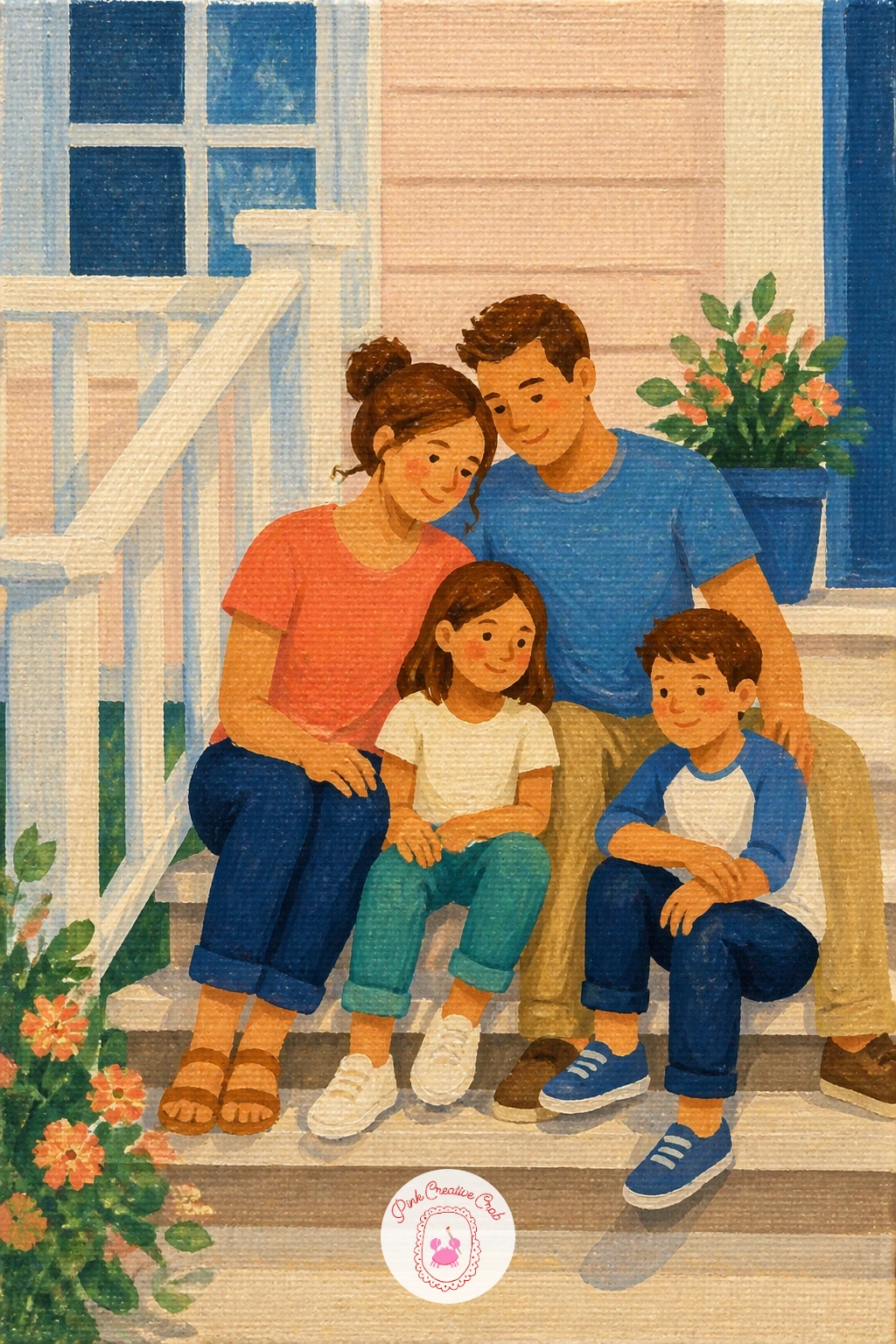
Paint the porch steps first as a simple stack of flat rectangles leading up to a doorway shape, in a warm wood tone, with the house wall behind in a soft pastel color. Keep the step edges clean and straight, since that structure gives the rest of the scene somewhere solid to sit.
Paint the family seated across two or three steps, arranged a little informally rather than lined up evenly, some leaning against the railing or against each other. A dog curled at the bottom step, if you like, adds warmth without taking attention from the people above it.
Comparing each figure’s position before you paint helps the steps read correctly: seat the tallest family members on the lower, wider steps and the smallest higher up, which keeps the group looking settled rather than precarious. A porch railing painted as a few simple vertical lines on one side frames the whole group nicely.
If a full porch feels like too much, paint just the top step and the doorway behind and let that carry the whole scene.
Palette: Burnt Sienna,Cream,Pastel Lavender,Sap Green
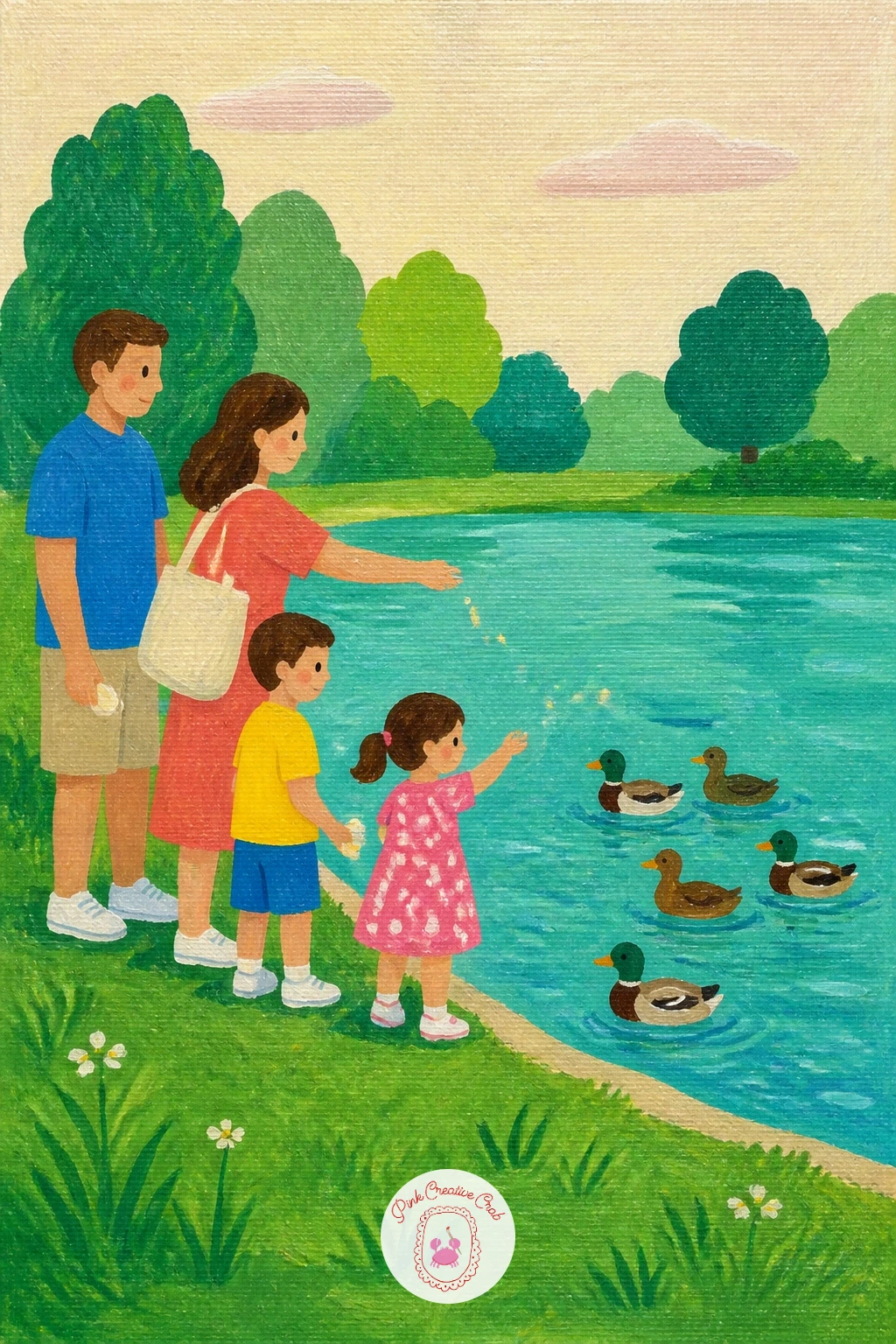
Lay the pond down first as a flat blue-green oval filling most of the lower canvas, with a thin band of green grass along the near edge where the family stands. A few simple ripple lines radiating out from where bread hits the water add life to the pond without much extra work.
Paint the family standing at the water’s edge, one figure tossing a small white bread shape toward the ducks, arm extended and slightly raised. Paint the ducks as a cluster of simple oval bodies with small triangle beaks, gathered toward the bread rather than scattered evenly across the water. For more duck poses to study, the duck painting ideas cover a good range of simple shapes worth practicing.
Keep the ducks clustered close together rather than spread out, since a tight group reads immediately as excited ducks competing for bread, which is exactly the energy this scene needs. A couple of small white bread crumb dots scattered on the water between the ducks and the family finishes the story.
If ducks feel fiddly, three is plenty, you do not need a full flock to tell the story.
Palette: Teal,Sap Green,Titanium White,Yellow Ochre
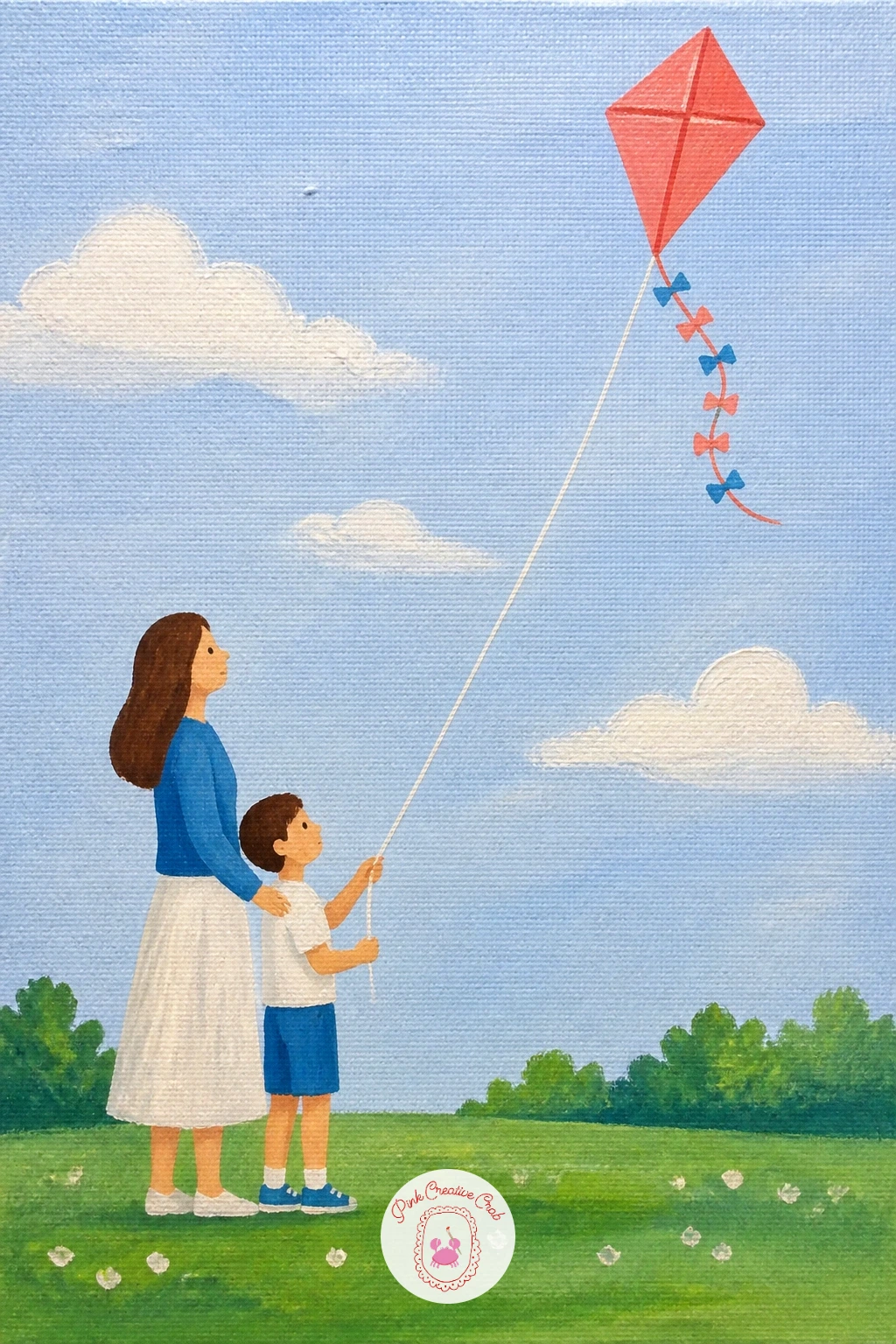
Paint the sky first, almost the whole canvas, in a soft gradient from pale blue at the top to a lighter cream near the horizon, since this scene depends on a lot of open air above the figures. A few simple cloud shapes, just soft white ovals, break up the space without pulling focus.
Paint mother and son standing close together on a small patch of green ground near the bottom, both looking up and one arm raised on each figure toward the kite. Paint the kite as a simple diamond shape high in the sky, with a single curving line down to the son’s hand to suggest the string.
Getting the kite string’s curve right makes this scene convincing: paint it as one smooth loose curve rather than a straight line, since a taut straight string looks stiff while a gentle sag reads as a real kite caught in moving air. Keep the kite’s color bright, a coral or yellow, so it stands out clearly against the pale sky even at a distance.
If a diamond kite feels plain, add a short tail of two or three small triangle flags along the bottom edge.
Palette: Cerulean Blue,Coral,Cream,Sap Green
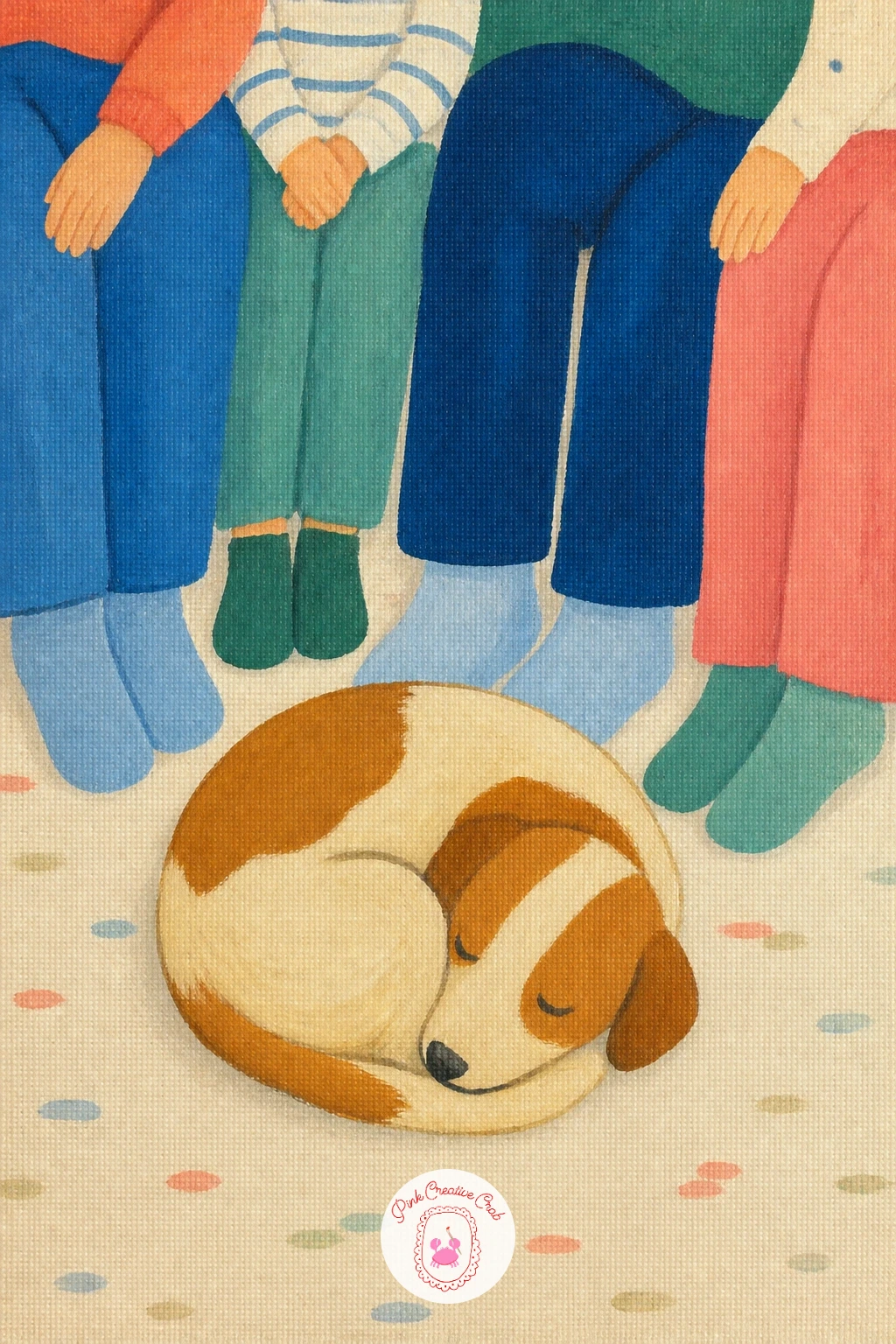
This final scene works well as a close up rather than a full room, so paint just the lower portion of a few family members, legs and feet only, gathered around a shared space like a rug or sofa edge. Keep the figures simple, just shoes or bare feet at different angles, resting still.
Paint the dog curled into a loose circle shape at the center of the feet, nose tucked near its tail, in a warm brown or cream with a few soft darker strokes to suggest its coat direction. Keep the dog’s shape rounded and compact rather than stretched out, since a curled sleeping pose reads as more peaceful than a sprawled one.
If you have painted a few of these family scenes already and want a different approach next time, try this same curled dog pose stretched out flat on its side instead, with legs extended, for a looser and more relaxed version of the same sleeping moment. For a broader look at how acrylic compares to other mediums for a scene like this, the guide on painting mediums is worth a look before you start your next canvas.
Keep the rug or floor color warm and simple so the dog’s curled shape stays the clear focus of the piece.
Palette: Burnt Sienna,Cream,Payne’s Grey,Coral
What to Do Next
Pick the family painting idea that matches a moment you actually want on your wall, grab a small canvas, and block in the biggest shapes first: the ground, the sky, the furniture, before any figures go on top. Keep faces simple and let the warmth come from the poses instead, and you will have a finished piece by the end of today.
Frequently Asked Questions
Do I need to paint realistic faces for a family painting?
No, simple shapes work better. A soft oval with a dot or two for cheeks and eyes keeps the focus on the moment and the mood, not on getting a likeness right.
What size canvas works best for these family painting ideas?
A small canvas, around eight by ten inches, suits every idea here. It is large enough to fit a few figures clearly but small enough to finish in one sitting.
How do I stop the family figures from looking too stiff?
Vary height, head tilt and arm position across every figure in the scene. Two identical poses side by side read as stiff, while small differences make the group feel alive.
What if I only have a limited acrylic palette at home?
Mix what you have rather than buying more. Most of these scenes only need a blue, a green, a coral or red, white and a brown, which cover sky, grass, skin tones and accents.
Can I paint these family scenes from imagination without a reference photo?
Yes, since every idea here uses simple shapes rather than exact likenesses. A rough mental picture of the pose and setting is enough to block in each figure confidently.
Have any thoughts?
Share your reaction or leave a quick response — we’d love to hear what you think!
-
 0
-
0
-
0
-
0
-
0
-
0


