Window view painting gives you the best of both worlds in one small rectangle: a cozy room on one side of the glass, a whole dreamy elsewhere on the other. You get to paint a curtain, a mug, a cat on a sill, and then let the window frame open onto a sea, a city or a snowy field without ever leaving your table. That little push and pull between inside and outside is what makes these paintings so satisfying to make and so easy to love once they are done.
Below you will find 37 different windows to paint, each one a complete scene you can finish in a single sitting. Some look out on turquoise water and striped umbrellas, others on rooftops, vineyards and horse pastures, and a few keep things very close to home with a bird feeder or a garden swing. Pick whichever view is calling to you tonight and get your gouache out.
Using these images: free for personal projects such as printing, coloring, cards, journals and gifts. Handmade items that include them may be sold up to 30 pieces per design. More than that is commercial use and is not permitted, and neither is selling or sharing the images themselves or passing them off as your own. Please ask before any other use.
Open shutters and a bright turquoise sea make a forgiving first project, because the water is just a few flat bands of color and the room around it stays simple. Start with a pencil sketch of the window frame and shutters pushed back against the wall, then block in the sea in two or three tones of blue and teal before you touch anything else.
Paint the curtain last, in one loose sweep of white or cream gouache with a few folds suggested rather than drawn in full, as if a breeze just caught it. The place this goes wrong is a curtain that looks stiff and flat against a lively sea, so keep your brush loose and let the edge wobble.
If this is your first time working with gouache, thin your paint slightly for the sea so it goes on smooth, then switch to thicker, more opaque paint for the white curtain so it sits clearly on top. No turquoise on hand works fine with cerulean blue mixed into a little white.
Finish with one small detail, a single white sailboat far out on the water, to give the eye somewhere to land.
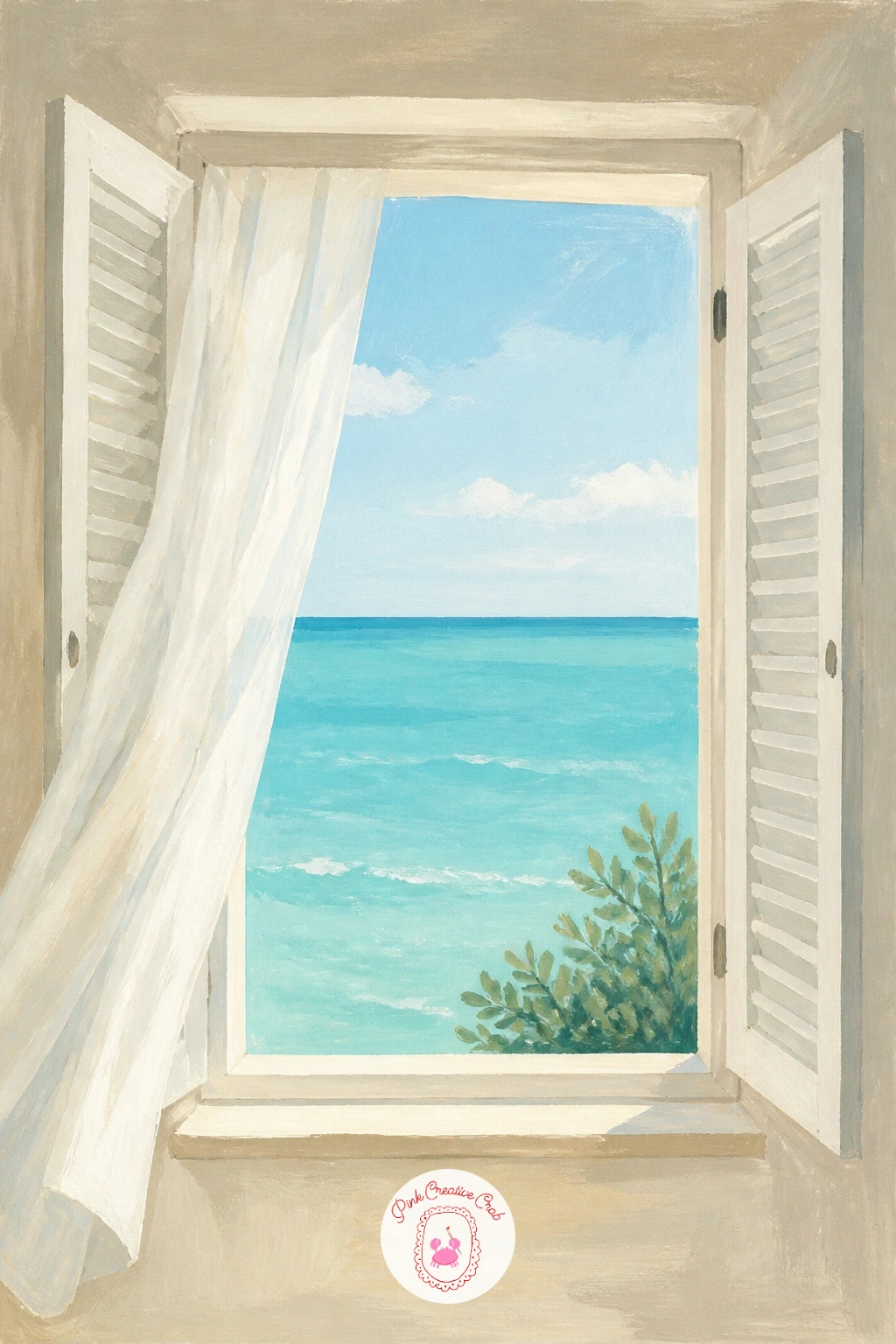
Palette: Turquoise,Cerulean Blue,Cream,Sage Green
Rooftops in Paris read as a simple pattern once you stop trying to paint every chimney, so this view is friendlier than it looks. Pencil in a tall window with a wrought iron railing just outside, then fill the whole lower half with flat grey-blue zinc roof shapes at slightly different angles, like a patchwork rather than a photograph.
Work the sky in next, a soft warm cream or pale pink if you want an evening feel, and let a few chimney pots and a distant dome break the roofline. The railing is where most people struggle, so paint it as a few confident curved lines of dark grey gouache over the dry roofs, not as a fussy grid.
For proportion, hold your pencil up to the screen or photo you are working from and compare the window height to its width before you commit to the frame, since a Paris window is usually taller and narrower than it first looks. If you only have acrylic paint, it will work here too, just keep it thin for the sky layer.
Add one small potted plant on the windowsill to finish the story.
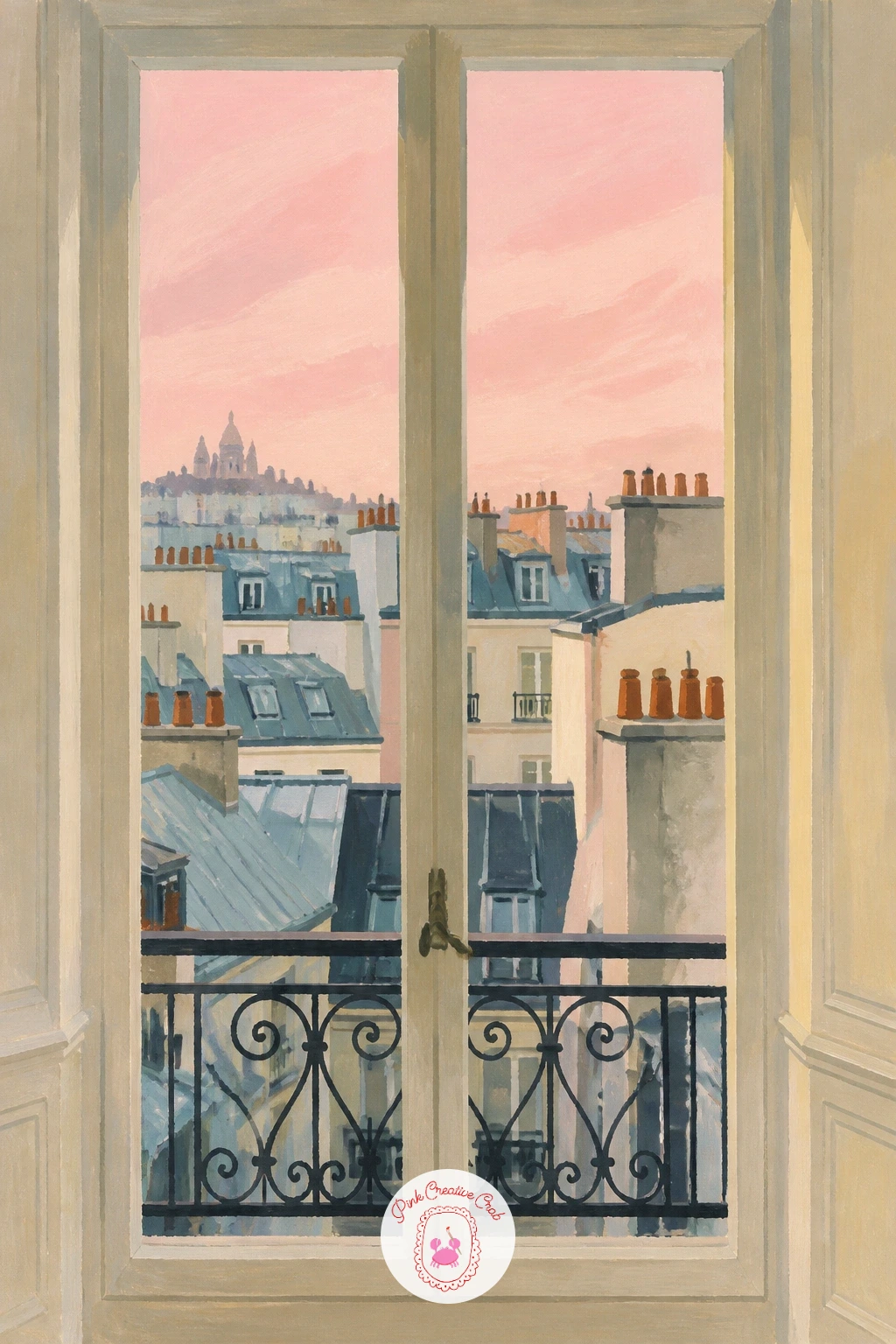
Palette: Payne’s Grey,Dusty Pink,Cream,Sage Green
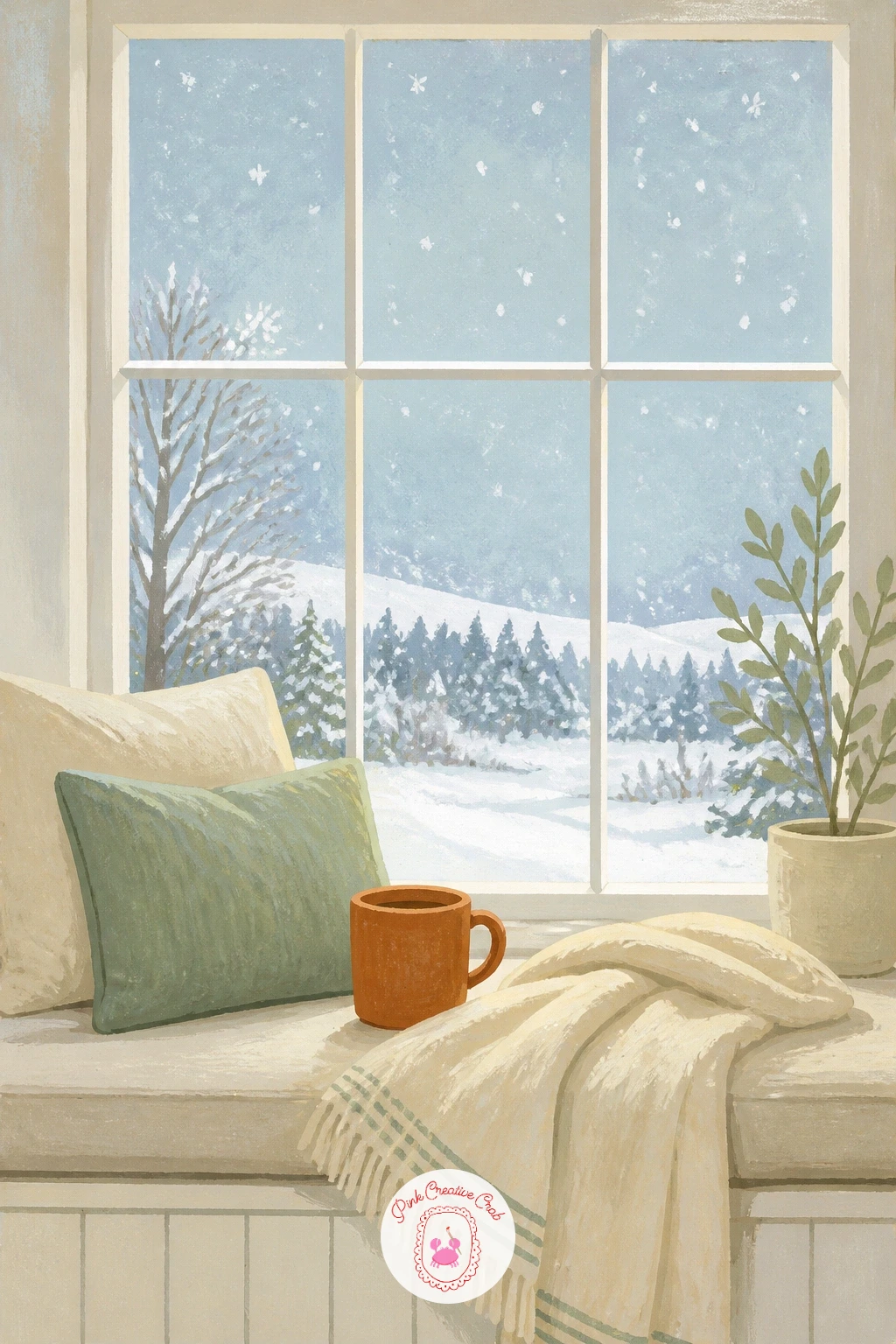
A window seat with a mug beside it brings the coziest kind of story to this idea, and it starts not with the window but with the cushion. Lay down a flat shape for the seat cushion in a warm terracotta or cream, then add the window frame around it before the snow goes in.
Paint the snowy view as a pale grey-blue sky with scattered white dots flicked on with a nearly dry brush, working from a loose wrist rather than dabbing each flake by hand. This is where the scene usually goes wrong, with snow that looks like scattered confetti instead of falling through the air, so keep the dots varied in size and a little blurred at the edges.
In ten minutes you can stop after the window and snow are in; given forty, add a knitted blanket draped over the seat and steam curling up from the mug in two soft curved lines of white gouache. No white gouache on hand, a well-loaded wet brush of white acrylic does the same job.
Keep your mug small and simple, just an oval and a handle, so it reads instantly.
You Will Need
- old toothbrush or stiff bristle brush for flicking snow
Palette: Terracotta,Pale Grey Blue,Cream,Titanium White
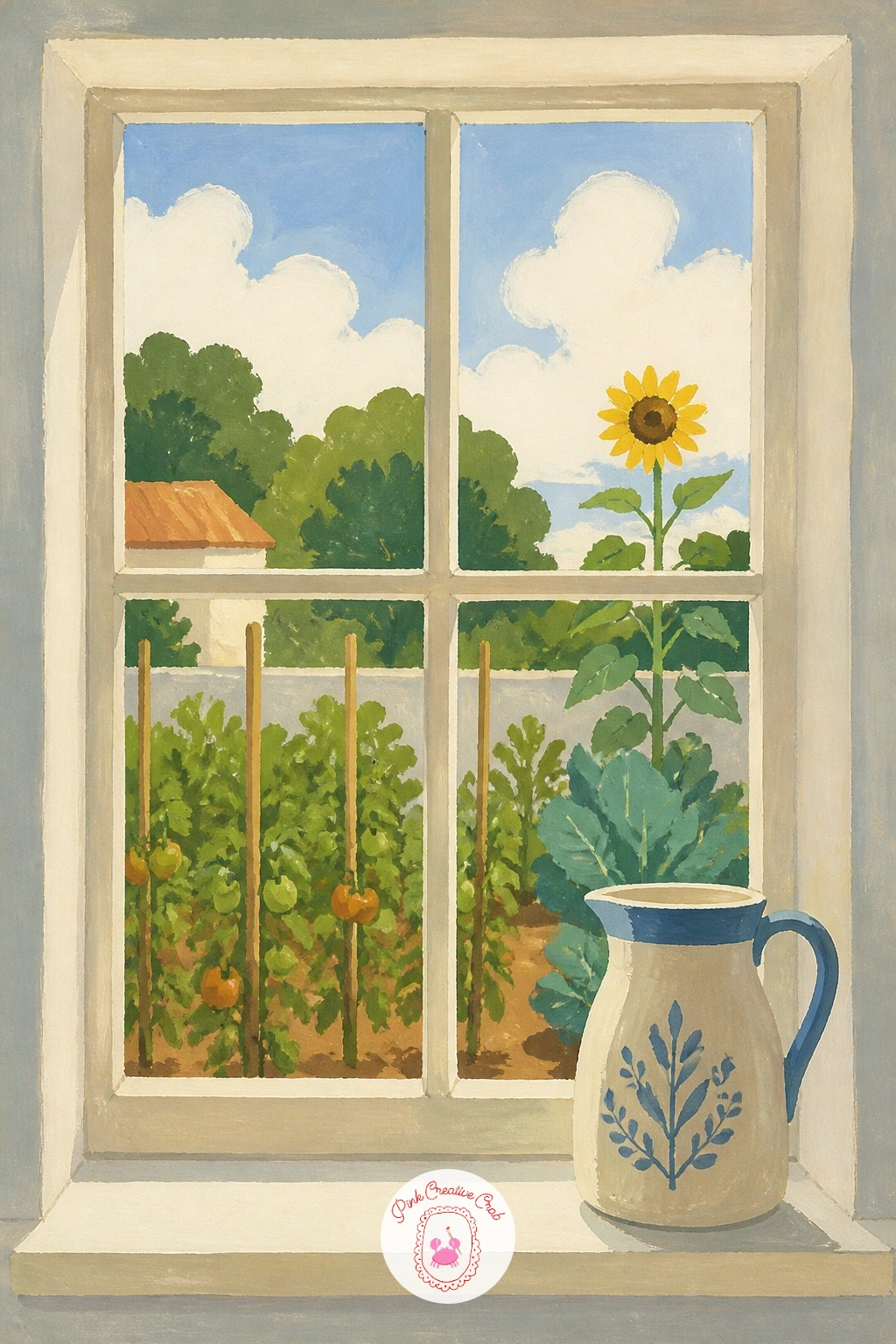
Kitchen windows ask for a bit of domestic clutter before the view even starts, so begin with a simple sill holding a jug or a small plant pot. Sketch the window frame, then build the garden beyond it in loose rows, a few tomato stakes, a patch of lettuce, a leaning sunflower near the back fence.
Work from the back of the garden forward: paint the distant fence and sky first, then the mid-ground rows of green, and finally the closest plants in slightly brighter, warmer green so they pop forward. Gardens often go muddy when every green gets mixed the same way, so vary your greens with a touch of yellow for sunlit leaves and a touch of blue for shaded ones.
If you enjoy painting growing things, this pairs nicely with the looser florals in acrylic painting flowers ideas for beginners for practice loosening up your brushwork on leaves and stems.
Finish with one ripe red tomato catching the light, painted in a single confident dab.
Palette: Sage Green,Sunflower Yellow,Terracotta,Cream
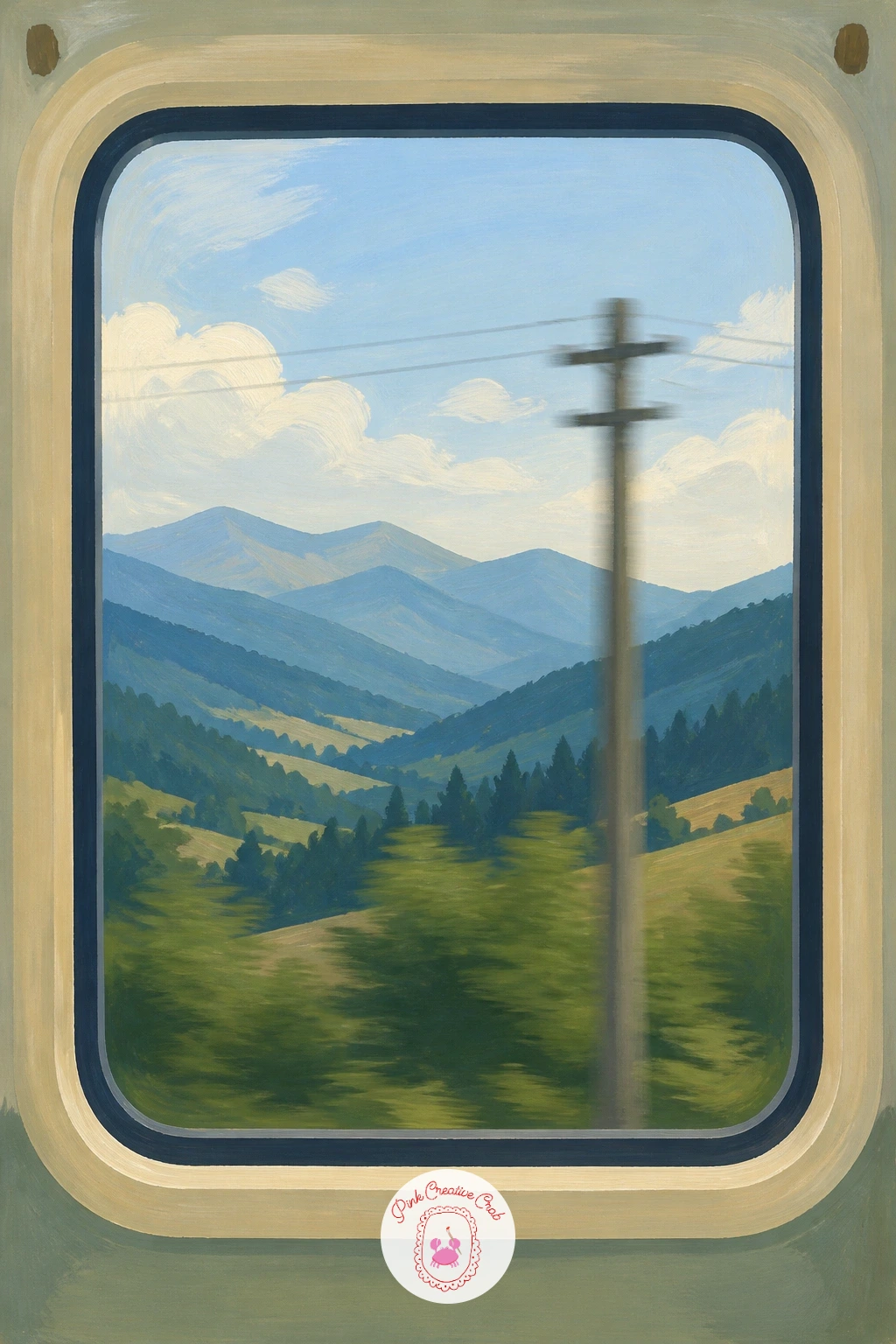
Mountains seen from a moving train carry a sense of speed that you can build right into the brushwork, so loosen your grip before you start. Paint the window frame first, including the little ledge below it, then block in the mountain shapes behind a soft pale sky using flat, slightly angled triangles rather than careful peaks.
Perspective does the heavy lifting here: set the horizon line low in the window and stack three or four mountain ranges behind each other, each one a little paler and bluer than the one in front, to push the farthest peaks back into the distance. Light should come from one side only, so pick left or right and keep every mountain’s shadow on that same side.
The usual mistake is mountains that all sit at the same distance with no sense of air between them, so test your paler blues against the nearest range before committing. No pale blue mixed yet, white gouache tinted with a whisper of grey works as a stand-in.
Add a single blurred telephone pole streaking past the glass to suggest the train’s motion.
Palette: Sky Blue,Payne’s Grey,Sage Green,Cream
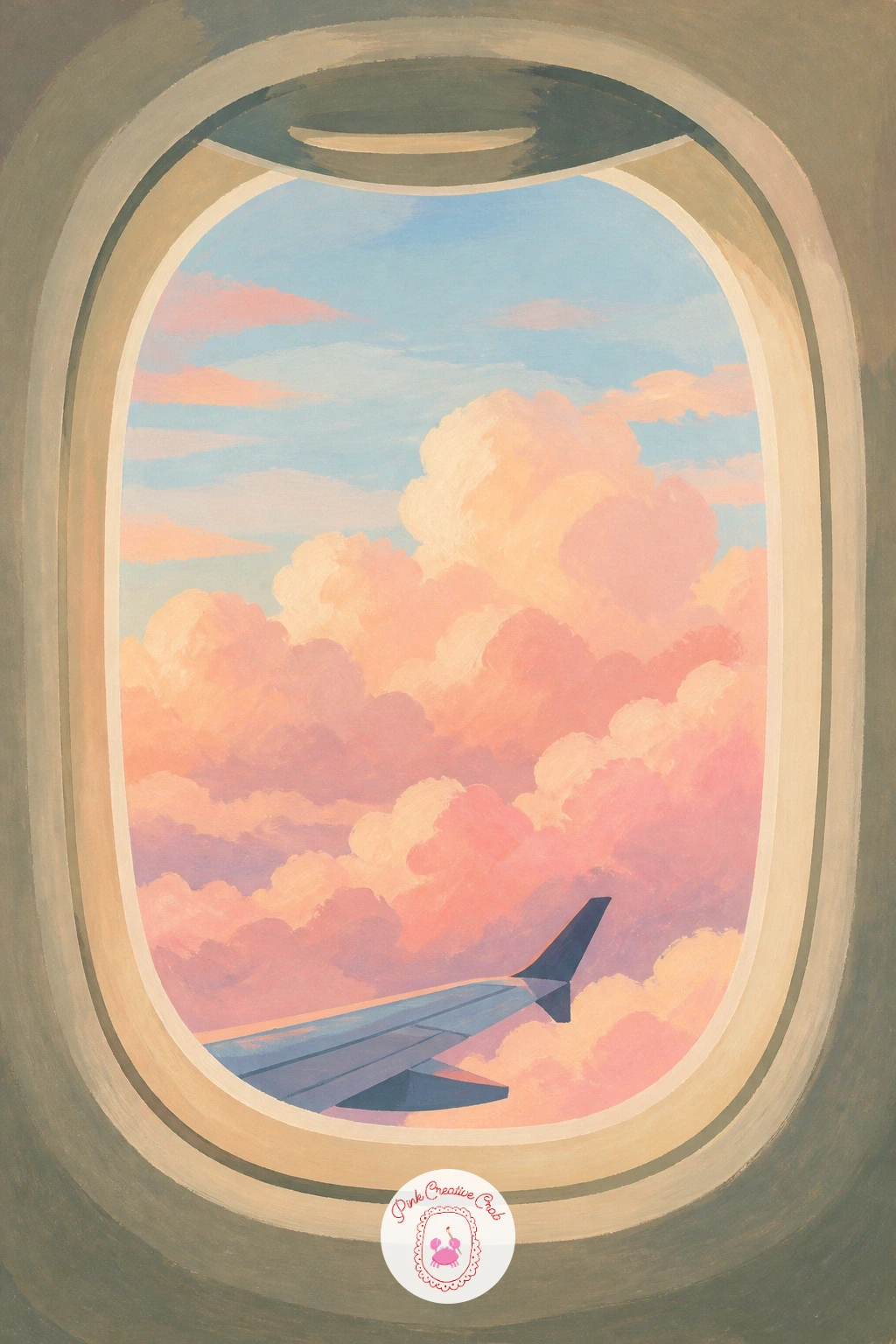
Clouds from above give you permission to paint loosely, since nothing here needs a hard edge. Start with the oval airplane window shape and the curved wall of the cabin around it, then fill the opening with a soft gradient sky, pale blue at the top fading into warm pink and peach lower down.
Build the clouds with a dry, barely loaded brush dragged sideways in short strokes, letting some of the sky show through so they look soft rather than solid. Where this goes wrong is clouds painted too thickly and evenly, turning into a flat pink blanket instead of something you could fly through, so vary your pressure and leave gaps.
Quick version: stop once the gradient sky and dry-brushed clouds are in, about ten minutes of work. With more time, add the dark edge of the wing just visible at the bottom of the window and a tiny row of cabin lights along the inside wall.
Keep the oval window frame perfectly clean and sharp so the soft clouds inside it feel even dreamier by contrast.
Palette: Sky Blue,Soft Pink,Peach,Payne’s Grey
Try dragging the dry brush in one direction only across the whole cloud layer before adding any detail, it keeps the light moving the same way through the sky.
Lemons on a sunny sill are the kind of detail that makes a whole painting feel like a holiday, so give them real attention even though the window itself stays simple. Sketch an arched or square window with painted shutters, then place three or four lemons along the sill in a loose cluster, slightly overlapping.
Paint the lemons as flat ovals of bright yellow first, then add just one shaded side in a yellow-green mix once they are dry, keeping the highlight side untouched paper or pale cream. Behind them, block in the Amalfi coastline as stacked pastel buildings tumbling down a cliff toward a bright blue sea.
Lemons often end up looking like flat circles with no weight, so place the shadow underneath each one in a short curved stroke of warm grey to ground them on the sill. Without blue shutters to reference, a soft sage green works just as well against the warm coastline colors.
One tip to use today: paint the sea darker near the horizon and lighter close to shore, it instantly reads as sunlit water.
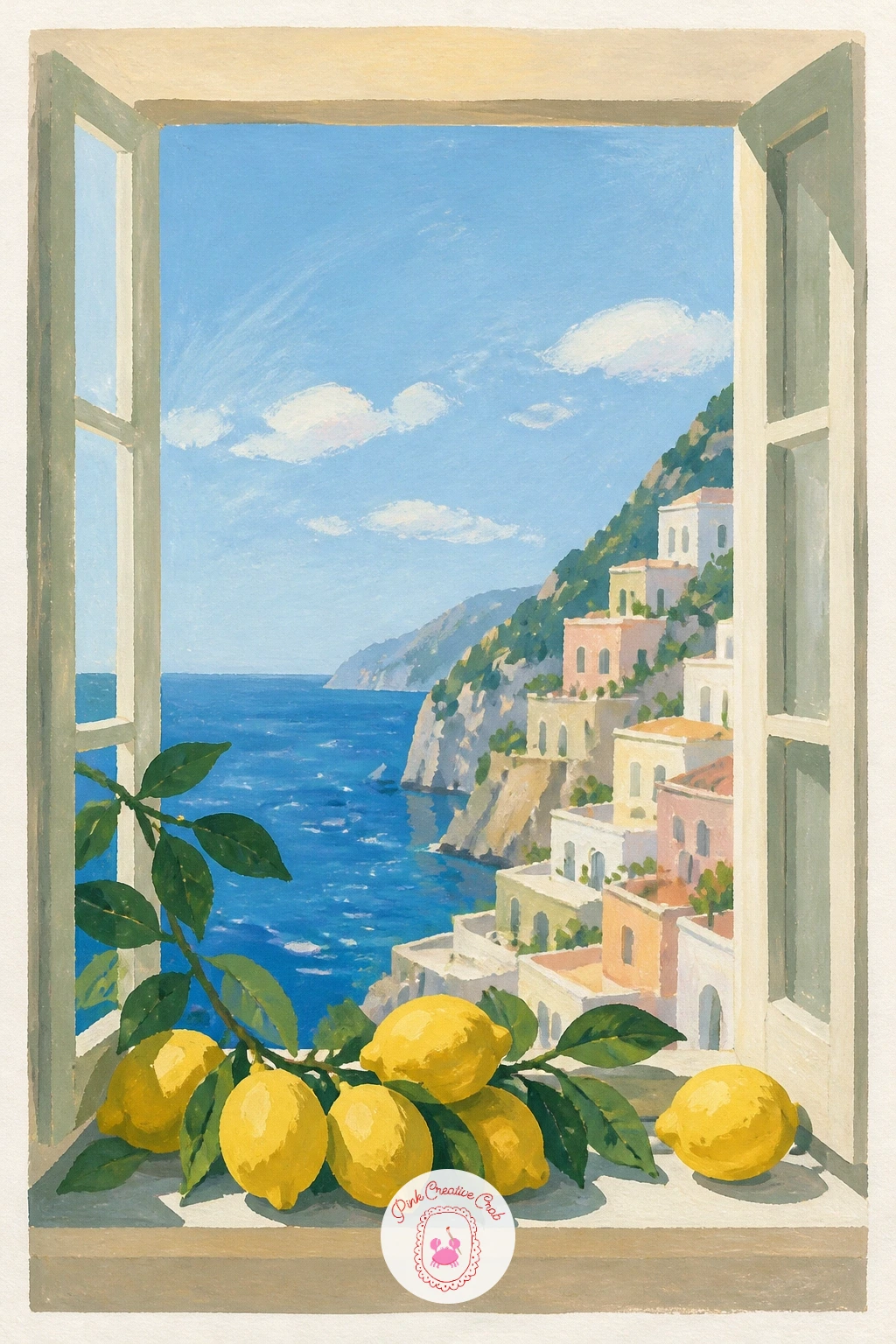
Palette: Lemon Yellow,Terracotta,Sea Blue,Sage Green
A cat at the window turns this into a tiny story rather than just a view, so decide on the cat’s pose before anything else. Paint it as a simple sitting silhouette, flat dark shape with two pointed ears and a curled tail, facing out toward the glass with its back mostly to you.
Build the window and garden behind the cat second, keeping the outdoor colors a little softer than the cat so the eye lands on the silhouette first. Add one or two small birds on a branch or feeder outside, painted as simple round bodies with a dot of a beak, positioned exactly where the cat’s gaze points.
Cats often go wrong around the ears and tail, so keep both shapes simple and slightly curved rather than sharp, a kneaded eraser can soften any pencil lines that feel too stiff before you paint over them. For more cat views like this one, the ideas in 32 cat sketchbook ideas of cats in bookshops, gardens and window boxes are worth a look.
Finish with a thin strip of pale curtain fabric at one edge of the window to frame the scene.
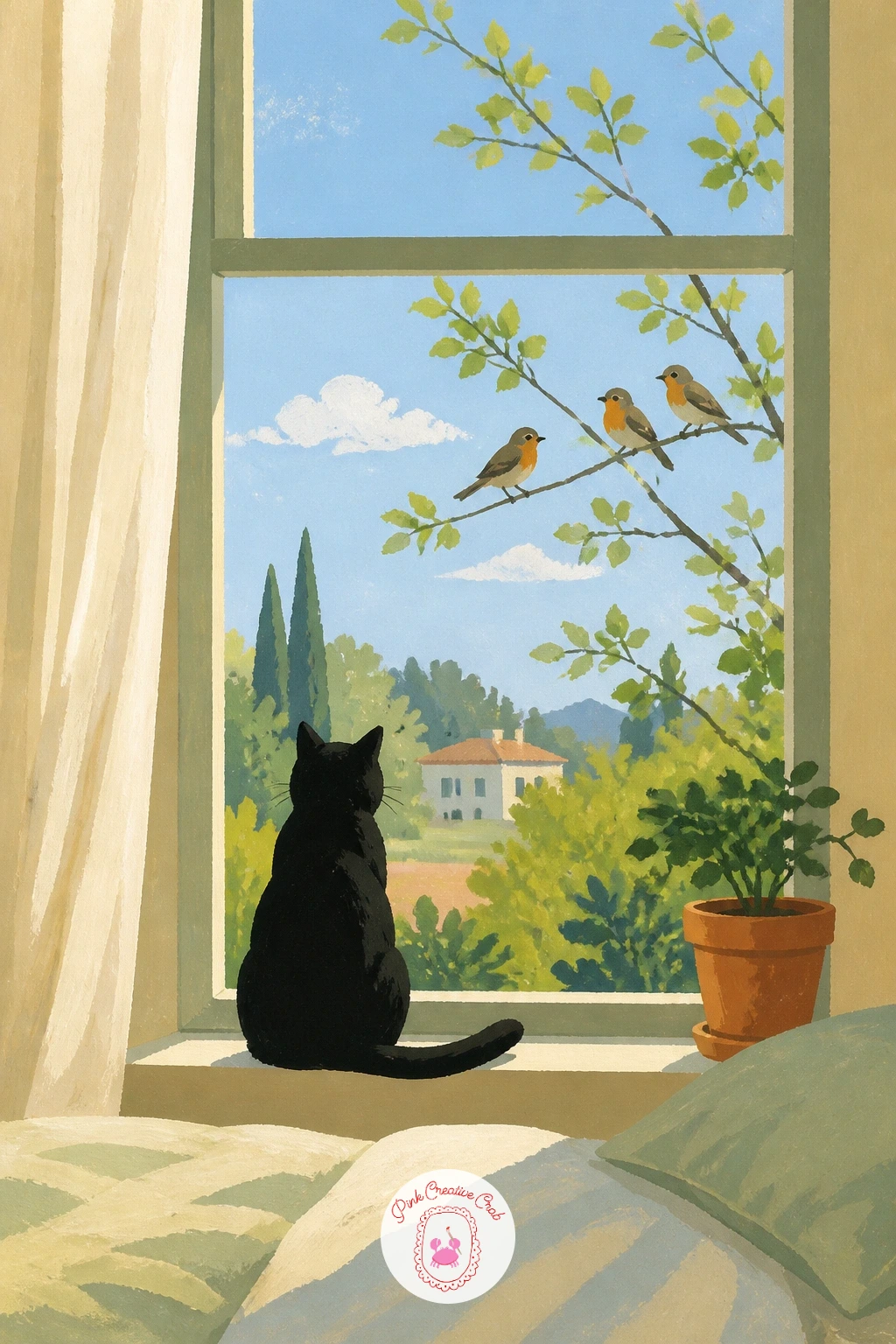
Palette: Charcoal Grey,Sage Green,Cream,Terracotta
People passing a cafe window work best as suggestions rather than portraits, so keep every figure small and simple. Paint the window frame and a hint of a cafe table or chair inside first, then block in the street and buildings outside in flat, muted tones.
Add figures last, each one just a vertical blob of color for the coat and a smaller oval for the head, varying the colors and heights so they read as different people without any facial detail at all. The usual trouble spot is figures that end up too detailed and stiff looking out of place against the flat street, so paint them fast and a little blurred, almost silhouettes.
If this is your first time painting figures, try just three or four rather than a crowd, spaced unevenly so it feels like a real moment caught in passing. No gouache for the street, thinned acrylic in a muted grey-brown works fine as a base layer.
Add a single awning or hanging sign above the window to anchor the cafe feeling.
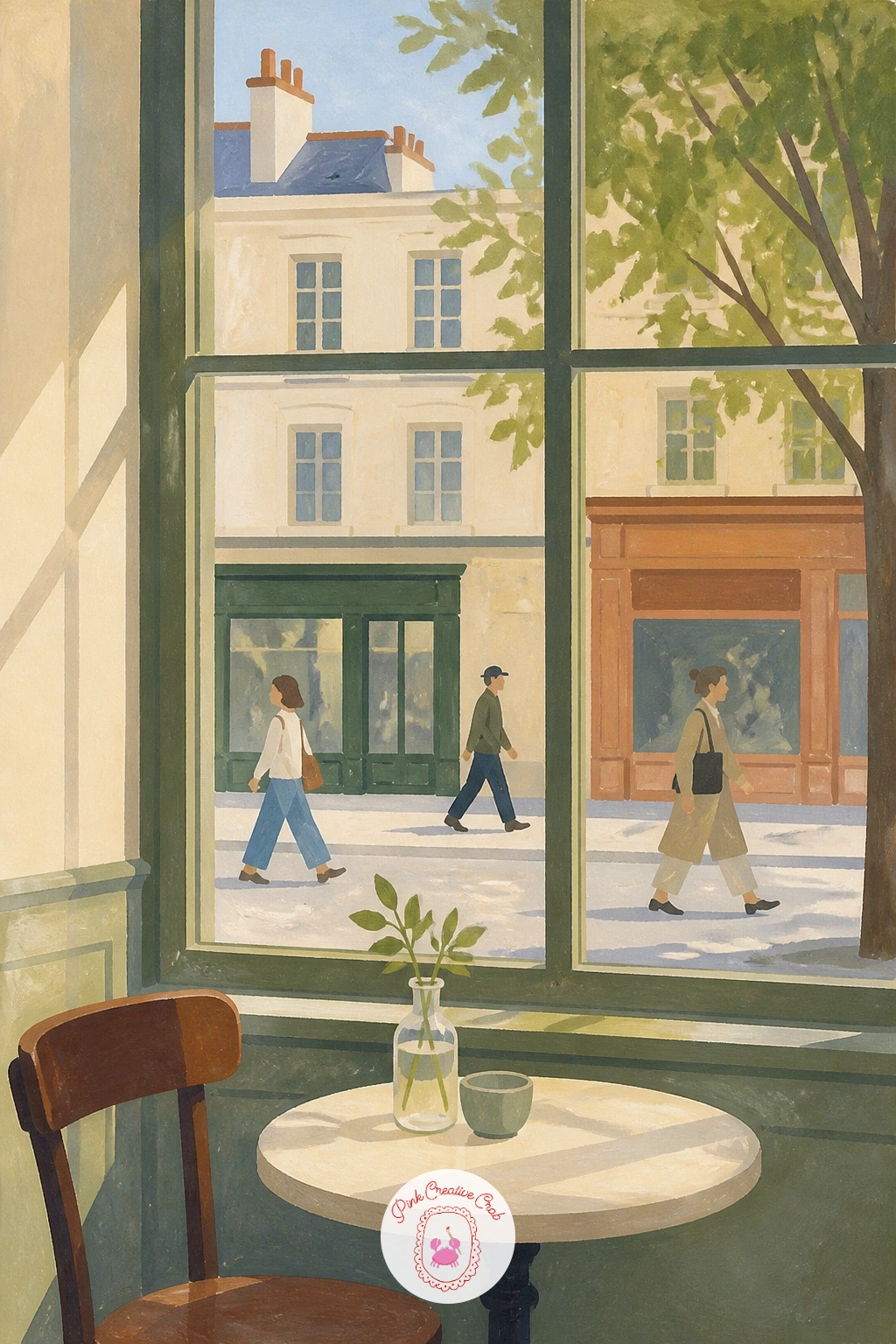
Palette: Warm Grey,Terracotta,Payne’s Grey,Cream
A harbor full of sailboats sounds complicated until you treat every boat as just two or three flat shapes. Paint the water first in horizontal bands of blue, lightest near the shore and deepest further out, then let it dry fully before adding any boats on top.
Place sailboats as simple white or cream triangles for the sails with a thin dark line for the mast, scattering them at different sizes so the smaller ones read as farther away. This is a perspective idea at heart, so keep the horizon line roughly a third of the way up the window and never let a distant boat get taller than a close one, even if it looks tempting to make it bigger for interest.
Harbors often go wrong when every boat ends up the same size and evenly spaced, so cluster two or three together and leave open water elsewhere. If your gouache runs thin on white, a gel pen can add a few final bright highlights once everything else is dry.
Close with a line of small colorful buildings along the distant shore to finish the harbor edge.
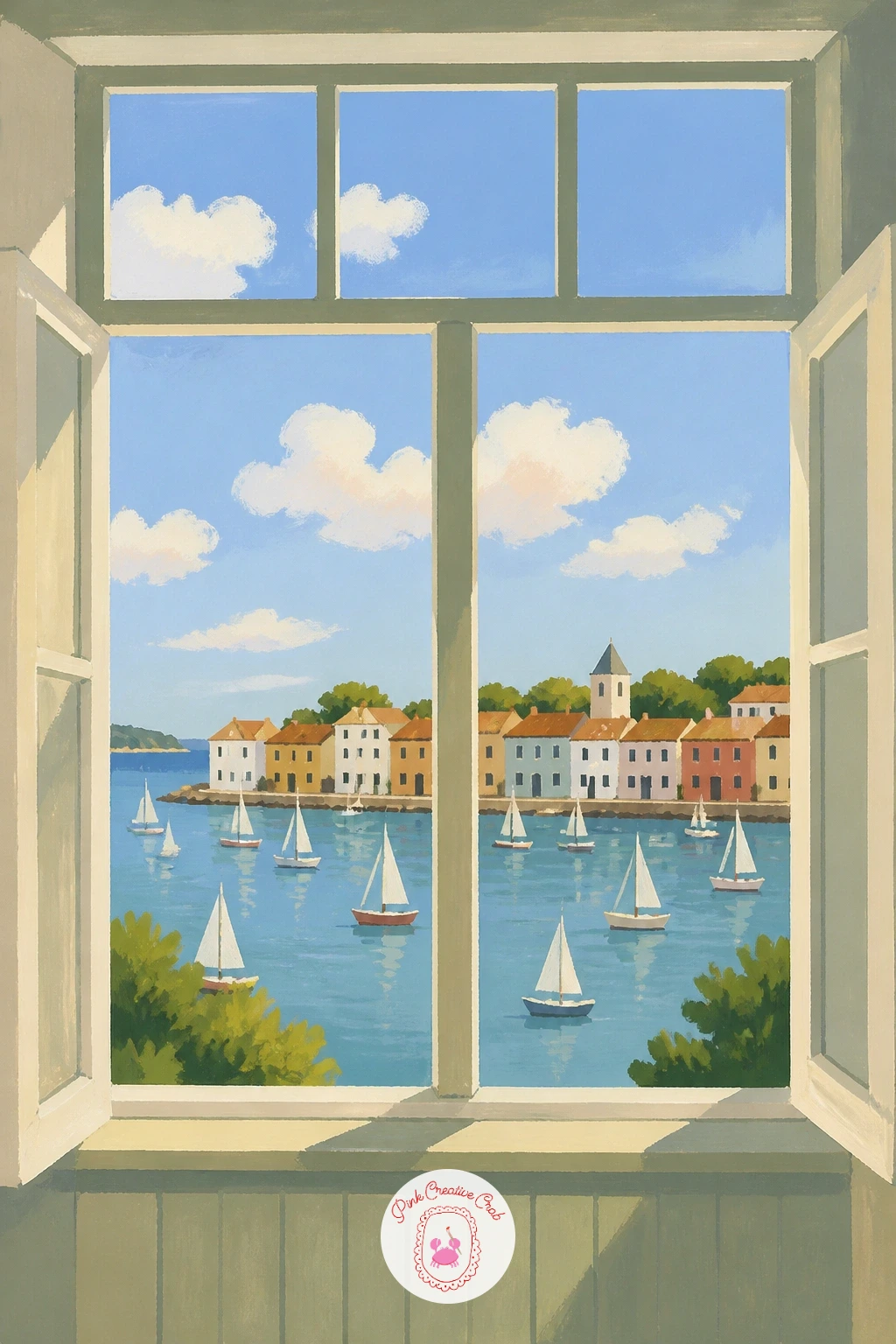
You Will Need
- white gel pen for highlights
Palette: Sea Blue,Cream,Terracotta,Sage Green
A bathroom window with a forest view brings a nice contrast between a clean indoor edge and a wild, leafy outdoor one, so keep the frame crisp and let the trees get looser. Paint the window and a hint of a tiled sill or hanging plant first, then build the forest in three layers of green, darkest at the back.
Work the nearest trees with a dry brush dragged upward in short strokes to suggest texture without painting individual leaves, which is the trick that keeps a forest from turning into a flat green wall. If the greens start to look too uniform, mix a little yellow into the lighter layers and a touch of blue into the shaded ones for variety.
In ten minutes, stop after the three green layers are blocked in; given more time, add dappled light coming through the canopy as a few soft yellow patches scattered across the mid-ground. No dry brush technique handy, a sponge dabbed lightly gives a similar broken texture.
Finish with a single bird or butterfly shape near the glass for scale.
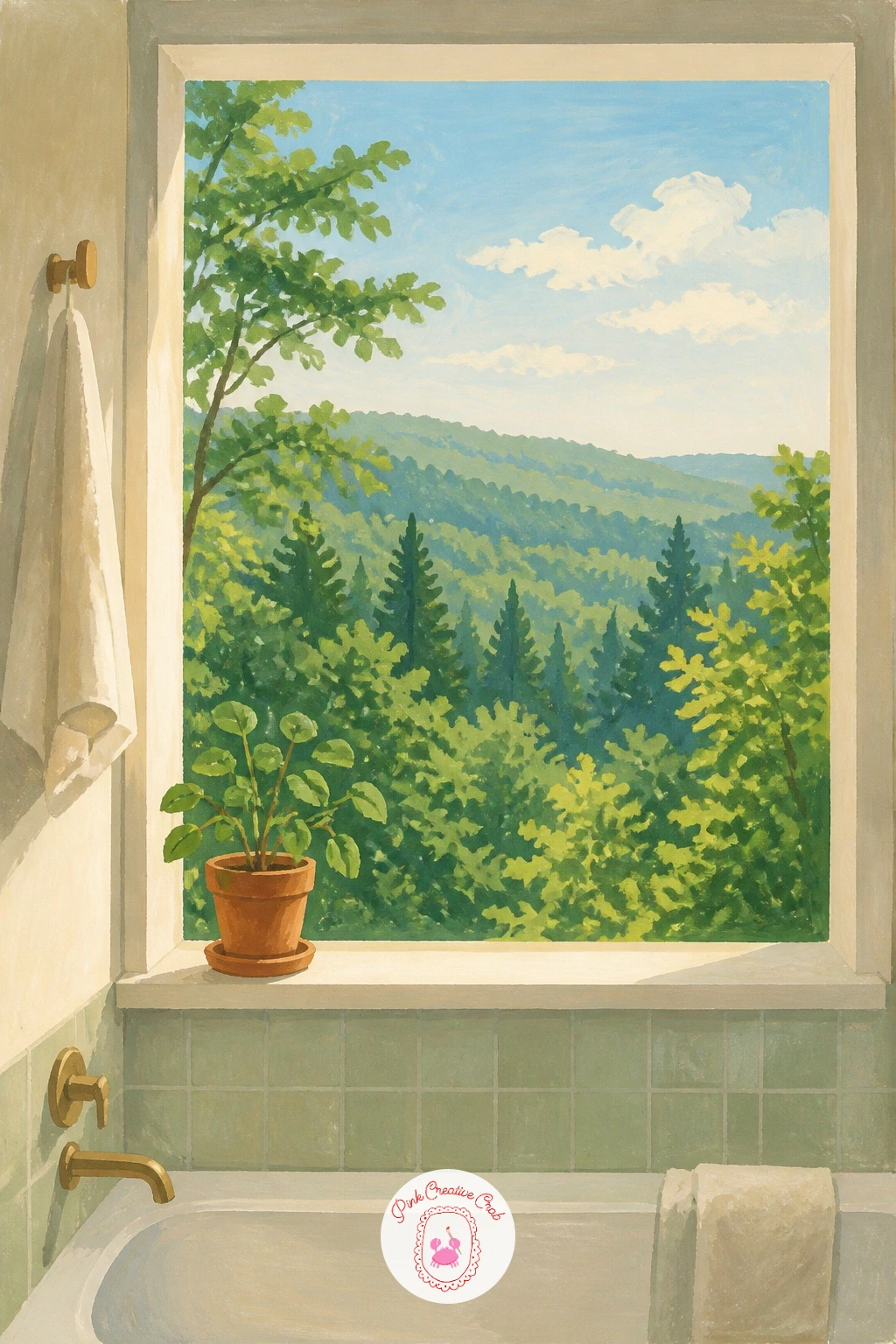
Palette: Forest Green,Sage Green,Sunflower Yellow,Cream
A round window gives this one an instant charm, so get the circle right before anything else goes in, tracing around a plate or jar lid if a freehand circle feels risky. Once the frame is drawn, paint the rooftops beyond it as flat overlapping triangles and rectangles in warm terracotta and brick red.
Vary the roof tones slightly from building to building so the pattern does not flatten into one solid color block, and let a pale sky fill whatever space is left at the top of the circle. The trickiest part is keeping the round frame perfectly even, so paint the circular border last in a steady, confident single pass rather than building it up in short choppy strokes.
If this is your first time with a circular composition, lightly pencil a second guide circle just inside the first before you paint, then erase it once the frame is dry. No plate to trace, a wide-mouth jar or even a roll of tape works just as well.
One small chimney with a wisp of smoke finishes the view nicely.
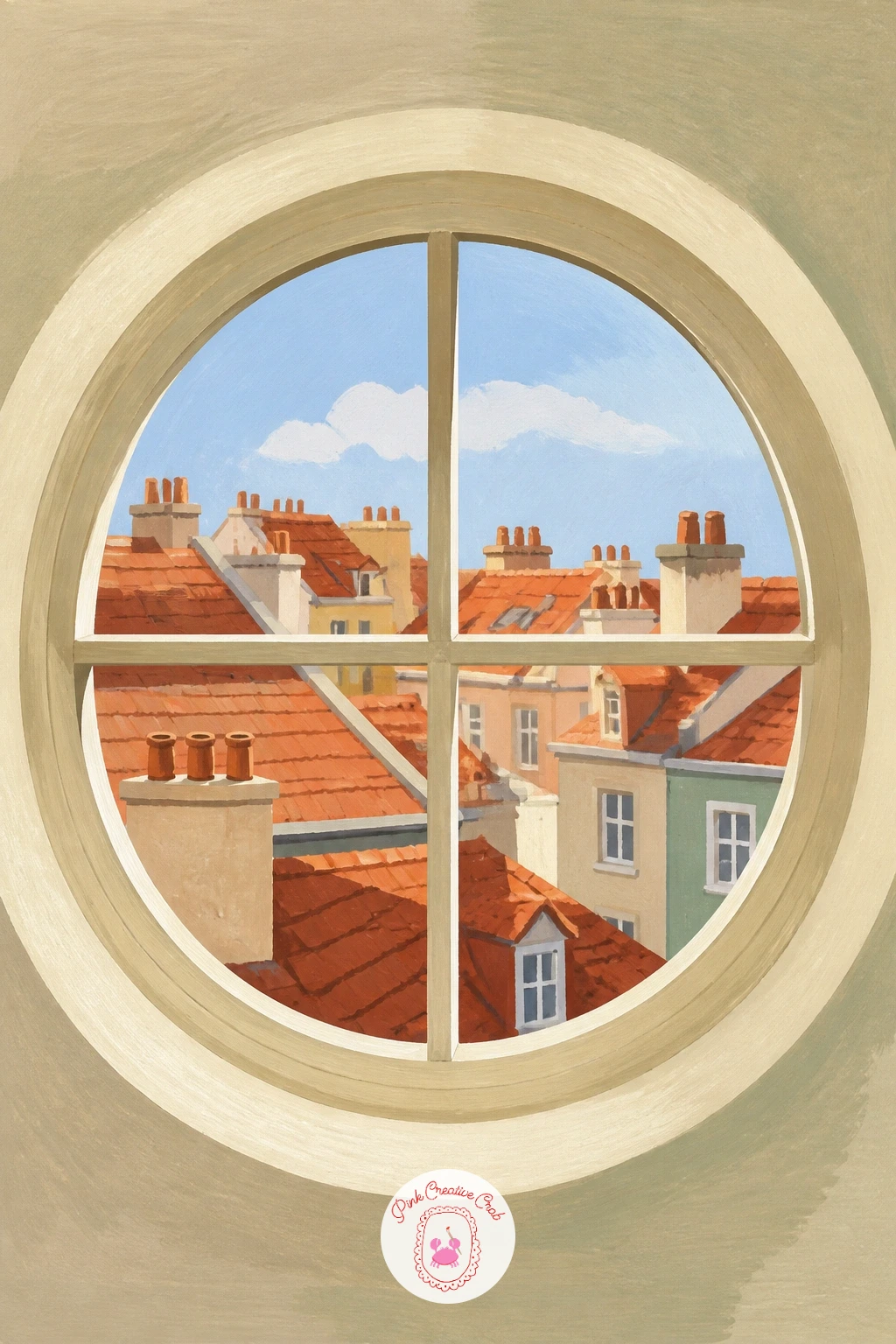
You Will Need
- plate or jar lid for tracing a circle
Palette: Terracotta,Brick Red,Cream,Sky Blue
An empty swing in a garden carries a quiet, wistful feeling that is worth leaning into, so give it a little space of its own in the composition. Paint the window and a simple curtain first, then block in the lawn and a large tree in soft greens before adding the swing itself.
The swing is just two straight ropes and a flat wooden seat shape hanging from a thick branch, painted with a ruler-steady hand if your lines wobble easily. Trees often overwhelm a scene like this, so paint the canopy as one soft rounded shape rather than individual branches, keeping the trunk and the swing ropes as the only hard lines in the whole garden.
If you have painted trees before and want more practice, the layered foliage work in gouache painting landscapes beginner ideas builds exactly that skill. No ruler on hand, the edge of a book or a steady two-finger brace does the job.
Add one or two fallen blossoms scattered on the grass below the swing to finish.
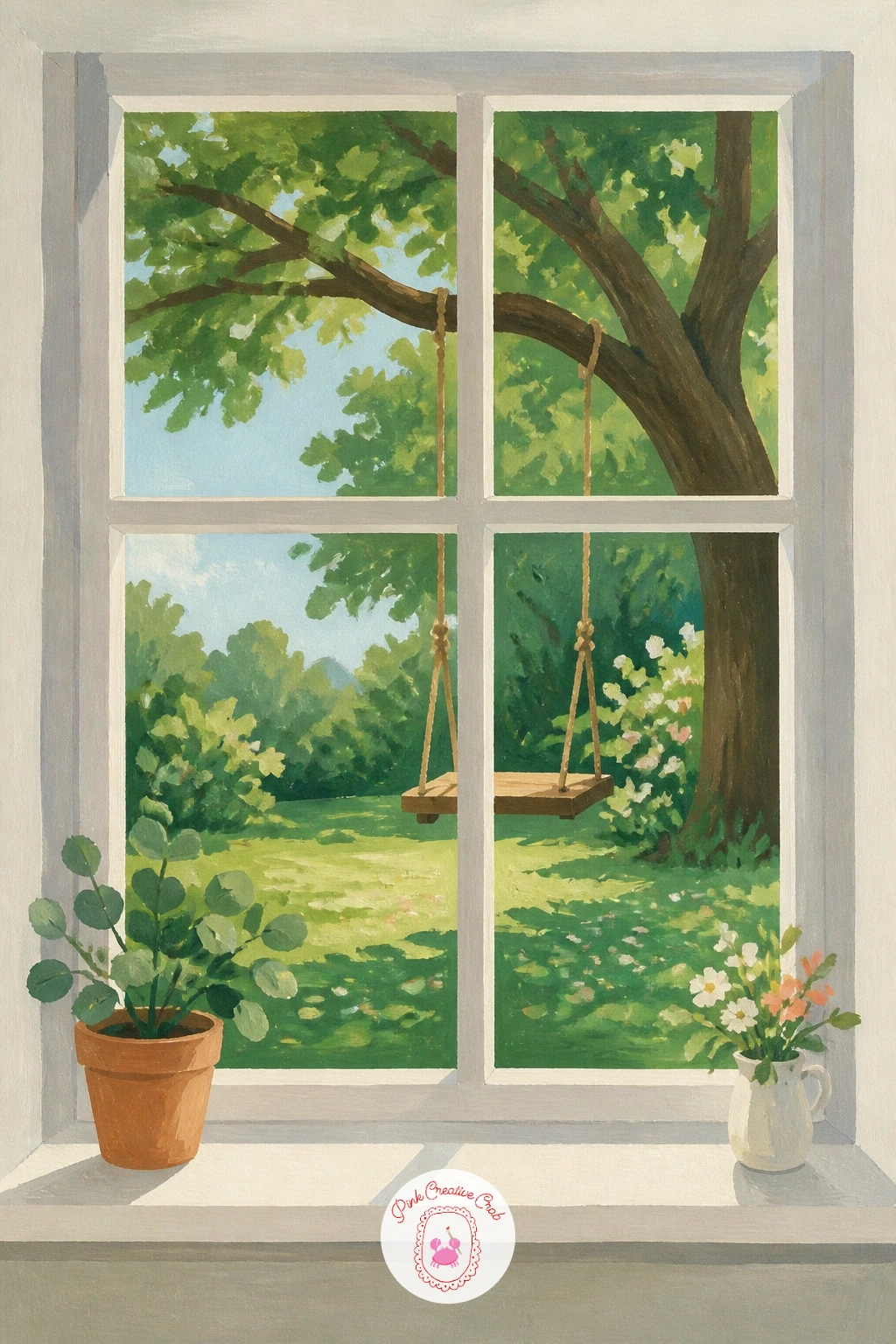
Palette: Sage Green,Cream,Terracotta,Soft Pink
Roses climbing a window frame let you practice small repeated shapes without worrying about a complicated view behind them. Paint the window itself first, a simple square with thick cottage-style frame, then let the climbing vine wind up one or both sides in a loose curving line.
Add roses as small clusters of five or six quick petal dabs each, varying the pink and red tones slightly so no two blooms look identical, then tuck a few sage green leaves between them to break up the color. The vine itself is where this goes wrong most, turning stiff and symmetrical, so paint it freehand in one continuous wavy line rather than planning every twist in pencil first.
Quick version: a handful of roses along the top of the frame takes about ten minutes. With more time, let the vine wander down one whole side and add a soft, blurred cottage garden glimpsed through the glass itself.
Keep the view behind the glass simple and pale so the roses stay the clear star of the painting.
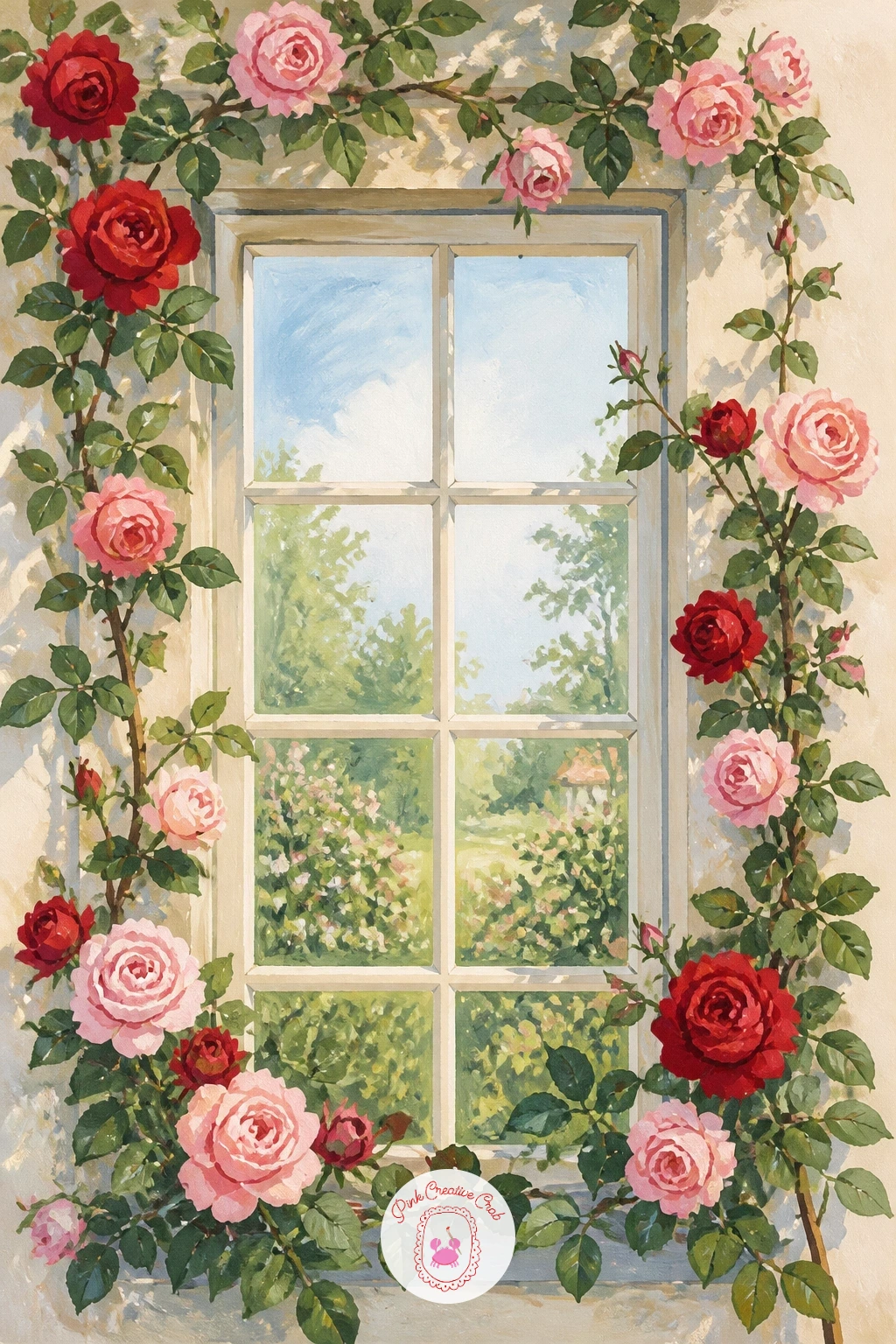
Palette: Soft Pink,Rose Red,Sage Green,Cream
Dusk gives a city skyline its best colors, so this is a nice chance to practice a gradient sky before anything else. Paint the window frame and a sliver of interior, a lamp or a plant, then fill the sky beyond in a smooth blend from deep blue at the top down to warm orange near the rooftops.
Buildings go in next as flat dark silhouettes of varying heights and widths, overlapping slightly so the skyline feels layered rather than lined up in a row. Light is the key angle here: since the sun has set, every building reads as a flat dark shape against the glowing sky, with only a scatter of small bright window squares breaking up the silhouettes.
The scene usually falls flat when every building is exactly the same height, so vary the skyline deliberately, one or two towers taller than the rest. No orange gouache mixed yet, warm yellow blended into a little red gets you there.
Dot in a handful of tiny lit windows last, after the buildings are fully dry, for the glow.
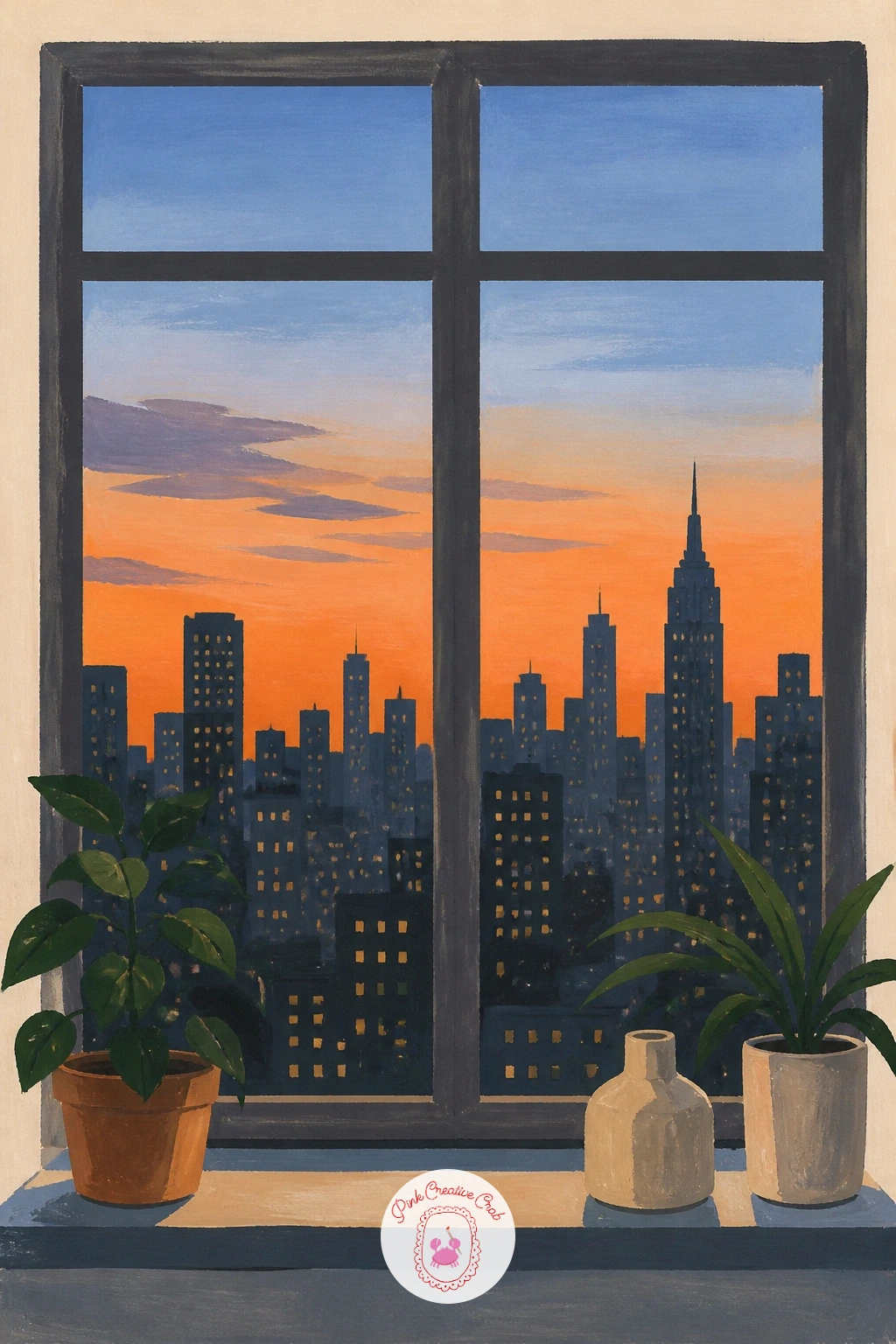
Palette: Deep Blue,Sunset Orange,Charcoal Grey,Sunflower Yellow
A narrow castle window naturally crops the view into a tall slim shape, which makes the whole composition feel dramatic with very little effort. Paint the thick stone frame first in warm grey, leaving the window opening itself blank, then fill that opening with rolling green hills stacked one behind the other.
Keep the eye level low in the window so the hills seem to rise up toward a wide sky, and let the stone frame’s deep sides fall into soft shadow on one side only, picking whichever side faces away from your light source. That shadow is what makes the frame feel thick and three-dimensional rather than flat, so do not skip it even though it is a small detail.
Hills often go wrong when they all sit the same shade of green, so lighten each successive hill slightly as it recedes, almost to a pale blue-green at the farthest ridge. No grey gouache mixed, a touch of Payne’s grey into white gets a good stone tone.
Finish with one small flag or bird silhouette at the top of the window for scale.
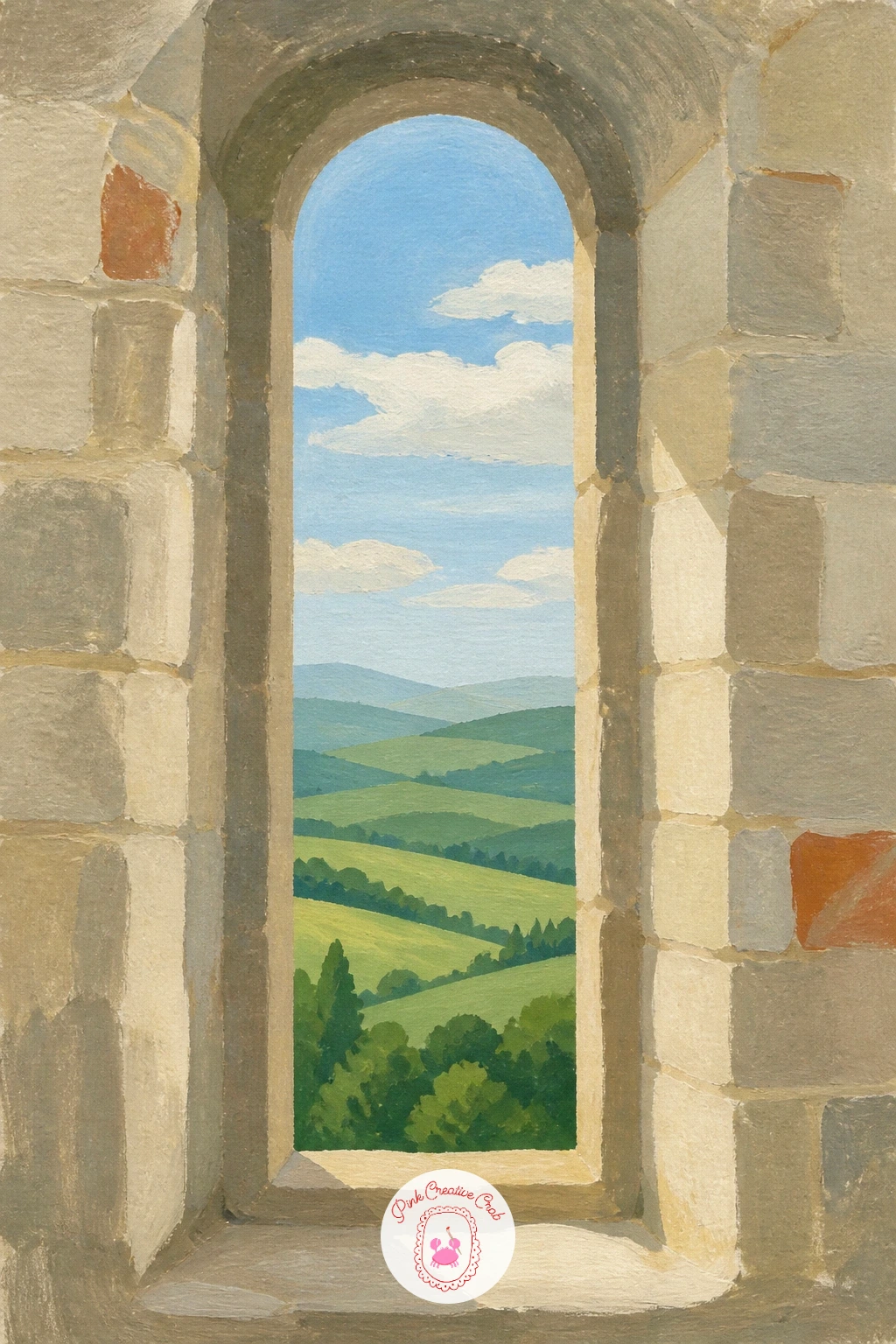
Palette: Stone Grey,Sage Green,Forest Green,Sky Blue
A desert seen through a car window is mostly about long flat bands of color, so this one moves fast once the composition is settled. Paint the window frame and the hint of a dashboard or side mirror first, then block in the sky, the distant mesas and the road in three or four simple horizontal layers.
Comparing proportions matters most here: hold your brush up against the scene and note that the sky usually takes up half the window or more, with the land a much narrower band below it, which keeps the desert feeling vast rather than cramped. Mesas go in as flat terracotta shapes with one darker shadow side, kept simple rather than textured.
The road is the easiest place for this to go wrong, since a perfectly straight road can look stiff, so angle it slightly and let it narrow quickly toward a single vanishing point near the horizon. No terracotta mixed yet, burnt sienna with a touch of red works as a swap.
Add one cactus silhouette close to the road for scale and interest.
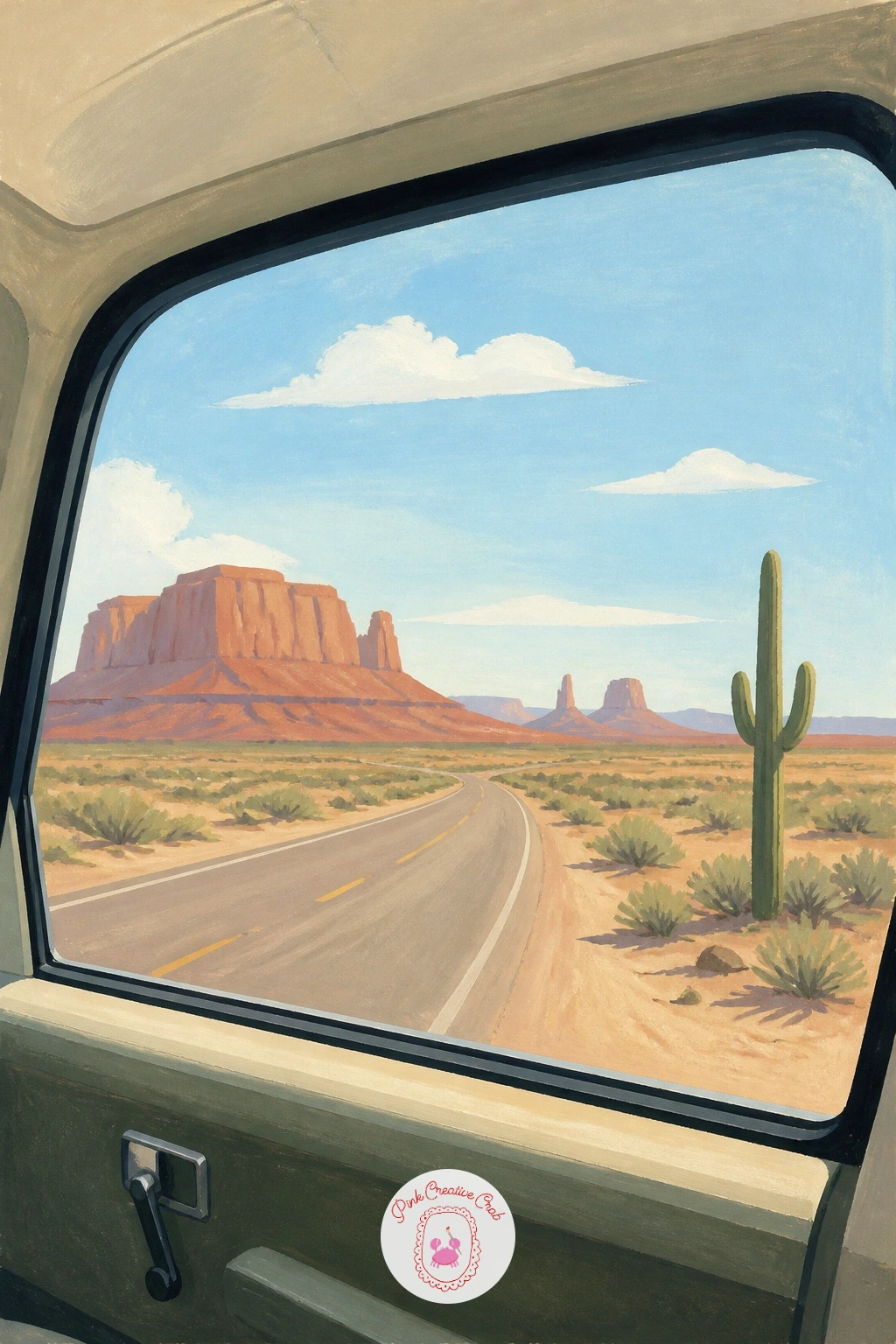
Palette: Terracotta,Sandy Beige,Sky Blue,Charcoal Grey
An island sitting ahead through a ferry window makes a satisfying little destination to build the whole painting toward. Paint the round or square porthole frame first, then fill it with water in the lower half and sky in the upper half, keeping the horizon line slightly below center so the island has room to rise.
Shape the island as one soft rounded hill or a cluster of two or three, painted in a cooler, hazier blue-green than anything else in the scene, since distant land always reads paler and bluer than what is close by. That haze is the detail that sells the distance, so resist the urge to paint the island in the same bright green as nearby water.
Ten minutes gets you the water, sky and island blocked in; forty minutes allows a small white ferry wake trailing behind the boat and a gull or two in the sky. No porthole shape traced yet, a round plate works as well as it does for the attic window idea above.
Keep the water’s reflection of the sky a shade paler than the sky itself for a believable sparkle.
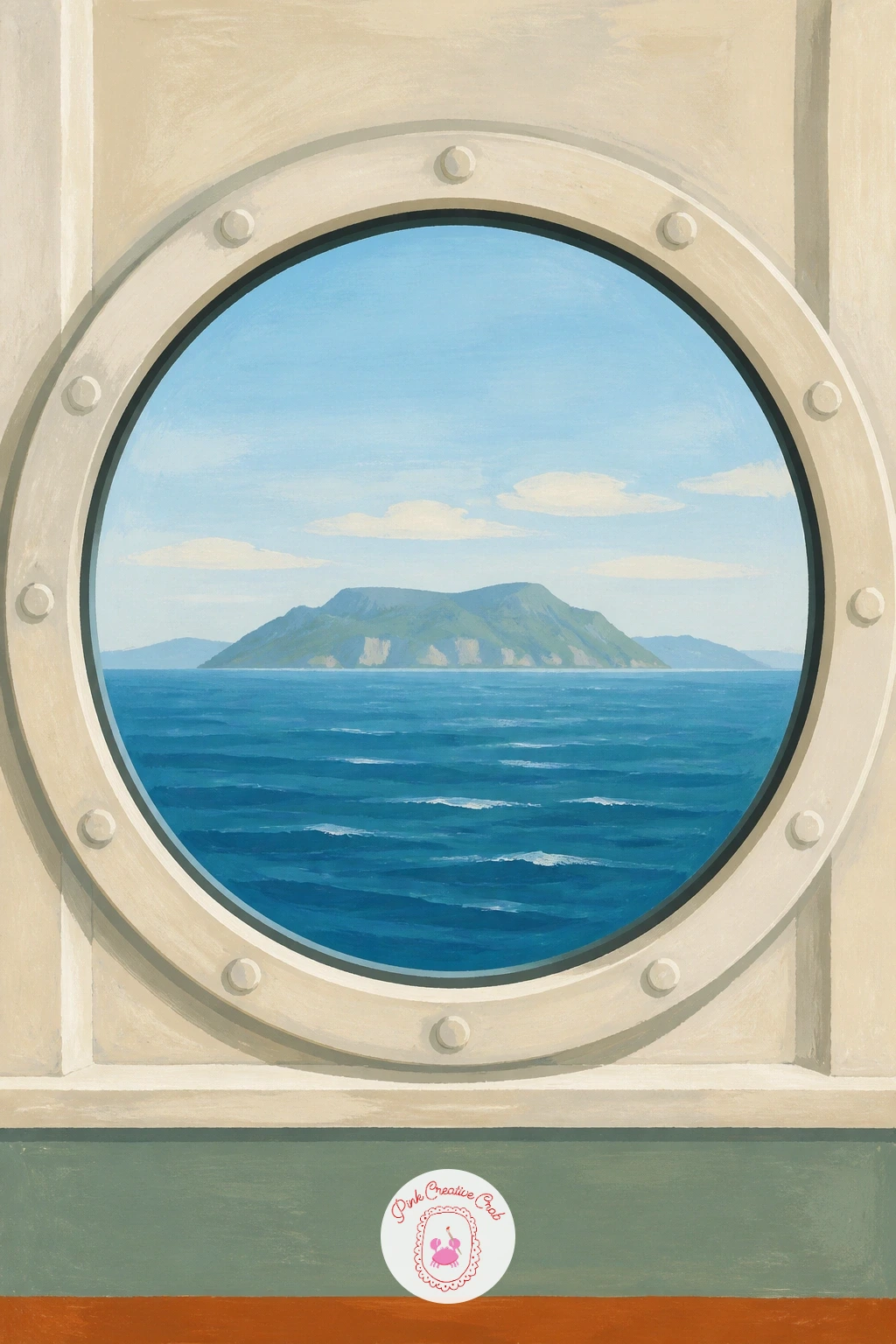
You Will Need
- plate for tracing a round porthole
Palette: Sea Blue,Hazy Blue Green,Sky Blue,Cream
A red tractor gives this golden wheat field a focal point that pulls the whole painting together, so place it before you commit to the rest. Paint the sky and the field as two large flat shapes first, pale blue above and warm gold below, meeting at a horizon roughly a third of the way up the window.
Add the tractor as a simple boxy red shape with two dark circles for wheels, positioned off to one side rather than dead center, which gives the field more room to breathe around it. Wheat fields can turn into a flat yellow block if you stop too soon, so drag a dry brush loaded with a slightly darker gold in short diagonal strokes across the field to suggest rows without painting individual stalks.
If red feels too bold, a weathered orange-red or even deep green tractor works just as well as a swap and still reads clearly against the gold.
Finish with a line of distant trees along the horizon to ground the field.
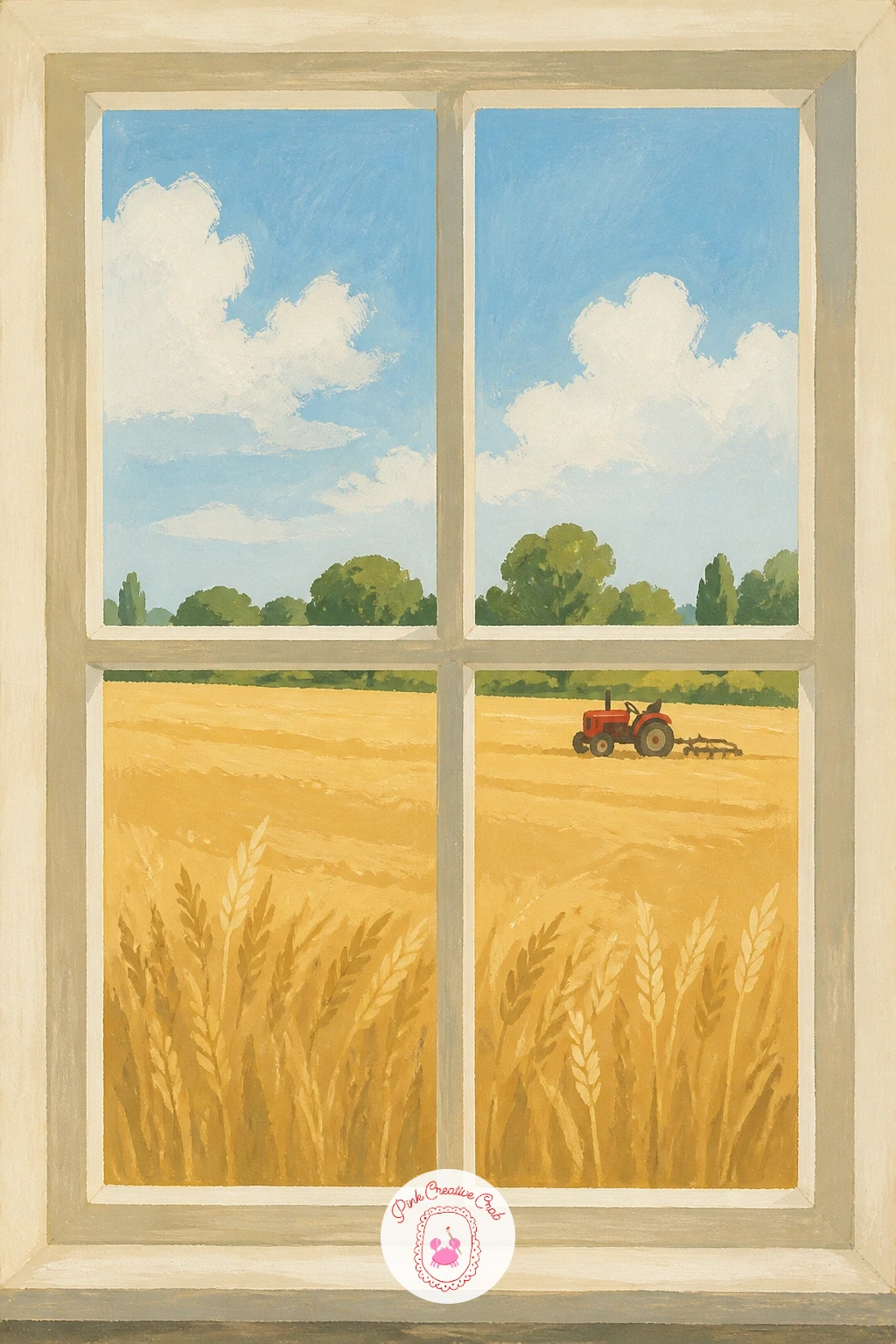
Palette: Golden Wheat,Brick Red,Sky Blue,Sage Green
Sheer curtains add a layer of softness that sits right over the view, which makes this one a nice chance to practice painting something partially see-through. Paint the lake, the far shore and the sky completely first, in calm flat bands of blue and sage, and let that layer dry fully before touching the curtains.
Add the sheer curtain on top using very thin, almost watery white gouache, letting the lake colors show faintly through it, then add a few slightly more opaque folds near the edges where the fabric gathers. The trouble spot is curtains painted too opaque, which block the view entirely, so test your white on a scrap first and thin it further if it looks solid.
If this is your first time layering a transparent effect in gouache, remember a little water goes a long way, add it in small amounts and check the coverage before adding more. No gouache for this effect, well-thinned acrylic glaze works the same way.
Leave the very center of the window curtain-free so the lake view stays clear and readable.
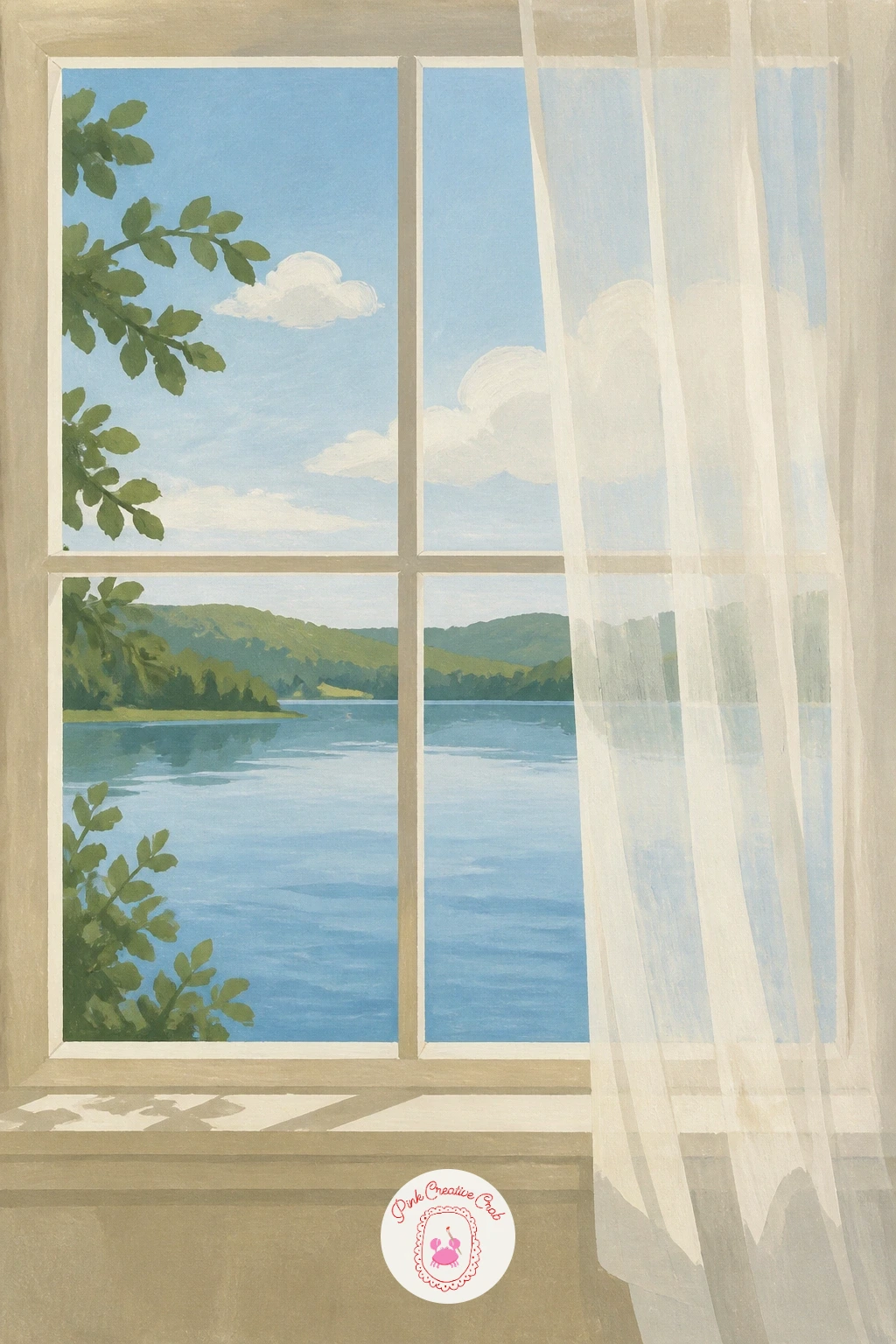
Palette: Sea Blue,Sage Green,Cream,Titanium White
A snowy ski slope lets white paper or a pale wash do most of the work, so this one is about restraint as much as painting. Sketch a cozy wooden window frame first, then fill the view beyond with a simple pale blue-white slope rising diagonally across the window, meeting a soft grey sky at the top.
Keep the light source consistent by deciding where the sun sits, usually just above the slope, and letting one side of every tree and bump in the snow catch a touch of warm yellow-white while the other side stays in cool blue shadow. That single choice is what makes flat snow look like it has real form rather than just being blank paper.
The usual mistake is snow with no shadow at all, which flattens the whole hill, so do not skip the cool blue side even where it feels like it should just stay white. No pale blue gouache mixed, white with the tiniest touch of Payne’s grey gives the same soft tone.
Add two or three small dark pine trees along the slope and a single skier as a tiny dash of color for scale.
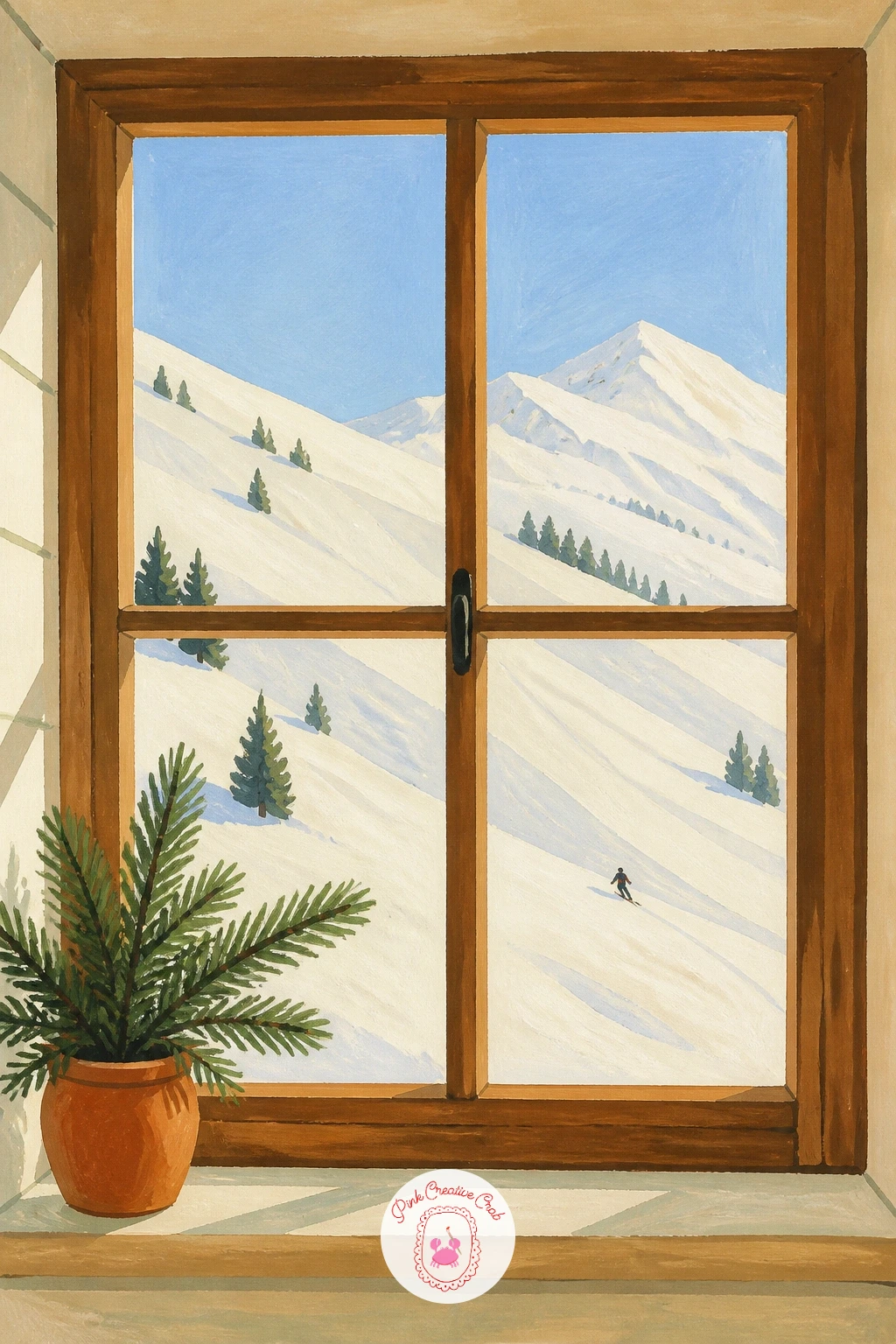
Palette: Pale Blue White,Payne’s Grey,Forest Green,Terracotta
Dolphins mid-leap bring energy to a boat cabin view, so sketch their arching bodies before you paint any water around them. Draw two or three simple curved grey shapes breaking the surface at slightly different points, each one just a smooth arc with a small fin, then build the round porthole frame around the whole scene.
Paint the sea first in deep blue with a slightly lighter band near the surface where the dolphins break through, then add the dolphins on top once the water is dry, keeping their shape simple and smooth rather than detailed. Dolphins often end up looking stiff or shark-like, so round every curve generously and keep the fin small and gently hooked rather than sharp.
For one hands-on trick, lift a thin curved line of wet blue paint with a damp brush right where each dolphin breaks the surface, which creates a soft splash edge without any extra painting. No porthole frame drawn freehand easily, trace a plate again as in the attic and ferry window ideas.
Keep the sky sliver at the very top of the porthole pale and simple so the dolphins stay the focus.
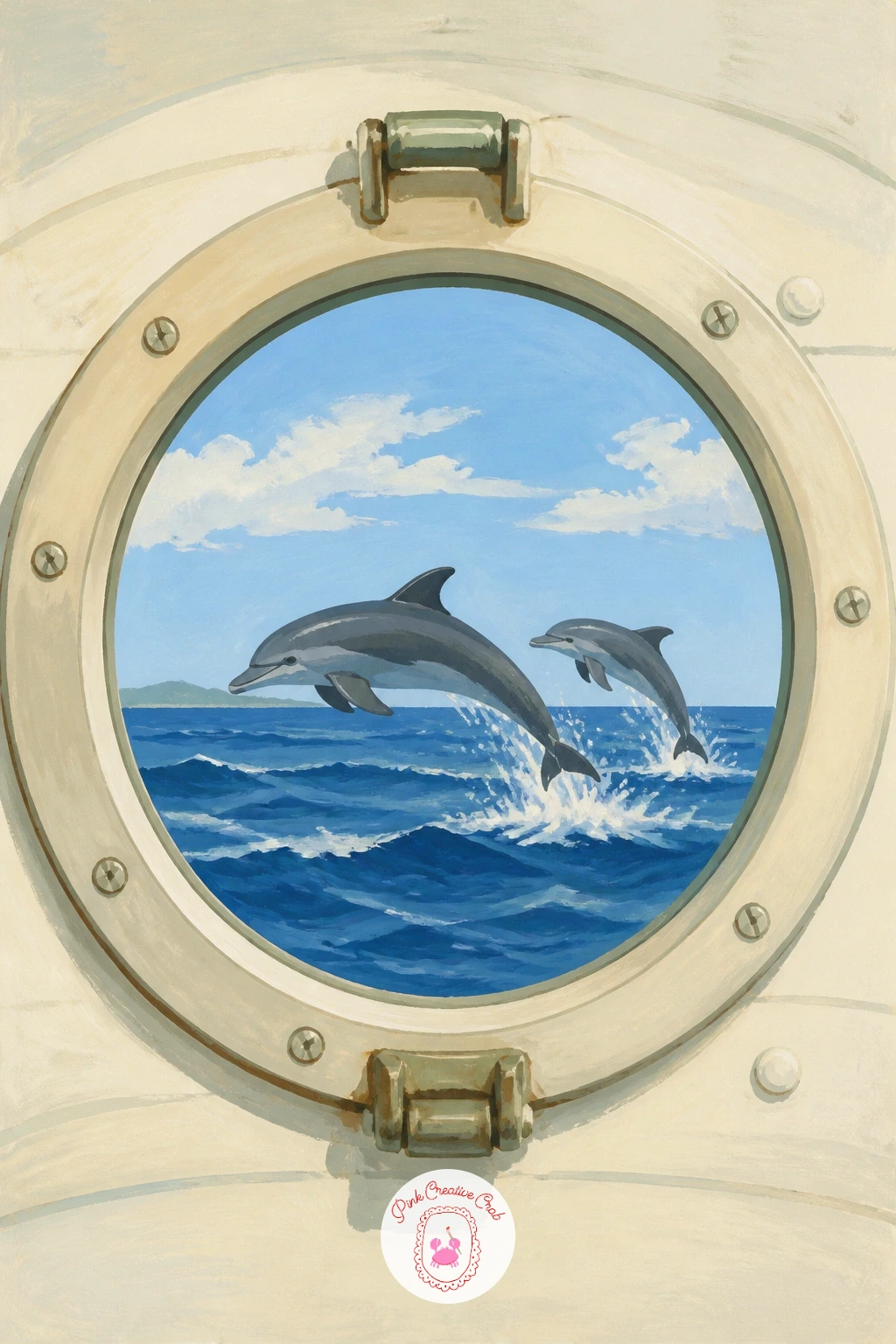
You Will Need
- plate for tracing a round porthole
Palette: Deep Blue,Sea Blue,Charcoal Grey,Titanium White
Ivy creeping around a library window gives you a chance to paint greenery with real character instead of a tidy, trimmed look. Paint the window frame first, then build the ivy as a loose tangle of small leaf shapes climbing up one or both sides and trailing a little across the top corner.
Vary the leaf sizes and tilt them in different directions so the vine reads as wild growth rather than a repeated pattern, and tuck in two or three tones of green from deep forest to pale sage for depth. Ivy often turns stiff when every leaf is painted the same size and angle, so work quickly and let some leaves overlap others.
Behind the ivy and glass, keep the outdoor view soft and blurred, a hint of distant trees or a garden path is plenty since the ivy itself is the real subject here. If you enjoy this kind of detailed greenery, the leaf and stem studies in 27 botanical sketchbook pages for wild herbs, seed pods and garden weeds are good practice.
Finish with one small bird perched briefly on the ivy for life.
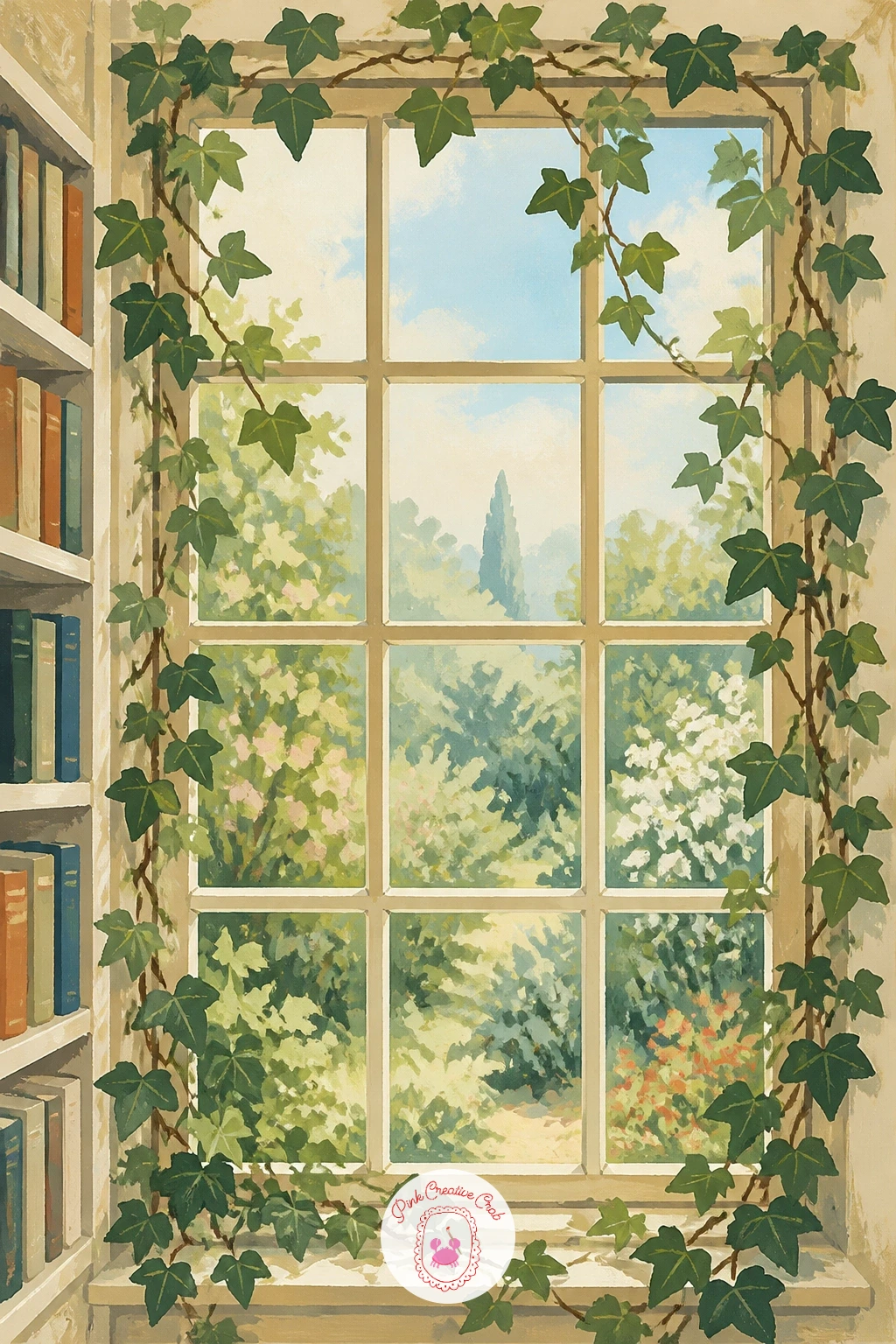
Palette: Forest Green,Sage Green,Cream,Terracotta
A Japanese maple gives this view its whole personality through color alone, so let the tree’s fiery red take center stage against a calm, quiet garden. Paint the window frame and a simple gravel path or pond shape first, then build the garden in muted greens and greys before adding the maple.
Shape the maple as one soft rounded canopy in deep red-orange, painted with a dry brush dabbed rather than smeared so the texture stays broken and leaf-like rather than solid. The rest of the garden should stay deliberately calm and low in detail, a few smooth stones, a simple lantern shape, so the red tree has nothing to compete with.
The maple can turn into a flat red blob if painted in one even coat, so vary the red with touches of orange and a little deep plum mixed in across different parts of the canopy. No dry brush handle on hand, a stiff old toothbrush dabbed gently gives a similar broken texture.
Add a small still pond reflecting a touch of the red canopy to finish.
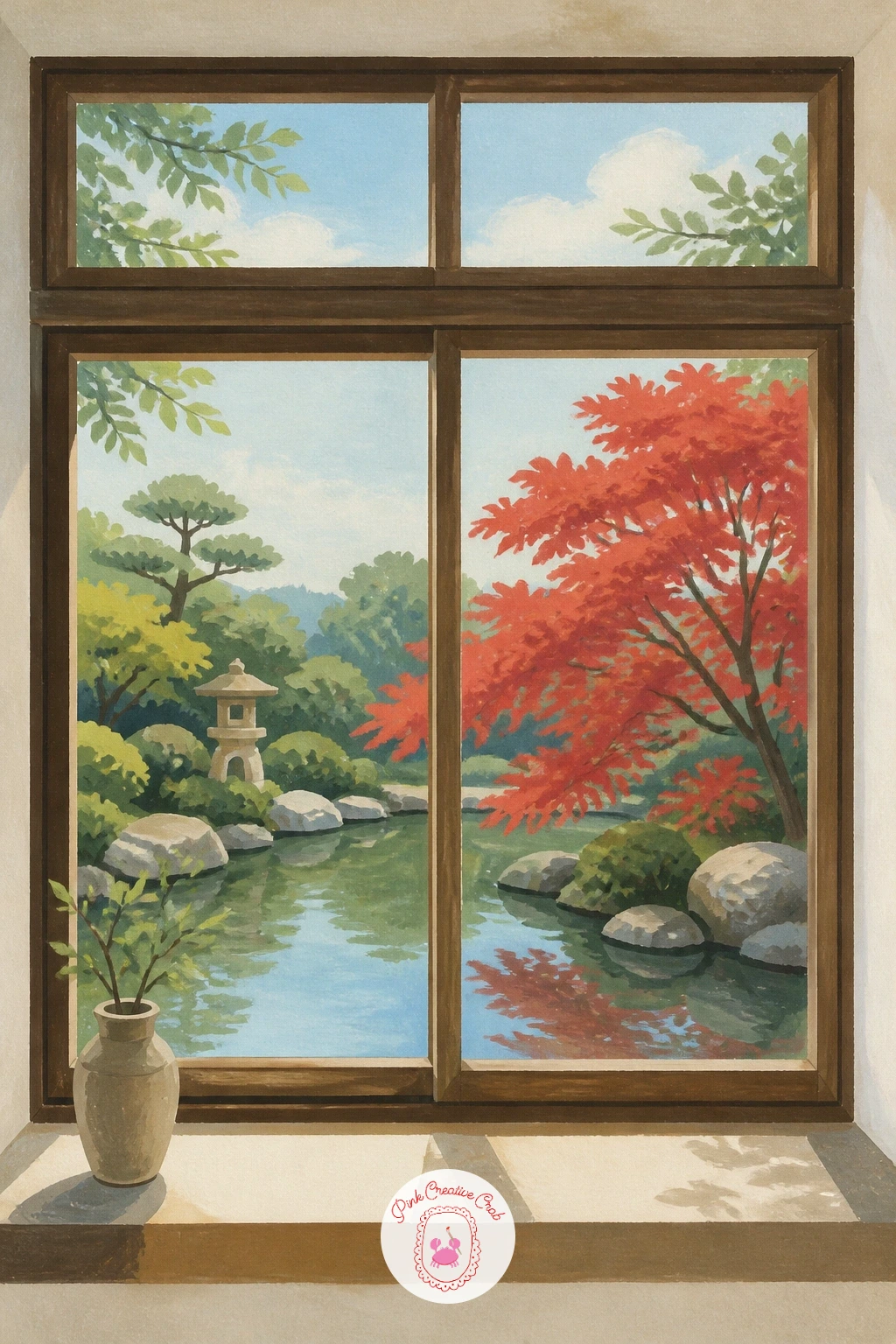
Palette: Maple Red,Burnt Orange,Sage Green,Stone Grey
A ferris wheel glimpsed far off gives a soft, nostalgic feeling to an otherwise simple skyline, so keep it small and let the rest of the view stay quiet around it. Paint the sky and distant rooftops or trees first, then add the wheel as a thin circle outline with a few short spoke lines, far smaller than it might feel natural to make it.
Hold your brush up to compare the wheel’s size against a nearby building or tree before committing, since a ferris wheel this far away should never be taller than the window’s own middle third, keeping that sense of real distance intact. A few tiny dots of color around the rim suggest the gondolas without needing any detail at all.
The wheel often ends up too large or too crisp for something meant to read as distant, so keep its outline thin and slightly soft rather than hard black.
Finish with a warm glow of string lights suggested as a scatter of small yellow dots near its base for an evening feel.
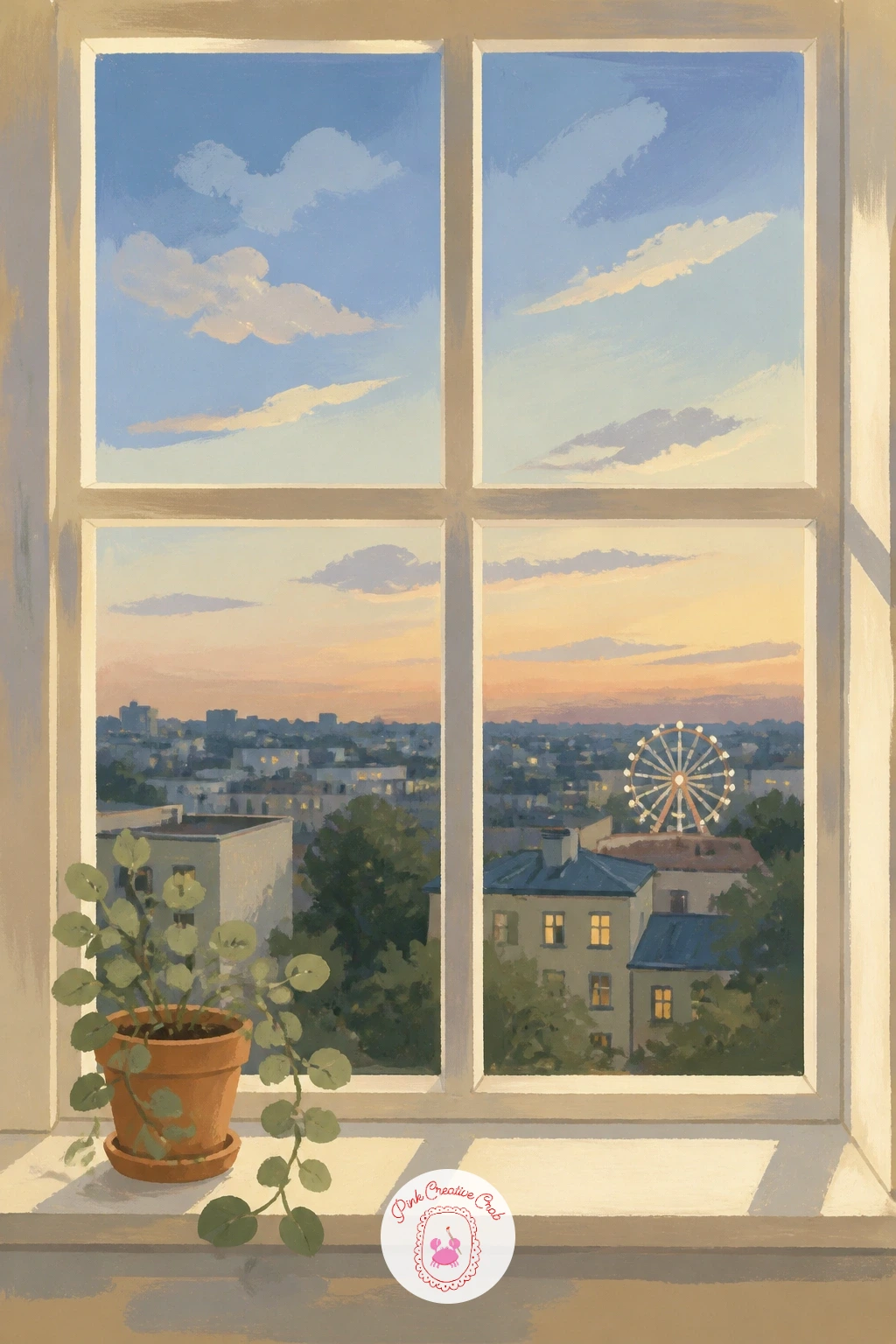
Palette: Sky Blue,Charcoal Grey,Sunflower Yellow,Soft Pink
An arched window brings its own built-in drama, so take care shaping the curve before anything else goes in. Draw the arch using a steady curved line, tracing around a bowl or lid if freehand curves feel shaky, then paint the thick tiled or painted frame in warm terracotta with a simple repeating pattern along its edge.
Beyond the arch, build a quiet courtyard with a central fountain or potted palm, keeping the walls in warm sandy tones and adding one or two patches of strong shadow where the midday sun would fall, since Moroccan courtyards are usually painted in bright, high sun rather than soft daylight. That hard shadow is what sells the heat and light of the scene.
The arch shape is the part most likely to wobble, so paint it in one slow, steady pass rather than several short strokes, and do not worry about perfect symmetry since a little variation looks handmade rather than wrong.
Add a single potted palm just inside the courtyard wall to finish the scene.
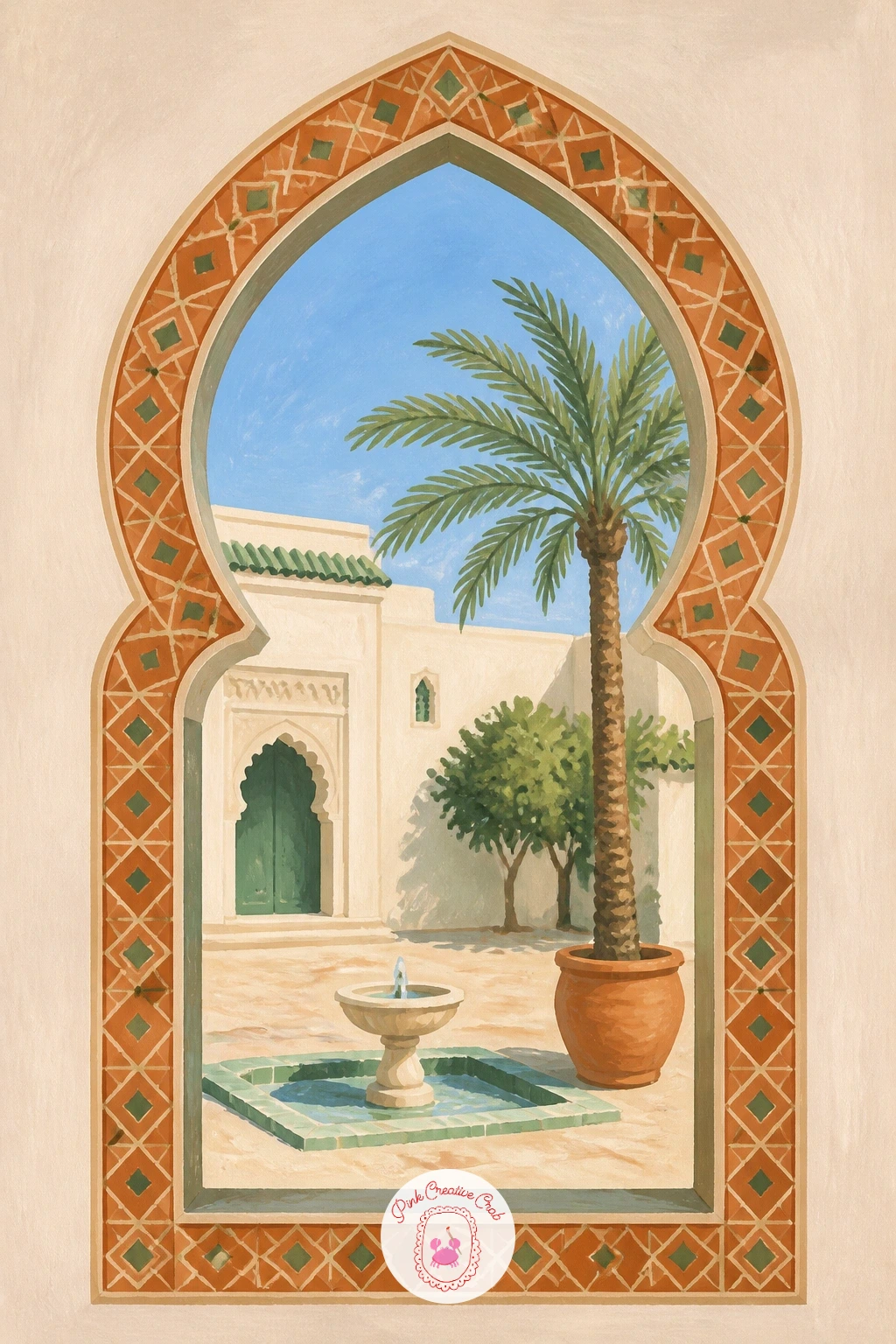
You Will Need
- bowl or lid for tracing the arch curve
Palette: Terracotta,Sandy Beige,Sage Green,Charcoal Grey
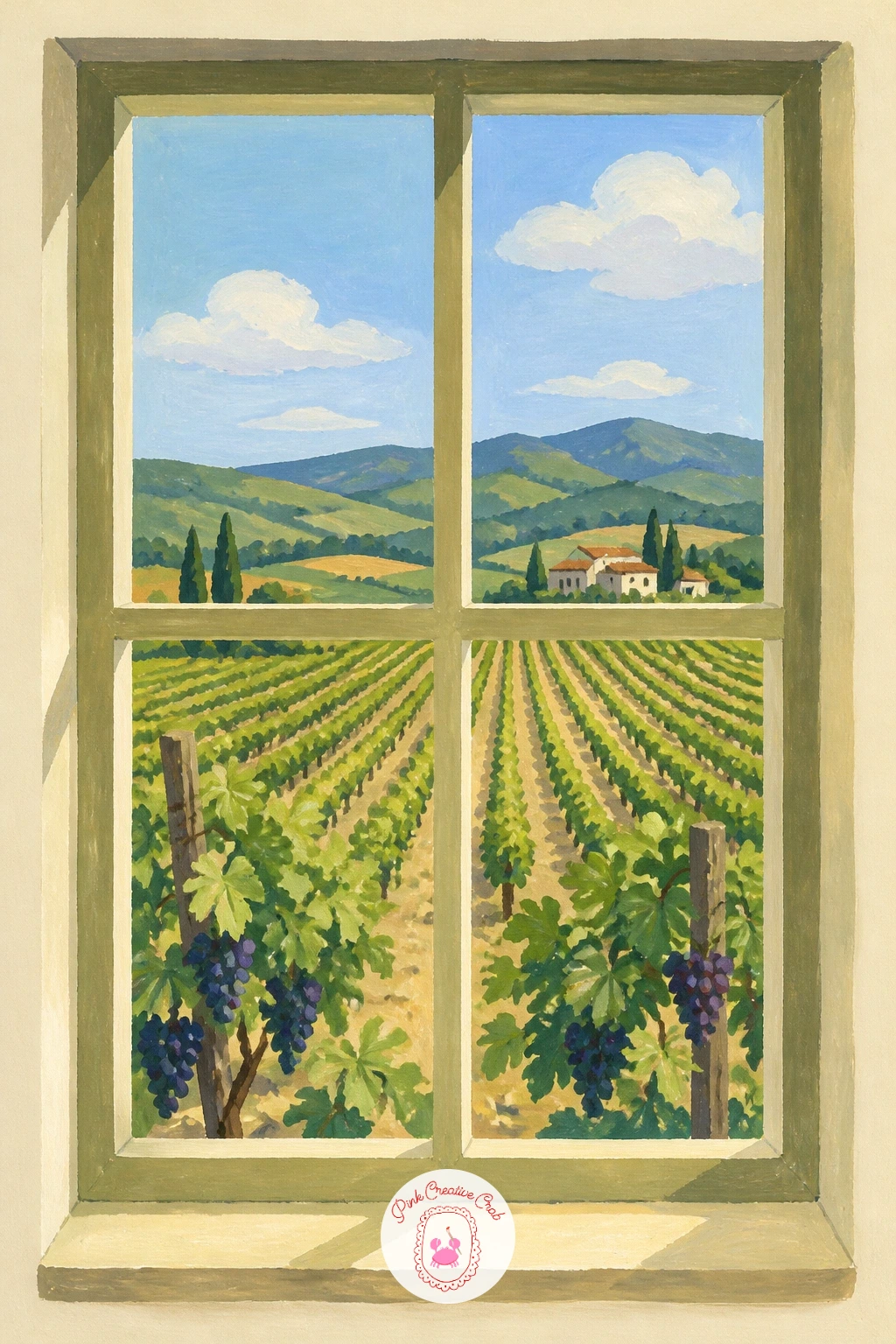
Rows of grapevines marching into the distance make a satisfying pattern once you think of them as simple repeated shapes rather than individual plants. Paint the sky and distant hills first, then lay in the vineyard rows as a series of parallel diagonal lines of green getting closer together as they recede toward the horizon.
That closing gap between rows is the whole trick to this view’s perspective, so space the nearest rows generously apart and let them pinch together quickly in the distance rather than staying evenly spaced across the whole field. A scattering of small purple dots along the nearest row or two suggests ripe grapes without painting individual clusters.
Rows often go wrong when they are painted perfectly straight and parallel all the way back, which flattens the distance, so let them angle slightly toward a single vanishing point. No deep purple mixed for the grapes, a blend of red and blue gouache gets you there quickly.
Finish with one small farmhouse or barn shape tucked among the distant hills.
Palette: Sage Green,Deep Purple,Terracotta,Sky Blue
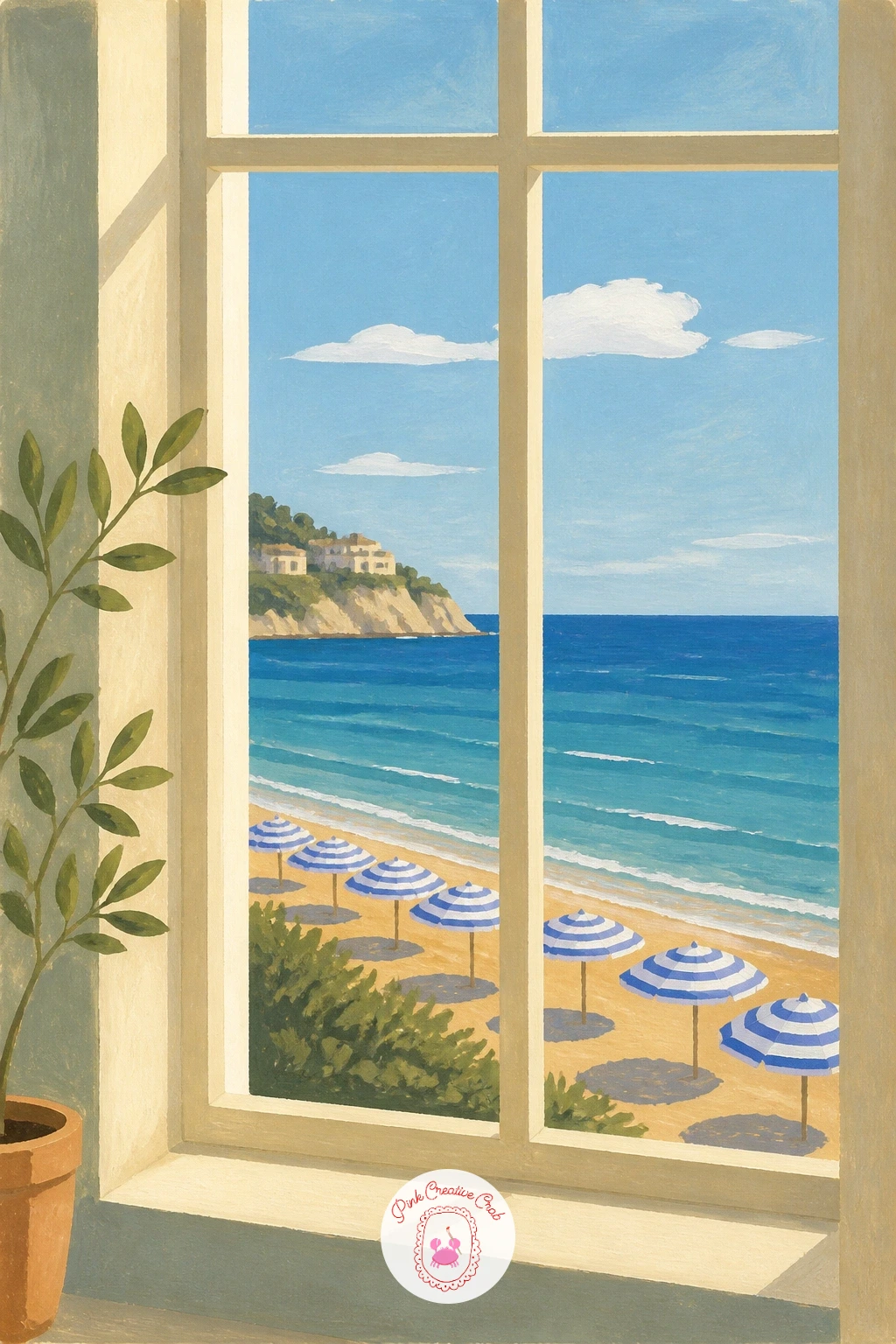
Striped umbrellas scattered along a beach give this view a cheerful rhythm, so plan their spacing before you paint the sand and sea beneath them. Block in the sky, sea and sand as three flat horizontal bands first, then let that layer dry completely before adding any umbrellas on top.
Paint each umbrella as one simple dome shape, alternating two colors in even stripes, then add a short straight pole beneath it, varying the umbrella colors across the row so no two sit right beside a matching pair. The water’s edge is the trickiest part to get right, so keep the line between sea and sand slightly uneven and soft rather than perfectly straight, which makes it read as a real shoreline.
In ten minutes you can block in the three bands and a few quick umbrella domes; with more time, add tiny figures lounging near a couple of the umbrellas and a scatter of small shells along the sand. No striped pattern feels confident freehand, a strip of masking tape laid at an angle gives a crisp stripe edge to paint against.
Finish with a few gulls as small dark checkmark shapes in the sky.
You Will Need
- masking tape for crisp umbrella stripes
Palette: Sea Blue,Sandy Beige,Brick Red,Cream
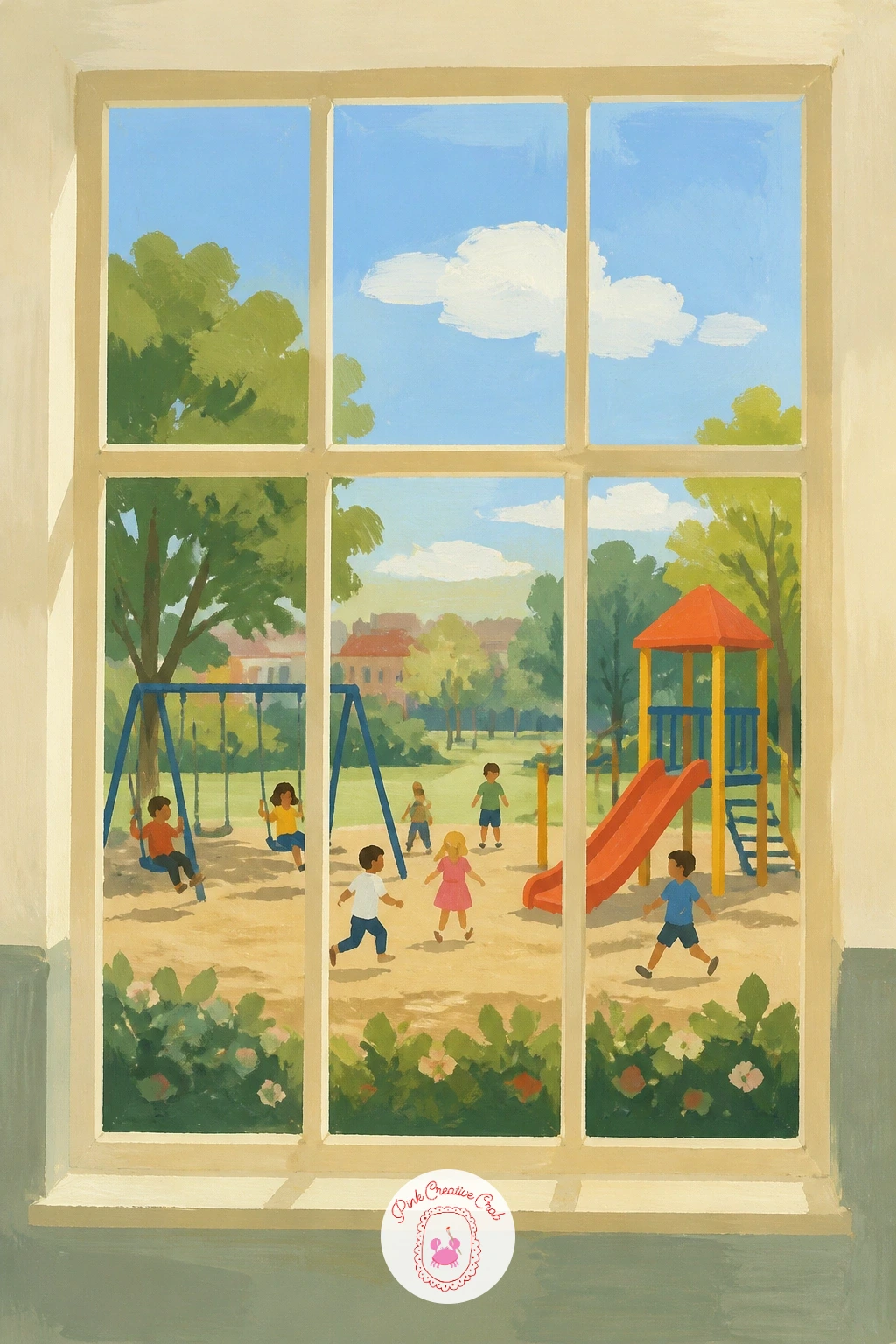
A playground view carries a wonderful sense of nostalgia, so keep the scene playful and a little loose rather than too precise. Paint the classroom window and a hint of a desk or plant on the sill first, then build the playground beyond it with simple flat shapes, a swing set, a slide, a patch of bright green grass.
Add a few children as tiny colorful dashes of clothing with simple round heads, scattered at different points around the equipment rather than lined up, which keeps the scene feeling candid and alive. Figures this small and simple go wrong only if they are over-detailed, so resist adding faces or clothing patterns and let color and posture do all the storytelling.
If you like painting small figures and playful scenes, the character studies in 33 silly animal doodles that look like they have opinions are a fun warm-up for loosening up quick, expressive shapes.
Finish with a simple chain-link fence line along the back of the playground to ground the whole scene.
Palette: Sage Green,Sunflower Yellow,Terracotta,Sky Blue
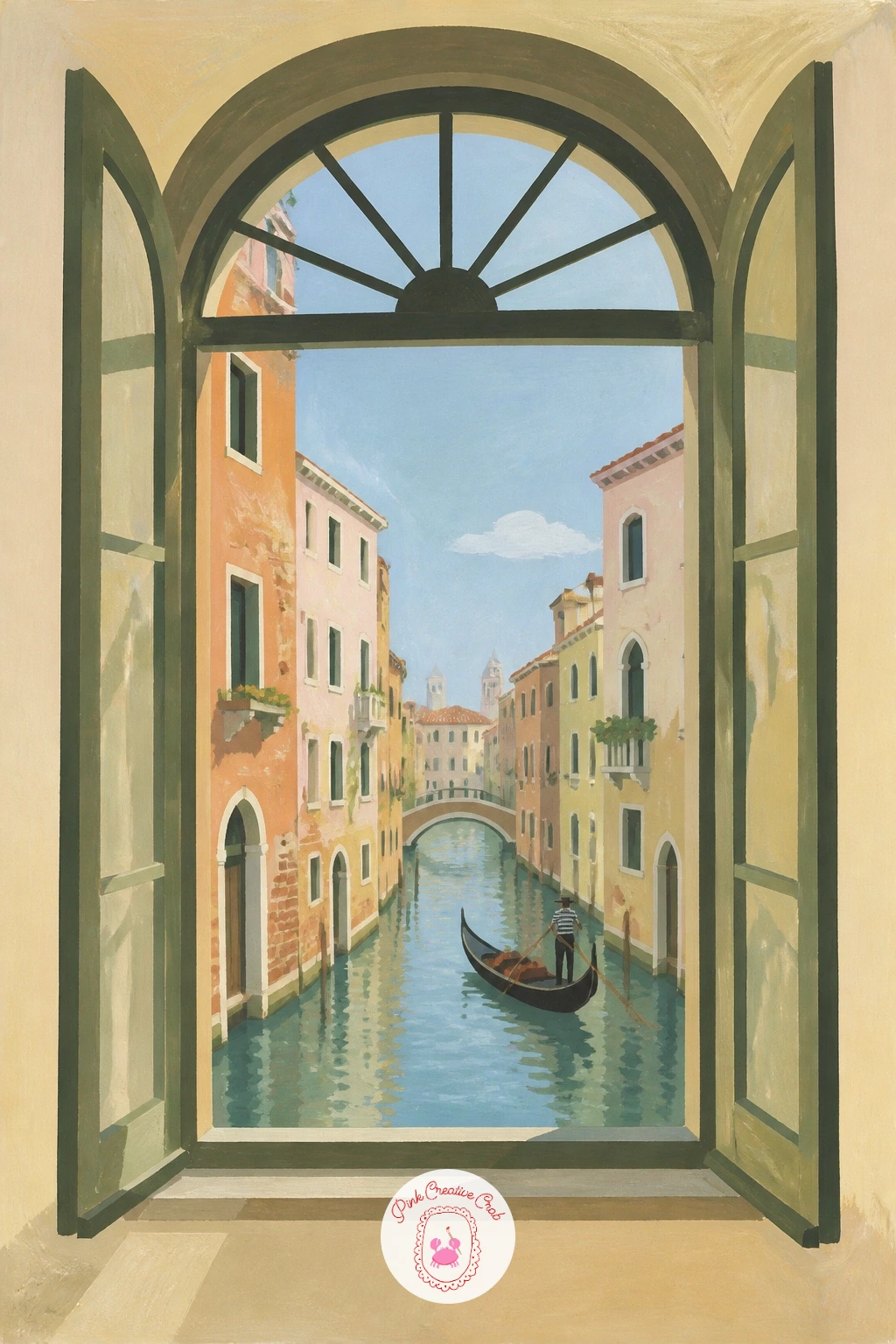
A Venetian canal view leans on tall narrow buildings and still water, so get the window’s proportions settled first since Venetian windows tend to be elegant and slightly arched. Paint the frame, then fill the view beyond with a row of tall, narrow pastel buildings standing close together along the canal edge.
Paint the water last, in a slightly darker, more muted version of the sky and building colors above it, then add a few soft horizontal reflections with a dry brush dragged gently sideways rather than painted as solid mirror images. That hazy, broken reflection is what makes still canal water look convincing, since a perfect mirror image usually looks stiff.
Buildings crowding too close together is the common trap here, so vary their heights and leave a narrow sliver of sky between at least two of them. No dry brush for the reflections, a nearly empty brush wiped on a paper towel first works the same way.
Add a single gondola gliding past to finish the canal scene.
Palette: Terracotta,Soft Pink,Sea Blue,Cream
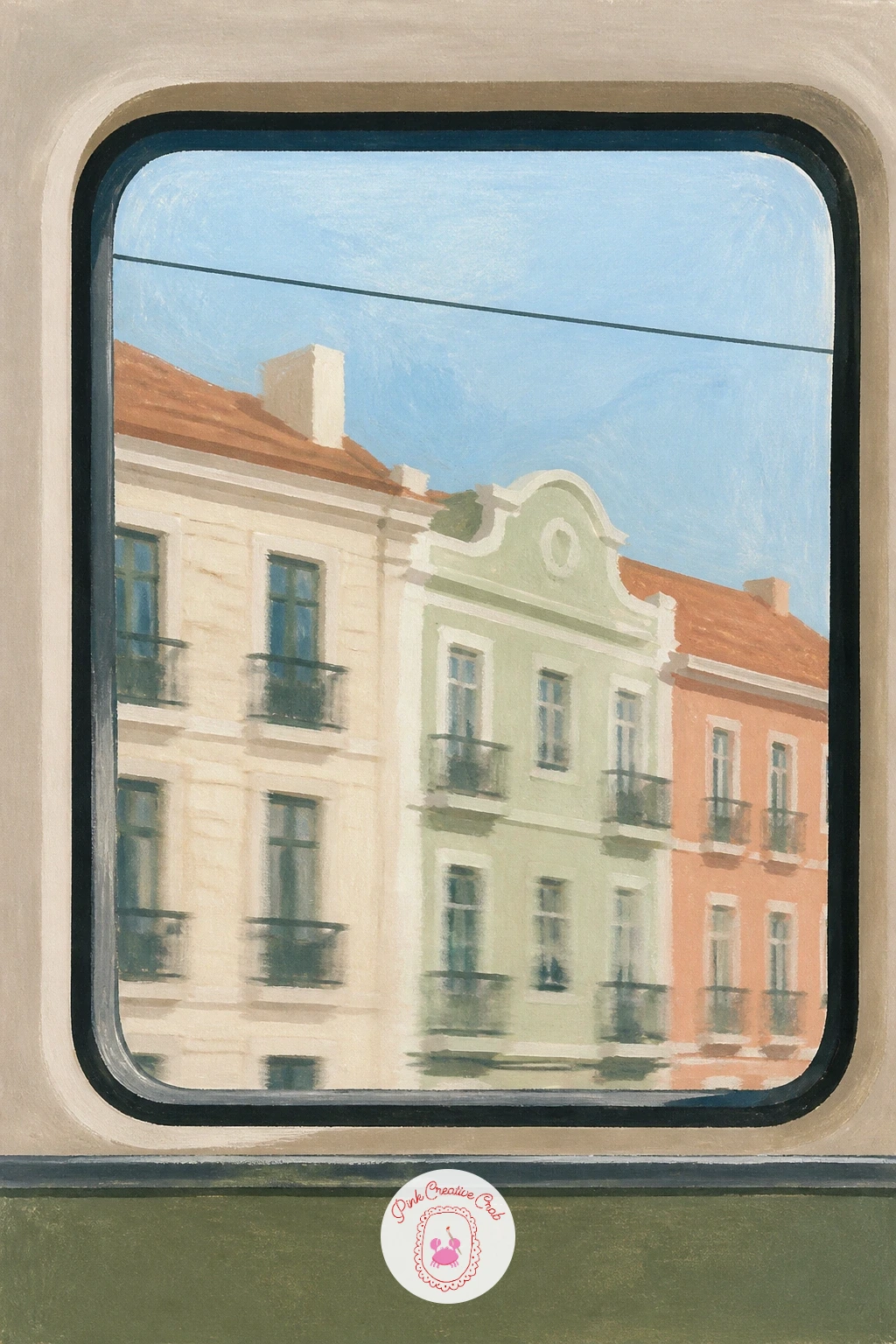
Old buildings sliding past a tram window give you a nice excuse to blur the background on purpose, which is more forgiving than painting a crisp street scene. Paint the window frame and the curve of the tram wall first, then block in a row of old buildings beyond the glass using soft, slightly smudged edges rather than crisp lines.
Drag a barely damp brush horizontally across the wet building colors right after you paint them, which stretches the edges just enough to suggest motion without losing the overall shapes. The common mistake is blurring everything equally, which makes the whole scene mushy, so keep the window frame itself perfectly crisp and sharp while only the view beyond softens.
If you enjoy this looser, European streetscape feeling, the rooftop and cafe scenes gathered in 27 free French junk journal pages and ideas with Paris cafes, lavender fields and patisseries offer more of the same mood to explore.
Finish with a single overhead tram wire sketched as a thin dark line across the top of the window.
Palette: Warm Grey,Terracotta,Cream,Payne’s Grey
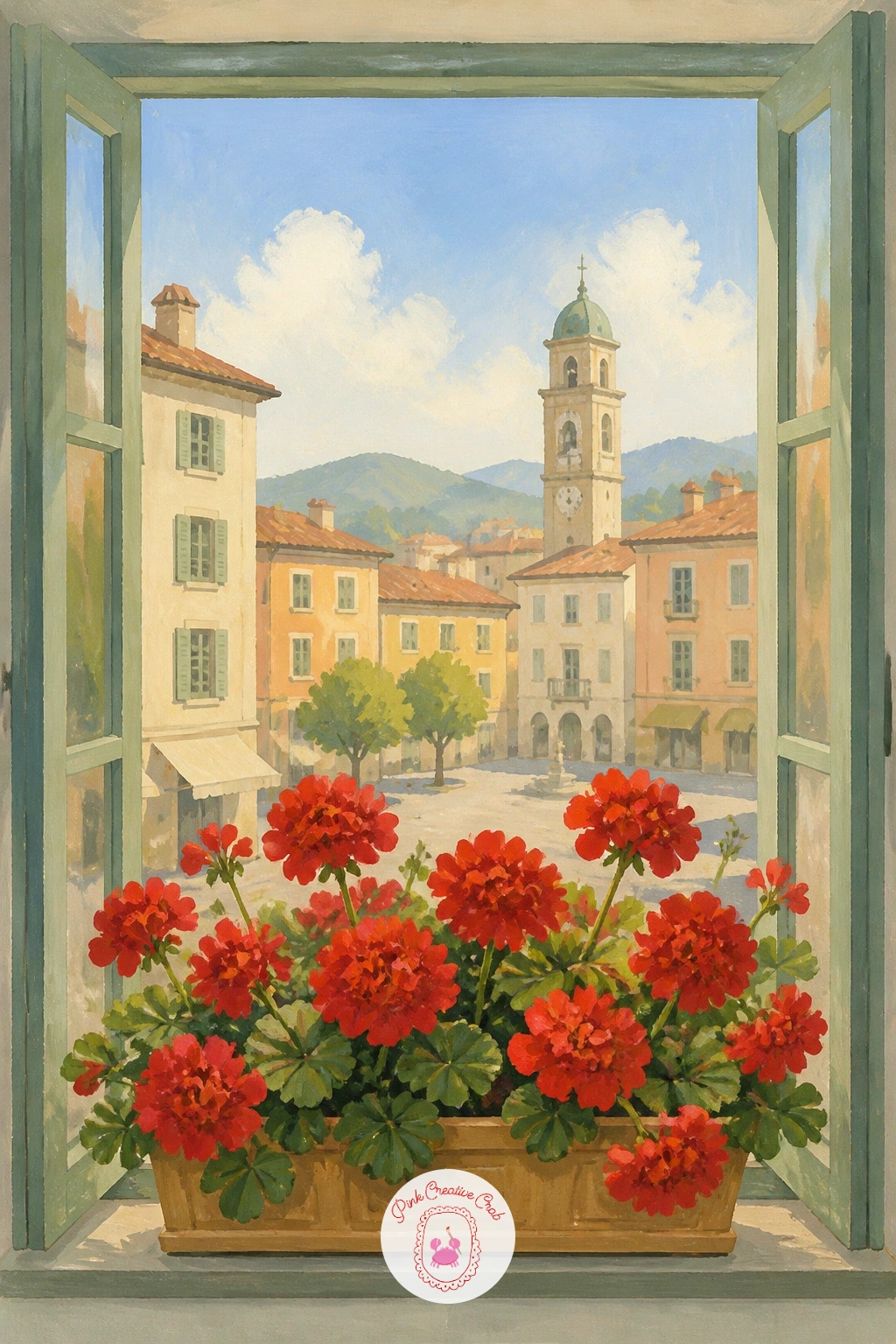
A window box bursting with geraniums gives you a bright foreground before the town square even begins, so paint the flowers first and let the square stay simpler behind them. Block in the window box as a flat terracotta or wooden rectangle, then add geraniums as small clusters of red dabs with a few sage leaves tucked between.
Keep the flowers varied in size and slightly overlapping so the box feels full rather than a tidy row, then build the town square behind them in muted, slightly hazy tones so the bright red geraniums stay the clear focal point. The flowers can turn into flat red blobs if painted in one single shade, so mix a lighter and a slightly darker red and alternate between them across the cluster.
No red geraniums on hand to reference, pink or orange blooms work just as well in the same simple dabbed technique.
Add a small church tower or clock tower in the square beyond to finish the scene.
Palette: Brick Red,Sage Green,Terracotta,Cream
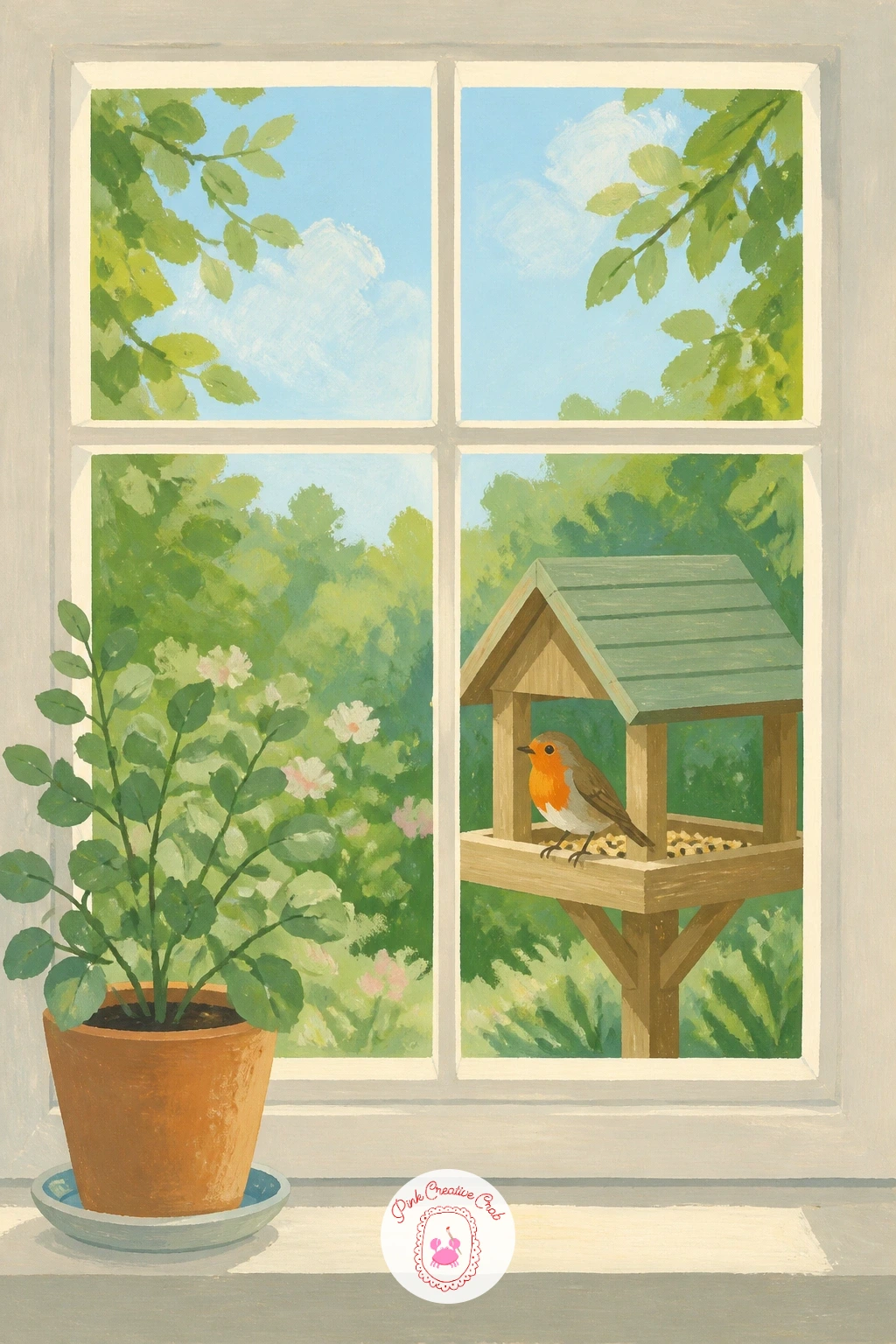
A robin at a bird feeder gives this quiet window scene a small spark of life, so paint the bird with care even though everything around it stays simple. Sketch the feeder first as a basic wooden shape hanging from a thin pole or branch, then build a soft, blurred garden behind it in muted greens.
Shape the robin last, a round body, a smaller round head, and just one patch of warm orange-red across the chest, keeping the rest of the bird in soft brown and grey. Birds often go wrong around the beak and legs, so keep both thin and understated, a tiny triangle and two short lines are enough, rather than trying to draw every detail.
For more small garden birds painted this simply, 19 watercolor birds tutorial cards for garden birds in every season offers a good range of poses to borrow from.
Finish with a scatter of birdseed dots below the feeder for a lived-in feel.
Palette: Terracotta,Warm Brown,Sage Green,Cream
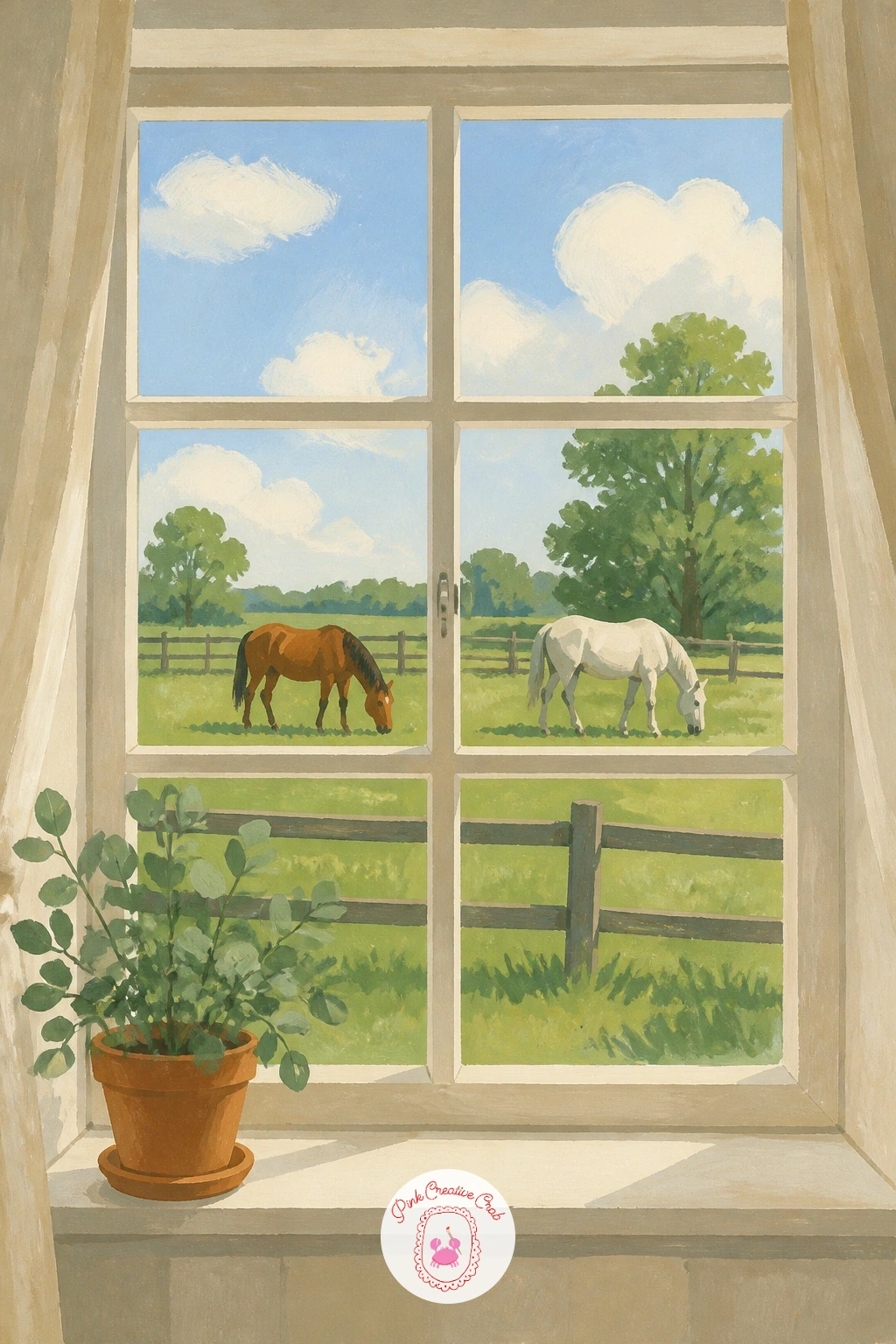
Horses grazing in a distant field are easiest to paint as simple grounded shapes rather than detailed animals, so keep their legs short and their bodies solid. Paint the sky, field and fence line first in soft greens and warm neutrals, then add two or three horses as flat brown or grey oval bodies with a small rounded head lowered toward the grass.
Comparing proportions matters here: keep each horse’s body roughly twice as long as it is tall, and check that against a nearby fence post or tree before you commit, since a horse that is too tall or too narrow reads oddly even at a distance. Space the horses unevenly across the field rather than lining them up.
Horses often go wrong at the legs, which can look too thin and spindly, so paint them as slightly thicker shapes than feels natural and let the grass below blur their feet a little. No brown gouache mixed for a horse, a warm burnt sienna works just as well.
Add a simple wooden fence line across the foreground to finish the farmhouse feeling.
Palette: Warm Brown,Sage Green,Cream,Sky Blue
If horses feel tricky, the simplified animal shapes in farm painting projects are worth a look, since the same short, grounded body shapes work well here too.
Mist softens everything it touches, which makes this one of the more forgiving forest views to paint since hard edges are not needed anywhere. Paint the window frame first, then build the forest in soft layers, darkest and clearest nearest the glass, fading gradually into pale grey-white as the trees recede into the mist.
Blend each layer into the next while the paint is still wet, using a clean damp brush to soften the boundary between one row of trees and the pale mist behind it, rather than leaving any hard line. The scene goes wrong if every tree stays equally sharp, since that kills the sense of depth mist is meant to create, so let the back third of the painting almost disappear into the pale background.
Ten minutes gets the soft layered forest blocked in; forty minutes allows a narrow path winding into the mist and a single deer standing at the edge of the clearing.
Keep the nearest one or two trees crisp and detailed as a contrast to everything fading behind them.
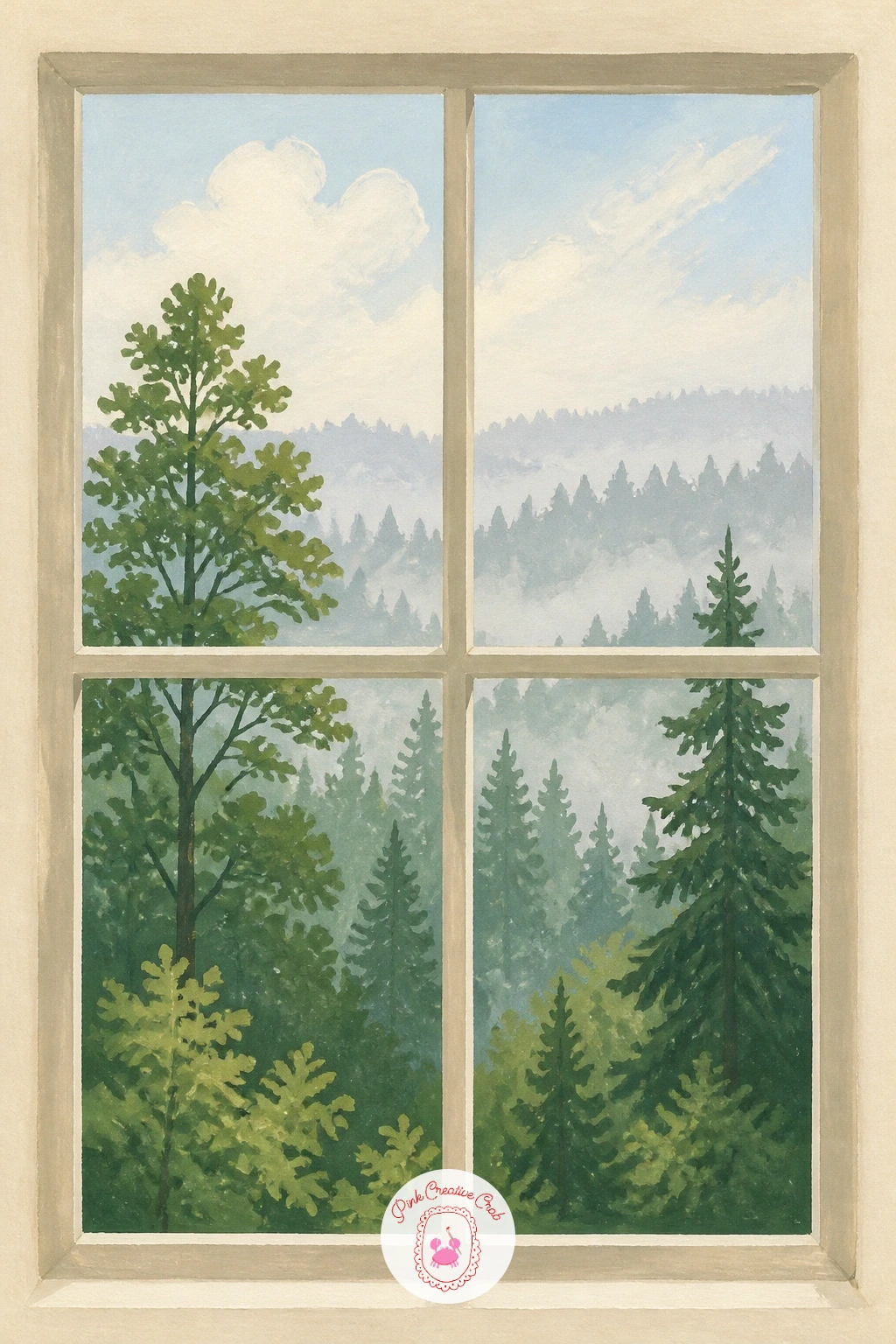
Palette: Forest Green,Pale Grey,Sage Green,Cream
A hammock strung between two posts gives this beach view a relaxed, inviting focal point, so get its gentle curve right before painting anything else outside the window. Draw the window and a simple curtain first, then sketch the hammock as a shallow sagging arc strung between two posts or palm trunks, rather than a straight line.
Build the beach and sea behind it in calm flat bands, then add the hammock’s woven texture with a few short dashed strokes across the curve rather than a single solid shape, which keeps it looking soft and fabric-like. The curve is the easy part to get wrong, since a hammock drawn too straight or too deep loses its relaxed sag, so check it against the posts for a gentle, believable dip.
If palm trunks feel tricky to paint, a wooden beam frame works as a simple swap and still holds the hammock convincingly.
Finish with a sun hat or a pair of sandals tossed in the sand below the hammock for a lived-in touch.
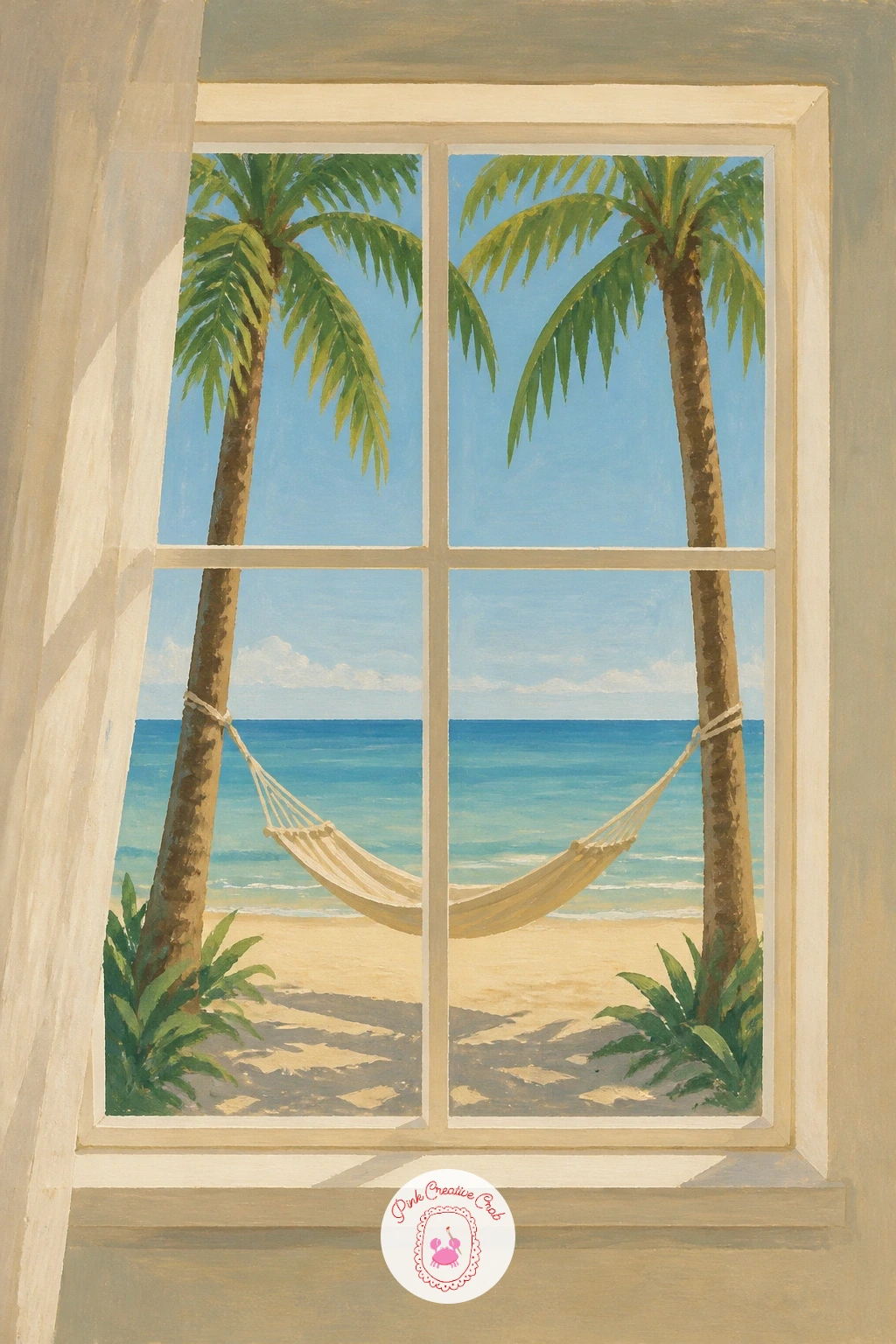
Palette: Sea Blue,Sandy Beige,Cream,Terracotta
A child waving at a passing train brings this whole list full circle with a small, warm story, so decide on the child’s simple pose before anything else goes in. Paint the child as a flat silhouette or simple colored shape standing at the window, one arm raised in a wave, facing out toward the glass.
Build the outdoor scene next, a train rendered as a few flat rectangular carriages with simple round windows, moving across a soft landscape of fields or hills in the background. Keep the child’s proportions believable by comparing the head size to the body, roughly one to four or five for a young child, which keeps the figure from looking either too adult or oddly top-heavy.
The train is the part most likely to go wrong if it gets too detailed, so keep it as flat, repeated carriage shapes with a simple puff of smoke or a motion blur trailing behind, echoing the same loose energy used for the earlier train window idea.
Finish with warm interior light spilling onto the windowsill where the child stands, to keep the whole scene feeling cozy.
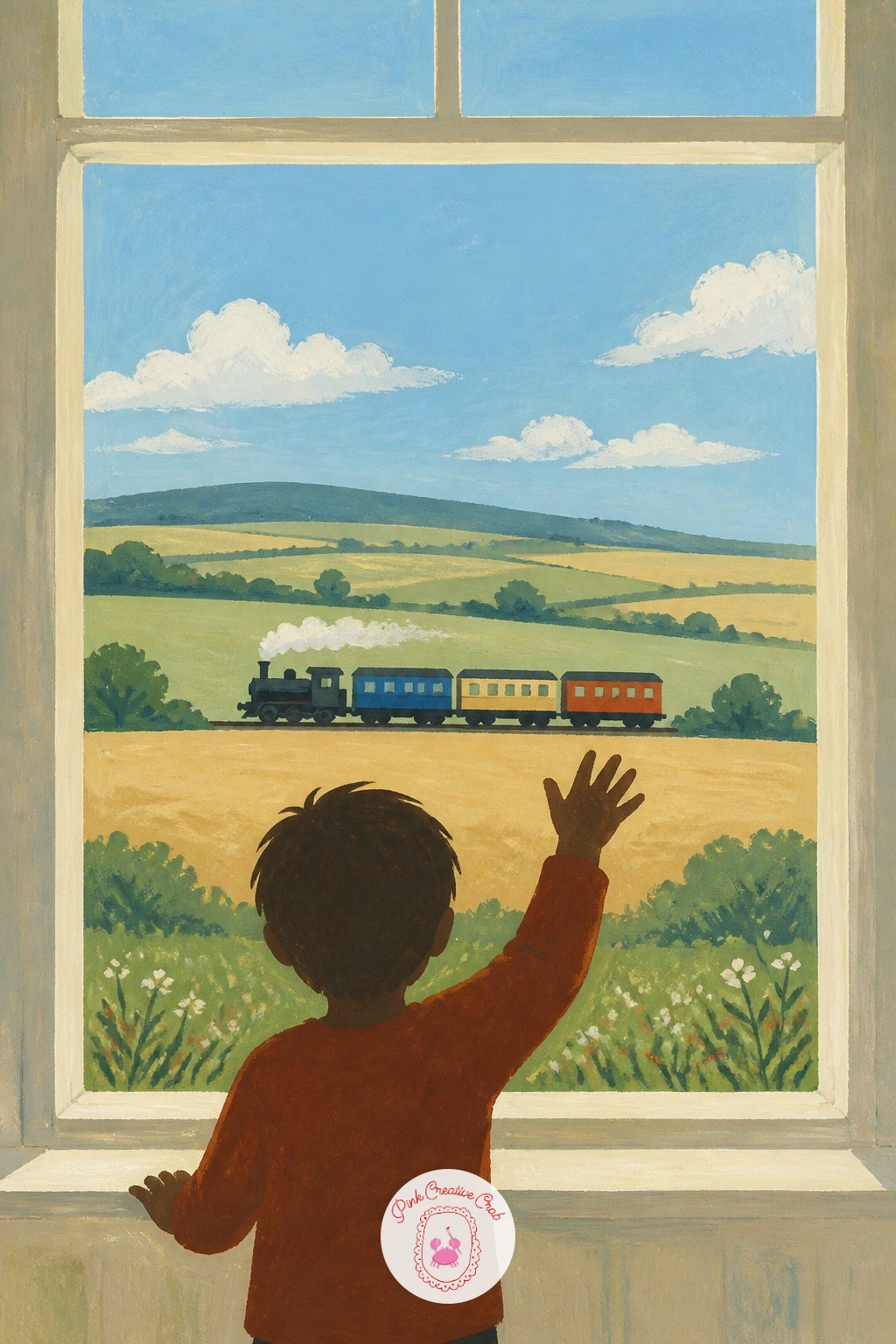
Palette: Terracotta,Sage Green,Sky Blue,Cream
What to Do Next
Pick one window that matches the mood you are in tonight, pull out your gouache and a sheet of cold press paper, and start with the frame or the farthest part of the view, whichever feels most natural. Once that first one is dry and hanging on the wall, the next window on this list will already be calling your name.
Frequently Asked Questions
What paper works best for window view painting in gouache?
Heavy cold press watercolor paper, around 140 pounds, works best because it handles flat washes without buckling. Gouache board or a sturdy mixed media pad are good swaps if that paper is not on hand.
How do you keep the window frame looking crisp against a loose painted view?
Paint the view first and let it dry completely before adding the frame on top in one confident, steady pass. A ruler or the edge of a card held against the paper helps keep straight frame edges clean.
What if I only have watercolor or acrylic instead of gouache?
Both work well for window view painting with small adjustments. Thin acrylic behaves closest to gouache for flat shapes, while watercolor needs a bit more planning since its lighter areas rely on the white paper showing through.
How do I stop the outdoor view from looking flatter than the room inside?
Vary your color temperature and value between layers, keeping distant elements paler and cooler than anything close to the glass. Adding one small detailed object on the sill also helps the eye judge the distance beyond it.
Which window view idea is easiest for a first attempt?
The turquoise sea with a curtain blowing is the simplest starting point, since the view is just a few flat color bands. The cafe window and the sheer curtain lake view are also gentle ways to begin.
Have any thoughts?
Share your reaction or leave a quick response — we’d love to hear what you think!
-
 0
-
0
-
0
-
0
-
0
-
0


