
A mother and daughter drawing is one of the warmest things you can put on paper, because it never needs a grand setting to work. A hand around a small hand, a shoulder leaned against a shoulder, a hairbrush paused mid stroke: graphite pencil carries all of that quietly, without a single drop of color getting in the way.
Below you will find thirty three of these moments, carried from a hospital blanket all the way to old age, each one sized to fill the page and finish in a single sitting. Work through them in order if you like the idea of a life unfolding, or pick whichever stage speaks to you today.
Using these images: free for personal projects such as printing, coloring, cards, journals and gifts. Handmade items that include them may be sold up to 30 pieces per design. More than that is commercial use and is not permitted, and neither is selling or sharing the images themselves or passing them off as your own. Please ask before any other use.
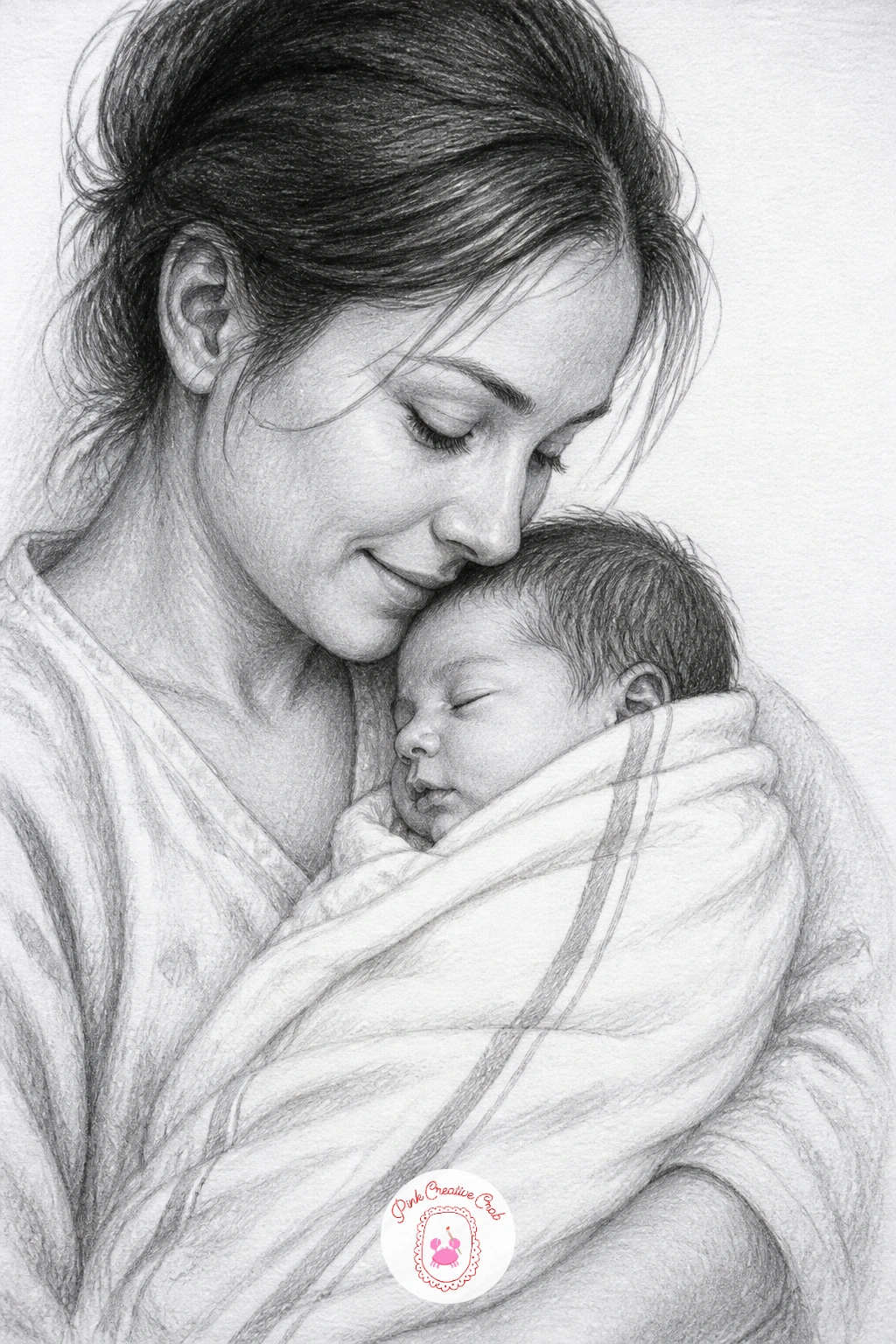
Start the whole series with a mother cradling her newborn daughter in a hospital blanket, since it sets the softest tone for everything that follows. Block the two heads first as simple ovals, the mother’s tilted down and the baby’s tucked into the crook of her arm, then check that the baby’s head is roughly a third the size of the mother’s before you commit to any line.
Work the blanket folds in loose HB lines first, then build the shading from 2B upward, keeping the baby’s face almost untouched by pencil so it reads as the brightest point on the page. The common mistake here is overworking the mother’s face and leaving the baby flat, so always finish her last with the softest pencil you own.
If you do not have a range of graphite grades, a single 2B pencil with varied pressure gets you most of the way, just slow down near the baby’s cheek. Keep your eraser clean and use it only to lift tiny highlights on the blanket’s edge, never to fix a whole shape.
Draw the mother’s eyes looking down rather than at the viewer, it instantly reads as tenderness rather than posing.
Palette: Graphite Grey,Soft Charcoal,Paper White
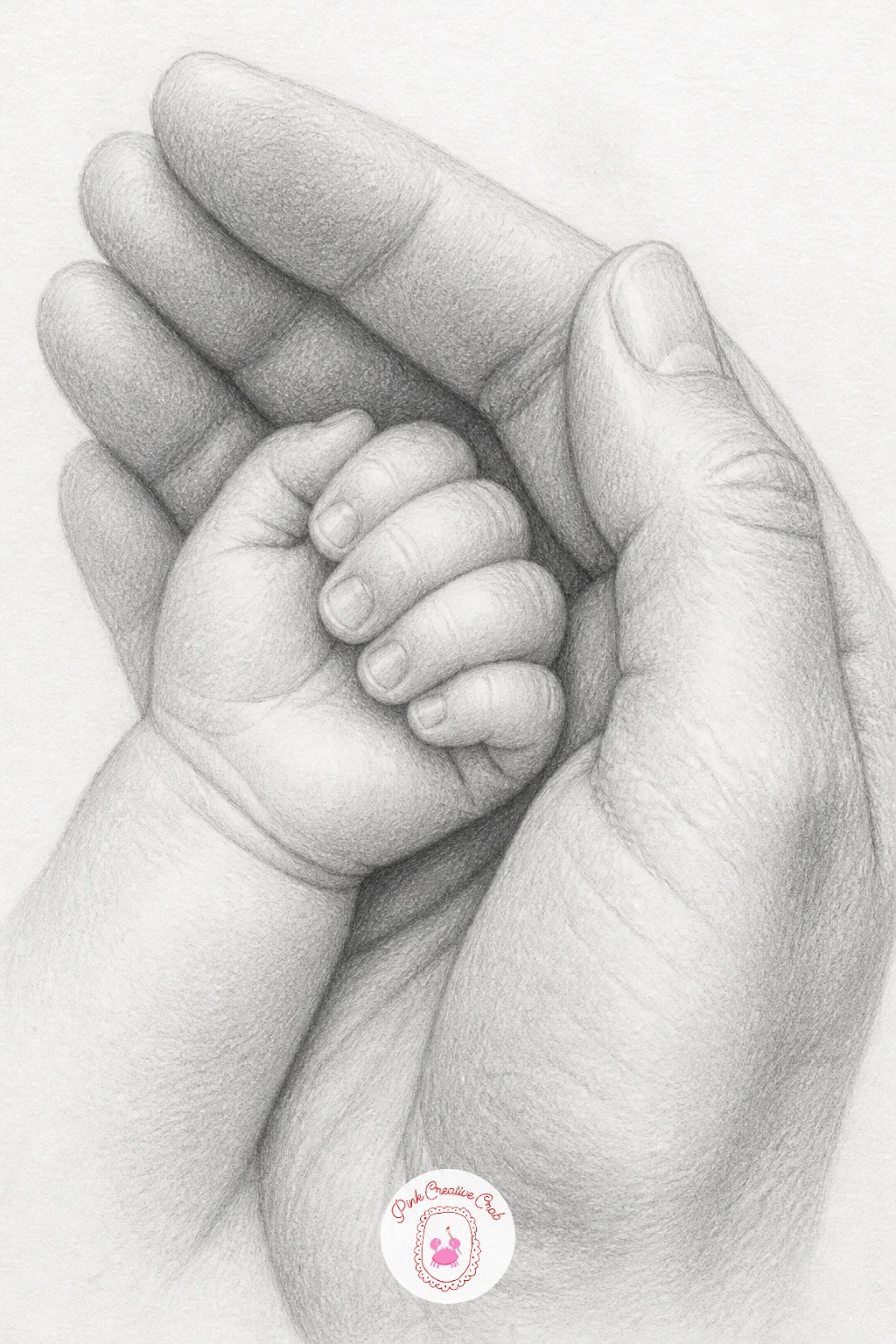
Move in close for this one: a mother holding her baby girl’s tiny hand in her palm, with everything else cropped away. Measure before you draw a single finger, the baby’s whole hand should fit across roughly two joints of the mother’s longest finger, and get that proportion down in light pencil before any shading begins.
Start with the mother’s palm as a simple curved shape, add the baby’s hand resting inside it, then work outward to the wrists and a hint of sleeve. Shade the mother’s hand first with mid tones from a 2B, saving your darkest values for the creases and shadows where the two hands meet.
Skin tends to go flat and waxy if you rush the shading, so build it in thin layers and blend gently with a stump rather than pressing hard in one pass. If you only have one pencil, vary your angle and pressure instead of grade, holding it nearly flat for the lightest skin tones.
Leave the baby’s fingertips almost bare of graphite, that one untouched sliver of white paper does more than any shading to make the skin look soft.
Palette: Graphite Grey,Warm Grey,Paper White
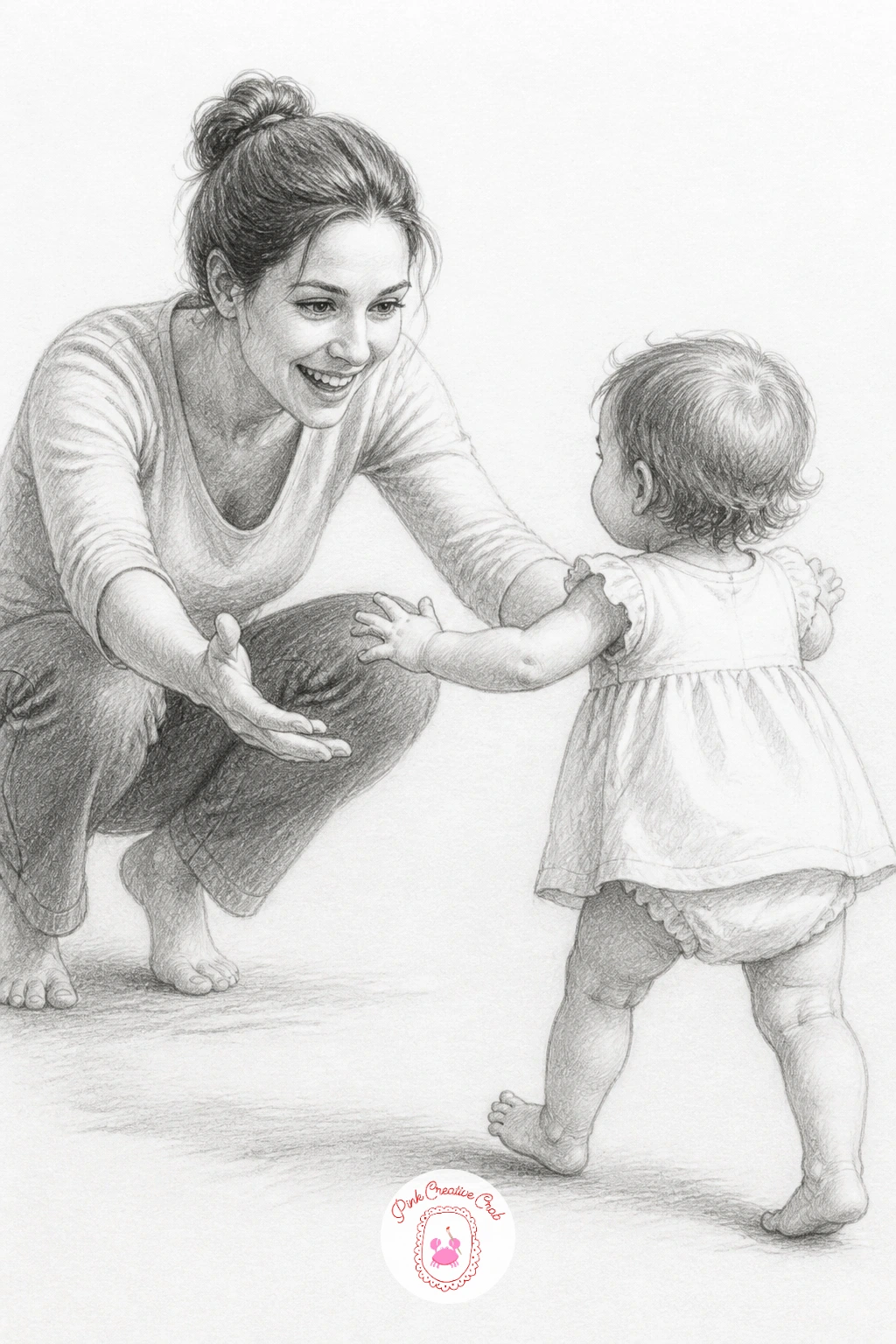
From a held hand you can move straight to a mother helping her toddler daughter take her first steps, hands outstretched toward each other across a small gap. Place the mother kneeling or crouched low so her eye level matches the toddler’s, which immediately makes the moment feel like it is happening at the child’s height rather than looking down on her.
Draw the toddler’s proportions generously round, with a head closer to a quarter of her total height instead of the adult ratio, and keep her stance a little unsteady with one foot slightly turned in. Shade the mother’s figure with firmer, more settled lines to contrast the toddler’s looser, rounder ones.
Drawings like this often go wrong when the toddler ends up looking like a tiny adult, so keep her limbs short and her tummy slightly forward. A 4B pencil is useful for her soft hair if you have one, otherwise press a little harder with your regular pencil just in that area.
Angle both of their faces slightly toward each other rather than at the viewer, it keeps the whole scene feeling private and unposed.
Palette: Graphite Grey,Soft Charcoal,Paper White
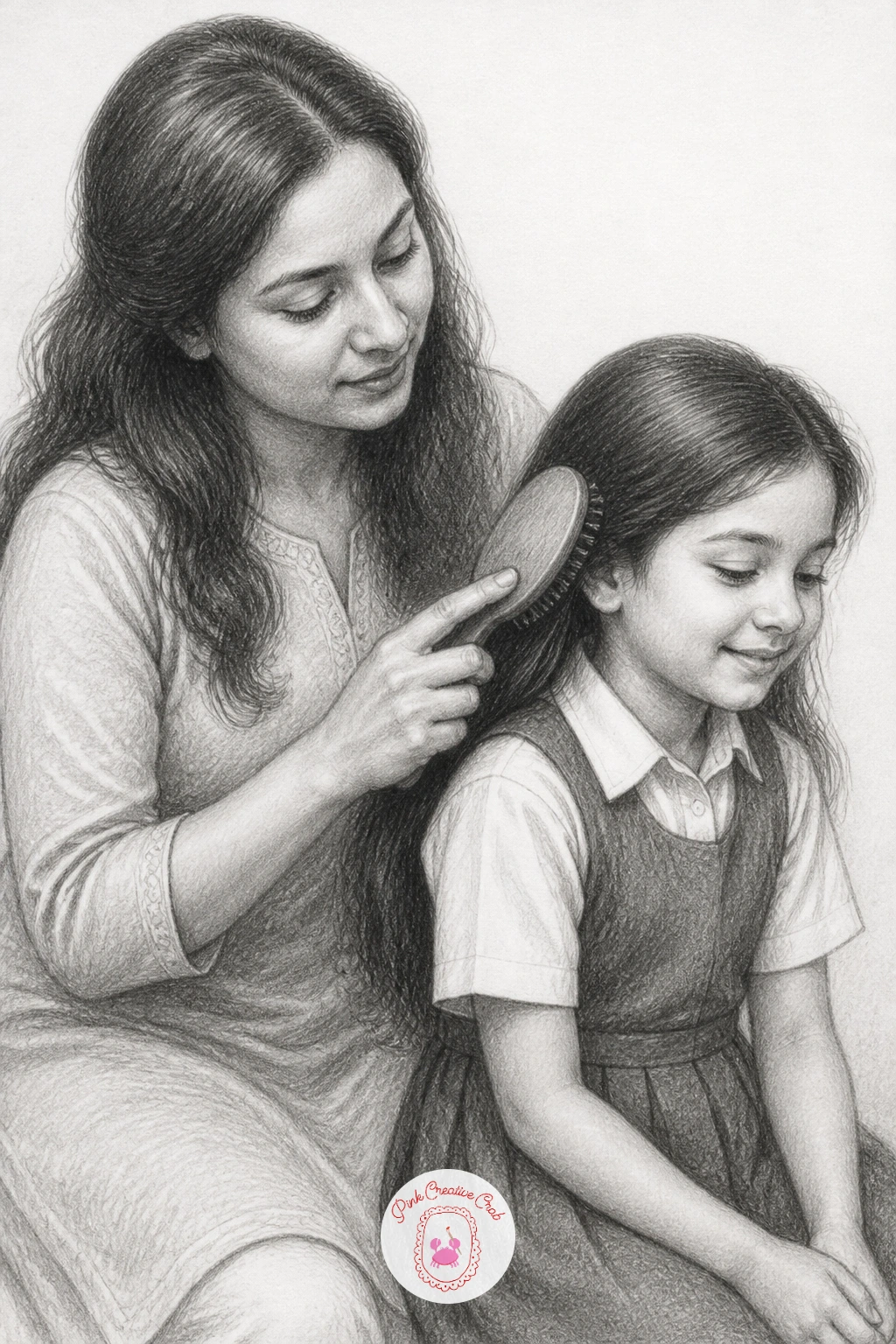
Keep the morning routine going with a mother brushing her little girl’s hair before school, both of them likely seated, the daughter in front with her back half turned. Sketch the hairbrush and the arc of hair it is pulling through first, since that gesture is the heart of the drawing and everything else supports it.
Work the mother’s face in profile or three quarter view looking down at the brush, and keep the daughter’s expression calm rather than fidgety, maybe eyes half closed. Shade the hair in long, even strokes following its direction rather than scribbling, building darker sections gradually so the strands still read as separate.
Hair is the part most likely to go muddy here, so resist blending every stroke with a stump, leave some texture from the pencil itself showing through. If your pencil set is limited, a 2B for the base layers and a sharper 4B just for a few dark strands will carry the whole head convincingly.
Add one small detail, like a hair tie looped around the mother’s wrist, to ground the scene in an ordinary weekday.
Palette: Graphite Grey,Deep Charcoal,Paper White
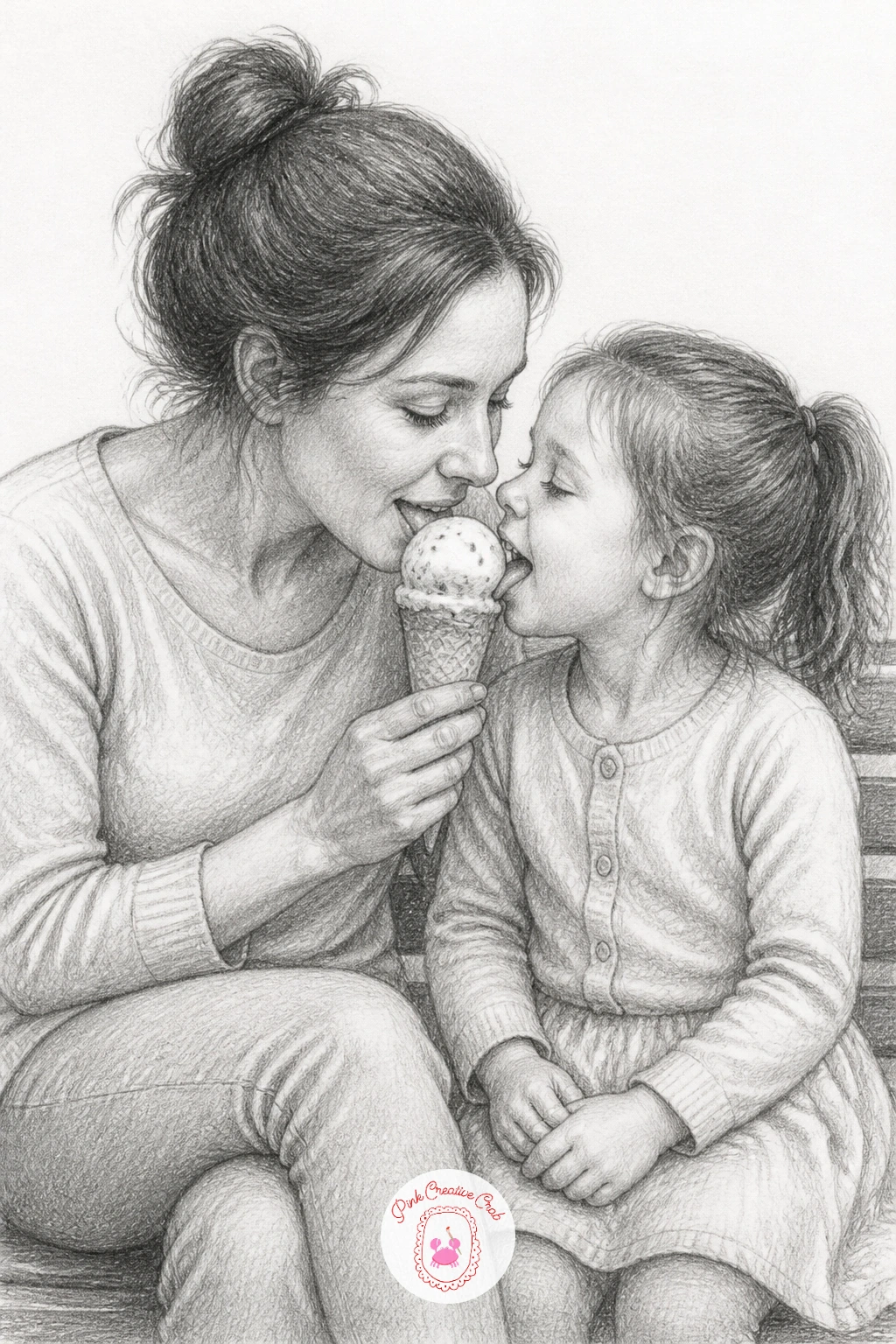
Lighten the mood with a mother and daughter on a park bench sharing an ice cream cone, sitting side by side with the cone held between them. Draw the bench slats first as a simple frame, then place both figures sitting slightly angled toward the cone rather than straight ahead, which naturally pulls the viewer’s eye to that shared point.
Build the daughter smaller in scale with rounder cheeks, and give the mother a relaxed, slightly leaned posture to show she is not in a hurry anywhere. Shade their clothing in broad, simple tones so the ice cream cone and their two faces stay the brightest, most detailed part of the drawing.
The scene can feel stiff if both figures face forward, so turn their shoulders and heads slightly toward each other instead. Without a ruler for the bench lines, draw them freehand but keep each slat roughly parallel, a touch of wobble actually reads as more natural here.
Melt a tiny drip of ice cream over the edge of the cone, it is a small detail that always makes viewers smile.
Palette: Graphite Grey,Soft Charcoal,Paper White
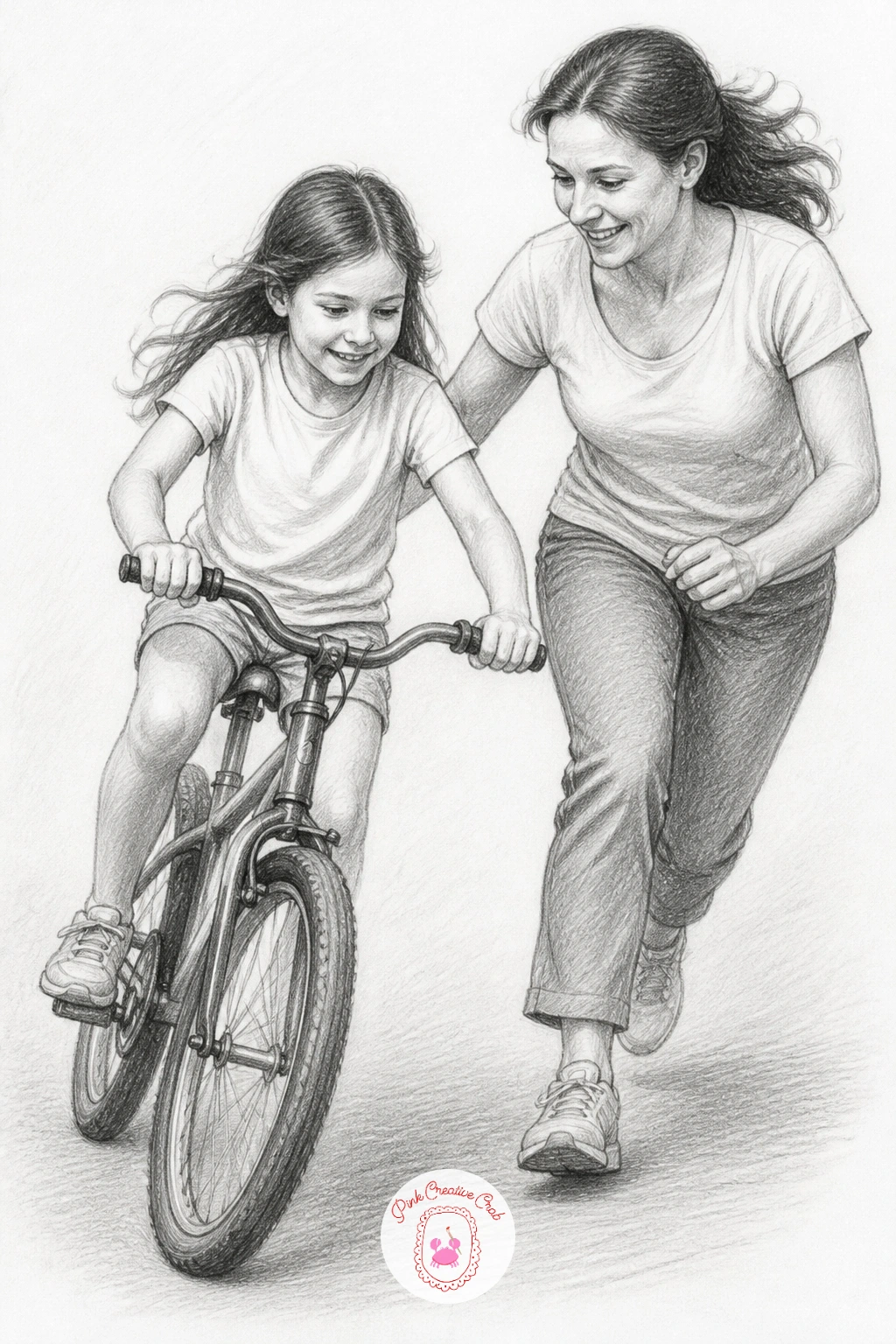
For motion and a little more challenge, try a mother teaching her daughter to ride a bike without training wheels, the mother running alongside with a hand on the seat. Place the bicycle on a slight diagonal across the page rather than flat and upright, which instantly suggests forward movement even in a still drawing.
Draw the wheels as true circles using a coin or lid to trace if your freehand circles wobble, then build the frame and both figures around that stable shape. Keep the mother’s stride mid motion, one leg forward, and let the daughter’s expression carry a mix of concentration and excitement rather than pure calm.
Wheels and spokes are the easiest part to overwork into a blur, so keep spoke lines few and clean rather than cramming in every one. If you lack a circle template, lightly draw a square around where each wheel goes and round the corners gradually until it reads as circular.
Tilt the daughter’s bike very slightly off vertical, a perfectly upright bike reads as parked, not ridden.
You Will Need
- coin or lid for tracing circles
Palette: Graphite Grey,Deep Charcoal,Paper White
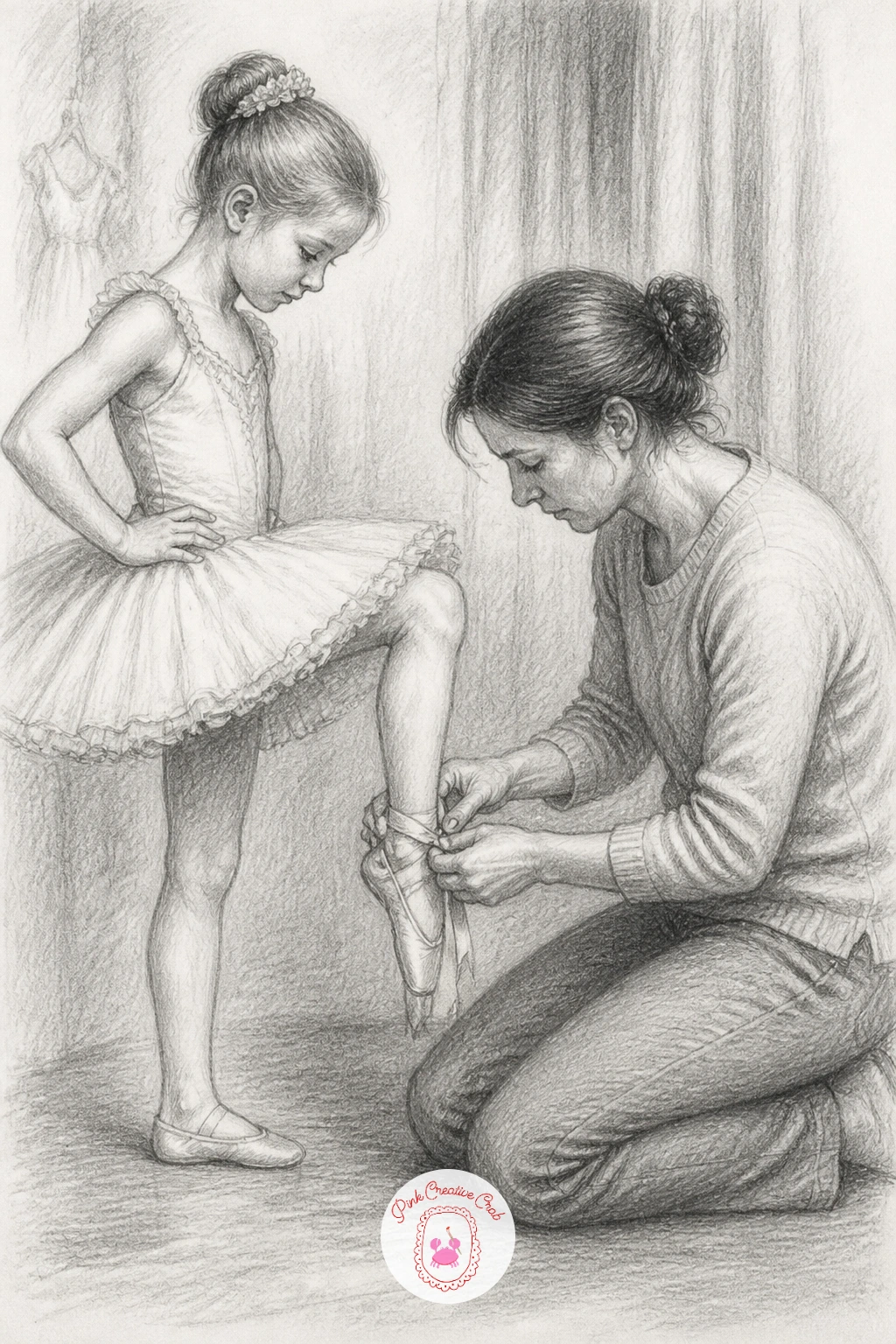
Bring in some quiet drama with a mother kneeling to tie her daughter’s ballet shoes backstage, the daughter standing with one foot raised onto the mother’s knee. Draw the ribbon crossings first since they are the focal detail, looping them in a simple figure eight pattern around the ankle before adding the shoe itself.
Place the mother low in the frame, kneeling, with her head bowed over the ribbon, and let the daughter’s tutu or costume bodice fill out the upper half of the drawing with soft, rounded folds. Shade the satin ribbon with a light touch and a cleanly erased highlight running along its length to suggest its sheen.
Ribbon crossings can turn into a tangled mess if you draw every loop at once, so lay them in lightly first and only darken the ones that sit on top. Without an eraser fine enough for a crisp highlight, a rolled corner of a kneaded eraser works just as well.
Keep the backstage setting to a single hint, like a costume hanger in the background, so it never competes with the two figures.
Palette: Graphite Grey,Soft Charcoal,Paper White
A satin ribbon reads best with one long erased highlight rather than many small ones, keep the eraser moving in a single smooth stroke along its curve.
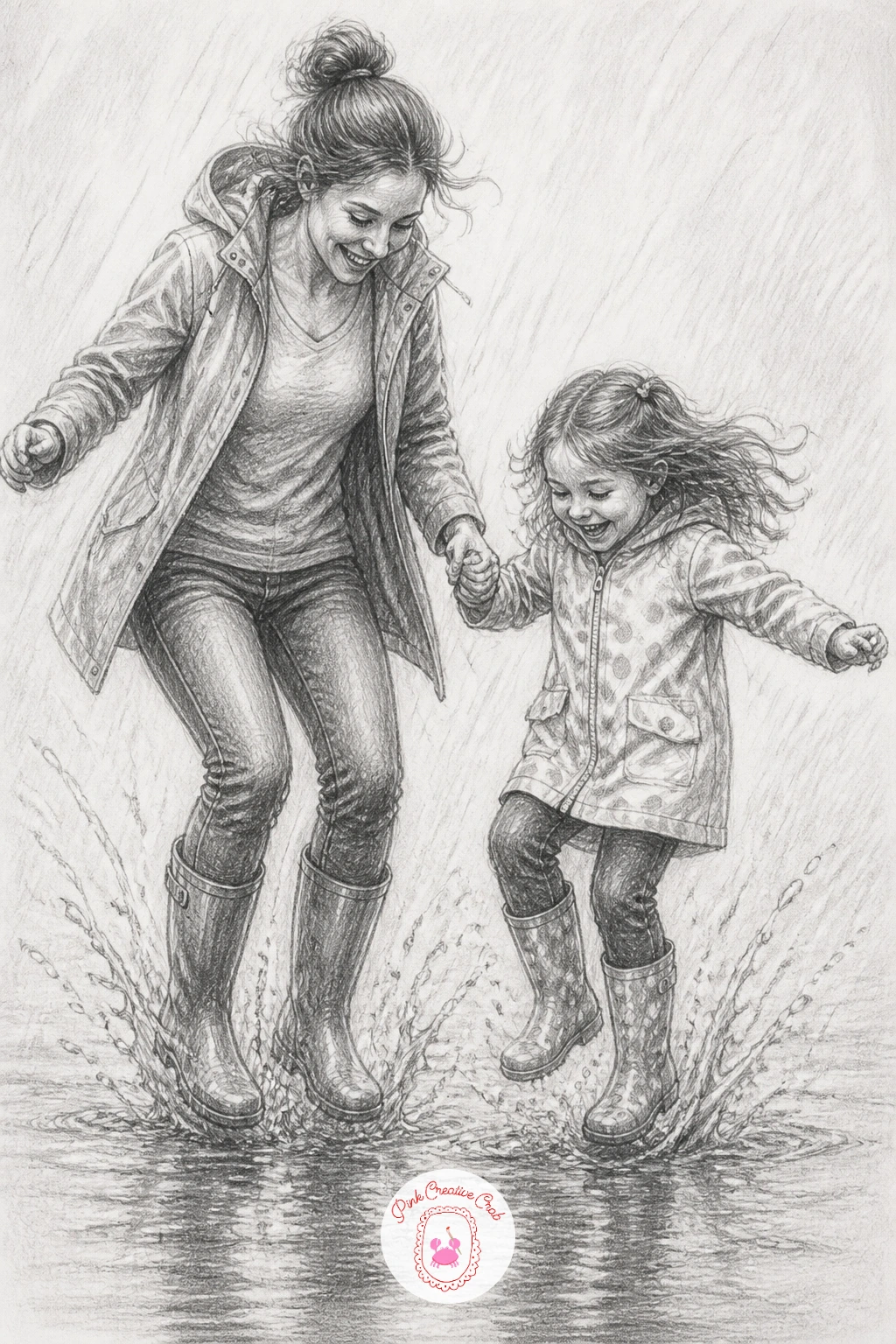
Switch to a livelier mood with a mother and young daughter splashing in rain puddles in rubber boots, both mid jump with water flicking up from their boots. Draw the puddle’s reflection first as a simple mirrored shape beneath their boots, then build both figures above it with knees bent and arms slightly flung for balance.
Give the daughter the bigger, bouncier splash and the mother a smaller, more controlled one, which keeps the energy believable rather than cartoonish. Shade the rubber boots with a flat, even tone and a single bright highlight band to suggest their glossy surface against the duller wet pavement around them.
Splashes drawn as solid white shapes can look stiff, so break the water edge into a few separate droplet marks instead of one smooth curve. If you are short on time, skip the reflection entirely and let a simple dark puddle shape under their boots imply the water just as well.
Draw the quick version by keeping both figures as simple silhouettes with minimal shading, then spend the extra time only on the splash droplets and boot highlights for the fuller forty minute version.
Palette: Graphite Grey,Deep Charcoal,Paper White
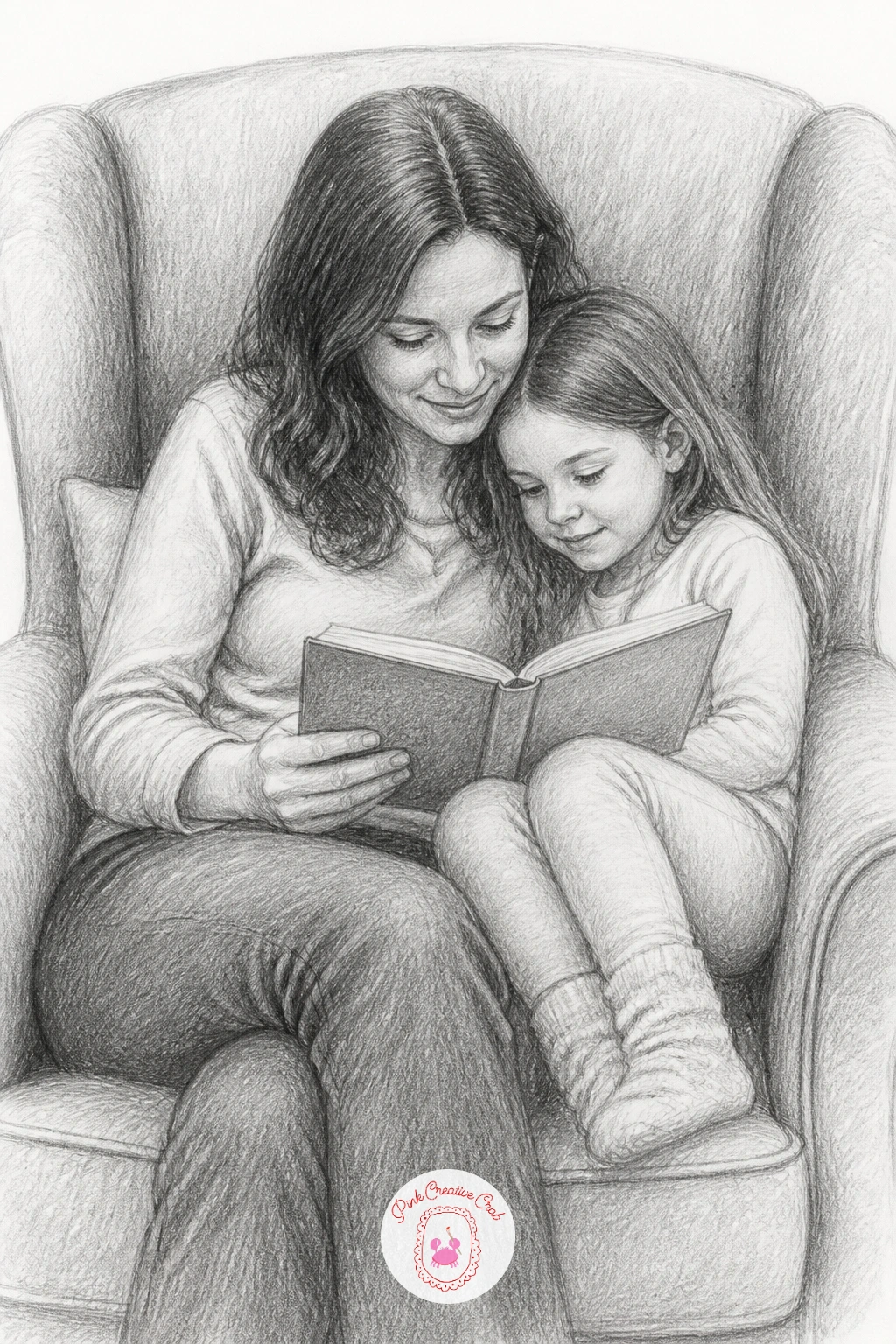
Settle things down again with a mother reading to her daughter in a big armchair, the daughter curled into her lap or side with the open book between them. Draw the armchair first as an oversized rounded shape that swallows both figures a little, since its scale is what makes the moment feel cozy rather than formal.
Place the book low and angled toward both faces so their eyes naturally read as looking down at the pages together. Shade the chair’s upholstery in soft, rounded strokes and keep the book’s pages the brightest area of the whole drawing, almost untouched by pencil.
The daughter’s curled up pose is where proportions often slip, so check that her bent knees and tucked feet still add up to roughly her actual leg length even though they are folded. If your chair reference is tricky to invent, simplify it to a few big cushioned shapes rather than drawing every tuft and seam.
One lamp glow sketched faintly behind them, even without full shading, adds warmth without extra effort.
Palette: Graphite Grey,Soft Charcoal,Paper White
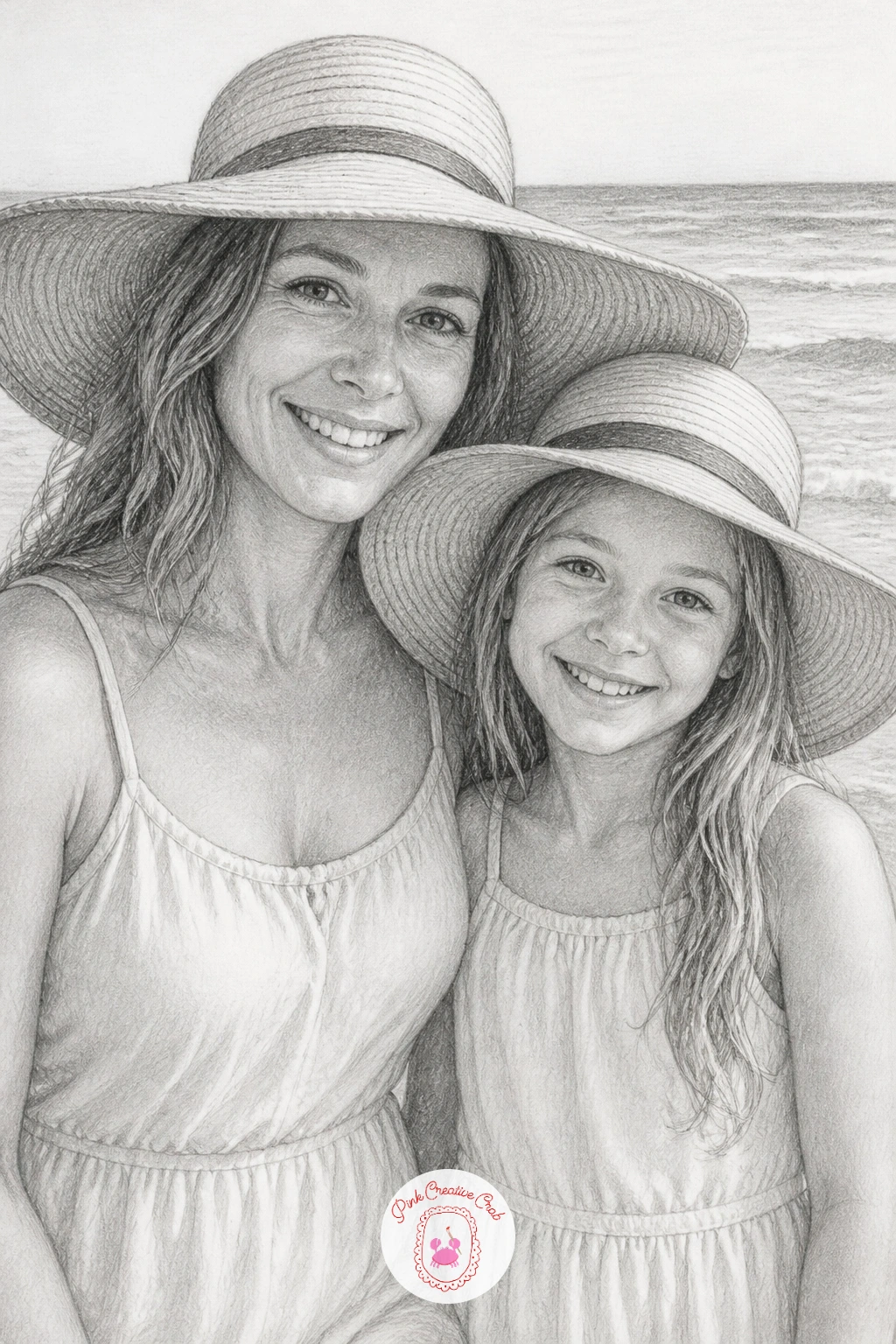
Head outdoors for a mother and daughter in matching sun hats at the beach, standing or sitting close with the brims of their hats nearly touching. Draw both hat shapes first as simple curved ovals seen from a slight angle, keeping the daughter’s hat noticeably smaller to match her smaller head.
Eye level matters here: set the horizon line low on the page, near their waists, so the sky and sea behind them feel open rather than cramped above their heads. That low horizon also lets the sun sit high behind them, throwing soft shadow under the hat brims across their faces.
Hat brims often flatten a face into total shadow if you overdo the darkness, so leave a thin sliver of light along the cheek closest to the viewer. Without a compass for the hat curves, trace around a cup or saucer for a cleaner oval before adding the fabric folds.
Let a little wind lift one ribbon or hat tie upward, it is a tiny detail that brings the whole beach scene to life.
You Will Need
- cup or saucer for tracing hat curves
Palette: Graphite Grey,Deep Charcoal,Paper White
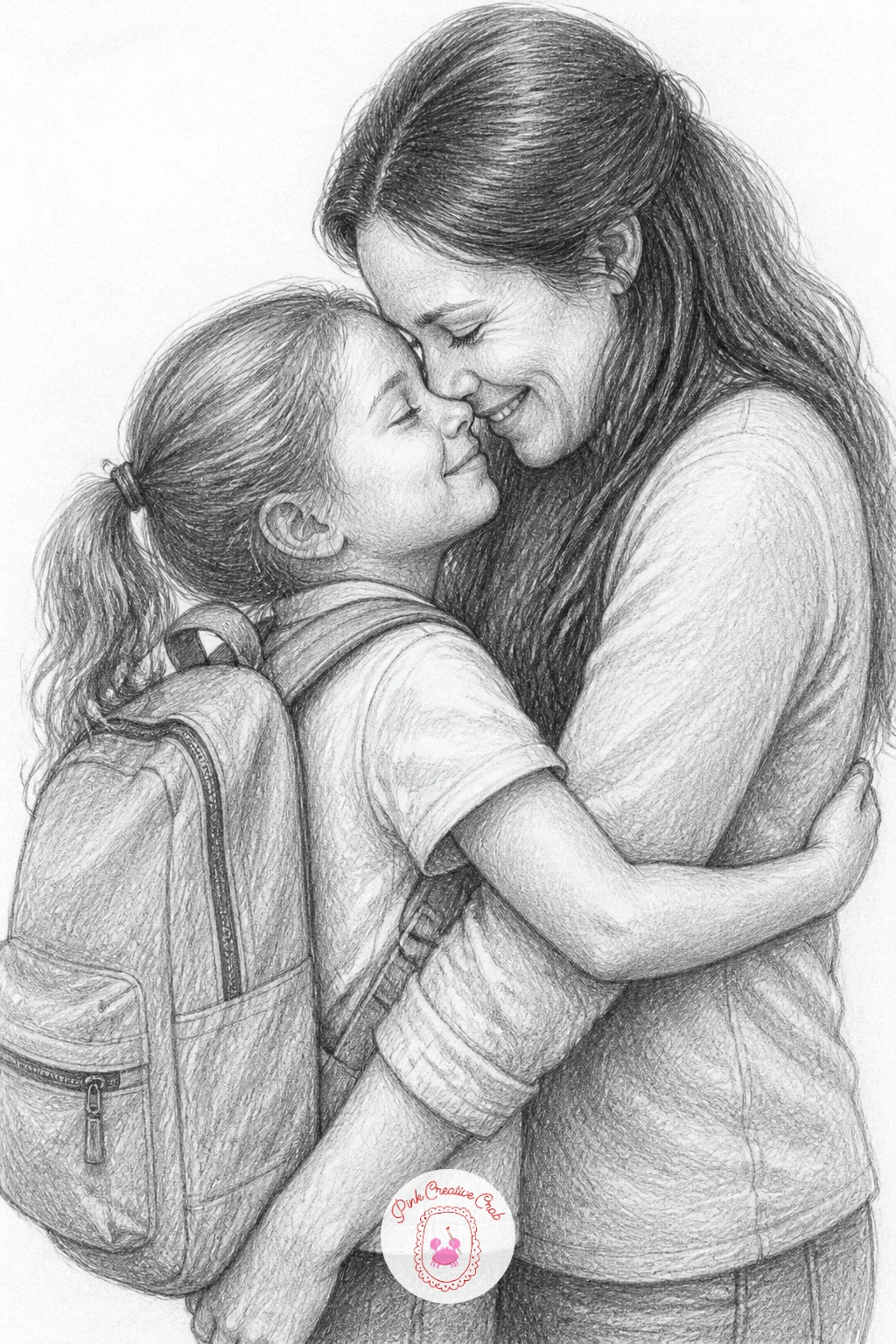
Mark a milestone with a mother hugging her daughter on the first day of school, the daughter wearing a backpack slightly too big for her and clutching the mother’s coat. Draw the backpack straps crossing over her shoulders first, since they anchor the whole pose and give you a reason for the slight forward lean in her stance.
Keep the hug itself the compositional center, both heads close together and slightly tilted, with the school building reduced to the faintest suggestion of a doorway or fence behind them. Shade their coats with simple, broad tones so the embrace and the two faces stay the clear focus of the page.
A common slip is making the backpack look empty and flat, so round out its corners and add a little bulge where books or a lunch box would sit inside. If you want this to double as a quick keepsake sketch for a card, the Mother’s Day gift tag ideas pair nicely with a scene like this one.
Keep the background to three or four lines at most, any more and it pulls focus away from the hug.
Palette: Graphite Grey,Soft Charcoal,Paper White
Build a different kind of shelter with a mother and daughter giggling inside a blanket fort, their heads poking through a gap in the draped fabric with a flashlight glow between them. Draw the blanket folds first as a few large triangular shapes propped on chairs or a table edge, since those big simple forms establish the fort before any faces appear.
Place both faces close together, tilted in toward a shared flashlight or small lamp, which gives you one clear light source to shade everything else around. Shade the blanket’s underside darker where it drapes away from that light, and leave the two faces as the brightest points in the whole drawing.
Folded fabric can collapse into a shapeless blob if you shade it all one value, so pick three or four distinct fold lines and commit to clear light and shadow sides on each one. Without a flashlight in the scene, a single candle or nightlight gives the same warm pool of light to work from.
Draw their mouths slightly open mid laugh rather than in a neutral smile, it carries the giggling far better than the eyes alone.
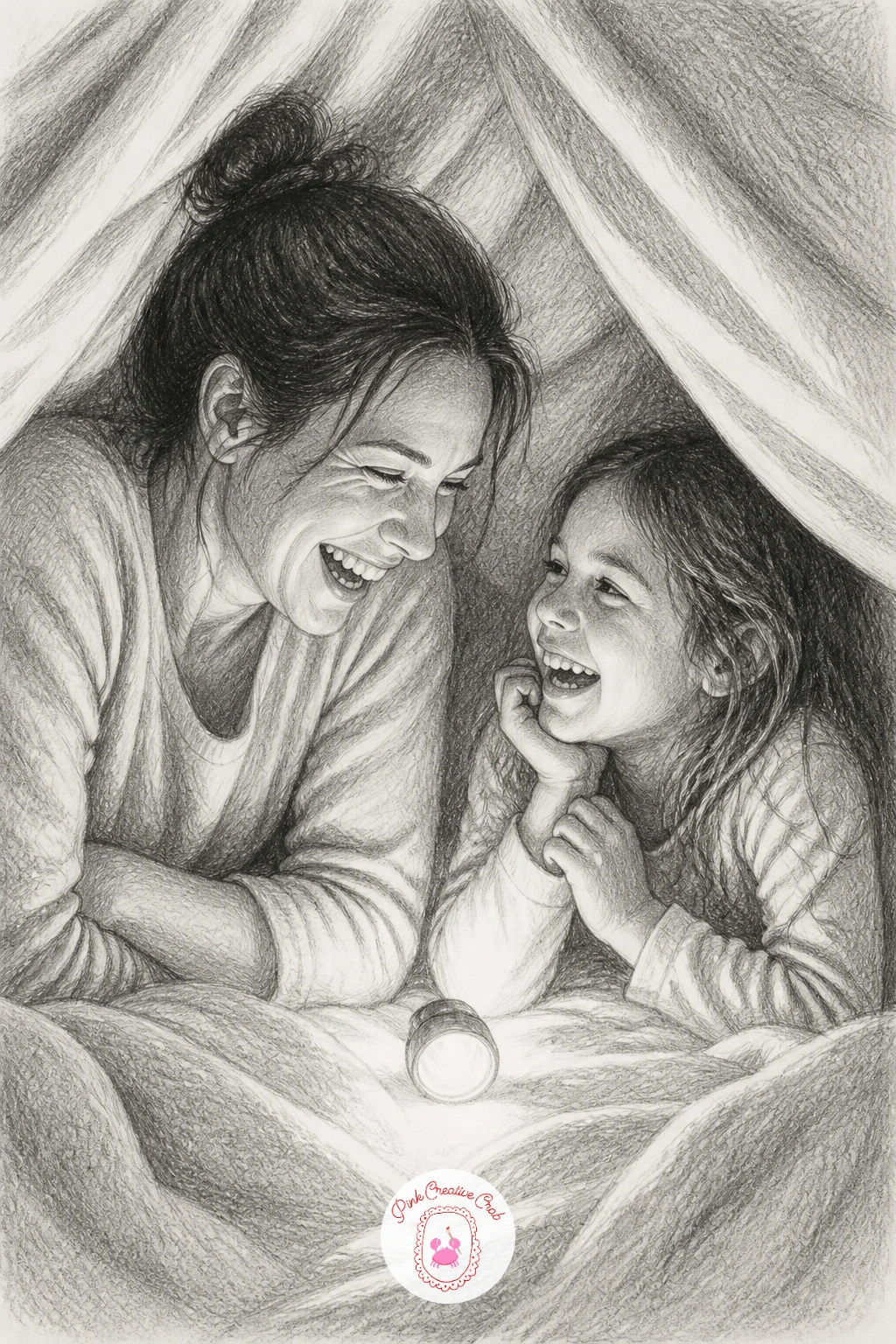
Palette: Graphite Grey,Deep Charcoal,Paper White
Slow the pace with a mother teaching her daughter to knit on the sofa, sitting close with yarn and needles passed between their hands. Draw the yarn strand first as a single continuous loose line connecting the ball to the needles, then build both sets of hands around that line so the knitting motion feels connected rather than two separate poses glued together.
Give the mother’s hands a settled, practiced grip and the daughter’s a slightly looser, uncertain one, which tells the whole story of the lesson without any extra detail. Shade the sofa cushions simply behind them so attention stays on the hands and the yarn.
Hands holding thin objects like needles often look stiff if the fingers are too straight, so curl them gently around the needle rather than drawing straight sticks beside straight fingers. If knitting needles feel fiddly to draw accurately, simplify them to two plain thin lines crossing at a slight angle, nobody will count the stitches.
Leave the yarn ball slightly unraveled on the daughter’s lap, it is a small, honest detail of a first lesson.
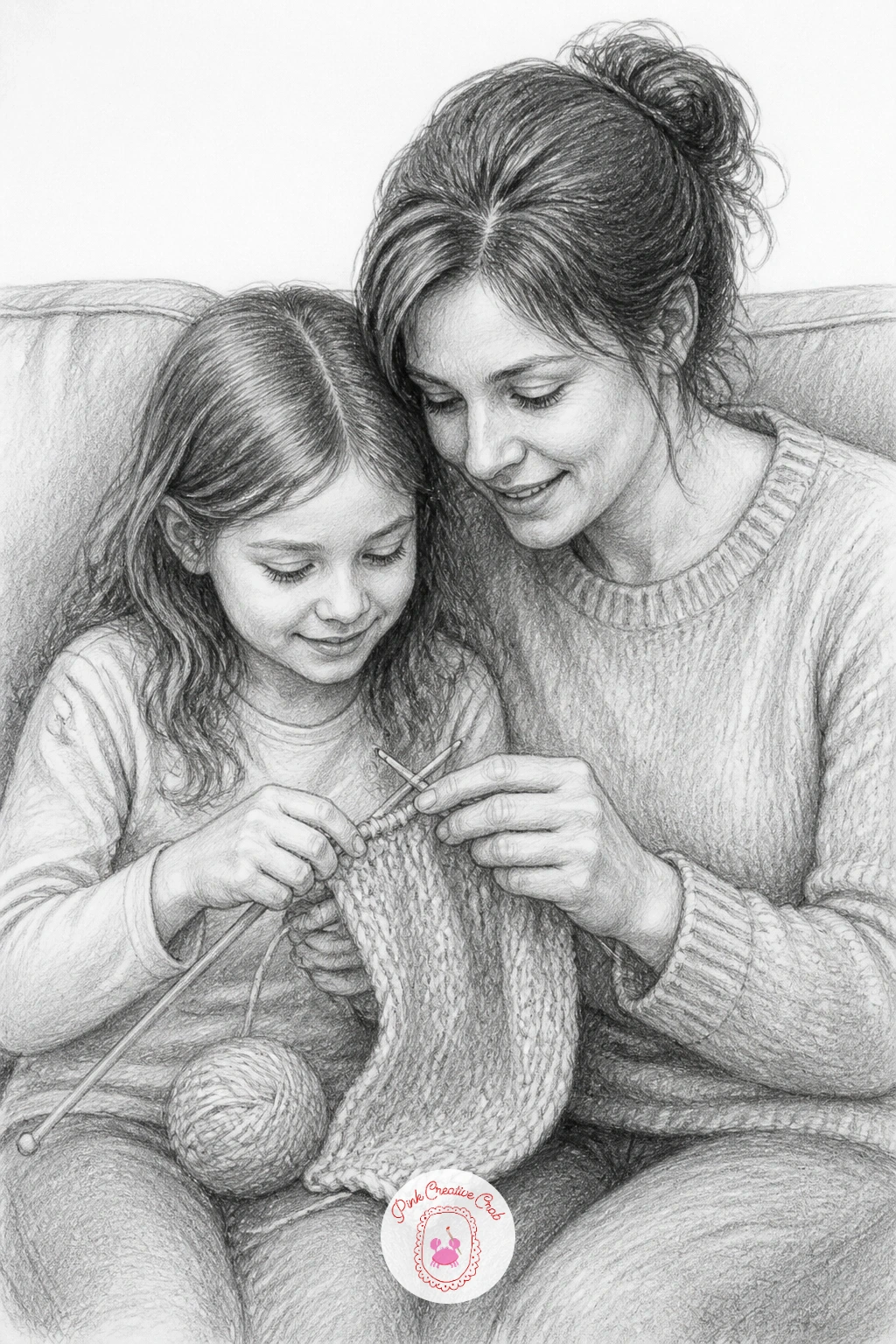
Palette: Graphite Grey,Soft Charcoal,Paper White
Flip the roles with a teenage daughter doing her mother’s makeup at a vanity, the daughter standing behind with a brush poised near the mother’s cheek while the mirror doubles both their faces. Draw the mirror frame first as a simple rectangle or oval, then place the reflected faces inside it slightly smaller and angled than the real ones in front, which is what sells the mirror illusion.
Keep the mother seated and relaxed, eyes half closed for the brush, while the daughter leans in with focused, slightly pursed concentration. Shade the mirror’s reflected figures a touch lighter and softer than the real ones in front, since reflections read as a little less solid than the subjects themselves.
Reflections drawn as identical mirror copies can look flat, so vary the angle of the reflected faces just slightly from the real ones. Without a vanity mirror shape handy for reference, a plain oval propped against a few straight lines for a stand reads clearly enough.
Add one makeup brush and a scattering of two or three products on the table, more than that starts to clutter the scene.
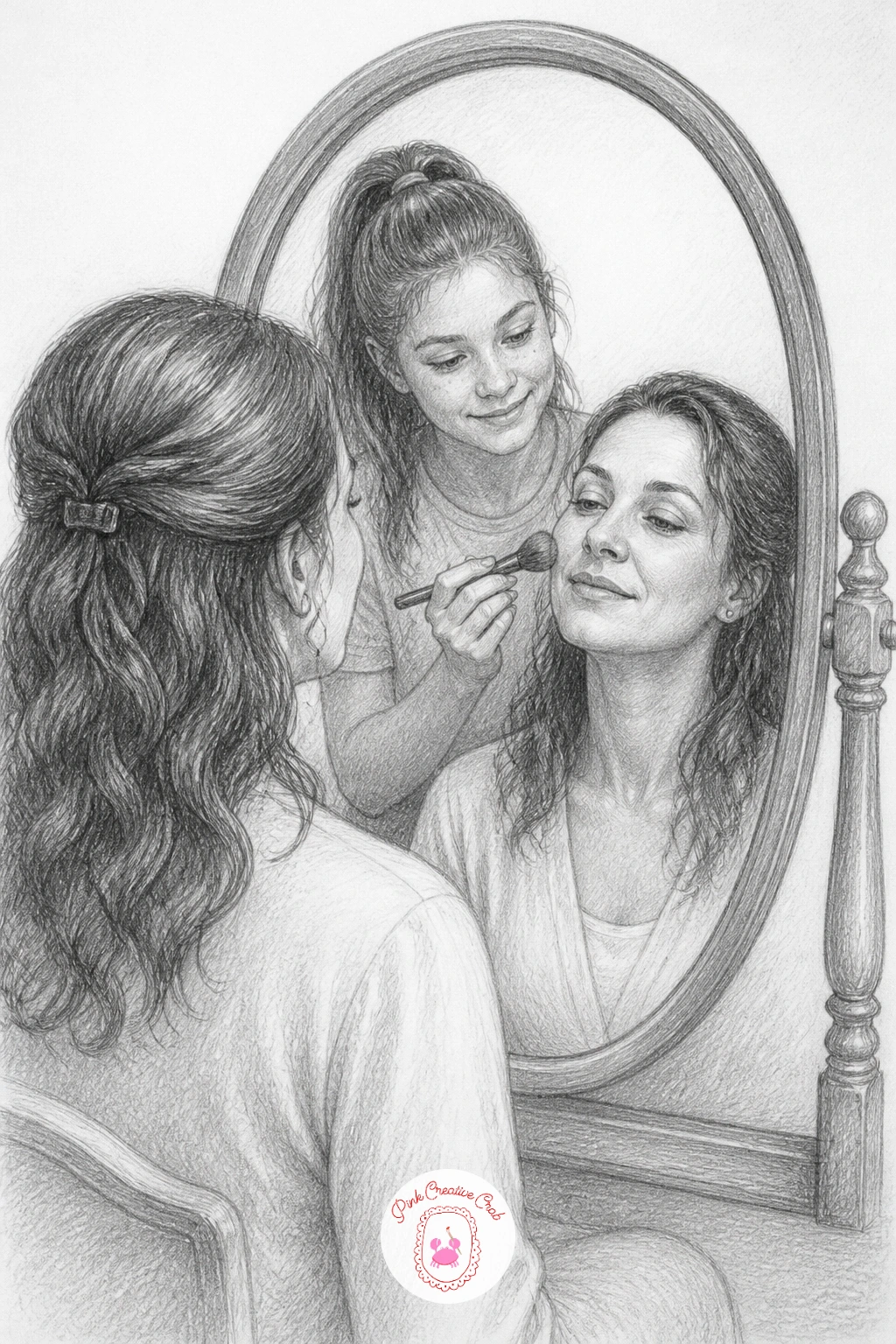
Palette: Graphite Grey,Deep Charcoal,Paper White
Carry the teenage years onward with a mother and teenage daughter sharing earphones on a train, heads leaned together with the thin cable looping between them. Draw the earphone cable first as one continuous curved line from ear to ear, since getting that loop right anchors the whole closeness of the pose before you touch the faces.
Place the train window behind them as a simple rectangle with a few horizontal streaks suggesting motion blur outside, rather than drawing a detailed landscape that would compete with their faces. Shade both faces with a calm, even light, since this is a quiet shared moment rather than a dramatic one.
Earphone cables tend to vanish into the hair if drawn too thin and pale, so darken just the sections crossing clear skin or clothing and let the rest fade naturally into the hairline. If a train setting feels like too much background work, a simple bench seat and window frame is enough, you do not need full train car detail.
Tilt their heads to meet exactly where the cable splits, it is the natural focal point of the whole drawing.
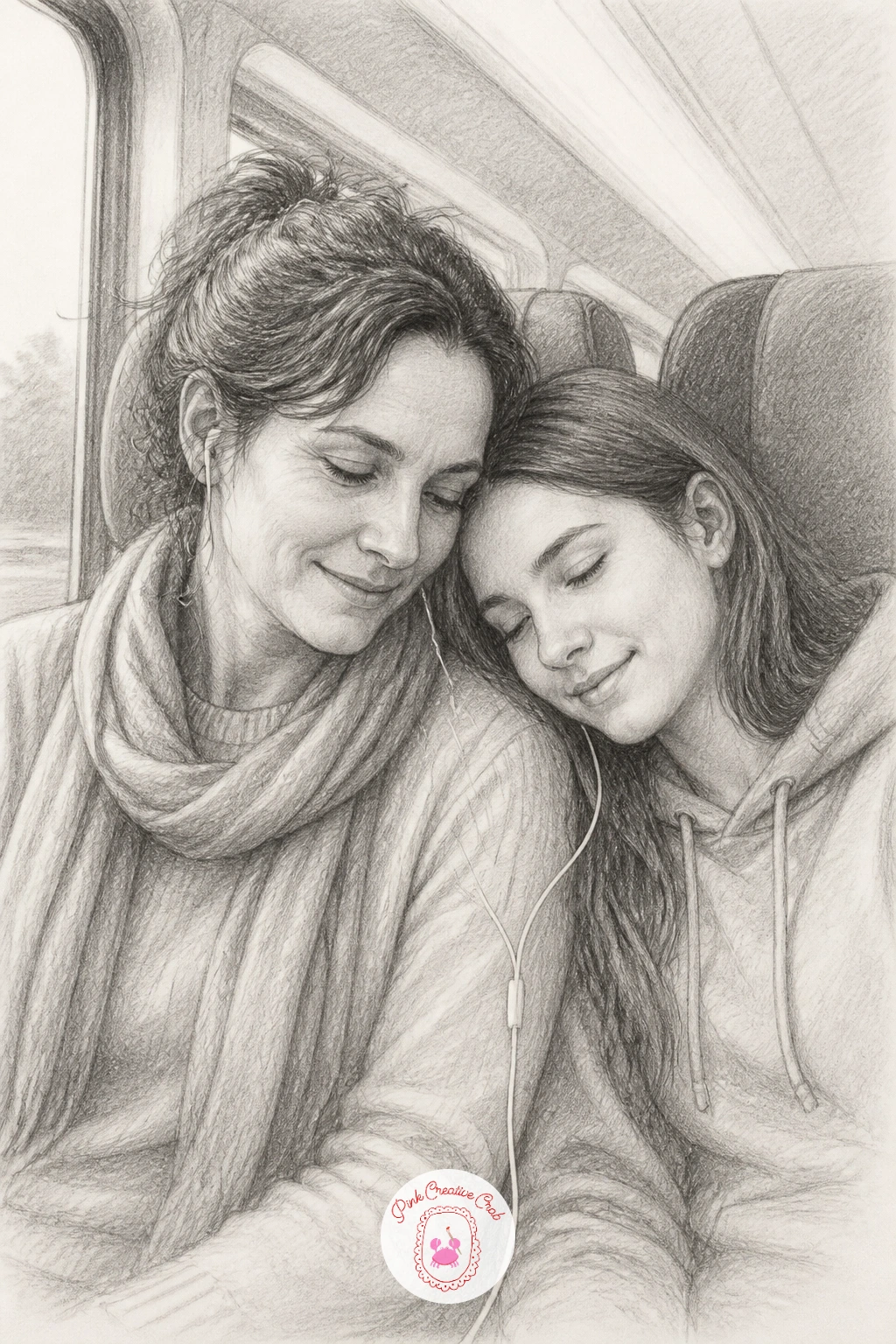
Palette: Graphite Grey,Soft Charcoal,Paper White
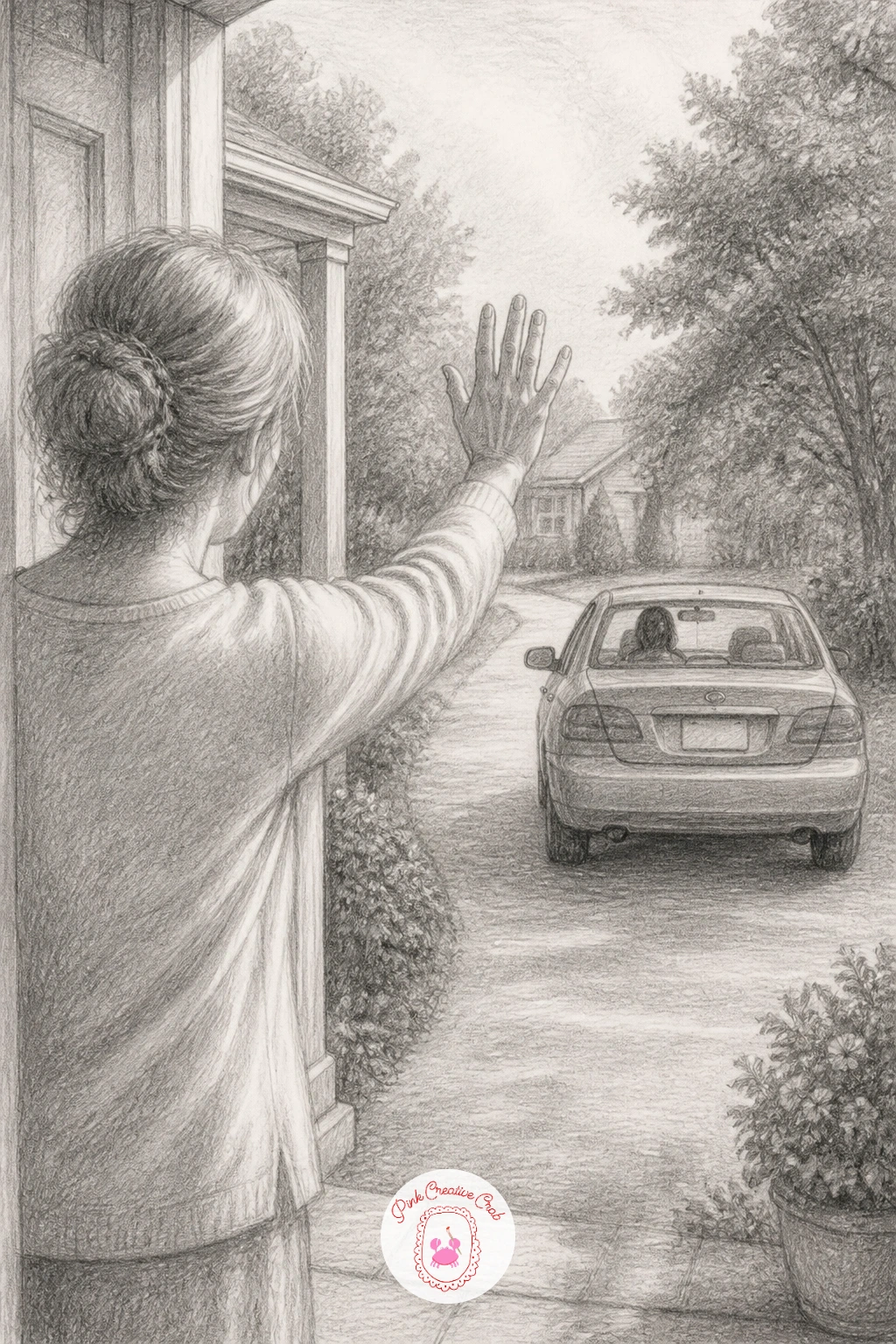
Mark a bigger step with a mother waving as her daughter drives off for the first time, the mother standing in a doorway or driveway while the car pulls away with the daughter’s hand visible at the wheel. Draw the car first as a simplified box shape in strong perspective, narrower where it recedes into the distance, since getting that single vanishing point right makes the whole departure feel convincing.
Keep the mother large and detailed in the foreground, since she is the emotional center, and let the car and daughter grow smaller and looser in detail the farther they sit down the driveway. Shade the mother’s raised hand and face with full attention while the car becomes mostly outline and shadow.
Perspective is the trap here, so sketch a single faint horizon line across the page first and angle the car’s roof and wheels toward it before adding any detail. Without a ruler for that vanishing point guide, a folded paper edge laid across the page works as a straightedge in a pinch.
Let the mother’s free hand rest against the doorframe, it gives her pose somewhere to settle rather than floating in open air.
You Will Need
- ruler or straightedge
Palette: Graphite Grey,Deep Charcoal,Paper White
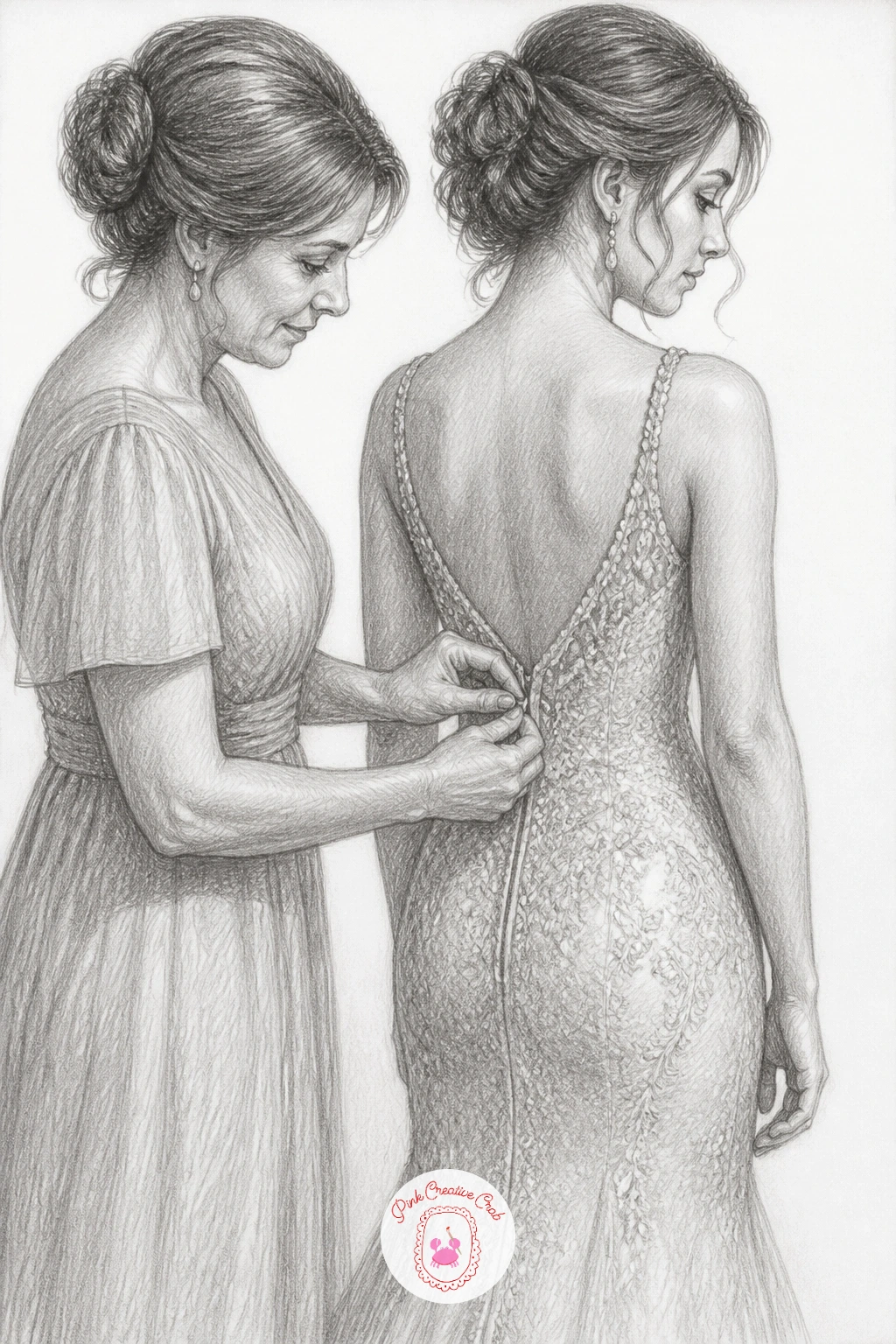
Return indoors for a mother helping her daughter zip up a prom dress, standing behind her with one hand pulling the zipper and the other steadying the fabric at the shoulder. Draw the dress’s back seam and zipper line first as a single straight vertical, then build the fitted bodice shape around it before adding any folds elsewhere in the fabric.
Keep the daughter’s posture straight and slightly proud, chin lifted, while the mother leans in close with focused, careful hands. Shade the dress fabric in smooth, even tones with a few crisp fold lines near the waist, saving your softest blending for the skin at the shoulders and neckline.
A zipper pull drawn too large turns into a strange metal blob, so keep it as one small rectangle with a tiny loop, nothing more. If an elaborate prom dress feels daunting, simplify it to a plain fitted silhouette with one or two fold lines, the gesture of helping matters more than the dress details.
Add a glimpse of jewelry, like a necklace clasp the mother is also fastening, to deepen the sense of getting ready together.
Palette: Graphite Grey,Soft Charcoal,Paper White
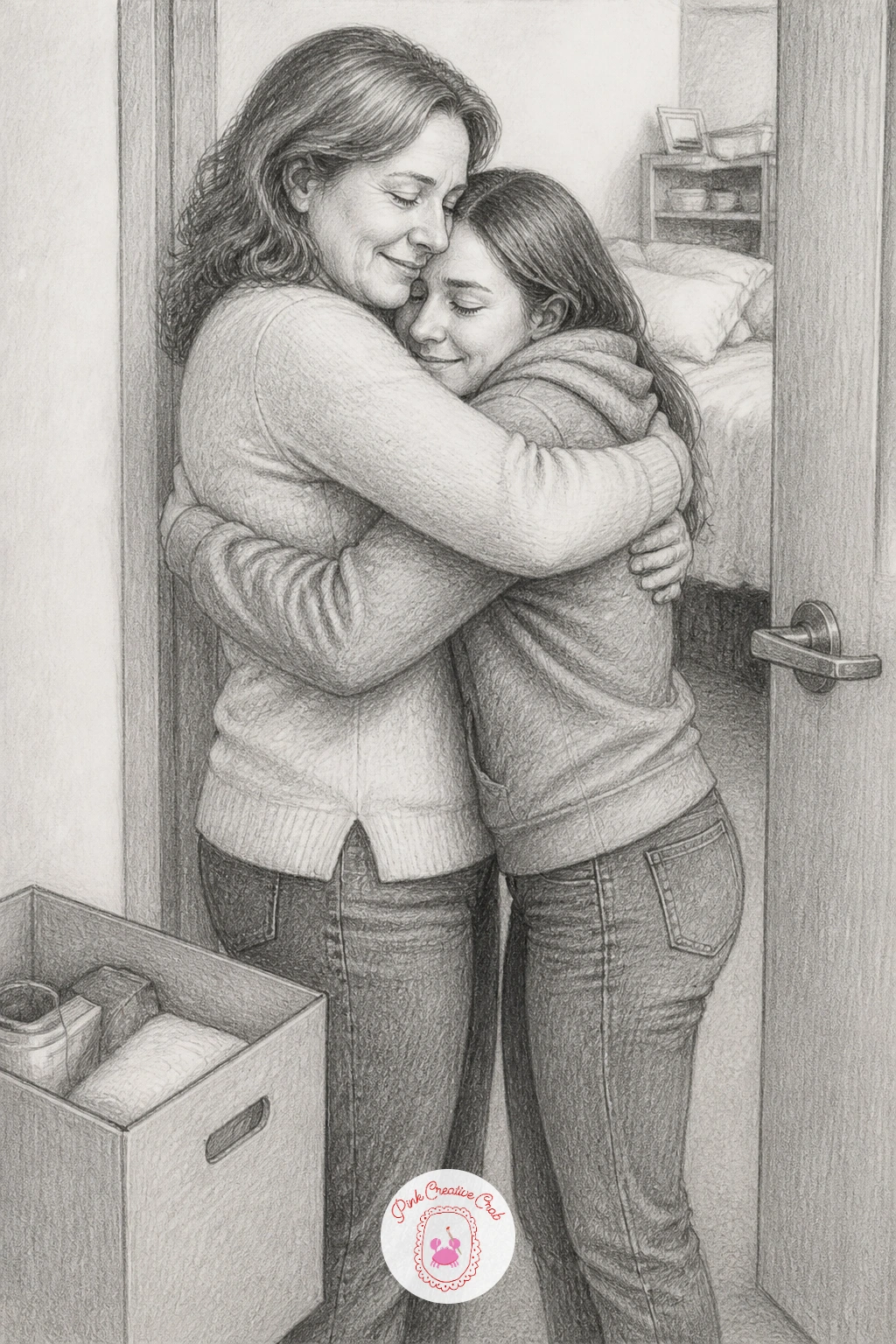
Follow her further from home with a mother and daughter hugging in a college dorm doorway, a box or suitcase set down beside them in the hall. Draw the doorway frame first as a simple rectangle slightly taller than both figures combined, which naturally sets the scale and gives the hug somewhere solid to happen inside.
Keep the embrace tight and centered, both figures leaning fully into each other rather than a loose pat on the back, and let the hallway behind fade into just a line or two suggesting other doors. Shade the cardboard box with a few simple diagonal lines for its tape and flaps, enough to read clearly without elaborate detail.
Doorways can flatten a drawing if drawn perfectly frontal, so angle the frame slightly to one side to add depth. Without a suitcase or box reference at hand, a simple rolled up rug shape or a stack of two books beside their feet tells the same story of moving in.
Keep the hallway lighting plain and even, this moment does not need dramatic shadow to carry its weight.
Palette: Graphite Grey,Deep Charcoal,Paper White
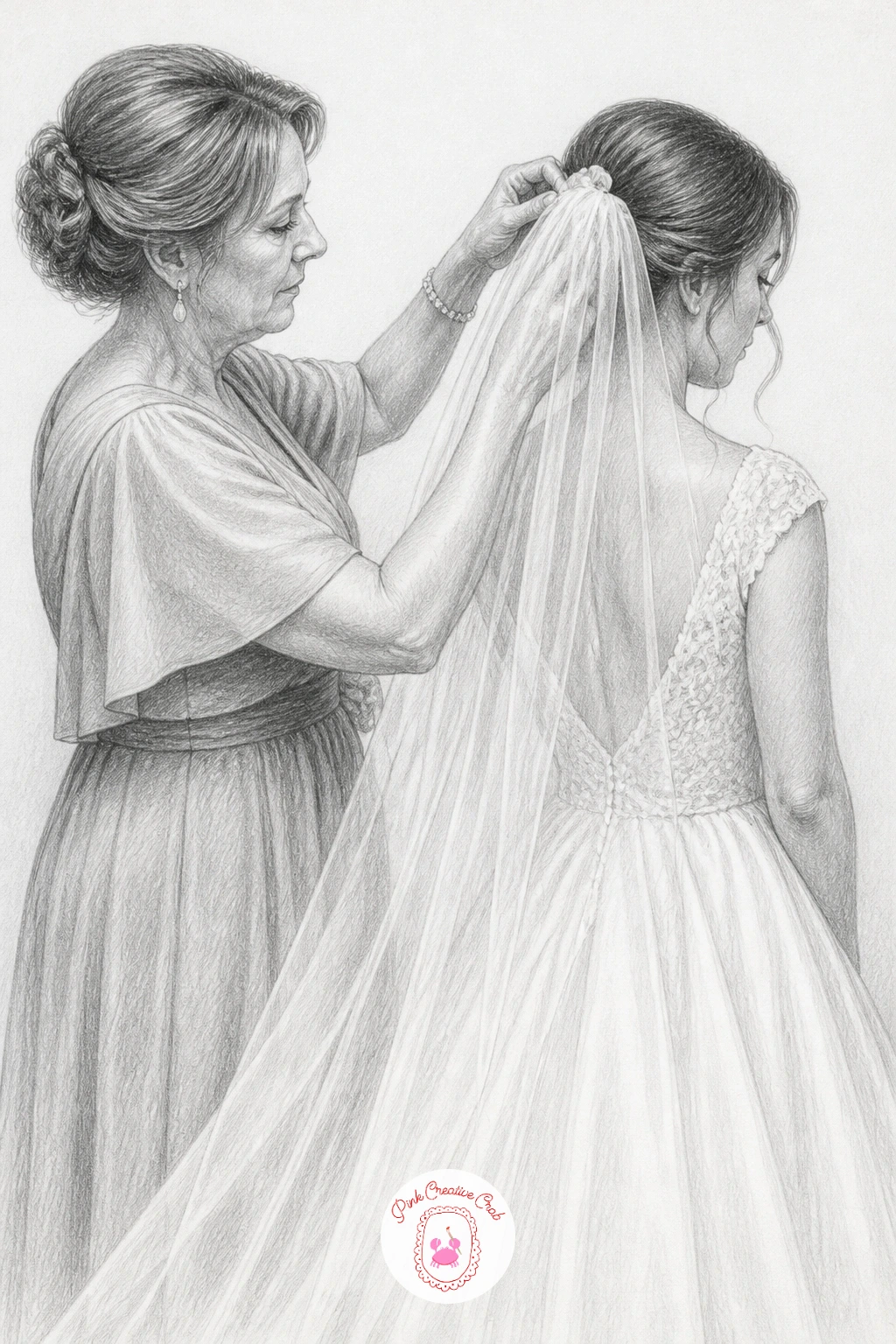
Arrive at a wedding day moment with a mother adjusting her daughter’s veil, standing behind or beside her and reaching up to settle the fabric just right. Draw the veil first as a few long, flowing lines falling from a point near the crown of the head, keeping the fabric light and transparent with mostly untouched white paper rather than heavy shading.
Place the mother’s hands at the exact point where the veil attaches, since that small gesture is the whole emotional center of the drawing even though the dress itself takes up more visual space. Shade the wedding dress in broad, soft folds, saving the darkest values only for the deepest creases near the waist.
Veils can disappear entirely if drawn too faintly or turn into a stiff sheet if overworked, so aim for just a handful of flowing lines with soft shading only along the edges. If a full wedding gown feels like too much detail for one sitting, crop the drawing at the waist and let the veil and upper bodice carry the whole scene.
Give the mother’s expression a slight welling of emotion rather than a plain smile, a softly furrowed brow says more than a grin here.
Palette: Graphite Grey,Soft Charcoal,Paper White
If this is your first time drawing sheer fabric, practice the veil separately on scrap paper first, just a few long curved lines with barely any pressure.
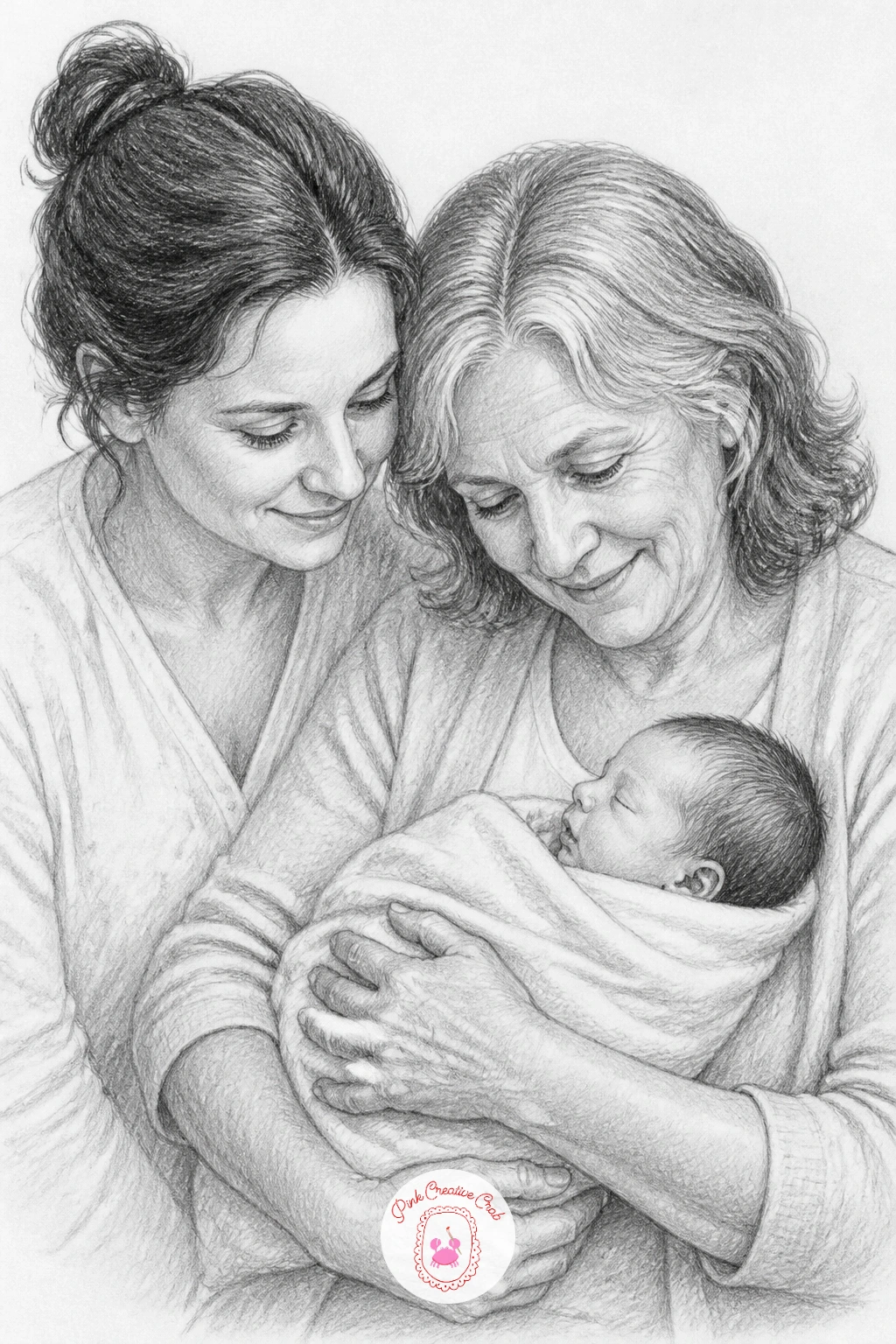
Loop the generations forward with a mother holding her daughter’s newborn for the first time, the new grandmother cradling the baby while the daughter watches close beside her, visibly tired but glowing. Draw the newborn’s bundled shape first as a simple rounded form, since its small scale against the grandmother’s arms is what makes the moment read instantly.
Keep the grandmother’s face soft and slightly older in its lines than earlier drawings in this set, a few more creases near the eyes, while the daughter beside her still carries the exhaustion of new motherhood in her posture. Shade the baby bundle the lightest area on the page, almost pure white paper with just a few soft grey folds.
Faces meant to show age can easily turn into harsh wrinkles if overdone, so add only a few soft lines around the eyes and mouth rather than heavy texture everywhere. If you want to practice fuller family portraits like this one, the ideas in things to draw in your sketchbook offer more everyday scenes to build the same skills.
Let the daughter’s hand rest on the grandmother’s arm rather than on the baby, it ties all three generations into one connected shape.
Palette: Graphite Grey,Deep Charcoal,Paper White
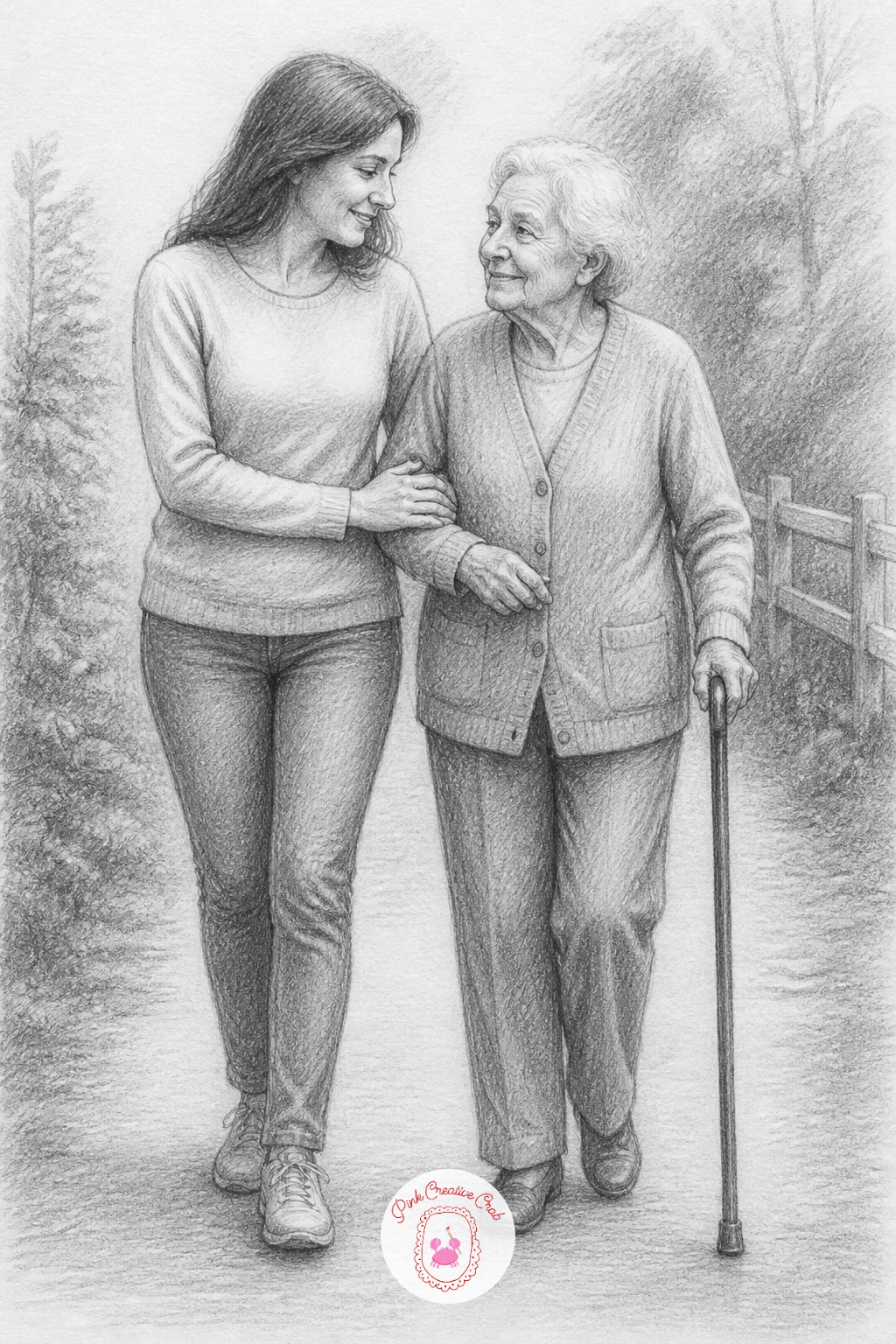
Turn now toward old age with a grown daughter walking arm in arm with her elderly mother, slow steps on a path or sidewalk, the daughter’s arm tucked supportively through her mother’s. Draw the linked arms first as the connecting shape between them, since that single gesture carries the whole relationship of care here.
Give the elderly mother a slightly stooped posture and a cane or walking stick if it suits the scene, while the daughter stands straighter beside her, matching her pace rather than pulling ahead. Shade the mother’s clothing with a few more gentle wrinkles and folds than the daughter’s, which subtly reads as age without any need for a detailed face.
Posture is easy to get wrong here, an elderly figure drawn too upright loses the whole point, so curve the spine slightly and lower the head angle just a touch. Without a cane in your reference, a simple folded umbrella serves the same supportive purpose in the drawing.
Keep their steps slightly out of sync, one foot forward on each, it reads as walking rather than standing still.
Palette: Graphite Grey,Soft Charcoal,Paper White
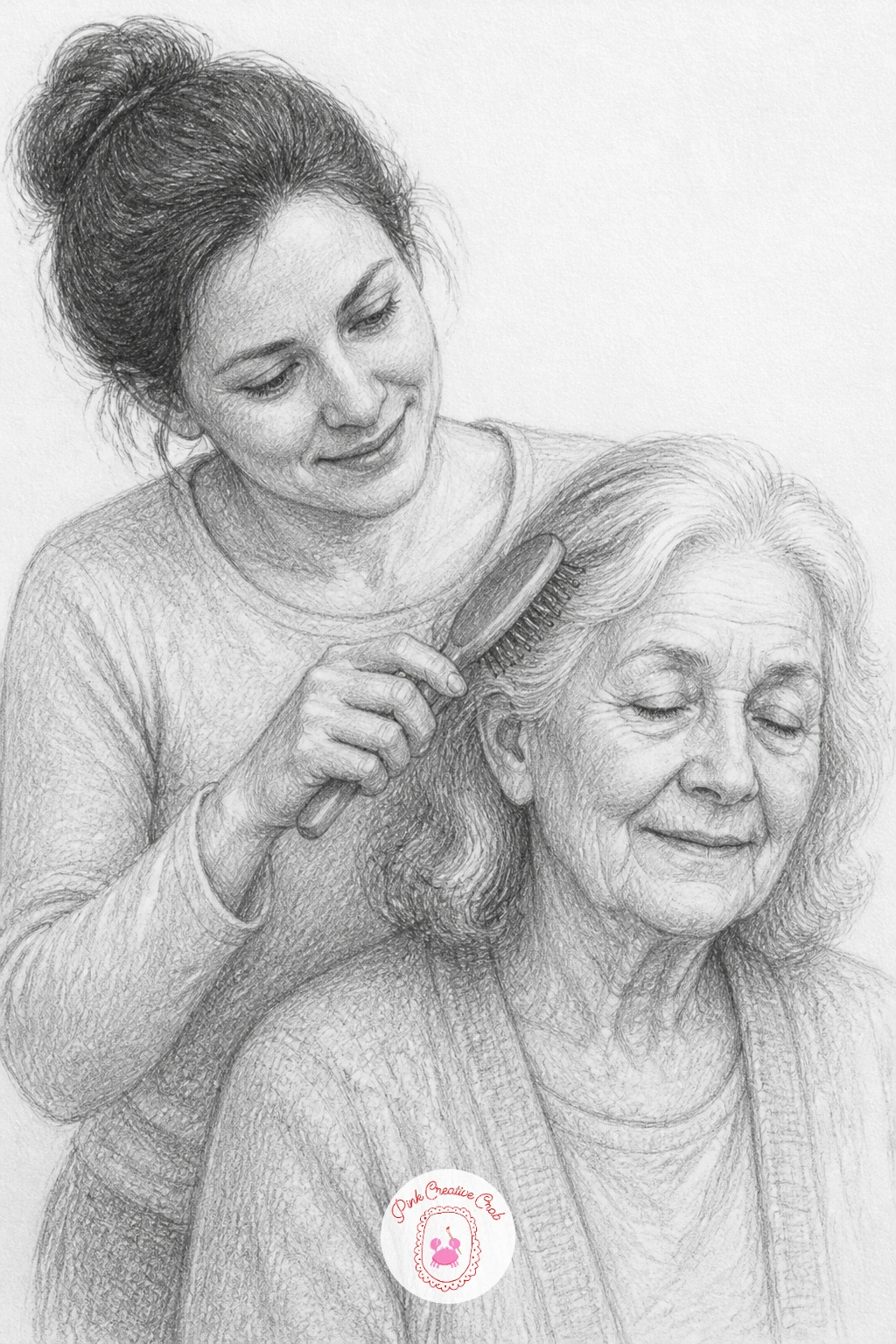
Echo the earlier hair brushing scene with its reverse: a daughter brushing her elderly mother’s silver hair, the mother seated and the daughter standing behind her now. Draw the hairbrush and its arc through the hair first, just as before, but this time keep the strands finer and thinner to suggest the texture of older hair.
Since graphite has no color, suggest silver hair through value rather than tone, keep it in the lighter mid grey range with fewer dark strands mixed through than you would use for darker hair. Shade the mother’s face with slightly more softness around the jaw and eyes, the reverse of the earlier firm, youthful lines in the first hair brushing scene.
Hair that is meant to look silver can accidentally look simply under shaded, so keep the values light but still varied, not just flat pale grey. If you want to compare the two life stages side by side later, sketching both hair brushing scenes on facing pages makes a lovely pairing.
Draw a few loose hairs escaping the brush stroke, it keeps silver hair from looking stiff or wig like.
Palette: Light Grey,Graphite Grey,Paper White
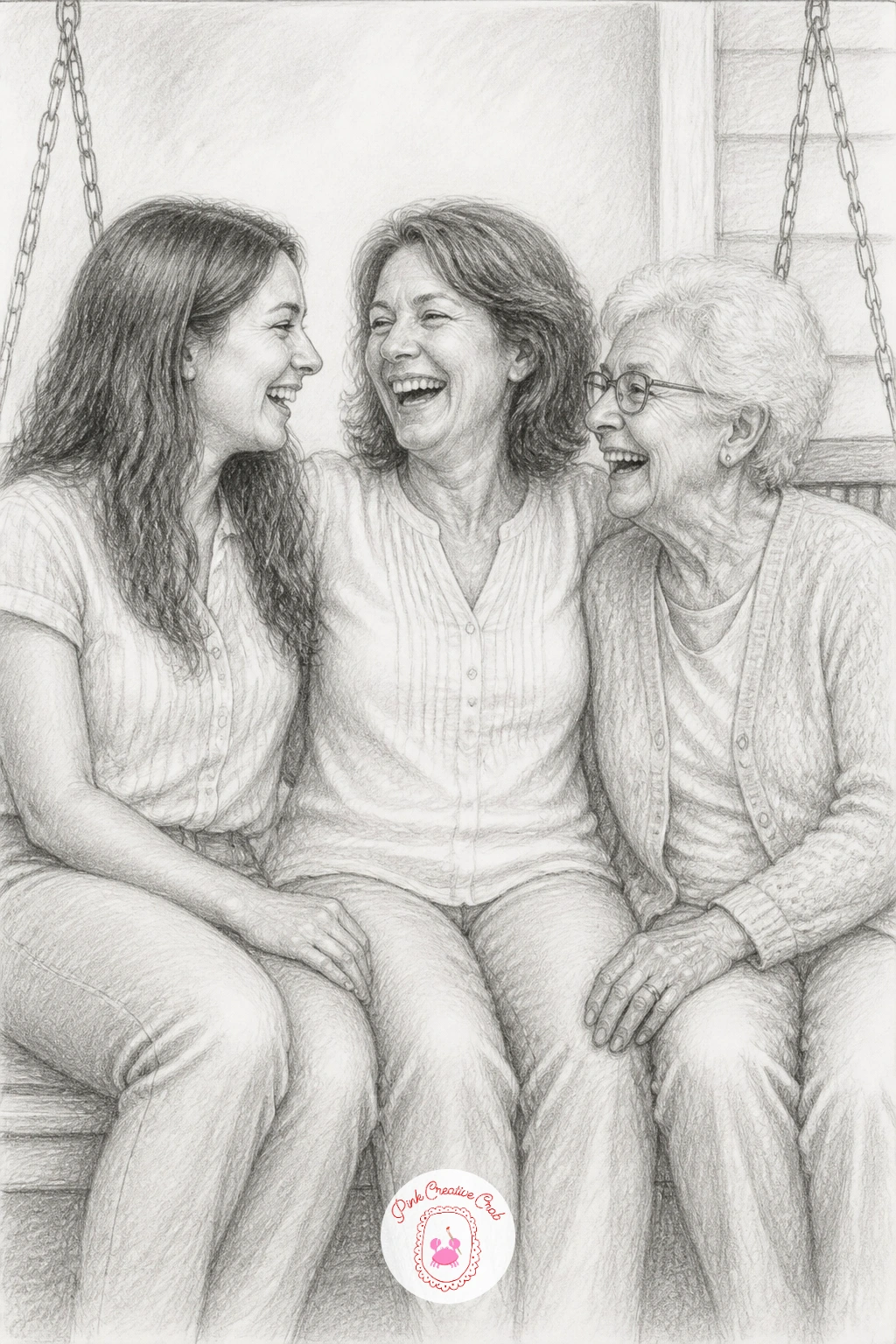
Widen the frame for three generations of women laughing together on a porch swing, grandmother, mother, and daughter or granddaughter all seated close in a row, swing chains visible above them. Draw the swing seat and its two chains first as the structure holding everyone, since getting that horizontal line level keeps all three figures sitting convincingly in a row rather than floating.
Vary each figure’s age through posture and face shape rather than just wrinkles, the youngest with rounder cheeks and a looser pose, the middle figure more upright, the eldest slightly settled into the seat. Shade the porch background minimally, just enough to suggest a railing or a hanging plant, keeping all the detail on the three faces and their open, laughing mouths.
Three figures in a row can look like paper dolls if they all face forward identically, so turn their shoulders at slightly different angles toward each other. If a full porch setting feels like too much, crop tightly on just the swing and the three of them, a hint of chain above is enough context.
Let their heads tilt at three different angles entirely, it is the fastest way to make a group feel like a real, caught moment.
Palette: Graphite Grey,Deep Charcoal,Paper White
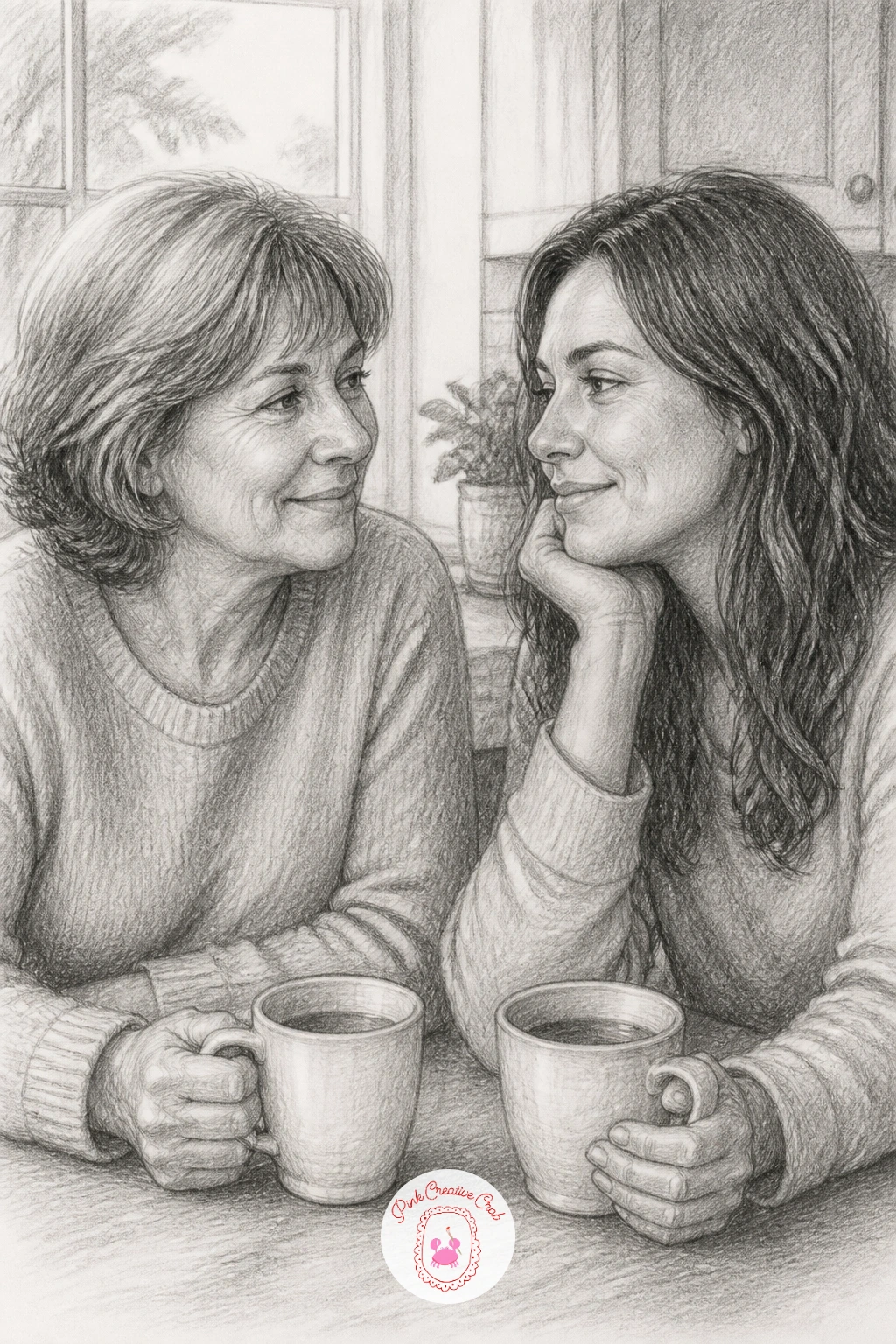
Settle into something quieter with a mother and adult daughter sharing coffee at a kitchen table, two mugs between them and hands resting near the cup handles. Draw both mugs first as simple cylinders using a light ellipse guide for the rims, then build the hands and faces around them once the table objects feel solid.
Keep the two women’s postures relaxed and leaning slightly inward over the table, as if mid conversation rather than posing for a photograph. Shade the mugs with a soft gradient from dark at the base to a lighter rim, and let steam rise as just two or three faint curved lines above one cup.
Table top objects like mugs often end up looking flat without that ellipse guide for the rim curve, so always sketch the oval lightly before adding the cylinder body beneath it. Without a compass or coin for that ellipse, draw it freehand slowly in one continuous motion rather than several short strokes.
Add one small shared detail, like a plate of cut fruit or toast between them, to suggest an unhurried morning together.
Palette: Graphite Grey,Soft Charcoal,Paper White
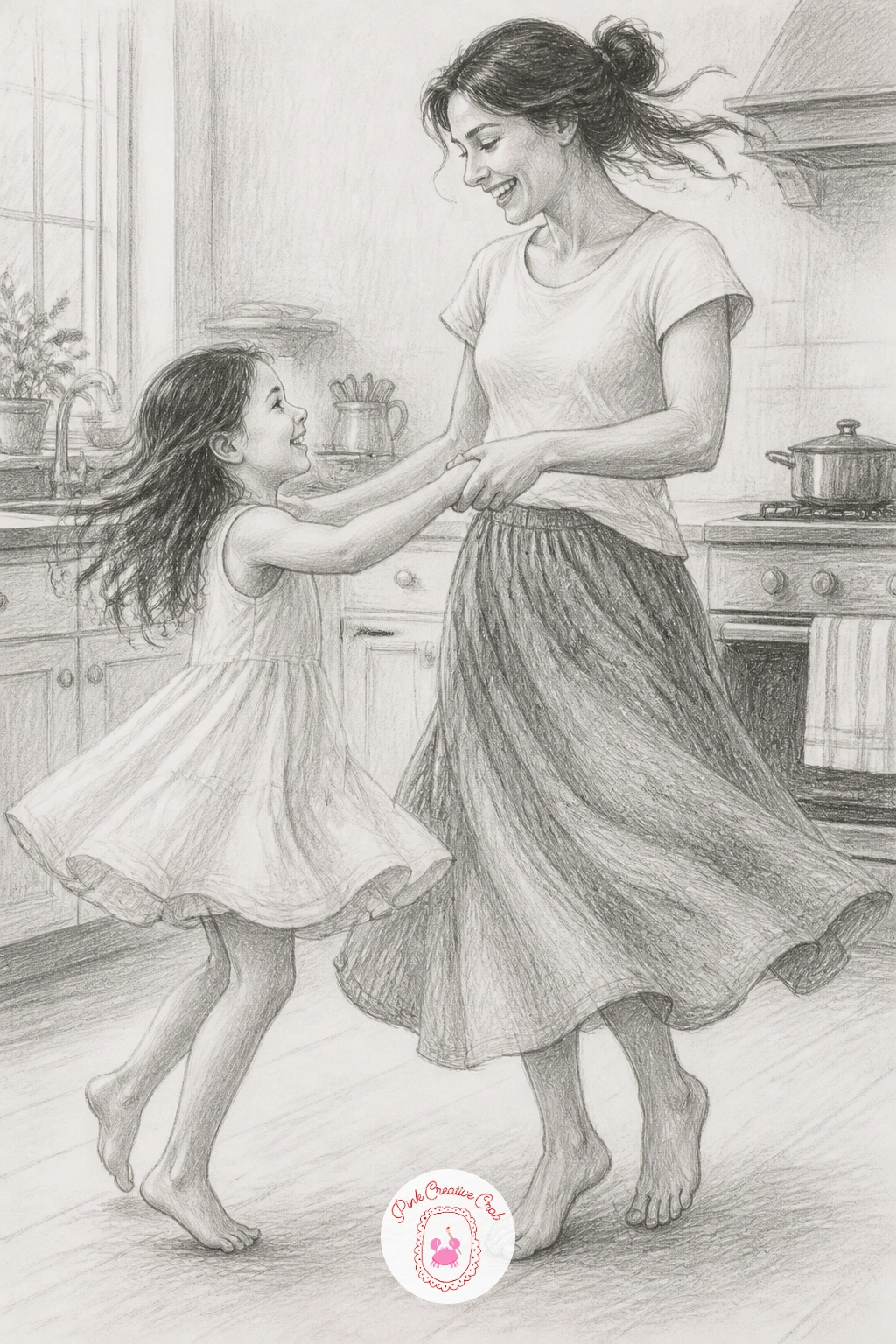
Bring some movement back with a mother and daughter dancing barefoot in the kitchen, hands clasped and spinning mid step, bare feet lifted slightly off the floor tiles. Draw the clasped hands first at the center of the composition, then build both bodies leaning away from that point in a gentle spiral, which is what makes the spin feel believable rather than two stiff figures standing still.
Keep their hair and loose clothing flowing in the same direction to reinforce the sense of spin, a few strands or a hem lifted outward on the same side for both figures. Shade the kitchen floor tiles with minimal detail, just enough diagonal lines to suggest the pattern without drawing a full grid.
A dancing pose can look frozen if both feet sit flat on the ground, so lift at least one foot slightly from each figure and bend the supporting knee. Without a tiled kitchen floor in mind, plain wood plank lines running in one direction work just as well and are quicker to draw.
Vary this scene next time by setting it outdoors on grass instead, the same spinning pose works in a garden just as well as a kitchen.
Palette: Graphite Grey,Deep Charcoal,Paper White
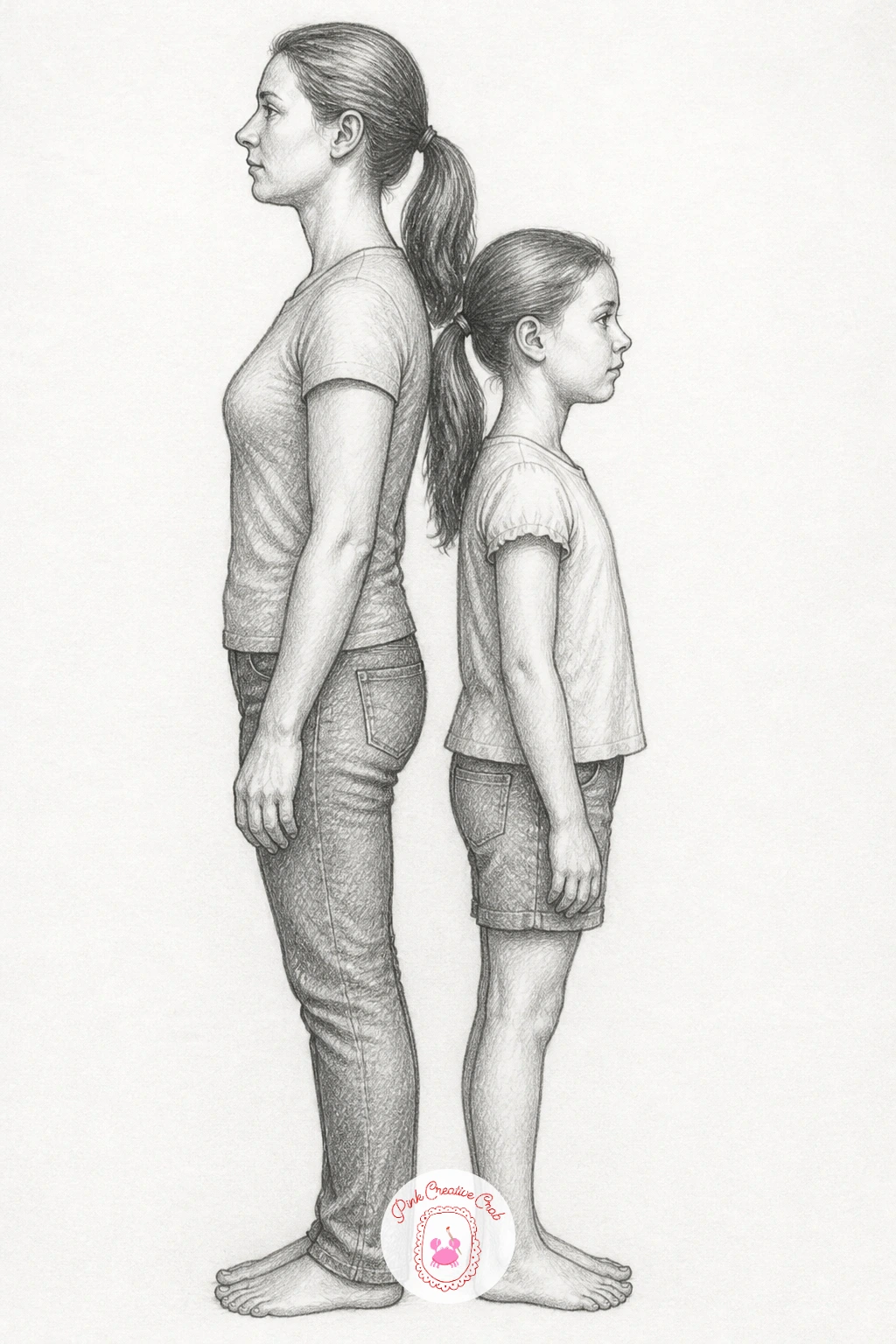
Measure things literally with a mother and daughter standing back to back comparing heights, a hand flattened on top of each head to mark the difference. Draw a single faint vertical guideline down the center of the page first, then build both figures symmetrically against it, which keeps the comparison reading clearly rather than looking lopsided.
Check the actual height difference against real proportion before committing to final lines, an adult woman typically stands a head and a half taller than a school age daughter, so measure that gap against your guideline rather than guessing by eye. Shade both figures evenly so neither visually dominates, since the whole point of the drawing is the comparison itself.
Height comparisons go wrong fastest when the back to back stance tilts even slightly, so keep both spines parallel to your center guideline throughout. Without a ruler for that guideline, fold your paper in half lightly to leave a crease you can draw along instead.
Draw the measuring hand flat and horizontal across both heads, it is the detail that makes the whole gesture read instantly.
You Will Need
- ruler or straightedge
Palette: Graphite Grey,Soft Charcoal,Paper White
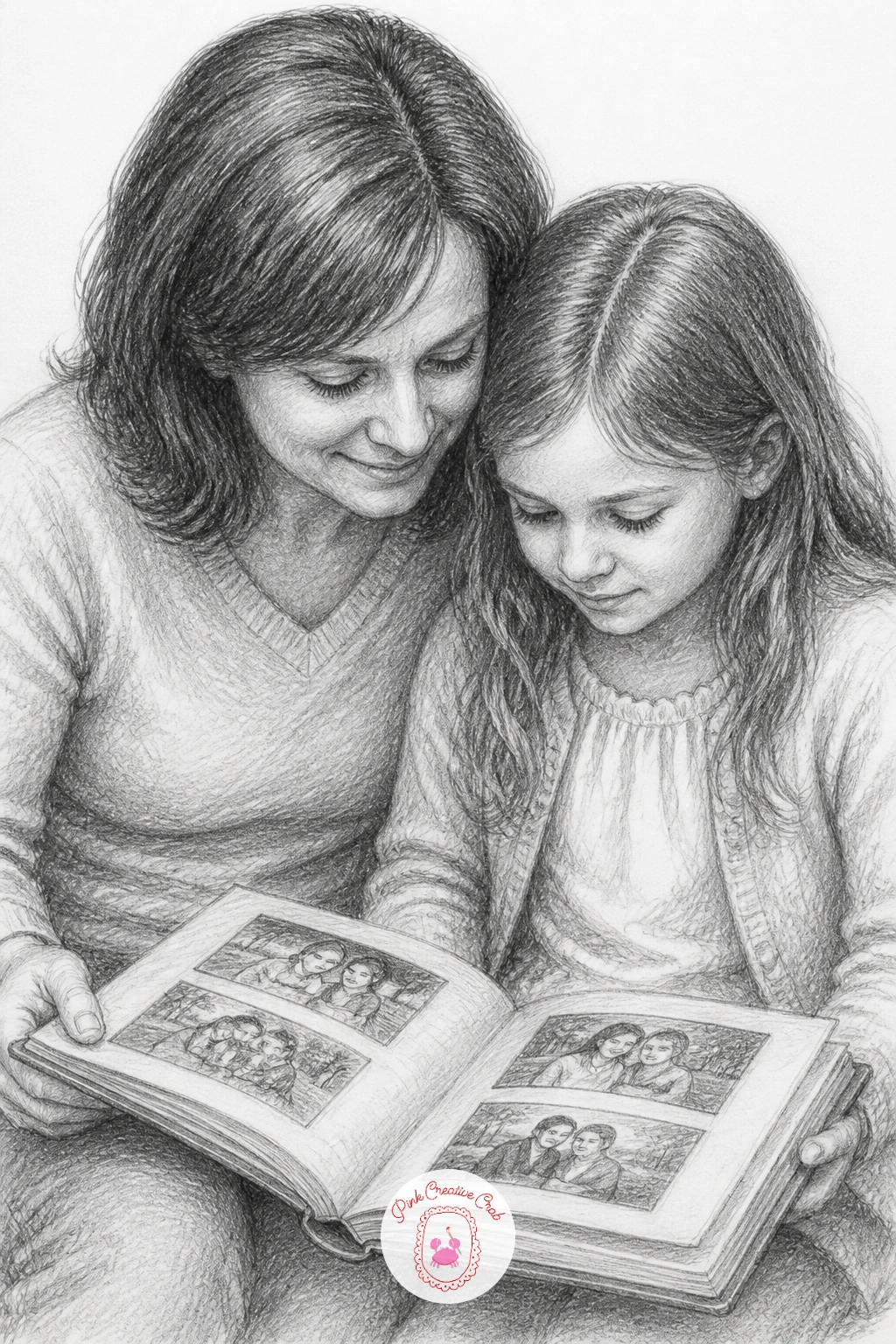
Pause for memory with a mother and daughter looking through an old photo album together, heads bent close over the open pages on a lap or table. Draw the album first as a simple open rectangle with a faint grid suggesting a few photo corners, keeping the actual photo content minimal or just implied rather than fully drawn scenes within the scene.
Place both faces angled downward toward the album rather than at each other, which naturally draws the viewer’s eye to the shared focus of the pages. Shade their expressions with a touch of nostalgia, a soft smile or slightly distant look works better here than a broad grin.
Drawing full detailed photographs inside the album can overcomplicate the piece fast, so keep them as simple rectangles with just a hint of a shape inside, the viewer’s imagination fills in the rest. If you enjoy this kind of layered memory keeping on paper, the wedding journal page ideas offer a related way to combine drawing with keepsakes.
Let one loose photo slip slightly outside the album’s edge, it adds a small sense of history being handled rather than just viewed.
Palette: Graphite Grey,Deep Charcoal,Paper White
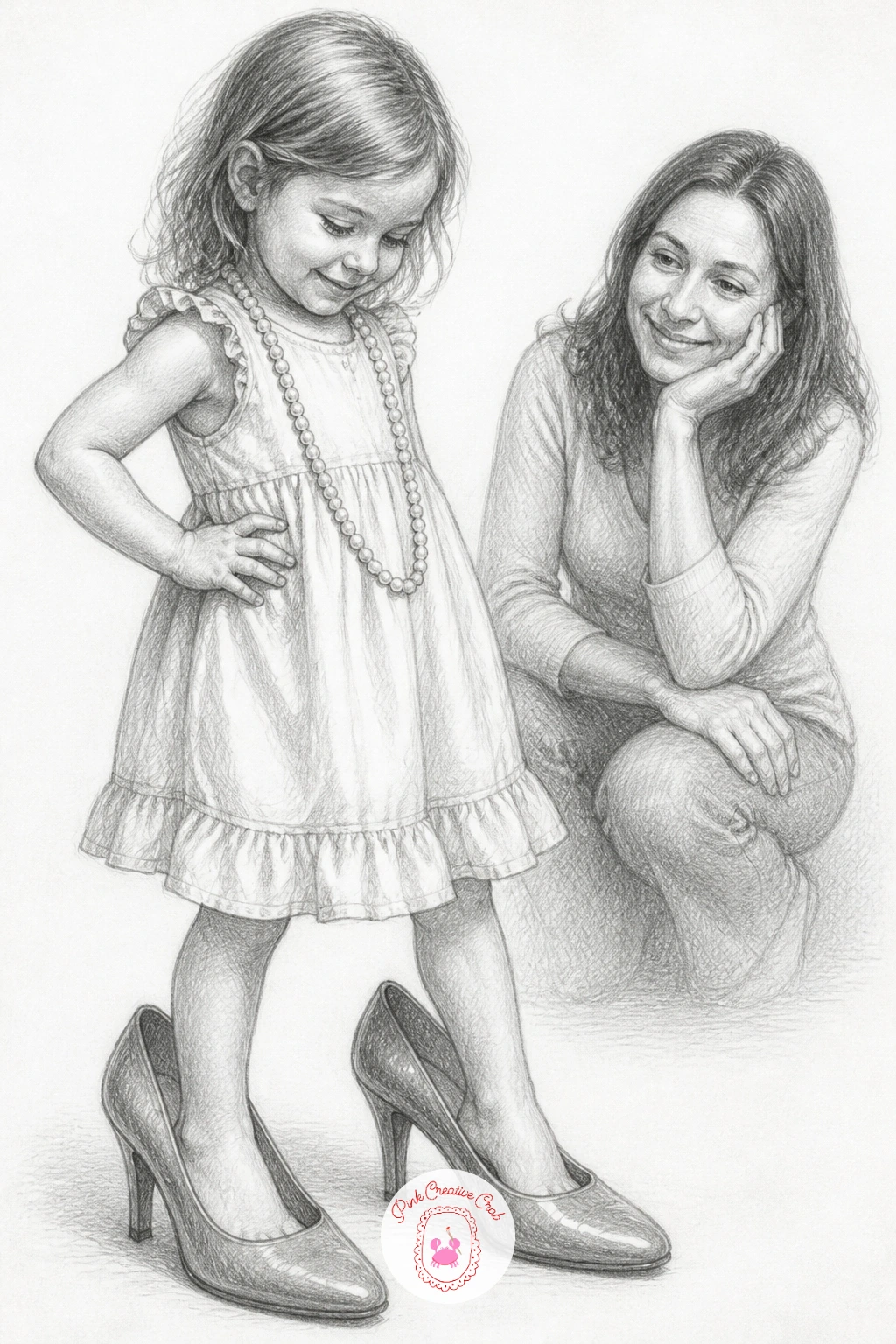
Add a playful note with a little girl wearing her mother’s pearl necklace and big shoes, standing alone in an oversized outfit while the mother watches, amused, from nearby. Draw the oversized shoes first, their length clearly exceeding her actual foot by a good margin, since that visual mismatch is the whole joke and charm of the scene.
Keep the daughter’s stance a little wobbly to match the comically large shoes, one foot turned slightly, and let the pearl necklace hang loose enough to bunch near her waist rather than sitting properly at the collarbone. Shade the mother softly in the background, slightly smaller in the frame and with a relaxed, watching posture, so the daughter remains the clear star of the piece.
Oversized clothing can end up looking like it fits if you are not careful with the gaps, so leave visible space between her small ankles and the wide shoe openings. Without pearls in your reference images, a simple string of small circles looped loosely around the neck reads just as clearly.
Give her one hand on her hip in a mock grown up pose, it instantly adds personality to the whole drawing.
Palette: Graphite Grey,Soft Charcoal,Paper White
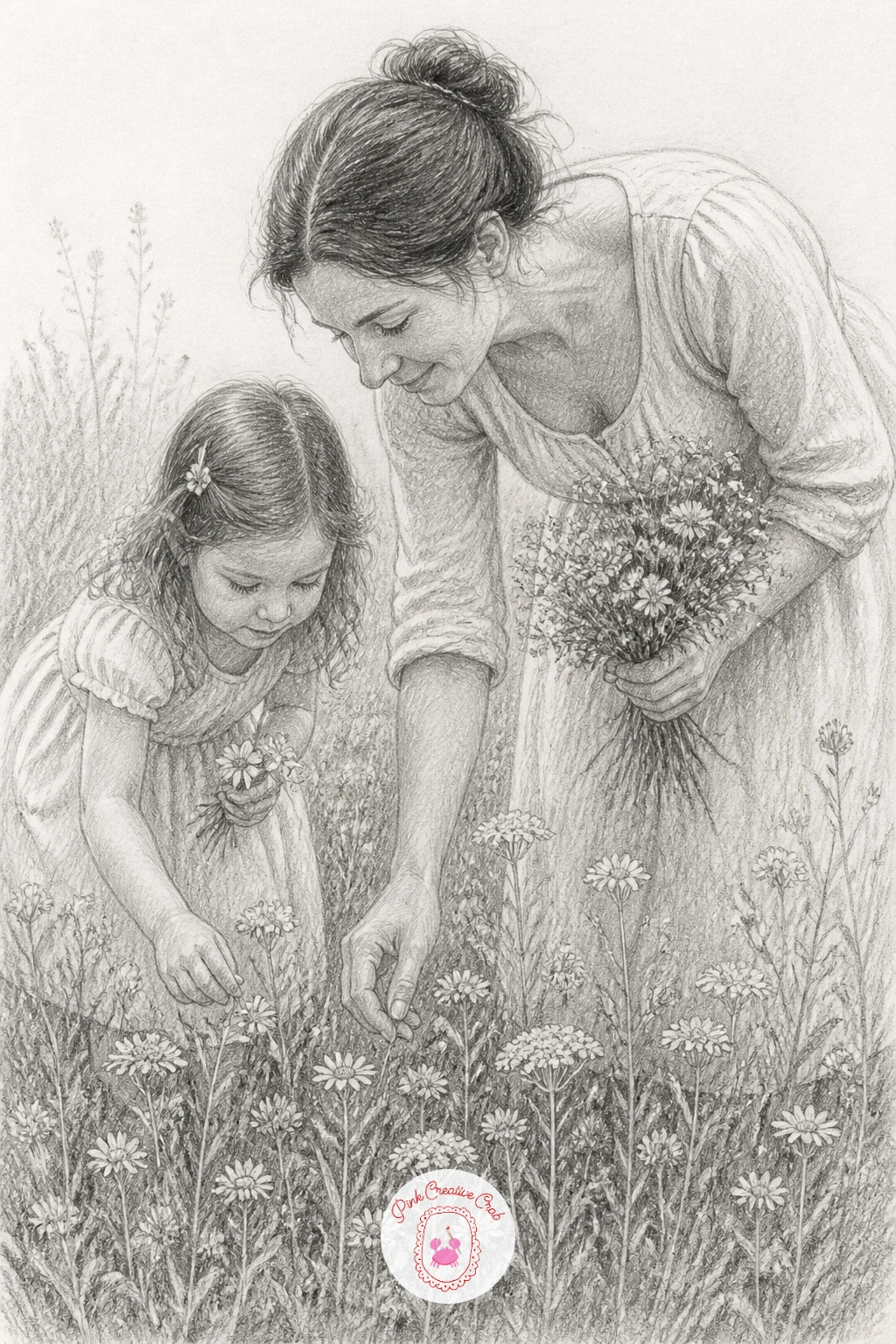
Step into open air with a mother and daughter picking wildflowers in a meadow, both bent slightly at the waist reaching toward a cluster of blooms at their feet. Draw a handful of simple flower shapes first, five or six larger blooms rather than a dense scattering, since a few clear flowers read better in graphite than an overcrowded field.
Place the light source high and slightly behind them for this one, which throws soft shadows forward across the grass and gives you a clear reason to shade one side of each figure darker than the other. Shade the meadow grass in loose, varied length strokes rather than one even texture, letting it thin out near the horizon.
A meadow can turn into a flat grey mass if every blade of grass gets equal attention, so vary your pressure and stroke length freely across the ground. If wildflowers feel fiddly to invent from memory, simplify every bloom to a simple five petal shape with a round center, it reads as a flower without needing botanical accuracy.
Tuck one picked flower behind the daughter’s ear, it is a small gesture that adds warmth without extra drawing time.
Palette: Graphite Grey,Deep Charcoal,Paper White
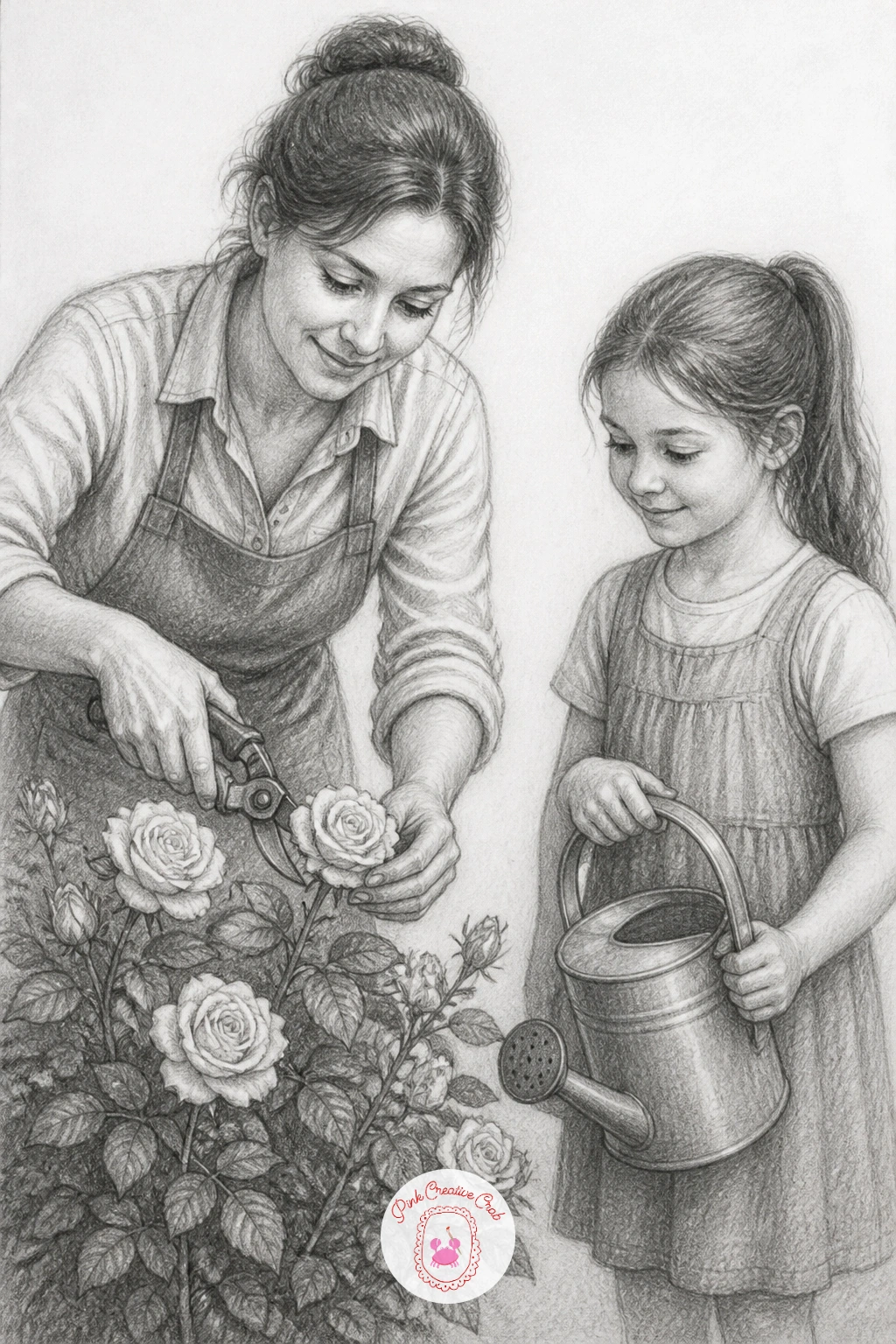
Bring the garden closer with a mother pruning roses while her daughter holds the watering can, standing beside a rose bush with pruning shears in one hand and the daughter waiting with the can ready. Draw the rose bush first as a cluster of simple layered oval shapes for the blooms and leaves, rather than trying to render every thorn and petal individually.
Give the mother a focused, slightly leaned forward posture toward the bush, shears angled precisely at one stem, while the daughter stands a little more upright and patient, can held with both hands. Shade the rose blooms with the softest gradients on the page, since their rounded, layered petals benefit from smooth blending more than sharp edges.
Rose bushes can become a tangle of indistinct scribbles fast, so block in three or four main stem directions first and keep leaves and thorns secondary to that structure. Without garden shears in mind for reference, simple curved scissors work as a stand in shape, the gesture of pruning matters more than the exact tool.
Vary this one next time by swapping the roses for a vegetable patch, the same pruning and watering gesture works just as well there.
Palette: Graphite Grey,Soft Charcoal,Paper White
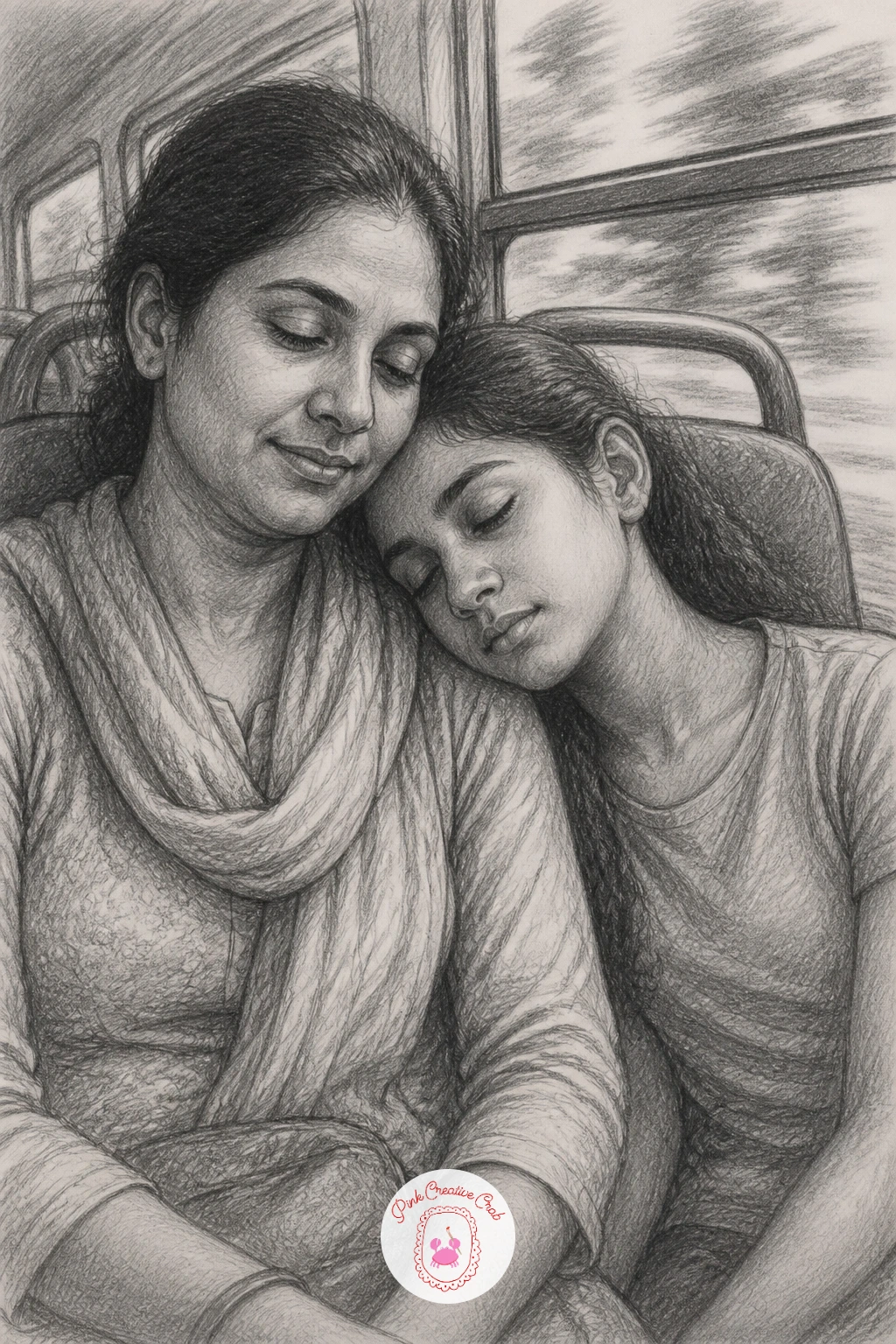
Return to quiet closeness with a daughter resting her head on her mother’s shoulder on a bus, both seated with the window and a few blurred shapes suggesting motion outside. Draw the angle of the daughter’s neck and tilted head first, since getting that soft lean exactly right against the mother’s shoulder is what makes the whole pose read as genuinely resting rather than just leaning awkwardly.
Keep the mother’s posture steady and upright to support the daughter’s weight visually, perhaps one arm resting protectively near her, while the daughter’s whole body looks loose and heavy with sleep or tiredness. Shade the bus window behind them with a few soft horizontal smudges rather than a detailed outside view, which reads clearly as motion without extra work.
A resting head drawn too high or stiff against the shoulder breaks the whole illusion of weight, so let it sink in slightly, compressing the shoulder fabric just a touch beneath it. If a bus interior feels like too much to invent, a simple seat back and window frame is all the setting this scene truly needs.
Close the daughter’s eyes fully rather than half open, it reads unmistakably as sleep rather than simple tiredness.
Palette: Graphite Grey,Deep Charcoal,Paper White
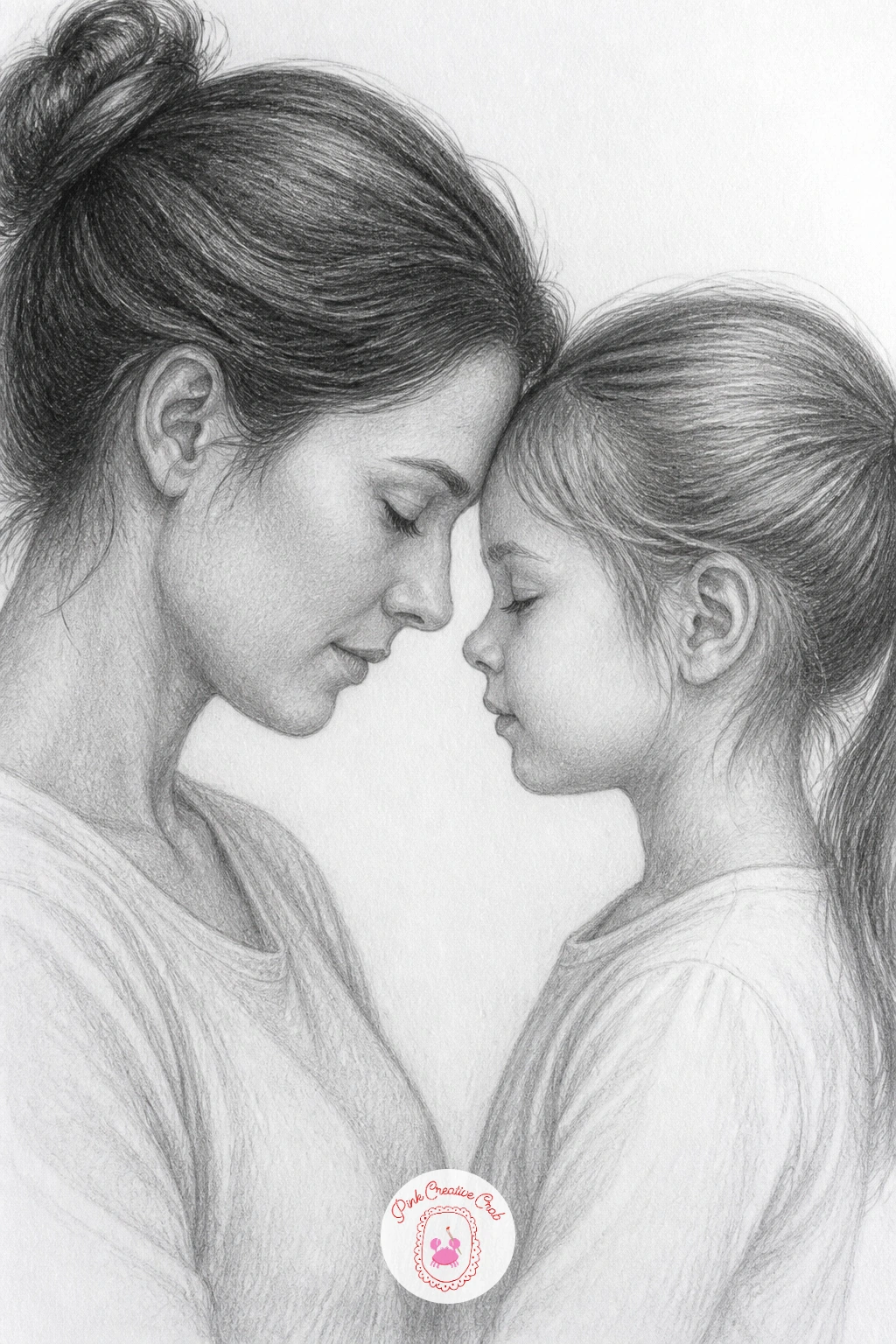
Bring the whole series to its most intimate point with a mother and daughter in profile with their foreheads touching, eyes closed, facing each other in a near mirror image. Draw one profile first, treating it almost like a portrait study on its own, then trace or copy its proportions loosely for the second face so both sides feel related without being identical.
Center the point where their foreheads meet exactly in the middle of the page, since that is the single focal point the whole composition builds toward. Shade both faces with soft, even light from the front, avoiding harsh shadow on either side so the moment feels calm rather than dramatic.
Mirrored profiles can look stiff and overly symmetrical if drawn identically, so vary small details like hair length, nose shape, or the exact closed eye curve between the two. Without two separate reference photos for each profile, drawing from a single mirror selfie for one face and adjusting the other slightly older or younger works just as well.
Leave a sliver of white paper right where their foreheads meet, that small untouched gap reads as the gentlest point of contact.
Palette: Graphite Grey,Soft Charcoal,Paper White
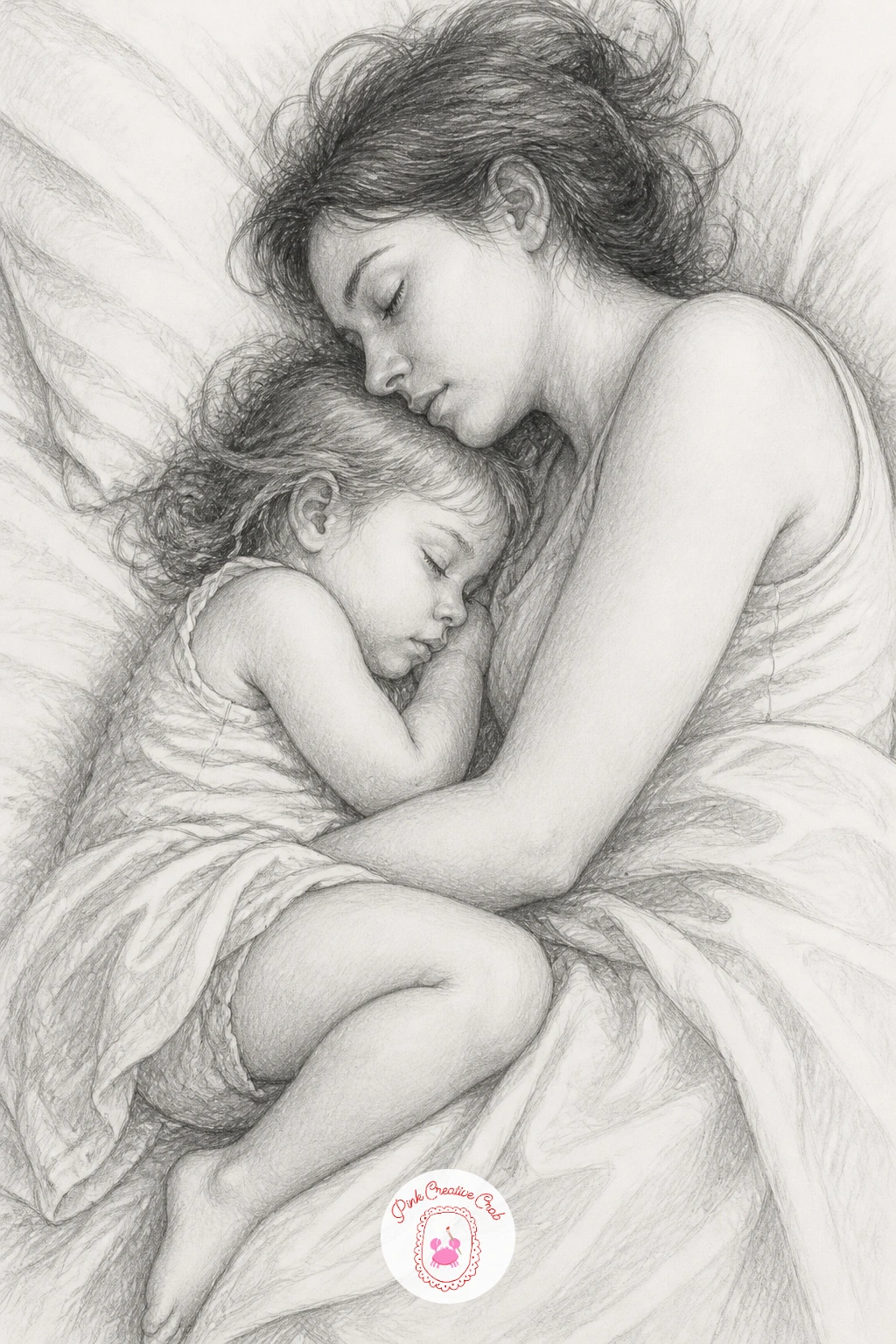
Close the whole series as it began, with a mother and toddler daughter asleep together during an afternoon nap, curled on a bed or sofa with limbs loosely tangled. Draw the overall curled shape of both bodies first as one connected silhouette before separating out individual limbs, since sleep poses read best when the two figures feel like a single soft mass rather than two distinct bodies placed side by side.
Keep every line loose and rounded here, no sharp edges anywhere, with the toddler’s small body tucked into the curve of the mother’s larger one. Shade in slow, gentle gradients with minimal contrast, since a nap scene calls for the softest values in the whole collection rather than any deep, dramatic shadow.
Tangled limbs during sleep can confuse a viewer if every arm and leg is drawn with equal clarity, so let one or two limbs disappear softly into shadow or fabric folds rather than tracing each one fully. Without a real reference photo of a sleeping pair, working from the general curled shape of two nested commas is a surprisingly reliable starting guide.
End the drawing with a blanket corner pulled loosely over just one of them, it is the last small detail that makes the whole scene feel lived in rather than staged, and a fitting close to this collection, worth returning to with the sketchbook diary ideas if you want to keep drawing small daily moments like it.
Palette: Graphite Grey,Deep Charcoal,Paper White
What to Do Next
Pick one idea that matches a moment you actually want on your wall, grab a smooth sheet of bristol paper, and start with the loosest construction lines before any shading touches the page. One finished drawing today is worth more than thirty three half started ones, so let this list be something you return to slowly, one page at a time.
Frequently Asked Questions
What pencils work best for a mother and daughter drawing in graphite?
A range from HB to 4B covers most of these drawings well. HB handles light sketching and midtones, while 2B and 4B build the deeper shadows in hair, fabric, and shaded skin areas.
How do you keep two faces looking related without making them identical?
Vary small features like nose shape, eye spacing, or jaw softness while keeping the same general head shape and proportions, which reads as family resemblance rather than one face copied twice.
How can you make a graphite skin tone look soft instead of flat?
Build skin shading in thin layers with a light touch, blending gently with a stump rather than pressing hard in one pass, and always leave the brightest highlight areas untouched by pencil.
What is the easiest way to get two figures the right size next to each other?
Measure one figure against a part of the other before drawing final lines, such as comparing a child’s whole height to an adult’s torso, so the proportion is checked rather than guessed.
Do these drawings need a detailed background?
No, most of these scenes work better with a plain or barely suggested background, since a few simple lines keep full attention on the two faces and their connected gesture.
Have any thoughts?
Share your reaction or leave a quick response — we’d love to hear what you think!
-
 0
-
 0
-
 0
-
 0
-
 0
-
 0
