A colored pencil portrait is one of the most satisfying things you can finish in an afternoon: no mixing, no drying time, just layer after layer of color building a face right in front of you. Each head below belongs to a different invented person, nobody real, so you can push the hair color, the skin tone and the little details as far as you like without worrying about getting a likeness wrong.
Below are 27 faces to work through, from a freckled redhead to a grandfather in a blue knit cap, arranged from quick and simple to a little more involved. Pick whichever one catches your eye first: every face stands alone and every one is built the same practical way, so you will finish with a page you actually want to pin.
Using these images: free for personal projects such as printing, coloring, cards, journals and gifts. Handmade items that include them may be sold up to 30 pieces per design. More than that is commercial use and is not permitted, and neither is selling or sharing the images themselves or passing them off as your own. Please ask before any other use.
Start with a redhead girl with freckles, because her coloring gives you an easy, forgiving place to begin. Lay the head shape lightly in pencil first, then block in skin with a thin layer of light peach before the hair or freckles go anywhere near it.
Build the hair in loose curved strokes of orange-red and burnt sienna, always following the direction it falls rather than scribbling flat. Freckles go on last with the tip of a sharp terracotta or light brown pencil, dotted in small uneven clusters across the nose and upper cheeks, never in a perfect grid.
The mint green sweater is the easiest part: flat strokes of mint green with a touch of darker green in the folds under the chin. If the freckles end up too heavy, soften a few with a kneaded eraser dabbed gently rather than rubbed.
Keep the background bare white paper so the hair color reads as bright as possible against it.
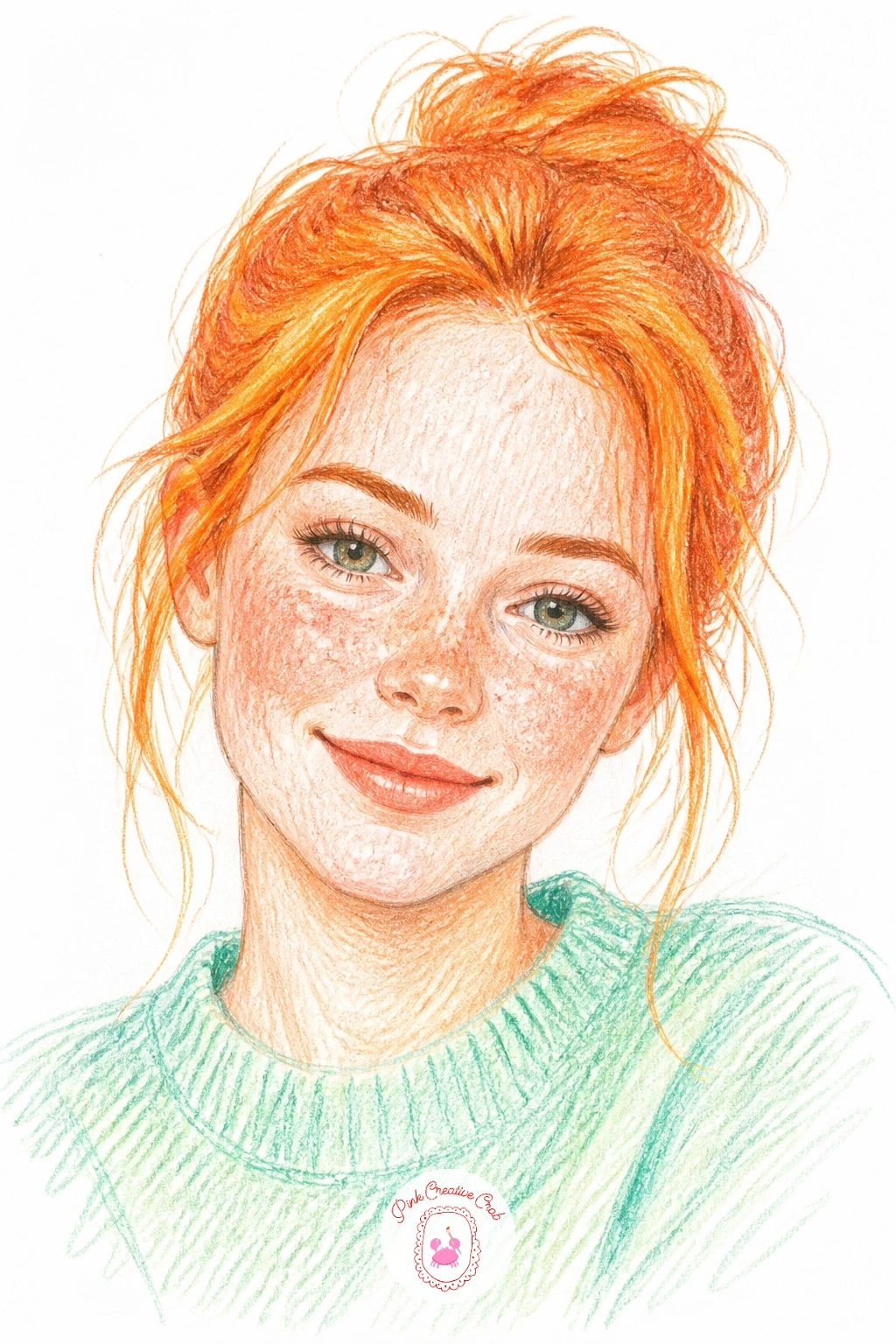
Palette: Burnt Sienna,Light Peach,Mint Green,Terracotta
Move next to a Black woman with a big curly afro, a great subject for practicing rich, deep skin tones without rushing to black too early. Build her skin in layers, starting with a warm mid brown base, then adding deep burgundy and a touch of warm red in the shadow areas under the cheekbones and jaw before any pencil ever touches pure dark brown.
The afro reads as rounded clusters rather than individual hairs: press small circular strokes of dark brown and black close together, leaving tiny flecks of white paper between some curls so the shape feels soft rather than solid.
Compare the width of the afro to the width of her shoulders before you commit to its outer edge, since this is the one measurement that can make the whole head look lopsided if it is guessed instead of checked.
Finish with small pink circles for the earrings, left simple and bright against all that dark hair.
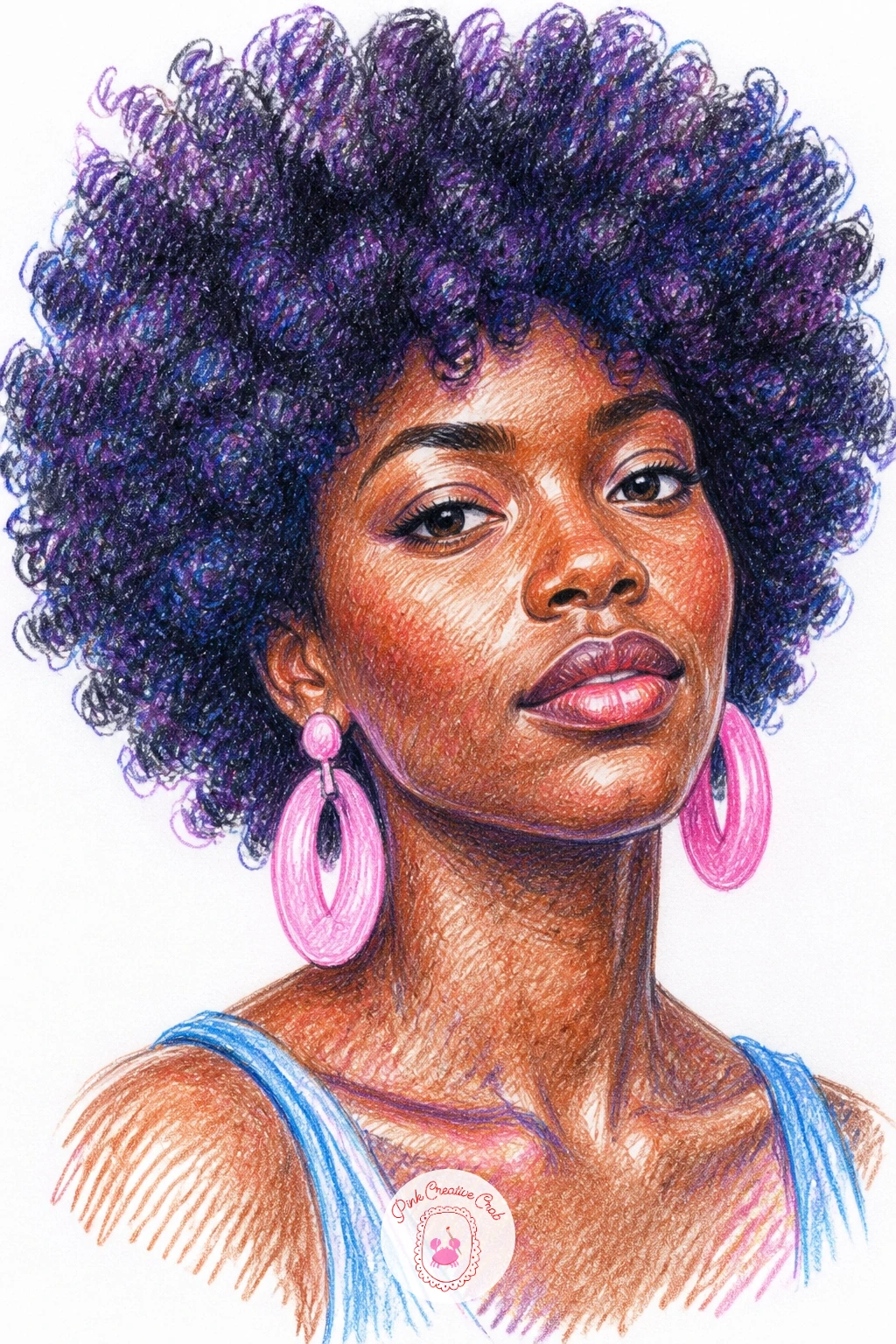
Palette: Burnt Umber,Deep Burgundy,Black,Rose Pink
After all that curved hair, a grandfather with a white beard and a blue knit cap is a nice change of texture: mostly flat shapes and soft wrinkles instead of busy curls. Lay his skin in a warm tan first, then add soft grey-violet shading around the eyes and under the cheekbones to suggest age without drawing hard wrinkle lines everywhere.
His eye level sits roughly halfway down the whole head shape, a rule that holds for every face in this list and is worth checking with a ruler the first few times you draw one.
The beard is built in short upward flicking strokes of white and pale grey over a light blue-grey base, never solid white, so it keeps some shadow and does not look pasted on.
If white pencil looks too chalky on its own, warm it slightly with a single pass of light blue first. The knit cap gets simple diagonal hatching in two blues to suggest ribbed wool.
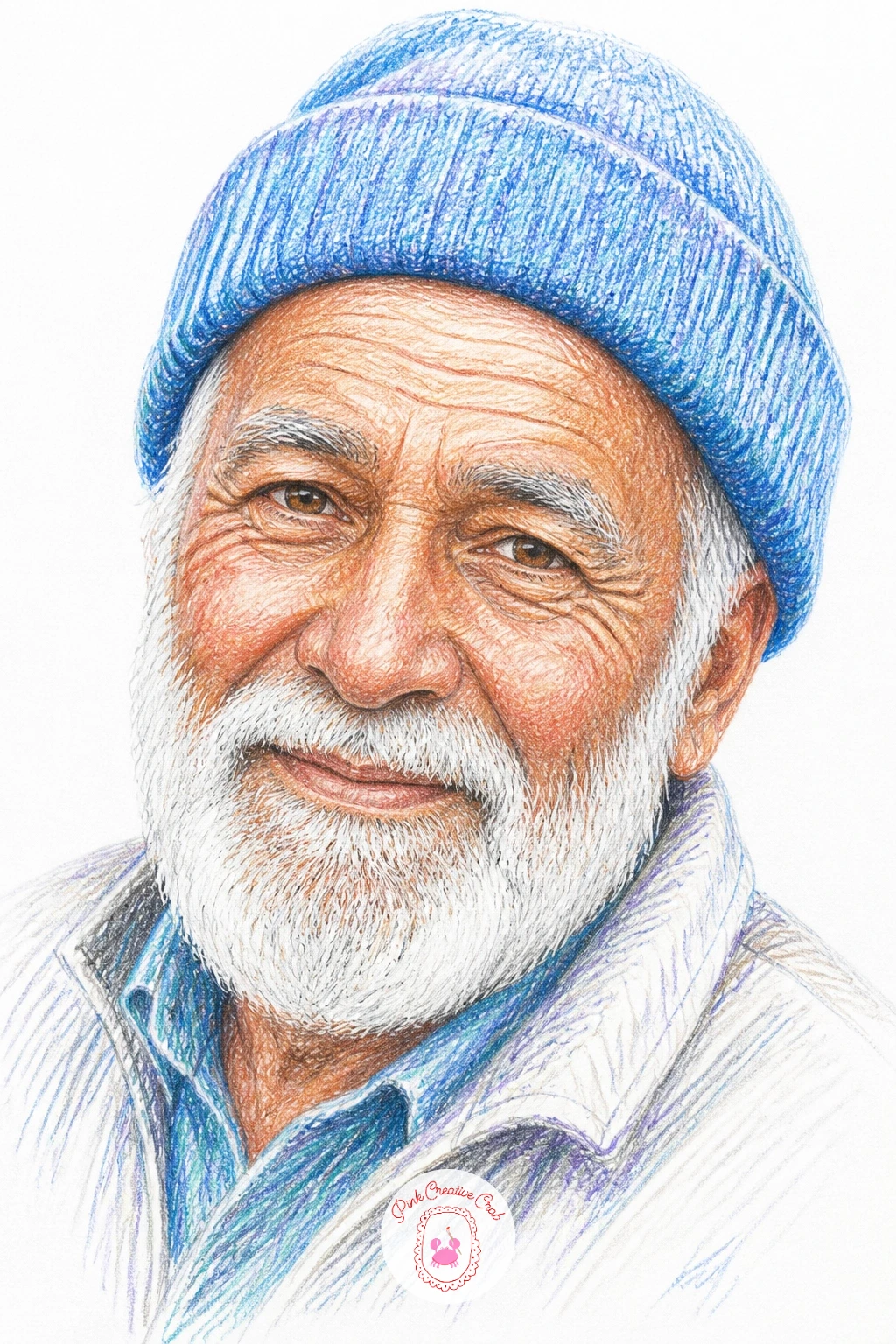
Palette: Warm Tan,Grey Violet,Sky Blue,White
A boy with a buzz cut grinning through a missing tooth brings some fun back into the page after a quieter face. The buzz cut is just short, even strokes of brown following the curve of the skull, left lighter near the crown where light would naturally catch it.
Draw the open, grinning mouth before you touch the teeth: a simple curved shape in a deep rose color, then add white teeth as small rectangles with one gap left as bare paper or the faintest grey shadow, never a hard black hole.
Round, full cheeks are what sell a child’s face, so keep the jawline soft and curved rather than angular, and push the cheeks slightly pink with warm rose over the base skin tone.
If the grin looks stiff, loosen the corners of the mouth with a short upward flick rather than a straight line.
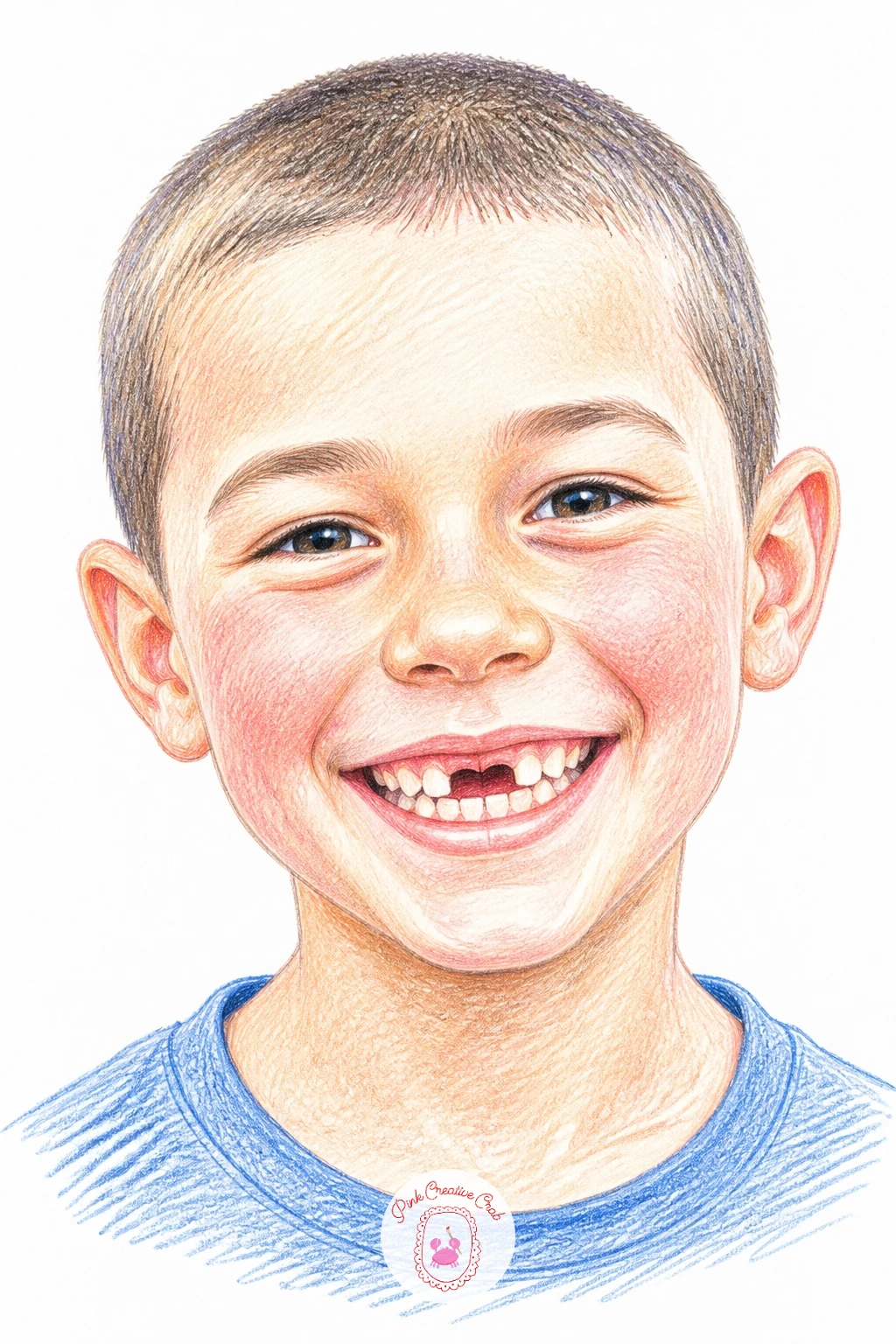
Palette: Warm Brown,Rose Pink,Light Peach,White
A woman with a teal bob and round glasses is a good subject for practicing clean, confident hair edges, since a bob has almost no loose strands to hide behind. Block the hair in flat teal first, then add a slightly darker teal-blue only where it tucks behind the ear and under the chin, keeping every edge crisp against the skin.
Draw the round glasses as two careful circles linked by a short bridge, sketched lightly in pencil before any color goes near the eyes, because a wobbly glasses shape is the easiest thing to ruin this whole face.
Leave the lenses mostly bare white paper with just a thin grey line along the top rim to suggest glass, rather than shading them in fully, which would hide the eyes behind them.
Swap teal for a cool violet if you want a slightly softer, less graphic version of the same bob.
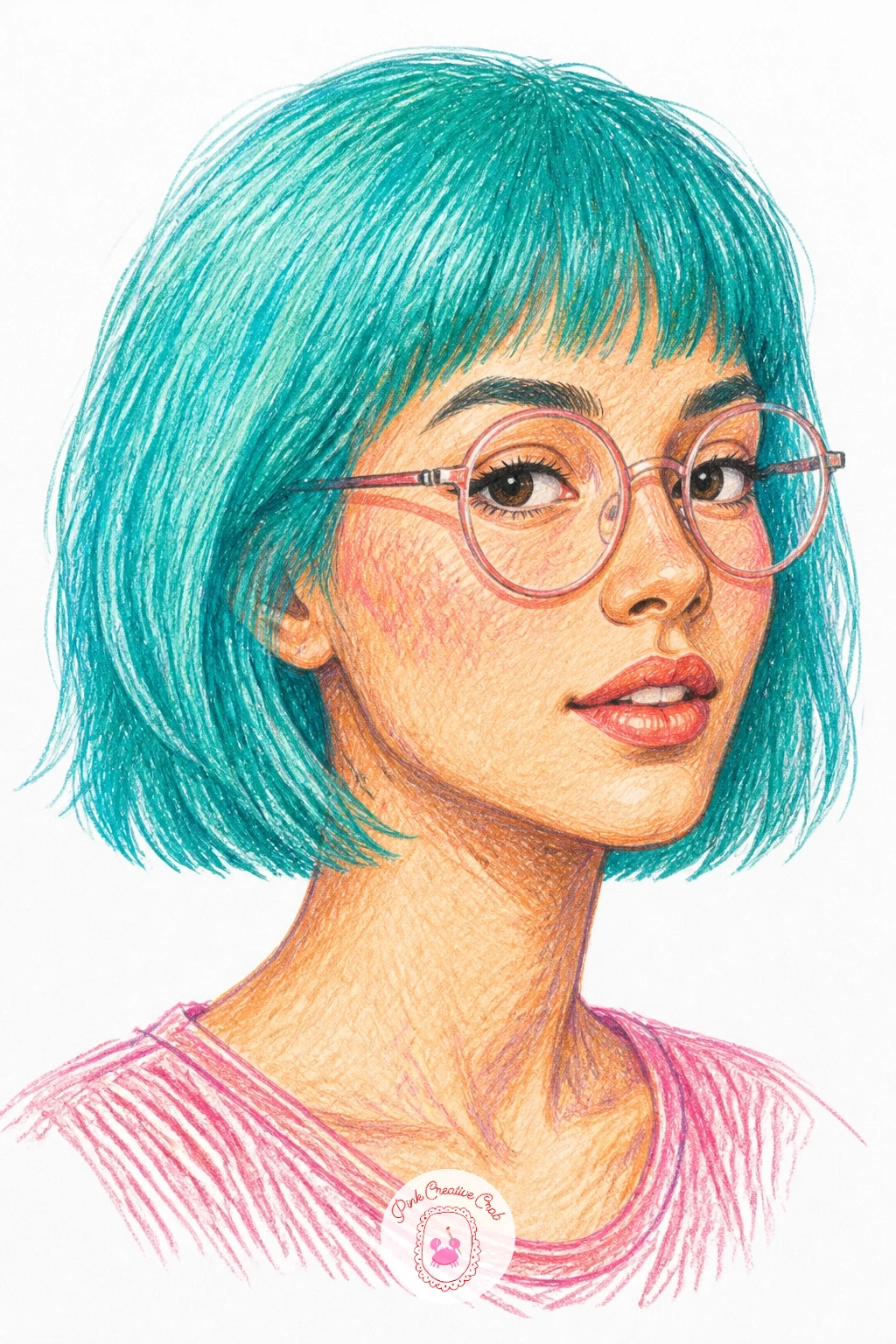
Palette: Teal,Teal Blue,Light Peach,Grey
A South Asian girl with a long braid and a nose stud is a lovely subject for practicing a woven texture that stays simple rather than fussy. Draw the braid as three gently overlapping bands rather than individual strands, shading each band slightly darker on one side so it reads as rounded rope instead of a flat stripe.
Her skin sits in the warm golden-brown range: start with a honey base, then deepen the shadow side of the face and neck with a touch of warm umber, always keeping the light side noticeably brighter so the face has real form.
The nose stud is one tiny dot of white gel pen added right at the end, after every pencil layer is finished, since any smudging over it will dull the sparkle that makes it read as metal.
If gel pen is not available, a sharp white pencil dot works almost as well.
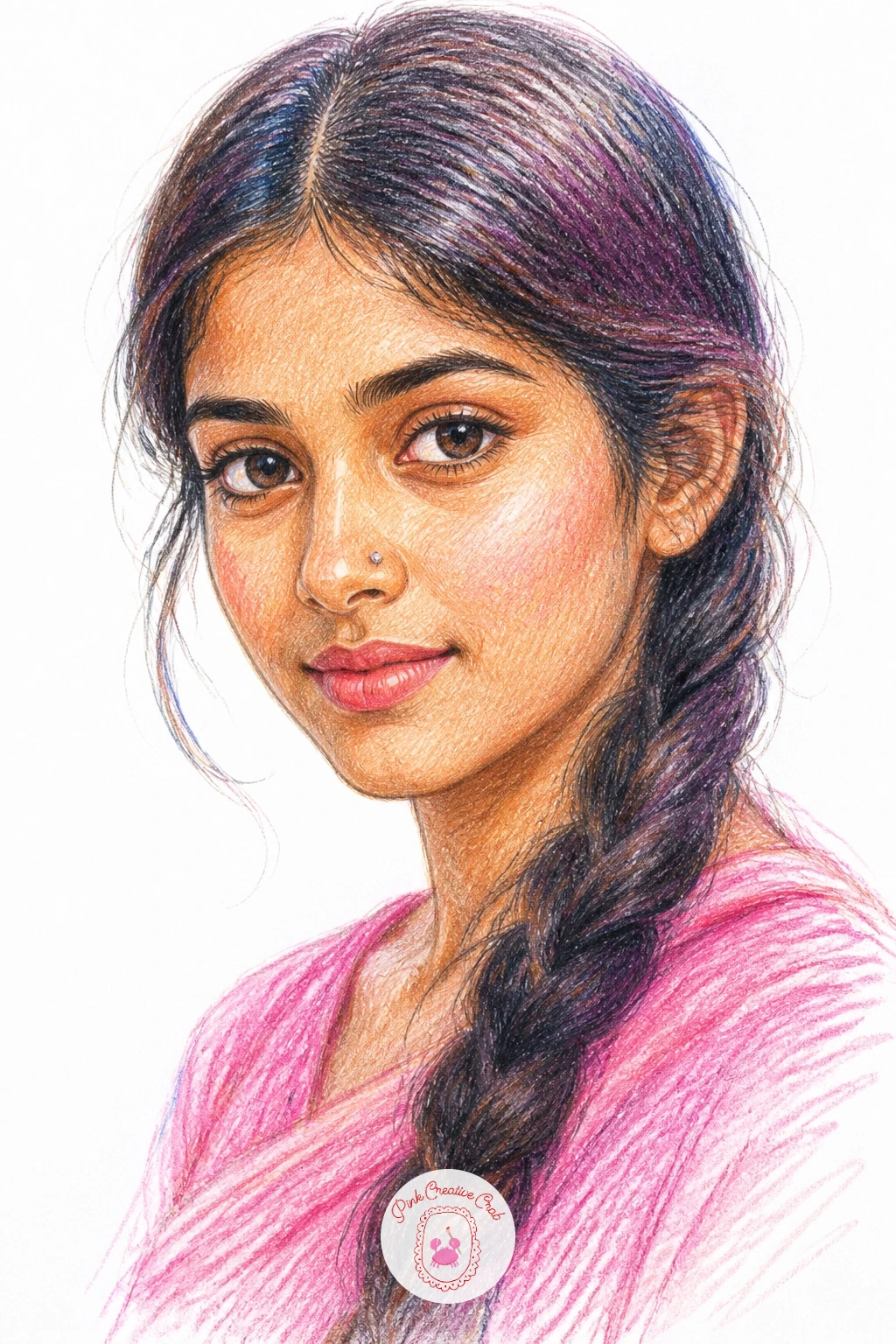
You Will Need
- white gel pen
Palette: Honey Brown,Warm Umber,Black,White
An East Asian woman with a blunt fringe and coral lipstick is a good next step for practicing sharp, graphic shapes against soft color. The fringe is cut dead straight: draw it as one confident horizontal line in pencil before any hair color goes down, then fill above and below that line with smooth black strokes running in slightly different directions to suggest thickness without looking stiff.
Her skin leans warm ivory with the faintest peach undertone, blended in one light even layer so nothing looks patchy.
The coral lipstick is where this whole face gets its spark: use a bright coral pencil on the lips only, pressed slightly harder in the center of the bottom lip where light catches it, and leave the very corners lighter.
Keep the eyeliner thin and simple, just one dark line close to the lash line rather than a full winged shape.
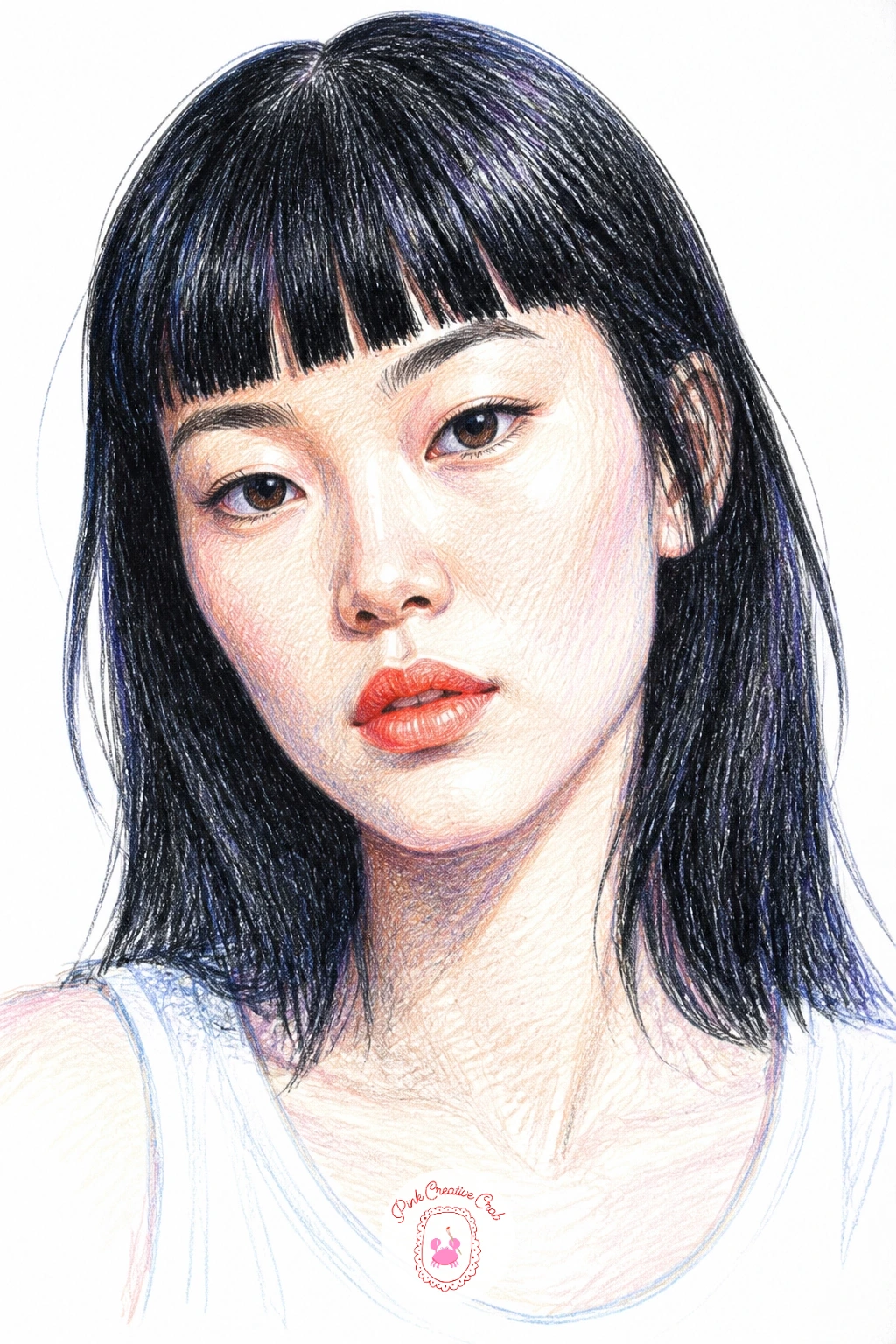
Palette: Warm Ivory,Black,Coral,Soft Pink
A teenager with lavender hair and headphones around her neck is a fun one to loosen your line work a little, since teenage hair rarely sits perfectly smooth. Draw the headphones first as two simple curved bands resting on the shoulders, since they anchor the whole pose and everything else is drawn around them.
Build the lavender hair in long strokes that bend gently at the ends rather than falling in straight lines, layering a pale lilac base with slightly deeper violet strokes only where one section of hair passes in front of another.
For speed, a ten minute version can stop at flat lavender with just a few darker strokes for shadow; a fuller forty minute version adds a second lighter lilac highlight down the center of each hair section where light would catch it.
If the headphones look too flat, add one curved white highlight along the top band.
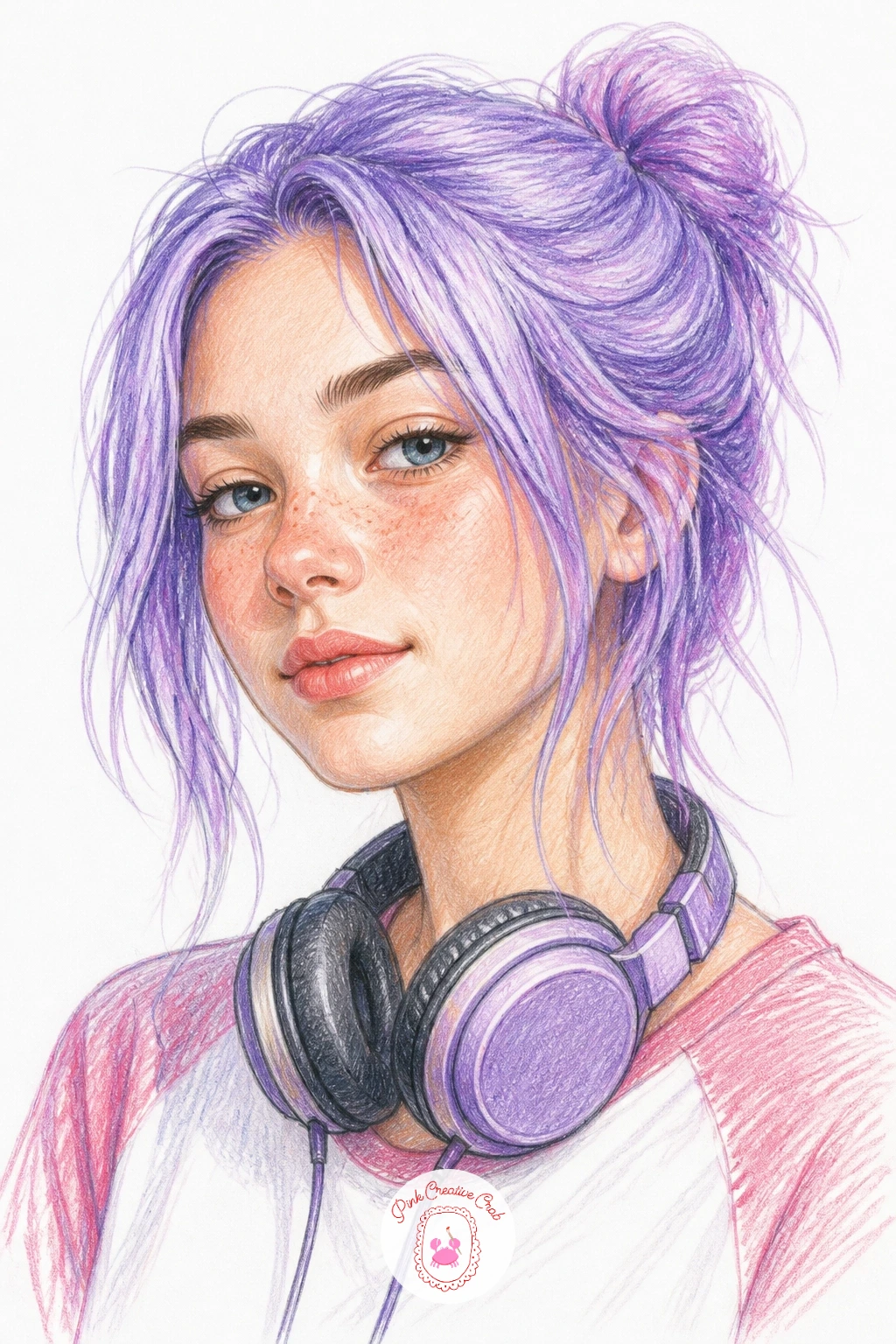
Palette: Pale Lilac,Violet,Light Peach,Grey
A grandmother with silver curls and pearl earrings is a chance to work with cool greys instead of warm browns in the hair, which changes the whole feel of a face. Build the curls in small overlapping loops of light grey and cool blue-grey, never pure white, since real silver hair almost always carries a shadow color running through it.
Her eye level still sits at the halfway mark of the head, but soften the skin around the eyes and mouth with gentle waves of light grey-violet rather than sharp lines, which reads as age far more convincingly than wrinkle lines alone.
The pearl earrings are two small pale circles with one tiny white highlight dot left bare, placed just below the earlobe on each side.
If the curls start looking like scribble, press a clean kneaded eraser into the densest spots to lift a little color and open up the shape again.
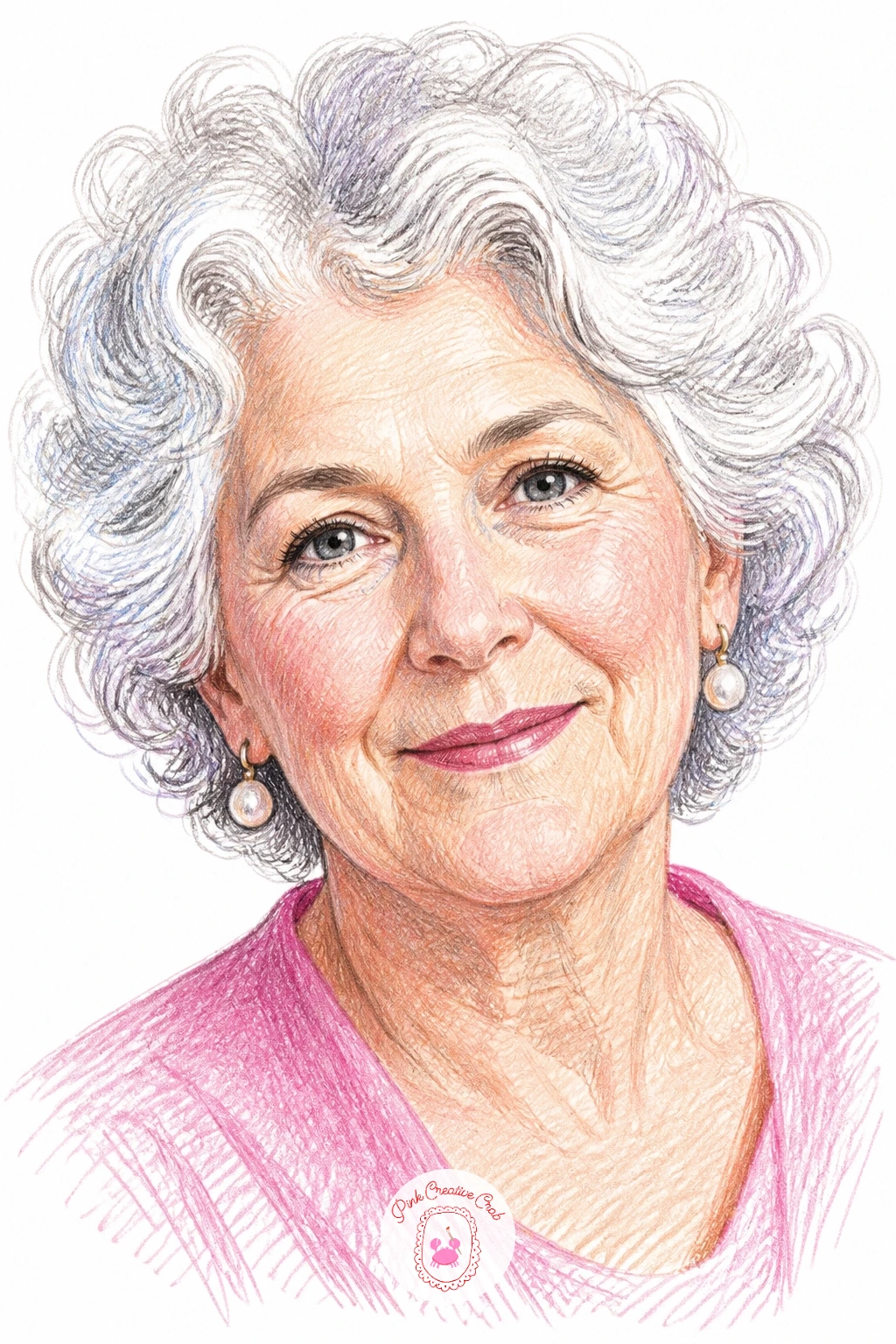
Palette: Light Grey,Blue Grey,Warm Tan,White
If you enjoy drawing faces with soft, quiet color like this one, the gentle layering here is very close to the style used across this girl pencil drawing collection.
A man with deep brown skin laughing in a sky blue shirt is worth drawing for the expression alone: a genuine laugh opens the whole face in a way a neutral pose never does. Draw the mouth wide and slightly uneven, with the top teeth showing fully and the eyes narrowed into soft curved lines rather than open ovals, since that is what reads as real laughter rather than a posed smile.
His skin builds in rich, deep layers: a warm dark brown base first, then added warmth from a touch of deep red-brown in the cheeks and a cooler shadow color along the jaw and neck, built up gradually rather than pressed on all at once.
The sky blue shirt is simple flat color with a few darker folds near the collar, left loose rather than tightly rendered so it does not compete with the face.
If the laugh looks forced, check that the eyebrows lift slightly and the cheeks push up, both small shifts that change everything.
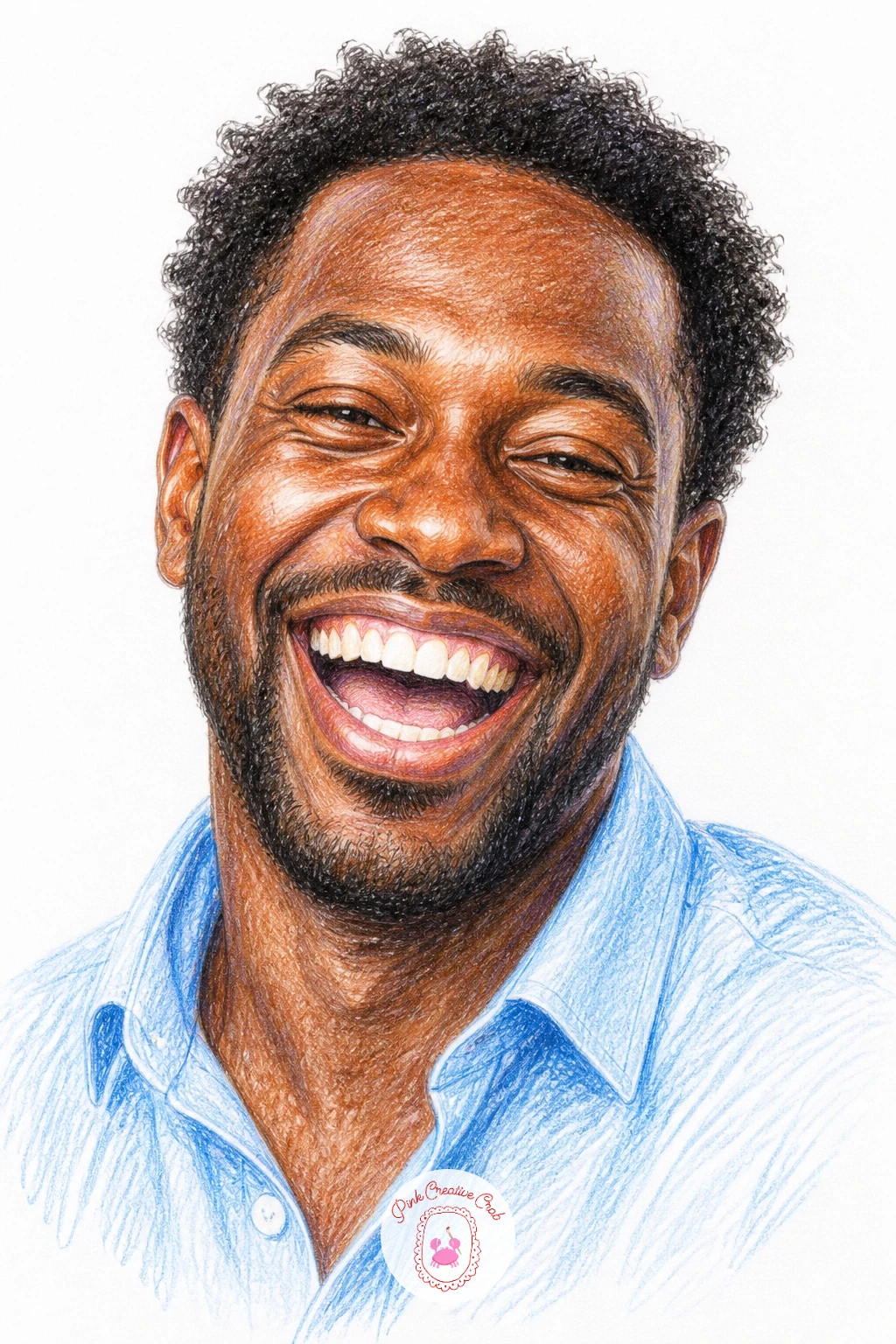
Palette: Deep Brown,Red Brown,Sky Blue,White
A girl with two hair puffs and a yellow hair clip is another good chance to practice rounded curl clusters, this time split into two separate shapes instead of one big afro. Place both puffs symmetrically first with light pencil guide circles, checking that they sit at the same height before any color goes down, since uneven puffs are the most common thing that throws this whole drawing off.
Build each puff the same way as the earlier curly afro idea: small tight circular strokes in dark brown and black, leaving a few tiny white gaps between curls so the texture stays soft rather than solid.
The yellow hair clip is one small bright shape placed at the base of one puff, left as flat clean color so it pops against all that dark hair.
Keep her expression open and simple, a slight smile is plenty for a face this young.
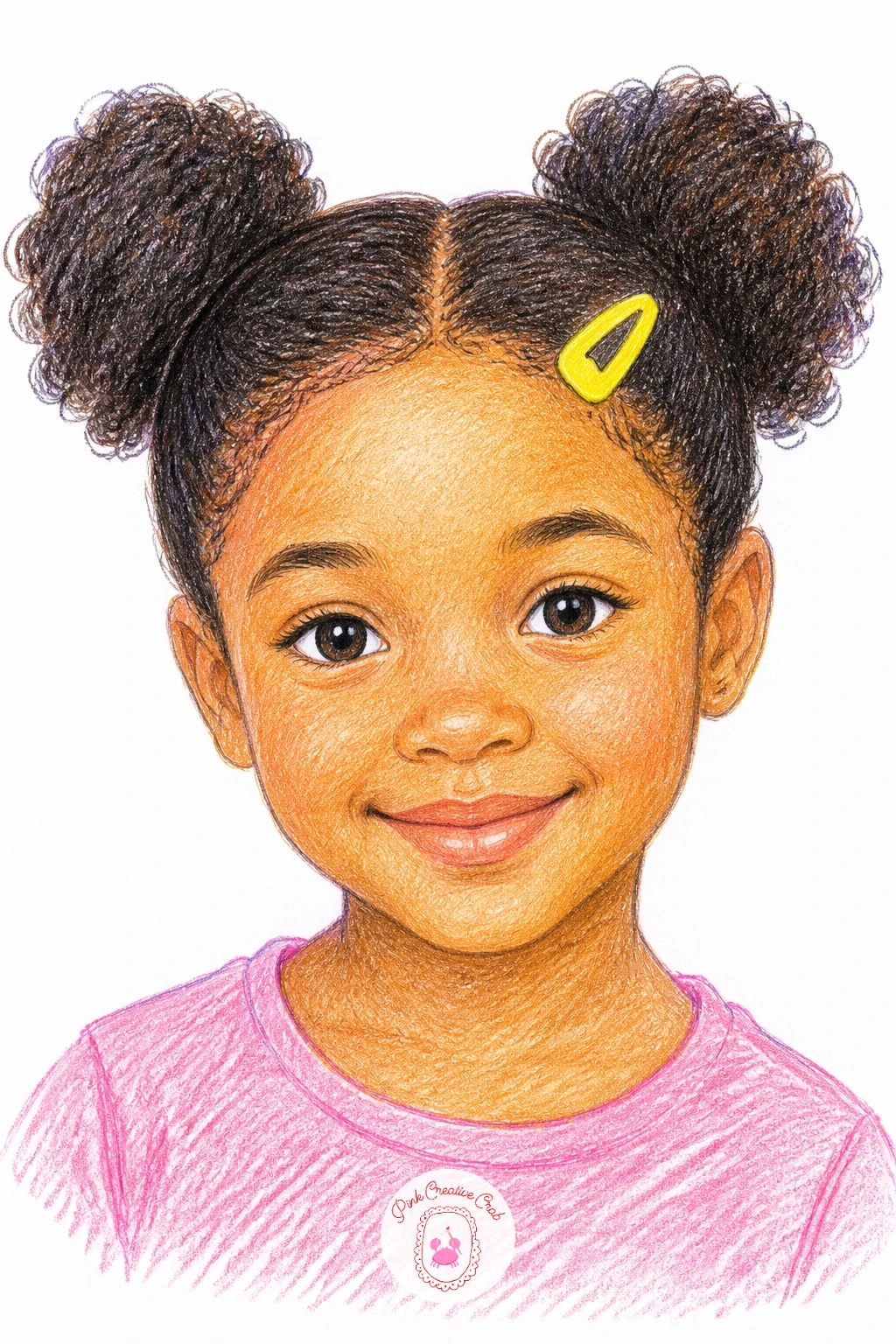
Palette: Black,Dark Brown,Warm Peach,Bright Yellow
A woman in a wide sun hat with shade across her eyes changes the lighting rules completely, so this is the idea to use for practicing cast shadow rather than a straight-on lit face. Draw the hat brim first, a wide curved shape that sits well above the head, then decide where its shadow falls across the forehead and eyes before adding any skin color underneath it.
Shade that strip across the upper face a full step darker than the rest of the skin, using a cool violet-brown rather than plain grey, since a shadow on skin is never truly grey.
Below the shadow line, the nose, lips and chin stay in full warm light, which is the contrast that makes the whole hat idea work on paper.
If the shadow edge looks too hard, soften it slightly with a clean finger or blending pencil right along its border only.
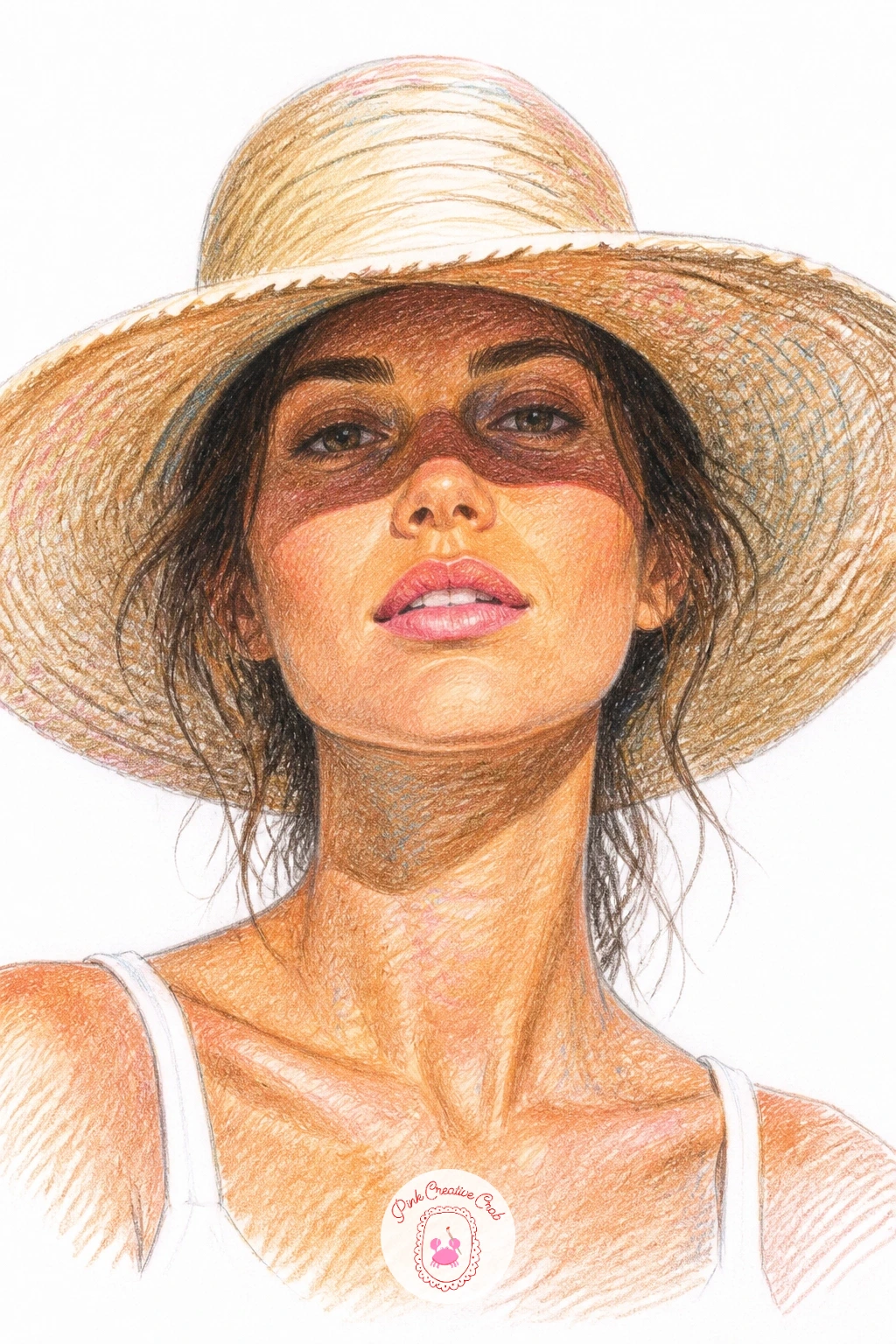
You Will Need
- colorless blender pencil
Palette: Warm Tan,Violet Brown,Straw Yellow,Soft Pink
Add some warmth to the page with a young dad with a ginger beard and a baby on his shoulder, a two-figure idea that still works as one simple composition. Draw the dad’s head and shoulders first at full size, then place the baby’s small round head just above and behind one shoulder, checking that the baby’s head is noticeably smaller than his since that scale difference is what sells the whole scene.
The ginger beard is built the same way as any beard texture: short strokes following the direction hair grows, layering warm orange-red over a lighter base so it has depth rather than sitting flat.
Keep the baby simple on purpose, just a round soft-cheeked face and a few wisps of hair, since too much detail on a tiny secondary face will pull attention away from the main portrait.
A soft smile on both faces is enough to carry the warmth of the moment.
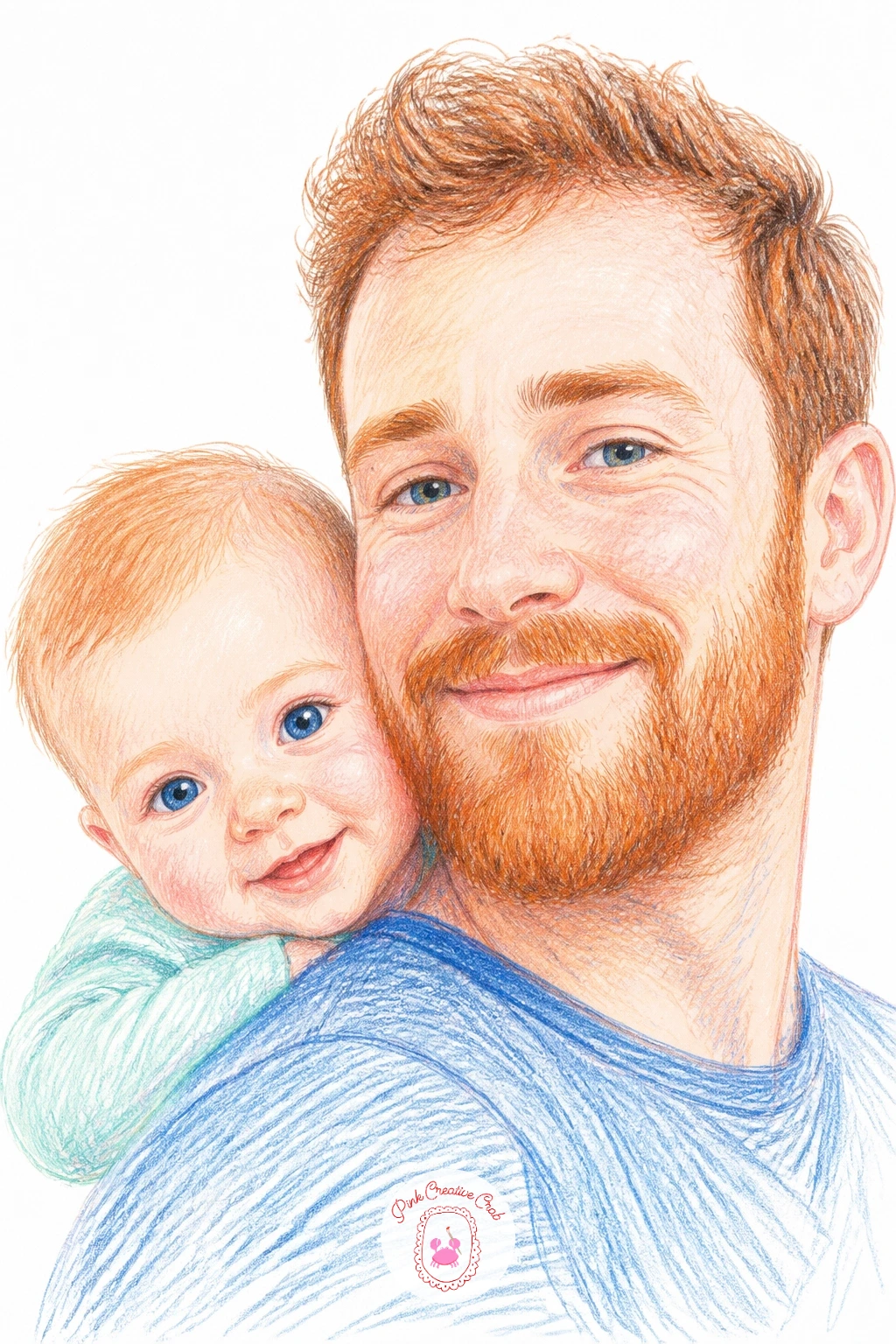
Palette: Ginger Orange,Light Peach,Warm Tan,Sky Blue
A girl with a pink buzzed head and hoop earrings gives you almost no hair texture to render, which makes her a great subject for focusing all your attention on the skin and the bold color choice instead. Lay the buzzed head in short, even strokes of bright pink, pressing a little harder near the crown and lighter toward the hairline so the pink has some gentle shading rather than sitting completely flat.
Her skin can be any warm or cool tone you like since this is an invented face, but keep whatever you choose smooth and evenly blended so it contrasts cleanly with that loud pink hair.
The hoop earrings are simple open circles, drawn with a thin dark outline and one small white highlight dot where light would catch the metal.
If pink pencil looks too pale on its own, go over it twice in the same direction rather than scrubbing in circles, which keeps the strokes looking clean.
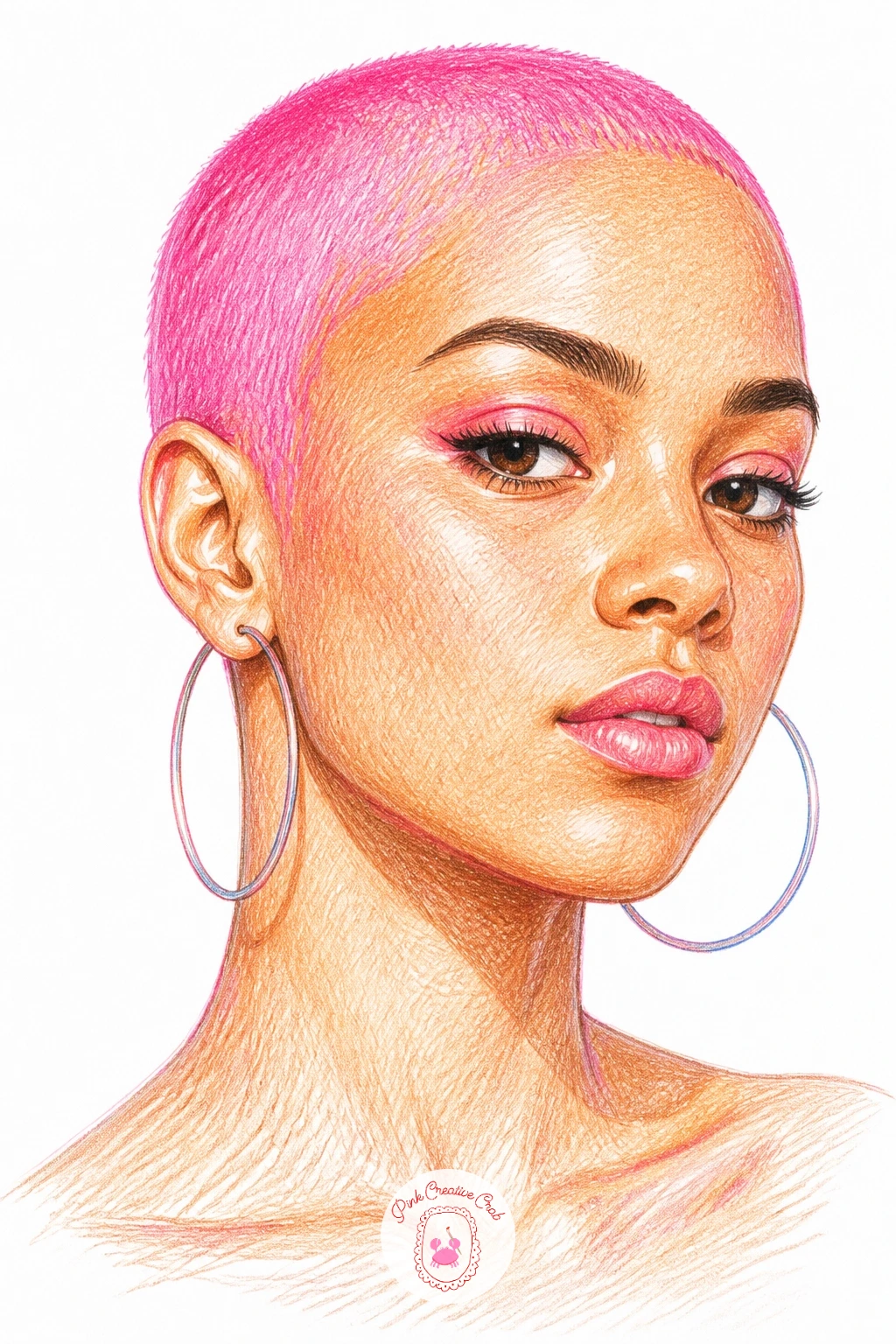
Palette: Hot Pink,Light Peach,Grey,White
A woman with vitiligo and a soft smile in a green scarf is a rewarding face for practicing patchy, irregular color areas that still read as smooth skin rather than a mistake. Lay her base skin tone first across the whole face and neck, then add the lighter vitiligo patches on top in soft uneven shapes, always rounded and organic rather than sharp-edged, following where such patches naturally tend to sit around the eyes, mouth and jaw.
Blend the edge of each patch very slightly so it fades rather than stops abruptly, which is the one hands-on trick that makes this texture believable instead of looking like spilled paint.
The green scarf wraps loosely around the neck and lower face, drawn in soft folds of sage and deeper forest green to frame the whole portrait.
Keep her smile gentle and closed, since a calm expression suits this quieter, more textural face.
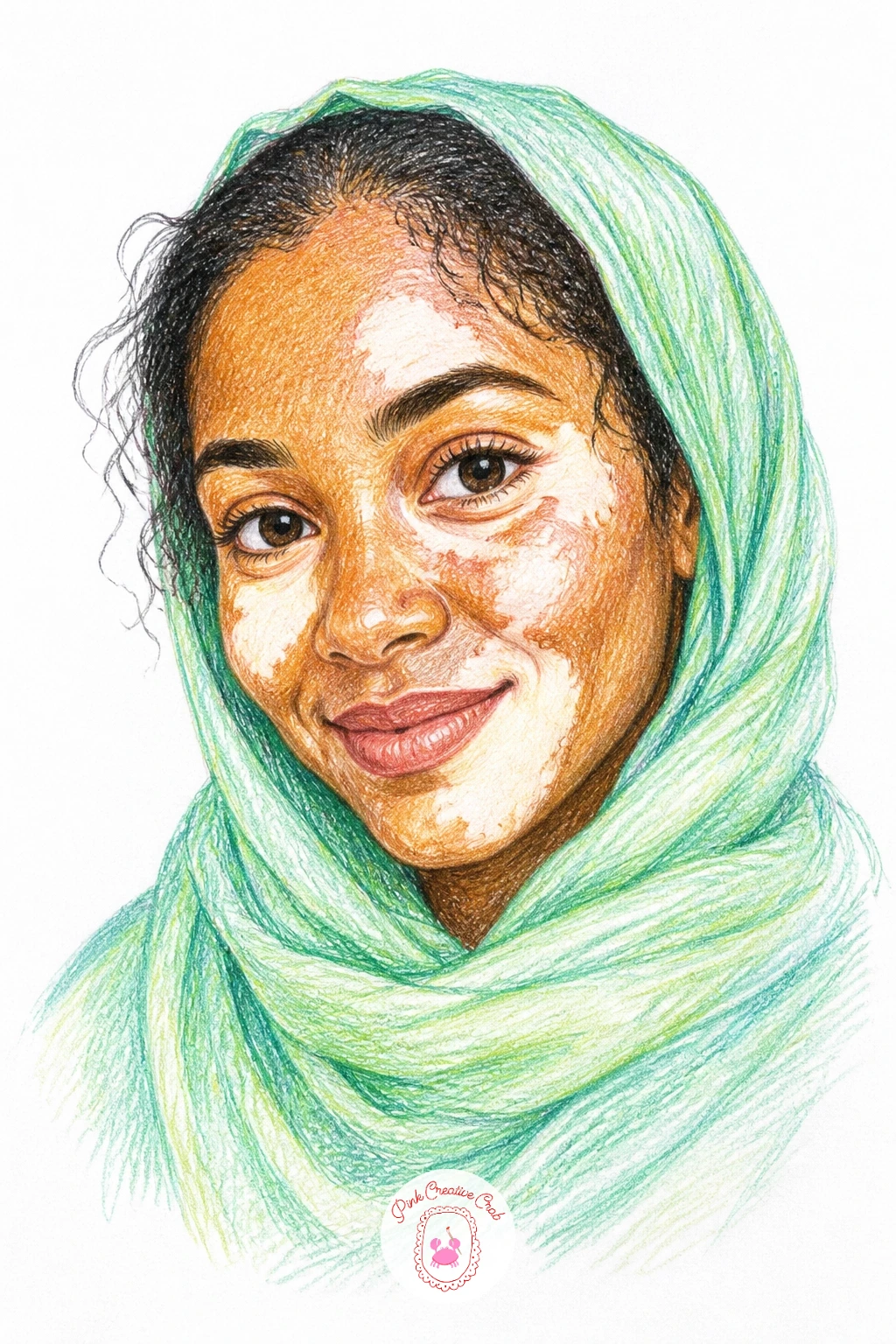
Palette: Warm Brown,Light Peach,Sage Green,Forest Green
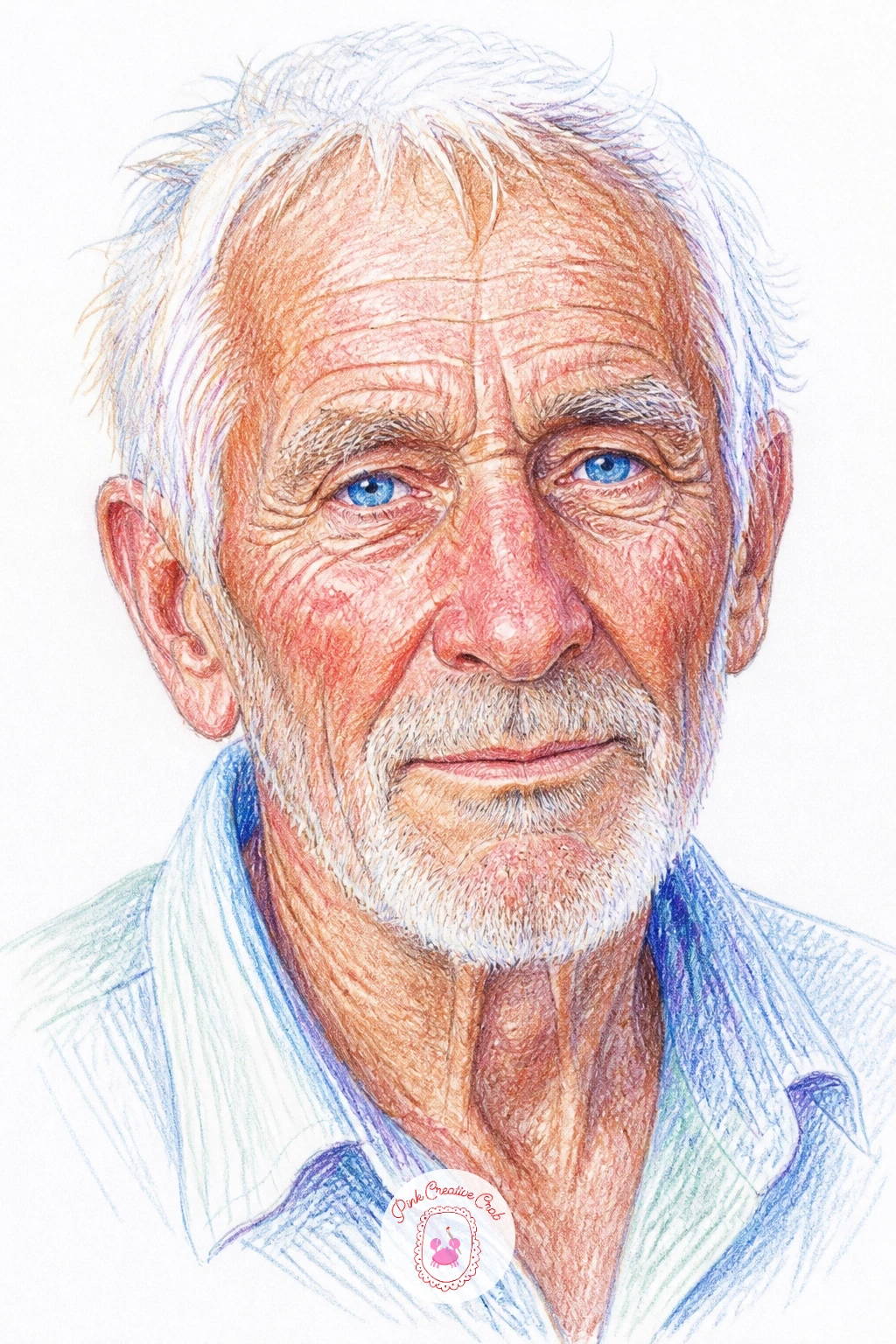
An old man with weathered skin and bright blue eyes is the face to practice real texture on, since age shows mostly in the surface of the skin rather than in any single feature. Build the skin in several thin layers rather than one heavy one: a warm tan base, then light hatching in soft brown and grey-violet along the forehead, cheeks and neck to suggest folds, always following the direction the skin would naturally crease.
Save the bright blue eyes for last and keep them clean and simple against all that textured skin, since a small bright clear detail against a weathered face is what makes the whole portrait feel alive rather than heavy.
If the wrinkle hatching starts looking like scratches, soften the hardest lines with a blending pencil run gently along each one.
A flat cap or plain collar keeps the focus entirely on the face.
You Will Need
- colorless blender pencil
Palette: Warm Tan,Grey Violet,Bright Blue,White
A girl with braces laughing with her eyes shut is a lively face to draw once you are comfortable with the basics, since a genuine laugh closes the eyes into tight curved lines and opens the mouth wide. Draw the closed eyes as simple upward curves with a few short lashes, never a straight line, since a flat line reads as sleepy rather than joyful.
The open laughing mouth shows both rows of teeth, and the braces go on as tiny evenly spaced dots or small squares of silver-grey across the upper teeth only, added last with a sharp pencil point.
Flush her cheeks with warm pink pushed up high near the eyes, which is where a real laugh lifts the color on a face.
If the braces look too heavy, lighten them with a kneaded eraser pressed gently rather than erased in a sweep.
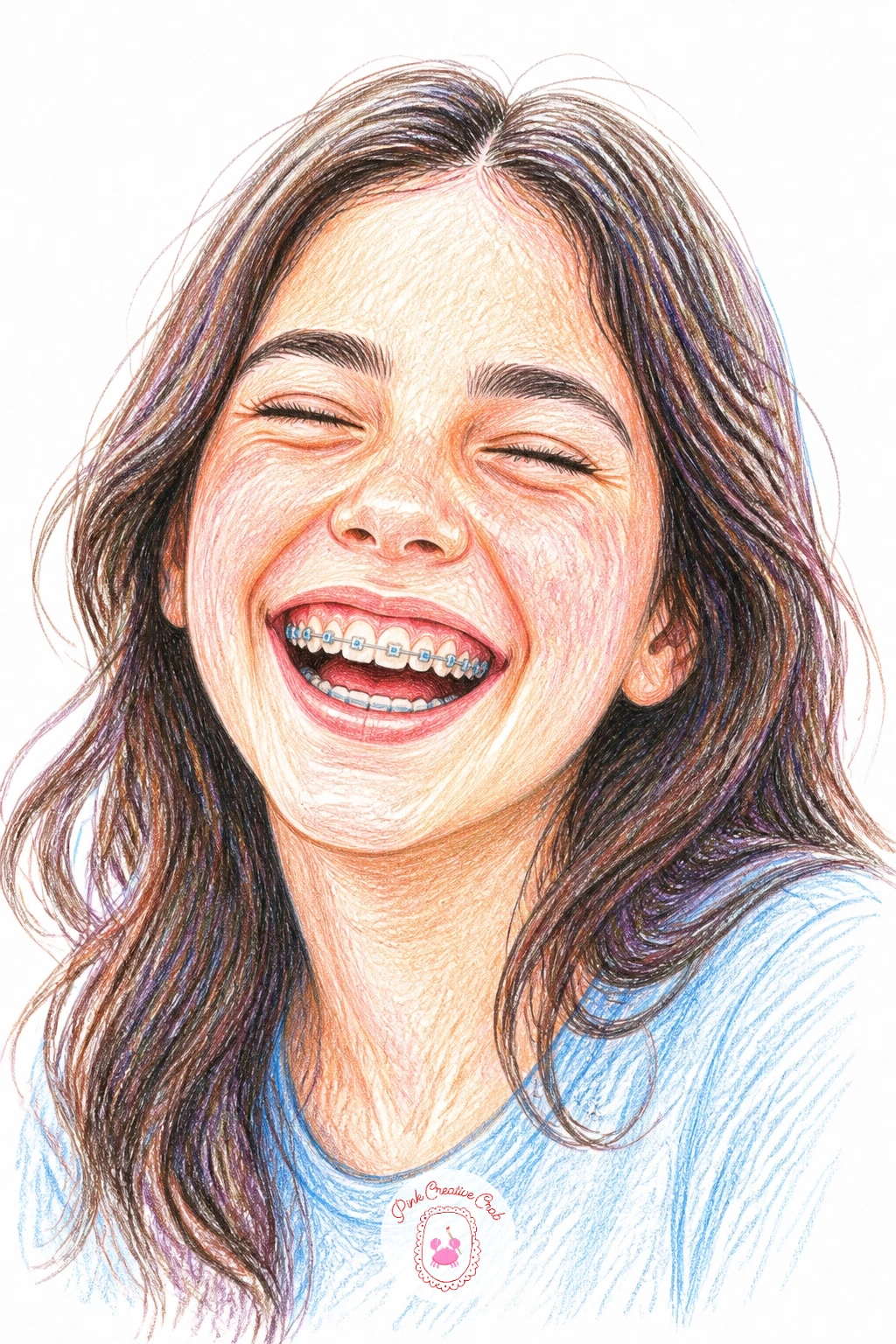
Palette: Light Peach,Rose Pink,Grey,White
A woman with box braids tied up in a turquoise wrap is a satisfying one for practicing long, repeated linear texture after all the rounder curl shapes earlier in this list. Draw each braid as a long gently twisting ribbon, shaded darker along one edge of every twist so the rope-like pattern holds together instead of collapsing into stripes.
Work from the crown downward or upward into the wrap, keeping the braids slightly loose and uneven in width rather than perfectly mechanical, which keeps the hair looking natural.
The turquoise wrap at the top of the head is flat bold color with a few soft fold lines, giving the eye a bright resting point against all that detailed braid texture below it.
If the braids start blurring together, go back in with a sharp black pencil to re-define just the darkest gaps between sections.
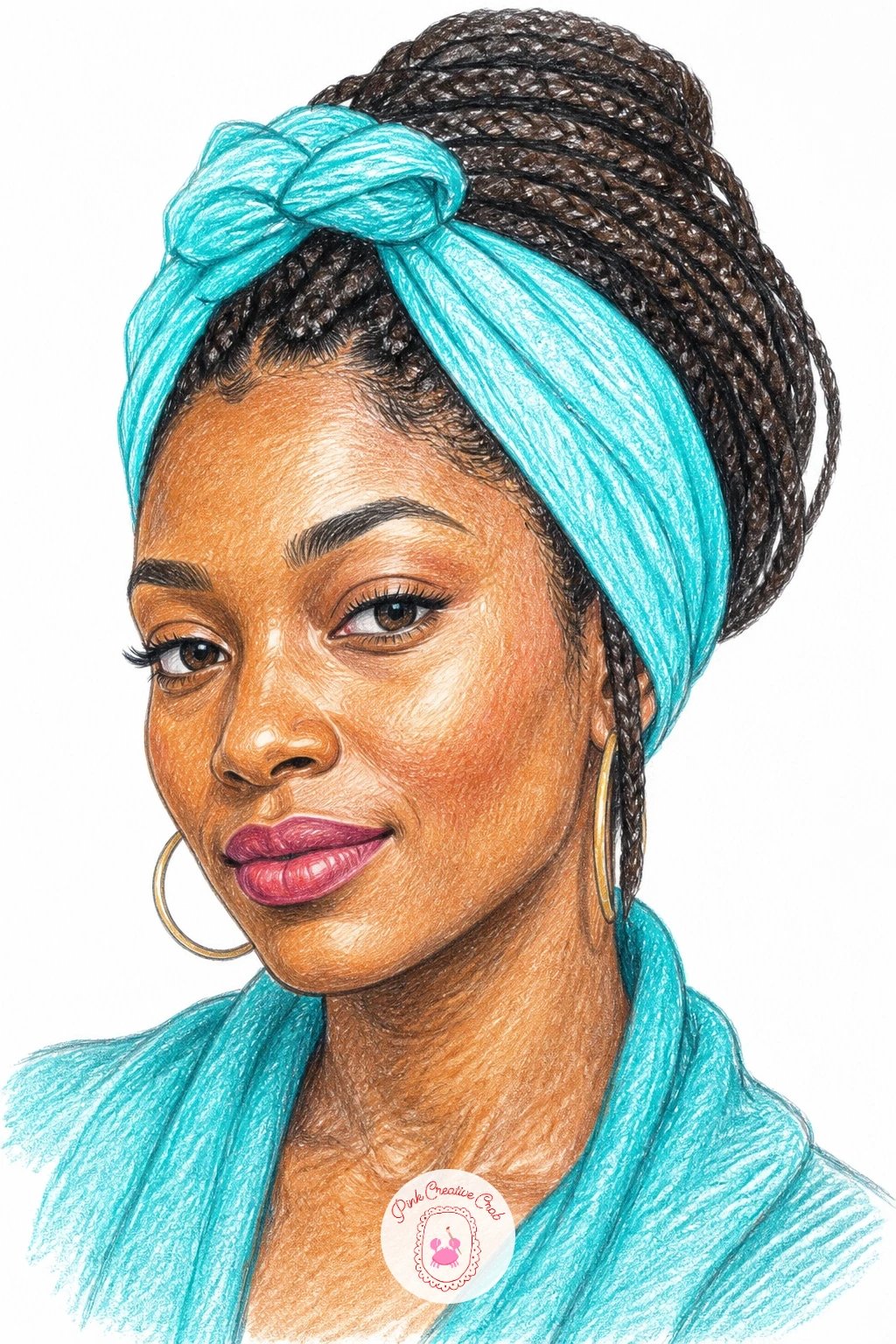
Palette: Dark Brown,Black,Turquoise,Warm Brown
A boy with thick glasses and a mop of black hair is a nice break back into simple shapes after the braids, built around one clear measuring trick: check that the glasses frames sit exactly between the eyebrows and the top of the nose before coloring anything, since glasses drawn too high or low throw off the whole face more than almost any other feature.
The mop of hair is loose, slightly messy strokes of black and dark brown going in several directions rather than one neat sweep, which instantly reads as a boy who has not combed it recently.
Keep the thick glasses frames a solid dark color with one thin white highlight line along the top edge of each lens, and leave the lenses themselves mostly bare paper so his eyes still show through clearly.
A simple light peach skin tone and a small closed smile finish the face without extra fuss.
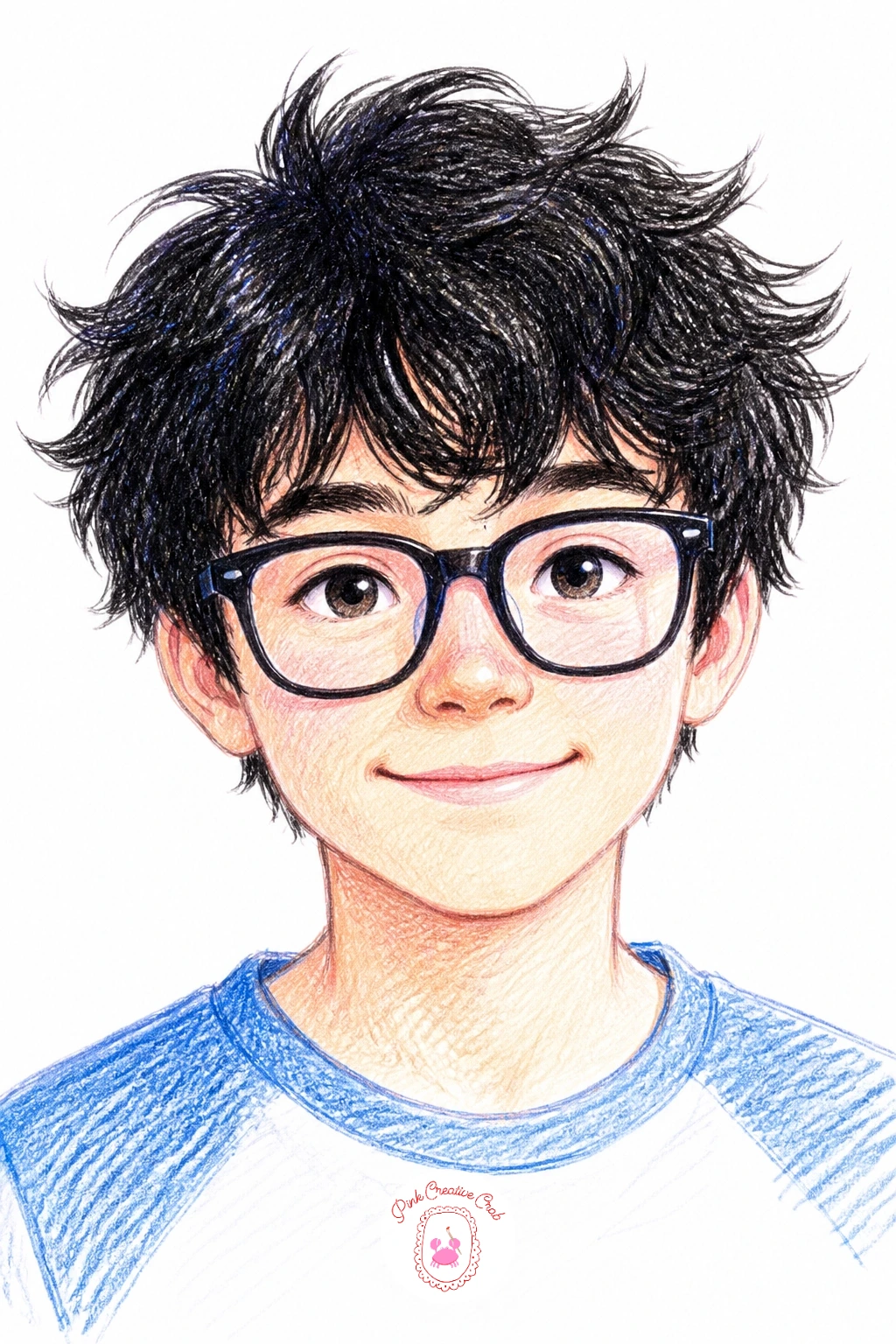
Palette: Black,Dark Brown,Light Peach,White
A woman with a platinum pixie cut and a blush pink blazer is the face to use for practicing very short hair, which is really about shading the scalp rather than drawing individual strands. Lay a pale grey-blonde base all over the short hair shape first, then add tiny directional flicks of white and the faintest grey only at the very tips, since real platinum hair almost always needs some grey underneath to avoid looking bald.
Her skin can stay light and clean, blended in one smooth even layer so the focus stays on the sharp contrast between pale hair and the blush pink blazer below.
The blazer is flat soft pink with one or two darker pink fold lines near the collar, kept simple so it does not fight with the hair for attention.
If the hair looks too flat, add a single thin line of shadow along the parting to give it some lift.
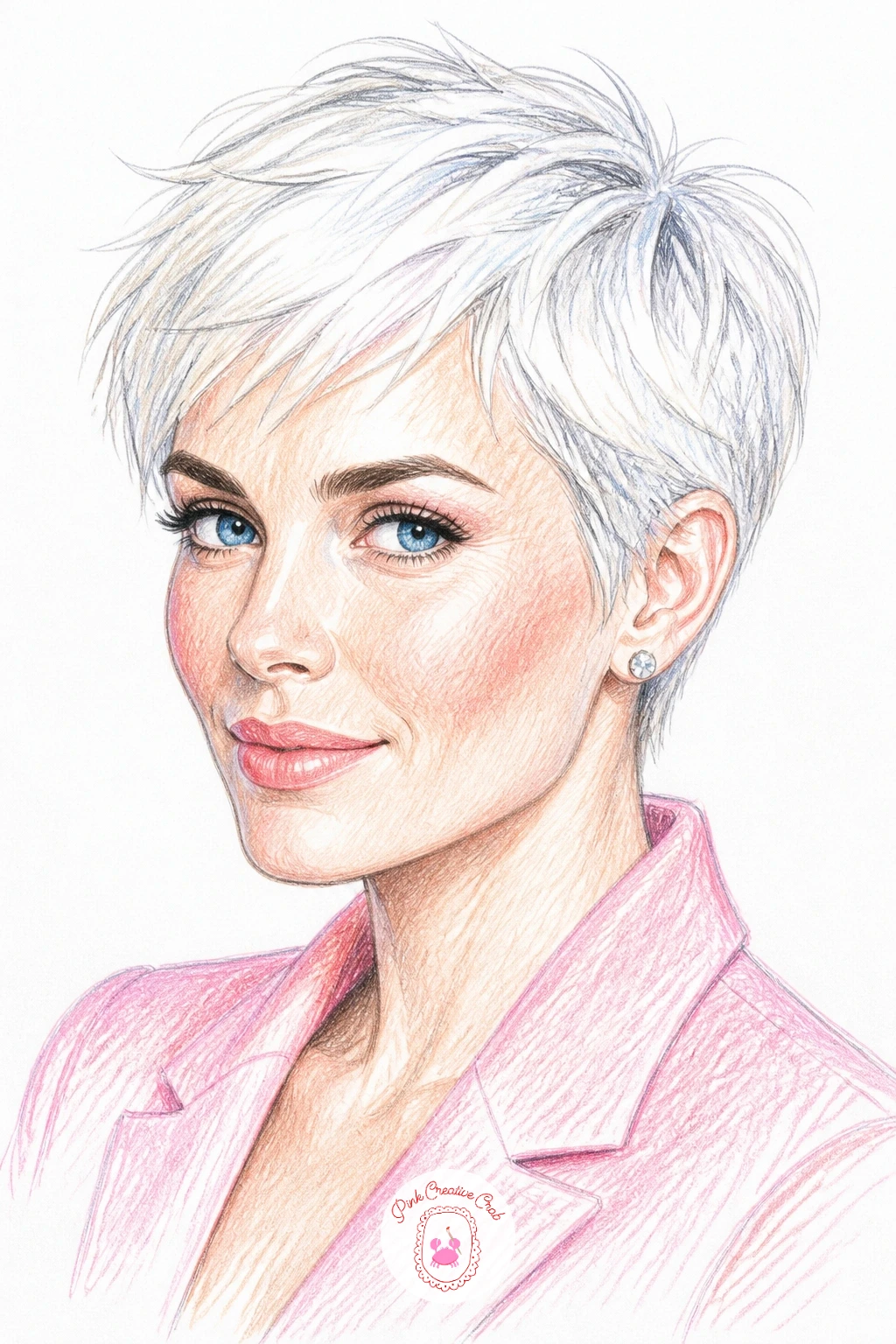
Palette: Pale Blonde,Light Grey,Blush Pink,Light Peach
A Latina teen with a high ponytail and a denim jacket is a good subject for a quick ten minute sketch if you are short on time, since a ponytail pulls most of the hair away from the face and leaves fewer edges to render. For the quick version, block the hair as one smooth swept shape into a single ponytail band, add a warm tan skin base, and finish the denim jacket in flat blue with two darker stitch lines along the collar.
For a fuller forty minute version, go back into the ponytail with individual lighter strands flicked over the dark base to catch light, and add soft rose blush across the cheeks along with a thin dark eyeliner line.
The denim jacket collar sits just under the chin, so check it does not crowd the jawline before adding any stitching detail.
Either version reads well on its own.
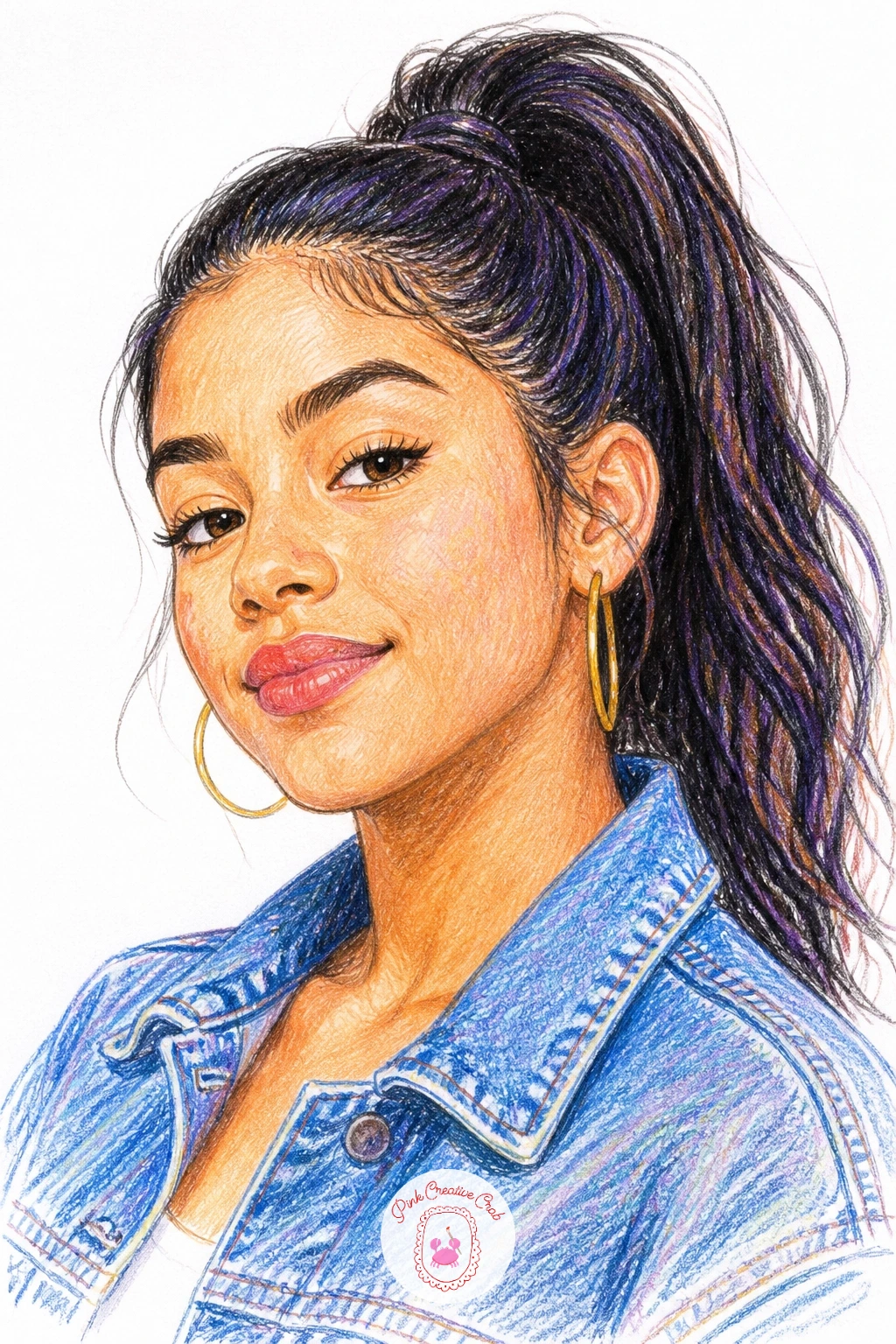
Palette: Warm Tan,Dark Brown,Denim Blue,Rose Pink
A ballerina with slicked-back hair seen in profile is the idea to reach for once you want to practice a side view instead of a straight-on face, since profile changes how every feature lines up. Draw the whole head and neck from the side first, paying close attention to where the nose, lips and chin project outward from one continuous curved line, which is the single trickiest part of any profile portrait.
The slicked-back hair is smooth, tight strokes pulled into a low bun, shaded with one dark value close to the scalp and a thin shine line of white left bare where the light catches the smoothest part of the hair.
Her neck is long and upright, drawn with a gentle taper rather than a straight cylinder, which instantly reads as a dancer’s posture.
Keep her skin tone light and clean so the strong profile line stays the star of the piece.
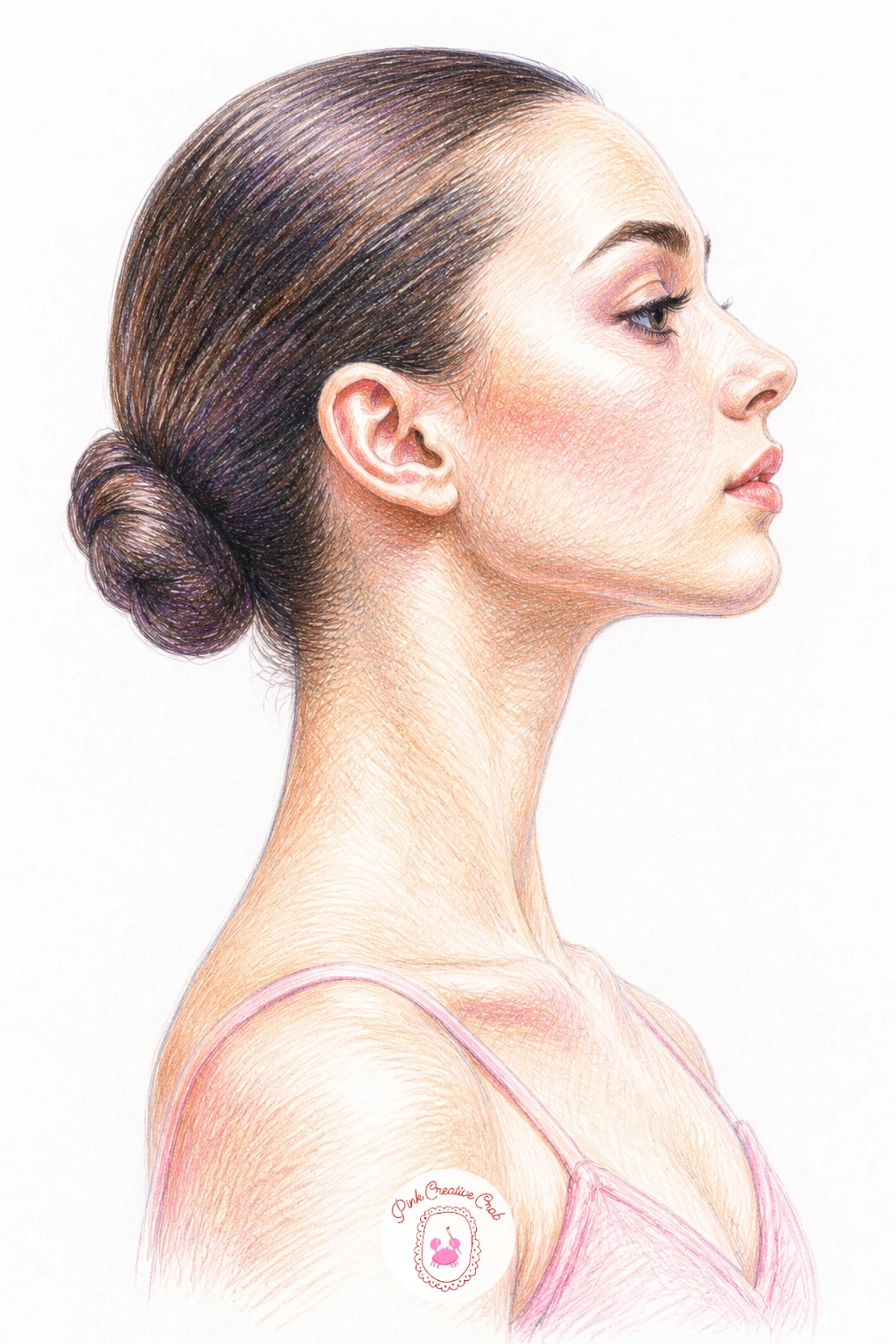
Palette: Light Peach,Dark Brown,Rose Pink,White
A woman with rosy cheeks wrapped in a striped scarf is a lovely face to try once you want to vary one of the earlier ideas on this list, since she uses that same cool-weather warmth as the grandfather in the blue knit cap but with a softer, younger feel. Build her skin in a light warm base, then push rose pink high across both cheeks and lightly across the bridge of the nose, which instantly suggests cold air without needing any snow or scenery around her.
The striped scarf wraps high around the neck and chin, drawn as alternating bands of two colors that follow the curve of the fabric rather than running in straight flat lines.
Keep her eyes soft and slightly narrowed, as if she is smiling into a cold wind rather than posing.
Next time you draw this same idea, try swapping the scarf stripes for a solid color to see how much calmer the whole face feels.
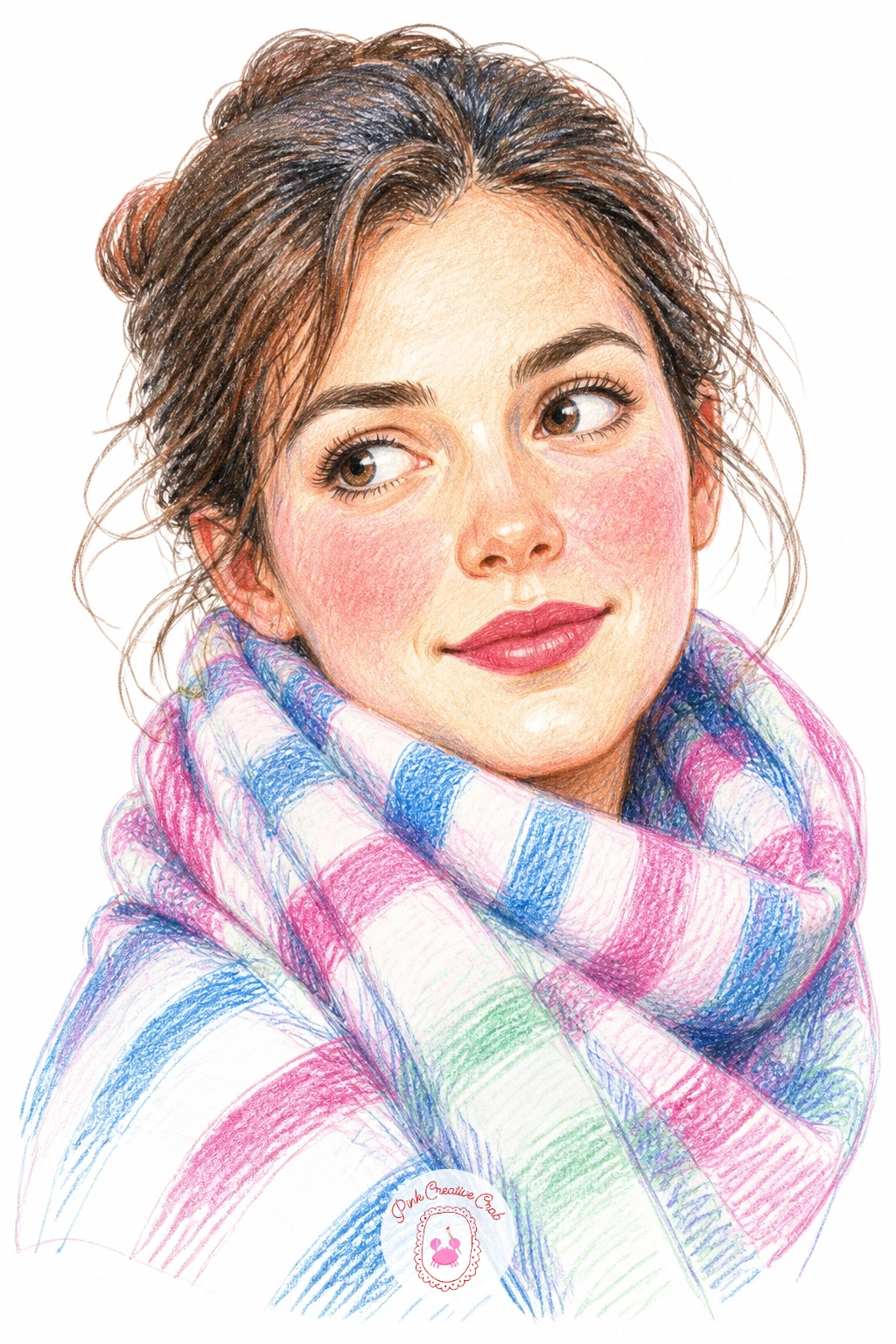
Palette: Light Peach,Rose Pink,Burgundy,Cream
A toddler with wild curls in a strawberry pink dress asks for a rounder, softer approach to the whole head than any of the adult faces so far, since toddlers carry much more baby fat in the cheeks and a smaller, shorter nose. Keep the head shape noticeably round, with the eyes set a little lower and wider apart than an adult face, which is the main proportion trick that makes any child portrait read correctly.
The wild curls spring out in several directions at once, built with short bouncy strokes rather than long flowing ones, since a toddler’s hair rarely lies flat.
The strawberry pink dress is simple and bright, just a few soft folds near the shoulders, kept loose so it does not compete with all that curly hair.
A big open smile or wide curious eyes both work well for this age.
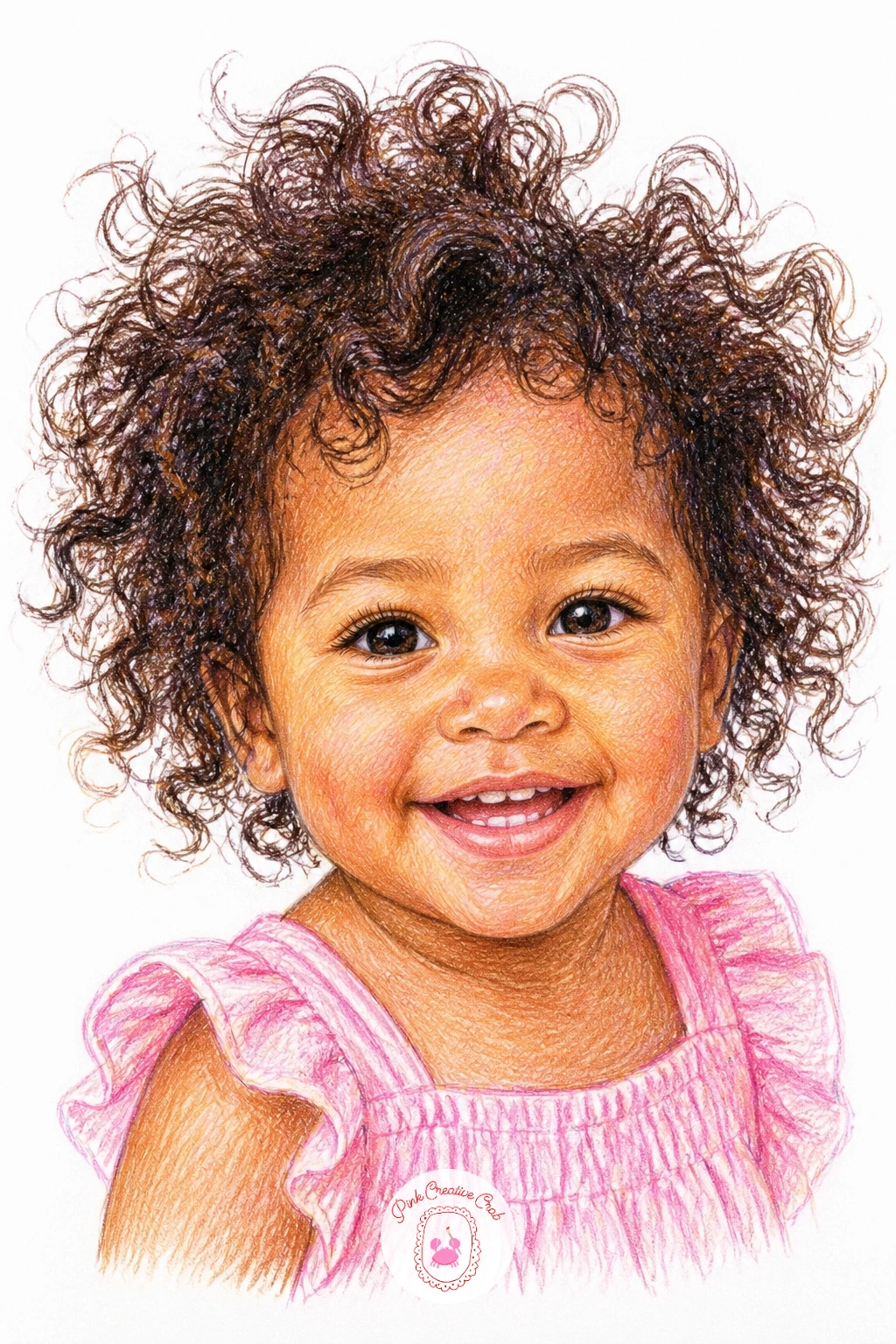
Palette: Warm Brown,Light Peach,Strawberry Pink,White
A man with a curled moustache and a flat cap is a satisfying face for practicing small, precise detail work on a feature most portraits skip entirely. Draw the moustache as two curved shapes that sweep outward and curl slightly upward at each tip, built in short strokes following the curl rather than one solid painted shape, since a flat block of color never reads as individual hair.
The flat cap sits low on the forehead with a small brim casting a thin soft shadow across the top of the eyes, which adds a touch of the same cast-shadow thinking used earlier with the wide sun hat.
Keep his skin tone warm and even, and let the moustache do most of the character work on this face.
If the curled tips look uneven, lightly pencil a small guide curve on each side before adding any color.
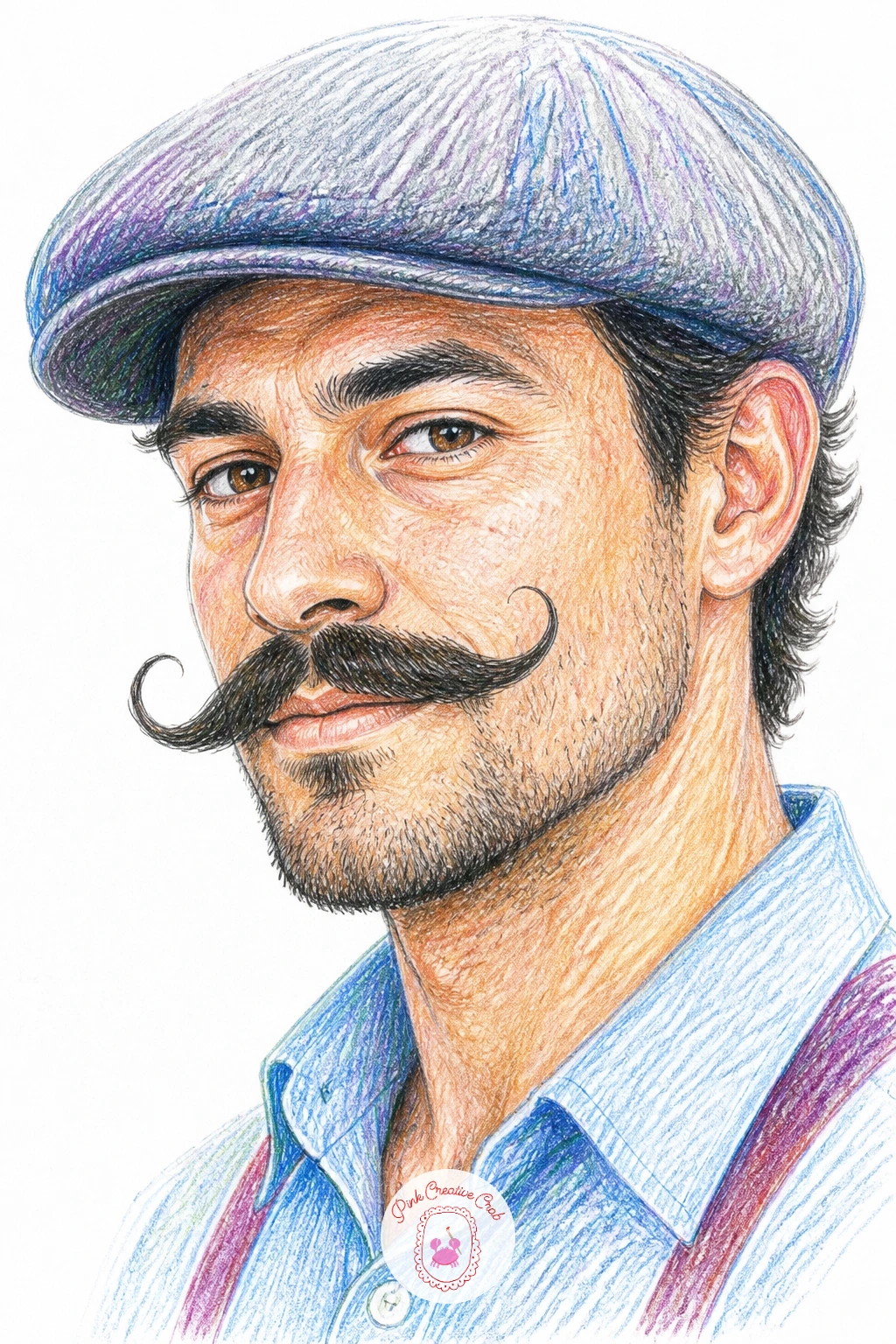
Palette: Warm Tan,Dark Brown,Grey,Charcoal Grey
A girl with blue-dyed hair ends and star stickers on her cheek is a cheerful, playful face that works well toward the end of a sketchbook session when you want something a little lighter. Build the hair in its natural base color first, then add the blue dye only in the lower half of each section, blending the transition with short overlapping strokes rather than a hard line so the color change looks grown out naturally rather than painted on in a block.
The star stickers sit just below one eye, a cluster of two or three small five-point stars in a single bright color, drawn last with a steady hand since they are small and easy to overcrowd.
Keep her expression bright and open, since this whole face is meant to feel a little fun and a little bold.
If the blue fade looks patchy, go over the transition zone once more with very light pressure to smooth it.
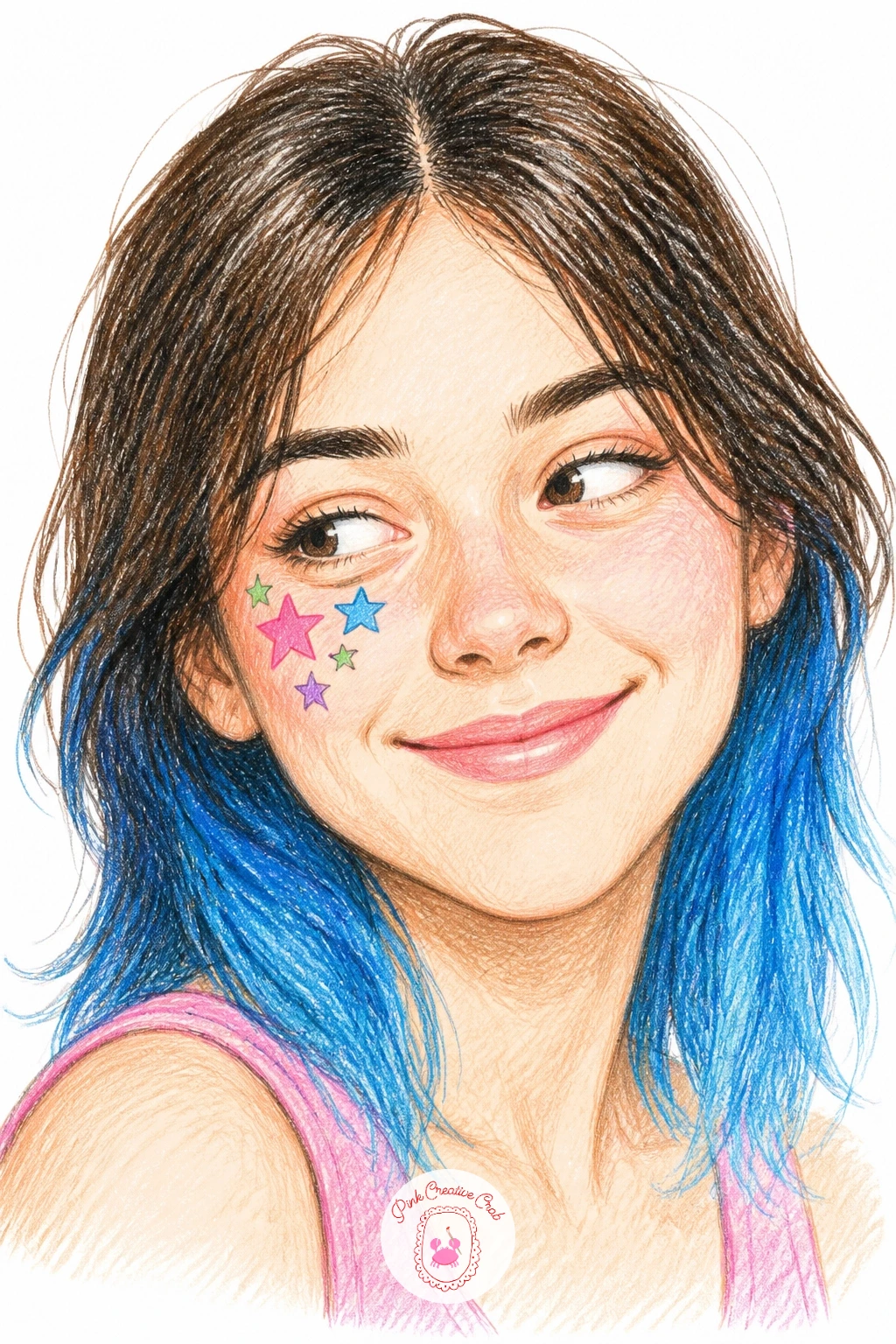
Palette: Dark Brown,Sky Blue,Light Peach,Rose Pink
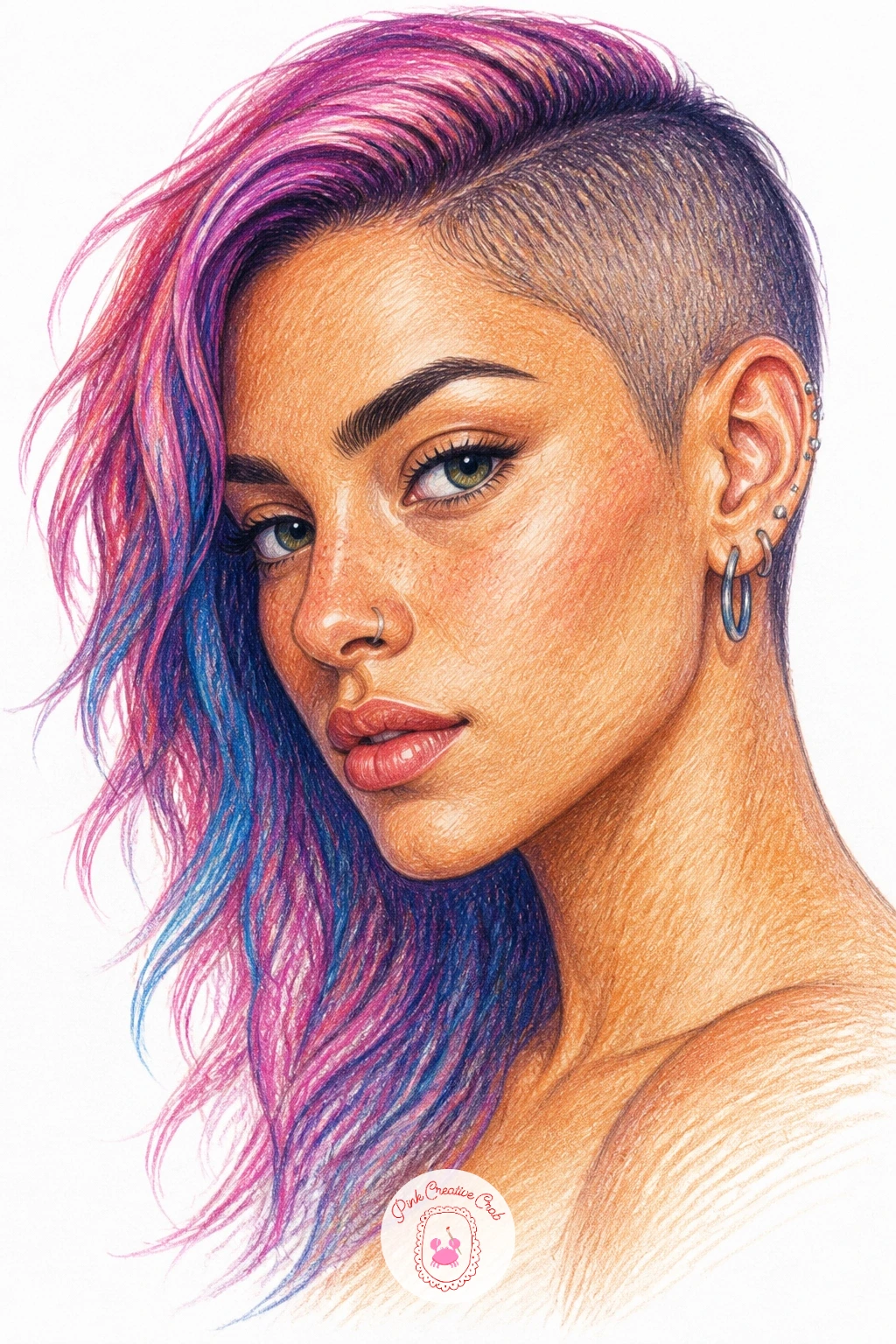
Close the set with a woman with a shaved side and a row of ear piercings, a strong graphic face that pairs a sharp, close-cropped texture with a longer section of hair on the other side. Shade the shaved side in very short, almost invisible strokes close to the scalp, slightly darker near the back of the head and lighter toward the top, while the longer side keeps the loose flowing strokes used throughout this whole list.
The row of ear piercings runs up the visible ear in small evenly spaced dots or tiny hoops, drawn last with a sharp pencil tip or a few dots of white gel pen for the metal highlights.
Keep her expression calm and confident, since this asymmetric cut carries plenty of visual interest on its own without needing a big smile.
One concrete tip to finish on: step back from the whole page and check that every face you have drawn still reads clearly from a small thumbnail size, which is exactly how most people will first see it online.
You Will Need
- white gel pen
Palette: Dark Brown,Warm Tan,Grey,White
What to Do Next
Pick one face from this list, whichever hair color or expression you are itching to try first, and start with a light pencil sketch of the head shape before any color goes down. Keep a sheet of smooth bristol paper on hand and work in thin layers: you will have a finished portrait by the end of the sitting.
Frequently Asked Questions
What colored pencils work best for skin tones in a portrait?
A warm mid brown, light peach, burnt sienna and a cool grey-violet cover most skin tones when layered gradually. Build color in thin layers rather than pressing hard once, since layering gives smoother, more lifelike results than one heavy pass.
How do you keep a colored pencil portrait from looking flat?
Shadows need their own color, not just a darker version of the skin tone, so add grey-violet or red-brown into shaded areas instead of plain grey. Leaving some white paper bare for highlights also adds instant depth.
What paper is best for a colored pencil portrait?
Smooth bristol or hot press paper gives the cleanest skin blends since it has less tooth to catch stray pencil marks. Rougher paper works too but shows more visible texture through the layers, which suits looser styles.
How do you fix mistakes in a colored pencil portrait?
Lift color gently with a kneaded eraser dabbed rather than rubbed, which pulls pigment up without damaging the paper surface. For small areas, a sharp eraser pencil can correct a stray line without disturbing the surrounding color.
Can beginners draw colored pencil portraits of invented faces?
Yes, invented faces are actually easier than real likenesses since there is no single correct answer to match. Focus on proportion basics like eye spacing and head shape, then let hair color and small details carry the character.
Have any thoughts?
Share your reaction or leave a quick response — we’d love to hear what you think!
-
 0
-
 0
-
 0
-
 0
-
 0
-
 0
