Easter paintings give you the best excuse all year to fill a canvas with pure pastel color: lily white, tulip pink, buttery yellow and soft sage, with no rabbit or lettering in sight. These are flower pieces and little still lifes, the kind you can prop on a mantel or a kitchen shelf the same day you paint them, and every one below sits happily inside that palette.
Below you will find 28 of them, ordered from a quick single-vase study up to fuller still lifes with eggs, nests and baskets worked in. Pick whichever one matches the time you have this afternoon, mix your pastels ahead of time, and work through the list at your own pace.
Using these images: free for personal projects such as printing, coloring, cards, journals and gifts. Handmade items that include them may be sold up to 30 pieces per design. More than that is commercial use and is not permitted, and neither is selling or sharing the images themselves or passing them off as your own. Please ask before any other use.
Easter paintings do not get more classic than white easter lilies standing tall in a glass vase, so this is the natural place to start. Block in the vase first with a pale grey-blue flat wash, leaving two vertical highlight strips untouched so the glass reads as glass. Then shape the lily trumpets with titanium white mixed with a whisper of yellow ochre, keeping each flower as two or three simple curved petals rather than fussing over every edge.
Work the green stems and leaves next, using sap green with a touch of white so they sit forward from a pale sky-blue background. Add the stamens last with a tiny dab of burnt sienna on the tip of a round brush: this is where the painting usually goes wrong, so keep them small and let the white petals stay the star.
If you want this done in ten minutes, paint just two open lily heads and skip the vase detail entirely, letting the stems run off the bottom edge. For the fuller forty-minute version, add a third bud still closed and vary the petal angles so the bouquet feels alive rather than stacked.
No glass vase on hand: paint a plain cream pitcher instead and the lilies will look just as fresh.
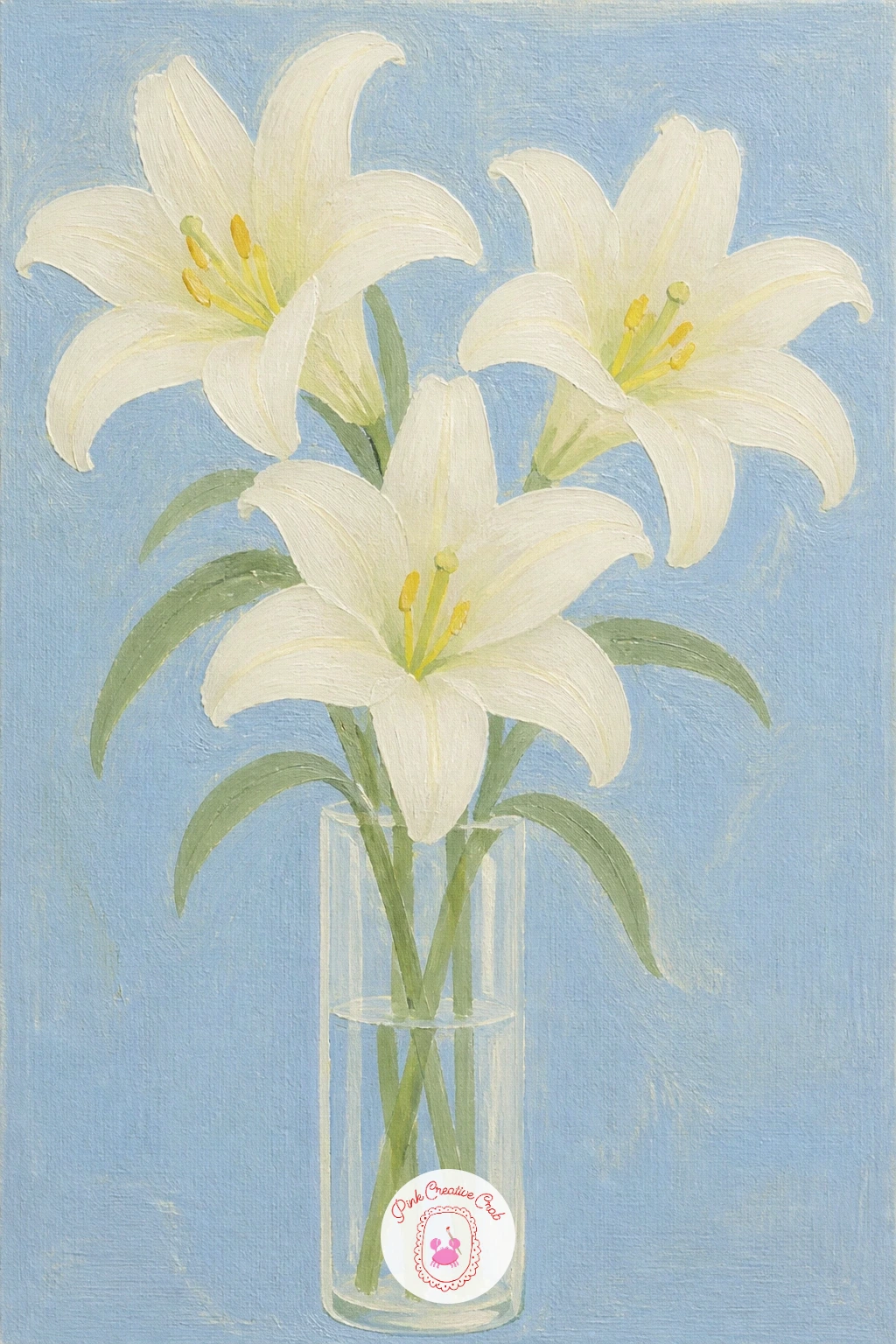
Palette: Titanium White,Yellow Ochre,Sap Green,Pale Sky Blue
Move from a single vase to a fuller scene with a basket of pastel eggs tucked among pink tulips, one of the most satisfying Easter paintings to build because it stacks two simple shapes together. Start with the woven basket as a rounded trapezoid in warm raw sienna, then lay a scribble of darker brown lines across it with a dry brush for the woven texture, barely loading the bristles so the strokes stay broken and papery.
Paint the tulip cups next in tulip pink, each one just a rounded triangle tilted slightly differently, and drop in three or four eggs between them in soft blue, lilac and buttery yellow. If the eggs start looking flat, roll a tiny highlight of white onto the top curve of each one with the tip of a round brush.
Where this composition usually stumbles is crowding too many tulips in: six or seven is plenty, leaving the basket weave visible between stems. Keep the background a single pale sage so nothing competes with the pink.
No real wicker basket to reference: a cereal bowl shape with brown cross-hatching reads just as well.
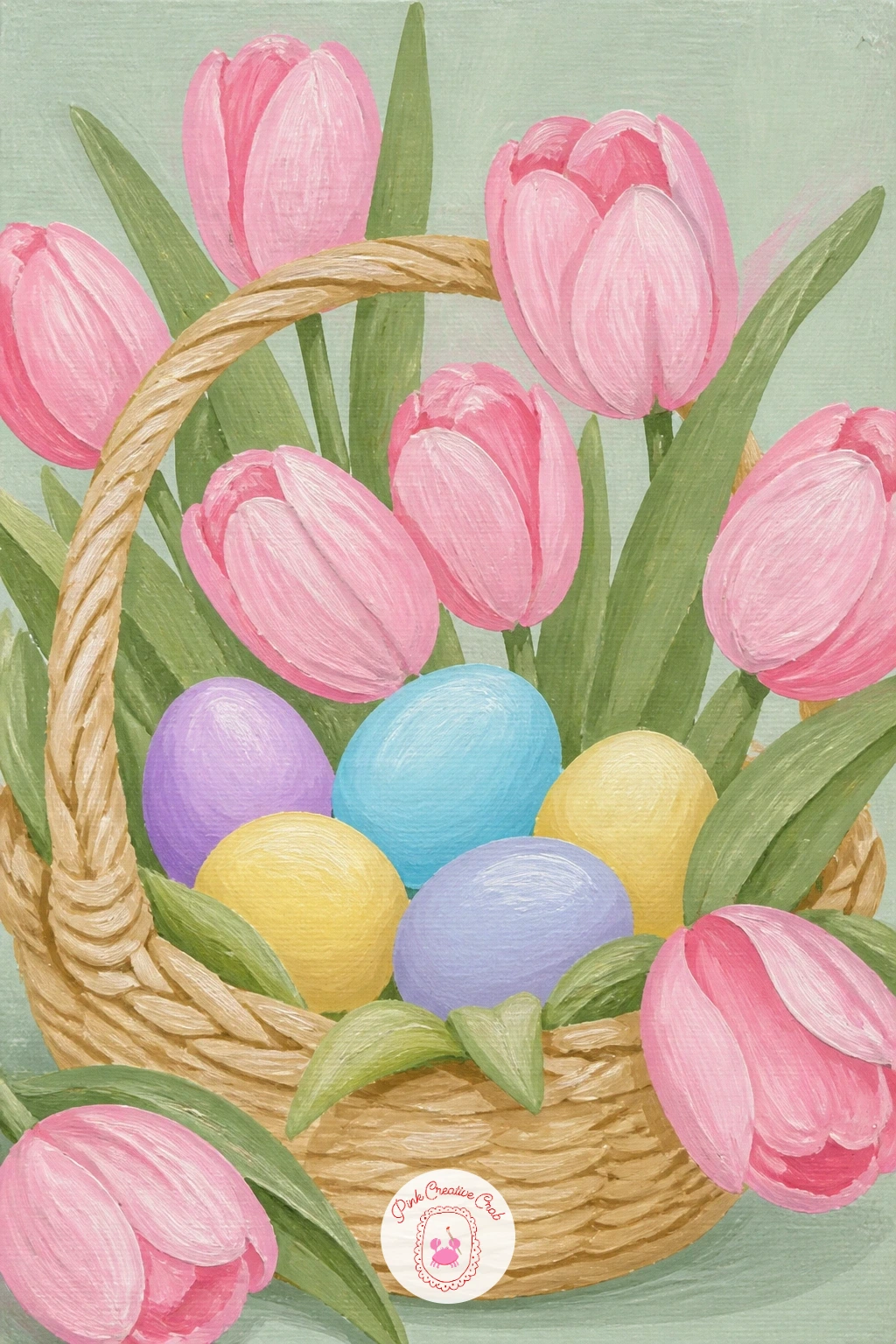
Palette: Raw Sienna,Tulip Pink,Pale Lilac,Soft Sage
From a basket on a table, lift the eye upward to a nest of blue eggs balanced on a cherry blossom branch, which trades the still life table for something closer to a tiny landscape. Think about eye level before you start: paint the branch running diagonally across the lower third of the canvas, low enough that you look slightly down into the nest, which makes the eggs feel settled rather than floating.
Lay the branch in burnt umber first, then dab the blossom clusters around it with small loaded strokes of pale pink and white, turning the brush slightly with each dab so no two blossoms match exactly. Build the nest from short curved strokes of ochre and brown criss-crossed over each other, then nestle three pale blue eggs into the top with soft white highlights on the upper curve where the light source sits.
If the blossoms start to look like a flat pink cloud, vary the pressure on your brush so some clusters sit thicker and closer than others.
No pink available: dogwood white blossoms against the same brown branch work just as sweetly.
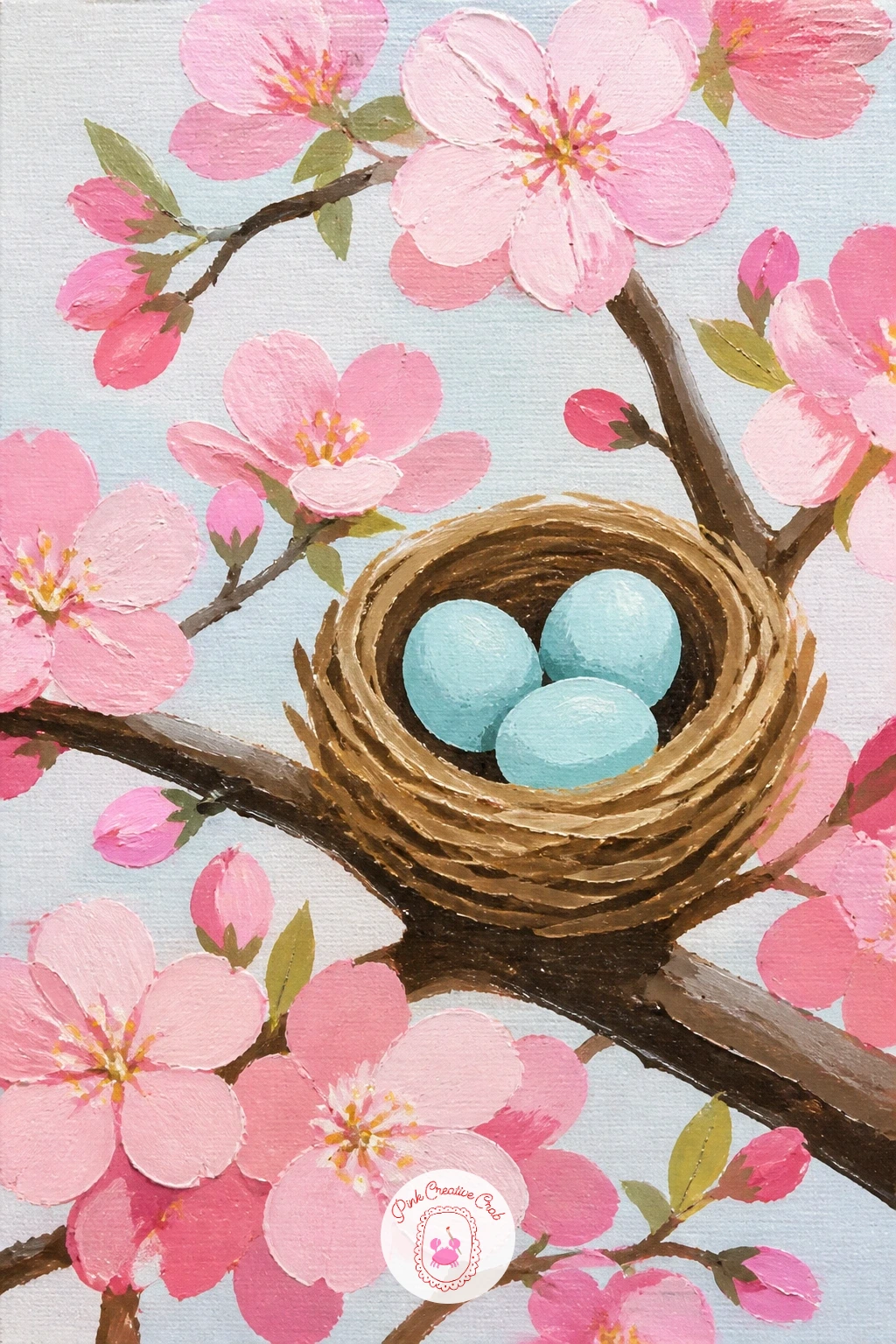
Palette: Burnt Umber,Blossom Pink,Pale Blue,Ochre
Try tilting the branch slightly uphill from left to right instead of straight across; it gives the whole composition a gentler, more natural lean.
Daffodils bring the sunniest yellow in the whole Easter palette, so pair a bouquet of them beside a bowl of dyed eggs for a cheerful double subject. Paint the bowl first as a simple curved shape in soft white with a pale blue rim, then fill it with four or five eggs in rose, lilac and mint, each just an oval with one quick highlight.
Build the daffodils next, starting each flower as a flat yellow circle of six petals, then adding the trumpet center in a slightly deeper orange-yellow with two short strokes to suggest its frilled edge. Keep the green stems loose and slightly bending rather than ruler-straight, which is what makes a hand-painted bouquet read as fresh rather than stiff.
The daffodil centers are where most beginners overwork things: one or two confident strokes beats five timid ones, so load the brush well and commit.
Short on yellow paint: lemon yellow mixed with a touch of white gives the same bright, happy color.
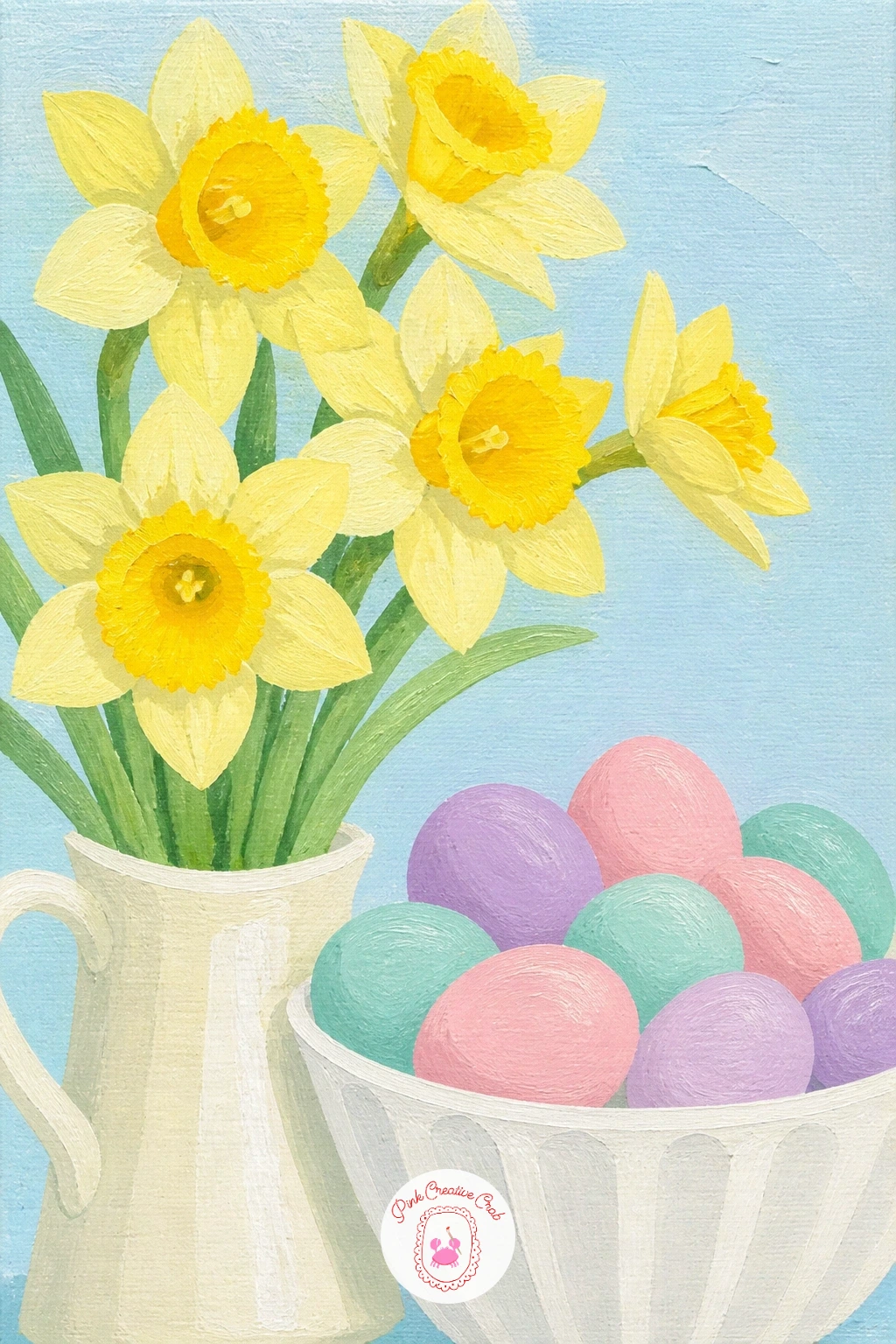
Palette: Daffodil Yellow,Deep Orange Yellow,Rose Pink,Mint Green
Scale right down after that busy bouquet with a single painted egg lying in a bed of violets, a quiet little subject that rewards a careful eye for proportion. Sketch the egg first and size it against the violet leaves around it: an egg this close to the viewer should sit roughly as wide as two violet blooms side by side, which keeps the whole scene believably scaled rather than guessing.
Paint the egg in soft lilac with one or two tiny painted flowers on its shell in a deeper purple, then surround it with heart-shaped violet leaves in sage green and small five-petaled violet blooms in purple and white scattered loosely around the base.
Where this one can go wrong is making the violets too uniform in size: vary a few larger and a few smaller so the bed feels natural rather than stamped.
No violets in reference: pansies painted the same loose way carry the same mood.
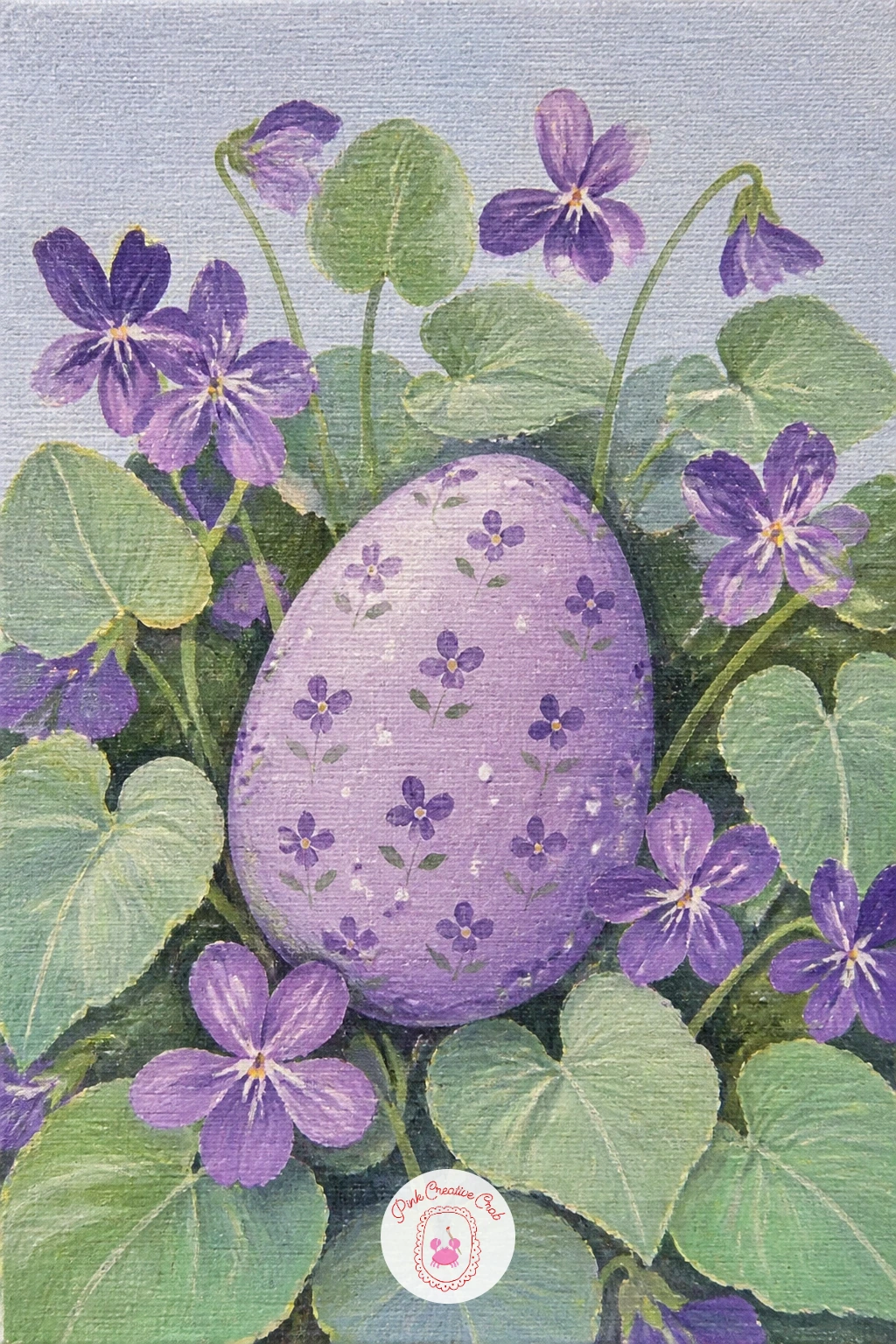
Palette: Lilac,Deep Purple,Sage Green,Soft White
Hyacinths give you a chance to paint texture rather than smooth petals, so set hyacinths in pastel pots with eggs at their feet as your next canvas. Block in two or three terracotta-toned pots first in dusty pink and pale blue, then build each hyacinth spike from dozens of tiny dabbed strokes in lilac, pink and white rather than one solid shape, which is what gives the flower its characteristic fuzzy look.
A dry brush with very little paint loaded is the trick here: drag it lightly over the spike shape so the dabs break up naturally instead of blending into a smear. Tuck two or three small eggs in soft pastel tones around the base of the pots once the flowers are dry.
If the spikes start looking like solid cones, stop blending and add more individual dabs instead, working from the bottom of the spike up.
No dry brush technique practiced before: a stiff old brush with the bristles slightly splayed works even better than a new one.
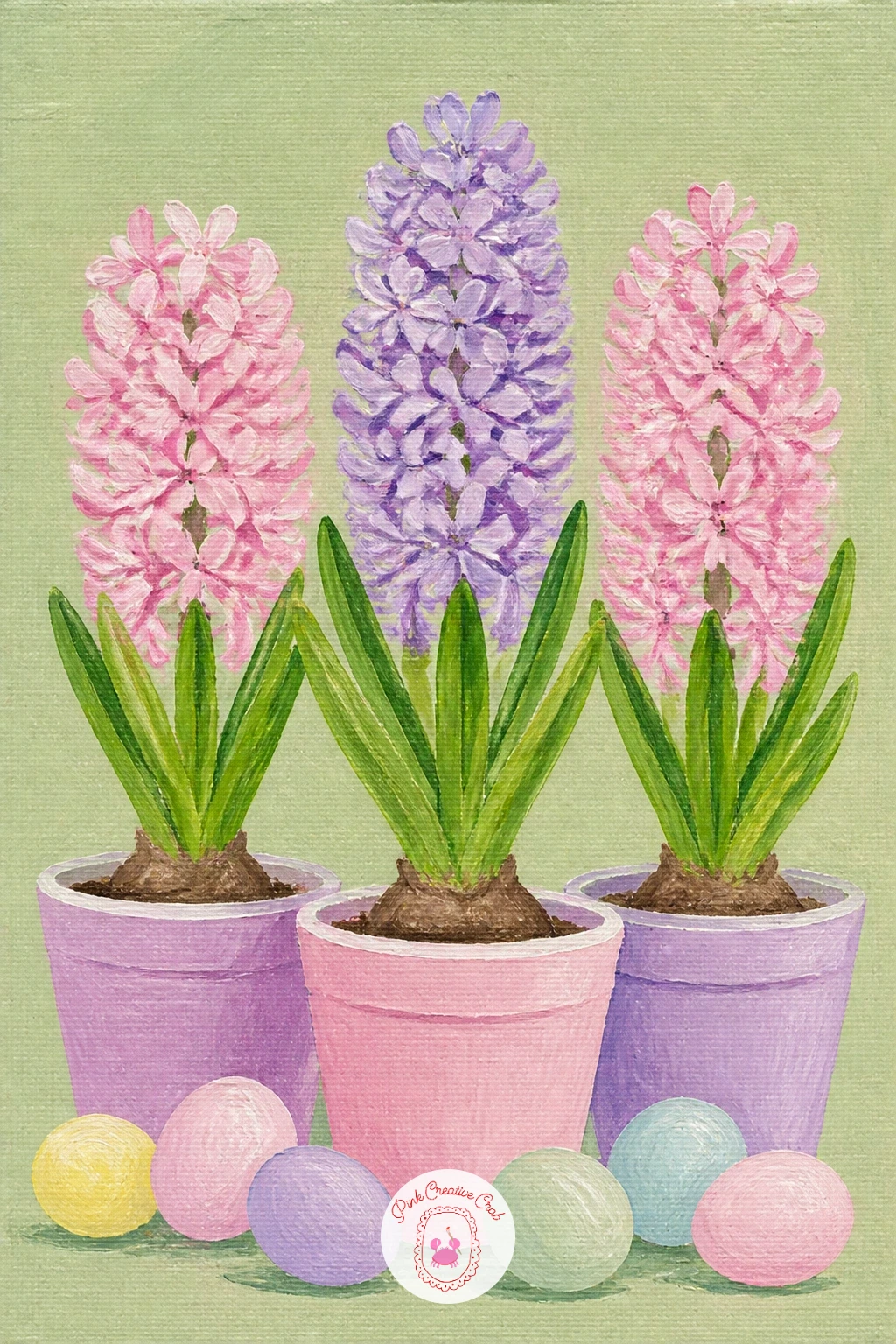
Palette: Dusty Pink,Lilac,Pale Blue,Terracotta
Bring in a circular composition with a wreath of eggs, ranunculus and greenery hung on a white door, which asks you to think in a ring shape instead of a bouquet. Lightly sketch a circle guide first, then build the greenery base around it with short overlapping strokes of sage and olive green, keeping the ring slightly irregular rather than a perfect machine-made circle.
Layer the ranunculus blooms on next in coral and pale pink, painting each as tight concentric petal swirls rather than separate petals, since that swirl is what makes a ranunculus recognizable at a glance. Tuck three or four small painted eggs between the flowers, and finish with the white door as a flat pale background with one faint vertical panel line to suggest it is a door and not just a wall.
The ring shape is where beginners drift off balance, so step back and check the wreath reads as even before adding the last few blooms.
No ranunculus reference handy: simplified rose shapes in the same coral work as a swap.
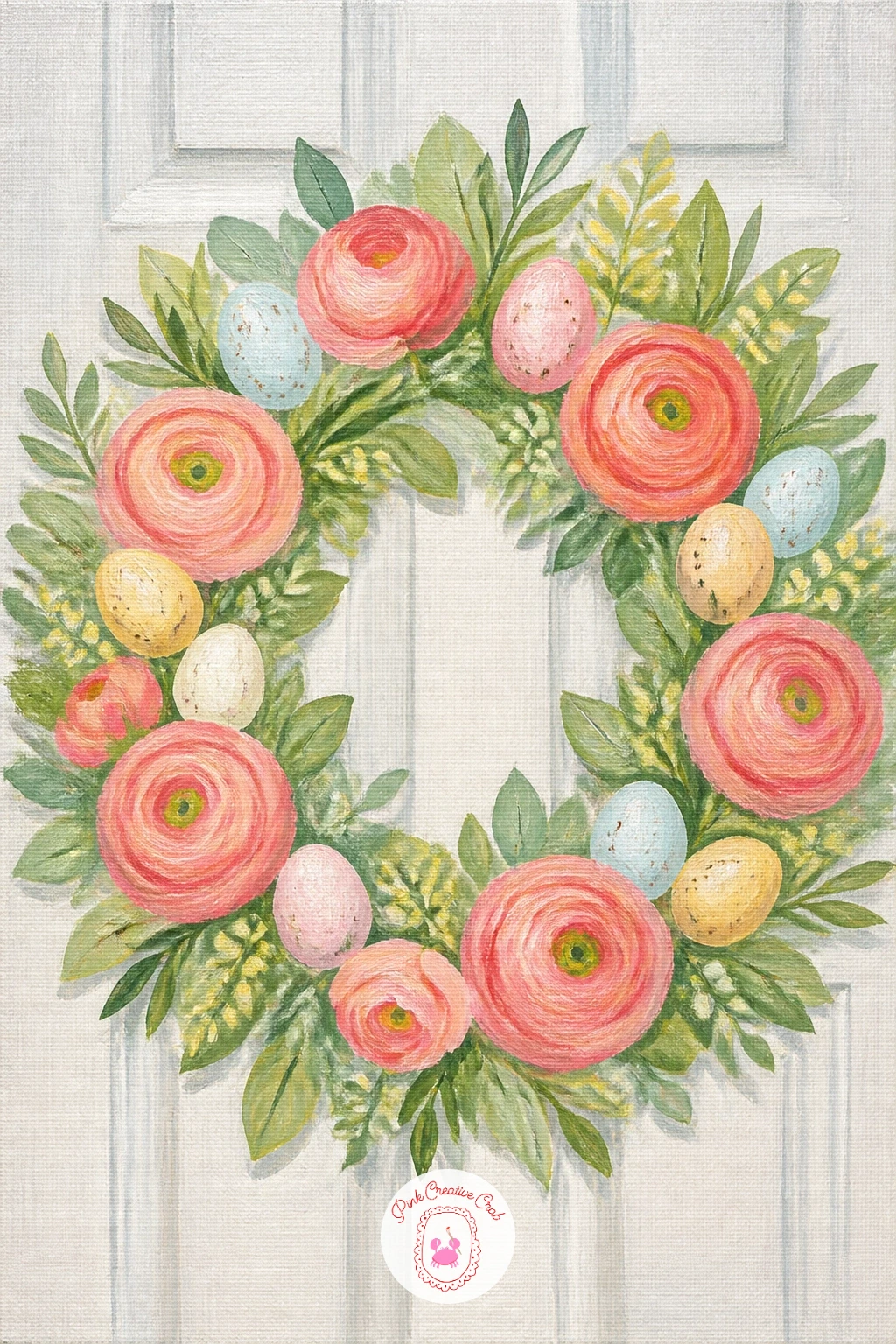
Palette: Coral,Pale Pink,Sage Green,Olive Green
Give the vase itself the Easter theme with a pink tulip bouquet in an egg-shaped vase, a fun shape challenge after all those straight-sided pots. Draw the vase as a rounded oval that narrows only slightly at the neck, almost like drawing an egg standing on its end, then shade one side a touch deeper to give it some roundness before adding the tulips.
Paint six or seven tulip blooms fanning out from the vase opening in varying shades of pink, from pale blush to a deeper rose, keeping each flower a simple closed tulip shape rather than opening the petals. Stems can cross loosely inside the vase neck, which reads as more natural than lining them up in parallel.
This composition tips over easily if the vase looks too narrow for the bouquet, so widen the base slightly if the flowers feel top-heavy once sketched in.
No oval vase shape coming easily: trace around an actual egg or a small oval object to get the proportions right first.
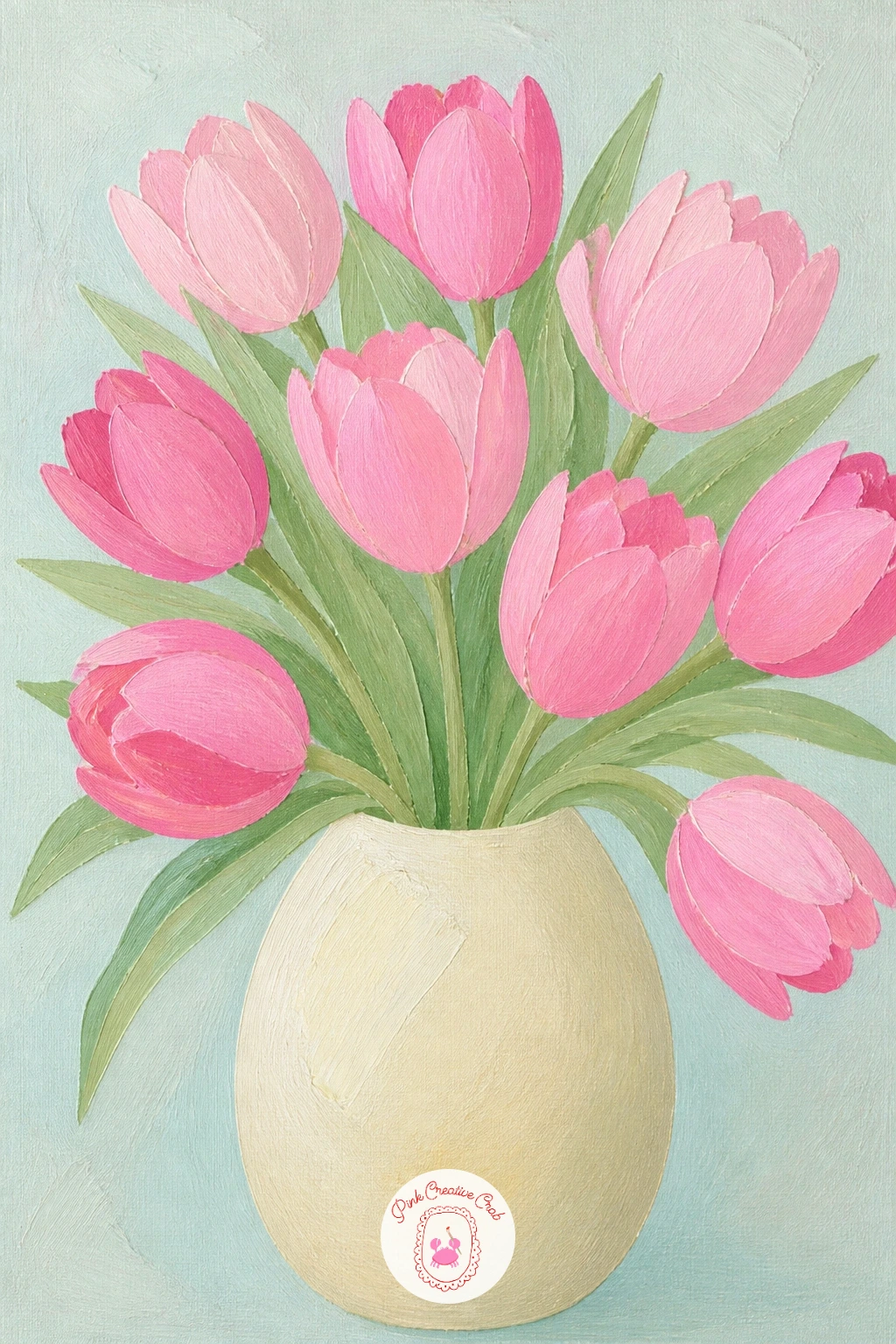
Palette: Blush Pink,Rose Pink,Sage Green,Soft Cream
Add one small character into the flowers with a chick perched among white anemones, keeping the bird simple enough to finish alongside the blooms in one sitting. Paint the chick first as two overlapping ovals, one for the body and a smaller one for the head, in soft buttery yellow, then add a small orange triangle beak and two tiny black dots for eyes.
Build the anemones around it next, each flower a ring of six or seven white petals around a dark navy-black center, which is the detail that makes anemones instantly recognizable rather than generic daisies. Keep the chick’s feet simple, just two small V shapes tucked under the body.
If the chick starts looking stiff, soften the edge between the head and body with a small dry brush so the fluff reads naturally rather than as a hard outline.
No black paint for the anemone centers: a very dark mixed purple works just as well and softens the contrast a touch.
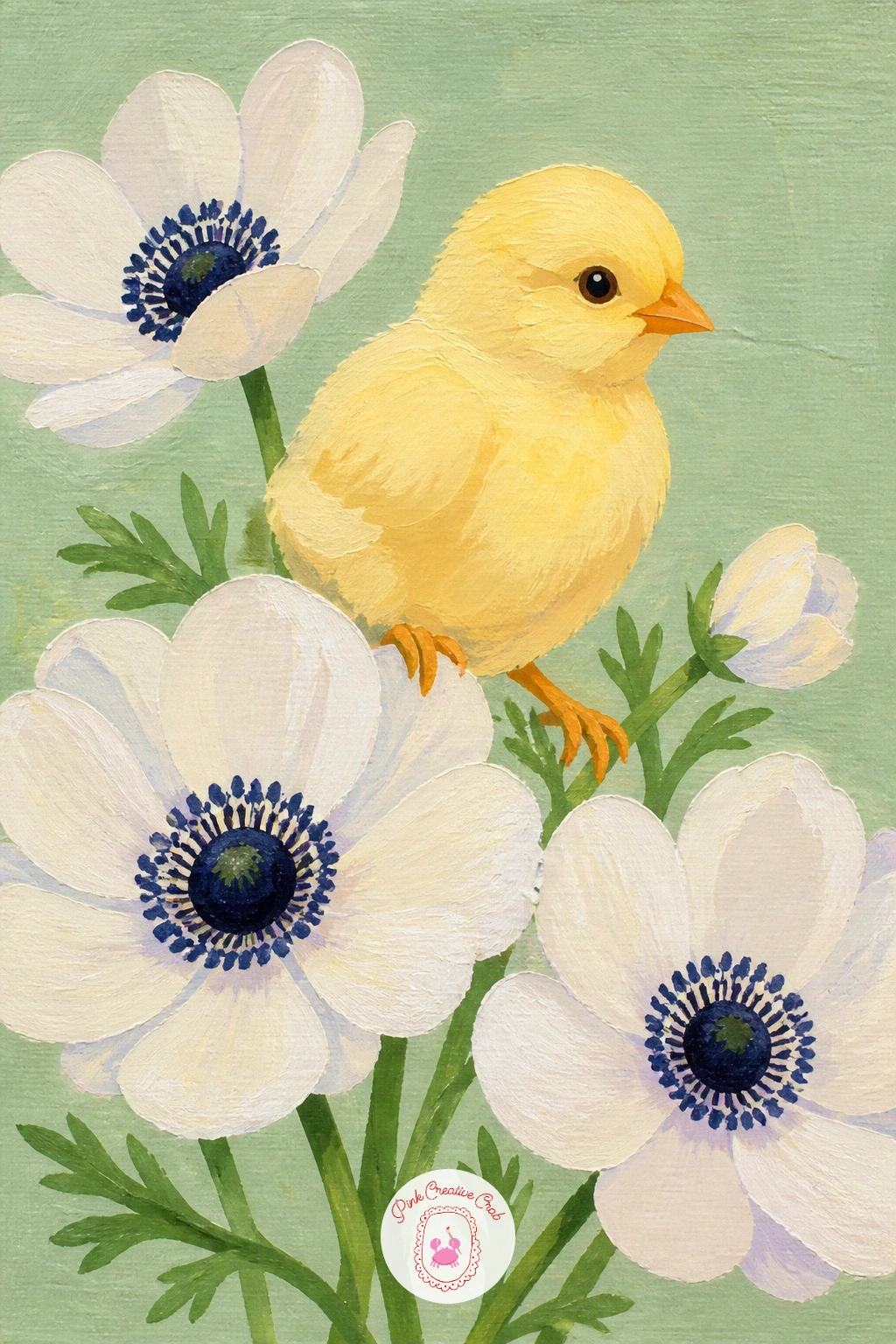
Palette: Buttery Yellow,Soft White,Navy Black,Orange
Step back out to a small landscape with a lamb grazing in a field of tulips, which needs a clear sense of perspective to feel settled rather than pasted on. Set the horizon line about a third of the way up the canvas, keep the lamb and the nearest tulips larger in the foreground, and let the back rows of tulips shrink and blur slightly toward that line, since objects further from the eye always read smaller and softer.
Paint the lamb as rounded cloud-like shapes in off-white with a soft grey shadow underneath, legs just simple narrow shapes tucked under the body. Fill the field with rows of tulips in mixed pinks and a few pale yellows, painting the back rows with less detail and a slightly lighter tone so they recede.
If the lamb looks flat against the field, deepen the shadow where its belly meets the ground.
No field reference to work from: a simple pale green meadow with a lighter strip of sky above gives the same open feeling.
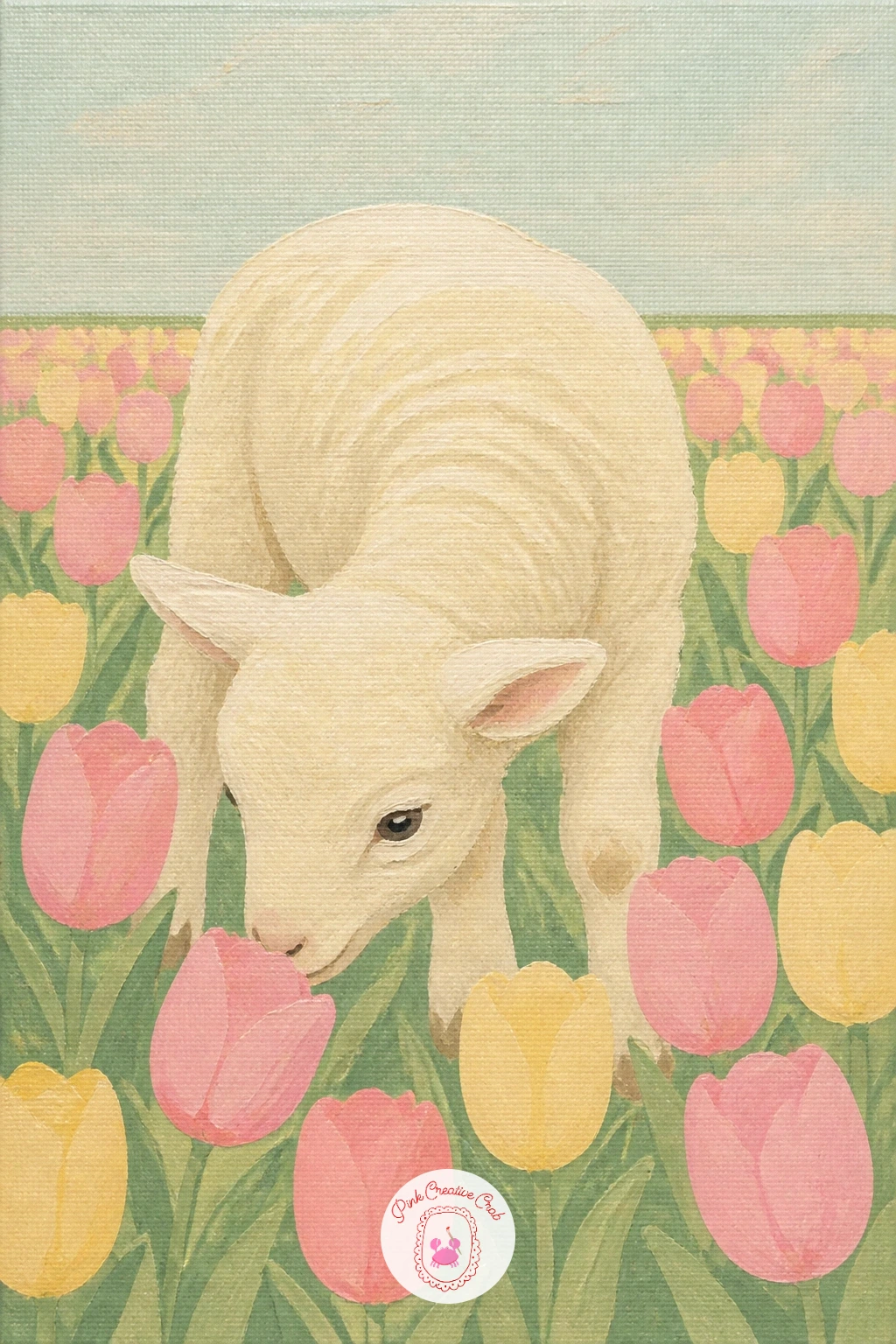
Palette: Off White,Soft Grey,Tulip Pink,Pale Yellow
Return indoors with a blue and white jug of lilacs next to painted eggs, a subject that pairs patterned china with soft flower clusters. Block in the jug shape first in white, then add simple blue brushstroke patterns, a few curved lines and small dots, keeping the pattern loose rather than trying to copy real china exactly.
Build the lilac clusters next using the same small-dab technique as the hyacinths, loading a round brush lightly and stippling in lavender, pale purple and white across a cone-shaped cluster for each bloom. Arrange two or three painted eggs on the table beside the jug in complementary soft blues and yellows.
The jug pattern is where this one can overwhelm the flowers, so keep the blue linework thin and sparse, letting the white porcelain show through as the dominant tone.
No real lilac branch to study: dabbed clusters of any soft purple flower will read the same way from a short distance.
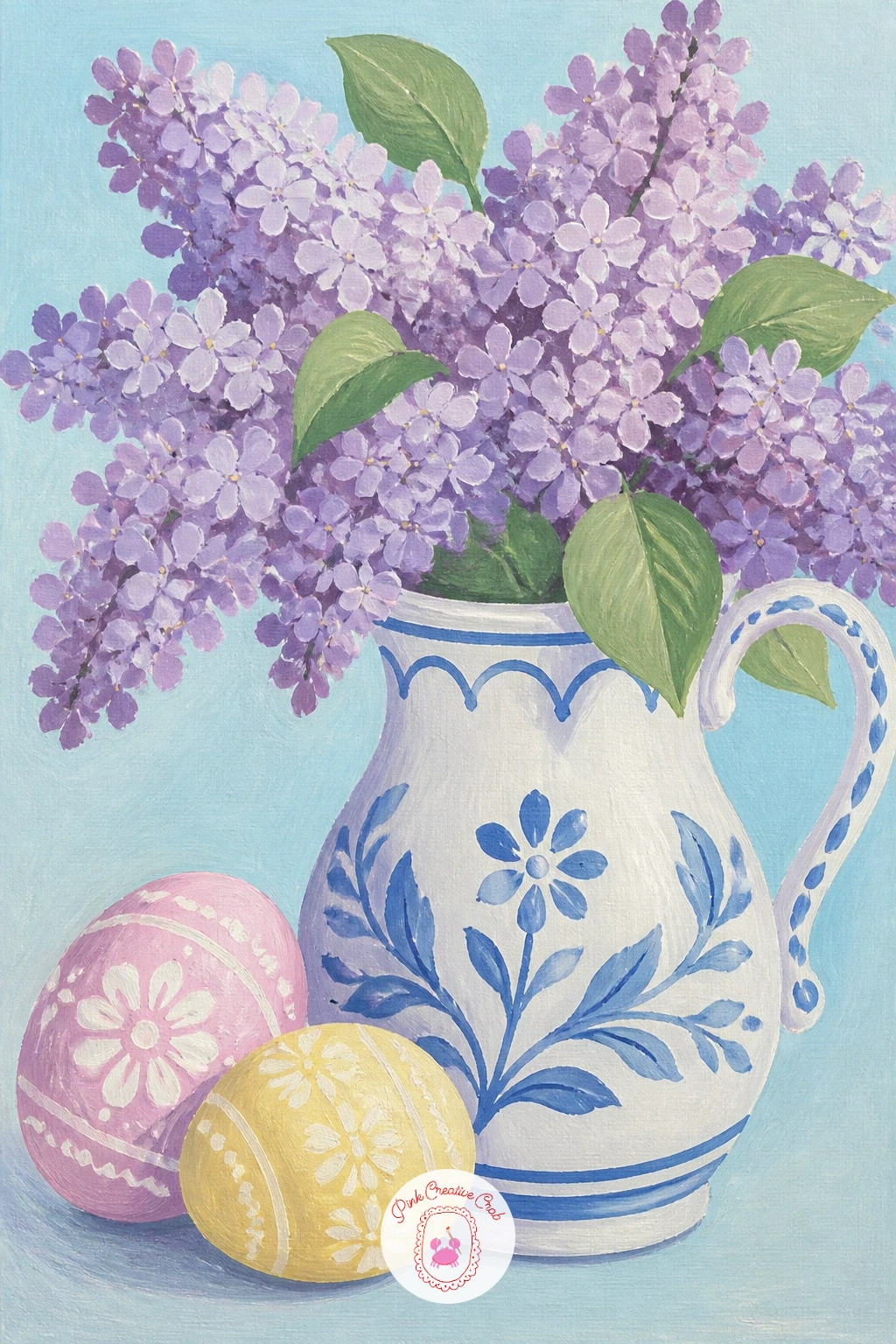
Palette: Lavender,Pale Purple,China Blue,Soft White
Try something tiny and sweet next with an eggshell planted with tiny violas, a subject that is really about painting something small inside something smaller. Paint the cracked eggshell first as a soft oval with an irregular jagged top edge, in the palest blush or blue, then shade the inside rim slightly darker so it reads as hollow.
Fill the opening with a small mound of soil in warm brown, then dot in three or four tiny violas using just a few quick strokes each, purple and yellow petals no bigger than a fingernail. Keep the whole arrangement small on the canvas with plenty of pale background around it, since this subject works best as something delicate rather than filling every inch.
If the violas start looking like blobs, use the very tip of a liner brush for the petal strokes instead of a round brush.
No liner brush on hand: the corner edge of a flat brush, turned sideways, makes a similarly fine mark.
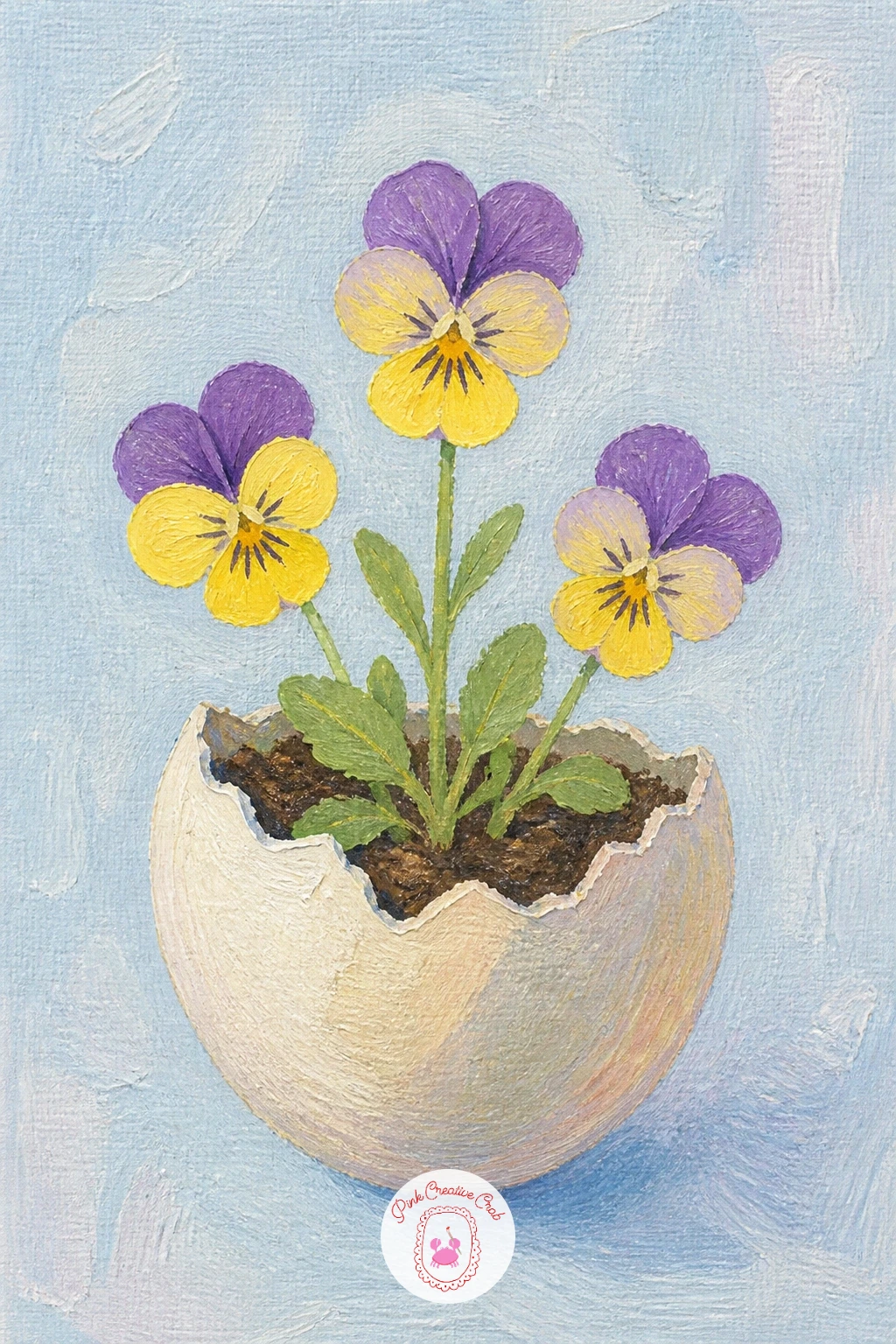
Palette: Blush,Warm Brown,Purple,Yellow
Keep the playful scale of that last idea going with a cracked egg overflowing with daisies, which turns the eggshell into more of a vase than a planter. Paint the shell in soft white with a jagged broken top edge, angled slightly so it looks like it is spilling rather than simply open, then let a cluster of green stems burst upward and outward from the crack.
Build each daisy as a simple ring of white oval petals around a bright yellow center, varying the angle of a few flowers so they do not all face forward like a row of clocks. Pack them fairly close together near the opening, then let two or three stems and blooms drift further out for movement.
If the daisies look too flat and even, add one or two half-hidden behind the front blooms so the cluster reads with real depth.
No white paint to spare: ivory or the lightest cream works just as crisply for the petals.
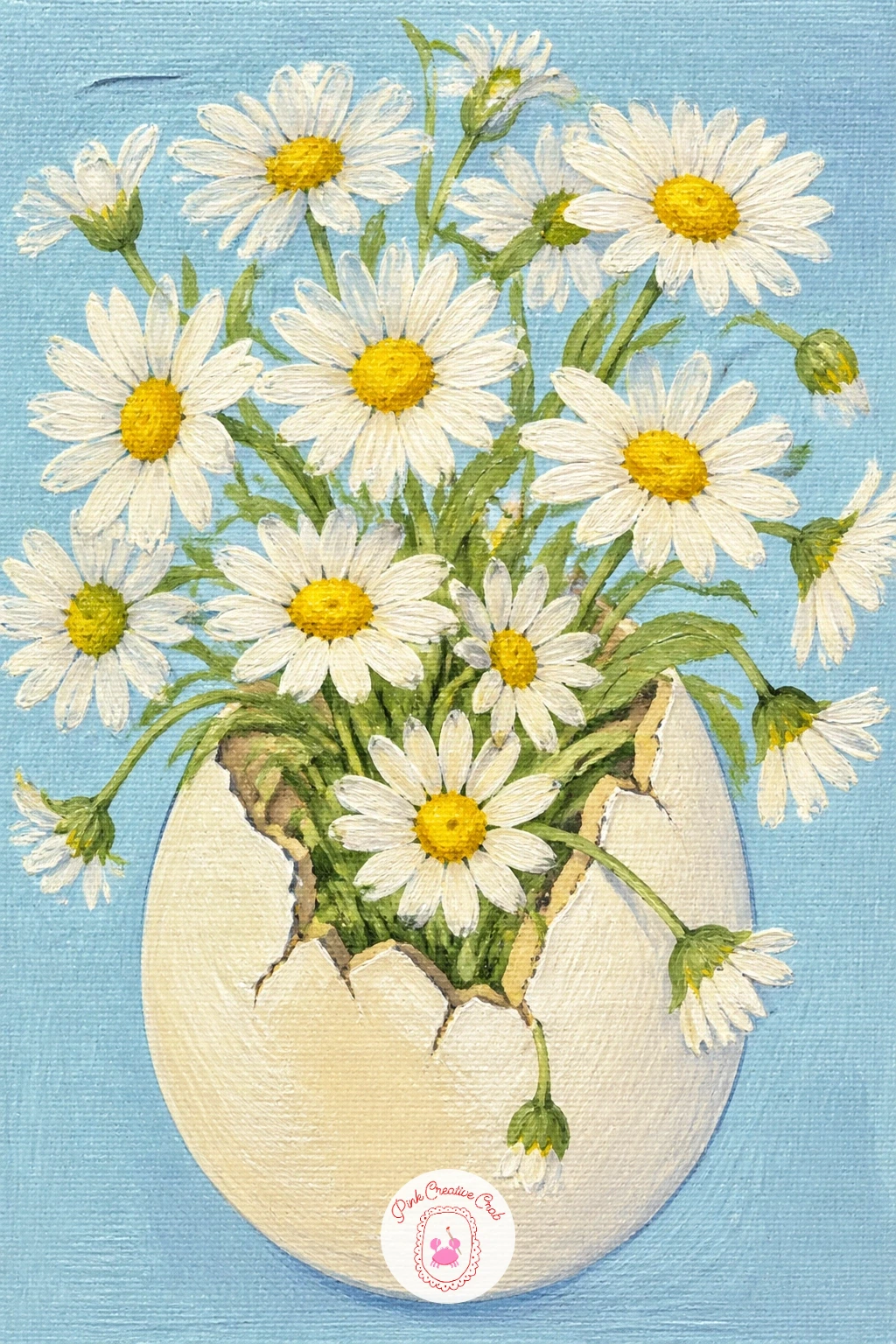
Palette: Soft White,Daisy Yellow,Sage Green,Pale Blue
Build a fuller tablescape now with a table centerpiece of tulips, moss and quail eggs, a subject with more going on than any single flower study. Start with a low oval base of moss in deep and pale green dabbed on with a dry, barely loaded brush so the texture stays rough and broken rather than smooth.
Nestle five or six speckled quail eggs into the moss using small dots of brown over a cream base, then add the tulips standing up through the arrangement in mixed pinks, taller at the center and shorter toward the edges so the shape reads as a proper centerpiece rather than a flat row.
The moss texture is the detail that sells this whole scene, so resist smoothing it out even if it looks messy at first: that roughness against the smooth tulip petals is exactly the contrast you want.
No quail egg reference: small dots of darker brown over any pale oval egg shape reads the same way.
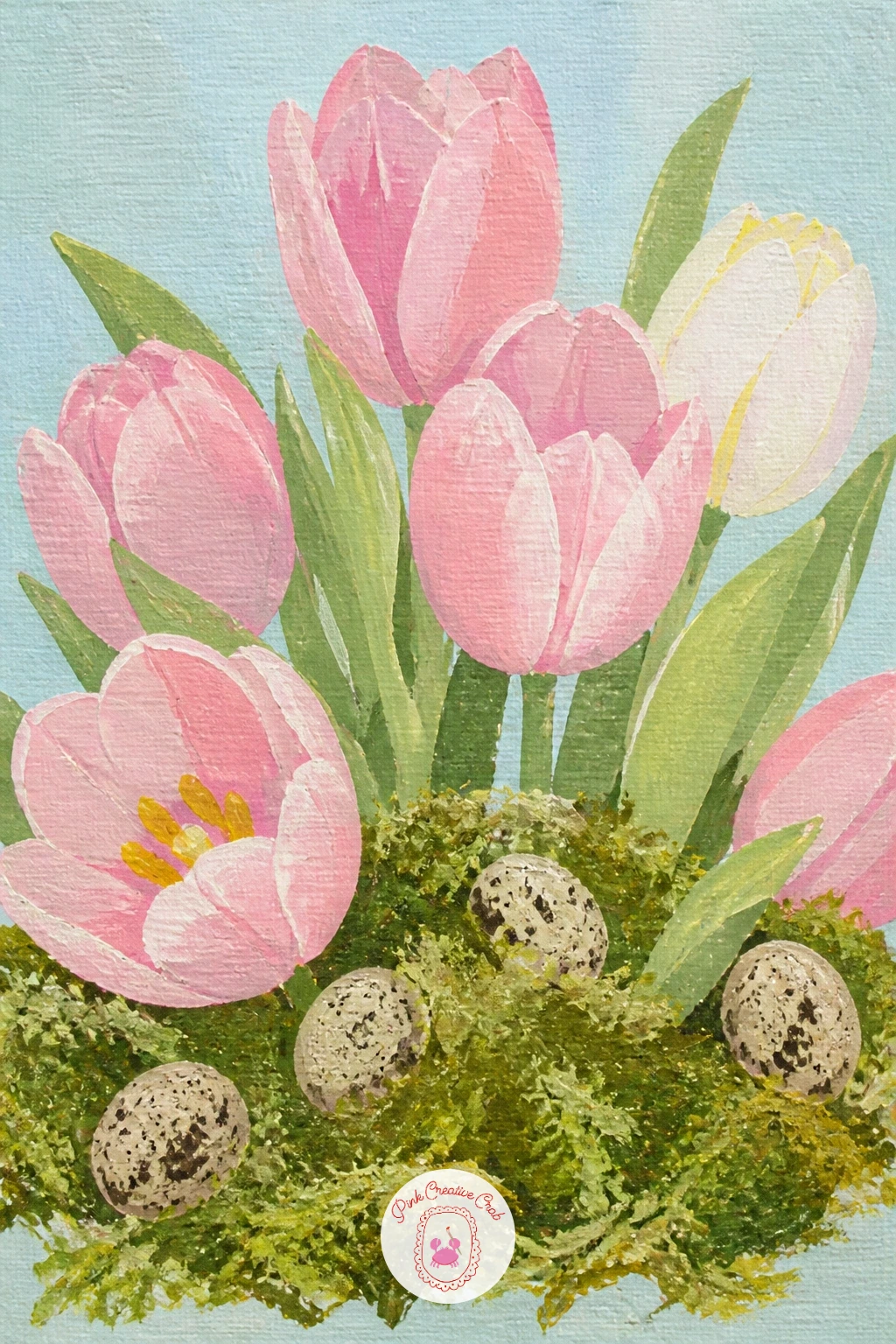
Palette: Deep Moss Green,Pale Moss Green,Cream,Tulip Pink
Bring a second small character in with a duckling sitting in a pot of daffodils, a cheerful pairing of soft yellow bird and soft yellow flower in slightly different tones so neither gets lost. Paint the terracotta pot first, then the daffodils rising behind it in the same way as the earlier bouquet, six-petaled flowers with a deeper orange trumpet center.
Build the duckling in front of the pot as two simple rounded shapes, a larger body and smaller head, in a warmer yellow than the flowers so it reads as a separate, living shape against them. One small orange bill and two tiny black dot eyes finish the face.
If the duckling blends too much into the daffodils behind it, darken the pot’s shadow just behind the duckling’s back to separate the two shapes clearly.
No terracotta orange to mix: a plain warm brown pot works just as well and keeps more attention on the yellow.
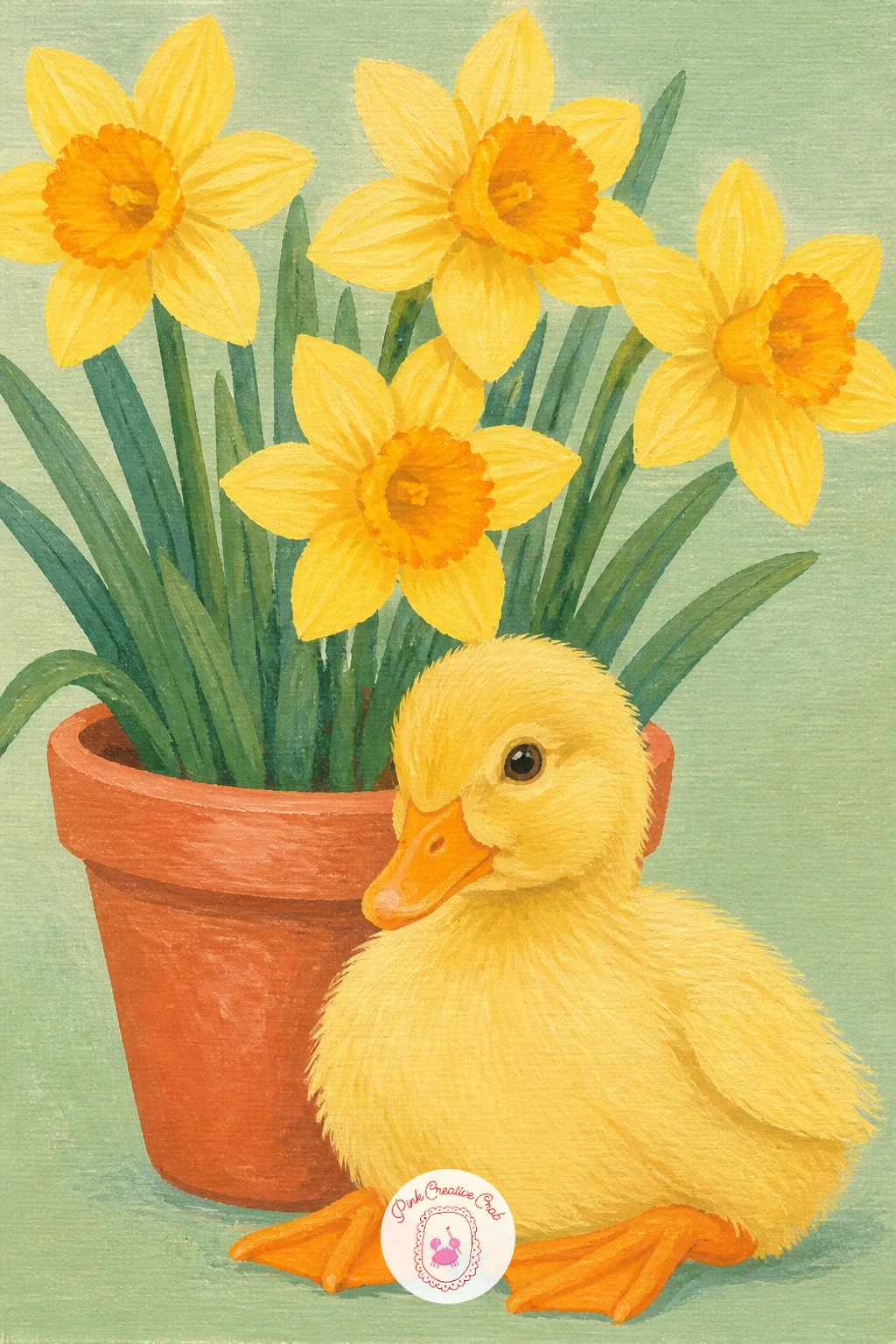
Palette: Warm Yellow,Daffodil Yellow,Terracotta,Orange
Give the eggs a more sculptural role with a magnolia branch with pastel eggs hanging from it, as though the branch were decorated for the season. Paint the branch first in a confident dark brown diagonal across the canvas, then build each magnolia bloom from five or six soft overlapping petals in pale pink fading to white at the tip, a shape that reads instantly as magnolia rather than any generic blossom.
Once the branch and blooms are dry, add two or three small eggs appearing to hang from short brown threads tied to the branch, each egg a soft solid color, blue, lilac or mint, with a tiny loop of thin brown line connecting it upward.
The hanging threads are easy to overdo, so keep them thin and few: one or two eggs reads as charming, five starts to look cluttered.
No pink for the magnolia: pure white blooms with just a blush of pink at the base look just as elegant.
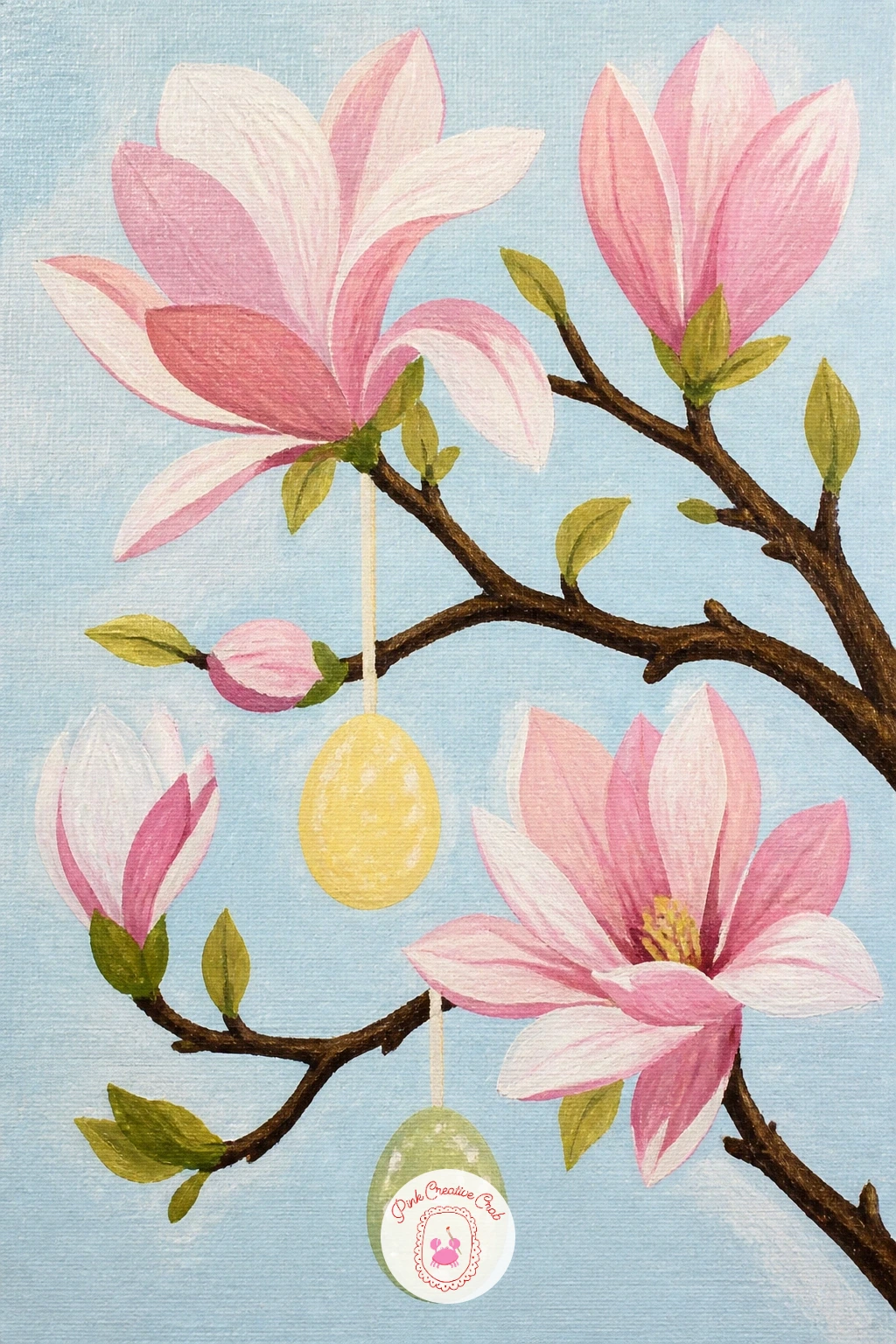
Palette: Blossom Pink,Soft White,Mint Green,Lilac
Turn the egg hunt itself into a composition with a garden bed of tulips with a hidden basket of eggs, where the fun is in tucking the basket just enough out of sight to feel discovered rather than displayed. Lay the perspective low, as though kneeling at the edge of the bed, with the nearest tulips large and clear and the basket sitting half behind a cluster of them toward the back.
Paint the tulip bed first in rows of mixed pink, yellow and white blooms, overlapping the stems slightly for a natural, slightly wild look rather than neat garden rows. Add the basket last in warm brown with just the tops of two or three eggs peeking above its rim and a few tulip stems painted over its lower edge to tuck it in.
If the basket looks too hidden to register as a subject, bring one whole egg fully visible at the rim so the eye catches it immediately.
No woven basket texture coming easily: a plain brown oval with a darker rim reads as a basket at this scale.
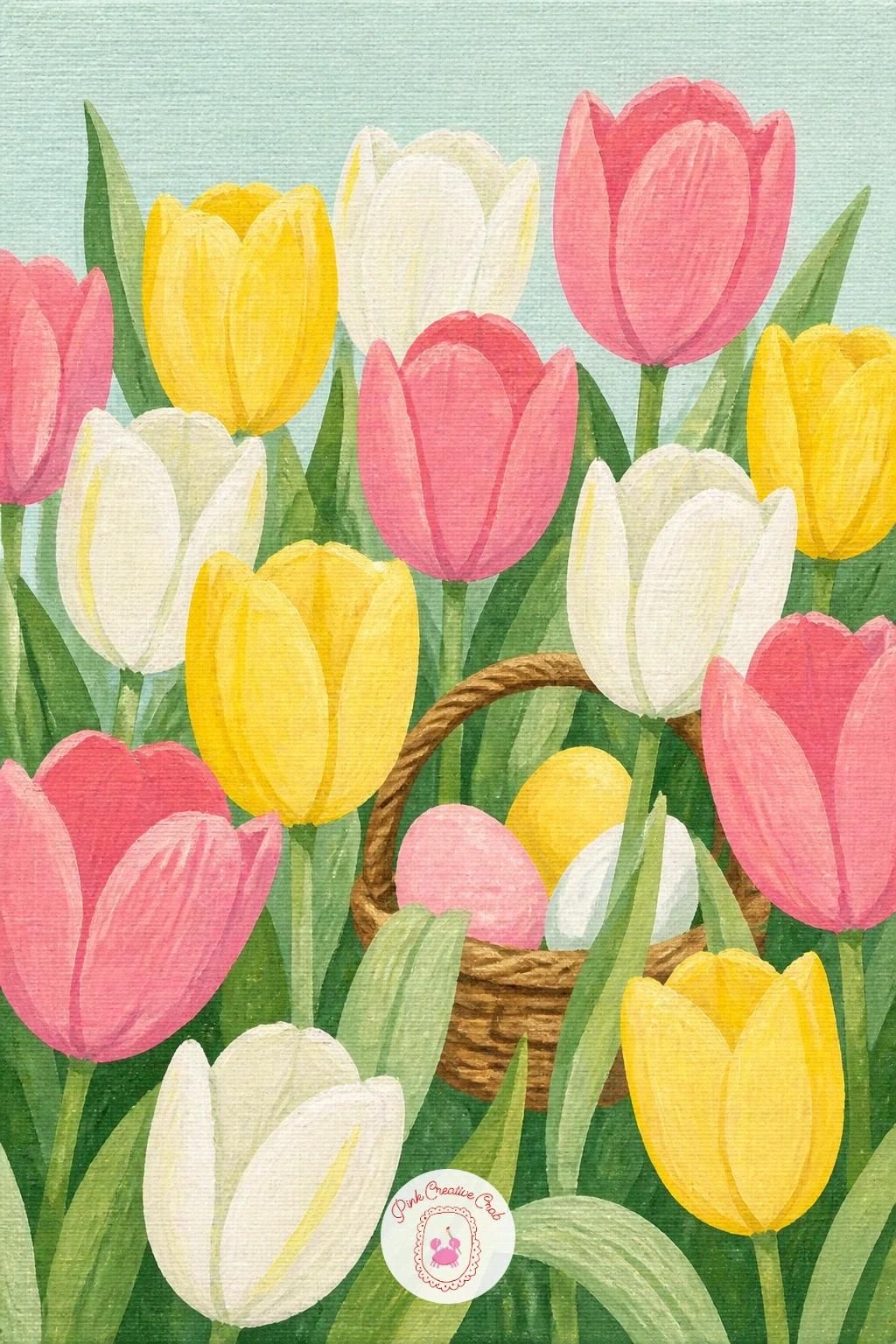
Palette: Tulip Pink,Pale Yellow,Soft White,Warm Brown
Move to a softer, more romantic still life with peonies and painted eggs on a lace tablecloth, which asks for restraint rather than detail in the lace itself. Paint the tablecloth as a flat soft white or cream base first, then suggest the lace pattern with just a few small white-on-white dots and faint scalloped edge lines rather than trying to render every thread.
Build the peonies next in blush pink and rose, each flower made of many small overlapping petal strokes layered from the outer edge inward, since peonies read as full and rounded rather than flat like a tulip. Scatter two or three painted eggs across the cloth in soft contrasting pastels once the peonies are dry.
Overworking the lace pattern is the easiest way to lose the peonies, so keep that texture faint and let your eye rest on the flowers first.
No lace reference at hand: a plain cream cloth with soft shadow folds carries the same gentle mood.
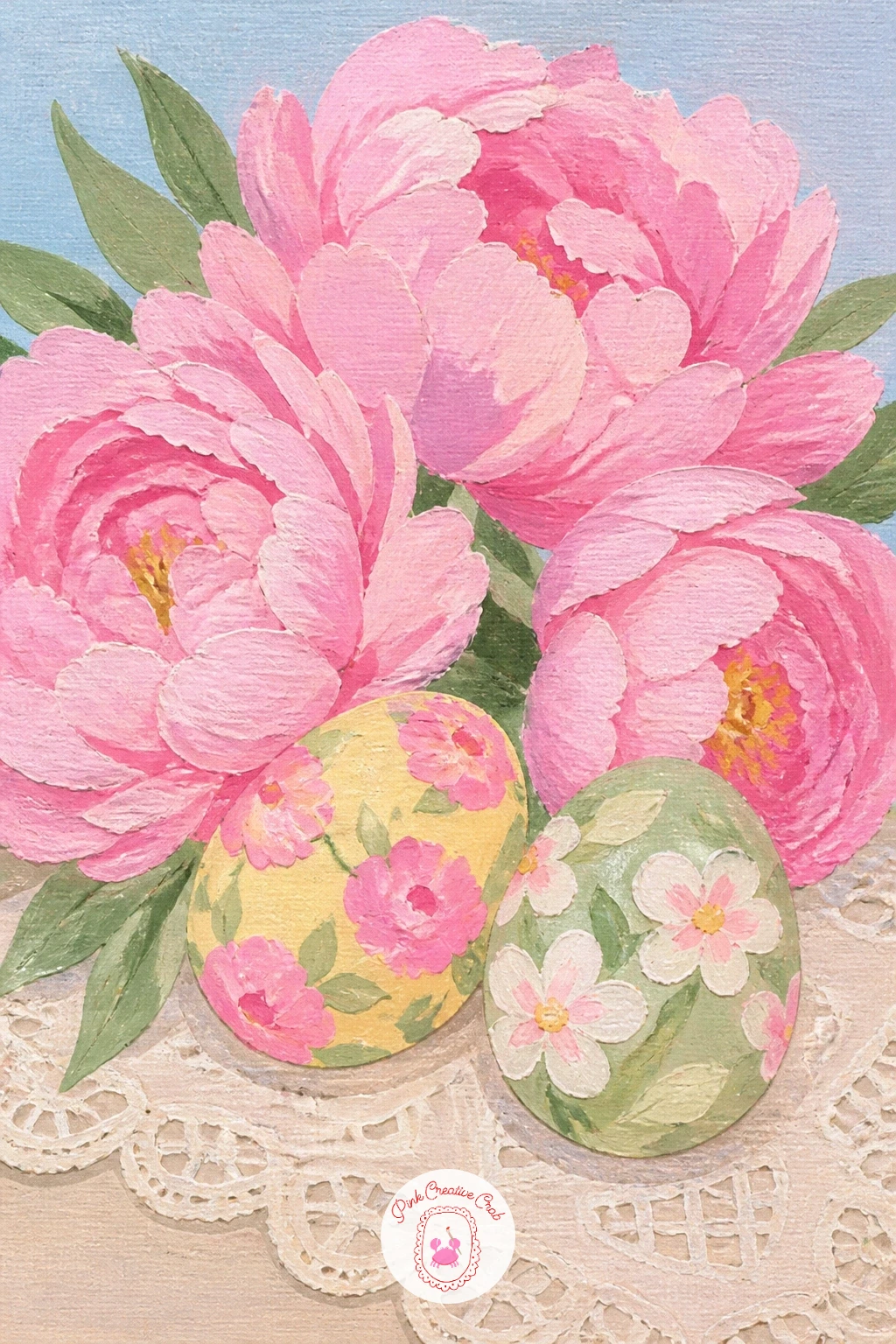
Palette: Blush Pink,Rose,Cream,Pale Blue
Keep the tabletop mood going with a vintage teapot with sweet peas and eggs around it, a subject that lets you practice a rounder, friendlier object shape than the jugs and vases so far. Paint the teapot body as a plump curved oval with a short spout and curved handle, in a soft dusty color like faded sage or pale rose, then add one or two thin painted lines or tiny dots as a simple decorative pattern.
Build the sweet peas around its base next, each bloom just two or three ruffled petal strokes in mixed pink, lilac and white, with thin curling green tendrils reaching between them. Place two small eggs near the teapot’s foot in colors that echo the flowers.
If the teapot looks squat or heavy, narrow the base slightly and raise the lid knob a touch, which lifts the whole shape visually.
No sweet pea reference: simplified loose petals in the same ruffled shape work for any small cottage flower.
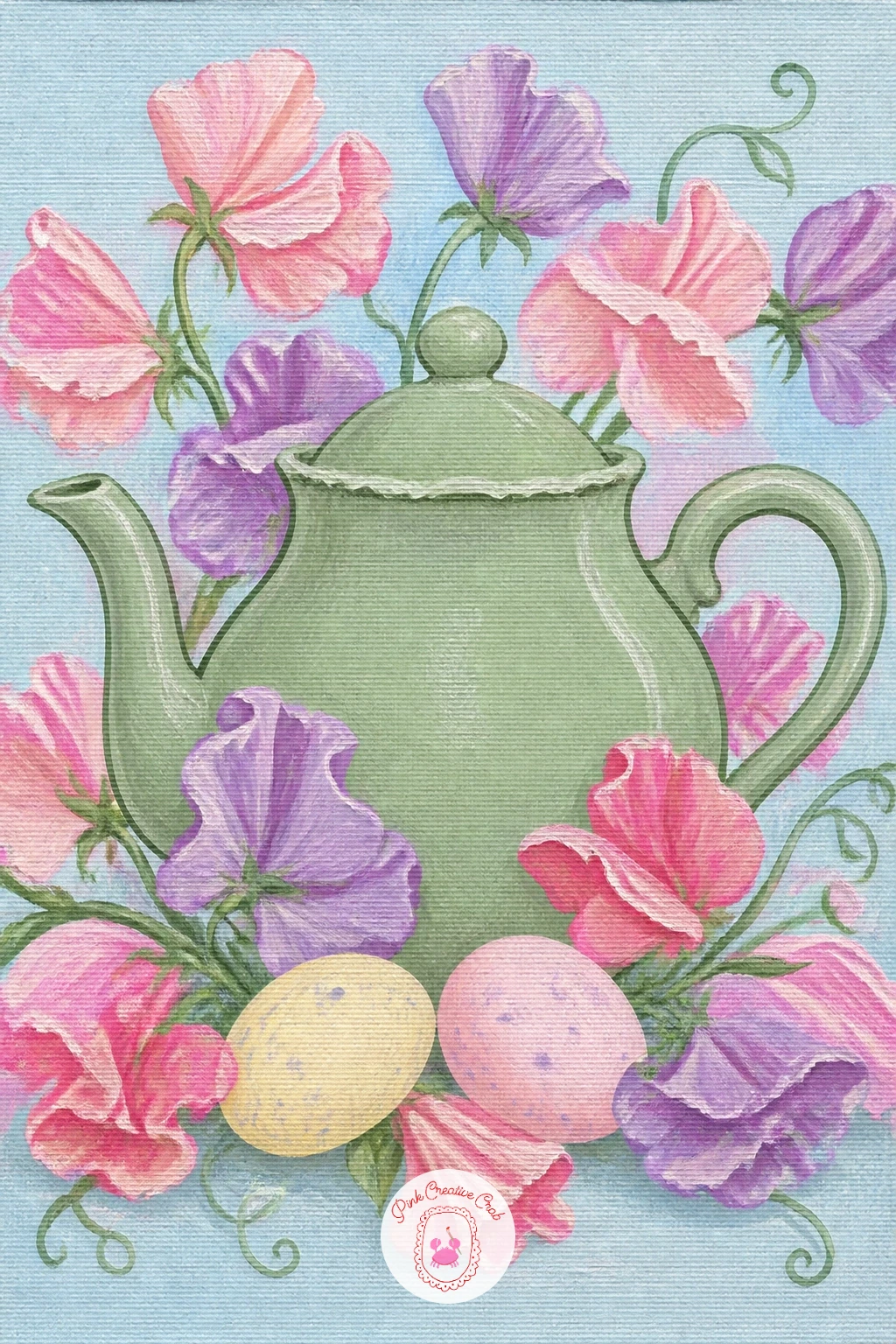
Palette: Faded Sage,Pale Rose,Lilac,Soft White
Head back outdoors for a meadow of buttercups with a nest of speckled eggs, a landscape moment where the light source really shapes the whole feel. Decide where the sun sits first, high and slightly to one side, then let the buttercups on that lit side glow a touch brighter and warmer while the grass in shadow stays a cooler, deeper green.
Paint the meadow as a loose field of green strokes in varying tones, then scatter small five-petaled buttercups across it in bright glossy yellow, a few clustered and a few standing apart. Settle a small brown nest into the grass with three speckled eggs inside, their speckles just tiny dark dots flicked on with a nearly dry brush once the egg base color is dry.
If the meadow looks flat under the strong light, deepen the shadow right around the nest so it sits believably in the grass rather than floating on top.
No yellow bright enough for the buttercups: mixing cadmium yellow with a touch of white gives the same glossy pop.
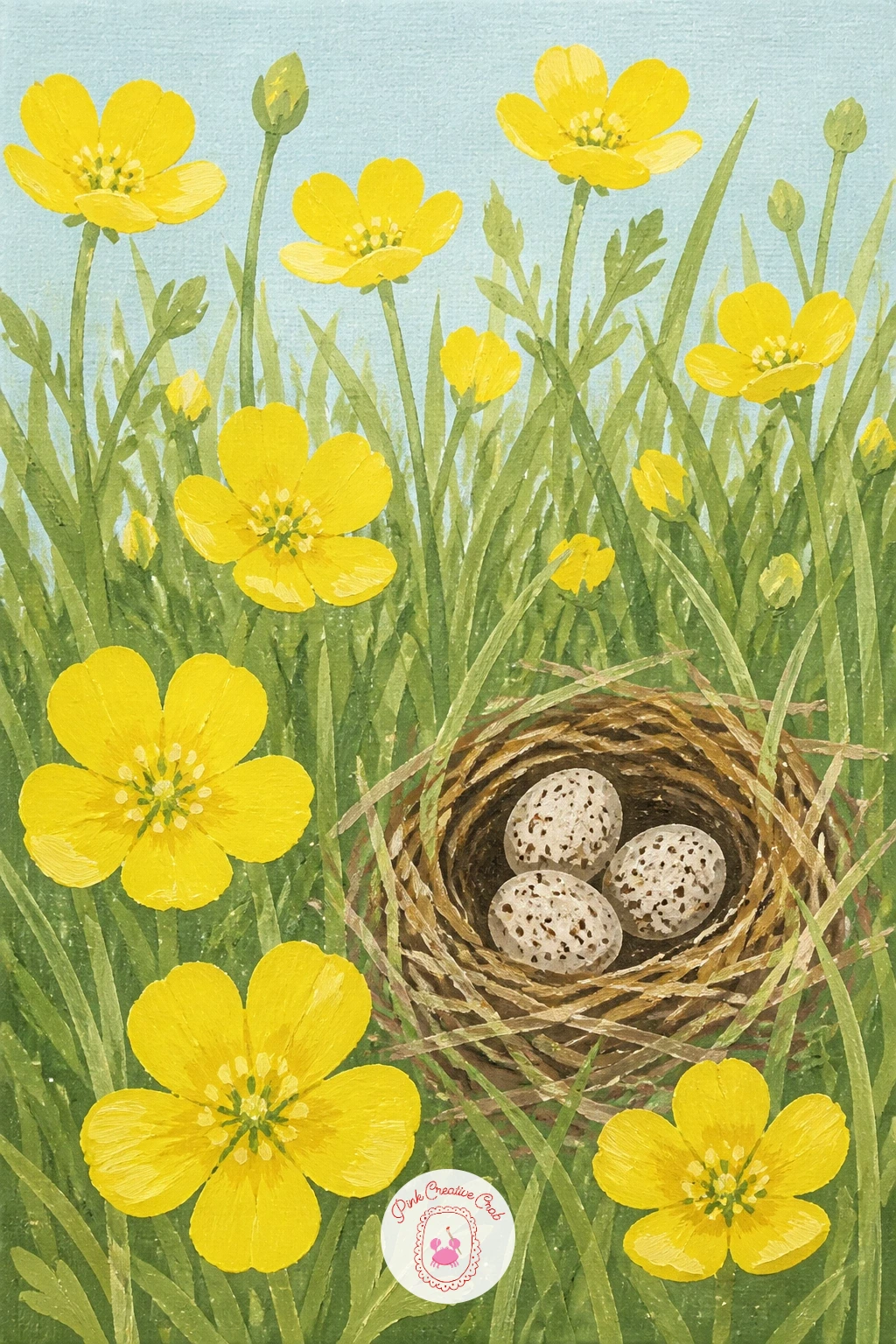
Palette: Buttercup Yellow,Grass Green,Deep Green,Warm Brown
Combine two of the earlier flowers into one gift-shop bouquet with a bouquet of Easter lilies and tulips wrapped in brown paper, a subject that works well as a gift painting as much as a still life. Paint the brown kraft paper cone first, keeping its edges slightly crumpled with a few darker fold lines rather than perfectly smooth, since real paper never sits flat.
Build the lilies toward the back and center of the bouquet in white with soft yellow centers, then fan the tulips forward and outward in pink and a touch of pale orange, letting a few stems and leaves show just above the paper’s folded edge for a hand-tied look.
A string or ribbon tie around the paper’s narrow point is a nice finishing touch, painted as one or two confident curved strokes rather than a fussy bow.
No kraft paper tone mixed yet: burnt sienna softened with a touch of white gives the same warm wrapping color.
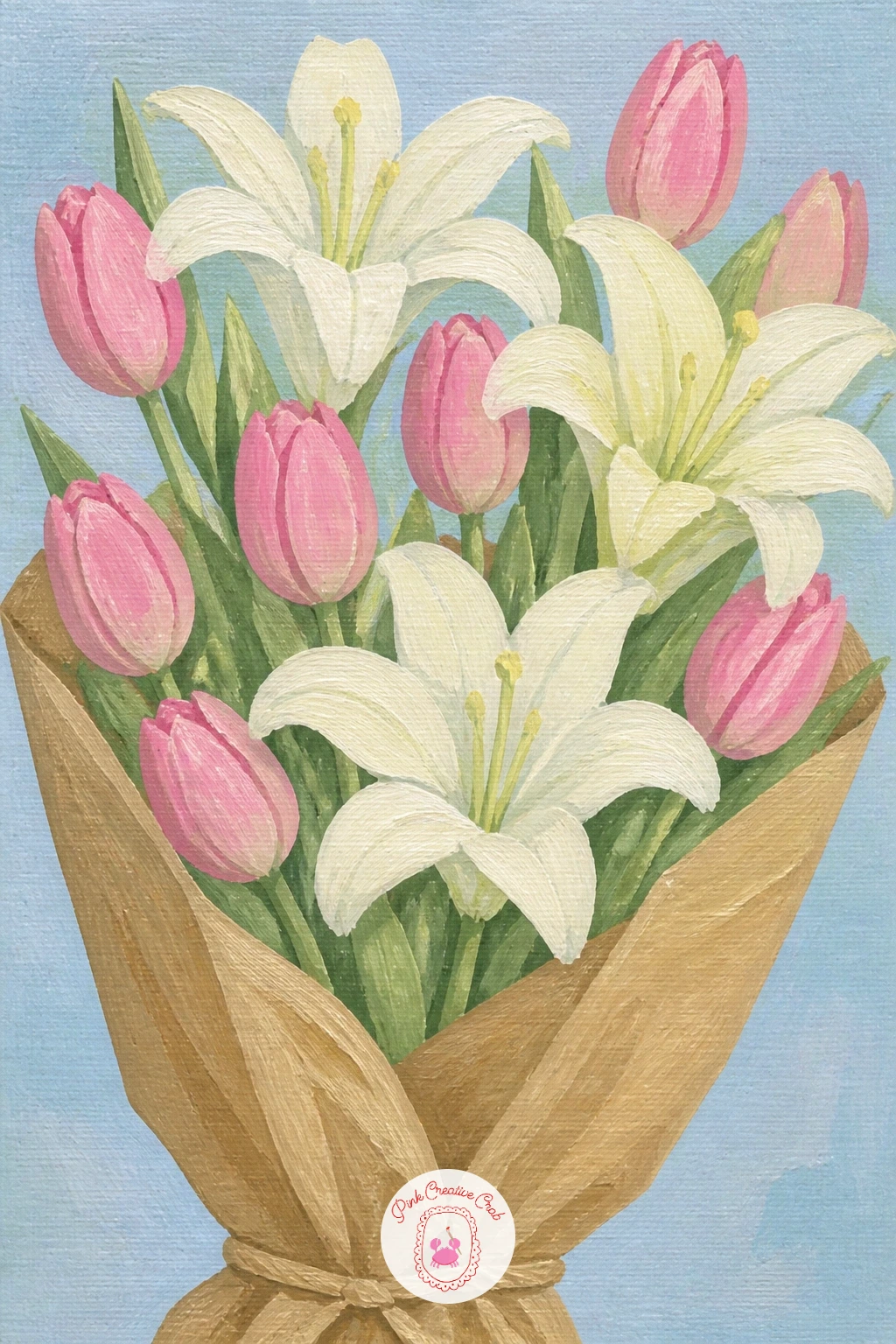
Palette: Kraft Brown,Soft White,Tulip Pink,Pale Orange
One of only two more traditional Easter figures allowed on this list, a ceramic hen dish surrounded by fresh hyacinths, leans into the kitschy charm of the china rather than painting a real bird. Paint the hen’s body as a simple plump oval in white or cream with a painted-on comb and wattle in soft coral, keeping the whole shape smooth and glossy like real ceramic rather than feathery and soft.
Add a thin painted highlight stripe along the hen’s back and head to suggest the shine of glaze, then surround the dish with hyacinth spikes using the same dabbed-texture technique from earlier, in lilac and pale pink this time for a change.
If the hen looks too much like a real bird instead of a dish, flatten the color blocks further and keep that glaze highlight crisp and clean, which is what reads as ceramic to the eye.
No coral for the comb: a soft dusty red works just as well against the white body.
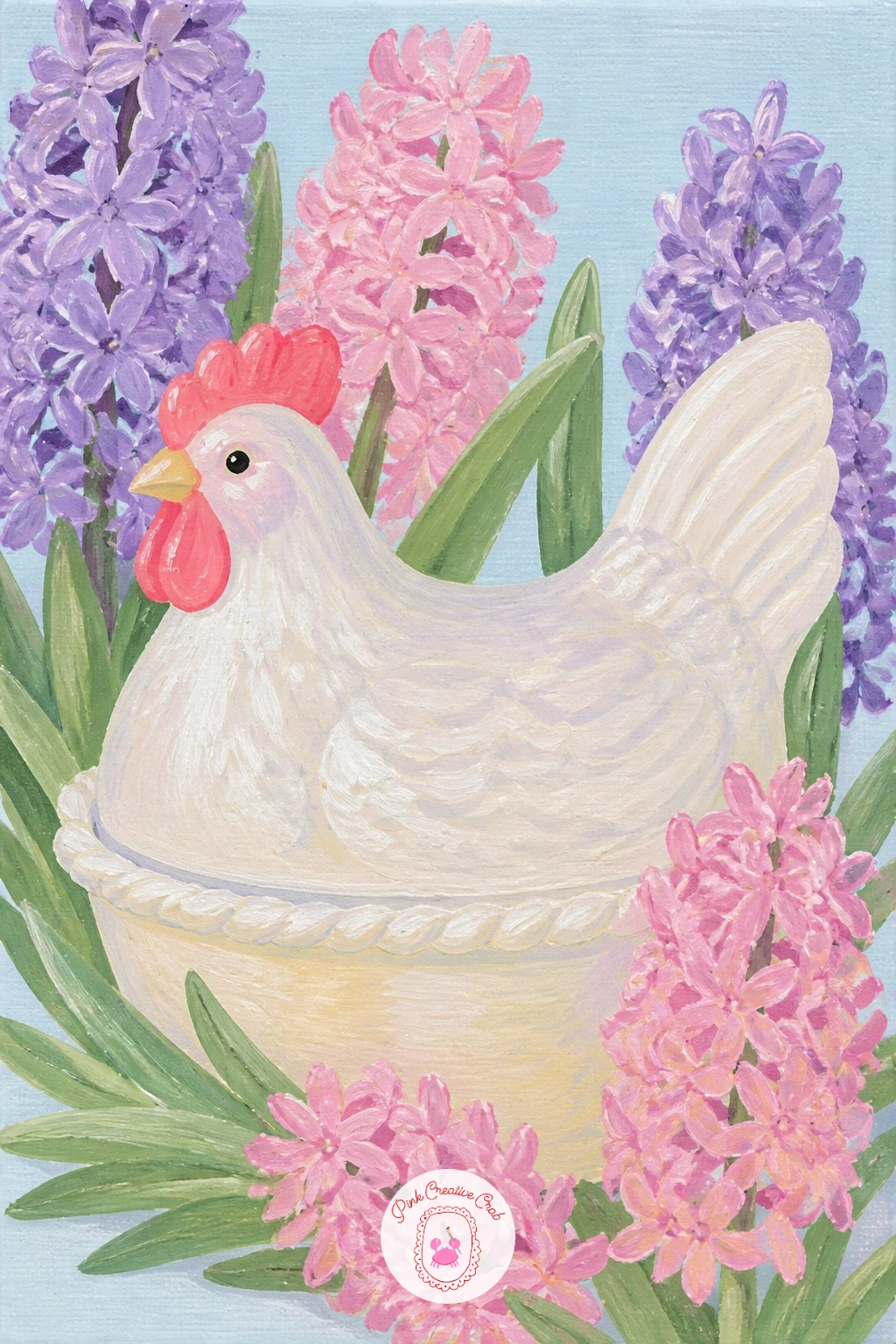
Palette: Cream White,Coral,Lilac,Pale Pink
Zoom all the way in for a pastel egg with a tiny tulip painted on it, essentially a painting within a painting that rewards a steady hand more than a big canvas. Block in the egg shape first with a flat pastel base color, mint or blue work especially well as a backdrop, and let it dry completely before adding any detail, since painting wet into wet here will muddy the small tulip design.
Paint the tiny tulip on the shell’s front curve using just three small strokes for the petals and one thin green line for the stem, keeping the whole motif no larger than a thumbprint so it reads as painted decoration rather than a full flower competing with the egg shape.
If the little tulip smears or wobbles, use a liner brush loaded thin, and rest your painting hand against the canvas edge for steadiness.
No liner brush available: the tip of a round brush, barely touched to the surface, makes a similarly fine line.
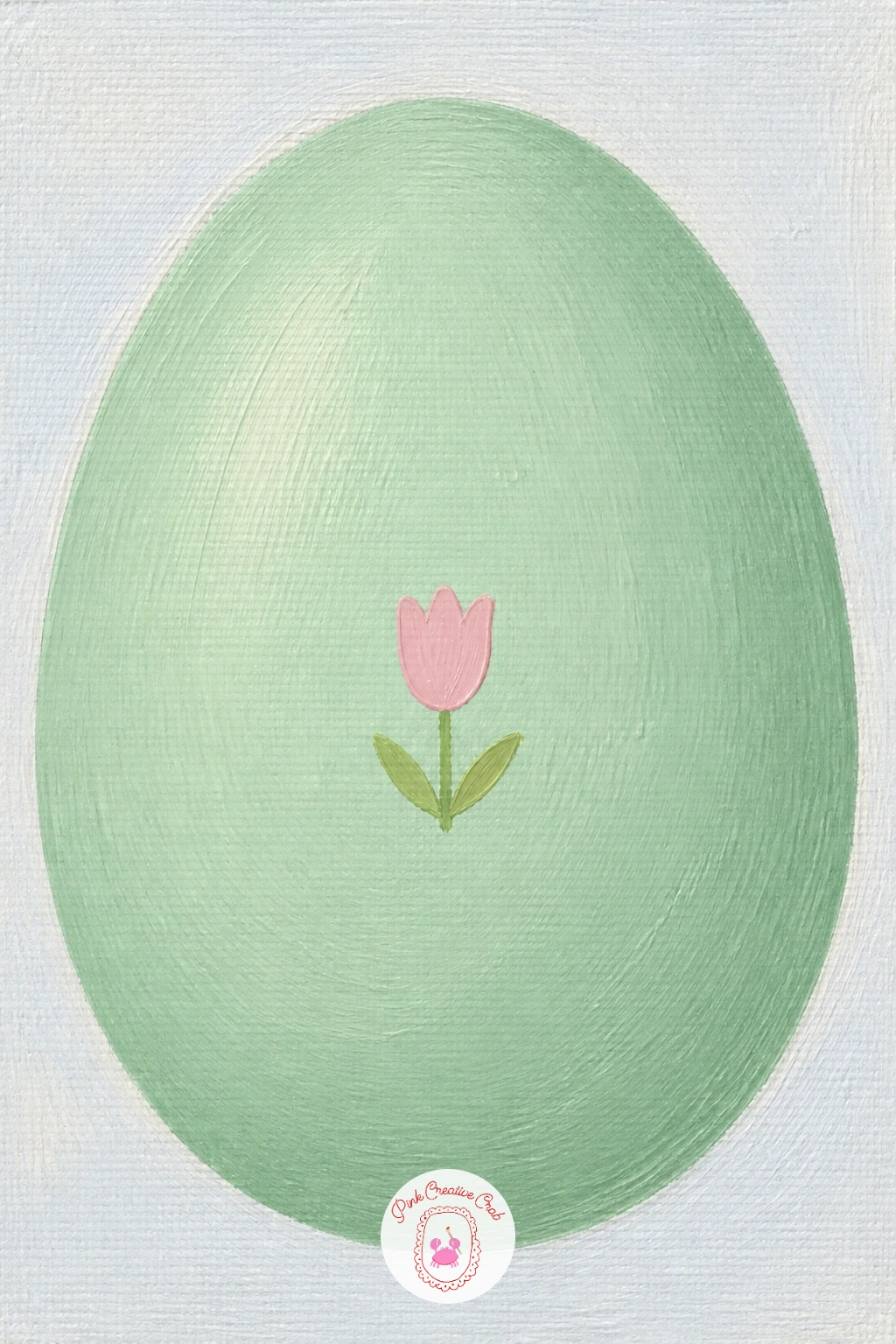
Palette: Mint Green,Tulip Pink,Sage Green,Soft White
Bring the second and final traditional figure in with a lamb sleeping beside a basket of primroses, a quieter companion piece to the grazing lamb from earlier in the list. Paint the lamb curled into a soft rounded shape in off-white, legs tucked completely out of sight, with closed eyes shown as just two short curved lines, which is really all that is needed to read as sleeping.
Build the basket of primroses beside it next, small round-petaled flowers in mixed yellow, pink and purple clustered tightly inside a shallow woven basket, using the same dry-brush weave texture from the earlier tulip basket.
Keep the lamb’s wool texture soft rather than sharp: a light stippling of a slightly lighter white over the base color suggests curl without turning the whole shape fussy.
No off-white mixed: plain titanium white softened with a touch of grey works just as gently.
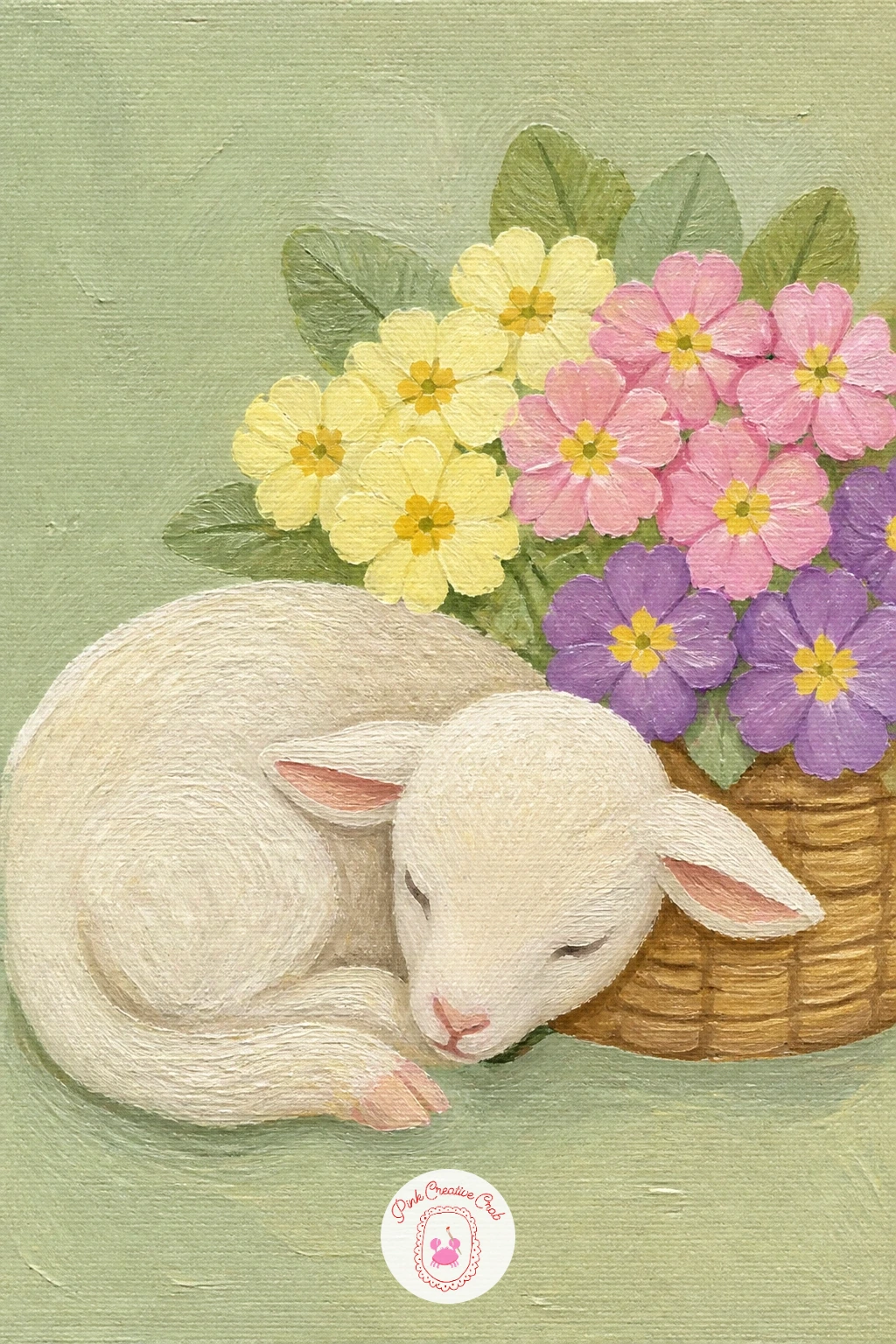
Palette: Off White,Soft Grey,Primrose Yellow,Primrose Pink
Trade soft round flowers for something sharper with a jug of forsythia branches beside a row of speckled eggs, since forsythia grows in small bright clusters along bare branches rather than full blooms. Paint the jug first in a plain warm cream or pale blue, then add the branches rising from it as thin confident dark lines in several directions, not perfectly straight, since real branches always kink and bend.
Dot bright yellow forsythia clusters along each branch with small quick strokes, leaving some stretches of branch completely bare, which is true to how the flowers grow and keeps the shape from looking like a solid yellow mass. Line up three or four speckled eggs beside the jug once dry, their speckles added with a nearly dry brush flicked lightly over the base color.
If the branches start looking too busy, thin out the yellow clusters on at least one branch so the eye has somewhere to rest.
No forsythia to reference: any bare flowering branch with small dotted yellow blooms reads the same way.
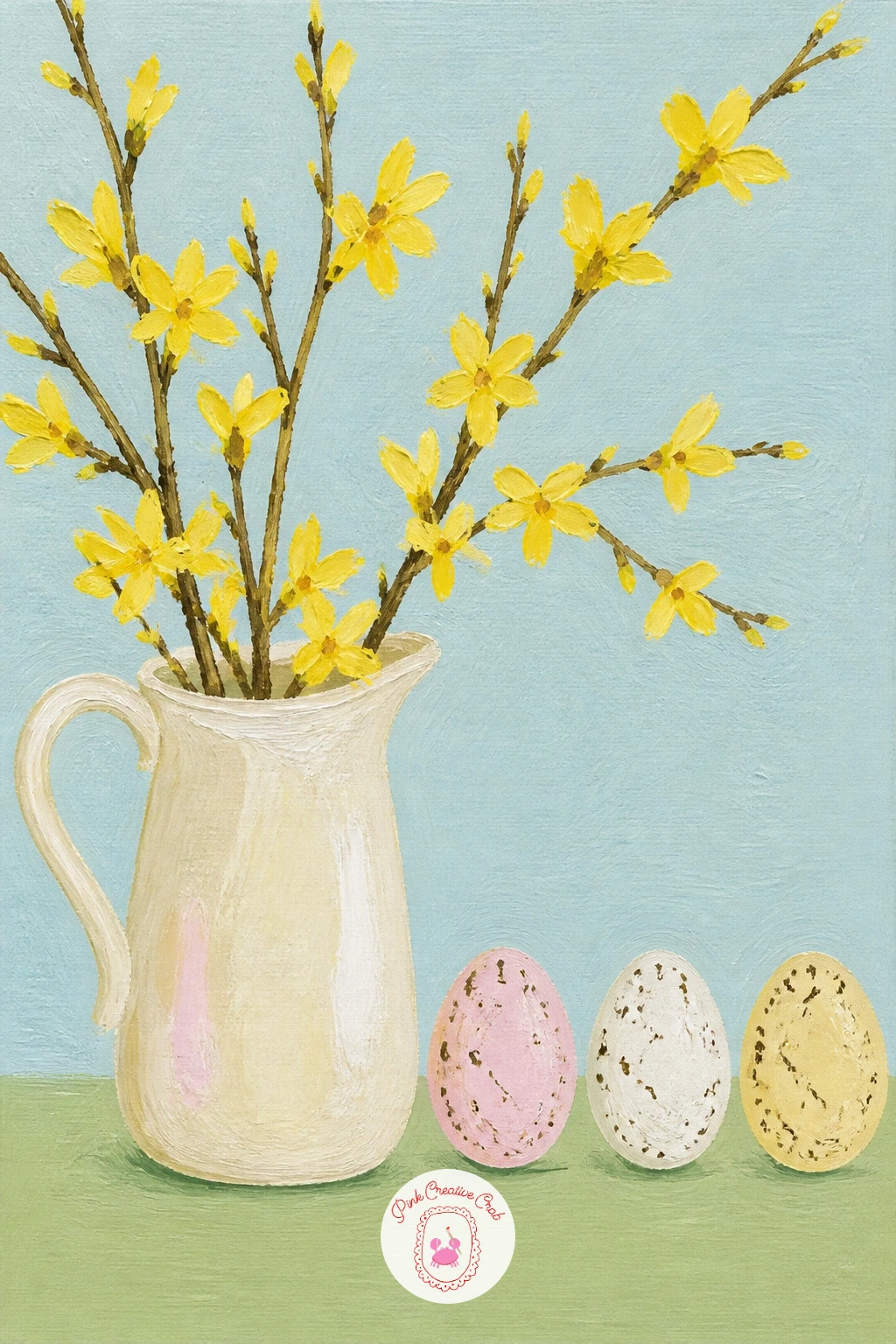
Palette: Forsythia Yellow,Cream,Warm Brown,Pale Blue
Bring some architecture into the mix with a church window with white lilies on the sill, a subject built almost entirely from the arch shape and the light coming through it. Sketch a tall pointed or rounded arch first, filling the upper window area with a soft colored glass effect using two or three gentle pastel blocks of color rather than detailed stained glass patterns.
Paint the stone sill beneath it in a pale warm grey, then set two or three white lily blooms along the sill, their petals catching a touch of the colored light from the window above with a faint tint mixed into the white. Keep the stone textured very lightly with a dry brush for a worn, soft look.
If the window glass looks too busy next to the lilies, simplify it down to two colors only and let the flowers carry the detail instead.
No arch shape coming out even: trace a dinner plate for the rounded top and rule straight lines down from its edges.
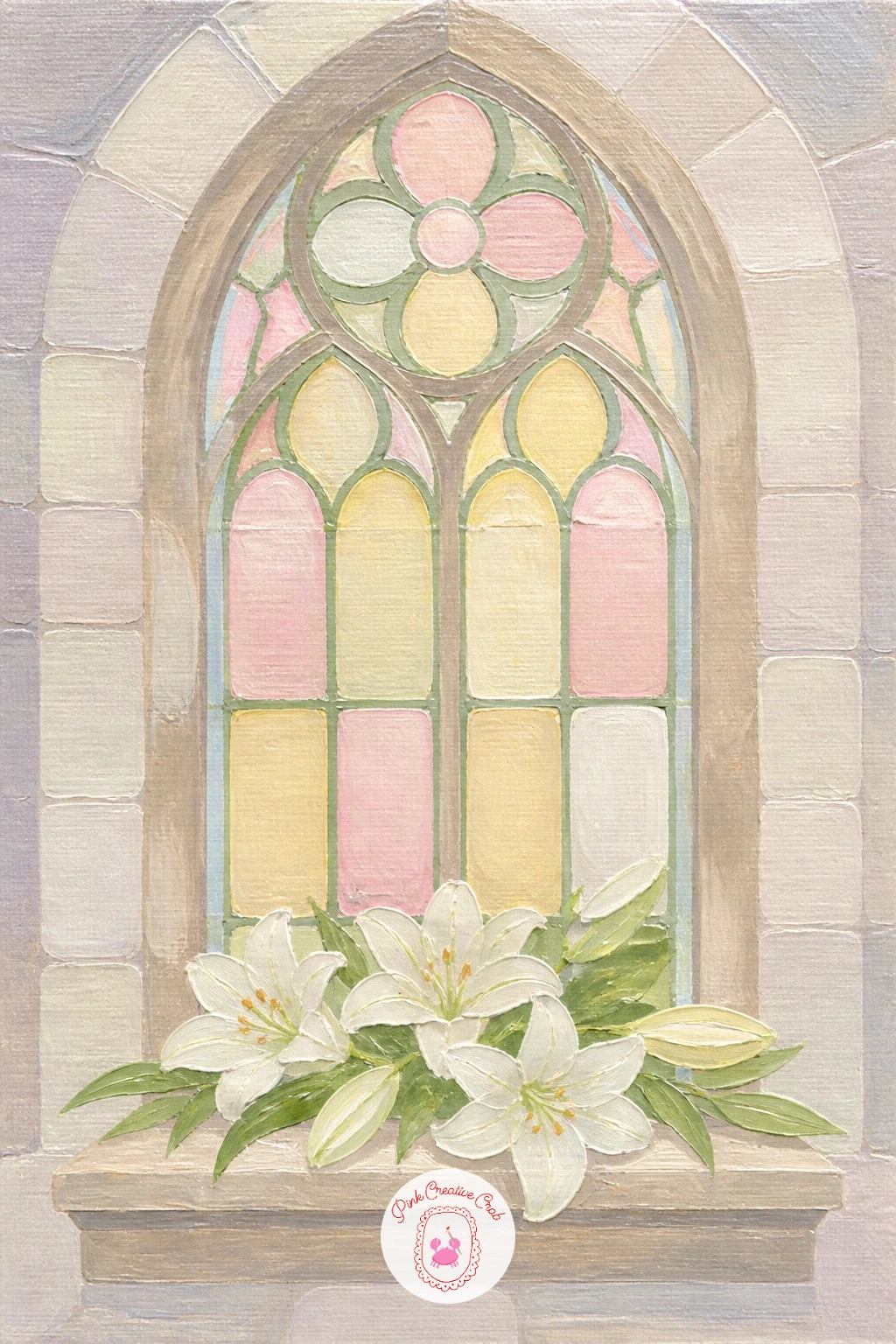
Palette: Pale Grey,Soft White,Pale Blue,Pale Amber
Line up color itself as the subject with a rainbow row of dyed eggs on moss with crocuses, which is really a study in keeping many bright colors calm together on one canvas. Lay a base of rough green moss across the lower half first, using the same dry dabbing technique from the earlier centerpiece idea so the texture stays broken and natural.
Paint five or six eggs in a row along the moss, each a different soft pastel, pink, blue, lilac, mint and pale yellow, keeping every egg the same size and shape so the rainbow effect reads as deliberate rather than random. Tuck two or three small crocus blooms, simple cup shapes in purple and white, between the eggs once they are dry.
Too many different colors crammed close together is the usual trap here, so keep the moss and crocus greens muted enough that the egg row stays the brightest thing on the canvas.
No five different pastels mixed: white added gradually to just two base colors can stretch into a believable soft rainbow.
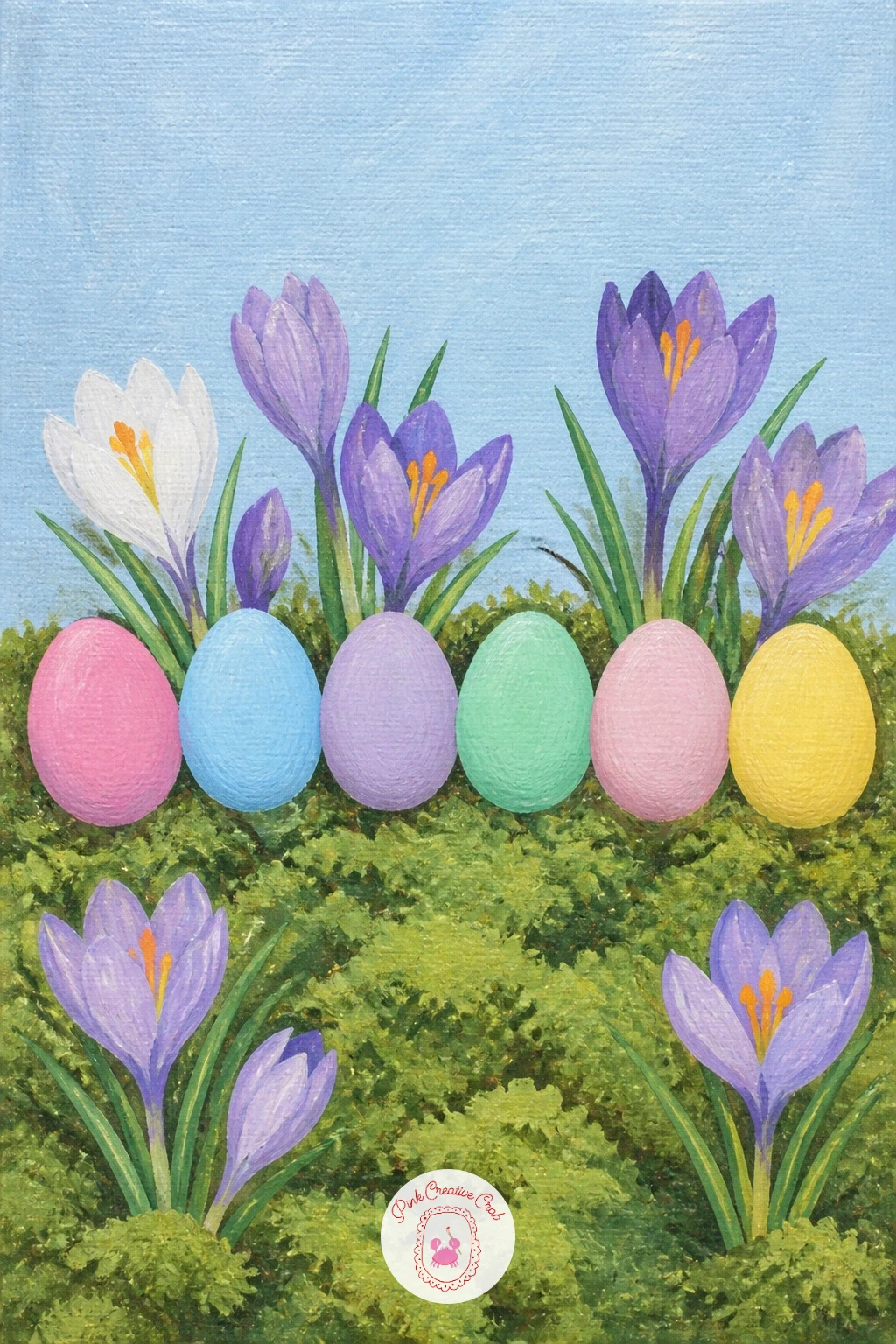
Palette: Pastel Pink,Pastel Blue,Pastel Lilac,Pastel Yellow
End the list with a bicycle basket full of tulips and painted eggs, a charming closing scene that only needs the basket and a hint of the bicycle rather than the whole frame. Paint just the front wheel and handlebar curve suggested at the lower edge of the canvas, keeping the metal a simple pale grey-blue line, then build the woven basket above it using the same dry cross-hatch texture from the very first basket idea.
Fill the basket generously with tulips in every pink and yellow tone used across this whole list, letting a few stems spill playfully over the basket’s rim, and tuck three or four small painted eggs among the blooms as a last bright accent.
If the bicycle parts pull too much attention, push their color even paler and let the tulip basket stay the one saturated, confident shape on the canvas.
No metal grey mixed: a soft black lightened with plenty of white gives the same quiet bicycle tone.
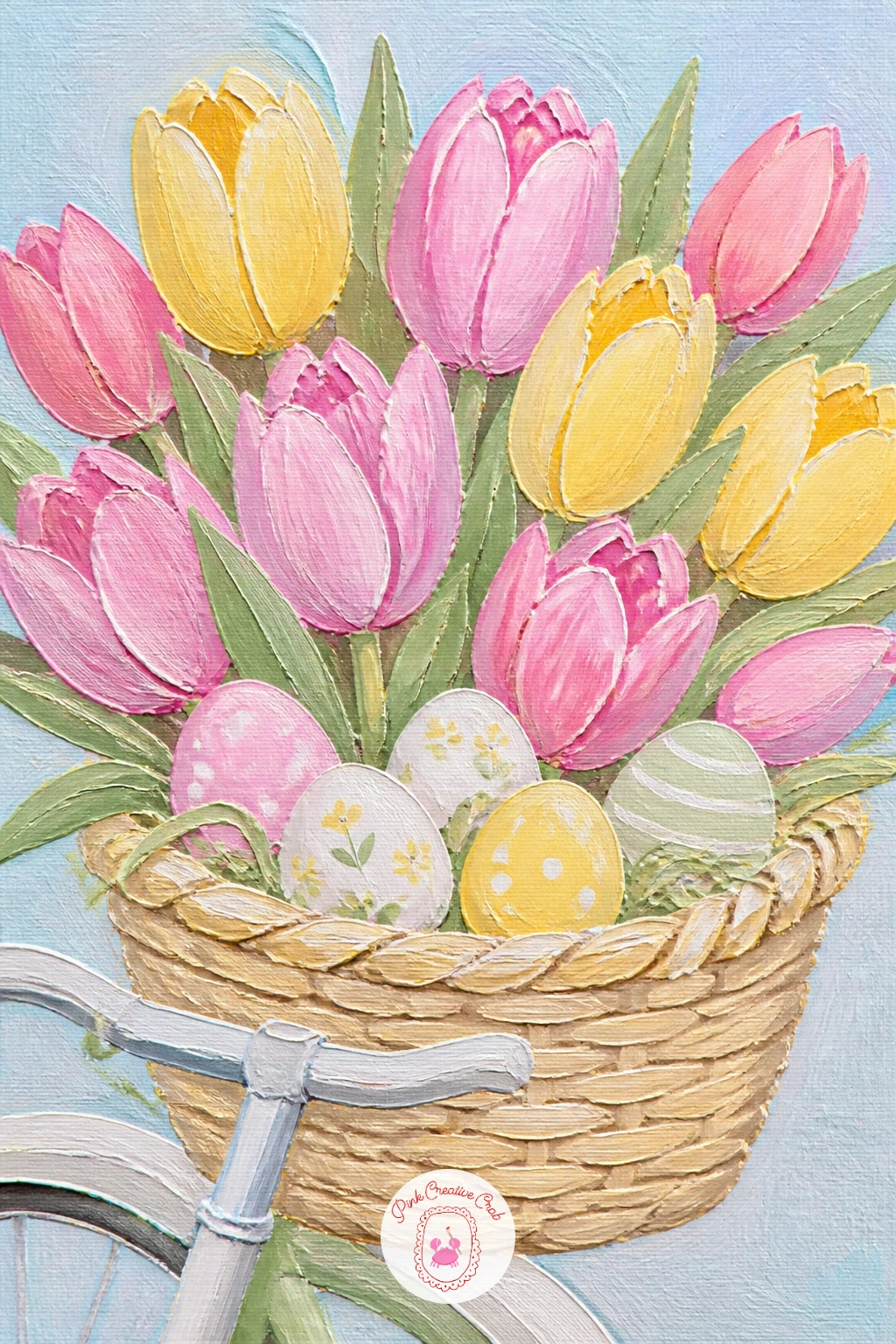
Palette: Tulip Pink,Pale Yellow,Warm Brown,Pale Grey Blue
Paint this one as the last in a series and it makes a lovely finishing piece for a little spring gallery wall alongside the lily vase and the tulip bouquet from earlier in the list.
What to Do Next
Pick whichever idea matches the canvas already sitting on your table, mix your pastel palette first so you are not stopping mid-flower to blend more paint, and work from the largest shapes down to the smallest highlight. If this is your first Easter still life, start with the lily vase or the daffodil bouquet before moving on to the fuller baskets and nests further down the list.
Frequently Asked Questions
What is the easiest way to start easter paintings if I have never painted flowers before?
Start with a single simple flower in a plain vase, like the white lily idea, before trying a busier still life. Block in large flat shapes first and add detail only once those shapes feel right.
What size canvas works best for these easter paintings?
A small canvas around eight by ten inches suits every idea on this list and keeps each piece finishable in one sitting. Larger canvases work too, just scale up the color blocks rather than adding extra detail.
How do I keep the pastel colors from looking muddy?
Mix each pastel from a small amount of color lightened gradually with white rather than adding white to a dark mix. Clean your brush fully between colors so pink does not creep into blue or lilac.
Do I need fine detail brushes for painting eggs and small flowers?
A small round brush and a thin liner brush cover nearly everything on this list, from egg highlights to tiny painted motifs. A dry, barely loaded brush handles moss, wool and hyacinth texture without any specialist tools.
How long does one of these easter paintings usually take to finish?
Most of these ideas finish in thirty to forty minutes once the palette is mixed, with simpler single-subject pieces closer to ten. Blocking in shapes first and adding detail last keeps the whole process quick and calm.
Have any thoughts?
Share your reaction or leave a quick response — we’d love to hear what you think!
-
 0
-
 0
-
 0
-
 0
-
 0
-
 0
