City landscape painting gives you a whole world of rooftops, bridges and corner cafes to work through without ever leaving your table, and gouache is the perfect tool for it. Flat, confident shapes and crisp edges turn even a busy street into something graphic and calm, and the matte finish reads beautifully whether you are painting a Paris chimney pot or a Hong Kong balcony strung with laundry.
Below are 28 views from rooftops, balconies, bridges and street corners around the world, each one built for a single sitting. Work through them in order if you like, from the simplest shapes to the busier scenes, or just pick whichever skyline is calling to you today.
Using these images: free for personal projects such as printing, coloring, cards, journals and gifts. Handmade items that include them may be sold up to 30 pieces per design. More than that is commercial use and is not permitted, and neither is selling or sharing the images themselves or passing them off as your own. Please ask before any other use.
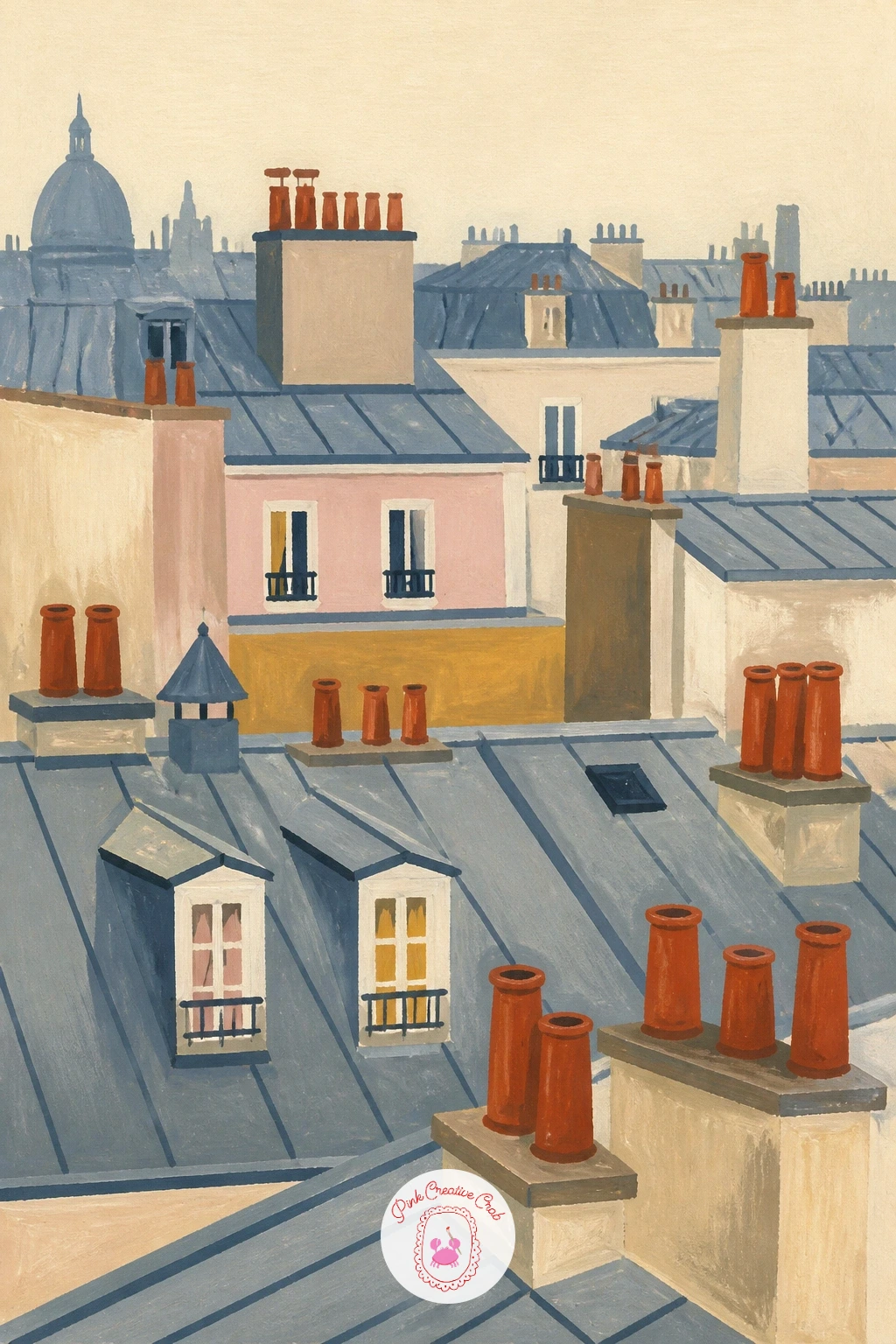
Start the whole set with a rooftop view over grey zinc roofs and chimney pots, since it is mostly flat shapes with no figures to worry about yet. Block in a soft cream sky first, then lay the roof planes in dusty blue grey, keeping every roof edge a straight ruled line against the sky.
Paint the chimney pots as small dark rectangles with a lighter cap on top, placed at slightly different heights along the roofline so nothing feels too even. Work largest shapes to smallest: sky, then roof planes, then chimneys, then the thin wires or aerials last with a fine brush.
If the roofs start looking flat and samey, vary just two or three with a warmer grey or a touch of mustard to suggest old tile among the zinc. If you do not have a ruler for the roof edges, the spine of a sketchbook or a bit of washi tape held taut works just as well.
Tip for today: paint the sky and all roof planes first in one sitting, then come back fresh for the chimney details so the shapes stay crisp.
Palette: Payne’s Grey,Dusty Blue,Soft Cream,Mustard
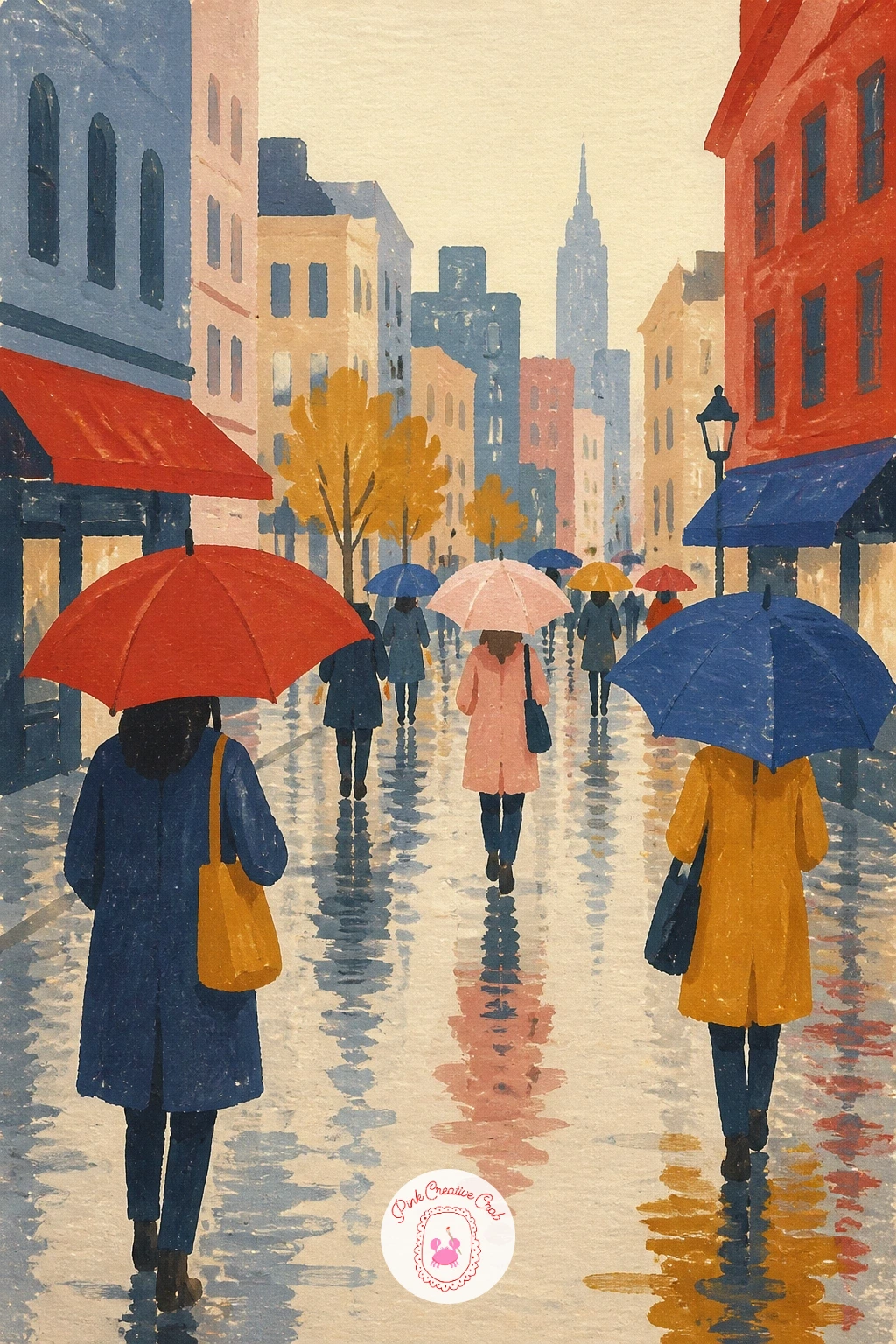
Move from rooftops down to street level with a rainy city street full of umbrellas reflected on wet pavement. Lay the pavement first as one long cream to grey shape, then paint each umbrella as a simple dome in brick red, mustard or dusty blue, spaced unevenly so the crowd feels natural.
Add the reflections last, as softened mirror shapes directly under each umbrella, slightly stretched and a touch darker than the umbrella itself. This is where the eye naturally wants to measure: keep every reflection the same width as its umbrella and just taller, so the wet pavement reads as instantly as the umbrellas above it.
If the reflections turn muddy, wipe the brush almost dry and pull one clean stroke down from each umbrella rather than scrubbing. No masking fluid on hand: paint around the lightest puddle highlights instead of lifting them out.
Finish with a few tiny dark figures under the umbrellas for scale, added only once the shapes above are dry.
Palette: Brick Red,Mustard,Dusty Blue,Payne’s Grey
For more wet street atmosphere in this style, the ideas in this rainy day painting roundup make a good companion session.
Bring in water and light with a stone bridge over a river at dusk, lights just coming on along its length. Paint the dusk sky first as a blush pink to dusty blue gradient, then the bridge as a confident dark silhouette of simple stone arches sitting across it.
Work the river next, a flat dusty blue band under the bridge, then add the lit windows and lamp posts as small warm mustard dots once everything else is dry. This is the idea to practice light direction on: decide the lamps sit along the bridge rail, keep every glow the same warm color, and let the river carry just a few vertical streaks of that same mustard as reflection.
If the dusk sky muddies where pink meets blue, blend the two while both are still wet rather than going back in later. No fine liner brush for the lamp dots: the tip of a round brush loaded lightly works just as well.
Keep the arches simple and the glow small, since a few confident lights read better than many faint ones.
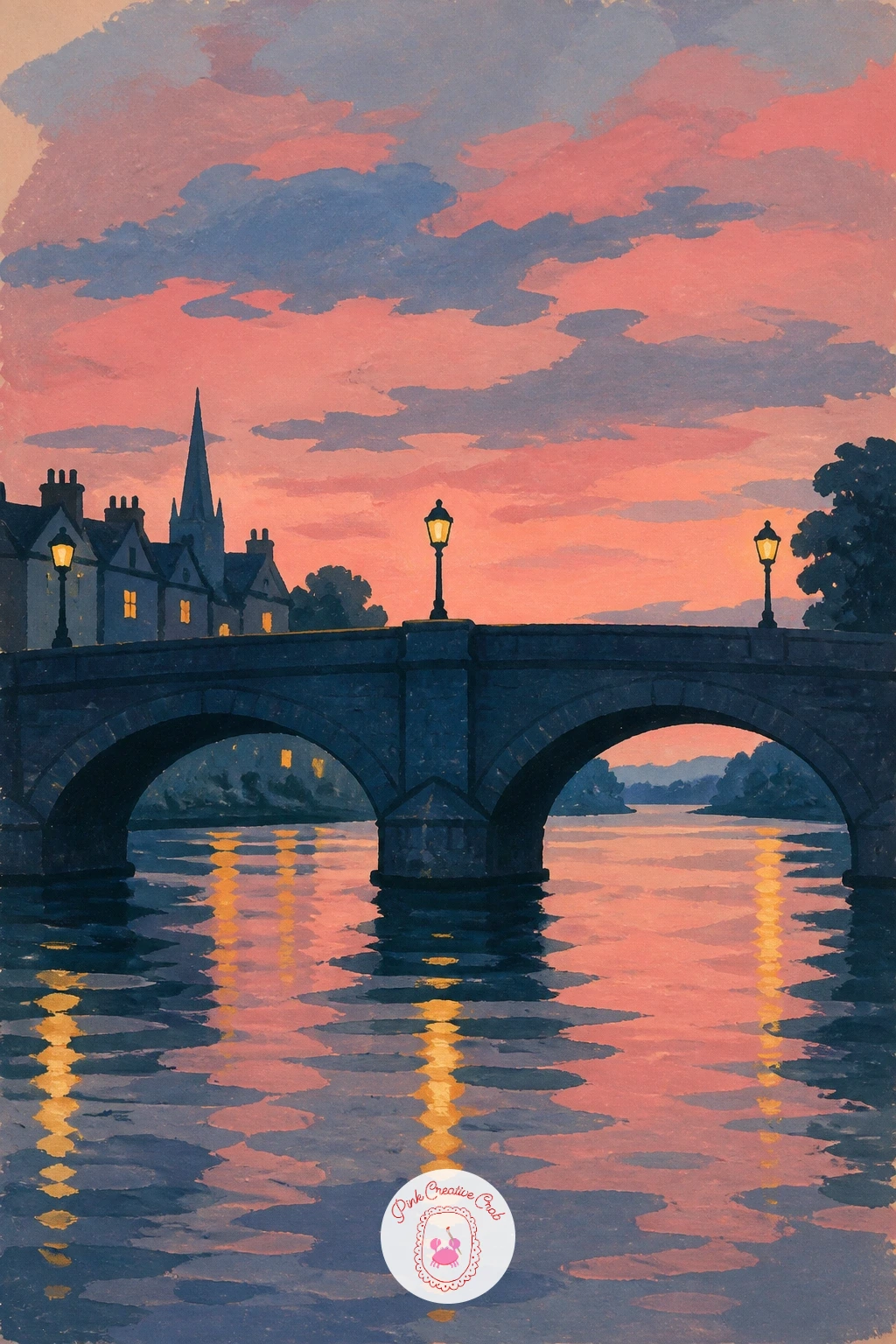
Palette: Blush Pink,Dusty Blue,Mustard,Payne’s Grey
After two quiet scenes, add some motion with a yellow taxi crossing a busy avenue between tall buildings. Block the towers first as tall flat rectangles in two or three close shades of dusty blue and cream, keeping every edge ruler straight to read as glass and stone.
Paint the road as a wide grey band, then drop the taxi in as the one bright mustard yellow shape in the whole painting, slightly angled to suggest it crossing rather than parked. Scale is the trick here: make the taxi no taller than a single ground floor window on the buildings behind it, or the whole street will feel like a toy town.
Add a crossing stripe or two under the wheels and a couple of tiny pedestrian shapes at the curb last, once the taxi is dry. If mustard yellow is not in your gouache set, warm ochre or a touch of cadmium yellow mixed with a little red gets you there.
Keep every other color muted so the taxi stays the one thing the eye lands on first.
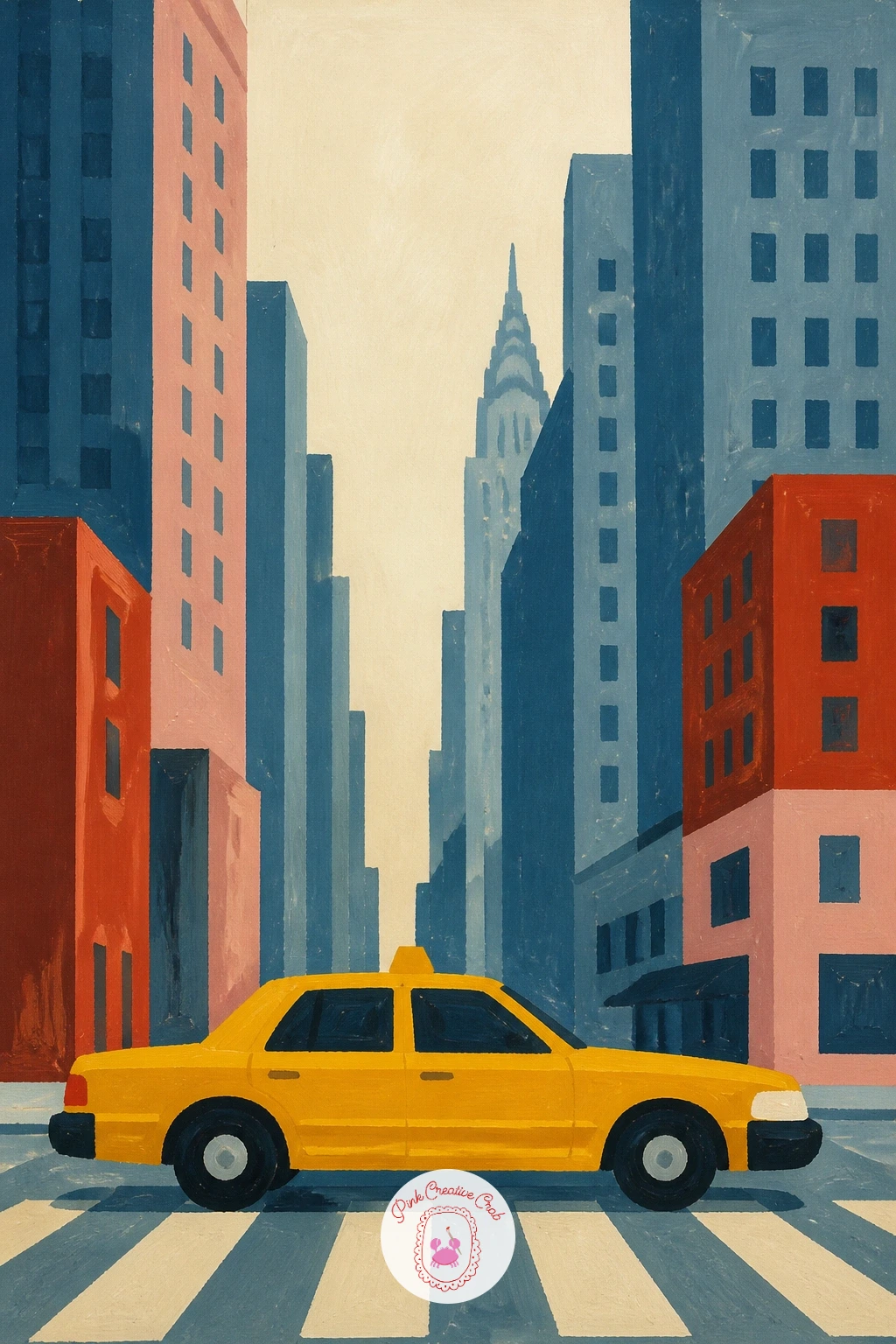
Palette: Mustard,Dusty Blue,Soft Cream,Payne’s Grey
Climb a hill next with a row of colorful townhouses on a steep street with a cable car running up through it. Paint the townhouses as a stack of simple rectangles in brick red, mustard and blush pink, each one sitting slightly higher than its neighbor to sell the slope.
Run the cable car tracks as two thin parallel lines angled up the hill, then paint the cable car itself as a small boxy shape sitting on them, roughly a third of the way up the street. The quick version in ten minutes stops right there with flat facades and the car; the forty minute version adds shuttered windows, a string of cable overhead and a tiny figure waiting at the bottom stop.
If the houses start to lean oddly, check that every roofline and every window stays parallel to the slope of the street, not to the edge of your paper. Swap a ruler for a torn strip of card held against the slope if you need a quick straight guide.
Finish with one warm lamp glow in a window for a lived-in feel.
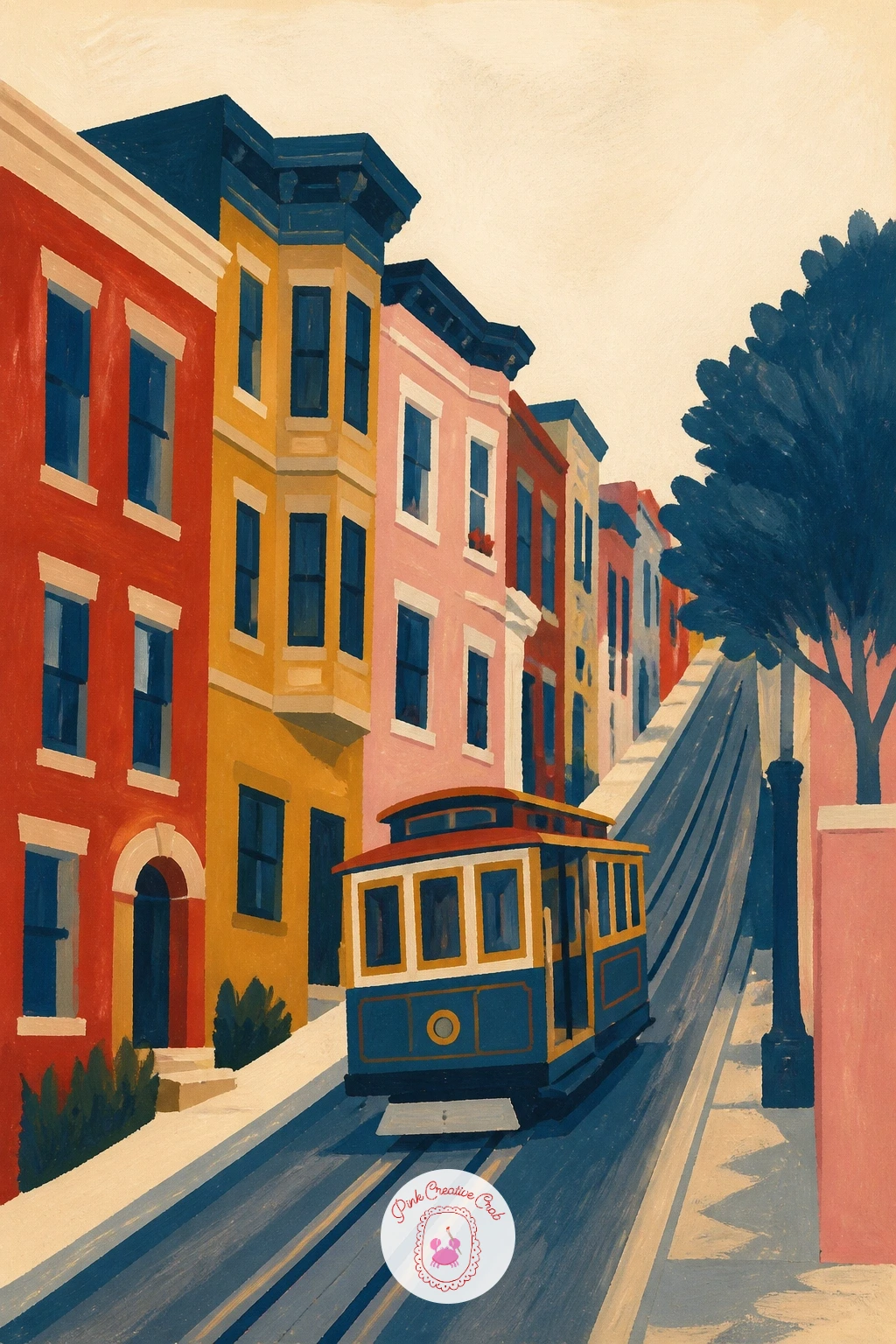
Palette: Brick Red,Mustard,Blush Pink,Payne’s Grey
Open the paper up wide for a city skyline reflected in a harbor at sunset. Lay the sky first in soft blush pink fading into dusty blue near the top, then silhouette the skyline as a row of flat dark shapes of varying height against it.
Paint the water as a near mirror of the skyline below the waterline, but softened and slightly rippled with a dry brush dragged horizontally, rather than a perfect copy. That dry brush pass is the trick to practice here: load the brush lightly, wipe most of the paint off on scrap paper, then skim it sideways so the water texture breaks up without losing the reflected shapes.
If the reflection turns too solid and flat, add two or three thin horizontal cream lines across it once dry to suggest small waves. No wide flat brush for the water texture: an old credit card edge dragged through wet gouache gives a similar broken streak.
Keep the skyline simple blocks so the reflection reads clearly beneath it.
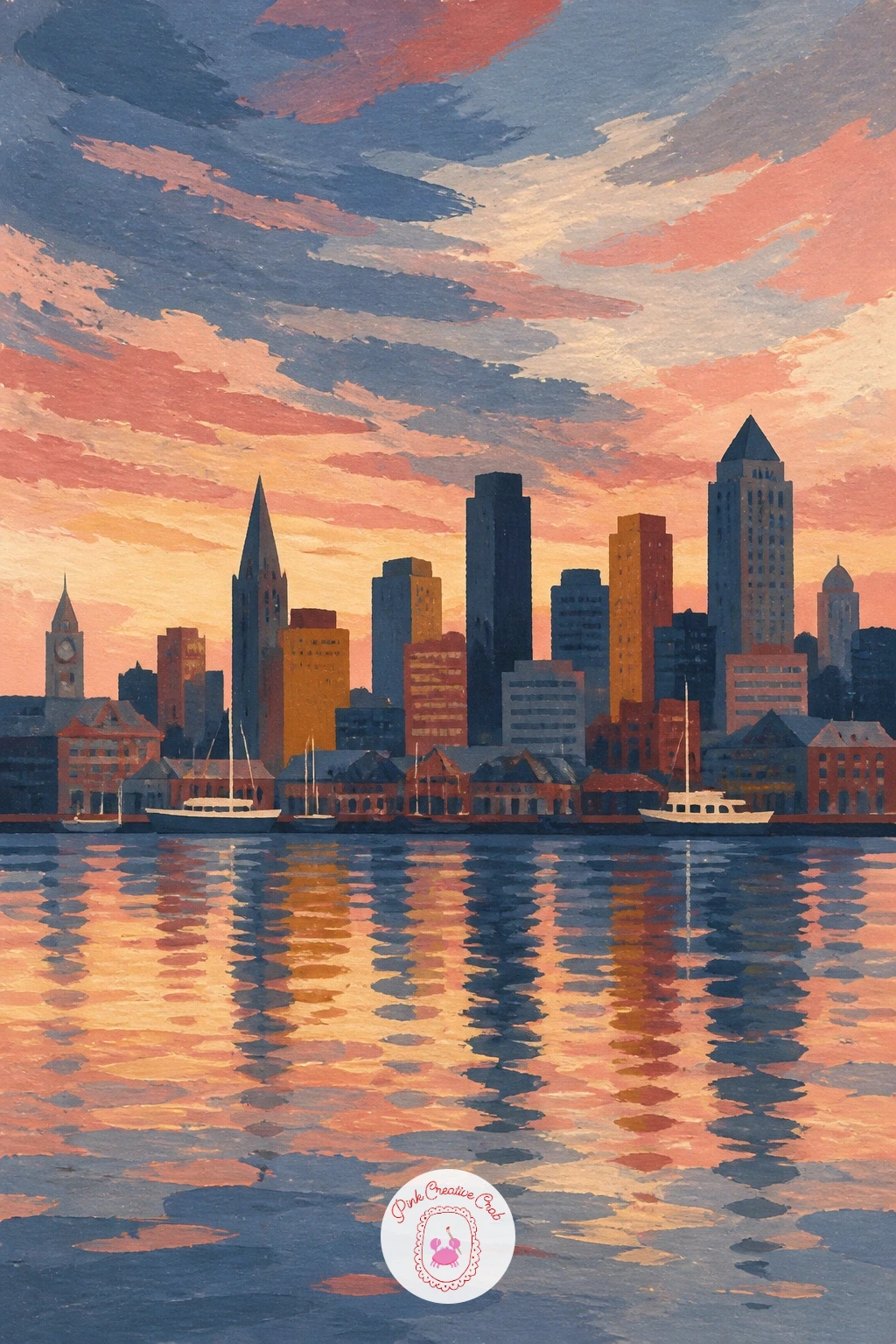
Palette: Blush Pink,Dusty Blue,Payne’s Grey,Soft Cream
Zoom right in now for a cafe corner with bistro chairs under a striped awning. Paint the awning first as a simple curved rectangle with alternating cream and brick red stripes, keeping every stripe the same width by eye or with light pencil guides underneath.
Build the bistro chairs and small round tables beneath it as a handful of simple curved line shapes, repeated three or four times at slightly different angles so they do not look stamped from one mold. Work the building wall behind in flat mustard or dusty blue last, so the awning and chairs sit forward against it.
If the stripes wobble, paint the cream base coat first, let it dry completely, then add the red stripes over the top rather than trying to paint both wet at once. No striped reference in front of you: count an odd number of stripes across the awning, five or seven, since odd numbers read more naturally than even ones.
Add one small cup or plant on a tabletop last for a lived-in feel.
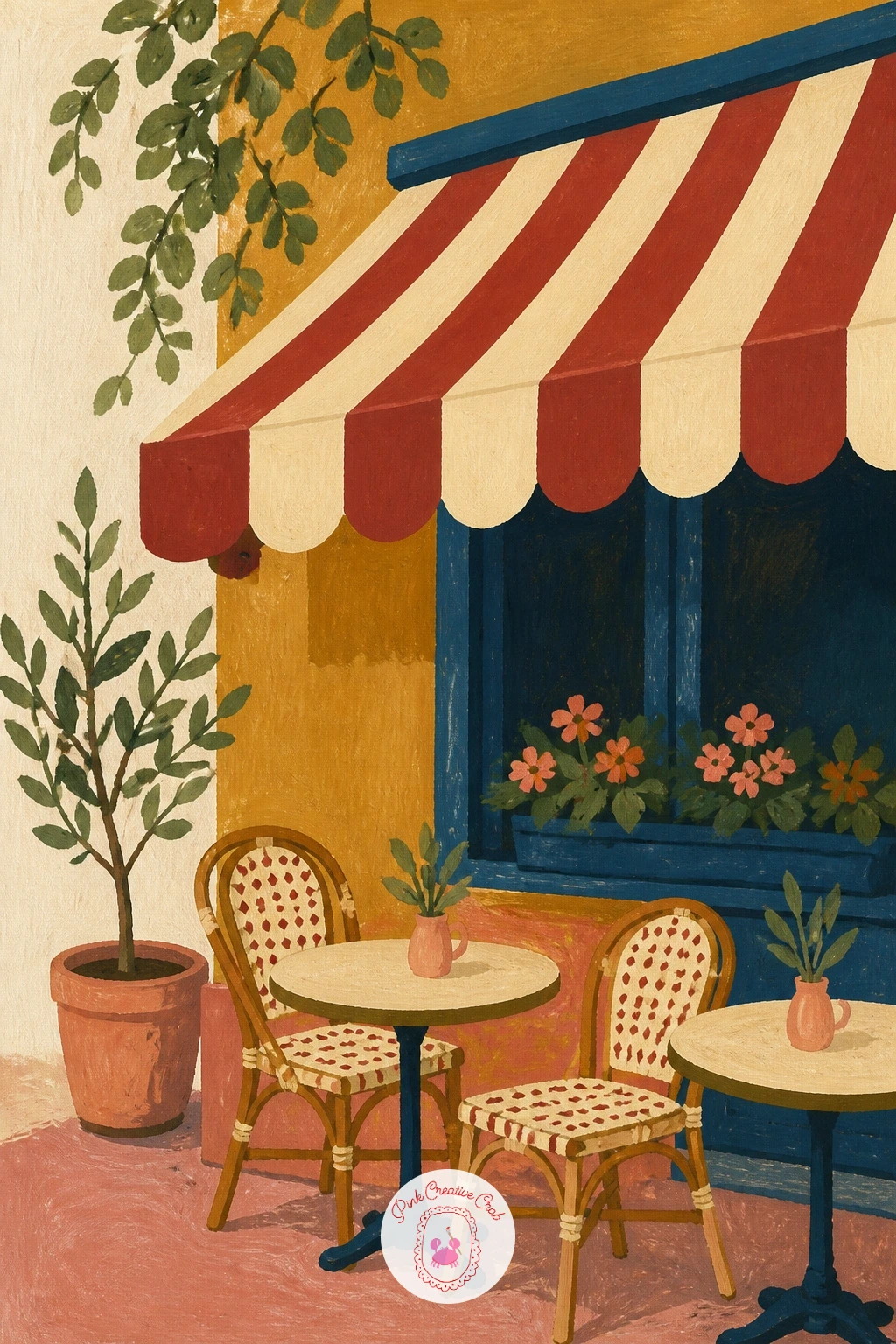
Palette: Brick Red,Soft Cream,Mustard,Dusty Blue
Shift the viewpoint to a balcony with plants overlooking a busy square, looking down and out rather than straight ahead. Paint the balcony railing and a few potted plants large in the foreground, then the square and its buildings smaller behind, since objects close to you read bigger than anything further away.
That size jump is the whole trick of this one: make the nearest plant pot roughly as tall as three or four of the distant buildings put together, and the depth will feel convincing without any other tricks. Work background to foreground so the balcony plants can overlap the square cleanly with crisp edges.
Scatter a few tiny figures and a cart or two across the square once the buildings are dry, keeping them loose dabs rather than detailed people. If your plants look stiff, vary the leaf shapes between two or three pots rather than repeating one leaf everywhere.
Finish with one bright blush flower among the greenery to pull the eye forward first.
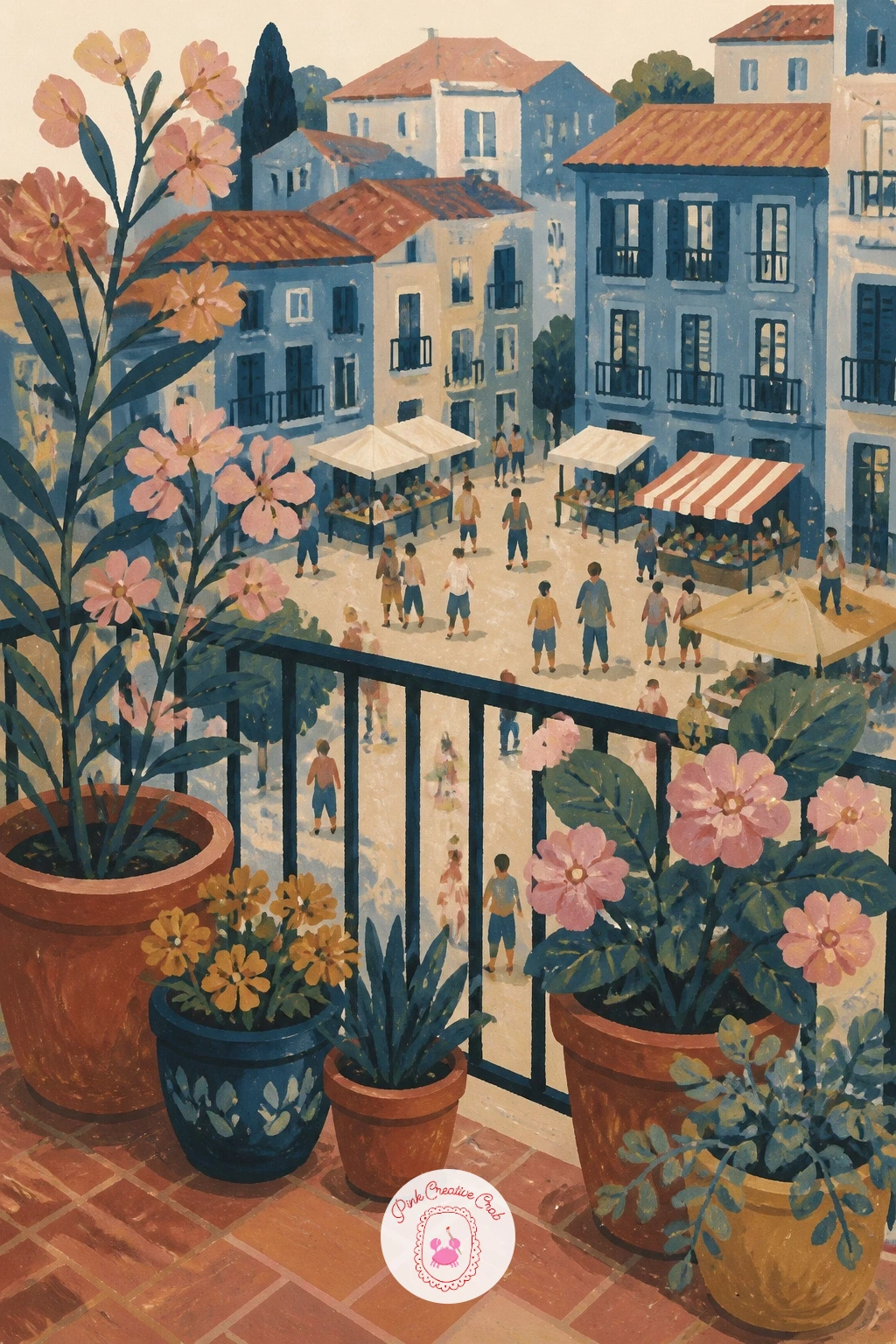
Palette: Sap Green,Blush Pink,Dusty Blue,Soft Cream
Head to a canal city of tall narrow houses with bicycles leaning along the railing. Paint the houses first as a tight row of tall thin rectangles, varying the width and color of each one, brick red next to mustard next to dusty blue, so the row reads as individual buildings rather than one block.
Run the canal as a flat band of dusty blue beneath them, then add the railing as one thin horizontal line along the water’s edge. Paint the bicycles last as small simple shapes leaning against that railing, two circles and a frame each, spaced unevenly rather than in a neat row.
If the houses start looking too uniform, give two or three slightly stepped or gabled rooflines instead of flat tops across the board. No reference for bicycle shapes: two overlapping circles with a straight diagonal line between them reads as a bike from this distance.
Keep reflections of the house colors as simple vertical streaks in the canal water.
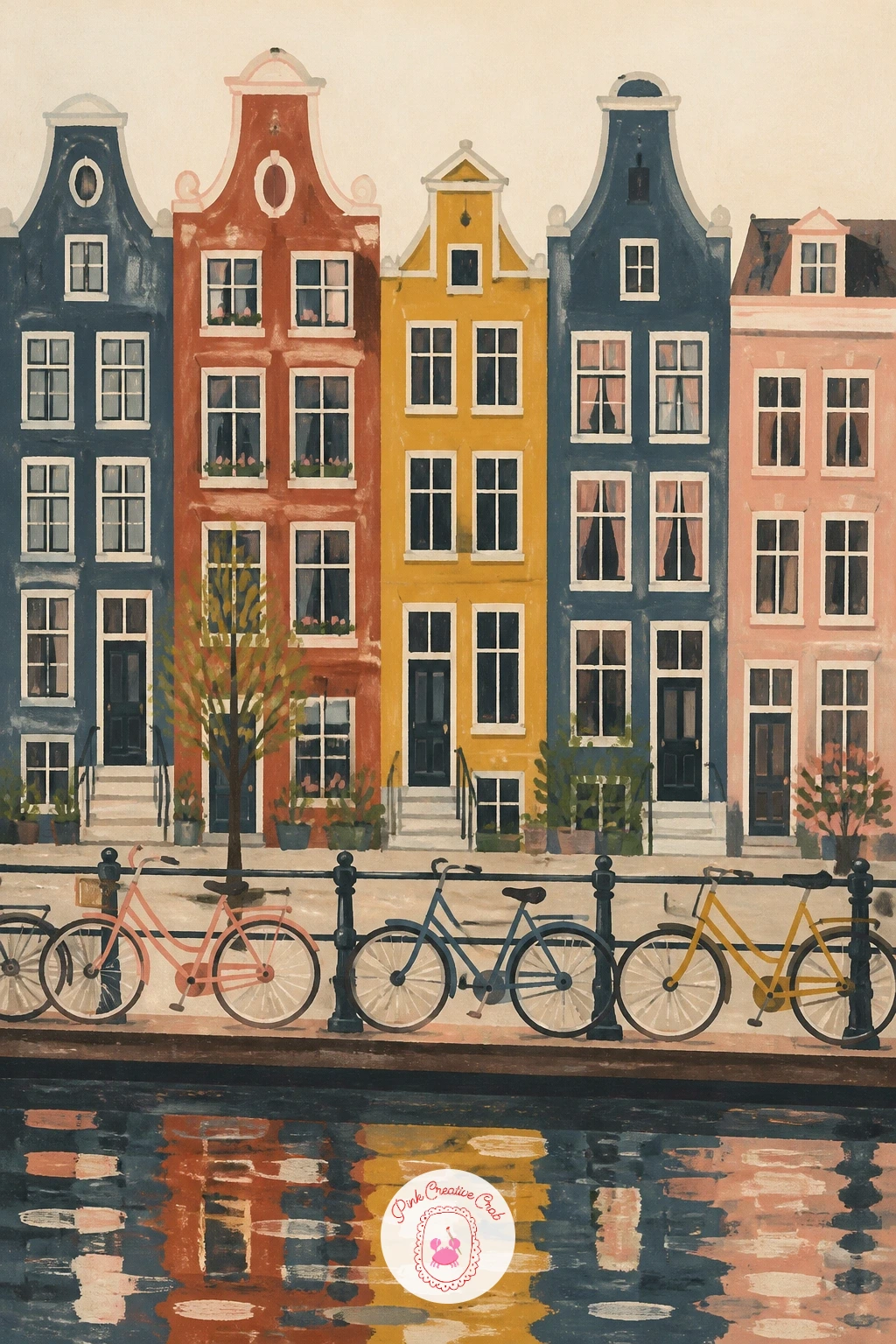
Palette: Brick Red,Mustard,Dusty Blue,Soft Cream
Bring back some motion with a red double decker bus crossing a bridge. Paint the bridge structure first as a simple flat shape, whether stone arches or steel girders, in dusty blue grey, then lay the road surface across it as a narrow grey band.
Place the bus next as a tall rectangular block in brick red, its windows a simple grid of small cream squares, positioned so it sits centered on the bridge road rather than crowding either end. Keep the bus proportion honest by checking its height against the bridge rail beside it: the bus should sit only slightly taller than the rail, never looming over the whole bridge.
Add a taxi or cyclist shape behind the bus once it is dry, smaller and set back to suggest more traffic beyond it. If brick red feels too orange next to your blues, cool it slightly with a touch of Payne’s grey before painting the bus body.
Finish with a soft sky color showing through the far end of the bridge.
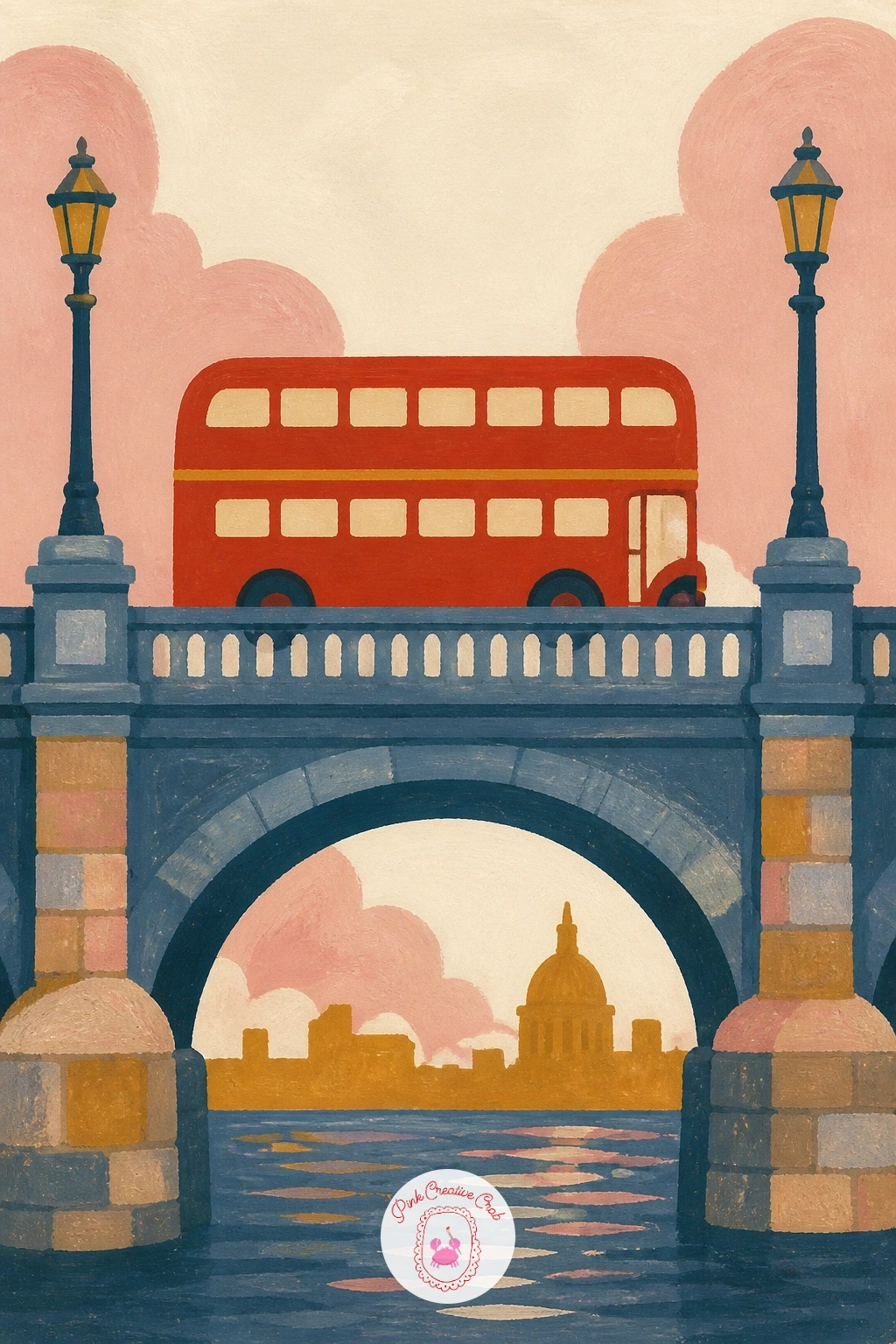
Palette: Brick Red,Dusty Blue,Soft Cream,Payne’s Grey
Give yourself a breather with a city park with joggers and skyscrapers rising behind the trees. Paint the skyscrapers first as tall flat blocks in soft dusty blue and cream, kept simple and slightly hazy so they read as background.
Layer the park trees next, rounded mustard and sap green canopies overlapping the base of the towers, with a path of cream or pale grey winding through the grass. Drop the joggers in last as small dark figure shapes mid stride, two or three scattered along the path at different sizes depending on how close they are to you.
That size change is the whole depth trick: a jogger near the front of the painting should stand noticeably taller than one further down the path, even though both are tiny. If your figures come out stiff, paint them as just two or three brushstrokes each, a lean body shape and two small leg marks, rather than trying for full detail.
Keep the skyscrapers behind the trees muted so the park stays the main event.
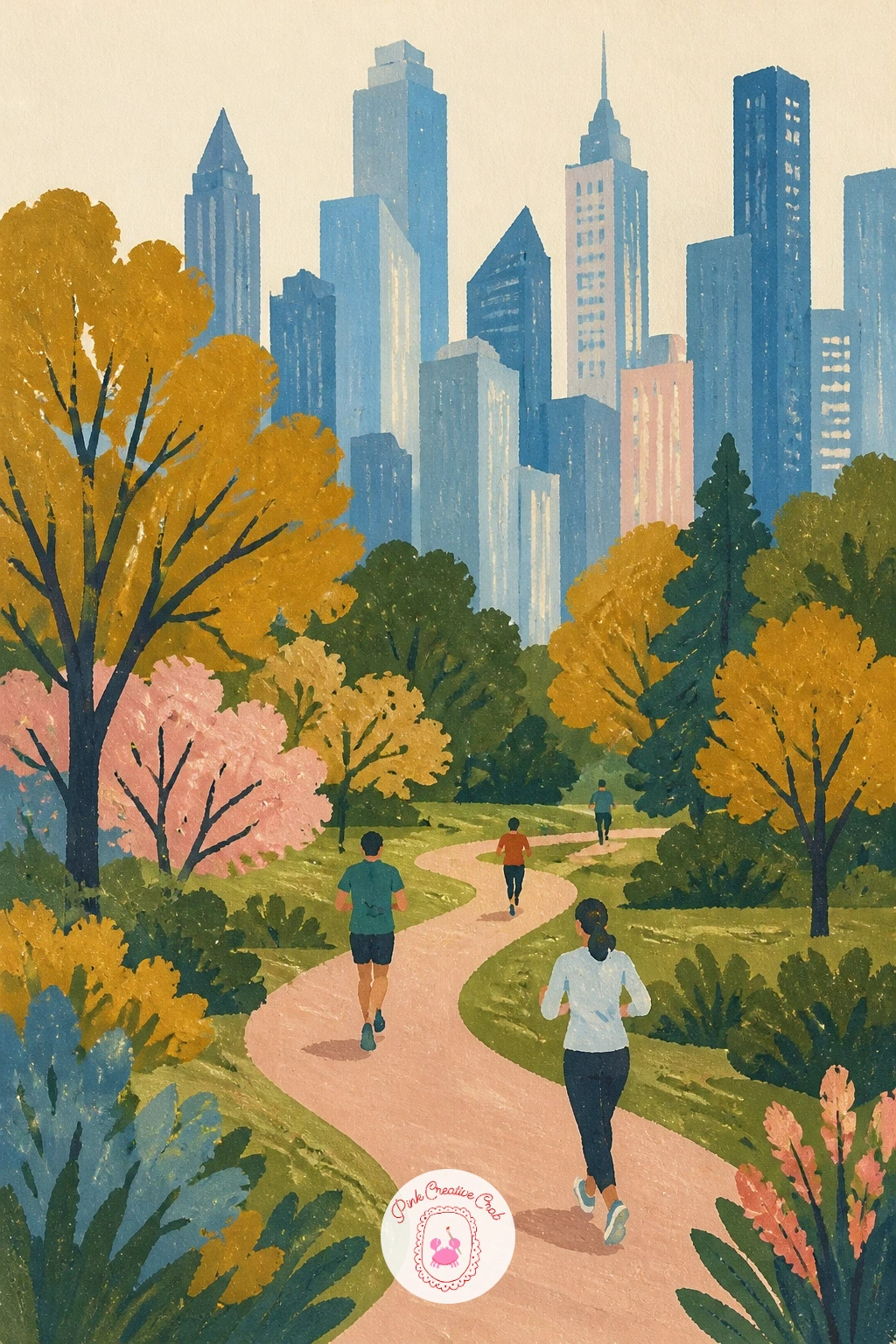
Palette: Sap Green,Mustard,Dusty Blue,Soft Cream
Return to pure architecture with a skyline of glass towers under pastel clouds. Paint the sky first in soft bands of blush pink and dusty blue, letting the colors sit side by side rather than blending too smoothly, since that flat transition is part of the modern print look.
Build the towers next as tall simple rectangles of varying height, each one a slightly different cool tone so they read as individual glass buildings rather than one wall. Add window grids as a light pencil guide first if it helps keep the small cream rectangles even across each tower face.
The ten minute version stops at flat towers and plain windows; the forty minute version adds a faint colored reflection of the pastel sky across one or two of the glass facades, painted as soft diagonal streaks once the base tower color is dry. If the window grid gets fiddly, use the edge of a small ruler or a cut strip of card to keep each row straight.
Vary tower height clearly so the skyline has a rhythm rather than one flat top line.
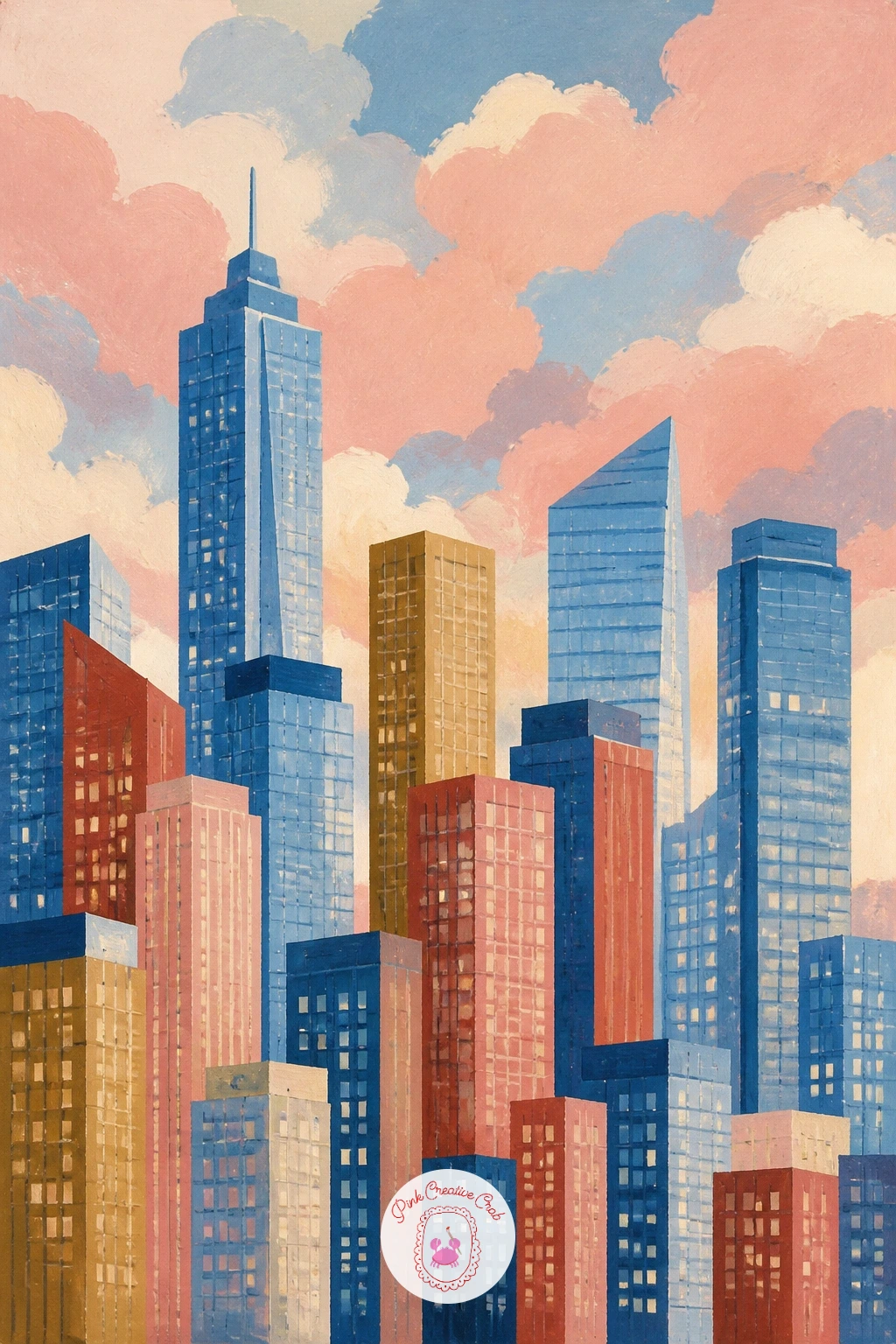
Palette: Blush Pink,Dusty Blue,Soft Cream,Payne’s Grey
Move to a hillside with an old yellow tram climbing a hilly street in Lisbon. Paint the street itself first as a steeply angled band, then the buildings on either side as leaning blocks of brick red, mustard and dusty blue that follow the same slope.
Place the tram on the tracks a little above the middle of the hill, painted as a boxy mustard yellow shape with a darker roof and a simple row of window squares along its side. Eye level matters here: since you are looking slightly up the hill, make the tram and the buildings above it a touch smaller than the buildings nearest you at the bottom of the street.
Run the overhead tram wires as one or two thin curved lines above the tram once everything else is dry, since they read best as the very last mark on the page. If mustard yellow reads too bright next to the warm wall colors, mix in a touch of Payne’s grey to dull it slightly.
Add one tiny figure waiting at a stop for scale.
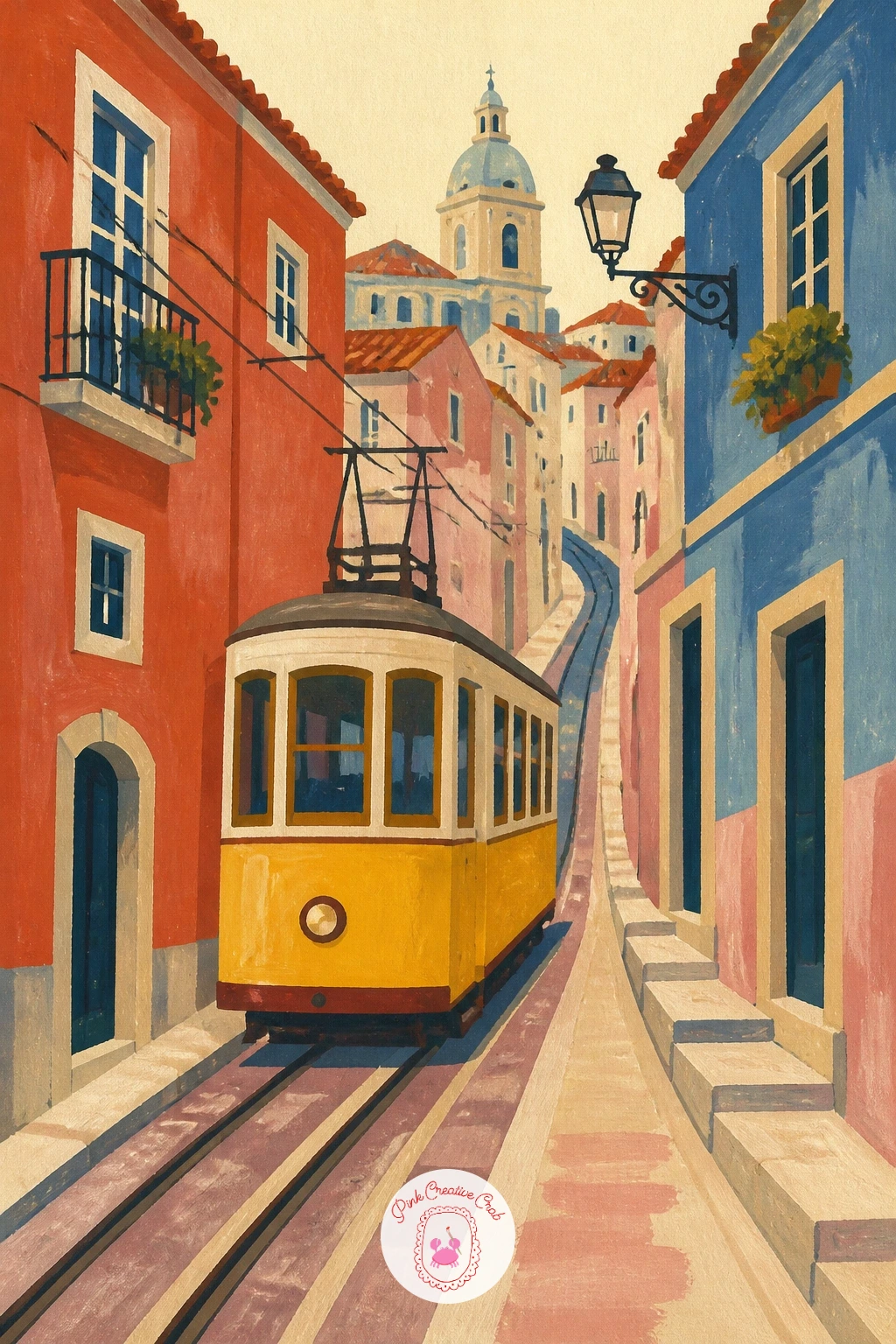
Palette: Mustard,Brick Red,Dusty Blue,Payne’s Grey
Stay up high for a city rooftop garden with string lights and plant pots. Paint the rooftop floor first as a flat warm grey or cream plane, then cluster the plant pots across it in sap green and mustard, varying their heights so the garden feels arranged rather than lined up.
Add the city buildings beyond the rooftop edge as smaller flat shapes in dusty blue, kept simple since the garden is the real subject here. Paint the string lights last as one continuous curved line looping between two points above the plants, with small mustard dots along it added once the line itself is dry.
If the dots smear into the line beneath, wait a full few minutes before adding them, or dab them with the very tip of a dry brush rather than a loaded one. No fine brush for the light dots: the end of a cotton swab dipped lightly in paint makes a clean small circle.
Keep two or three pots taller than the rest to break up the rooftop silhouette.
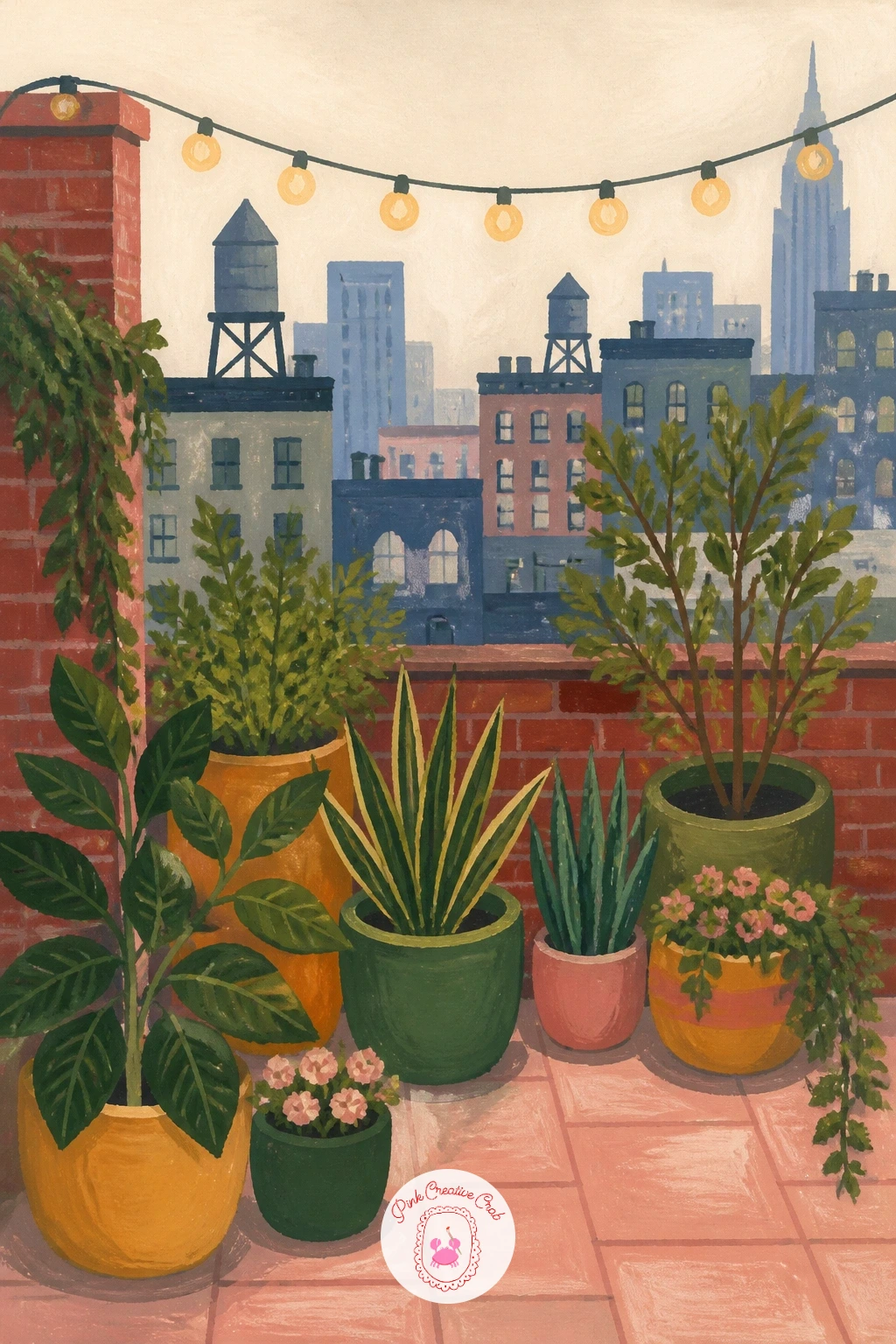
Palette: Sap Green,Mustard,Dusty Blue,Soft Cream
Zoom close in on a fire escape staircase on a brick apartment building in New York. Paint the brick wall first as one flat warm brick red plane, then build the fire escape as a stack of simple zigzag steel platforms in dusty blue grey running down the face of it.
Work top to bottom so each platform overlaps the one above it cleanly, keeping every railing line straight and every step the same width as you go. The edges of the metal are where this idea either sings or falls apart: once the blue grey dries, dry brush a touch of darker grey along one side of each rail to suggest a thin shadow edge without softening the crisp line underneath.
Drop a window or two into the brick wall behind the fire escape, lit faintly in mustard to suggest someone home. If your platforms start looking too mechanical, stagger their widths slightly rather than making each one identical.
Add a small potted plant on one landing for a lived-in touch.
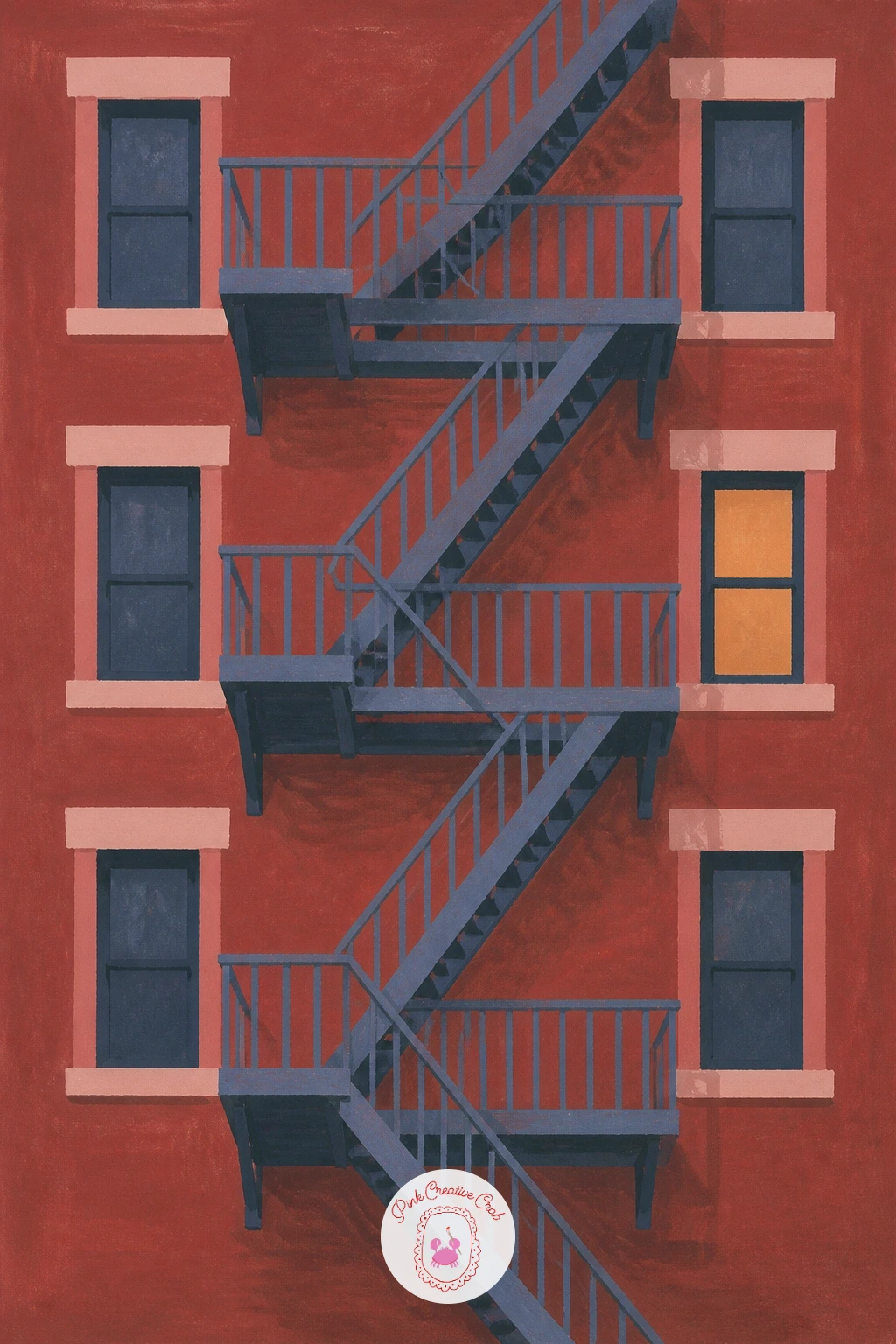
Palette: Brick Red,Payne’s Grey,Mustard,Soft Cream
Shift to a high vantage point for a city of lit windows seen from a high apartment at blue hour. Paint the whole sky and distant buildings first as one deep dusty blue wash, letting the color sit flat and even across most of the page.
Once that base is dry, add the windows across the buildings as small cream and mustard rectangles, varying which ones are lit so the pattern feels random rather than gridded. Leave plenty of buildings dark, since blue hour reads as true only when most windows stay unlit against the few that glow.
Work largest building shapes first, then drop windows into each one before moving to the next, so you are never guessing where a building’s edge falls among finished windows. If the lit windows start to look too even, group two or three close together on one floor and leave whole floors dark elsewhere.
Finish with one warm foreground window frame at the very edge of the page, slightly out of focus, to suggest you are looking out from inside.
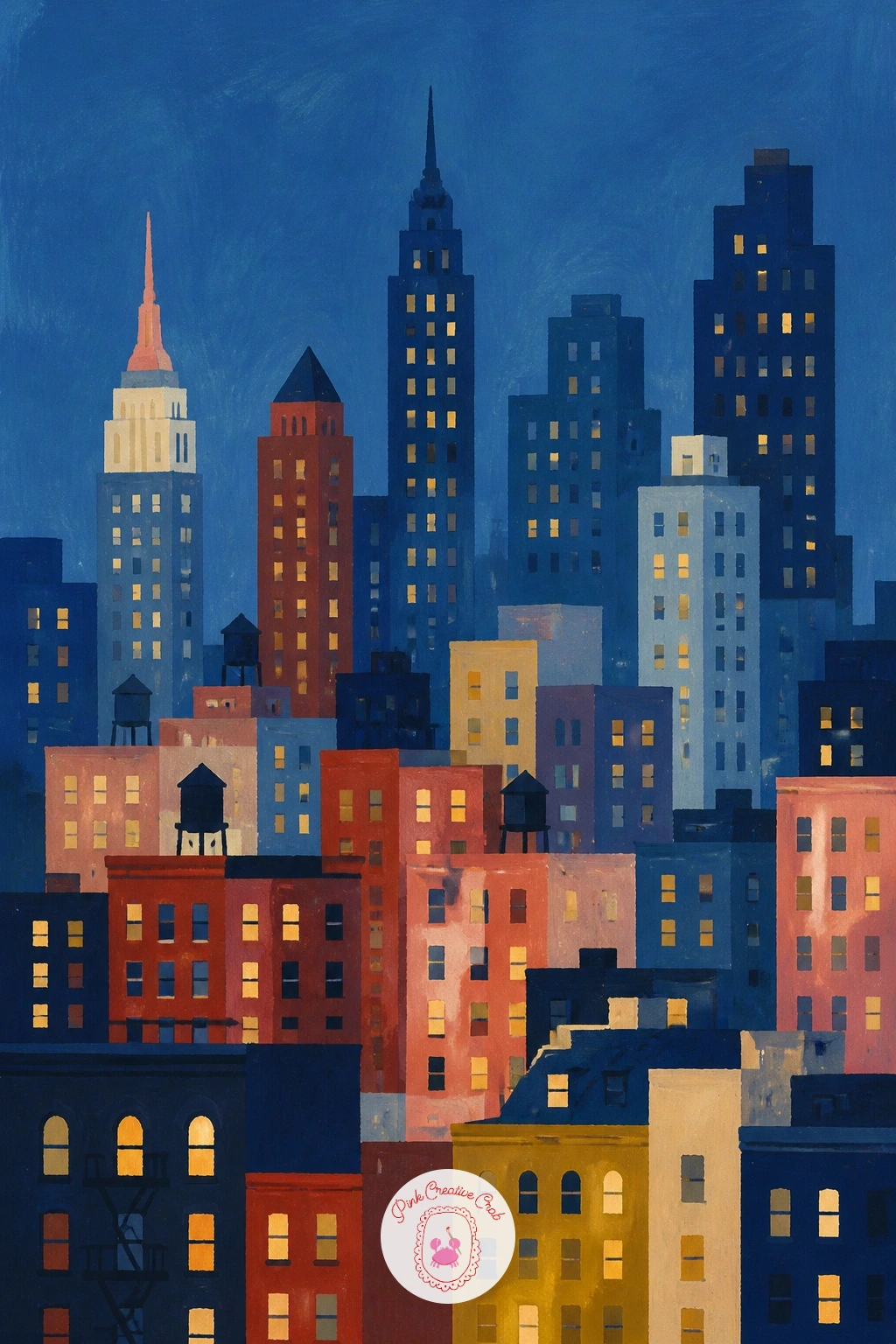
Palette: Dusty Blue,Mustard,Soft Cream,Payne’s Grey
Bring in some clutter with a Tokyo side street hung with paper lanterns and tangled power lines. Paint the narrow buildings on either side first as tall flat shapes in dusty blue and brick red, leaving a strip of cream sky visible above the street.
Add the power lines next as several thin dark lines criss crossing that sky strip at different angles, since a little visual tangle here is exactly the point. Paint the lanterns last, small glowing mustard ovals hung at a few points along the lines, each one a simple shape with no pattern needed.
If the power lines start to look too neat, draw them freehand rather than with a ruler, letting a couple sag or cross more than the others. No reference for a convincing tangle: three or four lines crossing at uneven points reads as wiring instantly.
Keep the street itself narrow and the buildings tall so the lanterns have room to glow against open sky.
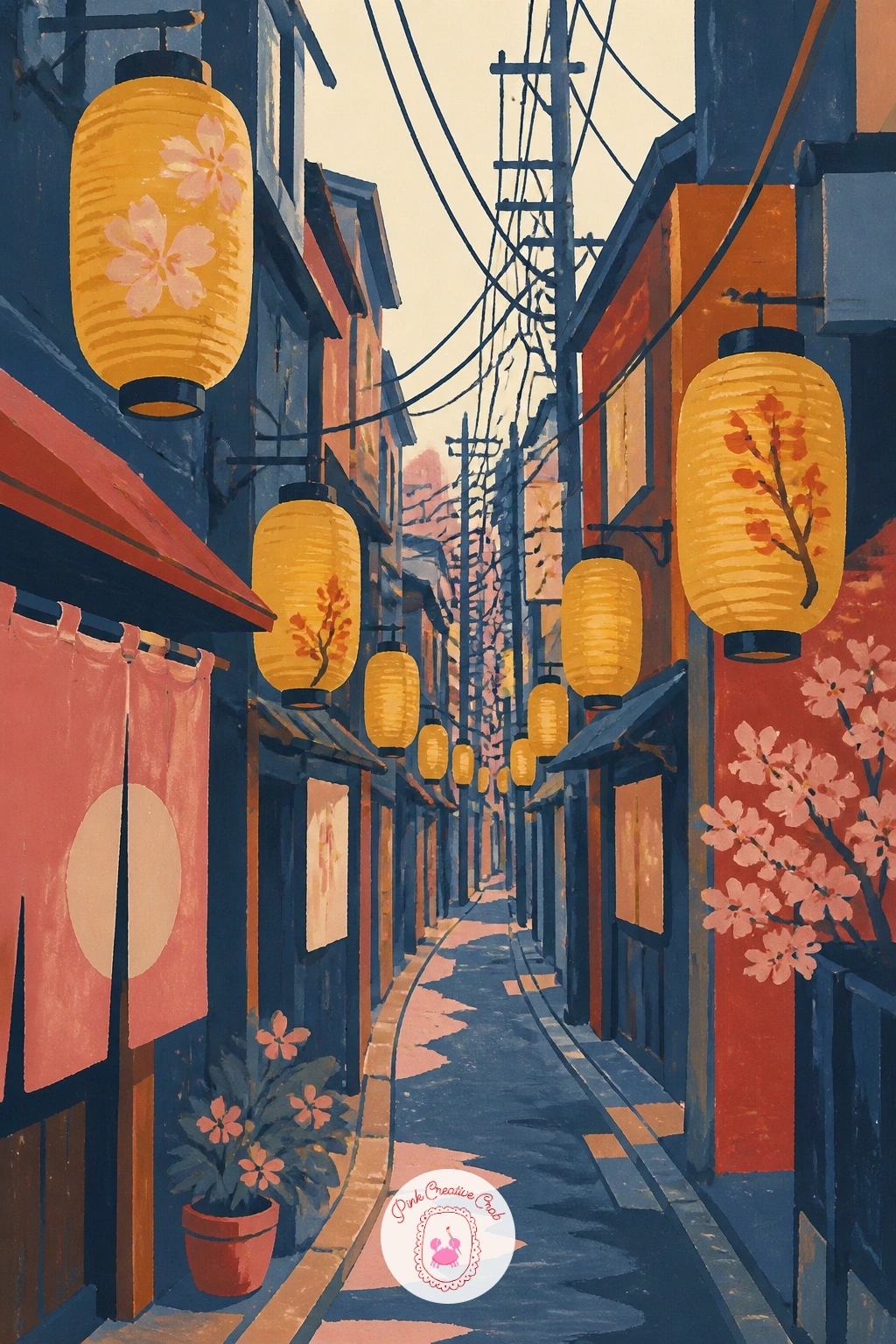
Palette: Dusty Blue,Brick Red,Mustard,Soft Cream
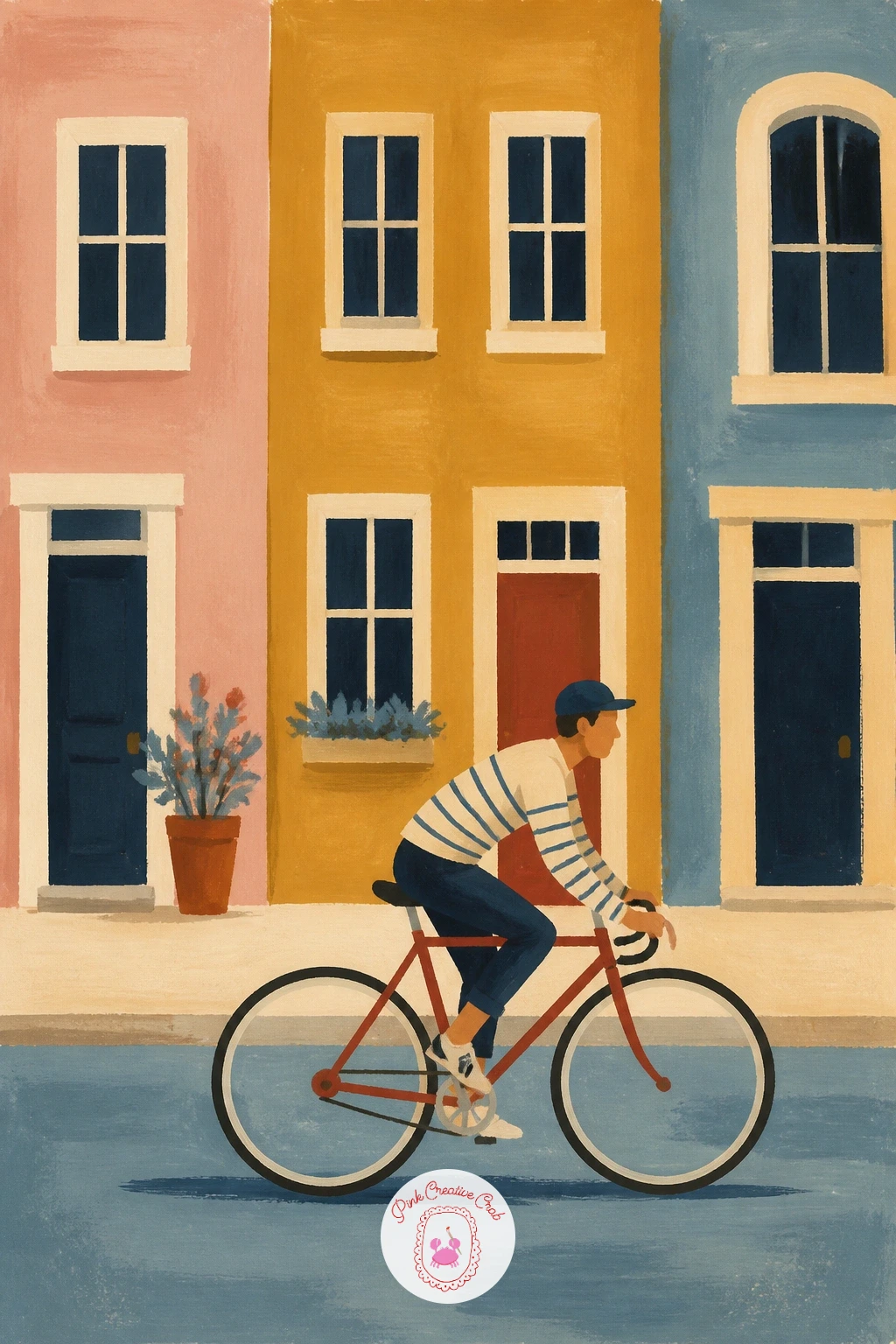
Add movement at street level with a cyclist riding past a row of pastel facades. Paint the row of buildings first, a repeating but varied line of blush pink, mustard and dusty blue fronts, each with a simple door and a window or two.
Work the cyclist next as a small confident shape, two wheel circles, a diagonal frame line and a leaning rider silhouette, placed so the bike seems to be moving across rather than sitting still. Angling the whole bike and rider a few degrees forward, rather than painting it perfectly upright, is the trick that sells the sense of motion here.
Add a basket or a small bag on the handlebars once the rider shape is dry, just a quick oval dab of mustard or brick red. If the wheels look oval instead of round, use a small coin or bottle cap to trace a clean circle before filling it in.
Keep the facades behind simple so the cyclist reads clearly against them.
You Will Need
- coin or small round object to trace wheels
Palette: Blush Pink,Mustard,Dusty Blue,Payne’s Grey
If you enjoy painting bikes in city scenes, this bicycle painting collection has more ways to pose a rider and basket.
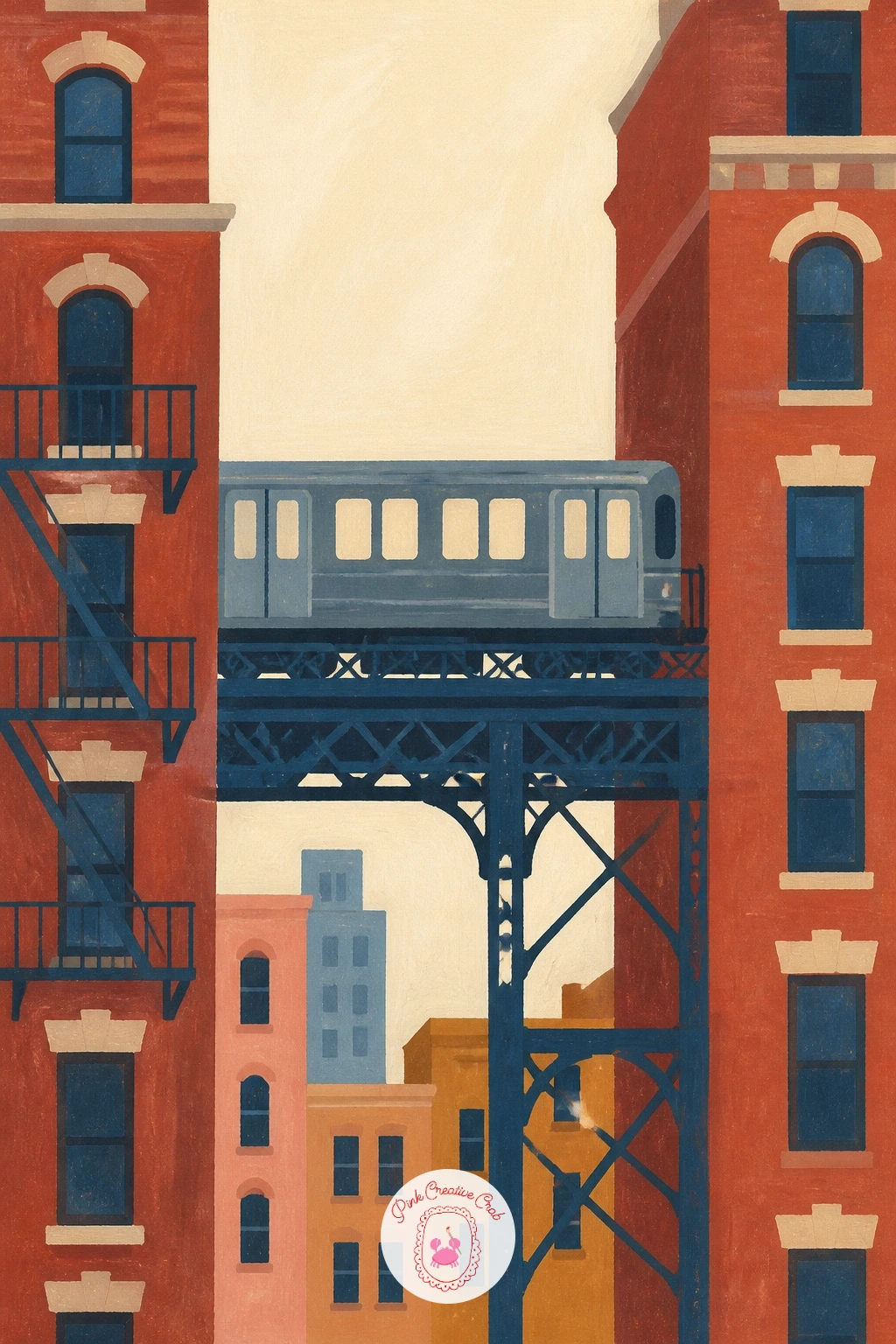
Add a different kind of motion with an elevated train passing between brick buildings. Paint the brick buildings first as tall flat shapes on either side of the page in brick red and dusty blue, leaving a clear horizontal gap between them for the tracks.
Build the elevated structure across that gap as a simple row of repeated steel supports and a flat track platform, then paint the train itself as a long rectangular block sitting on top, its windows a quick row of small cream squares. Keep every support post identical in width and evenly spaced, since that regular rhythm is what makes elevated track structure read correctly rather than looking like a random fence.
Add a little steam, dust or motion lines trailing behind the train once it is dry, just a few soft horizontal strokes in pale grey. If the repeated supports start to feel tedious to paint one by one, cut a small rectangle template from scrap card and trace it across the gap for speed.
Finish with a sliver of sky color showing through the gaps between supports.
You Will Need
- small rectangle template cut from card
Palette: Brick Red,Dusty Blue,Soft Cream,Payne’s Grey
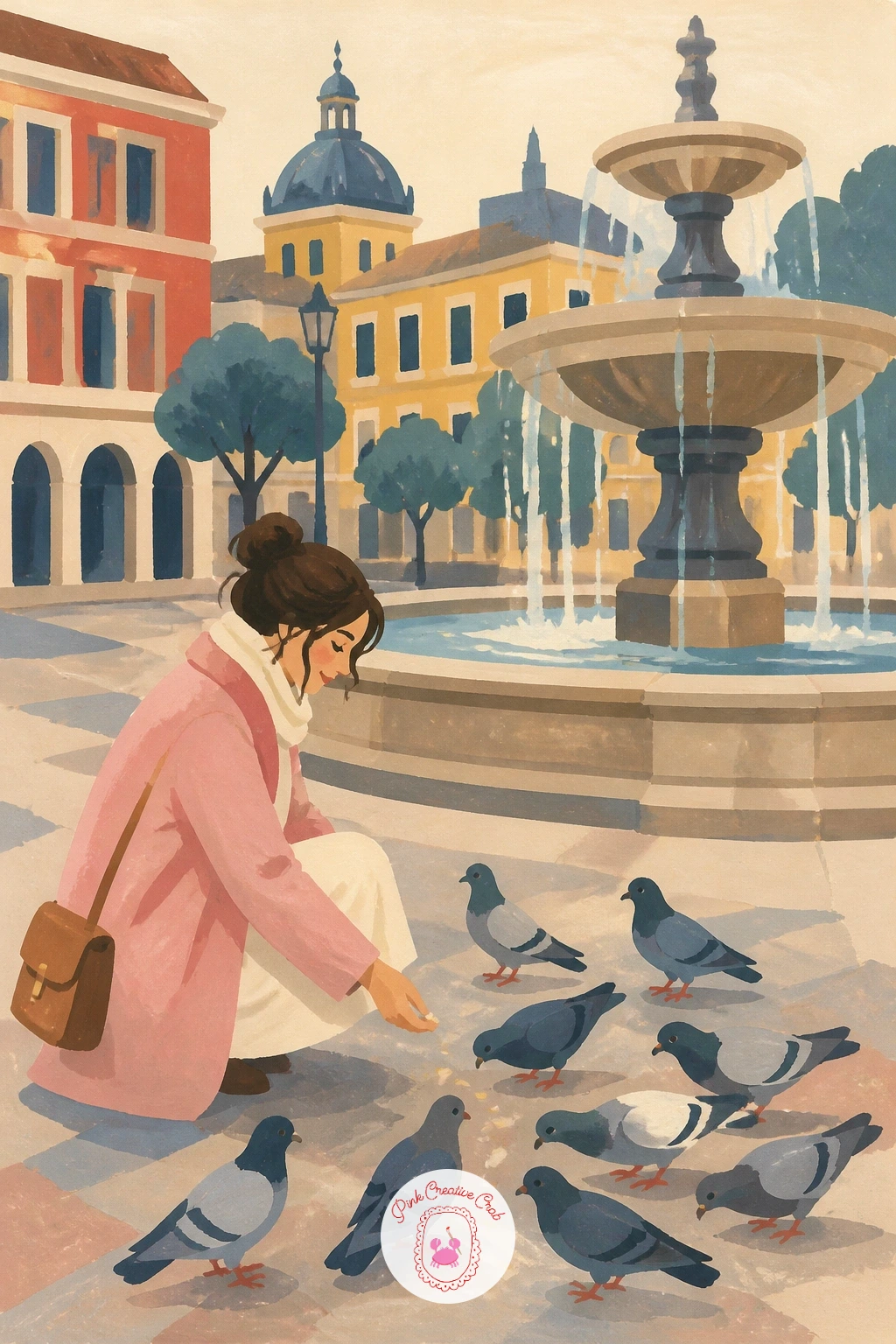
Slow the pace with a city fountain plaza with a woman feeding pigeons. Paint the plaza ground first as a wide flat cream or pale grey space, then the fountain as a simple tiered shape near the center, round basins stacked and painted in dusty blue.
Place the woman just to one side of the fountain, a simple standing figure in a blush pink or mustard coat, with a scattering of small grey pigeon shapes around her feet. Keep every pigeon roughly the same small size and shape, just a rounded body and a tiny head, so the flock reads as a group rather than individual studies.
Add buildings around the edges of the plaza last, kept smaller and simpler than the fountain and figure so the eye lands on her first. If the pigeons start to look like blobs, give two or three a tiny raised wing shape to break up the repetition.
Finish with a thin water line or two rising from the fountain top.
Palette: Dusty Blue,Soft Cream,Blush Pink,Payne’s Grey
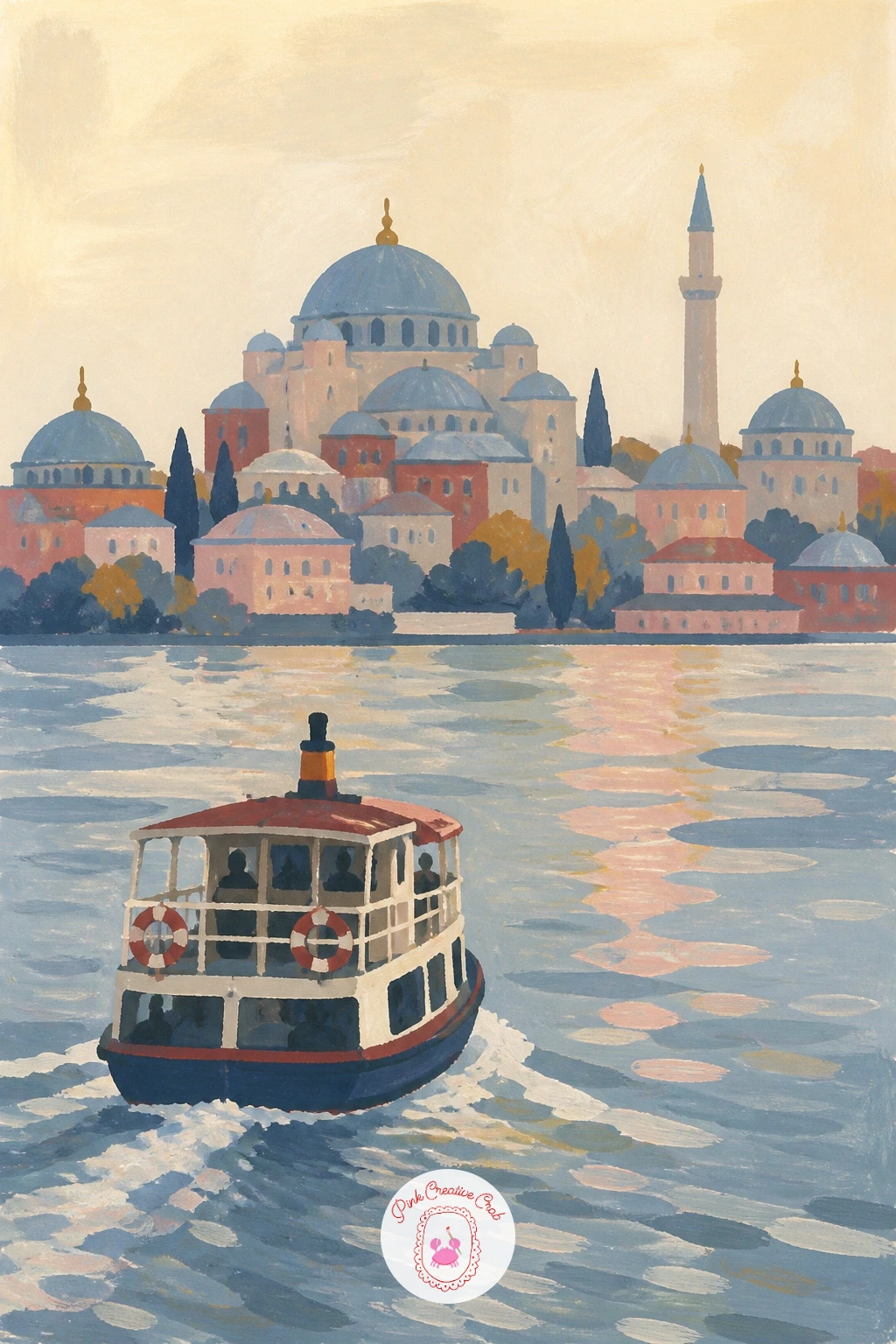
Widen the view again with a ferry crossing a wide river toward a domed city. Paint the domed skyline first and small in the distance, simple round dome shapes and a few towers in soft dusty blue, since everything far away should stay pale and simple.
Paint the river as a broad flat band taking up most of the lower half of the page, then place the ferry closer to you and noticeably larger than any building across the water. That size jump between the near ferry and the far skyline is what makes the crossing feel wide rather than cramped.
Build the ferry itself as a simple boxy hull with a cabin on top and a line of small cream windows, adding a thin trail of wake behind it in pale streaks once the hull is dry. If the domes look lopsided, trace them from a round lid or glass rather than freehanding the curve.
Keep the far shore hazy with less contrast than the ferry in front.
You Will Need
- round lid or glass to trace domes
Palette: Dusty Blue,Soft Cream,Blush Pink,Payne’s Grey
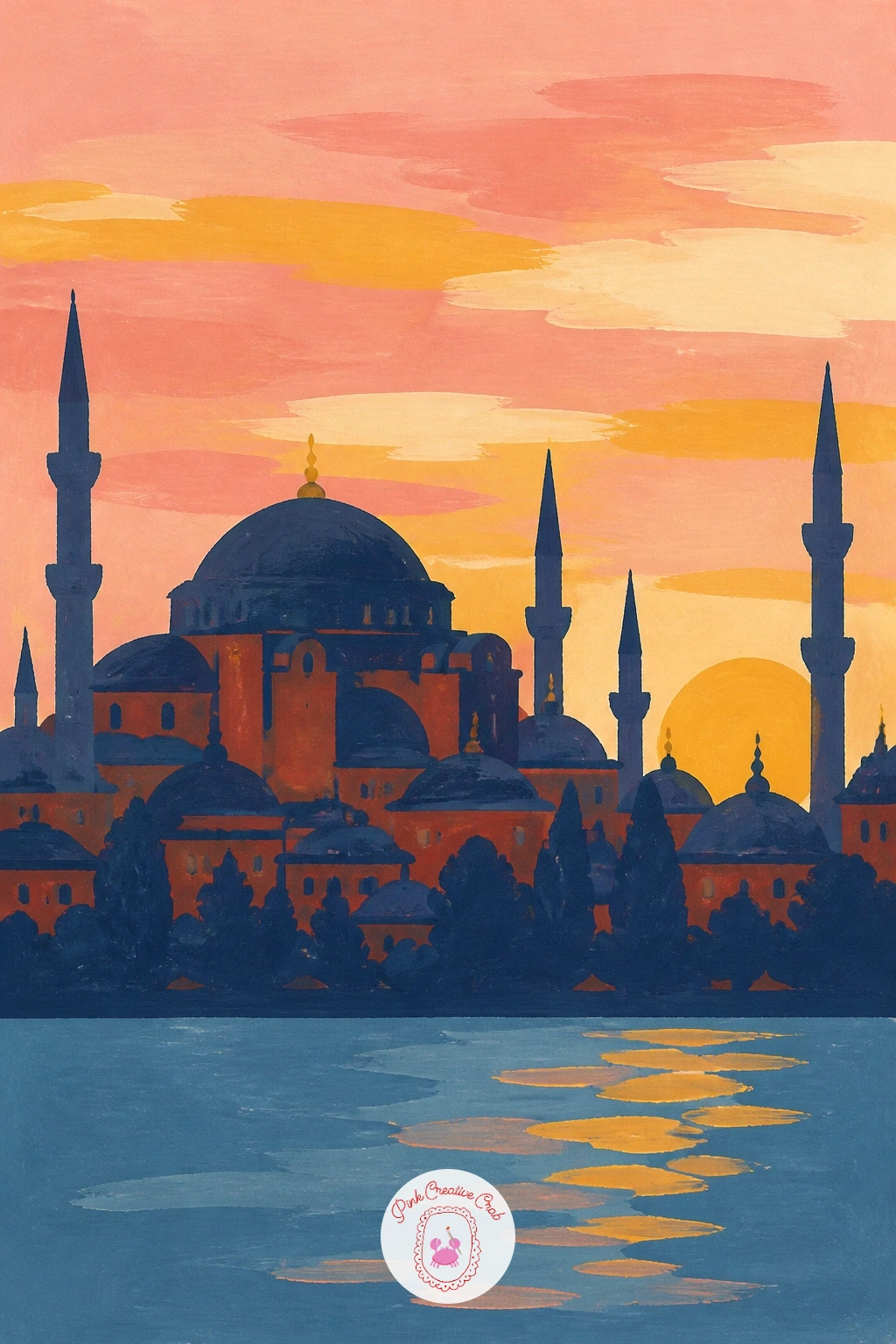
Follow that with a closer, warmer version: domes and minarets of Istanbul over the water at sunset. Paint the sky first in rich blush pink and mustard bands, letting the warm tones sit flat rather than blended into mush.
Silhouette the domes and tall thin minarets against that sky as solid dark shapes, keeping every dome a clean traced circle and every minaret a simple tapered rectangle with a small pointed cap. Vary the height of the minarets clearly against the rounder, lower domes so the skyline has a real rhythm rather than repeating one shape.
Add the water below as a flat dusty blue band with a few warm reflected streaks mirroring the sunset colors above. If the domes and minarets start blending into one dark mass, leave a thin sliver of sky color between each shape so they stay readable as separate buildings.
Keep the silhouette simple and let the sunset colors carry the whole painting.
You Will Need
- round object to trace domes
Palette: Blush Pink,Mustard,Dusty Blue,Payne’s Grey
Narrow the view right down for a narrow Venetian canal with a gondola passing under a little bridge. Paint the tall narrow houses on either side first, close together in brick red, mustard and blush pink, leaving a slim gap of cream sky above the canal.
Add the small arched bridge across the canal next, a simple curved shape in dusty blue grey, then run the water beneath it as a flat band with a few reflected color streaks from the houses above. Place the gondola last, a long thin curved hull shape with one standing figure, sized so it fits comfortably beneath the bridge arch without crowding it.
Getting the hull curve right matters more than anything else here: sketch it lightly first as a long thin crescent before committing in paint, and keep both pointed ends lifted slightly off the water. If a steady curved line is tricky with a brush, pencil the hull shape first and simply fill it in.
Finish with one small lamp glow on the bridge for evening atmosphere.
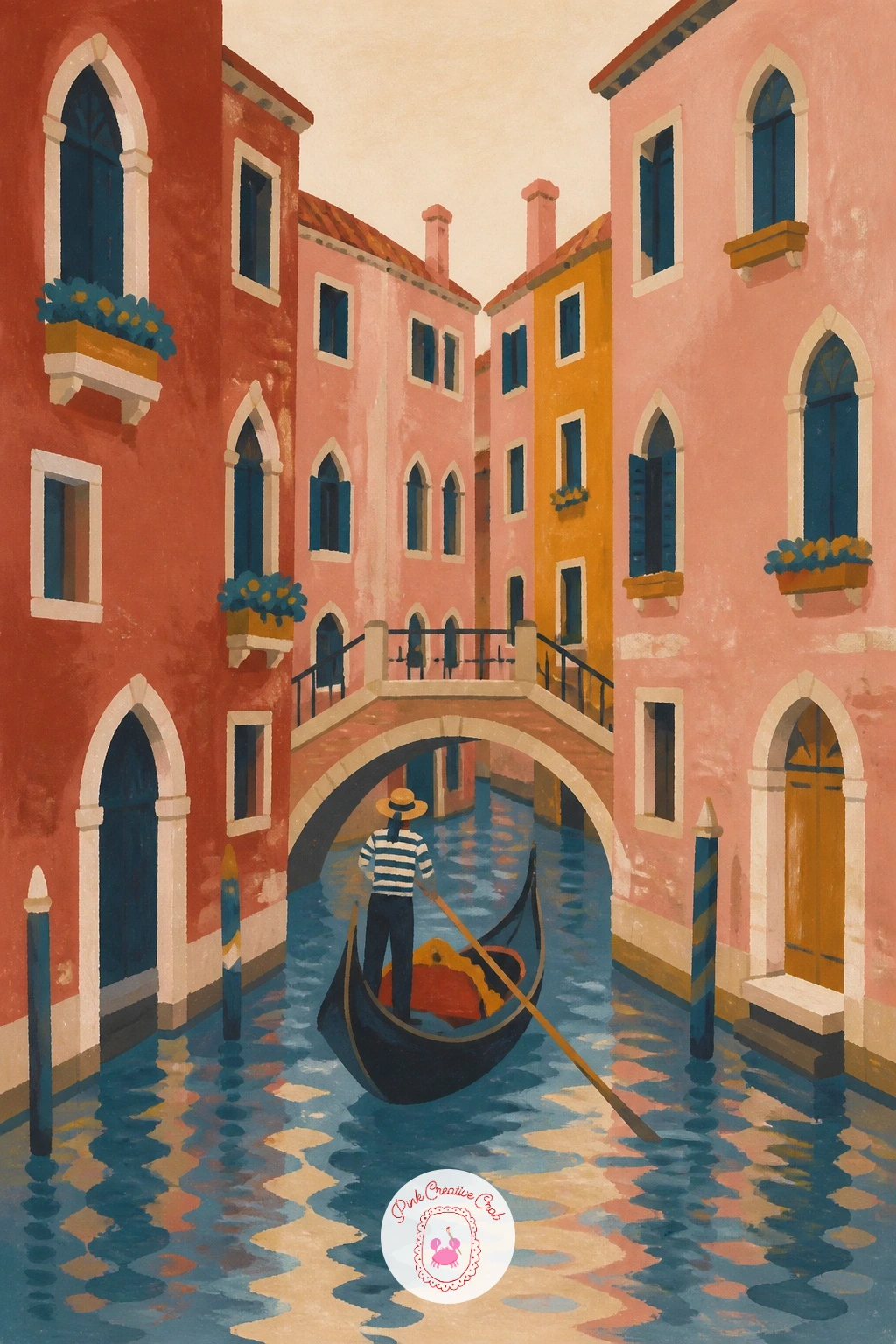
Palette: Brick Red,Blush Pink,Dusty Blue,Mustard
Go tall and dense with apartment blocks in Hong Kong with laundry hanging on the balconies. Paint the tower block first as one tall repeating grid of flat window and balcony shapes in dusty blue and cream, since the sheer repetition is what gives this subject its character.
Once the grid is dry, scatter small colored rectangles of laundry across a handful of the balconies, blush pink, mustard and brick red pieces hung at slightly different angles on each one. Repeating the exact same laundry shape on every balcony flattens the whole idea, so vary the color and tilt of each piece even though the balconies themselves stay identical.
Add a thin air conditioning unit or a small potted plant to one or two balconies last for extra life. If the window grid wanders out of line across such a tall shape, pencil a light grid of guidelines first and paint inside them.
Keep the building itself simple so the colorful laundry has somewhere plain to stand out against.
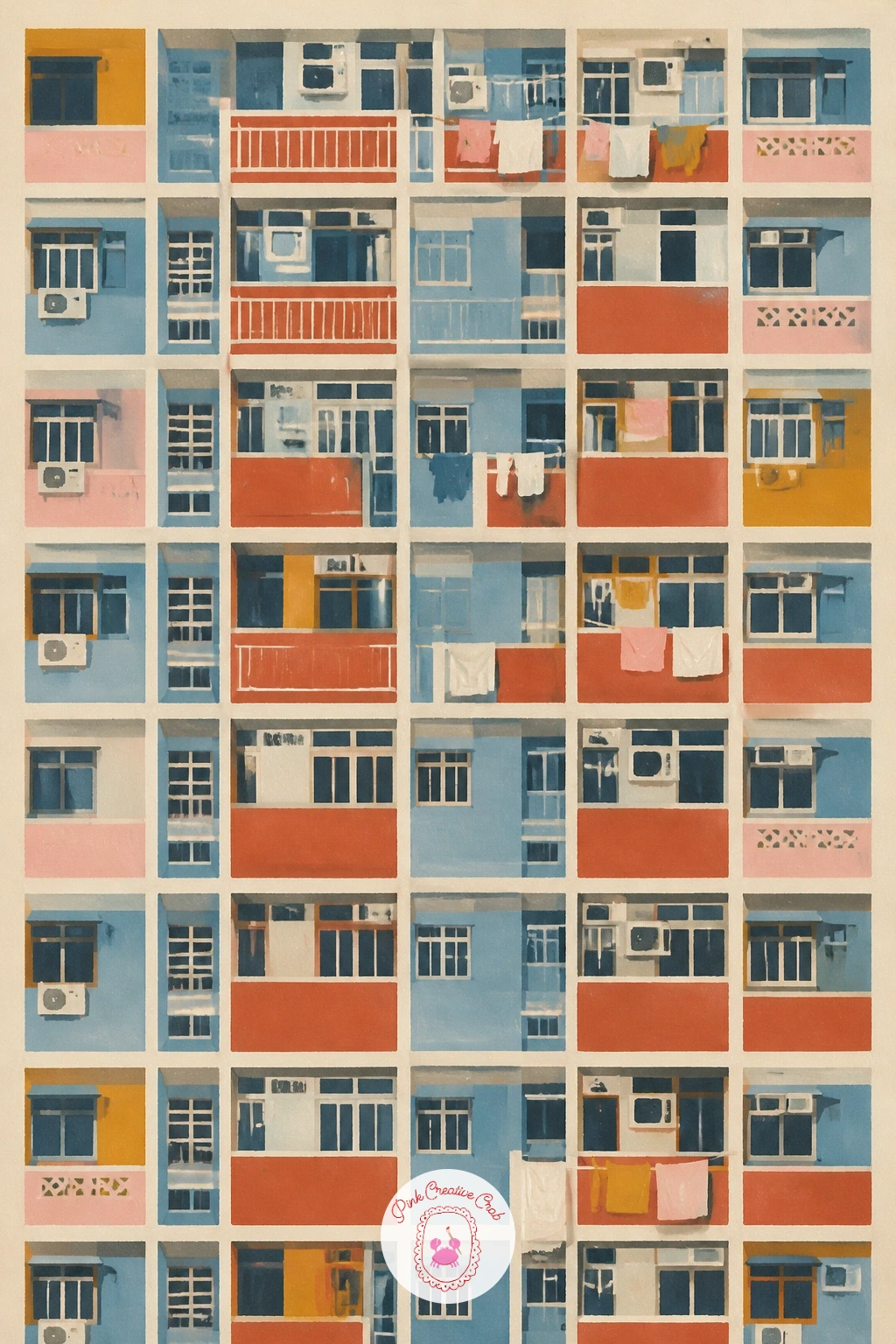
Palette: Dusty Blue,Soft Cream,Blush Pink,Brick Red
Take a bird’s eye view with a city crosswalk seen from above with people in colorful coats. Paint the crosswalk stripes first as a simple repeating pattern of flat cream bands across a grey road, kept perfectly parallel since the geometry here is the whole point.
Scatter the figures across the stripes next as small flat ovals and rectangles seen from directly above, no faces or feet needed, just a coat color and a simple shoulder shape for each person. From this straight down eye level everything reads as flat silhouette, so resist the urge to add any side detail or shadow that would break that bird’s eye illusion.
Vary the coat colors across blush pink, brick red, mustard and dusty blue so the crowd reads as lively rather than uniform, and scatter their positions rather than lining them up with the stripes. If a straight down figure feels odd to draw, think of each one as a rounded triangle with a small circle head peeking from the top.
Keep the road plain so the colorful coats do all the work.
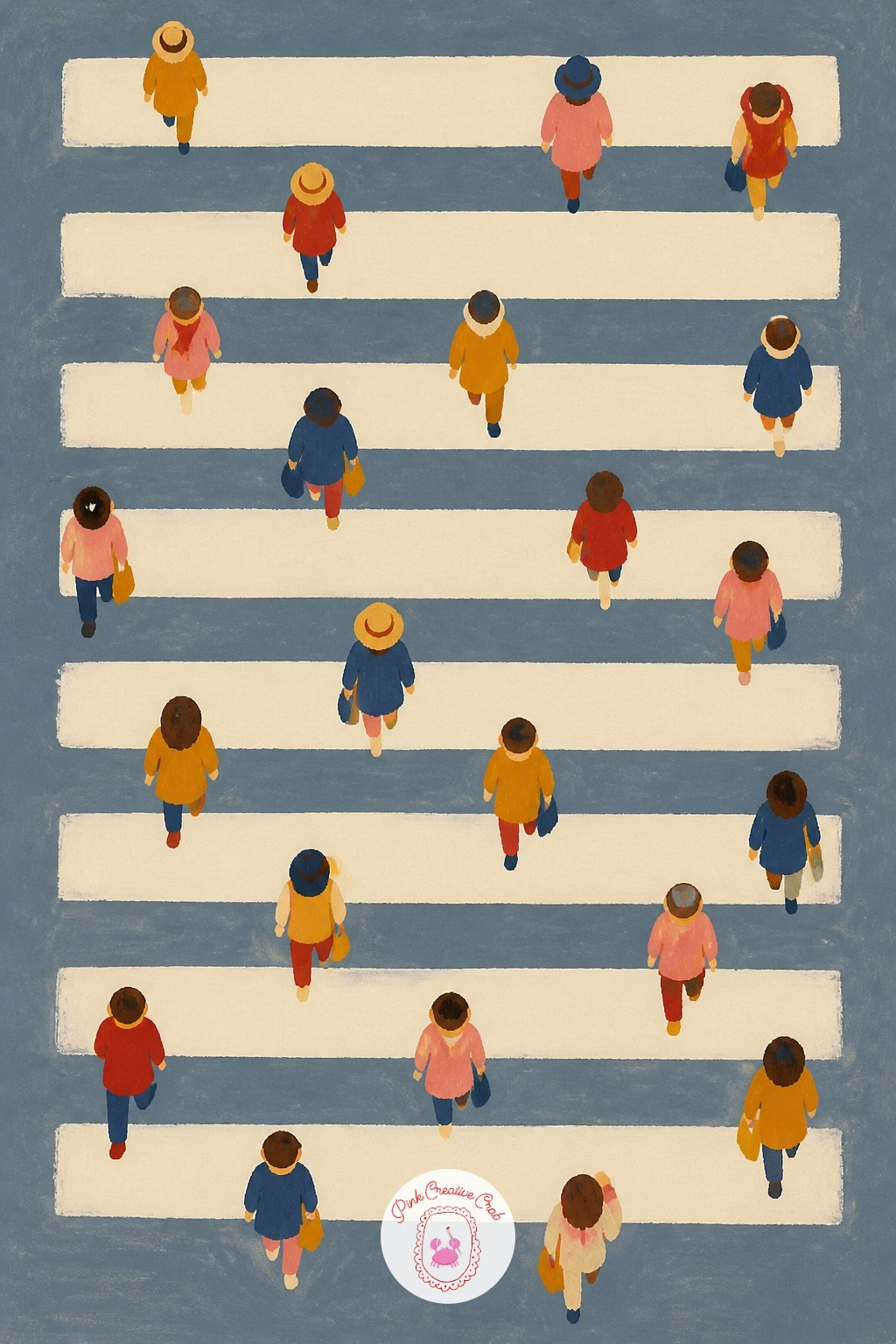
Palette: Payne’s Grey,Blush Pink,Brick Red,Mustard
Return to street level with a tree lined Paris boulevard and a woman walking her dog. Paint the row of trees first along one side, simple rounded mustard and sap green canopies on thin trunks, spaced evenly to suggest the boulevard stretching into the distance.
Build the buildings along the boulevard behind the trees as tall flat facades in soft cream and dusty blue, kept simpler and smaller as they recede toward the vanishing point. Place the woman and her dog in the foreground, her coat a confident blush pink or brick red shape and the dog a small simple silhouette on a thin leash line connecting the two.
Shrinking each tree and each building slightly more than the one before it, right down the row, is the one trick that makes a boulevard feel like it stretches away rather than sitting flat. If a dog shape feels fiddly, keep it to three ovals, body, head and one ear, rather than any fine detail.
Finish with a scatter of fallen leaves or a lamp post for extra charm.
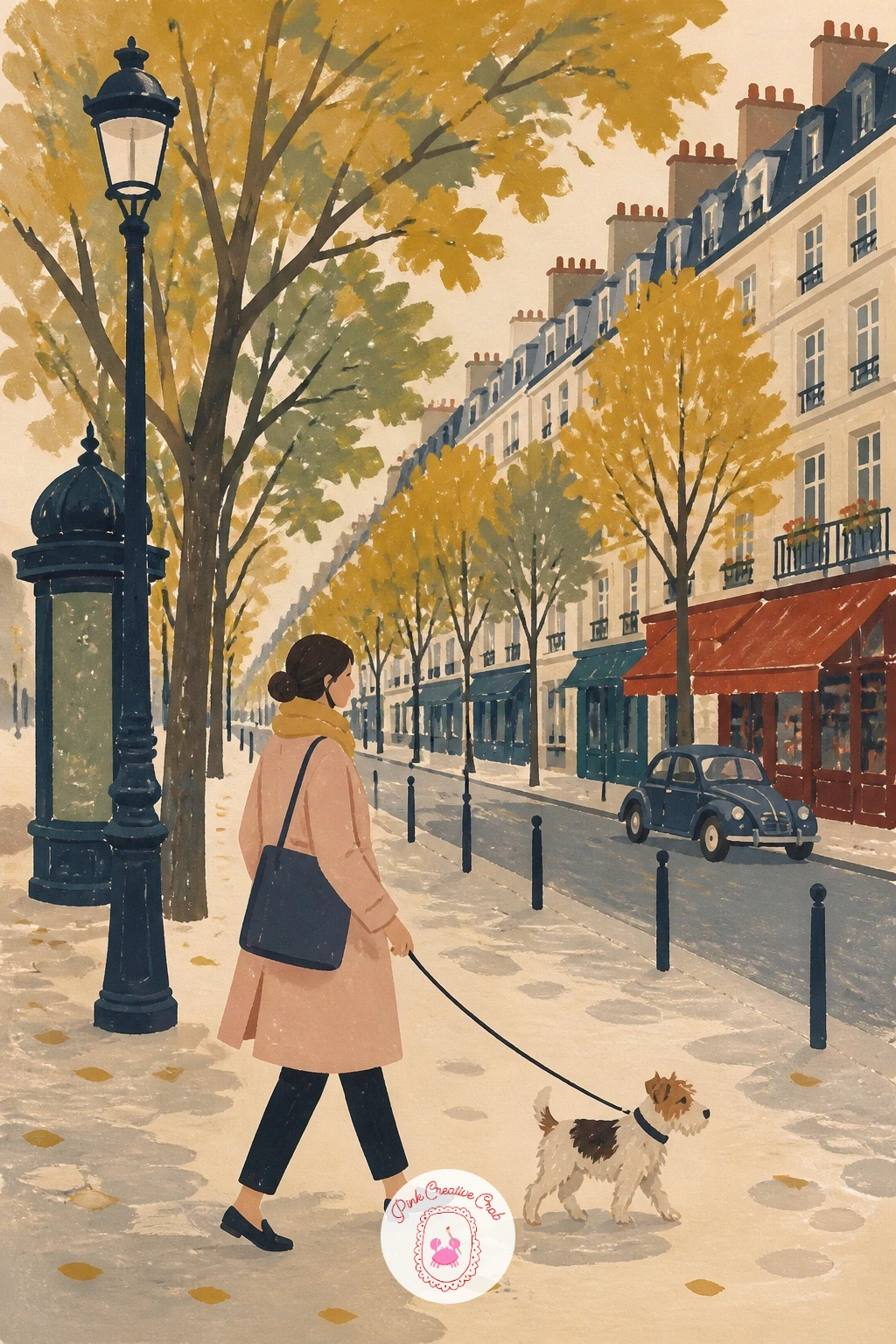
Palette: Sap Green,Mustard,Blush Pink,Dusty Blue
For more ideas on pairing a figure with a cityscape like this, this watercolor city roundup has several walking and strolling scenes.
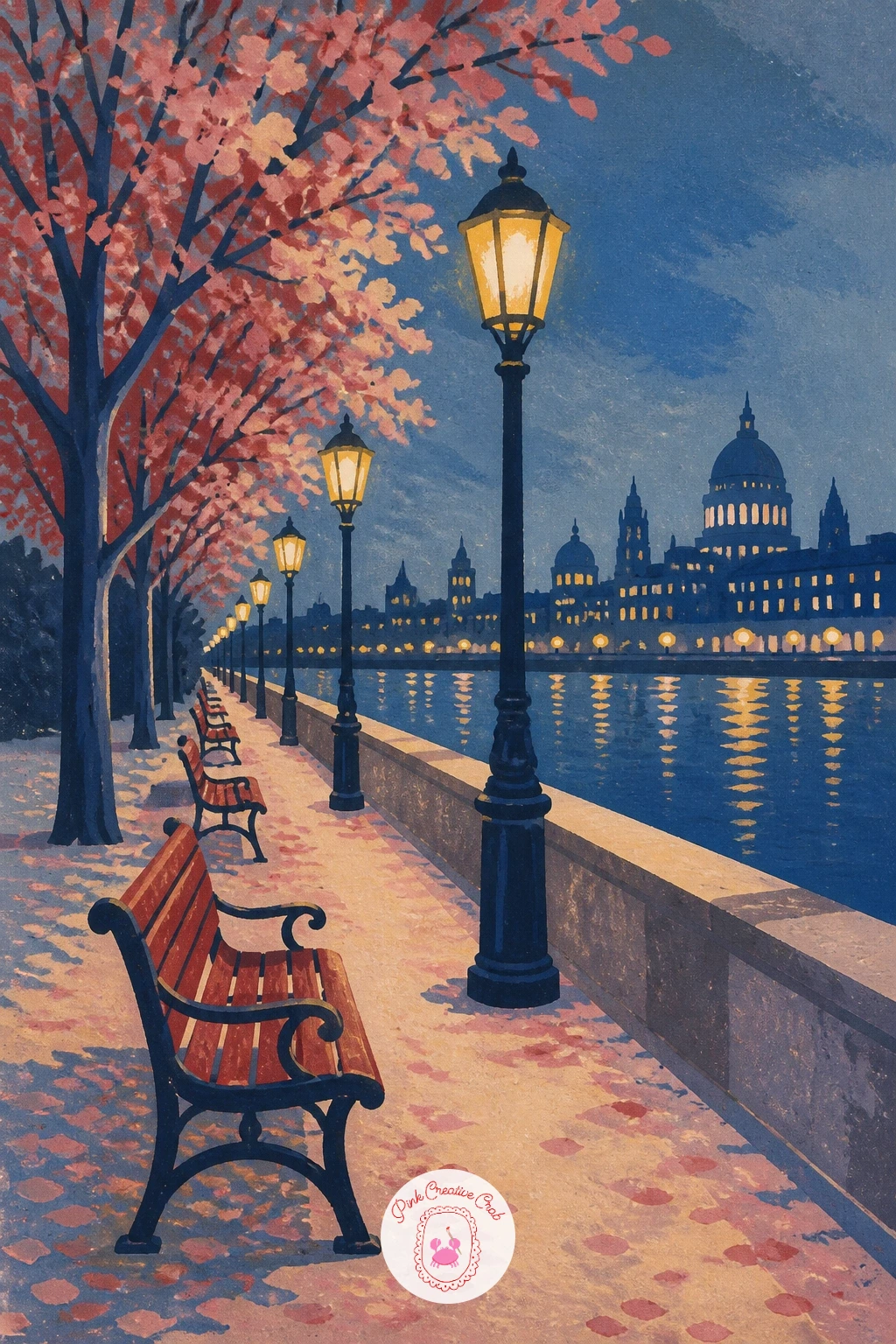
Settle into evening with a riverside promenade lined with benches and city lights. Paint the river first as a flat dusty blue band taking up the lower half of the page, then the far bank of buildings beyond it small and simple with a scattering of lit mustard windows.
Build the promenade path in the foreground as a warm cream strip, then place a row of simple bench shapes along it, each one just two or three confident lines and a flat seat. Add the lamp posts next, spaced evenly along the path, each topped with a small glowing mustard dome once the post itself is dry.
Bringing every lamp glow to the exact same size and warmth is the detail that ties the whole promenade together, more than any other single choice in this piece. If the benches look too stiff, angle every other one very slightly rather than keeping them all facing the same way.
Finish with a thin reflected light streak or two running down into the river below each lamp.
Palette: Dusty Blue,Mustard,Soft Cream,Payne’s Grey
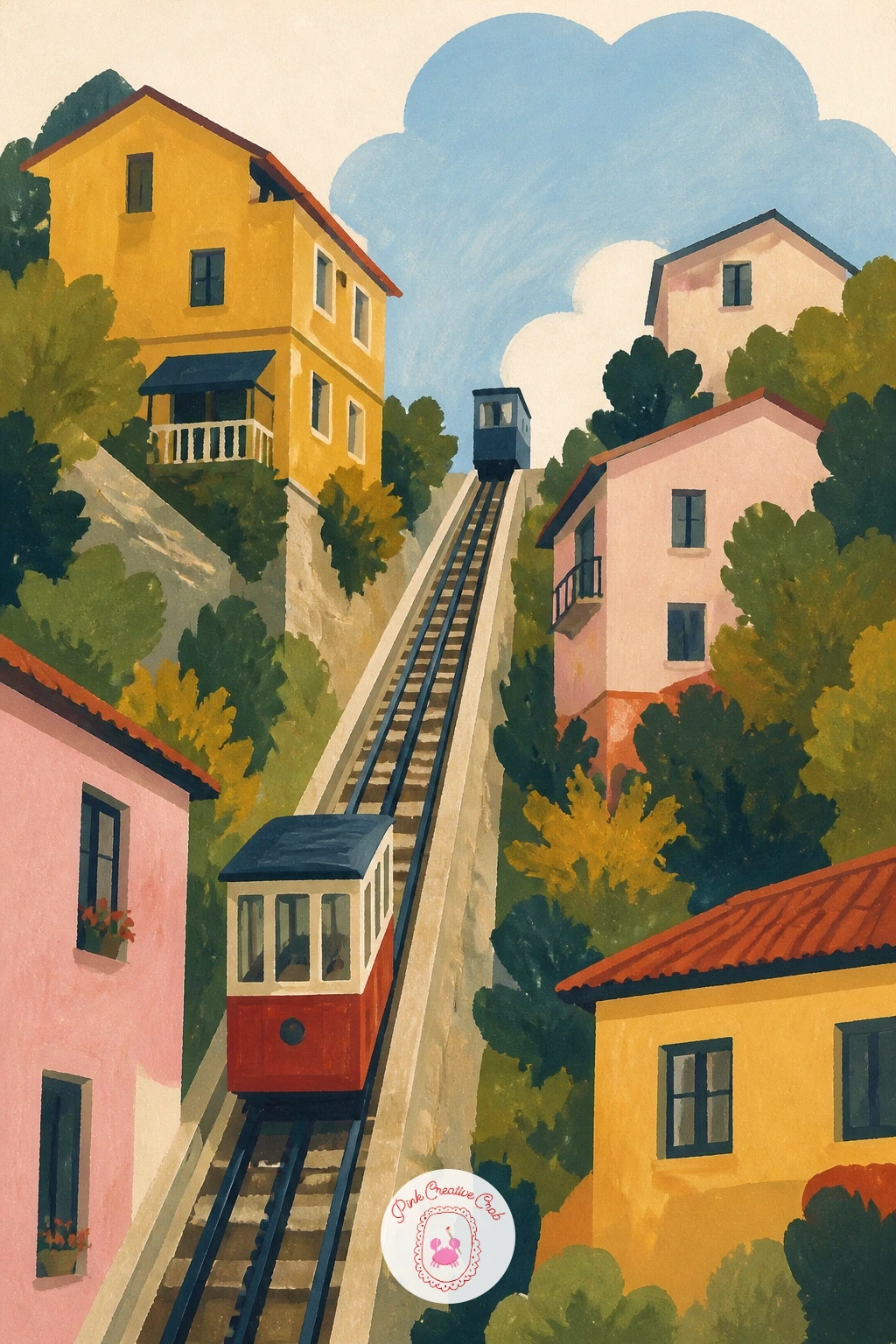
Close the set with a funicular climbing past houses toward a hilltop view. Paint the hillside first as a steep diagonal band of mustard and sap green, then tuck a few small houses into it at varying heights, their roofs all following the same upward slope.
Run the funicular track as two parallel lines angled straight up that hillside, then paint the funicular car itself as a simple boxy shape sitting on the tracks about two thirds of the way up, in brick red or dusty blue with a few small window squares.
Since a next attempt at this scene could easily feel repetitive, try painting it a second time from the opposite angle, looking back down the hill toward the city below instead of up toward the view, swapping the warm foreground houses for a wide hazy skyline in the distance. Keep the track lines perfectly parallel however you angle the hill, since any wobble there reads immediately as a mistake.
Finish this version with a small patch of open sky and distant hills visible at the very top of the page.
Palette: Sap Green,Mustard,Brick Red,Dusty Blue
What to Do Next
Pick whichever view is pulling at you most, rooftop, bridge or balcony, and start with its biggest flat shapes first: sky, water or wall. Work on a smooth illustration board so the matte color sits crisp, and let each shape dry before the next one goes in beside it.
Frequently Asked Questions
What is the best gouache for city landscape painting with flat matte shapes?
A student or artist quality gouache with good opacity works best, since it needs to cover in one flat coat without streaking. Look for a set with a dusty blue, brick red, mustard and a soft white or cream for mixing.
How do you keep gouache edges crisp in a city scene?
Let each shape dry fully before painting the one beside it, and avoid overloading the brush with water. Painting background shapes first and foreground shapes last also keeps edges clean rather than blending into each other.
Do I need to draw the buildings first before painting a city landscape?
A light pencil sketch of the main building blocks and horizon helps keep proportions honest, especially for straight rooflines and window grids. Keep the sketch simple since gouache covers pencil lines completely once dry.
How do you make a city painting look less flat and empty?
Add a small figure, vehicle or bit of life like a cyclist, pigeons or lit windows, since scale and a little movement carry most of the atmosphere. Varying building height and color also breaks up any flat, repetitive feel.
What paper works best for gouache city scenes?
A smooth cold press illustration board or heavier painting paper handles flat gouache washes without buckling. Rough watercolor paper can work too, but its texture will show through flat color areas more than a smoother surface.
Have any thoughts?
Share your reaction or leave a quick response — we’d love to hear what you think!
-
 0
-
 0
-
 0
-
 0
-
 0
-
 0
