Every easter illustration on this list starts from the same cheerful place: a barnyard full of animals getting ready for the holiday, painting eggs, hiding them in flower pots and carrying them home in wheelbarrows. There are no rabbits here and no lettering, just lambs, chicks, ducklings, hens, mice and goats doing small, busy, lovable things in flat gouache shapes.
Scroll through and pick whichever scene makes you smile first. Each one is sized to finish in a single sitting, with its own palette, its own little trick, and a tip for keeping the shapes crisp and the mood warm.
Using these images: free for personal projects such as printing, coloring, cards, journals and gifts. Handmade items that include them may be sold up to 30 pieces per design. More than that is commercial use and is not permitted, and neither is selling or sharing the images themselves or passing them off as your own. Please ask before any other use.
Start simple with a lamb painting eggs at a small wooden table, since this scene sets up the whole series: one character, one table, three or four eggs. Block in the lamb’s woolly body first as a cloud of overlapping curved bumps, then paint the flat tan table underneath before adding the eggs so their edges sit cleanly against both.
Work largest shapes to smallest: body, head, table, eggs, then the tiny paintbrush in one hoof. The wool shape is where beginners lose confidence, so keep the bumps generous and uneven rather than tracing neat scallops, and paint it one flat colour with the darker outline doing all the work of describing texture.
If your gouache set has no butter yellow, mix white into a lemon yellow until it turns soft and warm. Let the table dry fully before adding eggs on top so the colours stay separate and matte.
Keep one egg mid-stroke with the brush still touching it, this small action is what turns a still life into a story.
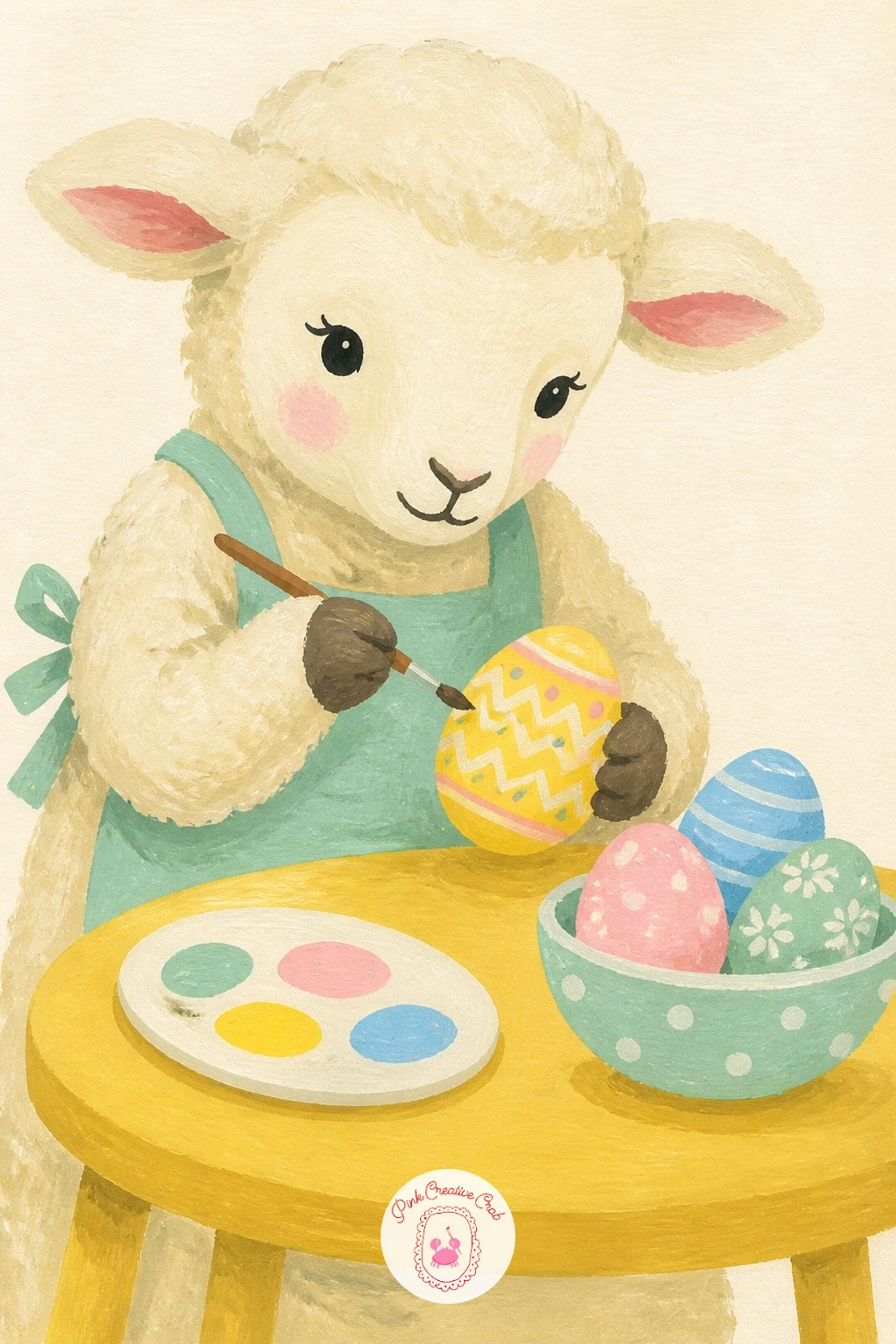
Palette: Butter Yellow,Mint Green,Blush Pink,Warm White
Move from one animal to several with a family of ducks heading to an egg hunt with baskets, lining up a mother duck and two or three ducklings in a row. Measure the mother against her ducklings first: she should stand about twice their height, and keeping that ratio consistent down the line is what makes the family read as one unit instead of random shapes.
Paint the mother duck’s body first, then repeat a smaller version of the same shape for each duckling, staggering them slightly so they overlap and feel like they are walking rather than standing still. Add the baskets last, one swinging from a wing, one held by a duckling’s wing-tip.
The row of ducks can go flat and lifeless if every beak points the same direction, so angle one duckling’s head back toward the others. If you do not have a fine liner for the little basket weave lines, the tip of a dry round brush works just as well.
Let one basket already hold a single painted egg, a small clue that the hunt has started.
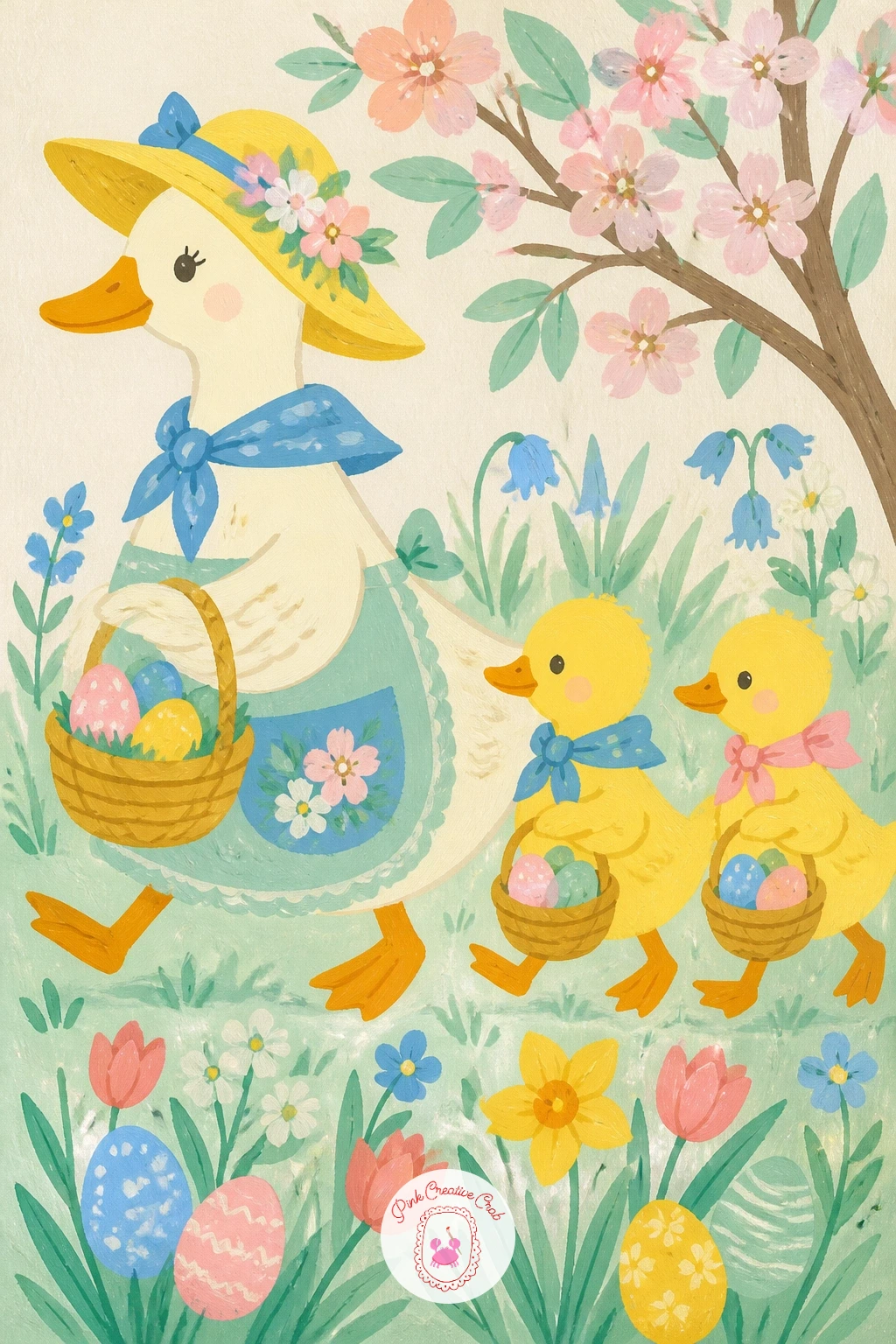
Palette: Sky Blue,Butter Yellow,Soft Orange,Cream
Give the page some depth with a chick pushing a wheelbarrow of eggs down a garden path, your first chance to think about eye level. Set the horizon low, near the chick’s own height, so the path stretches up the page rather than across it and the eggs in the wheelbarrow catch more light on their top curves.
Paint the path as a simple tan band first, then the chick’s round body leaning slightly forward into the push, then the wheelbarrow with its single wheel last so it overlaps the chick’s feet correctly. A common mistake is making the wheelbarrow too big for the chick, so hold your pencil up and compare: the barrow’s basket should sit no taller than the chick’s head.
If straight wheelbarrow handles feel shaky freehand, lay a ruler lightly in pencil before you paint over it. For beginners, three eggs in the barrow is plenty, more starts to crowd the small shape.
One egg can tip slightly over the rim, caught mid-wobble, for a bit of motion.
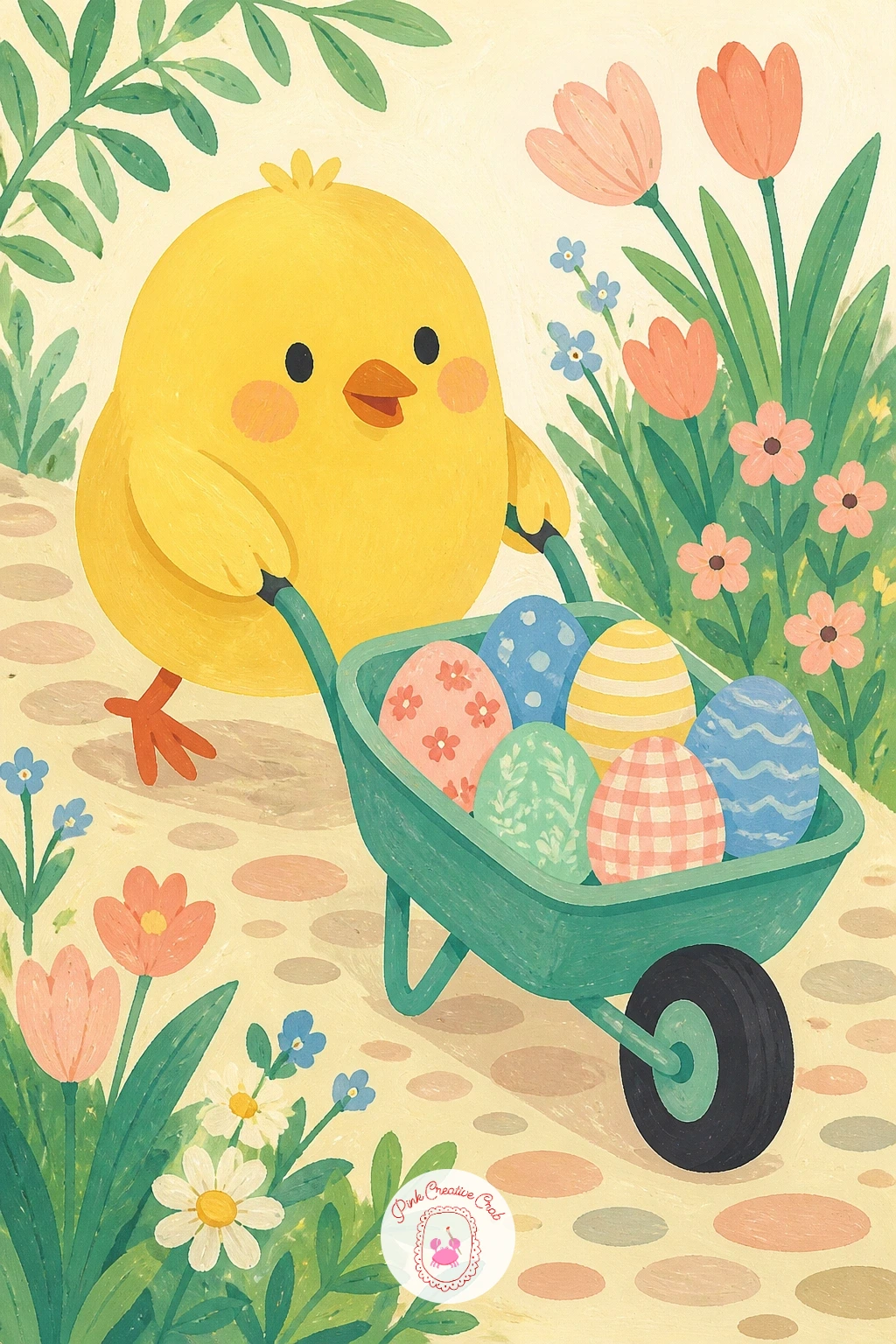
Palette: Butter Yellow,Mint Green,Terracotta,Cream
After the path, settle into a quieter moment with two lambs sharing a picnic among tulips, a good scene for practicing a cloth, a basket and a cluster of flowers all at once. Paint the checked blanket first as a flat shape with simple crossed lines, then the two lamb bodies sitting on top, overlapping the blanket’s edge so they feel grounded rather than floating.
Tulips go in last, in a loose row behind the lambs: three or four closed cup shapes on straight stems is enough, resist the urge to fill the whole background with them. The scene can look stiff if both lambs face forward, so turn one lamb’s head toward the other as though mid-conversation.
No checked fabric brush needed, just paint the blanket’s base colour, let it dry, then add thin crossed lines in a slightly darker tone with a fine round brush. Swap tulips for simple daisies if tulips feel fiddly at this stage.
Tuck one small painted egg into the picnic basket as the quiet nod to the holiday.
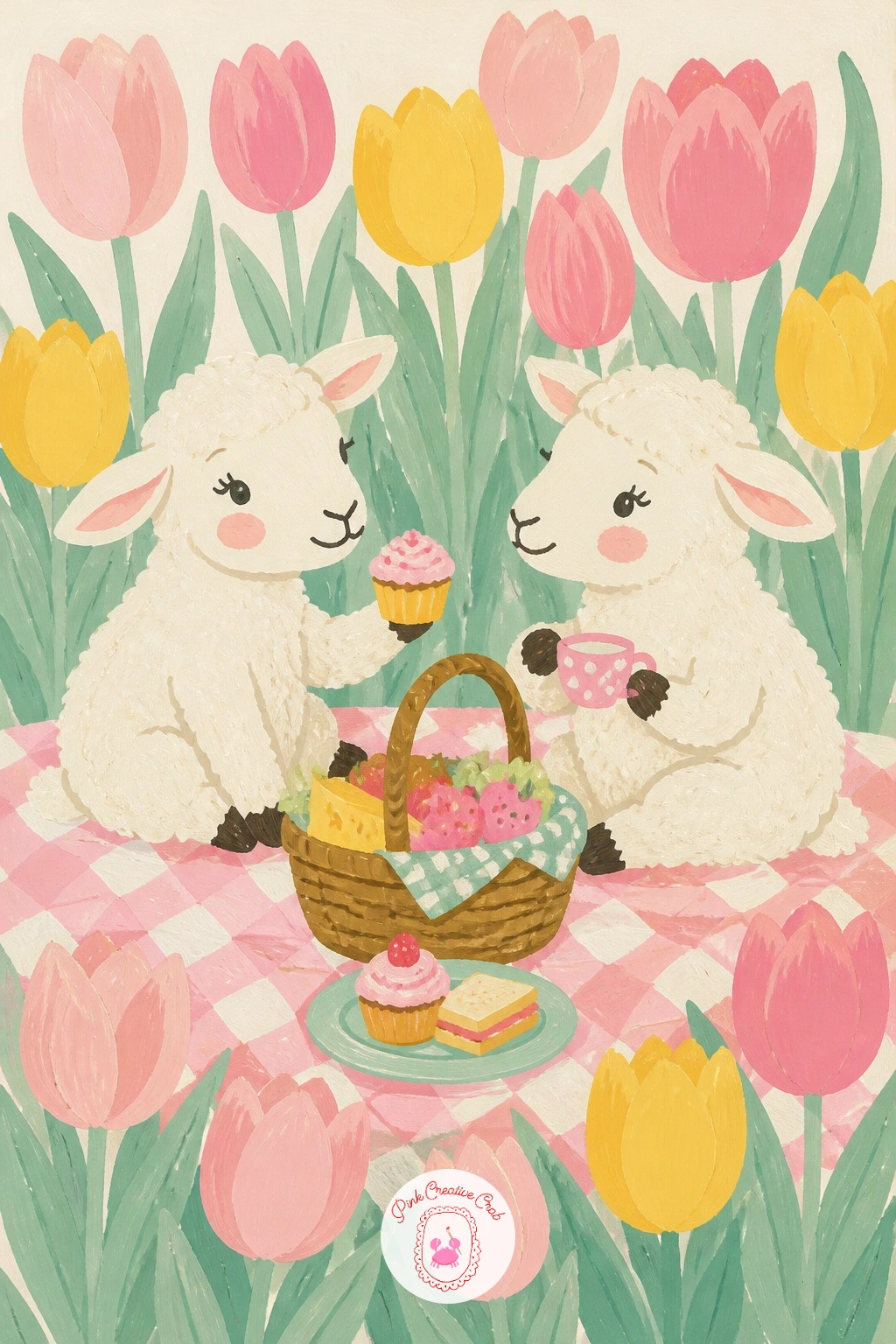
Palette: Blush Pink,Mint Green,Butter Yellow,Soft Red
If gouache sits a touch thick, more adults enjoy this loose storybook palette alongside the spring watercolor cards for Easter, which uses a thinner wash for the same mood.
Bring in some texture work with a hen knitting tiny hats for her chicks, a cozy indoor scene where the feel of yarn matters more than any outline. Paint the hen’s rounded body first in a warm red-brown, then dab in her comb and wattle, then add two or three chicks clustered at her feet waiting their turn.
For the sense of soft wool, let your brush run a little dry and pull short, slightly broken strokes across the knitted hats once the base colour has dried, rather than trying to paint each stitch. This dry-brush pass is the whole trick: too wet and the texture disappears, too dry and it looks scratchy, so test it on scrap paper first.
Knitting needles can be added with the tip of a toothpick dipped in white gouache if your finest brush feels too thick. No toothpick on hand, the corner of a cut piece of card works nearly as well.
Let one hat already be finished and sitting on a chick’s head, half on and tilted, for warmth.
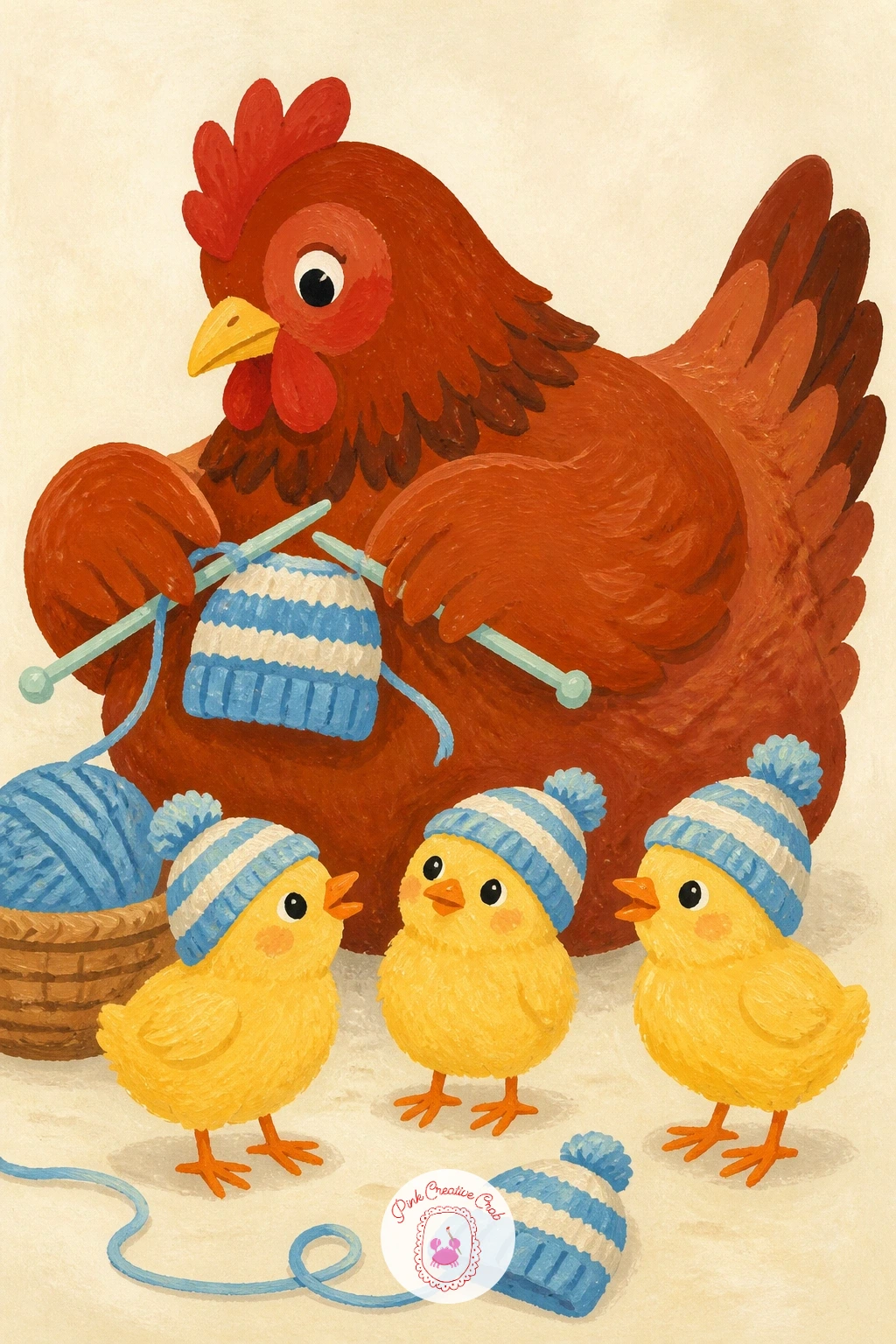
You Will Need
- toothpick for fine needle lines
Palette: Terracotta,Butter Yellow,Sky Blue,Cream
Keep the hiding theme going with a duckling hiding eggs under flower pots, a scene built almost entirely from circles and ovals so it is a good one for a ten-minute version. For the quick version, paint three terracotta pots in a row, one duckling mid-tiptoe beside them, and a single egg peeking out from under the nearest pot.
Given forty minutes, add a row of tulips growing from the tops of the pots, a second duckling checking a pot further back, and shadows under each pot to ground them on the path. The extra time goes into these small supporting details rather than any new main shape.
Flower pots can look flat if painted as plain triangles, so narrow each one slightly toward the base and keep the rim a touch wider, which reads instantly as a pot shape. If terracotta paint runs low, mix a little red into your yellow ochre.
Leave one pot tipped slightly to the side, as if just nudged by a curious beak.
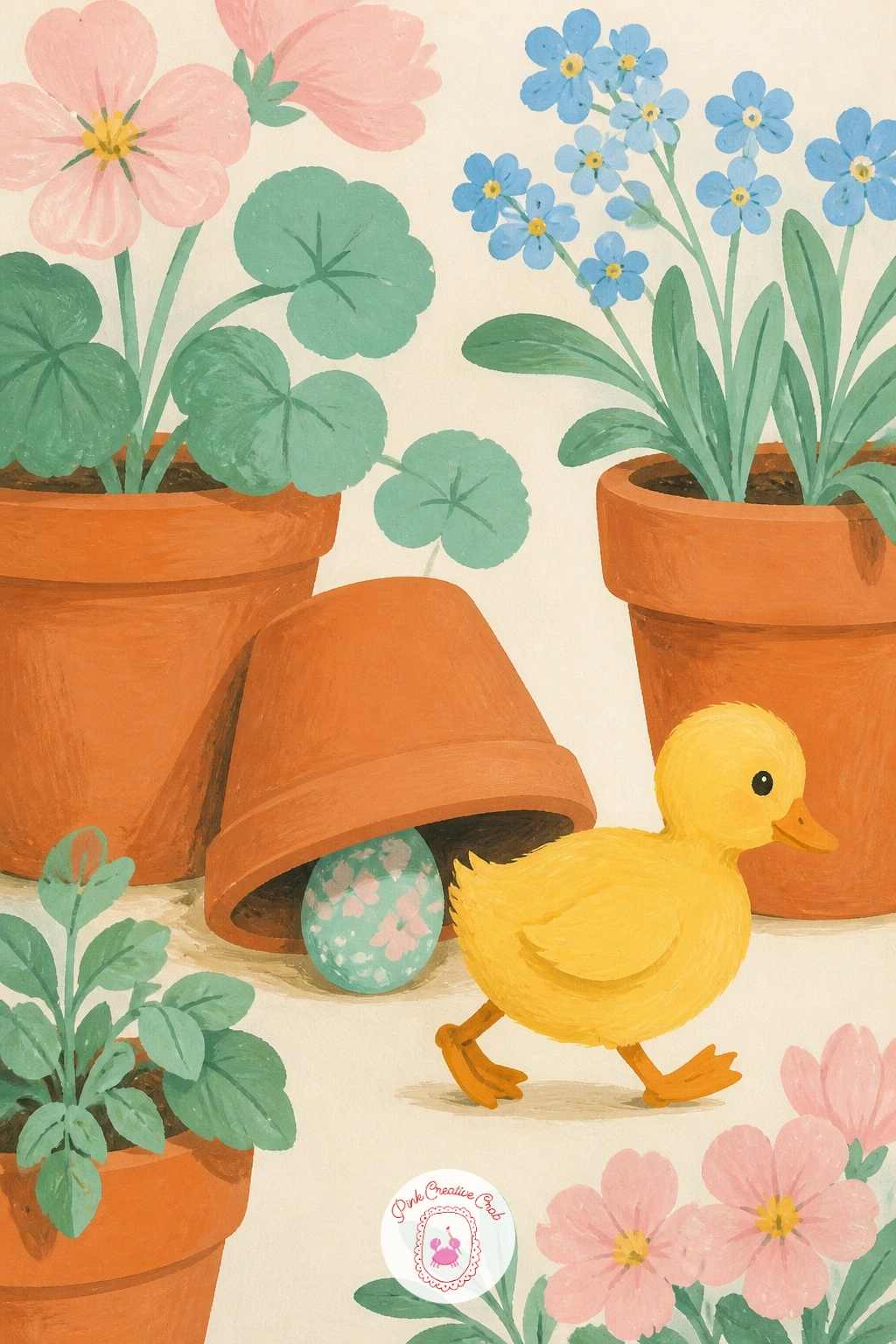
Palette: Terracotta,Butter Yellow,Mint Green,Blush Pink
Add a little architecture with a lamb in a straw hat selling painted eggs at a market stall, which means painting a simple wooden counter and a striped awning above it. Build the stall first as a flat rectangle with a scalloped edge for the awning, then place the lamb behind it so the counter overlaps the lower half of its body.
Rows of eggs go along the counter top in a neat line, each one a slightly different pattern so the stall feels stocked rather than repetitive: dots on one, stripes on the next, a simple flower on a third. The straw hat is the detail that sells the scene, so paint it as one flattened oval with a thin darker brim line rather than trying to shade individual straws.
Awning stripes can wander if drawn freehand, so mark evenly spaced pencil guides before painting each stripe. No striped reference handy, alternating mint and cream always works for this palette.
Put a small chalkboard sign leaning against the stall for a lived-in touch.
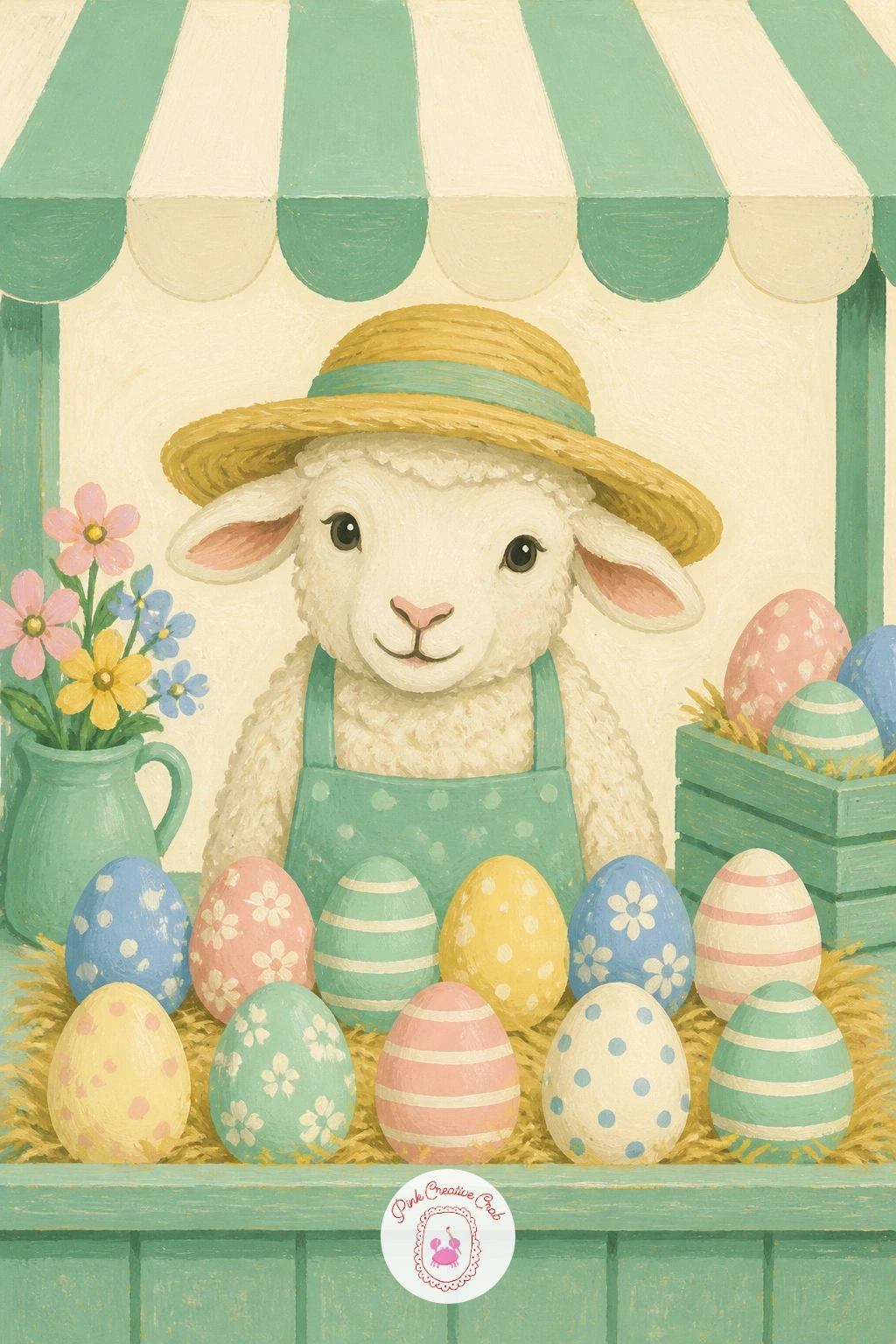
Palette: Mint Green,Cream,Butter Yellow,Blush Pink
Slow the pace with a chick reading a picture book in a cracked eggshell chair, a cozy single-subject scene that leans on one clever prop. Paint the eggshell first as a rounded form with one jagged broken edge along the top, then fit the chick’s small body down inside it like a nest, letting the shell’s rim overlap the chick’s sides slightly.
The open book comes next, held low in the chick’s wings with two simple pale pages and a few flat scribble lines standing in for text, never actual words. A cracked eggshell chair can look messy if the crack edge gets too jagged, so keep it to two or three clean zigzag lines rather than a scatter of small chips.
If pure white gouache looks too stark for the shell’s interior, warm it with a touch of yellow ochre for a soft ivory. A folded blanket draped over the shell’s rim adds coziness without extra complexity.
Let one of the chick’s feet dangle over the broken edge for a relaxed, settled feeling.
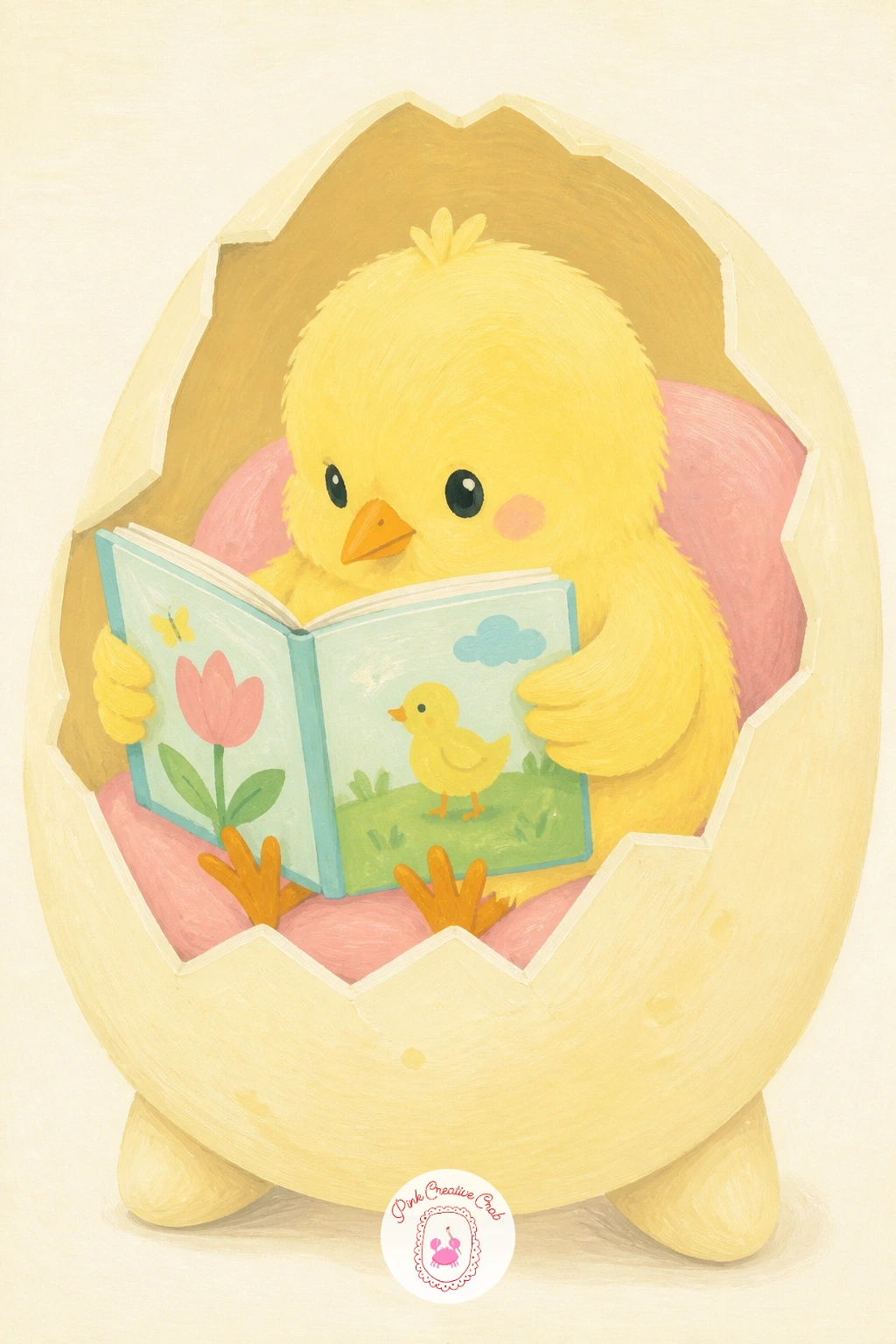
Palette: Cream,Butter Yellow,Mint Green,Soft Brown
Scale matters most in a mouse family carrying a giant painted egg home, so measure before you paint a single shape. Decide the egg’s height first, roughly three times taller than one mouse, then build the mice around it at that fixed size so the “giant” feeling actually holds up once colour goes on.
Paint the egg first as a large flat oval with a simple pattern of dots or stripes, then add three or four mice underneath and around it, each gripping the egg’s base with small paws, legs bent slightly as if straining. Keep every mouse the same height as the others, since mismatched mouse sizes are what usually breaks the illusion of teamwork.
Tails are the trickiest part of any mouse, so paint them as one confident curved line in a single brushstroke rather than building them up in sections. Pink or grey mice both work, use whichever grey or blush gouache you already have mixed.
Have one mouse glance backward over its shoulder, as though checking the others are keeping pace.
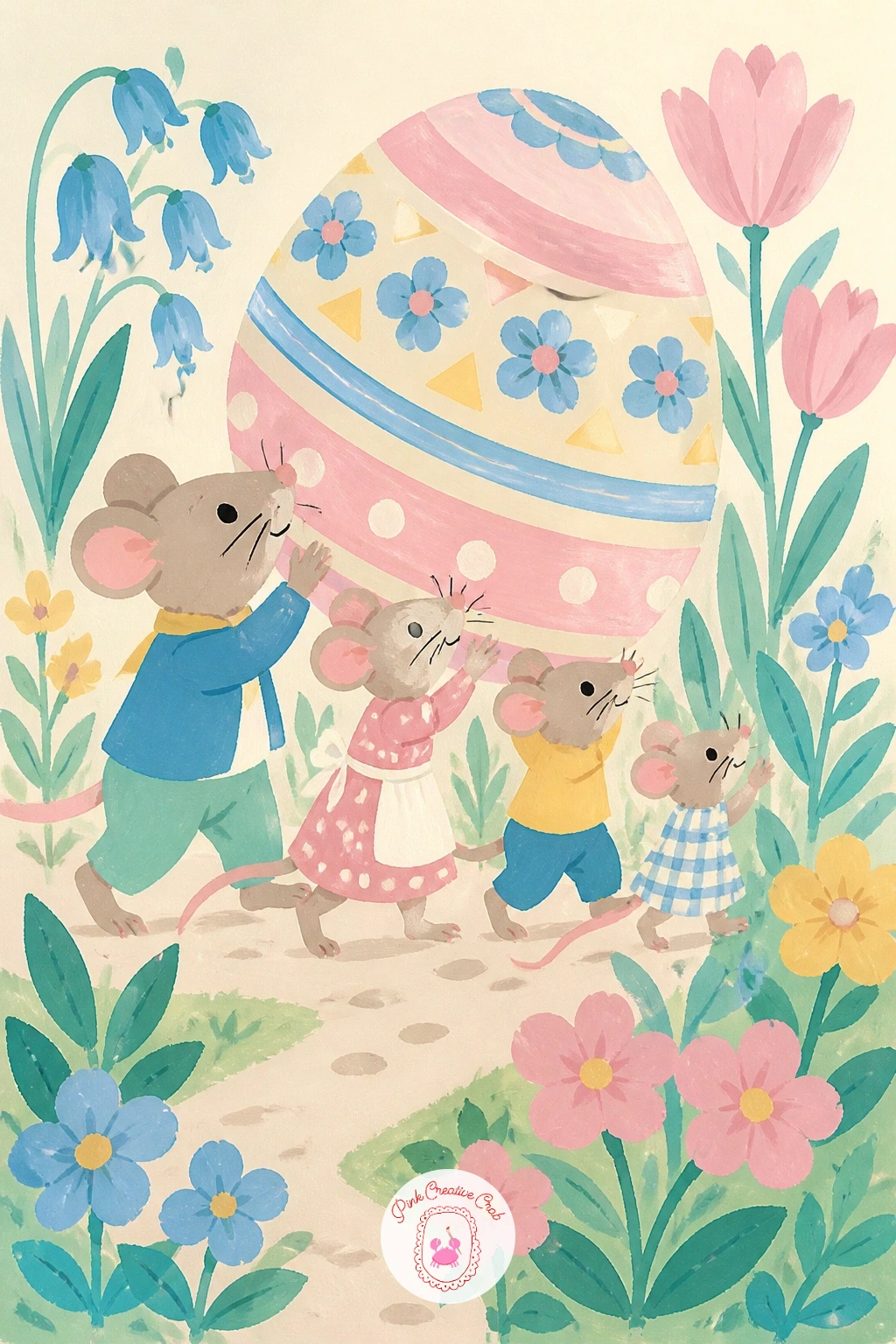
Palette: Blush Pink,Butter Yellow,Sky Blue,Soft Grey
Group work returns with a lamb choir singing together in a meadow, a good scene to practice repeating one shape with small variations. Paint four or five lamb bodies in a gentle curved row, as if standing on a slope, and vary only the tilt of each head and the open shape of each mouth to keep the row lively rather than copied and pasted.
Work back to front: the furthest lambs first and smaller, the nearest lamb last and largest, which gives the meadow its sense of depth without any real perspective lines. A faint scatter of small white or yellow flowers across the green ground finishes the setting without competing with the lambs.
If the row starts to look too even, stagger the lambs’ feet along a slightly curved line instead of a straight one. For a quick version, three lambs and a plain green ground is enough; the full choir with flowers suits a longer sitting.
Open one lamb’s mouth wider than the rest, mid-high-note, for a bit of music and humor.
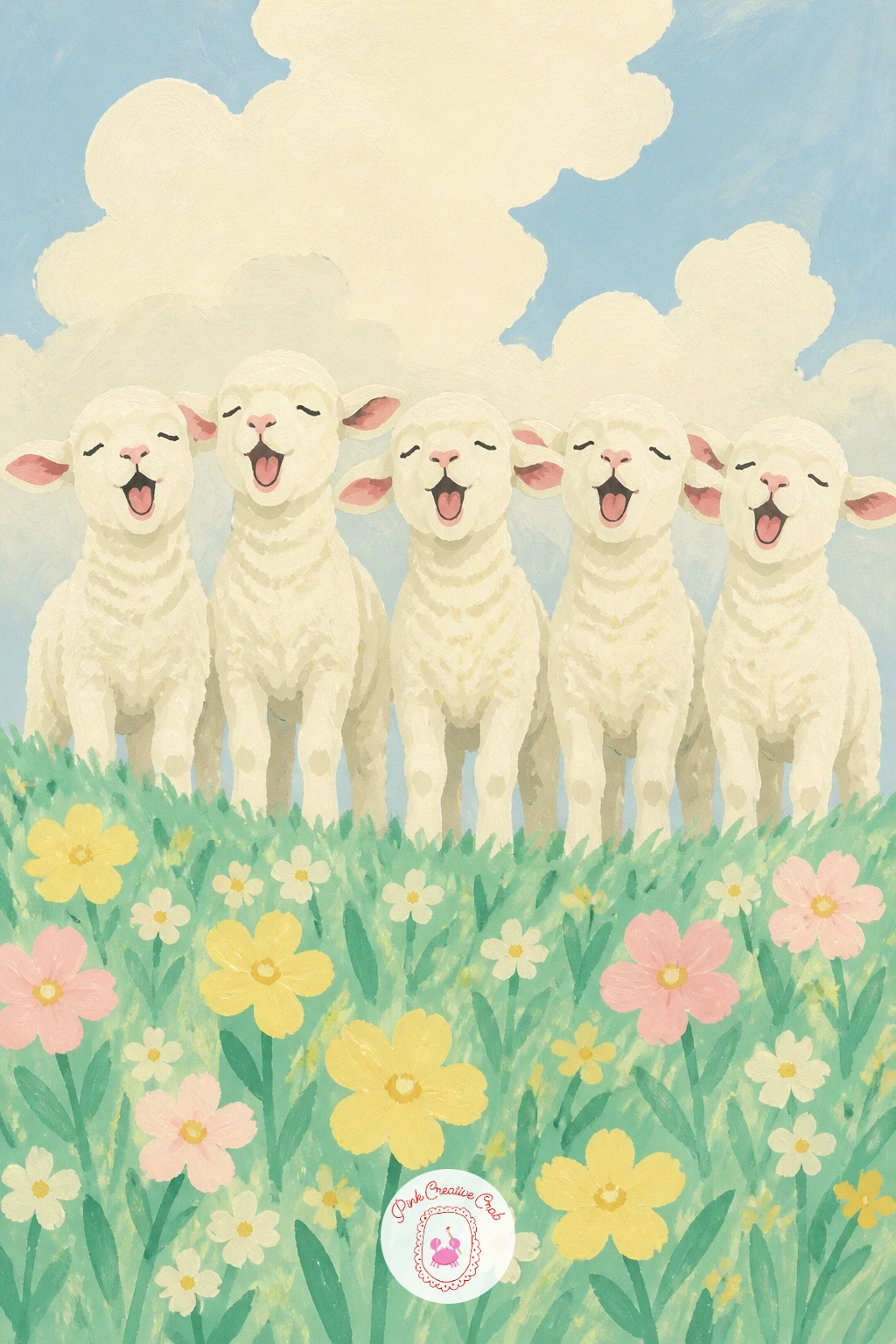
Palette: Mint Green,Cream,Butter Yellow,Blush Pink
Water brings its own challenge, so try a duckling floating in a half eggshell boat on a pond, which rests on getting reflections right rather than on complicated shapes. Paint the pond first as a flat mid-blue band, then the eggshell boat sitting on top with its reflection repeated just below it in a slightly darker, looser version of the same shape.
The duckling sits inside the shell with only its head and upper body showing above the rim, paddling with one wing trailing in the water. Reflections are where this scene usually goes wrong if painted too neatly, so loosen your brush and let the reflected shapes wobble a little rather than mirroring the boat exactly.
A dry brush dragged lightly across the pond surface afterward suggests gentle ripples without drawing each one individually. No dry-brush effect yet, a few short pale blue dashes do the same job.
Add one lily pad floating nearby to anchor the scene as a pond rather than open water.
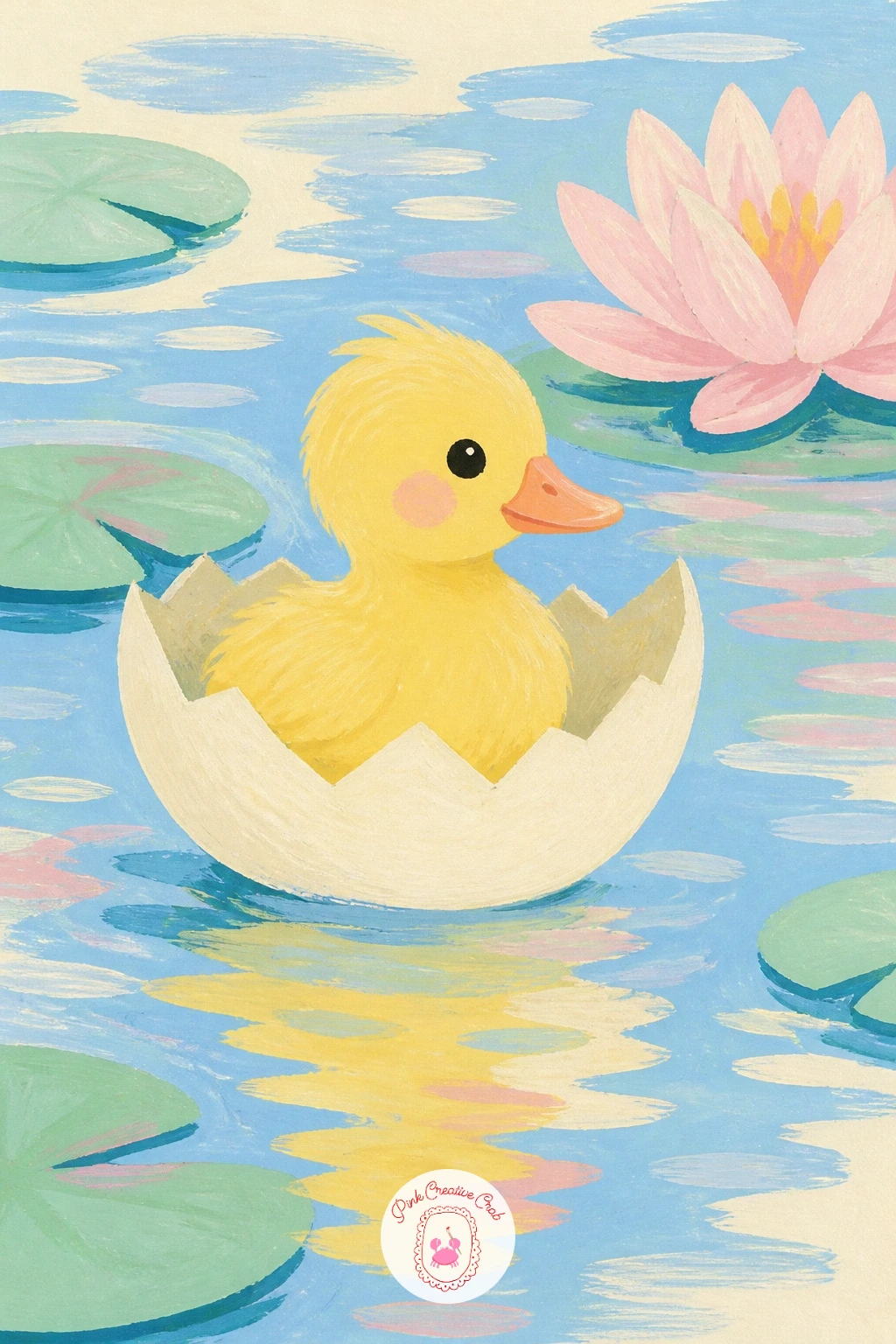
Palette: Sky Blue,Butter Yellow,Mint Green,Cream
Height differences carry a goat and a lamb decorating an egg tree in a garden, a scene built on one simple proportion trick. Stand the goat up on its back legs reaching for a high branch, and keep the lamb firmly on all fours below, since this contrast in posture does more to show scale than making one body literally bigger than the other.
Paint the bare tree first as a simple trunk with three or four curving branches, then hang five or six small painted eggs from it using thin curved lines, before adding the goat and lamb last so they overlap the trunk at the base. Branches can look stiff if they all curve the same direction, so let at least one branch bend the opposite way.
If hanging eggs look too uniform, vary their patterns, one striped, one dotted, one plain pastel. A small basket of spare eggs at the lamb’s feet suggests more decorating still to come.
Tip the goat slightly off balance on its back legs for a touch of comic effort.
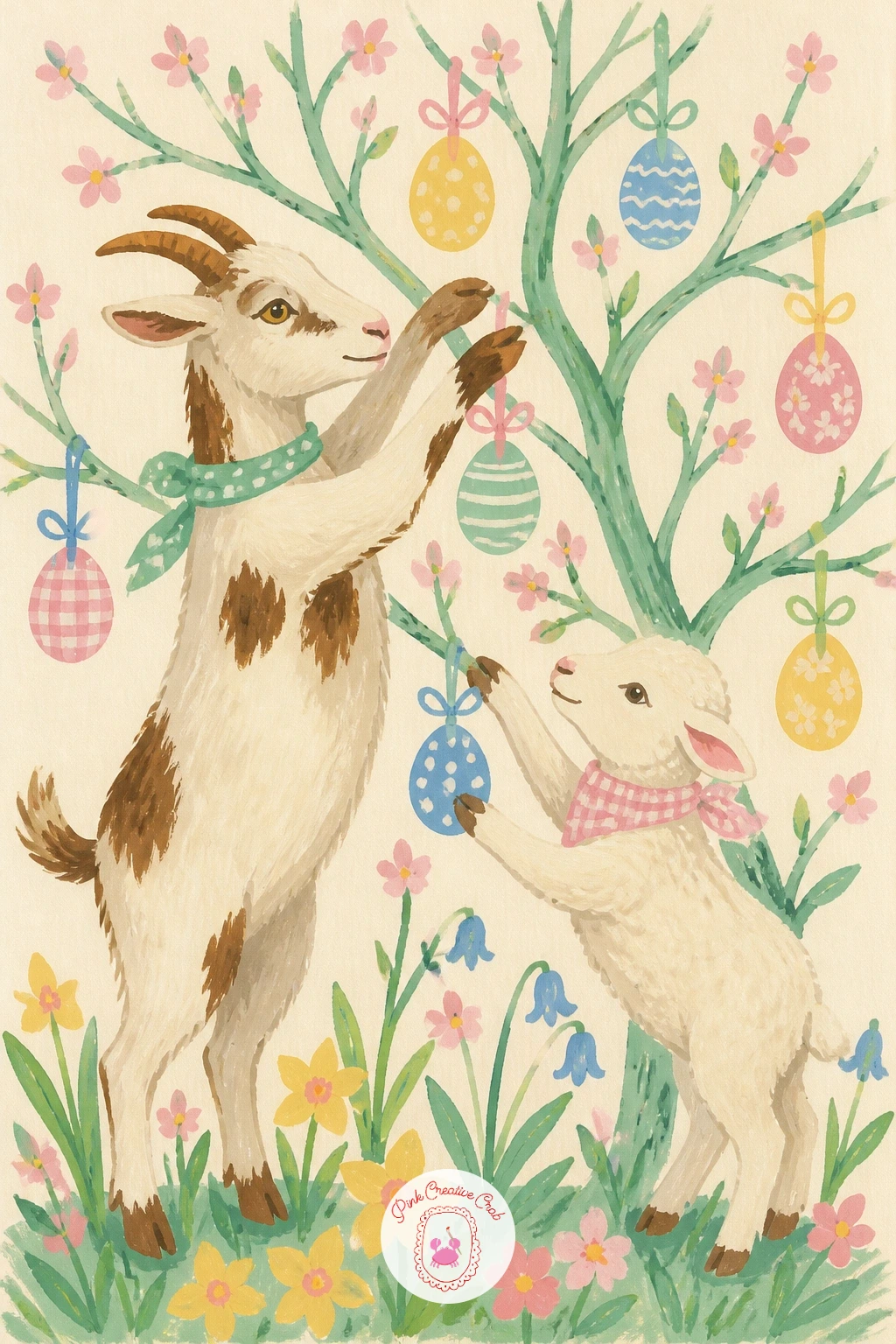
Palette: Mint Green,Blush Pink,Butter Yellow,Soft Brown
Shift the light for a badger dad hiding eggs in the woods for his cubs, setting this one at dusk rather than full daylight. Decide where the light comes from first, a low warm glow from one side as if from a lantern or setting sun, and let the badger’s striped face and the tree trunks around him pick up that warm edge on just one side while the rest stays in cooler shadow tones.
Paint the tree trunks and ground first in deeper greens and browns, then the badger crouching to tuck an egg into a mossy hollow, his white stripe catching the warm light clearly against the darker background. Woodland scenes can turn muddy fast if every colour is similarly dark, so keep at least the egg and one patch of light ground genuinely bright.
A kneaded eraser is not needed here since gouache is opaque, but a small scrap of lighter paint dabbed back onto a dry dark area can “lift” a highlight the same way. No lantern glow colour mixed, warm yellow ochre softened with a touch of pink does the job.
Place one small cub peeking from behind a trunk, eyes just visible, watching the hiding happen.
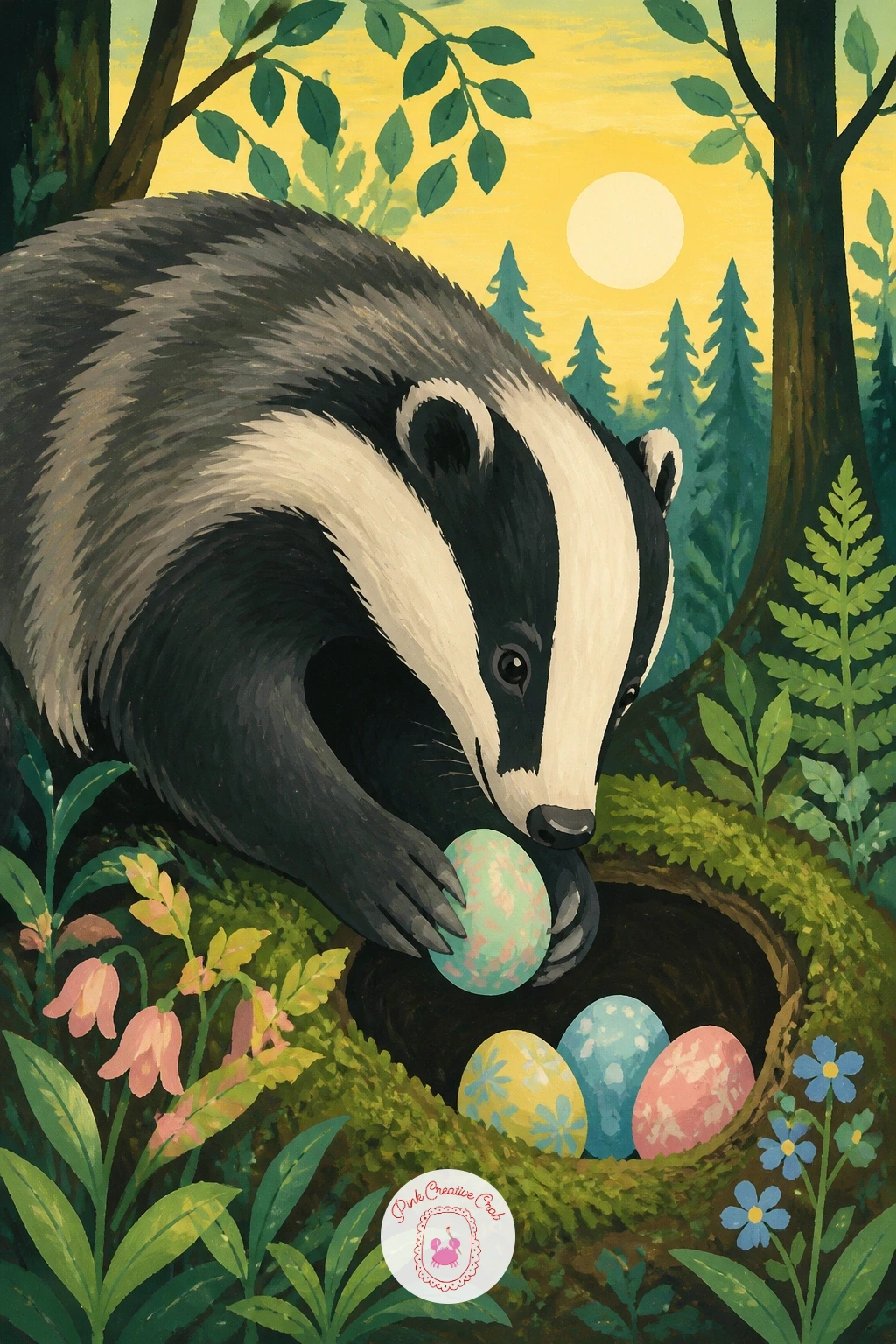
Palette: Deep Green,Soft Brown,Butter Yellow,Cream
Movement takes over in a chick riding a toy tractor through rows of tulips, a scene that rewards a confident, fast first pass. Paint the tractor’s boxy red body and big round wheels first, then sit the chick up high behind a simple steering wheel shape, before laying in two straight rows of tulips receding on either side.
For the ten-minute version, three tulips per row and a plain path is plenty to tell the story. Given forty minutes, add a small trailer behind the tractor carrying a few painted eggs, plus tire tracks pressed into the path and more tulips filling out the rows.
Tractor wheels often end up looking flat and pasted on, so give the front wheel a slightly different size than the back one to suggest it sits closer to the viewer. If red gouache looks too harsh, mix in a touch of yellow ochre to soften it toward a friendly orange-red.
Let one tulip get flattened slightly under a wheel, already past, for a sense of speed.
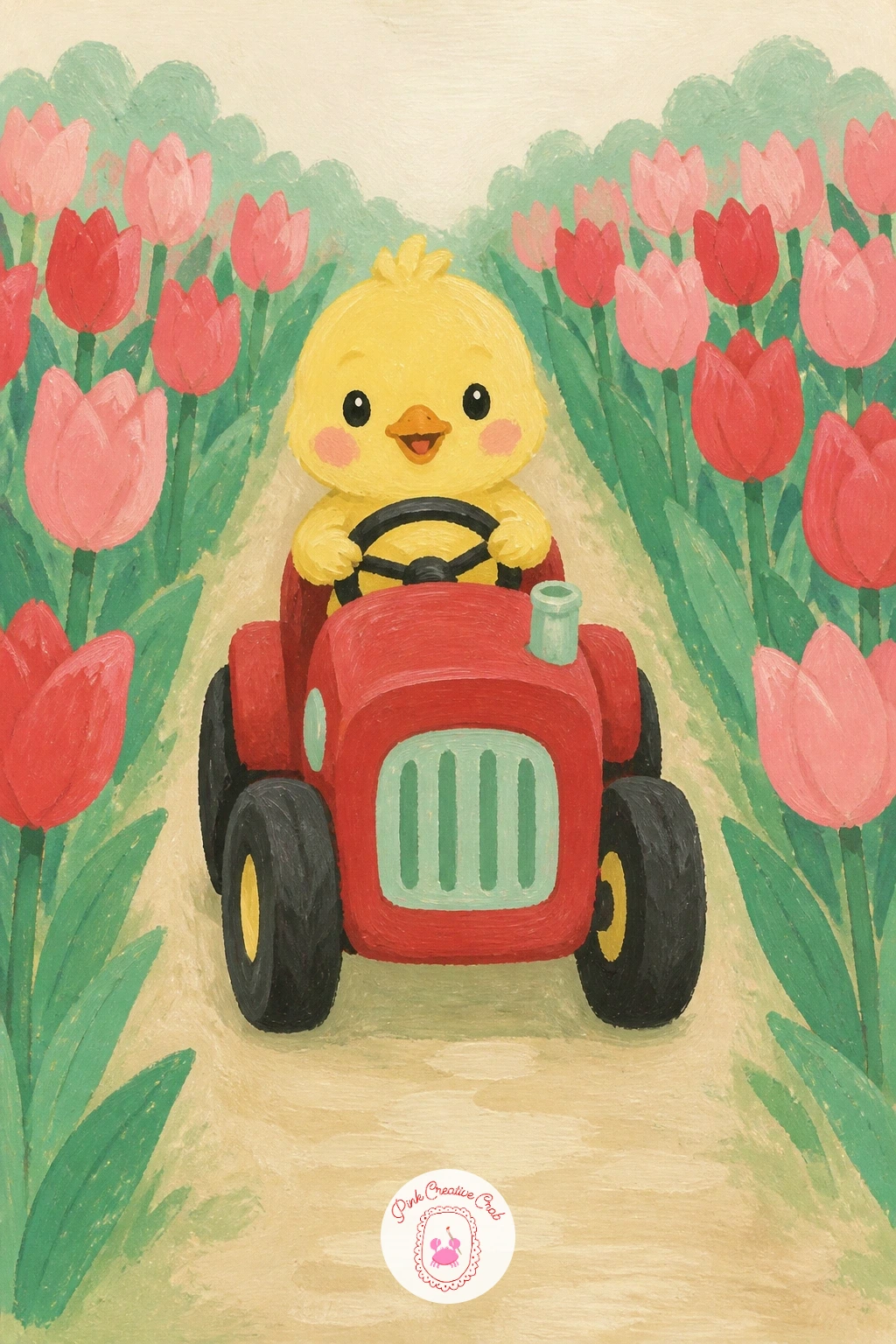
Palette: Soft Red,Mint Green,Blush Pink,Butter Yellow
Return to a quiet close-up with a lamb tucking chicks into a straw bed at night, a gentle bedtime scene lit by a single soft source. Set a small lantern or a round moon shape as the only light in the frame, and let it wash warm yellow across the lamb’s face and the tops of the chicks’ heads while the straw bed around them sits in cooler, muted tones.
Paint the straw bed first as a flattened oval nest shape with short upward strokes along its edge, then the lamb kneeling beside it, then two or three sleepy chicks tucked in a row with only their heads and folded wings showing above a simple blanket line. This scene can lose its warmth if the whole page gets lit evenly, so keep the corners and background noticeably darker than the center.
A dry brush pulled lightly over the straw’s edge after the base colour dries adds texture without drawing each strand. No lantern prop needed, a soft yellow glow painted directly behind the lamb’s head reads the same way.
Close one chick’s eyes with a single curved line for the final touch of sleep.
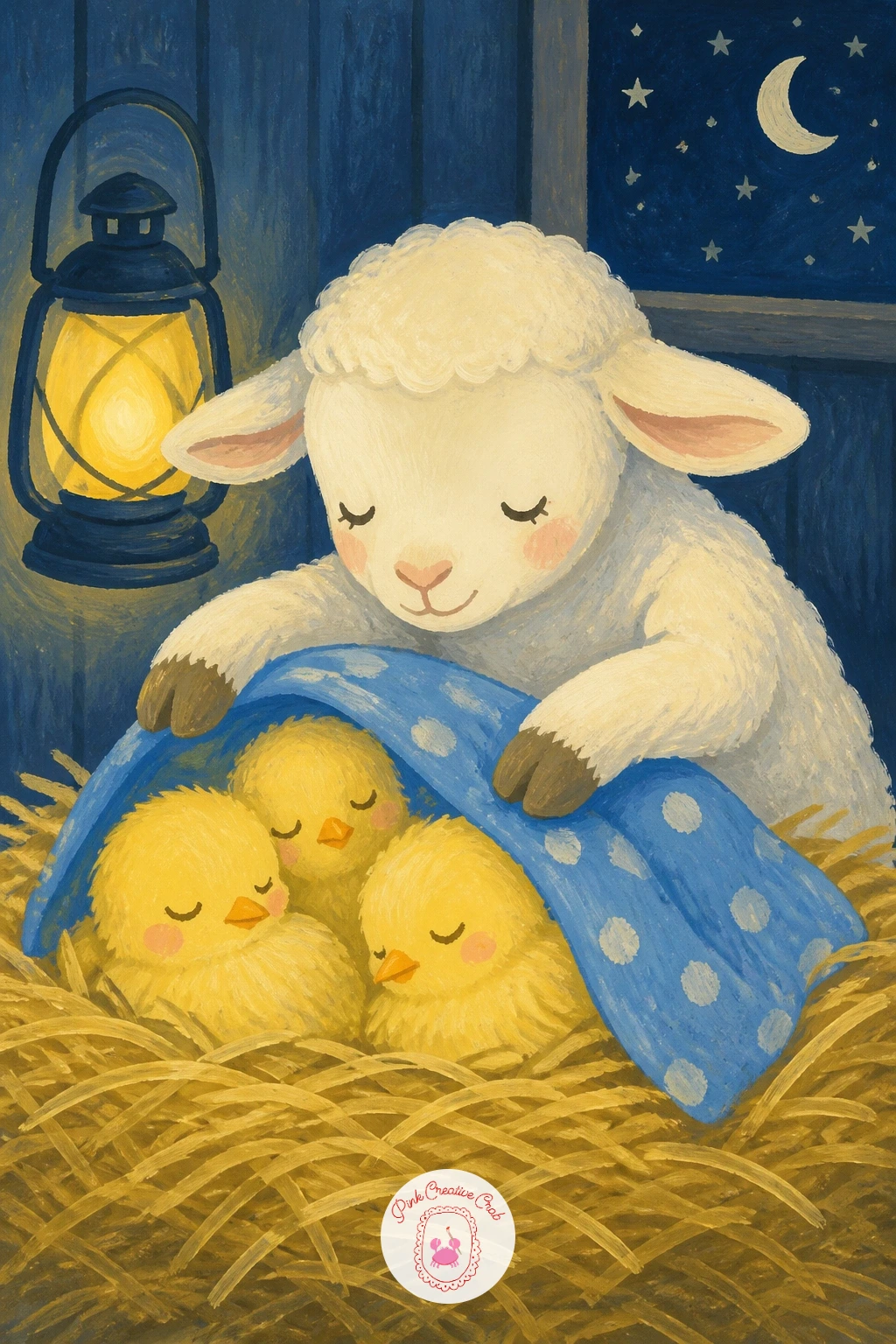
Palette: Soft Navy,Butter Yellow,Cream,Blush Pink
Architecture gets playful with a mouse peeking out of a painted egg house with a little door, a single tidy subject good for practicing crisp, clean edges. Paint the oversized egg first, standing upright, with its door and a round window marked out in pencil before any colour goes on so the openings land exactly where you want them.
Fill the egg’s surface with a simple pattern, stripes or a scatter of dots, then cut in the door and window last as flat darker shapes so they read as openings rather than decorations. Crisp edges are the whole point of this style, so let each colour dry fully before painting the next shape against it, and if an edge bleeds slightly, cover it with a thin clean line in your darkest colour once everything is dry.
The mouse’s face and paws poke out from the doorway, gripping the frame as if caught mid-step. No fine liner for the clean outline, the very tip of a small round brush loaded with a touch more water gives the same crisp line.
Add a tiny welcome wreath above the door made from two or three small flower dots.
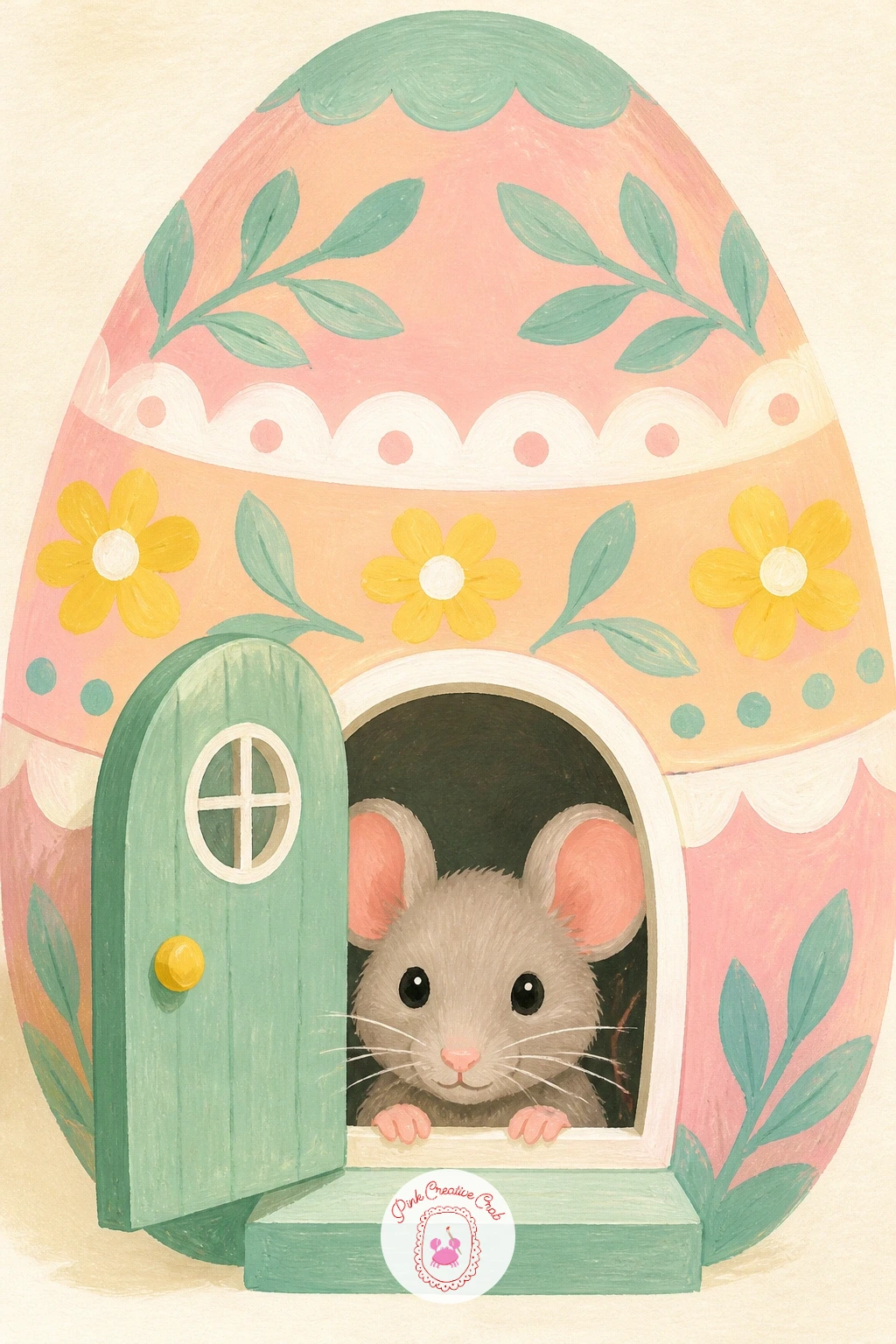
Palette: Blush Pink,Mint Green,Cream,Soft Brown
Weather adds character to three ducklings in raincoats searching for eggs after a shower, so start by deciding where the puddles and shine will sit before painting any duckling. Paint the wet ground first as a flat grey-green with two or three puddle shapes left slightly lighter, almost mirror-like, then build the ducklings on top so they clearly stand above the shine rather than merging into it.
Each duckling wears a tiny raincoat in a different colour so they stay easy to tell apart even though their poses are similar: one peering under a leaf, one lifting a stone, one holding an egg already found. Puddles can go muddy if mixed with too many colours, so keep each one a single flat tone just a touch paler than the ground around it.
A thin white gouache line along one edge of each puddle suggests the sky’s reflection without extra blending. If three raincoat colours feels like too much mixing, two colours repeated is just as charming.
Leave a single small rainbow arcing faintly in the upper corner of the sky.
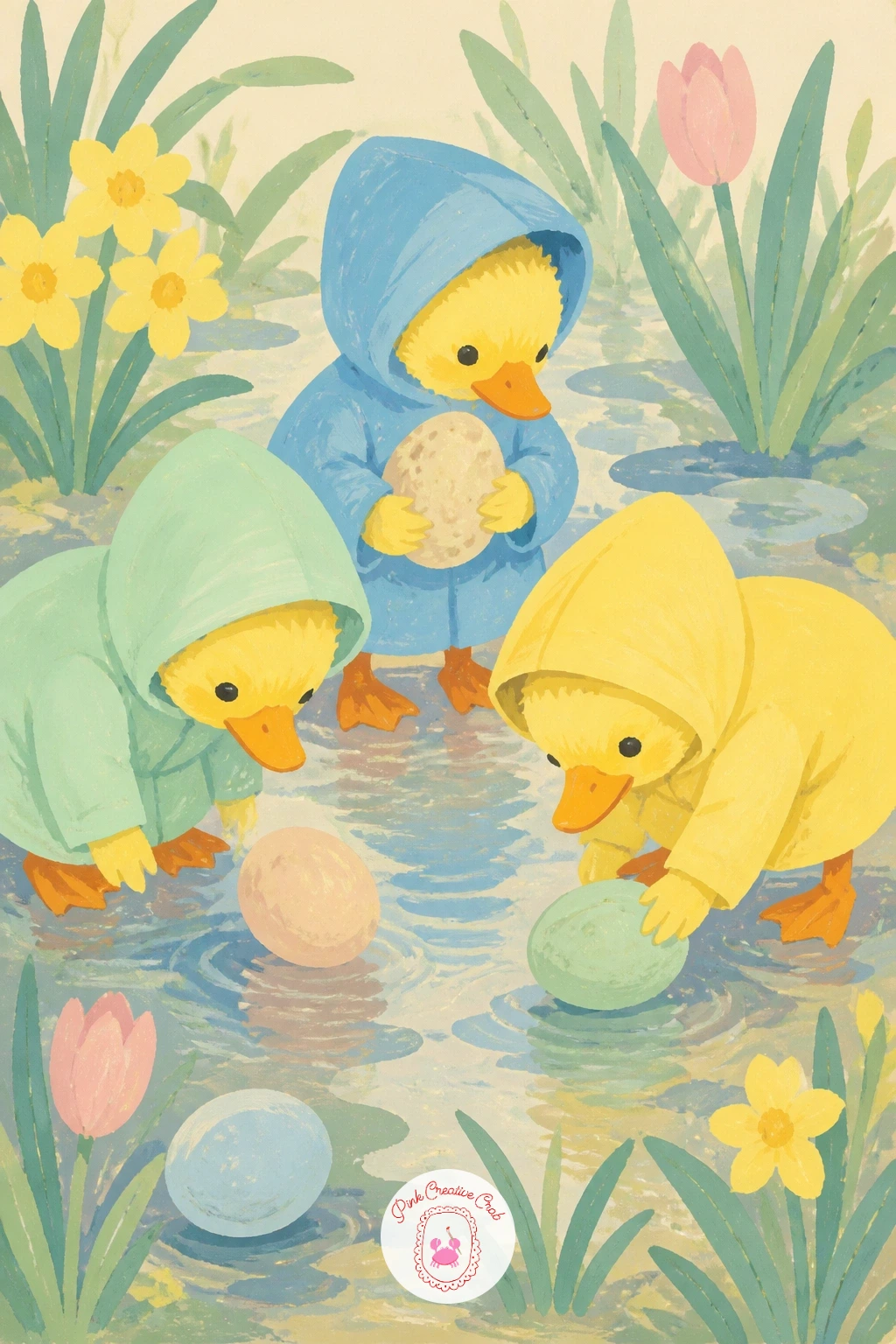
Palette: Sky Blue,Soft Yellow,Blush Pink,Mint Green
Keep the squirrel steady with one measuring trick: draw a light vertical pencil line down the center of its body first, so the egg balanced on its head, the tail, and both back feet all line up evenly on either side, which is what sells the balance before a drop of paint goes on. Off that center line, build the squirrel’s rounded body, its big curled tail arcing up behind, and the egg sitting flat on top of its head.
Paint the body first in a warm grey-brown, then the tail as one large sweeping shape with a few streaky highlights pulled through it while the paint is still workable, then the egg last in a bright contrasting pastel so it pops against the fur. A wobbling egg reads as funnier than a perfectly still one, so tilt it just slightly off center rather than painting it dead level.
If grey gouache looks flat on its own, warm it with a touch of butter yellow. The squirrel’s arms can spread wide for balance, which also fills the composition nicely.
Give the squirrel slightly crossed eyes for the comic tension of concentration.
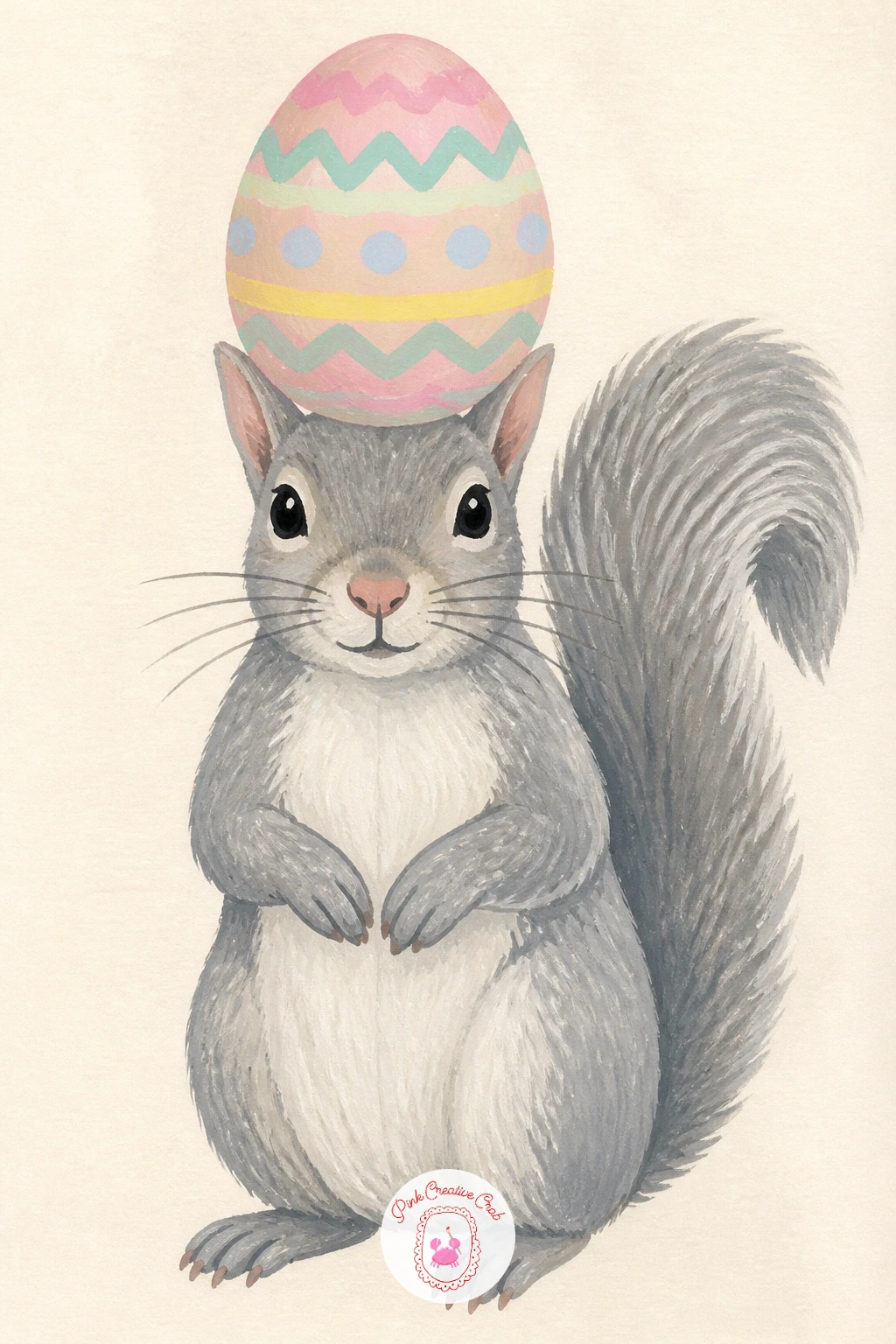
Palette: Soft Grey,Butter Yellow,Blush Pink,Sky Blue
Settle back into an easy rhythm with a hen and her chicks on an Easter morning walk, a simple procession scene that leans on soft morning light. Place the light source low and to one side, as if the sun has just risen, and let long pale shadows stretch out from the hen and each chick across the path to establish the time of day instantly.
Paint the hen first, walking with her head held high, then three or four chicks trailing behind in a loose, uneven line rather than a perfectly straight one. Morning scenes can look flat without that low light, so keep one side of each bird a touch brighter and let the shadow side lean slightly cooler and greyer.
A soft pale yellow wash brushed thinly across the upper sky suggests early sun without needing an actual sun shape in frame. No separate wash colour mixed, a very diluted touch of your butter yellow does the same thing.
Have one chick lagging behind, stopped to peck at something small on the path.
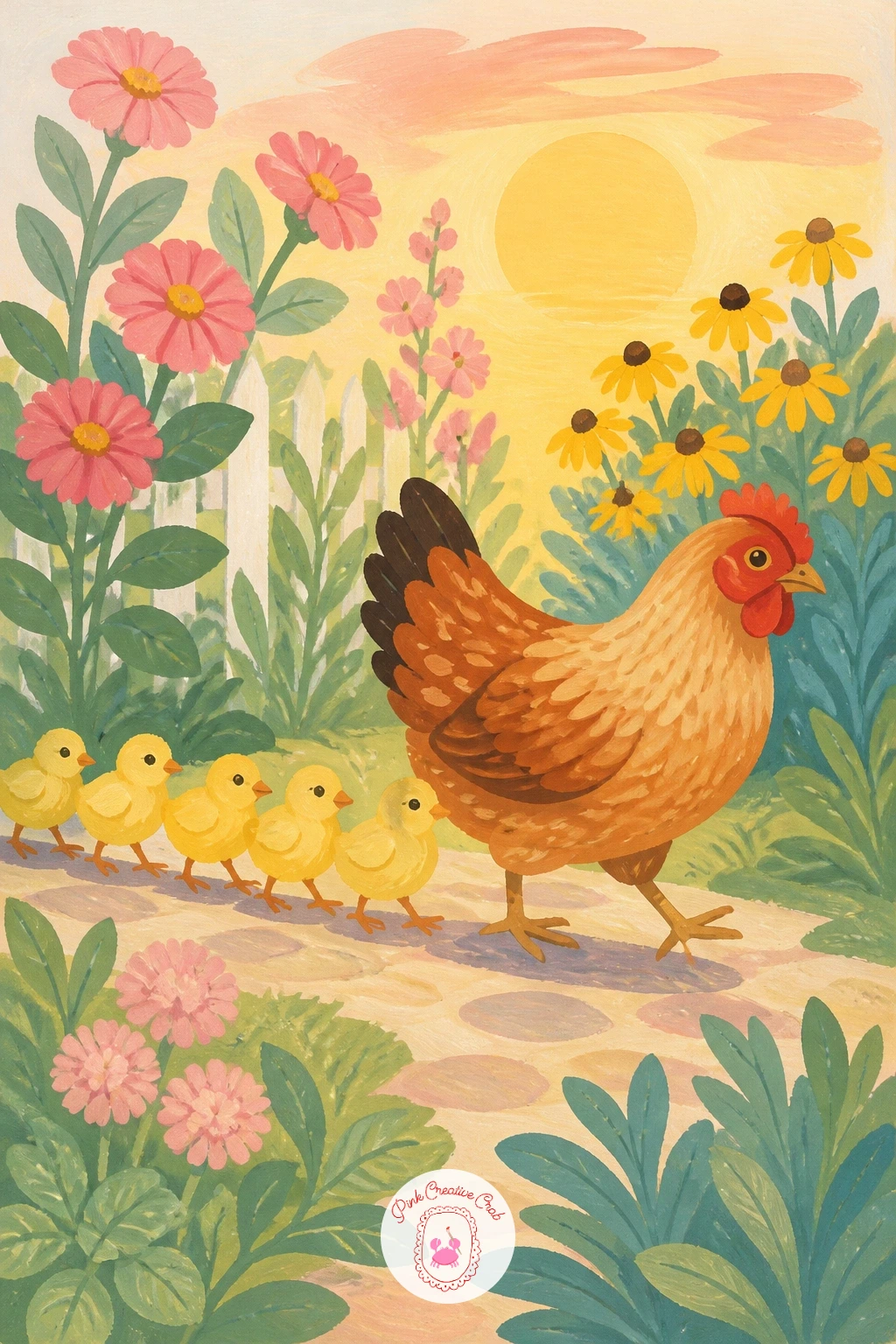
Palette: Terracotta,Butter Yellow,Mint Green,Cream
Return to yarn with a lamb knitting a striped scarf for a chick, a cozy two-character scene that leans on the same dry-brush texture trick as the hen’s hats earlier, this time along a longer stretch of fabric. Paint the lamb seated with knitting needles in its hooves first, then the chick standing patiently beside it, already wrapped halfway in one end of the unfinished scarf.
Lay the scarf’s colour stripes in flat first, letting each dry before the next so they stay crisp rather than bleeding together, then once fully dry, drag a slightly dry brush lightly along the scarf’s edges to soften them into a knitted texture. If the stripes blur anyway, a thin line of your darkest stripe colour painted along each boundary once everything is dry pulls the pattern back into focus.
No extra brush for dry texture, the same round brush wiped nearly clean on a paper towel works. Three stripe colours is enough to read as “striped” without overcomplicating the shape.
Let the ball of yarn sit at the lamb’s feet with a single loose thread trailing from it.
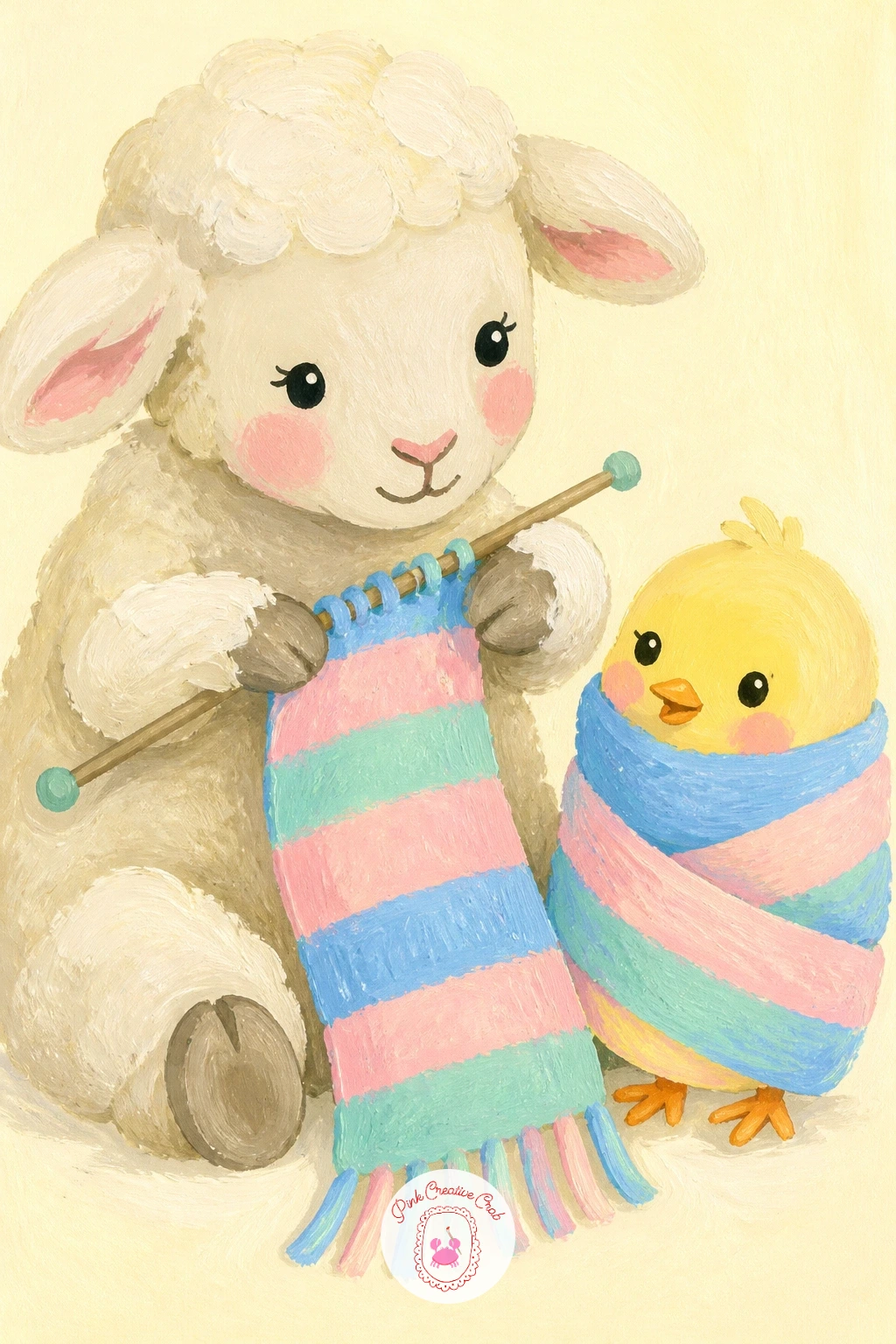
Palette: Blush Pink,Sky Blue,Butter Yellow,Cream
For more cozy animal pairs in this same gentle palette, the baby animals junk journal pages make a nice companion project.
Scale returns in a pair of mice having a tea party on top of a giant egg, so fix the egg’s size first by deciding it should stand roughly four times taller than one mouse, then keep the mice and their tiny tea set consistent with that scale throughout. Paint the egg as a large flat oval with a simple decorative band around its widest point, which doubles as the mice’s tabletop.
Place a small cloth, two tiny cups and a teapot along that band before adding the mice sitting on opposite sides, legs dangling over the egg’s curve. Props shrink unevenly if painted without checking against the mice, so hold your brush up to compare the teapot’s height against a mouse’s head before committing to the final size.
A single curl of steam rising from the teapot, painted as one soft wavy line in white gouache, finishes the cozy feeling. No tiny saucers in your usual kit, a plain dot of colour under each cup reads the same way.
Tip one mouse’s teacup slightly, caught mid-sip, for warmth.
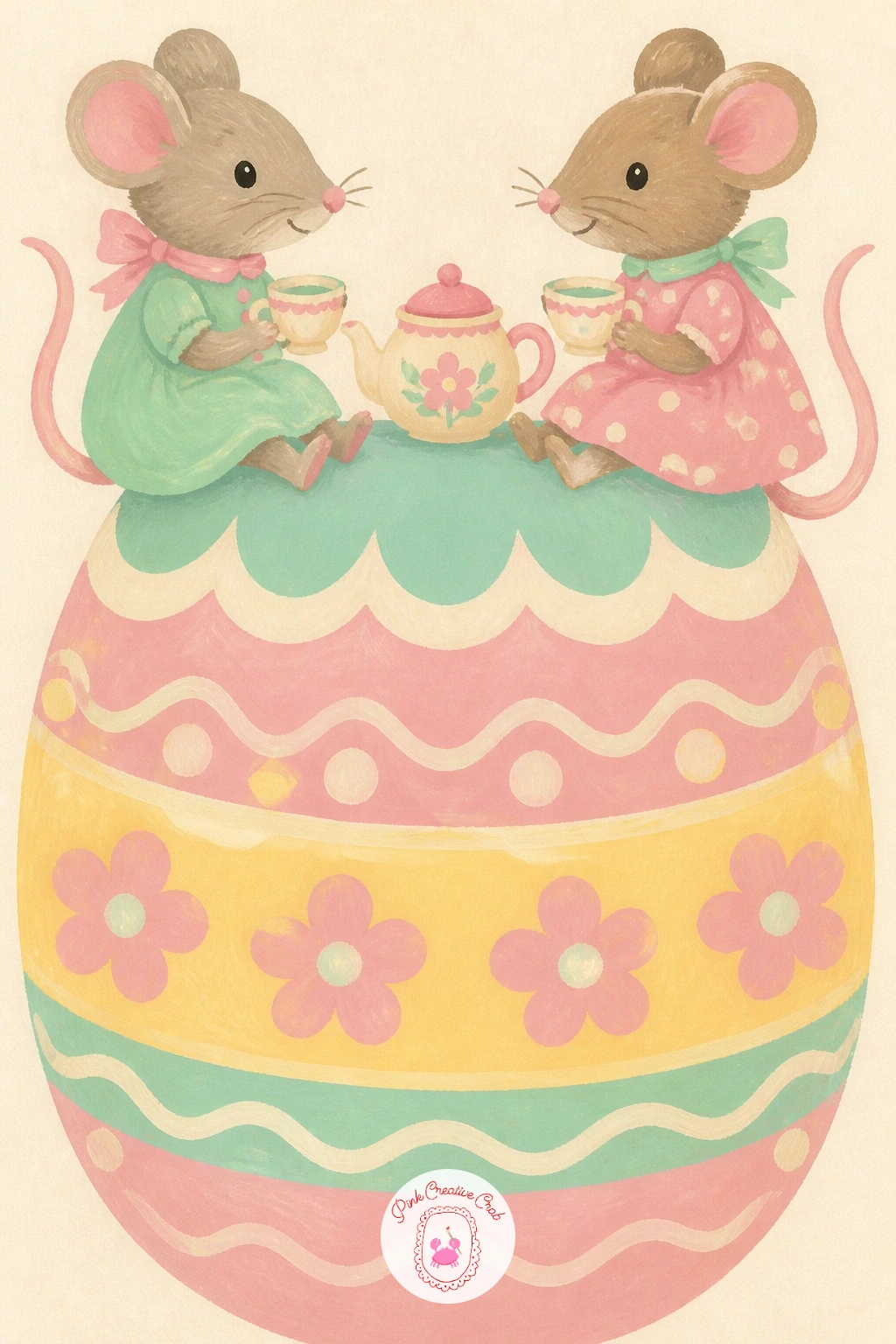
Palette: Blush Pink,Mint Green,Butter Yellow,Soft Grey
Keep things playful with a duckling taking a bubble bath in a half eggshell, a small, charming scene built from soft rounded bubbles and one happy pose. Paint the eggshell tub first as a simple curved bowl shape, then fill it partway with a pale blue wash for water before the duckling goes in sitting upright with wings resting on the rim.
Bubbles pile up last, painted as a cluster of overlapping circles in white gouache with the faintest touch of blue shading on their lower curves to keep them from looking flat. Bubbles often end up as a solid blob if painted too close together, so leave small gaps of the pale blue water showing between several of them.
If white gouache looks too stark against the blue, let a tiny bit of the water colour bleed into the edge of a few bubbles while still damp. A single larger bubble floating just above the rim, about to pop, adds a nice bit of motion.
Give the duckling closed, happy eyes for the full relaxed bath feeling.
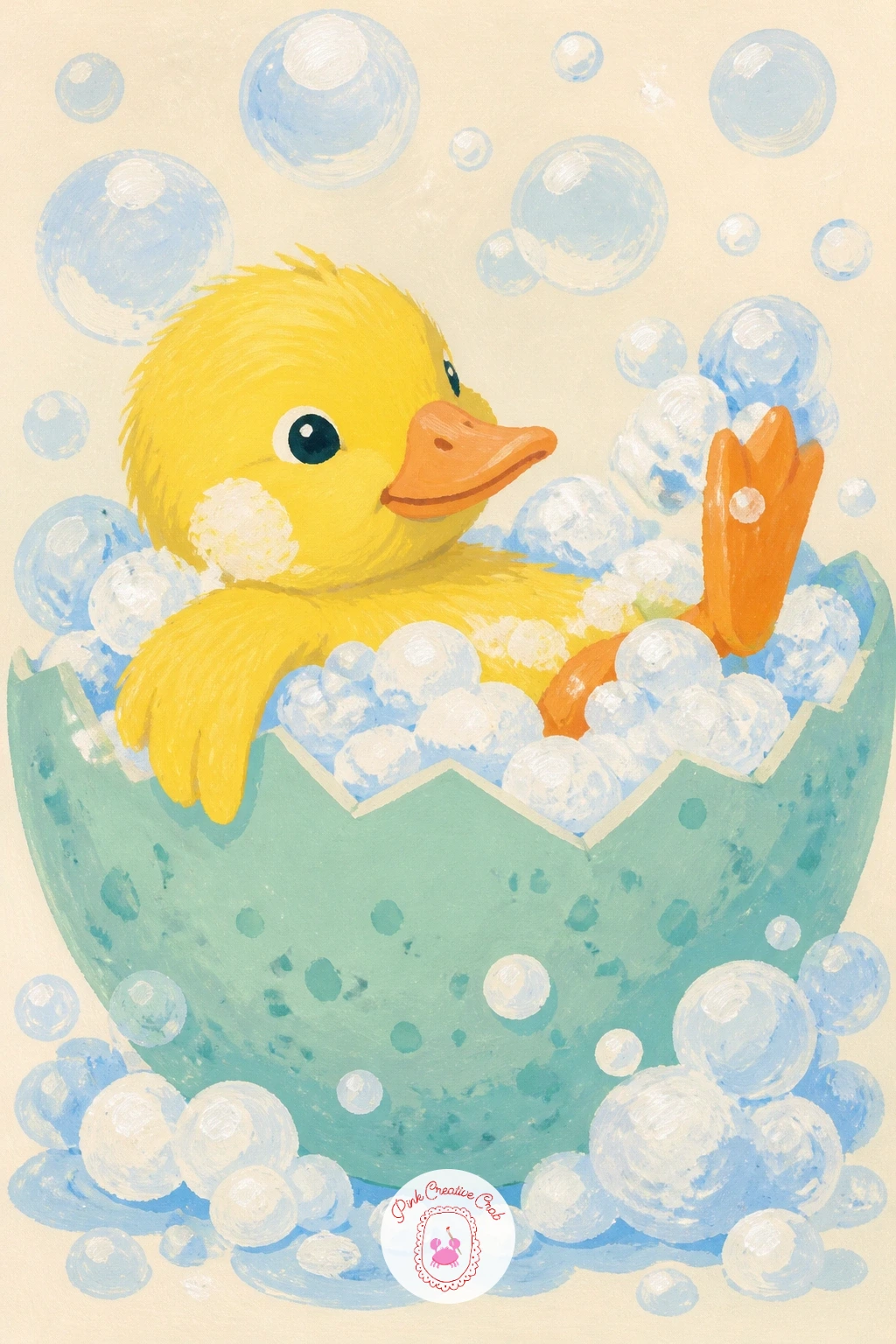
Palette: Sky Blue,Cream,Butter Yellow,Warm White
Build a bigger group with a lamb in a flower crown leading a parade of chicks, where the trick is keeping a long line of small figures feeling organized rather than scattered. Sketch a gently curving path in light pencil first, then place the lamb at its front and four or five chicks trailing behind directly along that same curve so the whole parade reads as one connected movement.
Paint the lamb’s flower crown as a simple ring of five or six small coloured dots around its head before anything else, since getting that crown right early keeps the whole character feeling festive from the start. Fill in the chicks behind with slight size variation, a touch smaller the further back they sit, which adds depth without any real perspective drawing.
If the parade feels static, give two chicks slightly raised wings as if mid-step or mid-cheer. Small paper or fabric flowers are not needed, the dots of colour alone read clearly as a crown from a normal viewing distance.
Let one chick near the back carry a tiny flag shape on a stick for festivity.
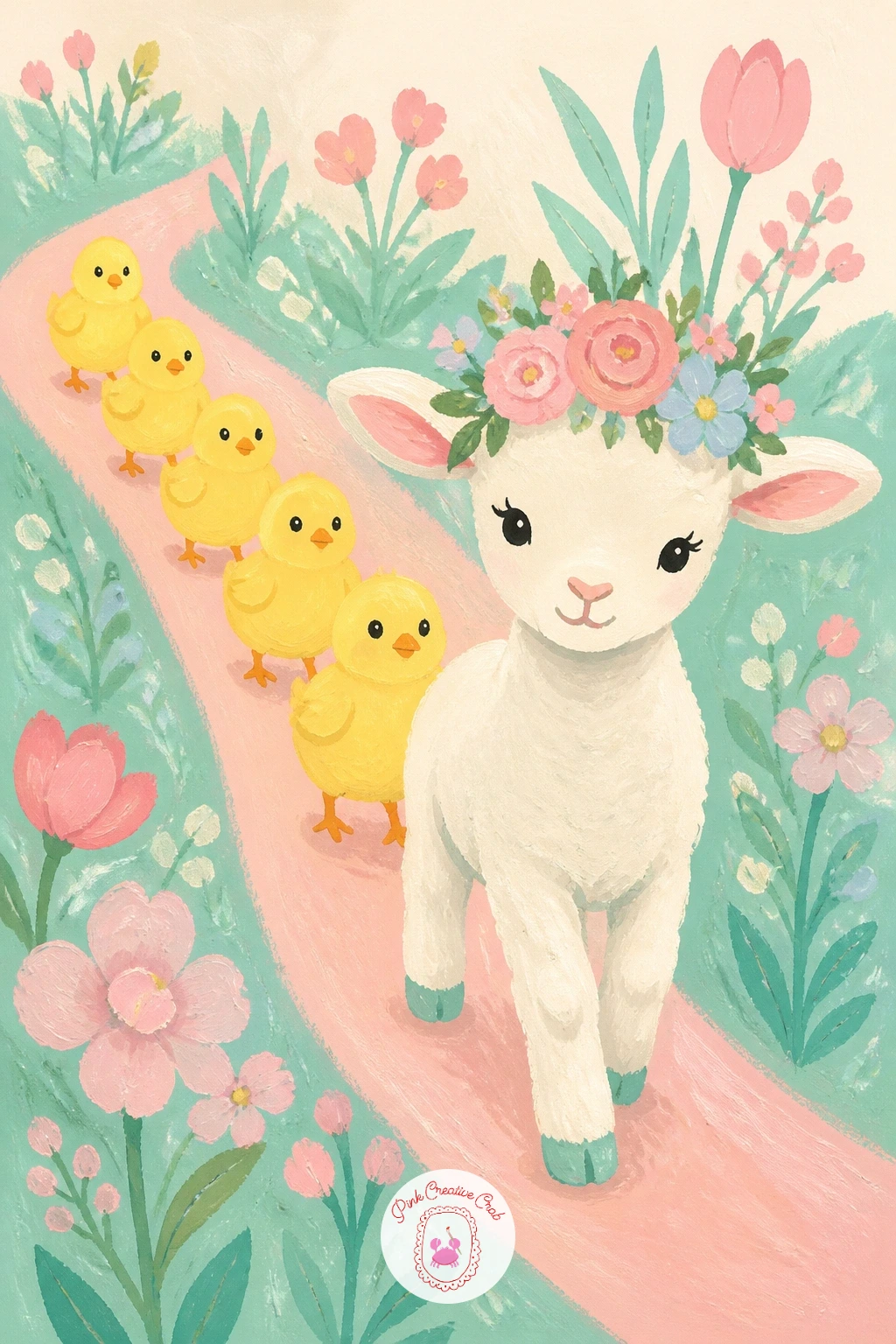
Palette: Blush Pink,Mint Green,Butter Yellow,Sky Blue
Add sky and wind to a chick flying a kite made from a tulip petal, which means deciding where the light sits before painting so the kite’s petal shape reads as translucent rather than solid. Keep the light coming from behind the kite, letting its edges glow slightly paler than its center, the same way real sunlight passes through a thin petal.
Paint the sky first in a flat pale blue, then the chick below holding a thin curved string, then the pink petal-shaped kite last, highest in the frame, with that paler glowing edge added once the base pink has dried. A kite strung too straight looks stiff, so let the string dip in a gentle curve rather than a ruler-straight line between chick and kite.
If a confident curved line feels tricky freehand, lightly trace the curve in pencil first and paint over it once satisfied. A couple of small drifting clouds fill extra sky space without any new complexity.
Let the chick’s feet lift slightly off the ground, caught mid-hop with excitement.
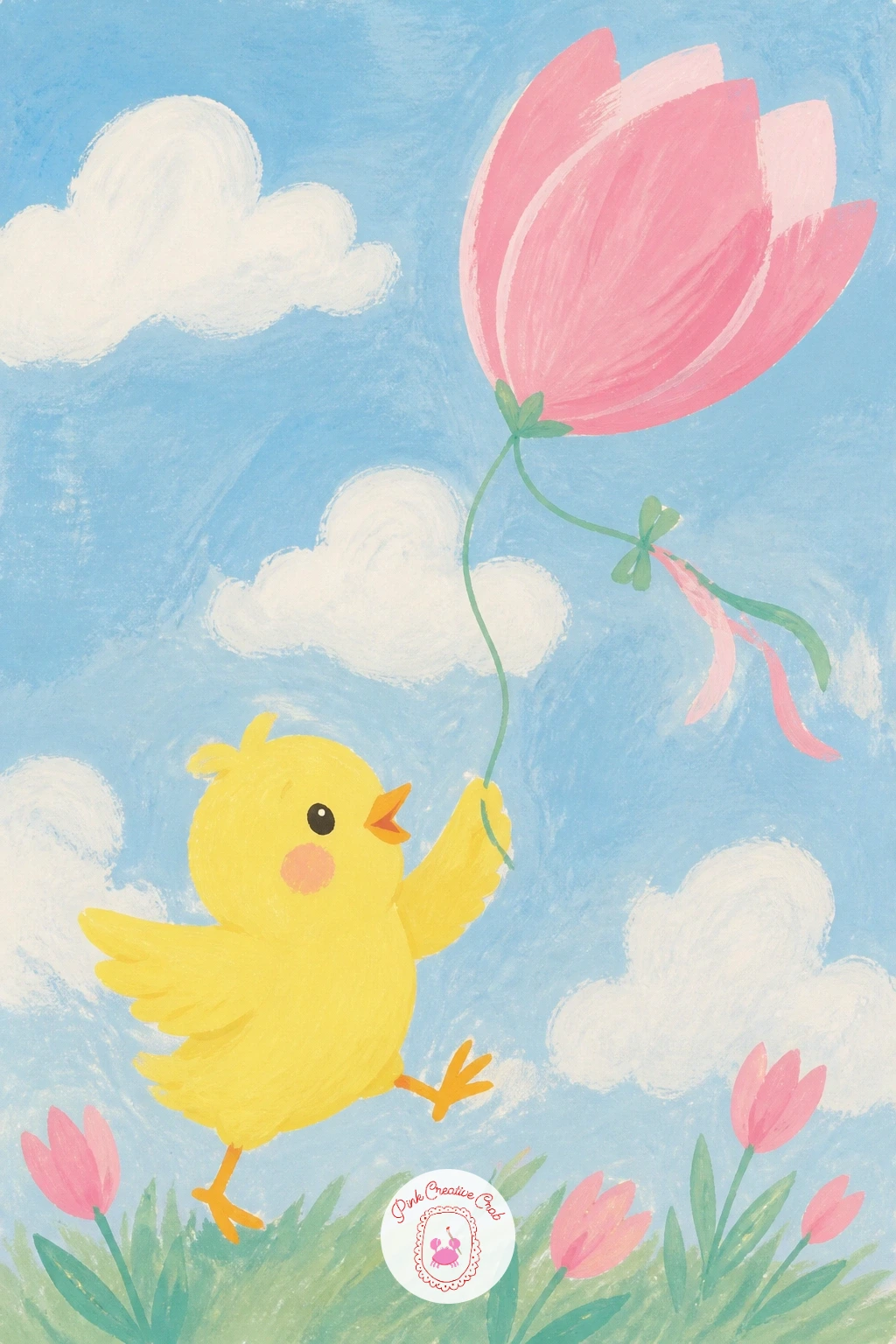
Palette: Sky Blue,Blush Pink,Butter Yellow,Cream
Return to a tender close-up with a sheep mom combing her lamb’s wool before church, a scene where getting the proportion between the two right makes all the difference. Measure the mother sheep’s head against the lamb’s whole body: the lamb should be roughly the same height as its mother’s head and neck together, which keeps the pair looking like parent and young rather than two same-sized sheep.
Paint the mother first, seated, with a comb held in one hoof, then the smaller lamb standing in front of her with its wool slightly tousled on one side where she has not yet reached. Work the mother’s own wool in loose overlapping bumps same as other sheep in this set, but keep the lamb’s wool bumps noticeably smaller and tighter to reinforce the size difference.
If a toothpick or fine brush for the comb’s teeth feels fiddly, a few short straight pencil lines under a thin wash of grey work just as well. A small ribbon ready and waiting on the table beside them hints at the church outing to come.
Give the lamb a slightly closed, patient expression, standing still through the fuss.
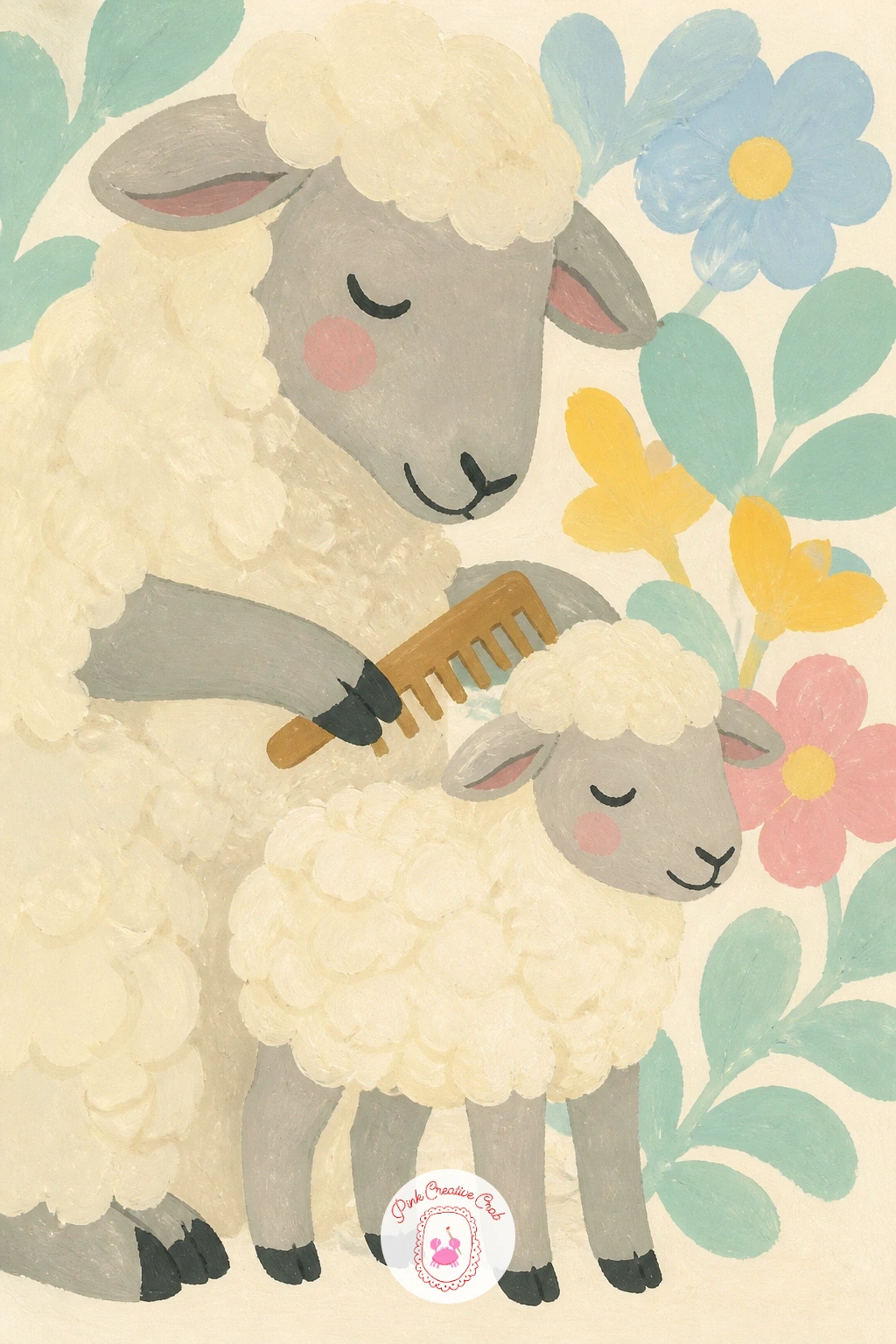
Palette: Soft Grey,Cream,Blush Pink,Butter Yellow
Bring back motion with a duckling delivering eggs on a little bicycle, which asks for one clear light source to make the wheels and basket feel like they are actually rolling. Put the sun high and to one side so the bicycle casts a long simple shadow across the path, instantly suggesting speed and daylight at once without any extra effort.
Paint the bicycle’s frame and both wheels first as a confident outline, then the duckling perched on the seat with wings on the handlebars, then a small front basket loaded with two or three eggs last. A bicycle can look wobbly if the wheels end up different sizes, so pencil a quick circle guide for each wheel using a coin or bottle cap before painting.
No coin on hand for a perfect circle, a steady freehand oval drawn slowly is nearly as good at this scale. Stretch that shadow a touch longer than expected, exaggerated shadows read as more dynamic than accurate ones.
Let one egg sit slightly higher in the basket, mid-bounce, as the bike rolls over a bump.
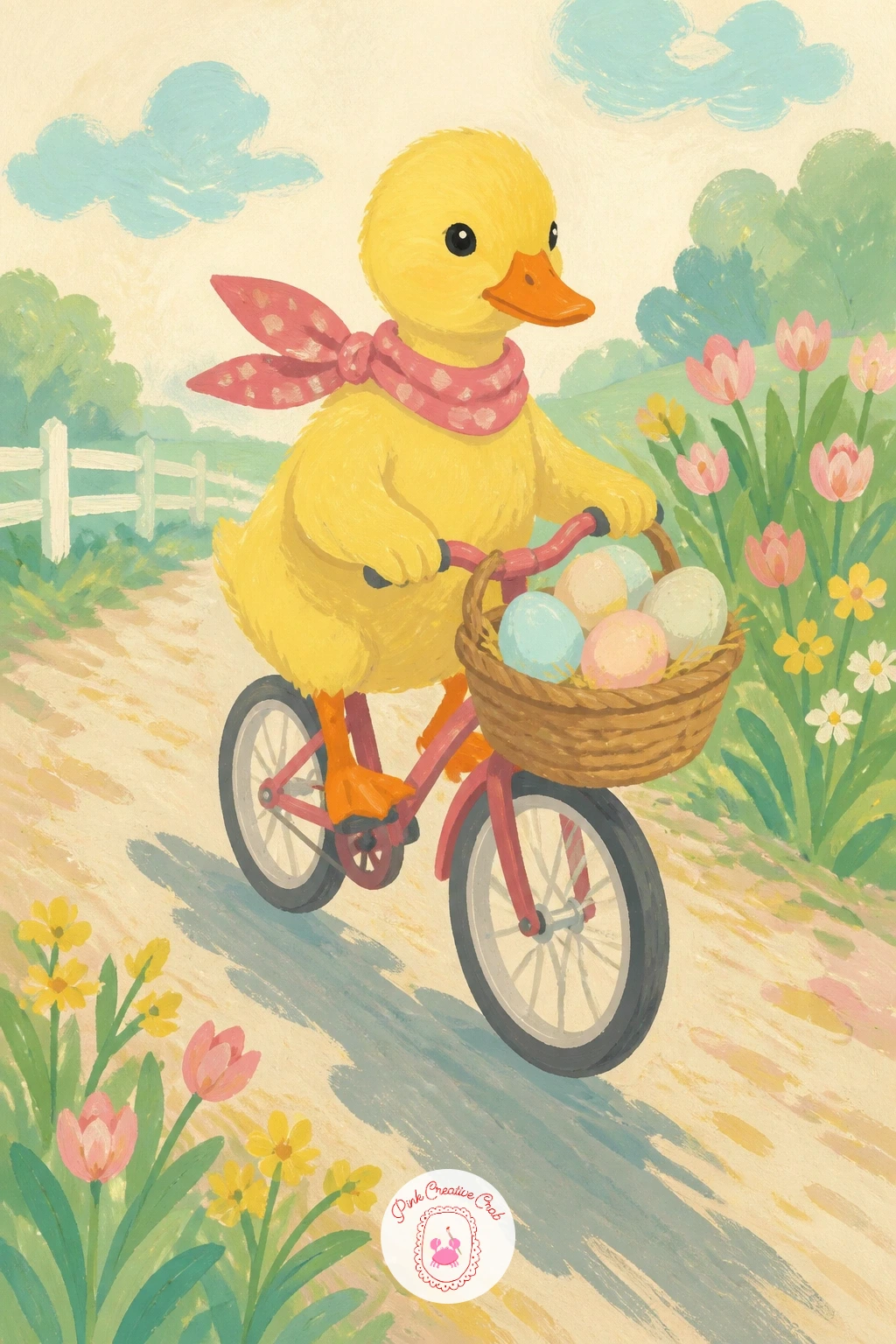
You Will Need
- coin or bottle cap to trace wheel circles
Palette: Butter Yellow,Soft Red,Sky Blue,Cream
Capture a single burst of energy with a baby goat jumping over a basket of eggs, best built from a quick ten-minute pass that you can refine afterward. For the quick version, paint the basket low in the frame first, then the goat mid-leap above it with all four legs tucked up, body arched in one smooth curve.
Given forty minutes, add a small trail of dust or grass flicked up where the goat’s back legs left the ground, plus a second smaller goat watching from the side, and a couple of scattered eggs that tipped out of the basket mid-jump. The arched body is the part worth slowing down for, since a stiff straight goat reads as standing rather than leaping.
If the leap looks flat, lower the front legs slightly more than the back ones to suggest the goat is already starting its descent. No extra colour for a motion trail, three short curved white lines behind the goat’s hooves does the job.
Let one egg already be rolling away from the basket, mid-tip, for extra energy.
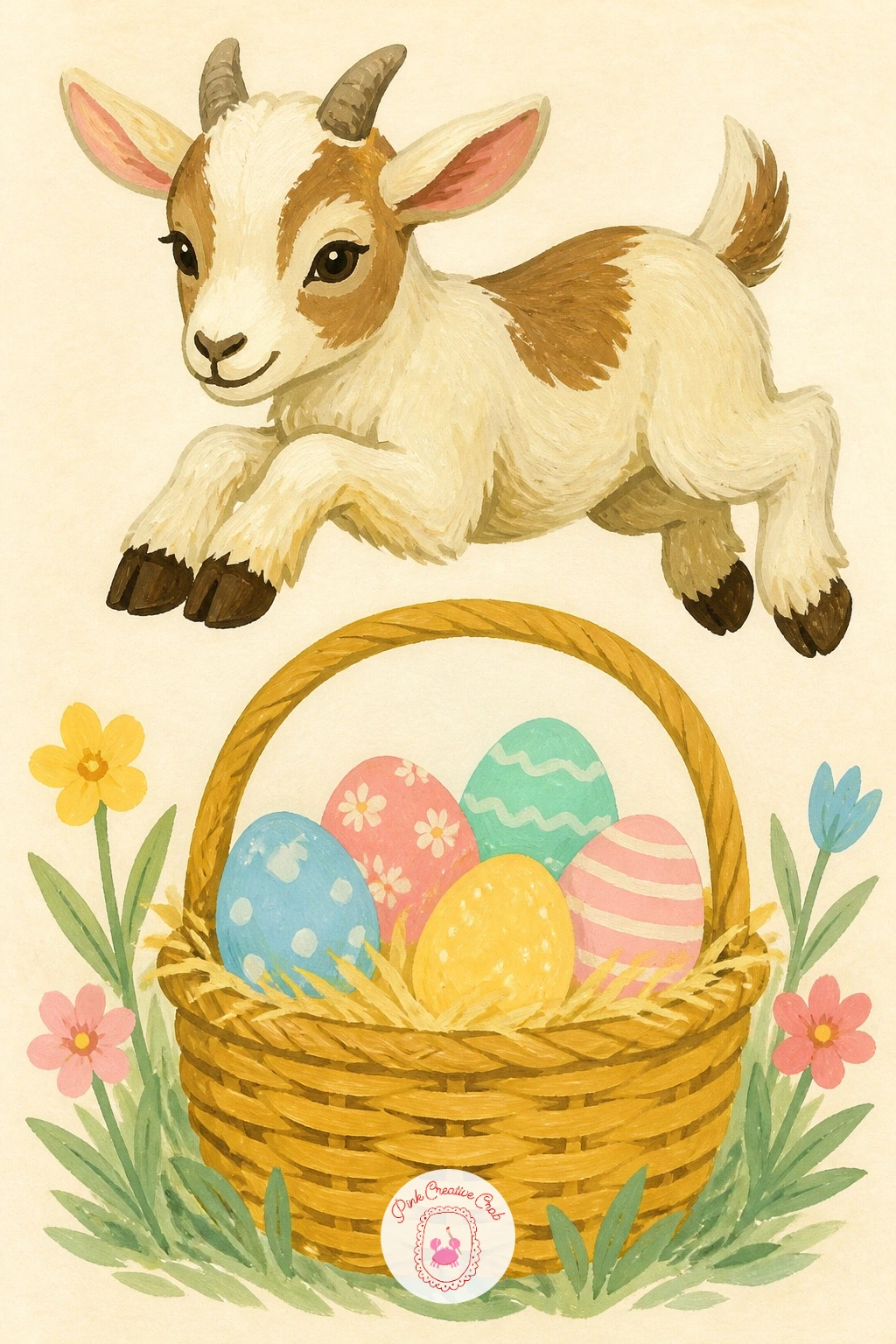
Palette: Butter Yellow,Mint Green,Blush Pink,Cream
Vary the family theme with a family of quails marching through daffodils, leaning on the quail’s distinctive head plume to keep the birds reading clearly as quails rather than generic chicks. Paint the parent quail first with that single curved feather plume rising from its head, then two or three smaller quail chicks behind, each with a much shorter version of the same plume.
Work the daffodils in last, in a loose row along the ground, painting each trumpet center first in deep yellow before the paler petals around it, since doing it in that order keeps the trumpet from getting lost under the lighter petal colour. A marching line of quails can flatten out if every bird stands the same height, so let the chicks’ heads dip slightly lower and more varied than the parent’s steady line.
If deep yellow gouache looks muddy once mixed, a touch of orange sharpens it back up. Three or four daffodils is enough; more starts to compete with the birds for attention.
Angle the lead quail’s plume forward, as if caught mid-step into a breeze.
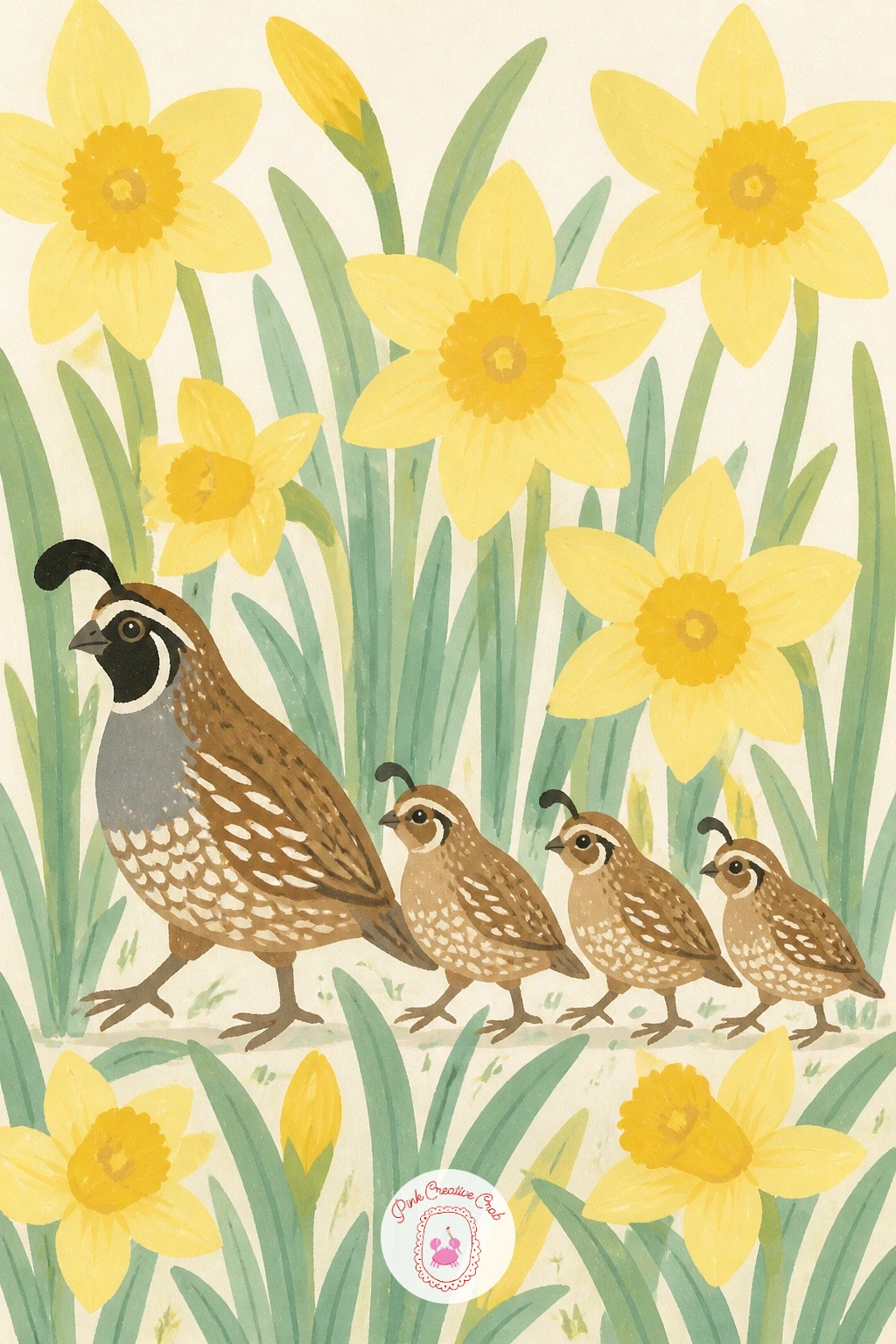
Palette: Soft Brown,Butter Yellow,Cream,Mint Green
Slow down for a close, still scene with a chick watering a seedling in an egg cup planter, a good one for practicing restraint with detail. Paint the egg cup first as a simple small vessel shape with a crack line near its rim, then a thin green seedling stem rising from it with two small leaf shapes unfurling at the top.
Add the chick last, tipping a tiny watering can toward the cup with a few curved drip lines falling between the spout and the soil. This scene can feel empty if left too sparse, so let one or two drips already land, shown as small dark dots on the soil’s surface, to connect the action across the page.
If a watering can feels fussy to paint small, a simple spouted jug shape reads just as clearly at this scale. Keep the whole composition compact and centered, since the quiet mood of this one depends on empty cream space around it rather than a busy backdrop.
Curl the seedling’s two leaves at slightly different angles so they feel freshly grown rather than symmetrical.
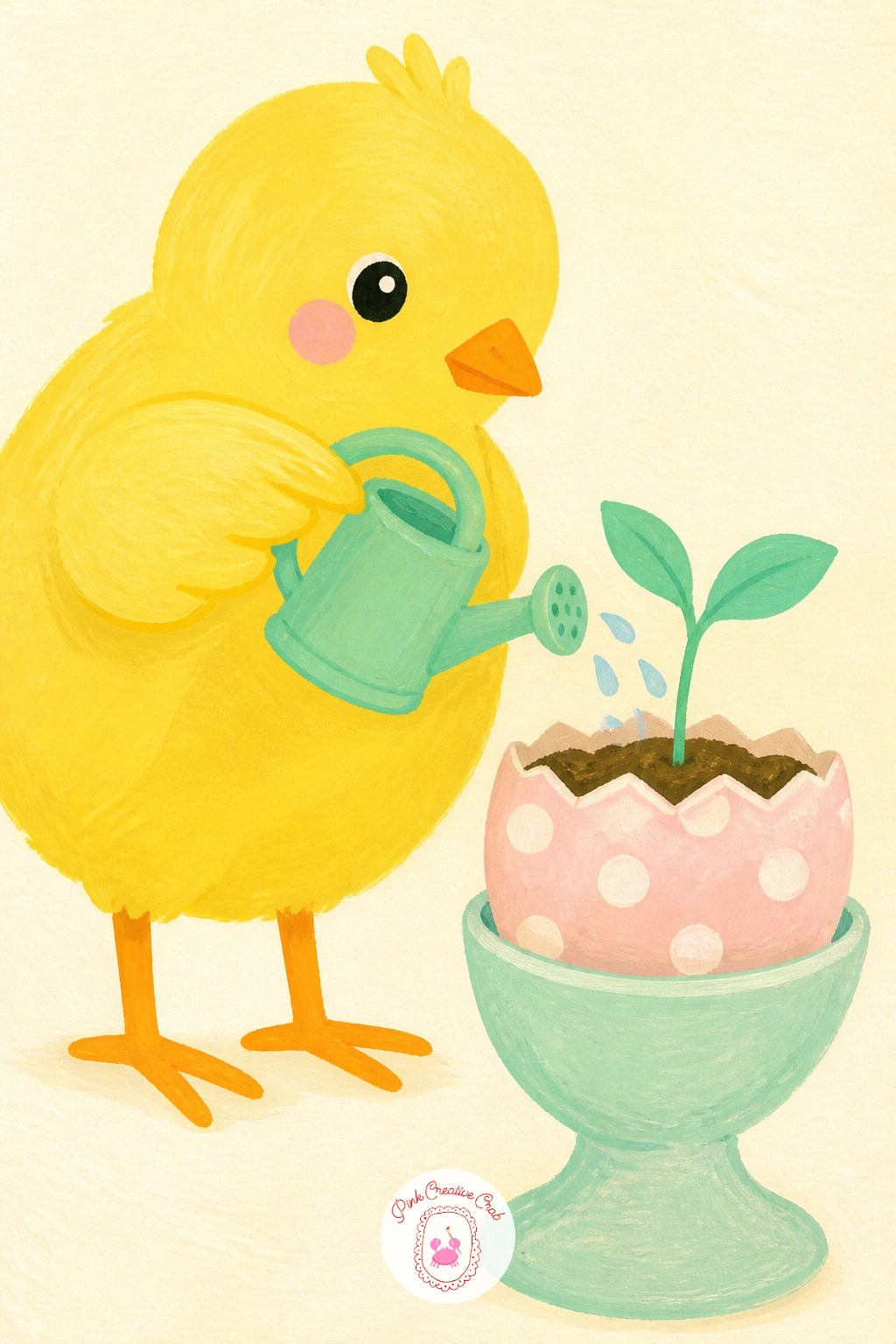
Palette: Mint Green,Butter Yellow,Soft Brown,Cream
End on something gentle with a lamb peeking into a nest of blue robin eggs, a scene where getting the eggs’ colour right carries most of the charm. Paint the nest first as a rounded woven shape built from short overlapping curved strokes, then the two or three pale blue eggs nestled inside before the lamb’s curious face leans in from one side.
Keep the lamb’s head large in proportion to the small nest, since a lamb’s face filling most of the frame while the nest sits modestly in one corner is what makes the eggs feel precious and small rather than like the main subject. A too-perfect robin’s egg blue can look artificial, so mix in the faintest touch of grey to soften it toward something closer to real eggshell.
If woven nest texture feels tricky, a flattened brown oval with just a few darker curved lines along its rim reads convincingly enough at this scale. Let the lamb’s breath on a cold morning show as a faint pale cloud near its nose for a quiet extra detail.
Angle the lamb’s ears forward and alert, fully absorbed in the discovery.
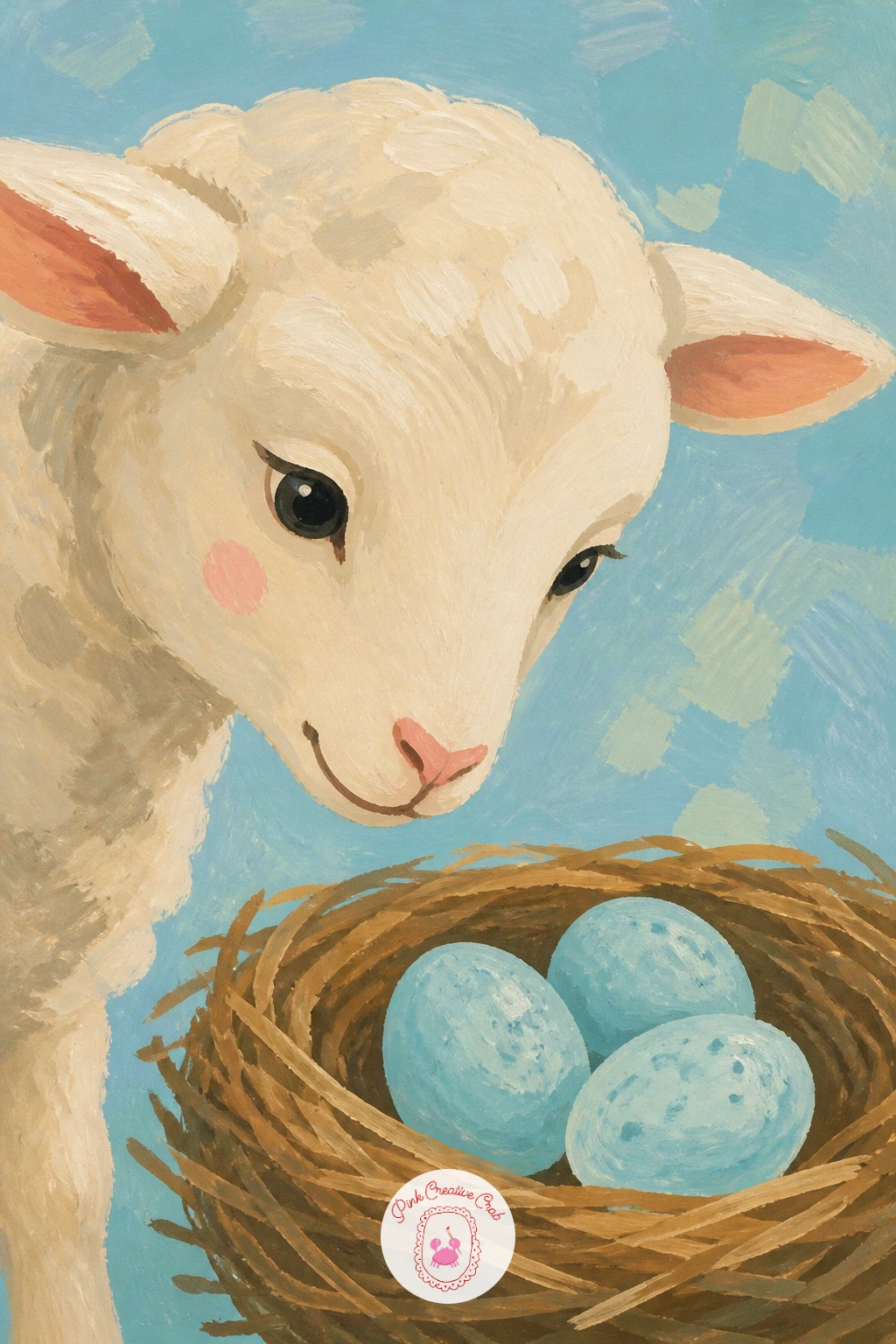
Palette: Sky Blue,Soft Brown,Cream,Soft Grey
For more ideas that pair cozy animals with a soft storybook palette, browse the storybook illustration ideas for further scenes in this same spirit.
Return to rest with a duck and her ducklings napping in a big basket, a soft pile-up of shapes that benefits from thinking about overlap before colour. Paint the basket first as one large woven oval, then the mother duck curled around its edge, then two or three ducklings tucked into the gaps between her wings and body, each one overlapping the next slightly so the whole group reads as one warm huddle.
A pile of sleeping birds can turn into a confusing blob if every shape sits at the same size and angle, so vary each duckling’s tuck: one curled tight, one with just a head poking out, one with a single webbed foot visible. Work from the back of the pile forward, finishing with whichever duckling sits most in front so its edges stay cleanest.
If the woven basket texture feels like too much detail, a few simple curved lines around the rim suggest weaving without drawing every strand. Close every eye in the scene with one soft curved line for a fully sleepy mood.
Tuck a single downy feather drifting beside the basket for a quiet finishing touch.
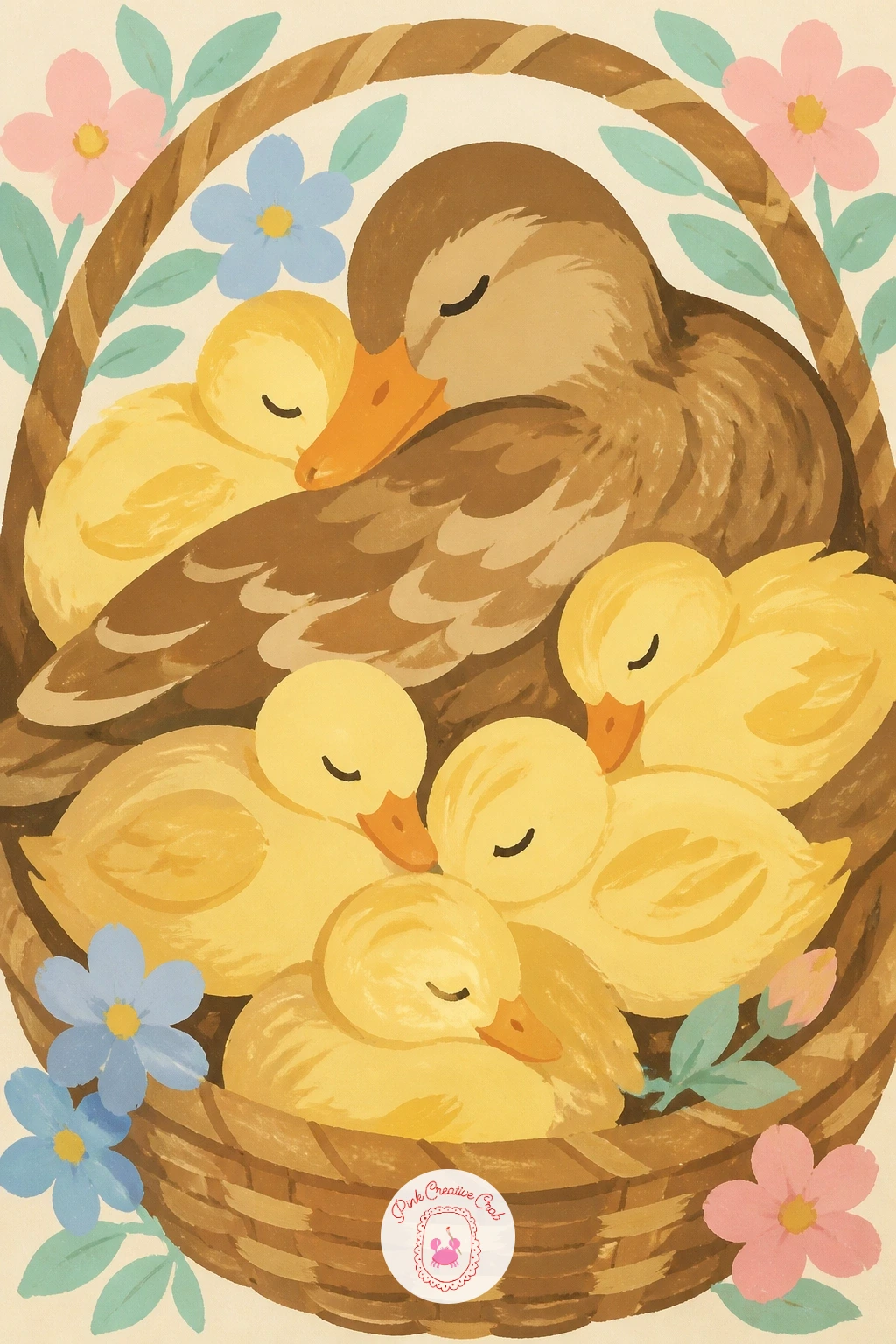
Palette: Soft Brown,Butter Yellow,Cream,Blush Pink
Have some fun with a mole popping up in a garden next to a hidden egg, a scene built almost entirely around one surprised expression. Paint the mound of dirt first as a simple dark rounded hill shape with the mole’s head and front paws emerging from a gap at its top, then tuck a single painted egg half buried in the grass just beside the mound.
The mole’s small eyes and pink nose are the whole personality of this piece, so keep its face simple, two tiny dots and one small triangle, and let the surprised expression come from eyebrows raised slightly rather than from any complicated shading. Dirt mounds can look like plain brown blobs without some texture, so once the base colour is dry, dab a slightly darker brown in small irregular patches across its surface with a nearly dry brush.
No separate dark brown mixed for texture, your base colour with a touch more black or deep green in it works. A few blades of grass drawn as simple thin green strokes around the egg finish the garden setting.
Give the mole one raised paw, as if just discovered the egg itself.
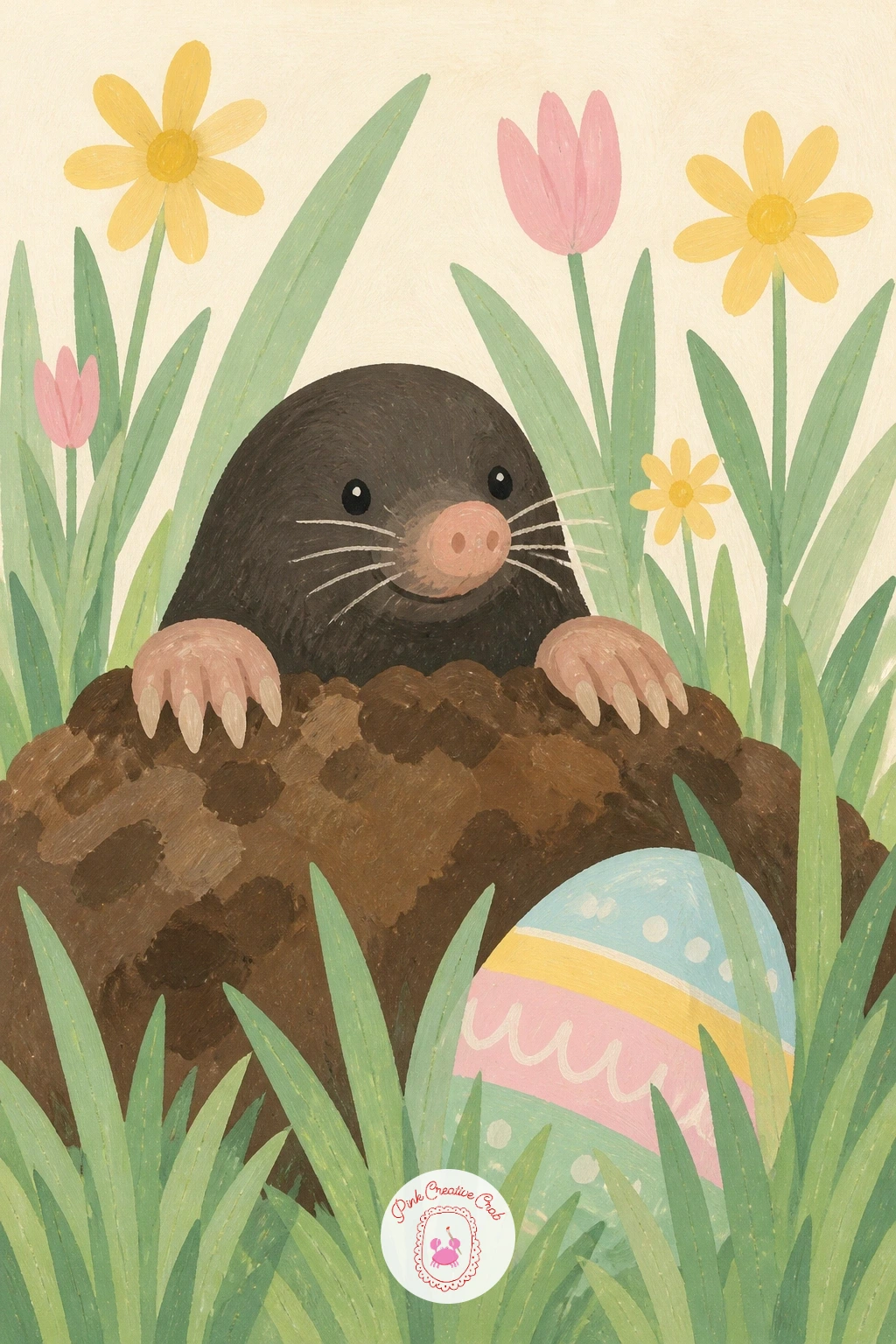
Palette: Soft Brown,Mint Green,Blush Pink,Cream
Close the series on a tender note with a lamb and a chick sharing an umbrella in a light shower, a two-character scene that leans on soft, scattered rain rather than a heavy downpour. Paint the open umbrella first as a simple domed shape with alternating colour panels, then the lamb holding its handle with the chick tucked close beside, both sheltered neatly under its curve.
Add a scatter of thin rain lines around the umbrella’s edge last, keeping them short, light, and irregularly spaced rather than a dense even grid, since a light shower should still let plenty of cream background show through between the drops. If the umbrella panels end up uneven in width, pencil in the dome shape first, then mark six evenly spaced lines from its center point before painting each panel between them.
No compass or template for a clean dome curve, tracing around a small plate or cup gives a reliable arc. Keep the ground beneath their feet just a touch darker and wetter looking than the dry air inside the umbrella’s shelter.
Let the chick press in close against the lamb’s leg, both looking out from under the umbrella together.
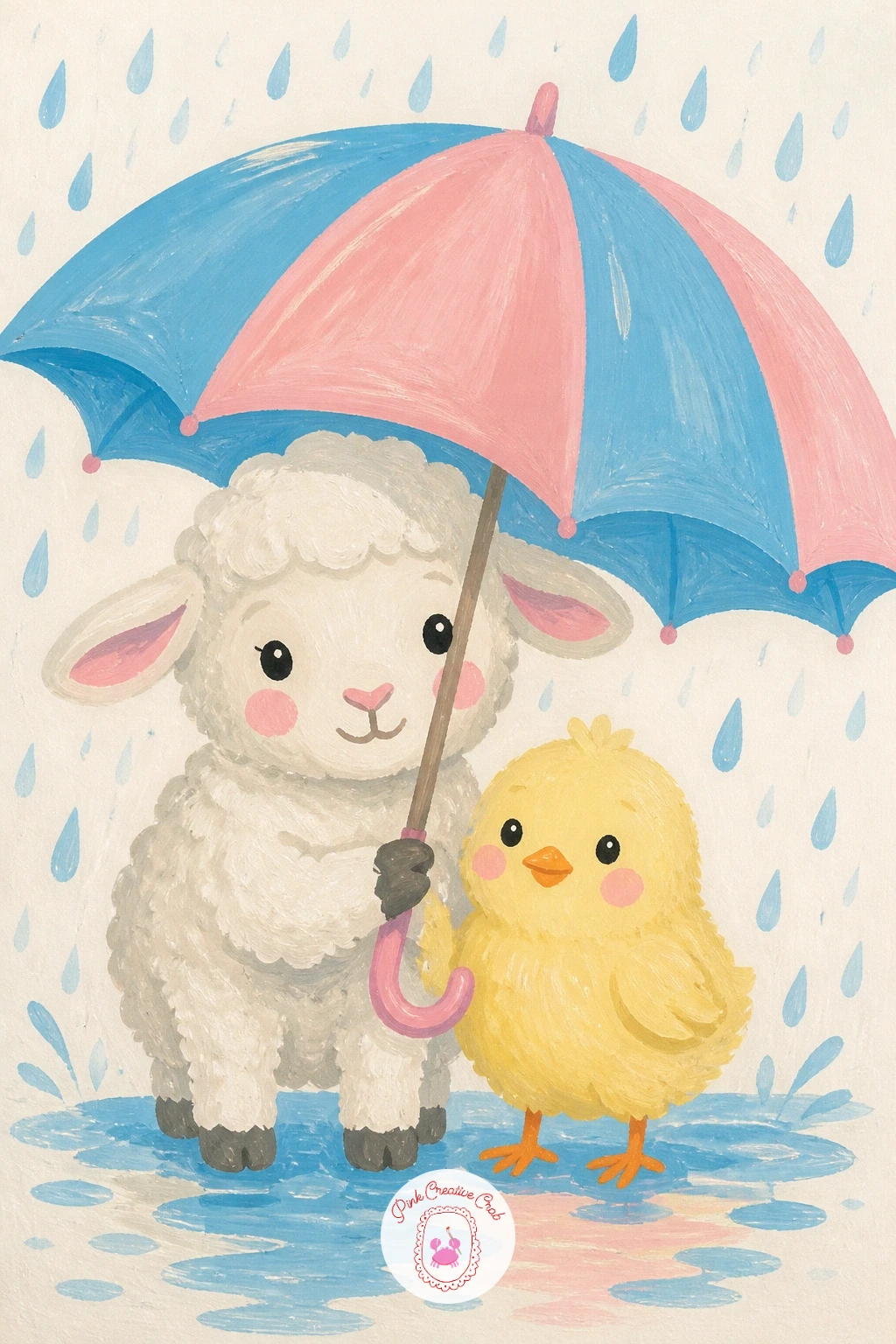
You Will Need
- small plate or cup to trace the umbrella dome
Palette: Sky Blue,Blush Pink,Butter Yellow,Cream
If you want to turn a favorite finished scene into a keepsake, the mini diorama scenes for Easter cards make a sweet way to display it.
What to Do Next
Pick whichever scene made you smile first, mix your four pastel colours ahead of time, and work largest shape to smallest on one sheet of gouache paper. One finished lamb, chick or duckling today is plenty, the rest of the list will still be here tomorrow.
Frequently Asked Questions
What is the easiest way to start an easter illustration in gouache?
Start with a single animal and one simple prop, like the lamb at the painting table. Block in the largest shape first, let each colour dry before adding the next, and keep edges crisp rather than blended.
Which gouache colours work best for storybook Easter scenes?
A soft palette of mint, butter yellow, blush pink and sky blue against a cream background covers most of these scenes. Mix white into each colour to keep them pastel and matte rather than bright or glossy.
How do I keep gouache edges crisp instead of blurry?
Let each shape dry fully before painting the next one beside or on top of it. Working wet against wet is what blurs edges, so patience between layers matters more than brush control.
How can I make a group of animals look like a family rather than random shapes?
Keep a consistent size ratio between the adult and the young, roughly double the height is a reliable guide. Overlap their bodies slightly and vary head angles so the group reads as connected rather than scattered.
What if I do not have the exact gouache colours listed?
Mix your own: add white to any yellow for butter yellow, white to pink for blush, and white to blue for a soft sky tone. The flat matte look depends more on opaque, dry-brush-free colour than on an exact named shade.
Have any thoughts?
Share your reaction or leave a quick response — we’d love to hear what you think!
-
 0
-
 0
-
 0
-
 0
-
 0
-
 0
