Food painting gets so much more interesting once you let people and places crowd into the frame. A crate of lemons on its own is fine, but a vendor leaning over it in a striped apron, calling out to a shopper, gives you a whole little world to paint in one sitting.
Every scene below is built for gouache: flat matte shapes, clean edges, and a cream background that lets the lemon yellows and cobalt blues sing. Scroll through market stalls, picnic blankets, street carts and long table dinners, and pick whichever one makes you want to pick up a brush right now.
Using these images: free for personal projects such as printing, coloring, cards, journals and gifts. Handmade items that include them may be sold up to 30 pieces per design. More than that is commercial use and is not permitted, and neither is selling or sharing the images themselves or passing them off as your own. Please ask before any other use.
Start with a fruit market stall, since stacked crates give you an easy grid to build from before any people go in. Block the stall and the crates first in flat cobalt blue and warm wood tones, then paint the lemons as a cluster of overlapping circles in two yellows, one lighter for the lemons catching light.
Add the vendor last, standing behind the crates in a striped apron, painted as simple blocks of coral and cream with no blended shading. Keep the stripes loose rather than ruled, a few wobbly bands read as cloth, a perfectly straight grid reads as a flag.
The common snag is crowding every lemon in with a hard black outline, which flattens the pile into a pattern instead of a stack. Paint the crate shadows first, then drop lemons in on top so the ones at the back sit visibly behind the front row.
If you do not have cobalt on hand, any mid blue plus a touch of white gets you close enough for this stall.
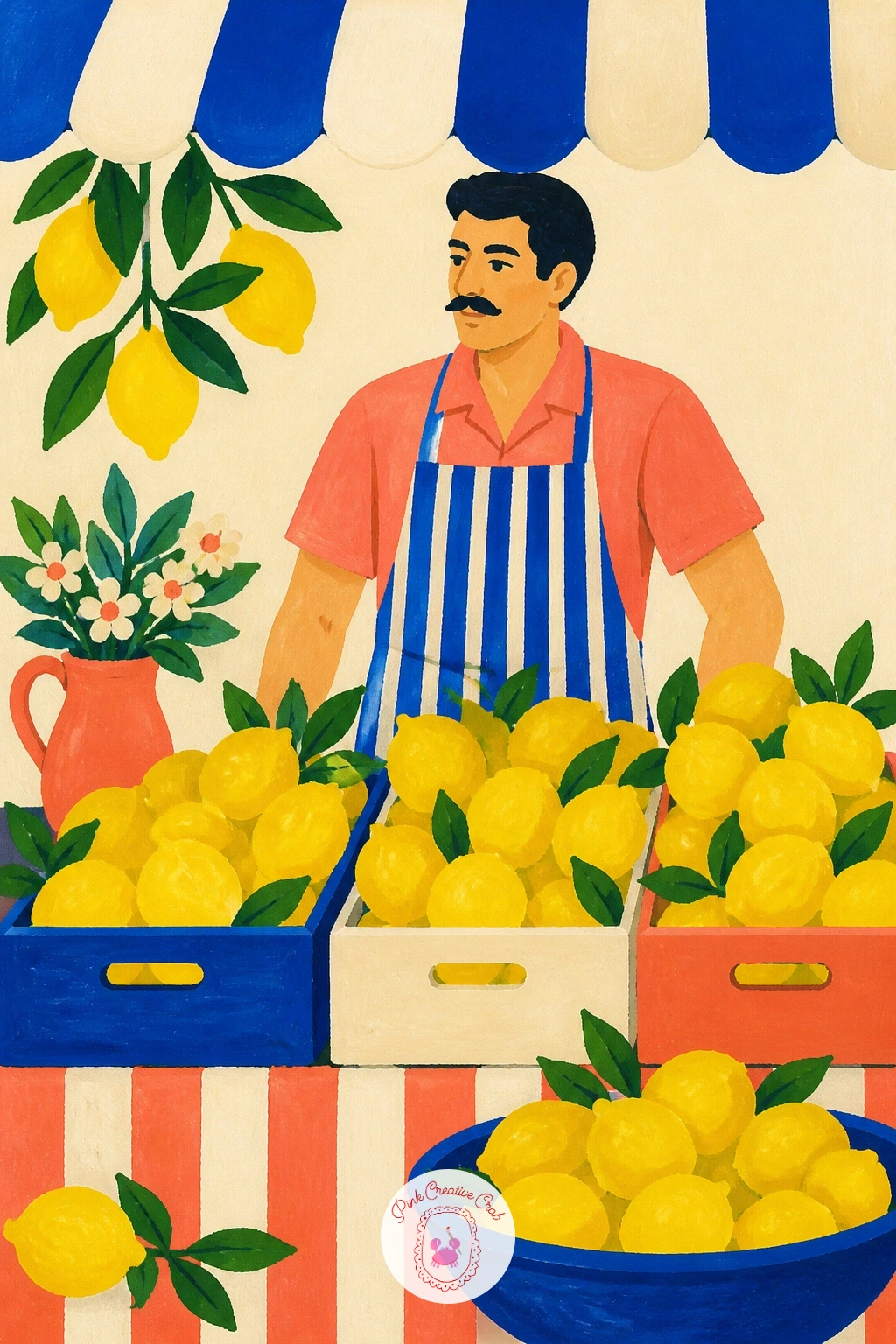
Palette: Lemon Yellow,Cobalt Blue,Coral,Cream
Move from the stall to a checked picnic blanket with two friends sharing grapes and cheese, a good second piece since the checks give you an easy pattern to practice flat edges on. Paint the blanket first as a grid of cream and coral squares, then place the figures sitting on top so the pattern breaks convincingly under them.
Measure before you commit to proportions: the two seated figures should sit roughly the same height from knee to head, and the cheese board between them should be no wider than one figure’s shoulders, or the whole scene tips off balance.
Paint the grapes as a tight cluster of small ovals in two greens, one darker underneath so the bunch reads as round rather than flat. The cheese wedge goes in last as one clean cream shape with a thin coral rind line.
No checked fabric reference handy. Any plain cream blanket with a coral border still carries the picnic feeling just as well.
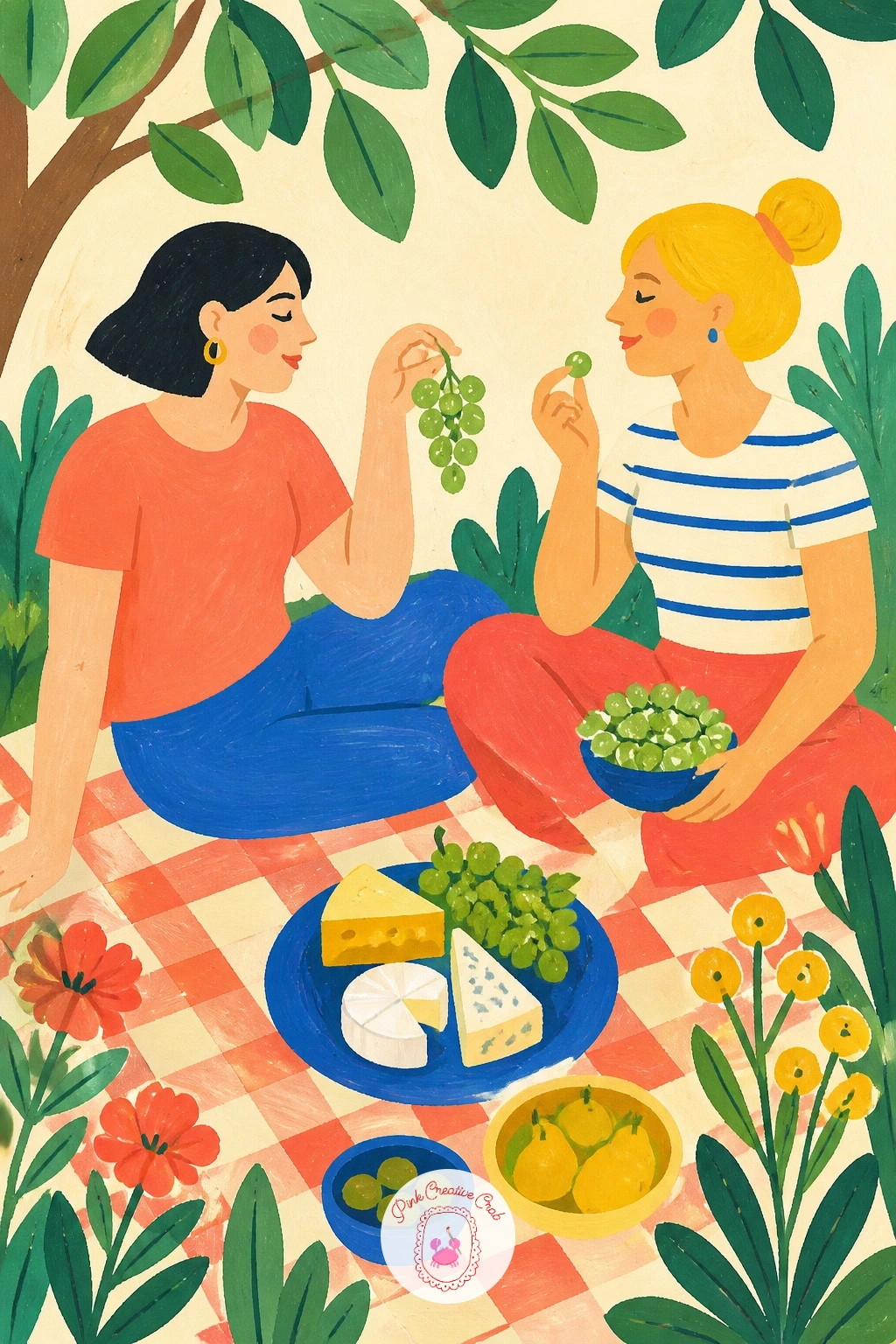
Palette: Coral,Leafy Green,Cream,Payne’s Grey
A long outdoor table under string lights asks for more patience, so work from the back forward: paint the string lights and sky first as a flat cobalt wash with small cream dots left unpainted or added last in white gouache. Build the table as one long cream rectangle, then seat the family around it as simple seated shapes spaced with slightly uneven gaps, which looks more like a real gathering than a perfectly even row.
Light decides the mood here. With the string lights as the only source, keep shadows under the table and under chins a touch darker, and let the tabletop itself stay bright cream where the bowls of pasta sit.
Paint the pasta bowls as simple coral or cream mounds with a few loose yellow lines for noodles, no need to paint individual strands. If the table gets too busy, drop one or two figures to the background as half shapes cut off by the table edge.
Keep the string lights sparse rather than evenly spaced, a cluster here and a gap there reads more natural overhead.
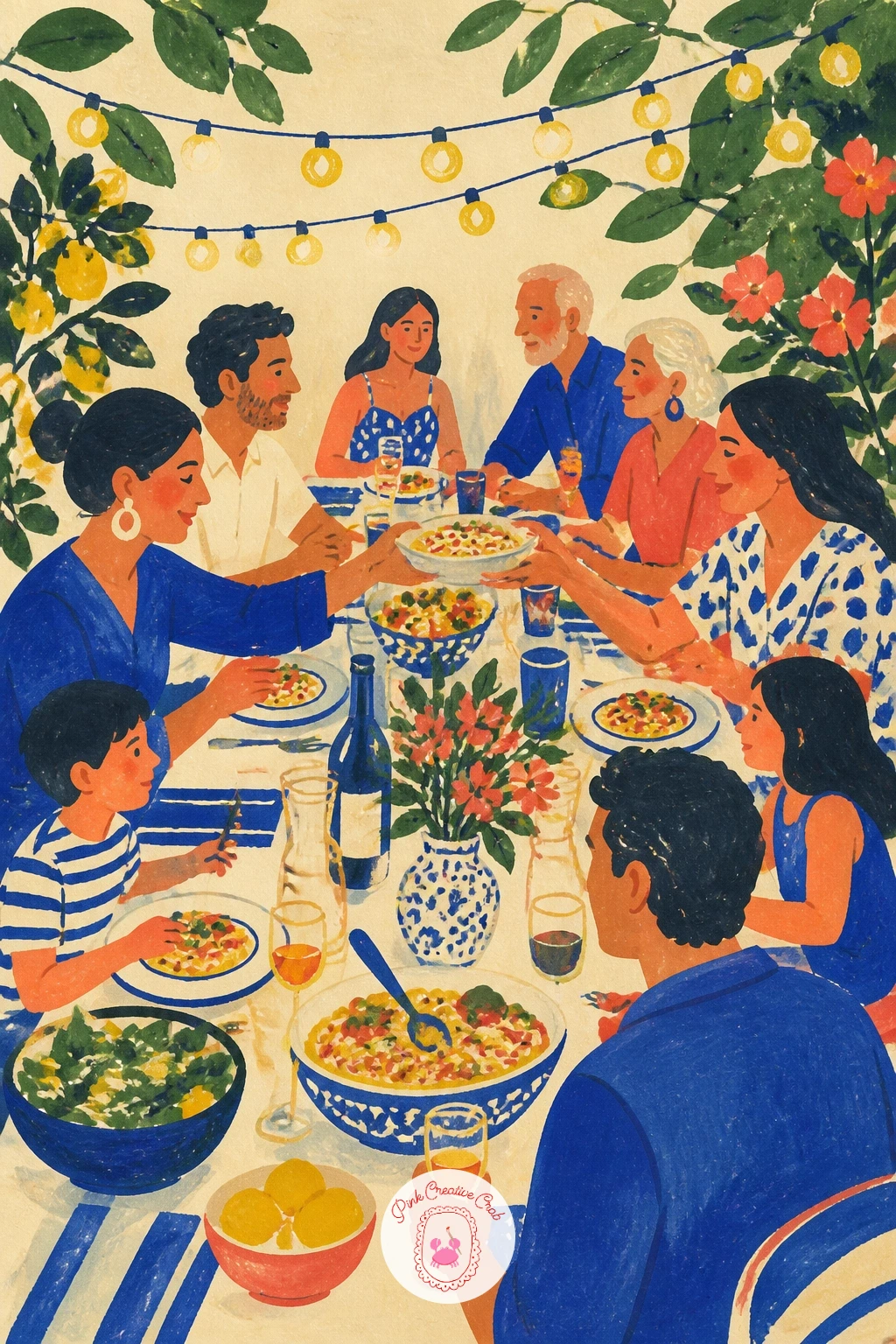
Palette: Cobalt Blue,Cream,Coral,Lemon Yellow
Try this one at dusk instead of full dark, with the sky a soft coral fading to cobalt, which gives the string lights more to glow against.
Give yourself a smaller cast after that long table: one girl buying peaches from a farm stand into a paper bag. Paint the farm stand as a simple wooden table shape first, then the peach crate on top as a mass of small coral and yellow circles, no two painted quite the same size.
Compare the girl’s height against the stand before you paint her in: her shoulders should sit roughly level with the top crate, which keeps her in believable scale next to the fruit. Paint her dress and the paper bag as two flat shapes, cream for the bag, any leftover coral or green for the dress so the palette stays tied together.
Edges matter most on the peaches. Keep each circle’s outline soft rather than hard black, a thin darker coral line along the shadow side is enough to round them.
If ten minutes is all you have, paint the stand and three peaches and call it finished. With more time, add a second crate of plums in cobalt-shadowed purple behind the first.
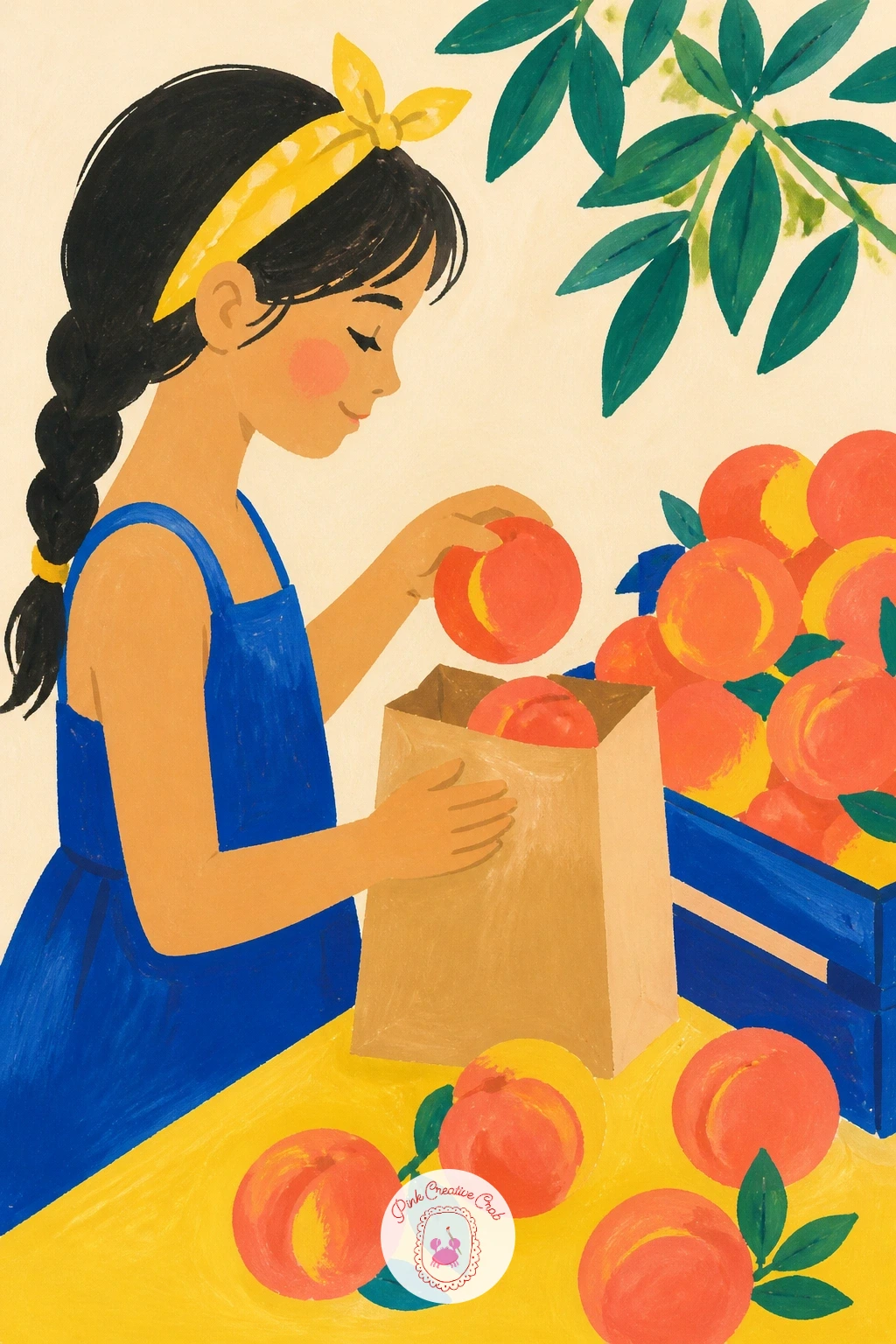
Palette: Coral,Lemon Yellow,Cream,Leafy Green
Bring in some action with a street taco cart, cook flipping tortillas while a short queue waits. Paint the cart body first as one solid cobalt block, then the grill top as a flat grey rectangle with the tortilla painted mid-flip, a simple curved cream shape caught at an angle rather than lying flat.
The cook’s arm is the trick here: paint it mid-motion, bent at the elbow with the hand slightly higher than the shoulder, which does more to suggest flipping than any detail on the tortilla itself. Keep the queue to three or four simple standing figures, each a different flat color so they read as separate people rather than one blob.
If the cart feels stiff, add a thin curl of grey-cream steam rising from the grill, painted loose and slightly transparent.
Swap the cobalt cart for coral if you want a warmer scene, the cast of colors still reads as the same cheerful street.
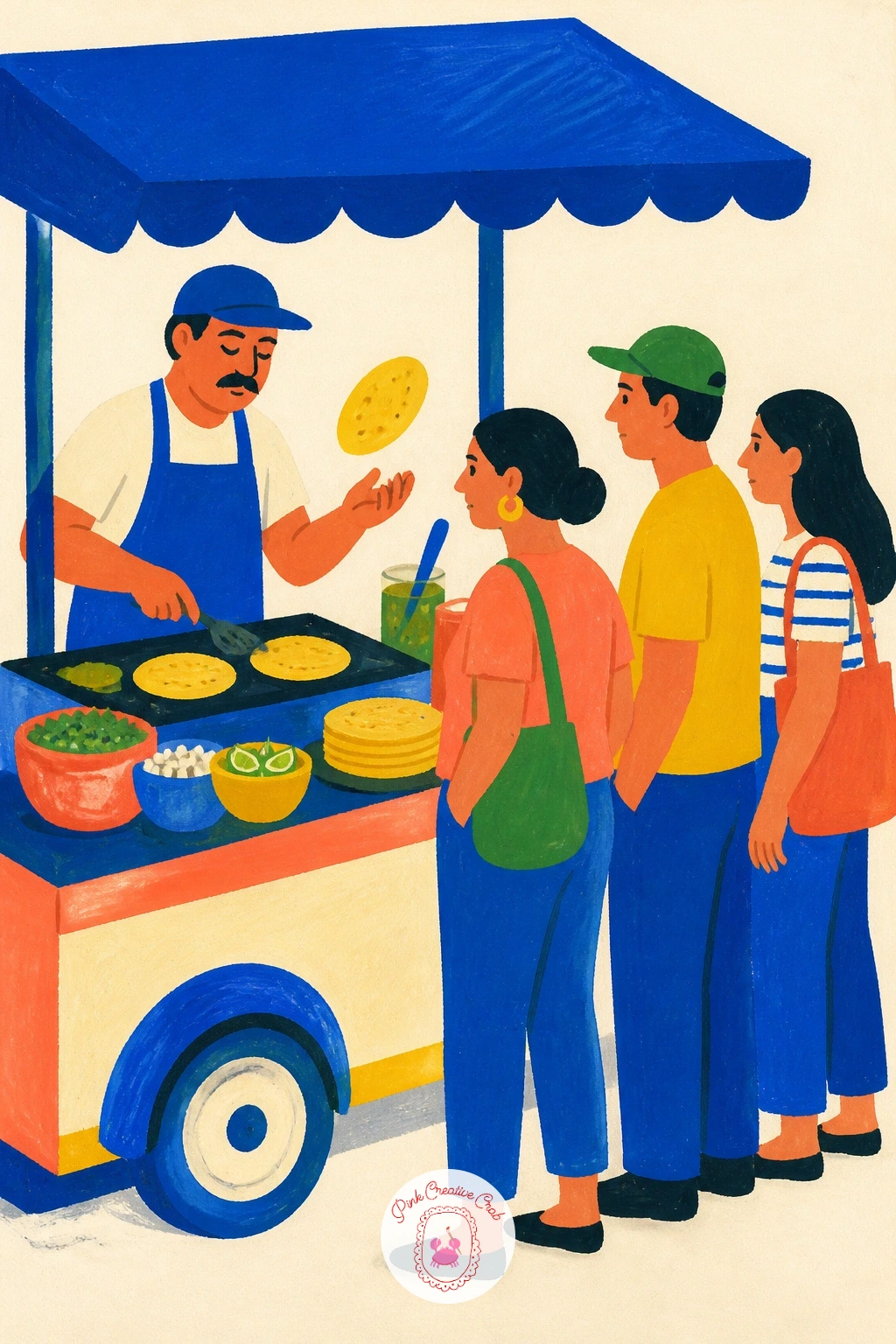
Palette: Cobalt Blue,Cream,Coral,Payne’s Grey
Settle into a quieter indoor scene next: a grandmother cutting fresh pasta ribbons at a kitchen table while a child watches. Paint the table and the sheet of pasta dough first as one large cream shape, since everything else sits on top of it.
Where the eye lands first decides the whole mood, so put it at the grandmother’s hands, not her face. Paint the ribbons as a fan of thin lemon-yellow strips curling slightly off the cutting edge, catching whatever light comes from the kitchen window behind her.
Keep the child small and a little lower in the frame, chin resting near the table edge, watching rather than reaching, which keeps the scene calm instead of busy. Her apron and the grandmother’s cardigan can share the same leafy green to tie the two figures together visually.
No pasta machine to reference. A plain rolled sheet with a knife beside it tells the same story just as clearly.
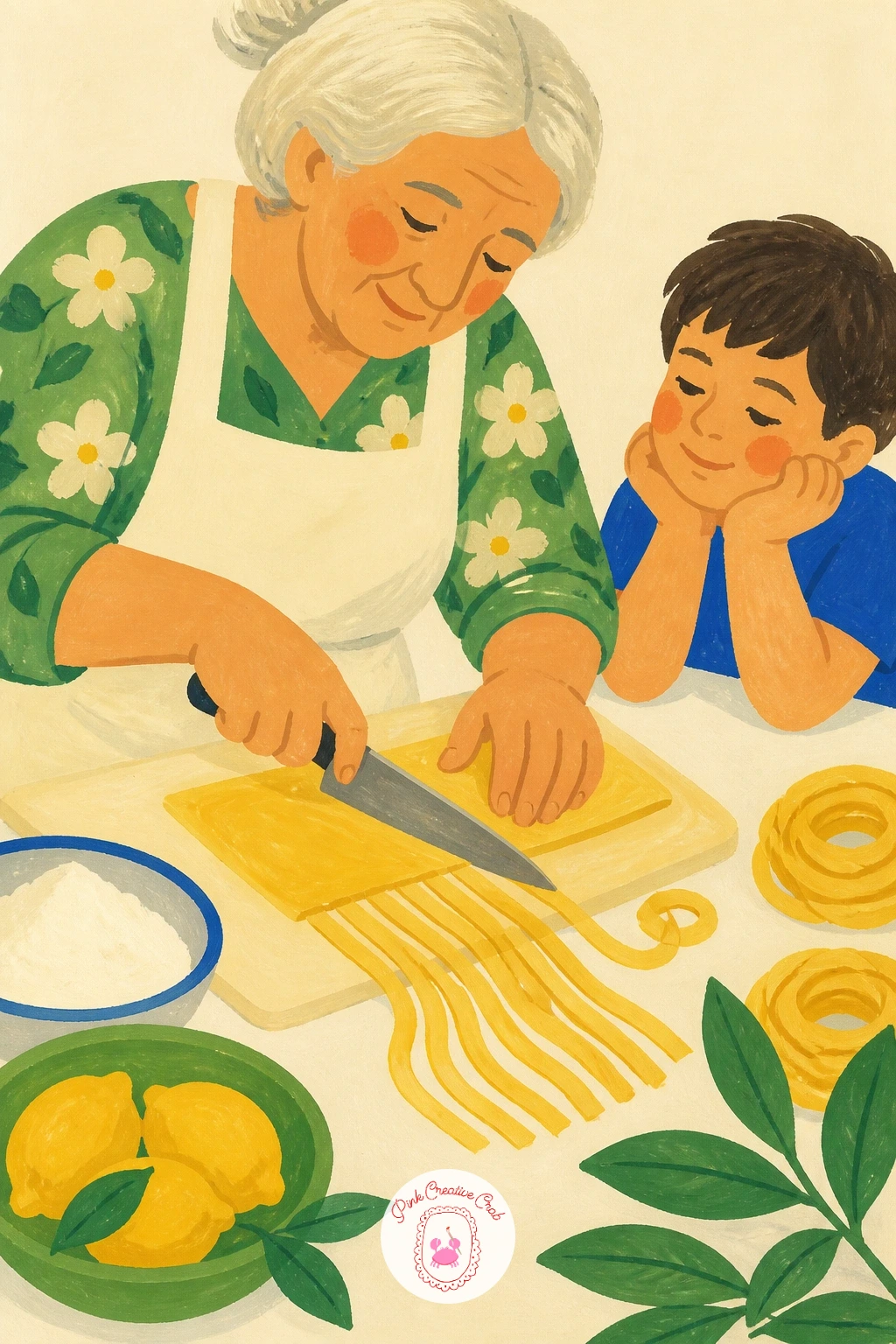
Palette: Lemon Yellow,Cream,Leafy Green,Payne’s Grey
Carry the noodle idea into a livelier setting: two friends sharing a big bowl of noodles at a night market. Paint the night sky first as a dark cobalt wash, then drop in two or three lantern shapes in coral and lemon before anything else, since they decide how bright the rest of the scene can go.
The bowl itself sits center, painted as one large cream circle with loose yellow curls for noodles and a few small coral dots for toppings, nothing precisely drawn. Paint the two friends leaning toward the bowl from opposite sides, chopsticks as thin straight lines held at an angle rather than straight up.
If the dark background swallows the figures, give each one a thin cream or lemon outline where they overlap the night sky, just enough to separate them from it.
Try this one in daylight too next time, swapping the cobalt night sky for a cream one, to see how differently the same bowl and figures read in full sun.
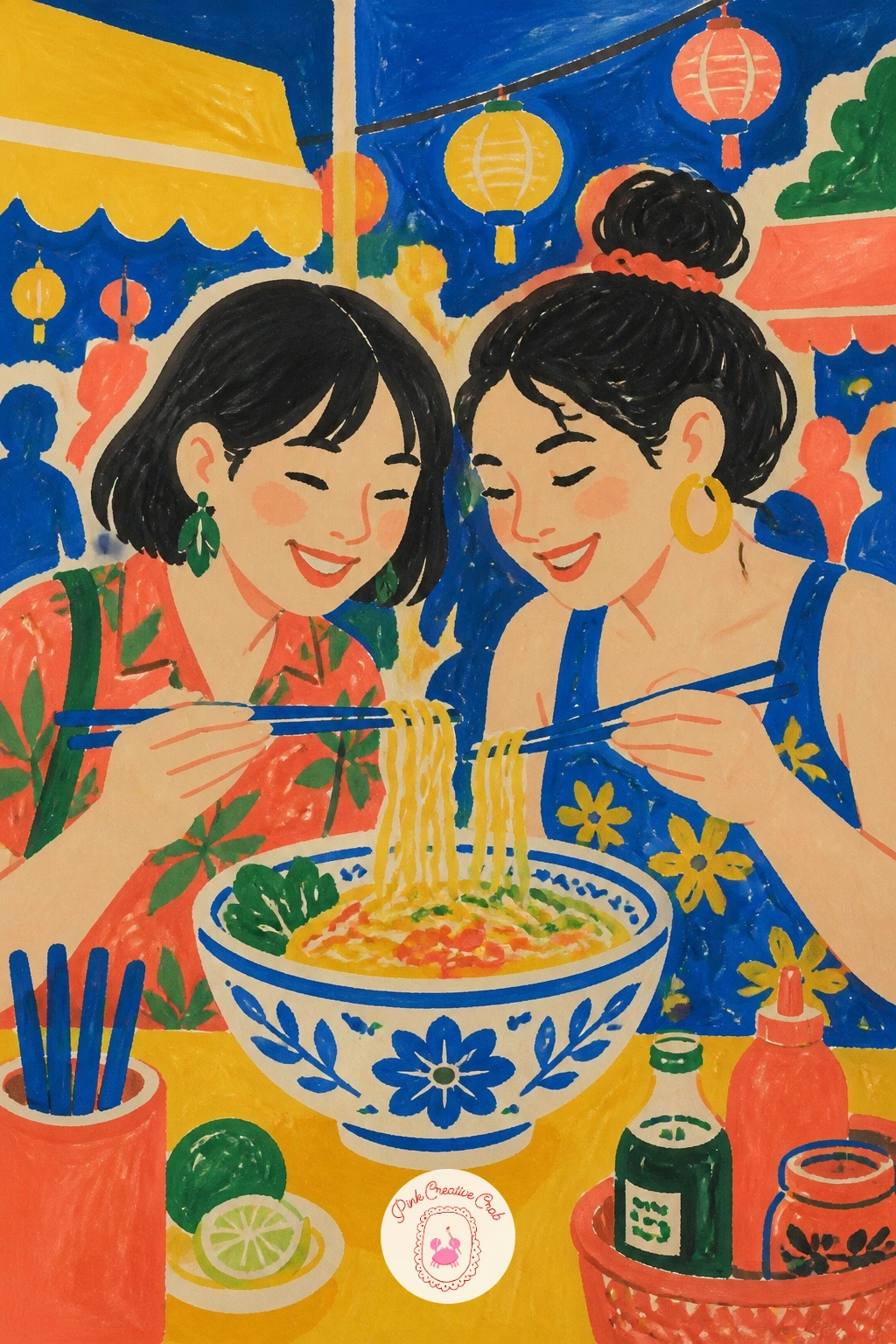
Palette: Cobalt Blue,Coral,Lemon Yellow,Cream
A fish market counter with rows of silver fish on ice is a good one for practicing repeated shapes without them turning monotonous. Paint the ice bed first as a flat cream and pale blue block, then lay the fish on top as simple tapered ovals, each angled very slightly differently so the row has a little life in it.
The fishmonger behind the counter anchors the scene: paint him as a solid coral or cobalt shape, apron included, standing just tall enough that his shoulders clear the top of the counter. Keep his face as simple flat features, no need for detail beyond a mouth and eyes.
Silver fish skin is the trap, painting it fully grey flattens them against the ice. Leave thin slivers of the cream paper unpainted along each fish’s back for a highlight, that alone reads as shine.
If you want a faster version, four fish and no fishmonger still reads clearly as a market counter.
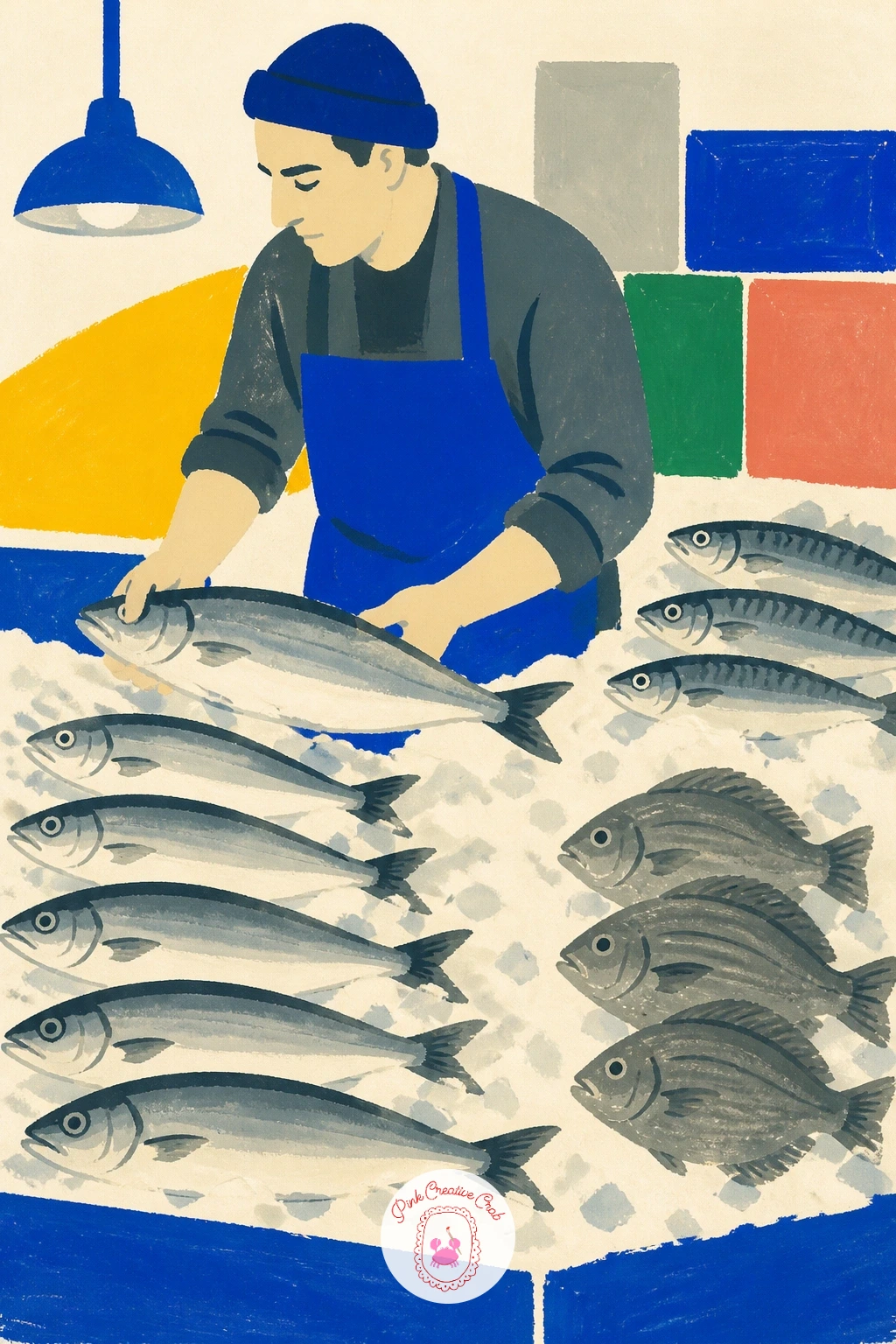
Palette: Payne’s Grey,Cream,Cobalt Blue,Coral
Lighten the mood with two kids running a lemonade stand on a sunny sidewalk. Paint the stand itself first as a simple wooden table and cream sign-free board, then the lemonade pitcher as one tall cream shape with a lemon-yellow fill line partway down.
Measure the two kids against the stand before painting in faces: their heads should sit just above the tabletop, which keeps them reading as children rather than adults scaled down. Paint one kid pouring and one kid holding out a cup, their arms bent at believable angles rather than straight sticks.
Sidewalk cracks or a curb line in the background give the scene a sense of place without much extra work, just a few thin grey lines across the cream ground.
If lemons feel repetitive after the market stall idea, swap the pitcher’s color to coral for a watermelon-flavored stand instead, same composition, fresh palette.
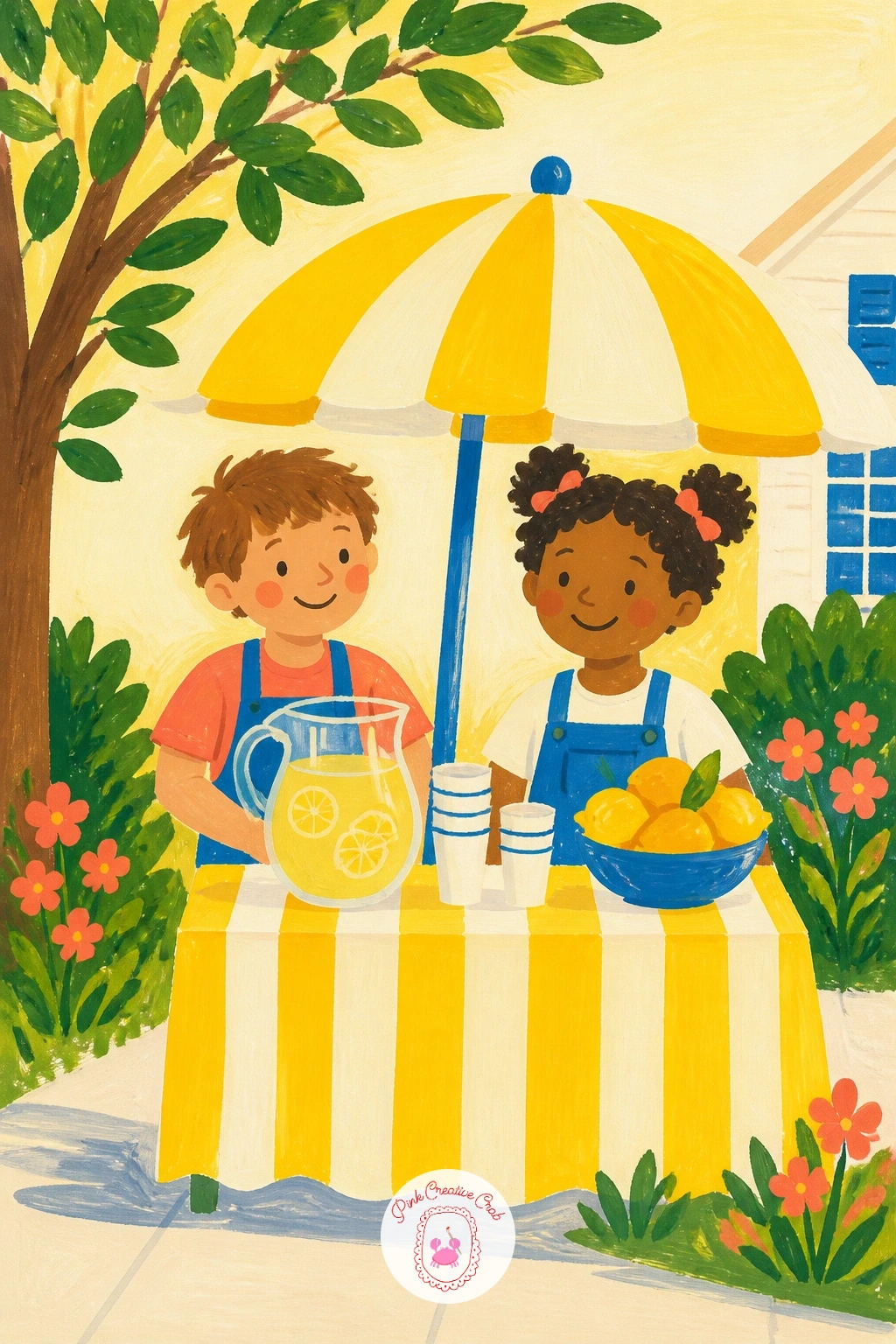
Palette: Lemon Yellow,Cream,Coral,Leafy Green
Take the palette to the beach: a couple sharing slices of watermelon on a striped beach towel. Paint the towel first as alternating coral and cream stripes, slightly uneven rather than ruler straight, then the two figures sitting on top so the stripes break under them believably.
Watermelon slices are mostly about edges. Cut each slice as one clean coral triangle with a thin cream rind and a scatter of small dark seeds, painted last with a fine brush once the fruit color is fully dry so the seeds stay crisp rather than bleeding.
Place the sun source high and slightly to one side, which lets you drop a soft cobalt shadow under the towel and under each figure, grounding them on the sand without painting the sand itself in detail.
No striped towel to copy from. A plain cream towel with a coral border carries the same beach feeling.
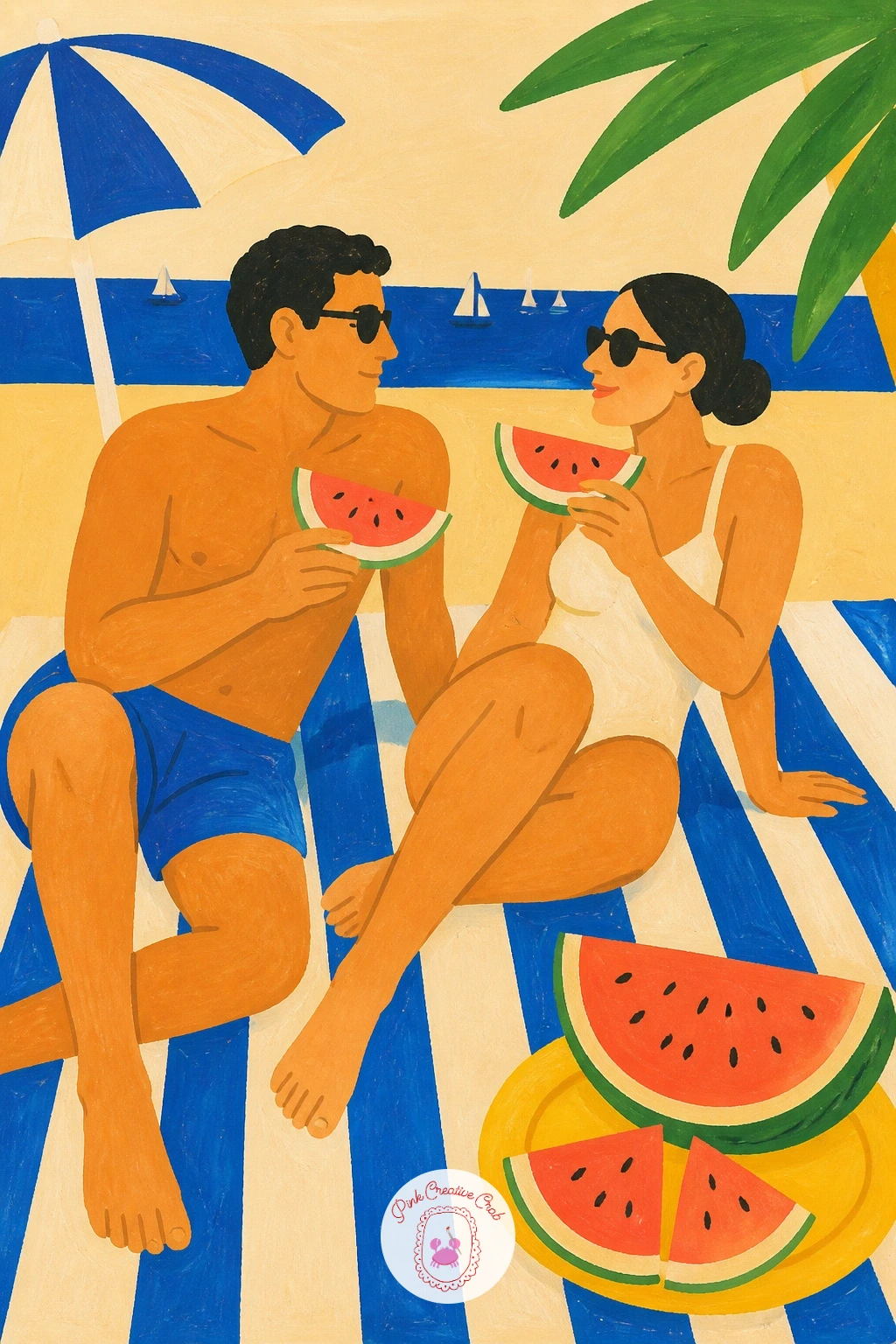
Palette: Coral,Cream,Cobalt Blue,Leafy Green
Head back to market territory with a vegetable stall, bunches of carrots and radishes and a shopper carrying a tote. Paint the stall’s wooden base and awning first, then the vegetable bunches as grouped shapes: carrots as tapering coral-orange triangles with leafy green tops, radishes as small rounded coral bulbs with the same green tops to keep the two bunches visually related.
Keep the tied string at the top of each bunch as one thin dark line, that single mark is what makes loose vegetables read as a tied bundle instead of a scattered pile.
Paint the shopper last, standing to one side with the tote bag as a simple cream shape hanging from one arm. Her pose should lean very slightly toward the stall, which reads as reaching or choosing rather than standing still.
If carrots and radishes feel too similar once painted, swap one bunch for bright yellow squash to break up the coral repetition.
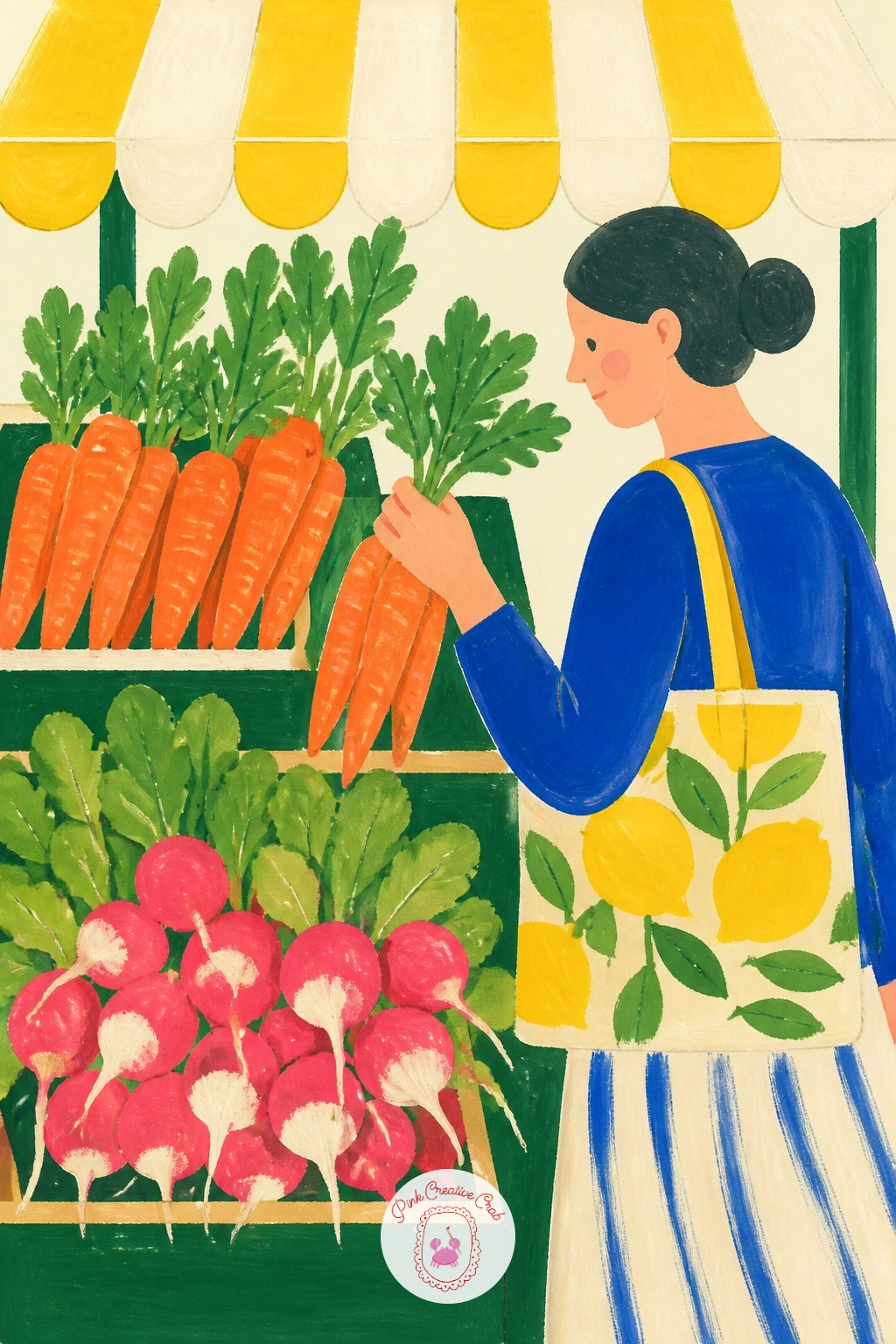
Palette: Coral,Leafy Green,Cream,Lemon Yellow
A market scene painting works well as a companion piece if this stall makes you want to paint a whole row of them side by side.
Move indoors for a family around a table with a steaming hot pot in the middle. Paint the pot first as one dark cobalt circle sitting in a cream table, then the steam rising from it as a few loose, slightly transparent grey-white curls, painted with a drier brush so they stay soft rather than solid.
Seat the family around the table in a loose circle rather than a straight line, each figure a different flat color, which keeps a crowded table from reading as a wall of people. Chopsticks or spoons reaching toward the pot, painted as thin diagonal lines, do more to suggest the meal in progress than any food detail inside the pot itself.
If the steam ends up looking like smoke, thin it with a touch more white and keep each curl shorter, long single plumes read as fire rather than cooking.
Try a daytime version next, same table and pot, with sunlight through a window instead of the glow of a single hanging lamp.
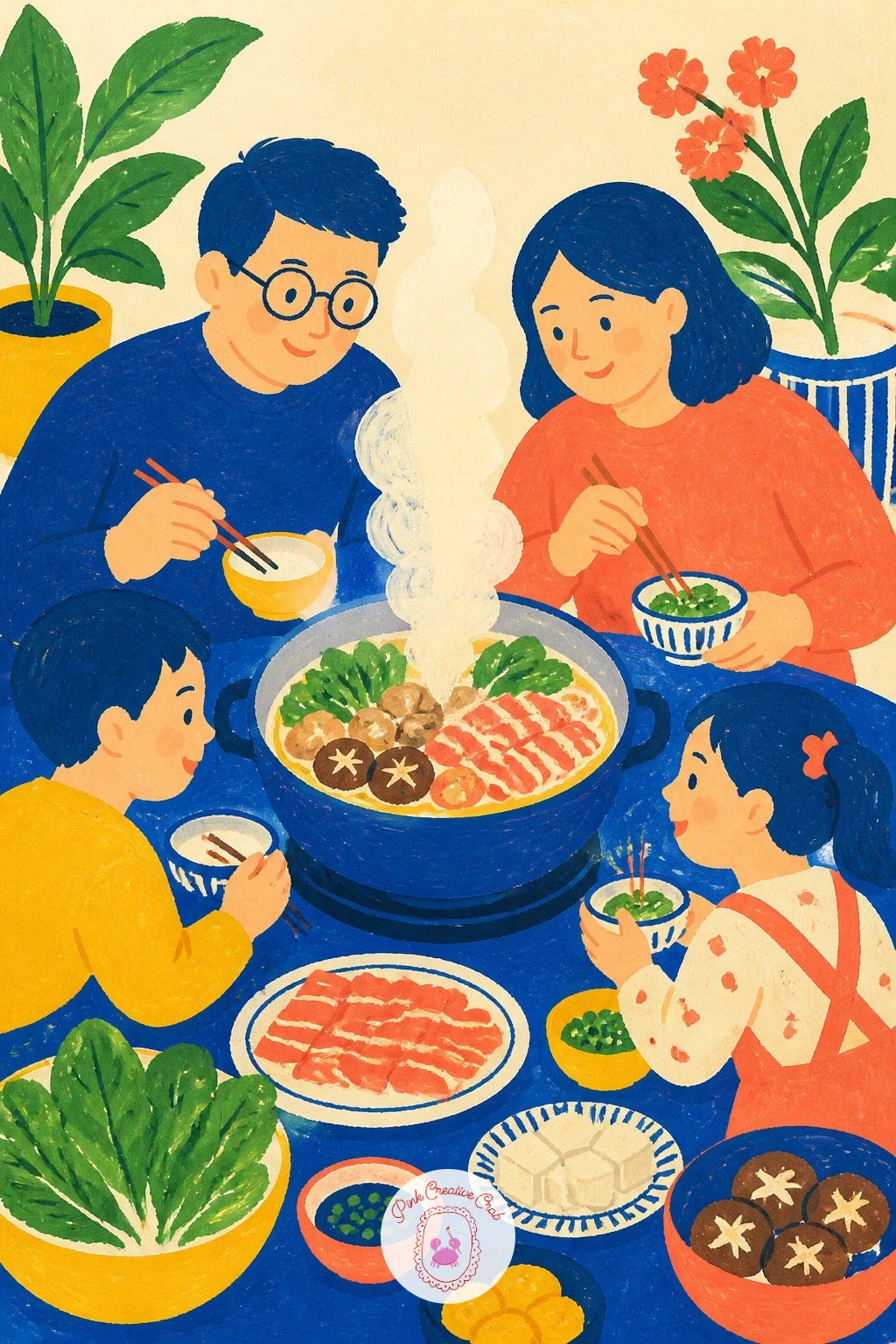
Palette: Cobalt Blue,Cream,Coral,Payne’s Grey
Step into a garden for a woman carrying a basket of zucchini and herbs through a vegetable garden. Paint the garden rows first as simple leafy green bands receding into the background, then the woman walking through them with the basket held at hip height, since a basket painted too high on the body looks carried rather than held.
Vary the zucchini sizes in the basket, two or three long coral-green shapes of slightly different lengths, with a few loose herb sprigs painted as single quick strokes rather than individually drawn leaves.
Her dress can repeat the same leafy green as the garden rows, which ties the figure into the setting instead of sitting her on top of it. Keep her face simple, a few flat features are enough when the whole scene reads from a short distance.
If garden rows feel like too much background work, paint just two or three and let the rest fade into flat cream.
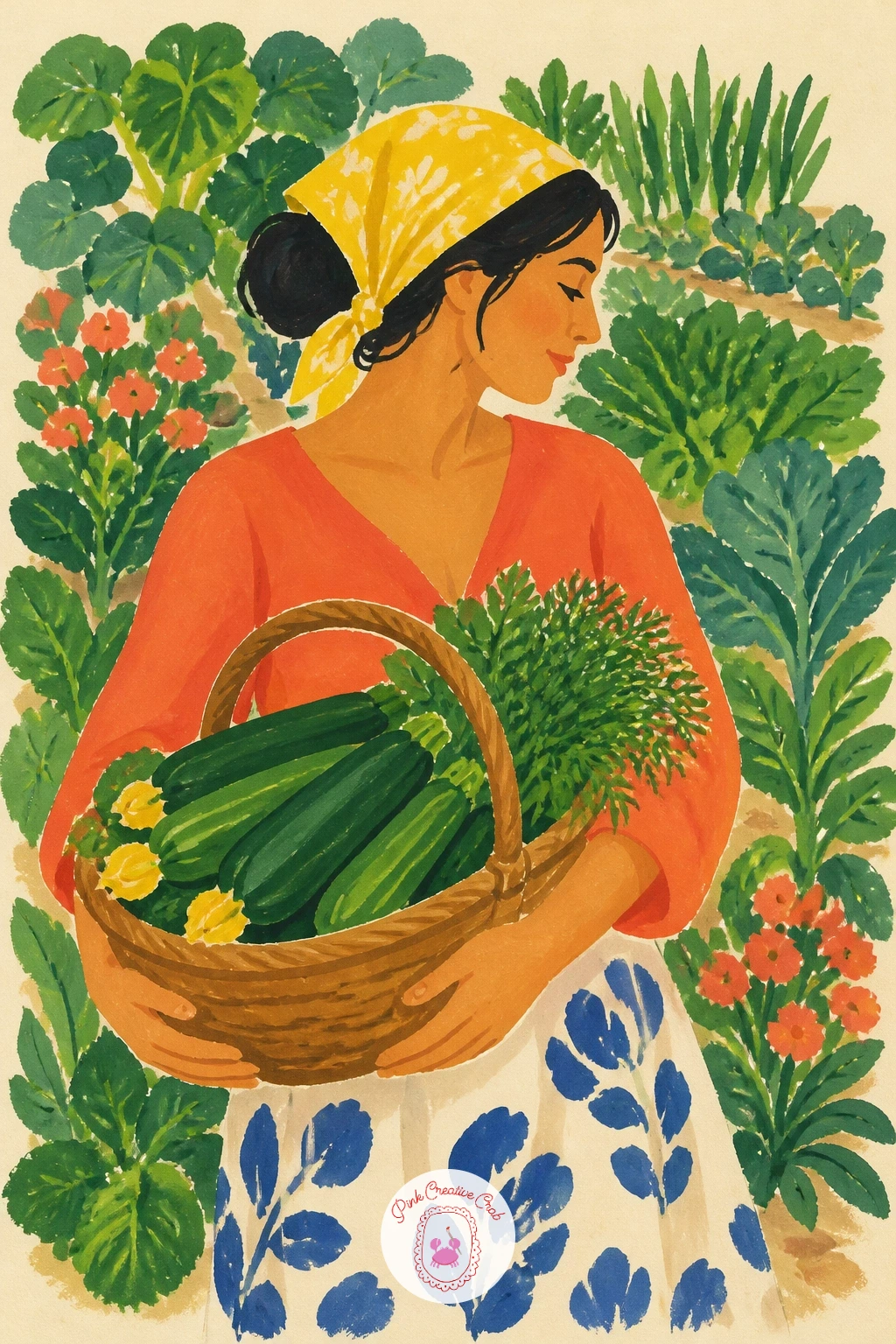
Palette: Leafy Green,Coral,Cream,Lemon Yellow
Bring some motion back with an ice cream cart by a park fountain, a child up on tiptoe reaching for a cone. Paint the fountain first as a simple cobalt and cream shape in the background, since it anchors the park setting without needing much detail.
The cart sits in front, painted as one coral or cream box shape with a striped umbrella above it in alternating bands. Paint the child reaching up with one arm raised well above the shoulder and the heel lifted slightly off the ground, that small lift is what sells tiptoe rather than just standing.
Ice cream scoops are easiest as two or three stacked ovals in lemon and coral, slightly smaller toward the top, with a thin cream cone beneath.
If the fountain feels like extra work for ten minutes, drop it and keep just the cart and the child, the scene still reads as a park.
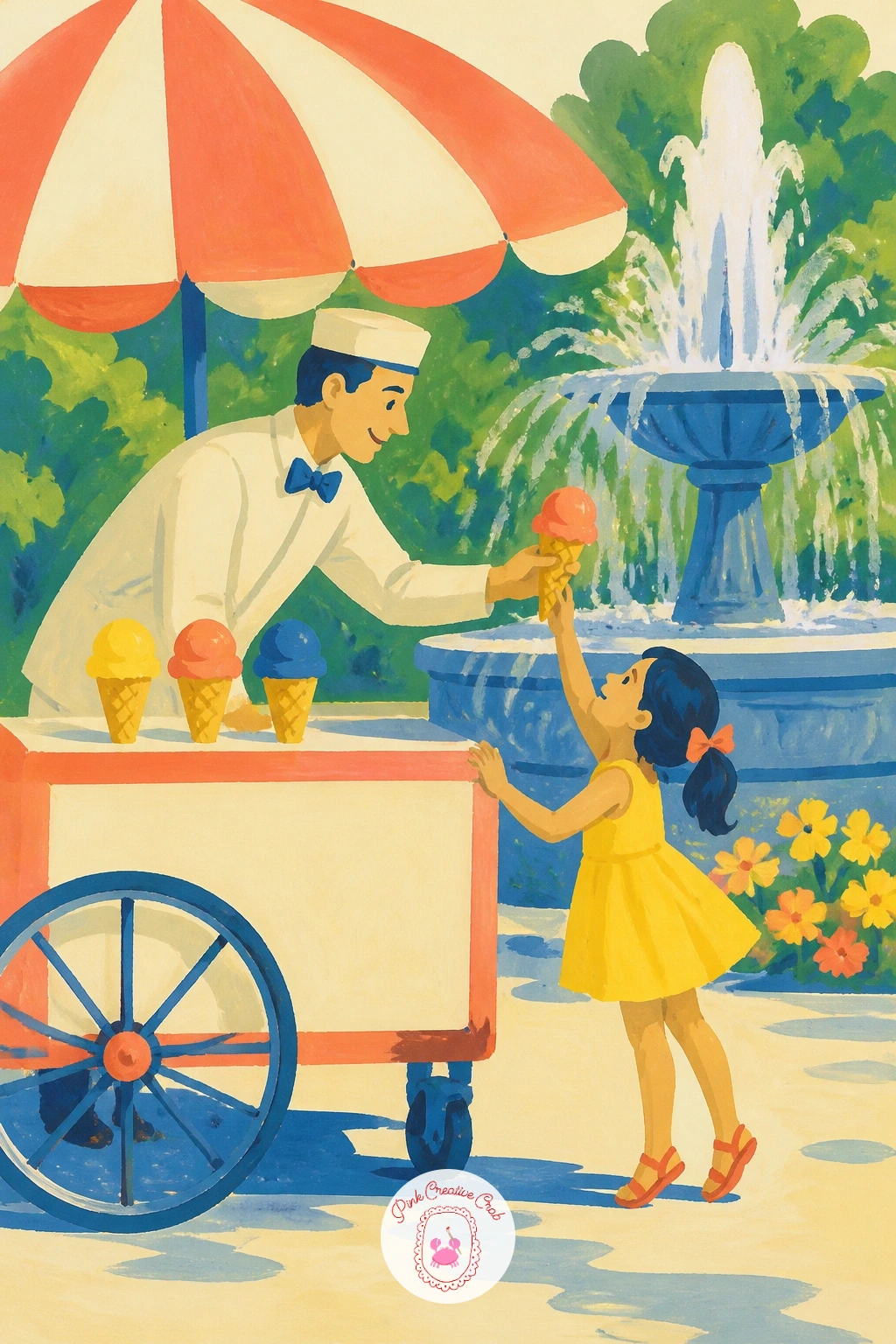
Palette: Coral,Cobalt Blue,Lemon Yellow,Cream
Settle into a calmer scene: friends clinking glasses of iced tea at a garden party table. Paint the table first in cream, then the tall glasses as simple narrow shapes with a lemon-yellow fill and a few loose ice cubes left as unpainted cream patches inside the liquid.
Where the light falls matters most here. With afternoon sun from one side, give each glass a thin cobalt shadow on its shaded edge, which is enough to make the row of glasses feel like they are actually sitting on the table rather than floating on it.
Paint the clink itself by angling two glasses toward each other at the top, nearly touching, rather than painting them straight upright side by side. Keep the friends behind them as simple seated shapes, faces turned slightly toward each other.
If lemon-yellow tea reads too much like lemonade, shift it toward a warmer amber-coral for a clearer iced tea color.
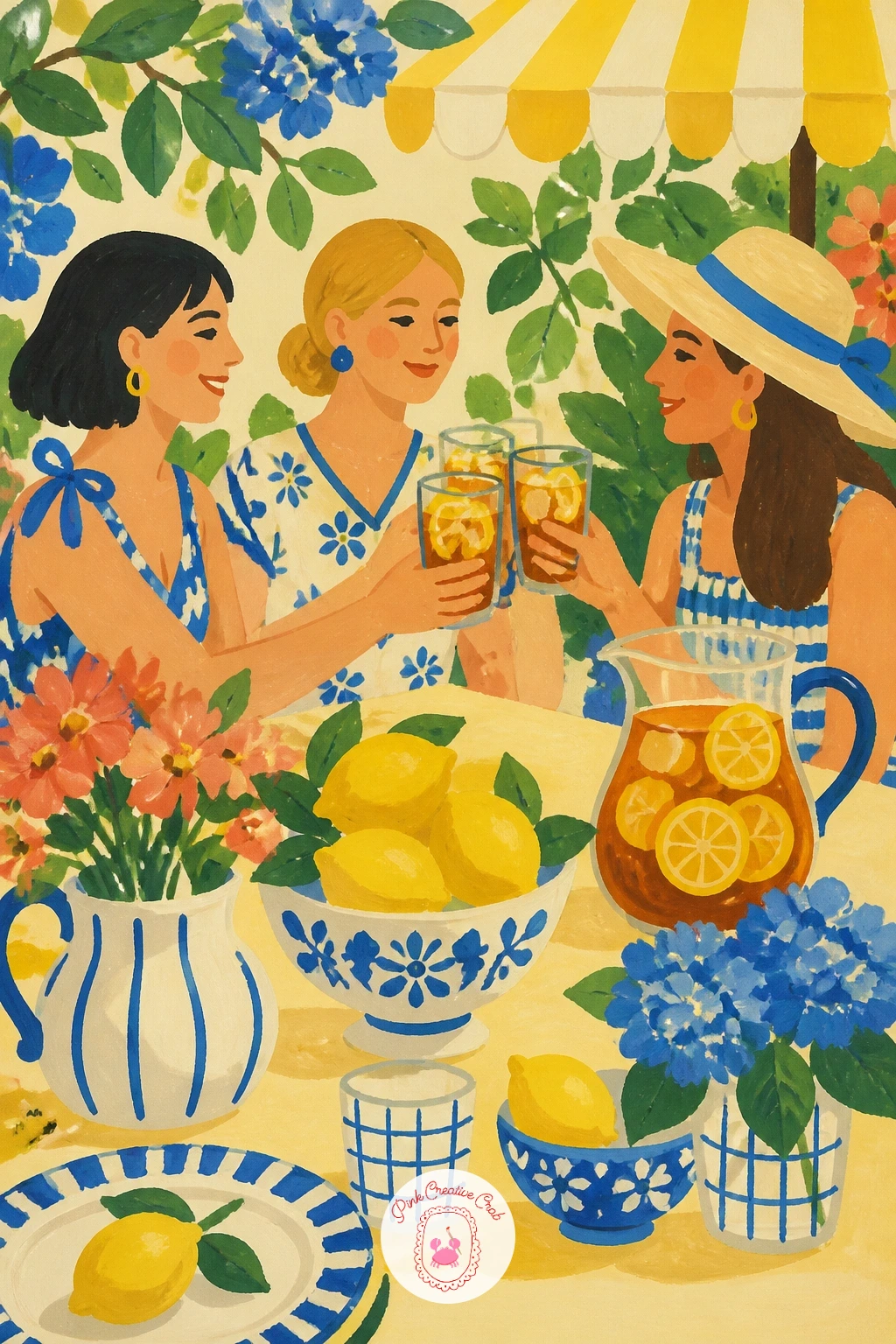
Palette: Lemon Yellow,Cream,Cobalt Blue,Coral
Try a sushi counter with a chef handing a plate to a smiling diner, a good scene for practicing a single moment of exchange between two figures. Paint the counter first as a long cream and cobalt band, then the chef standing behind it, apron a flat coral block, arms extended forward holding a simple cream plate.
Keep the diner’s hands reaching to meet the plate rather than already holding it, the small gap between the two sets of hands is what makes the handoff read as happening rather than finished.
Paint the sushi pieces on the plate as a few small simple ovals in lemon, coral and leafy green, no more than four or five, since too many tiny shapes on a small plate turns fussy fast at this scale.
If faces feel tricky, a simple raised eyebrow line and an upturned mouth is enough to read as smiling from a normal viewing distance.
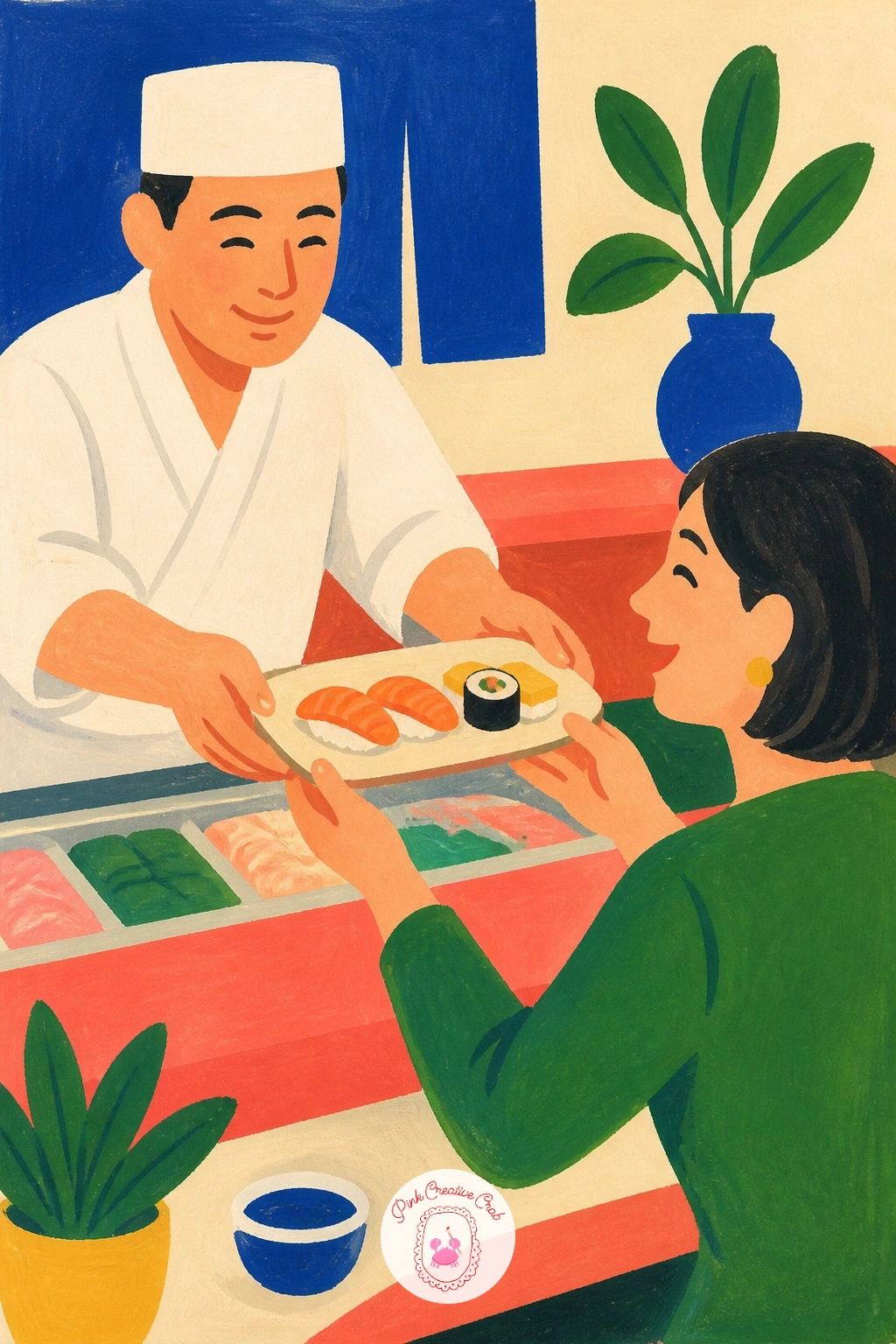
Palette: Cream,Coral,Leafy Green,Lemon Yellow
Bring in color variety with a spice market stall, cones of colorful spices and a merchant behind them. Paint the spice cones first as a row of simple triangular mounds, each a different warm color, lemon, coral, a deep rust if you have it, since the repeated cone shape is what reads as a spice stall even before any detail goes in.
Keep the cones slightly different heights rather than perfectly matched, an uneven row looks hand-piled rather than printed.
The merchant stands behind the cones, painted as one flat coral or cobalt shape with arms resting on the stall edge. Give him a simple patterned detail, a few short lines on his sleeve or hat, enough to suggest pattern without painting it stitch by stitch.
If five or six spice colors feels like too much to mix, three distinct tones repeated across more cones still reads as a full stall.
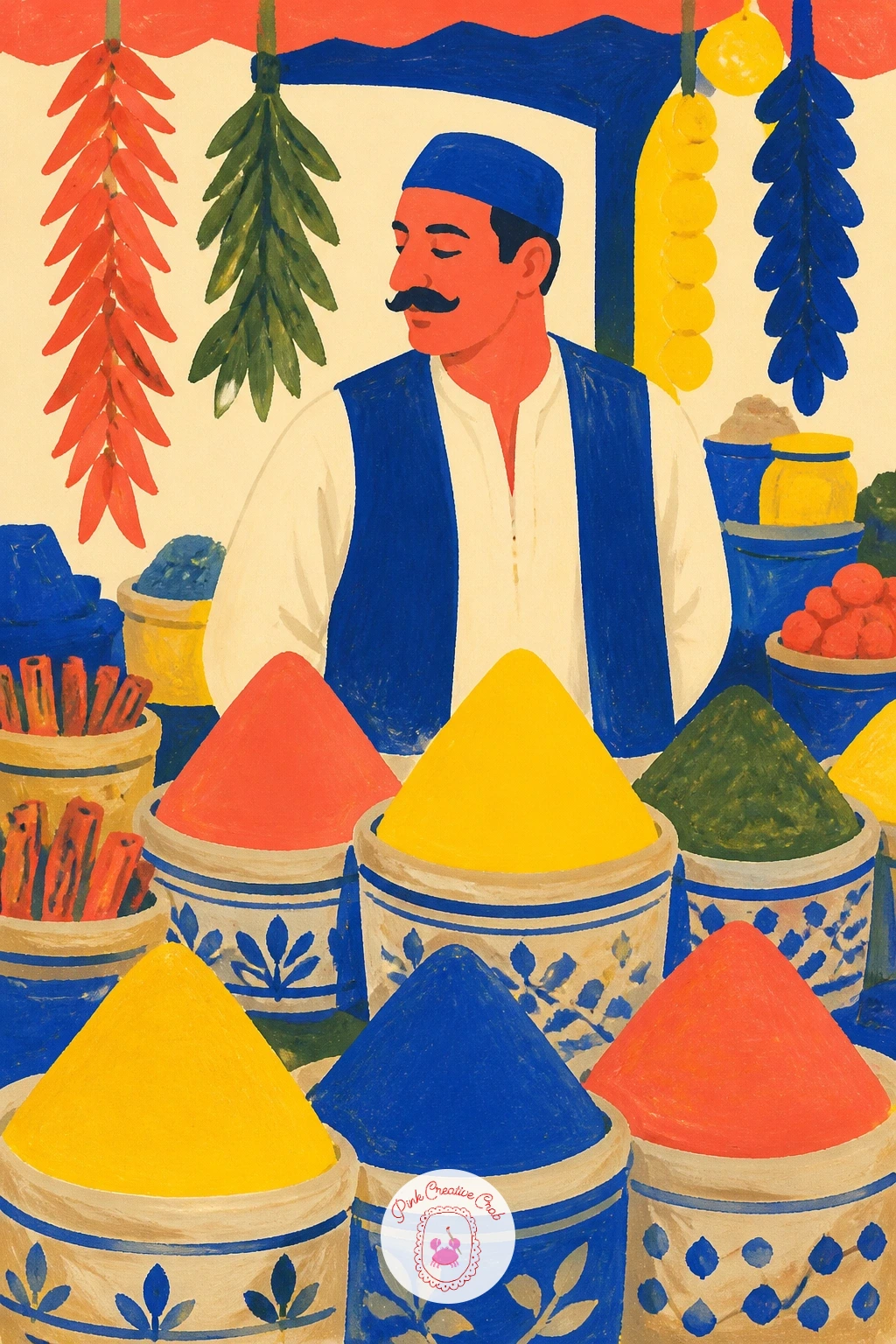
Palette: Coral,Lemon Yellow,Cream,Cobalt Blue
Slow the pace with a girl reading in a café window, a cup of coffee and a slice of cake beside her book. Paint the window frame first as a simple cobalt rectangle, then the girl seated inside it, book held slightly angled rather than flat-on, which reads more naturally as someone actually reading.
Compare the cup and cake against her hand before painting them in: the cup should sit no taller than her thumb’s length, keeping the tabletop items in believable scale next to the figure.
Paint the cake as one simple coral or cream wedge shape with a thin darker line marking the layer, no need for crumb detail. The coffee cup gets a flat cream body with a small dark oval for the coffee inside.
If the café window feels like extra structure to paint, a simple cobalt curtain edge in one corner suggests the window just as well as a full frame.
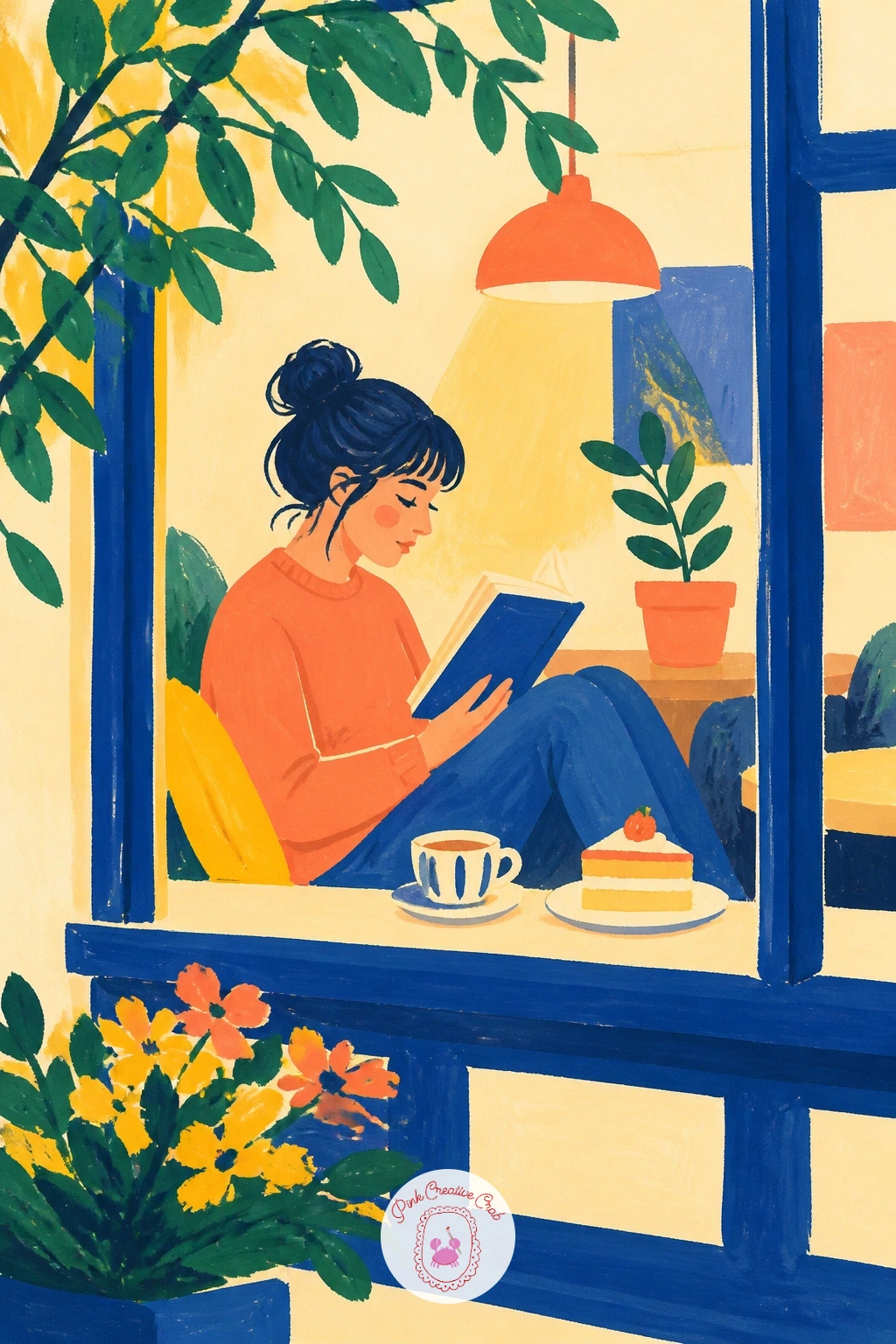
Palette: Cobalt Blue,Coral,Cream,Payne’s Grey
The watercolor and ink tutorial lessons for little cafes are worth a look if you want to try this same mood in a different medium.
Bring the scene indoors and cozy with a breakfast tray in bed, orange juice, fruit and a cat curled on the duvet. Paint the duvet first as a large soft cream shape, since everything else sits as smaller shapes placed on top of it.
The tray goes in next, a flat cobalt or coral rectangle holding a juice glass, a small bowl of fruit, and a few loose grapes or berry shapes scattered beside it. Keep the orange juice glass tall and narrow with a lemon-yellow fill, that one bright shape does most of the work of making the tray feel like breakfast.
Paint the cat last, curled into a simple comma shape near the tray, since a curled cat is far easier to get right than a sitting or standing one at this scale. One line for a tail curve and two small triangle ears is enough.
If orange juice feels repetitive with the lemon cones elsewhere in this list, swap it for pink grapefruit juice in soft coral instead.
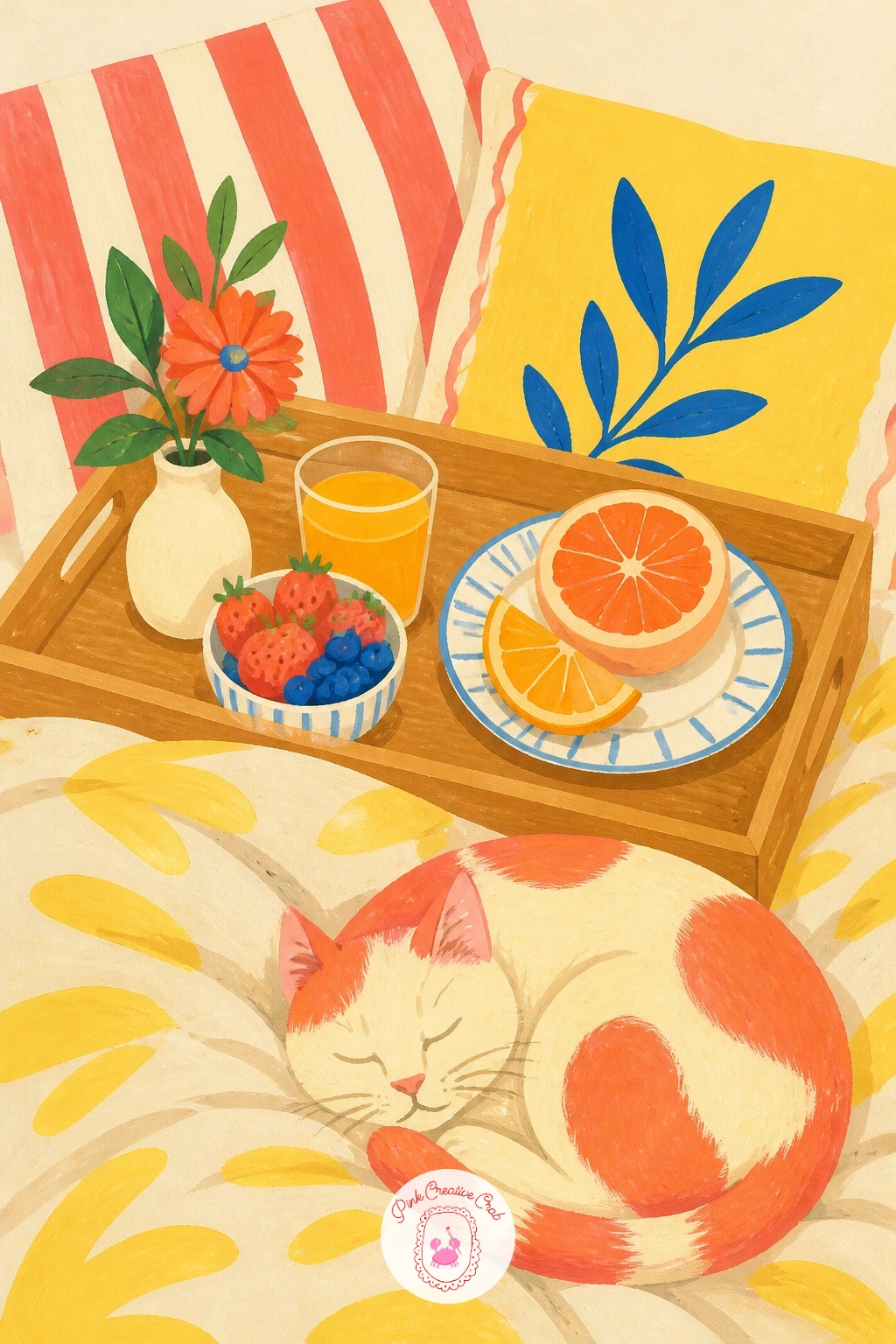
Palette: Cream,Lemon Yellow,Coral,Payne’s Grey
Return to the market with an olive stall, a shopper tasting from a toothpick while the merchant watches. Paint the olive barrels or bins first as flat cream and cobalt containers, then fill each one with a cluster of small dark oval shapes in two or three greens and a deep plum, since variety in olive color is what separates this stall from a plain vegetable bin.
Keep the olives loosely scattered rather than in neat rows, a tight grid of ovals reads as beads, not olives piled in a bin.
Paint the shopper with a small toothpick held near her mouth, arm bent at the elbow, which is a clearer read of tasting than a hand simply reaching toward the bin. The merchant stands slightly behind, a flat coral or cobalt shape watching with arms crossed or resting on the stall.
If dark olive colors feel muddy once mixed, add a touch more white gouache to each green before the final layer, it keeps the shapes crisp rather than murky.
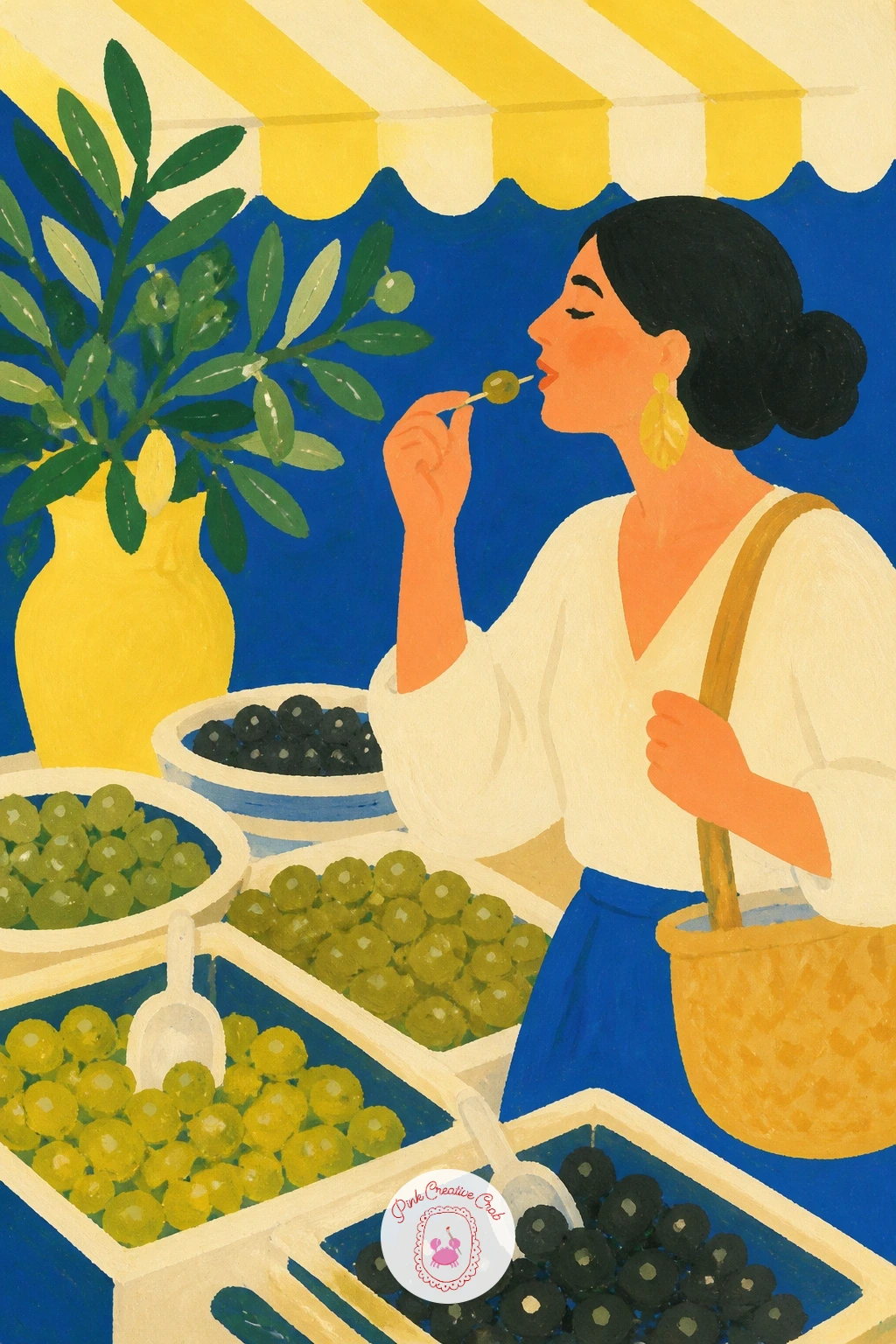
Palette: Leafy Green,Cream,Cobalt Blue,Coral
Take the picnic onto the water with a rowing boat picnic, a basket of strawberries sitting on the bench. Paint the water first as a flat cobalt band beneath the boat, then the boat itself as one simple cream or coral hull shape, keeping the waterline straight so the boat reads as floating rather than beached.
Measure the basket against the boat’s bench before painting it in, it should sit low and wide, no taller than the bench itself, or it will look like it is about to tip over the side.
Paint the strawberries as small coral triangles with tiny dark seed dots added once the paint is fully dry, and the green leafy tops as quick two-stroke marks rather than fully shaped leaves.
If a full rowing boat feels ambitious today, paint just the bow and the basket cropped at the edge of the frame, the water and the fruit still tell the whole story.
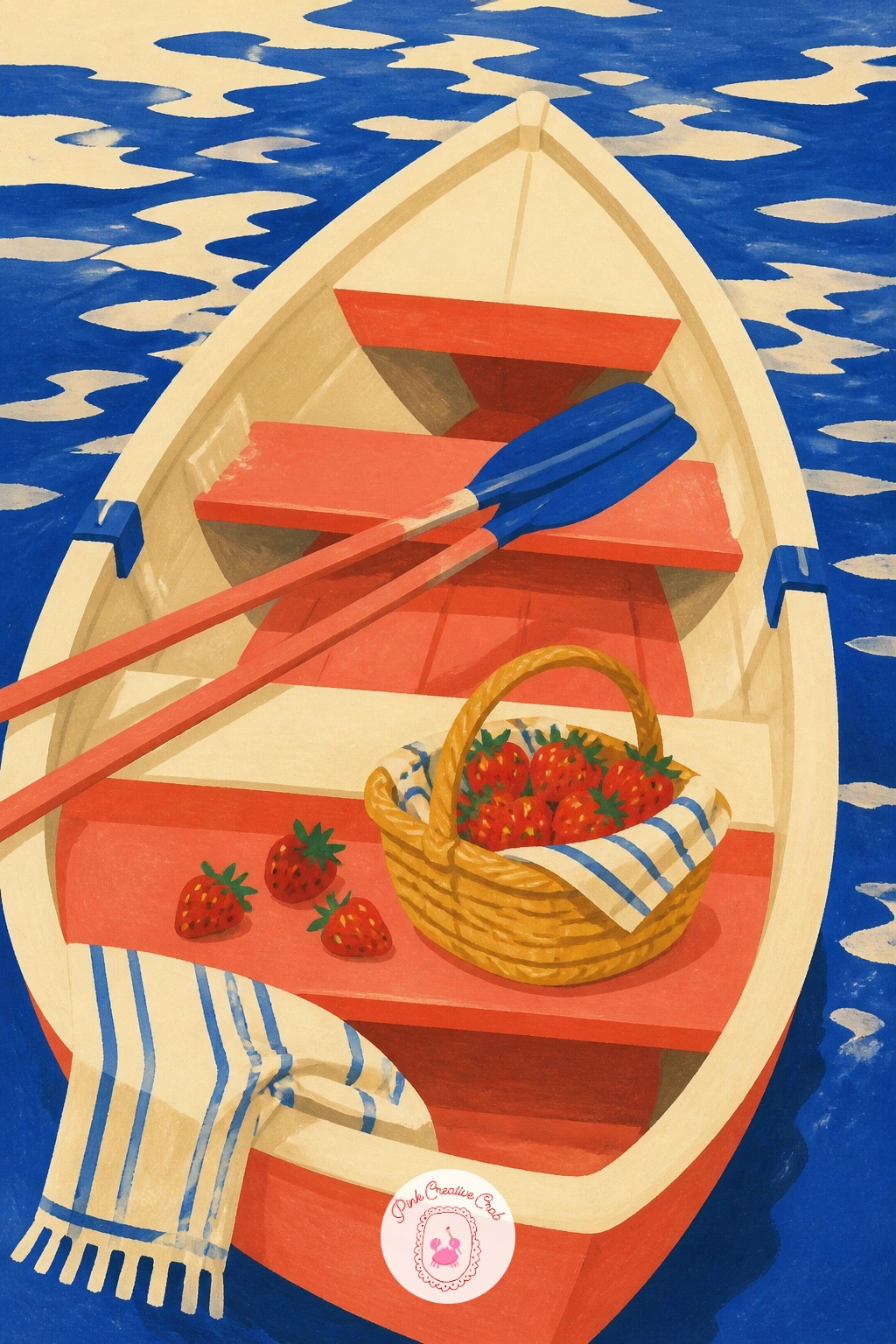
Palette: Cobalt Blue,Cream,Coral,Leafy Green
Capture a moment of action again with a dumpling stall, a cook lifting the lid off a bamboo steamer. Paint the steamer stack first as a series of flat cream and tan circles, slightly offset from each other, then the lid lifted up and away at an angle rather than set flat on top, which is what shows it mid-lift rather than resting closed.
Steam rising from the open steamer should curl upward and slightly to one side rather than straight up, following wherever the light source sits, a loose grey-white curl or two is enough.
Paint the cook’s hand gripping the lid handle with fingers curled around it, arm angled upward, and keep the dumplings inside the steamer as simple small cream mounds, no individual pleats needed at this scale.
If the bamboo texture feels fiddly, a few thin horizontal lines around each steamer tier suggest woven bamboo well enough without painting every strand.
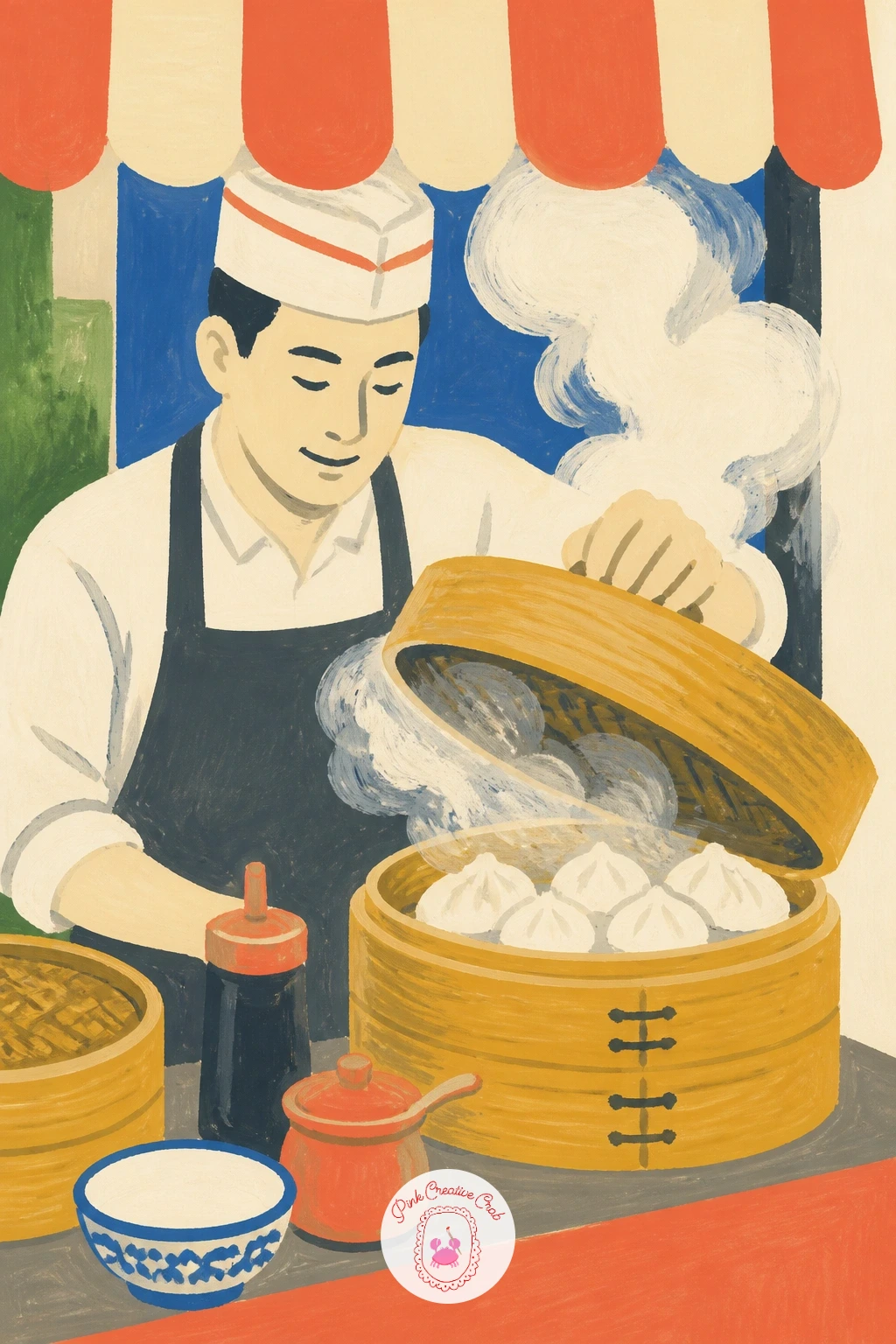
Palette: Cream,Payne’s Grey,Coral,Cobalt Blue
Bring everyone into one kitchen for friends around a kitchen island making tacos together. Paint the island counter first as one long cream shape, then group small bowls of toppings along it, each bowl a different flat color, lemon for corn, leafy green for lettuce, coral for salsa, so the row of bowls reads clearly from a glance.
Space the friends around the island with slightly different poses, one leaning in reaching for a bowl, one standing back talking, rather than everyone facing forward in a line, which is what makes a group scene feel like a real moment instead of a lineup.
Paint the tortillas as simple folded cream shapes held in hand, a loose curve rather than a flat circle, since a flat circle reads as a plate, not a taco being built.
If four friends feels like too many figures for one sitting, three still fills the island convincingly, just widen the gaps between the topping bowls a little.
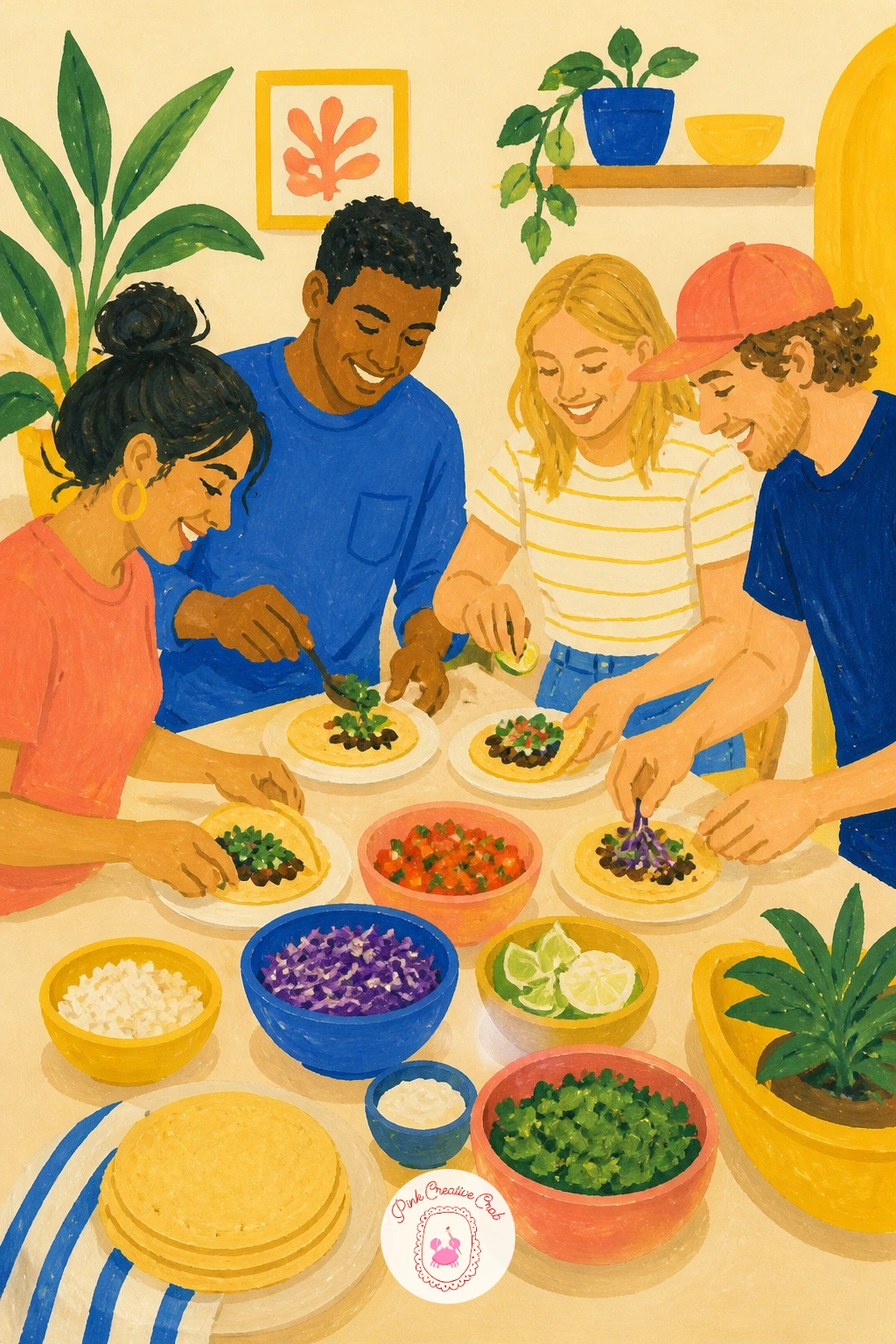
Palette: Cream,Lemon Yellow,Leafy Green,Coral
Take the palette outdoors again for a picnic under orange trees, a crate of oranges and a thermos set on the blanket. Paint the tree canopy first as loose leafy green masses with a scatter of small coral-orange circles tucked among the leaves, since painting the fruit into the canopy before the blanket below keeps the whole scene reading back to front correctly.
With the sun filtering through the branches, keep the blanket below in dappled light, a few soft cobalt shadow patches rather than one flat shadow shape, which suggests light falling through leaves without painting every gap individually.
Paint the crate of oranges as a simple wooden box shape stacked with circles, and the thermos beside it as one tall narrow cream cylinder with a coral cap.
If the canopy feels like too much to paint fully, crop the trees at the top of the frame so only branches and a few oranges show, letting the blanket below carry more of the scene.
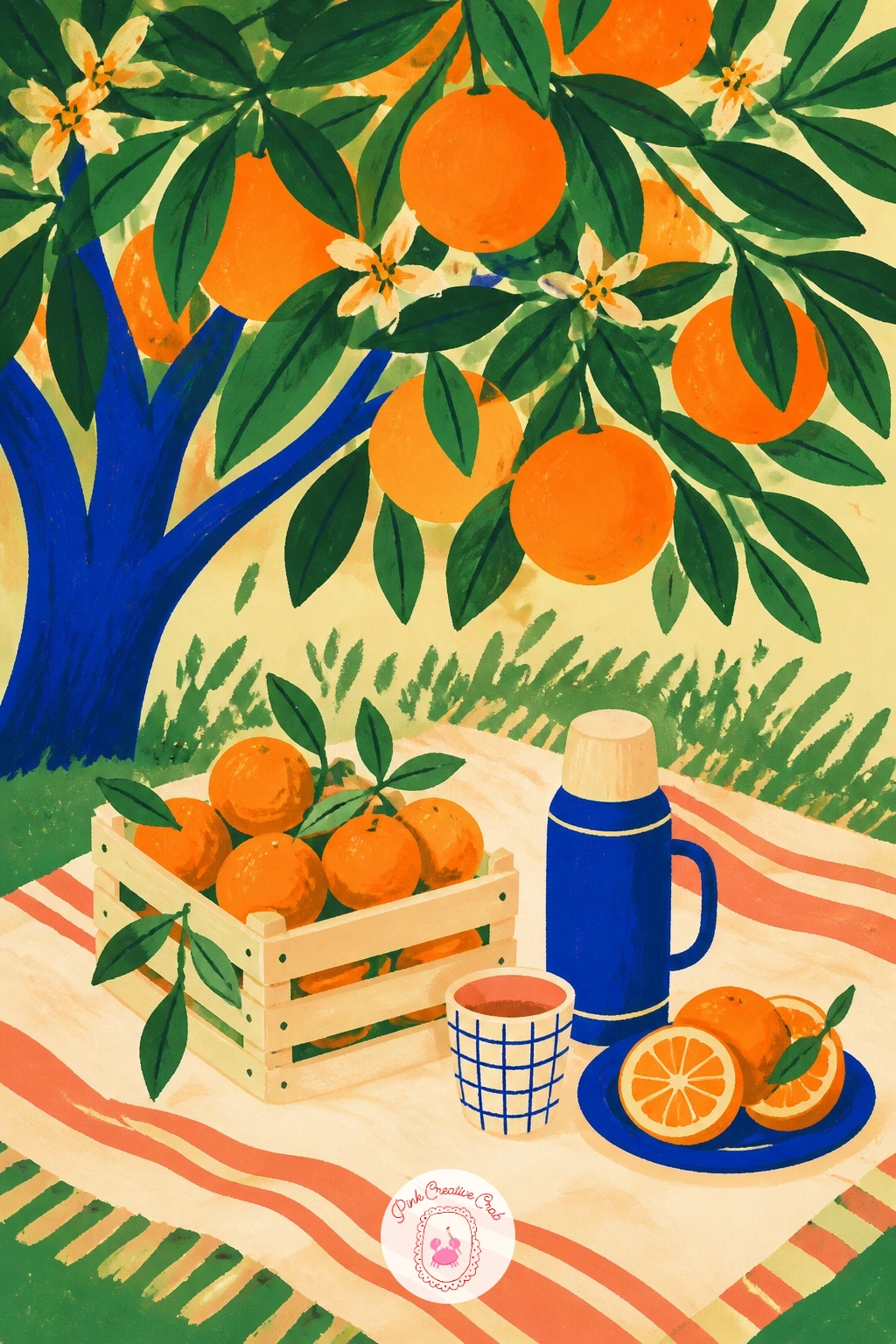
Palette: Leafy Green,Coral,Cream,Cobalt Blue
Watch the next idea in motion: a crepe stand in a park, the cook swirling batter on a hot plate. Paint the hot plate first as one flat grey circle, then the batter being swirled as a thin cream spiral shape across it, slightly off-center rather than a perfect ring, which is what reads as still spreading rather than finished.
The cook’s wrist does the work here, painted mid-turn with the small batter tool held at an angle rather than straight down, since that angle is the clearest sign of the swirling motion.
Paint the park setting behind the stand loosely, a bench or a tree shape or two in leafy green and cobalt, enough to place the stand outdoors without competing with the swirl itself for attention.
If the spiral batter shape comes out too neat, loosen it with a slightly wet brush right after laying down the cream, letting the edge blur just a touch reads as batter still in motion.
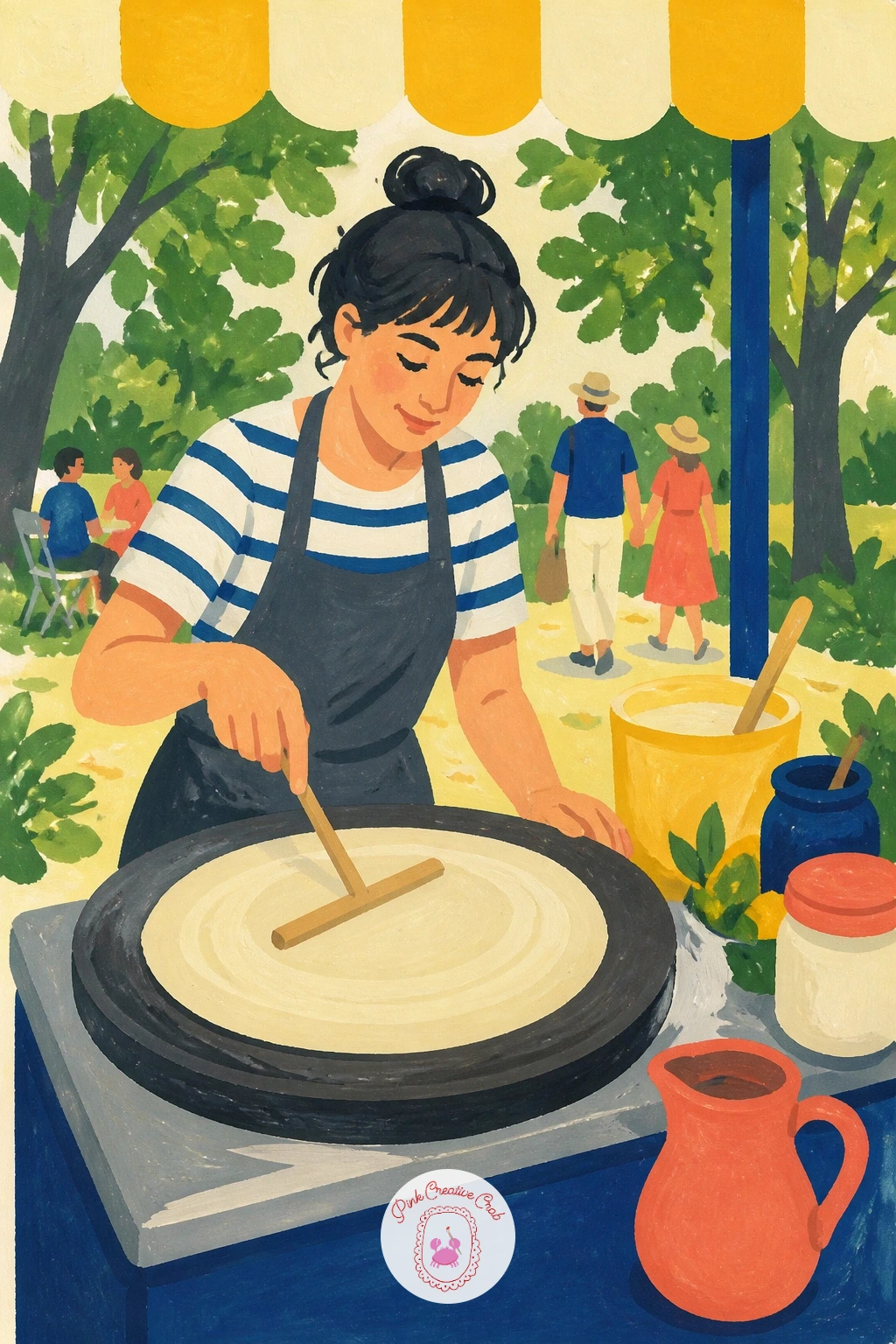
Palette: Cream,Payne’s Grey,Leafy Green,Cobalt Blue
Slow back down with a farmhouse table, a bowl of figs and a woman pouring tea. Paint the tabletop first as one warm cream plane, then the bowl of figs as a cluster of small rounded coral-purple shapes with a thin darker line splitting one or two open to show the inside.
Keep the teapot and cup close together, the woman’s arm extended at a gentle downward angle as she pours, rather than holding the pot level, which is the single detail that makes the pour read as happening rather than paused.
Paint the stream of tea as one thin, slightly curved line in a warm coral-amber tone, painted last with a fine brush once everything beneath it is fully dry so it stays crisp rather than smearing into the cup.
If figs are unfamiliar to paint from memory, plums or dark grapes in the same coral-purple family sit in the bowl just as well.
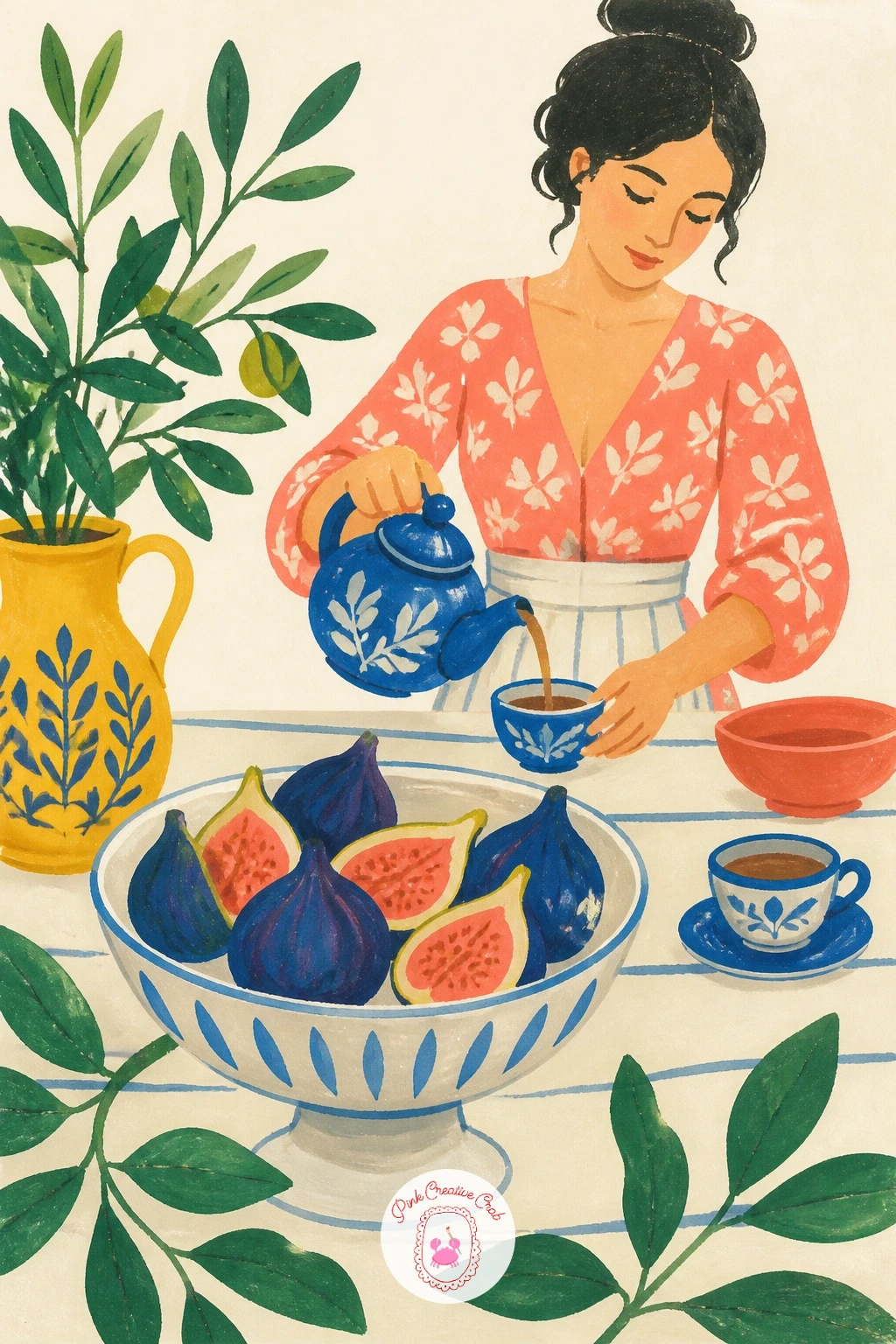
Palette: Coral,Cream,Leafy Green,Payne’s Grey
Carry the market idea onto water with a floating market boat loaded with mangoes, a seller in a wide hat steering through. Paint the water first as a flat cobalt band, then the boat as one long cream or coral hull shape sitting low in the water under the weight of its load.
Measure the mango pile against the seller’s seated height before filling it in: the mound should rise no higher than her shoulder, keeping the boat looking stable rather than about to tip.
Paint the mangoes as a dense cluster of small coral-yellow ovals, each slightly different in size and angle, and the seller’s hat as one wide flat cream disc shading her face, painted before her features go in so the shadow sits correctly beneath the brim.
If a full river scene feels like too much background, a narrow cobalt strip behind the boat is enough water to place the whole scene convincingly.
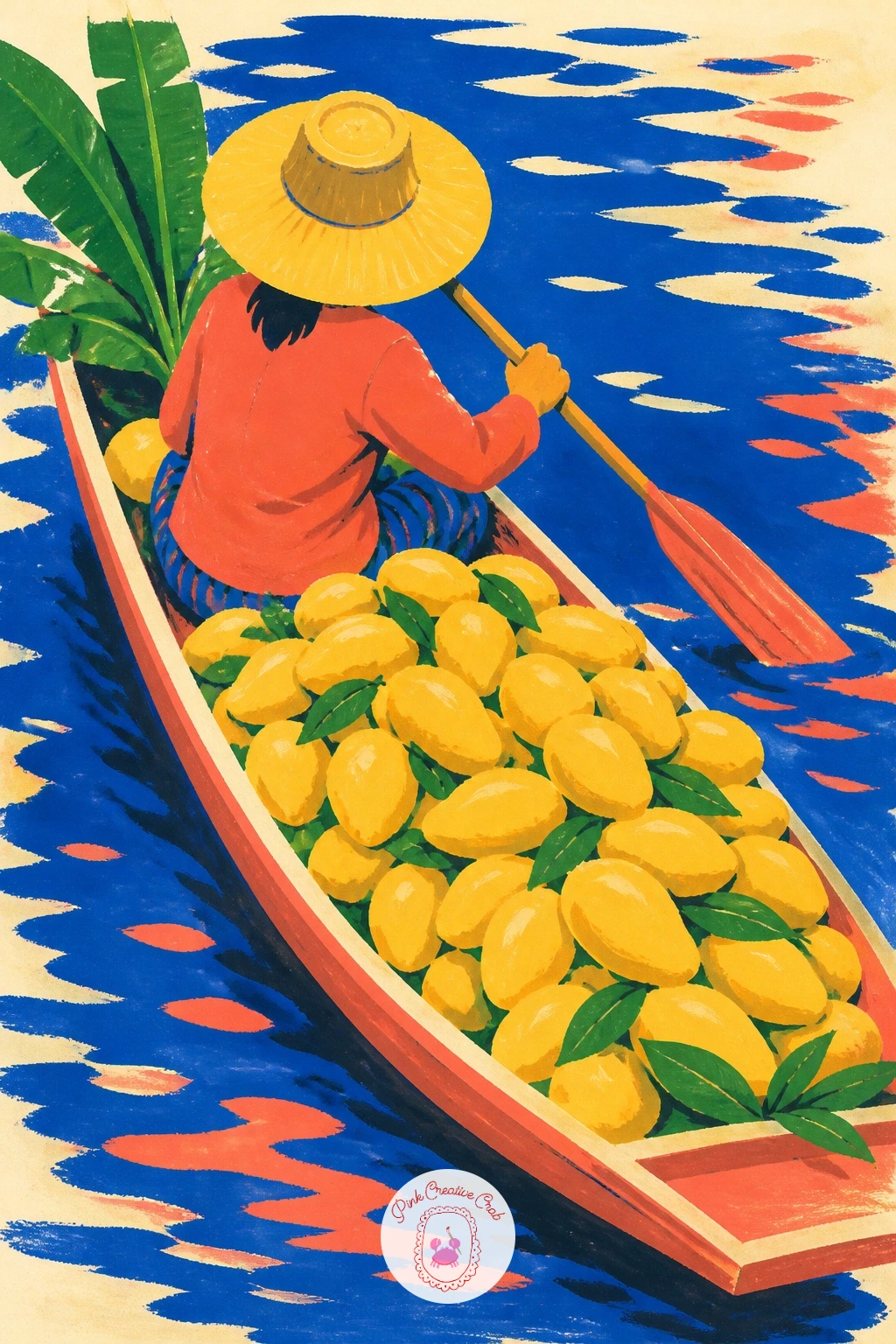
Palette: Cobalt Blue,Coral,Lemon Yellow,Cream
Bring the scene home with a backyard barbecue, a dad grilling corn while kids wait nearby. Paint the grill first as a flat cobalt or grey box shape, then the corn cobs laid across the grate as simple lemon-yellow ovals with thin dark grill lines crossing each one.
Keep the smoke rising from the grill loose and slightly curved to one side, following wherever you decide the light source sits, since smoke drifting straight up in still air reads oddly next to an active grill.
Paint the dad standing over the grill with tongs held out at an angle, and the kids a little off to one side, smaller in scale, standing rather than sitting, which reads clearly as waiting rather than already eating.
If a full backyard setting feels like too much today, crop it tight on the grill, the dad and one waiting kid, leaving the rest of the yard as flat cream.
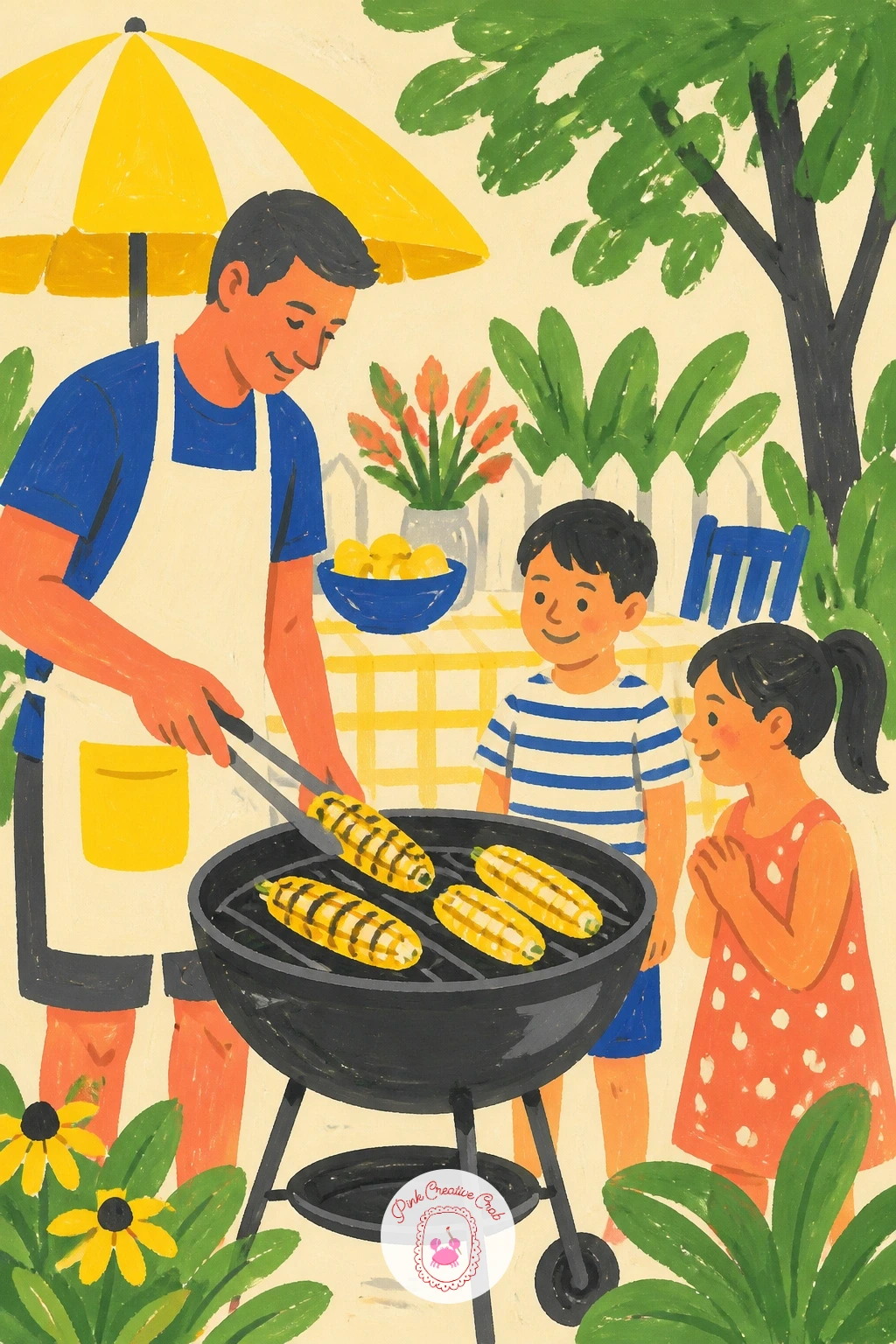
Palette: Lemon Yellow,Payne’s Grey,Cobalt Blue,Cream
Return to a quieter family moment: a grandmother pouring tea from a clay pot for her granddaughter. Paint the clay pot first as a rounded coral-brown shape, then the stream of tea as one thin curved line painted last with a fine brush, once the cup beneath it is fully dry.
Seat the two figures close together, the granddaughter’s cup held up with both hands rather than one, which reads as a younger child’s grip and sets her apart from the grandmother without needing different facial detail.
Keep their clothing in two related but distinct colors, perhaps leafy green for the grandmother and cream for the granddaughter, so the eye can separate the two figures instantly even at a glance.
If a full table setting feels like too much, crop in close on just the pot, the two cups and their hands, letting their faces sit outside the frame entirely.
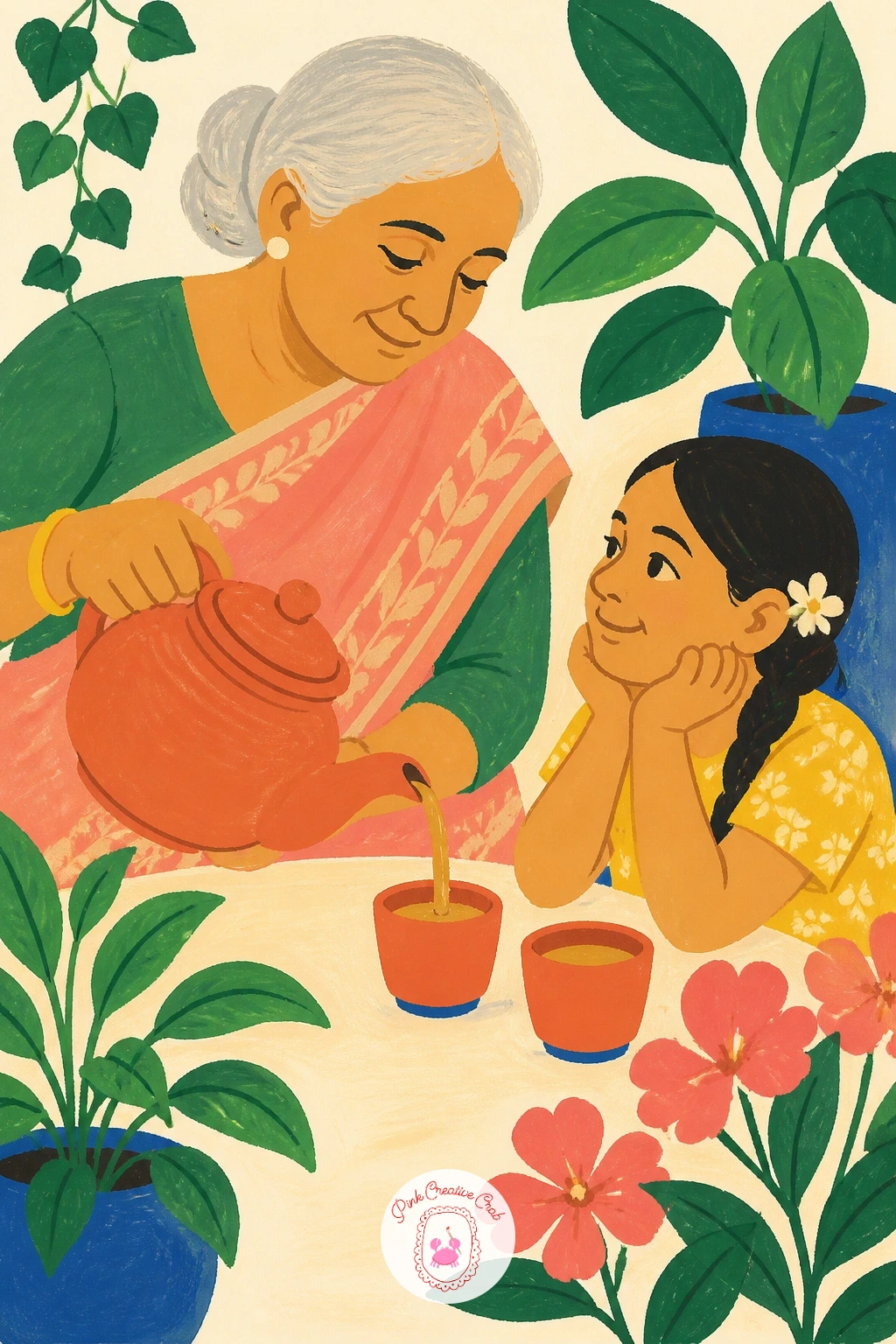
Palette: Coral,Leafy Green,Cream,Lemon Yellow
Move to a seaside restaurant terrace, a bowl of mussels and two glasses of wine between a pair of diners. Paint the sea in the background first as a flat cobalt band, then the terrace table in front of it as one cream plane, keeping a clear horizon line so the water sits convincingly behind rather than beside the table.
Paint the mussel bowl as a cluster of small dark navy-black oval shells, each with a thin cream line for the open edge, piled loosely rather than in neat rows, since neat rows read as a diagram rather than a shared bowl.
The two wine glasses go in next, simple narrow shapes with a coral or cobalt fill depending on whether you want red or white, angled slightly toward each other the way the iced tea glasses were, to suggest a toast without needing to paint a clink.
If mussels feel unfamiliar, swap the bowl for olives from the earlier stall idea, same loose cluster, different color story.
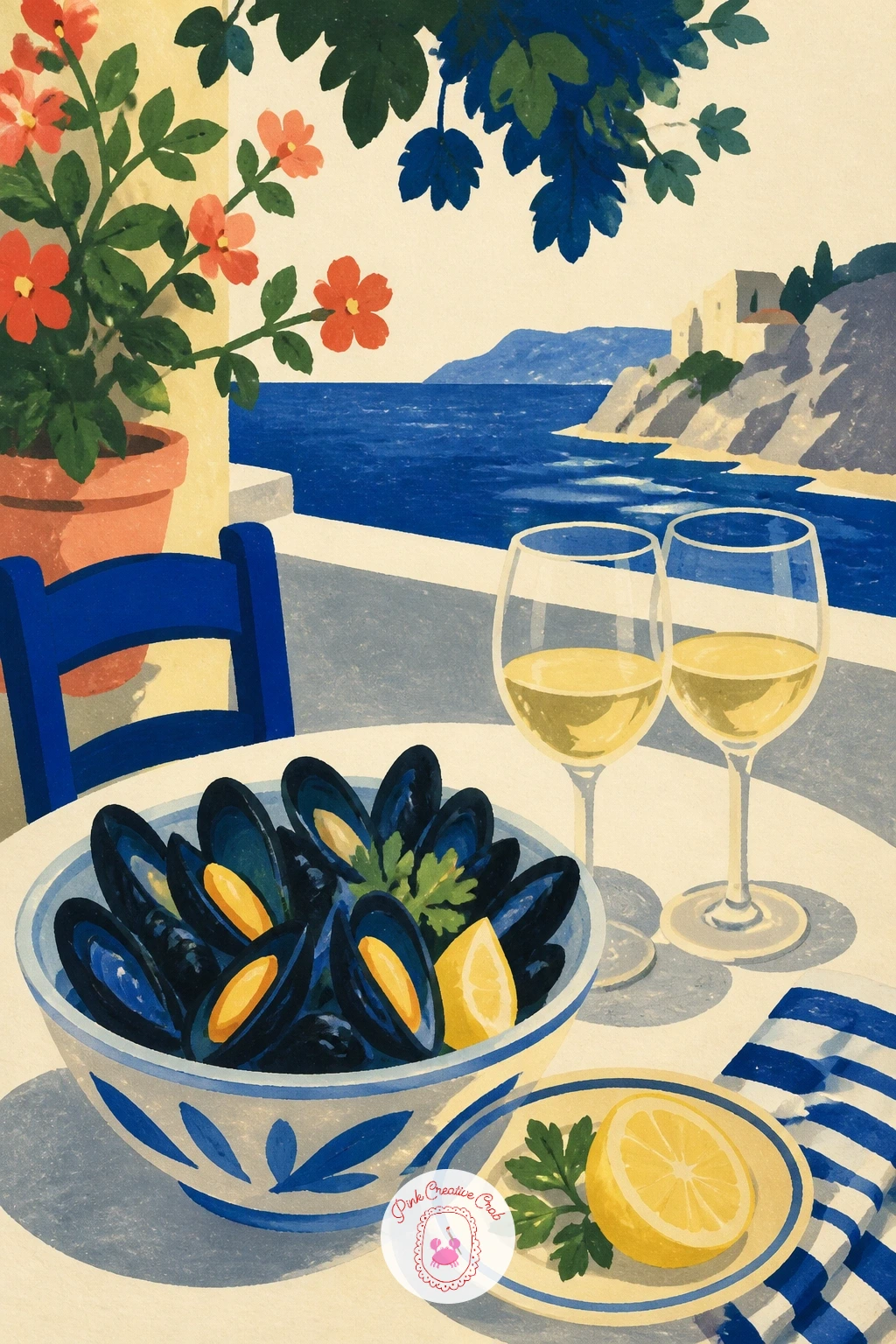
Palette: Cobalt Blue,Cream,Payne’s Grey,Coral
Take the brush outdoors once more for a girl picking blueberries into a tin pail on a hillside. Paint the hillside first as sweeping bands of leafy green fading toward a paler green at the top, then the blueberry bushes as loose clusters of small dark navy-blue dots scattered rather than lined up in rows.
Keep the girl’s reaching arm bent toward one bush rather than painted straight down at her side, that single angled arm is what turns a standing figure into someone actively picking.
Paint the tin pail as one simple cream or grey cylinder with a thin dark handle, a few loose blueberries already inside painted as small dark dots against the lighter pail interior.
If a full hillside feels too large a background for today, paint just two bushes close around her and let the rest of the hill fade into flat cream near the edges of the frame.
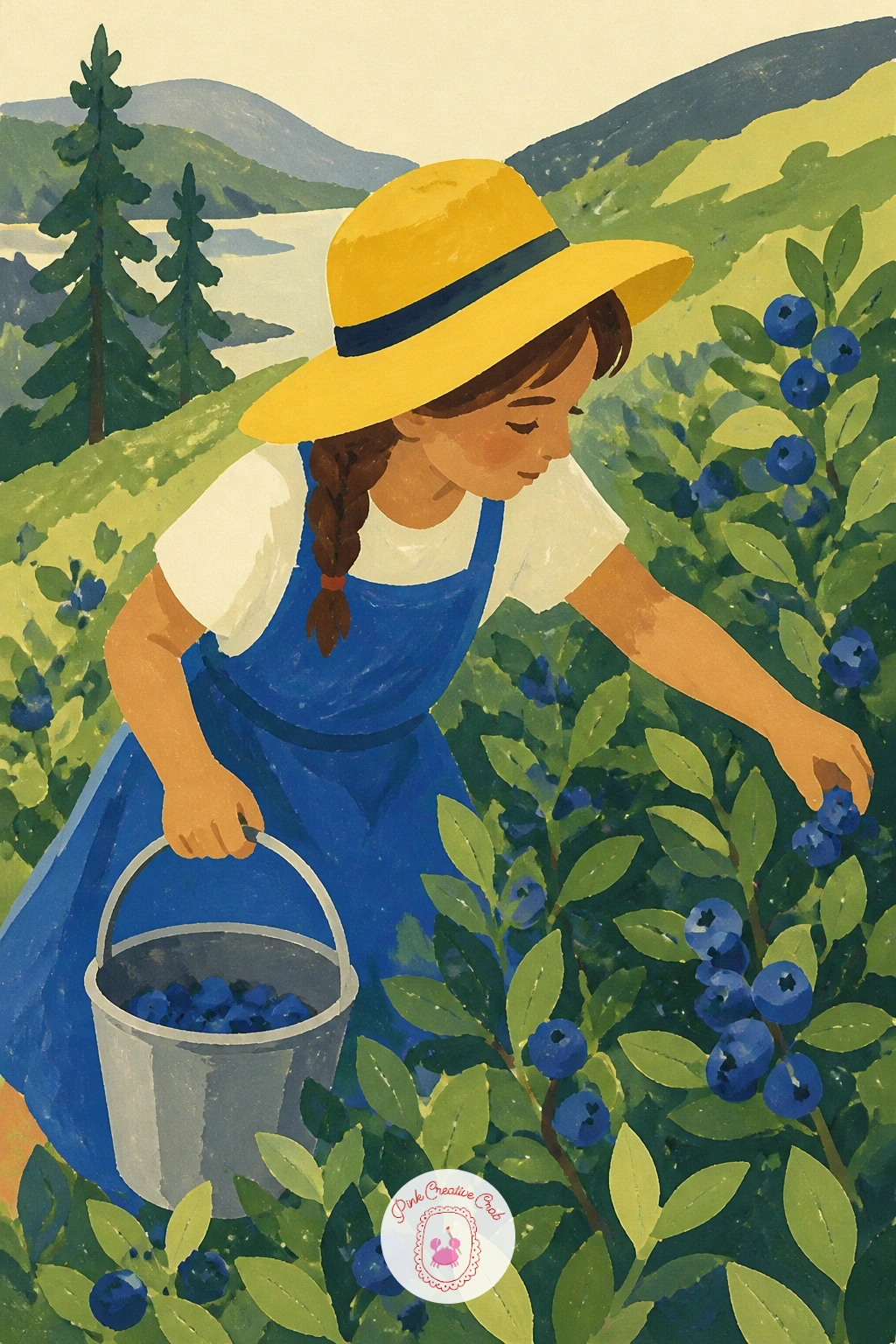
Palette: Leafy Green,Payne’s Grey,Cream,Cobalt Blue
Return indoors for a cheese shop counter, big wheels of cheese and a smiling shopkeeper behind them. Paint the wheels of cheese first as a row of large flat cream and lemon-yellow cylinders, varying their heights slightly so the row reads as individually cut wheels rather than one long stacked block.
Compare the shopkeeper’s height against the tallest wheel before painting her in, her shoulders should clear the top of the counter but sit below the stacked wheels behind her, which keeps the scale of the shop believable.
Paint a thin darker rind line around each wheel’s edge, and leave one wheel with a wedge already cut out, a simple triangular gap, which does more to suggest a working shop than any amount of extra detail on the whole wheels.
If the full row of wheels feels like a lot of repeated circles, three large ones plus the shopkeeper still reads clearly as a cheese counter.
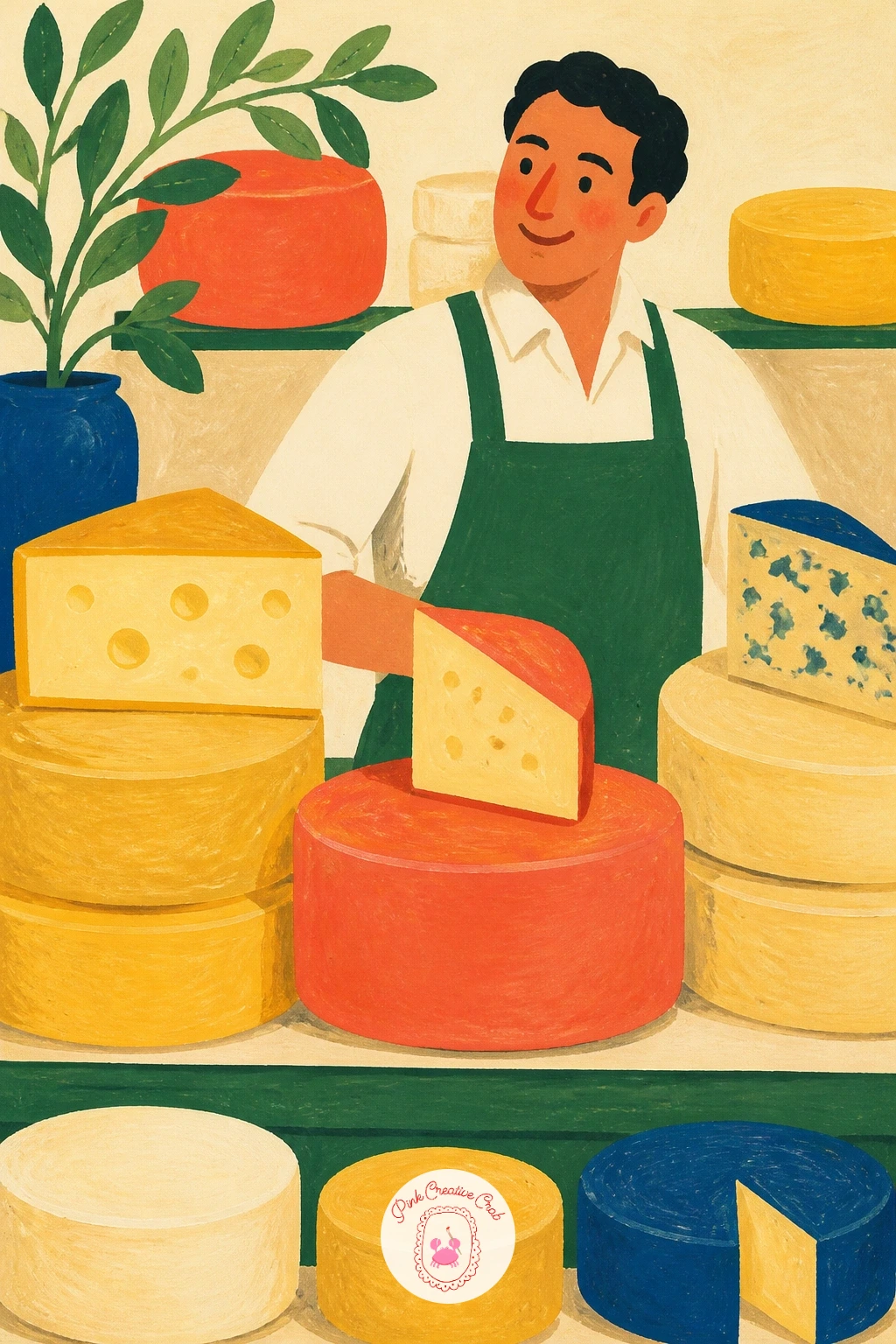
Palette: Cream,Lemon Yellow,Coral,Payne’s Grey
Finish on a rooftop dinner, candles lit and a big bowl of salad set between friends at the table. Paint the rooftop setting first, a flat cobalt night sky with a few scattered lemon-yellow dots for distant lights, since that background decides how warm the candlelight in front of it can read.
The candles go in next, small simple flame shapes in coral and lemon, placed down the center of the table, with a soft warm glow suggested by a faint coral tint on the faces nearest to them.
Paint the salad bowl as one large cream shape filled with loose leafy green marks, a few coral or lemon dots scattered through for tomato or pepper, kept casual rather than individually shaped leaf by leaf.
Once this scene works, try the same rooftop table lit by late afternoon sun instead of candles, the whole mood shifts from intimate to bright without changing a single prop.
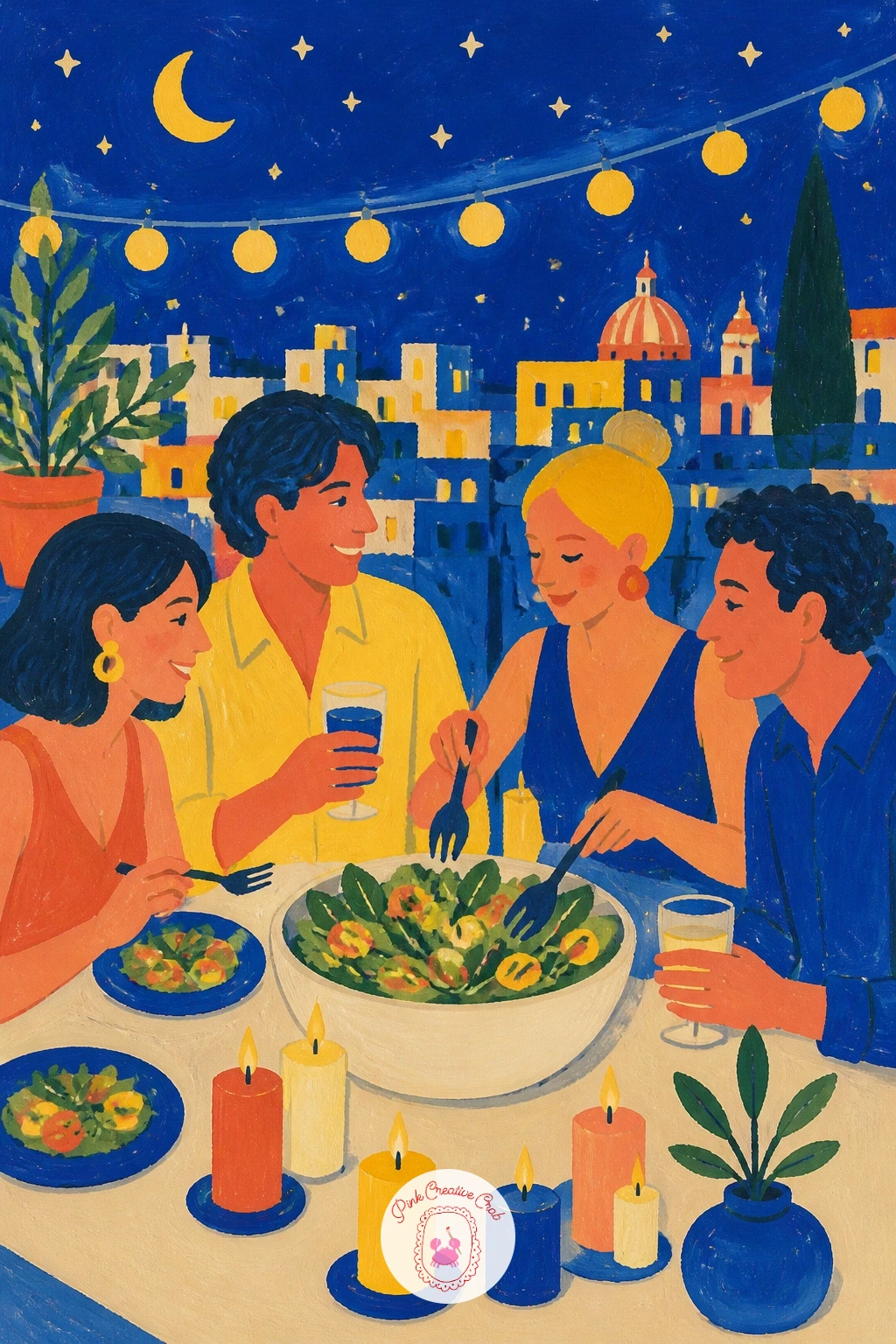
Palette: Cobalt Blue,Coral,Lemon Yellow,Leafy Green
If you enjoyed building a whole scene around a shared table, the picnic drawing lessons for blankets and baskets cover a similar idea in a different medium.
What to Do Next
Pick whichever scene pulled at you most while scrolling, load a fresh sheet of gouache paper, and block in the largest shapes first, the table, the stall, the sky, before any figures or fruit go in. One finished piece today beats three left half done, so keep today’s choice small enough to see through to the last lemon.
Frequently Asked Questions
What kind of paper works best for food painting in gouache?
A smooth, heavyweight paper or board made for gouache or mixed media works best. It holds flat color without the paper warping, and the smooth surface helps keep those crisp, print-like edges this style depends on.
How do you keep gouache colors from looking muddy in a busy market scene?
Let each shape dry fully before painting the next one on top of it. Mixing fresh paint for every color rather than reusing an old puddle, and adding a touch of white to deepen a color instead of more pigment, keeps shapes clean.
Do I need to paint realistic faces for the people in these scenes?
No, simple flat features read clearly from a normal viewing distance. A few confident marks for eyes and a mouth carry more life than an overworked, detailed face at this scale.
How do I stop a crowded scene like a long table dinner from looking cluttered?
Paint the background elements first in flat, quieter colors, then bring the figures and food forward in brighter tones. Varying the spacing between figures, rather than lining them up evenly, also keeps a busy scene feeling natural.
What is the easiest idea on this list to start with?
The lemon market stall or the picnic blanket with grapes and cheese are the simplest starting points. Both use a small number of large, flat shapes and a limited palette, which makes them forgiving for a first attempt.
Have any thoughts?
Share your reaction or leave a quick response — we’d love to hear what you think!
-
 0
-
 0
-
 0
-
 0
-
 0
-
 0
