A pencil sketch portrait is the quickest way to put a whole life onto one page. One tilted cap, one pearl earring, one gap-toothed smile, and the person is unmistakably themselves, long before you have finished rendering a single strand of hair.
Below are 28 faces to choose from, grandmothers and toddlers, nurses and carpenters, each with a small detail that carries the story. Pick whichever one you feel like meeting today, sharpen a pencil, and work your way from the loose outline to the last soft shadow.
Using these images: free for personal projects such as printing, coloring, cards, journals and gifts. Handmade items that include them may be sold up to 30 pieces per design. More than that is commercial use and is not permitted, and neither is selling or sharing the images themselves or passing them off as your own. Please ask before any other use.
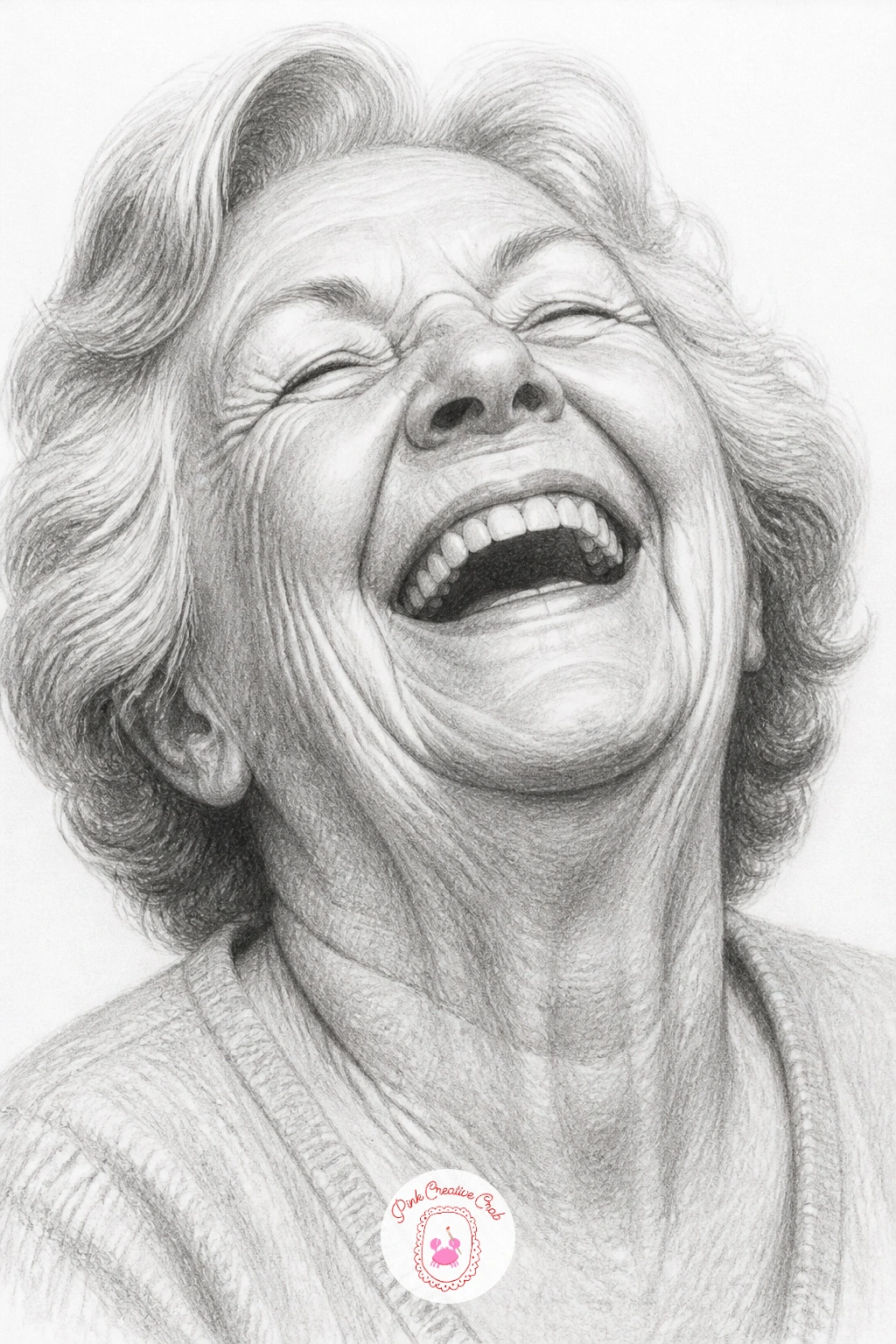
Start with a grandmother caught mid laugh, head tipped back so her chin lifts and her throat shows. Block the head as an egg shape tilted back on the page, then find the neck angle before you add a single wrinkle, because that tilt is what sells the joy.
Work the open mouth and crinkled eyes with an HB first, light and searching, then move to 2B for the deep laugh lines around the mouth and the soft folds at the neck. Blend the cheeks and forehead with a stump for a gentle glow, keeping the darkest marks inside the mouth and under the chin.
Beginners often flatten the tilt and end up with a grandmother staring at the ceiling instead of laughing. Check the angle of the chin against the shoulders before you commit to shading, and adjust the whole head if it looks too vertical.
Finish with a few loose, curved lines for soft waves of hair; they do not need individual strands to read as hair.
Palette: Graphite HB,Graphite 2B,Graphite 4B
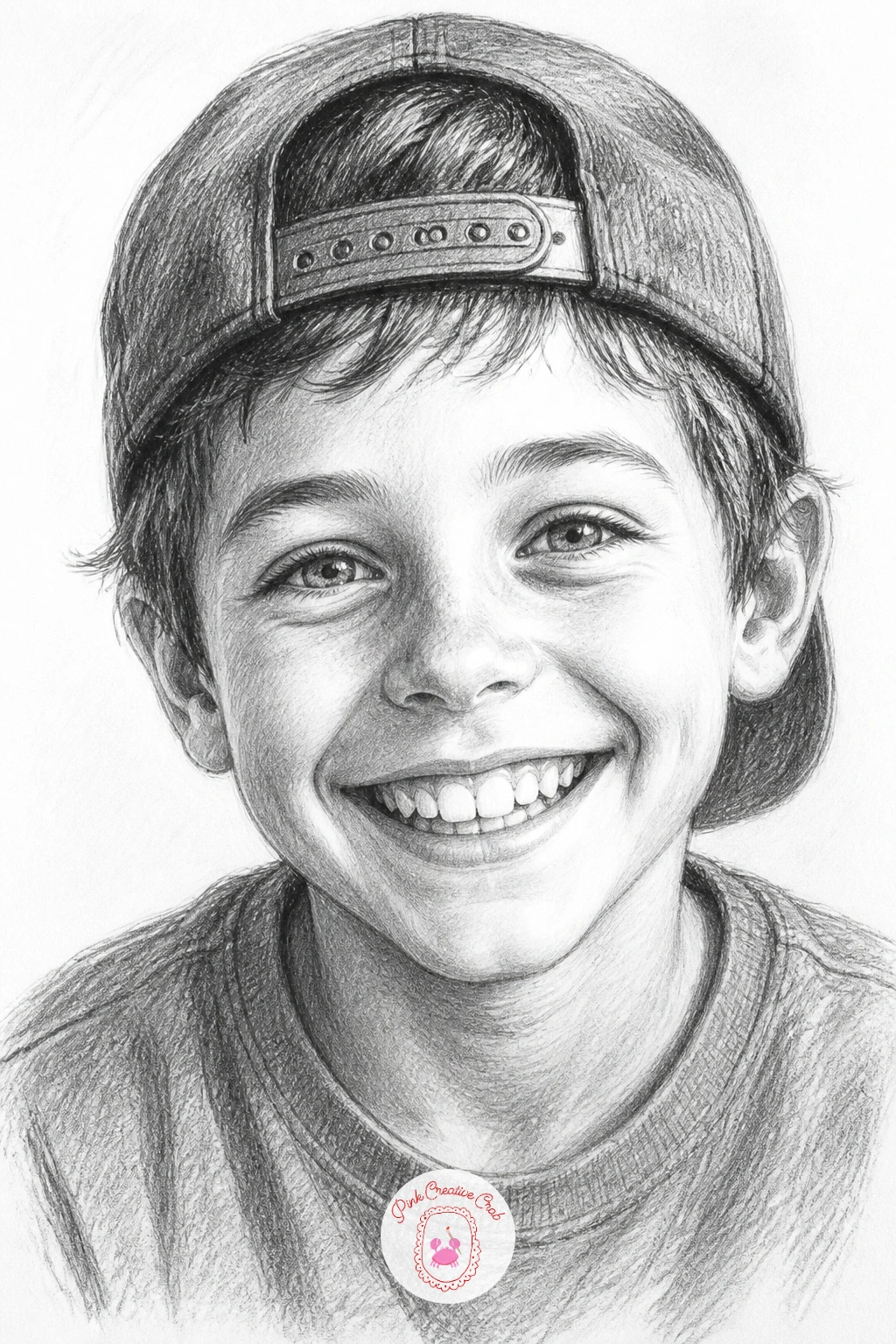
A boy in a backwards cap grinning gives you a face full of energy, so keep the whole drawing a little loose and quick to match. Sketch the skull shape first, then place the cap as a simple curved band sitting high on the head with the brim pointing away from you, before any grin appears.
Build the grin with short, confident strokes around the mouth, leaving the teeth as clean white paper rather than shading them flat grey. Shade the cheeks and nose with a 2B in small circular motions, lifting pressure near the highlights on the forehead and cheekbones.
The cap brim is where proportion goes wrong most often: measure its width against the width of the head before you draw the stitching lines, or it ends up looking pasted on. If you only have a soft pencil on hand, use the side of the lead for the cap shadow instead of a stump.
Keep the hoodie collar loose and unfinished at the bottom edge.
Palette: Graphite HB,Graphite 2B,Graphite 6B
Move from grins to freckles with a girl whose gap toothed smile is the whole point of the drawing. Lay in the face shape and the smile line first, leaving a small gap between the two front teeth deliberately open rather than filled in.
Freckles come last, never first: finish the base shading of the cheeks and nose bridge with a soft HB, then scatter small dots with a sharp 2B in a loose, uneven pattern that follows the curve of the cheekbones. Too many freckles in straight rows is the usual mistake, so turn the page sideways now and then to check they read as random rather than patterned.
If your pencil keeps smudging the dots into blotches, switch to a fine liner or a mechanical pencil with a hard lead just for the freckles, then go back to soft graphite for the shading around them.
Leave two pigtail tufts loose and sketchy rather than tightly drawn.
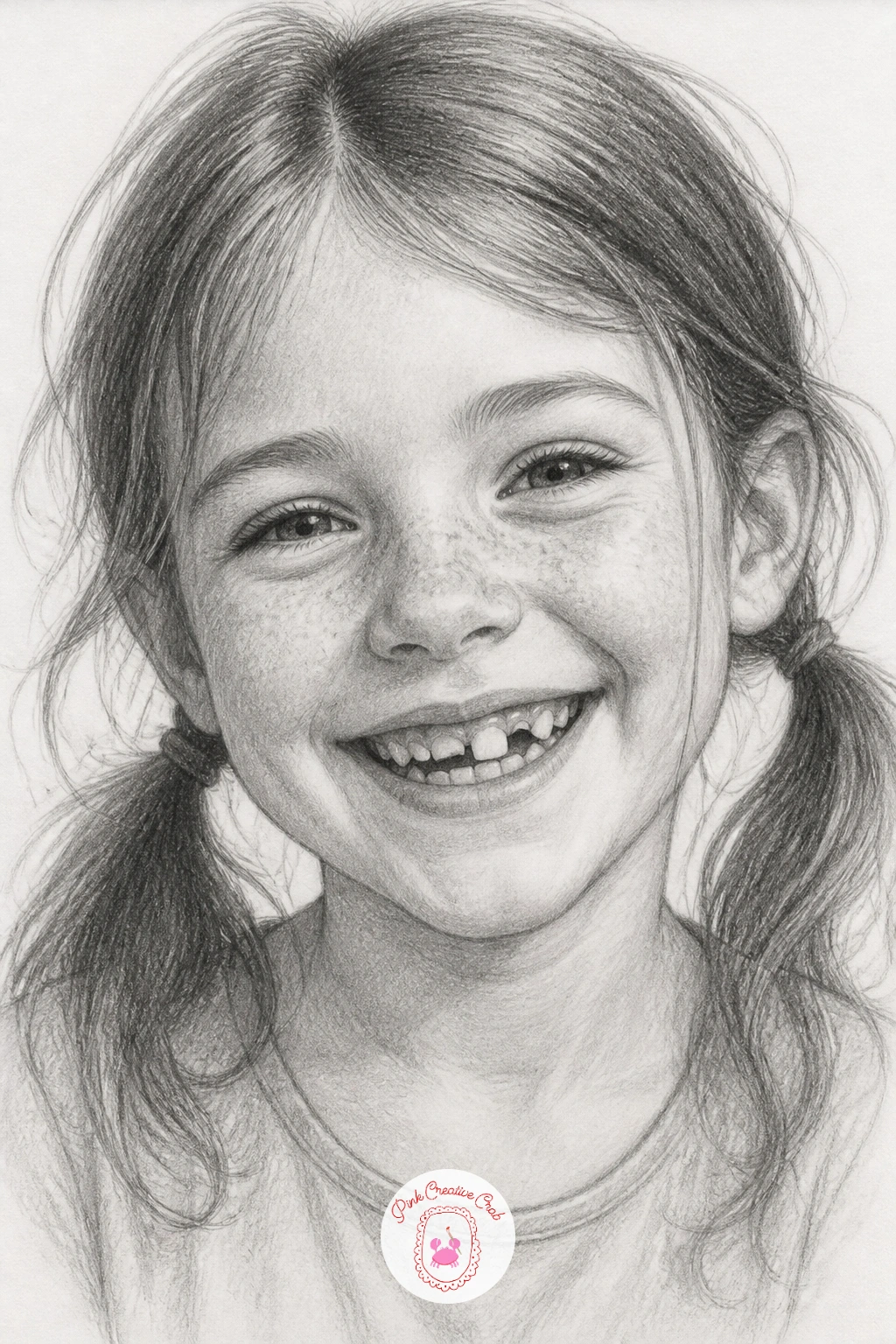
Palette: Graphite HB,Graphite 2B,Graphite 4B
Try drawing the freckles with a hard 2H pencil for a crisper dot than soft graphite gives, since soft lead tends to smear into a smudge under your hand.
An old man with a white beard and a wool scarf asks you to think about where the light falls before you touch the beard at all. Decide on one light source, usually from above and slightly to one side, and let that decide which half of the beard stays pale and which falls into shadow.
Draw the skull and jaw loosely under where the beard will sit, then build the beard in short overlapping strokes that follow the direction hair actually grows, curving down and out from the chin. Leave the lit side almost untouched white paper and push the shadow side close to black with a 4B, with the scarf’s knitted texture suggested by a few diagonal ridge lines rather than every stitch.
A flat, even grey beard with no light logic is the most common letdown here. Step back and squint at the drawing; if you cannot tell where the light comes from, deepen one side and lift graphite off the other with a kneaded eraser.
Finish the scarf folds with a few confident dark lines at the creases only.
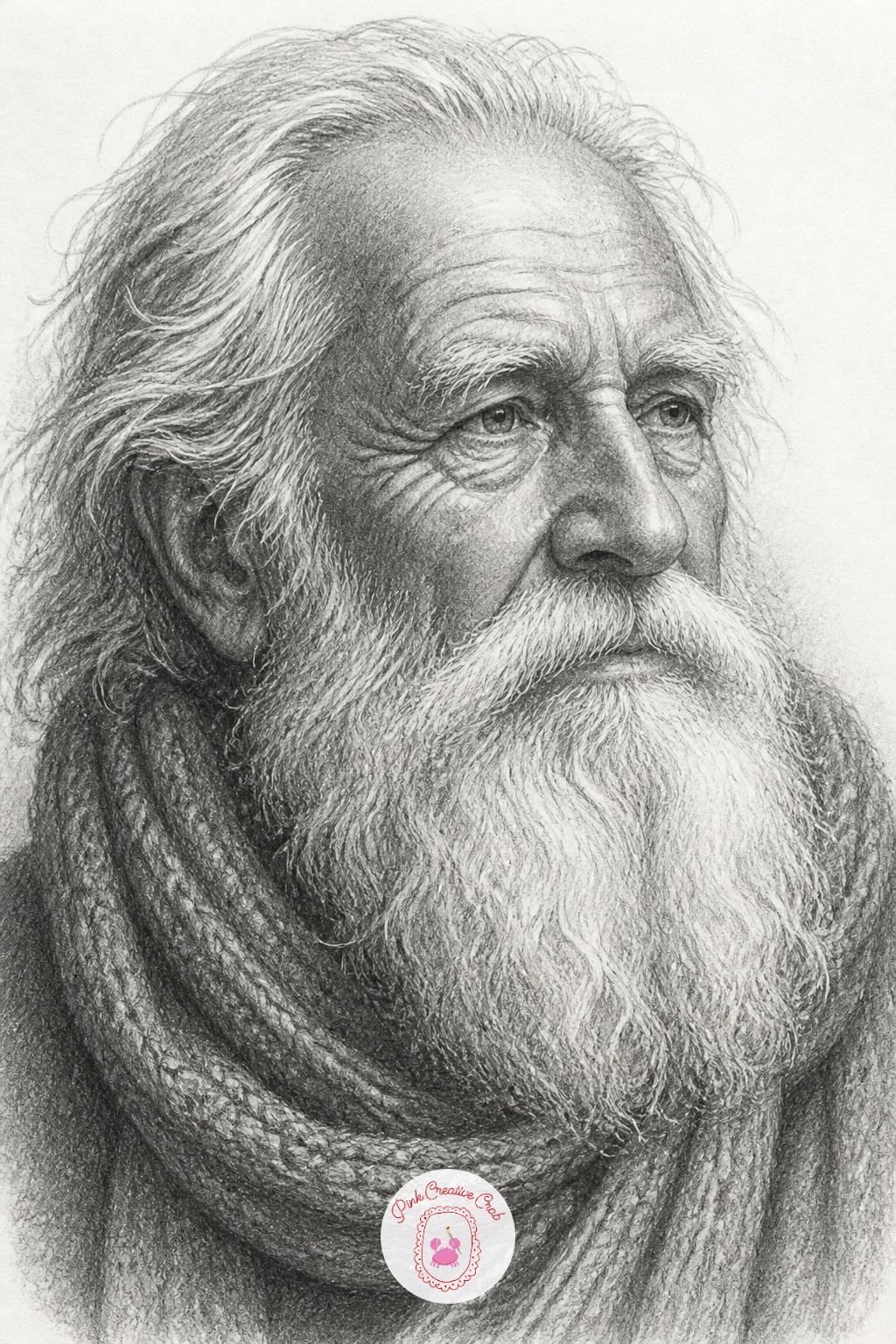
You Will Need
- kneaded eraser for lifting highlights
Palette: Graphite 2B,Graphite 4B,Graphite 6B
A young mother with a baby on her shoulder brings two faces into one drawing, so settle their relative sizes before you shade either. The baby’s head is roughly the size of the mother’s hand; sketch both heads as simple ovals first and compare them side by side until the scale feels believable.
Work the mother’s face to a soft finish with an HB and 2B, keeping her expression calm and a little tired around the eyes, then draw the baby’s head resting against her shoulder with rounder, simpler shapes and almost no shading, since baby skin has far less visible texture than adult skin.
If the baby ends up looking like a small adult, soften every edge on its face and round out the cheeks further; infant features are much closer to circles than adult ones. Trace a coin or a small lid for the baby’s eye if freehand rounds keep coming out oval.
End with the mother’s hand resting lightly on the baby’s back, drawn with soft, rounded knuckles.
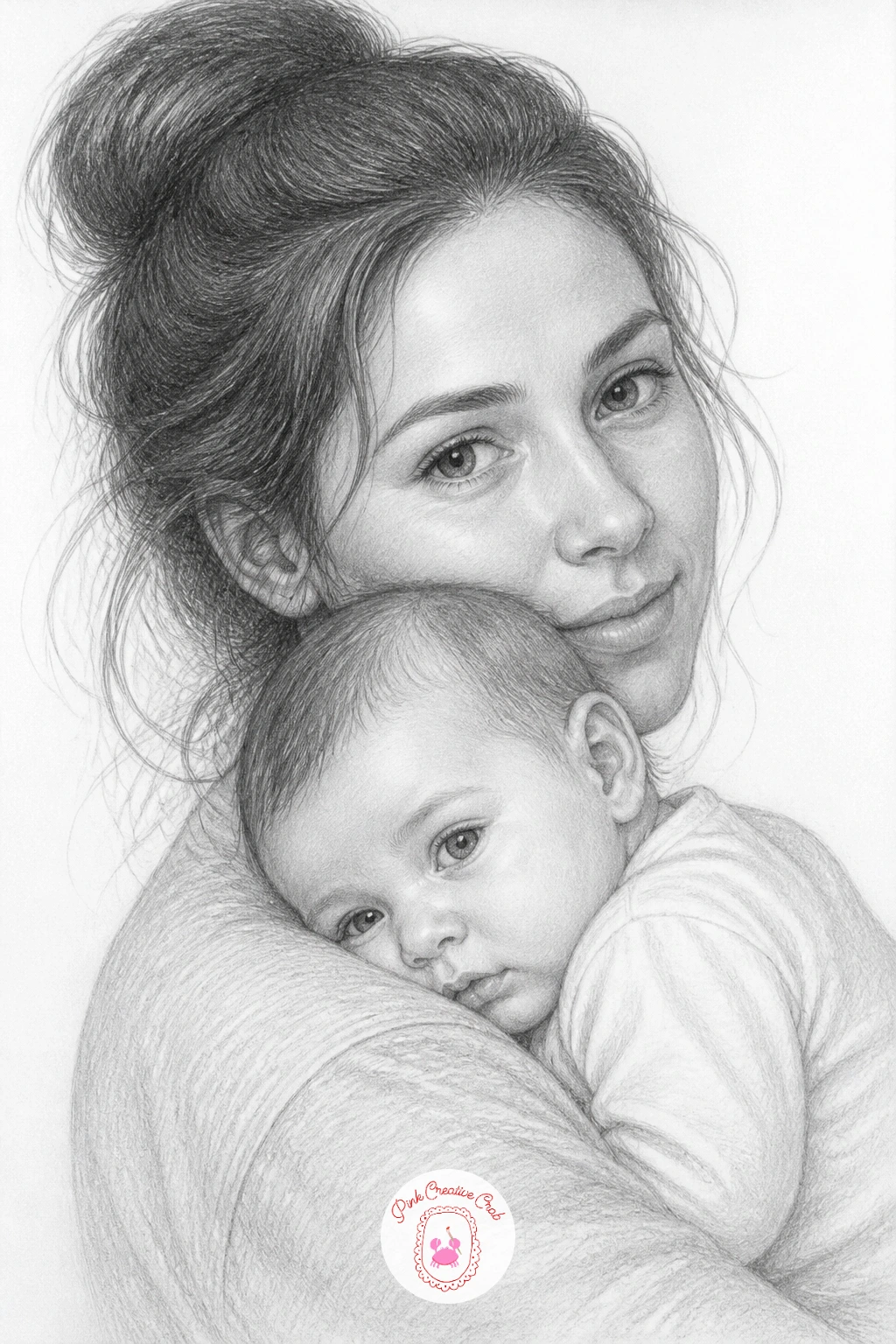
You Will Need
- coin or small lid to trace the baby’s eye shape
Palette: Graphite HB,Graphite 2B,Graphite 4B
A teenage girl with braces and a high ponytail needs a confident, upward pulling hairline before anything else goes on the page. Sketch the ponytail as one strong sweeping shape pulling back and up from the crown, and let that tension show in the slightly stretched skin near the temples.
Draw the smile with the lips slightly parted, then add the braces as small, evenly spaced rectangles along the visible teeth, drawn with a sharp hard pencil so they stay crisp rather than smudged into one grey band. Shade the face with an HB for the light areas and 2B for the shadow under the jaw, keeping the ponytail itself loose and flowing rather than fully rendered strand by strand.
Braces drawn too large or too dark read as a solid metal bar instead of individual brackets. Keep them small, pale, and spaced evenly, erasing and restarting that row if it clumps together.
A single hoop earring peeking through the hair adds a nice finishing detail.
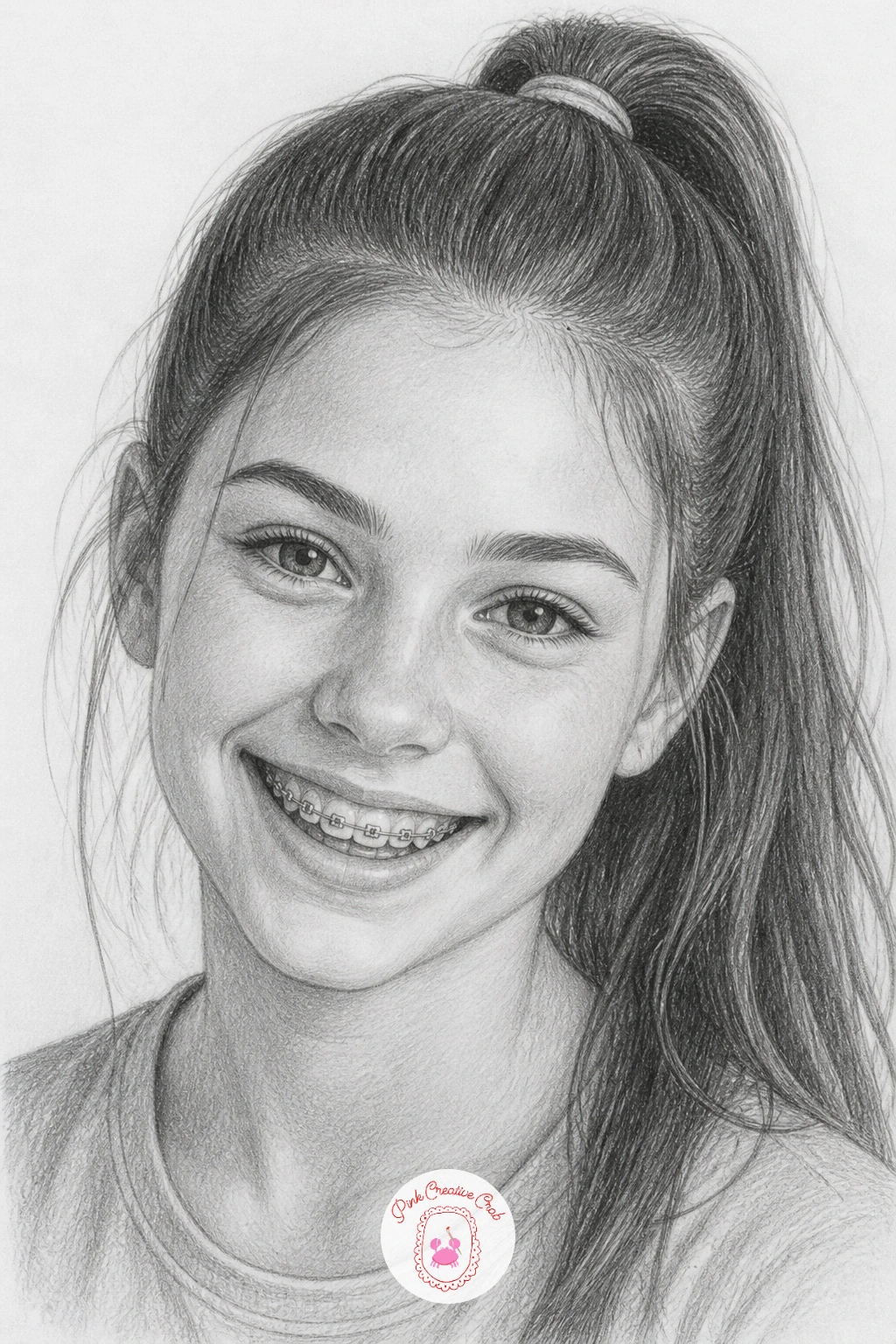
Palette: Graphite HB,Graphite 2B,Graphite 4B
A man with a shaved head and a kind gaze puts almost all the attention on the eyes, since there is no hairline to soften the top of the face. Map the skull as one smooth, rounded shape first, and resist the urge to add texture there until the face underneath is fully built.
Spend the most time on the eyes: a kind gaze usually means slightly lowered outer corners and soft, unhurried lids, so keep your pencil strokes slow and light around them rather than sharp and scratchy. Shade the scalp with a very light, even layer of HB and only a touch of 2B at the curve where it catches shadow, since a shaved head reflects light smoothly rather than in patches.
Over-shading the scalp into a dark, blotchy sphere is the easiest way to lose the kindness in the expression. Keep that area the lightest part of the whole drawing and let the eyes carry the warmth instead.
A faint shadow line along the jaw suggests stubble without drawing every hair.
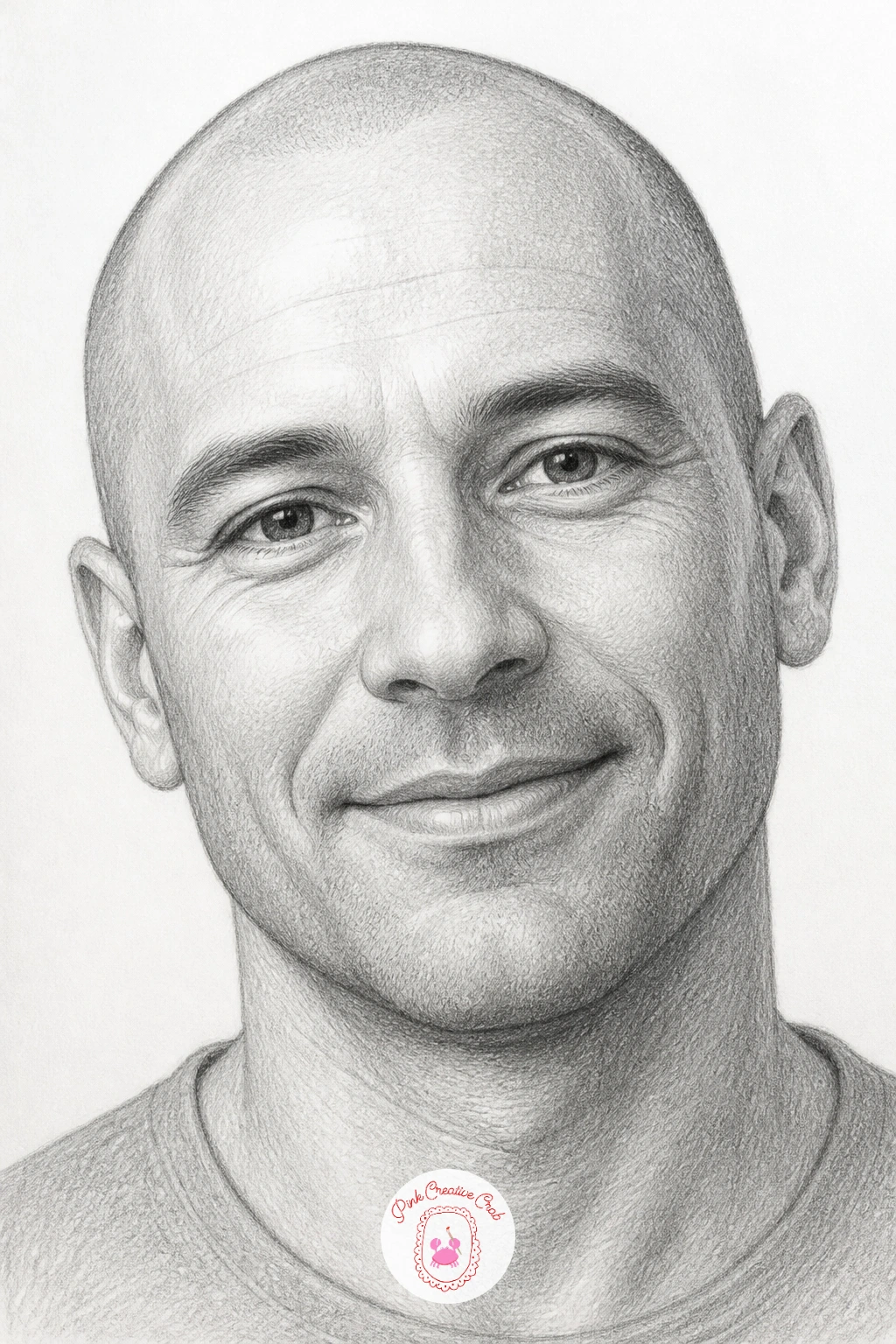
Palette: Graphite HB,Graphite 2B,Graphite 4B
A woman with short silver hair and pearl earrings is a good chance to practice leaving highlights alone instead of shading over them. Silver hair reads as silver mostly through contrast, so draw the darkest shadows between the strands first and let the white paper do the shining for you.
Build the short hair in layered, feathery strokes that follow the direction it is combed, then move to the face with HB and 2B for smooth, mature skin shading, slightly looser than you would for a younger subject. Draw the pearl earrings as small circles with one tiny bright highlight dot left untouched on each, surrounded by a soft grey shadow underneath.
If the hair looks flat grey rather than silver, you likely shaded it evenly instead of in contrast; go back in with a sharp 4B for a few deep strand-shadows and a kneaded eraser to lift a few strands back to white.
Keep the earrings small; oversized pearls pull focus from the face.
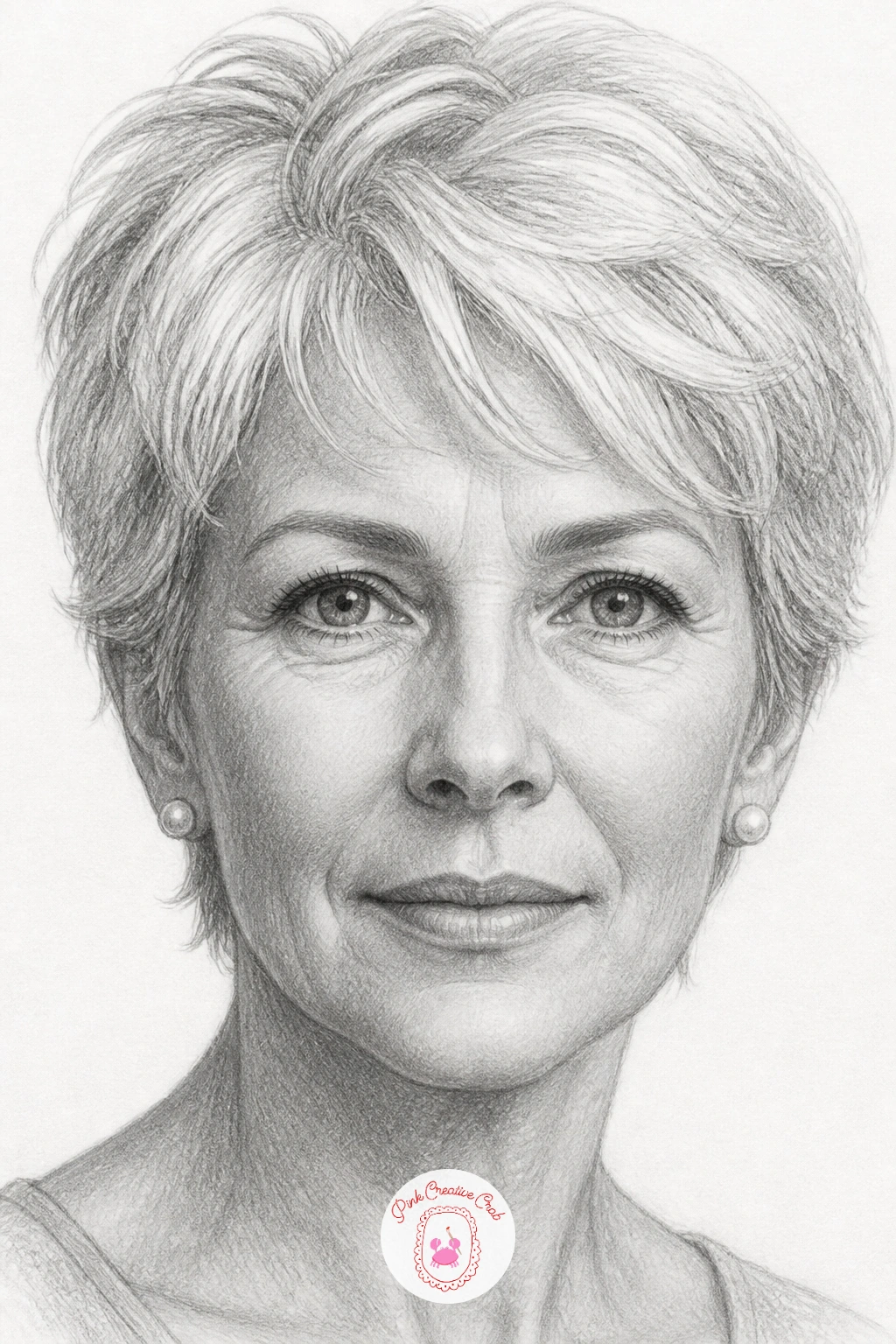
You Will Need
- kneaded eraser for lifting highlights in the hair
Palette: Graphite HB,Graphite 2B,Graphite 4B
A toddler with chubby cheeks and wispy curls works best drawn ten minutes fast, since over-rendering a baby face quickly makes it look older than it is. Block the head as a wide, round shape with the eyes sitting lower than you expect, roughly at the halfway point of the face rather than above it, which is the key to keeping a believable toddler proportion.
Shade the cheeks with a very light HB, almost a polish rather than a texture, and leave most of the forehead untouched white paper for that soft baby shine. A ten minute version stops there, with a few quick curling lines for wispy hair at the crown.
Given forty minutes, add gentle shadow under the chin where a double chin folds, and soften the curls with a stump so they blend into the scalp rather than sitting as separate hard lines.
If the eyes land too high, the toddler reads as a small adult; lower them and widen the cheeks until the proportion feels right again.
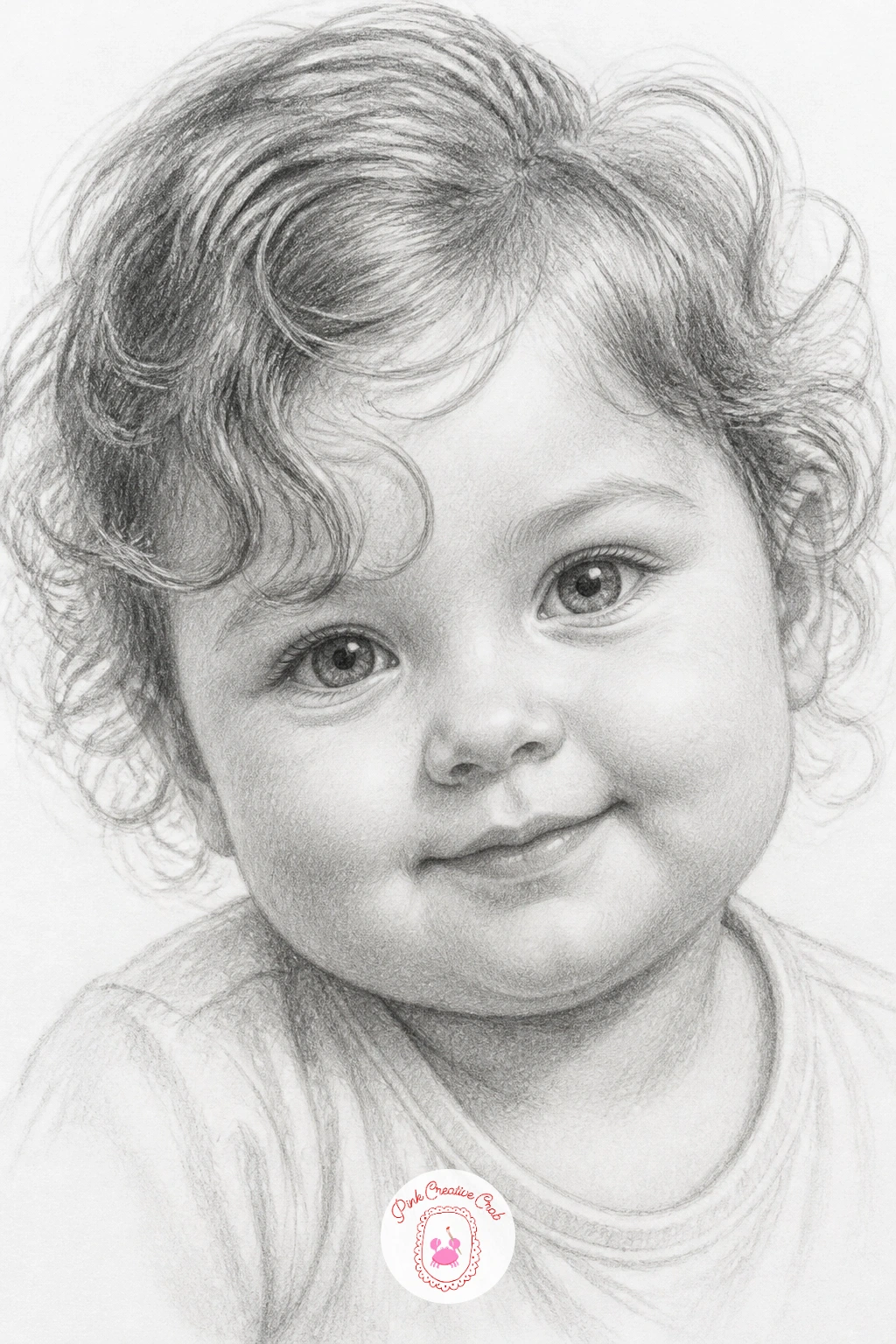
Palette: Graphite HB,Graphite 2B
A nurse in scrubs with tired eyes and a soft smile asks you to balance two feelings in one face, exhaustion and warmth, without tipping into either sadness or forced cheer. Draw the under-eye area with a light, soft 2B shadow rather than hard dark lines, since tiredness in a face is usually gentle and puffy, not deeply carved.
Let the smile stay small and closed-lipped, with the corners lifted just slightly, and keep the brow a touch lower than a fully rested face would have. Sketch the scrubs collar loosely with a V neckline and one simple fold line at the shoulder, leaving the fabric mostly untouched white paper to keep attention on the face.
Overdoing the dark circles turns tired into bruised, which reads as injury rather than a long shift. Keep that shadow soft-edged with a stump and check it against the rest of the face before deepening it further.
A simple id badge sketched at the collar is an easy, honest detail to add last.
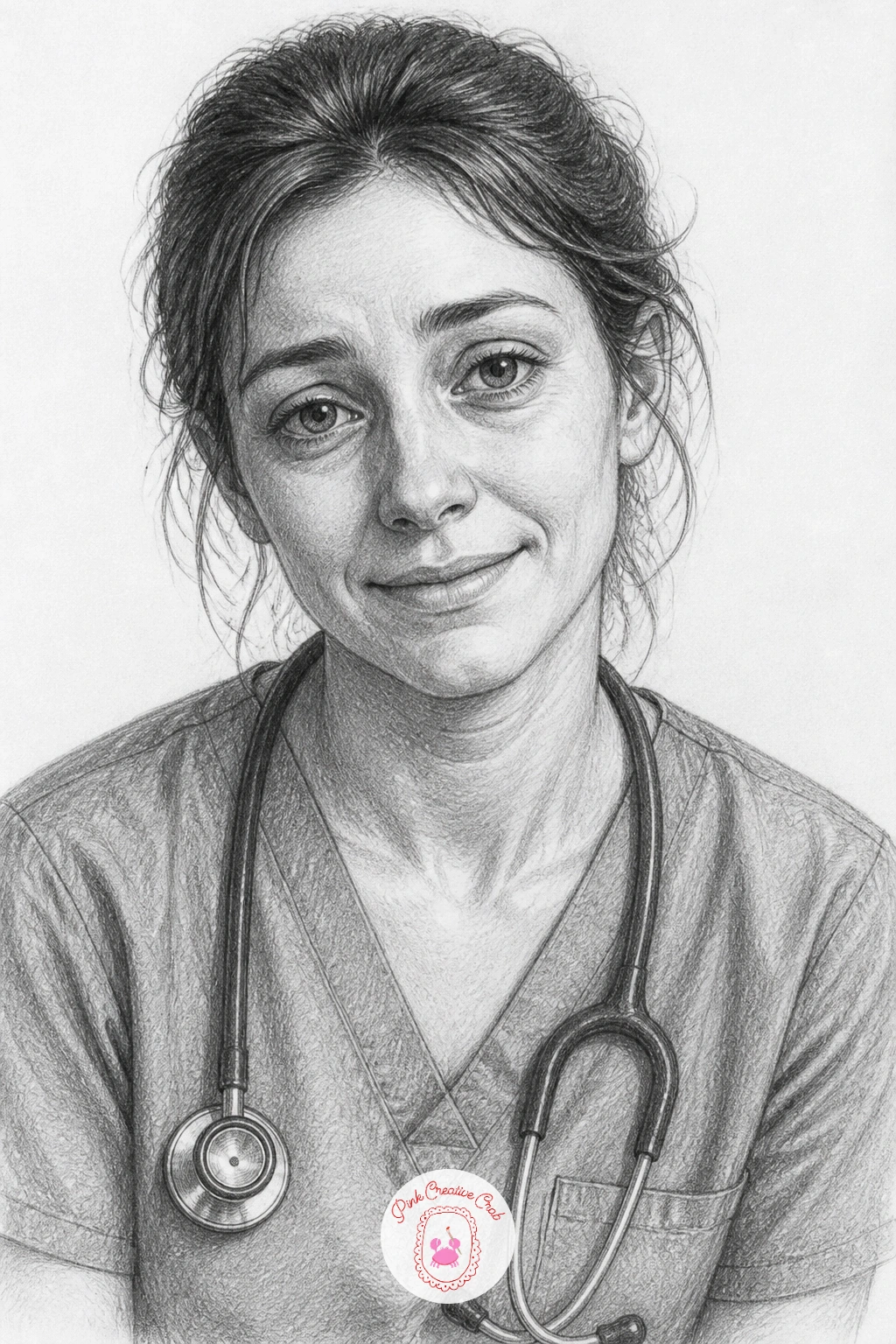
Palette: Graphite HB,Graphite 2B,Graphite 4B
A girl with thick curly hair tied up in a scarf is a good subject for practicing volume, since the scarf has to look like it is actually containing a lot of hair rather than sitting on a flat head. Draw the scarf shape first as a simple knotted band, then build the hair escaping around its edges larger than feels natural, in loose rounded clusters rather than individual curls.
Shade each curl cluster with a 2B working from the outer edge inward, leaving small white gaps between clusters so they read as separate and springy rather than one solid mass. The scarf itself takes a lighter touch, with soft fold shadows at the knot and a few fabric wrinkle lines.
Curls drawn too small and too even tend to look like a tight cap of hair instead of thick, loose curls. Vary the cluster sizes, and let a few curls break the scarf’s edge unevenly.
Finish with a confident dark line where the scarf knots to anchor the whole shape.
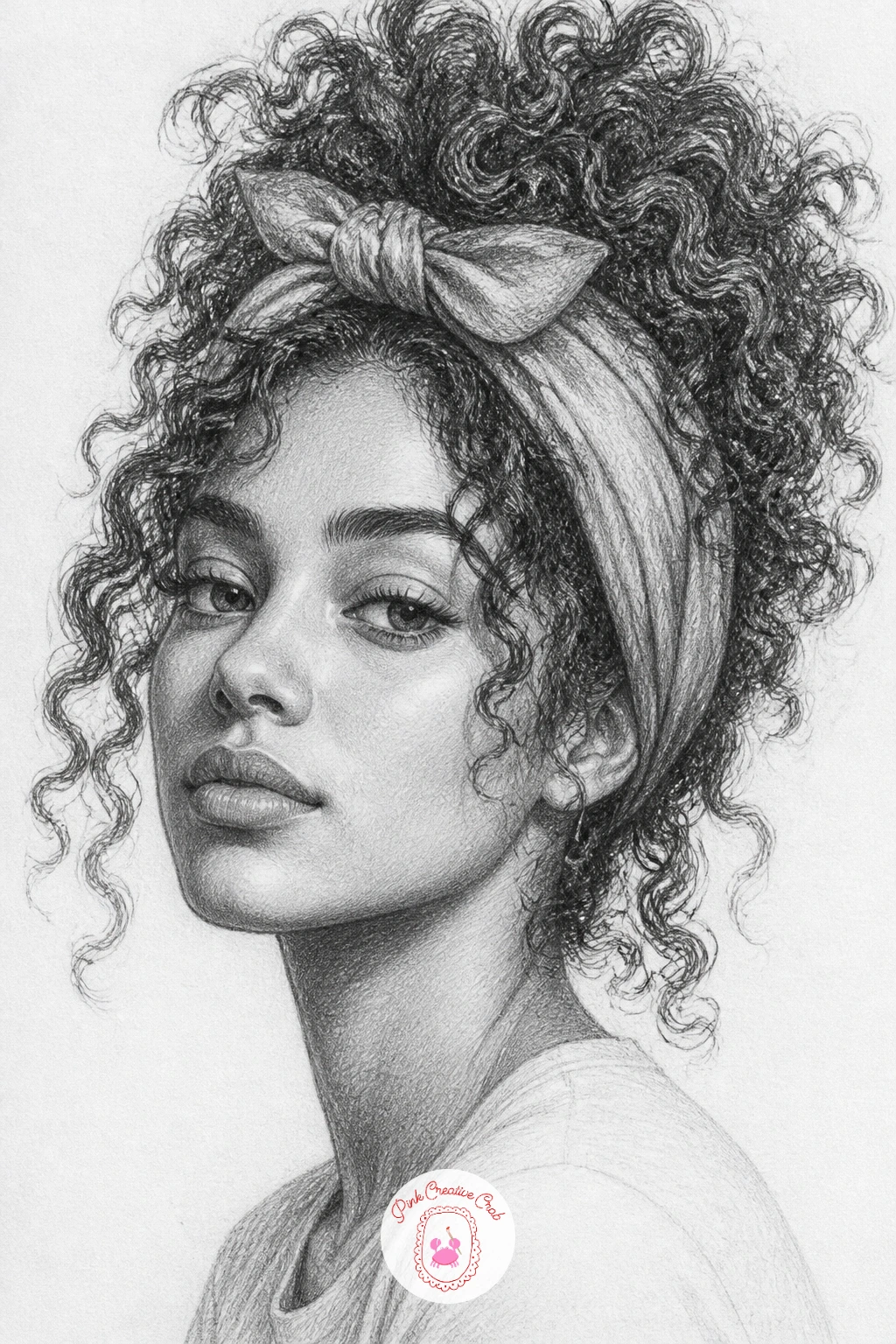
Palette: Graphite HB,Graphite 2B,Graphite 4B
A man with a curled mustache and a bowler hat gives you a strong silhouette to get right before any shading begins. Draw the bowler hat as a simple dome with a slightly curled brim, checking that its width roughly matches the width of the jaw below it so it does not look like it belongs to a smaller or larger head.
Block the mustache as two symmetrical curling shapes meeting at the center, then shade it in short strokes following the curl rather than straight across, keeping it darker than the surrounding skin with a 2B or 4B. The hat itself stays mostly flat dark tone with one soft highlight along its curve, achieved by lifting graphite with a kneaded eraser rather than leaving the paper untouched.
A mustache that sits perfectly flat with no curl direction looks pasted on rather than grown. Let the strokes sweep outward and slightly upward at the tips to catch that classic curl.
A waistcoat collar sketched loosely at the bottom edge finishes the look without extra work.
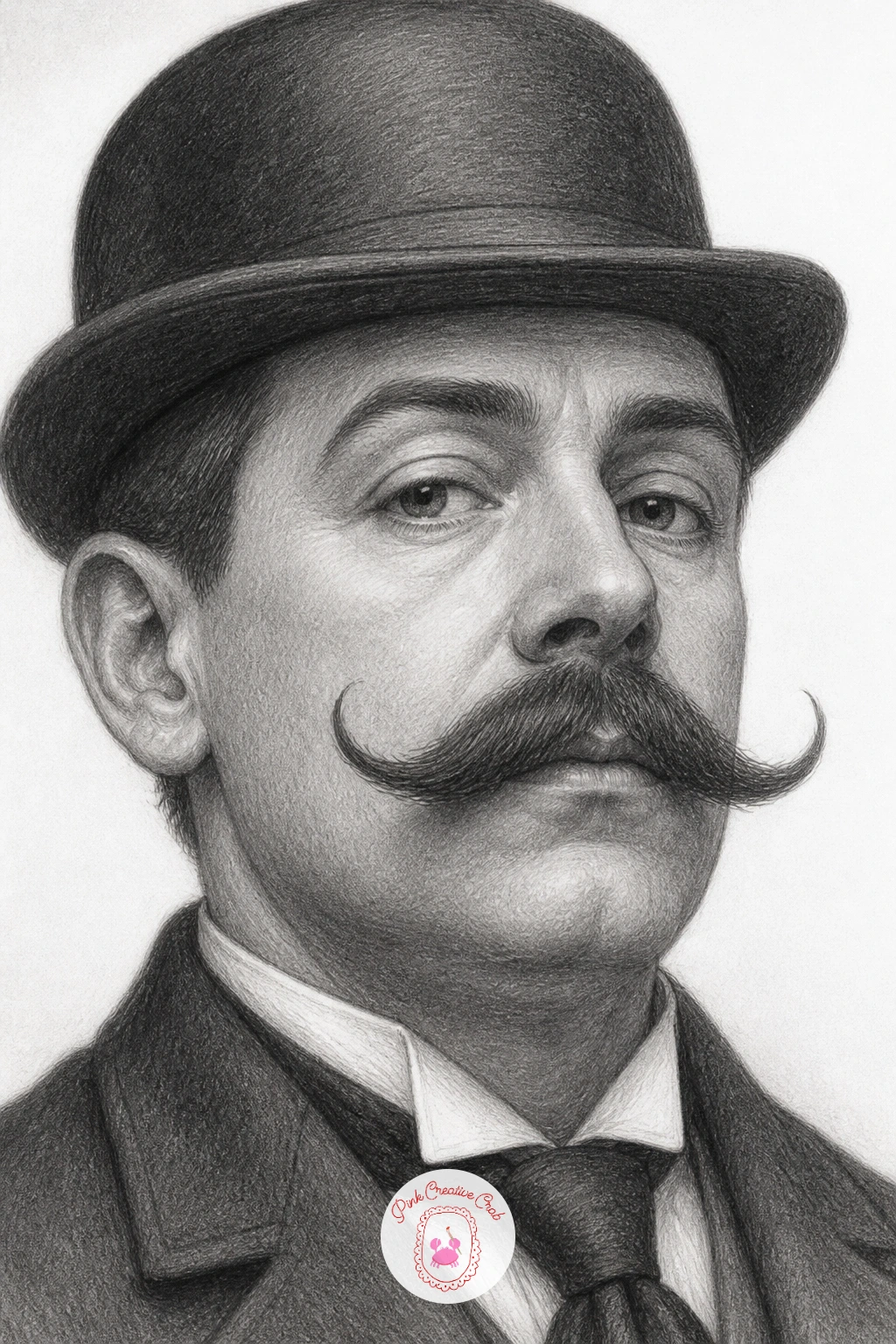
You Will Need
- kneaded eraser for the hat highlight
Palette: Graphite 2B,Graphite 4B,Graphite 6B
A woman in a hijab looking out a window turns on where the light falls across her face, since the window itself sits outside the frame as the implied light source. Decide the light comes from one side, roughly where the window would be, and shade the far side of the face and the hijab fabric noticeably darker than the near side.
Draw the hijab’s fabric folds following the shape of the head and shoulders underneath, with soft rounded shadows at each fold rather than hard creases, since fabric drapes in curves. Keep the face shading simple and calm, with the eyes looking slightly off to one side toward the implied window rather than straight at the viewer.
Flat, even shading on the hijab loses the sense of fabric entirely. Vary your pressure across each fold, pressing harder in the fold’s shadow and lifting near its highlight, to let it read as cloth rather than a solid helmet shape.
A single soft highlight along the cheekbone nearest the light ties the whole mood together.
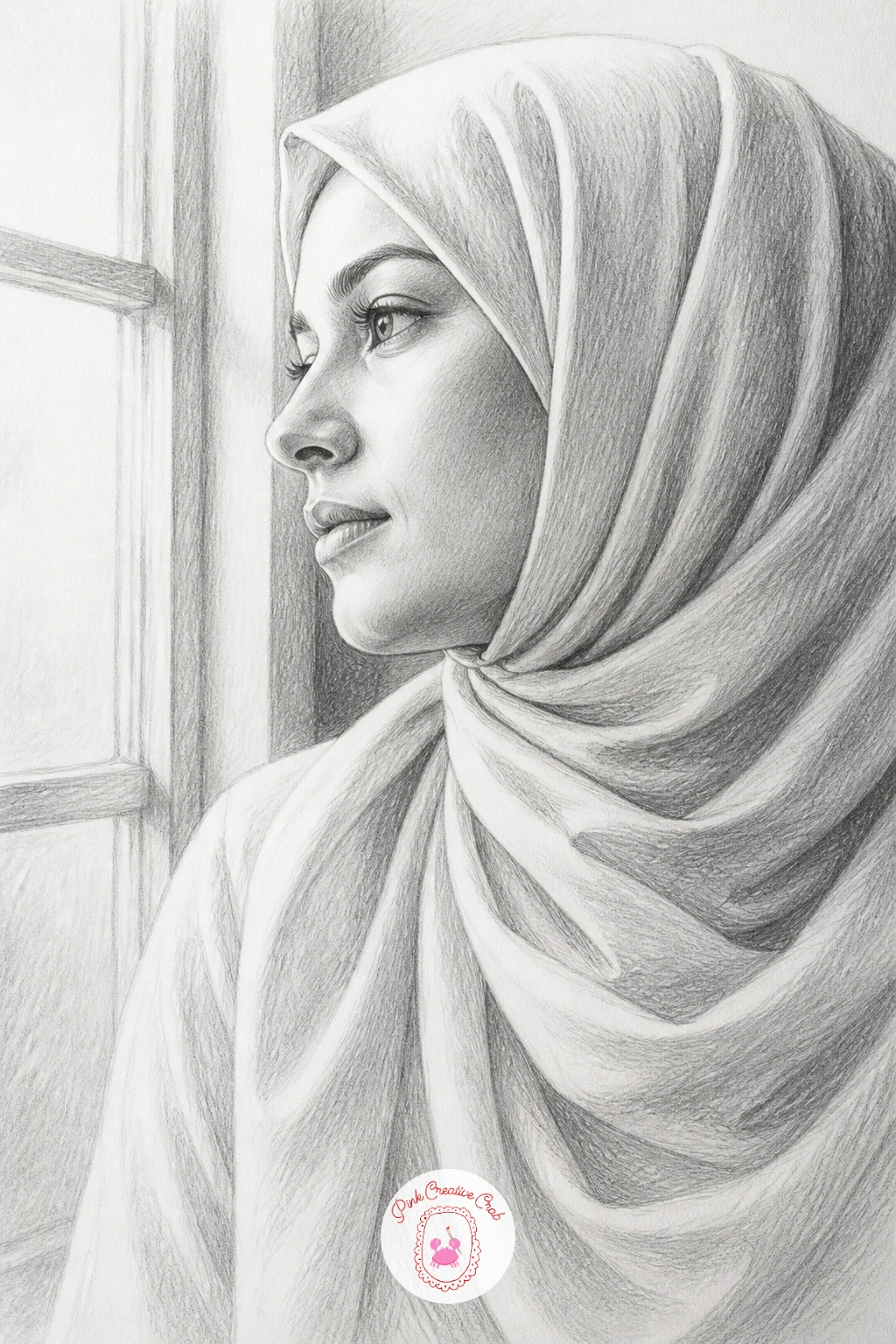
Palette: Graphite HB,Graphite 2B,Graphite 4B
A boy with glasses reading under a desk lamp lets you practice light falling from below and one side rather than the usual overhead glow. Place the implied lamp low and to one side of the page, then shade the underside of the chin, nose, and glasses frames brighter than you would expect, since the light is bouncing up rather than down.
Draw the glasses as two simple ovals with the lenses left nearly white where the lamp catches them, and a small dark reflection shape in one corner of each lens for believability. Shade the rest of the face with a 2B, keeping the top of the head and the area above the brow comparatively darker since it falls away from the low light.
Lighting a reading face the same way as a normal portrait, evenly from above, is the easy trap here. Keep checking that the brightest points are low on the face, not high, to hold the lamp-lit feeling.
A sliver of book page caught in the light finishes the small scene.
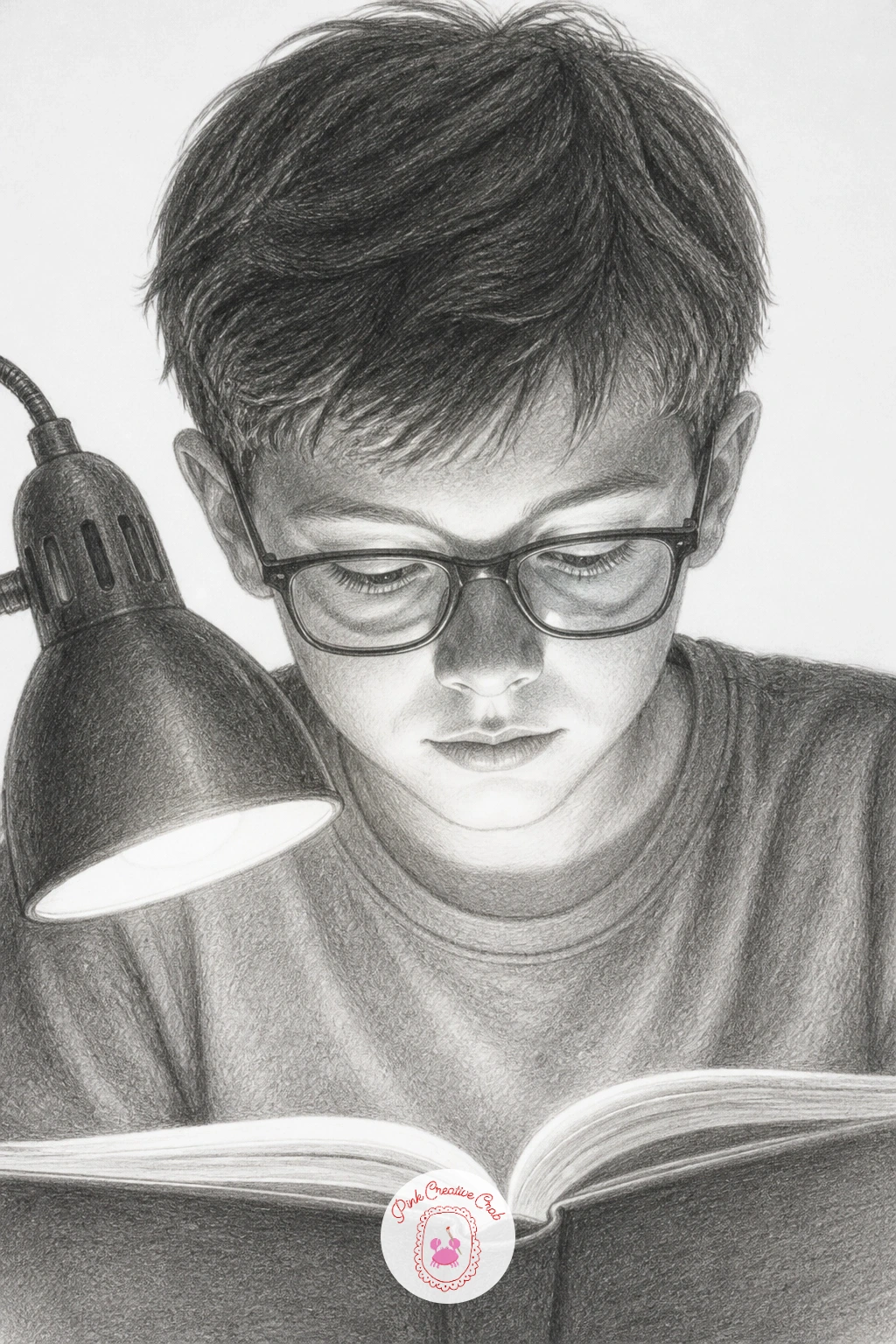
Palette: Graphite HB,Graphite 2B,Graphite 4B
If you enjoy drawing quiet reading scenes like this one, the book doodles collection has more small reading-themed sketches to try.
A teenage boy with buzz cut and hoodie is a fast, satisfying sketch since the short hair needs almost no individual strand work. Shade the buzz cut with a light, even 2B tone over the whole scalp shape, then stipple a few darker dots near the hairline with a sharp pencil tip to suggest texture without drawing every hair.
A ten minute version stops at the face and a simple hoodie outline with one drawstring line at the neck. The forty minute version adds the hoodie’s fabric folds at the shoulders and a soft cast shadow where the hood sits behind the neck, plus a touch more detail in the eyebrows and jawline.
A buzz cut shaded completely flat loses the sense of a shaved texture against skin. Keep your pressure light and uneven rather than one smooth pass, so some stray texture shows through.
Hoodie strings drawn slightly uneven on each side look more natural than a perfectly symmetrical pair.
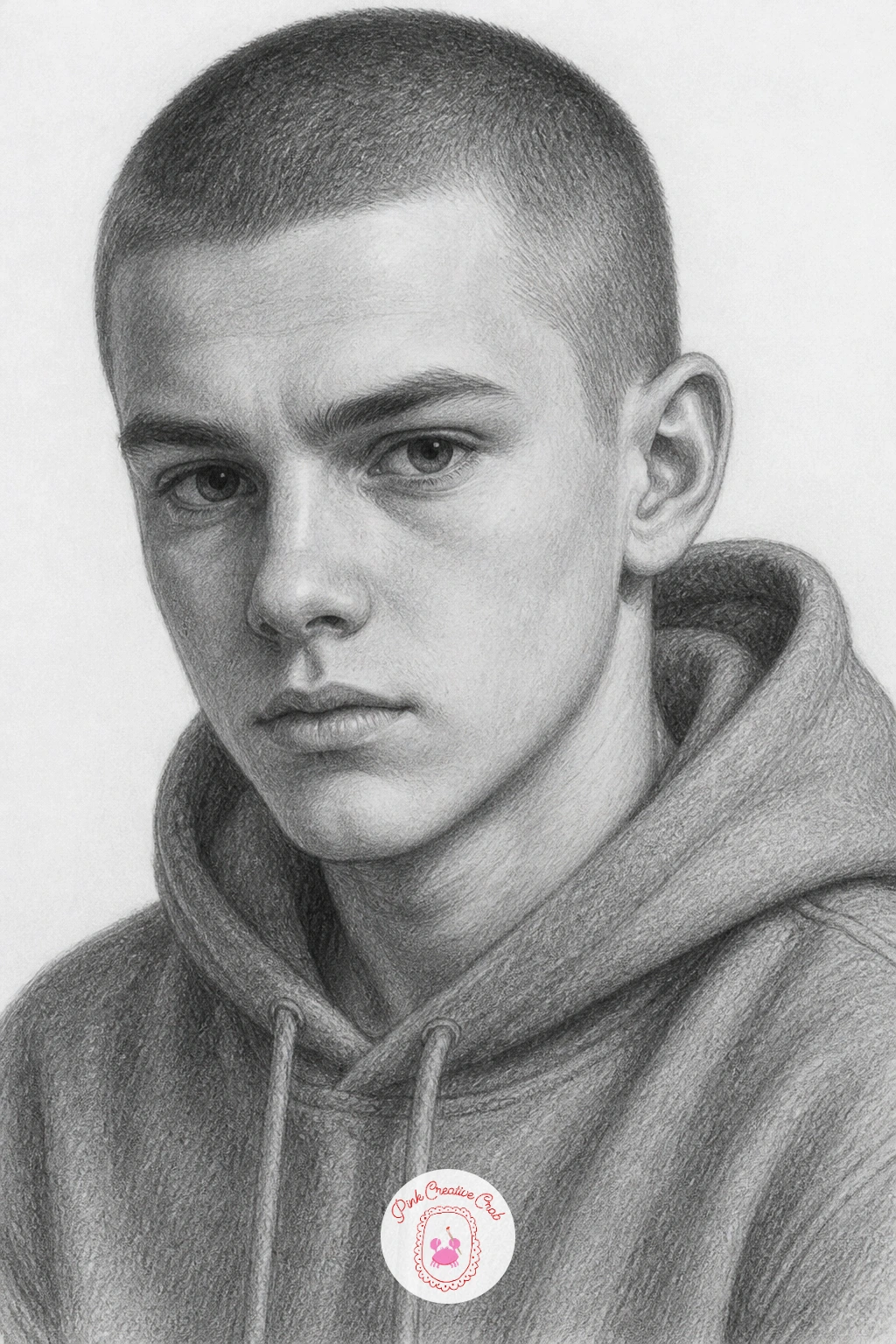
Palette: Graphite HB,Graphite 2B
A woman with pixie cut and hoop earrings rewards confident, short strokes rather than careful long ones, since pixie hair sits close to the head in choppy little pieces. Draw the hairline first, following close to the skull with small angled marks pointing in different directions at the crown and temples.
Shade the face with HB and 2B for smooth, even skin tone, then draw the hoop earrings as two clean circles hanging just below the jaw, leaving a thin white gap where the metal catches light along the top curve of each hoop. Keep the hoops a consistent size on both sides by measuring one against the other before finishing the second.
Hair that looks like a flat cap rather than choppy pixie layers usually means every stroke ran the same direction. Vary the angle of your pencil marks across the head, some pointing forward, some back, to break up that flatness.
A relaxed, slightly asymmetrical smile keeps the whole face from looking stiff.
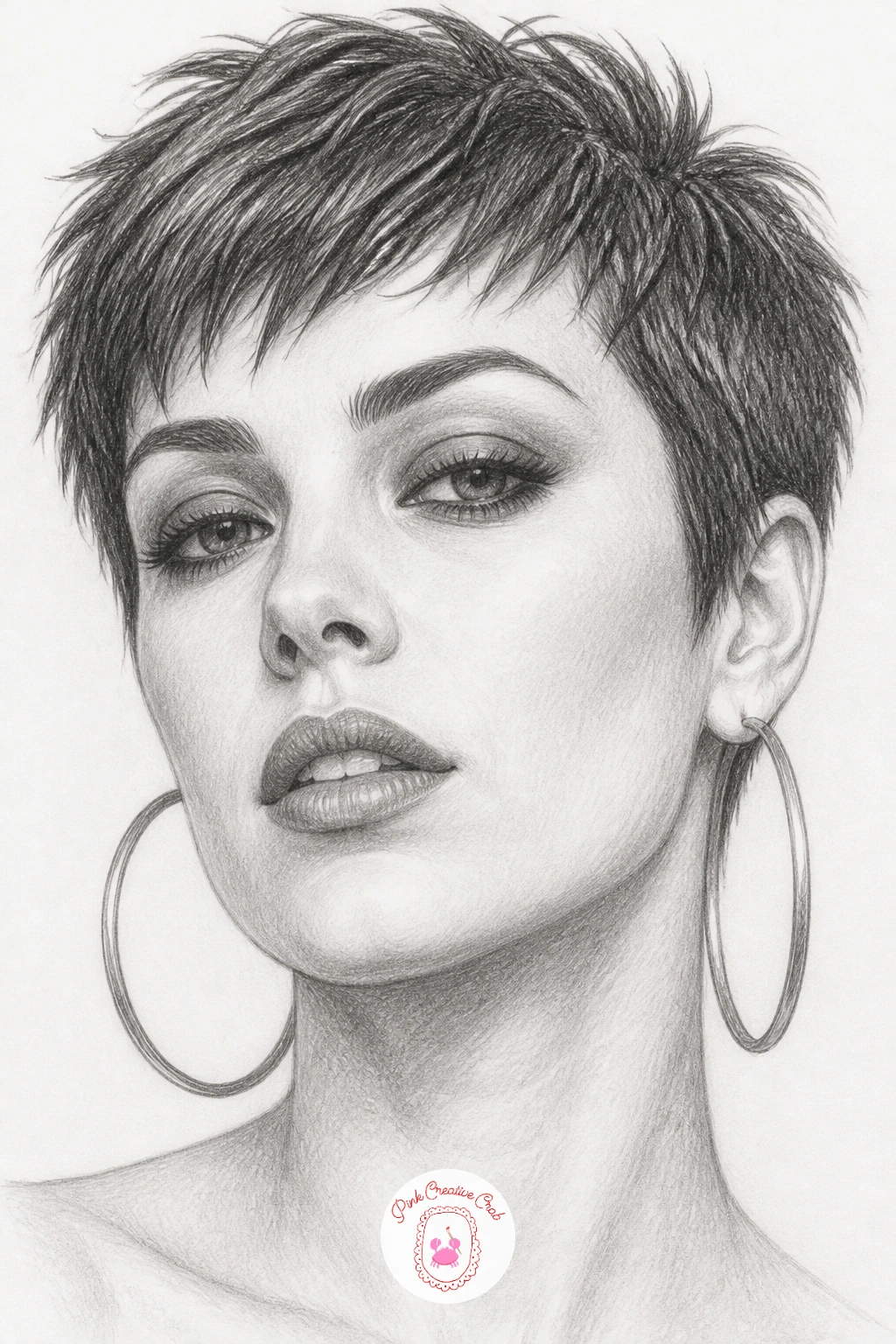
Palette: Graphite HB,Graphite 2B,Graphite 4B
An elderly couple cheek to cheek asks you to size two older faces against each other before any wrinkle gets drawn. Sketch both heads as simple ovals leaned together at the cheek, matching their proportions roughly in scale, then check that neither head reads as noticeably larger unless you intend an age or height difference.
Work one face fully before moving to the other, building wrinkles with short curved strokes that follow the natural folds around the eyes and mouth rather than straight scratchy lines. Keep the shading on the touching cheeks slightly softer where the two faces meet, since that contact point usually sits in gentle shadow.
Drawing both faces with identical wrinkle patterns makes the couple look oddly matched rather than like two individual people who have aged differently. Give each face its own rhythm of lines, heavier in some spots, lighter in others.
A single shared detail, like matching glasses or a scarf, ties the two figures together without extra work.
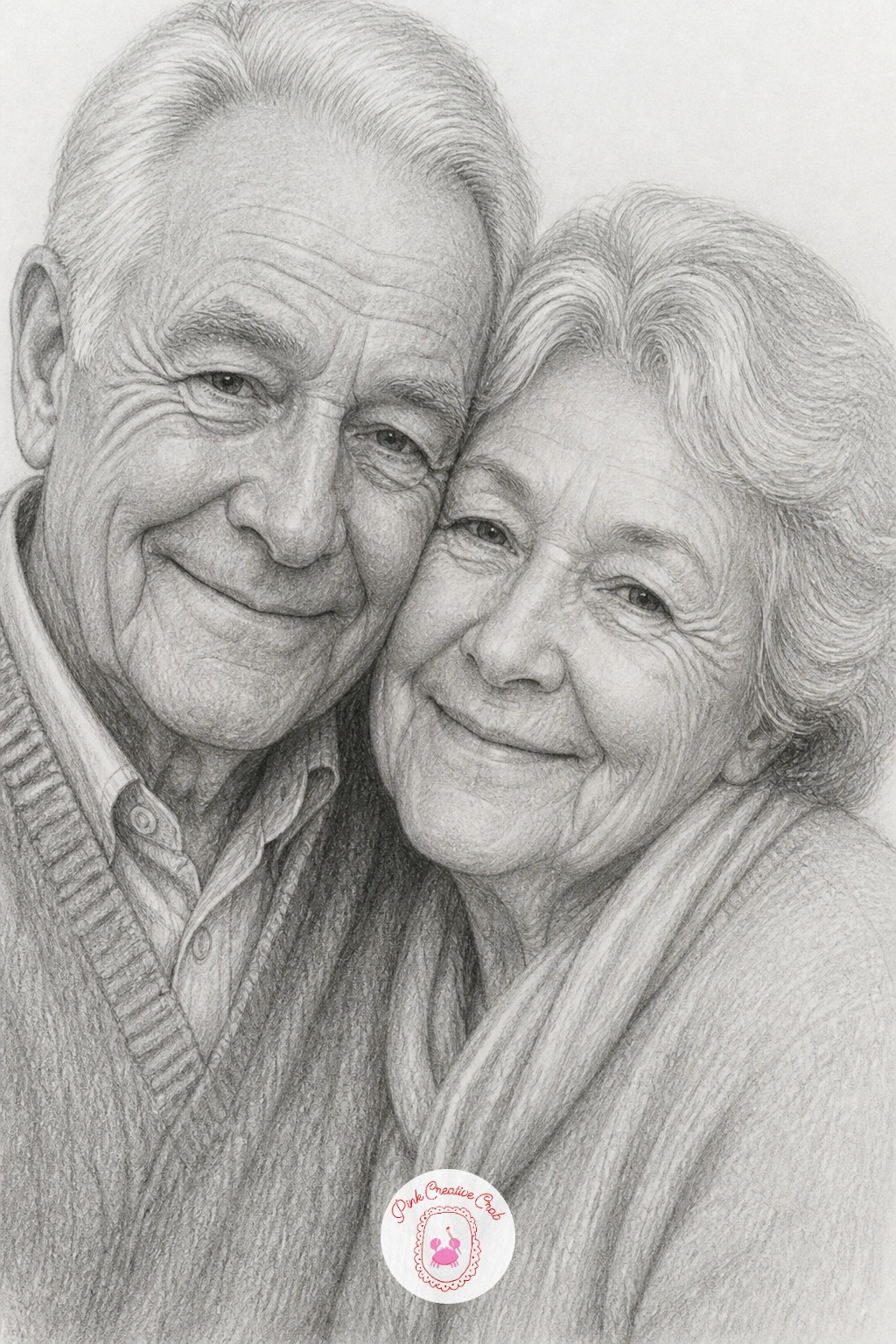
Palette: Graphite HB,Graphite 2B,Graphite 4B
A girl with long straight hair and a center part is a calm, symmetrical subject, so use the part line itself as your measuring guide for the whole face. Draw a faint vertical line down the center of the head first, then check that both eyes, the nose, and the mouth sit at matching distances from it before shading anything.
Let the hair fall in long, smooth strokes on either side of the part, using a soft 2B pulled in one continuous motion per section rather than many short choppy marks, which keeps straight hair looking sleek rather than frizzy. Shade the face evenly with HB, since a calm, straight haired portrait usually suits a quieter, more even light than a dramatic one.
Hair that drifts off center as it falls down the page is the most common slip with this pose; keep glancing back at your faint center line as you extend each hair section downward.
A few single loose strands crossing the forehead add life without disturbing the overall calm.
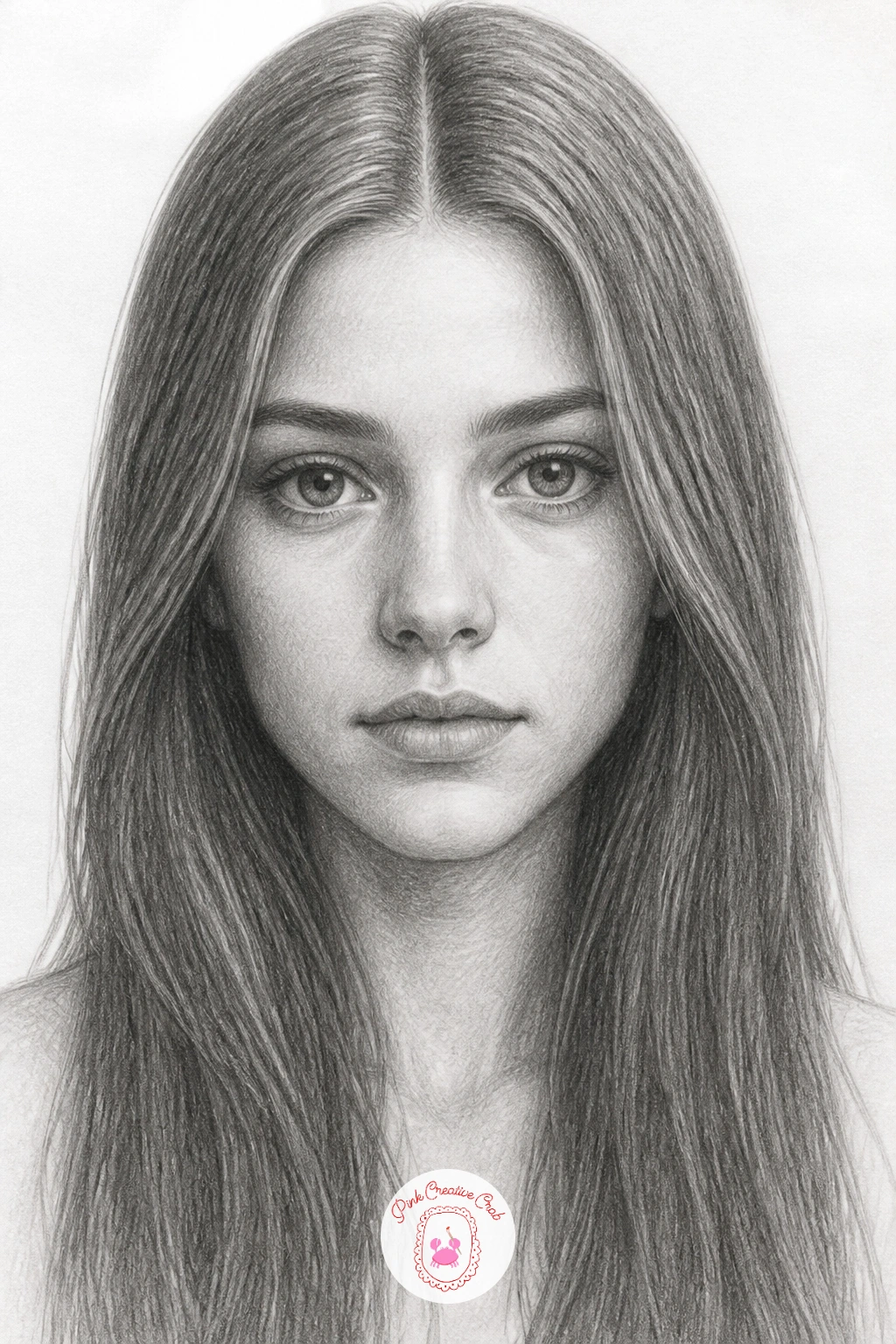
Palette: Graphite HB,Graphite 2B,Graphite 4B
A carpenter with a pencil behind his ear is a nice chance to add one small prop that tells a whole story without extra drawing elsewhere. Sketch the head and ear normally, then tuck a simple pencil shape behind the ear, angled slightly upward, checking that it looks tucked rather than floating by overlapping it with the ear and a few strands of hair.
Shade the face with a weathered feel, using slightly rougher, more varied strokes than you would for a smoother subject, with a bit more shadow at the brow and jaw to suggest years of outdoor work. Keep the pencil prop itself simple: one line for the wooden body, a small dark triangle for the sharpened tip, nothing more.
A pencil drawn too large competes with the face for attention. Keep it modest in scale, roughly the length of the ear, and let the expression do the storytelling instead.
A loose collar line and a bit of sawdust-pale shading on the shoulder finishes the setting without adding a background.
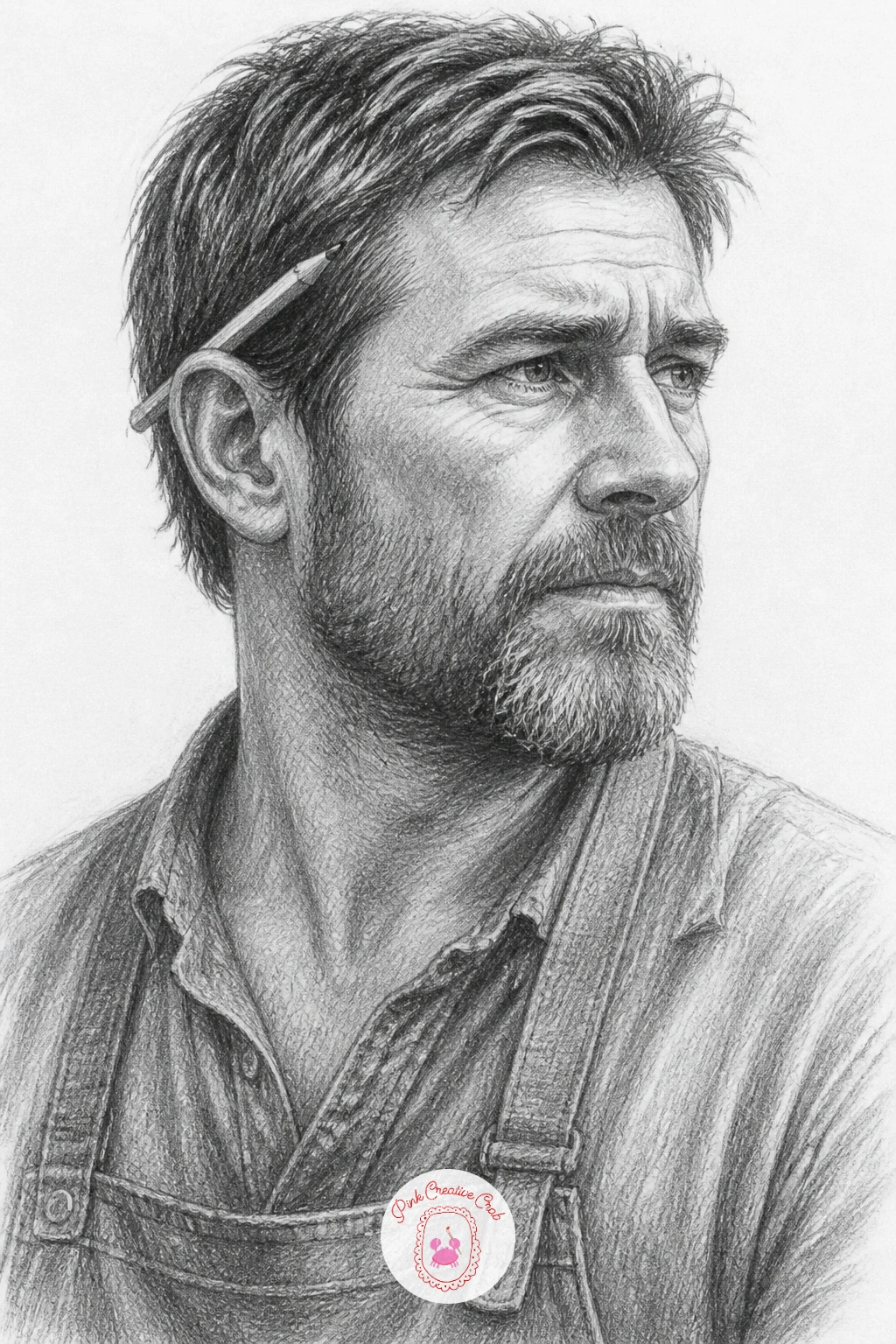
Palette: Graphite HB,Graphite 2B,Graphite 4B
A young violinist with her chin resting on her violin asks for careful placement before any shading, since the chin and the instrument overlap in a way that is easy to get wrong. Draw the violin’s shoulder rest first as a simple curved shape, then nestle the chin into it, checking that the jawline actually meets the wood rather than floating above it.
Shade the face calmly, eyes often softly closed or looking down in concentration, then move to the violin itself with darker, richer tones using a 4B, since the wood reads much darker than skin and benefits from a glossy highlight left as untouched paper along one curved edge. Keep the strings as thin, perfectly straight lines drawn last with a ruler if needed, since wavering strings are the fastest way to spoil an otherwise careful drawing.
If the chin and violin look disconnected, deepen the shadow exactly where they touch; that small dark wedge is what convinces the eye they are pressed together.
A loose curl of hair falling near the scroll of the violin adds a nice final touch.
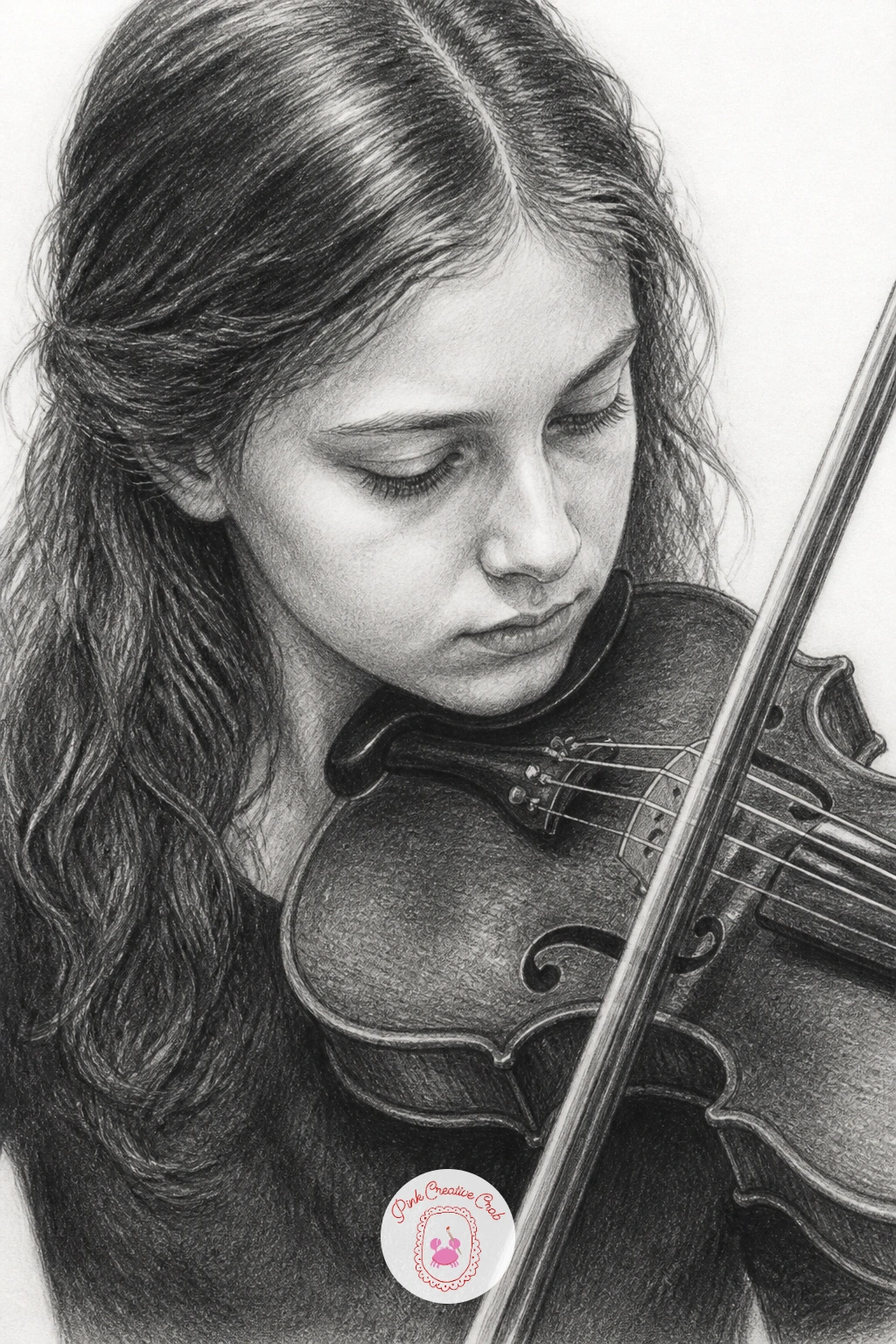
You Will Need
- ruler for straight strings
Palette: Graphite HB,Graphite 2B,Graphite 6B
A farmer in a straw hat squinting into light is built entirely around where the sun sits, so decide that first. Place an implied sun high and to one side, then let the straw hat cast a strong, clear shadow line across the upper half of the face, with the eyes squinting into a band of brighter light just below the hat’s shadow edge.
Draw the straw hat’s texture with short, crisscrossing diagonal strokes rather than a flat tone, since woven straw catches light unevenly across its surface. Shade the squinting eyes with heavier creases at the outer corners and a slightly raised cheek beneath them, which is what actually reads as squinting rather than simply closed eyes.
A hat shadow with a soft, blurry edge loses the strong midday feel this subject wants. Keep that shadow line crisp and clearly defined where it crosses the forehead and cheek.
Deep sun lines at the corners of the eyes finish the weathered, outdoor feeling.
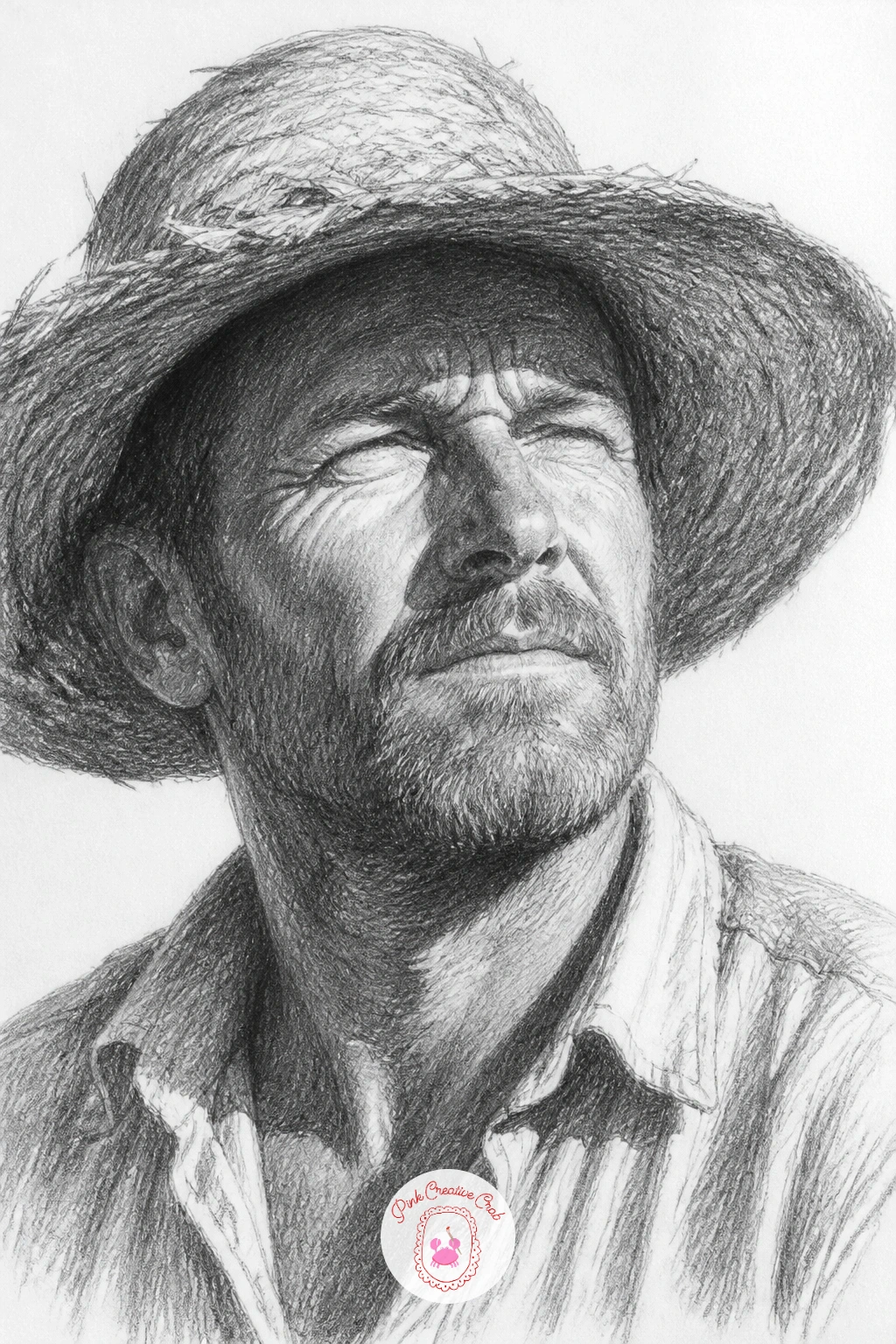
Palette: Graphite HB,Graphite 2B,Graphite 4B
A little boy with a missing front tooth turns an open grin into the whole drawing’s charm, so give the smile plenty of room before adding anything else. Sketch the mouth wide and open, leaving a clean, deliberate white gap where the missing tooth should be, with the remaining teeth drawn slightly smaller and less even than an adult’s.
A ten minute version keeps the rest of the face loose, just enough shading to suggest round cheeks and bright eyes around that grin. Given forty minutes, add a light sprinkle of freckles, a slightly mussed cowlick at the crown, and softer gradual shading under the eyes and along the jaw.
Drawing the gap too small or filling it with a faint grey line undoes the whole joke of the picture. Keep it a clean, confident white space the eye goes straight to.
A single scraped-knee detail or a loose shirt collar nearby hints at a kid who has been outside playing.
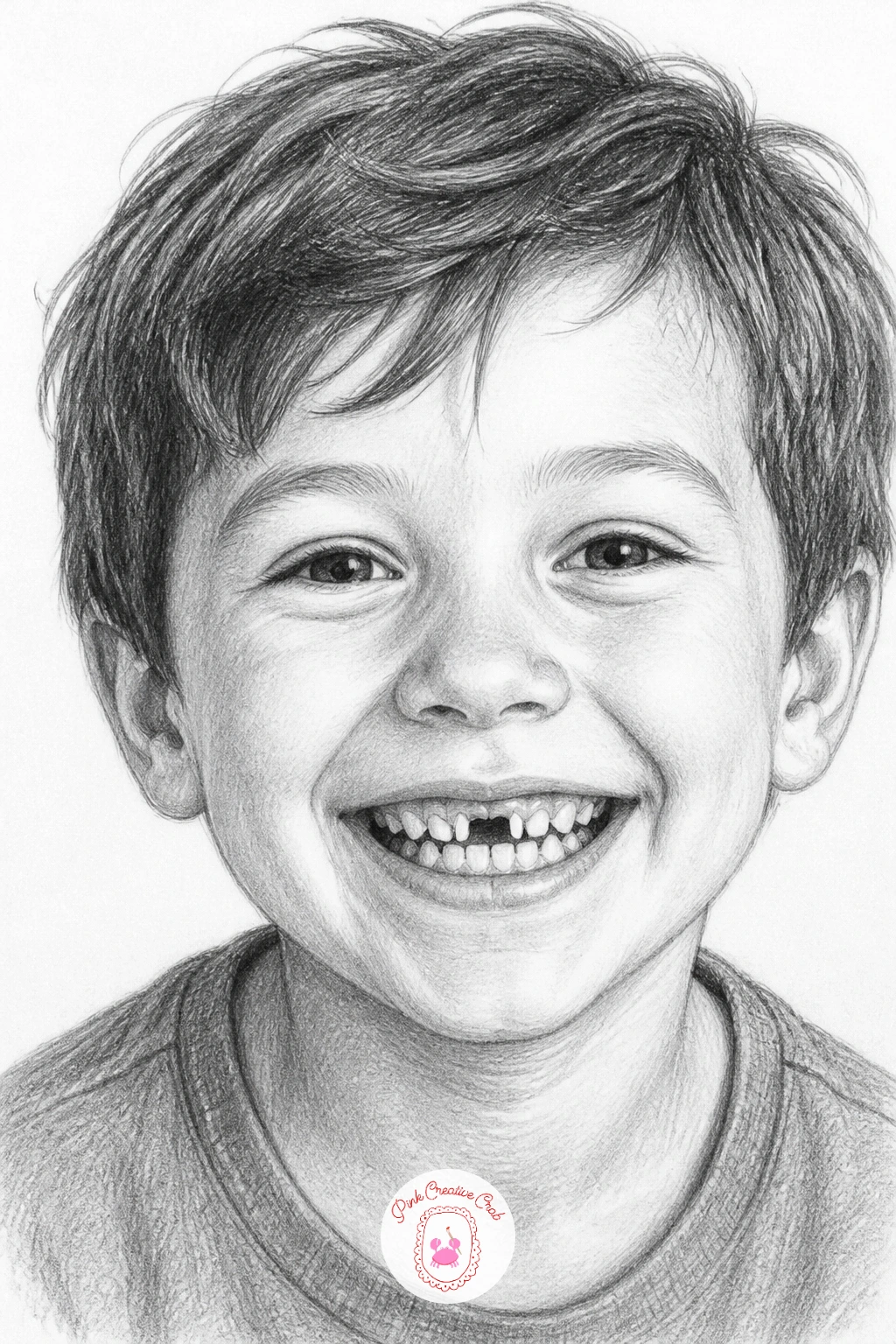
Palette: Graphite HB,Graphite 2B
A woman with locs piled on top of her head gives you a strong, sculptural hair shape to enjoy, so block that pile first as one large rounded mass before any individual lock appears. Check its size against the face below; a pile of locs usually reads larger than you first expect, roughly matching the height of the face itself.
Draw individual locs as separate rounded cylinders overlapping within that larger mass, each shaded with its own highlight running along the top and shadow underneath, rather than one flat tone across the whole pile. Vary the thickness of a few locs so the bundle does not look like identical repeated tubes.
Flattening the pile into a single smooth dome loses all its character. Keep distinct gaps and overlaps between locs visible, even if subtle, so the structure reads as separate strands gathered together rather than one solid shape.
A loose loc or two escaping near the temple softens the whole composition nicely.
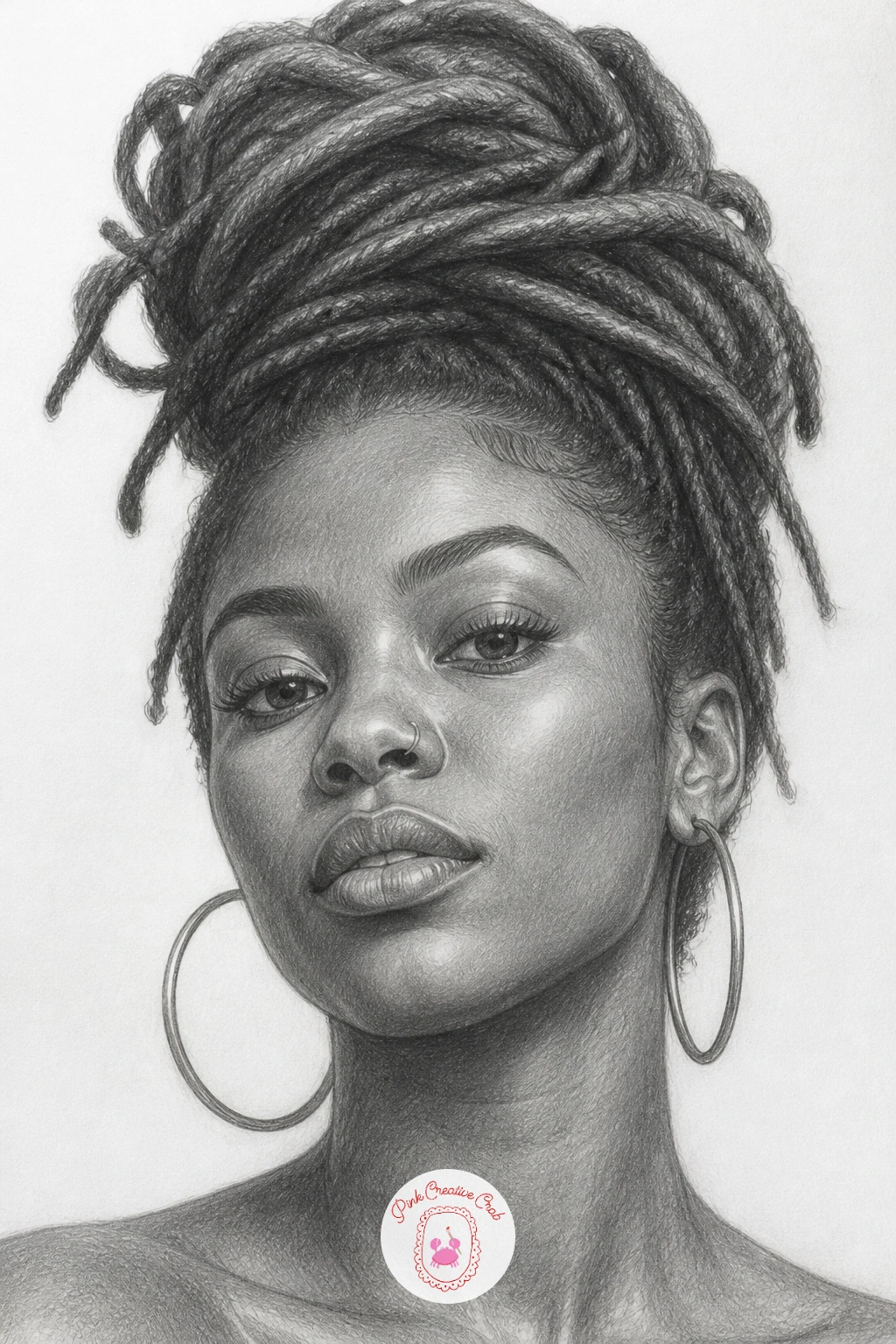
Palette: Graphite HB,Graphite 2B,Graphite 4B
A sleepy girl wrapped in a blanket is mostly about soft edges, so keep your pencil work gentle from the very first line. Draw the blanket as one large, simple shape wrapping around the shoulders and up near the chin, with rounded, bunched folds rather than sharp creases, since soft fabric gathers in gentle curves.
Shade droopy, half closed eyes with a light touch, using a stump to soften the lids immediately rather than leaving crisp pencil lines, which quickly looks tired rather than alert. Keep most of the face shading smooth and low contrast, saving your darkest tone only for the deepest fold of the blanket near the chin.
Sharp, hard-edged folds in the blanket fight the sleepy mood the whole drawing is going for. Round every fold line off and blend its shadow rather than leaving a crisp pencil mark.
A few loose hair strands falling across the forehead complete the just-woken feeling.
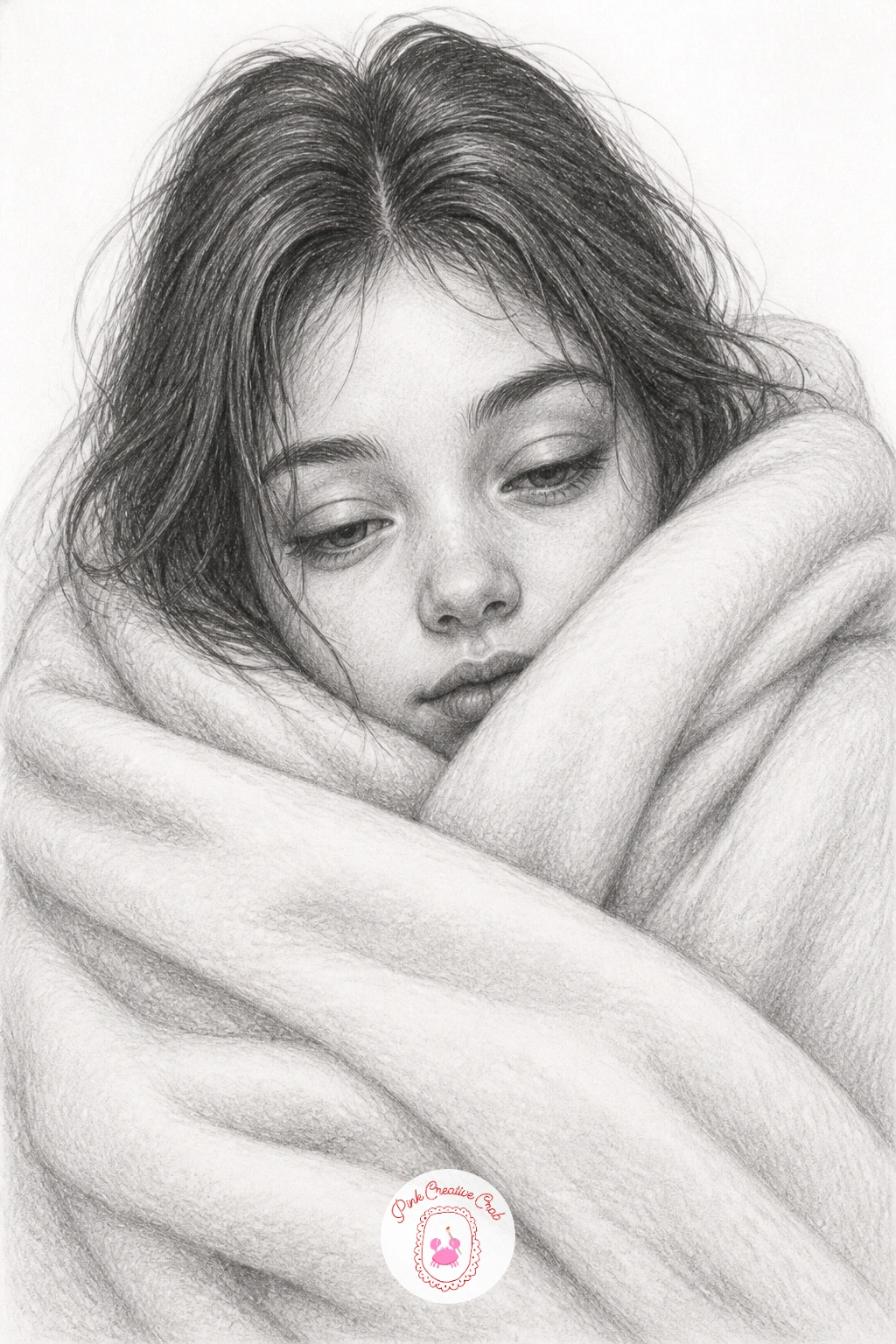
Palette: Graphite HB,Graphite 2B,Graphite 4B
A bearded man in a beanie looking down puts the eye line low on the page before anything else matters, so tilt the whole head gently forward from the start rather than drawing a straight-on face and tipping it later. A downward gaze shows more of the eyelids and brow and less of the whites of the eyes, which is the detail that actually reads as looking down.
Draw the beanie as a simple ribbed dome pulled low over the brow, then build the beard in short overlapping strokes beneath it, darker near the jaw where the head’s own shadow falls. Keep the overall tone a little moody and low contrast, since a downward gaze usually suits a quieter mood than a direct one.
A head drawn upright with only the eyes pointed down looks unnatural and cross-eyed. Commit to tilting the whole head and neck forward, not just the eyes, to keep it convincing.
A single ribbed line pattern on the beanie suggests the knit without drawing every row.
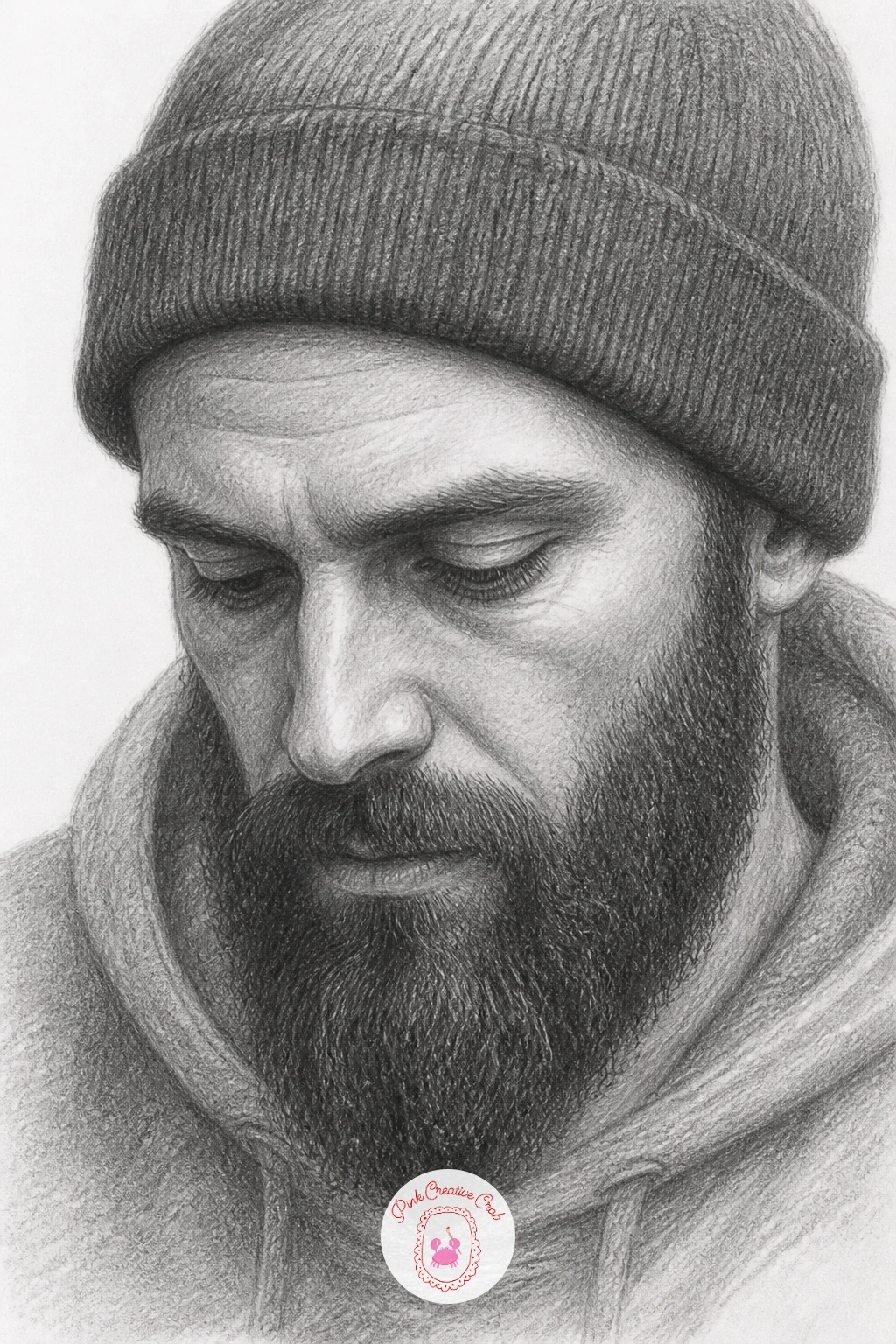
Palette: Graphite 2B,Graphite 4B,Graphite 6B
A grandfather holding his baby granddaughter pairs the most lined, textured face in this list with the smoothest, so lean into that contrast rather than softening it. Build the grandfather’s wrinkles first with a network of fine curved lines around the eyes and across the forehead, shaded with 2B and 4B for real depth.
Draw the baby small against his chest, with almost no wrinkle work at all, just gentle round shading with an HB and a few soft shadow pockets at the creases of her wrists and neck. Keep the grandfather’s hands large and slightly knuckly where they cradle her, since aged hands read very differently from a baby’s smooth ones.
Making both faces similarly smooth loses the whole point of this pairing. Push the contrast further than feels natural at first, heavier texture on him, almost none on her, and the drawing reads instantly as grandfather and granddaughter.
A loosely sketched cardigan or shirt collar is enough background detail; nothing more is needed.
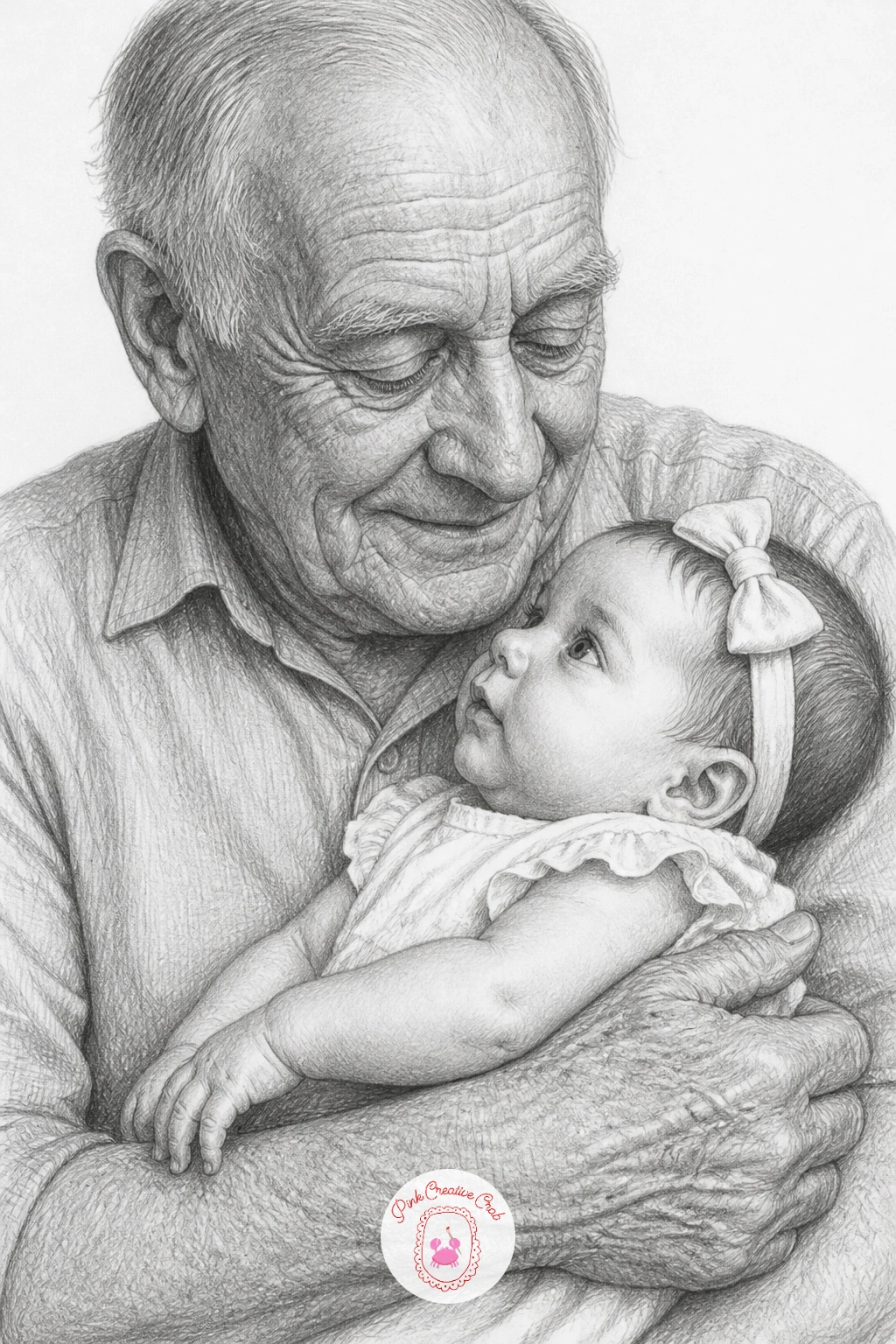
Palette: Graphite HB,Graphite 2B,Graphite 4B
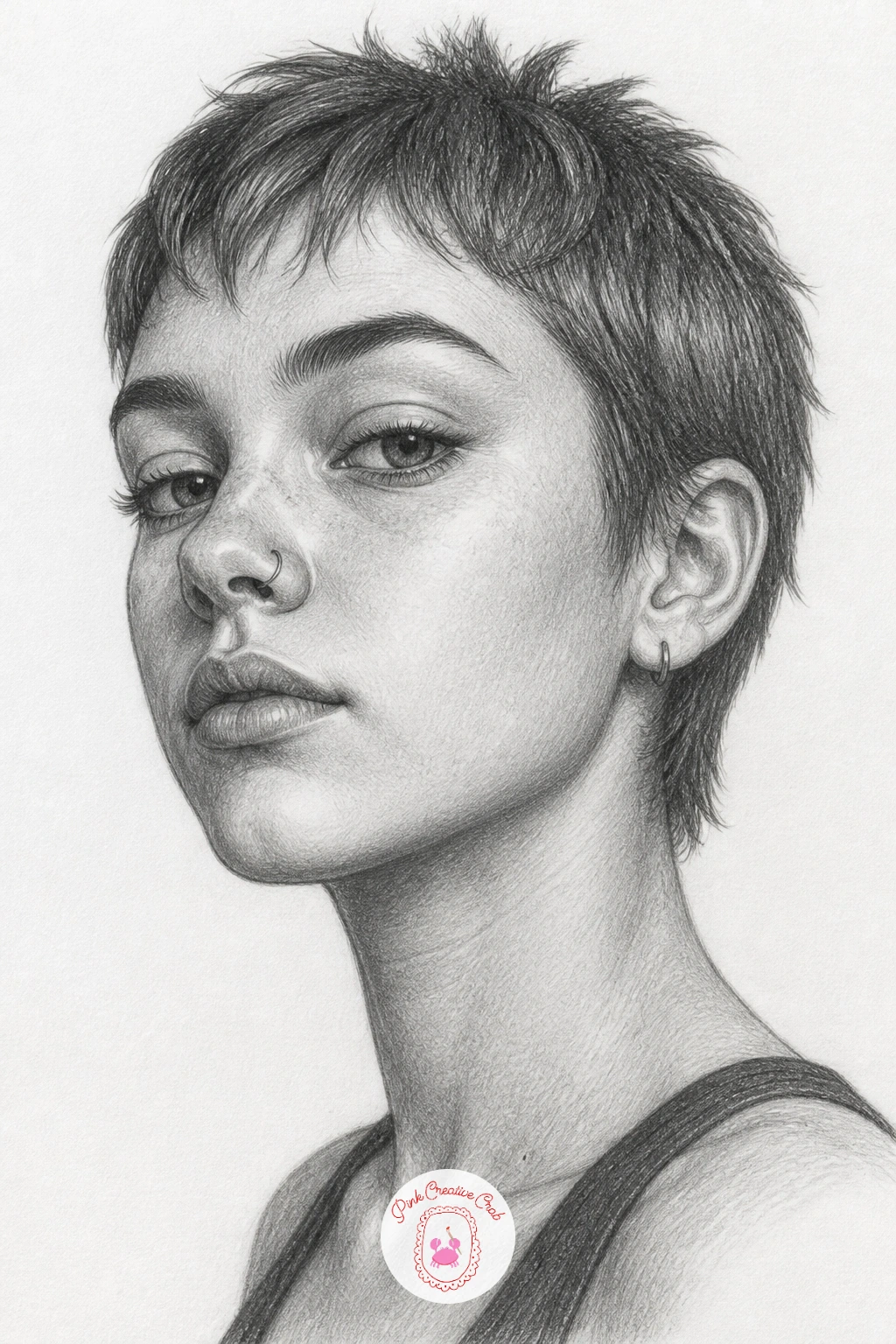
A teenage girl with nose ring and cropped hair is a good subject for trying a slightly different crop or angle once the basics feel steady, since her confident look suits a bolder composition than a straight-on gaze. Try turning the head three-quarters rather than facing forward, which also makes the small nose ring catch a believable highlight along its curve.
Shade the cropped hair with short, textured strokes close to the scalp, similar to a buzz cut but slightly longer and messier at the top, then draw the nose ring as a tiny, precise circle with one bright dot of reflected light left untouched. Keep the expression a little guarded or amused rather than openly smiling, which suits the overall look.
A nose ring drawn too thick looks like a cartoon hoop rather than real jewelry. Keep the line extremely fine and add only the smallest highlight dot to suggest metal.
Next time, try this same face from a lower angle looking slightly up, for an even more confident feel.
Palette: Graphite HB,Graphite 2B,Graphite 4B
For more faces and figures to practice angles like this one on, the girl pencil drawing ideas list has plenty of beginner friendly options.
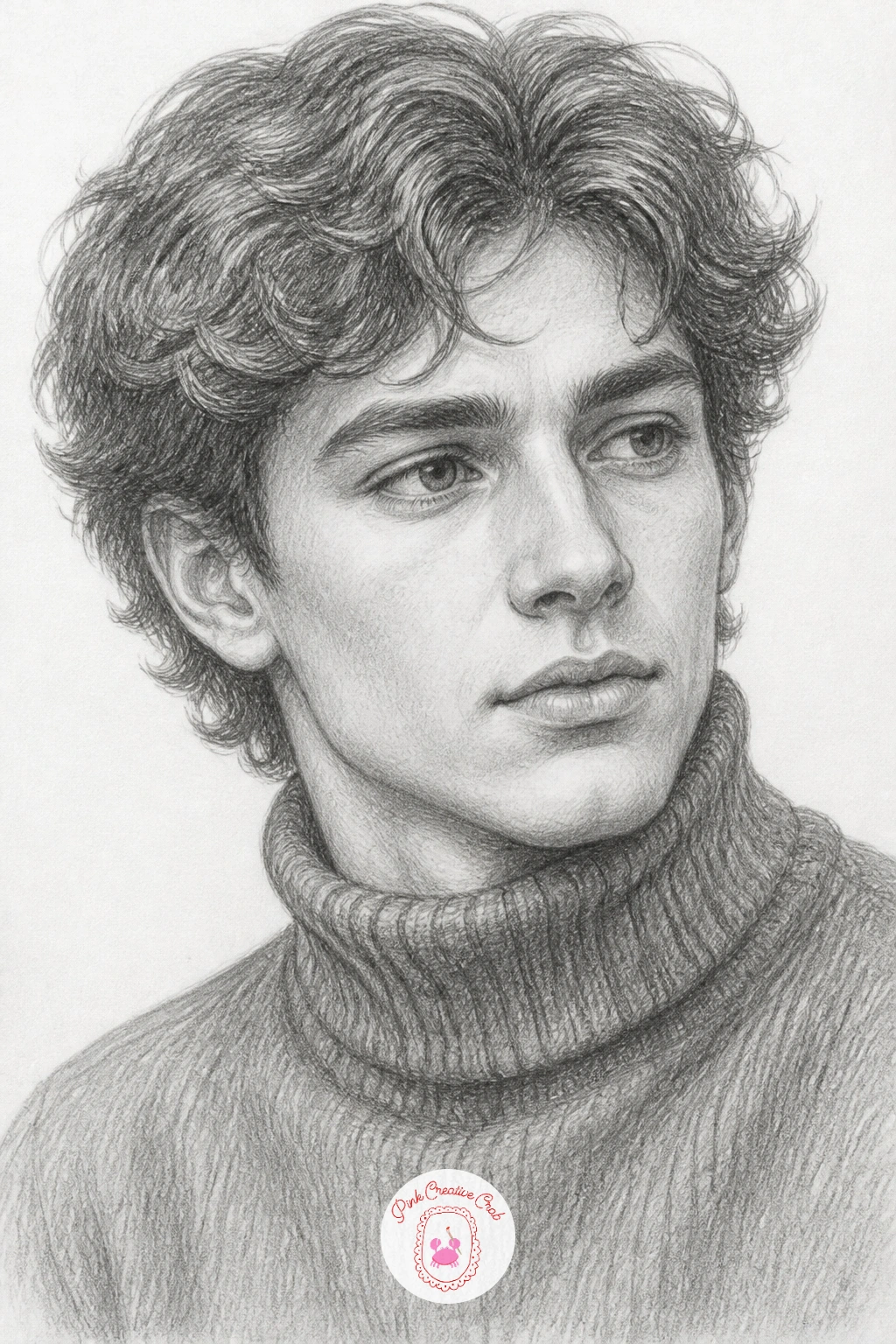
A young man with wavy hair and a turtleneck closes the list with a calm, classic pose that pulls together everything practiced above. Draw the wavy hair in loose S-curve strokes rather than straight lines, grouping them into a few larger wave sections instead of many tiny identical curls, which keeps the texture believable without extra fuss.
Shade the turtleneck with horizontal ribbing suggested by a handful of soft curved lines at the neck, left mostly in mid tone so it does not compete with the face. Build the face itself with calm, even HB and 2B shading, a relaxed, slightly thoughtful expression suiting the quiet mood of the whole piece.
Wavy hair drawn as uniform, identical curls looks more like a wig than real hair. Vary each wave’s size and direction slightly, and let a few strands break away from the main shape near the temple.
Once this one feels comfortable, try the same pose again with the head turned slightly, or swap the turtleneck for an open collar for a different mood entirely.
Palette: Graphite HB,Graphite 2B,Graphite 4B
What to Do Next
Pick whichever face caught your eye first, that is usually the one you will finish. Start on a smooth sketch pad with an HB for the loose outline, keep a kneaded eraser nearby for the highlights, and let the shading build up gradually rather than rushing to the darkest tones too soon.
Frequently Asked Questions
What pencils work best for a pencil sketch portrait?
A range from HB to 6B covers most portrait work, HB and 2B for general skin shading, 4B and 6B for deep shadows and dark hair. Keep one hard pencil like a 2H for crisp small details such as braces or earrings.
How do you keep facial proportions accurate in a pencil sketch portrait?
Lightly sketch guide lines dividing the face in half for the eyes and in thirds for the nose and chin before adding any detail. Measure one feature against another, like eye width against the gap between the eyes, rather than guessing by eye alone.
How long does a pencil sketch portrait take for a beginner?
A simple one can take under an hour once the proportions are blocked in confidently. Faces with heavy texture, like a bearded man or a wrinkled grandfather, naturally take longer because of the extra shading passes needed.
What is the most common mistake in a pencil sketch portrait?
Shading too evenly across the whole face without deciding where the light comes from is the most common issue. Pick one light direction early and let the darkest and lightest areas follow from that single decision.
How do you make hair look soft instead of stiff in pencil?
Draw hair in sections that follow its actual growth direction rather than as one solid block, and vary the pressure within each section. Blending the base layer lightly with a stump before adding a few sharp final strands also keeps it soft rather than wiry.
Have any thoughts?
Share your reaction or leave a quick response — we’d love to hear what you think!
-
 0
-
 0
-
 0
-
 0
-
 0
-
 0
