These doodle ideas turn everyday objects into tiny characters with faces, and that single trick is why they are so satisfying to draw. A teapot yawns, a kettle gets proud of its own whistle, a pair of sneakers goes jogging: nothing here needs a reference photo or a steady hand, just a fineliner and a few minutes.
Below you will find 32 small scenes to pick from, starting with the simplest shapes and working up to a few with more going on. Grab a notebook, pick whichever face makes you smile first, and work your way down the list whenever you want another quick win.
Using these images: free for personal projects such as printing, coloring, cards, journals and gifts. Handmade items that include them may be sold up to 30 pieces per design. More than that is commercial use and is not permitted, and neither is selling or sharing the images themselves or passing them off as your own. Please ask before any other use.
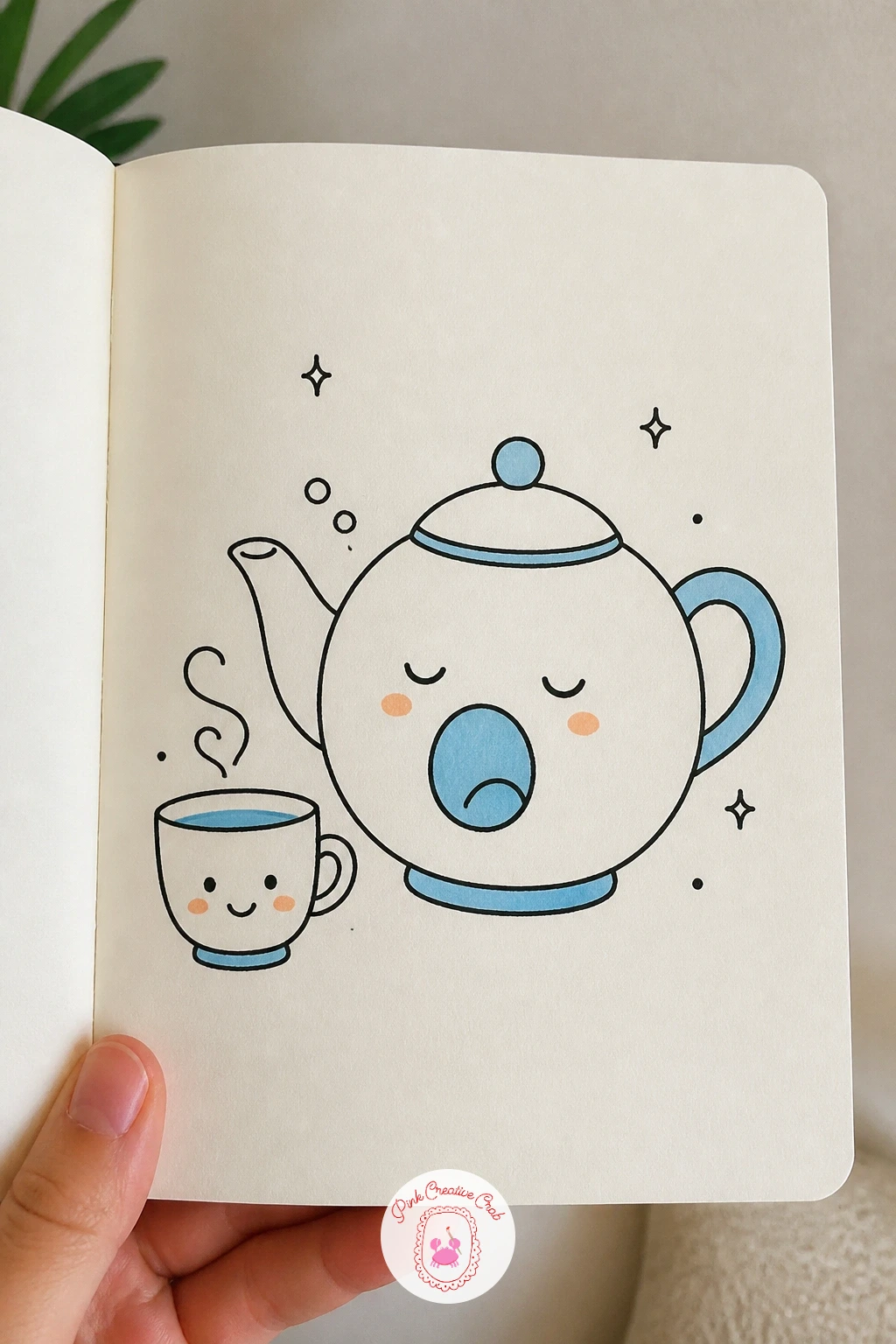
Start with the teapot, since its round body and curved spout make an easy first character for a page of doodle ideas. Draw a rounded oval for the body, a curved spout on one side, a small lid with a knob on top, and a looped handle on the other side.
Give it a wide open mouth stretched into a yawn, with two small closed eyes and maybe a tiny tear at the corner. Add a smaller teacup beside it with a thin curl of steam rising, then shade the teapot body lightly with sky blue marker and leave the steam uncolored.
If the yawn looks more like a frown, widen the mouth into more of an oval and raise the inner corners slightly, that softens the expression. If you do not have blue on hand, peach works just as well for the body and keeps the pair looking warm instead of cool.
Keep the line weight even and unhurried, since a wobbly outline actually suits this sleepy mood better than a perfectly smooth one.
Palette: Sky Blue,Peach,Black
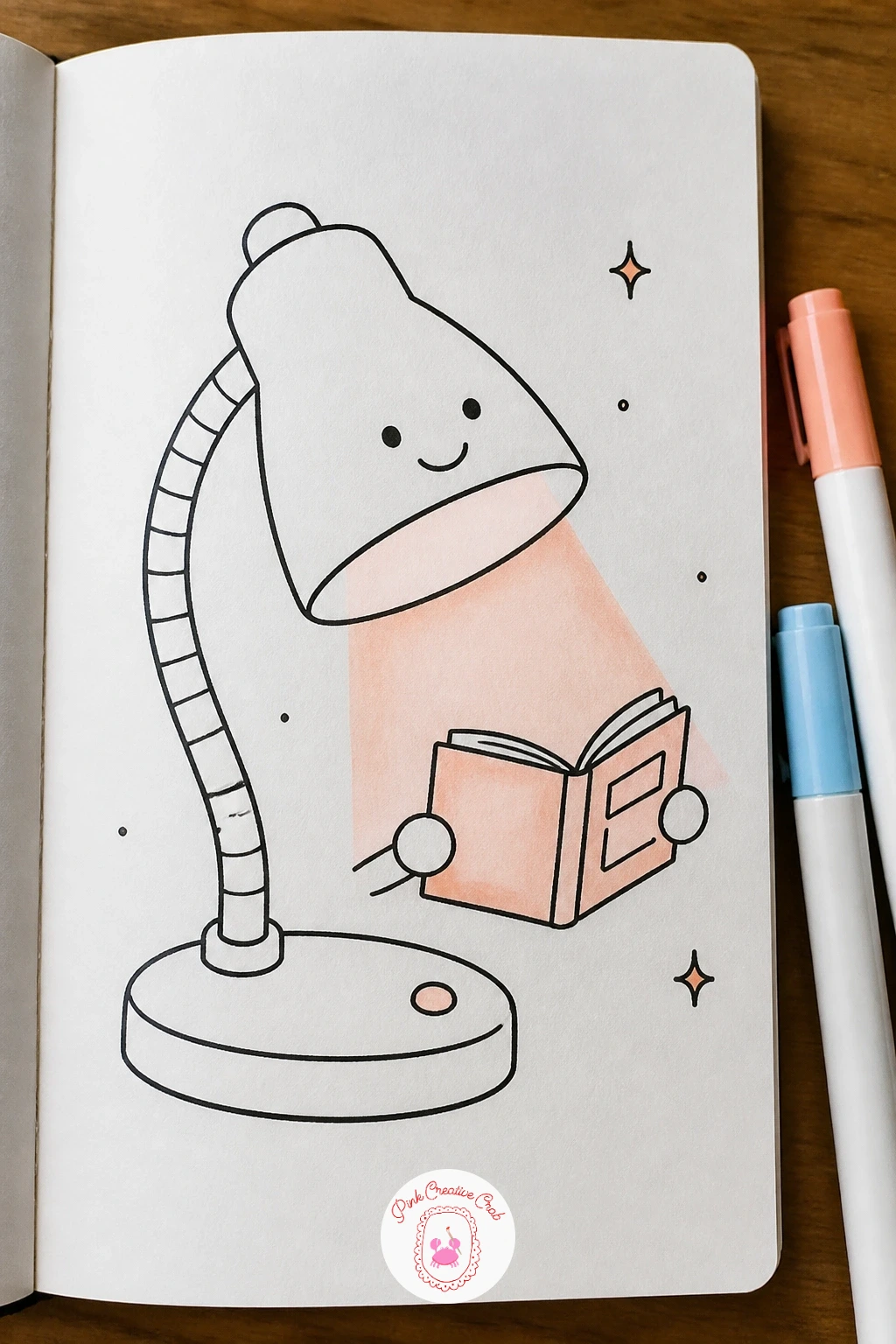
Move from the teapot to a desk lamp, another object with a shape that almost begs for a face. Draw a curved base, a thin bendy neck made of two or three joints, and a cone shaped shade tilted downward like a head looking at the desk.
Put the face right on the front of the shade, with the light beam drawn as a soft cone of straight lines underneath. Inside that beam, sketch a tiny open book with a few short lines for text, then color the beam pale peach and leave the lamp body in plain black line.
The neck joints are where this one usually goes wrong, so keep them simple: two short overlapping circles are enough, you do not need hinges or screws. If your lamp shape feels stiff, round off every corner on the shade and base until it looks more like a friendly creature than a hardware diagram.
This is a nice one to revisit later with the reading glasses and noon naps from an owl doodle set, since both lean on that same cozy, studious mood.
Palette: Peach,Black,Sky Blue
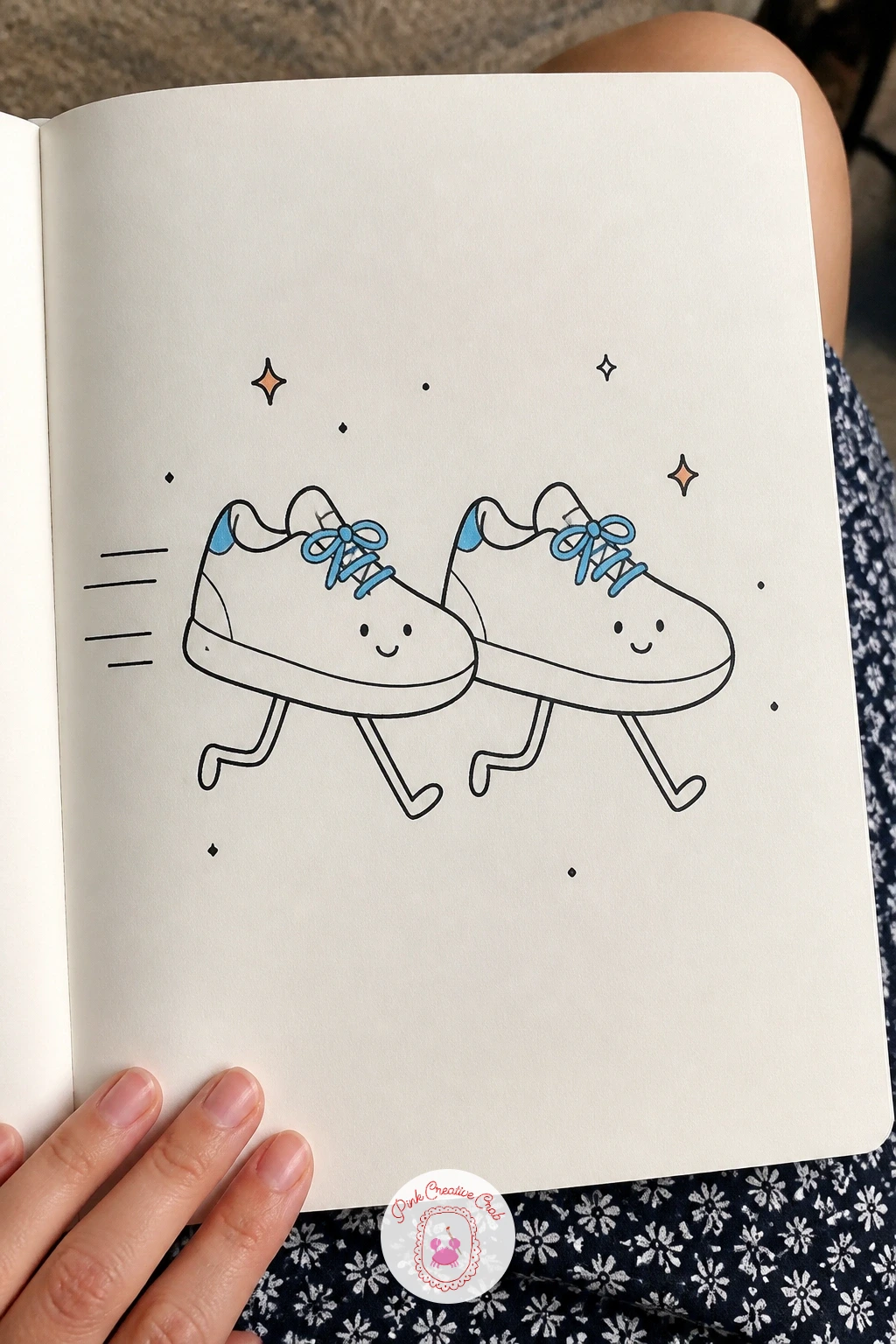
After two stationary objects, give yourself one with actual movement: a pair of sneakers jogging side by side. Draw the first shoe in profile with a curved sole, a rounded toe, and a few quick lines for laces, then give it two tiny legs bent mid-stride instead of a flat sole resting on the ground.
Place the second sneaker just behind and slightly overlapping the first, angled a touch differently so the pair reads as moving rather than standing still. Add small motion lines trailing behind both shoes, and a simple face on the toe of the front sneaker with a determined little smile.
Matching the stride of both shoes is the part that trips people up, so check that the back shoe’s legs bend the opposite way to the front one before you ink anything. Color the laces sky blue and leave the canvas body white or lightly peach to keep the pair easy to tell apart from the background doodles around them.
If you enjoy giving ordinary objects a sense of motion like this, the pizza doodle ideas page has a surfing slice that uses the same trick.
Palette: Sky Blue,Black,White
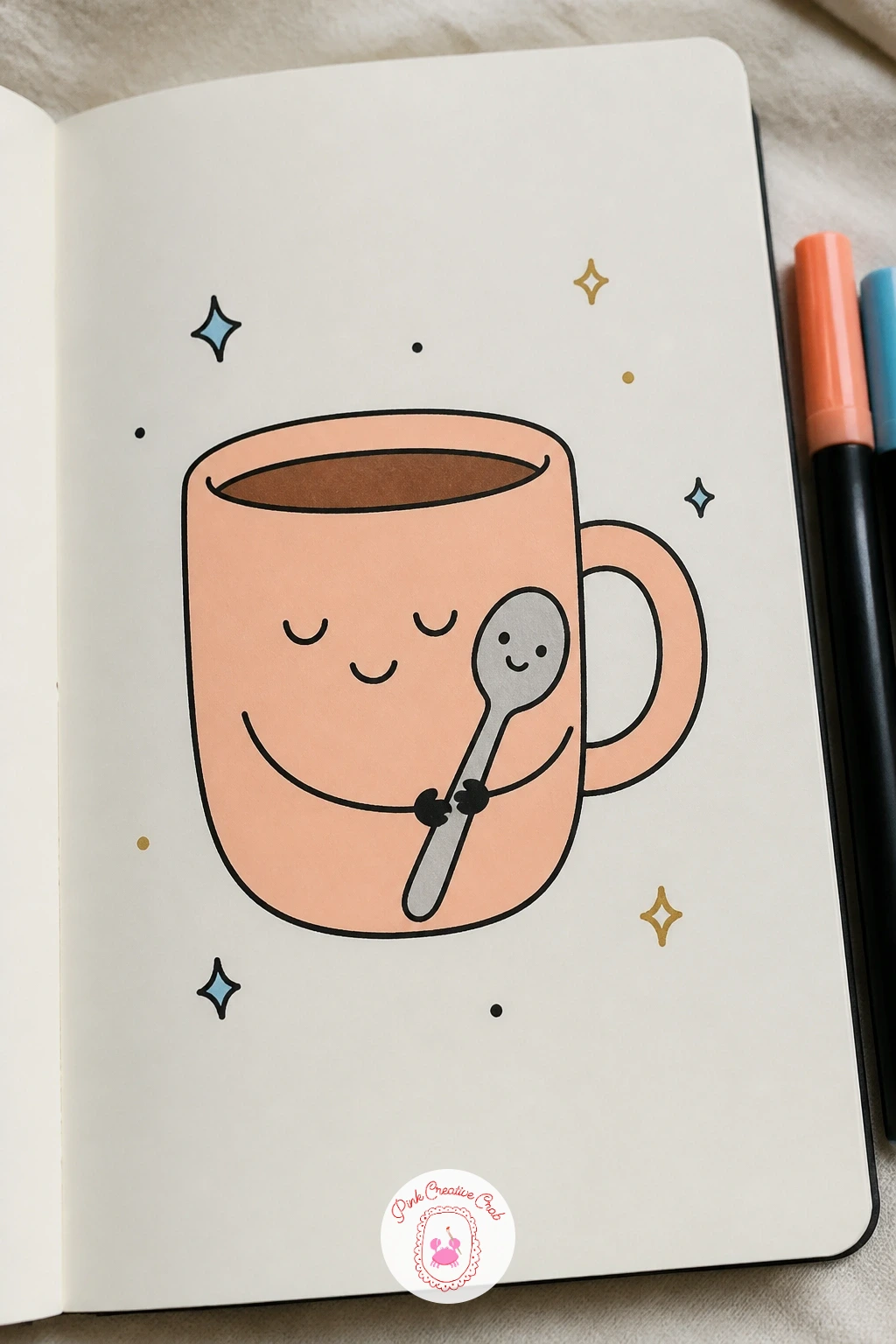
Keep the kitchen theme going with a coffee mug that holds its own tiny spoon. Draw a simple cylinder body with a slightly wider rim, a curved handle on one side, and a small pair of stick arms coming out near the top.
Give the mug a relaxed half-closed eye expression, as if it just had its first sip, and have one arm wrap around a small spoon leaning against its body. Fill the inside rim with a thin wavy line to suggest coffee, then color the body peach and the coffee itself a touch darker with extra marker layers.
If the handle looks too thin or snaps visually from the body, thicken it where it meets the mug on both ends, that join is the part eyes go to first. Swap the spoon for a straw if you would rather draw an iced drink, the face and arms work exactly the same way.
Steady pressure on the fineliner for the mug’s outline keeps it looking solid next to the lighter lines of the steam or coffee fill.
Palette: Peach,Black,Sky Blue
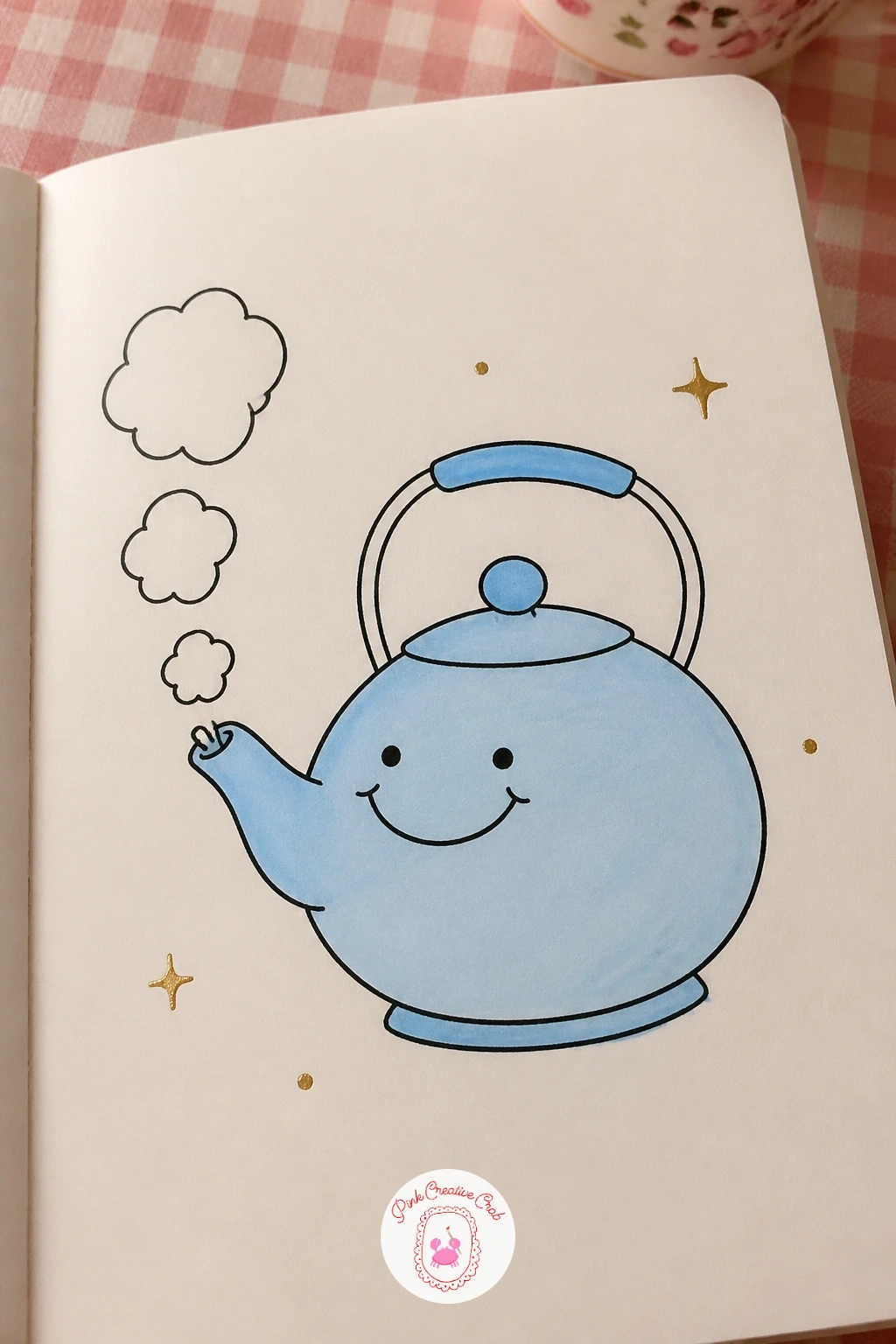
Let the mug’s kitchen company get noisier with a kettle that is visibly proud of its own whistle. Start with a rounded body, a curved spout angled upward, and a small handle arching over the top, then draw the face low on the body with closed eyes and a wide confident grin.
From the spout, add two or three puffs of steam drawn as soft overlapping circles that get bigger as they rise, almost like little speech bubbles with no words in them. Color the kettle body sky blue and leave the steam puffs white with just a thin peach outline so they stay light and airy.
Eye level matters here more than with the teapot: if you draw the spout and steam from slightly below, the kettle reads as tall and self-satisfied, which suits that proud expression. If overlapping circles feel fiddly for the steam, three simple wavy lines rising from the spout do the same job with less drawing.
Try drawing the steam puffs last, after the face, so you can judge how big they need to be to balance the kettle’s size.
Palette: Sky Blue,White,Peach
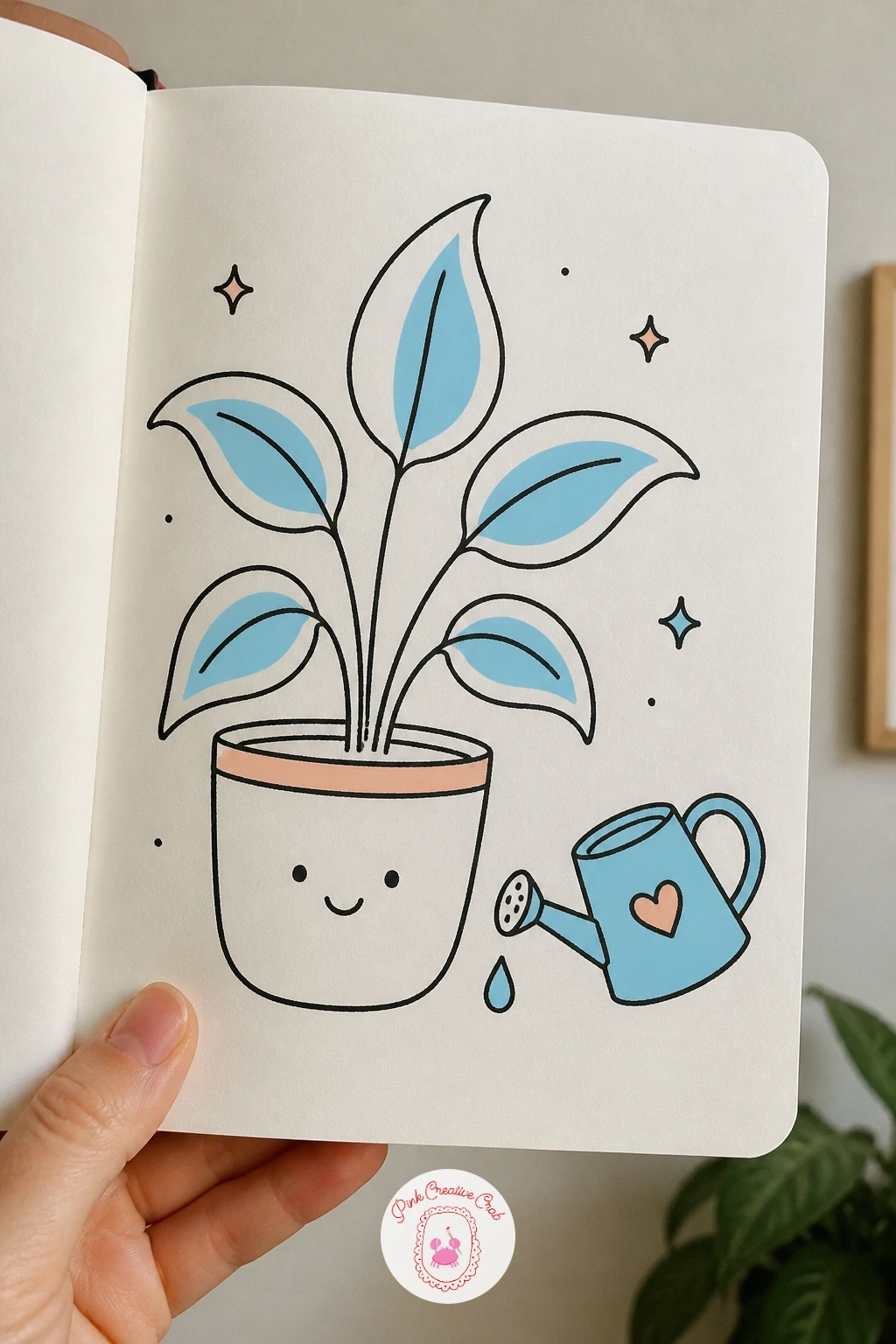
Switch from kitchen objects to a smiling houseplant, which gives you a nice change of shape after all those rounded appliances. Draw a simple pot with straight tapered sides, then a cluster of five or six leaf shapes rising from the rim, varying the leaf size so the plant does not look too symmetrical.
Put the face on the pot itself rather than the leaves, with a calm closed-eye smile that suits something that just got watered. Beside it, sketch a small watering can tilted slightly toward the pot, with a thin curved line showing a drop or two still falling.
Leaves are the part that usually turn stiff, so draw each one with a single curved stroke rather than two straight lines meeting at a point, and let a few overlap each other. Color the pot peach and the leaves sky blue for a slightly unexpected, cheerful combination instead of the obvious green.
If botanical doodles like this one appeal to you, the watercolor pencil botanical drawings page shows how the same leaf shapes look with more detailed color work.
Palette: Peach,Sky Blue,Black
Bring some energy back with an alarm clock caught mid-jump as its bells ring. Draw a round clock face first, with two small bell shapes perched on top like ears, then give the whole clock two little legs drawn bent, as though it just leapt off the nightstand.
Give it wide open eyes and an open mouth, the kind of startled expression that fits ringing bells, and add a few short motion lines around the bells and legs to sell the jump. Use sky blue for the clock face and peach for the small feet or legs so the two colors separate the body from the motion.
Proportion is what keeps this one readable: keep the bells smaller than the clock face itself, even though real alarm clocks often have oversized bells, or the character gets top heavy and the jump looks less convincing. If drawing bent legs mid-air feels tricky, draw them first as straight lines then bend each one at a single joint afterward.
Finish with three or four short lines radiating from each bell to show the ringing sound without adding any extra shapes.
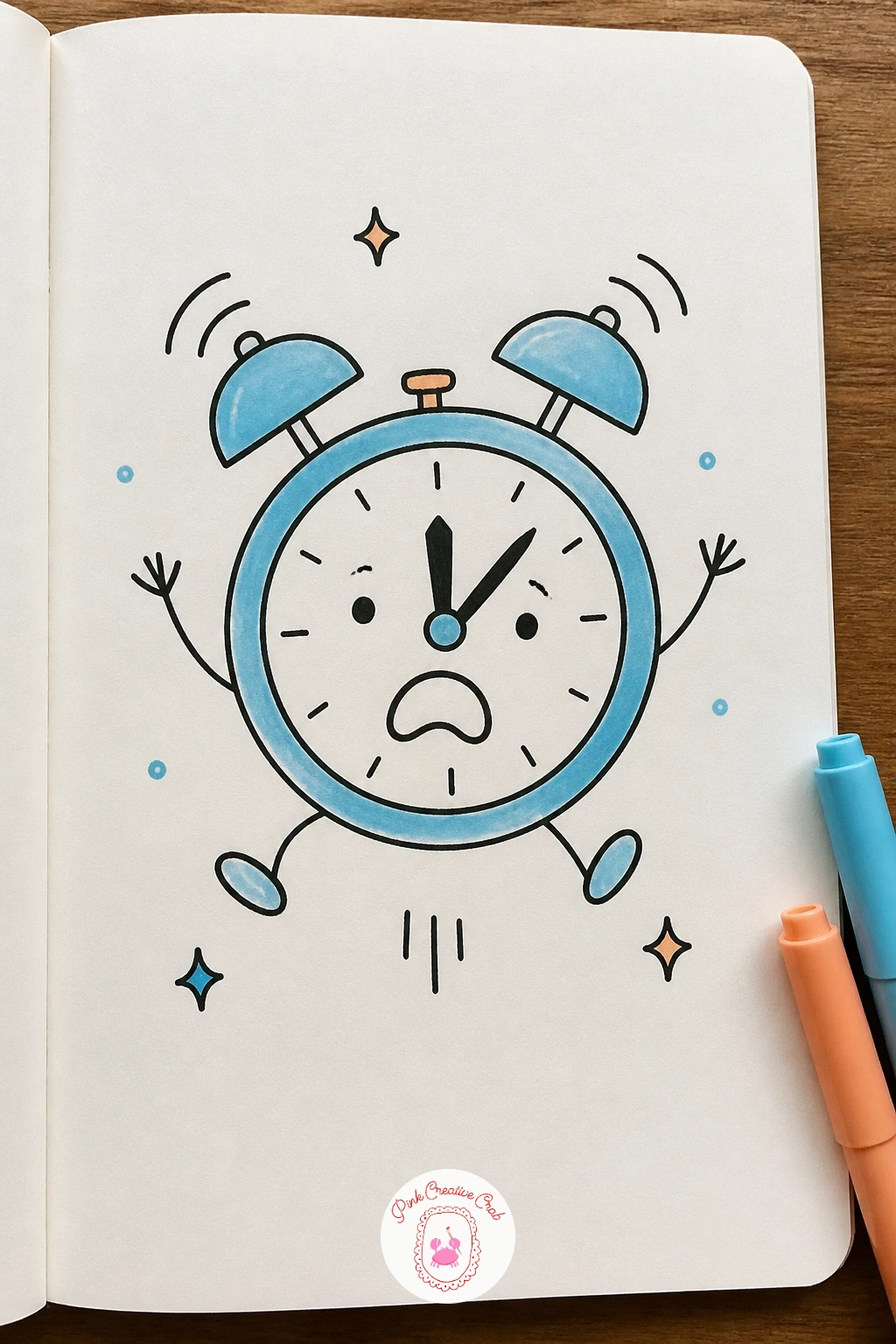
Palette: Sky Blue,Peach,Black
Give the page a small story with an umbrella shielding a tiny plant from the rain. Draw the umbrella canopy as a simple half circle with a few curved panel lines inside it, a straight handle, and a small bent arm holding it tilted protectively over a little potted sprout below.
Place the face on the canopy itself, with a gentle determined expression, and add a handful of short diagonal lines around the umbrella to show rain falling everywhere except directly under it. Color the canopy sky blue and leave the tiny plant in peach and a touch of green so it stands out as the thing being protected.
Light source decides how caring this scene feels: keep the rain lines coming from one consistent direction across the whole page, and leave a clear dry patch directly beneath the canopy where the plant sits, that contrast is what makes the shielding read clearly. If a full rain shower feels like too much, six or seven lines scattered around the edges are enough to suggest the weather.
Draw the umbrella’s tilt before anything else, since everything underneath has to sit inside that angled shadow to make sense.
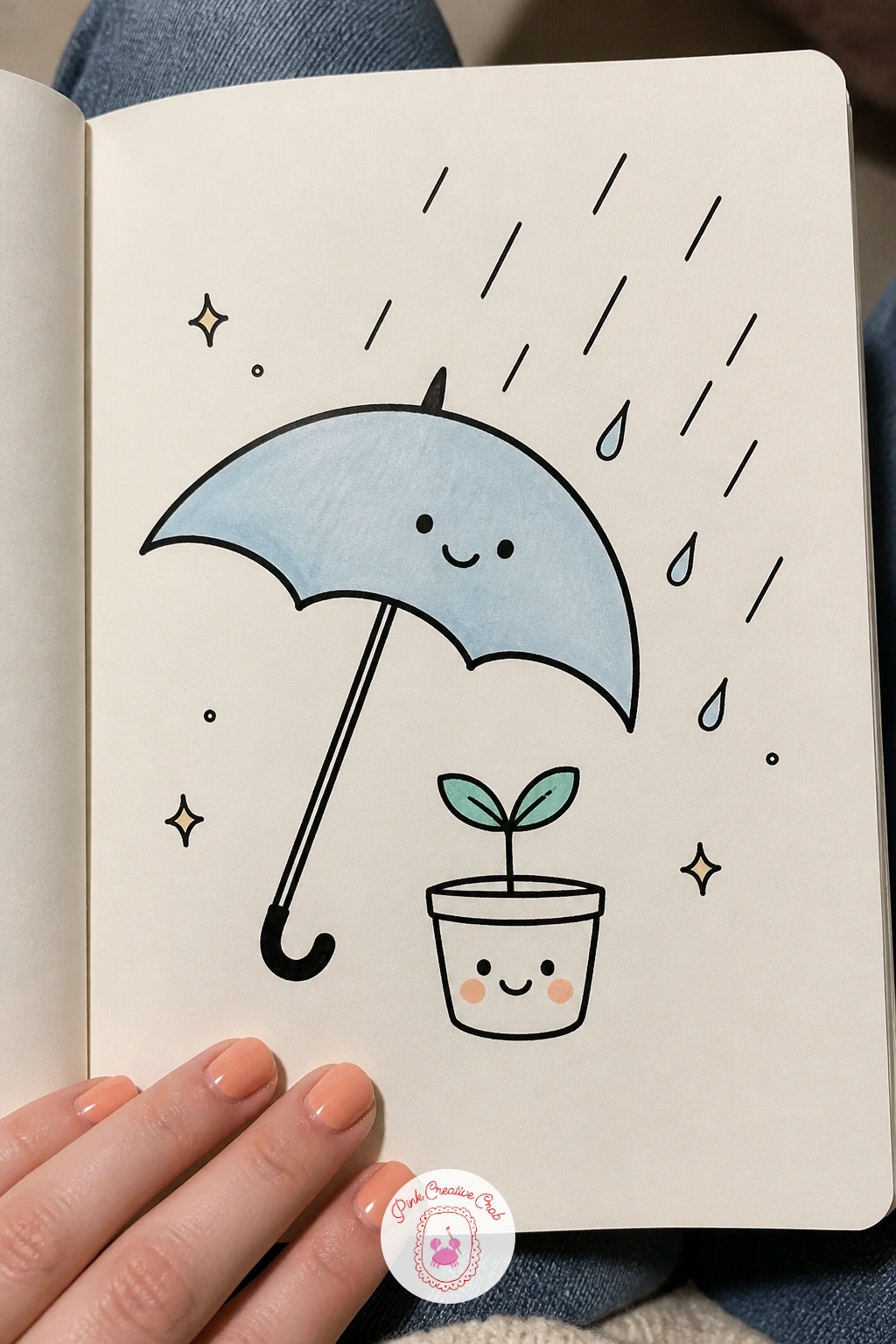
Palette: Sky Blue,Peach,Black
Try a pencil that draws with its own tip, a fun bit of logic that makes this doodle idea stand out. Draw a long pencil shape lying at a diagonal across the page, pointed tip at one end and a small eraser band at the other, then add two thin arms near the middle, one of them bent so the tip of the pencil touches the paper just in front of it.
Beneath that touching tip, sketch a small heart shape as though the pencil just drew it, with a thin wobbly line connecting the heart’s outline back to the pencil point. Give the pencil a pleased, focused expression with eyebrows slightly raised, then color the pencil body peach and the heart sky blue so the two feel connected but distinct.
Keep the angle of the pencil and the angle of the heart’s wobbly connecting line consistent, since a pencil drawing at one angle but a heart appearing from a completely different direction breaks the illusion. No peach marker on hand works fine here too, a plain yellow or uncolored pencil body reads just as clearly.
Draw the heart last, after the arm and connecting line are both settled, so you can size it to whatever space is left.
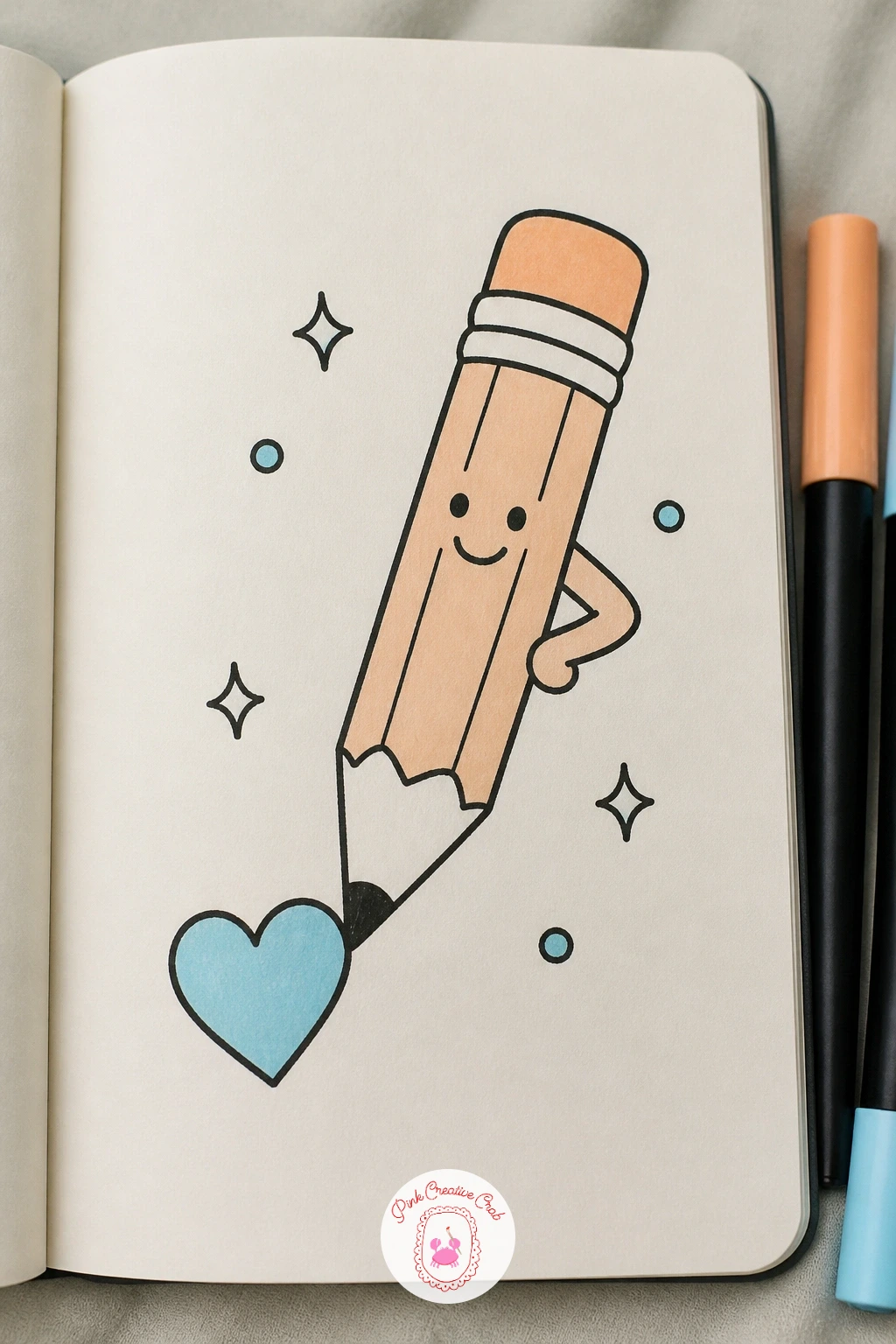
Palette: Peach,Sky Blue,Black
Pair up with the earlier jogging sneakers by drawing a sock peeking out of one shoe. Sketch a single sneaker in profile, simple and still this time, then draw a soft fabric shape rising just above the shoe’s opening with a scalloped or ribbed top edge to read clearly as sock fabric.
Give the sock a small shy face peeking over the edge of the shoe, eyes wide as though checking if it is safe to come out further. Color the sneaker body sky blue and the sock peach, keeping a clean gap of white paper between the two so the color block makes the two separate textures obvious.
The shy, peeking feel depends on how much sock you show: too much and it looks like it is simply worn normally, too little and the joke disappears, so aim for roughly a third of the sock’s height showing above the shoe. If ribbed texture lines feel fussy, three or four short horizontal dashes along the top edge are enough.
This pairs nicely on a page with other silly doodle ideas that put ordinary items in slightly awkward little situations.
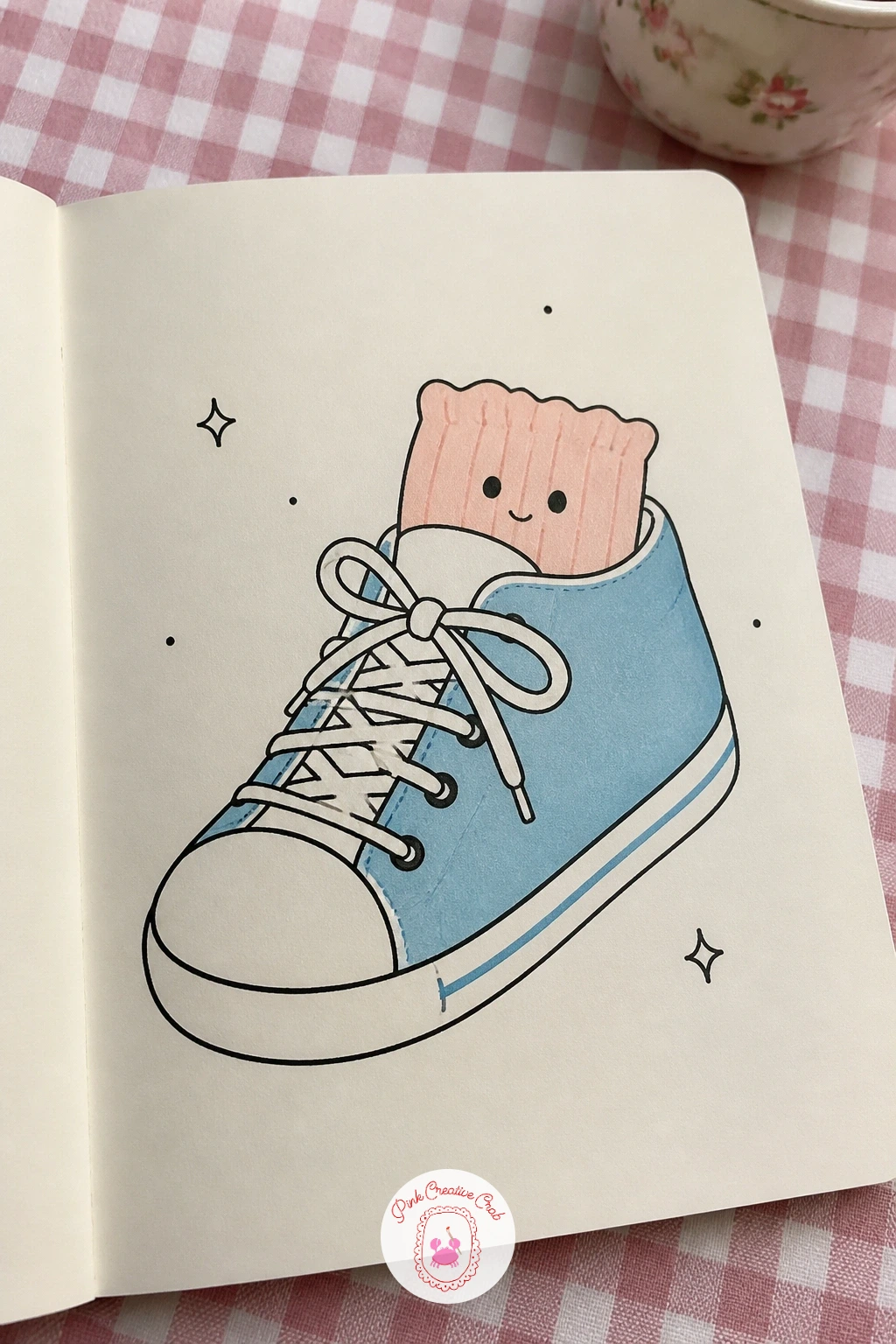
Palette: Sky Blue,Peach,White
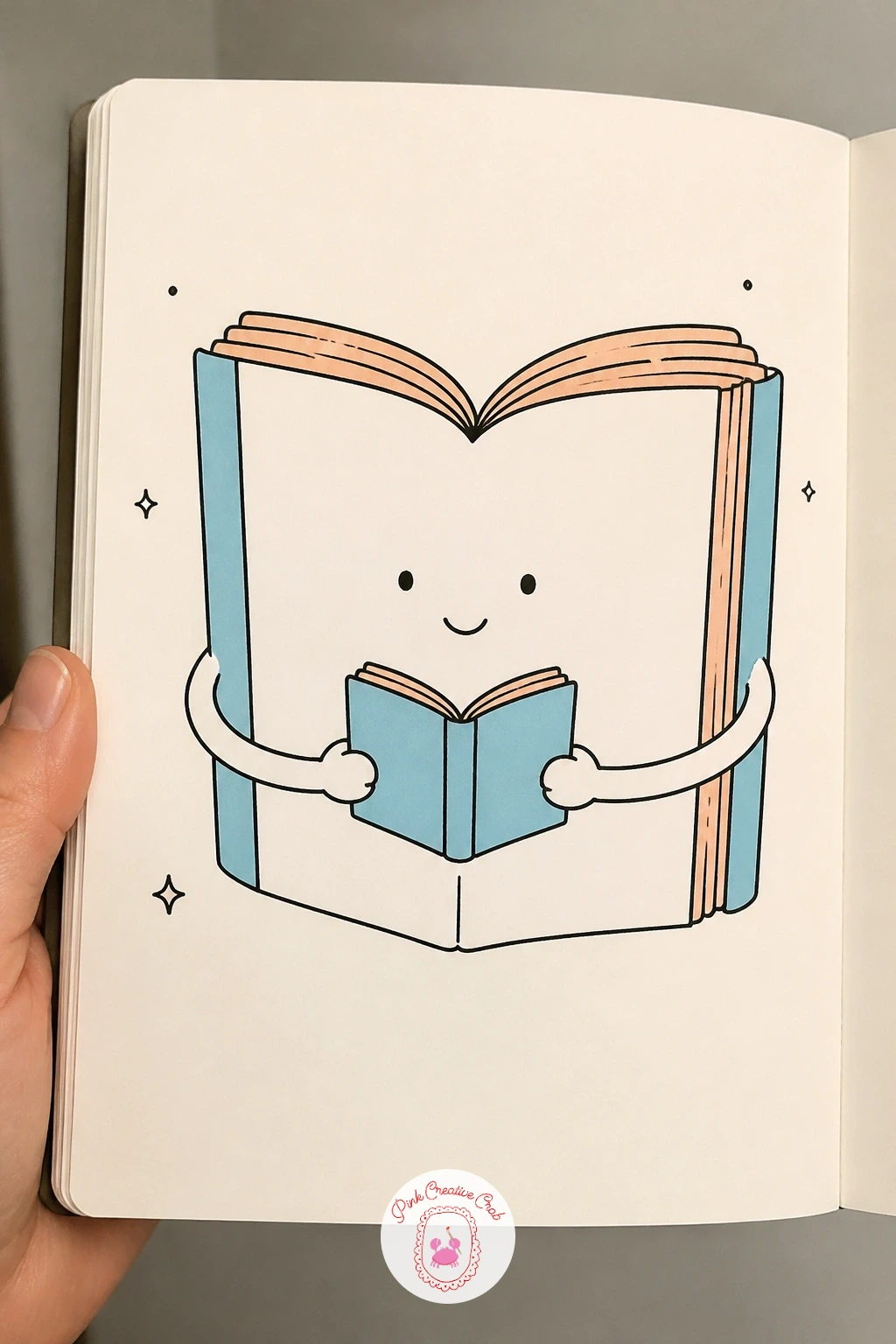
Move to a quieter scene with a book reading an even smaller book of its own. Draw a simple closed-looking book shape propped open at an angle, with a visible spine and a few thin lines along the edge of the pages to suggest thickness.
Give it two small arms holding an even tinier open book up in front of its face, with the smaller book’s pages drawn as a simple V shape with a center line. The bigger book’s face should look focused and calm, eyes angled slightly downward toward the smaller book it holds.
Getting the size difference right matters more than any other detail here: the small book should be no more than a quarter the size of the main one, or the joke of a book reading a book gets lost. Color the cover of the larger book sky blue and leave the smaller one plain white with peach-colored edges along its pages.
If you like this cozy, bookish mood, the cozy bookshop junk journal pages explore the same feeling with more detailed scenes.
Palette: Sky Blue,Peach,White
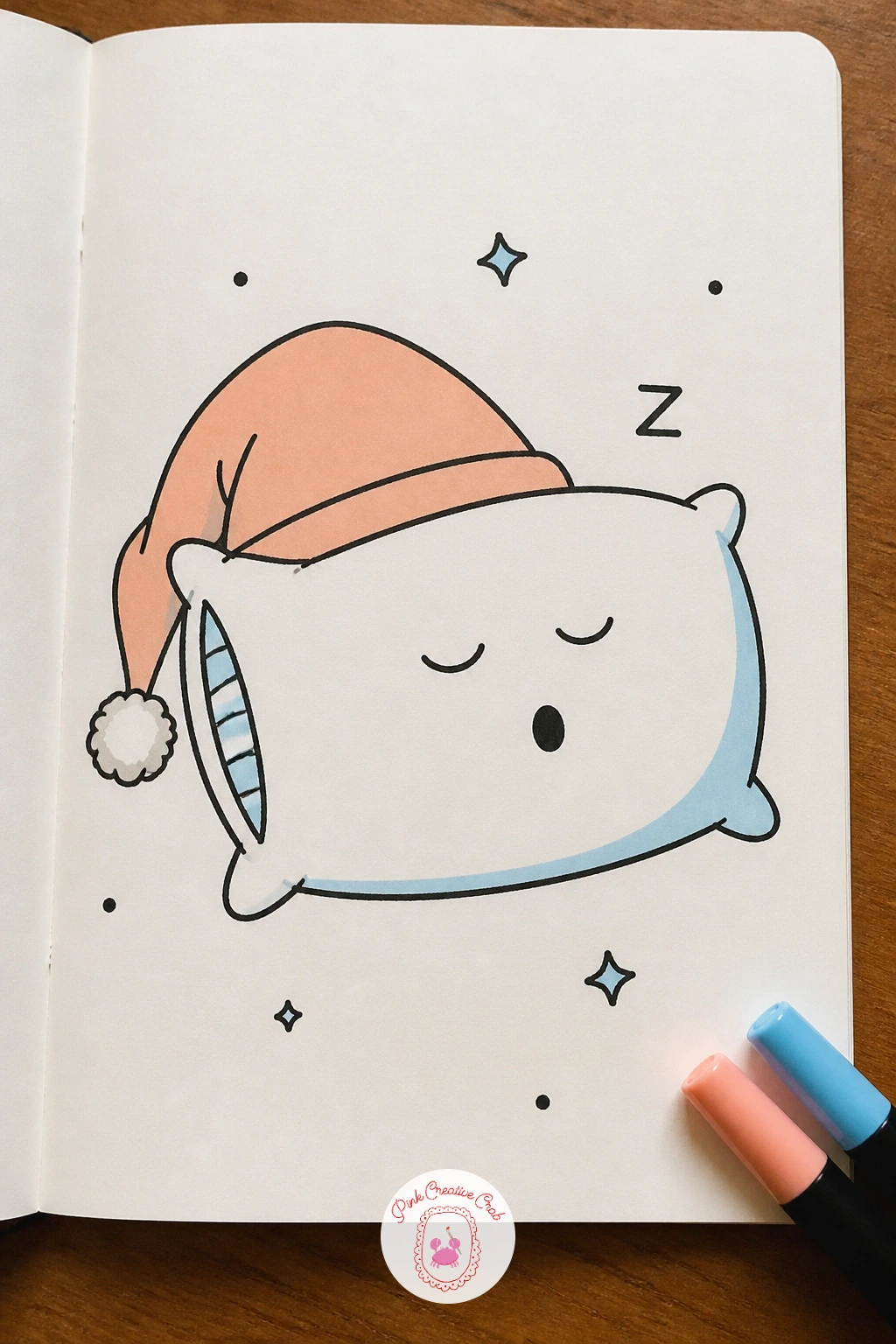
Settle into a sleepier mood with a pillow wearing its own nightcap. Draw a simple rounded rectangle for the pillow body with slightly puffed, soft looking corners, then add a small pointed nightcap perched on one edge with a little pompom at the tip.
Give the pillow two closed, curved line eyes and a small open mouth mid-snore, with a tiny “z” shape floating just above it if there is room. Color the nightcap peach and leave the pillow body in plain sky blue, keeping the color blocks large and simple since this subject depends on a soft, uncluttered feel.
If the corners of the pillow look sharp instead of soft, go back over the outline and round every corner slightly more than feels natural, pillows are rarely as crisp as a rectangle. Dry fabric texture lines across the surface can crowd the sleepy mood, so leave the body mostly plain and let the nightcap carry the only pattern.
Draw the floating “z” last and keep it small, one clean shape says more than three cluttered ones stacked together.
Palette: Sky Blue,Peach,Black
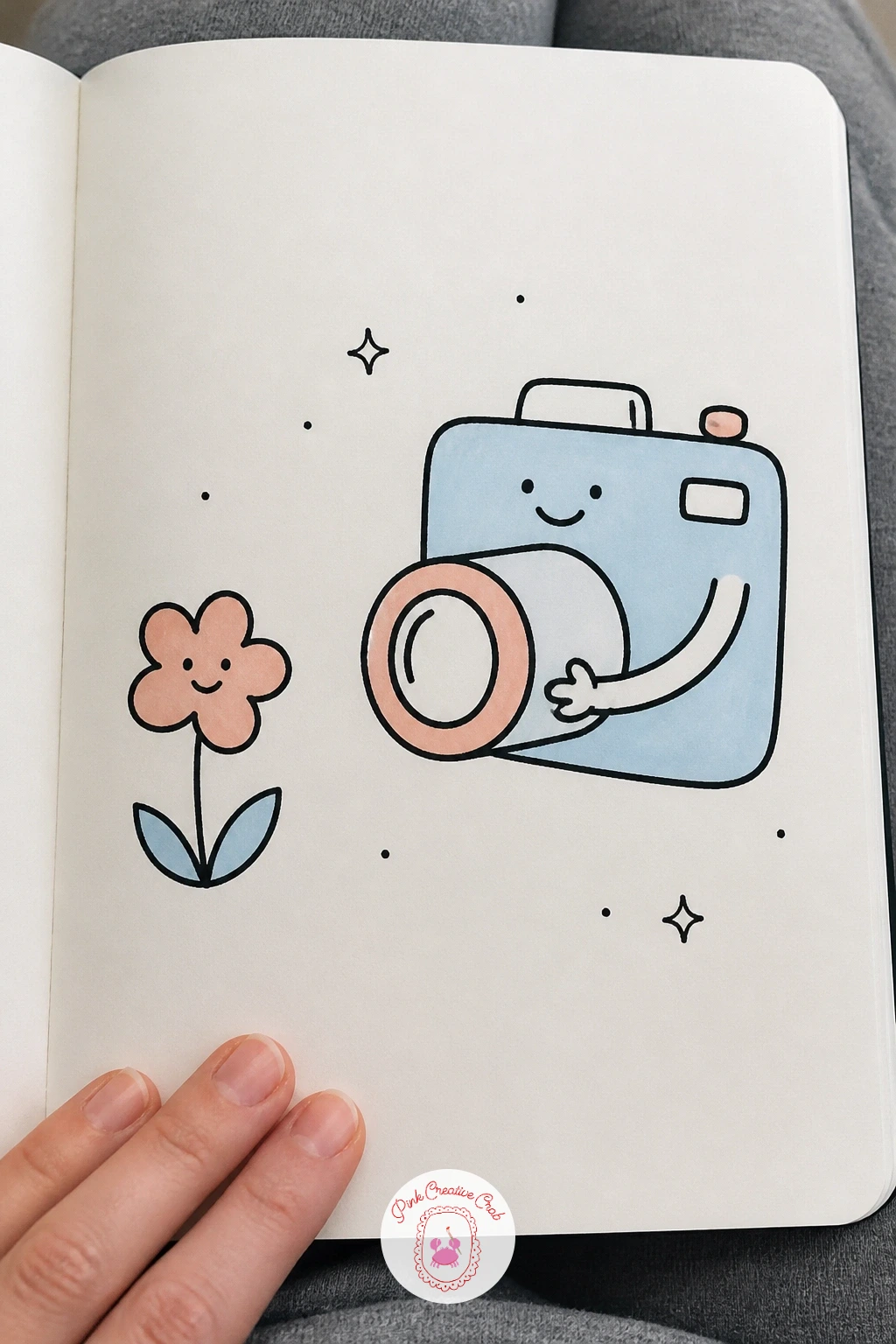
Add a hobby to the page with a camera caught photographing a small flower. Draw a simple boxy camera body with a rounded lens circle in the center and a small flash bump on top, then give it two thin arms holding itself steady, as though framing a shot.
In front of the lens, sketch a small flower on a short stem, just a few petals and two leaves, positioned slightly off to one side rather than dead center, the way a real photo composition often looks better. Give the camera a focused, slightly squinting expression, and color the body sky blue with a peach-colored lens ring.
Lens placement is the detail to watch: center it a touch low on the camera body rather than perfectly in the middle, which reads more naturally like an actual camera front. If drawing a full flower feels like too much alongside the camera, three simple petal shapes and one leaf communicate the same idea.
Add one small sparkle near the lens to suggest the flash just went off, that tiny extra sells the whole scene.
Palette: Sky Blue,Peach,Black
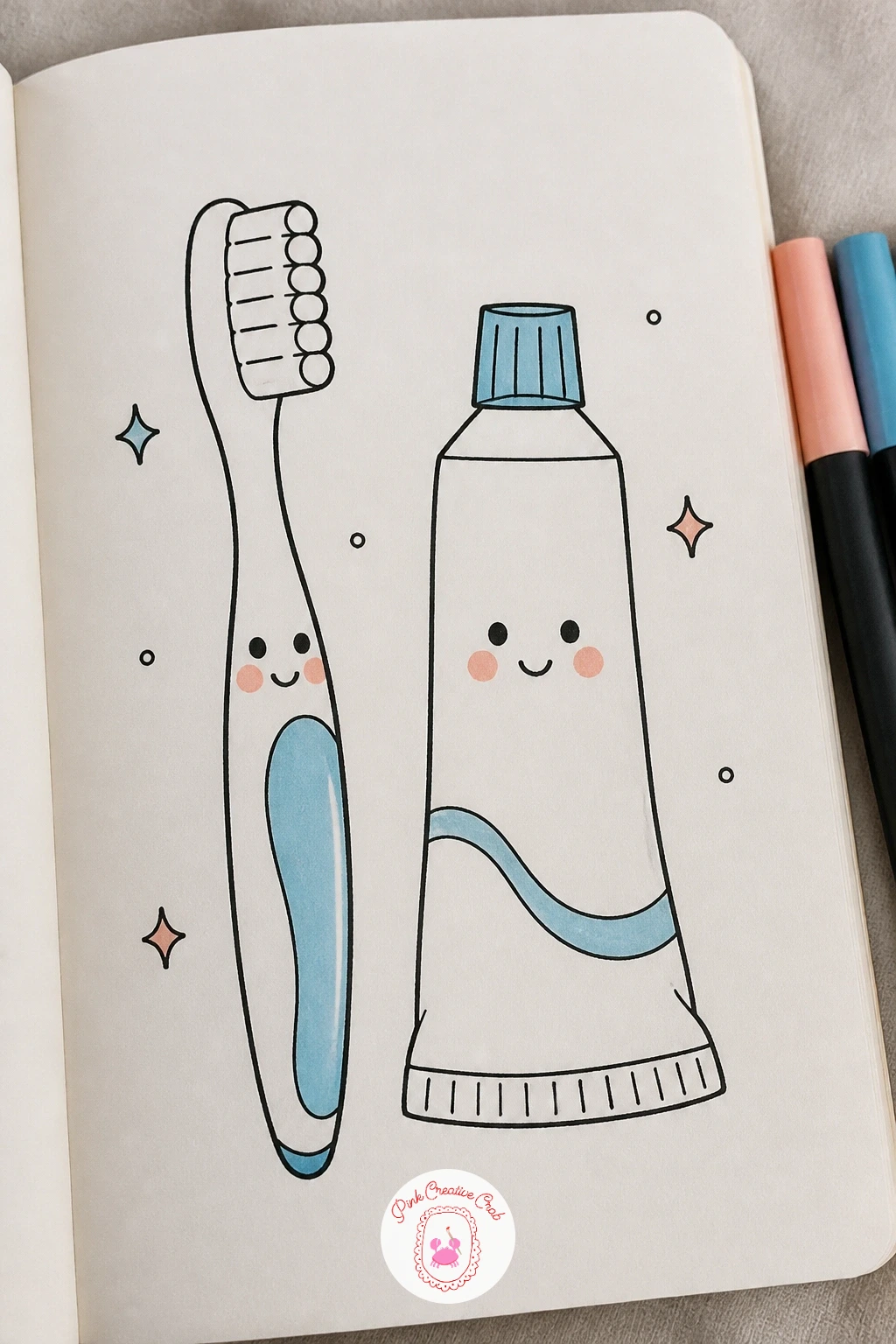
Head into the bathroom for a pair of characters that work well together: a toothbrush and its toothpaste tube. Draw the toothbrush as a long thin handle with a cluster of short bristle lines at one end, giving it a bright, energetic expression since it is usually the more cheerful of the two.
Beside it, draw a simple tube shape with a rounded cap, slightly squeezed in the middle, with a calmer or more tired face to create a bit of contrast between the two personalities. Color the toothbrush handle sky blue and the toothpaste tube peach, and add one small blob of toothpaste sitting on top of the bristles.
Bristle lines are easy to overdo, so keep them to six or seven short even strokes rather than a dense cluster, which keeps the toothbrush looking tidy rather than fuzzy. A simple round-tip marker or felt pen outline instead of fineliner works just as well if that is what is on hand.
Give the toothpaste tube a slightly squeezed waist in the middle, that one curve does most of the work in making it look used and friendly rather than brand new.
Palette: Sky Blue,Peach,Black
Keep the bathroom energy going but shift rooms with a happy lightbulb that has an idea of its own. Draw the classic bulb shape, round top tapering into a short threaded base, then add a small thought cloud above it made of two or three bumpy circles leading up to a tiny dot trail.
Leave the inside of the thought cloud blank or add one tiny simple shape, like a star or a single light squiggle, to suggest an idea without over explaining it. Give the bulb a wide, delighted expression, color the glass part of the bulb pale sky blue, and leave the thought cloud in plain white outline.
If the bulb’s filament lines inside feel fiddly, two or three simple curved lines in the center are enough, you do not need the full coiled detail of a real filament. For a quick ten-minute version, skip the thought cloud completely and just draw the bulb glowing with a few short rays around its edge, saving the cloud and its content for a slower, more considered sitting.
Place the thought cloud slightly off to one side rather than dead center above the bulb, it reads more naturally that way.
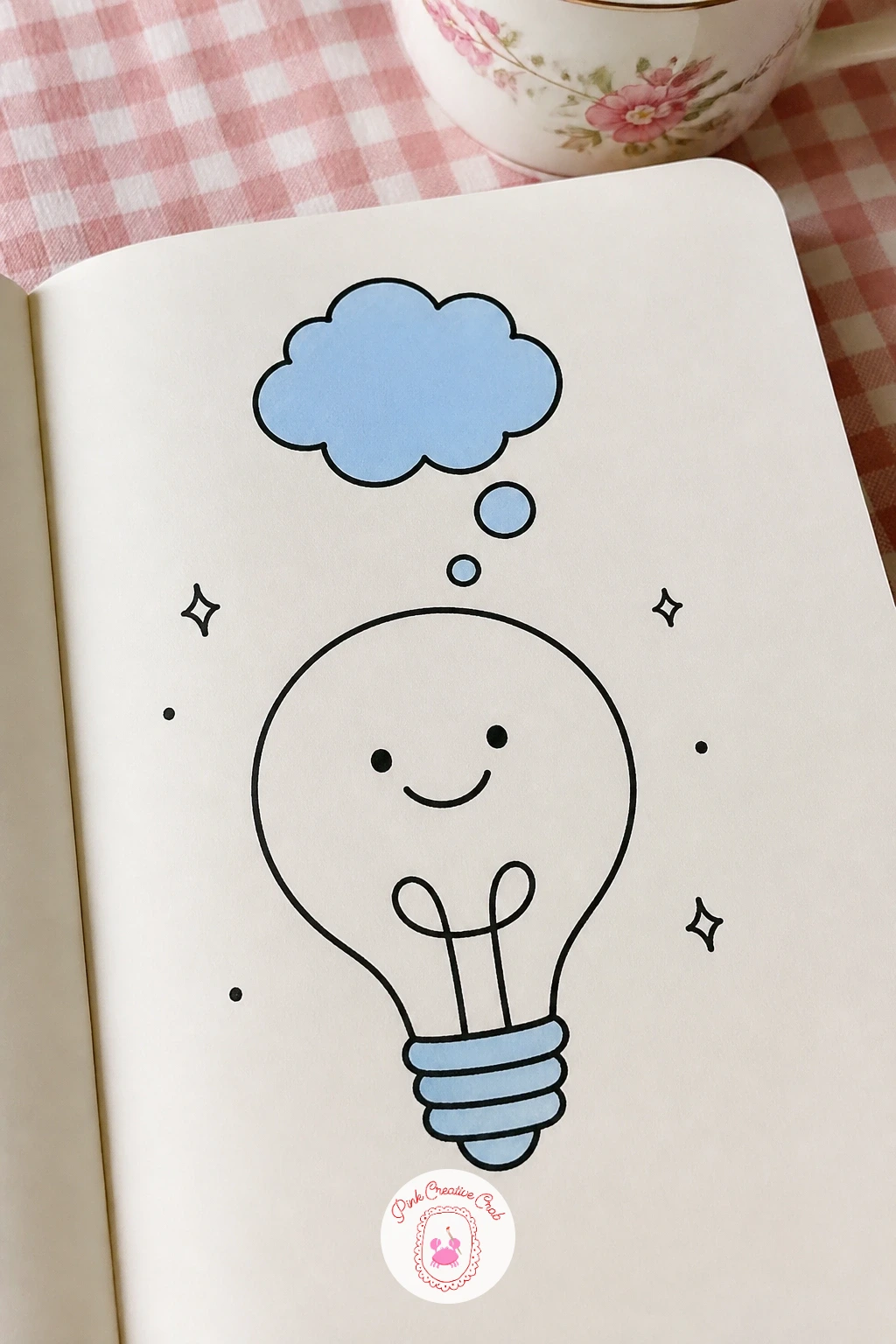
Palette: Sky Blue,White,Black
Give the page some travel energy with a backpack that carries its own water bottle in a side pocket. Draw a simple rounded rectangle body with two shoulder straps curving off the top corners, then add a smaller side pocket shape bulging slightly where a water bottle peeks out.
Give the backpack a friendly, ready-to-go expression on its main body, and draw the water bottle with a simple cap and a small highlight line down one side. Color the backpack body peach and the water bottle sky blue, so the two shapes stay clearly separate even though they overlap.
Strap placement is worth checking before you ink: make sure both straps curve down and inward slightly rather than straight down, which makes the backpack look like it is actually worn rather than floating flat on the page. If the side pocket bulge looks odd, draw it as a simple rounded triangle tucked against the main body rather than a full separate shape.
One short practical habit: always draw the straps before the pocket detail, since they set the backpack’s overall posture that everything else sits against.
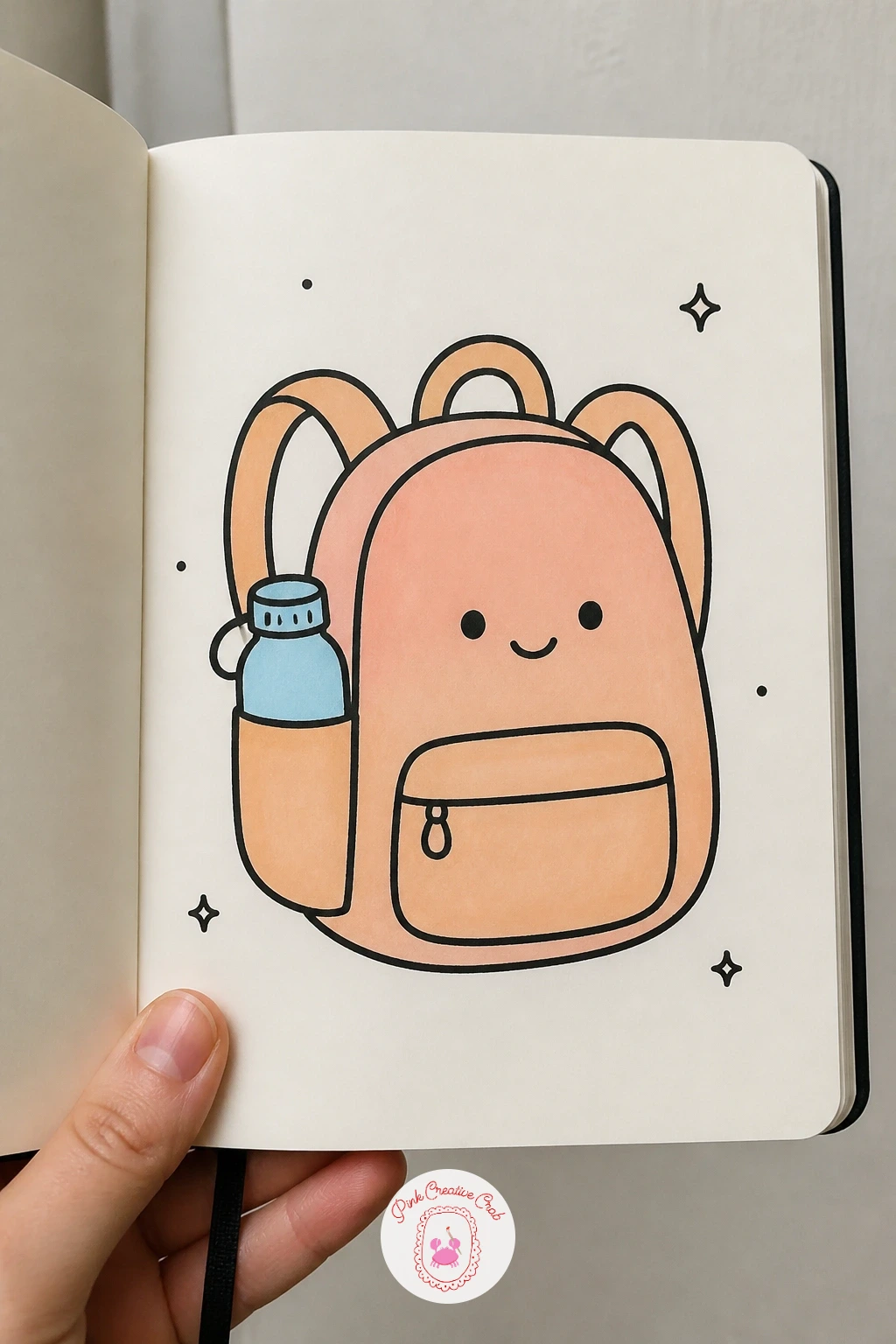
Palette: Peach,Sky Blue,Black
Add a little vanity table charm with a lipstick checking itself in a compact mirror. Draw the lipstick as a simple cylindrical tube with the colored tip showing above the case, then give it two thin arms, one holding up a small round compact mirror open in front of its face.
Draw the mirror as a circle inside a slightly larger circle, with a tiny line suggesting a reflective shine across the glass, and give the lipstick a pleased, checking-itself expression as it looks into it. Color the lipstick tip peach and the case sky blue, leaving the mirror mostly uncolored so it reads as reflective.
If the mirror looks flat instead of reflective, add one diagonal shine line across it and nothing else, extra detail usually makes a mirror look busier rather than clearer. No peach marker handy works fine with a warm pink or coral instead for the lipstick tip, since the key contrast is just a warm tip against a cooler case.
Draw the compact mirror circle first and the lipstick second, positioning the lipstick so its face lines up level with the center of the mirror.
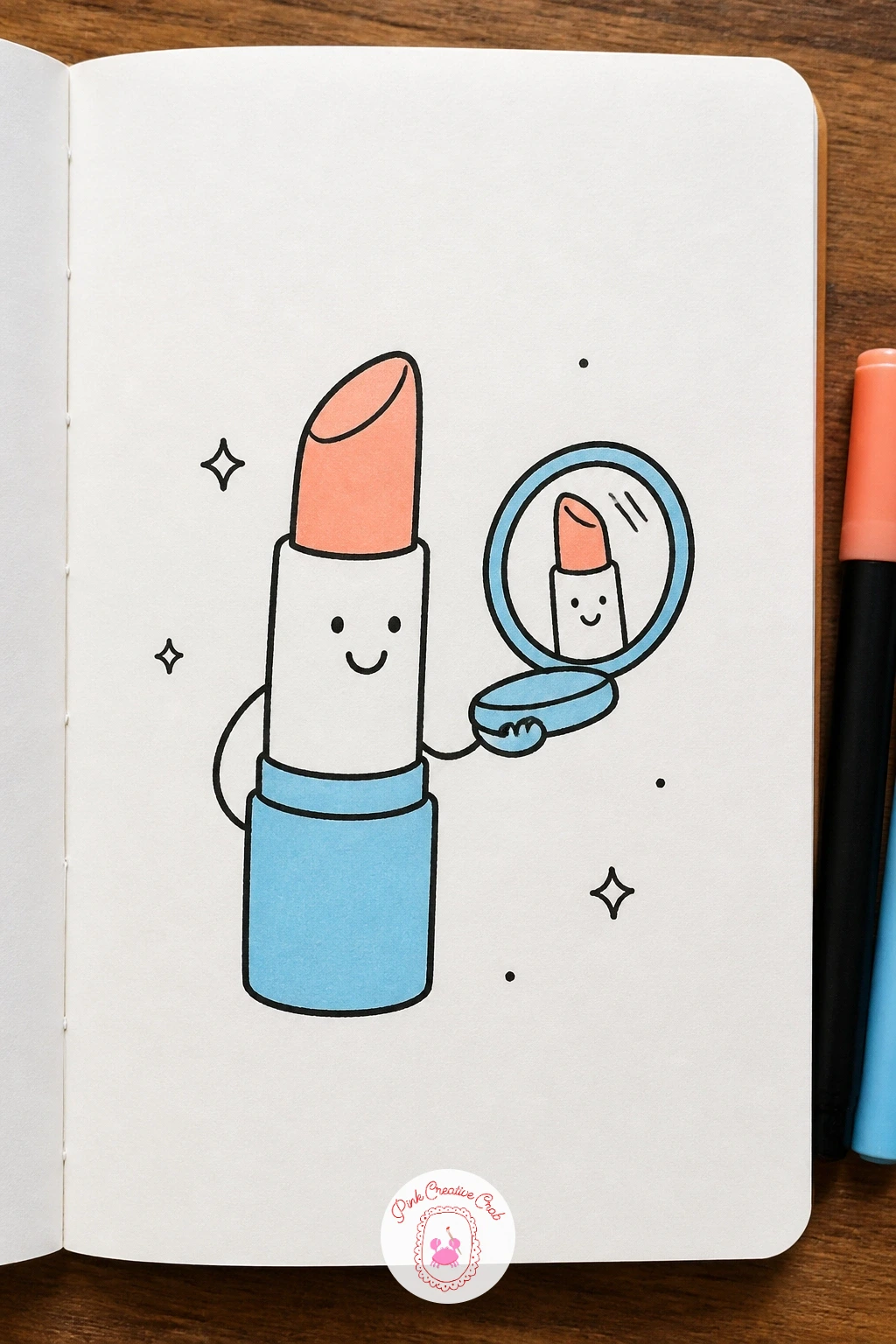
Palette: Peach,Sky Blue,Black
Bring in a craft table scene with a pair of scissors mid-cut on a paper heart. Draw the scissors in a simple open X shape with two rounded finger loops at the bottom and pointed blades at top, then give the face a focused expression right where the blades meet the pivot point.
Beneath the blades, sketch a heart shape with one edge drawn as a jagged, half-cut line to show the scissors caught in the act, rather than a heart that is already finished. Color the scissor loops peach and the heart sky blue, and leave the blades themselves in plain black line to keep them reading as metal.
Keep the blade angle fairly open, close to forty five degrees, since scissors drawn nearly closed look more like they just finished the cut rather than actively mid-snip. If the finger loops feel tricky to shape evenly, draw one first then trace it lightly as a guide for the second so both loops match.
This pairs well on a page beside the pencil drawing a heart idea above, since both lean on the same small, sweet gesture.
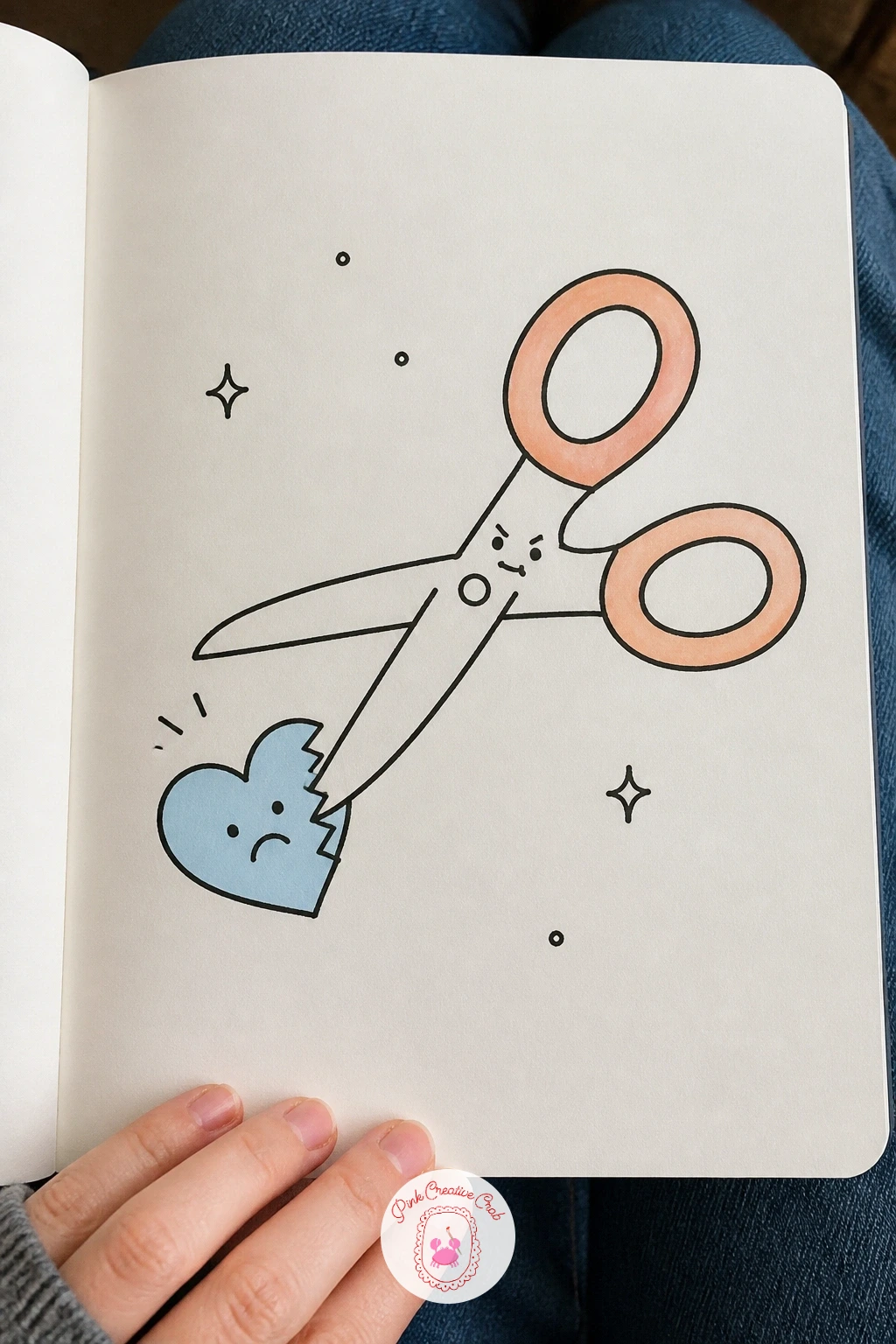
Palette: Peach,Sky Blue,Black
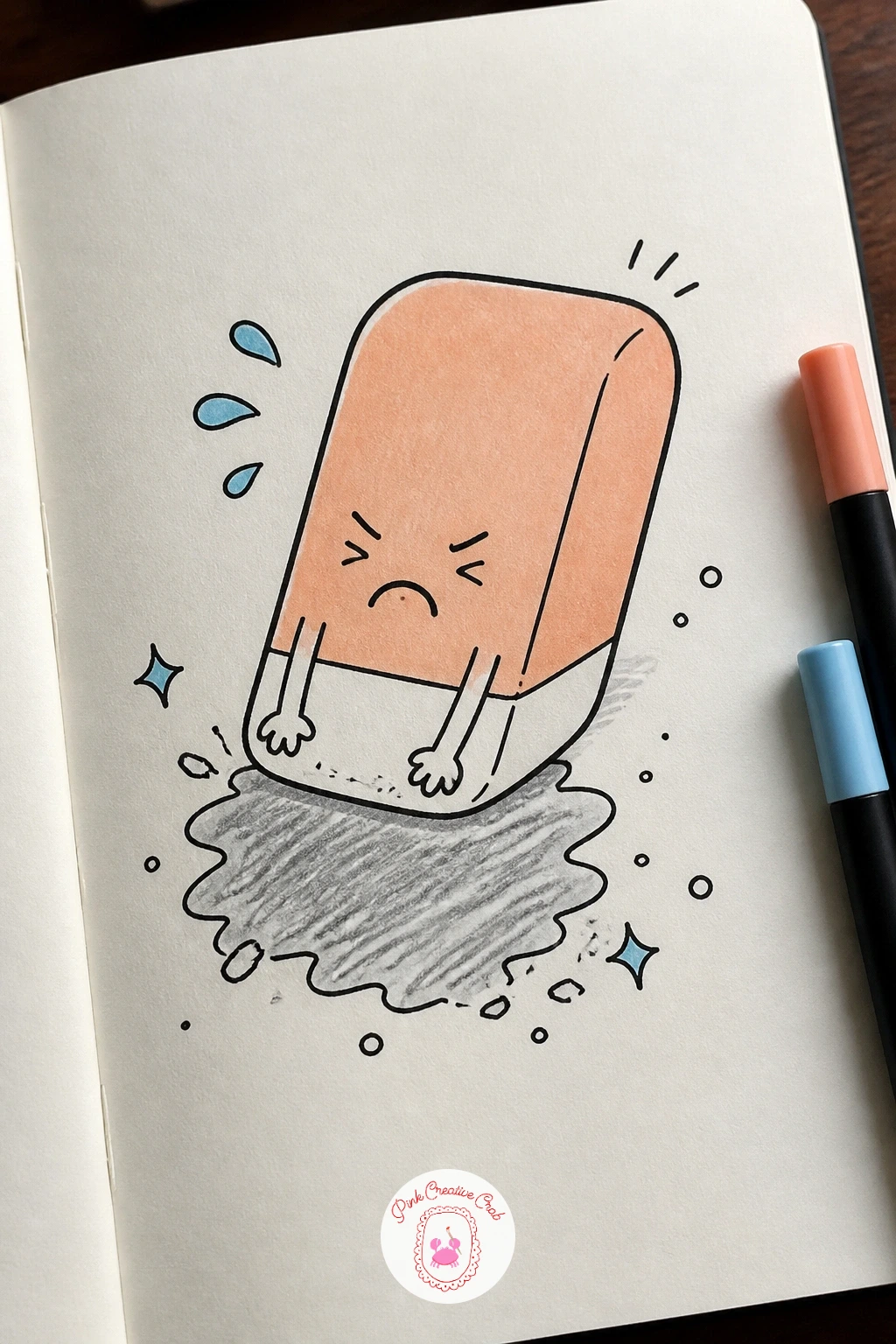
Keep the desk supplies theme going with an eraser caught mid-task, rubbing out a pencil smudge. Draw a simple rectangular eraser block with slightly rounded corners and a worn, uneven bottom edge to suggest use, then give it two small arms pressing down against a scribbled gray smudge beside it.
Draw the smudge as a loose, messy scribble rather than a neat shape, with one section already lighter where the eraser has started working. Give the eraser a determined, slightly strained expression, and color its body peach, leaving the smudge in plain pencil gray or light fineliner cross-hatching.
The eraser’s worn bottom edge is the detail that sells the whole idea: keep it uneven and slightly crumbly looking rather than perfectly flat, since a crisp clean edge reads as unused. If a full messy scribble feels hard to control, three or four loose overlapping circles make a convincing smudge with far less fuss.
Draw the smudge first this time, then fit the eraser against it at whatever angle looks like it is actively pressing down.
Palette: Peach,Black,Sky Blue
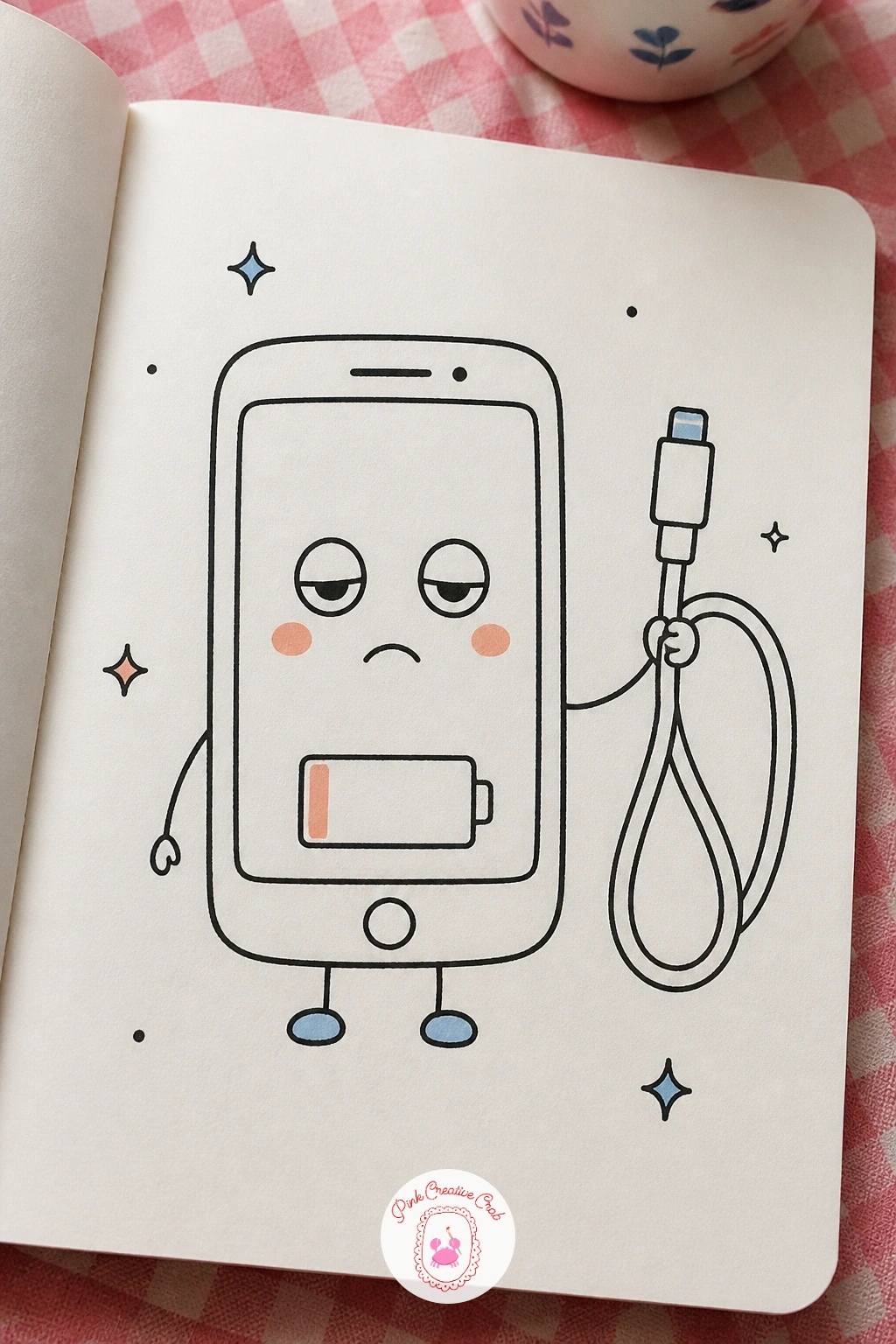
Give the desk a modern character with a tired phone clutching its own charger cable. Draw a simple rounded rectangle for the phone body with a small camera dot and screen outline, then give it two thin arms, one gripping a charger cable that trails off the edge of the page.
Draw the screen with heavy, half-closed eyes and a small battery icon in one corner showing a low charge, which tells the whole story without needing any extra text. Color the phone case sky blue and the charger cable peach, keeping both colors flat and simple so the screen details stay the clear focal point.
Cable drawing is where people tend to overcomplicate things: one smooth curved line with a slight loop near the plug end is plenty, a tangled or overly coiled cable competes with the face for attention. For a faster version, skip the battery icon and just rely on the droopy eyes and loose cable to tell the story in under ten minutes.
Keep the phone’s screen rectangle slightly inset from the case edge, that small border is what makes it read as a screen rather than a blank tile.
Palette: Sky Blue,Peach,Black
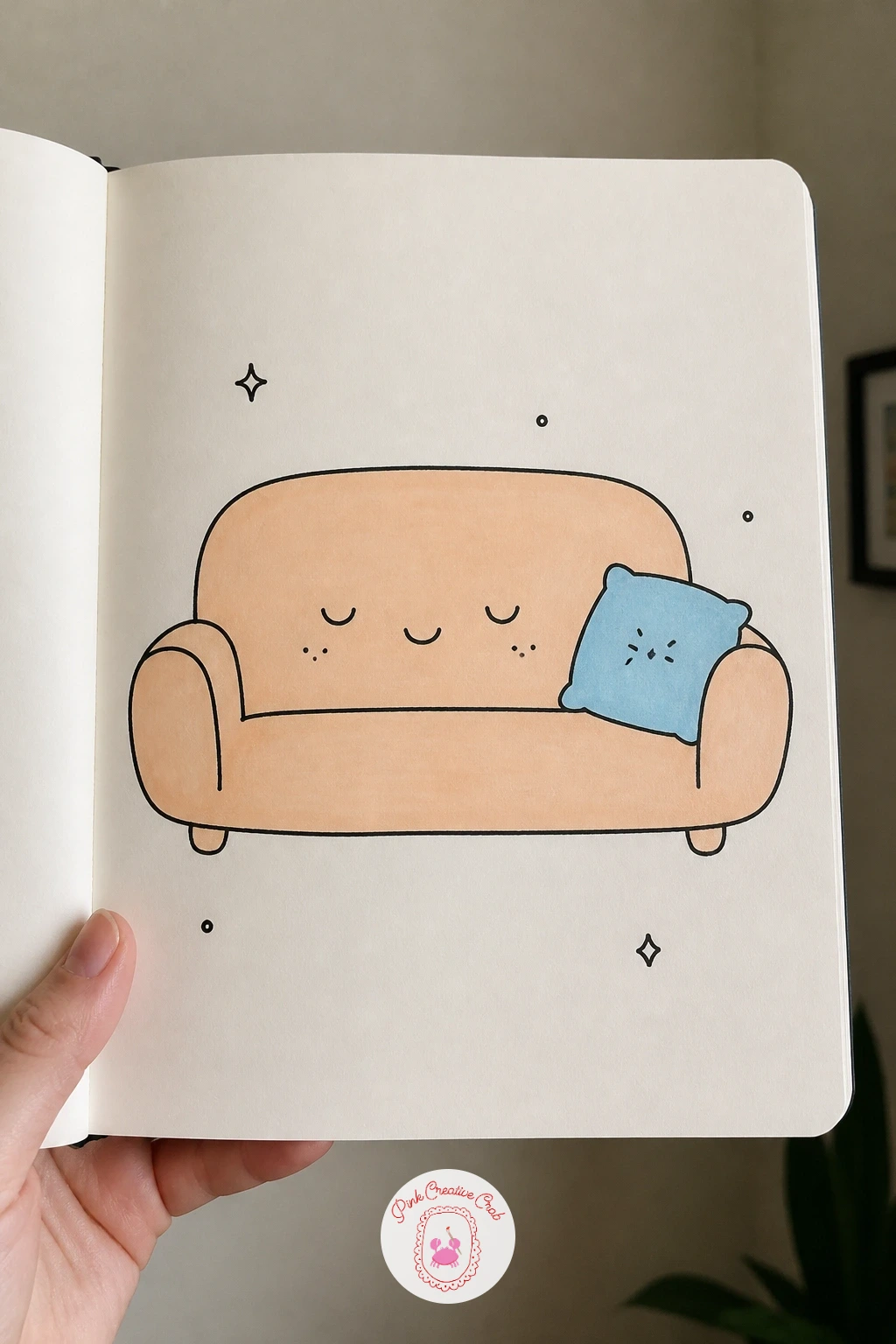
Move into the living room with a sofa settling in for a nap alongside a single cushion. Draw the sofa as a wide rounded rectangle with two slightly raised armrests, then add short stubby legs underneath so it reads clearly as furniture rather than a plain box.
Place the face on the front cushion area of the sofa itself, with heavy closed eyes and a small content smile, then draw one separate cushion leaning against an armrest with its own tiny pattern of two or three simple lines. Color the sofa body peach and the single cushion sky blue so the two feel like a matching but distinct pair.
Keep the armrests symmetrical before you commit to ink, since a sofa with uneven armrests reads as structurally wrong in a way that is hard to unsee once it is inked. If stubby legs feel unnecessary for your style, a simple baseline shadow under the sofa works as a lighter substitute.
Draw the single cushion at a slight tilt rather than perfectly upright against the armrest, it looks more settled and lived-in that way.
Palette: Peach,Sky Blue,Black
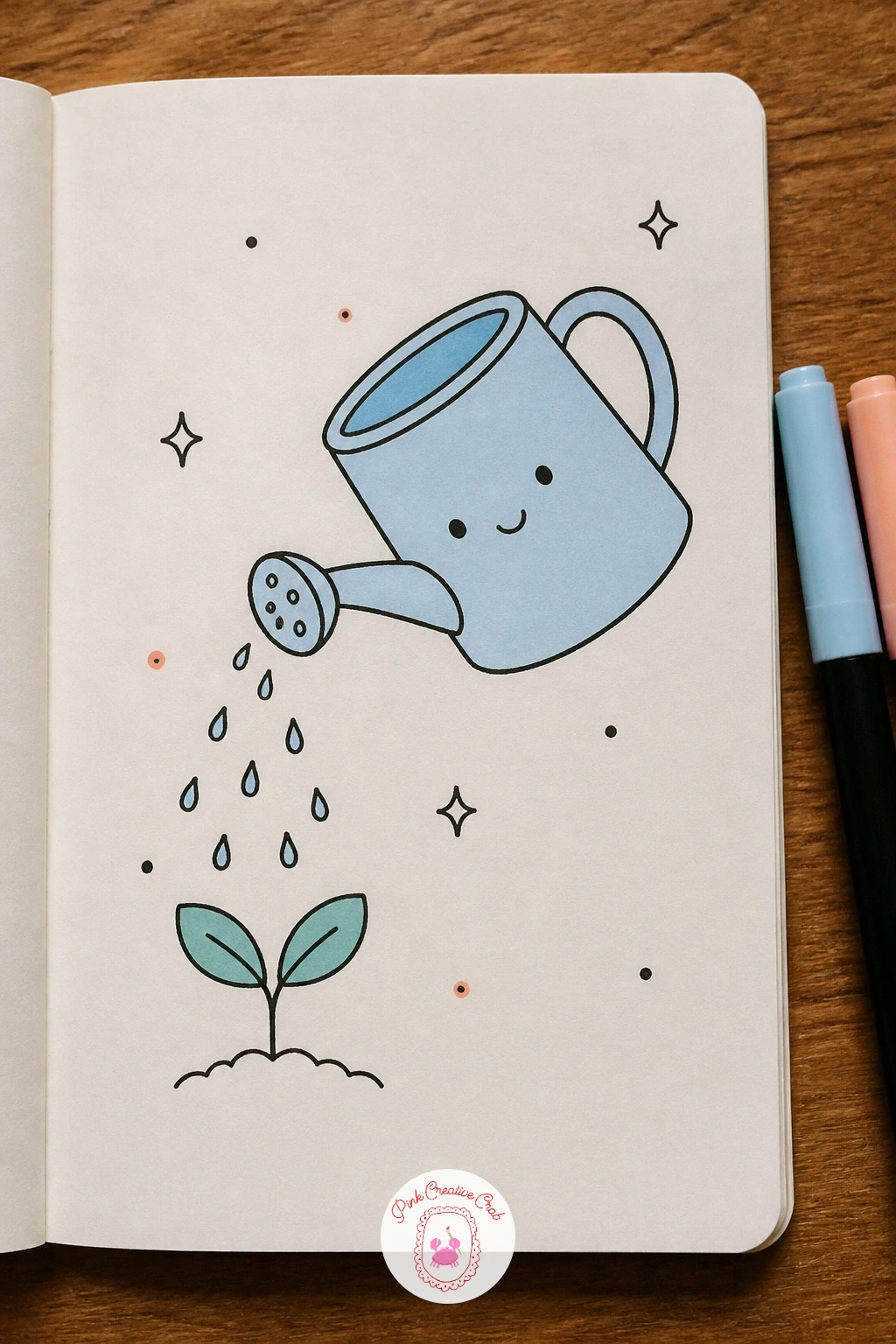
Bring the garden tools back for a watering can caught in the act of watering a tiny sprout. Draw a simple rounded can body with a curved spout and a looped handle on top, then angle the whole can slightly forward so the spout tips downward toward the ground.
From the spout, add three or four small curved drop shapes falling toward a tiny two-leaf sprout planted just below. Give the can a gentle, caring expression, color the body sky blue and the little sprout’s leaves in a soft green-tinted peach mix if you are layering markers, or plain peach if keeping it simple.
Getting the tilt right matters here: if the can sits upright with drops falling straight down beside it rather than from the spout itself, the whole action reads as confusing rather than clear, so always angle the body first before adding any water drops. If drawing a full stream of water feels fussy, three dots in a diagonal line communicate falling water just as well as fuller drop shapes.
Finish by making the sprout noticeably smaller than the can, that size gap is what makes the gesture feel gentle and protective.
Palette: Sky Blue,Peach,Black
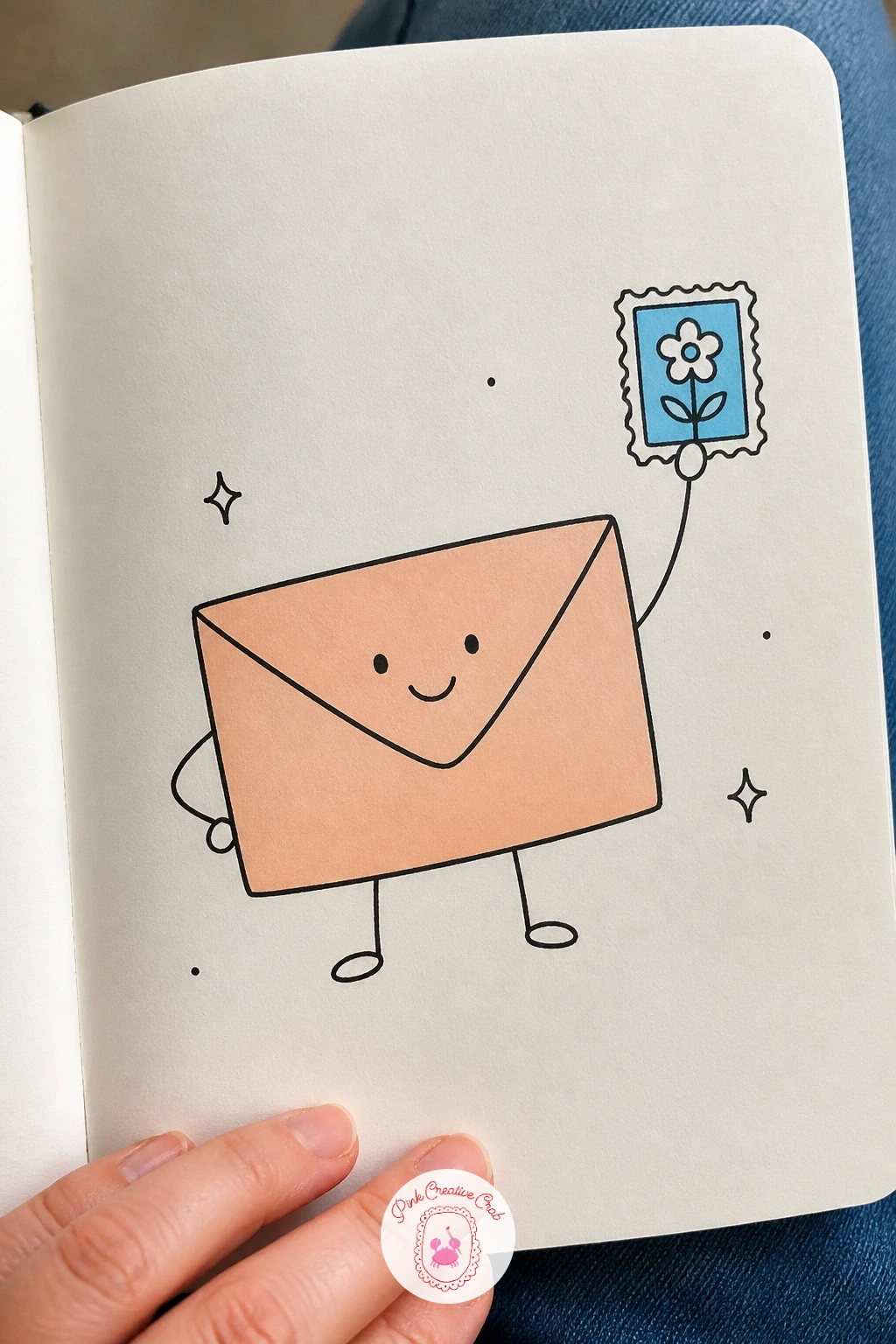
Head to the writing desk for an envelope proudly holding its own postage stamp. Draw a simple envelope shape with the classic triangular flap folded down at the top, then give it two small arms holding up a tiny square stamp just above itself, as though showing it off.
Draw the stamp with a scalloped border made of small bumps along each edge and one simple shape inside, like a tiny flower or star, to suggest a design without over detailing it. Give the envelope a proud, cheerful face in the center, color the envelope body peach and the stamp sky blue so the two feel connected but distinct.
Scalloped stamp edges are the fiddliest part, so draw them as a series of small even bumps rather than trying to match a real stamp’s perforations exactly, consistency matters more than precision here. If the flap triangle looks lopsided, draw a light center guideline down the middle of the envelope first and fold both flap edges to meet it evenly.
This pairs nicely with greeting card projects if you want a small mailable doodle to send along with a note.
Palette: Peach,Sky Blue,Black
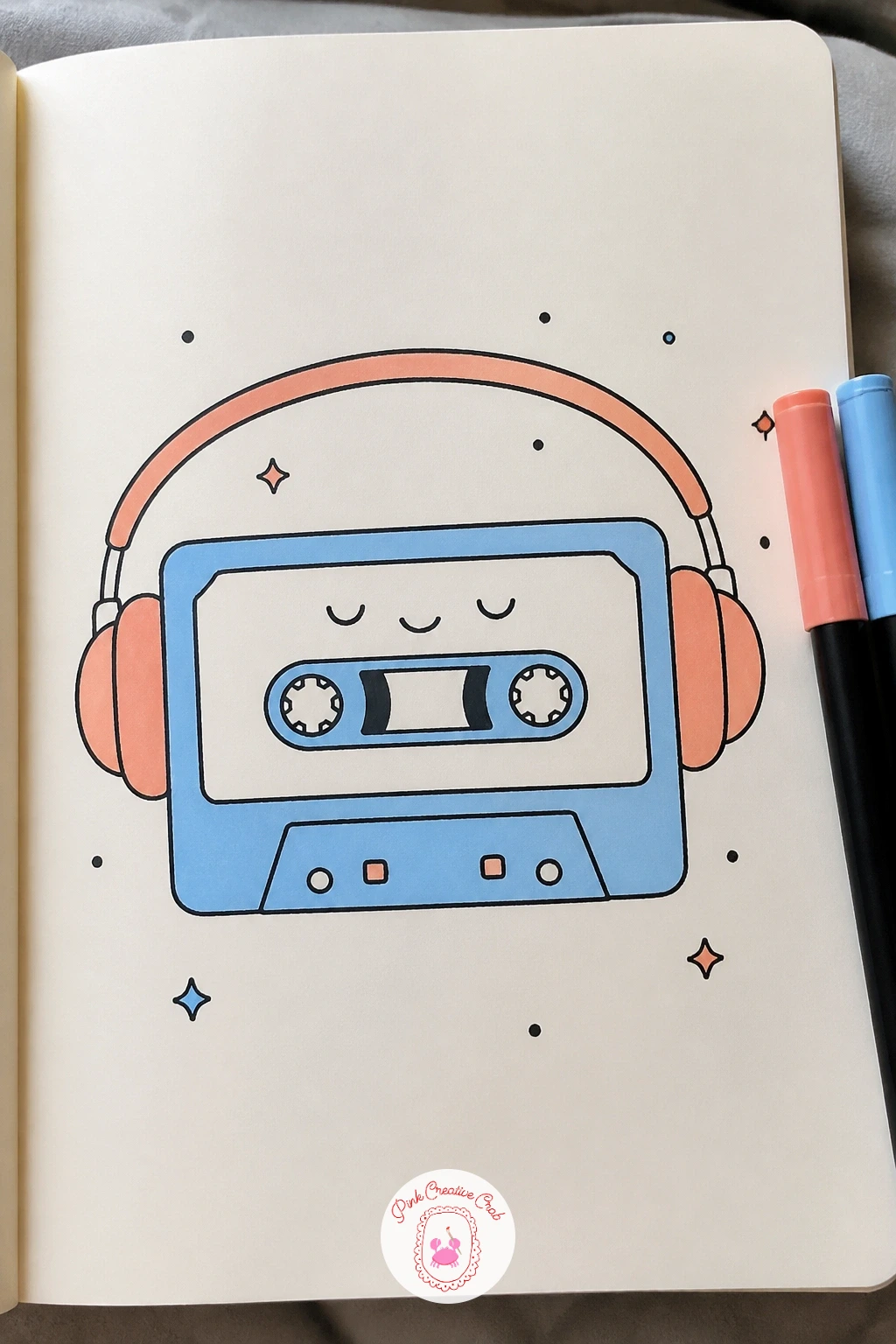
Add a bit of nostalgia with a cassette tape wearing its own pair of headphones. Draw a simple rectangular cassette body with two small circular reels visible through a window in the middle, then add a thin headband arching over the top with two small ear cups resting where the reels sit.
Give the cassette a relaxed, eyes-closed expression as though lost in its own music, and draw a few short wavy lines near the ear cups to suggest sound. Color the cassette body sky blue and the headphones peach, keeping the reel windows mostly uncolored so they read as see-through plastic.
Reel circles are easy to make lopsided, so draw a light pencil guide of two equal small circles before inking, and keep the connecting window rectangle between them slightly wider than both reels combined. If a full headphone band feels tricky at this angle, a single curved line resting directly on top of the cassette with no visible ear cups still reads clearly enough.
Vary this one next time by drawing a vinyl record instead of a cassette, the same face and headphone shapes work on a flat circular body with very little change.
Palette: Sky Blue,Peach,Black
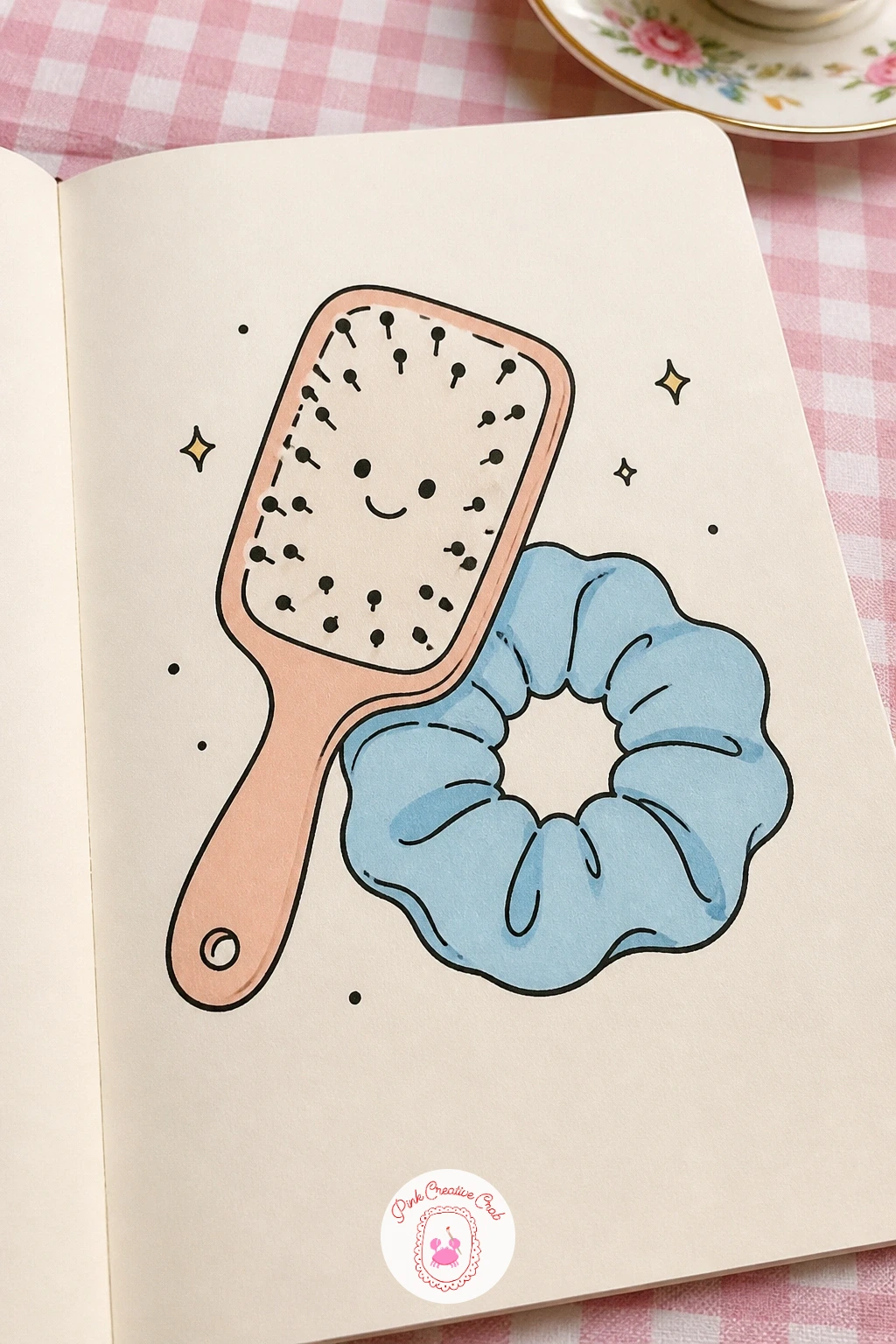
Return to the bathroom shelf with a hairbrush that keeps a scrunchie close by. Draw a simple paddle-shaped brush with a short handle and a cluster of small evenly spaced dots along the brush head to suggest bristles, then give it a cheerful face on the handle itself.
Beside the brush, draw a scrunchie as a simple thick ring with a few loose fabric folds along its edge, almost like a small inflated donut shape, and let it rest leaning slightly against the brush head. Color the brush handle peach and the scrunchie sky blue, which keeps the pair reading as a clear set.
Bristle dots are easy to overdo, so space them in loose evenly gapped rows rather than packing them tightly, a cluttered bristle head competes with the brush’s face for attention. If a fineliner feels too fine for the scrunchie’s fabric folds, switch to the broader edge of a marker for those two or three fold lines and keep the fineliner just for the main outline.
Lean the scrunchie against the brush rather than placing it flat beside it, that slight contact makes the pairing look intentional rather than just two separate objects floating near each other.
Palette: Peach,Sky Blue,Black
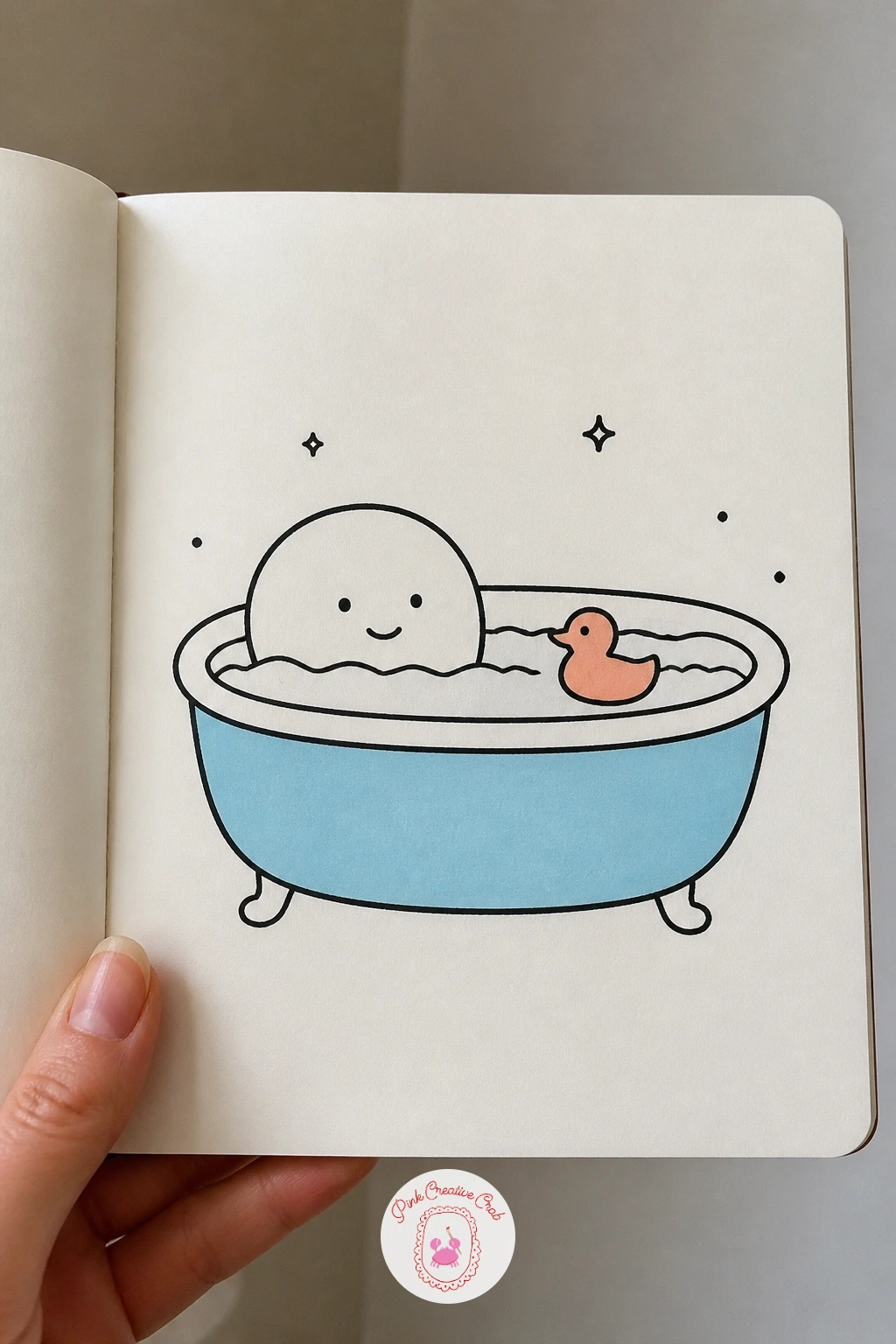
Fill the tub for a classic pairing done a little differently: a bathtub with a face enjoying company from a rubber duck. Draw a simple oval tub shape with short curved feet underneath, a few wavy lines across the top to suggest water, and a relaxed face peeking just above the water line on the tub’s front edge.
Place a small rubber duck floating on top of the wavy water lines, keeping the duck simple with a round body, a small raised head, and a short beak. Color the tub body sky blue and the duck peach, letting the water lines stay as plain outline so the two solid color shapes stand out clearly against them.
Water line placement is the detail to watch: keep them loose and slightly irregular rather than perfectly parallel, real bath water never sits in neat straight bands. If the tub’s curved feet feel fussy at this scale, a simple flat base line under the tub works just as well and keeps the whole drawing quicker to finish.
Draw the duck last, floating slightly off center on the water, since a perfectly centered duck tends to look posed rather than bobbing naturally.
Palette: Sky Blue,Peach,Black
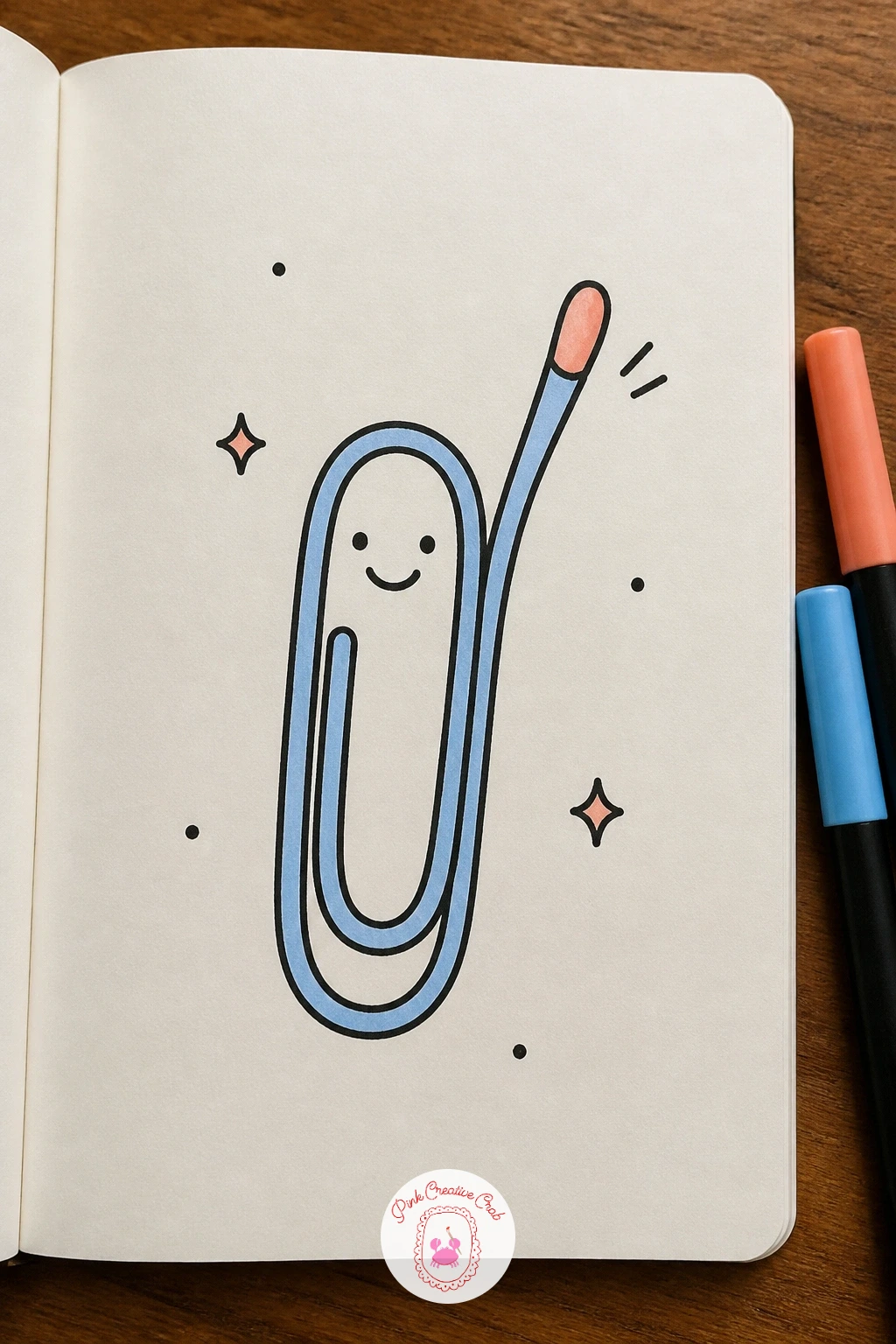
Take a break from larger objects with something tiny and simple: a paper clip caught mid-stretch. Draw the familiar double loop paper clip shape, then bend one end slightly outward and upward, as though it is reaching up like someone stretching after sitting too long.
Give it a small face near the top loop with eyes closed and a satisfied, relieved expression, and add two short curved lines near the stretched end to suggest the motion of the reach. Color most of the clip body sky blue, leaving just the stretched tip in peach to draw the eye toward the motion.
Because the whole subject is just a few thin lines, keep every curve smooth and deliberate rather than rushed, since a shaky line is far more noticeable on a simple shape like this than on a busier one. If the classic double loop feels fiddly to get symmetrical, draw a single loop first as a guide, then trace the second loop just outside it.
This is a good one to practice fast, since you can fit four or five small paper clip poses on a single page in the time it takes to draw one larger character elsewhere on this list.
Palette: Sky Blue,Peach,Black
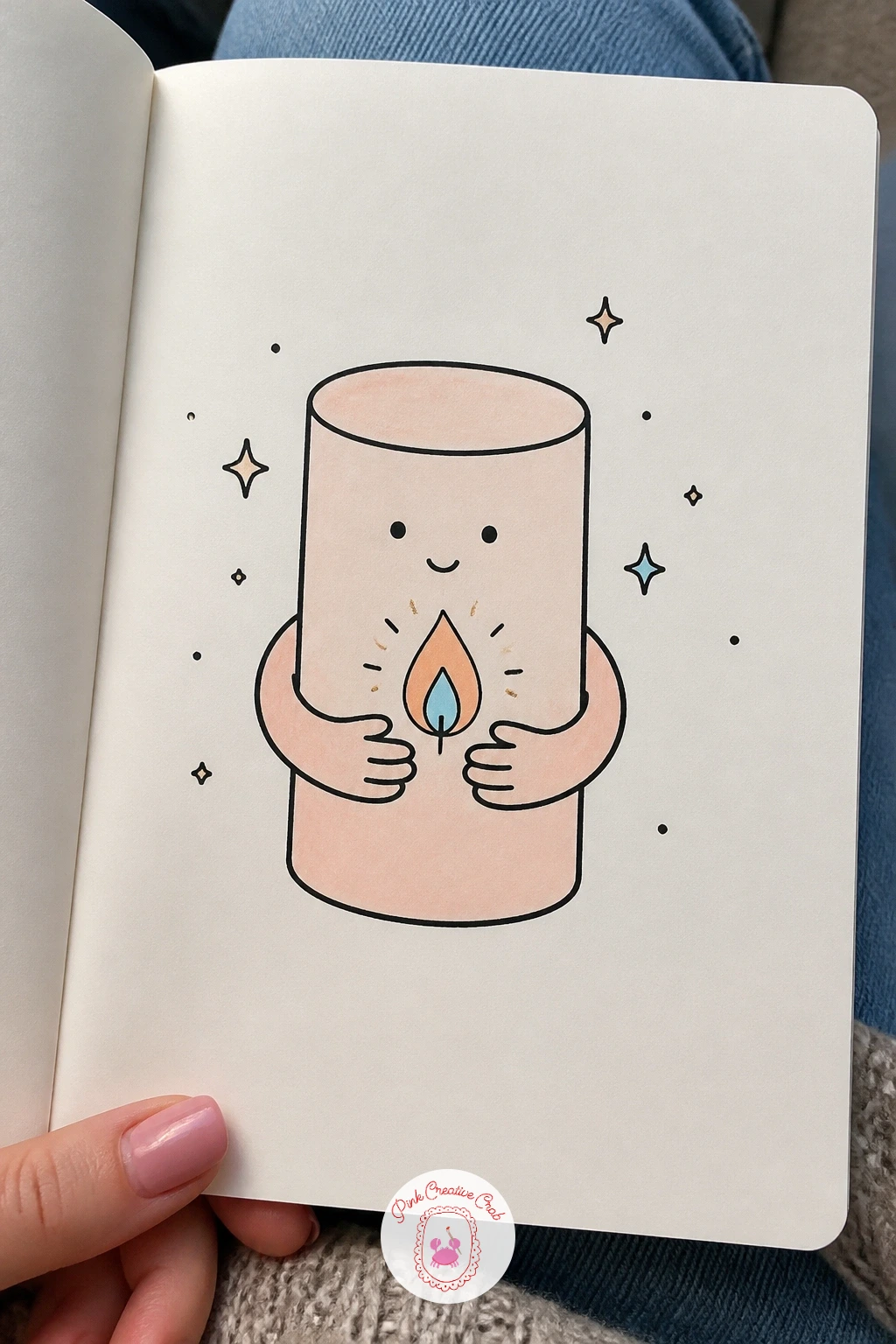
Light things up with a candle that cups its own hands around its tiny flame. Draw a simple cylindrical candle body with a short wick at the top, then add a small teardrop flame shape just above the wick, slightly flickering with a wavy rather than a smooth outline.
Give the candle two small arms reaching up on either side of the flame, hands cupped as though shielding it from a breeze, and a calm, protective expression beneath. Color the candle body peach and the flame sky blue at the base fading toward white at the tip, if you want a cooler flame look, or keep it in a warmer tone if that suits your palette better.
Hand placement is what sells the shielding gesture: keep both hands close to the flame without actually touching or covering it, since hands drawn too far away just look like a separate wave rather than active protection. If a wavy flame outline feels tricky to control, a simple smooth teardrop shape still reads clearly as a flame, just with less flicker.
Try this one next with a small gust of wind lines blowing from one side, to show exactly what the candle is bracing against.
Palette: Peach,Sky Blue,Black
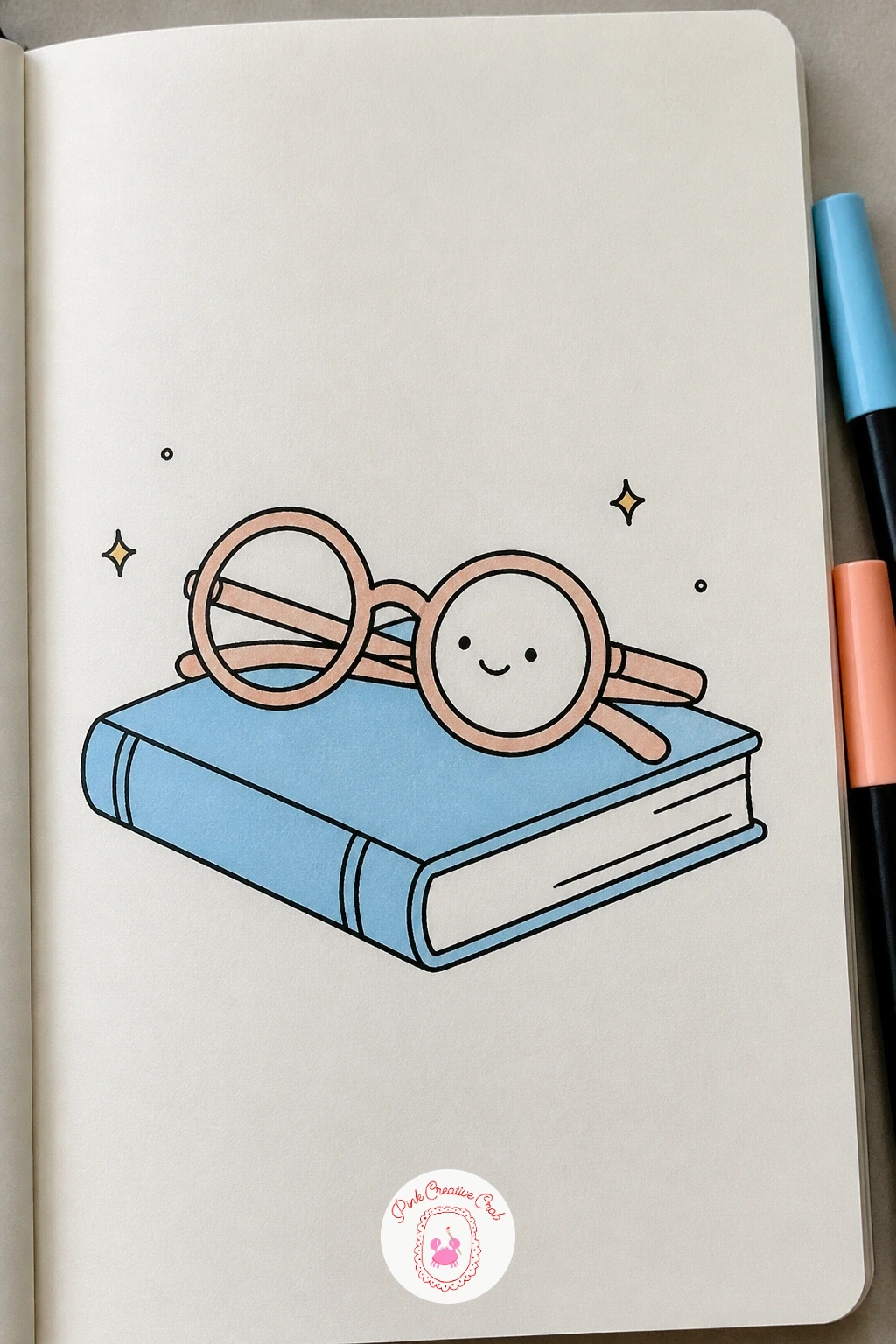
Slow the page down with a pair of glasses resting quietly on top of a closed book. Draw the book first as a simple closed rectangle with a visible spine edge, then add the glasses on top, two rounded lenses connected by a small bridge, with the temple arms folded in toward the center rather than spread open.
Give the glasses a small content face centered in the bridge area, eyes gently closed as though the glasses are also taking a short break from reading. Color the book cover sky blue and the glasses frames peach, keeping the lenses themselves mostly uncolored so they read as clear glass.
Folded temple arms are the trickiest part: draw them bent inward at roughly the same angle on both sides, since mismatched folding angles make the glasses look broken rather than simply set down. If you would rather draw the glasses open and worn, that works too, just add a small nose bridge shape and skip the folded arm detail entirely.
Keep this one quiet and still on the page, with plenty of white space around the book, it suits a calmer mood than some of the busier characters on this list.
Palette: Sky Blue,Peach,Black
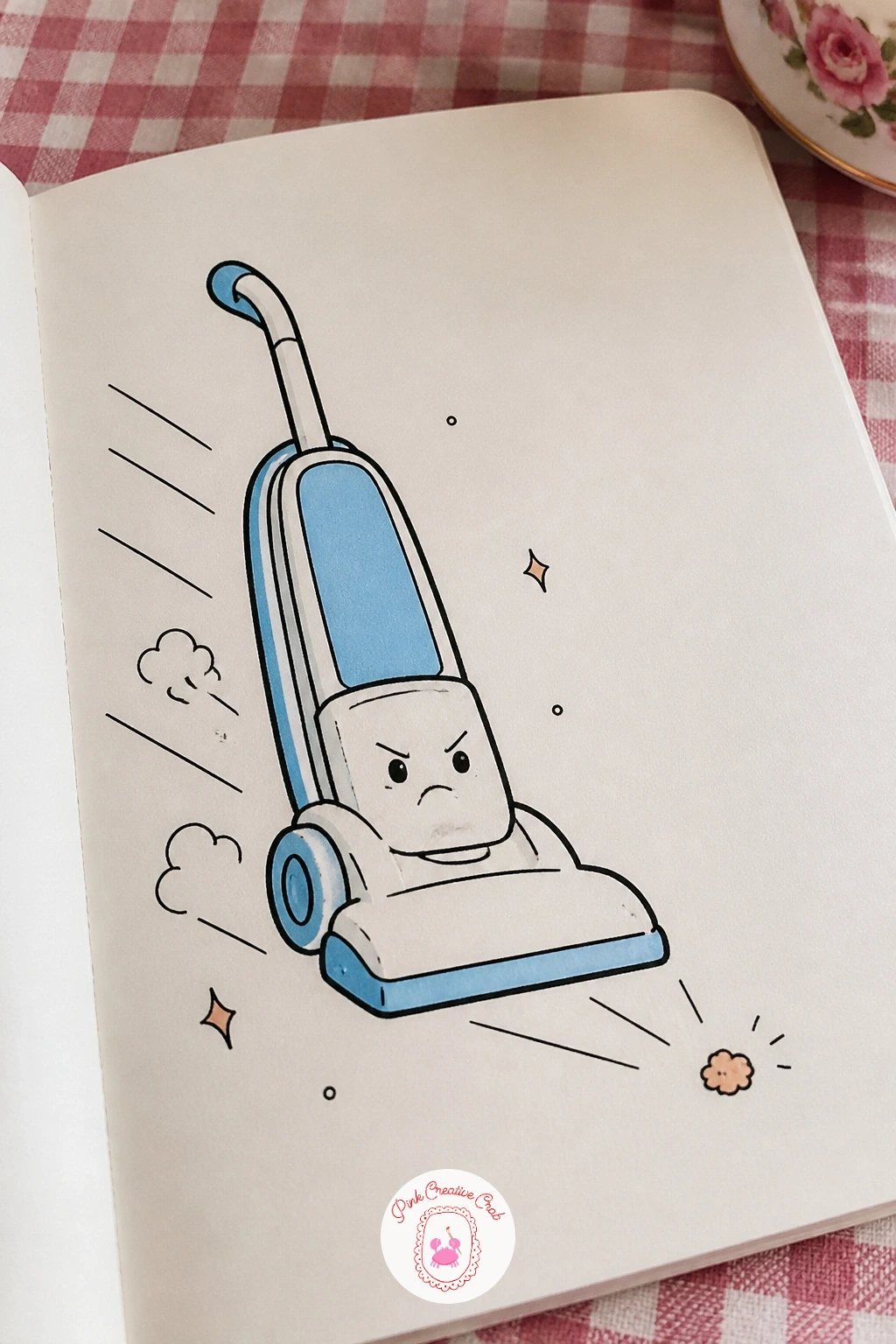
Pick up the pace again with a vacuum cleaner caught mid-chase after a single stray crumb. Draw an upright vacuum body with a simple cone or cylinder shape, a small wheel or two at the base, and a short hose or nozzle pointed determinedly toward one tiny crumb drawn nearby on the floor.
Give the vacuum a focused, slightly fierce expression, eyebrows angled downward, and add two or three short motion lines behind it to suggest it just rolled quickly into frame. Color the vacuum body sky blue and the single crumb peach, keeping the crumb genuinely small so the size contrast reads as a little comic chase rather than an even match.
Only drawing one crumb, not several, is what makes this read as a specific tiny chase rather than general cleaning, so resist adding extra mess around it. If the vacuum’s wheel base feels hard to balance, a simple flat line at the bottom with just a shadow beneath works fine instead of drawing visible wheels.
Angle the nozzle directly at the crumb before you ink anything else, that single sightline is what tells the whole story.
Palette: Sky Blue,Peach,Black
Head back to the kitchen one more time for a jam jar enjoying its own spoon. Draw a simple round-shouldered jar shape with a lid on top and a small label band around the middle, then give it two thin arms holding a small spoon dipped slightly into the open jar.
Give the jar a happy, satisfied face just above the label, and fill the jar’s interior with a few loose wavy lines to suggest thick jam texture rather than a flat solid color. Color the jam itself peach or a warm red-toned peach if you are mixing markers, and leave the glass jar mostly in plain outline with a light sky blue tint for the lid.
Jam texture inside the jar is the easiest place to overdo things, so two or three loose horizontal wavy lines are enough, packing in more just muddies the inside of the jar. If a full lid feels fiddly at this size, a simple flat band across the top of the jar reads just as clearly as a lid without needing extra rim detail.
Draw the spoon dipping in at a slight angle rather than straight down, it looks more like an actual scoop in progress that way.
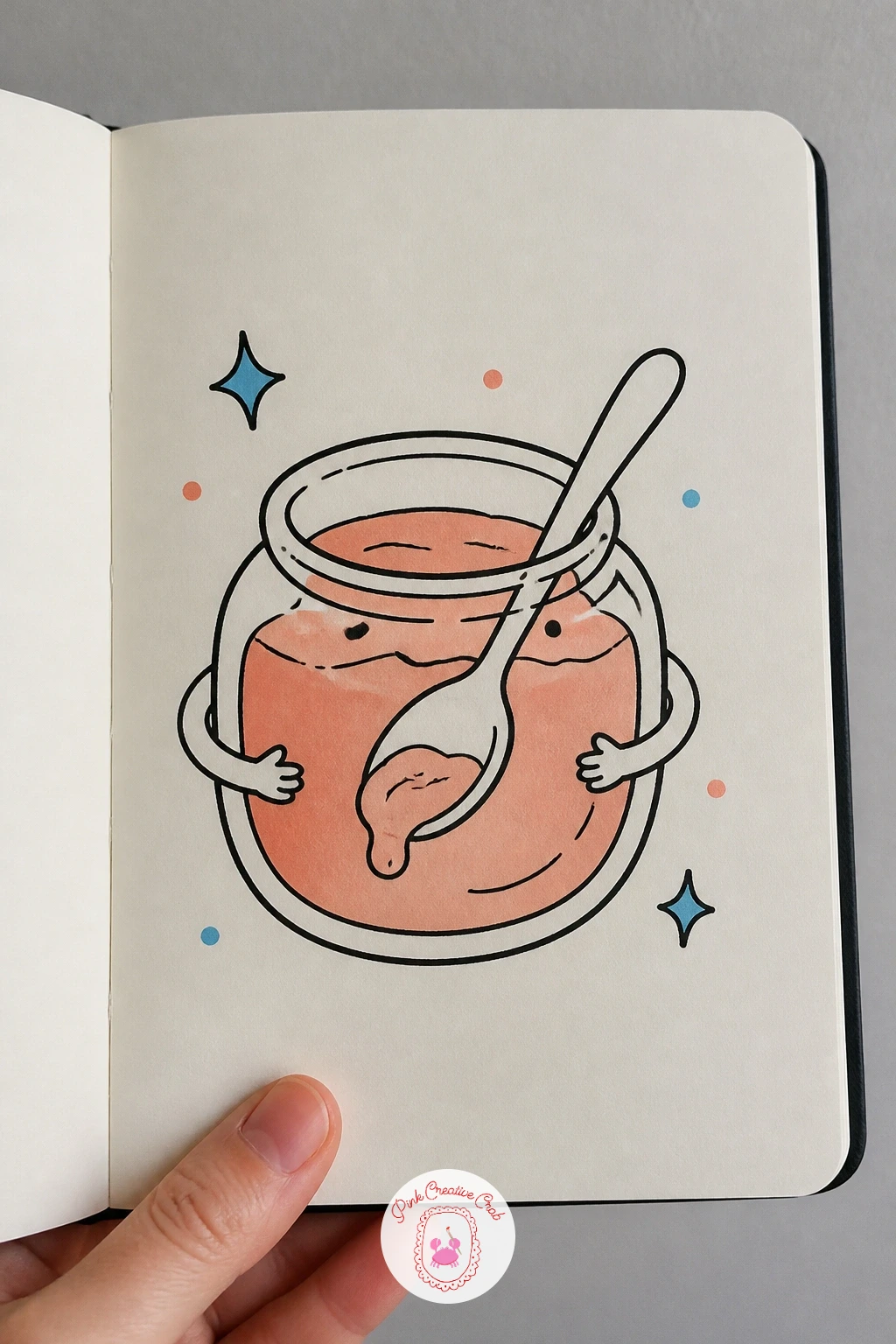
Palette: Peach,Sky Blue,Black
Close the list with a spool of thread carefully holding its own needle. Draw a simple cylindrical spool with a visible thread wound evenly around its middle in a few neat diagonal lines, then give it two thin arms holding a small needle out in front, threaded with a single loose strand looping back to the spool.
Give the spool a careful, concentrating expression, as though mid-stitch, and keep the thread winding lines evenly spaced rather than overlapping messily, since neat winding is what makes a spool read clearly at a glance. Color the spool body peach and the thread sky blue, which also makes the loose threaded strand easy to follow visually from the needle back to the spool.
The needle is the trickiest element at this small scale, so keep it as one simple thin line with a tiny oval eye near one end rather than trying to add shine or metallic detail. If thread color matching the spool itself feels confusing, make the loose working strand noticeably thinner than the wound thread so the two stay visually separate.
One last tip for today: keep this spool’s expression gentle and focused rather than worried, it suits the quiet, careful nature of the task far better.
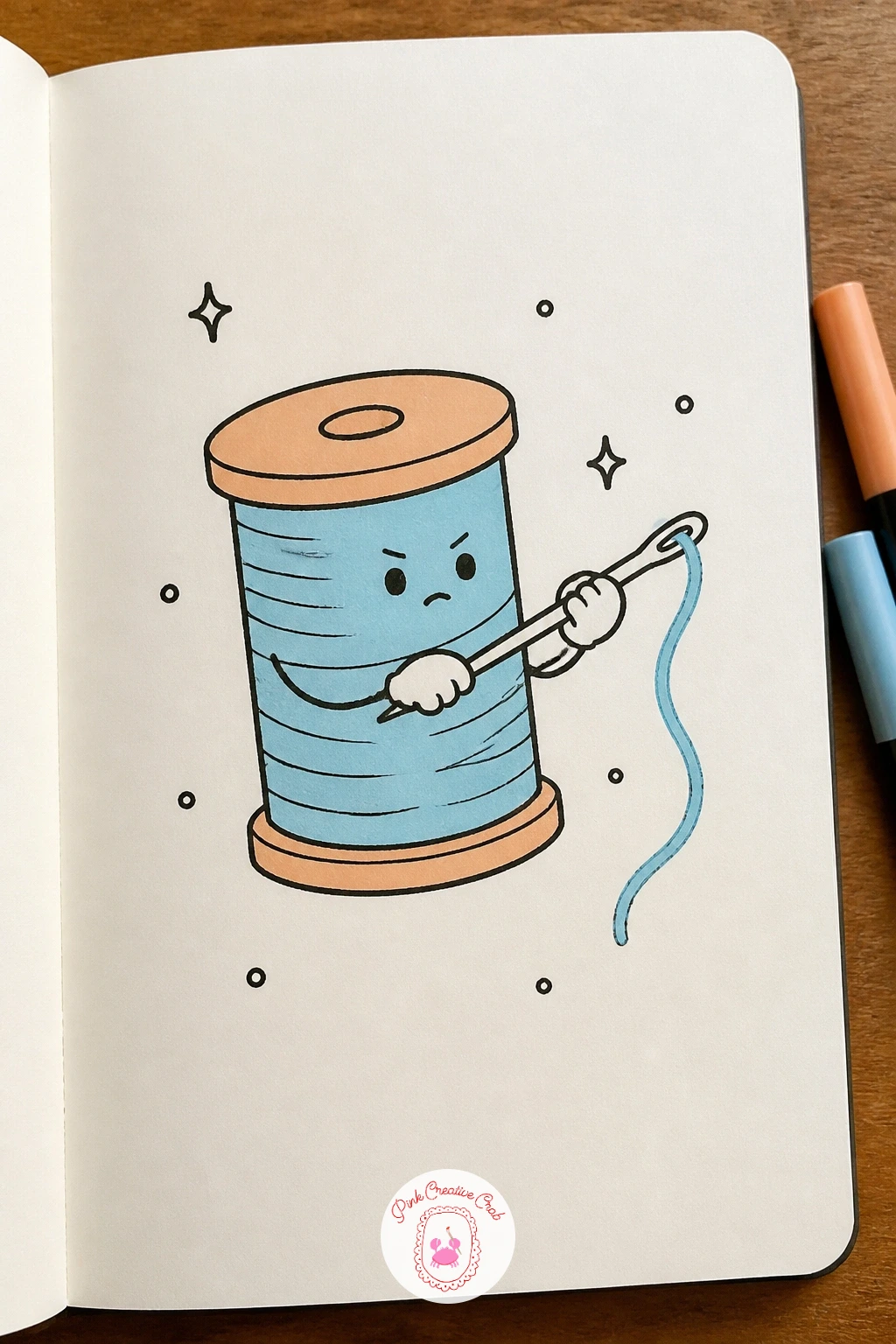
Palette: Peach,Sky Blue,Black
What to Do Next
Pick whichever face made you smile first, whether that is the proud whistling kettle or the tired phone clutching its charger, and start with just a pencil outline before you commit to ink. A plain notebook page and your fineliner are all you need, and once one idea feels easy, the next one on the list will go even faster.
Frequently Asked Questions
What pens work best for doodles like these?
A black fineliner in a fine tip, around 0.3 to 0.5, gives the cleanest outline for these doodles. Add sky blue and peach alcohol or brush markers afterward for the accent color, once the ink outline has fully dried.
How do I make these objects look friendly instead of flat?
Keep every shape rounded rather than sharp cornered, and place the eyes slightly below the halfway point of the face area. A closed or half closed eye reads as calmer and friendlier than a wide stare on most objects.
Do I need to draw a background for each doodle?
No, these doodles work best with plenty of white space around the subject and little or no background. A few small motion lines or a single prop beside the object is usually all the scene needs.
How long does each doodle idea take to finish?
Most of these take between five and fifteen minutes once the shapes feel familiar, since each is a single small character or object. Simpler subjects like the paper clip or eraser finish even faster than the busier scenes.
What if my lines come out shaky or uneven?
Shaky lines actually suit this loose, hand drawn style, so there is no need to redo them. Draw slowly with your whole arm moving rather than just your fingers, and the lines will settle with a little practice.
Have any thoughts?
Share your reaction or leave a quick response — we’d love to hear what you think!
-
 0
-
 0
-
 0
-
 0
-
 0
-
 0
