A reaction doodle is the quickest way to put a whole mood onto paper: one small character, one big feeling, drawn in a few minutes flat. These little faces are made for a fineliner and a couple of markers, so there is no mixing, no drying time and no pressure to get anatomy right, just a round body, a sharp expression and maybe a prop.
Below are 37 of them, from a wide-eyed shocked cat to a teapot rattling with rage, ordered from the simplest blob shapes up to the ones with a little more going on. Pick whichever one matches how you feel today and draw it exactly as it is, or swap the animal for your own favorite once you see how the formula works.
Using these images: free for personal projects such as printing, coloring, cards, journals and gifts. Handmade items that include them may be sold up to 30 pieces per design. More than that is commercial use and is not permitted, and neither is selling or sharing the images themselves or passing them off as your own. Please ask before any other use.
Start with the easiest shock face in the whole set: a shocked cat sitting bolt upright, fur standing straight out in every direction. Draw a round head and a slightly smaller oval body first in fineliner, then two huge circles for eyes with a tiny dot pupil floating in the middle of each.
Once the face sits right, ring the whole body with short straight lines pointing outward instead of smooth fur, that spiky outline is what sells the shock. Add two triangle ears, a small open mouth and whiskers last so they do not get lost under the fur lines.
If the spikes come out too even and stiff, vary their length and angle a little, uneven spikes actually read as more startled than a tidy row. Color just the inner ears and the nose tip in tangerine, leaving the rest white keeps the panic reading clearly from across a page.
Draw the eyes a touch bigger than feels sensible, oversized eyes are what make a reaction doodle work at this size.
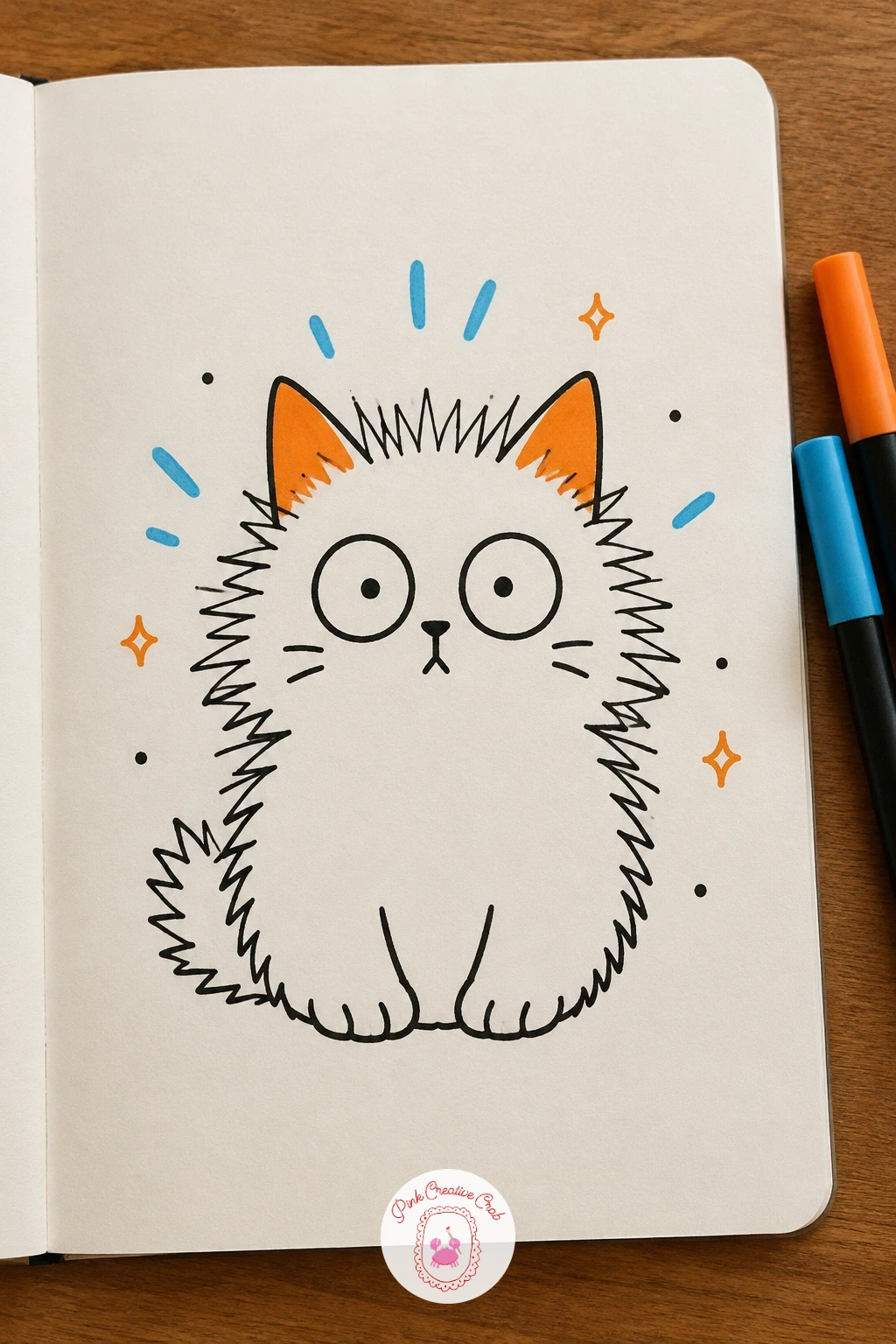
Palette: Tangerine Orange,Ink Black
Move from the cat straight into the simplest shape in this whole list, a round blob laughing so hard it has tipped onto its back. Draw one big circle lying on its side with two short stub arms and legs sticking up, then add a wide open mouth curved into a laugh.
Eyes become two tight squeezed-shut curves instead of circles, since a laughing face always closes its eyes. Add two or three curved lines streaming from each eye for tears, and a couple of motion lines under the blob to show it rolling.
If this is your first time drawing a blob character, keep the whole shape a little lumpy rather than a perfect circle, a slightly uneven outline gives it more personality than a geometric one. Color the blob itself sky blue and leave the tears and mouth white for contrast.
Draw the mouth wider than feels natural, an exaggerated laugh reads better than a polite smile at this size.
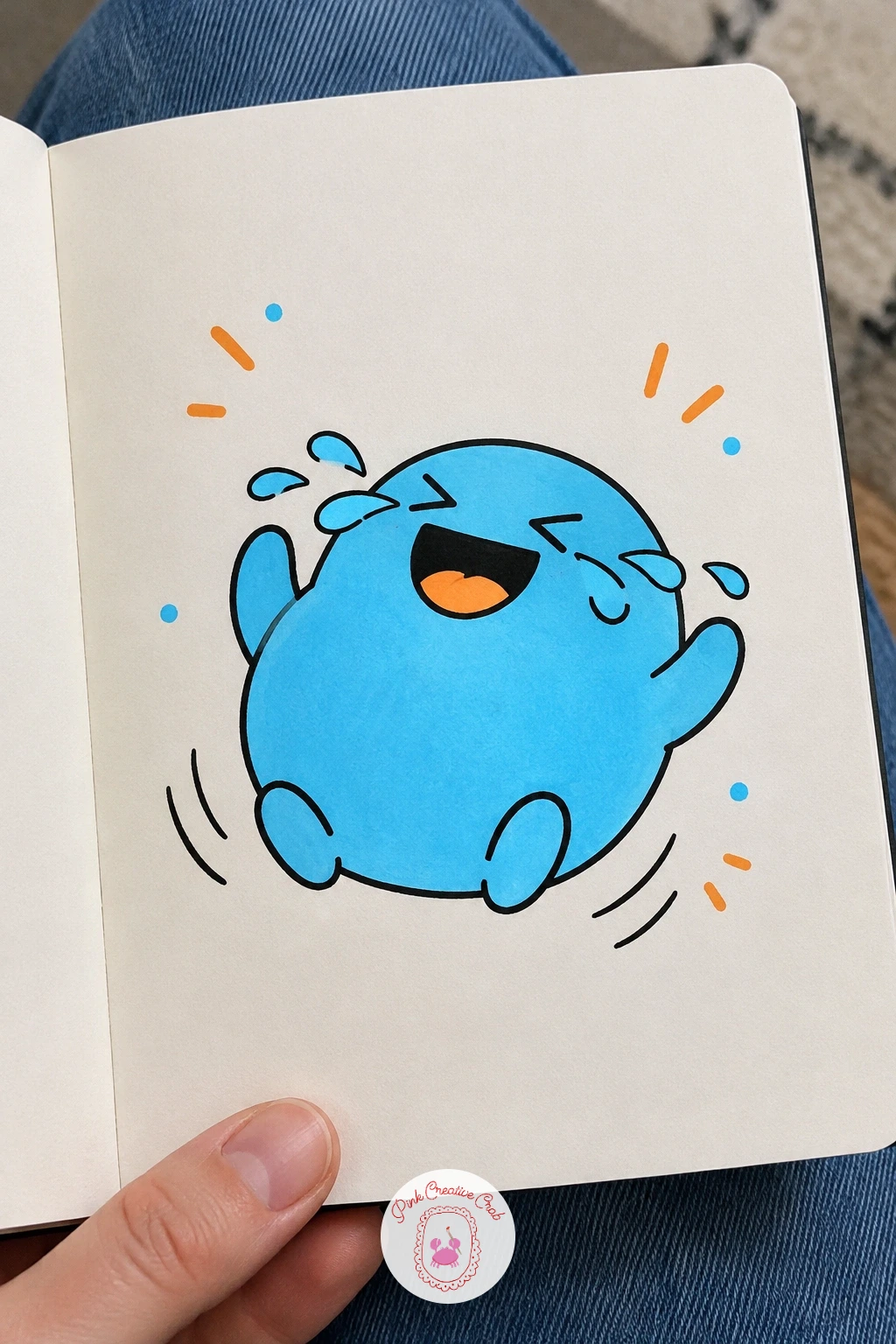
Palette: Sky Blue,Ink Black
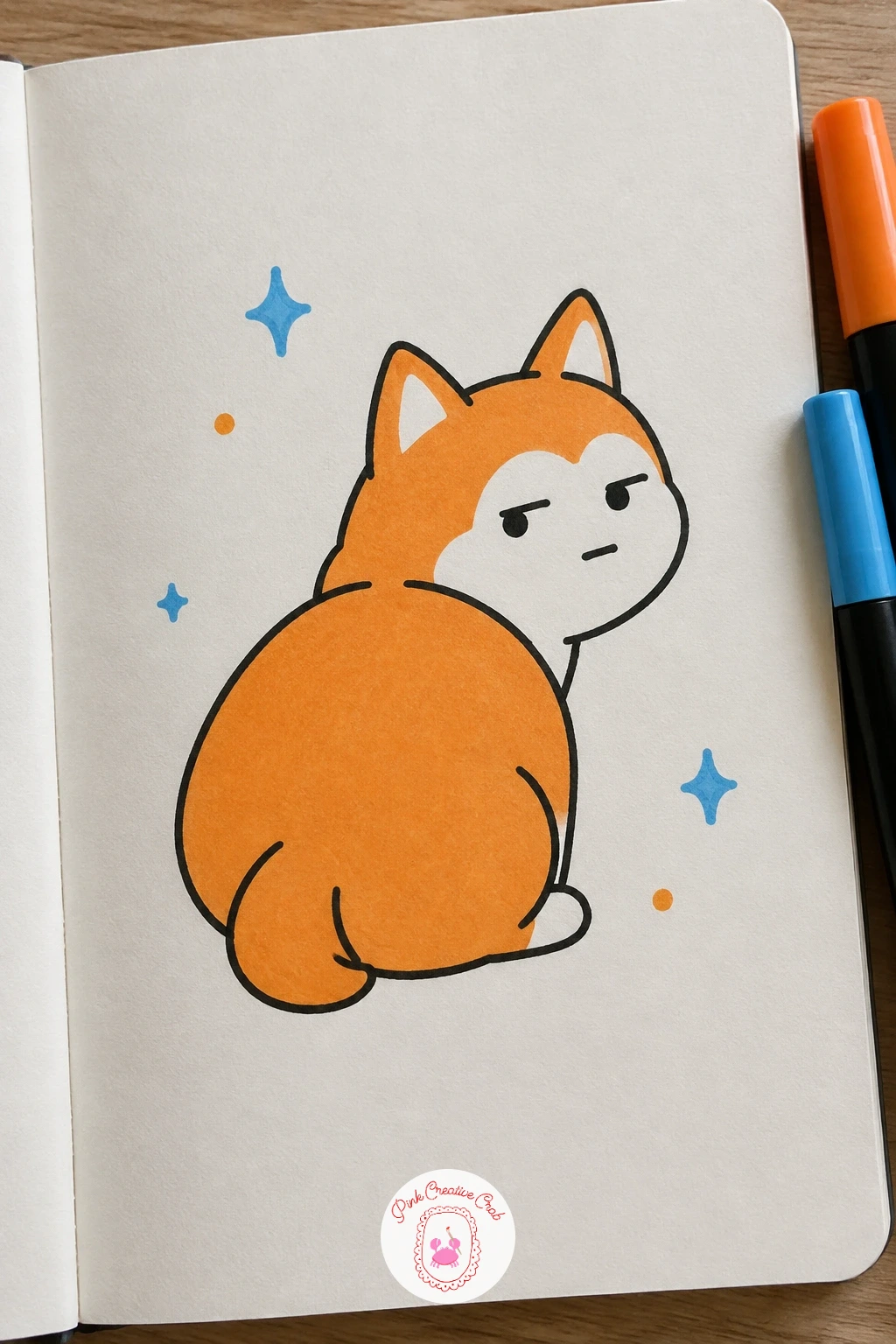
After two blob shapes, bring in a bit of perspective with a dog glancing back over its shoulder in pure side-eye. Draw the body facing away first, then turn only the head to face the reader, that twist is what gives the pose its suspicious energy.
Think about where the eye actually looks: both pupils push into the far corner of the eye shapes rather than sitting centered, and the eyelids droop slightly over the top. That small shift in pupil position is the whole joke, so take your time placing it before inking.
Keep the ears low and the mouth a flat closed line, any curve there turns suspicion into a smile. Color the body and ears tangerine, leaving the face white so the eyes stand out clearly.
Draw the head slightly larger than the body would normally call for, it keeps the expression readable even at doodle size.
Palette: Tangerine Orange,Sky Blue,Ink Black
If you enjoy giving animals personality through a glance, the cat pencil drawing ideas at this beginner guide work on the same trick in graphite.
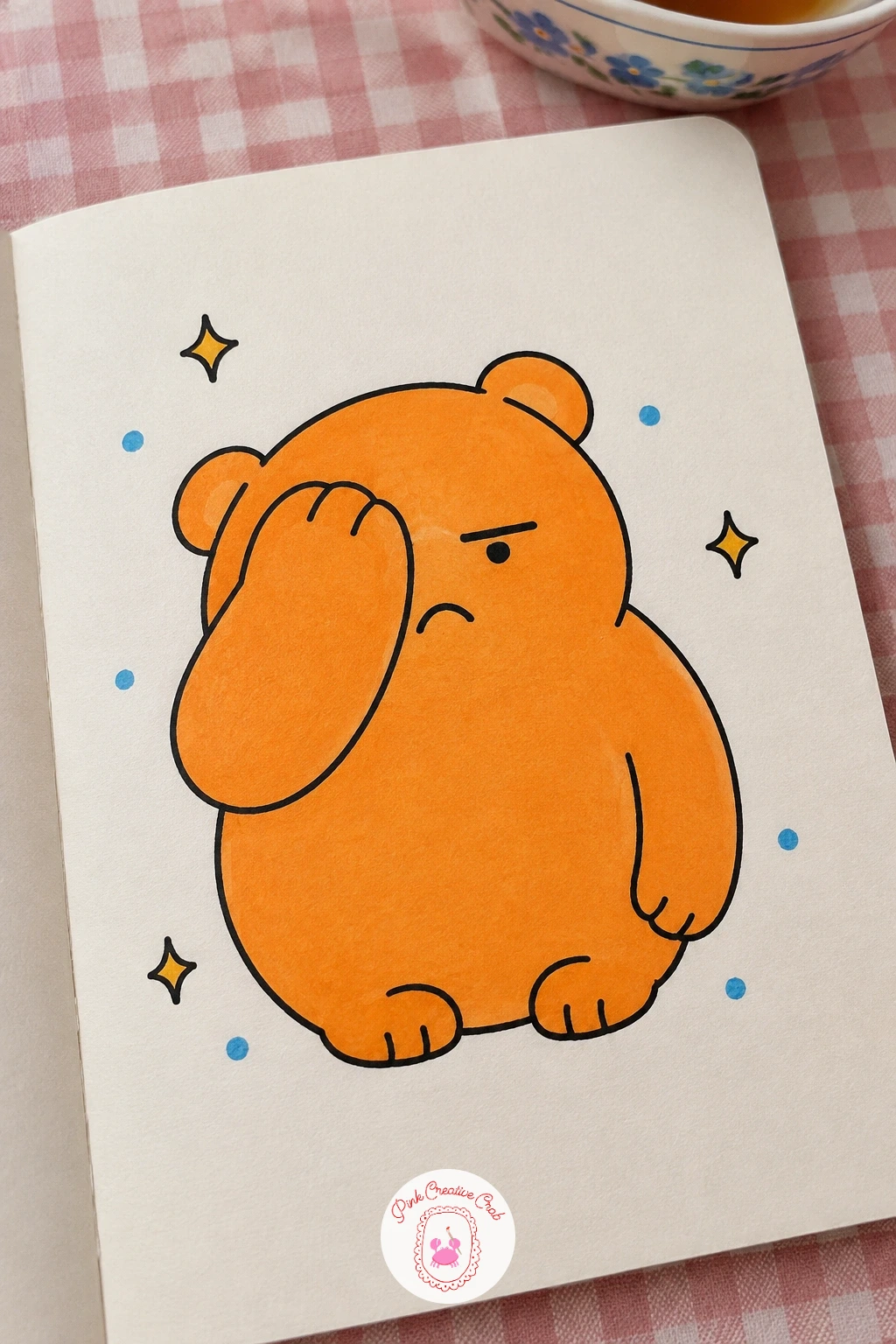
Carry the dog’s head-turn logic into a bear that has given up entirely and buried its face in one big paw. Draw a round bear head and shoulders, then bring one oversized paw up to cover half the face before you ink the features underneath it.
Only one eye peeks out from beside the paw, squeezed into a tired curve, and the visible side of the mouth droops down. Where the paw meets the face is the part that usually goes wrong, so overlap the paw’s outline slightly over the head rather than leaving a gap, that overlap is what makes it look pressed against the face rather than floating beside it.
Round ears and a soft belly curve keep the bear friendly rather than grumpy. Color the fur tangerine and leave the paw pads white.
Draw the uncovered eyebrow tilted down hard, that single line carries most of the exasperation.
Palette: Tangerine Orange,Ink Black
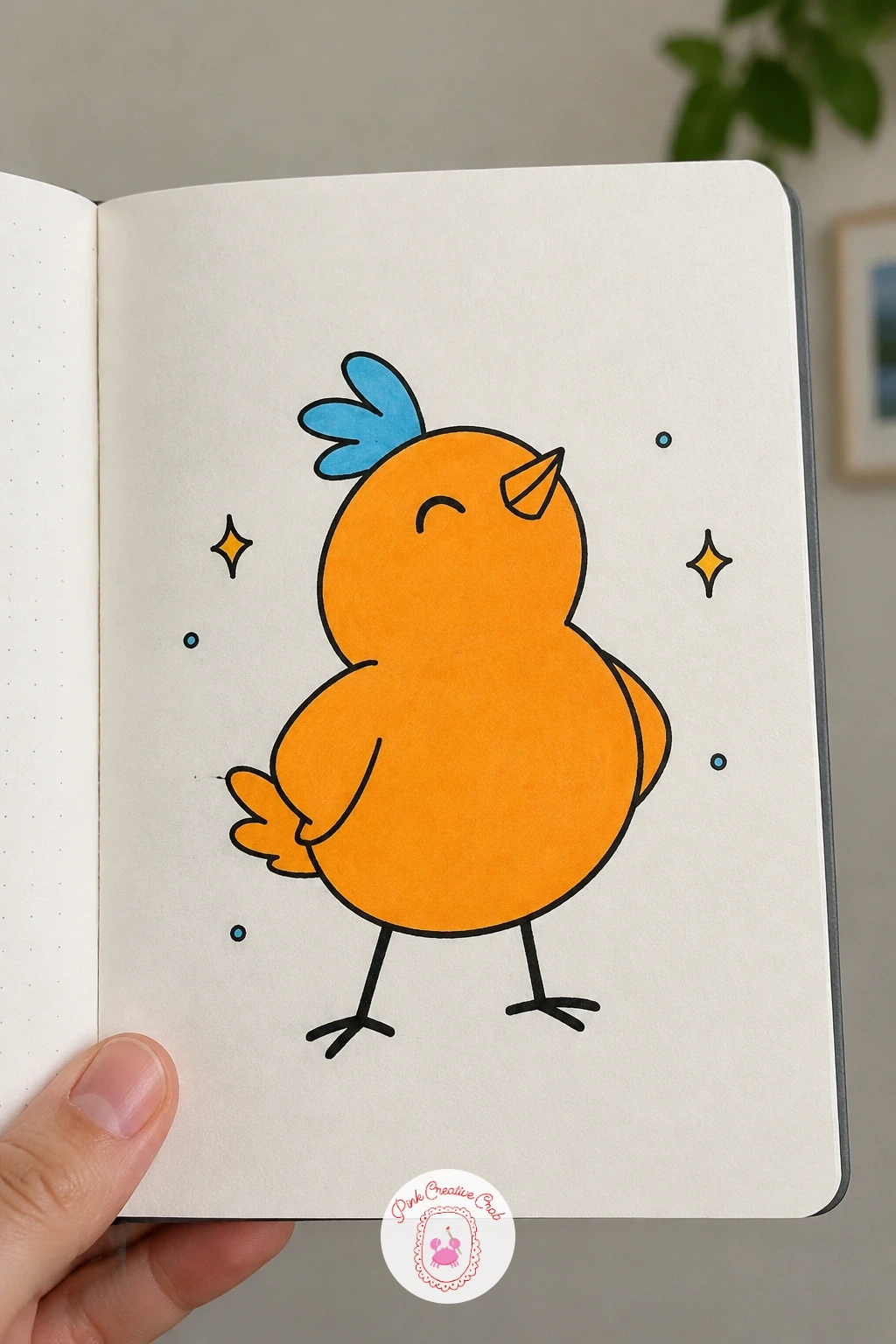
Switch from exhaustion to pride with a small chick standing tall and puffing its chest out with its eyes shut in satisfaction. Draw a round body with the chest curve pushed noticeably forward and the head tipped slightly back, that forward chest is what reads as pride rather than just a round bird.
Eyes become two closed upward curves, like tiny smiles turned sideways, and the beak points up rather than straight ahead. Two small wing stubs rest on the hips rather than hanging down, which adds to the confident stance.
If the body ends up round rather than puffed, push the chest line out further than feels right and pull the belly in slightly below it, the contrast between the two curves creates the puff. Color the body tangerine with a sky blue tuft of feathers on top of the head.
Add a few short motion lines beside the chest to show it swelling with pride.
Palette: Tangerine Orange,Sky Blue
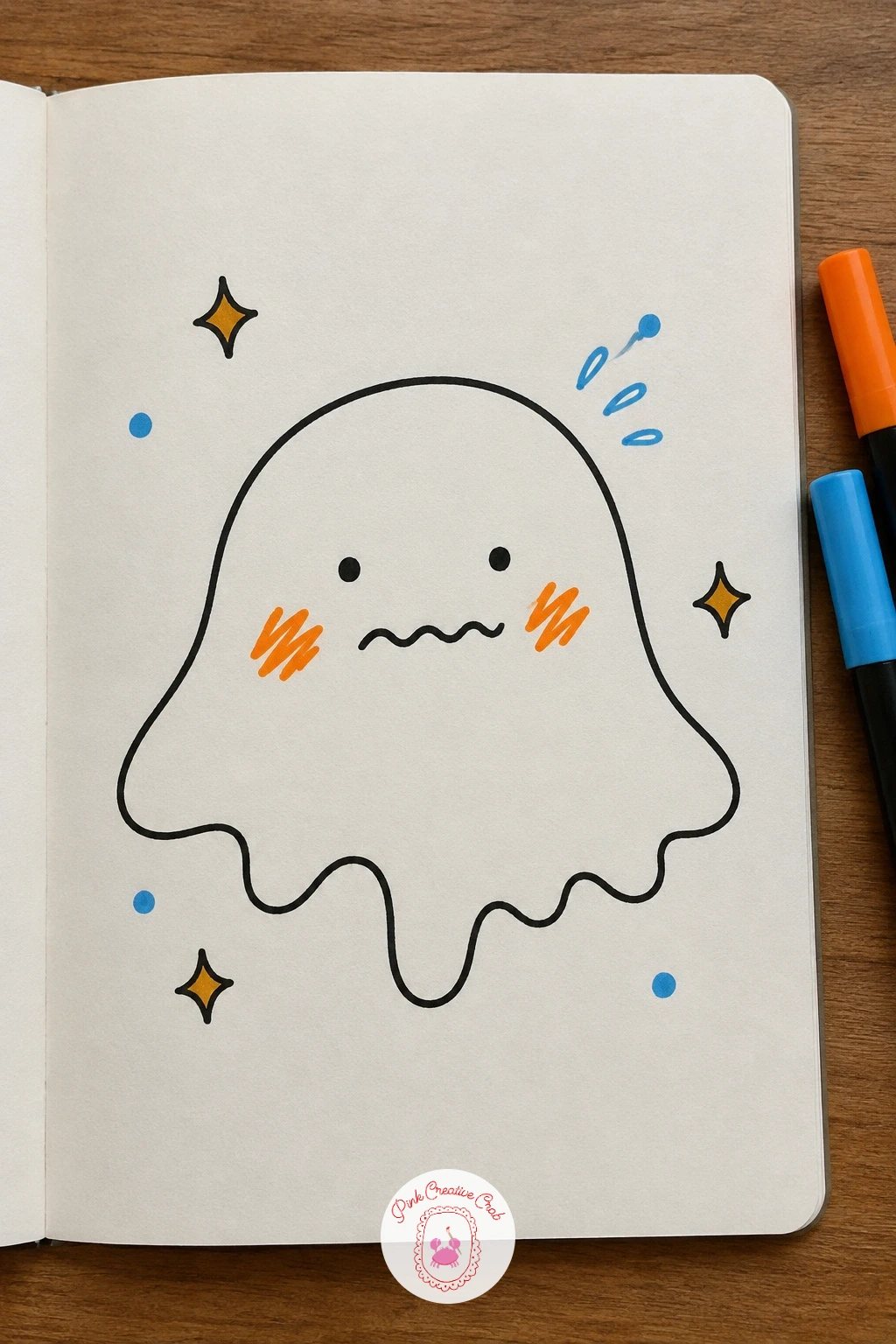
Now try a character with no fixed shape at all, a puddle of embarrassment that is visibly melting into the floor. Start with a rounded head shape at the top and let the bottom edge droop and sag unevenly, like wax running down a candle, rather than closing into a clean outline.
Keep two simple dot eyes near the top of the melt and a small wavy line for a nervous mouth, placed before the melting edges so the face stays readable. Blushing cheeks go on as two loose scribbled circles in tangerine, letting the color bleed slightly past the fineliner line actually helps it look hot and flustered rather than too neat.
If the melt looks too symmetrical, drag one side down further than the other, uneven sagging sells the gag better than a balanced puddle. Color the puddle body itself in a light sky blue wash if you have one, or leave it white with just the blush.
Draw a few small drip marks trailing off the lowest point for extra melt.
Palette: Tangerine Orange,Sky Blue,Ink Black
Bring a little proportion thinking into the next one: a hamster with its jaw dropped wide open, holding up one empty peanut shell in disbelief. Draw the round body first, then measure the open mouth against the head, the gap should be roughly a third of the whole face height to read as genuinely shocked rather than mid-chew.
Tiny paws hold the shell up near chest height, and the shell itself gets a few short lines inside it to show it is hollow. Round cheek pouches sit low and slightly deflated, since a shocked hamster has clearly lost its stash.
If the open mouth looks like a smile instead of shock, square off the corners rather than curving them up, a flatter oval mouth reads as surprise. Color the fur tangerine, the shell pale and empty-looking in plain outline.
Draw two tiny round eyebrow marks lifted high above the eyes to finish the disbelief.
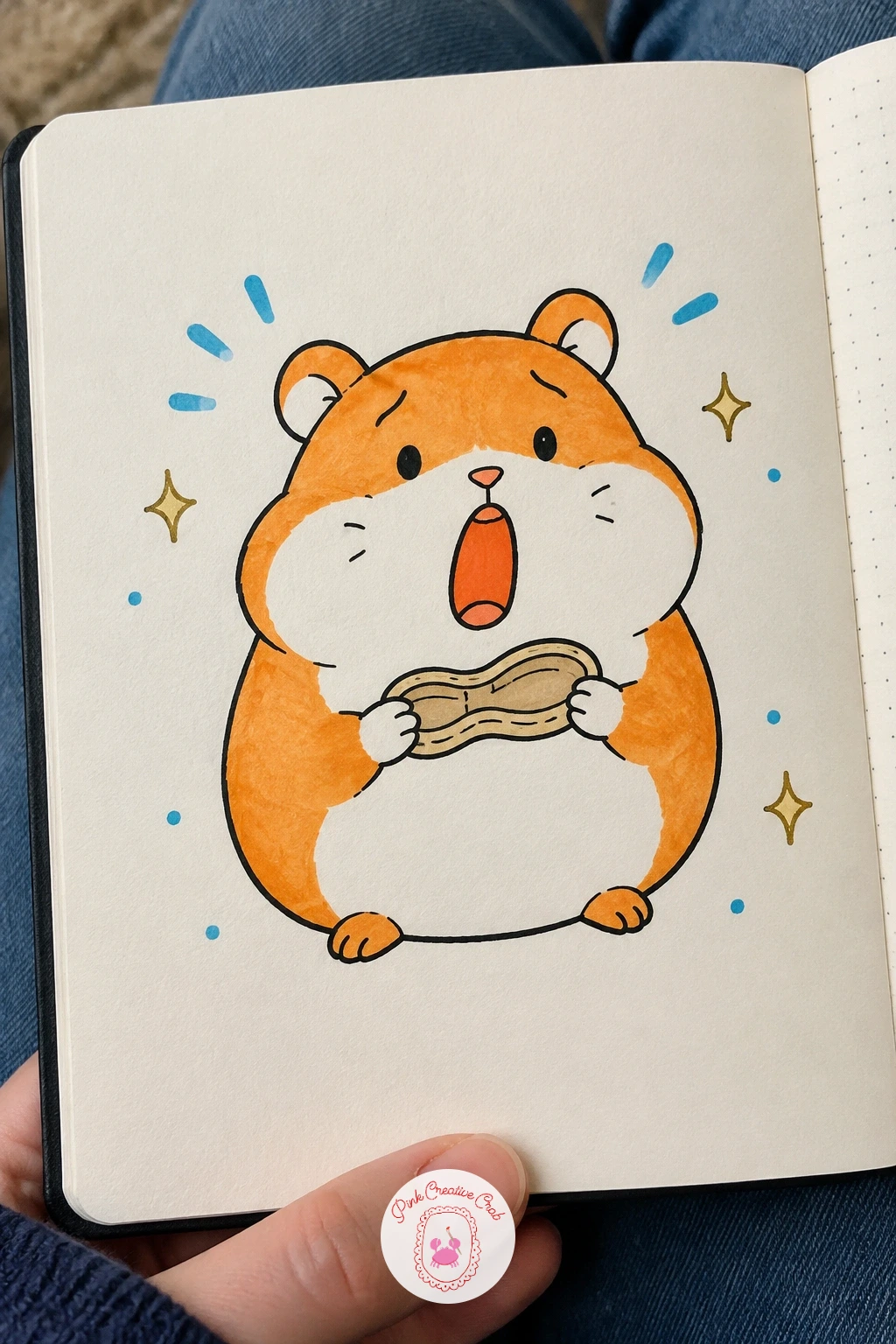
Palette: Tangerine Orange,Ink Black
Think about light and pose together for this one: a sloth hanging from a branch, giving the world’s slowest thumbs up. Draw the branch first as a single diagonal line across the top of the page, then hang the sloth’s arms over it before building the rounded body below.
Half-closed eyes and a faint smile keep the face relaxed rather than excited, speed is the entire joke so nothing about the expression should look urgent. One arm reaches up with a thumb clearly separated from the fist, the other stays wrapped loosely around the branch for support.
Shading barely matters here since the pose carries it, but a few short curved lines along the back suggest shaggy fur without slowing you down. Color the body tangerine with a sky blue branch for contrast.
Keep every line slow and a little wobbly on purpose, a too-clean sloth loses the joke entirely.
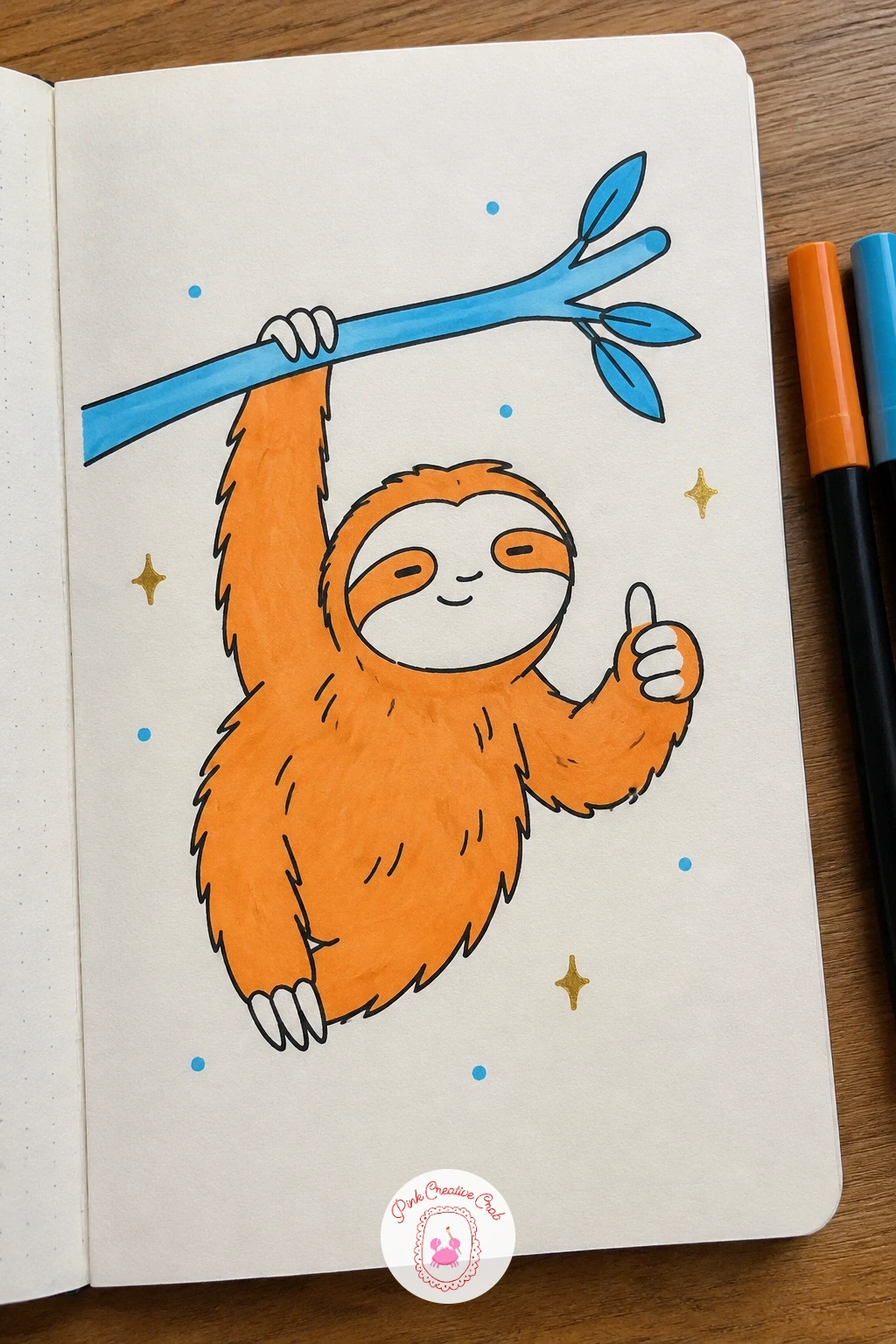
Palette: Tangerine Orange,Sky Blue
Keep working with light and framing: draw a tiny mouse peeking out from between its own paws, as if hiding from something scary just off the page. Start with the paws as two rounded shapes covering most of the face, then draw only a sliver of the eyes peeking through the gap between them.
That narrow gap is the whole trick, so leave it deliberately small rather than drawing a full face and covering half of it, the suspense comes from how little you actually show. One ear pokes up nervously above the paws, slightly flattened rather than upright.
If the peeking eyes get lost in the gap, outline just the pupils a touch thicker than the rest of the linework so they catch the eye first. Color the body tangerine with white paw fur left plain.
Draw a couple of short tension lines radiating from the head to suggest a held breath.
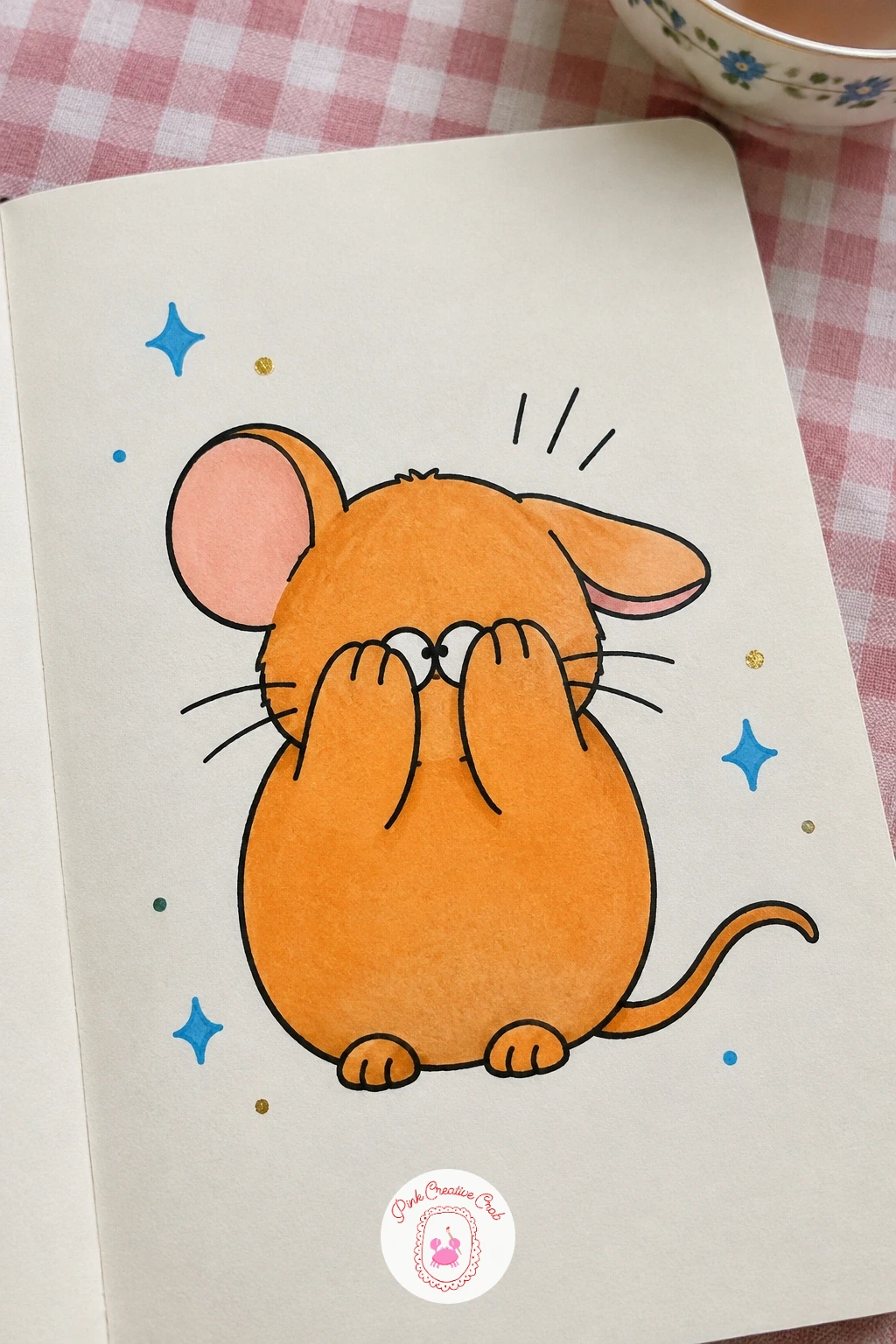
Palette: Tangerine Orange,Ink Black
Try the quick version first with this one, since a deadpan frog takes barely any lines at all. Draw a wide flat oval for the body, two bulging eyes sitting on top rather than on the sides, and half-closed eyelids drawn as straight lines cutting across the middle of each eye.
A completely flat horizontal mouth finishes the look in under ten minutes, no curve up or down at all, which is exactly what makes it deadpan. That is the whole quick version and it genuinely reads as funny on its own.
Given forty minutes, add some texture: a few small bumps along the back in a loose scatter, webbed toes drawn with short notches rather than smooth curves, and a lily pad underneath in sky blue. Color the body tangerine or leave it green if you prefer a classic frog, outline stays black either way.
Resist the urge to curve the mouth even slightly, a dead flat line is funnier than any smirk.
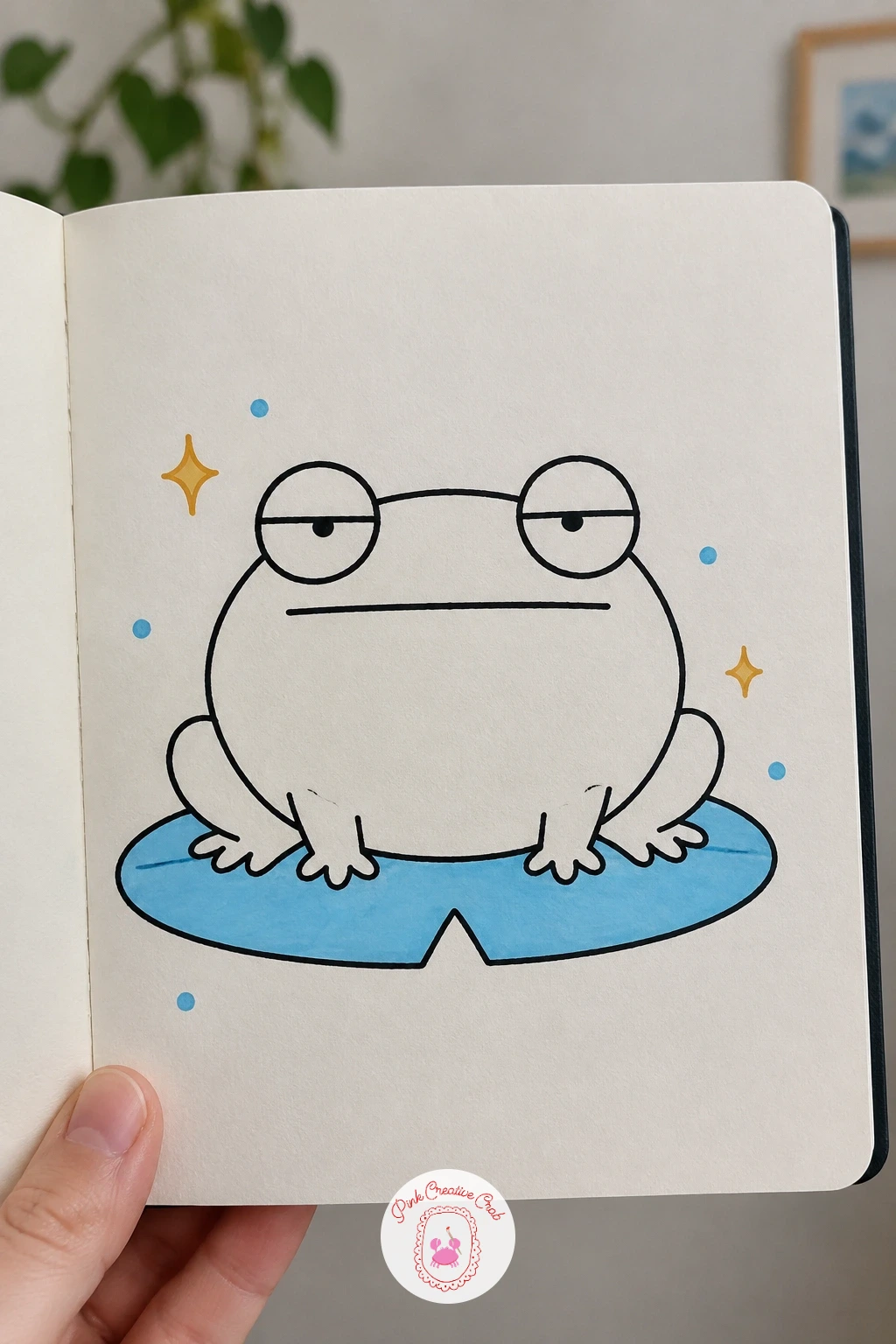
Palette: Tangerine Orange,Sky Blue,Ink Black
Give the next face a texture challenge: a puppy with wobbly lips, visibly trying hard not to cry. Draw the head and ears first, then build the mouth as a small zigzag line rather than a smooth curve, that broken wobble in the line is what reads as a trembling lip.
Eyes go glassy with one small curved highlight left white inside each pupil, and the eyebrows tilt inward and up for that pleading look. Keep the ears drooping low rather than perked, upright ears undercut the sadness instantly.
If the wobbly mouth comes out too smooth, go over it a second time in short broken strokes rather than one continuous line, dry choppy lines read as trembling far better than clean ones. Color the fur tangerine, leaving a sky blue collar around the neck for a small bright accent.
Leave one single tear drop sitting right at the corner of an eye without letting it fall, holding it there is more touching than a full cry.
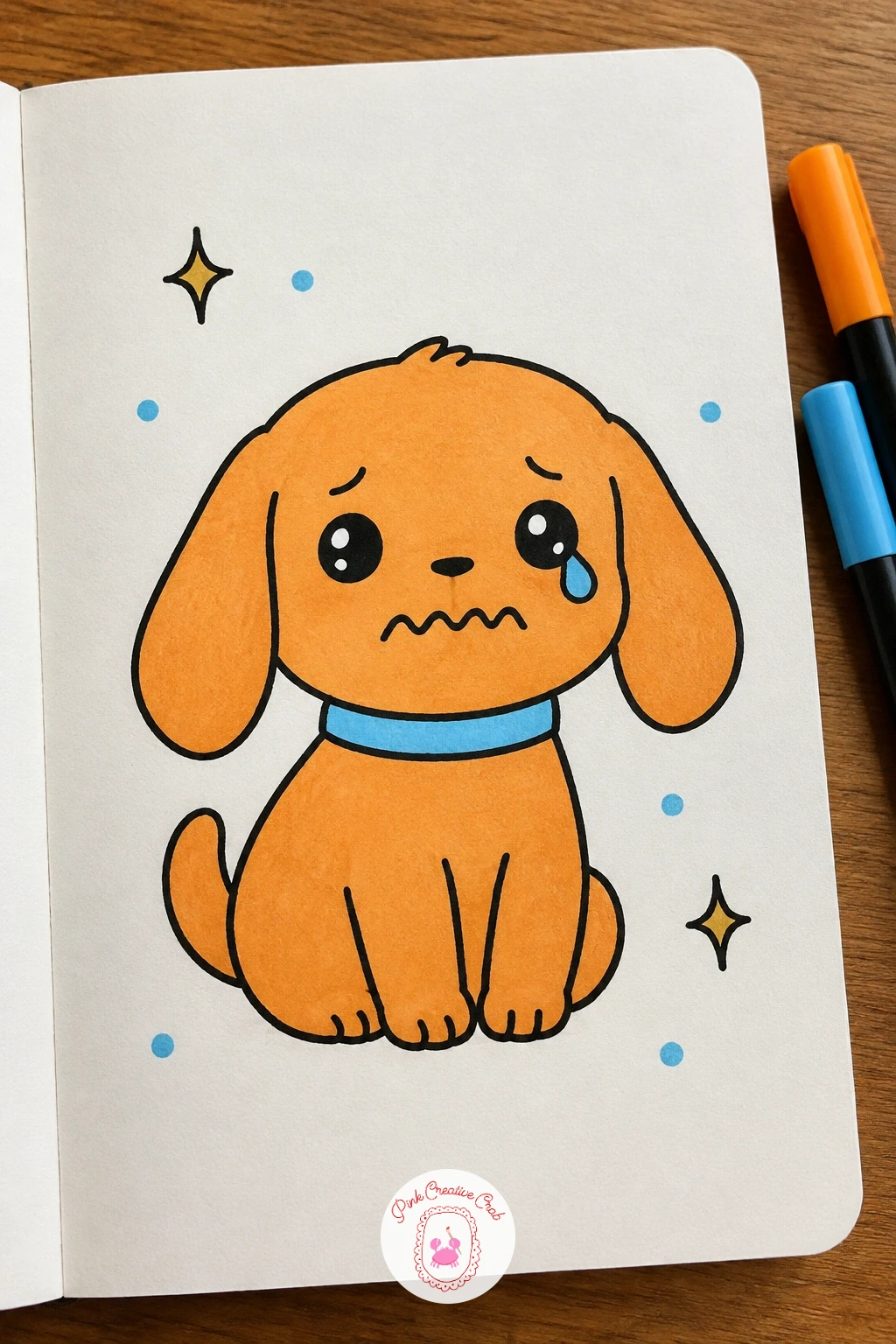
Palette: Tangerine Orange,Sky Blue
Move into full drama with a cat throwing one paw dramatically across its chest as if its heart has just been broken. Draw the body leaning slightly backward rather than upright, that small backward tilt sells the swoon far more than a straight pose.
One paw presses flat against the chest with the claws just slightly splayed, while the other arm flings out to the side for balance. Eyes squeeze shut with a few short lines above them for extra anguish, and the mouth opens in a small wail shape.
If the pose looks stiff, exaggerate the lean further than feels comfortable, a reaction doodle can get away with proportions a realistic drawing cannot. Color the fur tangerine and add a tiny cracked heart shape in sky blue floating just above the chest paw.
Keep the flung-out arm loose rather than straight, a slight curve in it reads as more theatrical.
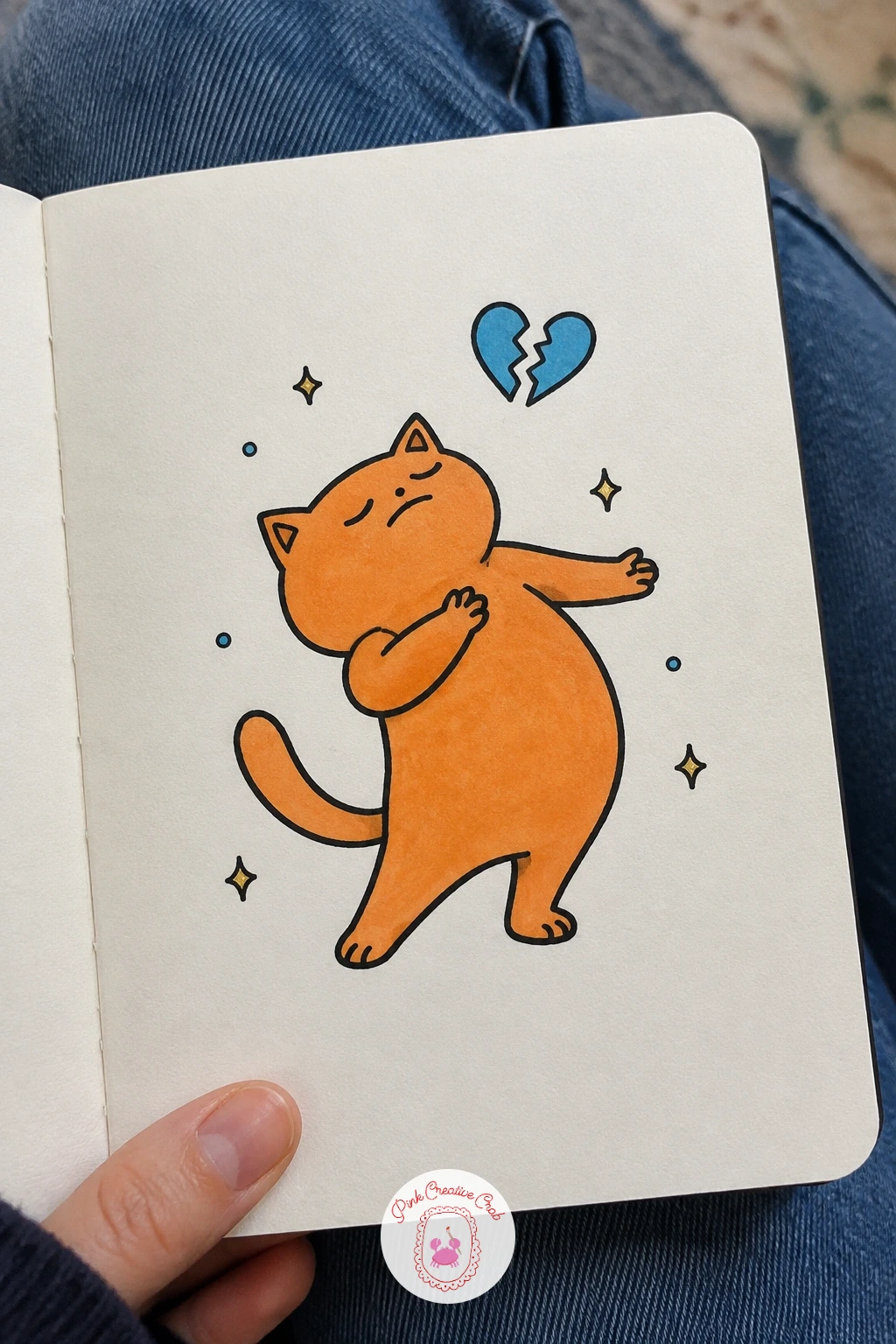
Palette: Tangerine Orange,Sky Blue
After the quiet drama of the cat, let loose with a bird screaming its head off, beak stretched wide with two feathers flying off mid-shriek. Draw the beak open far wider than a normal open beak, almost a full oval rather than a thin wedge, since the scale of the beak is what sells the volume.
Place two small feathers detached from the head, drawn with a gap between them and the body, to show they have just popped loose from the shock of the scream. Eyes squeeze into tight x shapes rather than circles for maximum alarm.
If the open beak looks more like yawning than screaming, add two or three short jagged lines radiating outward from it like a shout burst, that small addition changes the whole read. Color the body sky blue with a tangerine beak interior for contrast.
Keep the wings flung slightly upward rather than tucked, it adds to the sense of total overreaction.
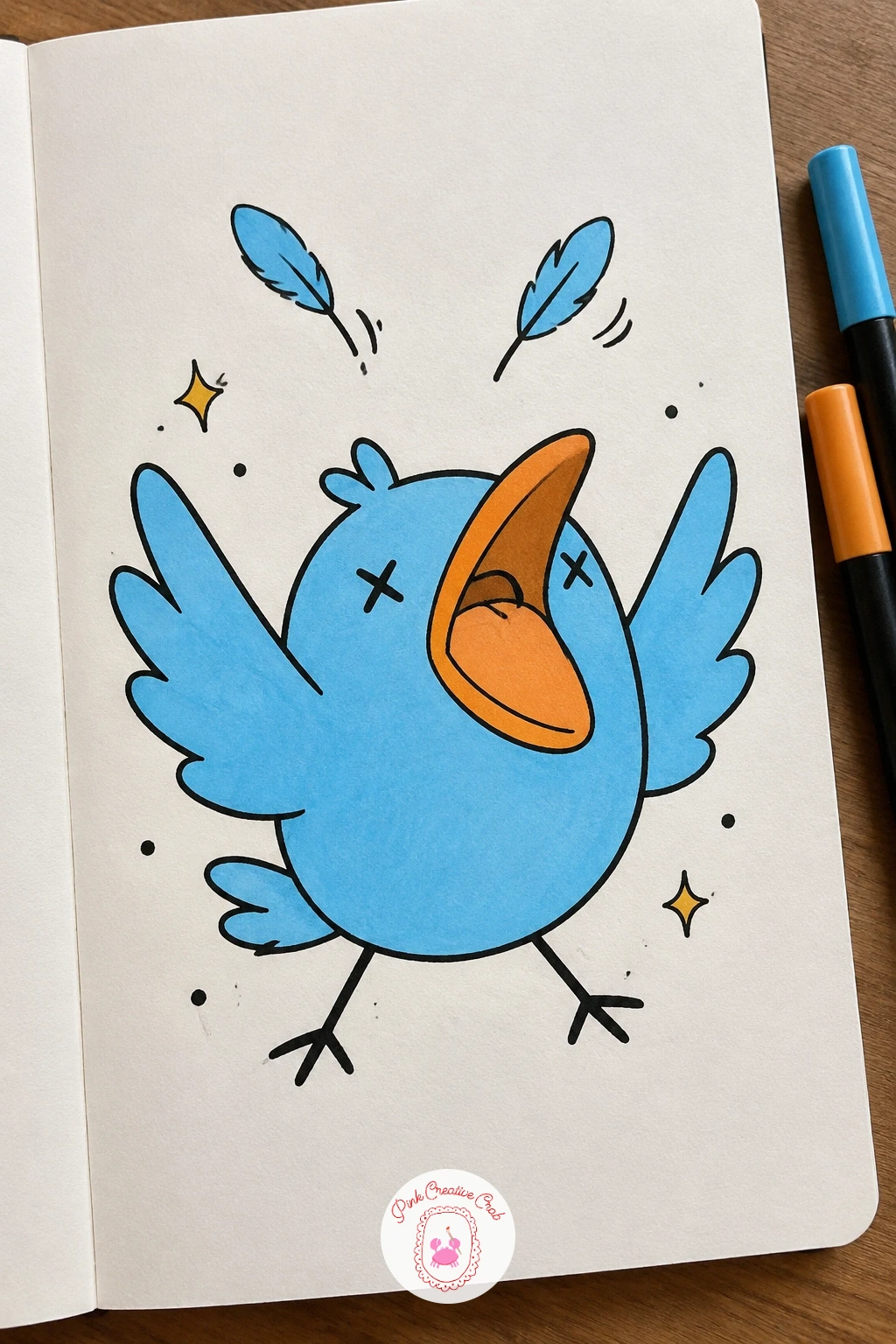
Palette: Sky Blue,Tangerine Orange
Shift the mood into shy embarrassment with a small ghost that has turned pink and is covering its face with both stub arms. Draw the classic wavy-bottomed ghost outline first, then bring both arms up to cover the upper half of the face, leaving only the eyes peeking just above the arms.
Since ghosts have no real anatomy to worry about, the whole trick is in the blush, so scribble a loose patch of tangerine color across both visible cheeks and let it spread slightly past the fineliner edges rather than staying perfectly inside the lines. That looseness is what makes a blush look hot and sudden instead of printed on.
Keep the wavy bottom edge of the ghost uneven rather than symmetrical scallops, a slightly lopsided wave looks more alive. If you do not have an orange marker, light pink colored pencil works just as well for the blush.
Leave the eyes as two small simple dots, anything bigger competes with the blush for attention.
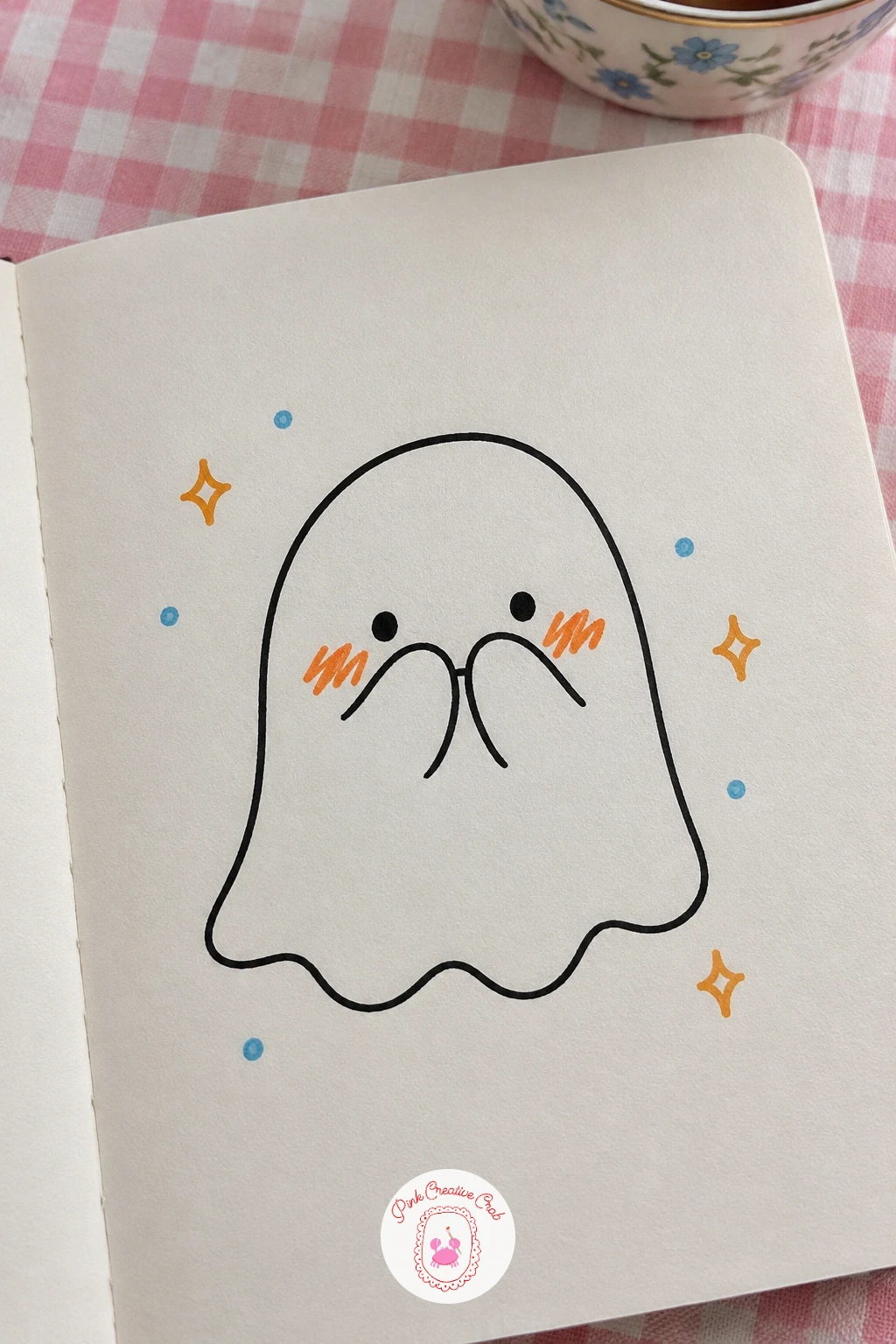
Palette: Tangerine Orange,Ink Black
Return to the hamster family for a sneakier version: cheeks puffed full of food, eyes wide and innocent, clearly pretending nothing happened. Draw the cheeks noticeably larger and rounder than a normal hamster face, almost bulging past the outline of the head, since the exaggerated puff is the entire joke.
Keep the eyes wide open and slightly too round for innocence to actually land as innocent, a subtle giveaway that always gets a laugh. Tiny paws rest politely in front of the body rather than near the mouth, as if hiding any evidence.
If the cheeks look lopsided, draw one side, trace over it faintly to check the match, then commit to the second side in ink rather than eyeballing both freehand. Color the cheeks tangerine with a slightly darker edge where they bulge most, body left mostly white or lightly shaded.
Add one tiny crumb drawn beside the mouth for the detail that gives it away.
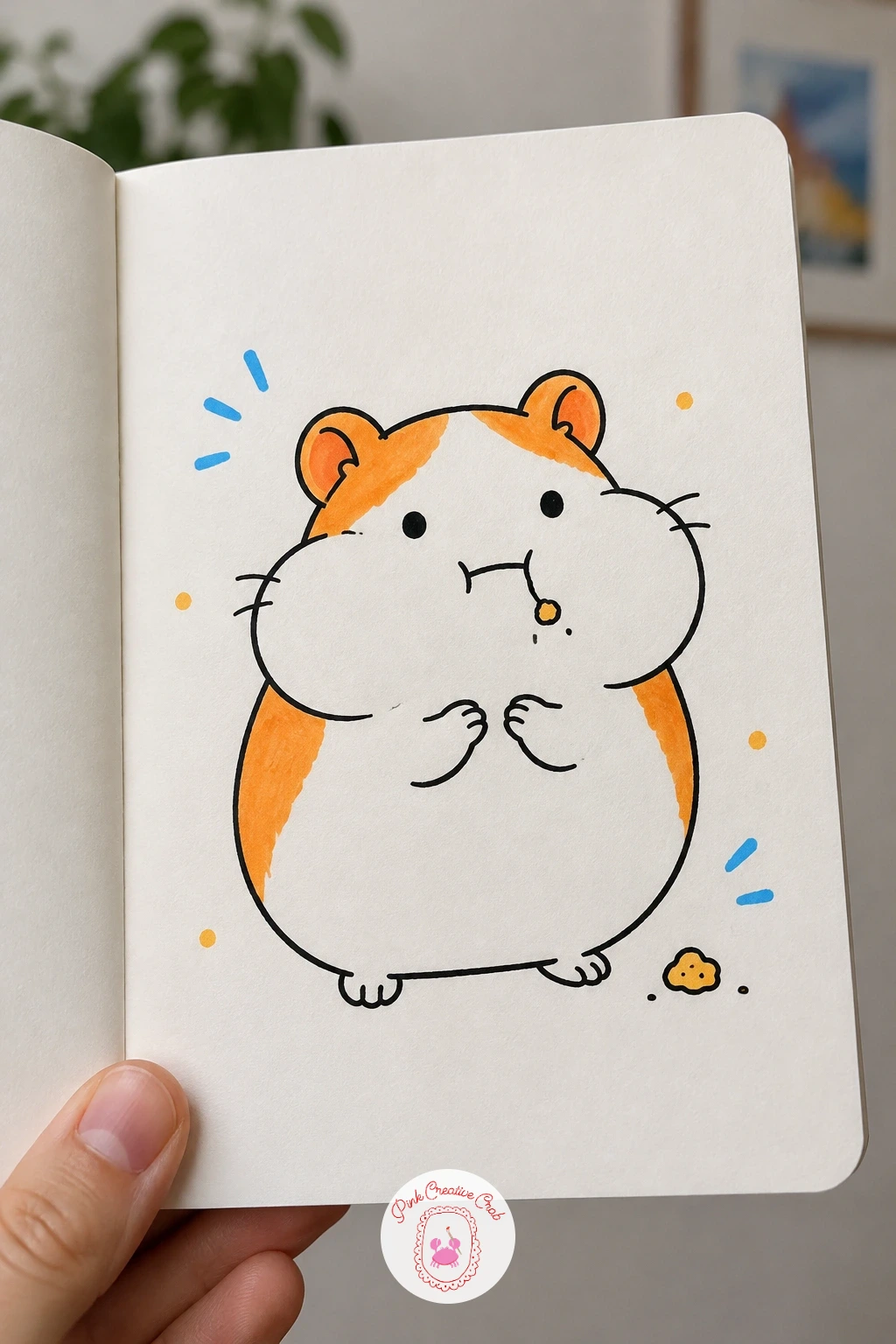
Palette: Tangerine Orange,Ink Black
Lift the mood with a small pig clapping its hooves together in pure delight, cheeks pushed up by a wide open smile. Draw the body first with both front hooves raised and nearly touching at the center, a small gap between them leaves room for a few motion lines to suggest the clap itself.
Eyes close into two upward curves and the mouth opens into a big rounded smile with the tongue just visible, tipping the head back slightly adds even more enthusiasm to the pose. Curly tail and round snout finish the shape quickly since pigs need very little linework to read clearly.
If the hooves look stiff mid-clap, round their edges rather than keeping them square, soft rounded shapes feel more joyful than sharp ones. Color the body tangerine with a sky blue curl in the tail for a small bright accent.
Draw three or four short lines between the hooves to show the clap in motion rather than just two hooves resting together.
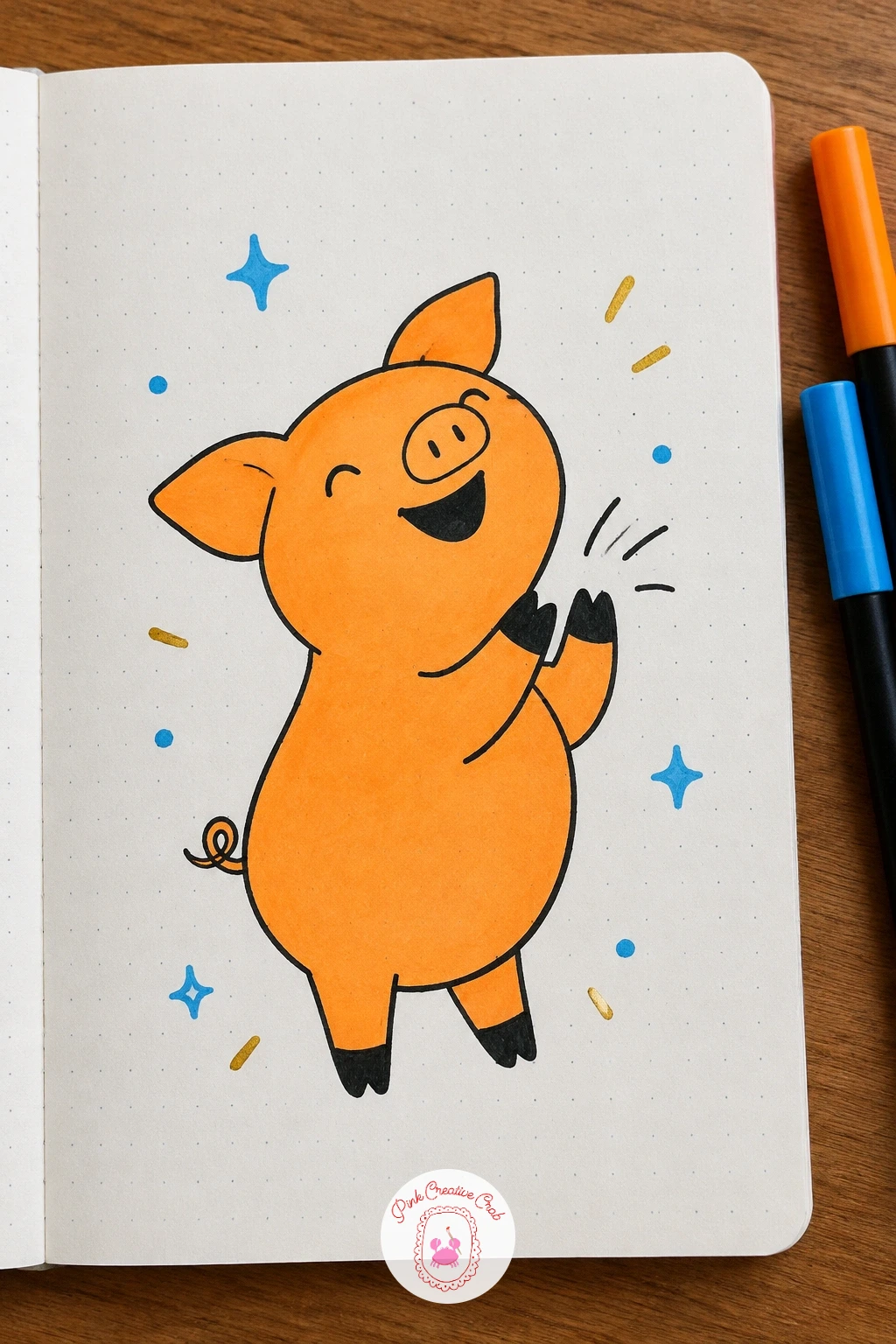
Palette: Tangerine Orange,Sky Blue
If pigs are your favorite character to draw, the full pig doodle collection has plenty more farmyard moments to try next.
Bring judgment back with a cat sitting perfectly still, one eyebrow raised, quietly unimpressed with everything around it. Draw the head level and the body relaxed, nothing dramatic in the pose at all, since the entire joke lives in one tiny detail on the face.
Give one eye a slightly raised arched line above it while the other stays flat, that single asymmetry is what reads as judgment rather than surprise. Keep both pupils small and centered, a wide pupil would undercut the cool, detached read you are going for here.
If the raised eyebrow looks too similar to the flat one, exaggerate the arch further than feels natural and check it from a slight distance, small asymmetries disappear fast at close range. Color the fur tangerine, leaving the face white so the single raised line stands out clearly.
Keep the mouth a short flat line, any curve at all turns judgment into amusement.
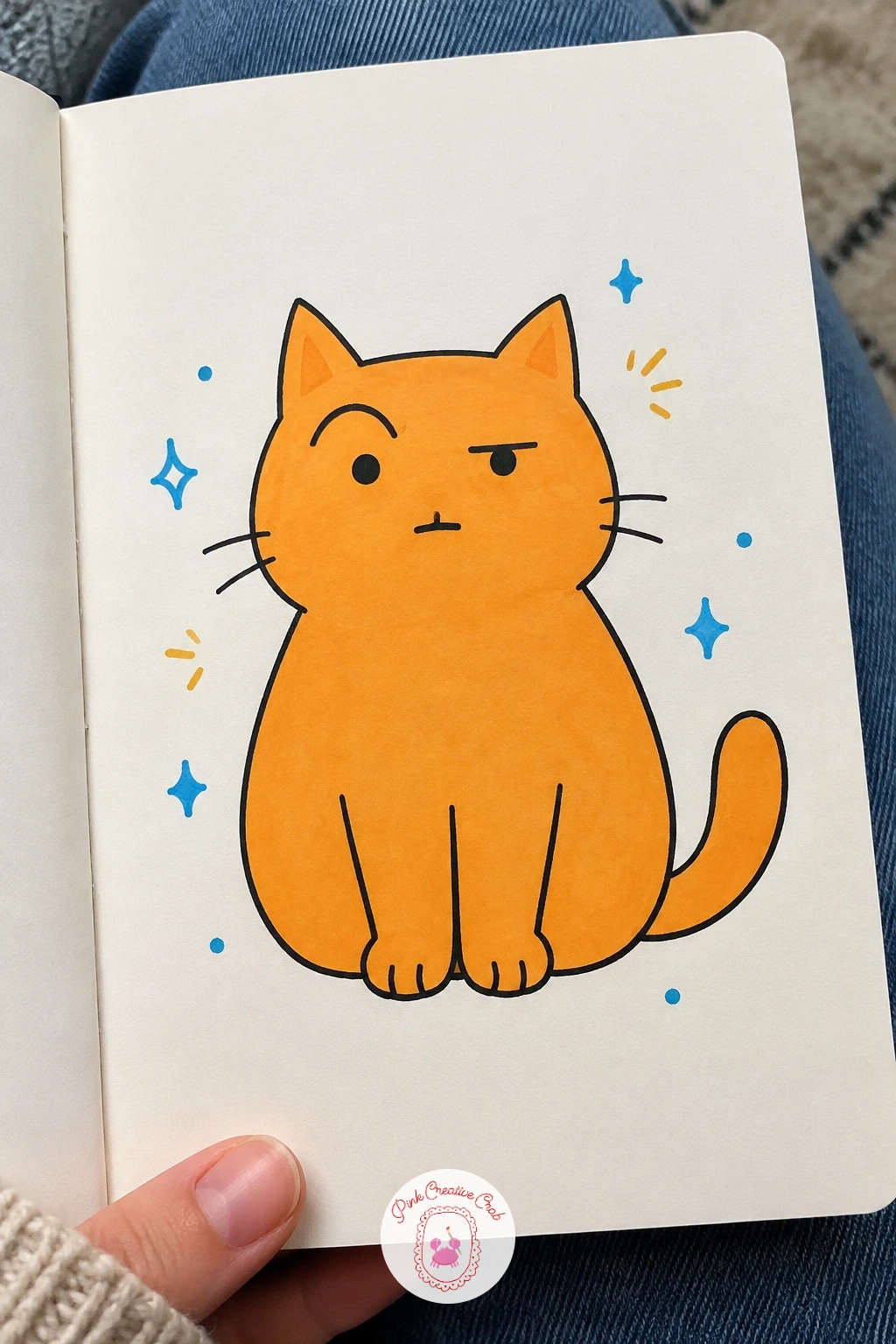
Palette: Tangerine Orange,Ink Black
Add light texture to a koala clinging to a branch with one giant nervous sweat drop forming on its forehead. Draw the round head and ears first, then place a single oversized teardrop shape at the hairline, far bigger than real sweat would ever be, since scale carries the nervous comedy here.
Eyes shift slightly to one side rather than looking straight ahead, which reads as nervous darting, and the mouth presses into a tight flat line. A branch drawn as one diagonal stroke under the body gives it something to cling to.
If the sweat drop looks static, add two short curved lines trailing just above it to suggest it is still forming and about to drip. Color the fur tangerine with the sweat drop left plain white outlined in sky blue for contrast.
Keep the grip on the branch tight and close together, loose paws undercut the nervous energy.
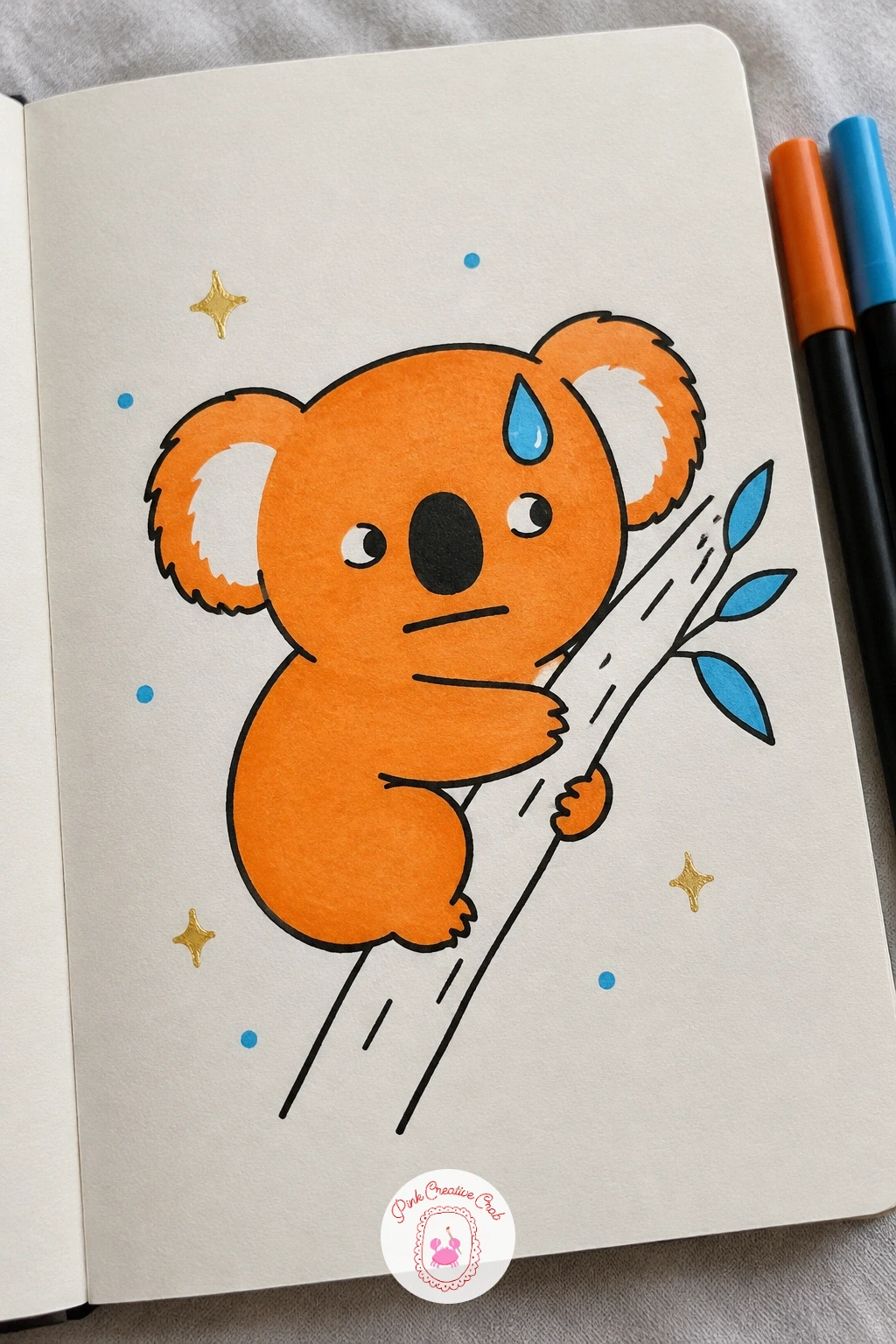
Palette: Tangerine Orange,Sky Blue
Swing the mood back up with a dog staring at a treat just out of frame, eyes replaced entirely by two small sparkly hearts. Draw the head tilted slightly forward toward the edge of the page, as if leaning toward something irresistible, before placing the heart shapes where the eyes would normally go.
Keep both hearts the exact same size and tilt, mismatched hearts read as a mistake rather than a stylistic choice. A few extra tiny sparkle marks scattered near the head finish the besotted look without adding much drawing time.
If the hearts come out lopsided, draw a faint pencil guide circle for each eye first and fit the heart inside it before inking over in fineliner. Color the hearts tangerine and the sparkles sky blue for a nice contrast against the fur.
Draw a small drool drop at the corner of the open mouth for one extra comic touch.
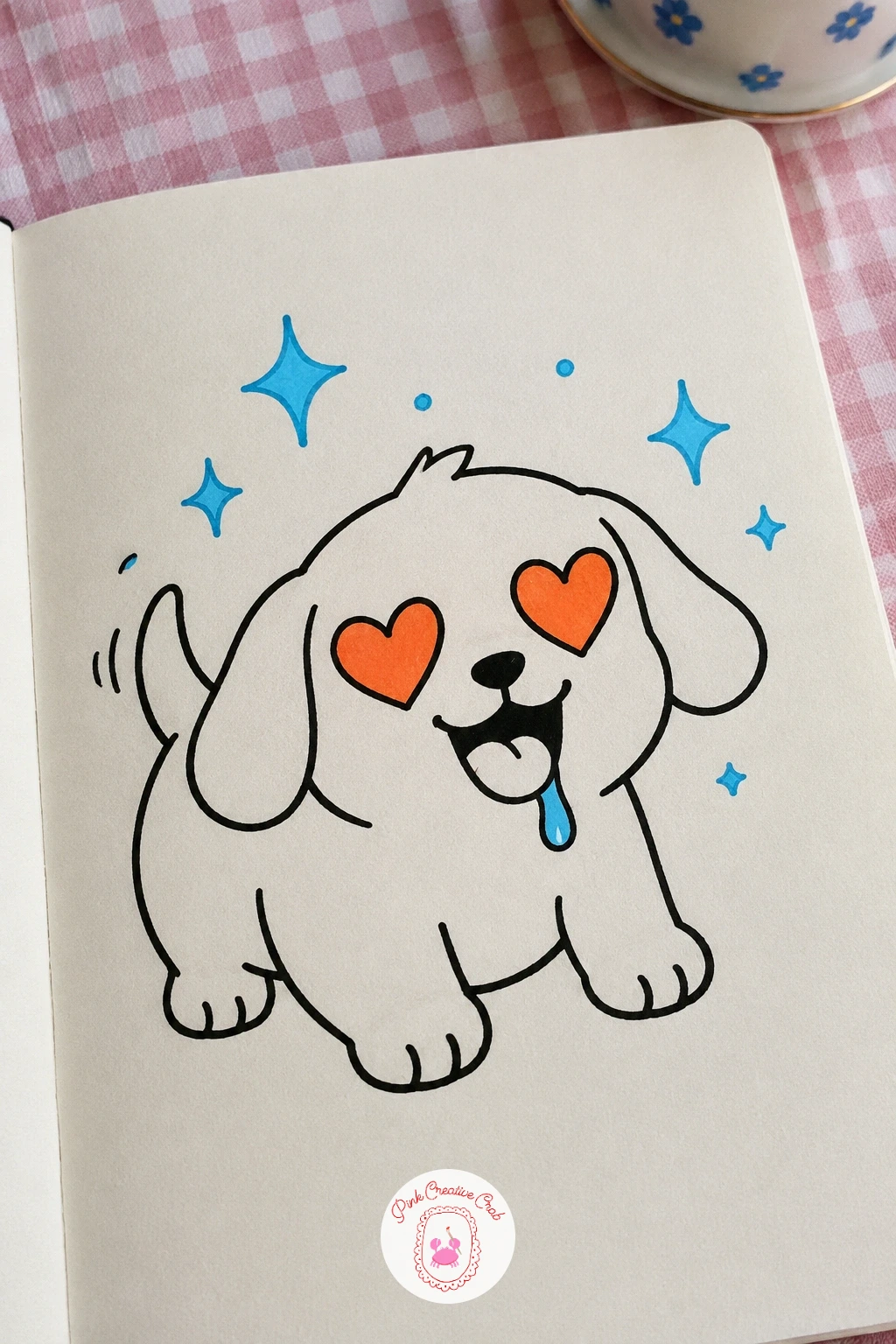
Palette: Tangerine Orange,Sky Blue
Try a full-body pose for this one: a sheep fainting flat on its back, legs straight up in the air, utterly overwhelmed. Draw the body lying horizontally rather than standing, with all four legs pointing straight upward in a neat row, that uniform row of legs is what makes the faint instantly readable from across a page.
Eyes close into tight x shapes and the mouth drops open slightly, with the fluffy wool outline drawn as loose overlapping loops rather than one smooth edge. A couple of small stars or swirl marks floating above the head finish the dizzy effect.
If the legs look stiff and too straight, give them a very slight outward splay rather than keeping them parallel, a tiny variation looks more like a collapse than a pose. Color the wool left mostly white with tangerine hooves and a sky blue swirl above the head.
Keep the body flat against an invisible ground line so it reads clearly as lying down rather than floating.
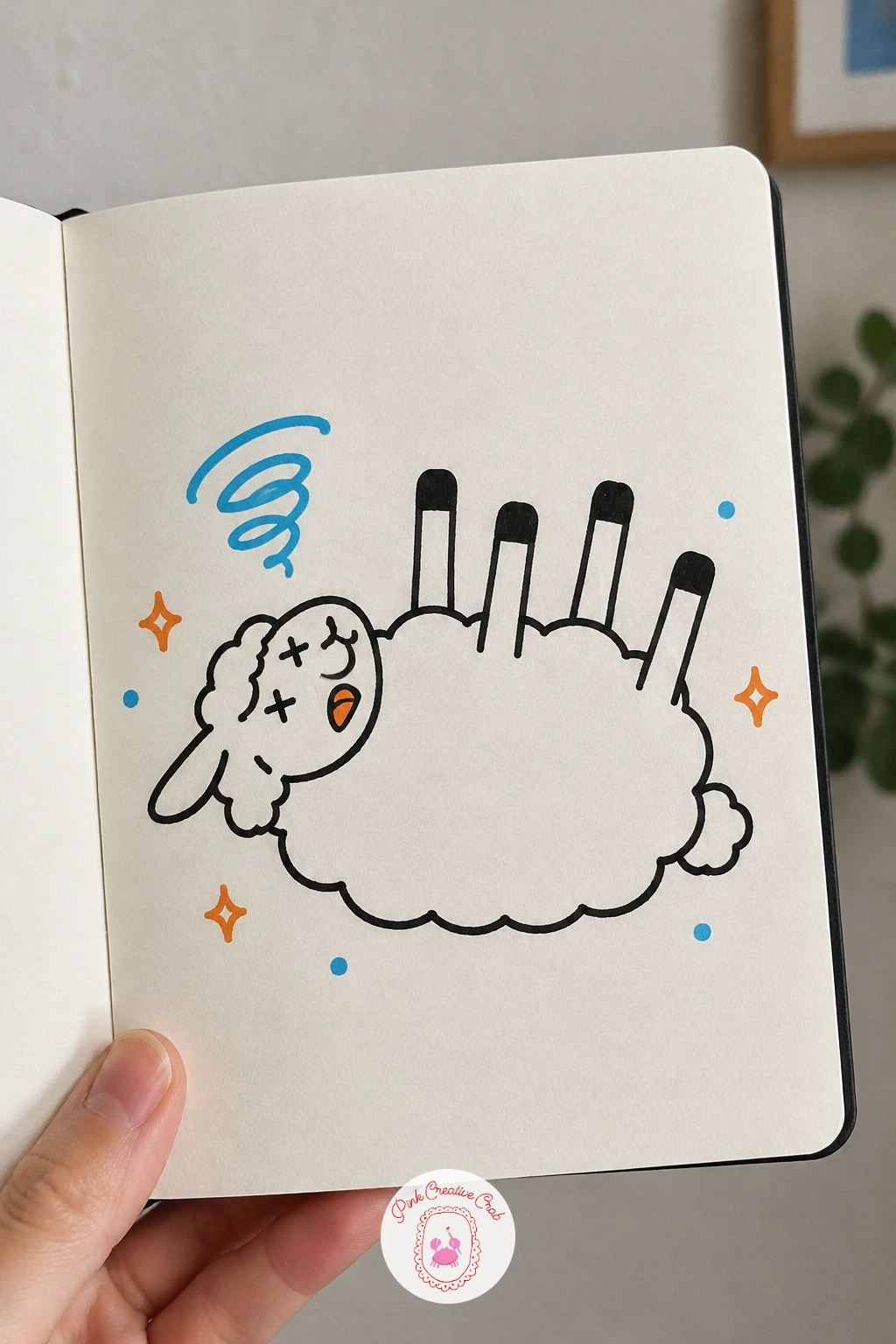
Palette: Tangerine Orange,Sky Blue
Return to the blob family for total indifference: both arms thrown out wide in a shrug, face set to a flat blank smile that says it has given up caring. Draw the round body first, then the arms as two simple curved lines extending outward and slightly upward, palms open rather than closed.
Eyes stay as two small simple dots and the mouth is a flat line with the smallest possible upward curve at each end, enough to register as a smile without looking genuinely happy. That near-flat mouth is the whole gag, so resist curving it further.
If the shrug reads as waving instead, keep the elbows close to the body and only flare the forearms outward, a shrug stays compact near the shoulders while a wave opens the whole arm. Color the blob sky blue with tangerine palms for a small detail.
Keep the whole pose symmetrical, an even shrug reads calmer and funnier than a lopsided one.
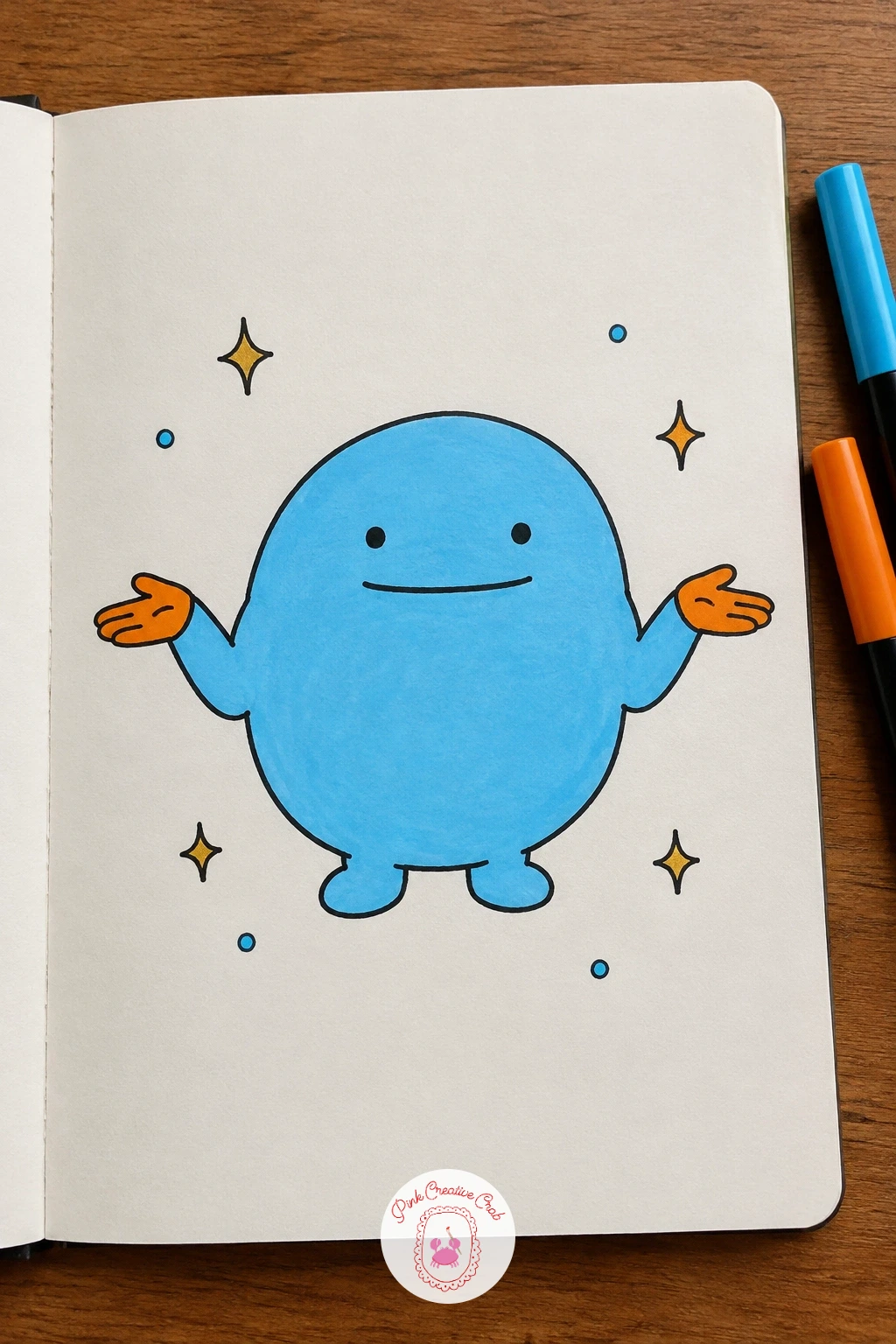
Palette: Sky Blue,Tangerine Orange
Give the next bird a prop instead of a dramatic pose: a small chick standing quietly under its own personal rain cloud, clearly having a rough day. Draw the chick first, body slightly slumped and head tilted down, then place a small puffy cloud shape hovering just above its head, close enough to touch but not overlapping.
Keep the cloud small relative to the chick’s body, an oversized cloud overwhelms the character rather than accompanying it. A few short straight lines beneath the cloud suggest light rain falling only onto the chick’s own head, nowhere else on the page.
If the slump looks like the chick is simply sitting, drop the shoulders slightly and tuck the head in closer to the body, that tucked posture reads as dejected rather than relaxed. Color the chick tangerine and the cloud sky blue for a clean contrast.
Leave the eyes as two small downturned dots rather than full curves, understatement works better here than a big sad face.
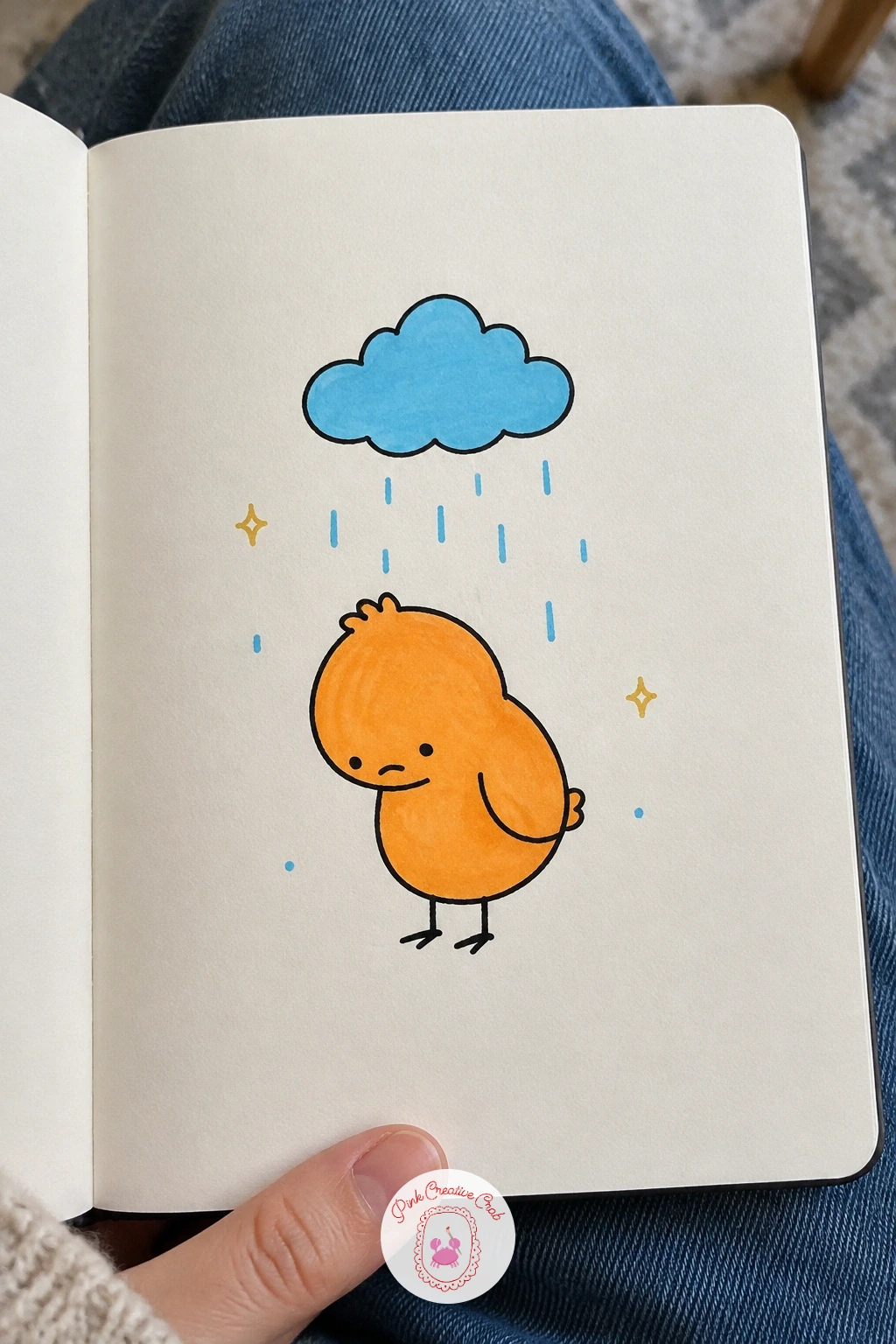
Palette: Tangerine Orange,Sky Blue
Bring the grumpy cat family back with ears pressed flat against the head and a pout that leaves no doubt about the mood. Draw the head first with the ears angled backward and flattened rather than upright, that single change in ear angle does more work than any other feature on this face.
Eyes narrow into thin half-moon shapes and the mouth curves down into a small frown rather than a flat line, giving it more attitude than the earlier judging cat. Whiskers droop slightly downward too, matching the overall mood of the pose.
If the ears look simply small rather than flattened, draw them pointing backward along the curve of the head rather than straight up, the backward angle is what reads as flat. Color the fur tangerine with a sky blue bow or collar if you want one bright accent.
Fold the front paws tightly together for one more small signal of a bad mood.
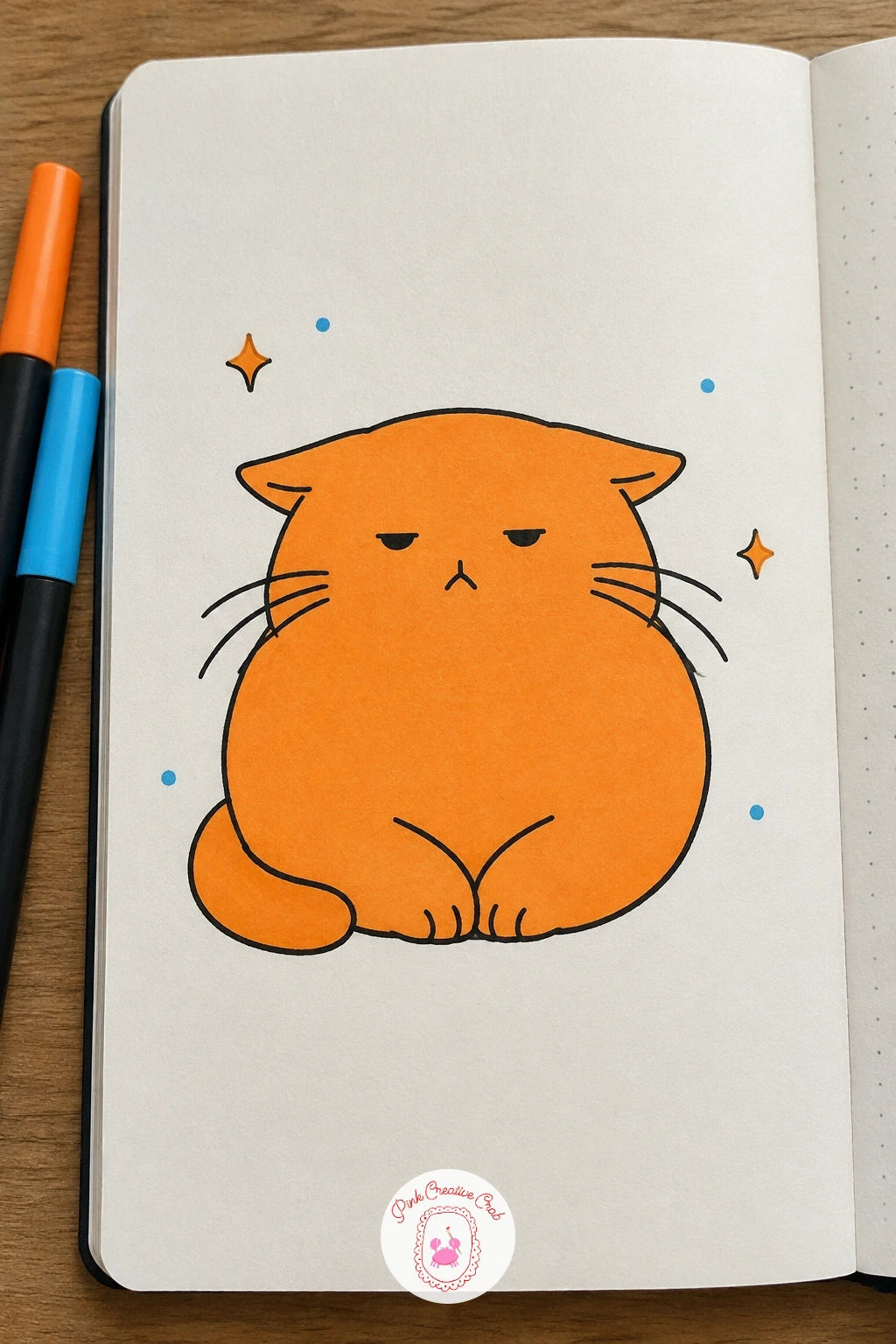
Palette: Tangerine Orange,Sky Blue
Lighten the mood again with a bear sticking its tongue out and blowing a raspberry at whatever it is reacting to. Draw the round head and body first, then the mouth as a wide open oval with the tongue drawn protruding from the center, slightly curled at the tip rather than flat.
Eyes squeeze shut into tight curves since a real raspberry always closes the eyes, and a few short curved lines near the mouth suggest the motion and spray of the gesture. Keep the ears relaxed and round rather than perked, which keeps the bear playful instead of aggressive.
If the tongue looks too small to read clearly, make it wider and longer than feels proportionate, a reaction doodle tongue can take up real space without looking wrong. Color the fur tangerine and the tongue a soft pink or leave it white with just an outline.
Add two or three tiny dots flying from the mouth for the classic raspberry spray.
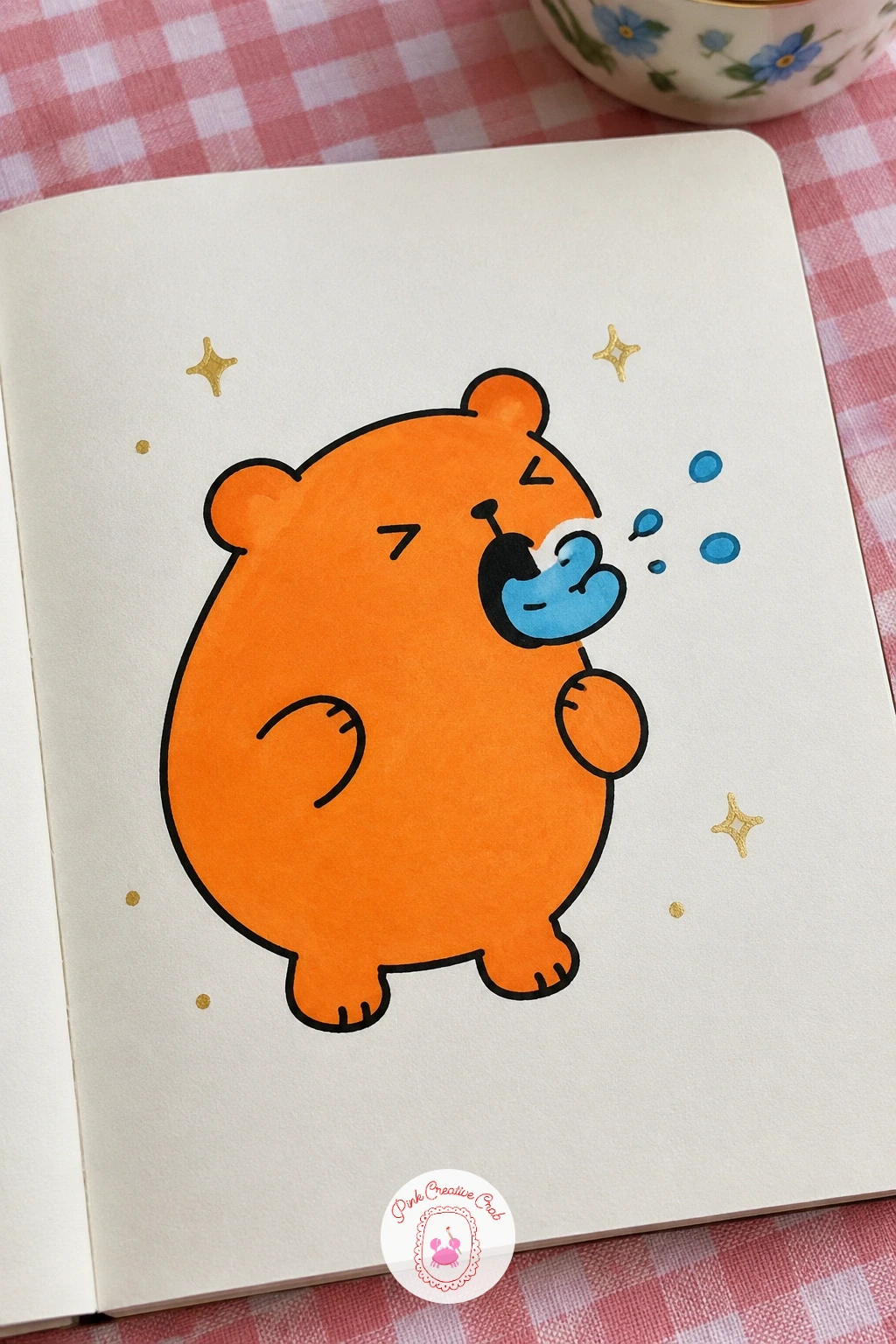
Palette: Tangerine Orange,Ink Black
Take the blob character somewhere quieter: a soft rounded mochi shape pressing its face into a pillow, screaming silently where no one can hear it. Draw the pillow first as a simple rounded rectangle, then press the blob’s face down into it so the top of the head overlaps the pillow’s edge slightly.
Keep the visible part of the face minimal, just the top of the head and maybe one squeezed eye peeking from the side, since most of the drama here comes from the pose rather than a visible expression. A few short jagged lines rising from the pillow suggest a muffled scream escaping anyway.
If the blob looks like it is simply resting, press the head down further into the pillow fabric and add a slight dent in the pillow shape where it presses, that dent sells the pressure of the pose. Color the blob sky blue and the pillow tangerine for contrast.
Keep both stub arms gripping the sides of the pillow tightly rather than resting loosely.
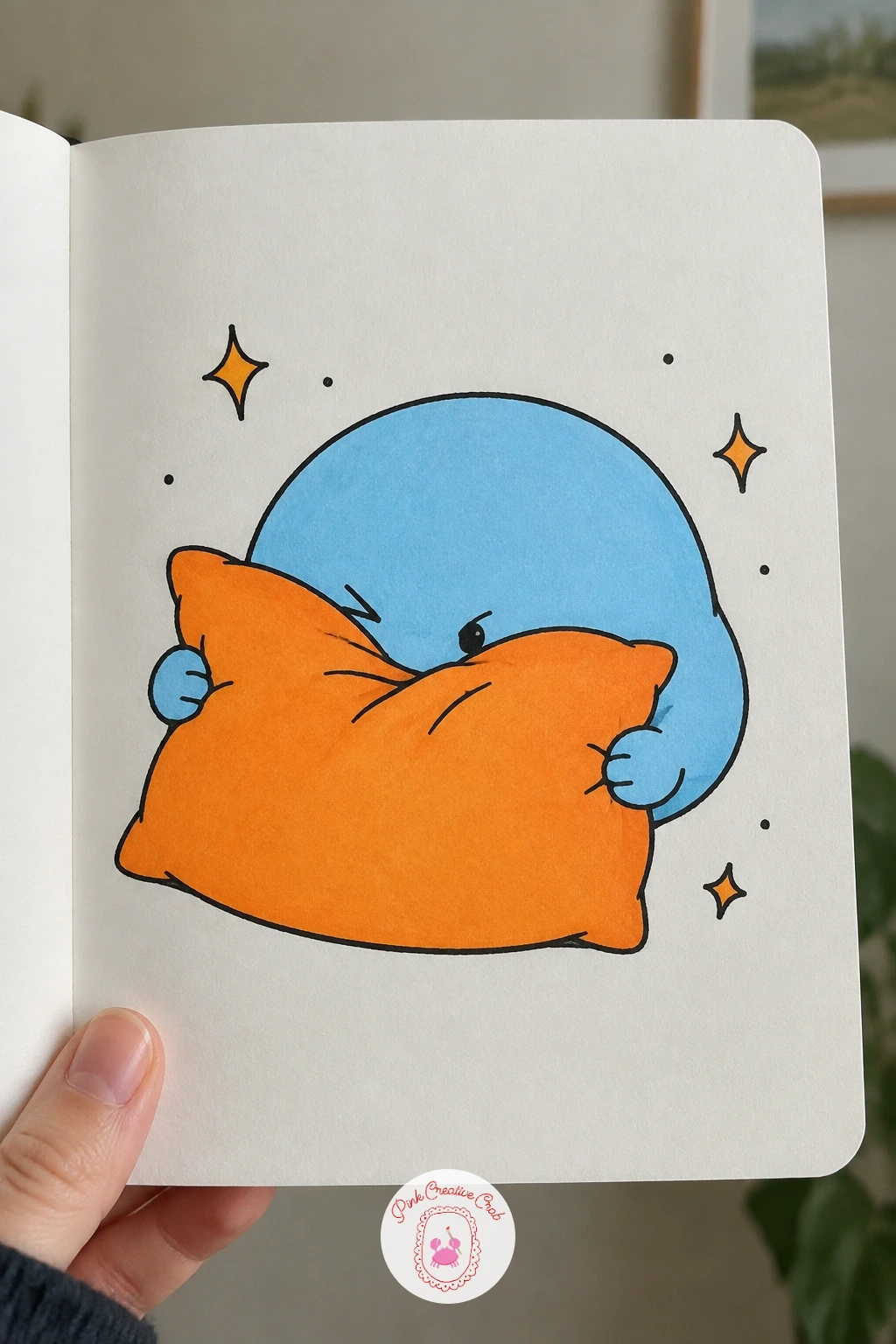
Palette: Sky Blue,Tangerine Orange
Bring back a dog for pure disbelief: a pug with its mind visibly blown, a small puff of smoke drawn rising from the top of its head. Draw the classic flat pug face first, wrinkles and all, then widen both eyes far beyond their usual size and drop the jaw open in a loose oval.
The smoke puff above the head is simple to draw, just two or three overlapping curved loops rising upward, but keep it small and light rather than a thick dark cloud, a delicate puff reads as comic rather than literal. Wrinkle lines across the forehead can bunch up slightly around the wide eyes for extra emphasis.
If the face looks too calm despite the wide eyes, raise the eyebrows further and add one small sweat drop beside the head to reinforce the shock. Color the body tangerine and the smoke puff sky blue so it reads clearly against the fur.
Keep the wrinkle lines loose and a little uneven, pugs are naturally wrinkly and tidy lines fight that charm.
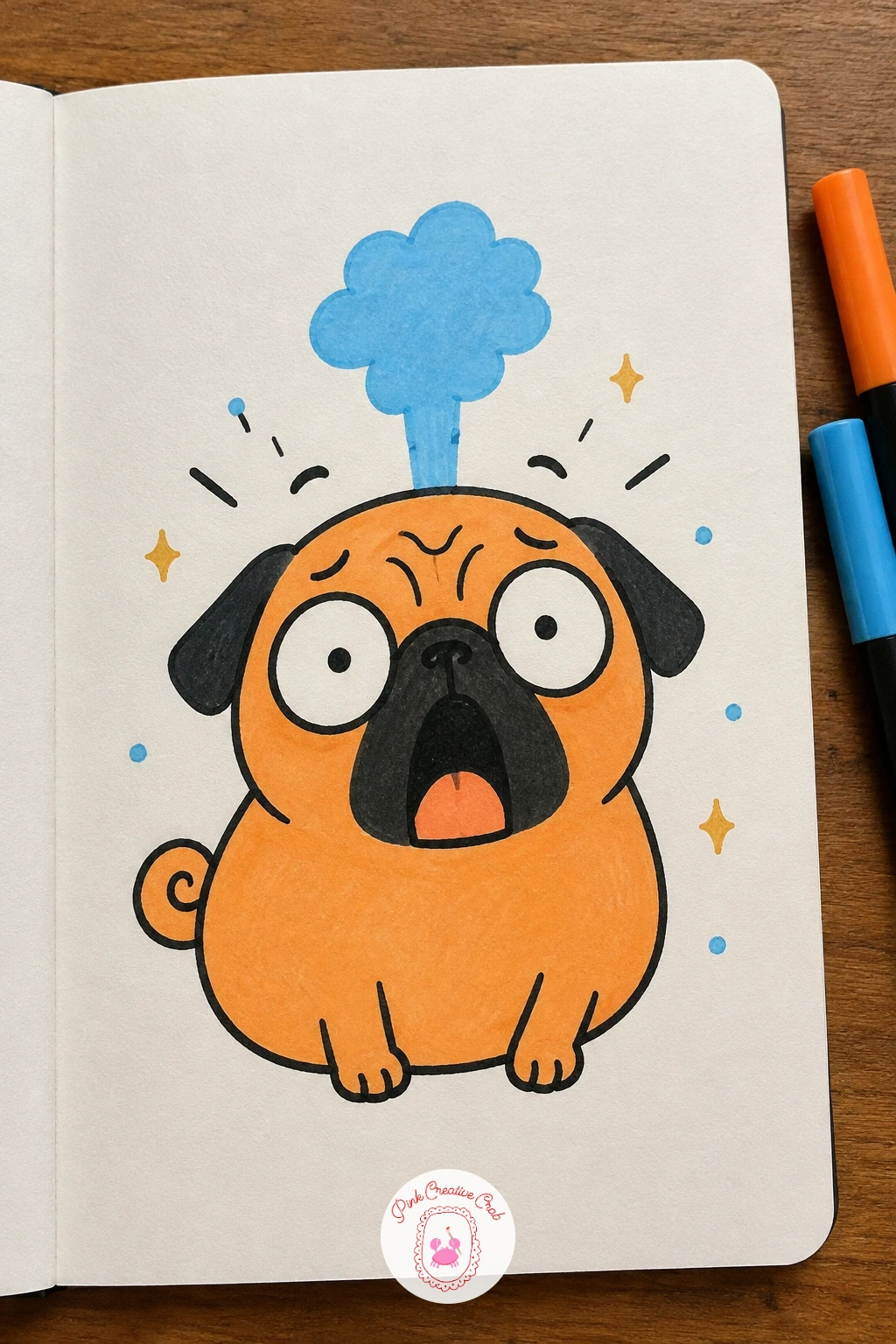
Palette: Tangerine Orange,Sky Blue
For more small dog personalities to sketch after this one, the dachshund painting ideas page is full of them.
Keep the energy up with a tiny mouse mid victory dance, both arms thrown straight up and one foot lifted off the ground. Draw the body first in a slight forward lean, since a static upright pose will not read as dancing, then bring both arms up high with the paws open rather than fisted.
Lift one leg noticeably off the ground with the knee bent, and let the tail swing out to the opposite side for balance, that opposing swing is what makes the pose feel like movement rather than a stiff jump. A wide open smile and closed happy eyes finish the face quickly.
If the pose looks flat rather than dynamic, tilt the whole body slightly off the vertical axis, a small lean does more for motion than any number of extra lines. Color the body tangerine with a sky blue party streak or confetti mark nearby.
Add two or three small motion lines trailing behind the lifted foot for extra energy.
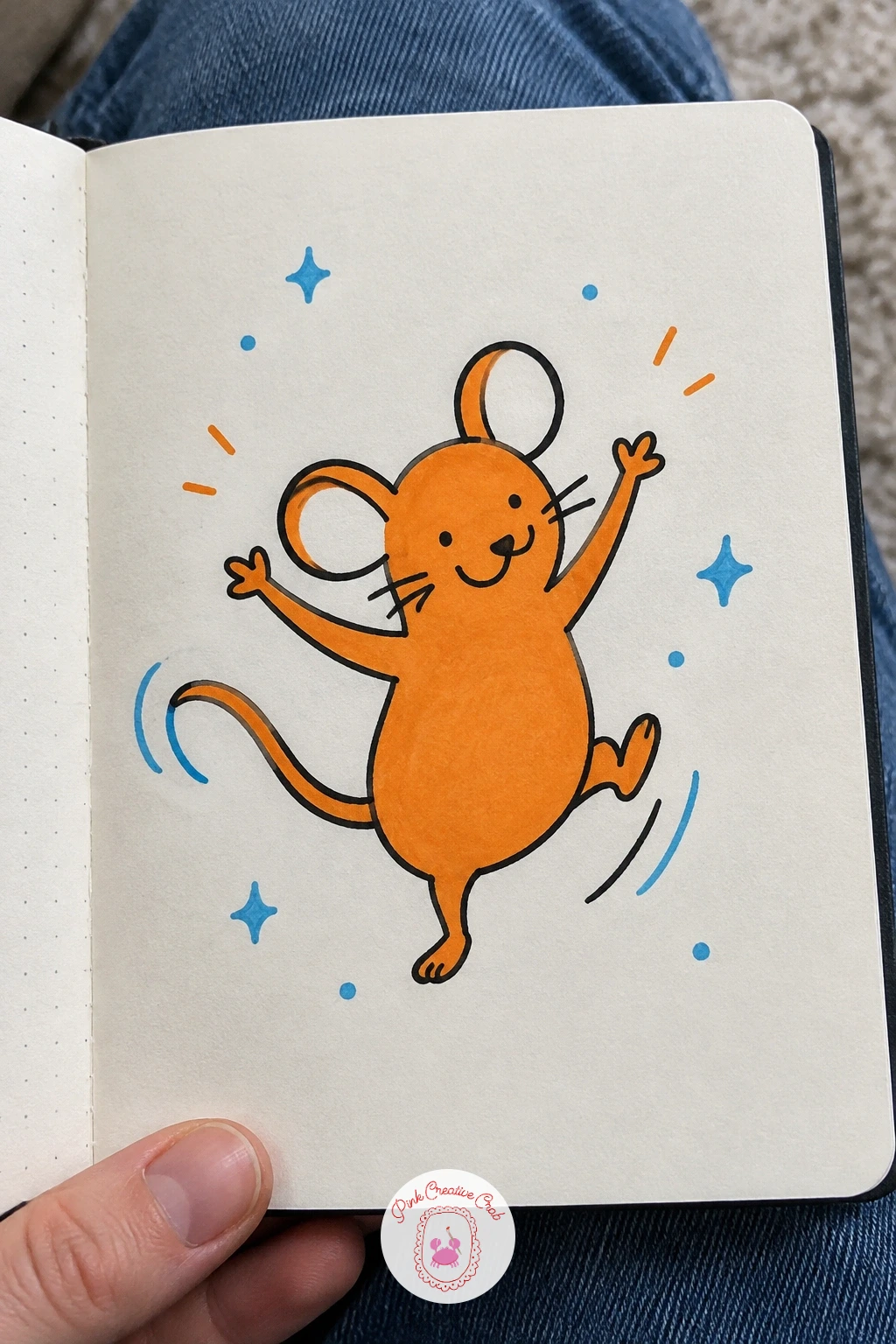
Palette: Tangerine Orange,Sky Blue
Slow things right down with a round sleepy blob caught mid-yawn, one small tear forming in the corner of its eye from the stretch. Draw the body first as a simple soft oval, then the mouth as a wide vertical oval rather than a wide horizontal one, since yawns stretch the jaw downward more than sideways.
Eyes squeeze shut from the effort of the yawn, and a single small teardrop sits in the corner of one eye, a natural result of a big stretch rather than sadness. Two stub arms can stretch outward or stay tucked against the body depending on how much energy the blob has left.
If the yawning mouth looks more like shouting, round the top and bottom of the oval rather than keeping sharp corners, soft rounded edges feel sleepy rather than alarmed. Color the blob sky blue and leave the single tear plain white with a thin outline.
Add a tiny zzz mark floating nearby for the sleepy finish.
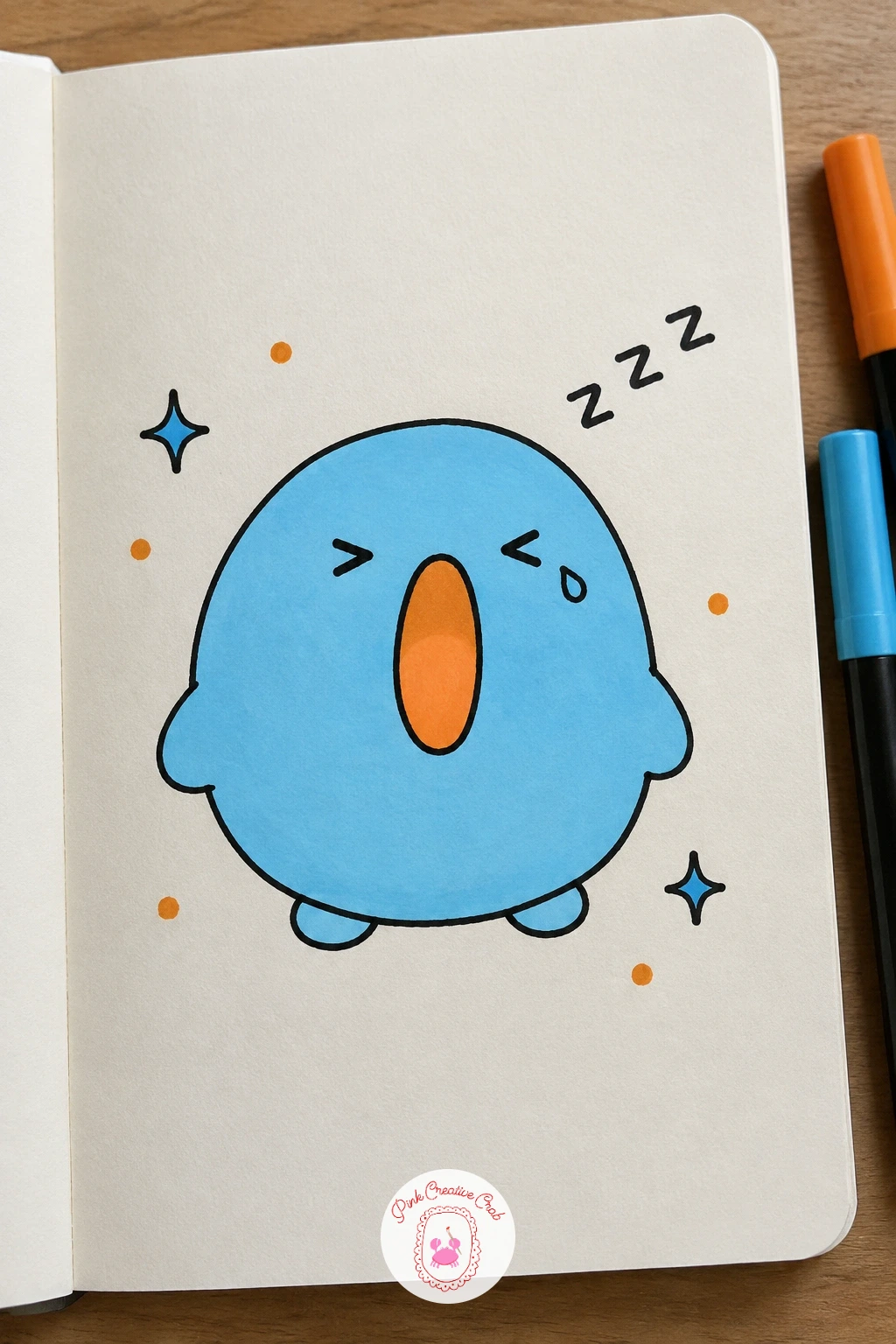
Palette: Sky Blue,Ink Black
Soften the mood with a small dog pressing both paws together in a pleading please, head tilted and eyes extra wide. Draw the head tilted noticeably to one side first, since a straight-on head reads as neutral while a tilt immediately adds pleading charm to the pose.
Bring both paws together at chest height, pressed flat against each other rather than overlapping loosely, with the fingers slightly spread for emphasis. Eyes go large and round with a small white highlight dot in each, and the eyebrows lift up and inward for the classic pleading look.
If the paws look awkward pressed together, draw them slightly smaller than the rest of the body suggests, oversized paws fight the delicate pleading gesture. Color the body tangerine and leave the paws and chest fur lighter or white for contrast.
Keep the mouth small and slightly open rather than closed, a tiny open mouth adds to the hopeful expression.
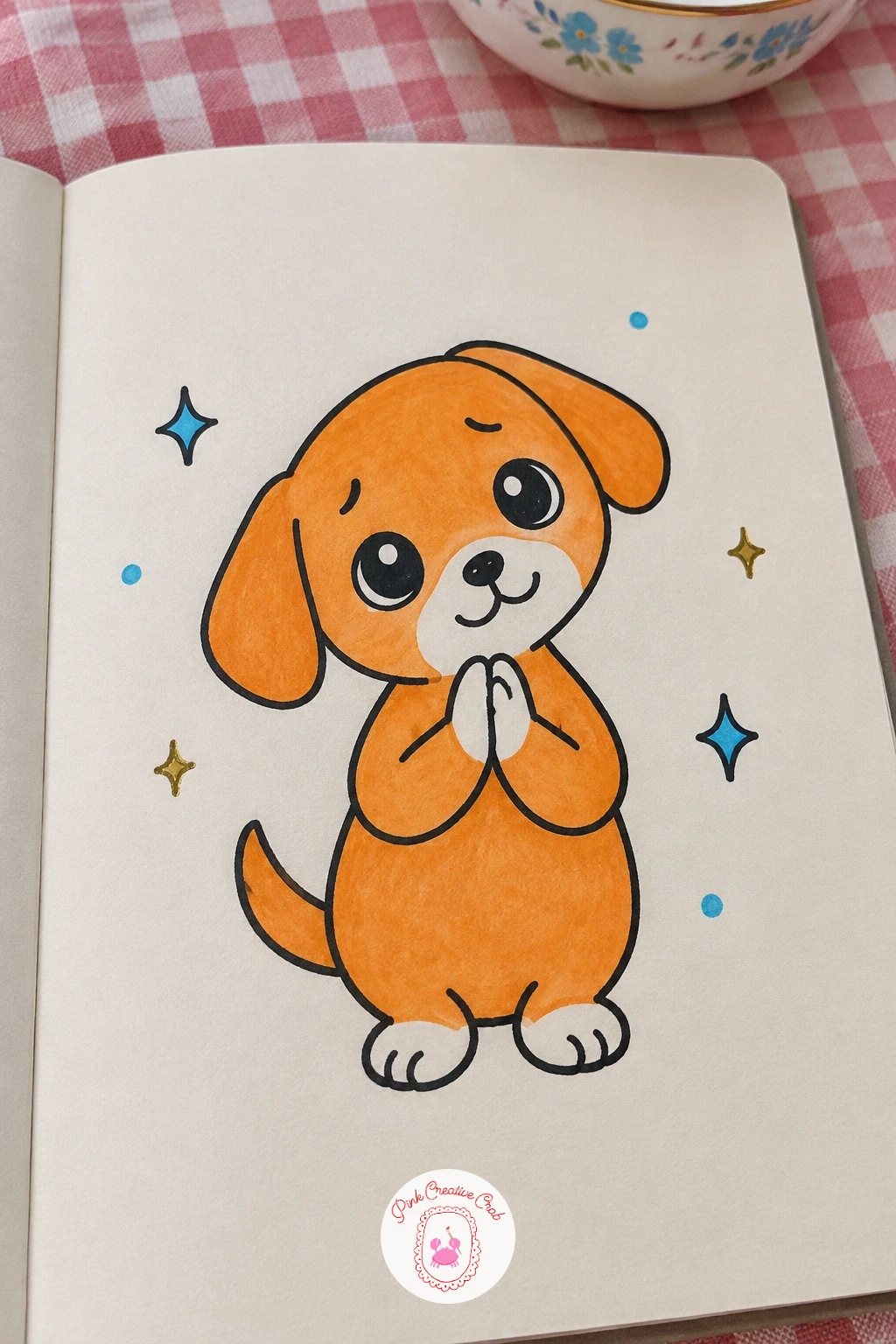
Palette: Tangerine Orange,Ink Black
Try a guilty freeze-frame next: a squirrel caught mid-step with one paw raised, wide guilty eyes, and an acorn held tightly against its chest. Draw the body in an unfinished walking pose, one foot still lifted off the ground as if paused halfway through a step, that frozen leg is what tells the whole guilty story before you even get to the face.
Keep the eyes wide and round, pupils shrunk small rather than large, since tiny pupils in a big eye read as caught-in-the-act rather than simple surprise. The acorn presses close against the chest, held with both paws rather than one, as if trying to hide it by sheer proximity.
If the frozen pose looks like a normal walk, exaggerate the lifted leg higher than a natural stride would ever go, that extra height reads clearly as a sudden stop. Color the body tangerine with a sky blue bushy tail for contrast.
Draw the tail puffed up stiff rather than flowing, stiffness in the tail reinforces the frozen moment.
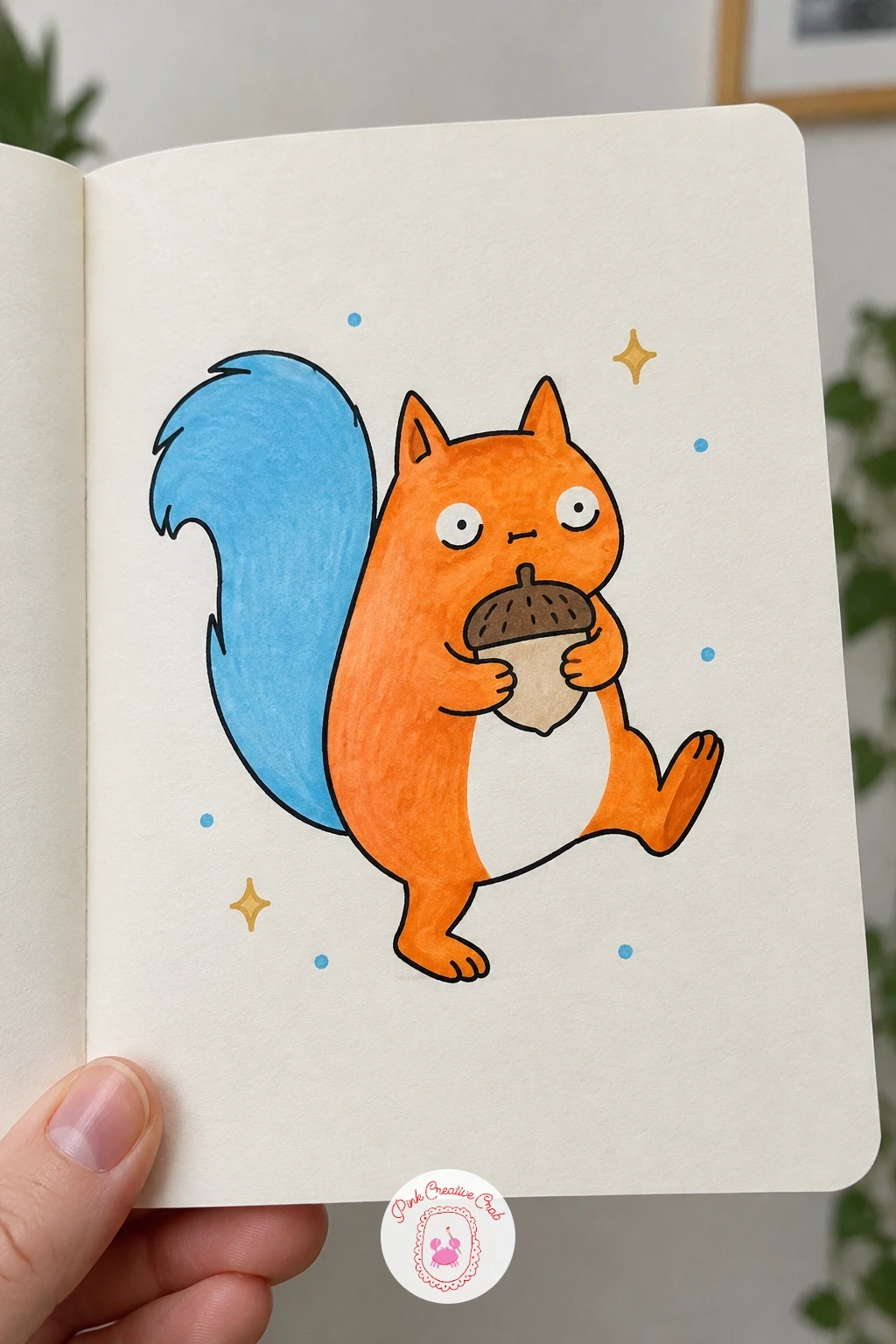
Palette: Tangerine Orange,Sky Blue
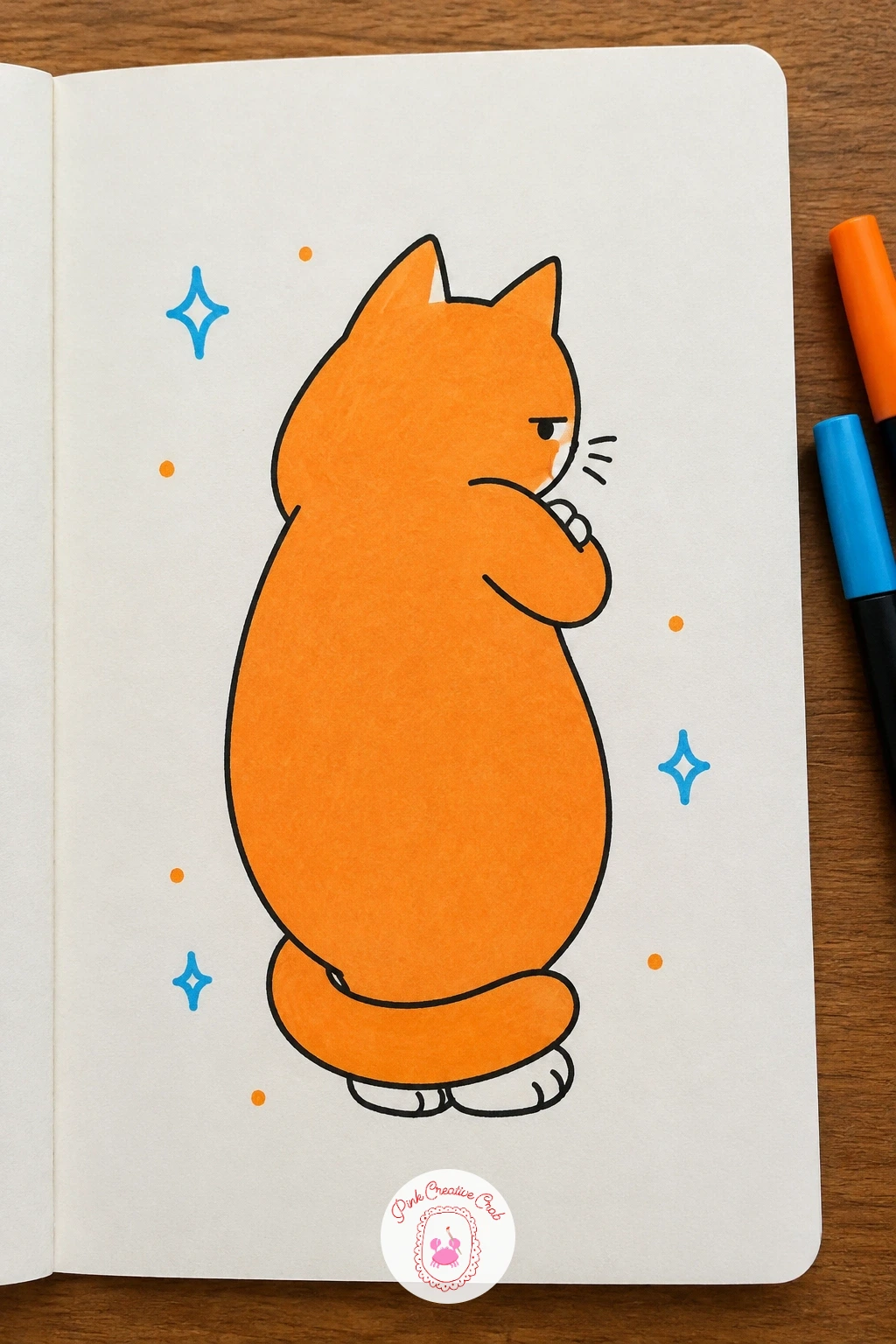
Bring the cat family back one more time for a full-body sulk: arms crossed tightly, body turned away from the viewer in a huff. Draw the body facing mostly sideways or away, with only a sliver of the face visible over one shoulder, since turning away is the clearest sulking signal a small drawing can give.
Cross both arms high on the chest rather than low, a high tight cross reads as more stubborn than a loose low one. The visible eye narrows into a thin line and the tail curls tightly around the feet rather than swishing loose.
If the turned-away pose looks like it is simply facing sideways, exaggerate the shoulder angle further and tuck the chin down slightly, that combination reads clearly as a deliberate huff rather than an idle stance. Color the fur tangerine with the tail tip in sky blue.
Keep the visible ear flattened slightly, matching the grumpy family of expressions earlier in this list.
Palette: Tangerine Orange,Sky Blue
If you like giving cats this much attitude, the silly goober doodle ideas lean into the same expressive style with other animals.
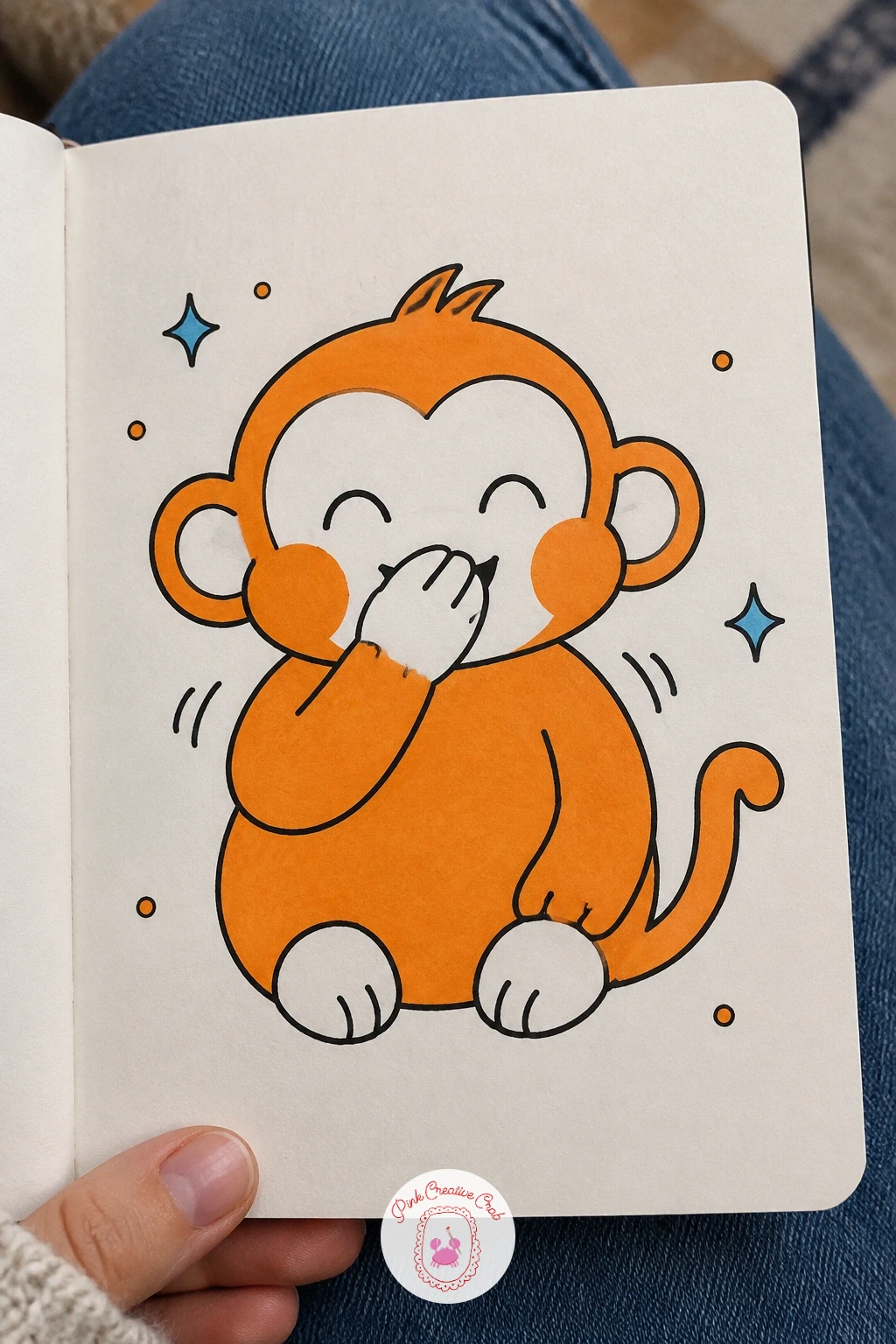
Keep the hand gesture theme going with a monkey covering its mouth, clearly trying and failing to hold back a laugh. Draw the head first with both eyes squeezed into tight upward crescents, since the eyes give away the laugh even when the mouth is hidden.
One paw covers the mouth loosely rather than tightly, leaving a small gap at the corner where a hint of teeth or tongue peeks through, that tiny gap is what shows the laugh is escaping despite the cover. The other arm can rest on the knee or hang loose at the side.
If the covered mouth makes the whole face look blank, raise the cheeks slightly on either side of the covering paw, pushed up cheeks read as a suppressed grin even with the mouth hidden. Color the fur tangerine with a lighter face patch left white or very lightly shaded.
Add two or three tiny motion lines near the shoulders to suggest the body shaking with held-in laughter.
Palette: Tangerine Orange,Ink Black
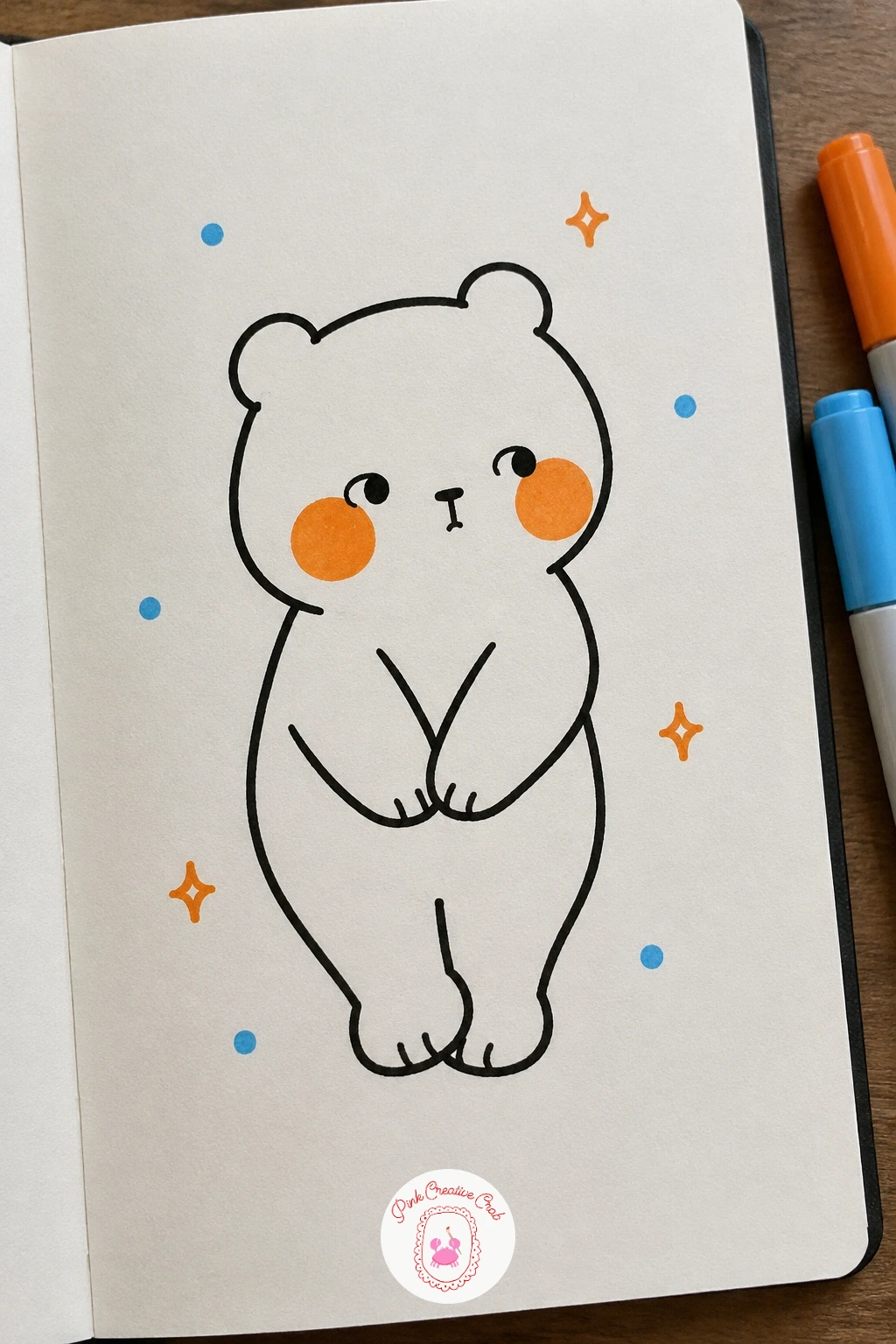
Return to the bear family for a shy moment: cheeks flushed, one foot twisting awkwardly against the ground, eyes looking off to the side. Draw the body first with the shoulders drawn in slightly, rounded forward rather than squared, that small inward curve reads as shy body language before the face even comes into it.
Twist one foot inward, toes pointing toward the opposite leg rather than straight ahead, a classic shy gesture that takes only a couple of extra lines to add. Eyes glance sideways rather than meeting the viewer, and the mouth stays small and closed.
If the blush looks too faint, scribble the tangerine color a little heavier right at the center of each cheek and let it fade out toward the edges rather than filling evenly, that gradient looks more like a real blush than a flat patch. Color the body in a lighter shade if you have one, keeping the blush as the brightest spot on the page.
Keep the paws loosely clasped in front rather than at the sides, which adds to the bashful posture.
Palette: Tangerine Orange,Ink Black
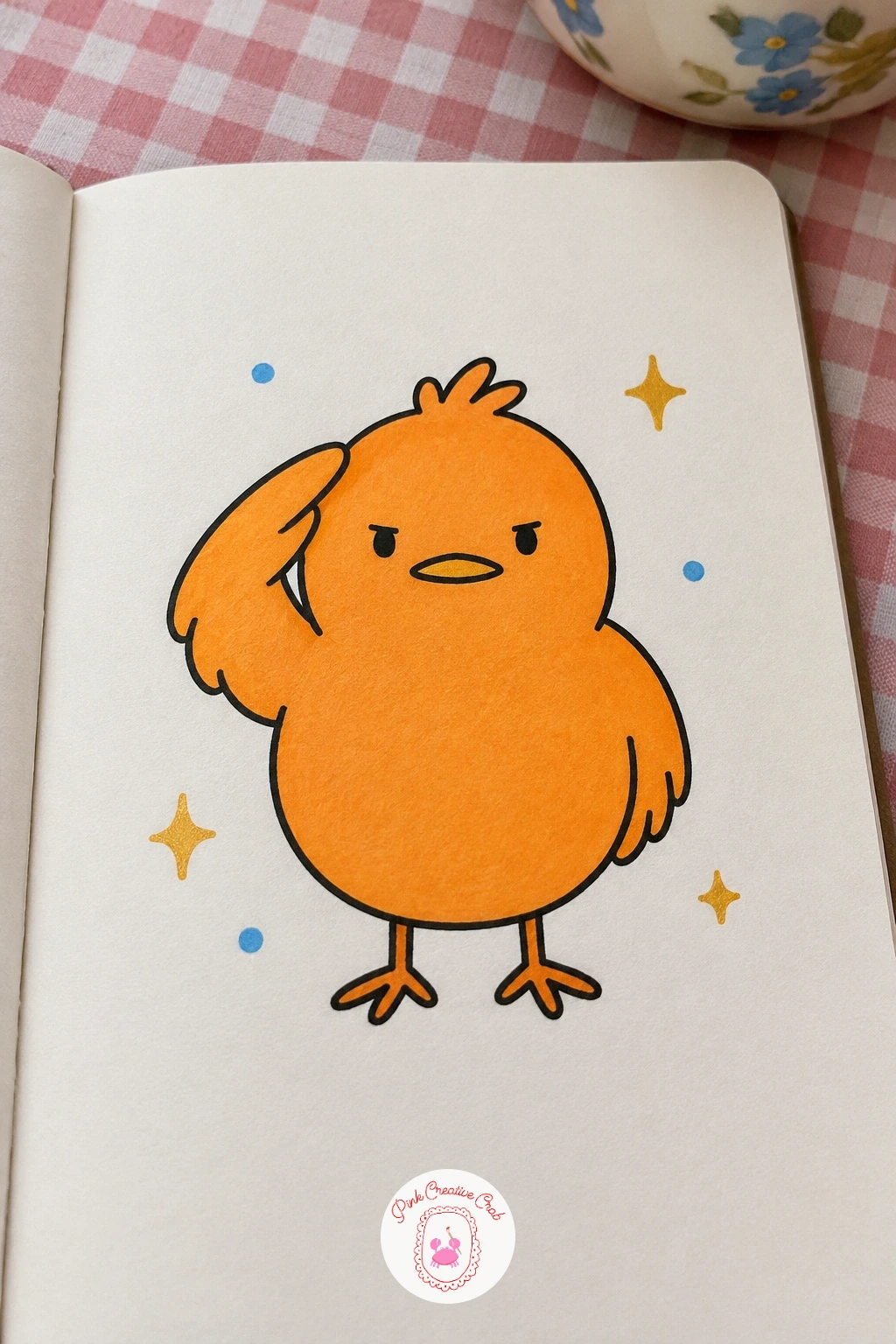
Switch to something crisp and confident: a chick standing at full attention, giving a very serious firm salute. Draw the body upright and straight rather than rounded and relaxed, with the chest pushed forward slightly, that stiff straight posture is what separates a salute from a casual wave.
Bring one wing up to the side of the head in a clean salute position, keeping the angle sharp rather than soft or drooping, and draw the eyes narrow and focused rather than wide, matching the serious mood. The other wing stays pinned flat against the side.
If the salute looks floppy, straighten the wing further and square off its edge rather than rounding it, sharper lines read as more disciplined. Color the body tangerine with a sky blue little cap or band if you want a small costume detail.
Keep the beak closed and level, any upward curve turns the serious salute into a grin.
Palette: Tangerine Orange,Sky Blue
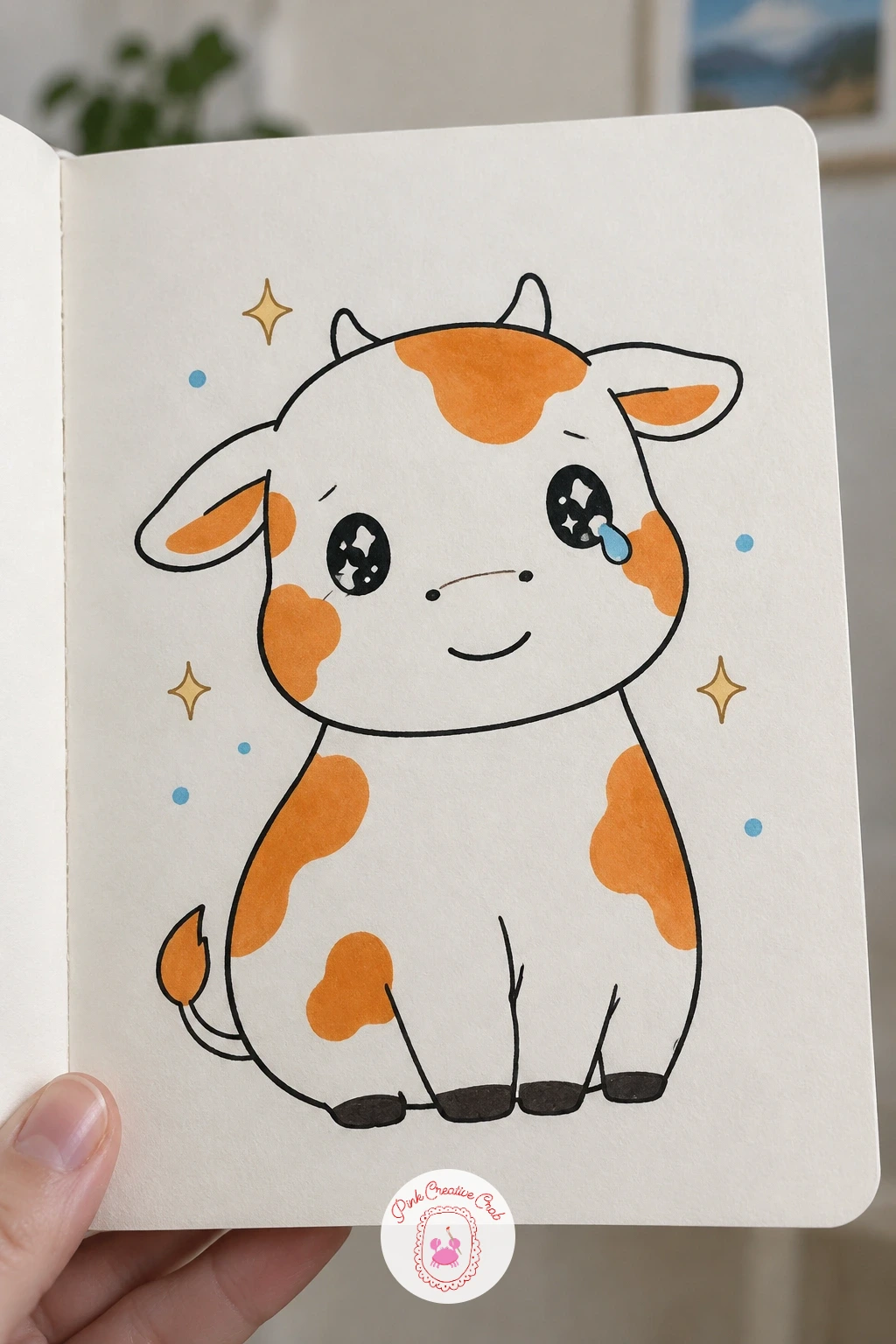
Soften the mood with a cow moved to tears, eyes sparkling with a couple of small highlight marks and a faint smile. Draw the head first, keeping the spots loose and irregular across the body since real cow markings never form tidy shapes, then build the eyes extra large and glassy with two or three tiny white sparkle marks placed inside each pupil.
A gentle closed-mouth smile, slightly upturned at the corners, pairs with the wet eyes to give a touched rather than sad expression, the smile is what tells the viewer these are happy tears. One small tear drop at the corner of an eye finishes the emotional read without overdoing it.
If the sparkles make the eyes look too cartoonish, keep them small, no bigger than a pinhead, and place them off center rather than dead center for a more natural glint. Color the spots tangerine against a white body, with a sky blue tear drop outline for contrast.
Keep the ears relaxed and slightly drooped rather than alert, which adds to the gentle mood.
Palette: Tangerine Orange,Sky Blue
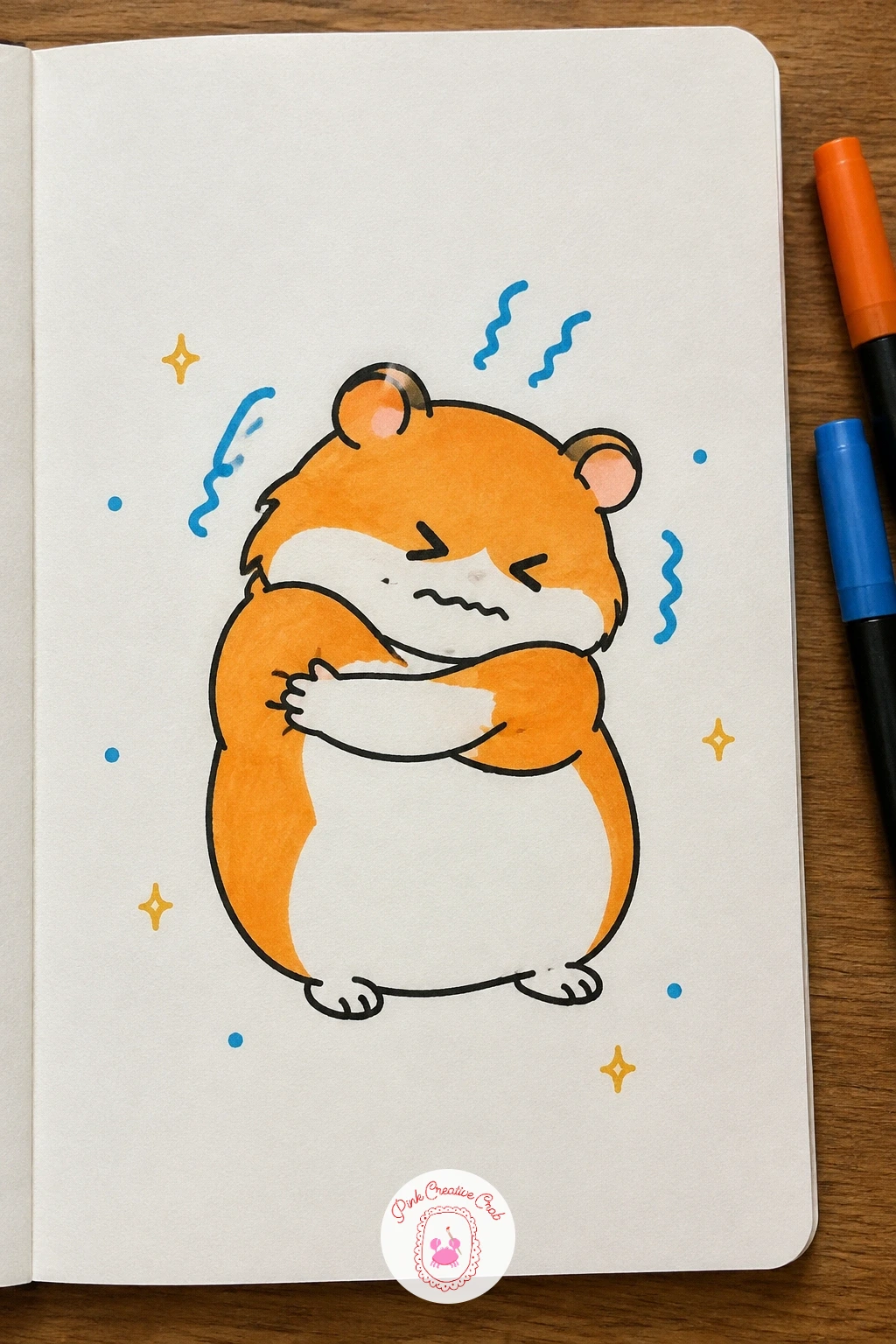
Bring the hamster family back one final time for a full-body cringe: arms wrapped tight around itself, shoulders hunched, face scrunched up tight. Draw the body hunched down and inward first, shoulders pulled up close to the ears, since that compressed posture reads as cringing before the face does any of the work.
Wrap both paws around the opposite sides of the body in a self hug, elbows tucked in close rather than out, and scrunch the eyes into tight closed lines with the mouth pulled into a small wince shape rather than a frown. A few short wavy lines around the head can suggest the awkward feeling radiating outward.
If the hunch looks more like sitting than cringing, pull the shoulders up further and tilt the head slightly down into the chest, that extra tuck is what makes the pose unmistakably uncomfortable rather than simply relaxed. Color the fur tangerine with the paws left a touch lighter for contrast.
Keep the wince tight and small rather than a big open mouth, a smaller wince actually reads as more awkward.
Palette: Tangerine Orange,Ink Black
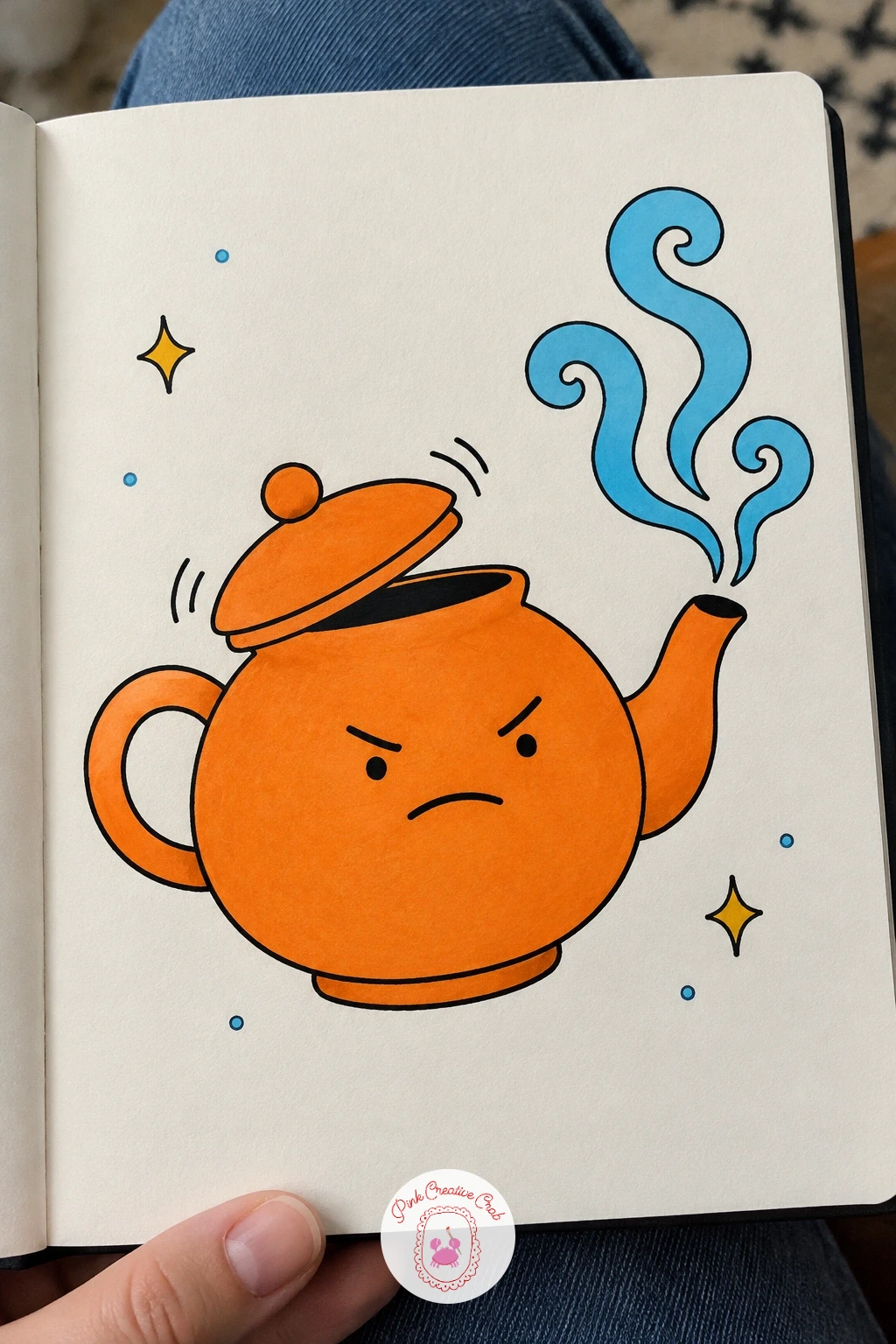
Close the whole set with an object instead of an animal: a small teapot absolutely furious, steam pouring out and the lid rattling on top. Draw the teapot body first with a simple rounded shape and a curved spout and handle, then give it a face right on the front, two angry slanted eyebrow lines and a small tight frown mouth.
Draw the lid slightly off center and tilted, with two or three short motion lines around it to suggest it is rattling rather than sitting still, and let thick curled steam lines pour from the spout in loose upward loops rather than straight lines. That looseness in the steam is what makes it read as rage rather than ordinary cooking steam.
If the face looks too calm for the steam around it, angle the eyebrows down sharper toward the center and bring them closer together, a tighter eyebrow angle reads as far angrier than a wide one. Color the body tangerine with sky blue steam curls rising from the spout.
Finish with one small heat-wobble line along the side of the teapot for extra fury.
Palette: Tangerine Orange,Sky Blue,Ink Black
If this little character sparks an interest in cozy kitchen scenes, the cozy drawing ideas collection has plenty more quiet-afternoon subjects to try.
What to Do Next
Pick whichever face matches your mood right now, grab a fineliner and one or two markers, and draw it start to finish on a single page before moving to the next. Once a few of these feel easy, try inventing your own reaction by mixing an expression from one idea with the pose from another.
Frequently Asked Questions
What makes a good reaction doodle subject?
A good reaction doodle subject has one clear emotion shown through a single exaggerated feature, like huge eyes, a flat mouth or a dramatic pose, so the feeling reads instantly even at a small size.
Do I need colored markers for reaction doodles?
No, a black fineliner alone works fine since the expression carries the joke. Tangerine orange and sky blue markers simply add quick highlights like blush, steam or accent fur without needing a full color fill.
How do I keep reaction doodle faces consistent across a page?
Keep the eye size, mouth shape and line weight similar across characters, and decide early whether eyes are dots, circles or curves for that page, since mixing styles within one set makes the page feel unplanned.
Why do my reaction doodles look stiff instead of funny?
Stiffness usually comes from drawing shapes too evenly and symmetrically. Exaggerate poses, tilt heads, vary spike or wrinkle lengths, and let edges stay a little uneven, since looseness is what sells the humor.
Can reaction doodles be reused like stickers or stamps?
Yes, once a character works well, trace or redraw it smaller on sticky note paper or card stock to reuse as a quick sticker, stamp reference, or margin doodle in a planner or notebook.
Have any thoughts?
Share your reaction or leave a quick response — we’d love to hear what you think!
-
 0
-
0
-
0
-
0
-
0
-
0


