A frog doodle is the kind of small, silly drawing that fills a notebook corner in minutes and somehow makes you smile every time you flip past it. Give a plump little frog a crown, a raincoat or a lollipop stuck to its tongue and it turns into a tiny character with a whole personality, no fancy art training needed.
Below you will find 31 frog doodles to work through, from a frog sheltering under a lily pad to a tadpole showing off brand new legs. Each one uses the same simple black fineliner line with lily pad green and coral pink marker accents, so grab your pen and pick whichever frog makes you laugh first.
Using these images: free for personal projects such as printing, coloring, cards, journals and gifts. Handmade items that include them may be sold up to 30 pieces per design. More than that is commercial use and is not permitted, and neither is selling or sharing the images themselves or passing them off as your own. Please ask before any other use.
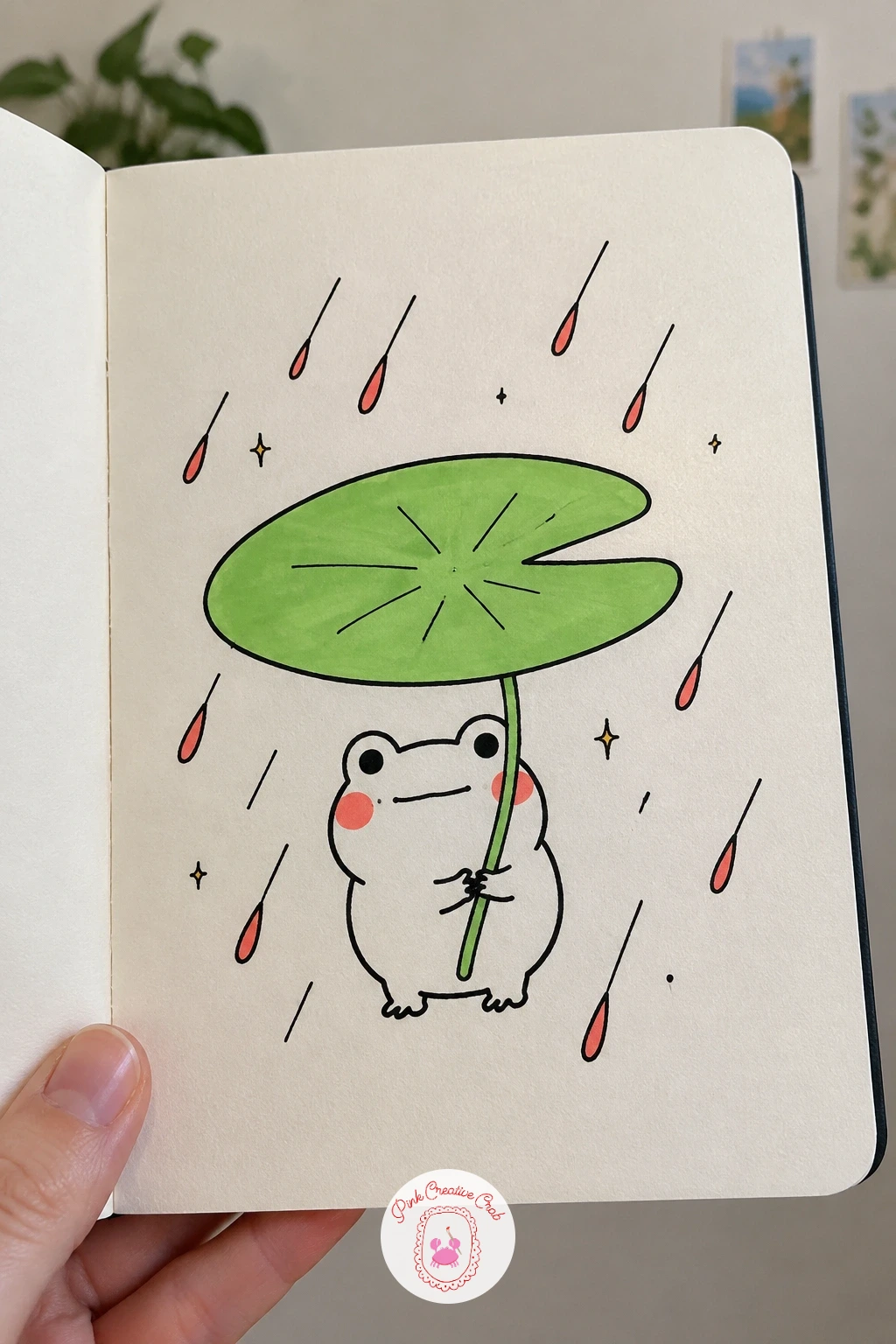
Start this frog doodle with the easiest shape in the whole list: a rounded oval body sitting low, two bulgy circle eyes on top, and a wide closed-mouth smile. Draw two bent arm lines reaching up before you add the lily pad, so the pose reads as holding something rather than just standing near it.
Once the frog is happy with its proportions, draw the lily pad as a single wedge-cut circle above the raised arms, like a round leaf with one notch bitten out. Add three or four short diagonal lines falling around the frog for rain, keeping them all tilted the same direction so the scene feels consistent.
If the pad ends up too small to look like shelter, just extend its edge wider than the frog’s shoulders; it reads as an umbrella the moment it overlaps the head. Color the pad lily pad green and leave the frog’s belly pale, with a few coral pink raindrops for contrast.
No green marker on hand? A light pencil hatching under the fineliner outline still gives the pad enough weight to read clearly.
Palette: Lily Pad Green,Coral Pink,Ink Black
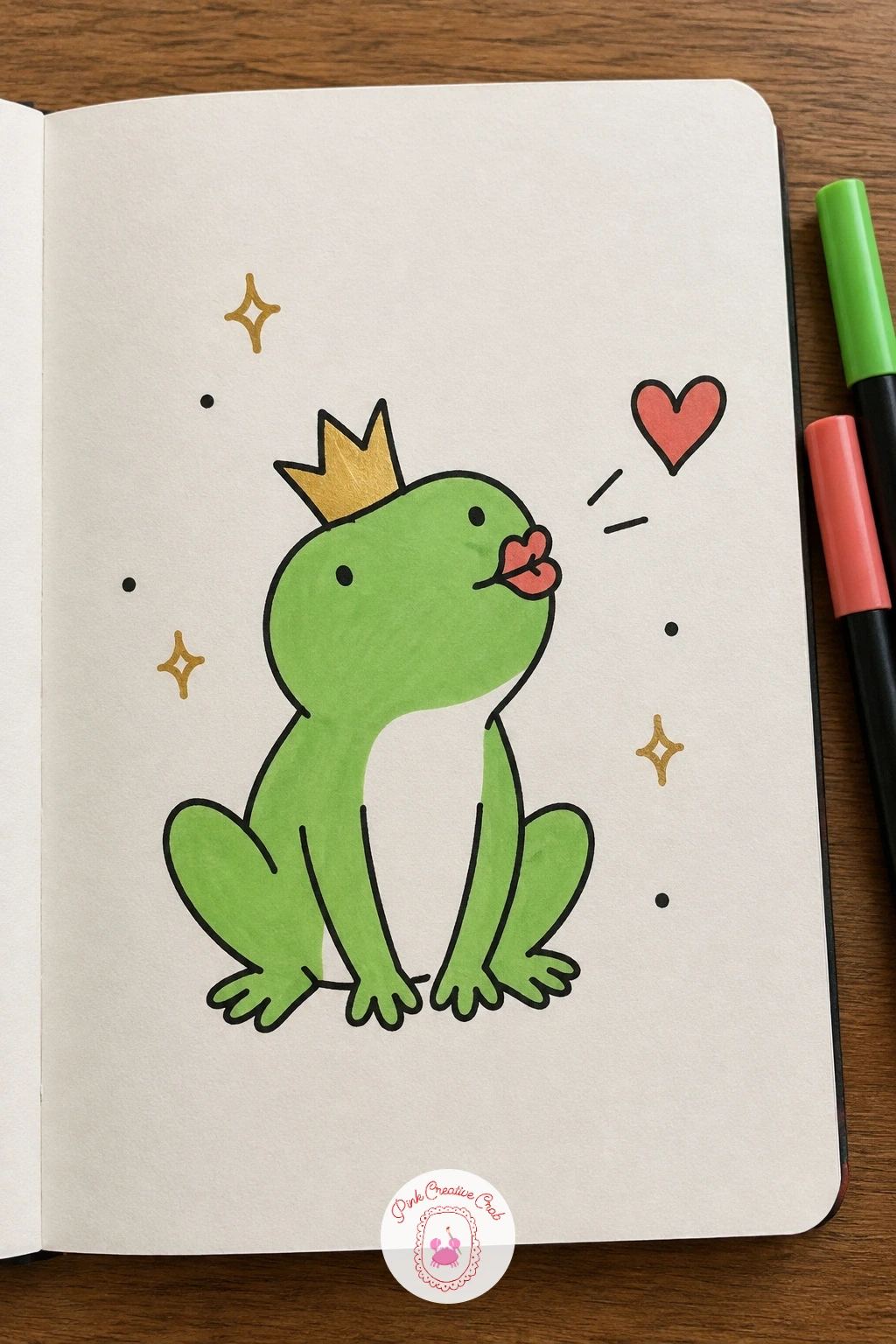
Give this frog doodle a little storybook charm by drawing the same rounded body as before, but puckering the mouth into a small tight circle instead of a smile. Puckered lips are just two curved lines meeting at a point, so do not overthink the shape.
Add the crown last: three small triangle points sitting on a thin curved band across the top of the head. Keep the crown narrow so it balances on the frog rather than swallowing it, and leave a tiny gap between the points for a lighter, more playful look.
Where this one usually wobbles is the crown tipping sideways; draw the headband first as a flat curve following the head’s curve, then build the triangles on top of that guideline. Coral pink works nicely on the lips, with the crown left uncolored or just outlined for a gold feel.
A fine gold gel pen outline on the crown, if you have one, adds a nice glint without extra steps.
Palette: Lily Pad Green,Coral Pink,Ink Black
This frog doodle borrows its energy from the pose, so sketch the leap before anything else: a diagonal body stretched between two lily pads, back legs kicked behind and front legs reaching forward. A frog mid-air always looks more convincing when the back legs trail lower than the front ones.
Draw the raincoat as a simple triangle shape over the shoulders with a small pointed hood, then add the puddle underneath as a flat oval with two or three curved splash lines jumping off its edge. The puddle sells the whole scene, so give it slightly more detail than the frog itself.
If the leap looks stiff, angle the whole body line diagonally across the page rather than keeping it level; a tilted frog always reads as moving. Color the raincoat lily pad green or leave it plain yellow if you have a yellow marker, with coral pink splash marks in the puddle.
Try this one in ten minutes with just the outline and splash lines, or spend closer to thirty adding cross-hatched shading under the raincoat for a fuller look.
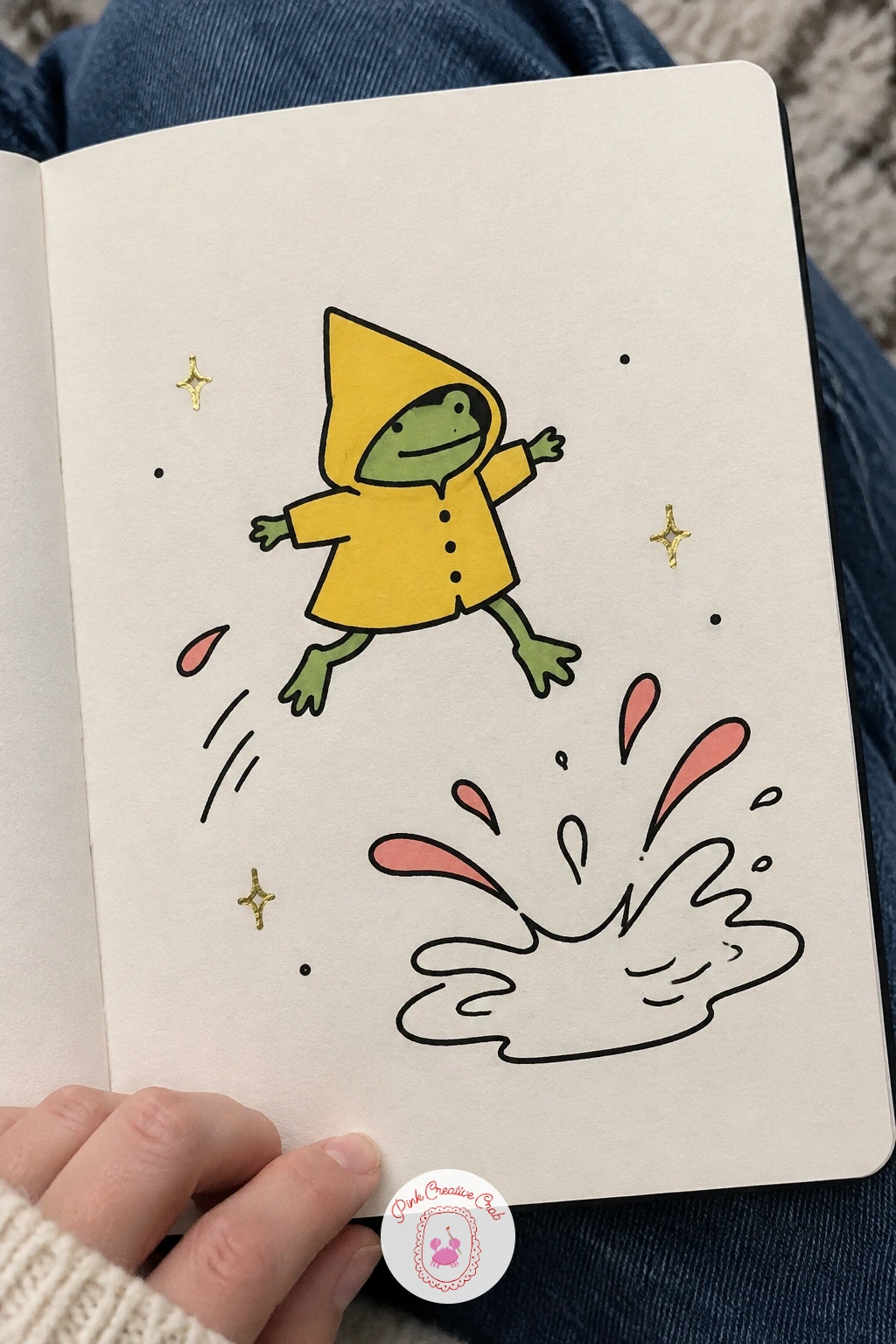
Palette: Lily Pad Green,Coral Pink,Ink Black
Carry on the cozy evening feeling from the raincoat frog into this quieter firefly doodle. Draw the frog sitting with both front legs wrapped around a simple jar shape: a rounded rectangle body with a slightly narrower neck and a small lid line on top.
Inside the jar, add one small oval firefly with two thin wing lines and a tiny glow circle behind it, drawn slightly larger than the firefly itself so it reads as light rather than another bug. Keep the jar’s glass lines loose and minimal; too many reflection lines make it look cluttered rather than glowing.
If the glow circle disappears once you add color, outline it faintly in coral pink marker instead of filling it solid, which keeps the light soft without hiding the firefly inside it. Swap a plain circle for the jar if drawing straight glass sides feels fiddly.
One concrete tip: draw the glow before the jar lines cross over it, so the light appears to sit behind the glass rather than on top.
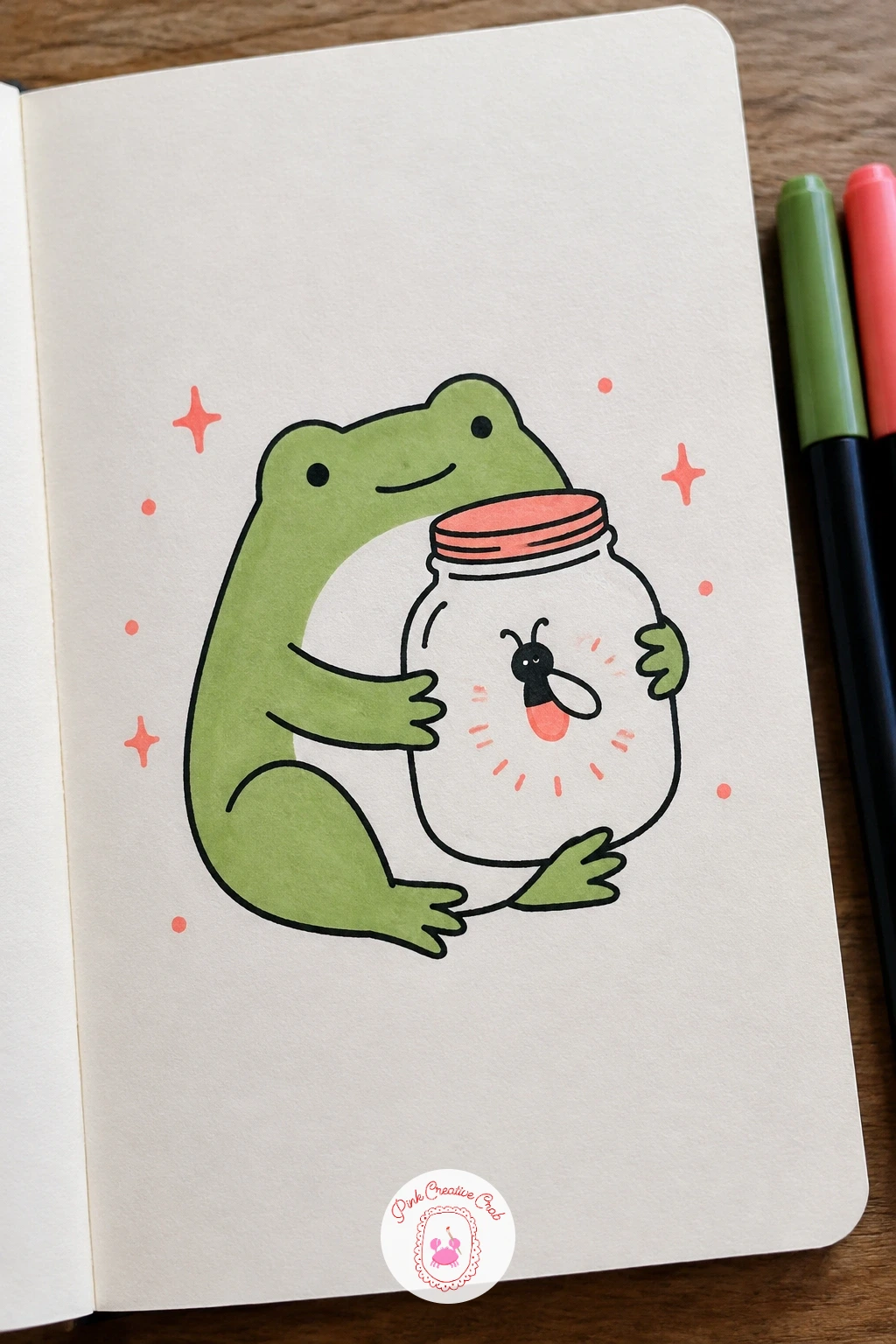
Palette: Lily Pad Green,Coral Pink,Ink Black
Try a soft yellow highlighter behind the firefly’s glow circle before inking over it, which gives the light a gentle halo without extra linework.
This calmer frog doodle pairs well after the busy firefly jar, since the pose slows right down. Draw the lily pad first as a flat wide oval, then sit the frog’s rounded body directly in its center with both back legs crossed into a simple pretzel shape instead of bent at the sides.
Front arms rest on the knees with small three-line hand shapes, palms up. Close the eyes with two short curved lines instead of circles, which instantly changes the frog’s expression from alert to peaceful.
Crossed legs are the part that most often goes wrong, so draw them as one continuous loop shape rather than two separate legs, then add a single line down the middle to split them visually. Lily pad green fills the pad nicely, leaving the frog’s body plain or lightly shaded.
If you enjoy this calmer pose, try the same crossed-leg trick on other small animal doodles, like the ones in this hamster doodle collection, to build a little set of meditating critters.
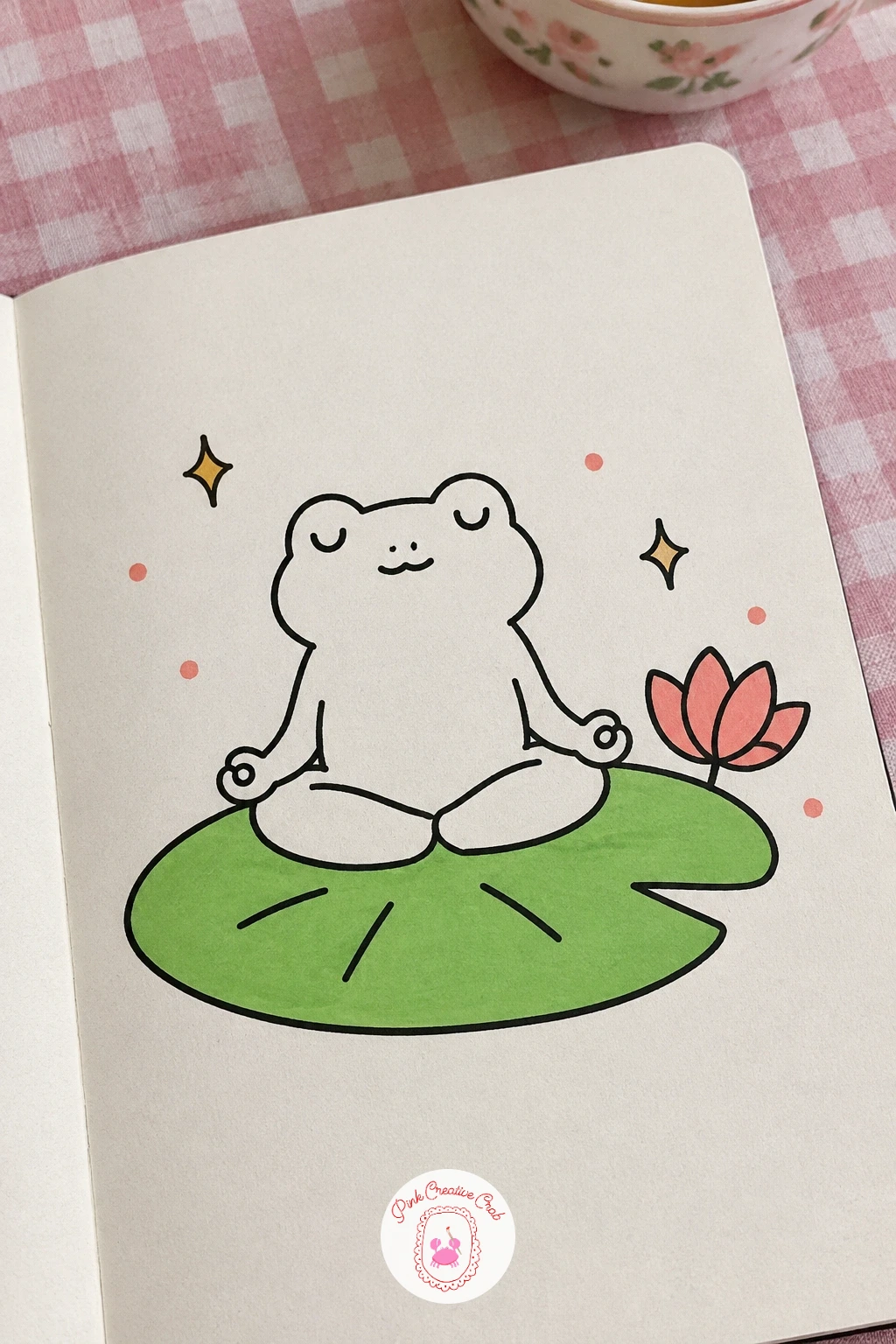
Palette: Lily Pad Green,Coral Pink,Ink Black
Give this one a comic burst of energy right from the first line: draw the frog’s body leaning backward slightly, as if caught off guard, with both eyes wide open as small circles with dot pupils. The surprised pose carries most of the joke, so keep the body simple.
The tongue is the fun part: a long curved line looping out from the mouth and stretching to a swirled lollipop shape drawn as a spiral inside a circle, with a short stick below it. Draw the tongue line first in pencil to check the stretch looks believable before inking it.
If the spiral lollipop looks messy, simplify it to two or three colored rings instead of a full spiral; it still reads clearly at doodle size. Color the lollipop in alternating coral pink and white, with the tongue left pale pink to match.
Swap the lollipop for a simple striped candy circle if spirals feel tricky to control with a marker tip.
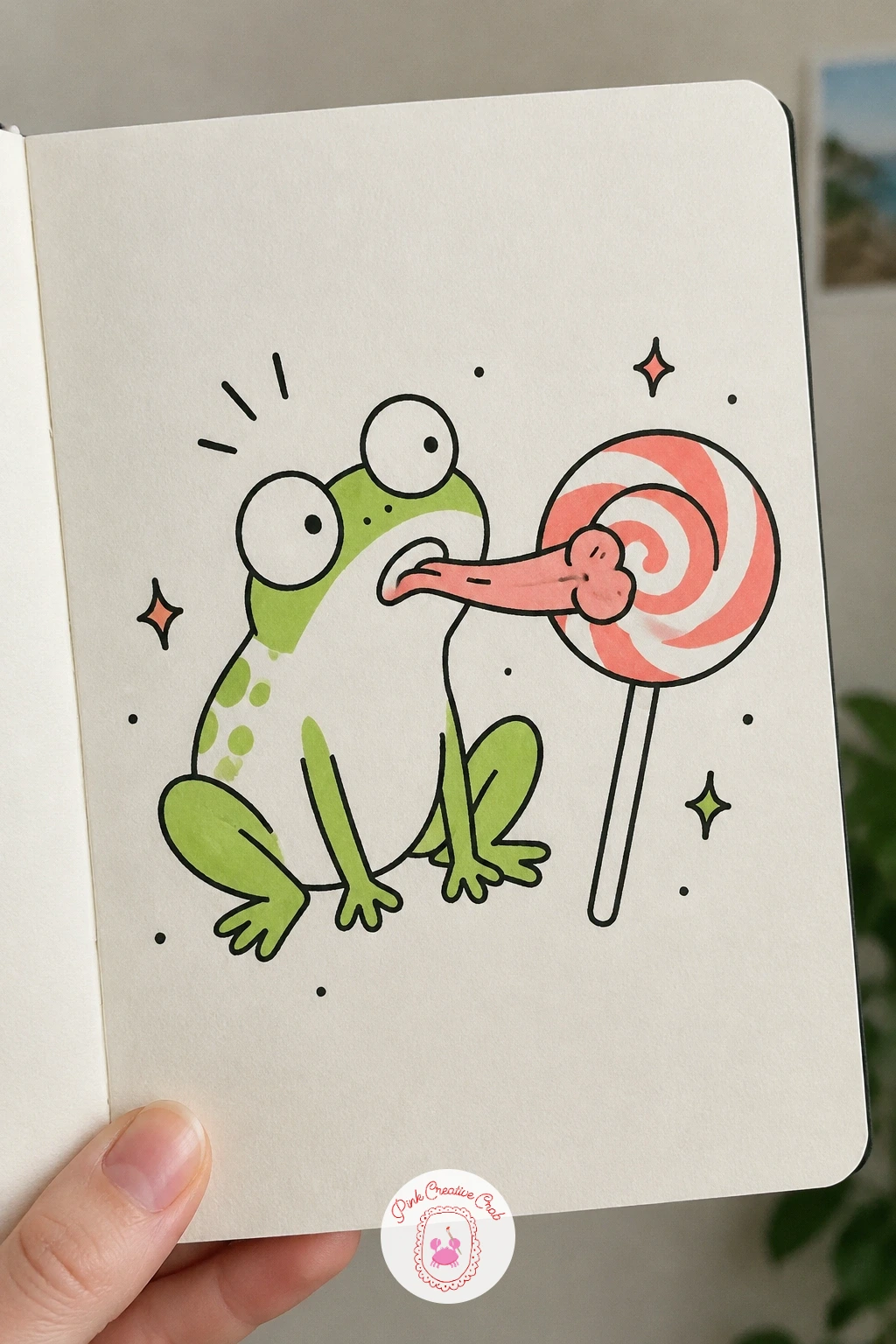
Palette: Coral Pink,Lily Pad Green,Ink Black
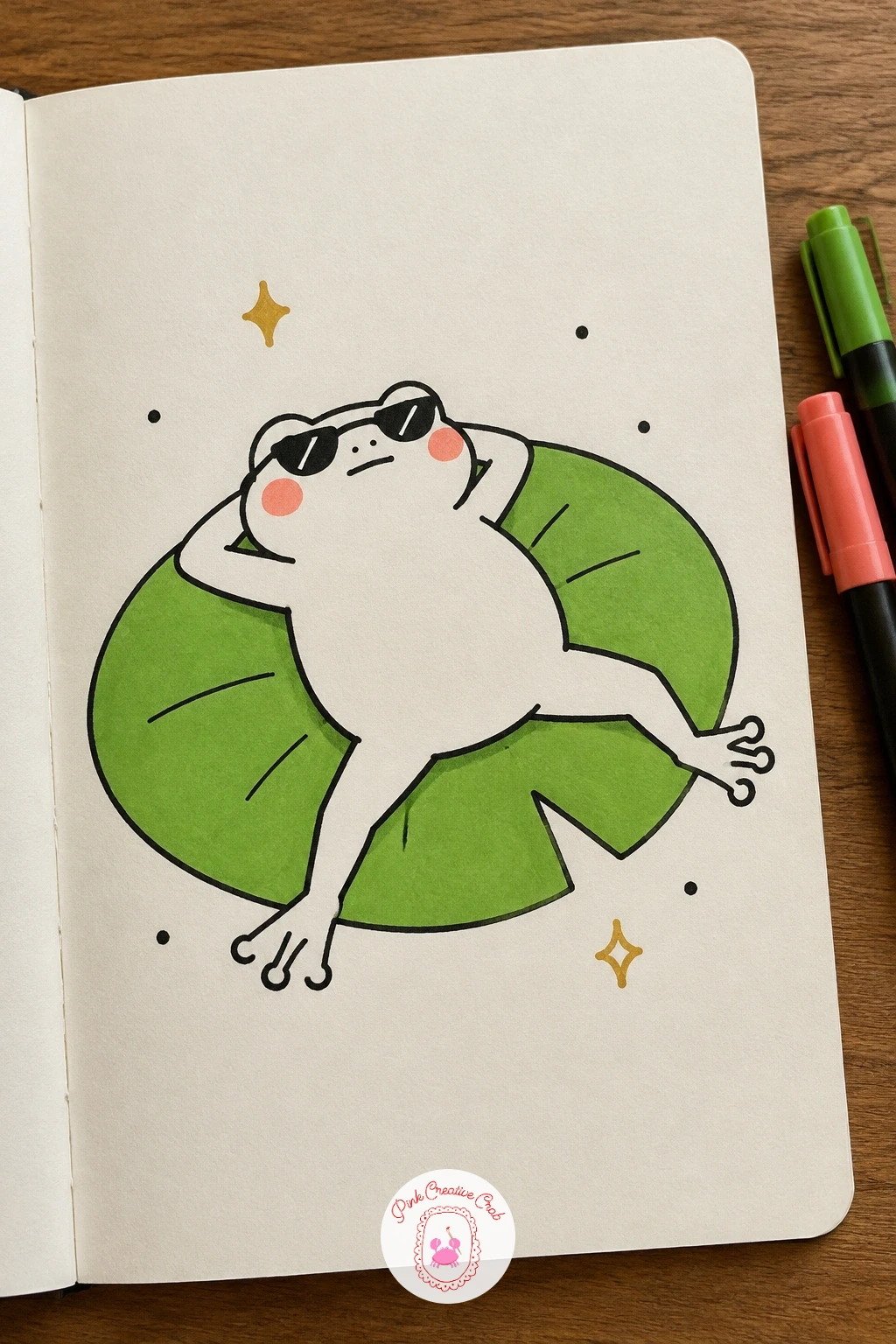
After all that movement, let this frog doodle relax completely. Flip the usual pose and draw the frog lying flat on its back across a lily pad, round belly facing up, with all four legs splayed loosely out to the sides rather than tucked in.
Keep the eyes as two closed curved lines and add a small contented smile. A pair of tiny sunglasses drawn as two connected ovals over the eyes is an easy optional touch if you want extra personality.
The belly shape is where this goes wrong most often, since a perfectly round belly can look like a separate blob; draw it as one continuous outline from chin to tail rather than adding the belly as a shape on top of the body. Shade the lily pad lily pad green and leave the belly pale with a few small coral pink sun-flush dots on the cheeks.
One tip worth remembering today: always draw the lily pad slightly wider than the frog’s sprawled limbs, or the pose reads as floating in open water instead of resting.
Palette: Lily Pad Green,Coral Pink,Ink Black
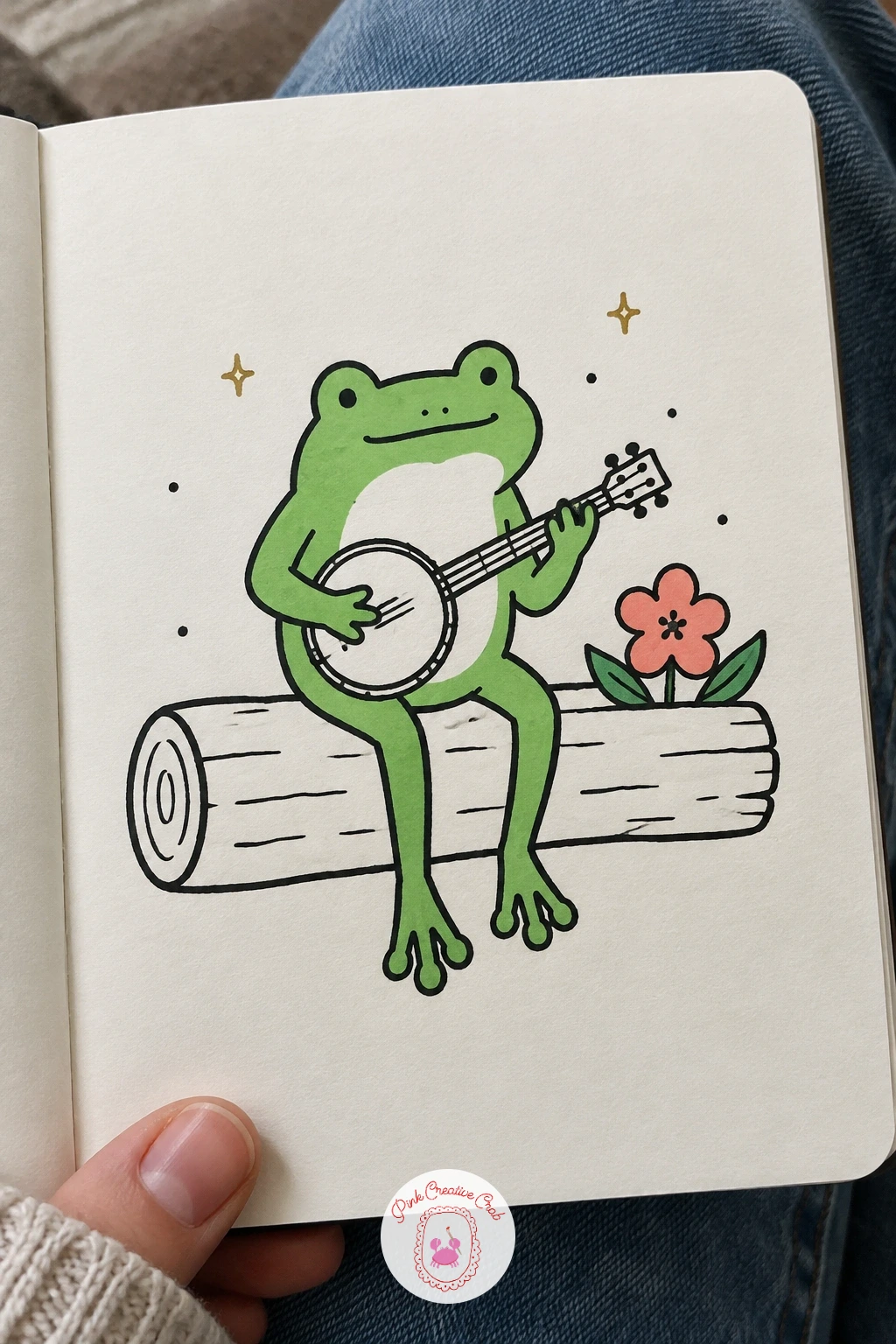
Move into a livelier scene with this frog doodle, perched on a simple log drawn as a long rounded cylinder with two or three short line marks for bark texture. Sit the frog on top with legs dangling over the edge.
Draw the banjo as a small circle body with a thin straight neck, four short strings as straight lines across the circle, and tiny tuning pegs at the top. Angle the frog’s arms so one hand strums near the strings and the other holds the neck, which makes the pose read as playing rather than just holding an object.
If the banjo circle looks flat against the frog’s round body, overlap it slightly across one arm rather than placing it beside the body; overlapping shapes always read as held objects more convincingly. A pale wood tone or light pencil shading works for the banjo and log, with coral pink saved for a small flower nearby if you want one.
No banjo reference needed: a ukulele’s four strings and small body work as an easy swap if the round banjo shape feels fiddly.
Palette: Lily Pad Green,Coral Pink,Ink Black
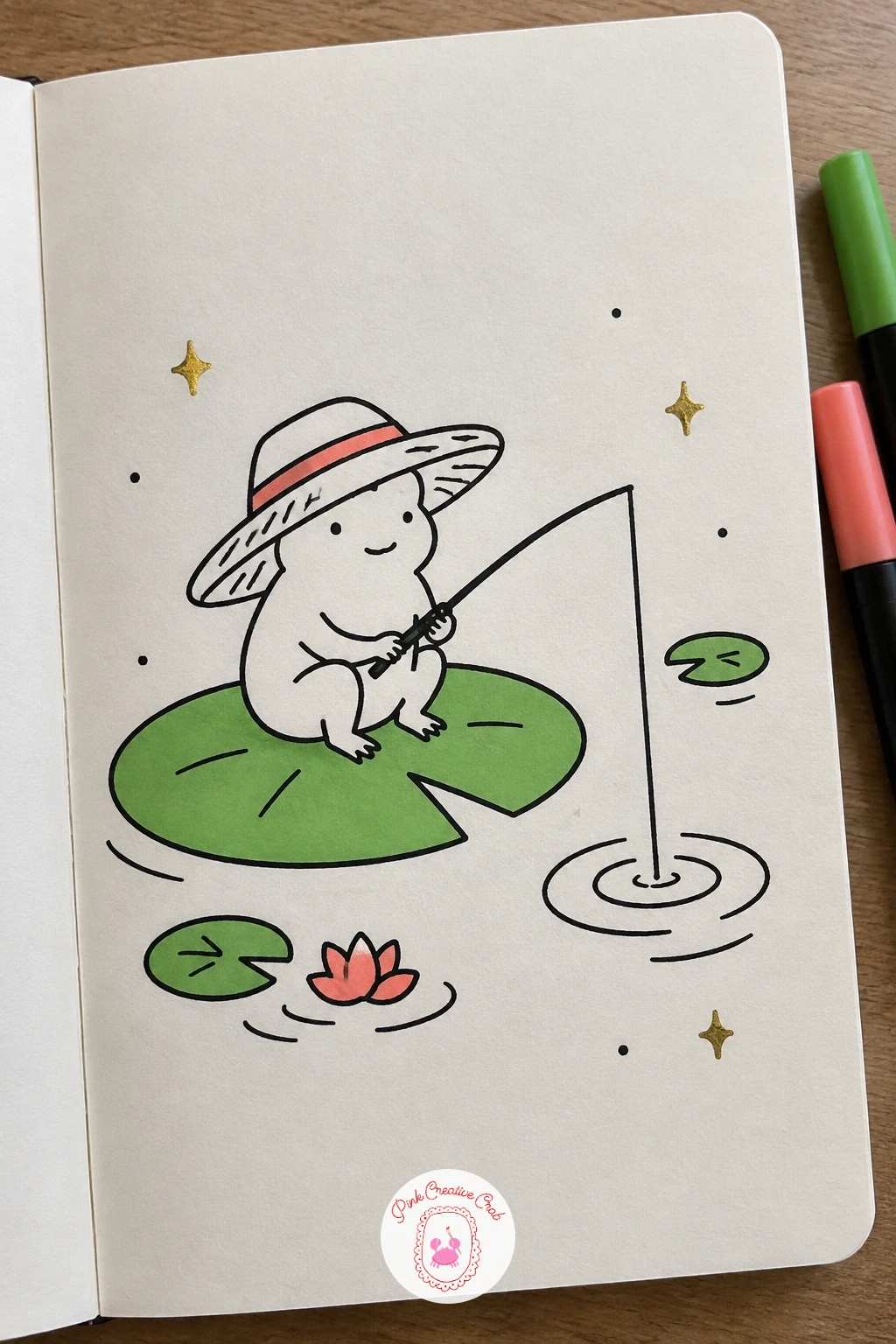
This frog doodle works well as a quiet companion to the banjo scene, so keep the same relaxed mood. Draw the frog sitting on a lily pad with a small round straw hat on its head, shown as a shallow dome with a wide brim drawn as two curved lines.
A fishing rod is just one long diagonal line from the frog’s hand down to a short curved hook, with a tiny wavy line below the water’s surface to suggest a fishing line disappearing into the pond. Keep the rod thin so it does not compete with the frog for attention.
Straw hats tend to look lopsided if the brim curves are drawn freehand without a guide, so lightly sketch an oval first and trace the brim along its edge before inking. Color the hat a pale tan or leave it white, with lily pad green for the pad and a few coral pink dots as tiny bobbing flowers nearby.
For a forty-minute version, add gentle ripple lines spreading out from where the fishing line meets the water.
Palette: Lily Pad Green,Coral Pink,Ink Black
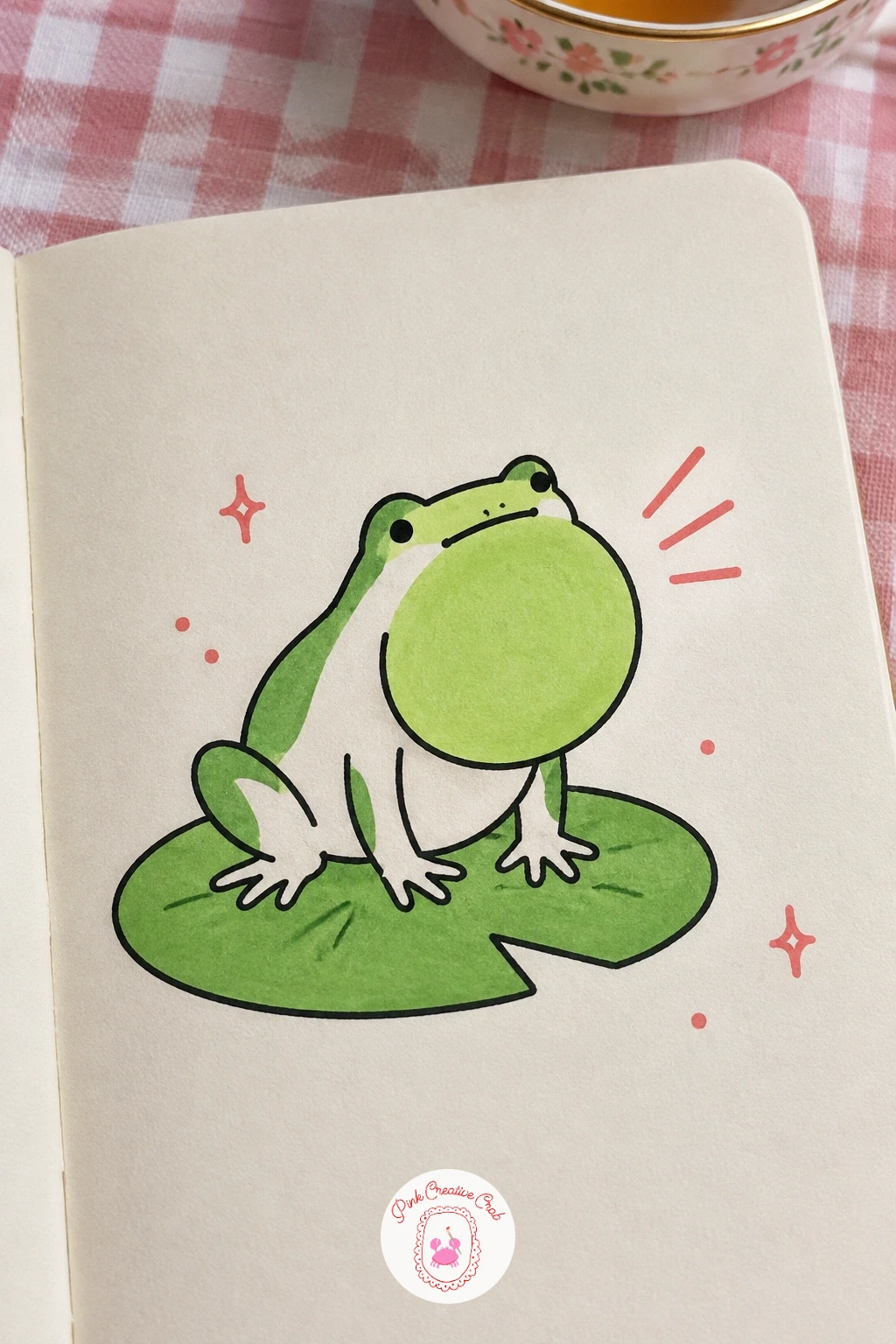
Here the fun is entirely in exaggeration, so make this frog doodle’s throat the biggest shape on the page. Draw the usual rounded body first, then add one large smooth balloon shape under the chin, bigger than the head itself, to show the throat puffed mid-croak.
Angle the head slightly upward and open the mouth into a small wide oval, with two or three short curved lines radiating from it like sound waves. Proud posture helps the joke land, so lift the front legs slightly off the ground as if standing tall.
Beginners often draw the throat too small out of habit, since it feels odd to make a body part larger than the head; trust the exaggeration and let the throat bulge past the frog’s chin line and even past its arms. Color the throat a lighter lily pad green than the body to show it stretching thin, with coral pink for the little sound-wave lines.
If circles feel hard to balance, draw the throat as an egg shape instead of a perfect balloon; it still reads as puffed and round.
Palette: Lily Pad Green,Coral Pink,Ink Black
Keep the rain theme going but flip the mood entirely for this frog doodle: no umbrella this time, just pure joy. Draw the body in a mid-twist pose, one arm raised and one leg kicked out, with the head tilted back slightly as if laughing up at the sky.
Surround the frog with scattered raindrops of different sizes rather than evenly spaced ones, which makes the rain feel livelier and matches the dancing energy. A few small motion lines near the kicked-out leg reinforce the movement.
If the twisting pose feels stiff, draw a simple curved spine line first, almost like a backwards C, then build the arms and legs off that curve instead of starting with a straight body outline. Color most raindrops lily pad green with one or two in coral pink for contrast, scattered rather than uniform.
This pose pairs naturally with the earlier leaping raincoat frog if you want two rainy-day doodles side by side on the same page.
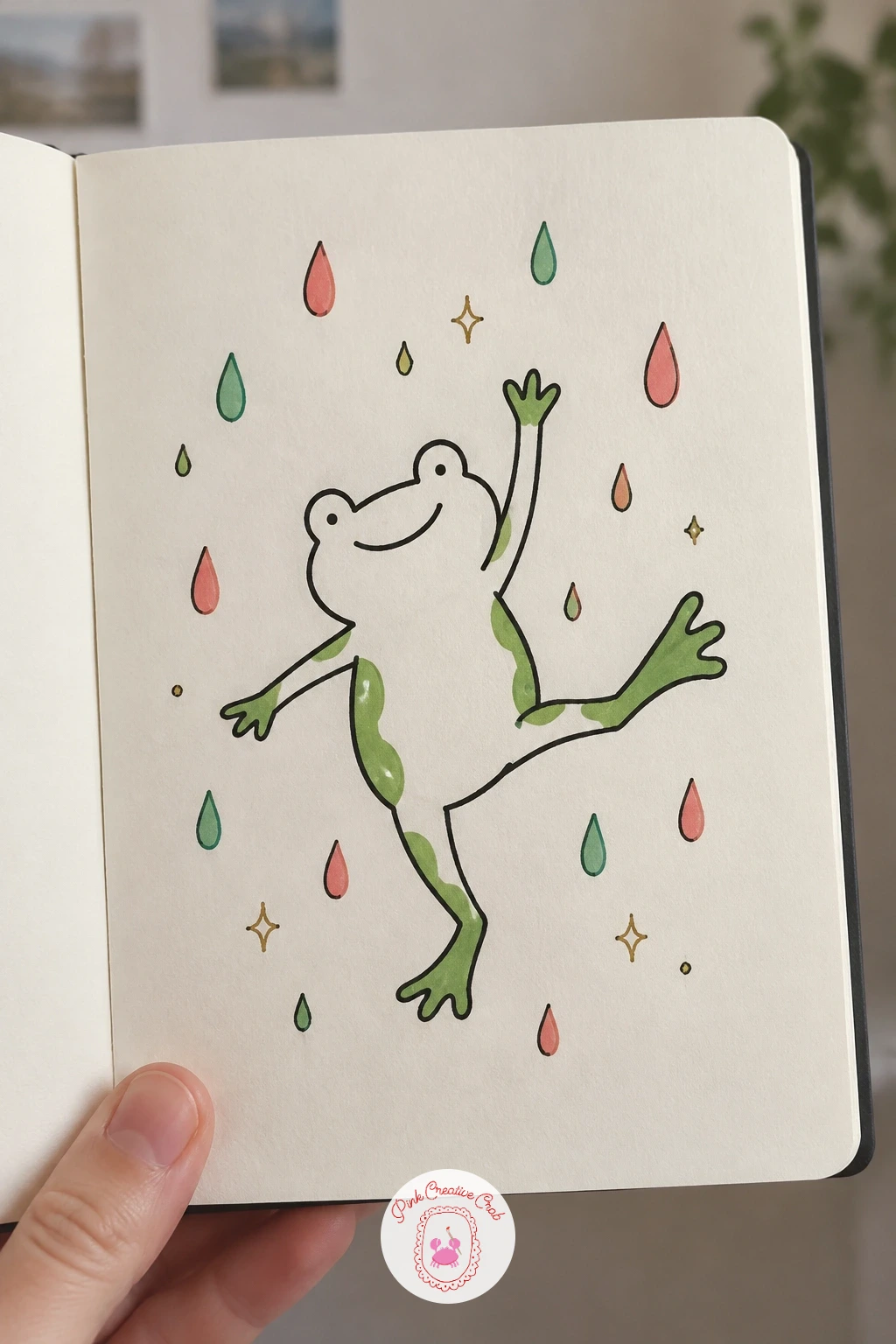
Palette: Lily Pad Green,Coral Pink,Ink Black
Scale is the whole trick in this frog doodle, so draw the raindrop first and make it clearly bigger than the frog’s own head, almost as wide as its whole body. A raindrop is just a circle with one pointed top, so keep that shape simple and smooth.
Wrap the frog’s arms around the widest part of the drop, with legs bent slightly as if braced against its weight, and tilt the head to rest against the curved side. This gives the hug a cozy, affectionate feel rather than looking like the frog is simply standing next to it.
The hug reads wrong if the arms stop short of meeting around the back of the drop, so extend the arm lines until they slightly overlap behind it, even if you cannot see the overlap clearly. Leave the raindrop mostly uncolored or very pale blue-green, since a solid fill can make it look heavy rather than light and clear.
If you want a softer edge on the drop, lift a little color out while the marker is still wet using a damp cotton swab.
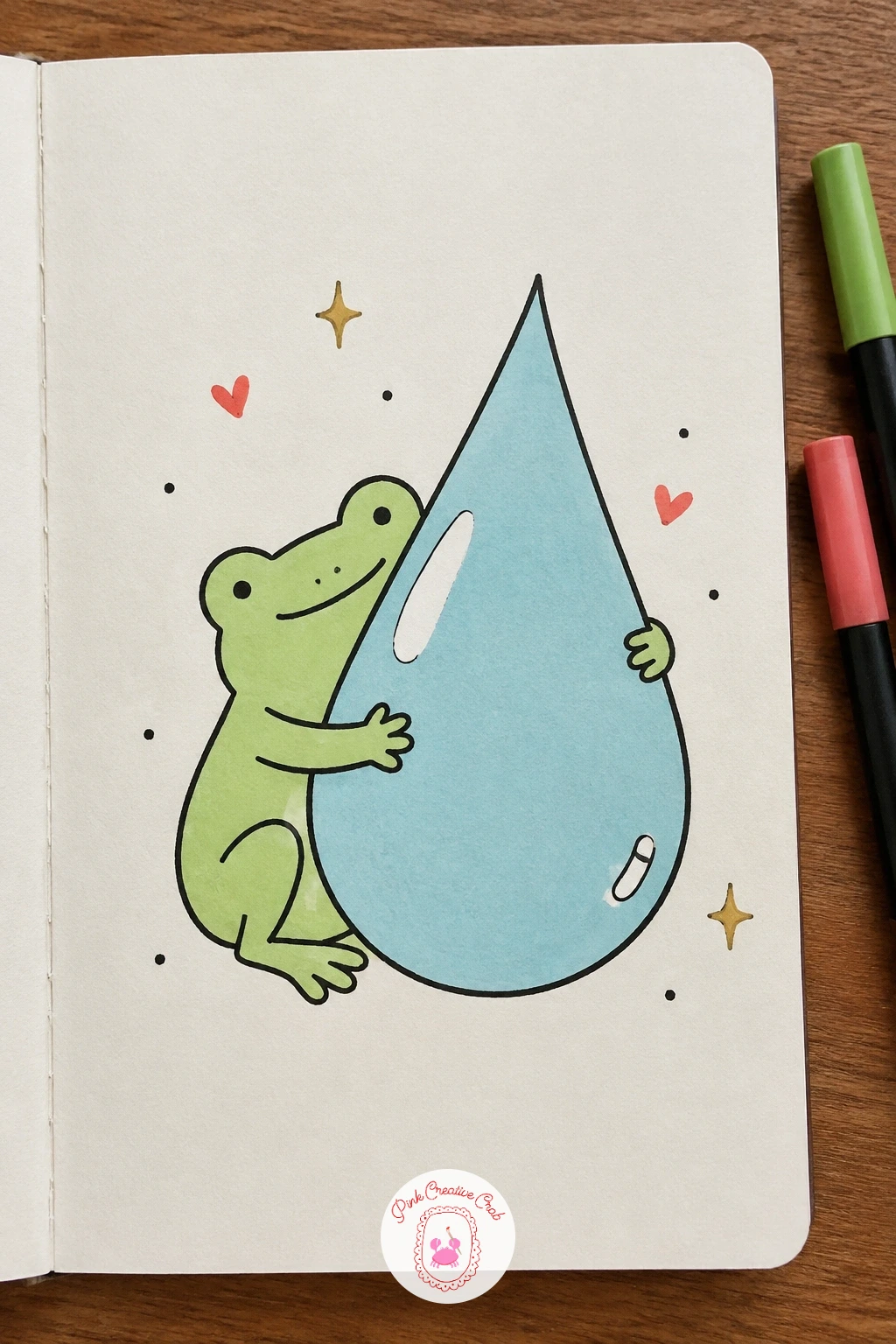
Palette: Lily Pad Green,Coral Pink,Ink Black
This smaller, sweeter frog doodle pairs nicely after the raindrop hug. Draw a large dewdrop shape resting on a thin blade of grass or a leaf tip, then place the frog sitting beside it at about shoulder height to the drop.
Add a thin straw as two parallel lines running from the frog’s mouth into the top of the dewdrop, bent slightly at the point where it enters the liquid to suggest refraction. Keep the frog’s cheeks slightly puffed to show the sipping action.
Straws often look stuck on if drawn perfectly straight, so bend the line gently where it crosses the drop’s edge, just like a straw bending in a real glass of water. Leave the dewdrop clear or pale, with lily pad green for the grass blade beneath it and a touch of coral pink on the frog’s cheeks.
Swap the dewdrop for a round water droplet on a flower petal if you would rather set the scene among petals than grass.
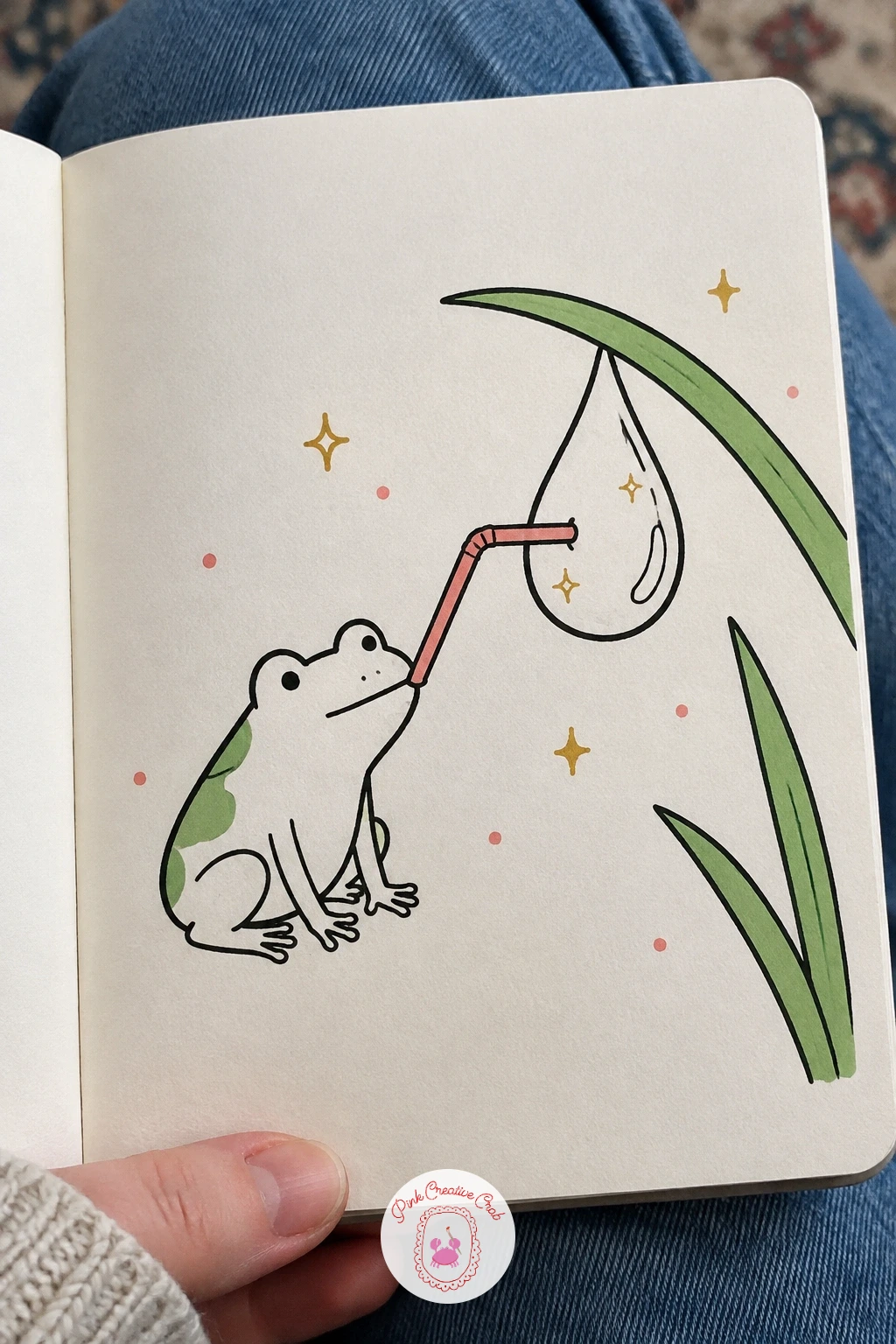
Palette: Lily Pad Green,Coral Pink,Ink Black
Build on the earlier jumping pose but push the expression further in this frog doodle. Stretch the body into a long diagonal line across the page, back legs fully extended behind and front legs reaching ahead, further apart than in a resting pose.
Close both eyes tightly with short curled lines instead of circles, almost like tiny upside-down U shapes, and open the mouth slightly to show the effort of the jump. A few speed lines trailing behind the back legs finish the motion.
One measuring trick helps this leap look right: imagine a line from the tip of the nose to the tip of the back foot, and keep the whole body roughly twice as long stretched out as it is when sitting. Shortening that stretch is the most common reason a jumping frog doodle looks flat rather than airborne.
Color lightly, since a stretched pose with too much solid fill can look stiff; a thin lily pad green outline with coral pink speed lines keeps it feeling fast.
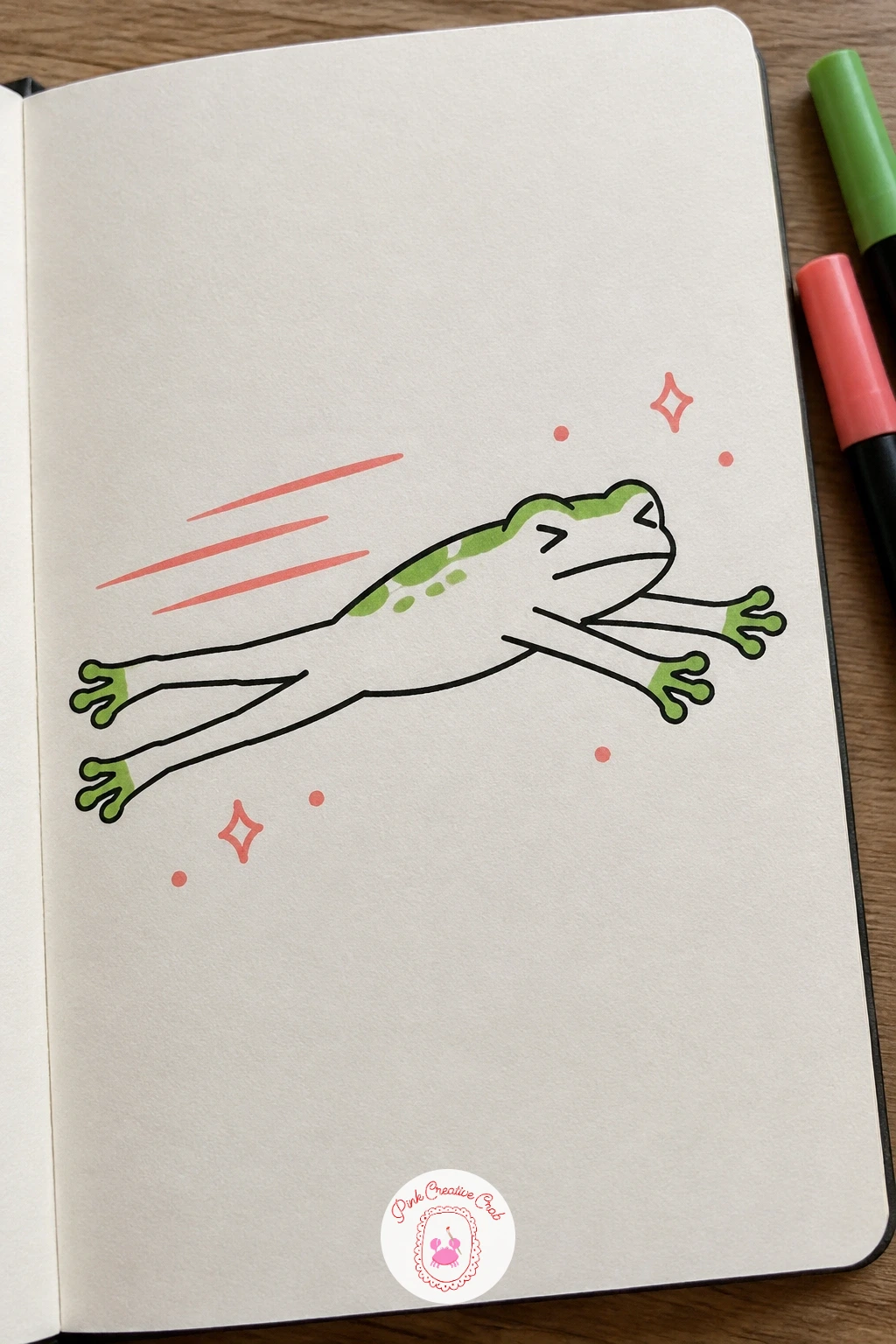
Palette: Lily Pad Green,Coral Pink,Ink Black
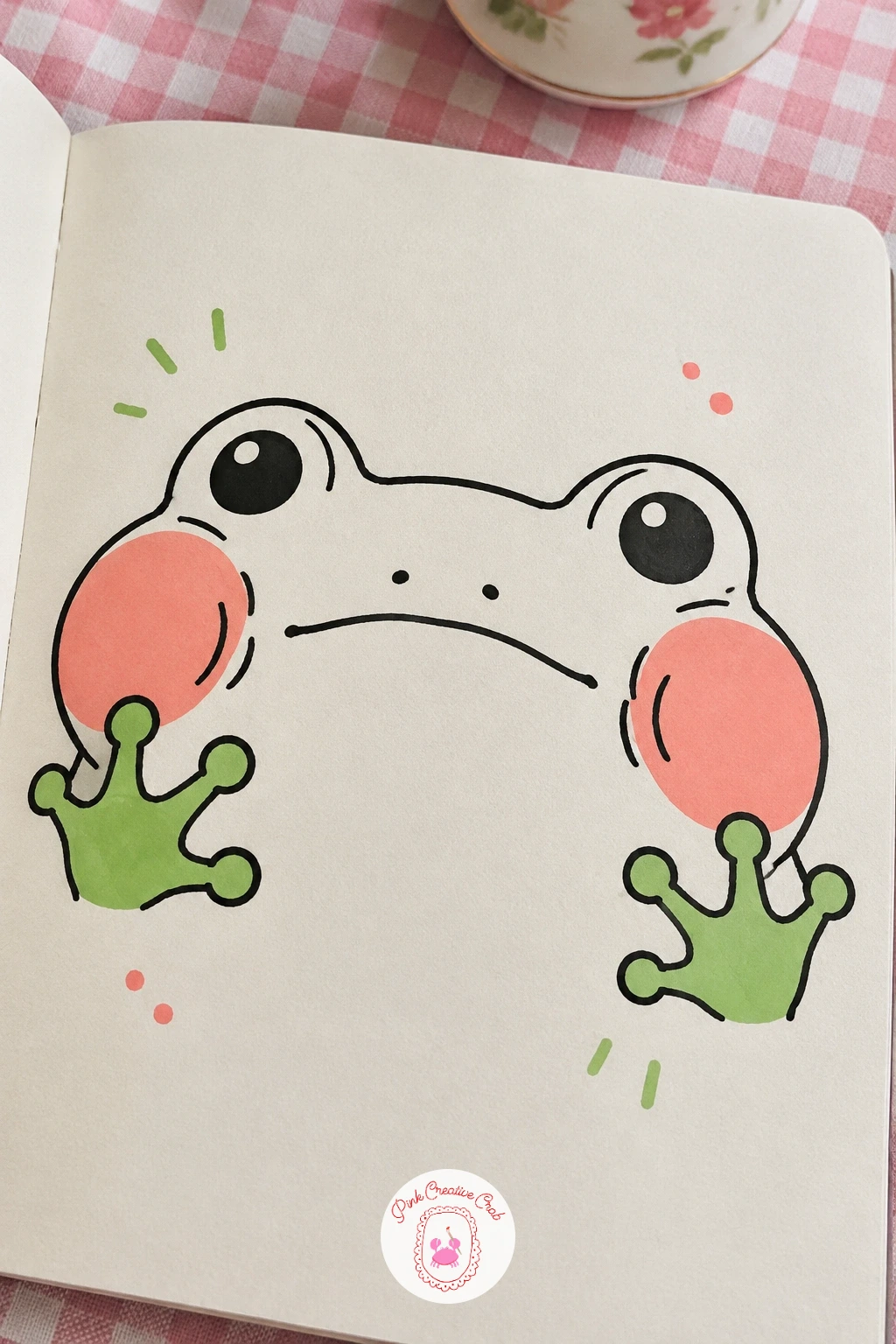
This frog doodle gets its charm entirely from distortion, so start by drawing a simple vertical line down the page to represent the glass pane, then build the frog’s face pressed flat against it from one side. Flatten the usual round cheeks into wider, squashed ovals that bulge slightly past where the glass line would be.
Draw the mouth as a small flattened oval too, pressed wide rather than tall, and keep the eyes bulging forward as normal since eyes do not squish the way cheeks do. A few short curved lines near the squished cheeks suggest the pressure point against the glass.
If the squish looks too subtle to notice, exaggerate the cheek width further than feels natural; cartoon squishing always reads better pushed slightly too far rather than kept realistic. Color the cheeks a flushed coral pink to emphasize the pressure, with lily pad green reserved for a small leaf shape in the corner if you want extra context.
A kneaded eraser lifts stray pencil guidelines cleanly before you ink the final squished outline.
You Will Need
- kneaded eraser
Palette: Coral Pink,Lily Pad Green,Ink Black
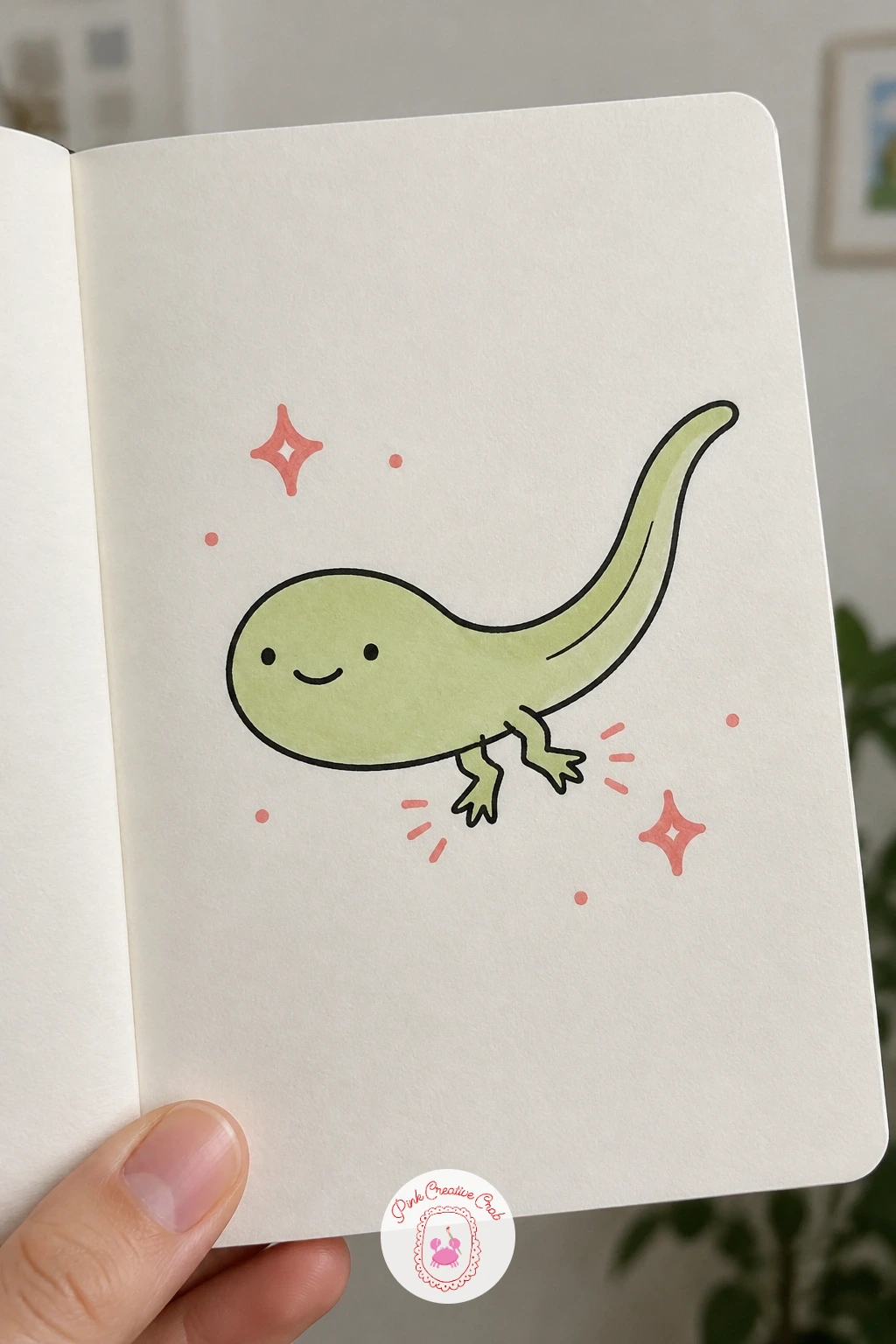
Shift the story slightly with this frog doodle, since it is really a tadpole still mid-transformation. Draw the familiar teardrop tadpole shape first, a round head tapering into a long curved tail, then add two small, proud-looking back legs sprouting from the base of the tail where it meets the body.
Give the legs a slightly different line weight than the smooth tail, since new legs often look a little stiff and awkward compared to the fluid tail shape, which actually helps sell the idea that they just grew in. Add a small proud expression with wide eyes and a closed smile.
If the legs look like they are floating separately from the body, draw one continuous outline that flows from the tail into the top of each leg rather than attaching them as separate shapes afterward. Color the tail and head lily pad green, leaving the new legs a touch paler to show they are fresh.
This is a nice one to pair with a full grown frog doodle elsewhere on the page to show the size difference.
Palette: Lily Pad Green,Coral Pink,Ink Black
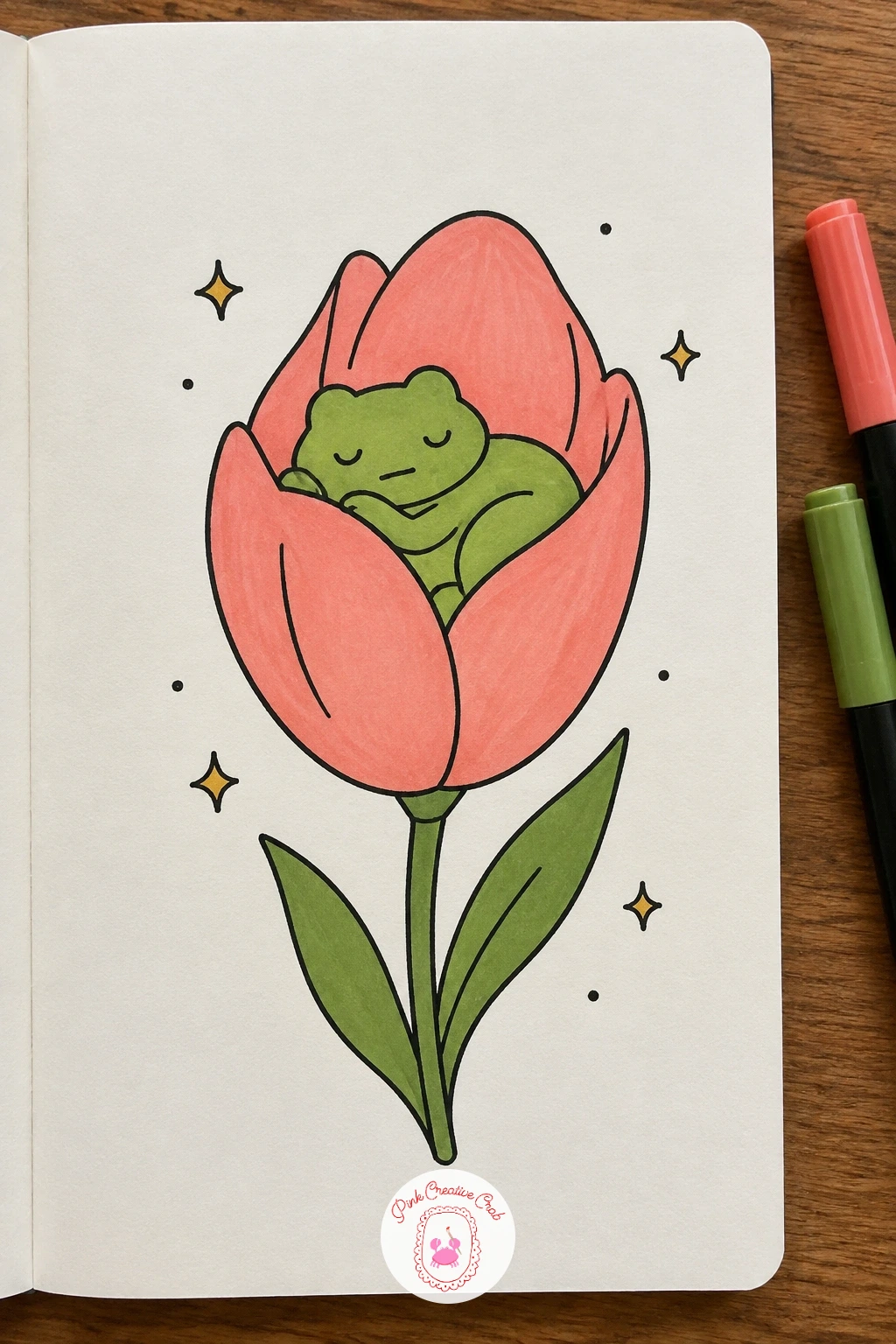
After the busier tadpole, slow things down again with this cozy frog doodle. Draw a tulip first as three overlapping petal shapes curving inward at the top, wide enough at the base to fit a curled-up frog comfortably inside.
Curl the frog’s body into a tight ball shape with the head tucked down and legs folded under, rather than the usual open sitting pose, so it reads clearly as sleeping rather than resting upright. A small closed-eye line and a tiny zzz mark above the head finish the mood.
Petals often end up too narrow to hold the frog convincingly, so draw the tulip shape first and then size the curled frog to fit inside it, rather than drawing the frog first and squeezing petals around it. Color the petals coral pink and the frog lily pad green for a nice contrast between the two main colors of the whole set.
If tulip petals feel tricky, a simple rounded flower cup with no pointed petal tips still reads clearly as a flower bed.
Palette: Coral Pink,Lily Pad Green,Ink Black
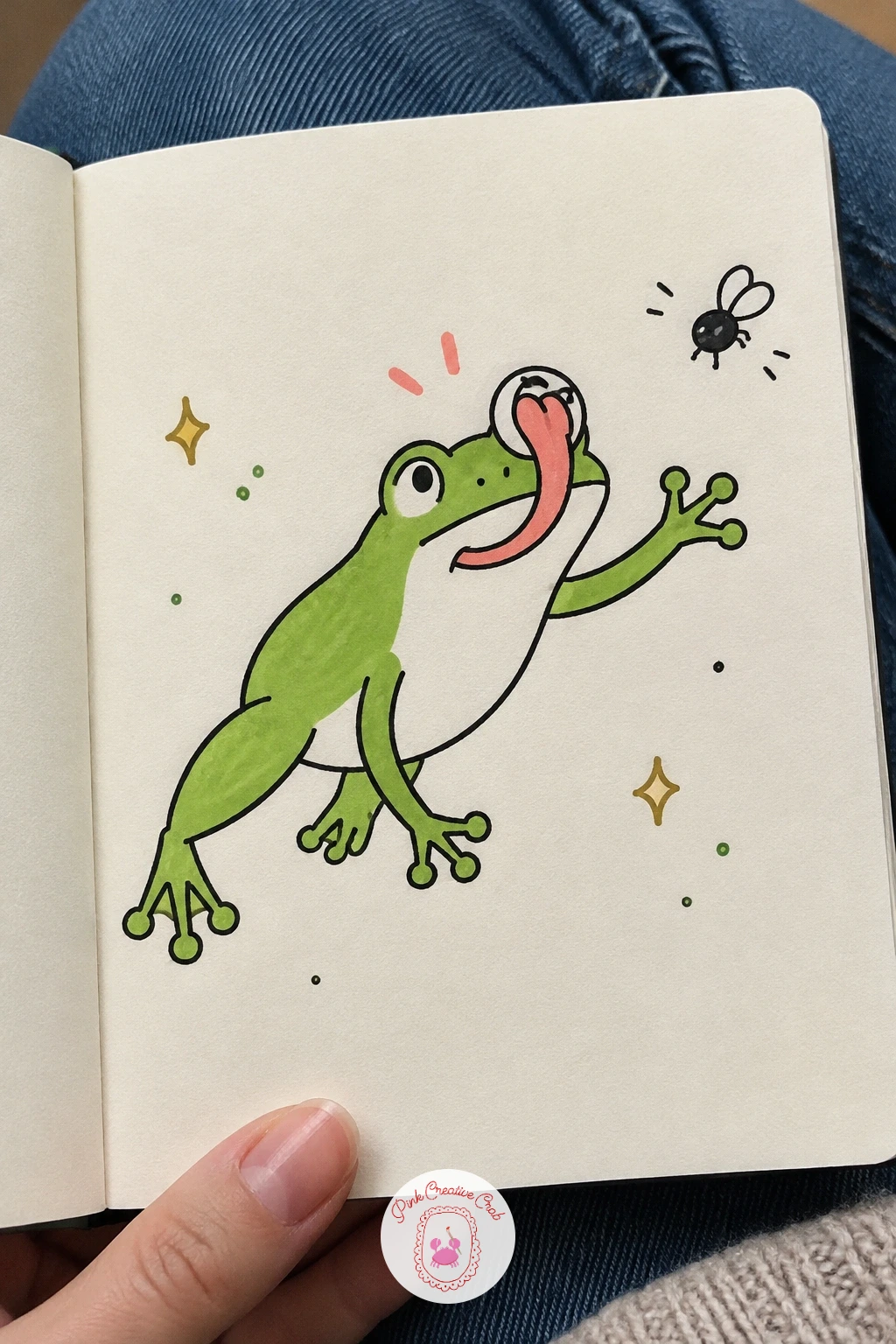
Bring some slapstick back into the set with this frog doodle. Draw the frog mid-lunge toward a small fly, shown as a tiny oval with two thin wing lines, hovering just above and to the side of the frog’s head.
Instead of the tongue reaching the fly, curl it upward and back toward one of the frog’s own bulging eyes, with the eye drawn slightly squeezed and the tongue tip just touching its edge. Keep the fly clearly missed by leaving a visible gap between it and the tongue.
This gag depends on timing in the drawing itself, so draw the fly first in its hovering spot, then draw the tongue curling the wrong way on purpose, well clear of the fly, so the miss reads instantly rather than looking like an unfinished tongue. Color the fly a dark accent and keep the frog’s usual lily pad green and coral pink palette for the body and tongue.
No image needed for the fly’s wings if that feels fussy: two short strokes still read clearly at this size.
Palette: Lily Pad Green,Coral Pink,Ink Black
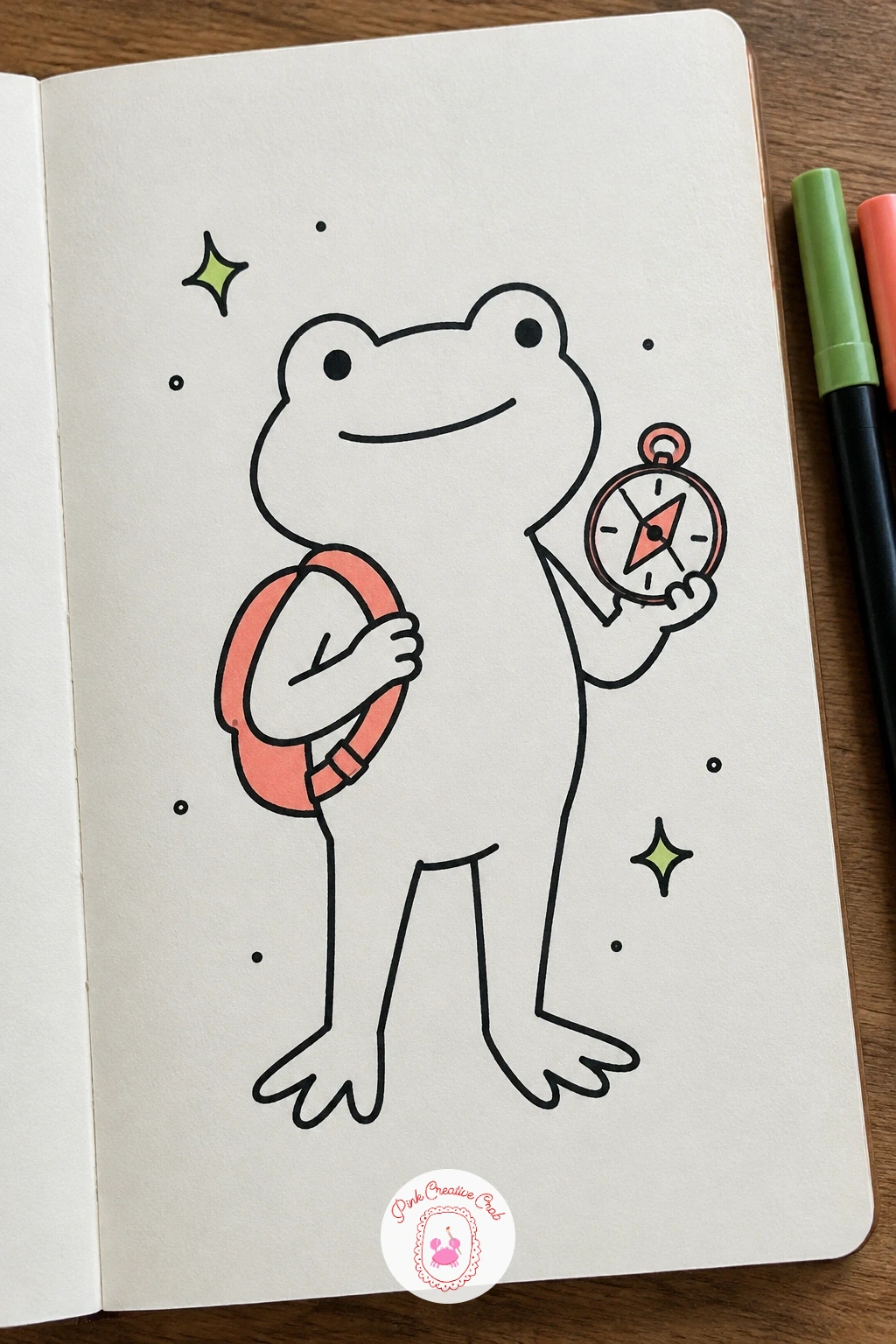
Give this frog doodle a sense of purpose after the silliness of the last one. Draw the frog standing upright with one arm raised, holding a small round compass drawn as a circle with a thin diamond-shaped needle inside and tiny tick marks around the rim.
Angle the head slightly forward, as if looking ahead toward an adventure, and keep the free arm resting on the hip or swinging slightly for a confident stance. A small traveling bag slung over one shoulder is an easy optional addition if you want more story.
Compass needles look cluttered if you add full numbers and letters around the rim, so stick to four small tick marks at the top, bottom and sides instead of a detailed dial. Color the compass body a pale metallic gray or leave it white, with lily pad green for the frog and a coral pink strap on the bag if you add one.
Next time you draw this frog, try swapping the compass for a rolled-up paper map for a slightly different adventuring mood.
Palette: Lily Pad Green,Coral Pink,Ink Black
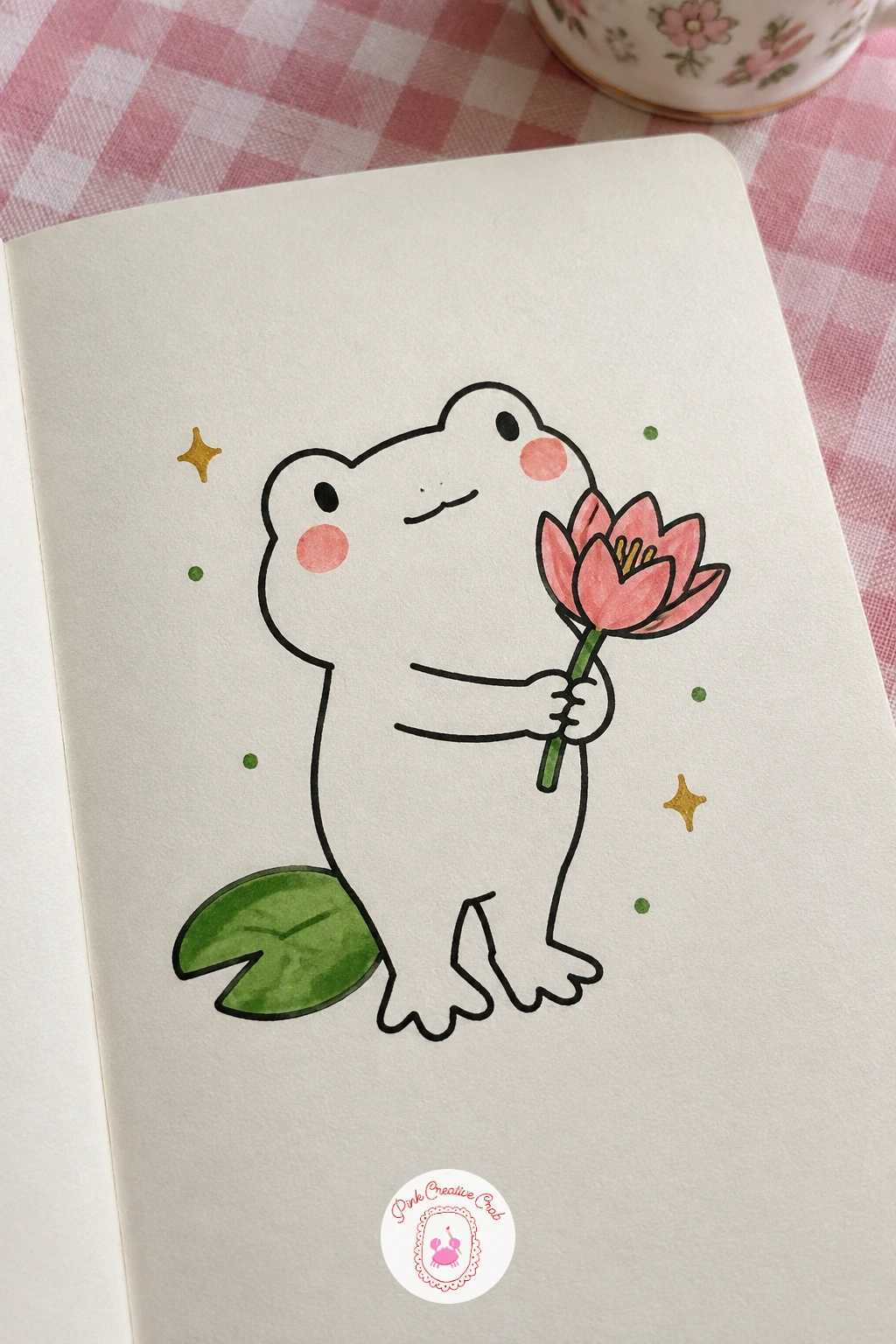
Follow the confident compass frog with something softer and shyer in this frog doodle. Draw the frog standing with both arms extended forward, holding out a single water lily flower shown as five or six rounded petals around a small center circle.
Tilt the head slightly downward and add two small round blush marks on the cheeks, drawn as simple soft circles rather than hard shapes, to give the shy, offering expression. Keep the eyes a little smaller and softer than usual to match the mood.
If the flower looks flat or stuck on, draw the petals slightly overlapping each other rather than evenly spaced like a cartoon sun, which gives the lily more natural depth even at a small doodle size. Color the petals coral pink with a lily pad green center, and keep the blush marks a lighter version of the same pink.
This pairs nicely as a gift tag doodle, something also explored in this friends doodle collection if you want more small, sweet gesture drawings.
Palette: Coral Pink,Lily Pad Green,Ink Black
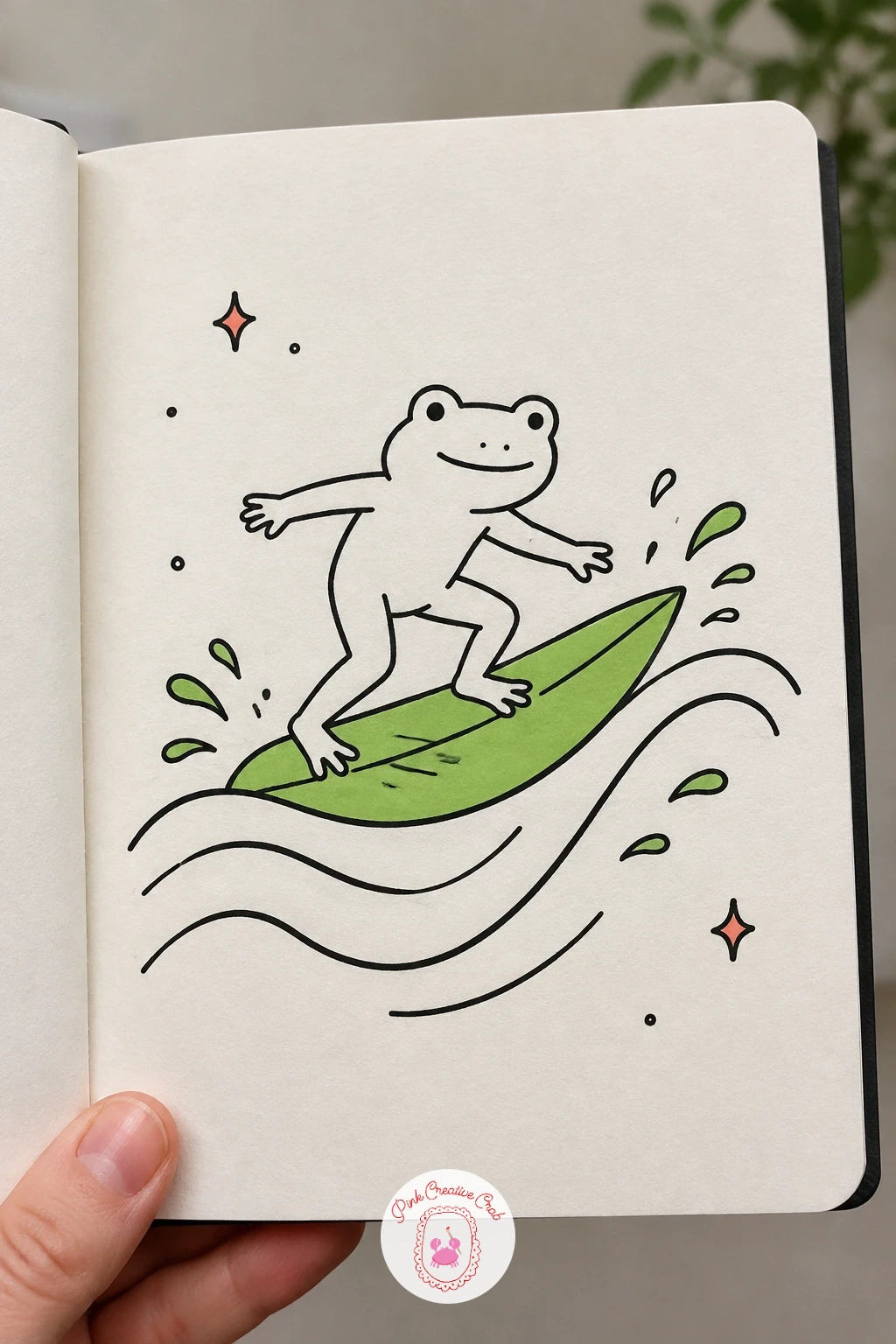
Pick the energy back up with this frog doodle, built around a strong sense of movement across water. Draw a long curved leaf shape first, pointed at both ends, then place the frog standing on top with knees bent and arms out slightly for balance, just like a tiny surfboard rider.
Add a few wavy lines beneath and around the leaf to suggest flowing water, angled slightly to show the direction of the current, and a couple of small splash marks near the back of the leaf where it cuts through the surface. Keep the frog’s weight shown leaning slightly forward into the direction of travel.
Balance poses tend to look stiff if both legs are bent at the exact same angle, so vary them slightly, one knee a touch more bent than the other, which reads as active balancing rather than a static stance. Lily pad green suits the leaf well, with coral pink reserved for small splash accents.
Try this one quickly in ten minutes with just outline and wave lines, or spend longer adding ripple detail for a fuller stream scene.
Palette: Lily Pad Green,Coral Pink,Ink Black
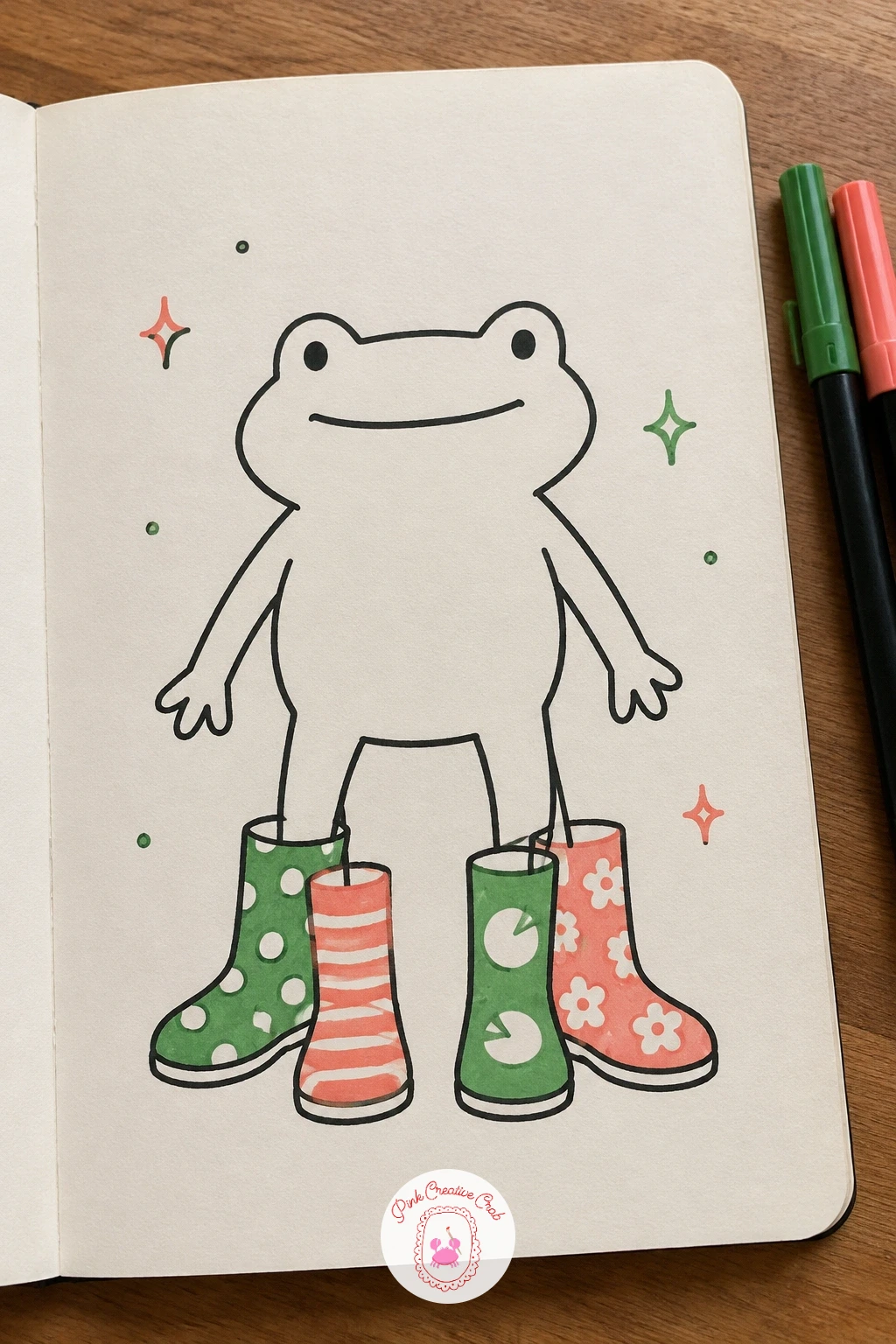
This frog doodle is almost entirely about small details that make the joke land, so draw the frog’s body and legs first in a simple standing pose with all four feet visible and spaced apart. Each boot then gets its own shape and pattern: one striped, one polka dotted, one plain, one with a small flower.
Keep the boots a consistent basic shape, a short rounded cylinder with a slightly wider top rim, and change only the pattern and color between them rather than the shape itself. This keeps the joke readable as mismatched boots rather than four oddly different objects.
If four different patterns feel busy, limit yourself to two colors used in different combinations across the boots rather than four separate palettes; it still reads as mismatched without overwhelming the small drawing. Use lily pad green and coral pink as your two boot colors, alternating stripes, dots and plain fills between them.
No patterned markers needed: a fine black pen can draw stripes or dots directly over a plain colored boot just as easily.
Palette: Lily Pad Green,Coral Pink,Ink Black
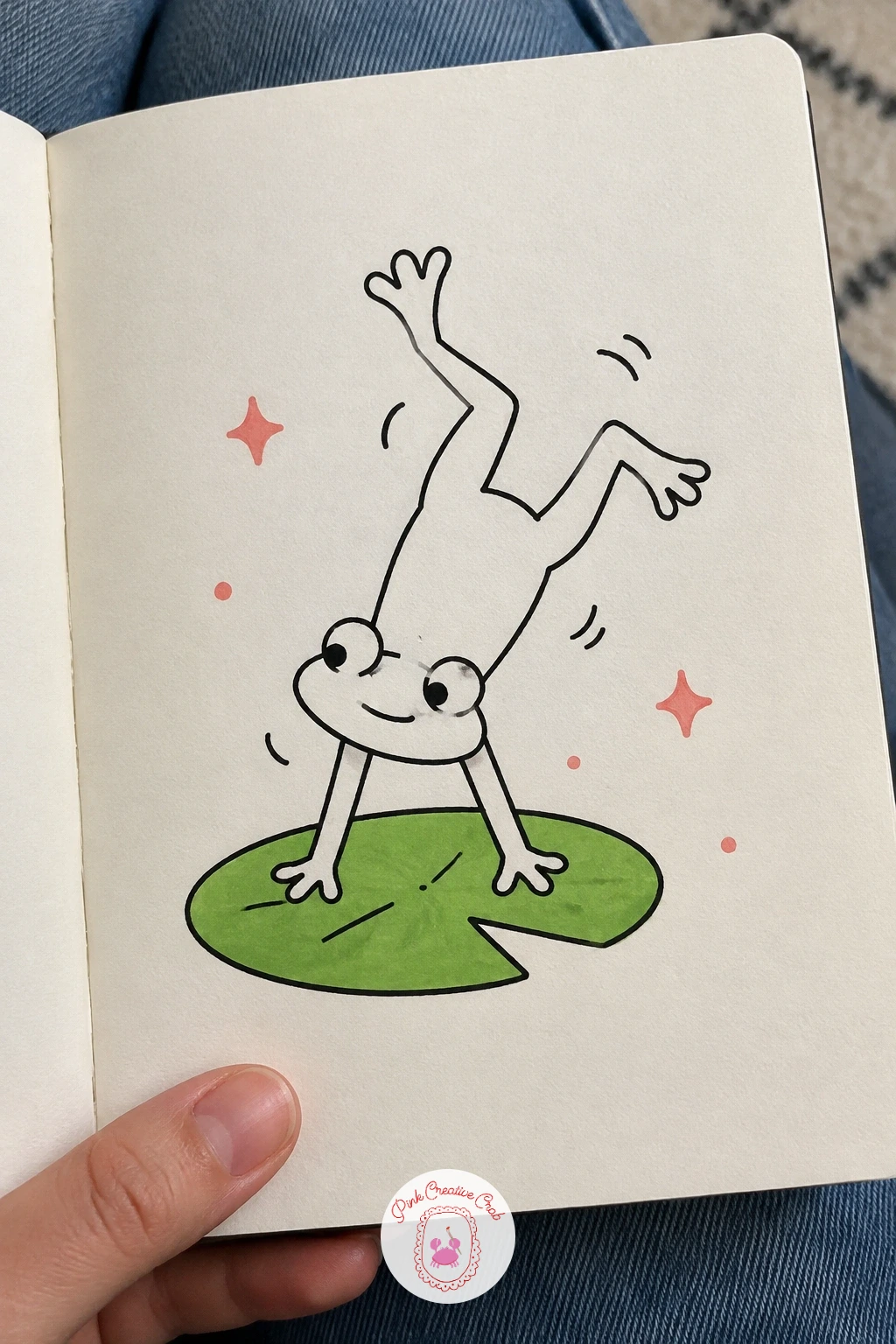
Push the comedy into full physical effort with this frog doodle. Flip the body upside down with both front legs planted flat on the lily pad and the back legs kicked up and slightly bent, leaning off to one side rather than perfectly vertical to suggest the wobble.
Draw the eyes wide and slightly crossed, with a small strained line across the mouth, and add two or three small motion lines near the back feet to show them trembling or about to topple. The tilt is what sells the wobble, so avoid making the pose too symmetrical.
Balance poses like this are easiest to get right from the eye level of the lily pad itself: imagine looking at the pad edge-on so it reads as a thin flat ellipse beneath the planted hands, which keeps the whole frog looking grounded even while upside down. Color the pad lily pad green and keep the frog’s usual palette otherwise.
If the upside-down proportions feel confusing, sketch the frog right-side up first in pencil, then flip your sketchbook upside down and trace over it; the shapes click into place more easily that way.
Palette: Lily Pad Green,Coral Pink,Ink Black
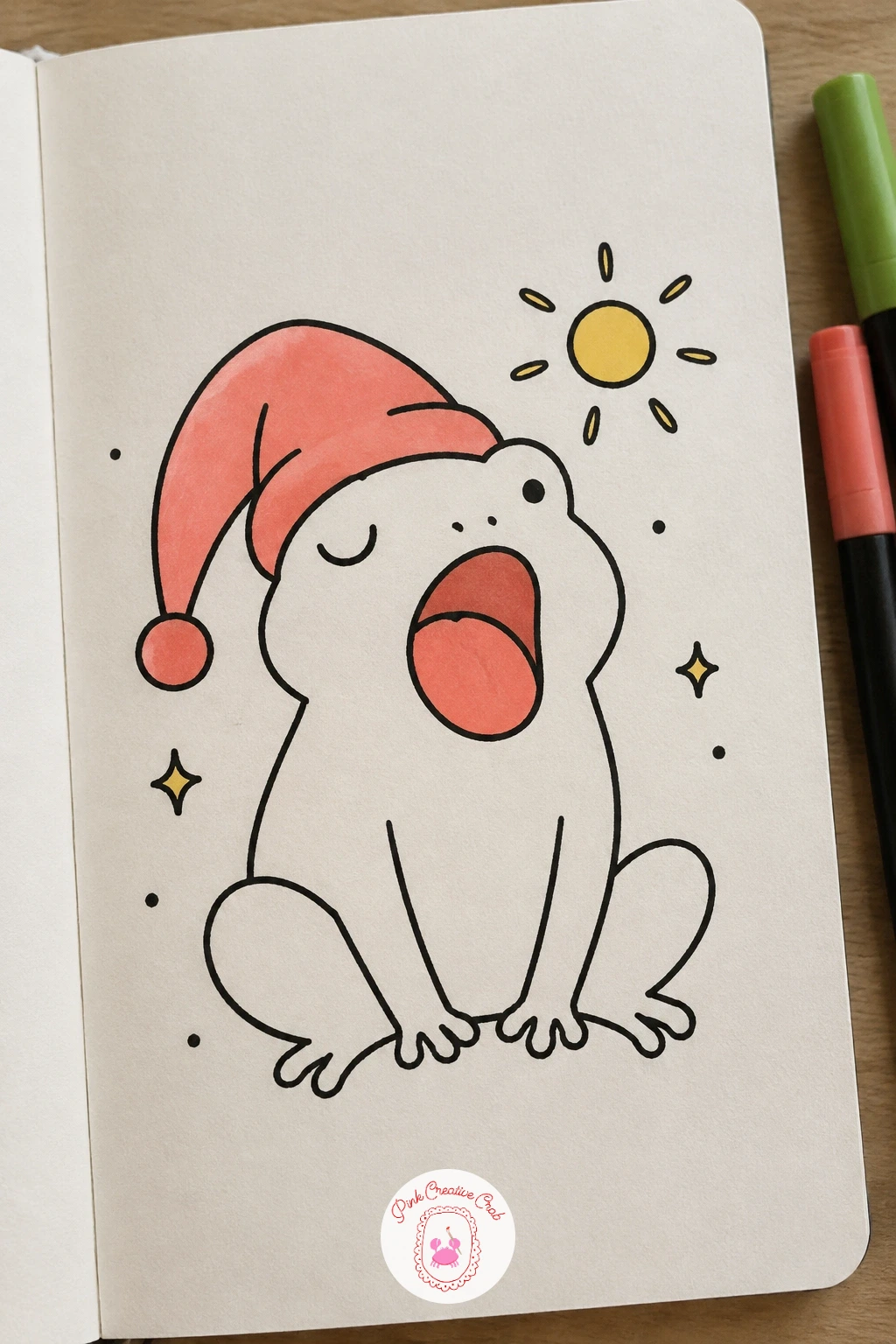
Slow the pace right down again with this sleepy frog doodle. Draw the frog sitting upright with a tall floppy nightcap on its head, shown as a long triangle shape drooping to one side with a small pom-pom at the tip.
Open the mouth wide into a rounded yawn shape, bigger than the usual smile, and add one small eye squeezed shut while the other stays slightly open, which gives a nicely groggy, half-awake feel. A simple sun shape with a few short rays in the background sets the early morning mood.
Nightcaps tend to look stiff if drawn as a straight triangle, so curve the sides slightly and let the tip droop downward rather than pointing straight up; soft folds read as sleepy fabric far better than sharp edges. Color the cap coral pink and keep a small lily pad green sun or leaf accent nearby for contrast.
A soft pencil shading under the chin before inking adds a nice groggy shadow without much extra effort.
Palette: Coral Pink,Lily Pad Green,Ink Black
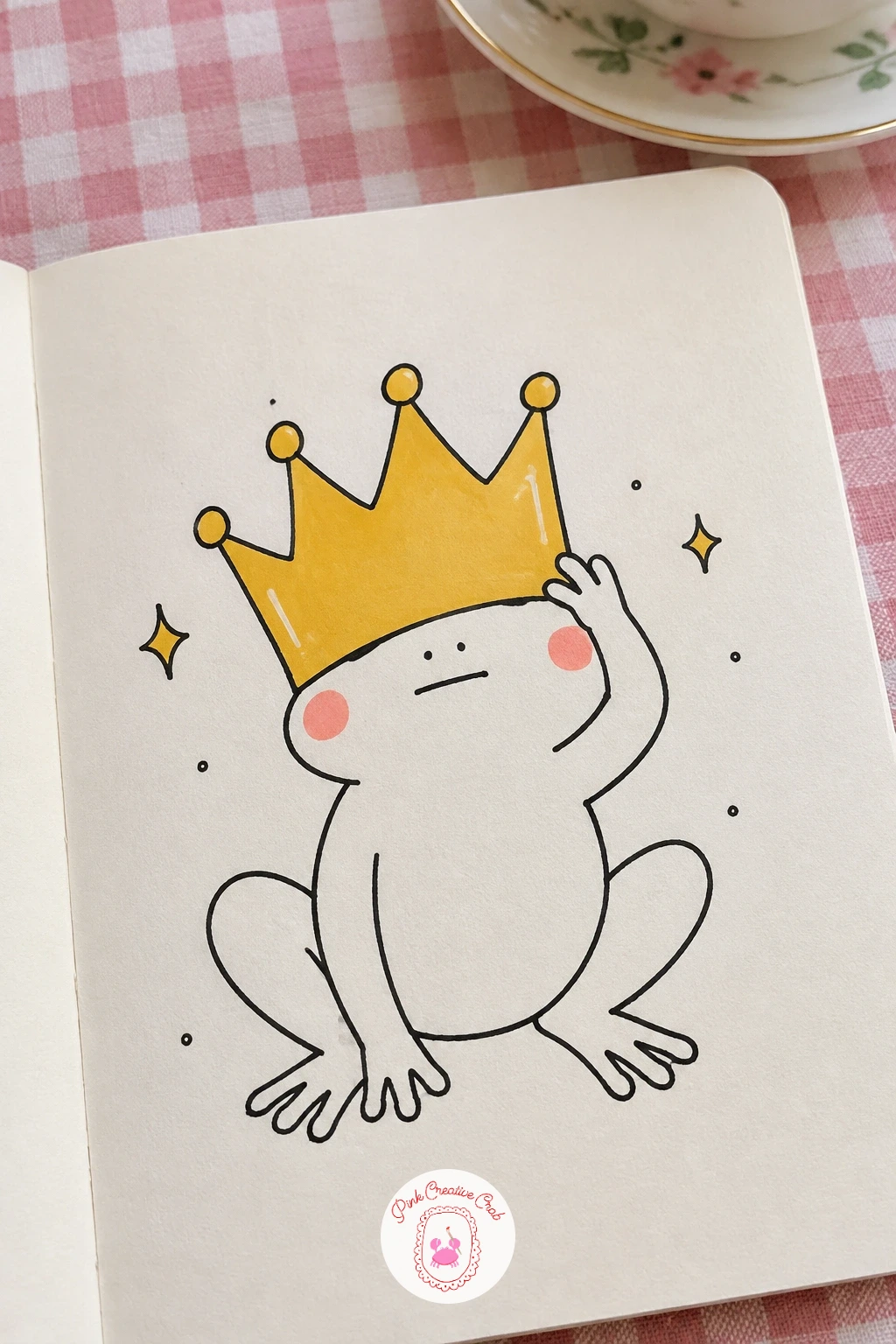
Return to the crowned frog from earlier, but give this version a gentler, funnier mishap. Draw the same rounded body and crown shape as before, but this time slide the whole crown down the head until the band sits across the eyes rather than above them.
Keep the mouth in a small confused flat line and angle one arm slightly up toward the crown, as if about to push it back into place. The humor comes entirely from the mismatch between the regal crown and the clumsy slipped position, so keep everything else about the pose calm.
Crowns slip convincingly only if the band line follows the same curve as the head beneath it, just lower down, rather than sitting at a different angle entirely; keep that curve consistent even as you lower it. Leave the crown outlined in black with no fill, and use coral pink for a small blush of embarrassment on the visible part of the cheeks.
This pairs naturally with the earlier frog prince doodle if you want to tell a tiny two-panel story on the same page.
Palette: Coral Pink,Lily Pad Green,Ink Black
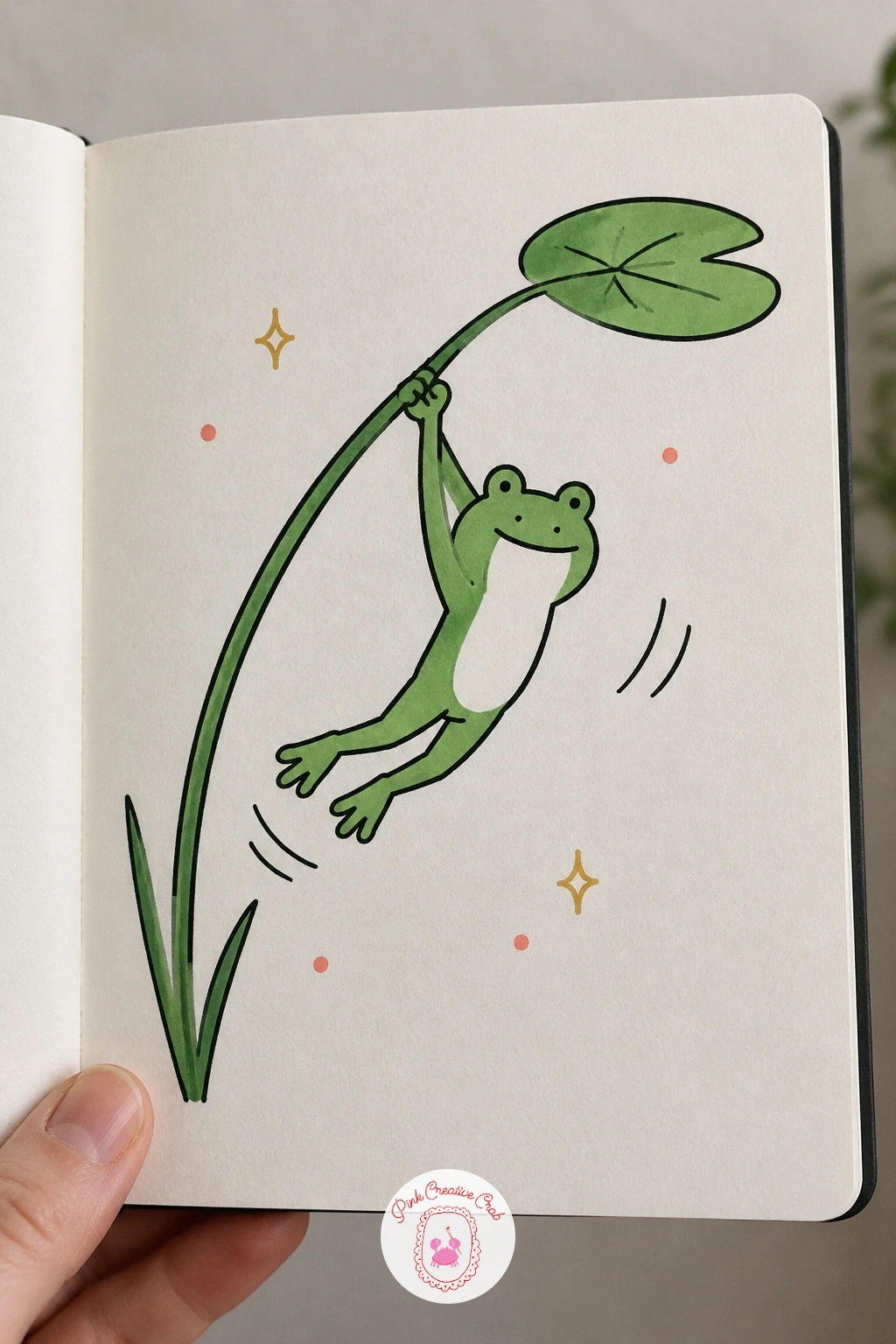
Bring some playground energy into this frog doodle. Draw a single tall reed bending into a smooth curve under weight, then place the frog hanging from the top of the bend with both hands gripping the reed and legs swinging loosely below.
Angle the body slightly forward in the swing direction, with the legs trailing behind rather than hanging straight down, to suggest motion rather than a static hang. A couple of small curved motion lines near the feet finish the swinging feel.
The reed itself is the trickiest part: draw it as one smooth continuous curve from base to tip rather than several short straight segments, since a jointed-looking reed reads as broken rather than bent under weight. Color the reed lily pad green and keep the frog’s grip hands slightly darker to show pressure.
If a single curving reed feels hard to control, use a thin vine or a long blade of grass instead; the swinging pose works the same way.
Palette: Lily Pad Green,Coral Pink,Ink Black
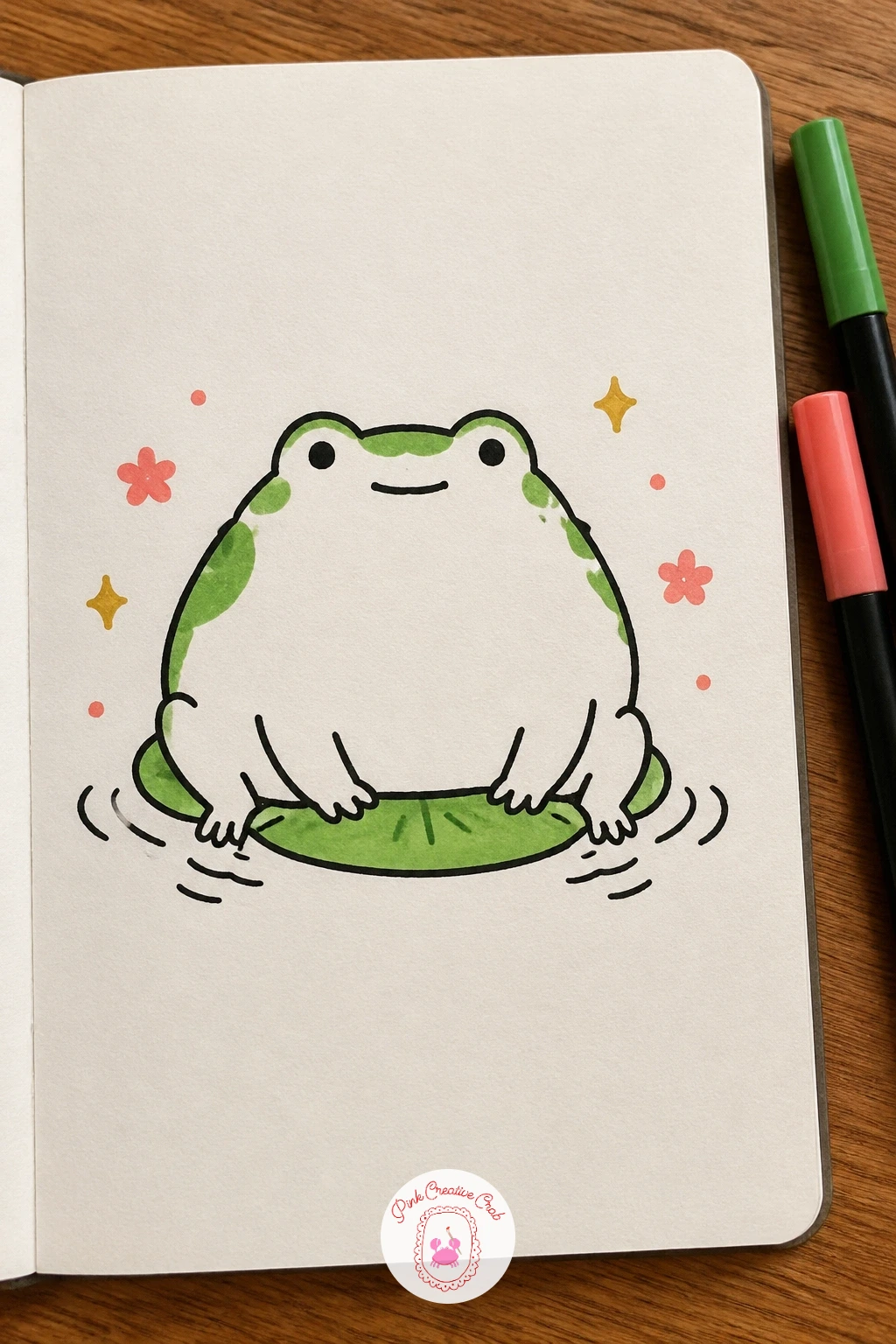
This frog doodle leans fully into a soft, funny kind of sinking. Draw the lily pad first, smaller and rounder than the usual size, then place the frog’s wide chubby body on top so its belly and sides spill slightly over the pad’s edges on every side.
Tilt the pad very slightly downward at the edges closest to the frog’s weight, and add two or three small ripple lines around the submerged edges to show the pad dipping below the waterline. Keep the frog’s expression calm and unbothered despite the obvious sinking, which adds to the humor.
If the sinking is not reading clearly, draw the waterline cutting slightly across the lowest edge of the pad itself, not just around the frog, so the dip in the pad’s own shape is visible rather than implied. Color the pad lily pad green with a slightly darker shade near the submerged edge, and keep the chubby frog rounded with coral pink cheeks.
No ripple experience needed: three short curved lines stacked loosely are enough to suggest water disturbance.
Palette: Lily Pad Green,Coral Pink,Ink Black
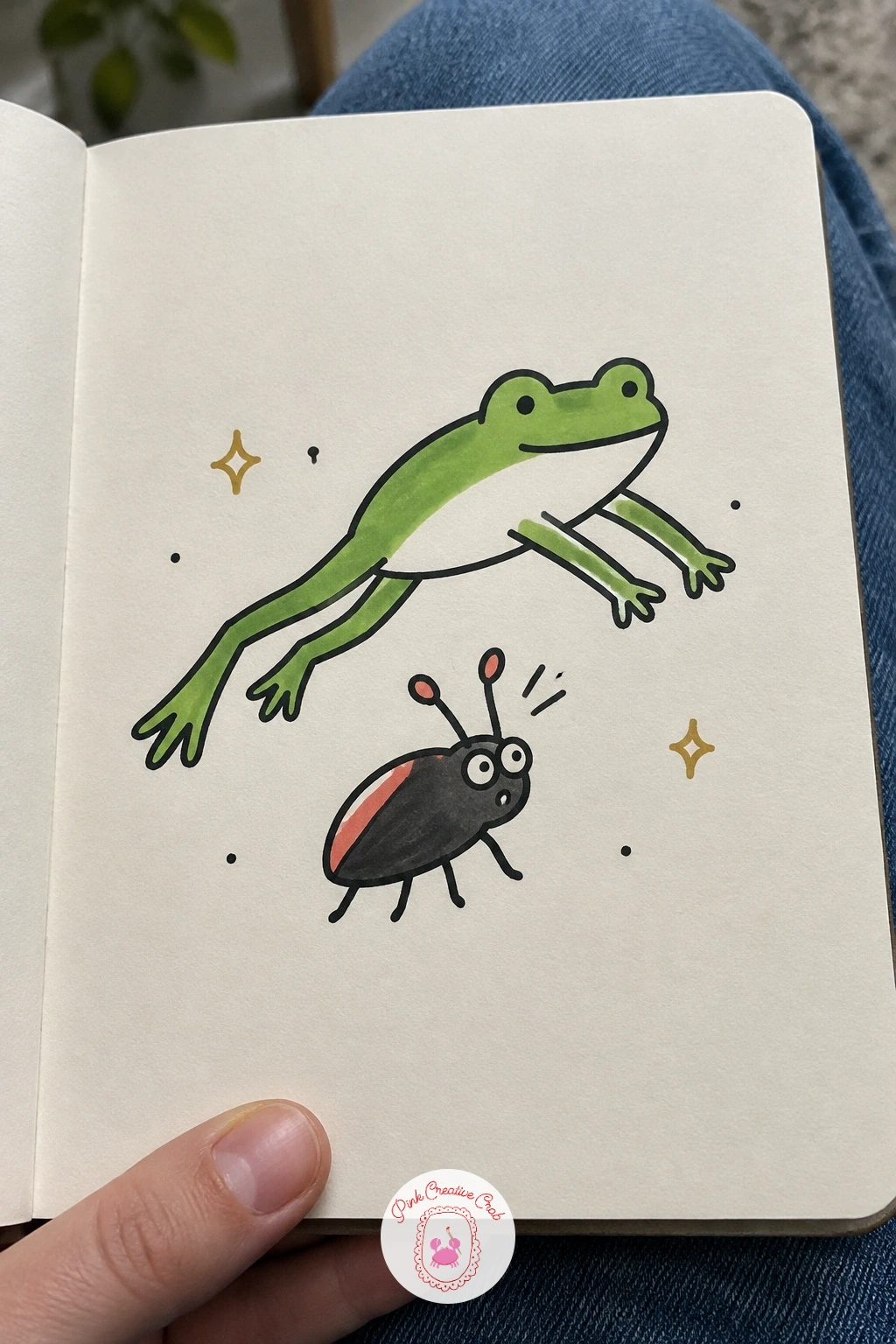
Give this frog doodle a clear sense of two characters interacting rather than one alone. Draw the frog mid-leap, body arched over a small round beetle that is bent forward and braced on all six legs below it, exactly as leapfrog is played.
Widen the beetle’s eyes into two round surprised circles and raise its small antennae straight up, which reads instantly as shock at being leapt over. Keep the frog’s own pose loose and confident in contrast, arms reaching forward past the beetle’s back.
Scale is the part to watch here: keep the beetle noticeably smaller than the frog, roughly a third of its height, so the leap reads as an easy hop over a tiny obstacle rather than two evenly matched creatures. Color the beetle a dark shell tone with a small coral pink shine mark, and keep the frog in its usual lily pad green.
If drawing a beetle’s legs feels fiddly, three short lines per side are enough; no need for exact insect anatomy at this scale.
Palette: Lily Pad Green,Coral Pink,Ink Black
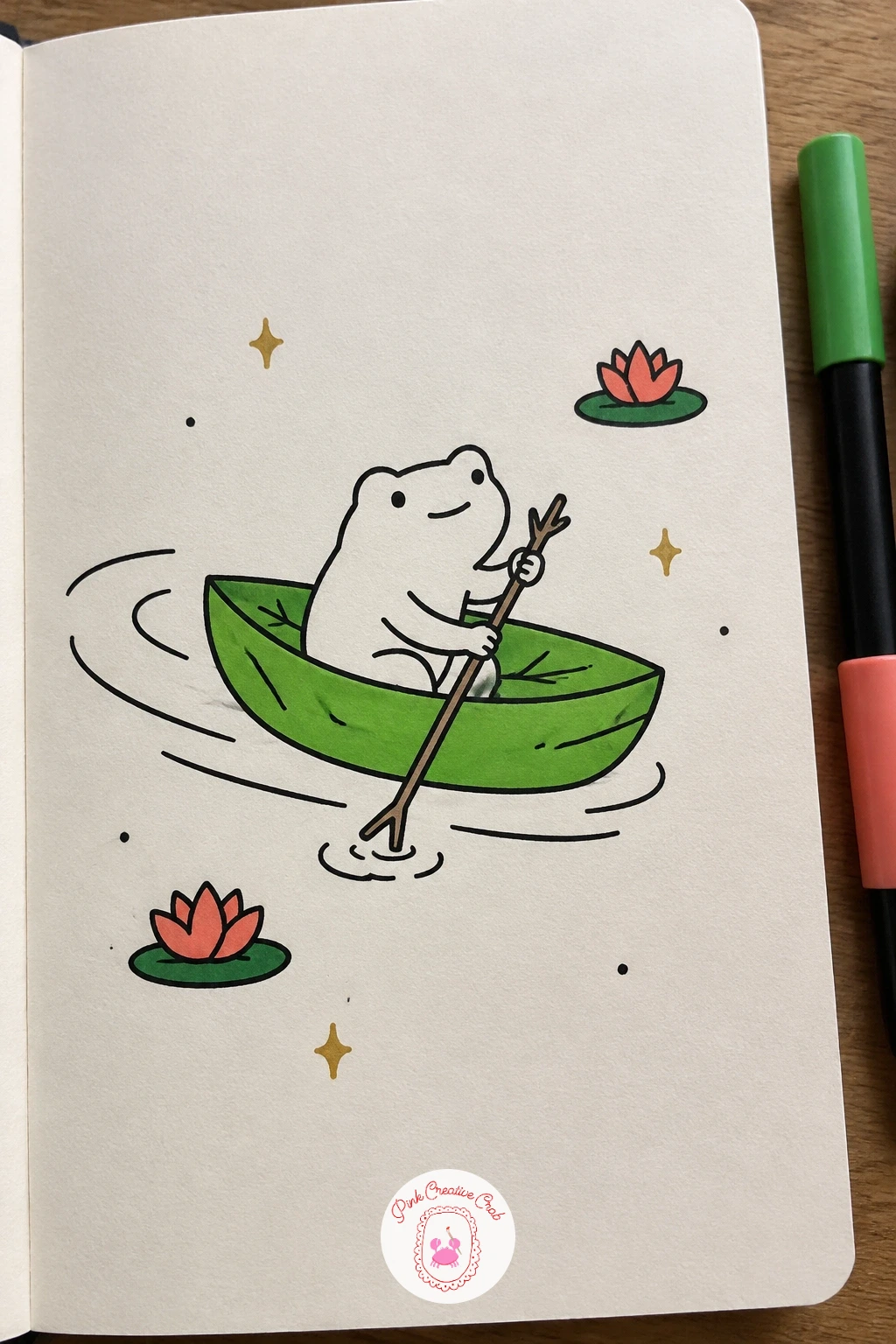
Settle the energy back into a calmer scene with this frog doodle. Draw a small canoe shape first, a long thin oval pinched to a point at both ends, then sit the frog inside with knees bent and one arm extended down into the water holding a simple twig as a paddle.
Add a few gentle wavy lines around the canoe to show it floating, and a couple of small ripples trailing from the paddle tip to suggest the stroke in progress. Keep the frog leaning slightly to one side with the paddling motion rather than sitting perfectly upright.
Canoes look odd if both ends are drawn as identical sharp points; soften one end slightly rounder than the other, since real canoes read more naturally with a little asymmetry. Lily pad green suits the canoe itself, with coral pink kept for a tiny flag or ribbon on the bow if you want one extra detail.
A plain twig works fine as the paddle; no need to draw a full carved oar at this size.
Palette: Lily Pad Green,Coral Pink,Ink Black
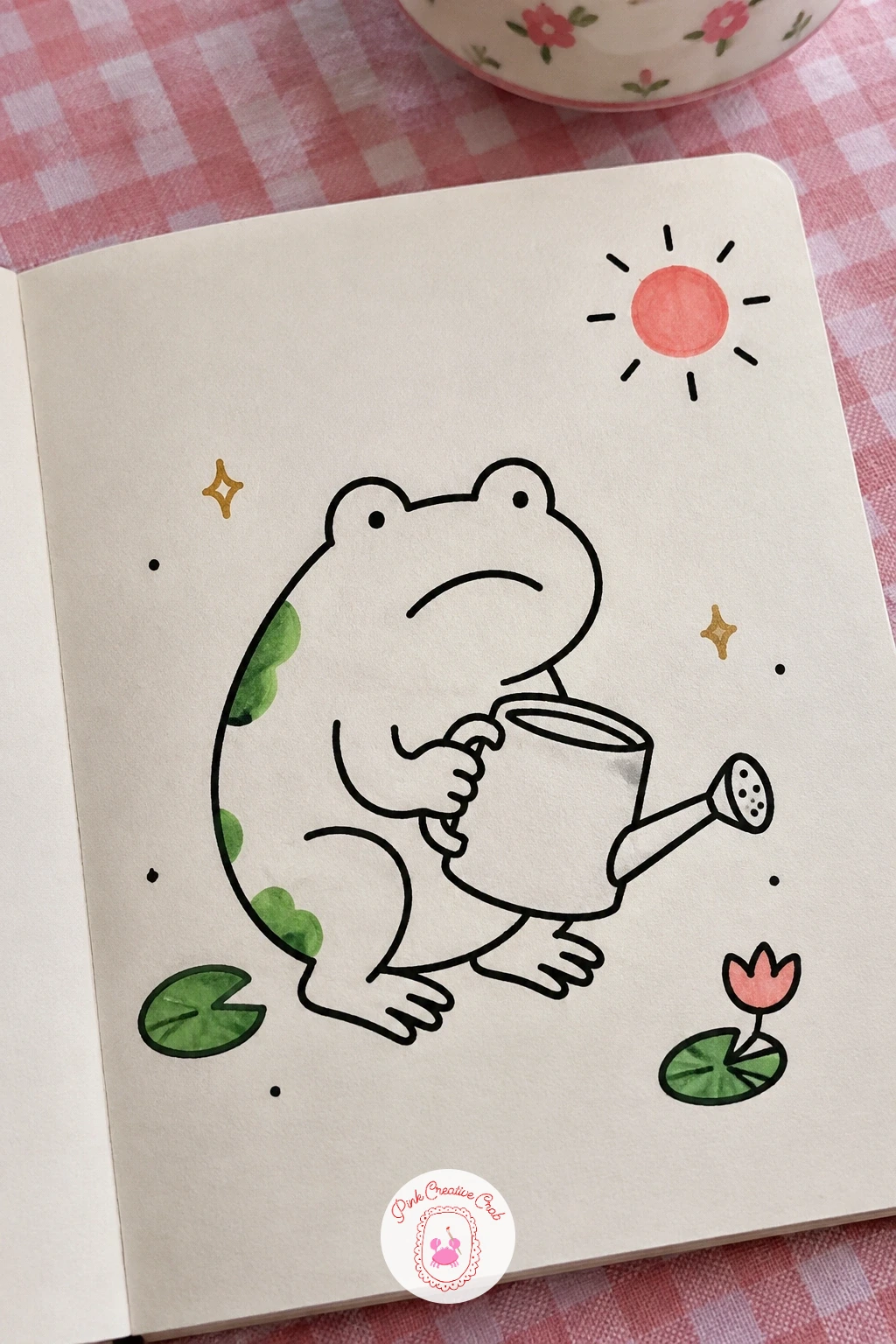
Bring in a quieter, funnier mood for this frog doodle, built around a small mismatch between a sunny setting and a grumpy expression. Draw the frog standing with shoulders slightly slumped, holding a simple watering can shape, a rounded body with a curved spout and small handle on top.
Give the face a drooping mouth line and lowered eyebrow marks above the eyes, which read instantly as sulking even on a simple round face. A few short straight lines radiating from a small sun shape in the corner show the bright weather the frog is unhappy about.
Draw a couple of faint dotted lines or small droplet shapes falling from the spout’s tip if you want to clarify that the can is empty and not currently pouring; otherwise it can read as just resting rather than empty. Color the can lily pad green and keep the pouting mouth and cheeks in a muted coral pink.
If a watering can shape feels fiddly, a simple bucket with a handle works as an easy swap and still tells the same story.
Palette: Lily Pad Green,Coral Pink,Ink Black
Close out the set with a confident, dynamic frog doodle that brings the rain theme full circle. Draw the frog looking upward with its tongue extended in a smooth curved line reaching toward a single raindrop falling from above, caught right at the tip of the tongue.
Shape the raindrop as the usual circle with a pointed top, slightly smaller than the giant hugged raindrop from earlier, since this one needs to look catchable rather than oversized. Keep the frog’s eyes wide and focused upward, tracking the drop’s path.
If the tongue looks disconnected from the mouth, draw it as one unbroken line from the inside of the mouth all the way to the drop, curving gently rather than kinking at any point; a smooth curve reads as a flicking tongue far better than a straight segmented line. Color the drop pale blue-green and the tongue coral pink to match the rest of the set.
One last tip for today: ink the tongue’s curve in a single confident stroke rather than several short ones, since a hesitant line looks shaky at this small scale.
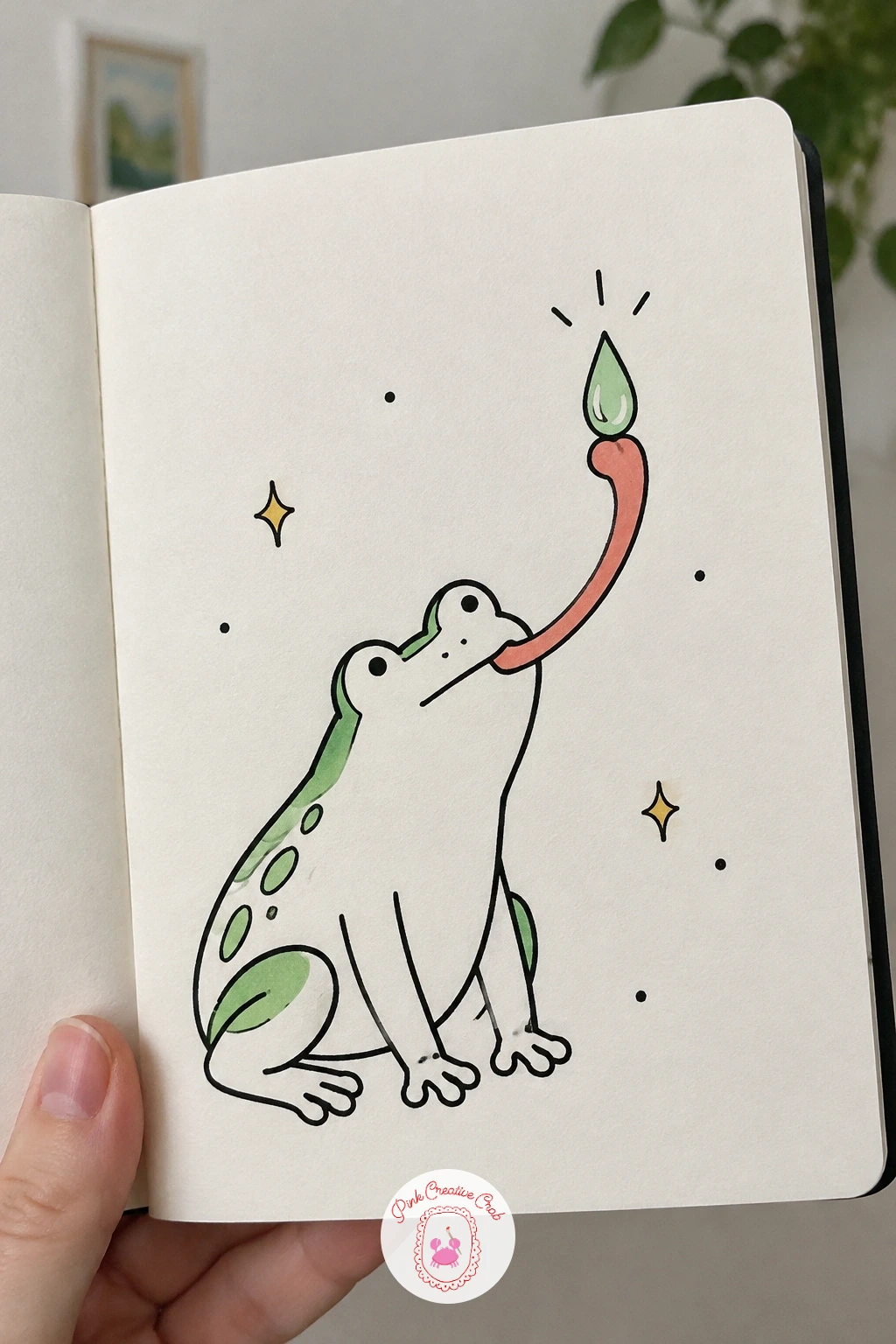
Palette: Coral Pink,Lily Pad Green,Ink Black
What to Do Next
Pick whichever frog made you smile first, grab a fineliner and a plain notebook page, and start with the body shape before adding any prop or expression on top. One finished doodle today is enough to make the next one even easier.
Frequently Asked Questions
What pens work best for a frog doodle?
A fine black fineliner between 0.3 and 0.5 millimeters gives clean, confident outlines. Add lily pad green and coral pink alcohol or water based markers for small color accents once the ink has fully dried.
How do I make a frog doodle look less stiff?
Keep the body as one or two smooth curved shapes instead of many short straight lines. Tilt the head, arms or legs slightly off center, since perfect symmetry is what usually makes a doodle feel rigid.
Do I need to draw the frog’s whole body every time?
No, many of these ideas work just as well cropped to the head, shoulders and hands holding a prop. Cropping tighter also makes the drawing finish faster if you only have a few minutes.
What is the easiest frog doodle to start with?
A simple seated frog with a round body, bulgy eyes and a closed smile is the easiest starting shape in this whole list. Build every other pose and prop from that same basic body once it feels comfortable.
How do I keep the lily pad green and coral pink from clashing?
Use lily pad green as the larger, calmer base color and coral pink only for small accents like cheeks, lips or a prop. Keeping one color dominant and the other as a highlight stops the page from feeling busy.
Have any thoughts?
Share your reaction or leave a quick response — we’d love to hear what you think!
-
 0
-
0
-
0
-
0
-
0
-
0


