A tulip drawing is the fastest way to get some color going when February still looks grey outside the window. Tulips are forgiving flowers to draw: a few curved petal shapes, a strong stem, and the whole thing already reads as spring, even with snow sitting on the sill behind it.
Below you will find 27 small scenes built around tulips in buckets, jugs, baskets and bottles, with people and pets wandering through most of them. Work through them in order if you like, from the simplest single stem to the fuller market scenes, or just pick whichever one matches the mug of tea next to you right now.
Using these images: free for personal projects such as printing, coloring, cards, journals and gifts. Handmade items that include them may be sold up to 30 pieces per design. More than that is commercial use and is not permitted, and neither is selling or sharing the images themselves or passing them off as your own. Please ask before any other use.
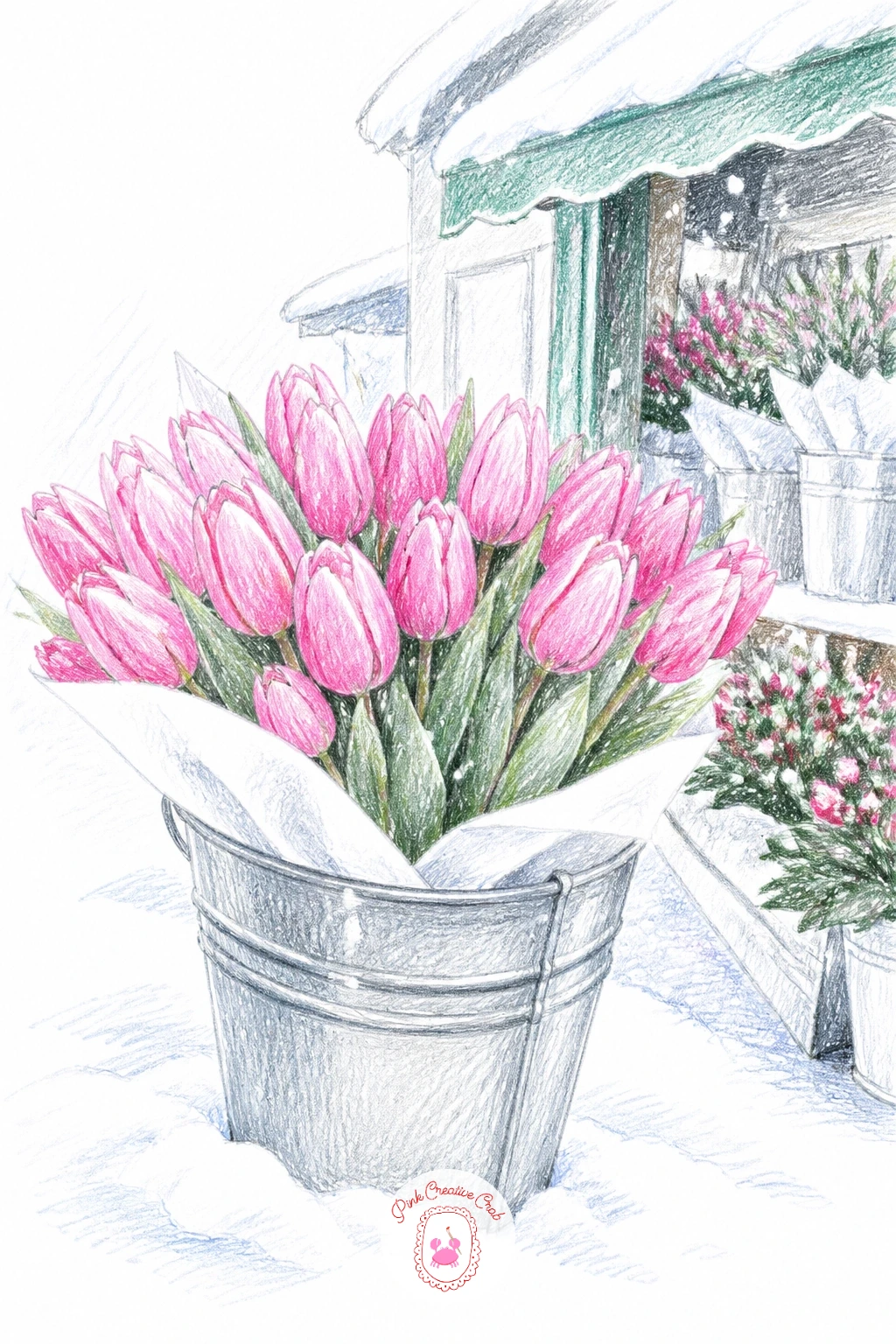
Start the whole list with a zinc bucket of pink tulips standing outside a flower market, because the bucket is the easiest shape here: just a trapezoid, wider at the top than the bottom. Draw it lightly in graphite first, then switch to a cool grey pencil and leave a bright strip of white paper down one side to read as shine on the metal.
Build the tulips above the rim as simple closed-tulip shapes, rounded at the top with a slight point, in two or three pink tones layered from light to dark. Stems come last in sage green, overlapping where they cross the bucket edge so the bunch feels tied together rather than floating.
The mistake to watch for is making every tulip the same size, which flattens the bunch. Vary the height of three or four stems so the top line zigzags gently instead of running straight across.
If you do not have a cool grey pencil, use light blue pressed softly for the bucket shadows instead. Finish by scattering a few tiny white dots of untouched paper or gel pen around the base for light snow on the ground.
You Will Need
- white gel pen
Palette: Tulip Pink,Carmine Red,Cool Grey,Sage Green
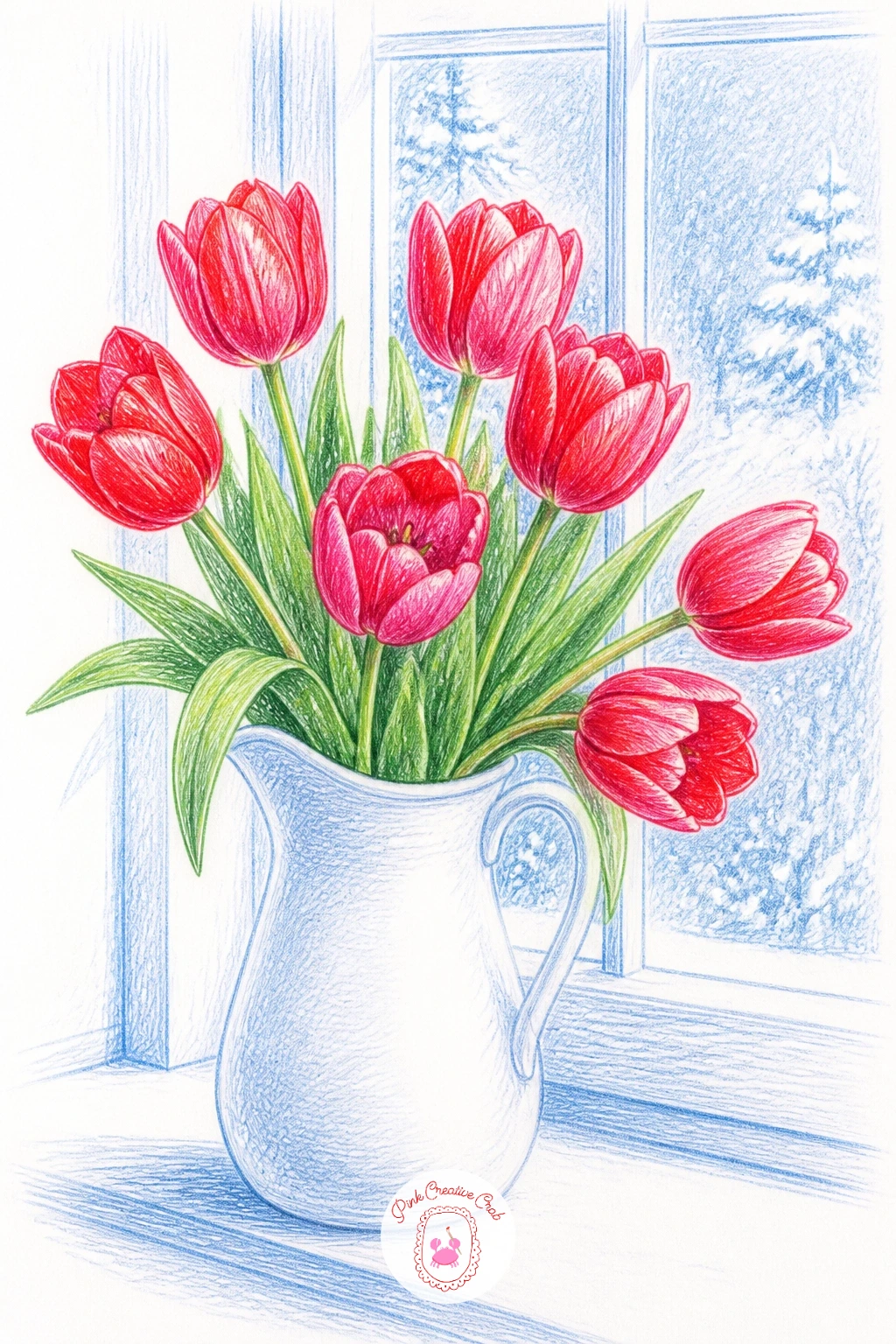
Move from the market bucket to something quieter: a plain white jug of red tulips sitting on a windowsill with snow outside the glass. Draw the jug first with a light pencil outline, keeping the body nearly untouched white paper except for one soft grey curve of shadow where it turns away from the light.
Figure out where your light source sits before adding the tulips, since it decides which side of the jug and which side of each petal stays pale. If the window light comes from the left, every tulip should carry its deepest cherry red on the right side of each bloom, with the left edges left lighter or bare.
Many people color the jug too dark and lose the white jug entirely. Keep your grey pencil light and build shadow in thin layers, checking often against the white of the paper.
No white jug on hand to look at? Any plain mug or vase works as reference, since the shape logic is the same. Sketch a faint strip of blue grey behind the glass to suggest snow light without drawing individual snowflakes.
Palette: Cherry Red,Icy Blue,Cool Grey,Sap Green
Bring a person into the scene with a girl walking home carrying a paper-wrapped bunch of tulips, her coat and the falling snow doing most of the work. Block her in simply first: an oval head, a long coat shape down to the knees, legs mid-stride, keeping proportions loose rather than anatomical since this is a quick figure, not a portrait.
Measure her coat length against her head height before you commit to ink or heavy pencil, roughly four to five head-heights tall for an adult figure, so she does not end up too short or stretched. The paper cone of tulips sits in her arms as a simple triangle shape with pink and red tips peeking from the top.
Faces are where this goes wrong fastest. Keep hers simple, a few soft lines for eyes closed against the cold or a small smile, rather than trying to render full features at this scale.
If figures intimidate you, start with her from the back instead, walking away through the snow, which removes the face entirely and still tells the story. For more practice drawing people at this friendly scale, the girl pencil drawing ideas cover plenty of poses worth trying.
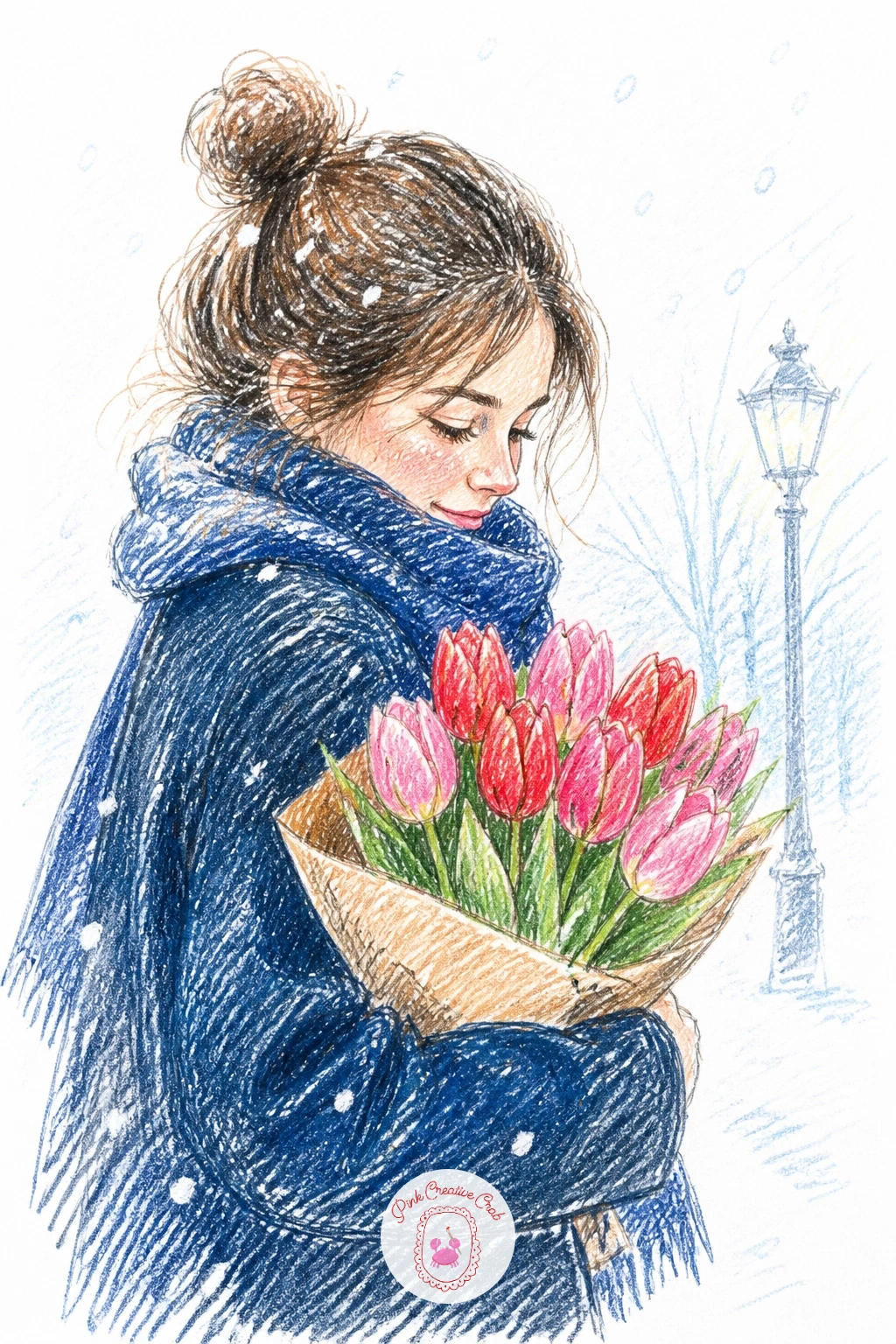
Palette: Tulip Pink,Carmine Red,Navy,Icy Blue
Give her coat a bold solid color like navy or mustard so she reads clearly against white snow, and keep the tulip bunch as the only other strong color in the piece.
Settle into a cozier still life with pink tulips bending over a glass vase beside a teapot, a nice change of pace after the outdoor scenes. Draw the vase as a simple cylinder first, keeping its outline faint, then add the teapot beside it as a rounded body with a curved spout and handle, checking that the teapot sits roughly the same height as the vase so neither object dwarfs the other.
Tulips droop naturally once they open fully, so let two or three stems curve outward past the vase rim rather than standing straight up. This bending is what makes pink tulips distinct from the stiffer bucket flowers earlier on the list.
Glass vases trip people up because they try to draw the glass itself instead of what shows through it. Leave most of the vase as bare white paper and add only a few curved pencil lines for the stems visible inside and a touch of grey where the glass catches light.
Swap the teapot for a simple mug if that is what sits on your own table, the composition works just as well with either.
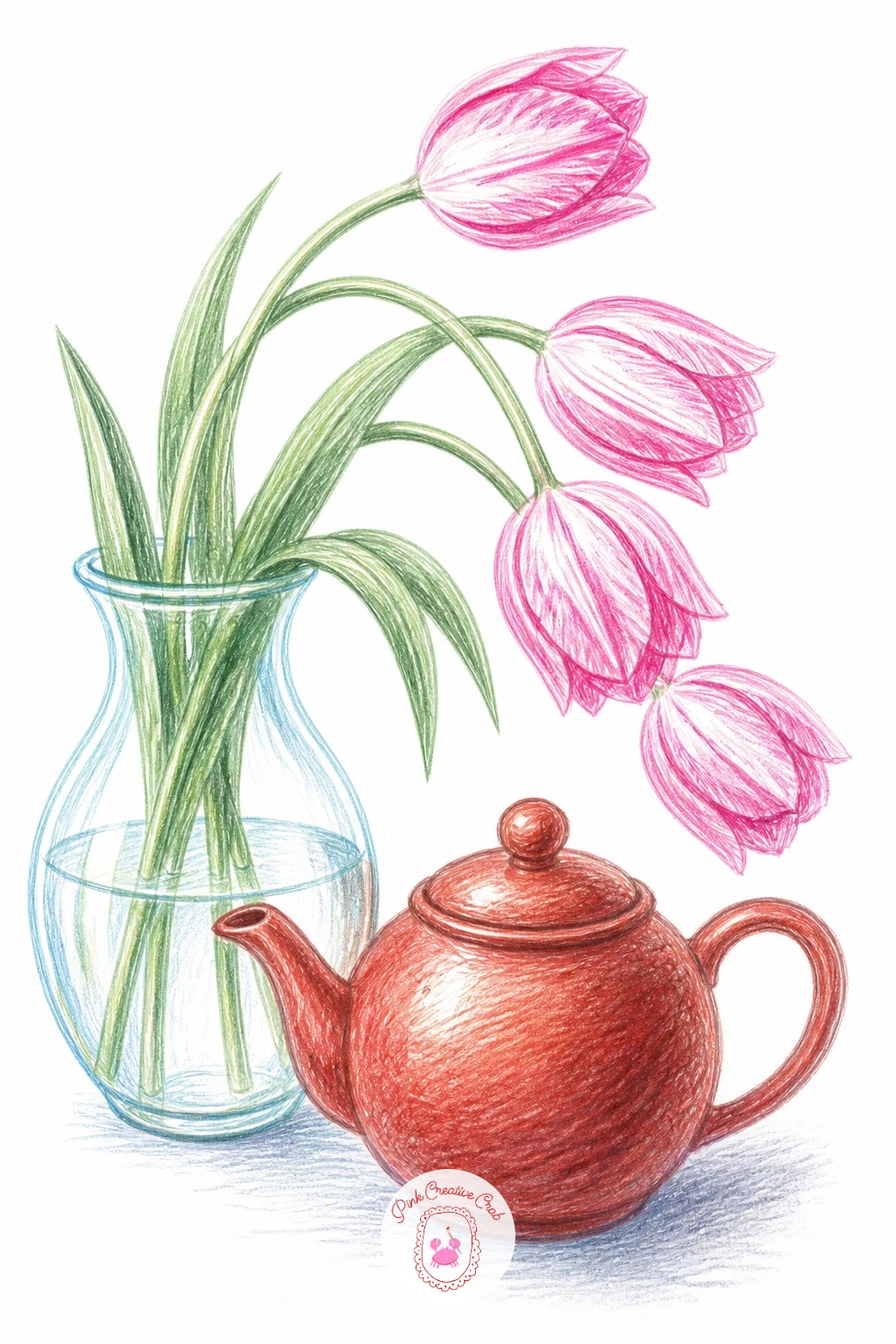
Palette: Tulip Pink,Sage Green,Cool Grey,Warm Brown
Add some life to the kitchen table with a cat sniffing a vase of yellow tulips, a small moment that gives the drawing personality without needing a full scene. Sketch the cat first since it anchors the composition, using simple rounded shapes for the body and a slightly stretched neck reaching toward the flowers, ears perked forward in curiosity.
Work the yellow tulips next in two tones, a pale lemon base layer and a warmer golden yellow built up only on the shadow side of each petal, which keeps them looking sunny rather than flat. The vase can stay a plain glass or ceramic shape, whatever is quicker for you to draw confidently.
Cat fur often ends up as one solid grey blob. Use short flicking pencil strokes that follow the direction fur actually grows, lighter along the back and a touch darker under the chin and belly, to give the coat some texture without overworking it.
If drawing a cat from imagination feels tricky, the cat pencil drawing ideas walk through friendly poses that transfer well to this scene.
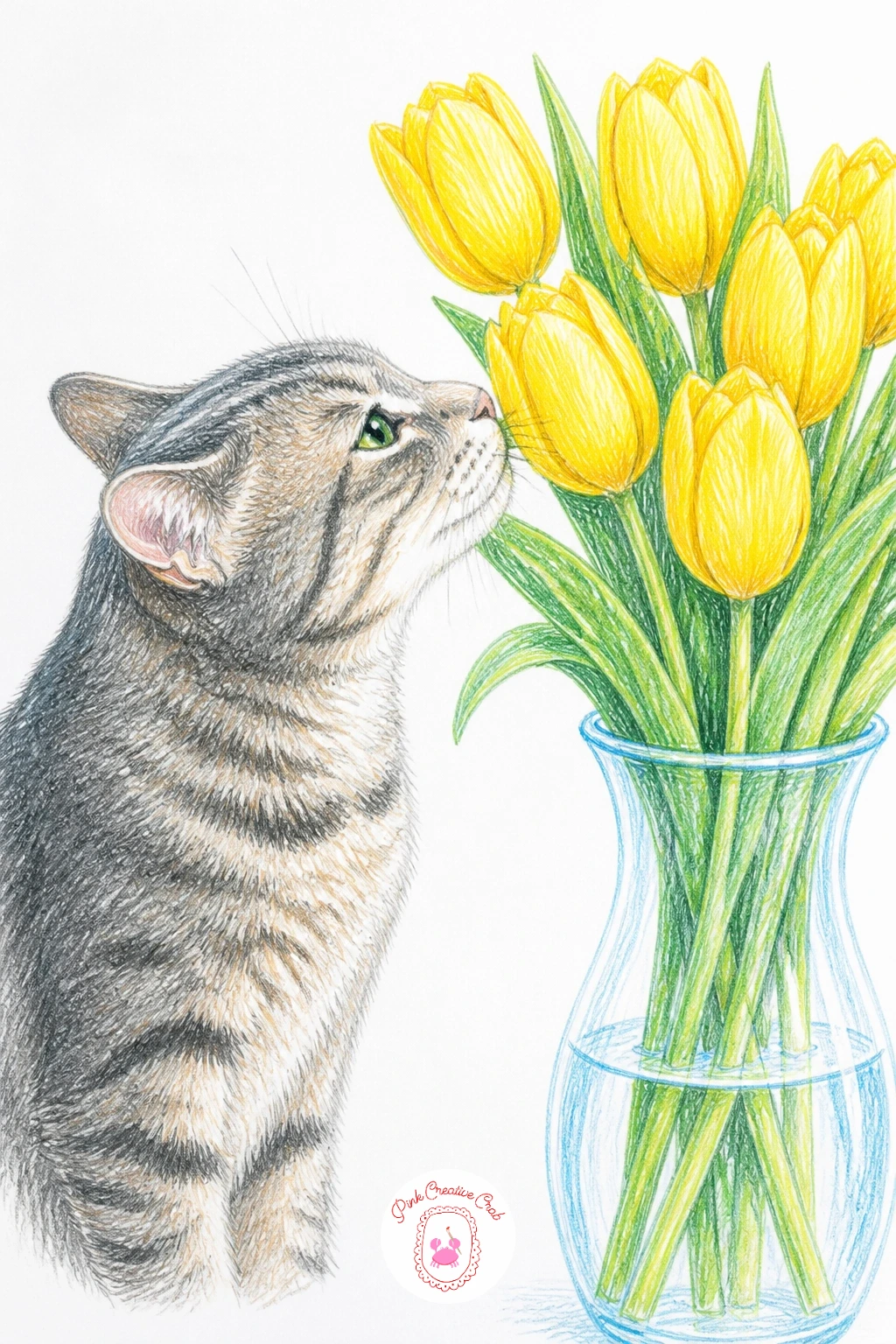
Palette: Golden Yellow,Pale Lemon,Warm Grey,Sap Green
Shift outdoors again with a bicycle basket overflowing with tulips, parked against a snowy street corner. Draw the bicycle frame loosely first using two overlapping triangle shapes for the frame and two circles for the wheels, keeping the lines light since this is a supporting shape, not the main subject.
The basket sits at the front, drawn as a simple woven rectangle with rounded corners, and this is where most of your color goes: pack it with overlapping tulip heads in pink, red and a few white ones for variety, letting stems and leaves spill slightly over the basket edge.
Wheels and spokes are the usual trap, since fussy detail there pulls focus from the flowers. Keep the wheels as simple dark circles with only a few straight lines suggesting spokes, nothing fully rendered.
No bicycle reference handy? Search any basic bike photo for the frame angle, then forget the photo and draw the basket and flowers from your head, since that part matters more here.
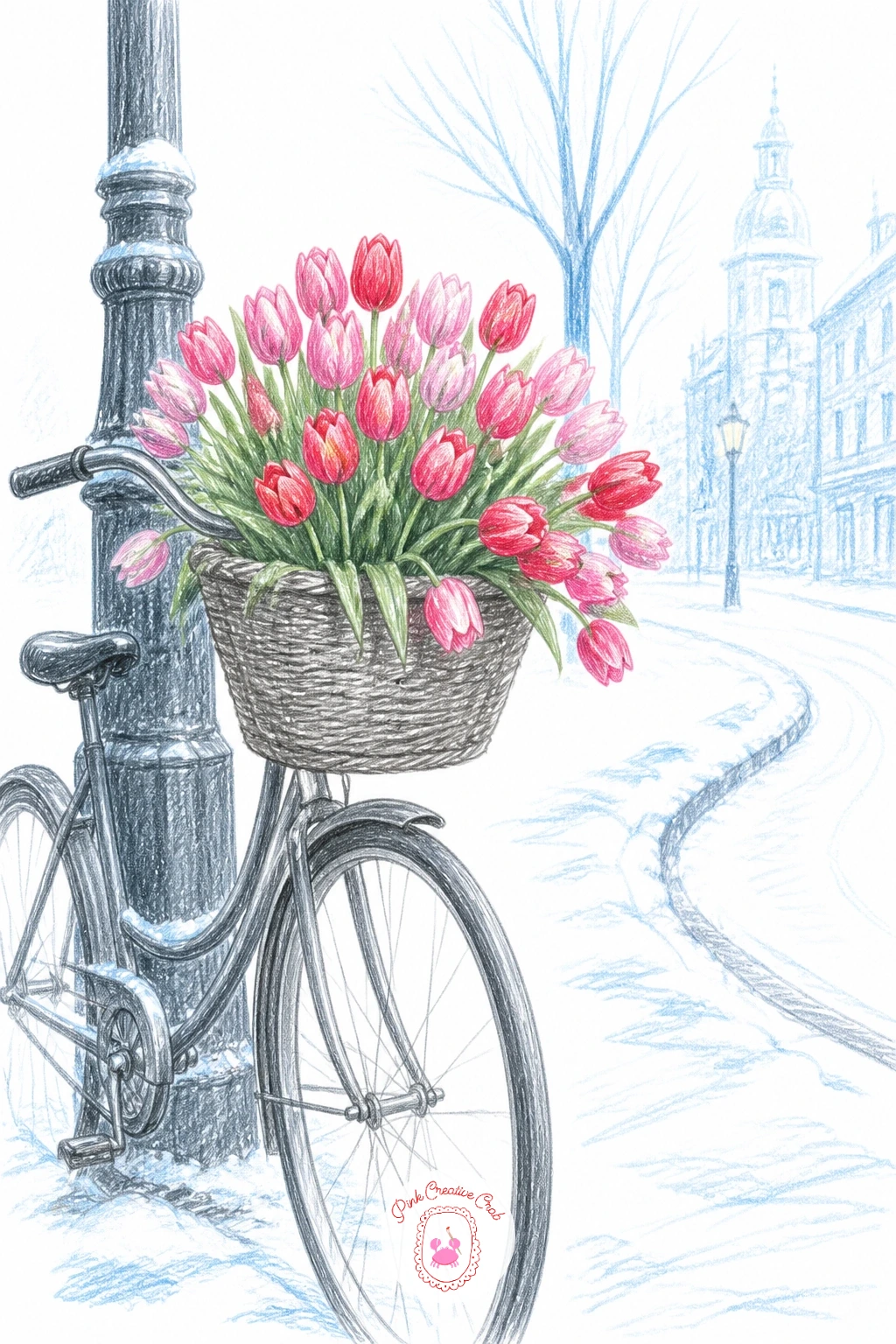
Palette: Tulip Pink,Cherry Red,Charcoal Grey,Icy Blue
Build on the earlier market bucket idea with a wider scene: a florist arranging tulips in buckets at a frosty stall, hands busy mid-task. Lay out the stall structure first as a simple wooden frame with a row of buckets along the front, varying their heights slightly so the row does not look mechanically even.
Place the florist figure behind the buckets, kept fairly simple with a warm coat and a scarf, hands reaching toward one bucket as if adjusting stems. Working front to back, finish the closest bucket of tulips in full color before moving to the ones behind, which naturally pushes the background flowers slightly paler and less detailed for depth.
Crowding every bucket with identical fully rendered tulips makes the whole stall feel busy and flat. Let one or two buckets carry most of the color detail and sketch the rest more loosely in outline and a light wash of hatching.
If a full figure feels like too much today, crop the scene at the shoulders so only the florist’s hands and the buckets show, which is just as charming and faster to finish.
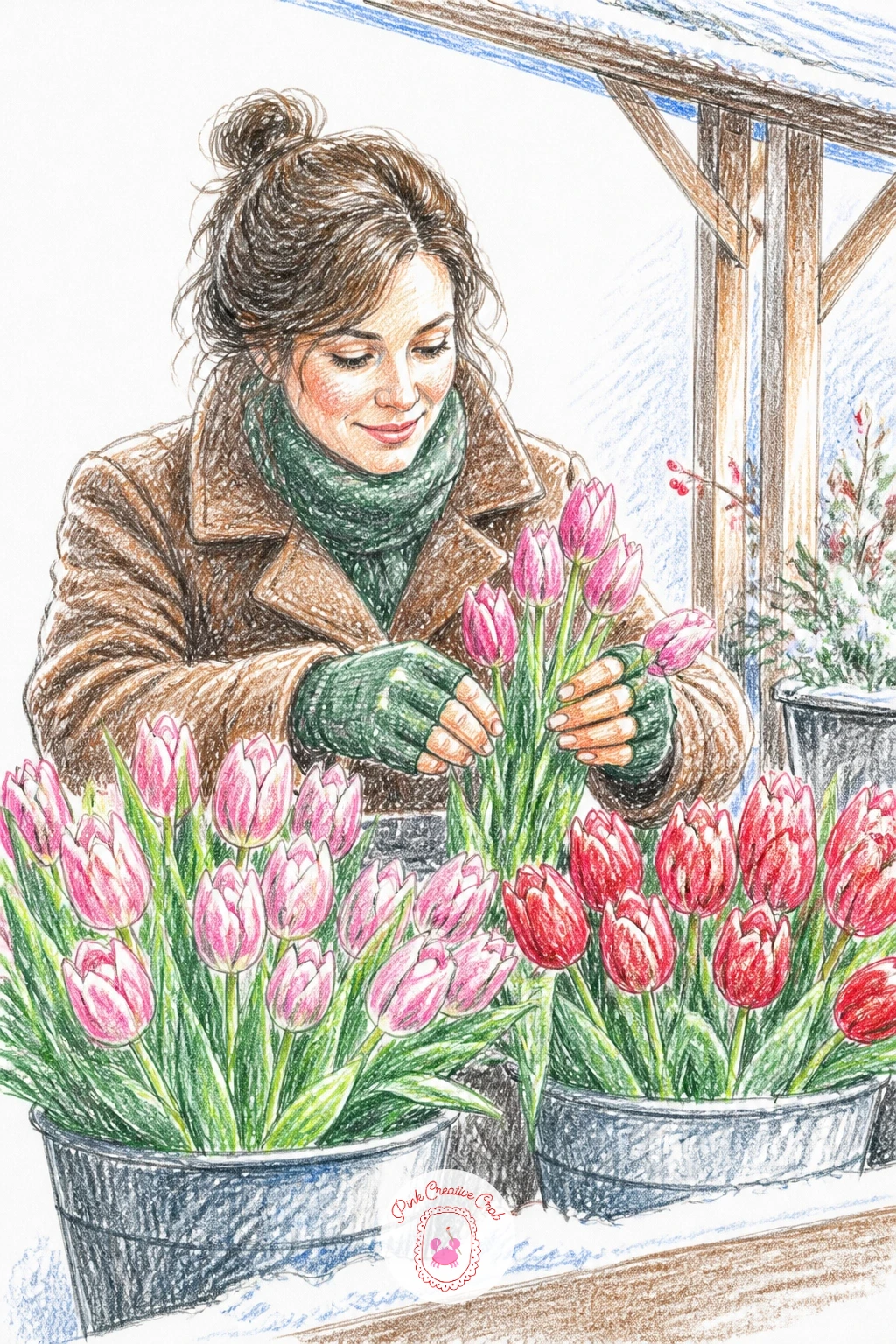
Palette: Tulip Pink,Carmine Red,Warm Brown,Cool Grey
Turn to a fancier bloom with parrot tulips, their ruffled and twisted petal edges, standing in a blue and white jug beside a bowl of clementines. Draw the jug first and use a light blue pencil to sketch a loose pattern of dots or swirls around its body, keeping the pattern simple rather than copying full willow-pattern detail.
Parrot tulip petals are their whole personality, so spend most of your time on those ruffled edges. Instead of a smooth tulip outline, draw each petal edge with small wavy curves and a few pointed tips, in two pink or red tones so the ruffles catch some shadow.
Flat, straight petal edges are the giveaway that this is a regular tulip, not a parrot one. If your first attempt looks too tidy, go back over the outer edge with a slightly wobblier line in a darker tone to exaggerate the ruffle.
Round out the bowl of clementines beside the jug in warm orange with a touch of the same cherry red used in the petals, which ties the whole still life together in one warm note against the blue jug.
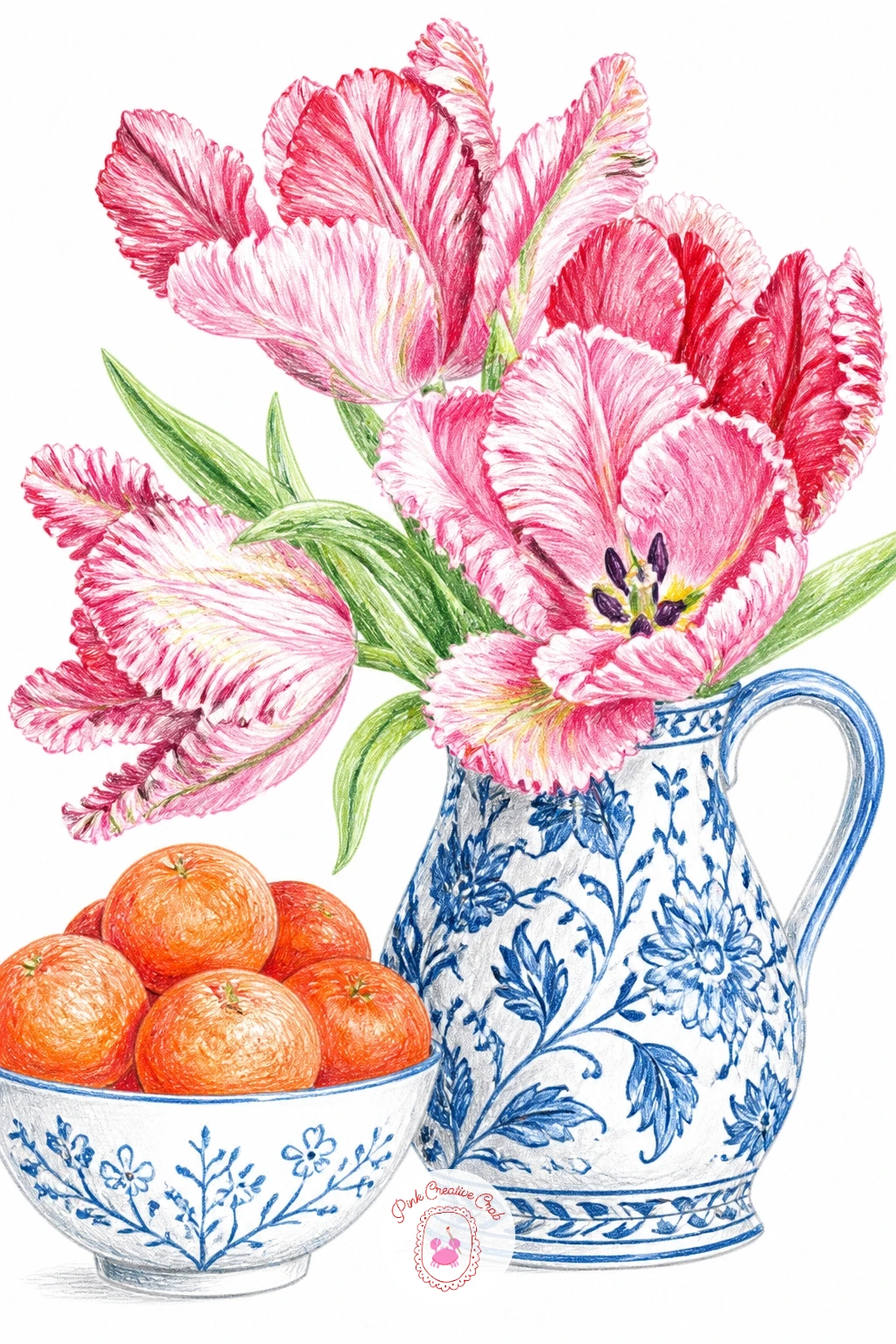
Palette: Ruffled Pink,Cherry Red,China Blue,Clementine Orange
Picture a slower morning with a tulip bouquet laid across a breakfast tray in bed, toast and a mug of coffee beside it. Start with the tray itself as a simple rectangle on the bedding, which gives you a flat surface to anchor everything else, then add the plate of toast as an oval with two overlapping triangle slices and the coffee mug as a simple cylinder with steam lines curling up in a pale grey.
Lay the tulip bunch diagonally across the tray rather than standing upright, since a bouquet resting on its side reads instantly as a relaxed morning moment rather than a formal vase arrangement. Color the petals in two or three tones, keeping the stems and leaves loose and slightly overlapping the edge of the tray.
Bedding is often overworked into a tangle of wrinkle lines. Keep the duvet as mostly flat white or pale blue with only a few confident curved lines for folds near the tray’s edges.
If toast and coffee feel like too many extra objects for one sitting, the quick version keeps just the tulips and the mug, skipping the toast plate entirely and still telling the same story.
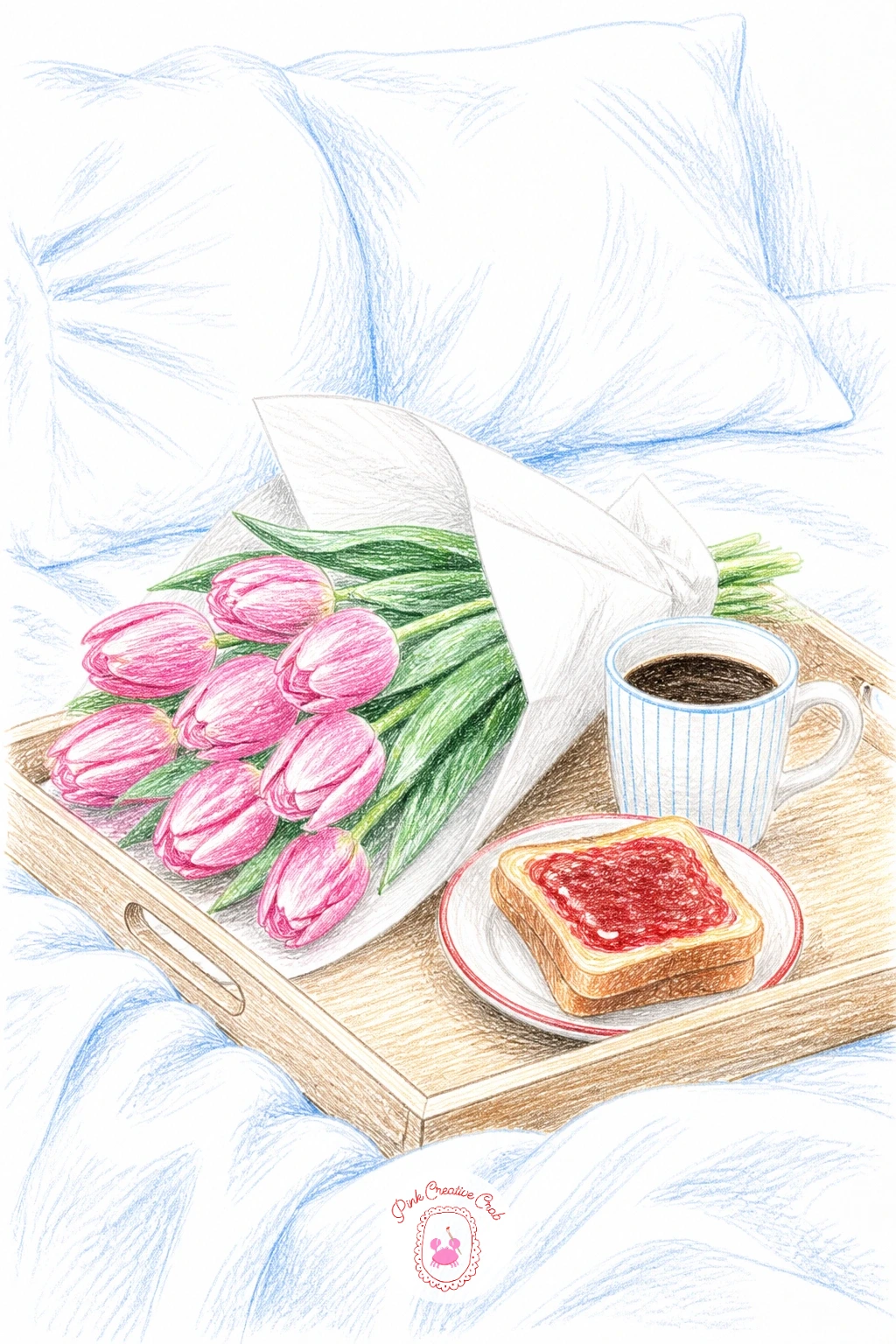
Palette: Tulip Pink,Warm Brown,Pale Blue,Sage Green
Pare everything back to one single tulip standing in a milk bottle on a frosted window ledge. With only one flower and one bottle, this is a good proportion exercise: measure the bottle’s height against the tulip stem before you commit to ink, since a stem that is too short or too tall will throw off the whole quiet mood of the piece.
Draw the milk bottle first as a simple rounded cylinder narrowing at the neck, leaving most of it bare white paper with only a thin curved line of grey shadow along one side. The single tulip head gets all your color attention, built up in three or four layers from pale to deep red or pink so it has real depth against the plain bottle.
With so little in the frame, any wobble in the stem line shows immediately. Draw it slowly in one continuous light stroke rather than several short hesitant ones, and if it still looks off, a thin ribbon of white gel pen down one side of the stem can straighten the read.
Suggest frost on the ledge with small white gel pen flecks rather than drawing each crystal, which keeps the whole piece light and quick to finish.
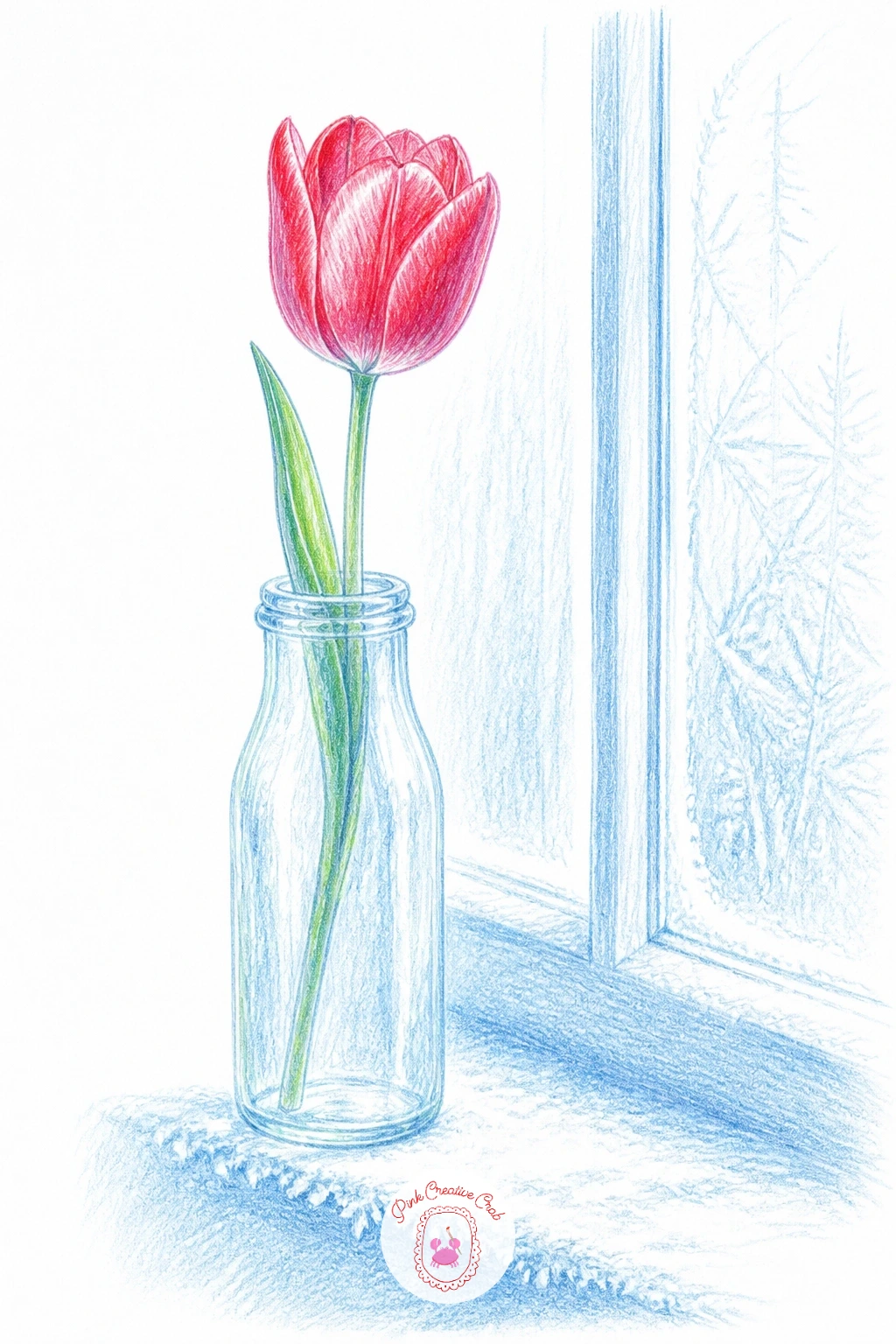
You Will Need
- white gel pen
Palette: Cherry Red,Sap Green,Cool Grey,Icy Blue
Return to the market with a closer, quieter moment: a girl in a knit hat leaning in to smell a bunch of tulips she is holding. Draw her head and shoulders large in the frame first, since the character is the whole point of this one, keeping the hat as a simple ribbed dome shape with a small pompom on top.
Tilt her head slightly downward toward the bouquet and close her eyes with two simple curved lines, which instantly reads as someone enjoying a scent rather than just staring at flowers. The tulip bunch she holds close to her face needs only a few fully colored blooms near her nose, with the rest of the bunch trailing off more loosely below.
Hands holding flowers are notoriously fiddly. Simplify hers into soft rounded shapes wrapped around the stems rather than drawing each finger, which looks more natural at this scale anyway.
If knit texture on the hat feels fussy, a flat solid color with just a few short diagonal lines for the ribbing reads just as well from a normal viewing distance.
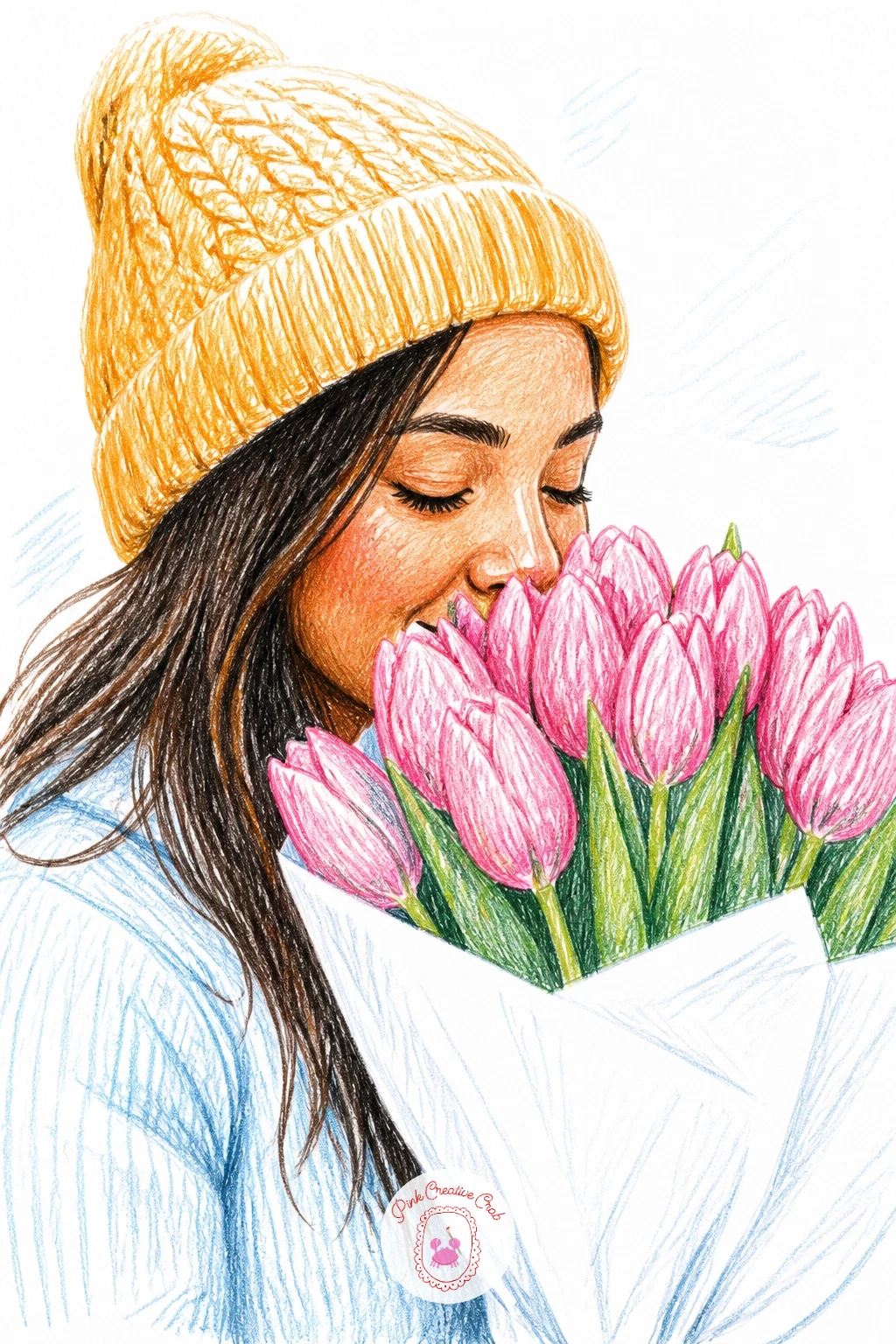
Palette: Tulip Pink,Mustard Yellow,Skin Tone,Sage Green
Set the scene for a cozy dinner with tulips in a ceramic pitcher standing on a table laid for soup night, bowls and spoons nearby. Draw the pitcher first with a slightly rounded belly and a confident curved handle, adding a simple painted stripe or dot pattern in blue or green if you want a bit of pattern without much extra work.
Place a soup bowl and spoon in front of the pitcher, both kept as simple rounded shapes, and consider the eye level you are drawing from: looking slightly down onto the table, as if seated at it, makes the bowl read as a believable oval rather than a flat circle or a straight-on rectangle.
Getting that tabletop perspective wrong is the most common slip here, usually by drawing the bowl rim as a perfect circle instead of a flattened oval. Check the width versus the height of the oval before adding any color, and flatten it further if it still looks like you are staring straight down from above.
No ceramic pitcher at home to study? A plain jug or even a kettle shape works fine as a stand-in, since the table setting carries the cozy mood either way.
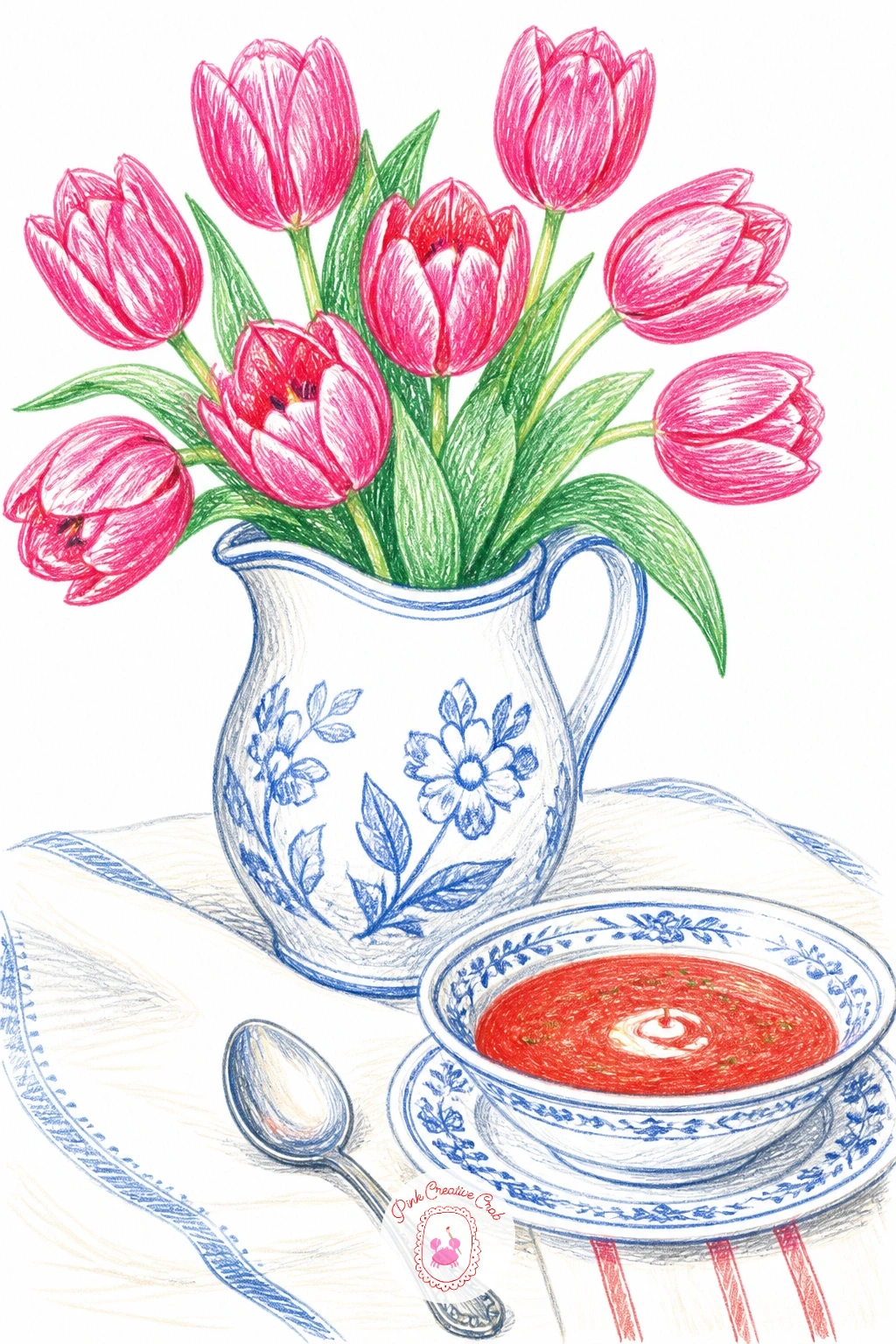
Palette: Tulip Pink,China Blue,Warm Cream,Sap Green
Give a dog a cameo trotting past a flower stall stacked with buckets of tulips, caught mid-stride on a leash out of frame. Sketch the dog first in a simple trotting pose, one front leg forward and one back leg extended, since a moving pose brings more energy to the scene than a sitting dog would.
Keep the dog’s proportions loose and friendly rather than breed-accurate: a rounded body, perked or floppy ears depending on what feels fun to draw, and a short tail caught mid-wag. Work the flower stall behind as a simple row of buckets in two or three tulip colors, kept slightly smaller and less detailed than the dog so he stays the clear focus of the piece.
Four legs in a walking pose trip up a lot of people, often ending up stiff or floating. Draw the body and head first, then add legs as simple tapered shapes angled forward and back, checking that the two legs on the ground actually touch the ground line.
For more confidence with dog poses in general, the dog pencil drawing ideas cover a good range of simple stances worth practicing.
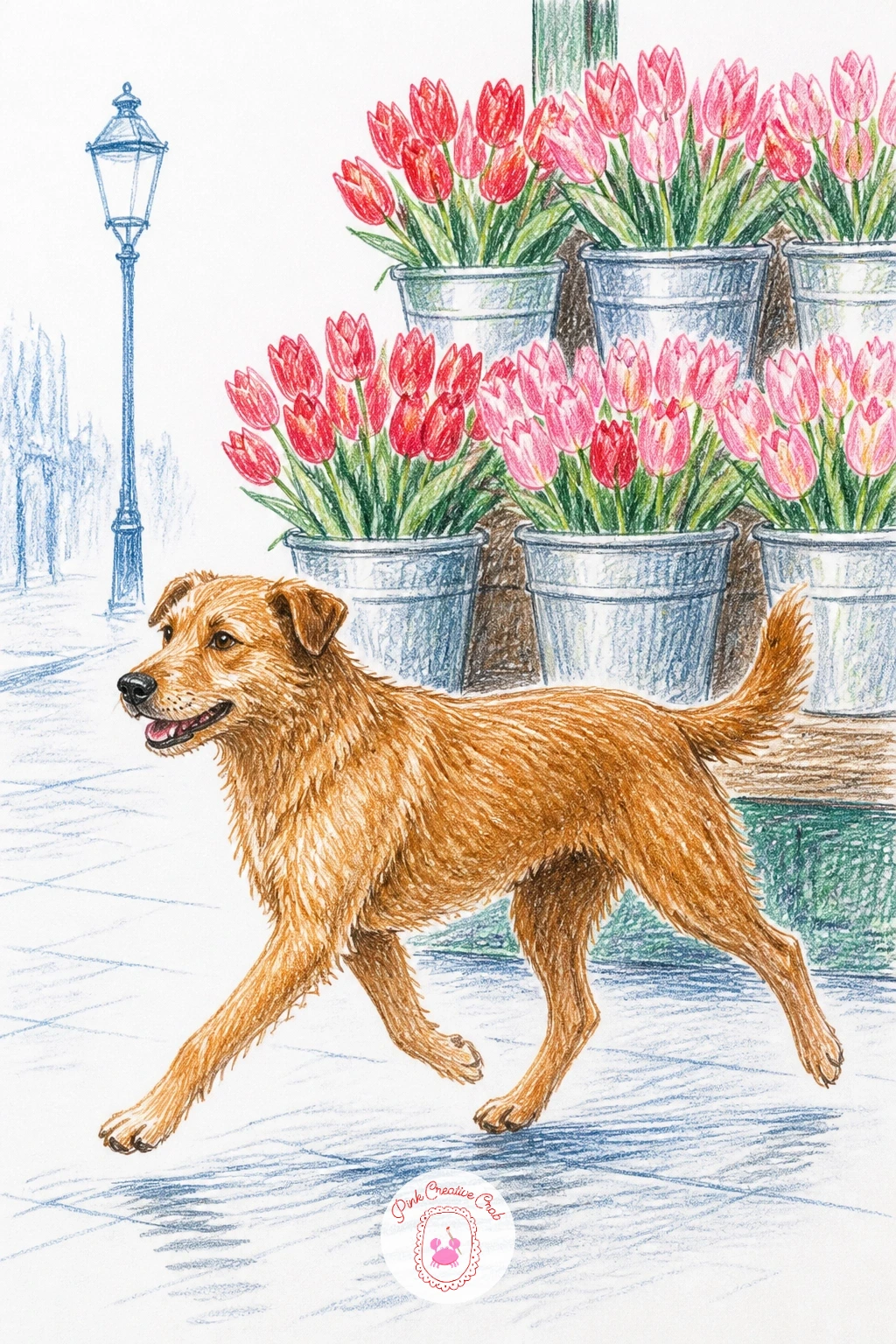
Palette: Warm Brown,Tulip Pink,Cherry Red,Cool Grey
Slow things down with a tulip bouquet resting on a cafe table next to a latte, the kind of quick sketch you might actually draw while sitting at one. Draw the latte cup first as a simple rounded shape with a saucer beneath it, leaving the foam on top as bare white paper with just a thin curved line separating it from the coffee below.
Lay the tulip bunch on its side across the table rather than in a vase, which keeps this composition quick: just an overlapping cluster of petal shapes and crossing stems, no container to draw at all. Work the closest two or three tulips in full color and let the rest fade into looser outlines behind them.
People often make the cafe table itself too busy with extra cups, napkins and spoons. Keep the surface to just the latte and the tulips, maybe one small spoon, so the eye has somewhere restful to land.
If you want the quick ten-minute version, skip the saucer and the spoon entirely and draw only the cup and the tulip bunch, which still reads clearly as a cafe moment.
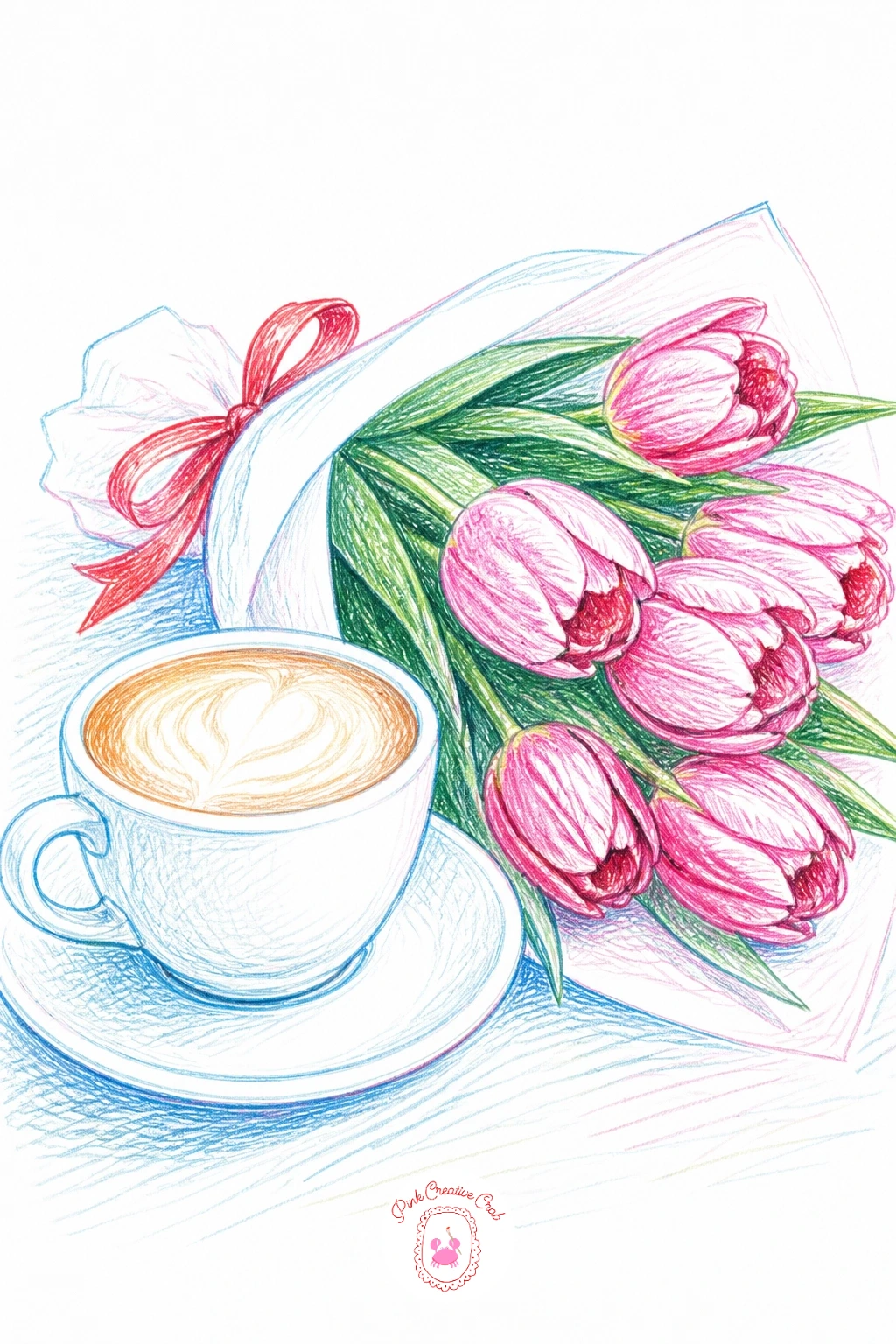
Palette: Tulip Pink,Warm Brown,Cream,Sage Green
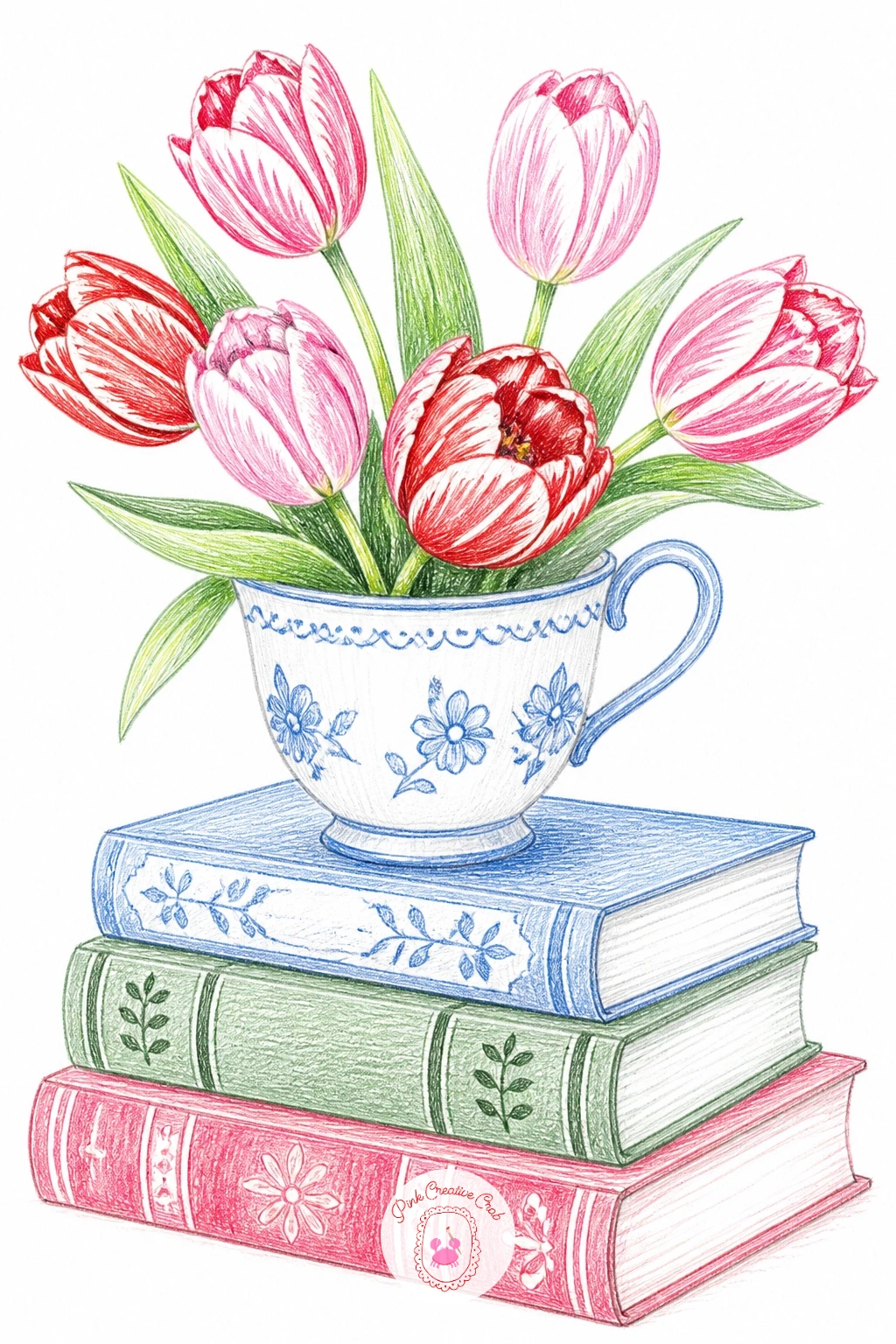
Try something a little playful next: striped tulips, with fine candy-cane lines of color running up each petal, arranged in a teacup balanced on a stack of books. Draw the book stack first since it is mostly straight lines: three or four rectangles of varying widths stacked slightly off-center for a natural, unstyled look, with a spine color or title line on each if you want extra detail.
The teacup sits on top as a simple rounded shape with a small curved handle, and this is where the fun texture trick comes in. After laying a base layer of pink or red on each petal, go back in with a fine-tipped white gel pen and draw a few curved stripe lines following the petal’s natural curve, which gives a convincing striped tulip effect without needing special markers.
Drawing the stripes too straight and evenly spaced is what makes them look printed rather than organic. Vary the stripe widths and let a couple of them fade out partway up the petal instead of running the full length.
No gel pen on hand? A kneaded eraser pressed and lifted in thin curved lines through a colored pencil layer creates a similar pale stripe effect.
You Will Need
- white gel pen
- kneaded eraser
Palette: Tulip Pink,Cherry Red,Warm Brown,Cool Grey
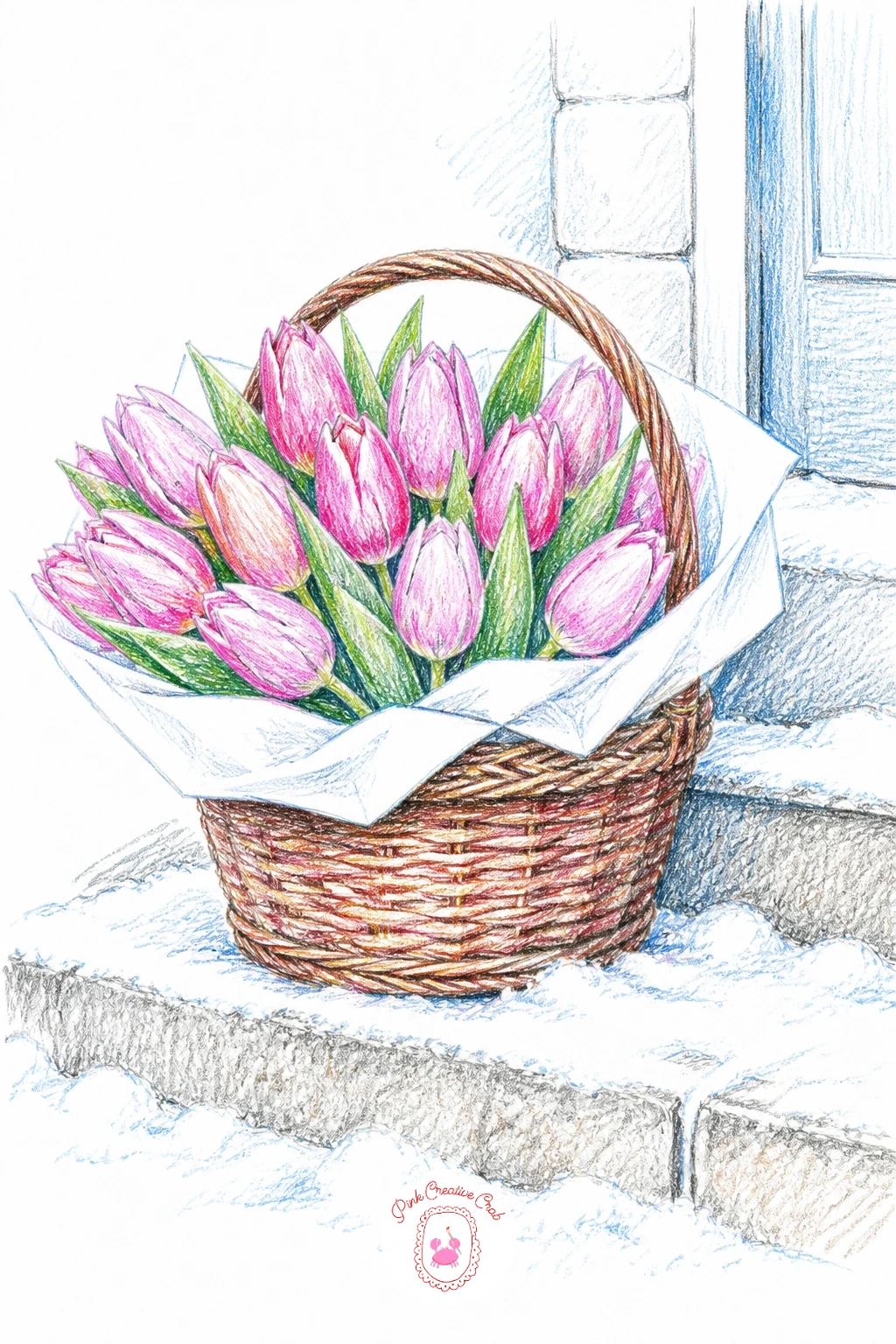
Picture a hand-tied bunch of tulips resting in a wicker basket set on a snowy doorstep, string or ribbon still wrapped around the stems. Draw the basket first with a simple woven texture: a few curved horizontal lines crossed by short vertical marks, enough to suggest weave without rendering every strand.
Bundle the tulip heads tightly together near the top of the basket, since a hand-tied bunch sits more compact and upright than a loose arrangement spilling over an edge. Add a thin ribbon or string line wrapped once or twice around the stems just below the flower heads to sell the hand-tied look.
Overworking the wicker texture is the easy trap, since it can swallow the whole drawing if you render every gap in the weave. Keep the basket texture loose and let it stay secondary to the tulips, which should carry the strongest color in the piece.
Set the basket on a doorstep with just a thin dusting of white gel pen snow at its base and a hint of a stone step line beneath, nothing more elaborate needed.
You Will Need
- white gel pen
Palette: Tulip Pink,Warm Brown,Sage Green,Cool Grey
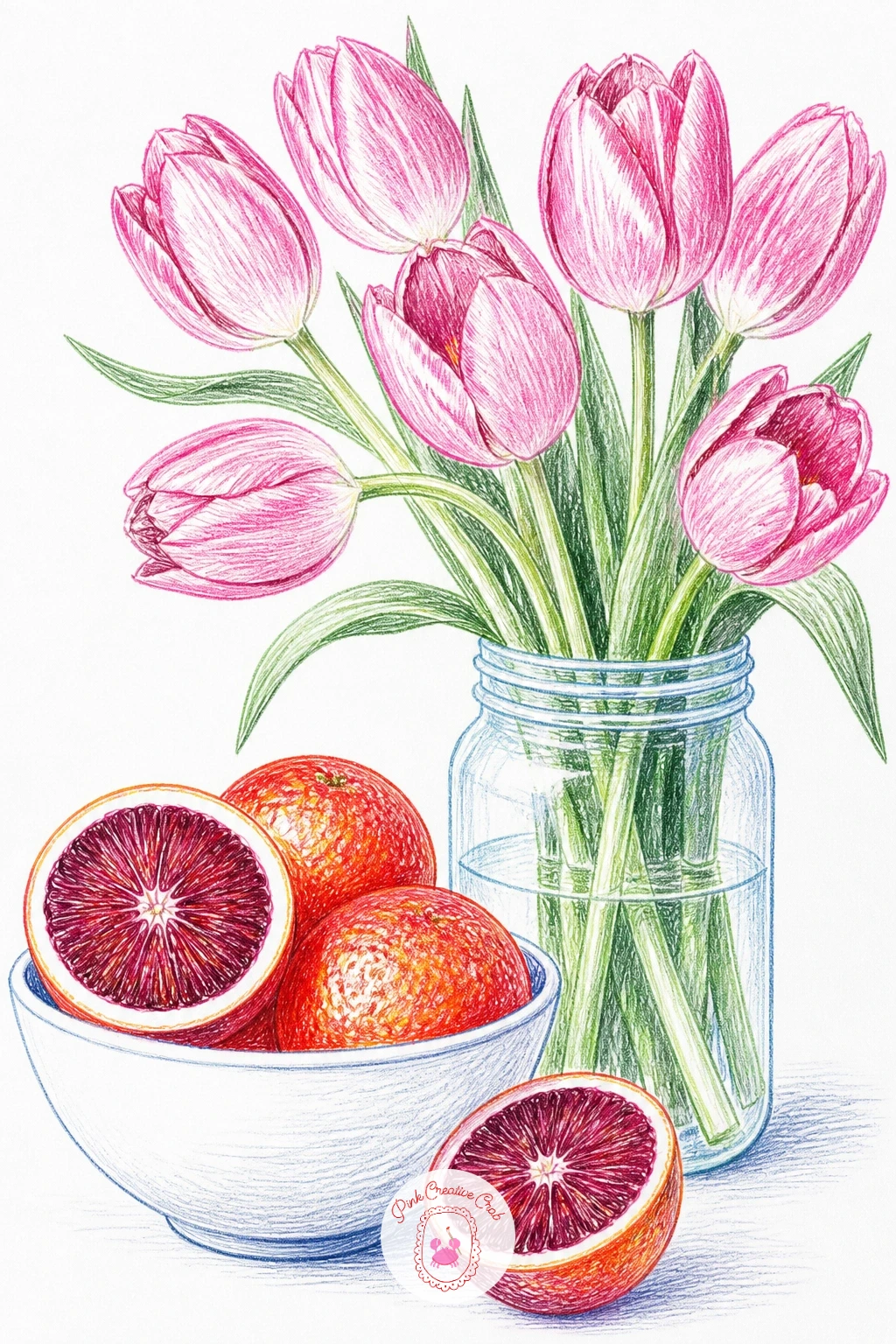
Pair pink tulips in a simple glass jar with a bowl of blood oranges for a still life built entirely on color contrast. Draw the jar first as a plain cylinder, leaving it almost entirely white paper except for a faint curved shadow line, which keeps focus on the two colorful elements beside it.
Work the blood oranges next in a bowl beside the jar, using warm orange as the base layer and then dropping in small irregular patches of deep red-purple to suggest the flesh showing where one orange is cut in half. This bold color-pairing trick is what makes blood oranges distinct from regular oranges in a drawing, so do not skip the red patches.
If the oranges end up looking too uniformly orange with no red at all, go back in with a sharpened dark red or maroon pencil and add a few confident strokes rather than trying to blend it in smoothly.
Stand the pink tulips tall in the jar behind the bowl, keeping their stems visible through the glass with just a few simple curved lines rather than fully rendered glass refraction.
Palette: Tulip Pink,Clementine Orange,Deep Maroon,Sage Green
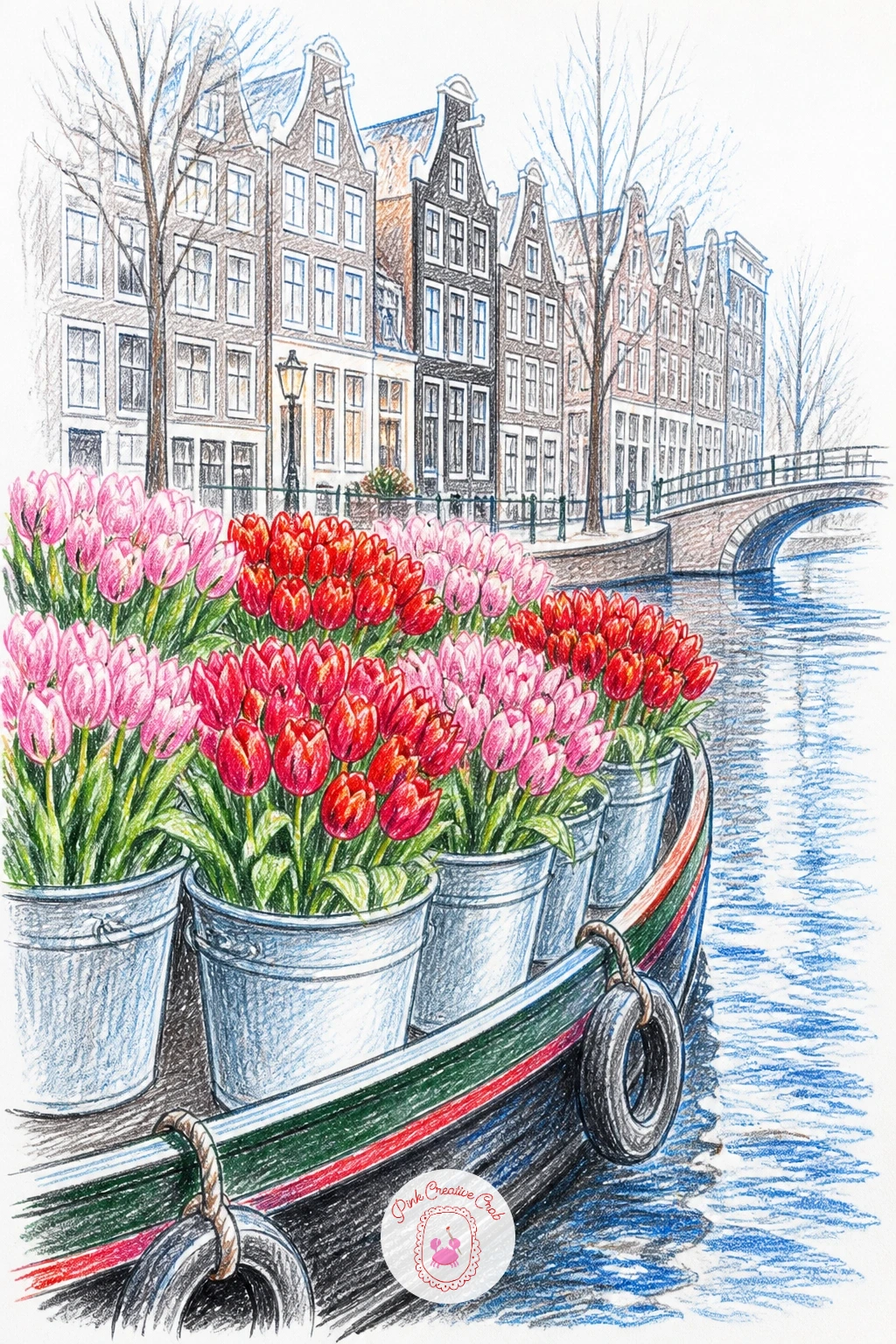
Widen the scene with buckets of tulips lined up along a canal-side flower boat in winter, water and a bit of townscape in the background. Draw the boat’s hull first as a simple curved rectangle sitting low in the frame, then line up a row of buckets along its deck, varying bucket color and height slightly so the row has some rhythm rather than looking stamped from one shape.
The water beneath the boat is where perspective matters most: keep the reflection colors slightly darker and more muted than the buckets themselves, and use mostly horizontal pencil strokes for the water’s surface so it reads as still, cold canal water rather than choppy sea.
A common slip is drawing canal buildings behind the boat in too much detail, which competes with the flowers for attention. Simplify the background into a few flat-fronted building shapes in muted colors, with only a window or two picked out, keeping all the saturated color in the tulip buckets themselves.
If a full canal scene feels like a lot for one sitting, crop in tighter on just the boat deck and buckets, letting the water show only as a thin strip along the bottom edge.
Palette: Tulip Pink,Cherry Red,Icy Blue,Warm Grey
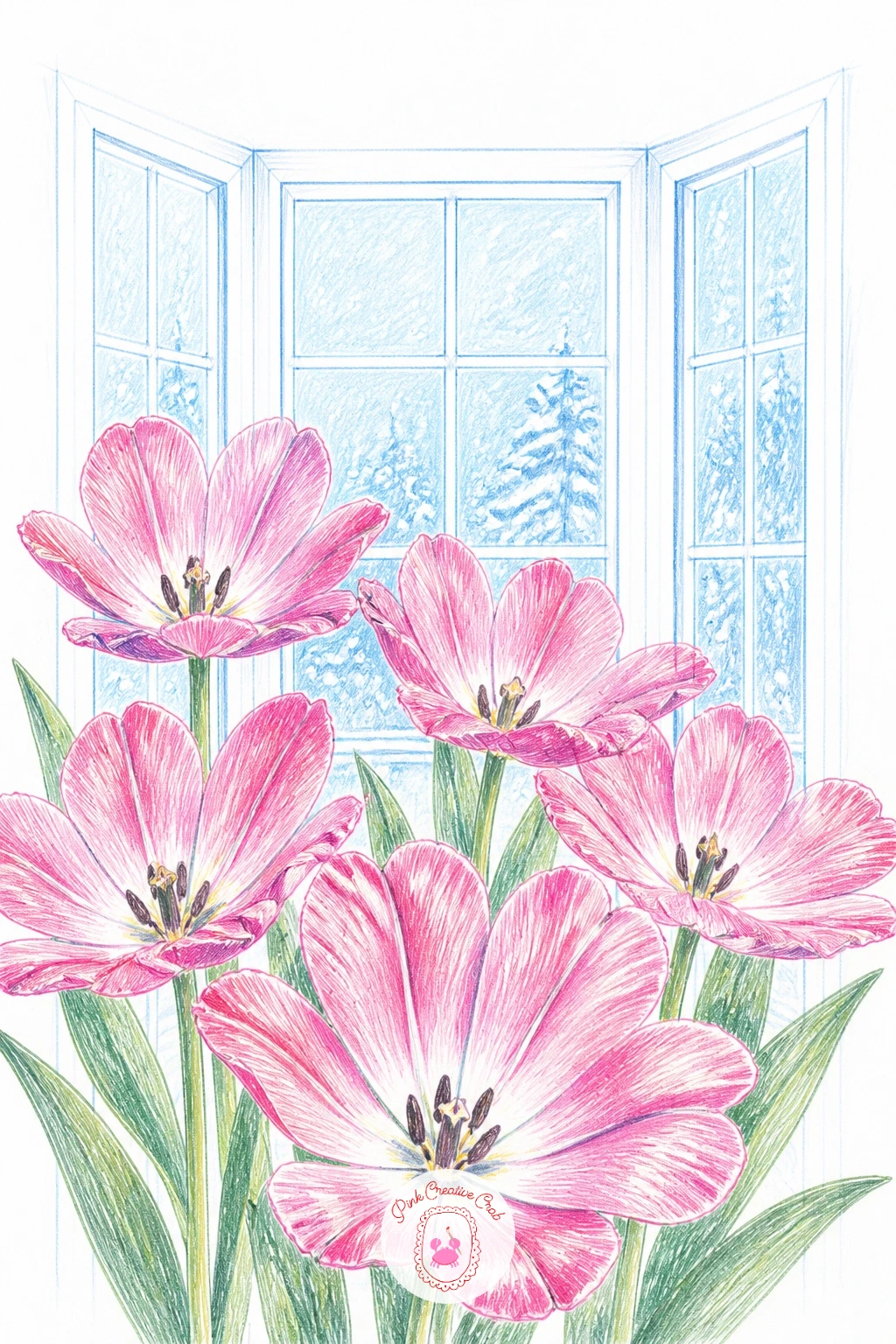
Give the flowers room to breathe with tulips opening wide in a bright bay window while snow falls outside. Draw the window frame first as the structural backbone of the piece: a few simple straight mullions dividing the bay into panes, kept light so they do not compete with the flowers in front.
Fully opened tulips look quite different from the closed buds used in earlier ideas on this list, with petals splayed outward almost flat rather than cupped. Draw each petal as a wider, flatter curve than usual, and let a couple of stamens show as small dark marks in the open centers for that extra bit of realism.
Drawing every pane of falling snow outside the window can quickly turn fussy and distracting. Suggest snow with a handful of white gel pen dots scattered unevenly across the glass panes instead, leaving most of the window as soft pale blue.
Vary this one next time by trying the same open-tulip shape in a completely different color group, deep purple or burgundy tulips instead of pink, to see how much mood changes with color alone.
You Will Need
- white gel pen
Palette: Tulip Pink,Pale Blue,Sap Green,Warm Brown
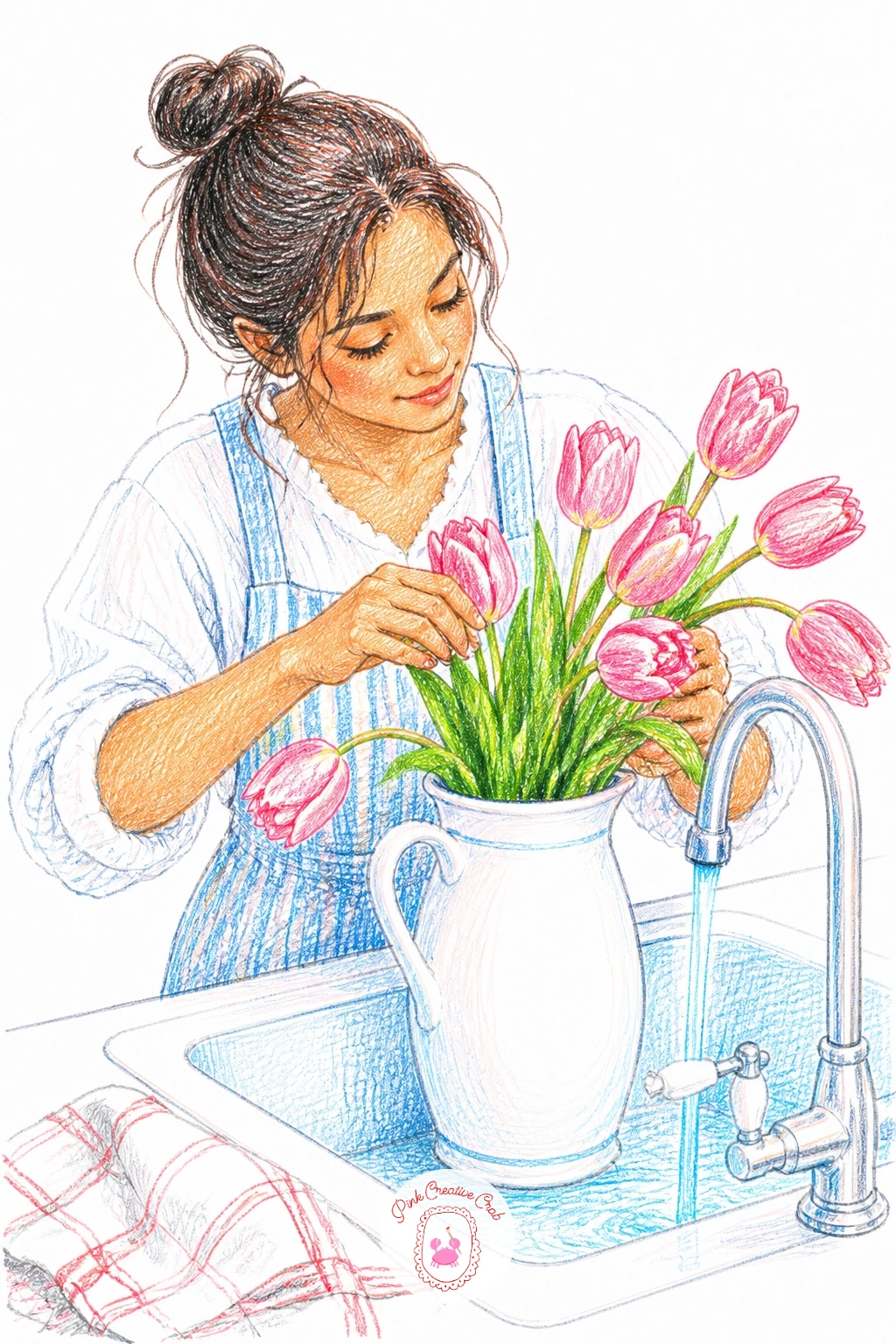
Bring the earlier girl figures back into the kitchen with one arranging tulips in a jug at the sink, sleeves pushed up, water running. Draw the sink and counter edge first as a simple rectangle block, then add her standing at it in three-quarter view so you can show both her face in profile and the jug in her hands clearly.
Measure her against the counter height before finalizing the pose: counters typically sit around hip height on an adult figure, so her torso should bend only slightly forward rather than hunching dramatically over the sink. The jug and tulip bunch sit in her hands at roughly chest height, the main color focus of the piece.
Running water is often drawn as rigid straight lines, which looks stiff. Use a few loose curved pencil marks in pale blue or grey for the stream instead, leaving gaps of white paper to suggest splash and movement.
If a full kitchen setting feels like too much today, crop tightly around her upper body and the jug, letting the counter and sink edge do the rest of the storytelling with minimal detail. The kitchen drawing ideas have more quiet domestic scenes like this one worth trying next.
Palette: Tulip Pink,Skin Tone,Pale Blue,Sage Green
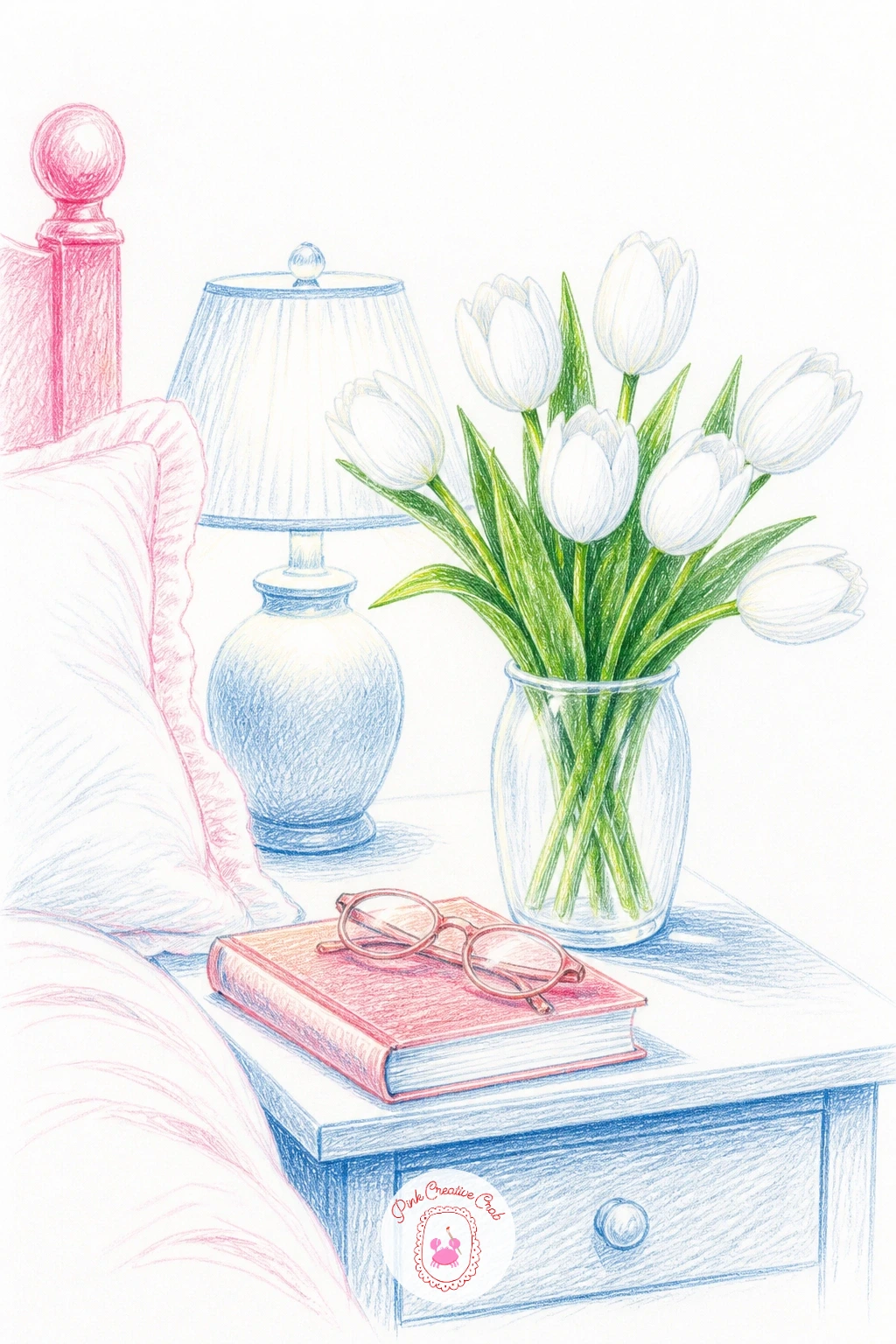
Keep things gentle and quiet with white tulips standing beside a book and a pair of glasses on a bedside table. White flowers are a good texture exercise since you cannot rely on bold color alone: draw the petal shapes first in a very light outline, then build their form using only shadow, a pale cool grey or icy blue laid in thin layers along the folds and base of each petal, leaving the petal tips almost pure white paper.
Place the book beside the vase as a simple closed rectangle with a slightly curved spine edge, and rest the glasses on top with two simple oval lenses connected by a thin bridge line, angled slightly so they look set down rather than floating flat.
White flowers that end up looking grey and dull usually have shadow spread evenly everywhere instead of concentrated where petals actually overlap or curve inward. Pull your darkest grey back to just those overlap points and leave broader areas bare.
A small lamp glow nearby, even just a soft circle of pale yellow in one corner, adds warmth to the quiet scene without much extra effort.
Palette: Icy Blue,Cool Grey,Warm Brown,Pale Yellow
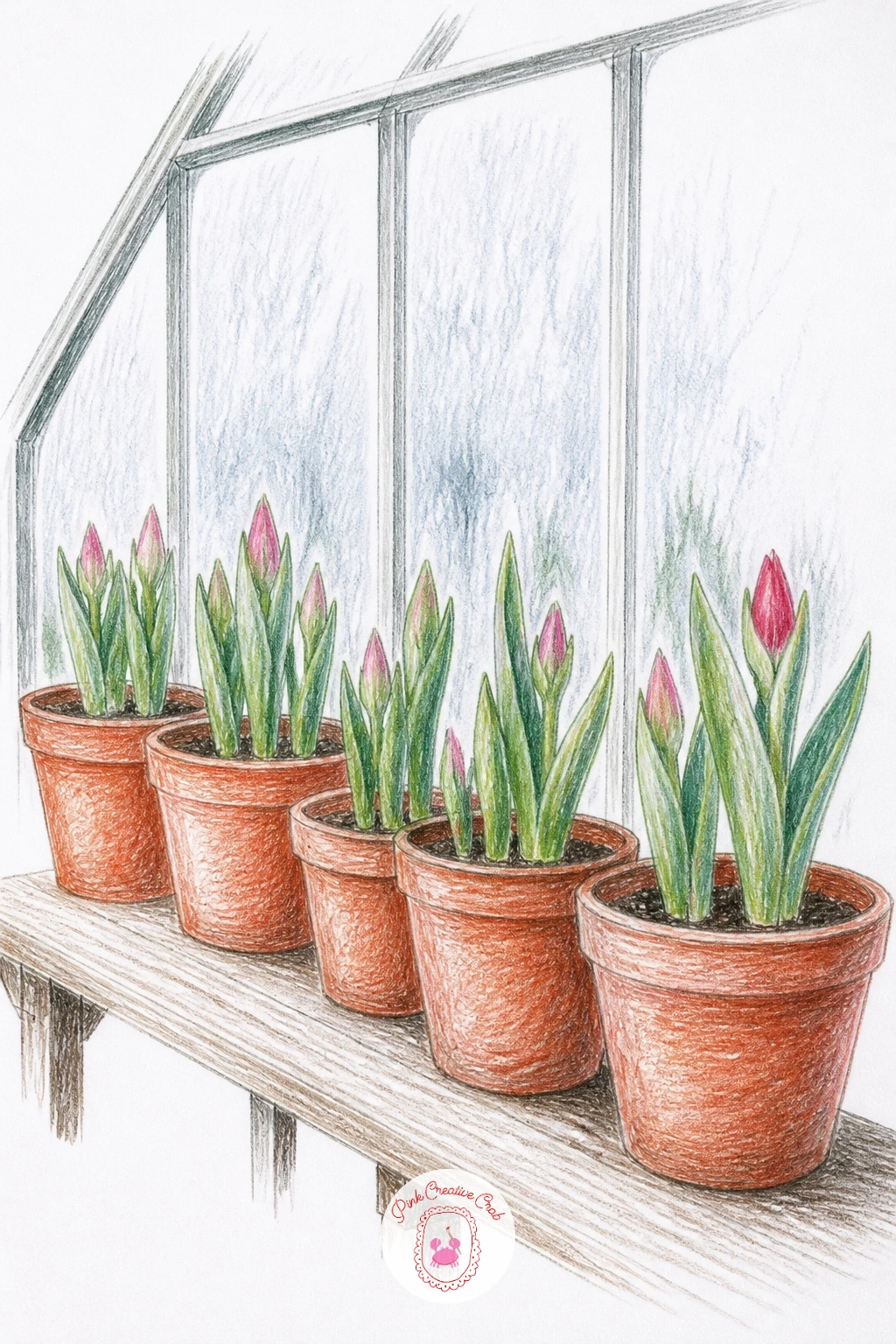
Move ahead a little in the tulip’s life and draw pots of tulips just sprouting on a greenhouse bench in February, green shoots barely showing above the soil. Line up a row of simple terracotta pots along a wooden bench first, each pot a plain trapezoid shape in warm orange-brown, varying their size slightly so the row feels planted by hand rather than mass-produced.
The quick version of this scene takes about ten minutes: three pots, a few short green shoots in each, done. The longer forty-minute version adds the greenhouse structure behind them, simple glass panes sketched in light grey lines, and lets a couple of shoots show their first hint of pink or red color peeking from the tip of the bud.
Overcrowding the bench with too many identical pots is the easy mistake. Three or four varied pots read as a believable greenhouse bench; a dozen identical ones start to look like a pattern rather than a scene.
No terracotta pots to reference? Any plain plant pot works, the warm orange-brown color is what matters more than the exact shape.
Palette: Terracotta,Sap Green,Cool Grey,Tulip Pink
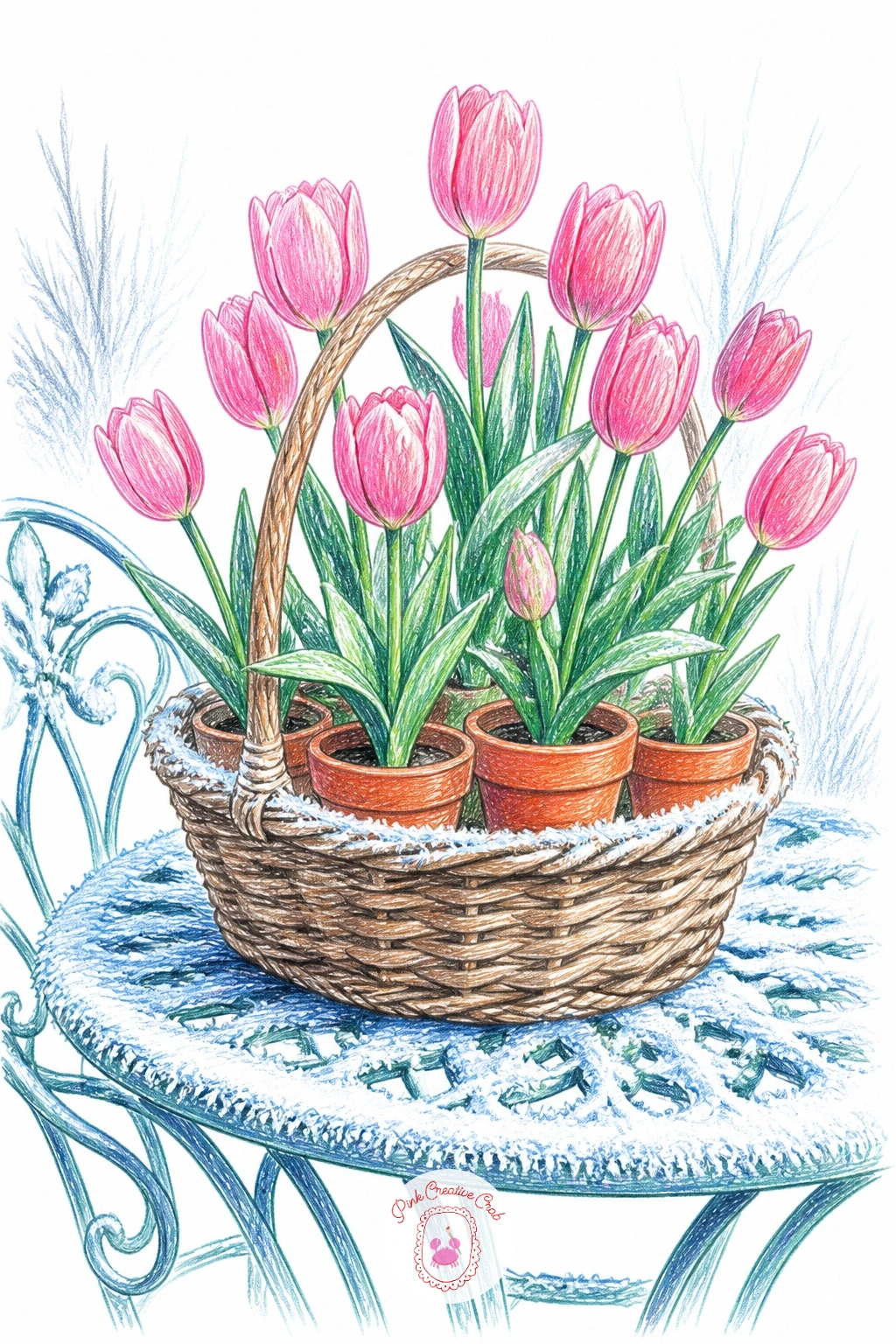
Build on the greenhouse idea with a basket of fully potted tulips sitting outdoors on a frosty garden table, further along than the sprouting pots above. Draw the basket first as a simple woven rectangle holding two or three small pots nestled inside it, their rims peeking over the basket’s edge at slightly different heights.
Compare the height of the tallest tulip bloom against the basket’s width before adding final color, since potted tulips in a group basket often end up too short and stubby if you do not check this ratio early. A believable potted tulip usually stands about as tall as the basket is wide, sometimes a little taller.
Frost on the garden table is easy to overdo with too many fussy white marks. A light scatter of white gel pen flecks along the table’s edge and a thin icy blue line where frost meets shadow is enough to read clearly as a cold morning.
If weaving the basket texture feels slow, swap it for a plain wooden crate instead, which needs only a few straight slat lines and still holds the pots just as well.
You Will Need
- white gel pen
Palette: Tulip Pink,Terracotta,Icy Blue,Warm Brown
Picture a canvas tote bag stuffed with tulips, set down on a snowy park bench as if someone just rested it there mid-walk. Draw the bench first as a simple slatted rectangle with short straight legs, keeping the wood tone warm against the cooler snow around it, then add the tote bag leaning against one arm of the bench.
The tote itself is a soft rectangular shape, not a stiff box, so let its sides curve slightly inward from the weight of the flowers packed inside. Tulip heads and loose leaves spill generously out of the opening at the top, a good mix of pink and red blooms layered so the closest ones are fully colored and the ones tucked further back stay a bit looser.
A tote bag drawn too stiffly looks like a cardboard box instead of cloth. Add a few soft diagonal wrinkle lines near the bottom and sides where the fabric folds under the weight of the stems, which immediately reads as soft canvas.
Next time, try this same stuffed-tote idea with a completely different flower, sunflowers or peonies, to see how the overflowing-bag composition adapts to a different bloom shape.
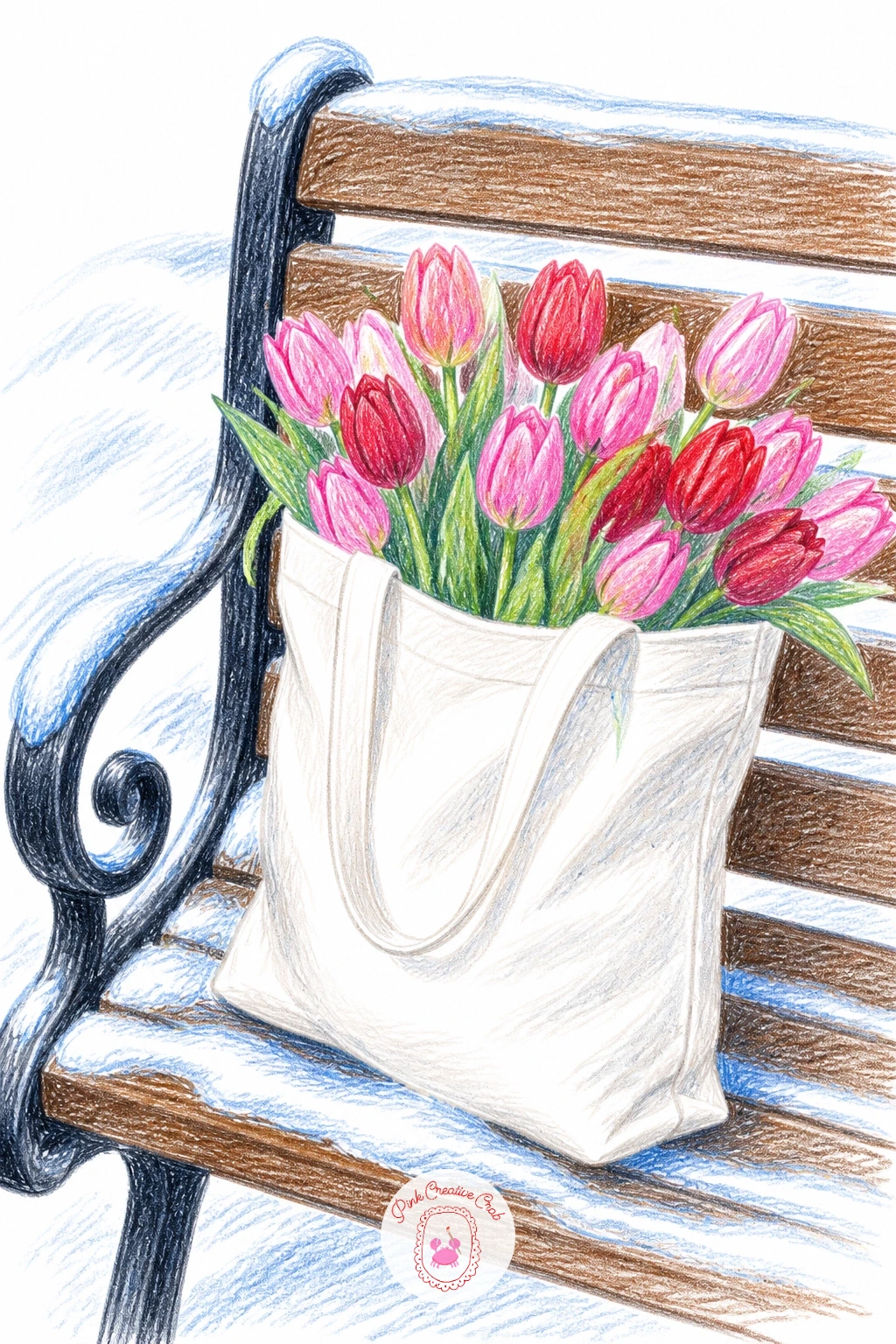
Palette: Tulip Pink,Cherry Red,Warm Brown,Icy Blue
Pair a tulip bouquet with a slice of lemon drizzle cake on a cake stand for a sweet little still life. Draw the cake stand first with a simple raised pedestal shape, then build the cake on top as a layered rectangle with a lightly textured top surface in pale yellow, a few darker golden-brown flecks suggesting the drizzle glaze catching light.
Lay the tulip bunch beside the stand rather than behind it, so the flowers and the cake sit at a similar height in the frame and neither one dominates the composition. Keep the tulip colors warm, pinks and soft reds, to echo rather than clash with the cake’s pale yellow.
The lemon glaze is the trickiest part, since drawing it too smooth loses the drizzled texture entirely. Use short irregular squiggly pencil lines in a pale cream tone across the top of the cake rather than one flat wash of color, which reads much more like an actual drizzle.
A simple swap if lemon drizzle is not to your taste: draw a plain sponge cake instead and skip the glaze squiggles altogether, the composition still works.
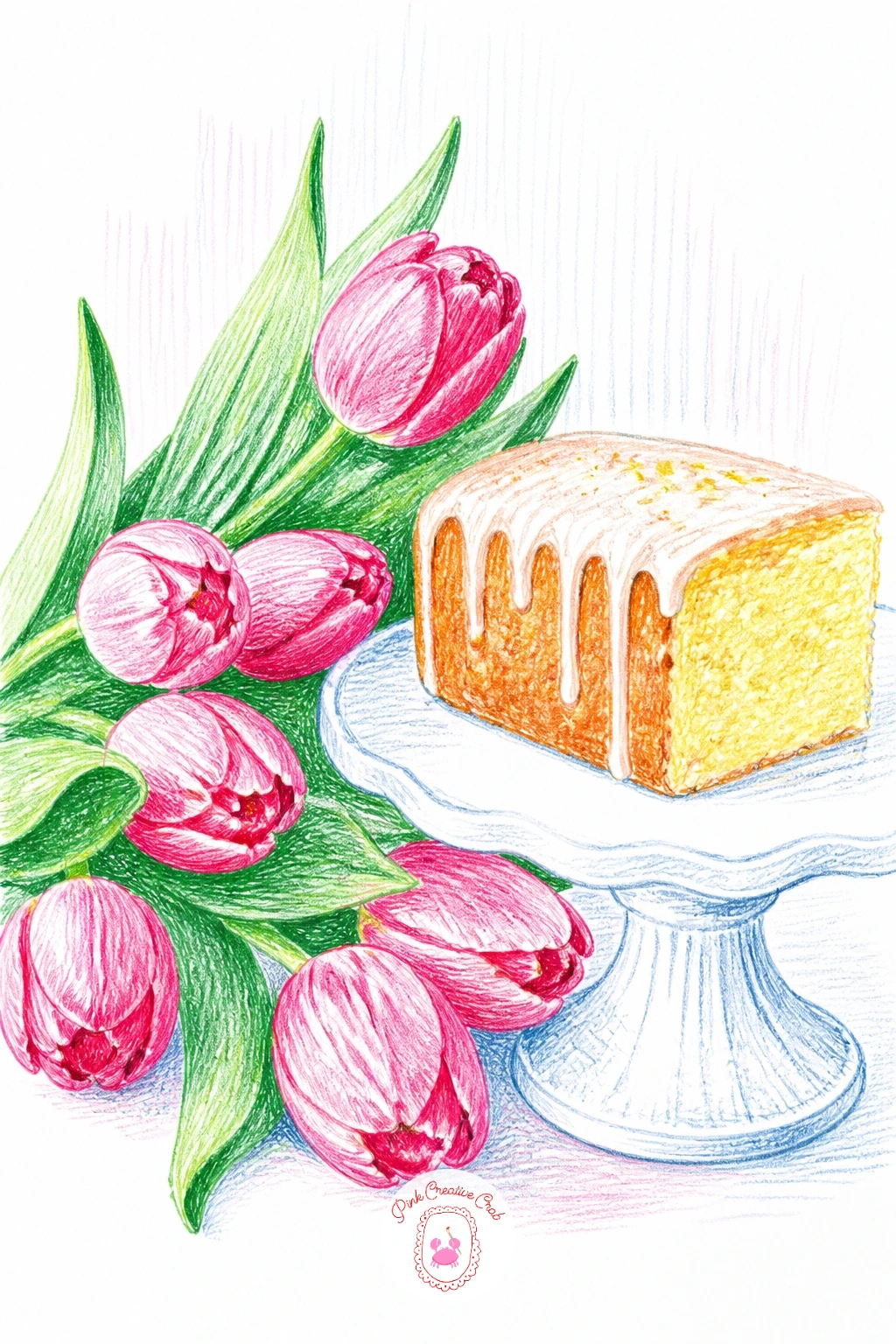
Palette: Tulip Pink,Pale Lemon,Golden Brown,Cream
Set an evening mood with tulips standing in an old wine bottle on a candlelit dinner table, warmer and moodier than the daylight scenes earlier on this list. Draw the bottle first with its distinct long neck and slightly curved shoulders, leaving a thin vertical highlight of bare white paper down one side to suggest glass catching candlelight.
Place a lit candle just beside or behind the bottle, and let that light source decide your whole color temperature: shadows throughout the piece should lean warm, using a brown or deep red grey rather than the cool blue greys used in the daylight window scenes earlier on this list, since candlelight warms everything it touches.
Overly bright, evenly lit tulips kill the candlelit mood fastest. Push the side of each petal facing away from the candle noticeably darker than you might normally, almost shadowed into the background, so the warm light feels like it is really doing something.
No wine bottle to reference? Any tall glass bottle works, the warm candlelight is what carries the mood, not the exact bottle shape.
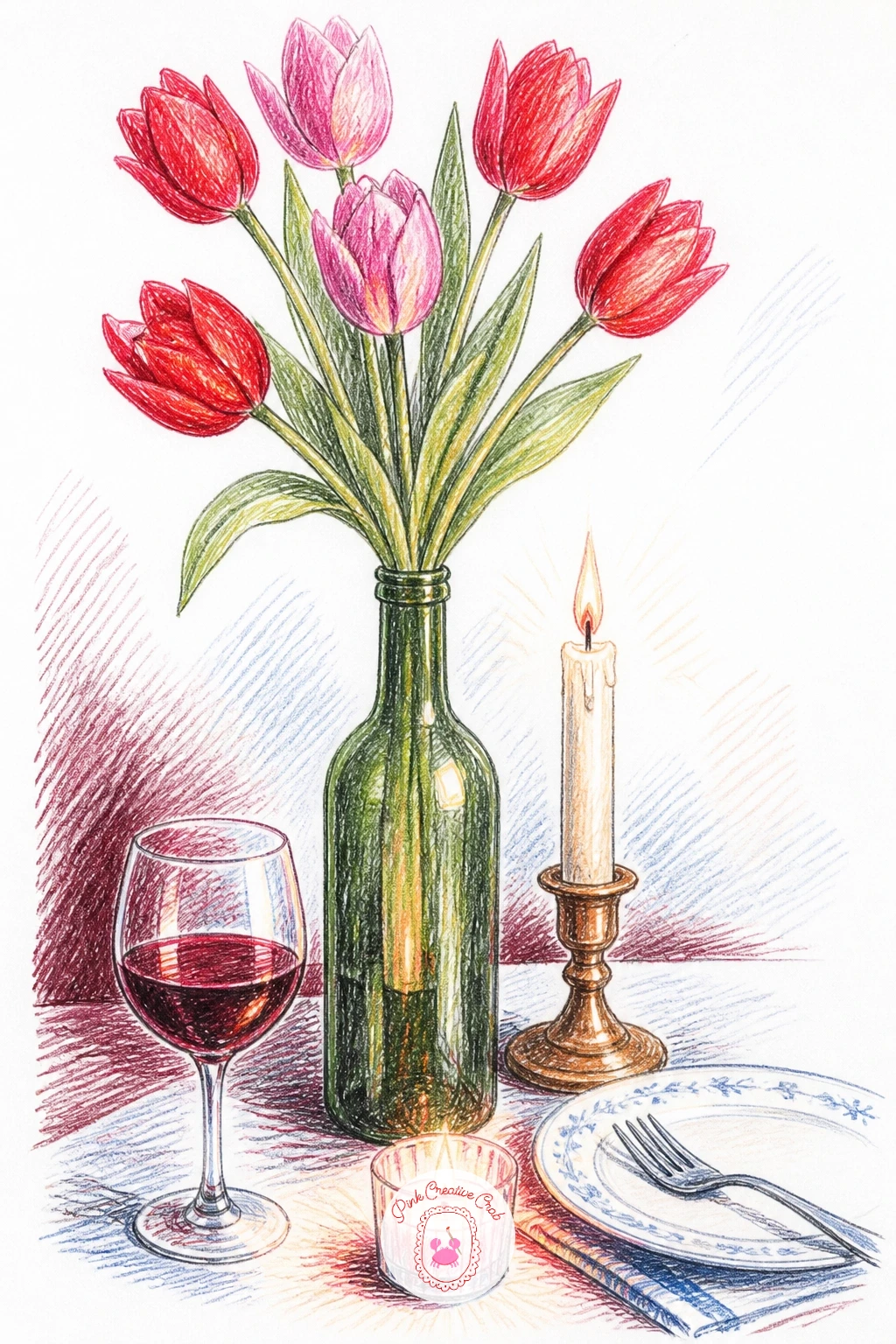
Palette: Cherry Red,Warm Brown,Golden Brown,Deep Maroon
Close the list on the warmest note of all: a little girl holding out a single red tulip to her mother. Draw the two figures first at slightly different heights, the child small and the mother kneeling or bending down to meet her at closer to eye level, which keeps the gesture intimate rather than distant.
Keep both faces simple, a few soft curved lines for closed or gently smiling eyes, since the real emotion in this piece comes from the pose and the outstretched hand holding the tulip, not from detailed features. The single red tulip stays the brightest, most fully colored object in the whole drawing, everything else kept a touch softer around it.
Hands exchanging a small object like this are easy to overcomplicate. Simplify both hands into soft rounded shapes, the child’s fingers curled gently around the stem and the mother’s hand reaching to receive it, without drawing each individual finger joint.
If two full figures feel like a lot for today, crop the scene down to just the two hands and the tulip passing between them, which still carries the whole warm moment in a much smaller, quicker sketch. For more quiet character moments like this, the BFF drawing ideas are worth a look.
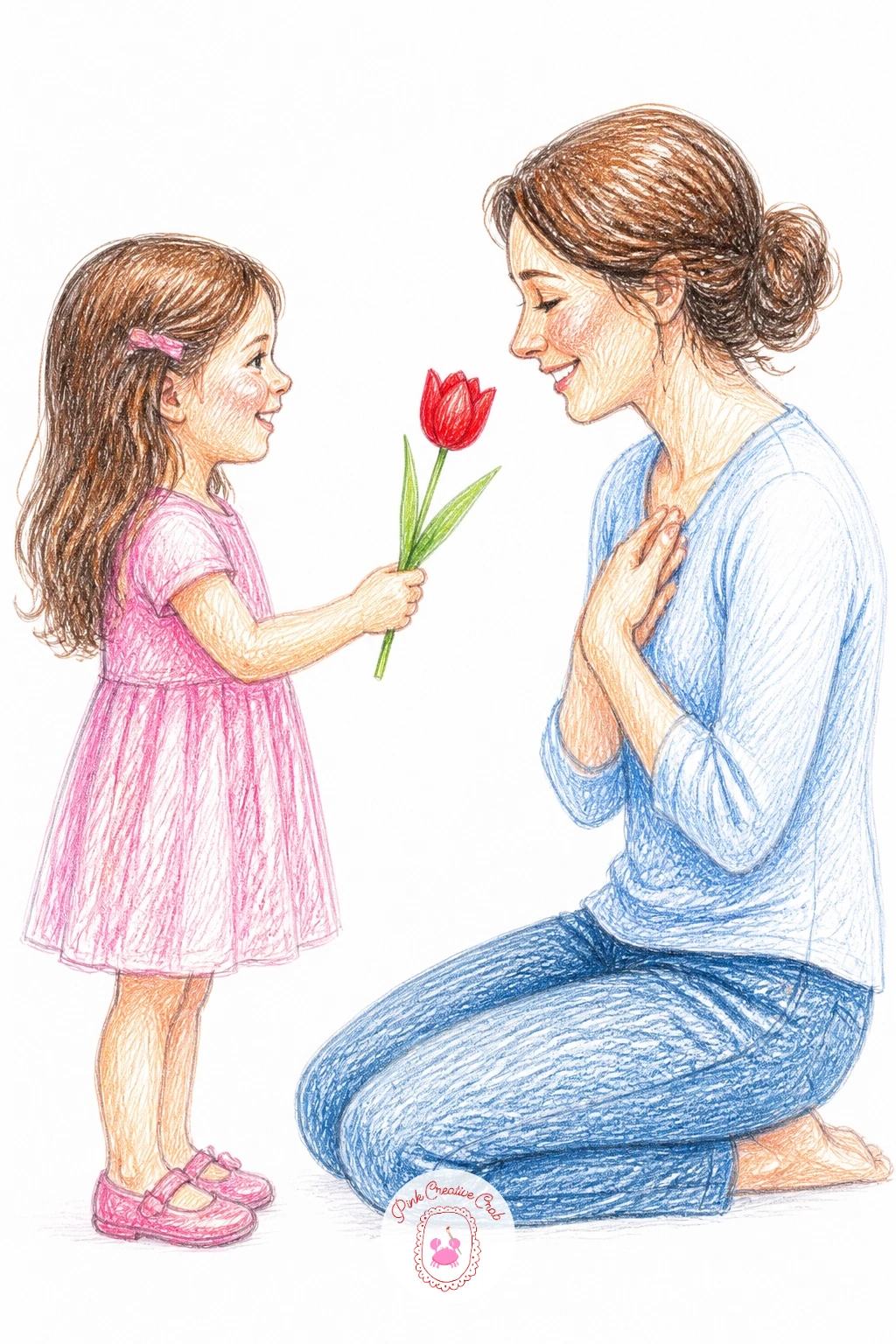
Palette: Cherry Red,Skin Tone,Sage Green,Warm Brown
What to Do Next
Pick whichever tulip scene matches your mood today, start with a light pencil sketch on plain white paper, and build the color in thin layers rather than rushing to full saturation. A single milk bottle tulip or one market bucket is plenty for a first try, and the fuller scenes are there waiting once that one feels easy.
Frequently Asked Questions
What colored pencils work best for drawing tulips?
A soft wax-based colored pencil set with at least two pinks, two reds and a sage green covers most tulip drawings well. Add a cool grey and an icy blue for shadows and winter light, and a white gel pen for snow or highlights.
How do you keep tulip petals from looking flat?
Layer two or three tones from light to dark rather than one flat color, always darkest where petals overlap or curve inward. Leave small strips of bare white paper on the lit side of each petal for a natural highlight.
What is the easiest tulip shape for a beginner to start with?
A single closed tulip bud is the simplest shape, just a rounded top narrowing to a point with straight sides. Practice that one shape a few times before attempting open or ruffled parrot tulip petals.
How do you draw snow without making the whole page too busy?
Leave most of the paper bare white rather than drawing individual snowflakes everywhere. A light scatter of white gel pen dots near edges and corners reads as snow without crowding the main subject.
Can these tulip ideas work with watercolor instead of colored pencil?
Yes, the same compositions translate well to watercolor, since the simple shapes and limited color palettes suit a loose wash just as easily as layered pencil strokes. Keep whites reserved with masking fluid if you switch mediums.
Have any thoughts?
Share your reaction or leave a quick response — we’d love to hear what you think!
-
 0
-
0
-
0
-
0
-
0
-
0


