Snowman drawing gets a lot more fun once the snowman has somewhere to be and something silly to do. Forget the stiff carrot-and-coal portrait standing alone on a blank page: every snowman here is caught mid-moment, walking a dog, losing his hat, or stuck in a freezer on a sunny day.
Grab a fineliner and a set of markers and work through the list below with a kid, a grandparent, or on your own. Each idea comes with a simple way to draw it and a small extra for anyone who wants to push it further, so the page never feels too easy or too hard.
Using these images: free for personal projects such as printing, coloring, cards, journals and gifts. Handmade items that include them may be sold up to 30 pieces per design. More than that is commercial use and is not permitted, and neither is selling or sharing the images themselves or passing them off as your own. Please ask before any other use.
Start simple and start happy: this snowman walking a little dog on a leash is the easiest way into the whole list. Draw two stacked circles for his body with a fineliner, a small round head on top, two dot eyes, a triangle nose and a curved smile. Add stick arms, one of them holding a short curved leash line down to a round little dog with two ears and a wagging tail.
Keep the dog smaller than the snowman’s middle circle so the size relationship reads instantly, that one comparison is the whole trick here: the snowman should tower over his pet the way a stack of snowballs would. If the proportions drift, erase just the dog and redraw it smaller rather than starting the whole scene again.
Color the snowman white with icy blue marker shadows under each curve, then let the dog be a warm brown or grey so the two shapes separate clearly. A beginner can stop at flat color; an adult can add little footprints trailing behind both of them in the snow.
If you only have one marker color, use it for the dog and keep the snowman in plain pencil shading for contrast.
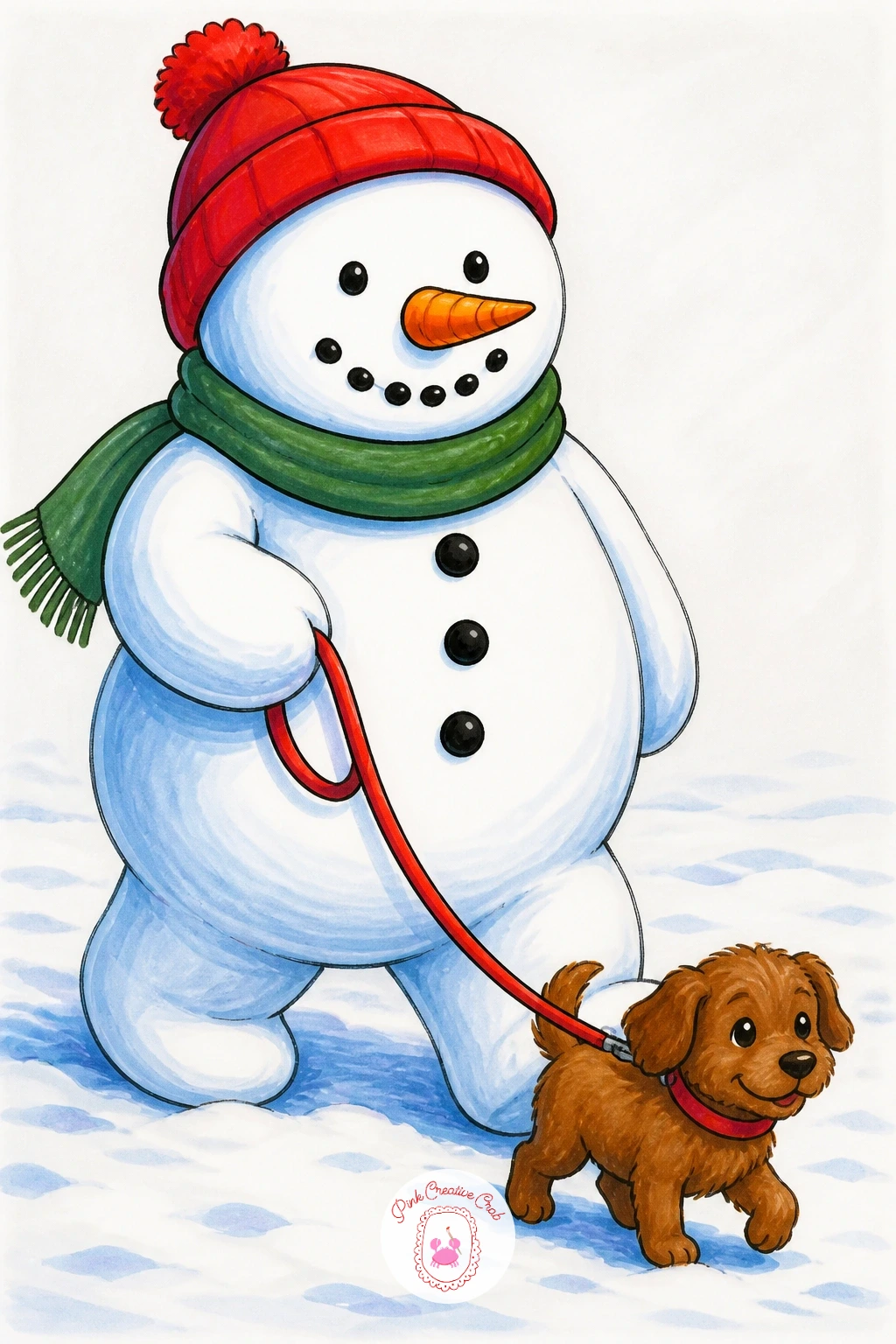
Palette: Snow White,Icy Blue,Chestnut Brown,Carrot Orange
Once the walking snowman feels easy, try one that is actually moving fast: a snowman ice skating on a frozen pond with wobbly arms. Draw the pond first as a pale blue oval that fills most of the lower page, then build the snowman slightly off center so he has room to glide across it.
Give him bent stick arms instead of straight ones, out to the sides for balance, and draw his bottom snowball tilted a little rather than sitting flat. That tilt is what sells the motion, so skip the straight-up-and-down pose you used for the walking snowman.
Add two curved skate blades under his base and a few scratchy white lines on the ice behind him to show where he has already skated. If the ice looks too plain, blend a darker blue marker into the far edge of the pond so the near ice stays bright and the far ice recedes.
This companion piece pairs well with the frozen rinks over in the ice skating painting ideas if you want a whole winter page spread.
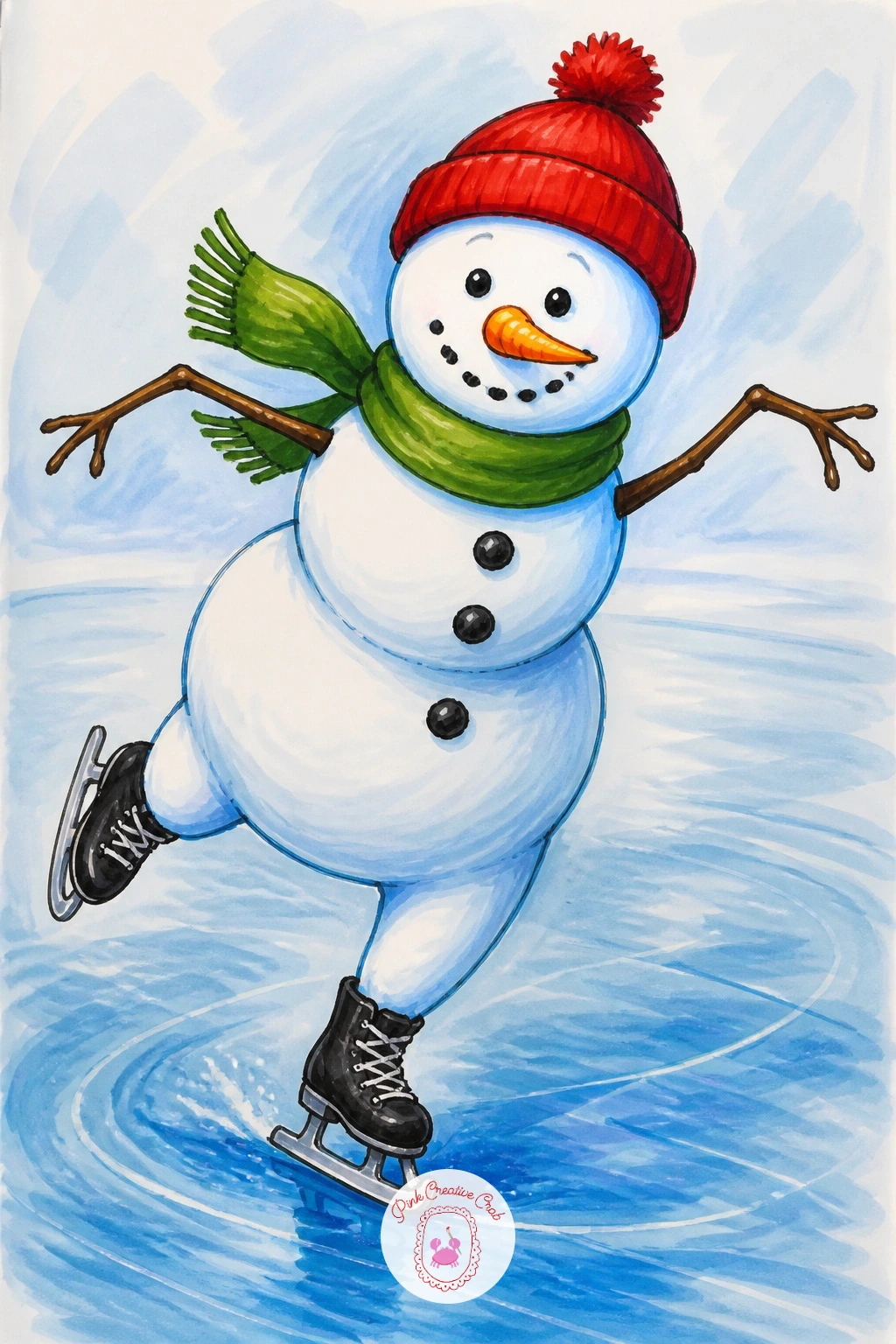
Palette: Snow White,Pond Blue,Icy Blue,Cherry Red
Give the snowman a little patience now: a snowman waiting at a bus stop with a newspaper under his arm. Draw a simple bus stop sign first, a thin pole with a rectangle sign on top, then build the snowman standing beside it so the pole gives you a fixed height to measure against.
Make the snowman roughly as tall as the sign post, that single height comparison keeps him from accidentally towering over the whole scene or shrinking too small beside it. His newspaper is just a folded rectangle tucked under one stick arm, no need to draw any text on it.
Keep his expression patient rather than grumpy, a flat closed-mouth line works better than a frown for a character this cheerful. Color the sign post grey and let the snowman stay the brightest white shape on the page so your eye lands on him first.
Swap the newspaper for a simple shopping bag if drawing a folded rectangle feels fiddly.
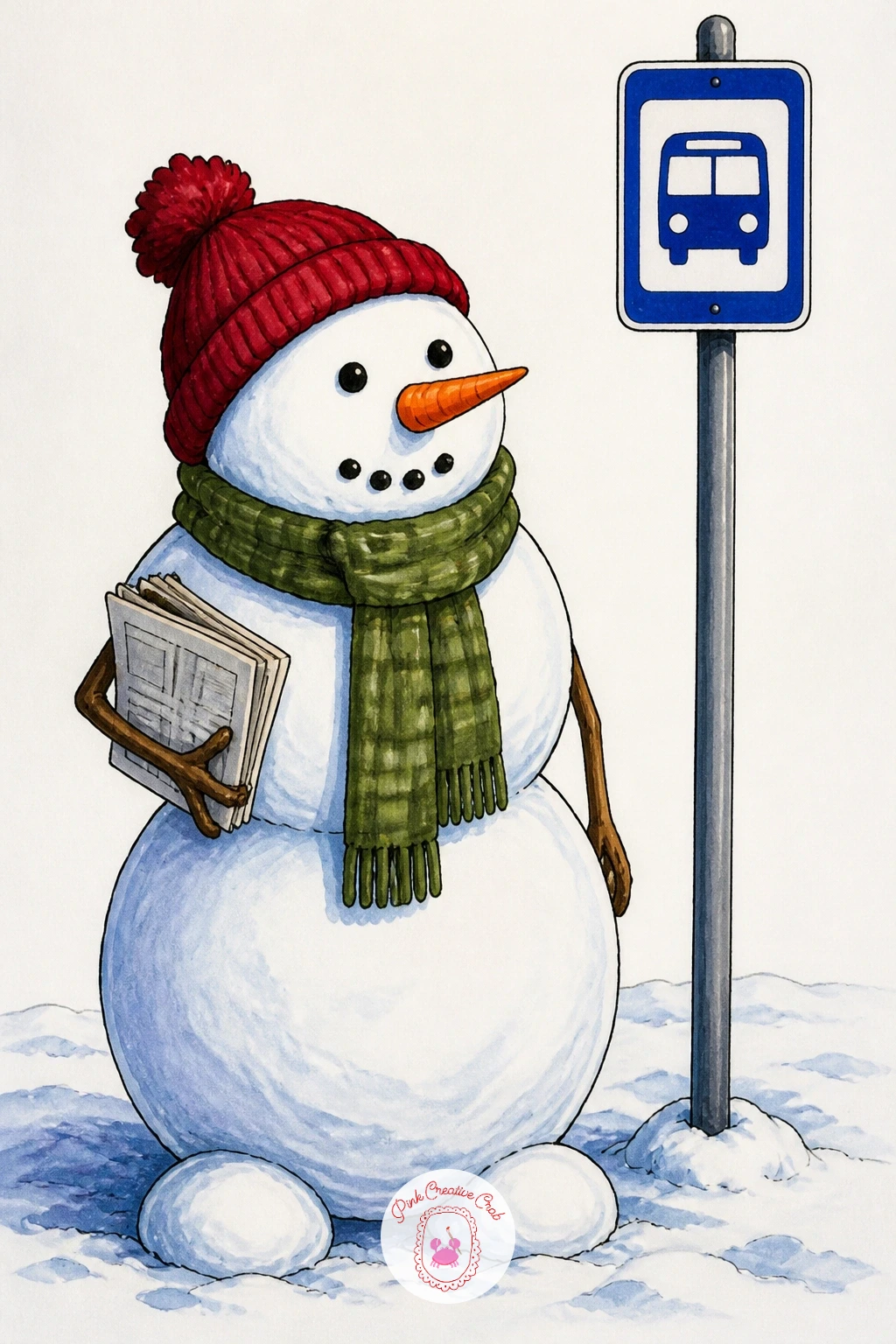
Palette: Snow White,Icy Blue,Slate Grey,Carrot Orange
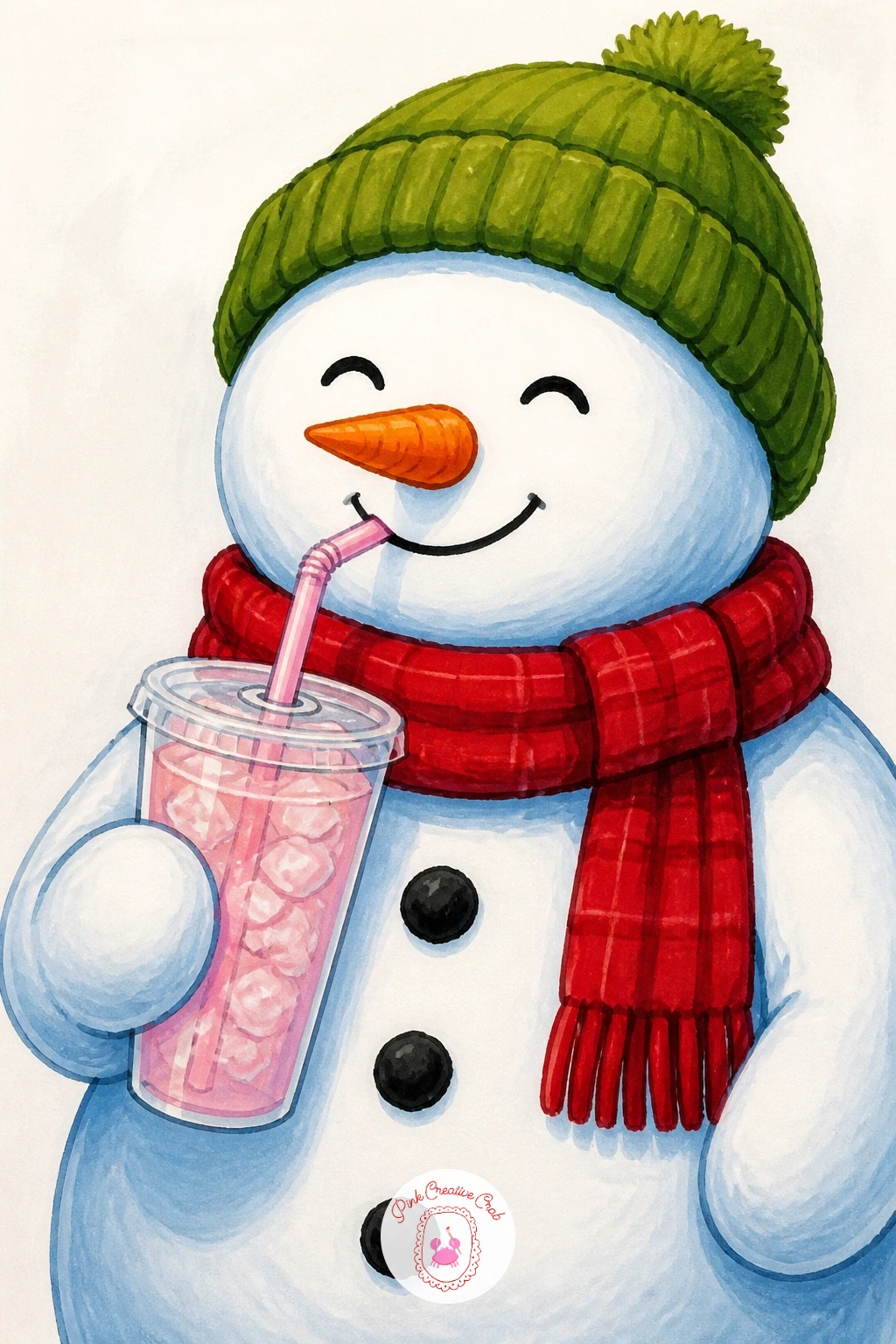
Here is a joke that draws itself: a snowman sipping an iced drink through a straw, which only works because he is made of the exact thing filling the cup. Draw a tall clear cup shape first with a few short horizontal lines inside for ice cubes, then place the snowman next to it holding the cup in one stick arm.
Where this goes wrong is in the straw, it needs to actually reach his mouth, so draw his head and mouth position before you commit to the straw’s angle. A bendy straw with one visible kink reads clearer than a perfectly straight line.
Shade the drink itself in a pale icy blue or soft pink so it reads as a cold drink rather than plain water, and leave the ice cube lines white against it. A beginner can leave the cup plain; an adult can add condensation drips running down its side with a few short curved white gel pen marks.
Keep his sunglasses off for this one so his happy eyes read clearly over the straw.
You Will Need
- white gel pen for condensation drips (optional)
Palette: Snow White,Icy Blue,Soft Pink,Cherry Red
Try a tall striped straw instead of a plain one, it adds a cheerful pattern without adding any extra drawing difficulty.
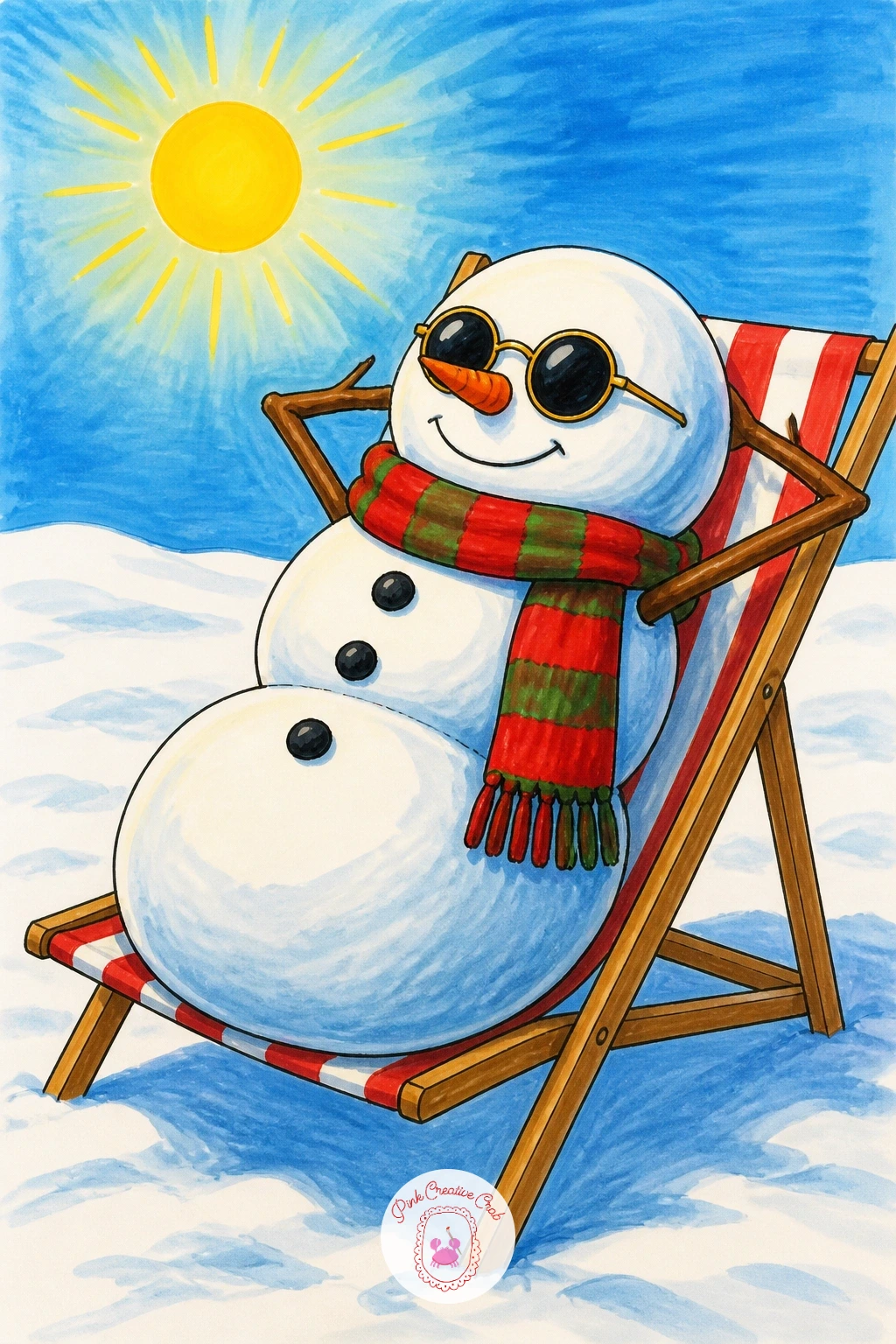
Flip the whole mood with this one: a snowman sunbathing in a deck chair with sunglasses, completely unbothered by the sun that should be melting him. Draw the deck chair first as a simple folding frame with a few horizontal strap lines across it, then lay the snowman’s three snowballs along its angle rather than stacking them straight up.
That reclining angle is the trick worth practicing here, tilt each snowball segment slightly so the whole body reads as lying back rather than standing sideways. Round sunglasses drawn as two connected circles instantly read as relaxed rather than grumpy.
Color a warm yellow sun in one corner with a few short ray lines, then keep the snowman himself crisp white so the contrast between him and the summery light becomes the joke. If a deck chair feels fiddly to draw, a plain striped towel on the ground works just as well under him.
Finish with one small puddle shape under the chair if you want to hint that he is very slowly losing the argument with the sun.
Palette: Snow White,Sunny Yellow,Icy Blue,Cherry Red
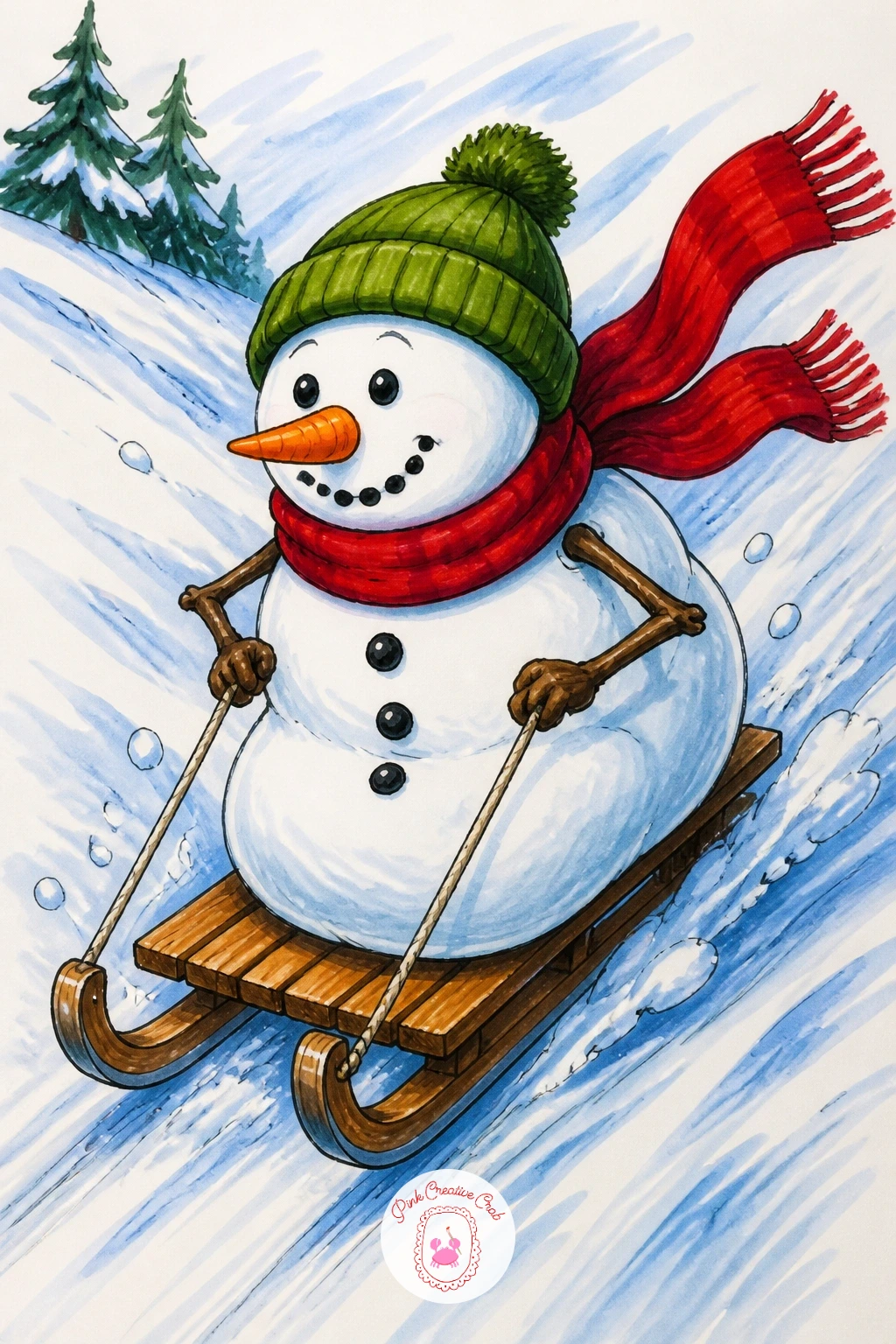
Time for real speed: a snowman sledding downhill with his scarf flying straight out behind him. Draw a simple curved hill line across the lower page first, then place a basic sled shape pointing down the slope before you add the snowman riding on top of it.
The scarf is what makes this picture move, so draw it as a long wavy ribbon trailing up and back from his neck rather than hanging down the way it would if he were standing still. Stretch his stick arms forward too, gripping the sled’s front edge.
Lean the whole stack of snowballs forward along the hill’s angle the same way you tilted the deck chair snowman, it is the same trick in a faster direction. Add a few short motion lines behind the sled if the speed still is not reading.
If sledges are tricky to draw in perspective, a simple flat board under him reads just as well and is much easier to get right.
Palette: Snow White,Icy Blue,Moss Green,Cherry Red
This one plays with scale on purpose: a snowman building a tiny snowman of his own, crouched down and patting a much smaller version into shape. Draw the big snowman first at full size, bent forward at the middle with both stick arms reaching down, then build the tiny snowman at roughly a third of his height right in front of his hands.
Keep that size ratio deliberate, measure the big snowman’s head against the little one’s whole body so the difference reads clearly rather than looking like a drawing mistake. The small snowman only needs two snowballs instead of three to read as a simplified version.
Give the big snowman a focused expression, eyebrows drawn as two short angled lines above his dot eyes work well for concentration. Color both snowmen the same white so the family resemblance is obvious, saving the color contrast for a scarf on one and not the other.
If drawing two snowmen at once feels like a lot, sketch the tiny one first since it is the simpler shape and easier to fix if it goes wrong.
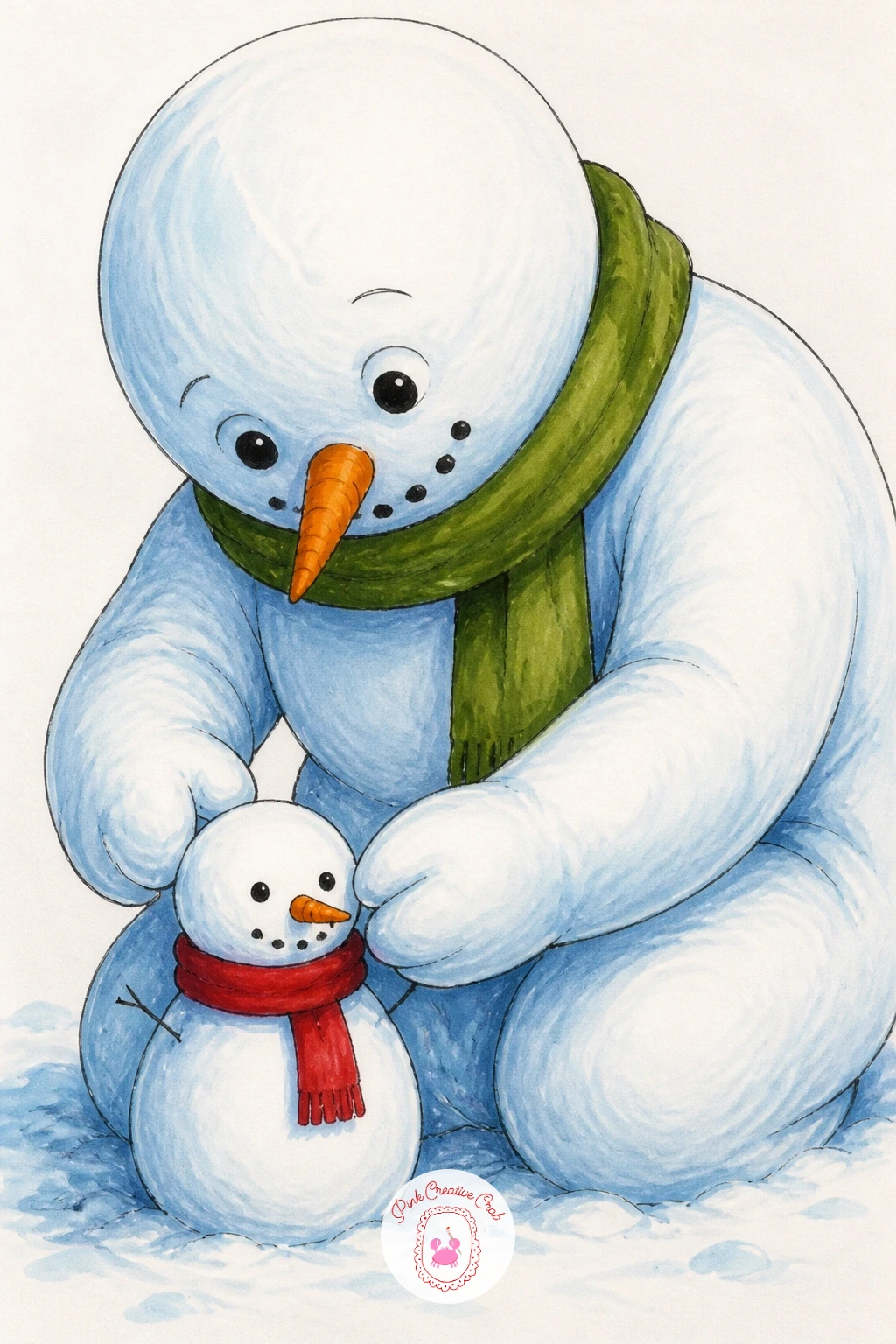
Palette: Snow White,Icy Blue,Carrot Orange,Moss Green
Slow the pace down with a snowman reading a book on a park bench, sitting quietly with an open book balanced on his lap. Draw the bench first as two simple horizontal planks on short legs, sized to fit the snowman’s seated height, then draw him sitting with his bottom snowball resting flat on the seat rather than stacked the usual standing way.
Sitting changes the whole proportion of a snowman, so flatten his lowest snowball slightly where it meets the bench rather than keeping it perfectly round. The open book is just two trapezoid pages meeting in the middle, held up by both stick arms.
Where beginners struggle is the eye line, draw his dot eyes looking down toward the book rather than straight ahead so he genuinely looks like he is reading it. Color the bench a warm wood brown to separate it from the white snowman and pale blue snow around it.
No bench handy to reference? A simple tree stump works as a seat and needs only one curved shape to draw.
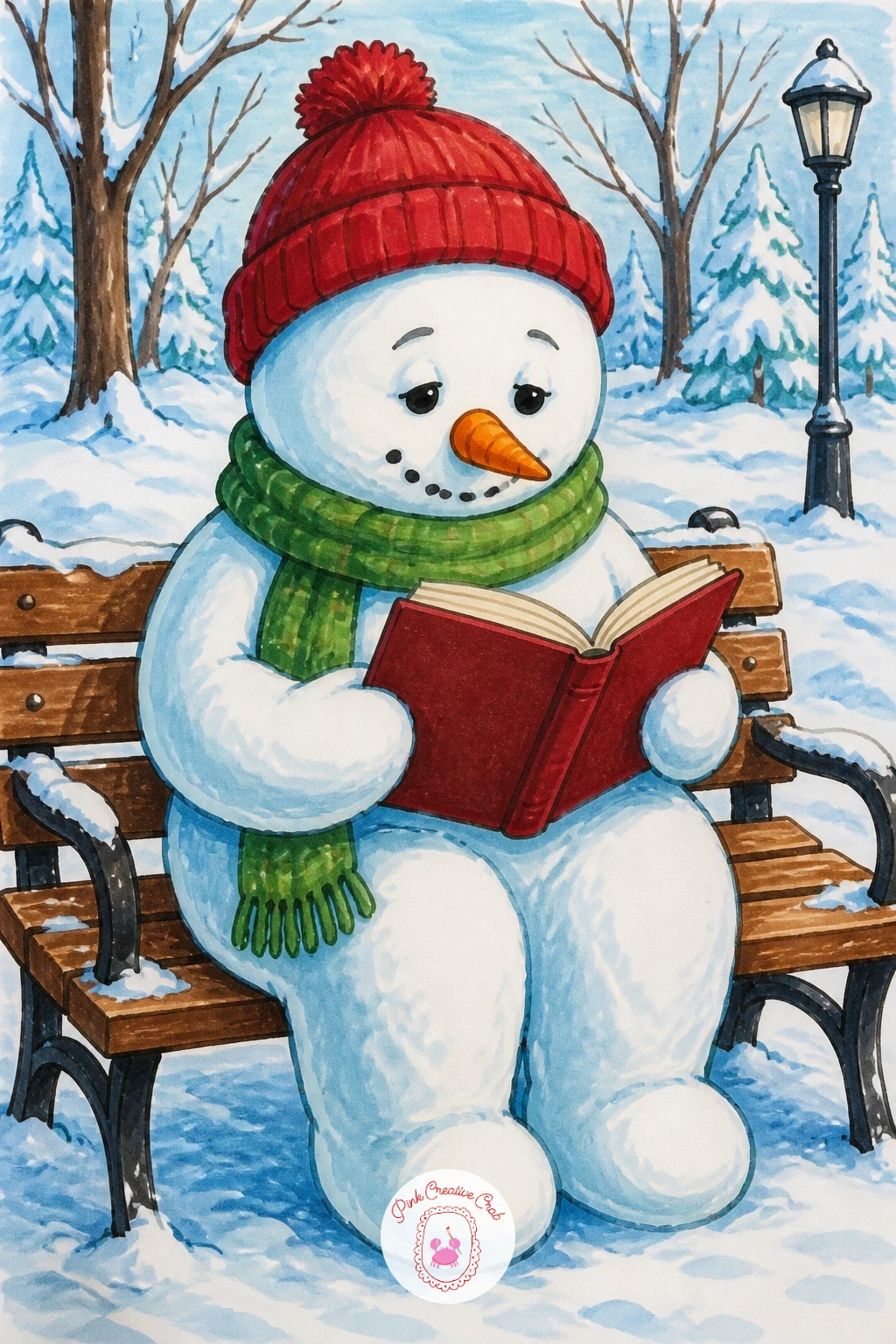
Palette: Snow White,Icy Blue,Wood Brown,Cherry Red
Bring the focus right in close for this one: a snowman pulling mittens onto his stick hands, caught mid-tug with one mitten half on. Draw his body at a slightly smaller scale than usual so there is room to zoom into the hands, or simply draw the stick arms larger in proportion to the body so the mittens become the clear focus.
Draw one arm with the mitten already on, a simple rounded shape at the end of the stick, and the other arm mid-pull with the mitten only halfway up and the stick hand still showing below it. That difference between the two arms is what tells the whole story without any extra props.
Give him a slightly strained expression, eyebrows pulled up and together, to sell the effort of tugging wool over a stick. Color the mittens cherry red or moss green so they pop clearly against the white body.
If two different mitten positions feels confusing to plan, draw the finished mitten first since it is the simpler shape, then work backward to the half-on one.
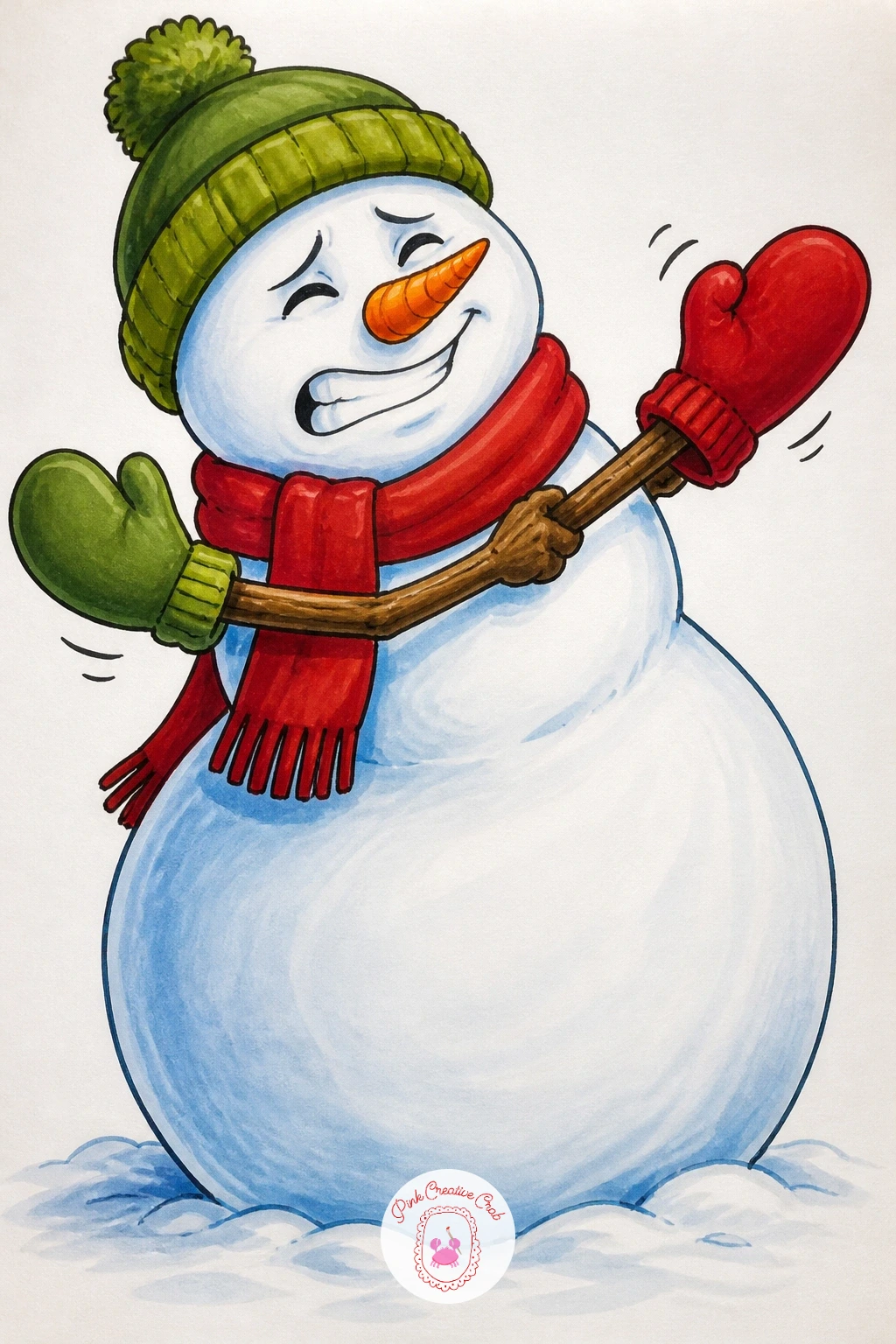
Palette: Snow White,Icy Blue,Cherry Red,Moss Green
Try a quieter winter activity now: a snowman fishing through a hole in the ice, sitting patiently with a line dropped into a dark circle cut in the frozen pond. Draw the ice surface as a pale blue rectangle first, then cut a simple dark oval hole into it before placing the snowman seated at its edge.
The eye line matters here: since you are looking down slightly at the ice hole from the snowman’s seated height, draw the oval hole a touch flattened rather than a perfect circle, which is what a circle actually looks like from above at this angle. A simple fishing rod is just one curved line with a straight line dropping down into the dark hole.
Keep his expression calm and patient, a small closed smile rather than an open grin suits the stillness of fishing. Shade the ice hole a deep navy so it reads as water rather than another patch of snow.
If a fishing rod feels tricky, a simple string tied to his mitten works just as well and skips the rod entirely.
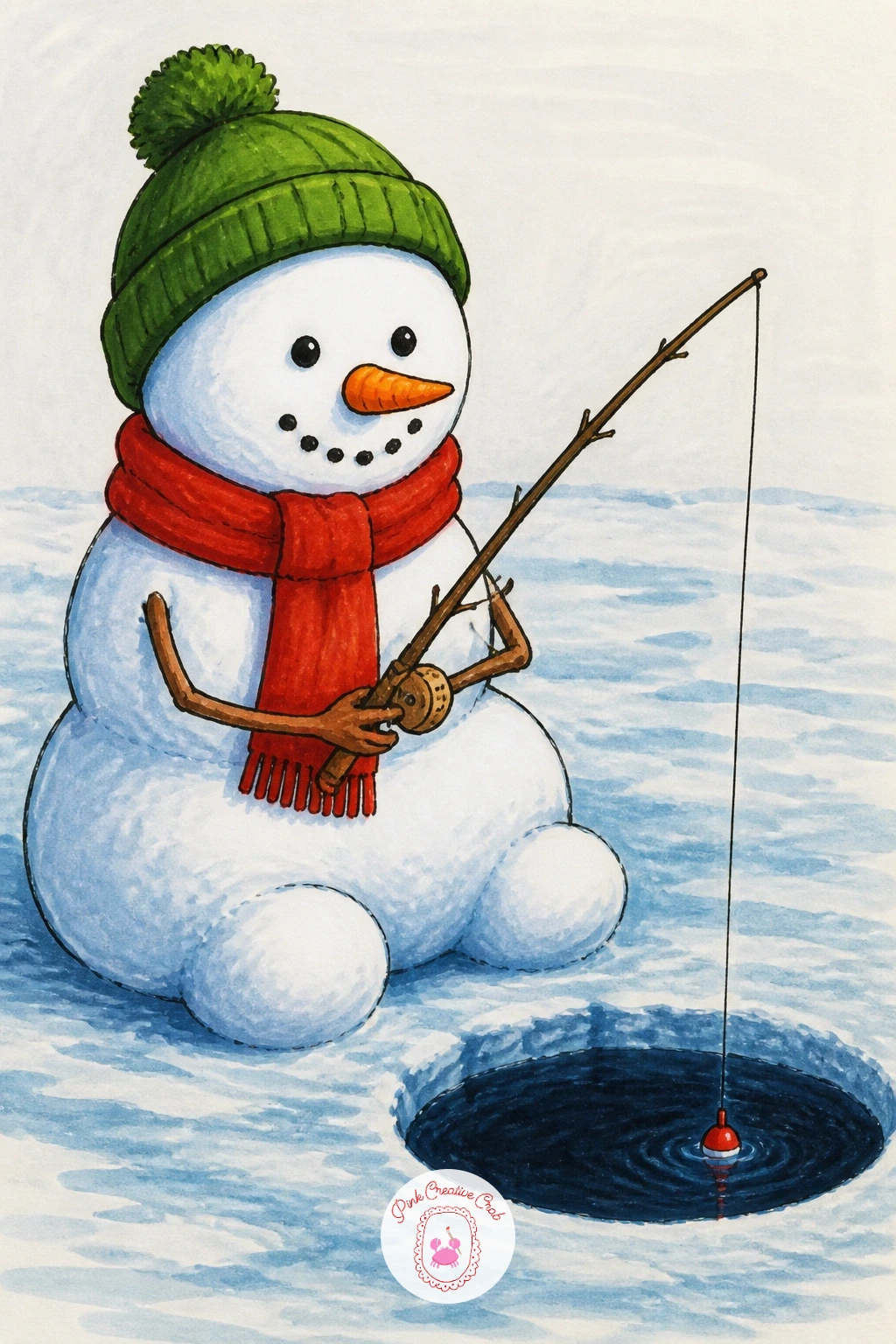
Palette: Snow White,Icy Blue,Navy Water,Carrot Orange
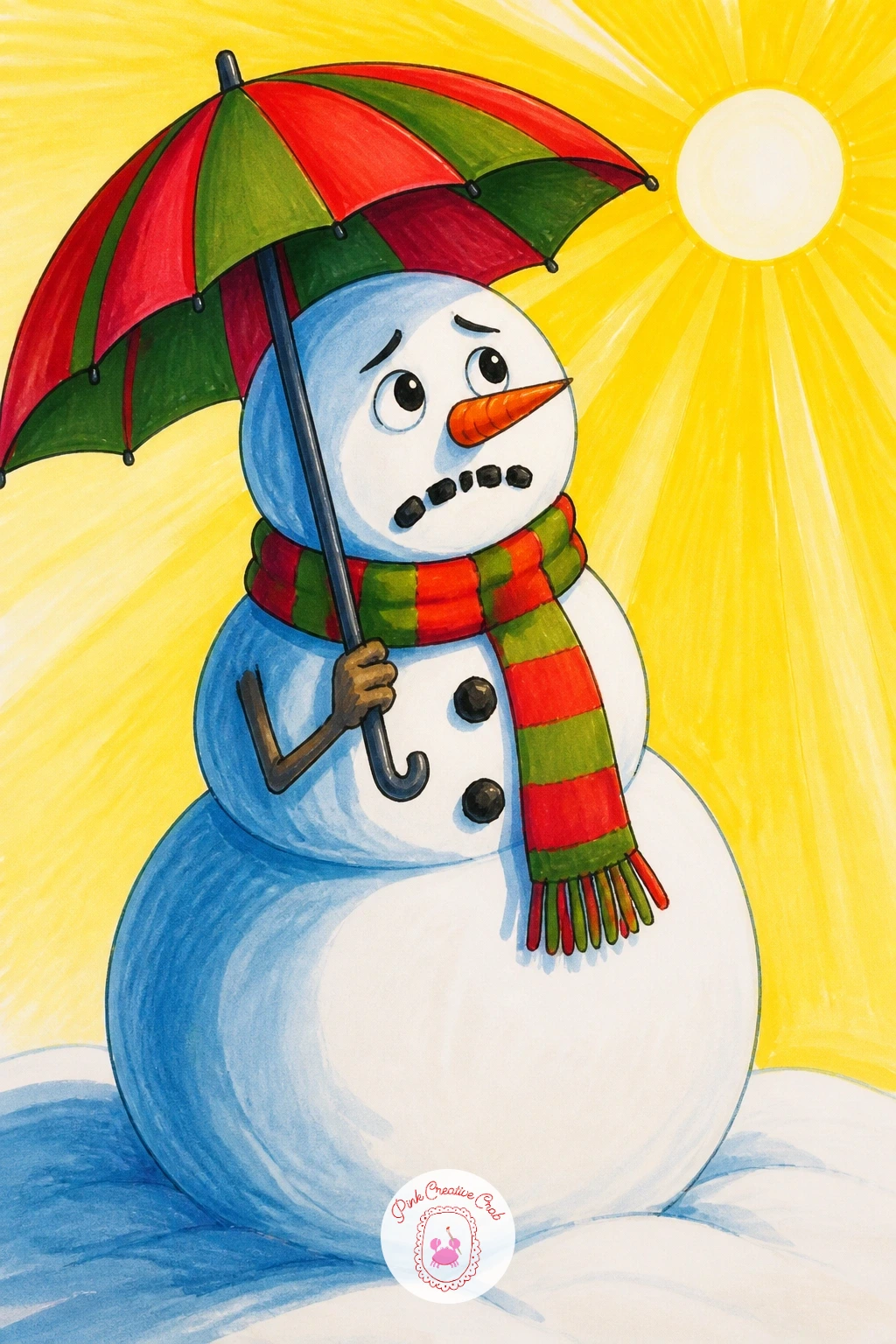
Keep the sun-versus-snowman joke going with a snowman holding an umbrella against the sunshine, shielding himself from the very thing that threatens him most. Draw the umbrella first as a simple curved dome with a straight handle, held up and angled toward the sun rather than straight overhead, since he needs to block a specific direction of light.
That angled hold is the whole point here: think about where the sun sits in the corner of your page, then tilt the umbrella handle so its dome sits directly between the sun and his face. A light source from one side means one side of his body gets a soft blue shadow stripe and the other stays bright white.
Give the umbrella alternating stripes in two colors, cherry red and moss green work well against the white snowman. Keep his expression a little nervous, raised eyebrows, rather than his usual relaxed smile.
If stripes feel fussy, a single solid color umbrella reads just as clearly and is much faster to color in.
Palette: Snow White,Icy Blue,Cherry Red,Sunny Yellow
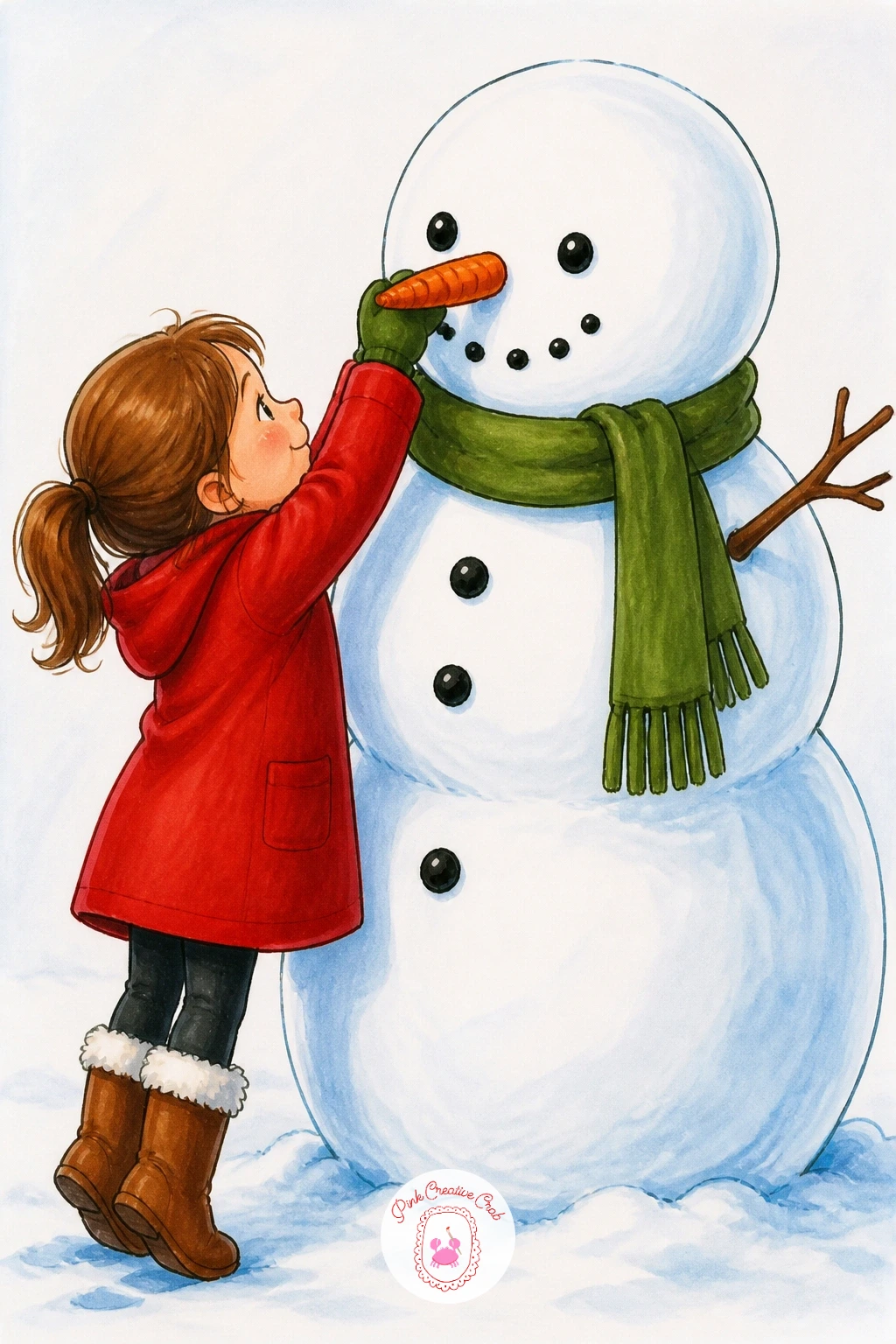
Bring in a second character for this one: a little girl giving a snowman his carrot nose, caught at the exact moment of finishing him. Draw the snowman’s body complete first, two eyes and a mouth already in place but with a blank space in the middle of his face, then draw the girl standing on tiptoe beside him reaching up with the carrot.
Height is everything in this scene, so draw her roughly level with his middle snowball, tall enough to reach his face on tiptoe but clearly still a child beside an adult-sized snowman. Give her simple rounded mittens and a bobble hat rather than detailed clothing, this keeps her quick to draw and matched to his simplicity.
Leave a small gap between the carrot tip and his face, almost touching but not quite, which captures the moment better than carrot already in place. Color her coat a bright contrasting color, cherry red works well, so she reads clearly against the white snowman.
If a reaching pose feels hard to draw, have her standing flat-footed holding the carrot out at chest height instead.
Palette: Snow White,Icy Blue,Carrot Orange,Cherry Red
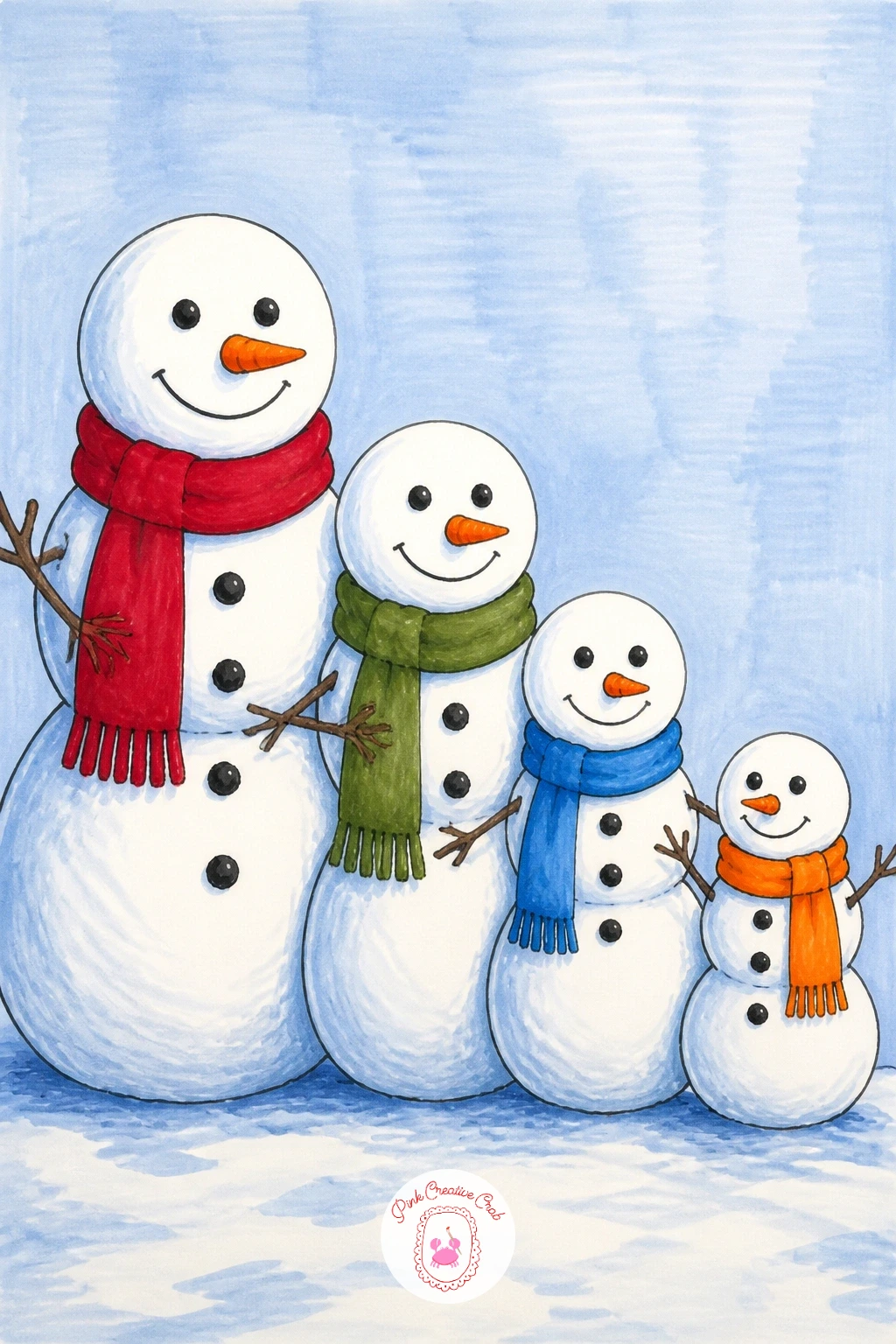
Scale the idea up into a group now: a snowman family posing for a photo in the yard, three or four snowmen of different sizes lined up together. Draw the tallest snowman first on one side, then work down in height across the row, the shortest one small enough to be clearly a child snowman.
Spacing them evenly matters more than usual here, leave roughly the same gap between each snowman so the row reads as a tidy family lineup rather than a scattered crowd. Vary each one’s scarf color so they read as individuals within the same pose, all facing forward with simple smiling faces.
Keep every pose nearly identical, stick arms down or slightly out, which is exactly what makes it read as a posed family photo rather than a candid scene. A beginner can stop at three snowmen in a row; an adult can add a small dog snowman at the end to round out the family.
If drawing several snowmen at once feels like too much, start with just two and add more once those feel balanced.
Palette: Snow White,Icy Blue,Cherry Red,Moss Green
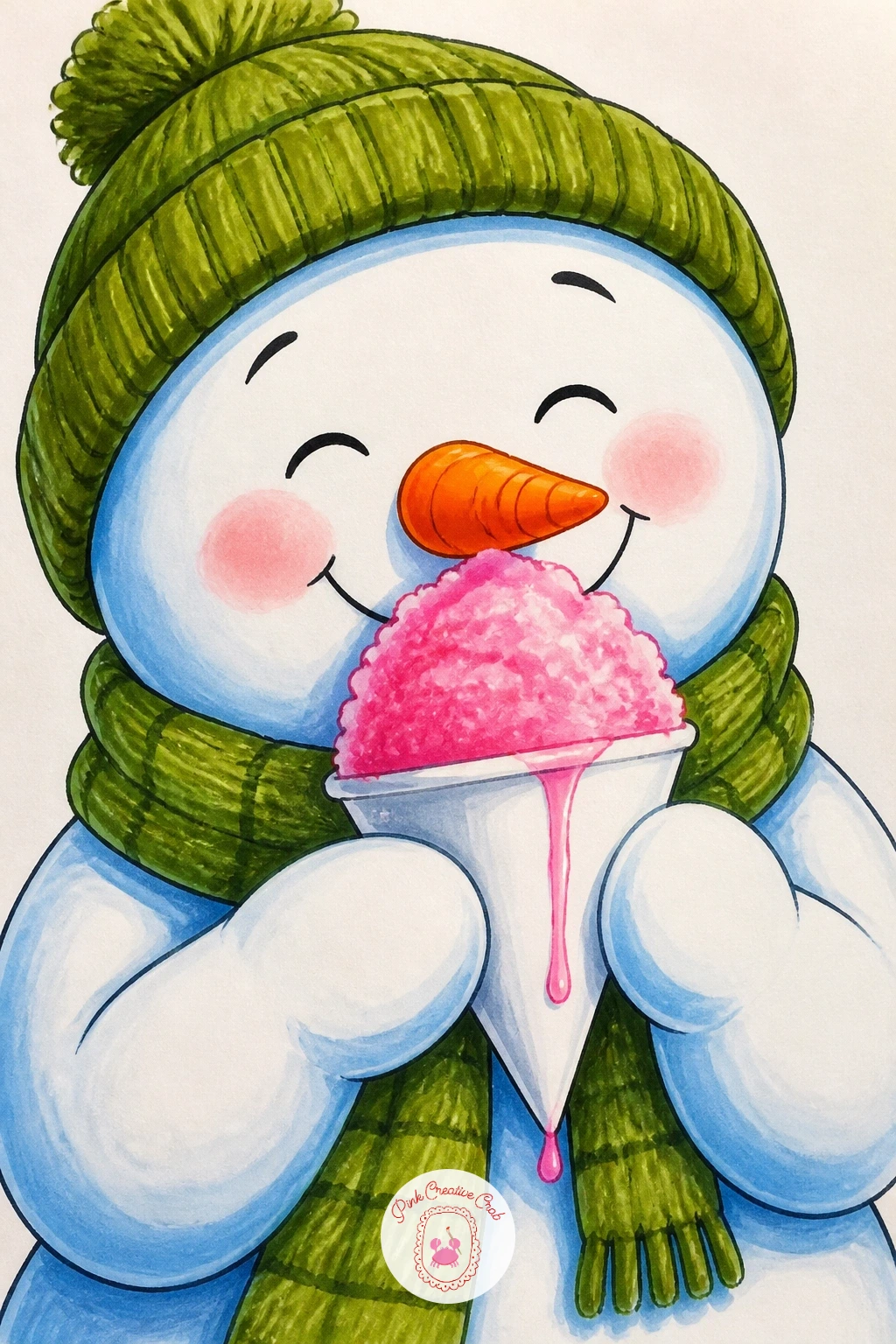
Here is another joke built on irony: a snowman happily eating a snow cone, holding a paper cone of shaved ice up to his mouth without a hint of concern. Draw the cone first as a simple triangle with a rounded scoop of ice on top, then place it directly at his mouth level in one stick hand.
Drip a little color down from the scoop onto the paper cone, a thin streak of pink or orange, which instantly reads as a melting treat rather than a plain white lump. His free arm can rest on his hip or hang simply at his side, no need to overcomplicate the pose.
Give him an exaggerated happy expression, eyes closed in delight works nicely for a character enjoying a treat. Color the ice scoop a bright flavor color so it stands apart from his white body, cherry red or a soft purple both work well.
If a paper cone feels fiddly, a simple round bowl shape under the ice scoop is just as easy to color and reads just as clearly.
Palette: Snow White,Icy Blue,Cherry Red,Soft Pink
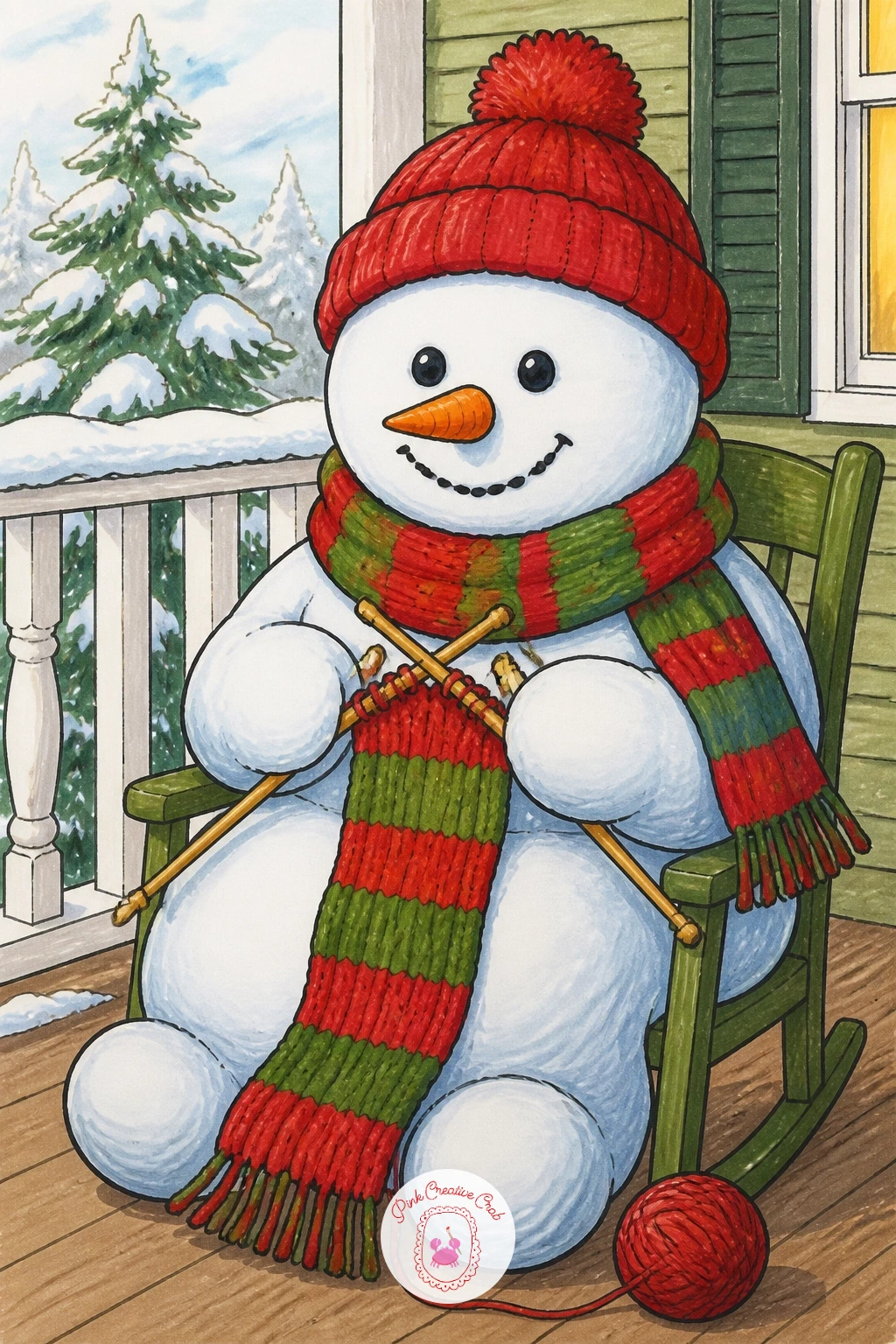
Settle him into a cozy pose next: a snowman knitting a new scarf on the porch, two needles crossed in his stick hands with a strip of fabric growing between them. Draw the porch first as a simple railing and a couple of floor planks behind him, then seat the snowman against it with his stick arms brought close together in front of his chest.
Knitting needles are just two thin straight lines crossing at an angle, with the half-finished scarf drawn as a short striped rectangle hanging between them. Keep that strip short, it only needs to suggest a scarf in progress, not a finished one.
Where this goes wrong is the hand position, bring both stick arms in close to the body rather than spread wide, since knitting is a small close gesture, not a big one. Color the in-progress scarf in stripes using two colors so it reads clearly as yarn work.
No porch railing handy? A simple rocking chair outline works just as well as a cozy setting.
Palette: Snow White,Icy Blue,Moss Green,Cherry Red
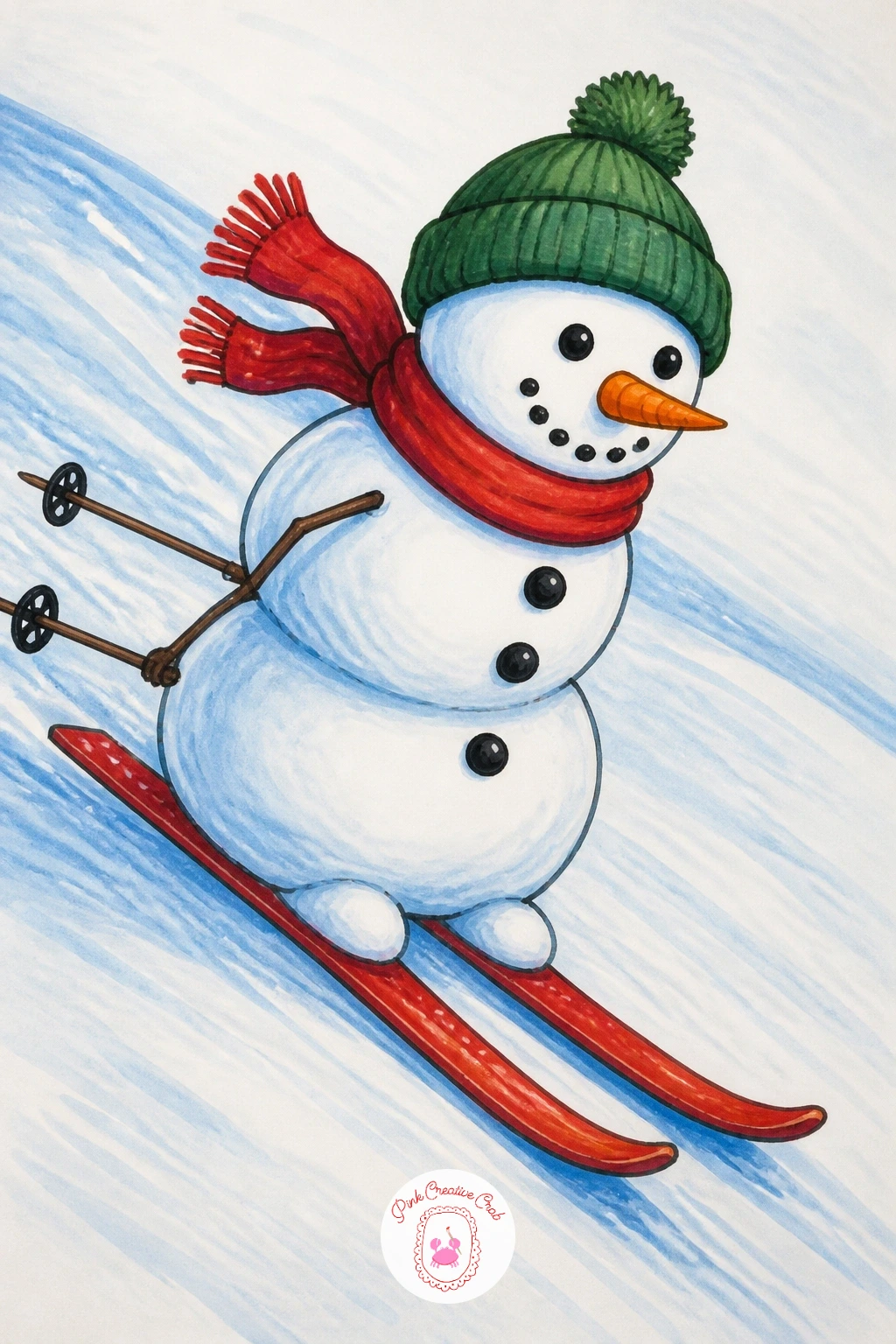
Add real downhill speed again with a snowman in a beanie skiing down a gentle slope, leaning forward with two thin skis under his base. Draw the slope as a single diagonal line across the page first, then place the snowman on it leaning in the direction of travel rather than standing straight up.
From this low eye level looking up the slope, the skis closest to the viewer should sit slightly lower and larger than the far one, that small difference in size is what makes the ground feel like it is sloping away rather than flat. Draw simple ski poles as two thin diagonal lines trailing behind his stick arms.
Keep the beanie a single rounded shape with one short pom line on top, easy to draw quickly and instantly readable as winter sports gear. Color the skis a bright contrasting color against the white snow so the speed reads clearly.
If skis feel tricky at an angle, draw them nearly flat and let the slope line behind him do the work of suggesting the hill.
Palette: Snow White,Icy Blue,Cherry Red,Moss Green
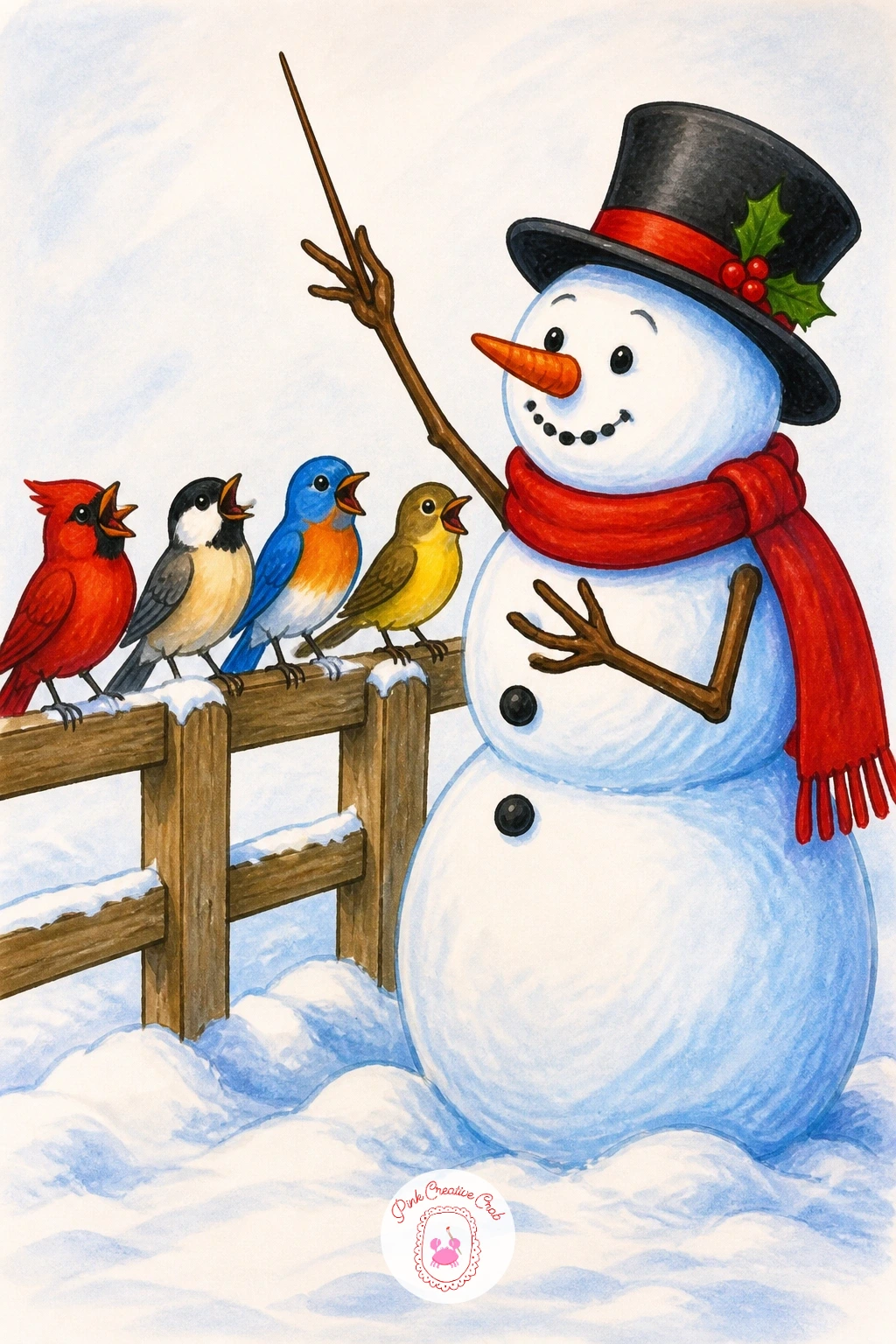
Give the snowman a tiny audience of his own: a snowman conducting a choir of birds on a fence, one stick arm raised as a conductor’s baton in front of a row of small round birds. Draw the fence first as a simple horizontal line with a few vertical posts, then perch three or four small birds along its top before placing the snowman facing them.
Keep the birds small and simple, round bodies with a tiny triangle beak and two short wing lines each, spaced evenly along the fence the same way you spaced the snowman family earlier. His raised stick arm should point slightly upward, as if mid-gesture rather than resting.
Open mouths on a couple of the birds, just a small oval shape, suggest they are mid-song without needing any musical notes drawn at all. Color the birds in warm browns and reds so they read as a cheerful little flock against the white snowman.
If a full fence feels like too much, three birds on a single branch works just as well as a stage.
Palette: Snow White,Icy Blue,Chestnut Brown,Cherry Red
Look at real garden birds like sparrows or robins for the simple round body and short tail shape, they translate easily into a quick marker drawing.
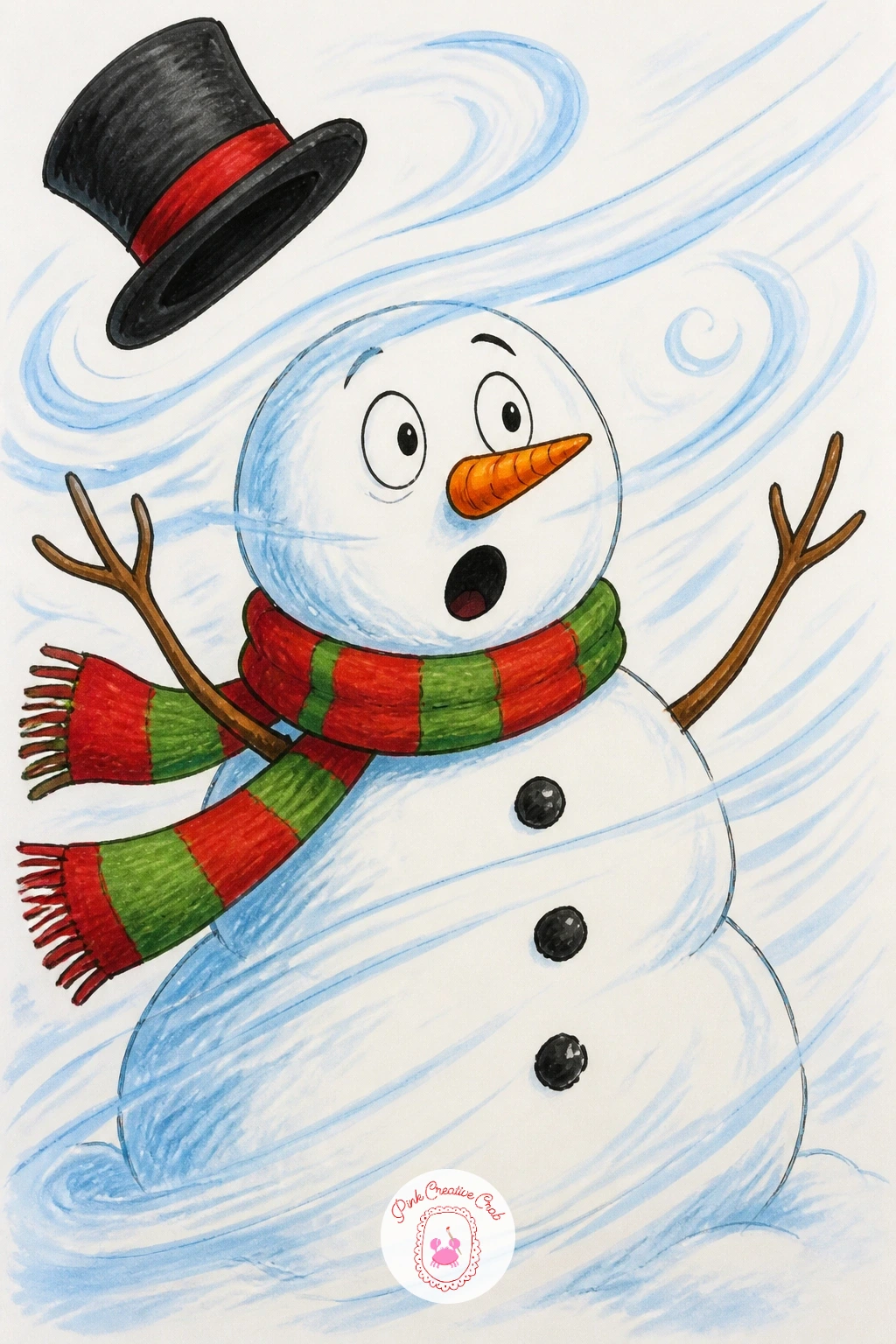
Capture a sudden gust with this one: a snowman losing his hat to a gust of wind, caught mid-surprise as it lifts off his head. Draw the snowman’s head first without the hat in place, then draw the hat a short distance above and to one side of his head, tilted at an angle rather than sitting flat.
A few curved wind lines streaming past the hat and trailing off the page edge sell the gust far more than the hat alone ever could, keep those lines light and sparse rather than filling the whole background. His expression needs wide surprised eyes and an open mouth, a clear change from his usual calm smile.
Where beginners lose the effect is drawing the hat too close to the head, leave real visible space between them so it genuinely reads as airborne rather than just floating slightly askew. Color the wind lines a very pale blue so they stay subtle rather than competing with the snowman.
If drawing wind lines feels tricky, a few of his scarf tassels flying sideways tells the same story with less to draw.
Palette: Snow White,Icy Blue,Carrot Orange,Slate Grey
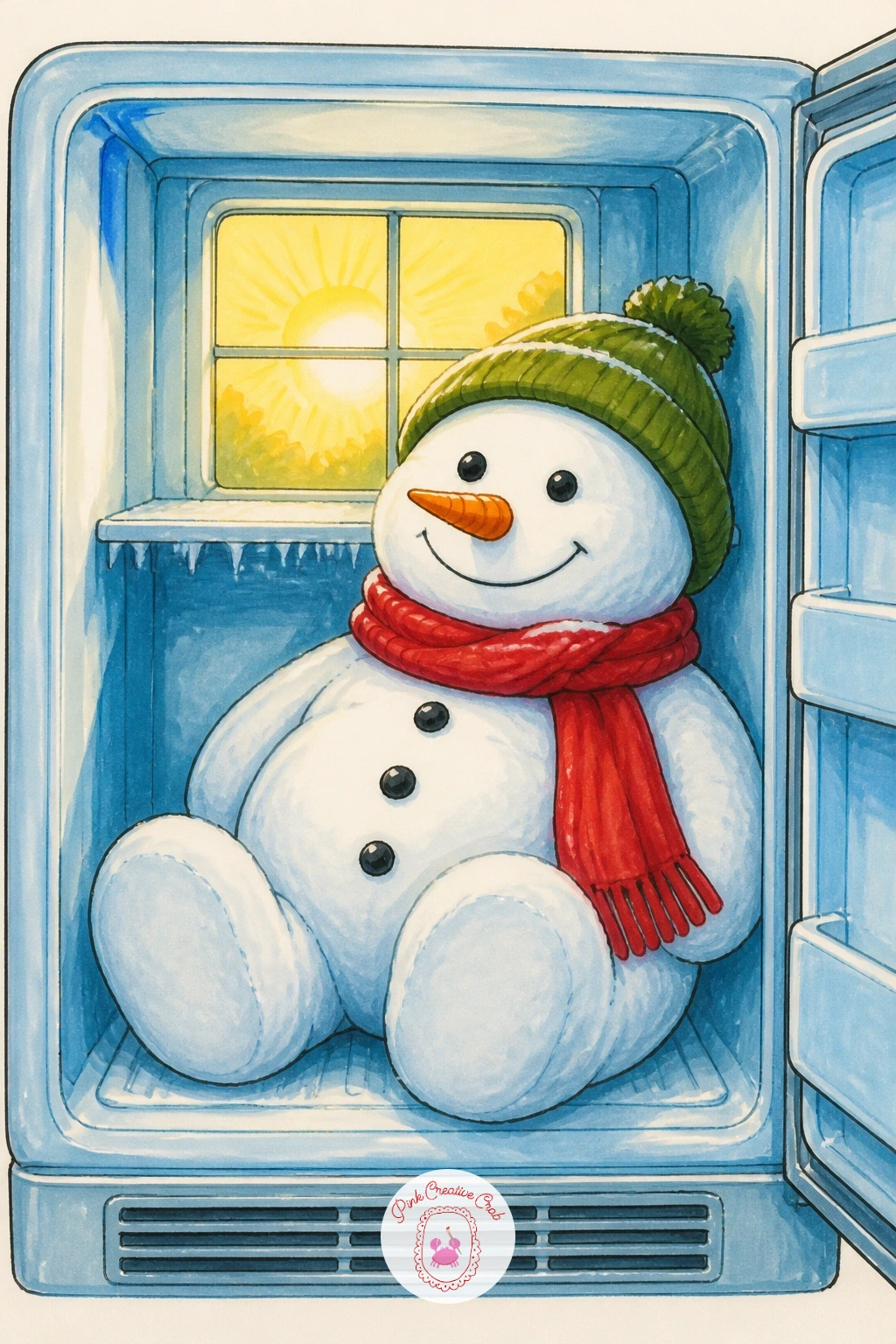
Here is the strangest joke on the list and one of the most fun to draw: a snowman sitting in an open freezer on a sunny day, perfectly content inside the appliance while sunshine pours in from a window behind it. Draw the freezer first as a simple open box shape with a hinged lid tilted back, then seat the snowman inside it with his knees or lower snowball tucked to fit the box.
Since the freezer is an actual object with straight edges, keep its lines ruler-straight rather than the wobbly organic lines you use for the snowman himself, that contrast between rigid box and round snowman is part of the joke. A simple window shape in the background with a yellow sun outside completes the gag without needing any extra props.
Give him a relaxed, satisfied expression, like someone in a nice cool bath, rather than looking cold or uncomfortable. Color the inside of the freezer a pale icy blue so it reads clearly as a chilled space against the warm yellow sunlight outside.
If a full freezer feels complex, a simple cooler box with the lid open works as an easier stand-in.
Palette: Snow White,Icy Blue,Sunny Yellow,Slate Grey
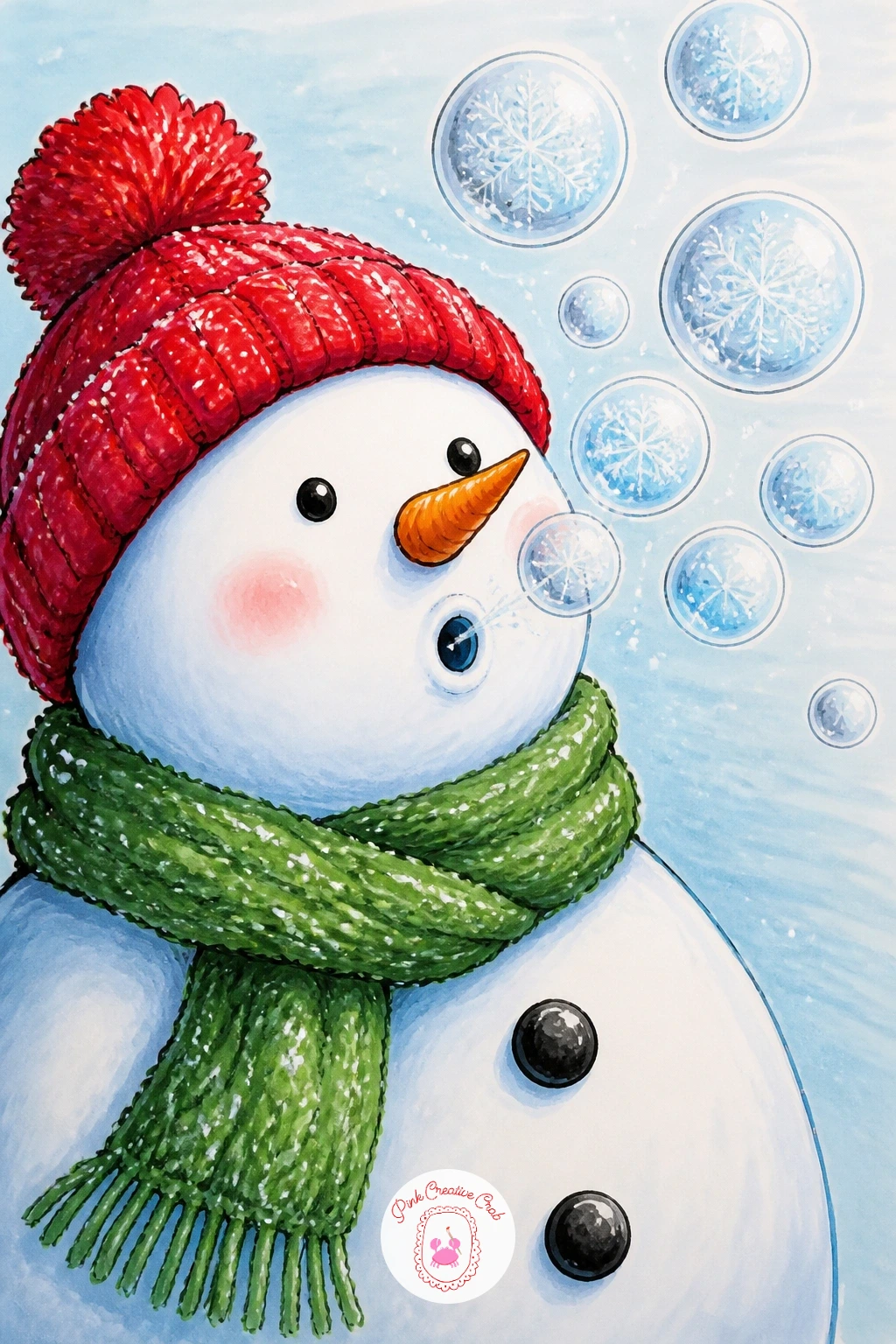
Try a delicate little trick next: a snowman blowing bubbles that freeze in the air, each one hanging frozen rather than floating or popping. Draw the snowman first with a small round bubble wand held in one stick hand near his mouth, then scatter several bubble circles of different sizes trailing up and away from the wand.
Keep the bubbles as simple clean circles rather than adding too much detail inside them, a thin crescent highlight in white or pale blue on each one is enough to suggest they are frosted rather than ordinary soap bubbles. Vary their sizes noticeably, a couple large and several small, so the group reads as scattered rather than a stiff row.
His mouth should be a small round “o” shape rather than his usual smile, since blowing requires a different mouth shape entirely. Color the bubbles very pale blue with a thin white outline so they read as icy rather than plain glass.
If drawing several bubbles feels repetitive, three larger ones read just as clearly as a dozen tiny ones and finish much faster.
Palette: Snow White,Icy Blue,Pale Frost,Carrot Orange
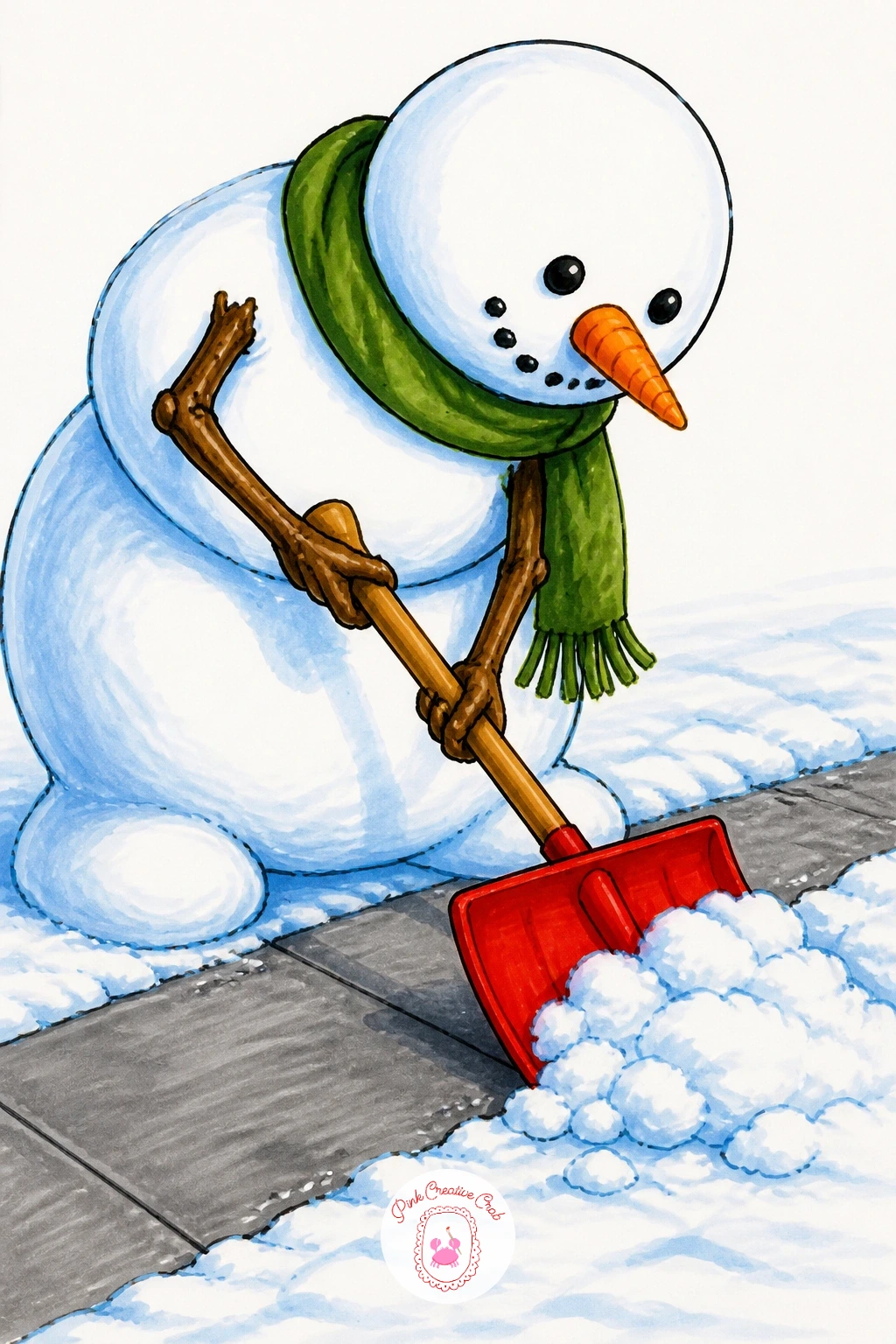
Give him an actual chore for this one: a snowman shoveling snow off the sidewalk, caught mid-scoop with a small pile already cleared beside him. Draw a simple straight sidewalk edge first, then place the snowman standing over it with both stick arms gripping a shovel handle angled down into the snow.
The shovel blade should sit low near the ground with a small scooped pile of snow drawn just beside it, that pile is what makes the action readable rather than just a snowman holding a random tool. Bend his upper body slightly forward over the shovel to suggest effort rather than standing perfectly upright.
Where this scene can look static is the snow itself, draw the cleared section of sidewalk as a flat grey or brown strip next to the still-white uncleared section so the before-and-after reads instantly. Color the shovel blade a bright color like cherry red so it stands out clearly against all the white.
If a full shovel feels like a lot to draw, a simple broom works as an easier substitute and tells nearly the same story.
Palette: Snow White,Icy Blue,Cherry Red,Slate Grey
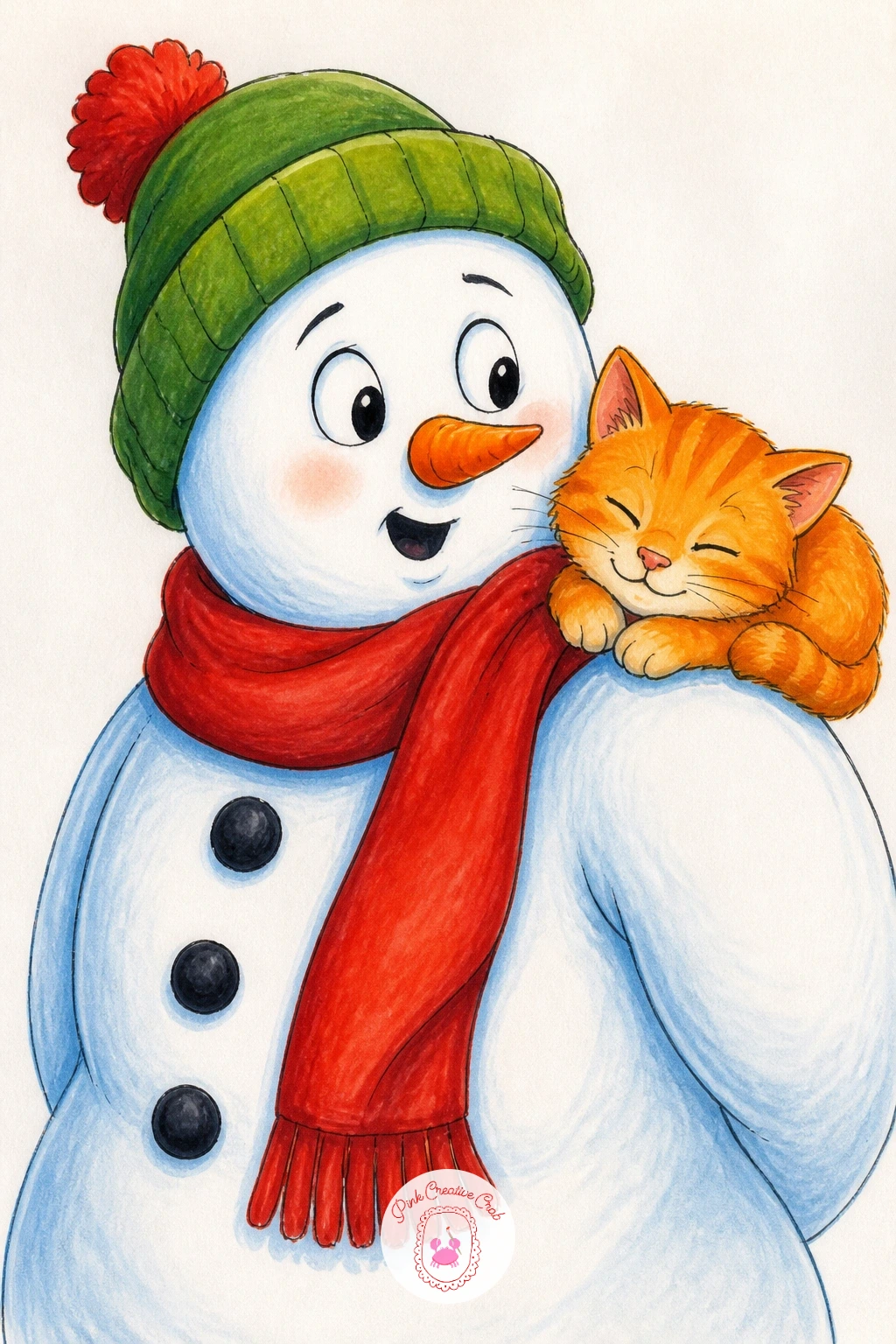
Add a quiet companion here: a snowman with a cat sitting on his shoulder, perched there as if it is the most natural seat in the yard. Draw the snowman’s upper body and head first, then place a simple rounded cat shape right at the join between his head and shoulder, two triangle ears and a curled tail draped down his side.
Keep the cat noticeably smaller than the snowman’s head so the scale stays believable, measure its body against his head circle the same way you compared dog to snowman earlier in this list. A simple closed-eye expression on the cat suggests it is comfortable and relaxed up there.
His own expression should look slightly surprised or pleased rather than neutral, since a cat choosing him as a perch is worth a small reaction. Color the cat in warm grey or orange tones so it contrasts clearly against his white shoulder.
If balancing a cat on a shoulder feels tricky to place, try it sitting on top of his head instead, which needs the same small rounded shape in an easier spot.
Palette: Snow White,Icy Blue,Carrot Orange,Slate Grey
Keep the small-creature theme going with a snowman with a bird nest on his top hat, a cozy little home balanced right on the brim. Draw the top hat first as a simple cylinder shape, then nestle a round woven nest shape directly on top of it before adding one or two small birds poking out.
Keep the nest small relative to the hat, roughly a third of the hat’s width, so it reads as a nest sitting on the brim rather than swallowing the hat entirely. A few short scribbled lines inside the nest circle suggest woven twigs without needing to draw each one individually.
Give the snowman a pleased, patient expression, since he is clearly letting this happen rather than being bothered by it. Color the nest a warm brown against the black hat so the two shapes separate clearly even at a glance.
If a top hat feels fiddly, a simple round winter hat with the nest balanced on its pom works just as well.
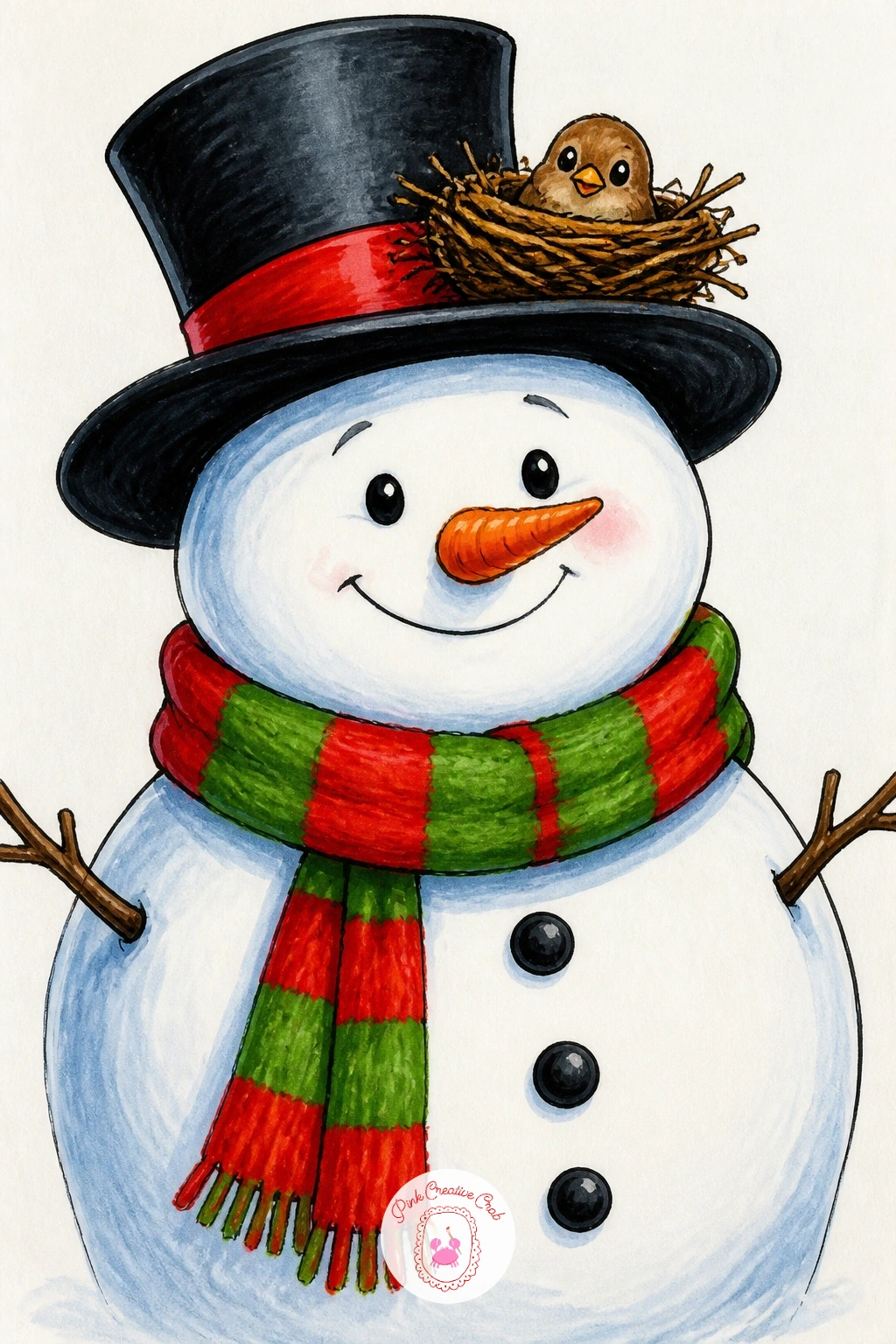
Palette: Snow White,Icy Blue,Chestnut Brown,Cherry Red
Pick the pace up again with a snowman jogging in a headband on a snowy path, mid-stride with both stick arms bent and pumping. Draw his legs, if you give him simple stick legs for this one, in a clear running stance, one forward and one trailing back, rather than the usual straight stance most snowmen stand in.
A simple headband is just a thin curved band across his head with a small knot or bow on one side, easy to add in seconds but instantly readable as athletic gear. Bend both stick arms at the elbow and bring them up near his chest the way a real jogger’s arms move.
Where beginners lose the sense of motion is the feet, lift one foot slightly off the ground line rather than keeping both snowballs planted flat, and the whole pose reads as moving rather than standing. Color the headband a bright cherry red so it pops against the white body and pale path.
If stick legs feel odd to draw, keep him on his usual round base and just lean the whole stack of snowballs forward to suggest the same forward motion.
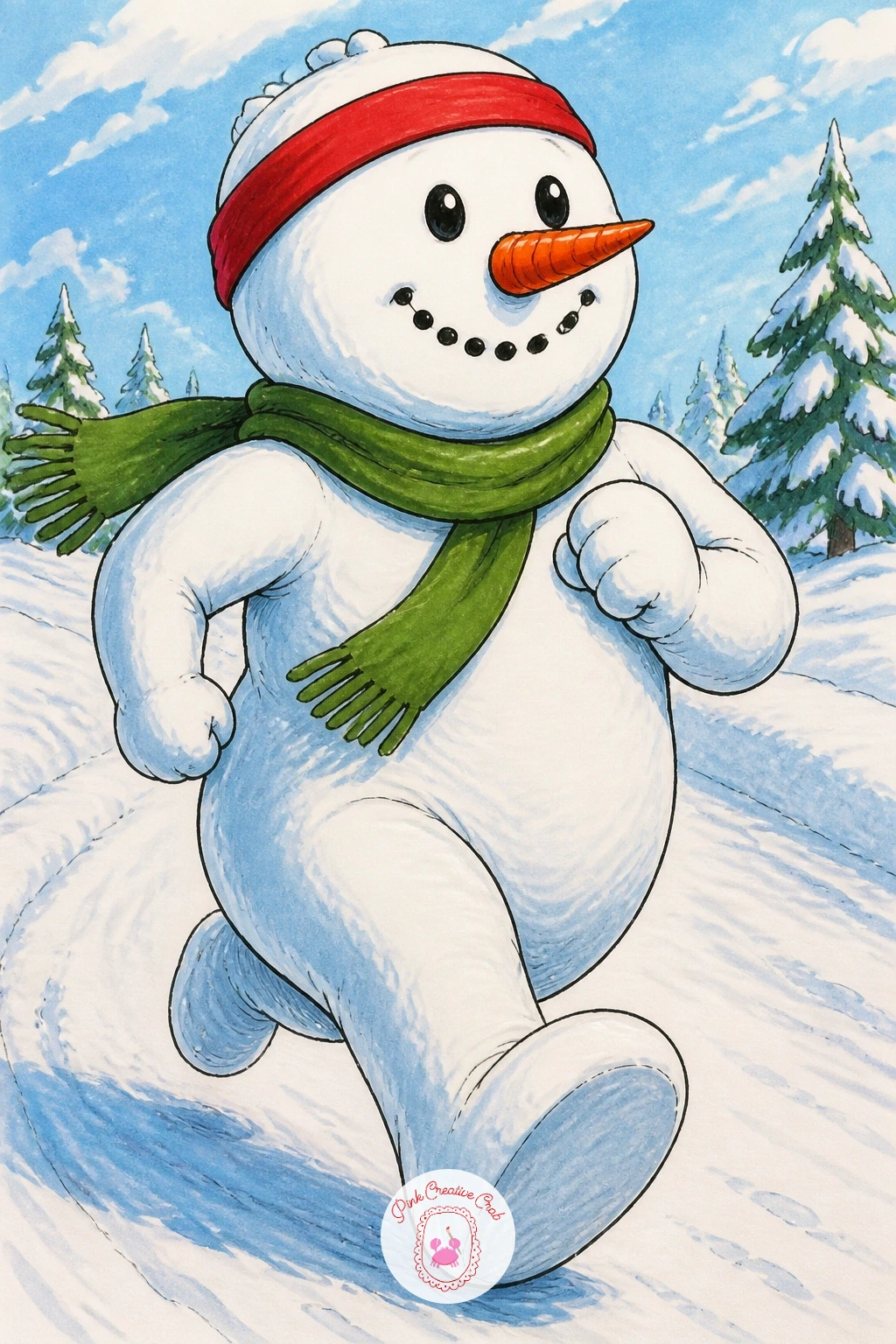
Palette: Snow White,Icy Blue,Cherry Red,Moss Green
Bring the whole scene to life with a snowman having a snowball fight with kids, caught mid-throw alongside one or two children. Draw the snowman first with one stick arm pulled back holding a round snowball, then place a child or two a short distance away in a matching throwing pose so the action reads as a real exchange rather than a solo moment.
Spacing is everything in a scene like this, leave a clear gap between the snowman and the kids with a couple of loose snowball shapes drawn mid-air in that gap, which is what makes the fight feel active rather than staged. Keep the kids simple, round heads, bobble hats, basic coat shapes, matched in simplicity to the snowman rather than more detailed than him.
Give everyone an open-mouthed laughing expression, since this is meant to be a joyful chaos moment rather than a tense one. Color the kids’ coats in bright contrasting colors so they read clearly as separate characters next to the white snowman.
If multiple figures feels like too much at once, one child and one snowman is plenty to tell the story.
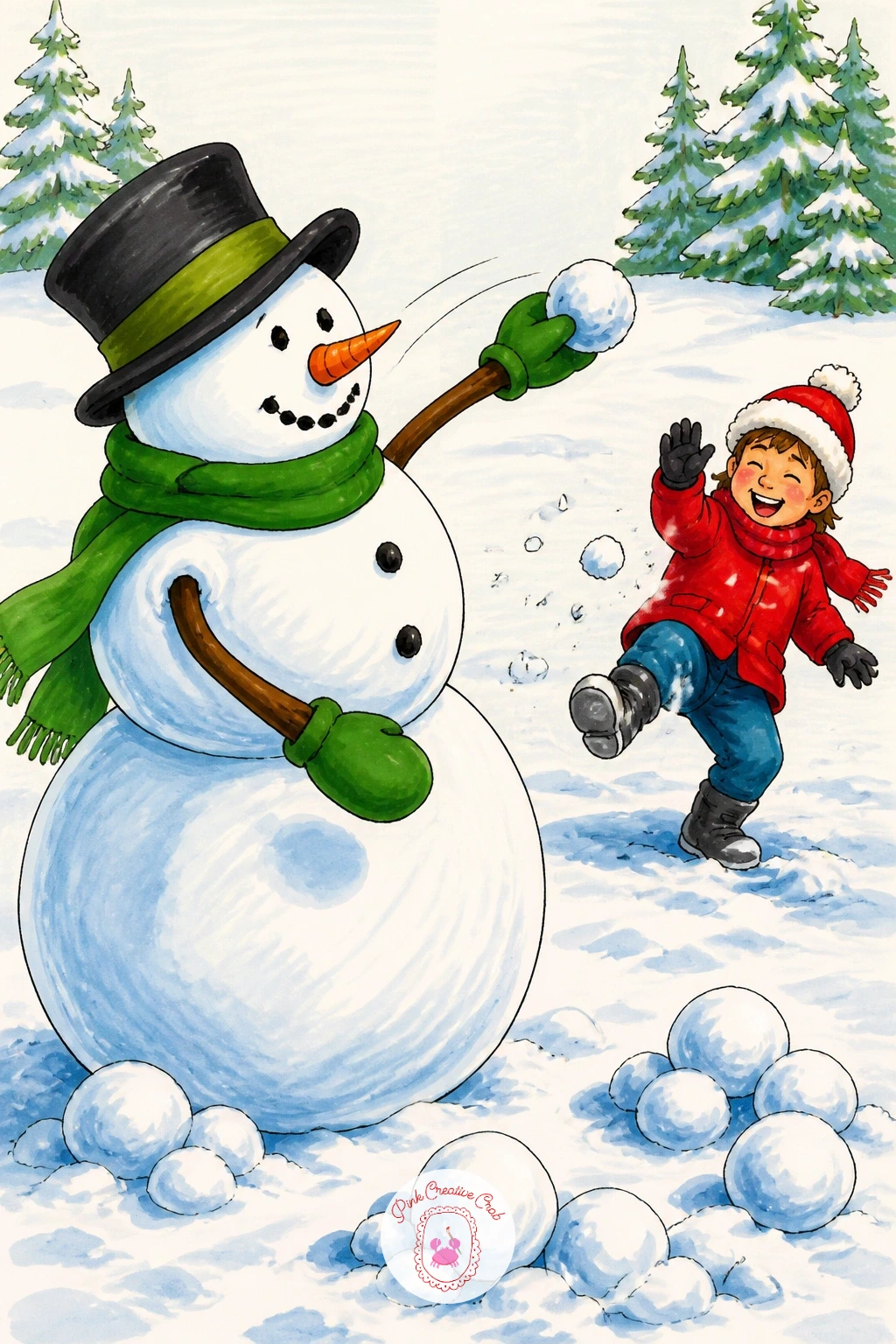
Palette: Snow White,Icy Blue,Cherry Red,Moss Green
Add some real traction to the sledding idea from earlier with a snowman on a sled pulled by a husky, this time being towed rather than coasting downhill on his own. Draw the husky first standing or mid-run, pointed ears and a curled tail, with a simple harness line running back to the sled behind it.
Since the husky is doing all the work here, draw its legs in a clear running stride, front legs stretched forward and back legs pushing off behind, while the snowman on the sled stays in a relaxed seated pose for contrast. That contrast between an active dog and a calm passenger is the whole joke of the scene.
Keep the sled low and simple, a flat board on two curved runners, sized to match the snowman seated on it comfortably. Color the husky in classic grey and white patches with blue eyes, which reads instantly as the breed even in a simplified cartoon style.
If a husky’s markings feel like too much detail, a plain grey dog shape pulling the sled tells the same story with far less drawing.
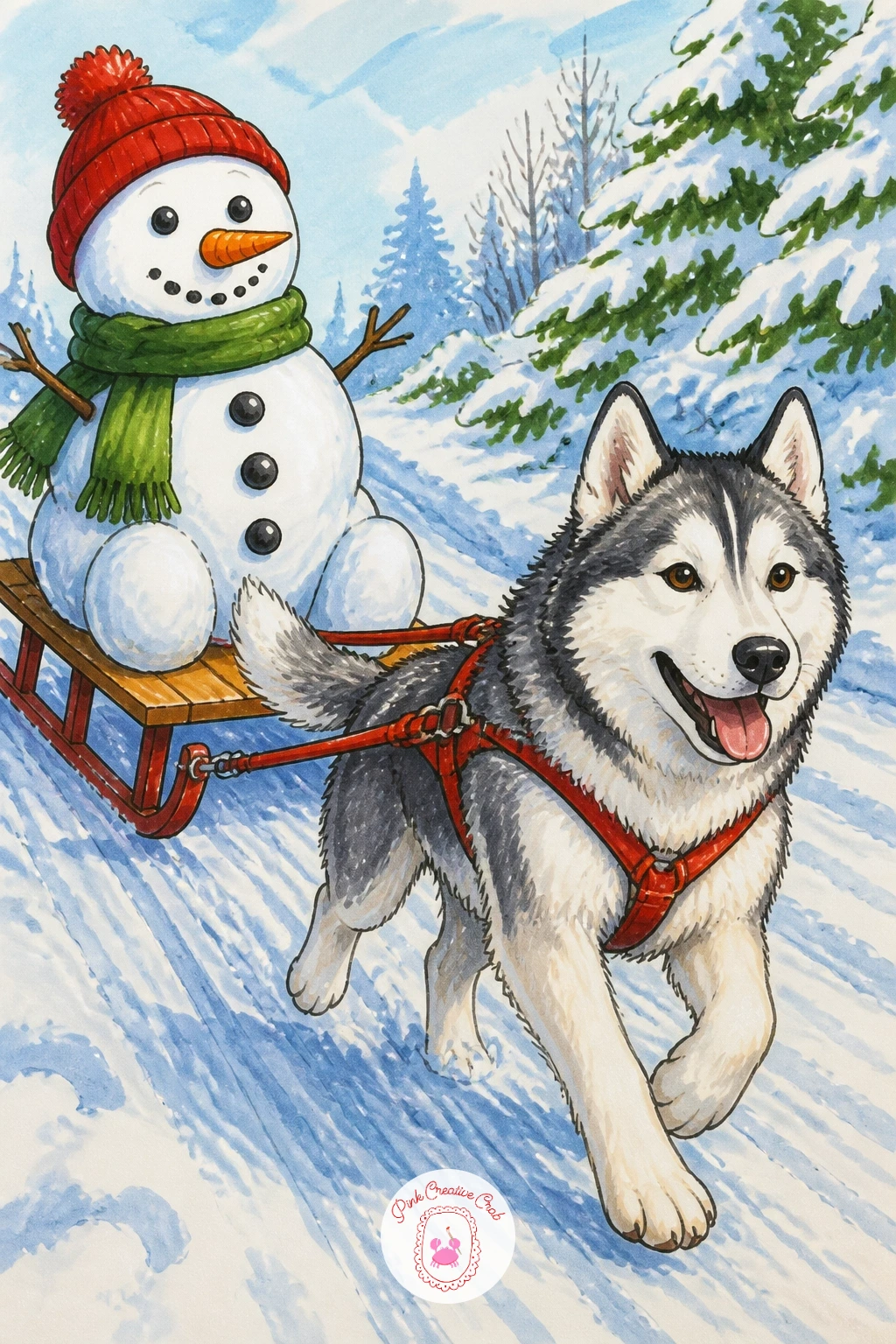
Palette: Snow White,Icy Blue,Slate Grey,Cherry Red
Look at a real husky photo for the ear shape and the mask-like face marking, they are what makes the breed instantly recognizable even in a simple drawing.
Slow things down with a quieter mood for a snowman peeking in a window at a cozy kitchen, pressed close to the glass looking in from outside. Draw a simple window frame first, a rectangle divided into panes, then place the snowman right up against the outside of it, his face turned so the viewer sees him in profile peering through the glass.
Since he is lit from inside the window rather than outdoors, this is the one to think about light source carefully: a warm yellow glow should fall on the side of his face nearest the glass while the rest of him stays in cooler blue shadow, which is what actually sells the cozy-kitchen-at-night feeling.
Inside the window, just a few simple shapes suggest the kitchen, a warm glowing shape for a lamp or a simple mug outline on a sill, nothing needs full detail since it is seen through glass anyway. Keep his expression wistful rather than sad, a small closed smile works well.
If drawing an interior feels like too much, a single warm glowing rectangle behind the window glass does the job just as well.
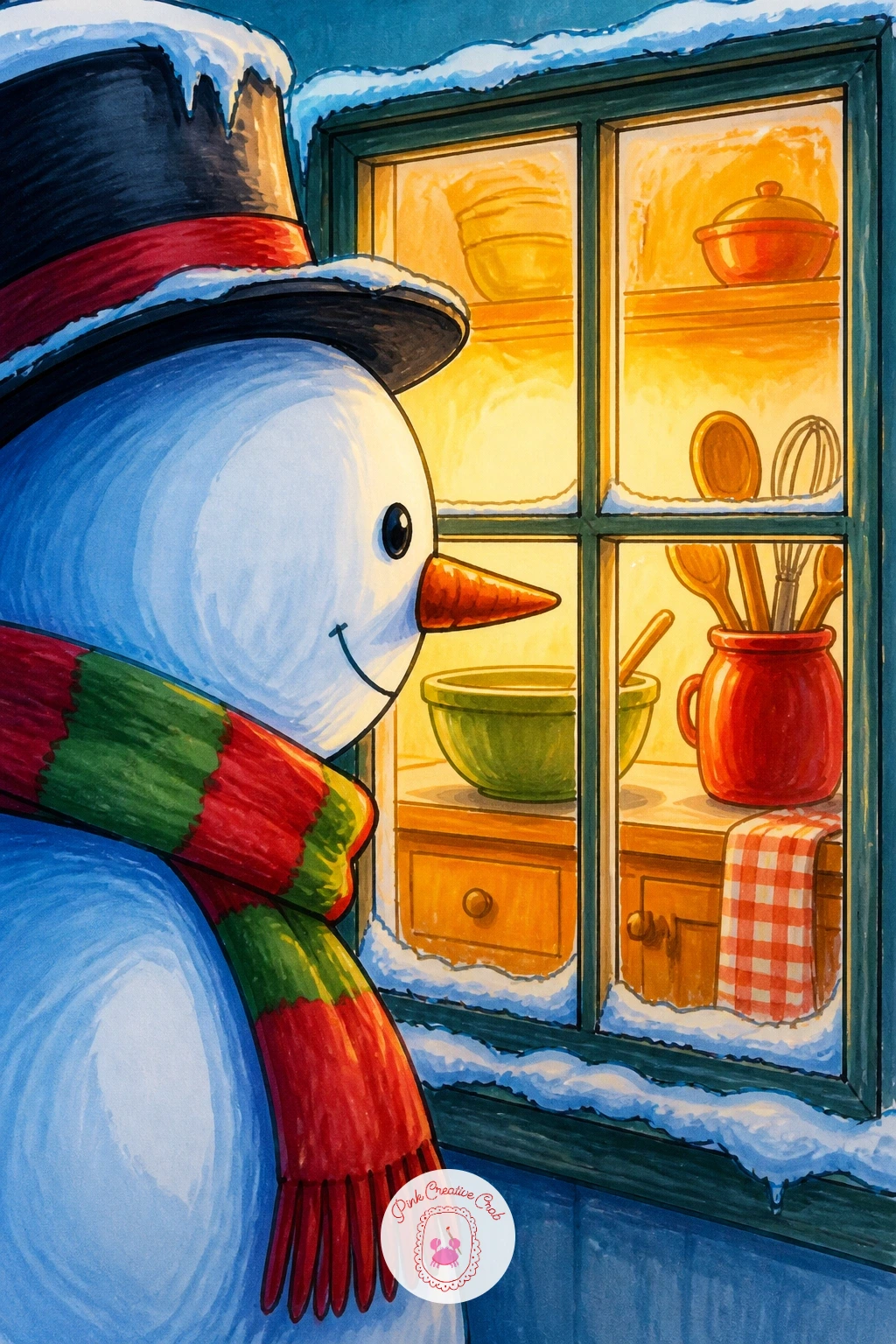
Palette: Snow White,Icy Blue,Warm Glow Yellow,Slate Grey
Give him an artistic hobby with a snowman painting a picture at an easel, brush in one stick hand and a small canvas propped in front of him. Draw a simple wooden easel frame first, then rest a small canvas or paper rectangle on it at a height that matches where the snowman’s stick arm can comfortably reach.
A loaded paintbrush is just a thin stick with a dab of color at the tip, held close to the canvas as if mid-stroke. Draw a few simple colored shapes already on the canvas, a small sun or a scribble of a tree, rather than leaving it blank, since a blank canvas reads as unfinished rather than in progress.
Where beginners lose the pose is the arm angle, keep the painting arm bent and close to the canvas rather than stretched straight out, which looks stiff and unnatural for a painting gesture. A small palette shape with a few dots of color in his other stick hand finishes the scene nicely.
If an easel feels complex, prop the canvas against a simple tree stump instead and skip the easel frame entirely.
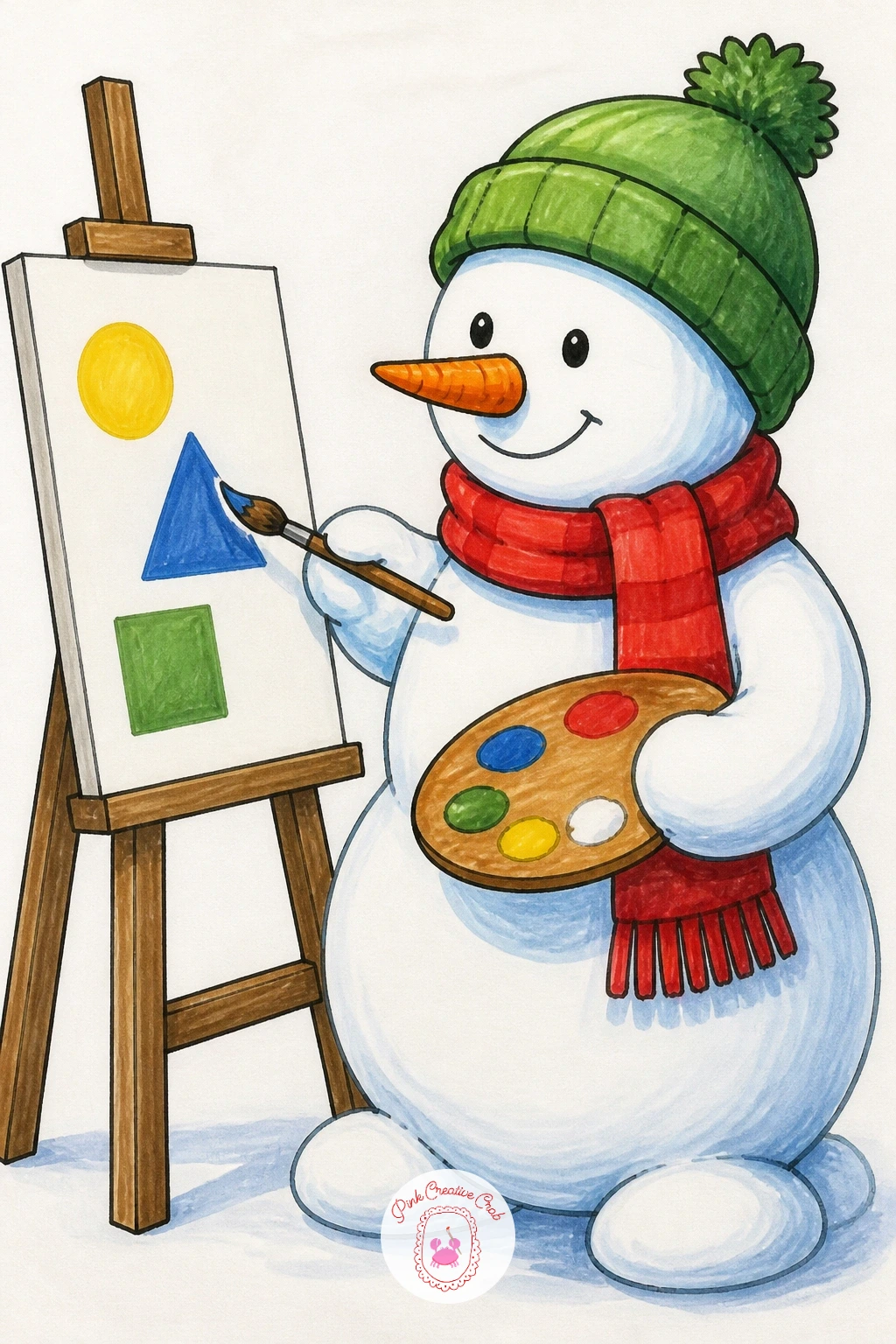
Palette: Snow White,Icy Blue,Cherry Red,Moss Green
Here is another gentle irony for the list: a snowman holding a cup of cocoa he cannot drink, steam rising from a mug he will never actually get to taste. Draw a simple round mug first with a curved handle, a few wavy steam lines rising from the top, then place it in one of his stick hands held up near his chest.
Keep the steam lines loose and a little wobbly rather than perfectly straight, that looseness is what makes steam read as steam rather than as smoke or scribbles. A small swirl of marshmallows, a few simple circles floating on top of the cocoa, adds a nice detail without much extra drawing.
Give him a wistful, slightly comic expression, since the joke only lands if he looks like he genuinely wants to drink it and knows he cannot. Color the cocoa a rich warm brown with the steam kept pale and barely-there against the white snow background.
If marshmallows feel fiddly, a plain full mug without them still tells the whole joke on its own.
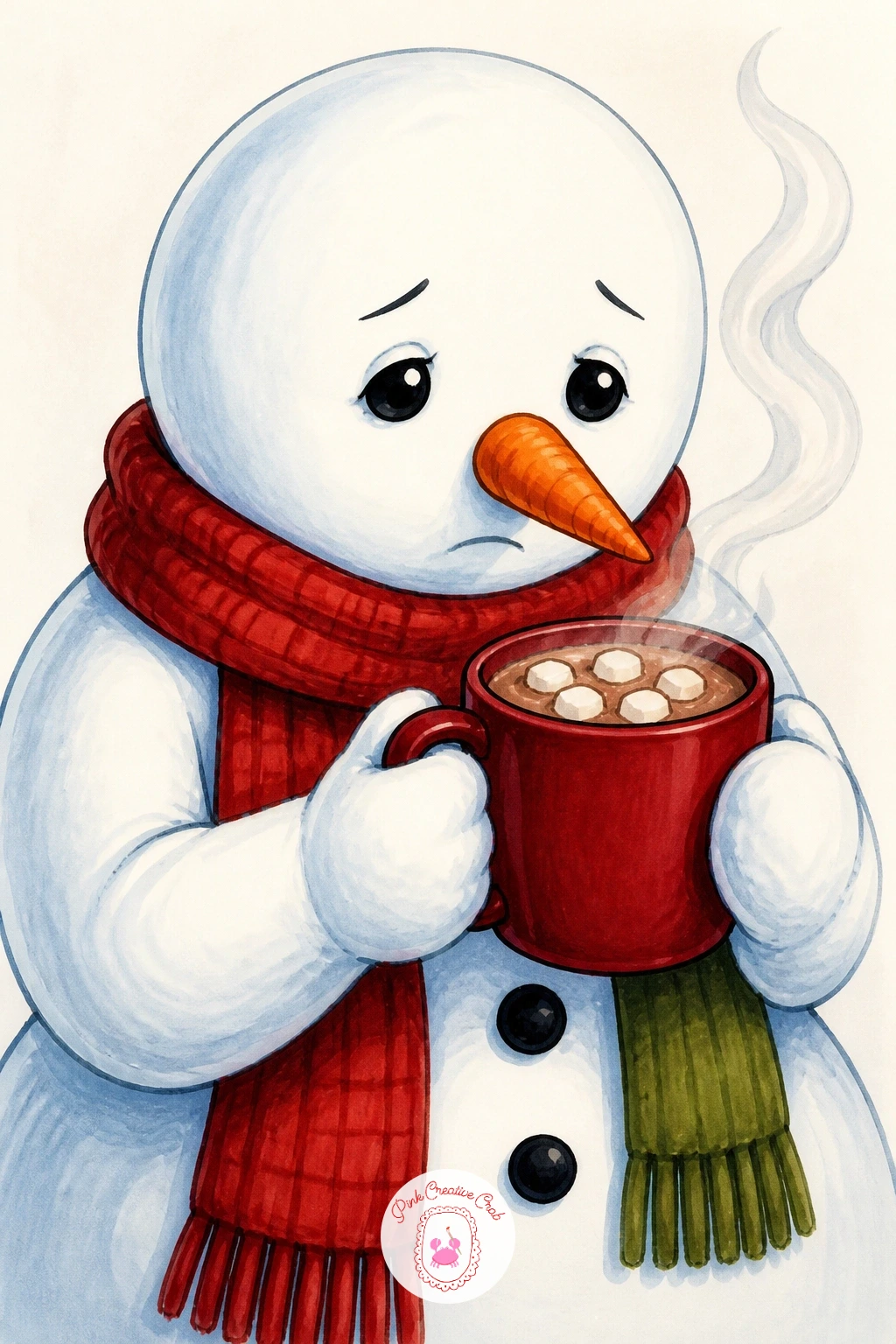
Palette: Snow White,Icy Blue,Cocoa Brown,Carrot Orange
Give him a quiet moment of his own with a snowman wearing earmuffs and listening to music, eyes closed and clearly enjoying a song only he can hear. Draw the earmuffs first as a simple curved band over his head connecting two round pads over where his ears would be, then build the rest of his body and happy closed-eye expression around that.
A few small musical note shapes floating near his head, just simple curved stems with a small oval at the base, suggest the music without needing headphones with any visible cord or device at all. Keep the notes small and few, two or three is plenty.
Give him a slight sway in his pose, tilt his head a little to one side rather than drawing him perfectly upright, which suggests he is moving gently to a beat. Color the earmuffs a bright cherry red so they stand out as the clear focal point of the drawing.
If musical notes feel fiddly to draw well, a single wavy line trailing from the earmuffs suggests sound just as effectively.
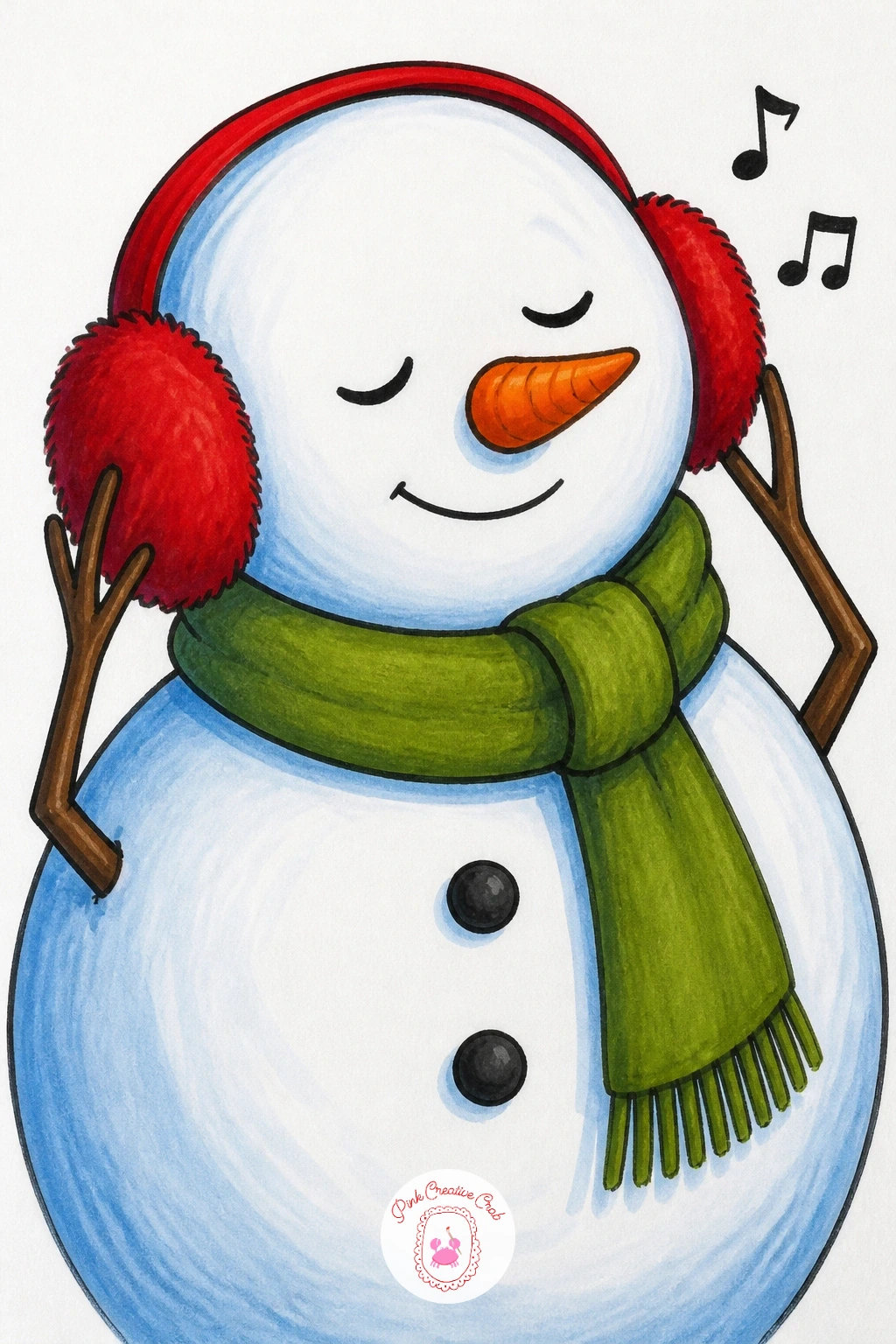
Palette: Snow White,Icy Blue,Cherry Red,Carrot Orange
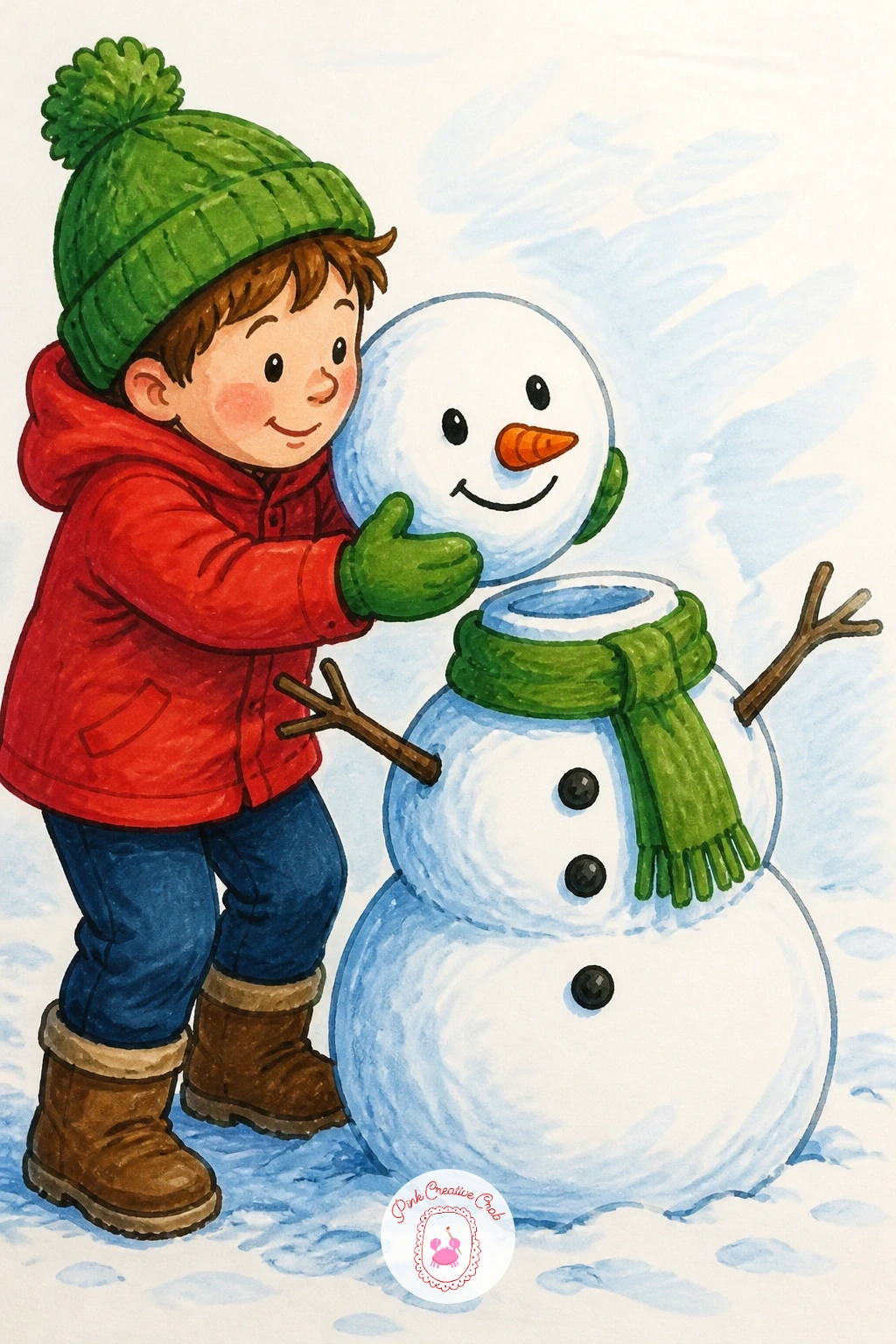
Add a little mishap and rescue with a kid fixing a snowman after his head fell off, the round head lying on the ground while a child lifts it back into place. Draw the snowman’s body first standing with a flat gap where the head should be, then draw the detached head a short distance away on the ground before placing a child reaching to lift it.
Keep the fallen head’s face still smiling, that small detail of calm cheerfulness even mid-disaster is what makes the scene funny rather than alarming. The child should be bent forward at the middle, both hands under the head, mid-lift rather than already holding it in place.
Where this scene needs care is the gap on the snowman’s body, draw a simple flat circle top on the headless body so it clearly reads as missing a head rather than looking like an unfinished drawing. Color the child’s coat and hat in a bright contrasting color so the small figure stands out clearly beside the larger white body.
If lifting the head feels like a hard pose to draw, have the child simply holding the head already back in place with both hands steadying it.
Palette: Snow White,Icy Blue,Cherry Red,Carrot Orange
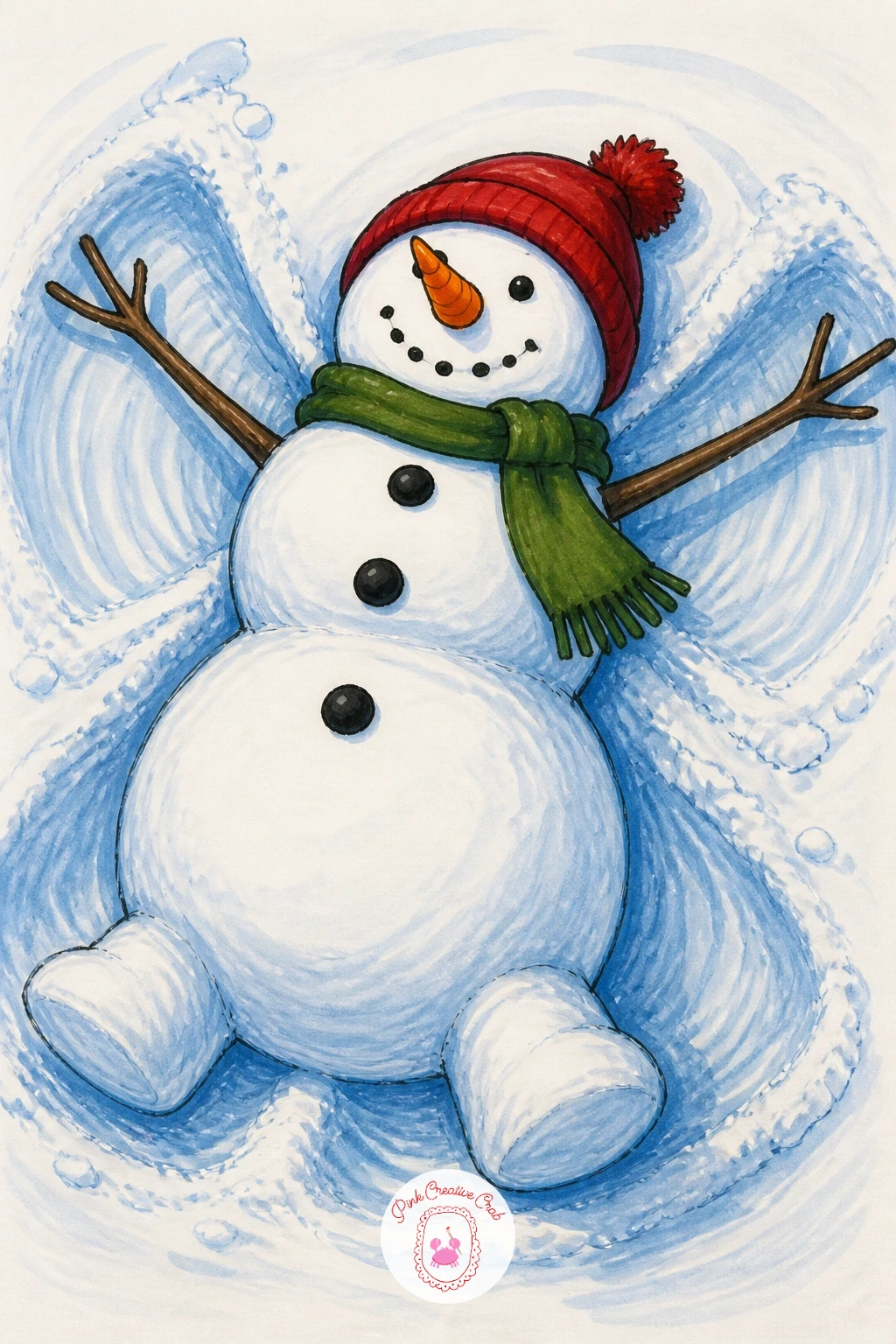
Let him lie flat for once with a snowman lying down to make a snow angel, arms and legs spread wide in the snow. Draw his body flattened against the ground this time rather than stacked upright, three overlapping circles lying in a horizontal row works well, then spread his stick arms out and slightly up from his sides.
A few curved sweep marks fanning out from where his arms and legs would move capture the angel shape without needing to draw actual wing or leg marks, since a classic snowman has no real legs to sweep with anyway. Keep those sweep lines loose and curved rather than straight.
His face should point straight up with a relaxed, happy closed-eye expression, since this is a moment of pure fun rather than any kind of effort. Shade the snow around his flattened body a touch darker where it has been disturbed, which helps the lying-down shape read clearly on a mostly white background.
If drawing him lying flat feels tricky to picture, look at how a standing snowman’s circles would look if you simply rotated the whole stack onto its side.
Palette: Snow White,Icy Blue,Carrot Orange,Cherry Red
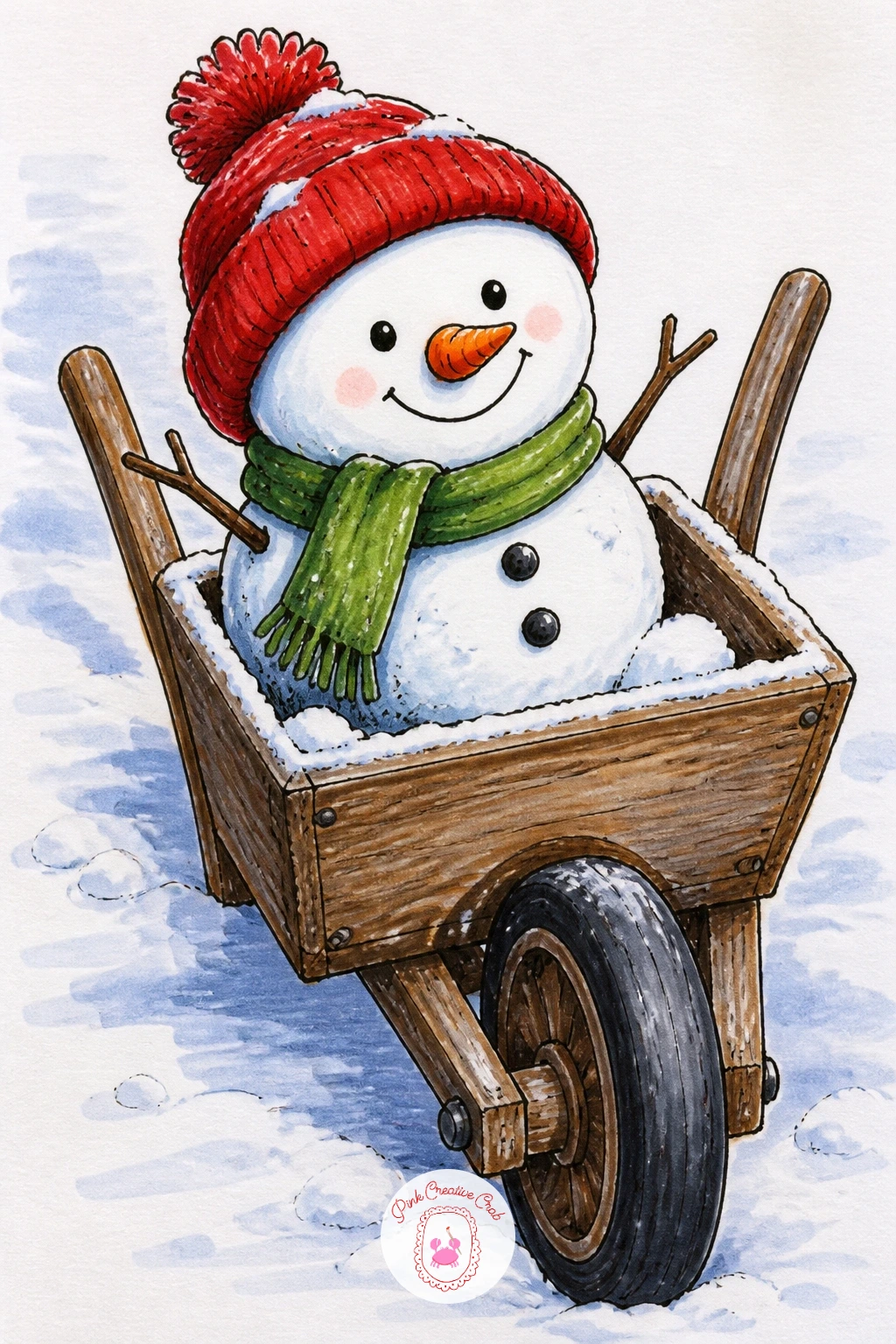
Bring back the small-and-large joke one more time with a tiny snowman riding in a wheelbarrow, perfectly content being wheeled around like cargo. Draw the wheelbarrow first as a simple tray shape on one front wheel with two handles extending back, then place the tiny snowman sitting inside the tray rather than standing beside it.
Scale the snowman to fit comfortably inside the wheelbarrow’s tray, roughly knee height on a normal-sized snowman, which is the clearest way to establish just how small he is without needing anything else in the scene for comparison. Two or three snowball segments stacked small still reads clearly as a snowman even at this reduced size.
Give him a relaxed, pleased expression, as if riding in a wheelbarrow is exactly where he wants to be. Color the wheelbarrow a weathered wood brown or faded red so it contrasts clearly against the white snowman sitting inside it.
If a wheelbarrow feels complex to draw accurately, a simple basket or sled works as an easier stand-in for the same tiny-rider joke.
Palette: Snow White,Icy Blue,Wood Brown,Cherry Red
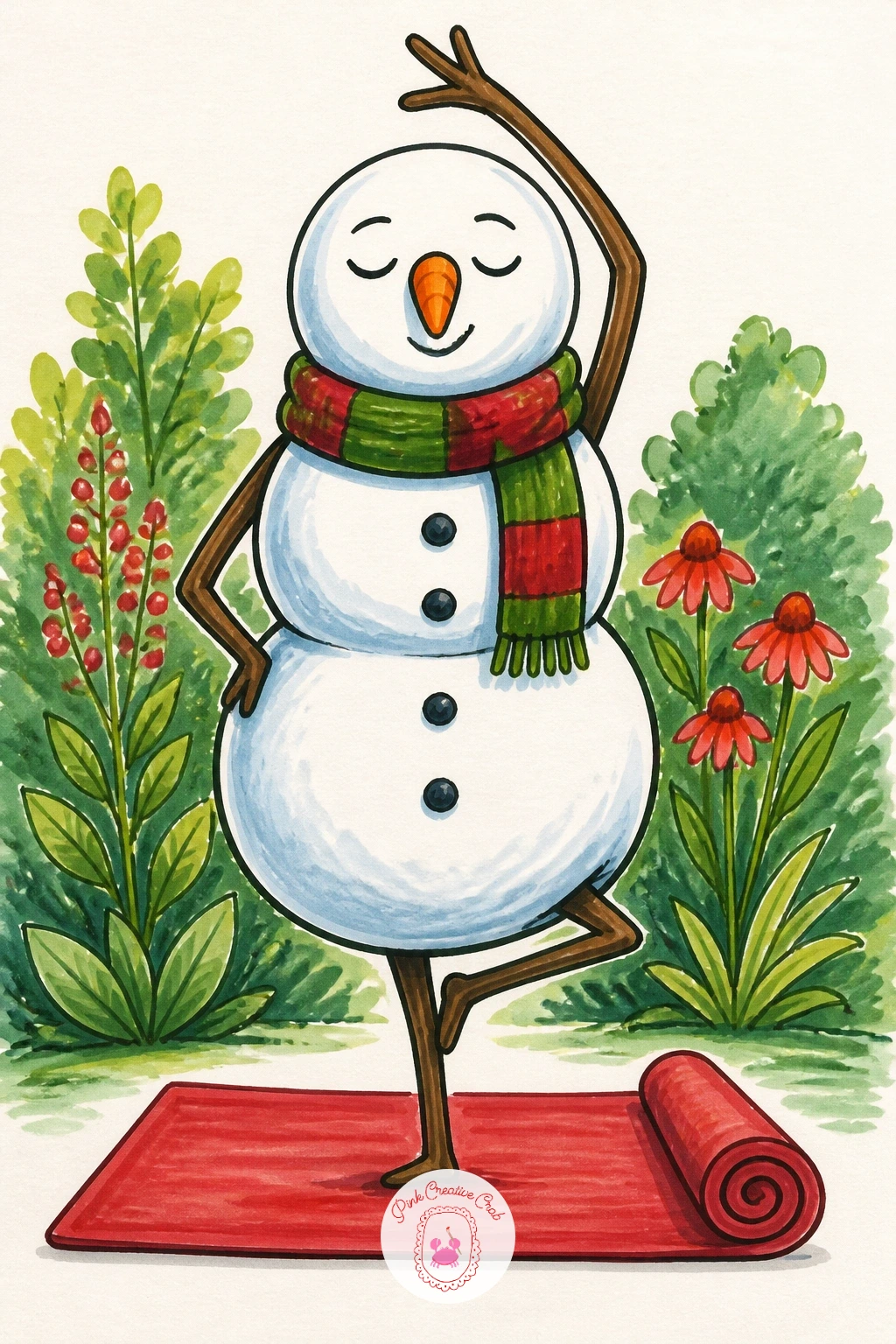
Close the whole list out with a snowman doing yoga in the garden, holding a simple balance pose among a few garden shapes. Draw the snowman first in a tree-pose stance, one stick leg bent with its foot resting against the opposite leg if you give him legs, or simply one stick arm raised overhead in a stretch if you keep him on his usual round base.
A small garden setting, a simple fence post or a bare bush shape, grounds the scene without needing much extra drawing, keep these background shapes minimal so the snowman’s pose stays the clear focus. Add a thin rolled mat shape beneath him for a nice finishing touch.
His expression should be calm and serene, eyes closed, a small peaceful smile, quite different from his usual wide grin elsewhere on this list. Color the garden elements in soft moss green so the whole scene feels calm rather than busy.
If balance poses feel too tricky to draw convincingly, a simple seated cross-legged pose with both stick arms resting on his knees works just as well and is much easier to get right.
Palette: Snow White,Icy Blue,Moss Green,Carrot Orange
What to Do Next
Pick one idea from the list, grab a fineliner and a few markers, and work the whole scene in a single sitting rather than overplanning it. Plain marker paper or a smooth sketchbook page is all this needs, and once one snowman feels easy, the next one on the list will go even faster.
Frequently Asked Questions
What is the easiest way to start a snowman drawing?
Start with three stacked circles of decreasing size using a light pencil before going over them with a fineliner. Keep the circles roughly even in spacing, then add the face and arms last once the stack feels balanced.
What markers work best for a snowman drawing like this?
Alcohol-based markers blend smoothest for the icy blue shadows and bright scarf colors used across this list. A fineliner for the outline first, then markers layered on top, keeps edges crisp and colors clean.
How do you make a snowman drawing look less flat and plain?
Add icy blue shadow strokes along the underside of each snowball rather than leaving the whole body flat white. A light grey or blue shadow shape under his base also helps him sit properly on the snow.
Can young kids draw these snowman scenes too?
Yes, every idea has a simple version built from basic circles, stick arms and a few simple props a child can manage alone. An adult can then add small extras like shading, patterns or background details if wanted.
What is a good first prop to add to a plain snowman drawing?
A scarf is the easiest and most effective first addition, just a simple curved band with two trailing ends in a bright color. It adds personality and color contrast without changing the basic snowman shape at all.
Have any thoughts?
Share your reaction or leave a quick response — we’d love to hear what you think!
-
 0
-
0
-
0
-
0
-
0
-
0


