

Good anniversary card ideas do more than mark a date, they hold a whole marriage in one small painted scene. Here you will follow one couple from their first dance right through to grey hair and grandchildren, each moment painted soft and small enough to finish as a single card front.
Every idea below uses the same gentle palette of dusty rose, sage green and soft cream with a touch of gold, so you can paint one today and come back for another next week. Work small, keep the faces simple, and let the brushstrokes stay loose rather than tight.
Using these images: free for personal projects such as printing, coloring, cards, journals and gifts. Handmade items that include them may be sold up to 30 pieces per design. More than that is commercial use and is not permitted, and neither is selling or sharing the images themselves or passing them off as your own. Please ask before any other use.
Start the whole series here, with a first dance under string lights in an old barn, because the warm glow gives you an easy reason to practice soft edges before anything else gets complicated. Block in the barn’s dark interior first with a thin wash of burnt umber and sage green, then place the couple as one soft silhouette hugging close in the middle third of the canvas.
Save the string lights for last. Dot them in with the tip of a small round brush loaded with cream and a touch of gold, and let each dot sit slightly uneven rather than perfectly spaced, which reads as hand strung rather than printed.
If the dots spread into a blur, you have too much medium on the brush, so wipe it almost dry and dab rather than drag. A clean cotton swab works if you do not have a fine detail brush on hand.
Keep their faces to three small marks each, a curve for the cheek, a dot for the eye, nothing more, so the warmth comes from the light and the pose rather than from drawn expressions.
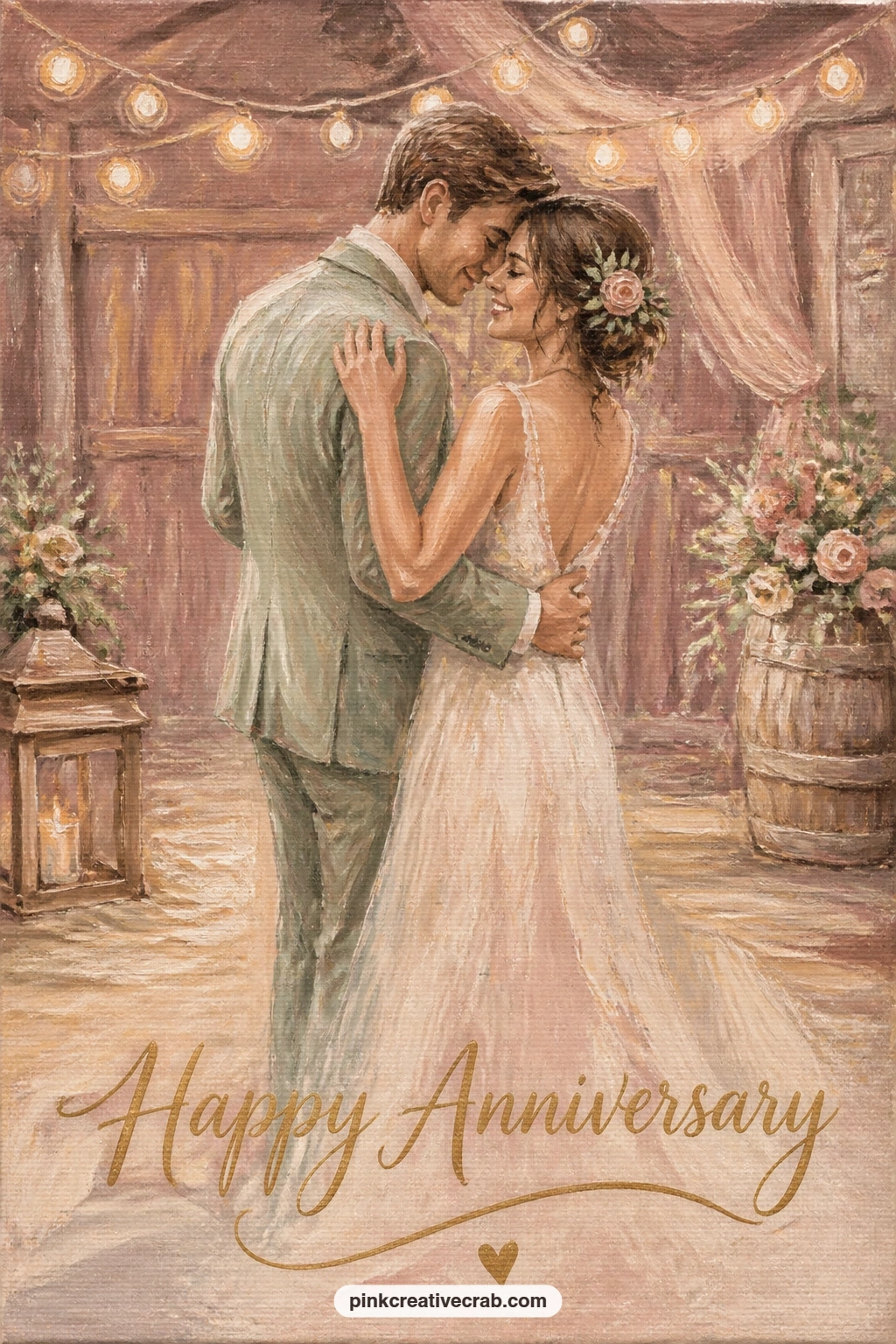
Palette: Burnt Umber,Dusty Rose,Sage Green,Soft Cream,Gold Ochre
After the energy of a first dance, slow things right down with an older couple swaying on the same old porch swing at dusk. This one is about getting the eye level right: sit your imaginary viewer at porch height, roughly where someone would stand on the step below, so the swing chains rise up and out of frame rather than floating mid air.
Paint the dusk sky first in broad sweeps of soft cream fading into dusty rose, then bring in the porch railing and swing as darker silhouettes once that sky has dried enough to layer over.
The swing itself is the trickiest part. Keep the chains as two thin straight lines rather than trying to render links, and let the wood slats blur slightly at the edges so the eye settles on the couple, not the furniture.
If your dusk colors turn muddy, clean your brush fully between the cream and rose layers rather than blending wet into wet. Try this one on toned paper if canvas feels intimidating today, the warm ground will do half the dusk glow for you.
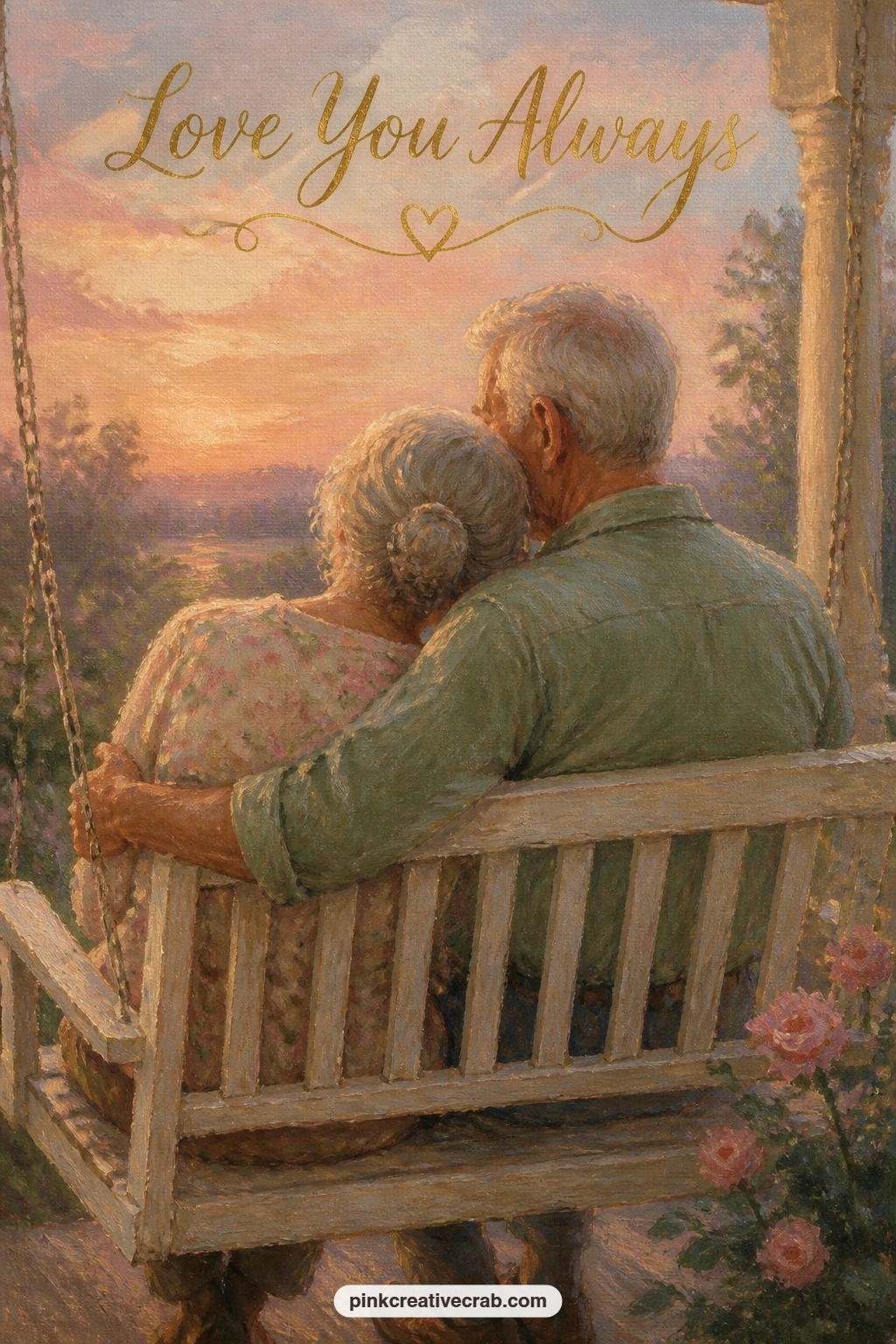
Palette: Dusty Rose,Soft Cream,Payne’s Grey,Sage Green
Move back in time now to a young couple planting an apple sapling in their garden, a quiet beginning that pairs the couple with the earth they will share for decades. Proportion carries this whole scene, so measure the sapling against the figures first: it should sit no taller than the kneeling couple’s shoulders, thin and a little crooked, so it reads as newly planted rather than established.
Lay the soil and garden background in loose sage and umber strokes before the figures go in, then paint the couple kneeling close together with their hands meeting near the base of the sapling.
Keep the sapling’s few leaves as small dabbed touches of fresh sage, not individually drawn, and leave the trunk as one thin confident line rather than several shaky ones.
If the composition feels empty, add a simple fence line or a distant garden bed behind them to anchor the space. A painting knife can lay that soil texture faster than a brush if you own one.
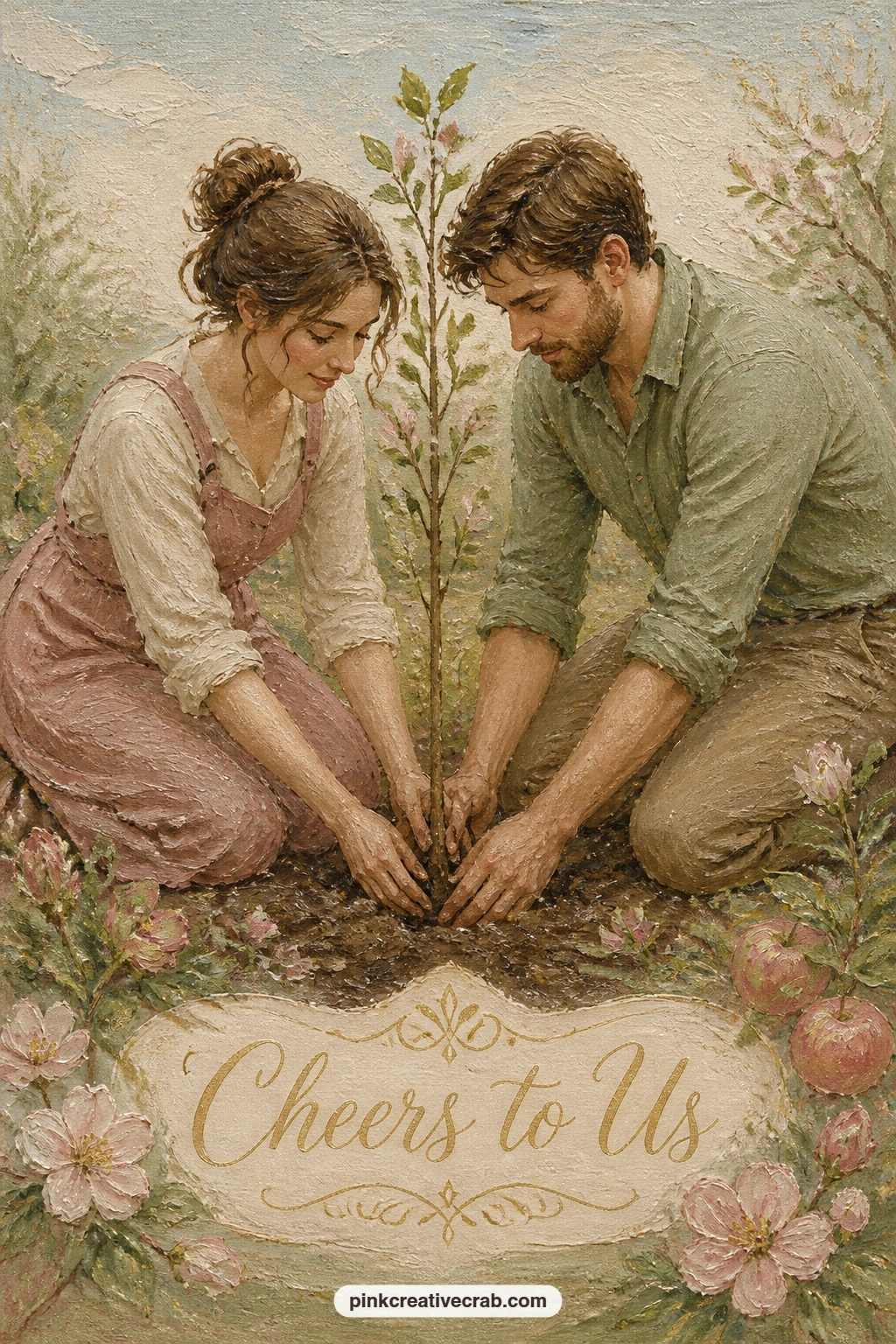
Palette: Sage Green,Burnt Umber,Soft Cream,Dusty Rose
Carry the story forward with a gray-haired couple picnicking by the lake where they first met, returning to the same water decades later. Perspective does the storytelling here: set the horizon line low, about a third up the canvas, so the lake and sky stretch wide behind the couple and give the scene room to breathe.
Begin with that wide lake and sky in horizontal sweeps of soft cream and pale sage, then set the picnic blanket and basket in the foreground before placing the couple sitting close upon it.
Let the water stay mostly flat color with just a few short horizontal dashes of lighter paint for ripples, since fussing over individual waves will pull focus from the couple.
If the lake looks too busy, scrape a few streaks back out with a palette knife while the paint is wet. A picnic cloth in soft cream rather than a strong pattern keeps the whole scene calm.
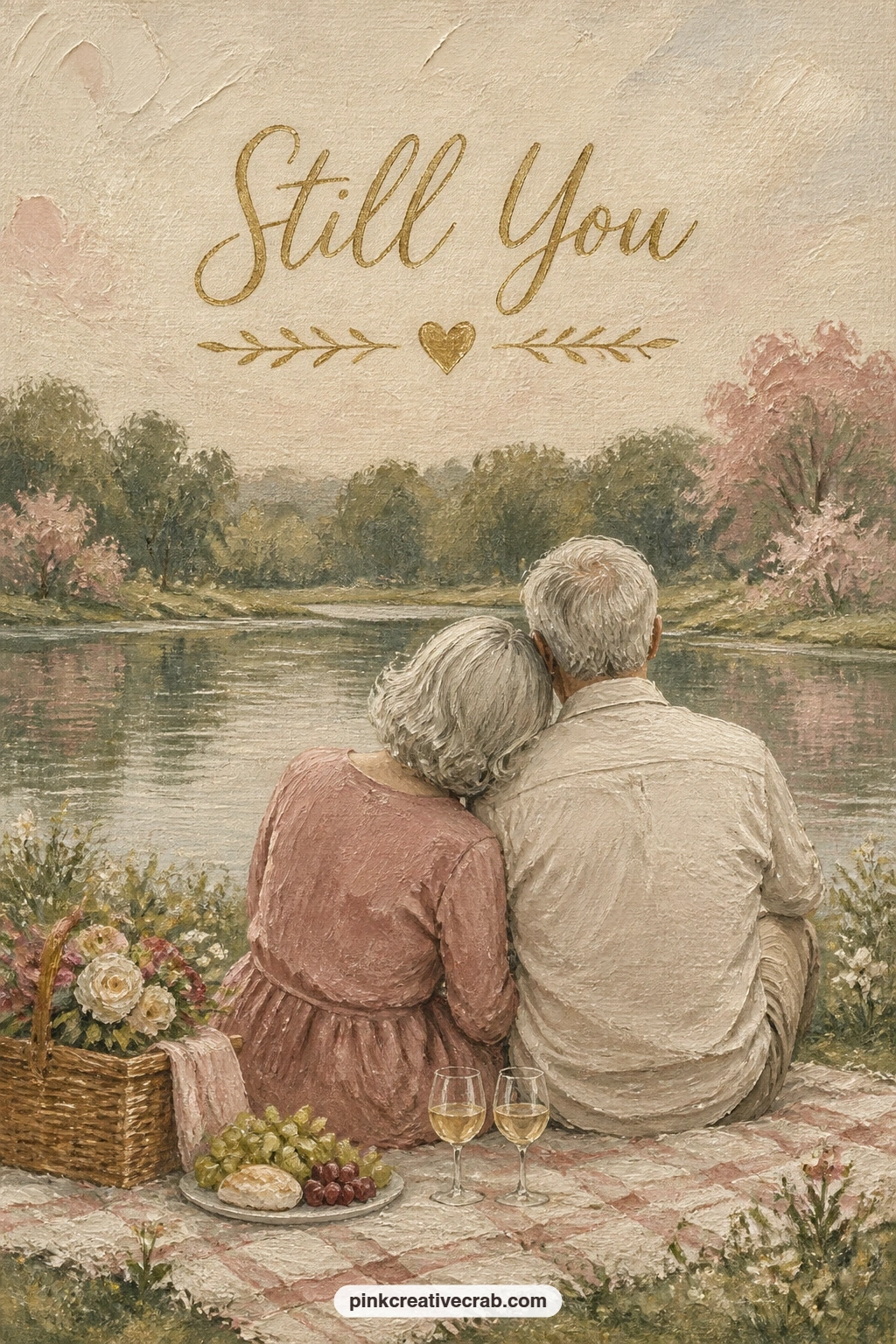
Palette: Sage Green,Soft Cream,Dusty Rose,Payne’s Grey
Jump back to the very start of their home together with a young couple carrying the first box into a little blue house. This is a fun one for texture: dry brush the clapboard siding with a stiff flat brush loaded with just a touch of sage green over a cream base, dragging sideways so the boards show as broken, uneven streaks rather than solid lines.
Paint the house first, keeping its blue door and trim as the one saturated note against the softer palette, then add the couple walking toward the open door with the box held between them.
Edges matter most where the box meets their arms. Keep that line soft and slightly blurred rather than hard, which helps the box feel light and carried rather than glued in place.
If the dry brush texture looks too scratchy, go back over it once with a nearly dry brush of plain cream to soften it. No stiff brush on hand, a frayed old brush works just as well for this effect.

You Will Need
- stiff dry brush for siding texture
Palette: Sage Green,Dusty Blue,Soft Cream,Burnt Umber
Settle into something quieter with an old couple sharing a pot of tea on a garden bench among roses. Give yourself ten minutes for a quick version: block in the bench and figures in flat shapes, dab in a handful of rose blooms around them in dusty rose and cream, and leave it there as a loose sketch-like study.
The forty minute version builds on that same start by refining the teapot and cups with small highlights of cream, adding shadow beneath the bench, and layering a few more rose blooms climbing a trellis behind the couple.
Either way, paint the roses as simple clusters of three or four dabbed petals rather than fully formed flowers, since from a small card’s distance the cluster reads as roses without needing botanical detail.
If the bench feels flat, add one line of shadow along its underside with a touch of umber. Try swapping the roses for a climbing jasmine if you would rather paint white blooms against the sage leaves.
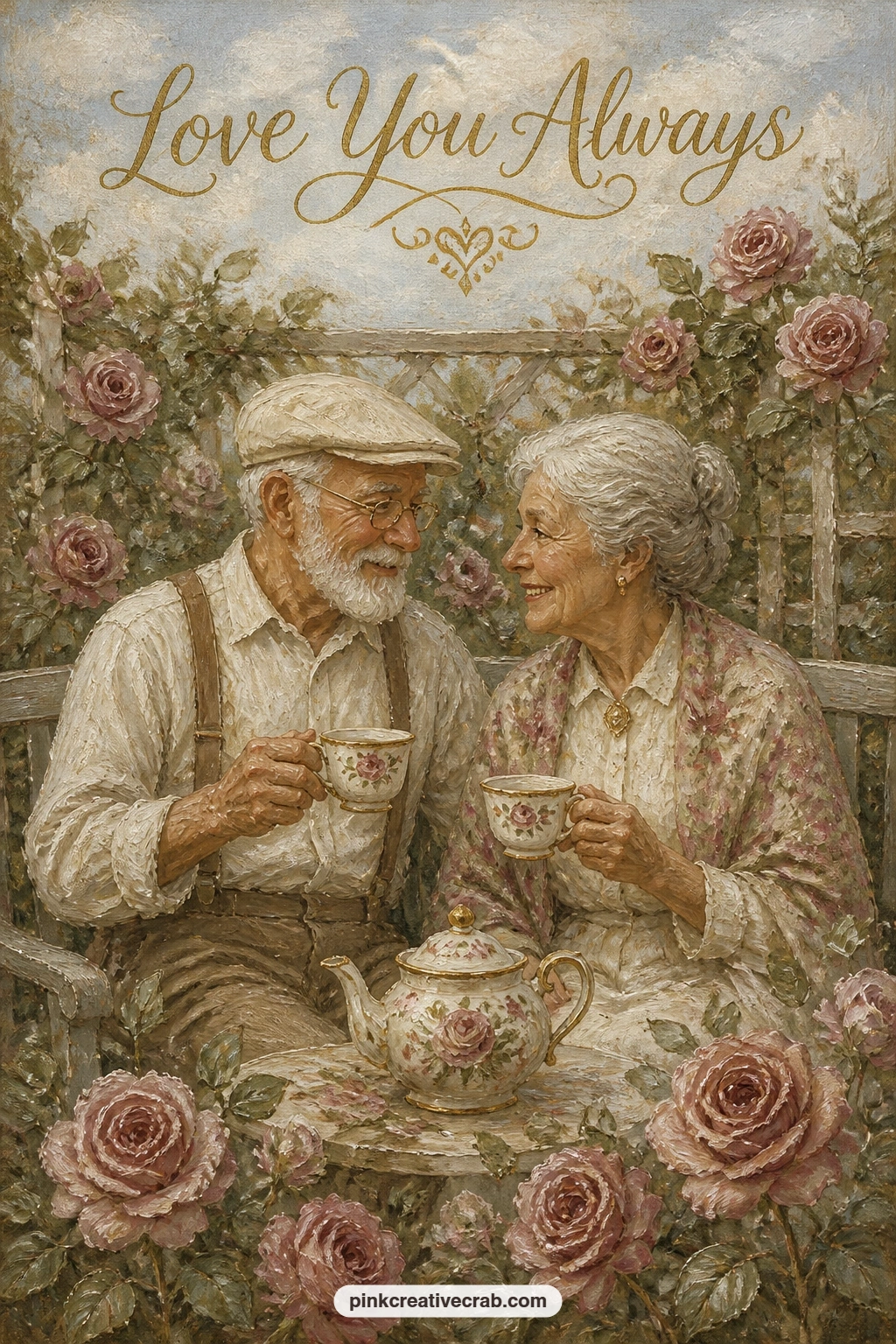
Palette: Dusty Rose,Sage Green,Soft Cream,Burnt Umber
Build on that same garden with a couple renewing their vows under a rose arch in the backyard, a bigger moment that deserves a bit more planning before you paint. Next time you revisit this scene, try varying the season: swap the roses for wisteria in spring, or bare branches wrapped in fairy lights for a winter renewal, using the same arch shape and composition.
For this version, sketch the arch shape first in thin umber lines, keeping it as a simple curved frame rather than an elaborate trellis, then paint the sky and garden behind it before the arch itself goes in.
Place the couple standing close beneath the arch’s peak, facing each other rather than the viewer, which keeps the moment feeling private rather than posed.
Roses along the arch work best as the same small dabbed clusters used elsewhere in this series, kept loosely scattered rather than evenly spaced. If the arch looks stiff, round its top curve slightly more than feels natural, since a too-straight arch reads as architectural rather than garden-built.
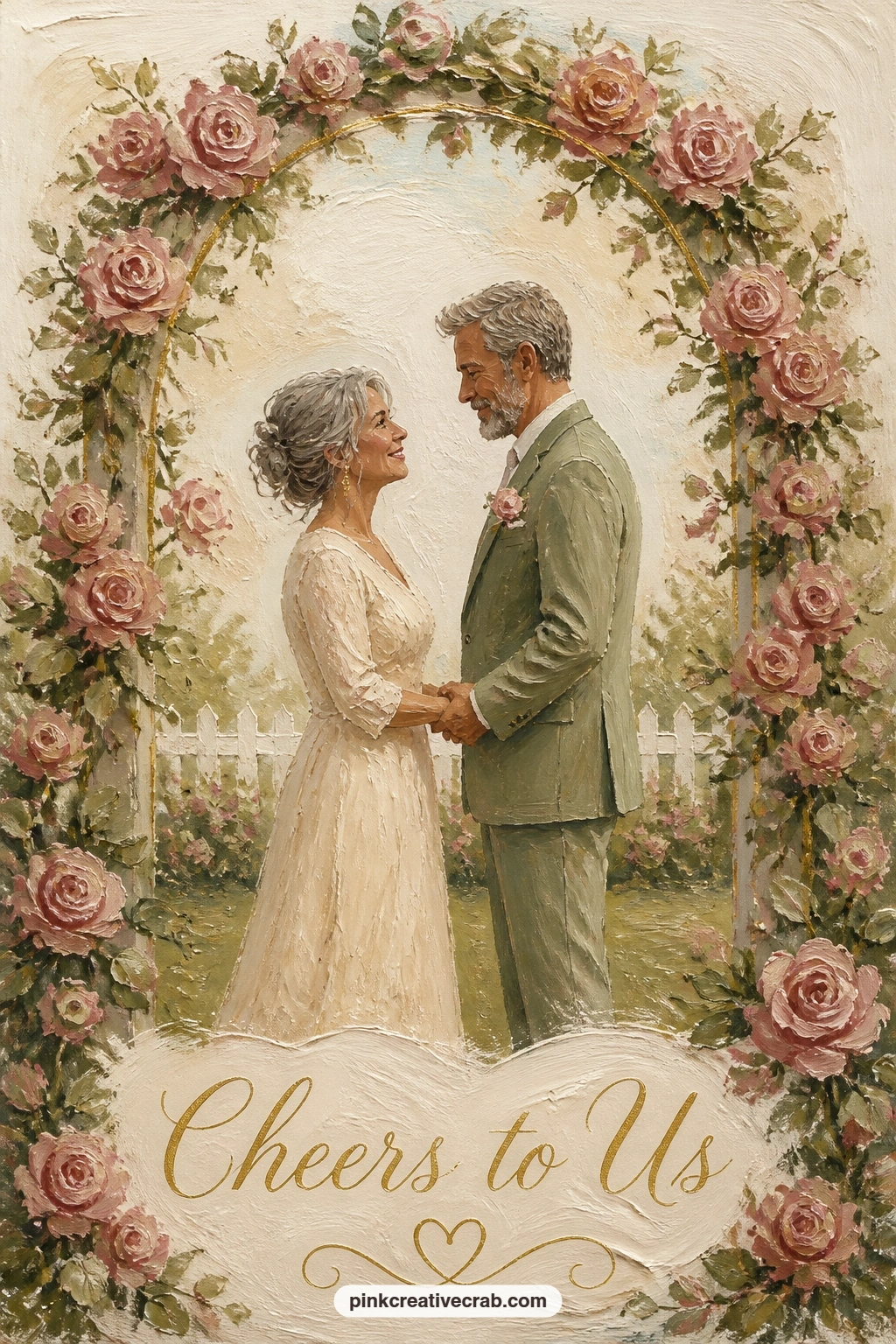
Palette: Dusty Rose,Sage Green,Soft Cream,Gold Ochre
Bring the story indoors with a couple dancing in the kitchen while a pot of soup simmers, a small domestic moment that is easy to finish in one sitting. Start with the kitchen’s warm background, loose strokes of cream and sage for the cabinets and walls, then add the stove with its pot before the dancing couple goes in last, slightly off center so the pot has room to read clearly.
A thin curl of steam rising from the pot sells the whole scene. Paint it with a dry, barely loaded brush dragged upward in a soft S shape, then immediately soften the top edge with a clean finger or soft brush so it fades rather than stops abruptly.
Keep the couple’s dance pose simple, one hand raised, bodies turned slightly toward each other, and let their feet blur into the floor rather than painting shoes in detail.
If the kitchen feels cluttered, remove extra objects rather than adding them, a single pot and maybe a window is plenty. A palette knife swipe of cream along a counter edge gives a quick highlight if you are short on time.
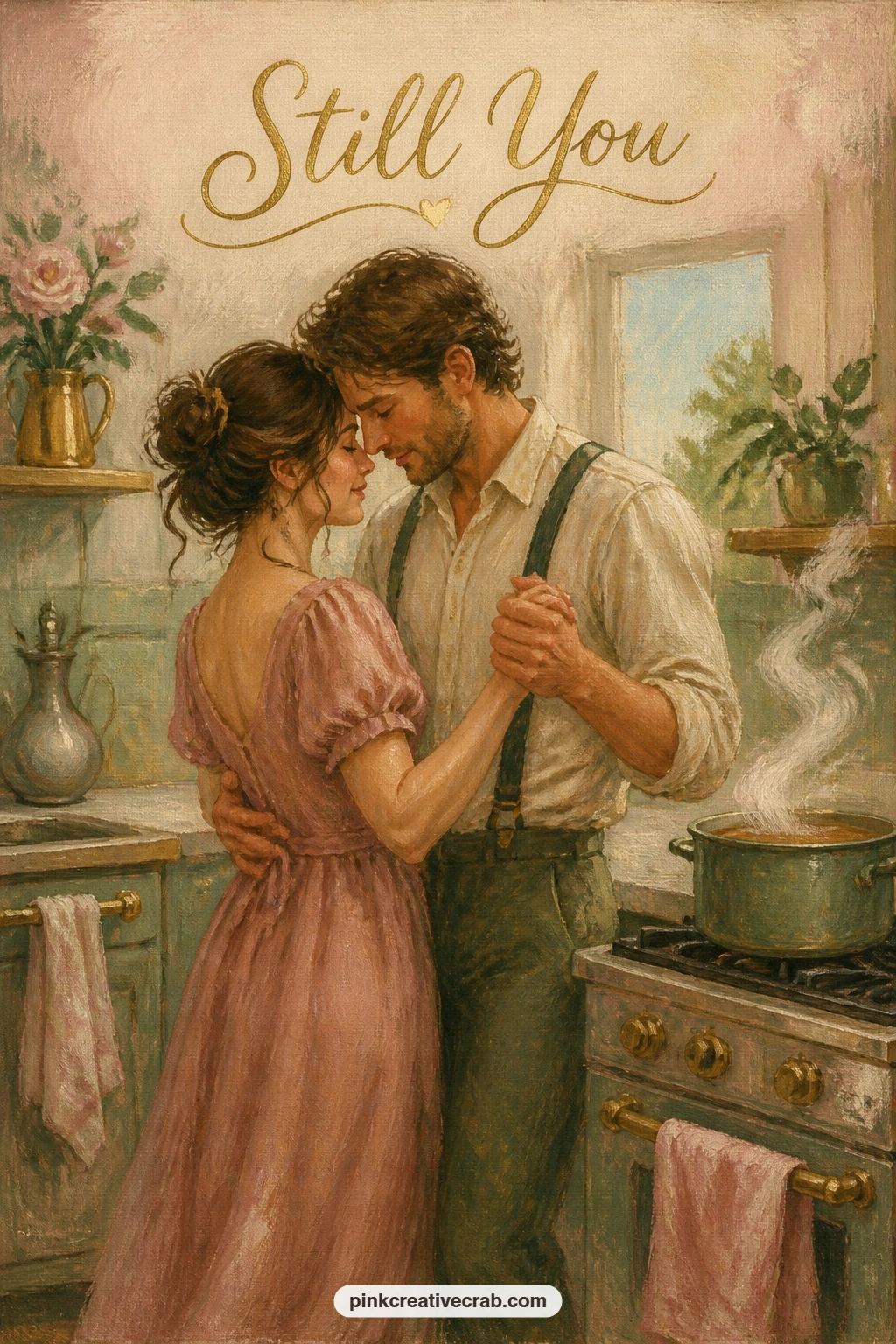
Palette: Soft Cream,Sage Green,Burnt Umber,Dusty Rose
Look at reference photos of steam rising from real pots before painting it, the way it curls and thins out is hard to invent from memory alone.
Head outdoors again with an elderly couple walking arm in arm along a seaside promenade, a scene built almost entirely from horizontal bands. Measure the canvas into rough thirds before you start: sky on top, sea in the middle, promenade and figures along the bottom, which keeps the whole composition calm and easy to balance.
Paint the sky and sea first in soft cream and pale sage-grey, letting the horizon line stay slightly uneven rather than ruler straight, then add the stone promenade railing as a simple pale line running across the lower third.
Place the couple walking along that railing, small against the wide sea behind them, arms linked and bodies leaning slightly toward each other.
If the sea looks too flat, drag a dry brush lightly across it once dry for a few streaks of texture. A painting knife gives a nice crumbly edge to the stone railing if a brush feels too smooth for it.
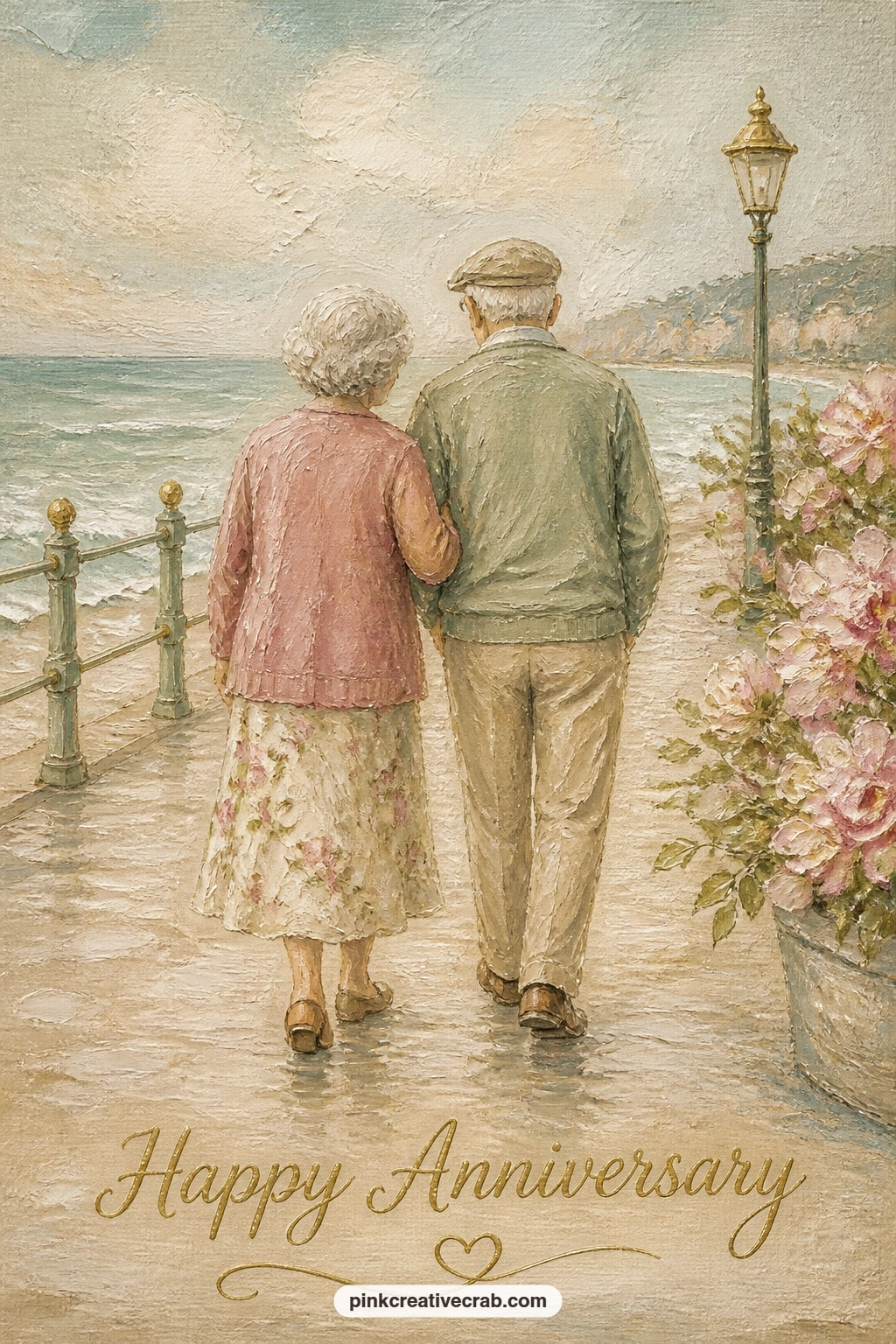
Palette: Soft Cream,Sage Green,Payne’s Grey,Dusty Rose
Switch the mood with a couple sitting on the hood of an old car at a drive-in, a nighttime scene that leans on light more than any idea so far. Decide where your light source sits before anything else: the drive-in screen itself should glow as the brightest point in the painting, washing pale cream and soft gold light across the car and the couple’s faces.
Block in the dark night sky and car silhouette first in deep umber and grey, then paint the glowing screen in the distance as a soft rectangle of light, and finally add the couple sitting on the hood catching that glow on the sides of their faces.
Keep the car’s shape simple, a rounded hood and a few curved highlights, rather than trying to render real chrome and detail.
If the glow looks too hard-edged, soften the screen’s borders with a dry blending brush so the light feels like it is spilling rather than printed on. Swap the car for a simple blanket on the grass if painting vehicles feels too fussy today.

Palette: Payne’s Grey,Soft Cream,Gold Ochre,Burnt Umber
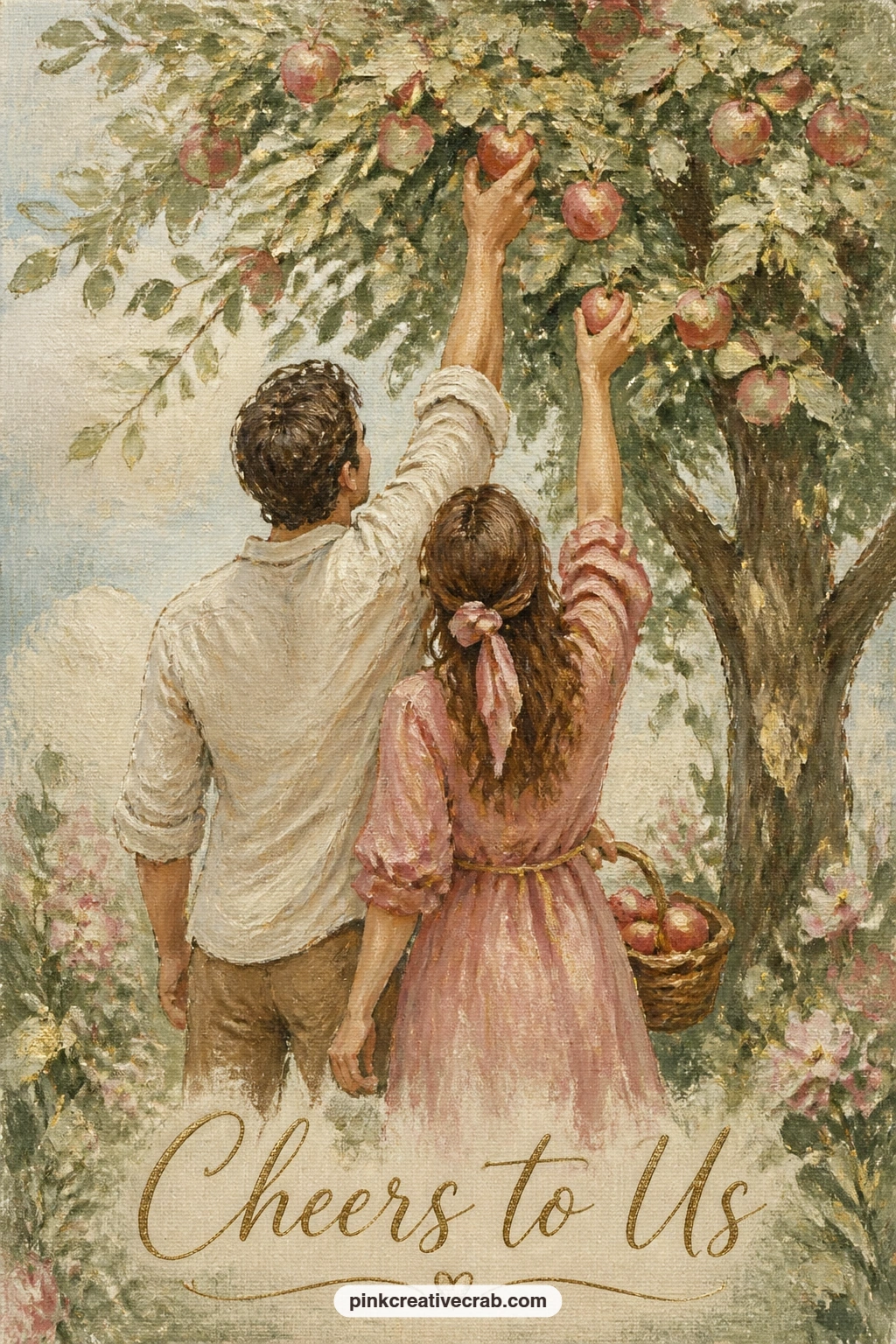
Return to the sapling idea from earlier, now grown up, with the same apple tree now tall with fruit and the couple picking together. Proportion is everything in this pairing: the tree should now tower well above the couple’s heads, its canopy filling the upper half of the canvas, a clear visual answer to how small that sapling once was.
Paint the sky and tree canopy first in rounded sage green masses dotted with small touches of dusty rose and cream for the apples, then bring the trunk down through the middle and add the couple reaching up together near its base.
Keep the apples as simple dabbed dots of color rather than individually shaded fruit, scattered unevenly through the canopy so it reads as a laden tree rather than a decorated one.
If the canopy looks too solid, leave small gaps of sky showing through in a few places. A rigger brush is handy for the thin branches peeking out at the canopy’s edges if you own one.
Palette: Sage Green,Dusty Rose,Soft Cream,Burnt Umber
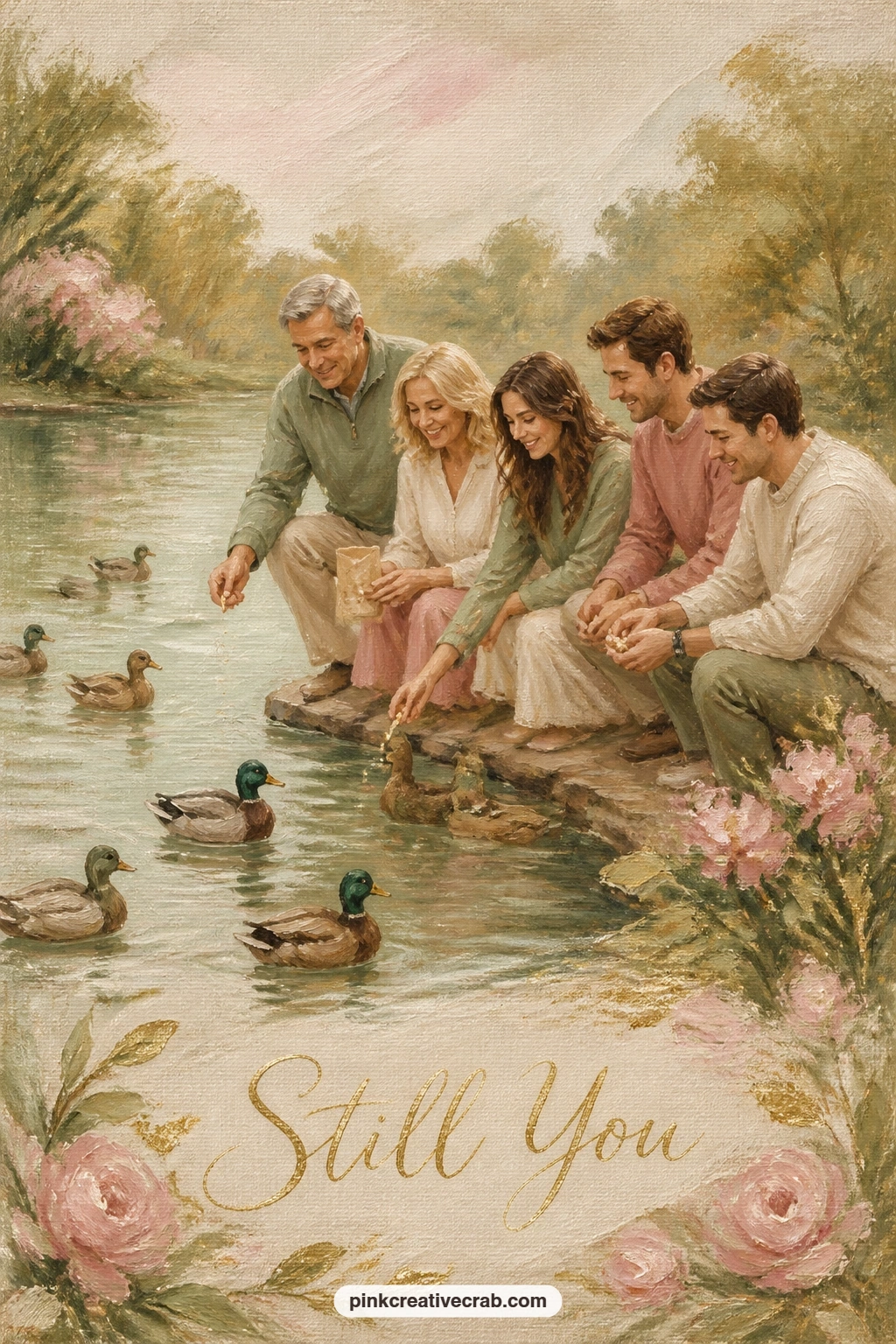
Widen the family a little with a couple feeding ducks at the old pond with their grown children, which brings more figures into frame than any scene so far. Start with a simple perspective trick, place the pond’s far edge higher on the canvas than its near edge, which tilts the water gently toward the viewer and gives the whole group somewhere to stand without looking stacked.
Paint the pond and far bank first, then add the group of figures along the near edge, keeping the couple slightly larger or more central and the grown children as softer, slightly smaller shapes beside them.
A few ducks scattered on the water finish the scene, each one just a simple oval body and a short line for the head, no individual feathers needed.
If the group of figures feels crowded, space them a little further apart and let some overlap slightly rather than lining them up evenly. This pairs nicely as a companion piece if you also try the family scenes gathered in the family painting ideas list.
Palette: Sage Green,Soft Cream,Dusty Rose,Burnt Umber
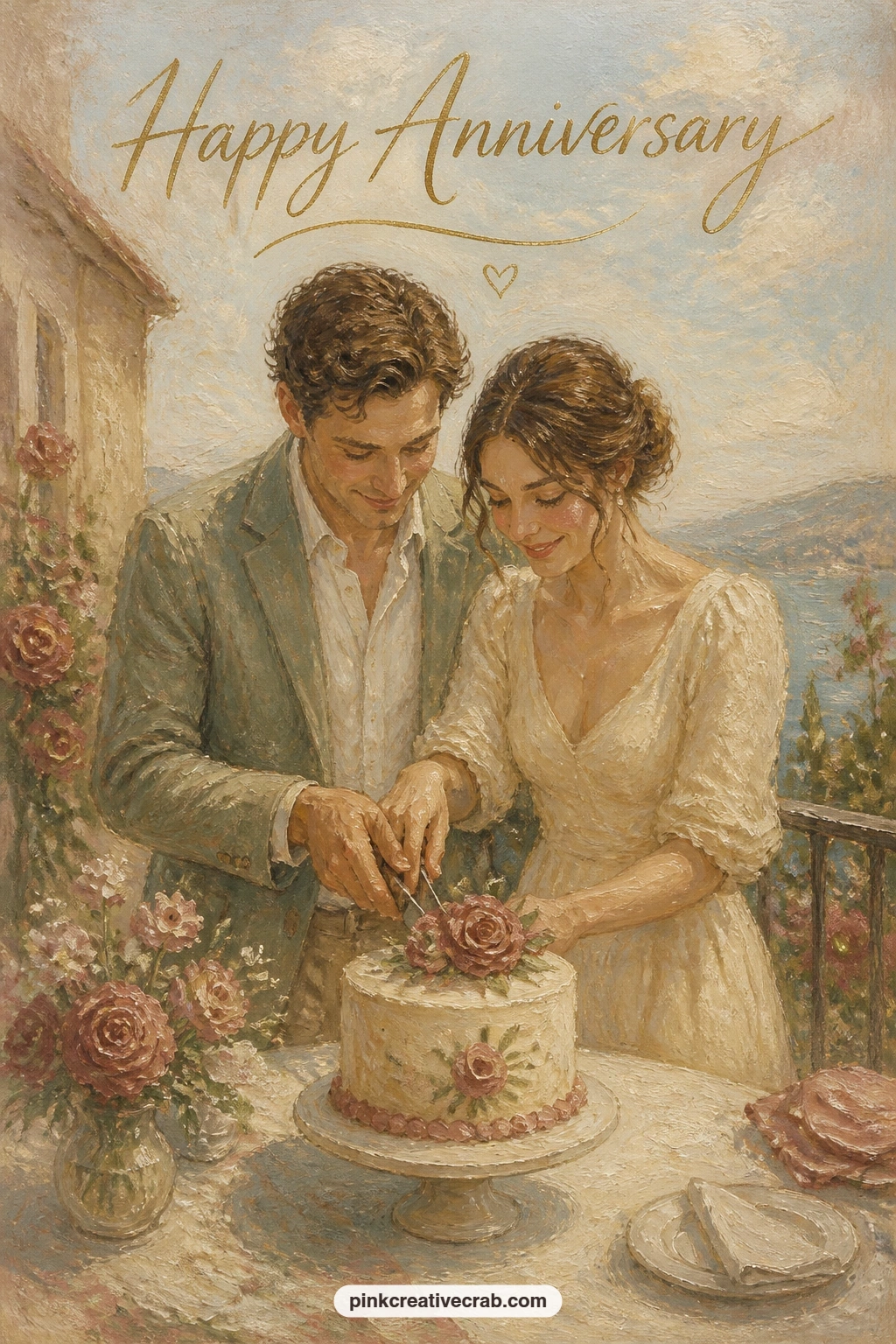
Move to a celebration with a couple cutting a small rose cake on a sunny balcony, a bright scene that works well as a quick ten minute study or a fuller forty minute piece. Quickly, block the couple and cake as simple shapes with the balcony railing behind them, leaving most detail for later or skipping it entirely if time is short.
Given more time, refine the cake with a few dabbed rose decorations in dusty rose and cream, add soft sunlight catching the railing and the couple’s hands on the knife, and deepen the shadow beneath the cake plate for weight.
Keep the cake itself small and simple, two or three tiers at most, iced in soft cream with just a handful of rose dabs rather than elaborate piping.
If the balcony background feels empty, a single potted plant in the corner fills the space without competing with the couple. A painting knife loaded with pure cream gives a nice thick highlight along the cake’s top edge.
Palette: Soft Cream,Dusty Rose,Sage Green,Gold Ochre
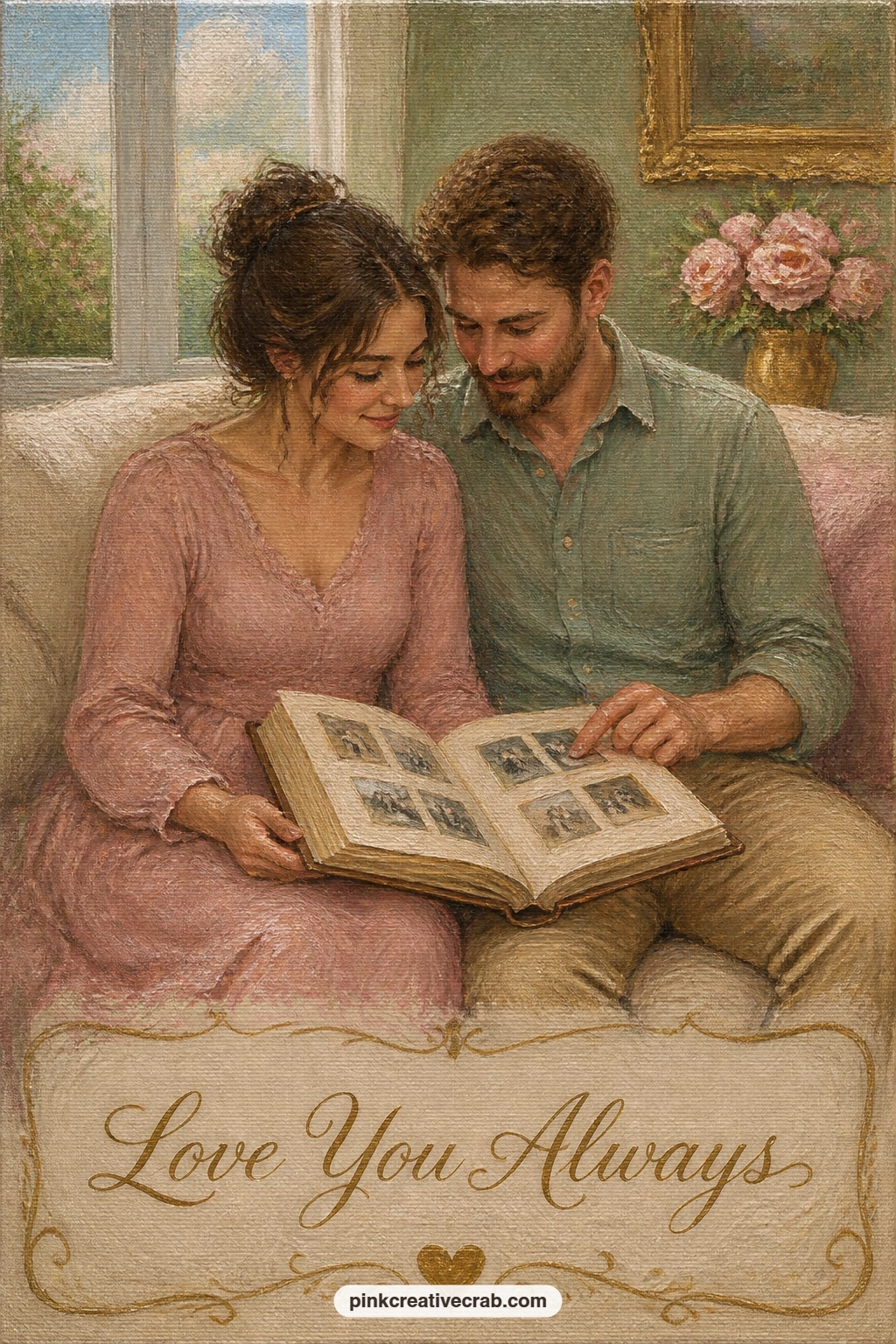
Slow the pace with a couple looking through an old photo album on the sofa, a cozy indoor scene that rewards careful edge work over anything flashy. Build the sofa and room first in soft sage and cream, keeping the background loose and slightly blurred, then paint the couple seated close together with the open album resting across both their laps.
The album itself is the one place worth sharpening your focus, since a slightly crisper edge there draws the eye exactly where the story sits. Keep the pages mostly pale cream with just a few tiny marks suggesting photographs, nothing detailed enough to read as specific pictures.
Let their heads lean gently toward each other and toward the album, which does most of the emotional work without needing any expression at all.
If the sofa looks stiff, round its cushions with soft curved strokes rather than straight lines. A warm lamp glow to one side, painted as a soft circle of cream, adds coziness if the room feels too flat.
Palette: Sage Green,Soft Cream,Dusty Rose,Burnt Umber
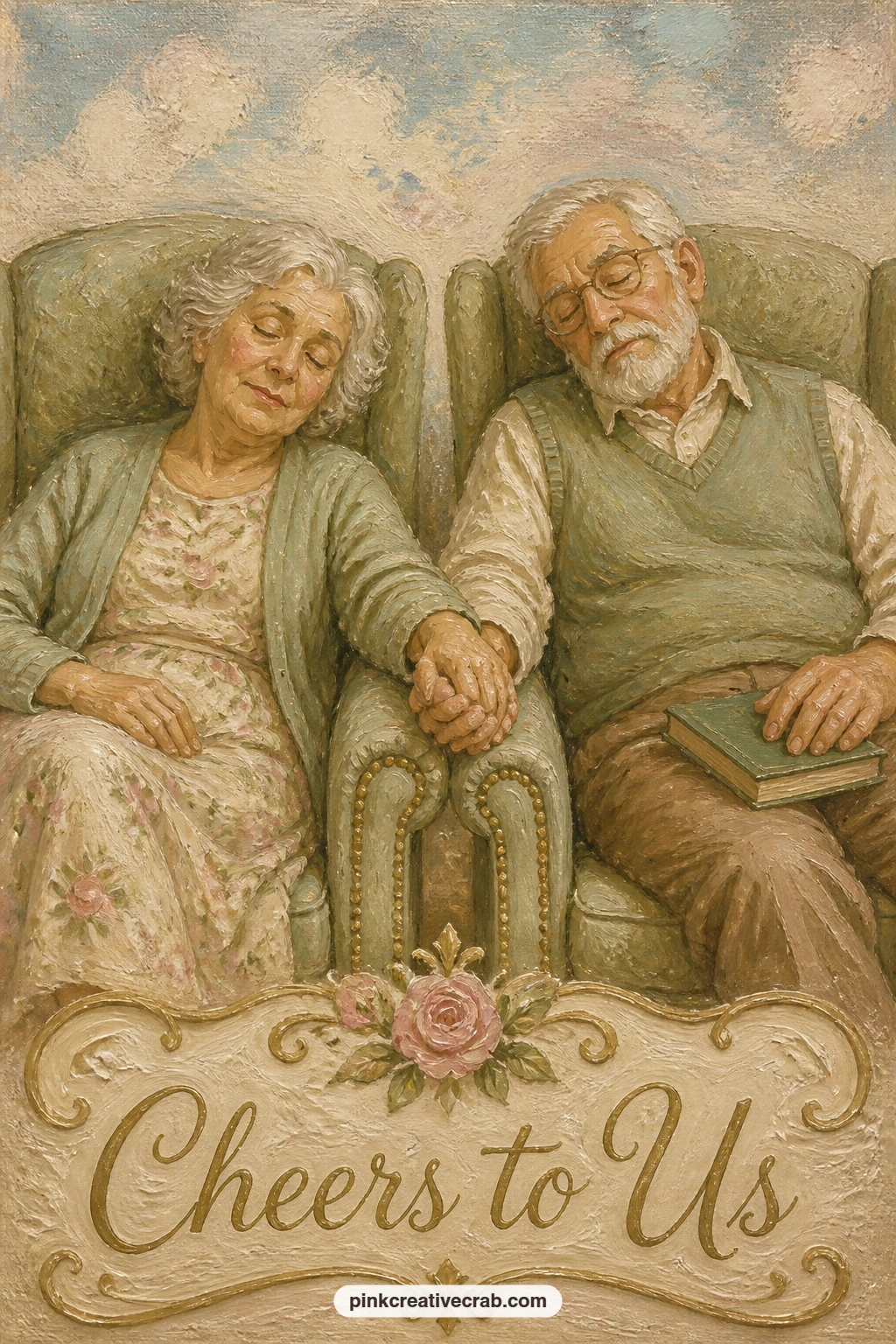
Give the couple a quiet rest with an older couple holding hands while napping in two armchairs, a gentle scene built almost entirely on soft edges. Paint the two armchairs first as simple rounded shapes in sage green with cream highlights, placed close enough together that the arms can meet in the middle without stretching unnaturally.
Add the couple settled into each chair, heads tilted slightly, eyes closed with just a single soft curved line each rather than lashes or detail, then bring their hands together on the shared armrest as the focal point of the whole piece.
Blur the edges of the chairs and the figures slightly into each other with a soft dry brush, since napping scenes read better loose than sharp.
If the hands look awkward, simplify them to soft rounded shapes rather than individual fingers, a common trouble spot at this scale. A throw blanket draped over one chair arm, in dusty rose, adds warmth without extra work.
Palette: Sage Green,Soft Cream,Dusty Rose,Payne’s Grey
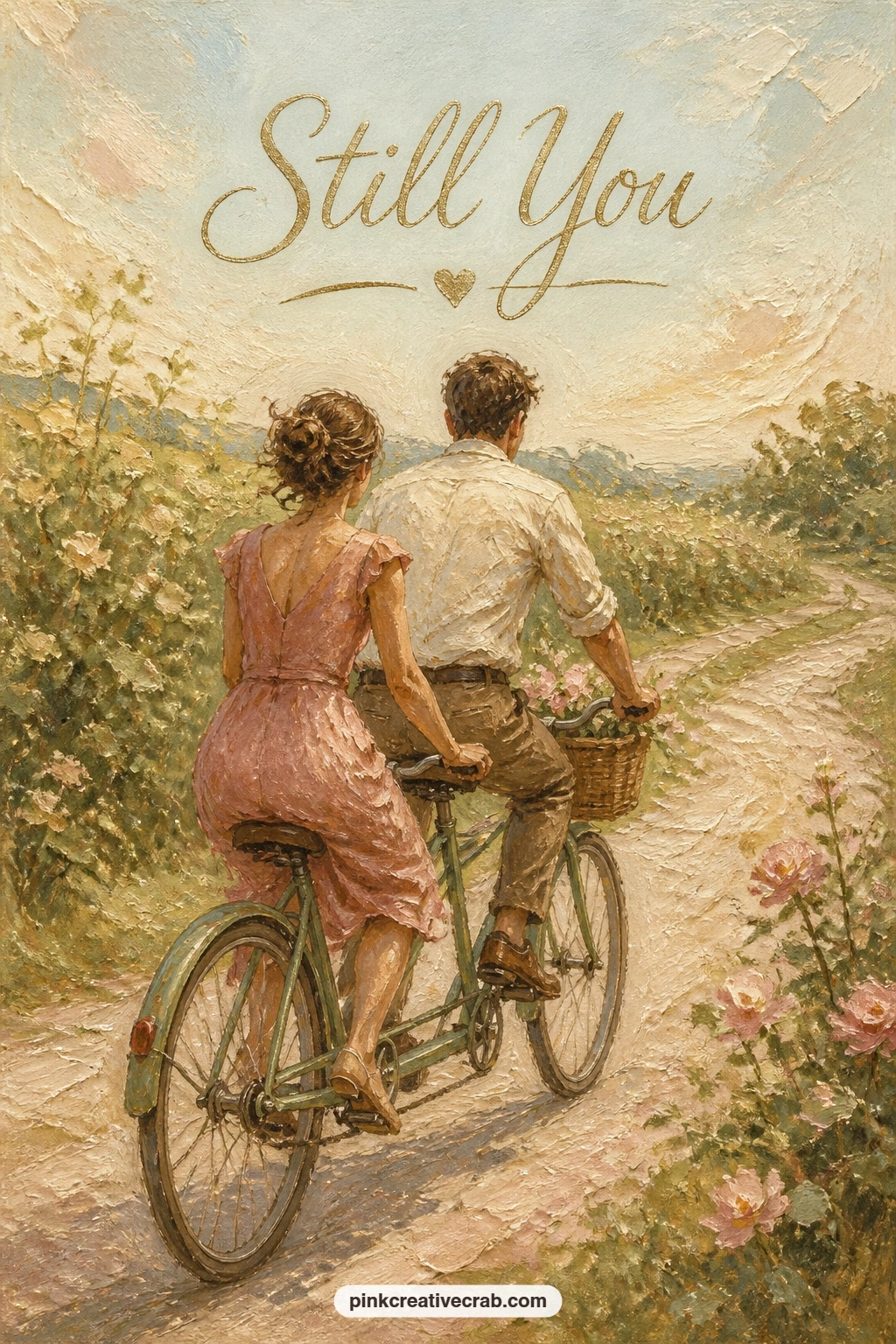
Pick the pace back up with a couple on a tandem bicycle down a country lane in summer, a scene full of movement that still works fine held still. Think about proportion again here: the bicycle’s two wheels should sit at the same size and the same distance apart no matter how the lane curves behind them, since a mismatched tandem is the fastest way to lose the whole picture’s believability.
Sketch the bicycle shape lightly first in thin umber lines before adding any color, checking that both riders sit at a sensible height on the frame, then paint the lane and hedgerows behind them in loose sage and cream strokes.
Keep the wheels as simple circles with a few spoke lines rather than fully rendered mechanics, and let the lane blur slightly at the edges to suggest motion.
If the bicycle still looks off, a quick photo reference of a real tandem helps more than guessing proportions from memory. Fields of loose cream and gold wildflowers along the lane cover for any remaining wobble in the hedgerow.
Palette: Sage Green,Soft Cream,Gold Ochre,Burnt Umber
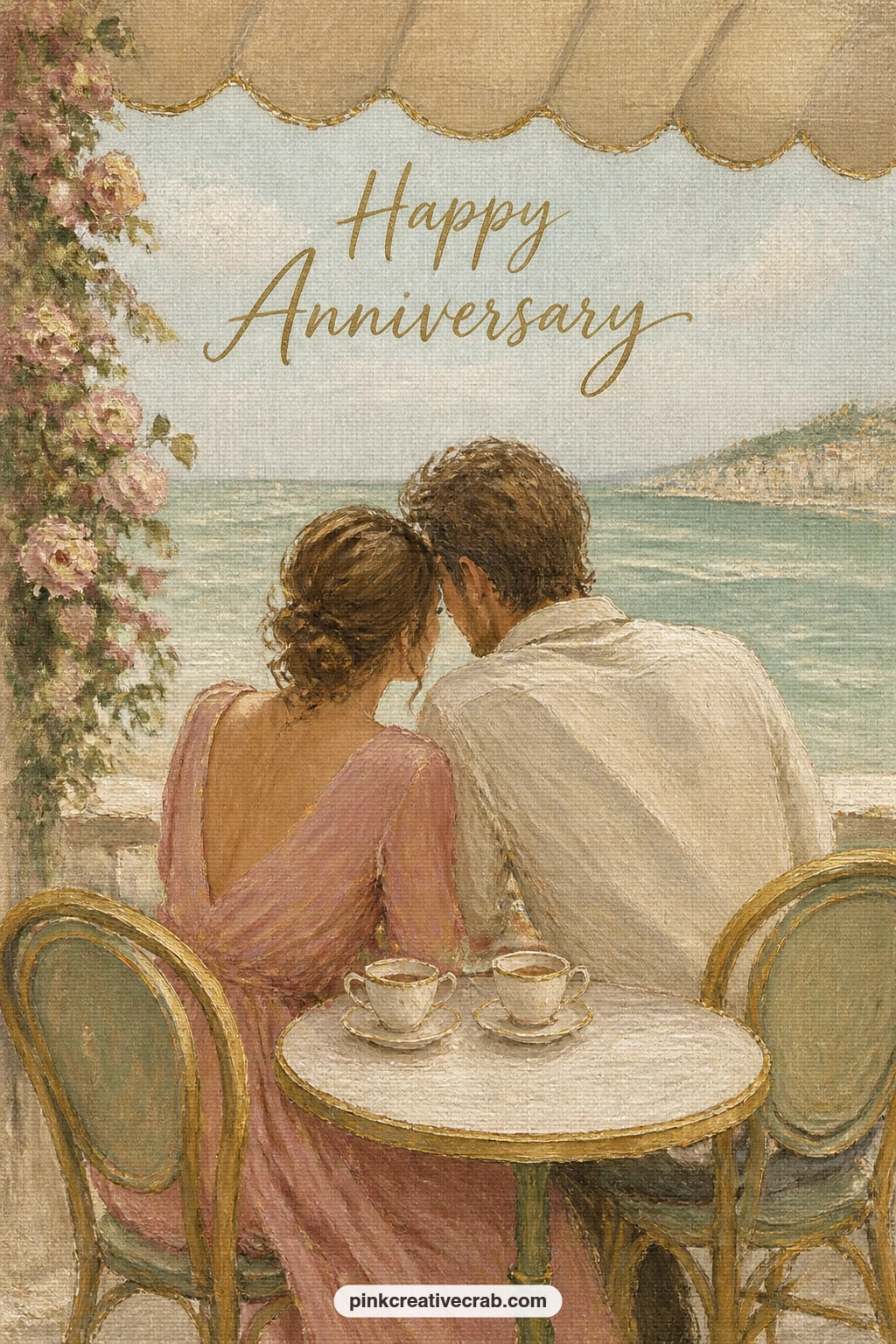
Return the couple to where things began with a couple back at the seaside cafe of their first date, a scene that pairs well with the earlier promenade walk. Eye level matters here: sit the viewer at table height, looking slightly up at the couple across a small cafe table, which makes the moment feel shared rather than observed from a distance.
Paint the cafe’s awning and background sea first in soft cream and pale sage, then bring in the small round table and two chairs before the couple themselves, seated close with cups between them.
Let the sea beyond the awning stay loose and pale, almost just a suggestion of blue-grey, so it reads as backdrop rather than competing with the couple in the foreground.
If the table feels too bare, two simple teacups and a small vase with one flower fill it without clutter. Readers who enjoy this kind of cozy café mood might also like the cafe drawing ideas for more scenes in that spirit.
Palette: Soft Cream,Sage Green,Payne’s Grey,Dusty Rose
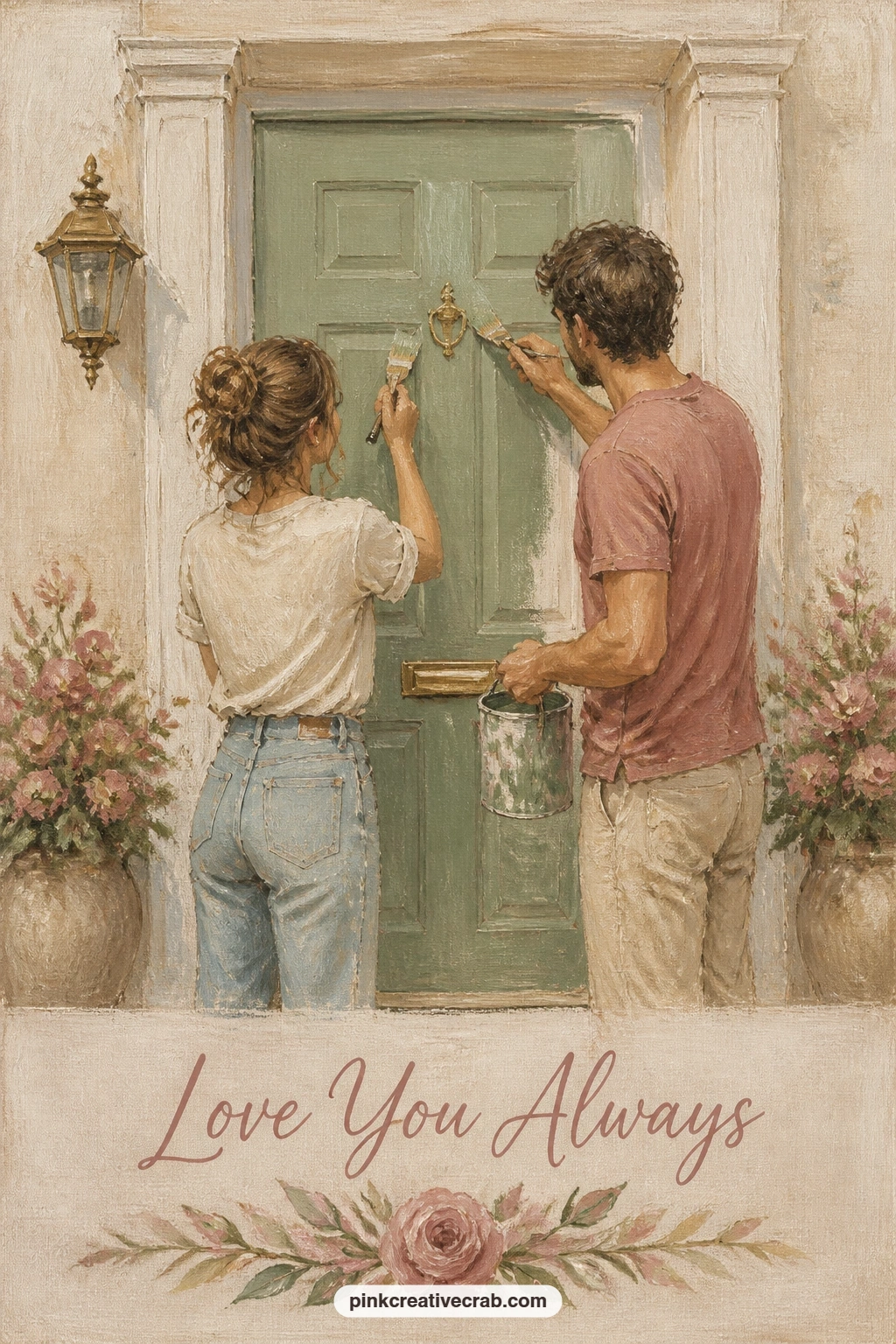
Bring the story back to their house with a couple painting their front door sage green together, a playful domestic scene that rewards a light touch with the brush. Start with the house facade in soft cream, then leave the door itself as bare canvas or a thin wash until last, since it needs to read as freshly wet paint rather than a finished surface.
Paint the couple standing at the door with brushes in hand, one reaching higher than the other, then finally add the door’s sage green in loose, visibly brushy strokes that run slightly uneven, mimicking real wet paint rather than a flat color fill.
A few drips or uneven edges along the door’s border actually help here, so resist the urge to clean them up too much.
If the door looks too flat, drag a dry brush over it once more in long vertical strokes before it fully sets. A painting knife dipped in pure sage gives one convincing thick drip if you want a playful final touch.
Palette: Sage Green,Soft Cream,Burnt Umber,Dusty Rose
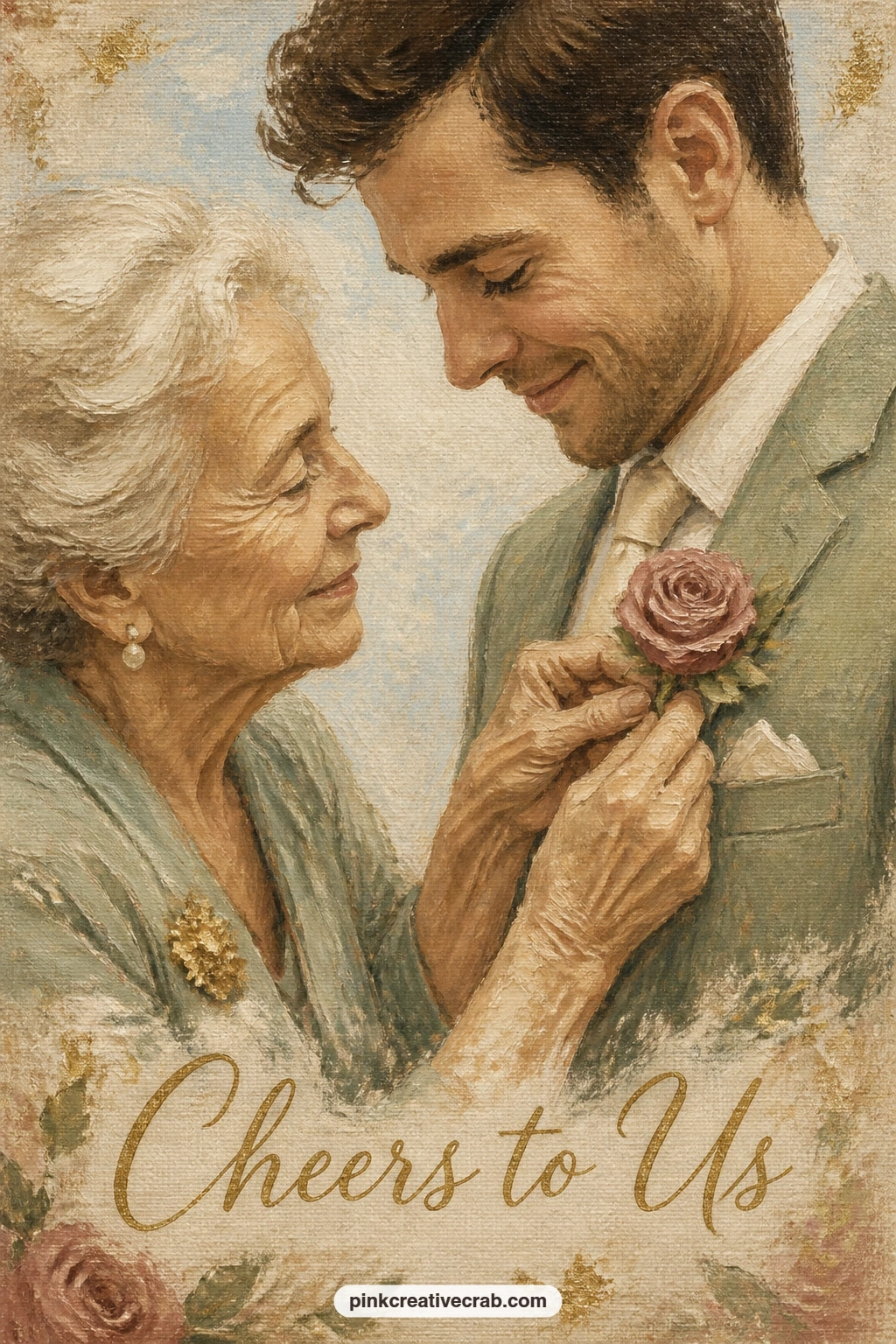
Slow down for a tender detail with a grandmother pinning a flower to grandpa’s lapel before a party, a close, small gesture rather than a wide scene. Crop in tighter than most of the earlier ideas here, framing mostly their upper bodies and faces so the small act of pinning the flower becomes the whole focus of the canvas.
Paint their clothing and background first in soft sage and cream, then bring their faces and hands in last, with her fingers gently at his lapel and the flower, a single dusty rose bloom, caught mid-pin.
Keep the flower itself as the most detailed element in the piece, three or four confident petal strokes, while everything else around it stays loose and soft.
If the hands look stiff, simplify them further rather than adding more detail, since at this size two soft curved shapes read better than overworked fingers. A single gold button or small gold accent on his jacket ties in the metallic note from the rest of the series.
Palette: Dusty Rose,Sage Green,Soft Cream,Gold Ochre
Take the couple onto the water with a couple rowing on a misty lake in matching sweaters, a scene built almost entirely from soft, hazy edges. Mist is a texture trick more than a drawing one: once the lake and distant shore are blocked in with pale sage and cream, drag a nearly dry, wide soft brush horizontally across the whole upper portion to soften and haze everything behind the boat.
Paint the rowboat and couple with slightly crisper edges than the misty background, which naturally pulls them forward as the clear focal point against the soft haze.
Keep their matching sweaters in the same dusty rose or sage tone so they read as a pair at a glance, even from across a room.
If the mist effect looks patchy, go over it a second time once the first pass is dry, building the haze gradually rather than trying to get it in one go. A fan brush makes quick work of the softened reeds along a distant shoreline if you want one more small detail.

Palette: Sage Green,Soft Cream,Dusty Rose,Payne’s Grey
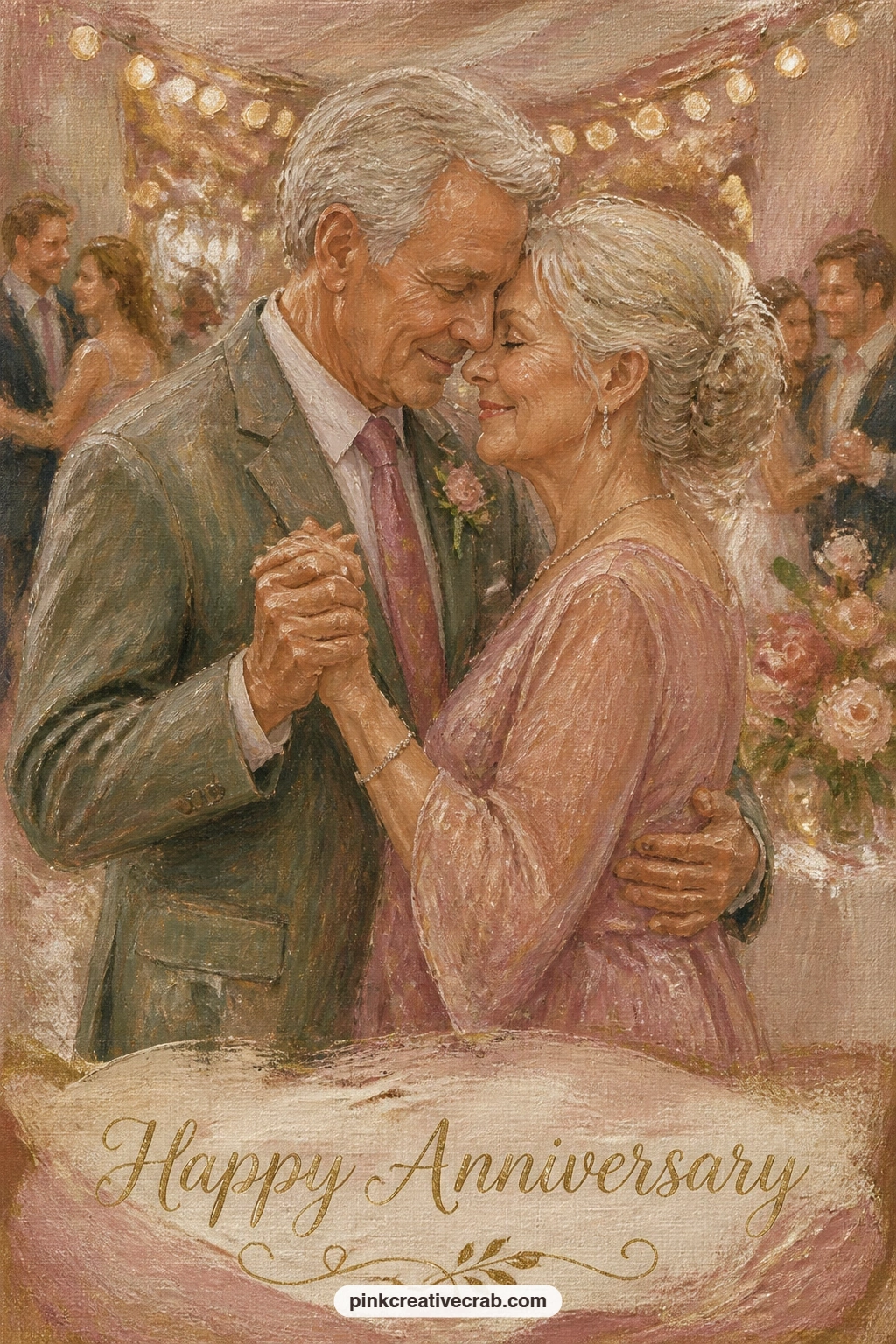
Jump ahead a generation with a couple slow dancing at their grandchild’s wedding, a scene that lets you bring in soft background shapes without painting a whole crowd. Quickly block this one in ten minutes by placing the dancing couple center frame with just a loose suggestion of fairy lights and blurred guests behind them, enough to say wedding without detailing a single other face.
With more time, refine the couple’s formal clothing with a touch more structure, soften and multiply the background fairy lights with small dabbed dots of cream and gold, and add a hint of a floral arch or table setting at the very edges of the frame.
Keep every background figure as a soft blurred shape, never a defined face, which keeps the focus entirely on the dancing couple no matter how much time you add.
If the background feels too busy, simplify it back down, a plain soft wash often reads better than an overworked crowd. One string of lights in gold ochre across the top of the canvas ties this scene back to the very first idea in the series.
Palette: Dusty Rose,Gold Ochre,Soft Cream,Sage Green
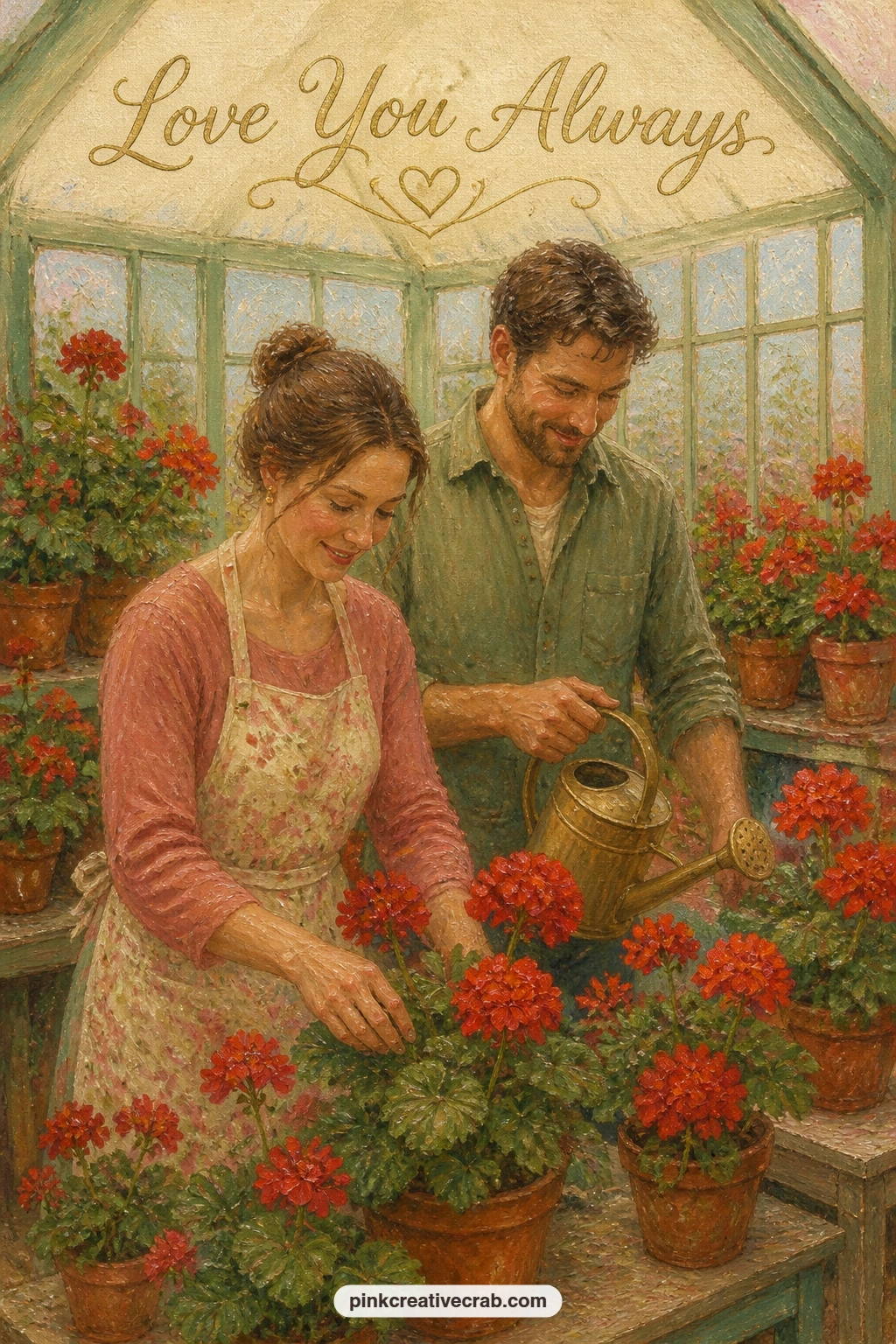
Step into a greenhouse full of red geraniums with the couple tending it together, a scene that lets a single bold color break from the usual soft palette. Paint the greenhouse glass structure first in pale cream and sage, keeping the panes as simple geometric divisions rather than individually glazed squares, then fill it with loose clusters of geranium red scattered across several shelves.
Add the couple working among the plants, one watering and one pinching back leaves, keeping their poses active but their faces simple as always.
The geraniums are the one place to let color run a little stronger than the rest of this series, since their red against all that soft sage and cream is exactly what makes the scene feel alive.
If the glass structure looks too rigid, loosen the pane lines slightly so they feel hand built rather than drafted. A toothbrush flicked with tiny drops of red makes a quick, convincing cluster of small blooms if you are short on time.
You Will Need
- toothbrush for flicked paint texture
Palette: Geranium Red,Sage Green,Soft Cream,Burnt Umber
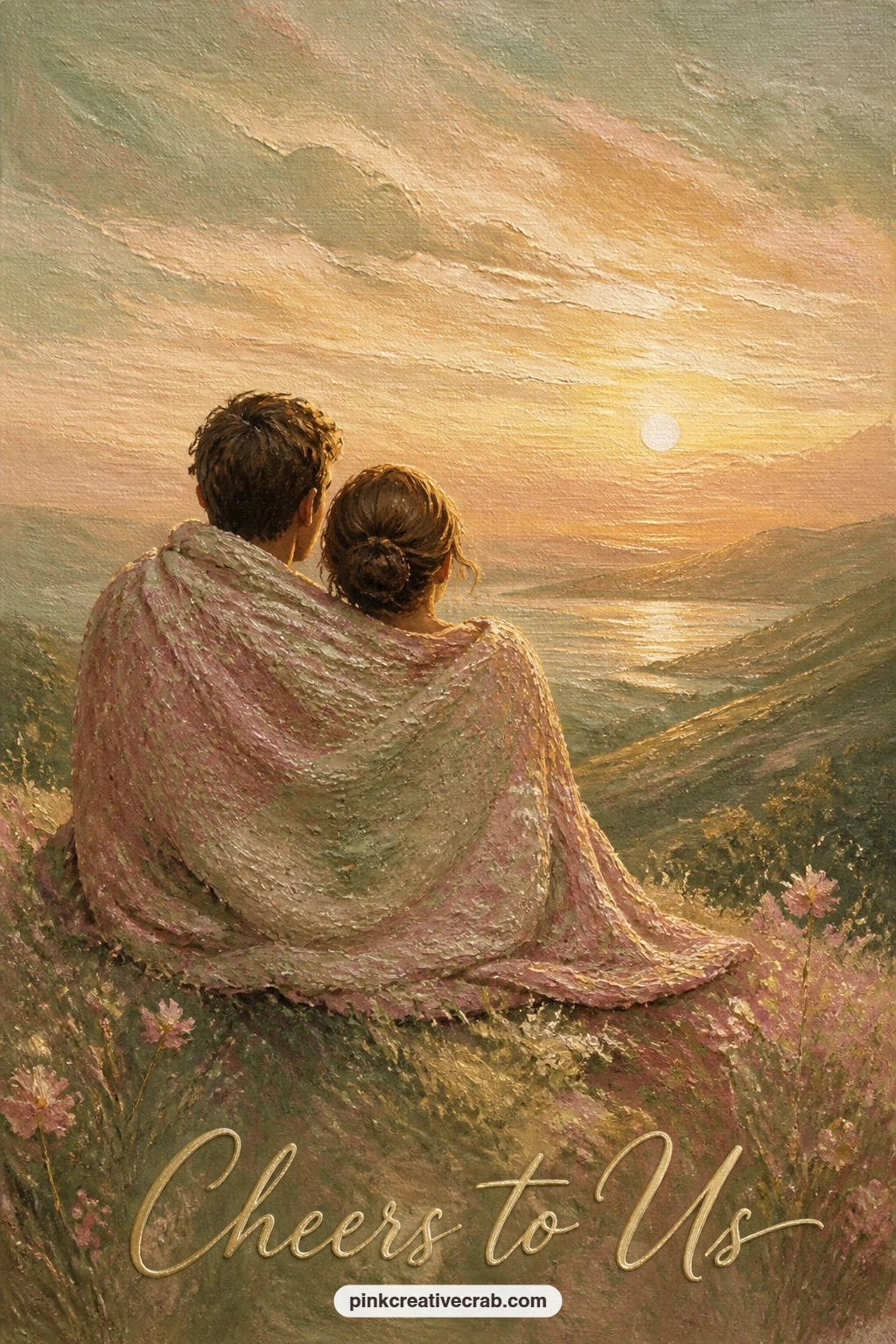
Carry the warmth outdoors with a couple wrapped in one blanket watching the sunrise from a hill, a scene where the light source decides almost everything. Place the rising sun low near the horizon, slightly off center, and let its glow wash upward through soft gold and cream into the darker sage-grey sky above, since that gradient is what makes a sunrise read correctly rather than looking like flat daylight.
Paint that sky gradient first, working wet into wet so the colors blend softly at their edges, then add the hill as a simple dark silhouette and the couple sitting atop it wrapped in one shared blanket.
Keep the blanket as one unified shape around both figures rather than two separate ones, since the shared wrap is the detail that makes this scene about togetherness rather than just a view.
If the gradient looks banded, blend it with a soft dry brush while still wet rather than adding more paint. A single bird silhouette crossing the sky adds scale without any extra detail work.
Palette: Gold Ochre,Soft Cream,Sage Green,Payne’s Grey
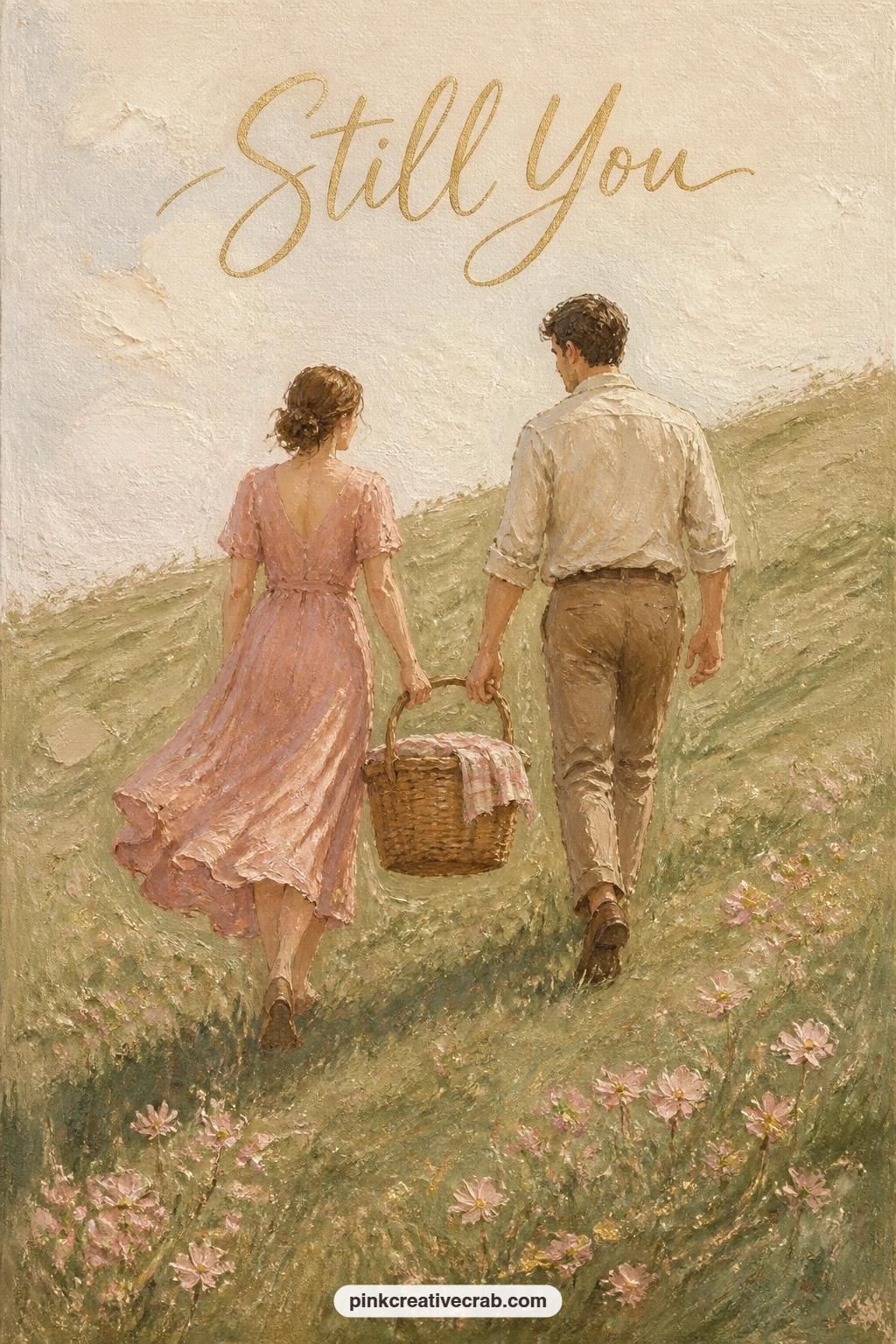
Go back to the very start of their romance with a couple climbing the grassy hill of their first date with a picnic basket, a companion piece to the sunrise scene above. Measure the hill’s slope against the couple’s height before painting: the hill should rise at roughly a forty five degree angle behind them, steep enough to suggest a climb without tipping the whole composition off balance.
Paint the sky and hill first in broad sage and cream strokes, following that slope, then add the couple walking upward together with the picnic basket swinging between their joined hands.
Let the grass texture come from quick upward flicks of a dry brush loaded with a slightly darker sage, applied only in patches rather than across the whole hill, which suggests texture without demanding you paint every blade.
If the hill’s slope looks unconvincing, double check that the couple’s feet sit at different heights on the canvas, climbing figures should never stand level with each other. A few wildflower dabs in dusty rose scattered through the grass finish the scene quickly.
Palette: Sage Green,Soft Cream,Dusty Rose,Burnt Umber
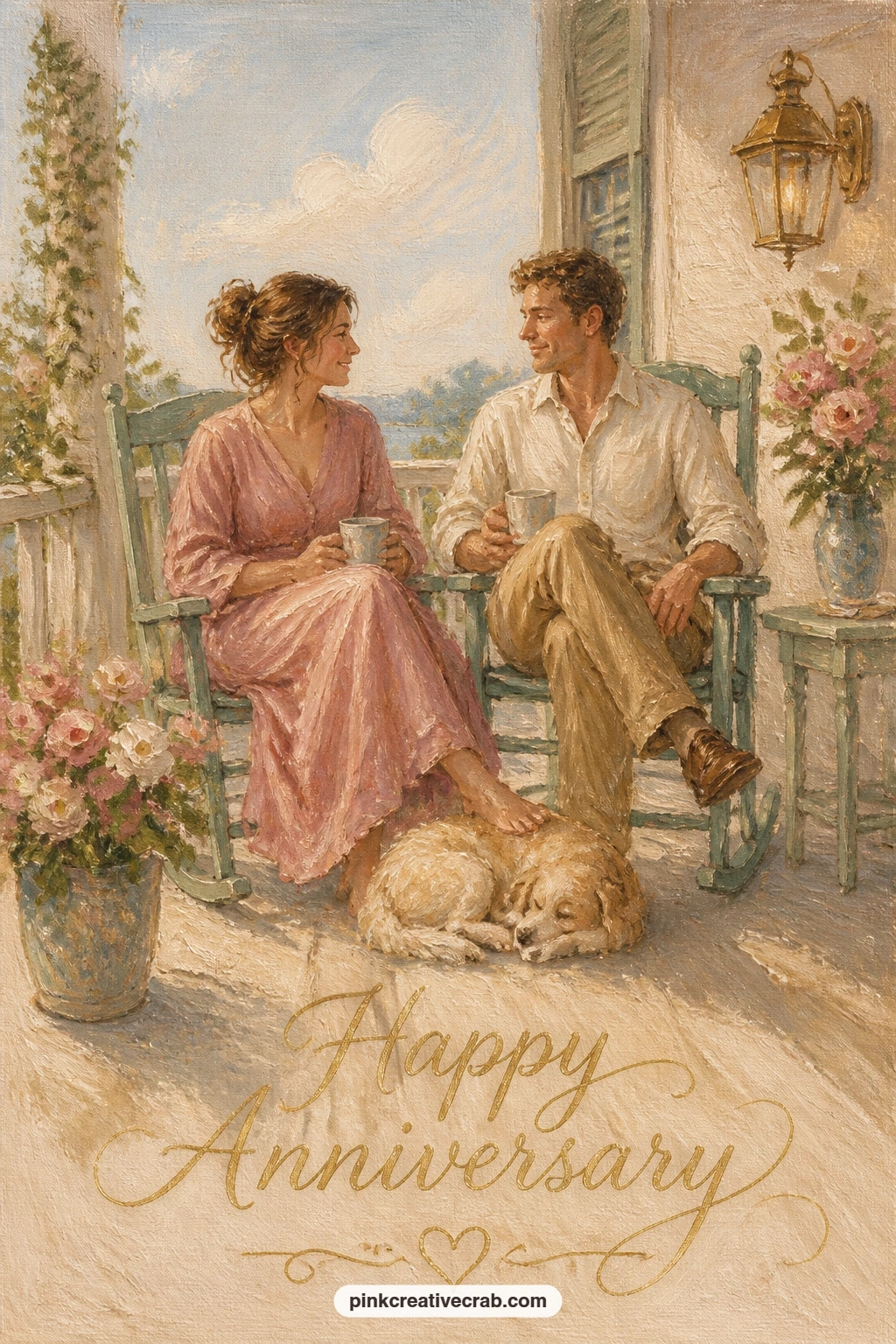
Bring in a beloved pet with a couple on a sunny porch with their dog asleep between them, a relaxed scene that balances three subjects without crowding the canvas. Place the dog as the literal and visual center point, curled into a simple rounded shape between the couple’s chairs, which naturally pulls your eye back and forth between all three figures rather than settling on just one side.
Paint the porch and chairs first in warm cream and sage, then add the couple seated on either side before the dog goes in last as a soft curled shape in cream and umber.
Keep the dog simple, a rounded back, a tucked head, maybe one ear flopped over, since an overworked dog face will pull attention away from the couple it is meant to connect.
If the three subjects feel disconnected, a shared patch of sunlight falling across all of them helps tie the composition together visually. Any small, quiet dog breed works here, so paint whichever shape feels easiest to simplify.
Palette: Soft Cream,Sage Green,Burnt Umber,Dusty Rose
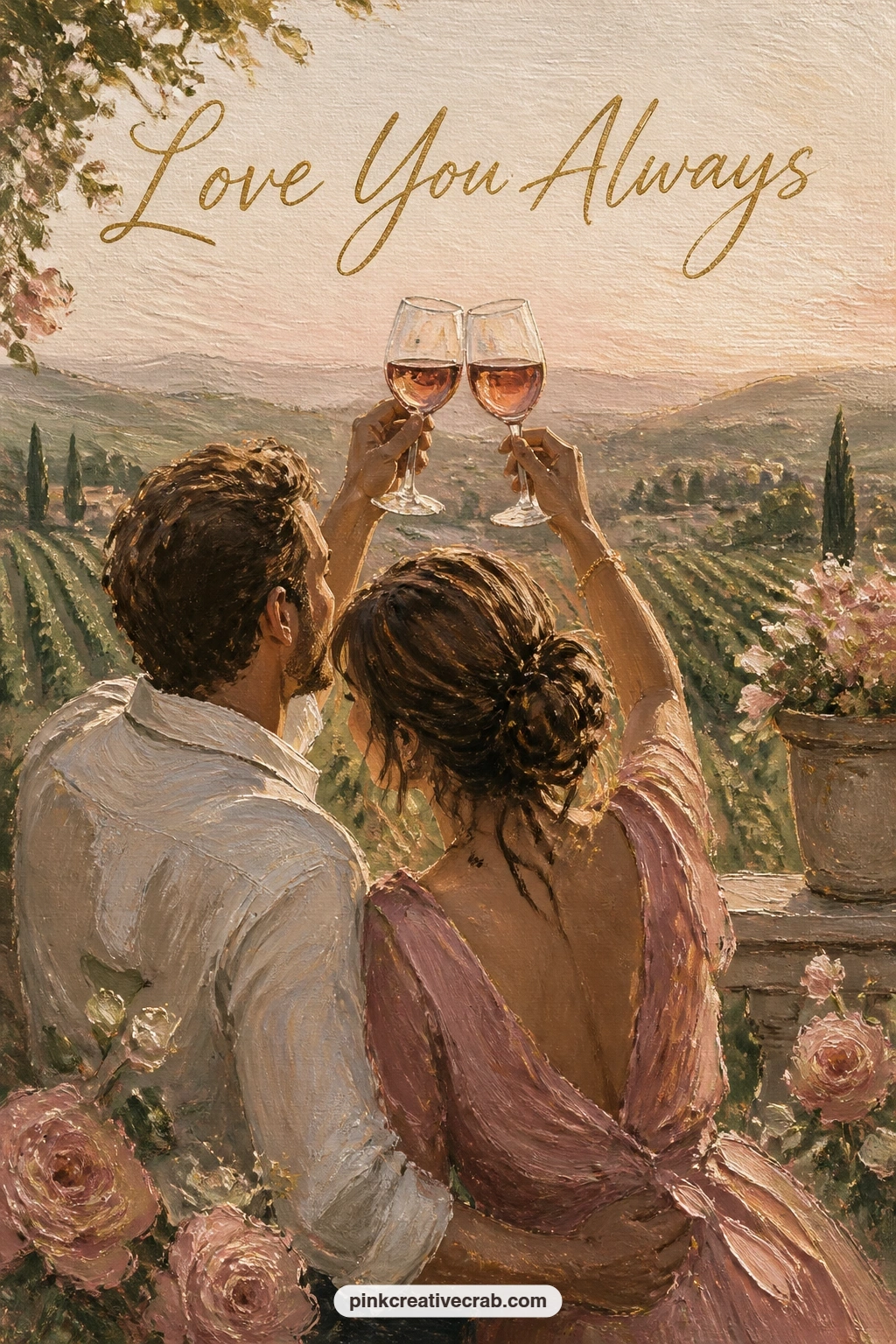
Take the couple somewhere further afield with a couple toasting with two glasses on a terrace above vineyards, a scene that leans on a wide, sunny background. Set your light source behind the couple, low in the sky, so it rims their shoulders and the edges of the wine glasses with a thin line of gold while their faces stay in softer shadow, a backlit effect that reads as golden hour instantly.
Paint the vineyard rows and distant hills first in loose horizontal bands of sage and cream, then add the terrace railing and finally the couple raising their glasses, keeping that gold rim light as the last and brightest marks you make.
The two wine glasses are small but worth care: a single bright dot of cream on each is enough to suggest glass catching light without needing to render transparency.
If the backlighting looks flat, darken the couple’s silhouettes slightly more than feels natural, since strong backlight always reads darker on the front-facing side than beginners expect. A warmer gold wash across the whole sky ties the mood together if the scene feels cool.
Palette: Gold Ochre,Sage Green,Soft Cream,Dusty Rose
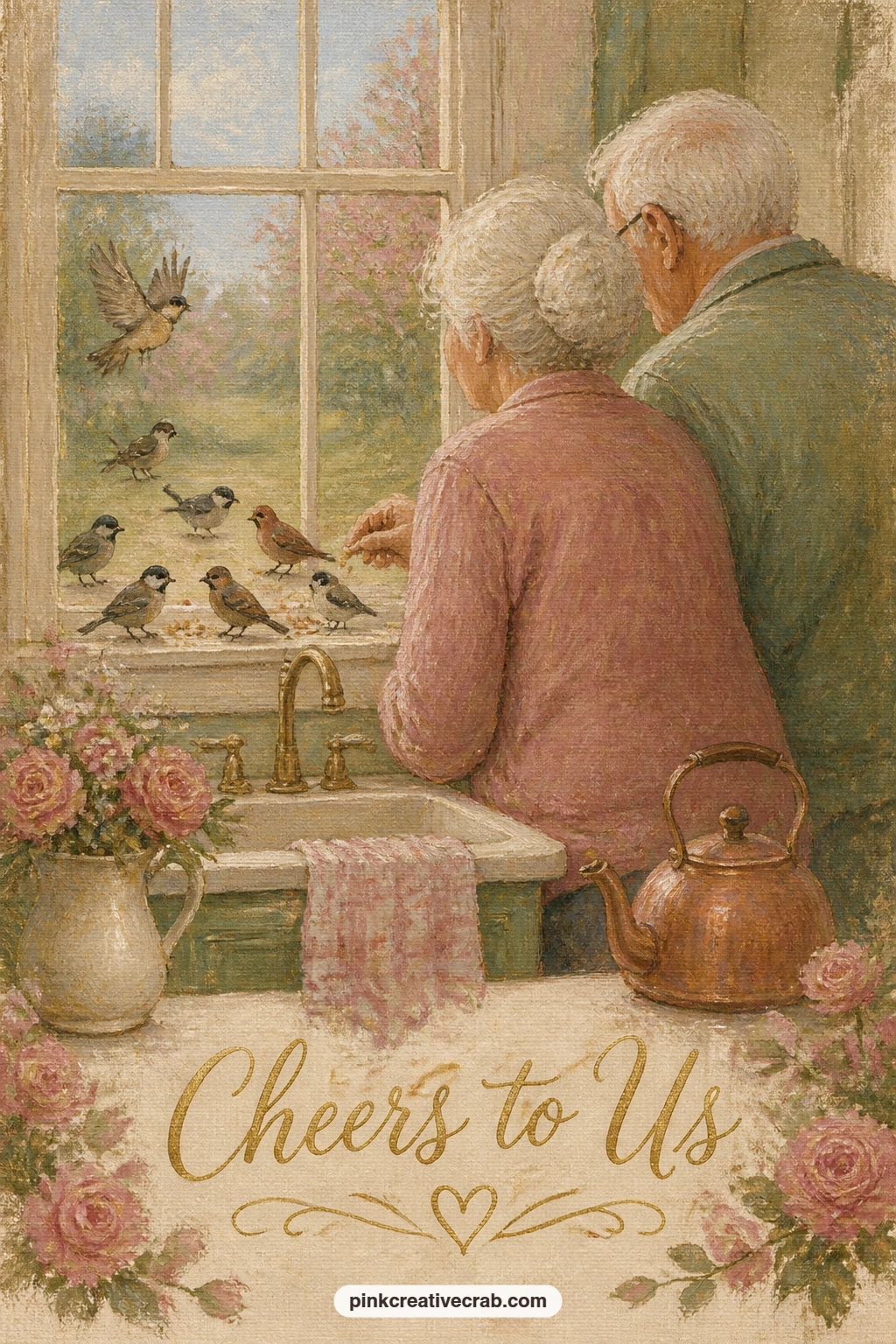
Bring the scene back inside with an old couple feeding birds from the kitchen windowsill, a quiet close-up scene that works beautifully in a small format. Crop this one tight around the window frame itself, with the couple’s faces and hands visible just behind the glass, since the windowsill and birds outside should feel like the clear subject rather than a wide kitchen.
Paint the window frame and a soft blurred kitchen interior behind the couple first, then bring in a simple birdfeeder or scattered seed along the outer sill before adding two or three small birds, each just an oval body and a short beak line.
Keep the couple’s faces soft and slightly turned toward the window rather than the viewer, watching the birds rather than posing.
If the birds look stiff, vary their poses slightly, one pecking, one with head tilted, rather than painting identical copies. A simple sparrow or chickadee shape works well here, and if birds feel tricky today, try the techniques in the Christmas birds junk journal pages for more practice with small bird shapes.
Palette: Soft Cream,Sage Green,Burnt Umber,Dusty Rose
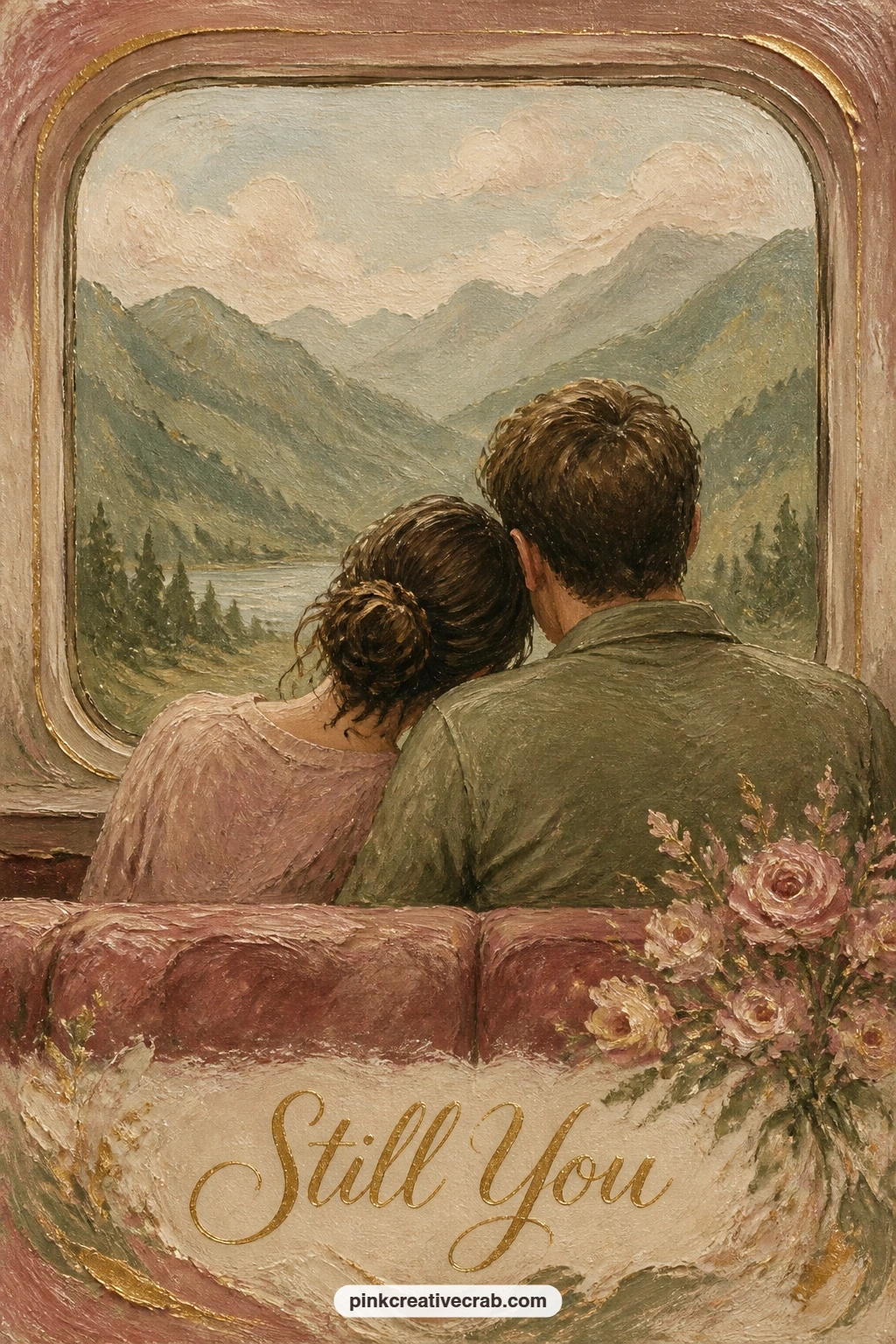
Send the couple traveling with a couple at a train window on an anniversary trip through the mountains, a scene built around a strong frame within the frame. Paint the train window itself first as a simple rounded rectangle, then treat everything outside it, the mountains, sky and passing landscape, as one continuous painted backdrop glimpsed through that window shape.
Add the couple seated close together inside the train, their faces turned toward the glass, with the window frame’s edge overlapping slightly in front of them to sell the sense of looking out from inside.
Keep the mountains loose and layered, pale sage in the distance growing slightly darker and cooler toward the foreground, which gives a quick sense of depth without much extra work.
If the window frame looks flat, add a thin highlight of cream along one edge where light catches the glass. A soft reflection of the couple’s shapes faintly echoed in the glass is a nice touch for a second attempt, but skip it if this is your first time painting reflections.
Palette: Sage Green,Soft Cream,Payne’s Grey,Dusty Rose
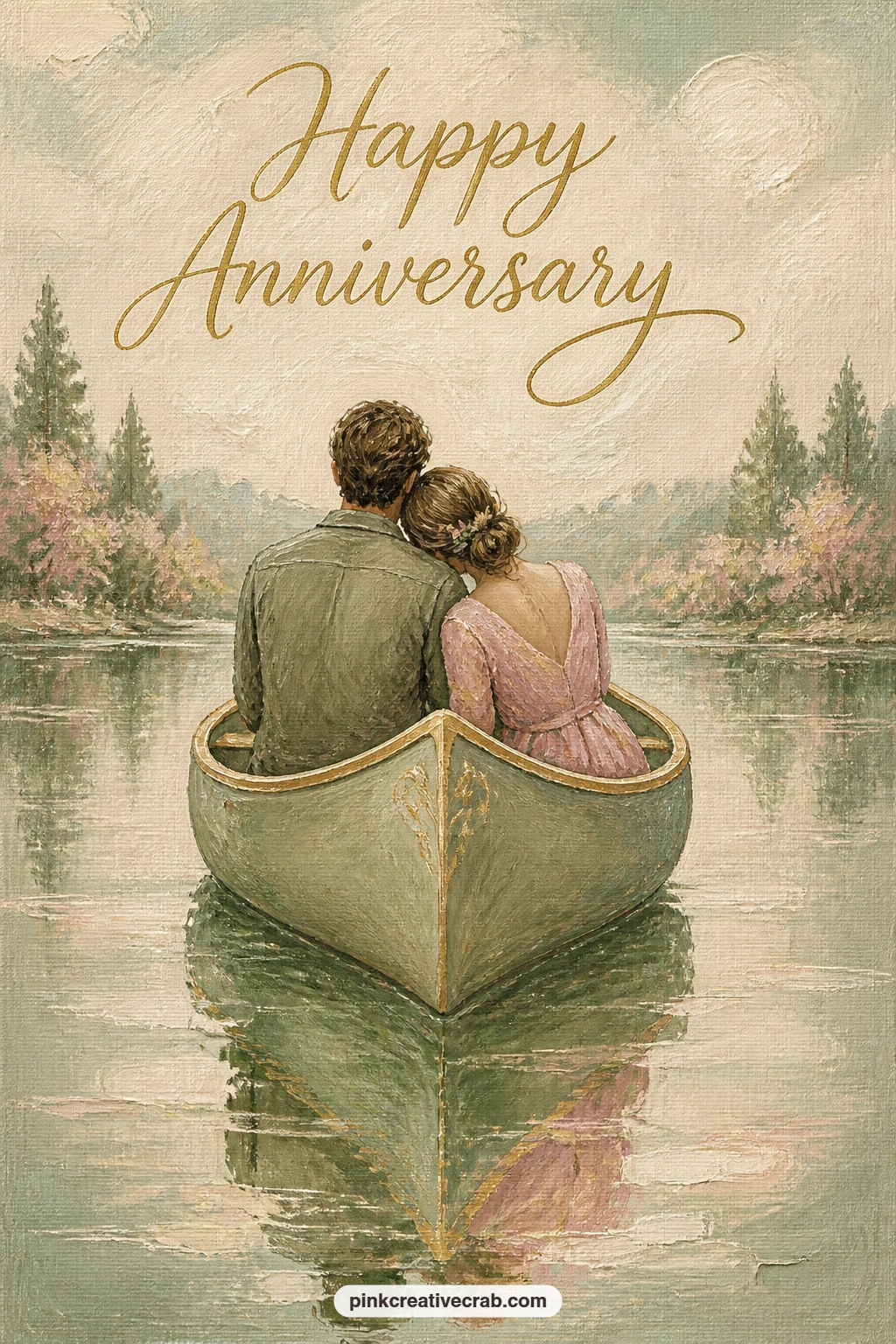
Return once more to still water with a couple in a canoe on the lake where he proposed, a tender bookend to the earlier rowing scene. Keep the water glassy and calm by painting it in one smooth horizontal wash of pale sage and cream first, then add just a few short reflected strokes of the canoe and couple’s colors directly below them once the figures are in, since a mirror-still lake reflects its subjects almost exactly.
Paint the canoe and couple after that calm water base, keeping the canoe’s shape simple and slightly tipped toward the viewer to show its inside, then add the couple seated close with one holding something small, a ring box or a single flower, between them.
That small held object is worth a touch more care than the rest of the scene, since it is the quiet detail that tells the viewer what moment this is.
If the reflection looks messy, keep it as just a soft blur of matching color directly under the canoe rather than a detailed mirror image. A single lily pad floating nearby adds a nice quiet touch if the water feels too empty.
Palette: Sage Green,Soft Cream,Dusty Rose,Burnt Umber
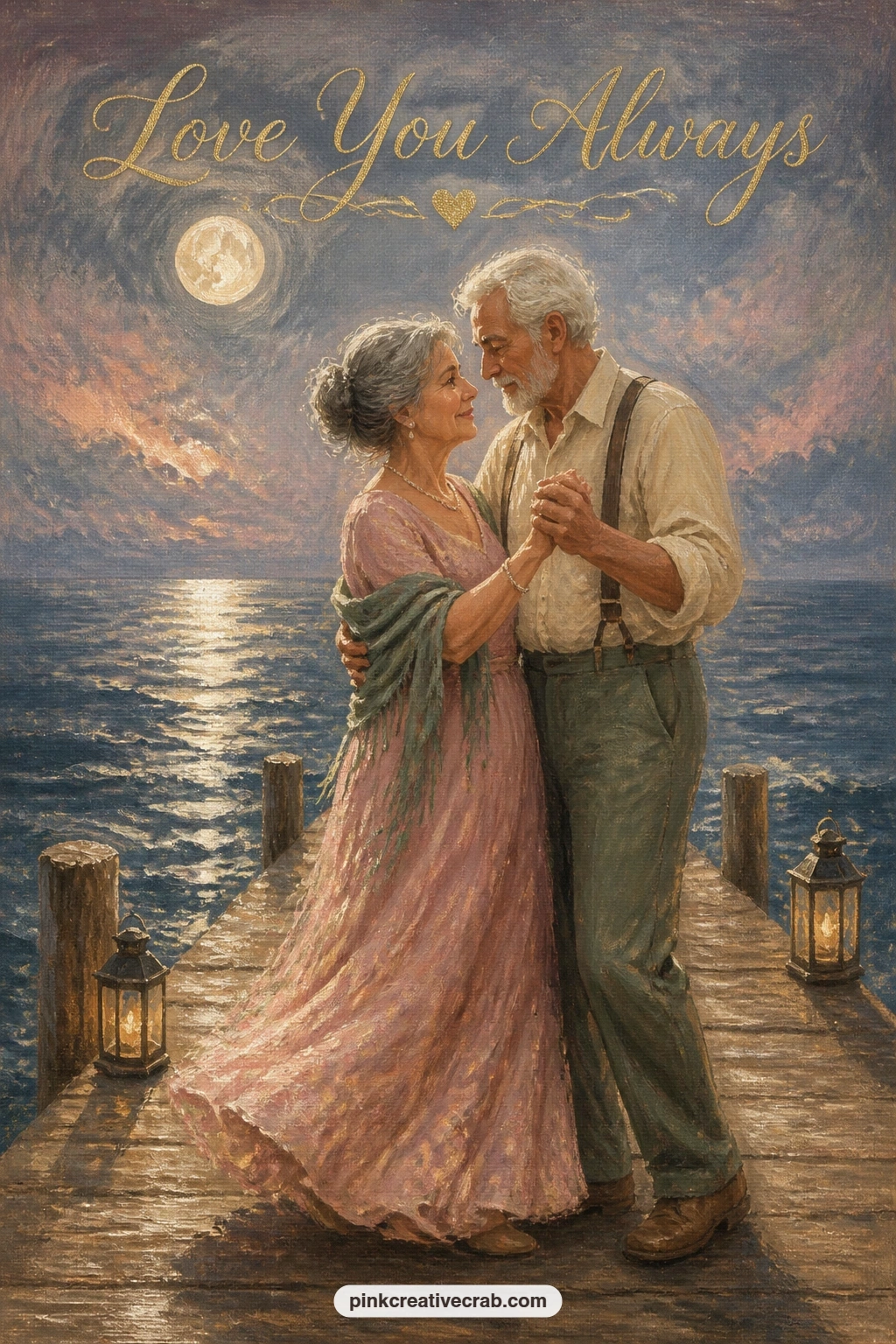
Take the couple out for one more nighttime scene with an older couple dancing on a moonlit pier, a quiet echo of the barn dance that opened this whole series. Place the moon high and slightly off center, letting its light lay a long pale streak down across the water toward the pier, which is the single detail that makes a night scene over water read correctly rather than just looking dark.
Paint the night sky and that moonlit water streak first, working the pale cream light in soft vertical strokes over a darker sage-grey base, then add the pier as simple dark planks and finally the dancing couple standing near its end.
Keep the couple as a soft, mostly silhouetted shape against all that pale light behind them, since strong silhouettes against moonlight read as more romantic than fully lit faces would here.
If the moonlight streak looks too solid, break it up slightly with a few darker horizontal strokes crossing through it to suggest gentle ripples. A single string of small lights along the pier railing ties this scene back to the string lights from the very first idea.
Palette: Payne’s Grey,Soft Cream,Sage Green,Gold Ochre
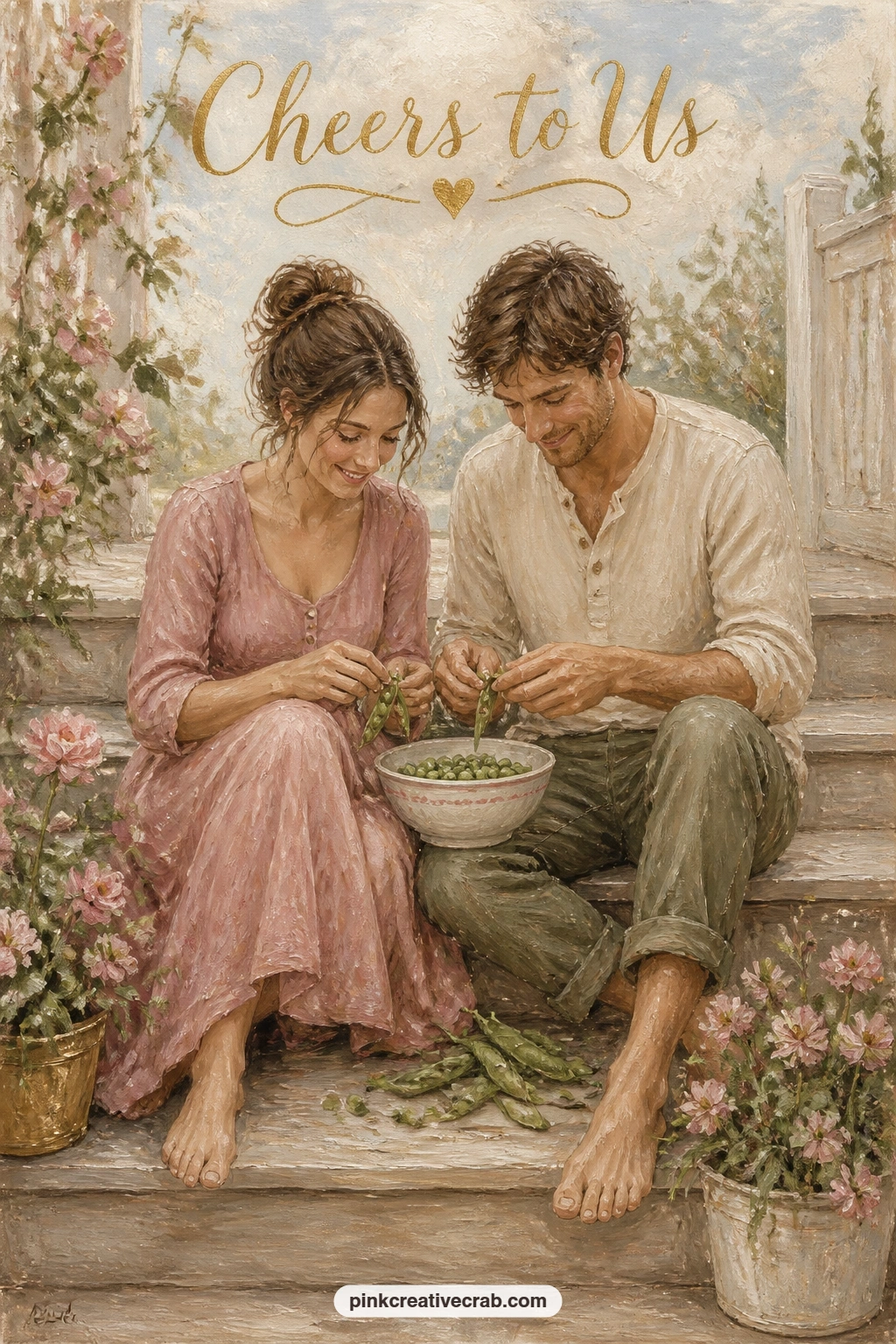
Slow right down again with a couple shelling peas together on the back steps, a small everyday task that makes a surprisingly tender little scene. Paint the back steps and a loose garden backdrop first in warm cream and sage, then add the couple seated side by side with a bowl of peas between them on their laps or the step itself.
The peas and pods are worth a little extra care here. Dab small rounded strokes of fresh sage green for the shelled peas gathering in the bowl, and a few open pod shapes nearby in a slightly duller green to show the task in progress.
Keep their hands simple but active, fingers slightly curled around a pod rather than resting flat, which sells the sense of real work happening in a still scene.
If the peas look like scattered dots rather than peas, group them in small clusters of three or four rather than spreading them evenly across the bowl. A simple wicker-textured bowl, suggested with a few curved dry brush lines, finishes the detail without much extra effort.
Palette: Sage Green,Soft Cream,Burnt Umber,Dusty Rose
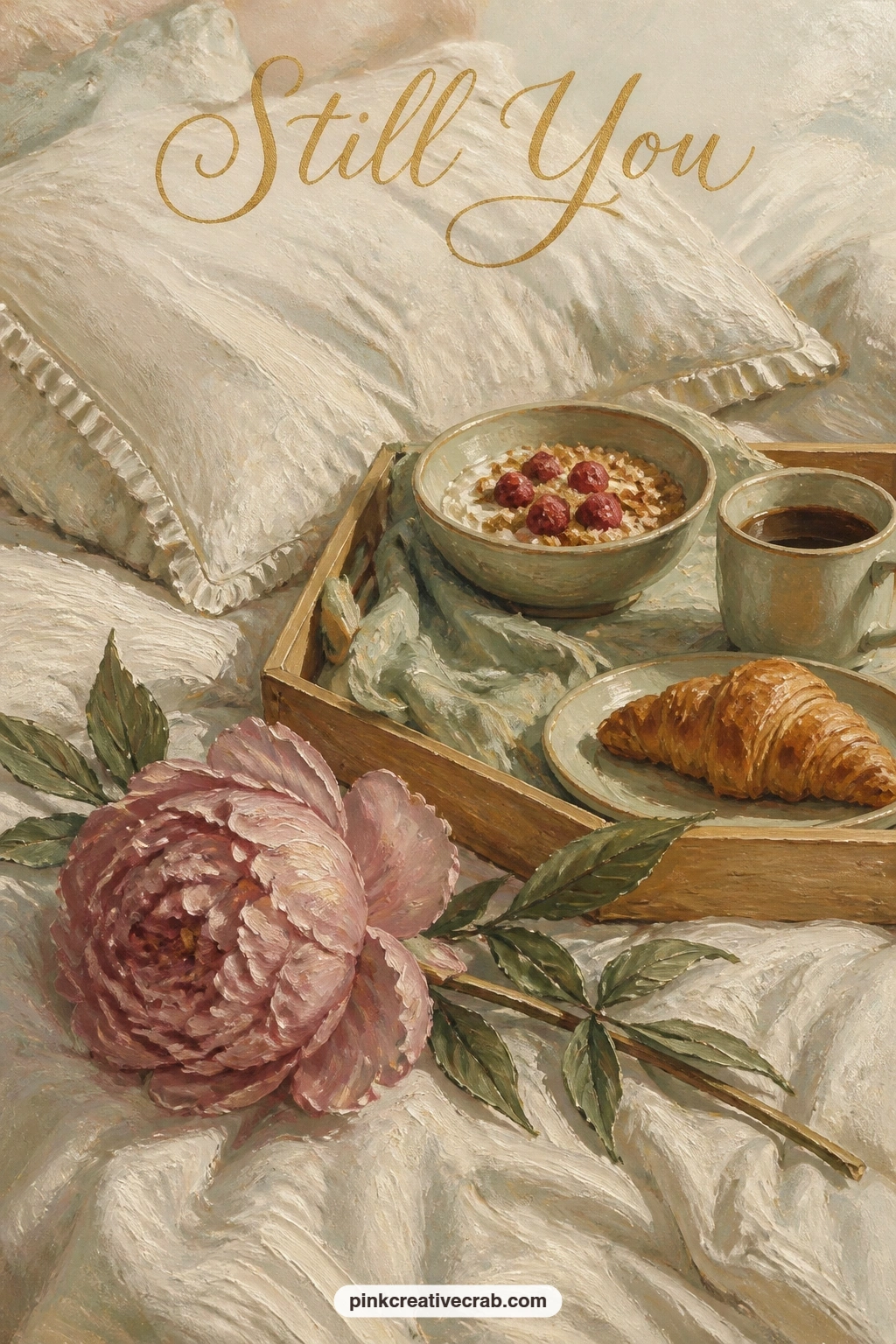
Bring a little romance indoors with a husband bringing breakfast in bed with a single peony, a close, warm scene centered on one small gesture. Frame this tightly around the bed itself, the tray and the peony, cropping out most of the wider room so the whole canvas reads as an intimate close moment rather than a furnished bedroom.
Paint the bedding first in soft cream with gentle sage shadows in its folds, then add the tray with its simple breakfast shapes, a cup, a plate, nothing detailed, before placing the single peony bloom as the most carefully painted element in the whole piece.
That peony deserves real attention: build it from several soft overlapping petal strokes in dusty rose, layered from the center outward, rather than the simpler dabbed clusters used for roses elsewhere in this series.
If the peony looks flat, add one or two darker rose strokes near its center for depth before the lighter outer petals go over the top while still slightly wet. A simple coral or peach rose makes a fine substitute if peonies feel too complex today.
Palette: Dusty Rose,Soft Cream,Sage Green,Gold Ochre
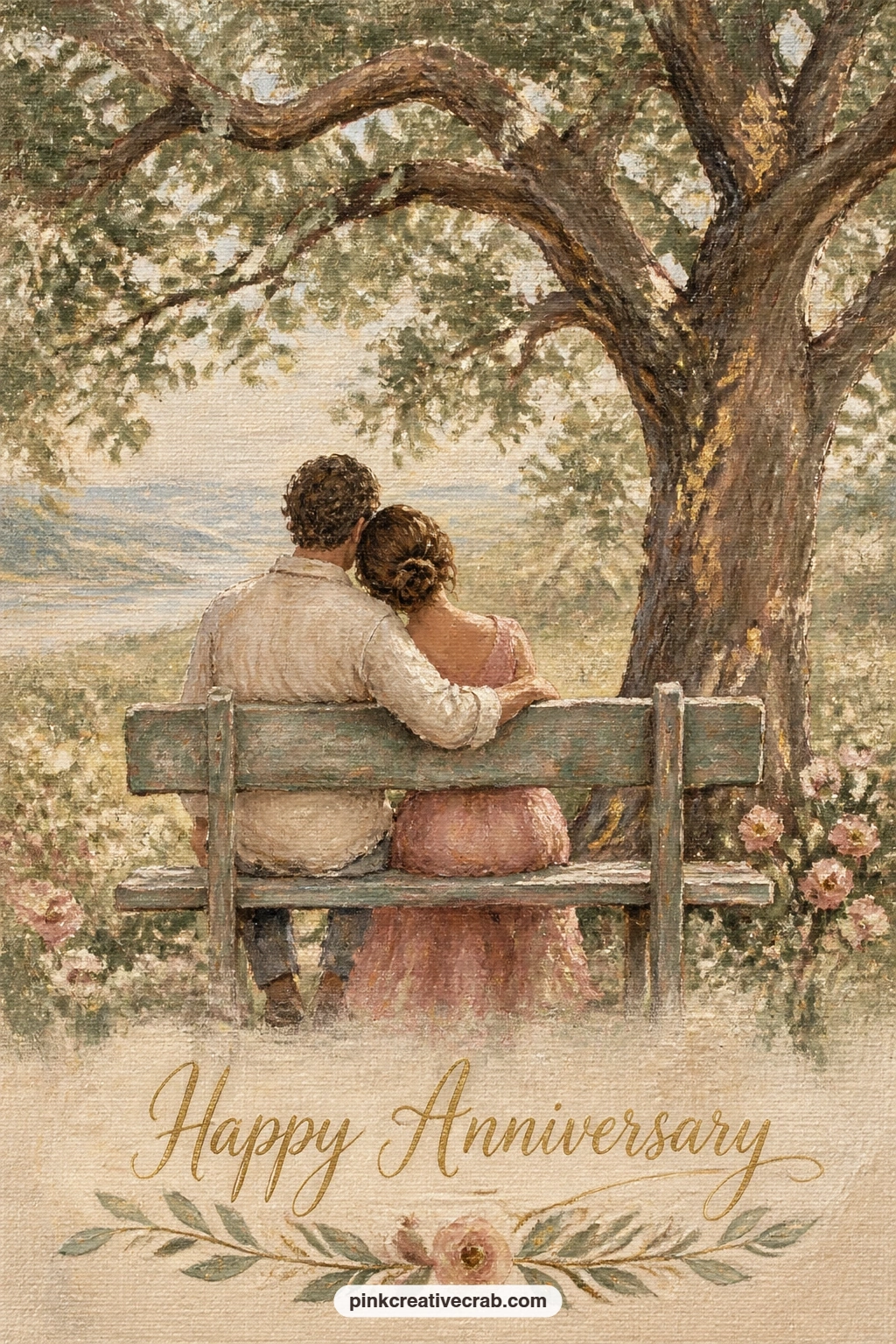
Return to the theme of time passing with a couple on a bench under the oak they planted decades ago, a direct echo of the apple sapling scene from much earlier in this list. Measure this oak against the bench and the couple the same way you measured the apple tree: the trunk should now be noticeably wider than either figure, with a canopy spreading well beyond the bench on both sides, a clear visual marker of all the years between planting and sitting beneath it.
Paint the sky and that wide canopy first in rounded sage masses, then bring the thick trunk down behind the bench before adding the couple seated together beneath it.
Let dappled light fall across the bench and the couple’s shoulders through small gaps left in the canopy, a few scattered dabs of cream breaking through the sage, which ties the whole scene together with a soft natural light.
If the trunk looks too thin to feel old, widen its base more than seems reasonable at first glance, since a genuinely old tree’s trunk is almost always wider than beginners expect. A scattering of fallen leaves in dusty rose and umber around the bench’s feet adds a nice seasonal touch.
Palette: Sage Green,Soft Cream,Burnt Umber,Dusty Rose
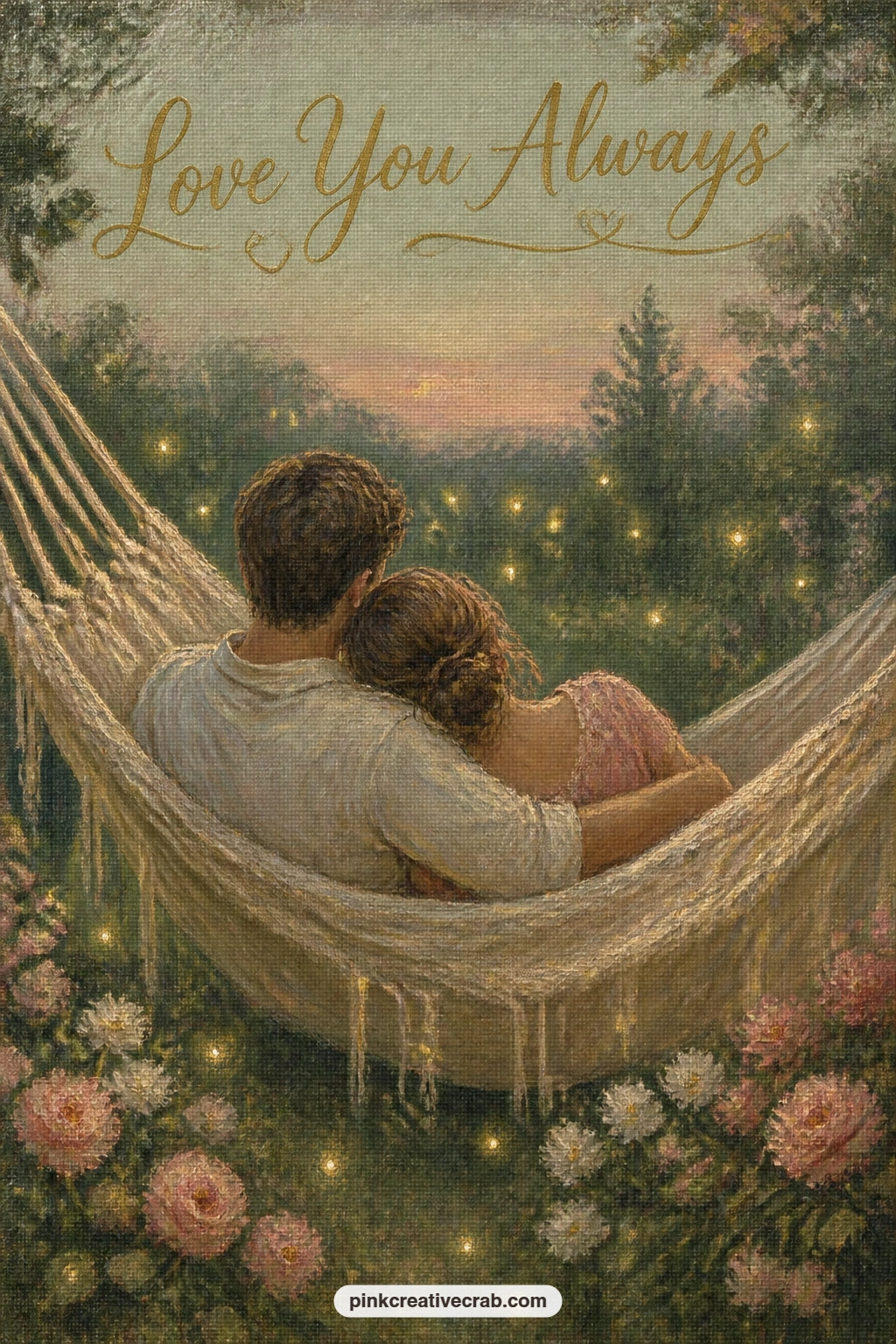
Settle into a warm evening with a couple watching fireflies from a hammock in the garden, a scene that pairs well with the earlier sunrise idea for a day and night matched set. Keep this one simple for a quick ten minute version: a dark sage-grey garden background, the hammock as one curved shape holding the couple, and just a handful of small bright dots scattered through the air for fireflies.
Given more time, deepen the garden background with soft silhouetted shrubs and a hint of a distant fence, add gentle highlights along the hammock’s curve where moonlight catches the fabric, and scatter the fireflies more generously with a few brighter, slightly larger dots mixed among the smaller ones.
Paint each firefly as a single confident dot of warm gold rather than a drawn insect shape, since from a small card’s distance a dot of light reads perfectly well as a firefly.
If the fireflies look too even, cluster a few close together and scatter others further apart, real fireflies never space themselves evenly. A dry brush loaded lightly with cream across the hammock’s folds gives a quick sense of fabric without much extra work.
Palette: Payne’s Grey,Sage Green,Gold Ochre,Soft Cream
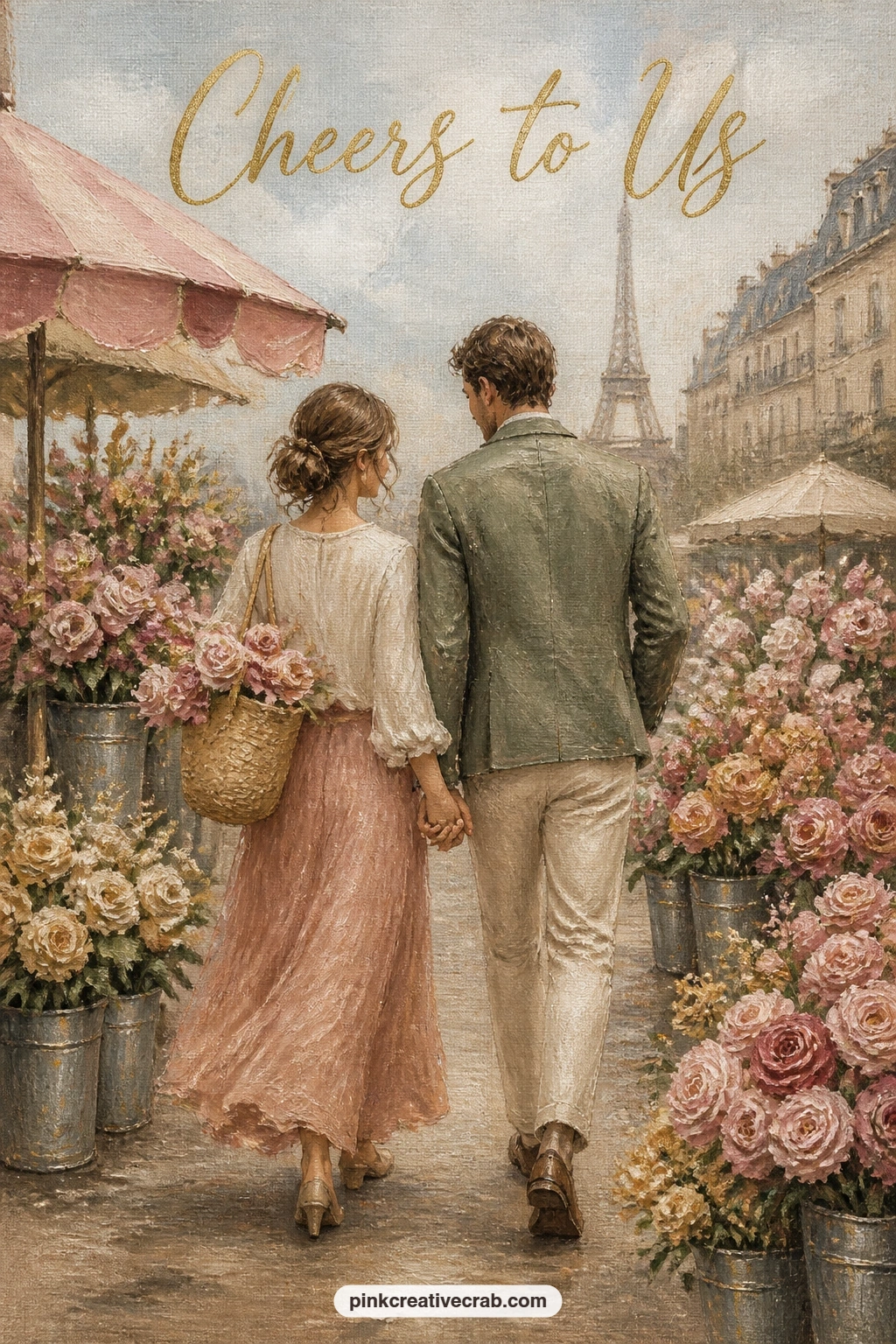
Take the couple somewhere further still with a couple strolling through a Paris flower market on their anniversary, a scene that lets you paint a whole wall of flowers without fussing over any single bloom. Block in rows of flower buckets and stalls first as simple rectangular shapes in sage and cream, then fill them with loose clusters of color, dusty rose, soft gold and a touch of deeper rose, dabbed in quickly rather than painted bloom by bloom.
Add the couple walking through the middle of the market last, smaller in scale than the flower stalls around them, which helps the market itself feel appropriately full and lively without overwhelming the canvas.
Keep architectural details like awnings or market signs extremely simple, a few straight lines and a curve or two, since the flowers and the couple are the real subject here, not the buildings.
If the flower clusters start looking like a solid wall of color, vary the size of your dabs, a few larger blooms among the smaller dabs reads as more convincing than uniform dots. Readers who enjoy painting flower clusters like this might also like browsing vintage flower reference images for more bloom shapes to borrow from.
Palette: Dusty Rose,Gold Ochre,Sage Green,Soft Cream
Close the whole series back at home with a couple waltzing in the living room in front of the fireplace, a fitting final scene that echoes the barn dance you started with. Let the fireplace be your light source one last time, placing its warm glow low and slightly to one side so it washes gold and cream light up across the lower half of the dancing couple while the rest of the room fades into softer sage shadow.
Paint the room and fireplace first, keeping the fire itself as simple warm shapes of gold and cream rather than detailed flames, then add the couple dancing in front of it, caught mid turn with one trailing fabric edge suggesting motion.
Let the firelight catch just the edges facing the hearth, their jawlines, shoulders, the hem of a skirt, while the far side of each figure stays in that cooler shadow, which is what makes a fireside glow convincing rather than flat.
If the fire’s glow looks too orange against this soft palette, mix a touch of dusty rose into the gold to keep it in the same family as the rest of the series. A simple mantel with one small vase ties the room together if the space feels bare, and this makes a lovely final piece to pair with your very first barn dance painting as bookends to the whole set.
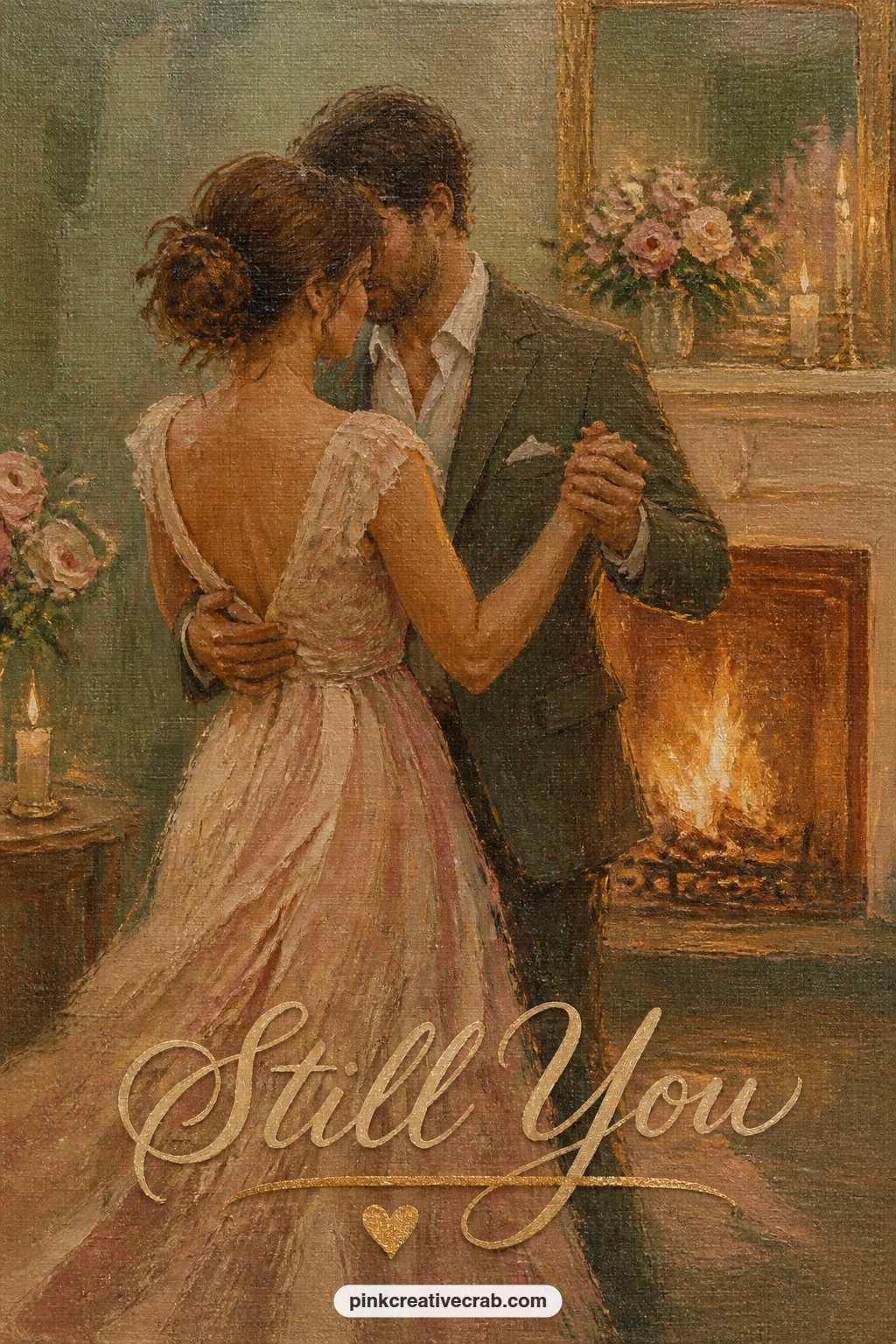
Palette: Gold Ochre,Dusty Rose,Soft Cream,Sage Green
What to Do Next
Pick whichever moment speaks loudest to your own story, start small on a single canvas panel, and let the brushstrokes stay loose rather than careful. One finished scene today is plenty, and the rest of this list will still be here waiting for next time.
Frequently Asked Questions
What oil paint colors do I need for anniversary card ideas like these?
A small set covers the whole series: dusty rose, sage green, soft cream, burnt umber, Payne’s grey and one gold ochre. These six mix together for every scene from barn dances to firelight, so there is no need for a large palette.
How small can I paint these anniversary card ideas and still have them read well?
A canvas panel around four inches by six inches works well for every idea here. Keep faces to just a few simple marks at this size, since fine detail tends to disappear once the painting is small.
Do I need to paint realistic faces for these couple scenes?
No, simple faces work better at this scale and suit the soft, loose style of the whole series. A curved line for a cheek and a small dot for an eye is enough to carry warmth without looking unfinished.
How long does each anniversary card idea take to paint?
Most of these scenes finish in under an hour once you know the steps, and several work as quick ten minute studies too. Working wet into wet on a small canvas keeps the whole process fast and forgiving.
Can I turn these oil paintings into real greeting cards afterward?
Yes, photograph the finished small canvas in good natural light and have it printed onto blank card stock at a local print shop or online service. This keeps the original painting intact while giving you a card to send or keep.
Have any thoughts?
Share your reaction or leave a quick response — we’d love to hear what you think!
-
 0
-
0
-
0
-
0
-
0
-
0


