Art sketchbook ideas get a lot more fun when you borrow from the museum instead of staring at a blank page. These twenty seven pages take paintings you already know by heart and slip in something that should not be there: a cat, a latte, a surfboard, a laptop. Half the joy is spotting what changed.
Every page below works at sketchbook size and finishes in one sitting, so you can pick whichever painting is rattling around your head today and just start. Keep a fineliner, a few markers and a small watercolor set nearby, because that is really all this set asks of you.
Using these images: free for personal projects such as printing, coloring, cards, journals and gifts. Handmade items that include them may be sold up to 30 pieces per design. More than that is commercial use and is not permitted, and neither is selling or sharing the images themselves or passing them off as your own. Please ask before any other use.
Start with Van Gogh’s bedroom, because its tilted perspective and chunky furniture forgive a wobbly line better than almost any other painting. Draw the bed first, slightly off center, then the two chairs and the window behind it, keeping every edge a little uneven on purpose since that unevenness is the whole charm of the original.
Add the cat last, curled into a comma shape right on the pillow, so your eye lands there before anything else in the room. Outline everything in fineliner, then block in color with marker: mustard yellow for the bed frame, dusty blue for the walls, a warm red for the floor.
If the room starts to feel flat, compare the size of the bed to the door behind it. Van Gogh deliberately made the furniture oversized and the room shallow, so resist the urge to correct that proportion back to realistic.
If you do not have markers, colored pencil layered in cross hatching gets you the same chunky, textured fill.
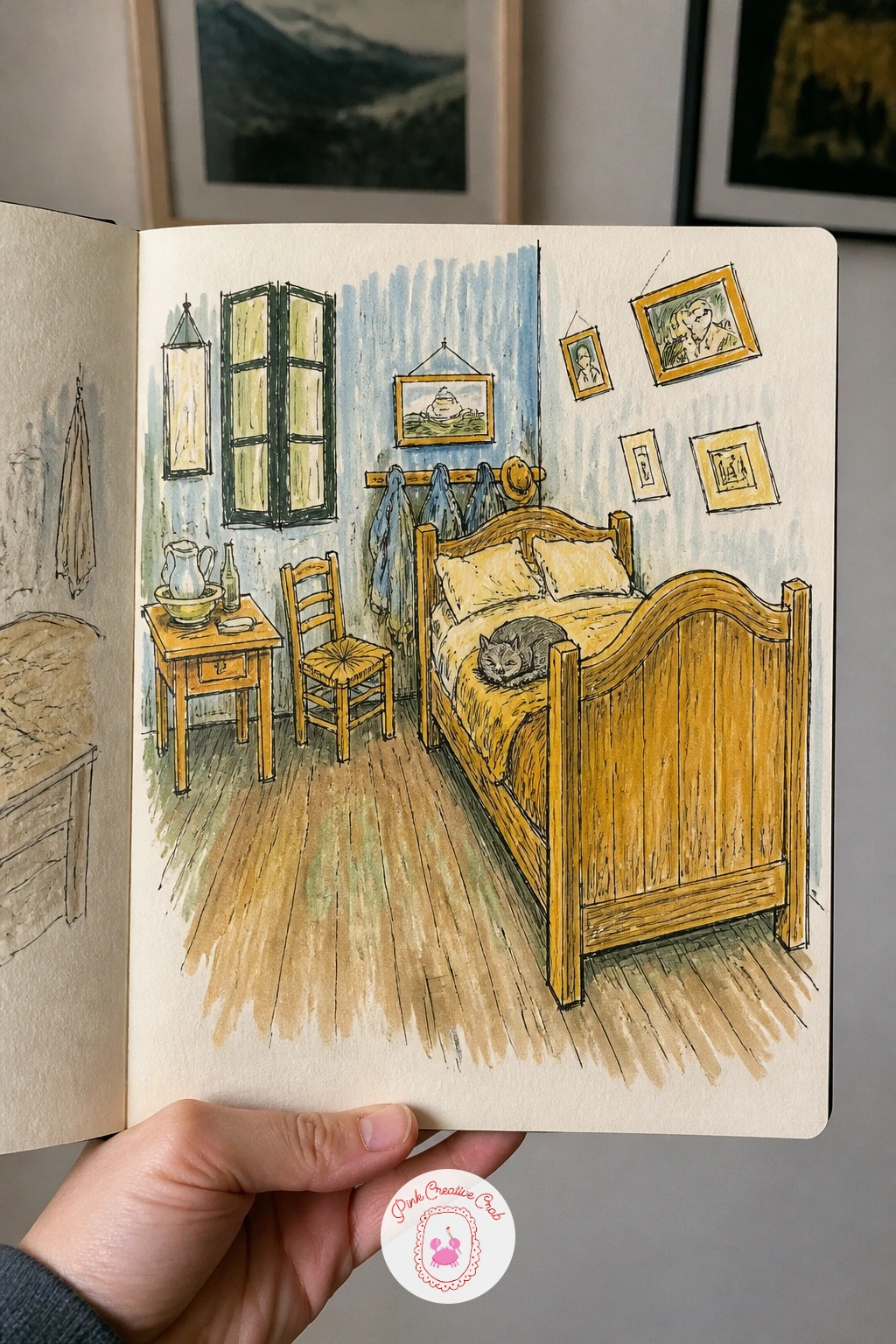
Palette: Mustard Yellow,Dusty Blue,Brick Red,Warm White
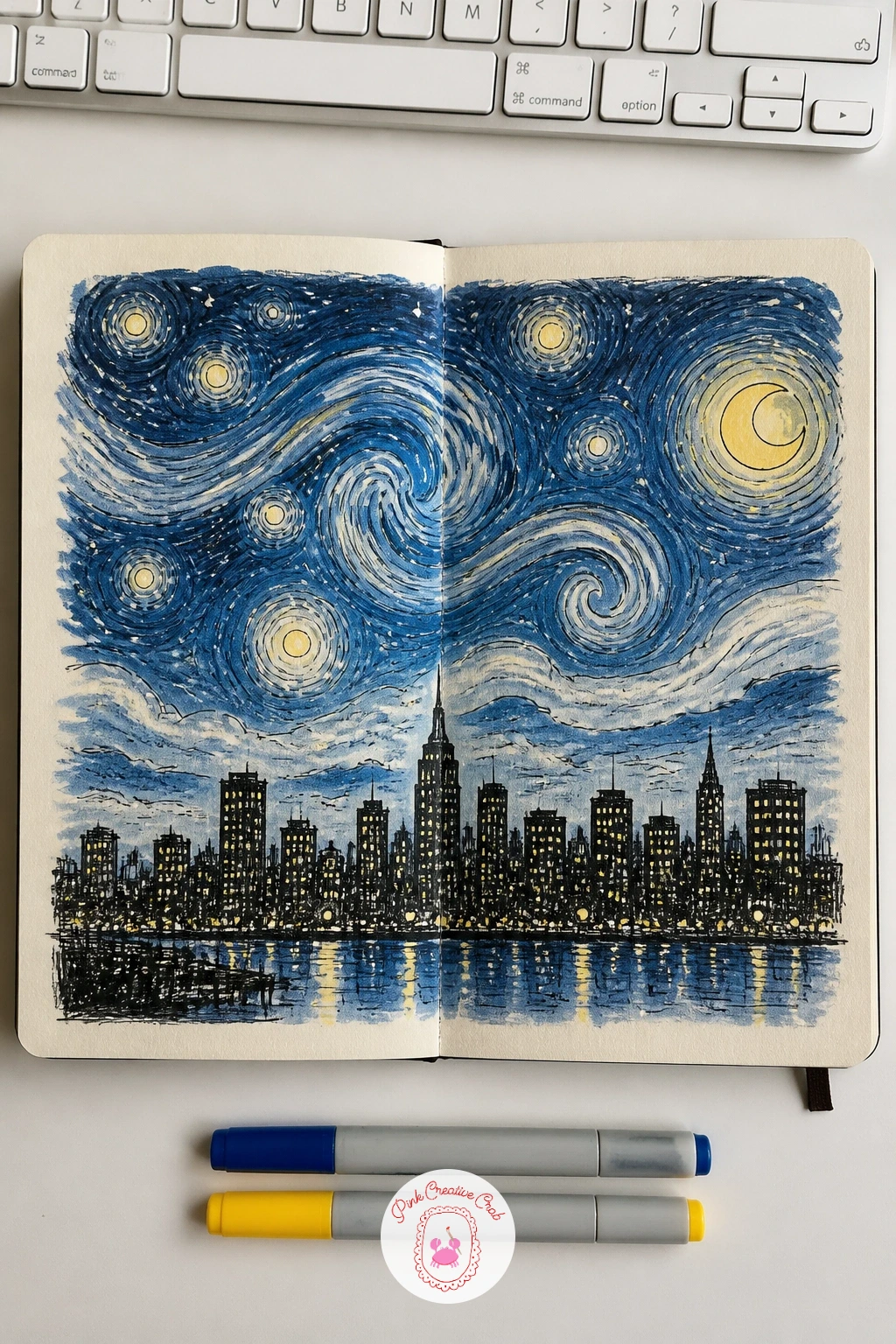
Swap Van Gogh’s hilltop village for a skyline of tall rectangles, and the swirling sky from The Starry Night still does all the heavy lifting. Pencil in a simple row of buildings along the bottom third of the page first, varying their heights but keeping the silhouettes plain, almost like a city at dusk.
Once the skyline is inked, fill the rest of the page with the swirling sky: big looping strokes of fineliner first, then cobalt and indigo watercolor washed in wet so the colors bleed into each other. Drop a few dots of white gouache or a white gel pen on top for stars once everything is dry.
Eye level sits low here, near the base of the buildings, which is why the sky gets to swell so large above them and why a couple of lit windows in warm yellow read instantly as a city at night rather than a village.
One concrete tip: paint the sky wet-on-wet before you add a single building window, so the swirls stay soft underneath the crisp city lights.
You Will Need
- white gel pen
Palette: Cobalt Blue,Indigo,Charcoal Grey,Warm Yellow
After a loose night sky, slow down for Girl with a Pearl Earring, since her portrait rewards a careful, patient hand. Lightly sketch the oval of her face and the turban first in pencil, checking that her eye sits roughly halfway down the head and that the famous pearl hangs just below her jaw.
Ink the face with a fine nib, keeping lines light around the cheek and darker where the turban folds sit, then switch to marker for the blue and yellow turban. Add the bubble tea cup last, tilted toward her mouth with a straw crossing her lips, so it reads as a genuine sip rather than a prop glued on beside her.
If the face looks stiff, soften the shadow under her lower lip with a blending stump or a damp brush, since that single soft shadow is what makes Vermeer’s portraits feel alive.
No marker on hand works fine too: a warm ochre watercolor wash under the turban gets close enough.
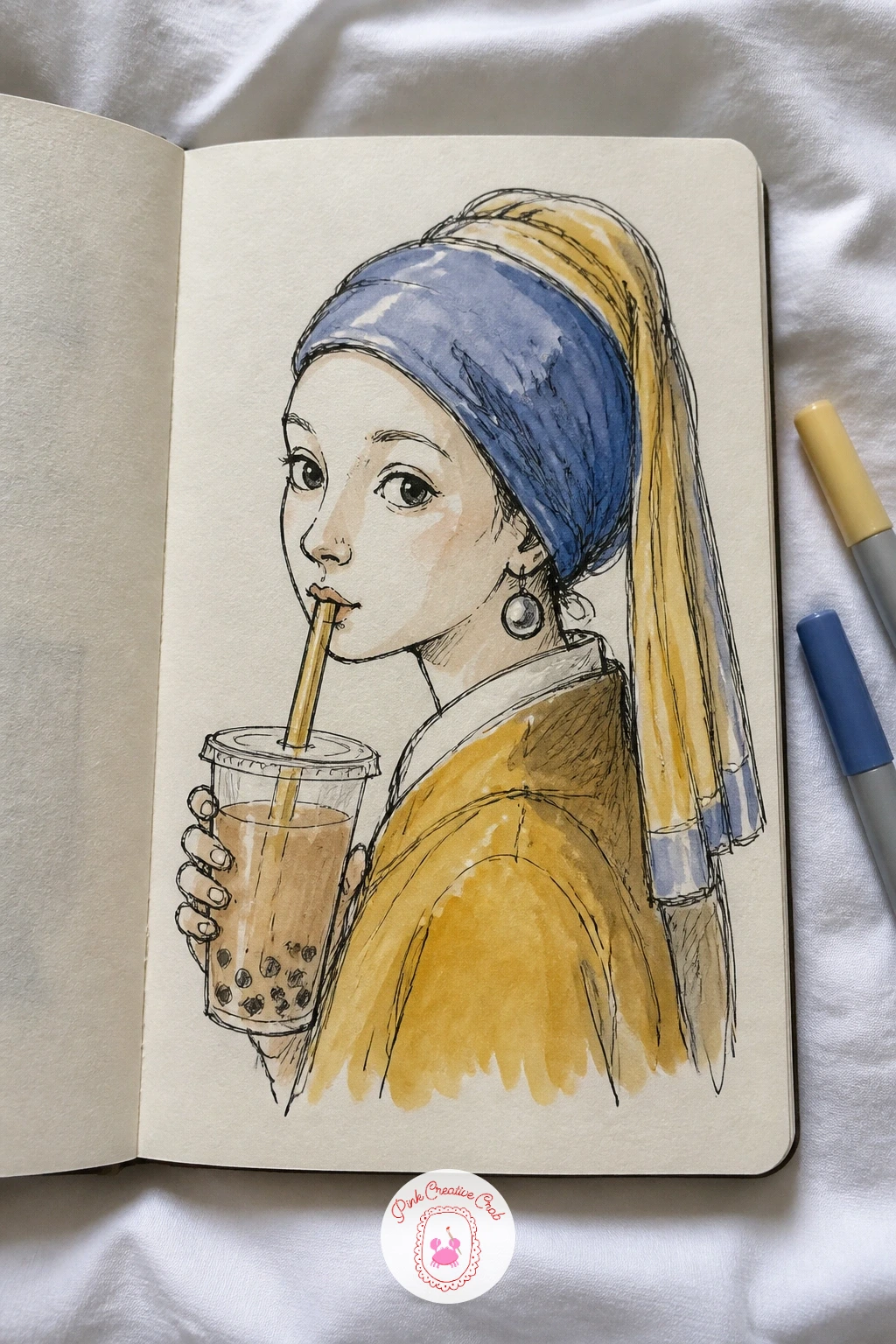
Palette: Ultramarine,Ochre Yellow,Skin Beige,Soft Brown
Look at a real photo of the painting while you sketch the turban folds, since getting that blue and yellow wrap right is what sells the whole reference instantly.
Monet’s water lilies forgive almost any brush wobble, which makes this the page to loosen your wrist after the tight portrait before it. Wet the whole page first with clean water, then drop in loose patches of green, violet and soft pink watercolor and let them bloom into each other without much guiding.
While the wash is still slightly damp, lift a few ovals of color with a clean dry brush or a paper towel to suggest lily pads floating on the surface, then once it is fully dry, ink small lily shapes with fineliner just to anchor a few of them.
Draw the rubber duck last, bright yellow, bobbing among the pads near one edge of the page, small enough that it feels like a visitor rather than the main event.
If the colors turn muddy, let the page dry completely and add one more fresh wash on top rather than scrubbing at the wet paper.
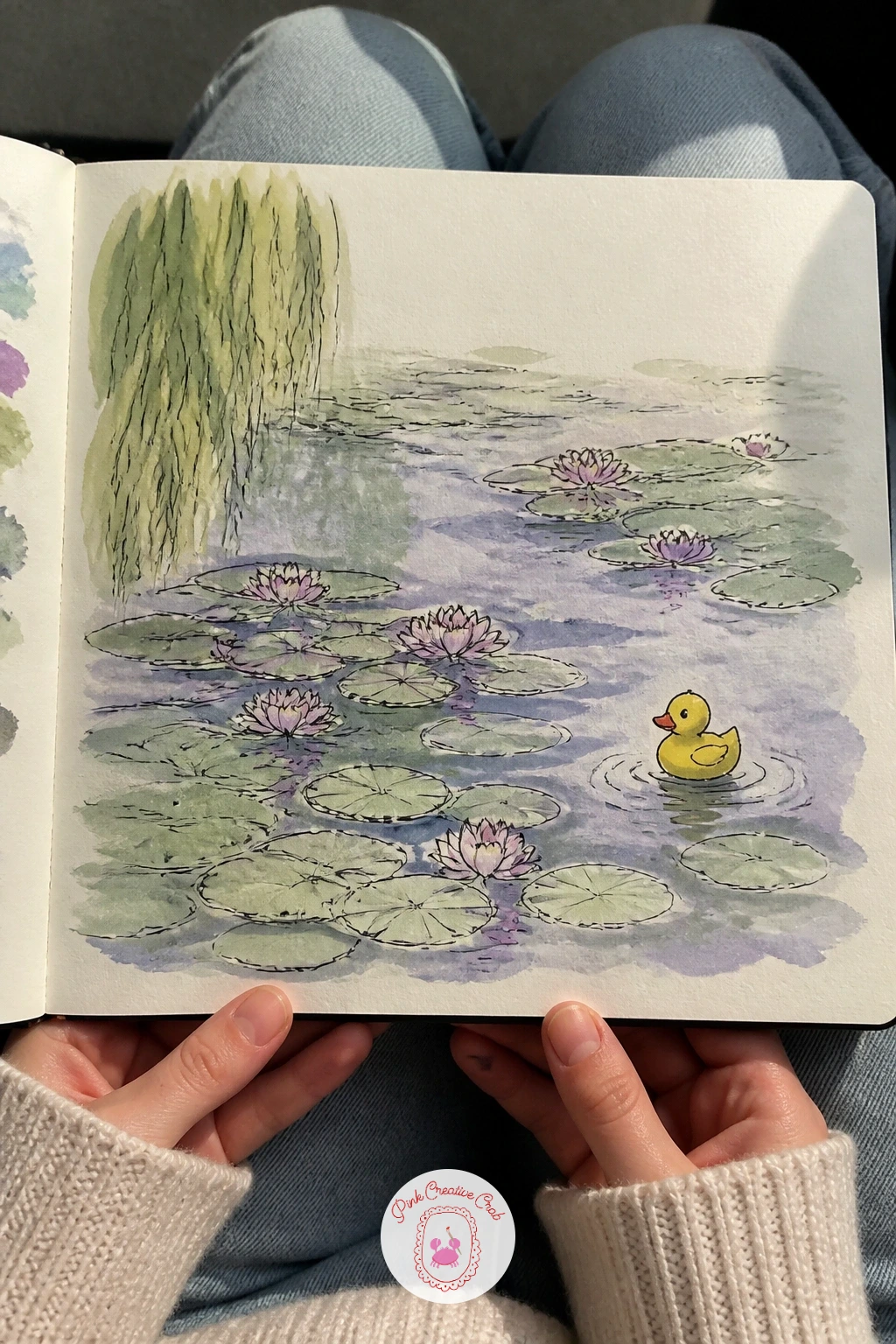
Palette: Sap Green,Violet,Soft Pink,Duck Yellow
The Great Wave gives you one dramatic curling shape to get right, so draw that first: a long claw-like crest arcing over the page with smaller foam fingers breaking off the top, exactly like Hokusai’s print. Keep Mount Fuji small and pale in the background, far enough away that the wave stays the star.
Ink the wave in confident sweeping lines, thicker along the outer curve and thinner inside, then add flat Prussian blue and white in bands rather than a smooth gradient, since the original print reads in distinct blocks of tone.
Place a tiny surfer riding low along the base of the wave, just a dark silhouette with a surfboard, so scale makes the wave feel enormous by comparison.
If the curl looks stiff, practice the sweep on scrap paper first; one loose confident line beats several hesitant retraced ones.
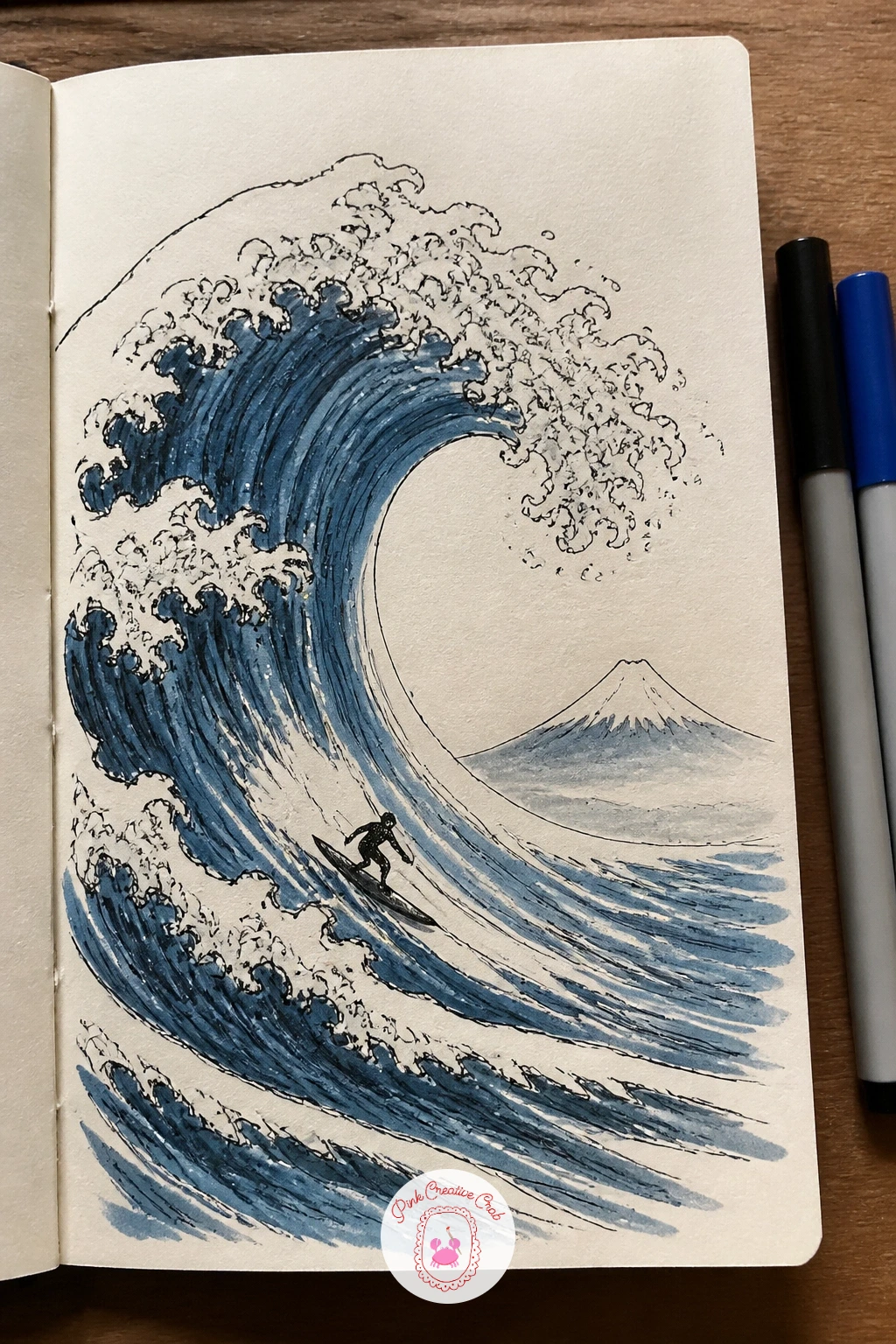
Palette: Prussian Blue,Pale Blue,Foam White,Charcoal Grey
Trade Van Gogh’s grand vase for a humble jam jar, which actually makes the sunflowers easier to draw since the container needs almost no detail. Sketch the jar first as a simple cylinder, then build each sunflower head from a center circle with petals radiating out unevenly, since real sunflowers never line up in a neat ring.
Ink the petals with slightly wavy lines rather than straight ones, then fill with warm yellow and burnt orange marker, leaving a few petals paler than others for variation. Add the table surface last with a quick line of shading underneath the jar to ground it.
If the flowers start to look identical, vary their tilt: let one head droop slightly and another face almost straight out of the page.
Short on time, a ten minute version uses just three sunflowers and skips the table detail entirely, while a forty minute version adds the kitchen window and a teaspoon resting beside the jar.
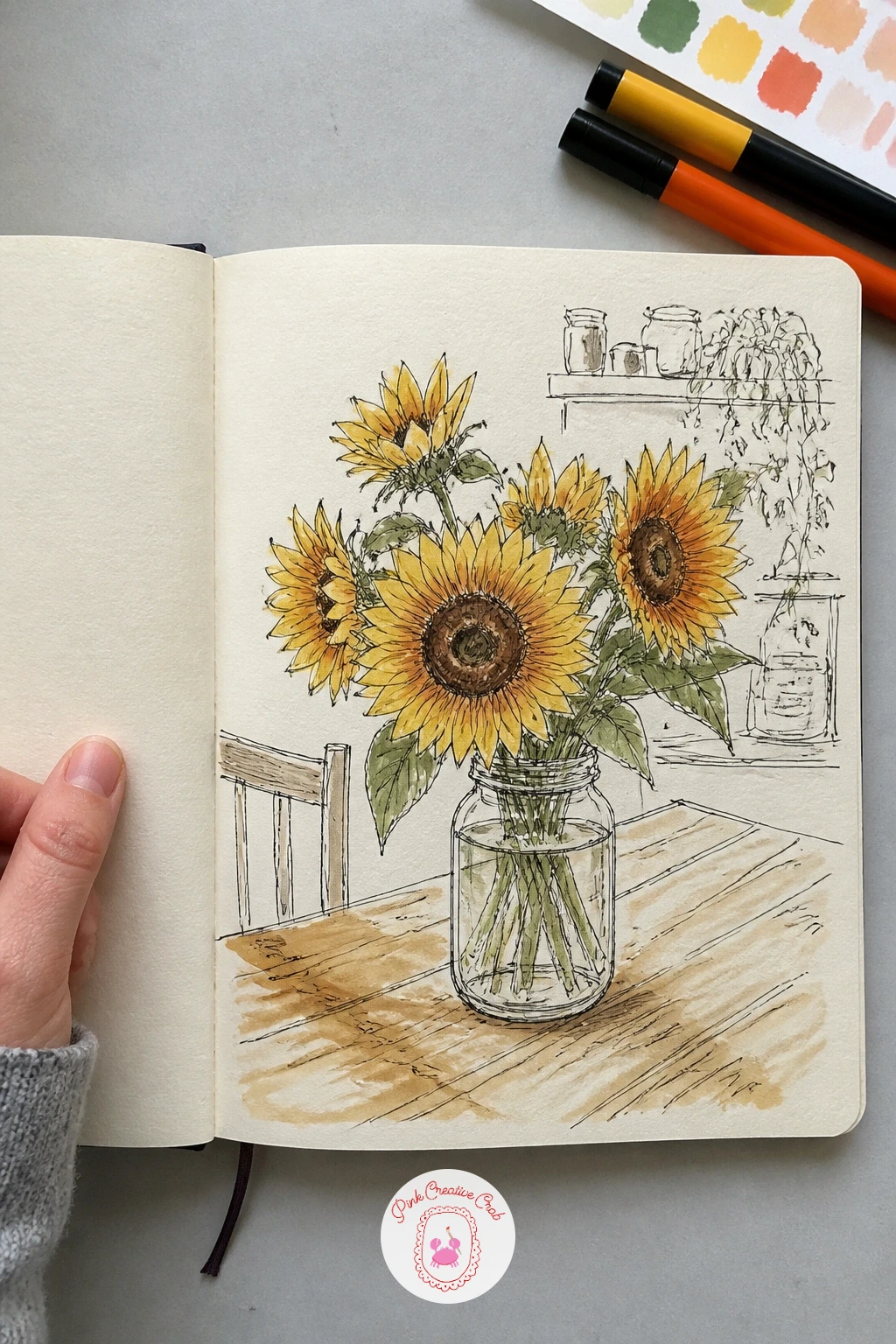
Palette: Golden Yellow,Burnt Orange,Olive Green,Jar Clear
Keep Botticelli’s elegant pose for Venus but swap her shell for an inflatable pool float, since the contrast is what makes this page funny. Sketch her figure first in a gentle S curve, weight on one hip, hair flowing down over one shoulder exactly as in the original.
Ink her outline with light, flowing lines, then draw the pool float beneath her as a simple flamingo or donut shape, bold pink against the pale figure. The water around her can stay mostly white paper with just a few curved blue lines suggesting ripples, which keeps the whole page feeling breezy rather than busy.
If the pose feels stiff, loosen your wrist and redraw the spine curve in one single stroke rather than several short ones; the fluidity of that one line does most of the work.
No pink marker handy, a light wash of magenta watercolor over the float works just as well.
Palette: Flesh Pink,Flamingo Pink,Sea Blue,Gold
American Gothic is really just two stern faces and a pitchfork, so after the flowing Venus curve this page is a good chance to practice straight, deliberate lines again. Draw the farmhouse window and gable behind the couple first, keeping every line ruler straight, then build the two figures standing stiffly side by side in front of it.
Give the man his round glasses and overalls, the woman her collared dress, then replace the pitchfork with two garden trowels held upright between them, one in each hand. Ink the faces last with minimal shading, since the deadpan expression depends on keeping the features plain and flat.
If the couple end up lopsided, draw a faint vertical center line down the page first and mirror their shoulder heights across it before inking.
A gel pen in place of marker still gets the flat, poster-like color this painting is known for.
This is a nice page to pair with a look at other sketchbook prompts if you want more quick character studies afterward.
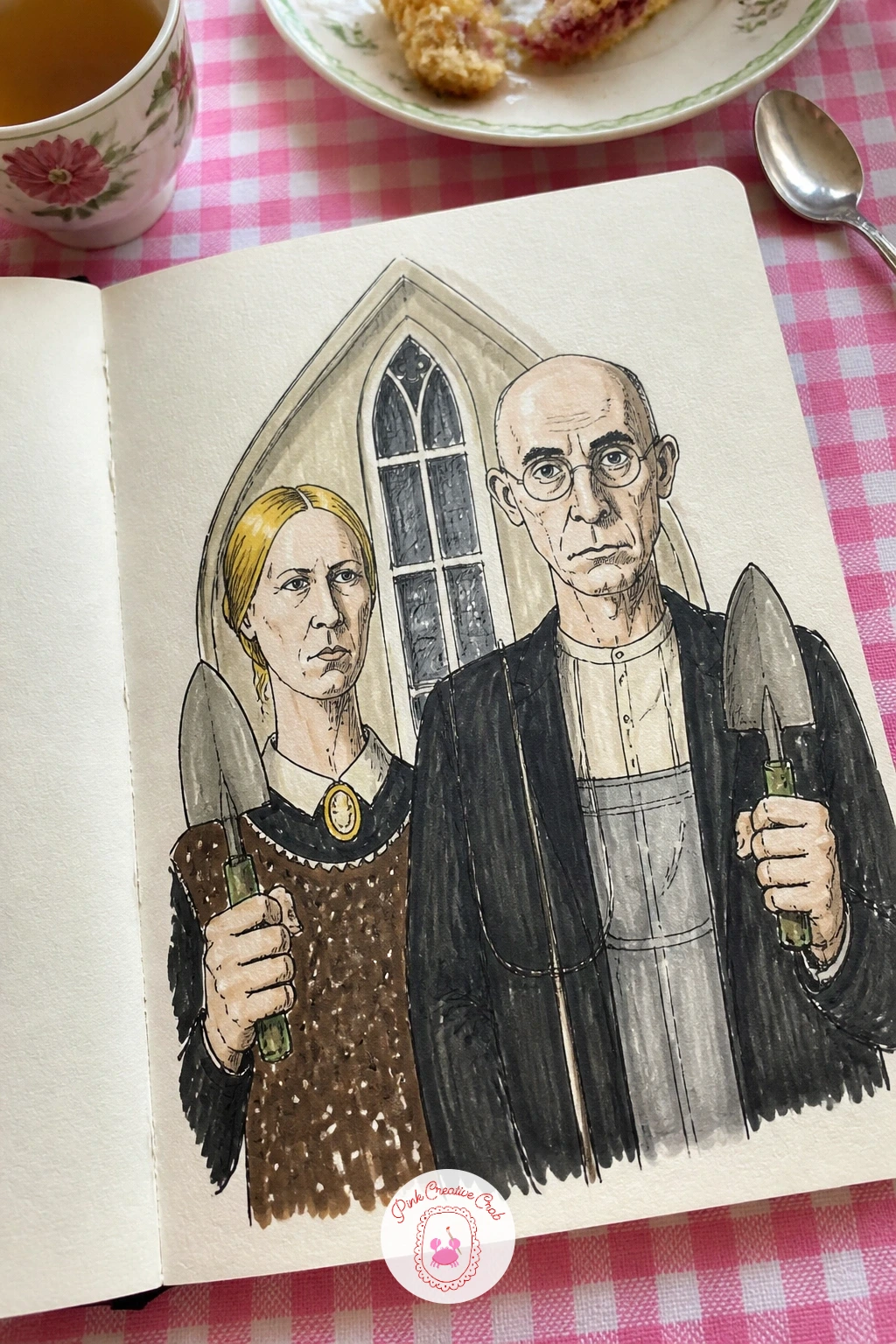
Palette: Overalls Blue,Dress Grey,Trowel Brown,Farmhouse White
Whistler’s seated mother already has a calm, upright pose, so give her a scarf and some knitting needles and the twist writes itself. Sketch the chair and her profile first, keeping the silhouette simple and the background almost bare, just like the original grey composition.
Ink her dress in long vertical folds, then add the knitting needles crossing in her lap with a long striped scarf trailing down to the floor, which is the one bright, busy detail against all that quiet grey.
Shade her dress with cross hatching rather than flat marker, building the darkest folds first and leaving the lit edge of the fabric as bare paper; that contrast is what gives the dress its weight.
If the scarf stripes wander, pencil faint guide lines first and ink over them once you are happy with the spacing.
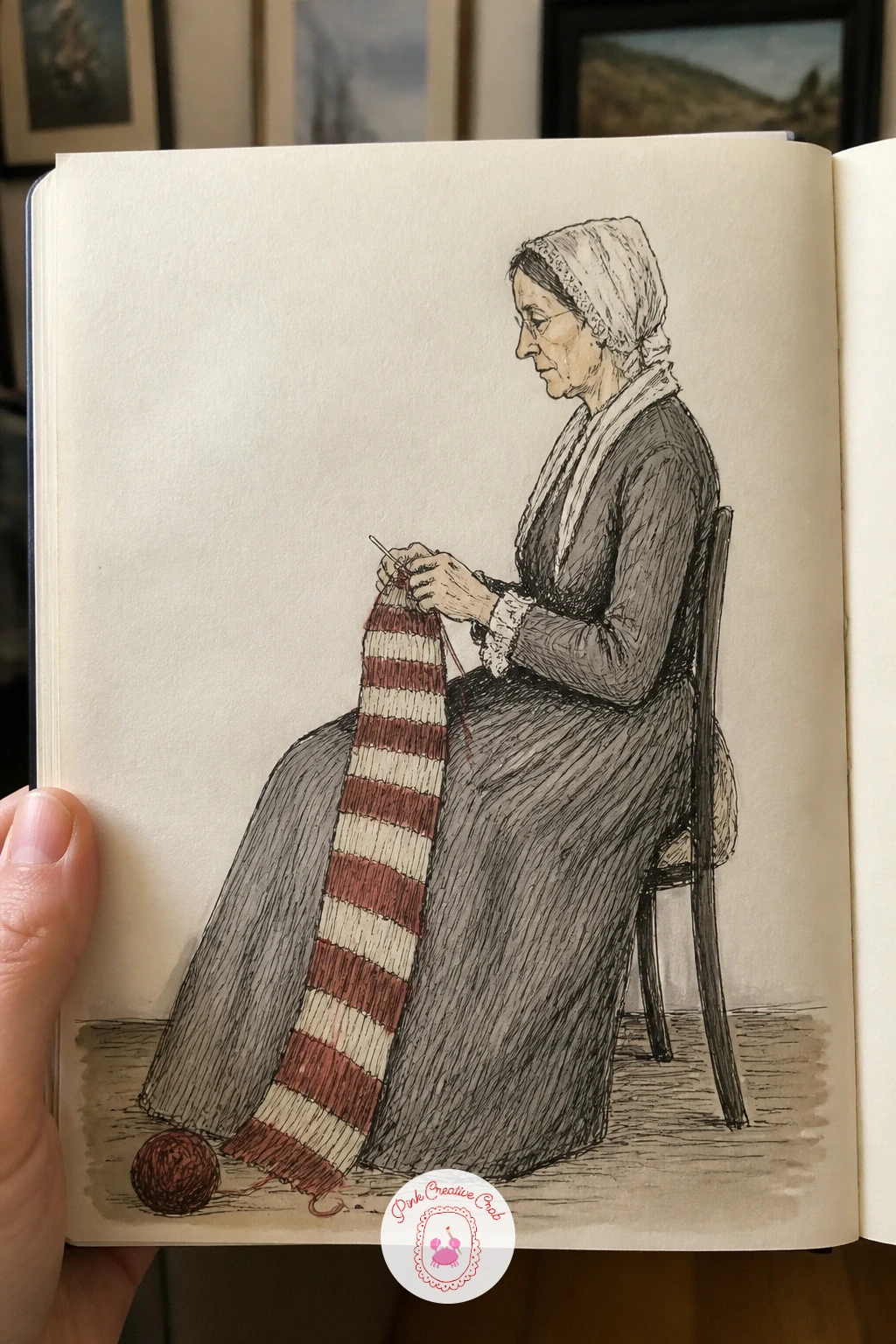
Palette: Charcoal Grey,Dove Grey,Scarf Red,Scarf Cream
Constable’s quiet river scene gets its calm from a low horizon and a wide sky, so lay out the page that way first: a thin strip of riverbank and trees along the bottom third, and everything above it open for clouds. Sketch the old wooden cart standing in the shallow water as the painting’s anchor point.
Ink the trees loosely with broken, scribbly lines rather than clean outlines, since Constable’s foliage is all texture and no hard edges. Add the bicycle leaning against a tree on the bank, a small modern detail that reads clearly against all that soft green.
Paint the sky first with a wet graded wash of pale blue and grey, then drop in the greens once that layer is dry so the colors stay separate and fresh rather than muddy.
If you do not have a big brush for the sky wash, a wide marker blended with a water brush covers the same ground.
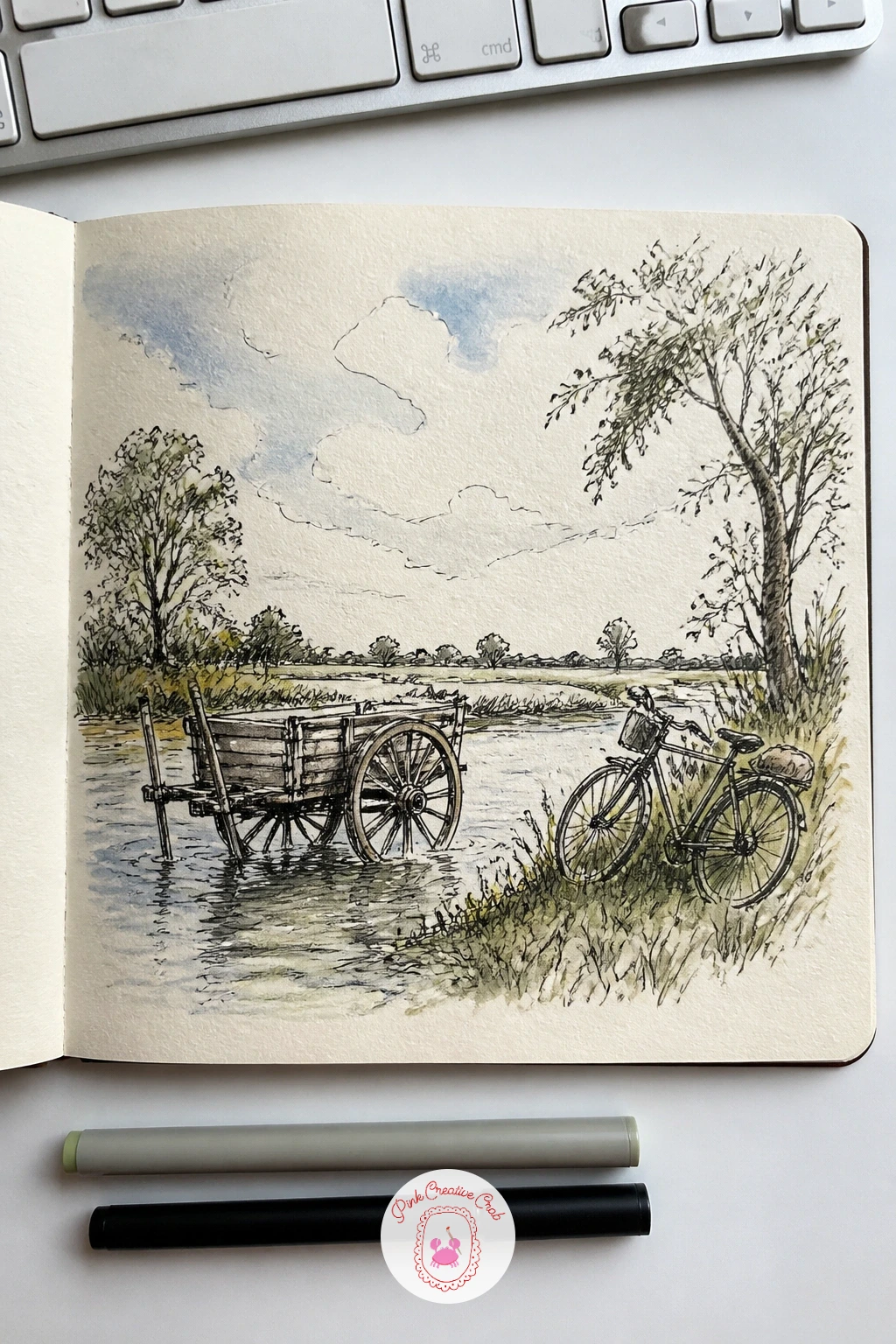
Palette: Sky Grey Blue,Meadow Green,Cart Brown,River Blue
Seurat’s park scene is full of stiff, elegant figures standing around, which makes it the perfect excuse to fill the grass with dogs instead of crowding it with more people. Sketch just two or three of the original figures loosely, the woman with the parasol works well, then leave most of the page open as green lawn.
Ink simple dog silhouettes scattered across that lawn in different sizes and poses, one sniffing, one mid-run, one sitting primly like the humans above it, which plays nicely against the stiff formality of the painting.
Fill the grass with small dabs of green and yellow marker rather than a flat wash, echoing Seurat’s dotted technique without needing his patience; a stippling brush pen does this in a fraction of the time.
If the dots look too even, vary their size and spacing; the slight irregularity is what makes the stippled grass feel alive rather than mechanical.
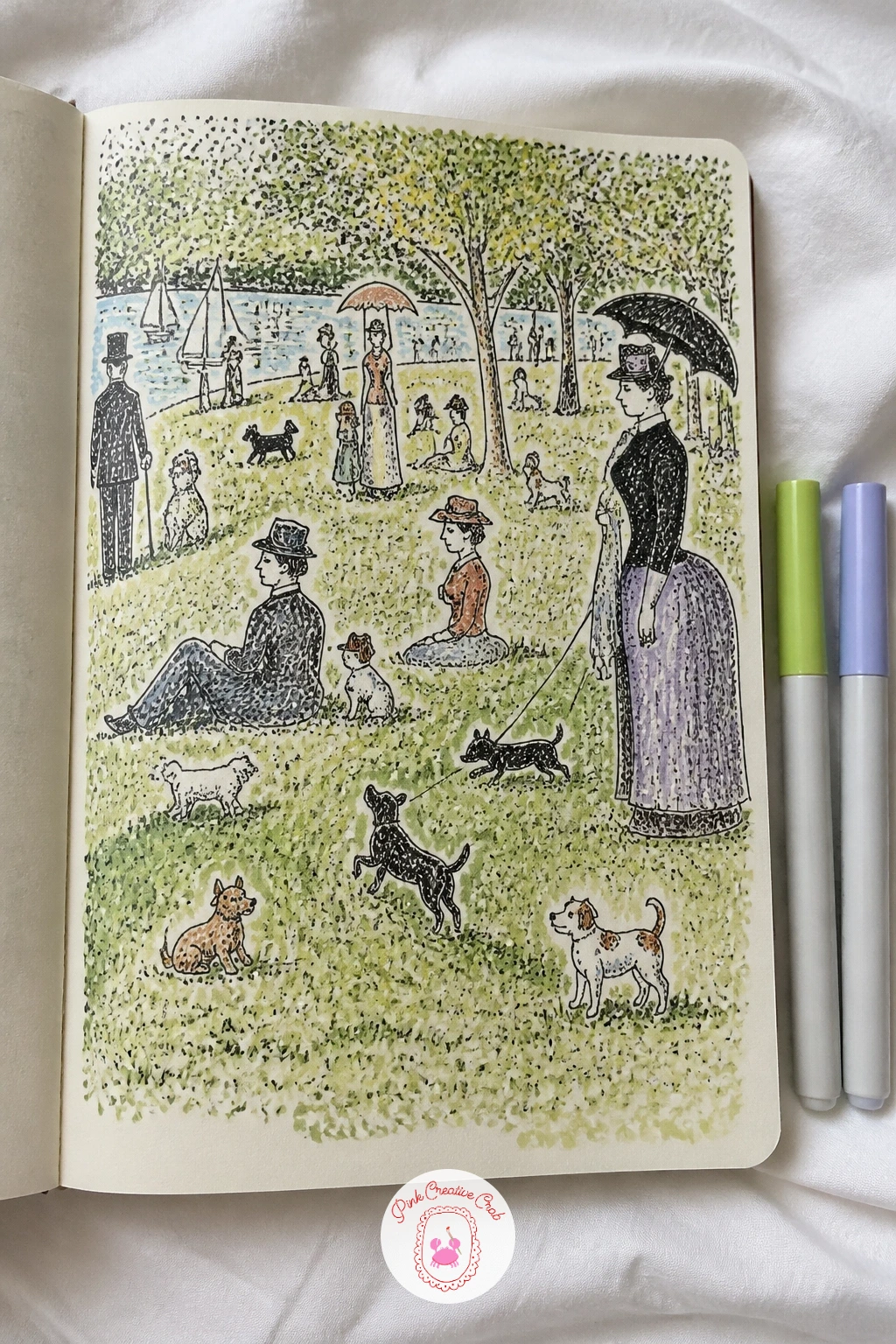
Palette: Lawn Green,Sunlit Yellow Green,Parasol Cream,Dog Brown
Klimt’s gold leaf robes translate beautifully into gel pen, so this page rewards patience more than drawing skill. Sketch the embracing couple first as a simple kneeling shape, heads tilted together, keeping the anatomy loose since the robes will hide most of it anyway.
Ink the outline, then cover both figures in small patterned shapes, squares for him and circles or spirals for her, exactly like the original’s gold mosaic robes, but swap the gold field behind them for a checkered picnic blanket pattern instead of plain gilding.
Fill the patterns with gold and copper gel pen over a base of warm ochre marker, working in small patches rather than trying to cover the whole robe at once so the pen does not dry out mid-stroke.
If gold pen is not in your kit, yellow ochre watercolor dotted with a fine brush gives a similar glimmer at a distance.
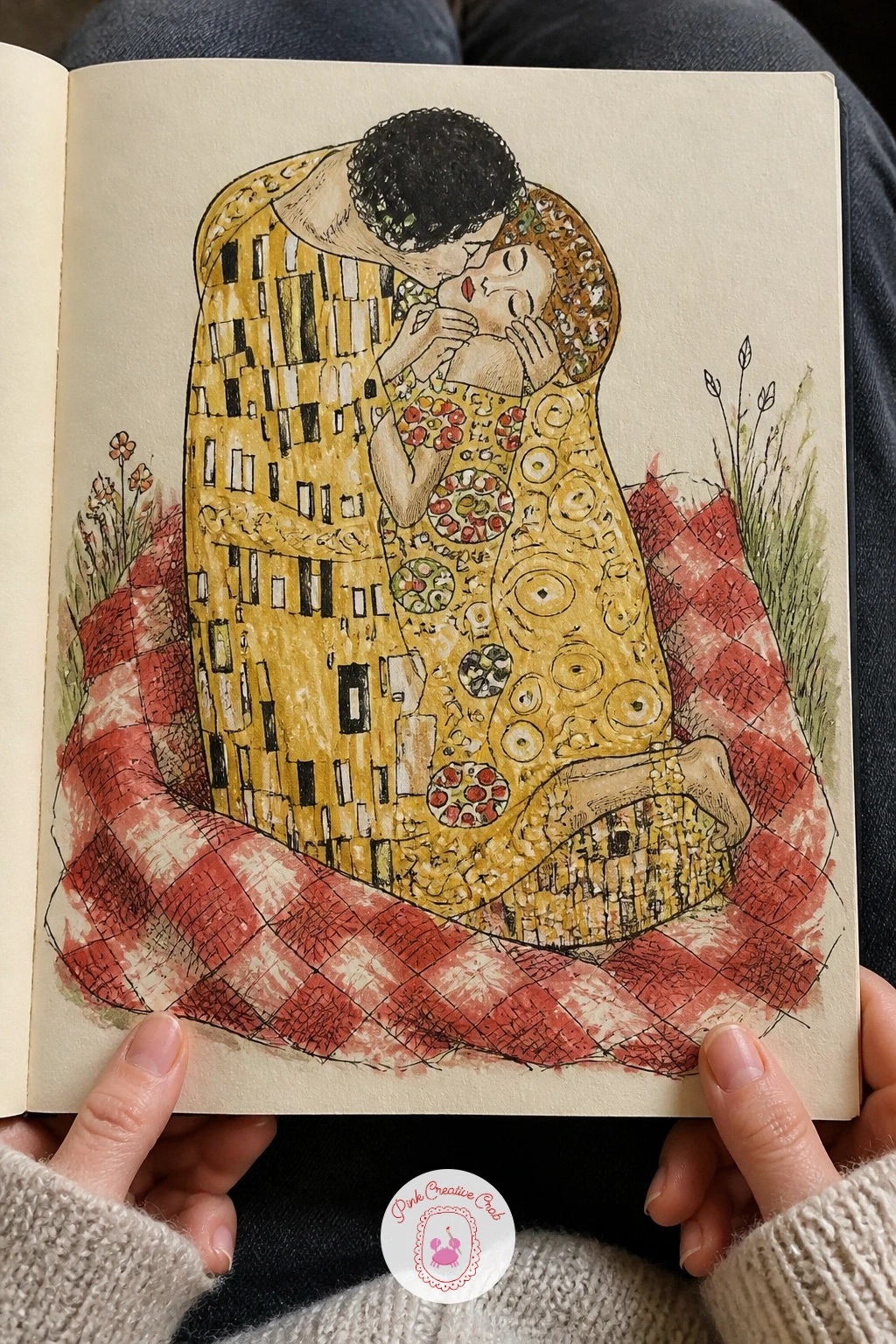
You Will Need
- gold gel pen
Palette: Gold Ochre,Copper,Blanket Red,Skin Beige
Primavera is packed with figures, so for a sketchbook page pick just three: the central goddess and two of the flanking women, standing in their usual gentle poses among a scatter of trees. Rain changes the mood completely, so swap the painting’s bright flowered gowns for the same figures huddled under open umbrellas.
Sketch the umbrellas first as simple triangles above each head, then build the robes flowing down beneath them in Botticelli’s typical soft folds. Ink the background trees with thin vertical trunks and light foliage, then wash the whole page in cool grey-blue to suggest rain, leaving the umbrellas as the one bright spot of color.
If the rain wash looks heavy-handed, dab it with a dry tissue while still damp to lift some color back out and keep the mood soft rather than stormy.
One tip worth keeping: paint the umbrellas in a saturated color before the grey rain wash goes down, so they stay vivid against the muted background.
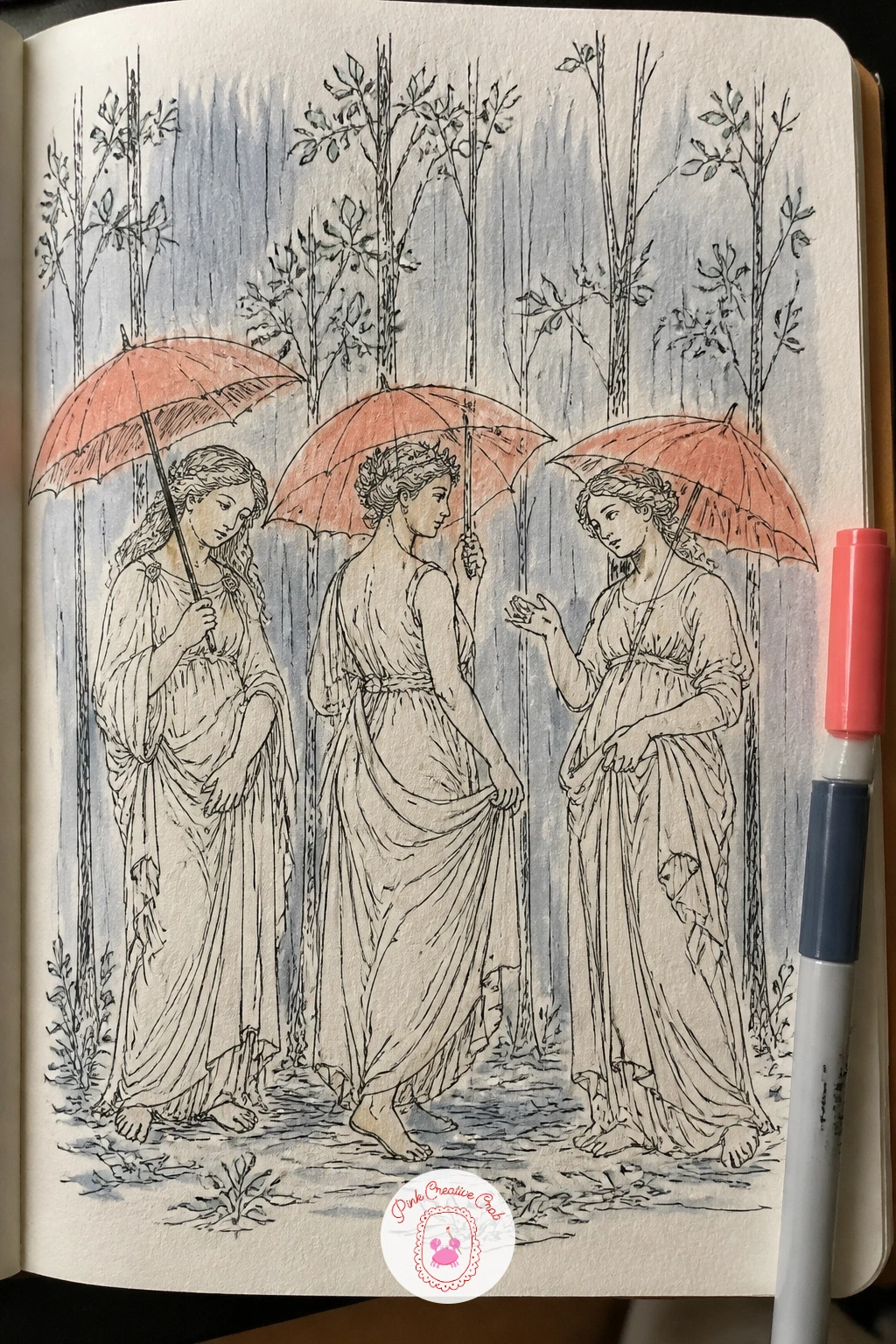
Palette: Rain Grey Blue,Umbrella Coral,Robe Cream,Tree Green
Vermeer’s milkmaid is a lesson in quiet light, which makes her the page to slow down on and really study where the light falls. Draw her figure first turned slightly toward a window on the left, pouring from a jug, since that window is the true subject of the original painting.
Ink the yellow bodice and blue apron with care around the folds, then light the whole scene from that left window: the side of her face toward it stays pale, the other side falls into soft shadow, and the same logic applies to the table and jug.
Swap the stream of milk for a thin ribbon of latte foam pouring into a mug on the table, bread and a milk jug still nearby for continuity with the original still life.
If the light feels flat, add one more shadow where the table meets the wall behind it; that single dark accent sells the whole window-lit room.
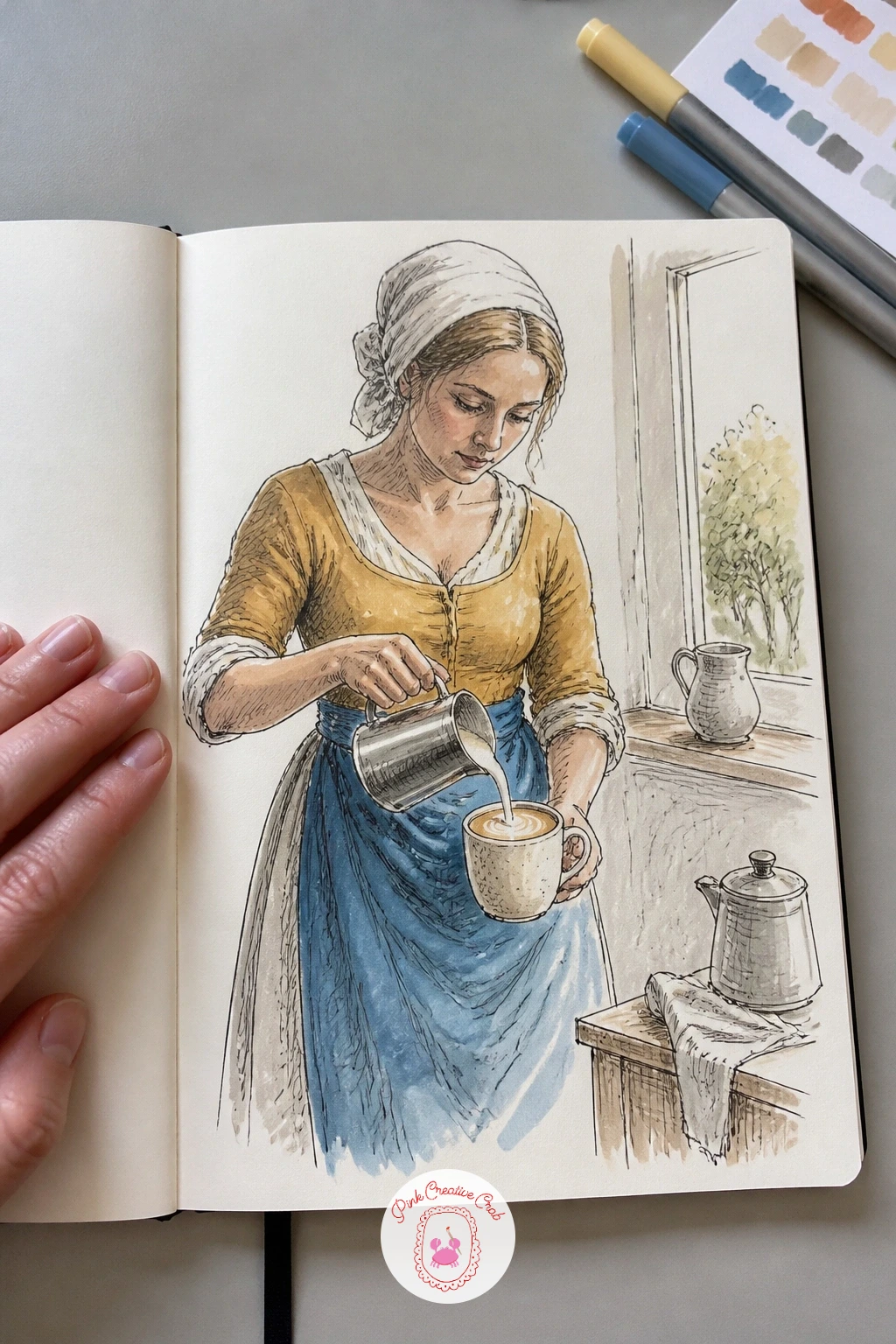
Palette: Vermeer Yellow,Vermeer Blue,Table Brown,Latte Cream
After the careful light study, Fuji is a nice reset: a simple triangular peak with a dusting of snow at the top, drawn in a few confident lines. Place it in the upper third of the page, small and pale, exactly the way Hokusai’s prints always push the mountain back into the distance.
Fill the foreground instead with a small picnic scene, a blanket, a basket and perhaps two cups, drawn larger and bolder than the mountain so scale does the storytelling: the closer thing is bigger, even though Fuji is enormous in real life.
Ink the mountain with flat, graphic shapes the way a woodblock print would, then add texture to the picnic basket and blanket with hatching, so the two parts of the page sit in deliberately different styles.
If you want a quicker version, skip the basket detail and just paint a folded blanket and two mugs; the contrast in scale still carries the joke.
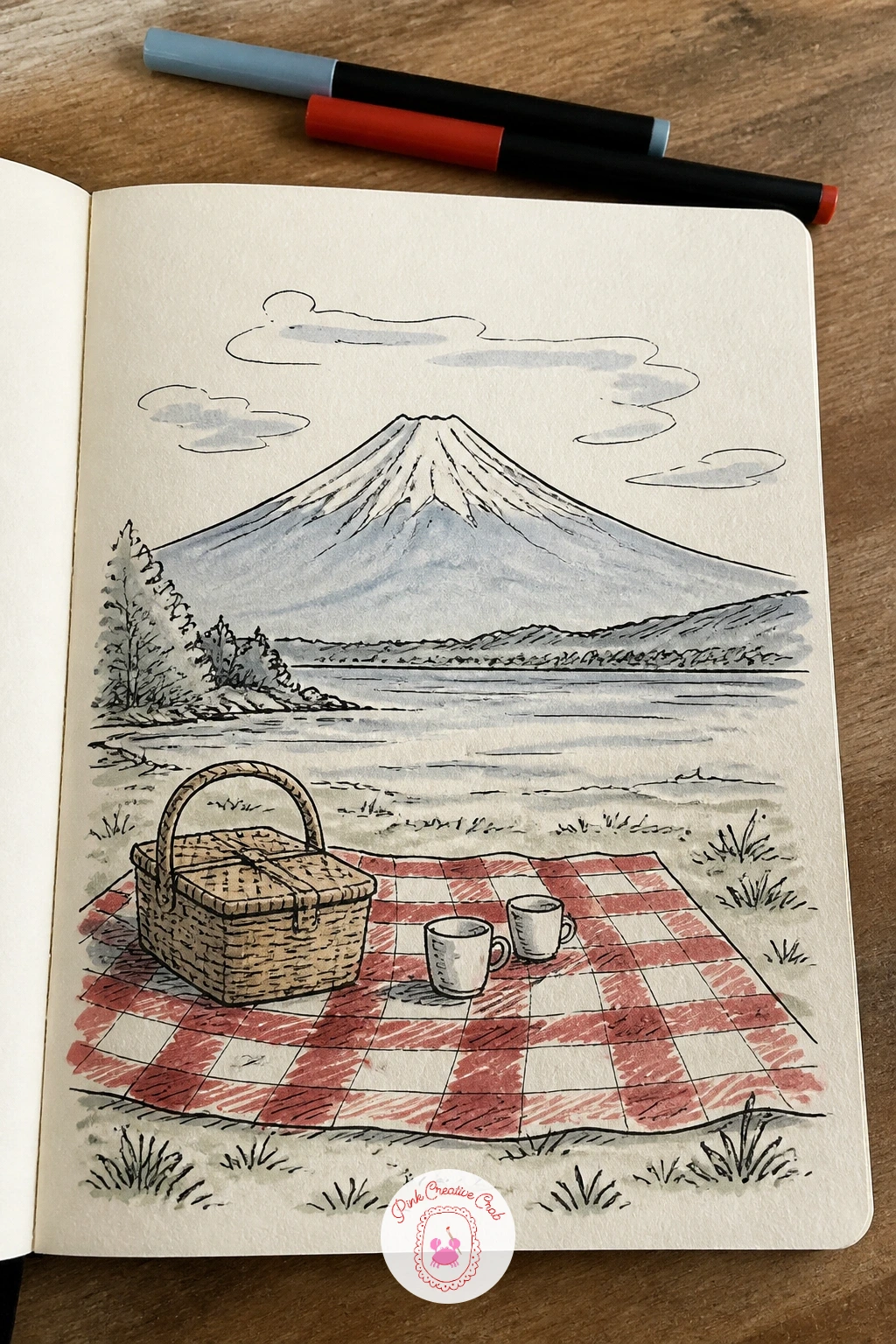
Palette: Fuji Blue Grey,Snow White,Blanket Check Red,Grass Green
Degas drew ballerinas constantly, usually mid-rehearsal rather than mid-performance, so this page keeps that backstage energy but trades satin slippers for sneakers. Sketch two dancers first, one bending to stretch a leg along a barre, the other tying her shoe, using quick gesture lines before you commit to any outline.
Ink the tutus loosely with soft, scribbly edges, since Degas’s pastel technique was never about clean lines, then switch focus to the sneakers, drawn with more precise detail than the rest of the figure so the twist actually reads.
Shade the tutus with the side of a soft pencil or pastel stick rather than fineliner cross hatching, smudging gently with a finger or blending stump for that soft, powdery Degas look.
No pastels on hand, a dry brush loaded with very little watercolor dragged lightly over the paper gives a similar soft texture.
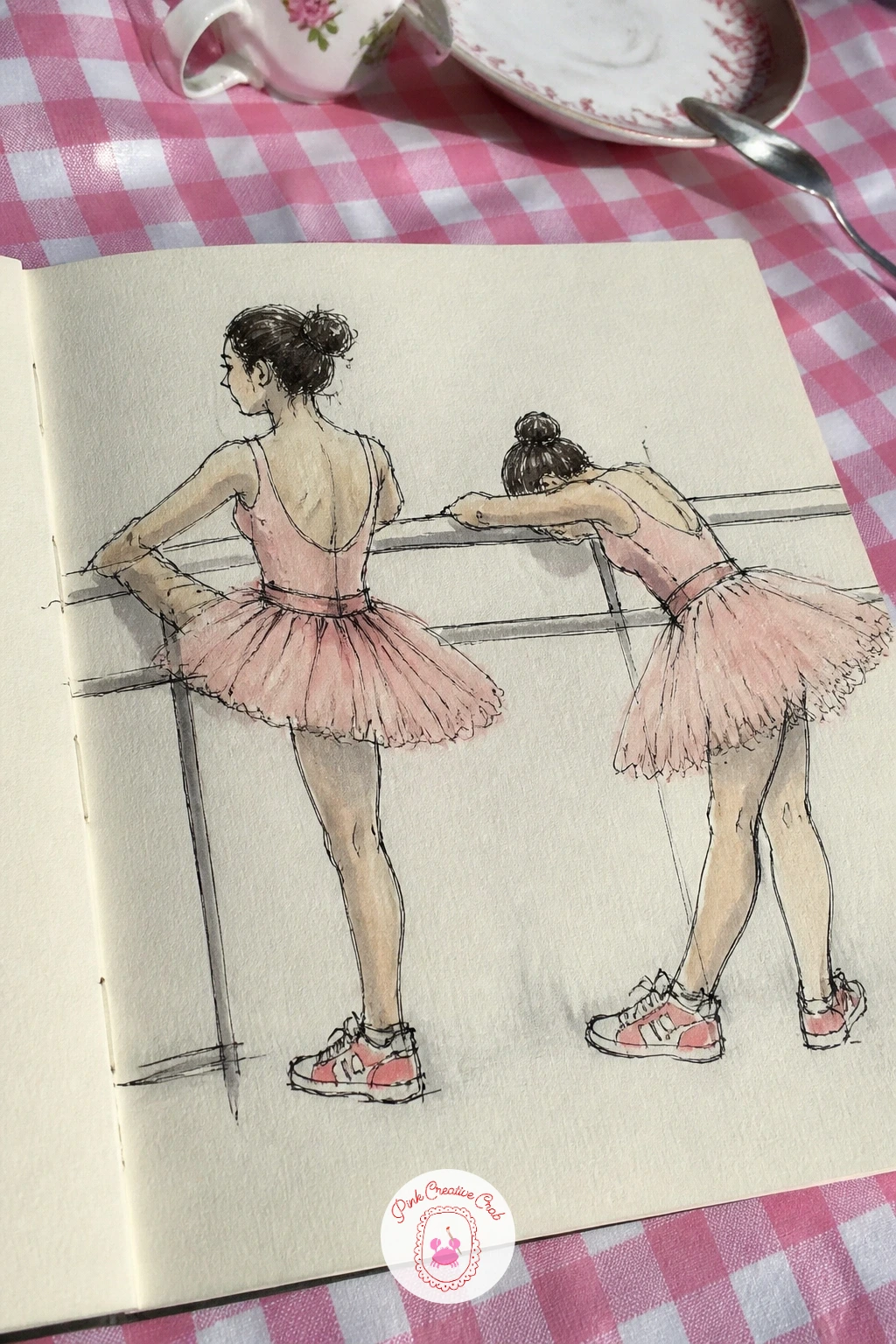
Palette: Tutu Pink,Sneaker White,Sneaker Red,Floor Tan
Monet’s green Japanese bridge is usually drowning in lily pads and warm light, so painting it under snow is mostly about swapping the palette rather than the shapes. Sketch the bridge arc first, the same gentle curve as always, then the bare branches of the wisteria hanging over it instead of full leaves.
Ink the structure in simple lines, then wash the whole page in cool white and pale blue-grey, leaving the bridge itself in its usual soft green so it still reads as Monet’s bridge under a layer of snow.
Add snow with a flick of white gouache from an old toothbrush or a stiff brush, spattering it lightly across the top half of the page for falling flakes.
If the spatter goes on too heavy in one spot, dab it immediately with a tissue before it dries; once it sets, it is part of the page.
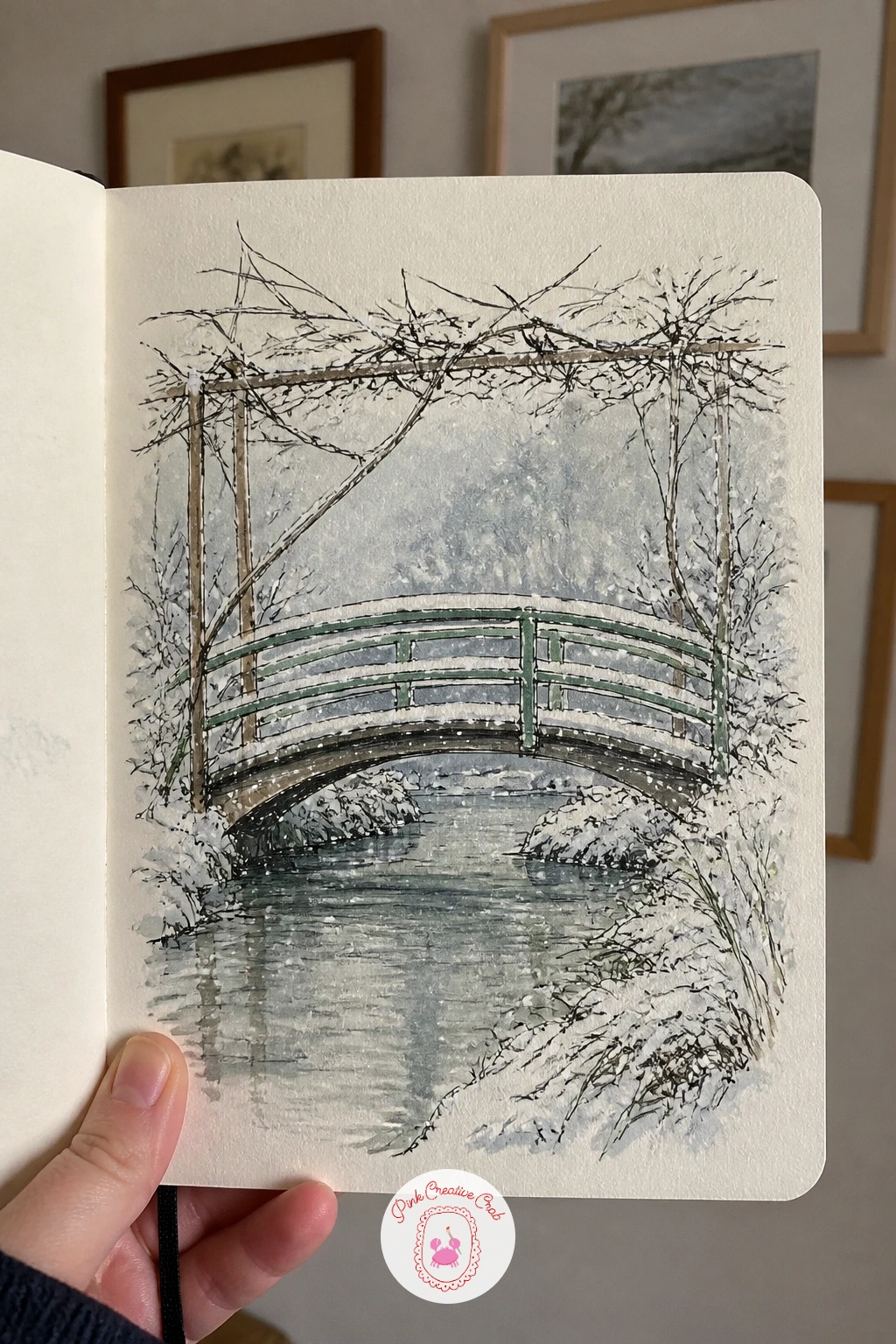
You Will Need
- toothbrush for splatter
- white gouache
Palette: Winter Blue Grey,Bridge Green,Snow White,Branch Brown
Van Gogh painted his cafe terrace glowing at night, so moving it to morning light changes almost every color choice while keeping the same charming composition. Sketch the awning and the row of little round tables first, then the cobblestone street stretching away under a starry sky, this time swapped for a pale pink morning instead.
Ink the tables and chairs with quick, slightly wobbly lines, then add a small basket of croissants on the nearest table, drawn with soft curved hatching to suggest their flaky layers.
Wash the awning in warm yellow rather than the original’s deep gold, and keep the sky soft pink and pale blue rather than Van Gogh’s inky night, so the whole page reads unmistakably as early morning.
If the cobblestones look too busy, suggest only the front few rows in detail and let the rest fade into a loose wash toward the back of the page.
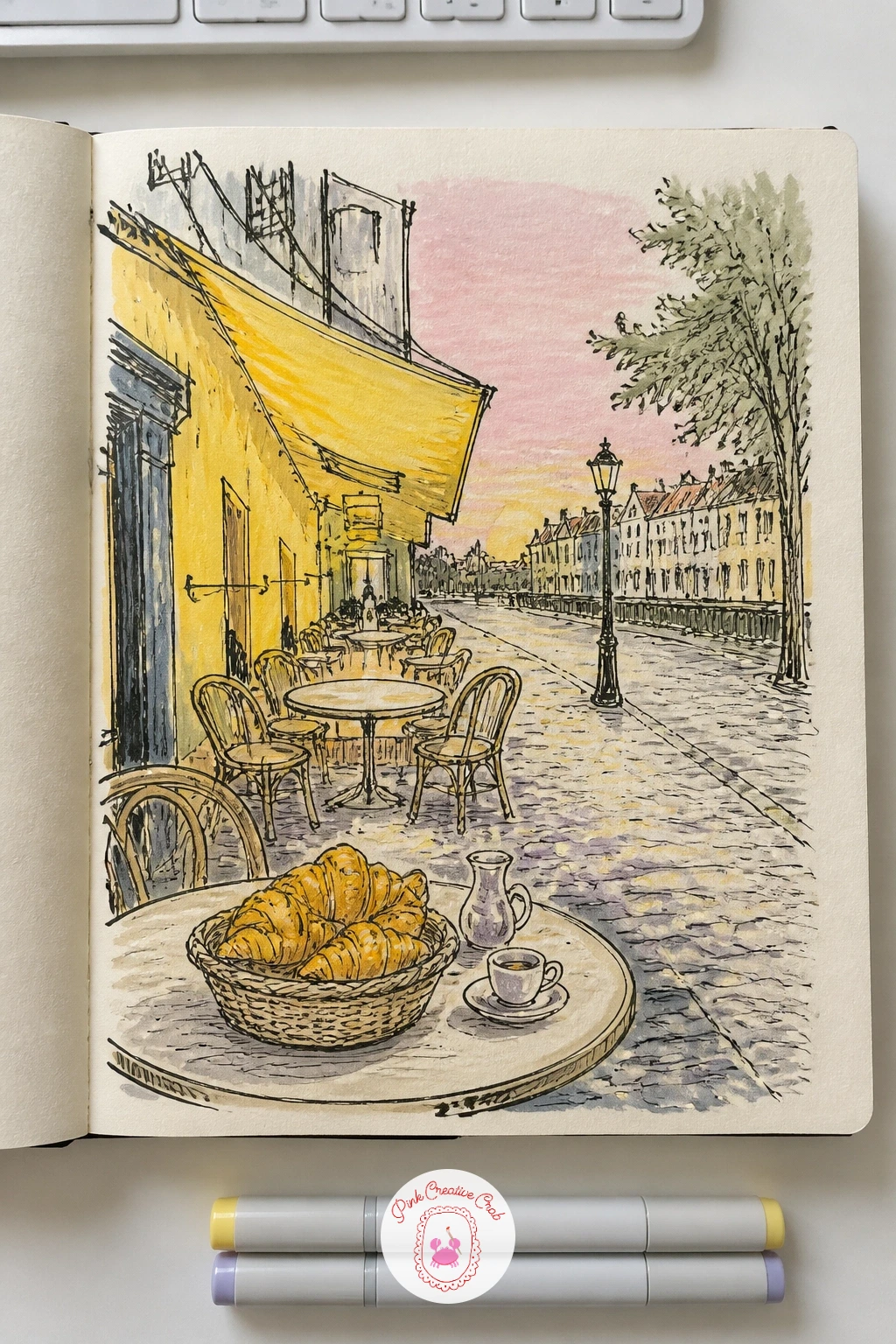
Palette: Morning Pink,Soft Blue,Awning Yellow,Croissant Gold
Renoir’s Luncheon of the Boating Party is full of relaxed figures draped over a balcony rail, which maps nicely onto a modern picnic scattered across a blanket on grass. Sketch three or four figures loosely first, some sitting, one leaning back on an elbow, keeping poses casual rather than formal.
Ink the figures with soft, rounded lines, then add a checkered blanket beneath them scattered with a few picnic items: a baguette, a bottle, a bowl of fruit, echoing the still life details Renoir packed onto his original table.
Build up color in loose dabs of marker or watercolor rather than flat fills, since Renoir’s brushwork was famously soft and broken; a slightly uneven fill actually helps the page feel truer to the source.
If the group looks crowded, drop to three figures and give each one more space on the page; a few well-placed people read more clearly than a packed crowd.
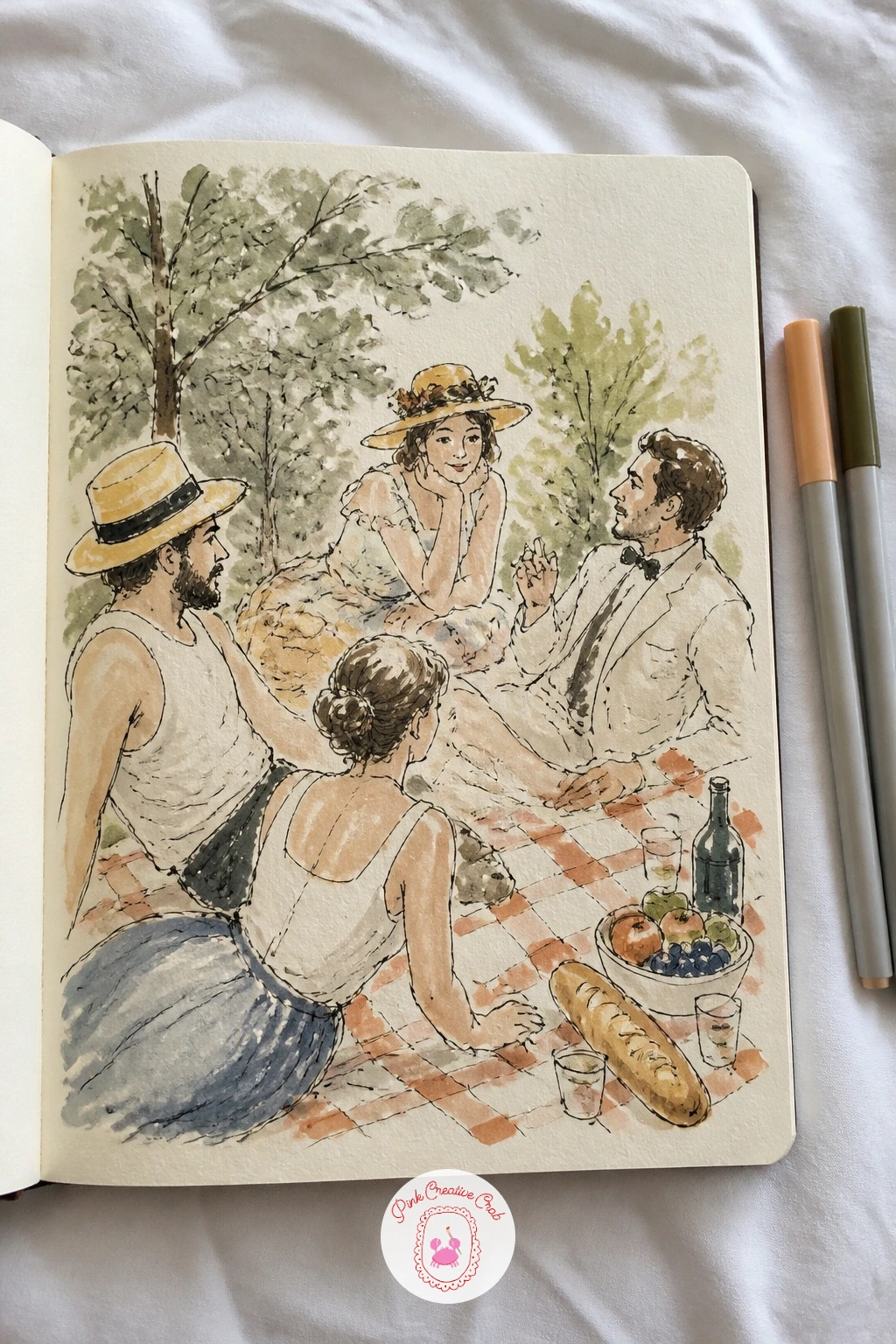
Palette: Picnic Red,Straw Yellow,Grass Green,Fruit Orange
After a page of soft Renoir dabs, swing the other direction and try Seurat’s full pointillist technique on a simple beach scene. Sketch a plain horizon line first, a strip of sand, a strip of sea, a strip of sky, then a couple of simple umbrella and figure silhouettes along the shore.
Fill every shape entirely in small dots rather than any line or wash, using a fine marker or the tip of a brush, layering warm and cool dots close together so the colors blend optically rather than physically mixing on the page.
This technique takes patience, so a true ten minute version covers just the sky and sea in dots and leaves the sand as a flat wash, while a forty minute version dots the entire page including the figures and umbrellas.
If the dots start to look too uniform, vary the pressure and spacing slightly as you go; true pointillism has a lively, uneven texture up close.
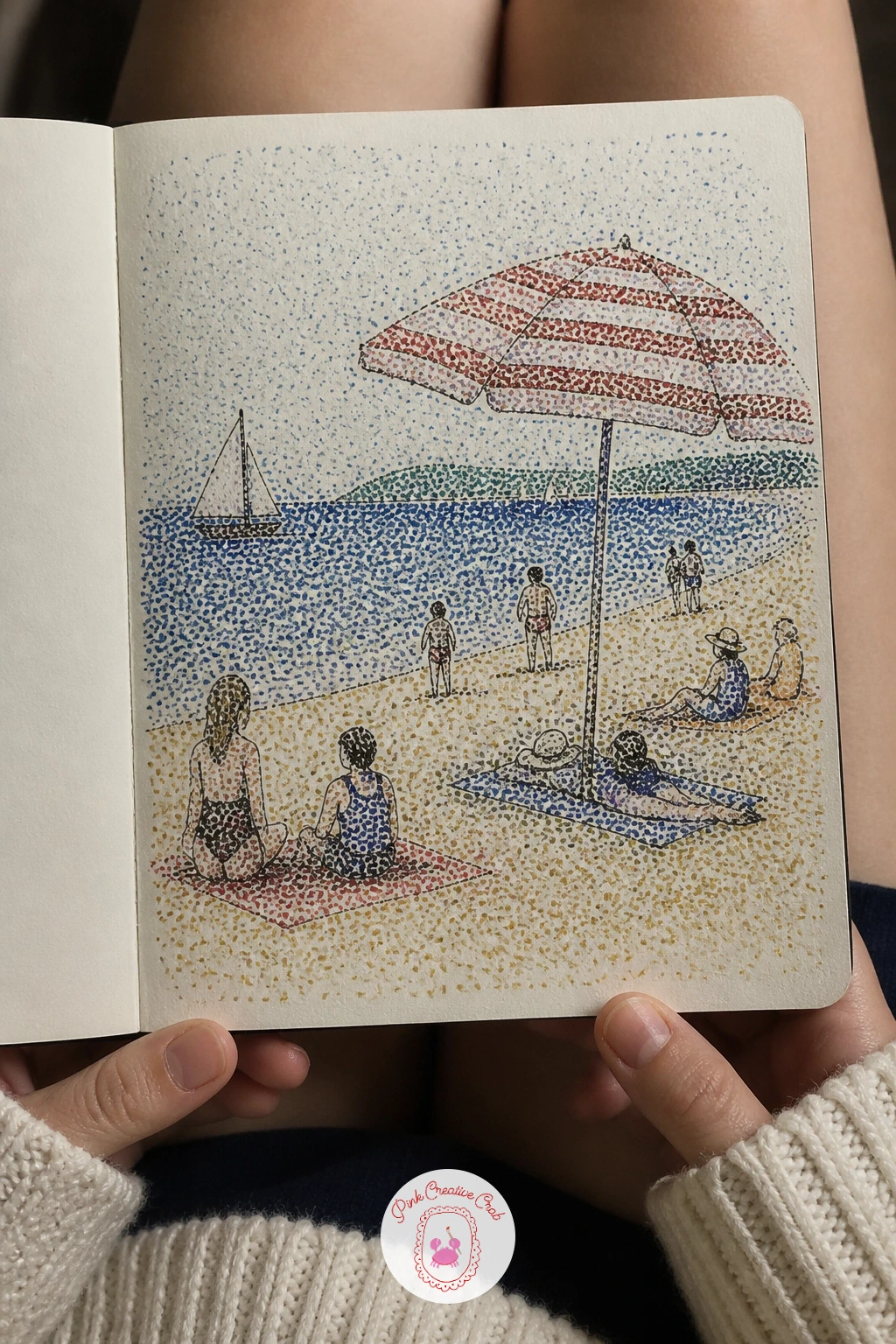
Palette: Sea Blue,Sand Yellow,Sky Pale Blue,Umbrella Red
Cezanne painted the same bowl of apples over and over to study form and color, so this page is a quiet, structural exercise after the busy dotted beach. Arrange three or four apple shapes on a simple tilted tabletop, overlapping them slightly the way Cezanne always did to build depth without perspective tricks.
Measure the apples against each other before inking: Cezanne kept his fruit roughly the same size, so check that none of yours balloons much larger than its neighbors. Ink the outlines loosely, then build color in patches of red, green and yellow rather than one flat tone per apple, since that patchwork is Cezanne’s real signature.
Take one bite out of a single apple near the front, the pale flesh showing through a simple curved cut, which instantly modernizes the whole still life.
If the apples look flat, add one short cast shadow under each where it meets the table; that alone gives them weight.
This kind of structured still life also pairs well with the ideas in easy watercolor fruit paintings if you want to keep practicing fruit afterward.
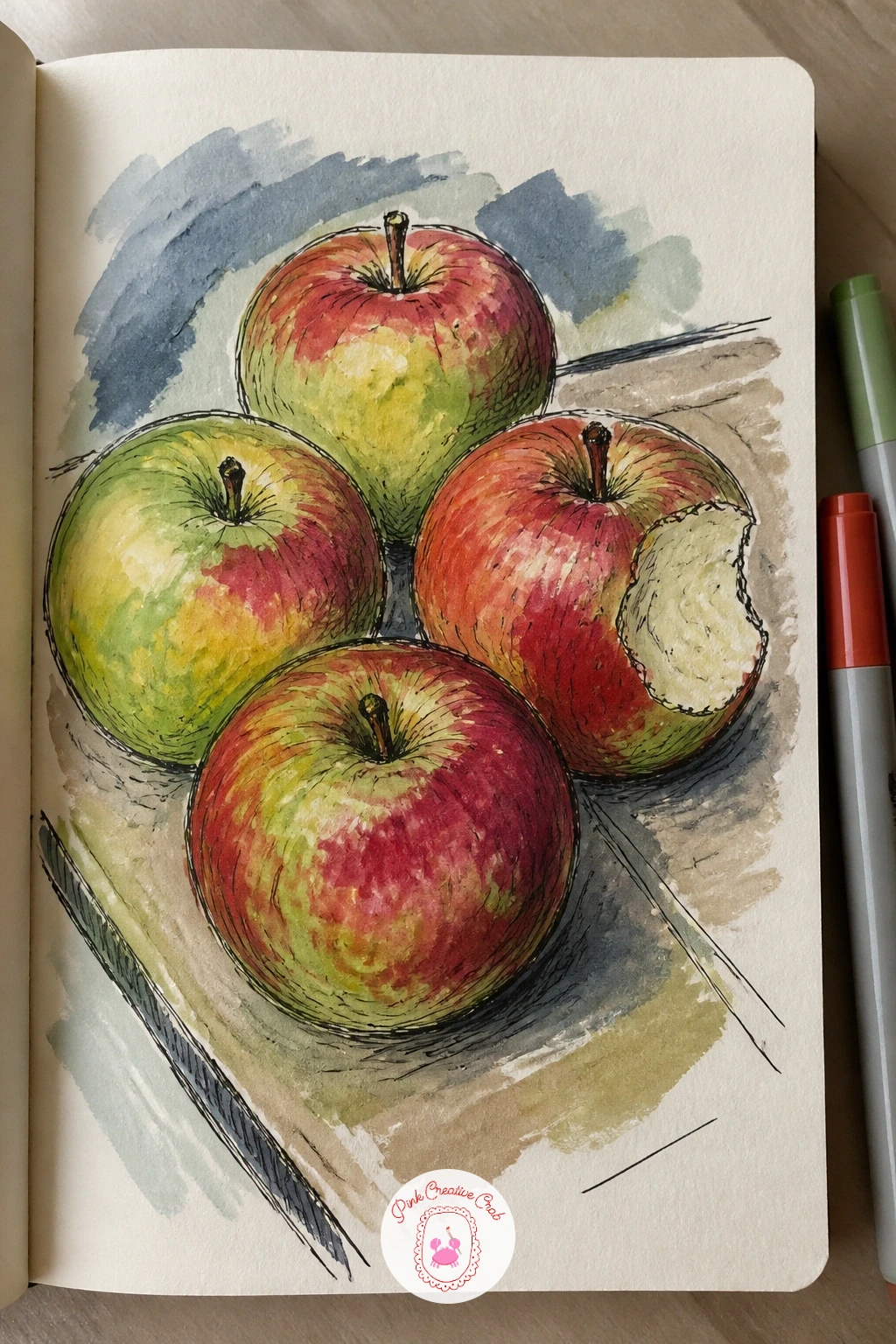
Palette: Apple Red,Apple Green,Apple Yellow,Table Brown
Return to Vermeer’s quiet window light, this time without a figure at all, just the empty table and the window beside it, now with a laptop sitting open where a letter or a jug once stood. Sketch the window frame first, off to one side, then the table running perpendicular to it so the light falls diagonally across the whole scene.
Ink the laptop simply, a flat rectangle base and an upright screen, then shade the room using the window as the only light source: the side nearest the glass stays pale, the far side of the table falls into warm shadow.
Wash the walls in a muted blue-grey and the table in warm wood brown, keeping the laptop screen a cool pale blue-white to suggest it is glowing faintly in the dim room.
If the perspective of the table feels off, draw a faint horizon line at your own eye level first and keep both edges of the table converging gently toward it before inking.
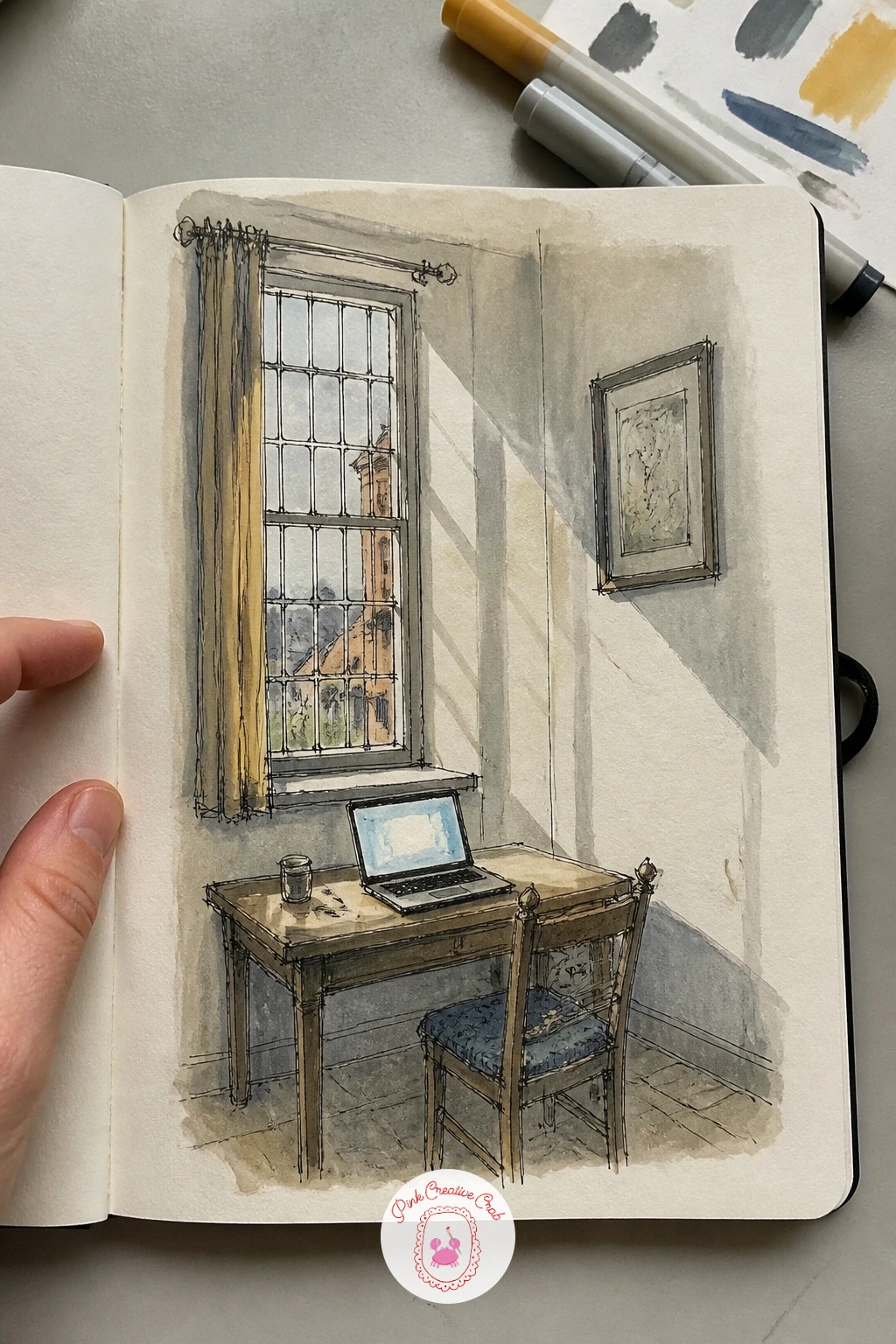
Palette: Window Blue Grey,Table Brown,Screen Pale Blue,Wall Cream
Millais’s Ophelia drifts among real river reeds and flowers, so keeping her floating but adding an inflatable lilo underneath her is a gentle, funny twist rather than a jarring one. Sketch her figure first lying flat, arms loosely open, hair spreading out around her head exactly as in the original.
Ink the lilo beneath her as a simple curved shape, bright against the water, then surround her with painted flowers scattered across the surface, poppies and daisies work well and are quick to paint in small dabbed strokes.
Build the water in a soft green-blue wash first, dropping the flower colors in wet so their edges blur slightly into the water, which keeps the whole scene feeling submerged and dreamy rather than stiff.
If the flowers end up too neat, flick a little extra water onto the wet paint to let colors bloom outward unevenly; that softness matches the original mood far better than crisp petals.
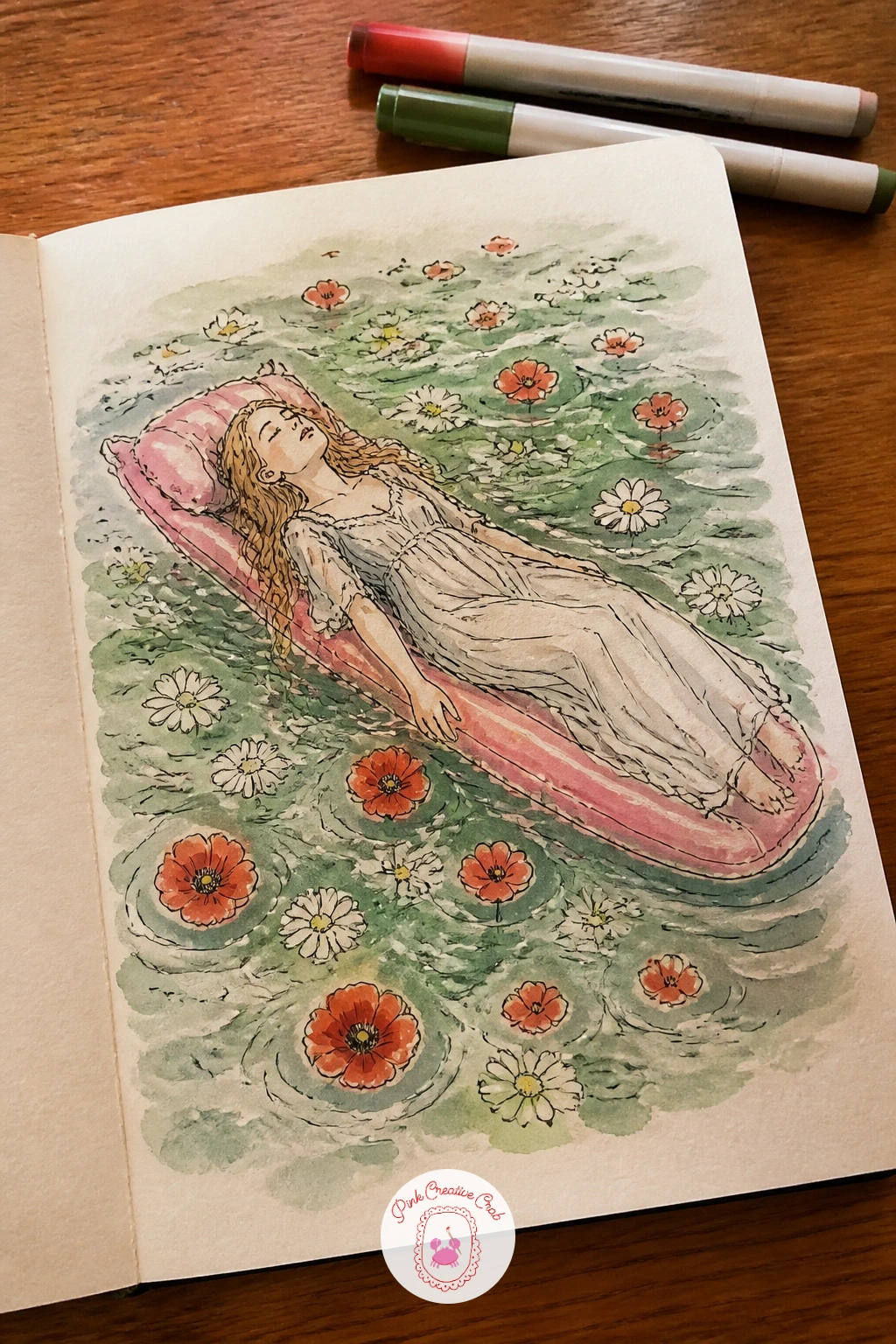
Palette: River Green,Lilo Pink,Poppy Red,Daisy White
Millet’s gleaners bend low across a wheat field, so swapping their task for strawberry picking keeps the same gentle, bent-over poses but brightens the whole mood considerably. Sketch three figures first, each bent at a slightly different angle, spaced across a low horizon the way Millet always kept his figures small against a wide field.
Ink the field behind them in loose horizontal strokes of green rather than Millet’s golden wheat, then dot small red strawberries low to the ground near each figure’s hands.
Shade the figures simply with their backs lit from a low sun behind them, which Millet used to give his laborers quiet dignity; keep faces mostly turned away or down, since the original figures are rarely shown clearly.
If the field looks empty, scatter a basket near one figure and a few stray strawberry leaves closer to the front of the page for depth.
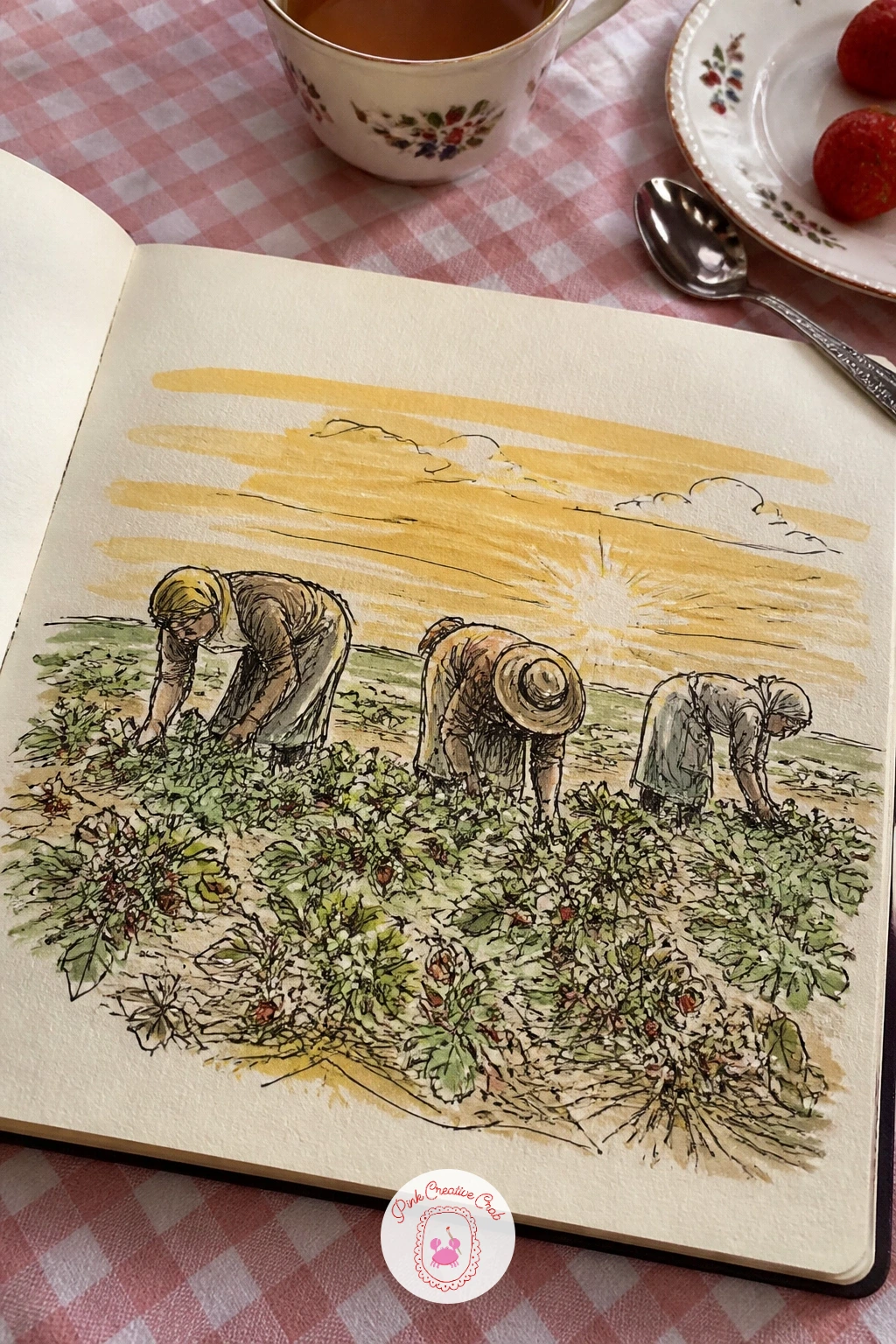
Palette: Field Green,Strawberry Red,Sky Gold,Figure Brown
Berthe Morisot’s The Cradle shows a mother gazing at a baby through sheer curtain fabric, so replacing the baby with a sleeping puppy keeps the same soft, tender mood while adding an easy smile. Sketch the cradle first, a simple curved basket shape draped in light fabric, then the curtain hanging over it in loose, veil-like folds.
Ink the fabric with very light, broken lines rather than solid outlines, since the whole point of the original is how translucent and soft everything looks. Draw the puppy curled small inside the cradle, just visible through the curtain, ears relaxed and eyes closed.
Wash the fabric in the palest grey-white you can mix, almost letting the white paper do the work, then add a single warm highlight where light falls across the puppy’s fur.
If the curtain looks too solid, lift some color back out with a damp clean brush once it is dry to soften the folds further.
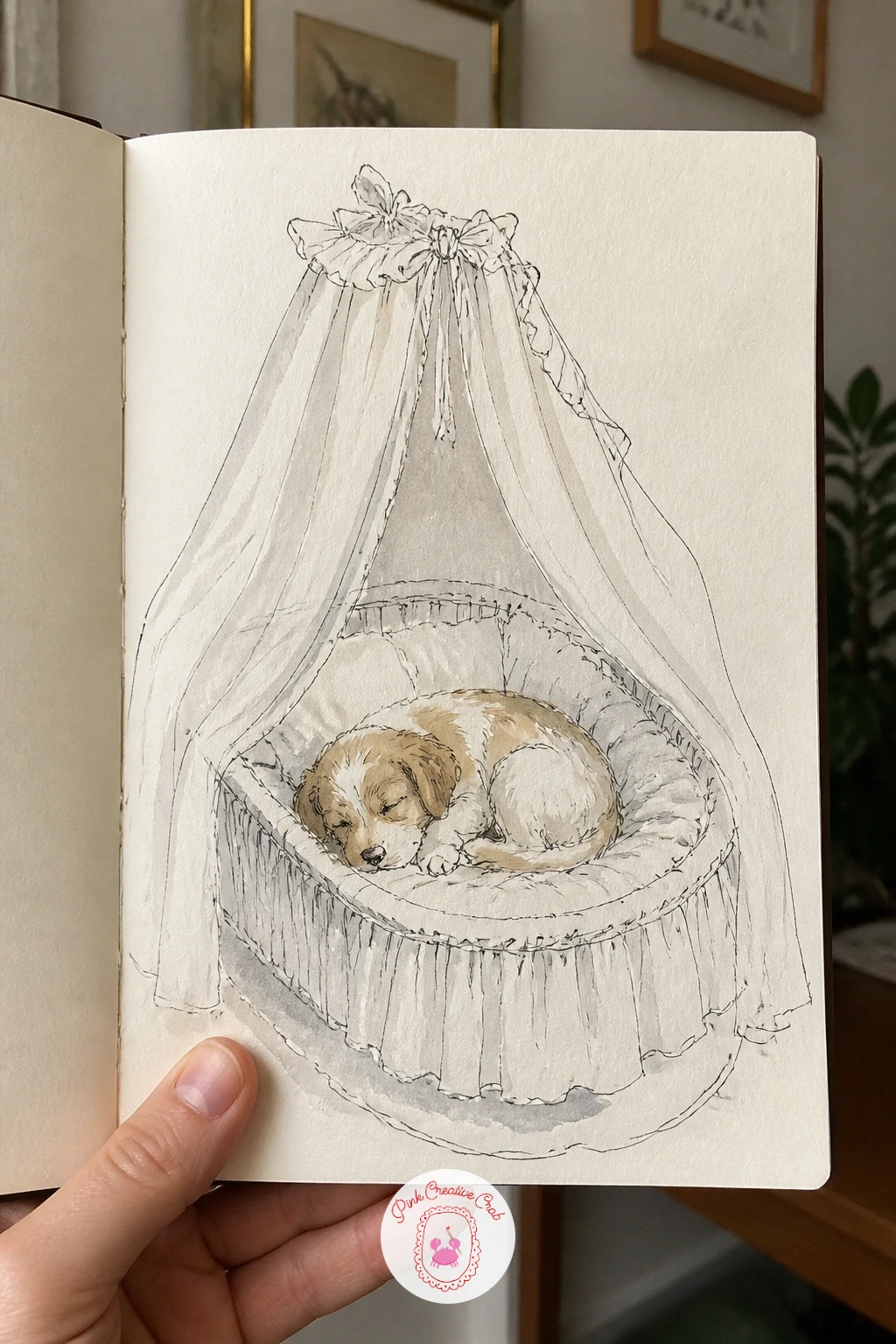
Palette: Curtain Grey White,Puppy Tan,Soft Pink,Shadow Grey
Monet’s poppy field is mostly texture and color rather than careful drawing, which makes it a relaxing, quick page near the end of this list. Sketch a low horizon line and two tiny figures walking in the distance, exactly as Monet placed his own mother and son, keeping them small and loose.
Fill the field with dabs of red marker or a loaded brush, scattering poppies more densely in the foreground and thinning them out toward the horizon so the field reads as receding into the distance.
Lay a small picnic blanket over part of the field in the foreground, with a basket and a couple of cups, so the modern detail sits right where the eye naturally lands first.
If the poppy dabs feel too controlled, load the brush heavily and press rather than paint; the resulting blotchy mark is closer to Monet’s own loose touch than a neat dot ever is.
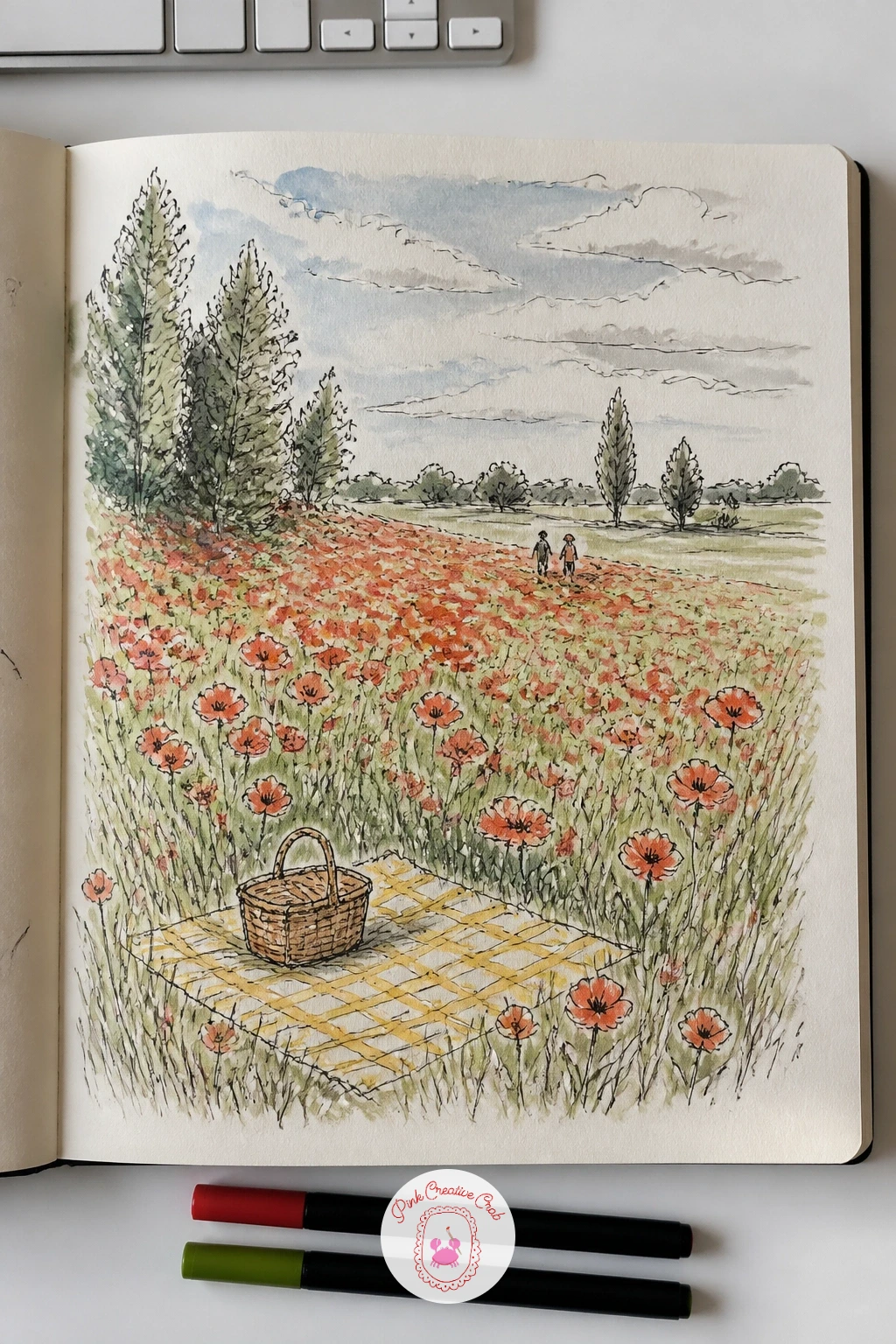
Palette: Poppy Red,Field Green,Sky Pale Blue,Blanket Yellow
Close the sketchbook on Van Gogh’s irises, but stand them in a blue watering can instead of a vase, since the curved spout gives you one more interesting shape to draw than a plain jug would. Sketch the can first, a simple rounded body with a spout and handle, then build each iris above it from a few curved petal strokes rather than trying to copy every twist of the real flower.
Ink the petals with quick, slightly curling lines, since irises bend and fold more than most flowers, then fill them in ultramarine and violet marker with a touch of yellow at the center of each bloom.
Compare the height of the tallest iris to the watering can beneath it before you ink; Van Gogh kept his irises roughly twice the height of their container, and that ratio is what makes the bouquet feel generous rather than sparse.
If the blues start to look too similar, mix in one iris of pure violet among the ultramarine ones for contrast, the way the original painting does with its single white bloom.
For more flower pages after this one, the ideas in flower sketchbook ideas for beginners make a nice next stop, and how to fill your sketchbook is worth a look too if you want to keep this whole project going.
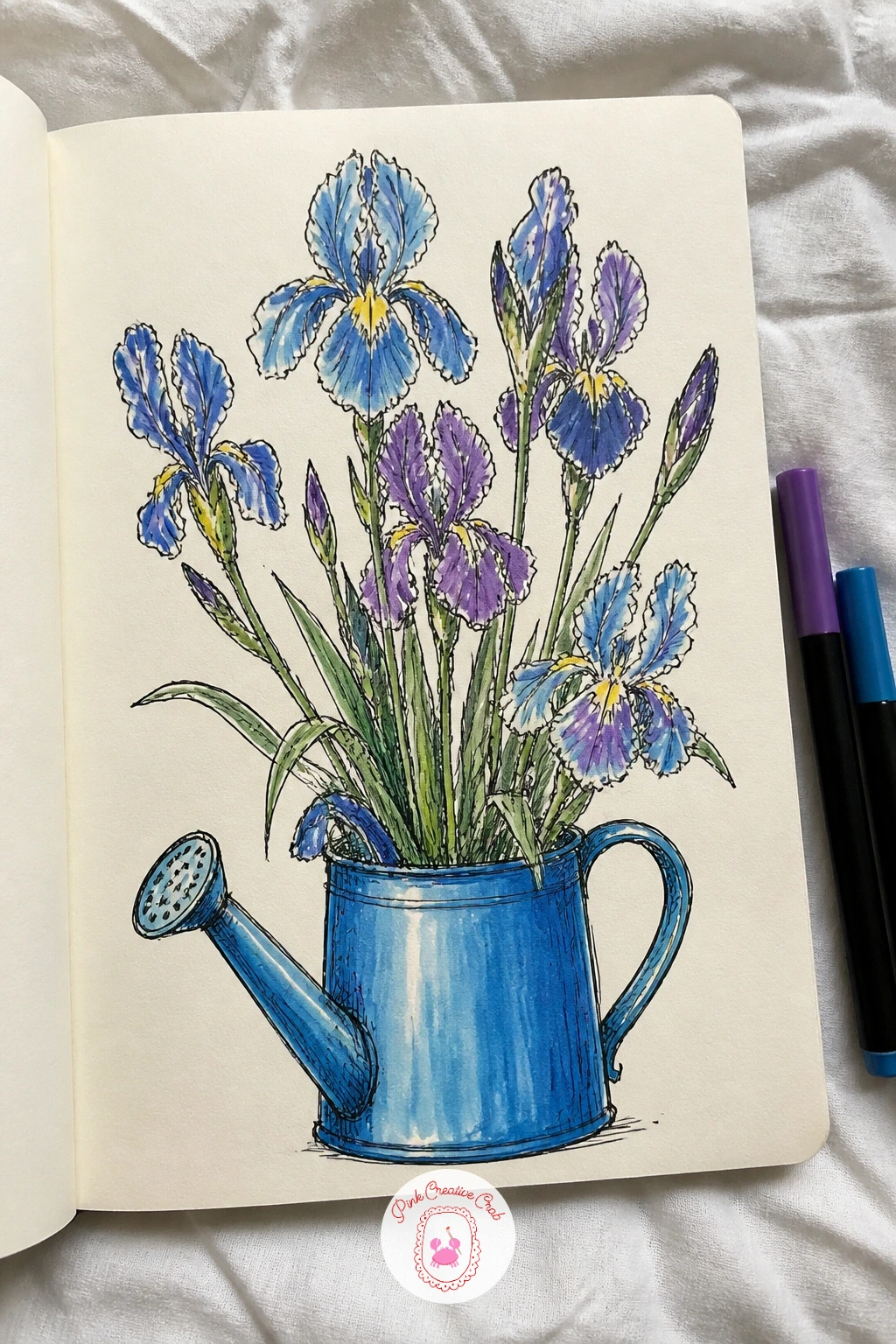
Palette: Ultramarine,Violet,Iris Yellow,Can Blue
What to Do Next
Pick whichever painting is stuck in your head right now, open to a clean page, and start with the loose pencil shapes before any ink touches the paper. One finished page tends to pull you straight into the next one.
Frequently Asked Questions
Do you need to know how to draw well to copy a famous painting in a sketchbook?
No, these pages work from simplified shapes rather than exact copies. Focus on the overall pose, color and composition of the original painting rather than fine detail, since the playful twist is what makes each page fun, not precision.
What materials work best for painting-inspired sketchbook pages?
A fineliner for outlines, a small set of markers or watercolors for color, and heavyweight paper that can handle a little wet media all work well. Keep the kit small so you can finish a page in one sitting.
How do you keep a famous painting recognizable once you add a twist?
Keep the original pose, palette and composition close to the source, and change only one clear element, like an object, a season or a character. A recognizable silhouette matters more than exact color matching.
Is it okay to copy public domain paintings in a personal sketchbook?
Yes, paintings old enough to be in the public domain, like the ones in this list, are free to reference, copy and reinterpret for personal sketchbook work without any permission needed.
How long does one of these sketchbook pages usually take?
Most pages take between twenty and forty minutes depending on detail level. Simpler ones, like the apples or the poppy field, can be finished in under fifteen minutes if you skip extra background detail.
Have any thoughts?
Share your reaction or leave a quick response — we’d love to hear what you think!
-
 0
-
0
-
0
-
0
-
0
-
0


