A nutcracker drawing is the one Christmas subject that lets you go properly opulent: deep burgundy velvet, antique gold trim, a little ink linework to sharpen the edges. These pages are fun to make because the palette does most of the work for you, so even a quick sitting looks rich and finished.
Below you will find 36 scenes pulled from the old Hoffmann tale and the classic ballet, soldiers and princes, the Sugar Plum Fairy, Clara at the window, snowflake dancers and gingerbread nutcrackers among them. Pick whichever one your evening and your paint box can manage, and work through the rest another night.
Using these images: free for personal projects such as printing, coloring, cards, journals and gifts. Handmade items that include them may be sold up to 30 pieces per design. More than that is commercial use and is not permitted, and neither is selling or sharing the images themselves or passing them off as your own. Please ask before any other use.
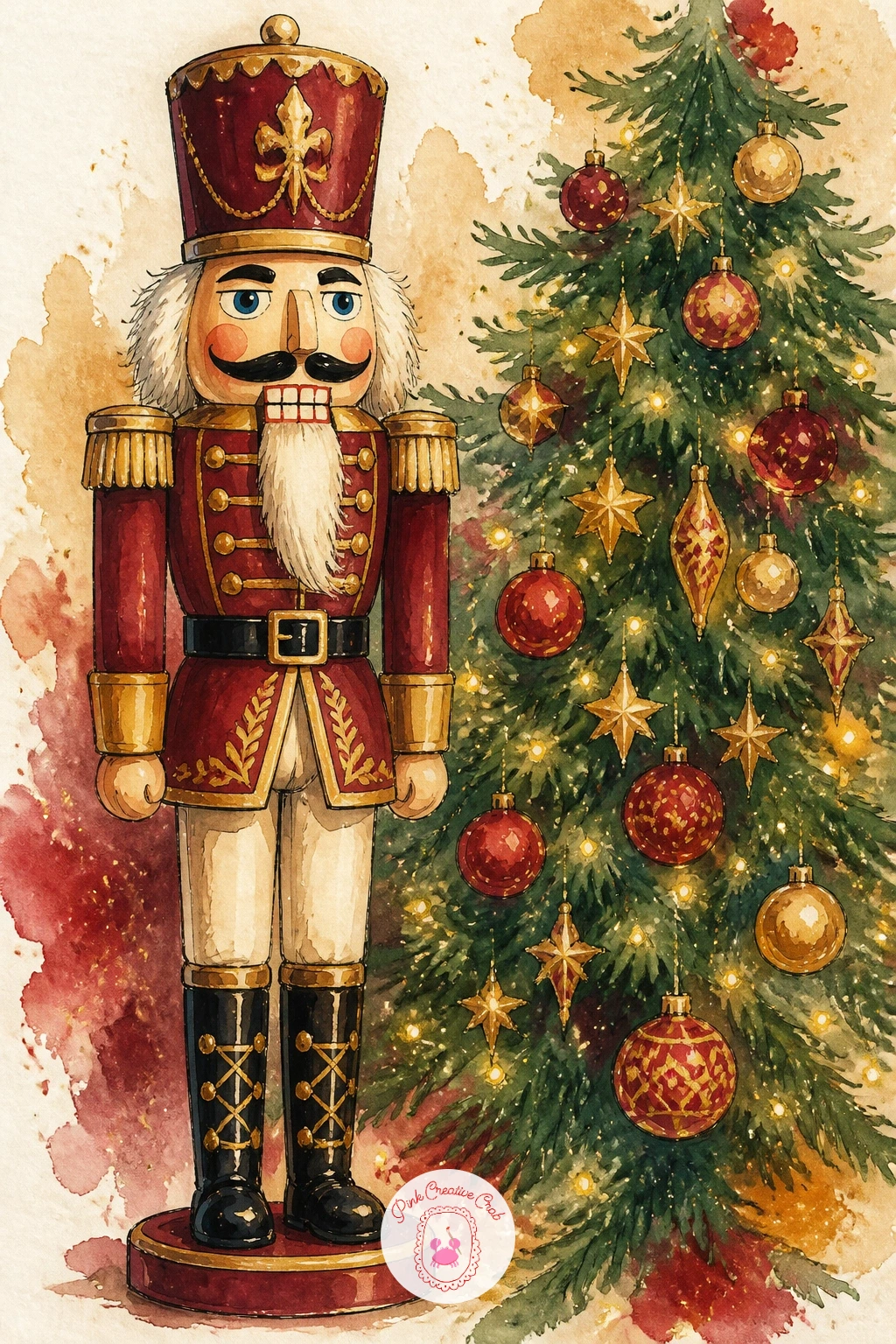
Start the whole series with a nutcracker soldier standing guard by a lit tree, since the pose is just a straight column of a body and it teaches you the proportions every other nutcracker will reuse. Pencil a tall rectangle for the coat, a smaller one for the legs, and a round head with a stiff jaw, then check that the head sits at about one-sixth of the total height, the way a toy figure’s oversized head should.
Paint the coat in a burgundy wash first, let it dry, then add gold stripes down the front with a dry brush so the gold catches only on the paper’s texture instead of sitting flat. The tree behind him can stay a soft green blur with a few dabs of warm yellow for the lights, so he reads as the sharpest thing in the scene.
The usual trouble spot is the face going too soft or cartoonish. Keep the ink line for the mouth short and straight, almost a grim little dash, and the stern nutcracker expression appears on its own.
If you do not have gold paint, warm yellow ochre with a touch of white gouache reads almost the same from a normal viewing distance.
You Will Need
- cold press watercolor paper
- round brush size 6
- burgundy and pine green watercolor
- gold gouache
- fine black liner pen
Palette: Burgundy,Antique Gold,Pine Green,Cream
Look up a real wooden nutcracker figurine online before you start, since the stiff arms and oversized head only look right once you have seen the proportions on a real one.
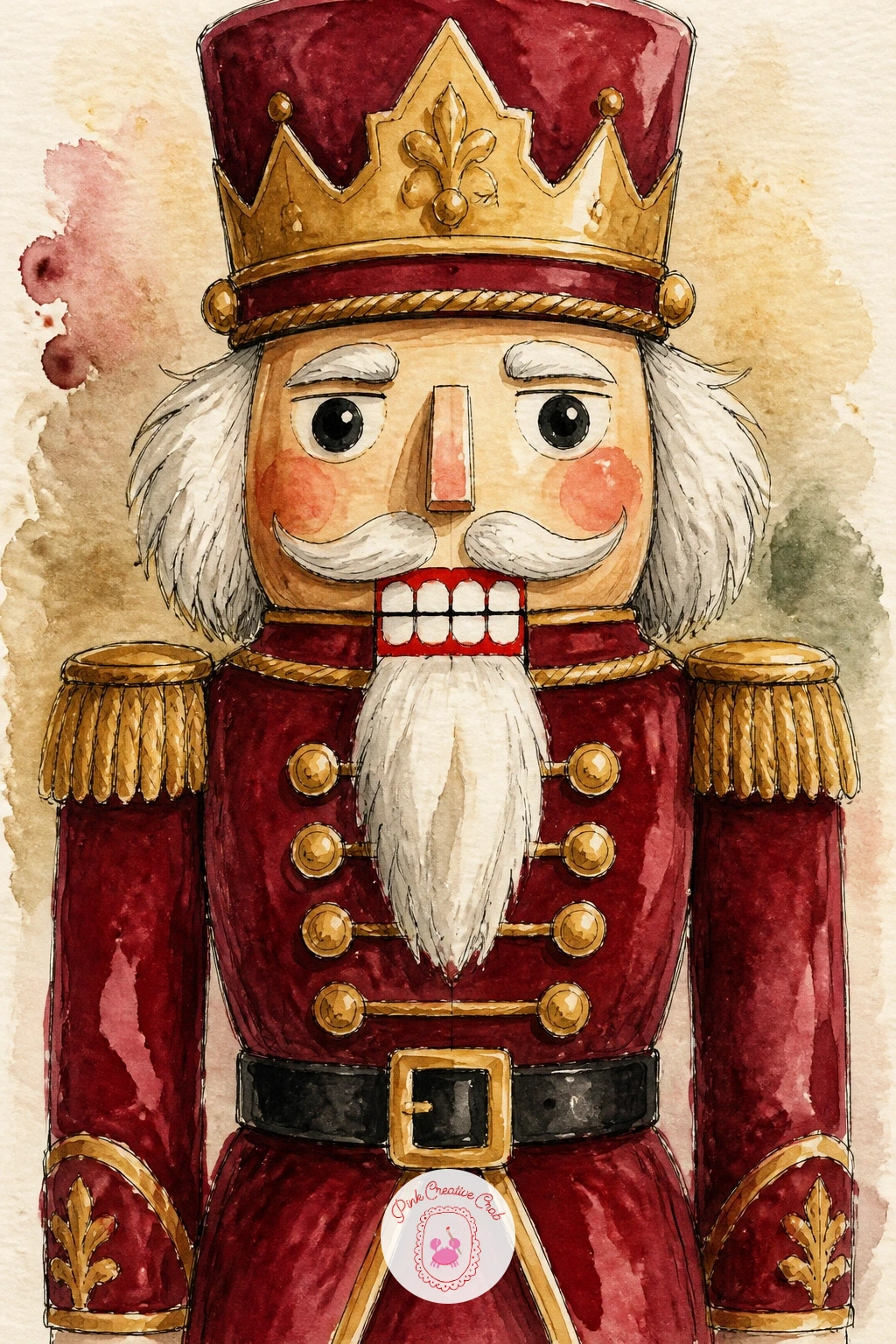
Once the basic soldier feels comfortable, try a nutcracker in a burgundy velvet coat with gold buttons and let the coat itself become the star of the page. Draw the coat wider and more rounded than the first one, with a slight flare at the hem, so it reads as fabric rather than wood.
Paint the velvet in two passes: a mid-tone burgundy wash first, then while it’s still slightly damp, drop in a darker burgundy at the folds so the color blooms softly instead of sitting in a hard line. This is what gives velvet its depth on paper. Add the gold buttons last with a tiny dot of gouache down the center front, spaced evenly by eye rather than measured.
Buttons often end up crooked or uneven in size. Pencil in faint dots before you paint, spaced the width of one button apart, so the ink and gouache just confirm a line you have already checked.
No gold gouache on hand? A gold gel pen gives the same small bright dot with no mixing required.
You Will Need
- watercolor paper
- round brush
- burgundy watercolor in two values
- gold gouache or gold gel pen
- fine liner pen
Palette: Deep Burgundy,Cherry Red,Antique Gold,Cream
Try wet-on-wet for the coat’s folds by keeping the paper damp a little longer than feels natural, since that softness is what separates velvet from flat card.
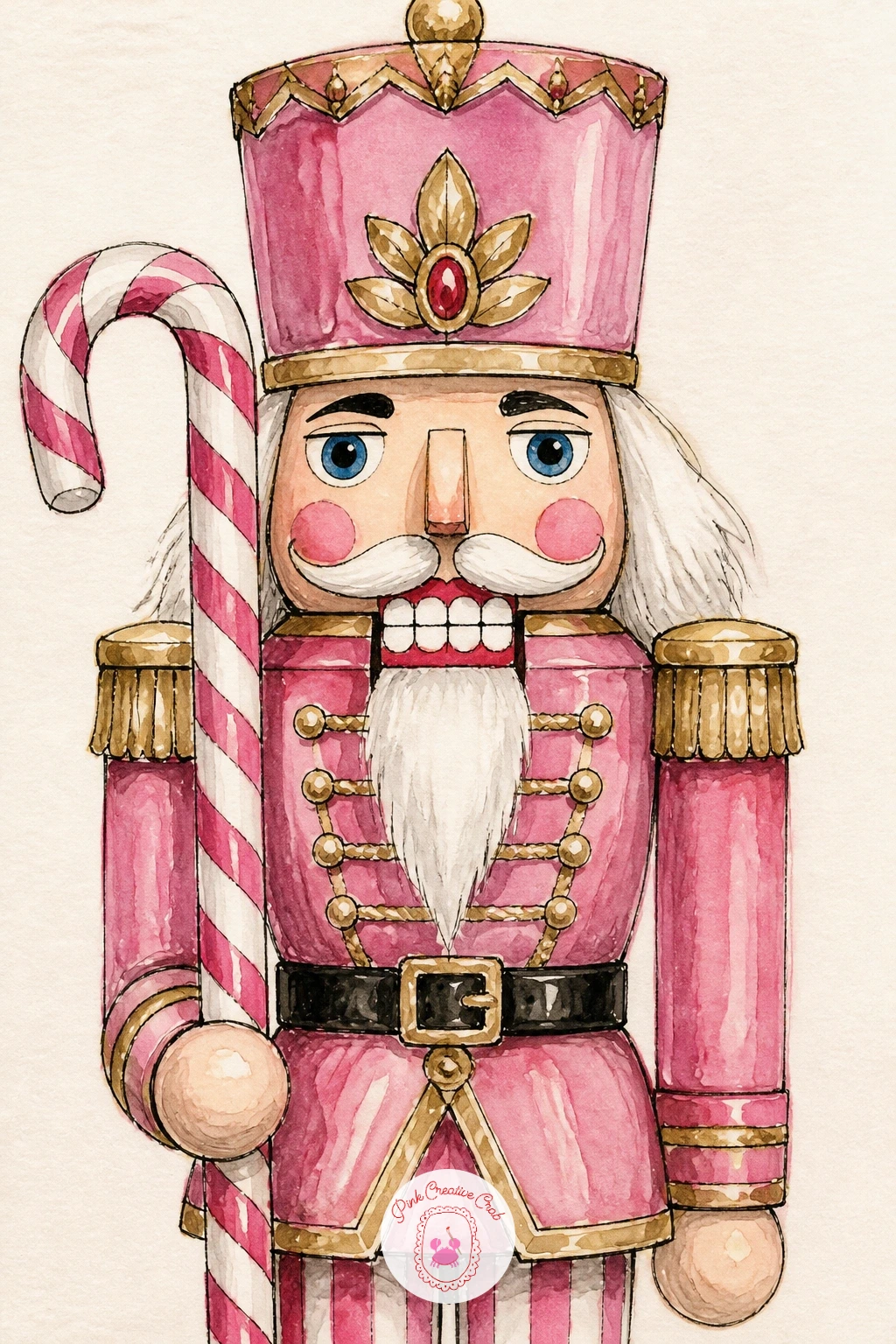
Give yourself a break from burgundy with a pink nutcracker holding a candy cane, a cheerful variation that still fits the opulent palette if you keep the gold trim. Sketch the same stiff standing pose as before, but swap the coat color and hold the candy cane diagonally across the chest in one painted hand.
Wash the coat in a dusty rose rather than bubblegum pink, since a slightly muted pink sits better next to gold than a bright one does. Paint the candy cane with thin red spiral stripes over a dry white coat, using the tip of your round brush rather than the full belly of it for control.
Edges on a striped object like this blur easily if the white base isn’t fully dry. Wait a full few minutes before adding the red spiral, or keep a hairdryer on hand to speed the page along.
If pink paint runs thin, mix red with a touch of white gouache instead of relying on water to lighten it, since that keeps the color opaque.
You Will Need
- watercolor paper
- fine round brush
- dusty pink and cherry red watercolor
- white gouache
- fine liner pen
Palette: Dusty Rose,Cherry Red,Antique Gold,Cream White
Try swapping the candy cane for a small gold bell if you want a less expected prop, since the pink coat carries the scene on its own.
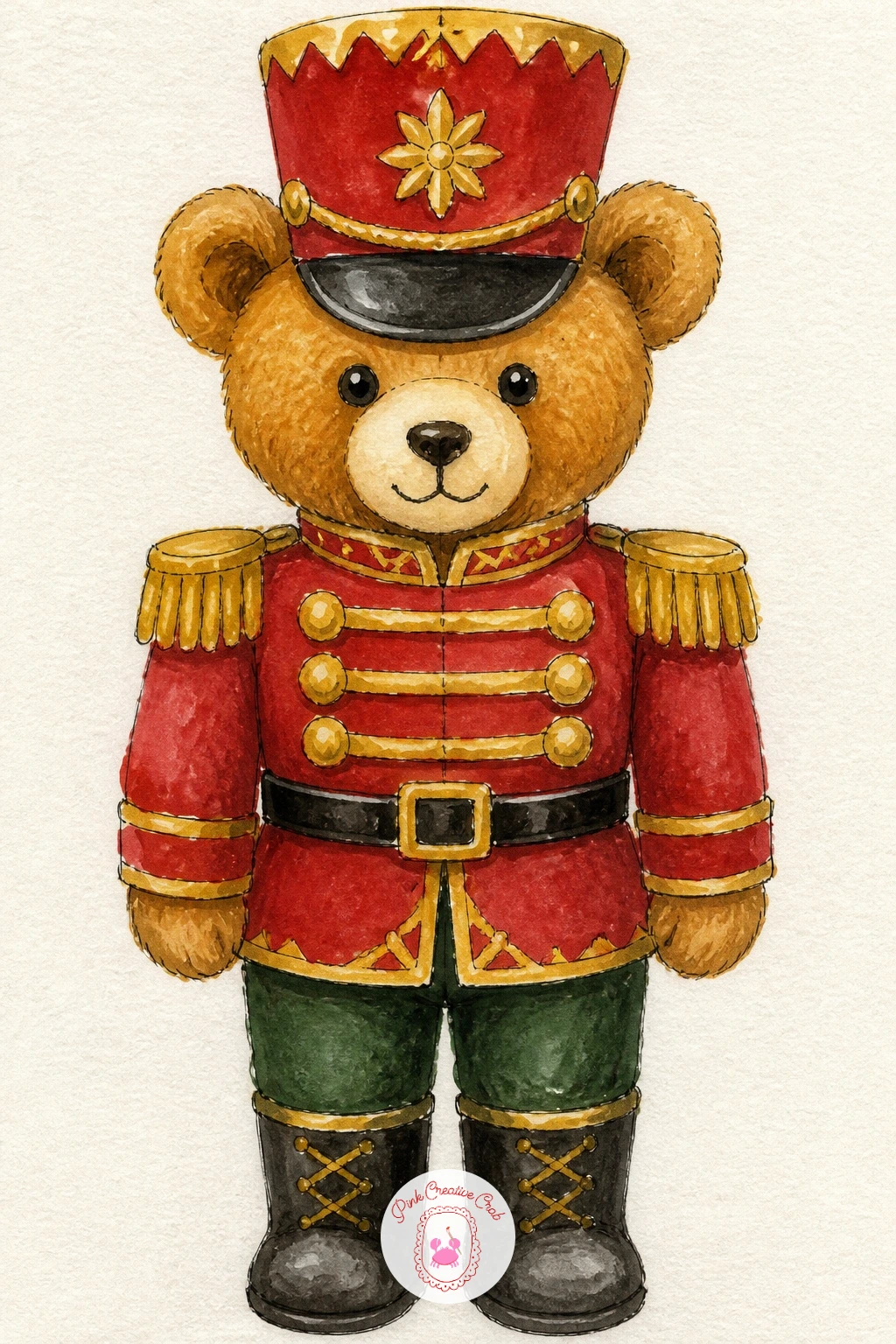
Move from toy soldiers to a nutcracker bear in a red uniform, which asks for a rounder head and softer jaw than the human figures so he reads as a bear rather than a man in a suit. Block in the head as a wide oval with small round ears, then the body as the same stiff column shape you have used before.
Paint the fur in a warm brown with a dry brush dragged lightly over the muzzle and ears, leaving some white paper showing through for texture, then add the red uniform coat over the body in a flat wash once the fur is dry. The red should look crisp and toylike against the softer fur.
If the fur texture disappears under too much paint, lift some color back out with a damp clean brush while it’s still wet, pulling pigment away rather than adding more.
Brown watercolor running low? A warm sepia ink wash gives a similar fur tone with less mixing.
You Will Need
- watercolor paper
- dry flat brush
- brown and red watercolor
- fine liner pen
- clean damp brush for lifting
Palette: Warm Brown,Cherry Red,Antique Gold,Cream
Look at a real stuffed bear’s ear placement before drawing, since nutcracker bears go wrong most often at the ears sitting too high or too far apart.
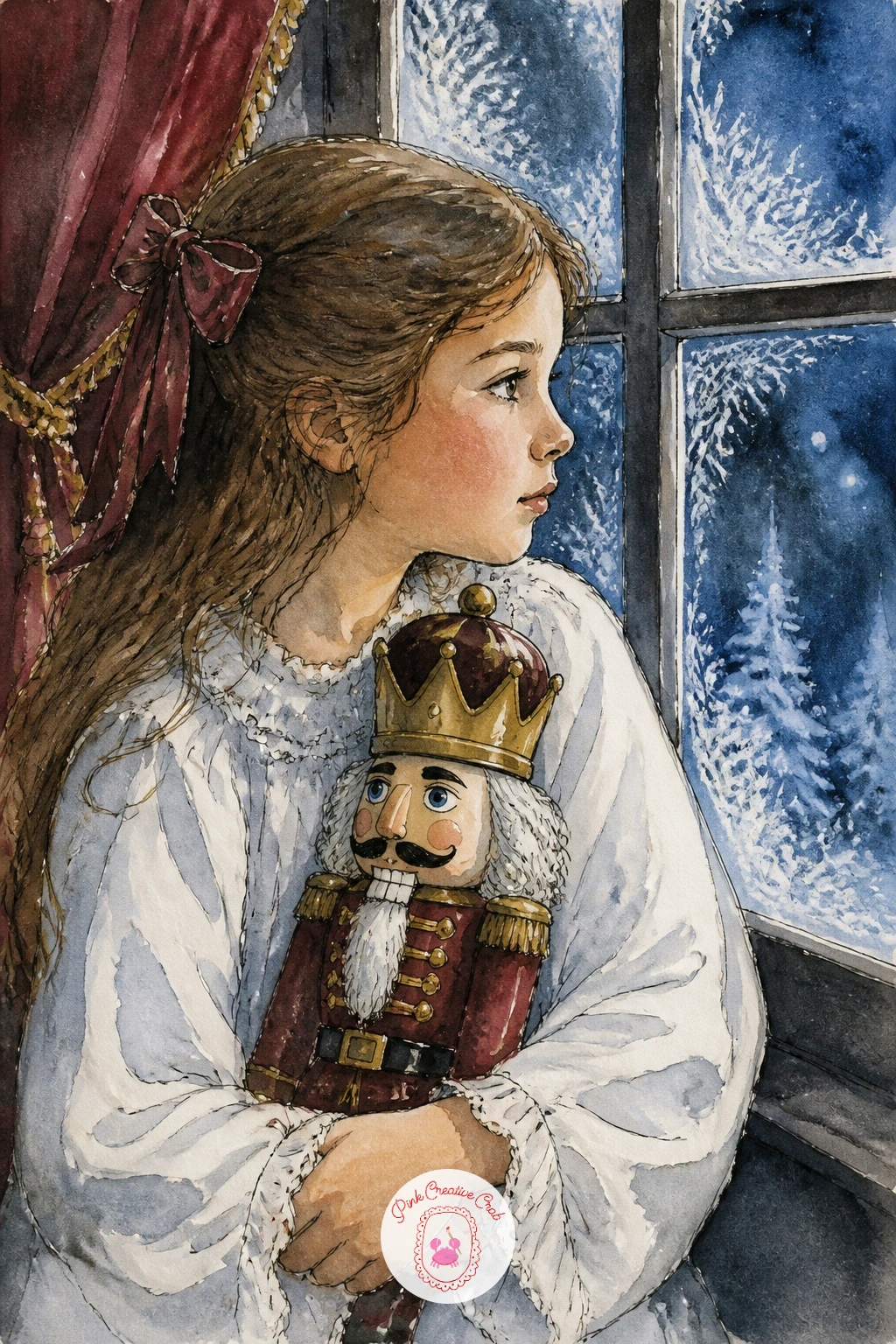
Bring in the story itself with Clara holding a nutcracker by the window, a quieter scene that leans on a cold winter light rather than a crowded page. Place the window to one side of the composition and let the light fall across Clara’s face and the nutcracker’s painted cheek from that direction only, keeping the far side of both figures in a cooler shadow.
Sketch Clara in a simple nightgown silhouette first, then the nutcracker cradled against her chest, smaller and stiffer than her soft rounded arms. Paint the window glass in a pale blue-grey wash before you touch the figures, so the cool light is already established when you add her warm skin tones and the nutcracker’s burgundy coat.
Faces at this scale go wrong if you add too much detail. Two ink dots for eyes and a single curved line for the mouth is enough; resist adding brows or lashes that will only clutter a small face.
Without a window to reference, a single pale rectangle with a faint curtain line reads perfectly well.
You Will Need
- watercolor paper
- small round brush
- blue-grey and burgundy watercolor
- skin tone watercolor
- fine liner pen
Palette: Pale Blue Grey,Burgundy,Soft Skin Tone,Antique Gold
Try adding a small candle on the windowsill for warmth against the cool window light, a nice contrast that makes the whole page feel more like a bedtime scene.
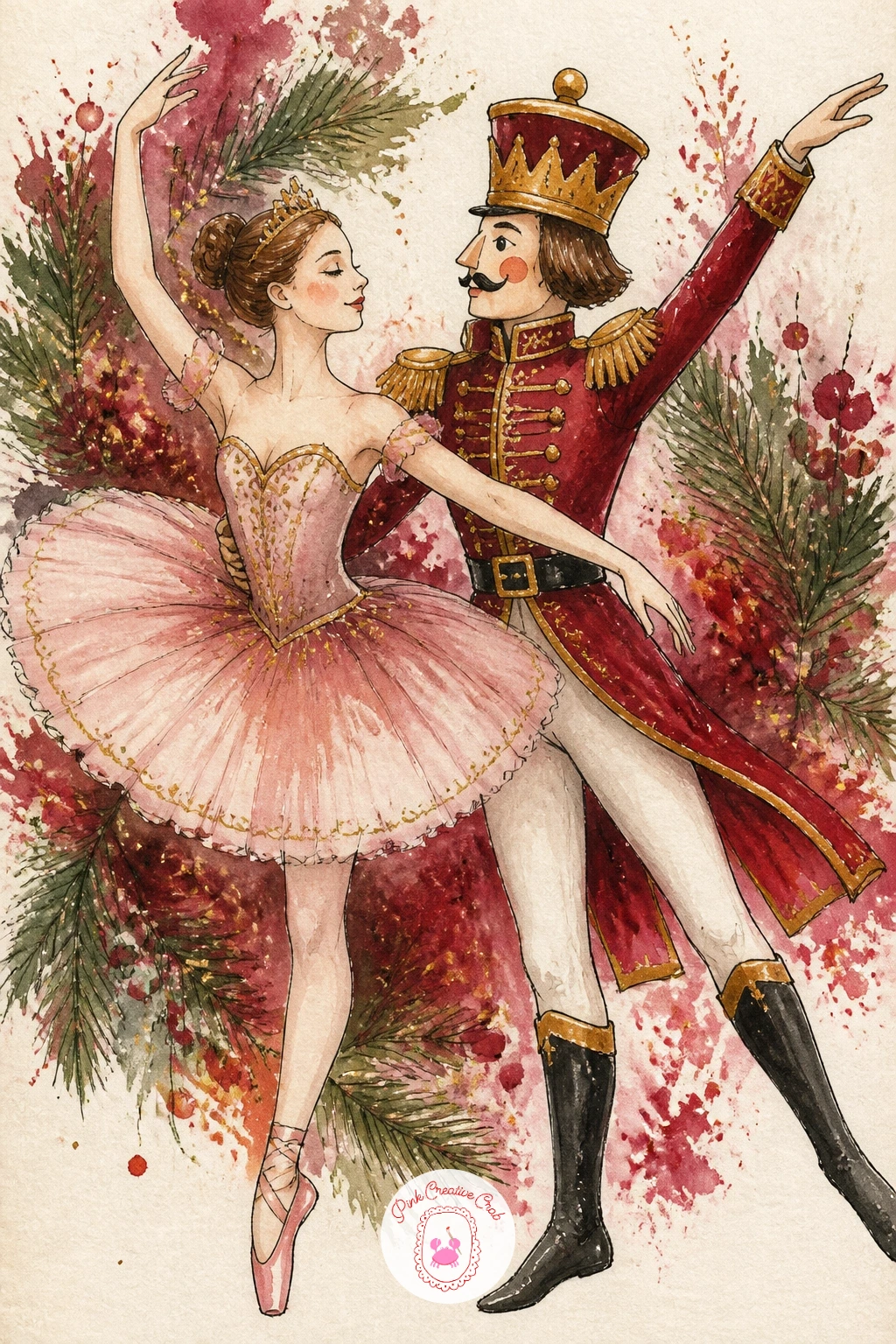
Step into the ballet proper with a ballerina dancing with a nutcracker prince, the first scene here with two full figures in motion rather than one standing still. Sketch her in a classic arabesque, one leg extended back, and him beside her in a more upright stance with one arm raised to meet hers, so the two poses balance each other across the page.
Paint her tutu first in a pale cream or blush wash with a few quick gold accents at the bodice, then work on the prince’s burgundy coat while her layer dries. Keep both figures’ outlines loose until the ink pass ties the whole composition together at the end.
Two figures close together often end up the same size by accident, which flattens the scene. Measure her head height against his before you commit to ink, and keep him slightly taller, since the prince reads better as the larger figure.
If tutus feel tricky in watercolor, try a dry-brush skirt in white gouache over a tinted paper instead of painting it from a wash.
If you enjoy figures in motion like this, the girl pencil drawing ideas cover plenty more pose practice for later.
You Will Need
- watercolor paper
- two round brushes, one fine
- blush, cream and burgundy watercolor
- white gouache
- fine liner pen
Palette: Blush Cream,Burgundy,Antique Gold,Soft White
Reference an actual Nutcracker ballet photograph for the arabesque angle, since the extended leg’s angle is easy to get wrong from memory alone.
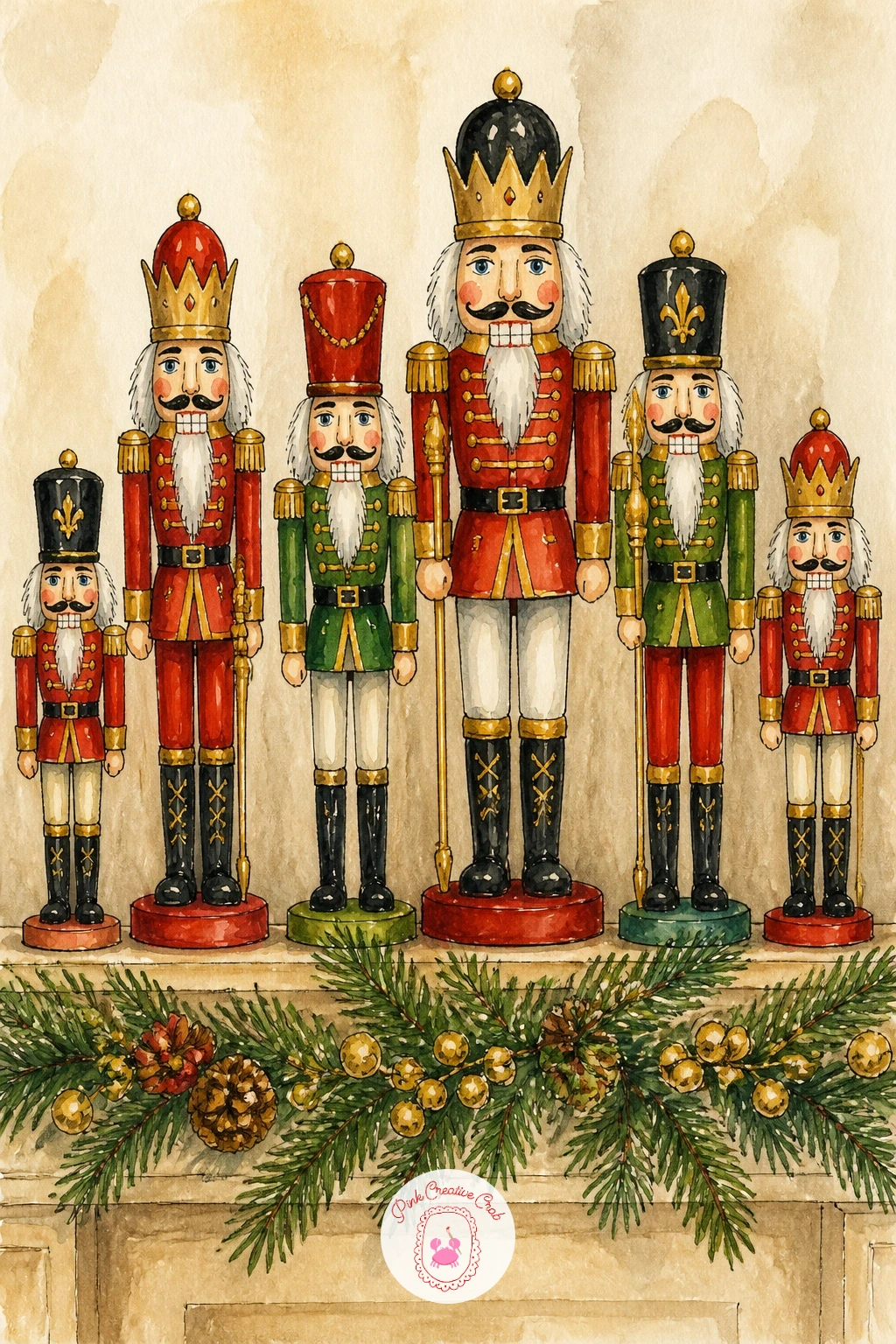
Slow the pace down with a row of nutcrackers on a mantel with garland, a satisfying scene built from repeating the soldier shape you already know three or four times at slightly different heights. Sketch each one with a small variation, a different hat shape or coat color, so the row reads as a collection rather than a copy-pasted line.
Paint the mantel itself as a simple cream ledge first, then the garland trailing across it in a loose pine green wash with small gold dot berries added once dry. Work each nutcracker in turn rather than painting all the coats at once, so the colors stay distinct and don’t bleed into neighbors.
Rows like this can look stiff if every figure stands at the exact same height. Stagger them slightly, with the tallest in the center and shorter ones at either side, the way a real mantel display tends to fall.
Short on time, a quick version with two nutcrackers rather than four still reads as a cozy mantel scene.
You Will Need
- watercolor paper
- fine round brush
- mixed coat colors in watercolor
- pine green and gold for garland
- fine liner pen
Palette: Cream Mantel,Pine Green,Burgundy,Antique Gold
Try adding a few candle stubs between the nutcrackers for extra warmth, a small detail that fills gaps in the row without crowding the figures themselves.
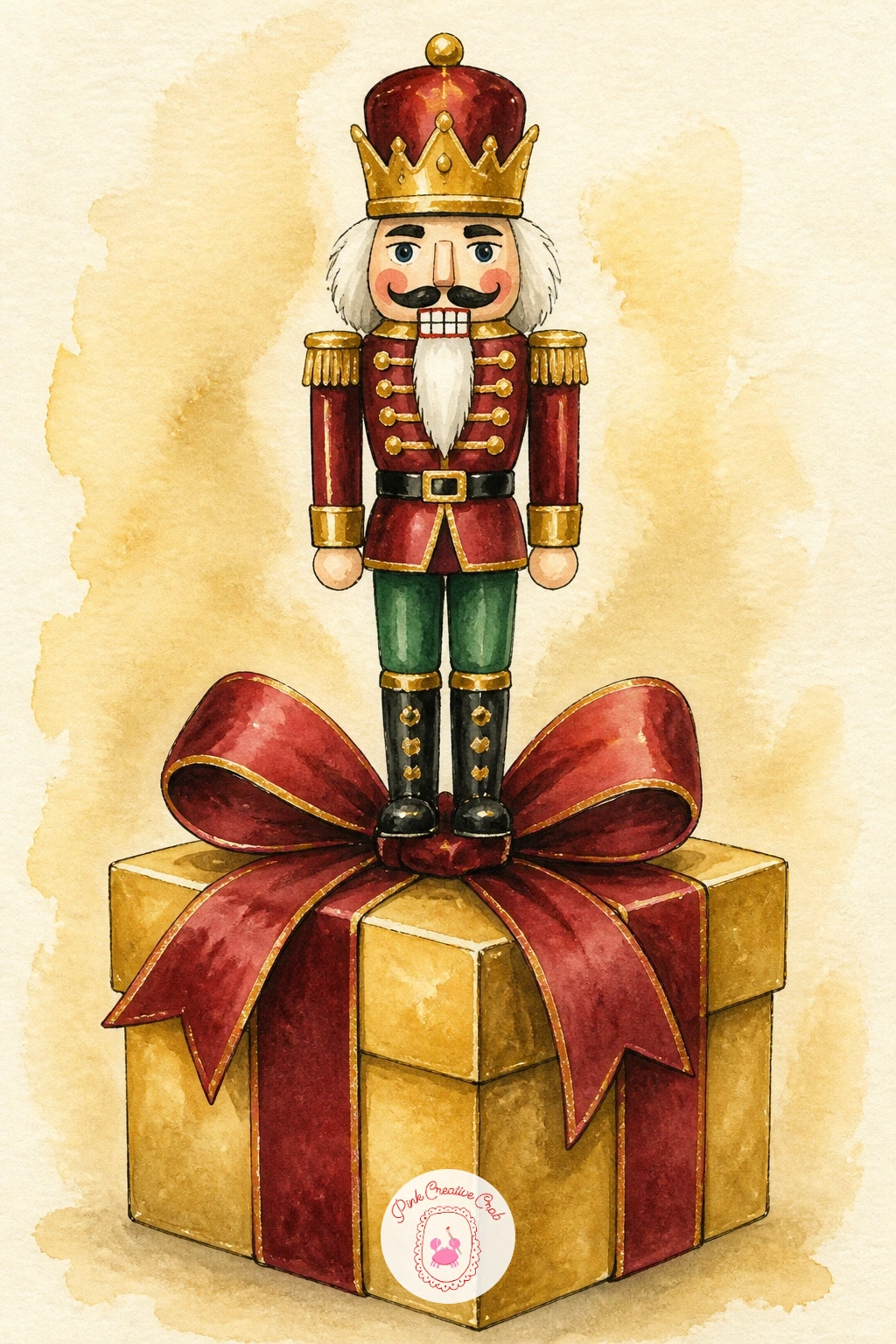
Bring in some Christmas wrapping with a nutcracker on a gift box with a bow, a scene where the box itself does most of the compositional work by giving the standing figure a solid base. Draw the box as a simple cube below the nutcracker’s feet, then a wide ribbon bow wrapped around it in a contrasting color to the coat.
Paint the box in gold or cream first and let it dry completely before adding the ribbon, since a wet box edge will bleed straight into a wet ribbon and blur the crisp line between them. The nutcracker goes on last, standing just slightly behind the front edge of the box so his feet appear to rest on top rather than floating.
Perspective trips people up here: the box needs to tilt slightly toward the viewer, with the top face visible as a thin diamond shape, or it will look like a flat rectangle stuck behind him rather than something he’s standing on.
No gold paint for the box, a warm yellow ochre with a thin white gouache highlight along one edge reads just as rich.
You Will Need
- watercolor paper
- round brush
- gold or cream watercolor
- burgundy and contrasting ribbon color
- fine liner pen
Palette: Antique Gold,Burgundy Ribbon,Cream,Pine Green
Add a small tag hanging from the bow with a tiny name written in ink, a nice touch if you plan to use the finished page as a holiday card front.
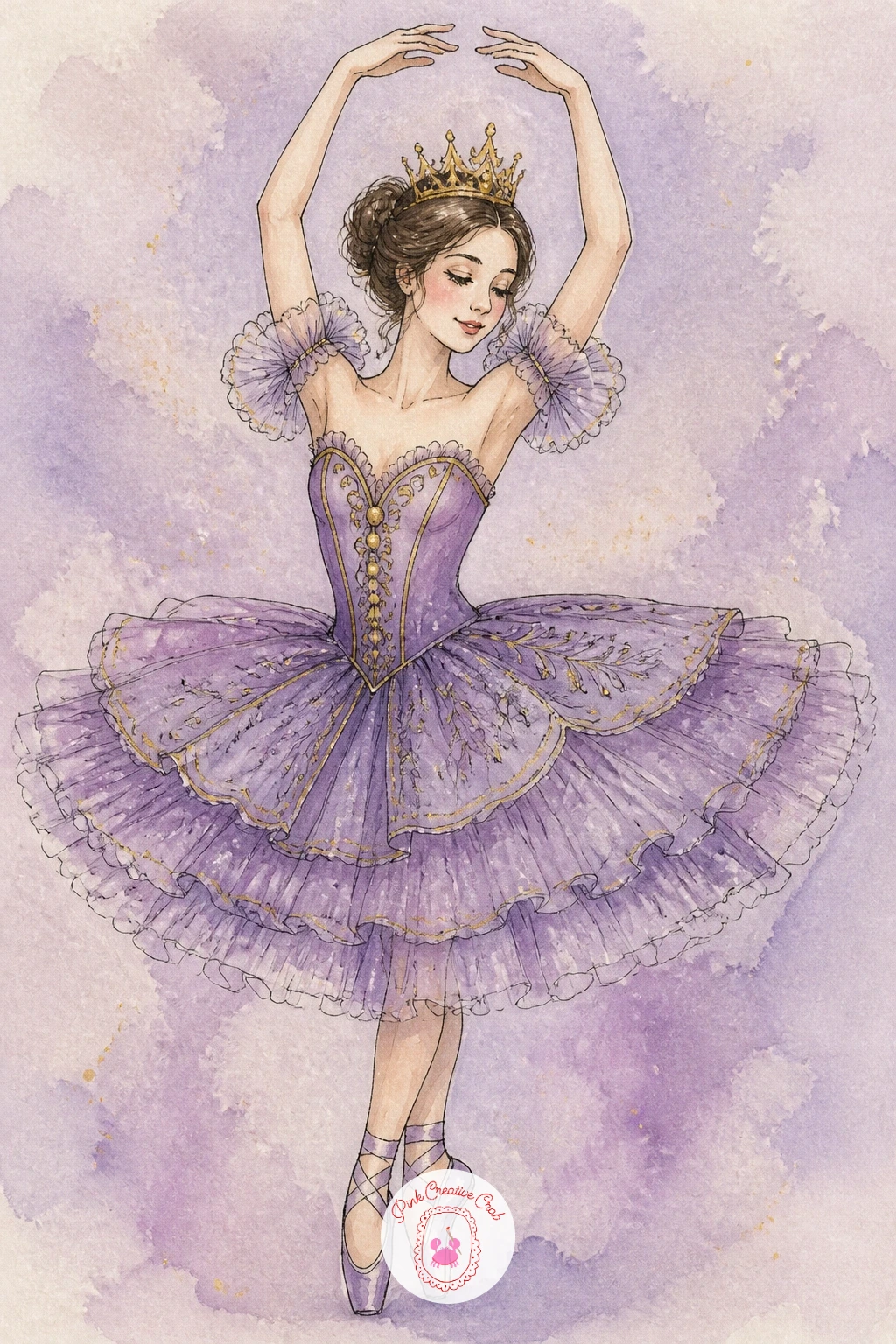
Shift the palette for a moment with the Sugar Plum Fairy in a lilac tutu, the one figure in this list that earns a departure from burgundy and gold into something paler and more magical. Sketch her in a light arabesque or simple standing pose, arms curved overhead, and keep the tutu wide and layered with three or four tiers rather than one solid shape.
Wash the tutu in pale lilac first, then add a slightly deeper purple at the base of each tier while the paper is still a little damp, so the layers separate softly rather than reading as flat stripes. Gold accents at the bodice and a small crown tie her back into the rest of the series.
Lilac can turn muddy fast if you mix too many colors into it. Keep the base to just a violet and white, adding only a touch of blue if you want it cooler, and avoid reaching for brown or black near it.
If lilac watercolor isn’t in your set, mix a touch of red into blue rather than buying a new pan.
You Will Need
- watercolor paper
- round brush
- violet and white watercolor
- gold gouache
- fine liner pen
Palette: Pale Lilac,Deep Violet,Antique Gold,Soft White
Try a tiny dusting of loose glitter or a metallic gel pen over the dry tutu for a bit of stage sparkle, since the Sugar Plum Fairy’s costume always catches light.
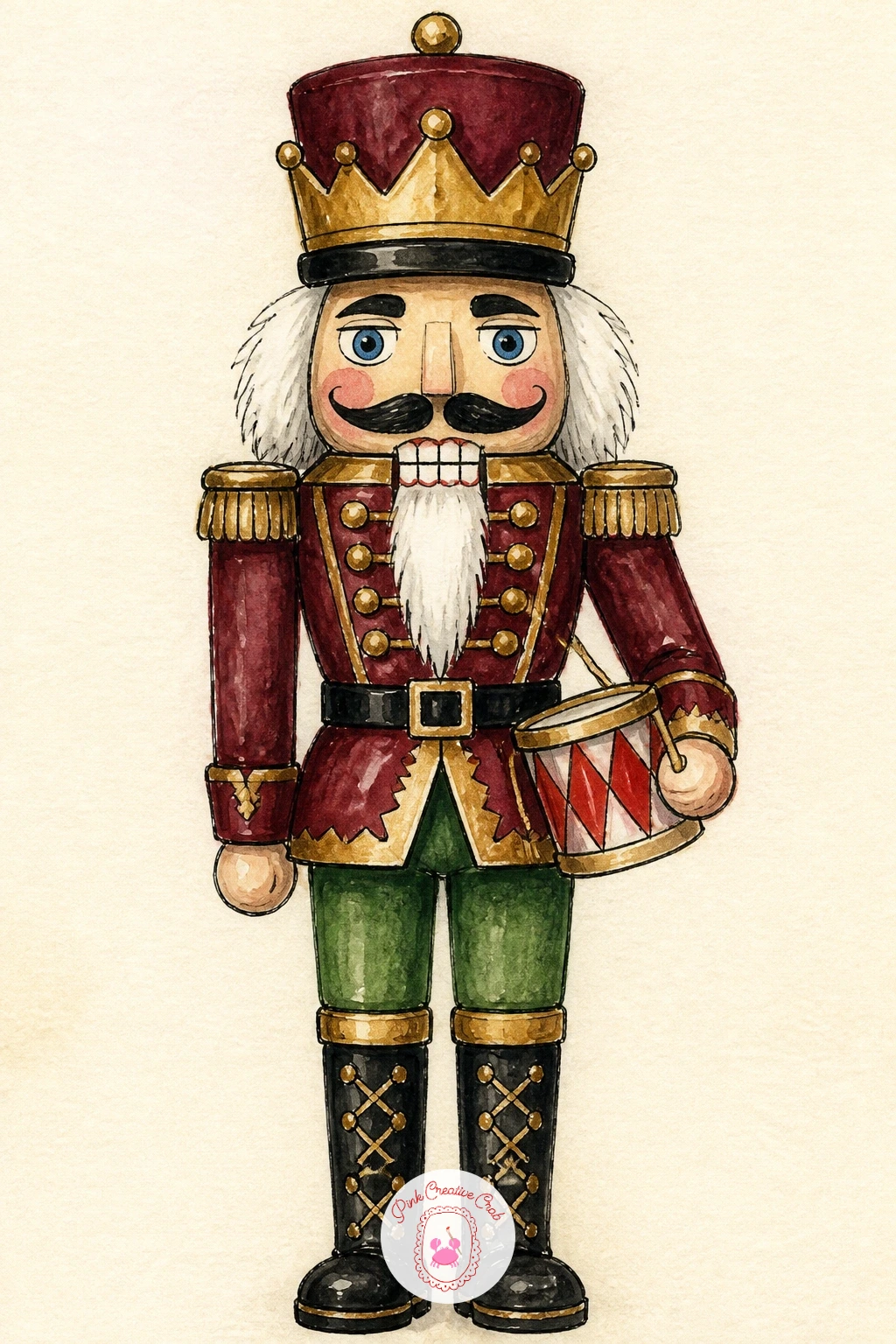
Return to the soldier figure with a nutcracker holding a tiny drum, a small prop that adds personality without complicating the pose much at all. Keep the standing stance from your first nutcracker, but bend one arm down to hold a small cylindrical drum at the hip, strapped across the body with a thin painted line.
Paint the drum in alternating cream and burgundy stripes once the coat is dry, using the edge of a flat brush for clean bands rather than trying to freehand them with a round brush. A single gold dot on each side finishes it as a drum rather than a plain barrel shape.
Stripes on a small curved object like a drum often warp if painted in one go. Let each stripe dry before adding the one beside it, so the colors stay crisp rather than merging into a smear.
A toothpick dipped in gouache works in place of a fine brush if you need an even thinner stripe line.
You Will Need
- watercolor paper
- flat brush for stripes
- cream and burgundy watercolor
- gold gouache
- fine liner pen
Palette: Cream,Burgundy,Antique Gold,Pine Green
Try tilting the drum slightly off the hip rather than dead center, a small asymmetry that keeps the stiff toy pose from looking too static.
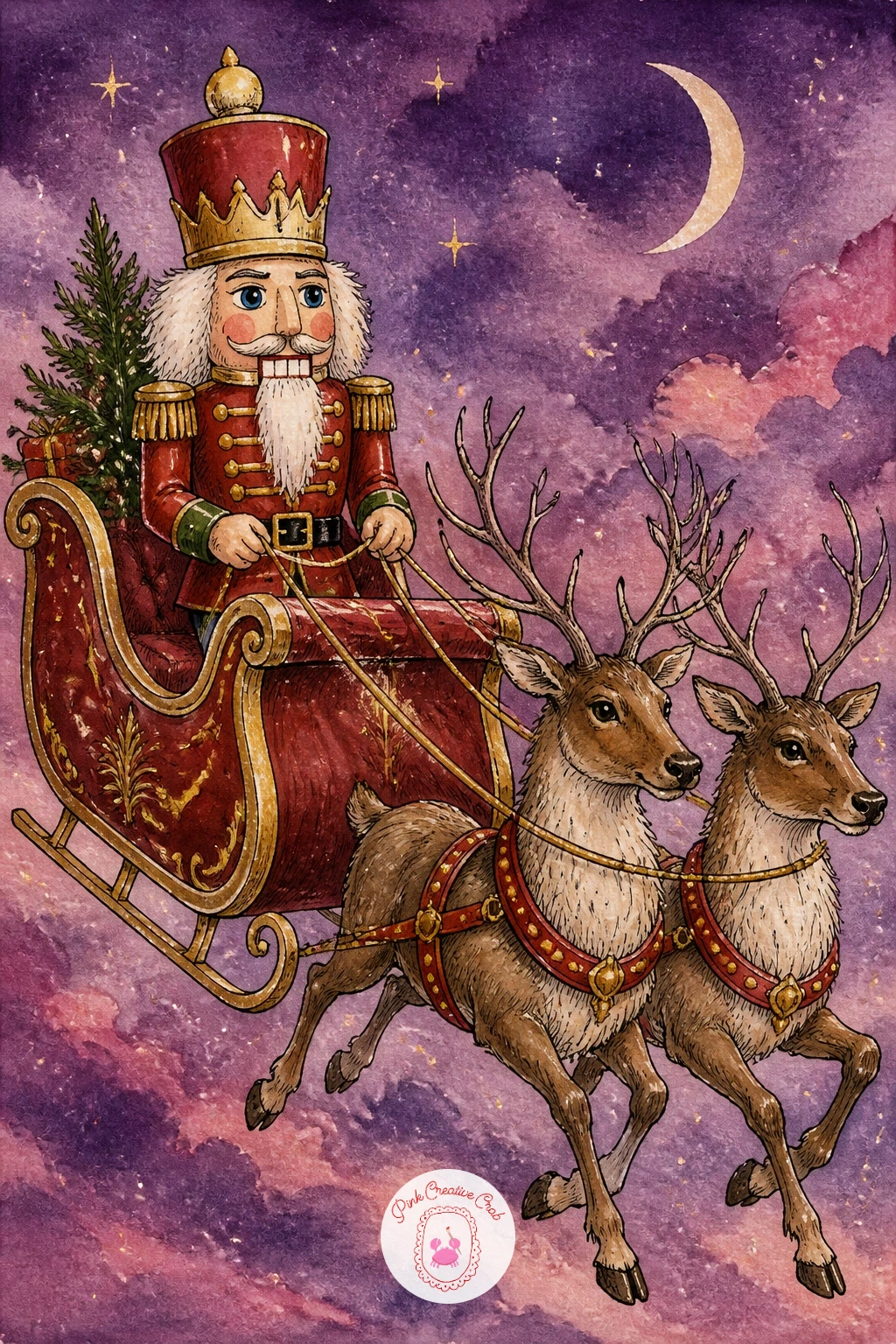
Widen the page for a nutcracker sleigh pulled by reindeer, the first full landscape-style scene in the list and a good one to practice fitting several shapes across a horizontal frame. Sketch the sleigh low on the page with the nutcracker seated upright inside it, reins in hand, and the reindeer ahead of him angled slightly so their legs overlap rather than lining up flat.
Paint the sky first in a soft blue or dusk purple wash, then the reindeer in warm brown once it’s dry, leaving the antlers as thin ink lines rather than painted shapes. The sleigh itself takes burgundy and gold to match the rest of the series.
Overlapping animals confuse beginners most. Draw the nearest reindeer complete first, then only the visible parts of the one behind it, rather than drawing both fully and erasing afterward.
If reindeer feel like too much for one sitting, a single horse or even just the sleigh with reins trailing off the edge of the page still tells the story.
You Will Need
- watercolor paper
- wide flat brush for sky
- dusk purple and brown watercolor
- burgundy and gold watercolor
- fine liner pen
Palette: Dusk Purple,Warm Brown,Burgundy,Antique Gold
Look at reindeer leg joints bending backward before you draw them, a detail that separates a convincing reindeer from a horse with antlers glued on.
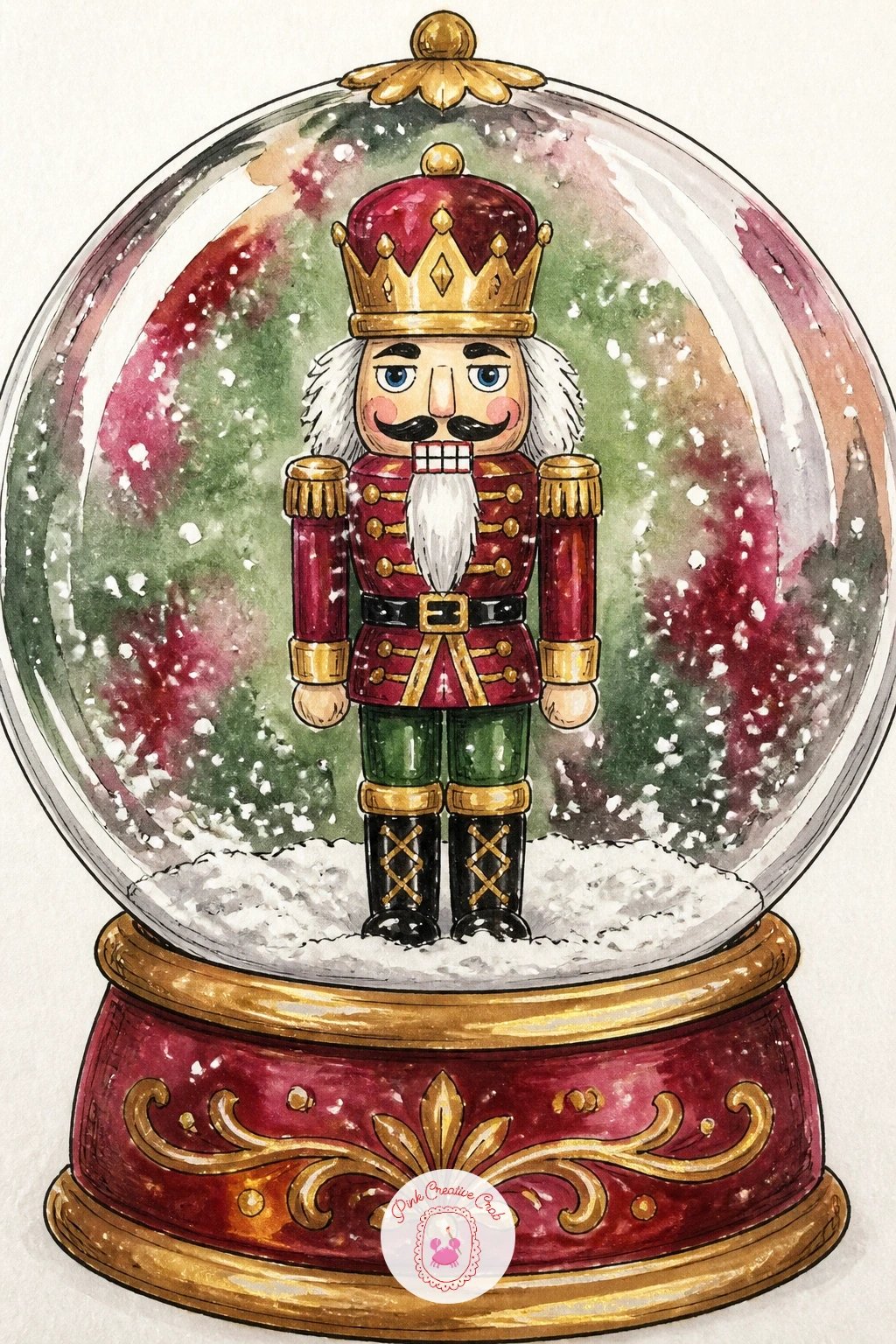
Add a bit of whimsy with a nutcracker in a snow globe, a scene that plays with containing the whole figure inside a circle rather than letting him fill a square page. Draw the globe outline first in a light pencil circle, then the nutcracker standing inside it at a slightly smaller scale than you’d use for a full-page figure.
Paint the inside of the globe with a very pale blue-grey wash to suggest glass, keeping the nutcracker’s colors a touch brighter than everything around him so he reads as the focal point inside a softer world. The wooden base of the globe goes in gold or dark brown beneath the circle.
White dots for snow can look like scattered confetti if they’re all the same size. Vary the dot sizes and cluster more of them near the bottom of the globe, where snow would naturally be settling.
No white gouache for the snow, a white gel pen flicked lightly over the dry painting does the same job.
You Will Need
- watercolor paper
- fine round brush
- pale blue-grey watercolor
- white gouache or gel pen
- fine liner pen
Palette: Pale Glass Blue,Burgundy,Antique Gold,Warm Brown
Try adding a faint reflected highlight along one side of the globe’s curve, a single pale arc that makes the glass read as rounded rather than flat.
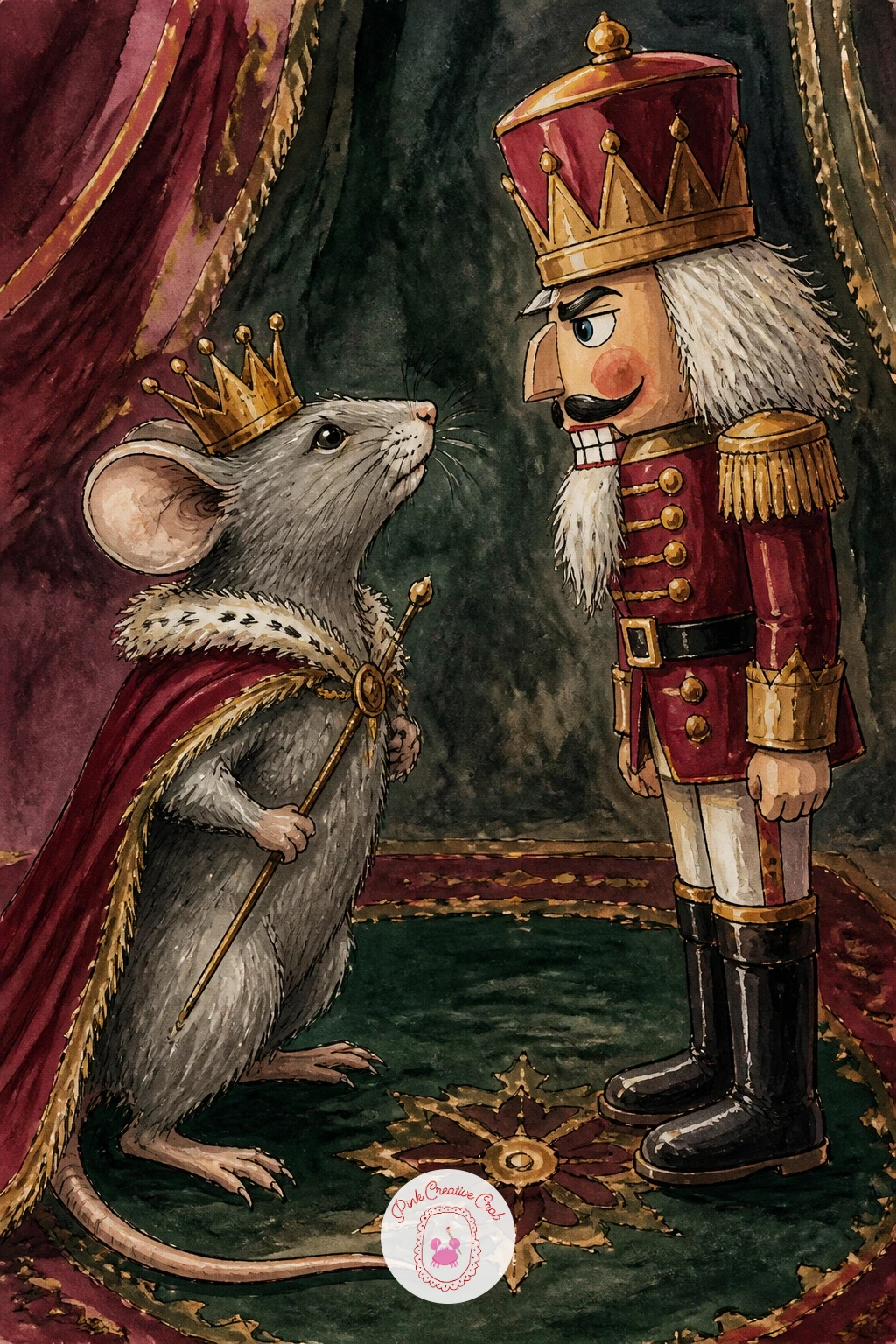
Bring in the story’s conflict with a mouse king facing a nutcracker on the rug, a two-figure standoff that asks for a bit more drama in the poses than the quieter scenes before it. Sketch the nutcracker upright and stiff on one side, sword or arm raised, and the mouse king low and crouched on the other, with a small painted crown on his head to mark who he is.
Paint the mouse king in a soft grey wash with a few darker ink lines for fur texture along his back, then the nutcracker in the usual burgundy and gold once the grey has dried. A dark rug shape beneath both figures grounds the scene and keeps it from floating on bare paper.
Mice in a standoff pose often come out looking too cute rather than threatening. Keep his back arched and his ink-line whiskers sharp rather than curved, and the tension in the scene holds.
If grey paint isn’t handy, a watered-down black ink wash gives the same mouse coloring.
You Will Need
- watercolor paper
- round brush
- grey and burgundy watercolor
- dark rug color
- fine liner pen
Palette: Mouse Grey,Burgundy,Antique Gold,Deep Rug Red
Reference an illustration of the original Hoffmann story’s mouse king for his crown shape, since it reads as more regal than a plain toy mouse would.
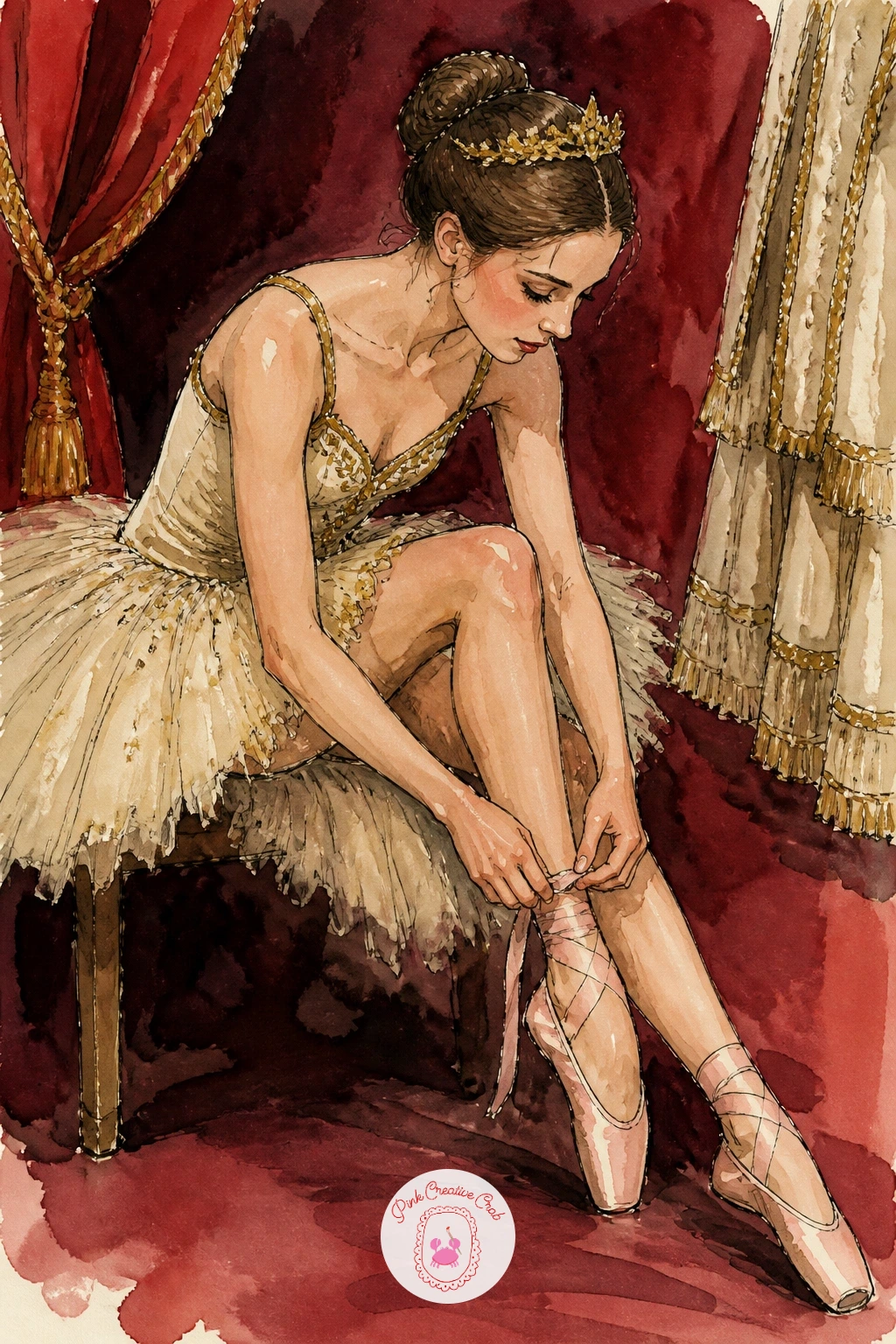
Slow back down with a ballerina tying her pointe shoes backstage, a quieter character moment that sits well after the mouse king’s drama. Sketch her seated on a low bench, bent forward over one raised foot, ribbons trailing from her hand down to the shoe, with the rest of the backstage kept simple: a dim curtain edge, maybe a mirror corner.
Paint her tutu and bodice in a pale cream first, then the shoe ribbons last in a soft pink, using a fine brush to keep the ribbon lines thin and slightly curved rather than straight. The background can stay a loose wash in deep burgundy or near-black, since a dark backstage makes her pale costume glow.
Hands tying ribbon are a common sticking point. Simplify them to a soft rounded shape gripping the ribbon rather than drawing individual fingers, which rarely reads well at this scale.
If you’d rather skip the hands entirely, crop the scene at the wrist and let the ribbon trail off the edge of the page.
For more seated figure practice like this, the picnic drawing lessons work through similar relaxed poses.
You Will Need
- watercolor paper
- fine round brush
- cream and pink watercolor
- deep burgundy for background
- fine liner pen
Palette: Cream,Soft Pink,Deep Burgundy,Antique Gold
Try darkening the background almost to black in one corner only, a spotlight effect that pulls focus straight to her hands and the ribbon.
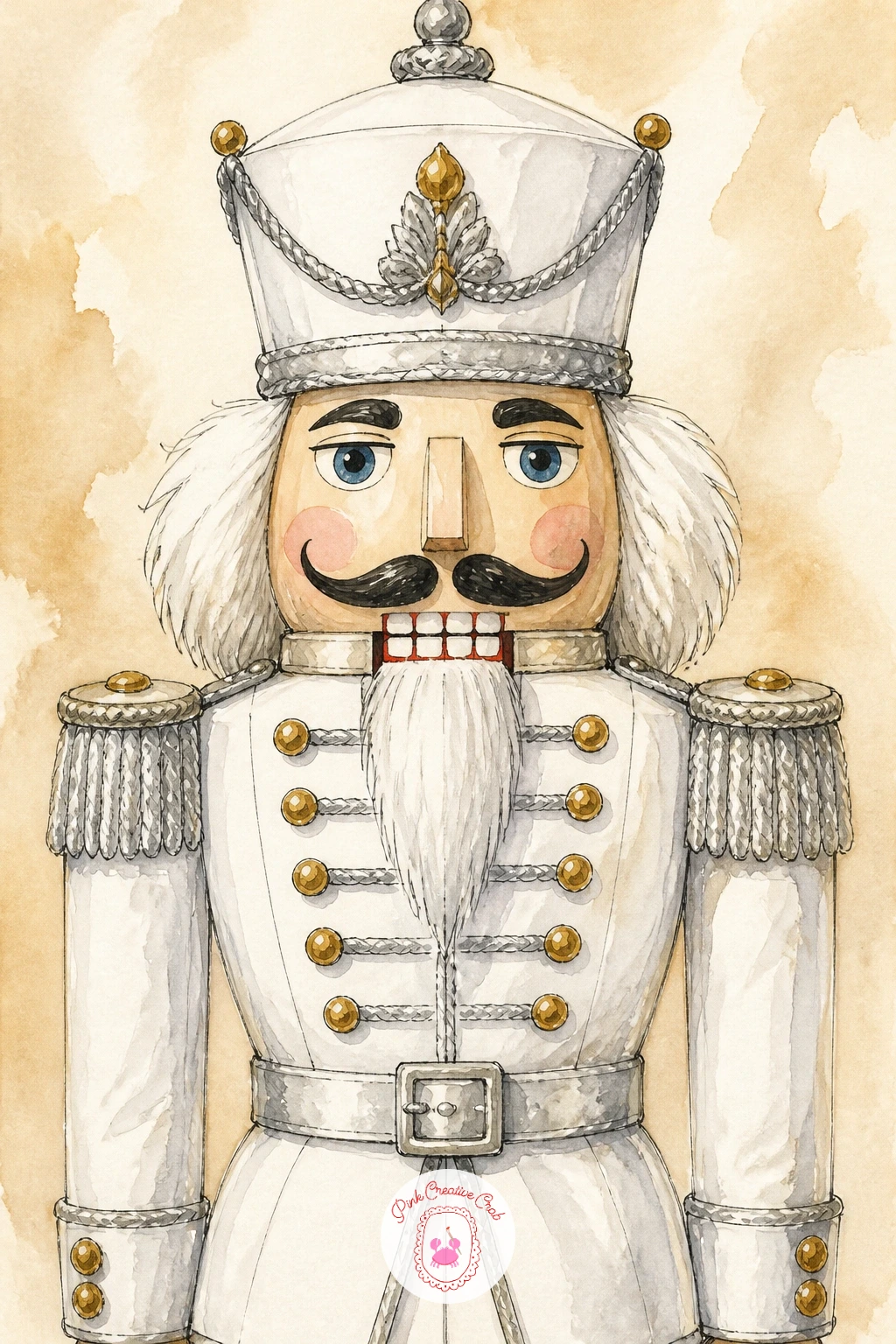
Switch the trim for a nutcracker in a white uniform with silver details, a cooler variation that still belongs in this opulent set if you pair it with a warm background. Keep the familiar stiff standing pose, but wash the coat in off-white rather than burgundy, letting a little grey shadow pool at the folds so it doesn’t read as a flat blank shape.
Add silver detail with a silver gel pen or silver gouache once the white coat is fully dry, tracing the braid and buttons in the same places gold would normally go. A warm cream or soft gold background behind him keeps the whole page from feeling cold.
White paint over white paper can disappear entirely if you’re not careful. Add the grey shadow lines early, while you can still see where the folds are, rather than trying to find them again after the coat is already painted flat.
No silver gouache on hand, a regular grey pencil traced over the dry paint gives a similar metallic hint.
You Will Need
- watercolor paper
- round brush
- white and grey watercolor
- silver gel pen or gouache
- fine liner pen
Palette: Off White,Soft Grey Shadow,Silver,Warm Cream Background
Try this one on toned grey paper instead of white, since the off-white coat will stand out more clearly against a mid-value background.
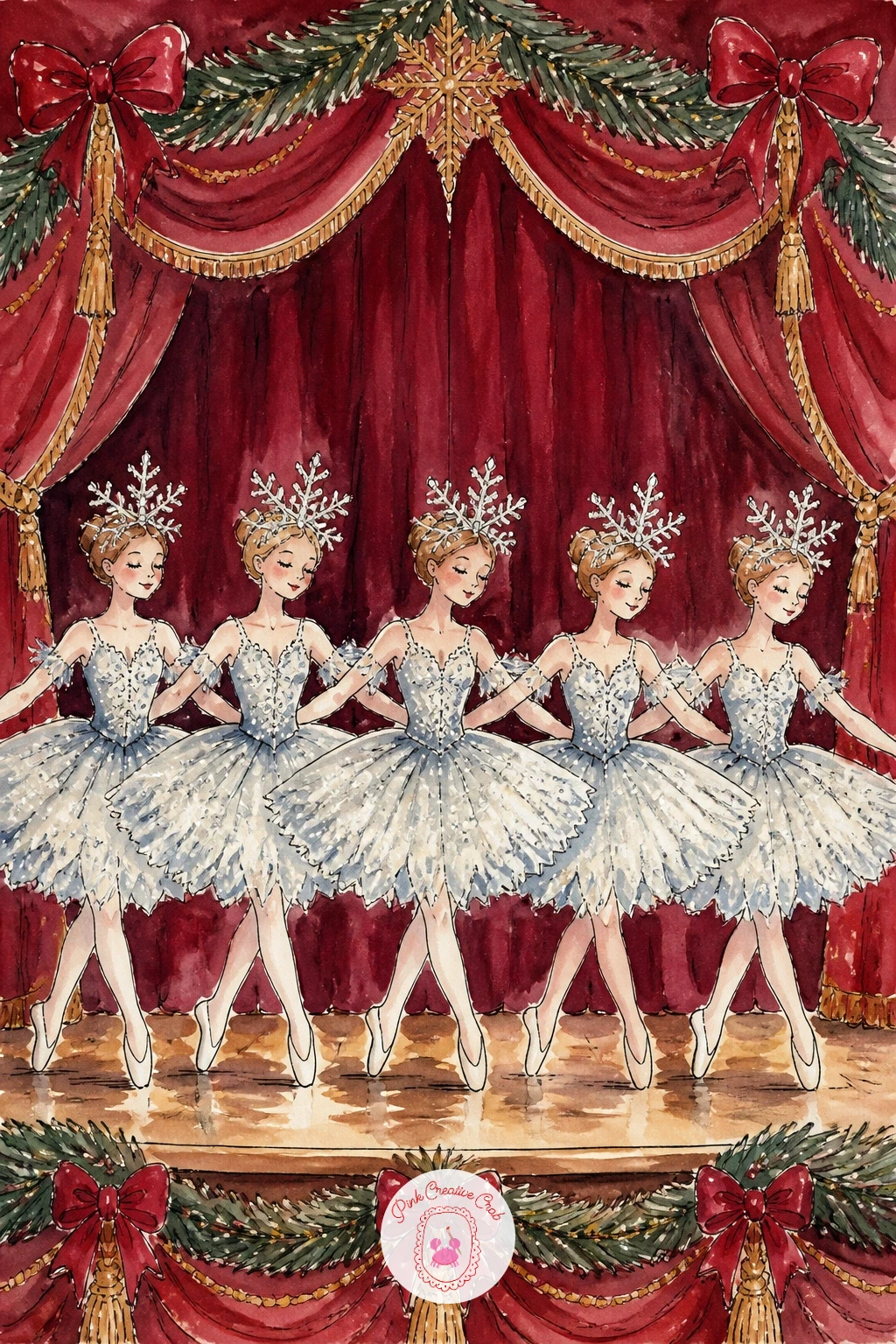
Widen out again for snowflake dancers on a stage, a group scene that works well once you accept the dancers can be fairly simple shapes repeated with small variations. Sketch three or four figures in a loose row, each with arms raised slightly differently, tutus suggested by a single curved line rather than full detail on every one.
Paint all the tutus in the same pale white-blue wash at once while your brush is loaded with that color, then come back with individual ink details once everything is dry, so you’re not mixing fresh paint for each dancer separately. A deep burgundy stage curtain or dark background behind them makes the pale costumes glow.
Groups of figures tend to end up stiff and identical if you draw them one at a time from scratch. Rough in all the poses loosely first in pencil, adjusting arm heights against each other, before you commit to paint on any single one.
Pressed for time, two dancers rather than four still reads as a stage scene without losing the idea.
You Will Need
- watercolor paper
- round brush
- pale blue-white watercolor
- deep burgundy for background
- fine liner pen
Palette: Snow White Blue,Deep Burgundy Curtain,Antique Gold,Soft Grey
Try a light spatter of white gouache flicked from a loaded brush across the finished page for falling snow, a quick effect that ties the whole stage together.
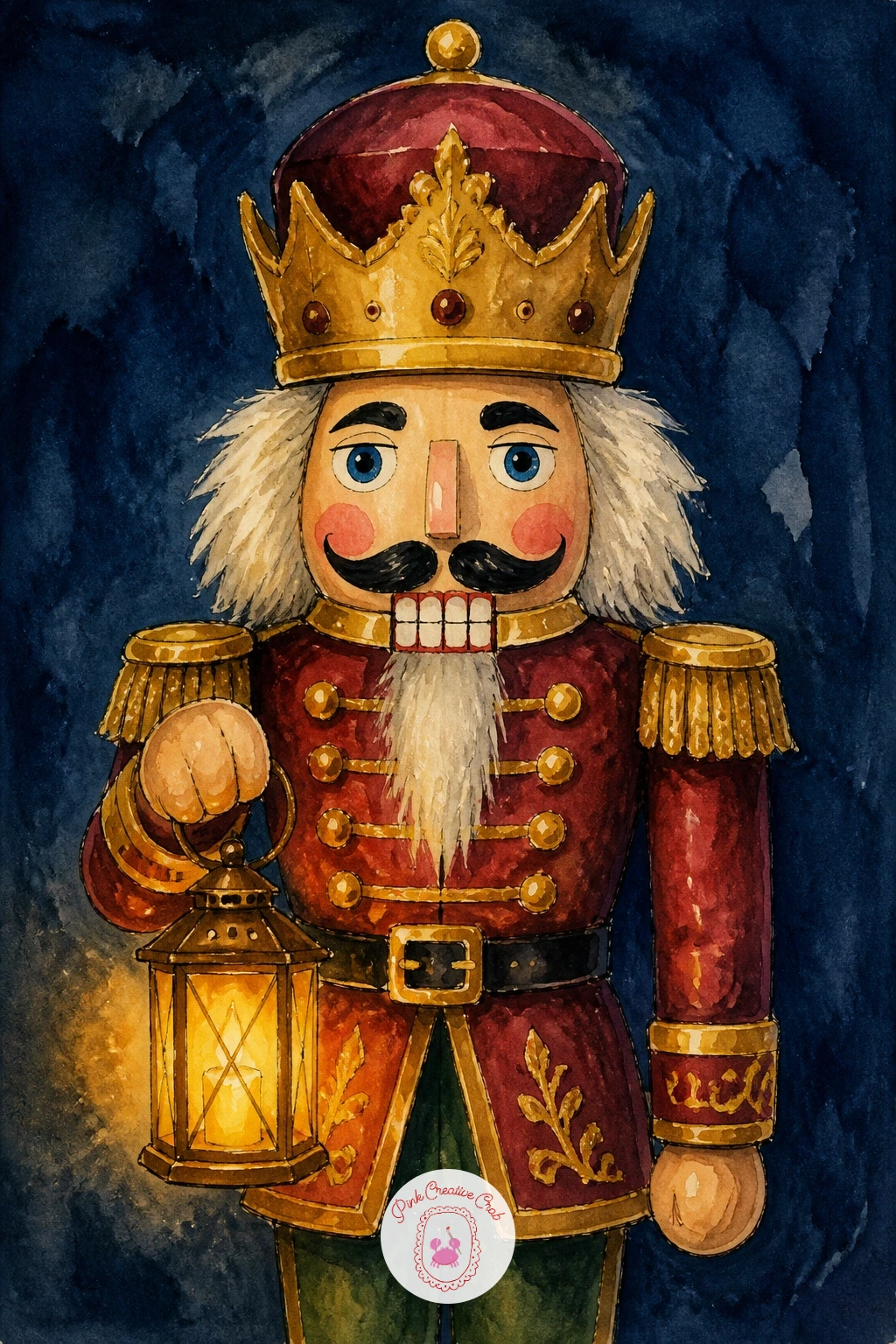
Bring the light source into the composition itself with a nutcracker holding a lantern, a good scene for practicing a single warm glow against a cooler surrounding wash. Sketch the familiar standing figure with one arm bent, holding a small lantern shape out in front rather than at the side.
Paint the background first in a cool dusk blue, then leave a soft untouched halo of paper around where the lantern will sit, since that bare paper reads as glow once everything else around it is dark. Add the lantern itself in warm yellow and gold, letting a little of that warm color bleed softly into the blue at the very edge of the halo.
The glow effect collapses if the warm and cool colors meet in a hard line. Soften that boundary with a clean damp brush right after painting the yellow, blending it gently into the blue before either one dries.
If gold gouache isn’t available for the lantern’s frame, a warm orange ink line does the job just as well.
You Will Need
- watercolor paper
- round brush
- cool blue and warm yellow watercolor
- gold gouache
- fine liner pen
Palette: Dusk Blue,Warm Lantern Gold,Burgundy,Antique Gold
Try adding a thin trail of warm light along the ground beneath the lantern, a small cast glow that makes the whole night scene feel more lived in.
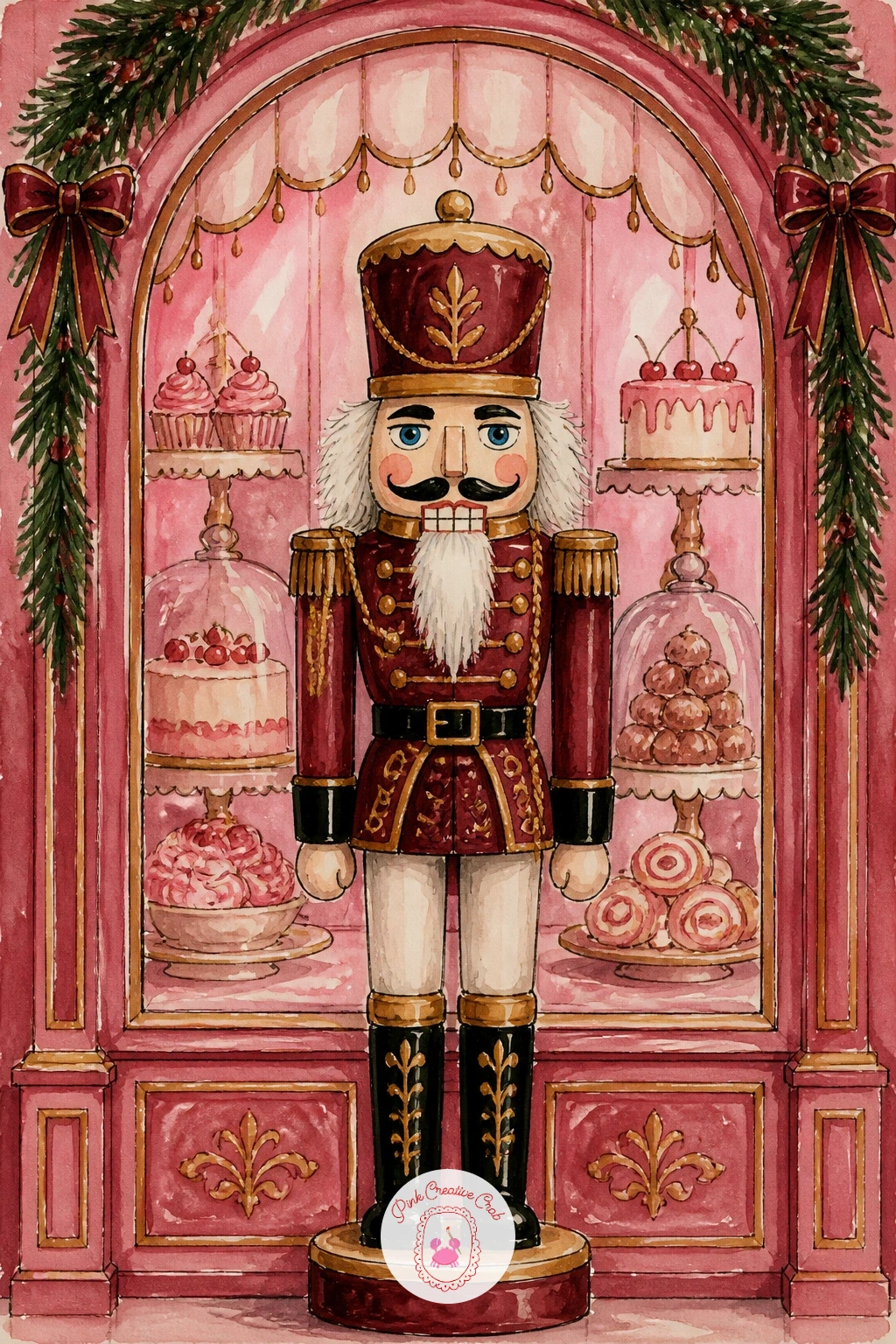
Shift the setting entirely with a nutcracker standing in a pink bakery window, a cozy small scene that borrows the warmth of a shop display rather than a tree or stage. Sketch a simple arched window frame first, then the nutcracker standing inside it among a few suggested shapes of pastries or a cake stand, kept loose and unlabeled.
Paint the window’s interior in a soft blush pink wash, then the nutcracker in his usual burgundy and gold once that pink layer is dry, so his darker colors stand out clearly against the pale backdrop. A few small gold dots scattered around suggest sprinkles or lights without needing real detail.
Window frames can flatten a scene if drawn too symmetrically. Angle the frame very slightly, as though seen from the street rather than straight on, and the whole window gains a bit of real depth.
If pink feels too sweet for your taste, a soft cream bakery window works just as well and keeps the focus on the nutcracker.
You Will Need
- watercolor paper
- round brush
- blush pink watercolor
- burgundy and gold watercolor
- fine liner pen
Palette: Blush Pink,Burgundy,Antique Gold,Cream
Try adding a tiny painted sign or ribbon in the window corner, since a small unreadable label suggests a bakery without needing actual lettering.
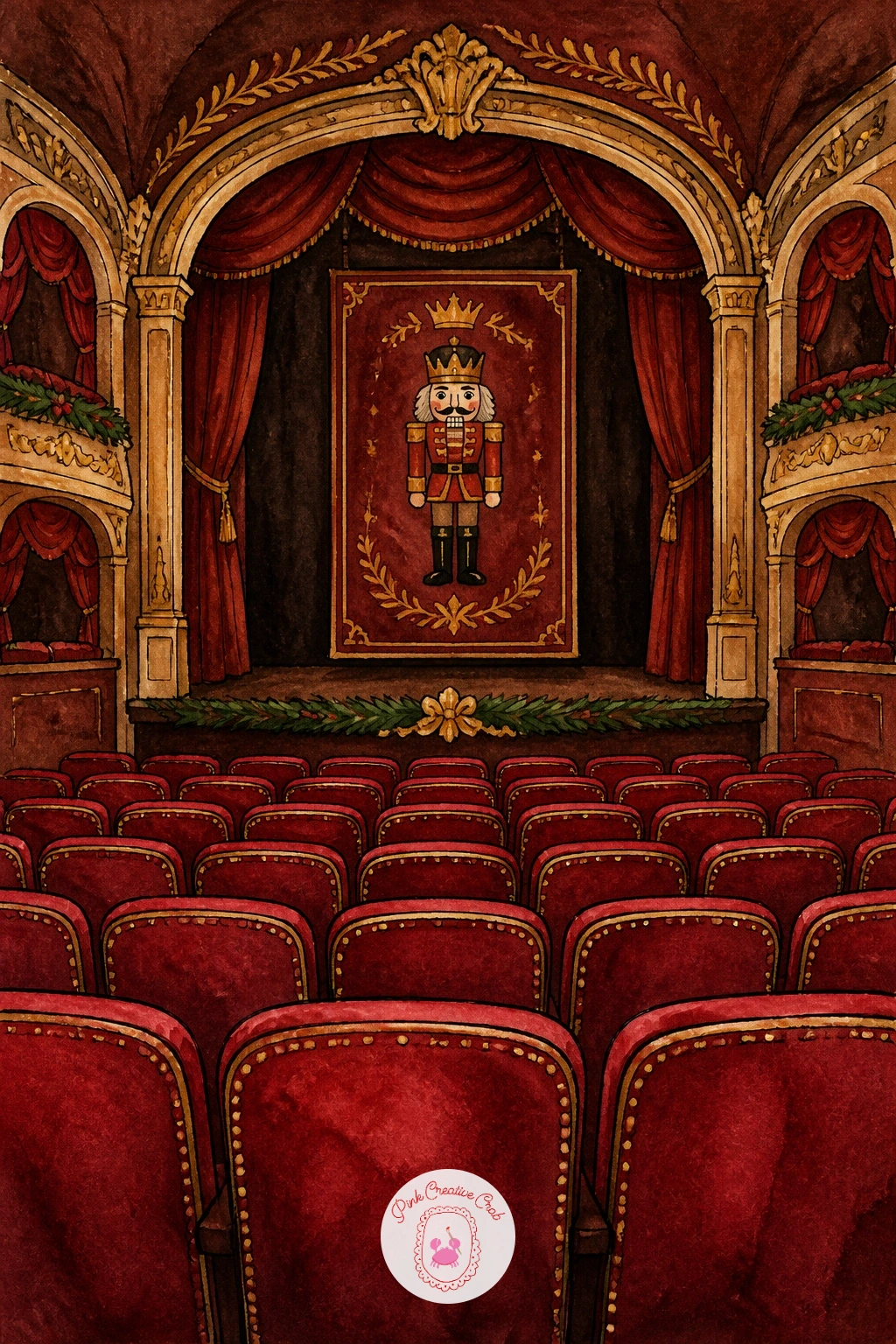
Zoom out for a theater with red seats and a Nutcracker poster, a scene built almost entirely from simple repeated shapes rather than any single figure. Sketch rows of seat backs receding slightly toward a small stage or poster at the back, keeping the perspective loose rather than technically precise.
Paint the seats in a rich red wash, working from the front row back and letting each row get slightly smaller and closer together as they recede, which is really the only trick to selling the depth. The poster itself can stay a simple burgundy and gold rectangle with a suggested silhouette rather than readable text.
Rows of seats often end up looking like a ladder rather than a theater if the spacing between them doesn’t shrink as they go back. Measure the gap between your first two rows, then make every gap after that a little smaller than the last.
Short on time, three or four rows of seats with a hinted poster still reads clearly as a theater.
You Will Need
- watercolor paper
- round brush
- red watercolor
- burgundy and gold for poster
- fine liner pen
Palette: Theater Red,Burgundy,Antique Gold,Warm Cream
Try a soft spotlight wash over the poster area, lighter than the surrounding dark theater, to pull the eye straight to it the way stage lighting would.
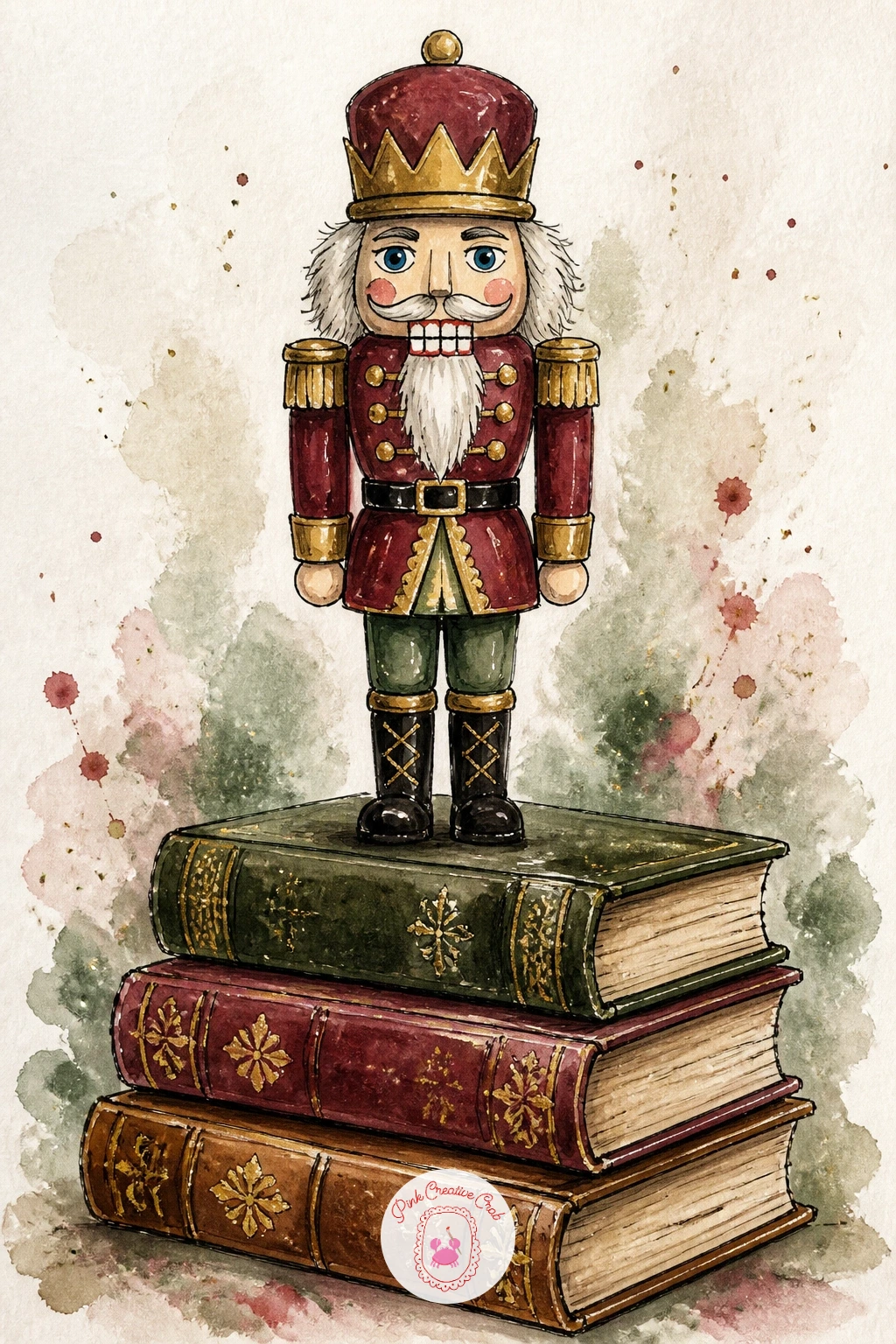
Settle back into a quiet still life with a nutcracker on a stack of vintage books, a composition that pairs well with any reader who already loves cozy book corners. Draw the stack first, three or four books of varying size and slightly uneven edges, then the nutcracker standing on top, smaller in scale than your full-page figures since the books need room too.
Paint the books in muted greens, dusty blues and warm browns, letting each cover dry before the next so the colors don’t bleed together into mud. The nutcracker goes on last in his usual burgundy and gold, standing just slightly off-center for a more natural still life feel.
Book stacks look wrong if every spine lines up too neatly. Let the books overhang each other’s edges very slightly and tilt one at a faint angle, the way a real stack settles.
If you enjoy still life groupings like this, the book stack drawing lessons go deeper into building a convincing pile.
You Will Need
- watercolor paper
- round brush
- muted green, blue and brown watercolor
- burgundy and gold watercolor
- fine liner pen
Palette: Muted Green,Dusty Blue,Warm Brown,Burgundy
Add a sprig of pine tucked beside the books for a little extra Christmas warmth, a small addition that fills empty space without crowding the nutcracker.
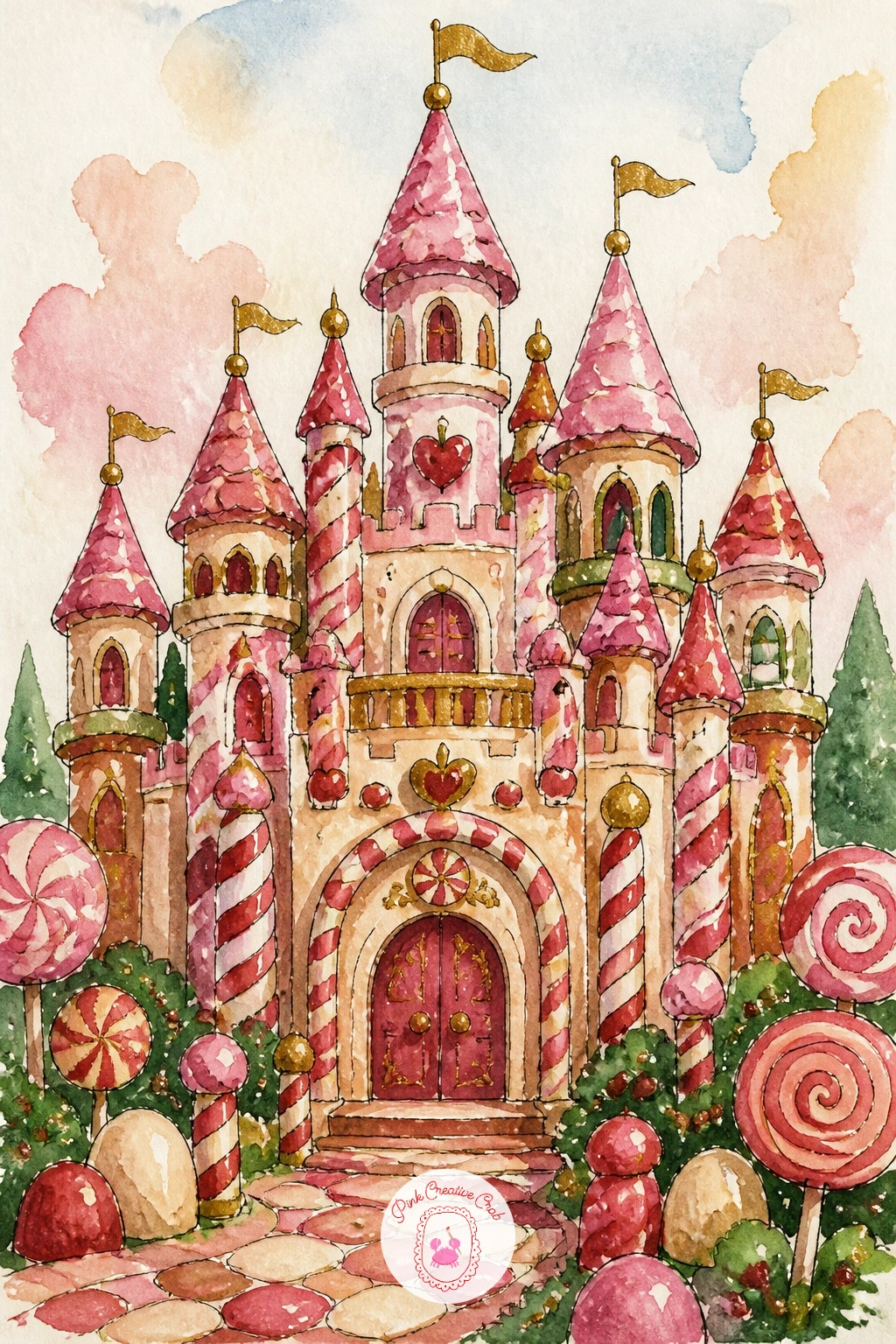
Take on a full landscape with a candy land castle from the ballet, the most involved scene so far and a good one to save for when you have a longer stretch of time. Sketch a whimsical castle silhouette first, turrets topped with shapes that suggest candy, swirled columns, a few scattered sugar-dusted trees around the base.
Paint the castle in pale pastel pinks and creams rather than the deep burgundy used elsewhere, since this is the one scene in the set that can lean sweeter and lighter to separate it from the rest. Gold still ties it back to the series, used sparingly on turret tips and a few small flag details.
Castles with too many turrets at the same height look repetitive. Vary their heights and widths as you sketch, and let one dominate clearly as the tallest point.
If a full castle feels like too much, a single turret filling the page with candy details still captures the idea.
You Will Need
- watercolor paper
- round brush
- pastel pink and cream watercolor
- gold gouache
- fine liner pen
Palette: Pastel Pink,Soft Cream,Antique Gold,Pine Green
Try adding tiny painted candy shapes along the base of the castle, a border of sweets that reads as the land itself without needing a full landscape behind it.
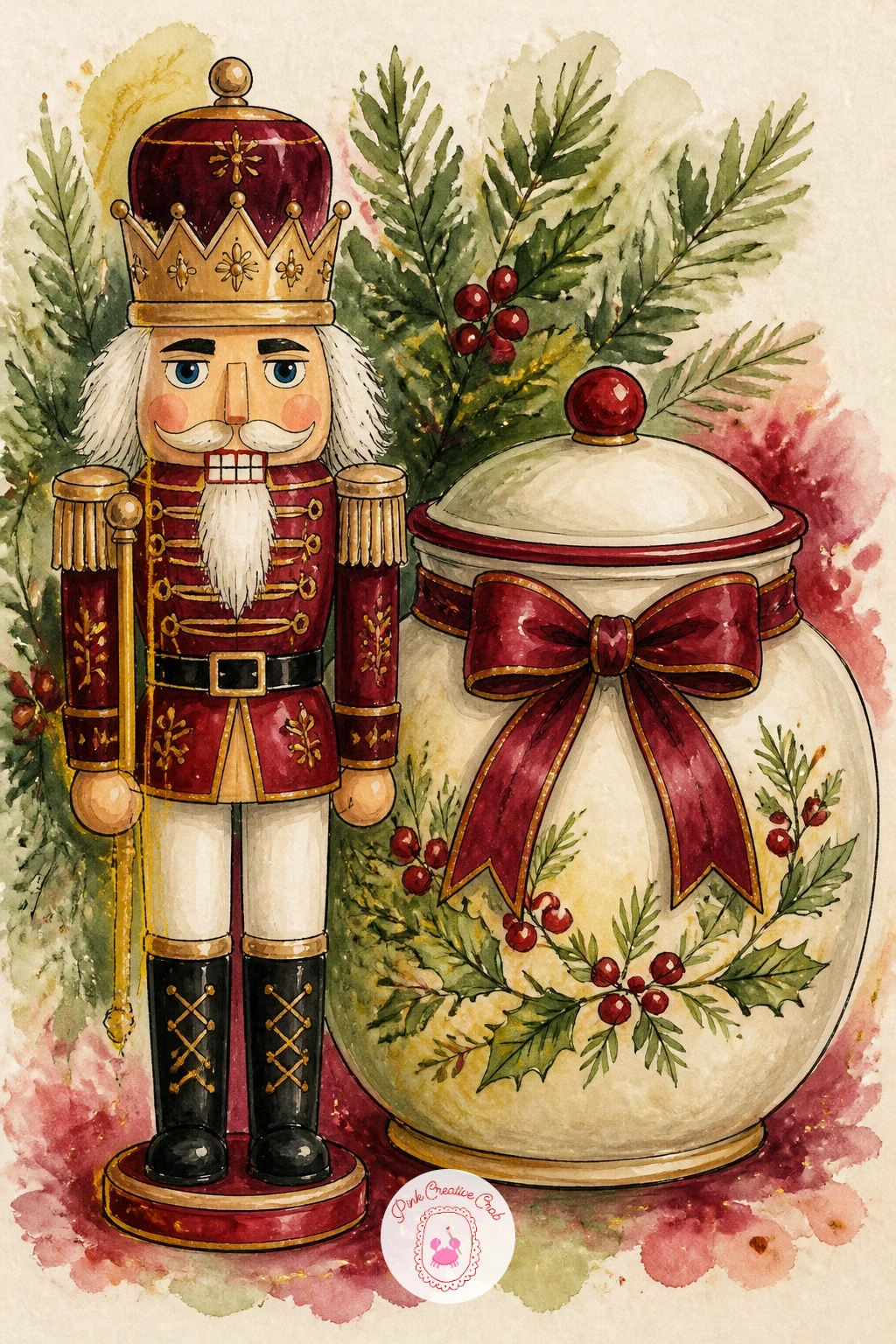
Return to a smaller still life with a nutcracker guarding a cookie jar, a cozy kitchen pairing that works well as a quick page after the castle’s bigger effort. Draw the jar first as a simple rounded shape with a lid, then the nutcracker standing beside it at roughly the same height, one hand resting near the jar as if keeping watch.
Paint the jar in a soft cream with a painted gingerbread or holly pattern around the middle, then the nutcracker in burgundy and gold once that’s dry. A few scattered crumbs or a loose cookie shape near the base adds a little story without extra complexity.
Round objects like a jar often end up lopsided if sketched in one continuous line. Draw a light guideline oval for the top and bottom first, then connect them with the jar’s sides, checking that both curves match before you ink anything.
No pattern ideas for the jar, plain cream with a simple painted ribbon tied around the neck looks just as charming.
You Will Need
- watercolor paper
- round brush
- cream watercolor for jar
- burgundy and gold watercolor
- fine liner pen
Palette: Soft Cream,Burgundy,Antique Gold,Warm Brown Crumbs
Try drawing the lid slightly ajar with a cookie peeking out, a small detail that adds humor and makes the guarding nutcracker feel like he’s losing the battle.
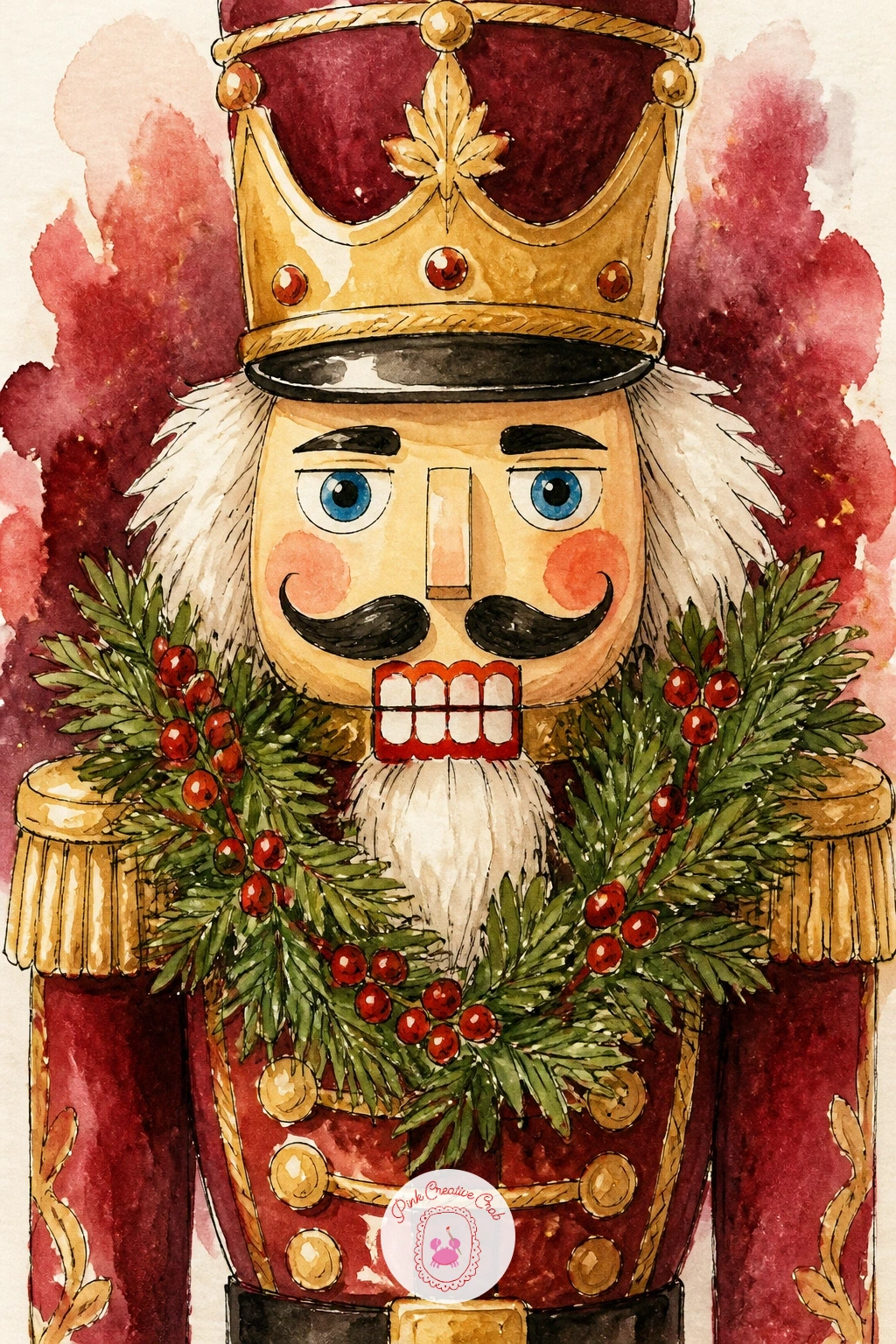
Keep things simple again with a nutcracker with a wreath around its neck, a quick variation on the familiar standing pose that only needs one new shape added. Draw the usual stiff figure, then a small circular wreath draped over the shoulders like a scarf rather than sitting on the head, so it reads clearly against the coat.
Paint the coat first in burgundy and gold as always, then the wreath in pine green with small dabs of cherry red for berries once the coat has dried completely. A thin gold ribbon bow at the front of the wreath ties it to the rest of the gold details on the page.
Wreaths can look like a flat green ring if painted in one even wash. Vary the green slightly as you go around the circle, darker in some spots and lighter in others, the way individual pine sprigs would actually catch light differently.
If you don’t have a true pine green, mix regular green with a touch of brown to dull it down toward something more natural.
You Will Need
- watercolor paper
- round brush
- pine green and cherry red watercolor
- burgundy and gold watercolor
- fine liner pen
Palette: Pine Green,Cherry Red Berries,Burgundy,Antique Gold
Try adding tiny pinecone shapes tucked into the wreath for texture, a small extra that takes only a minute and adds real variety to the greenery.
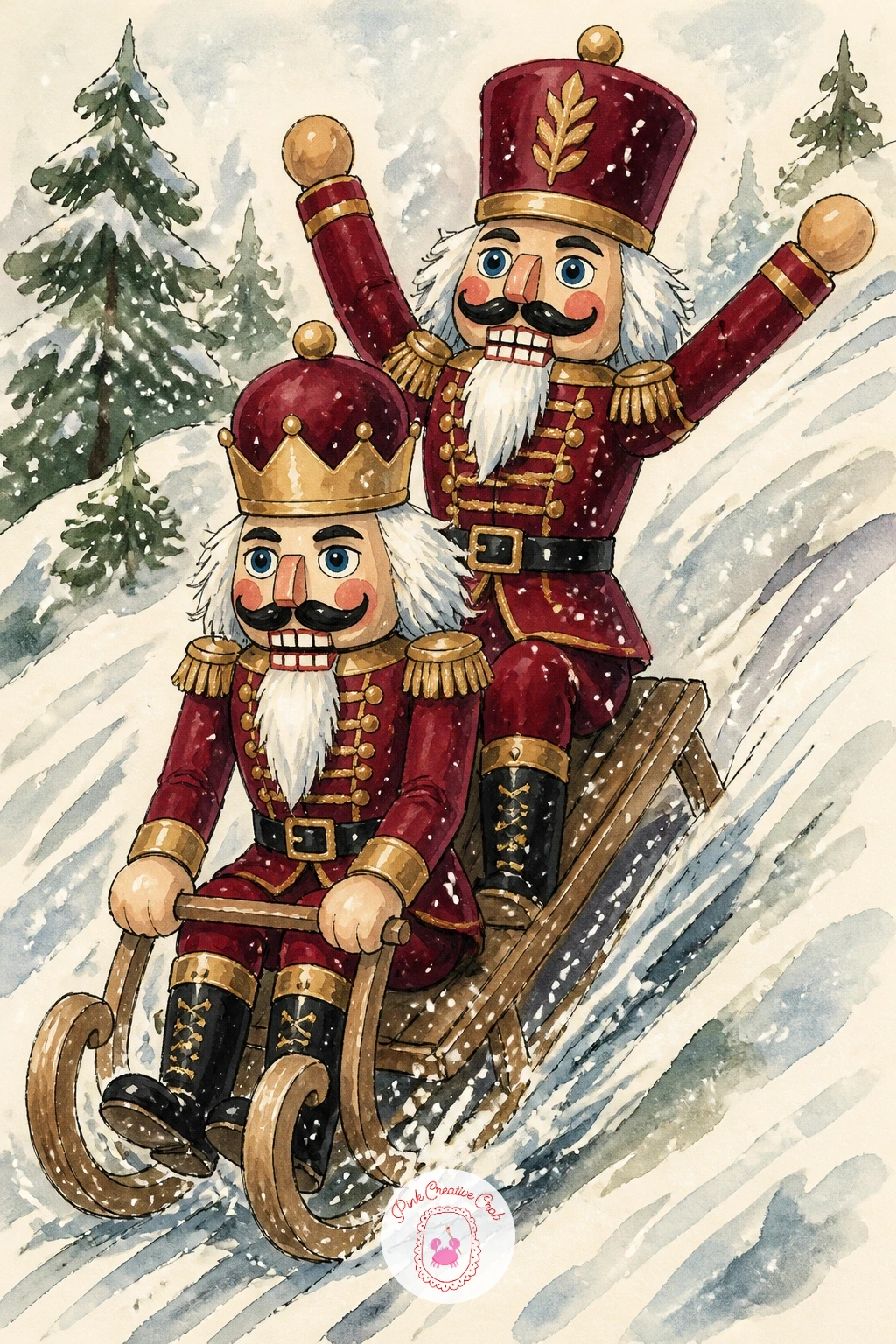
Add a bit of movement with two nutcrackers on a sled, a playful scene that puts the stiff standing figures into an unusual seated, tumbling pose instead. Sketch the sled at a diagonal across the page, one nutcracker gripping the front and the other seated behind with arms thrown up, as though caught mid-ride down a hill.
Paint the snow hill beneath them in a cool pale blue-white first, then the sled in warm brown wood tones, and finally both figures in their usual burgundy and gold, varying the trim slightly between the two so they read as a pair rather than twins. A spray of white gouache flicked behind them suggests snow kicked up by the ride.
Diagonal compositions can tip over into feeling unbalanced. Anchor the bottom corner of the page with a solid snow mound or a few trees, which keeps the sled’s motion from sliding the whole scene off the edge.
If two full figures feels like too much detail for one sitting, a single nutcracker on the sled still carries the same playful energy.
You Will Need
- watercolor paper
- round brush
- pale blue-white and brown watercolor
- burgundy and gold watercolor
- fine liner pen
Palette: Pale Snow Blue,Warm Sled Brown,Burgundy,Antique Gold
Try tilting the whole page slightly as you sketch rather than keeping the hill level, since a tilted horizon sells the sledding motion better than a straight one.
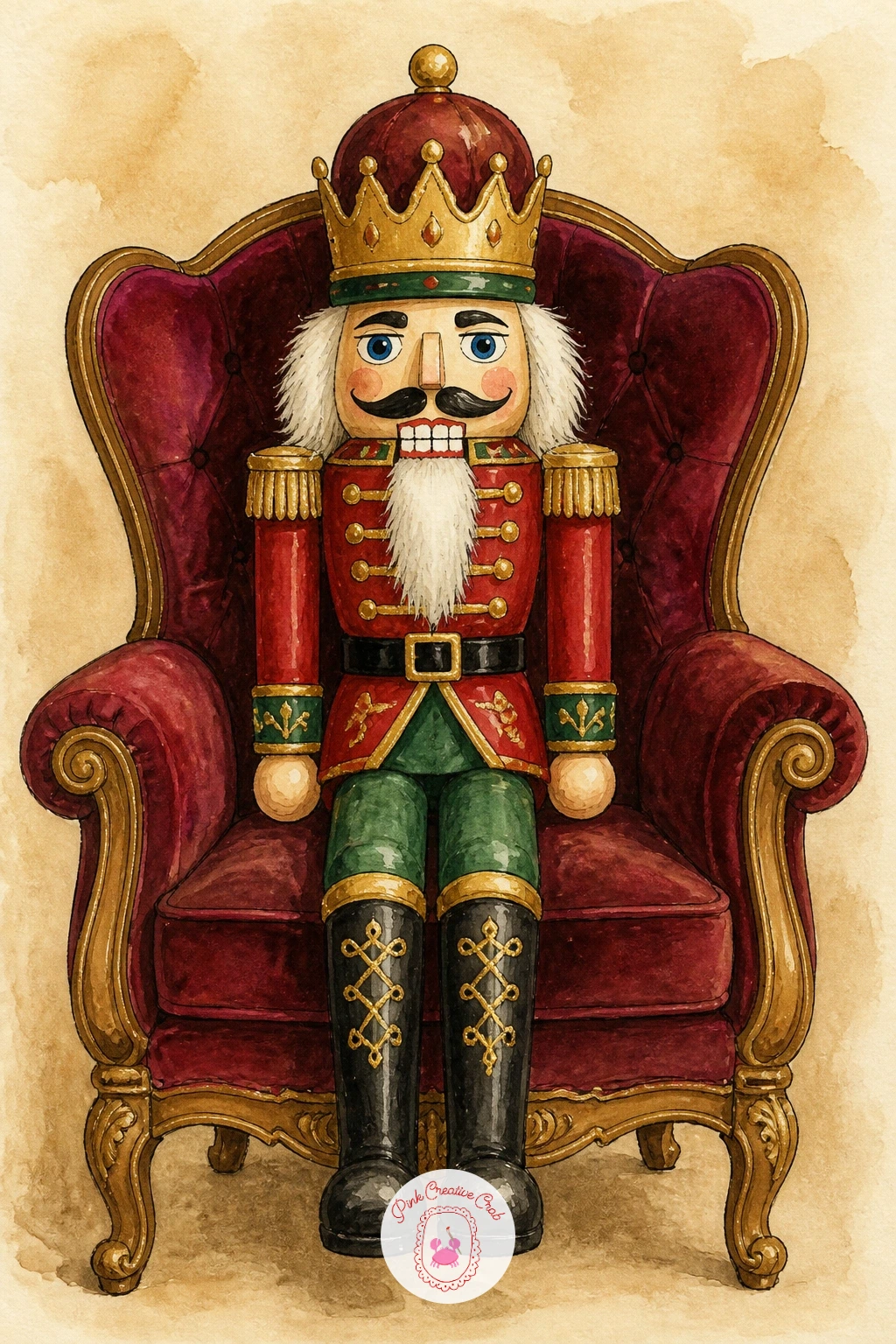
Return to stillness with a nutcracker sitting on a velvet armchair, a scene that lets you paint a second velvet surface beside the nutcracker’s own coat and compare the two textures directly. Sketch a wide armchair first, rounded arms and a tall back, then seat the nutcracker inside it, legs out straight since his joints don’t really bend at the knee.
Paint the chair in a deep burgundy wash with the same wet-on-wet darker fold technique you used for the velvet coat earlier, so the two surfaces echo each other in texture. Add the nutcracker last in a contrasting gold-heavy coat so he stands out clearly against the chair rather than blending into it.
If the chair and coat are too close in color, the whole page reads as one burgundy blob. Push the chair slightly darker or the coat slightly brighter so there’s real contrast between the figure and his seat.
A soft pencil shading pass over a dry burgundy wash can stand in for the folds if you’re out of a second burgundy mix.
You Will Need
- watercolor paper
- round brush
- burgundy watercolor in two values
- gold watercolor for coat
- fine liner pen
Palette: Deep Burgundy Chair,Brighter Burgundy Coat,Antique Gold,Cream
Try adding a small cushion with a tassel beside him on the chair, a quiet detail that fills the empty seat space and adds a bit more velvet texture practice.
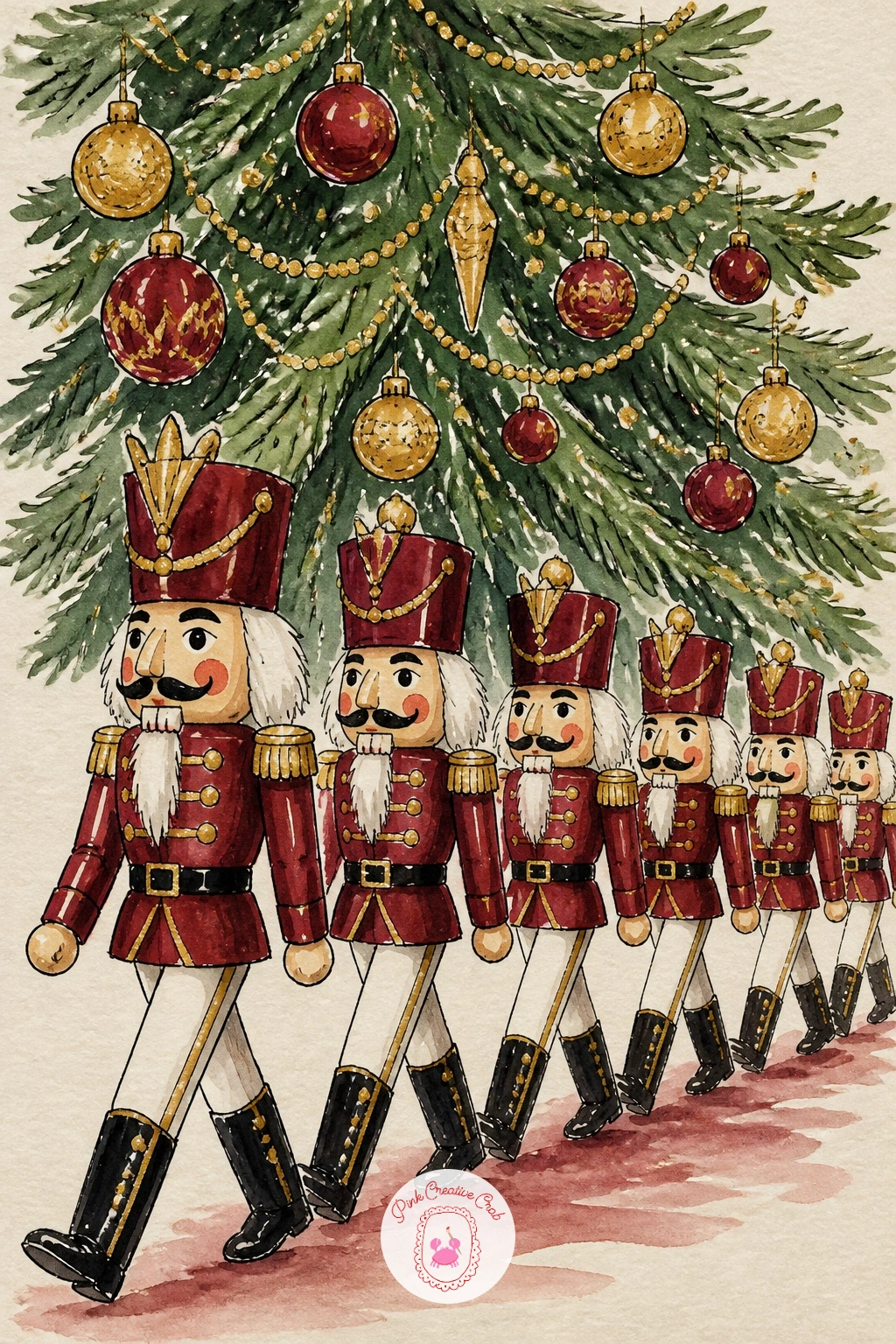
Build on the mantel row from earlier with a toy soldier parade under the tree, a livelier group scene where the figures march in profile rather than standing still and facing forward. Sketch three or four nutcrackers in a loose line, each one angled slightly to suggest marching, legs mid-step rather than planted, with the tree looming large behind them.
Paint the tree first as a soft green backdrop with a few gold ornament dots, then work through the soldiers one at a time in burgundy and gold, keeping each one’s pose just slightly different from its neighbors. A strip of warm floor color beneath their feet grounds the whole parade.
Marching figures in profile often come out looking identical if you trace the same pose repeatedly. Vary the arm swing and head tilt on each one even slightly, since small differences are what make a parade feel alive rather than copied.
Pressed for time, two marching soldiers rather than four still reads clearly as a parade.
You Will Need
- watercolor paper
- round brush
- pine green watercolor
- burgundy and gold watercolor
- fine liner pen
Palette: Pine Green,Burgundy,Antique Gold,Warm Floor Brown
Try overlapping the soldiers slightly rather than spacing them evenly, which pushes the sense of a crowded parade rather than a neat lineup.
Add a cozier textile touch with a nutcracker with a tartan bow, a small detail that brings a new pattern into the palette without changing the basic figure at all. Draw the usual standing nutcracker, then a wide bow tied at the neck in place of the plain collar you might have used before.
Paint the coat first as always, then the bow in a simple tartan: a burgundy base crossed with thin gold and pine green lines using the tip of a fine brush or a ruler-guided pen for straight crossing lines. Keep the pattern loose rather than a perfect grid, since hand-drawn tartan reads as warmer than a mechanically even one.
Tartan lines tend to wander if drawn freehand at a small scale. Lightly pencil a few faint guide lines first in both directions before committing to ink, so the crossing pattern stays roughly even.
If a full tartan feels fiddly, two or three gold stripes crossed with a single pine green line gives the same impression at a glance.
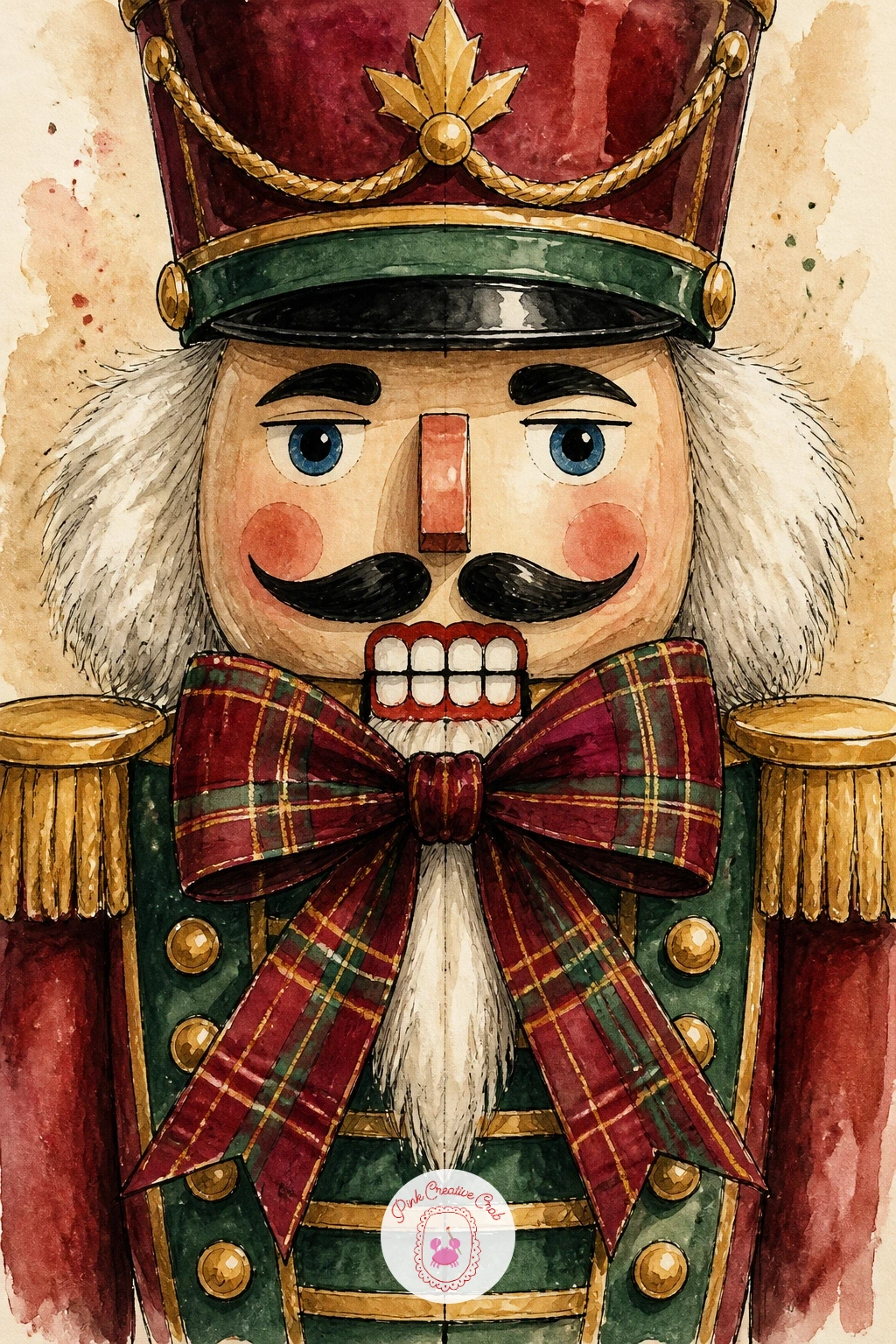
You Will Need
- watercolor paper
- fine brush or ruler-guided pen
- burgundy, gold and pine green watercolor
- fine liner pen
Palette: Burgundy Base,Antique Gold,Pine Green,Cream
Try this tartan pattern on a scrap piece of paper first to settle the spacing, since it is much easier to adjust there than directly on the finished page.
Take on another full ballet scene with the Waltz of the Flowers with dancers in pink, a softer group piece than the snowflake stage and a good chance to practice layered pastel tutus across several figures at once. Sketch three dancers in a loose circle or sweeping line, arms curved overhead, tutus layered wide at the hip.
Paint each tutu in graded pink, darker pink near the waist fading to pale pink at the hem, working wet-into-wet so the gradient stays soft rather than banded. Keep the background a loose warm cream or soft green so the pink costumes stand as the clear focus of the page.
Multiple dancers in pink can blur into one shape if their poses are too similar. Vary each one’s arm position and the tilt of her head clearly, so the eye can trace each figure separately even at a glance.
If three full figures feels ambitious, one dancer mid-turn with a hint of a second behind her still carries the Waltz of the Flowers feeling.
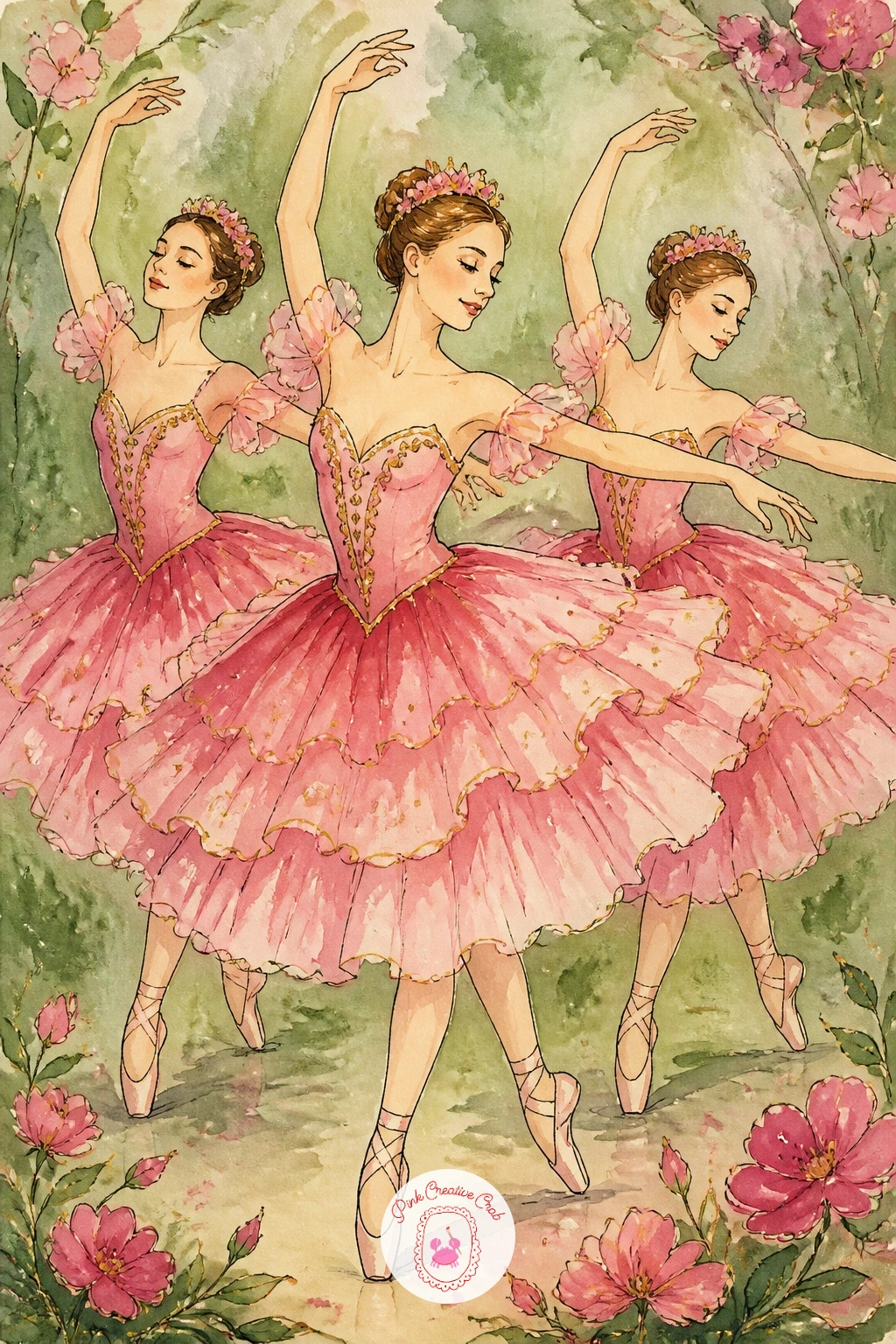
You Will Need
- watercolor paper
- round brush
- graded pink watercolor
- soft green or cream for background
- fine liner pen
Palette: Deep Pink,Pale Pink,Soft Green Background,Antique Gold
Try adding a faint circle of petals scattered around the dancers’ feet, a small motif that nods to the flower theme without adding full background detail.
Scale back down with a nutcracker in a teacup, a charming small scene that treats the cup almost like the snow globe’s frame from earlier. Draw a simple teacup shape first, wider at the top than the base, then the nutcracker standing inside it so only his upper half shows above the rim.
Paint the cup in cream with a thin gold band around the rim and base, then the nutcracker’s visible coat and head in burgundy and gold once the cup is dry. A little steam suggested by two or three soft curved ink lines above the cup adds warmth without much extra work.
Cups drawn without a visible ellipse at the rim look flat rather than round. Draw the rim as a shallow oval rather than a straight line across the top, even though it feels counterintuitive at first.
No gold band paint on hand, a fine gold marker traced around the dry cup rim works just as well.
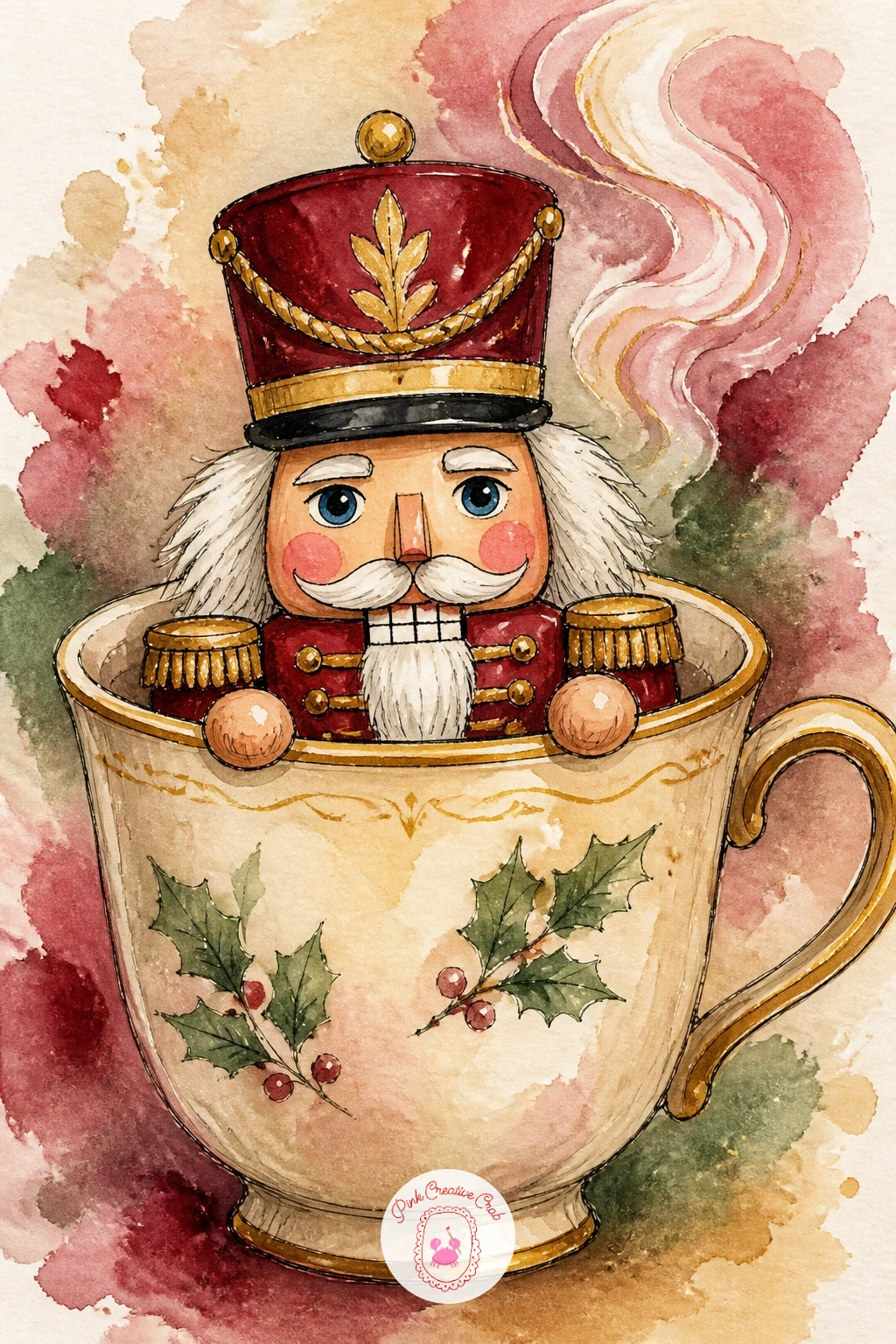
You Will Need
- watercolor paper
- fine round brush
- cream watercolor for cup
- burgundy and gold watercolor
- fine liner pen
Palette: Cream Cup,Antique Gold Rim,Burgundy,Soft Steam Grey
Try adding a few painted holly leaves around the base of the cup, a small border that ties the scene back to the Christmas theme without crowding the nutcracker.
Bring the story back to a child’s perspective with a little girl in a tutu with a nutcracker doll, a tender pairing that works well as a gift piece. Sketch her first in a simple standing pose, tutu skirt flared, holding the nutcracker doll against her chest or by one arm the way a child actually carries a favorite toy, slightly loose rather than careful.
Paint her tutu in a soft pastel first, then her skin and hair, and finally the nutcracker doll in the usual burgundy and gold, scaled down to toy size rather than matching her own height. Keep her face simple, just as you did for Clara, since over-detailing a small child’s face tends to age her unintentionally.
Children’s proportions differ from adults in ways that trip people up. Keep her head noticeably larger relative to her body than you would for a grown ballerina, since that’s what reads as a child rather than a short adult.
If you want more practice with figures like this, the girl pencil drawing ideas cover proportion tricks in more depth.
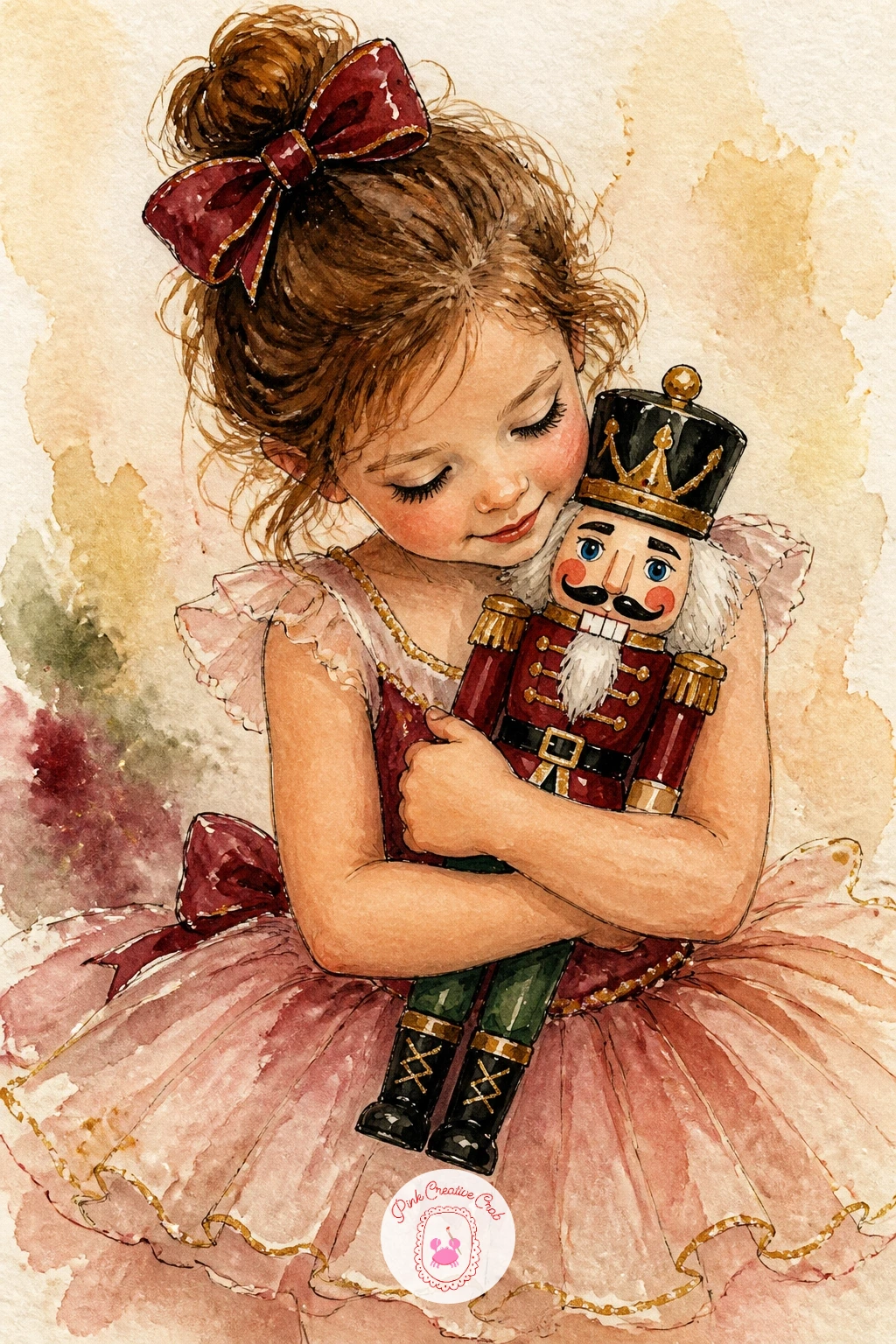
You Will Need
- watercolor paper
- round brush
- pastel watercolor for tutu
- skin tone and hair color watercolor
- fine liner pen
Palette: Pastel Pink Tutu,Soft Skin Tone,Burgundy Doll Coat,Antique Gold
Try giving her one shoe slightly untied or a stray hair loose, a small imperfection that makes a child’s figure feel alive rather than posed.
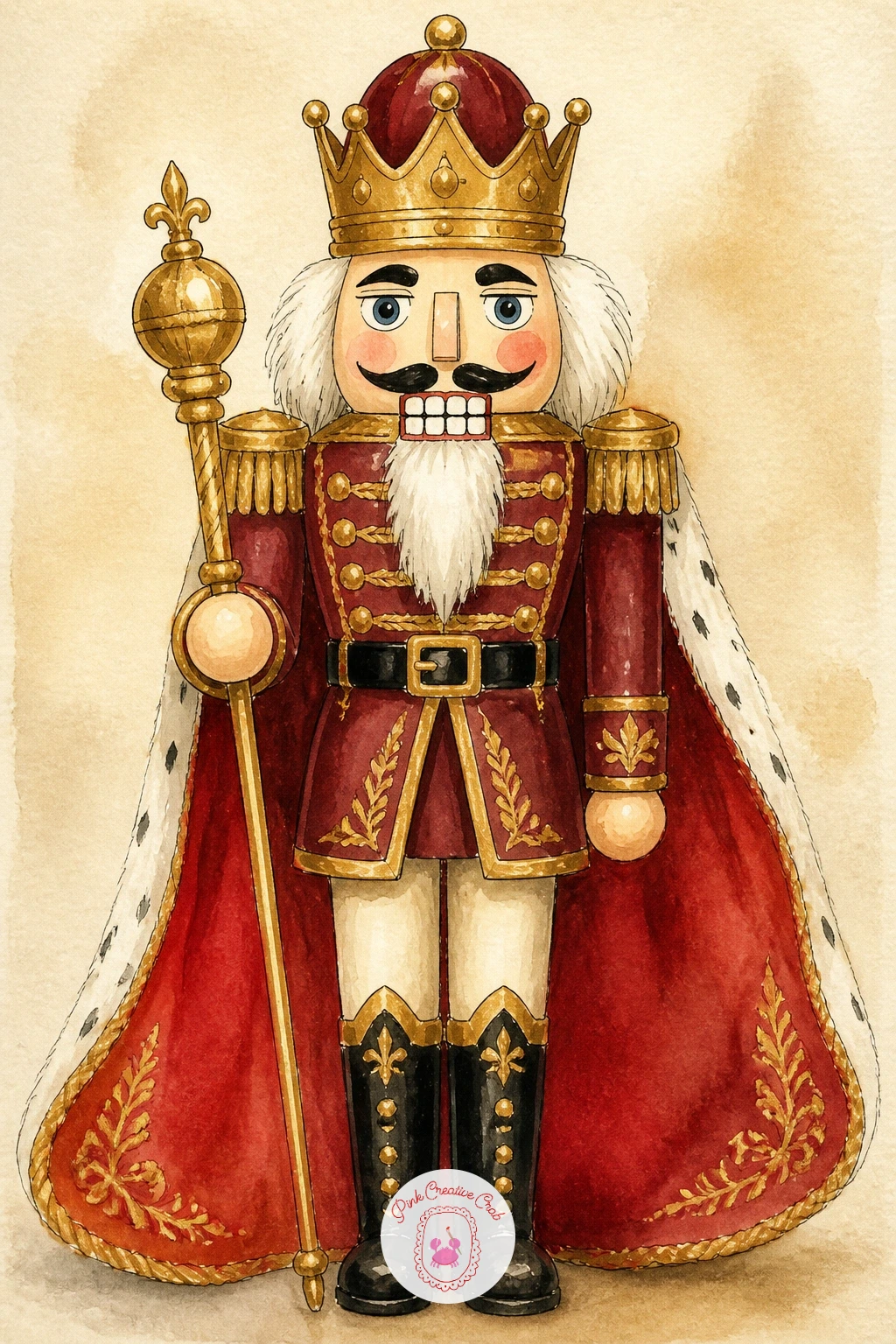
Give the figure some real ceremony with a nutcracker with a gold crown and scepter, a regal variation that leans hardest into the gold half of the palette. Draw the usual stiff standing pose, but add a tall crown shape atop the head and a long thin scepter held upright in one hand, both rendered larger and more ornate than any trim you’ve used before.
Paint the coat in burgundy as usual, saving the richest, thickest gold gouache specifically for the crown and scepter so they read as the brightest, most important part of the page. A few small ink flourishes, tiny jewels or dots along the crown’s points add sparkle without much extra time.
Crowns can look lopsided if sketched freehand without a center guideline. Draw a faint vertical line down the middle of the head first, then build the crown’s points symmetrically out from that line before inking.
Out of gold gouache for this one, a metallic gold marker gives an even brighter, more reflective finish than paint alone.
You Will Need
- watercolor paper
- fine round brush
- burgundy watercolor
- gold gouache or metallic marker
- fine liner pen
Palette: Burgundy,Antique Gold,Bright Gold Crown,Cream
Try adding a small cape trailing from the shoulders in a richer red, a regal touch that balances the tall crown and gives the figure more presence on the page.
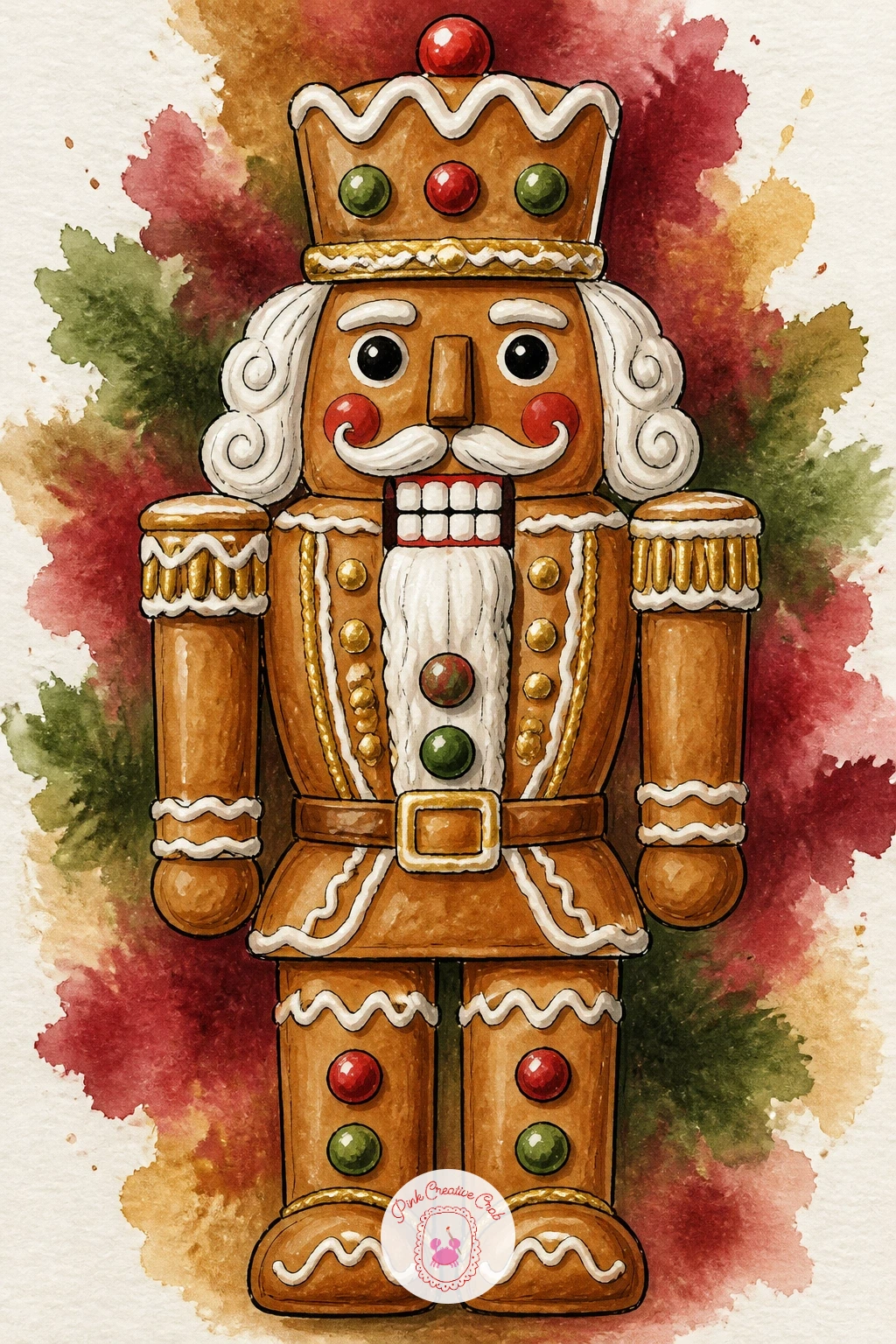
Have some fun with a nutcracker made of gingerbread, a playful variation that swaps the wooden toy for a baked one without losing the stiff pose everyone knows. Sketch the familiar standing figure, but shape the head and limbs a little rounder and softer, like a cookie rather than carved wood.
Paint the whole figure in warm gingerbread brown first, then add icing details in white gouache for the coat trim and buttons once the brown has dried completely, since icing always goes on after the cookie base is set. A few tiny red and green gumdrop shapes along the hem finish the holiday bakery feel.
Icing lines can smear if your gouache is too watery. Mix it thick, almost like actual icing, so it sits on top of the paper with a slight raised texture rather than soaking in and blurring.
No white gouache available, a white gel pen gives crisp icing lines with no mixing required at all.
You Will Need
- watercolor paper
- round brush
- warm brown watercolor
- white gouache or gel pen
- fine liner pen
Palette: Gingerbread Brown,Icing White,Cherry Red Gumdrop,Pine Green Gumdrop
Try adding a faint bite mark at one corner, a playful detail that makes clear this nutcracker is edible rather than carved.
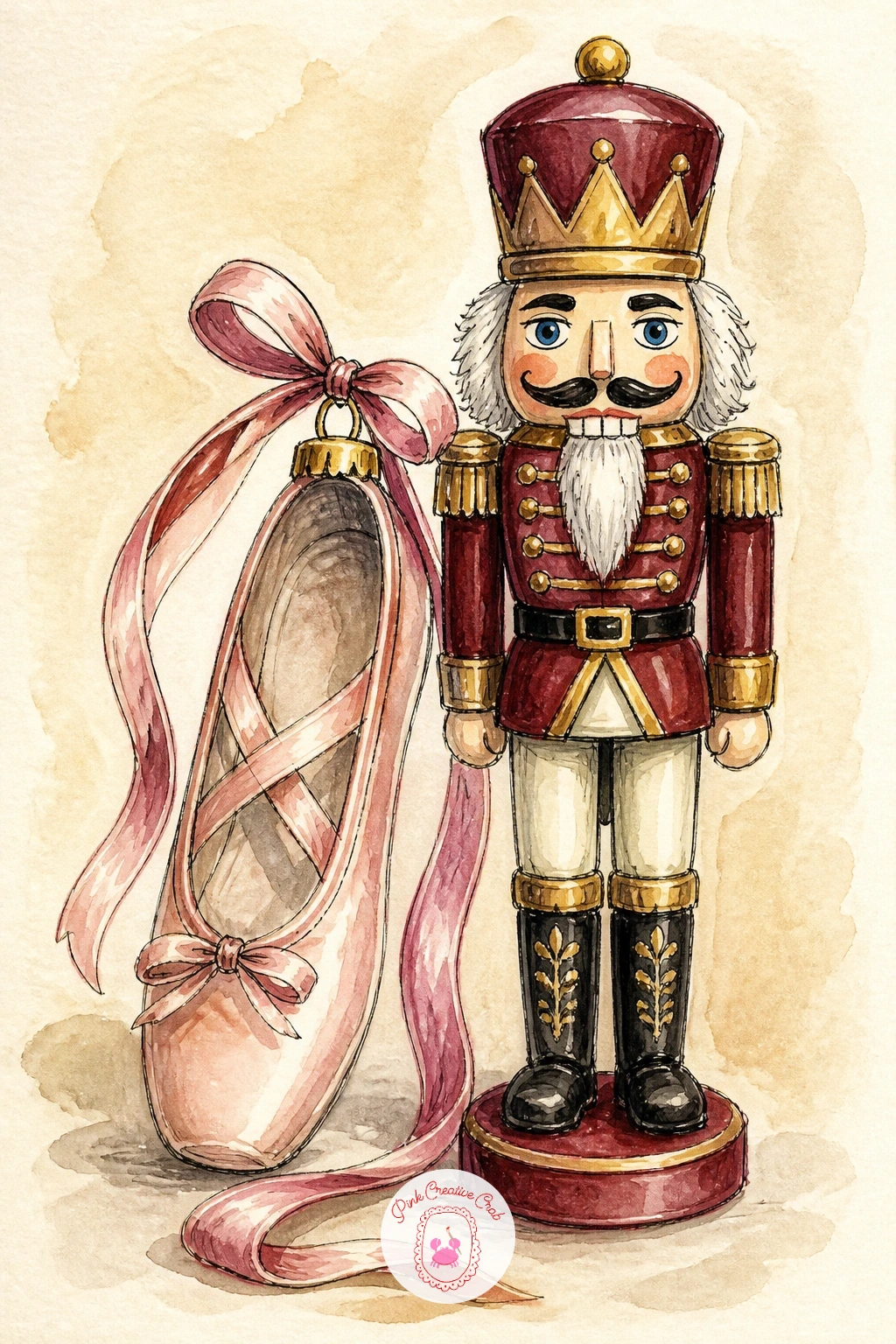
Pair two small objects together with a ballet slipper ornament next to a nutcracker, a quiet still life that works well as a smaller, quicker page after some of the bigger scenes. Draw a single pointe shoe lying on its side first, ribbon trailing loosely away from it, then a small nutcracker standing just behind or beside it, roughly matched in scale.
Paint the slipper in a soft pink satin wash with a slightly darker pink at the folds of the ribbon, then the nutcracker in burgundy and gold once that’s dry. Keep both objects close together on the page so they read as a paired still life rather than two separate unrelated sketches.
Satin ribbon can look stiff if painted as a flat shape. Let the ribbon curve and overlap itself slightly rather than lying in a straight line, which gives it the soft droop real ribbon has.
If pink satin paint looks too flat, a light wash of white gouache over the dry pink adds a believable sheen.
You Will Need
- watercolor paper
- fine round brush
- soft pink watercolor
- burgundy and gold watercolor
- fine liner pen
Palette: Satin Pink,Deeper Pink Fold,Burgundy,Antique Gold
Try tying a tiny bow at the end of the ribbon rather than leaving it loose, a small finishing touch that adds a bit more pink detail to balance the nutcracker’s gold.
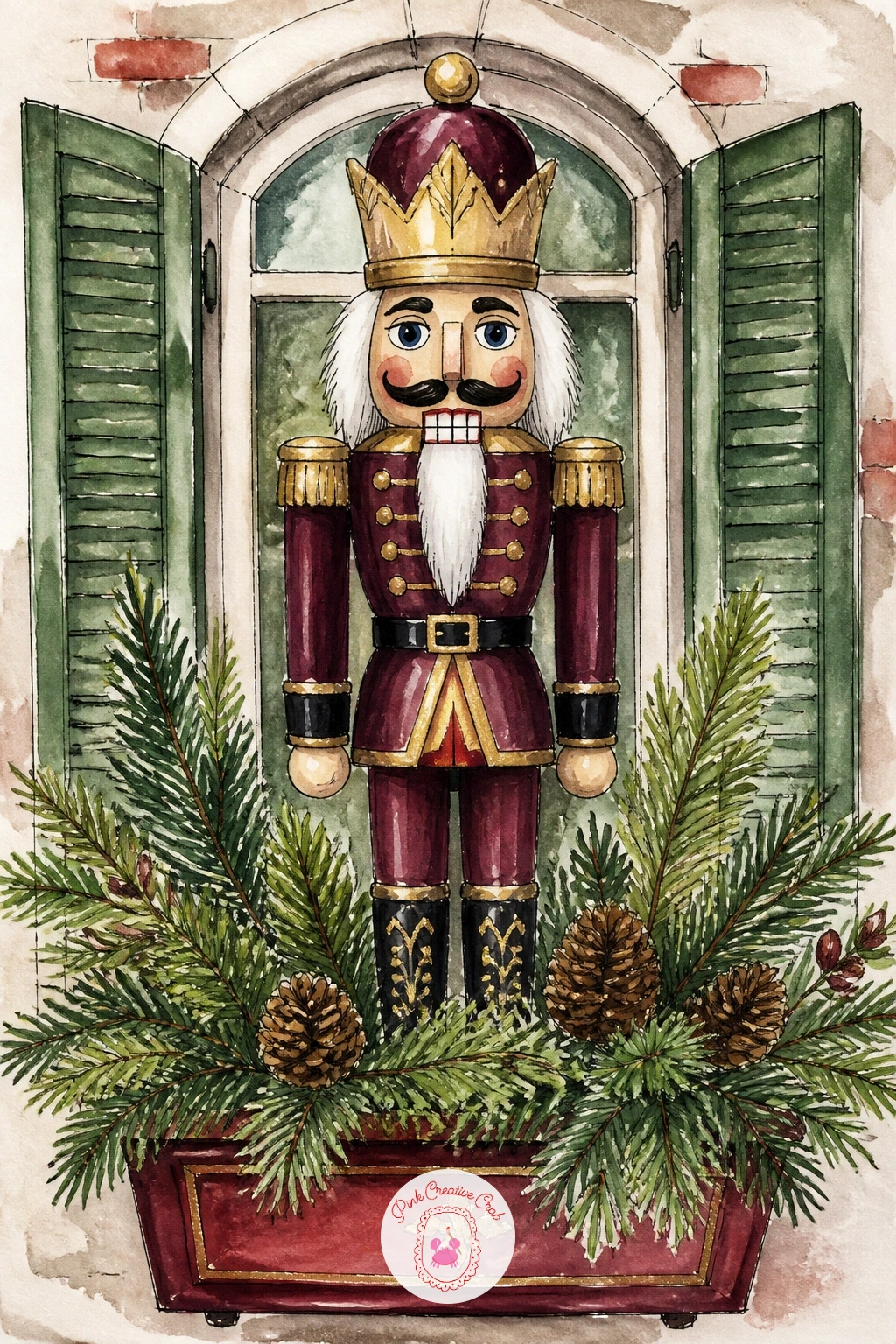
Bring the nutcracker outdoors with a nutcracker in a window box with pine, a scene that frames the figure with greenery rather than a bow or wreath. Sketch a simple rectangular window box first, then a few sprigs of pine fanning out from it, and the nutcracker standing among the greenery as though placed there as a decoration.
Paint the pine sprigs in varied greens, some lighter and some darker, using quick short brush strokes rather than one even wash so the texture reads as individual needles rather than a flat green mass. The nutcracker goes in last, burgundy and gold standing out clearly against all that green.
Pine needles painted too carefully end up looking like a solid green blob rather than foliage. Work fast with a drier brush and let some strokes break apart, since that roughness is exactly what reads as pine from a normal distance.
If pine feels fiddly, a few simple holly leaves tucked in around the box give the same wintery frame with less detail work.
You Will Need
- watercolor paper
- round brush, slightly dry
- varied green watercolor
- burgundy and gold watercolor
- fine liner pen
Palette: Dark Pine Green,Lighter Pine Green,Burgundy,Antique Gold
Try adding a few small pinecones tucked among the sprigs, a quick brown shape that adds variety without much extra painting time.
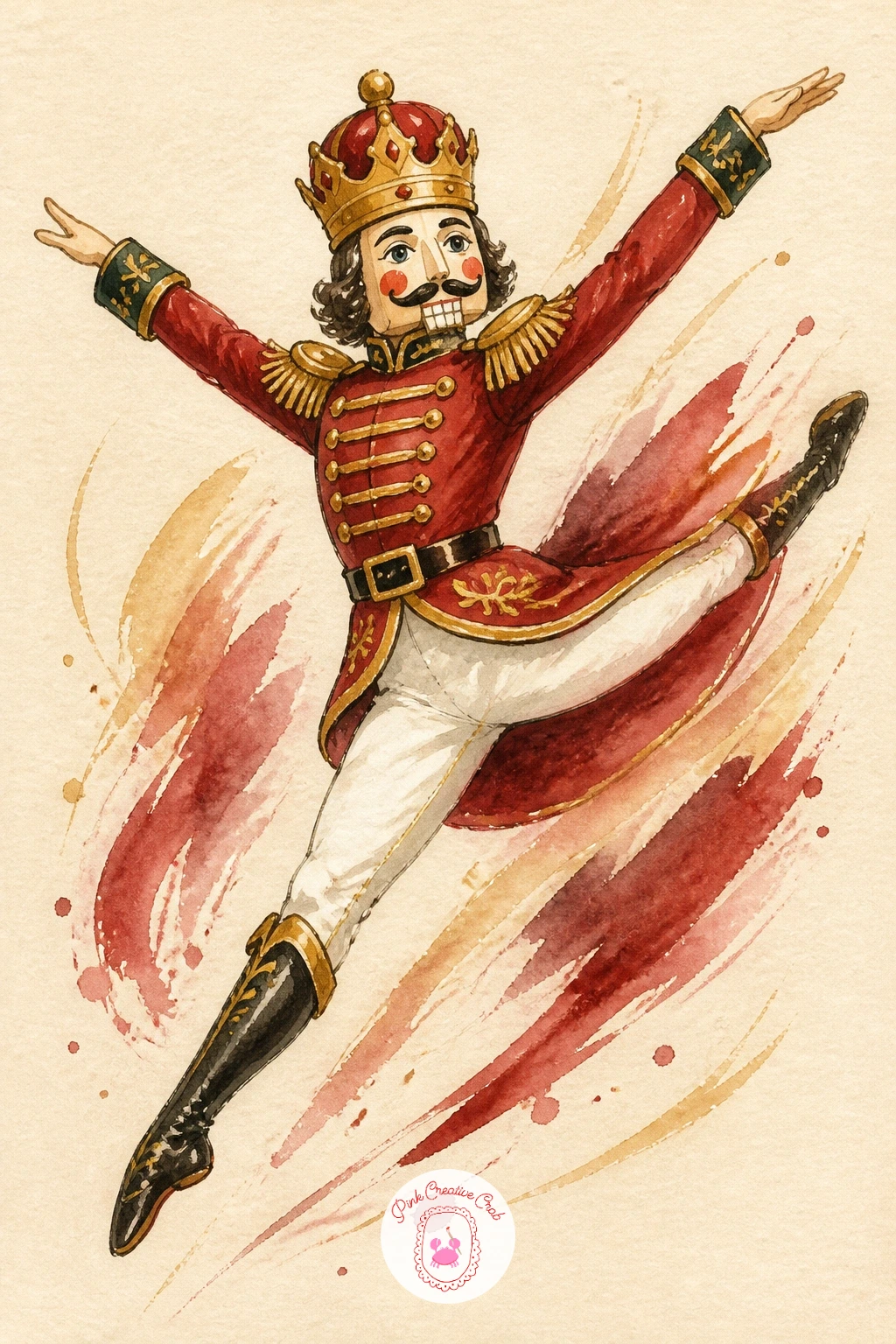
Push the pose further with a dancing nutcracker prince mid-leap, the most dynamic single figure in the whole set and worth trying once the standing poses feel settled. Sketch him with both legs extended, one forward and one back, arms open wide, body angled as though caught at the peak of a jump rather than standing still.
Paint the coat in burgundy and gold as usual, but work a touch looser and faster than you have on the quieter scenes, since a tight careful line fights against the energy of a leap. Add a few short ink motion lines trailing behind his back leg to reinforce the sense of movement.
Leaping figures tip over into looking like they’re falling rather than jumping if the angle is wrong. Keep his head and shoulders upright even while the legs extend dramatically, since that upright core is what reads as controlled motion rather than a stumble.
If a full leap feels too ambitious today, a simpler one-leg-raised pose still captures plenty of energy with less risk.
You Will Need
- watercolor paper
- round brush
- burgundy and gold watercolor
- fine liner pen
- scrap paper for pose practice
Palette: Burgundy,Antique Gold,Cherry Red Accent,Cream Background
Try sketching the leap three or four times quickly on scrap paper before touching your good sheet, since this pose depends entirely on getting the angle right from the start.
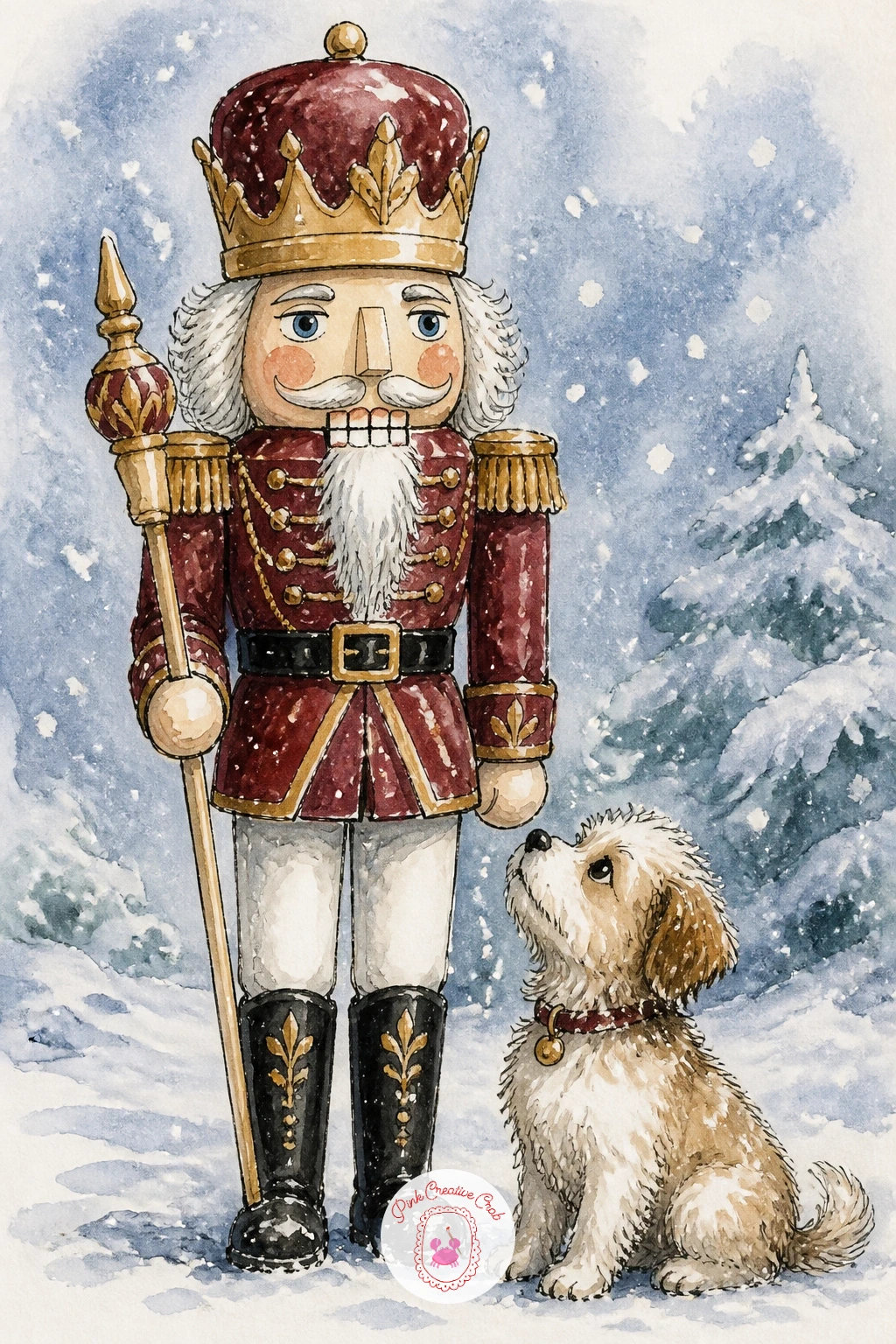
Close the series with a nutcracker standing in snow with a little dog, a warm final scene that pairs the toy figure with something alive and soft beside him. Sketch the nutcracker in his usual stiff stance, then a small dog sitting or standing at his feet, head tilted up toward him, scaled noticeably smaller to keep the nutcracker as the taller figure.
Paint the snow ground first in a very pale blue-white wash, then the dog in whatever coloring you like, warm browns or soft greys work equally well, and finally the nutcracker in burgundy and gold once both have dried. A scatter of white gouache dots over the whole page finishes it as a snowy scene.
Dogs sitting beside a taller figure often end up floating without real contact between them. Overlap the dog’s shoulder very slightly against the nutcracker’s leg or coat hem, so the two clearly share the same patch of snow.
If you’d like more small dog poses to practice, the dog pencil drawing ideas cover plenty of simple sitting and standing positions.
You Will Need
- watercolor paper
- round brush
- pale blue-white watercolor
- brown or grey watercolor for dog
- burgundy and gold watercolor
- fine liner pen
Palette: Pale Snow Blue,Warm Dog Brown,Burgundy,Antique Gold
Try adding a small knitted scarf on the dog in a matching burgundy, a tiny detail that ties the two figures together as a pair on the page.
What to Do Next
Pick one scene that matches your evening, a quick nutcracker on a gift box if time is short, or Clara by the window if you want to sit with it longer, and start with a light pencil sketch on cold press watercolor paper before any paint touches the page.
Frequently Asked Questions
What paper works best for a nutcracker drawing in watercolor and ink?
Cold press watercolor paper works best, since its slight texture holds pigment for rich burgundy washes while still letting a fine liner pen glide cleanly for ink detail on top.
How do you get a true burgundy instead of a flat red or purple?
Mix a cherry red watercolor with a small touch of Payne’s grey or black rather than buying a pre-mixed burgundy, adjusting the grey until the red deepens without turning muddy or purple.
Should the ink details go on before or after the watercolor?
Ink details go on after the watercolor is fully dry in almost every case, since wet paper makes waterproof ink feather and pencil-first, paint-second, ink-last is the safest working order.
What if gold gouache isn’t in my paint box yet?
Warm yellow ochre mixed with a touch of white gouache gives a close stand-in for gold at a normal viewing distance, and a gold gel pen works well for small details like buttons or crowns.
How do you keep a stiff nutcracker figure from looking flat or lifeless?
Vary the arm position, head tilt or the object he holds slightly in every version, and let the ink line stay a touch uneven rather than perfectly straight, since real toy carving is never machine-precise.
Have any thoughts?
Share your reaction or leave a quick response — we’d love to hear what you think!
-
 0
-
0
-
0
-
0
-
0
-
0


