A polar bear drawing gives you one of the most satisfying subjects in colored pencil: huge soft shapes, a coat that is never really white, and all that bright paper you get to leave bare. Every bear here lives in a small arctic moment, a swim, a snow nap, a cub tumbling into a drift, so you can sit down and finish the whole thing in one sitting.
Below you will find 31 scenes running from a quick sliding cub up to a full mother-and-cubs group, each one built for a light icy palette of blue, white, mint and grey with a cherry red accent. Pick whichever bear is calling to you and start layering.
Using these images: free for personal projects such as printing, coloring, cards, journals and gifts. Handmade items that include them may be sold up to 30 pieces per design. More than that is commercial use and is not permitted, and neither is selling or sharing the images themselves or passing them off as your own. Please ask before any other use.
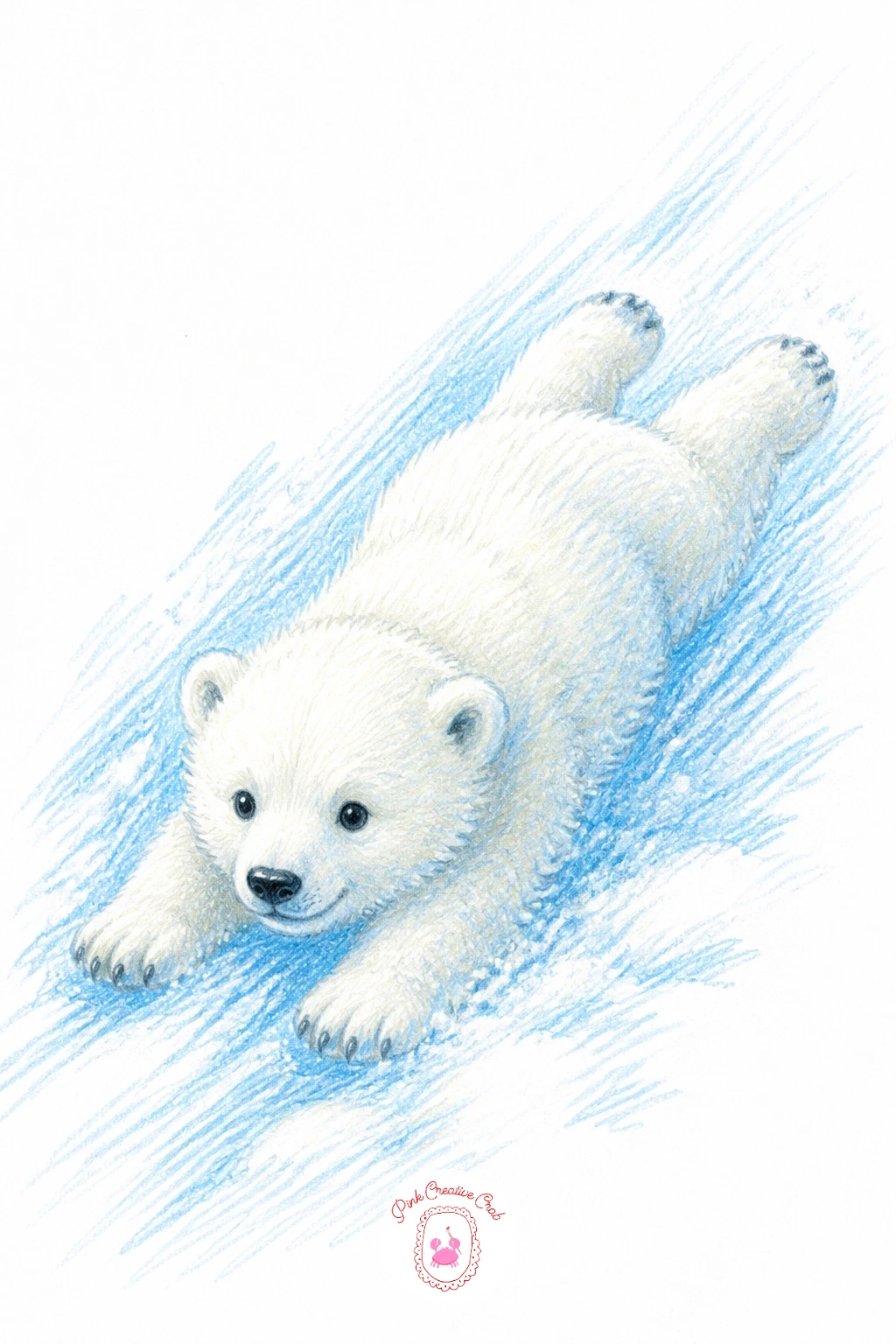
Start simple with a cub sliding down a snowbank on its belly, legs flung out behind like a sled run gone slightly wrong. Sketch the body as one long soft oval tipped at an angle, then add the head, ears and the four paws trailing off the back edge. Light pencil guidelines keep the pose from drifting flat before you commit to color.
Block in the fur with Titanium White and Light Cerulean Blue in the shadow folds, working short strokes that follow the direction the bear is moving. Leave the brightest hump of the snowbank untouched paper, since that white gap reads as sunlit snow far better than any pencil can.
The pose usually goes wrong when the belly sits too stiff and straight. Curve the spine slightly and drop the chin low so the whole bear looks like it is enjoying the ride. If your blue pencil feels too dark, a grey works as the swap for shadow instead.
Finish with a scatter of flicked white gel pen dots behind the back paws for flying snow, your one concrete touch that sells the speed.
You Will Need
- white gel pen
Palette: Titanium White,Light Cerulean Blue,Cool Grey,Cherry Red
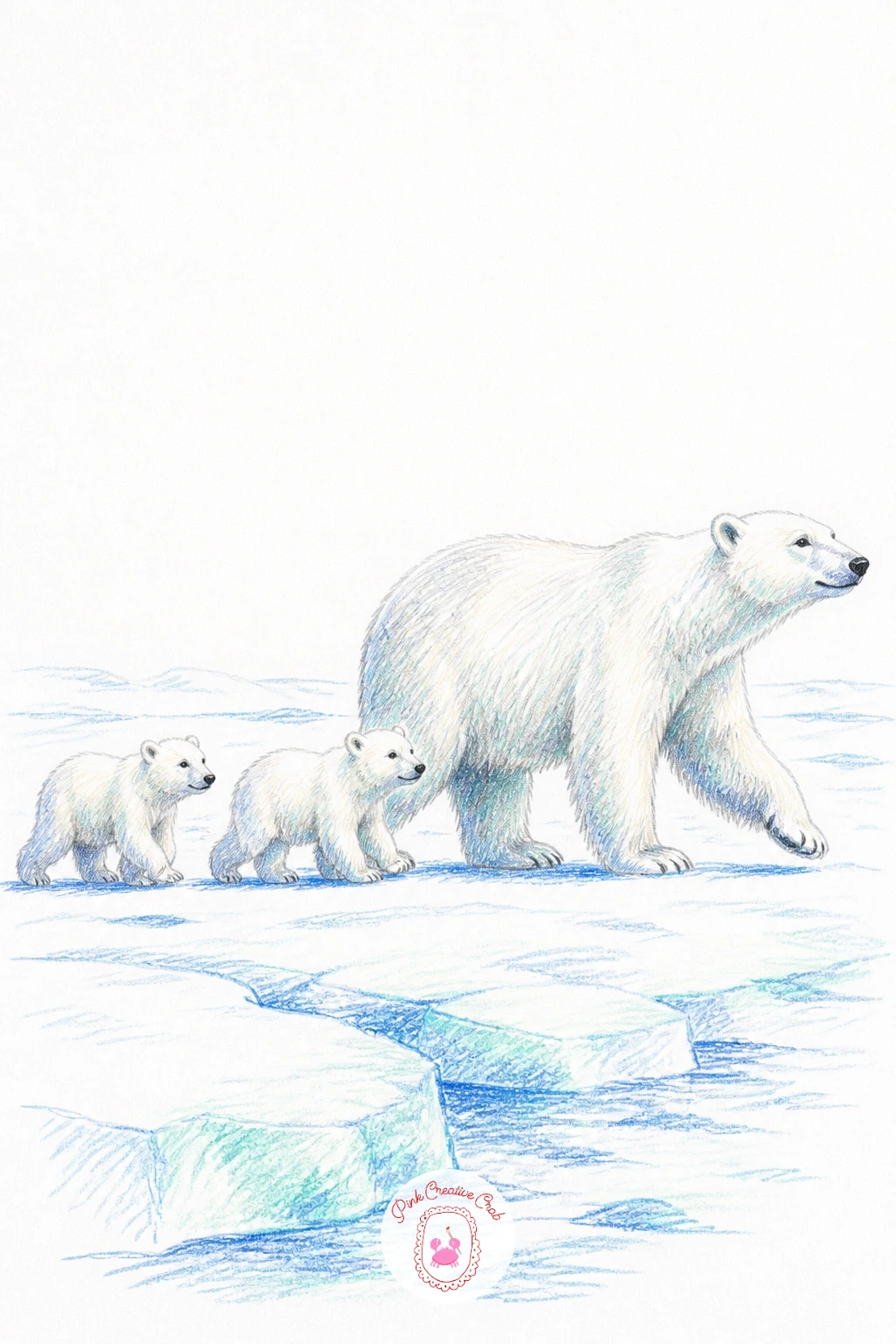
Build confidence with a mother polar bear leading two cubs across pale sea ice, all three walking the same direction in a loose line. Draw the mother largest and furthest forward, then compare each cub against her shoulder height, roughly a third her size, to keep the family scale believable before you add a single stroke of color.
Work the mother’s fur first in Light Cerulean Blue shadow and Titanium White highlight, then drop the cubs in behind her using the same two pencils but softer pressure, so they read as slightly smaller and further back. A thin band of Payne’s Grey along the horizon separates ice from sky without any real landscape drawing.
If the group starts to look like three separate bears rather than one family, overlap the back cub’s paw behind the middle one’s leg. That single overlap locks the line together.
Swap Payne’s Grey for any dark blue pencil if that is what sits in your tin.
Palette: Titanium White,Light Cerulean Blue,Payne’s Grey,Cherry Red
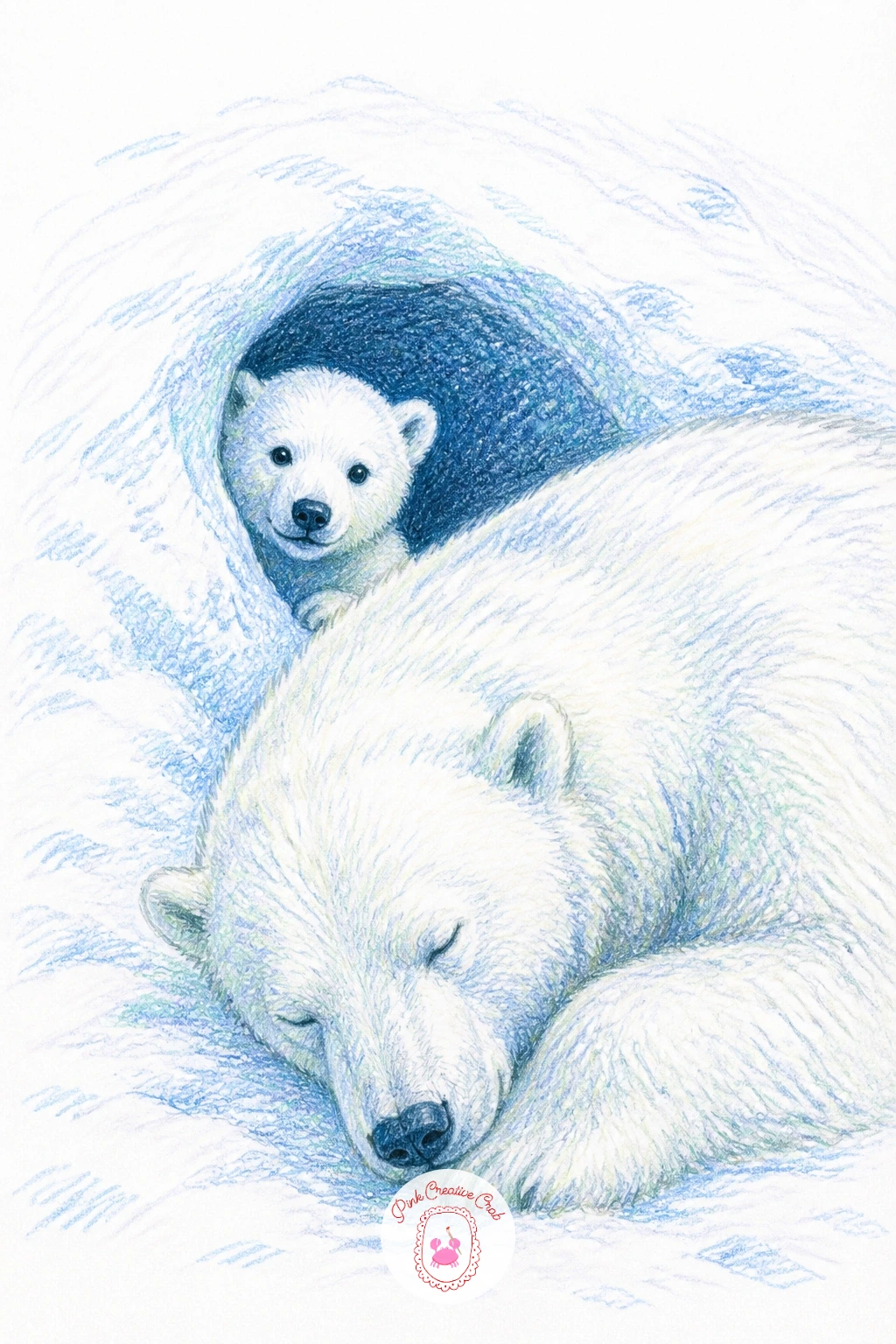
A snow den scene turns on where the light comes from, so decide that before anything else: let it fall from the upper left so the den mouth throws one clear shadow and the sleeping mother inside stays half in shade. Draw the den as a rounded dark opening in a mound of white, then place the cub’s head just inside the rim, eyes bright and curious.
Shade the den’s inner curve heavily in Payne’s Grey and Light Cerulean Blue so it reads as a true hollow rather than a flat dark patch. The mother’s shape behind the cub needs only a suggestion, an ear and a curve of back fading into that shadow.
This scene goes flat when the den opening is too round and neat. Rough its edge with a few jagged pencil marks, since real snow never cuts a clean circle.
Keep the cub’s face the lightest value in the whole drawing so your eye lands there first.
Palette: Payne’s Grey,Light Cerulean Blue,Titanium White,Cherry Red
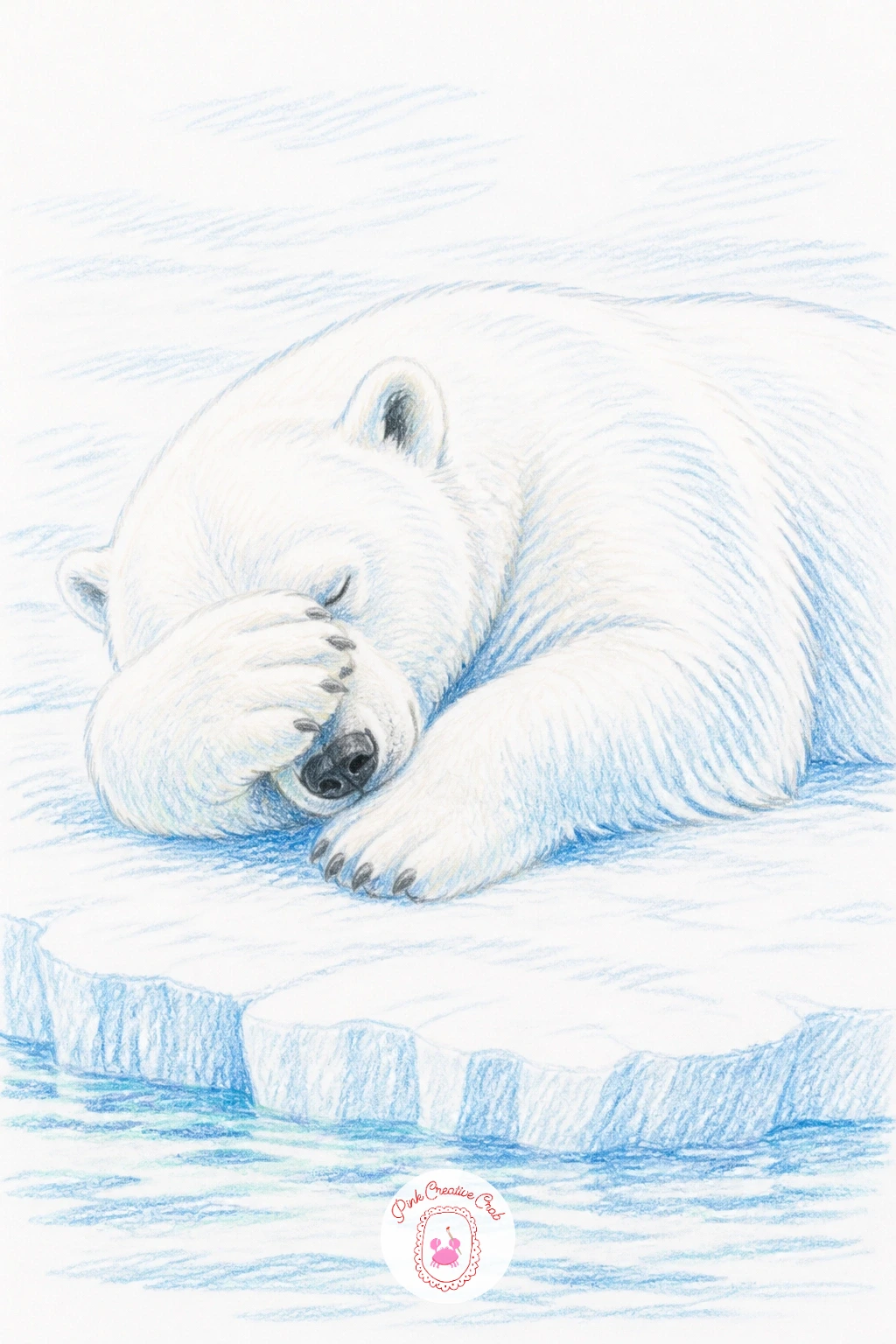
Nothing beats a polar bear napping on an ice floe with one paw over its nose for pure charm, and the trick is entirely in the edges. Draw the body as a long loaf shape lying flat, then bring the front paw up and over the muzzle in one soft curved line, tucking the claws in rather than spreading them.
Lay down the base fur in Titanium White and Light Cerulean Blue shadow, then lift color back out of the paw and cheek with a kneaded eraser to create soft highlights that look like real fur catching light, rather than pencil shine. This lifting trick works far better here than more layers of white.
If the paw looks stiff, round its underside and let a little shadow sit where it presses into the nose. That small shadow is what makes the gesture read as genuinely sleepy.
No kneaded eraser on hand? A clean white pencil pressed hard over the shadow area does a similar job.
You Will Need
- kneaded eraser
Palette: Titanium White,Light Cerulean Blue,Cool Grey,Cherry Red
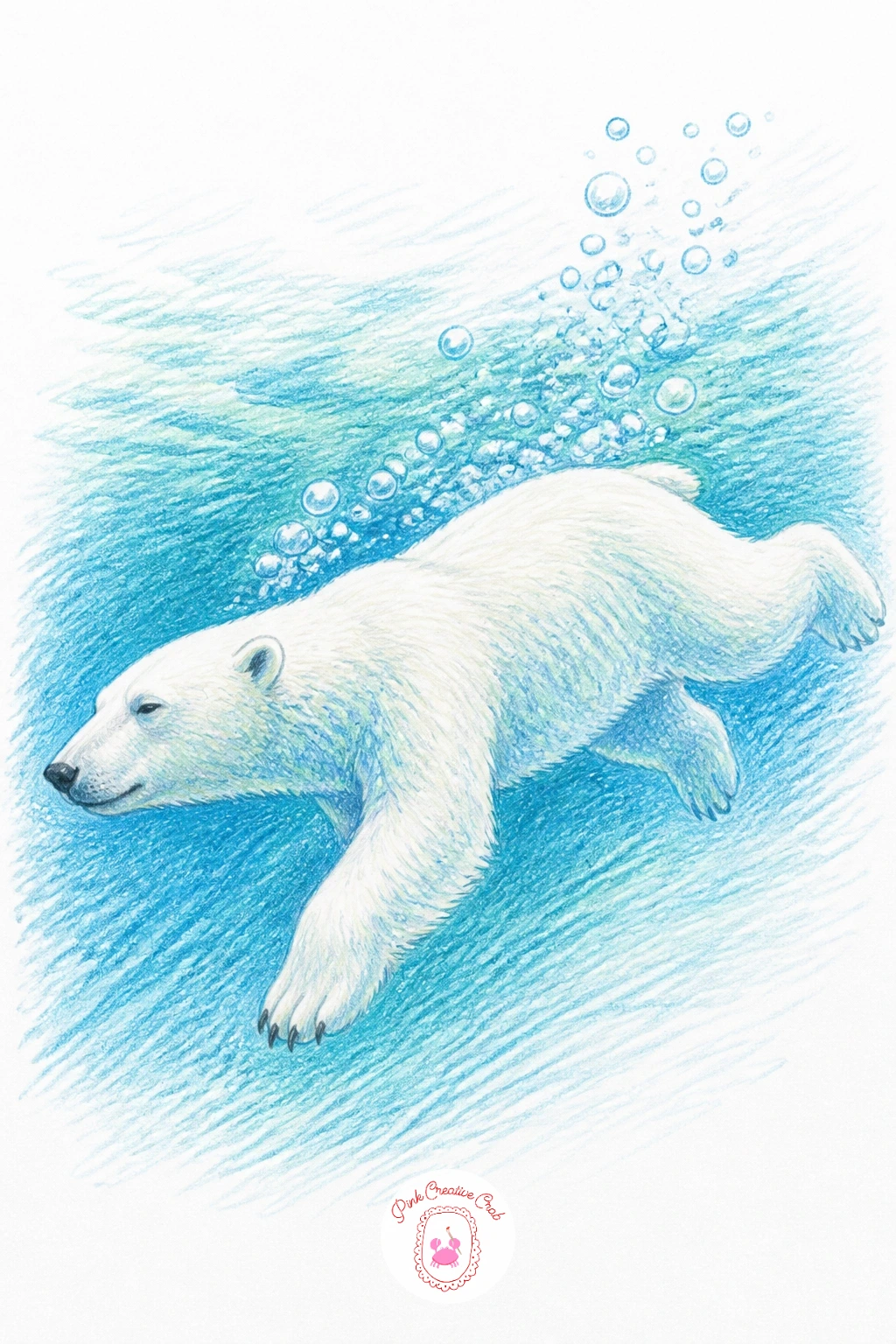
Swimming underwater is where this subject gets to show off, so give yourself ten quiet minutes for the quick version: one bear gliding sideways, legs stretched into a paddle, a trail of bubbles behind. The forty-minute version adds rippling light bands across the body and a second, smaller ripple of bubbles near the surface above.
Draw the bear elongated and slightly curved, since bodies stretch underwater, then build the water in layered Light Cerulean Blue and a deeper Cerulean Blue Hue around the silhouette, leaving the bear itself much paler than its background.
Bubbles are simply small bare paper circles outlined in a thin pencil line, clustered smaller as they rise. Too many bubbles clutters the scene, so keep them to a loose trail rather than a solid stream.
If blue pencils run light, deepen the water with a layer of grey underneath before adding the blue on top.
Palette: Light Cerulean Blue,Cerulean Blue Hue,Titanium White,Cool Grey
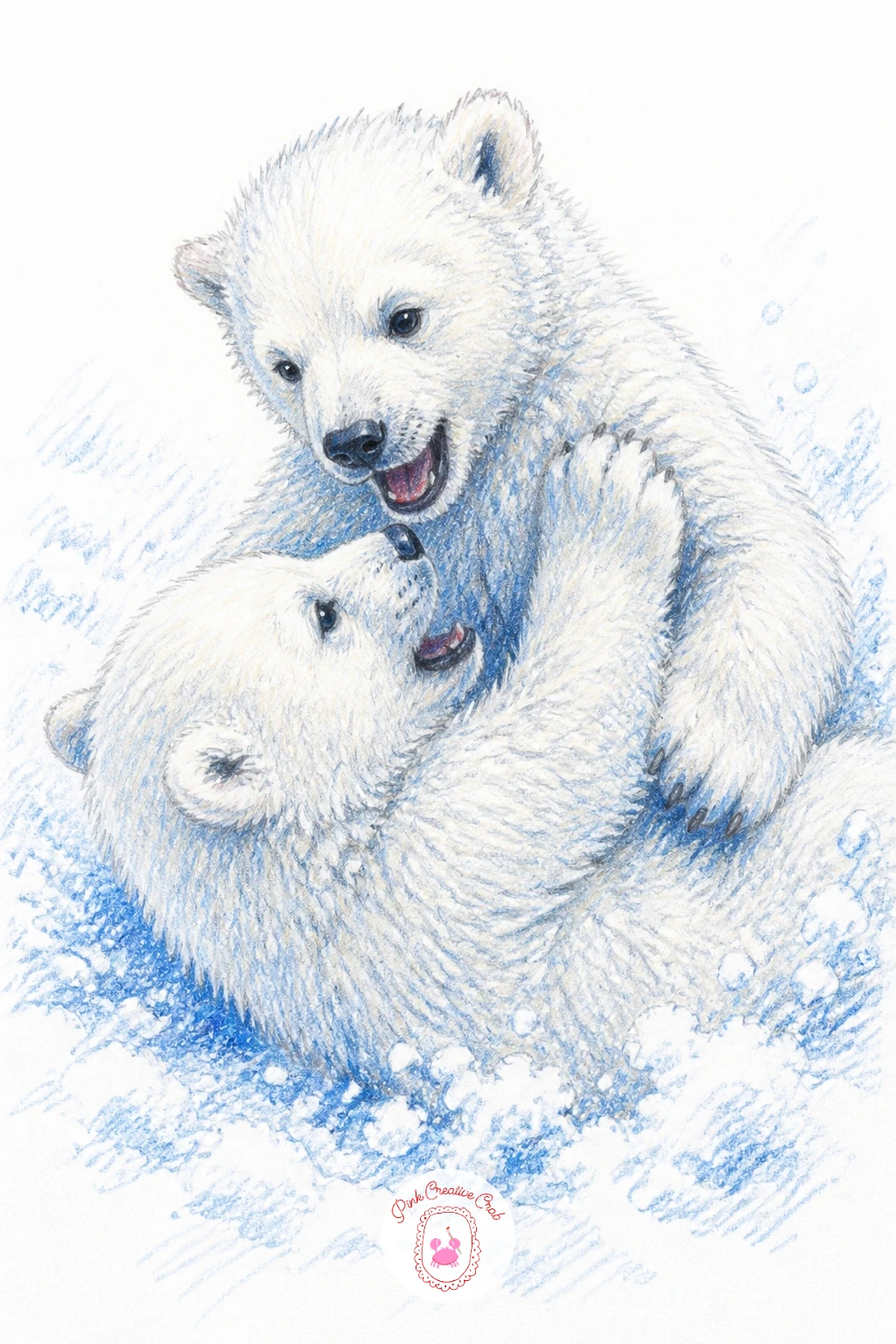
Twin polar bear cubs wrestling in fresh powder snow gives you a chance to draw real movement, so measure before you commit: stack the two cub bodies so neither is taller than the other, keeping their heads at roughly the same height even as the limbs tangle.
Sketch one cub rearing slightly with paws raised and the other leaning into it, bodies overlapping at the chest. Shade each cub separately in Light Cerulean Blue so the overlap stays readable, then add a scuffed ring of disturbed snow beneath them in loose grey marks, broken rather than smooth.
This scene collapses into a blob if the two cubs blend into one shape. Keep a thin strip of white paper between their outlines wherever they touch, even just a hair’s width, so your eye can separate them.
Swap the scuffed snow for simple flicked white gel pen lines if shading grey under white pencil feels fiddly.
You Will Need
- white gel pen
Palette: Titanium White,Light Cerulean Blue,Cool Grey,Cherry Red
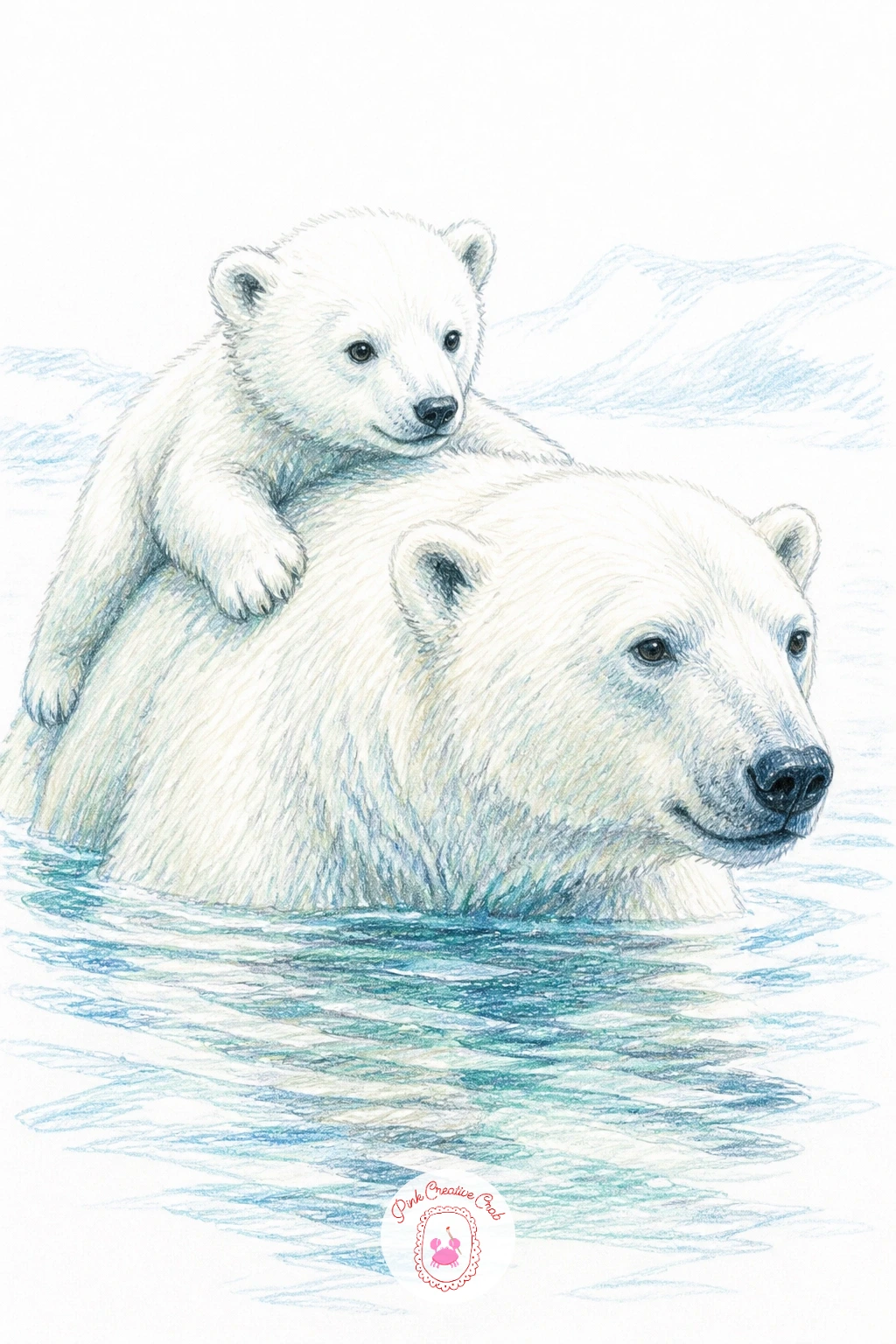
Picture the eye level low, almost at water height, for a cub riding on its mother’s back through shallow icy water, since that angle is what makes the scene feel intimate rather than distant. The mother’s back sits just above the waterline, a long smooth curve, with the cub perched small and round at its highest point.
Draw the mother first, her legs mostly hidden beneath the water’s surface, then place the cub gripping on with front paws tucked close to her neck. Water laps in soft horizontal Cerulean Blue strokes around her lower body, lighter where it catches reflected sky.
The ride looks unstable if the cub sits too high or too far back. Nestle it right into the dip just behind her shoulders, the most natural resting spot on a real bear’s back.
A thin white gel pen line along the waterline adds the glint that finishes the swim.
You Will Need
- white gel pen
Palette: Light Cerulean Blue,Titanium White,Cerulean Blue Hue,Cherry Red
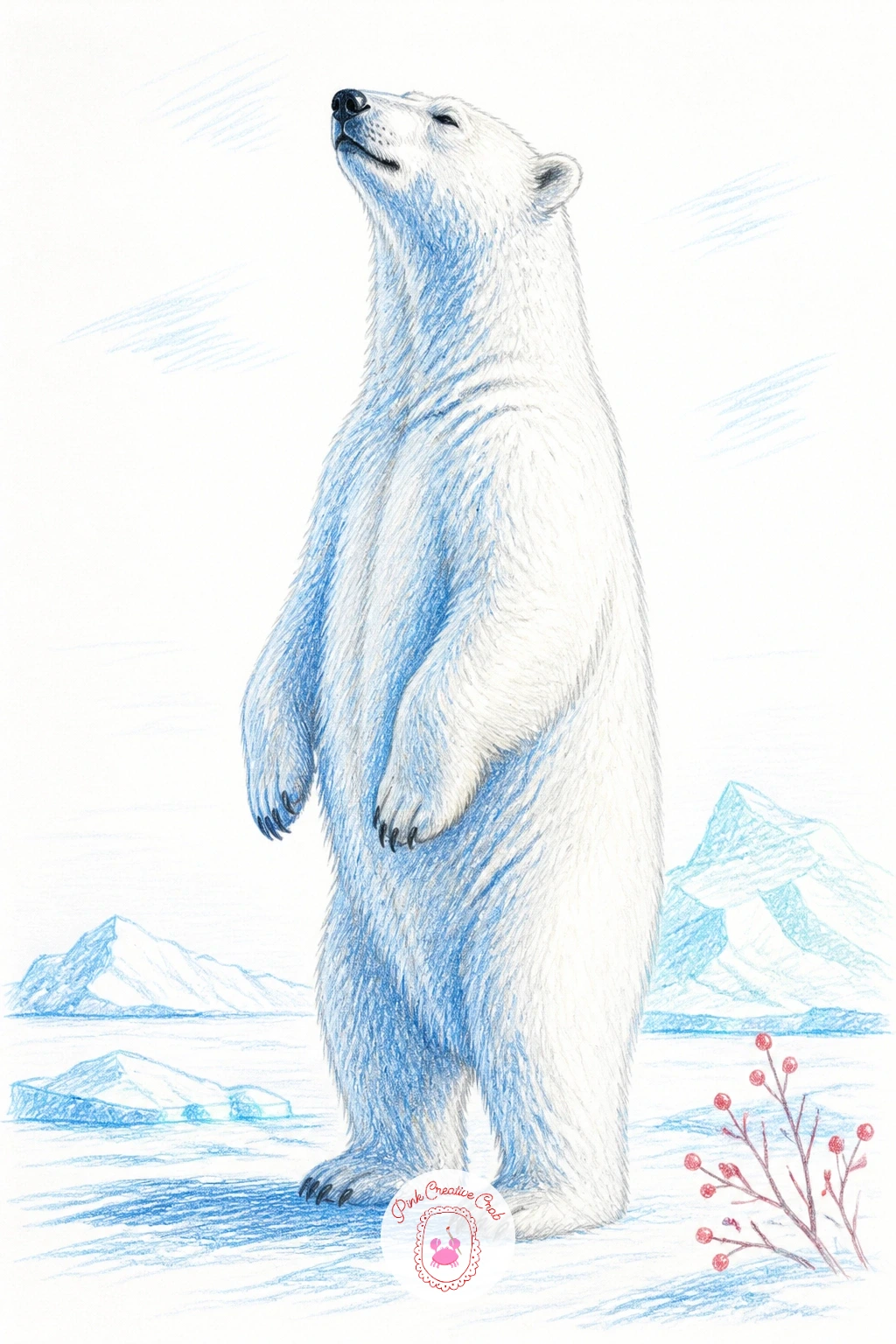
Height matters here, so measure the standing bear against itself before drawing a single hair: the body from nose to tail should fit roughly two and a half times into the standing height, legs included. Mark that proportion lightly in pencil first so the pose does not end up squat or stretched.
Sketch the bear rising onto its back legs, front paws loose at chest height, nose lifted and nostrils slightly flared. Shade the chest and belly lighter than the back and legs, since the morning light usually falls from above and skims the top of the fur brightest.
Balance is the usual problem with standing poses. Widen the back paws slightly and angle them outward so the bear looks planted rather than about to topple.
Add a faint puff of breath in pale grey near the nose for a cold-morning touch that needs no extra pencil beyond what you already have out.
Palette: Titanium White,Light Cerulean Blue,Cool Grey,Cherry Red
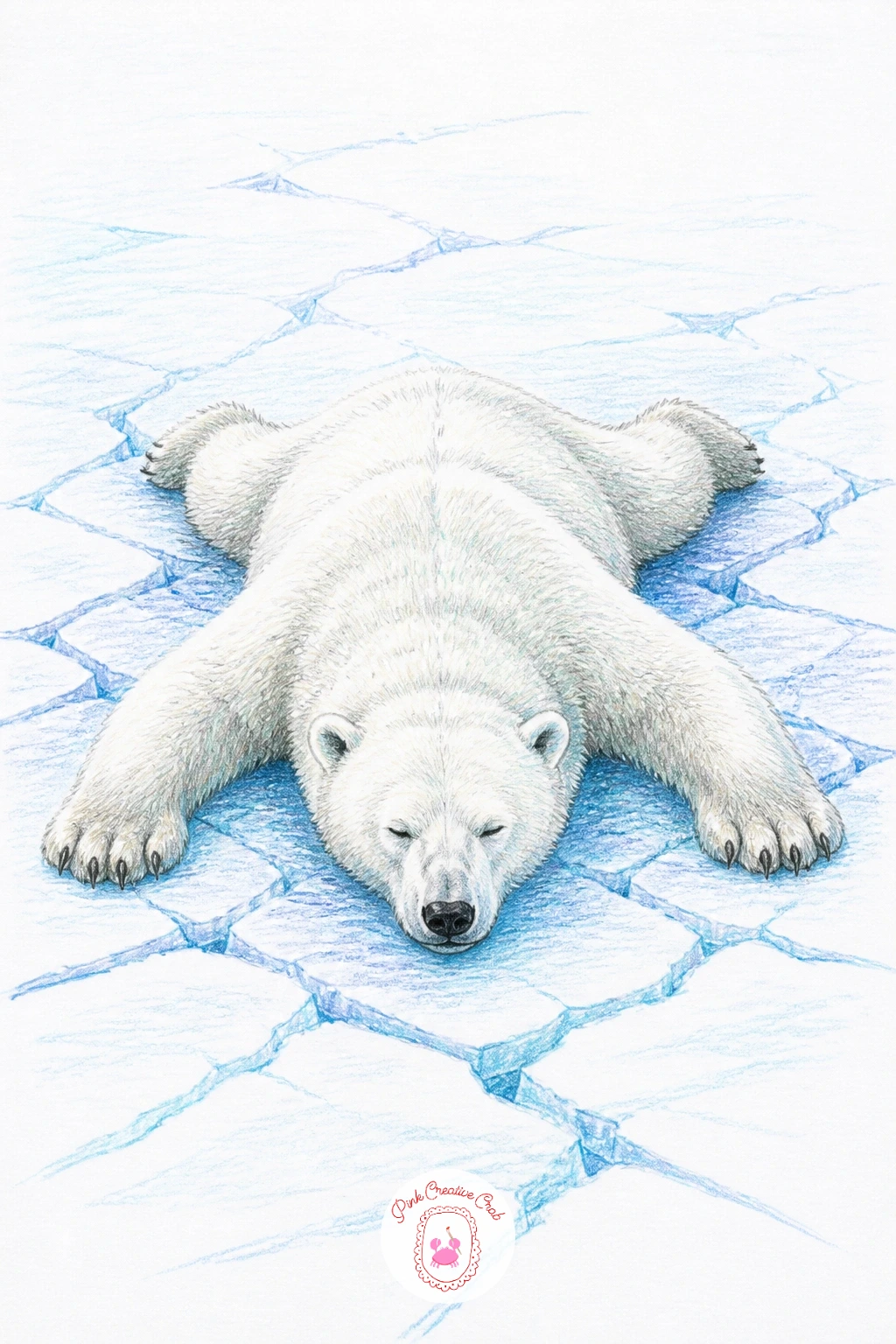
Keep the quick version of this one to ten minutes: a polar bear stretched flat on a frozen lake, legs splayed loosely in every direction, drawn as one relaxed silhouette pressed against the ice. The forty-minute version adds a faint reflection beneath the bear and a network of thin crack lines across the lake surface.
Draw the body low and wide rather than tall, since a fully stretched bear reads almost twice as long as a standing one. Shade the underside in deeper Light Cerulean Blue where it meets the ice, keeping the top of the back nearly bare paper for the brightest highlight.
Ice cracks are simply a few branching grey lines scratched in with a sharp pencil point, never a dense grid. Too many lines turns clean ice into broken glass.
If you want the reflection, a soft grey smudge directly below the bear’s outline is all it takes.
Palette: Titanium White,Light Cerulean Blue,Cool Grey,Cherry Red
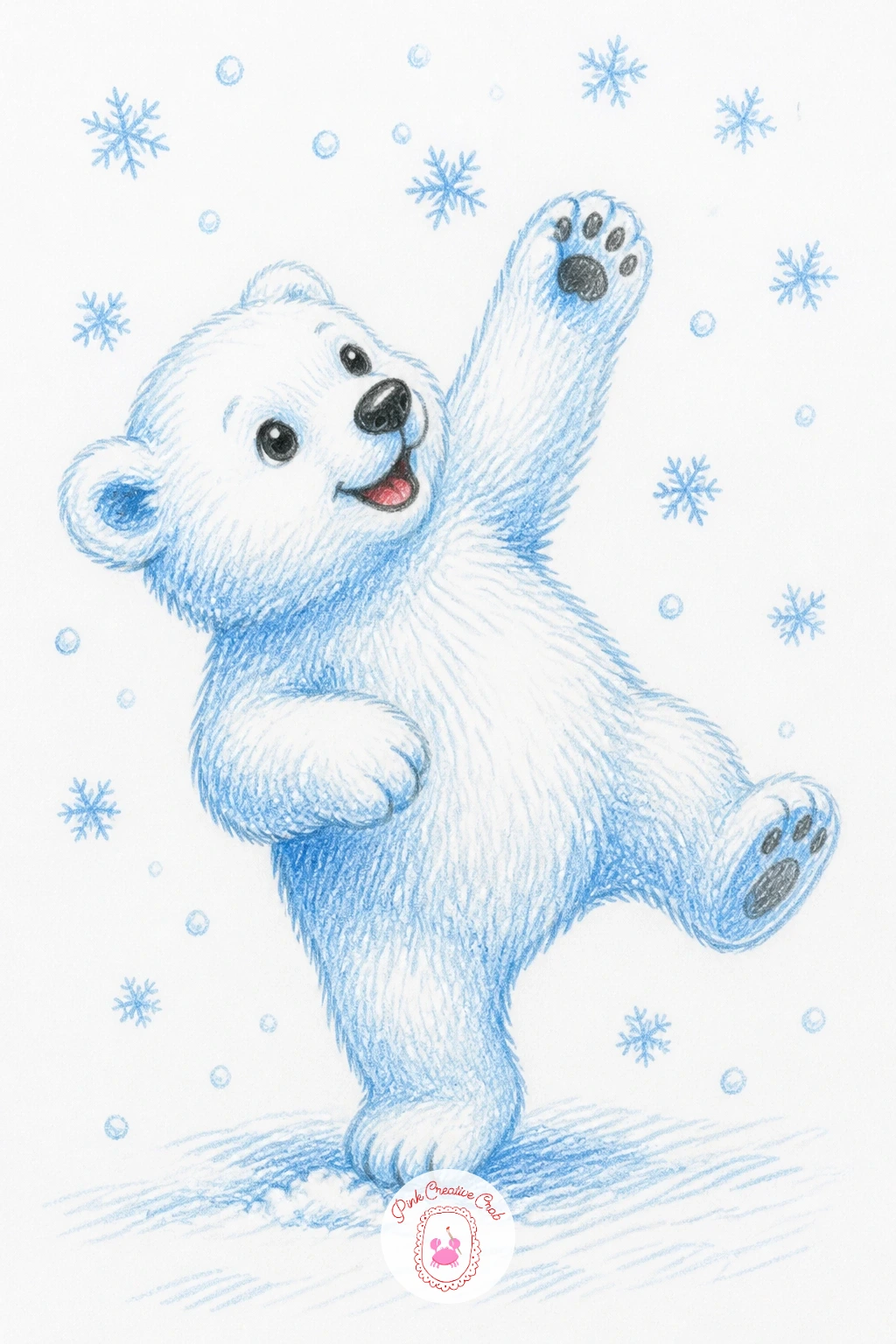
Next, loosen your hand for a cub batting at falling snowflakes with its front paws, caught mid-swipe with one paw raised and head tilted up. Sketch the pose a little off balance, weight shifted onto the back legs, since that imbalance is what reads as playful rather than static.
Fill the body with light Titanium White and Light Cerulean Blue strokes, then scatter a handful of snowflakes above and around the cub using a white gel pen directly on the dry pencil layer, a few simple dots and tiny crosses rather than detailed flakes.
Too many snowflakes turns the page busy. Keep them to a loose scatter, heavier near the raised paw and thinner elsewhere, so the eye still goes straight to the cub.
No gel pen available? A sharp white pencil pressed firmly works nearly as well on bright paper.
You Will Need
- white gel pen
Palette: Titanium White,Light Cerulean Blue,Cool Grey,Cherry Red
Comfort is the whole point of a polar bear floating on its back between drifting chunks of ice, belly up, paws loose in the air. Start with the belly as the widest, lightest shape in the drawing, almost pure bare paper, then tuck the head back and the paws up and out to the sides.
Surround the bear with a handful of simple ice chunks, each one a rough angular shape in Titanium White outline with a thin Light Cerulean Blue shadow on its underside where it sits in the water. Keep the chunks varied in size so the water between them reads as open rather than crowded.
The pose tips over into awkward if the paws point too stiffly upward. Curl them slightly inward, like a bear genuinely relaxing rather than posing.
A few short horizontal water lines around the body finish the floating feel without any extra material.
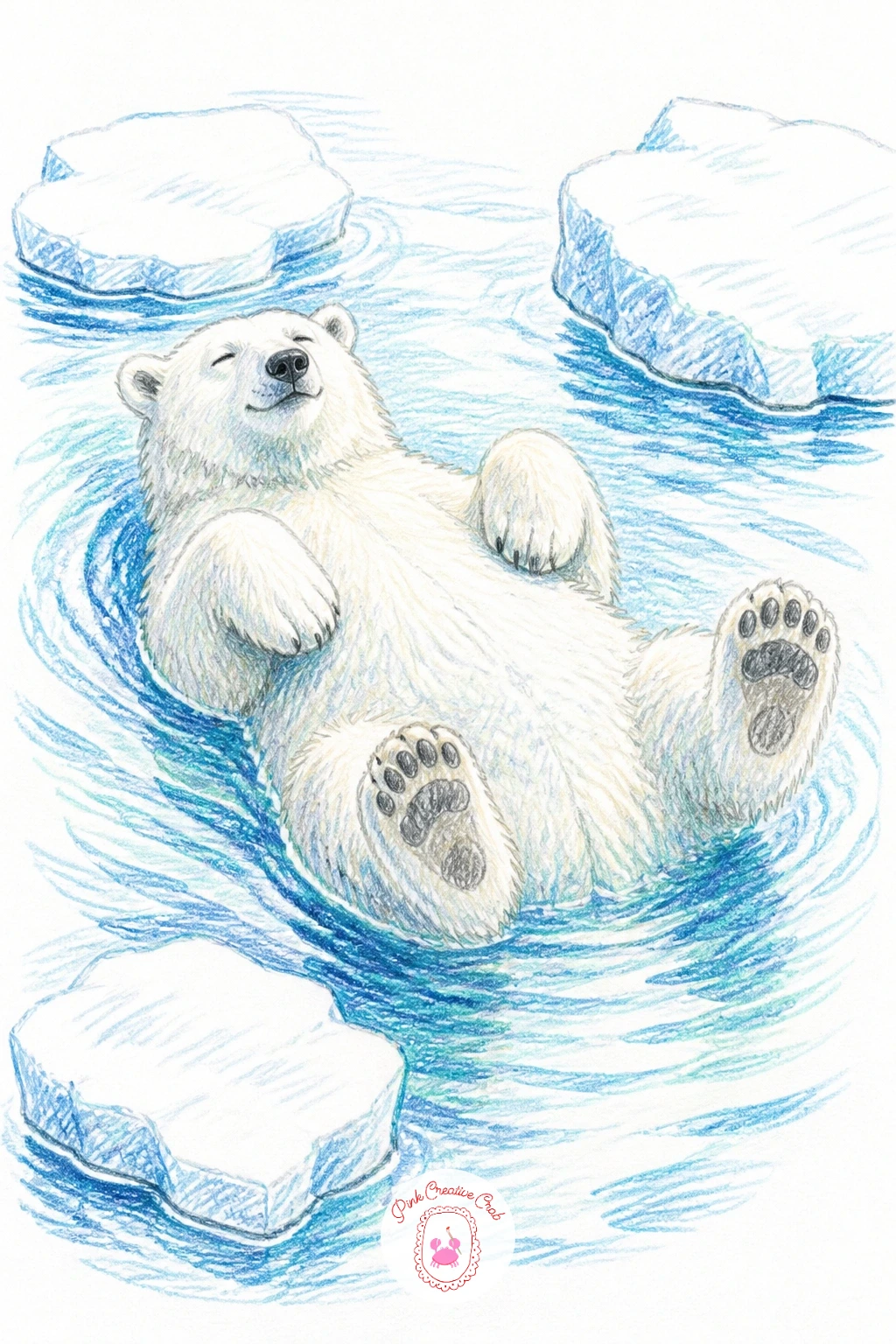
Palette: Titanium White,Light Cerulean Blue,Cerulean Blue Hue,Cherry Red
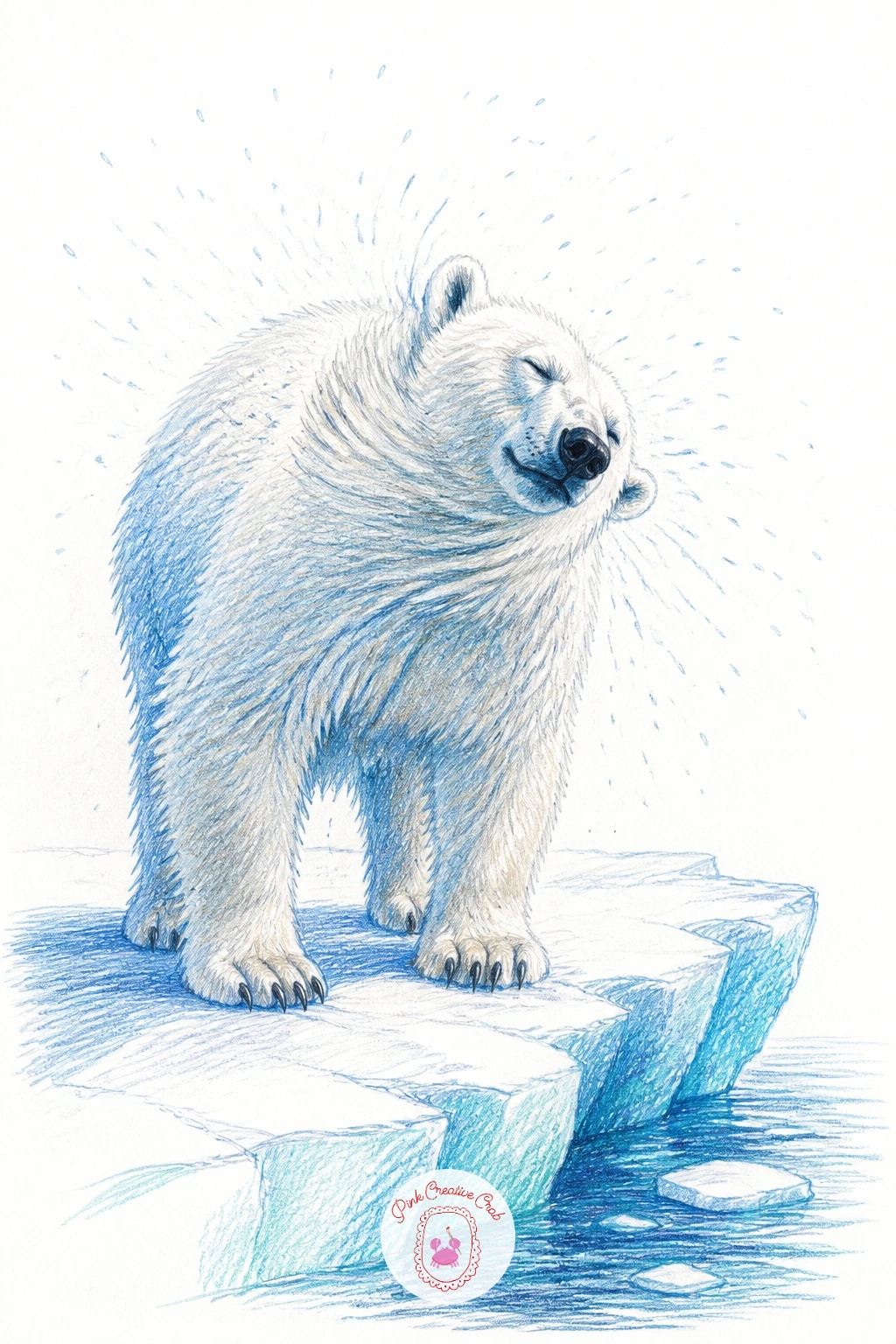
For energy, try a polar bear shaking water off at the edge of an ice floe, body mid twist with droplets flying from the fur. Picture the light coming from behind the bear here, low and bright, so the flying water catches a rim of highlight while the body itself sits in soft shadow against it.
Draw the torso twisted, front half facing one way and back half the other, a classic shake pose. Shade the fur in deeper Light Cerulean Blue on the side away from the light, leaving a thin bright edge of bare paper where the backlight hits.
Flying water droplets are small curved white gel pen flicks radiating outward from the shoulders, a dozen is plenty. Overdoing the spray flattens the backlit effect you just built.
If the twist looks flat, exaggerate the curve of the spine slightly more than feels natural.
You Will Need
- white gel pen
Palette: Light Cerulean Blue,Titanium White,Cool Grey,Cherry Red
Scale carries this whole scene, so compare before drawing: the iceberg should rise only slightly above the seated cub’s head, small enough that the bear clearly dominates the picture rather than looking lost on it. Draw the cub seated upright, tail tucked, gazing off to one side toward open water.
Shade the iceberg in pale Light Cerulean Blue with a slightly deeper Cerulean Blue Hue along its waterline shadow, keeping the top faces nearly bare paper. The cub’s fur stays lighter still, so it reads as the brightest shape against the cooler ice.
This one tips into sad or lonely if the horizon sits too high and crowds the bear. Drop the horizon low, just a thin line of grey, and give the sky most of the upper page.
A touch of Cherry Red is unnecessary here; let the scene stay cool and quiet instead.
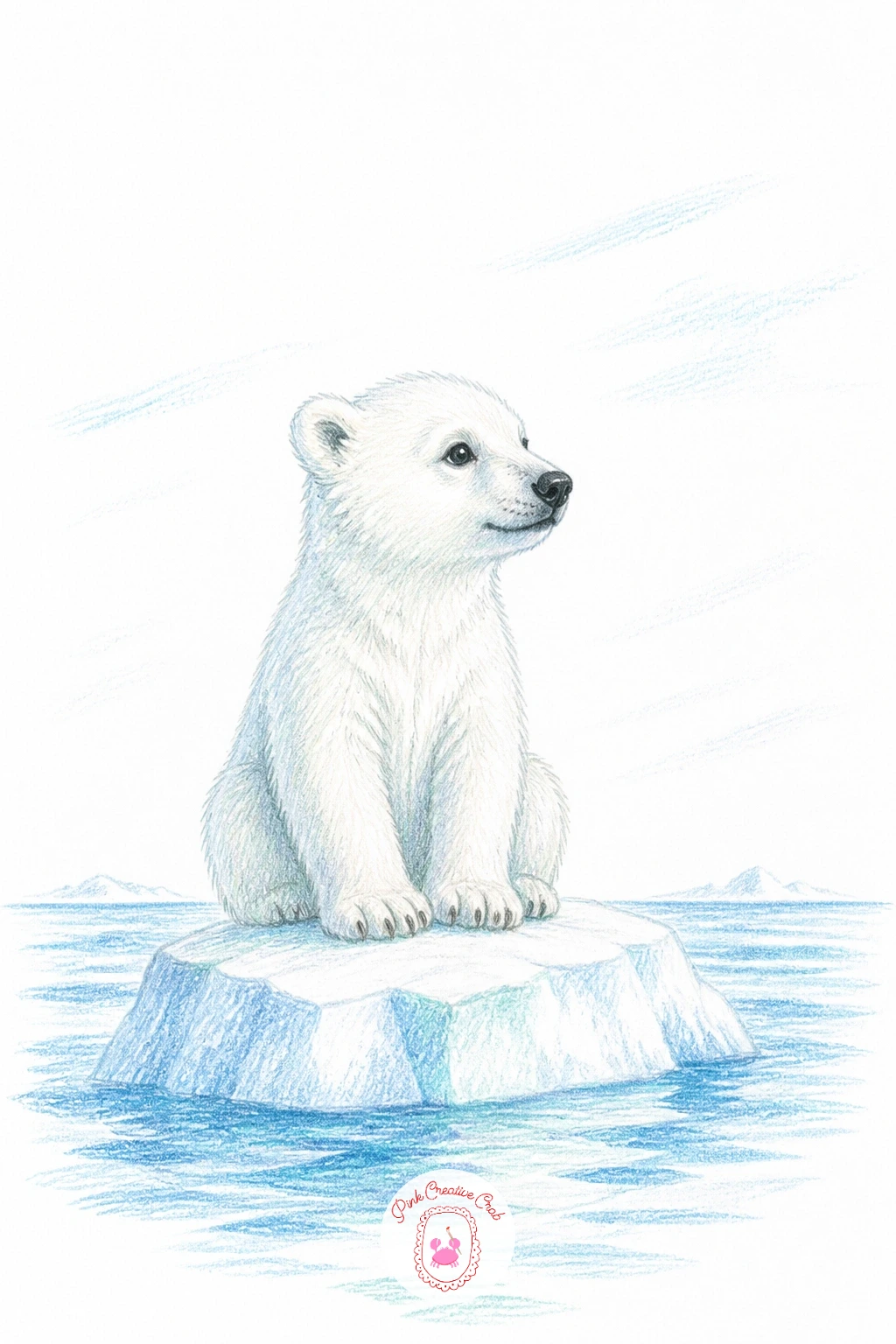
Palette: Light Cerulean Blue,Cerulean Blue Hue,Titanium White,Cool Grey
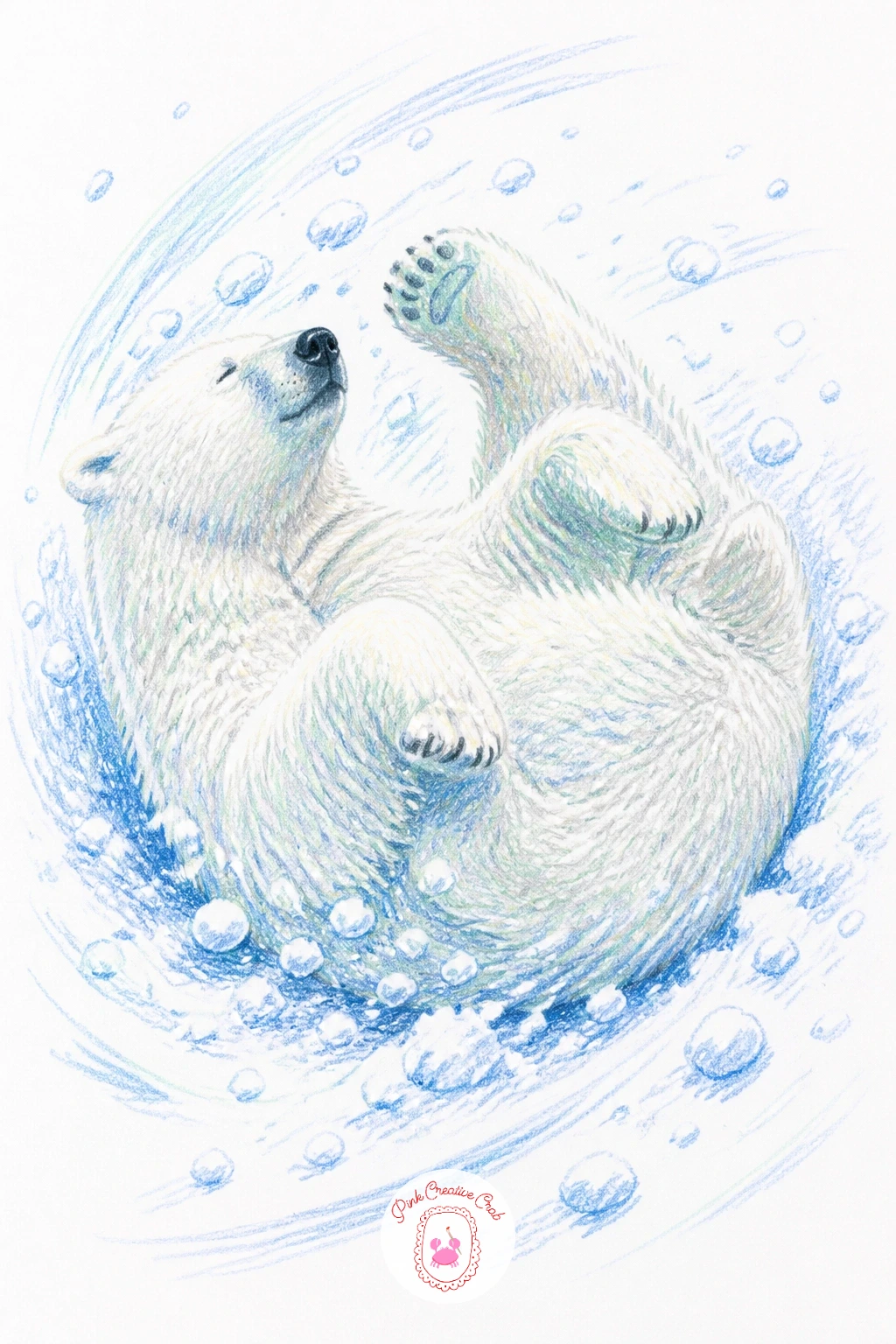
Keep things loose for a polar bear rolling in the snow to dry its fur, body curved into a half circle with legs tucked and snow kicked up on every side. Sketch the bear from above and slightly to one side, since a rolling pose reads clearest when you can see the curve of the whole back.
Build the fur in short overlapping Titanium White and Light Cerulean Blue strokes that follow the roll’s direction, curving around the body rather than running straight. That stroke direction alone does most of the work of showing motion.
Disturbed snow around the bear is a loose scatter of grey scribbles and white gel pen flicks, denser near the body and thinning outward. Keep it uneven rather than a tidy ring.
If the pose feels static, tilt the head slightly downward into the roll for a stronger sense of motion.
You Will Need
- white gel pen
Palette: Titanium White,Light Cerulean Blue,Cool Grey,Cherry Red
Light does the heavy lifting in a mother polar bear nuzzling her cub under a pale pink sky, since a warm sky behind two cool white bears gives you the whole drawing’s color story in one background wash. Place the sun low, just above the horizon, so its pink and soft orange light grazes the tops of both bears.
Draw the mother’s head bent low over the cub, noses nearly touching, bodies close together. Shade both in Light Cerulean Blue shadow as usual, but add a faint warm edge, a touch of Cherry Red softened heavily, along the tops of their backs where the pink sky catches them.
The sky itself needs only a light, even layer of pale pink pencil fading into white near the bears, never a hard edge.
If pink pencil runs too strong, lighten it by going over it once with white before adding the bear shadows.
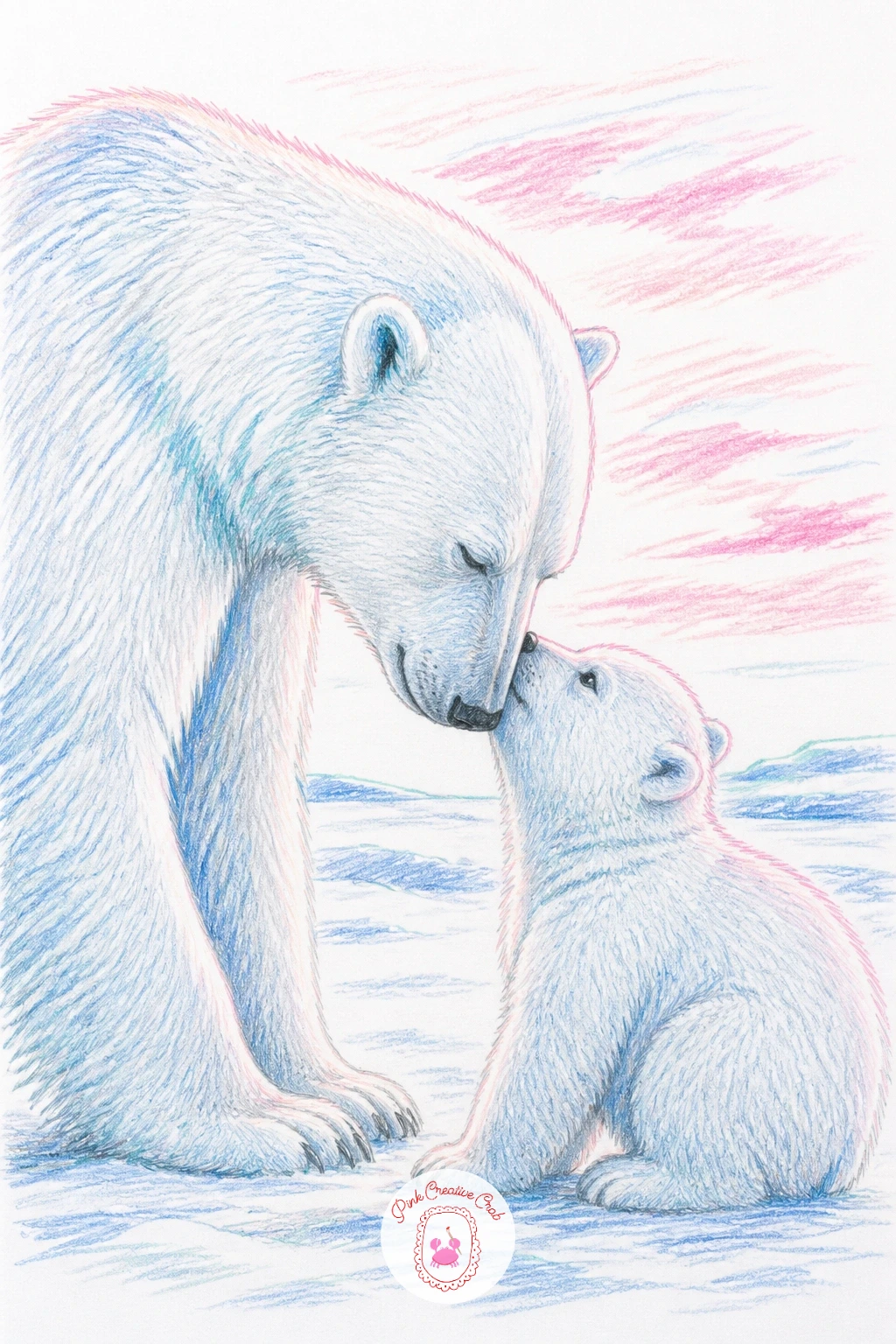
Palette: Light Cerulean Blue,Titanium White,Blush Pink,Cherry Red
Follow on with a polar bear walking along an icy shoreline leaving big paw prints, body shown mid stride from the side. Draw the legs in a clear walking rhythm, one front leg forward and the opposite back leg forward too, the natural diagonal gait of a real bear.
Lay the body in the usual Light Cerulean Blue and Titanium White, then turn to the trail behind: a line of paw prints growing fainter into the distance, each one just a simple rounded shape with four small toe marks pressed in grey.
Prints look wrong when they sit in a perfectly straight line. Stagger them slightly left and right, the way a walking animal’s feet actually land.
No grey pencil handy? A sharpened graphite pencil presses a convincing print shadow just as well.
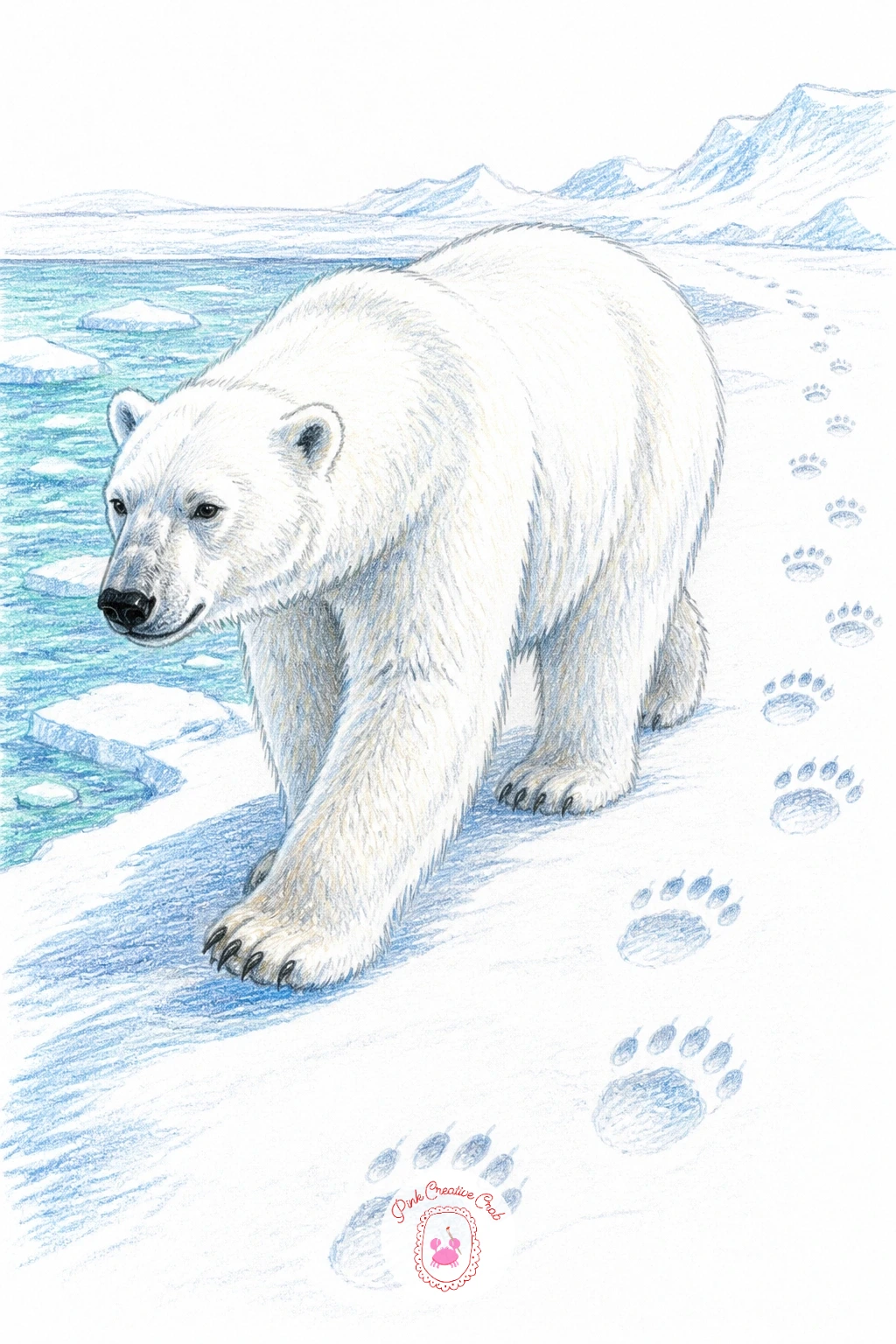
Palette: Light Cerulean Blue,Titanium White,Cool Grey,Cherry Red
Balance two young polar bears play-fighting on their hind legs by measuring them against each other as you sketch: matched heights, paws raised and pressed together at roughly the same level, like a mirrored pose. That symmetry is what makes a standing wrestling match read clearly rather than as a scuffle.
Draw both bears leaning slightly into the contact point where their paws meet, weight shifted back through the hips for balance. Shade each one in the usual Light Cerulean Blue, keeping a thin strip of bare paper between the two bodies wherever they overlap so the shapes stay separate.
This pose collapses if both bears face exactly the same way. Angle one slightly toward the viewer and the other slightly away for real depth.
A scuffed patch of snow beneath their back feet, loose grey marks, grounds the whole fight.
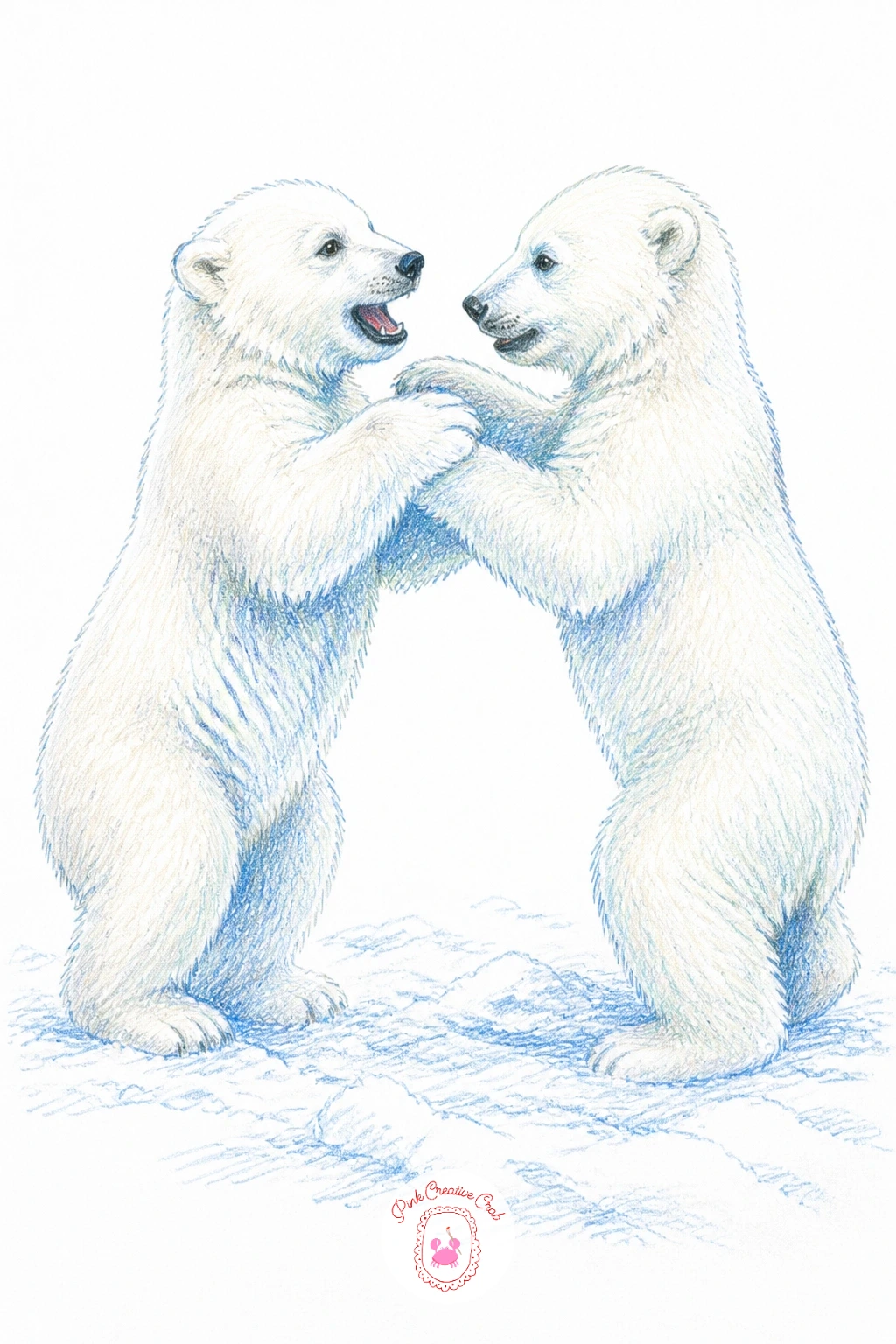
Palette: Light Cerulean Blue,Titanium White,Cool Grey,Cherry Red
Add a little story with a cub hiding behind its mother’s leg from a curious gull, peeking out with just its head and one paw visible around the mother’s thick leg. Draw the mother’s leg first as a solid vertical anchor, then tuck the cub’s small shape mostly behind it, only the face and a sliver of body showing.
The gull perches small and distant, just a simple grey silhouette with a short beak, giving the cub something to react to without needing much detail itself. Keep it noticeably smaller than either bear so the scale stays honest.
If the cub looks too confident rather than wary, widen its eyes slightly and pull its visible ear back a touch. Small adjustments like that carry a surprising amount of expression.
Swap the gull for a simple snow bunting silhouette if you would rather skip drawing a beak.
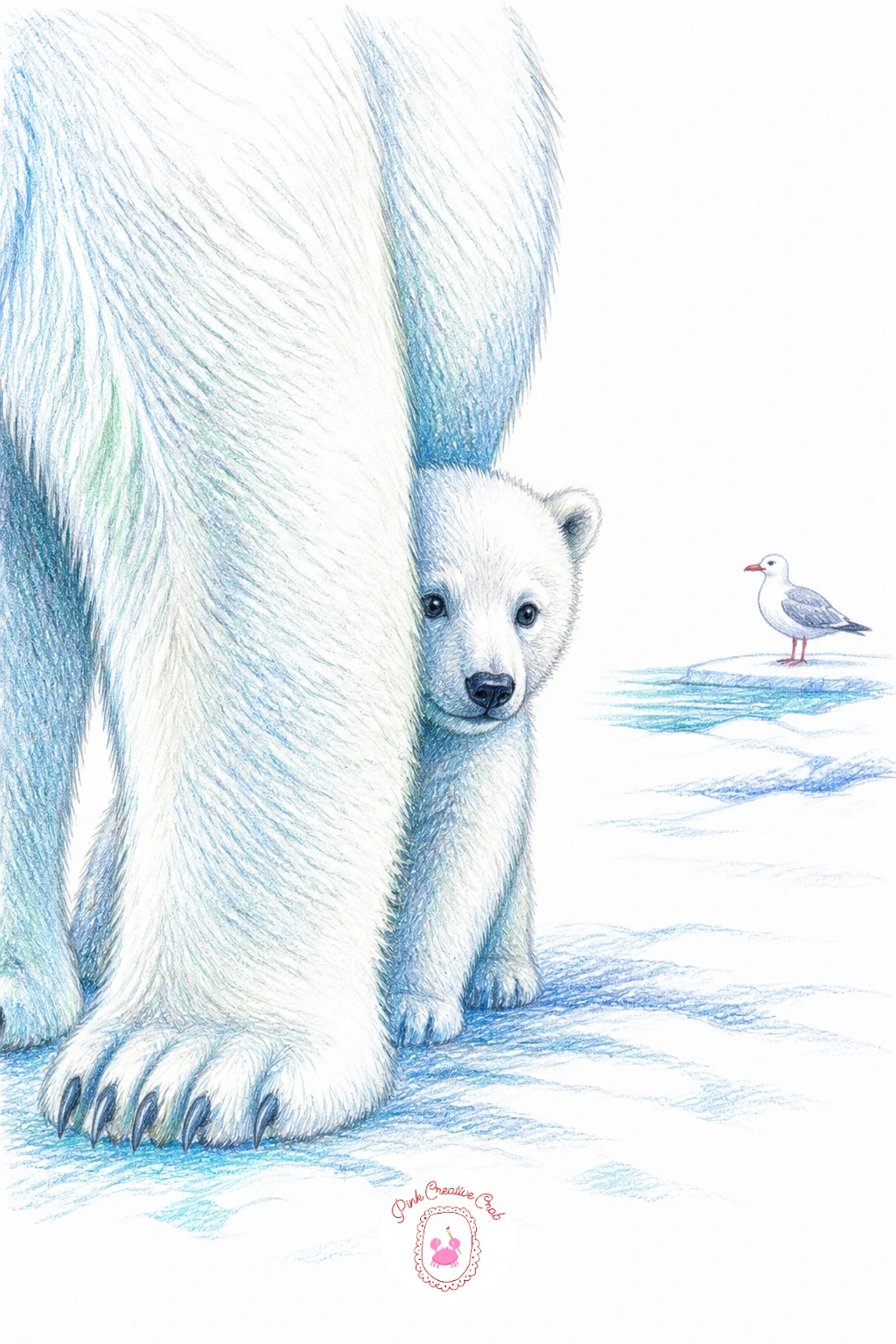
Palette: Light Cerulean Blue,Titanium White,Cool Grey,Cherry Red
If you like drawing seabirds, the shoreline detail here pairs well with the beach ice birds covered in the seal drawing ideas list.
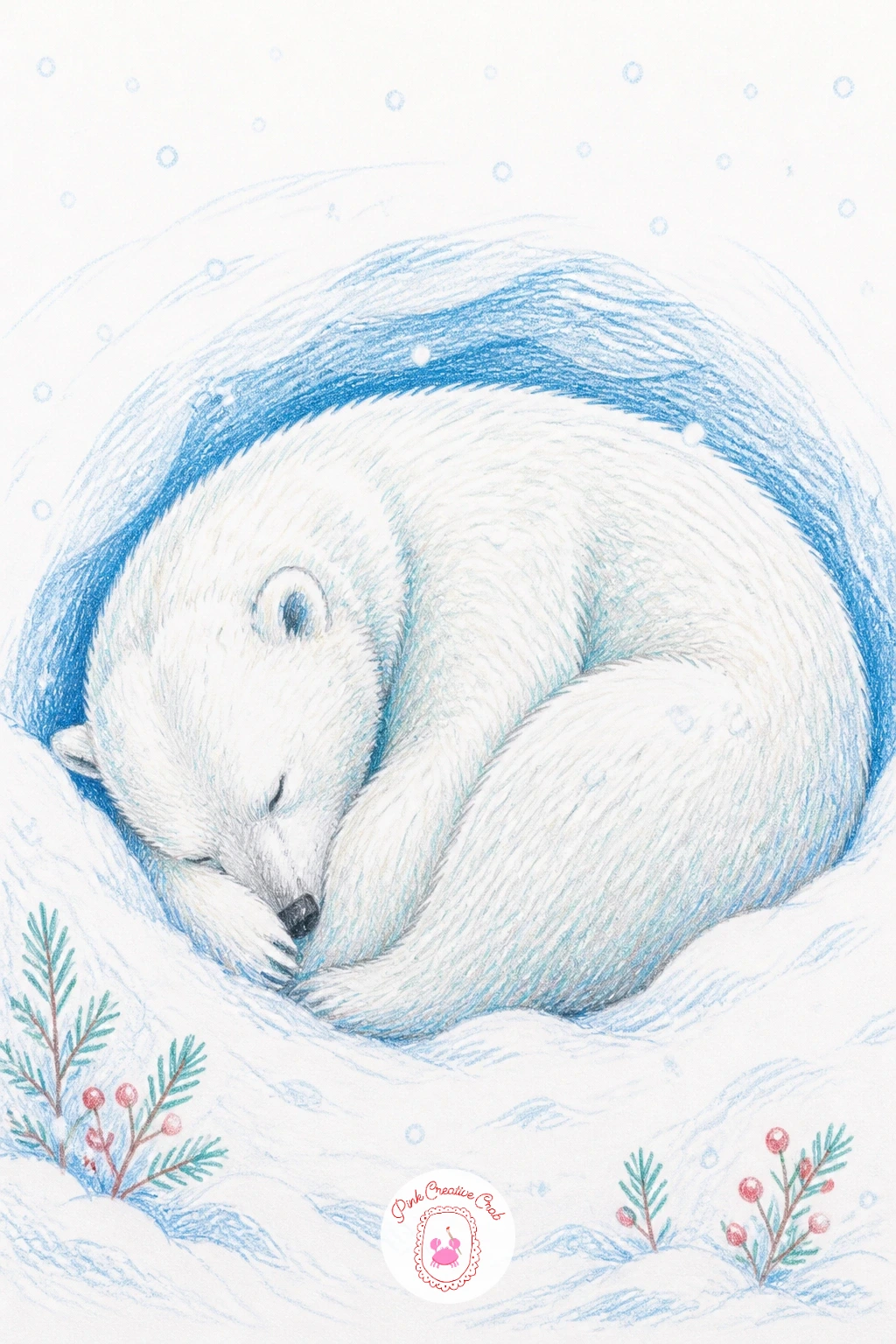
Settle into quieter territory with a polar bear curled up asleep in a snow hollow during light snowfall, nose tucked under a back paw, body folded into a tight comma shape. Draw the hollow first as a shallow dip in the snow, its inner curve shaded darker so the bear reading as nestled into it rather than sitting on top.
Shade the curled body in soft Light Cerulean Blue, keeping the highest curve of the back nearly bare paper since that is where falling snow would settle lightest. Add a gentle scatter of white gel pen dots falling across the whole scene, heavier near the top of the page and thinning toward the bear.
The hollow reads as flat ground if its shadow edge is too thin. Thicken the grey along the inner curve until the dip is unmistakable.
Keep snowfall dots small and widely spaced so they stay light rather than looking like static.
You Will Need
- white gel pen
Palette: Light Cerulean Blue,Titanium White,Cool Grey,Cherry Red
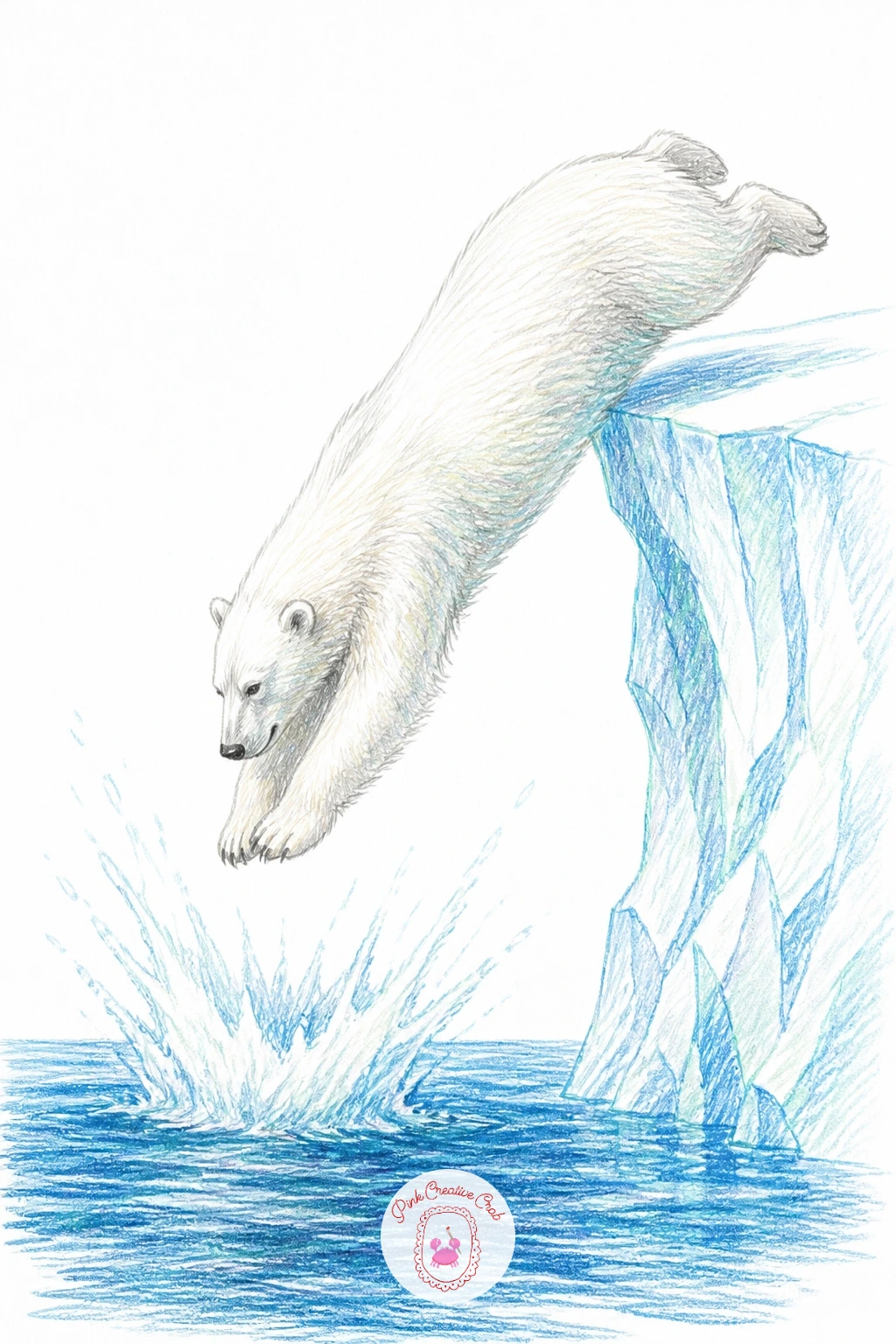
Capture the moment a polar bear diving off an ice ledge into icy blue water, body stretched long and angled downward, front paws reaching ahead. Set the eye level at the waterline so you see the ledge above and the splash beginning below in the same frame, which makes the dive feel immediate rather than distant.
Draw the bear mid air first, fully stretched, then the ledge behind as a simple flat white shape with a Light Cerulean Blue shadow along its underside. Where the paws meet the water, break the surface with a few jagged white gel pen splash marks radiating outward.
Dives read as falling rather than diving if the body stays horizontal. Angle the head and front paws down more steeply than feels natural, since that exaggeration is what the pose needs.
Add one or two small bubbles just below the splash to carry the eye down into the water.
You Will Need
- white gel pen
Palette: Light Cerulean Blue,Cerulean Blue Hue,Titanium White,Cherry Red
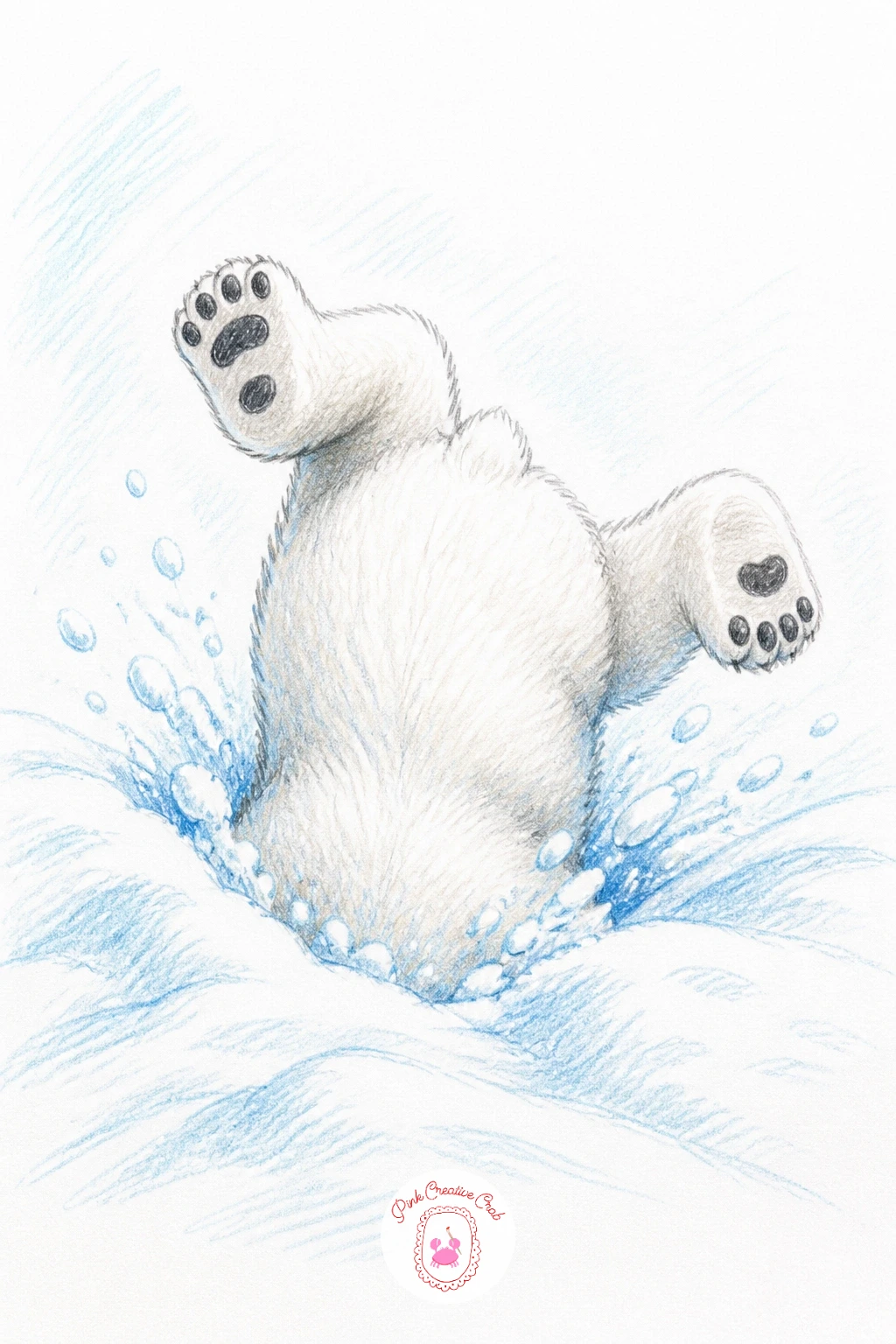
Keep the ten-minute version playful: a polar bear cub tumbling headfirst into a snowdrift, back legs still kicked up in the air as the front half vanishes into the snow. The forty-minute version adds a small puff of displaced snow bursting outward at the point of impact.
Draw the visible back half of the cub first, rounded and slightly raised, then let the front half fade into a soft white mound with only a hint of ear showing. Shade the exposed rear in Light Cerulean Blue while leaving the snowdrift itself almost entirely bare paper.
If the tumble looks posed rather than accidental, tilt the back legs unevenly, one higher than the other, for a more chaotic, funnier angle.
A burst of white gel pen flecks around the impact point finishes the comic motion in seconds.
You Will Need
- white gel pen
Palette: Titanium White,Light Cerulean Blue,Cool Grey,Cherry Red
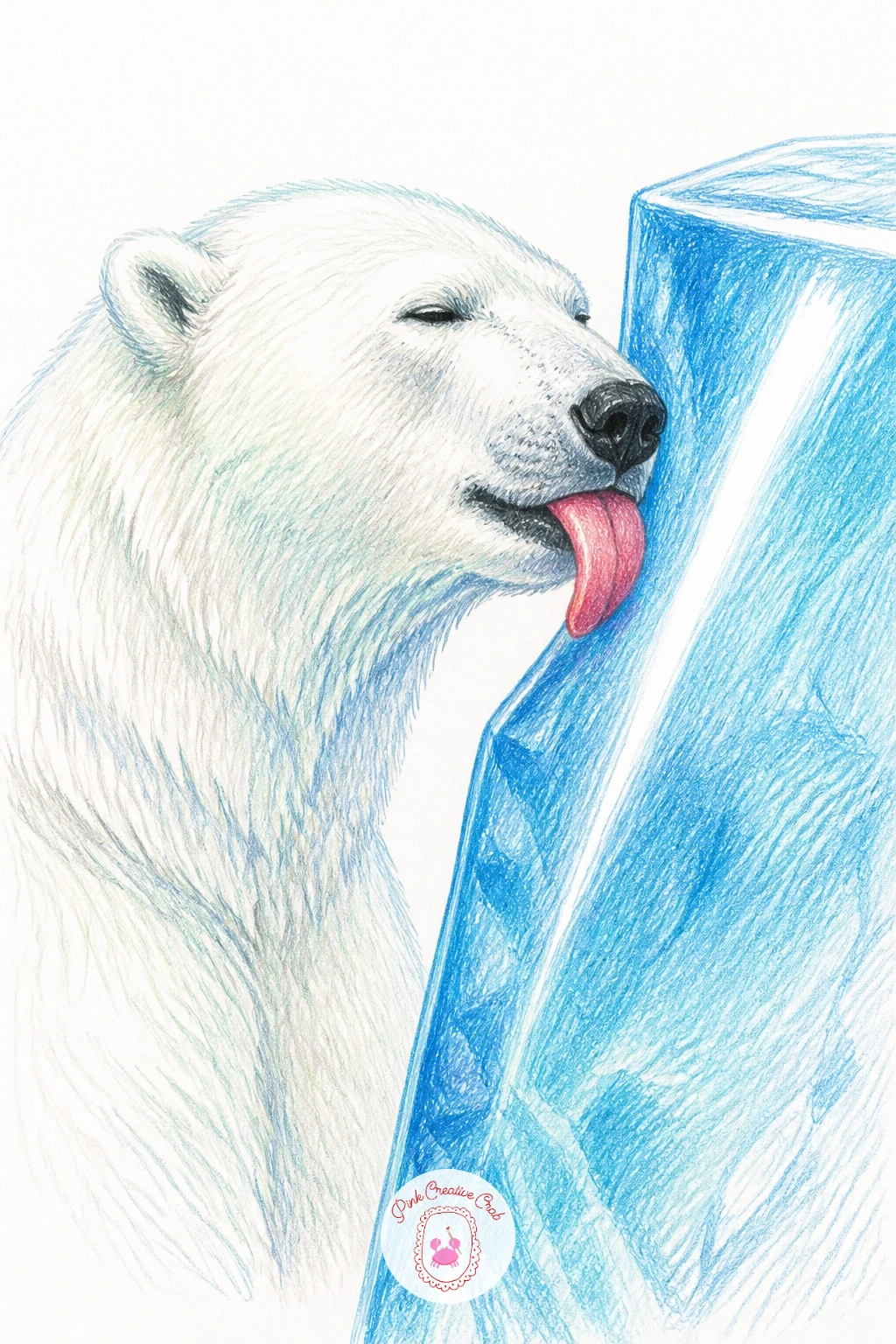
Texture takes the lead with a polar bear licking a block of glassy blue ice, tongue out, head tilted toward the block’s smooth face. Draw the ice first as a clean geometric chunk, flatter and sharper edged than any of the drifted snow elsewhere in this list, since glassy ice needs straighter lines to read correctly.
Layer the block in Cerulean Blue Hue with a few streaky dry-brush style pencil marks, pressing lightly and dragging the pencil sideways to leave faint parallel lines that suggest glassy internal cracks. Leave a bright diagonal strip of bare paper across one face for the main highlight.
The ice looks like snow instead of ice if its edges stay soft. Keep every edge on the block crisp and straight, in contrast to the bear’s rounded, hatched fur right beside it.
Swap Cerulean Blue Hue for a strong blue marker underlay if your pencils run too pale for the glassy effect.
Palette: Cerulean Blue Hue,Light Cerulean Blue,Titanium White,Cherry Red
Step up to a full polar bear family resting in a row on a snowy ridge, mother and two or three cubs lying side by side along the top of a gentle rise. Draw the ridge line first as a simple curve across the page, then place each bear along it, overlapping slightly so the row feels connected rather than scattered.
Vary each bear’s pose a little, one curled tighter, one stretched flatter, so the row avoids looking like repeated copies of the same shape. Shade them all in the same Light Cerulean Blue family so the group reads as one unit despite the pose changes.
This scene crowds easily with more than three or four bears. Keep the count modest and give each one clear space along the ridge rather than packing them tight.
A low pale sky behind keeps the whole row the clear focus of the page.
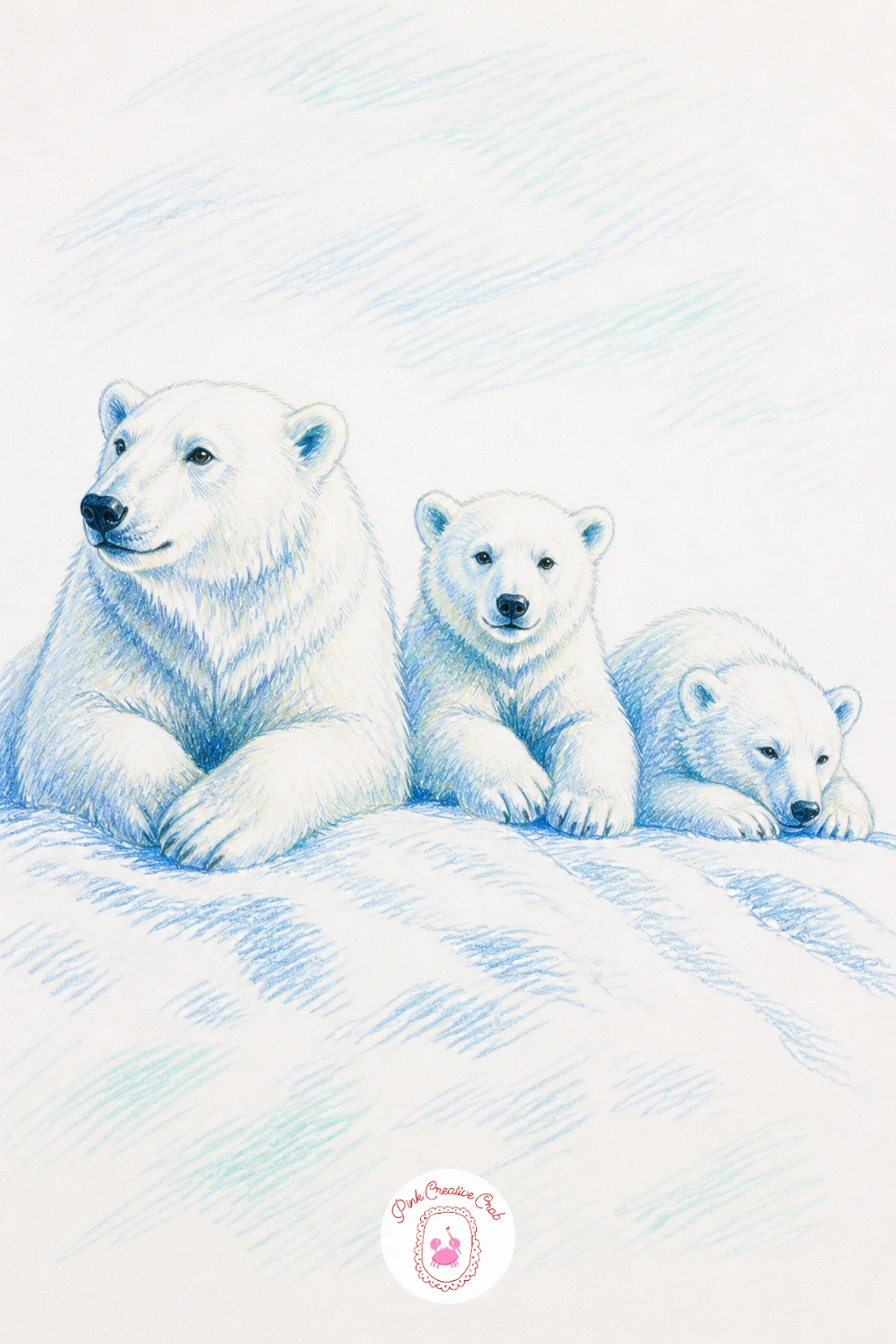
Palette: Light Cerulean Blue,Titanium White,Cool Grey,Cherry Red
Give the light somewhere specific to sit for a polar bear crossing the wide white tundra under a pale winter sun, a low sun positioned off to one side so it casts one long faint shadow stretching away from the bear across the snow. That single shadow does more to suggest wide open space than any amount of background detail.
Draw the bear small to medium within a very open, mostly bare page, walking steadily across the middle distance. Shade it in the usual Light Cerulean Blue, then add the pale sun itself as a soft circle, barely tinted yellow-white, with the faint grey shadow trailing from the bear’s feet toward the opposite edge.
The scene flattens if the shadow is missing or too short. Stretch it generously, longer than the bear itself, to sell the low winter sun.
Leave the rest of the tundra essentially untouched paper for the open feel this scene needs.
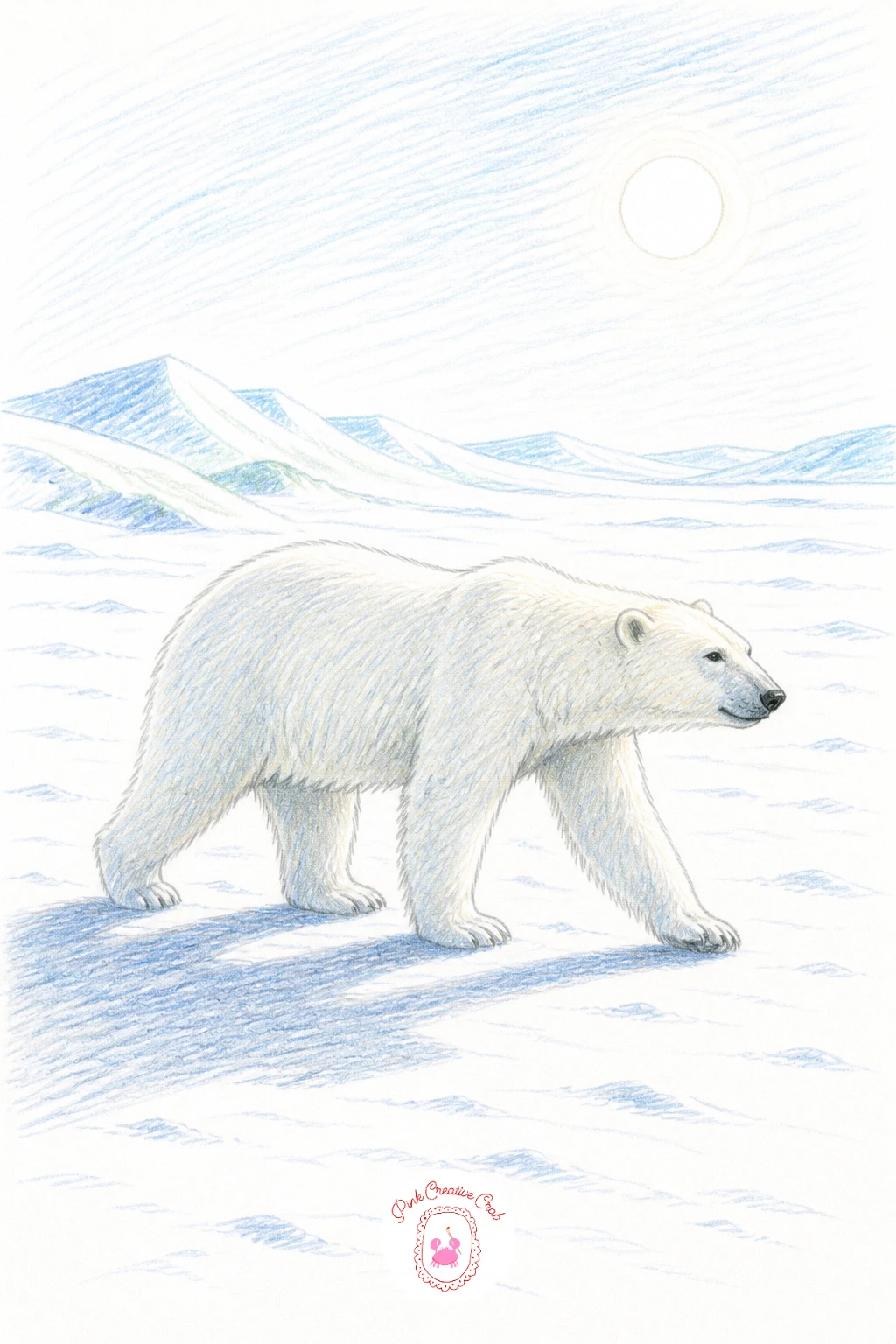
Palette: Light Cerulean Blue,Titanium White,Cool Grey,Pale Yellow
Bring in a small prop with a cub chewing on a strand of kelp washed up on the ice, head lowered, the kelp trailing from its mouth in a loose curved ribbon. Draw the cub’s head and front paws first, mouth slightly open around the kelp strand, then let the strand curl naturally rather than hanging straight.
Shade the kelp in a muted olive or brown pencil, the one real departure from the icy palette elsewhere in this list, since real kelp reads as warm and organic against all that cool blue and white. Keep it as a small accent rather than a large shape.
If the kelp looks stiff, add a second small curl or kink partway along its length. Real seaweed never lies in one clean arc.
No olive pencil in your set? A dulled dark green works just as well for this small accent.
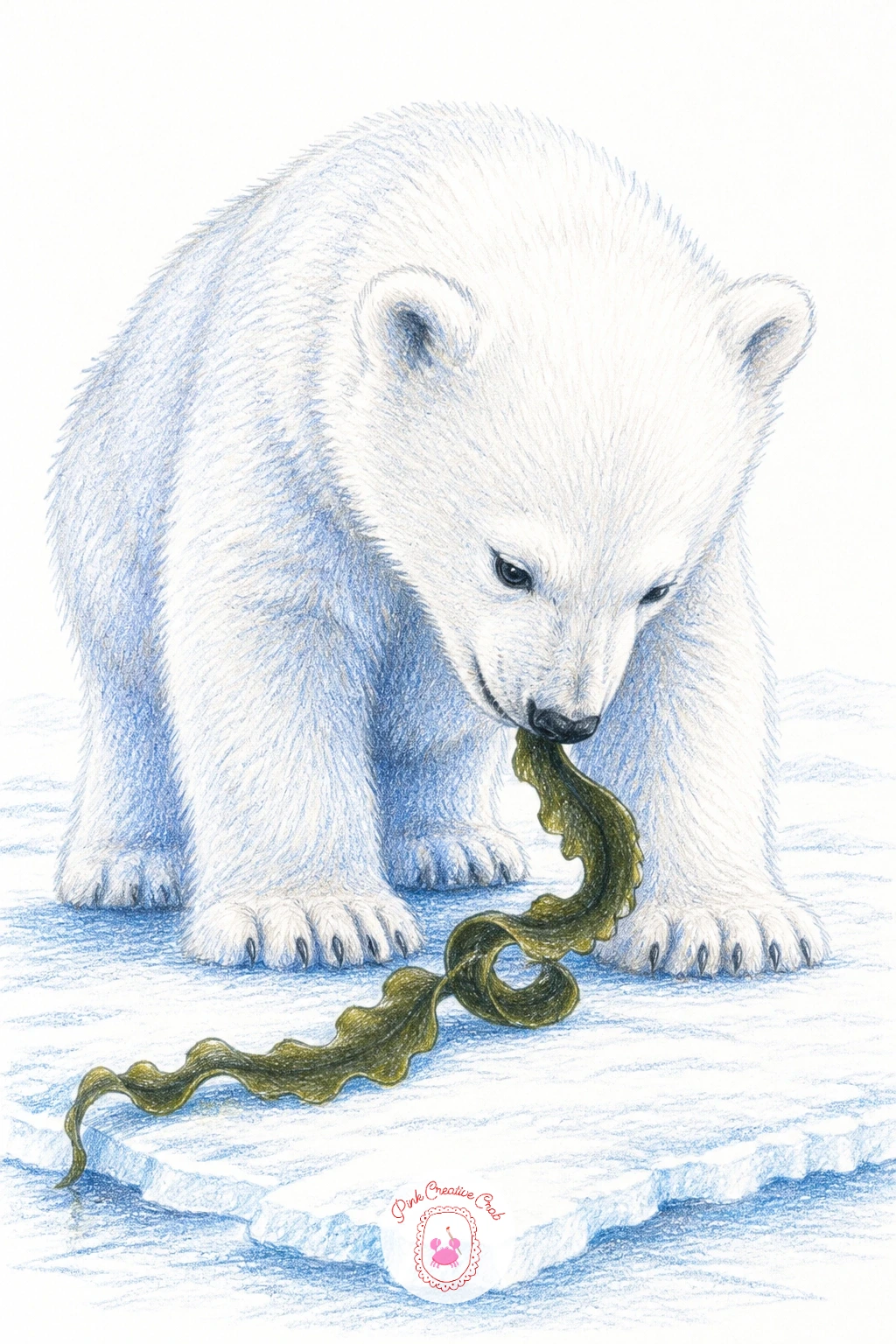
Palette: Light Cerulean Blue,Titanium White,Olive Green,Cherry Red
Give yourself a confident swim scene with a polar bear swimming beside a turquoise iceberg, head and shoulders above the waterline, the iceberg rising large just behind. Build the iceberg first since it anchors the whole composition, shading its underwater portion in a richer turquoise than its sunlit top, which can stay mostly bare paper.
Draw the bear’s head low in the water, ears small and close to the skull, a visible wake of ripple lines spreading behind in simple curved strokes. Keep the bear’s head the warmest, lightest value in the scene so it stands out clearly against the cooler iceberg.
The iceberg can swallow the composition if it grows too large. Keep the bear’s head and the iceberg’s peak at similar heights in the frame so neither one dominates completely.
A faint turquoise reflection of the iceberg in the water ties the whole scene together.
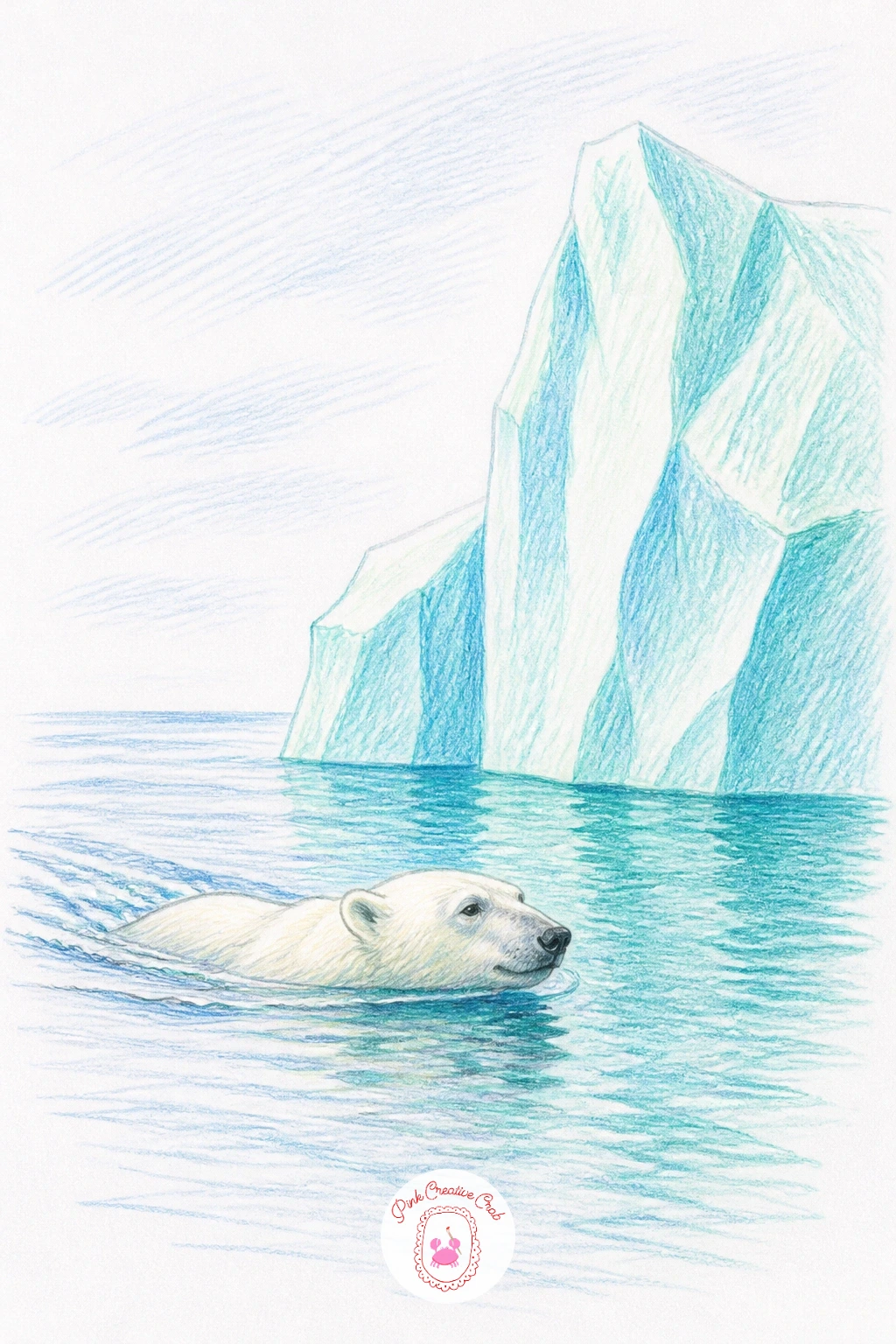
Palette: Turquoise,Light Cerulean Blue,Titanium White,Cherry Red
For pure tenderness, draw a cub sleeping tucked between its mother’s big front paws, completely enclosed by her shape with only its head and back visible. Build the mother’s paws first as two large rounded forms framing the cub on either side, since their size relative to the small cub is what makes the whole scene read as protective.
Shade the mother’s paws slightly darker than the cub nestled between them, a clear value difference that keeps the smaller shape from getting lost. Add soft hatching along the cub’s visible back to suggest fine fur, lighter and shorter strokes than the thicker adult fur around it.
If the cub reads too large, shrink it further, since a genuinely tiny cub against those paws is what sells the tenderness of this one.
Keep the background entirely bare paper so nothing competes with this quiet close pairing.
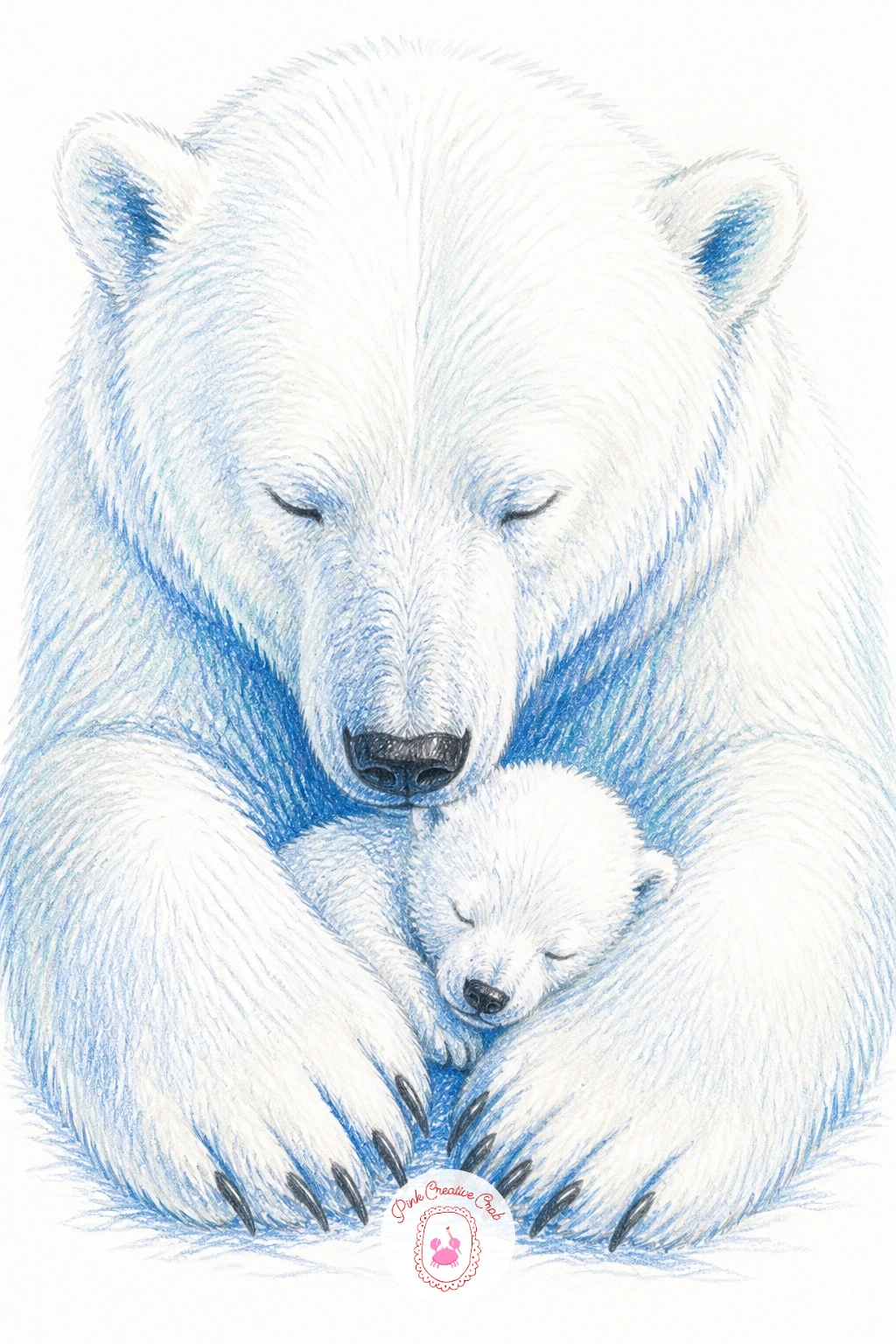
Palette: Light Cerulean Blue,Titanium White,Cool Grey,Cherry Red
Try a polar bear sitting upright like a person watching the snow fall, haunches tucked under and front paws resting in its lap, head tipped slightly back. Compare the proportions carefully here: a seated bear’s torso looks shorter and rounder than a standing one, so keep the chest compact rather than stretching it the way you would for a walking pose.
Shade the body in the familiar Light Cerulean Blue, then fill the sky above with a gentle, even scatter of white gel pen snowflakes, keeping them small and consistent in size across the whole upper page.
This pose reads awkward if the back paws poke out too far forward. Tuck them in close under the body, almost hidden, the way a seated bear naturally settles.
A faint grey ground shadow beneath the haunches keeps the bear from floating on the page.
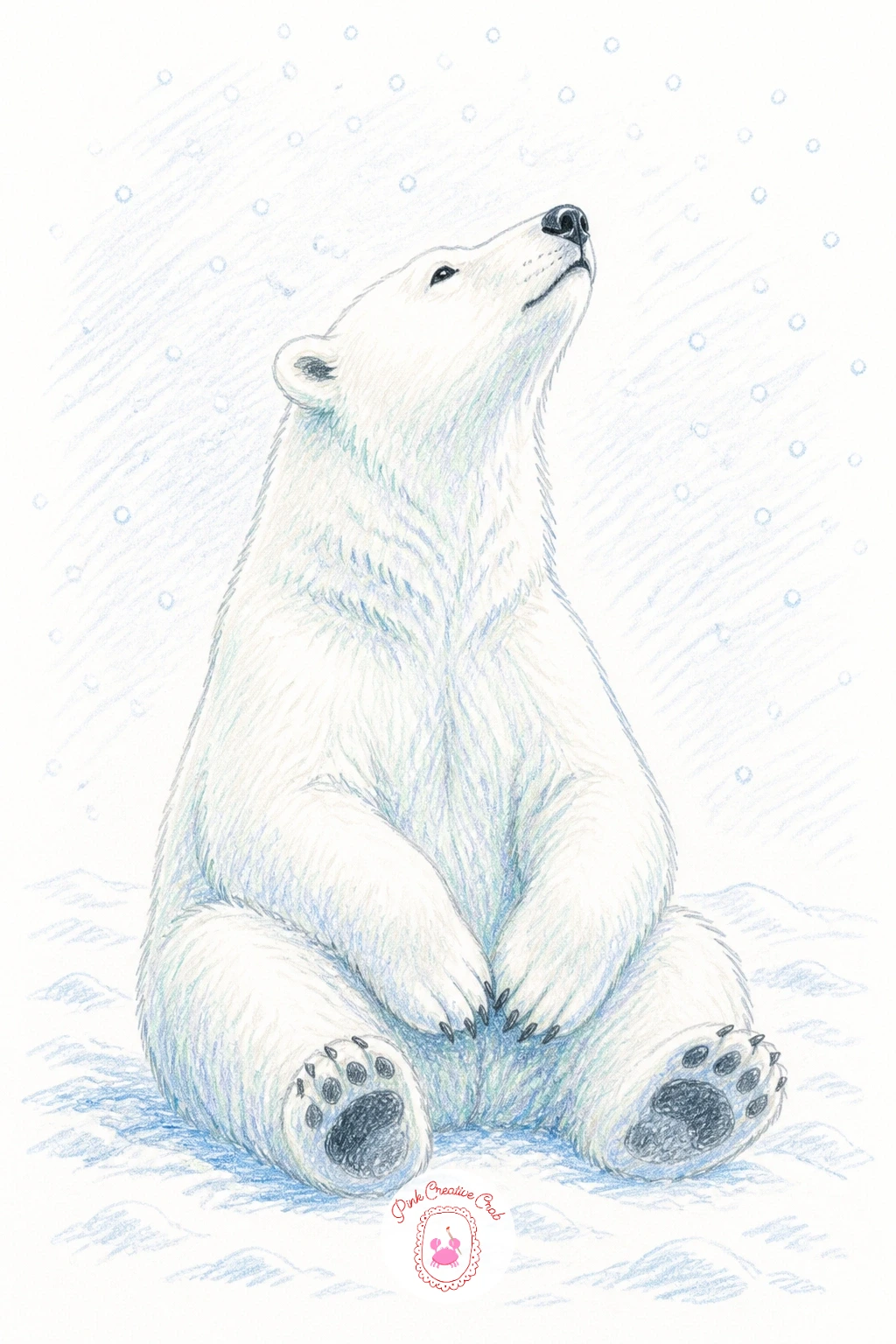
You Will Need
- white gel pen
Palette: Light Cerulean Blue,Titanium White,Cool Grey,Cherry Red
Once the basic cub shape feels easy, vary it here: a cub tasting its first snowflake on its tongue, head tilted straight up, tongue out, eyes closed in simple contentment. Keep the body small and round as usual, but push the head further back than in any other pose in this list, since the full upward tilt is what makes the moment clear.
Shade lightly as always in Light Cerulean Blue, then place a single oversized snowflake drawn in white gel pen directly above the open mouth, larger and more detailed than the scattered background flakes elsewhere, since this one needs to be the star.
If the closed eyes look blank, add two short curved lines for lashes rather than a flat closed line. That small addition carries real warmth.
Keep background snowfall light and sparse so the one big snowflake stays the clear focus.
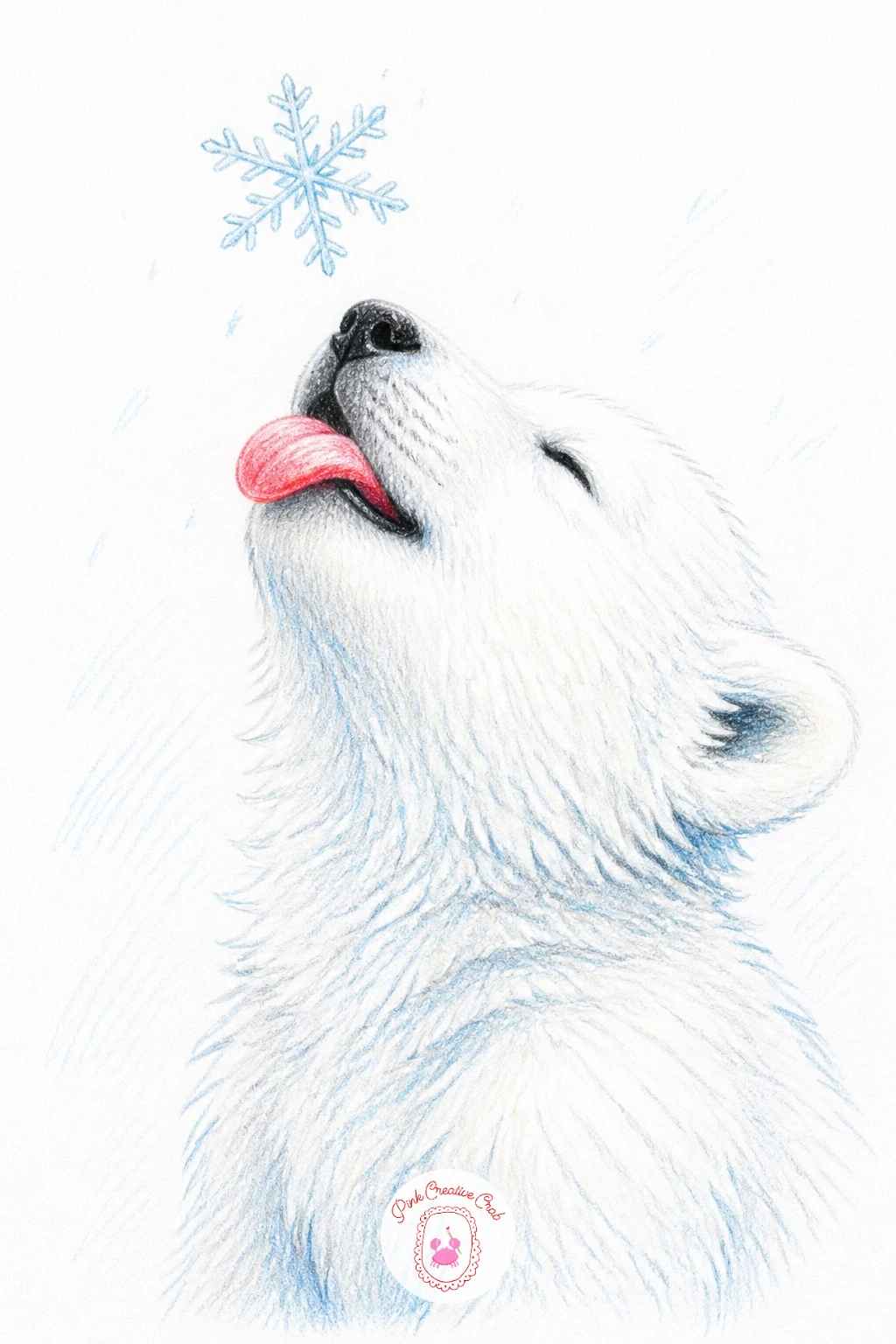
You Will Need
- white gel pen
Palette: Light Cerulean Blue,Titanium White,Cool Grey,Cherry Red
If you enjoy this kind of close, expressive cub face, the same approach to eyes and expression carries over well into the cute panda drawing ideas.
Bring in that cherry red accent properly with a polar bear padding past a tiny red research hut in the snow, the hut small and distant behind the bear’s larger foreground shape. Draw the bear first, walking steadily, then place the hut well back and well to one side, a simple box with a peaked roof no taller than the bear’s shoulder in the frame.
Color the hut in solid Cherry Red, the only strong saturated note in the whole scene, which makes it pop instantly against all the cool blues and whites around it. Keep its details minimal, a door, maybe one small window, nothing more.
The hut can accidentally steal the whole composition if it sits too large or too central. Keep it genuinely small and off to one side so the bear stays the clear subject.
A single thin trail of grey smoke from a tiny chimney adds life without extra effort.
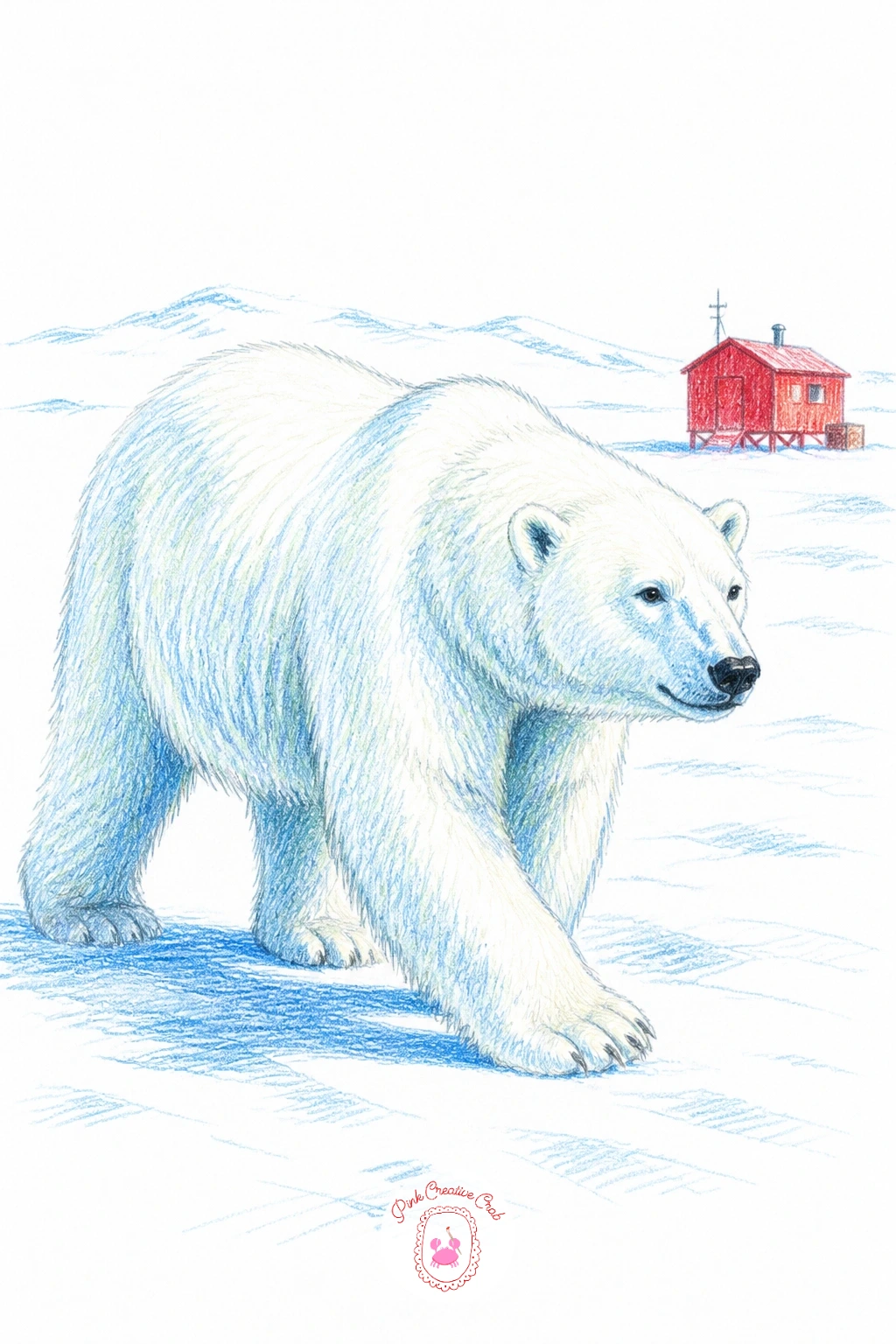
Palette: Light Cerulean Blue,Titanium White,Cherry Red,Cool Grey
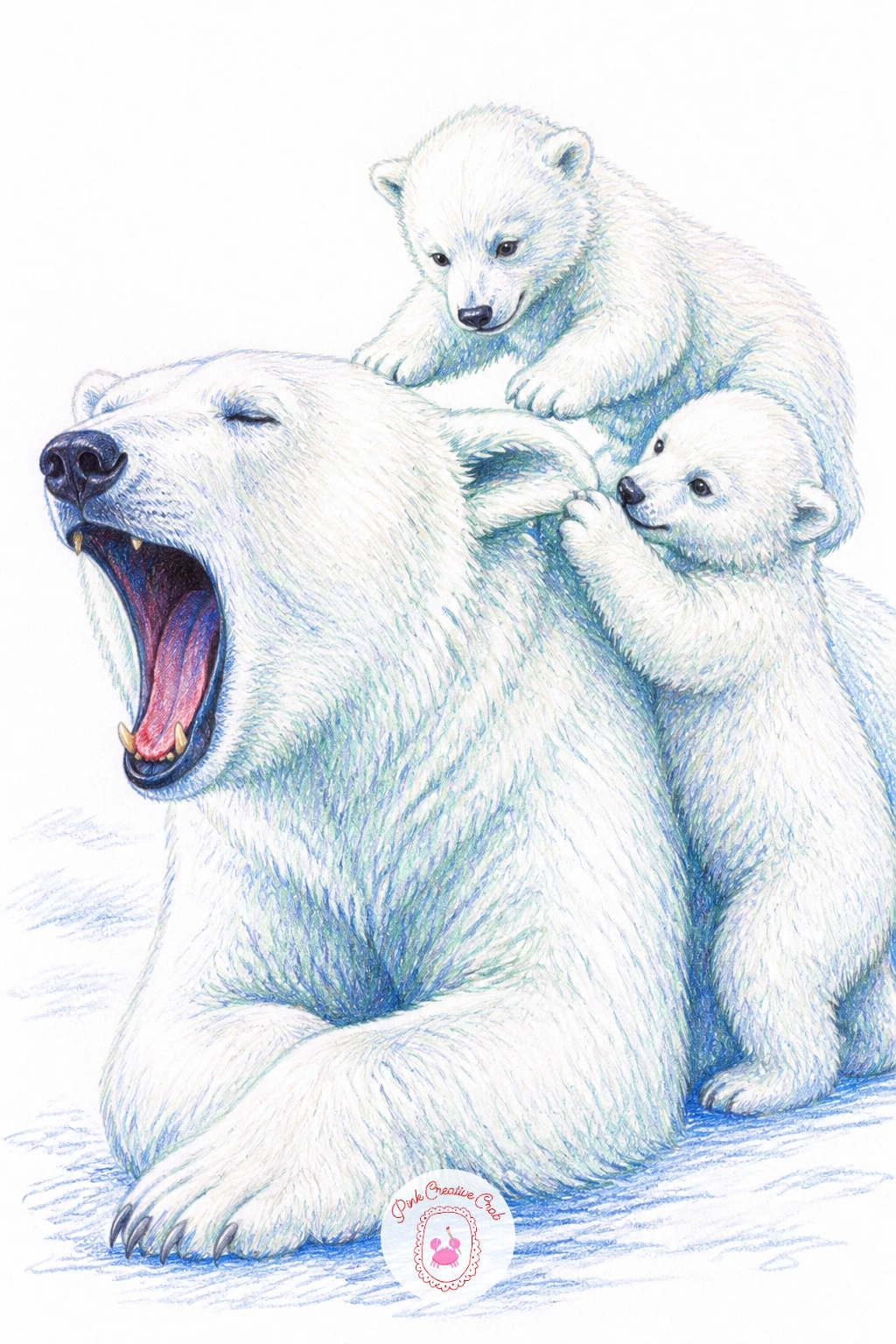
Finish the list with its liveliest scene: a mother polar bear yawning while two cubs climb all over her, mouth open wide, eyes half closed in patient exhaustion, one cub scrambling up her back and the other tugging at an ear. Draw the mother’s bulk first as the stable base of the whole composition, then build each cub’s climbing pose around her, limbs gripping and reaching at different points.
Shade the mother in the usual Light Cerulean Blue but keep her expression soft rather than alarmed, since a gentle, tolerant yawn is the charm of this scene rather than genuine distress. Vary the two cubs’ poses clearly so they read as separate small bodies rather than one tangled mass.
If the group starts to blur together, leave a thin strip of bare paper wherever a cub’s body overlaps hers, the same trick used for the wrestling cubs earlier in this list.
End on this one and the whole arctic family feels complete.
Palette: Light Cerulean Blue,Titanium White,Cool Grey,Cherry Red
For more on building a related multi figure scene like this one, the grouped poses in the bear painting ideas work the same way with a brush instead of pencil.
What to Do Next
Pick one bear from this list, whichever pose feels most fun right now, and start with its basic shape in light pencil before any color goes down. Keep a sheet of smooth white paper close by, leave plenty of it bare, and let the blue and grey do the quiet work of turning simple shapes into snow and ice.
Frequently Asked Questions
What colored pencils work best for a polar bear drawing?
A cool blue, a warm grey and plenty of white carry most of the fur. Add one accent color like cherry red for small details, and keep the rest of the set in reserve for background touches.
How do you keep a polar bear from looking grey instead of white?
Leave large areas of the paper completely bare rather than shading everything. The white of the paper itself reads as the brightest fur, while blue and grey only shape the shadows and folds.
What paper suits colored pencil bears best?
Smooth bristol or a fine-tooth drawing paper holds layered colored pencil cleanly and keeps those visible strokes crisp. Rougher textured paper can break up fine fur strokes and make blending harder.
How do you make a polar bear cub look younger than an adult bear?
Keep the cub’s head larger relative to its body and round out the muzzle and ears. Shorter legs and a more compact torso read instantly as young, even before any shading goes in.
Is a polar bear hard to draw for a beginner?
Not at all, since the body is mostly simple rounded shapes with few sharp edges. The main skill is layering light and shadow carefully rather than drawing anything structurally complicated.
Have any thoughts?
Share your reaction or leave a quick response — we’d love to hear what you think!
-
 0
-
0
-
0
-
0
-
0
-
0


