A newborn baby card gets so much more charm from a hand drawn crib or a tiny pair of socks on a line than from anything bought off a shelf, and colored pencil is the easiest way to get there in one sitting. Each scene below sits on bright white paper with soft hatching, so the card front feels fresh and light rather than fussy, and there is no lettering to plan, just the picture doing the talking.
Scroll through all 33 and pick whatever matches the baby you are making this for: a quiet crib under a window, a pram in a garden, a sibling peeking in. Every idea tells you exactly how to build it, where it tends to go wrong, and one tip to use the moment you pick up your pencil.
Using these images: free for personal projects such as printing, coloring, cards, journals and gifts. Handmade items that include them may be sold up to 30 pieces per design. More than that is commercial use and is not permitted, and neither is selling or sharing the images themselves or passing them off as your own. Please ask before any other use.
Start with the window frame, a simple rectangle of soft blue light pencil lines dividing the panes, then draw the crib sitting just below it so the two shapes anchor each other. Keep the crib’s side bars as evenly spaced vertical lines, and if spacing by eye feels tricky, mark the top and bottom rail first and divide the gap into equal steps with light tick marks before you commit to ink-dark lines.
Add the mobile last, three or four felt cloud shapes hanging from a thin curved wire above the crib, each cloud shaded with the lightest touch of powder blue so they read as soft fabric rather than sky. Work the crib itself in warm white left almost bare, just a little grey hatching along the underside for shadow.
The mistake here is making the bars too thick, which turns a delicate crib into a cage. Keep your pencil sharp and your lines thin. If you do not have a fine point handy, a mechanical pencil works just as well for this part.
Finish with a pale yellow wash of hatching on the wall behind the window to suggest afternoon light, and leave the crib itself the brightest, cleanest white on the page.
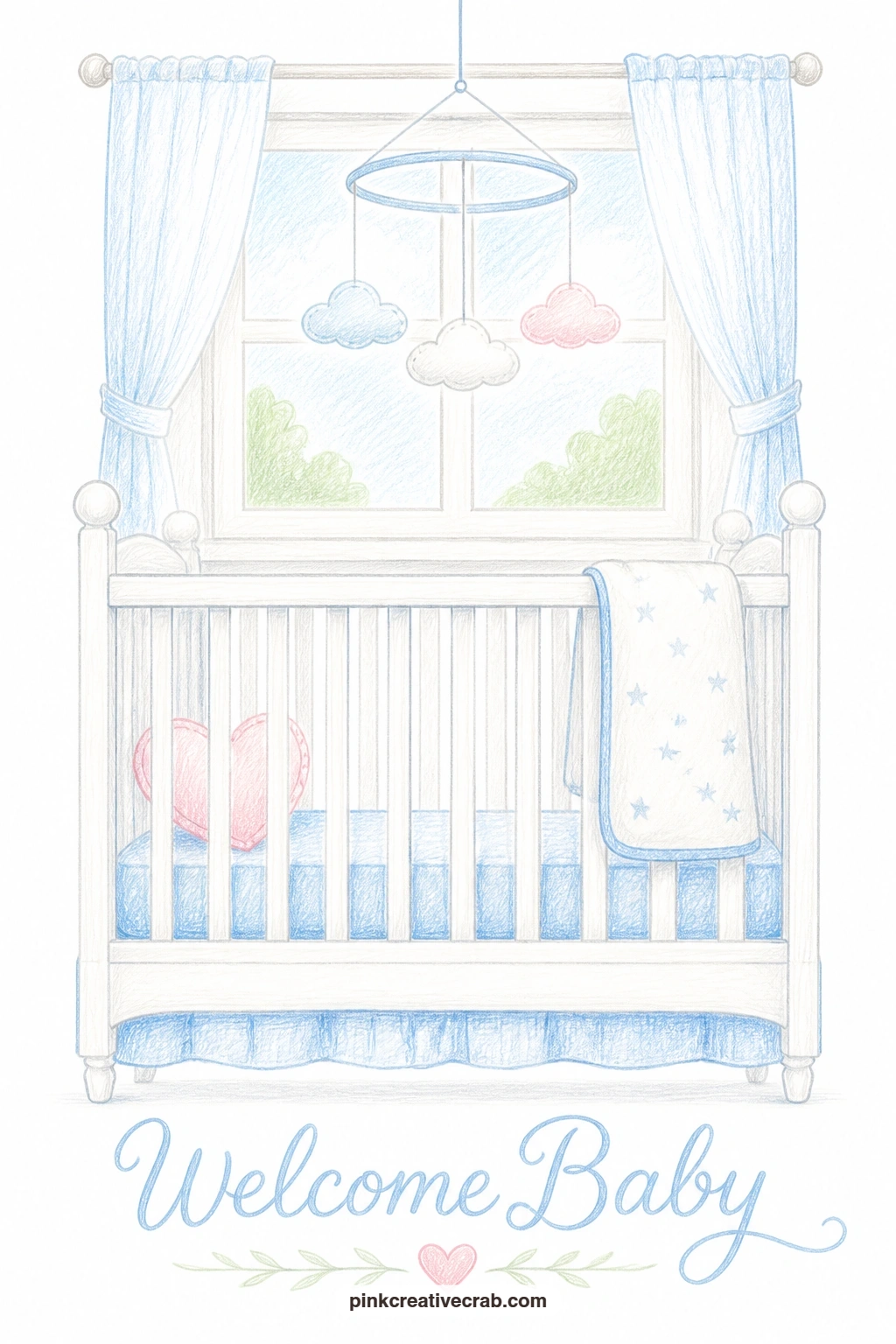
Palette: Powder Blue,Lemon Yellow,Warm White,Soft Grey
Draw a single light grey line stretched diagonally across the page first, just a thin pencil stroke with two tiny pegs at the corners, since this line is what the whole composition hangs off. Space four or five pairs of socks along it, varying the sizes slightly so the scene does not look stamped out of a template.
Shade each sock with short strokes running in the direction the fabric would fall, powder blue for some, soft pink for others, mint for one pair so the colors do not repeat in a row. If this is your first time drawing hanging fabric, look at how a real sock droops at the toe and leave that curve soft rather than pointed.
The easy mistake is drawing every sock the same size and angle, which flattens the whole line. Vary the tilt of each pair by a few degrees and let one or two overlap slightly for depth. A toothpick dipped in white gel pen works well for a tiny highlight along the clothesline wire if you want it to catch light.
Keep the background bare white with just a hint of warm yellow hatching in one corner to suggest a sunny nursery window nearby.
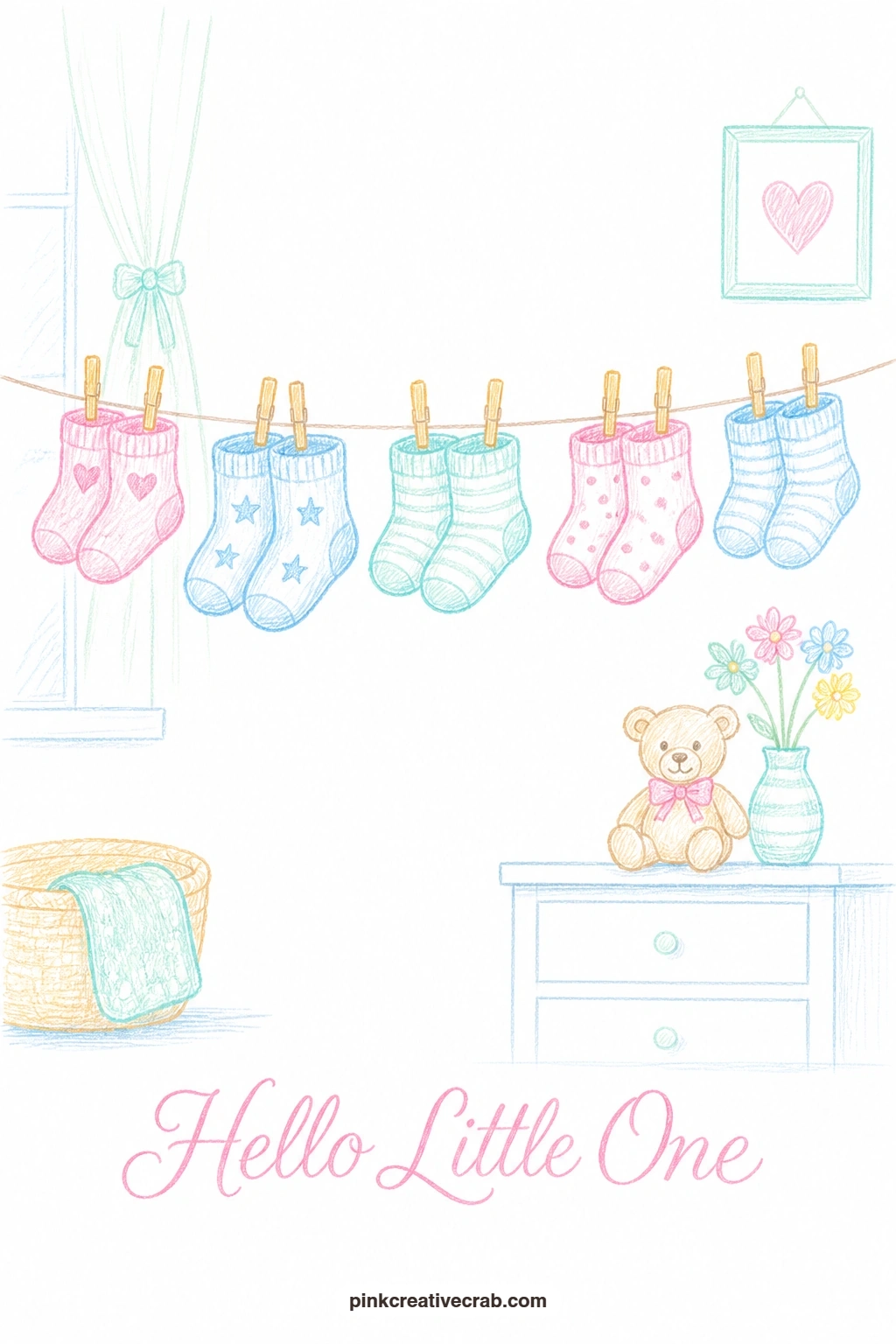
Palette: Powder Blue,Soft Pink,Mint,Soft Grey
Block in the apple tree’s trunk and main branches first using a light brown, keeping the shape loose and slightly leaning so it feels like a real garden tree rather than a stiff diagram. The pram goes underneath, drawn with its big round wheels as the first marks since getting those circles even sets the proportion for the whole body above them.
Eye level matters here: sit low, roughly at pram height, so you are looking slightly up into the blossoms rather than down on the pram. That low view makes the flowering branches feel like they arch protectively over the scene, with light falling from one side so the pram’s hood casts a soft shadow across its own body.
Build the blossoms with small clustered pink dabs rather than outlined petals, which reads as soft spring color at a glance. If the tree starts looking too heavy, erase a few clusters with a kneaded eraser to let white paper breathe through as sky.
Keep the pram itself in navy or soft grey with a cream hood, since a vintage pram reads best in a quieter color than the blossoms around it.
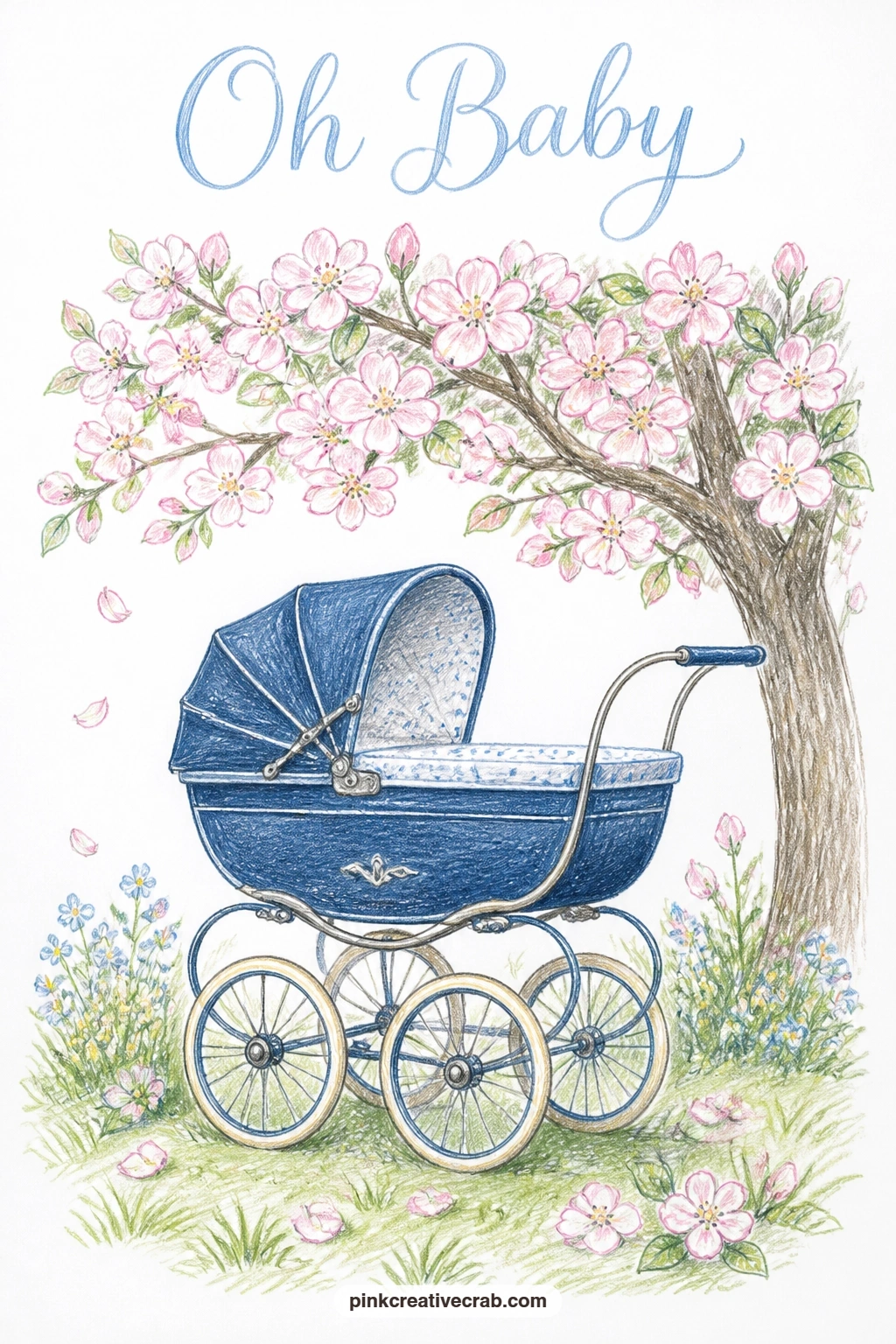
Palette: Soft Pink,Navy,Sap Green,Cream
Sketch the striped blanket first as a simple rectangle of alternating soft pink and cream bands, laid at a gentle angle so it does not look like a flag. The baby’s head and shoulders come next, kept rounded and simple, since a newborn’s face at this scale needs only two closed-eye lines and a small nose, nothing more.
Set the teddy bear beside the baby rather than on top, leaning in slightly as if it has been propped there by someone. Give the teddy a slightly worn look with uneven, patchy hatching in brown rather than smooth even color, which instantly reads as a loved, old toy rather than a new one.
The stripes are where most people struggle to keep even. Draw two guide lines in light pencil along the blanket’s edges first, then fill the bands between them, rather than trying to free-hand each stripe from scratch.
If brown pencil looks too flat for the teddy’s fur, add a few short strokes of a slightly darker shade along its edges to suggest texture without overworking it.
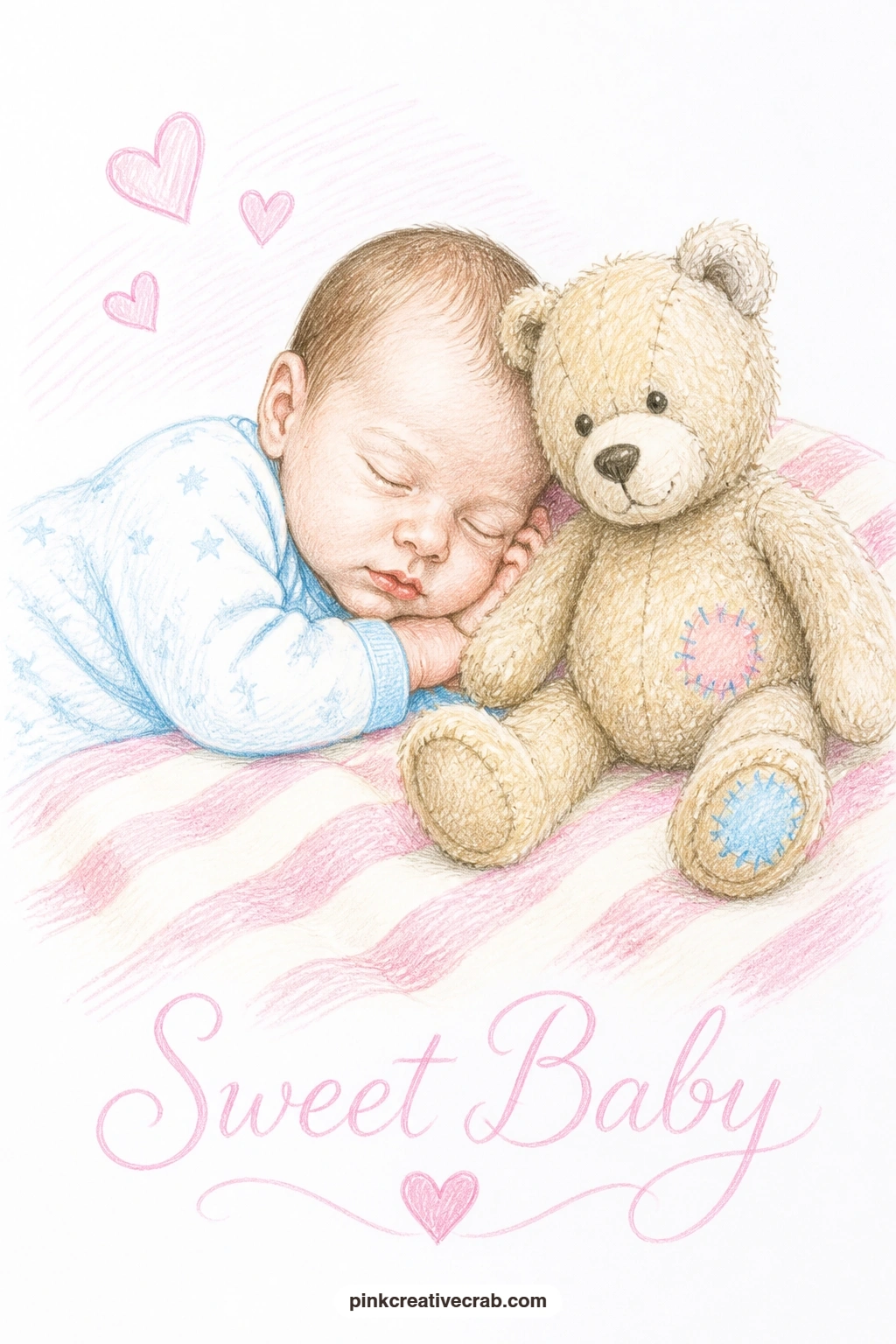
Palette: Soft Pink,Cream,Warm Brown,Soft Grey
Place the windowsill as a single horizontal line first, low on the page, so the booties and the potted daisy both have somewhere solid to sit. Draw the booties as two soft rounded shapes side by side, slightly tilted toward each other as if they were just set down a moment ago.
Texture is the whole point of this one. Use short, slightly curved strokes all going the same direction to suggest knit stitches rather than trying to draw each loop, and press a little harder along the ribbed cuff to darken it compared to the rounded toe.
The daisy pot sits just beside the booties, a simple terracotta cylinder with a few white petaled flowers poking up, kept smaller than the booties so it does not steal the scene. If the booties end up looking stiff, soften their outlines with a light grey blended edge rather than a hard pencil line.
A swap if you are missing mint: soft sage green works just as well for the daisy’s leaves and keeps the palette just as fresh.
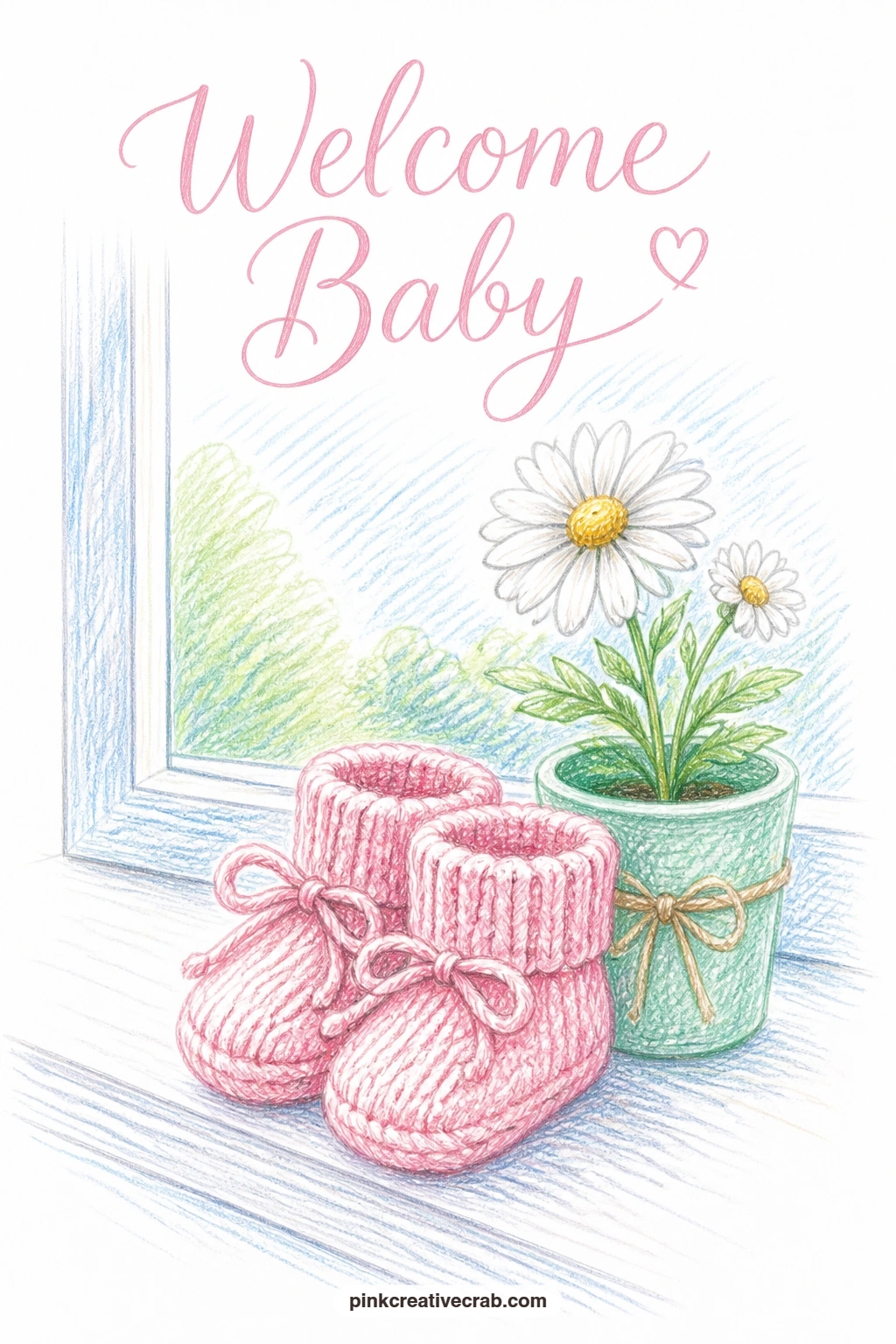
Palette: Soft Pink,Mint,Terracotta,Warm White
Begin with the basket’s woven texture using small overlapping curved strokes in warm tan, working around the oval basket shape rather than filling it in with flat color, since that crosshatched texture is what sells the wicker look. Keep the weave loose and uneven; real wicker is never perfectly regular.
Set the rocking chair just behind and slightly larger than the basket so the eye reads depth without needing any real perspective work, then drape a soft mint blanket folded in thirds beside the basket rather than inside it, so its folded edges show.
If the basket’s weave starts looking muddy, stop adding strokes and let some bare white paper show through between the curves, which keeps the wicker looking light rather than heavy. A fine-tip brown marker works as a swap if your pencil feels too soft for crisp weave lines.
Finish with one small shadow strip of soft grey beneath the basket to ground it on the floor.
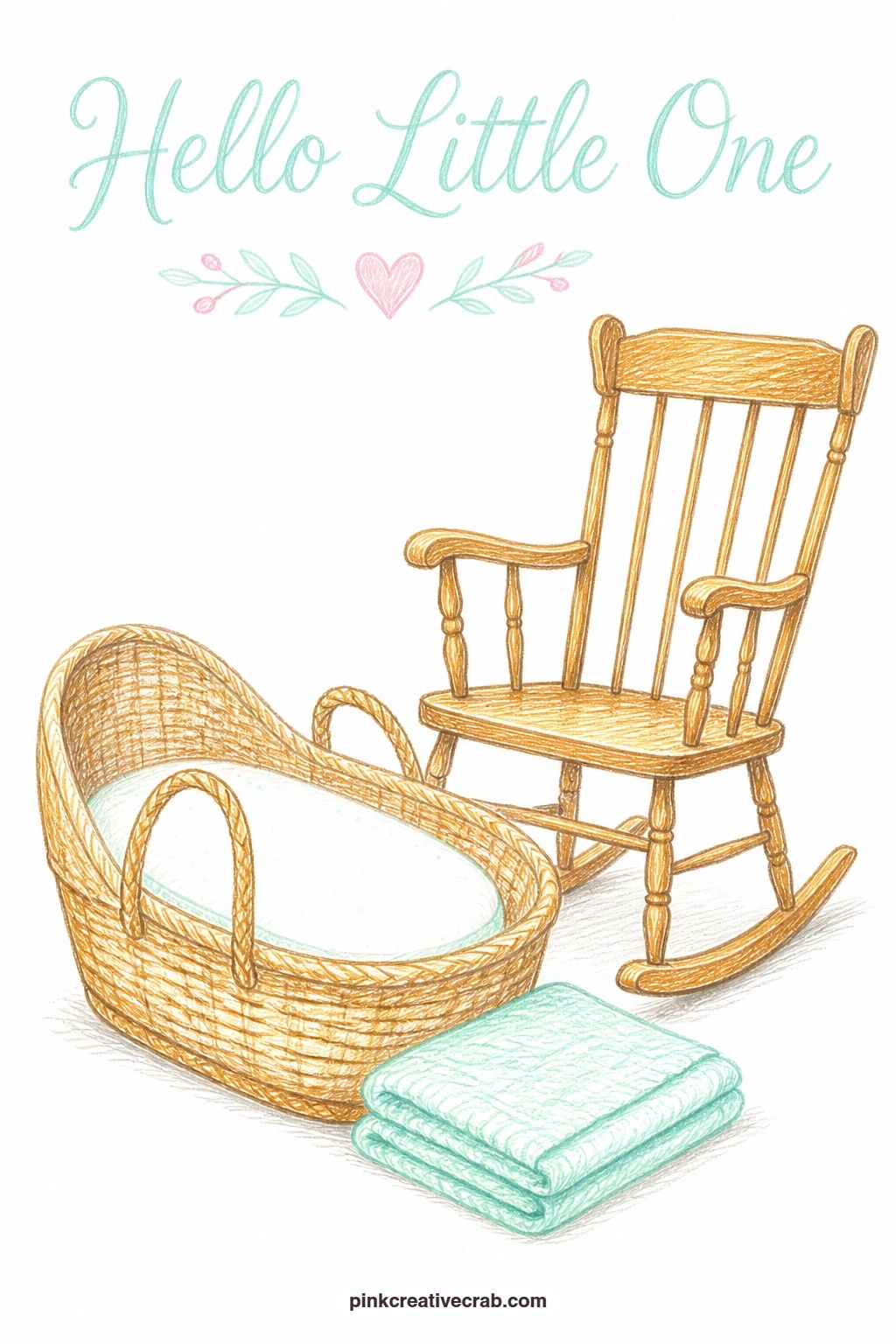
Palette: Warm Tan,Mint,Soft Grey,Cream
Build the rocking chair first with its curved rockers as two matching arcs, checking that both ends sit at the same height so the chair looks balanced rather than tipping. A crocheted blanket drapes over one arm, worked in small granny-square-like blocks of alternating soft pink and lemon yellow to suggest the crochet pattern without drawing every stitch.
The stuffed lamb sits tucked into the seat, its wool texture made from small tight circles or loops in white and cream layered closely together rather than smooth shading, which is the easiest way to suggest curly fleece in colored pencil.
Chairs are easy to tip over visually if the rockers do not match. Draw one rocker, then trace its curve lightly on the other side before darkening the second line, rather than freehanding both separately.
Keep the blanket’s crochet blocks small and the lamb simple with just two dot eyes, so the whole scene stays calm rather than busy.
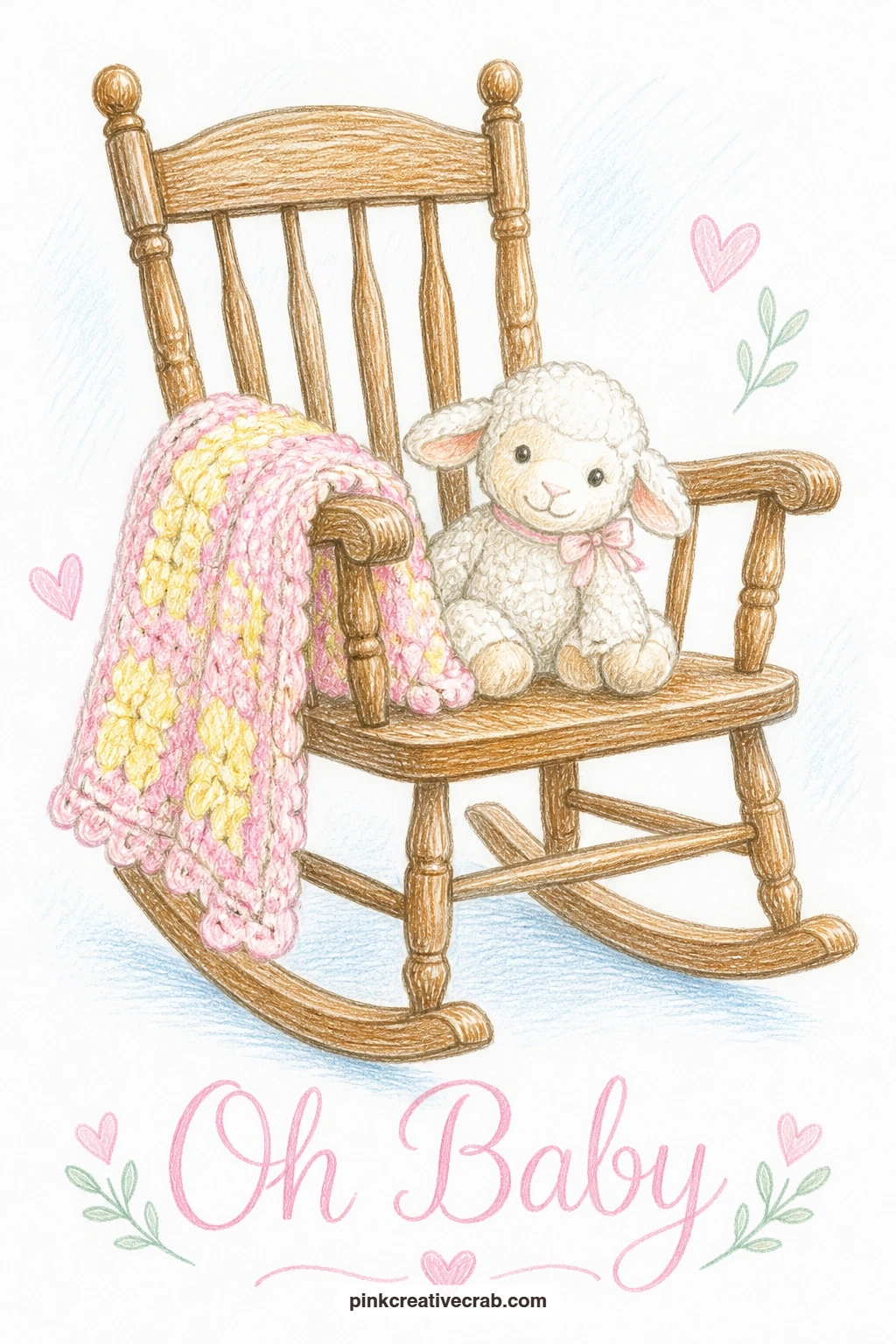
Palette: Soft Pink,Lemon Yellow,Cream,Warm Brown
Draw the enamel bath as a simple oval basin first, shading its rim with a thin band of soft blue and leaving the inside mostly white to suggest the shine of enamel. The rubber duck floats slightly off center, a round body and small pointed beak in bright lemon yellow, since a duck drawn dead center looks too stiff.
Light is what makes enamel look like metal rather than flat paint. Decide the light comes from one side, then leave a thin bright white strip along that edge of the bath’s rim untouched by pencil, with the shadow side taking a slightly deeper blue.
The duck often ends up looking like a lemon with a beak if the body is too round and even. Flatten the bottom very slightly where it sits on the water line, and add two tiny curved strokes of soft blue around it to suggest ripples.
If yellow pencil feels too pale, layer a light orange underneath first then yellow on top for a warmer, richer duck.
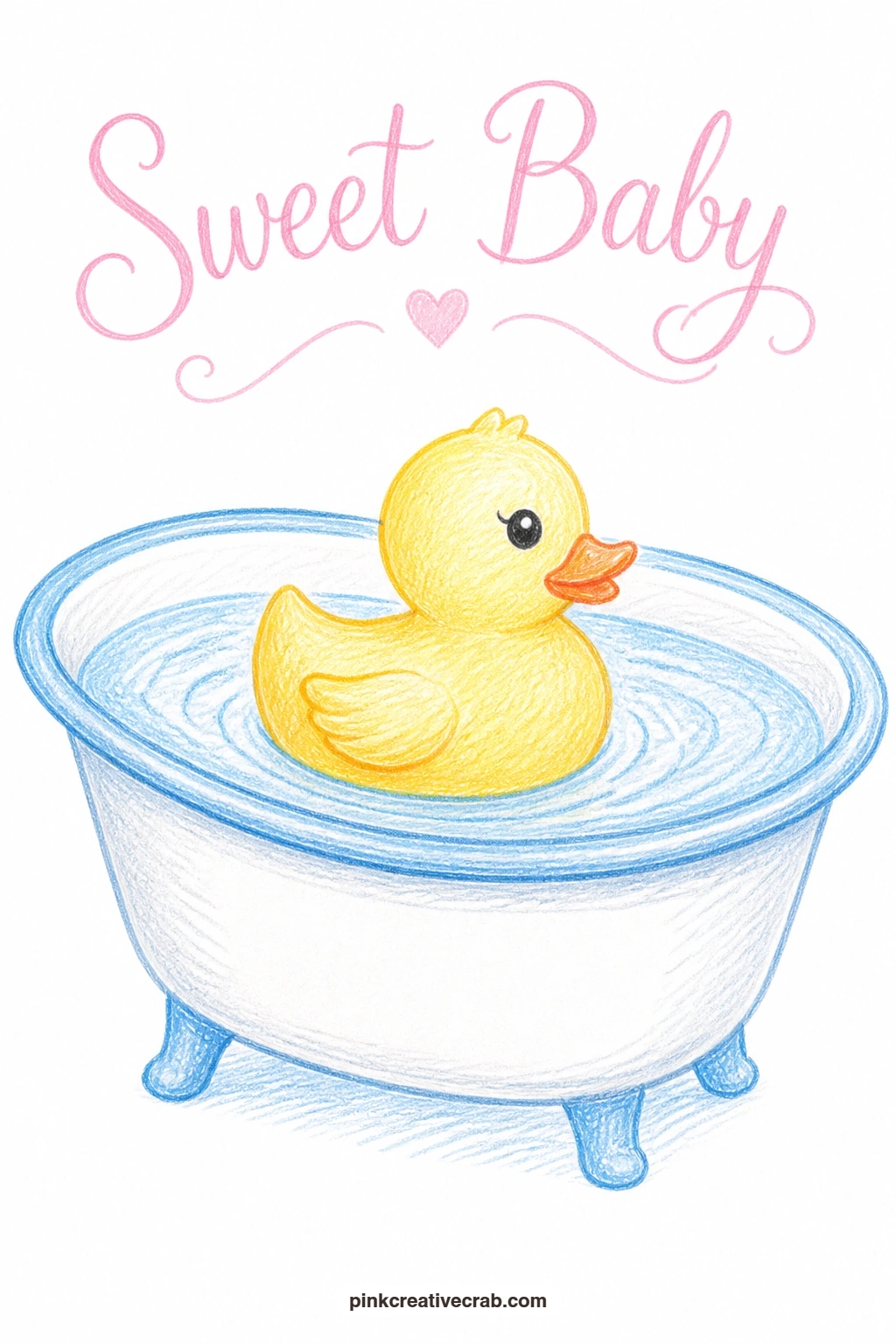
Palette: Powder Blue,Lemon Yellow,Warm White,Soft Grey
Start with the parent’s hand as the larger shape, a simple relaxed fist with one finger extended, since getting its proportion right first gives the newborn’s tiny hand something correct to wrap around. Compare sizes directly: the whole newborn hand should measure roughly the length of the parent’s one finger, which keeps the scale believable.
Keep both hands soft and rounded rather than detailed with knuckle lines, just a gentle curve for each tiny finger wrapped around. A soft blanket beneath them fills the rest of the card front, drawn in loose folds using light grey shadow lines between pink or cream bands.
Hands are one of the trickiest things to draw, so if the fingers look stiff, round off every tip rather than leaving any pointed, and keep the newborn’s fingers slightly curled rather than straight.
This is a good one to try as a careful forty-minute piece rather than rushing it, since the proportion between the two hands carries the whole feeling of the card.
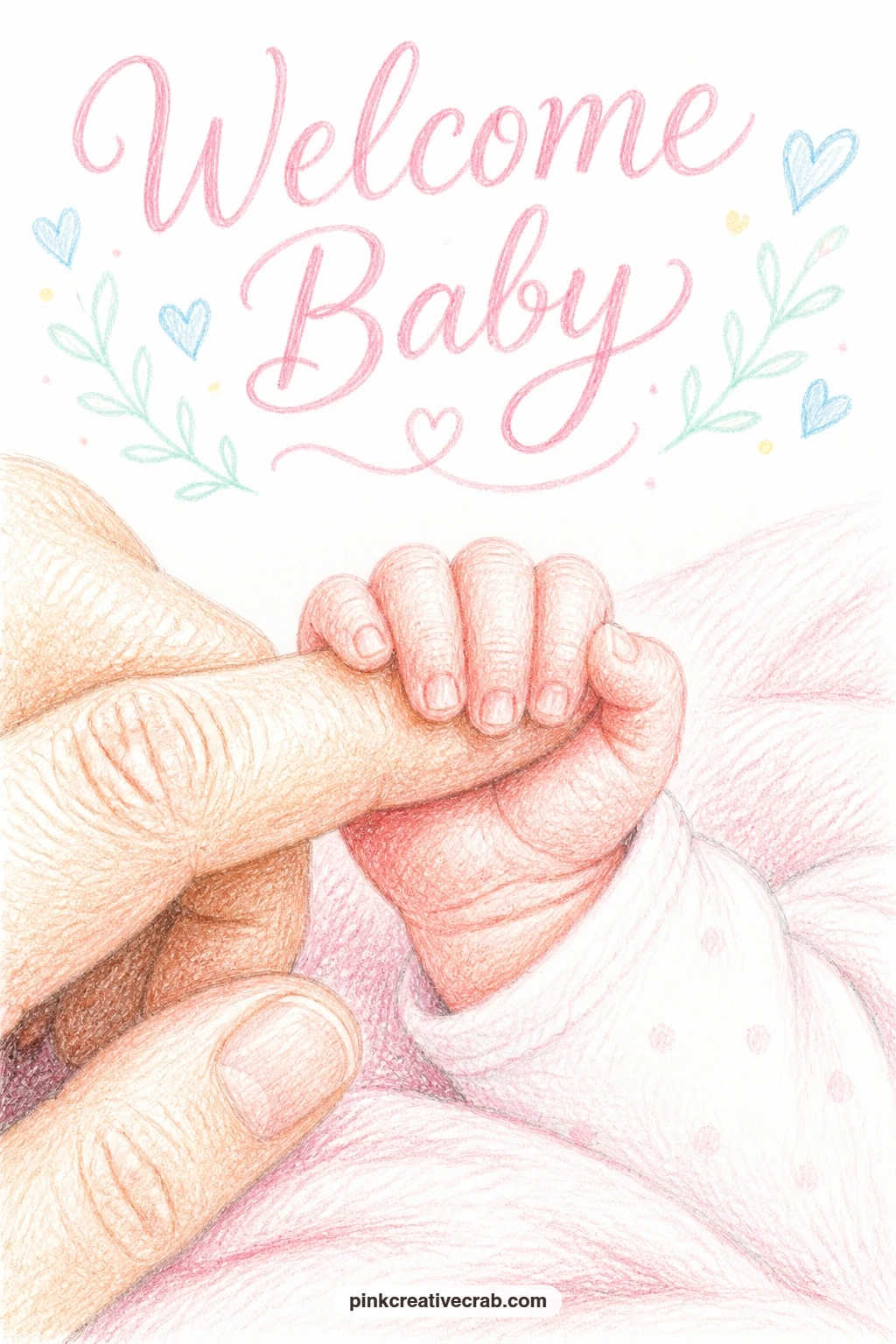
Palette: Soft Pink,Warm Brown,Cream,Soft Grey
Place the crescent moon night light first in one corner, a simple curved shape in soft yellow with a gentle glow built from short radiating pencil strokes fading outward into the white paper, since that glow is easier to add before the crib is in the way.
Decide the light comes from the moon itself, which means the side of the crib nearest it stays pale and warm while the far side falls into soft blue shadow. That single choice does most of the work in making the scene feel like nighttime rather than daytime with a yellow shape stuck in the corner.
Draw the sleeping baby simply inside the crib, a soft curled shape under a blanket with just a hint of a peaceful closed-eye face, kept small compared to the moon so the light source stays the star of the picture.
If the glow looks too hard-edged, soften it by rubbing the outer strokes gently with a cotton swab or your fingertip.
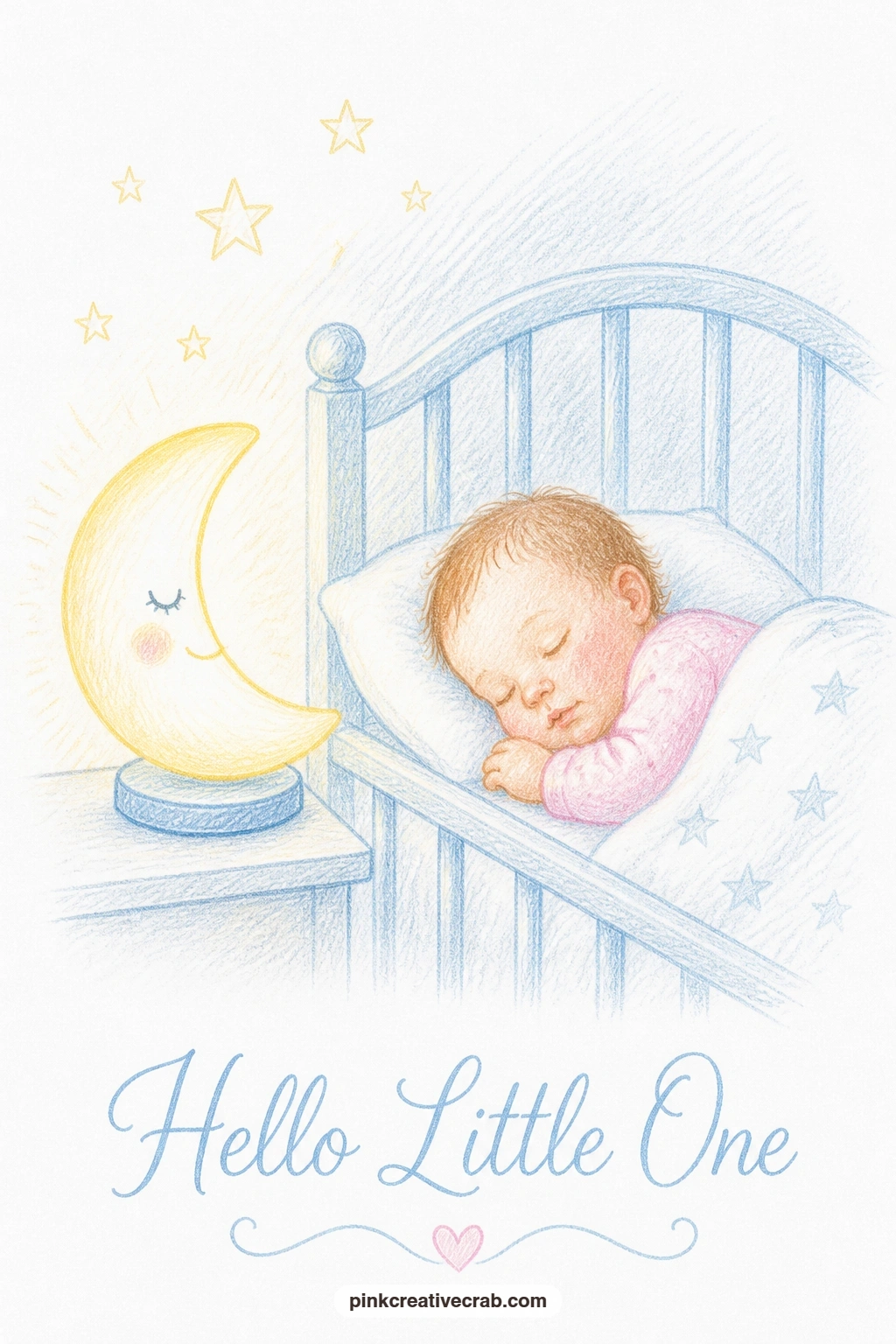
Palette: Lemon Yellow,Powder Blue,Soft Grey,Warm White
Stack the muslin cloths as three or four slightly offset rectangles, each folded edge drawn with a single soft crease line rather than multiple lines, which keeps the fabric looking light rather than stiff. Vary each cloth’s color slightly, soft pink, mint, cream, so the stack does not read as one block.
The knitted hat sits on top, worked with the same short directional strokes used for knitwear elsewhere, a small pompom at its peak made from tight circular scribbles in white left slightly rough at the edges for texture.
Folded fabric often goes flat if every crease gets the same weight. Press harder on the crease closest to the viewer and lighter on ones further back, which gives the stack a sense of depth with almost no extra drawing.
Quick version: three cloths and a plain hat takes about ten minutes. The forty-minute version adds a thin ribbon tied around the stack and a tiny embroidered edge detail on the top cloth.
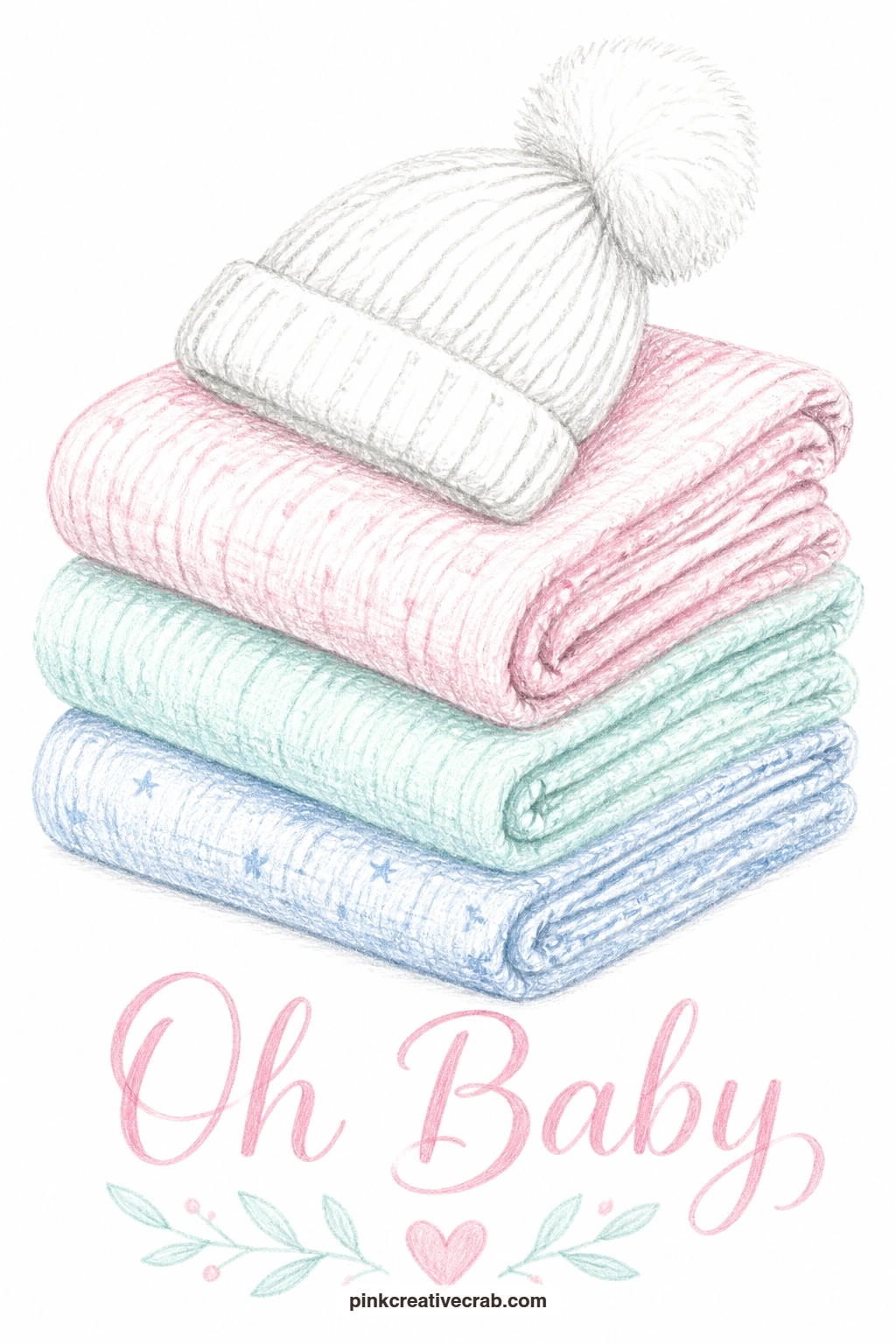
Palette: Soft Pink,Mint,Cream,Warm White
Draw the pram first since it anchors the whole scene, a simple navy body with large round wheels, drawn slightly larger than the flower stall beside it so the pram clearly stays the subject rather than the background competing for attention. If you are new to drawing a figure pushing a pram, keep the parent’s body simple: a coat shape, two visible hands on the handle, and no detailed face.
The flower stall sits just to one side, built from small clustered dabs of color, pink, yellow, mint, in loose buckets sketched as simple cylinders, which reads as flowers at a glance without needing individually drawn petals.
Eye level stays at adult height looking slightly down on the pram and stall, which is the natural view for this everyday moment and keeps the proportions simple since nothing needs dramatic foreshortening.
Keep the street itself nearly bare, just a thin grey line for pavement, so the pram and flowers carry all the color.
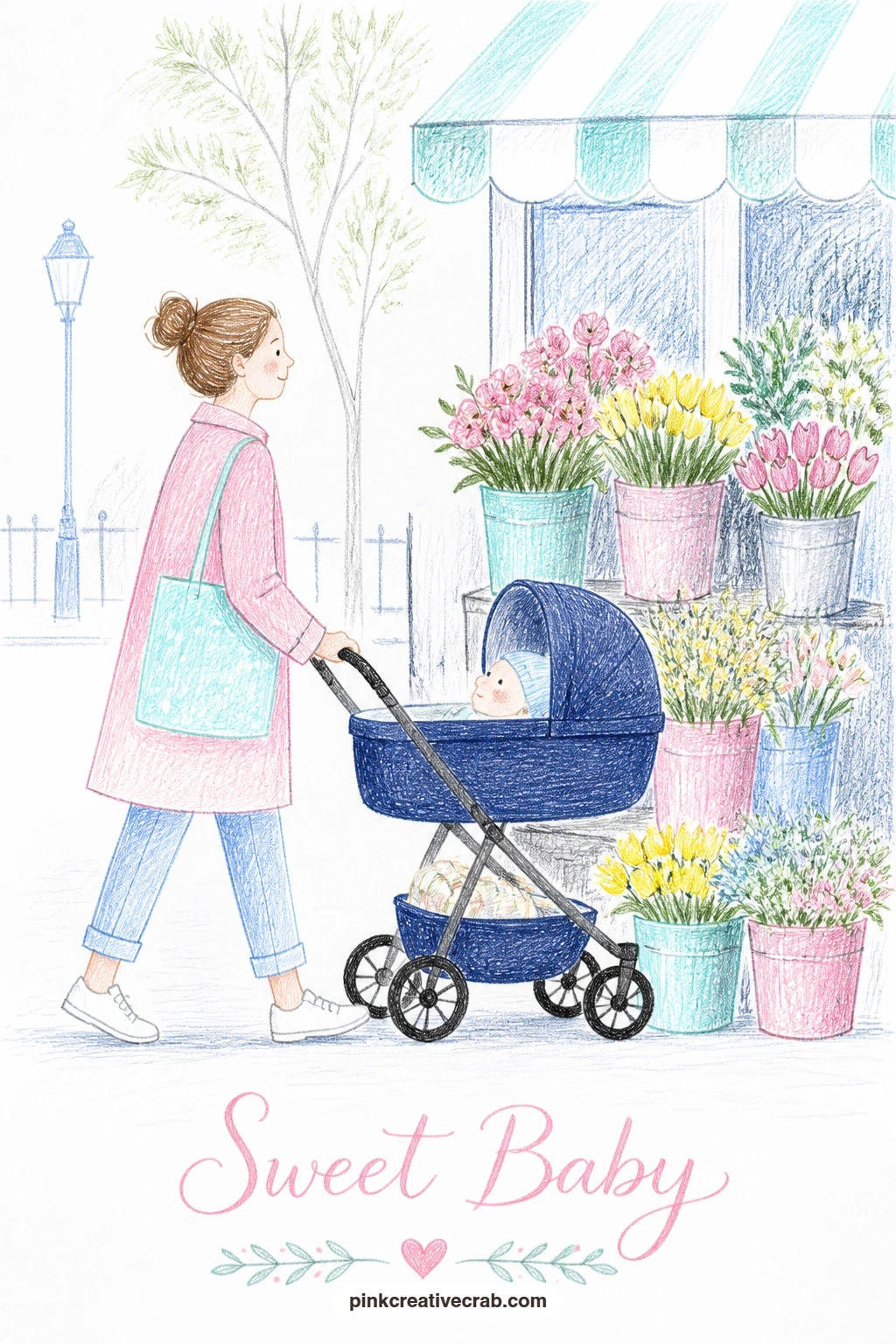
Palette: Navy,Soft Pink,Lemon Yellow,Mint
Build the high chair’s tray and legs first as simple straight lines, checking that all four legs reach the same baseline so the chair sits level, since a wobbly high chair undercuts the gentle humor of this scene. The teddy bear sits upright in the seat, bib tied at its neck, waiting the way a baby might at mealtime.
Give the bib a small scalloped edge and a pale mint color to set it apart from the teddy’s warm brown fur. Keep the teddy’s expression simple and sweet, two dot eyes and a small stitched smile, so it reads as patient rather than silly.
The tray in front is a good spot for one small prop, a single wooden spoon resting on it, which tells the whole story of waiting for dinner without needing any food drawn in.
If the chair’s legs look uneven once finished, a light grey shadow beneath each leg helps visually settle them onto the floor even if the lines were not perfectly matched.
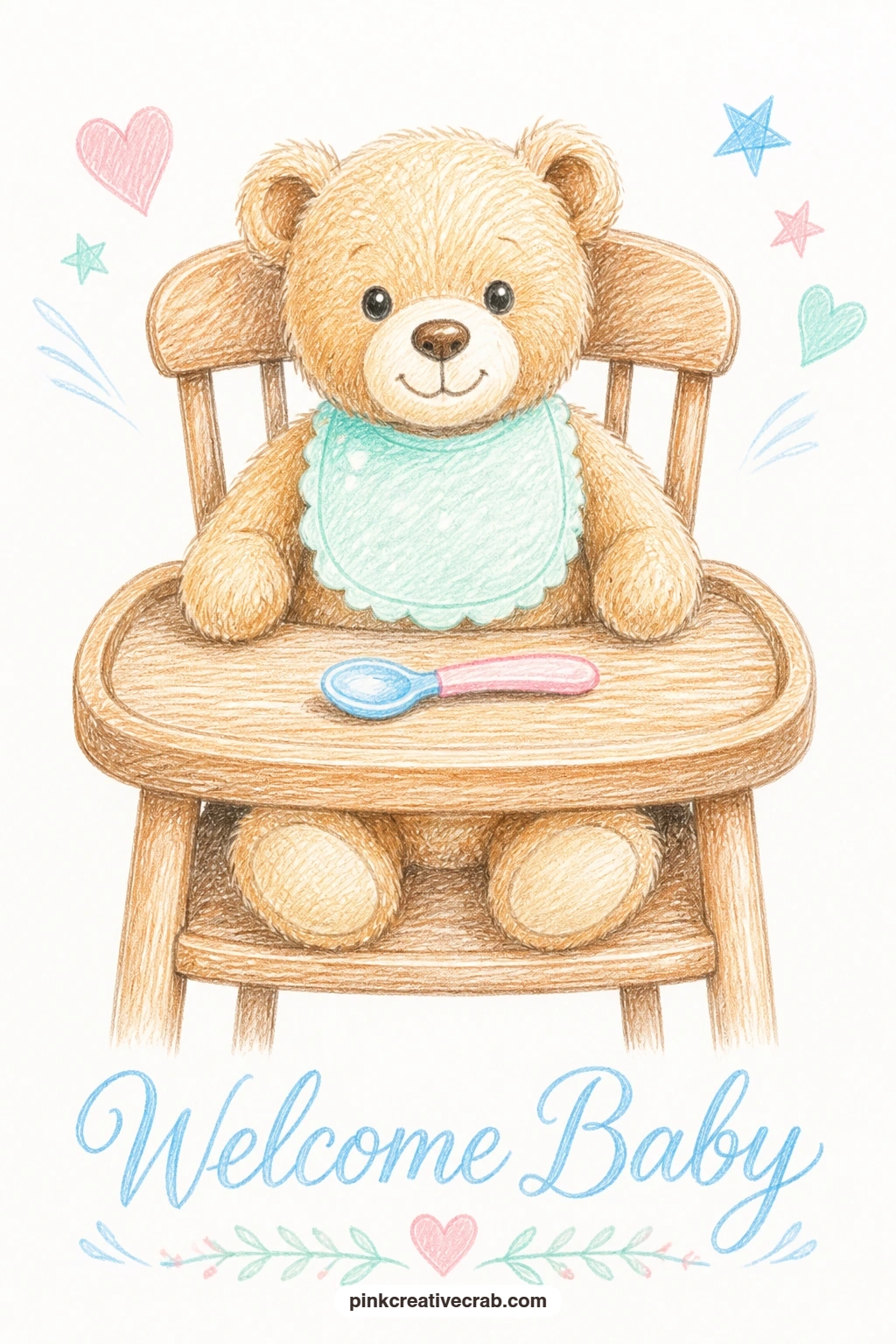
Palette: Warm Brown,Mint,Cream,Soft Grey
Hang the cardigan on a simple curved wooden hanger first, keeping the hanger’s hook as a single light line so it does not compete with the garment below it. Build the cardigan’s shape with soft rounded shoulders and a gentle taper at the hem, since baby clothes have none of the sharp structure adult clothing does.
Tiny buttons down the front are the detail that makes this one feel finished: three or four small circles in a contrasting color, cream against a soft pink cardigan or pink against mint, spaced evenly down the center line.
Knit texture goes here too, short strokes along the ribbed cuffs and hem worked in the direction the ribbing would run, left smoother across the main body of the cardigan so the texture does not fight for attention everywhere at once.
Set it against a window a few soft blue hatching lines behind, suggesting daylight without drawing a full window frame if you want to keep this one quick.
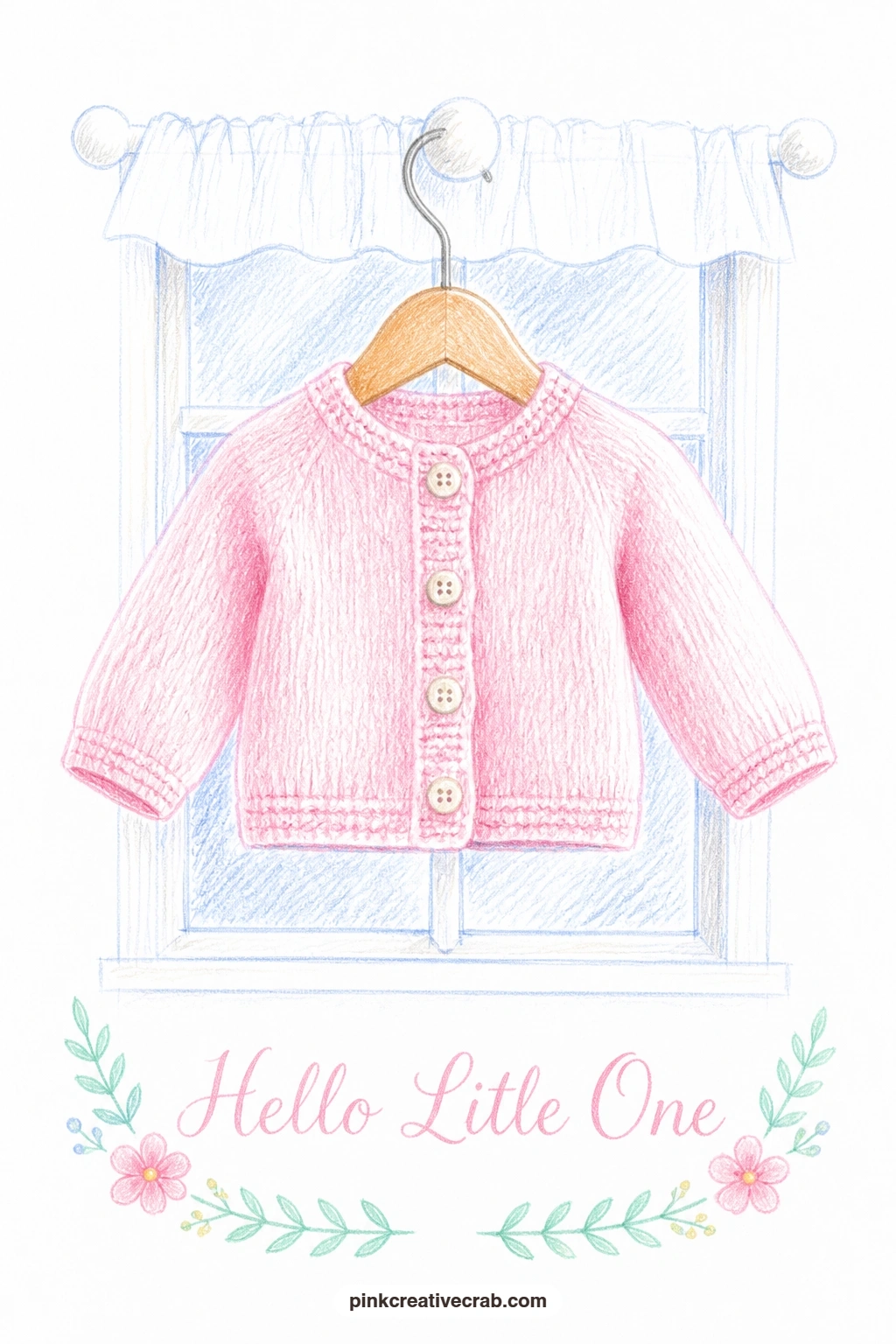
Palette: Soft Pink,Mint,Cream,Warm Brown
Draw the parent’s upper body and shoulders first as a simple rounded shape, since the sling and baby both depend on that torso for their placement. The sling wraps diagonally across the chest, a soft fabric band in mint or soft pink, with the baby’s head tucked snugly just below the parent’s chin.
Keep the baby almost entirely wrapped, just a small sleeping face peeking out, which is both the easiest way to draw a baby at this scale and the most tender. A few garden leaves or a single flowering branch in the background keeps the setting readable without needing a full garden drawn in.
The sling fabric can look stiff if drawn as flat shapes. Add a few soft diagonal fold lines across it in a slightly darker shade of the same color to suggest the fabric wrapping around a body.
If garden foliage feels like too much today, a single potted plant beside the parent’s feet does the same job in a fraction of the time.
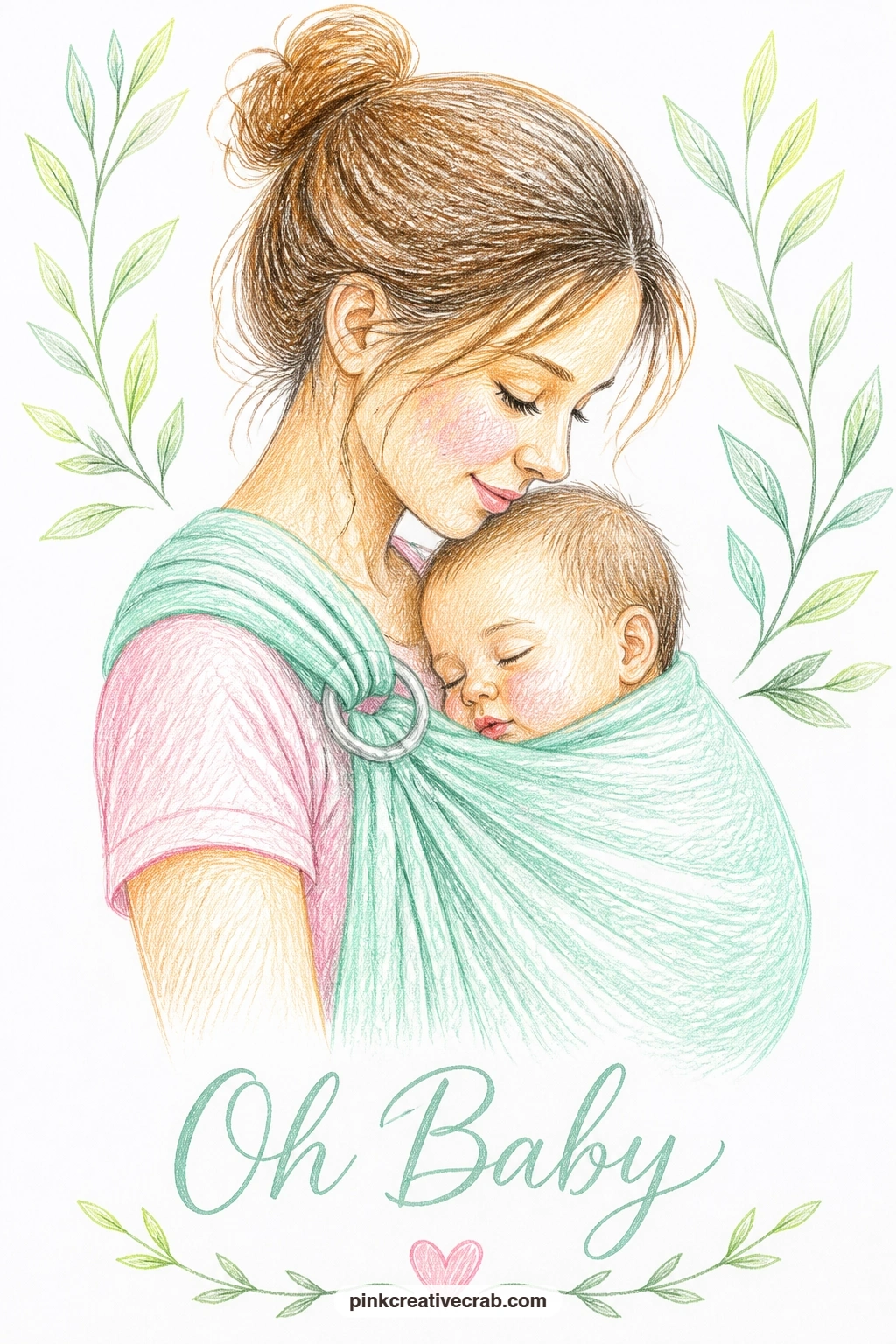
Palette: Mint,Soft Pink,Sap Green,Warm Brown
Lay the lace cushion down first as the base of the whole scene, built from a simple soft rectangle with a scalloped edge drawn in small repeating curves rather than one continuous line, since lace reads better as a rhythm of small shapes than a smooth outline.
The wooden rattle sits toward one side, a round handle and a small circular head, shaded with warm brown strokes following the grain direction. The silver spoon rests nearby, its bowl given one bright white highlight left completely bare to suggest the shine of polished metal against the soft fabric.
Lace is the part people overwork. Keep the scalloped edge pattern loose and only partially shaded, letting plenty of white paper show through the open parts of the lace rather than filling every gap with pencil.
A swap for the silver spoon if metallic shine feels tricky: a small wooden spoon works just as well and only needs flat warm brown shading.
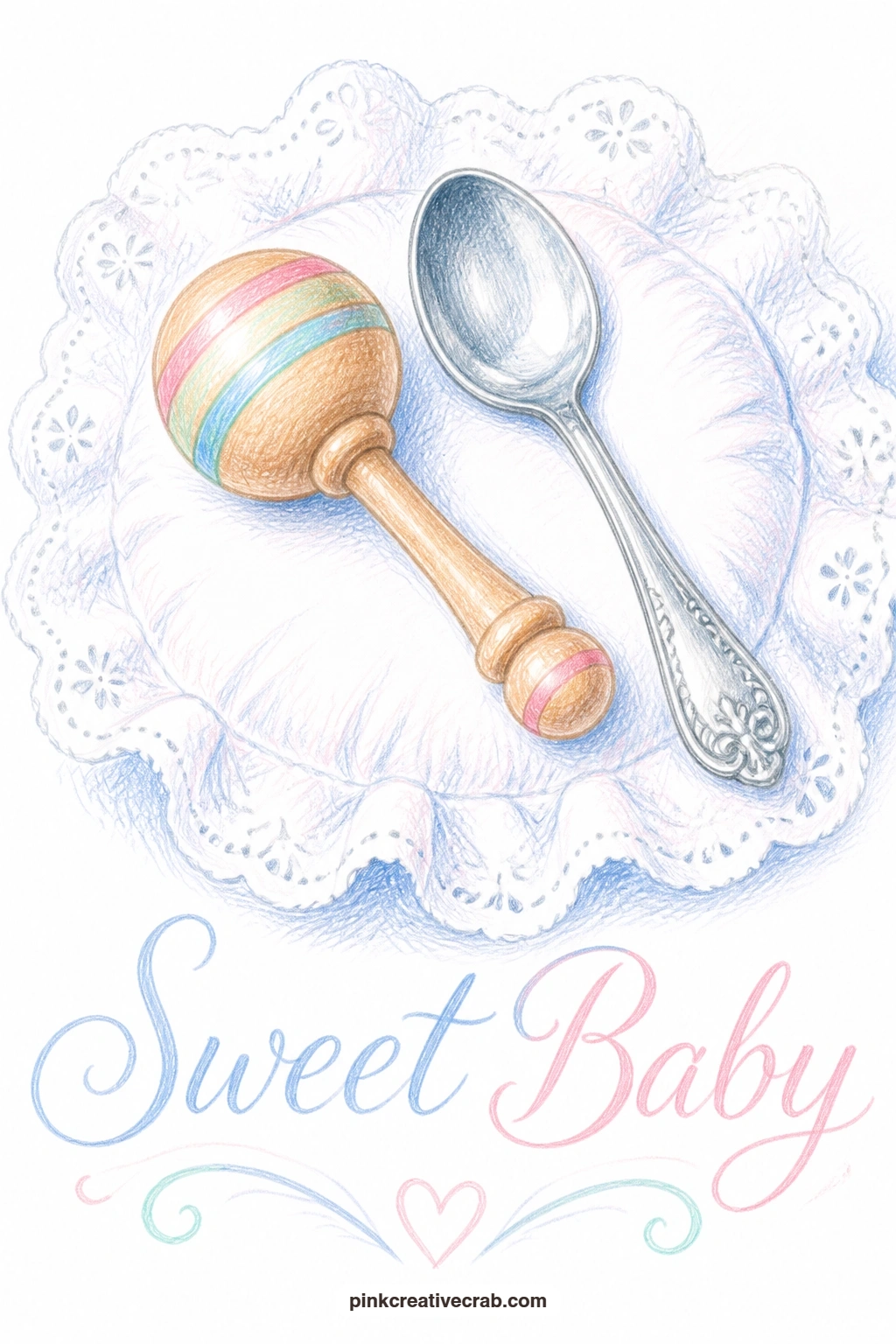
Palette: Warm White,Warm Brown,Soft Grey,Cream
Draw the crib first as a simple empty frame, keeping its bars light and evenly spaced the same way as the earlier crib idea, since an empty crib needs to read clearly before the cat is added beside it. The cat curls in a tight oval shape on the floor just beside the crib’s legs, tail wrapped around its own body.
Fur texture is the main job here: short, slightly curved strokes layered in the direction fur naturally grows, darker along the cat’s back and lighter underneath where light would catch it. If this is your first time drawing a curled cat, start with the oval body shape, then add the head as a smaller circle tucked into one end before any fur strokes at all.
The easy mistake is making every fur stroke the same length and direction, which looks like scales rather than fur. Vary the stroke length slightly and let a few strands break the outline at the edges.
Keep the cat in one warm solid color, ginger or grey, so it stands out clearly against the white crib.
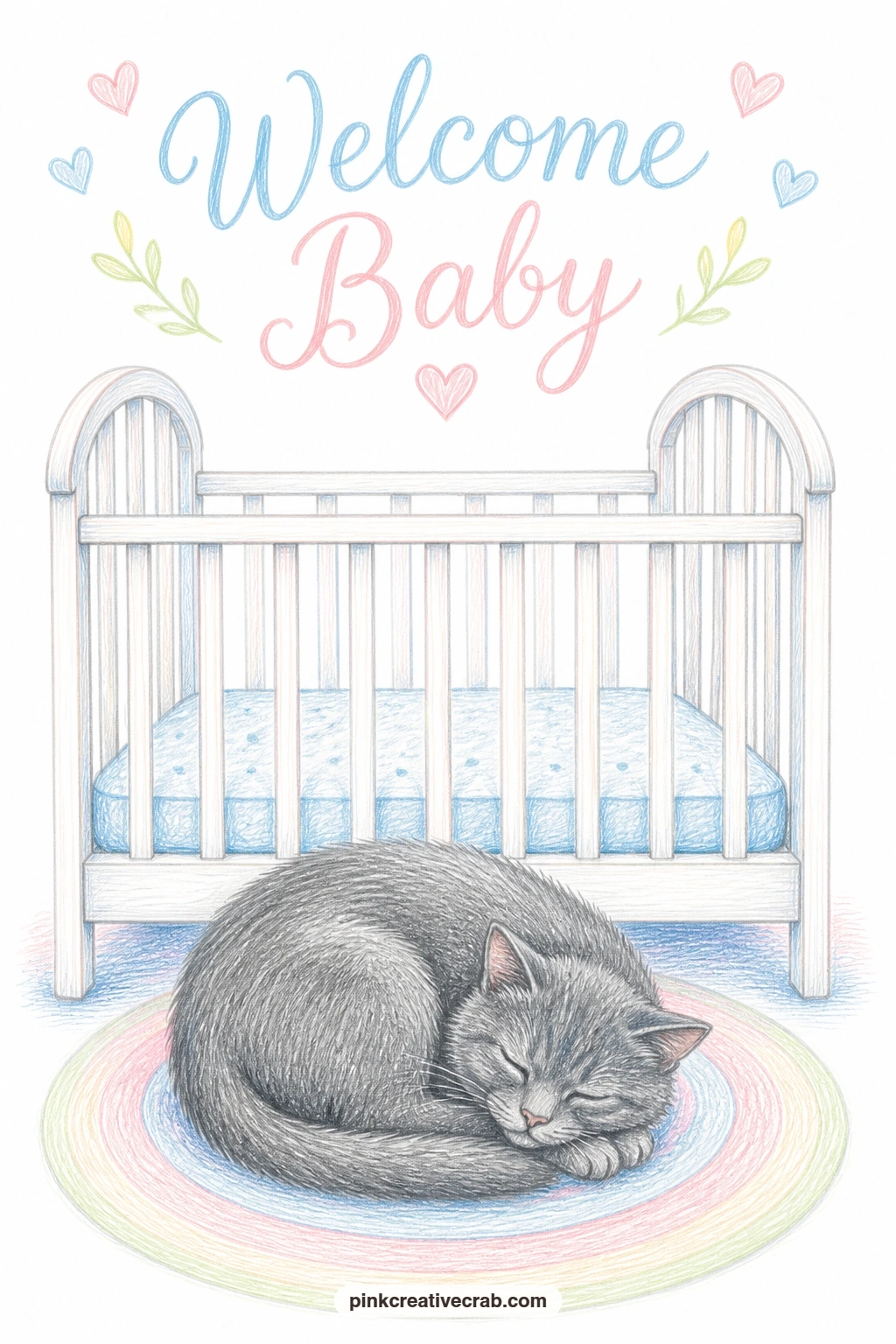
Palette: Warm Grey,Soft Grey,Warm White,Cream
Build the bassinet first as a simple rounded basket shape with a soft fabric skirt, keeping its woven texture light since the dog’s face above it is the real focus of this scene. Rest the dog’s chin and paws on the bassinet’s edge, front legs just visible over the rim, as if it has carefully climbed up to look inside.
Eye level here sits slightly above the bassinet, looking down into it along with the dog, which is what makes the viewer feel like they are peeking in together with the dog at the sleeping newborn below.
Keep the dog’s expression gentle and curious rather than alert, ears relaxed, eyes soft, since the whole point of this scene is tenderness rather than mischief. A floppy-eared breed like a spaniel reads as particularly gentle at this scale.
If the dog’s fur looks too smooth and flat, a few longer single strokes along the ears and tail break up the shading and suggest softness without much extra work.
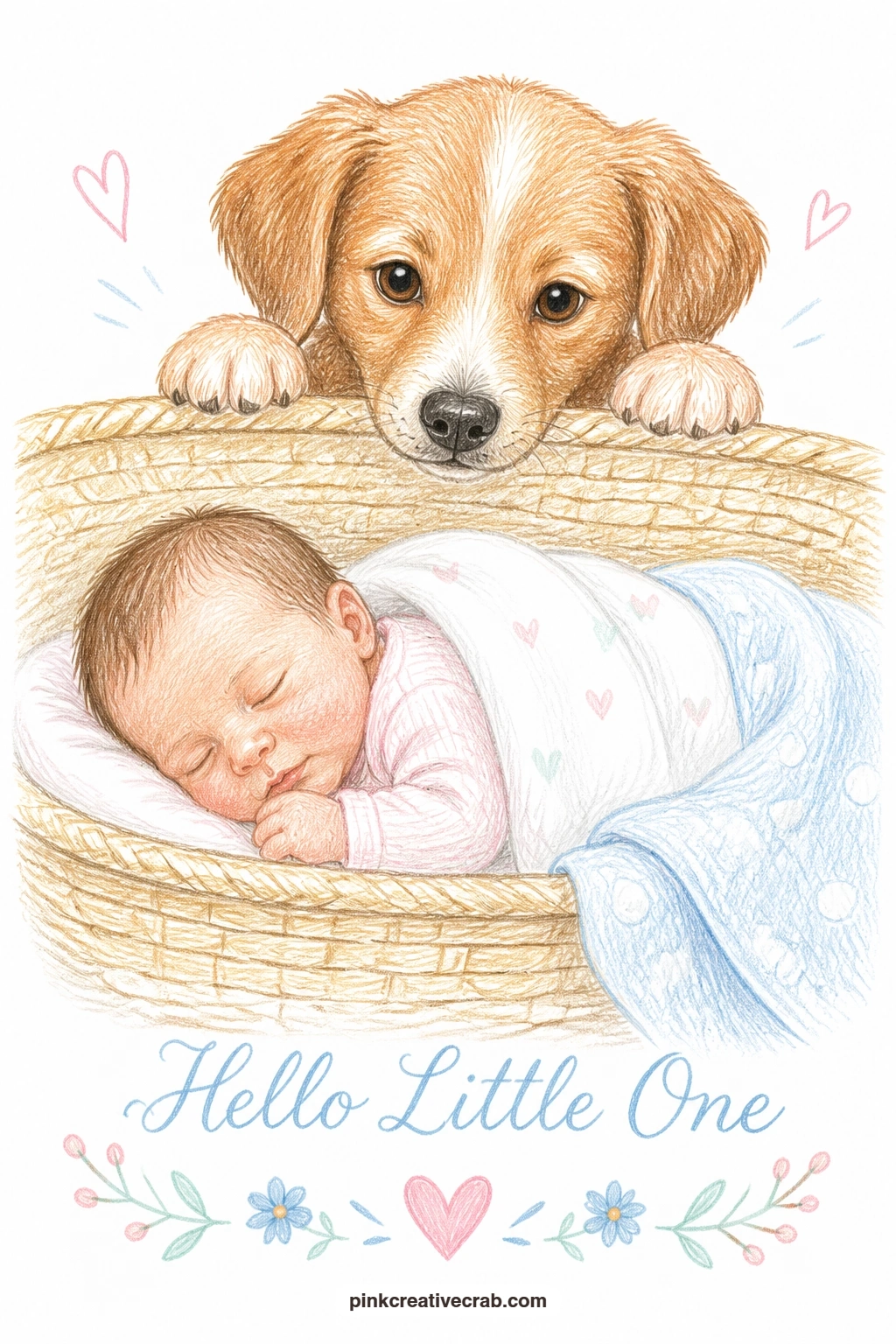
Palette: Warm Brown,Cream,Soft Pink,Soft Grey
Sketch the front door first as a simple rectangle with a rounded top panel, since the door frame sets the scale for the car seat being carried through it. The car seat itself is a rounded shell shape with a simple handle arching over it, carried at roughly waist height by a parent whose legs and lower coat are the only part of them shown entering the frame.
Crop the parent at the shoulders or waist rather than drawing a full figure, which keeps the focus on the car seat and door and sidesteps the trickiest parts of figure drawing entirely.
A small welcome detail, a potted plant beside the door or a doormat just visible at the bottom edge, grounds the scene as a home rather than any entrance. Keep the car seat’s fabric in one soft color with a simple pattern of two or three dots rather than a busy print.
If door panels feel fussy to draw, a plain flat door with just a round doorknob works just as well.
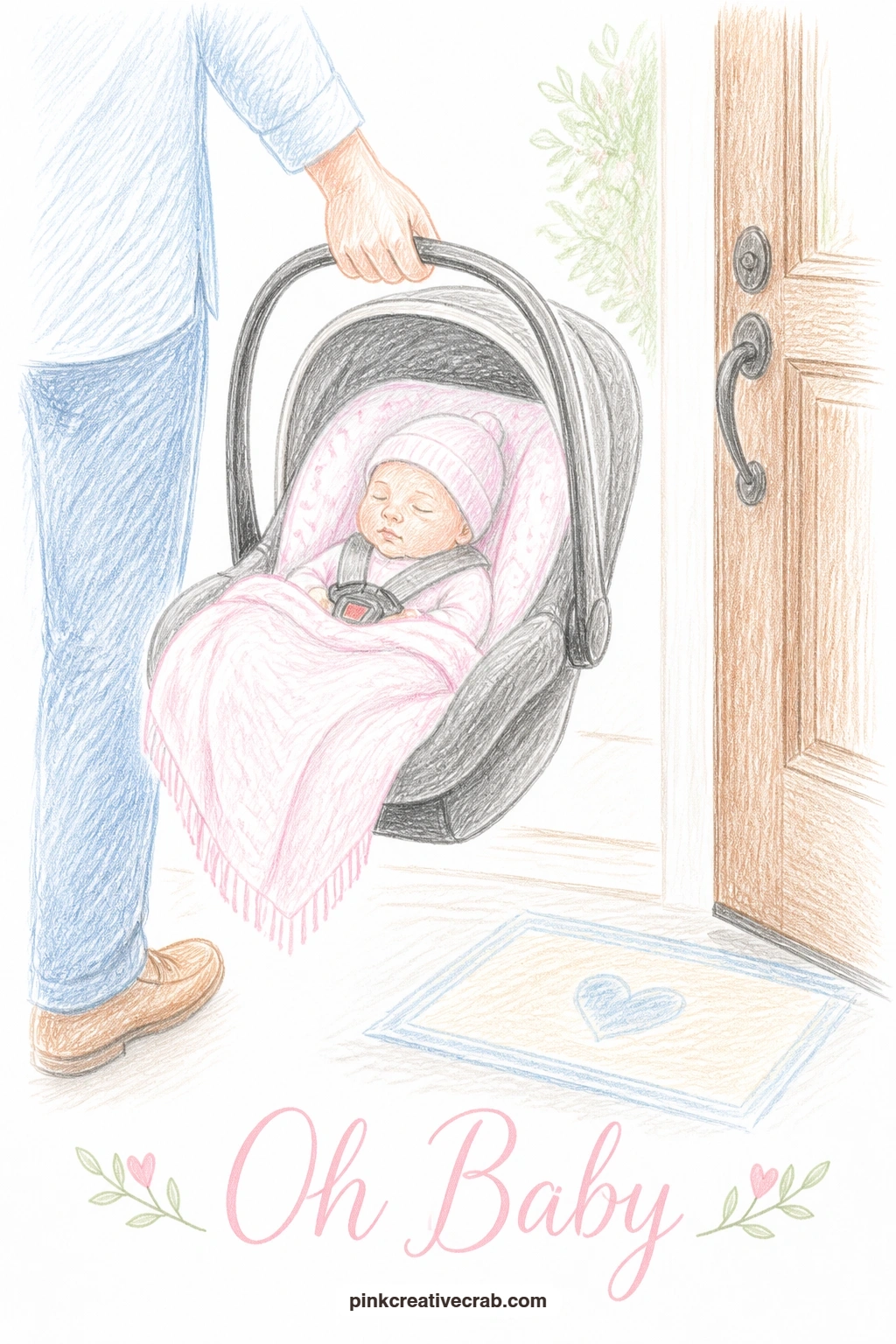
Palette: Warm Brown,Soft Pink,Cream,Sap Green
Draw the parent shoes first since their larger size sets the scale for everything else on the doormat, a simple pair of loafers or boots drawn front-on with minimal detail. Compare sizes directly as you add the baby shoes: a newborn shoe should measure roughly a third the length of the adult shoe beside it, which is the trick that makes this pairing read instantly as parent and child.
Keep both pairs angled slightly toward each other rather than perfectly parallel, which feels more like a real moment of shoes kicked off at the door than a diagram.
The doormat beneath them is a good place for a little texture, short crosshatched lines in a warm tan to suggest woven fiber, kept loose so it does not pull focus from the shoes.
If straight shoe outlines feel stiff, round every corner slightly. Shoes, like most soft objects in a nursery scene, read better a little rounded than sharp.
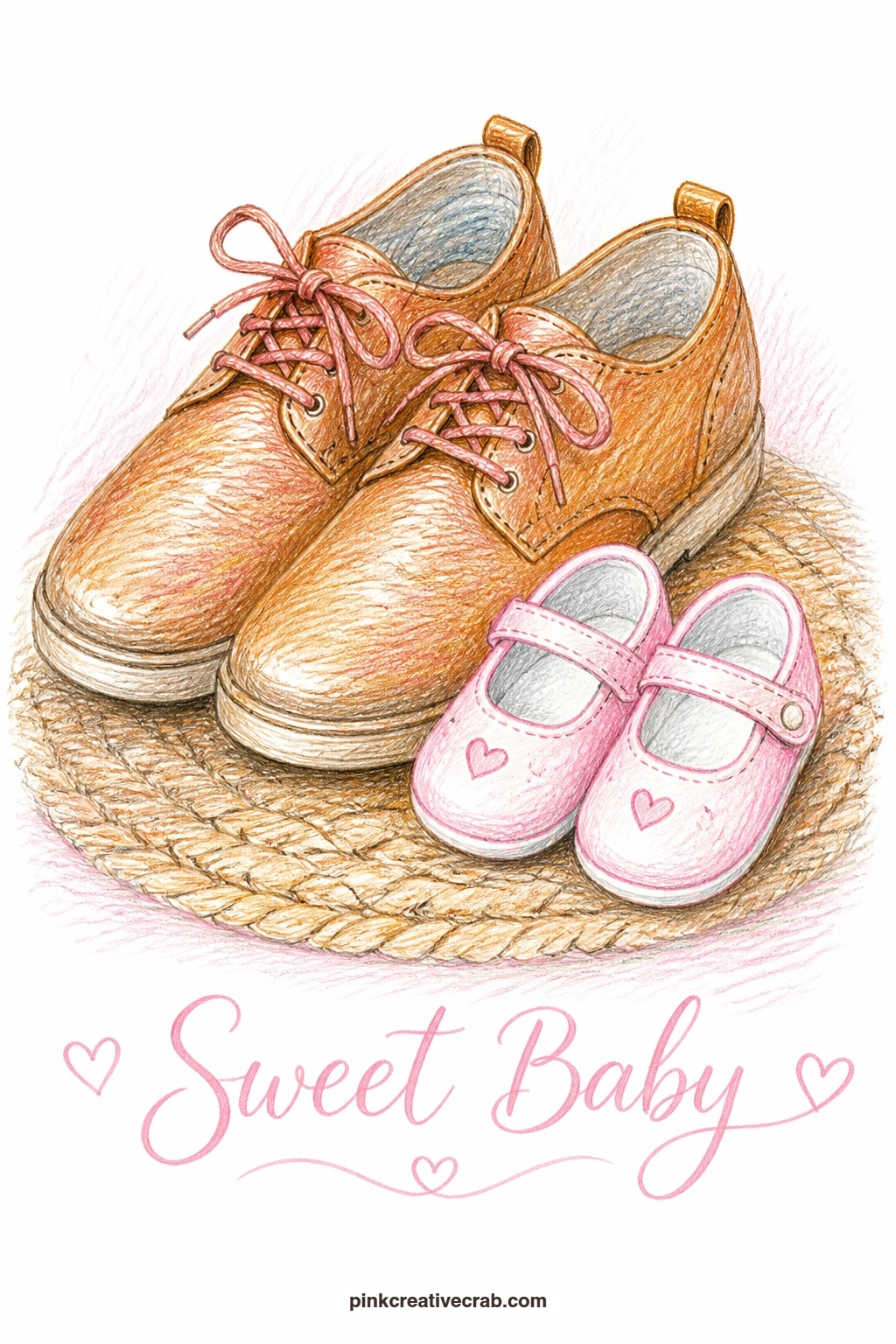
Palette: Warm Brown,Soft Pink,Warm Tan,Cream
Draw the changing table surface as a simple flat shelf first, since everything else sits on top of this one horizontal line. The stack of diapers goes to one side, a simple rounded rectangle block with a few soft curved lines across its front to suggest the folded edges without drawing each one individually.
The stuffed elephant sits beside the stack, its ears drawn as two large soft ovals and its trunk curling gently downward, shaded in powder blue or soft grey with the same short-stroke fur texture used for other stuffed toys in this list.
Diaper stacks can look like plain boxes if left totally flat. Add one soft shadow line where the stack meets the table and a highlight strip along the top edge to give it just enough form to read as soft paper rather than wood.
Need a change of material? A stuffed rabbit or bear works just as well as the elephant if trunks feel tricky to draw today.
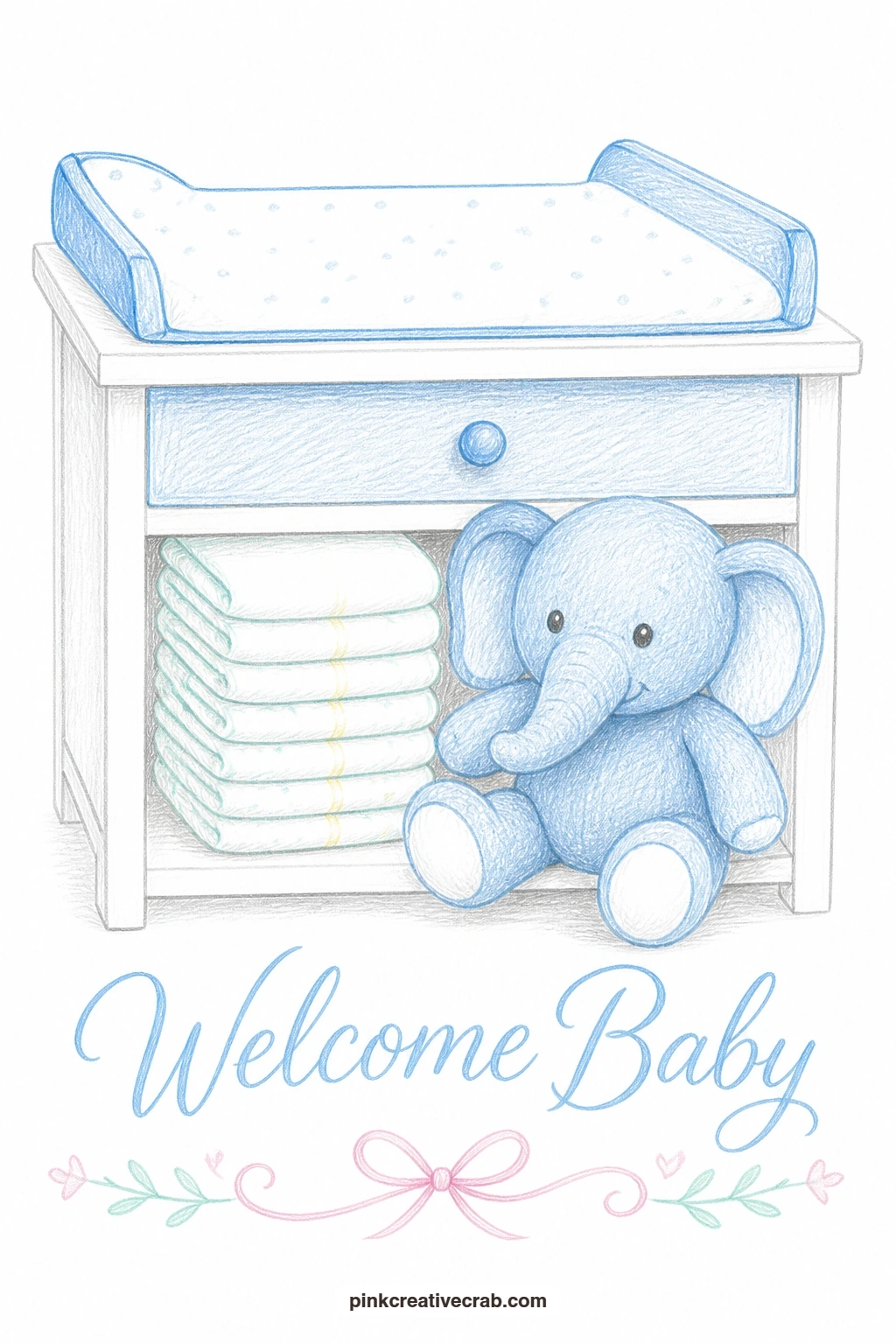
Palette: Powder Blue,Soft Grey,Warm White,Cream
Draw the pram body first in navy or soft grey, keeping it the same simple shape used in earlier pram ideas, since the balloons are what make this version feel celebratory rather than everyday. Tie three or four balloons to the handle with thin curved strings, each balloon a different pastel, pink, mint, lemon yellow, so the handle becomes the brightest point on the page.
Balloons need a highlight to read as round and shiny rather than flat circles. Leave a small curved sliver of bare white paper near the top of each balloon untouched by pencil, which does nearly all the work of making them look inflated.
Keep the strings slightly curved rather than perfectly straight, crossing over each other once or twice, which feels more like real balloons bunched together than a diagram.
If you want a quicker version, two balloons instead of four still read clearly and take about half the time, saving detail for a fuller bunch another time.
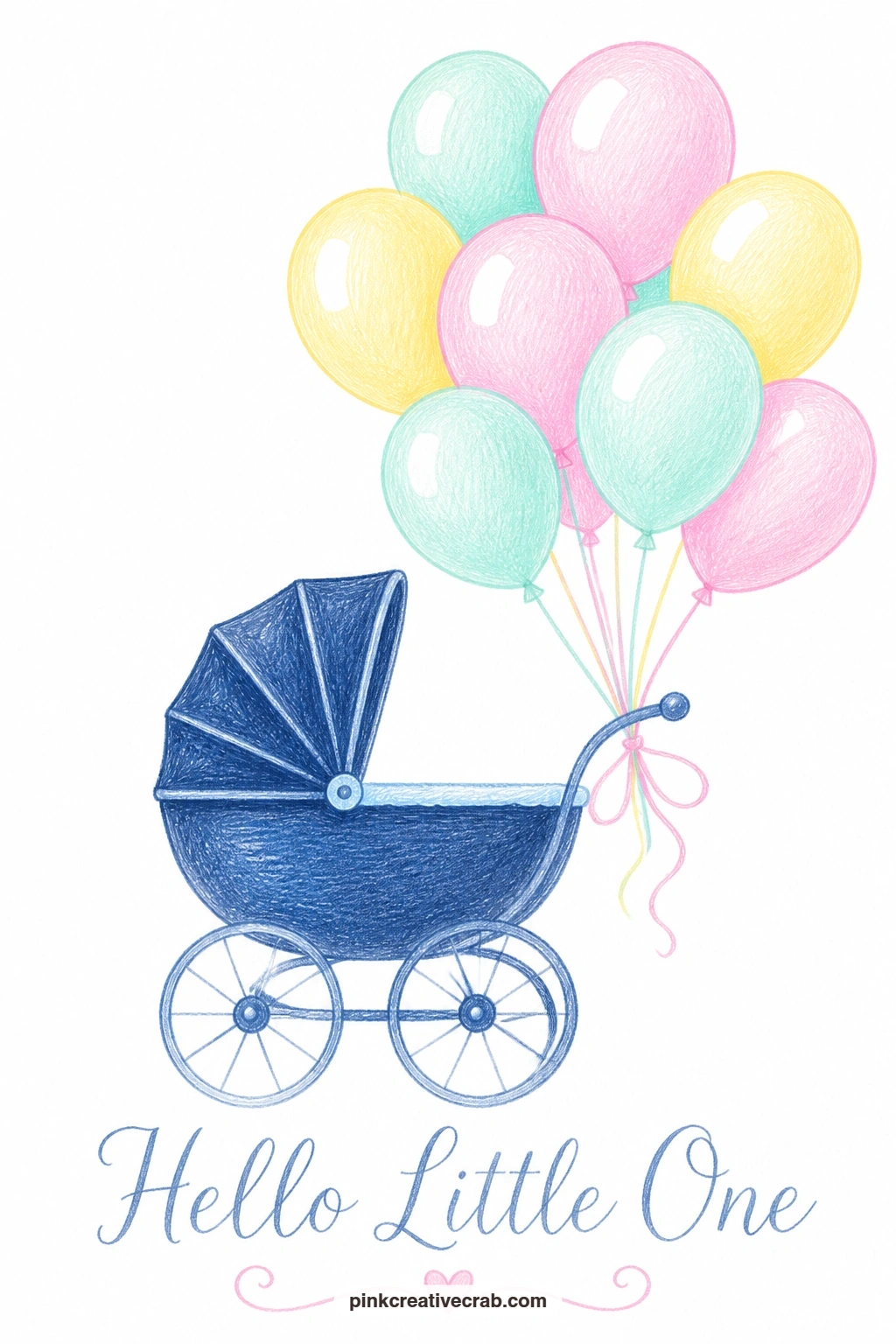
Palette: Navy,Soft Pink,Mint,Lemon Yellow
Start with the patchwork quilt beneath the baby, a simple grid of small squares in alternating soft pink, mint and cream, drawn with a light ruler line grid first if straight edges matter to you. The swaddled baby sits on top as one rounded tapered shape, wider at the head end and narrowing toward the feet, exactly like a wrapped burrito.
Only the face shows at the top, kept small and peaceful, while the swaddle fabric itself gets a few soft diagonal fold lines wrapping around the tapered shape to suggest the wrap without drawing every layer of fabric.
The easy mistake is making the swaddle shape too straight-edged, which looks stiff rather than cozy. Keep every outline slightly curved and soft, almost like a smooth stone shape rather than a cylinder.
Once this one works, try it again with a striped swaddle instead of plain fabric, or swap the patchwork quilt for a single solid color blanket for a calmer version.
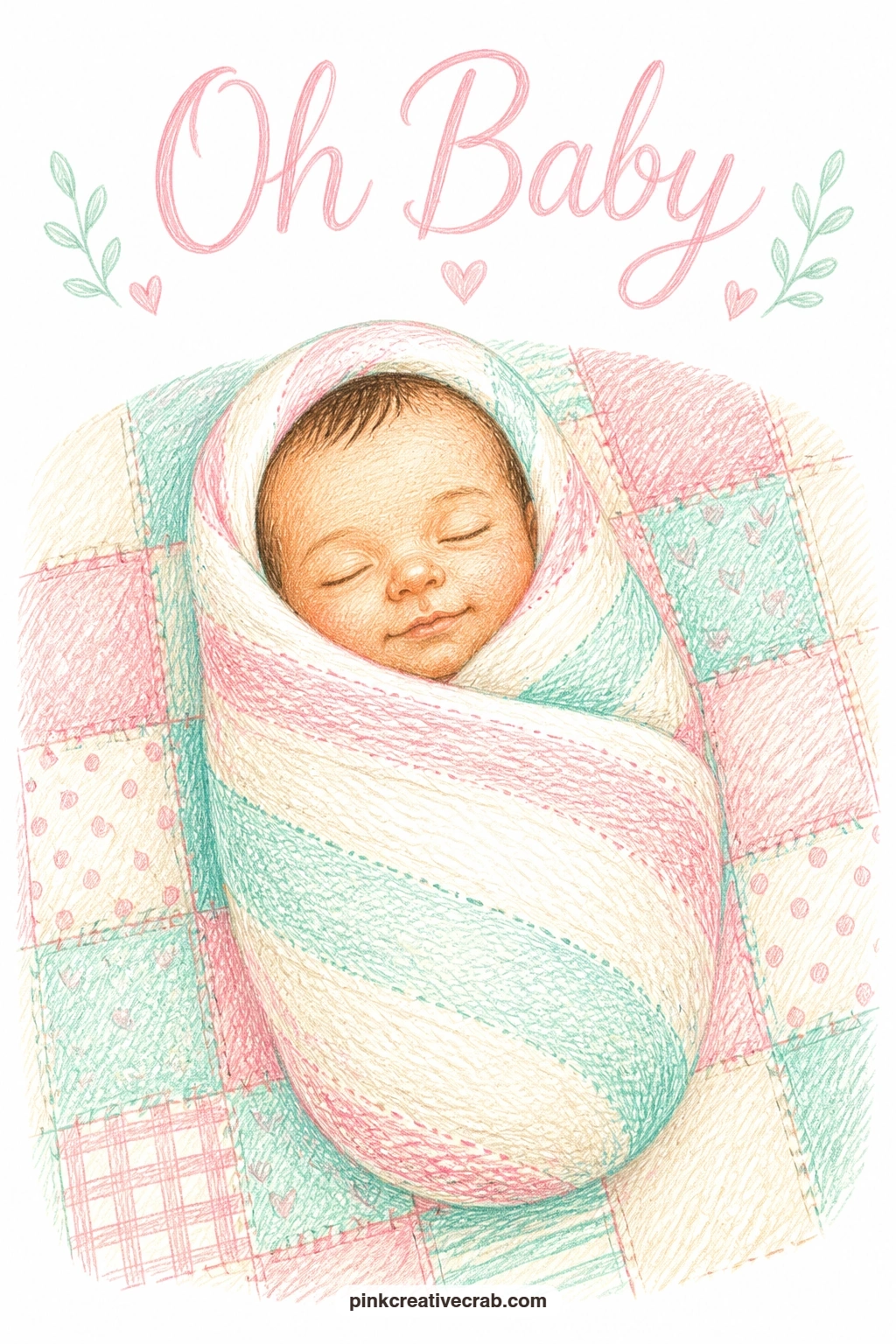
Palette: Soft Pink,Mint,Cream,Soft Grey
Draw the crib rail first as a simple horizontal line with a few vertical bars, since both toy animals will lean against it from outside. The giraffe’s long neck curves in from one side, its head and two small horns reaching just over the rail, while the elephant’s trunk and ears peek in from the other, giving the scene a balanced left and right.
Pattern the giraffe with small irregular patches in warm tan rather than a perfect grid, since real giraffe print is always uneven, and keep the elephant a soft powder blue or grey with simple round ears.
If both animals end up looking the same size and height, the scene reads flat. Make the giraffe taller and the elephant lower and rounder, which naturally varies the silhouette along the crib rail.
Keep the crib itself mostly bare white so the two colorful toy animals stay the clear focus of the card front.
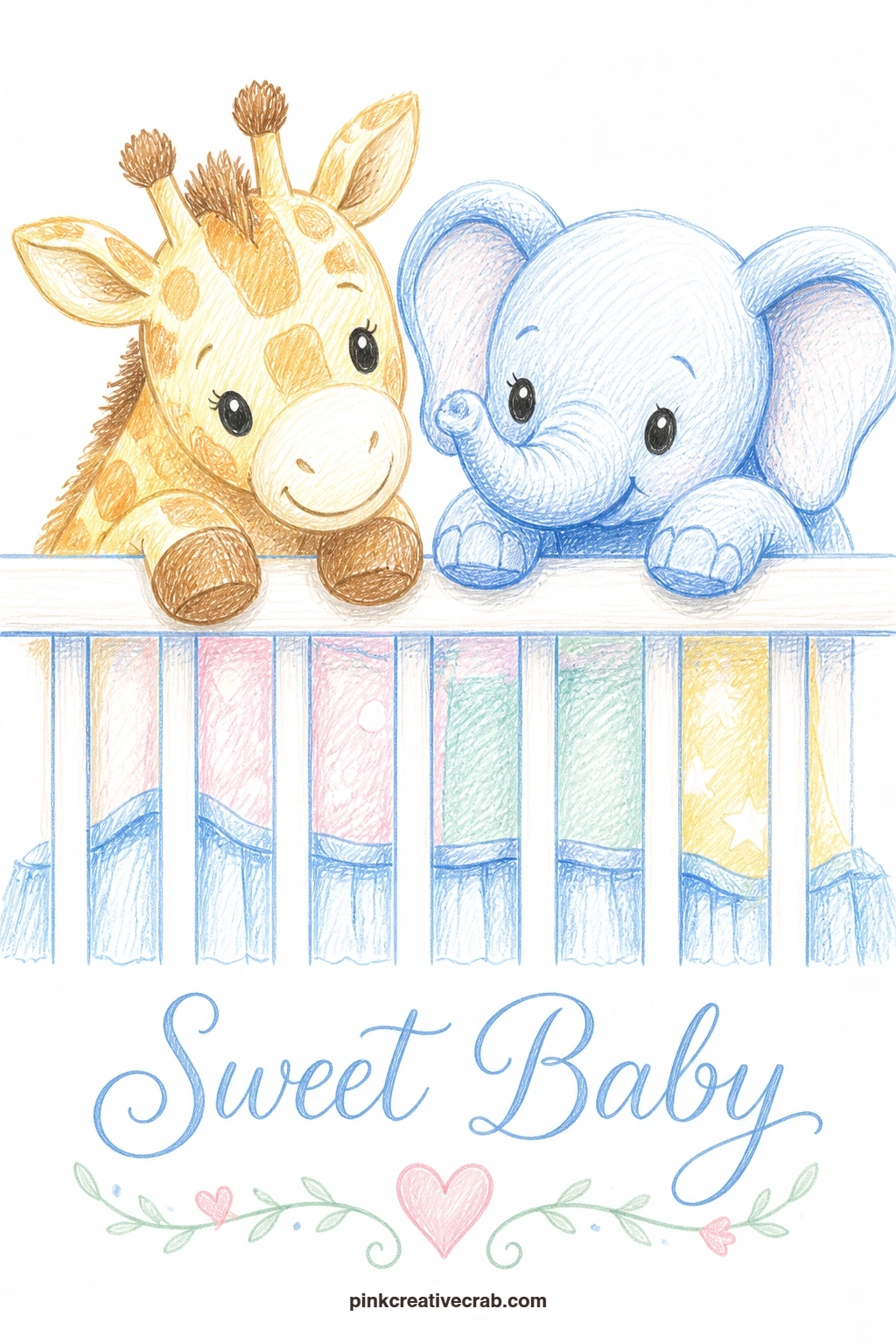
Palette: Warm Tan,Powder Blue,Soft Grey,Warm White
Draw the shelf as a single flat horizontal line first, since every object in this scene lines up along it. Group two or three stuffed animals together toward one end, varying their heights and shapes, a round bear, a taller rabbit, so the lineup has some rhythm rather than a row of identical blobs.
The tiny pair of overalls hangs from a small peg at the other end of the shelf, denim blue with two simple straps and one round button, breaking up the soft toy colors with something sturdier and more structured.
Shelves of objects often look cluttered if everything is the same size and spaced evenly. Let the stuffed animals overlap slightly and vary the gaps between objects, tighter in one spot, looser in another, the way a real shelf actually gets arranged.
If denim blue feels too dark against the pastel toys, a soft chambray grey-blue keeps the overalls readable without breaking the palette.
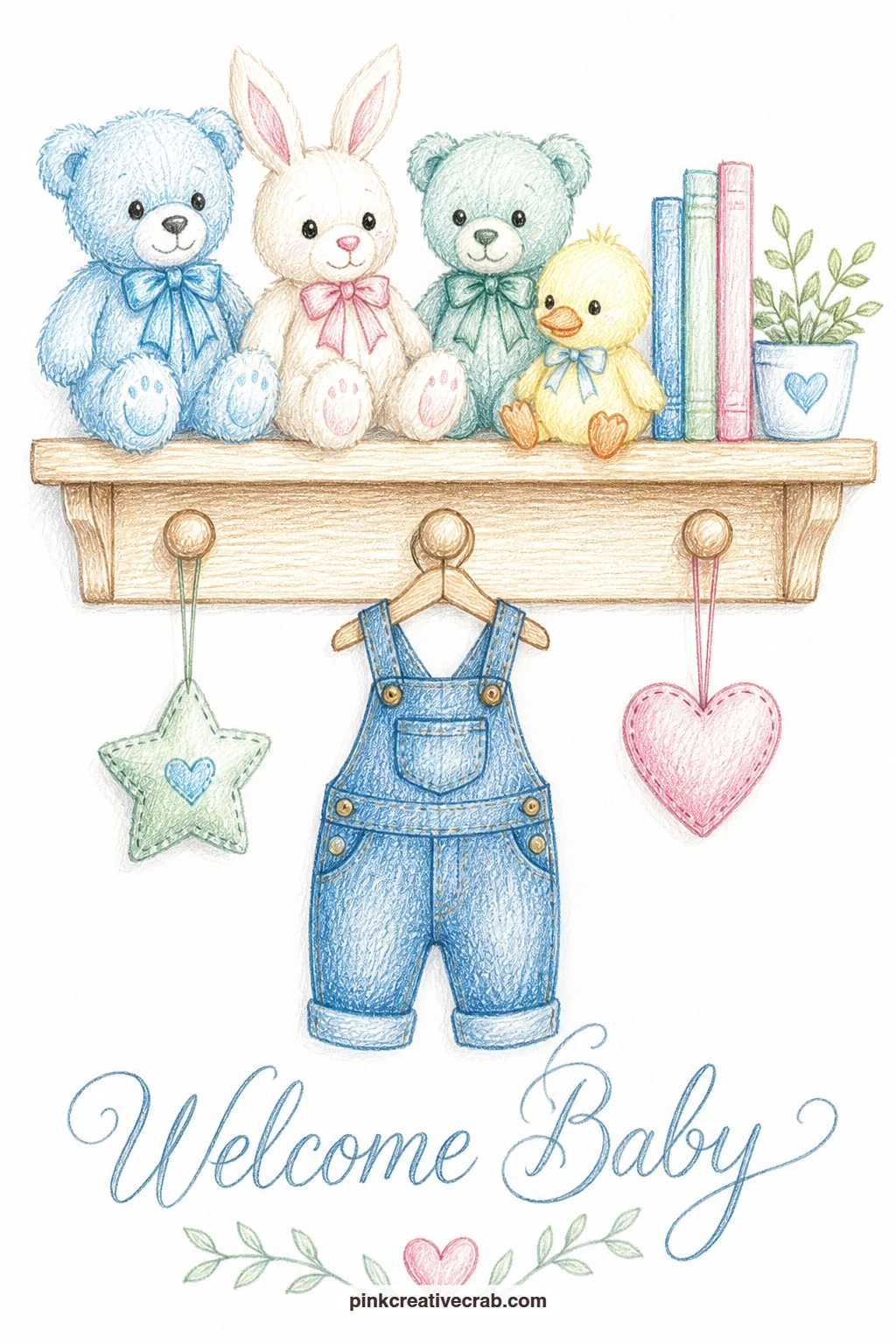
Palette: Soft Pink,Denim Blue,Cream,Warm Brown
Build the sofa and dad’s reclined upper body first as one large soft shape, since the baby napping on top needs a believable surface to rest against. Keep his shirt in a plain soft color with a few fold lines across the chest and shoulder to suggest the fabric settling under the baby’s weight.
The newborn lies with its whole body stretched along the chest, head turned to one side, which is easier to draw convincingly than a baby lying flat on its back since the curve of the body naturally follows the chest beneath it.
If figures feel difficult, crop the scene at dad’s shoulders and keep his face out of frame entirely, which keeps all the attention on the peaceful baby and avoids the hardest part of figure drawing.
A soft cream or mint blanket draped loosely over both finishes the scene and gives you one more spot of color to balance the composition.
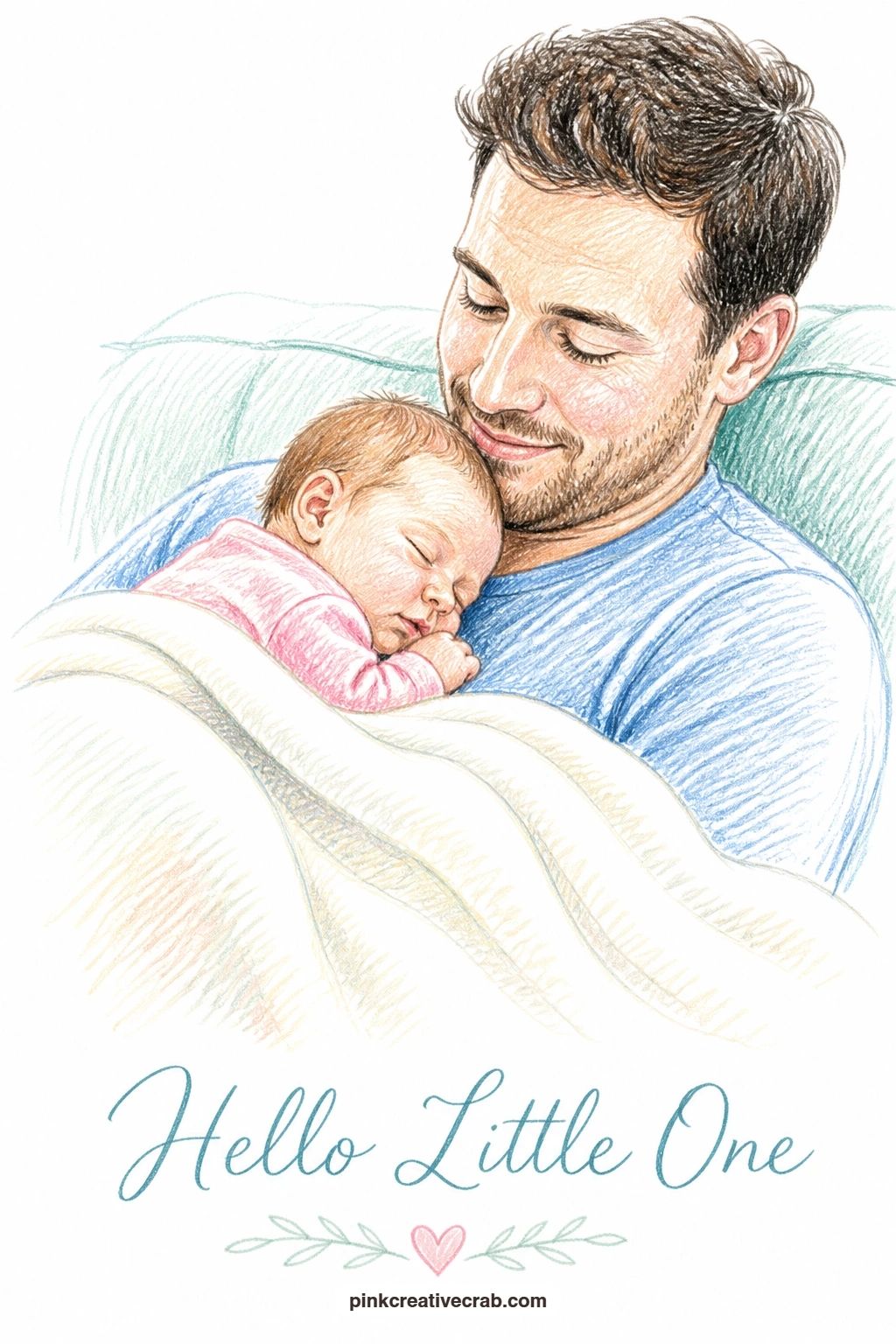
Palette: Soft Pink,Mint,Cream,Soft Grey
Draw the hedge first as a loose rounded mass of short overlapping green strokes, kept deliberately uneven since a hedge is never a smooth shape. The knitted blanket drapes over the top, its folds following the curve of the hedge beneath it rather than hanging in straight lines the way fabric on a flat line would.
Knit texture here covers a much bigger area than the earlier booties or hat, so work in rows of short strokes across the whole blanket shape, slightly varying the pressure so it does not look perfectly uniform.
Sunlight works well as the extra detail for this one: decide it falls from one side, then leave the top-facing folds of the blanket noticeably paler than the folds that curve downward into shadow against the hedge.
If a full hedge feels like too much green to fill in, a single large shrub works just as well and takes a fraction of the time.
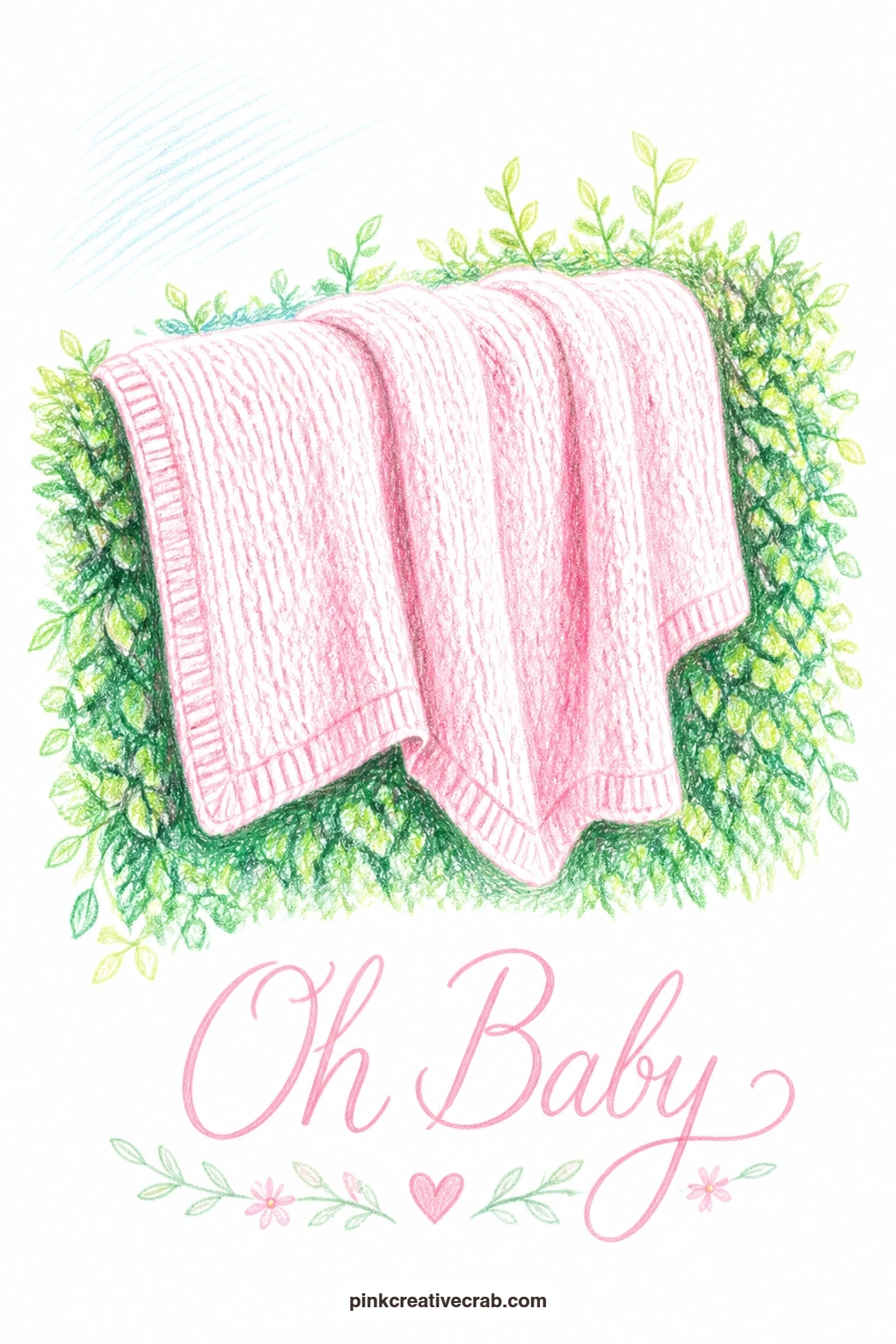
Palette: Sap Green,Soft Pink,Cream,Lemon Yellow
Draw the window first with a few diagonal streaks of rain running down the glass, using a very light grey pencil so they stay subtle rather than turning the whole window dark. The mother’s seated shape and the baby she holds go just inside, kept soft and rounded with no sharp detail in the face.
Light here comes from the grey window itself, cool and soft, which means her far side and the baby’s blanket both take a slightly cooler, greyer tint than they would in a sunny scene, giving the whole picture a quiet, hushed feeling.
Rain streaks are easy to overdo. Draw no more than six or seven lines across the glass, all running the same gentle diagonal, rather than filling the whole pane, which keeps the window readable rather than scribbled.
If grey days are not the mood you want today, the same pose works just as well with warm afternoon light instead, simply swap the cool grey for soft lemon yellow around the window.
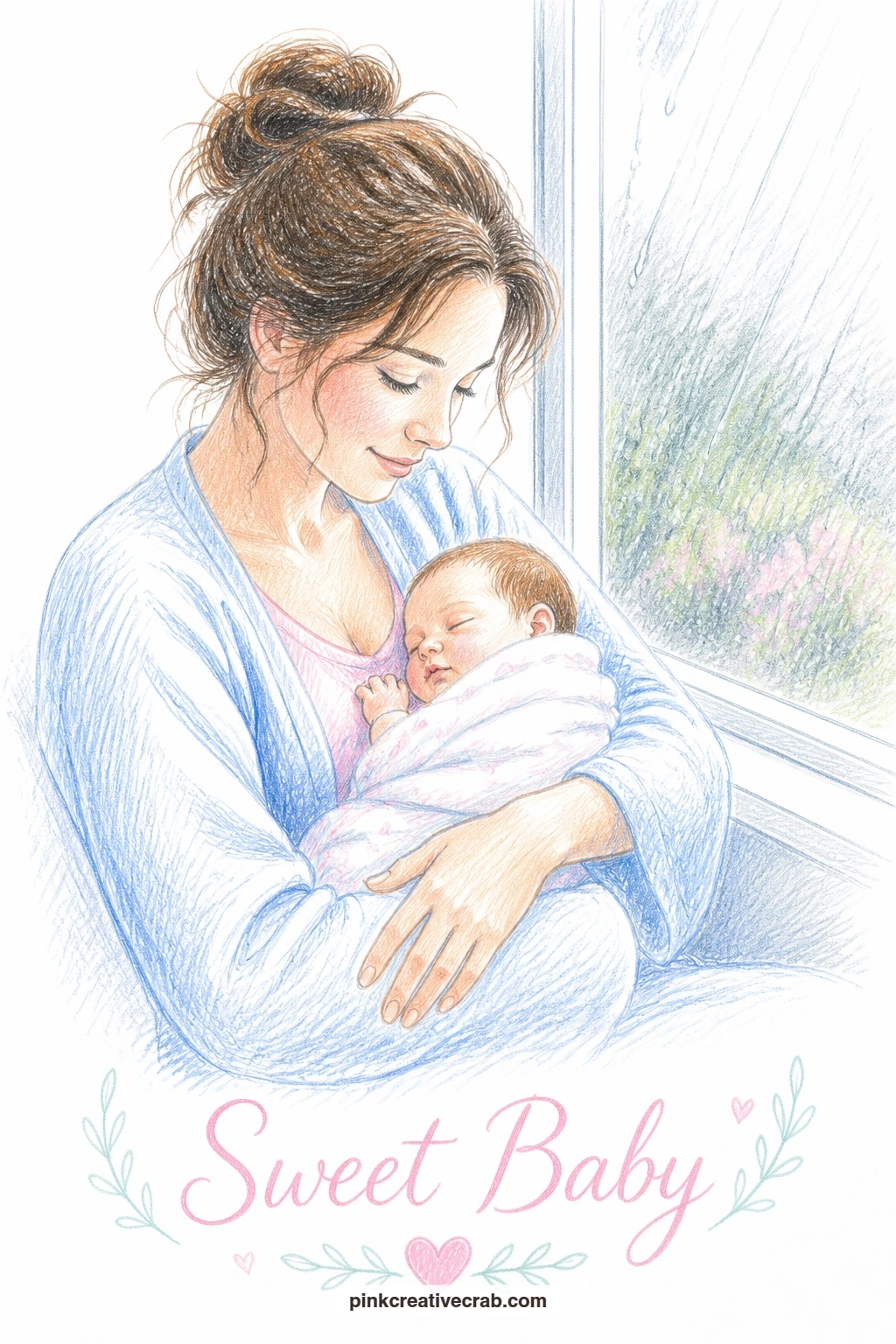
Palette: Soft Grey,Powder Blue,Soft Pink,Cream
Draw the tree’s canopy first as a loose cloud of green strokes overhead, since the pram and picnic blanket both need to sit clearly within its shadow. The pram parks to one side, in the same simple navy or cream shape used earlier, while the checked picnic blanket spreads out beside it in a grid of soft pink and cream squares.
Shade works as the detail to get right here: keep the grass directly under the tree a cooler, deeper green, while grass just outside the shade’s edge turns a brighter, warmer green, which is the single change that makes the shade read convincingly.
If a full tree canopy feels like a lot to fill in, a single low branch reaching into frame from one corner suggests the same dappled shade with far less drawing.
Keep the picnic blanket’s checks loose and slightly uneven rather than ruled perfectly, since a hand-drawn grid always looks warmer than a mechanical one.
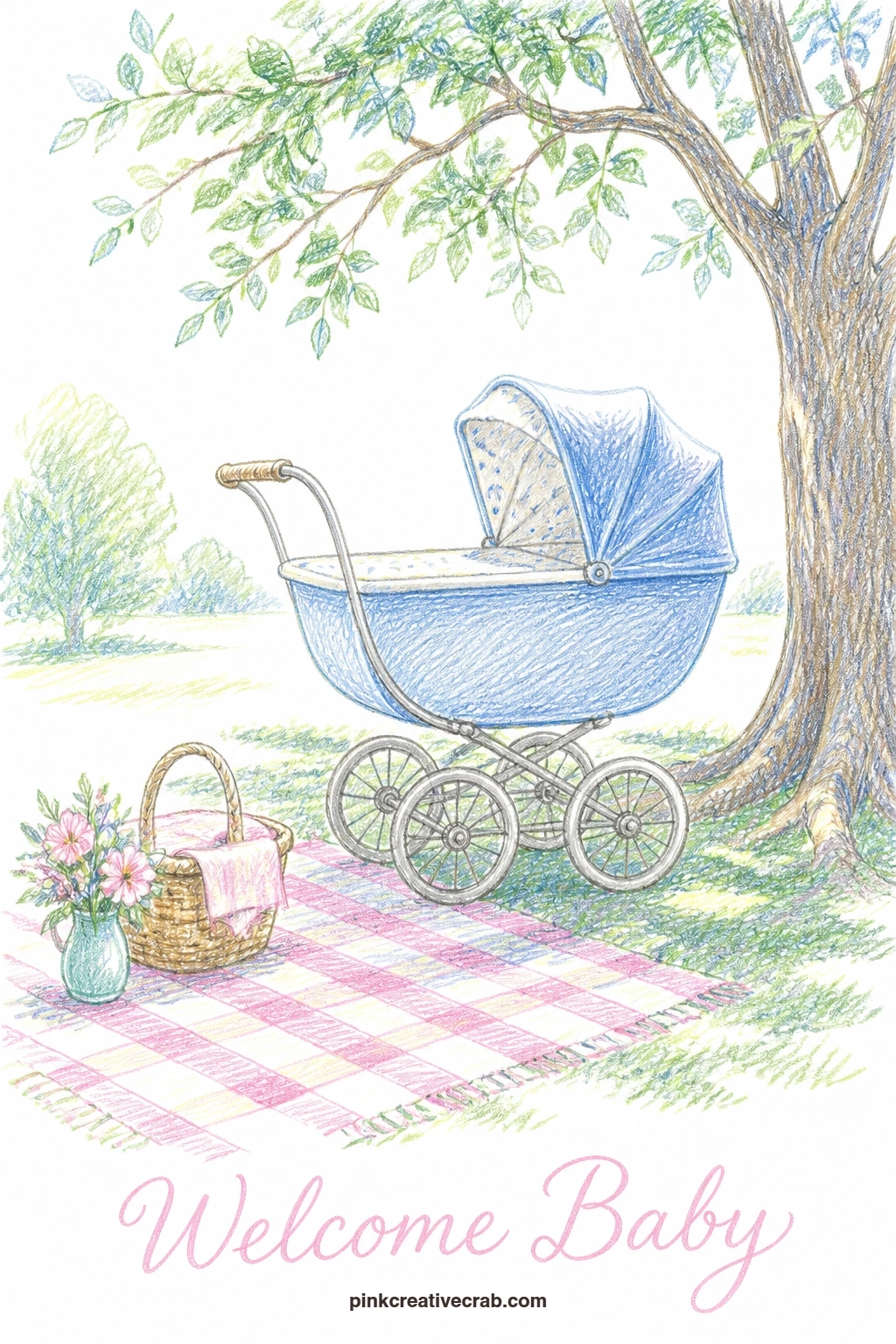
Palette: Sap Green,Soft Pink,Cream,Navy
Lay the pastel quilt down first as the base, a few soft squares of color in pink and mint, then place the pacifier and teething ring on top as the first two small objects, each a simple rounded shape with a tiny loop handle. Keep both objects small compared to the quilt beneath them so the scene reads as still life rather than crowded clutter.
The duckling toy sits just beside them, round and yellow with a small orange beak, textured with the same soft loop strokes used for the lamb and teddy earlier in this list to suggest its plush fur without hard outlines.
The teething ring’s plastic ring shape can look flat if left one solid color. Add a thin bright highlight line along its curve, leaving a sliver of bare white paper, which gives it a glossy plastic feel instead of a dull flat one.
If yellow duckling toys feel repetitive after the earlier rubber duck idea, swap it for a small plush chick in soft cream instead.
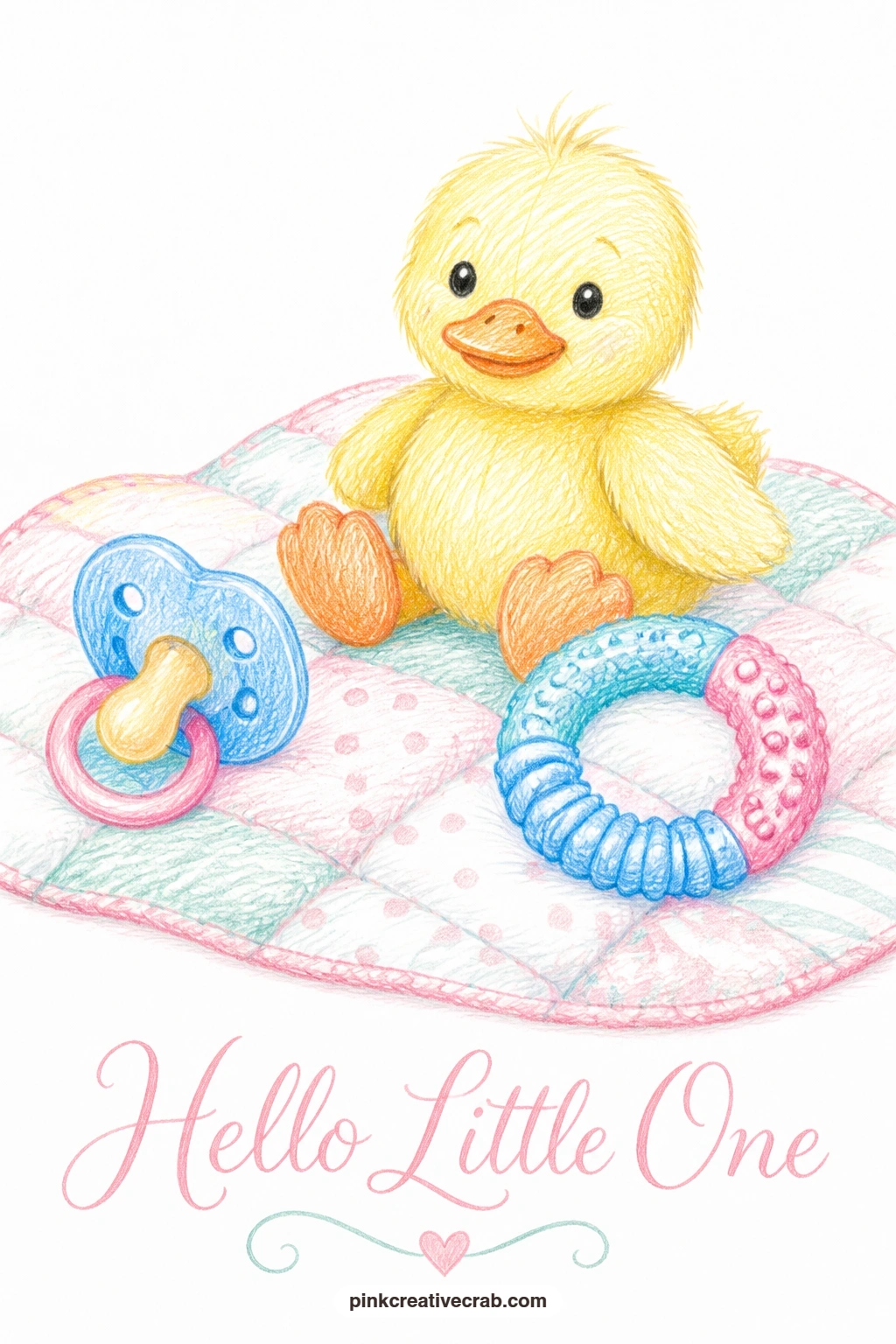
Palette: Soft Pink,Mint,Lemon Yellow,Warm White
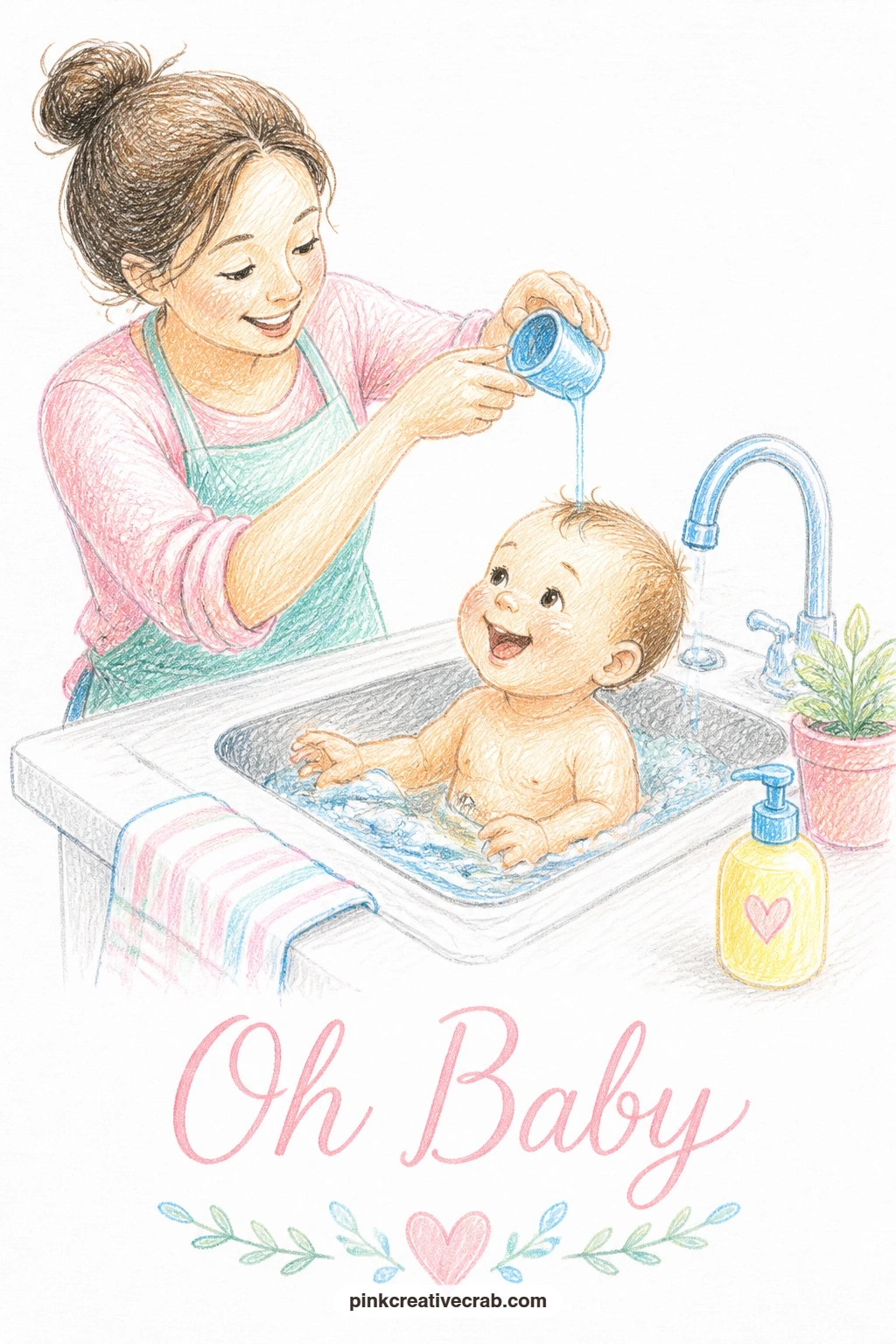
Draw the kitchen sink first as a simple rounded basin shape, since the baby sitting inside it needs that boundary established before anything else. The baby sits propped up with both hands on the rim, round-bellied and small, while the parent’s hand and arm reach in from one side holding a small cup tipped to pour.
A thin stream of water falling from the cup is the detail that sells the whole action: a few short, nearly straight light blue lines falling from the cup’s lip toward the baby’s shoulder, with a tiny splash mark where it lands.
Water streams are easy to overdraw into a solid blob. Keep the stream thin, just two or three parallel lines, and leave gaps of white paper between them so it reads as flowing water rather than a solid rod.
If a full sink feels fussy to draw, a round baby bath tub works as a swap and needs far less background detail around it.
Palette: Powder Blue,Soft Pink,Warm White,Cream
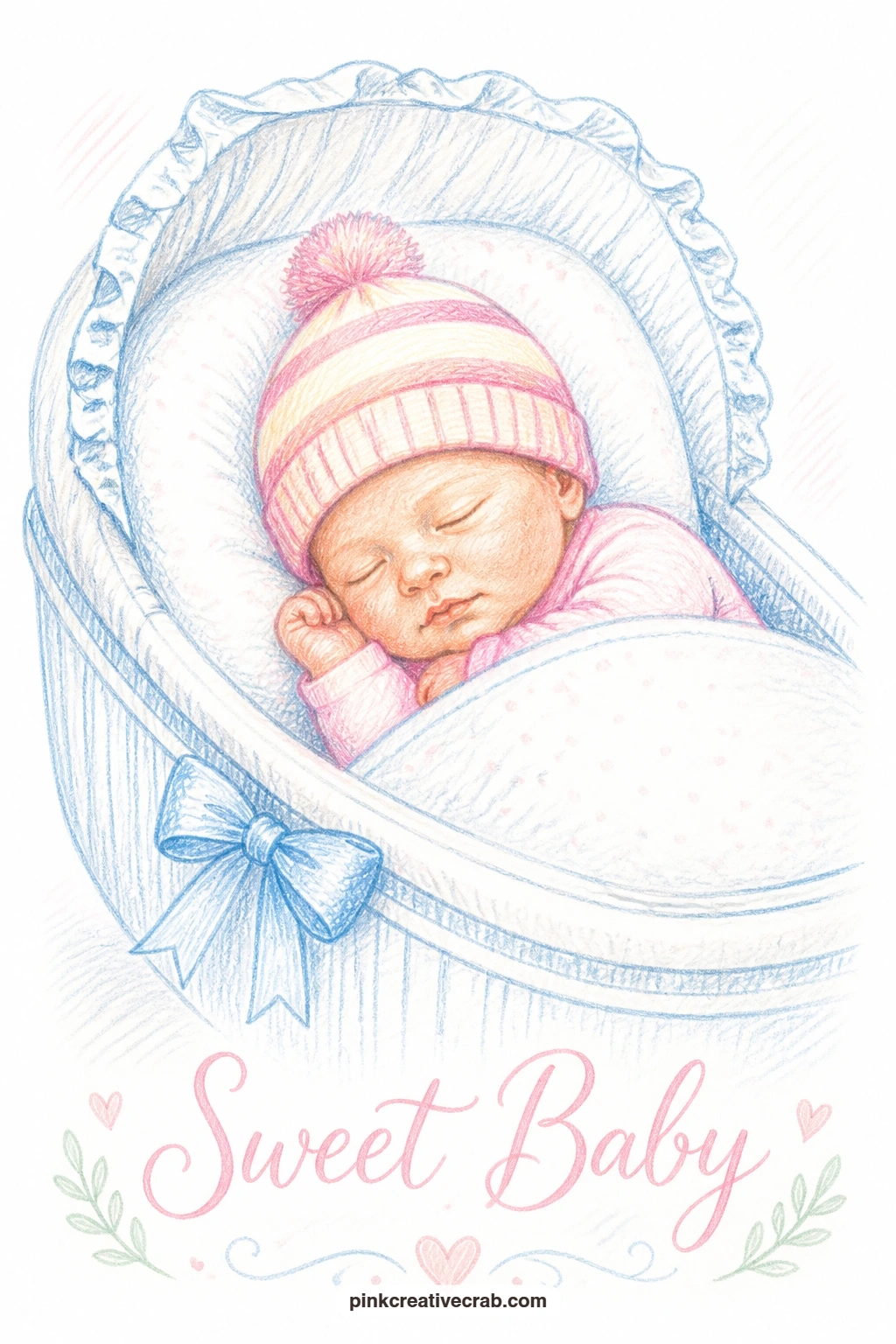
Tuck the newborn into the bassinet first with just the head and shoulders visible above the blanket line, since the striped hat is the real subject and needs the simplest possible setting around it. Keep the bassinet itself loosely sketched, just enough woven texture at the edges to read as a basket without pulling focus.
The hat’s stripes run horizontally around the rounded head shape, alternating soft pink and cream, or mint and powder blue, with each stripe following the curve of the head rather than staying flat, which is what makes a striped hat look like it is actually wrapped around something round.
Curved stripes are the part that trips people up. Lightly pencil the head’s curve first, then draw each stripe as a line that bends to match that curve before adding color, rather than drawing straight bands and hoping they look right.
Finish with a small knitted pompom at the very top in a contrasting color, the brightest point on the whole card front.
Palette: Soft Pink,Mint,Cream,Powder Blue
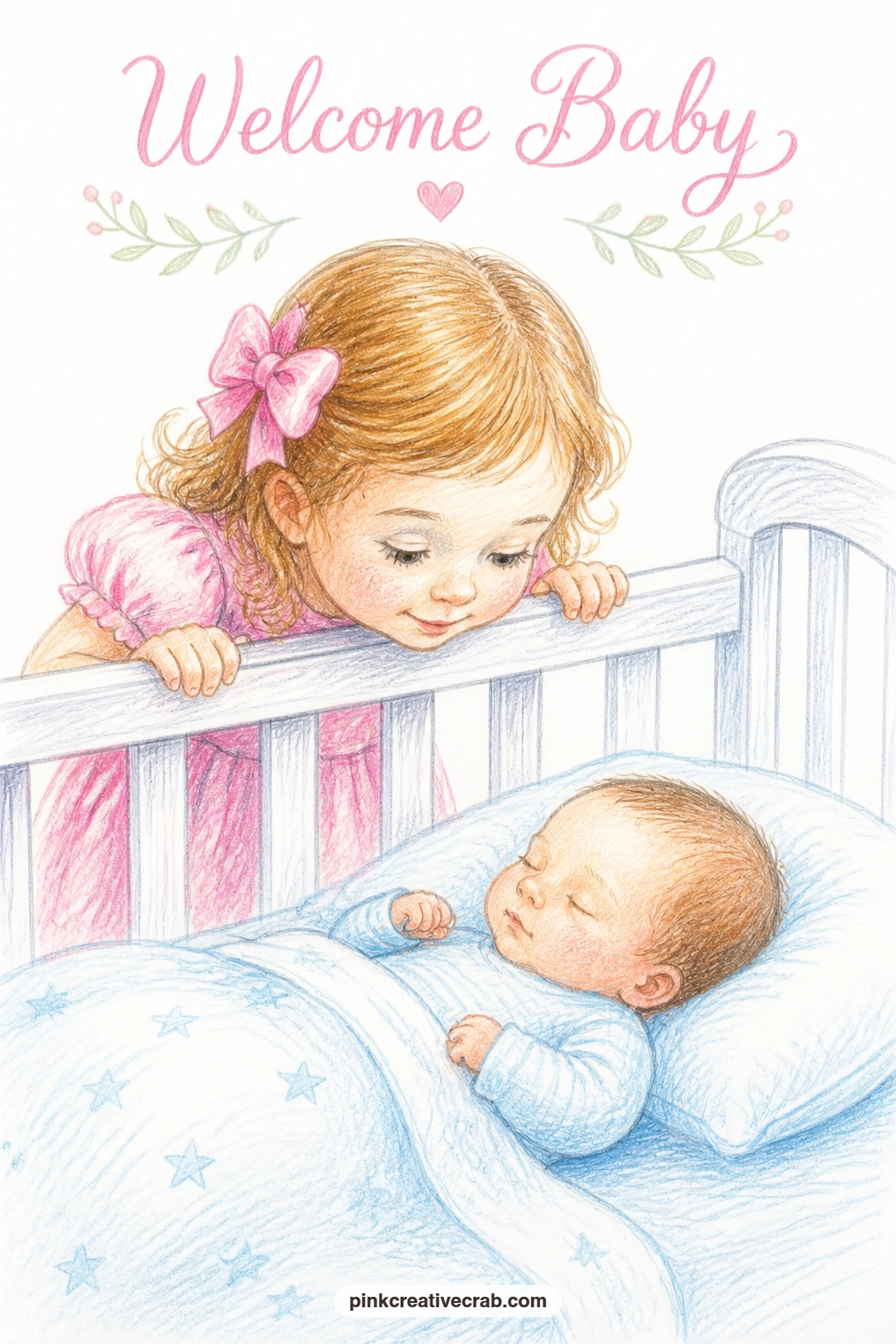
Draw the crib first, keeping it the same simple barred shape used throughout this list, with the newborn resting quietly inside. The older sister leans in from one side, hands resting on the crib rail and chin tipped up slightly to peek over, her height drawn noticeably taller than the crib’s rail to make the age difference between the two children read clearly at a glance.
Keep her expression soft and curious rather than too wide a smile, since a gentle, quiet curiosity matches the hush of a nursery scene better than an excited pose. A simple dress or overalls in soft pink or mint keeps her clothing uncomplicated.
If figures of different ages feel hard to size correctly, measure in crib-rail heights: the newborn’s head sits well below the rail, while the sister’s head rises a full rail-height or more above it.
For a second version once this one works well, try her holding a small toy out toward the crib instead, which adds a tiny gesture of welcome to the same simple pose.
Palette: Soft Pink,Mint,Warm Brown,Cream
What to Do Next
Pick one scene that matches the card you need today, sketch it lightly in pencil first, then build the color in soft layers on a sheet of bright white cardstock sized for a folded card front. Keep your first attempt simple, a crib, some socks, a single toy, and save the fuller garden or figure scenes for once the basic shapes feel comfortable.
Frequently Asked Questions
What colored pencils work best for a newborn baby card?
Any artist-grade colored pencil set works well, since the soft pastel palette used in these cards needs smooth blending at low pressure. Look for pencils described as soft or buttery rather than hard, as they layer more easily for gentle nursery colors.
How do I keep a nursery card scene from looking cluttered?
Leave generous bare white paper around your main subject rather than filling the whole card front. One crib, pram or toy drawn large with a small supporting detail reads far more calmly than several objects packed edge to edge.
What is the easiest newborn baby card idea for a first try?
Tiny socks on a line or a pair of knitted booties on a windowsill are the simplest starting points, since both rely on just one or two soft shapes and basic knit texture rather than any figure or perspective work.
How do I make colored pencil look soft instead of waxy on a card?
Work in light layers with short directional strokes rather than pressing hard in one pass, building color gradually. A light base layer in white or cream pencil underneath your main color also softens the finish.
Can I draw figures like a parent and baby if I am not confident with people?
Yes, crop the figure at the shoulders or waist so only an arm, hand or torso shows. Several ideas in this list use that trick, which keeps focus on the baby and sidesteps the hardest parts of figure drawing.
Have any thoughts?
Share your reaction or leave a quick response — we’d love to hear what you think!
-
 0
-
0
-
0
-
0
-
0
-
0


