

A winter sketchbook does not need a single candy cane to feel like the season. I love these pages because every one is a little story: someone pulling a sled, a fox crossing a field, smoke curling from a chimney while skis lean by the door. That quiet narrative pull is what makes winter such good sketchbook material, far beyond the usual holiday motifs.
Below you will find 37 scenes built for watercolor with white gouache snow, cool blues and greys warmed by one small accent color per page. Pick whichever one catches your eye first and you can have it finished before the light changes outside your window.
Using these images: free for personal projects such as printing, coloring, cards, journals and gifts. Handmade items that include them may be sold up to 30 pieces per design. More than that is commercial use and is not permitted, and neither is selling or sharing the images themselves or passing them off as your own. Please ask before any other use.
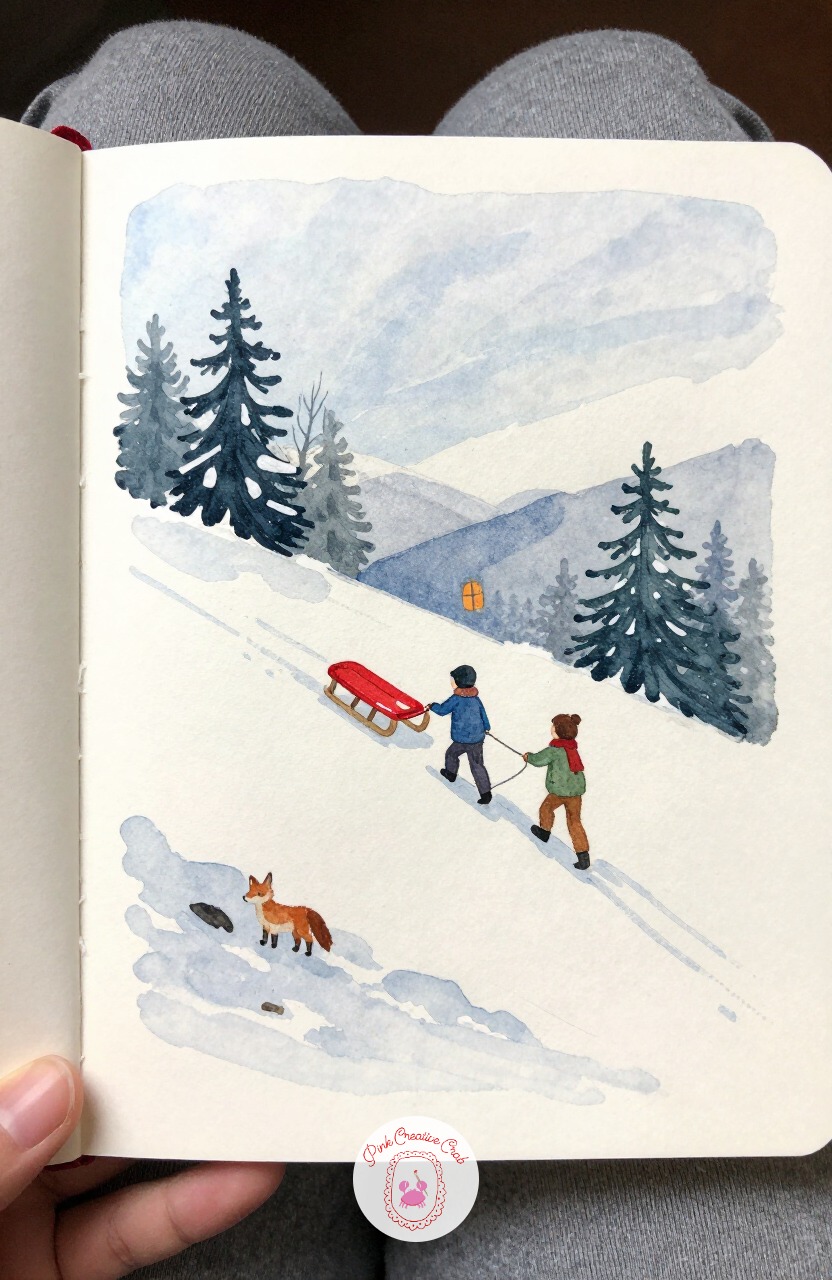
Start here if you want an easy warm-up: two small figures leaning into a rope, dragging a red sled up a pale hill. Keep the figures simple, just wedge-shaped coats and round hood shapes, no faces needed at this size.
Lay the hill first as one flat wash of pale blue-grey, then drop in the figures and sled while the paper is still slightly damp so the edges stay soft. Save the rope and the sled’s red for the very last step, painted dry and crisp so it pops against the loose snow behind it.
One concrete tip: paint the sled’s red before you varnish anything else in your head as the accent, it should be the brightest note on the page.
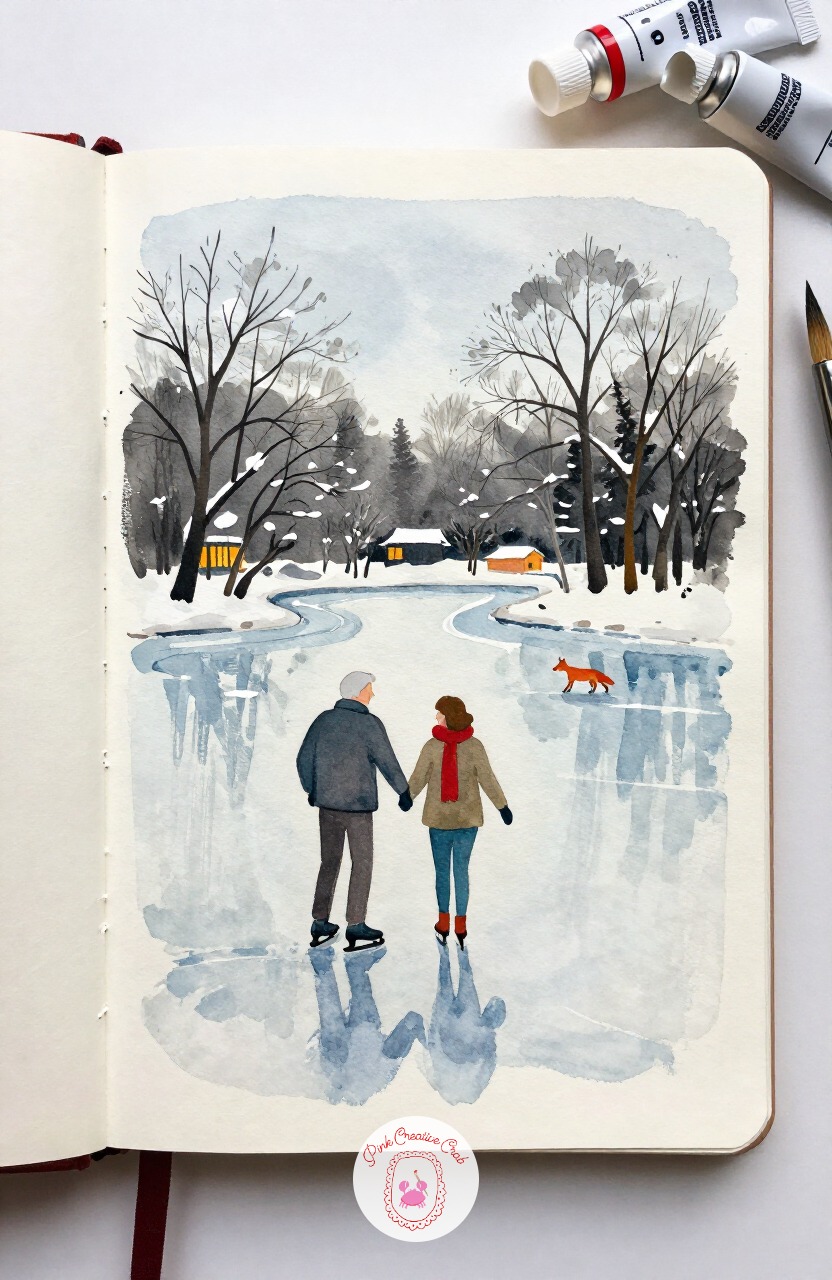
Following that sled up the hill, let’s come back down to flatter ground for a pond scene. An old couple skating hand in hand works beautifully in watercolor because the ice itself can be one smooth wash reflecting a grey sky.
Figure proportion matters here: keep both skaters about four heads tall, drawn small and leaning slightly forward, with the woman’s scarf as your one warm accent trailing behind her in the cold air. Paint the ice first as a pale blue-grey puddle, then drop the two figures in once it has dried so their edges stay clean against the softer background.
Tip for today: tilt both bodies at the same forward angle so the skating motion reads instantly, even at this small size.
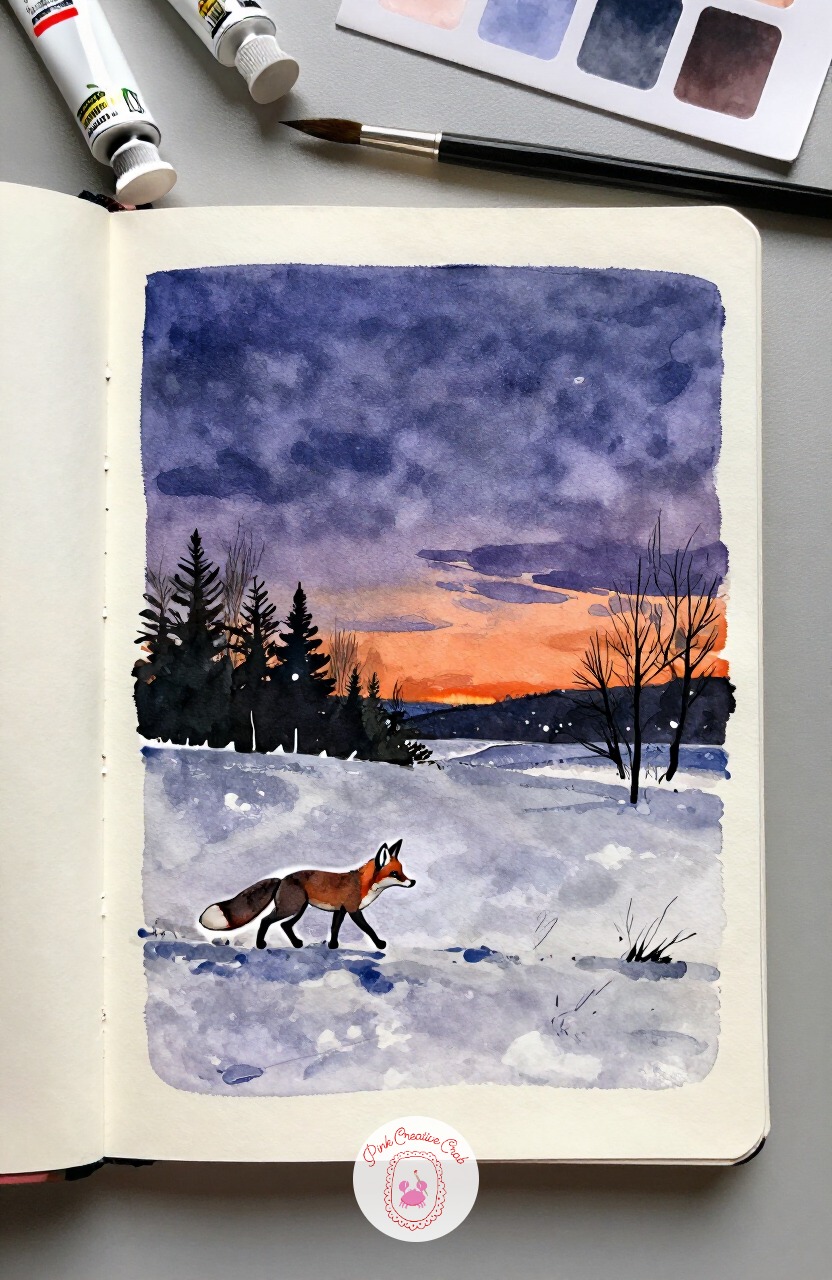
From the pond’s quiet motion, shift to something wilder: a fox picking its way across an open field as the light fades. This is a perspective and light idea, since dusk changes everything about how you lay in color.
Put the horizon line low, maybe a third up from the bottom, so the field dominates the page, and let the sky above it glow a deep violet-blue fading to a thin band of warm orange at the horizon, which becomes your single accent color. The fox itself stays small and dark against that glow, just a silhouette with one tufted tail, with its own long blue shadow stretching toward the viewer since the light source sits low and behind it.
Paint the sky wash first, then the field, then drop the fox in last with a tiny brush once everything else is dry.
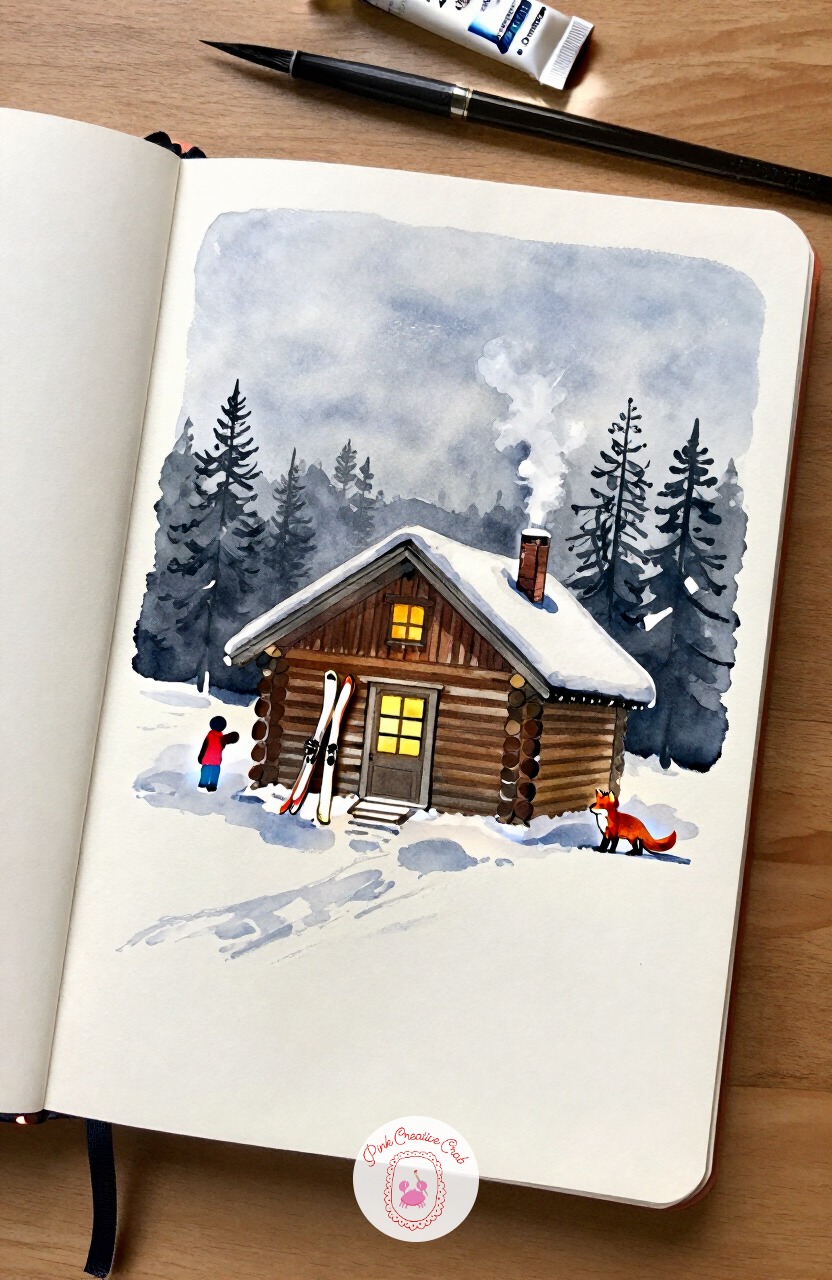
After that open field, bring the eye in close to a warm little building: a log cabin with a pair of skis propped against its porch and smoke curling from the chimney. This one is about the first three marks, since a cabin can go wrong fast if you overthink the structure.
Put down the roofline first as one confident triangle, then the wall beneath it as a simple rectangle, then the chimney as a thin vertical before anything else. Leave the window glow, the smoke and the skis for last, painting the window in warm amber gouache or thick paint so it reads as the one bright accent against all that cool snow and timber.
Quick tip: keep the smoke as a soft dry-brush wisp, never a hard outlined shape, or it will look solid instead of drifting.
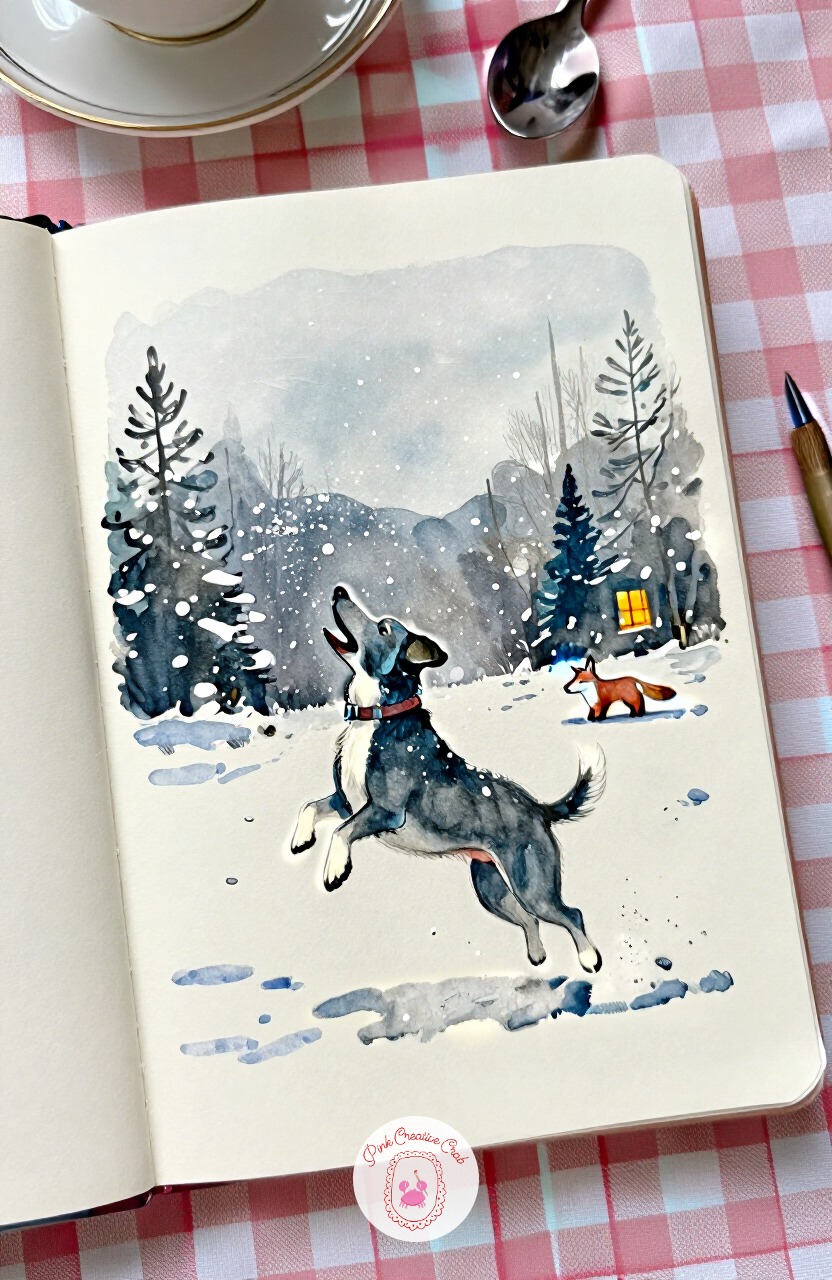
Cabins and fields can wait a page, because a dog mid-leap catching snowflakes is pure joy to paint and a nice change of pace. This idea leans on the usual mistake beginners make with jumping dogs: flattening the pose so it reads as standing rather than airborne.
Fix it by arching the back slightly and tucking the front paws up rather than letting all four feet point down, with the head tipped back and mouth open toward the falling snow. Keep the dog’s coat a simple two-tone wash, cool shadow side and pale highlight side, and let your single warm accent live in its collar or tongue.
Today’s tip: paint the falling snowflakes last, flicking white gouache from a dry brush rather than drawing each one by hand.
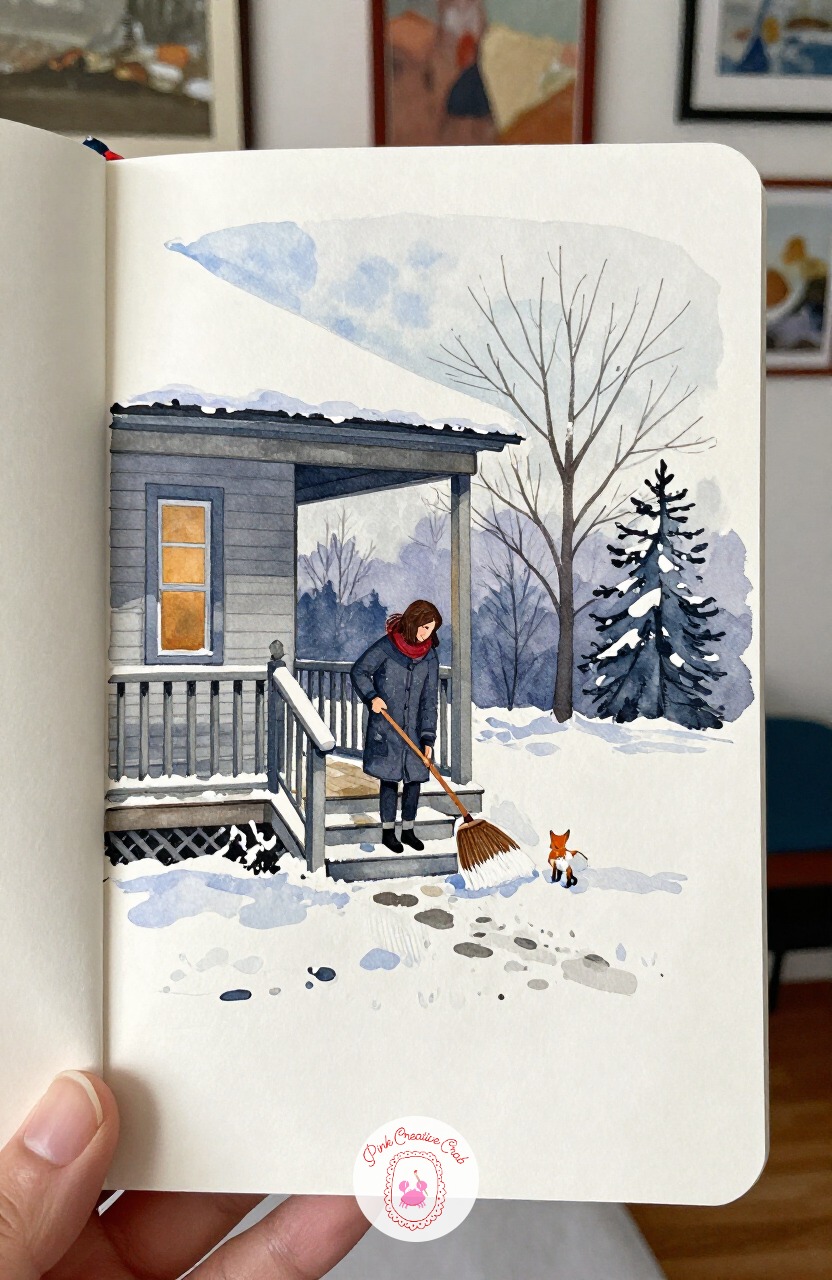
Coming down from that leaping dog, settle into a quieter moment: a woman in a thick coat sweeping snow off her porch step with a stiff broom. The ten-minute version just blocks in her shape, the step and a quick grey wash behind her.
Given forty minutes, add the texture of the broom bristles with a dry, splayed brush stroke, a pale puddle of swept snow at her feet, and perhaps a cat watching from the doorway behind her. Her scarf or mittens can carry your one warm color note against all the grey timber and white snow.
Tip: angle the broom diagonally across the step, it reads far more active than a broom held straight up and down.
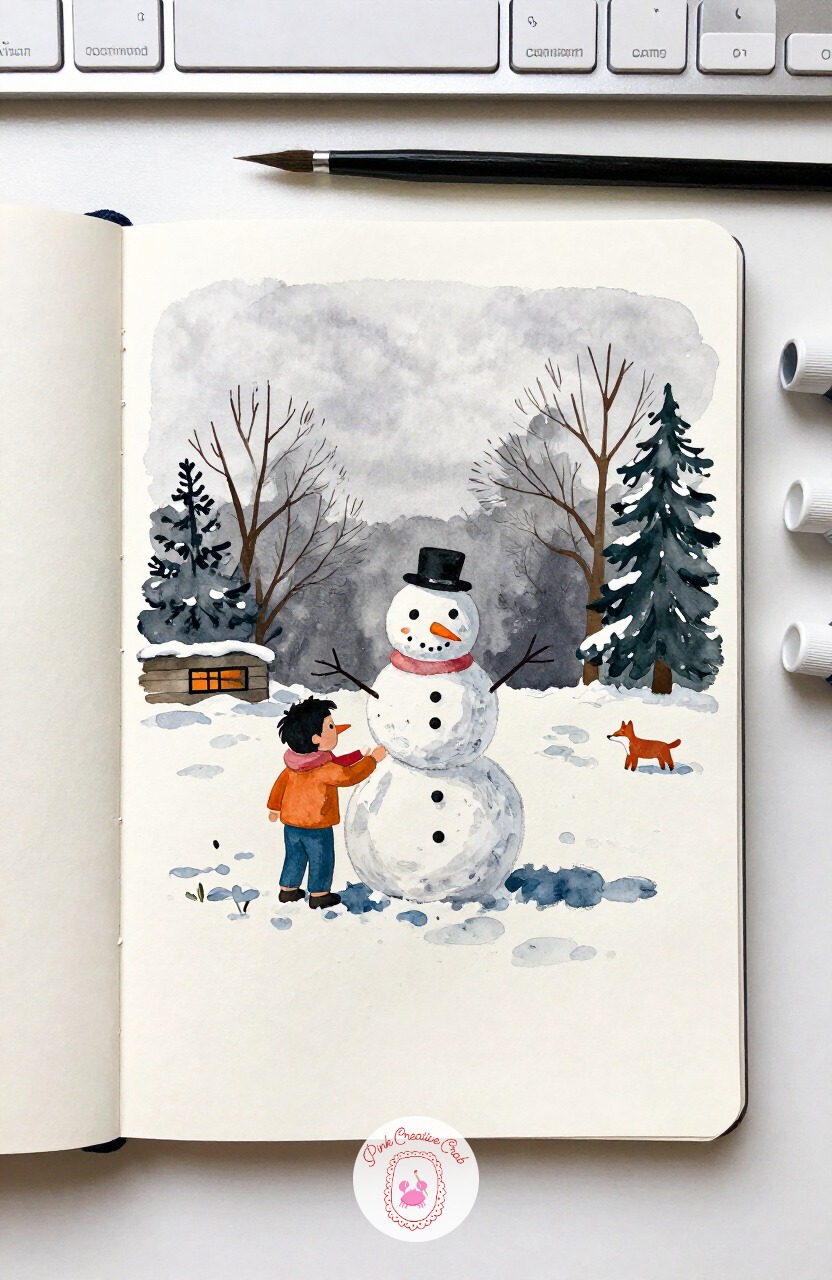
From one quiet porch to a noisier yard, two kids stacking snow into a slightly lopsided snowman makes a fun contrast. Proportion is the trick here: stack three rough circles that shrink as they rise, bottom largest, middle smaller, head smallest, and let the middle one sit slightly off-center so the whole figure leans just a touch.
That small lean is what makes a snowman charming rather than stiff. Paint the kids as simple rounded coat-shapes beside him, one reaching up with a carrot, and keep your warm accent in that carrot nose or in one child’s hat.
Tip for today: never paint the snowman perfectly round, a slightly flattened top circle always looks more convincing than a true sphere.
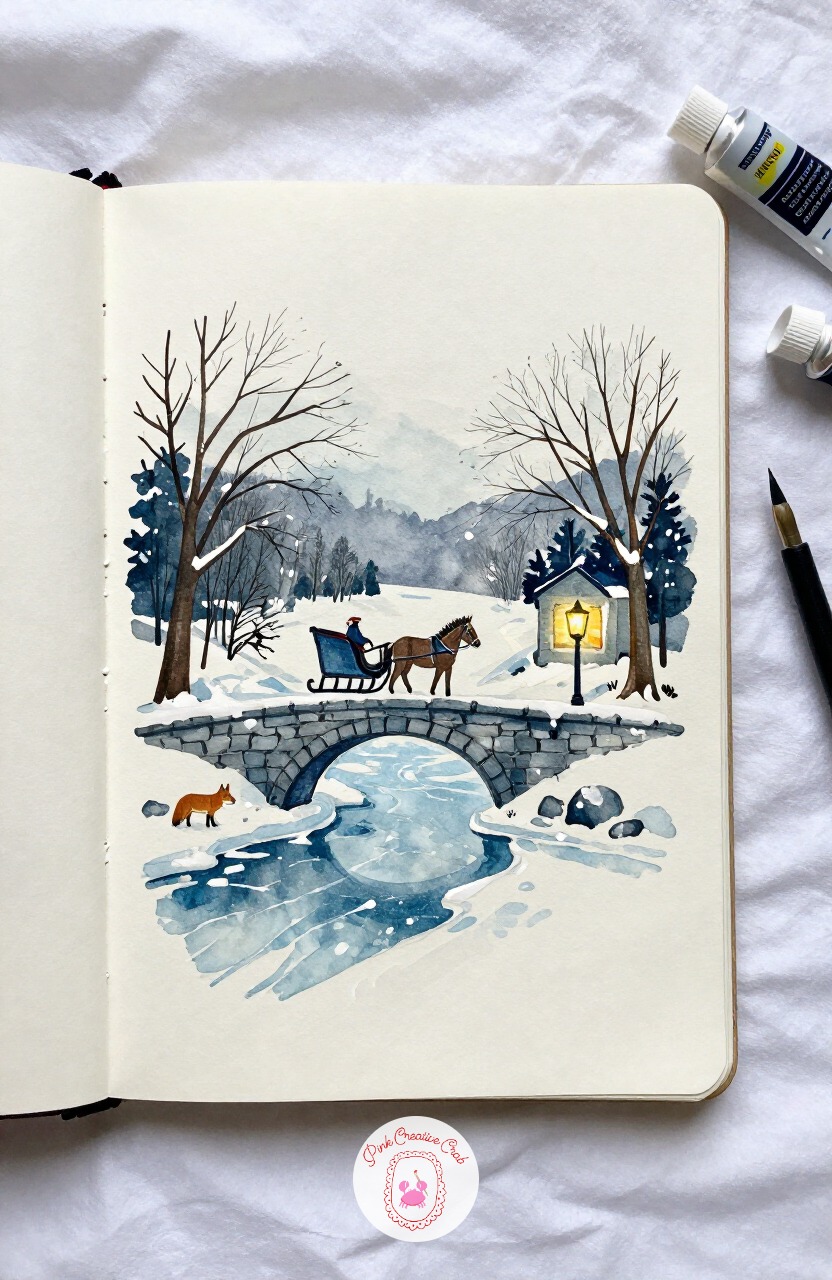
Leaving the yard behind, picture a horse-drawn sleigh crossing a small stone bridge over a frozen stream. This is a tool choice idea: a slightly larger round brush, maybe a size eight, lets you lay the horse’s body and the sleigh in two or three confident strokes rather than fussy little ones.
Smaller detail brushes come out only for the reins, the bridge’s stone texture and the one lantern hung on the sleigh’s side, which carries your warm accent glowing against the cool stone and ice below. Let the frozen stream stay a flat pale wash with just a hint of blue-grey shadow where the bridge arches over it.
Tip: paint the horse’s legs as thin dark strokes last, after the body has dried, so they stay crisp rather than bleeding into the snow.
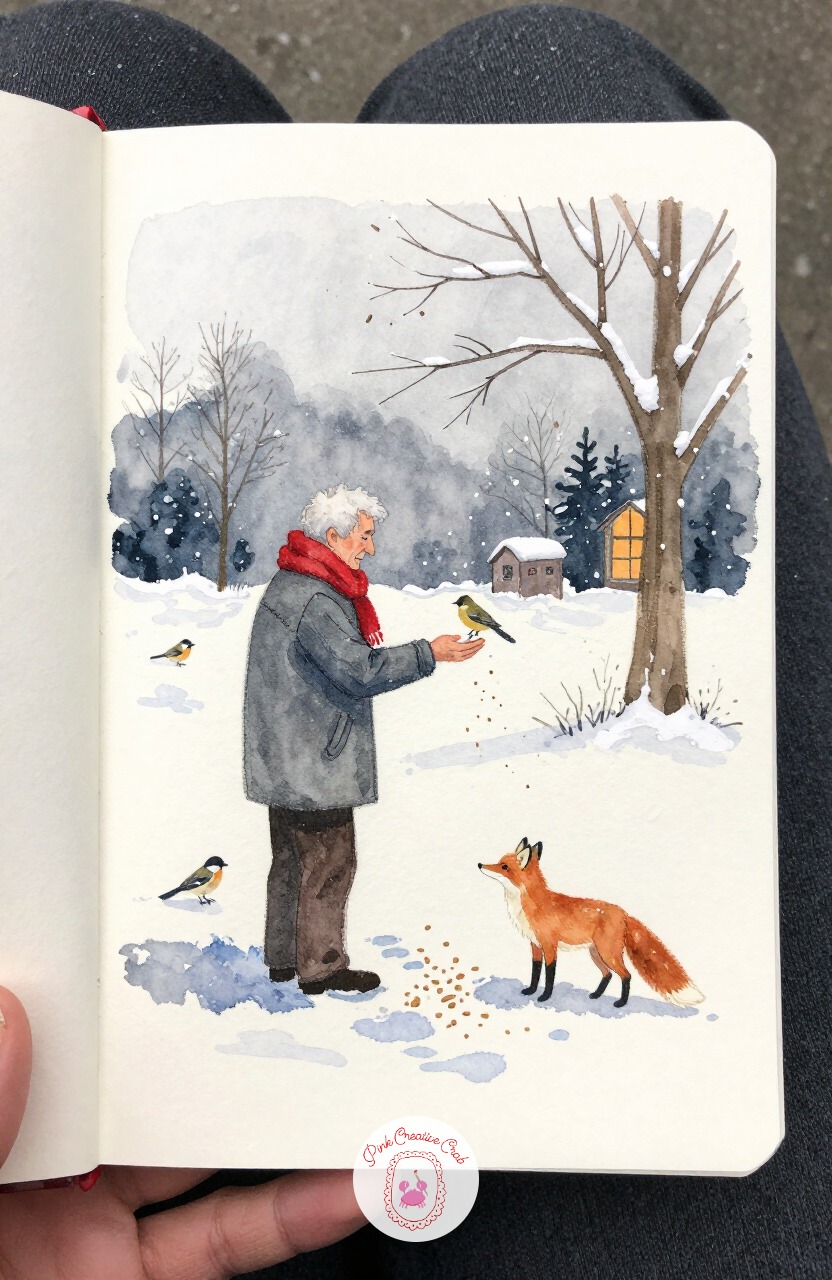
After the motion of that sleigh, slow down again with an elderly man standing still in the snow, scattering seed for a small flock of birds at his feet. The usual mistake here is painting the birds too large, which makes the whole scene feel cramped.
Keep each bird no bigger than a thumbnail, just a few dabbed shapes with tiny dark marks for eyes and beaks, scattered loosely rather than lined up. The man himself stands tall and still, coat in cool grey-blue, with his scarf or hat as the one warm note, and his gesture, one arm extended with seed falling from his hand, is what tells the whole story.
Tip: paint the birds last, in quick single strokes, so they stay light and don’t overpower him.
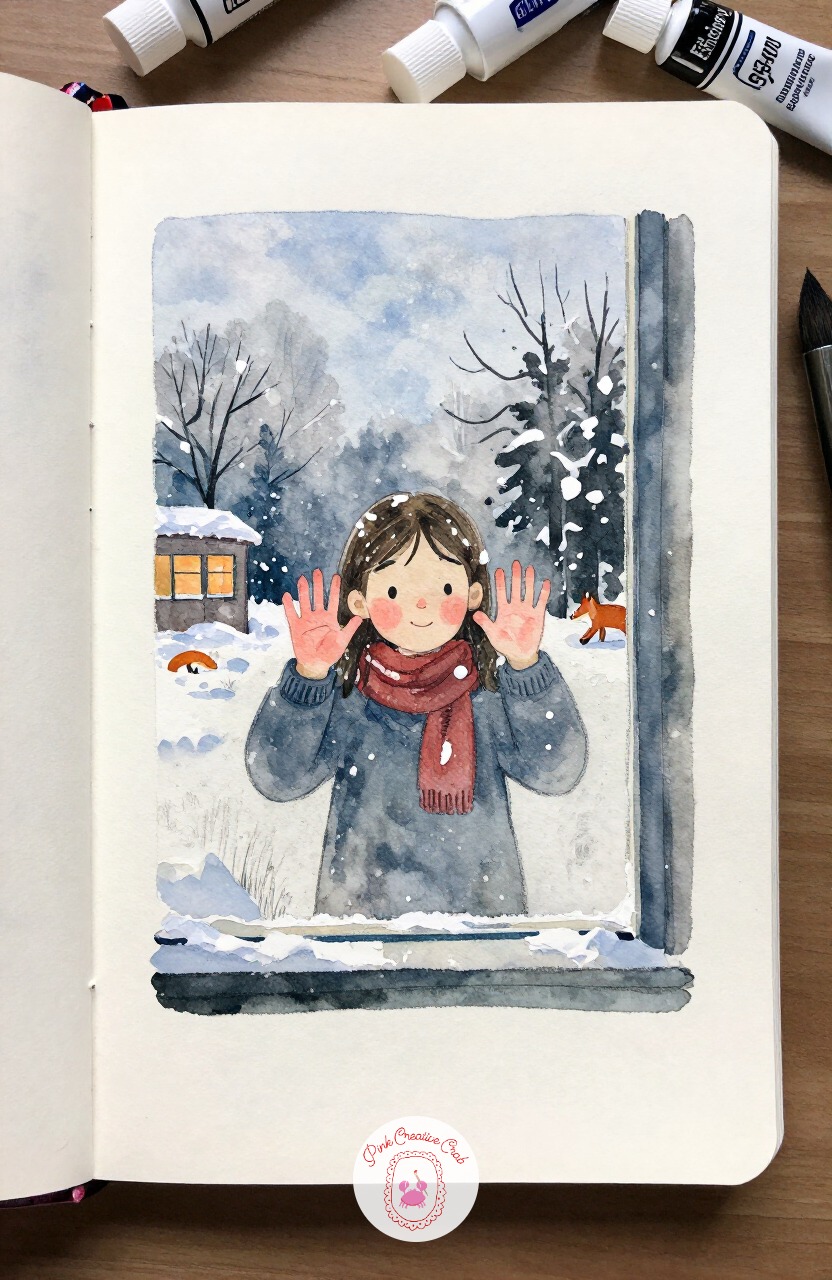
Step inside for a moment with a girl pressing her face and palms against a frosted windowpane, looking out at the snow. This idea rests on perspective and light: you are painting from outside looking in, so the glass itself needs a soft fogged quality around her warm, pink-cheeked face.
Paint the window frame first as simple dark verticals, then the foggy glass as a pale grey-blue wash, and leave her face and hands as small warmer patches where her breath has cleared the frost. That warm skin tone becomes your single accent against all that cool glass and falling snow outside.
Tip: keep the handprints on the glass loose and slightly smudged rather than sharply outlined, frost never has a clean edge.
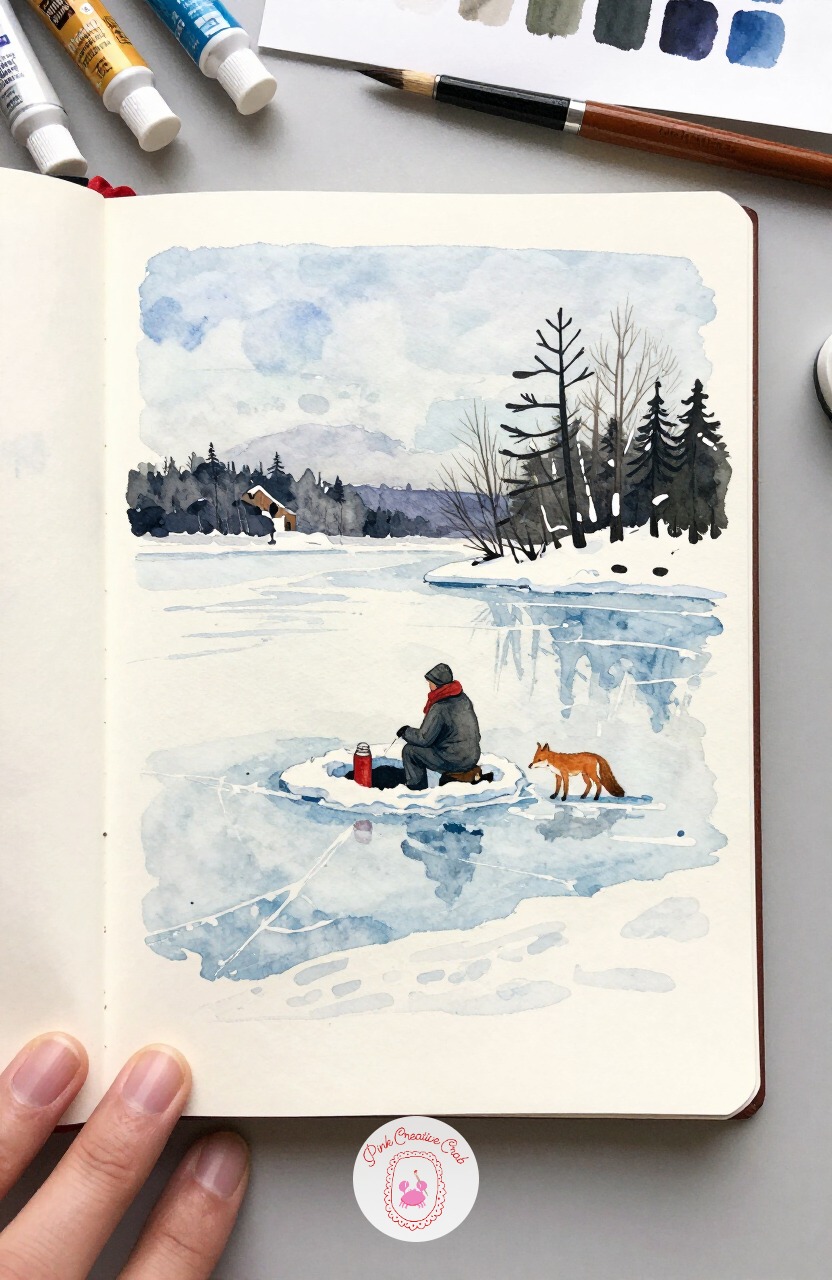
From a warm window, head back out to open ice for a solitary ice fisherman seated beside his small drilled hole, rod in hand. This is a proportion idea: keep him seated low, folded into roughly three heads tall from his bent knees to his hat, which reads instantly as someone hunched patiently in the cold.
The frozen lake around him should stretch wide and mostly empty, just a flat pale wash with a few thin cracks suggested in darker blue-grey lines. His hat or thermos can be the one warm spot of color on an otherwise silvery page.
Tip: leave the ice hole itself as a small dark circle painted last, it anchors the whole composition instantly.
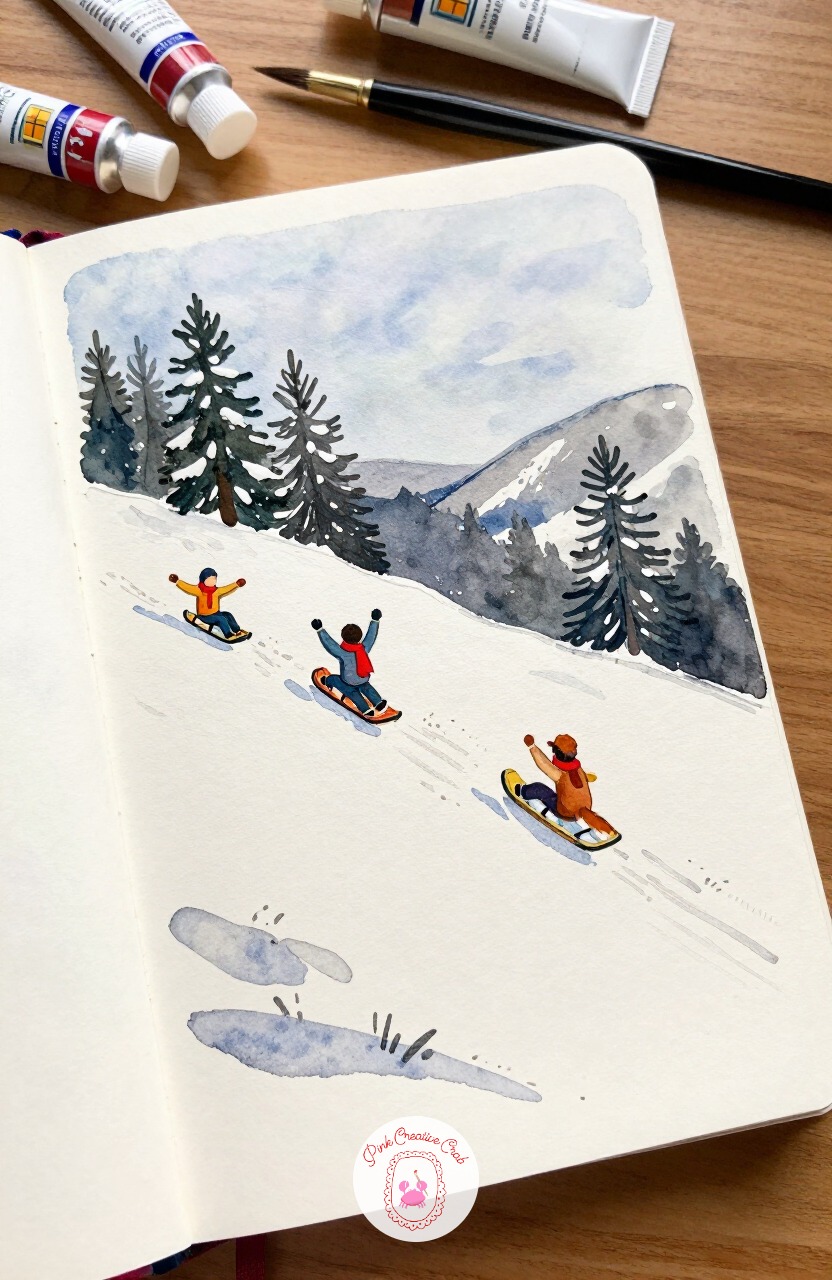
Returning to that sled from earlier, this time let’s paint the descent rather than the climb: kids flying down a steep hill, arms up, snow spraying behind them. The quick ten-minute version is just the hill’s slope and one sled shooting down it with a loose spray of white gouache flicked behind.
Given more time, add two or three more sledders at different points on the hill, some mid-fall, some laughing, which turns one moment into a whole busy afternoon. Keep every figure small and gestural, a few confident brush marks rather than careful outlines, with your warm accent scattered across different scarves or hats.
Tip: tilt each sledder’s body backward slightly, that lean against the speed is what sells the motion.
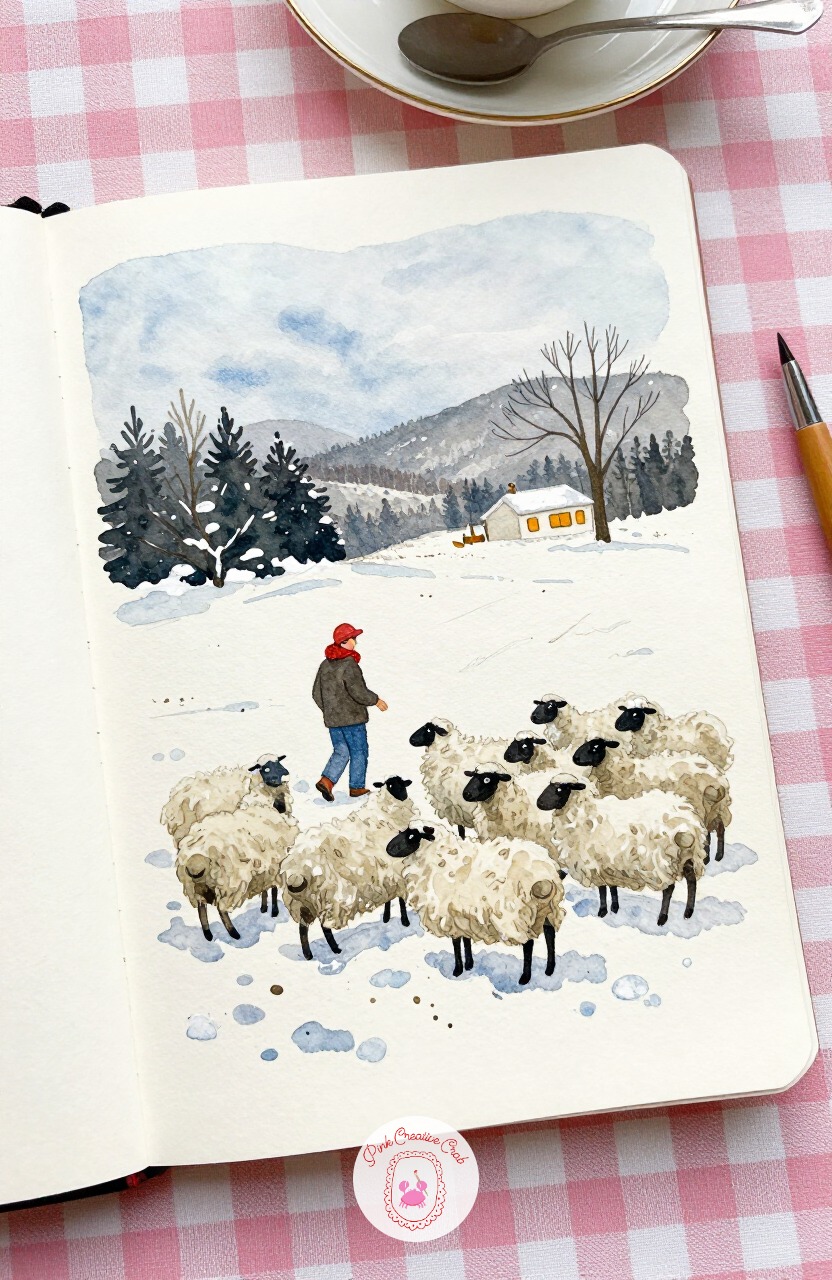
Away from the hill’s energy, a farmer walking through a snowy pasture to check on a huddled group of sheep makes a calmer, rural scene. Texture is the whole point here: sheep need thick, choppy dry-brush strokes for their wool rather than smooth washes, since that broken texture is what reads as fleece against flat snow.
Paint the pasture and sky as simple flat washes first, let them dry completely, then use a half-dry brush loaded with titanium white and a little grey to stipple the sheep’s wool in short dabbing strokes. The farmer himself stays simple, a dark coated figure with perhaps a red cap for your warm accent, walking steadily toward the flock.
Tip: never outline the sheep’s wool, let the dry-brush texture itself define the edge.
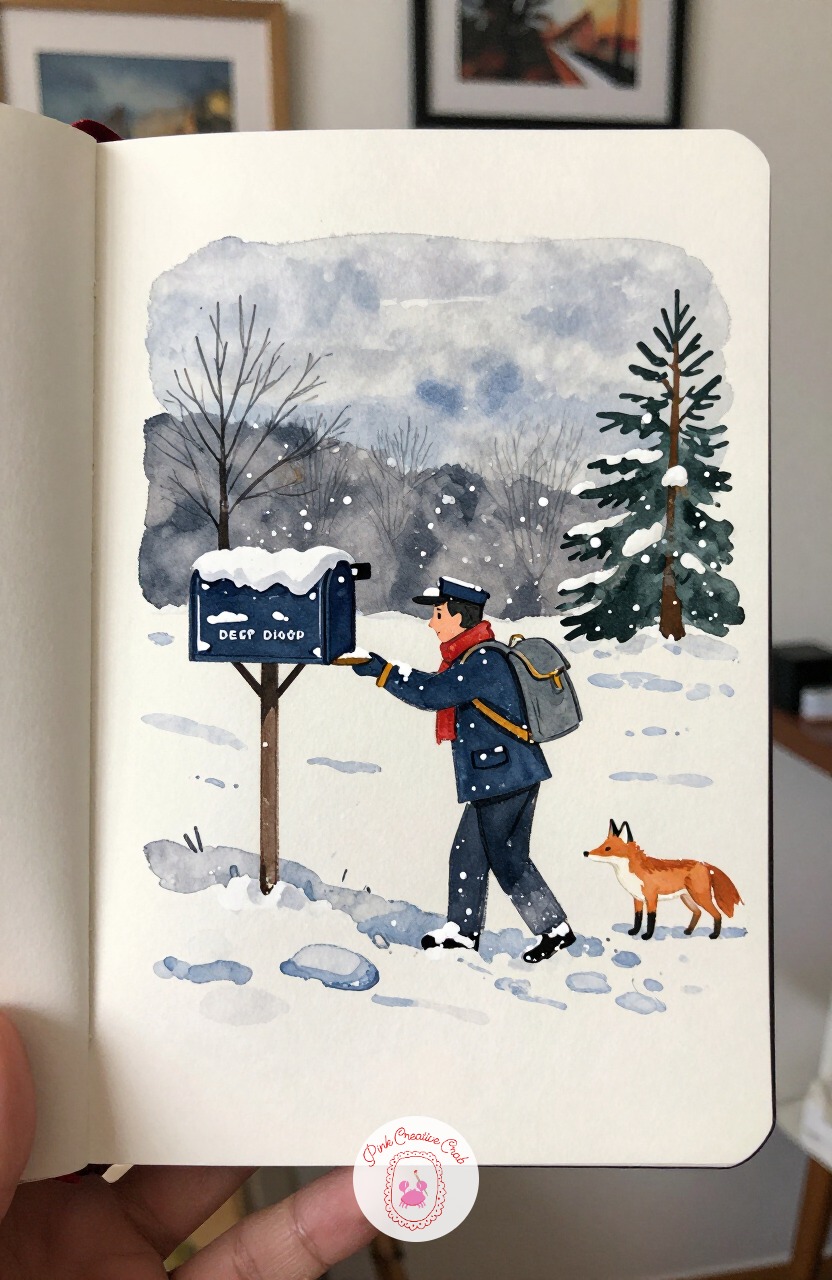
From quiet pasture to a working figure, picture a postman wading through deep drifts, satchel over one shoulder, leaning into the effort. The usual mistake with figures in deep snow is painting their legs visible all the way down, which makes the snow look shallow and thin.
Fix it halfway through by painting a soft white wash up over his boots and shins, letting the snow visually swallow the lower half of his legs so the depth reads immediately. His satchel can carry the one warm accent, a mustard or red strap cutting across his dark coat.
Tip: lean his whole body forward at a slight diagonal, that single angle does most of the work of showing effort against deep snow.
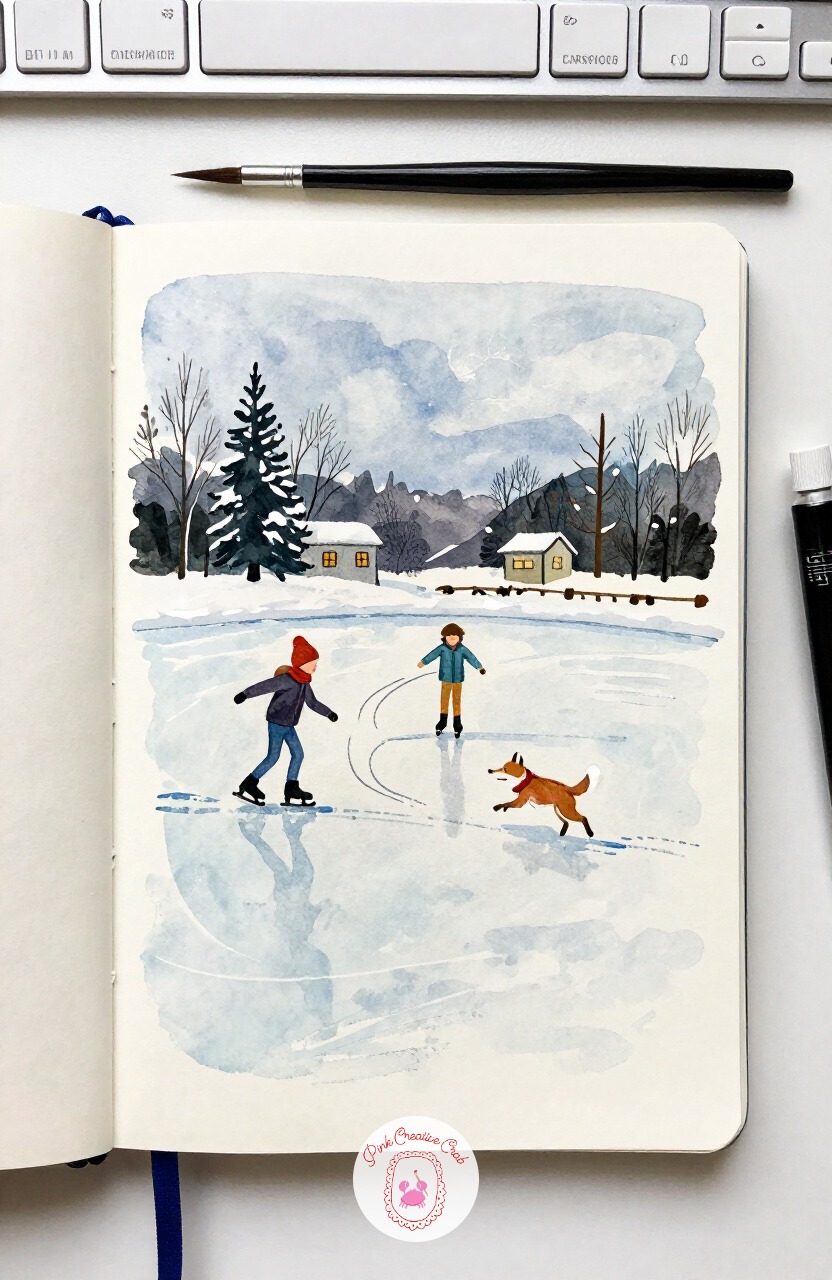
Back on the ice again, but livelier this time: a couple of kids skating in loose circles while a small dog chases happily behind them, legs flailing on the slippery surface. This idea is about the first three marks: lay the ice as one pale wash first, then the children’s curved skating paths as light pencil guides, then the dog last, since its scrambling pose needs the most attention.
Give the dog’s legs an exaggerated splayed angle, as if it keeps losing its footing, which instantly reads as funny and endearing. Your warm accent can live in one child’s hat or in the dog’s collar, a single bright note against the pale ice.
Tip: keep the kids’ skate blades as thin dark lines added last, over dry paint, so they stay crisp.
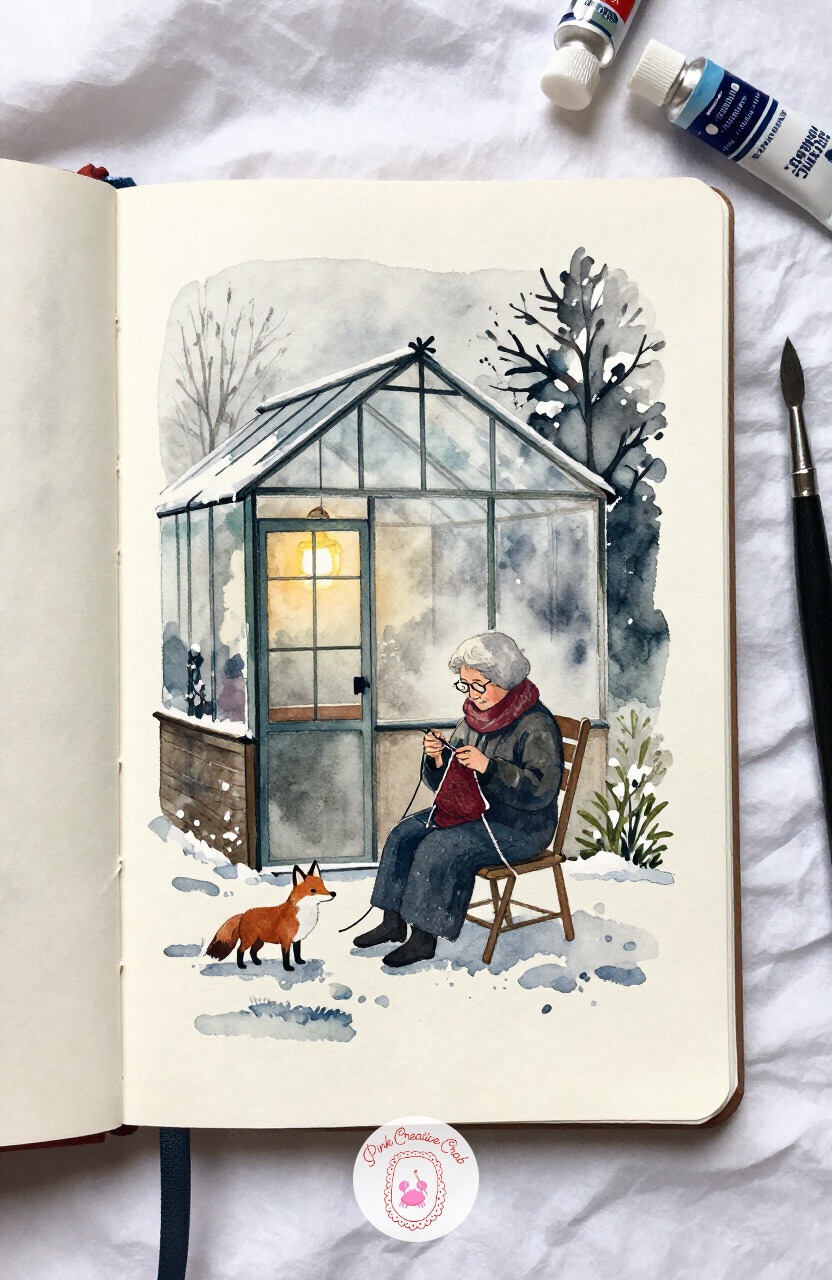
Slow the pace again with an elderly woman seated in a chair just inside a frosted greenhouse, knitting while snow piles outside the glass. This is a perspective and light idea: the glass panes behind her should be rendered as a grid of soft, foggy rectangles, cooler and paler than the warmly lit interior where she sits.
That contrast of warm lamp-lit interior against cool frosted glass is what makes the scene feel properly wintry and cozy at once. Her knitting wool becomes a natural home for your one warm accent color, perhaps a deep red yarn spilling from her lap.
Tip: paint the glass grid lines last, in thin dark strokes, over an already-dry pale wash, so they sit crisply on top.
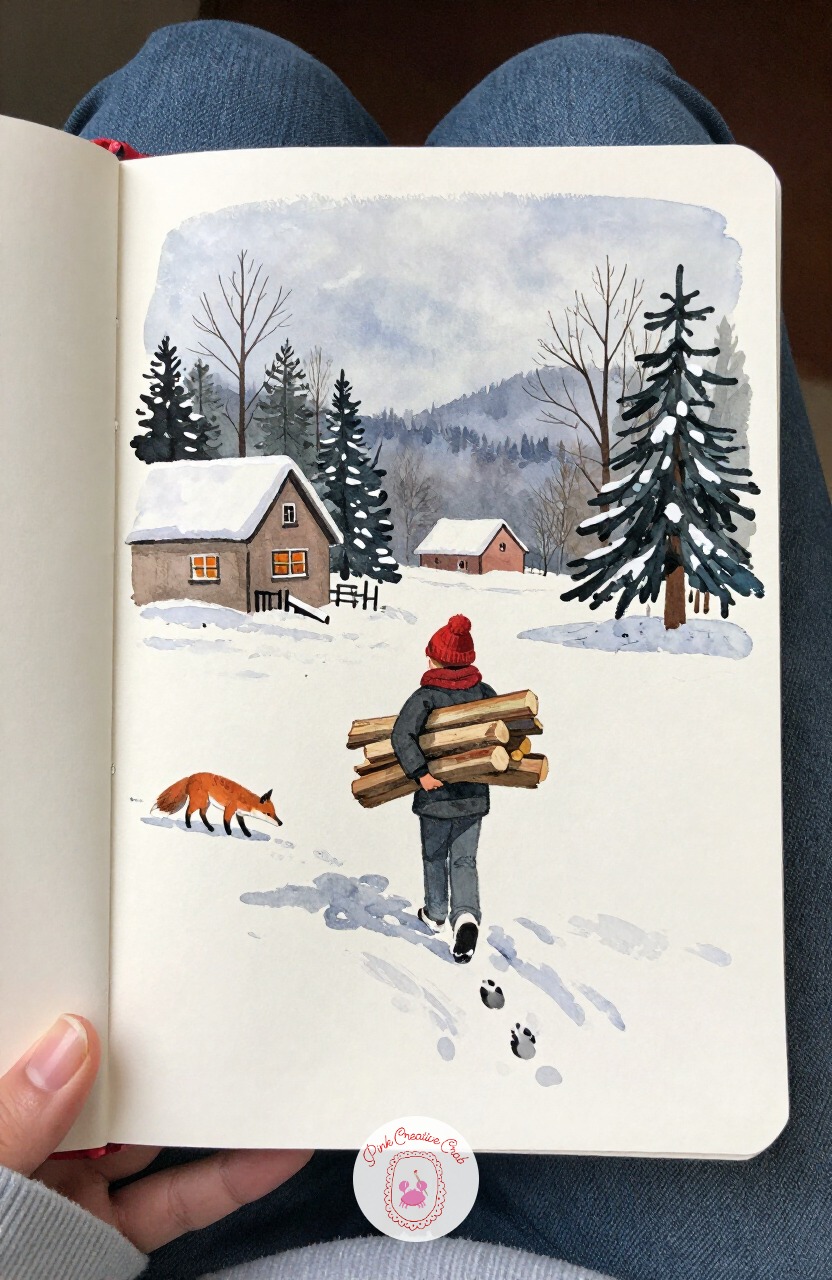
From that cozy greenhouse, step back outside with a boy stacking firewood in his arms and trudging it toward a distant house. Proportion matters here: keep the woodpile in his arms roughly as wide as his own torso, since too much wood makes the figure look unbalanced rather than burdened.
Let his footprints trail behind him in the snow, just a few simple dark ovals growing fainter toward the distance, which does a lot of storytelling work for very little effort. His knit hat or scarf holds your one warm accent against the cool, snowy yard.
Tip: tilt his whole upper body slightly backward to counterbalance the load, it makes the weight of the wood read instantly.
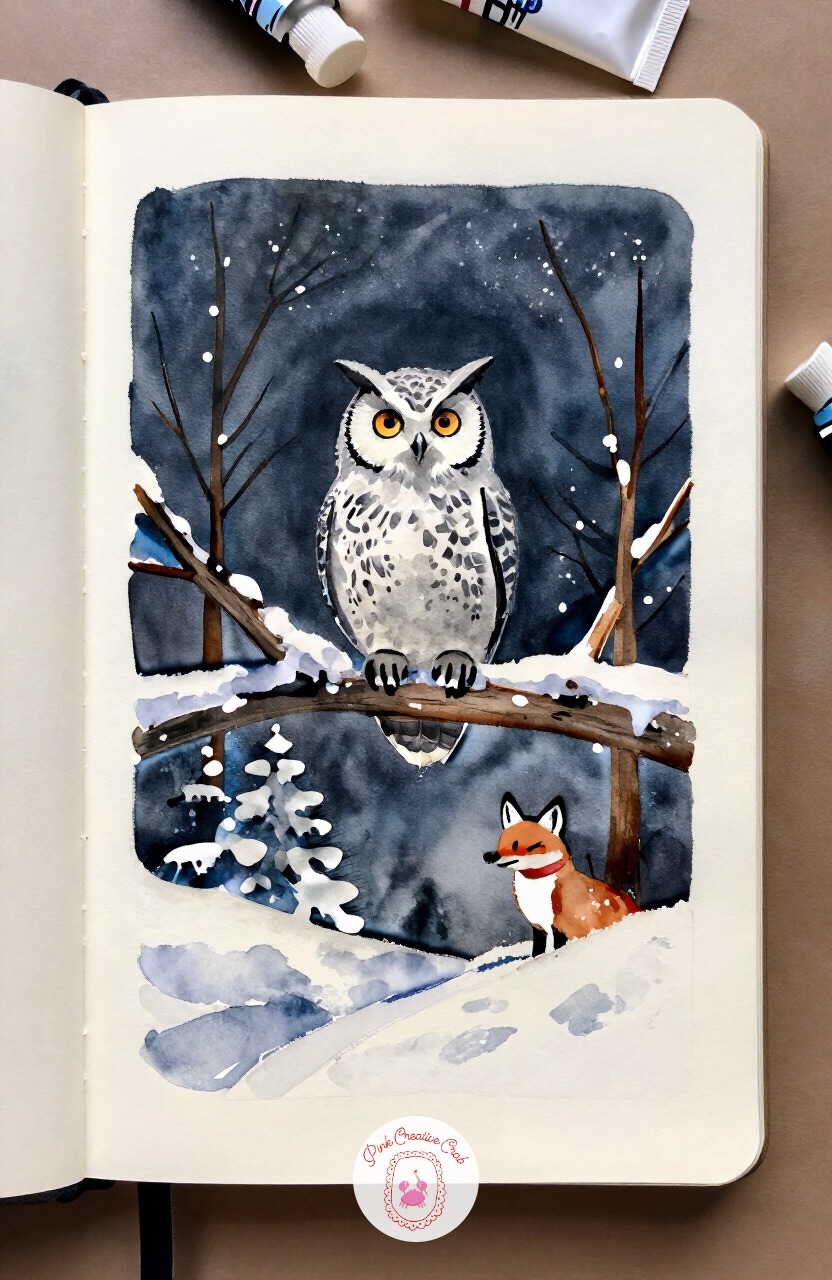
After all that human activity, give the page over to a single owl perched on a heavy, snow-laden branch against a dark night sky. This is a tool idea: use your smallest round brush only for the owl’s feather texture and eyes, saving the larger brush for the big flat washes of sky and snow.
Paint the night sky first as a deep blue-black wash, let it dry fully, then add the snowy branch in pale strokes across it, and only then bring in the owl itself with careful small dabs for its feather pattern. A single warm amber eye becomes the one accent glowing against all that cool darkness.
Tip: leave tiny unpainted flecks of white paper scattered near the owl for stars, rather than painting them in with gouache.
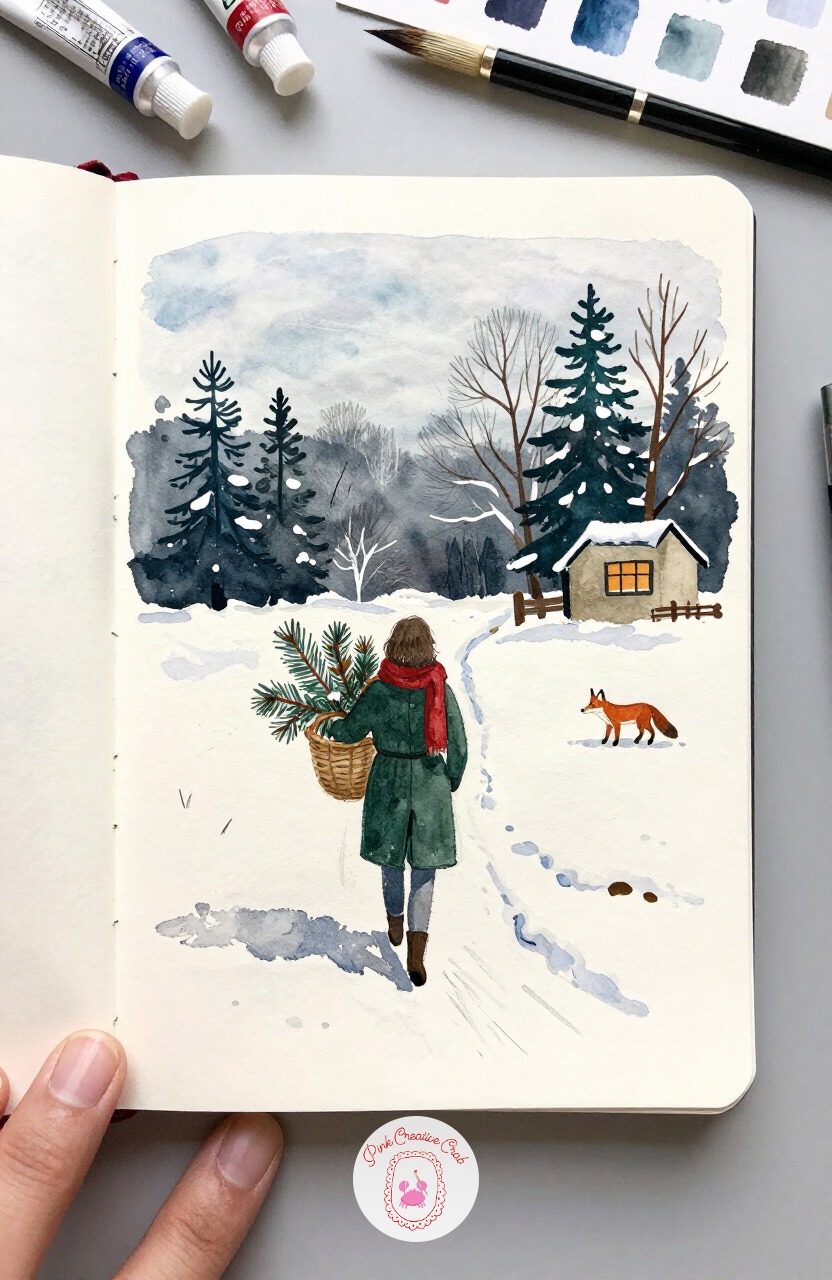
Coming down from that night sky, follow a woman walking home along a snowy path with a basket of cut pine branches balanced on her hip. The quick ten-minute version is just her silhouette, the basket and a simple path receding into pale distance.
With more time, add texture to the pine branches poking from her basket using quick dry-brush dabs of deep green, and soften the path’s edges into the surrounding snow with a damp brush so it feels trodden rather than drawn. Her mittens or scarf hold your warm accent against all that cool green and white.
Tip: let the pine branches overlap the basket’s rim loosely, rather than sitting neatly inside it, for a more natural gathered look.
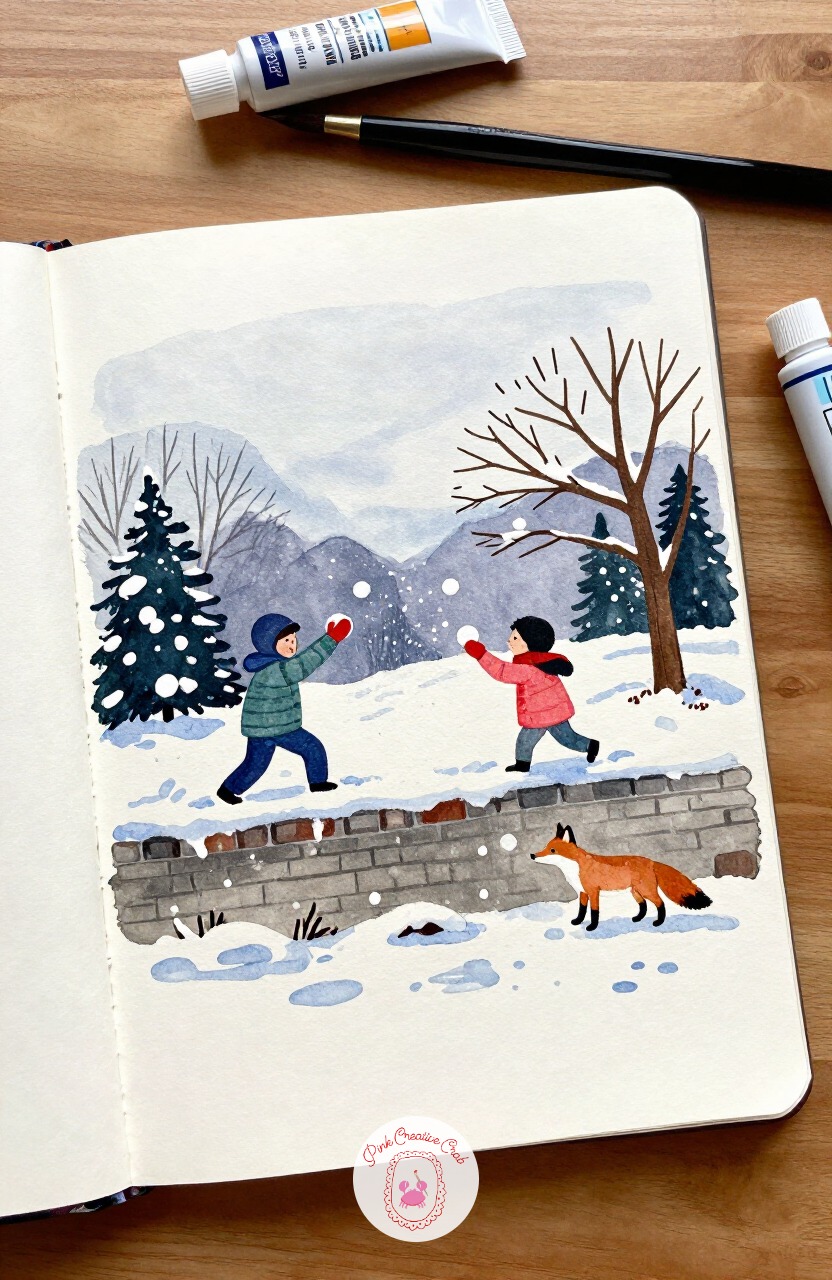
From a quiet walk home, bring the energy back up with two kids crouched behind a low snow wall, mid-throw in a snowball fight. The usual mistake here is painting both figures facing the same direction, which flattens the sense of a contest.
Fix it by angling one child forward, winding up to throw, and the other slightly ducked or turned away, bracing for impact, so the two poses read as a real exchange rather than a mirrored pair. Keep their mittens or hats as your scattered warm accent, one red, one perhaps a softer rust tone.
Tip: paint a few loose white dots flying mid-air between them, that single detail makes the whole fight readable instantly.
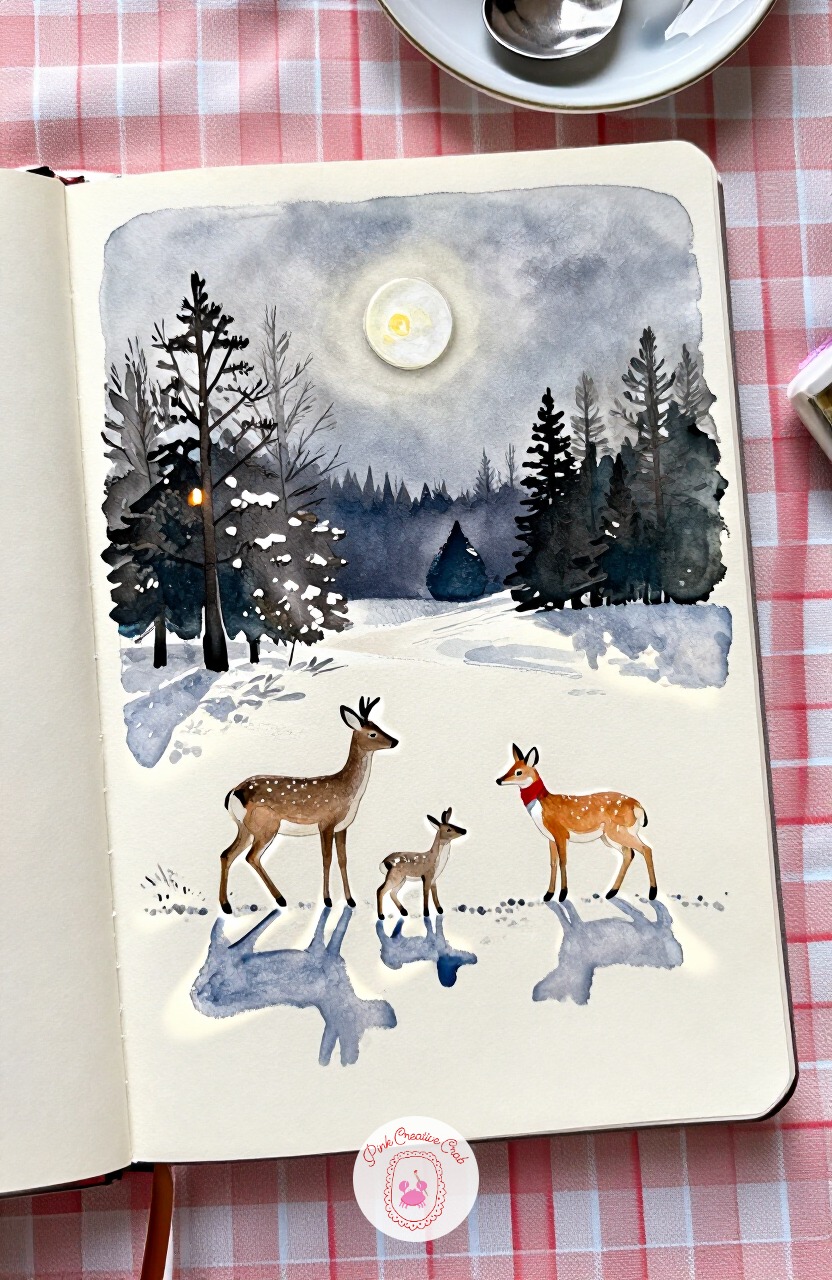
After that noisy fight, let the page go quiet again with a small deer family picking their way across a moonlit clearing. This is a proportion idea: keep the fawn roughly two-thirds the height of the adult doe, and place it slightly behind and to one side, which reads instantly as a family group rather than two unrelated deer.
Paint the clearing as a pale blue-grey wash lit from one side by an unseen moon, with long cool shadows stretching from each deer’s legs across the snow. A single warm touch, perhaps catching the edge of one deer’s ear or muzzle, keeps the scene from feeling entirely cold.
Tip: leave the deers’ legs thin and slightly broken where they vanish into unpainted snow texture, rather than painting them solid to the ground.
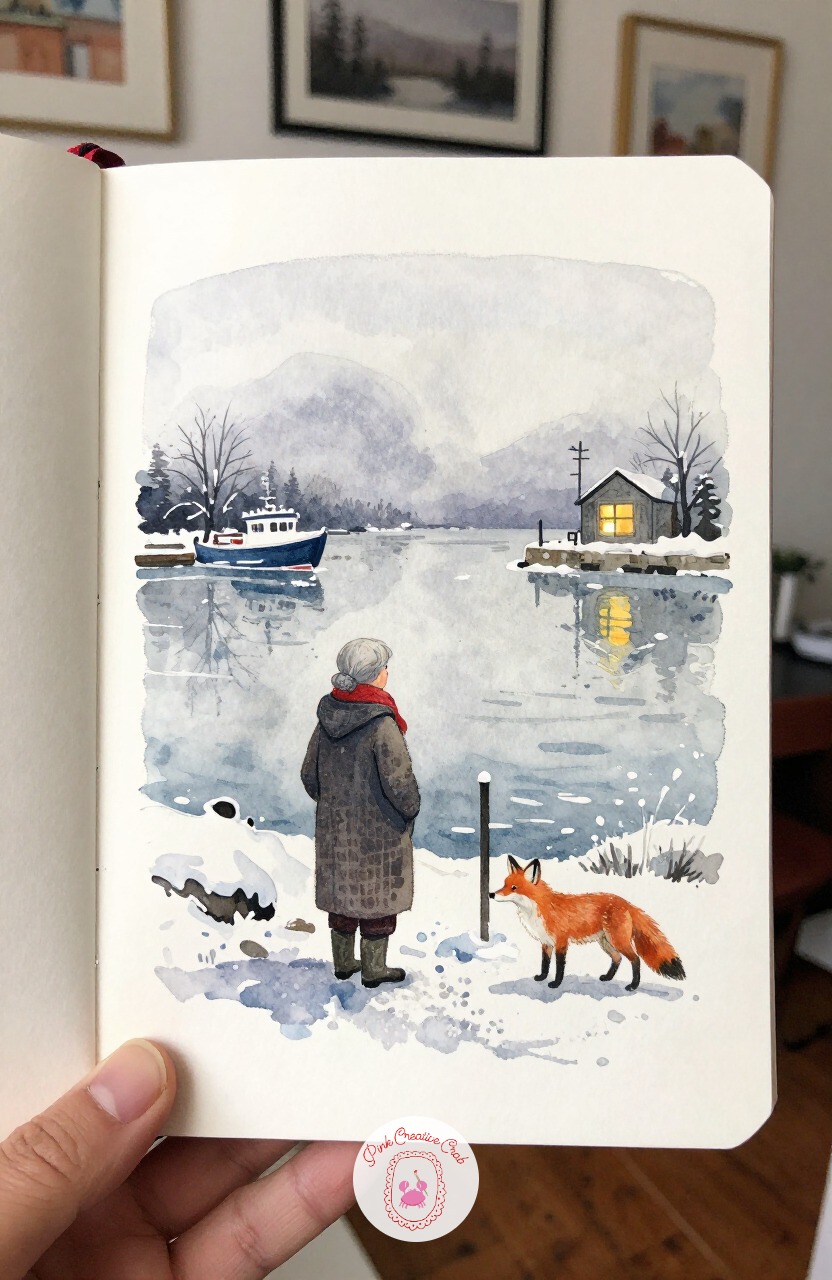
Shift from forest to coast with an older woman standing at a frosted harbor’s edge, watching for a boat’s return through the winter haze. Light and perspective drive this one: set the horizon low and hazy, with the boat only a small dark shape far out on pale grey water, so the distance itself becomes part of the story.
Her shawl or lantern can hold your one warm accent, a small bright note against all that cool harbor fog and ice-crusted rope. Paint the water and sky first as one continuous soft wash, barely distinguishing where one ends and the other begins, before adding her figure crisply in the foreground.
Tip: keep the distant boat as just two or three strokes, any more detail and it stops feeling appropriately far away.
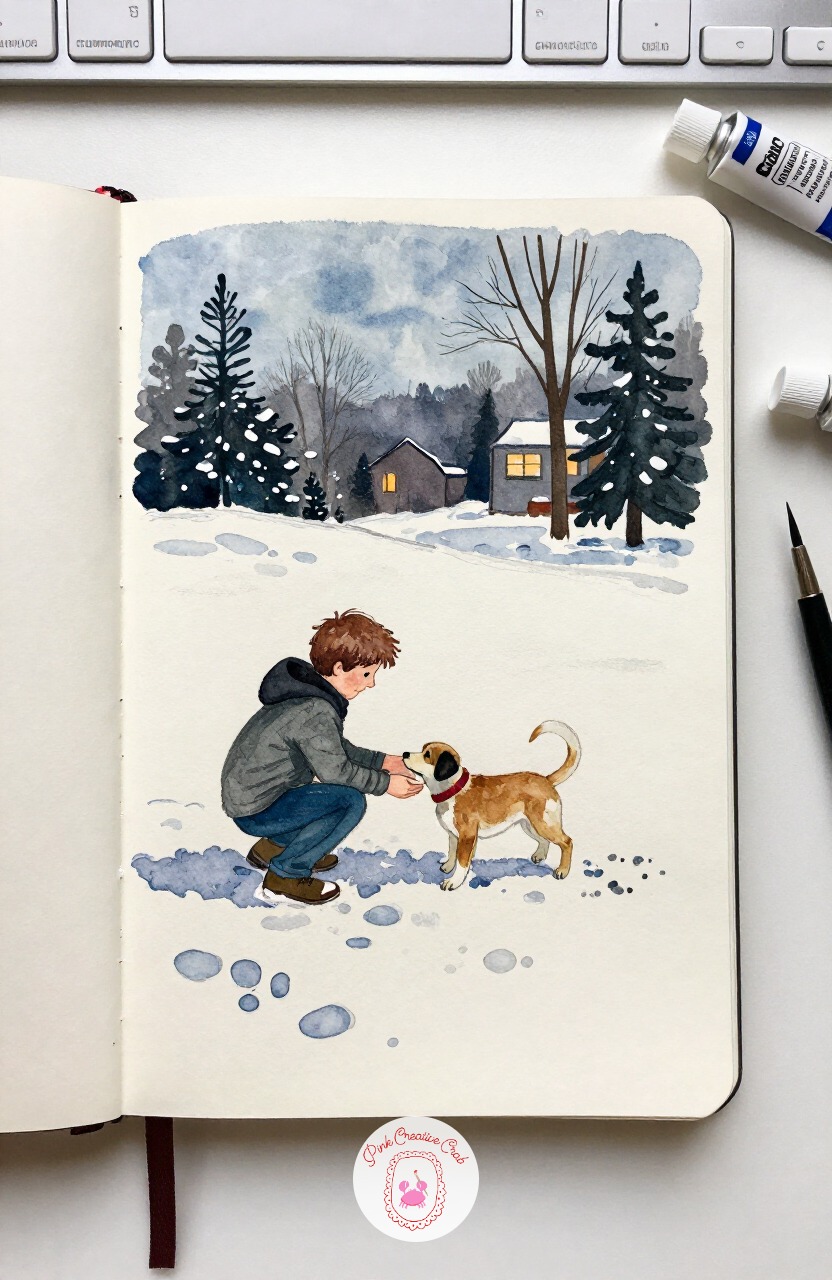
From that quiet harbor, warm things back up with a boy crouched down, coaxing a nervous puppy to take its first steps through unfamiliar snow. This is a texture and edges idea: the puppy’s fresh paw prints should look crisp and new, while the boy’s own tracks behind him can be softer and slightly melted at the edges, showing he arrived first.
Use a kneaded eraser on your pencil underdrawing to lighten the puppy’s edges before painting, so its fur reads soft rather than hard-outlined against the snow. Its collar or the boy’s hat makes a good home for your one warm accent color.
Tip: paint the fresh paw prints last, as small crisp dark dots, directly on top of dry white snow.
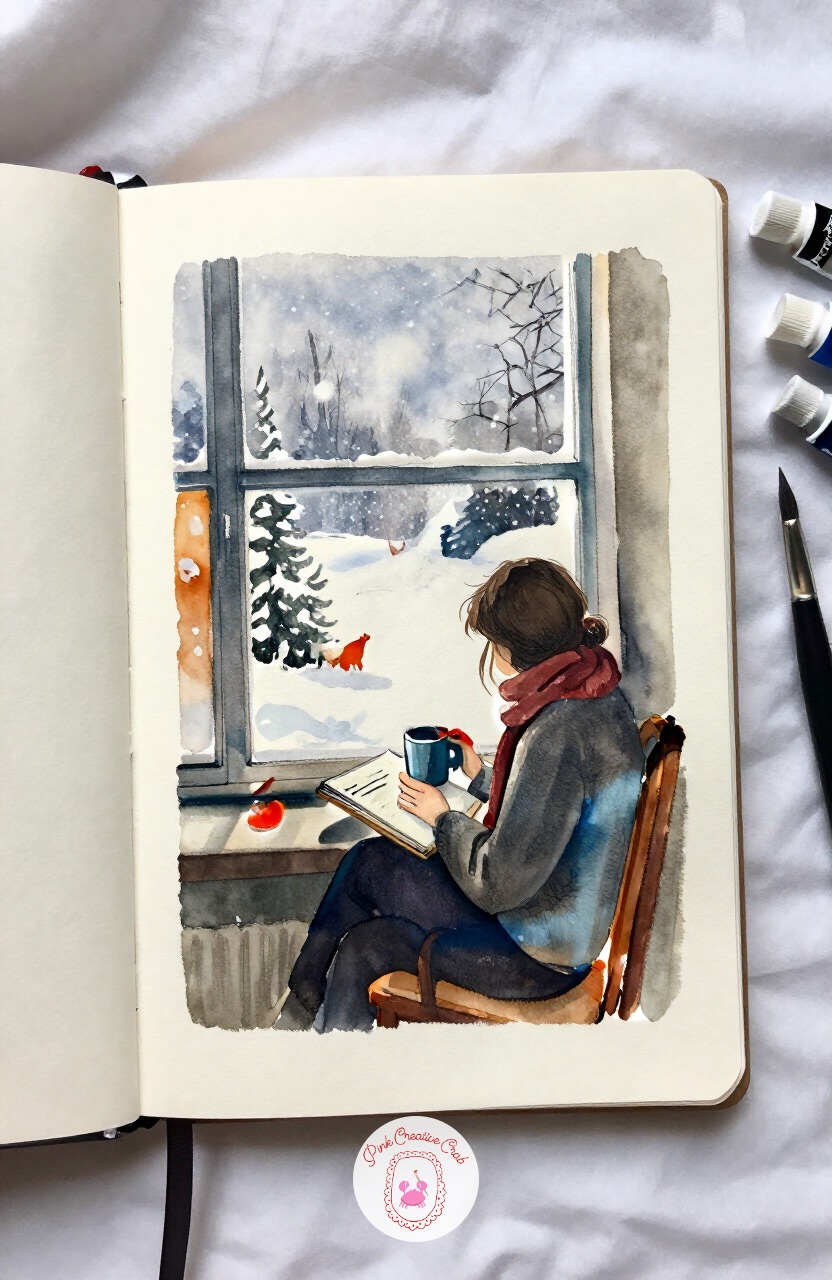
Turn the page inward again with a woman curled into a window seat, sketchbook or paints balanced on her knees, looking out at falling snow. The forty-minute version adds real depth here: paint the interior room warmly lit and detailed, her blanket, a mug beside her, while the view outside stays loose and pale, almost unfinished, to suggest distance through glass.
That contrast between a tightly rendered interior and a soft exterior is what makes a window scene convincing. Her mug or blanket is the natural place for your one warm accent against all that cool glass and snow beyond.
Tip: soften the window’s edges slightly with a damp brush so the glass itself feels transparent rather than like a hard frame.
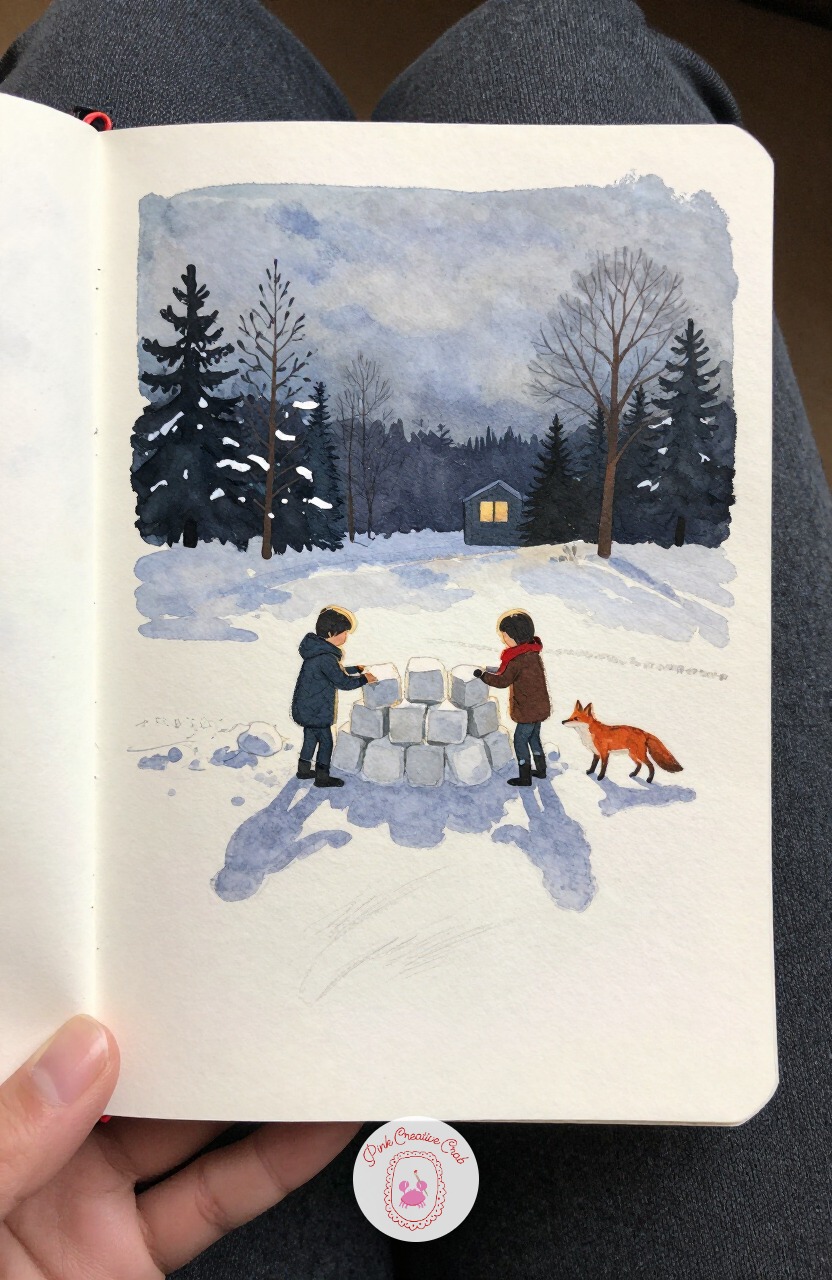
From that quiet window seat, head back outside to two kids stacking snow blocks into a small fort as the light fades to dusk. Perspective and light shape this one: set the sun low behind the fort itself, so the wall throws a long cool shadow toward the viewer and the children’s silhouettes catch a thin warm rim of light along one edge.
That rim light is your single warm accent, just a thin glowing line along a shoulder or hood, rather than a large patch of color. Keep the fort itself simple, a low curved wall of stacked rectangular blocks, easy to suggest with just a few confident strokes.
Tip: paint the long shadow first, as one flat cool shape, before adding either child, so it sits correctly underneath them.
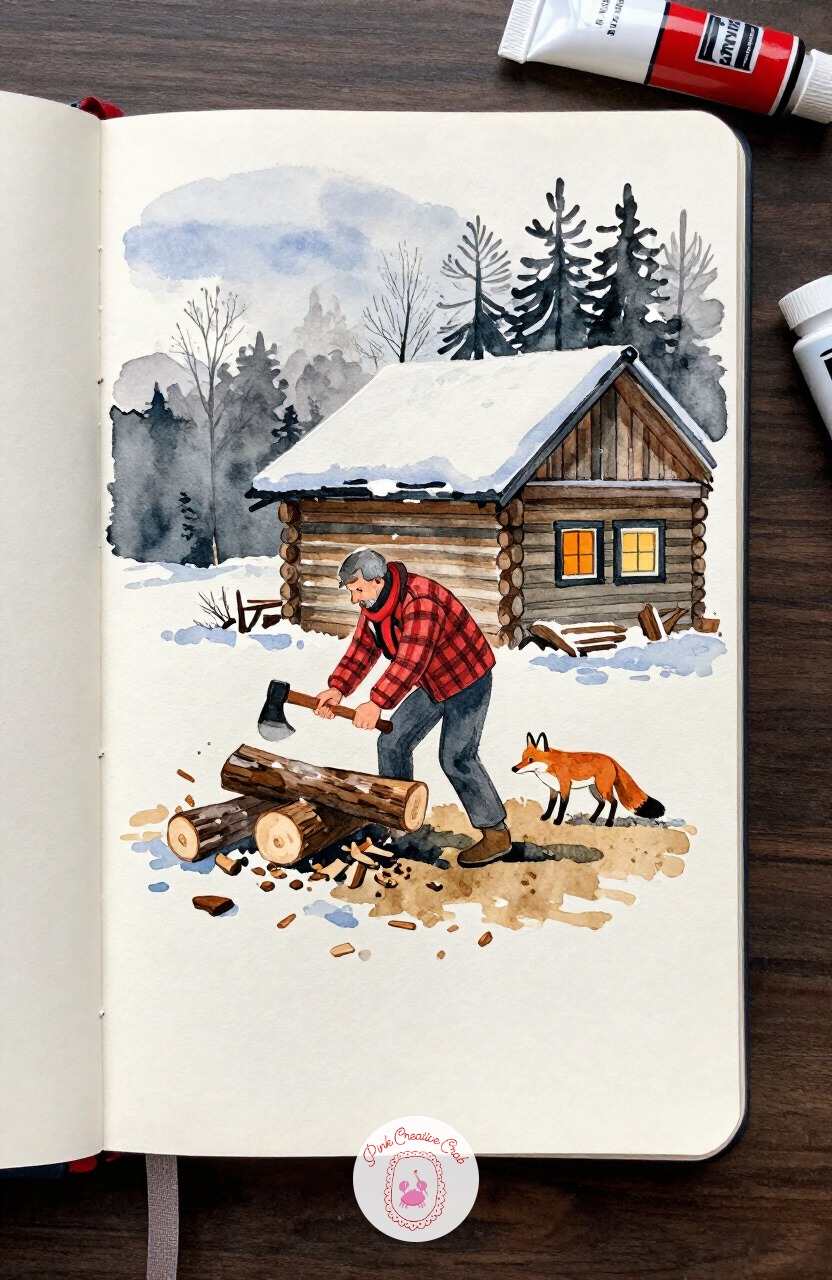
Following that fort at dusk, swing back to daylight with an old man mid-swing, axe raised, splitting logs outside a timber cabin. Proportion keeps this pose from looking stiff: raise the axe well above head height and twist his torso slightly at the waist, since a straight, flat-footed stance reads as standing still rather than mid-motion.
Scatter a few split logs and wood chips around his boots to ground the action, painted as quick loose dabs rather than careful individual shapes. His flannel shirt or the cabin door makes a natural spot for your one warm accent against all that cool timber and snow.
Tip: paint the axe head last, as one small sharp dark stroke, it needs to read instantly even though it is tiny.
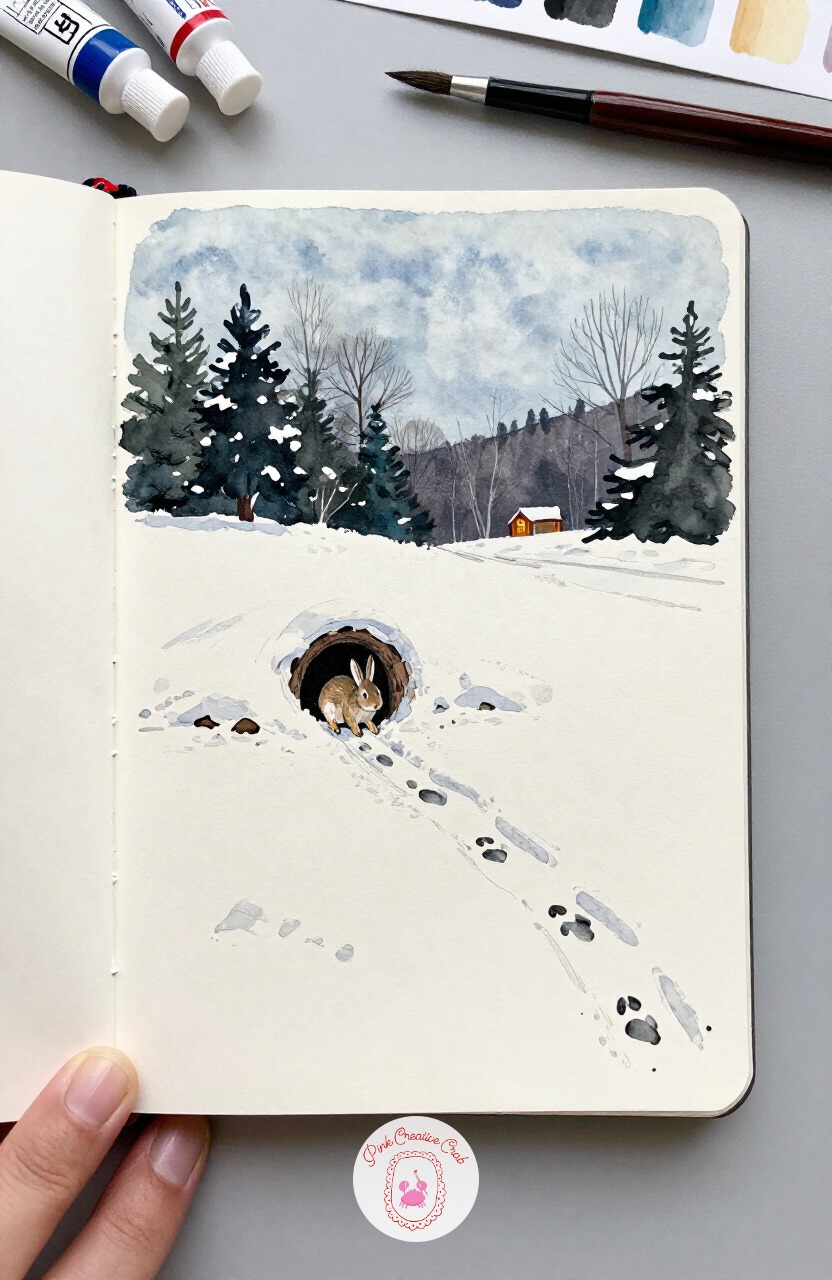
Give the page a breather with a quieter scene: a single rabbit pausing at the entrance to its snow burrow, a line of tracks leading back across an empty field. This is a tool idea: switch to your smallest brush just for the tracks themselves, since each paw print needs to stay distinct and small rather than blurring into one smudged line.
Paint the open field first as one flat pale wash, let it dry, then stipple in the tracks with that tiny brush loaded with cool grey, spacing them unevenly as a real hopping rabbit would leave them. The rabbit’s own fur can carry a touch of warm brown as your one accent against all that cool white field.
Tip: curve the trail of tracks slightly rather than keeping it perfectly straight, it reads far more like a living animal’s path.
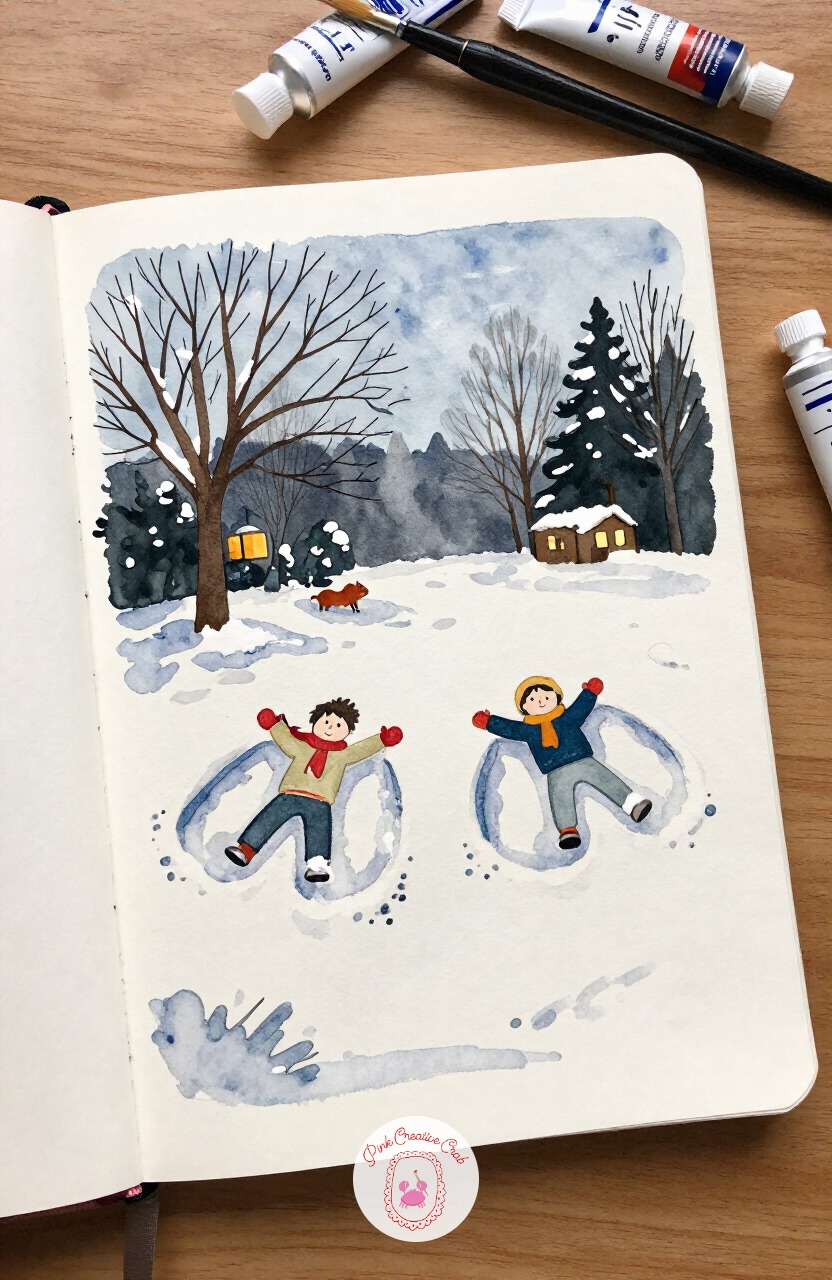
From that quiet burrow, bring energy back with two kids lying flat in fresh snow, arms sweeping wide mid-motion to make snow angels. The usual mistake here is painting the angel’s wing shapes too neat and symmetrical, which looks stamped rather than swept.
Fix it by letting each wing arc trail off unevenly at the tips, with a slightly messier sweep on one side than the other, since real arm motion is never perfectly even. Their scarves or mittens, splayed out beside them, hold your scattered warm accent color across the otherwise cool, flat snow.
Tip: paint the body shapes first, then add the wing-sweep marks around them last, in a slightly darker blue-grey, so they read as pressed into the snow rather than floating on top.
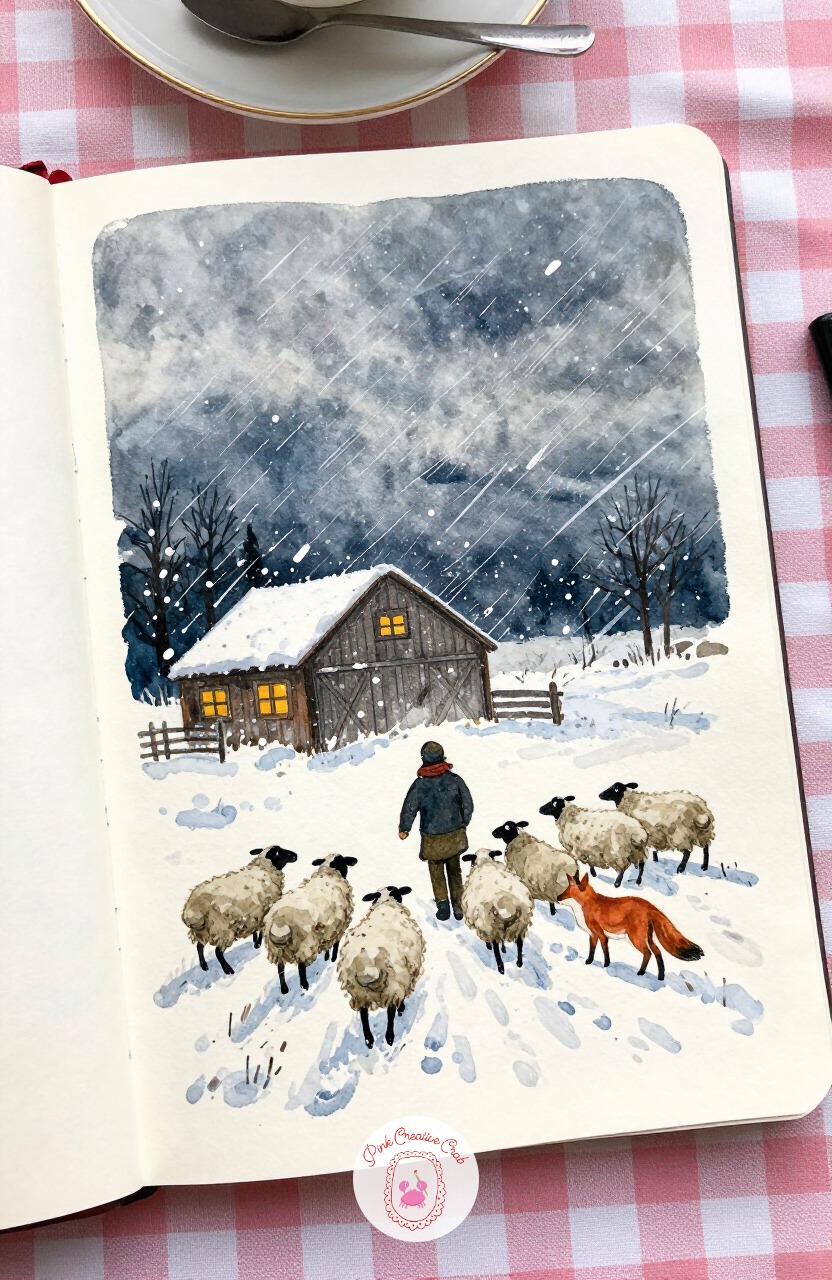
Raise the stakes slightly with a shepherd hurrying a small flock of sheep through blowing snow toward the dark shape of a barn. Light and perspective matter most here: keep the barn’s window as the only warm glow in the whole composition, pulling the eye straight through the storm toward shelter.
Paint the blowing snow as diagonal streaks of white gouache flicked across an already-dry grey-blue wash, all leaning the same direction, which instantly reads as wind rather than calm falling snow. The shepherd and flock stay simple dark silhouettes against that streaked, stormy backdrop.
Tip: angle every diagonal snow streak identically, mixed directions make it read as scattered dots instead of wind-driven snow.
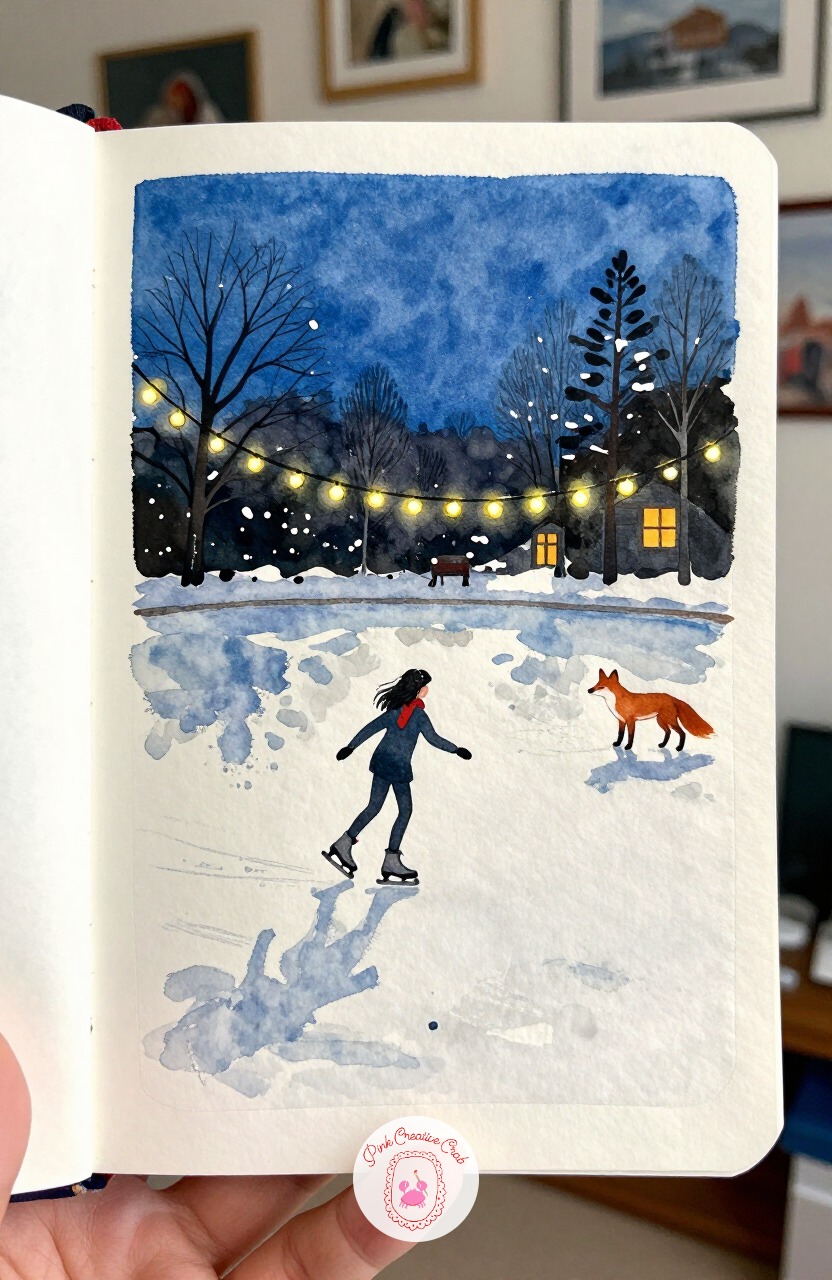
After that stormy barn scene, cool back down with a lone girl skating gentle figures on a pond strung with simple outdoor lights overhead. This is a texture idea: paint the string lights as small dots of masking fluid or left-white paper before your sky wash goes down, so they stay bright and clean once the dark blue evening sky is painted around them.
Once the sky wash is dry, touch each light dot with a small dab of warm yellow gouache, which becomes your single accent scattered gently across an otherwise deep blue page. The skater herself stays a simple, graceful silhouette below the lights.
Tip: keep the lights uneven in spacing and size rather than perfectly lined up, it feels far more like a real string than a printed pattern.
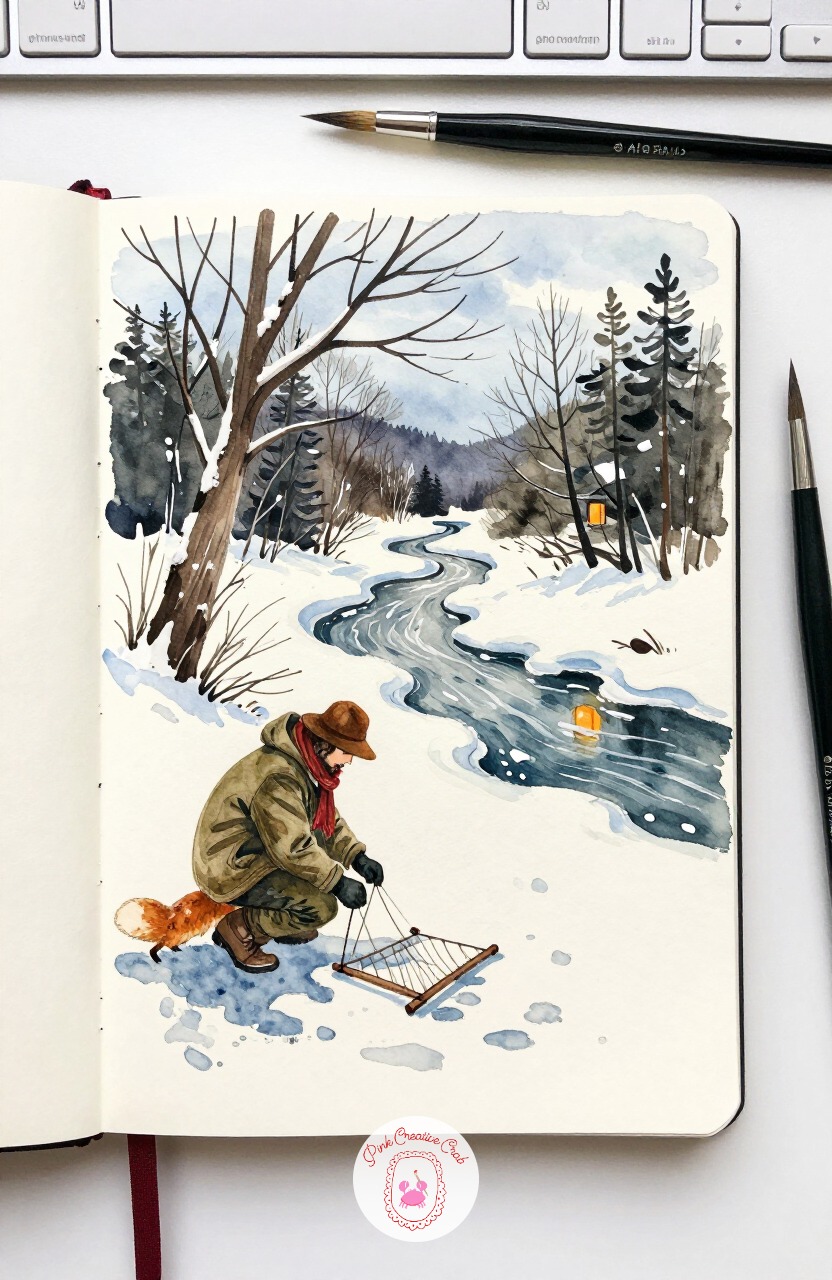
From string lights, head into quieter wilderness with a lone trapper crouched beside a frozen creek, checking a simple snare line. Proportion keeps this figure convincing: crouch him down to about half his standing height, weight balanced on his heels, which reads instantly as careful, deliberate movement rather than standing upright.
The frozen creek itself should wind through the composition as a pale ribbon between darker snowy banks, with a few bare branches overhanging from one side. His hat or coat lining carries the one warm accent against all that cool creek ice and bare winter wood.
Tip: let the creek’s pale ribbon narrow slightly as it recedes into the distance, that single taper creates depth without any extra perspective work.
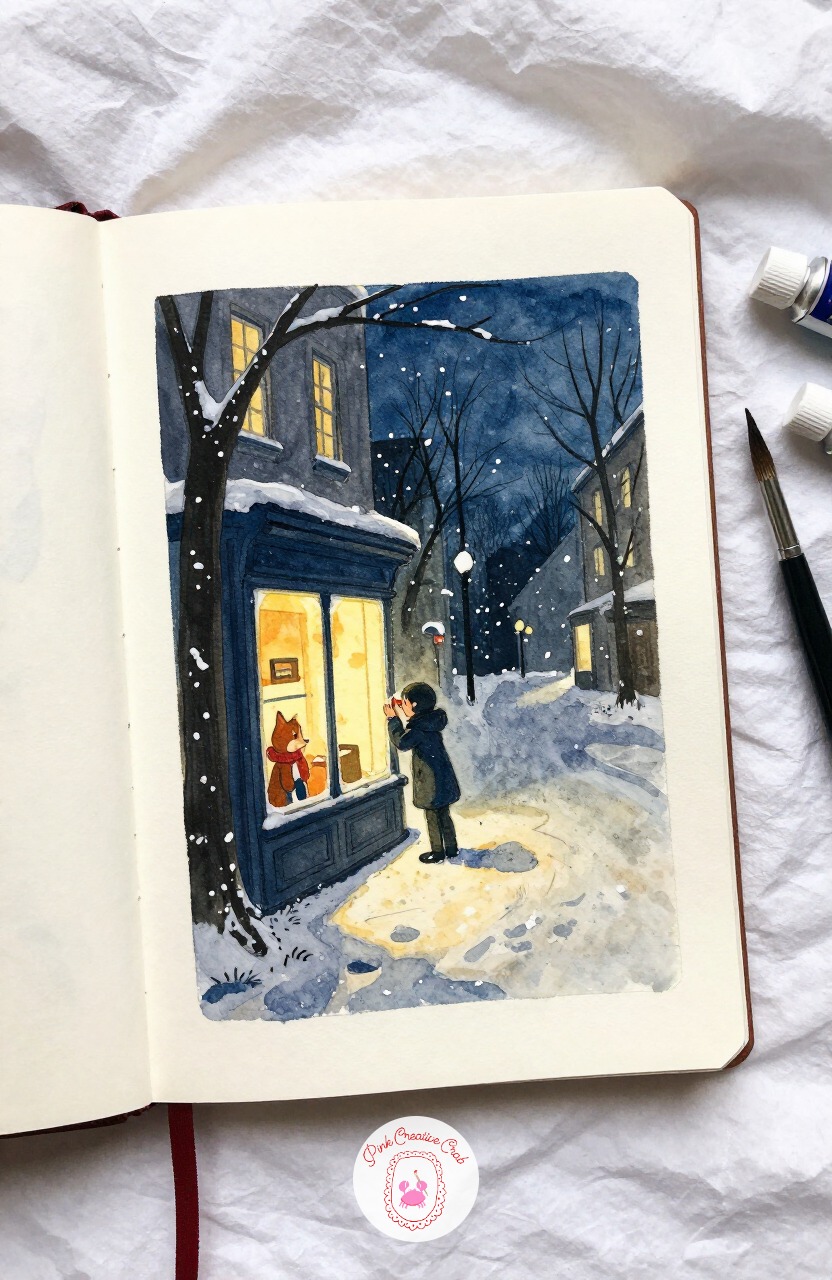
Bring the scene back into town with two kids pressed close to a shop window at night, noses nearly touching the cold glass as they peer in. Light is everything in this one: keep the street outside dark and cool, almost entirely blue-grey, so the shop window’s warm glow reads as the single dramatic bright spot on the whole page.
Paint that window glow first as a solid warm wash, let it dry completely, then add the two children’s dark silhouettes over it last, which keeps them crisp and readable against the brightness behind them. This naturally gives you your one warm accent already built into the composition.
Tip: let a little of that warm glow spill onto the snow at their feet, a soft puddle of reflected light sells the night setting instantly.
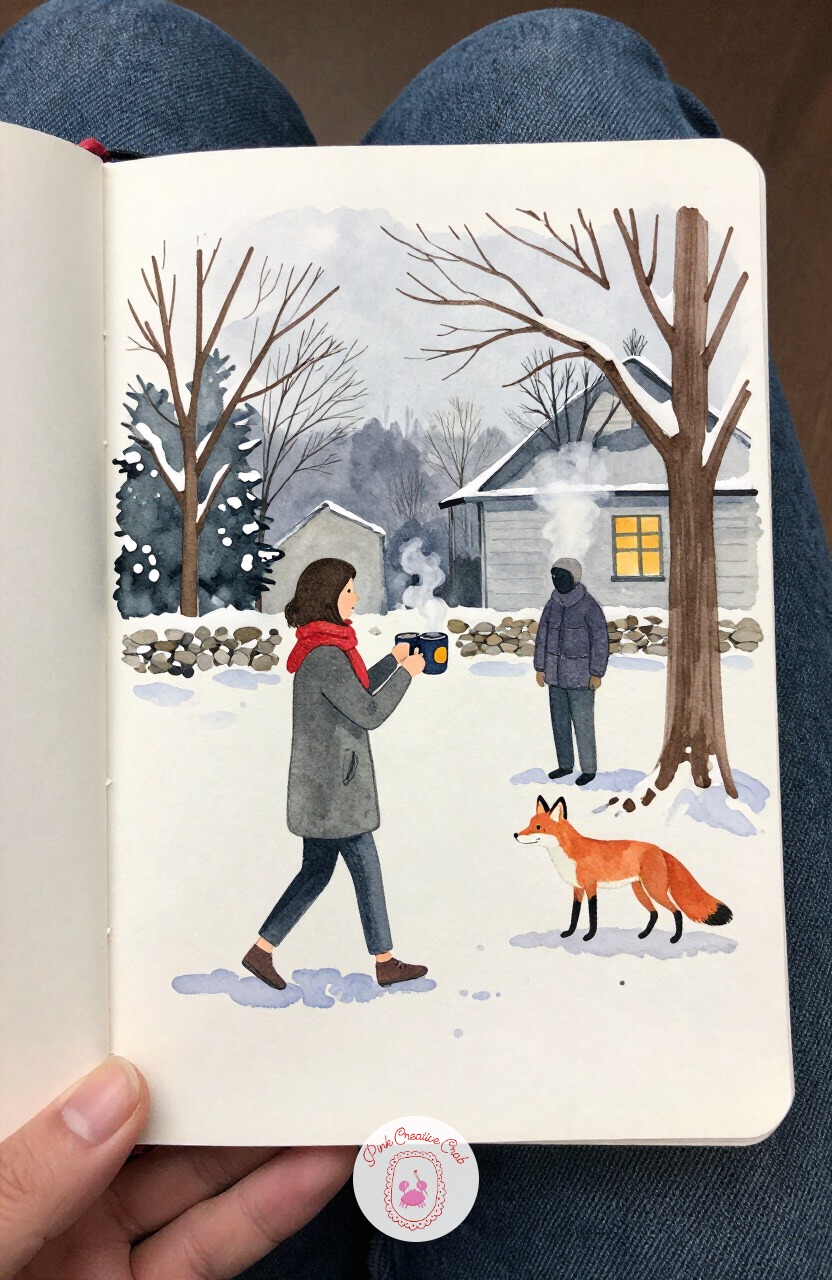
From that glowing window, step back into daylight with a woman crossing her yard carrying two steaming mugs toward someone waiting outside. The ten-minute version is just her figure, the mugs and a loose suggestion of steam rising, painted wet into wet.
Given more time, add her own footprints crossing diagonally behind her and a second figure waiting at the edge of the page, perhaps seated on a porch step, which turns a single figure into a small shared moment. The steam itself and one mug’s warm color make natural homes for your single accent.
Tip: paint steam as two or three soft upward curls in very pale grey-white, never as a solid cloud shape, or it stops reading as heat.
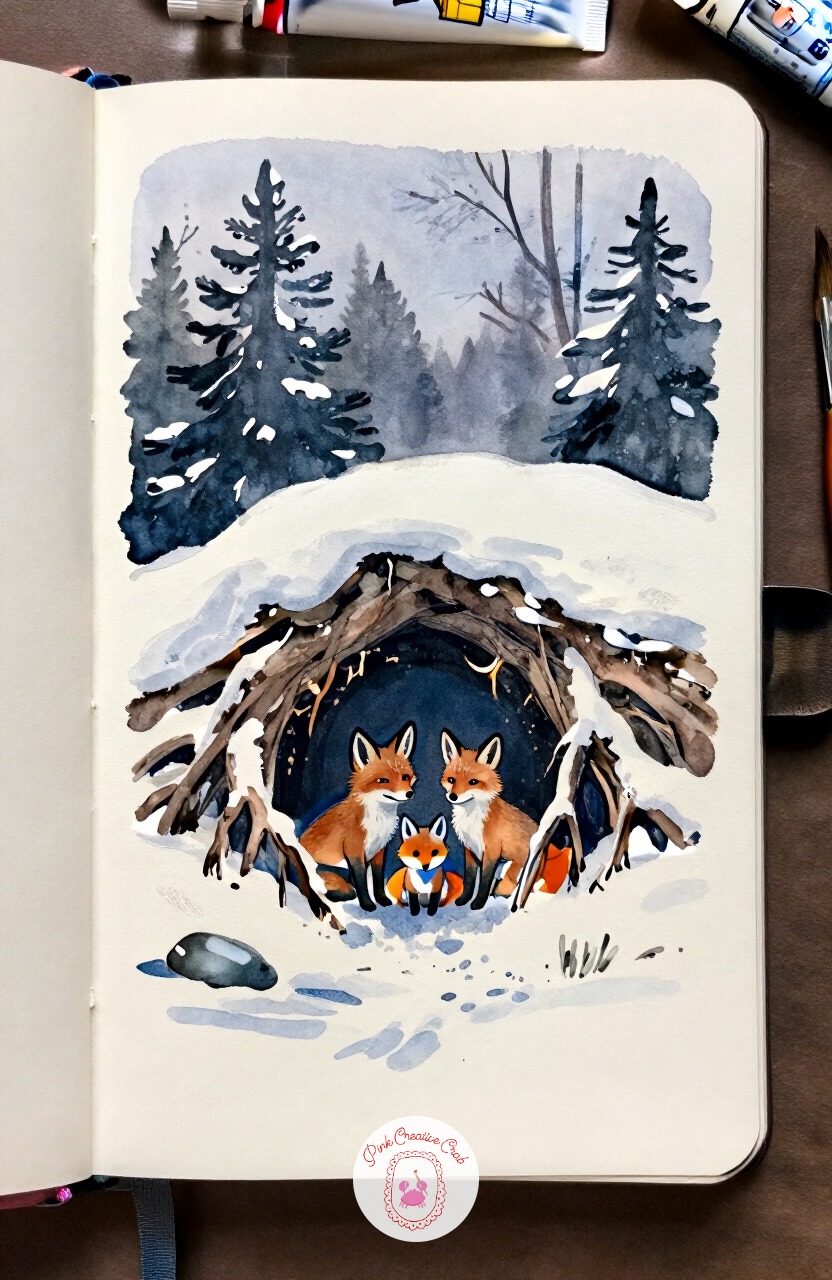
Return to wildlife with a small fox family, one adult and two kits, tucked beneath the snow-covered roots of a fallen tree. This is a proportion idea again: keep both kits noticeably smaller and rounder than the adult, closer to compact little balls of fur, which instantly reads as young rather than simply small foxes.
Nestle them into the dark hollow beneath the roots, letting that hollow stay the darkest, coolest shape on the page so the foxes’ warm rust-colored fur glows by contrast as your single accent. Keep the snow-covered roots above them simple, just a few heavy white-capped curves.
Tip: leave the den’s opening as the darkest unpainted-feeling shadow on the page, deep indigo rather than true black, so it still feels cold rather than flat.
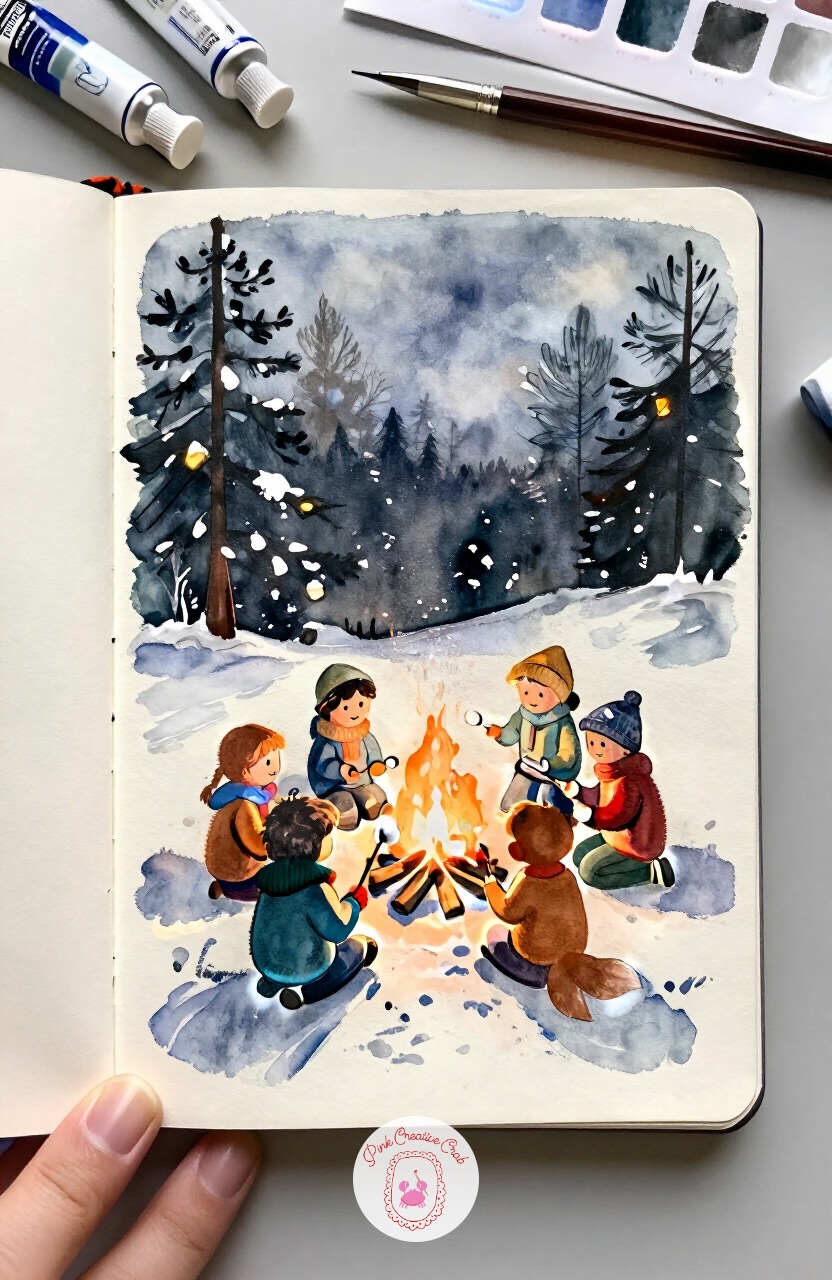
From that quiet den, bring warmth and noise back with a few kids gathered around a small outdoor fire, sticks extended, roasting marshmallows in the snow. Light drives this scene entirely: the fire itself is your warm accent and your only true light source, so every face and hand nearest it should carry a touch of orange glow while the surrounding snow stays cool and shadowed.
Paint the fire first as a loose warm core of orange and yellow, let it dry, then build the children’s silhouettes and faces around it, lightest and warmest on the side facing the flame. Their marshmallow sticks extend out from the circle as simple thin diagonal lines.
Tip: let the fire’s glow fade gradually into the cool snow rather than stopping at a hard edge, warmth never ends abruptly in real light.
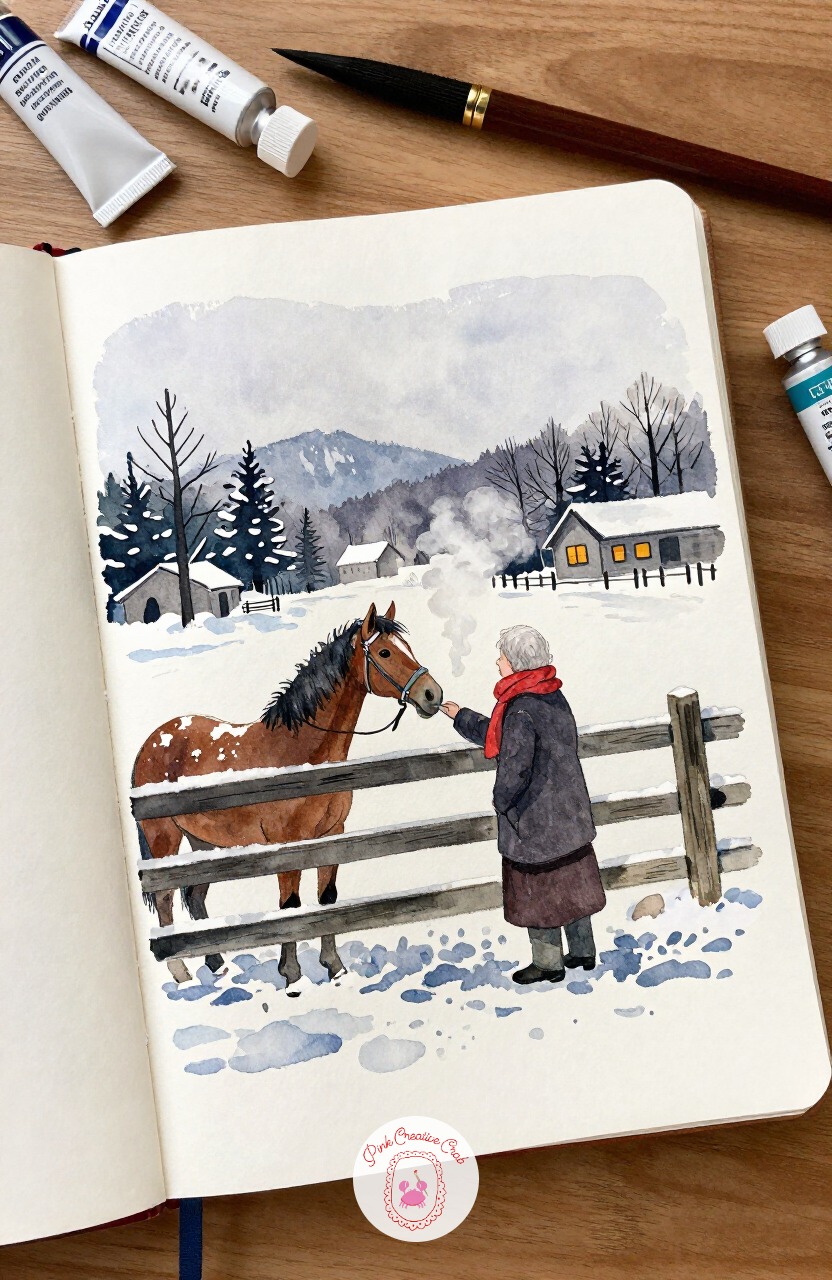
Slow the pace with an elderly woman standing at a wooden fence, offering something from her palm to a horse leaning its head over to reach her. Edges and texture matter here: the horse’s breath should show as a soft pale cloud in the cold air, painted wet into wet so it blurs naturally rather than sitting as a hard white shape.
Keep the fence itself simple, just a few horizontal and vertical lines capped lightly with white gouache snow, letting the two figures, woman and horse, do all the storytelling. Her scarf or the horse’s blanket can carry your one warm accent against all that cool fencing and breath-fogged air.
Tip: paint the horse’s breath cloud before its head fully dries, so the two blur together softly at the edge.
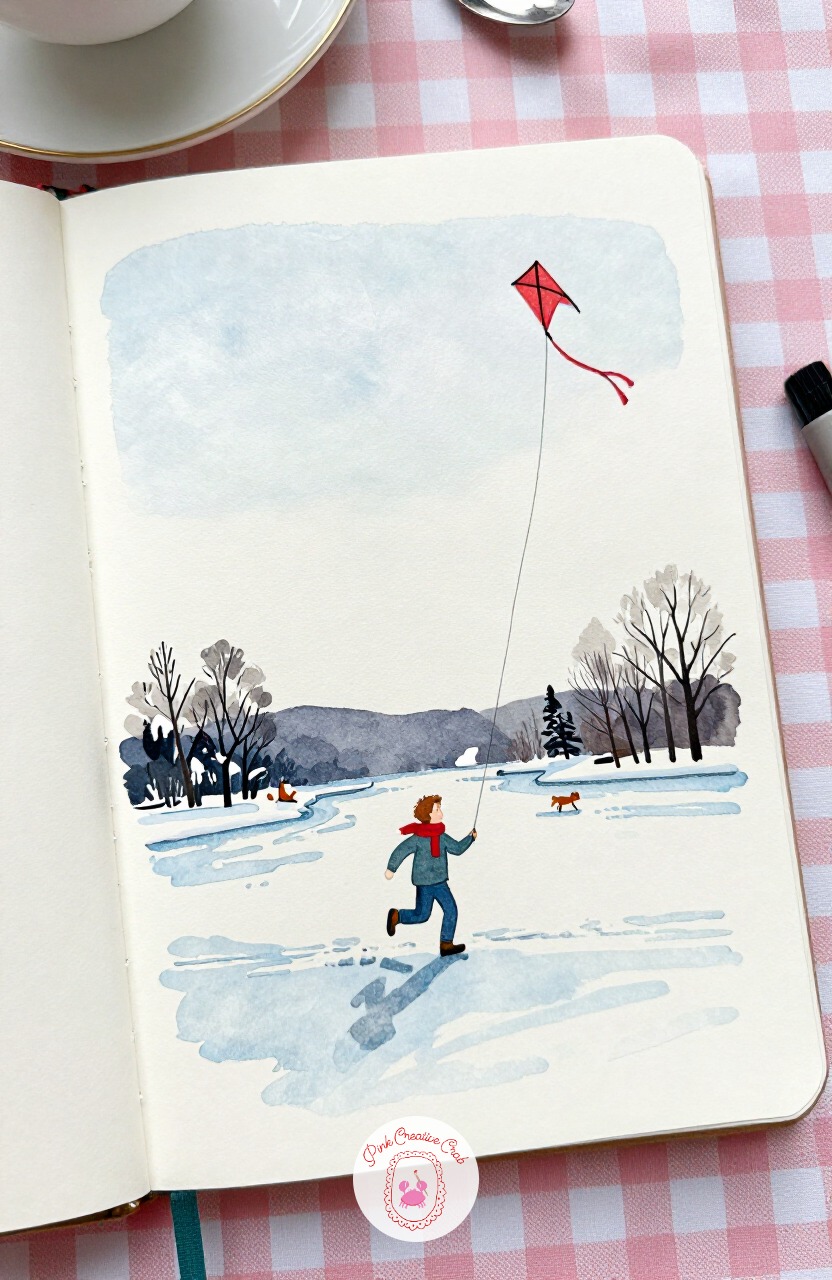
From the quiet fence scene, pick the energy back up with a boy running across open lake ice, kite climbing high behind him on a cold, clear day. This is a tool choice idea: use a fine liner brush or the very tip of a small round just for the kite string, since one unbroken thin line does more to show distance and height than any amount of shading could.
Paint the lake’s ice and sky as two simple flat washes first, then add the boy running with one leg forward mid-stride, and only then thread that single fine line up from his hand to the kite itself. The kite’s fabric is the natural place for your one warm accent, a bright patch of color against all that pale blue ice and sky.
Tip: let the kite’s tail curve rather than hang straight, a gentle curve reads instantly as caught in wind.
What to Do Next
Pick whichever scene pulled at you most on this list, mix a puddle of pale blue-grey, and get the big sky or snowfield wash down first while your paper is still fresh. For more cool-weather pages once this one is dry, the winter painting ideas and winter doodles collections make a nice next stop.
Frequently Asked Questions
What paper works best for a winter watercolor sketchbook?
A cold-press 140lb pad holds up well to wet-into-wet skies and layered washes without buckling too much, and its slight texture helps snow and fur read naturally. Avoid anything smoother than that, since very smooth paper makes gouache snow highlights sit flat instead of catching light.
How do I make white gouache snow look natural instead of chalky?
Let your watercolor washes dry fully first, then apply gouache in small varied strokes rather than one flat layer, keeping some areas thin enough to show the paper beneath. Thinning it slightly with water also helps it blend rather than sit as a hard opaque patch.
How do I keep a cool winter palette from looking flat or lifeless?
Pick one warm accent color before you start each page, whether it is a scarf, a window glow or a fox’s fur, and let every other color stay in the blue-grey family. That single contrast is what keeps cool scenes feeling alive rather than monotonous.
How small should figures be in these winter scenes?
Most figures here work best drawn small, often under a third of the page’s height, since the landscape and atmosphere carry much of the story. Keep proportions simple, around four heads tall for adults, and let gesture and pose do more work than facial detail.
Can I paint these winter sketchbook ideas without snow scenery experience?
Yes, these scenes rely on simple flat washes, soft wet-into-wet skies and a few confident brush strokes for figures rather than tight detail. Start with the easier early ideas in this list and the loose, forgiving style will carry you through the more involved ones.
Have any thoughts?
Share your reaction or leave a quick response — we’d love to hear what you think!
-
 0
-
0
-
0
-
0
-
0
-
0


