A crab doodle earns its spot on the page the moment you give it something small to do: hold a pebble, hide under an umbrella, panic at a seagull. That little bit of story is what turns ten round shapes into a page you actually want to keep, and it only takes a fineliner and a couple of markers to get there.
Below you will find twenty eight of them, starting with the simplest round bodies and working up to little two character scenes. Pick whichever one makes you grin first, grab your pen, and finish it before the kettle boils.
Using these images: free for personal projects such as printing, coloring, cards, journals and gifts. Handmade items that include them may be sold up to 30 pieces per design. More than that is commercial use and is not permitted, and neither is selling or sharing the images themselves or passing them off as your own. Please ask before any other use.
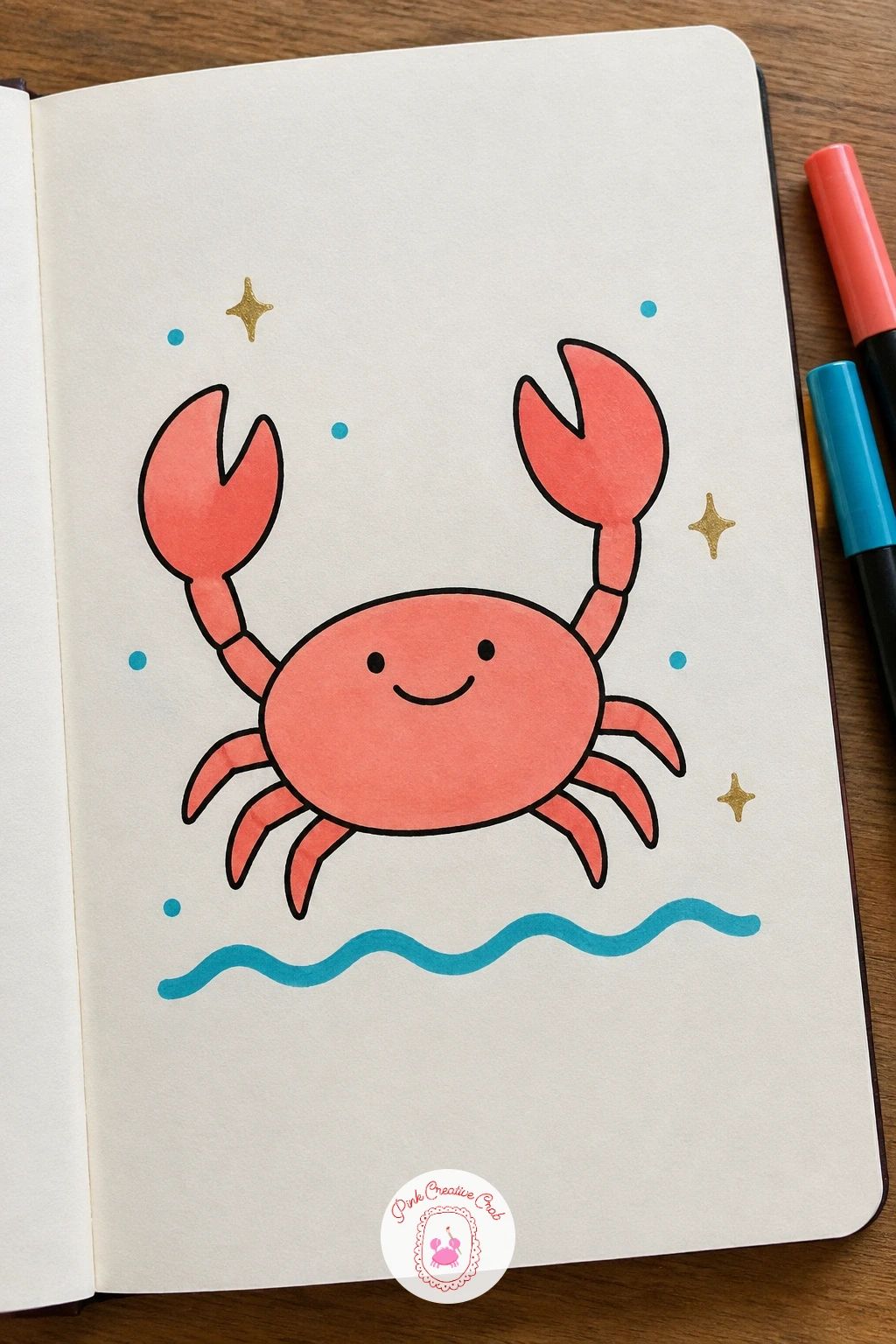
Start with the friendliest one on the list: a crab waving both claws hello with a big grin. Draw a wide oval body first, then two smaller ovals on top for the eyes on stalks, and keep the whole thing squashed rather than tall so it reads as a crab and not a spider.
Ink the body outline before you touch the legs, then add four bent legs on each side, all leaving the body at roughly the same angle so the crab looks steady rather than lopsided. Lift both claws up high and open, like little mitts, and give the mouth a simple curved smile.
If the claws end up uneven, fix it by making both a touch bigger rather than shrinking one, since a slightly oversized claw reads as cheerful rather than wrong. Color the shell in coral pink marker, leave the claws and eye stalks white or light, and add a thin sea blue wave line underneath for ground.
No coral marker on hand works fine with any warm pink or orange you already own, since the shape carries this one more than the color does.
Palette: Coral Pink,Sea Blue,Ink Black
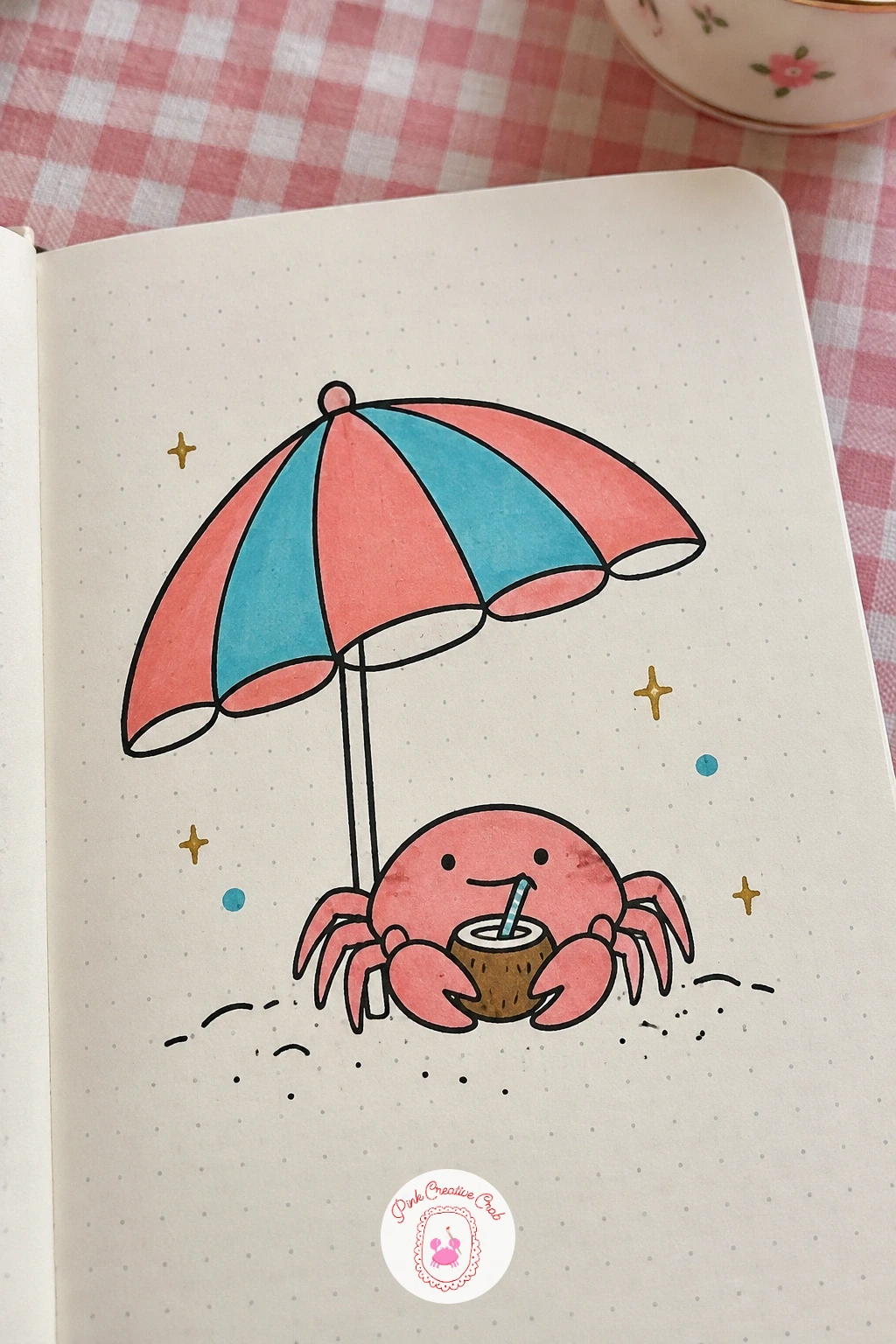
Once the basic crab body feels easy, give it a prop: a pink crab under a striped beach umbrella sipping coconut water. Draw the umbrella first as a simple triangle fan on a thin pole, planted a little off center so the crab has room to sit beside it, then add the crab body low on the page.
Work the striped canopy in alternating coral pink and sea blue marker bands, inked over once the color is dry so the stripes stay crisp. Give the crab one claw wrapped around a tiny coconut with a straw, the other claw resting on the sand.
Eye the proportion here: keep the umbrella roughly twice the width of the crab’s body so it reads as shade overhead rather than a hat. If the stripes wobble, straighten them afterward with a ruler edge in fineliner rather than erasing the marker.
Swap the coconut for a tiny drink cup with a bent straw if coconuts feel fiddly to draw small.
You Will Need
- ruler
Palette: Coral Pink,Sea Blue,Sand Beige
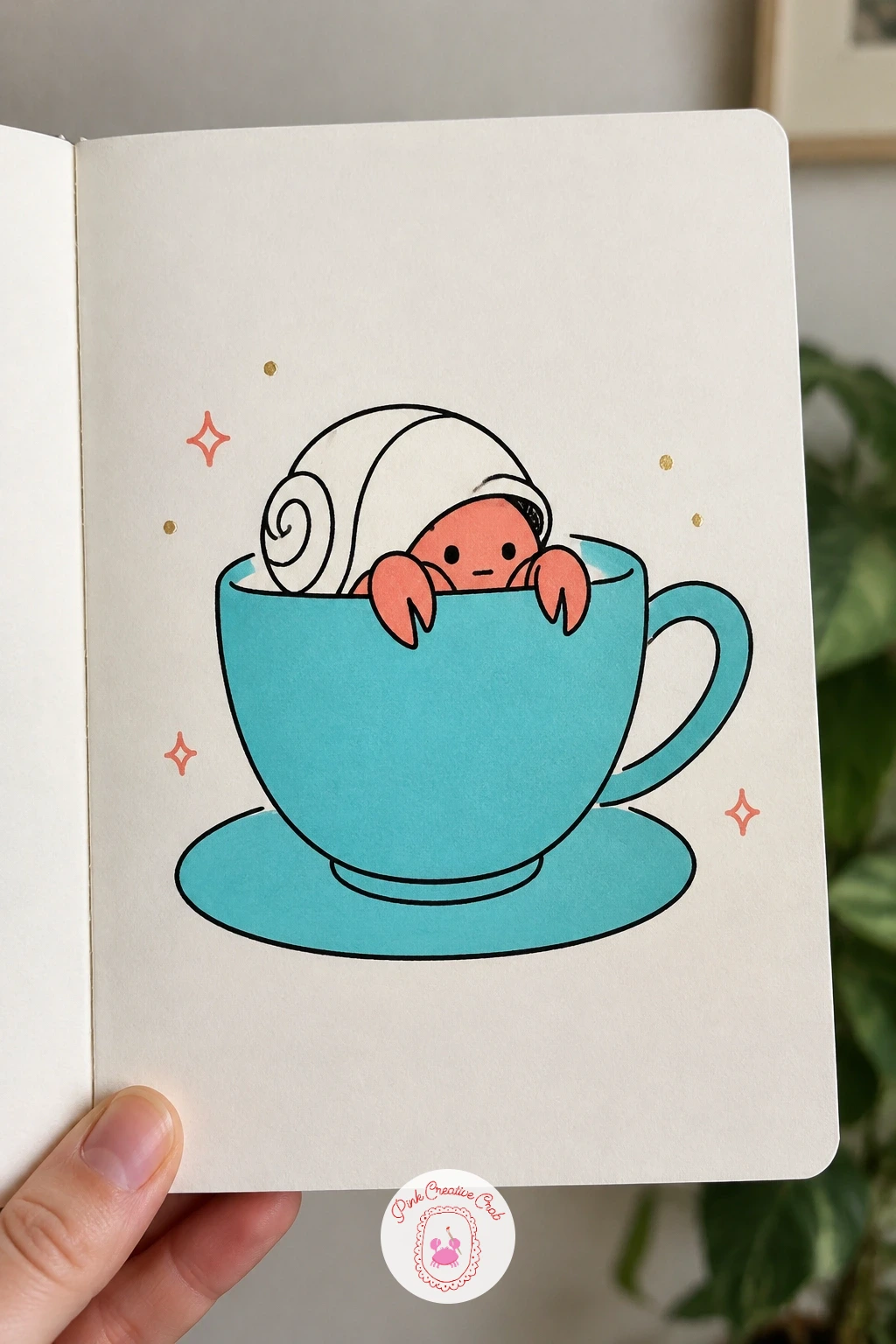
Shift from open beach scenes to something cozier: a hermit crab moving into a teacup and peeking out shyly. Draw the teacup first, a simple rounded cup with a curved handle and a thin saucer line beneath it, then tuck the hermit crab’s front half peeking over the rim.
Ink the cup’s outline clean and single stroke, then add the crab’s eye stalks and two small claws gripping the rim like it is testing the water. Keep the body mostly hidden inside the cup, since the joke is in how little of the crab you actually show.
This is a nice one for a bridge into more hermit crab drawing ideas if the moving-house theme grabs you. Where it tends to go wrong is a cup that looks like a bowl: keep the top wider than the base and add a handle early so the proportion locks in from the start.
No teacup reference handy works fine from a mug on your own desk, traced loosely for the curve.
Palette: Sea Blue,Coral Pink,White Highlight
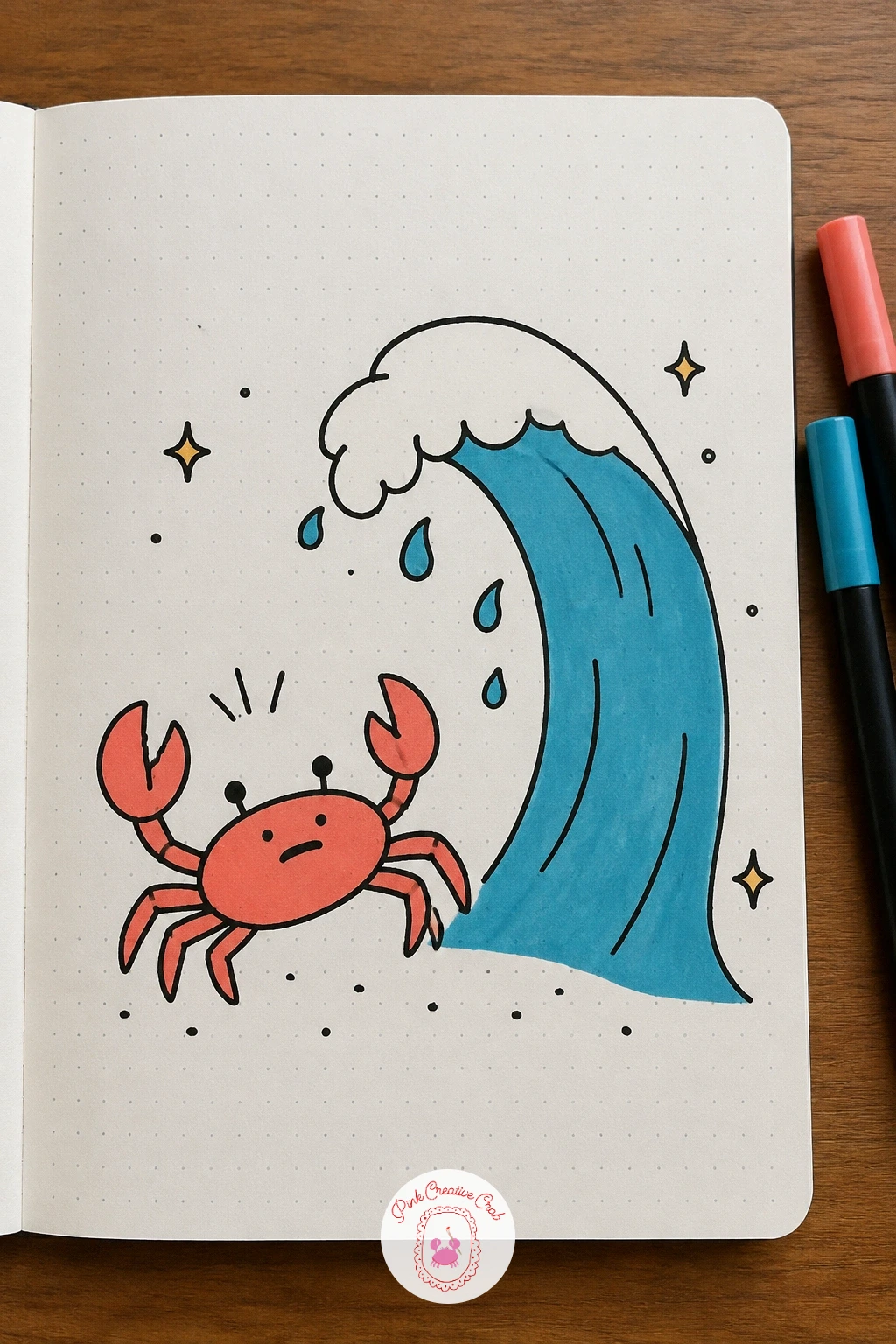
Now bring in motion and a bit of drama: a crab walking sideways into a wave and looking shocked. Draw the crab first in profile, legs mid-stride and body tilted slightly forward, then build a single curling wave shape rising beside it.
Think about eye level here: set the wave’s crest just above the crab’s eye stalks so it genuinely looms, and widen the crab’s eyes into two small circles with tiny dots for pupils to sell the shock. Ink the wave with one confident curving line rather than several short ones, so the curl stays smooth.
Color the wave in sea blue with a lighter streak left white for foam, and keep the crab coral pink so it pops against the blue. If the wave ends up flat, add two or three short foam curls at the tip in white gel pen or by leaving the paper bare.
Try a hermit crab version of this same pose next time for a shell that tips sideways too.
You Will Need
- white gel pen
Palette: Sea Blue,Coral Pink,Foam White
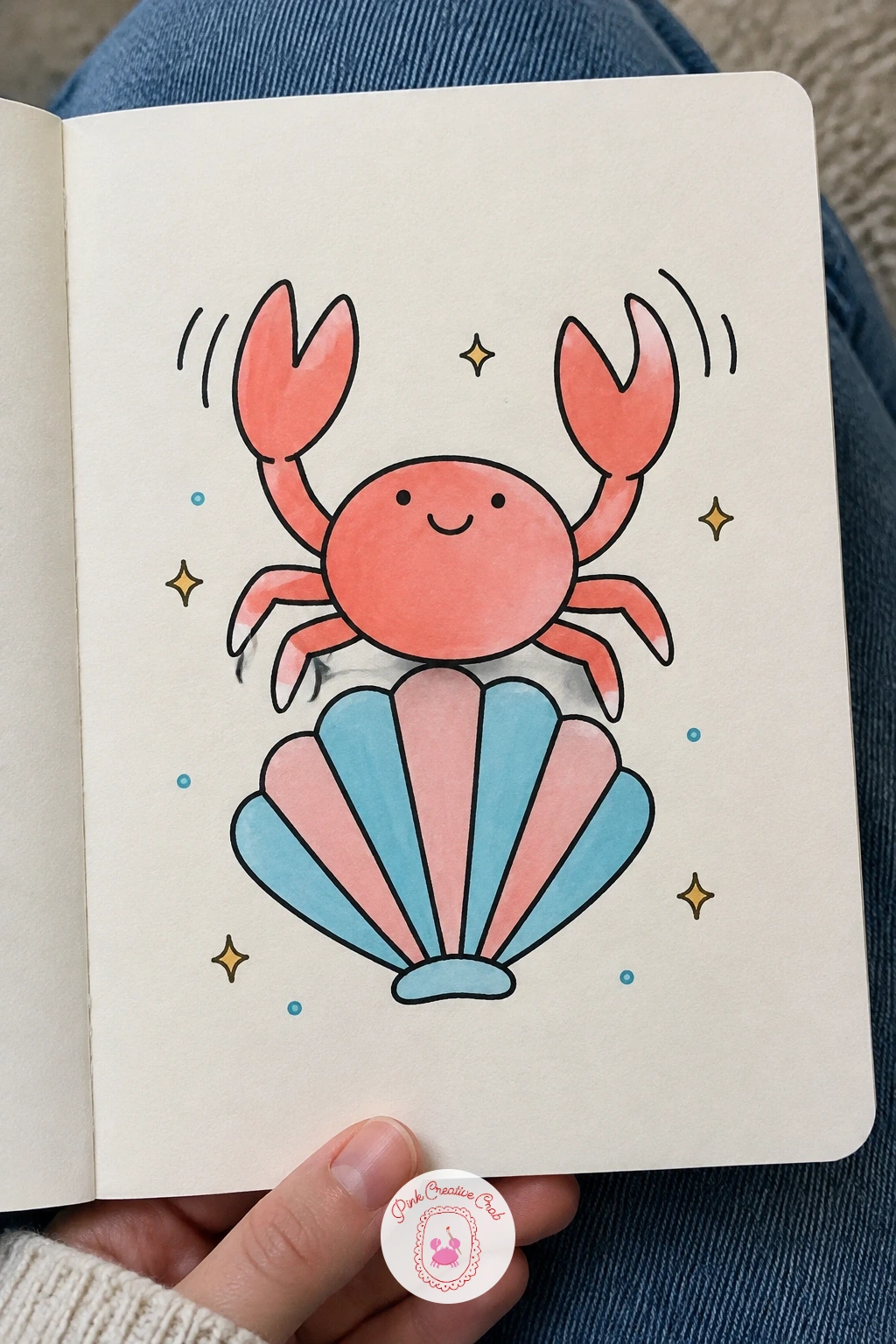
Keep the energy up with a crab clapping its claws over a shiny seashell it found. Draw the seashell first as a simple fan or spiral shape sitting on the ground, then place the crab’s body just behind it, slightly raised on its back legs like it is excited.
Bring both claws up and together above the shell, meeting in a clap shape with a few short motion lines radiating out to sell the excitement. Ink the shell’s ridges with short curved lines fanning from one point so they stay even.
The usual snag is claws that look like they are praying rather than clapping: keep a small gap between them and angle the tips slightly outward instead of flat together. Color the shell in sea blue with a coral pink edge, and leave a few white highlight dots on the shell for shine.
A fan shell is the easiest shape to start with if seashells feel tricky; spirals can come later once the fan version feels natural.
Palette: Sea Blue,Coral Pink,White Highlight
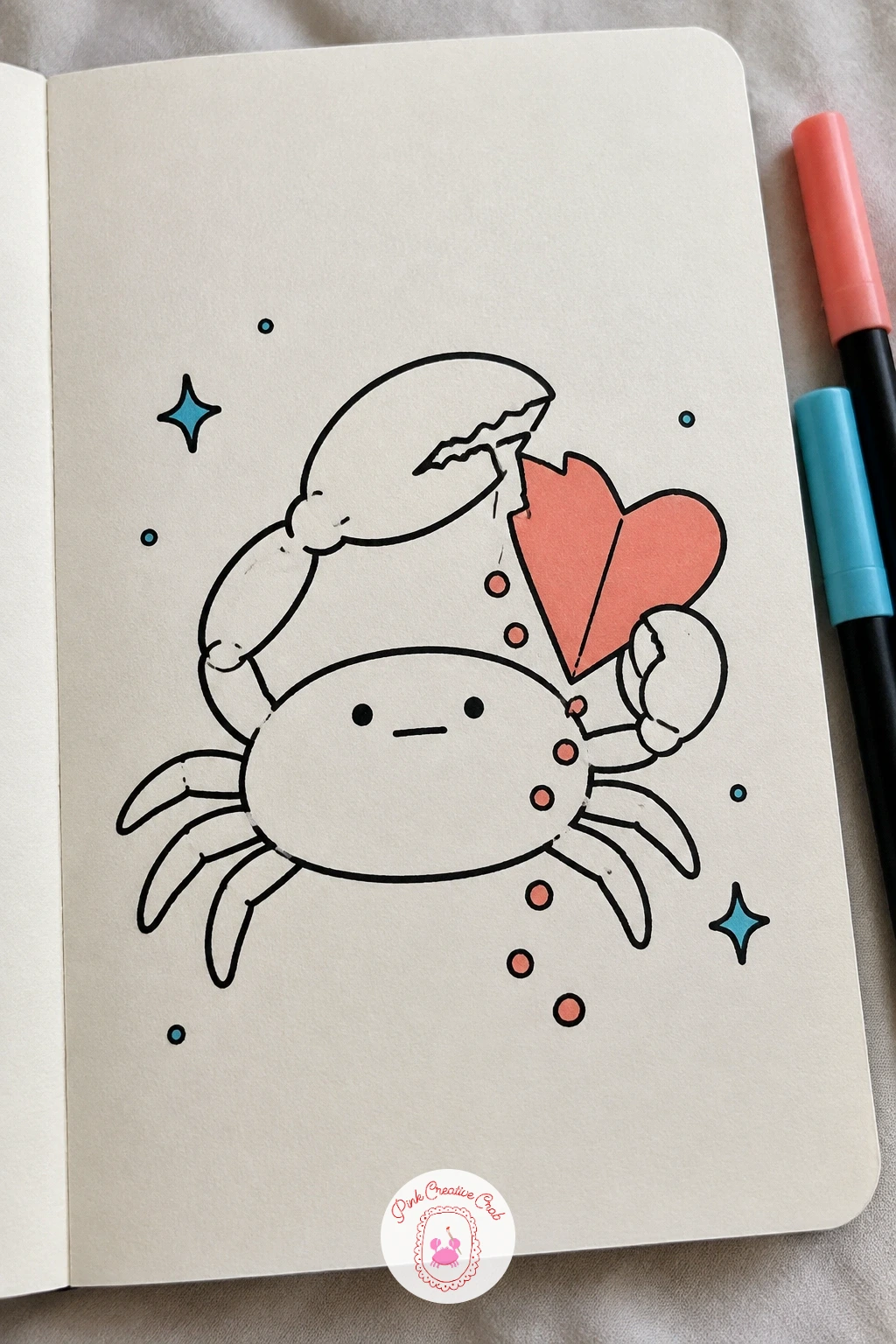
Give the claws a job in this one: a crab using its claws as scissors to snip out a paper heart. Draw a small folded paper shape first, half a heart along one fold line, then the crab’s body beside it with one claw open like a scissor blade mid-snip.
Ink the paper heart’s curved edge in one smooth stroke so the fold reads clearly, then add a few short snipped dots falling away from the claw to show motion. Keep the other claw tucked down holding the paper steady.
If the claw does not read as scissor-like, open it wider than a normal pinch and add a thin line down the middle to suggest a hinge. Color the heart in coral pink, the crab in a lighter shade or leave it mostly white with pink outlines so the two do not blend together.
This pairs nicely as a little card front, especially alongside ideas from couple drawing ideas if you want a matching set for someone.
Palette: Coral Pink,Sea Blue,Paper White
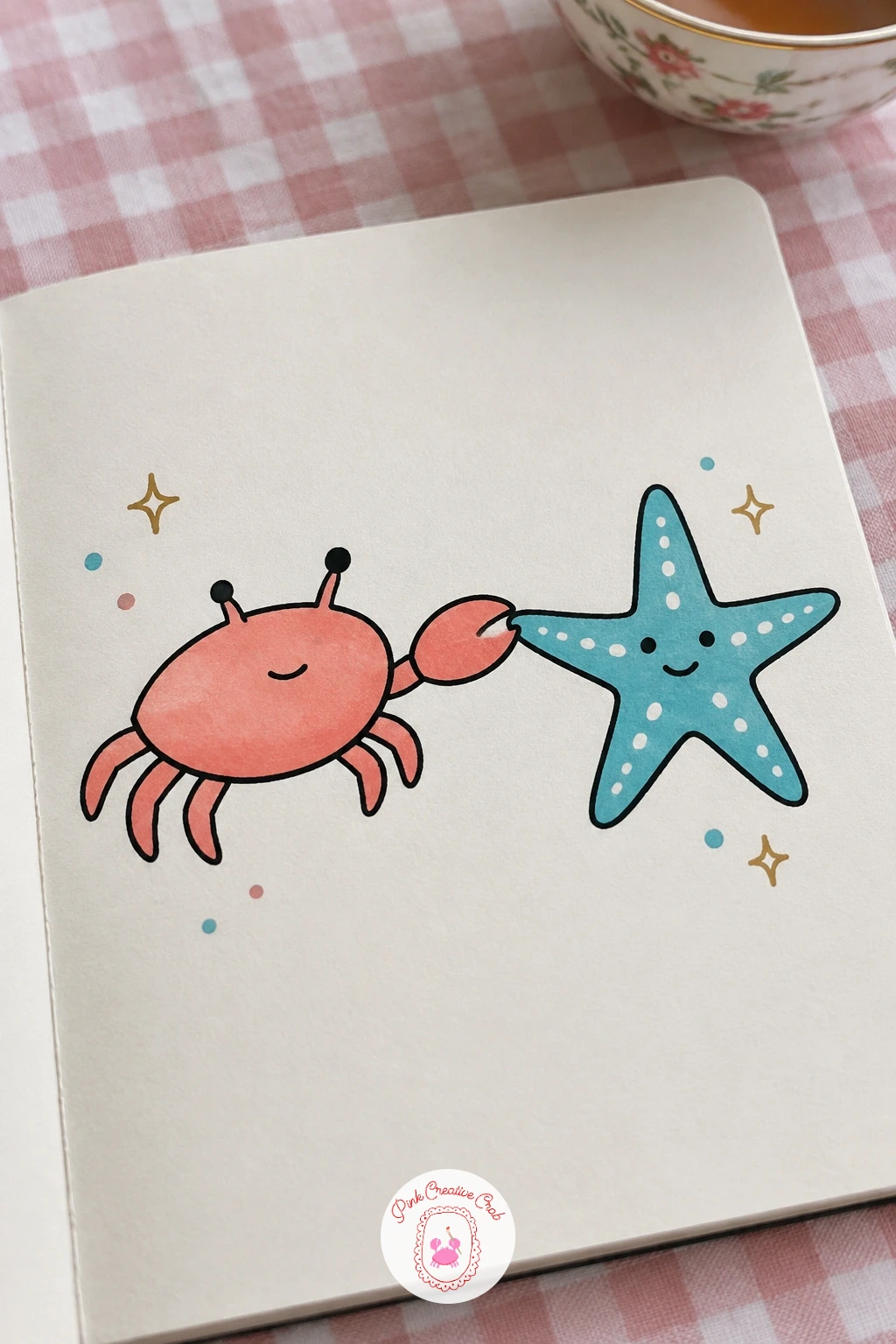
Move from props to a small social moment: a crab giving a starfish a polite claw handshake. Draw the starfish first as a simple five point star with slightly rounded arms, then set the crab beside it at the same height so the two feel like they are meeting as equals.
Extend one crab claw out toward one starfish arm and let them touch tip to tip, keeping the gesture gentle rather than a full grip. Ink the starfish’s texture with small dotted rows along each arm rather than a solid fill, which keeps it looking light.
Where this one wobbles is scale: keep the starfish roughly the same width as the crab’s body so neither one swallows the scene. Color the starfish in sea blue and the crab in coral pink so the handshake reads clearly between two different colors.
Swap the starfish for a small sea snail if you want a shorter character to shake claws at crab height.
Palette: Sea Blue,Coral Pink,Ink Black
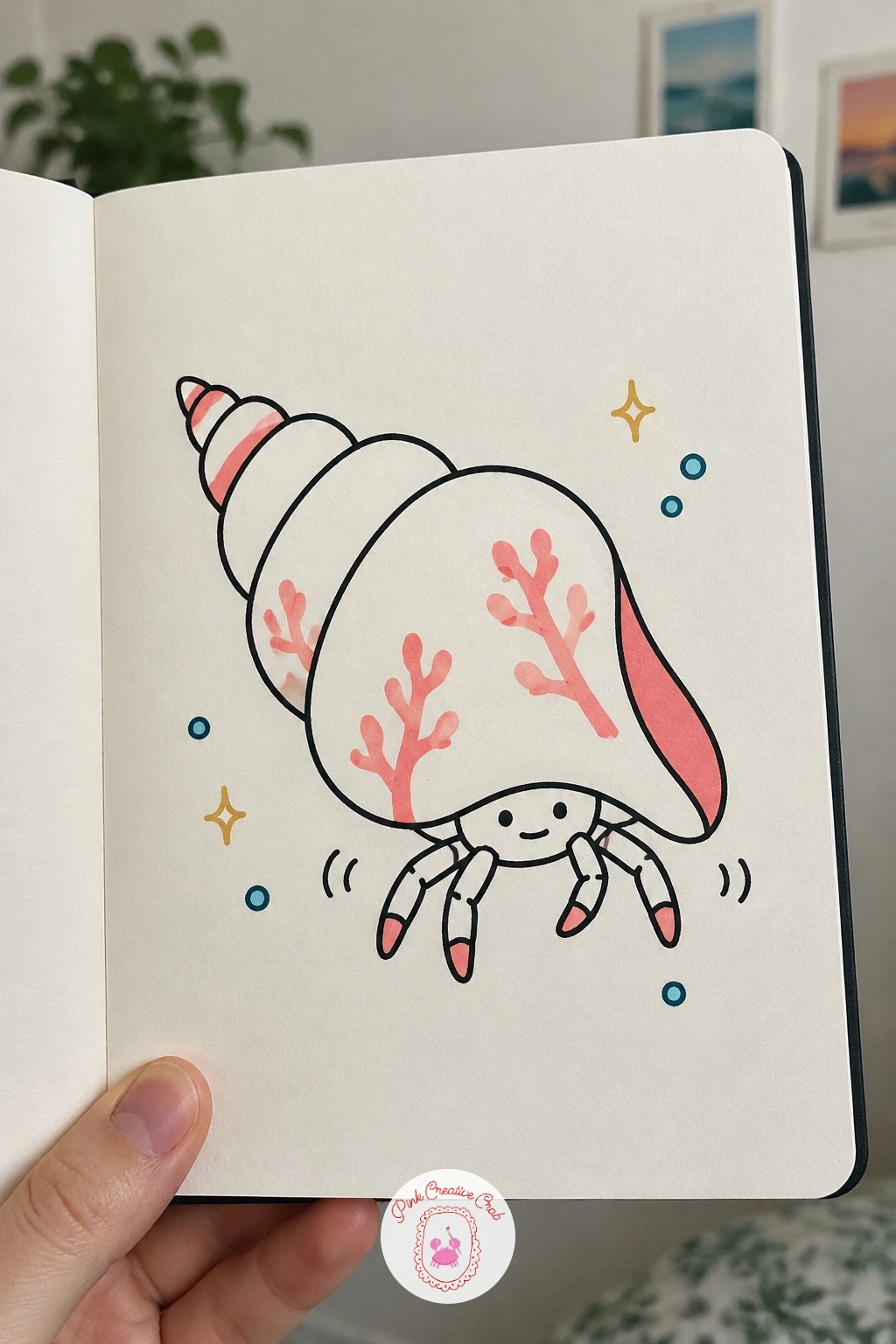
Return to the hermit crab for a size joke: trying on a huge conch shell and wobbling. Draw the conch shell first, big and spiraled with a long pointed tip, clearly oversized next to where the crab’s legs will go, then add the small legs peeking out underneath, bent at odd angles to show the wobble.
Ink the shell’s spiral with one continuous curving line from the tip inward, then add a few short ridge lines along the outer edge for texture. Keep the legs thin and slightly crossed so the whole pose reads as unsteady rather than simply standing.
The scale is the whole joke here, so exaggerate it: make the shell at least twice the height of a normal hermit crab shell from your other doodles. Color the shell in warm coral with sea blue ridge lines, and add a couple of small motion lines beside the wobbling legs.
No inspiration for a conch curve nearby works fine from a photo of any spiral shell, even a garden snail’s.
Palette: Coral Pink,Sea Blue,Ink Black
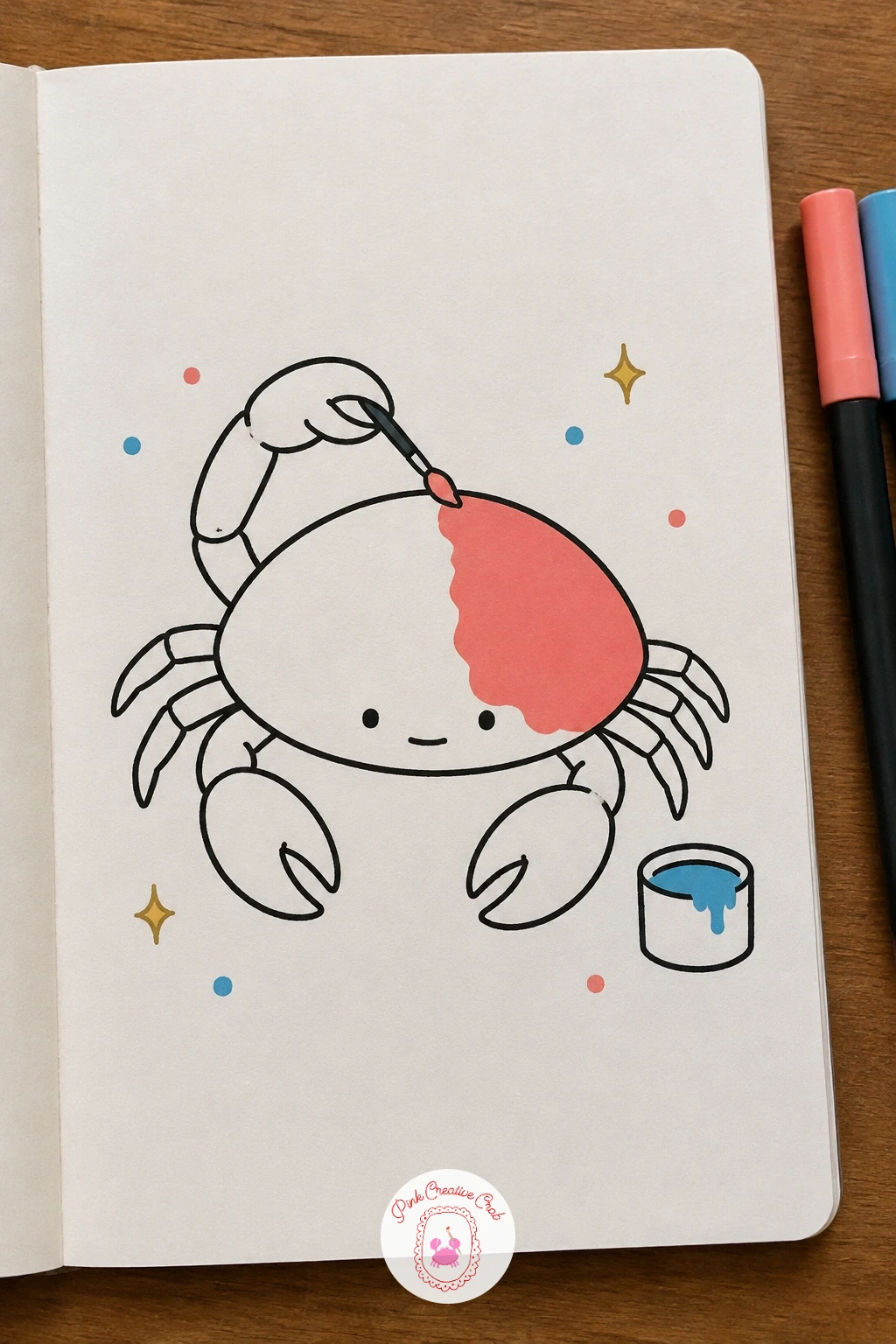
Here is a fun bit of meta humor: a crab painting its own shell pink with a tiny brush. Draw the crab’s body first, then add one claw holding a tiny paintbrush reaching back over its own shoulder toward its own shell, as though it can just reach.
Ink the brush as a simple thin handle with a small triangular tip, then leave a few short pink streaks already painted on one side of the shell while the other side stays outlined but uncolored. This half-finished look is the whole gag, so resist coloring the entire shell in.
The light source matters here: if you want the wet paint to shine, leave one small white highlight streak along the painted section, since wet color always picks up more light than dry. Keep the dry paint can or small pot beside the crab in sea blue for contrast.
A cotton swab dipped in marker ink works well if you want real texture on the “wet paint” streaks instead of just flat pen lines.
You Will Need
- cotton swab (optional)
Palette: Coral Pink,Sea Blue,White Highlight
Leave one shell half outlined but uncolored and the other half freshly painted coral, it sells the joke better than a fully finished shell.
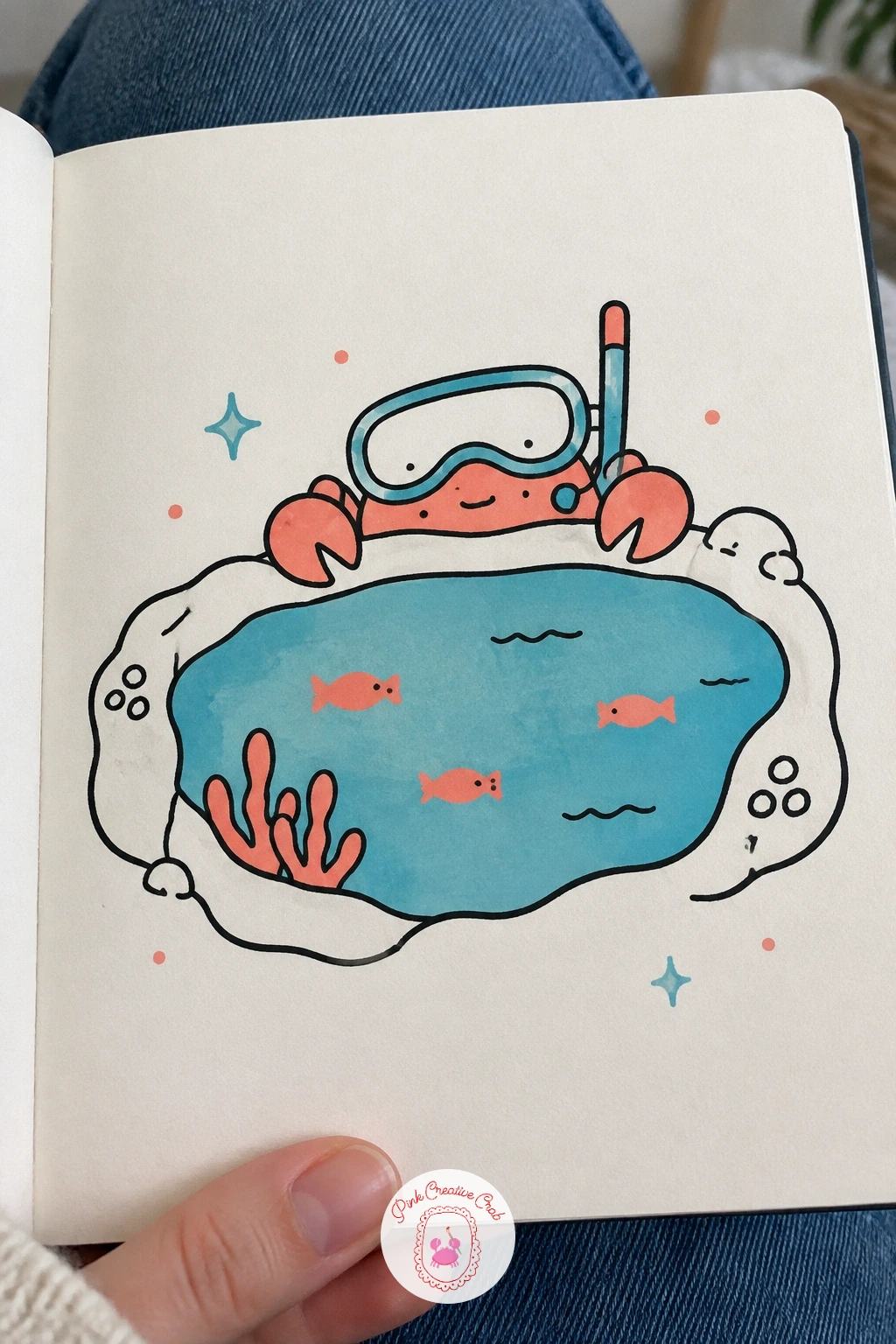
Settle into a quieter scene: a crab in a snorkel mask peeking out of a tide pool. Draw a simple irregular puddle shape first for the tide pool, then set the crab’s head and one claw peeking over the pool’s near edge, snorkel mask strapped over its eye stalks.
Ink the mask as two small circles joined by a thin strap, with a short snorkel tube sticking straight up. Fill the tide pool in sea blue, leaving a ragged white edge where it meets the rock or sand so the water has a believable boundary.
If the mask ends up looking like glasses instead, round the lenses out fully and add a thin line across the top for the strap, which reads more like swim gear. Add a couple of small coral pink dots in the water for tiny visible fish.
Working the quick version, sketch the pool and crab head in five minutes flat; the fuller version adds rock texture around the pool’s edge and a second small creature like a snail peeking from the other side.
Palette: Sea Blue,Coral Pink,Rock Grey
Give the crab a treasure to haul: a crab carrying a pearl like a precious bowling ball. Draw the pearl first as a single large circle, bigger than the crab’s own body, then build the crab around it with both claws wrapped underneath as though straining to lift it.
Ink the pearl with a light shading curve along one side rather than a hard outline all around, since pearls read as soft and glowing rather than sharply defined. Keep the crab’s legs bent and braced wide apart to show the effort of carrying something heavy.
The proportion trick here is simple: make the pearl at least as wide as the crab’s whole body, since a small pearl loses the joke entirely. Leave the pearl mostly white with a faint sea blue shadow underneath, and color the crab in coral pink for contrast.
Try a seashell instead of a pearl next time for a lighter object that the crab can lift with ease rather than strain against.
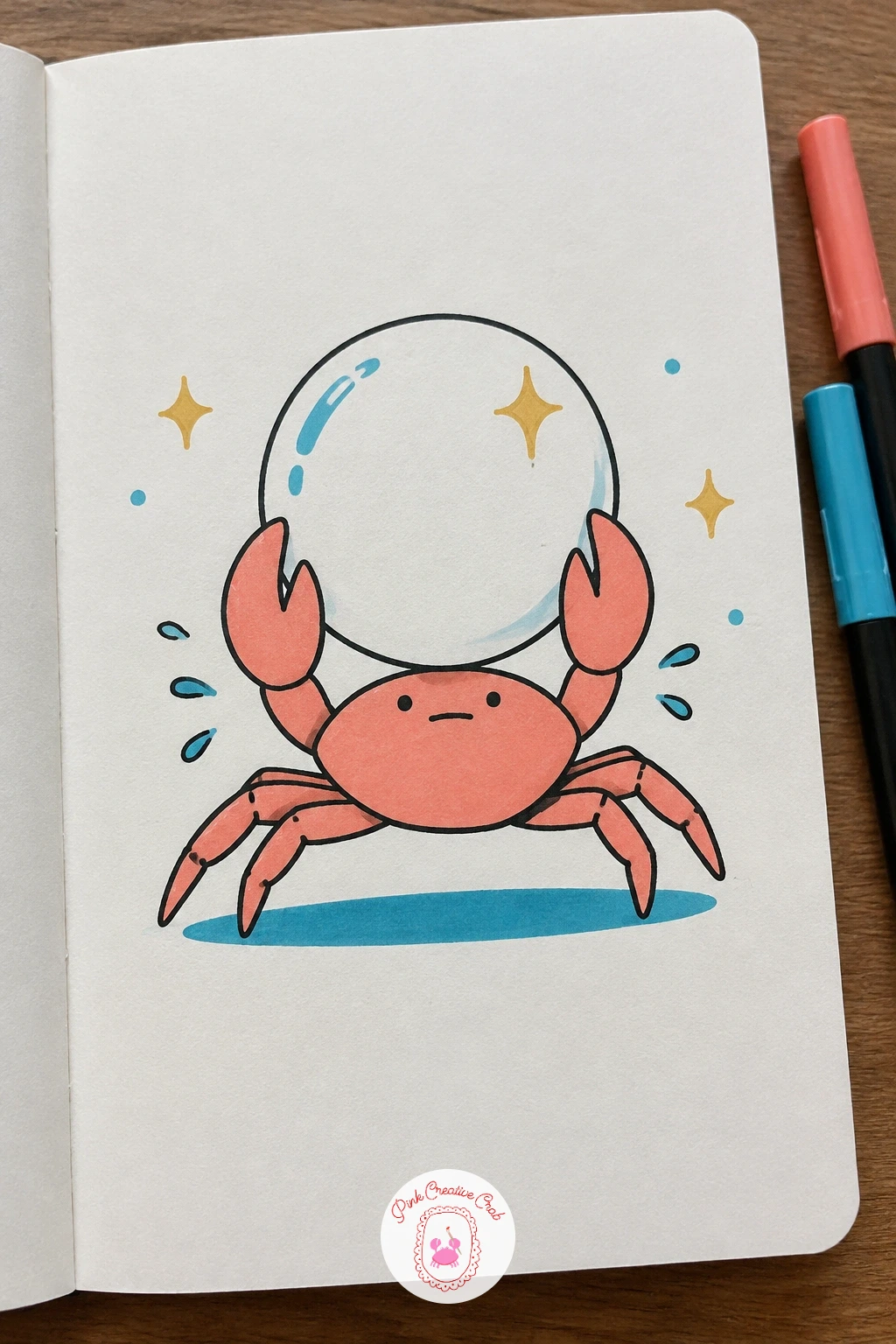
Palette: Sea Blue,Coral Pink,Pearl White
Slow things down with a crab lounging on a beach towel with claws folded on its belly. Draw the towel first as a simple rectangle laid flat on the sand, striped in alternating coral and blue bands, then set the crab on top lying on its back, claws folded neatly over its round belly.
Ink the crab’s legs splayed loosely out to the sides rather than tucked under, since a relaxed pose needs open rather than bunched limbs. Keep the eye stalks half closed with short curved lines instead of full circles to show it dozing.
Striped towels can look stiff if every band is the same width: vary the stripe widths slightly so the pattern feels hand drawn rather than ruled. Add a tiny pair of sunglasses perched on the eye stalks if you want one extra personality touch.
This is an easy one to pair with ideas from easy beach watercolor ideas if you want to paint a matching beach scene later.
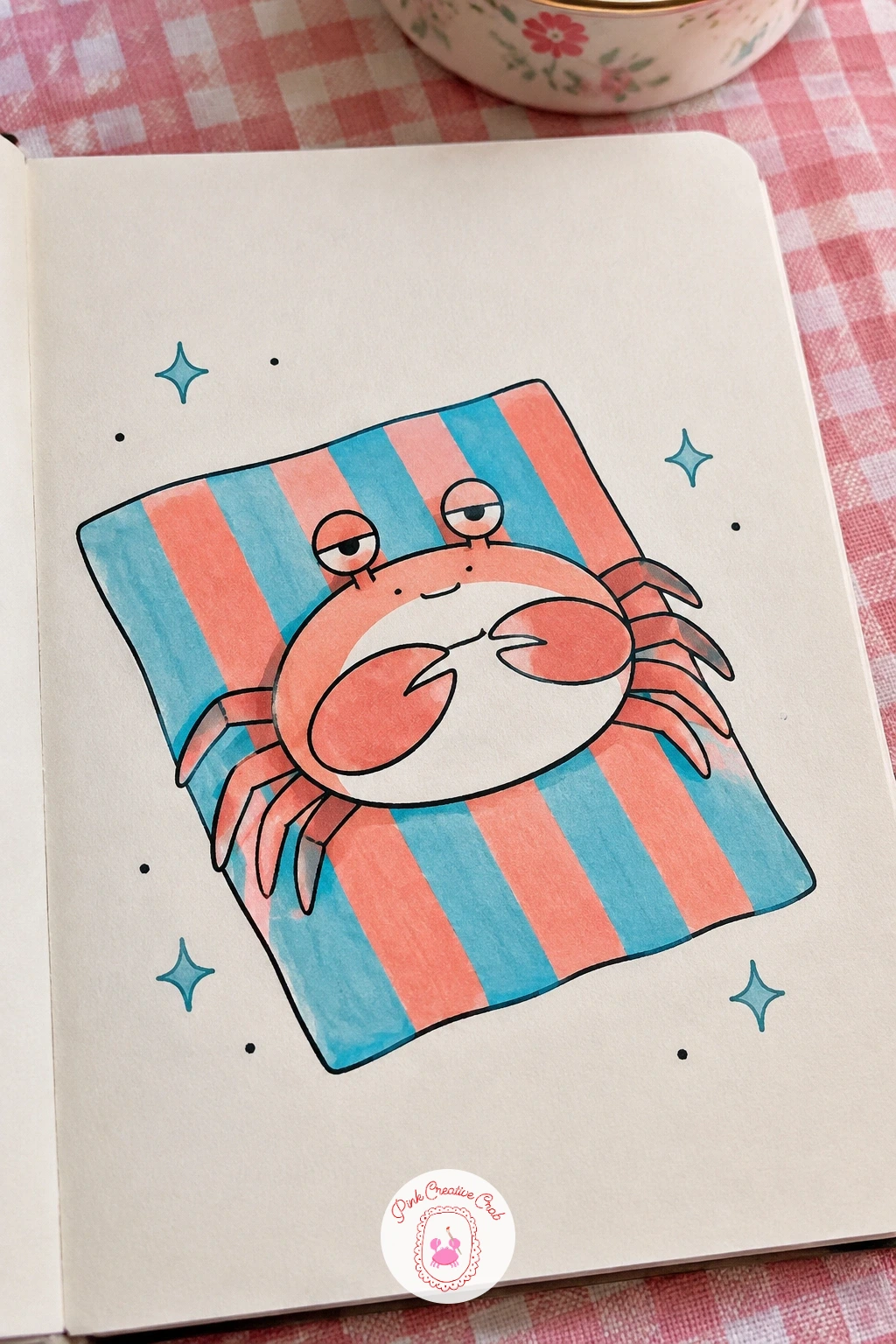
Palette: Coral Pink,Sea Blue,Sand Beige
Try a trickier composition next: a crab buried in the sand with only its eyes poking up. Draw a gentle mound of sand first, a simple low hill shape, then add just two small eye stalks and the very top of the shell peeking out at the mound’s crest.
Ink the sand mound with a few short curved texture lines rather than a flat outline, since sand reads better with some surface marks. Keep the eyes wide and alert looking, maybe slightly crossed, to suggest the crab is watching something nearby.
The temptation here is to show too much crab: resist drawing the claws or legs at all, since the whole joke relies on hiding almost the entire body. Color the sand in warm sand beige and leave the tiny visible shell edge in coral pink so it stands out against the mound.
A small shovel or bucket set beside the mound adds a quick second prop if you want the scene to feel like someone just walked away.
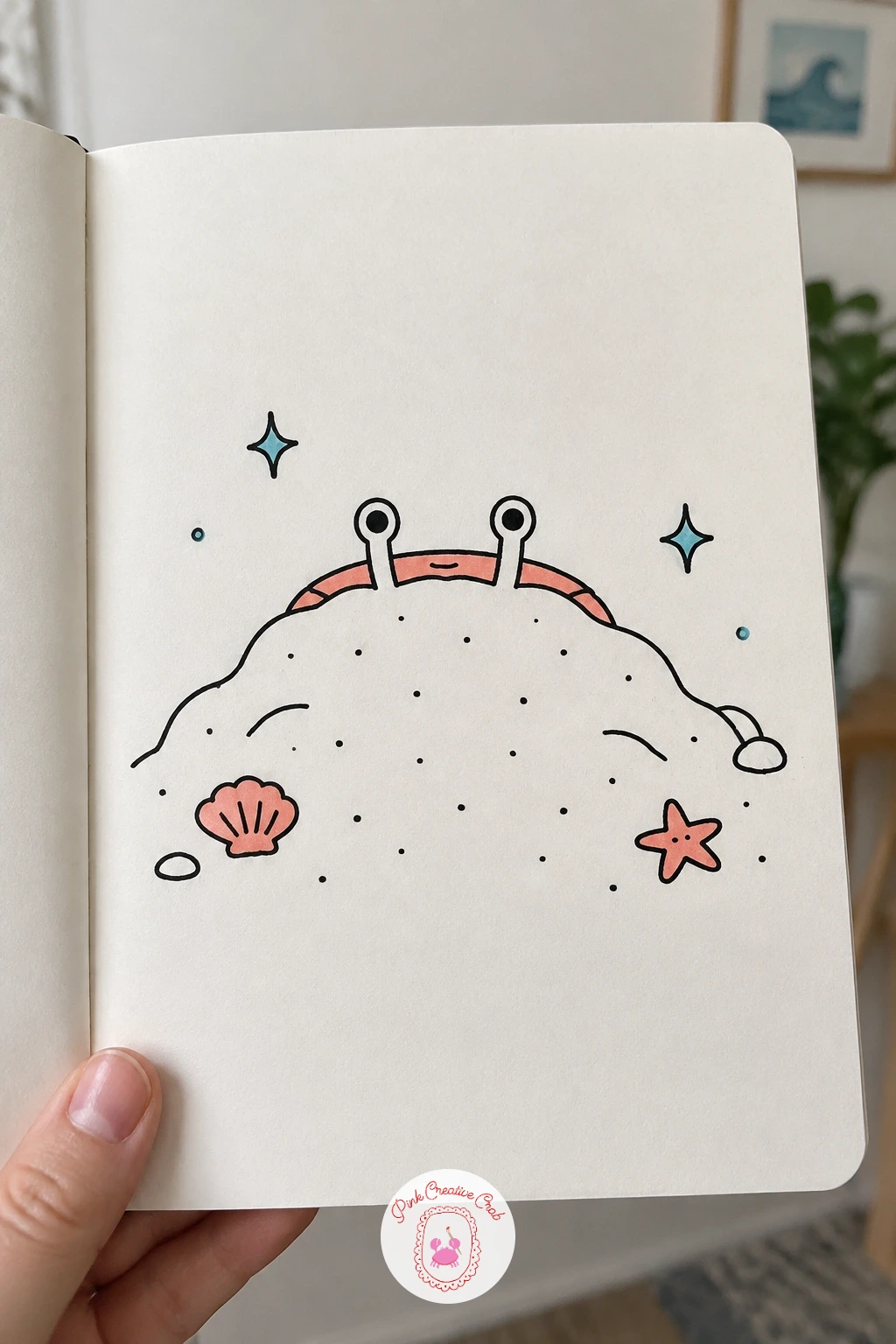
Palette: Sand Beige,Coral Pink,Ink Black
Bring motion back with a crab doing the cha-cha sideways across the sand. Draw the body at a slight diagonal lean first, then add legs in a staggered stepping pattern, some lifted and some planted, so the pose reads as mid-dance rather than standing still.
Ink short motion lines trailing behind the lifted legs and claws to suggest quick sideways steps. Raise one claw up in a flourish and keep the other lower, bent like it is holding an invisible dance partner’s hand.
Dance poses live or die on the lean, so tilt the whole body a few degrees off vertical rather than keeping it upright, which instantly makes it feel like movement instead of a static stance. Color the crab in coral pink with a few sea blue motion lines trailing its steps.
If straight motion lines feel stiff, curve them slightly in the direction of the step, which reads as swingier and more musical.
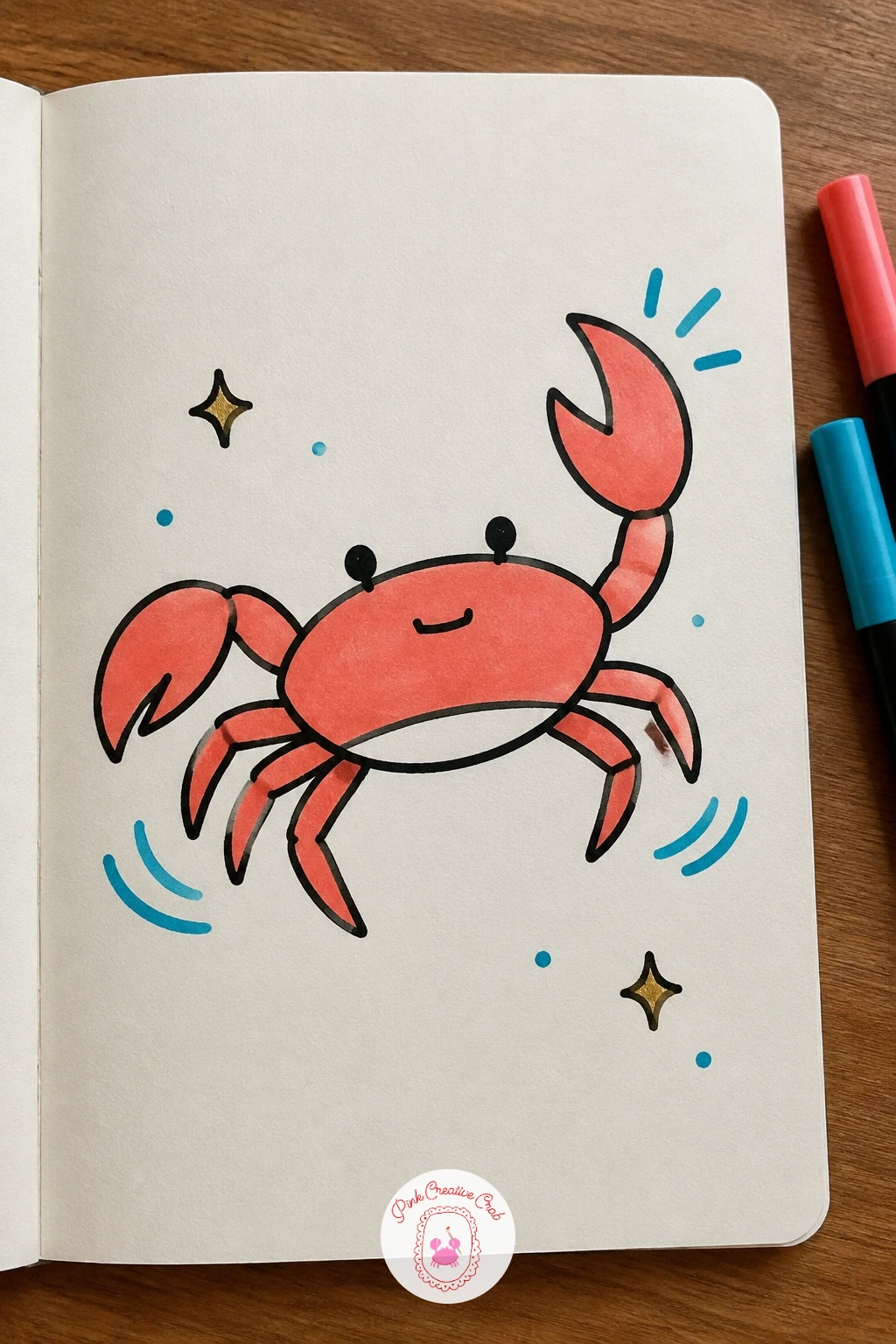
Palette: Coral Pink,Sea Blue,Ink Black
Give the claws a craft project: a crab using its claws as knitting needles on a small pink square. Draw two thin knitting needles first, crossed slightly, held one in each claw, then add a small lumpy square shape of knitted fabric hanging between them.
Ink the fabric square with short diagonal stitch marks in rows rather than a smooth fill, since that texture is what sells the knitting idea. Keep the needles simple straight lines with small round tips, nothing fancier.
If the needles look like they are just floating, anchor them by having each claw close around one needle with a small gap showing the pinch. Color the knitted square in coral pink with sea blue stitch lines, leaving the needles uncolored.
A ball of extra yarn drawn beside the crab’s feet gives the scene one more prop without adding much extra drawing time.
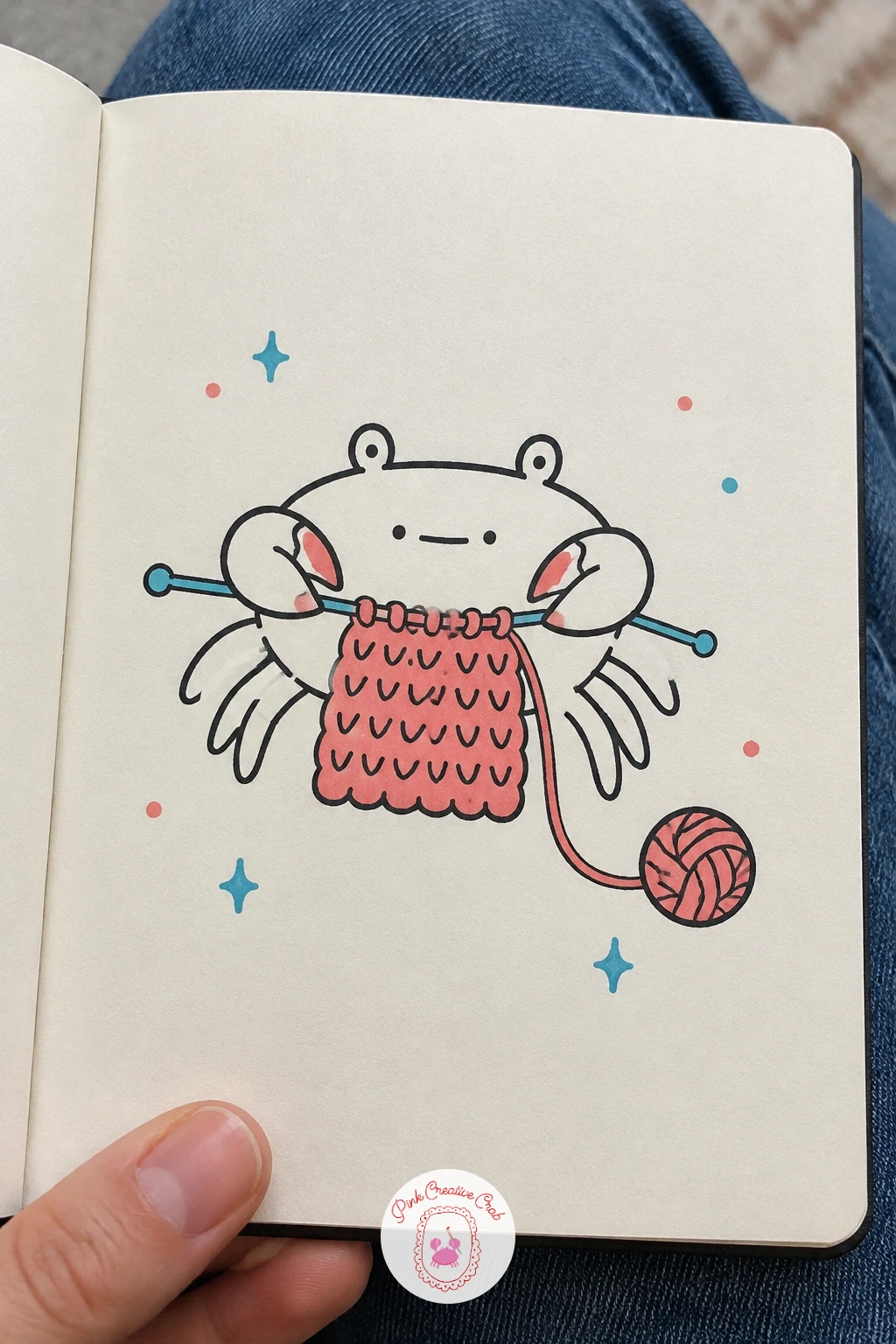
Palette: Coral Pink,Sea Blue,Ink Black
Add a split second moment: a crab popping a soap bubble with one claw. Draw a single large circle for the bubble first, positioned just above and ahead of the crab’s reaching claw, then add a few thin curved highlight lines inside it to suggest the bubble’s surface.
Ink the claw mid-reach, tips just touching the bubble’s edge, and add three or four short burst lines radiating from the contact point to show the pop happening right now. Keep the crab’s other claw and legs still, since contrast between one moving part and a calm body sharpens the timing.
Soap bubbles read best with very light color, so wash the sea blue marker thin or just outline the circle and leave it mostly white rather than filling it solid. Add tiny droplet dots scattering from the burst for extra motion.
Try this same burst trick later on a balloon instead of a bubble for a bigger, louder version of the same gag.
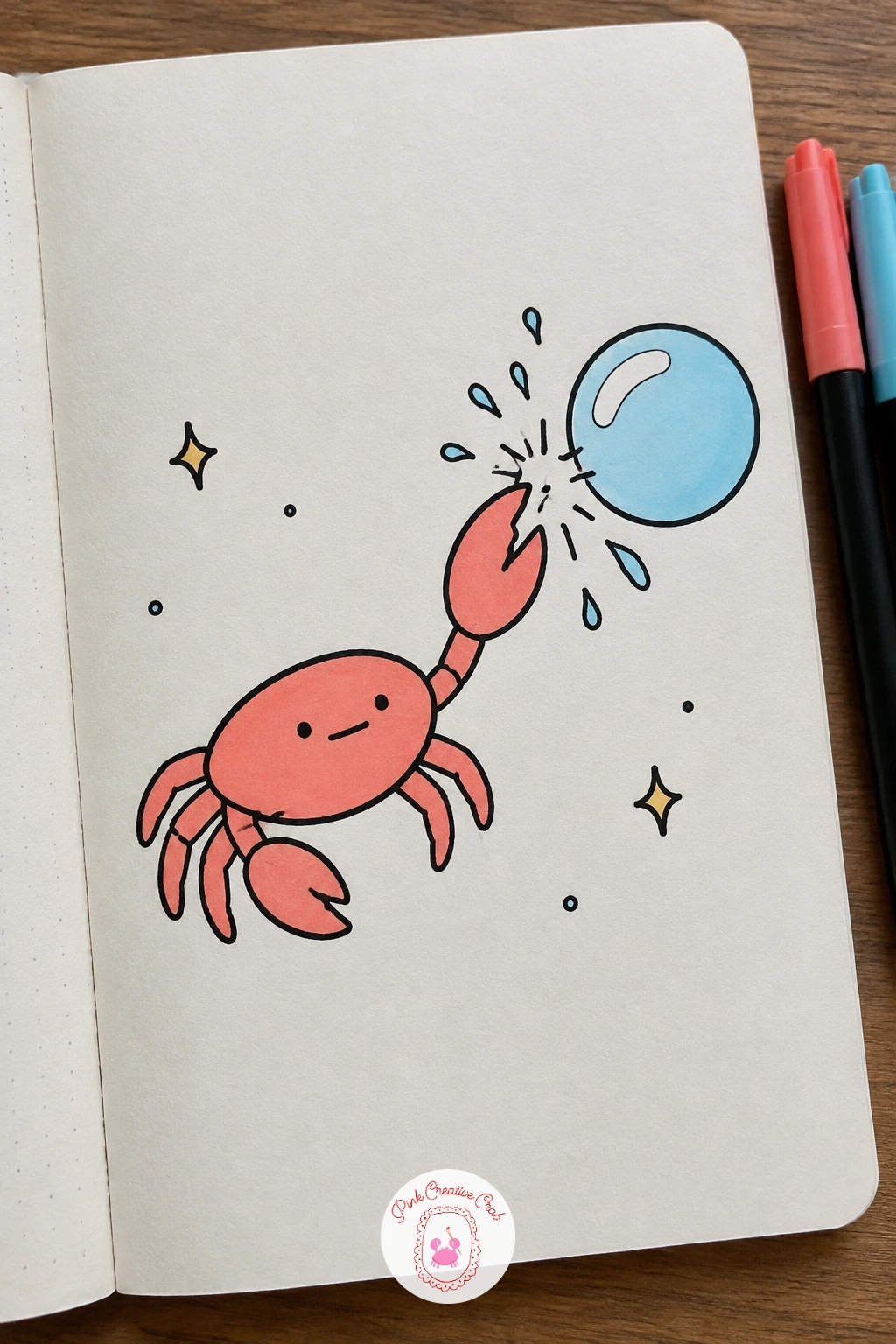
Palette: Sea Blue,Coral Pink,White Highlight
Raise the stakes with a crab frozen in panic while a seagull stares at it. Draw the seagull first, up and off to one side, a simple pointed body with a sharp beak aimed straight down at the crab below, then add the crab small and still beneath it.
Ink the crab’s legs stiff and straight rather than bent, with both claws pulled in tight to the body, since a frozen pose needs rigid lines instead of the usual relaxed curves. Widen the eyes into two small circles with tiny pupils to push the panic.
The composition leans on scale and placement: set the seagull higher and slightly larger than it would realistically be, which reads as looming rather than simply nearby. Color the seagull in white and sea blue, the crab in coral pink, and leave a thin dotted line between their eyes to show the stare.
If you want a softer version, swap the seagull for a curious child’s shadow falling over the crab instead.
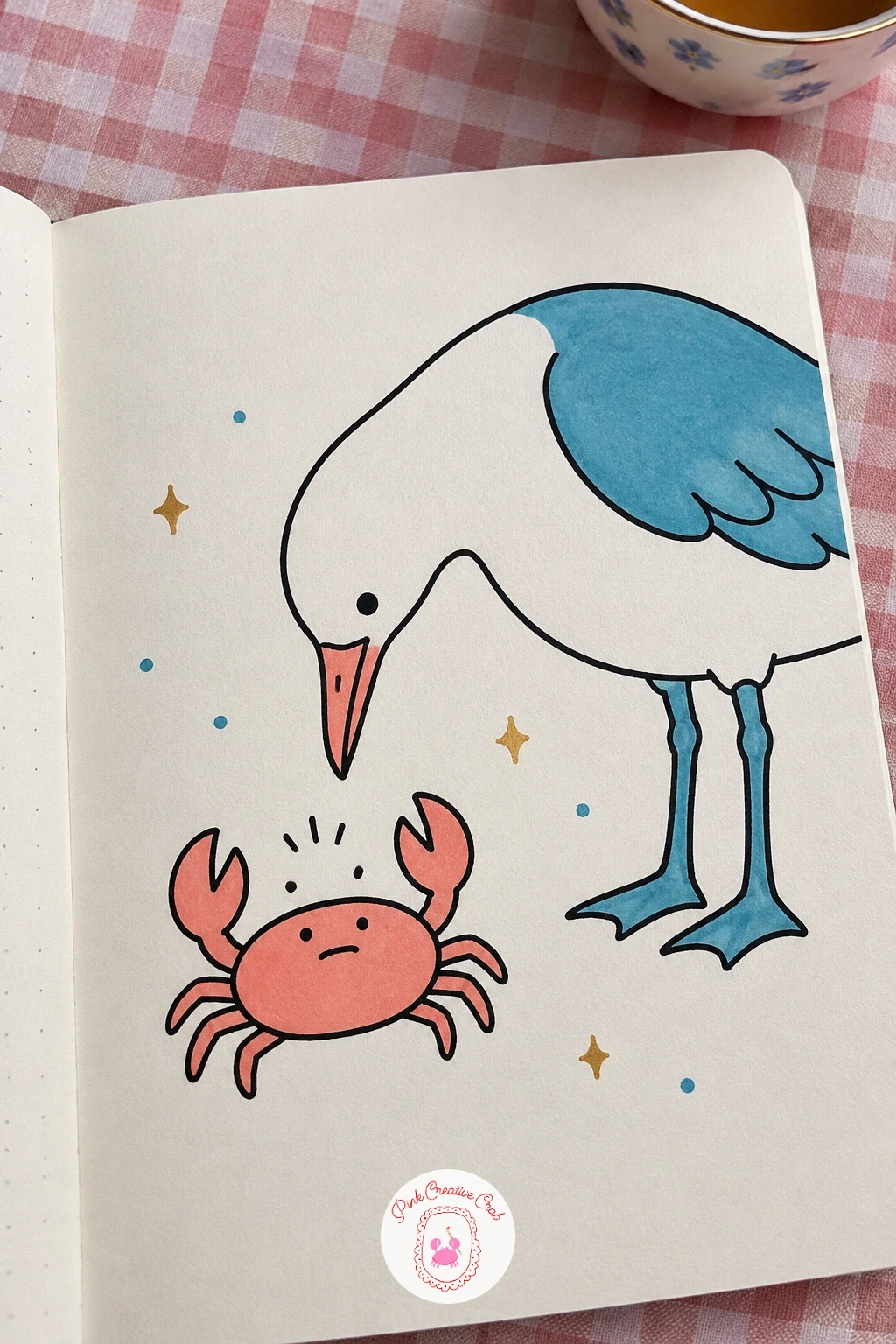
Palette: Sea Blue,Coral Pink,White Highlight
Return to the hermit crab theme for a bigger story beat: moving house, pulling its old shell in a wagon. Draw a small simple wagon first, two round wheels and a flat bed, then set the old empty shell sitting inside it and the hermit crab out front pulling a short rope or handle.
Ink the crab leaning slightly forward into the pull, legs mid-stride, with the new shell already on its back so the old one in the wagon reads clearly as the one being left behind. Keep the wagon’s wheels perfectly round, since lopsided wheels read as a mistake rather than a style choice.
This idea pairs naturally with the wider world of hermit crab drawing ideas if the moving theme keeps appealing to you. Color the new shell in coral pink and the old one in a faded sea blue to show the contrast between fresh and left behind.
A short dotted trail behind the wagon’s wheels adds a nice sense of distance already traveled.
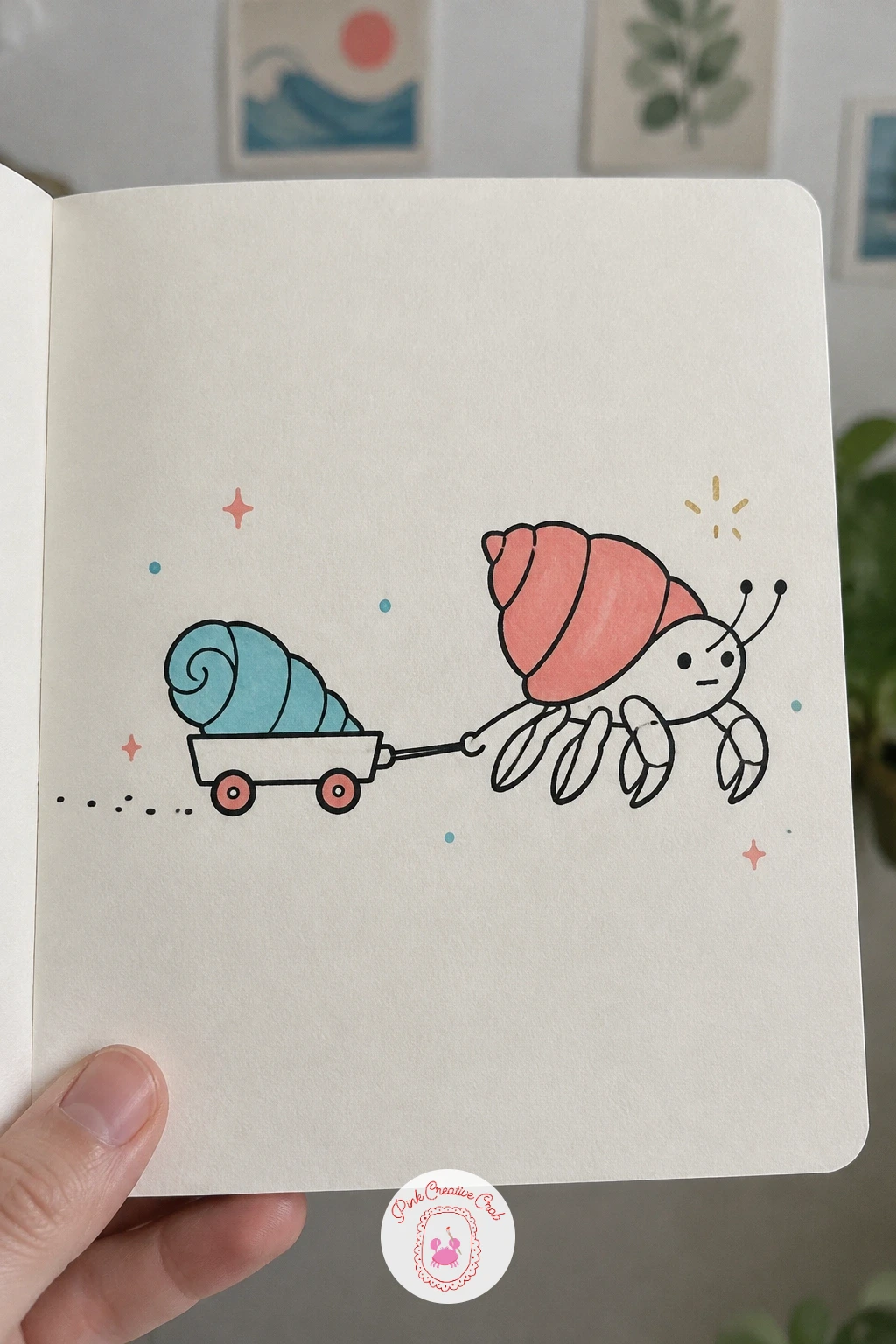
Palette: Coral Pink,Sea Blue,Ink Black
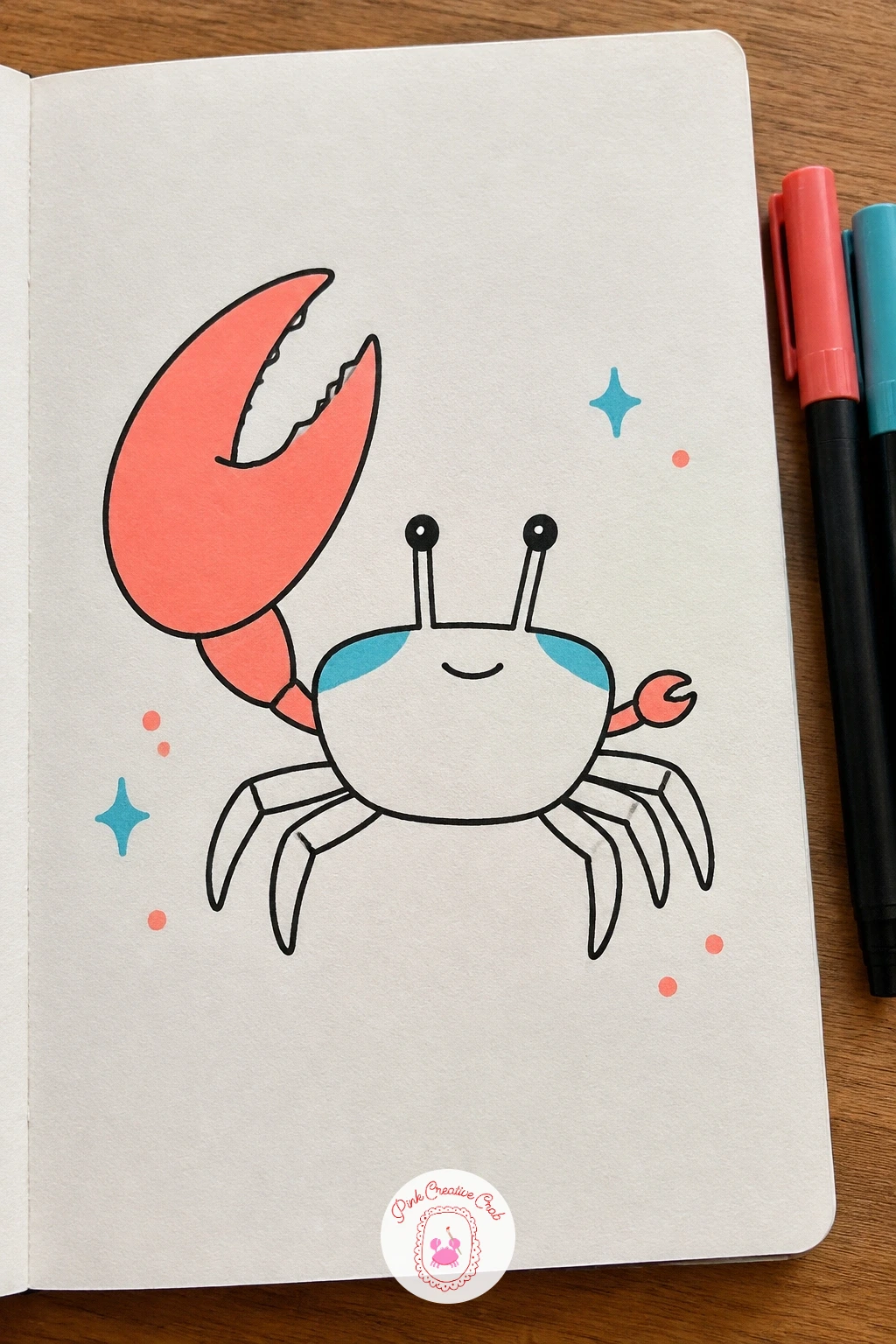
Bring in a specific species for variety: a fiddler crab flexing its one giant claw with pride. Draw the oversized claw first, taking up nearly half the crab’s total width, held up and flexed like a bodybuilder’s arm, then add the much smaller matching claw on the other side for contrast.
Ink the big claw with a clear joint line where it bends, and add two or three small curved lines beside it to suggest a little shine or sparkle of pride. Keep the small claw genuinely tiny, since the size gap between the two is the entire point of a fiddler crab.
If the oversized claw starts looking like a boxing glove instead of a crab claw, add a thin pincer line splitting the tip so it still reads clearly as a claw shape. Color the big claw in bold coral pink and the body in a slightly softer shade so the claw remains the star.
Draw it from the front next time, both claws visible at once, for a fun before and after comparison on the same page.
Palette: Coral Pink,Sea Blue,White Highlight
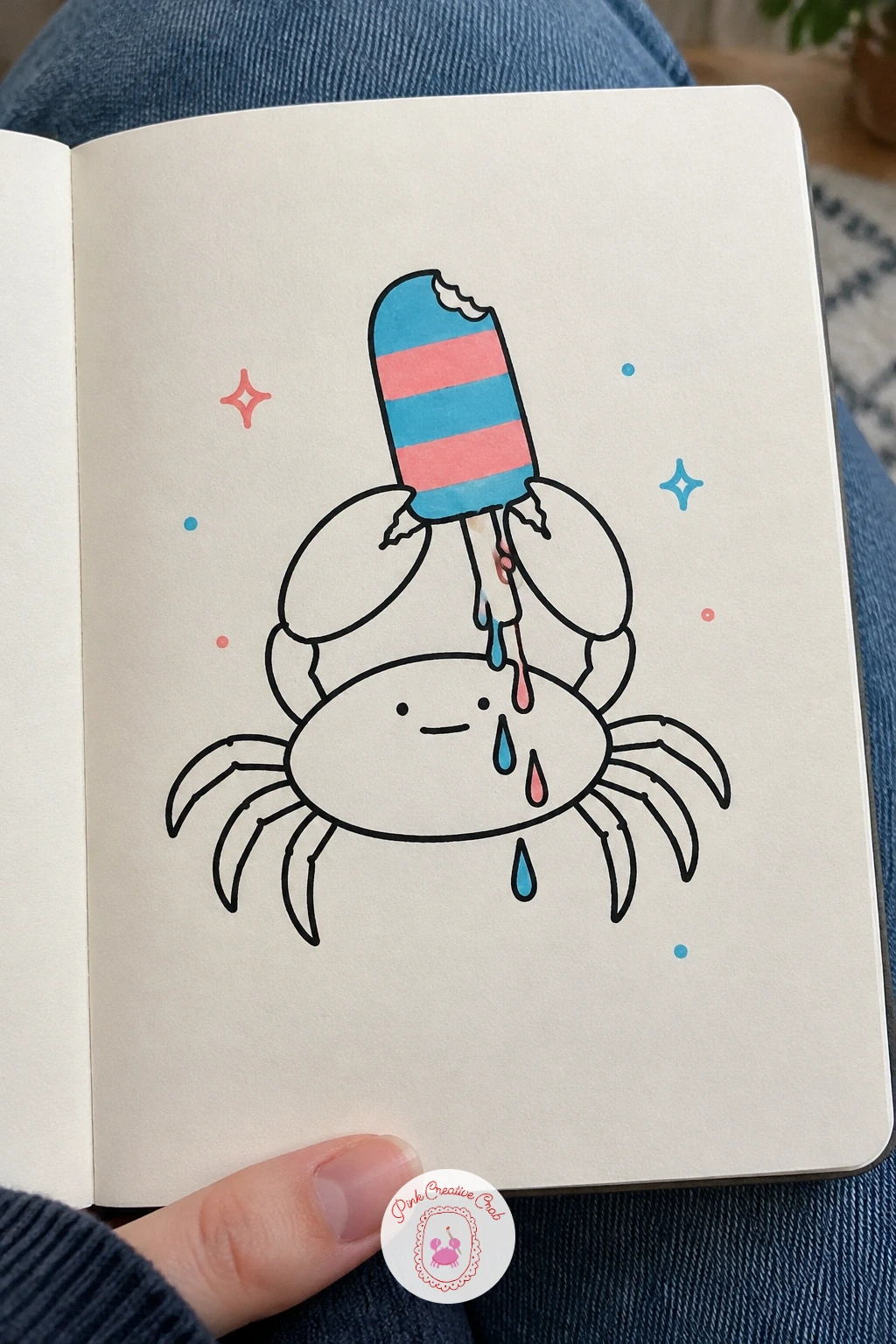
Cool things down with a crab eating an ice pop held in both claws. Draw the ice pop first, a simple rounded rectangle on a short flat stick, then set both claws gripping the stick low while the crab’s mouth reaches up toward the top.
Ink a few drip lines running down from the ice pop’s bottom edge to show it melting in the heat, and add a couple of small bite marks along one top corner. Keep the stick thin and slightly off center so the whole pop does not look perfectly symmetrical.
Melting drips look best loose and slightly uneven rather than straight lines, so let them wobble a little as they run down toward the claws. Color the ice pop in sea blue with a coral pink stripe through the middle, and leave the stick plain white.
Swap the ice pop for a small cone of shaved ice if you want a rounder shape instead of a rectangle.
Palette: Sea Blue,Coral Pink,Ink Black
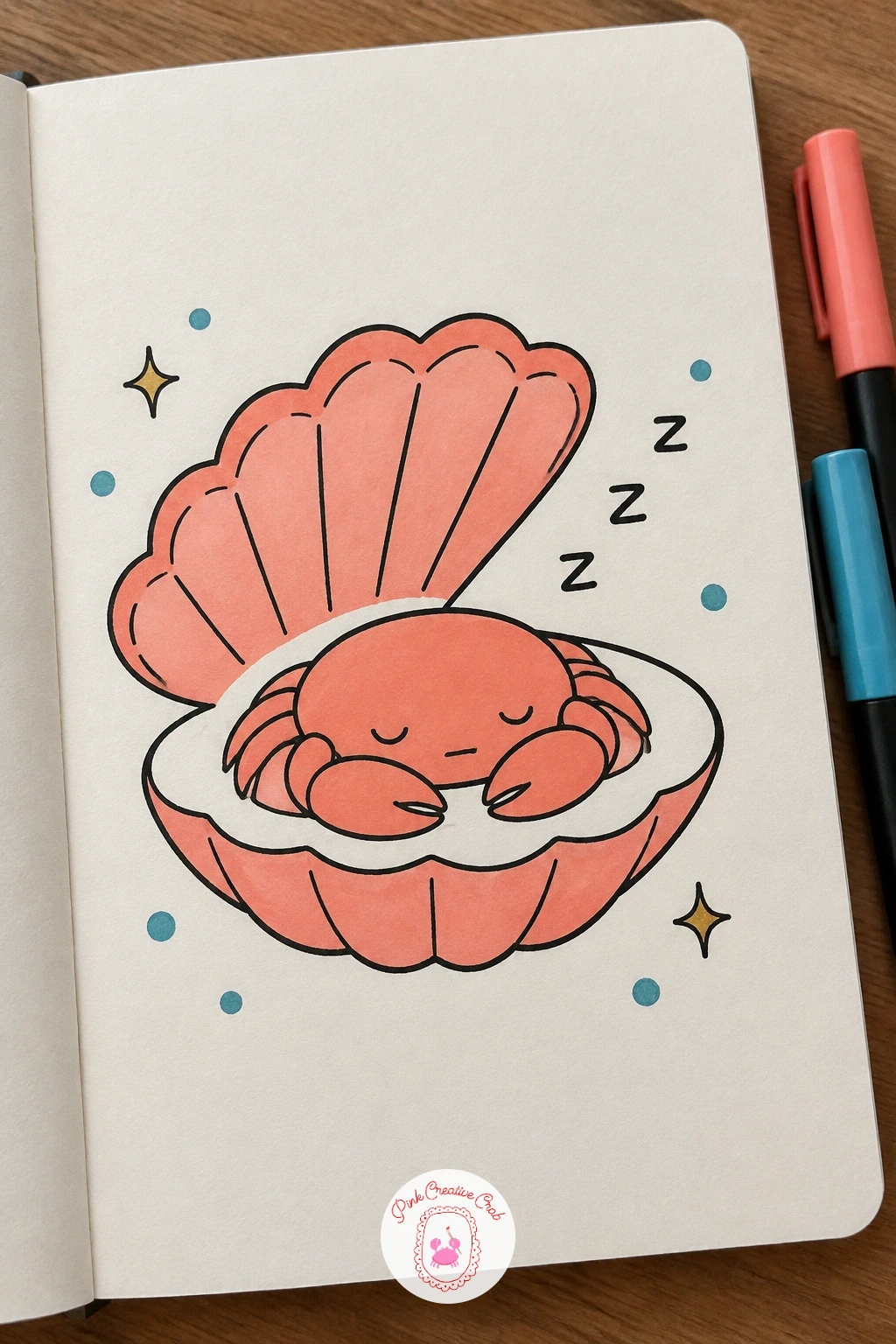
Settle into a cozy one: a crab asleep in an open clam shell like a little bed. Draw the open clam shell first, two curved halves meeting at a hinge like an open book, then lay the crab curled up inside one half with its legs tucked under.
Ink a few short curved lines inside the shell to suggest the soft ridged texture, and add small “z” marks floating above the crab’s head to show sleep. Keep the crab’s body rounder and more compact than usual, since a curled sleeping pose reads softer than a standing one.
The quick ten minute version is just the shell and the sleeping crab; the fuller version adds a tiny starfish blanket draped over the crab or a small pearl as a pillow. Color the shell in soft coral pink on the outside and leave the inside pale, with the crab itself in a slightly deeper shade for contrast.
This one works nicely as a small card front; see tea doodle ideas for other cozy little scenes in the same spirit.
Palette: Coral Pink,Sea Blue,Pearl White
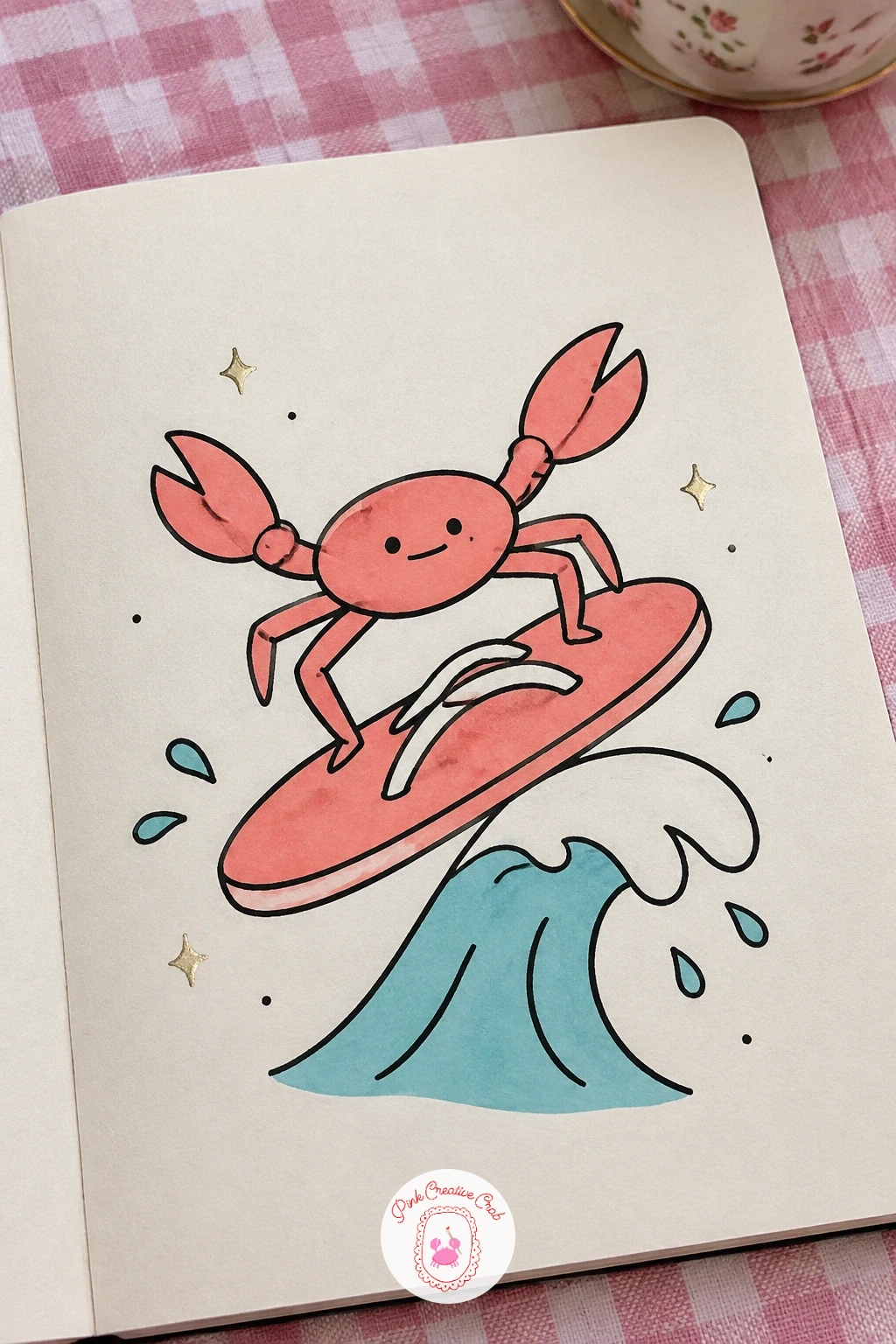
Bring energy back with a crab surfing a small wave on a lost flip-flop. Draw the flip-flop first, a simple elongated oval with a thin strap across the top, tilted at an angle to suggest it is riding downhill on a wave. Then add the crab standing on top, legs bent and arms, or claws, out wide for balance.
Ink a small curling wave beneath the flip-flop, much like the earlier wave idea but smaller in scale since this one only needs to lift a tiny board, not swallow the whole scene. Keep the crab’s stance wide and low, since a surfer’s center of gravity always sits close to the board.
If the flip-flop looks like it is floating flat rather than riding the wave, angle its front tip upward slightly, the same way a real board noses up over a swell. Color the flip-flop in coral pink with a sea blue strap, and the wave itself in a lighter blue wash beneath.
Try drawing the crab wiping out next time for a funnier companion piece to this one.
Palette: Coral Pink,Sea Blue,White Highlight
Keep the fun going with a crab drumming on two upturned clam shells. Draw the two shells first, side by side and upside down like small drums, then place the crab behind them with both claws raised mid-strike, one high and one already down on a shell.
Ink short motion lines above each claw to show the beat in progress, and add a few small curved marks around the shells to suggest sound ringing out. Keep the claws slightly different heights from each other, since matched identical claws look static rather than mid-rhythm.
The hands-on trick here is edge work: leave the clam shells’ rims slightly rough and uneven in your ink line rather than perfectly smooth, since real shells never have a clean factory edge. Color the shells in sea blue with coral pink undersides showing where they are tipped up.
Add a tiny pair of drumsticks made from thin twigs if you want the claws to look even more like a real kit.
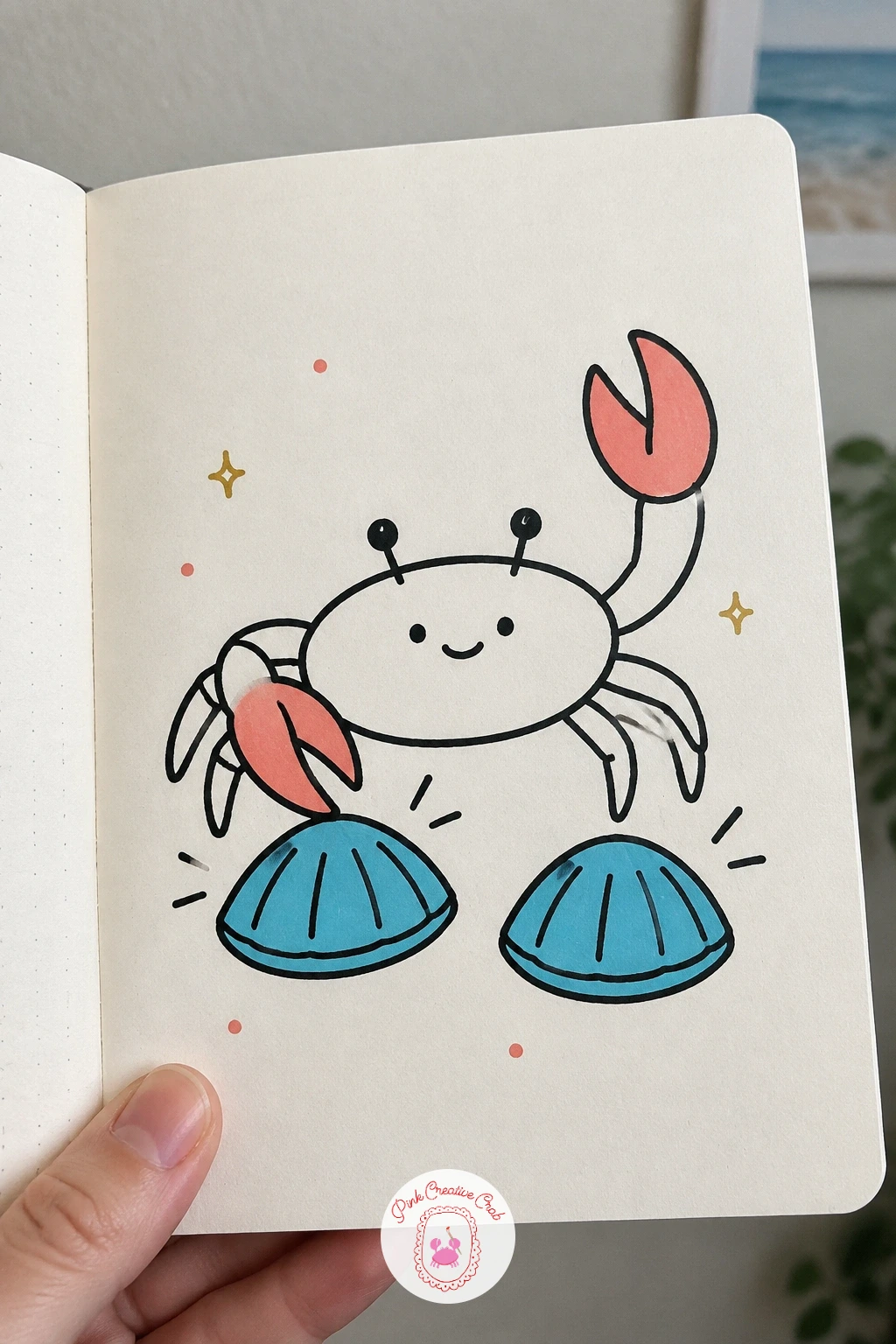
Palette: Sea Blue,Coral Pink,Ink Black
Slow down for a gentle finish: two crabs holding claws on the beach at sunset. Draw both crab bodies first, side by side and slightly facing each other, then connect one claw from each so they meet in the middle like held hands.
Ink a simple sunset behind them, just a low curved horizon line with a round sun sitting on it, rather than a detailed sky, since the crabs stay the focus here. Keep both crabs roughly the same size so neither reads as more important than the other.
The light source matters most in this one: let the sun sit low and warm behind the crabs so their outlines catch a touch of coral glow along one edge, and leave a soft sea blue wash across the rest of the sky above. If coloring both crabs identically feels flat, make one a shade lighter than the other for gentle contrast.
This makes a sweet little card pairing nicely with ideas from couple drawing ideas for a matching set.
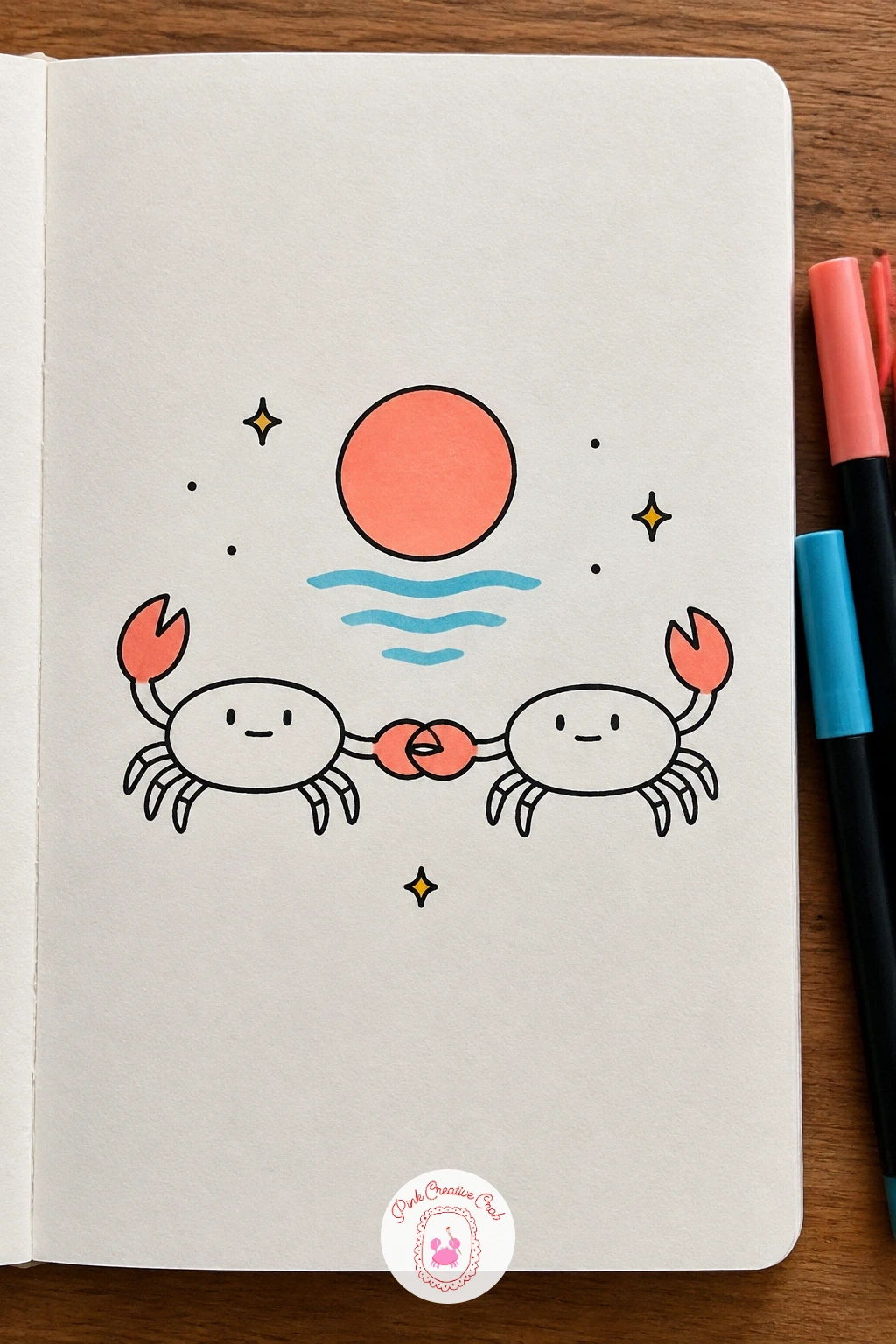
Palette: Coral Pink,Sea Blue,Sunset Orange
Build a tiny adventure scene: a crab in a captain hat sailing a bottle cap boat. Draw the bottle cap first, a simple ridged circle seen from the side like a tiny hull, then add a thin mast with a small triangular sail rising from its center. Set the crab inside, one claw on an invisible wheel and a small captain hat perched between its eye stalks.
Ink the cap’s ridges as short evenly spaced notches around the rim, which is what makes it read as a bottle cap rather than a plain circle. Keep the sail simple, a single triangle, rather than adding rigging or extra detail that a bottle cap boat would not realistically carry.
If the whole boat looks too large to be a bottle cap, shrink the crab slightly rather than the cap itself, since the joke depends on the cap staying recognizably tiny. Color the cap in sea blue with coral pink ridge notches, and give the captain hat a simple dark band.
A small wave or two beneath the boat finishes the scene without adding much extra drawing time.
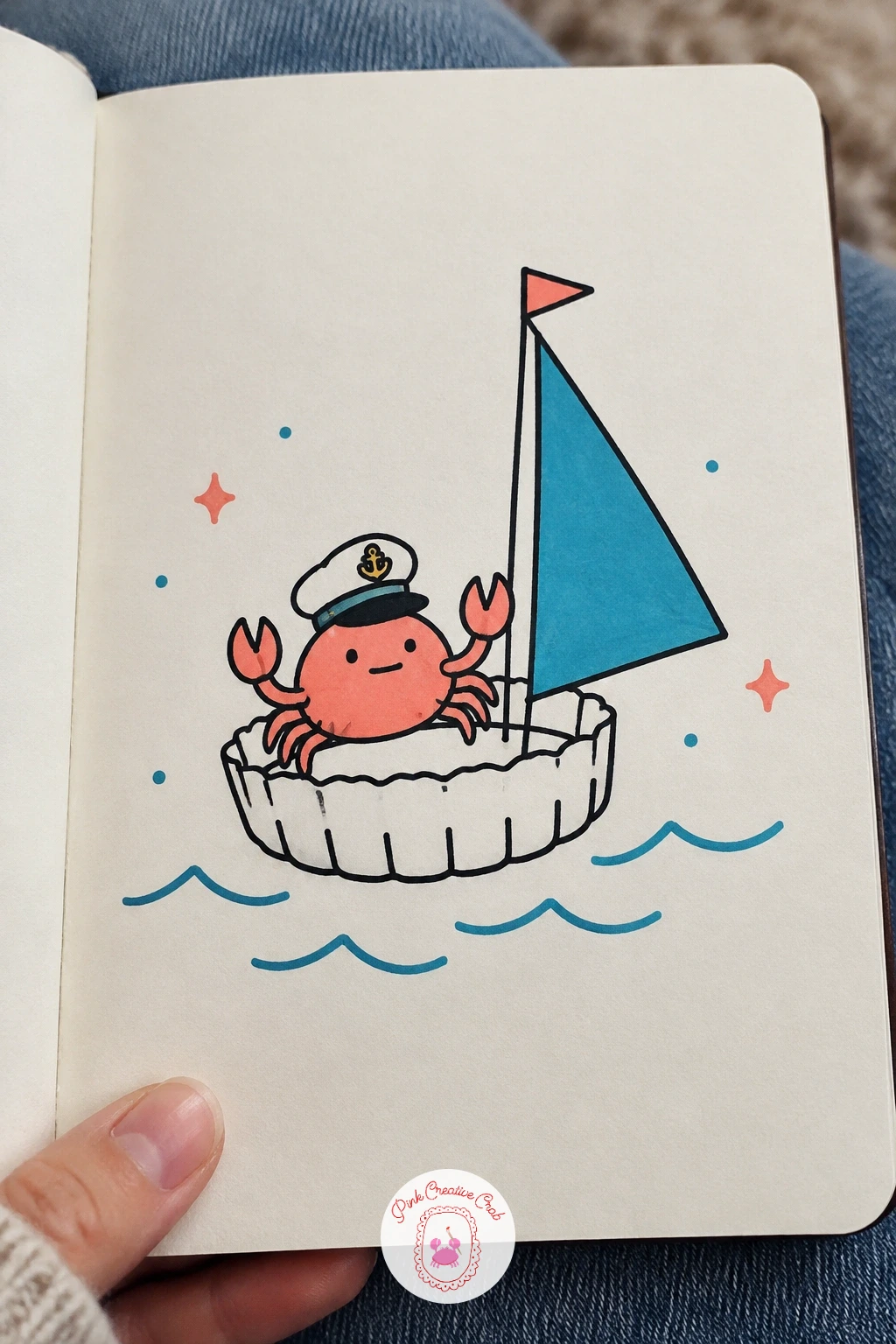
Palette: Sea Blue,Coral Pink,Ink Black
Soften the mood with a crab offering a heart-shaped pebble to its crush. Draw the heart pebble first, a simple rounded heart shape with a slightly uneven, stone-like edge rather than a perfect cartoon heart, then set one crab extending it forward on an open claw toward a second, smaller crab facing it with a shy posture.
Ink the offering crab’s claw open and flat like a little tray, and give the receiving crab slightly lowered eye stalks and claws pulled close, which reads as bashful rather than bold. Keep both crabs facing each other at a slight angle rather than head on, since a little turn adds warmth to the moment.
Stone textures look convincing with just a few short scratch lines rather than full shading, so keep the pebble’s surface marks sparse. Color the pebble in coral pink, and pick one crab in sea blue and the other in a softer pink so they read as two distinct characters.
This idea sits nicely beside couple drawing ideas if you are building a small collection of sweet little scenes.
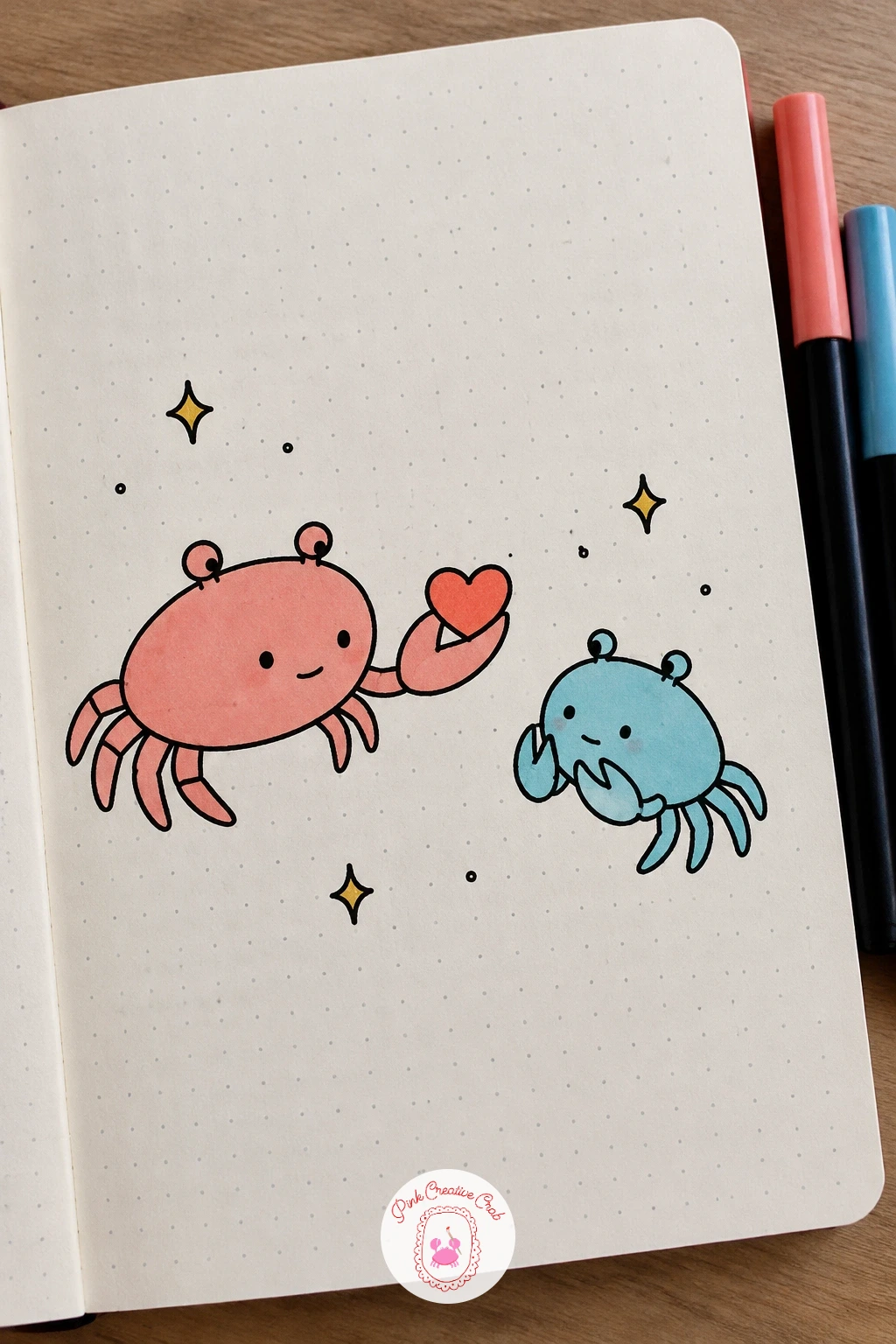
Palette: Coral Pink,Sea Blue,Stone Grey
Add a little comedy with a crab guarding a lone sandal like it owns it. Draw the sandal first, a simple flat sole with a thin strap across the top, lying on its side or flat on the sand, then perch the crab directly on top or standing beside it with claws raised in a defensive stance.
Ink the crab’s legs planted wide and firm, almost like it is standing guard rather than simply resting, and give the eyes a narrow, alert shape rather than round and soft. Keep the sandal plain and ordinary looking, since an unremarkable object makes the crab’s fierce guarding pose funnier by contrast.
If the guarding pose reads as too calm, raise both claws higher and add a couple of short sharp lines around them to suggest readiness to pinch. Color the sandal in sea blue with a coral pink strap, and keep the crab in a bold matching coral so it stands out as the clear subject.
Try swapping the sandal for a dropped sunglasses case next time for a quick variation on the same gag.
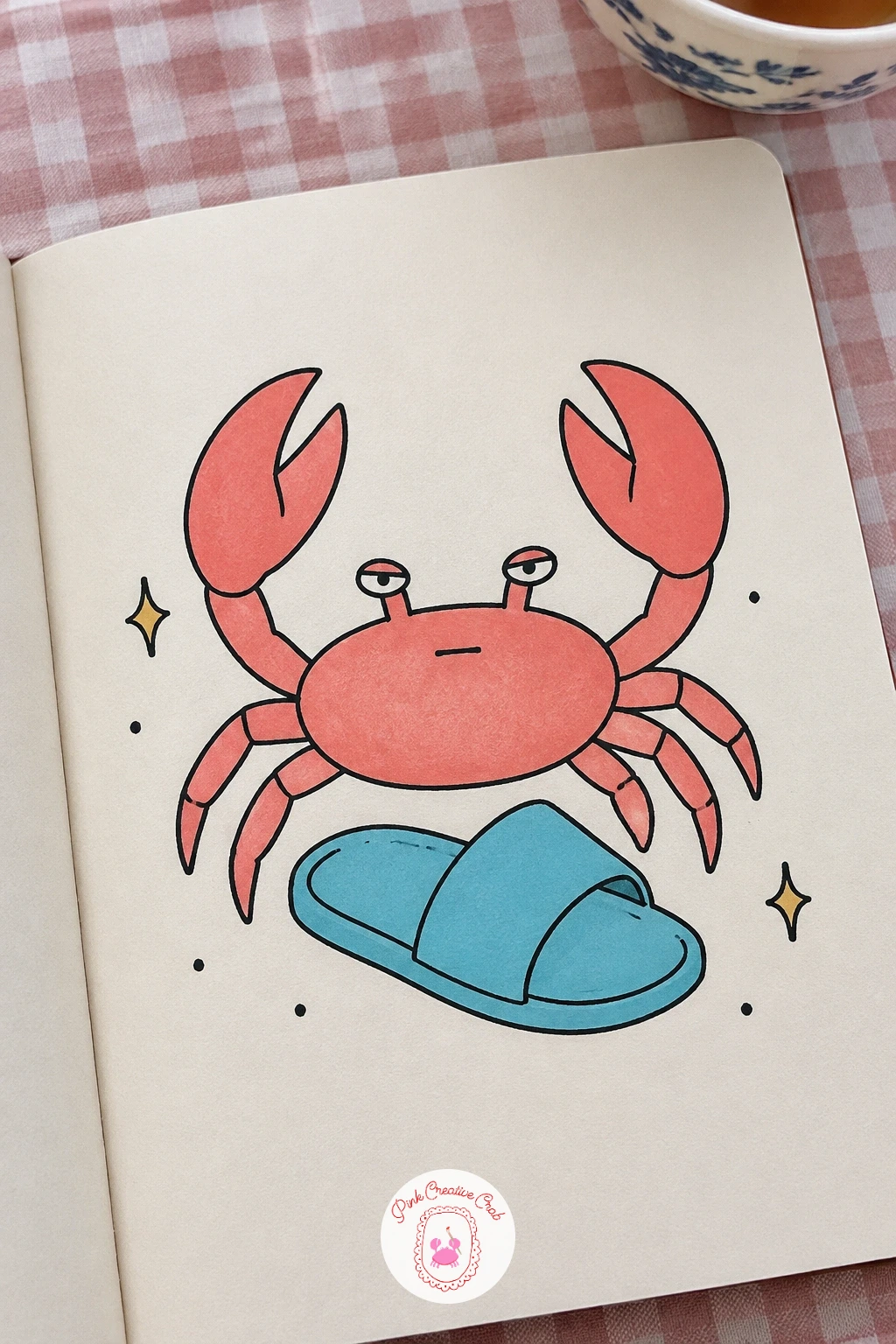
Palette: Sea Blue,Coral Pink,Ink Black
Close the set with a little slapstick finish: a crab giving a gentle pinch to a balloon and regretting it. Draw the balloon first, a large round shape with a thin knotted string at the bottom, then add the crab reaching one claw toward it with the tips just touching the surface.
Ink a small burst of jagged lines right at the contact point to show the balloon popping, and give the crab’s whole body a recoil pose, legs pulled back and eye stalks squeezed shut, to sell the regret. Keep the burst lines short and sharp rather than long, since a tight burst reads as sudden and immediate.
The easy fix if the pop looks too gentle is to add a few small floating scraps of balloon rubber scattered near the burst point, which makes the moment feel more dramatic. Color the balloon in sea blue right up until the burst, where a scrap or two turns coral pink to show the inside catching a different light.
This is a fun one to end a page on since the surprise works as a visual punchline all on its own.
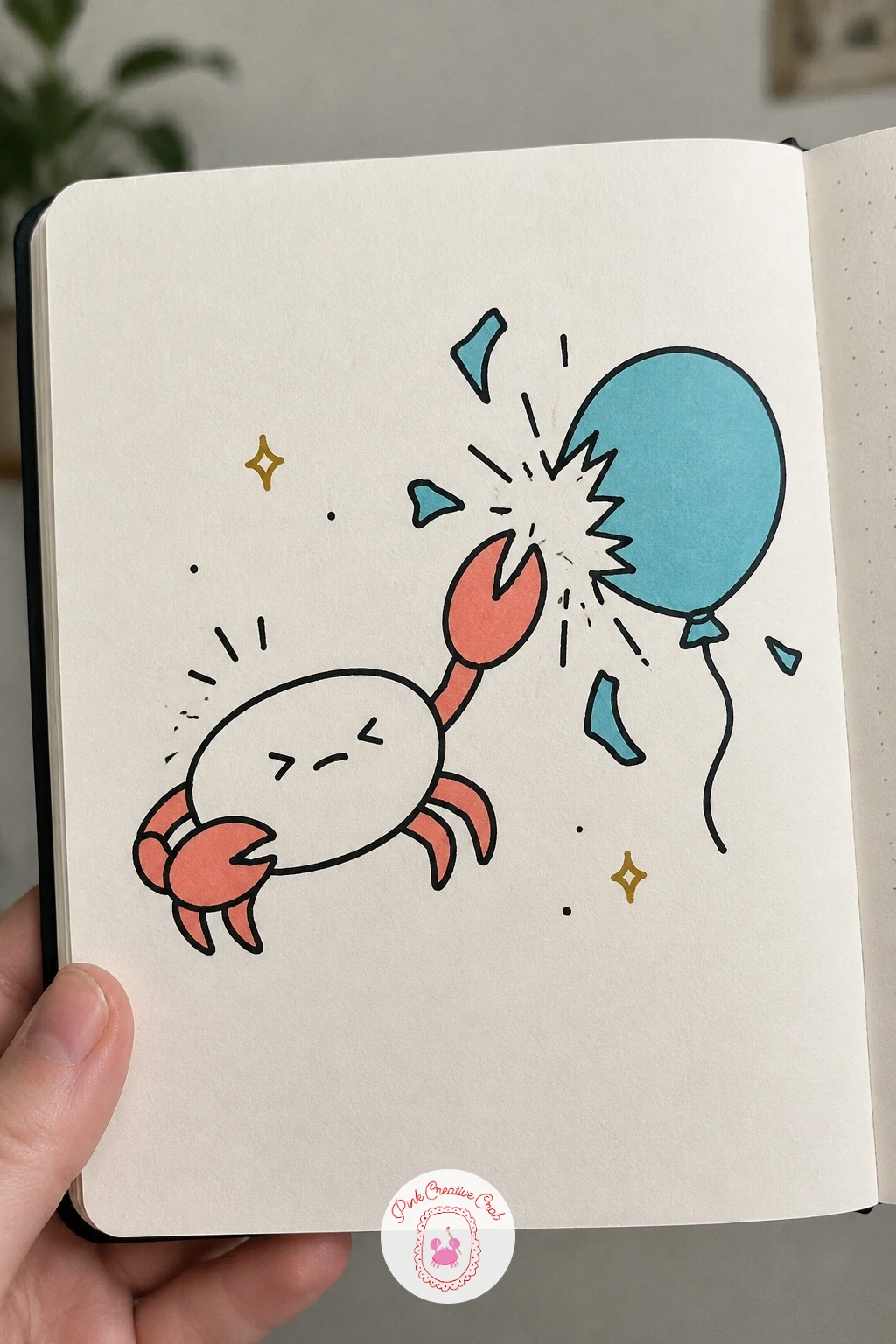
Palette: Sea Blue,Coral Pink,Ink Black
What to Do Next
Pick whichever crab made you smile first, whether that is the one hiding in the sand or the one sailing a bottle cap boat, and draw it today on whatever paper is already open in front of you. Keep the fineliner for outlines and save the coral and sea blue markers for last, once the ink has had a minute to dry.
Frequently Asked Questions
What pens work best for a crab doodle?
A black fineliner in a fine tip, around 0.3 to 0.5, gives clean outlines without bleeding through most sketchbook paper. Add coral pink and sea blue alcohol markers or brush pens for the accent color once the ink is fully dry.
How do I make a crab doodle look less like a spider?
Keep the body wide and oval rather than round, and set all eight legs leaving the body at a similar low angle instead of splaying upward. A flatter, wider stance reads instantly as a crab rather than a long-legged spider.
Do I need to draw the crab realistically for these ideas to work?
No, these doodles rely on simple rounded shapes and a clear little action, not anatomical accuracy. A believable pose and a bit of personality in the eyes matter far more than getting the legs technically correct.
What is the easiest crab doodle to start with?
Start with a crab waving hello, since it only needs a round body, four bent legs each side and two raised claws. It builds the basic crab shape you will reuse in every other idea on this list.
How do I keep the coral and blue colors from looking muddy together?
Let each marker layer dry fully before the other touches it, and keep the two colors in separate zones rather than overlapping them directly. A thin white gap or ink outline between coral and blue areas keeps both shades looking clean.
Have any thoughts?
Share your reaction or leave a quick response — we’d love to hear what you think!
-
 0
-
0
-
0
-
0
-
0
-
0


