A panda doodle is the perfect small project for a notebook margin or a quiet coffee break: round, soft, and full of personality even when the drawing stays loose and simple. These pandas tumble down hills, slurp noodles, hide in laundry baskets and nap on each other, and every one of them is built from a handful of shapes you can draw from memory by the end of the page.
Below you will find 31 of these little scenes, ordered from the simplest round-body poses up to the trickier ones with props and two figures. Grab a black fineliner and keep a bamboo green and cherry blossom pink marker close by for small accents, and work through them in any order that catches your eye.
Using these images: free for personal projects such as printing, coloring, cards, journals and gifts. Handmade items that include them may be sold up to 30 pieces per design. More than that is commercial use and is not permitted, and neither is selling or sharing the images themselves or passing them off as your own. Please ask before any other use.
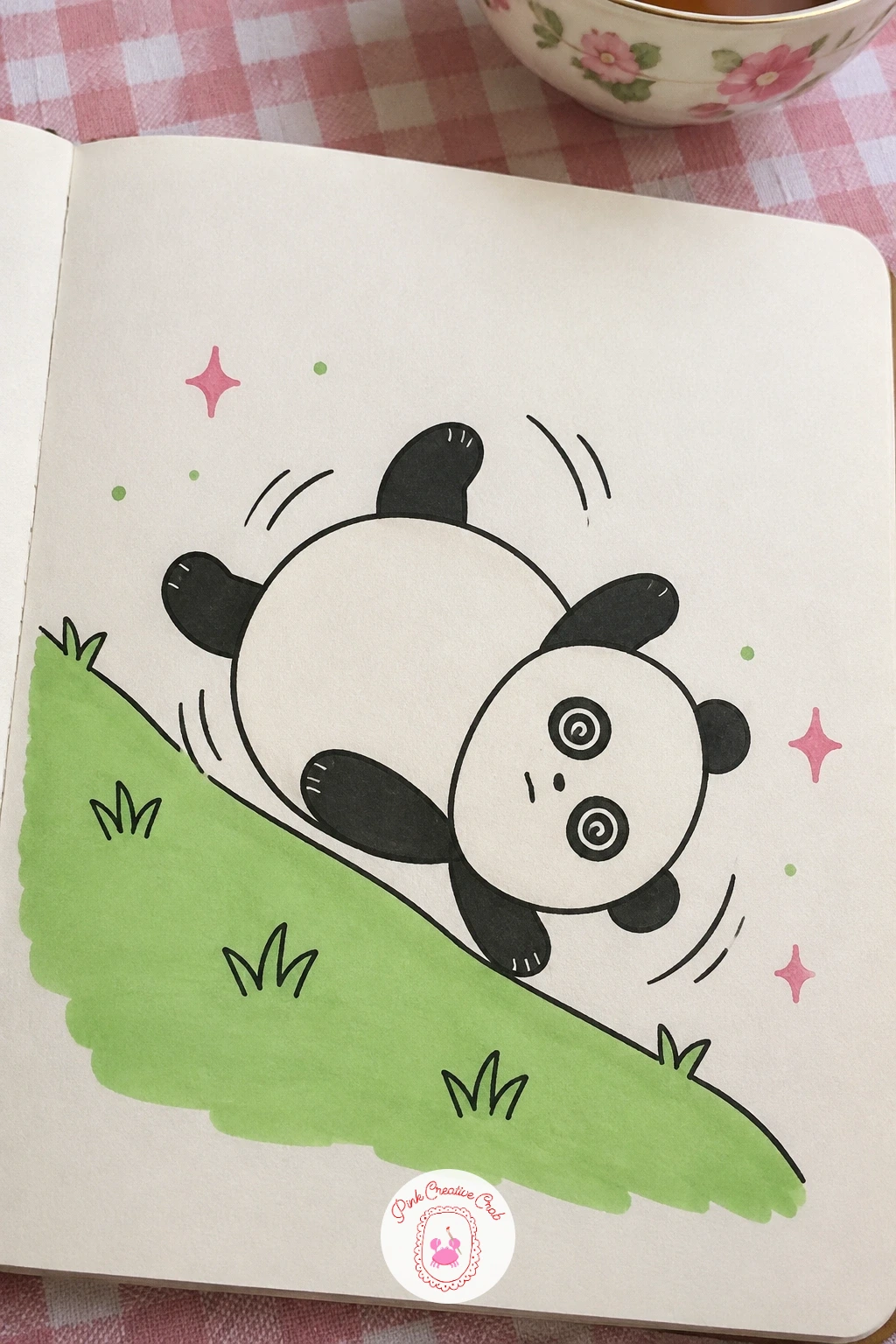
Start this panda doodle with the easiest shape in the whole list: a soft oval body tipped sideways, because a panda mid roll is really just a lopsided egg with stubby arms and legs tucked in close. Draw the hill first as one gentle curved line across the lower third of the page, then drop the tumbling panda on top of it at an angle, round ears poking out and legs flung wide like a starfish.
Ink the black eye patches as two tilted ovals with the pupils drawn as tiny spirals or crossed lines to sell the dizzy look, then add a small open mouth. If the body ends up looking too stiff, soften the outline with a few quick wobbly strokes rather than redrawing it.
Color the hill with your bamboo green marker in loose strokes that do not need to stay inside the line, and leave the panda itself mostly white with black ink patches. No green marker on hand works fine too, since even a plain grassy scribble in fineliner reads just as clearly.
If this is your first time drawing a tumbling pose, sketch the oval body lightly in pencil first and rotate the whole page while you ink it, which makes the tilt feel natural instead of forced.
Palette: Bamboo Green,Ink Black,Paper White
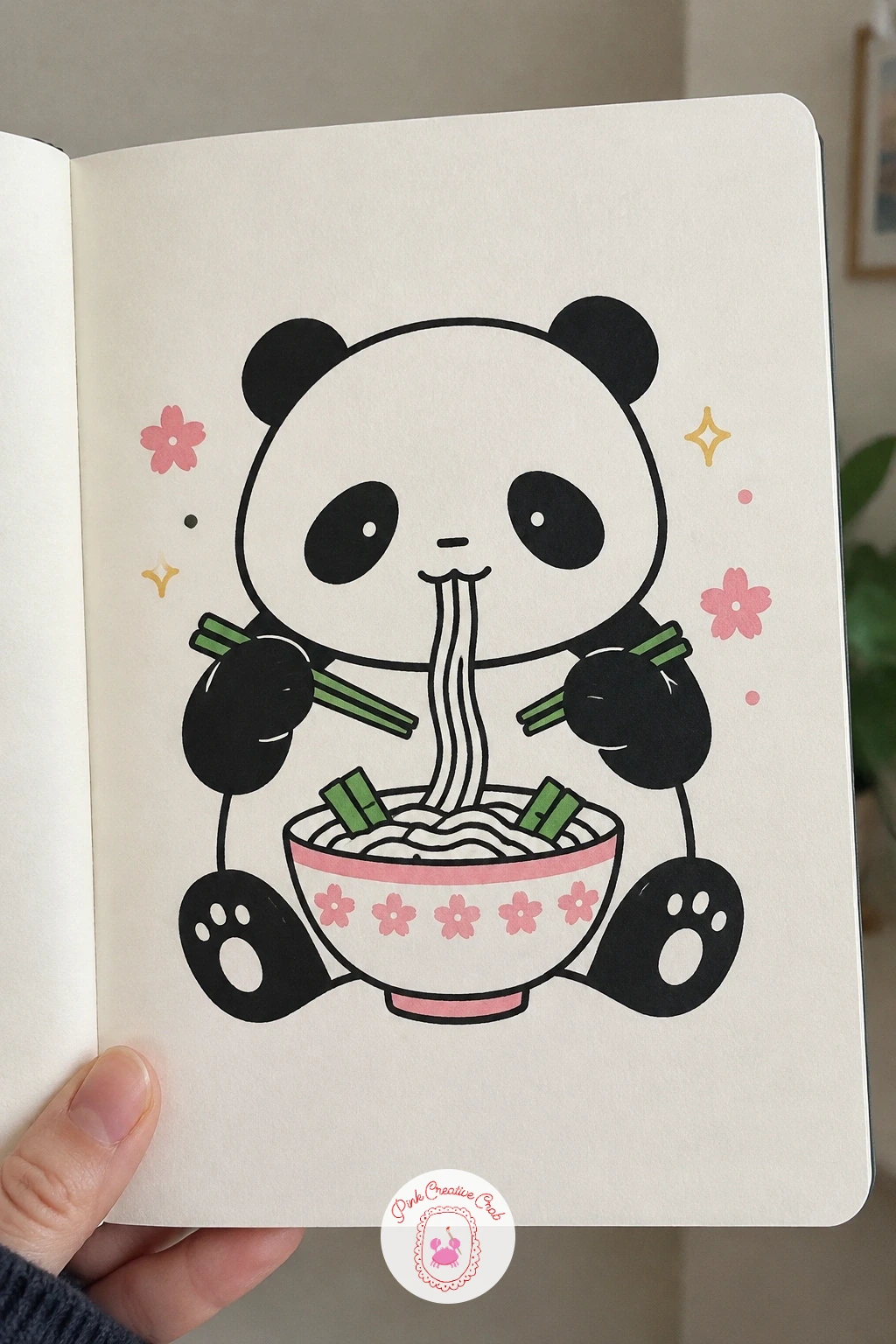
Give the hill-rolling panda a rest and sit the next one upright in front of a bowl, because a seated panda holding chopsticks is only one new prop away from the shapes you already know. Draw the body as a tall rounded triangle for the sitting pose, then add a simple bowl shape below the chin with a few curved lines inside it standing in for noodle strands.
Ink the face last, with one long noodle strand running from the bowl up into a puckered mouth and both paws gripping chopsticks on either side. The eating panda loses its charm fastest around the mouth, so keep it a simple oval rather than a detailed open jaw, which keeps the whole doodle feeling light and quick.
Color the bowl’s broth or the chopstick tips with your cherry blossom pink marker for a small pop of contrast against all that black and white, and leave the noodles themselves uncolored so they read as pale strands. A chopstick swap works too: draw a simple spoon instead if chopsticks feel fiddly at this size.
Try this one in under ten minutes for a quick page filler, or spend closer to forty minutes adding steam lines rising off the bowl and a little puddle of spilled broth for extra character.
Palette: Ink Black,Cherry Blossom Pink,Paper White
Move from the noisy noodle scene to a quiet bedtime one: a panda standing in striped pajamas with its mouth wide open mid yawn. Block in the body as a simple standing oval first, then add the pajama shape as a loose rectangle around the torso before the stripes go in, since stripes drawn on a bare shape always sit straighter than ones added last.
The yawning mouth is the part most likely to go wrong, so draw it as a wide rounded oval rather than a jagged shape, and keep the eyes as two closed curved lines above it to finish the sleepy expression. One raised paw near the mouth sells the yawn even further if you want the extra detail.
Ink the pajama stripes in black first, then run your cherry blossom pink marker over alternating stripes for a soft pattern that still reads clearly at a small size. If pink stripes feel too bold for your page, swap in bamboo green instead for a cooler, sleepier palette.
Keep the line weight light and even through the whole pajama outline, since a heavy wobbling line on fabric reads as messy rather than soft and worn.
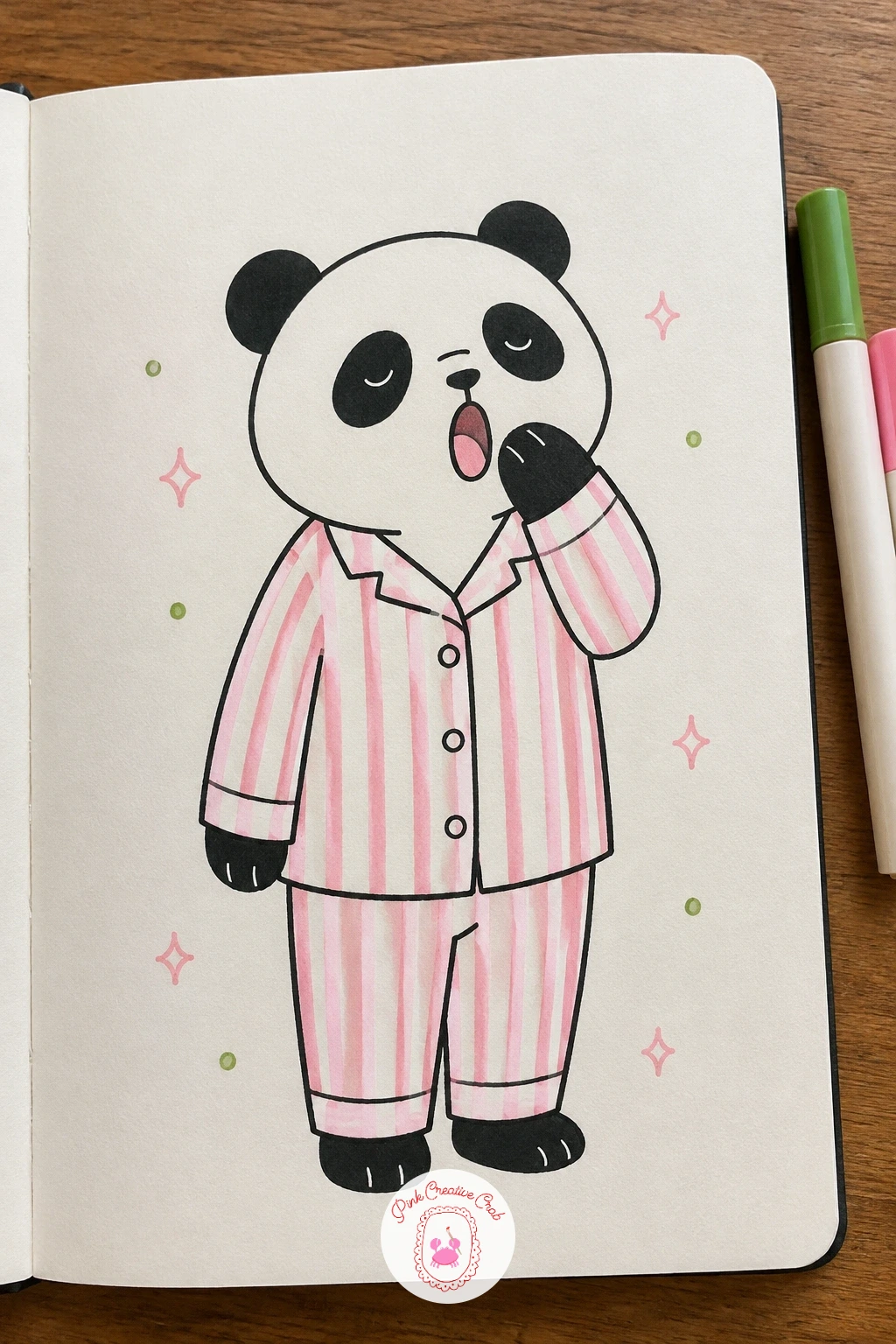
Palette: Ink Black,Cherry Blossom Pink,Paper White
Lean the next panda against a tall simple trunk for a quieter, more affectionate pose than the last few. Draw the tree trunk first as two slightly wavy parallel lines running the height of the page, then wrap the panda’s body and arms around it in a soft curve so the hug reads immediately.
Here is where eye level matters: draw the trunk straight on at the panda’s own height rather than from above, which keeps the hug looking cozy instead of like the panda is climbing. Closed eyes and a small content mouth finish the face, with the cheek pressed right against the bark.
Texture the bark with short vertical fineliner marks rather than one continuous outline, since a few broken lines read as rough bark far better than a smooth border ever will. Color a few bamboo leaves tucked near the base of the trunk with your bamboo green marker for a small finishing touch.
If drawing bark texture feels fussy, a handful of simple horizontal dashes works just as well and takes a fraction of the time.
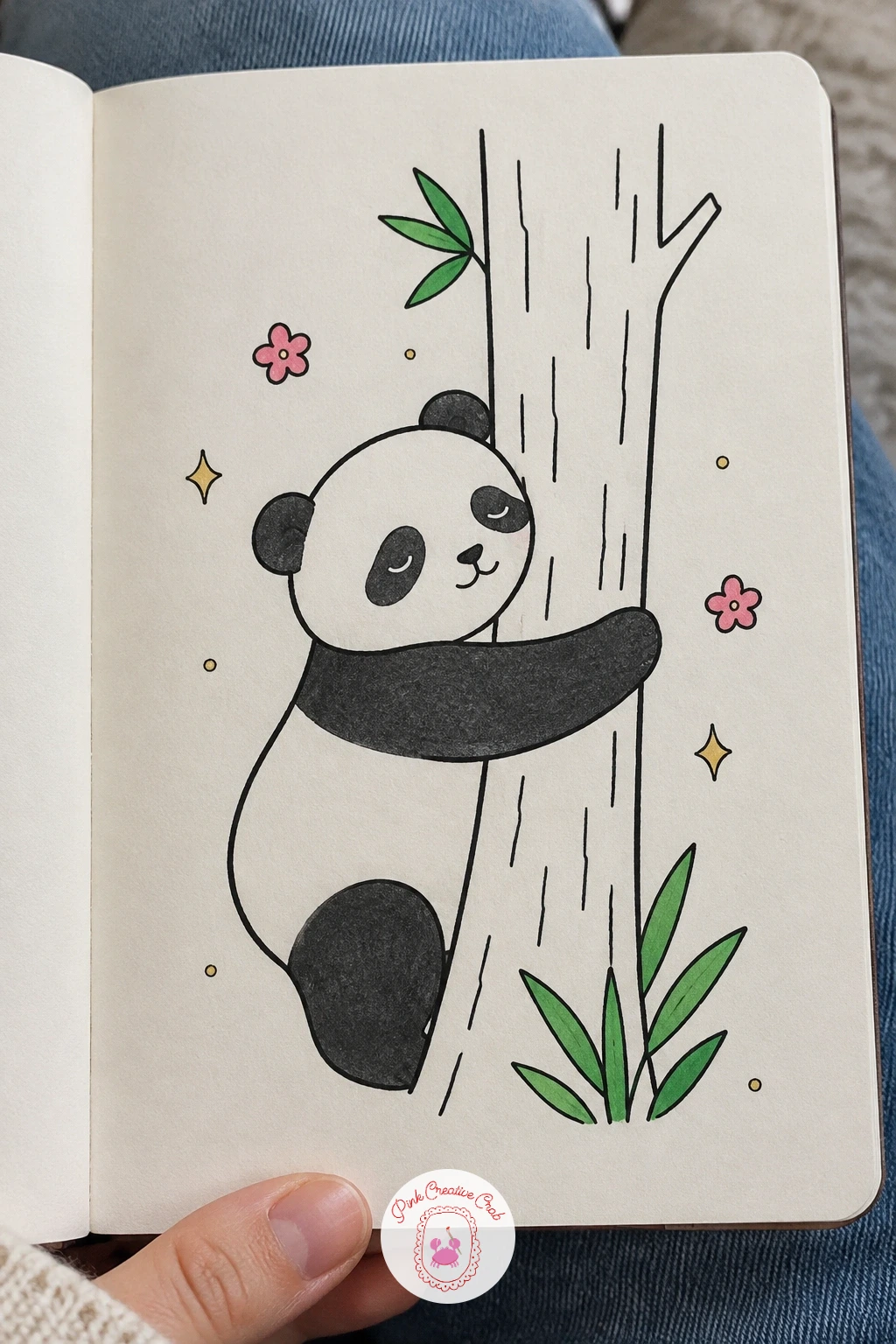
Palette: Ink Black,Bamboo Green,Paper White
Bring back the bamboo prop as the main focus this time, with a panda sitting upright and cheeks puffed full from chewing. Start with the round seated body, then measure the bamboo stalk against the panda’s own height before you ink it, since a stalk drawn too short loses the joke and one drawn too tall overwhelms the page.
A good rule of thumb: the stalk should run from paw to just above the ear tips, held diagonally across the body rather than straight up and down, which makes the whole pose feel more active. Puff the cheeks out as two extra curved bumps along the jawline to show the full mouth.
Ink the bamboo segments as a few horizontal lines dividing the stalk, then color it with your bamboo green marker in quick vertical strokes that leave some white paper showing through for texture. No green marker on hand just means leaving the stalk as a clean black and white outline, which still reads perfectly well.
One concrete tip: draw the full cheeks before the eyes, since fitting the eyes around an already-puffed jaw is far easier than squeezing puffed cheeks in afterward.
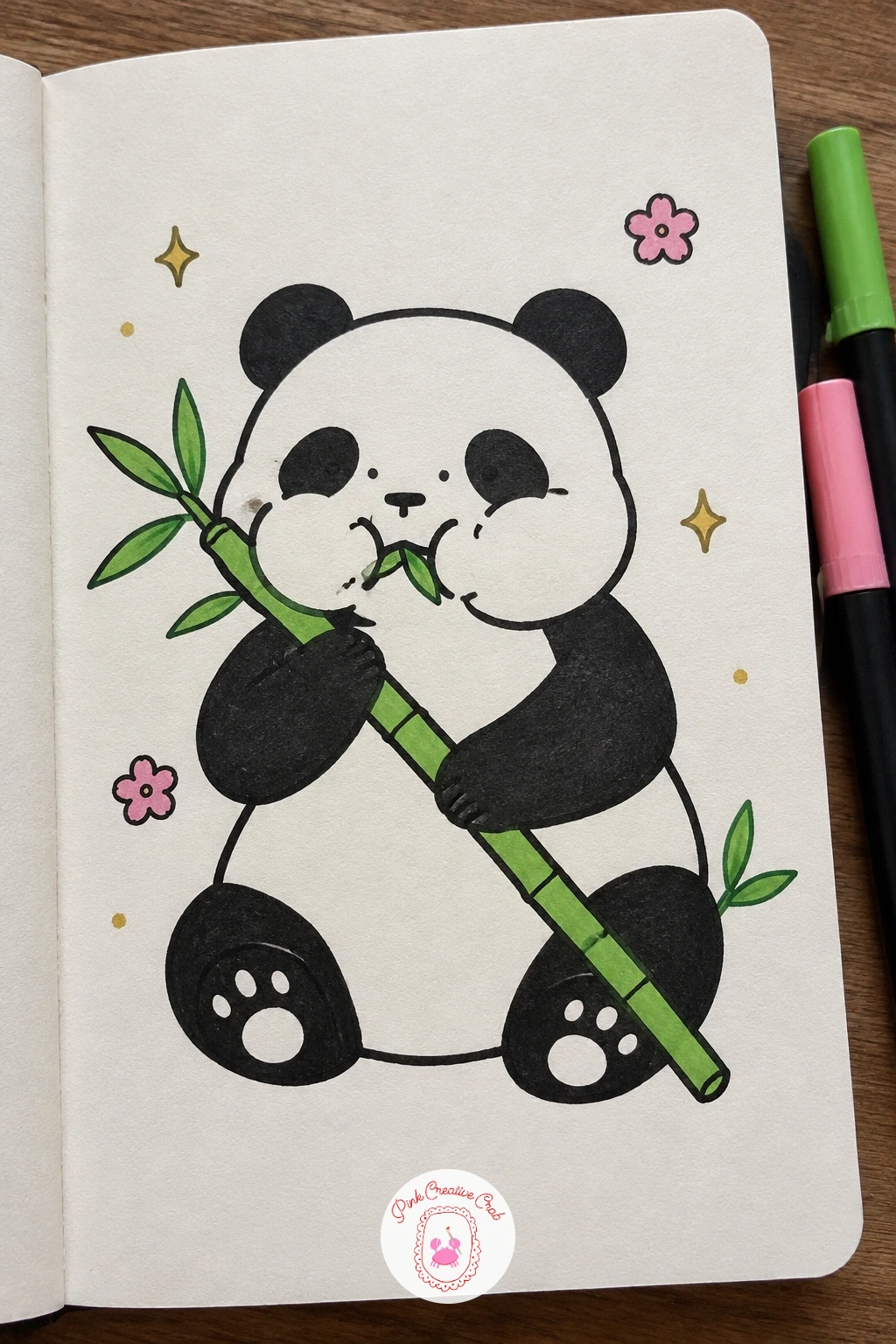
Palette: Bamboo Green,Ink Black,Paper White
Shrink the body down and widen the eyes for this one, since a baby panda needs a rounder head and a smaller frame than the adult poses before it. Draw a simple log shape first as a long rounded cylinder across the lower page, then place the baby panda’s body mid fall just beside it, limbs flailing outward in surprise.
The surprised expression carries this whole doodle, so draw the eyes as wide open circles with small dot pupils rather than the usual patches, and add a tiny open mouth below them. A few motion lines trailing up from the log help show the direction of the tumble without any extra shapes needed.
Keep the log’s bark texture minimal, just a few short curved lines along the top edge, since too much detail there competes with the panda for attention. If a full log feels like too much to draw, a simple rounded stump works as an easy swap and takes up less space.
Try the quick ten-minute version with just the outline and motion lines, or spend closer to forty minutes adding scattered bamboo leaves falling alongside the baby panda for a busier, more playful scene.
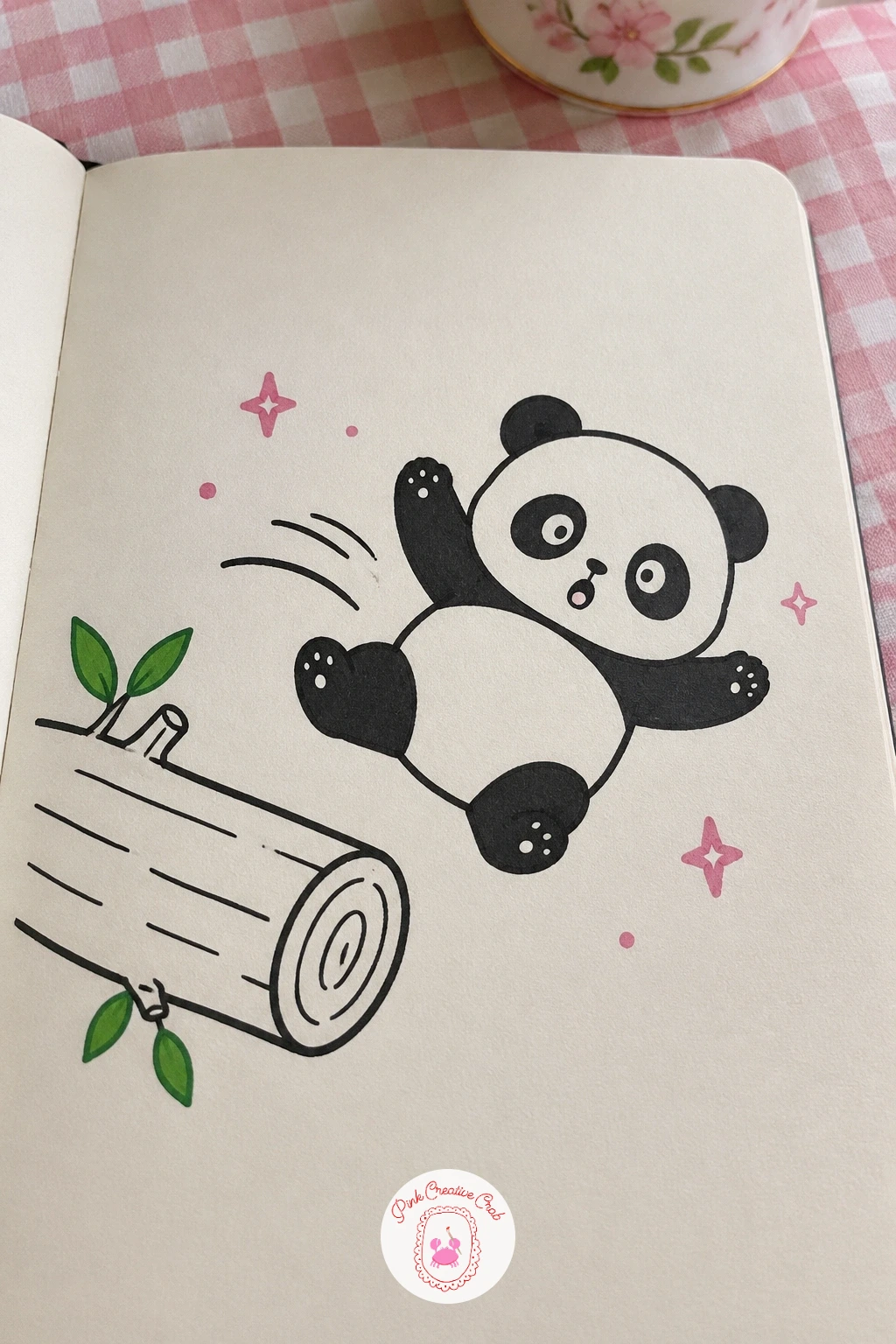
Palette: Ink Black,Bamboo Green,Paper White
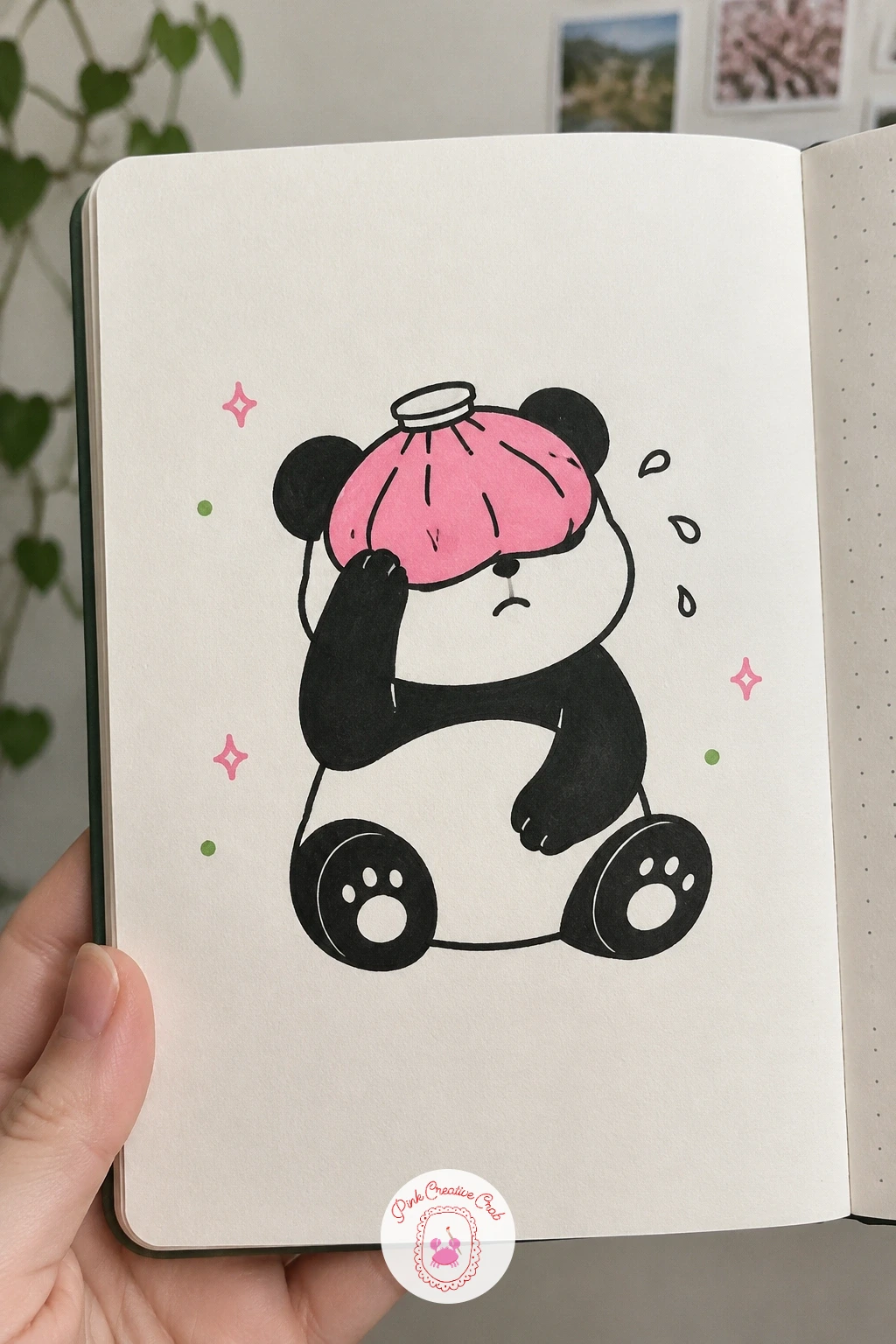
Give this panda a worried little moment of self care: sitting with a small ice pack pressed over its own dark eye patches. Draw the seated body first, then measure the ice pack against the width of the face before inking it, since a pack that is too wide hides the whole expression and one too small looks like it is floating.
A pack roughly as wide as the space between the ears works well, held in place by one paw while the other rests in the lap. Draw worried eyebrows as two short angled lines above the pack’s edge, which carries most of the emotion even with the eyes themselves hidden.
Ink a few small drip lines trailing down from the ice pack, then leave the pack itself uncolored or add the faintest hint of your bamboo green marker along its edge for a cool, clinical touch. Swap the ice pack for a folded cloth if drawing the drip lines feels fussy, since a cloth needs no extra detail at all.
One concrete tip: draw the eyebrows before anything else on the face, since they set the whole worried mood and everything else follows more easily once they are placed.
Palette: Ink Black,Bamboo Green,Paper White
Try drawing the eyebrows extra high and close together for a more comic, exaggerated worry, which reads clearly even at a very small doodle size.
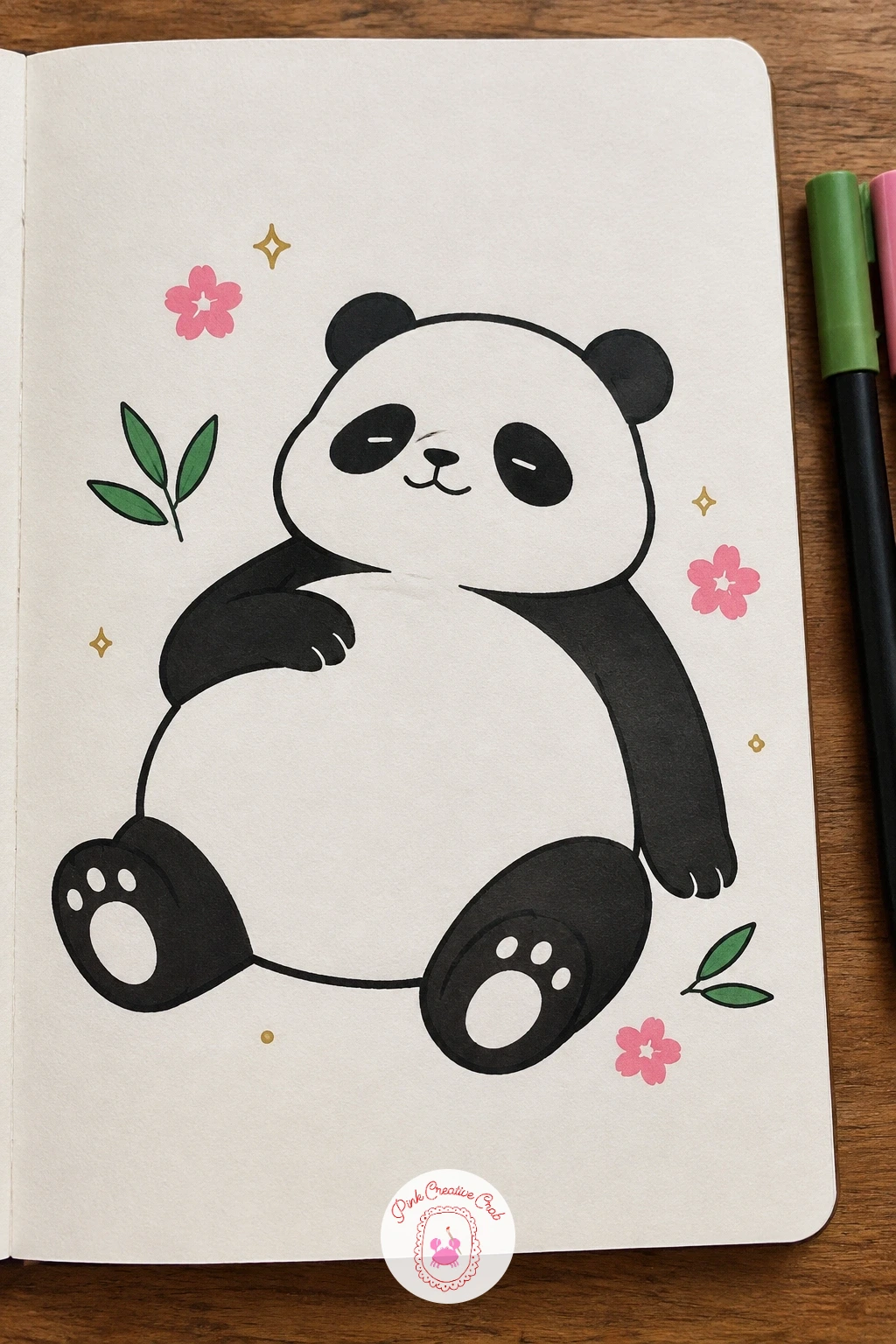
Seat this panda the way a tired person might flop down after a big meal: legs out straight, back slightly rounded, belly pushed forward. Draw the legs first as two simple straight shapes extending from the body, then build the rounded torso and arms around them so the pose reads as relaxed rather than stiff.
Compare the belly’s width against the head before inking the final outline, since a belly drawn too small loses the overstuffed joke and one too large swallows the rest of the body. A belly roughly one and a half times the width of the head usually hits the right note.
Draw the face with half closed, contented eyes and a small open mouth, then add one paw resting on top of the belly to finish the pose. Keep the feet simple ovals pointing outward rather than detailed paws, since this doodle depends on the overall silhouette more than any single detail.
If the sitting pose feels tricky to balance, sketch a simple triangle shape first as a guide for the body before adding the rounder final lines on top.
Palette: Ink Black,Paper White,Bamboo Green
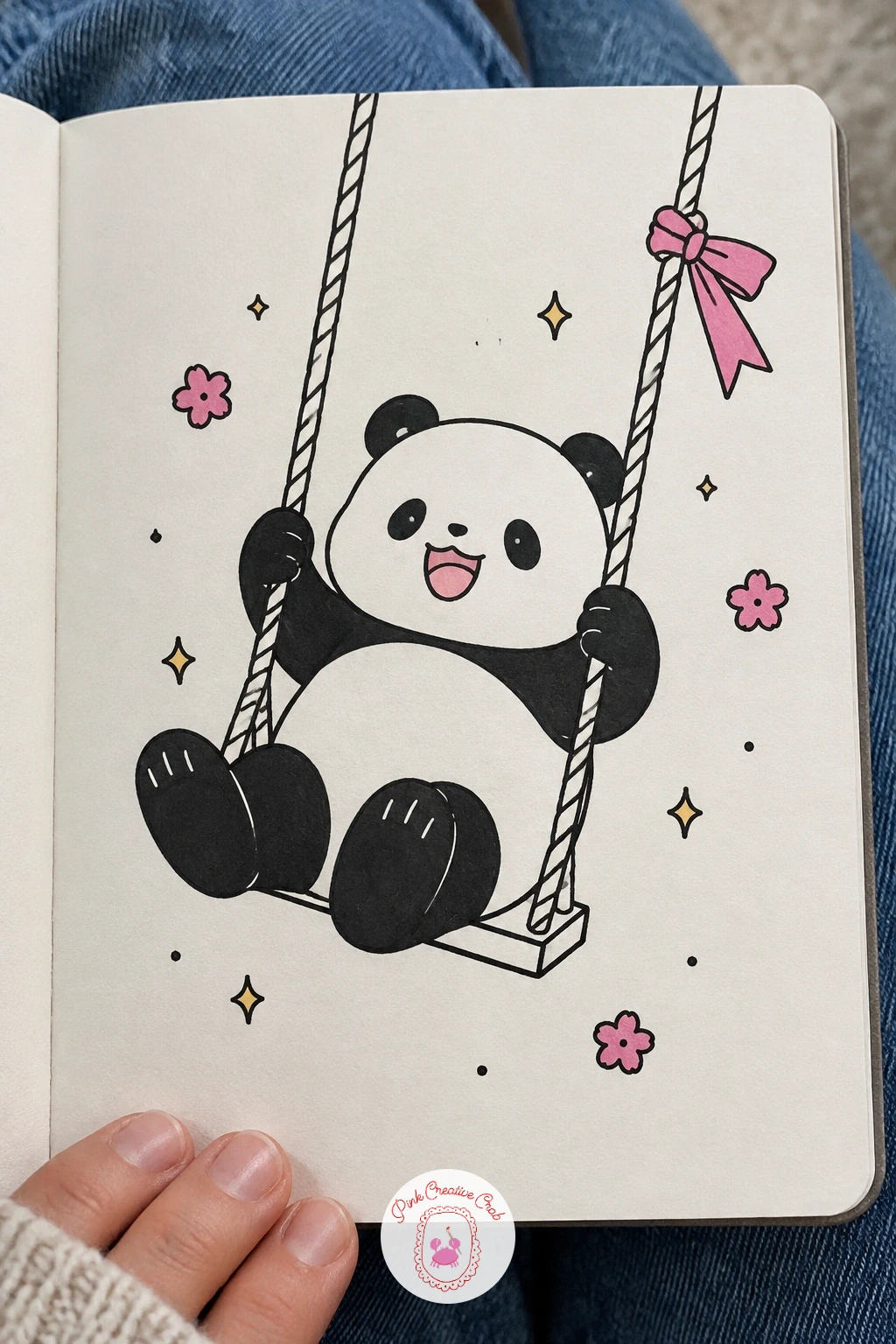
Add some motion with a panda mid swing, gripping a rope that hangs from the top of the page. Draw the rope first as two parallel curved lines running from the top edge down to a simple knot, then build the panda’s body sitting on the knot with legs kicked forward and arms gripping the rope above its head.
Eye level matters here: draw the swing arc from slightly below the panda’s own height, looking up, which makes the whole scene feel like it is caught mid motion rather than posed still. A few curved motion lines trailing behind the swinging body reinforce the same feeling.
Ink a wide open mouth and raised eyebrows for an excited expression, then color the rope knot or a ribbon tied near the top with your cherry blossom pink marker for a small bright accent against all the black linework. If drawing a full rope feels tricky, a plain swing seat on two straight lines works as a simpler stand in.
One concrete tip: angle the legs forward and the head slightly back, since that tilt alone does most of the work of showing the swing is moving.
Palette: Ink Black,Cherry Blossom Pink,Paper White
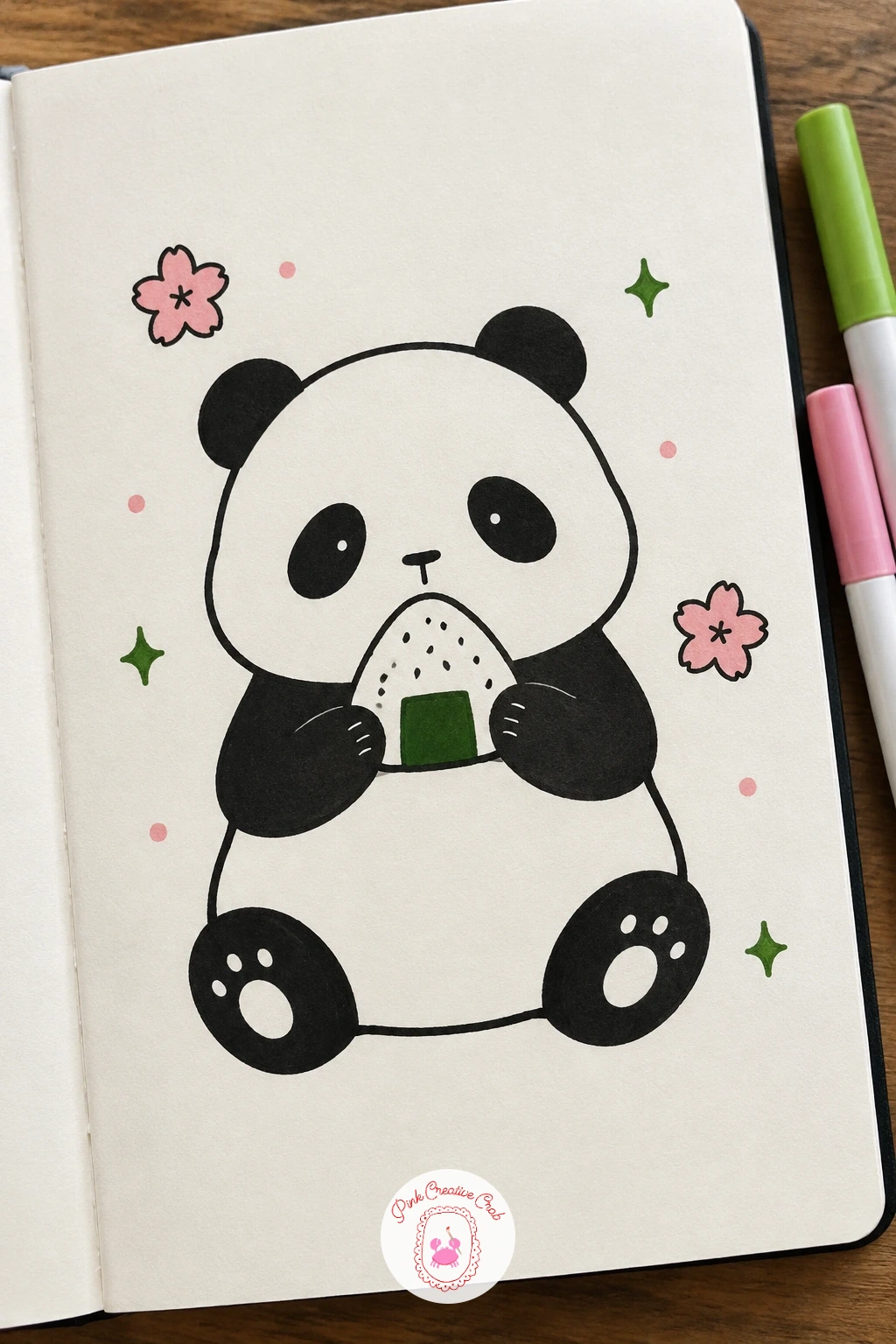
Settle things back down with a small, simple scene: a panda sitting and holding a rice ball in both paws. Draw the round seated body first, then place a simple rounded triangle shape between the paws for the rice ball, which is one of the easiest props in the whole list to get right first try.
Measure the rice ball against the panda’s own paw width before inking it, since a rice ball drawn too large looks like a boulder and one too small disappears between the paws entirely. Roughly the size of the panda’s own head usually works best.
Ink a small triangle of nori wrapped around the base of the rice ball, then leave it as plain black and white or add the faintest wash of bamboo green near a few grains of rice scattered on the paper below. Swap the rice ball for a simple round bun if the triangle shape feels tricky to balance.
Try the ten-minute version with just the seated panda and rice ball, or spend closer to forty minutes adding a small bamboo leaf plate underneath for a fuller little scene.
Palette: Ink Black,Bamboo Green,Paper White
Give this panda a little costume with a cone-shaped straw hat perched on its head. Draw the hat first as a simple triangle sitting just above the ears, then build the rest of the face and body underneath so the hat’s angle feels settled rather than balanced precariously on top.
Compare the hat’s width against the space between the panda’s ears before inking the final lines, since a hat drawn too narrow looks pinned on rather than worn, while one too wide swallows the ears completely. The brim should extend just slightly past each ear tip.
Texture the hat with a few short diagonal lines radiating out from the point, standing in for woven straw without needing any fine detail work. Color the hat’s brim edge with your bamboo green marker for a soft natural tone that suits the straw material.
If drawing the woven texture feels like too much, a plain triangle outline with no inner lines at all still reads clearly as a hat at this small size.
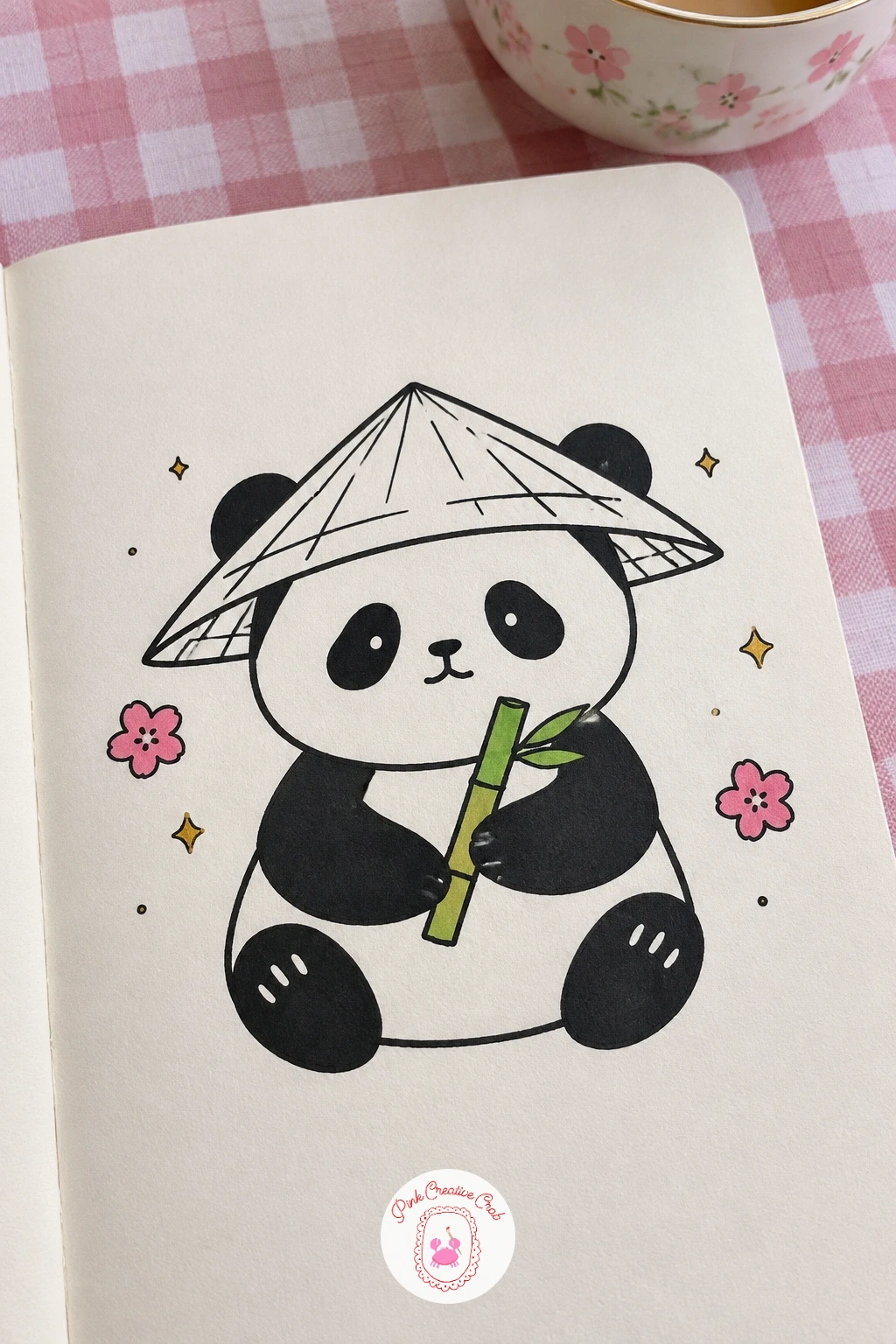
Palette: Bamboo Green,Ink Black,Paper White
Build the first two-figure scene in the list with a mama panda lying on her back, her cub curled up asleep on top of her belly. Draw the mama’s body first as a long rounded shape lying flat across the lower page, then place the smaller cub’s curled oval shape centered on her belly before adding any facial details.
Keep the size difference clear by drawing the cub’s head at roughly half the width of the mama’s own head, which is the single trick that makes this read instantly as parent and baby rather than two pandas of the same age. Both sets of eyes stay closed with simple curved lines for a peaceful, sleepy mood.
Ink the mama’s arm curled loosely around the cub last, since adding it too early can crowd the space before the cub’s shape is settled. Color a few bamboo leaves scattered near their feet with your bamboo green marker for a soft finishing touch.
One concrete tip: draw both figures’ breathing shown with a tiny curved line or two near the chest if you want extra charm, but skip it entirely if the page already feels busy enough.
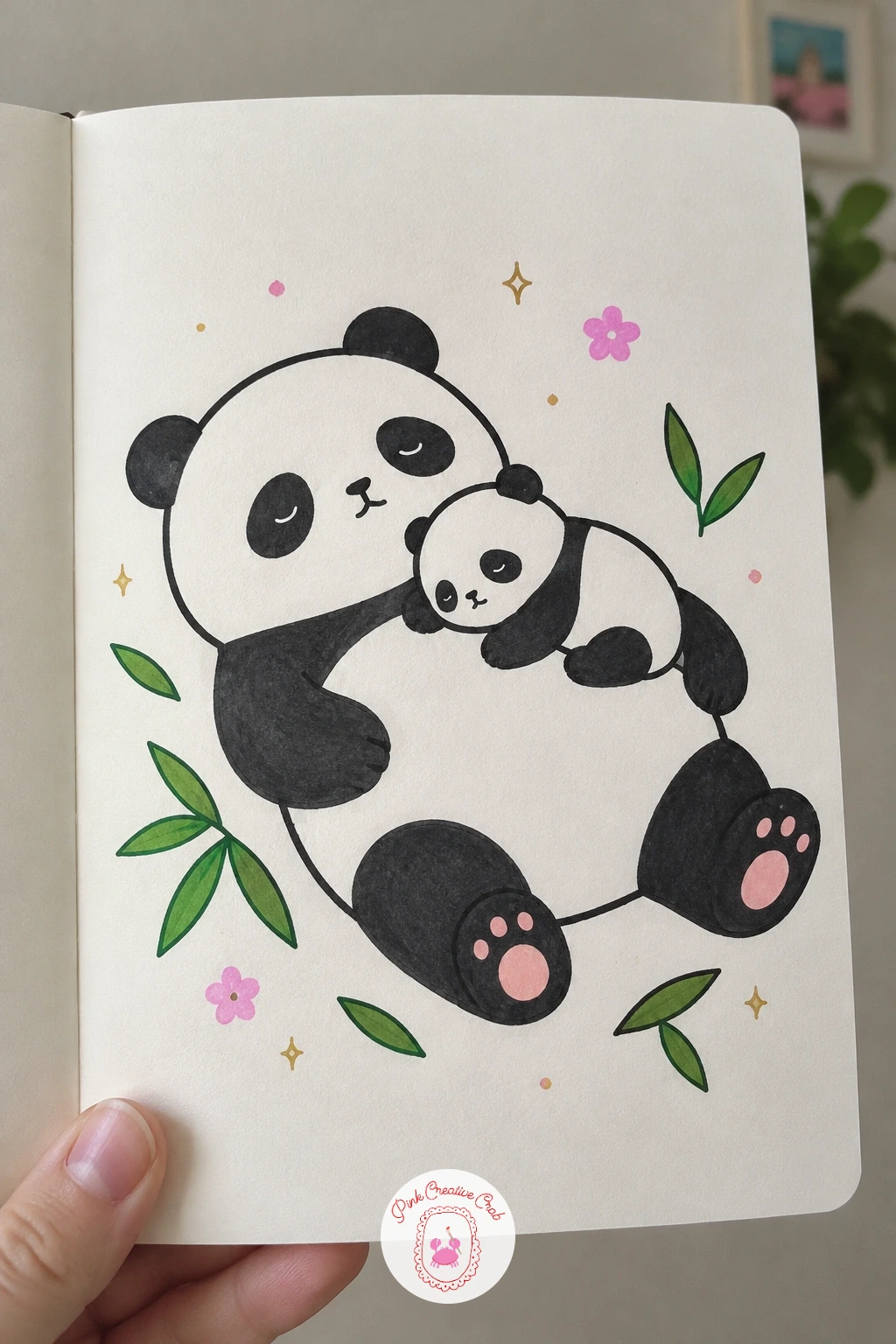
Palette: Ink Black,Bamboo Green,Paper White
Flip the mood from peaceful to silly with a panda stuck upside down in a laundry basket, feet waving in the air. Draw the basket first as a simple woven rectangle, then add the panda’s legs sticking straight up out of the top edge, since starting with the basket keeps the whole scene from looking lopsided.
The hands-on trick here is the woven texture: draw the basket’s crosshatch pattern with short, slightly uneven fineliner strokes rather than a perfectly even grid, which reads far more like real woven material and hides small mistakes better than a rigid pattern would.
Keep the visible legs simple round shapes with the paw pads as tiny ovals, and add a few motion lines near the feet to show the panda is still wriggling. If weaving the basket texture feels like too much work, swap it for a plain box shape with just a few horizontal lines for simplicity.
Color a stray sock or small cloth draped over the basket’s edge with your cherry blossom pink marker for one small bright detail against all the brown-toned linework.
Check out more playful poses in these animal doodle painting ideas if this kind of silly scene is your favorite part of the list.
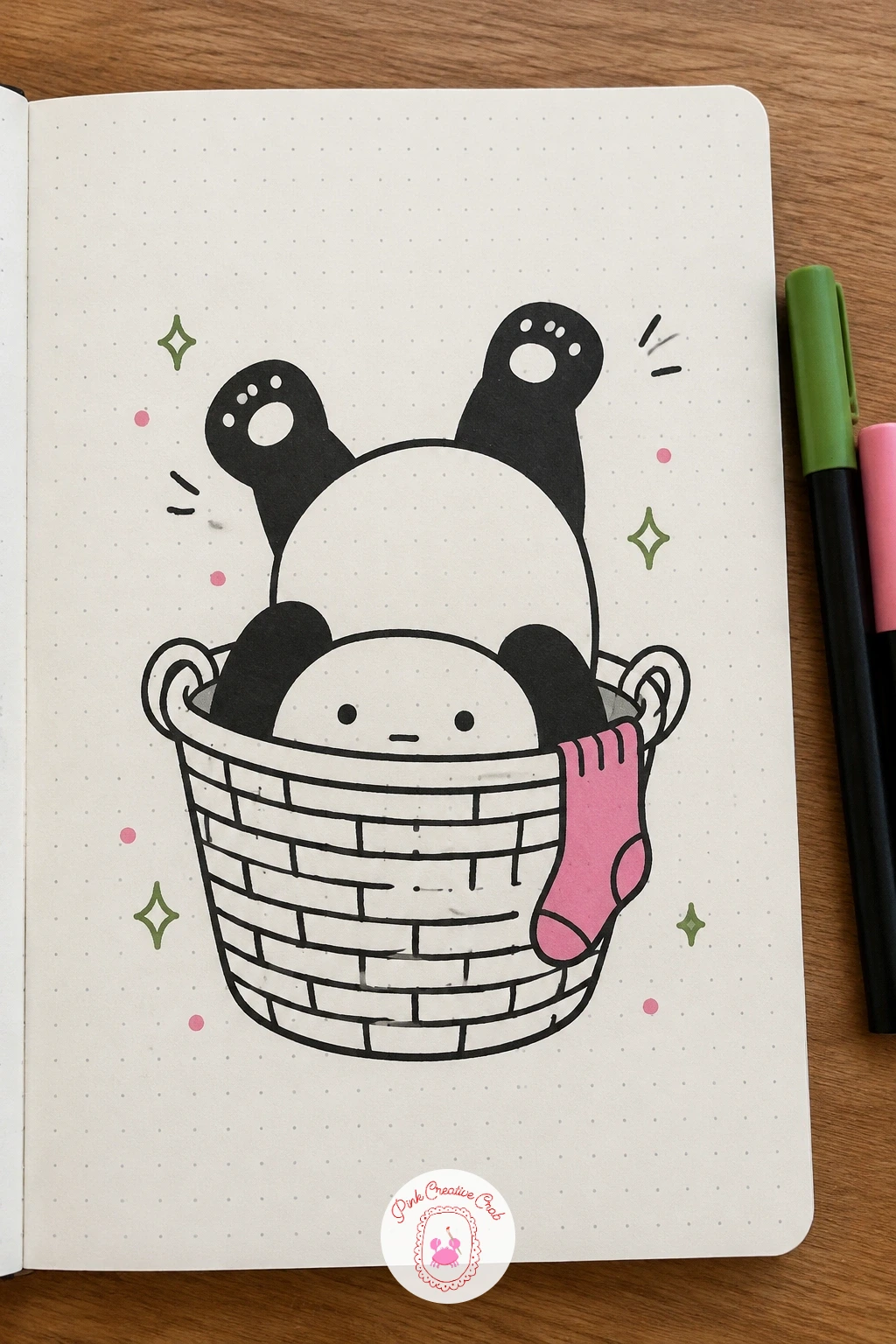
Palette: Ink Black,Cherry Blossom Pink,Paper White
Catch the exact moment of an enormous sneeze, with the panda’s whole body tipping backward from the force of it. Draw the body first at a sharp backward lean, weight on the heels and arms flung wide for balance, then build the sneezing face last once the pose itself feels stable on the page.
Draw the eyes as tightly squeezed shut curved lines and the mouth as a wide open oval, with a few small motion lines bursting outward from the nose to show the sneeze itself. A handful of scattered marks just in front of the face sell the force of it without needing any extra detail.
The pose goes wrong fastest when the backward lean looks like falling rather than sneezing, so keep the arms flung wide and the knees slightly bent rather than straight, which reads as a reaction rather than a stumble. If the full backward tip feels tricky to balance on the page, draw the panda already flat on its back with just the sneeze lines radiating from its face instead.
Ink a loose scatter of bamboo leaf bits flying up near the sneeze for a playful extra touch, colored lightly with your bamboo green marker.
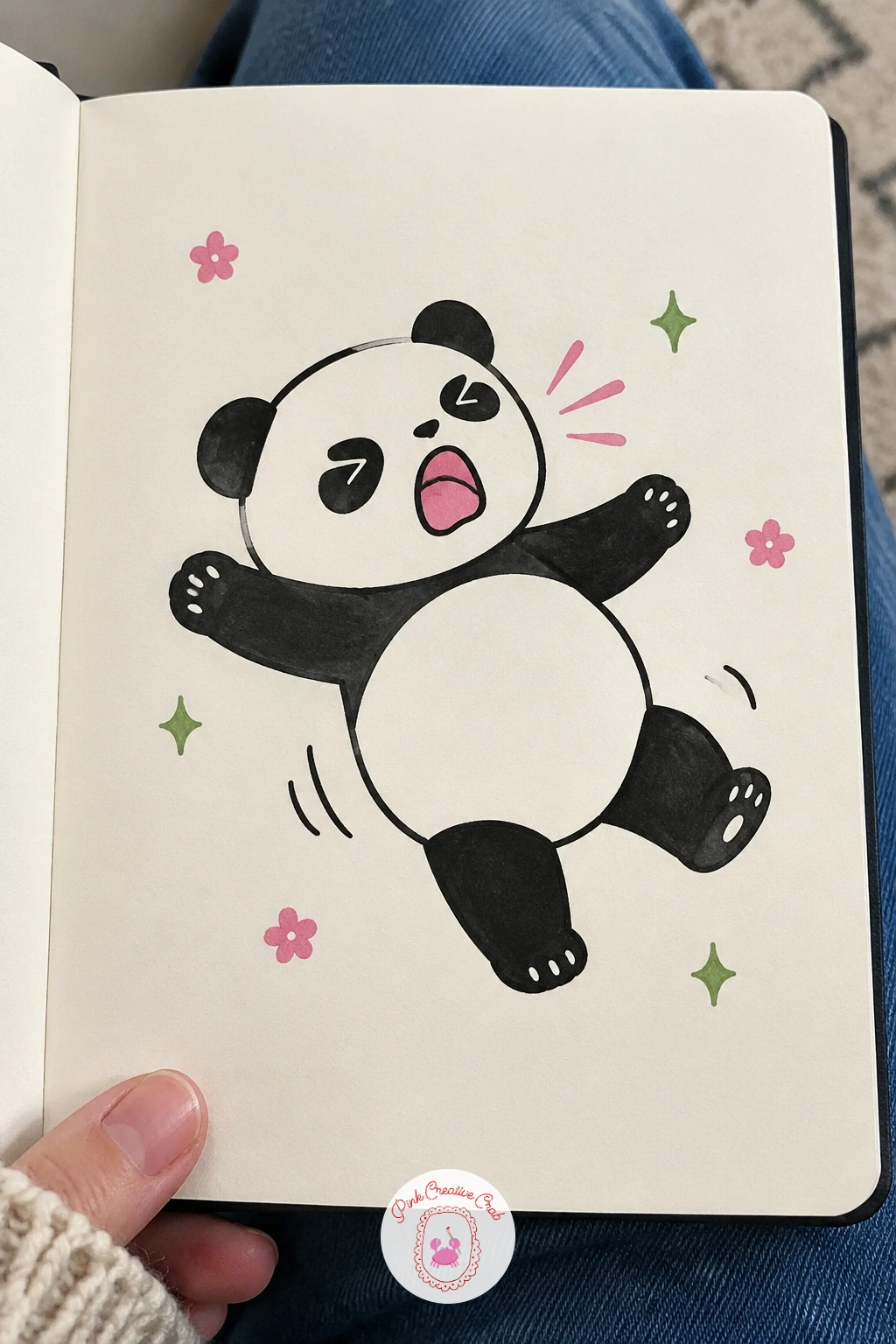
Palette: Ink Black,Bamboo Green,Paper White
Switch to a quieter mischief with a panda caught mid bite of an apple, giving the smallest sideways sneaky glance. Draw the apple first as a simple round shape with a small bite taken out, then position the panda’s mouth right against the bite mark so the two shapes lock together naturally.
The sneaky look lives entirely in the eyes, so draw them as narrow sideways ovals glancing off to one corner rather than looking straight ahead, paired with eyebrows angled slightly inward. That combination alone turns an ordinary eating pose into a guilty one.
Color the apple with your cherry blossom pink marker in loose strokes, leaving the bite mark itself uncolored white to show where the panda has already eaten through. A small stem and single leaf on top finish the apple quickly, colored with a touch of bamboo green if you like.
If drawing a convincing bite mark feels tricky, a simple semicircle cut from one edge of the apple works just as well and takes only a few seconds to ink.
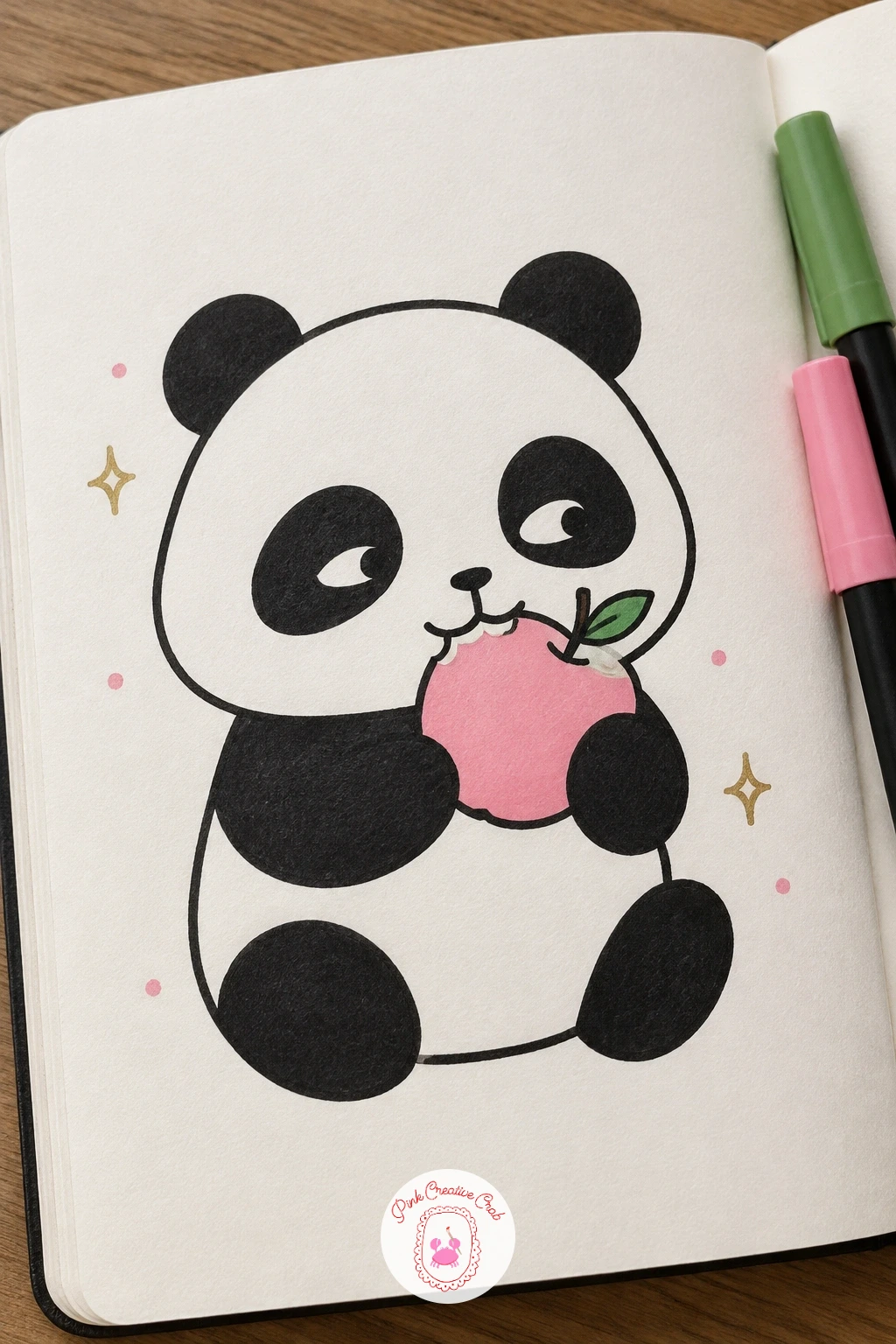
Palette: Cherry Blossom Pink,Bamboo Green,Ink Black
Give this panda a quiet hobby, sitting cross legged with a small bamboo flute held up to its mouth. Draw the seated body first, then measure the flute against the width of the panda’s own paw before inking it, since a flute drawn too long overwhelms the small scene and one too short looks like a stick rather than an instrument.
A flute roughly twice the length of the paw usually sits well, held diagonally across the body with both paws placed along its length. Draw a few small finger holes as evenly spaced dots down the flute to finish the instrument quickly.
Ink closed, contented eyes and puffed cheeks around the mouthpiece, then color the flute itself with your bamboo green marker to match its bamboo material, leaving thin black lines at the joints for segment detail. Swap the flute for a simple drum if the long thin shape feels tricky to keep straight.
One concrete tip: draw a few small musical note marks floating near the flute’s end, which instantly signals music is playing without needing any further detail.
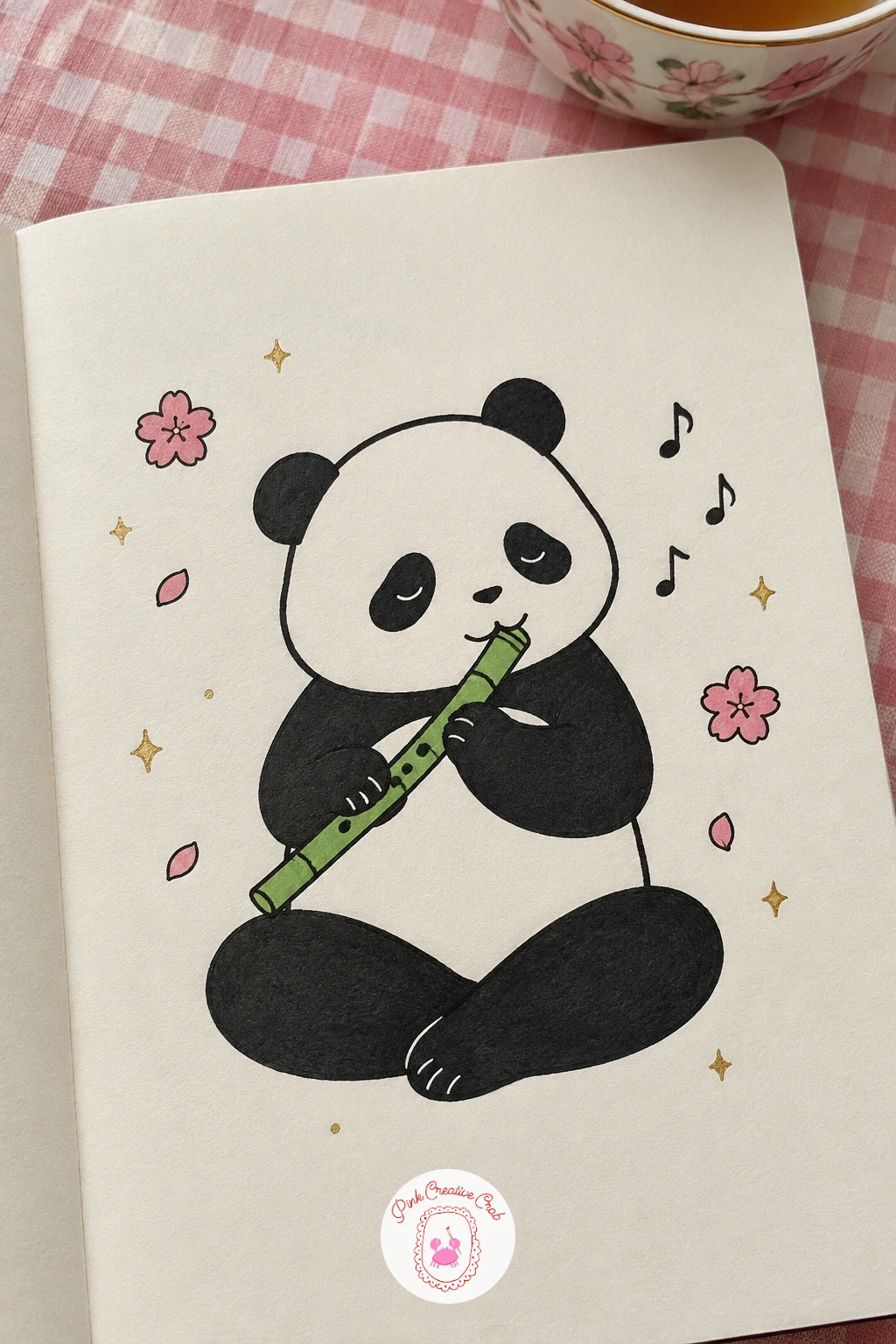
Palette: Bamboo Green,Ink Black,Paper White
Move this panda into a cozy bathtub scene with a small toy boat floating beside it. Draw the tub first as a simple oval basin shape, then place the panda’s head and shoulders peeking out above a scalloped waterline that runs across the middle of the tub.
Draw the scalloped water edge as a row of small connected curves rather than one straight line, since that single detail does most of the work of reading as water instead of a flat surface. A small toy boat floating just beside the panda’s shoulder finishes the scene with barely any extra shapes needed.
Ink a few soap bubbles scattered around the rim of the tub as simple circles of varying sizes, then color the water’s scalloped edge faintly with your bamboo green marker for a cool, soft tone. If drawing the boat feels fiddly, swap it for a floating rubber duck shape instead, which needs only an oval body and a small triangle beak.
Try the quick ten-minute version with just the tub and waterline, or spend closer to forty minutes scattering extra bubbles and a tiny towel draped over the tub’s edge.
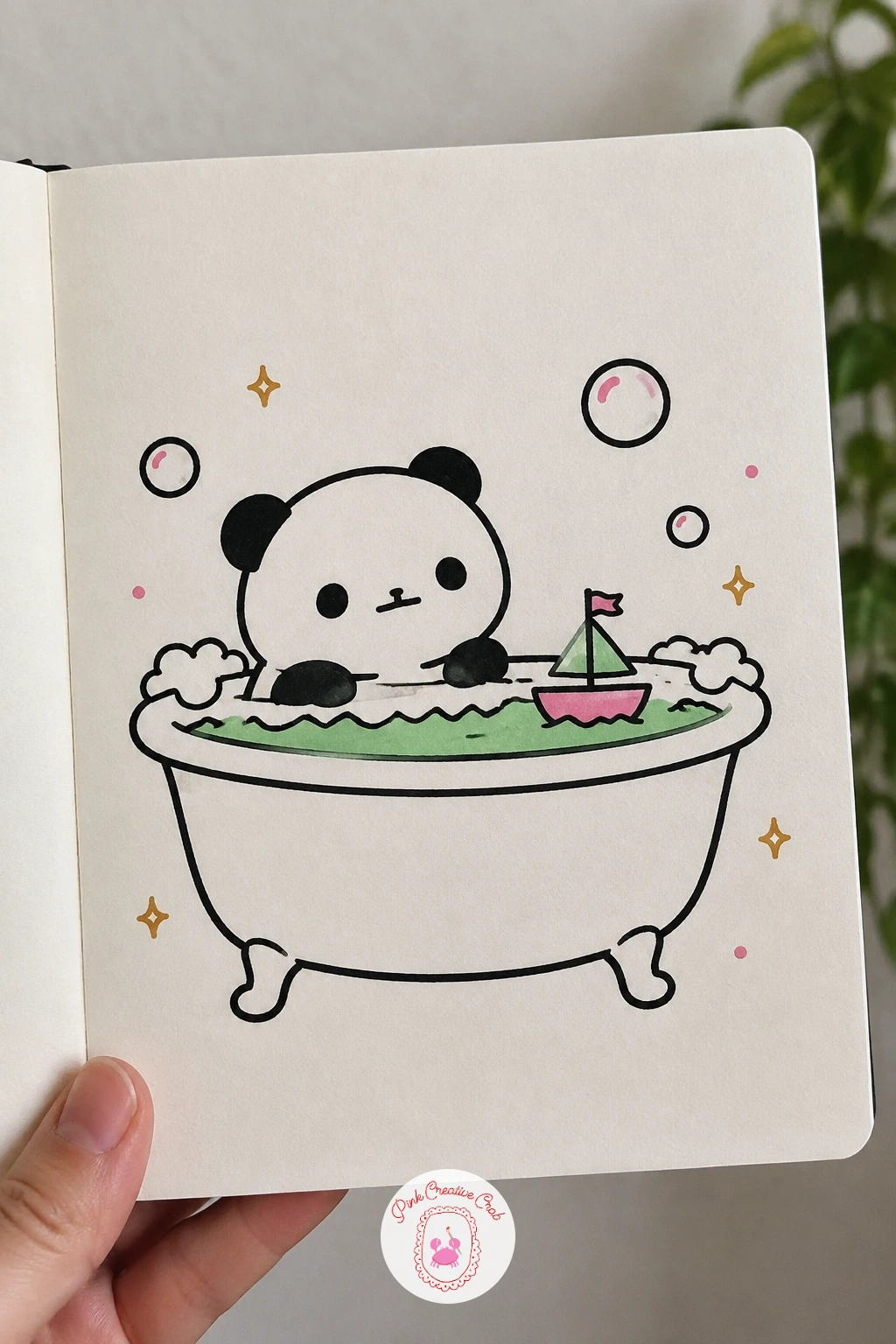
Palette: Bamboo Green,Ink Black,Paper White
Dress this panda in something entirely wrong for its own coloring: a zebra-striped sweater that leaves it looking thoroughly confused. Draw the sweater shape first as a simple rounded rectangle over the torso, then add the zebra stripes as slightly irregular black bands running diagonally across it, since perfectly even stripes read as a pattern rather than a knitted sweater.
The confused expression carries the joke, so draw one eyebrow raised higher than the other above a small flat mouth, with the eyes looking slightly cross toward the sweater itself rather than straight ahead. That mismatch between the calm body and puzzled face is what sells the scene.
Leave the sweater’s stripes in plain black and white to keep the zebra pattern reading clearly, and save your cherry blossom pink marker for a small tag or button detail near the collar instead. If drawing uneven stripes feels tricky, a simple striped scarf works as an easier swap that still carries the same joke.
One concrete tip: draw the sweater slightly too big and baggy around the body, since an oversized fit reads as more comical than a neatly tailored one.
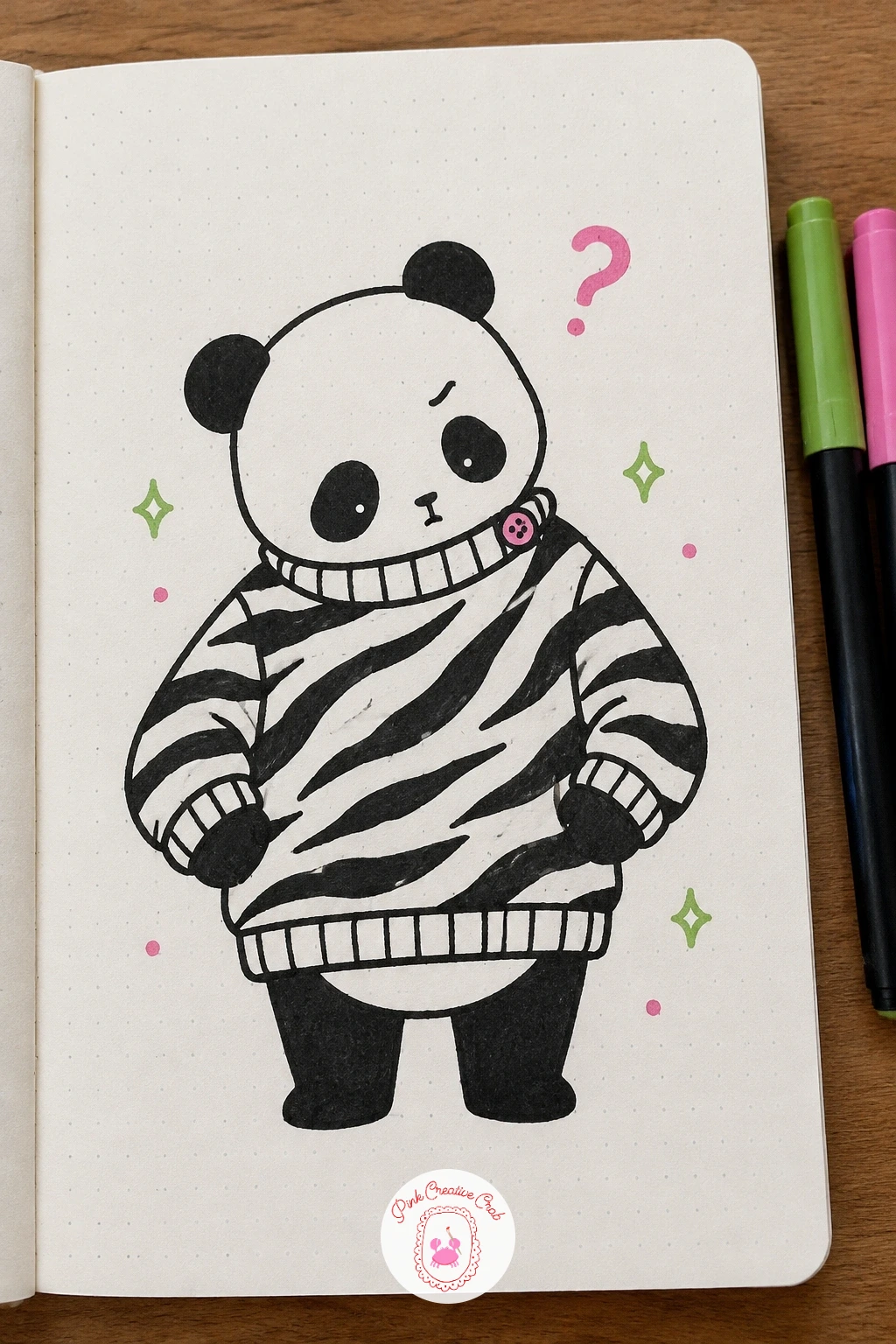
Palette: Ink Black,Cherry Blossom Pink,Paper White
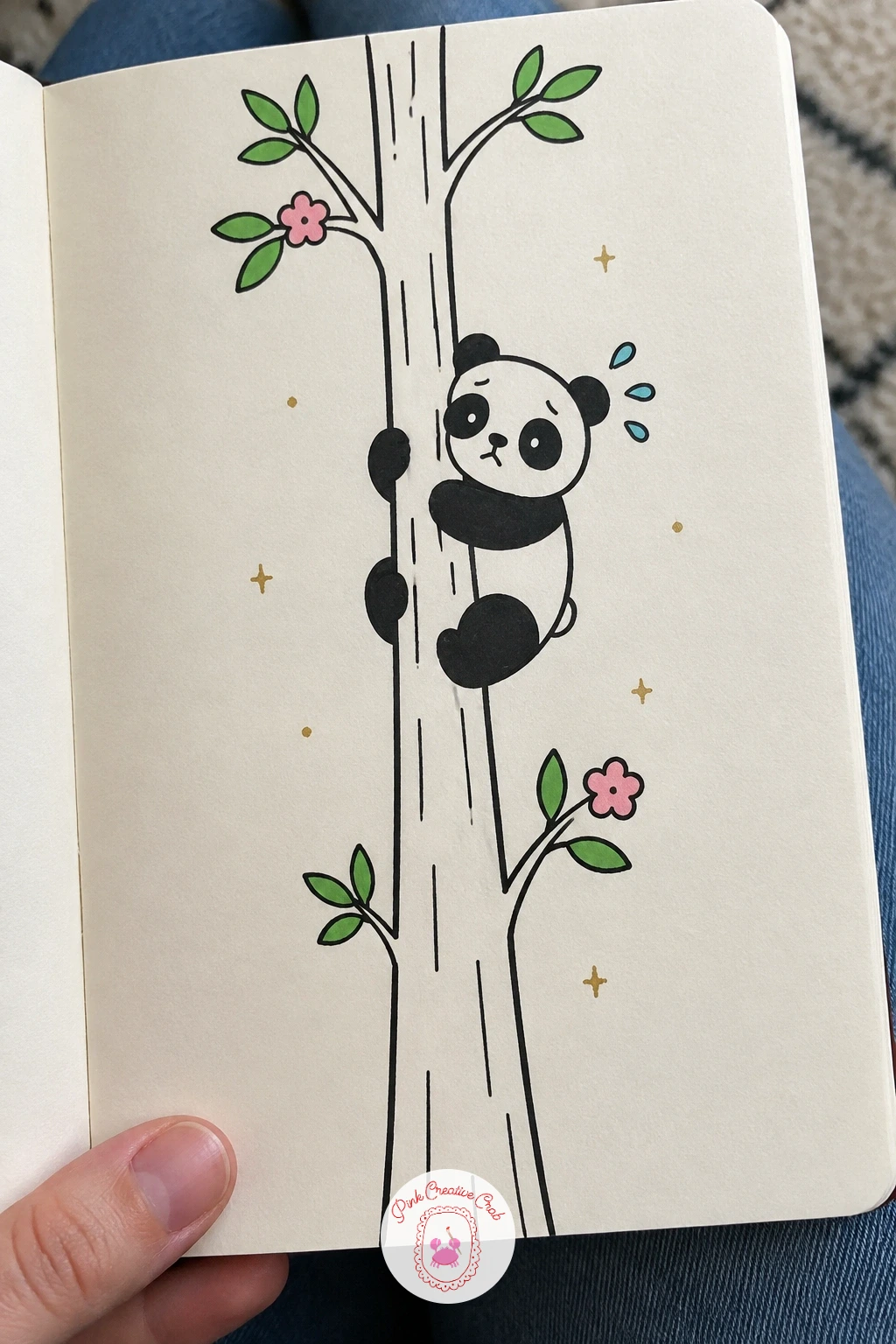
Return to a tall trunk for this one, but this time the panda is stuck partway up, hugging the bark tightly with a worried expression. Draw the trunk first running the full height of the page, then place the panda’s body gripping it sideways partway up rather than at the base, since the height itself is what creates the stuck joke.
From below looking up, the trunk should narrow slightly toward the top of the page, a small perspective trick that makes the climb feel taller than it actually is on paper. Draw the panda’s limbs wrapped tightly around the bark with claws showing as small curved marks for extra grip detail.
Ink wide worried eyes and a small open mouth, then add a few sweat drop marks near the head to finish the nervous mood. Color a couple of bamboo leaves near the base of the trunk with your bamboo green marker, keeping the rest of the scene in plain black and white for contrast.
If narrowing the trunk for perspective feels tricky, a straight-sided trunk still reads perfectly well, just without quite as much sense of height.
Palette: Ink Black,Bamboo Green,Paper White
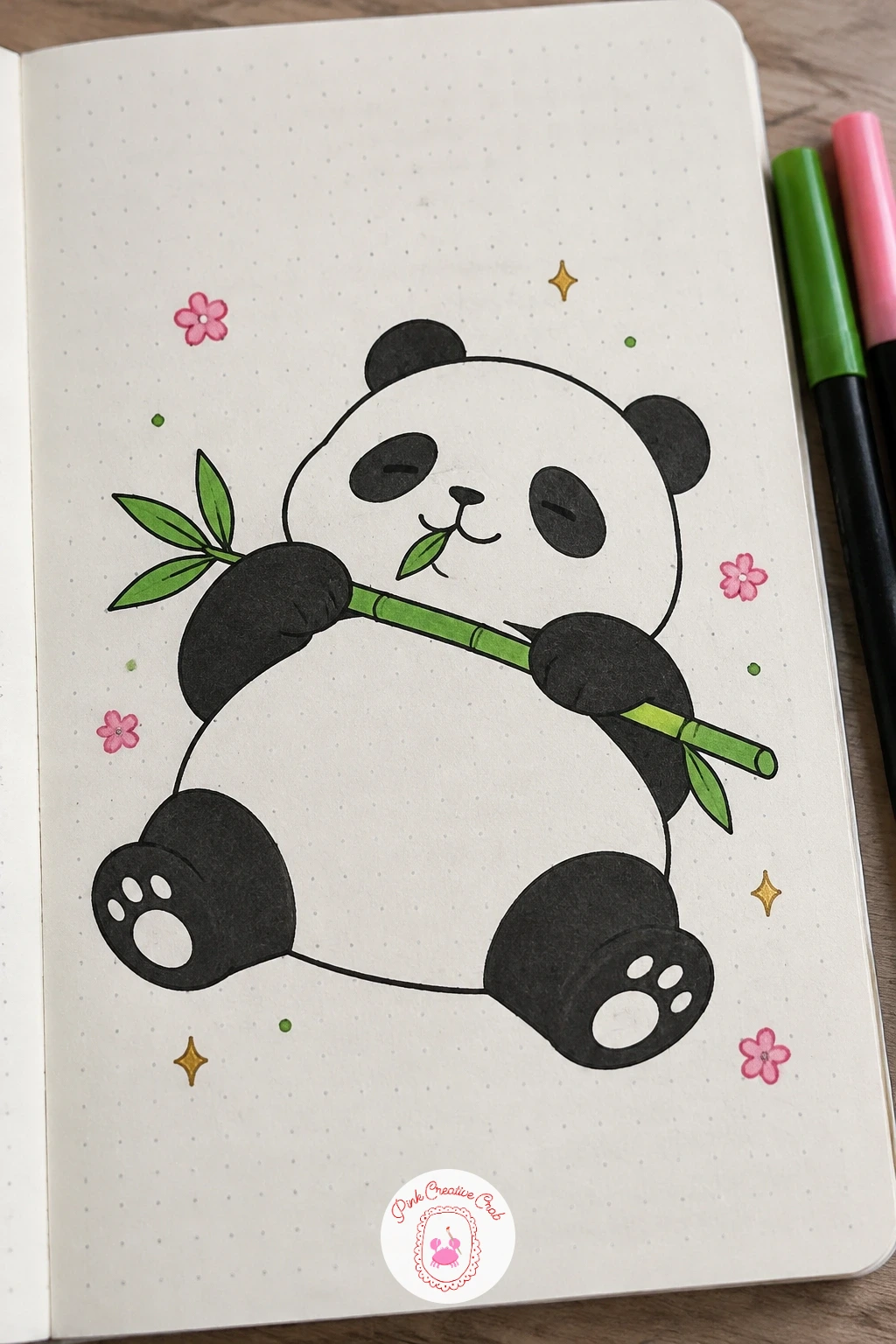
Flip the usual seated eating pose on its head with a panda lying flat on its back, bamboo balanced across its own belly while it munches away. Draw the body first as a long rounded shape lying horizontally, then rest the bamboo stalk diagonally across the belly before adding the face, since the stalk’s placement decides how relaxed the whole pose looks.
Keep the legs loosely bent and the paws resting lightly on either end of the stalk rather than gripping it tightly, which reads as far lazier and more comfortable than a firm grip would. Half closed, content eyes finish the mood completely.
Texture the bamboo stalk with a dry fineliner stroke technique: drag the pen quickly and lightly along the stalk so the ink breaks up slightly, giving a rougher, more natural bamboo surface than a smooth solid line would. Color the stalk afterward with your bamboo green marker for extra depth.
If the dry stroke technique feels tricky to control, a few short perpendicular dashes along the stalk create a similar rough texture with far less pen control needed.
Palette: Bamboo Green,Ink Black,Paper White
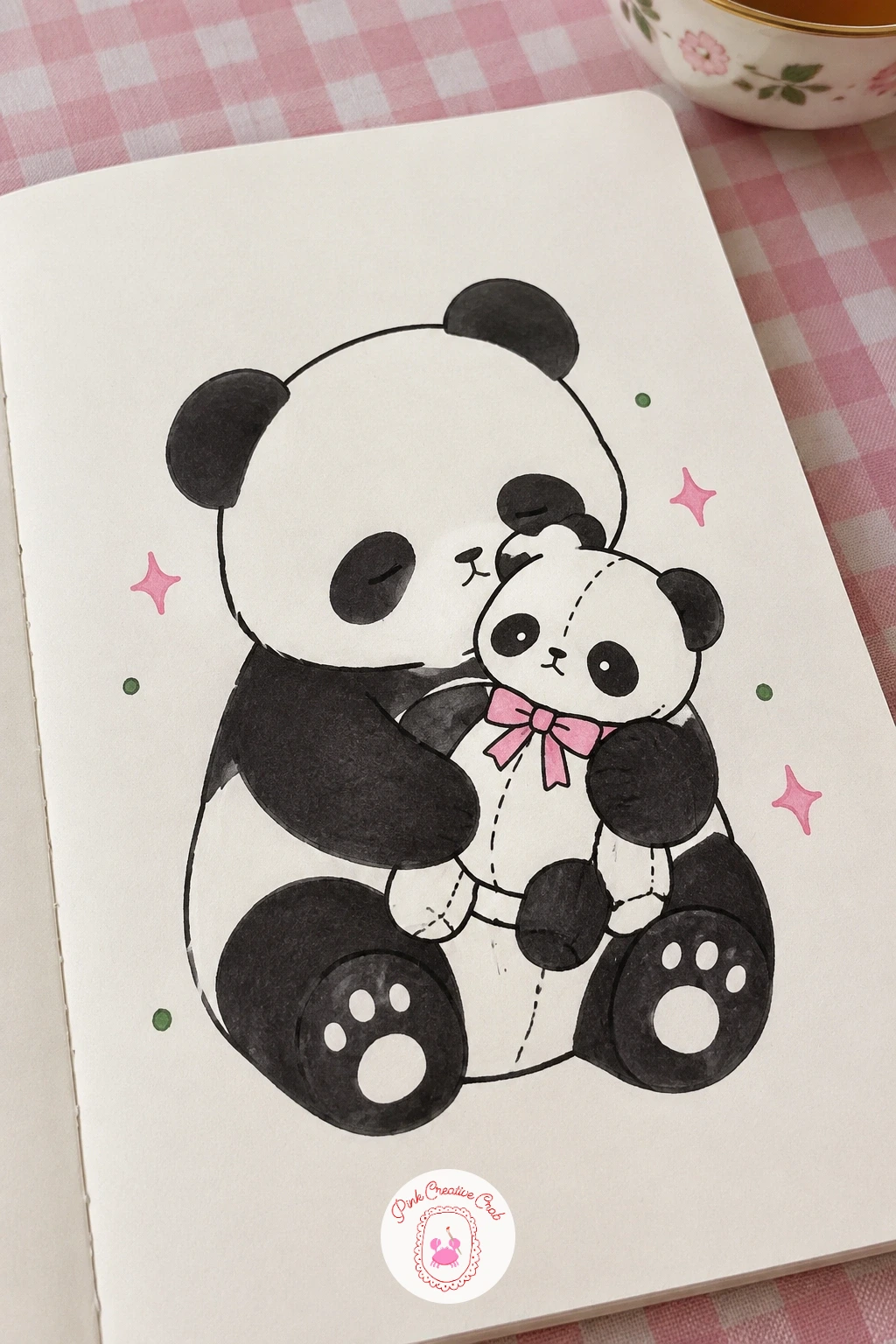
Keep the cozy mood going with a panda hugging a smaller stuffed panda toy of its own. Draw the real panda’s body first in a seated, slightly curled pose, then nestle a miniature version of the same round shapes into its arms for the toy, since reusing the same basic shapes at a smaller scale keeps the two figures reading as a matched pair.
Draw the toy’s stitching detail as a few simple straight lines across its limbs and a small cross stitch on its chest, which is the single detail that reads instantly as a stuffed toy rather than a second living panda. Keep the real panda’s eyes soft and half closed to match the gentle, affectionate mood.
Color a small ribbon tied around the toy’s neck with your cherry blossom pink marker for a sweet finishing touch, leaving the rest of both figures in plain black and white. If stitching detail feels fiddly at this size, a simple fabric seam drawn as one curved line across the toy’s back works just as well.
One concrete tip: draw the toy slightly smaller than feels natural at first, since an undersized toy reads more convincingly as a plush than one close to full size.
Palette: Ink Black,Cherry Blossom Pink,Paper White
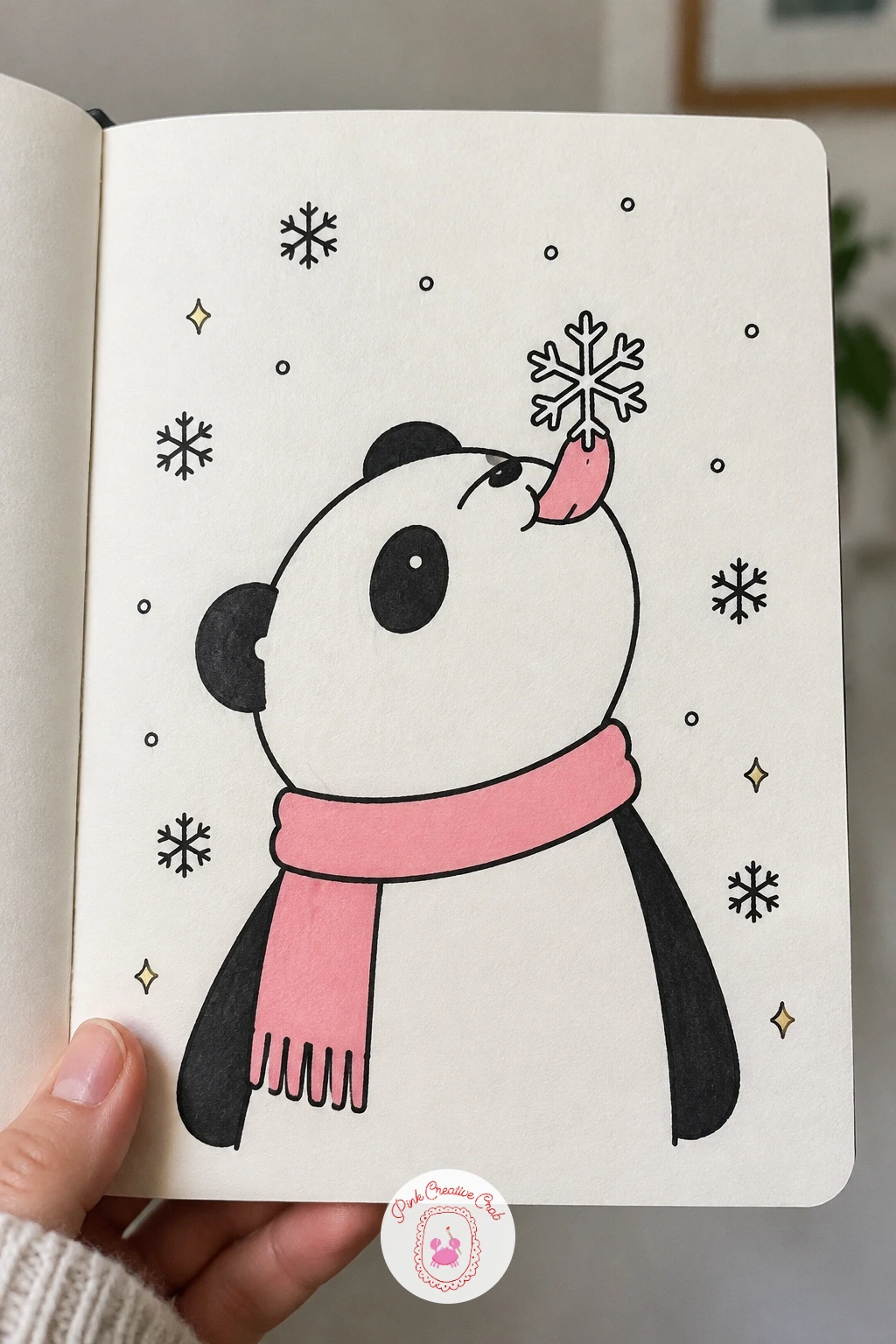
Take this panda outdoors into a light snowfall, head tipped back and tongue out to catch a single snowflake. Draw the head tilted upward first, then place one small snowflake shape just above the open mouth before adding the rest of the falling snow, since getting that one snowflake’s position right is the whole point of the pose.
Draw the falling snow around it as a loose scatter of small plus-sign shapes and simple dots at varying sizes, which reads far more naturally than evenly spaced identical flakes. Keep the mouth a simple open oval with the tongue a small rounded shape poking out.
Ink the snowflake itself with slightly thicker lines than the background snow so it stands out as the focal point of the whole scene. Color a soft scarf wrapped around the panda’s neck with your cherry blossom pink marker for a warm contrast against the cold scene.
If scattering varied snowflakes feels like a lot of extra drawing, a handful of simple dots works just as well and still reads clearly as snow falling.
Palette: Ink Black,Cherry Blossom Pink,Paper White
Look at real snowfall photos for reference on how flakes scatter unevenly, since copying that irregular spacing makes the falling snow feel far more natural.
Settle into a calmer evening scene with a panda standing and holding a round paper lantern up by its handle. Draw the lantern first as a simple circle with a small loop handle on top, then place the panda’s paw gripping the handle before building the rest of the standing body around it.
Compare the lantern’s size against the panda’s own head before finishing the outline, since a lantern drawn too small looks like an afterthought and one too large overwhelms the whole scene. Roughly matching the head’s width keeps the proportions comfortable.
Ink a few vertical rib lines around the lantern’s surface to suggest its paper folds, then color the lantern’s body with your cherry blossom pink marker, leaving the ribs themselves in plain black for contrast. If the ribbed paper texture feels tricky, a plain solid circle colored in works just as well as a simpler lantern shape.
Try the quick version with just the lantern and a plain standing pose, or add a few small stars scattered in the background for a fuller evening scene in the longer version.
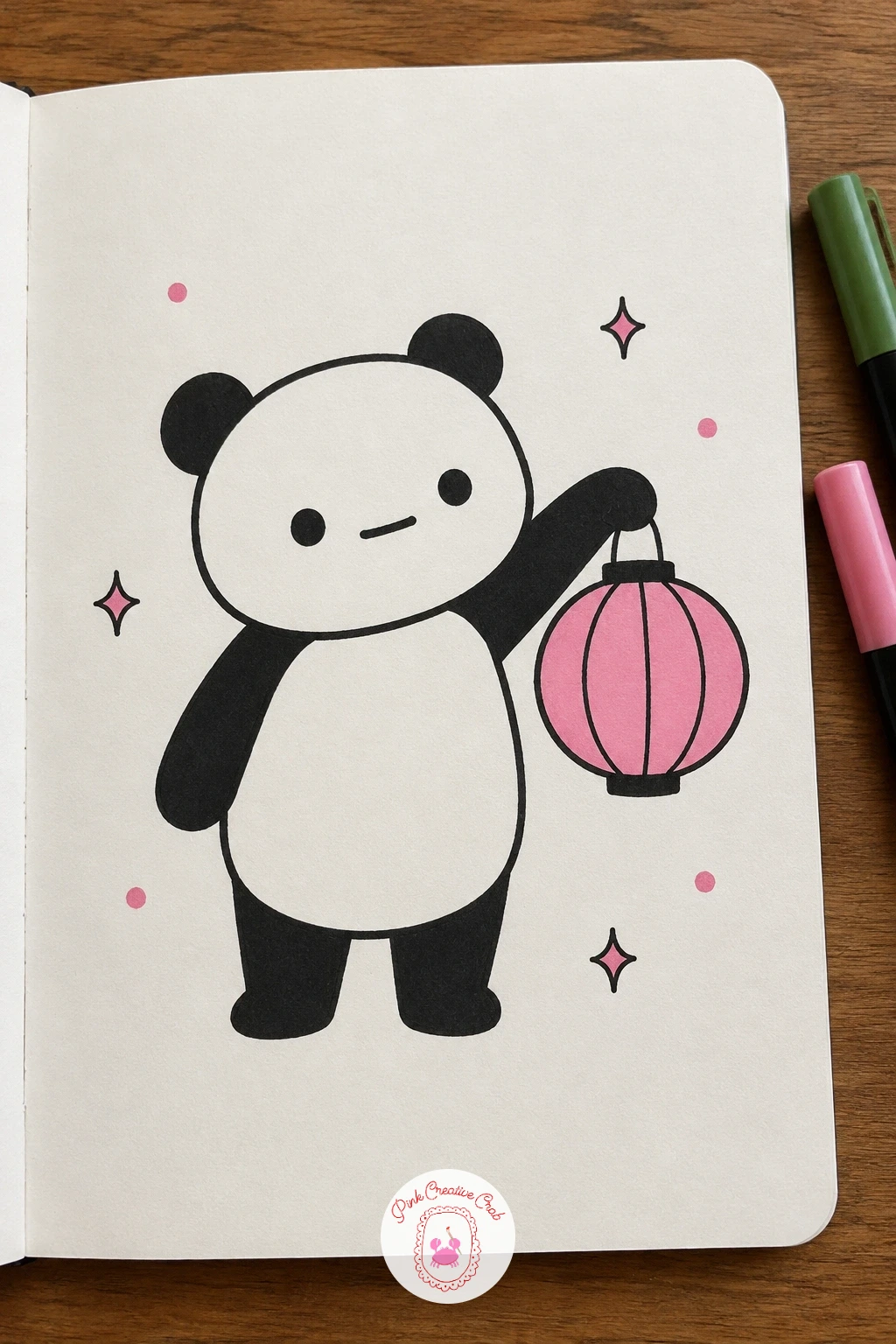
Palette: Cherry Blossom Pink,Ink Black,Paper White
Scale things up dramatically with a panda wrapped entirely around a peach larger than its own body. Draw the peach first as a large rounded shape taking up a good portion of the page, then build the panda’s arms and legs wrapped around its widest point so the hug reads as an embrace rather than the panda simply sitting beside it.
Measure the peach against the panda’s own head before finishing the outline: a peach roughly three times the head’s width creates a convincing giant scale without swallowing the panda’s face entirely out of view. Keep the panda’s face peeking out from one side with closed, happy eyes.
Ink the peach’s characteristic center crease as one curved line running from top to bottom, then color the whole peach with your cherry blossom pink marker in soft overlapping strokes that leave a little white highlight near the top for shine. Swap the peach for a simple round apple if the larger scale feels tricky to balance on the page.
One concrete tip: draw the panda’s arms barely meeting around the back of the peach rather than fully closed, which reads as a tight, genuine hug rather than a loose rest against it.
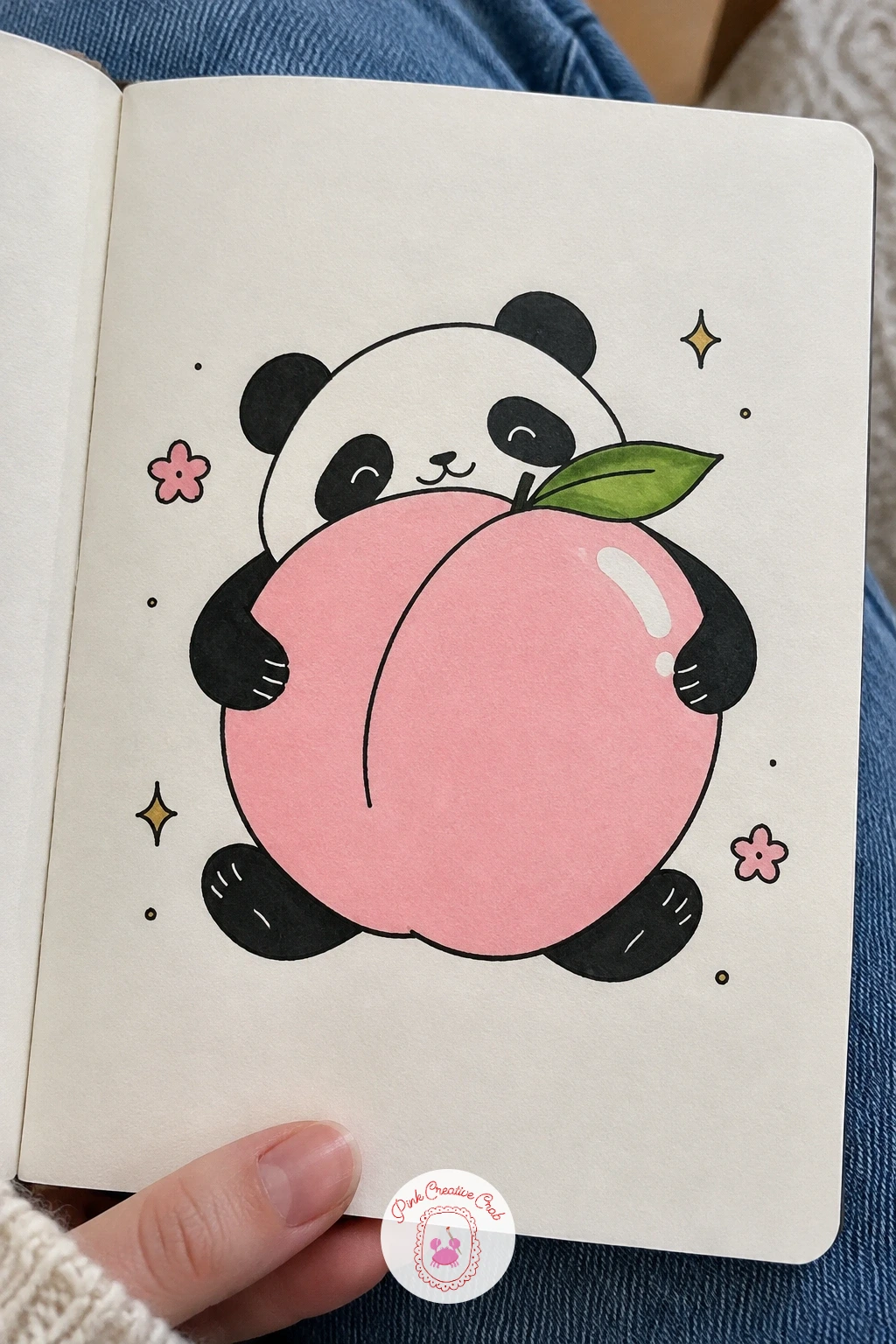
Palette: Cherry Blossom Pink,Ink Black,Paper White
Catch this panda at the exact unflattering moment it lands a cartwheel attempt on its bottom instead of its feet. Draw the body mid tumble first, one arm still raised from the attempt and legs splayed awkwardly, then settle the final landing pose with the bottom touching down and the rest of the body tipping backward from the momentum.
Keep the limbs loose and slightly bent rather than straight and controlled, since stiff limbs read as a posed stance while bent, scattered ones read as an accident caught mid motion. A surprised open mouth and wide eyes finish the expression.
Ink a few short motion lines trailing from the raised arm and one leg to emphasize the tumbling direction, then add a small dust cloud shape near the landing point using a few loose scribbled lines. If drawing full limb motion feels tricky, a simpler seated landing pose with just raised arms still carries the same joke.
Try the ten-minute version with just the final landed pose, or spend closer to forty minutes adding a small sequence of three tiny tumbling poses leading up to the landing for a mini comic strip feel.
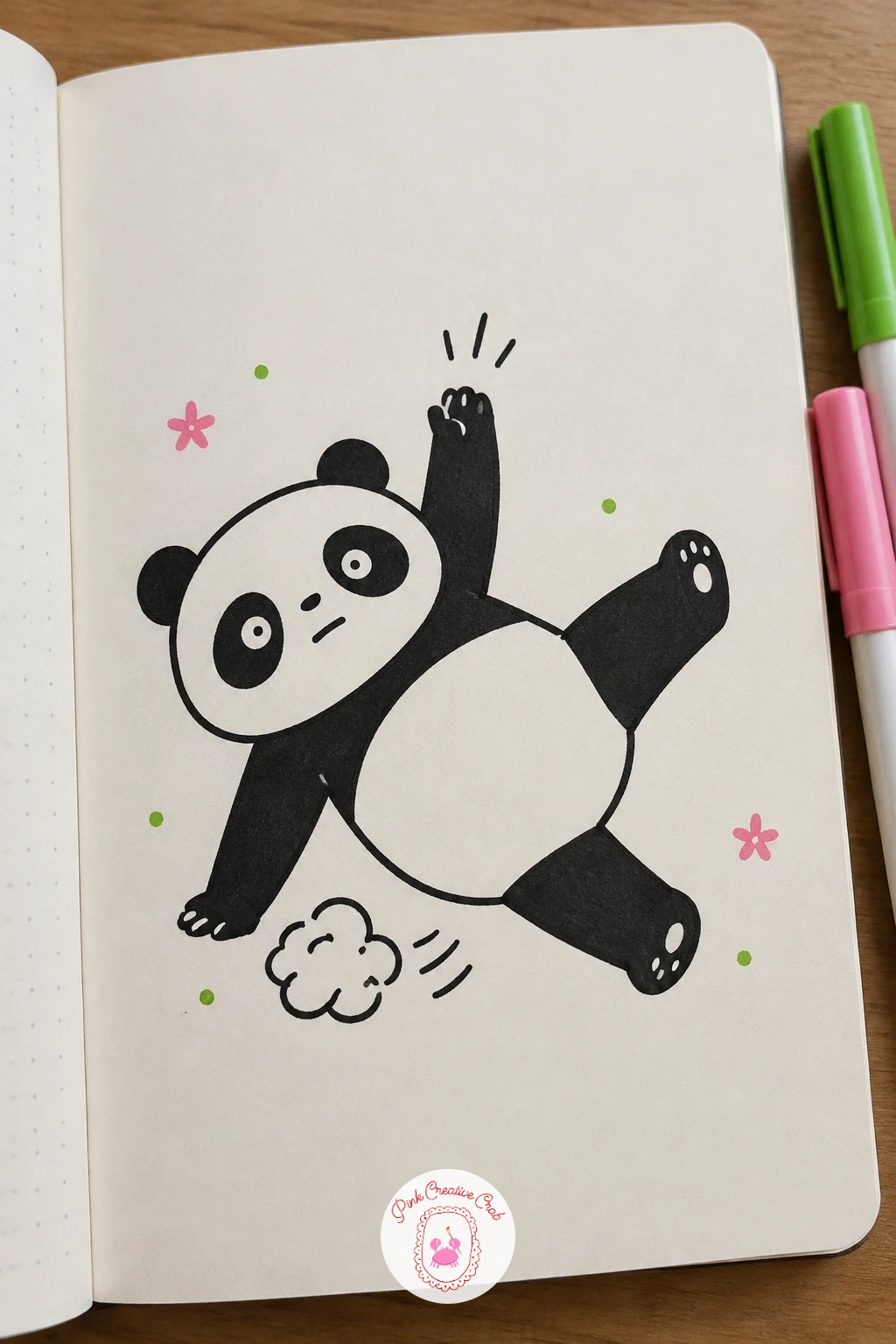
Palette: Ink Black,Paper White,Bamboo Green
Bring this panda into a quieter, more modern moment: sitting with large headphones on, head tilted slightly as if nodding along to music. Draw the headphones first as two rounded ear cups connected by a simple curved band over the head, then build the rest of the face and body around that band so the fit looks secure rather than floating.
Tilt the head a few degrees off center rather than drawing it perfectly upright, since that small tilt alone is what reads as nodding along rather than simply sitting still. Closed or half closed eyes with a relaxed, slightly smiling mouth finish the mood.
Ink a few small musical note marks floating near the headphone band to reinforce the music without needing any further detail. Color the headphone band and ear cups with your cherry blossom pink marker for a bright, modern accent against the usual black and white.
If the rounded headphone shape feels tricky to get symmetrical, draw one side first and trace over folded paper or hold the page up to a light source to copy the mirrored shape onto the other ear.
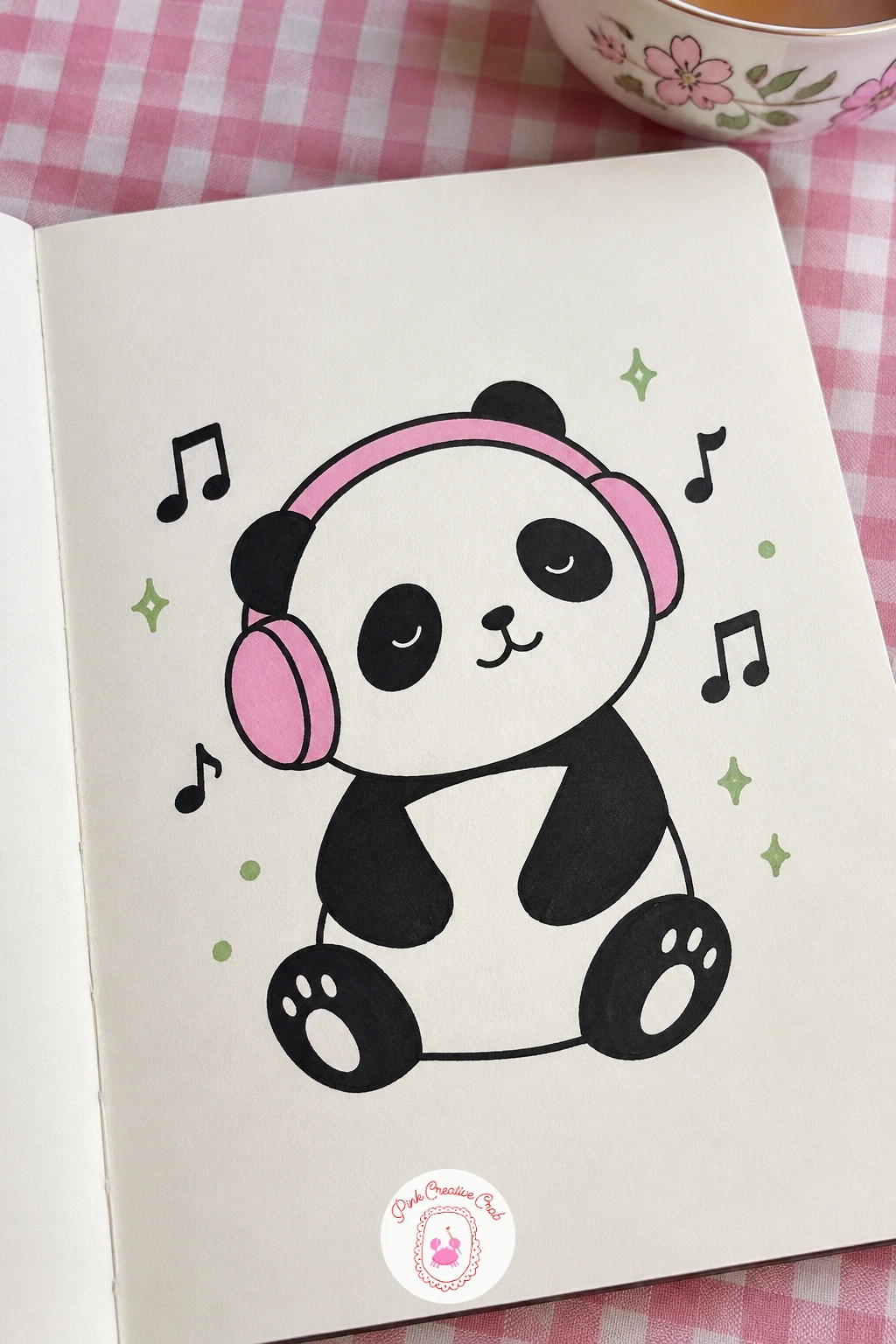
Palette: Cherry Blossom Pink,Ink Black,Paper White
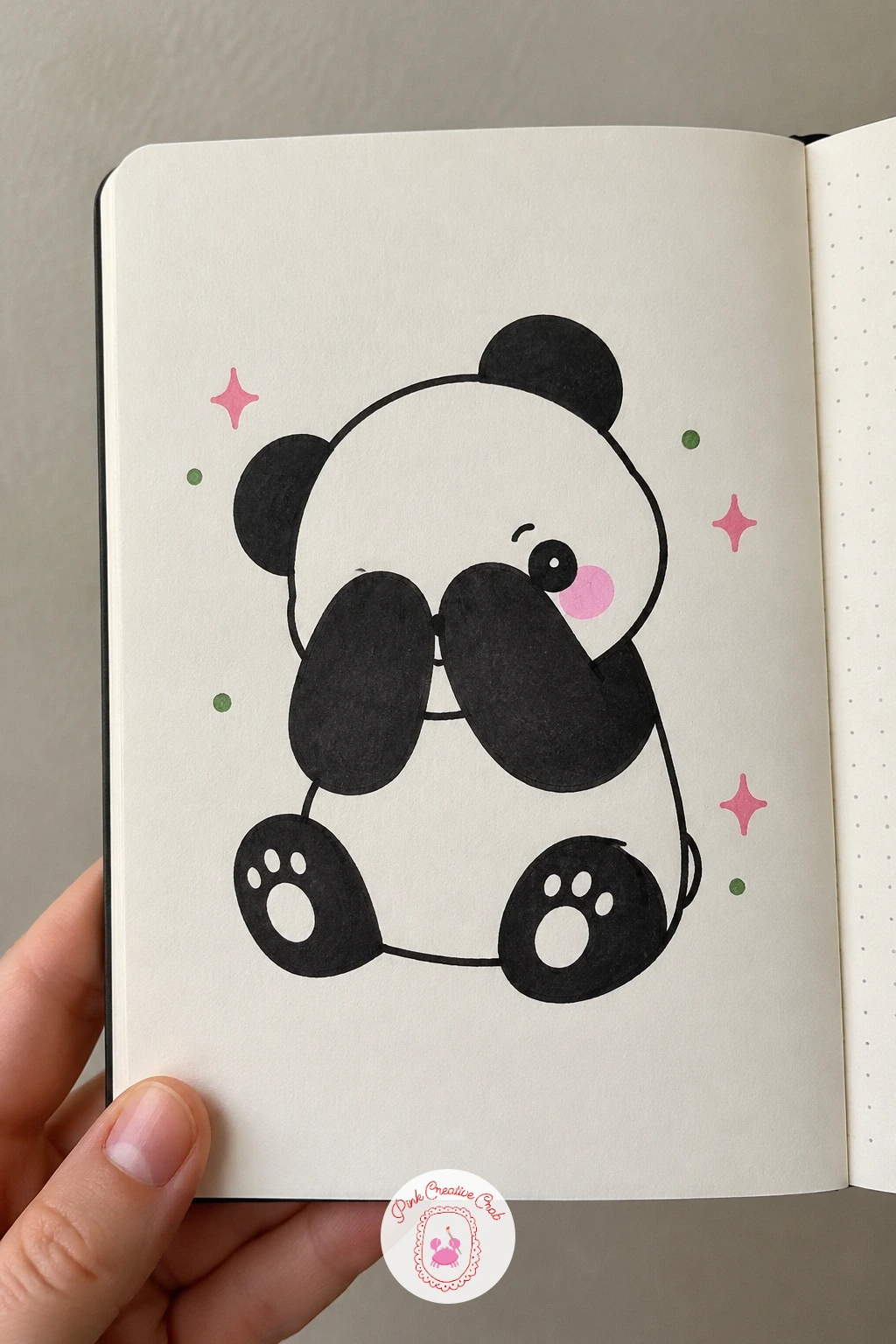
Pull back into a quieter, simpler pose with a panda hiding its own face behind both paws, peeking shyly through a small gap between them. Draw the paws first as two rounded shapes covering most of the face, then leave a small triangular gap between the fingers for a single visible eye peeking through.
That single visible eye carries the entire expression, so draw it slightly wide and curved upward at the outer corner for a shy, bashful look rather than a blank stare. A faint blush mark on the visible cheek, colored lightly with your cherry blossom pink marker, finishes the mood with barely any extra linework.
Keep the rest of the body simple and still, shoulders slightly hunched inward, since a busy pose elsewhere competes with the quiet shyness of the covered face. If drawing the finger gap feels fiddly at a small size, a simpler version covers the whole face with no gap at all, just two ears and the top of the head showing.
One concrete tip: draw the visible eye last, after both paws are fully inked, so you can judge exactly how much space is left for it to peek through naturally.
Palette: Cherry Blossom Pink,Ink Black,Paper White
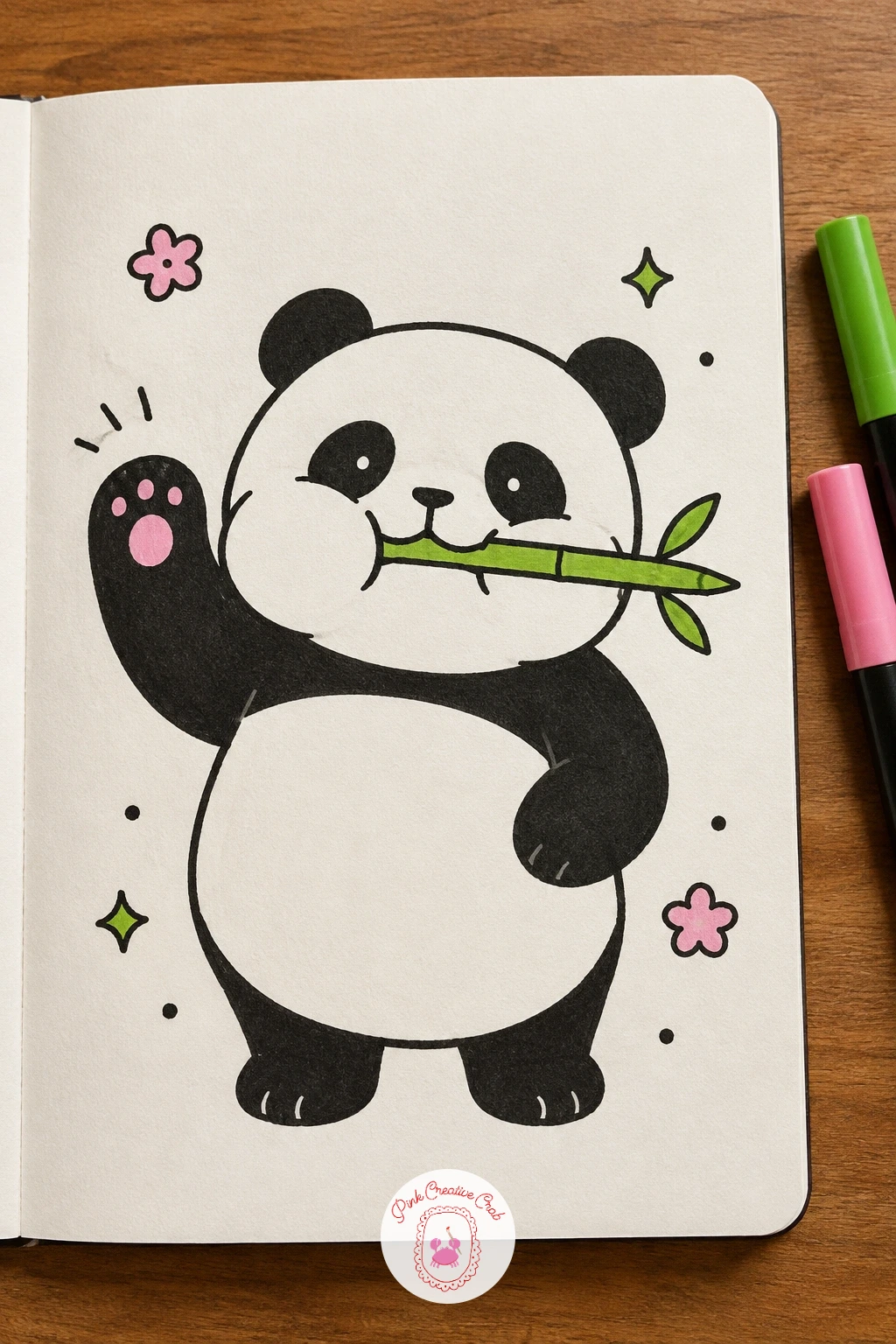
Combine two favorite panda moments into one: a panda waving a friendly greeting while its mouth is still stuffed full of bamboo. Draw the waving arm first, raised high with the paw open, then build the puffed cheeks and bamboo stalk sticking out from the mouth so the greeting and the eating happen at the same time.
Keep the raised arm at a slightly exaggerated angle, higher than feels natural at first, since an enthusiastic wave needs more height than a casual one to read clearly at this small size. The puffed cheeks should bulge noticeably past the jawline to show just how full the mouth really is.
Ink the bamboo stalk sticking sideways out of the mouth with the usual segment lines, then color it lightly with your bamboo green marker, leaving the waving paw and the rest of the body in plain black and white. If the exaggerated wave angle feels awkward to draw, a lower, more relaxed wave still carries the friendly greeting just fine.
For more cheerful character poses at this same easy level, browse the pig doodle ideas for a different animal with a similar playful energy.
Palette: Bamboo Green,Ink Black,Paper White
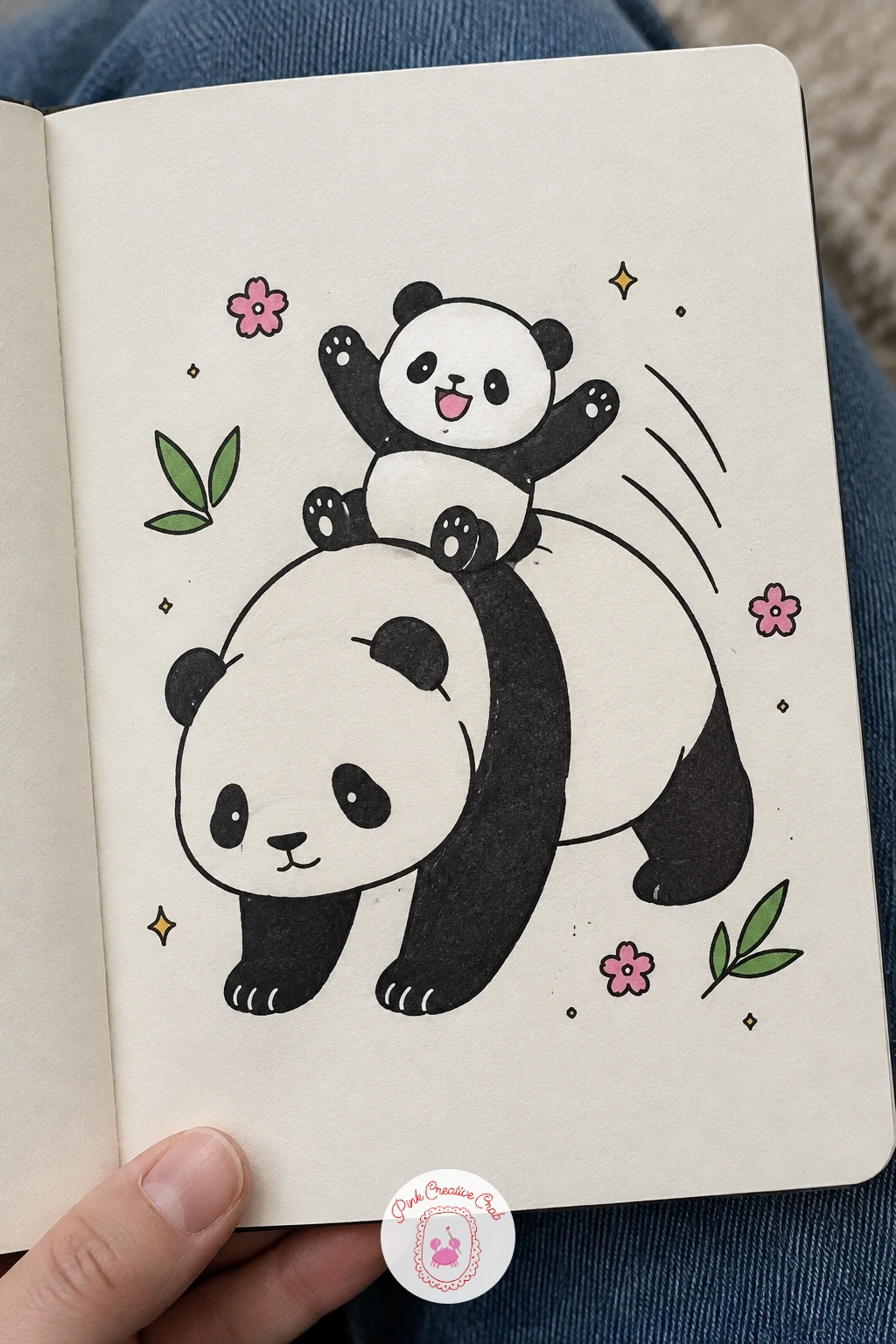
Build a second two-figure scene, this time with a baby panda sliding playfully down its mother’s curved back like a small slide. Draw the mother’s body first as a tall arched curve, back rounded high enough to give the slide some real height, then place the baby partway down that curve with arms raised and legs trailing behind.
Keep the size difference clear with the same trick from the earlier mother and cub scene: the baby’s head stays roughly half the width of the mother’s own head, which instantly reads as parent and child rather than two pandas of equal age. A wide open happy mouth on the baby and a calm, patient expression on the mother finish the contrast.
Ink a few motion lines trailing behind the sliding baby to show speed and direction down the curve. Color a couple of bamboo leaves scattered near the mother’s feet with your bamboo green marker for a small natural touch.
If arching the mother’s back high enough for a believable slide feels tricky, lower the curve slightly and shorten the baby’s slide distance, which still reads clearly as play without needing a dramatic height.
Palette: Ink Black,Bamboo Green,Paper White
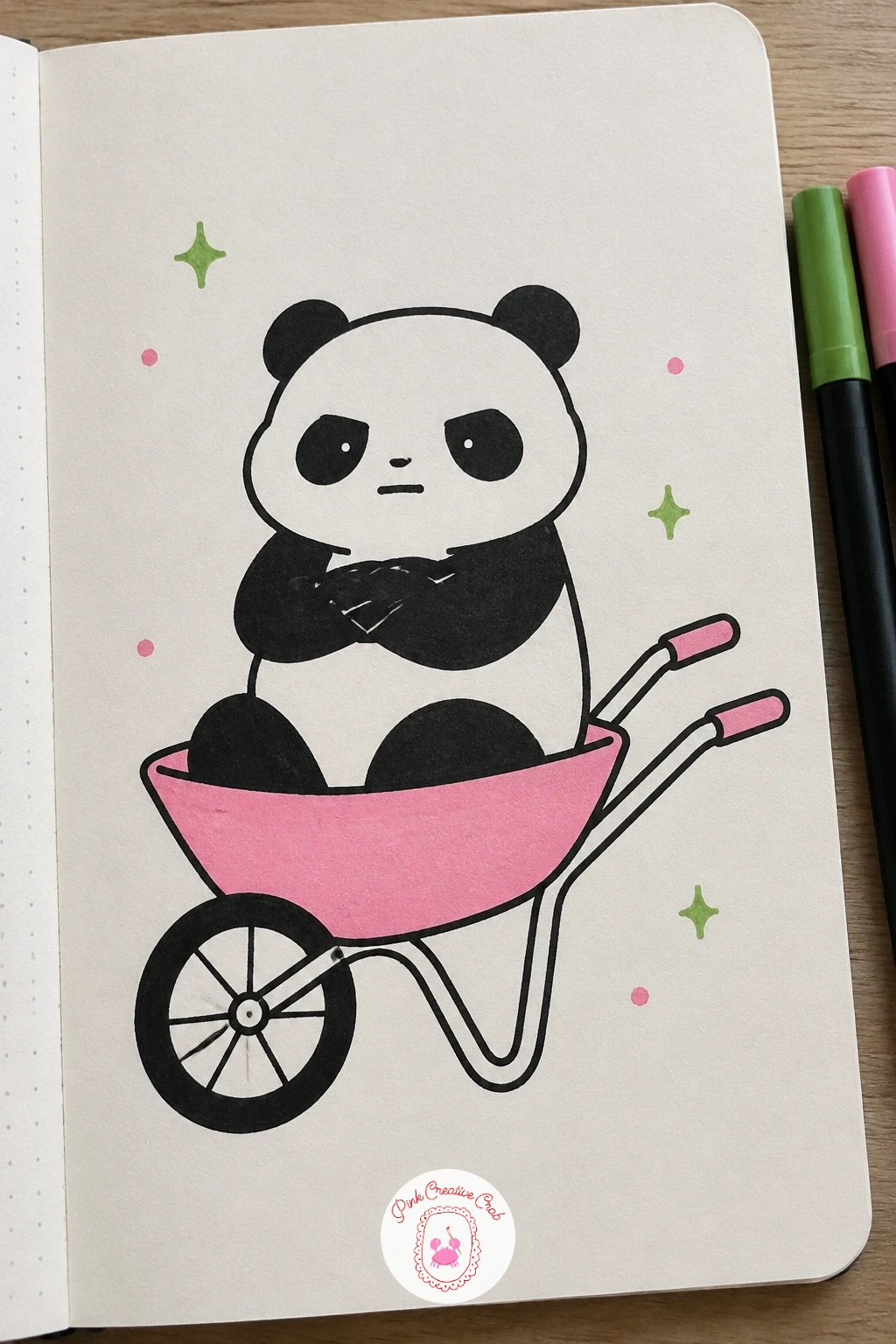
Finish on a stubborn note with a panda sitting firmly inside a wheelbarrow, arms crossed and clearly refusing to budge. Draw the wheelbarrow first as a simple rounded tray on one front wheel with two straight handles extending back, then seat the panda inside with its legs tucked and arms crossed tightly over its chest.
The crossed arms and a firmly set, flat mouth carry the entire stubborn mood, so keep the eyebrows drawn low and straight rather than curved, which reads as determined rather than merely tired. A tightly shut eye or two adds a final touch of defiance if you want the extra detail.
Ink the wheelbarrow’s single wheel with a few spoke lines inside it, then color the tray itself with your cherry blossom pink marker for a bright, cheerful contrast against the stubborn expression inside it. If drawing the wheel’s spokes feels fiddly, a plain solid circle wheel works just as well at this small size.
Once this pose feels comfortable, try varying it next time with the panda gripping the wheelbarrow’s edge instead of crossing its arms, or swap the wheelbarrow for a small wagon for a slightly different stubborn scene.
For another animal series built from these same small, finishable scenes, the penguin doodle ideas follow a similar cozy, playful approach.
Palette: Cherry Blossom Pink,Ink Black,Paper White
Close the list with one of the trickiest small poses: a panda balancing a single bamboo leaf on the tip of its own nose, eyes crossed as it watches it. Draw the face first with the nose positioned centrally, then place a single simple leaf shape balanced right at its tip before building the crossed eyes around that focal point.
The cross-eyed look is the whole joke here, so draw both pupils angled sharply inward toward the center of the face rather than looking forward, which takes a bit of practice to get symmetrical on both sides. Drawing one eye, then holding the page up to a light source or a window to trace its mirrored position for the second eye keeps both sides matching.
Ink the leaf itself with one simple center vein line running along its length, then color it with your bamboo green marker in a single light pass, leaving the nose tip clean and uncolored so the leaf reads as balanced on top rather than merged into the face. If the crossed eyes feel too tricky to draw symmetrically, a single raised eyebrow and one eye looking up at the leaf carries a similar comic effect with far less precision needed.
If you enjoyed building this whole list, the cute panda drawing ideas offer a further set of poses to keep the sketchbook going.
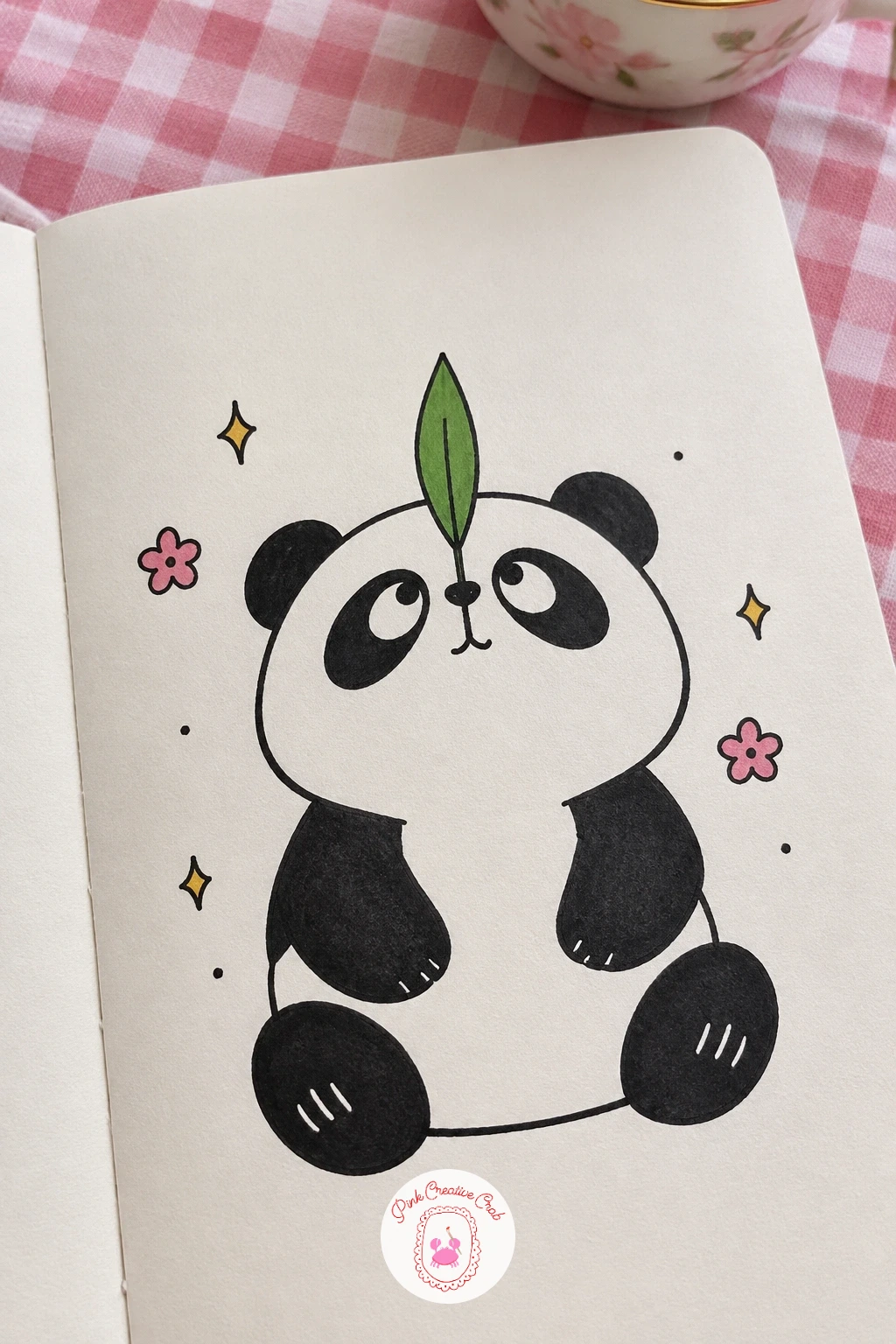
Palette: Bamboo Green,Ink Black,Paper White
What to Do Next
Pick one idea that made you smile and start there on a plain or dot grid page, pencil in the main shapes lightly first, then go over them with your fineliner once the pose feels balanced. The rest of the list will still be waiting whenever you want to fill another page.
Frequently Asked Questions
What pens work best for a panda doodle?
A black fineliner in a fine tip size, around 0.3 to 0.5, gives the cleanest outlines for a panda doodle. Add bamboo green and cherry blossom pink dual tip markers for small accents like leaves, props or a blush mark.
How do I keep the panda’s black patches looking neat?
Draw the eye patches and ear shapes as simple ovals first in pencil, then ink over them once the placement looks balanced. Filling them in with a thicker fineliner or a black marker tip keeps the edges cleaner than many thin pen strokes layered on top of each other.
Do I need to draw the whole body every time?
No, many of these ideas work just as well as a close crop on the head and shoulders if the full body feels like too much for the space. Simplifying the pose to its upper half still carries the expression and the joke clearly.
What if I do not have colored markers on hand?
Every idea in this list still works in plain black fineliner alone, since the humor and charm come from the pose and expression rather than the color. Add color later with whatever markers or colored pencils are already in your kit.
How small can a panda doodle be drawn?
Most of these ideas work well anywhere from about two to four inches tall, which suits a notebook margin or a small sketchbook page. Keep details minimal at the smaller end of that range so the lines do not crowd each other.
Have any thoughts?
Share your reaction or leave a quick response — we’d love to hear what you think!
-
 0
-
0
-
0
-
0
-
0
-
0


