A cloud doodle is the kind of small drawing you can finish before your tea goes cold, and that is exactly why it is so satisfying. Give a puffy outline a face and a tiny job to do, a watering can, a leash, a hot water bottle, and suddenly a shape you have drawn a hundred times feels brand new.
Below you will find 34 cloud characters to fill a notebook spread, a sketchbook page or a stack of little cards, each one built from the same simple fineliner shapes with a quick touch of sky blue and lemon yellow marker. Work through them in order if you like, from the easiest puffs to the busier little scenes, or just flip down the list and draw whichever one makes you smile first.
Using these images: free for personal projects such as printing, coloring, cards, journals and gifts. Handmade items that include them may be sold up to 30 pieces per design. More than that is commercial use and is not permitted, and neither is selling or sharing the images themselves or passing them off as your own. Please ask before any other use.
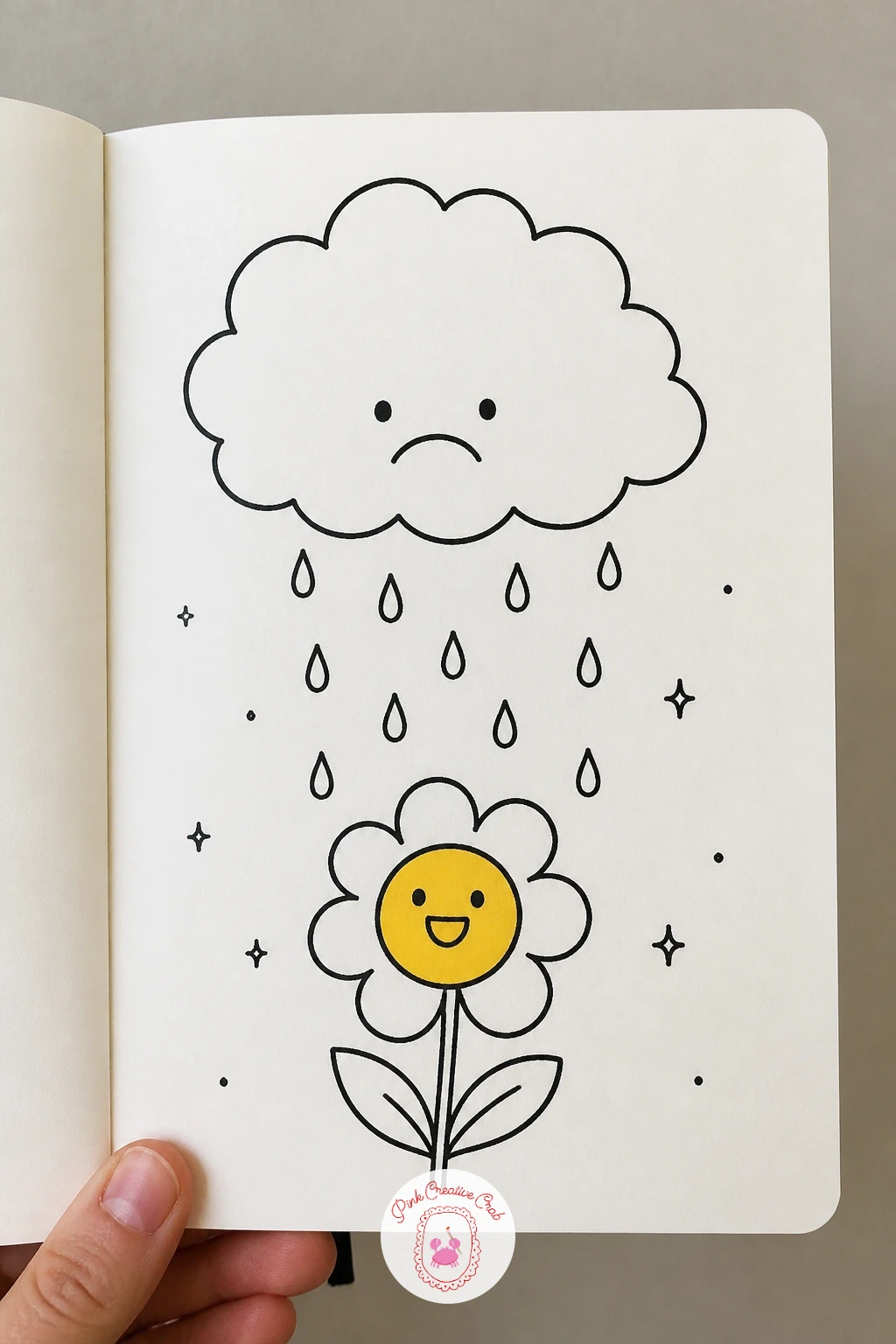
Start the whole page with this one because it sets up the simplest cloud shape you will use again and again: a bumpy oval outline in fineliner, three or four rounded bumps along the top and a flatter bottom edge. Add two dot eyes and a downturned mouth with a few tear lines, then a handful of short diagonal rain strokes falling to a small flower below.
Draw the flower last so the rain seems to land on it: a short stem, a few oval petals, and a wide open mouth or big smile to show how thrilled it is to finally get a drink. If the rain lines look too stiff, break a couple of them into two short dashes instead of one long stroke, it reads as softer and more natural.
Color the cloud body lightly in sky blue, just a few strokes rather than filling it solid, and touch lemon yellow onto the flower center. If you only have one marker color, sky blue alone still works fine, just leave the flower white.
Keep the rain to no more than five or six lines so the scene stays readable at doodle size.
Palette: Sky Blue,Lemon Yellow,Soft Pink
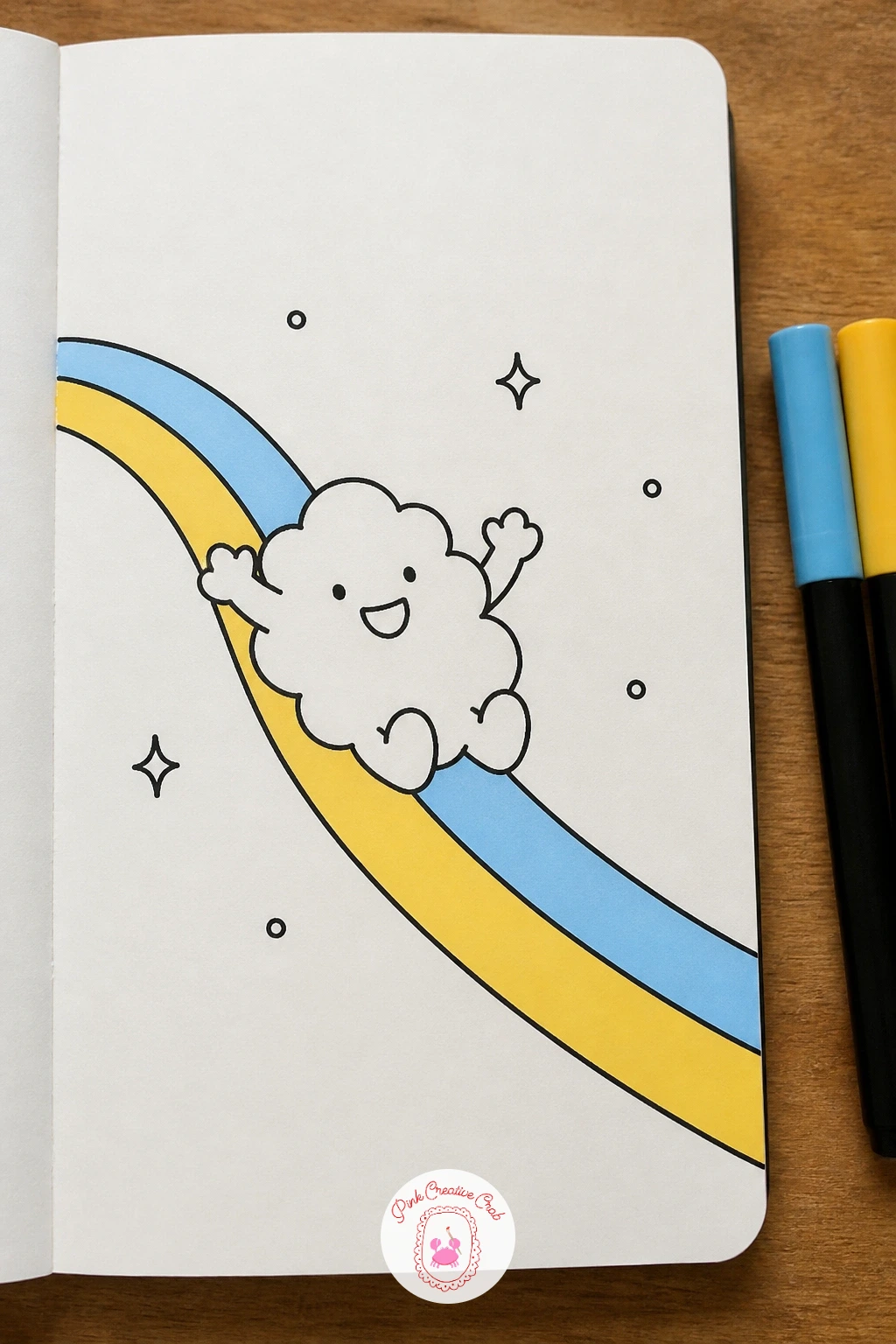
Once the basic cloud shape feels easy, give it some motion. Draw the rainbow first as three or four curved parallel arcs swooping down to one side, like a playground slide tipped at an angle, then perch your cloud at the top with its arms up and a wide open mouth.
A simple trick keeps the proportions friendly: make the cloud roughly the same width as the gap between the two outer rainbow arcs, so it looks like it actually fits on the slide rather than floating beside it. Add two short curved lines trailing behind the cloud to show speed.
Color only two of the rainbow bands, sky blue and lemon yellow, and leave the rest as plain outline, this keeps the piece light and stops it from competing with the cloud. If your rainbow bands come out uneven, a slightly wobbly curve still reads as a rainbow, perfectly straight is not the goal here.
Finish with a tiny motion line or two under the cloud for extra energy, and this is one you could easily pair with the ideas on this rainbow drawing list for a full page of weather characters.
Palette: Sky Blue,Lemon Yellow,Soft Pink
Give your page a quieter moment with a sleepy cloud curled on a crescent moon. Draw the moon first as a thick curved crescent, almost like a thick letter C, then nest the cloud into the inner curve so it sits like it is resting in a hammock.
Eye level matters here: since the moon and cloud are meant to be floating in a night sky, keep both shapes slightly tilted rather than perfectly level, it suggests they are drifting rather than sitting on a flat surface. Draw the cloud with closed curved line eyes and a small open mouth for a soft snore, then add a “z z z” trailing up and to the side.
Leave the moon as plain white outline so it reads as pale moonlight, and color the cloud faintly in sky blue, just enough to separate it from the paper. If you want a quick alternative, swap the fineliner outline for a soft pencil line on the moon only, which gives it a slightly glowing edge.
This pairs nicely in style with the sleepy characters in this celestial doodle collection.
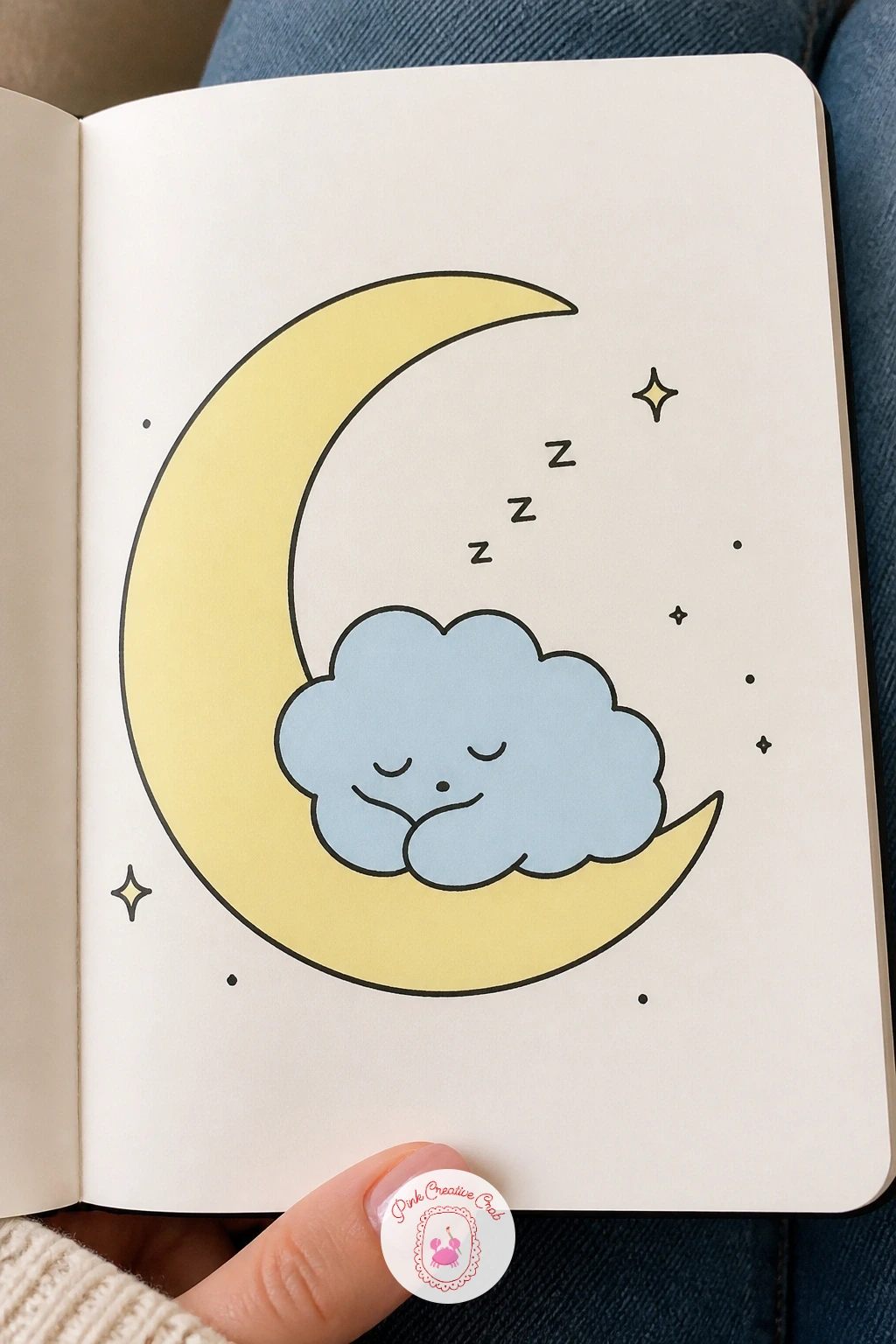
Palette: Sky Blue,Pale Yellow,Charcoal Grey
Move from a solo cloud to a pair now, since drawing two characters together is just two of the same basic shapes side by side. Draw the cloud’s bumpy outline first on one side of the page, then the sun as a circle with short triangular rays on the other side, leaving a small gap between them for their joined hands.
Give each one a simple arm, a short curved line ending in a small rounded hand, and connect the two hands in the middle so they read as holding on. Big smiling faces on both characters sell the friendship more than any other detail, so spend your time there rather than on the rays.
Color the sun’s rays in lemon yellow and the cloud lightly in sky blue, keeping the colors apart so the pairing stays clear even at a glance. If the rays look too busy, six or seven short triangles around the circle are plenty, you do not need a full ring of them.
Try this one in a horizontal note card format, it reads well as a small greeting piece.
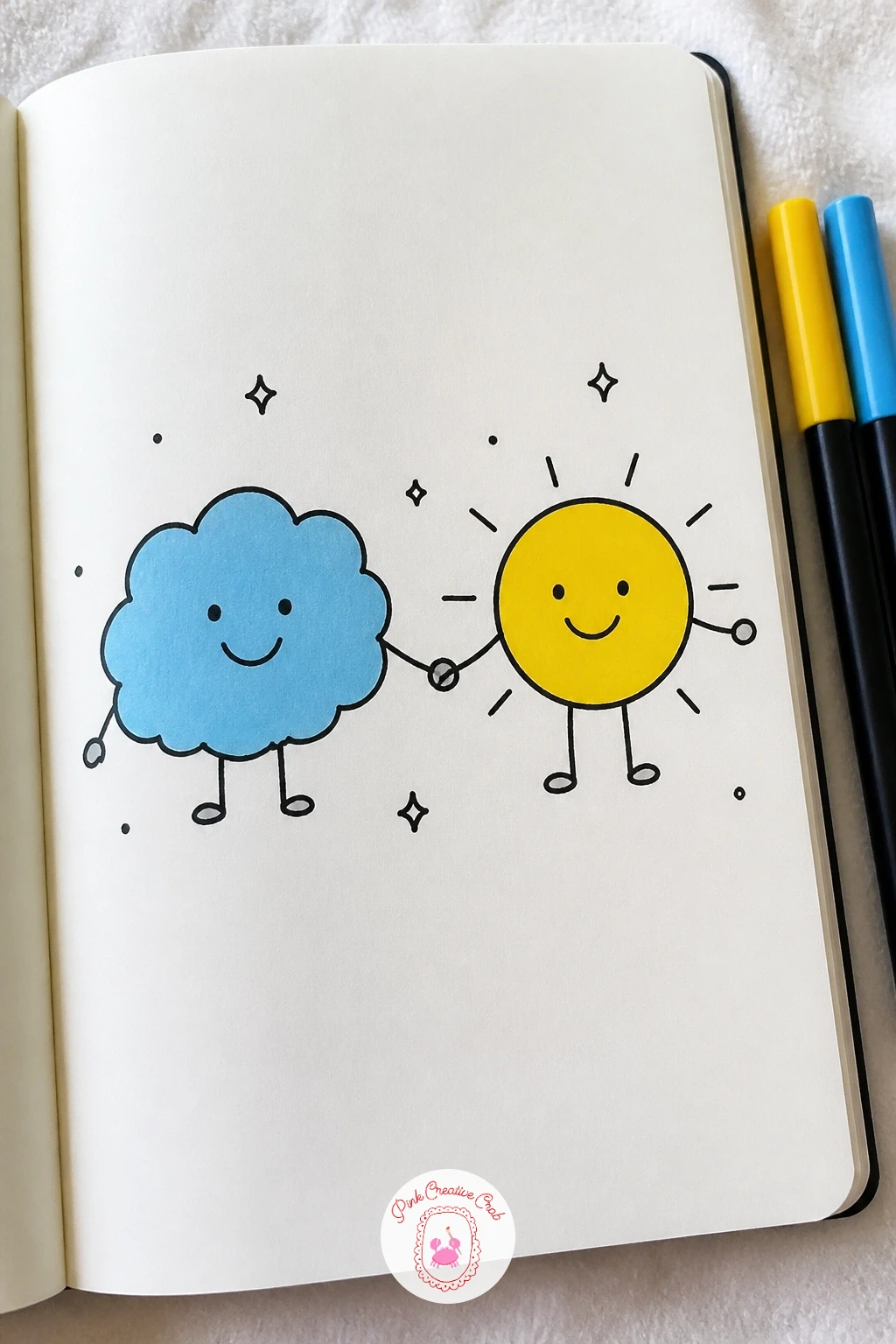
Palette: Lemon Yellow,Sky Blue,Soft Orange
This one has a nice small action to practice: capture a sneeze mid motion. Draw the cloud’s body first, tilted slightly backward, then its face with scrunched closed eyes and an open round mouth, as if it is right in the middle of an “achoo”.
For the ten minute version, add three or four simple snowflakes, tiny plus signs with short diagonal lines, scattering out from the mouth. For a forty minute version, vary the snowflake sizes and add a couple of short motion lines behind the cloud to show it got pushed back slightly by its own sneeze.
Keep the snowflakes small and spaced apart rather than clustered, a scattered handful reads clearer than a tight cluster at this size. If white space around the flakes feels empty, a very light sky blue wash on the cloud balances it without adding more shapes.
Leave the snowflakes uncolored white against the paper so they read as cold against the warm yellow accents elsewhere on your page.
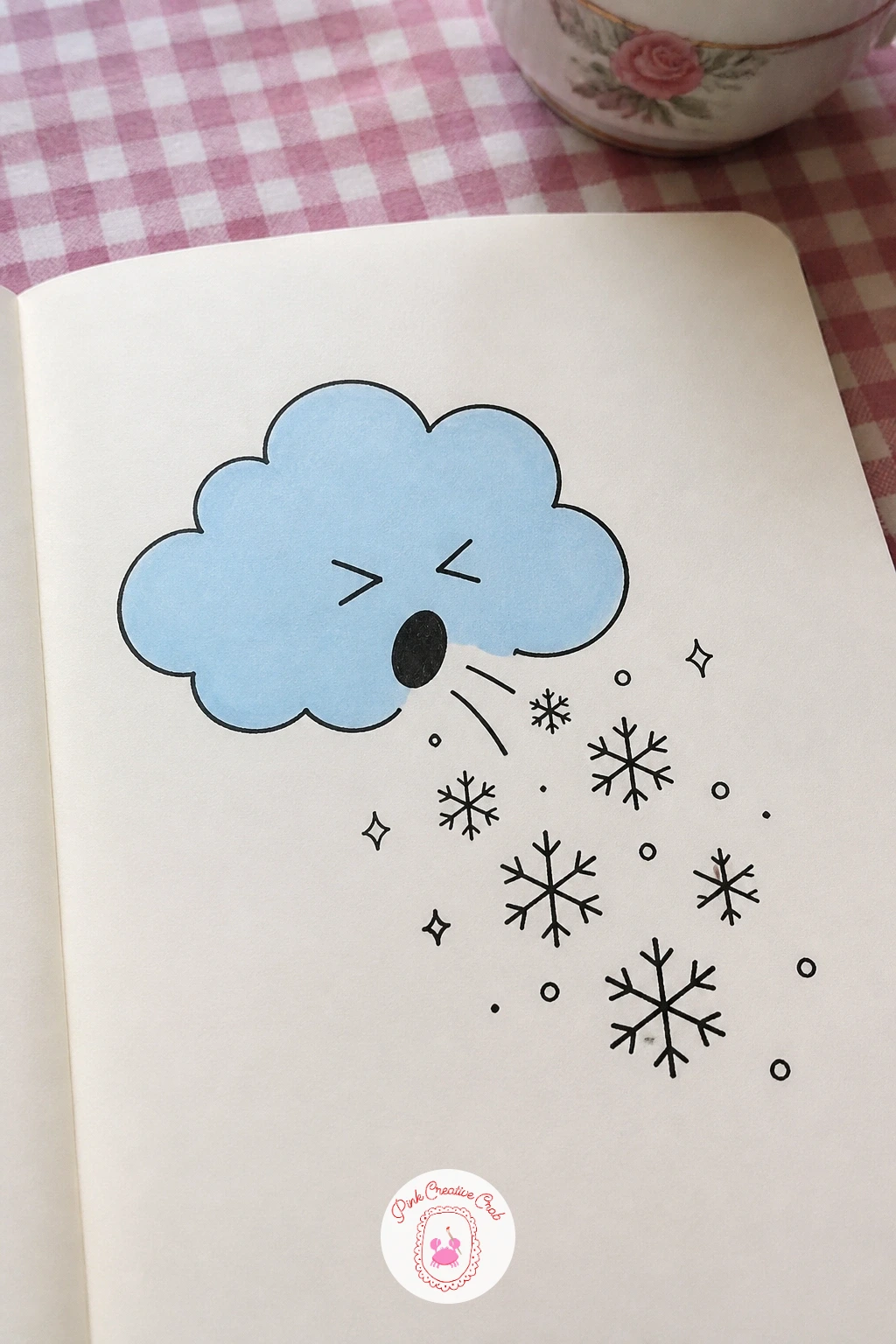
Palette: Sky Blue,Lemon Yellow,White
Switch the mood here and draw a proper grump. Make the storm cloud’s outline a bit heavier and darker than your other clouds, with a flatter bottom and sharper bumps, then give it furrowed brow lines above small narrowed eyes and a tight frown.
Have it hold a small zigzag lightning bolt in one hand, drawn as three or four sharp angular turns rather than a smooth curve, since the sharp lines against the round cloud body are what sell the grumpy energy. Thicken the fineliner outline on this cloud compared to your softer ones, heavier lines naturally read as crankier.
Color the bolt in lemon yellow so it pops, and leave most of the cloud body uncolored or just a thin grey outline, saving the sky blue for your gentler clouds elsewhere on the page. If you do not have a grey marker, cross hatch a few short fineliner lines on the cloud’s shaded side instead.
Keep the eyebrows low and close to the eyes, that single detail does more for the grumpy look than anything else you add.
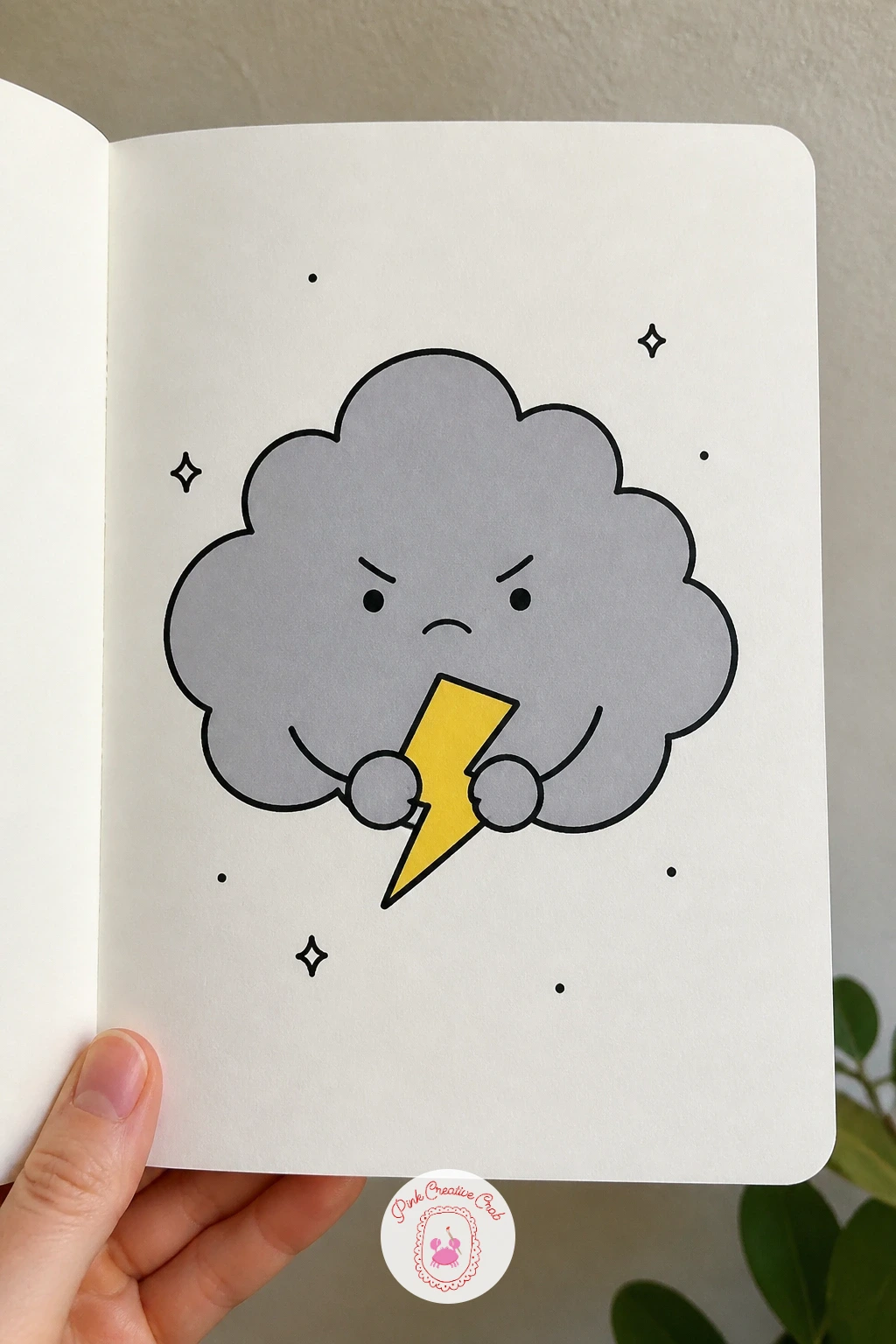
Palette: Lemon Yellow,Charcoal Grey,Slate Blue
Here is where light direction changes the whole feel of a simple shape. Draw your cloud’s outline as usual, but this time imagine the sun sitting low to one side, just off the edge of the page, and add a soft blush of color only on the side nearest it, leaving the far side paler.
Give the cloud a shy expression, closed curved eyes and a small round mouth, with two little blush circles on its cheeks to really sell the embarrassment. A light pink marker or colored pencil works best for the blush, applied in small circular scribbles rather than one flat patch.
Add a thin strip of lemon yellow low on the page behind the cloud to suggest the setting sun without drawing the sun itself, this keeps the focus on the cloud’s expression. If pink marker is not in your kit, a few light fineliner cross hatch marks on the cheeks read as a blush just as well.
Leave plenty of white space around the cloud so the warm colors stand out rather than filling the whole page.
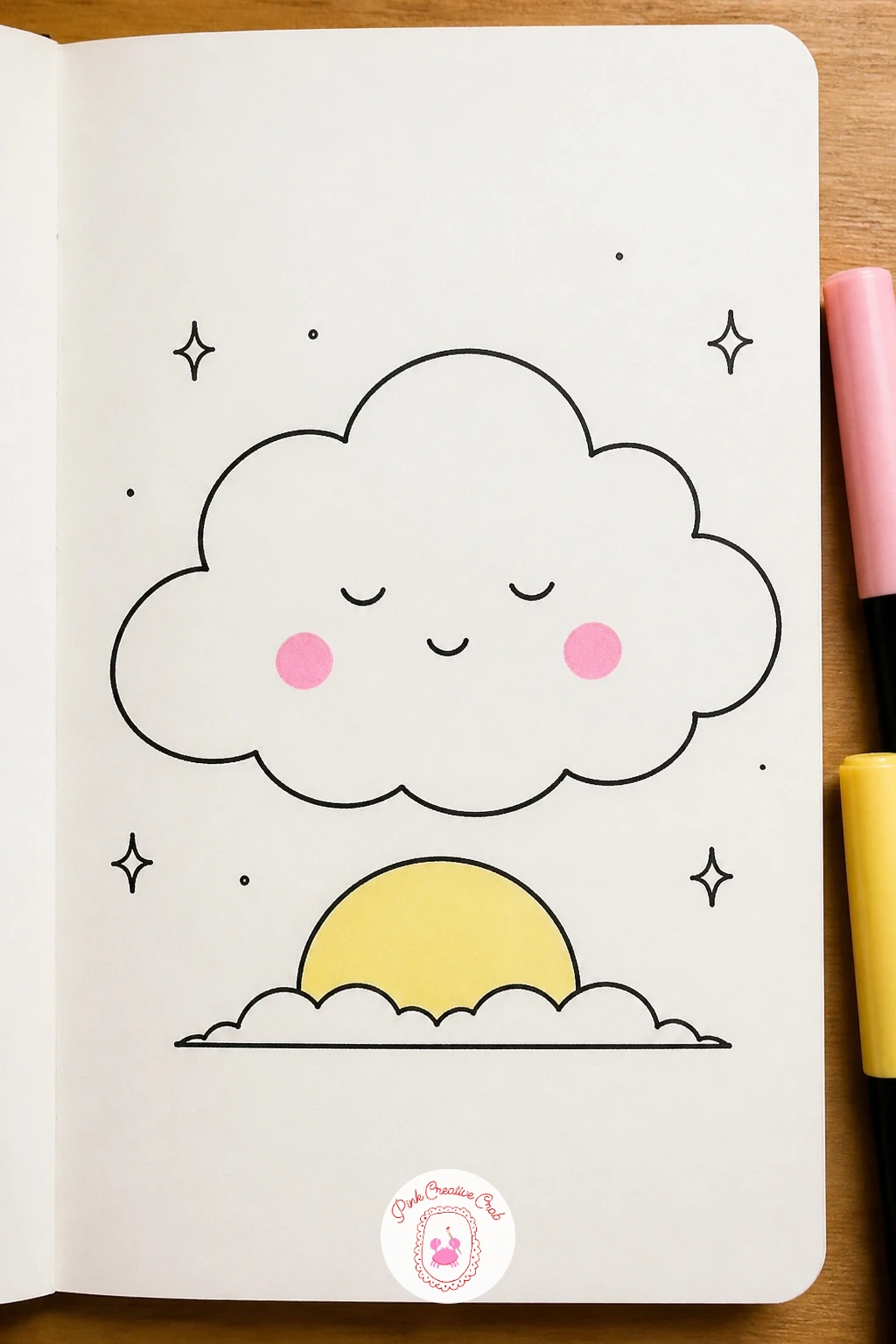
Palette: Soft Pink,Lemon Yellow,Peach
Try this one with a peach or coral marker instead of pink for a warmer sunset feel, it changes the whole mood of the piece.
For a bit of visual comedy, draw a cloud whose own rain falls straight back down onto its own head. Start with the usual bumpy cloud outline, then draw the rain lines starting from the cloud’s underside and curving slightly to land right back on its own top edge rather than falling away.
The curved rain path is the trick that makes this read clearly, a straight vertical line just looks like ordinary rain, but a gentle curve back onto the cloud’s own head tells the joke. Give it a pouting mouth, a small downturned curve with the corners pulled in tight, and crossed arms if you want to add more personality.
Color the rain lines in sky blue and leave the cloud body white so the wet drips stand out against it. If curving the rain feels fiddly in fineliner, sketch the path lightly in pencil first and ink over it once you’re happy with the arc.
Keep the pout small, a mouth that is too wide can read as a frown instead of a sulk.
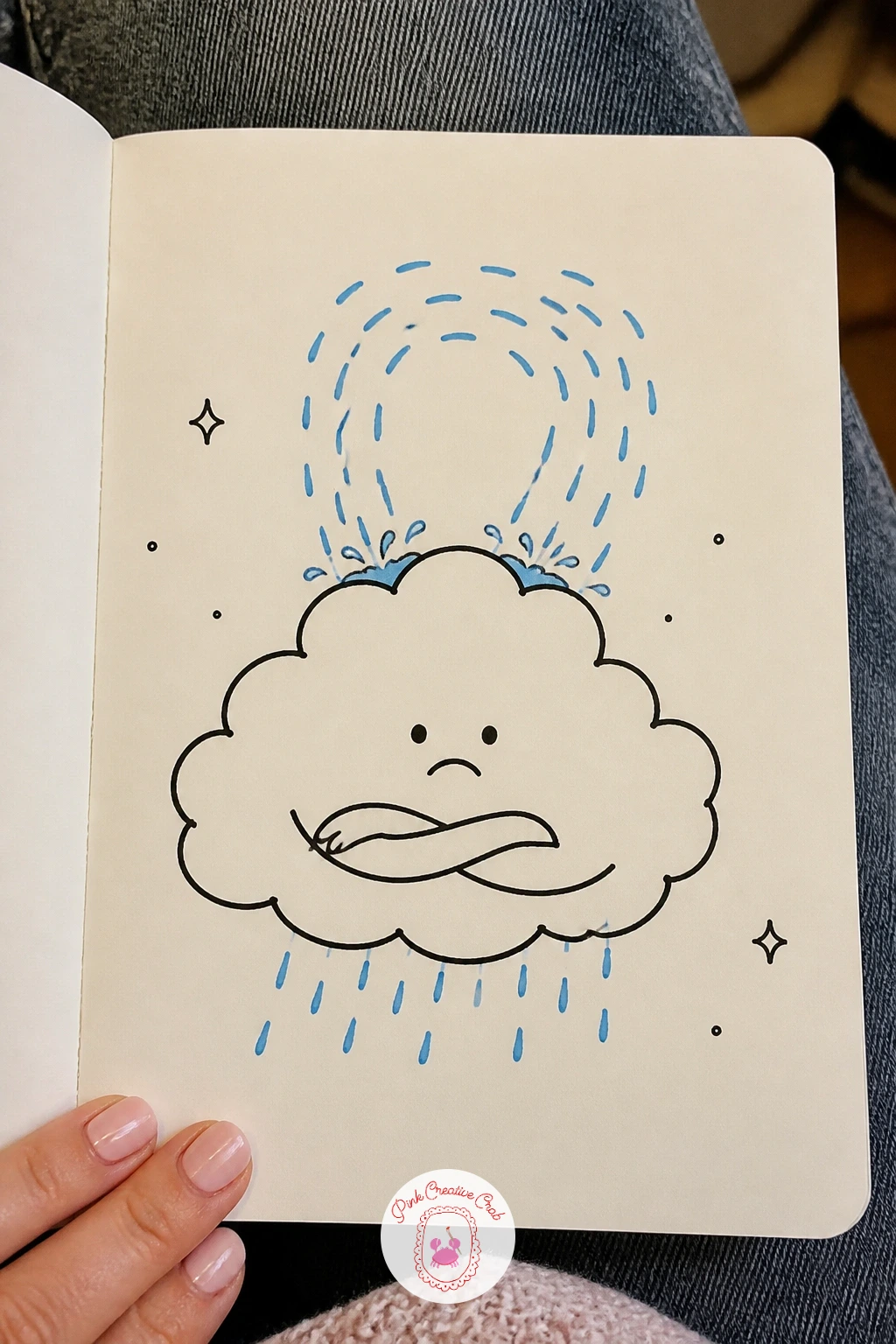
Palette: Sky Blue,Charcoal Grey,White
Build on the last idea with a cloud that has finally found a solution. Draw the cloud’s body first, then a small open umbrella held above its own head, the umbrella canopy as a simple curved dome with a few straight spoke lines and a small hooked handle gripped in a stick arm.
Getting the umbrella to actually sit above the cloud rather than beside it is the detail that sells the joke, so sketch a light guide line straight up from the center of the cloud’s head before drawing the umbrella, and center the canopy directly over that line. A relieved or satisfied expression, raised eyebrows and a small closed smile, finishes the story.
Color the umbrella canopy in lemon yellow with alternating white panels for a striped look, and keep a few sky blue rain lines falling around the umbrella’s edges rather than touching the cloud. No yellow marker on hand, a plain striped outline in fineliner works just as well.
Add one single raindrop sliding off the umbrella’s edge for a nice final touch.
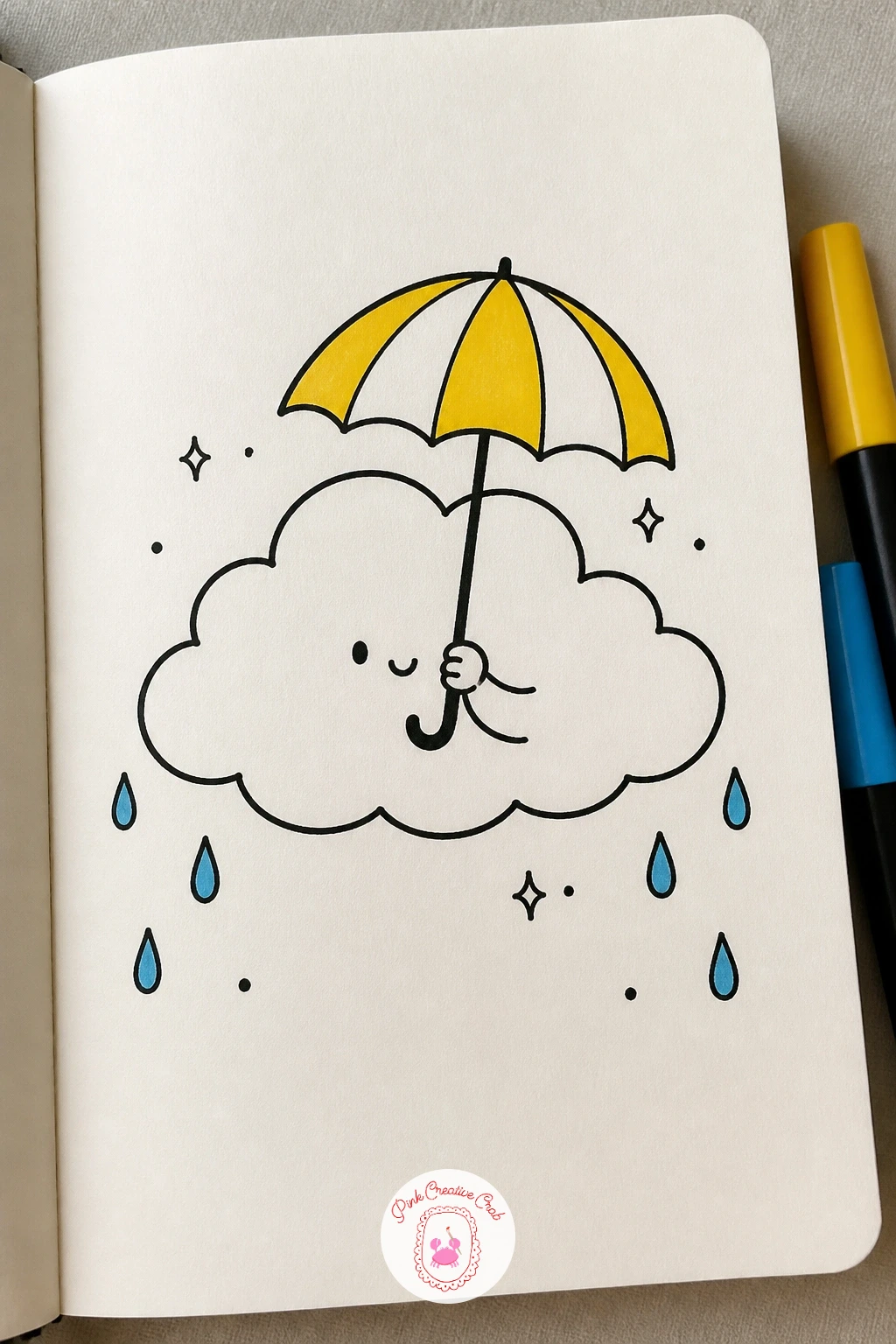
Palette: Lemon Yellow,Sky Blue,White
Give your cloud a tiny job to do with a watering can scene. Draw the cloud first, tilted slightly forward and down, then a simple watering can shape in its hands, a rounded body, a curved spout, and a small handle, with a few short rain lines falling from the spout tip down to a flowerpot below.
Draw the flowerpot last as a simple trapezoid shape with one or two leaves or a small flower poking out the top, positioning it directly under the spout so the pouring line makes visual sense. A concentrating expression, slightly narrowed eyes and a focused mouth, suits this cloud better than a big grin, since it is caught in the act of a careful little chore.
Color the watering can in lemon yellow and the pot in a warm terracotta if you have it, keeping the cloud itself a soft sky blue. If terracotta is not in your kit, leave the pot as plain outline, the contrast with the colored can is enough.
This is a nice one to repeat in a small series with different pots and plants once the basic pose feels comfortable.
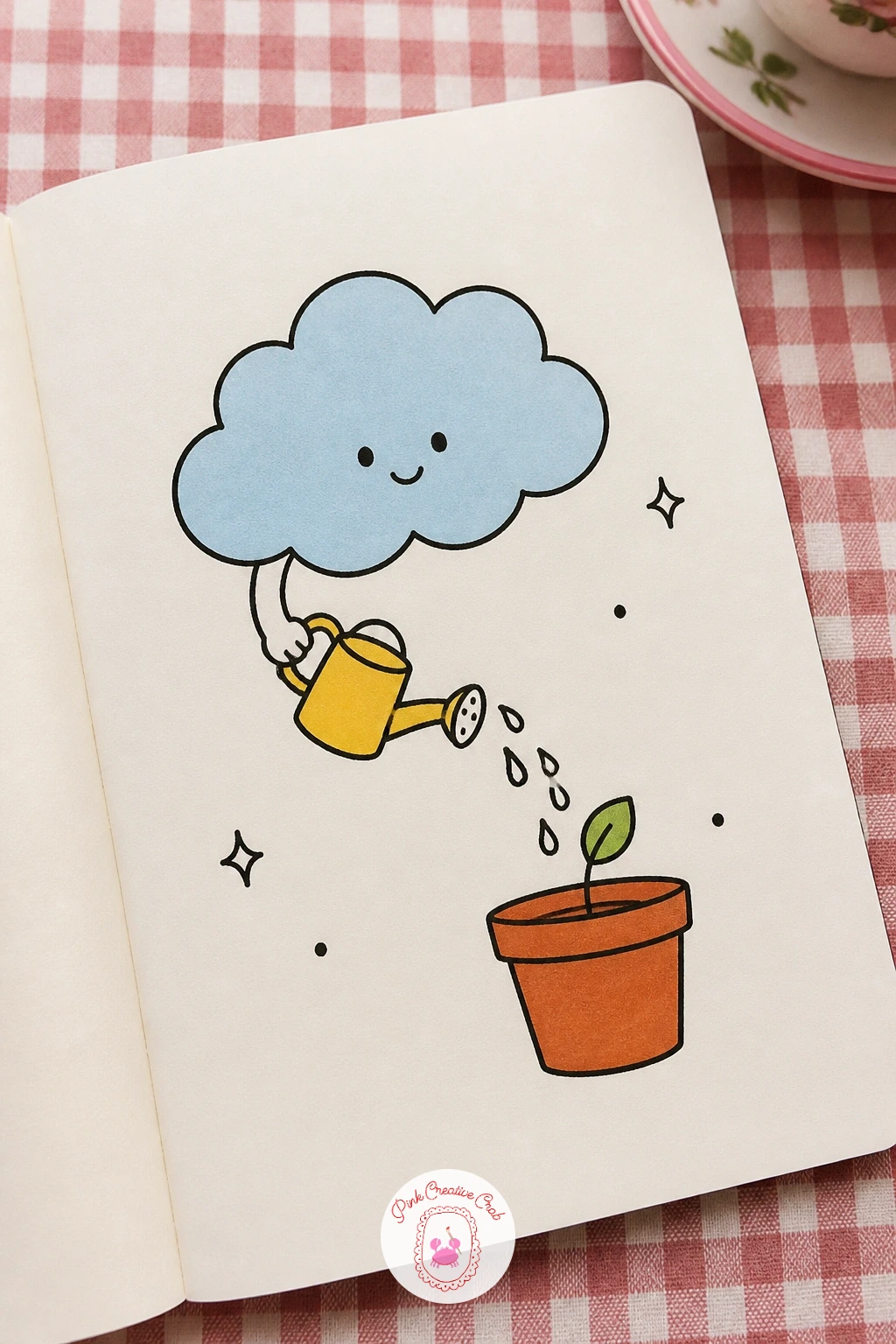
Palette: Lemon Yellow,Sky Blue,Terracotta
For a quick texture exercise, draw a cloud checking its own fluffiness in a small round hand mirror. Start with the mirror itself, a circle on a short handle, then draw the cloud holding it up at an angle, with a second smaller cloud reflection drawn inside the mirror’s circle.
The bumpy edge is the whole point of this cloud, so instead of one smooth outline, go over the edge twice with slightly different bump placements, this doubled scratchy line gives a soft fluffed up texture that a single clean outline cannot. A kneaded eraser can soften any pencil guidelines underneath once you are happy with the ink.
Give the cloud a pleased expression, checking itself out with a small proud smile, and color both the real cloud and its tiny reflection in matching sky blue so they read as the same character. If your mirror circle comes out lopsided, an oval handheld mirror shape is just as believable as a perfect circle.
Keep the reflected cloud smaller and simpler than the main one so the eye knows which is which.
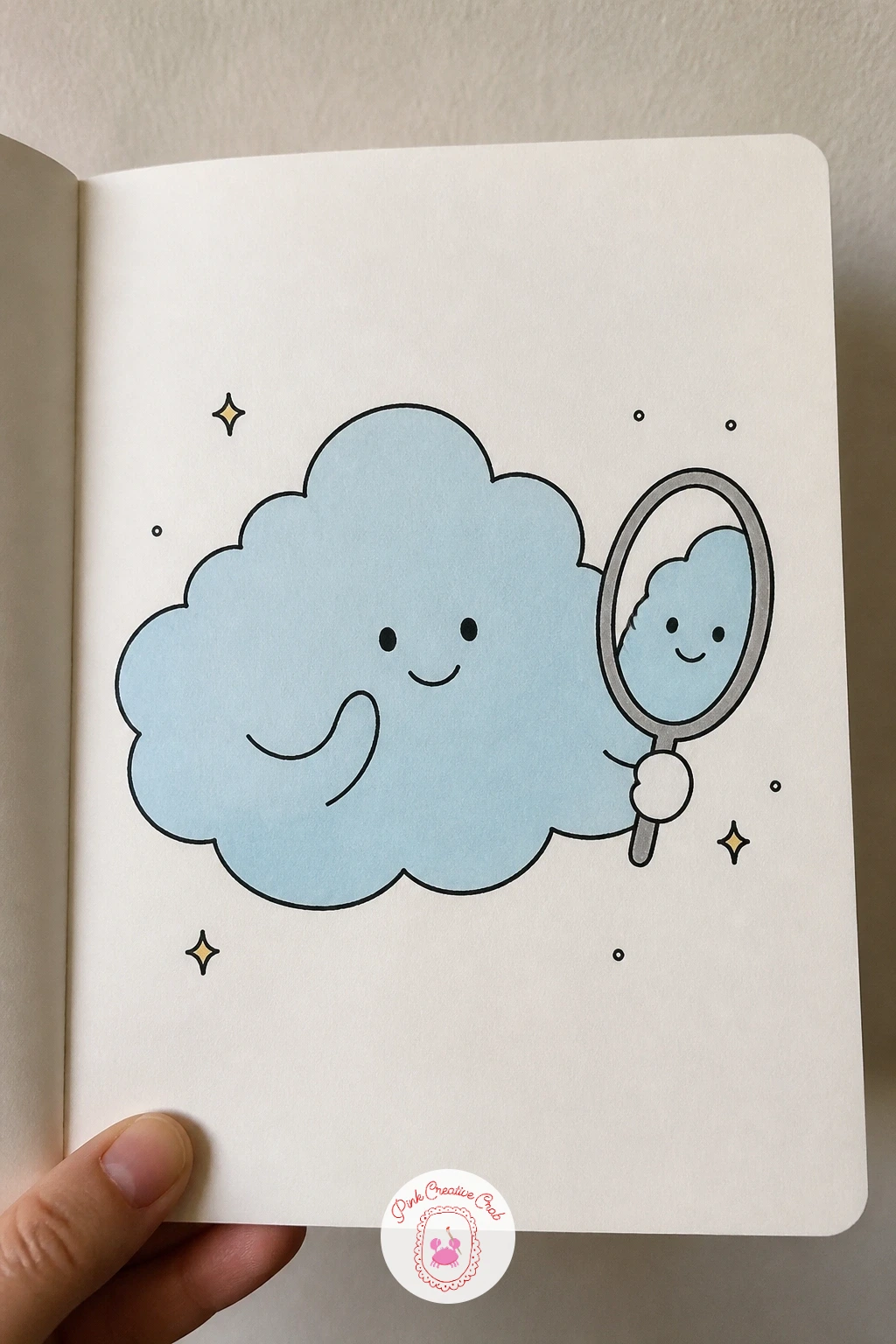
Palette: Sky Blue,Lemon Yellow,Charcoal Grey
Here is a fun one to draw as a two part scene. Sketch the cloud’s bumpy outline first, then a small pair of scissors snipping at one of the bumps, held either by a second tiny cloud or simply floating in frame if you want to keep the cast small.
Draw a few small clipped puffs falling away from the scissors’ point, little rounded shapes drifting down and to the side, to show the trim actually happening. Keep the cloud’s expression calm and pleasant rather than startled, since this is meant to read as a routine little grooming moment, not an accident.
Color the scissors in a plain grey or leave them as outline only, and touch lemon yellow onto a small ribbon or bow near the handles if you want a barbershop feel. The cloud itself stays its usual soft sky blue throughout.
If drawing scissors feels fiddly at this scale, simplify them to two long triangles crossed in an X with a small circle at the pivot point, that reads perfectly well as scissors even without the finger holes.
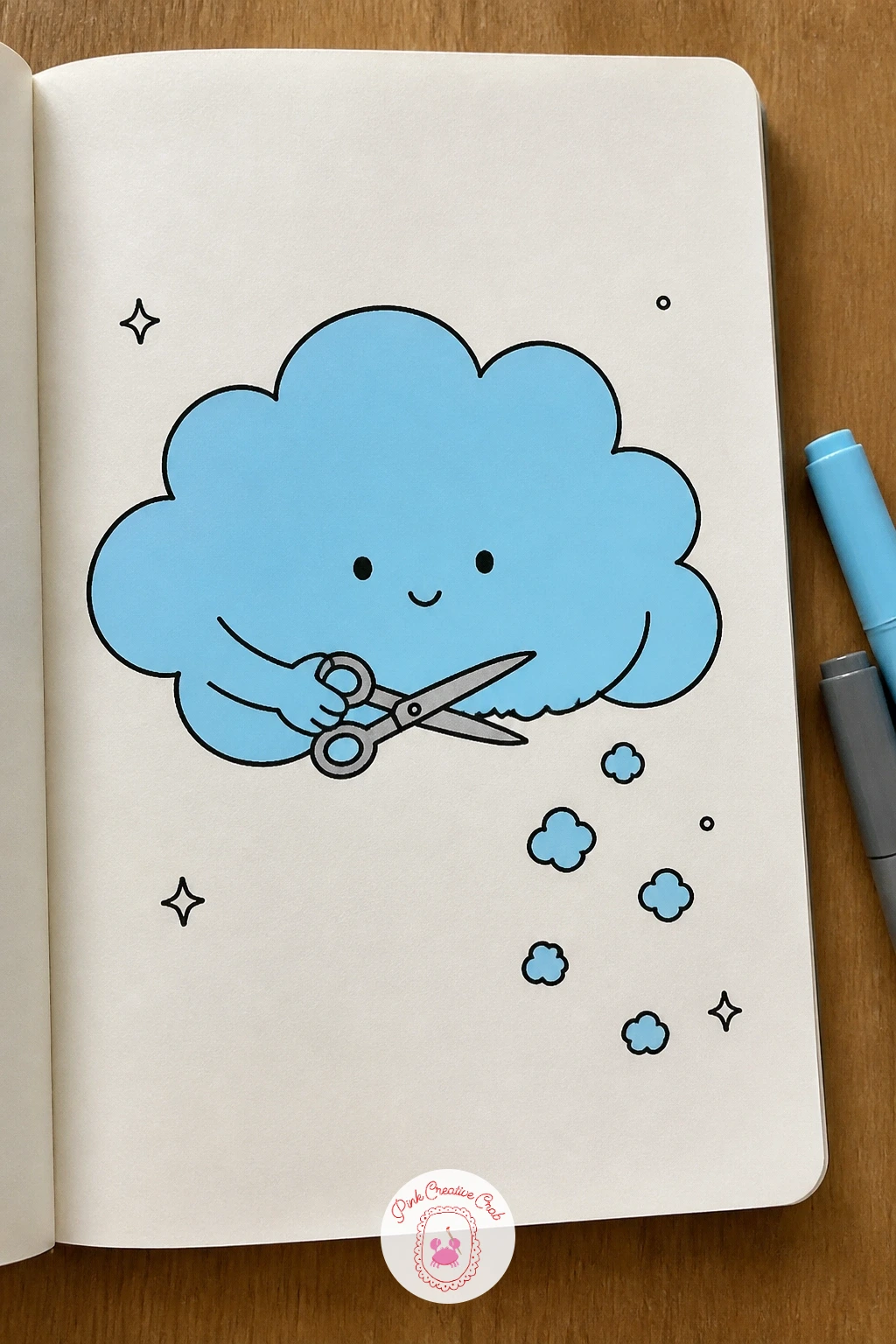
Palette: Sky Blue,Charcoal Grey,Lemon Yellow
This idea trades the usual bumpy cloud outline for a heart shape, so start by lightly sketching a simple heart in pencil first, two rounded humps meeting at a point at the bottom, before going over it in fineliner with the same bumpy cloud texture along the edges.
Comparing the width of the heart to a regular cloud of the same size helps keep the proportions from drifting, aim for roughly the same overall size as your other clouds on the page so it reads as a cloud shape first and a heart second. Give it wide eyes and a small open mouth, maybe a hand half covering its face, to show it is a little shy about its own shape.
A faint pink blush on the cheeks finishes the embarrassed look nicely, applied the same way as the sunset cloud earlier in this list. Keep the heart’s point soft and slightly rounded rather than sharp, a sharp point looks more like a valentine candy than a cloud.
If you want a gentler version, round out the top humps even more until the heart almost looks like two overlapping circles, still readable, less sharp.
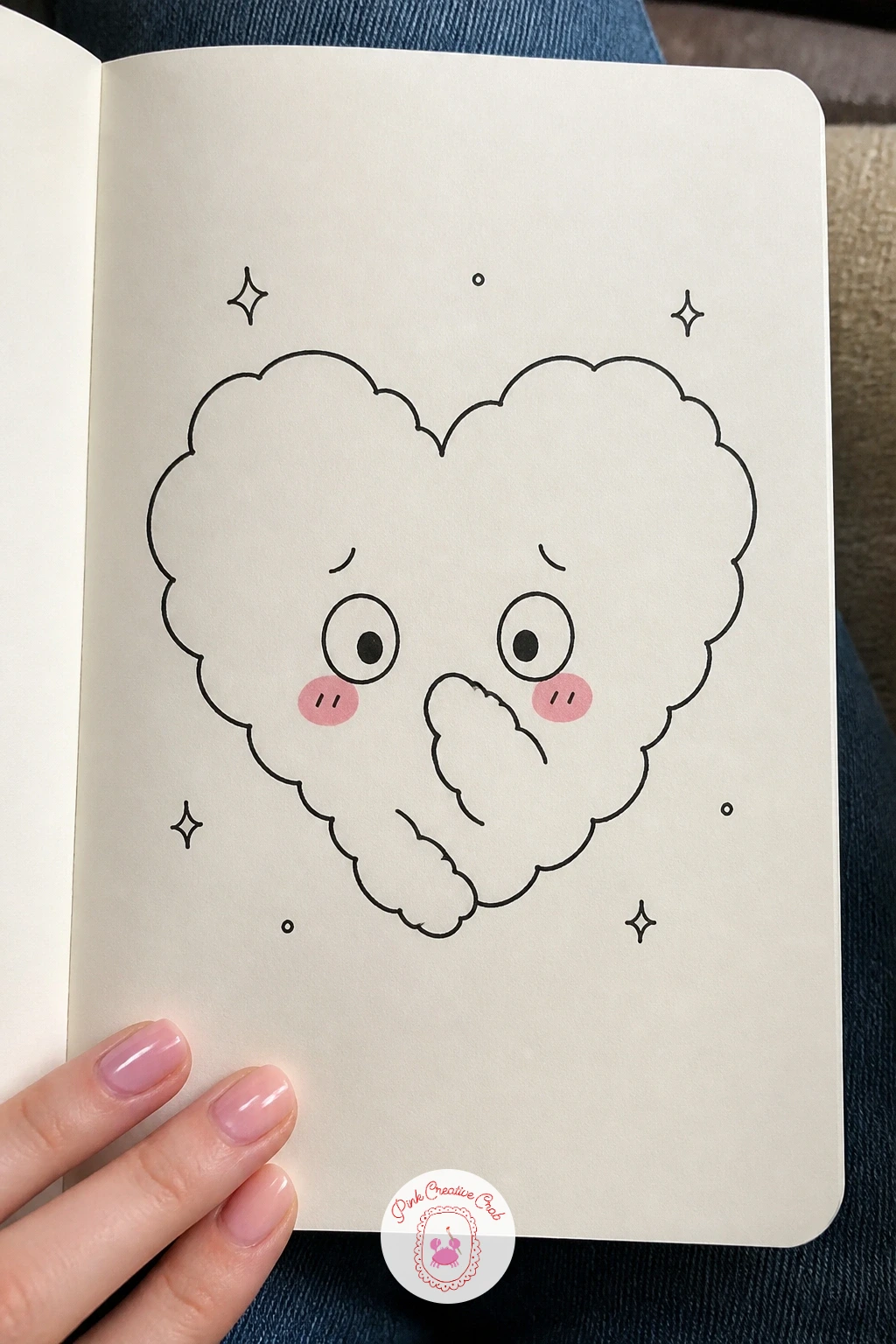
Palette: Soft Pink,Sky Blue,White
Pair up two very different sizes for this one. Draw the big storm cloud first, reusing the heavier outline and furrowed brow from the earlier grumpy cloud idea, positioned toward one side of the page, then draw a much smaller cloud right beside it, puffed up and standing on tiptoe with its arms raised in a mock scary pose.
Keeping the size difference obvious is the whole joke here, so make the small cloud no more than a third the height of the big one, and exaggerate the big cloud’s scale by placing it closer to the top of the frame while the small one sits lower, as if straining upward. Give the tiny cloud a wide, slightly forced grimace rather than genuine menace, a few short zigzag lines around it can suggest effort or a little growl.
Color the big cloud in a darker grey wash and the small one in plain sky blue, the contrast reinforces which one is actually intimidating. If grey marker is not available, a scribbled fineliner shadow under the big cloud does the same job.
Leave the lightning or thunder details off the big cloud here, its sheer size is doing all the work.
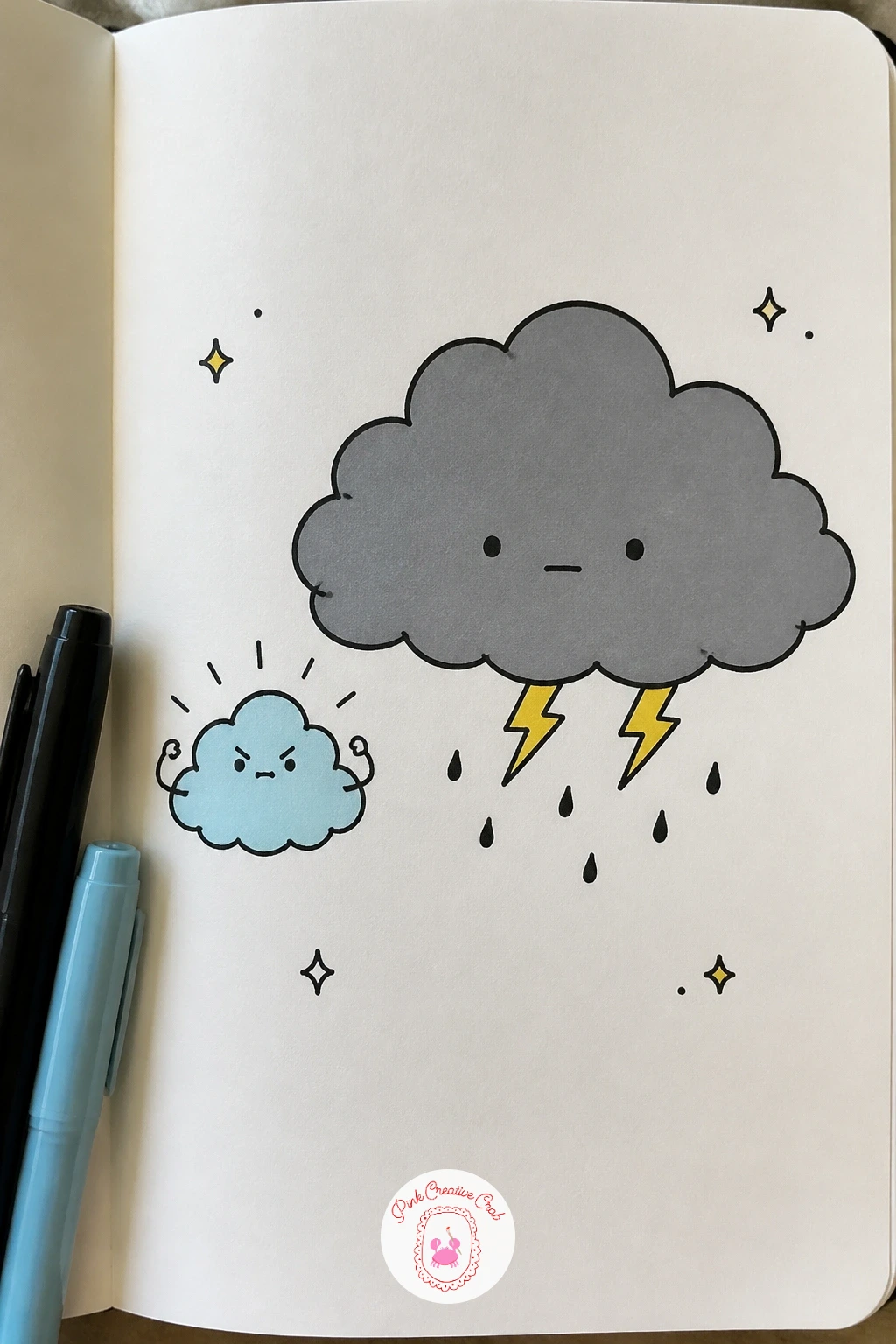
Palette: Charcoal Grey,Sky Blue,Slate Blue
Add some diagonal energy to the page with a cloud flying a kite on a windy day. Draw the cloud leaning into the wind, body tilted at an angle rather than upright, with one arm stretched out holding a taut string that leads up to a simple diamond shaped kite in the corner of the page.
A short tail of three or four small triangle flags on the kite’s bottom point adds movement without much extra drawing time, and a few curved wind lines trailing behind the cloud’s body finish the sense of a breezy day. Keep the kite string a single smooth curve rather than a jagged line, a gentle sag in the middle reads as more natural than a perfectly straight line.
Color the kite in alternating sky blue and lemon yellow panels, and leave the cloud itself mostly white with just a light blue tint along one edge. If drawing a diamond kite feels tricky, a simple triangle kite works just as well and is easier to keep symmetrical.
Angle the cloud’s face slightly upward toward the kite, it ties the whole composition together at a glance.
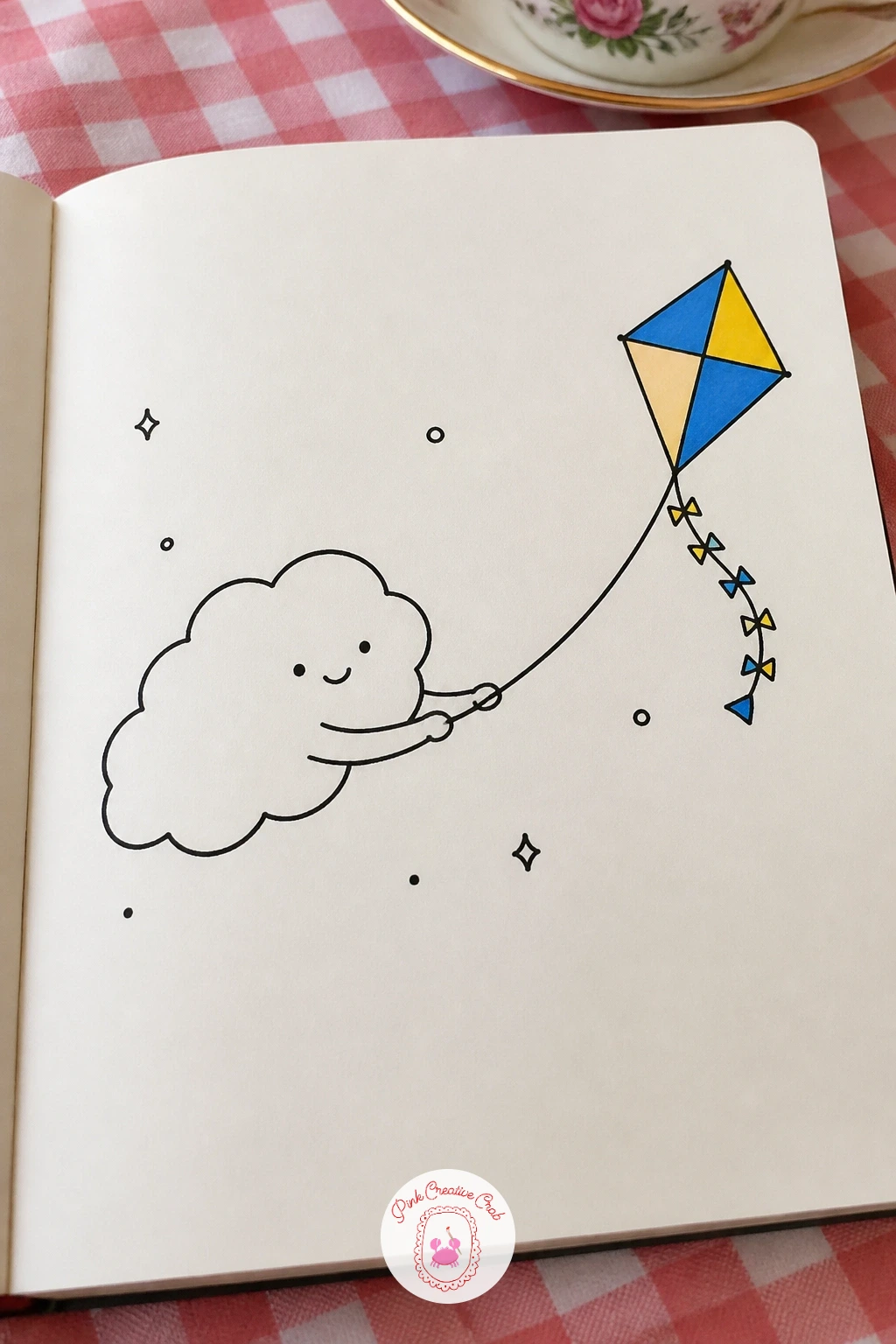
Palette: Sky Blue,Lemon Yellow,White
This idea plays with eye level, since you are looking slightly up at a tall pointy mountain with a small cloud wrapped around its peak. Draw the mountain first as a simple tall triangle with a jagged snowy cap near the top, then draw the cloud’s arms wrapping around that peak as if mid hug, its body settled just below the summit.
Placing the horizon line low on the page and making the mountain fill most of the height above it is what sells the sense of looking up, rather than drawing the mountain small and centered. Give the cloud closed happy eyes and a warm smile, arms drawn as simple curved lines meeting on the far side of the peak.
Color the mountain’s snowy cap in plain white left as paper, with a grey or cool blue shading only on one side to suggest the light source coming from the opposite direction. The cloud stays its usual soft sky blue.
If a jagged mountain cap feels fussy, a smooth rounded snow line is a perfectly good swap and still reads clearly as snow.
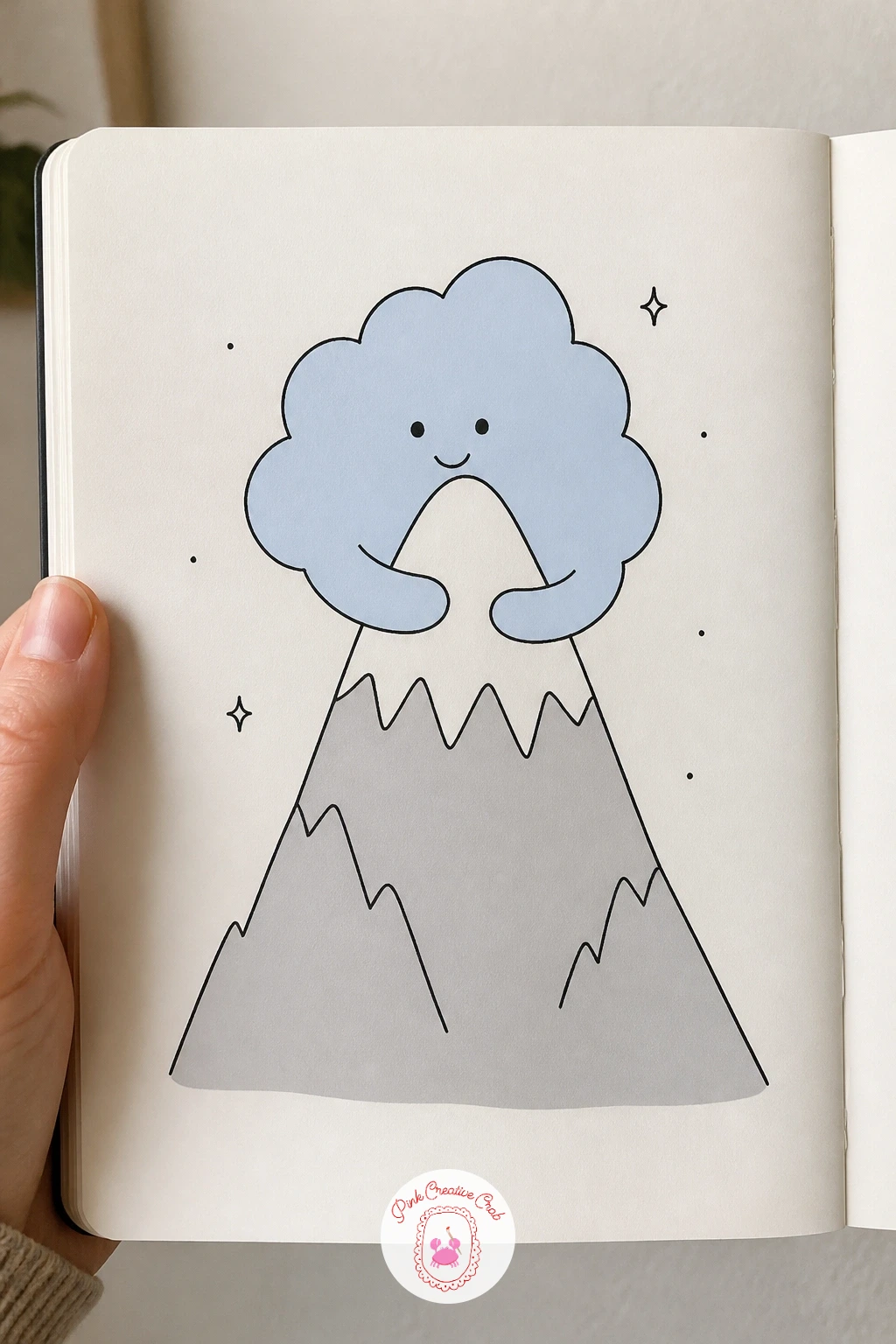
Palette: Sky Blue,Charcoal Grey,White
Switch the season again with a cold little cloud bundled in a knit hat. Draw the cloud’s body first, then a simple rounded beanie sitting on top, adding three or four short horizontal lines across the band to suggest a ribbed knit texture, and a small pompom circle at the very top.
Shivering comes across best through a few small wavy lines drawn around the whole body, almost like a heat haze but short and jittery, plus a tight closed mouth and slightly squeezed eyes. Draw the arms pulled in close and crossed over the chest rather than out to the sides, a tucked in pose reads as cold far more clearly than an open one.
Color the beanie in lemon yellow with the pompom in white, and leave the cloud a pale, almost grey toned blue rather than a bright sky blue, a slightly muted color helps sell the chill. If you only have one blue marker, just go lighter with the pressure to mute it.
Add two or three tiny snowflakes falling nearby to place it clearly in a cold scene.
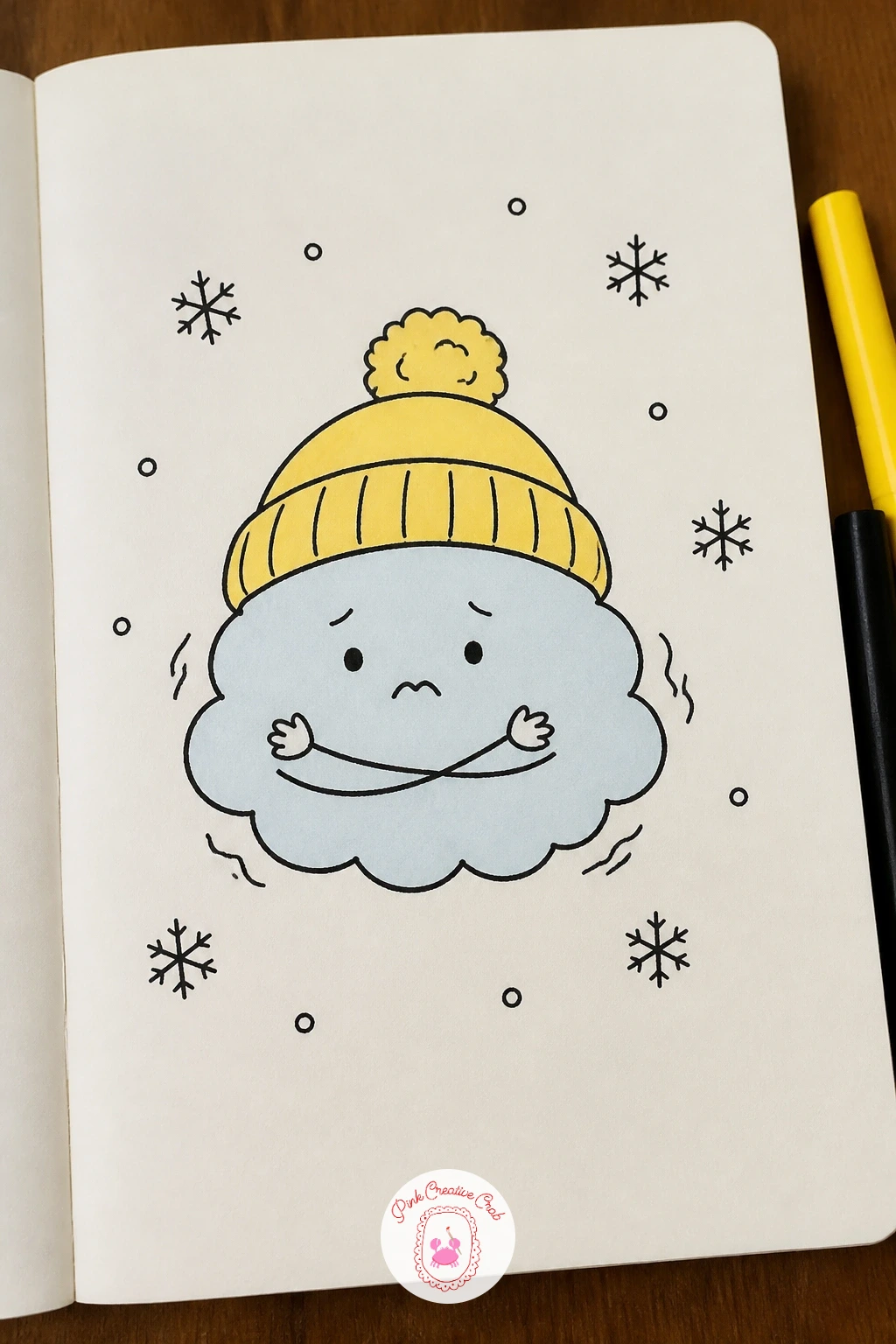
Palette: Lemon Yellow,Pale Blue,White
Have some fun with a cloud that nearly disappears into its own bath. Draw a simple tub outline first, a rounded rectangle with short curved feet, then fill the top with a cluster of overlapping bumpy bubble shapes, drawn exactly like small versions of your cloud’s own outline, so the cloud itself almost blends in among them.
Only its face gives it away, so draw the cloud’s eyes and smile peeking out from somewhere in the middle of the bubble cluster, with the rest of its body lost among the surrounding bubbles. A few bubbles floating up and out of the tub, drawn as simple circles of different sizes, add a nice finishing touch.
Leave almost everything white here and use sky blue only on the tub itself and a thin line along the waterline, the whole point of the joke is how little color separates the cloud from its bath. If you want more contrast, one single pale blue cloud face peeking through solid white bubbles is all it takes.
Keep the bubble shapes varied in size so the cluster feels soft rather than repetitive.
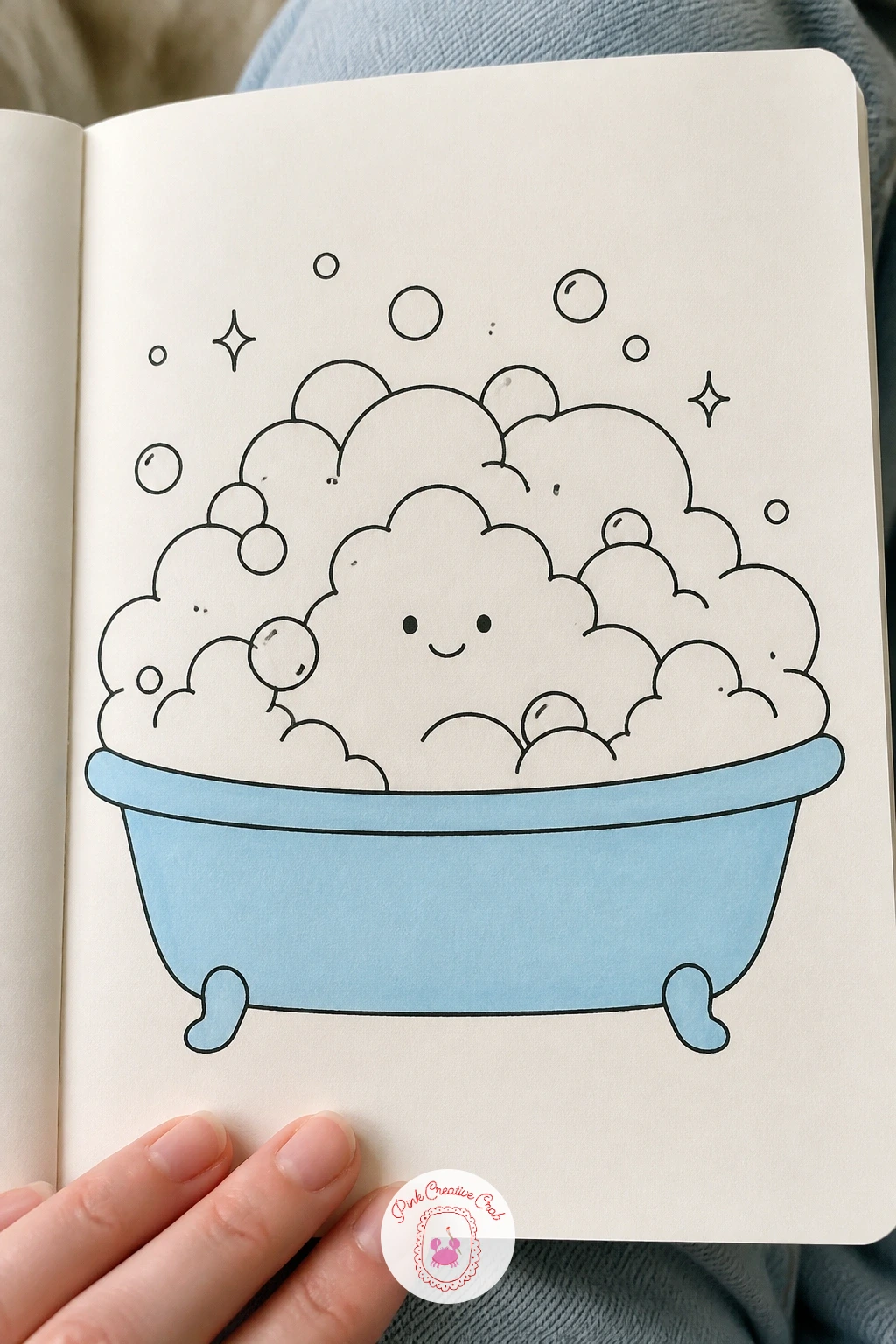
Palette: Sky Blue,White,Pale Blue
There is a nice little irony to draw here: a cloud eating something that looks a lot like itself. Draw the cloud’s body first, then a cotton candy cone in one hand, a simple triangular paper cone with a big bumpy puff of candy on top, drawn with the same rounded bump technique as the cloud’s own outline.
The worried expression is the detail to spend the most time on, wide eyes, raised eyebrows pulled up in the middle, and a small open mouth caught mid bite, as if it has just noticed the resemblance. Keep the cotton candy puff slightly smaller than the cloud’s own head so the two don’t compete for attention.
Color the cotton candy in soft pink or pale lemon yellow, whichever you have, and keep the cloud in its usual sky blue so the two read as clearly different despite the similar shape. If pink is not available, a pale yellow cotton candy puff works just as well and keeps the joke intact.
A single bead of sweat near the cloud’s forehead adds a nice comic touch if you want to push the worry further.
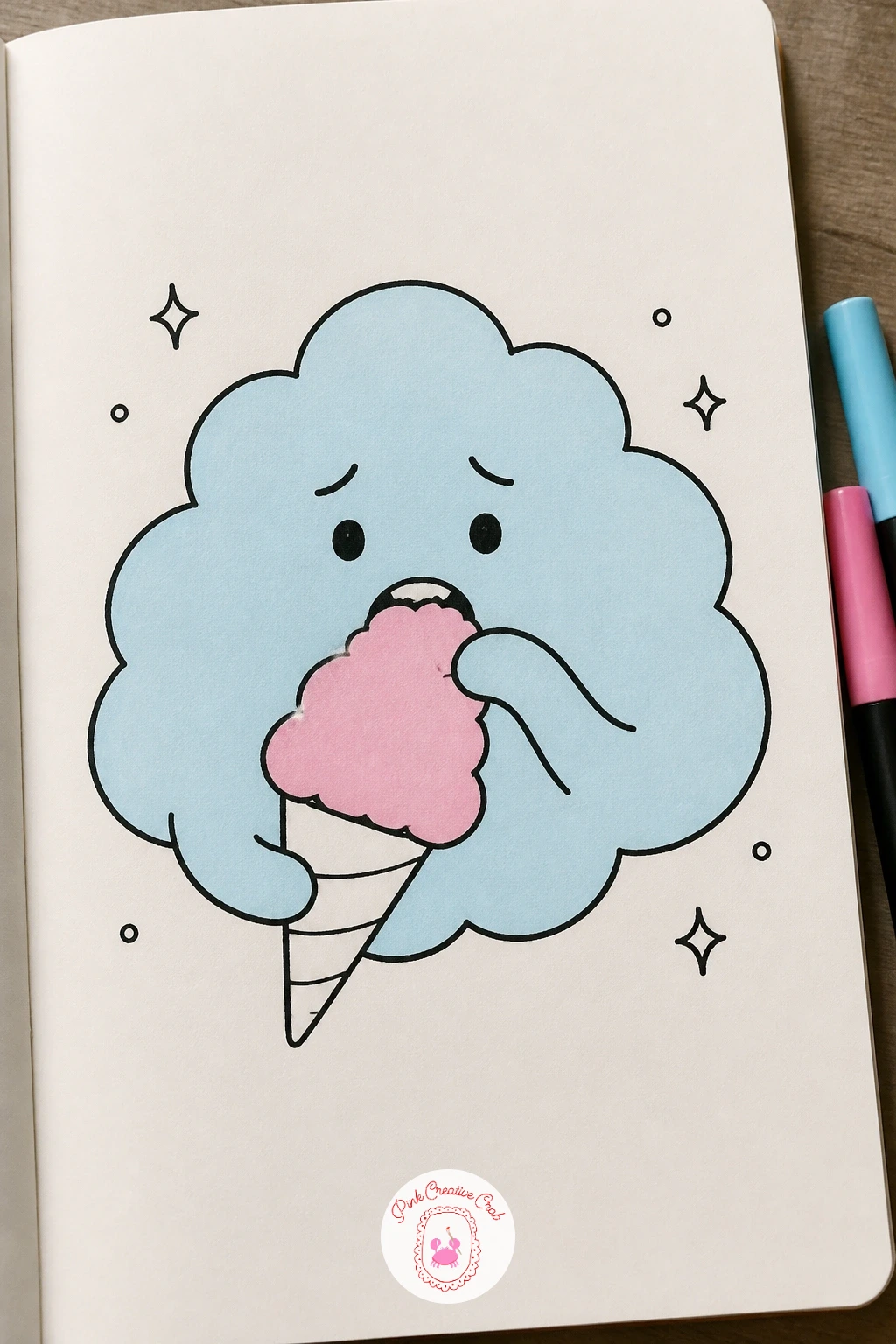
Palette: Soft Pink,Sky Blue,Lemon Yellow
Give this cloud some horizontal motion across the sky. Draw it lying on its back, body stretched out sideways rather than upright, with one arm raised up and back in mid stroke and a small splash of short curved lines near the raised hand.
Stretching the cloud’s outline wider than it is tall, rather than the usual roundish shape, is what makes it read as lying flat and swimming rather than just floating upright, so exaggerate that width a little more than feels natural at first. A closed happy mouth and relaxed closed eyes finish the carefree feel of a lazy swim.
Color a thin wavy line beneath the cloud in sky blue to suggest the surface of the sky it is “swimming” through, almost like a water line, and leave the cloud itself mostly white above that line. If drawing the stretched pose feels odd at first, sketch a simple oval lying on its side in pencil first, then build the bumps and face on top of that guide.
Add one or two small motion lines trailing behind the raised arm for extra movement.
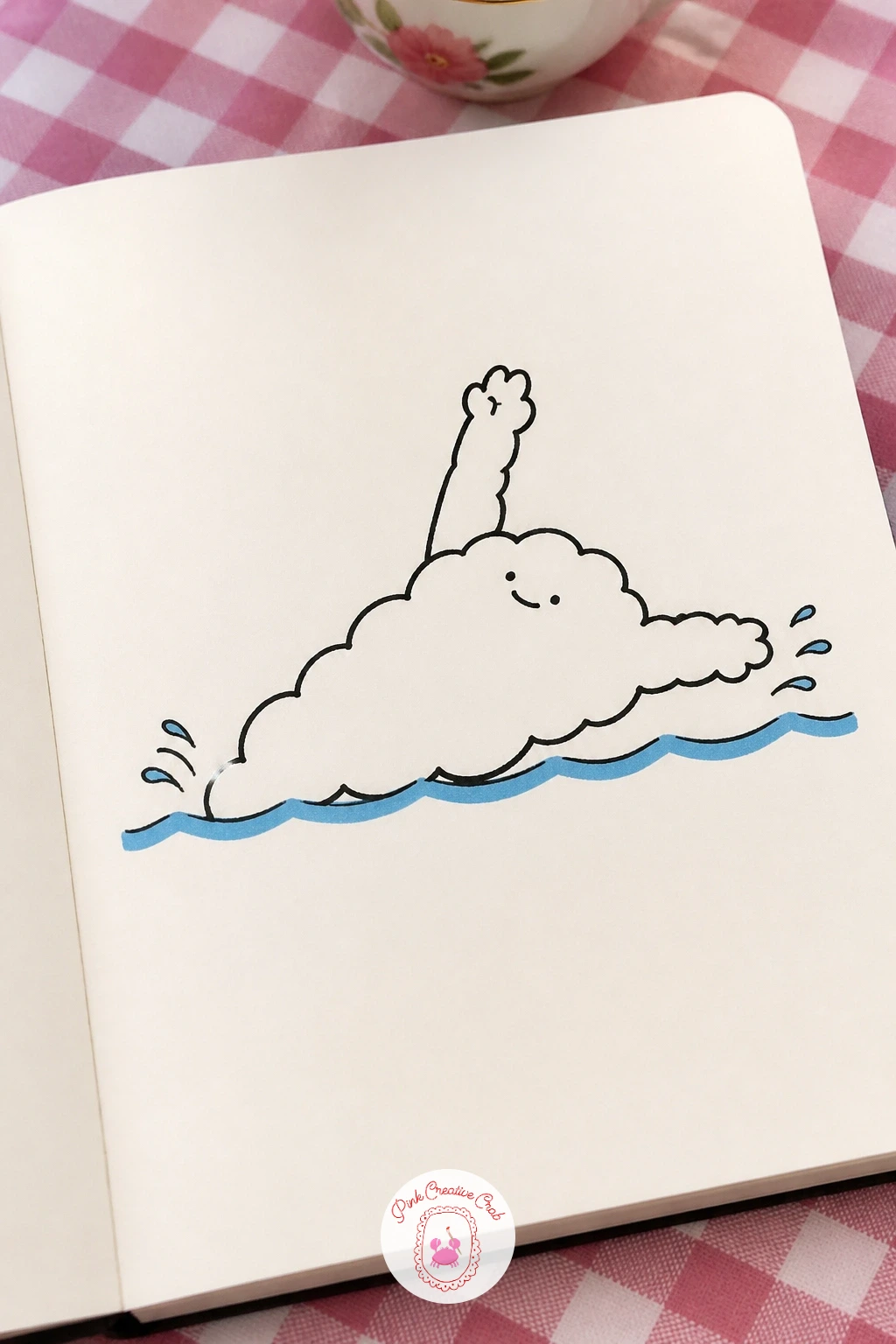
Palette: Sky Blue,White,Pale Blue
Bring back a cozy, slightly sorry for itself character here. Draw the cloud’s body first, then a small hot water bottle clutched against its chest with both arms, a simple rounded rectangle shape with a short neck and cap at the top.
A red or pink nose drawn as a small filled circle at the center of the face does more for the “has a cold” read than almost anything else, paired with droopy half closed eyes and a couple of short curved lines near the mouth to suggest a tired, sniffly expression. Add one tiny floating tissue nearby if you want to complete the scene.
Color the hot water bottle in lemon yellow and leave the cloud a slightly paler sky blue than usual, a washed out color subtly supports the tired, under the weather feeling. If you don’t have a pink marker for the nose, a small solid fineliner dot works just as well.
Keep the shoulders drawn slightly hunched rather than square, it reads instantly as a cloud that would rather be curled up resting.
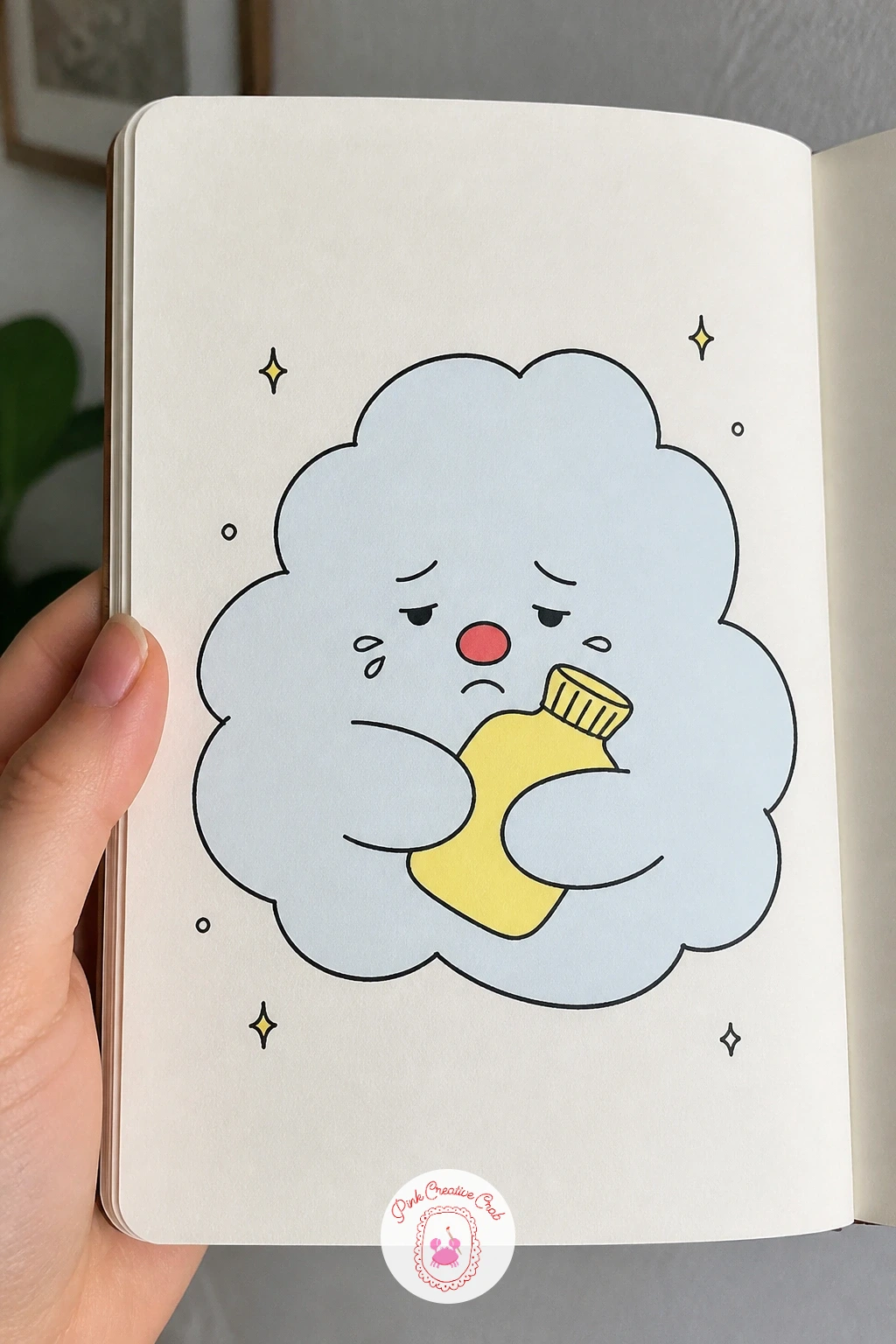
Palette: Lemon Yellow,Pale Blue,Soft Pink
This idea asks you to draw a cloud mid action, cheeks puffed out blowing air. Draw the cloud’s face with both cheeks drawn as extra rounded bumps on either side of a small pursed mouth, and three or four short curved lines streaming out from that mouth toward a small paper boat floating nearby.
The paper boat itself is just a simple folded triangle shape sitting on a short wavy water line, easy to draw in a few strokes once you’ve seen the fold pattern once. Keep the puffed cheeks noticeably rounder than the rest of the cloud’s bumpy edge, the contrast between its normal soft bumps and these extra tight round cheeks is what sells the effort of blowing.
Color the boat in lemon yellow and the water line in sky blue, with the cloud staying mostly white so the puffed cheeks stand out clearly against it. If a folded paper boat feels tricky to draw, a simple sailboat with a triangular sail is an easy swap that tells the same story.
Angle the air lines slightly downward toward the boat so the direction of the “wind” is obvious.
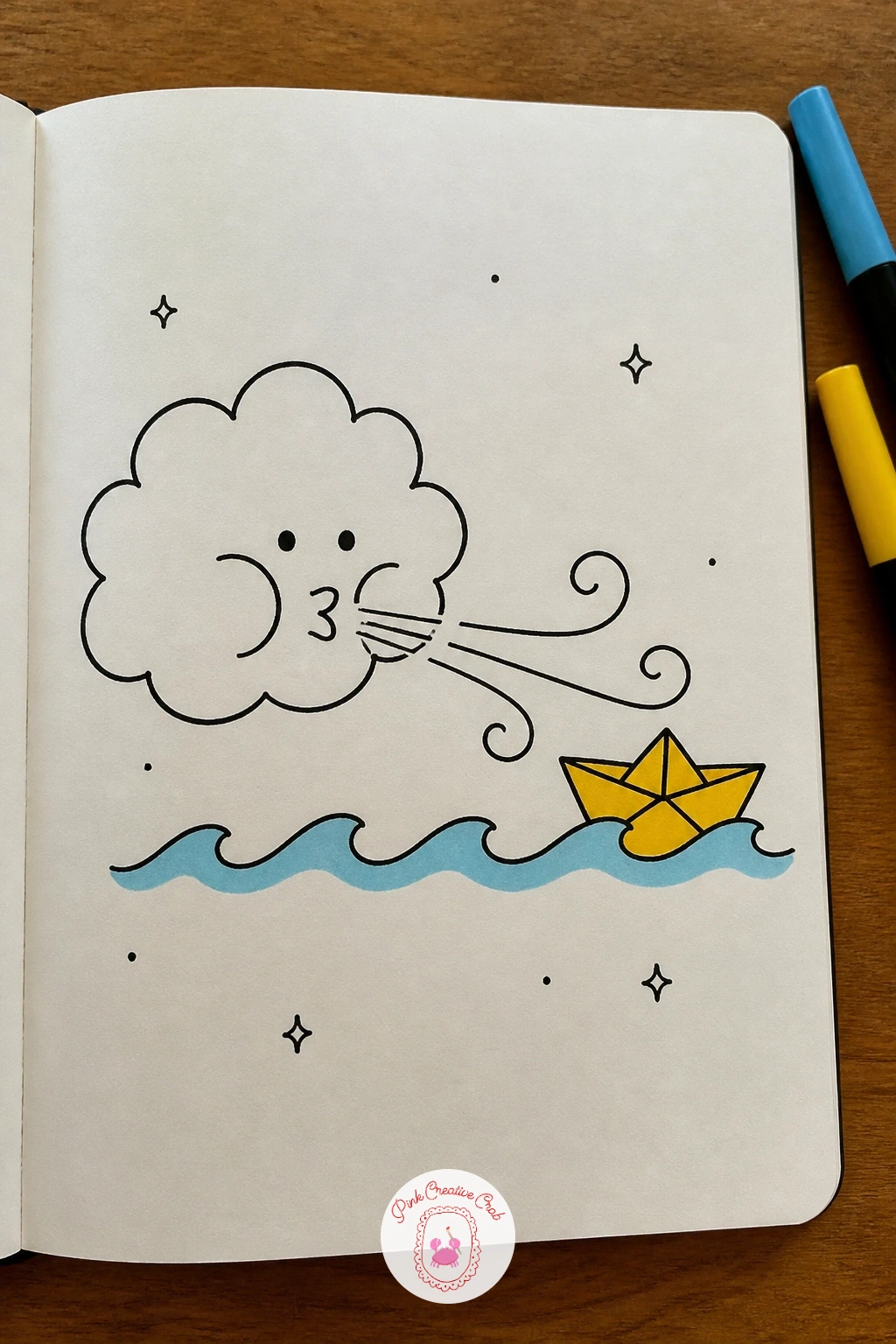
Palette: Lemon Yellow,Sky Blue,White
Work a little nighttime drama into this one. Draw the cloud with both arms outstretched and slightly bent at the elbow, as if braced to catch something, positioned a little below center on the page so there is room above for the falling star.
Draw the star itself as a simple five pointed shape with two or three short motion lines trailing behind it to show it was moving fast before landing safely in the cloud’s arms. A surprised but delighted expression, wide eyes and an open smile, works better here than a calm one, since the whole point is the sudden catch.
Color the star in lemon yellow with a thin sky blue halo or glow around it, and keep the cloud itself a cool toned blue to set against the warm star. If you want a simpler star shape, a four pointed sparkle star (like a plus sign with pointed tips) is easier to draw symmetrically than the classic five pointed version.
Scatter two or three tiny dot stars in the background so the falling star reads clearly as having come from the night sky.
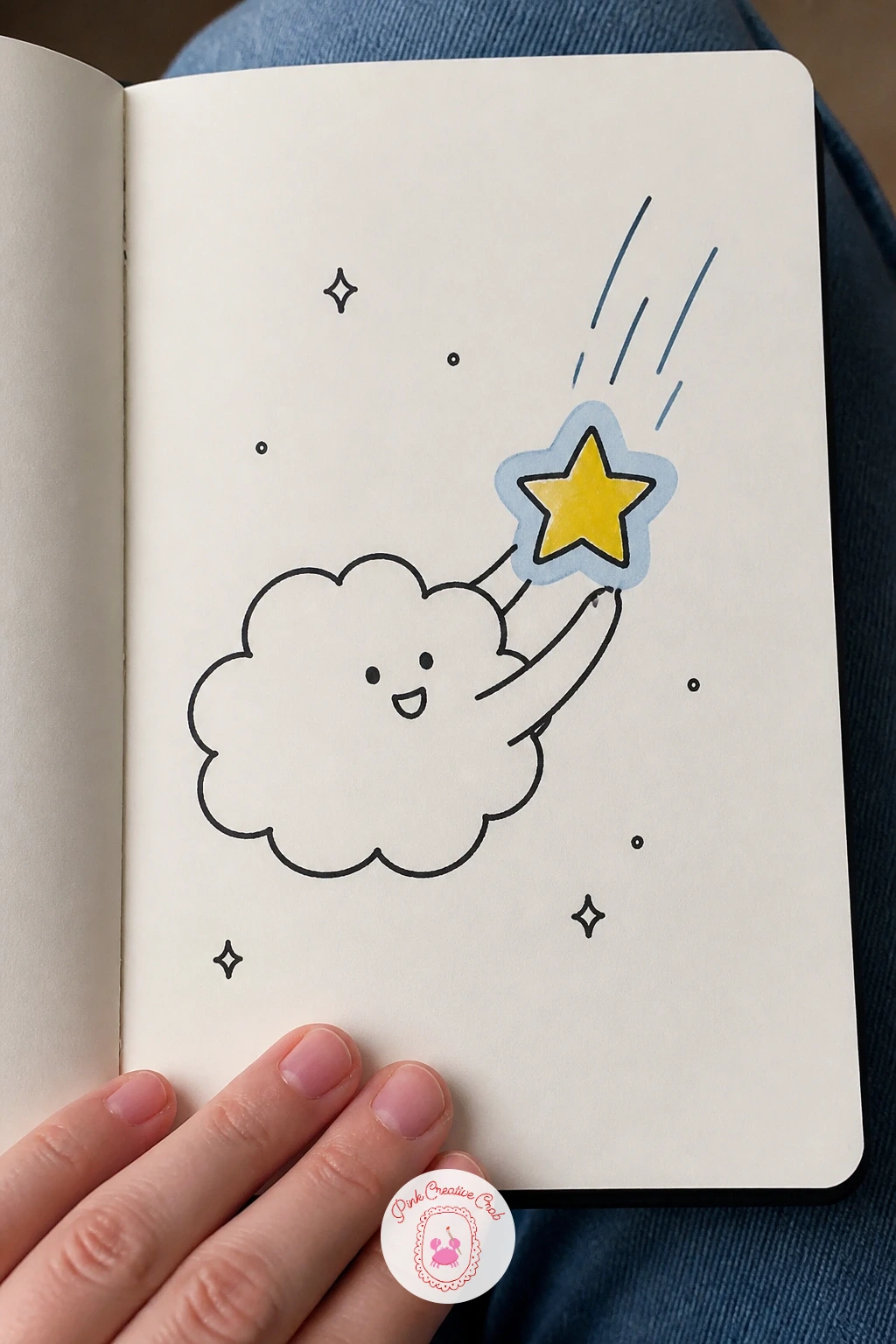
Palette: Lemon Yellow,Sky Blue,Charcoal Grey
Cool things down on the page with a cloud fanning itself in the heat. Draw the cloud’s body first, slightly drooping at the bottom edges rather than perfectly round, then a small folding fan held in one hand, drawn as a simple half circle with a few straight pleats radiating from a point at the base.
A few short wavy lines rising above the cloud’s head suggest heat shimmer, and a couple of drawn “sweat drop” shapes near the forehead finish the overworked, overheated look. Keep the fan’s pleat lines evenly spaced by lightly marking the center point first in pencil, then drawing each pleat line out from that same spot.
Color the fan in lemon yellow with a sky blue trim along its curved edge, and give the cloud itself a slightly flushed pink tint rather than its usual cool blue, warmer coloring supports the hot weather story. If drawing the pleated fan feels fussy, a simple paper fan folded like a rounded triangle is an easier stand in.
Add a bright sun shape in the corner of the page to make the heat obvious at a glance.
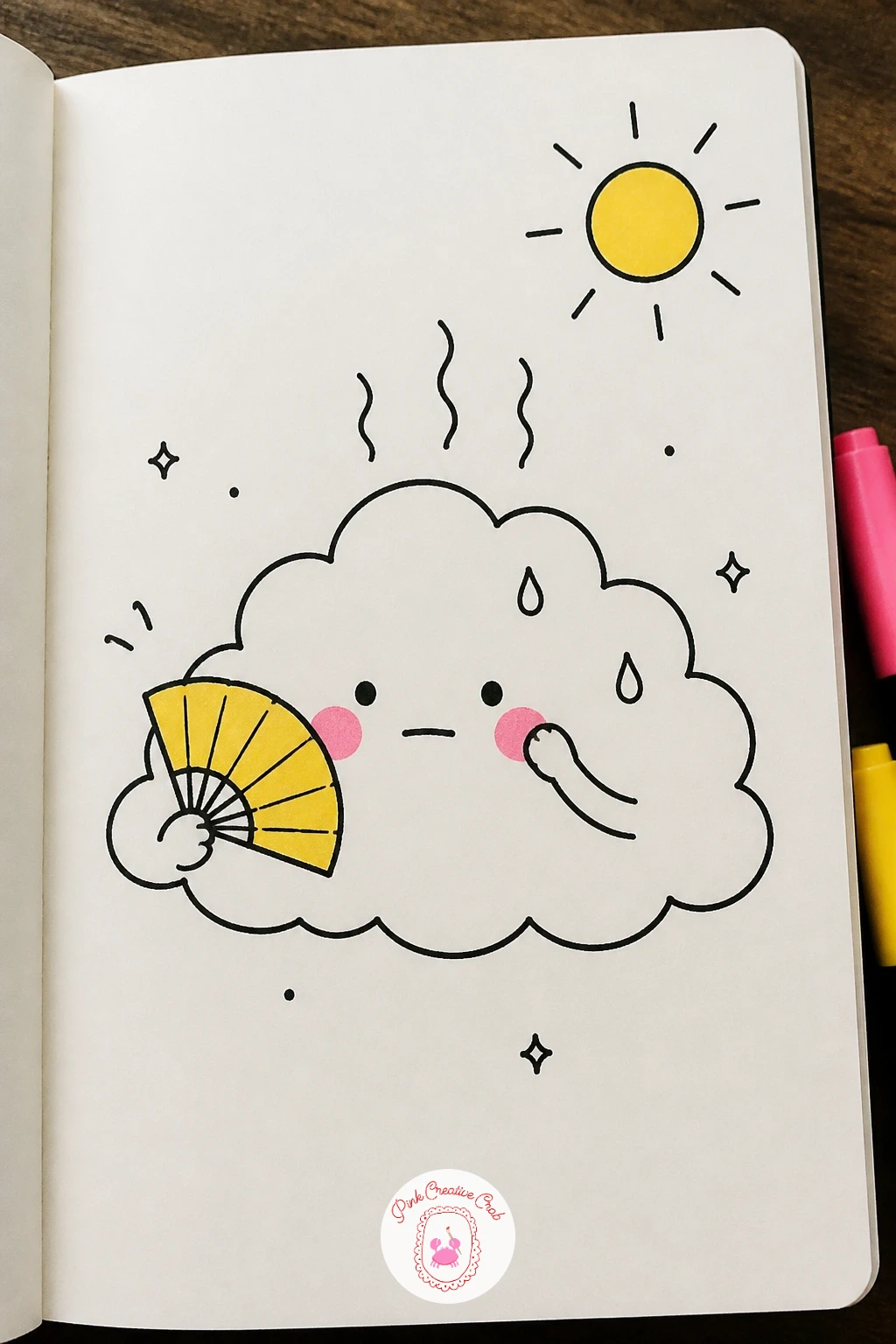
Palette: Lemon Yellow,Soft Pink,Sky Blue
Bring in your first human character here with a simple, happy kid walking a small cloud like a pet. Draw the child first as a simple rounded figure, a circle head, a short oval body, and stick limbs are all you need, then draw the small cloud trailing a short step behind on a simple curved leash line.
Keep the cloud noticeably smaller than the child’s head, this size relationship is what makes it read as a pet being walked rather than two characters of equal standing. A single curved leash line connecting a loop around the cloud’s middle to the child’s hand is all the detail you need, no collar or clasp required.
Color the child’s clothing in lemon yellow and the cloud in its usual sky blue, keeping the leash itself a plain fineliner line so it does not pull focus. If drawing a full child figure feels like too much, you could simplify to just a single raised arm and hand entering the frame holding the leash, cropping the rest of the child out of view.
Give the cloud a bouncy, happy expression to match the child’s joy, both characters smiling sells the whole scene.
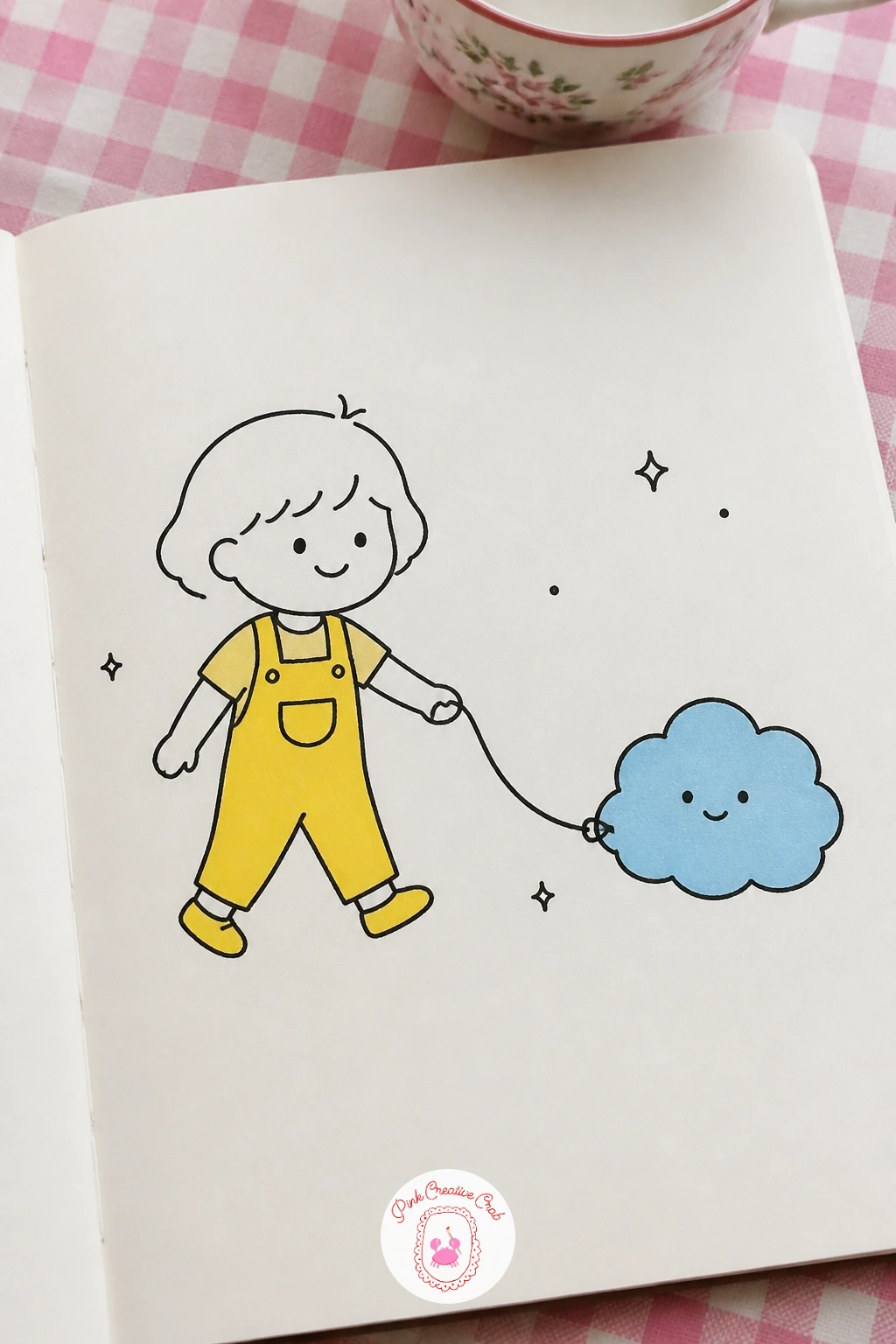
Palette: Lemon Yellow,Sky Blue,Soft Pink
Here is a nice awkward little moment to draw. Start with a tall simple tree, a single trunk line and a rounded or triangular top depending on whether you want it to read as a leafy tree or a pine, then draw the cloud caught on the very top point, stretched slightly out of shape where it has snagged.
Comparing the cloud’s stretched width to its original rounded shape helps here, pull one side out longer and thinner right at the snag point while keeping the rest of the body its normal rounded size, that contrast is what reads as “caught” rather than just floating near the tree. An embarrassed expression, wide eyes and a small awkward smile, finishes the story.
Color the tree in a simple green if you have it, or leave it as plain fineliner outline, and keep the cloud in sky blue with the snagged, stretched section left a little lighter to suggest it is thinner there. If green marker is not available, the tree reads just fine in outline only, no color needed.
Draw one small torn looking tuft of cloud left behind on the treetop for a nice extra detail.
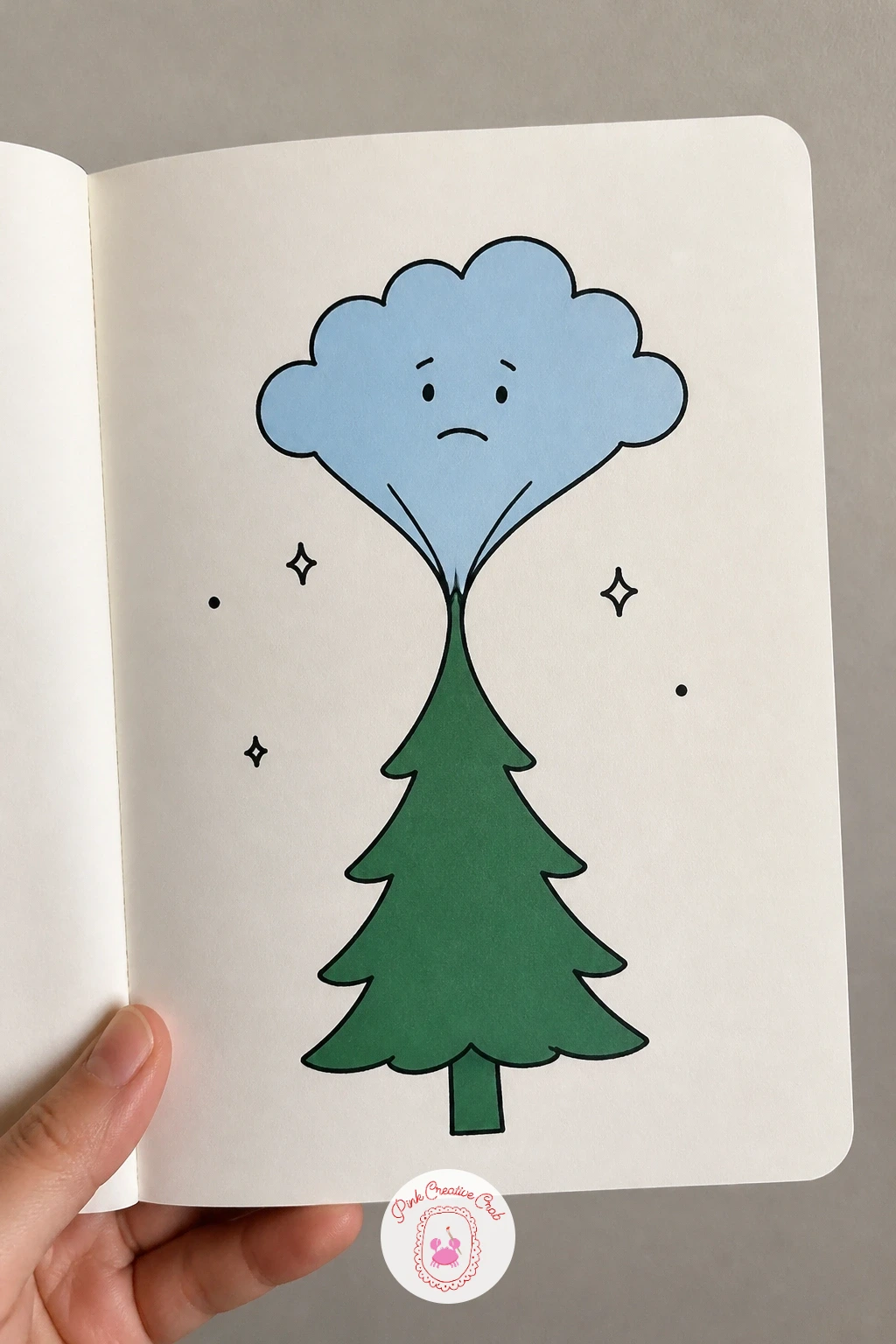
Palette: Sky Blue,Soft Green,White
After a page full of calmer characters, this one brings back some comic energy. Draw the cloud with a surprised, slightly wide eyed expression, mouth open mid hiccup, and one small puff of thunder drawn as a tiny jagged burst shape popping out right at the mouth instead of a normal hiccup sound.
Repeating that same small jagged burst shape two or three times at different points around the cloud, trailing off smaller each time, reads clearly as a series of little hiccups rather than one single event. Keep each burst shape simple, just four or five short pointed lines radiating from a center point, almost like a tiny star.
Color the bursts in lemon yellow so they pop against the cloud’s sky blue body, and keep the cloud’s expression a little startled throughout, eyebrows raised and eyes slightly too wide. If drawing the jagged burst shape feels fiddly, a simple row of three small exclamation marks near the mouth gets the same idea across.
Space the hiccup bursts unevenly rather than in a neat row, it reads as more sudden and involuntary that way.
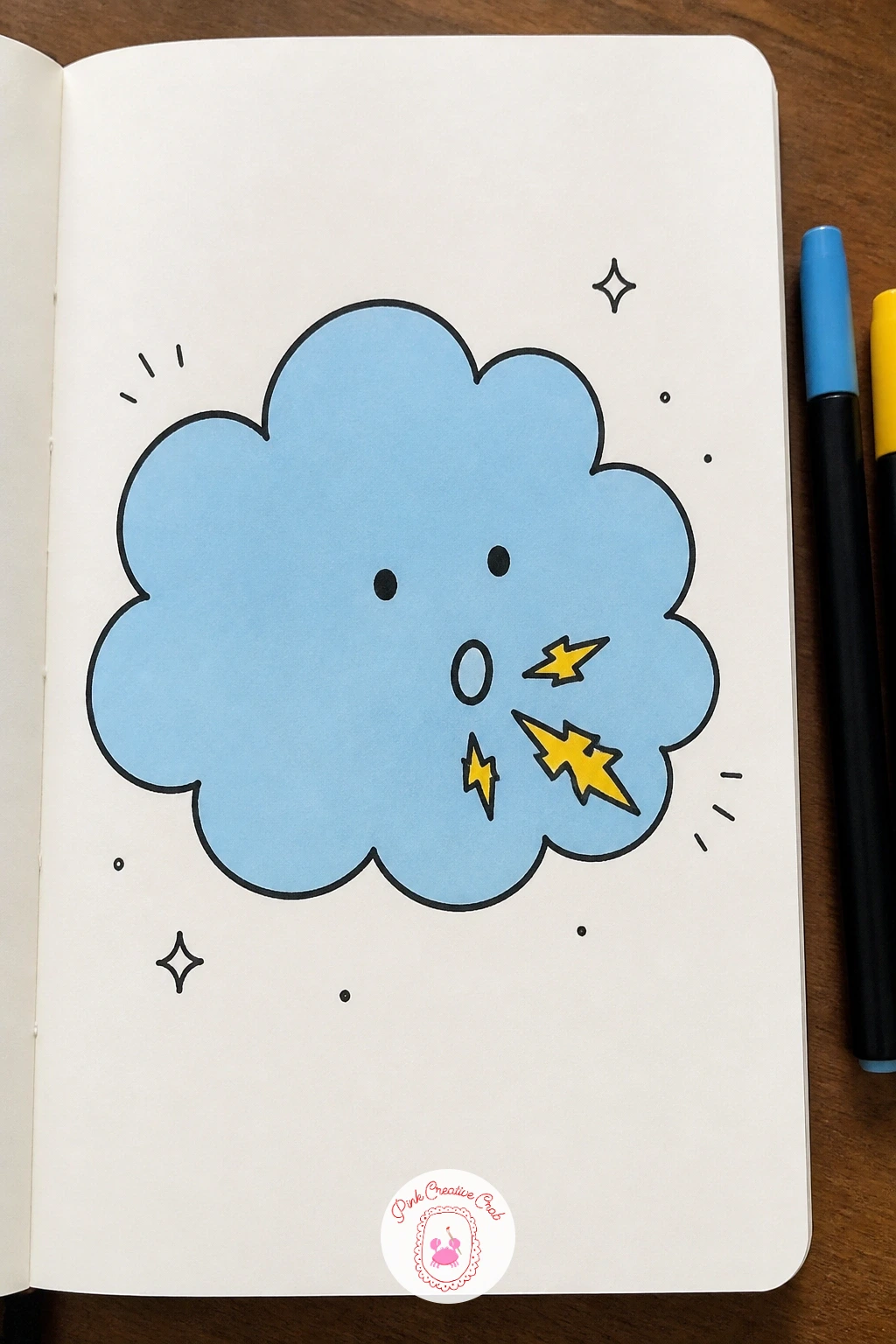
Palette: Lemon Yellow,Sky Blue,Charcoal Grey
This idea asks for a slightly stretched, twisted cloud shape, so it is worth sketching lightly in pencil first before you commit to ink. Draw the cloud’s body elongated and twisted in the middle, like a towel being wrung, with both ends still keeping their familiar bumpy cloud texture so it reads as a cloud and not just an abstract shape.
A few short curved drip lines falling from the lowest twisted point show the water being wrung out, and a strained, effortful expression, squeezed shut eyes and a tight mouth, completes the action. The twist in the middle is the part most likely to look confusing at first glance, so keep the two ends clearly rounded and only pinch the very center, rather than twisting the whole body.
Color the drip lines in sky blue and leave the cloud itself mostly white, letting the twisted shape do the visual work without extra color competing for attention. If the twisted pose feels too ambitious right now, a simpler version just has the cloud squeezing itself with both arms wrapped tight around its own middle, with the same drips falling below.
Either version pairs nicely with the wetter weather clouds earlier in this list if you are filling a whole page.
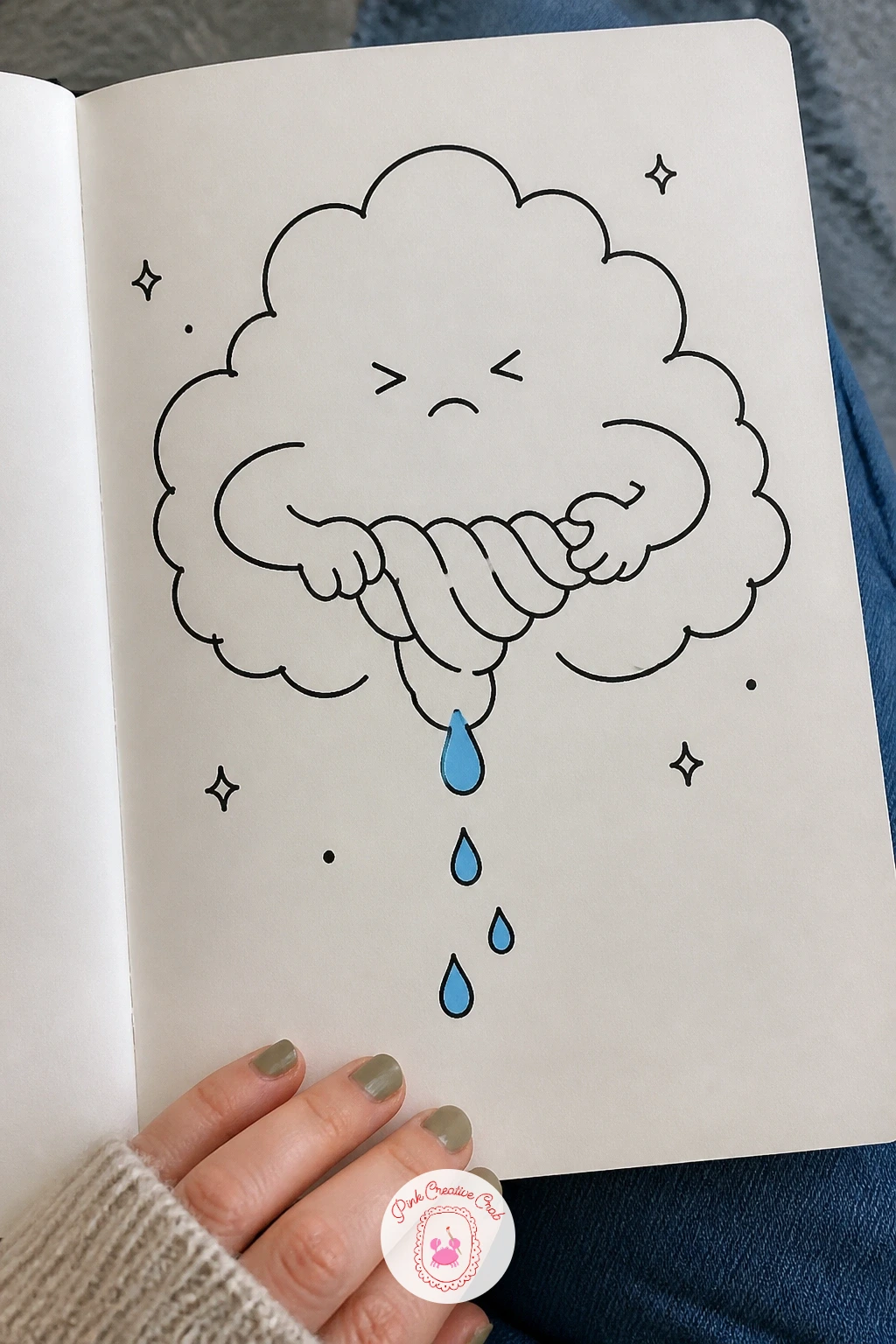
Palette: Sky Blue,White,Pale Blue
Here is a gentle, welcoming little scene. Draw the cloud first with both arms open wide, then a single round balloon on a short curled string drifting into that open embrace, its string trailing loosely below rather than held taut.
Keeping the balloon noticeably smaller than the cloud’s own head keeps the proportions friendly and avoids the balloon overwhelming the composition, and a slightly rounded, almost heart shaped highlight left blank on the balloon’s surface gives it a simple shiny look without any extra shading work. A warm, closed eye smile on the cloud finishes the welcoming feel.
Color the balloon in lemon yellow and leave its string as plain fineliner, with the cloud staying its usual soft sky blue so the two colors sit comfortably together. If you want a bit more charm, a tiny painted face on the balloon itself, two dots and a small curve, turns it into a second little character being welcomed in.
Curl the balloon’s string with two or three gentle waves rather than drawing it perfectly straight, a straight string looks stiff next to the round soft shapes around it.
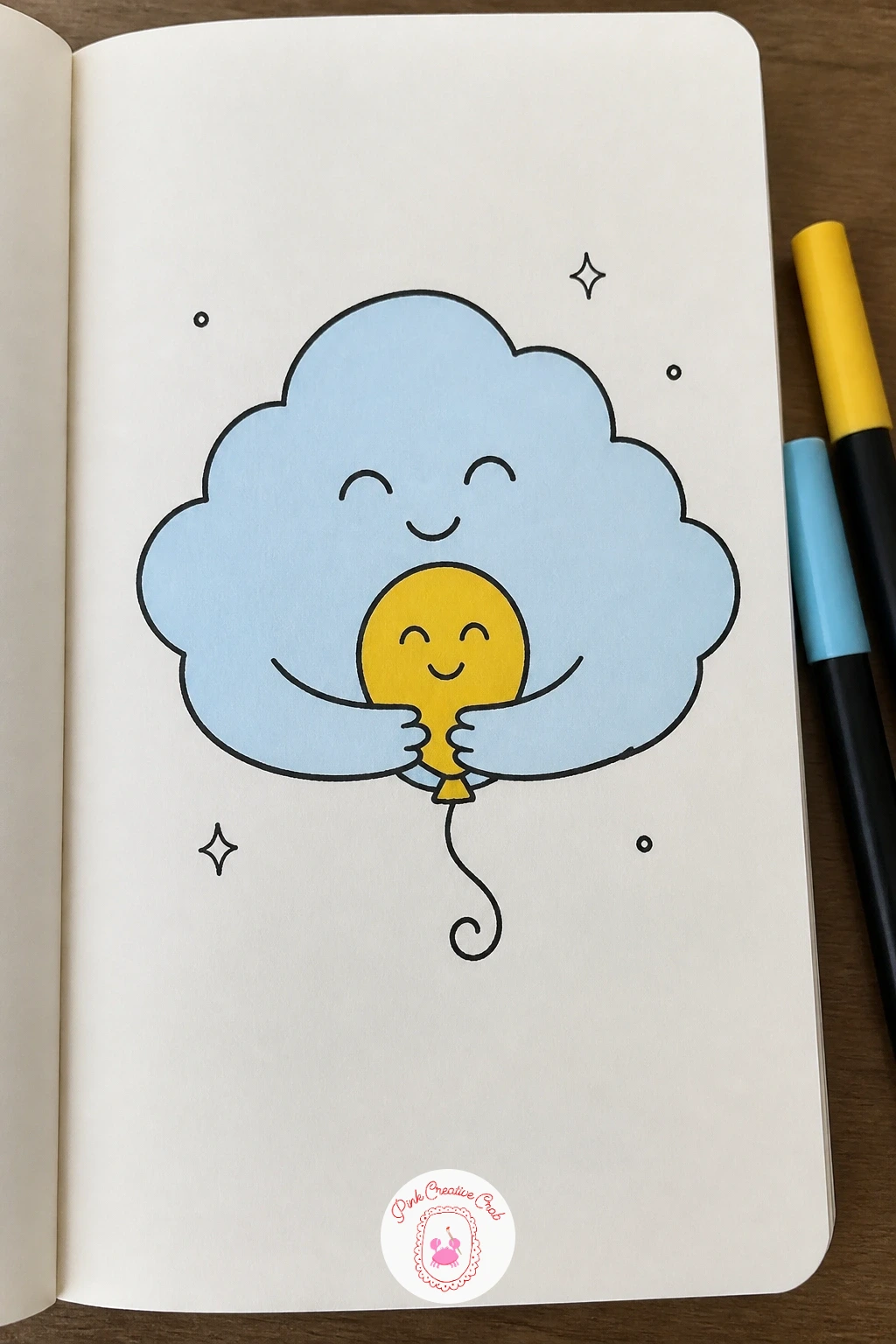
Palette: Lemon Yellow,Sky Blue,White
Shift the scale again for this one, since you are drawing a small cloud perched casually on something much bigger. Draw the airplane wing first as a simple long triangular shape cutting diagonally across the page, then perch the cloud right on top near the wingtip, legs dangling casually off the edge.
A relaxed, carefree expression and one arm raised in a small wave sells the “hitching a ride” idea better than any other detail, so spend your time there rather than on the plane itself, which can stay a simple outline with just a couple of rivet dots for texture. Keep the wing’s edge perfectly straight using a ruler if your fineliner work tends to wobble on long lines, a crisp mechanical edge contrasts nicely with the cloud’s soft bumpy body.
Color the wing in a plain silver grey or leave it white with just an outline, and keep the cloud in its usual sky blue so it stands out clearly against the straight lines of the plane. If a full wing feels like too much to draw, a simple triangle shape with one straight line down the middle still reads clearly as a wing at this scale.
Add a couple of small clouds drifting past in the background to place the scene clearly up in the sky.
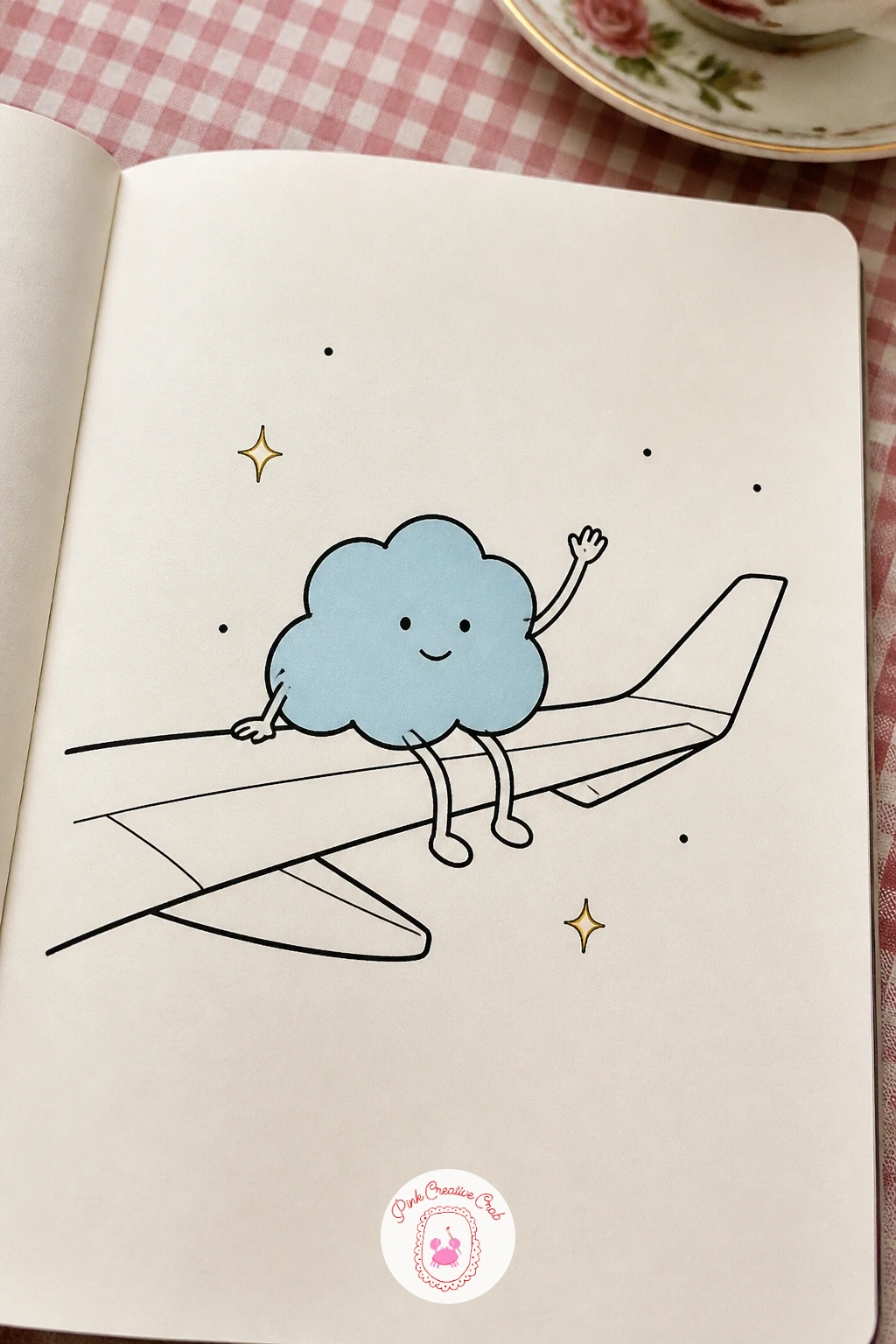
Palette: Sky Blue,Charcoal Grey,White
Pair your cloud with a small new character for this one. Draw a simple snail first, low on the page, its shell a tight spiral drawn from the center outward, then give it two small raised arms holding a tiny cup up toward the sky, where your cloud floats just above, tipped slightly to pour.
A short run of rain lines falling directly from the cloud into the cup is the detail that ties the whole scene together, so keep those lines narrow and close together rather than spread wide, aiming them precisely at the cup makes the connection obvious. The snail’s spiral shell is the trickiest part to draw cleanly, so start from the small center point and work outward in one continuous curling line rather than drawing separate rings.
Color the cup in lemon yellow and the rain in sky blue, leaving the snail’s shell a warm earthy tone if you have one, or plain outline if not. If a full spiral shell feels tricky to get right first try, a few simplified concentric curved lines inside an oval still reads clearly as a shell.
Give the snail a satisfied, grateful little smile looking up toward the cloud.
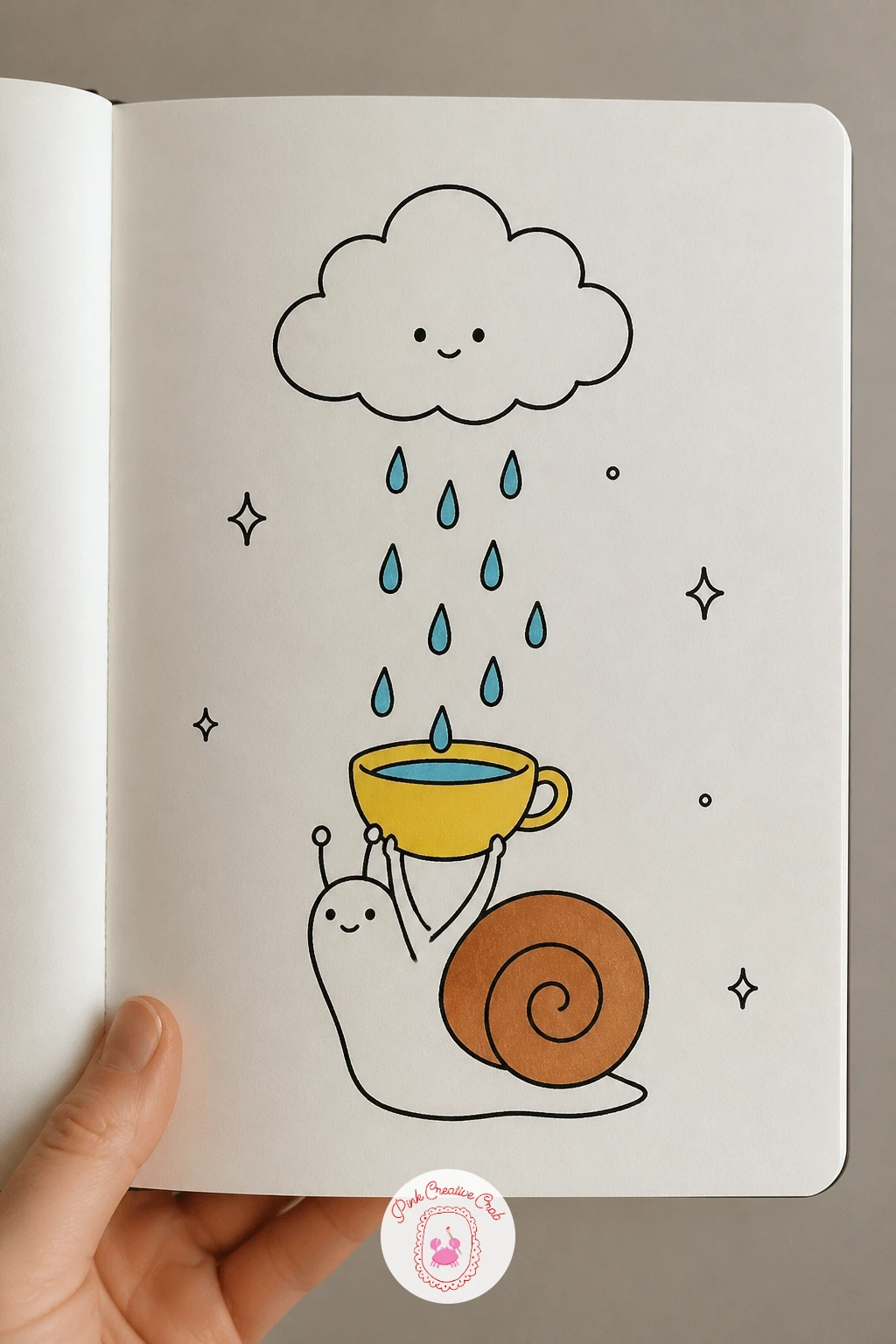
Palette: Lemon Yellow,Sky Blue,Warm Brown
This idea plays with a quiet, careful pose rather than a big expression. Draw a simple picnic blanket first, low on the page, as a square with a plaid pattern of a few crossed lines, then draw the cloud up and to one side, body leaning forward slightly with both hands raised near its chest as if tiptoeing carefully past.
Small details carry this one: draw the cloud’s “feet,” two short rounded points at the bottom, lifted slightly off an imaginary ground line to suggest the tiptoe, and a tightly pressed closed mouth to show concentration on staying quiet. Keep the picnic blanket pattern simple, four or five crossed lines are enough to suggest plaid without turning it into a busy grid.
Color the blanket in alternating sky blue and lemon yellow squares, and keep the cloud itself plain white or very lightly tinted so it stays visually separate from the busier pattern below it. If a full plaid pattern feels like too much, a single solid color blanket with a simple scalloped edge is a quick swap that still reads clearly as a picnic.
Add one small sandwich or piece of fruit on the blanket to finish the scene without much extra work.
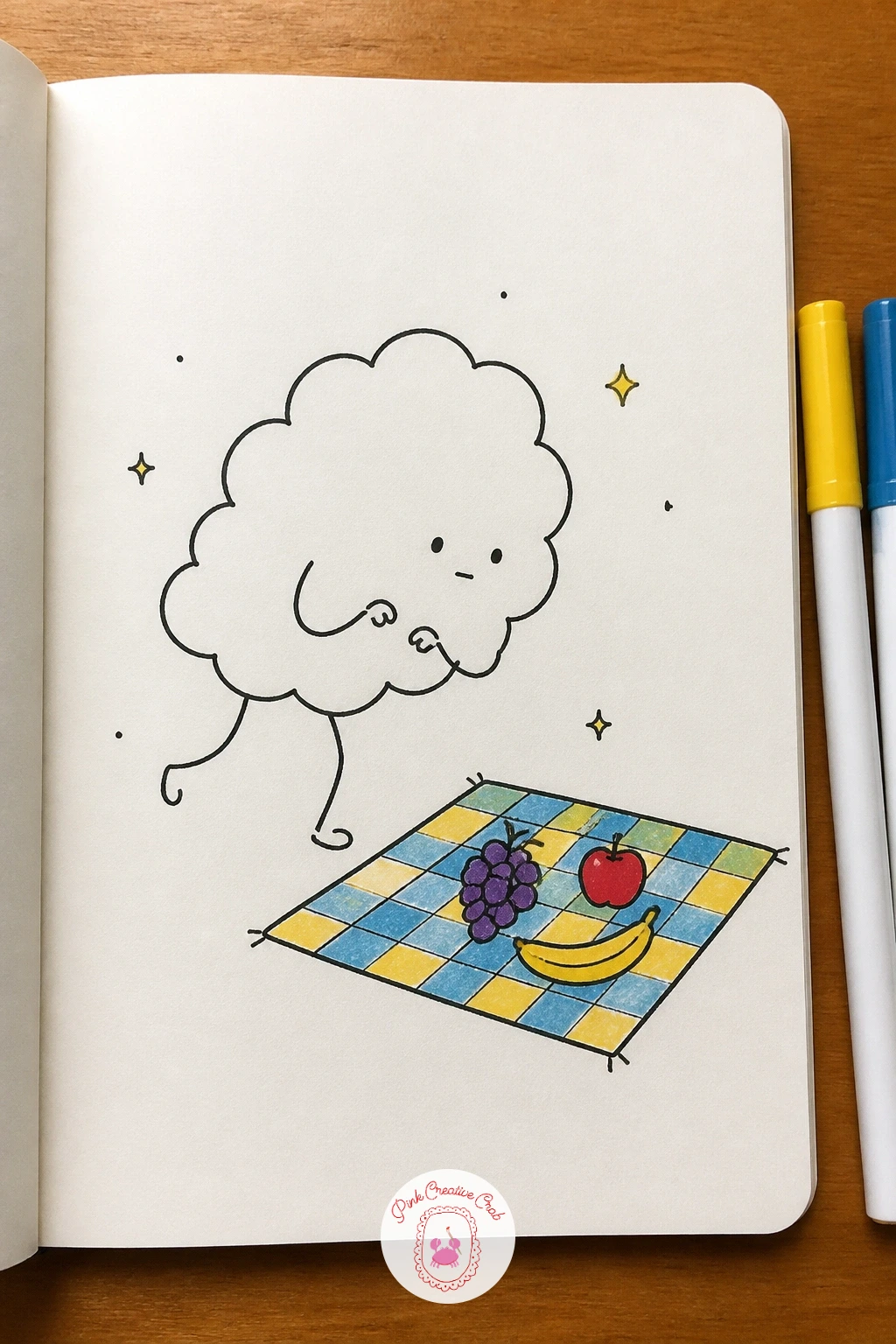
Palette: Sky Blue,Lemon Yellow,Soft Red
Close out the quieter scenes with this gentle pairing. Draw the larger cloud first, seated with a softly curved lap formed by its own rounded bottom edge, then draw a single small teardrop shaped raindrop nestled right in that curve, with its own tiny dot eyes and a peaceful closed mouth.
Keeping the raindrop baby no taller than about a third of the cloud mother’s height is the proportion that makes the “parent and child” read clear at a glance, so resist the urge to make the raindrop too big once it has its own cute little face. A soft, warm expression on the cloud, gently closed eyes and a small smile, completes the tender feel of the scene.
Color the raindrop in sky blue and the cloud mother in a slightly paler, warmer toned blue, a gentle contrast between the two keeps them visually distinct while clearly matching in family. If you want to soften the whole thing further, a light pink wash on the cloud’s cheeks adds warmth without extra line work.
This makes a sweet closing image for a page, or a simple card for someone expecting a little one.
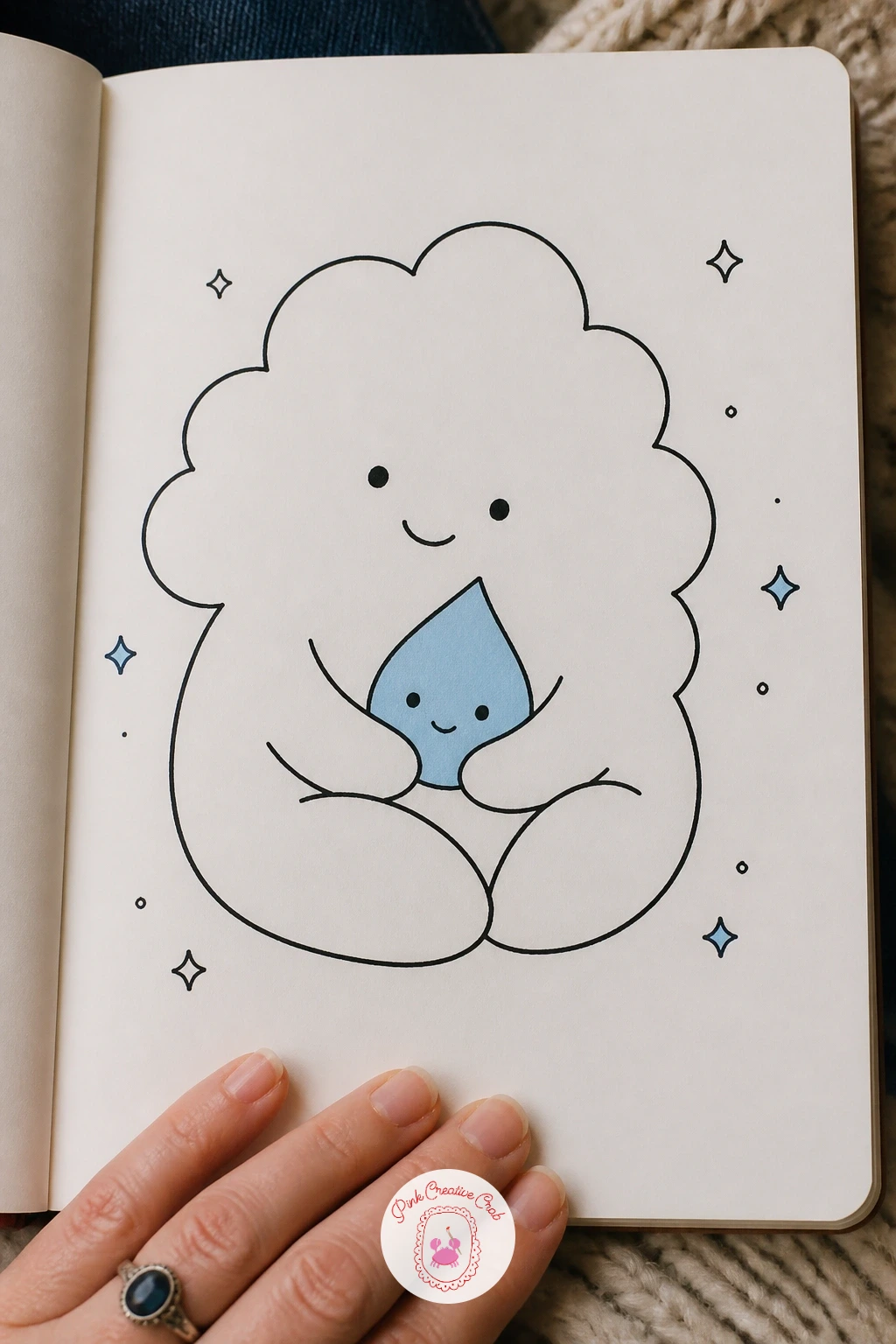
Palette: Sky Blue,Pale Blue,Soft Pink
End the page on a quiet goodnight note. Draw the moon first, a full round circle or a soft crescent depending on preference, placed slightly off center, then draw the cloud peeking out from directly behind one edge, just enough of its bumpy outline and one eye and a small smile showing past the moon’s curve.
Overlapping the two shapes correctly is the main thing to get right here: draw the moon’s complete outline first, then build the cloud’s edge starting from behind it so the moon’s line stays unbroken while the cloud appears to tuck neatly behind, rather than drawing the cloud first and trying to erase around it. One small raised hand near the cloud’s face, as if mid wave, adds a sweet goodnight gesture.
Color the moon in pale lemon yellow and the cloud peeking beside it in soft sky blue, with a dark background if you want a true nighttime feel, or plain white left simple if you prefer a lighter page. If a full moon feels large to fill, a smaller crescent takes less time and still leaves plenty of room for the cloud to peek around it.
A scattering of three or four tiny dot stars nearby finishes the scene as a nice closing goodnight image for your page.
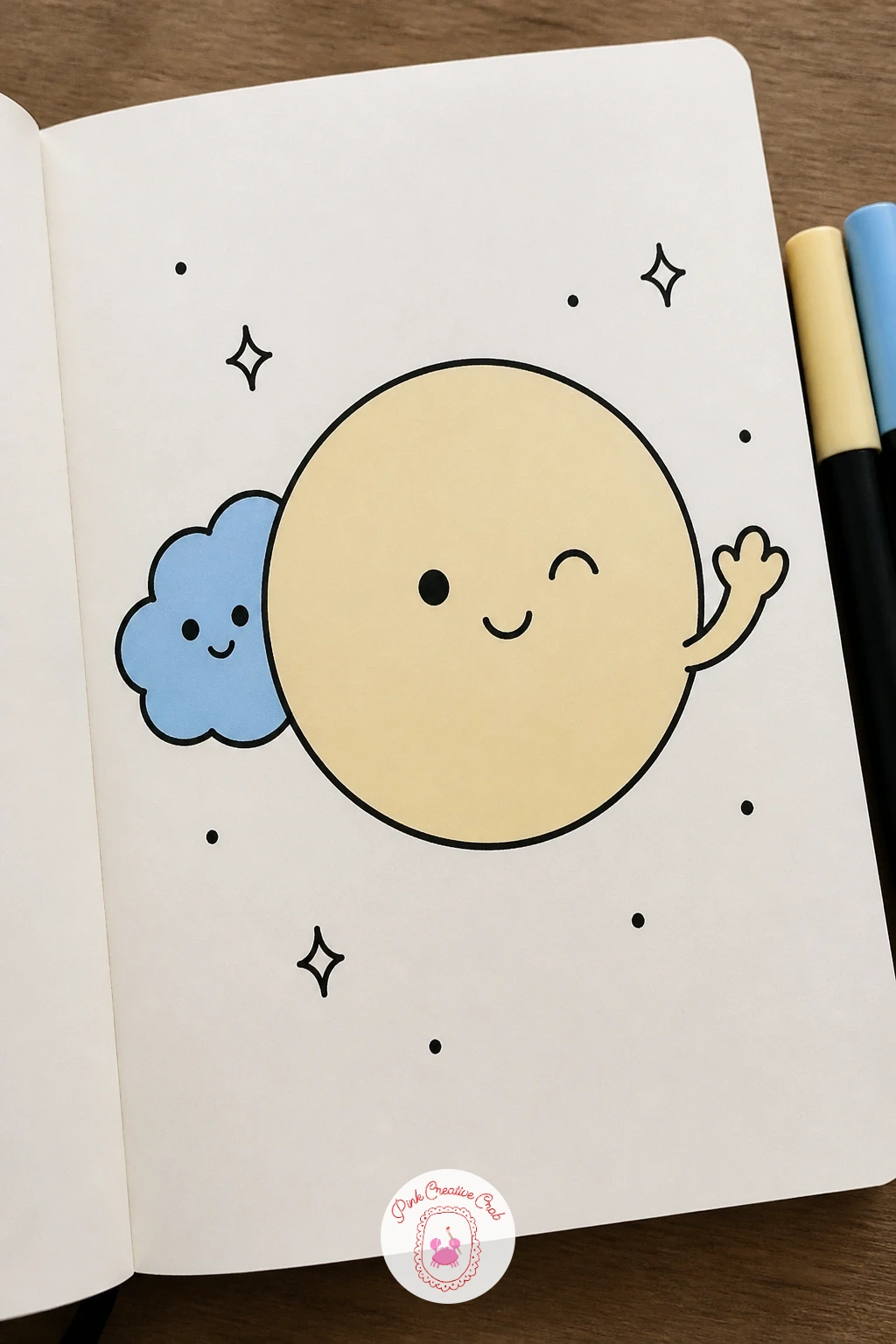
Palette: Lemon Yellow,Sky Blue,Charcoal Grey
What to Do Next
Pick one cloud that made you smile and start there, a plain sketchbook page or a piece of bristol paper is all you need. Sketch the bumpy outline lightly in pencil first if you want a safety net, then go over it in fineliner and finish with a touch of sky blue or lemon yellow marker once the ink is dry.
Frequently Asked Questions
What is the easiest way to draw a cloud doodle for a beginner?
Start with a single bumpy oval outline using three or four rounded bumps along the top and a flatter bottom edge. Add simple dot eyes and a mouth before anything else, the face is what turns a plain shape into a character.
What pens work best for cloud doodles?
A black fineliner in a fine to medium tip, around 0.3 to 0.5mm, gives clean outlines without bleeding through most sketchbook paper. Keep one or two alcohol markers in sky blue and lemon yellow nearby for quick color accents.
How do I stop my cloud shapes from looking too round or plain?
Vary the size of the bumps along the outline instead of making them all the same, and let two or three bumps overlap slightly. A slightly uneven edge reads as softer and more natural than a perfectly smooth cloud shape.
Can I color cloud doodles with colored pencil instead of marker?
Yes, colored pencil works fine and gives a softer, more textured finish than marker. Build the color in light layers rather than pressing hard once, since marker lays down flat color in a single pass but pencil needs a few passes to look even.
How do I give a cloud doodle personality without drawing a full face?
Posture carries almost as much personality as a face does, so lean the body, raise or lower the arms, or tilt it slightly off center. Even two dot eyes and a single curved mouth line can read as happy, sleepy or grumpy depending on their placement.
Have any thoughts?
Share your reaction or leave a quick response — we’d love to hear what you think!
-
 0
-
0
-
0
-
0
-
0
-
0


