Every dog illustration on this list starts from the same cold afternoon: fogged windows, a dog somewhere between the door and the fire, and snow doing something worth painting. Thirty three breeds get the loose watercolor and ink treatment here, from a dachshund trotting through drifts in a puffer coat to a cocker spaniel curled up beside someone knitting, and every one of them fits in a single sitting.
You will find coats and sweaters, zoomies and sled pulling, naps and walks with the humans who love these dogs, all built the same practical way: ink first or paint first, fur handled with a trick that actually works, and a fix for the moment it starts to look stiff. Scroll for the one that matches the dog on your own sofa right now.
Using these images: free for personal projects such as printing, coloring, cards, journals and gifts. Handmade items that include them may be sold up to 30 pieces per design. More than that is commercial use and is not permitted, and neither is selling or sharing the images themselves or passing them off as your own. Please ask before any other use.
Start with a dachshund, the long low body makes a friendly first subject because the shape is really just two stretched ovals, one for the body and a smaller one for the head, joined by a thin neck. Pencil the outline lightly, keep the legs short and the puffer coat as a simple rounded shape wrapping the middle third of the body, then go over the final lines in waterproof ink once you are happy.
Paint the coat first in cherry red, leaving a few white gaps where the quilting seams will sit, and drop chocolate brown onto the exposed head, ears and legs while the paper is still damp so the fur edge softens naturally. Add the snow last with a dry brush dragged lightly across the lower third of the page, which reads as kicked up powder around the trotting feet.
If the body ends up too short, it reads as a sausage rather than a dachshund: measure the length as roughly three head widths before you ink it, that one check saves the proportions every time. Swap cherry red for any warm pillar box or poppy red if that is what is in your palette.
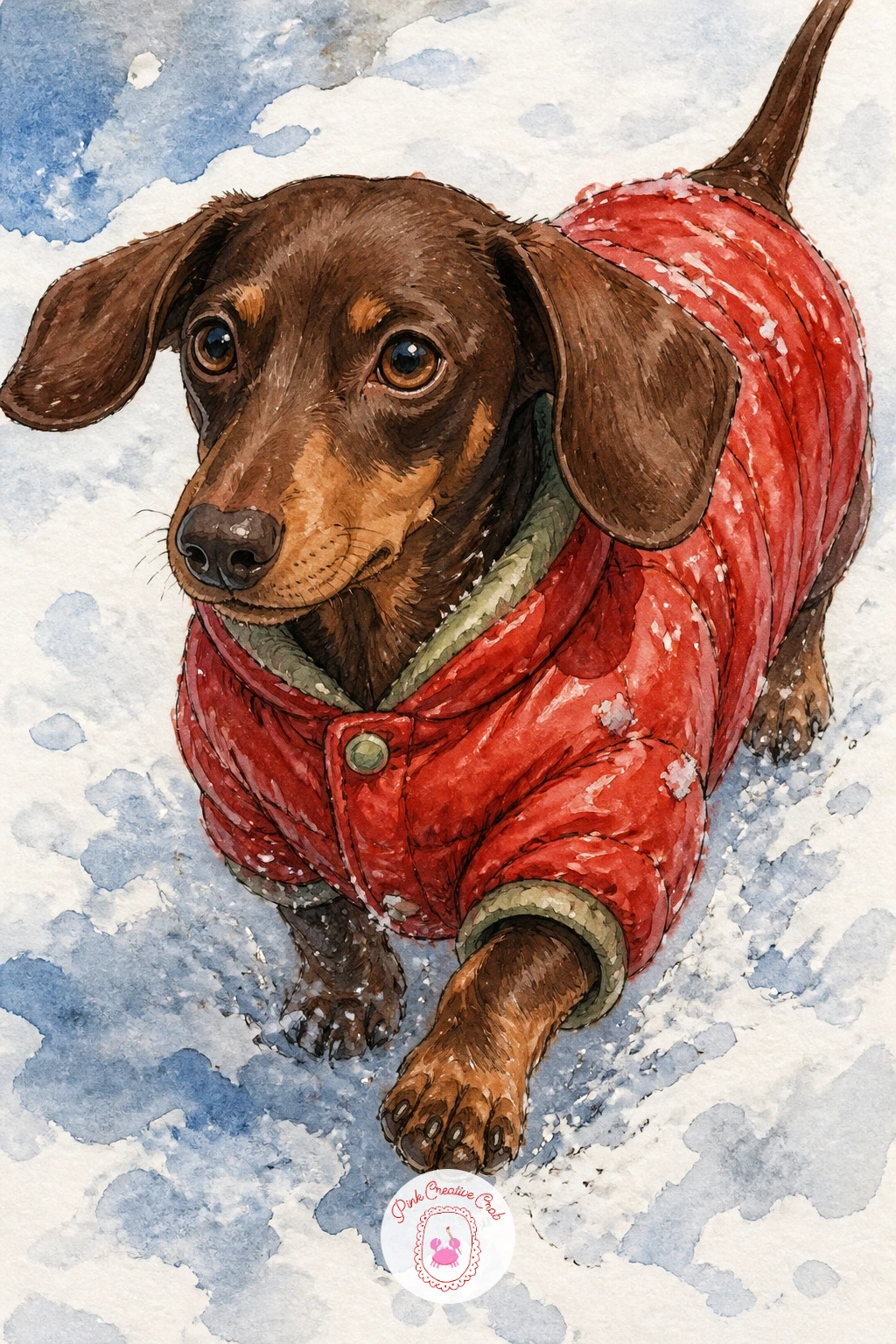
Palette: Cherry Red,Chocolate Brown,Icy Blue,Payne’s Grey
Zoomies ask for a different kind of drawing than a sleeping dog, so sketch the golden retriever mid stride with the front legs stretched forward and the back legs tucked under, ears and tail flying out behind. Keep the pencil sketch loose and gestural rather than careful, a stiff outline kills the sense of speed before paint even touches the page.
Lay a wash of golden ochre and raw sienna for the coat while the paper is wet, letting the colour pool heavier at the chest and tail for natural shading, then once that dries add ink linework only where it describes movement: streak marks behind the paws, flyaway fur at the ears. Save the white backyard as untouched paper with just a cool icy blue shadow stretching from the dog’s feet.
For speed on the page, tilt the whole dog off the vertical and keep the legs at different heights rather than mirrored, which is the quickest way to kill a static pose. If ten minutes is all you have, paint the dog and shadow only and skip the background texture; with forty minutes, add kicked up snow flecks with a flick of a loaded brush.
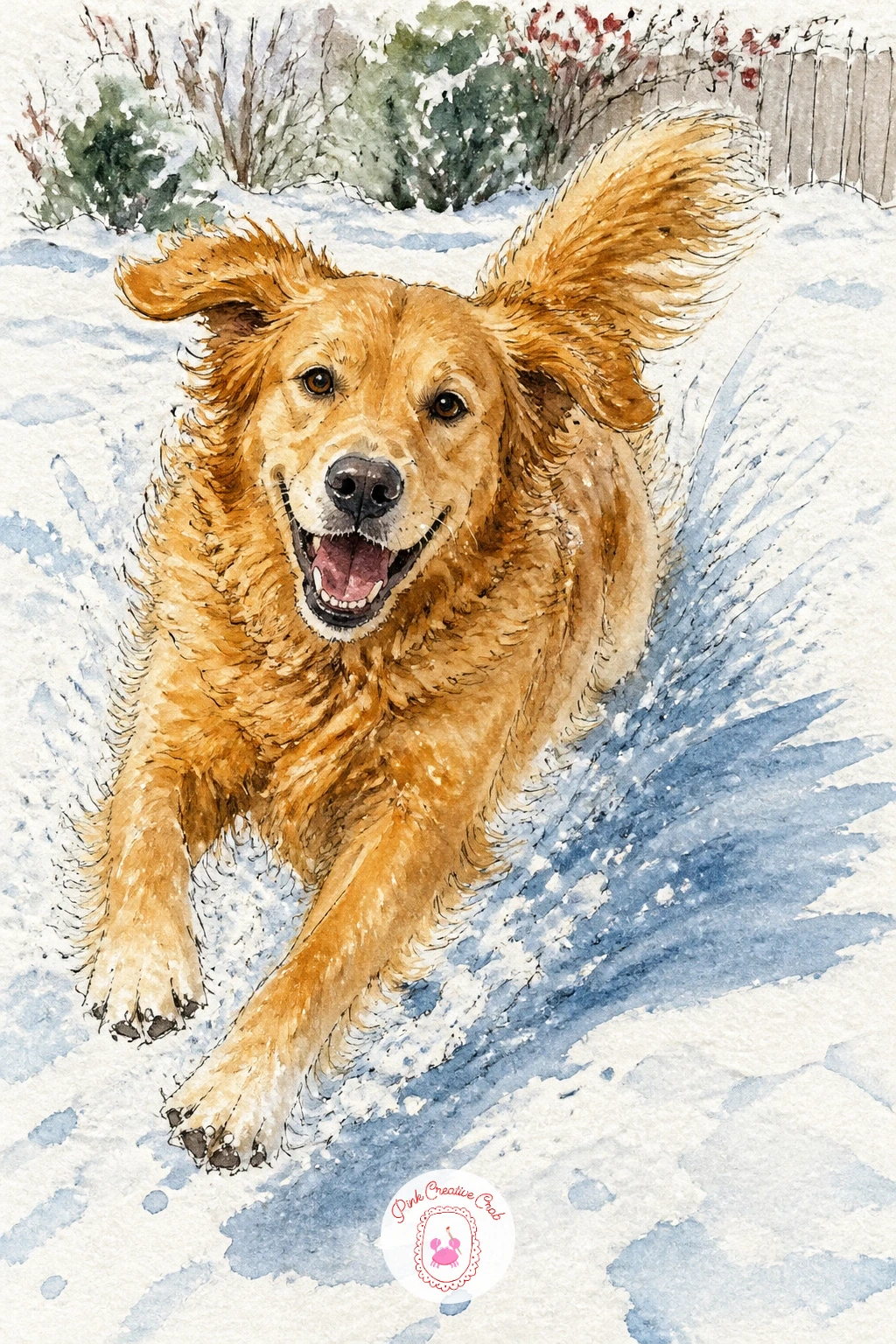
Palette: Raw Sienna,Golden Ochre,Icy Blue,White
Move from motion to stillness with a pug curled nose to tail on a round dog bed, the easiest sleeping pose because the whole body collapses into one soft oval with the head tucked down into the chest. Pencil the oval first, then the dog bed as a simple circle beneath it, and ink only the wrinkles around the face and the curl of the tail once the shapes feel right.
Watercolor the pug in warm fawn with chocolate brown kept to the muzzle and ears, then let the fireplace behind it glow in cherry red and ochre washed wet into wet so the flame edges blur rather than sit as hard shapes. The mistake here is painting every wrinkle as a hard ink line, which turns a sleepy face into a worried one, so keep most of the wrinkle marks soft and broken.
Light from the fire should sit low and warm, so let the underside of the pug and the near edge of the dog bed catch the cherry red glow while the far side stays in cooler brown shadow. No pug on hand to reference: any flat faced sleeping dog in a similar curl works just as well.
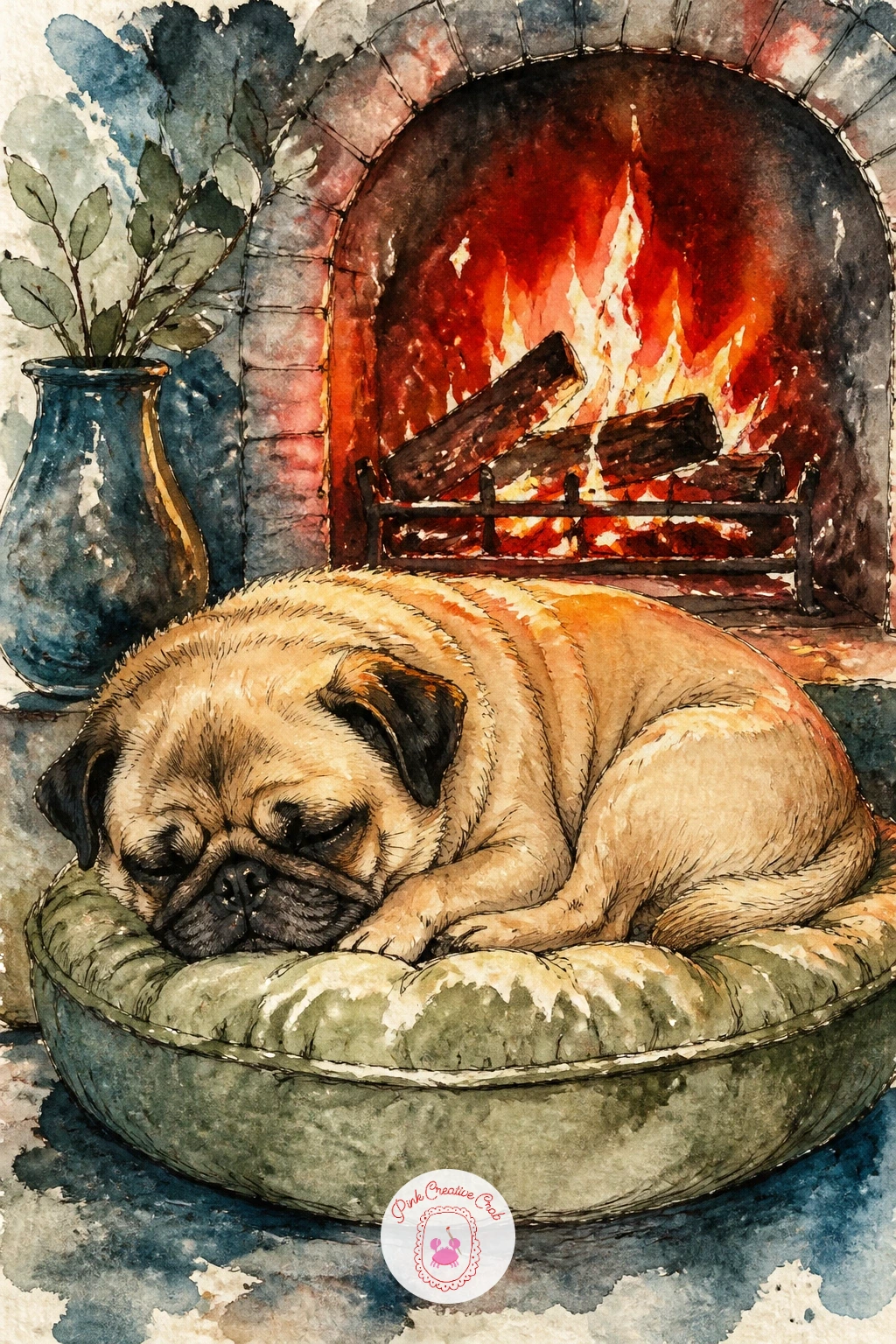
Palette: Fawn,Chocolate Brown,Cherry Red,Golden Ochre
Look at real firelight photos before you paint this one, the warm glow should only touch one side of the dog, the other side stays in cool shadow for contrast.
A corgi gives you a happy, slightly comic subject: short legs, big ears, and a fluffy rear end caked in snow after a good romp. Draw the body low and long like the dachshund but chunkier through the hindquarters, with the tail stub and rounded bottom facing the viewer as the main event of the composition.
Paint the main coat in warm tan and white patches first, then once dry dab clumps of thick white gouache or just leave white paper showing in irregular blobs across the back half to read as stuck on snow. Ink the fur texture on the ears and chest with short flicking strokes rather than one continuous outline, which keeps the coat looking soft instead of rubbery.
Where this goes wrong is making the snow clumps too neat and round, real snow sticks in uneven, slightly melted looking patches, so vary their size and let a couple of them trail down the back leg. Try a cotton swab dipped in white paint if you do not have gouache, it leaves a similarly textured dab.
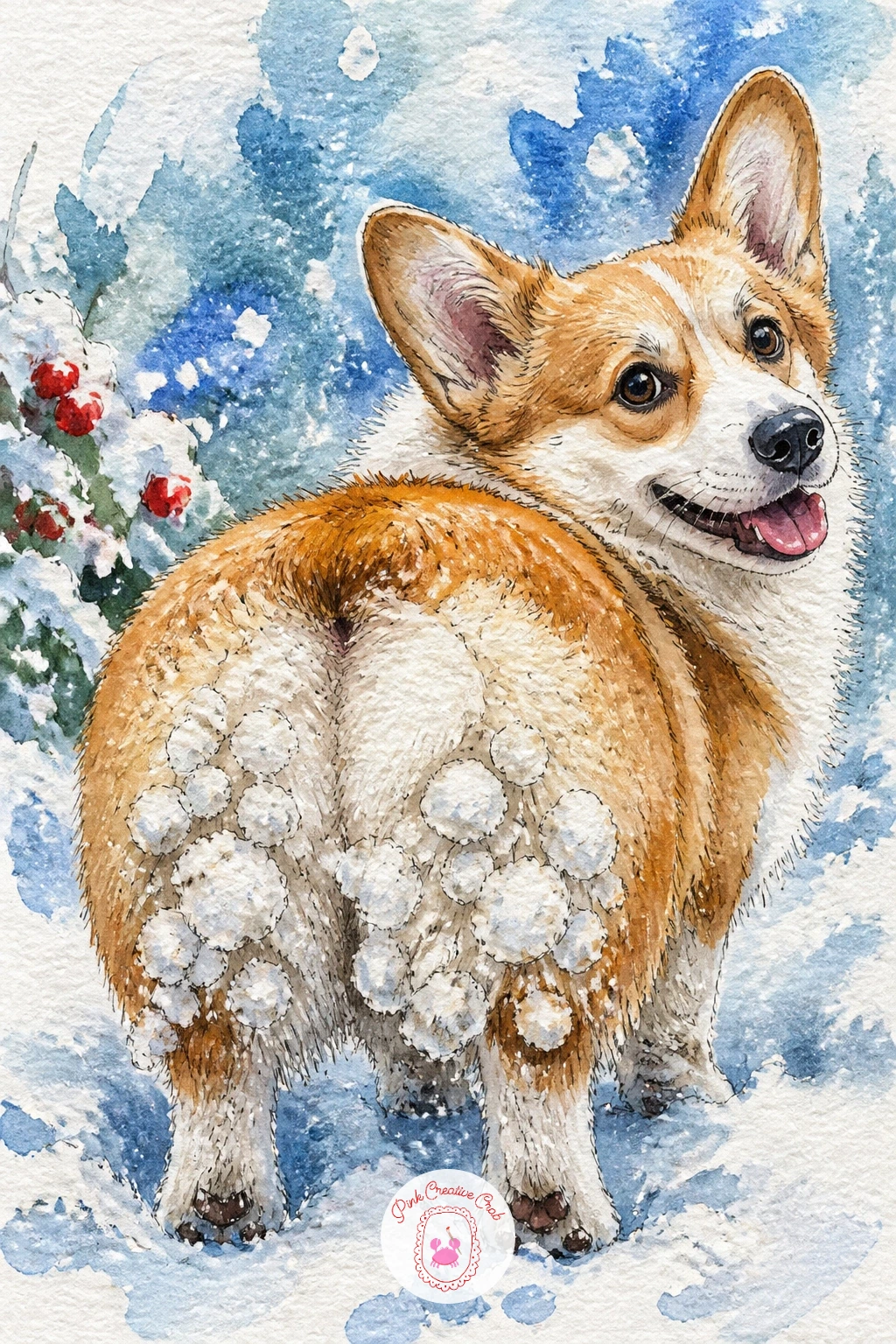
You Will Need
- white gouache or white gel pen for snow texture
Palette: Warm Tan,White,Chocolate Brown,Sage Green
Bring a person into the scene now with a girl walking a beagle along a snowy, tree lined street, a composition that works well as a vertical page with the trees framing both figures. Block in the two figures small against a tall background, keep the girl simplified to a coat shape, boots and a scarf, and let the beagle trot slightly ahead on its leash.
Underpaint the whole street in cool icy blue and grey first for the snow and sky, then add the beagle in warm tan and white, the girl’s coat in a contrasting cherry red, and the bare tree trunks in chocolate brown ink once everything else is dry. The eye level sits low here, at about the beagle’s height, which makes the trees loom taller and gives the street more depth.
A common slip is making the girl and dog the same size as the trees in the distance, keep the foreground pair noticeably larger than anything behind them to hold the perspective. For a related framing idea, the tree lined compositions in these winter painting ideas use the same low horizon trick.
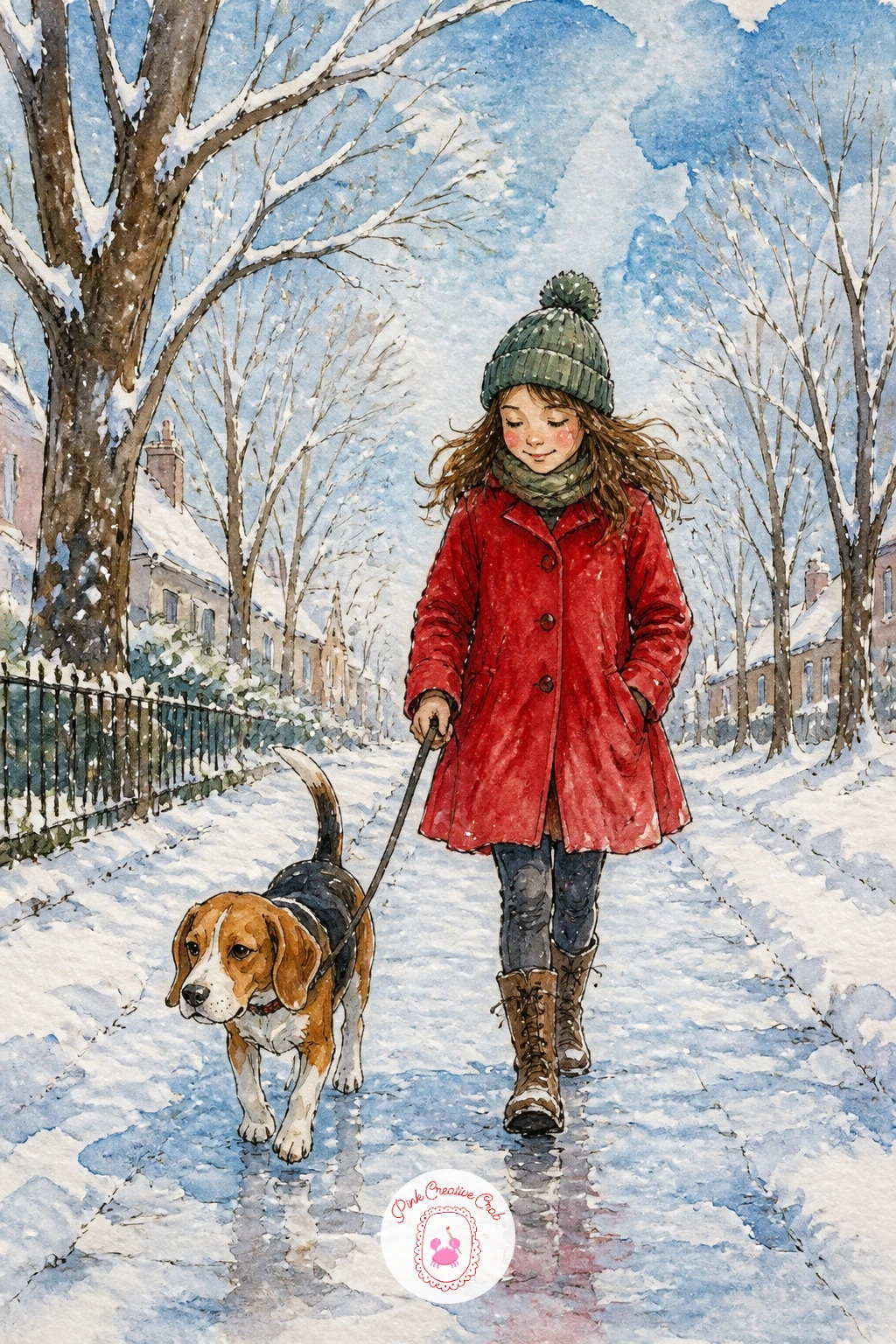
Palette: Icy Blue,Cherry Red,Chocolate Brown,Warm Tan
Switch to a husky thrown onto its back mid roll in fresh powder, legs up in the air and head tipped sideways, a pose that reads as pure joy if the angles stay loose. Sketch the body as a curved banana shape lying on its side with all four paws pointing up and slightly splayed.
Paint the husky’s grey and white coat with a dry brush technique: load the brush lightly, blot most of the water off on a paper towel, then drag it across the paper so the bristle marks leave streaky, broken texture that mimics thick fur far better than a flat wash. Keep the icy blue eyes as two small untouched dots of white paper with just a thin ink ring, which makes them glow against the grey.
Snow should spray outward from the rolling body in small flicked dots of white gouache or a flick of a dry toothbrush loaded with paint. If the pose looks flat, check that the legs are not all the same length on the page, foreshortening one back leg shorter than the others adds the roll’s twist.
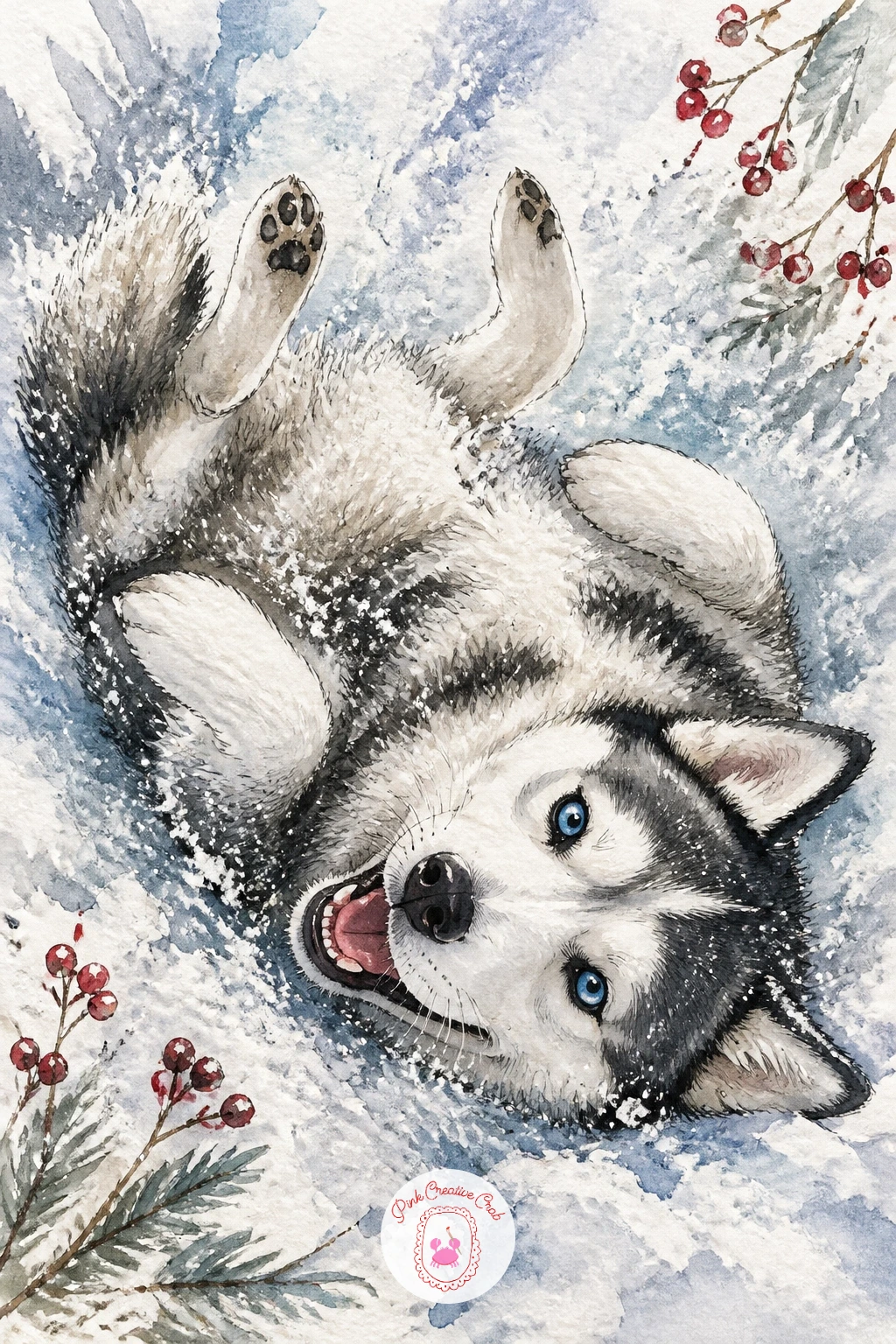
You Will Need
- toothbrush or white gouache for snow spray
Palette: Payne’s Grey,White,Icy Blue,Chocolate Brown
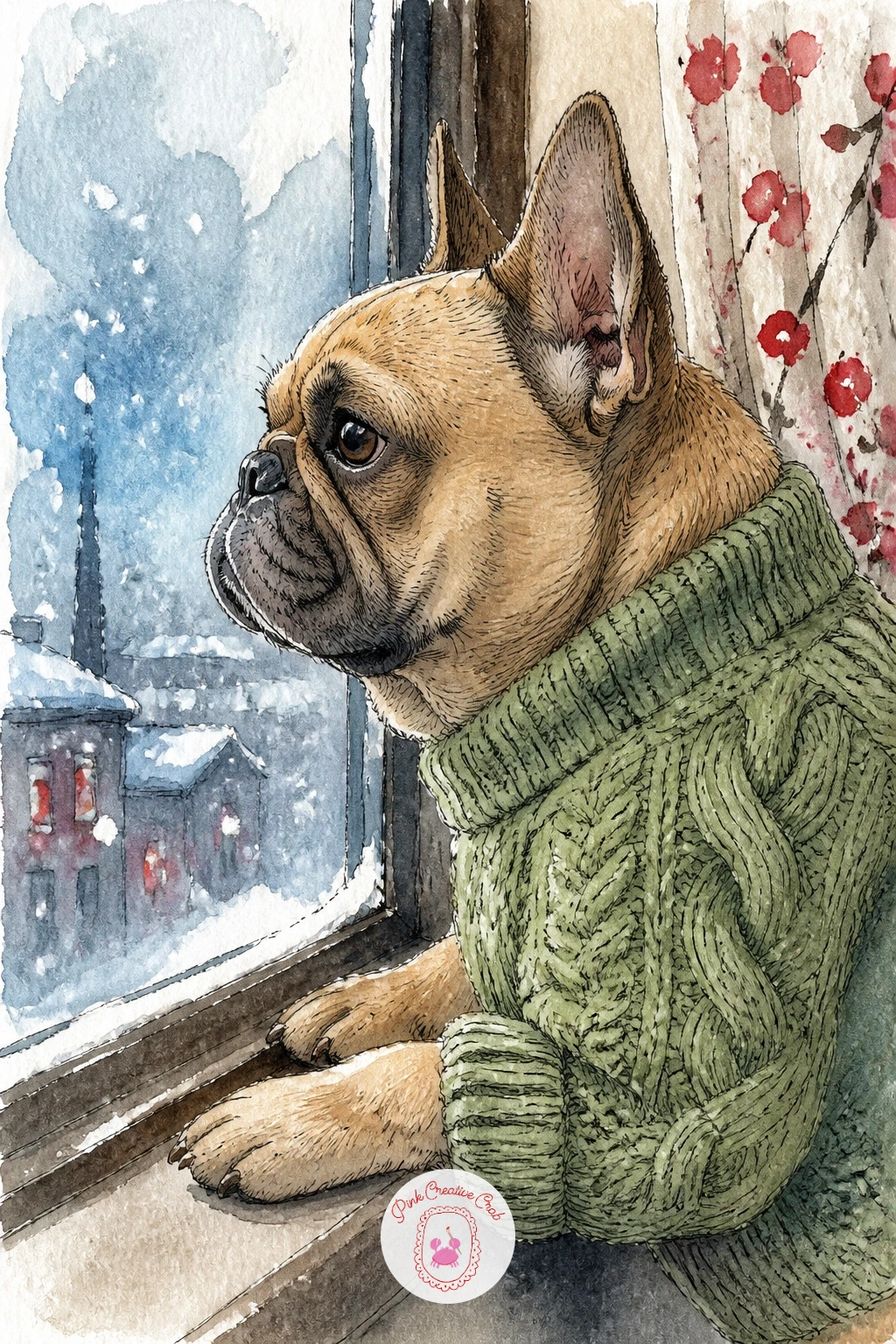
Quiet things down with a French bulldog sitting upright in a knit sweater, looking out at the snow through a window, a composition built almost entirely from circles: round head, round ears, round body under the sweater. Pencil the dog first, then add a simple window frame around it as a few straight ink lines, letting the glass stay as untouched white paper with just a soft blue wash in one corner.
Paint the sweater in sage green with a few short ink dashes for a cable knit texture, then the frenchie’s fawn coat and big bat ears, keeping the dark muzzle and eyes for last so they stay crisp and expressive. The easiest way to get the knit texture convincing is to paint the sweater as one flat colour first and only add the ribbing lines once it is bone dry, wet in wet ink will just bleed into a blur.
If you want a ten minute version, skip the window frame entirely and let the dog sit on plain white paper, the forty minute version adds falling snow dots outside the glass and a windowsill with a plant. No sage green on hand, moss or olive green reads the same.
Palette: Sage Green,Fawn,Chocolate Brown,Icy Blue
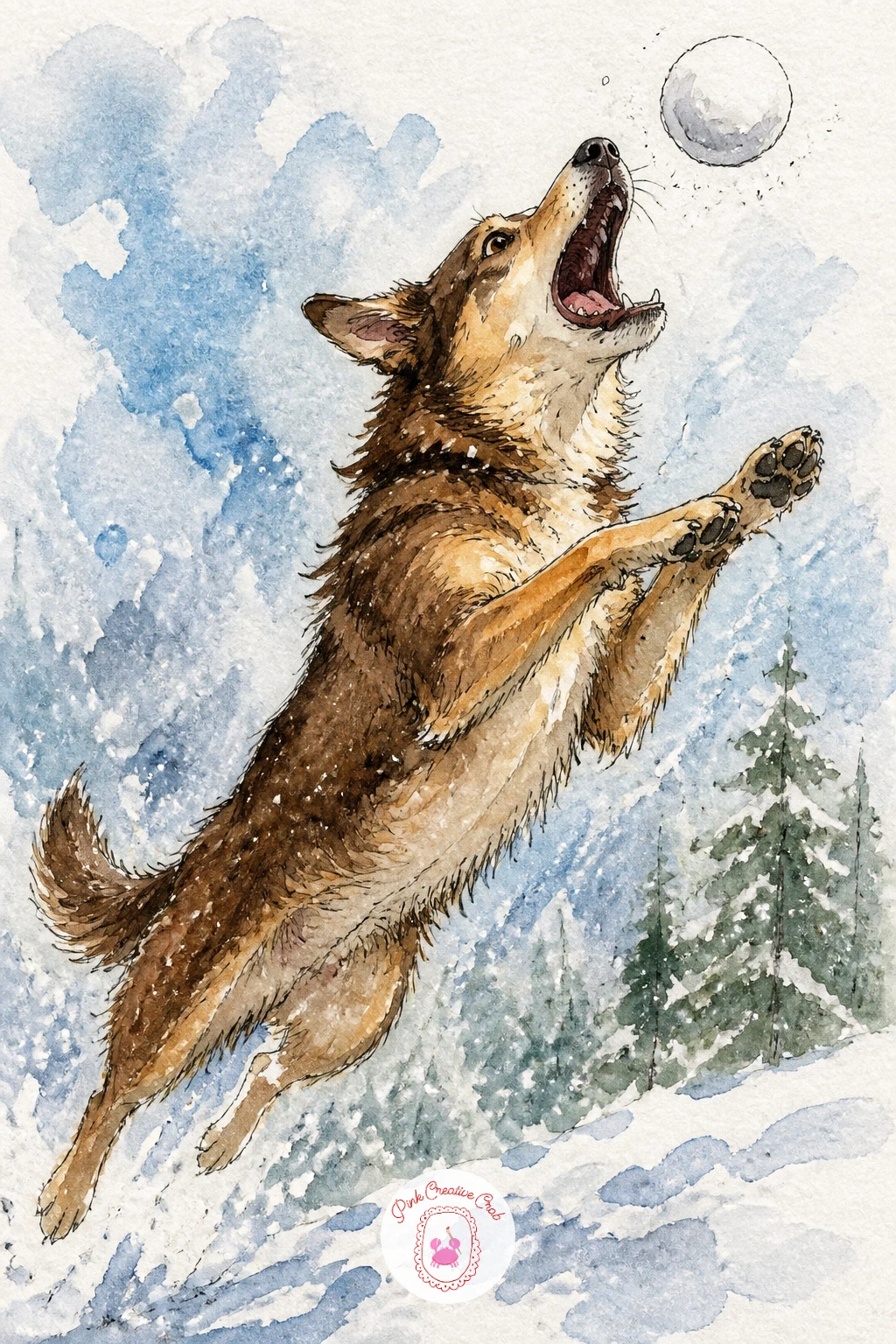
Jump into real action with a dog leaping to catch a snowball mid air, mouth wide open, front paws off the ground, which makes a lively centerpiece for any winter page. Sketch the body in a strong diagonal line from back paw to open jaw, this diagonal is what sells the leap, a dog drawn upright with a floating ball above its head just looks confused.
Paint the dog’s coat in whatever breed colours suit you, chocolate brown and tan work well, then leave the snowball itself as a perfect circle of untouched white paper with a thin grey ink outline and a tiny crescent shadow underneath. Ink the open mouth and visible teeth last in a few confident strokes, overworking this spot is the easiest way to lose the fun of the expression.
Keep the light source overhead and slightly behind the dog so the snowball throws a small shadow onto the open mouth, that one shadow does more to sell the catch than any extra detail on the dog itself. A swap for any missing white paint: simply leave the snowball as bare paper and add only the grey outline and shadow.
Palette: Chocolate Brown,Warm Tan,Payne’s Grey,White
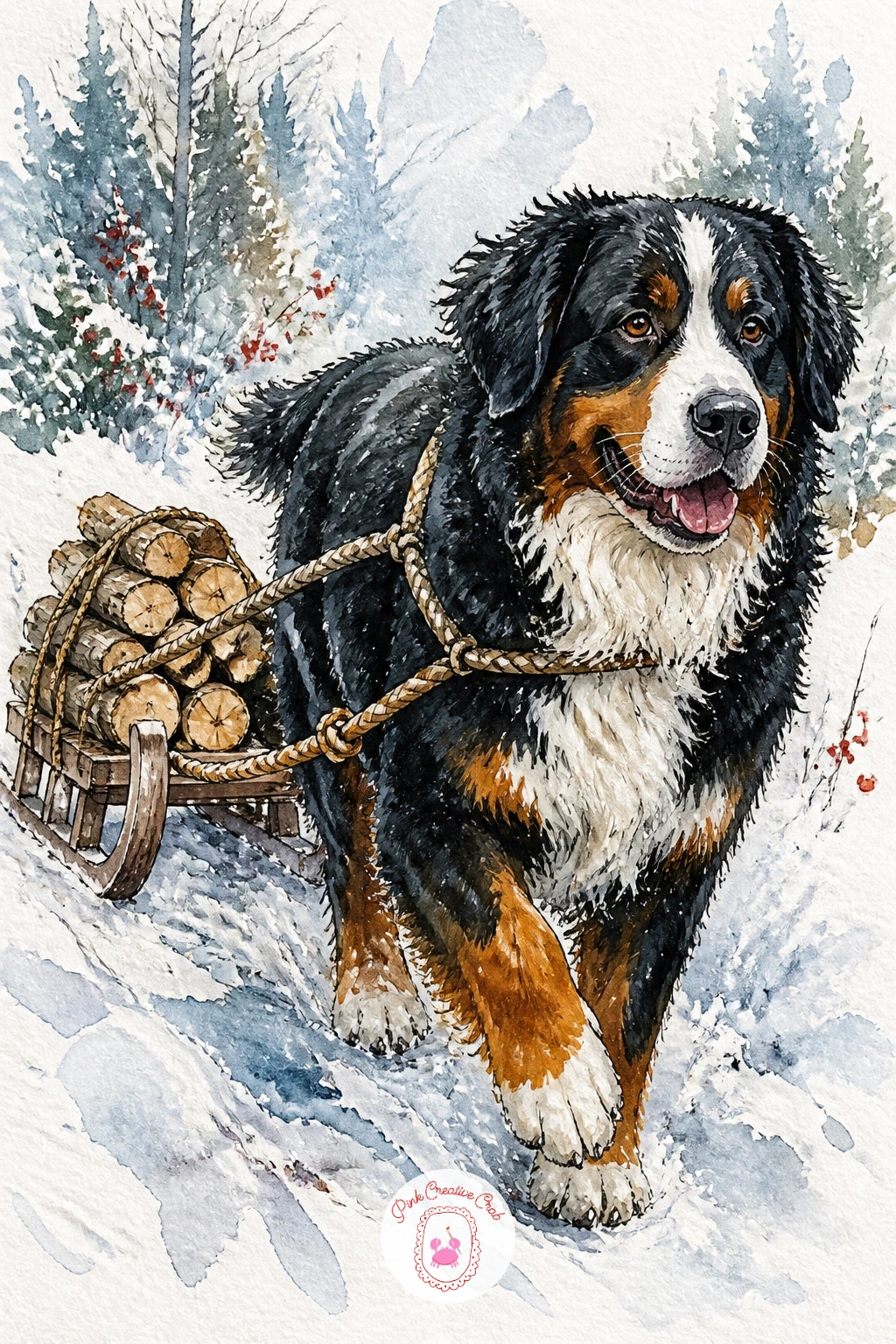
Give yourself a bigger, more satisfying subject with a Bernese mountain dog pulling a little wooden sled stacked with firewood, a scene that combines the dog, a harness, and a simple prop in one composition. Draw the dog large and solid in the foreground, legs mid stride, with the sled and its rope trailing behind at a smaller scale to establish the pulling motion.
Paint the tricolour coat in blocks, chocolate brown over most of the body, white for the chest blaze and paws, with rust tan accents above the eyes and on the legs, working dark to light so the white patches stay clean. The wooden sled and stacked logs go in next with dry brushed chocolate and sienna strokes, leaving thin white gaps between the logs so they read as separate pieces rather than one brown lump.
This is a good one to vary next time by swapping the firewood for a sled of wrapped gifts or a sleeping child, the same dog and harness pose carries any cargo. If the harness rope looks stiff, curve it slightly rather than drawing it dead straight, a little sag reads as real rope under tension.
Palette: Chocolate Brown,White,Rust Tan,Raw Sienna
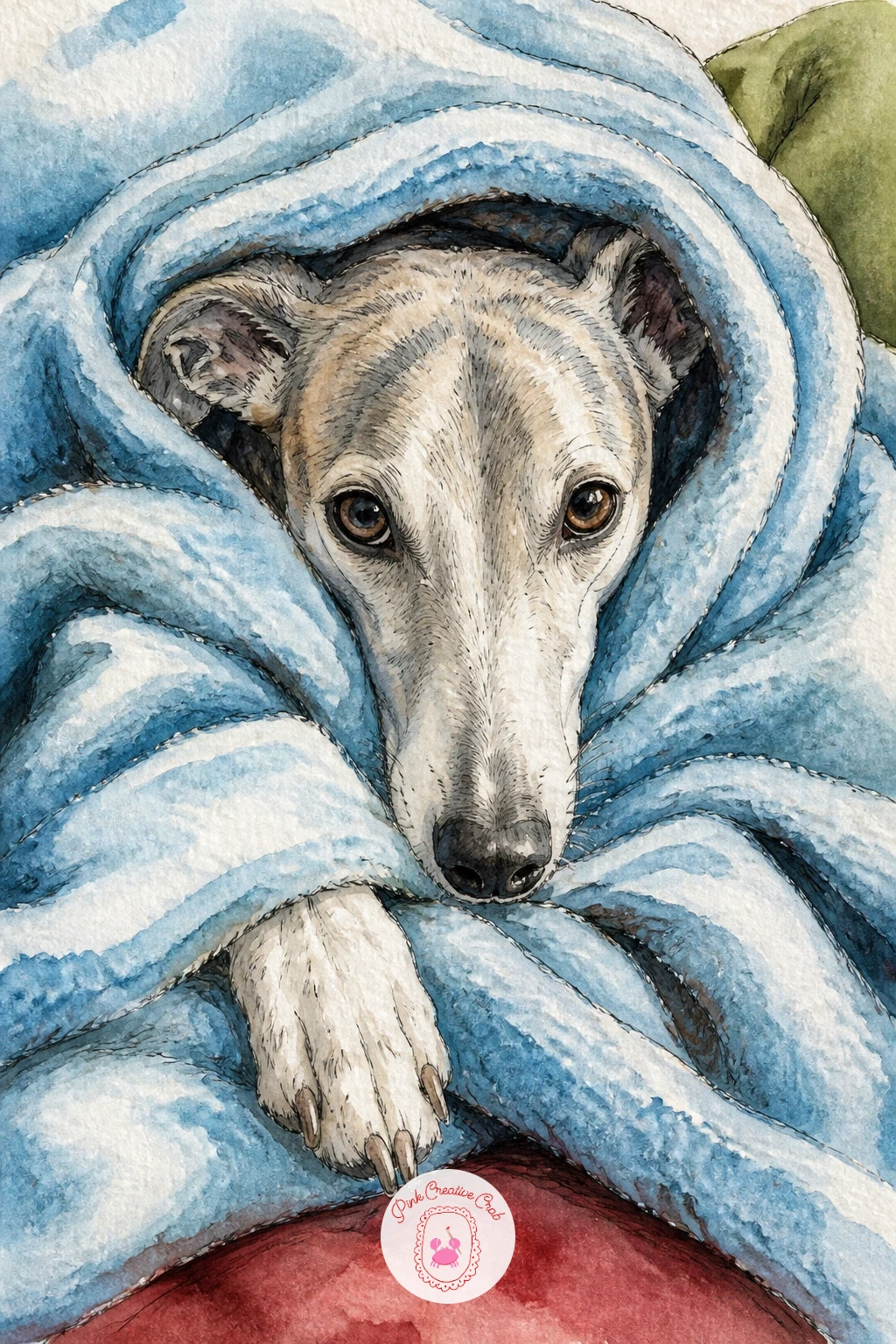
Come back indoors for a whippet wrapped nose to tail in a fleece blanket on the sofa, only the narrow face and one paw poking out, a cosy subject built mostly from soft folds of fabric. Sketch the blanket as a loose, rounded bundle first, then tuck the whippet’s small triangular head into one side and a single paw emerging near the bottom.
Paint the blanket in icy blue with soft chocolate brown shadows pooling in the folds, working wet into wet so the shadow edges blur rather than sit as hard lines, then add the whippet’s fawn or grey face once the blanket is dry so the two elements stay distinct. The fine bone structure of a whippet’s face reads best with a kneaded eraser lifting a few soft highlights off the brow and cheek after the first wash, rather than trying to paint the highlights in directly.
If the blanket looks flat, add two or three deeper ink creases radiating from where the body curls, that is usually all it needs. No fleece blue available: a warm oatmeal or grey blanket works just as well and lets the chocolate brown shadows read even more clearly.
You Will Need
- kneaded eraser
Palette: Icy Blue,Chocolate Brown,Fawn,Payne’s Grey
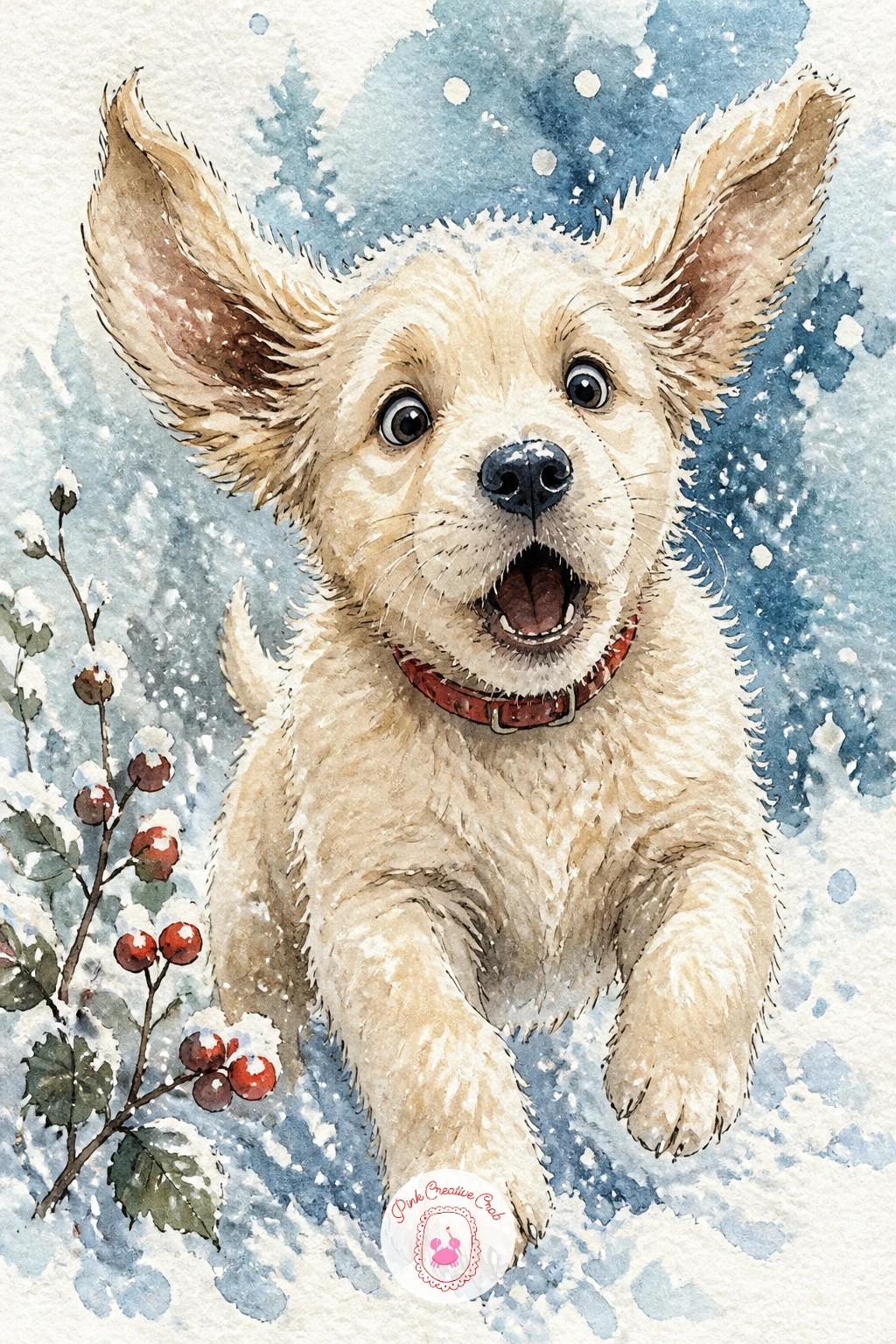
Capture something more expressive with a puppy seeing snow for the first time, ears flying up and out, body frozen mid bounce in surprise. Keep the puppy proportions soft and rounded, a big head on a small body reads as young far more than any detail does, and push the ears out at an exaggerated angle to sell the startled joy.
Paint the puppy’s coat in whatever soft colour suits, cream or pale tan works well against snow, then use loose dabbed brushstrokes rather than smooth gradients so the fur looks fluffy and new. Snowflakes falling around the puppy go in last as tiny flicked dots of white gouache or simply left as untouched circles of paper surrounded by a faint blue wash.
Eye level matters here: drop it down to the puppy’s own height rather than looking down on it from above, which makes the viewer feel like they are seeing the snow through the puppy’s eyes too. If gouache is not to hand, a white gel pen flicked lightly over the dry painting gives a similar scatter of snowflakes.
You Will Need
- white gouache or white gel pen
Palette: Cream,Warm Tan,Icy Blue,White
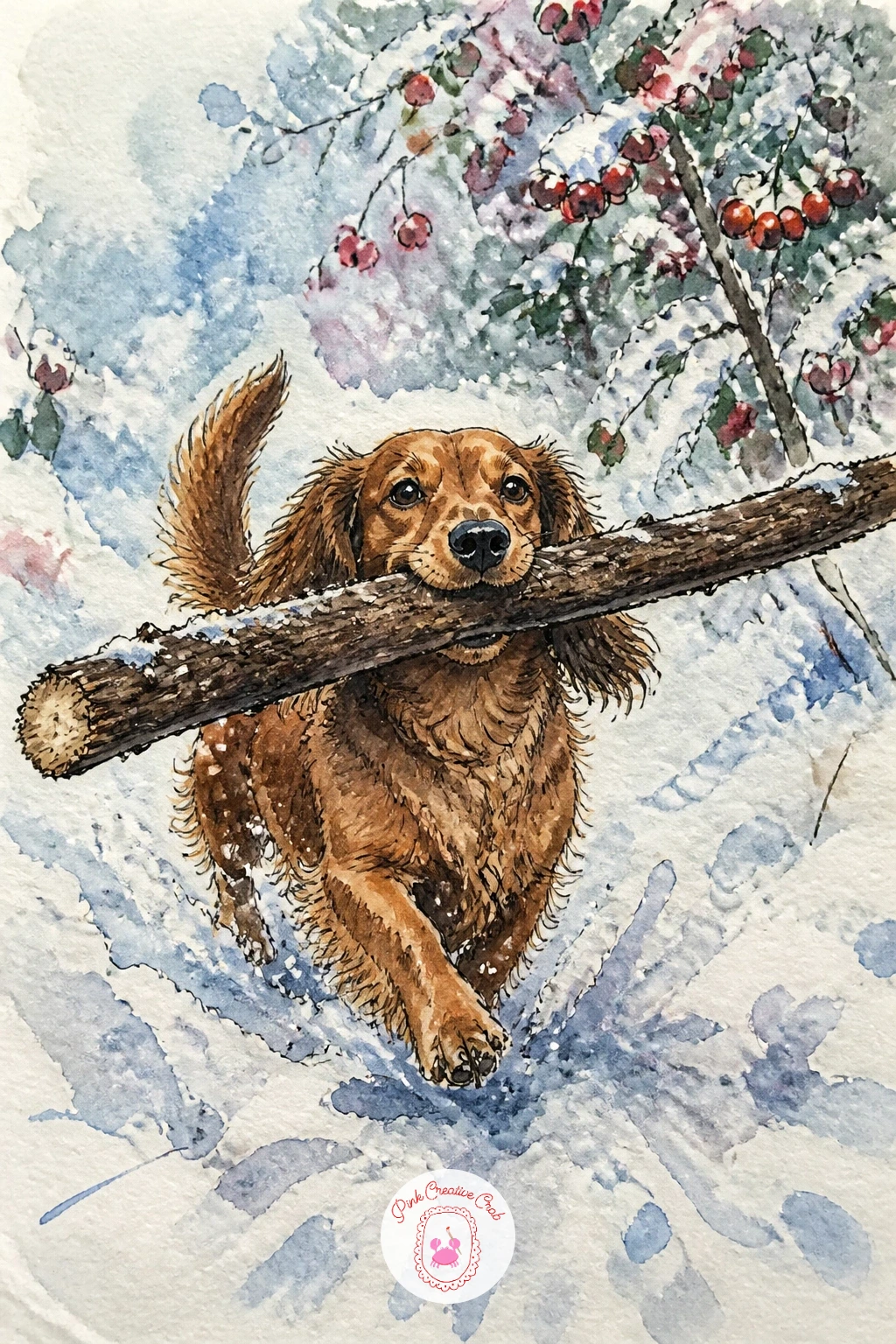
Add some comedy with a dog carrying a stick far too big for it through the snow, the stick stretching well beyond the dog’s body on both sides, which makes the whole page funnier the longer the stick gets. Draw the dog trotting proudly with head held high and the stick balanced crosswise in its mouth, exaggerating the stick’s length against the dog’s head as roughly four or five head widths.
Paint the dog’s coat in confident warm browns, then render the stick in dry, textured strokes of sienna and grey so the bark reads as rough and twiggy rather than smooth, a couple of small side branches help sell the scale. The snow trail behind the trotting paws can be suggested with a few quick dry brush strokes fading toward the background.
Measuring the stick against the head width before inking is the proportion trick that makes this joke land, too short and it just looks like a normal stick. If you want the quick version, skip the snow trail and background entirely and let the dog and stick sit on plain white paper, that alone carries the whole idea.
Palette: Warm Tan,Raw Sienna,Payne’s Grey,White
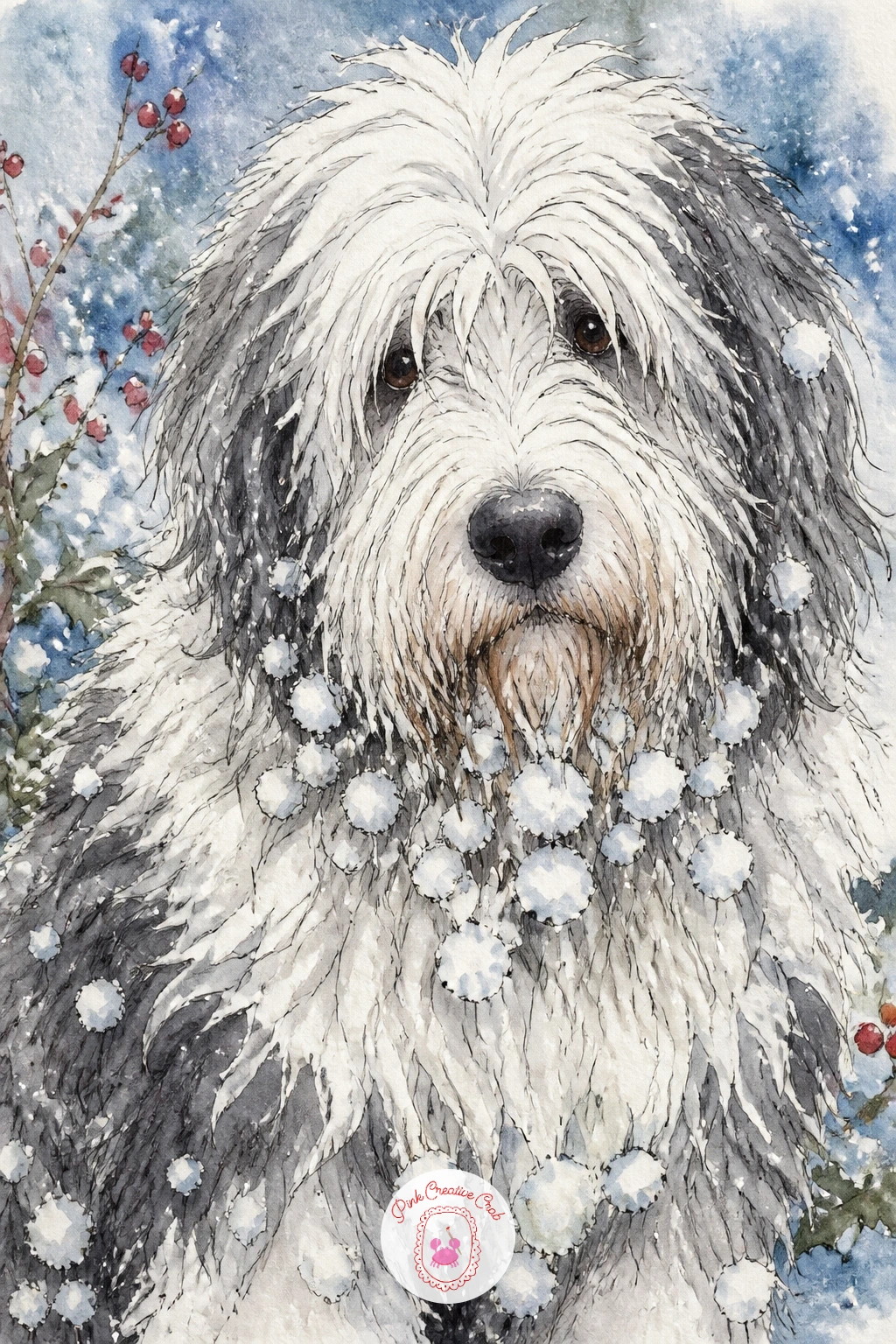
Take on more texture now with a sheepdog whose long shaggy coat has collected dozens of little snowballs after a romp outside. Build the body as one big soft cloud shape rather than trying to draw individual locks of fur, then break the outline edge with short, overlapping ink strokes that suggest shagginess without counting every hair.
Paint the coat in overlapping patches of grey and white, letting the colours bleed into each other wet into wet for that soft sheepdog texture, then once fully dry add the snowballs as small rounded dabs of thick white gouache sitting right on top of the paint, scattered unevenly rather than in a tidy row. The mistake to avoid is making every snowball the same size, vary them from tiny flecks to a couple of larger clumps near the legs and tail.
For a quick ten minute version, paint the shaggy body and leave out the snowballs altogether, letting the texture of the fur carry the picture. The forty minute version adds the full scatter of snowballs plus a faint blue shadow underneath the dog to ground it on the snow.
You Will Need
- white gouache for snowballs
Palette: Payne’s Grey,White,Icy Blue,Chocolate Brown
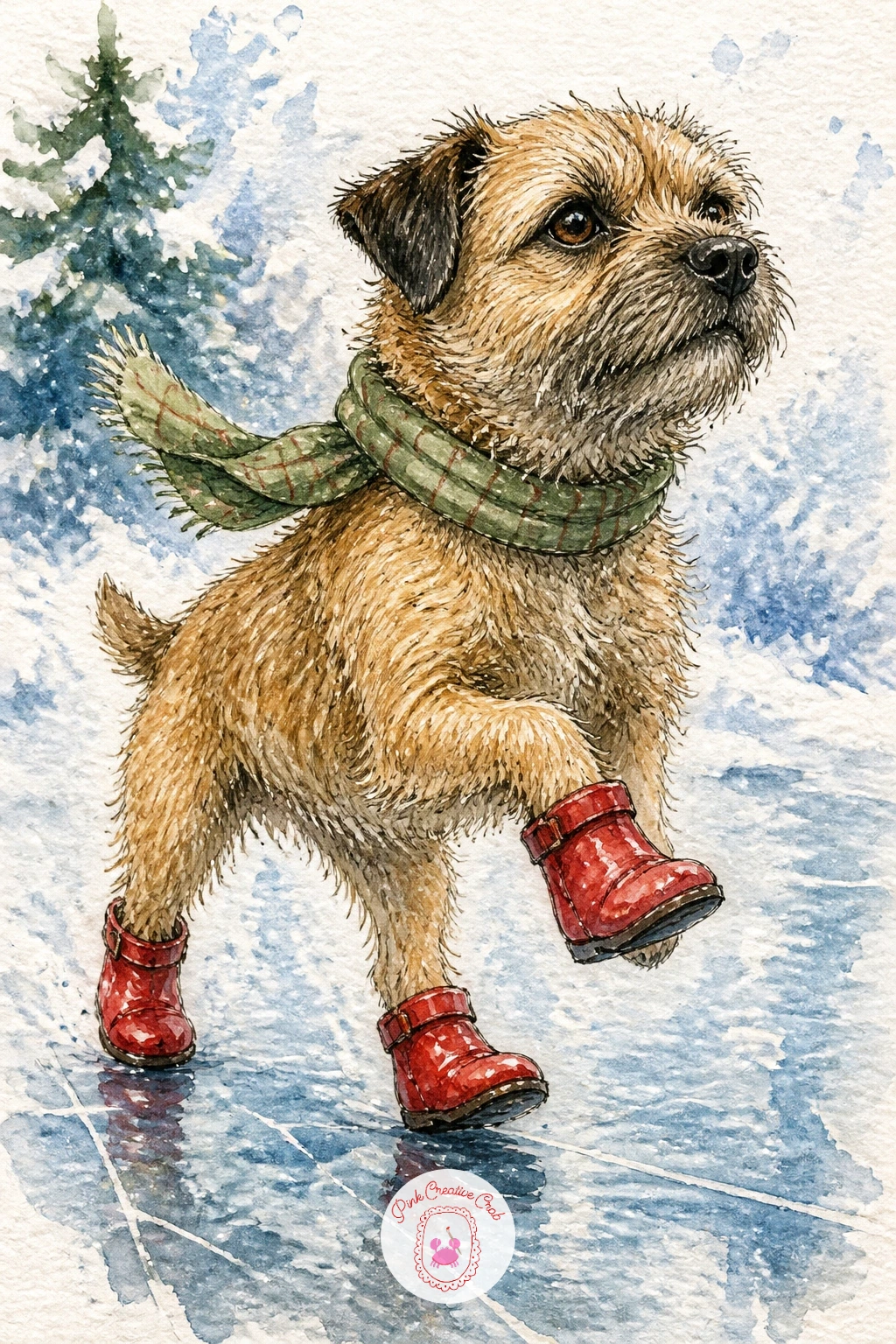
Have some fun with a small terrier wearing tiny boots, high stepping awkwardly across an icy path, a pose built around four exaggerated, lifted legs rather than a normal walking stride. Sketch each leg bent sharply at the knee and lifted higher than a natural step, which is what reads as comic uncertainty on ice rather than a confident walk.
Paint the terrier’s wiry coat in warm brown and cream with short, scratchy ink marks for texture, then add the little boots in cherry red or sage green, keeping them simple rounded shapes with a thin cuff line at the top. The icy path itself should stay mostly white paper with a few long, smooth ink lines suggesting the slick surface, crosshatching here would kill the shine of ice.
If the high stepping pose looks stiff, check that no two legs are at the same angle, each one should bend a little differently to suggest the wobble. A swap for the boots: paint them in chocolate brown instead if cherry red feels like too much against a busy coat.
Palette: Warm Tan,Cherry Red,Chocolate Brown,Icy Blue
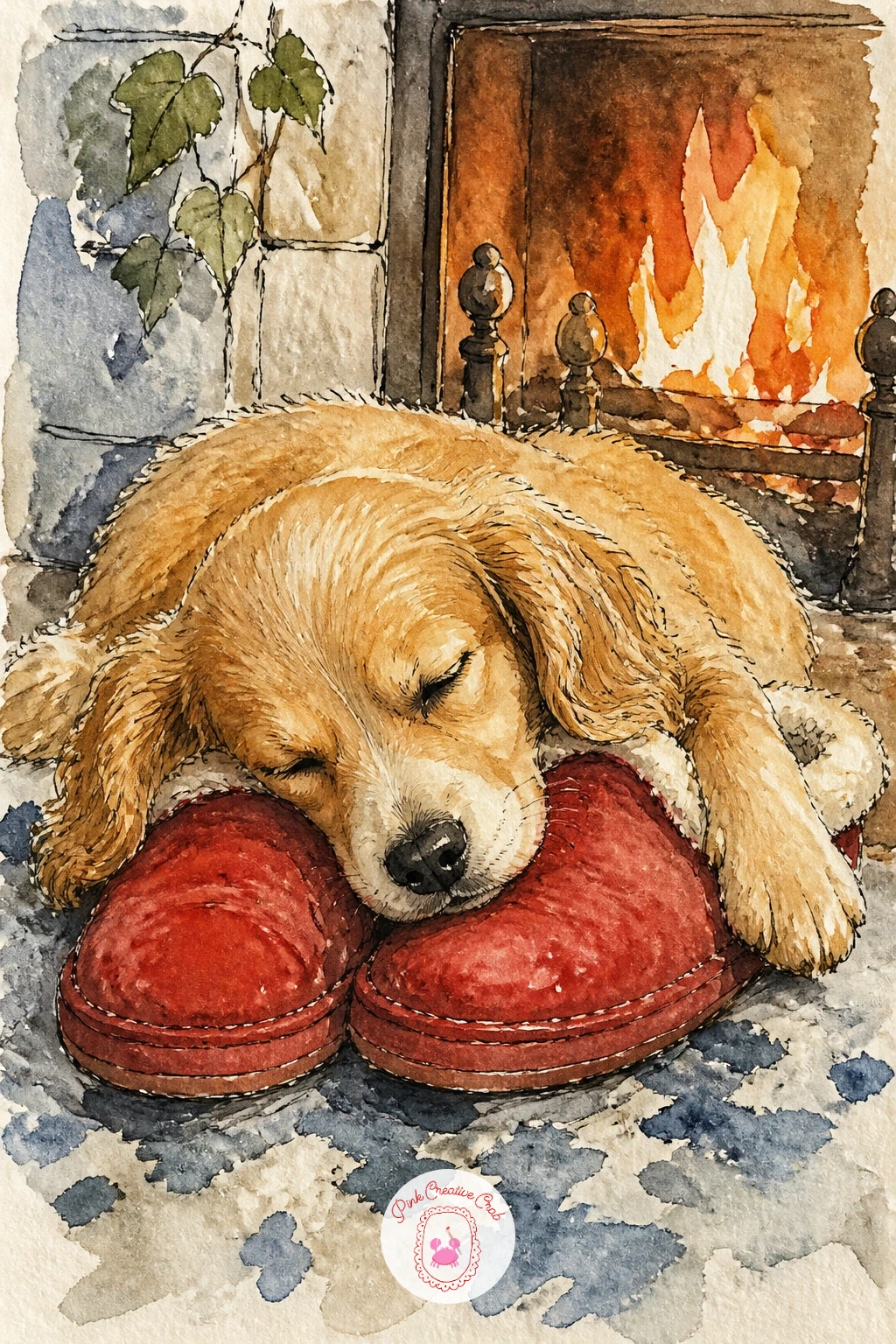
Settle into a quieter mood with a dog sprawled asleep across a pair of slippers by the fire, one of the simplest compositions on this list because the dog’s body can be one relaxed, melted looking shape draped over the small rectangular slippers beneath it. Sketch the slippers first as two simple curved shapes, then lay the sleeping dog’s body across and around them so a paw and an ear dangle slightly off each side.
Paint the slippers in a deep chocolate brown or cherry red, letting the colour sit solid and flat since they are a small, secondary shape, then bring the dog’s coat in on top in whatever colour you like, softening the edge where fur meets slipper with a damp brush so the two blend slightly rather than sitting as two separate flat shapes. Firelight glow in the background can stay loose and soft, just a warm wash with no hard edges.
The easiest way to ruin this one is drawing the slippers too large, keep them roughly a third the size of the dog’s body so they read as small household objects rather than another animal. If cherry red slippers feel too bold, a soft mustard or sage works just as well against most coat colours.
Palette: Chocolate Brown,Cherry Red,Warm Tan,Golden Ochre
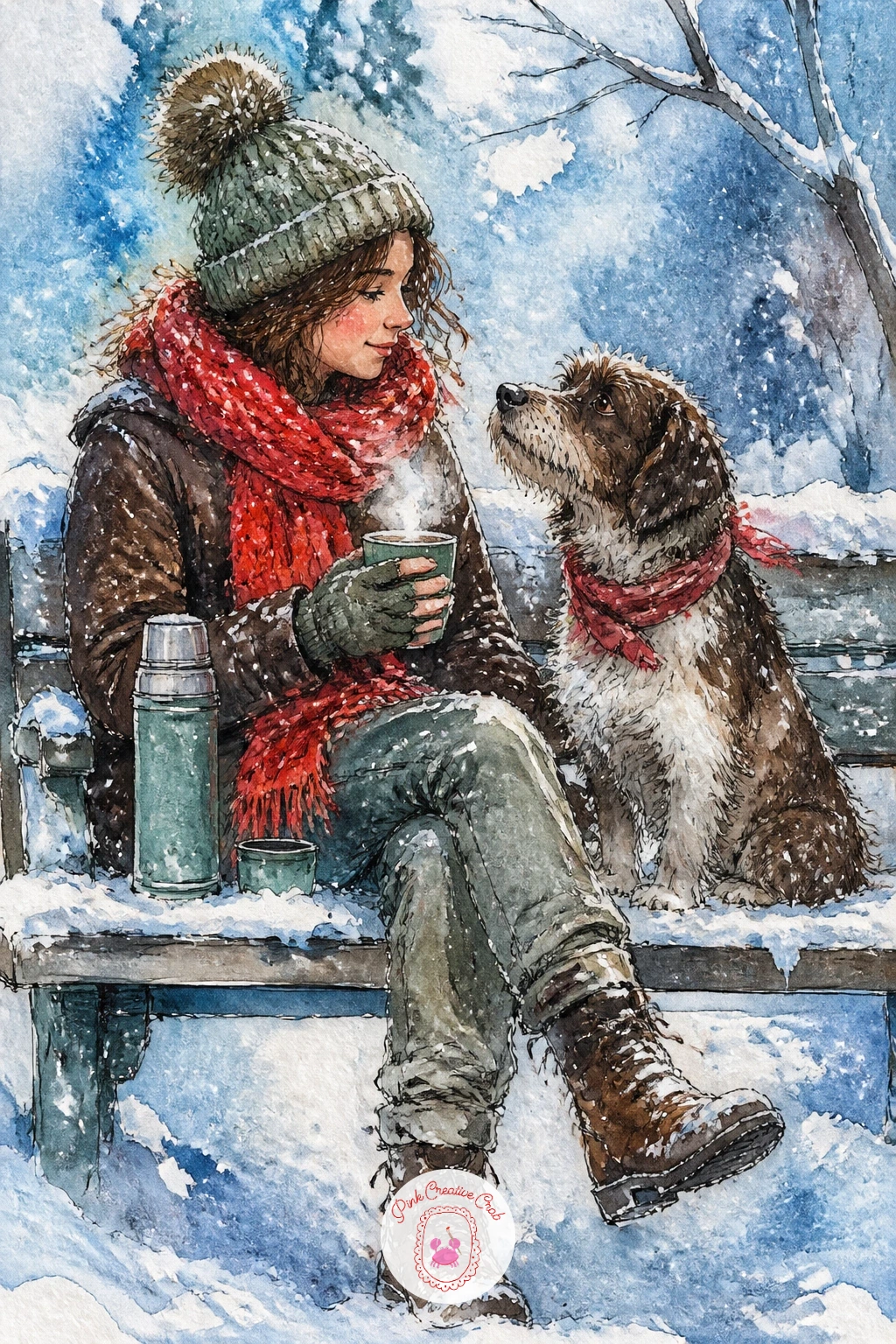
Bring the dog and its owner together again with a shared thermos break on a snowy bench, a small two figure scene that works well as a wider page. Place the person sitting with a simple coat shape and the dog sitting close beside them, both facing slightly outward so the thermos between them becomes the natural focal point.
Underpaint the bench and snow in cool icy blue and grey first, then bring in the warmer accents last: a cherry red scarf on the person, chocolate brown on the dog’s coat, and a small steam curl rising off the thermos cup painted in the thinnest possible wash of grey. The eye level sits roughly level with the seated figures here, which keeps the scene intimate rather than looking down on them from above.
Steam is easy to overdo, two or three soft curling lines read as warm rising air, a thick cloud just looks like smoke. If you enjoy pairing people with their pets like this, the seated figures in this fashion watercolor roundup use a similarly simplified coat and scarf approach.
Palette: Icy Blue,Cherry Red,Chocolate Brown,Payne’s Grey
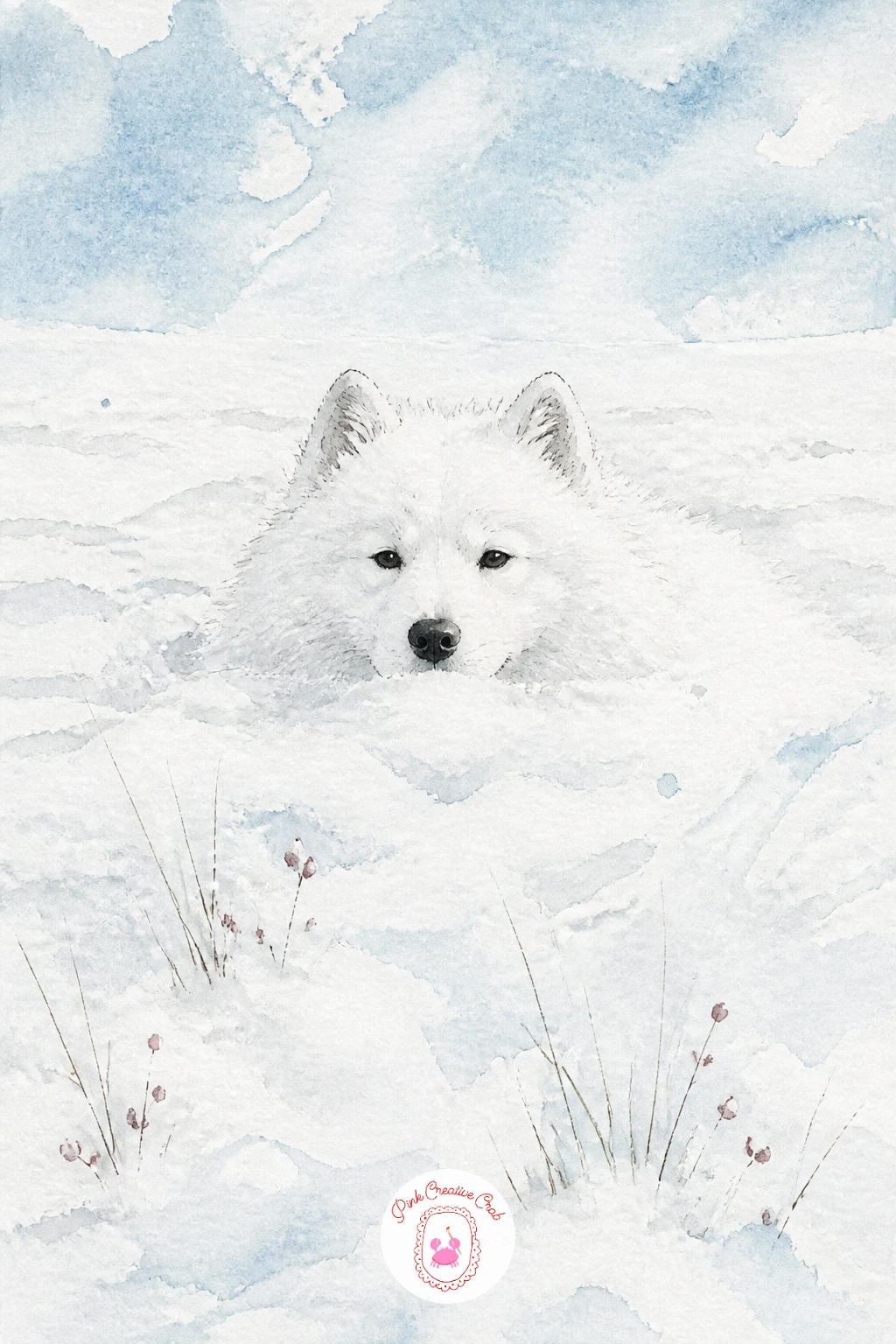
Try something quieter and more atmospheric with a Samoyed almost disappearing into a wide snowy field, where the challenge is suggesting a white dog against white snow using almost no hard edges at all. Sketch the dog small within a large empty page, its outline defined mostly by a thin ink line and a few grey shadow shapes rather than any white paint.
Paint the field first as one broad, pale icy blue wash covering most of the page, then lift small areas with a clean damp brush where the dog’s body sits to leave slightly cleaner white, and use soft grey shadow washes under the belly and legs to carry the dog’s form without outlining the whole thing. The dark eyes, nose and the curled black lips are the only strong ink marks needed, and they do most of the work of reading the shape as a dog at all.
This is a good one to revisit later at a larger scale or with the dog placed far off in the distance as a tiny mark, since the same lifting and shadow technique scales up or down easily. If lifting paint feels tricky, simply leave the dog’s shape as untouched white paper from the start and paint the field around it instead.
Palette: Icy Blue,Payne’s Grey,White,Chocolate Brown
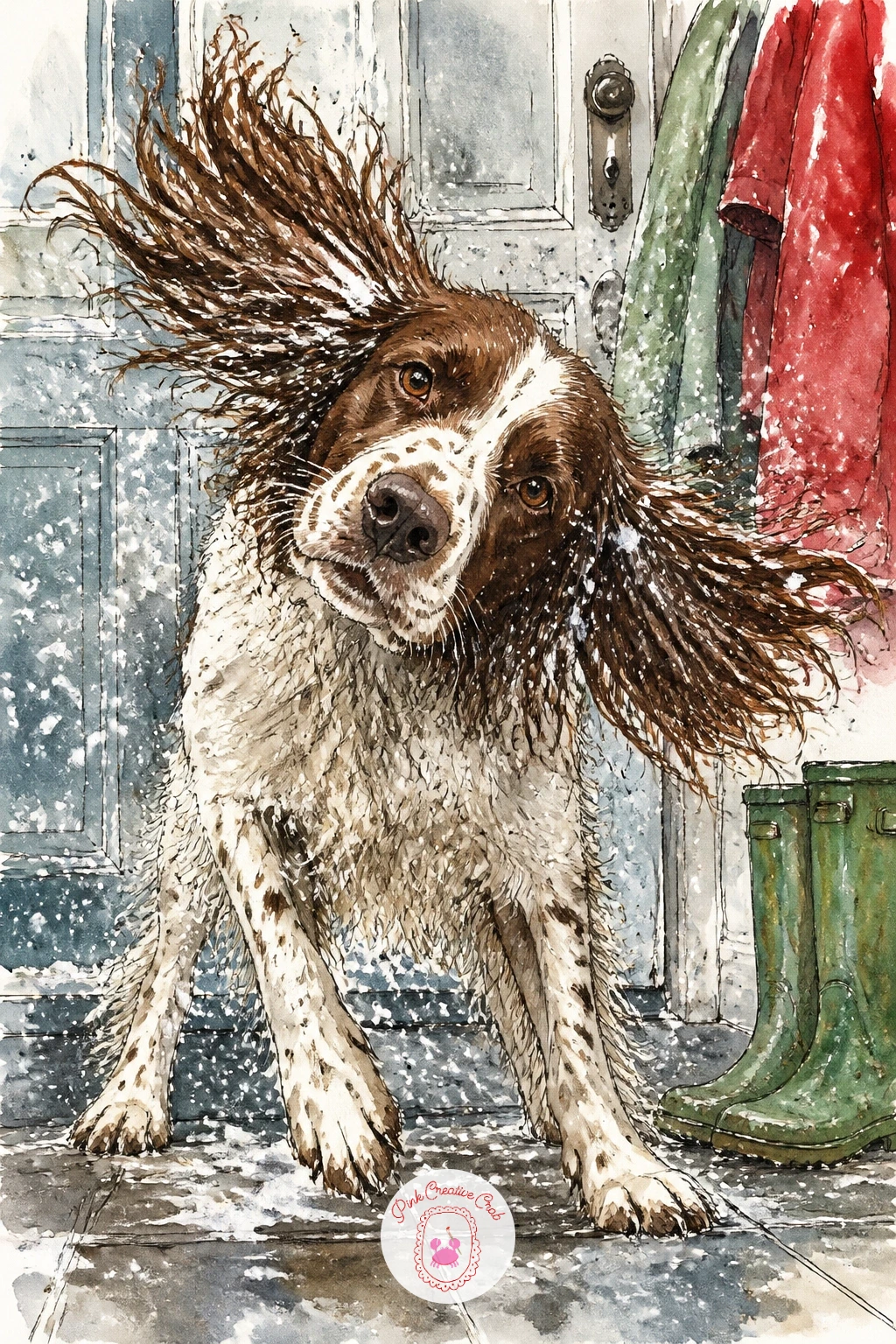
Move the action into a farmhouse mudroom with a spaniel shaking off snow, caught mid shake with ears and fur flung outward in a blur. Sketch the body with a slight twist through the spine, as if frozen mid motion, and let the ears fly out to each side at an exaggerated angle rather than hanging naturally.
Paint the spaniel’s wavy coat in warm liver brown and white, then flick a loaded brush toward the paper edges around the dog to throw small drops of icy blue tinted water, which reads as flying water and melting snow once dry. The mudroom background can stay simple, a wooden bench or row of boot shapes in chocolate brown ink keeps the setting readable without competing with the dog.
Freezing a shake mid motion is mostly about the ears, they should point in different directions rather than mirror each other, which is what breaks the stillness. No spray technique at hand, a dry brush dragged quickly outward from the body gives a similar sense of flung droplets.
You Will Need
- old toothbrush for water flicks (optional)
Palette: Chocolate Brown,White,Icy Blue,Rust Tan
Capture quiet anticipation with a dog sitting by the door holding its own leash in its mouth, patiently waiting for a walk. Keep the pose simple and upright, weight settled back on the haunches, head slightly tilted, with the leash looping down from the mouth in a soft curve rather than a straight stiff line.
Paint the dog in whatever coat colour suits, then bring in the door behind it as a few confident ink lines, a coat hook and a hanging scarf or mitten add a lived in feel without much extra work. The leash itself is worth taking slowly, a light pencil guide for the curve before inking keeps it looping naturally instead of looking tangled.
If the dog looks too alert rather than patient, soften the ears down and half close the eyes slightly, a fully perked, wide eyed dog reads as excited rather than waiting. This pairs nicely with a front hallway scene from this dog themed junk journal collection if you want a matching page for a journal spread.
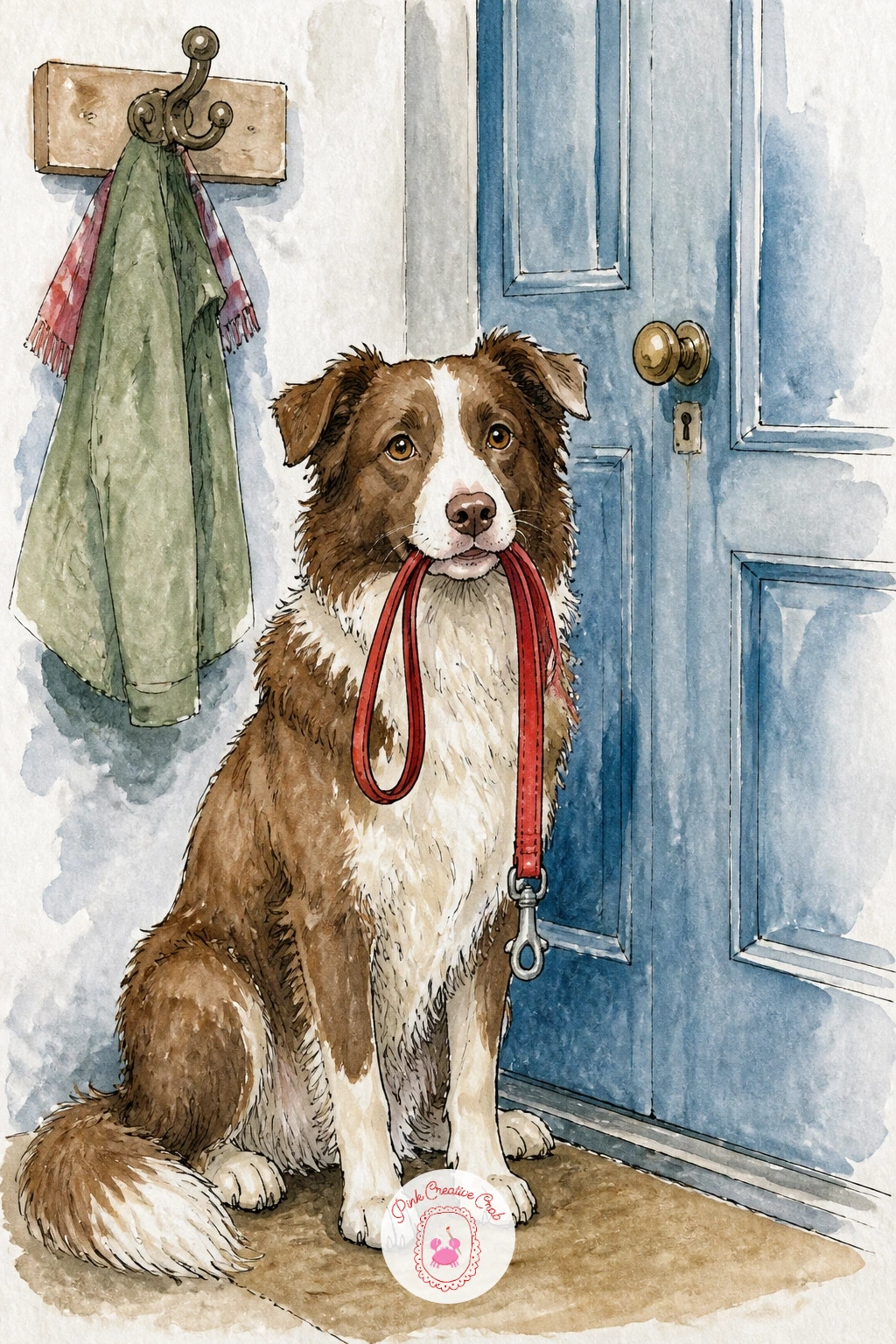
Palette: Chocolate Brown,Warm Tan,Cherry Red,Sage Green
Give a poodle a little scene of its own, sitting upright in a cable knit jumper at a small winter cafe table, perhaps beside a cup that is clearly too big for it to drink from. Build the poodle’s body from soft rounded clumps rather than one smooth outline, since the curly texture is really a cluster of small circles layered over the basic body shape.
Paint the base coat in cream or apricot first, then once dry use the tip of a small round brush to dab in individual darker curls across the surface, which reads far better as poodle fur than any smooth gradient would. The jumper goes on in sage green with a few short ink dashes for the cable pattern, and the little cafe table and cup can stay as simple flat shapes in chocolate brown and white so they do not compete with the textured coat.
Dabbing curls takes patience, so if you are short on time, suggest only the curls along the outline edge and leave the body’s center as a flatter wash, the eye fills in the rest. No small round brush available, the rounded tip of a cotton swab dipped lightly in paint gives a similar dabbed texture.
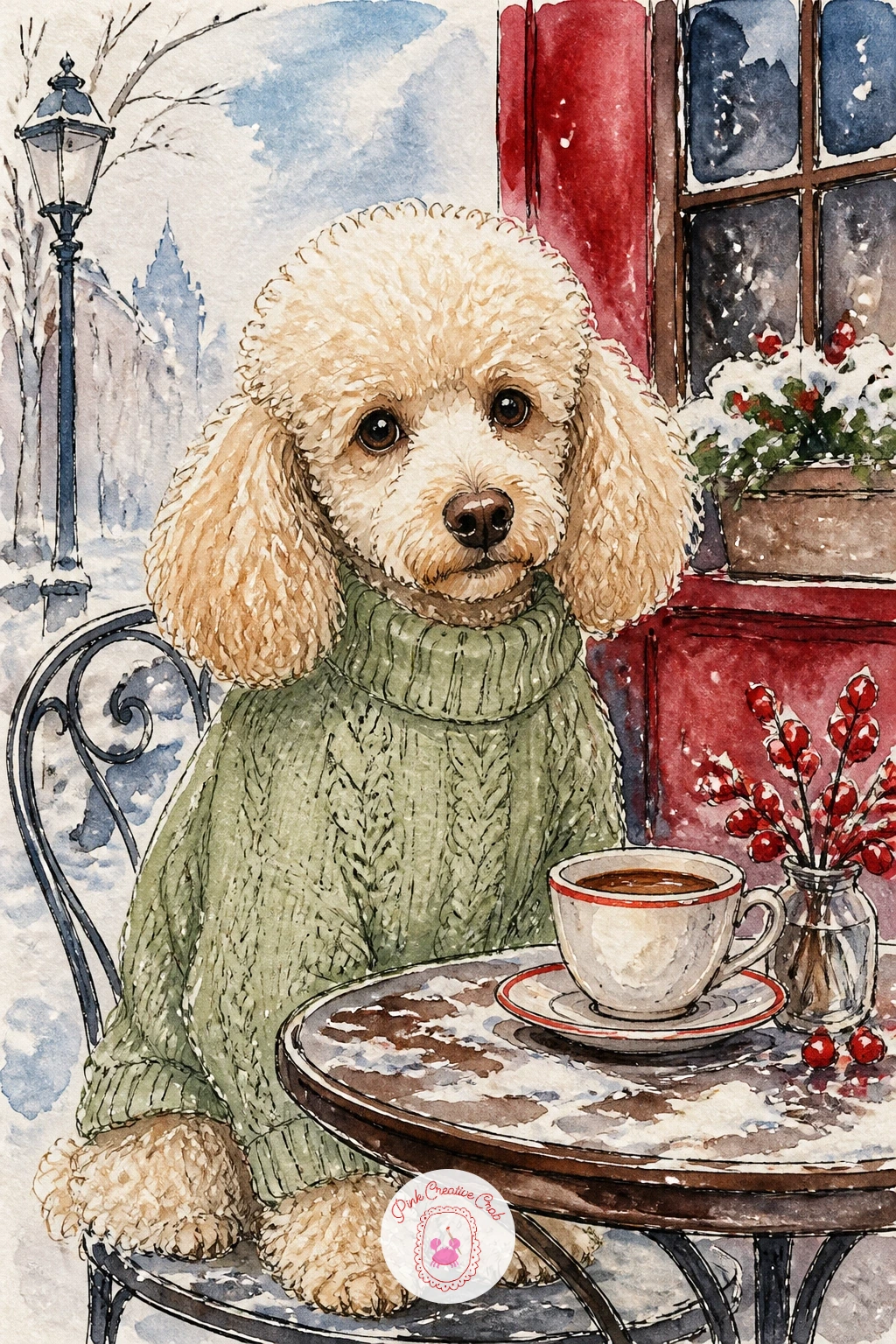
Palette: Cream,Sage Green,Chocolate Brown,Golden Ochre
Try a more unusual angle with a dog nose deep in a snowdrift, sniffing for something buried, only the back half of the body and tail visible above the snow line. This pose is really just a back end and two hind legs, which makes it a quick, satisfying subject once you commit to cropping the front half out of the picture entirely.
Paint the visible hindquarters and tail in confident, fairly dark tones so they stand out clearly against the snow, then build the snowdrift itself as a tall mound of mostly untouched white paper with soft icy blue shadow curving around its base and sides. The tail is the most expressive part of this composition, curl it upward with energy to suggest excited digging rather than letting it hang flat.
Where this idea goes wrong is a snowdrift that looks flat rather than solid, so add one firm shadow line along one side of the mound to give it some roundness before you call it finished. Any solid coloured dog breed works here since so little of the body actually shows.
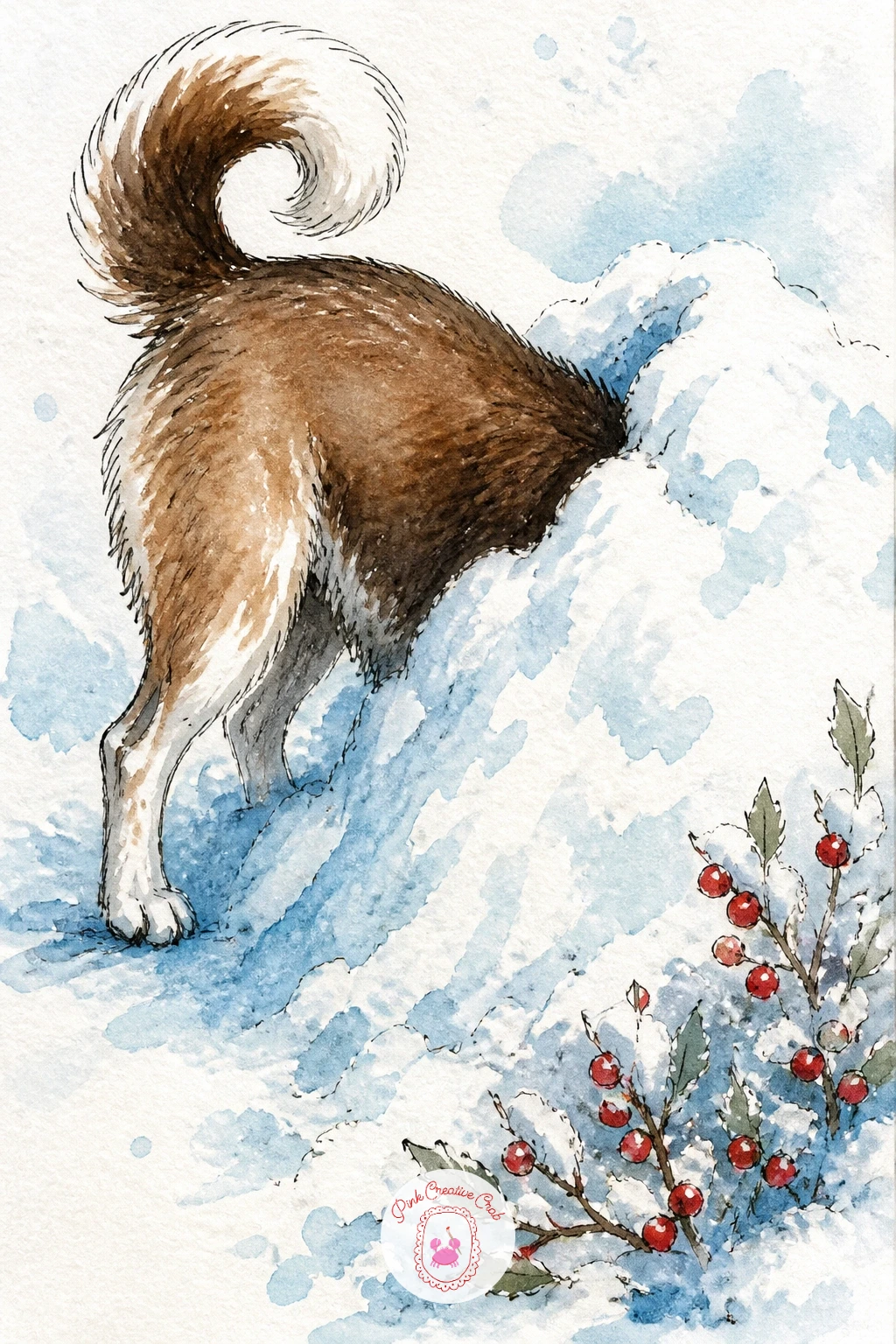
Palette: Chocolate Brown,Icy Blue,White,Payne’s Grey
Return to a cosy indoor mood with a dog watching the snow from under a blanket on a window seat, just the head and maybe one paw poking out above the fabric. Sketch the blanket as a soft rounded mound first, then tuck the dog’s head in at one end, tilted slightly toward the window to suggest it is watching the weather outside.
Paint the blanket in a warm plaid of cherry red and chocolate brown checks, kept loose rather than ruled out with a straight edge, then bring in the dog’s face once that layer is dry so the features stay crisp against the softer fabric folds. The window behind can stay simple, a pale icy blue wash with a few white gaps left for falling snow outside the glass.
If the plaid pattern feels intimidating, simplify it to just a few overlapping stripes rather than a full grid, a suggestion of plaid reads just as well as the real thing at this scale. A dog’s expression here should lean toward relaxed and half lidded rather than alert, which keeps the whole mood cosy.
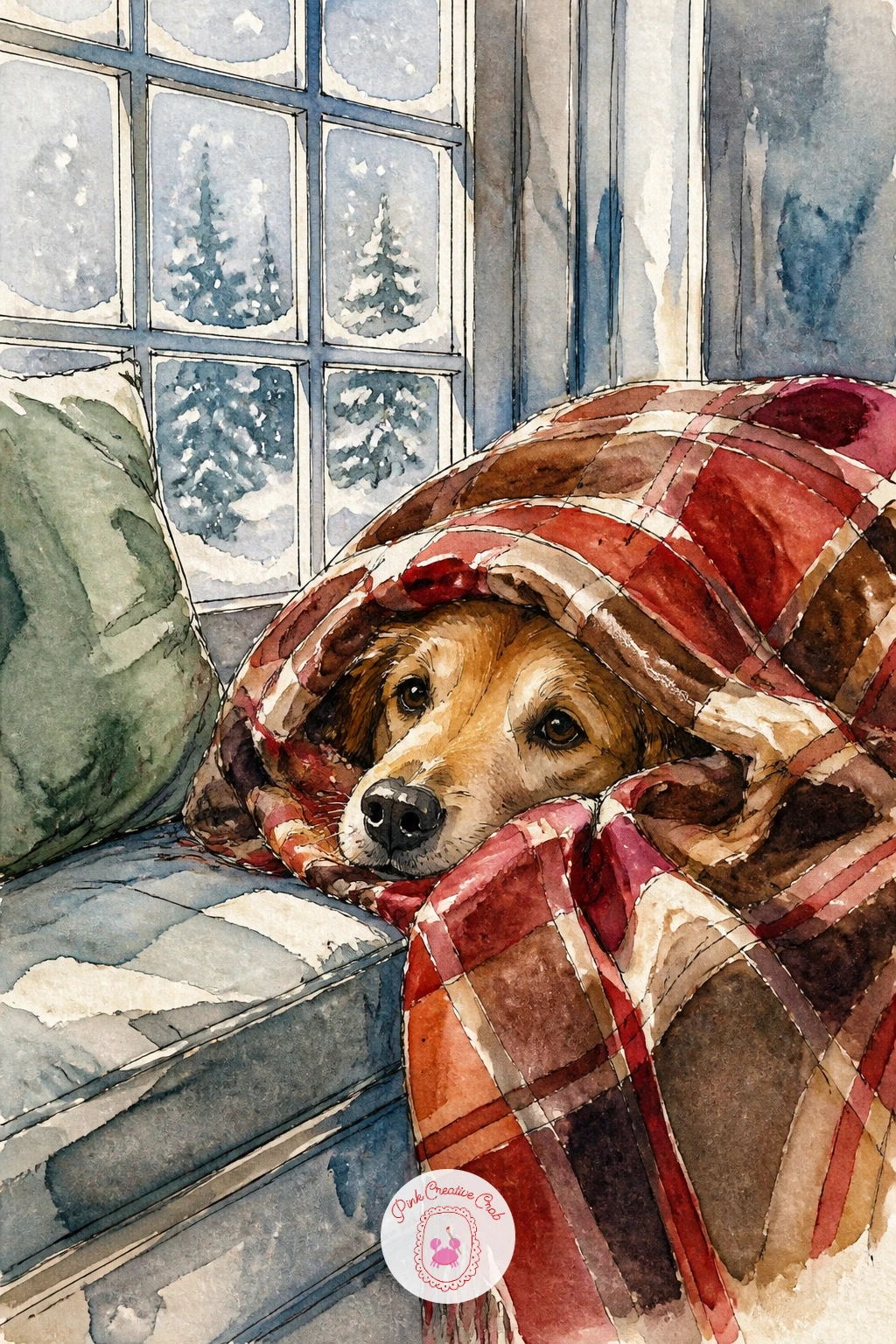
Palette: Cherry Red,Chocolate Brown,Icy Blue,Warm Tan
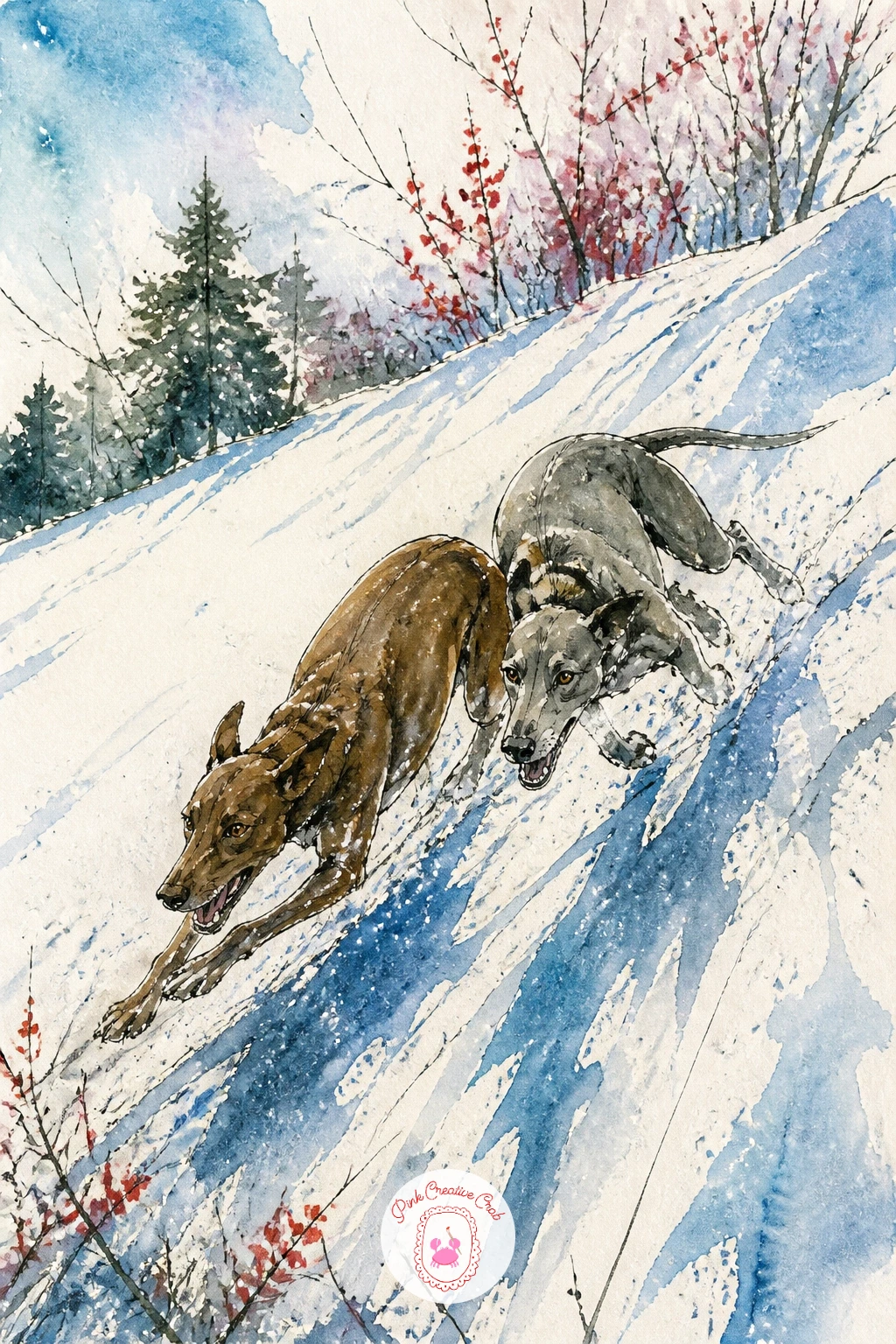
Add real energy with two dogs racing each other down a snowy hill, bodies stretched low and fast, legs a blur of motion. Sketch both dogs at slightly different points along the slope so one leads the other, which immediately reads as a race rather than two dogs simply running side by side.
Paint each dog in a different coat colour so they stay easy to tell apart at a glance, one in warm brown tones and the other in grey or black, working each one wet into wet for soft fur edges before any ink goes down. The hill itself can be suggested with just a single curving line separating white snow from pale sky, with both dogs’ shadows stretching downhill to reinforce the slope’s angle.
Keeping the hill’s single curving line consistent in angle for both shadows is the trick that sells the slope, mismatched shadow angles flatten the whole scene. For the quick version, paint just the two dogs and their shadows and skip any background detail at all, the race itself carries the picture.
Palette: Chocolate Brown,Payne’s Grey,White,Icy Blue
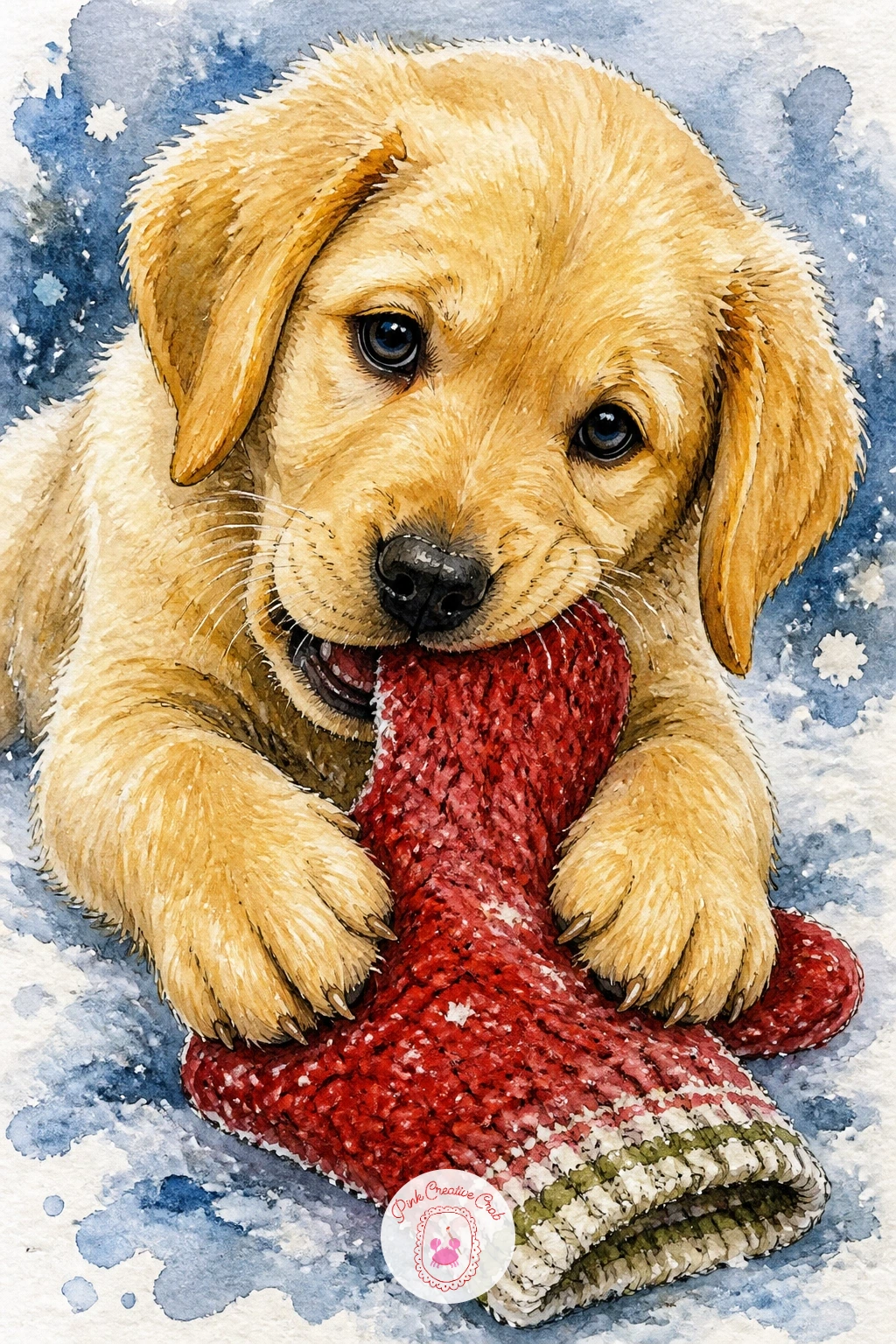
Return to puppy mischief with a Labrador puppy caught mid chew on a stray wool mitten, paws planted on top of it while the jaws clamp down. Keep the puppy’s proportions soft and round as before, oversized paws and a slightly too big head, with the mitten gripped at an angle rather than lying neatly flat under the chin.
Paint the puppy’s coat in warm golden tan with soft wet into wet shading around the ears and chest, then bring in the mitten in cherry red or sage green once the puppy layer is dry, adding a few loose threads pulled free at the chewed edge to sell the destruction. The mitten’s knit texture only needs a handful of short ink dashes rather than a full ribbed pattern, since it is a small secondary object in the scene.
If the puppy looks too adult, check the leg to body ratio, puppy legs and paws should look slightly oversized for the body, that mismatch is what reads as young. No red mitten in the palette, any single bright accent colour pulled from elsewhere on the page keeps the scene cohesive.
Palette: Golden Ochre,Cherry Red,Chocolate Brown,Warm Tan
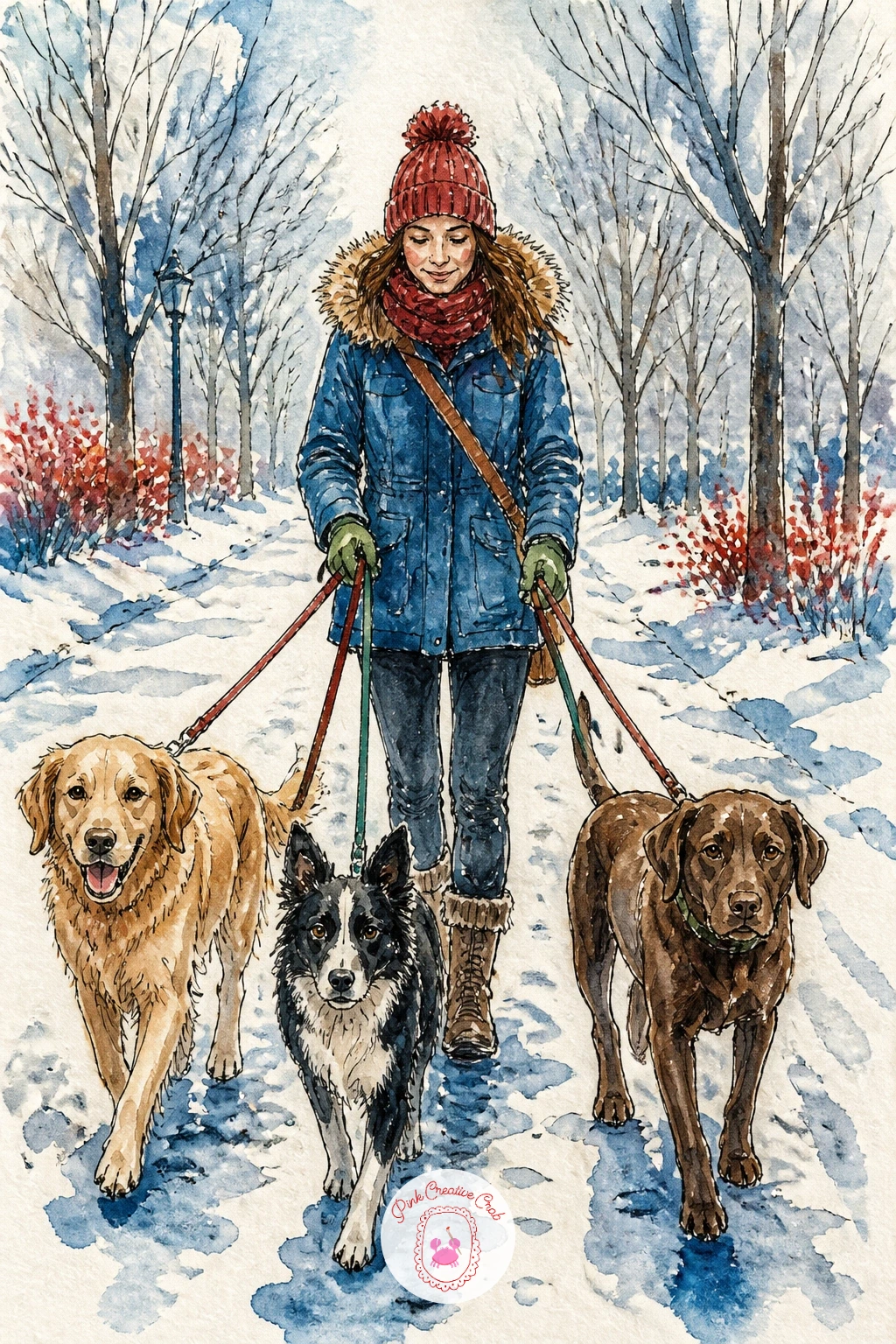
Take on a busier composition with a dog walker holding three leashes on a snowy park path, each dog a different breed and size to keep the group visually varied. Sketch the person centered and upright, then arrange the three dogs at staggered distances and heights around them, varying their poses so none of the three repeats the same stance.
Paint the walker’s coat in one strong colour, cherry red or chocolate brown, to anchor the composition, then work through each dog in turn with its own coat colour, keeping the leashes as a few confident curved ink lines connecting hand to collar. The park path recedes into the background with simple bare trees in chocolate brown fading to a paler wash toward the top of the page for distance.
Three figures plus a person is a lot to hold together, so keep the background minimal, just path, trees and sky, and let the group of bodies be the only busy part of the page. If three dogs feels like too much at once, start with two and leave space to add a third once the composition feels balanced.
Palette: Cherry Red,Chocolate Brown,Payne’s Grey,Warm Tan
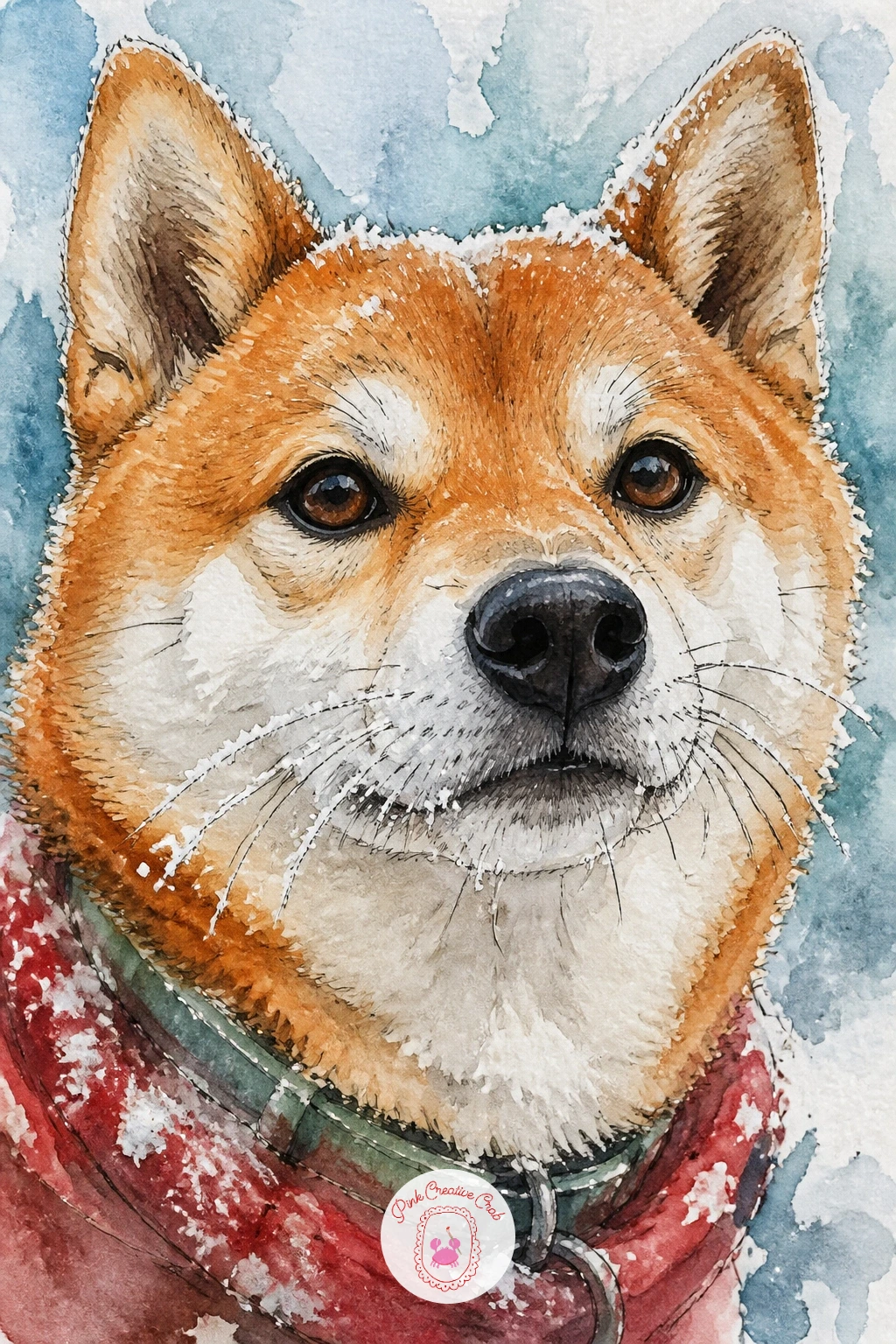
Zoom in close with a Shiba Inu portrait on a winter walk, frost clinging to its whiskers and the fur around its muzzle, a good subject for practicing fine detail work without drawing a whole scene. Sketch the head and alert, upright ears large within the frame, keeping the famous Shiba expression in the slight upward curl at the corners of the mouth.
Paint the coat in warm orange red with white underfur around the cheeks and chest, then once completely dry switch to a fine brush or white gel pen to add tiny individual frost marks along the whiskers and muzzle fur, working slowly rather than in one sweep. These frost details are the one hands on trick that makes this portrait, keep them sparse and scattered rather than covering the whole face, too many and they read as a dusting of flour instead of frost.
A close crop like this benefits from leaving the background almost entirely empty, just a pale icy blue wash behind the head keeps all the attention on the frosted detail. No gel pen on hand, a very fine brush loaded with thinned white gouache gives the same crisp little marks.
You Will Need
- white gel pen or fine brush with white gouache
Palette: Rust Orange,White,Icy Blue,Chocolate Brown
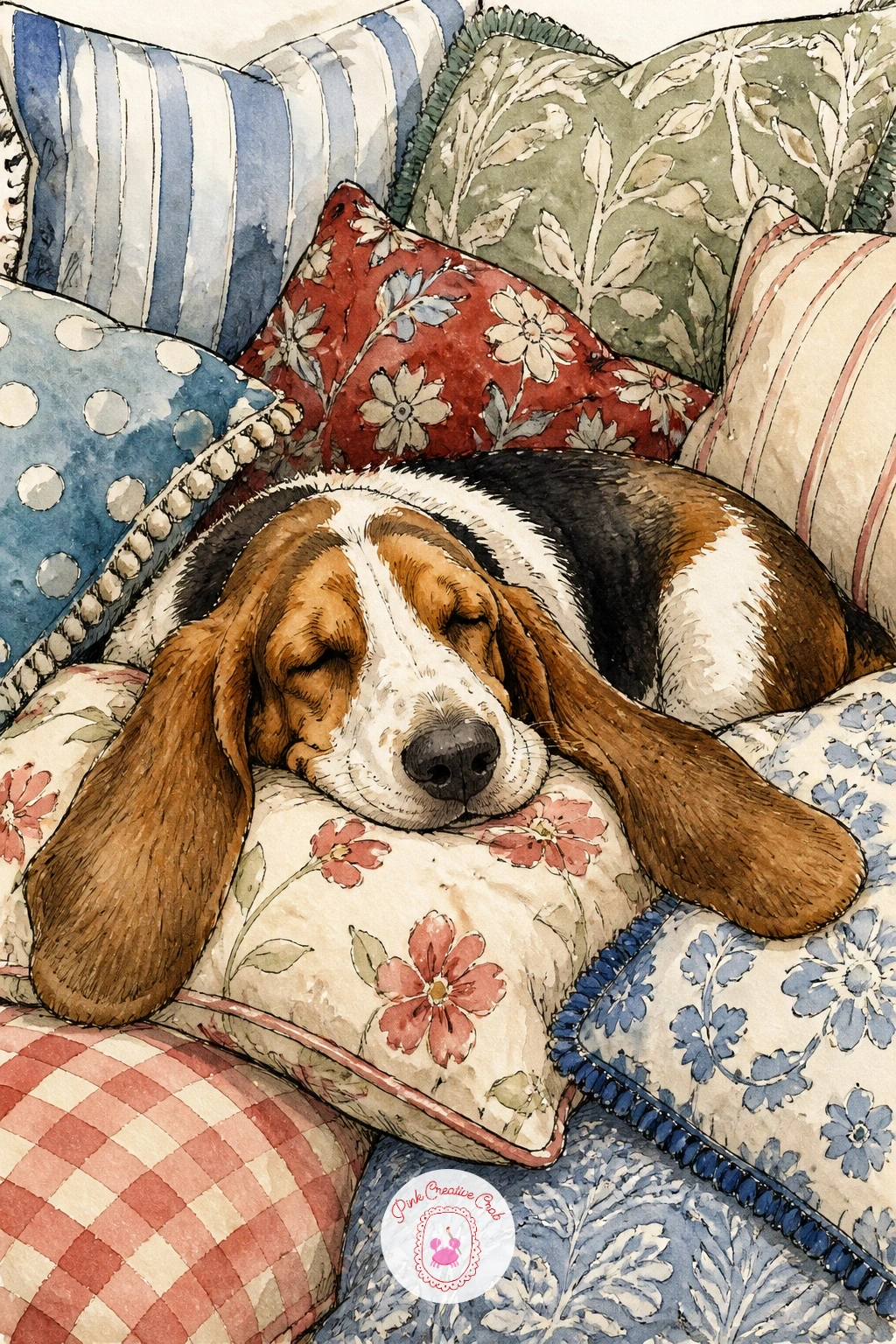
Settle into comfort with a basset hound snoozing in a pile of throw pillows, long ears draped over the edge of the cushions and that heavy, relaxed body sinking into the soft shapes around it. Sketch the pillows first as a loose cluster of overlapping rounded rectangles, then nestle the basset hound’s body into the gaps between them so it looks genuinely sunk in rather than placed on top.
Paint each pillow in a slightly different tone pulled from the palette, cherry red, sage green and warm tan, so the cluster reads as a cosy mismatched pile, then bring the basset hound’s tricolour coat in last, letting its long ears flop down over one of the pillow edges. The heavy wrinkled skin around the basset’s face is best suggested with just a few soft curved ink lines rather than many, too much detail here makes the face look aged rather than peacefully asleep.
If the pile of pillows starts competing with the dog for attention, keep the pillow patterns simple and flat while saving any fine detail for the dog’s face and ears. Swap the pillow colours for whatever is already on your own sofa, the cosy feeling comes from the clutter, not the exact shades.
Palette: Cherry Red,Sage Green,Warm Tan,Chocolate Brown
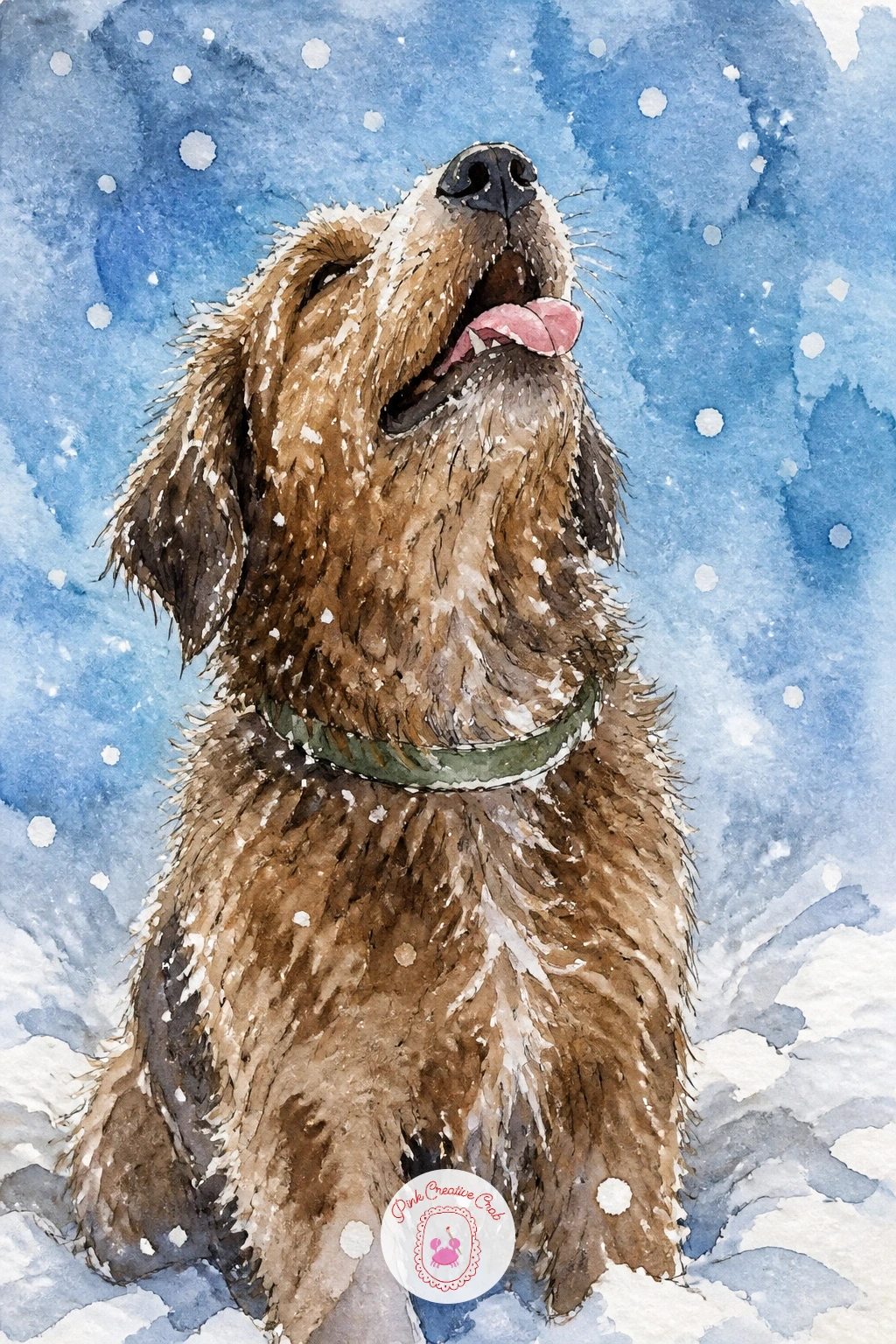
Return outside for a simple, joyful subject: a dog sitting still with its head tipped back and tongue out, watching snowflakes fall straight down onto its face. Sketch the head tilted fully upward, almost looking at the viewer from below the chin, with the tongue a small curved shape and the eyes half closed in contentment.
Paint the dog’s coat in any colour you like, working the face details, nose and slightly closed eyes, last since that upward tilt changes where all the features sit compared to a front facing head. Snowflakes land on the painted fur as small untouched white dots, easiest done by flicking a few drops of masking fluid onto the dry paper before painting the fur, then peeling it off once dry to reveal clean white snowflake shapes.
The upward tilted head is the trickiest part of this one, so sketch the jawline and ear placement carefully before inking, a head tipped back shows more of the underside of the chin and less of the top of the skull than most people expect. No masking fluid on hand, simply paint carefully around small dot shapes left as bare paper instead.
You Will Need
- masking fluid (optional)
Palette: Chocolate Brown,Warm Tan,Icy Blue,White
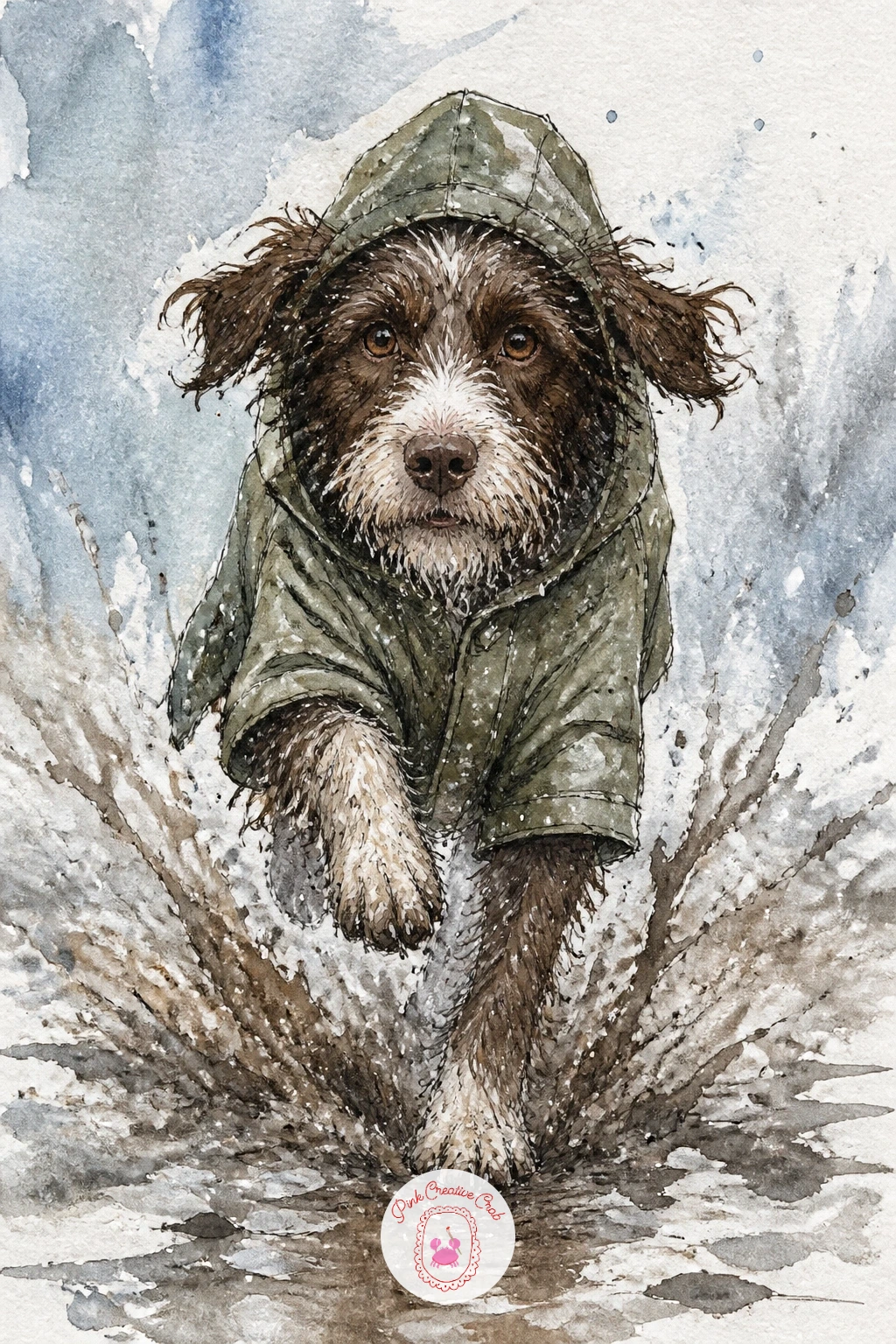
Change the weather slightly with a dog in a moss green raincoat splashing through slush, a wetter, messier scene than the dry powder snow elsewhere on this list. Sketch the dog mid stride with one paw lifted and a small splash shape kicking up beside it, the raincoat fitted simply over the back and chest like a saddle shape.
Paint the raincoat in flat sage or moss green first, then the slush puddles beneath the paws in a greyish wash mixed from icy blue and a touch of chocolate brown, letting the colours mix slightly on the paper for that muddy, melted look real slush has. The splash itself works best as a few quick flicked brushstrokes radiating from the lifted paw, done fast and loose rather than carefully drawn drop by drop.
Slush reads differently from clean snow mainly through colour, keep it duller and greyer than the bright white snow elsewhere so the two surfaces do not read as the same material. If green is not available, a warm mustard raincoat works just as well against the grey brown slush.
Palette: Sage Green,Icy Blue,Chocolate Brown,Payne’s Grey
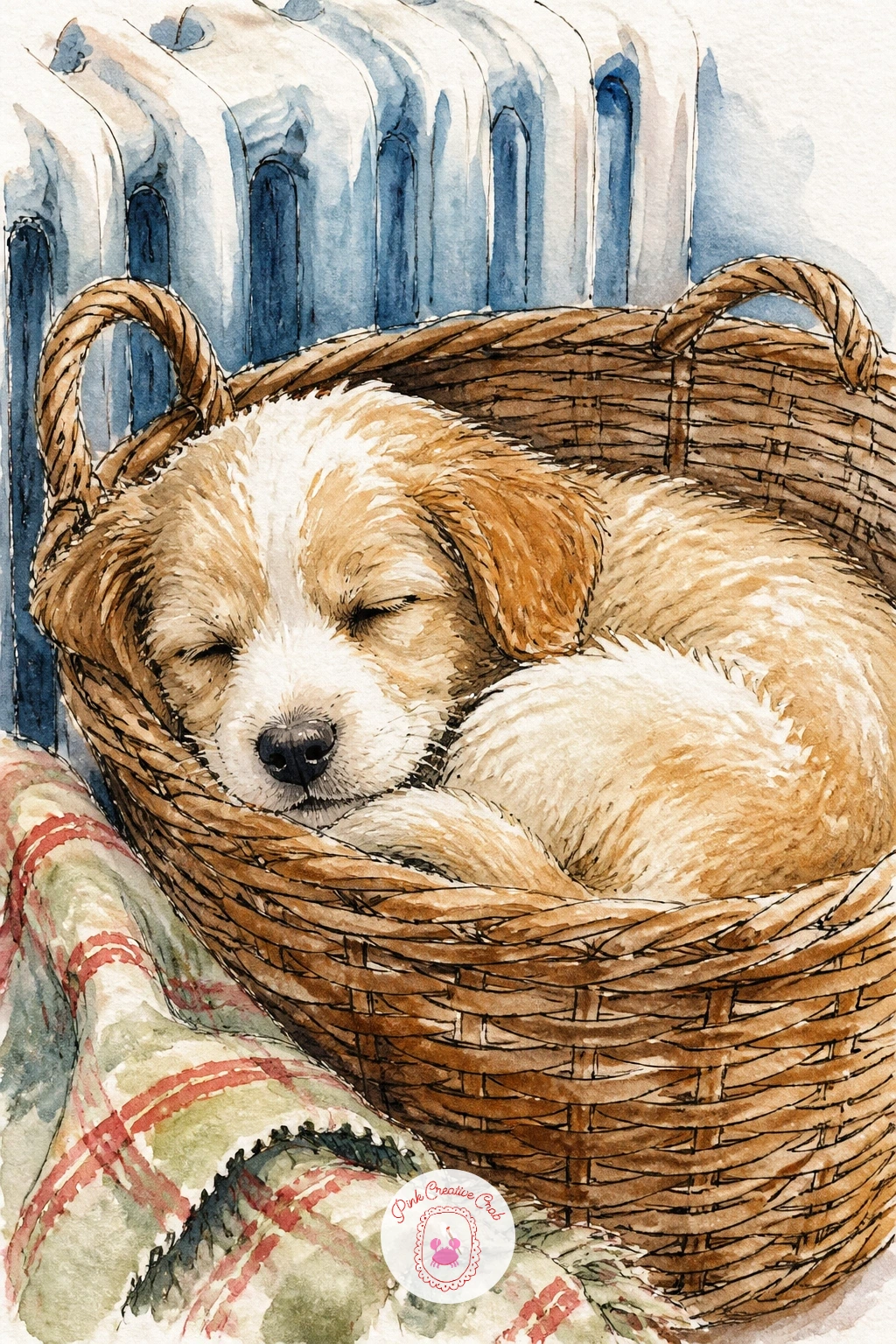
Return to something small and gentle with a sleepy puppy curled inside a woven basket by the radiator, the basket’s texture giving you a nice contrast against the puppy’s soft fur. Sketch the basket first as a simple rounded container with a rim, then curl the puppy’s small round body down into it so only the curve of the back and one ear rise above the rim.
Paint the basket in warm chocolate brown and sienna, using short choppy ink strokes once the paint dries to suggest the woven pattern without drawing every single strand, a handful of crossing lines along the rim is enough. The puppy goes in on top in a soft wash of cream or tan, kept smoother and rounder than the basket’s texture so the two materials read as distinctly different.
If the woven texture feels like too much work, suggest it only around the visible rim and leave the lower, hidden part of the basket as a flatter wash, nobody will miss the detail that is out of sight anyway. A small heater or radiator shape nearby, suggested with just a few straight ink lines, grounds the cosy setting without much extra effort.
Palette: Chocolate Brown,Raw Sienna,Cream,Warm Tan
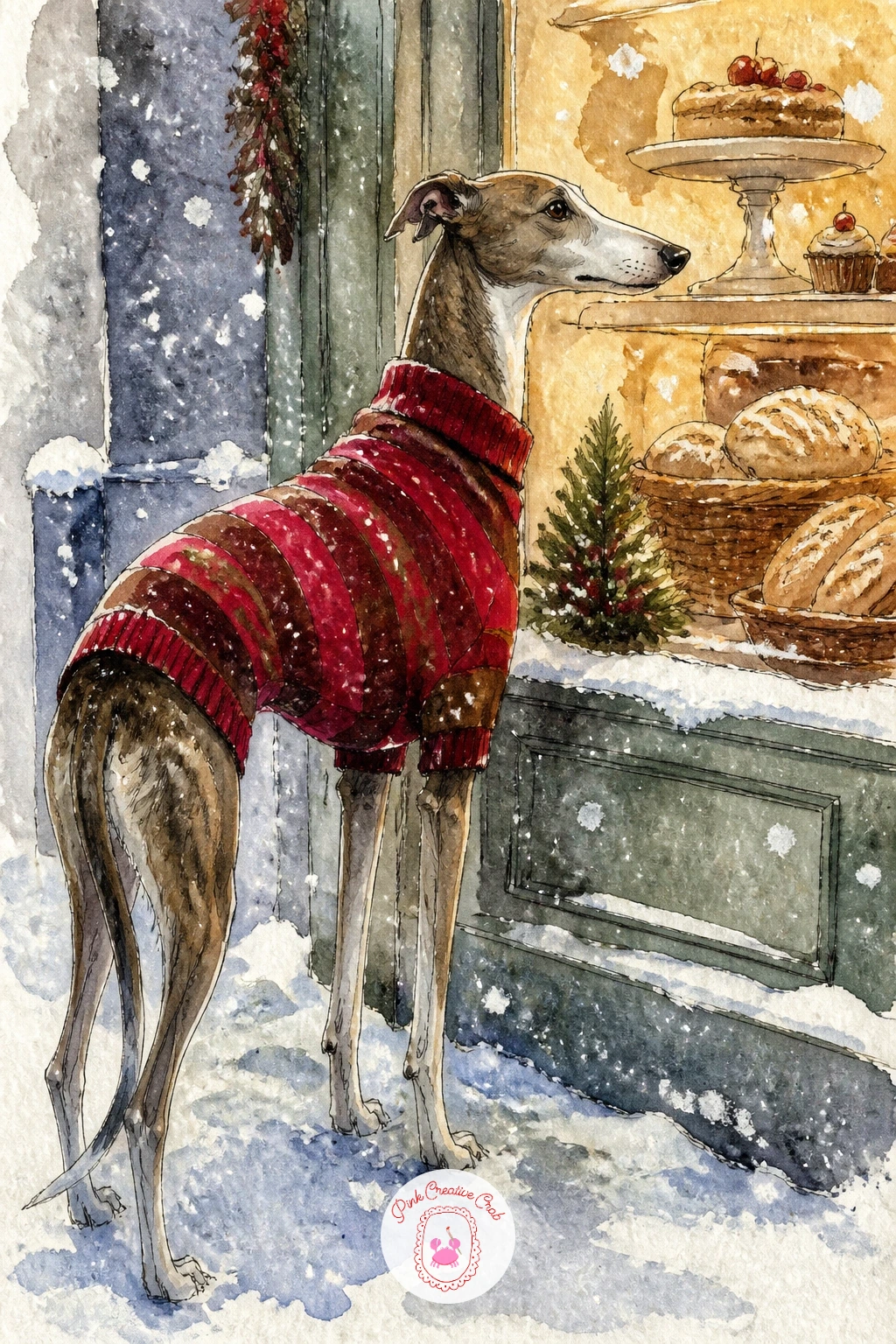
Give a greyhound a little scene of its own, waiting in a striped jumper outside a bakery window in the snow, the long narrow body and deep chest making a naturally elegant silhouette against a glowing shop front. Sketch the greyhound’s body first as a long curved line from chest to tail, keeping the legs thin and the whole stance slightly tucked up as greyhounds do even standing still.
Paint the striped jumper in alternating bands of cherry red and chocolate brown, following the curve of the narrow chest so the stripes bend slightly rather than running flat and straight, then bring in the bakery window behind as a warm glowing rectangle of golden ochre light spilling out onto the snow. The greyhound’s fine boned head and long nose benefit from a single confident ink line rather than several short sketchy ones, a hesitant line on such an elegant breed reads as fussy.
Where this goes wrong is drawing the legs too thick, keep them notably thinner than you first think looks right, that leanness is what makes a greyhound read correctly rather than as a generic dog. No cherry red stripe available, navy or chocolate brown alone still reads clearly as a jumper pattern.
Palette: Cherry Red,Chocolate Brown,Golden Ochre,Icy Blue
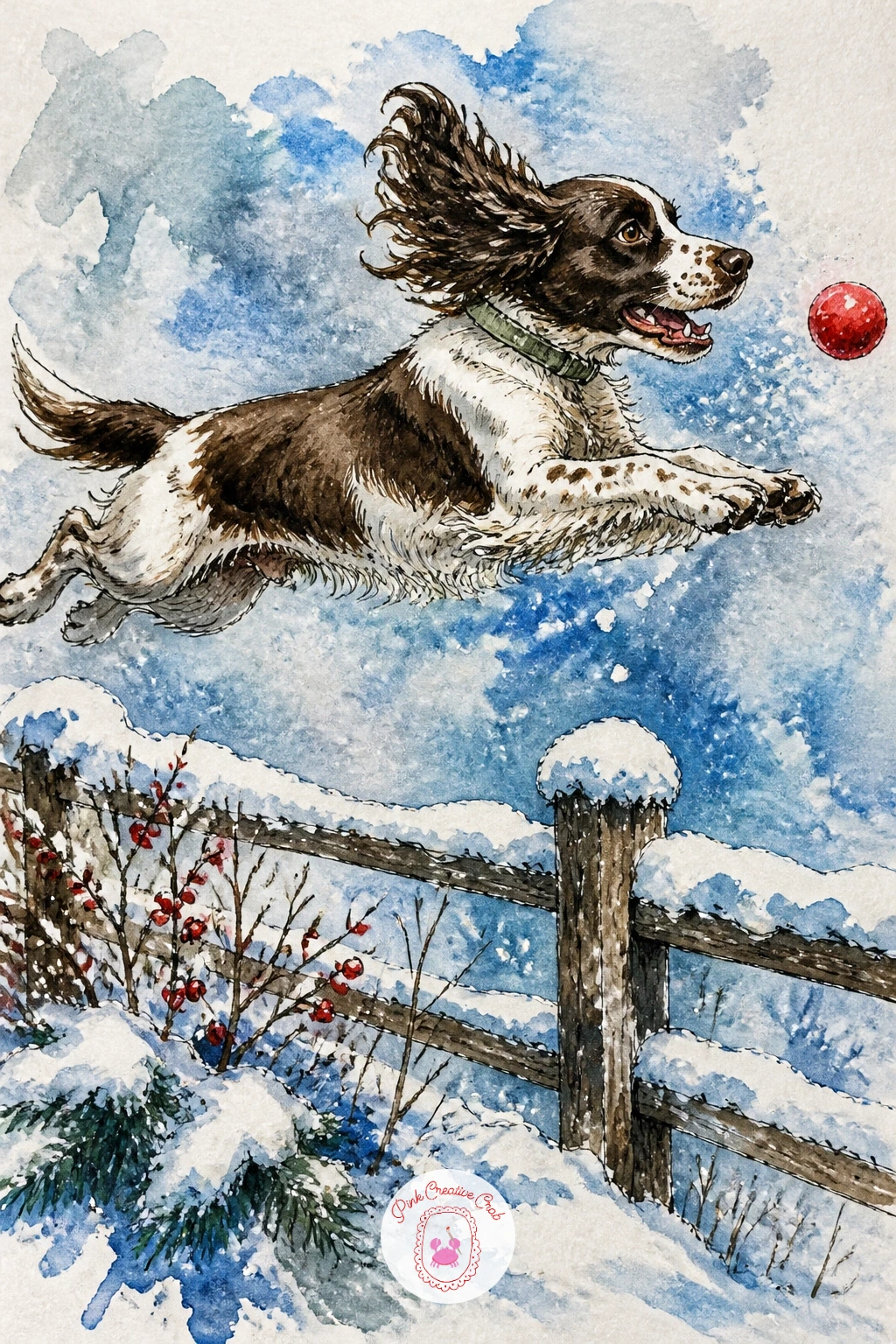
Bring back real motion with a dog leaping clean over a low snowy fence chasing after a ball, body fully extended in the air with all four legs off the ground. Sketch the fence first as a simple low horizontal line of posts, then arc the dog’s body over it in one smooth curve from nose to tail, front legs tucked and back legs trailing for a classic jump silhouette.
Paint the dog in a confident single coat colour so the leaping silhouette stays clean and readable, then add the ball as a small bright dot already past the fence, which tells the story of the chase without needing any extra explanation. The snow capped fence posts can stay mostly white paper with just a thin ink line and a touch of icy blue shadow on their undersides.
A jump only reads convincingly if the body curve is continuous from nose to tail with no sharp angles breaking it, so sketch that single sweeping line before adding any legs or details on top of it. For the quick version, paint just the leaping dog and fence and skip the ball entirely, letting the motion alone carry the idea.
Palette: Chocolate Brown,Cherry Red,Icy Blue,White
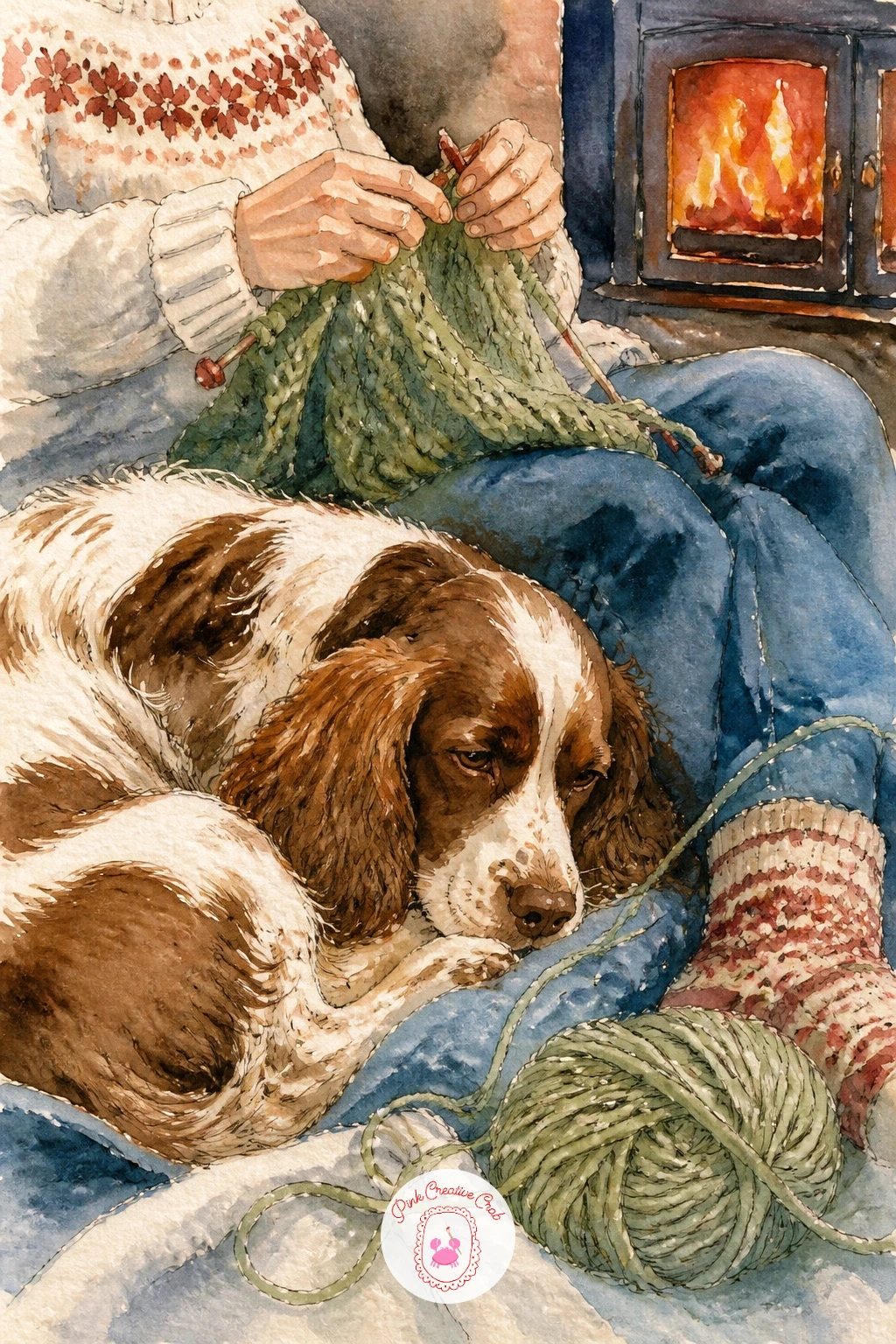
Close the list on the coziest note of all with a cocker spaniel curled up beside someone knitting by the fire, the dog tucked against a leg or basket of yarn while needles and wool fill the rest of the small scene. Sketch the cocker spaniel first as a soft curled shape with those long drooping ears pooling slightly on the floor, then add the knitter’s lap, needles and a loose tangle of wool beside it at a smaller scale so the dog stays the main subject.
Paint the spaniel’s wavy coat in warm liver brown or golden tones, working the ears especially loose and soft since their gentle drape is the most expressive part of the whole pose, then bring in the wool in sage green or cherry red with a few looping ink lines suggesting loose strands without drawing every single thread. Firelight glow in the background stays soft and warm, just enough wash to suggest the room without competing with the dog and yarn in front of it.
If the yarn tangle starts looking like a flat shape instead of soft wool, add two or three ink loops crossing over each other at different points, that overlap alone reads as tangled thread. This calm pairing of a pet and a hobby works well alongside the cosy page layouts in this sketchbook filling guide if you want more small scene ideas like it.
Palette: Chocolate Brown,Golden Ochre,Sage Green,Cherry Red
What to Do Next
Pick one dog from this list, the one closest to a pet you already know, and start with cold press watercolor paper and a light pencil sketch before any ink goes down. One finished page today builds the fur and snow habits you will reach for on every dog illustration after it.
Frequently Asked Questions
What is the best paper for a dog illustration in watercolor?
Cold press watercolor paper around 140 pounds works best because it holds enough water for soft fur washes while still taking fine ink linework cleanly without the paper buckling or the ink feathering.
Should I draw the dog in pencil before inking it?
Yes, a light pencil sketch first lets you fix proportions and pose before committing to ink, which matters most on a moving dog where legs and angles are easy to get wrong on the first try.
How do I paint realistic dog fur without painting every hair?
Work wet into wet for the base coat colour, then add texture with a dry brush or a few scratchy ink strokes along the edges only, since the eye reads a handful of well placed marks as a full coat of fur.
What colours capture snow without using only white?
Snow reads best with pale icy blue and grey shadows rather than flat white, since shadows are what give snow its shape and keep it from looking like empty paper left untouched.
How do I stop a dog illustration from looking stiff?
Sketch the pose loosely first with a single sweeping line for the spine before adding legs or details, since a stiff spine line is the most common reason a dog drawing feels frozen rather than alive.
Have any thoughts?
Share your reaction or leave a quick response — we’d love to hear what you think!
-
 0
-
0
-
0
-
0
-
0
-
0


