A duck painting earns its place on the page the moment you let the watercolor pool and bloom the way real feathers catch light. These birds give you soft round bodies, a splash of bright bill color and endless small dramas: a wobble across a path, a dive bottom-up into green water, a nap tucked under a wing. None of that needs a complicated setup, just a wet brush, a little patience for drying time and a willingness to let some edges stay fuzzy.
Below you will find twenty-nine separate ducks and duckling scenes, starting simple and building up to fuller farmyard and garden moments. Pick whichever one matches your mood today, read through the steps once before you wet your brush, and you will have a finished piece by the time the kettle’s gone cold twice.
Using these images: free for personal projects such as printing, coloring, cards, journals and gifts. Handmade items that include them may be sold up to 30 pieces per design. More than that is commercial use and is not permitted, and neither is selling or sharing the images themselves or passing them off as your own. Please ask before any other use.
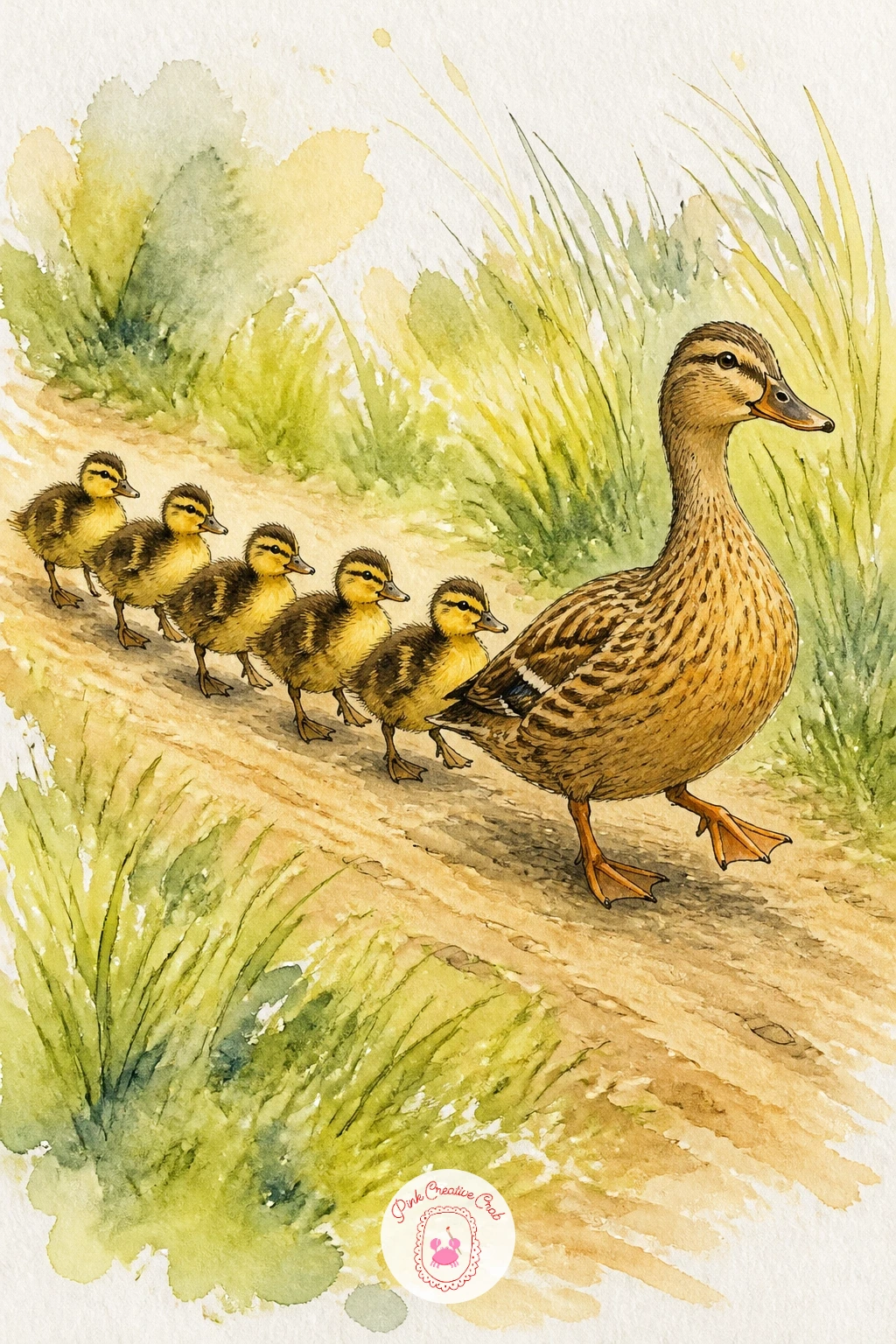
Start with the row of ducklings following their mother across a path, since it teaches you the whole duck shape in its simplest form before anything gets tricky. Pencil in a line of ovals, biggest at the front for the mother, shrinking slightly as they trail behind, all walking the same direction.
Paint the mother first in a flat wash of warm brown, leaving a white highlight along her back while the paint is still wet. Drop yellow ochre into the ducklings while damp so the color stays soft and fluffy looking, then add a dry orange-brown for the bills once everything has dried.
Where beginners go wrong is spacing the ducklings too evenly, which flattens the sense of movement. Stagger them, overlap a couple slightly, and leave gaps of different sizes so the row reads as a waddle rather than a parade line.
If your paper buckles with the first wash, press it under a heavy book overnight before starting the ink line work.
Palette: Raw Sienna,Yellow Ochre,Sepia,Sap Green
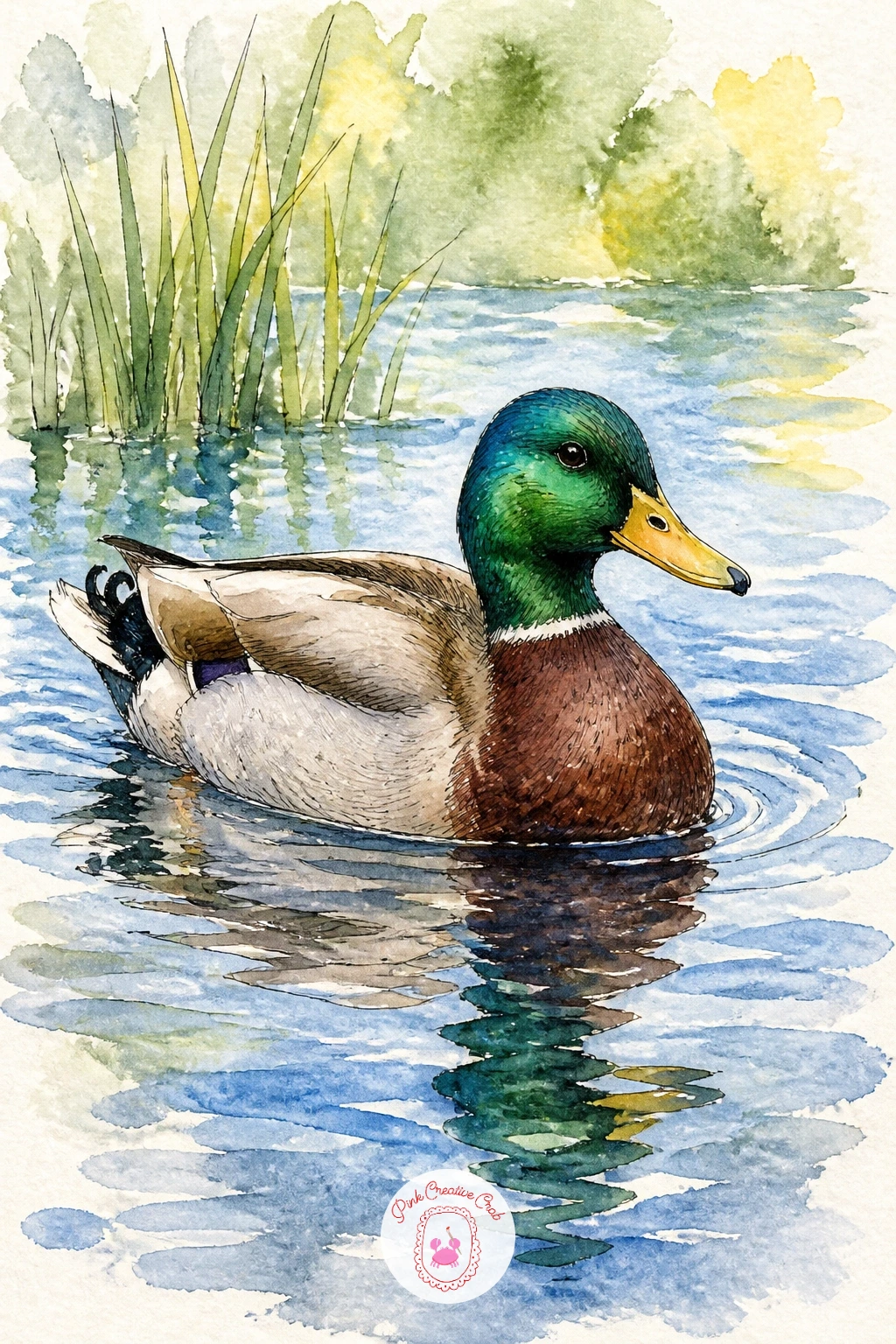
Move next to the mallard drake with an emerald head on a pond, a classic subject that rewards a bold first wash. Sketch the body low and oval, the head round and slightly raised, the bill flat and forward.
Wet the head shape first and drop in Phthalo Green, letting it shift toward blue at the edges while still damp, so the famous iridescent sheen appears on its own rather than through blending. Once dry, paint the chestnut breast and grey-brown body in separate flat washes, then ring the neck with a thin white gap before adding a fine ink collar line.
The eye level matters here: sit low, almost at water height, so the drake looms large against a narrow strip of sky and a wide reflecting pond. That low angle makes an ordinary pond scene feel intimate rather than distant.
If Phthalo Green runs too blue for your taste, mix a touch of yellow ochre into it before it dries to warm the sheen back up.
Palette: Phthalo Green,Burnt Sienna,Payne’s Grey,Cerulean Blue
Look at reference photos taken at water level rather than from above. The low angle is what gives the head its proper glossy drama.
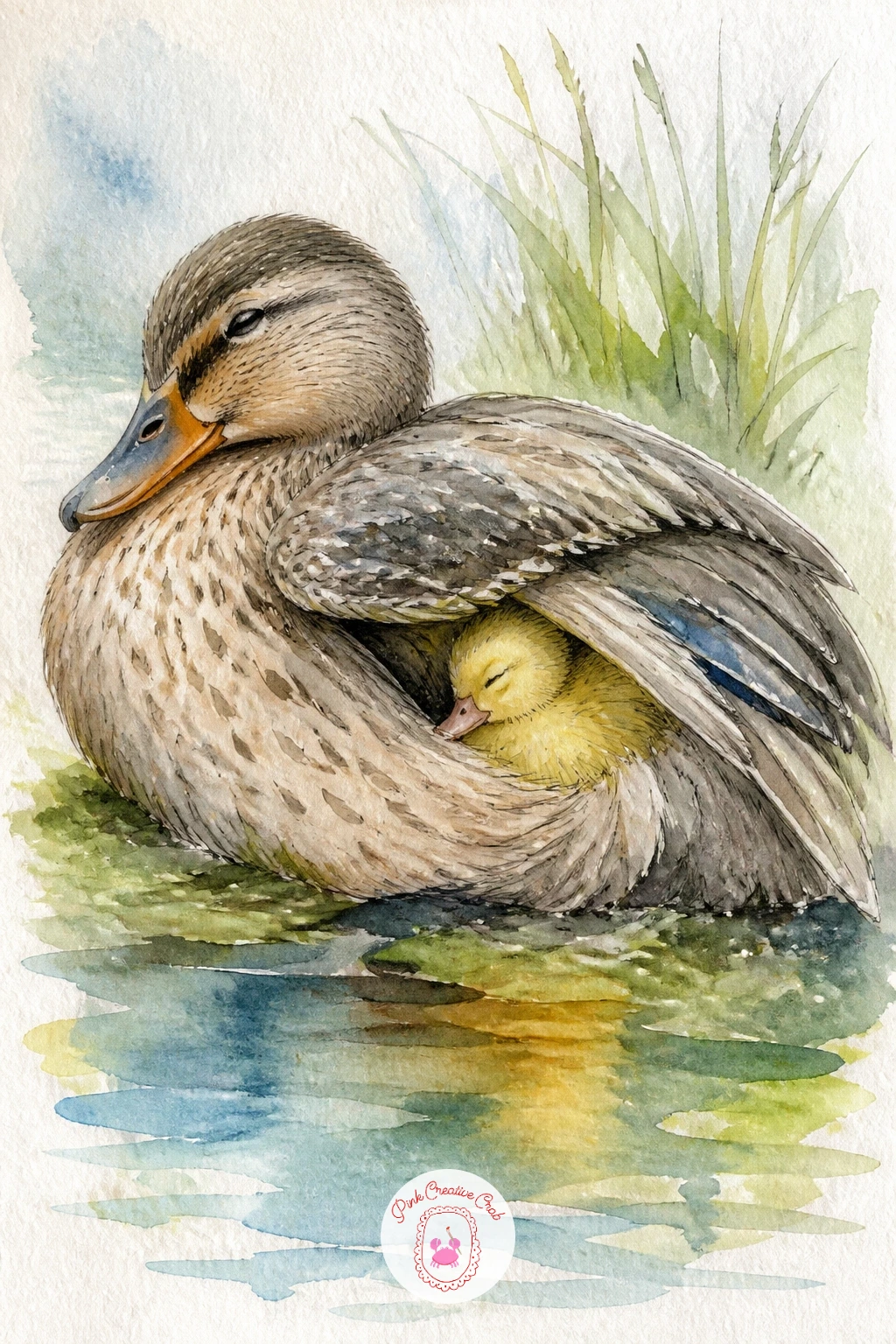
From a bold adult bird, settle into something quieter: a duckling asleep under its mother’s wing. Draw the mother as a large rounded form with one wing lifted slightly, and tuck a small oval duckling half hidden beneath it, just a head and one eye peeking out.
Paint the mother’s body in a soft wash of grey-brown, keeping the wing edge a touch darker to suggest the shadow it casts. Drop pale yellow into the duckling while the mother’s wash is still slightly damp nearby, so the two shapes feel connected rather than pasted together.
The edges where feathers meet feathers are where this picture can turn muddy. Use a dry brush loaded with very little water to soften just the overlap, and keep a kneaded eraser nearby to lift any pencil lines that show through the pale duckling patch.
No kneaded eraser on hand, a clean dry brush dabbed gently will lift fresh watercolor nearly as well.
You Will Need
- kneaded eraser
Palette: Payne’s Grey,Naples Yellow,Burnt Umber,Titanium White
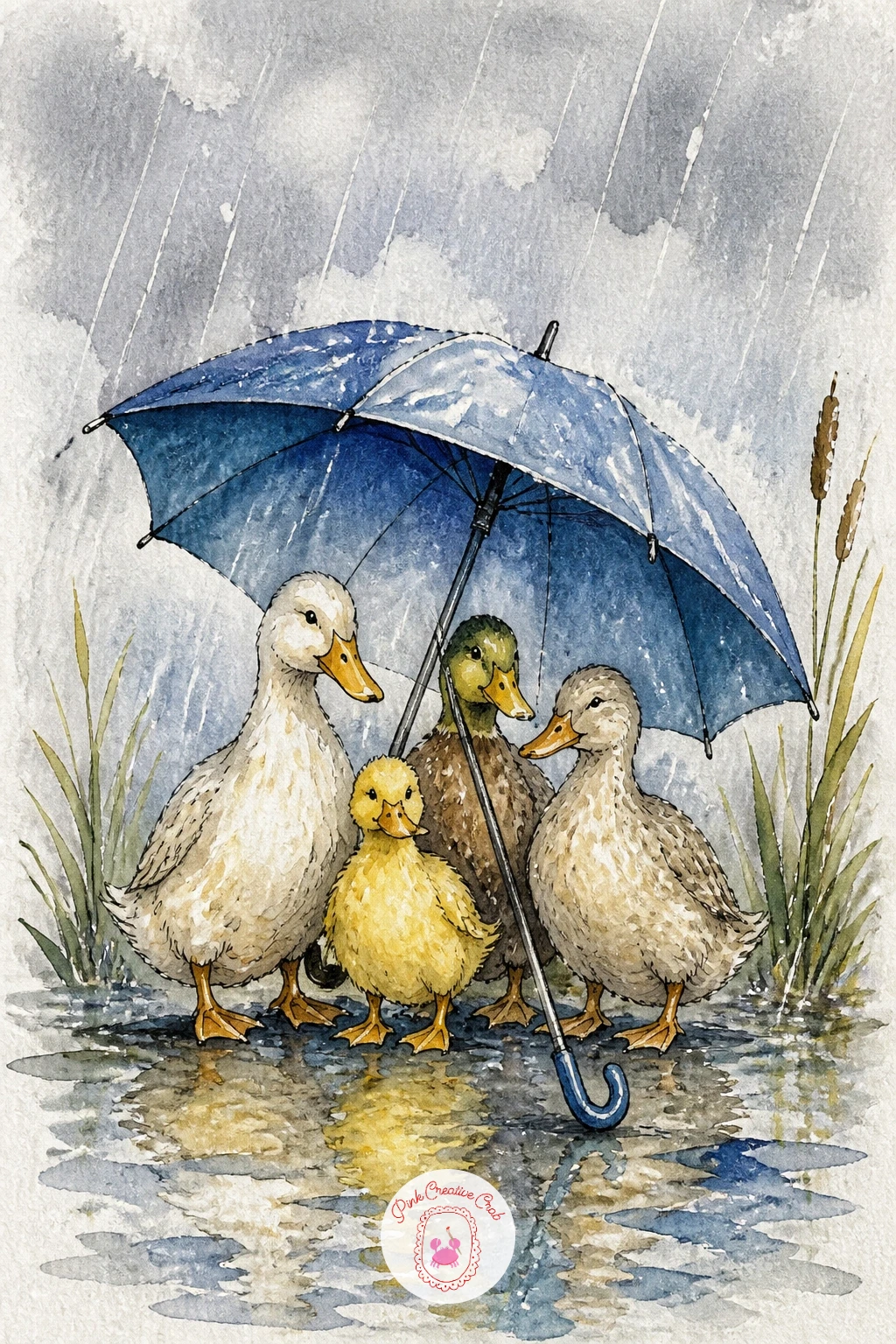
Bring in a little story now with ducks waddling under a blue umbrella in the rain, a charmer for anyone who likes a touch of whimsy in their birds. Draw two or three ducks in a loose cluster, a child-sized umbrella tilted above them as though someone just set it down to shelter them.
Paint the umbrella first in a confident flat wash of ultramarine, leaving the ribs as thin unpainted lines, then work the ducks beneath it in your usual yellow and brown washes once the umbrella has dried fully. Spatter a little clean water onto a still-damp grey sky wash to suggest rain blooming outward, and flick a few short ink lines for falling drops once everything is dry.
Ten minutes gets you the umbrella and one duck sketched loosely with minimal shading. Give it forty and you can add puddle reflections beneath the ducks’ feet and a second wash of grey clouds behind.
Keep a scrap of watercolor paper beside you to test how heavy your rain spatter looks before committing it to the real sky.
You Will Need
- toothbrush or spattering brush
Palette: Ultramarine Blue,Yellow Ochre,Payne’s Grey,Burnt Sienna
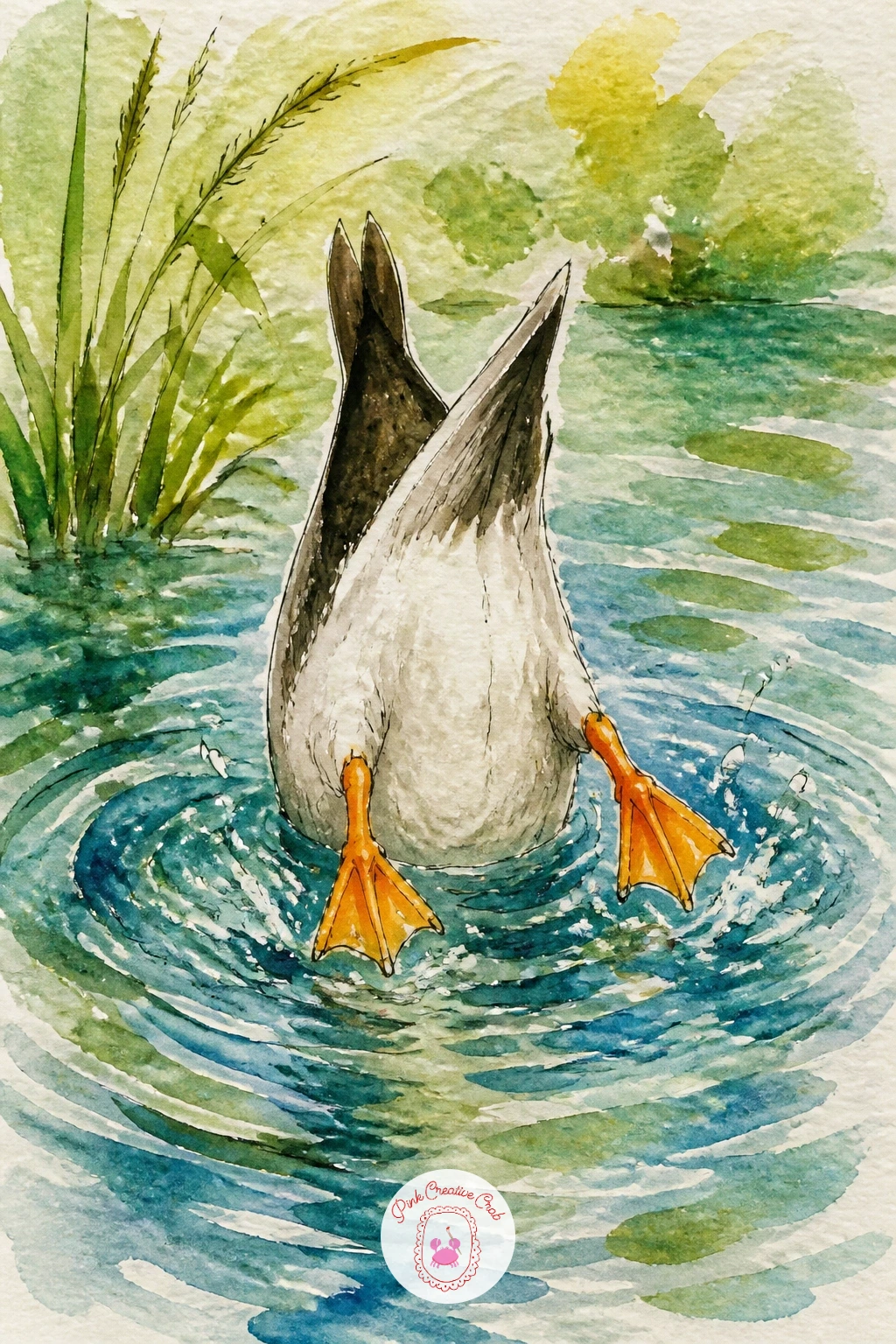
For something playful and a bit unusual, try a duck diving bottom-up in a pond, tail feathers and webbed feet in the air while the head disappears below the surface. Sketch just the rear half of the duck, angled downward, with the two feet splayed wide above the waterline.
Paint the tail and feathers in your usual brown wash, then work the waterline as a separate horizontal band of blue-green, letting it bleed slightly upward into the duck’s lower body so the two shapes merge convincingly. Add a ring of pale ripples around the entry point with a dry brush dragged lightly outward, which reads instantly as disturbed water.
Beginners often paint the water too flat, which makes the duck look like it is sitting on top rather than plunging in. Vary your brushstrokes in direction around the splash to keep the surface lively.
No masking fluid for the white ripple highlights, a damp brush can lift small streaks of color back out once the wash has set for a minute.
You Will Need
- masking fluid
Palette: Burnt Sienna,Teal,Payne’s Grey,White Gouache
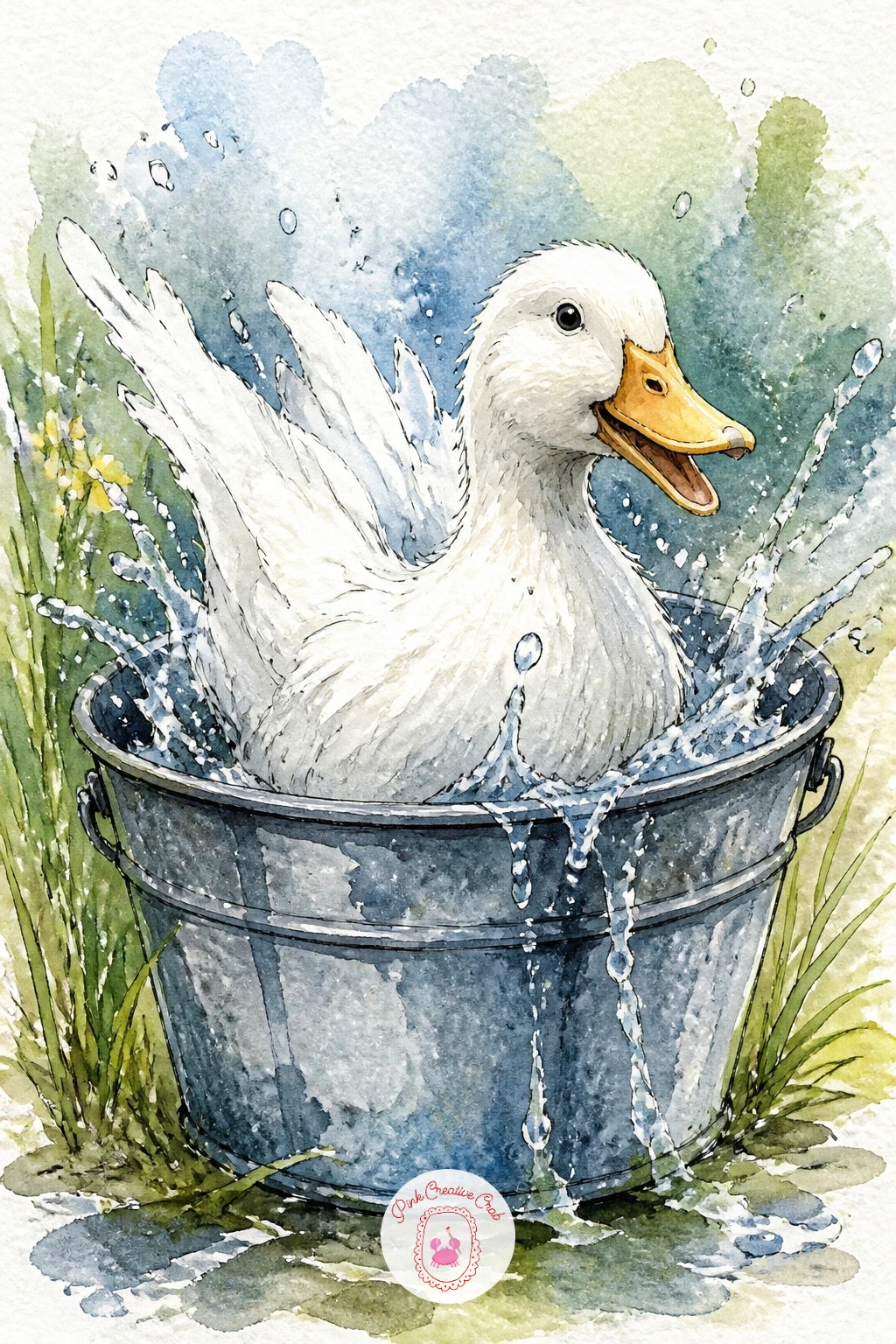
Keep the energy going with a white farm duck splashing in a tin bucket, a fun chance to paint shiny metal next to soft feathers. Draw the bucket as a simple trapezoid shape, then perch or part-submerge the duck at its rim with water flicking up around it.
Leave the duck almost entirely white paper, painting only pale grey shadow washes to shape the body, since white ducks get their form from shadow rather than local color. The galvanized bucket wants a flat grey-blue wash with a few dry-brushed streaks of darker grey for reflected dents and rim highlights left as untouched paper.
If your white duck starts to look flat and blank, strengthen the shadow under the wing and belly with a second light grey wash once the first has dried completely. That added depth alone will make the bird feel round.
No tin bucket reference handy, any old galvanized watering can or pail photo gives you the same reflective grey surface to study.
Palette: Payne’s Grey,Cerulean Blue,Yellow Ochre,Titanium White
Try a duck family crossing a city street next, a familiar spring sight that makes an unexpected and charming subject against pavement and curb lines. Sketch the mother leading a small line of ducklings across a simple strip of grey road, with just a hint of a curb and maybe one lamppost shadow to set the scene.
Paint the road in a flat wash of cool grey, letting it dry fully before adding the ducks on top so their warm yellows and browns pop against the cold tone. Keep the background loose and suggested, a wash of pale building color or a blurred hedge, so the ducks stay the clear focus of the page.
The common slip here is over-detailing the street with cars, signs and crosswalk stripes until the ducks get lost. Keep the city to a bare minimum, just enough grey and one architectural hint to say “street” and nothing more.
For architectural backdrops in other subjects, the ideas in this drawing roundup show how a few suggested buildings can frame a scene without overwhelming it.
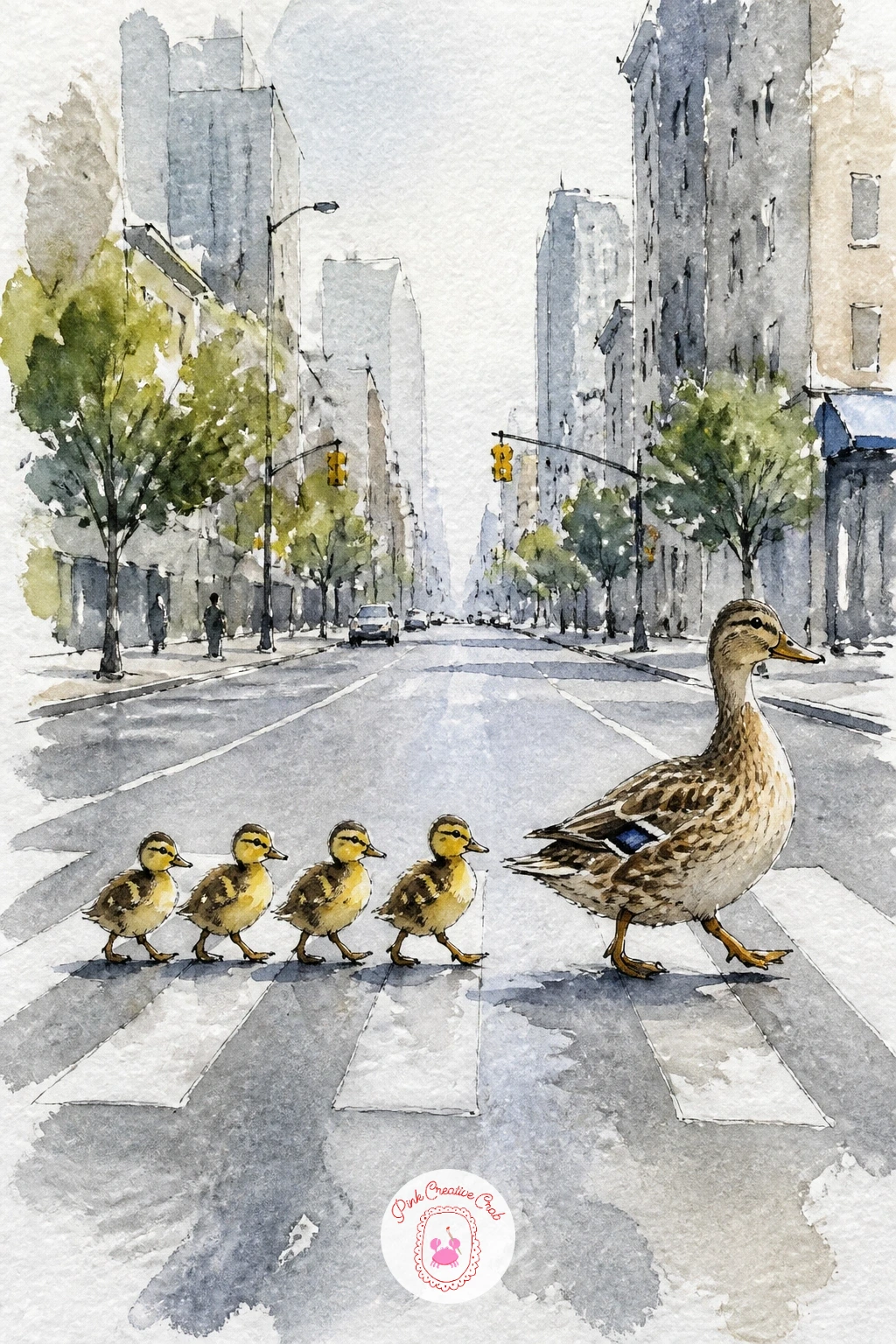
Palette: Payne’s Grey,Yellow Ochre,Burnt Sienna,Neutral Tint
Challenge yourself with a wood duck with its patterned head, one of the most striking birds you can put in a sketchbook thanks to its sweeping white facial stripes and glossy crest. Draw the head larger in proportion than a mallard’s, with a backward-sweeping crest shape flowing off the skull.
Build the head in layers: a base wash of deep green and purple blended wet-into-wet, then add the white facial stripes last using a fine brush loaded with white gouache or by carefully preserving the white paper from the start with light pencil guides. The red eye ring and orange-red bill base go in as small, confident dots of saturated color once the head washes have dried.
This bird goes wrong fastest when the white stripes get painted over by accident. Plan their exact path in pencil before you touch a brush, and consider masking fluid along the thinnest stripes if your hand isn’t steady with a brush tip.
Swap gouache for a white gel pen if you prefer crisp, graphic stripes over soft painted ones.
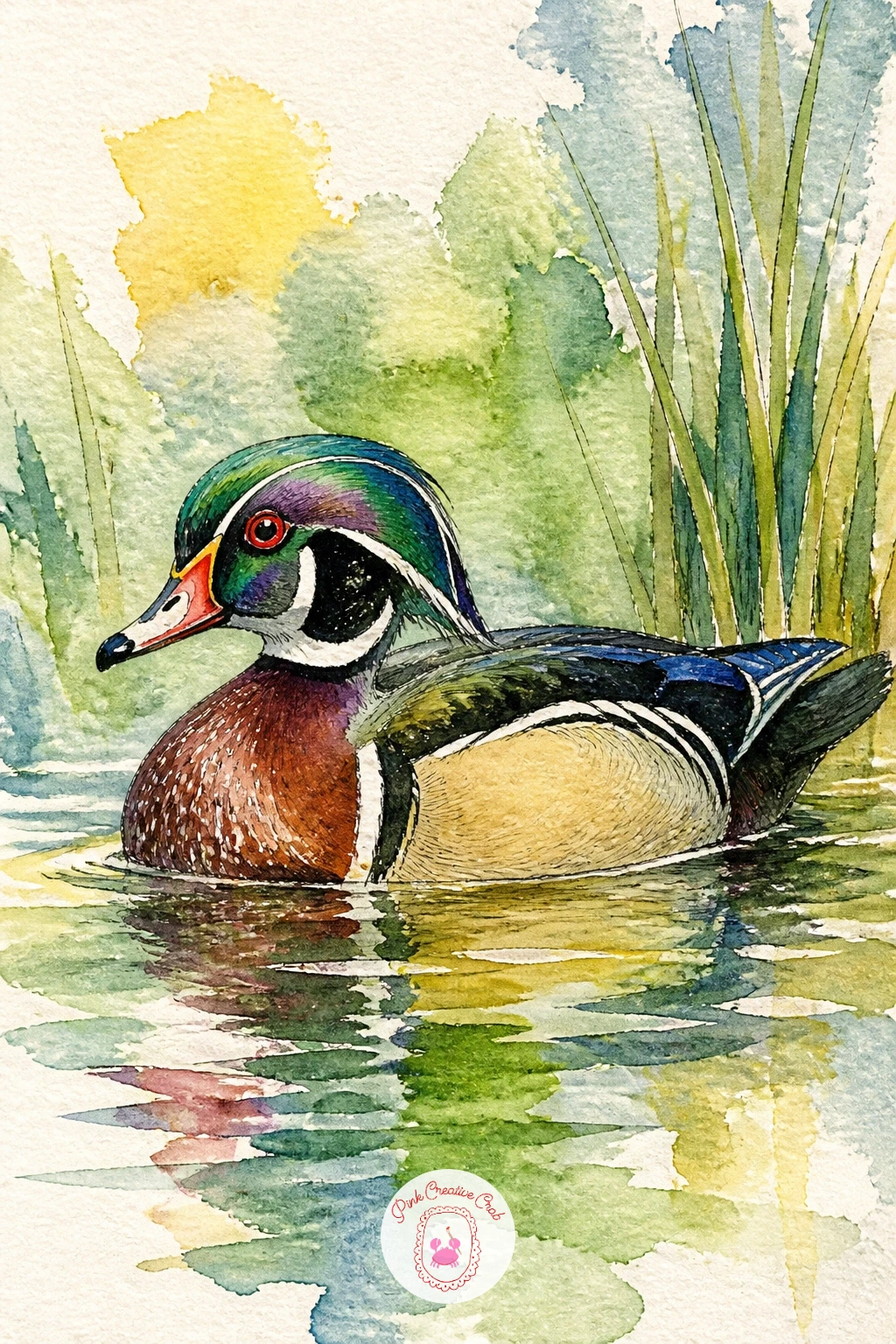
You Will Need
- masking fluid
- white gel pen
Palette: Hooker’s Green,Dioxazine Purple,Cadmium Red,Titanium White
Soften things back down with a duckling sitting in a teacup, a sweet, slightly surreal little vignette that works beautifully as a small painting or a card. Draw the teacup first with a simple ellipse for the rim and a curved handle, then nestle the duckling’s round fluffy body inside it as though it fits perfectly.
Paint the teacup in a pale wash with a thin decorative line or two of a contrasting color around the rim, keeping the china simple rather than ornately patterned. Add the duckling in your usual pale yellow, letting a touch of warm shadow pool where its body meets the cup’s inner curve.
Ten minutes gives you the cup and duckling with flat washes only. Forty minutes lets you add a painted saucer beneath, a thin trail of steam, and a floral pattern around the cup’s rim with your fine liner.
Keep the color palette to just two or three shades total so the small scene reads as cohesive rather than busy.
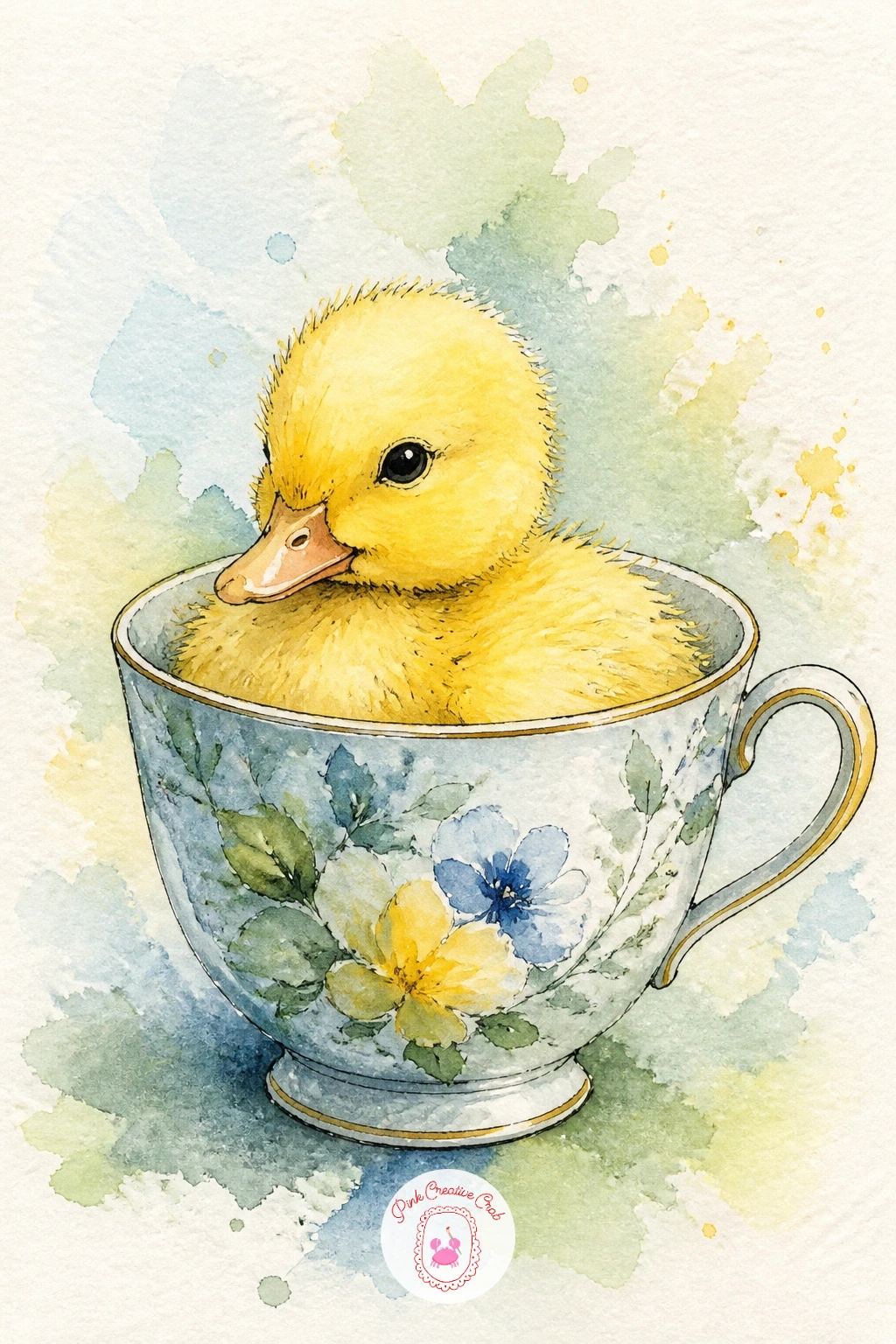
Palette: Yellow Ochre,Dusty Rose,Sap Green,Titanium White
Widen the view with a duck pond with a little wooden duck house, which gives you a chance to practice a small structure alongside the birds you have already been painting. Sketch the duck house as a simple triangular-roofed box sitting at the pond’s edge or on a little platform in the water.
Paint the water first in a loose graded wash of blue and green, then let it dry before adding the wooden house in warm browns with a slightly darker roof. Scatter two or three ducks around the base and on the water, keeping them smaller in scale than your earlier close-up subjects since this is a wider scene.
Perspective matters here more than in a single-bird portrait. Keep the duck house and any background reeds smaller and paler than the ducks in the foreground, which pushes them convincingly into the distance.
If you enjoy building out a fuller setting like this, the farmyard scenes in this farm animal watercolor list use the same trick of scaling background elements down.
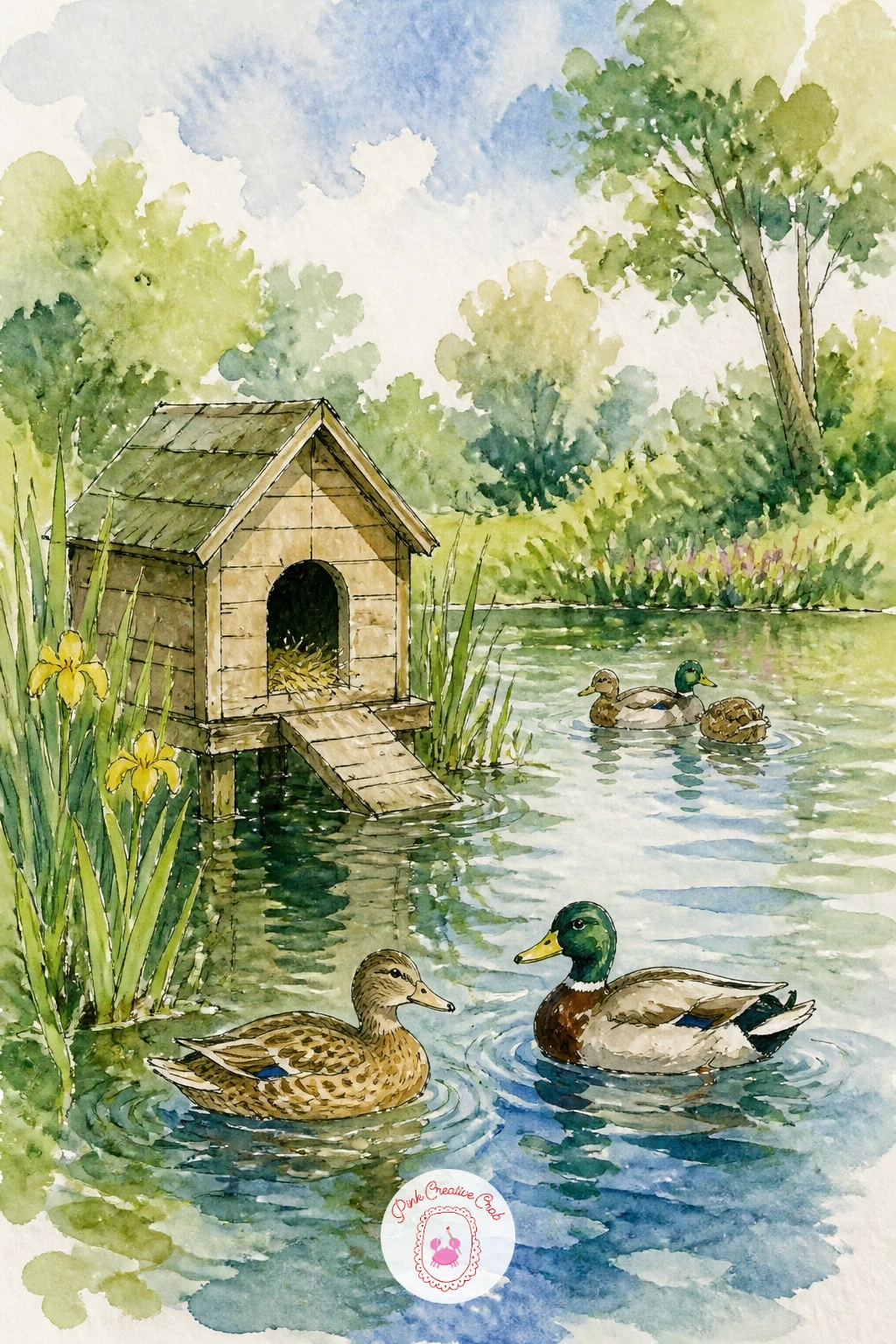
Palette: Cerulean Blue,Sap Green,Burnt Sienna,Yellow Ochre
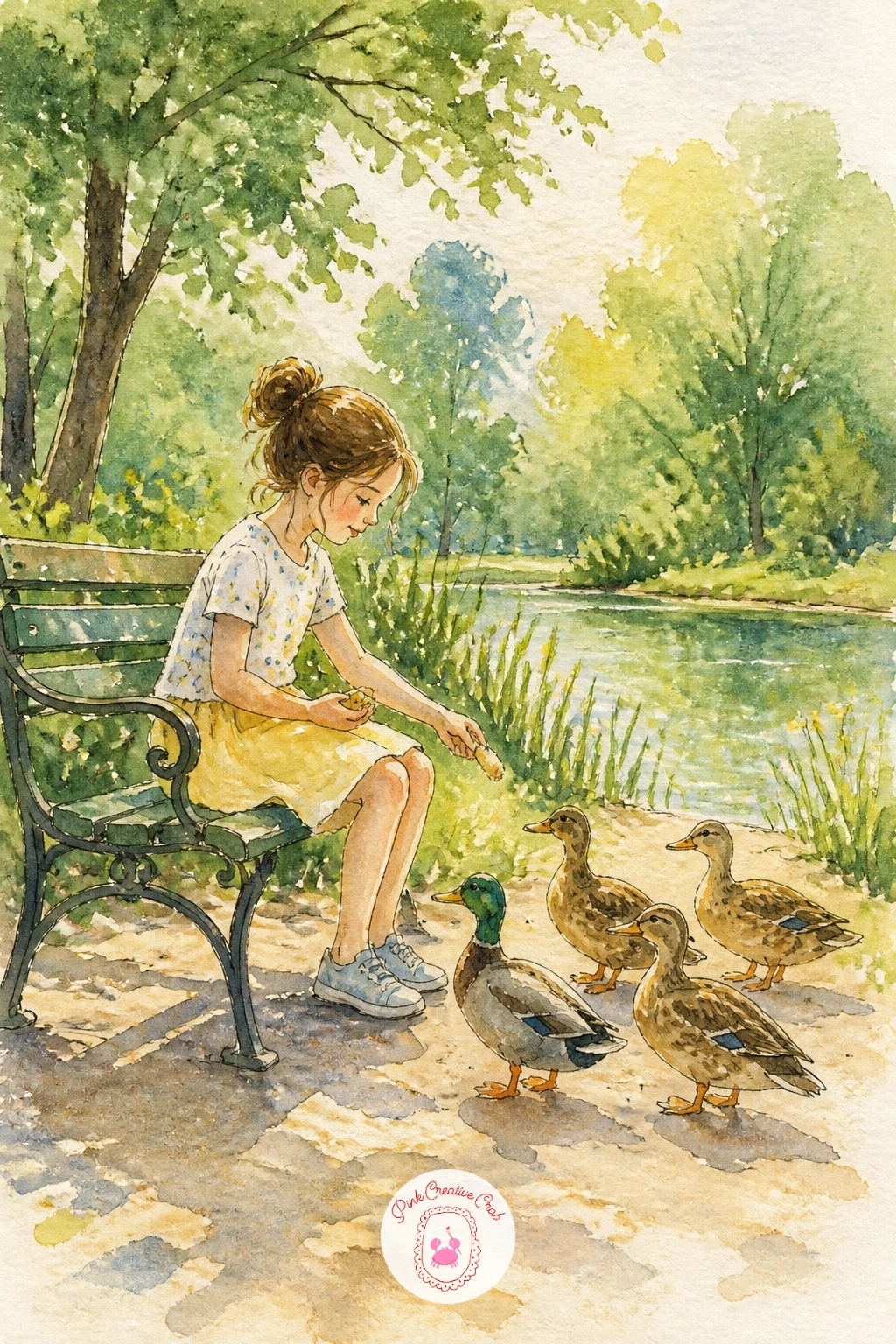
Add a human touch with a girl feeding ducks from a bench, a gentle narrative scene that still keeps the ducks as the real stars of the page. Sketch the bench simply in the lower third of the page, the girl seated with one arm extended, and a small cluster of ducks gathered at her feet.
Keep the figure loose and suggestion-based rather than detailed: a simple coat color, a soft wash for hair, no facial features beyond perhaps a hint of a smile. Paint the ducks with your usual care and detail, since the contrast between a loosely suggested person and a carefully rendered duck is what keeps the eye moving to the birds.
If the figure starts pulling focus away from the ducks, mute her coat to a quieter color than any duck’s bill or feather accent. Saturation is a simple way to direct attention without redrawing anything.
If you enjoy figures with animals, the park and picnic scenes in this sketchbook ideas roundup explore similar gentle human and animal pairings.
Palette: Burnt Umber,Yellow Ochre,Dusty Blue,Sap Green
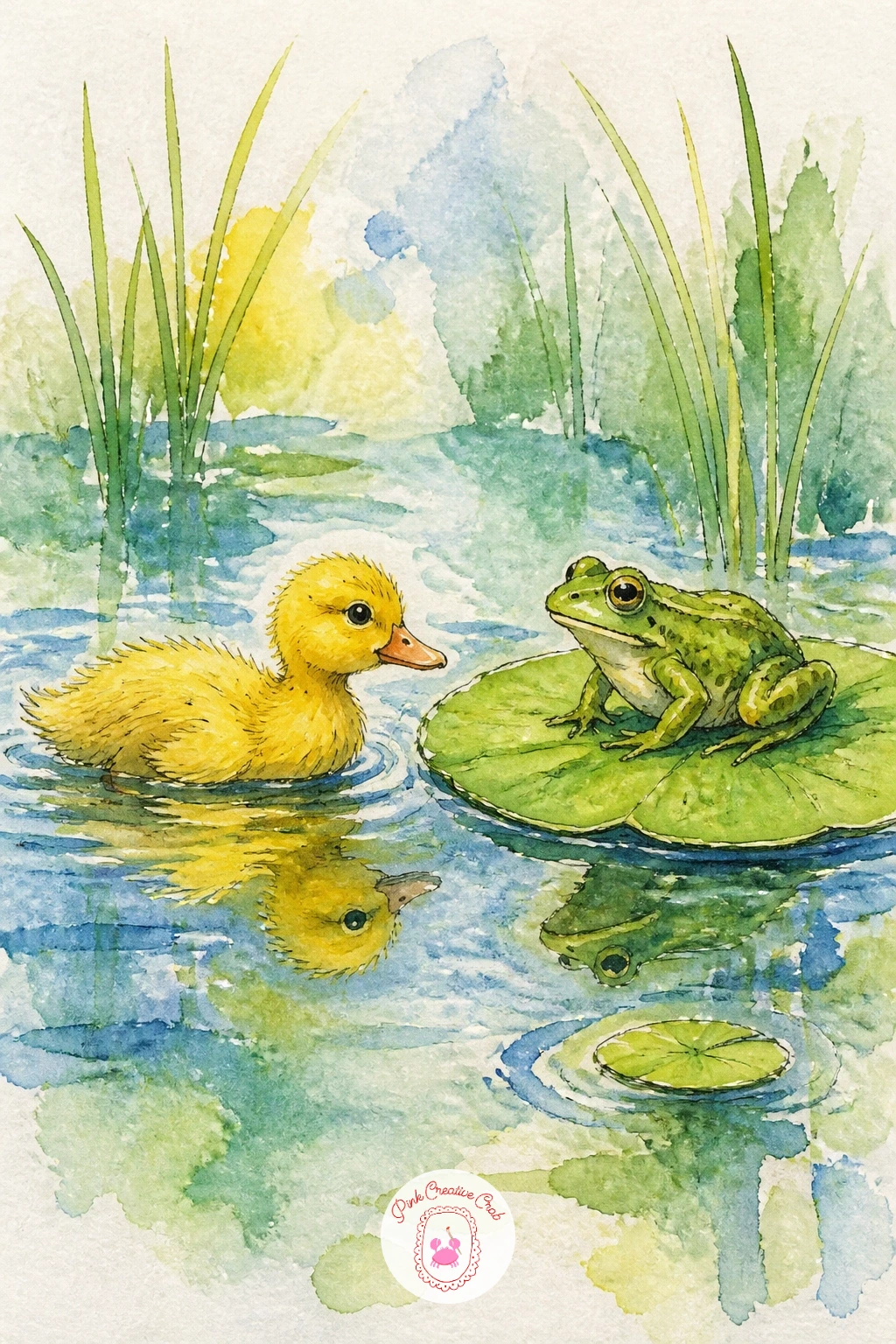
Return to a tiny pond-side moment with a duckling meeting a frog on a lily pad, a charming pairing of two creatures that share the same wet habitat. Draw the lily pad as a large flat circle floating on the water, the frog perched at one edge and the duckling paddling up curiously beside it.
Paint the lily pad first in a confident flat green wash with a darker vein line added once dry, then work the frog in mottled greens using a wet-into-wet technique so its skin looks naturally blotchy rather than flat. Finish with the duckling in your pale yellow wash, keeping its reflection in the water a soft, blurred echo rather than a sharp mirror.
If the frog ends up looking too smooth and plastic, drop a slightly darker green into the still-damp wash in two or three spots and let it spread unassisted. That uncontrolled bloom is exactly the texture frog skin needs.
No second green on hand, a touch of Payne’s grey mixed into your base green creates the same mottled shadow effect.
Palette: Sap Green,Hooker’s Green,Yellow Ochre,Payne’s Grey
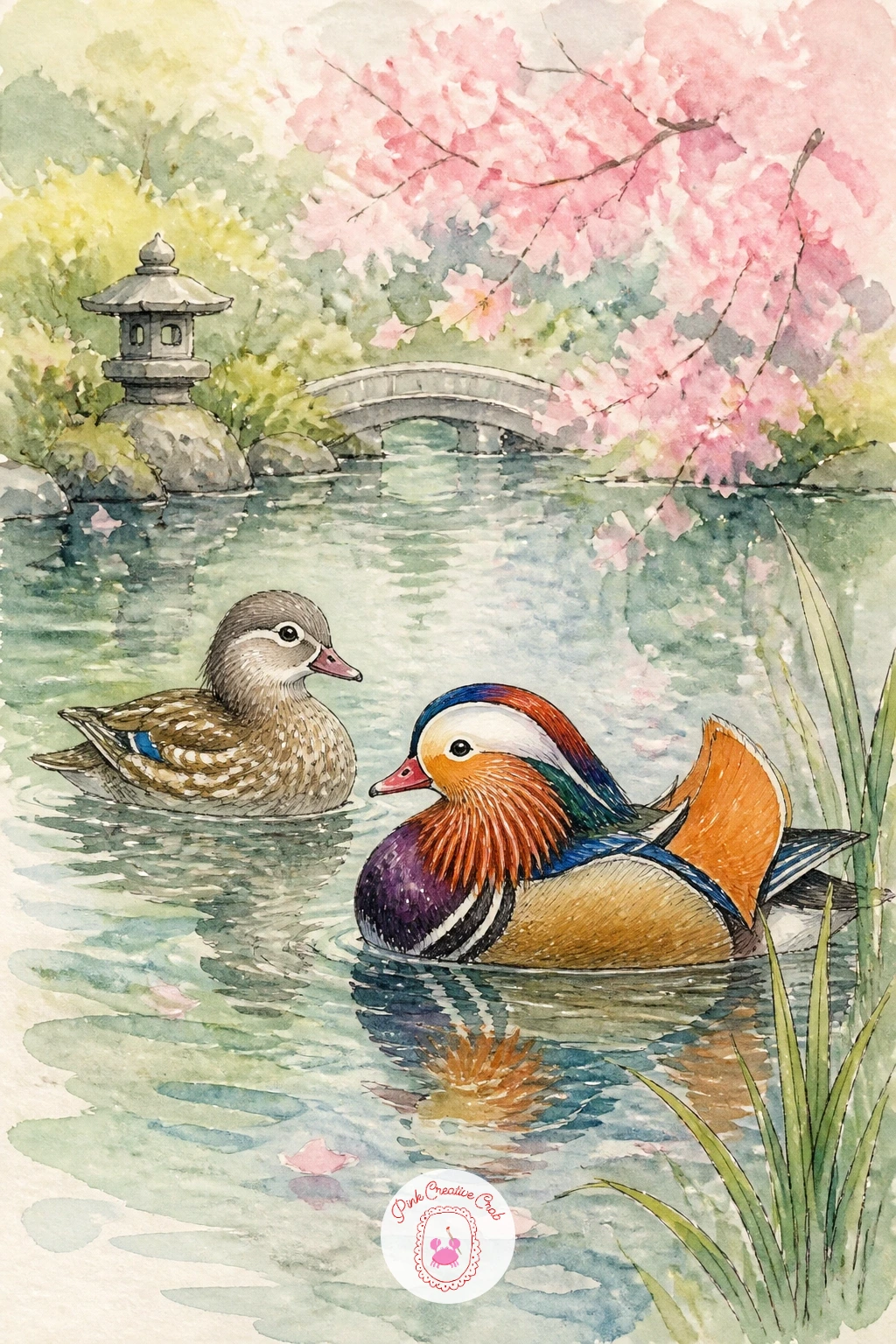
Step up the detail with mandarin ducks in a Japanese garden pond, one of the most visually rewarding birds to paint thanks to their fan-shaped orange sail feathers and striped faces. Sketch a pair side by side, the male’s elaborate crest and sail feather clearly larger than the quieter female beside him.
Build the male’s plumage in distinct color zones: orange sail feathers, purple-chestnut breast, green and white head stripes, each painted as a separate flat wash and allowed to dry before its neighbor is added, since too much wet-into-wet blending will muddy these crisp natural color blocks. Add a soft wash of pale pink or coral behind them to suggest garden blossoms without painting individual flowers.
Keep the female simpler and more muted in grey-brown tones so she reads as a calm companion rather than competing visually with her flashier mate. That contrast is accurate to the birds and also keeps your composition balanced.
Working in distinct dry color blocks like this is also a good warm-up for more ambitious bird portraits later on.
Palette: Cadmium Orange,Dioxazine Purple,Hooker’s Green,Payne’s Grey
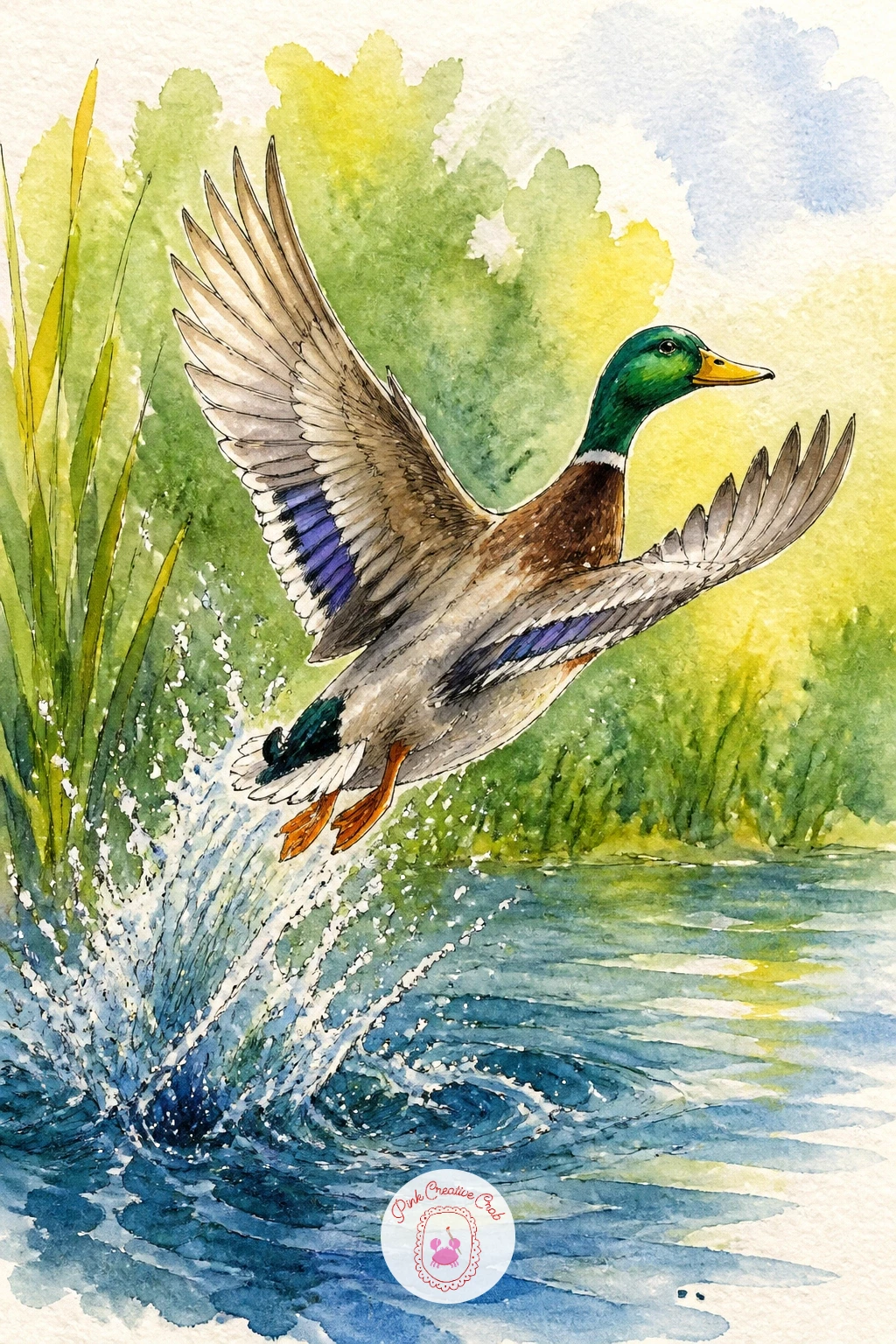
Build some drama with a duck taking off from the water in a spray, wings fully extended and water flying from its feet as it lifts off the surface. Sketch the body at a steep upward angle, wings drawn wide in a strong V shape above the back.
Paint the wings first since they carry the most visual weight, using a dry brush technique to drag streaky strokes of brown and white across the feather shapes rather than a smooth flat wash. That broken, textured stroke reads instantly as motion and feather structure at once.
Add the water spray beneath the feet with quick flicks of a nearly dry brush loaded with pale blue-white, radiating outward from the point of contact with the pond. Keep these marks sparse rather than dense, since too much spray clutter will compete with the bird itself for attention.
If your dry brush strokes come out too faint to read, load slightly more pigment but less water onto the brush before you drag it.
Palette: Burnt Sienna,Payne’s Grey,Titanium White,Cerulean Blue
Slow the pace again with a pair of ducks gliding at sunrise, a quiet subject that leans entirely on light and color rather than action. Sketch two simple duck silhouettes low on the water, keeping the drawing minimal since the sky and its reflection will carry most of the visual weight.
Paint the sky first in a graded wash running from warm coral at the horizon up to soft lavender higher up, then flip the same gradient upside down beneath the waterline to suggest reflection. Drop the two ducks in as near-silhouettes, dark warm brown against the bright sky, with only the thinnest rim of light catching their backs.
Light source is everything in this piece: keep every shadow on the ducks facing away from the horizon glow, and resist the urge to add surface detail to feathers that are meant to read as shapes against bright light. Less information here reads as more atmosphere.
If your gradient sky comes out streaky, tilt the paper slightly while the wash is still wet to help the colors settle smoothly.
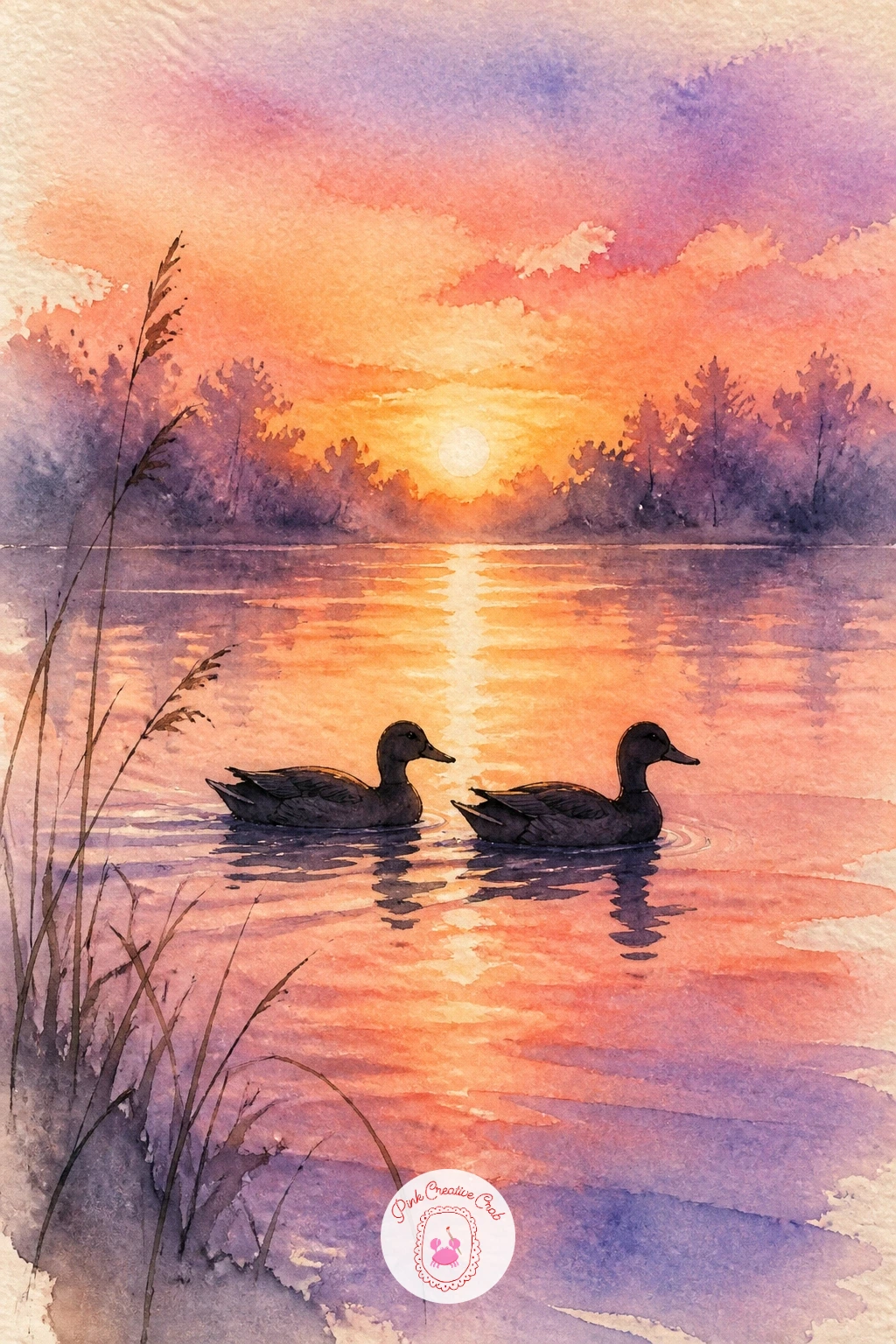
Palette: Coral,Lavender,Burnt Umber,Payne’s Grey
Return to something cozier with a duck sheltering under a big leaf in the rain, a sweet storybook moment that pairs a small bird against an oversized piece of foliage. Sketch a single broad leaf, perhaps a hosta or burdock shape, tilted like a makeshift umbrella above a duck tucked beneath it.
Paint the leaf first in a rich green wash with visible vein lines added once dry, keeping its underside slightly paler and cooler than the top surface catching the rain. Add the duck in shadow beneath it, mixing a touch more grey into your usual yellow and brown so the bird reads as sheltered rather than lit by open sky.
If the leaf and duck end up fighting for attention at the same size and saturation, scale the leaf up further and quiet its color slightly so the duck’s warmer tones still draw the eye first.
Fine rain lines added last with your ink pen, kept short and angled, finish the mood without needing a full grey wash over everything.
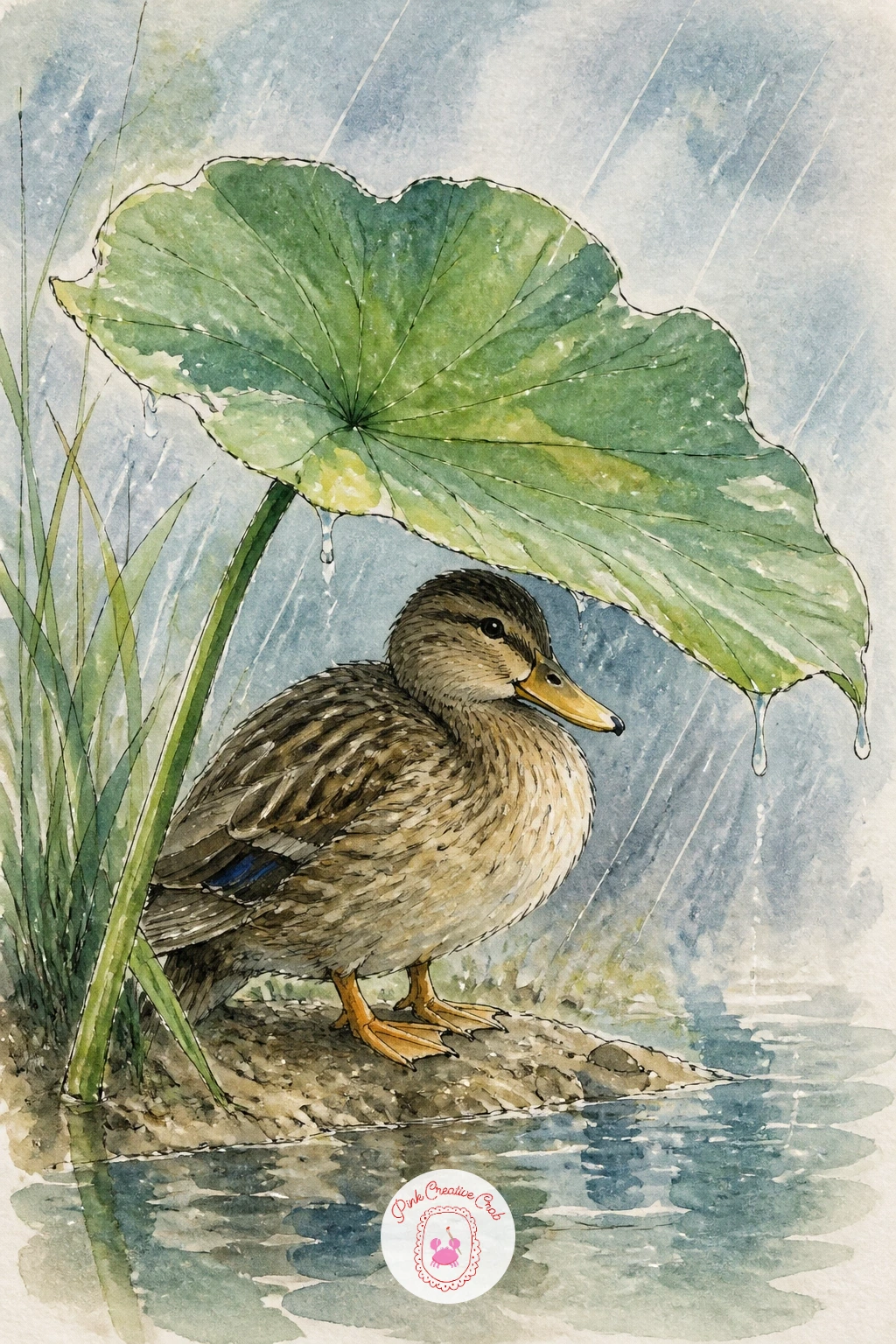
Palette: Hooker’s Green,Yellow Ochre,Burnt Sienna,Payne’s Grey
Try something structurally different with a runner duck standing tall, since this breed’s upright bowling-pin posture is unlike any other duck on this list. Sketch the body as a long vertical oval, nearly perpendicular to the ground, with the neck stretching straight up and the tail nearly touching the floor.
Compare the body length to the neck length before you paint: a runner duck’s neck takes up roughly a third of its total height, noticeably more than a mallard’s, and getting that ratio right is what sells the breed’s comic, upright stance. Paint the body in a single flat color, often all white or a warm fawn, keeping the wash even so the strong silhouette does the work rather than color variation.
If your duck ends up looking like it is simply standing rather than teetering upright, angle the tail slightly forward and the head slightly back for balance, which is how these ducks actually hold themselves.
No fawn pigment in your set, mix burnt sienna with a touch of yellow ochre and plenty of water for a close match.
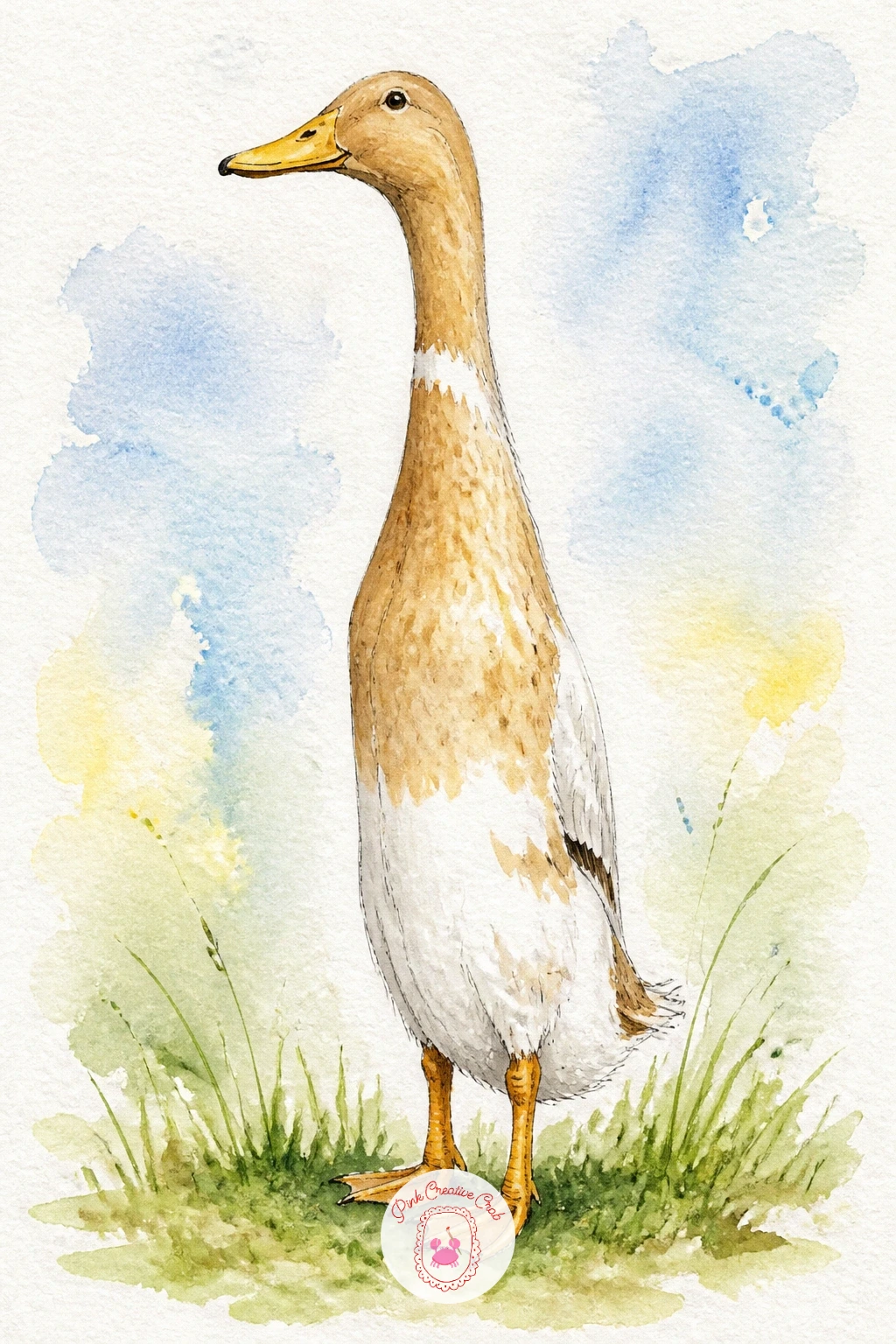
Palette: Raw Sienna,Titanium White,Burnt Sienna,Payne’s Grey
Bring in another small, playful vignette with a duckling peeking out of a rain boot, a classic cute pairing that still feels fresh when painted loosely rather than too polished. Sketch a single wellington boot tipped slightly on its side, the duckling’s head and one wing poking out of the opening.
Paint the boot in a bold flat color, a bright yellow or deep red works nicely against the duckling’s pale fluff, leaving a thin unpainted highlight line along its curved side to suggest the shine of rubber. Add the duckling once the boot has dried fully so the two colors stay crisp and separate rather than bleeding together at the opening.
If this is your first time painting a shiny rubber surface, keep your wash flat and add just one or two small white highlight shapes rather than trying to render a full gradient. Simplicity reads as shine more convincingly than you would expect.
A puddle wash beneath the boot, added last, grounds the whole scene nicely.
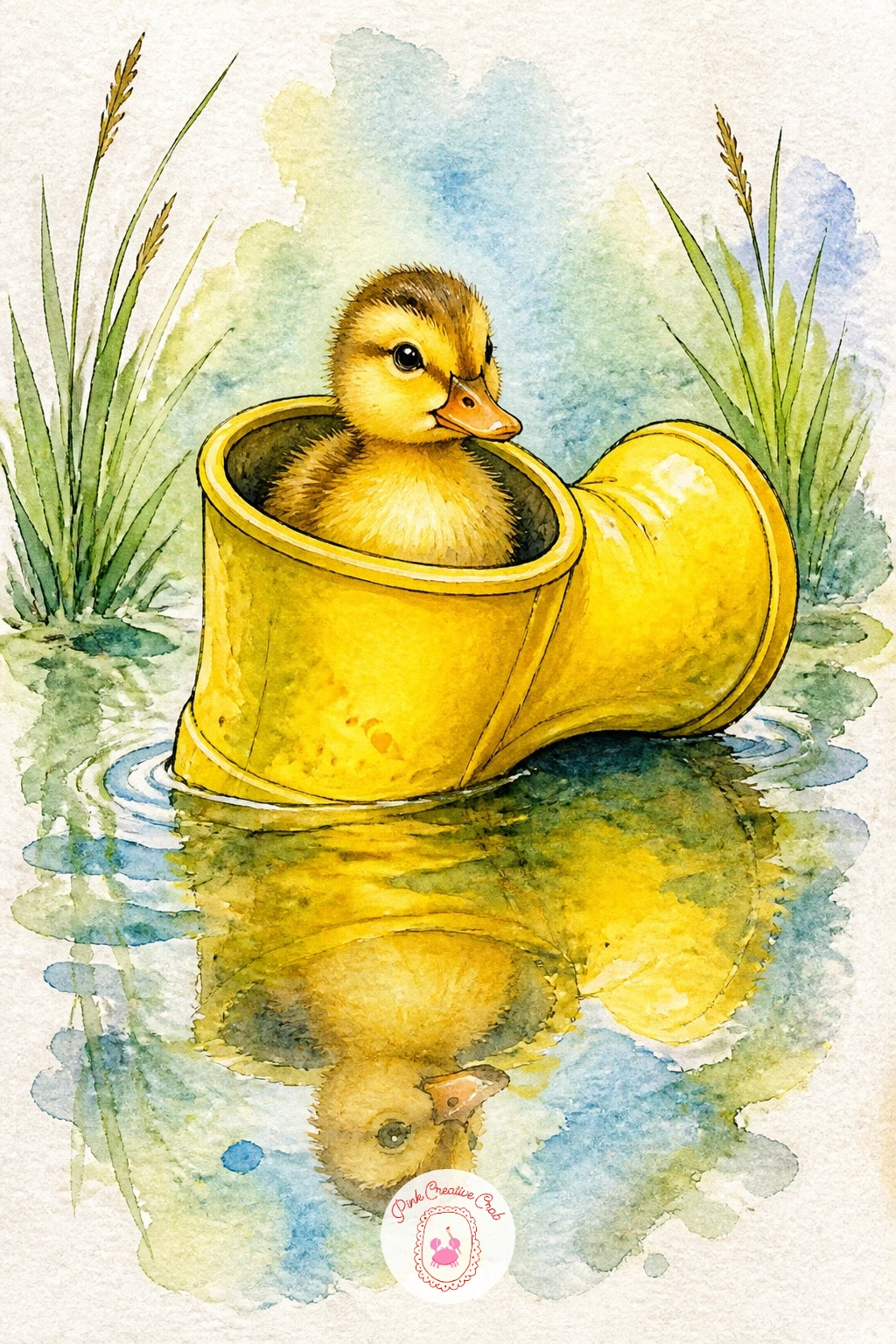
Palette: Cadmium Yellow,Cadmium Red,Naples Yellow,Cerulean Blue
Shift into a cooler season with ducks at the edge of a frozen pond, where open water meets a sheet of ice and the birds huddle at the boundary between them. Sketch two or three ducks standing right where unfrozen water meets the pale ice shelf, keeping their postures slightly hunched against the cold.
Paint the ice first in a very pale blue-grey wash, leaving streaks of bare white paper for cracks and texture, then paint the open water beside it in a darker, richer blue so the temperature contrast is immediate. Add the ducks last in their usual warm browns, which will pop strongly against all that cool surrounding color.
If the ice looks flat and lifeless, drag a dry brush loaded with pale grey across it once the base wash has dried, following a few irregular diagonal lines to suggest surface cracks without overworking the area.
Warm feather tones against cold ice and water is the whole trick of this piece, so resist adding any warm color to the ice itself.
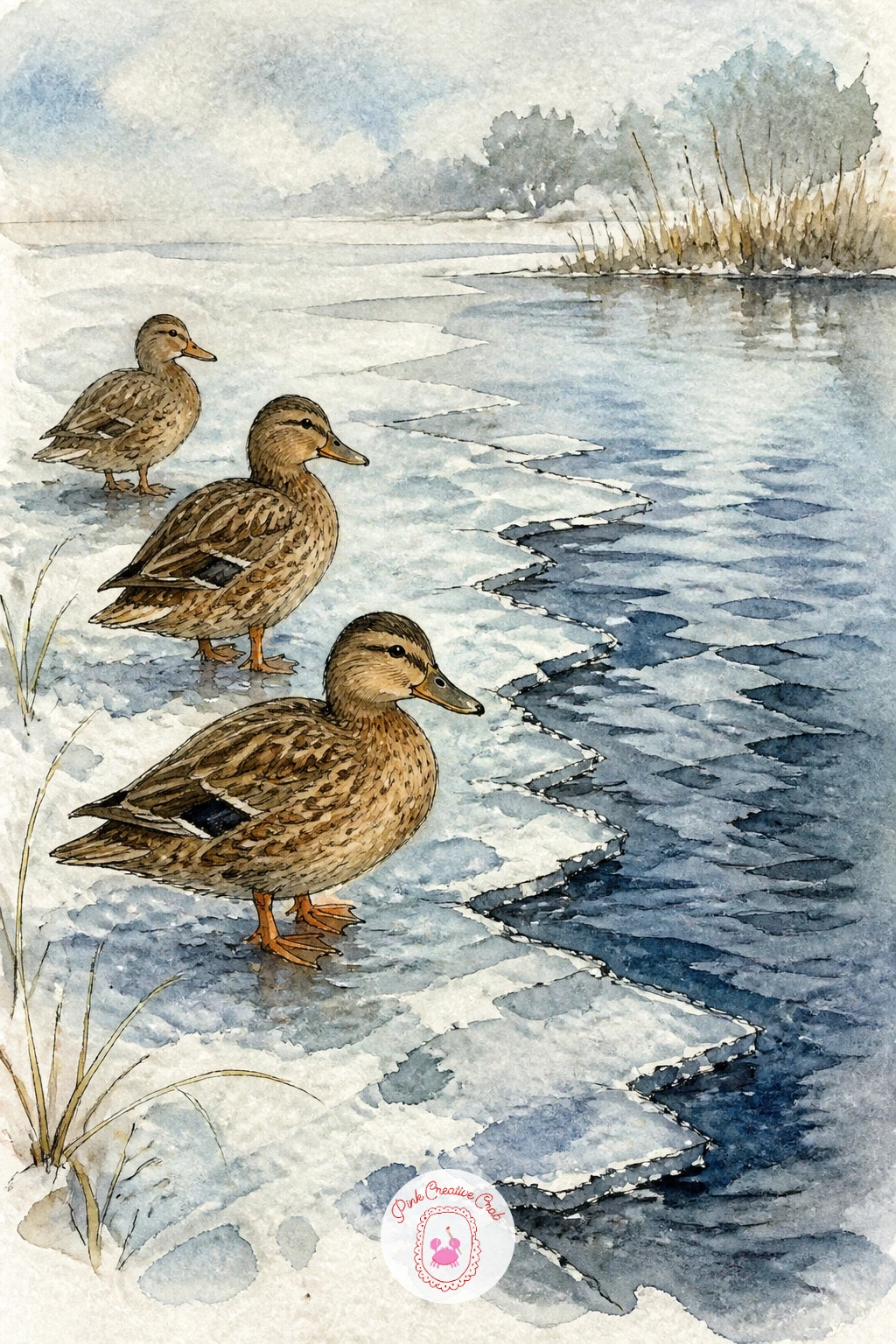
Palette: Payne’s Grey,Cerulean Blue,Burnt Sienna,Titanium White
Soften back up with a mother duck with ducklings riding on her back, one of the most beloved duck images and a satisfying one to paint once you have the basic duckling shape down from earlier ideas. Sketch the mother as a larger, calm floating oval, then tuck three or four small duckling shapes along the top of her back, varying their poses slightly.
Paint the mother in your usual brown wash first, then add the ducklings once she has dried, keeping their yellow slightly warmer and brighter than her more muted tones so they stand out clearly against her back. A thin ring of reflected water color beneath them both, added as one continuous wash, ties the whole group together visually.
The spot everyone struggles with is overlap: make sure each duckling’s base is tucked slightly behind the one in front rather than lined up edge to edge, which keeps the group looking natural rather than stamped on.
If you want to vary this piece next time, try just two ducklings perched at different heights along her back instead of a tidy row.
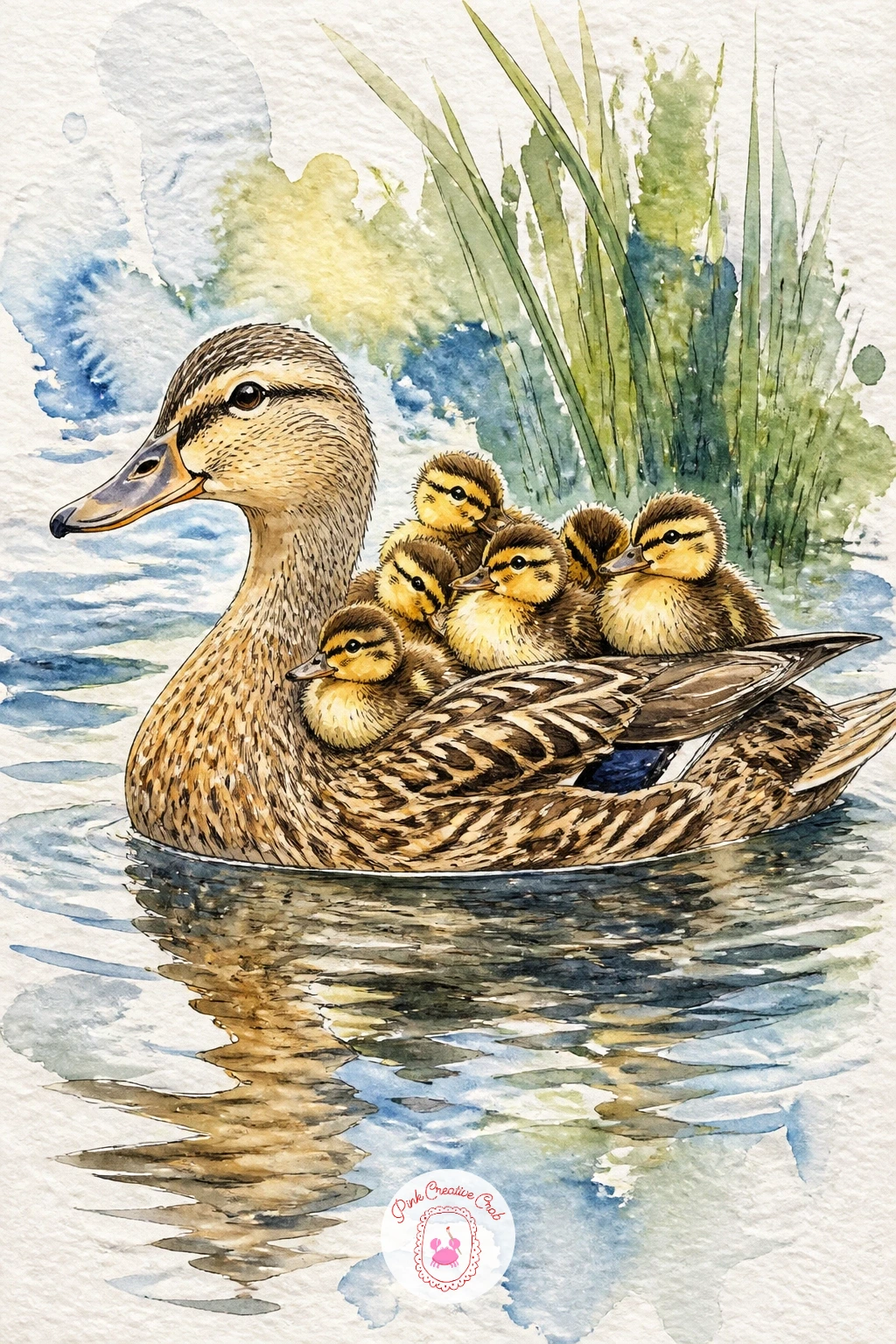
Palette: Burnt Umber,Yellow Ochre,Cerulean Blue,Naples Yellow
Push into a coastal mood with an eider duck on a rocky shore, swapping soft pond greens for cooler greys and the texture of weathered stone. Sketch the duck low against a cluster of rounded boulder shapes, its black and white plumage bold against the muted rock colors.
Paint the rocks first with a dry brush technique, dragging thick, barely-wet pigment across the paper so the natural paper texture shows through and reads as rough stone surface. Once dry, paint the eider in strong flat blocks of black and white, since this species relies on bold contrast rather than any blended gradient.
If your rocks come out smooth and soft instead of textured, try lifting a little color back out with a dry brush once the wash is still slightly damp, which breaks up the surface unevenly in a way that reads as weathered stone.
No rough-textured paper on hand, a dry brush technique on smooth paper will still give a convincing rock surface with practice.
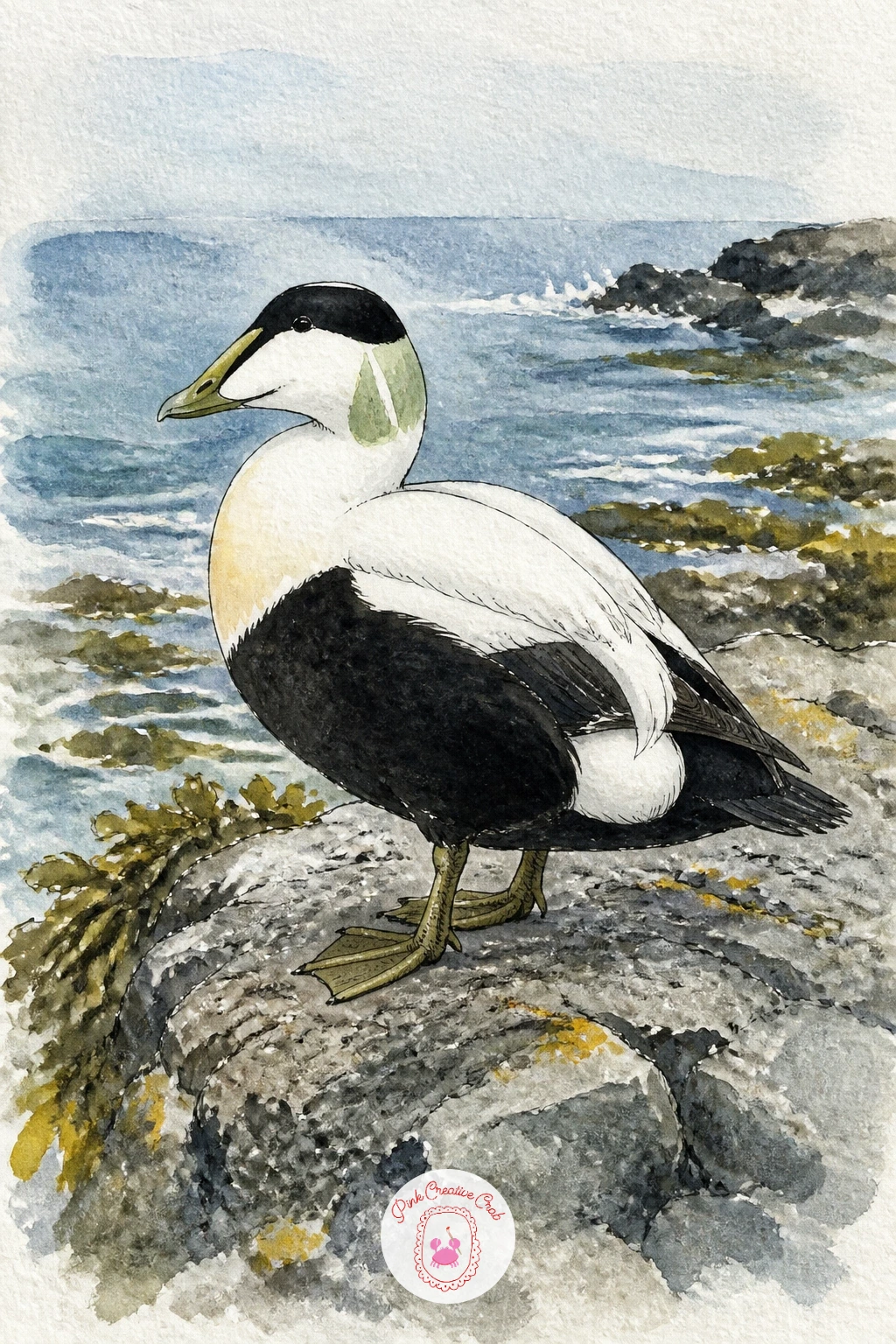
Palette: Payne’s Grey,Titanium White,Raw Umber,Cerulean Blue
Bring in spring color with ducks wandering through a tulip garden, a cheerful pairing that lets you practice flowers and feathers in the same piece. Sketch two or three ducks moving loosely among a bed of simple tulip shapes, keeping the flowers taller than the birds in places to suggest a proper garden bed.
Paint the tulips first in bold, saturated washes, reds and pinks work especially well, using a simple two-stroke cup shape for each bloom rather than detailed petals. Once dry, add the ducks weaving between the stems in your usual palette, letting a few tulip stems overlap in front of a duck’s body to root them properly into the scene rather than floating on top.
This is a nice moment to vary your approach from the pond scenes earlier: try a higher eye level looking slightly down onto the garden bed, which shows off more of the tulip pattern around the ducks’ feet.
If you enjoy painting flower beds like this, the ideas in this flower painting guide cover more simple bloom shapes worth trying.
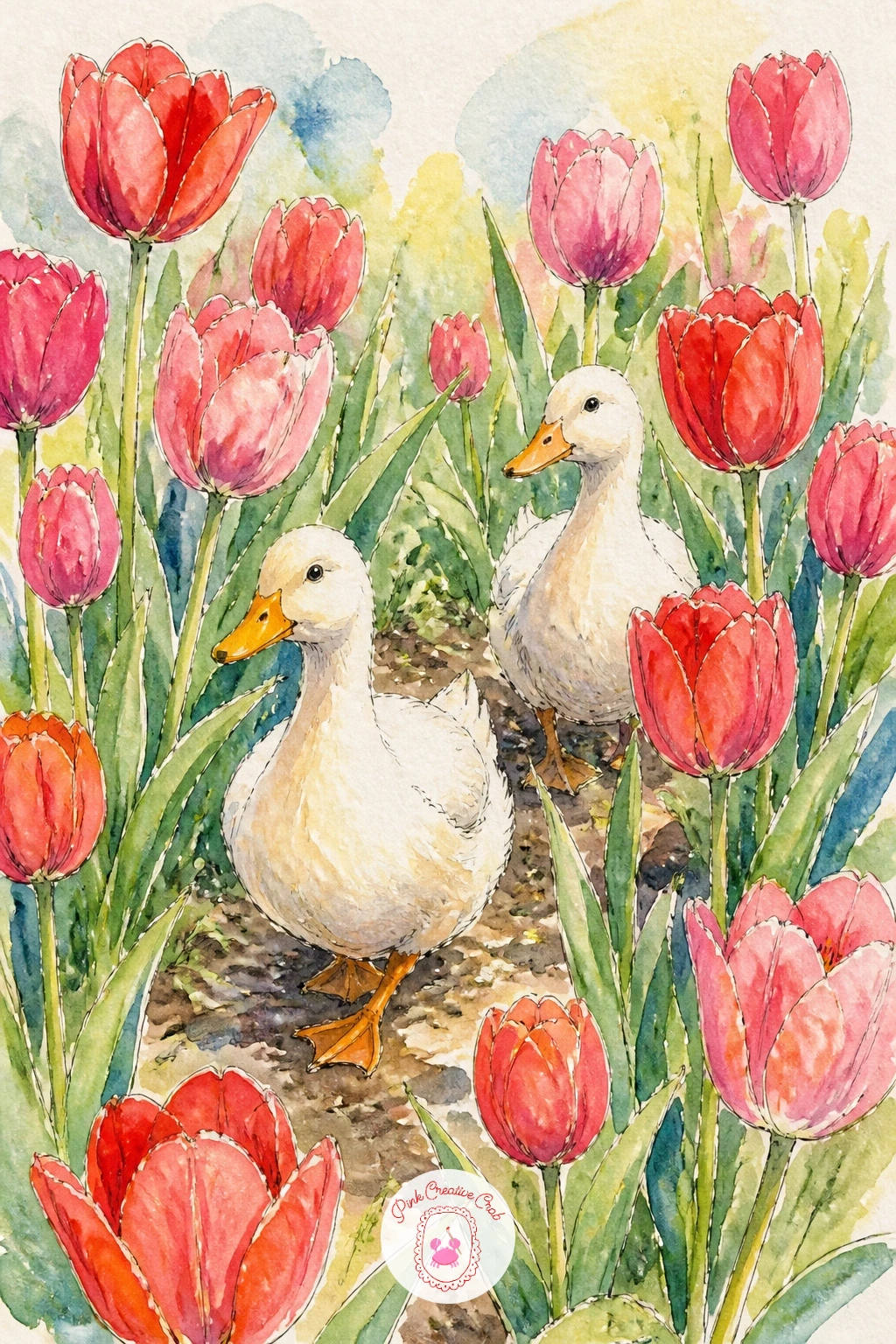
Palette: Cadmium Red,Magenta,Sap Green,Yellow Ochre
Zoom right in with a duckling yawning, a close-up portrait subject that captures a tiny, fleeting expression beginners often shy away from attempting. Sketch just the head and upper body large on the page, the bill opened wide in a comic little gap, one eye squeezed shut.
Paint the fluffy yellow body first in a loose wash, then work the open bill carefully in a pale pink-grey, keeping the inner mouth area slightly darker to suggest depth without overworking it. Add fine ink lines last for the small feather texture around the face and the single closed eye crease, since too much ink too early will flatten the softness of the fluff.
If this is your first close-up bird portrait, start with a larger sheet of paper than you think you need. Working at a bigger scale makes the small bill and eye details far easier to control with a brush.
No fine liner for the eye crease, the tip of a dry brush loaded with dark paint can draw an equally delicate line.
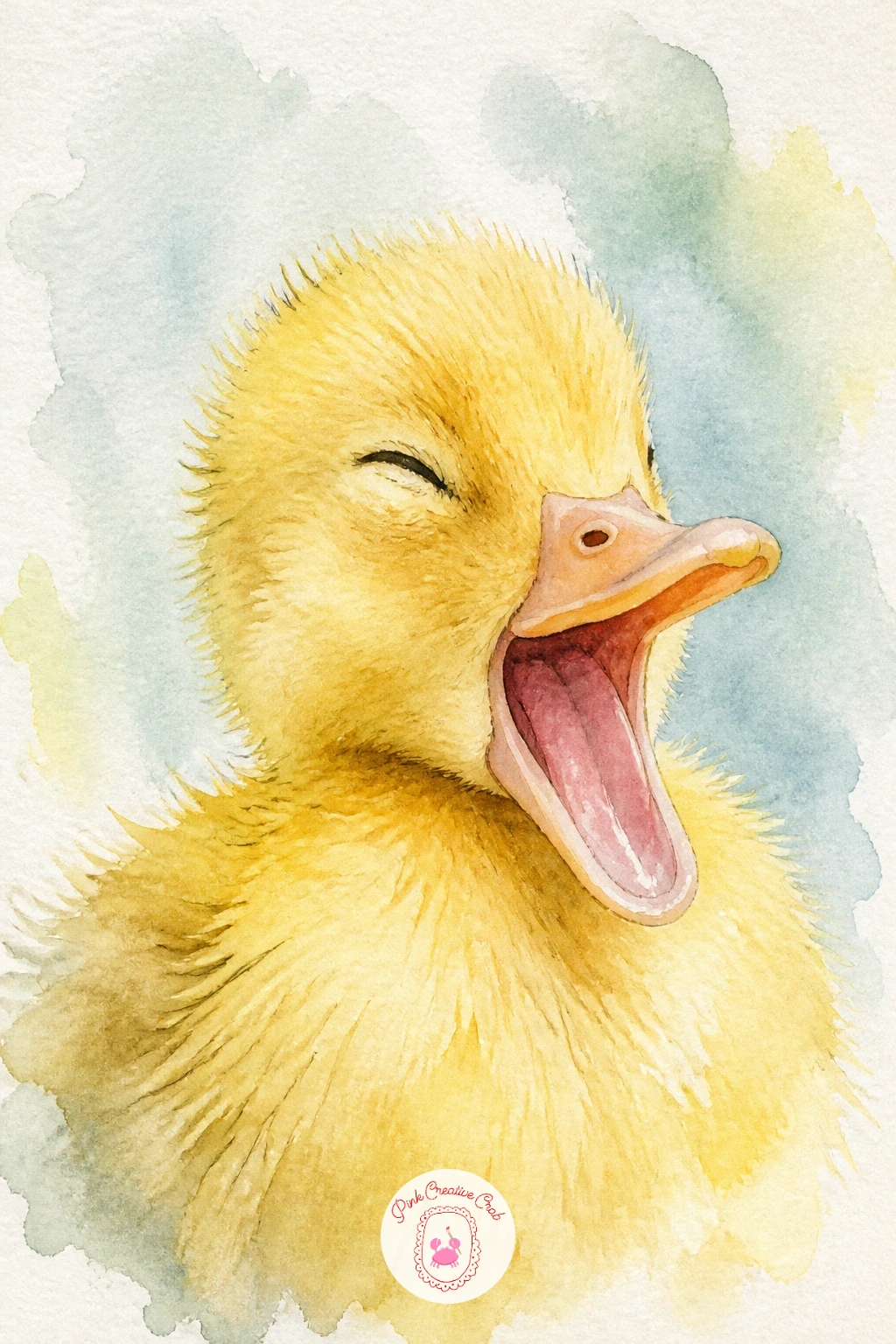
Palette: Naples Yellow,Dusty Pink,Payne’s Grey,Burnt Sienna
Settle into a quieter mood with a duck sitting on her nest in the reeds, a subject built around stillness rather than movement. Sketch the duck low and rounded, body spread slightly to cover the nest beneath her, surrounded by tall vertical reed shapes rising above her back.
Paint the reeds first as simple vertical strokes of varied green, letting some overlap in front of the duck’s body to tuck her properly into the setting rather than placing her in front of a flat backdrop. Add the duck herself in a calm, settled brown wash, keeping her silhouette low and wide rather than the more upright poses used in earlier ideas.
The nest itself rarely needs much paint at all: a few quick strokes of straw-yellow peeking from beneath her is enough, since too much detail there will pull focus from the duck.
If your reeds come out too uniform, vary the pressure on your brush as you pull each stroke upward so some are thicker and some thinner.
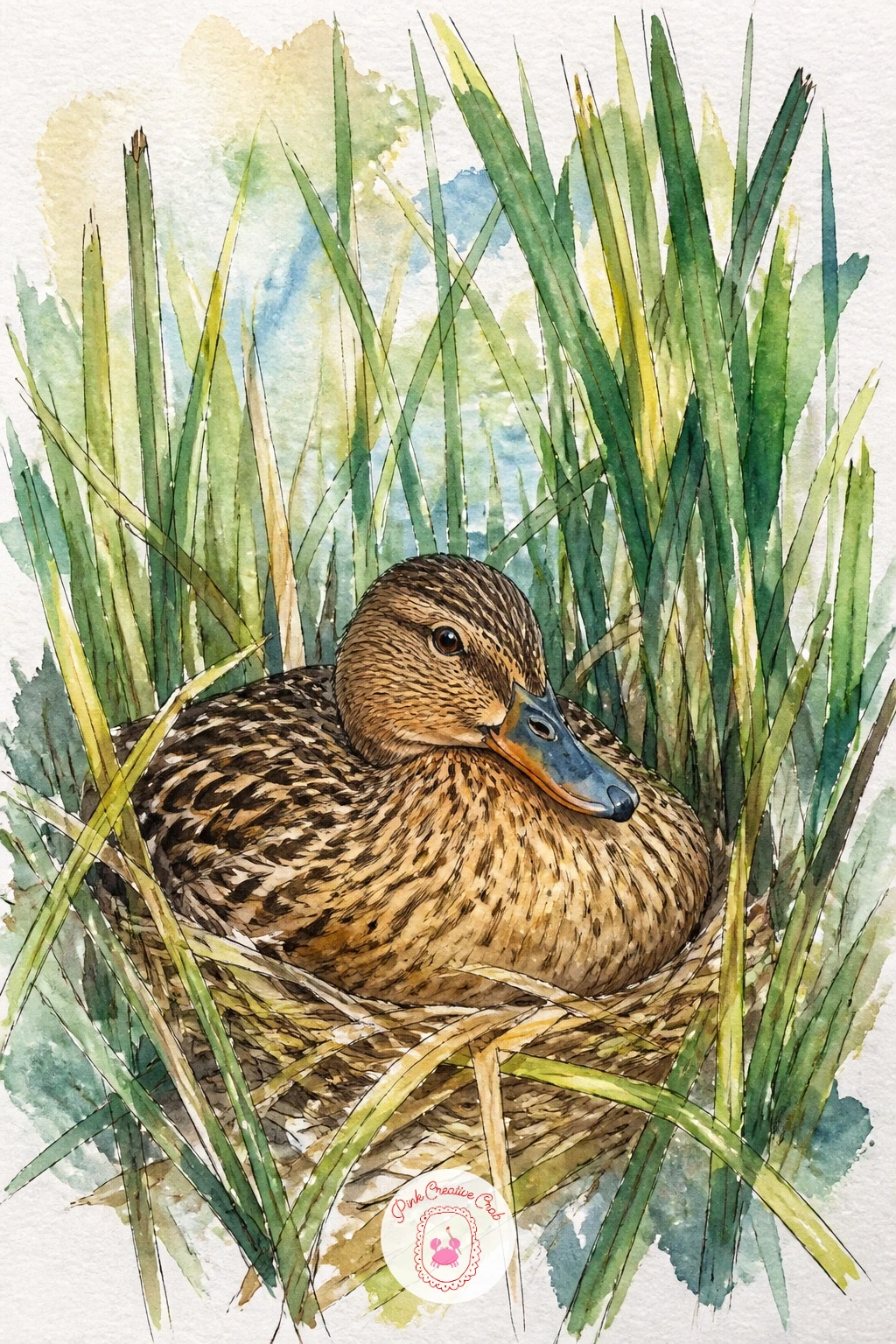
Palette: Sap Green,Burnt Umber,Yellow Ochre,Hooker’s Green
Build a fuller scene with a farmyard with ducks and a red water pump, a nice composition exercise now that you have practiced plenty of individual birds. Sketch the pump as a simple vertical structure with a curved handle off to one side, placed just off-center, then scatter three or four ducks around its base as though drawn by a puddle beneath it.
Paint the pump in a confident flat red, letting a touch of darker shadow fall along one side to give it some dimension, then add the surrounding dirt and puddle in muted browns and greys once the pump has dried. Finish with your ducks, keeping their palette consistent with earlier pieces so the whole scene feels unified.
With several elements competing for attention in one piece, color accenting matters most: that one bold red shape should be the only truly saturated color in the whole scene, with everything else kept a touch more muted so the eye has a clear place to land first.
If you enjoy farmyard scenes, a wider set of barnyard subjects appears in this farm animal painting guide.
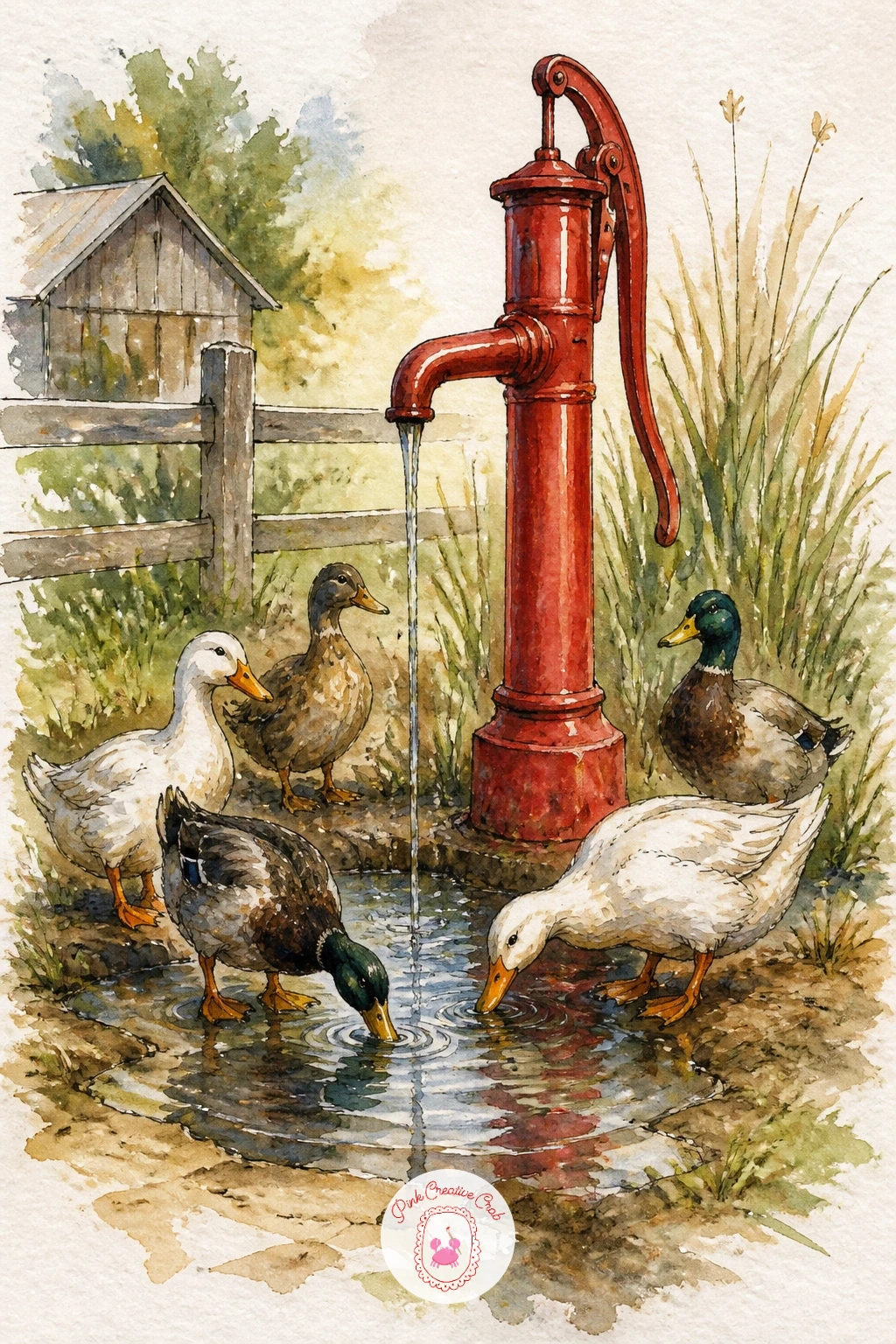
Palette: Cadmium Red,Raw Umber,Payne’s Grey,Yellow Ochre
Return to a single bird with a duck preening its feathers, a pose built around a dramatic curved neck reaching back toward the wing. Sketch the neck twisted in a strong S-curve, the bill tucked into the raised feathers along the back rather than facing forward.
Paint the body first in your usual flat wash, then work the raised wing feathers with a dry brush dragged in short upward strokes to suggest the slightly ruffled, lifted texture that happens during preening. Keep the neck smooth and glossy by comparison, since that contrast between smooth neck and textured wing is what sells the pose.
If the neck curve looks stiff or broken, draw it as one continuous flowing line in pencil before you ever pick up a brush, checking that it reads as a single graceful arc rather than two straight segments joined at an angle.
A wet-on-wet highlight dropped along the top of the curved neck, left to bloom on its own, adds a nice touch of gloss with very little effort.
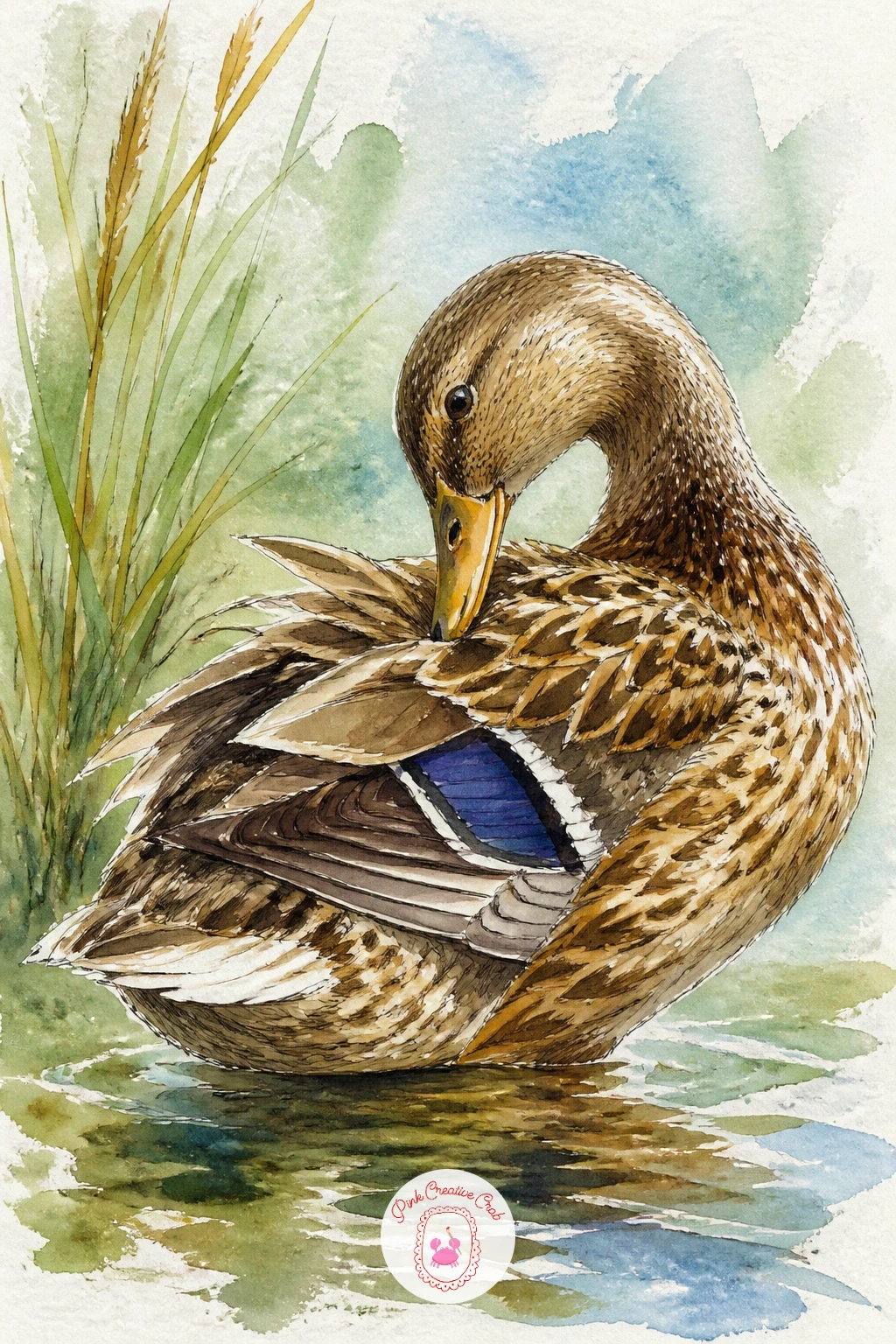
Palette: Burnt Sienna,Payne’s Grey,Yellow Ochre,Titanium White
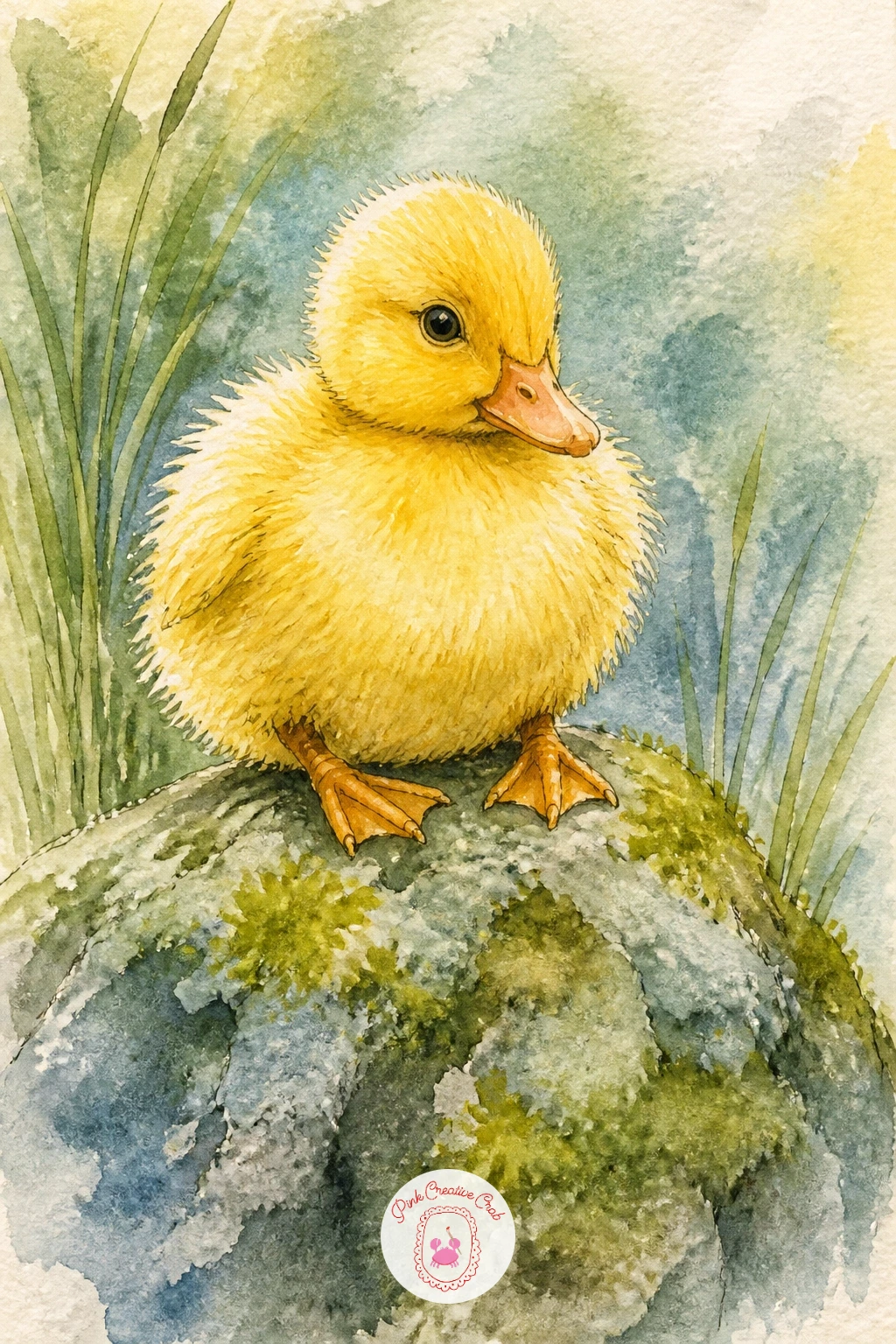
Come back to something small and gentle with a fluffy duckling on a mossy stone, a simple vignette that pairs the bird’s soft texture against the rougher surface beneath it. Sketch a single rounded stone shape with the duckling perched neatly on top, small feet just visible at its base.
Paint the stone first in a mottled wash of greys and greens, dropping extra pigment wet-into-wet in a few spots to suggest patches of moss growing across its surface. Once dry, add the duckling in your usual soft yellow, keeping the edge where fluff meets stone slightly blurred with a damp brush so the two textures feel connected rather than cut apart.
If the moss patches look too uniform, vary the green you drop in from one spot to the next, some more yellow-green, some more blue-green, so the stone surface feels naturally irregular rather than painted with a single flat color.
No second green mix ready, add a touch more yellow or blue to your base green between drops for quick variation.
Palette: Payne’s Grey,Sap Green,Naples Yellow,Hooker’s Green
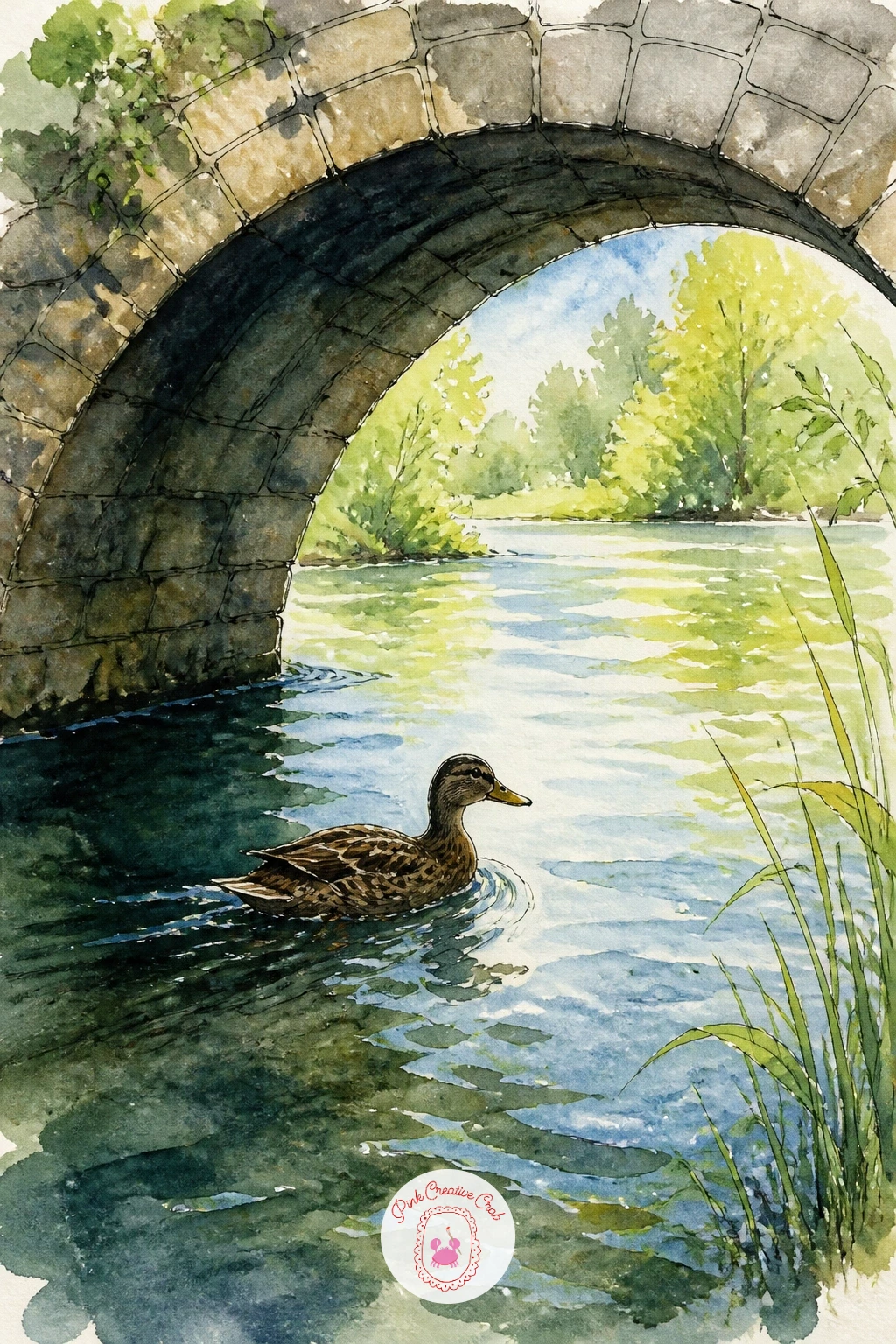
Build a more layered composition with a duck swimming under a stone bridge, which introduces an architectural arch and its reflection alongside the bird. Sketch the bridge as a simple curved arch spanning the top portion of the page, with the duck swimming through the dark shadow beneath it toward open water on one side.
Paint the shadowed underside of the arch in a deep, cool wash, then let the water beyond it lighten gradually toward the bright edge of the page, creating a strong light and dark contrast that pulls the eye straight through the composition. Add the duck mid-transition between shadow and light, with one side of its body noticeably darker than the other to show it genuinely swimming through that change in light.
If the arch’s reflection comes out flat, paint it slightly more broken and wavy than the solid stone above it, using a few interrupted brushstrokes rather than one smooth mirrored shape.
No large brush for the broad arch shadow, a smaller brush worked in overlapping strokes covers the same area just as evenly.
Palette: Payne’s Grey,Raw Umber,Cerulean Blue,Burnt Sienna
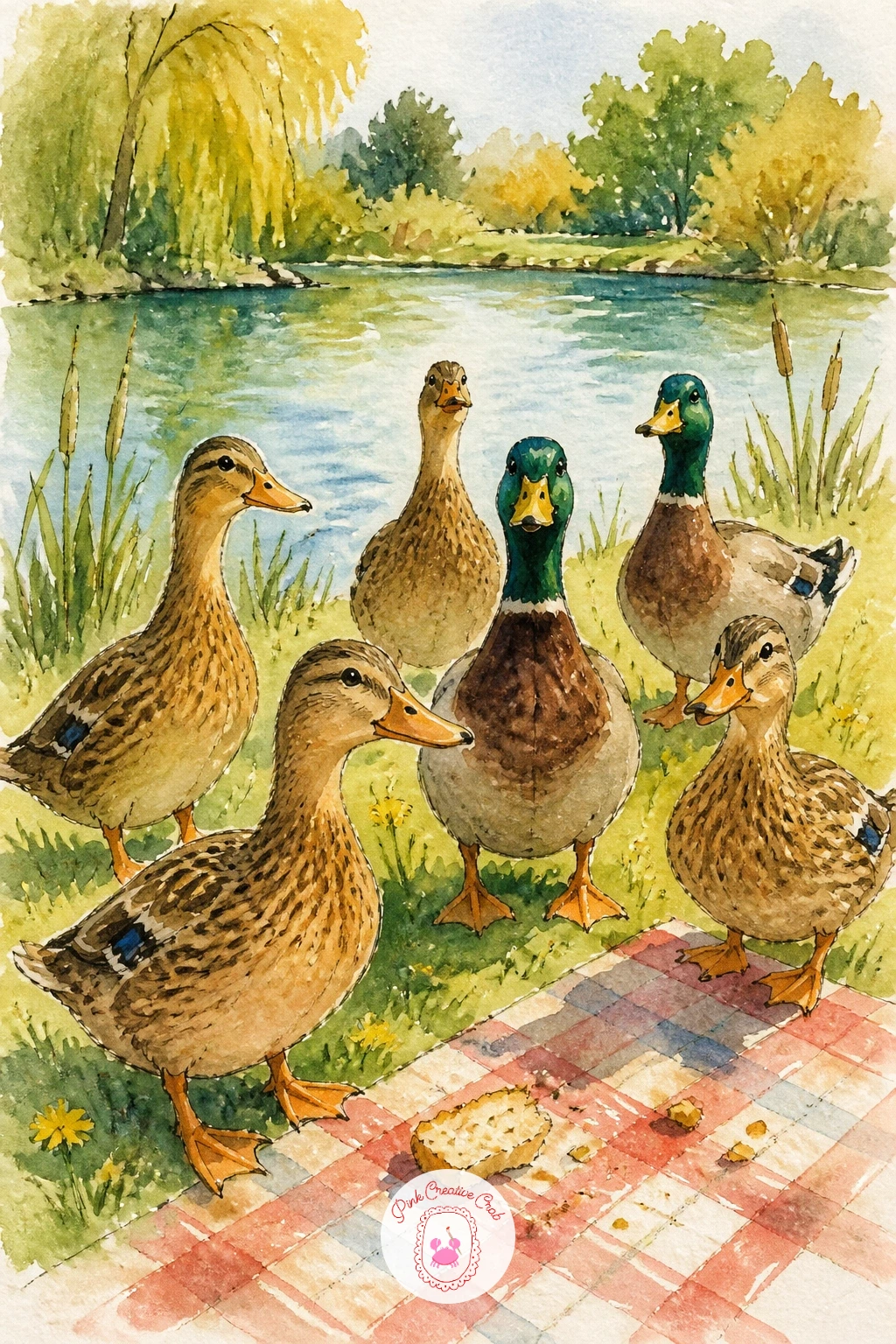
Close out with ducks waiting for crumbs at a pond picnic, a lively multi-bird scene to bring together everything practiced across this whole list. Sketch a cluster of ducks in varied poses, some standing, some stretching their necks forward, gathered near the edge of a blanket or basket just visible at the frame’s bottom edge.
Paint each duck in a slightly different pose and angle using the techniques from earlier ideas, varying your palette just enough between birds that the group doesn’t look stamped from one template. Keep the picnic elements themselves minimal, a corner of checked blanket or the rim of a basket, so they suggest the setting without competing with the birds for attention.
With several ducks in one piece, overlap is again the trick that sells the group as a real gathering rather than a lineup: let at least two birds overlap bodies or tails so the composition reads as one connected scene.
If you have enjoyed this whole list, similar gentle outdoor gatherings appear in this spring watercolor collection for your next sitting.
Palette: Yellow Ochre,Burnt Sienna,Payne’s Grey,Cadmium Red
What to Do Next
Pick one duck, gather your paper and paints, and let the first wash go down loose rather than careful. Start simple if this is new territory, maybe the sleeping duckling or the teacup scene, and work toward the fuller farmyard and garden pieces once a few of these are drying on your table.
Frequently Asked Questions
What watercolor paper works best for duck painting?
Cold press watercolor paper around 140 pounds works best for duck painting. Its slight texture holds washes well and supports the wet-into-wet blending that gives feathers a soft, natural look.
How do you paint realistic duck feathers in watercolor?
Build feathers in layers, starting with a flat base wash and adding texture with a dry brush once it dries. Dragging a nearly dry brush in short strokes suggests individual feathers without overworking the area.
What colors do you need for painting mallard ducks?
A mallard needs Phthalo Green or Viridian for the head, Burnt Sienna for the chestnut breast, and Payne’s Grey for the body. These three plus yellow ochre for the bill cover most mallard plumage.
How do you keep white ducks from looking flat in watercolor?
Leave the duck as bare white paper and paint only the shadows with pale grey washes. Form comes entirely from shadow placement under the wing, belly and neck rather than any color on the bird itself.
How long does a duck painting take to finish?
A simple single duck takes about ten to twenty minutes for a confident beginner, while a fuller scene with several birds or a background setting can take thirty to forty minutes including drying time.
Have any thoughts?
Share your reaction or leave a quick response — we’d love to hear what you think!
-
 0
-
0
-
0
-
0
-
0
-
0


