Greece painting gives you a whole summer of small, finishable scenes: a blue door, a cat on warm steps, a boat pulled up on the sand. Every one of these pictures is a moment a traveler actually remembers, not a postcard view, and gouache is the perfect medium for it because flat color and crisp edges read instantly on a phone screen or a page.
Below you will find 31 ideas, ordered from quick and simple to a little more involved, each one built around a single place, object or small scene from the islands or Athens. Pick whichever one you are craving right now and you can have it finished before the light changes.
Using these images: free for personal projects such as printing, coloring, cards, journals and gifts. Handmade items that include them may be sold up to 30 pieces per design. More than that is commercial use and is not permitted, and neither is selling or sharing the images themselves or passing them off as your own. Please ask before any other use.
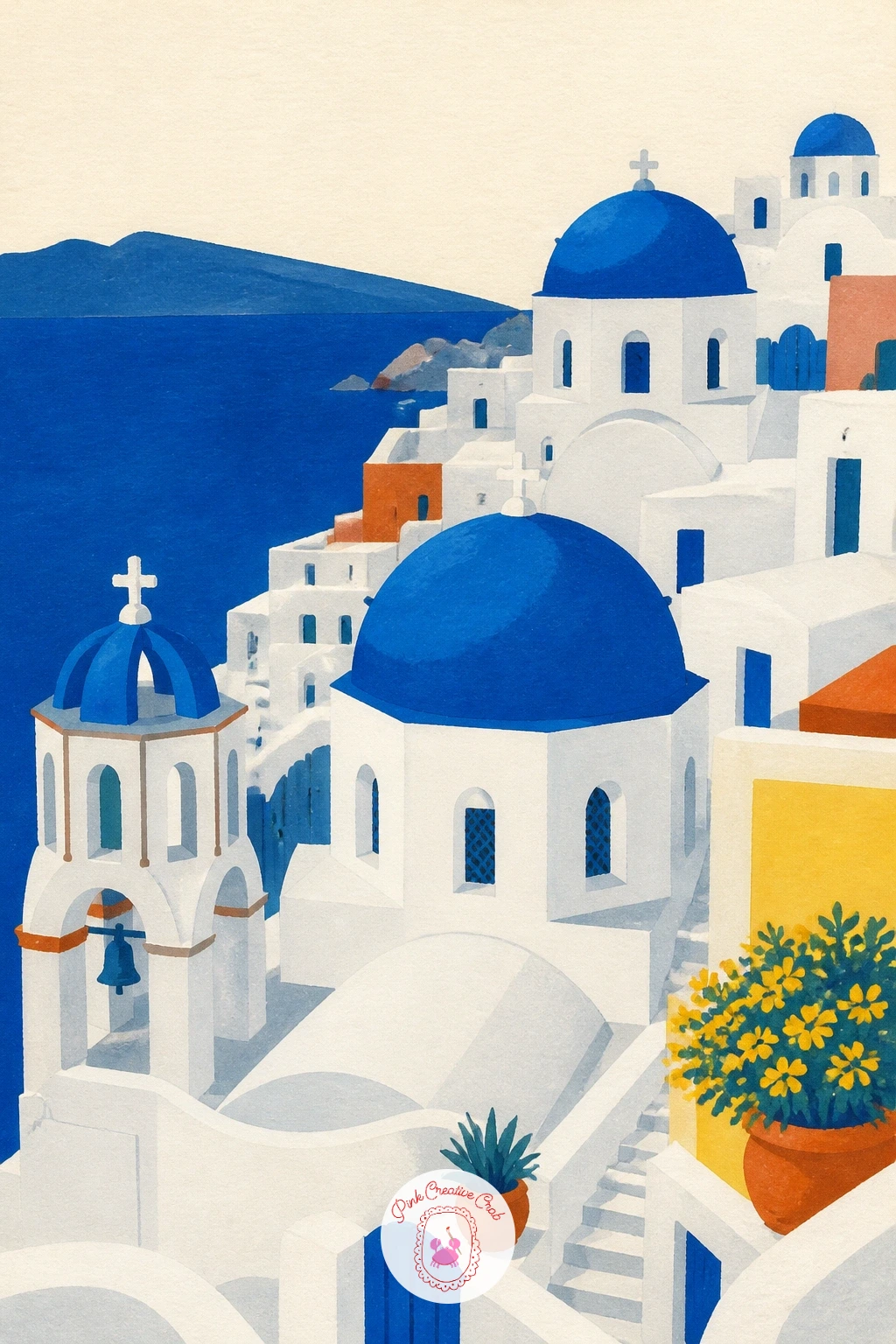
Start with the easiest postcard in the whole collection: white houses stacked above the sea with a cluster of blue domes catching the light. Pencil in loose rectangles and cubes climbing the hillside first, then block the sea in flat Aegean blue before you touch a single white wall, so you always know where your lightest lights sit against your darkest dark.
Paint the whitewash in two values, a cool white in shadow and a warm white in sun, then drop the domes in last with a rounder brush loaded with thick blue gouache so the edges stay crisp. The usual mistake is painting every house the same flat white, which flattens the whole hill, so vary the warmth slightly house to house.
Measure before you commit: hold your pencil up to the reference or your memory and compare the height of one house block to its neighbor, since this hillside only reads right when the stacking stays roughly consistent in scale. No reference photo on hand is fine, three or four simple cube shapes of similar size do the job.
Finish with a thin white gel pen outline on two or three domes to sharpen the print look.
You Will Need
- white gel pen
Palette: Aegean Blue, Whitewash White, Terracotta, Cream
A single blue door with a terracotta pot of red geraniums makes a satisfying small study you can finish in well under an hour. Work on a small sheet, pencil the door as one tall rectangle filling most of the page, then lay the flat blue first and let it dry completely before adding the pot so your edges stay clean.
Paint the pot in terracotta with one darker shade along its lower edge for weight, then dab in the geranium heads with the tip of a round brush loaded with red, leaving small gaps of leaf green between the blooms. If the flowers turn into a solid red blob, let the first layer dry and add a few individual petal strokes on top once it sets.
If you do not have a true Aegean blue, mix ultramarine with a touch of white and a whisper of black until it reads as deep and slightly muted rather than bright.
Keep the wall around the door a warm cream white so the blue and red both sing against it, and finish by flicking a little white gouache dry-brushed across the door for worn, sun-bleached texture.
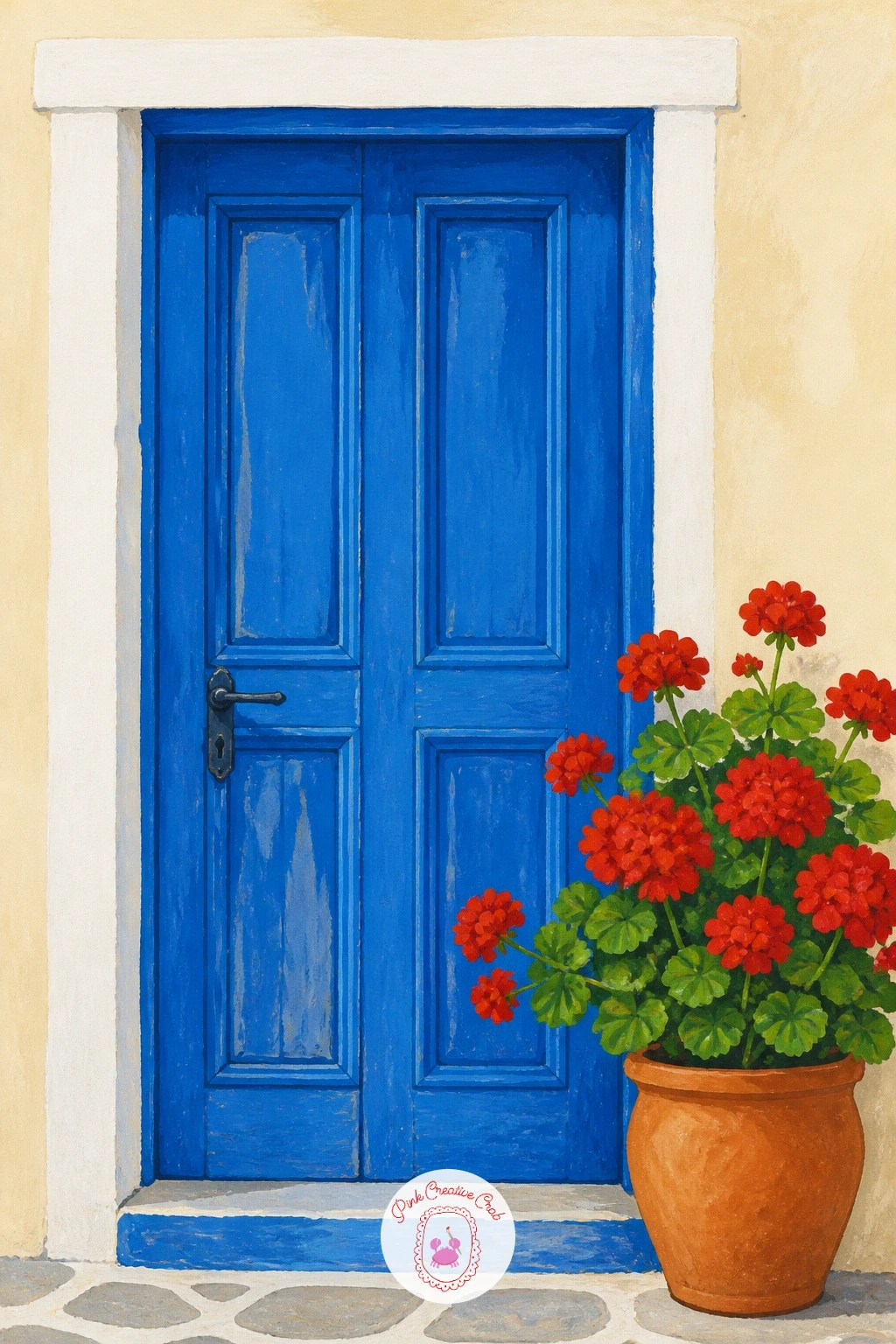
Palette: Aegean Blue, Geranium Red, Terracotta, Leaf Green
Try this one on a small canvas board instead of paper for a tiny finished piece you can prop on a shelf, the flat gouache sits beautifully on primed board.
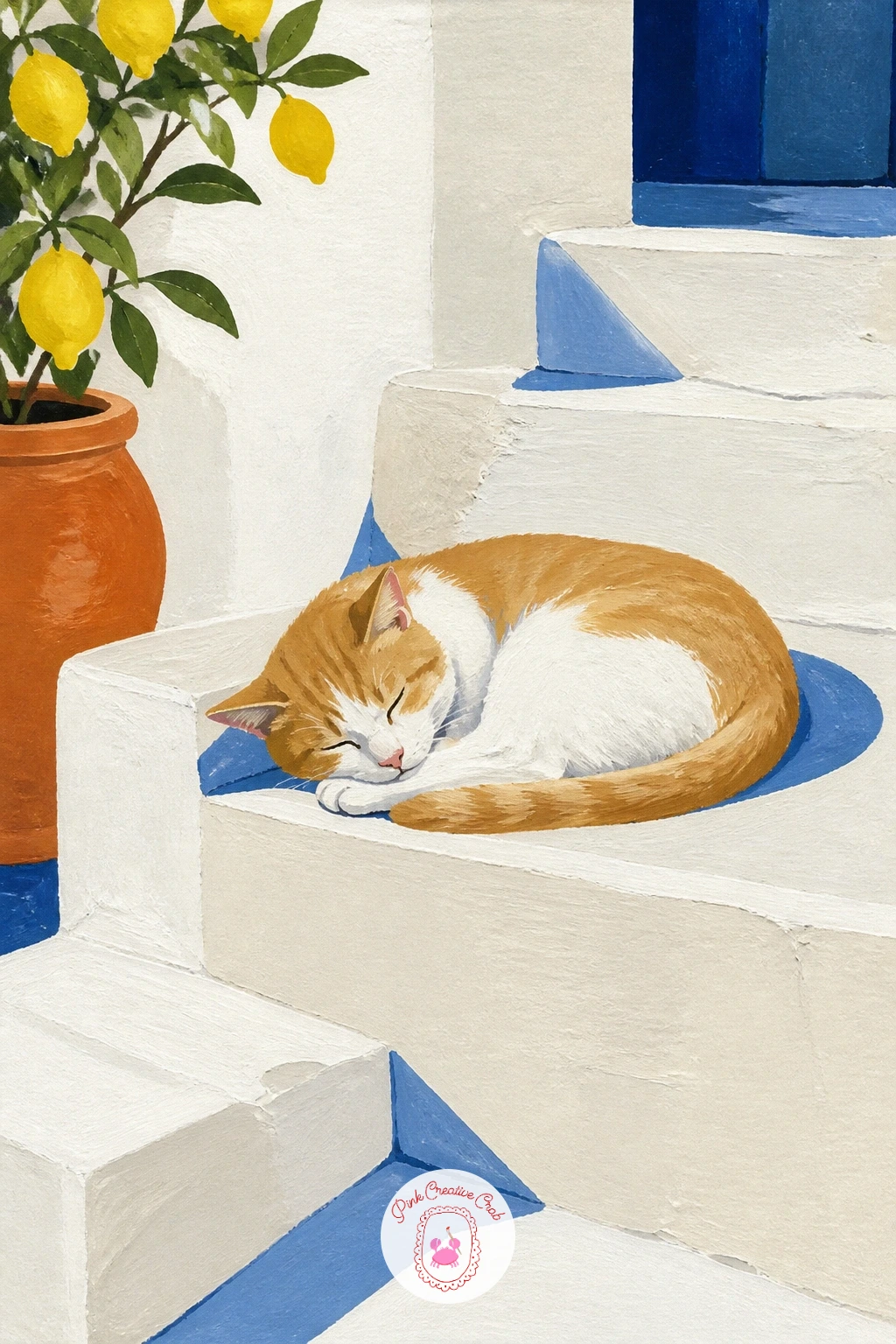
Every island has one of these: a cat curled up asleep on sun-warmed whitewashed steps. Sketch the steps first as three or four simple white blocks receding slightly, then drop in the cat as one soft rounded shape across two steps, keeping the pose simple with no visible legs or tail, just a loaf.
Paint the steps in two whites, warmer where the sun hits, cooler in the shadow under each step edge, then paint the cat last in a flat tan or grey so it sits clearly on top of the white. The mistake to watch for is painting the cat too dark against bright white steps, which can look like a hole rather than a soft animal, so keep the cat’s shadow side only a shade or two darker than its lit side.
This piece also works as your quick ten-minute version, just the cat and two steps. Given forty minutes, add a dropped fishing basket or a strip of blue railing behind to place it somewhere specific.
Finish with a few whisker lines in white gel pen once the cat’s fur color is fully dry.
You Will Need
- white gel pen
Palette: Whitewash White, Warm Tan, Soft Grey, Aegean Blue
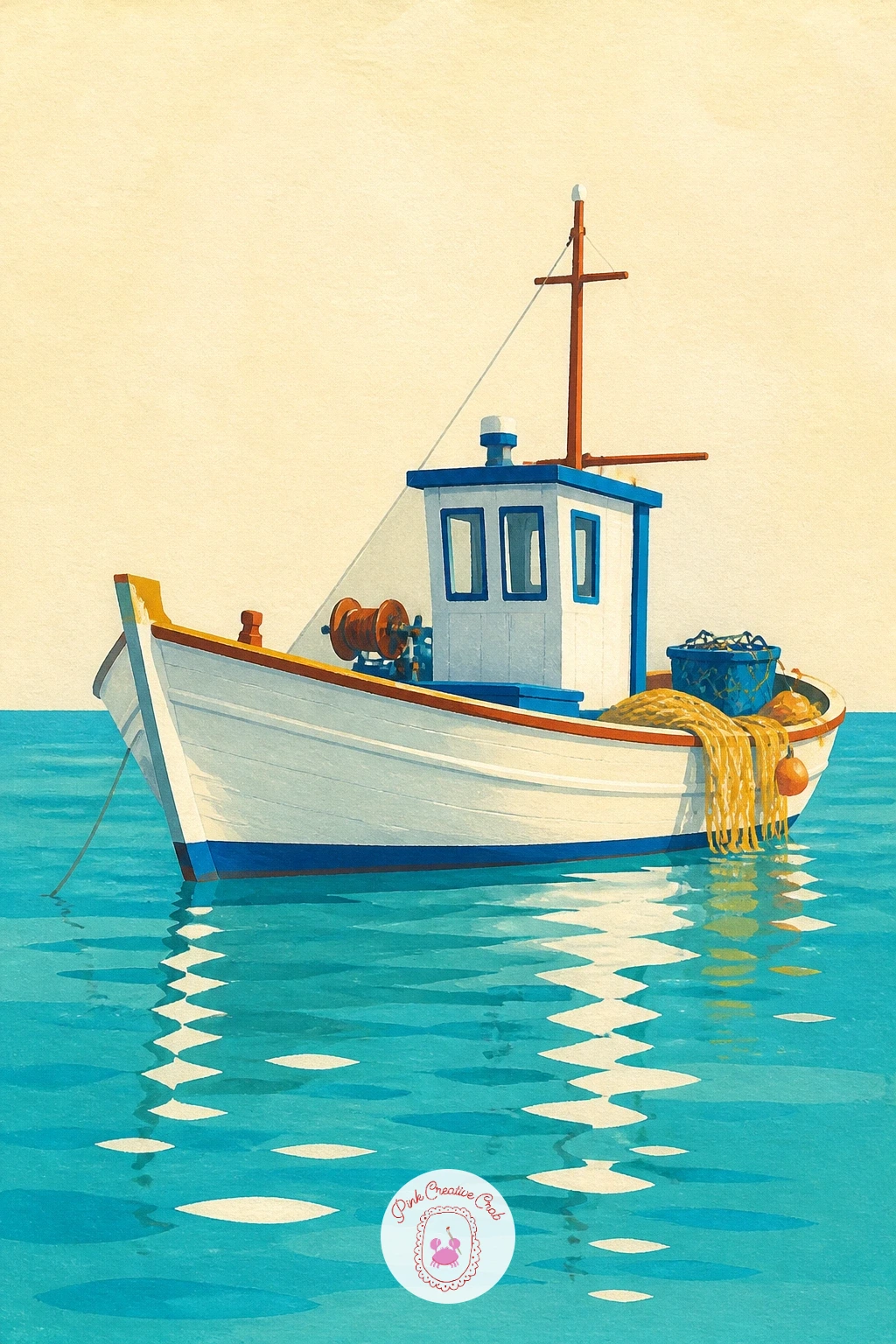
Move from land to water with a small fishing boat bobbing in a turquoise harbor. Block the water first in one flat turquoise, then paint the boat’s hull as a simple curved shape sitting on top, white or faded blue with a stripe of color along the waterline.
Light matters here: decide where the sun sits before you paint, since it tells you which side of the hull stays bright and which side falls into shadow, and it also tells you where to place the one or two sharp white reflections on the water below the boat. Keep those reflections as short, broken horizontal dashes rather than a solid mirror image.
The common trap is overworking the water with too many wave lines, which fights the flat, graphic look of this style. Two or three confident ripple shapes near the hull are enough, leave the rest of the turquoise flat and calm.
No turquoise in your set is no problem, mix a cool blue with a touch of white and a small amount of green until it sits between the two.
Palette: Turquoise, Whitewash White, Aegean Blue, Terracotta
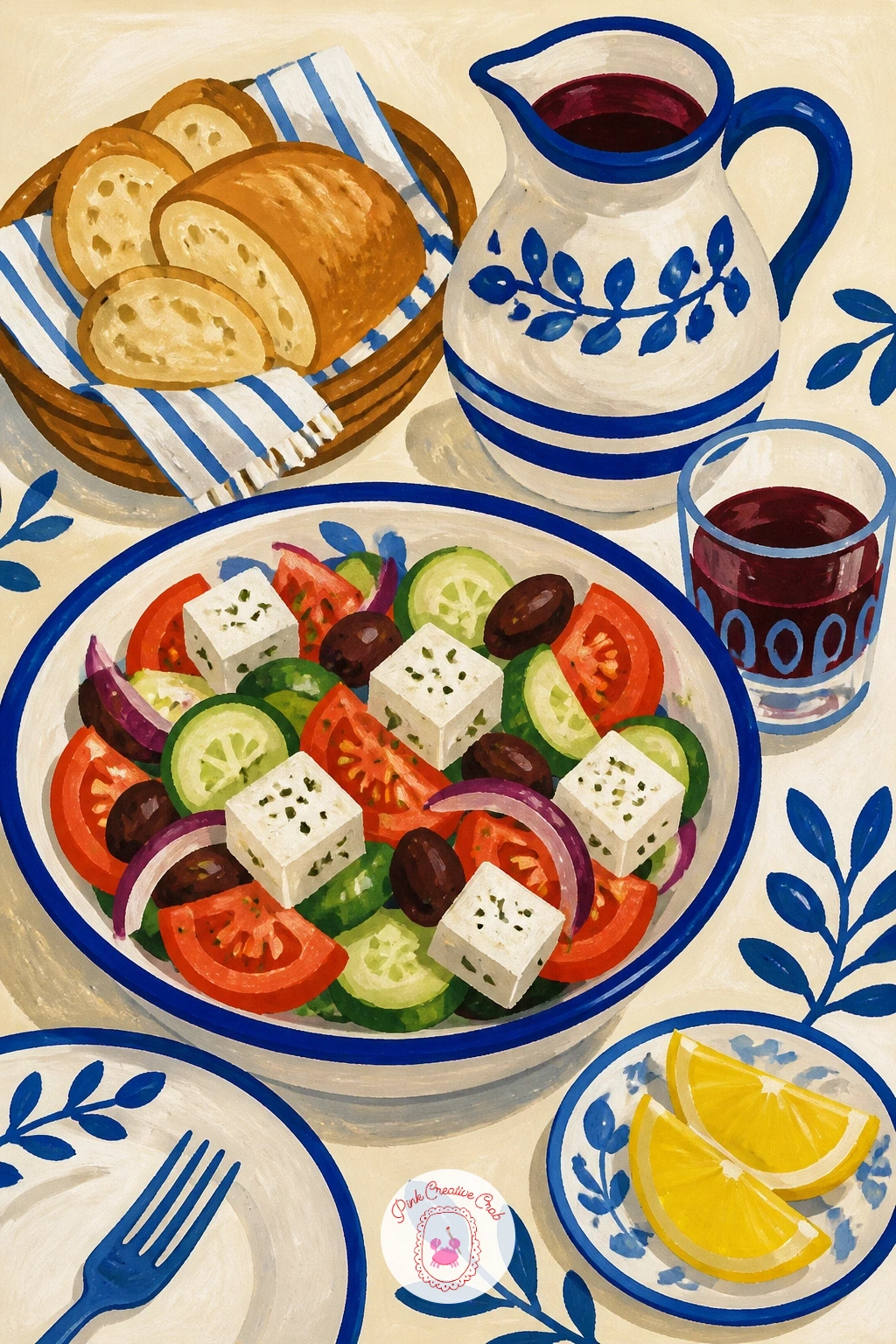
A taverna table set for lunch gives you a chance to paint food, glass and ceramics together in one small still life. Arrange the composition loosely in pencil first, the salad bowl slightly left of center, a basket of bread beside it, and the wine jug standing tallest to anchor the group.
Paint the tablecloth or wood surface first as your base layer, then build the salad in flat chunks of color, red tomato wedges, a block of white feta, a scatter of black olives, letting each shape stay simple rather than detailed. Work the jug last since its glass or ceramic surface needs the surrounding colors already in place to paint its reflections convincingly.
If the bowl looks flat and sits oddly on the table, add one curved shadow underneath it in a muted blue grey, this single shape does more to seat an object on a surface than any amount of extra detail inside the bowl.
Finish with a thin highlight of white along the rim of the wine jug to catch the light.
Palette: Tomato Red, Feta White, Olive Black, Terracotta, Aegean Blue
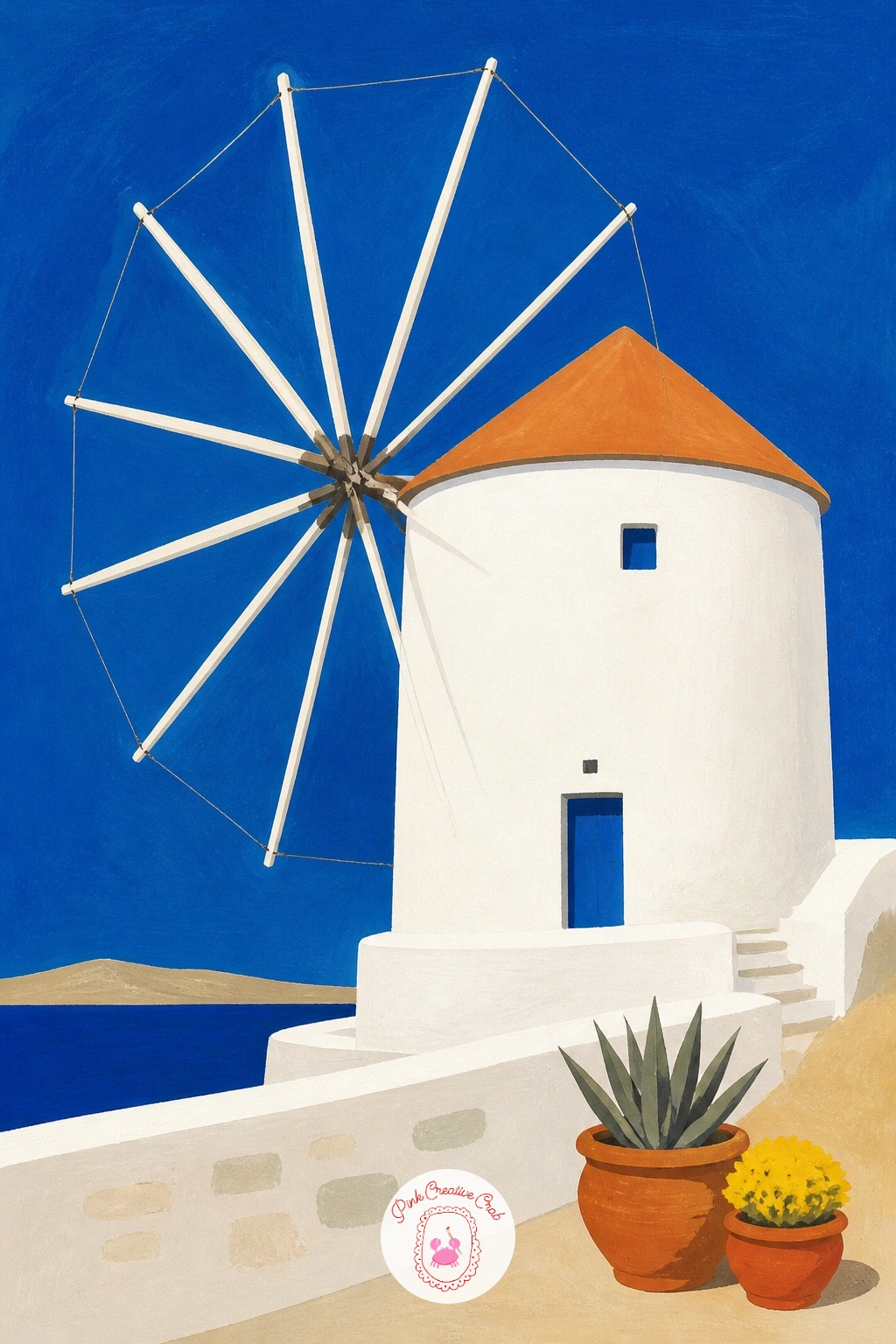
The round white windmills of Mykonos sit beautifully in gouache because their shape is so simple: a cone, a cylinder and a few thin sail spokes against open sky. Pencil the windmill body as a tapered cylinder first, then its conical thatched or tiled cap, and only then sketch the thin sail arms radiating out from the center.
Paint the body in flat white with one soft grey shadow down one side to show its roundness, then add the cap in a warm brown or terracotta. Save the sails for last using a fine round brush, since thin straight lines are far easier to place accurately once the solid shapes around them are already dry and settled.
Compare the windmill’s height to the hill and sky around it before you paint the background in, a windmill that fills nearly the whole page reads as a close, personal memory rather than a distant landmark, so do not shrink it to make room for extra scenery.
One swap if your fine brush is too thick for the sails: load a bamboo skewer tip with white paint instead.
Palette: Whitewash White, Soft Grey, Terracotta, Aegean Blue
A potted lemon tree beside a blue shuttered window brings in that lemon yellow accent the whole palette has been waiting for. Pencil the window frame first as a simple rectangle with a shutter panel to one side, then sketch the terracotta pot and the rounded mass of leaves and fruit beside it.
Paint the window blue and let it dry fully before adding the tree, since clean edges between blue frame and green leaves matter more here than anywhere else in this list. Build the leaf mass as a few overlapping flat green shapes rather than individual leaves, then dot in the lemons last with small ovals of lemon yellow, leaving the brightest two or three lemons untouched by shadow so they pop.
If the leaf mass looks like one solid green blob, go back in once dry with a slightly darker green on the underside to split it into two or three rounder clumps.
For a browser-worthy reference on painting citrus trees and pots in this palette, this lemon tree in a porcelain pot lesson works well alongside this one.
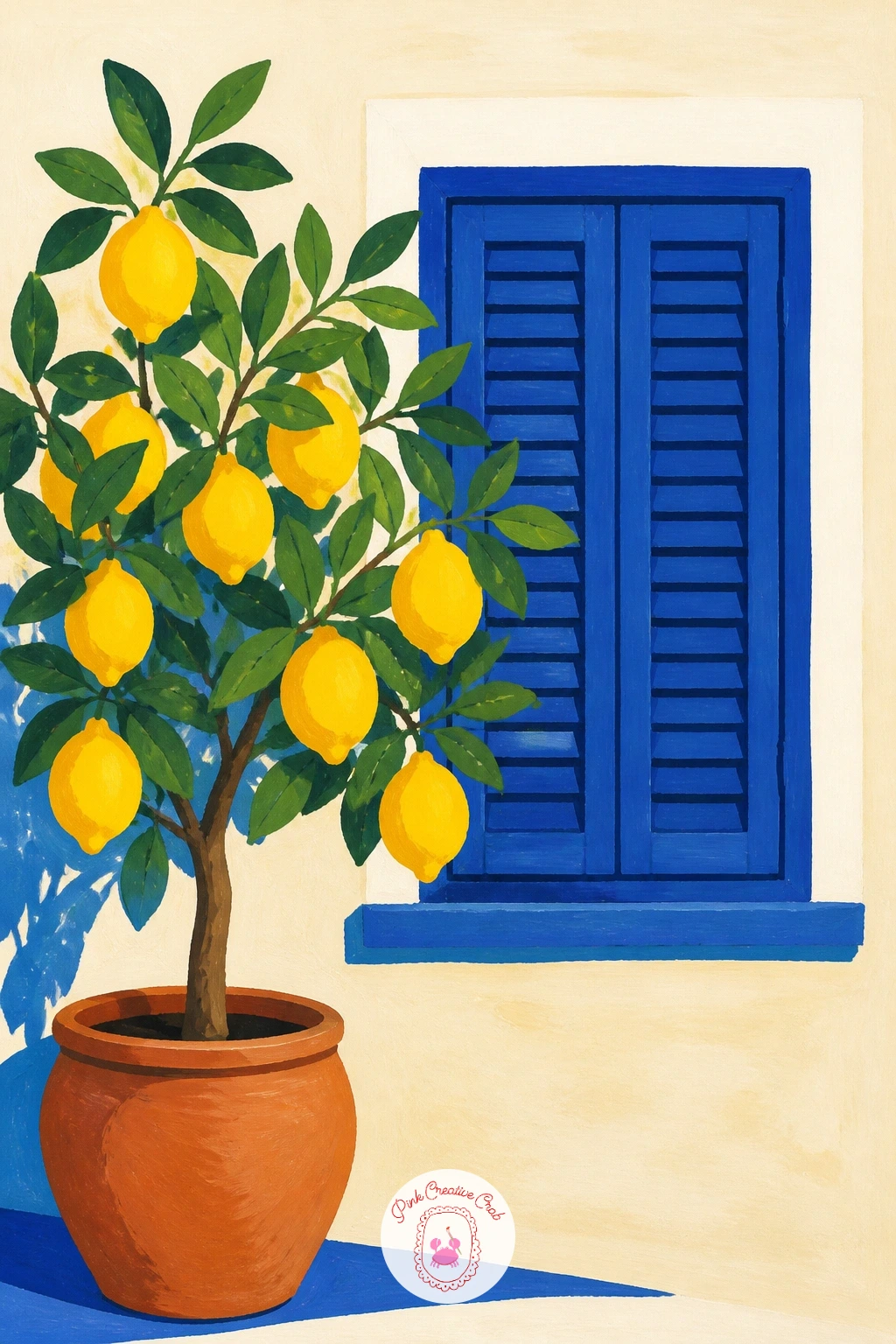
Palette: Lemon Yellow, Leaf Green, Aegean Blue, Terracotta
Paint a narrow whitewashed lane with steps and blue railings and you capture that feeling of wandering an island village with no particular destination. Set your eye level low, near the bottom of the steps looking up, since this angle makes the lane feel like you are walking straight into the picture rather than viewing it from a distance.
Block the steps in flat white and cream first, alternating value slightly so each step reads clearly against the next, then paint the railings as thin confident blue lines running alongside. A pot of flowers or a cat tucked into one corner gives the eye somewhere to land partway up the lane.
The lane often goes wrong when every step is painted the exact same white, flattening the whole climb, so keep warm light on the tops of steps and a cooler shade where each one meets the wall.
Finish with a scatter of small cast shadows along the lane to ground everything in afternoon sun.
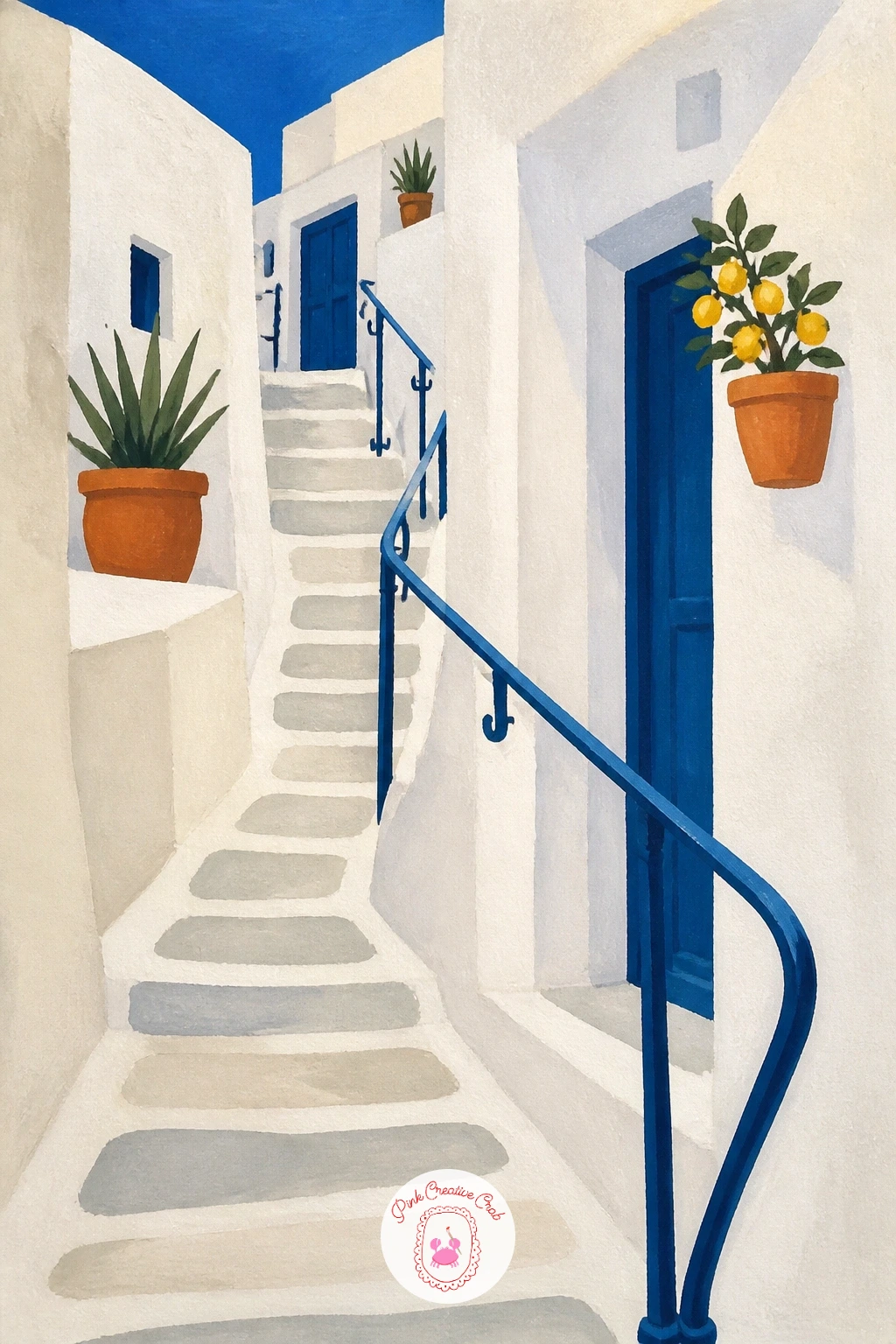
Palette: Whitewash White, Aegean Blue, Soft Grey, Terracotta
A donkey loaded with baskets climbing a village path adds movement and a little character to your collection. Sketch the donkey’s body as one simple rounded barrel shape with four short legs and a gently bowed head, then add the baskets as two rounded shapes hanging off its sides before you touch any paint.
Paint the donkey in a flat warm grey or brown, keeping the legs simple with no visible joints, then build the baskets in woven terracotta tones. Place the path beneath at a slight uphill angle, since a flat horizontal path makes the climb read as a stroll rather than real work.
If the donkey’s legs end up looking stiff or doll-like, soften the bottom edge of each leg with a damp brush while the paint is still workable, this blurs the hard stop and reads more naturally as a hoof meeting ground.
No grey gouache on hand, mix a little of your blue into your terracotta until it cools down toward brown grey.
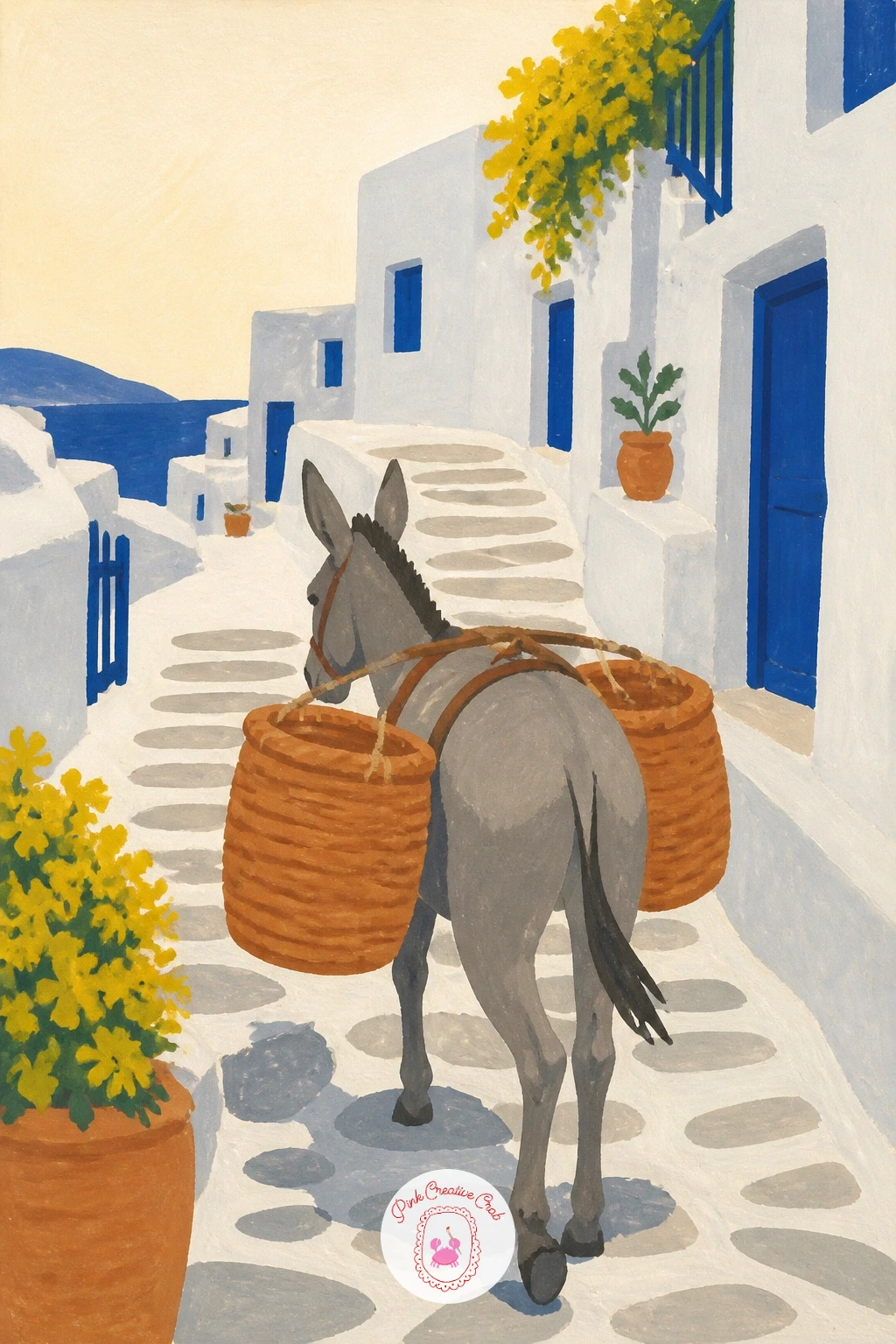
Palette: Warm Grey, Terracotta, Whitewash White, Aegean Blue
A small whitewashed chapel bell tower set against a deep blue sky makes a striking, simple composition built almost entirely from straight lines and one arch. Pencil the tower first as a tall narrow rectangle, then cut the bell arch opening near the top before adding the small cross or finial shape above it.
Paint the sky in one flat deep blue right up to the tower’s edges before you touch the white, this way your white stays perfectly crisp rather than fighting a painted-around edge later. Leave the bell arch opening as a darker cutout shape, almost black blue, to suggest the shadowed interior and the bell hanging inside.
If the tower looks too plain once painted, add one thin terracotta line or a small cross motif partway up to break the long white shape without cluttering it.
Painting the sky first and cutting in the white tower afterward is the single trick that keeps this whole piece crisp, so do not skip that order.
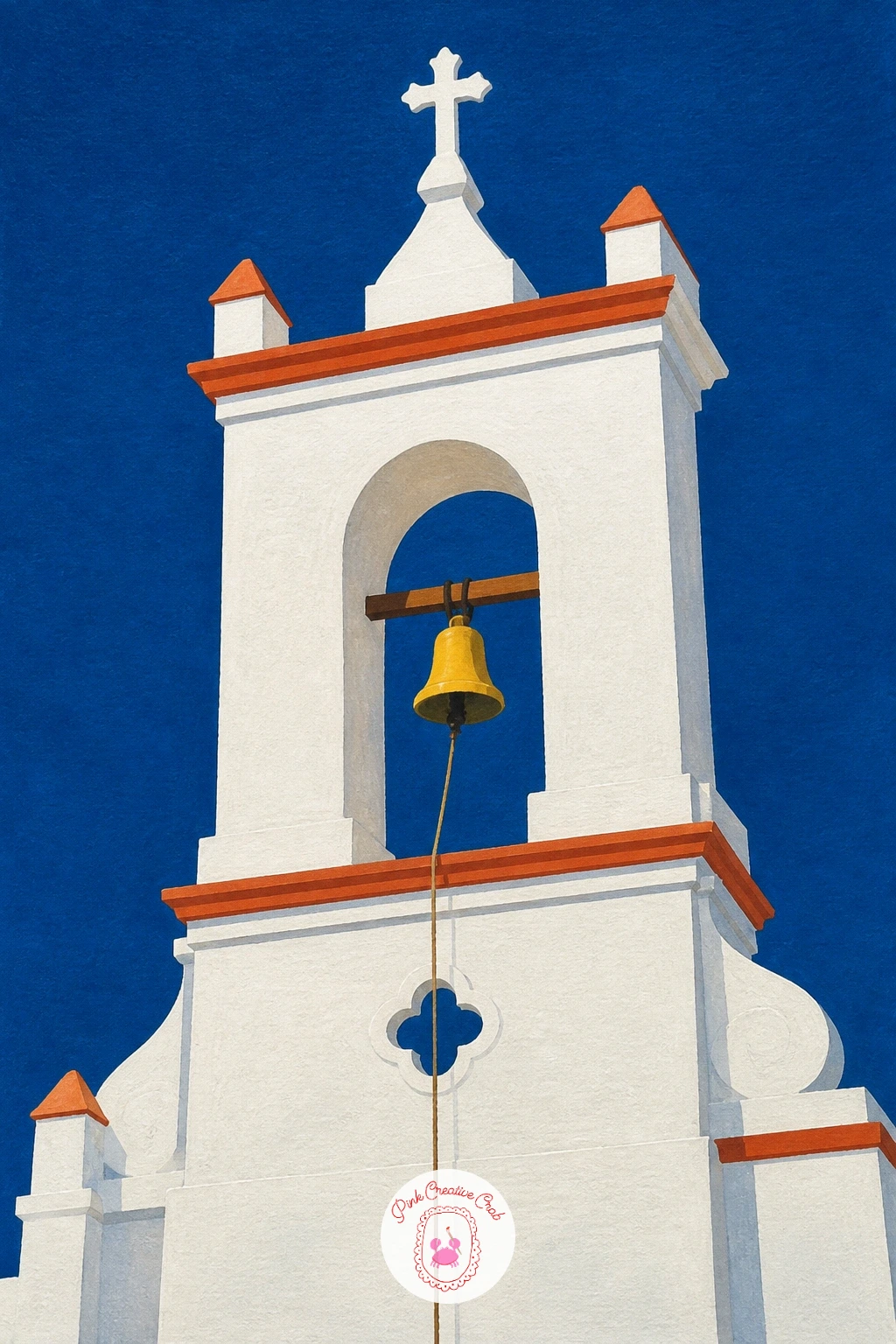
Palette: Aegean Blue, Whitewash White, Shadow Blue, Terracotta
Painting a figure feels more involved than a building, but a woman in a straw hat leaning on a balcony rail above the sea stays manageable if you simplify her to a few large shapes. Block her dress or top as one flat color shape first, then the straw hat as an oval tilted slightly, and only add her arms and the rail last.
Compare her height against the balcony rail before painting either in detail, a figure that reaches only to her hip on the rail reads as leaning and relaxed, while one towering well above it looks stiff and wrong, so check that proportion early with a quick pencil measure.
Keep her face almost featureless, a flat skin tone shape with maybe a single shadow under the hat brim, since from this distance a traveler remembers the pose and the hat far more than any facial detail.
Paint the sea behind her last in flat Aegean blue so her warm hat and skin tones sit forward against the cool background.
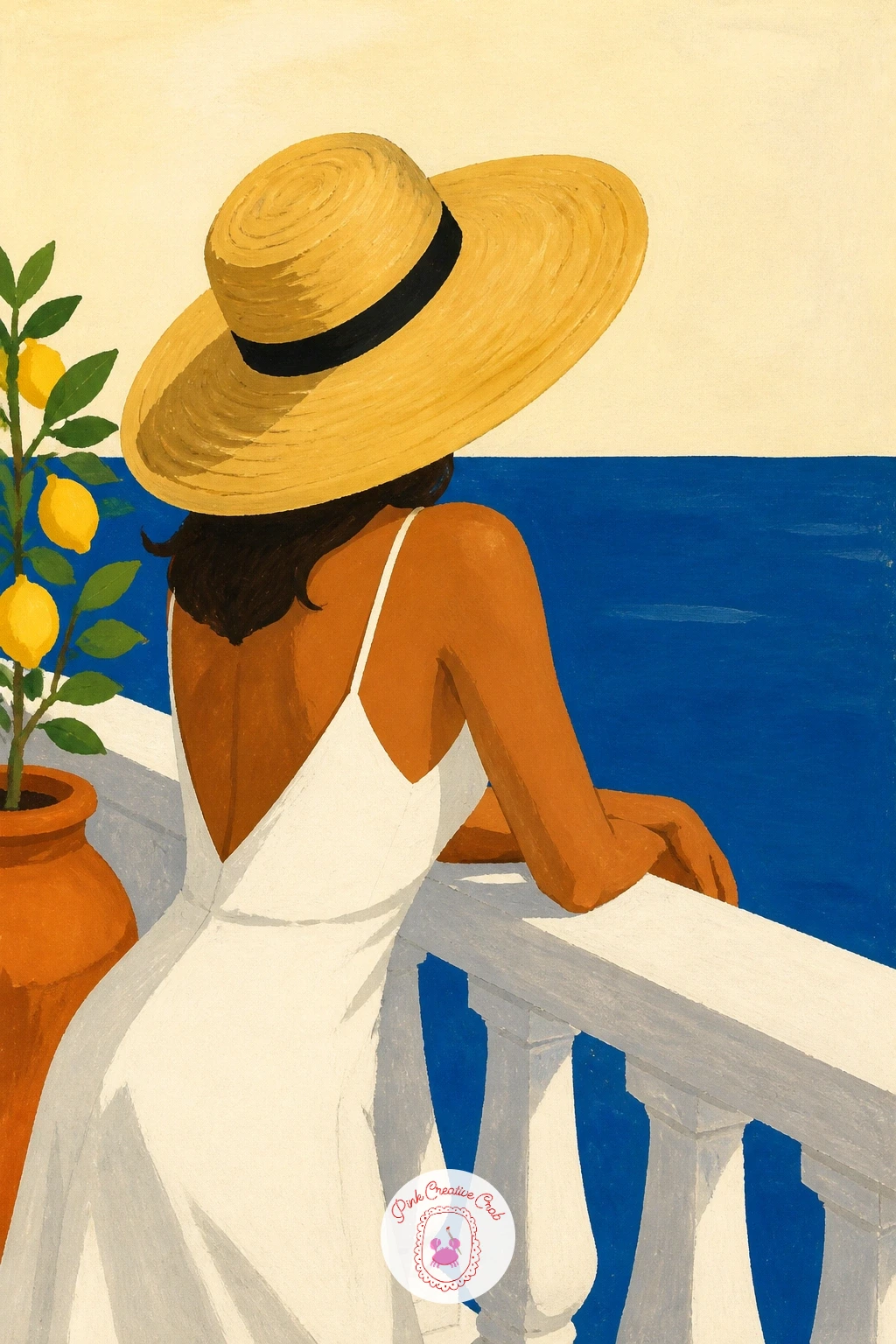
Palette: Straw Yellow, Skin Tone, Aegean Blue, Whitewash White
A basket of figs and grapes resting on cool marble makes a quiet, satisfying still life with plenty of color contrast. Sketch the basket as a simple woven oval first, then pile the fruit shapes on top and spilling slightly over the rim, a few whole figs, a cluster of grapes, maybe one fig cut open to show its pink interior.
Paint the marble surface first in a pale cool grey with a few thin darker veins dragged in with a nearly dry brush, then build the basket and fruit on top once that base is dry. Dry-brush the basket’s woven texture by loading only a little paint on a flat brush and dragging it lightly sideways, this catches the paper’s texture and suggests weave without painting every strand.
If the grapes turn into one solid purple mass, let the base color dry and dab in two or three highlight dots of lighter lavender to separate individual grapes visually.
Finish with one slice of fig showing its seeded pink center for a spot of unexpected color.
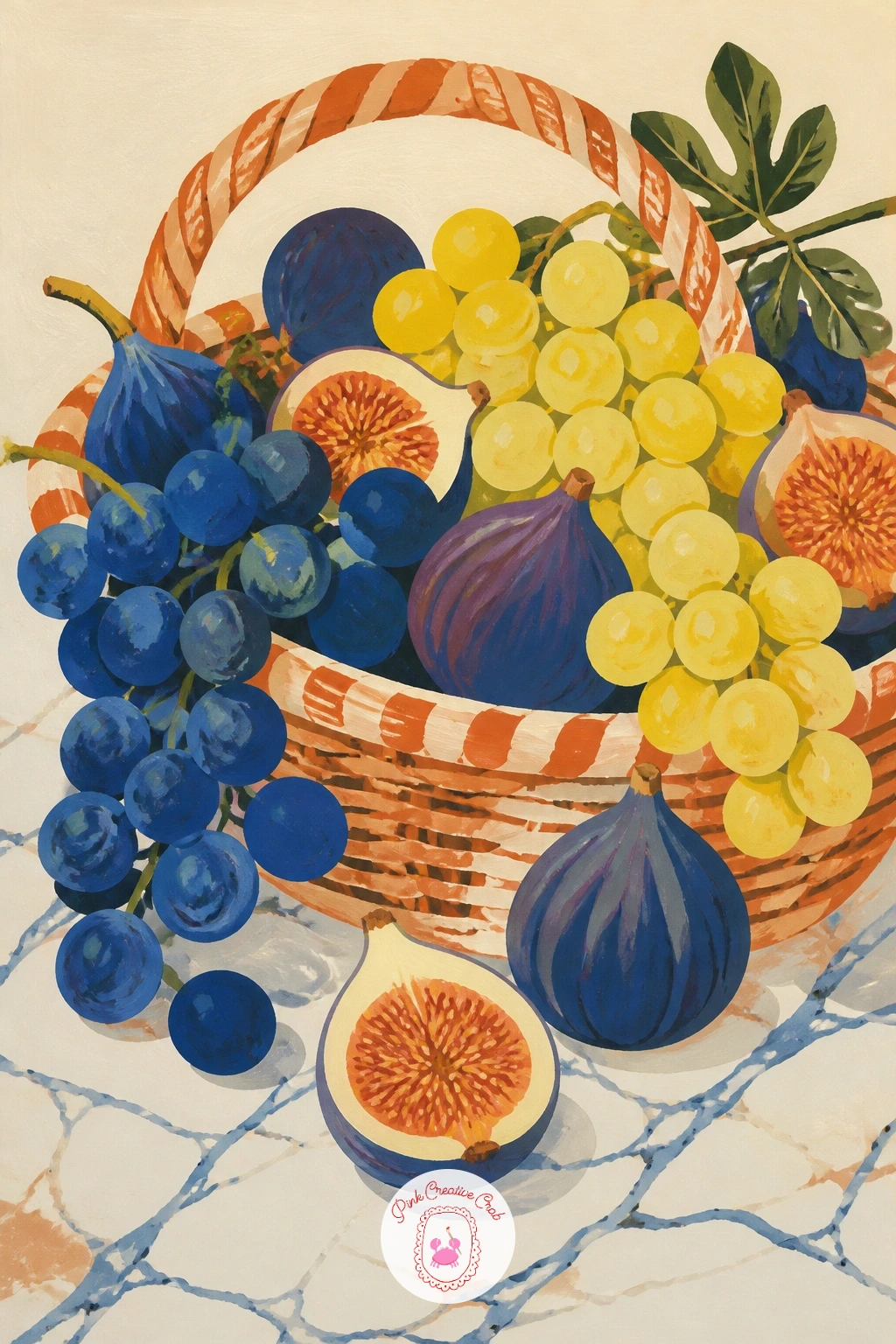
Palette: Fig Purple, Grape Lavender, Terracotta, Marble Grey
The Acropolis on its hill at golden hour is a satisfying step up in scale from the island scenes, built from the Parthenon’s columns sitting on a solid rock mass above the city. Block the hill and rock base first in warm golden tones, then the temple structure on top as a simple row of vertical column shapes under one horizontal roofline, kept flat and graphic rather than architecturally precise.
Decide where the sun sits before you paint the columns, since a low golden evening light means the columns’ sunlit sides should read warm and bright while their shadowed sides drop into a cool violet grey, and the whole hill should glow rather than sit in flat daylight.
The mistake here is adding too many individual columns in careful detail, which fights the flat print style. Five or six simplified verticals read as the Parthenon just as clearly as twenty precise ones.
Finish with a warm glow wash across the sky behind the hill using very diluted terracotta over the cream base.
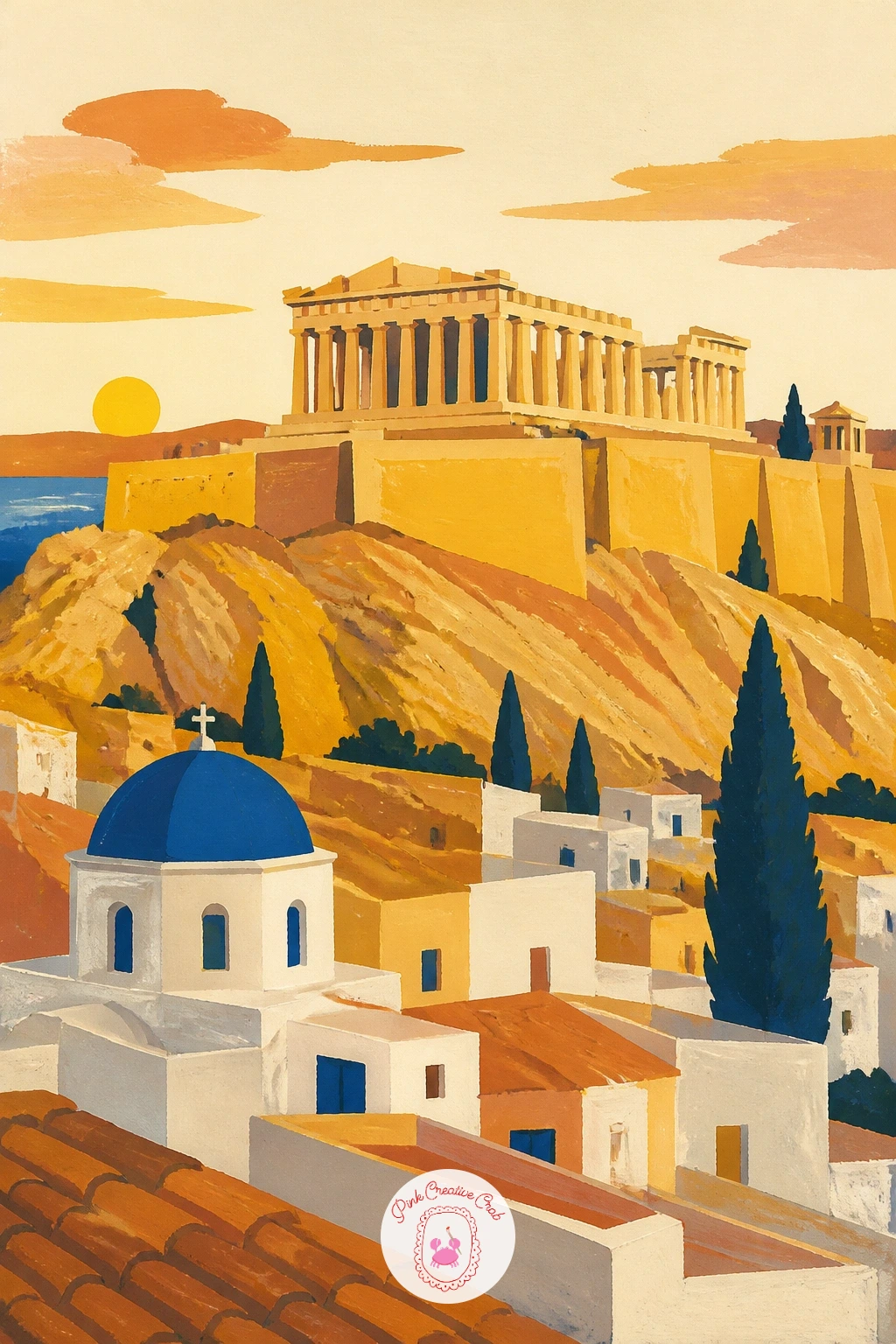
Palette: Golden Ochre, Terracotta, Violet Grey, Cream
An old man playing backgammon in a cafe doorway is a classic island moment worth slowing down for. Pencil the doorway first as a simple dark rectangle to frame the scene, then place the man seated on a low stool with the backgammon board as a flat striped rectangle on a small table in front of him.
Paint the doorway’s shadow as one flat dark shape first so the whole scene reads as sheltered from bright sun, then bring the man and board forward in warmer, lighter tones so they pop out of that shade. Keep his pose simple, hunched slightly forward over the board, one arm resting on his knee.
If the backgammon board looks too busy once you add its triangular point pattern, limit yourself to painting only four or five triangles rather than the full board, enough to read as the game without overworking a small shape.
No deep brown for the doorway shadow, mix your blue with a touch of terracotta to make a warm dark neutral instead.
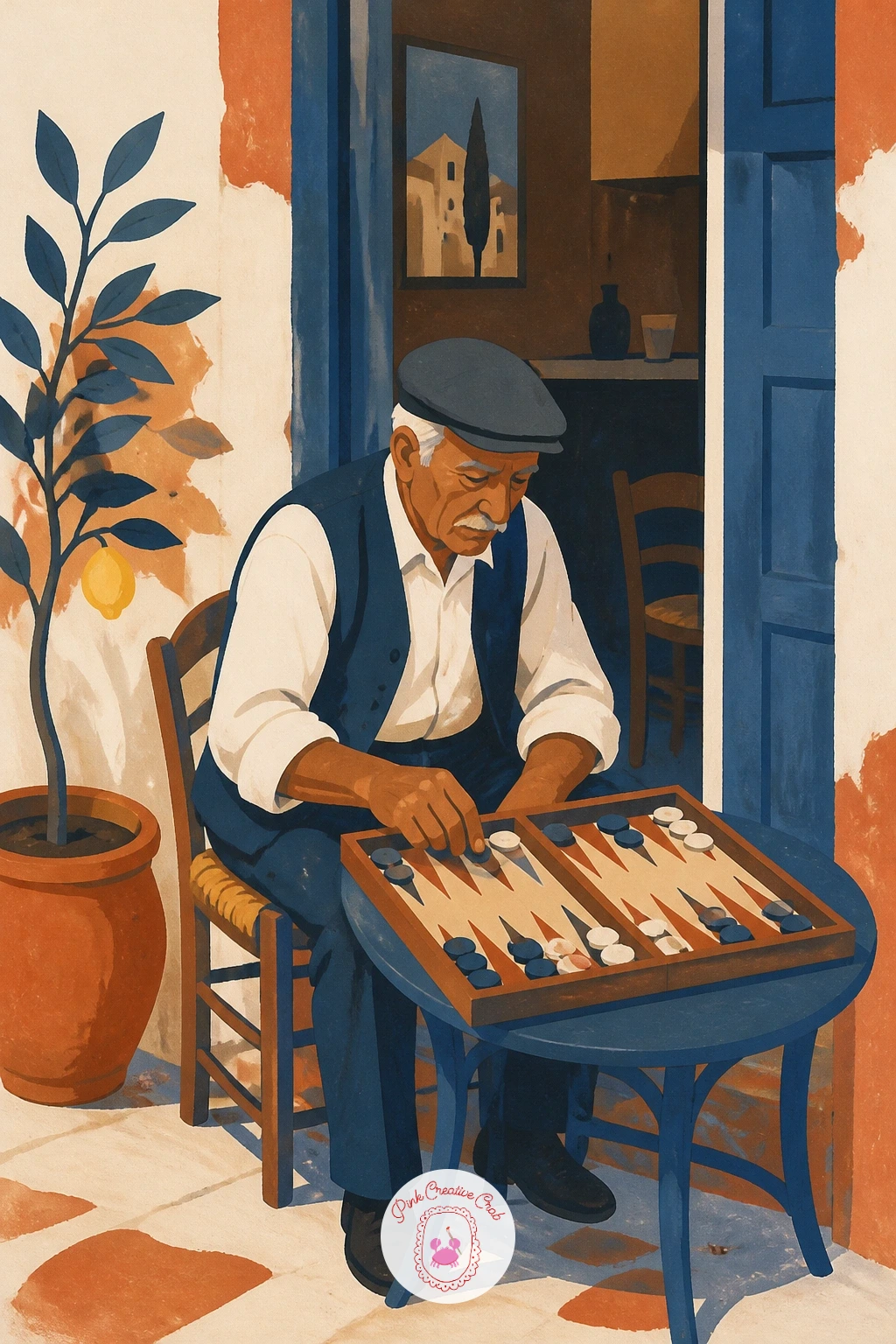
Palette: Shadow Brown, Terracotta, Whitewash White, Aegean Blue
White sheets drying on a rooftop line against blue sky is deceptively simple and a great lesson in letting negative space do the work. Pencil just the line itself and three or four sheet shapes hanging and slightly billowing, varying their widths so the row does not feel too even or mechanical.
Paint the sky first in flat Aegean blue right up around where each sheet will hang, then add the sheets in a warm white with one soft grey shadow fold down the center of each to show they hang with weight rather than sitting flat like paper.
If the sheets look stiff and board-like, curve the bottom edge of each one slightly inward rather than cutting it straight across, that small curve alone reads as fabric catching a breeze.
Finish with one or two small terracotta rooftop shapes peeking in at the bottom edge to place the scene firmly on an island roof.
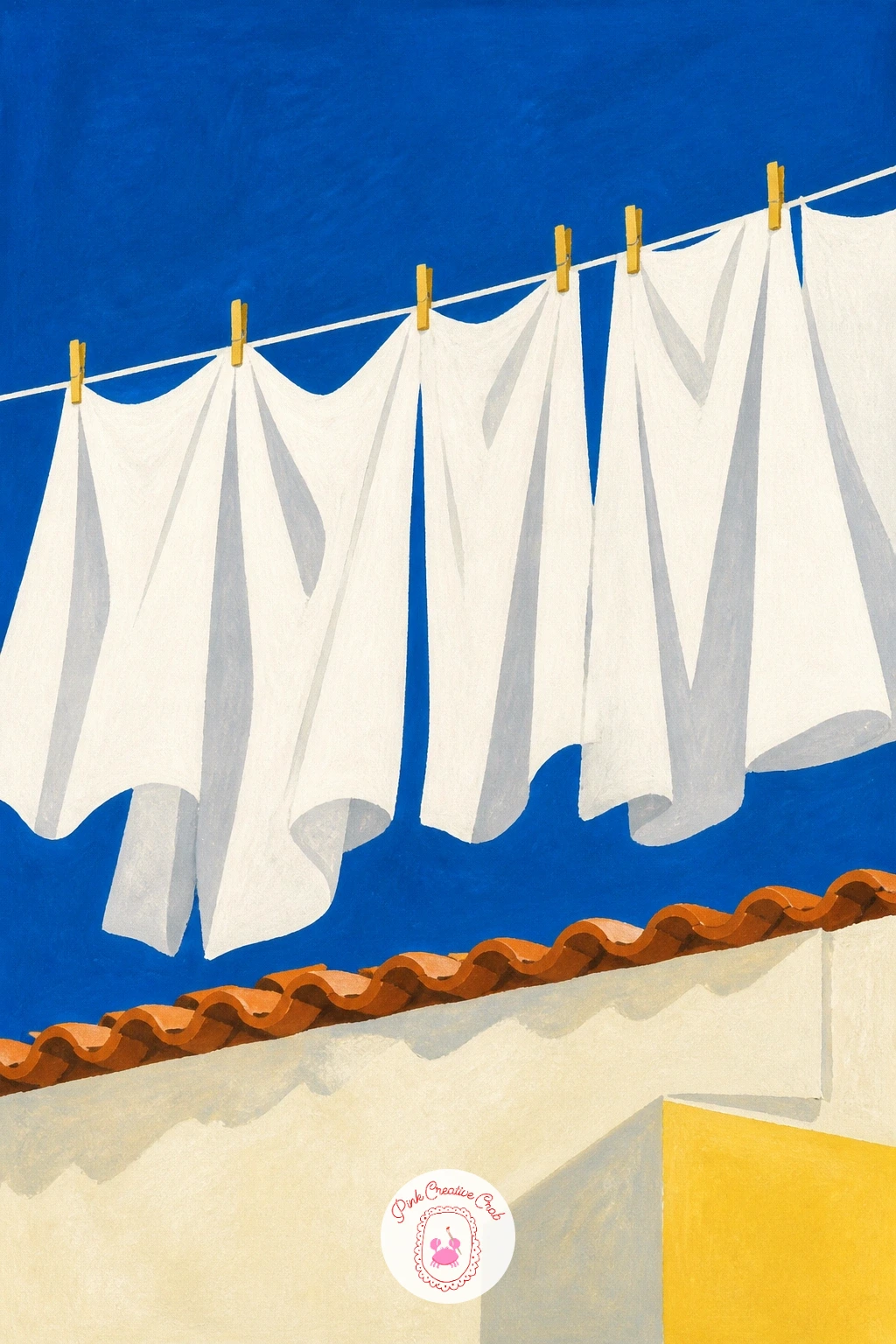
Palette: Aegean Blue, Whitewash White, Soft Grey, Terracotta
The stacked pastel houses of Symi give you a chance to break from pure whitewash into soft pink, yellow and blue facades climbing the hillside above the harbor. Block in the hillside shape first, then divide it into a loose grid of house fronts, varying the sizes so the row feels organic rather than a repeated pattern.
Paint each house front as one flat pastel color, keeping three or four hues cycling through the row, then add window and shutter details last in a darker accent once all the facades are dry. Compare the overall width of the hillside to its height before you start filling in color, a row that reads as wider than it is tall feels more like a real harbor view than a tall narrow strip.
If the colors start to clash, mute one or two of the brighter pastels slightly with a touch of white and grey so they settle back rather than fighting each other for attention.
Finish with the harbor water in flat turquoise along the bottom edge to anchor the whole hillside.
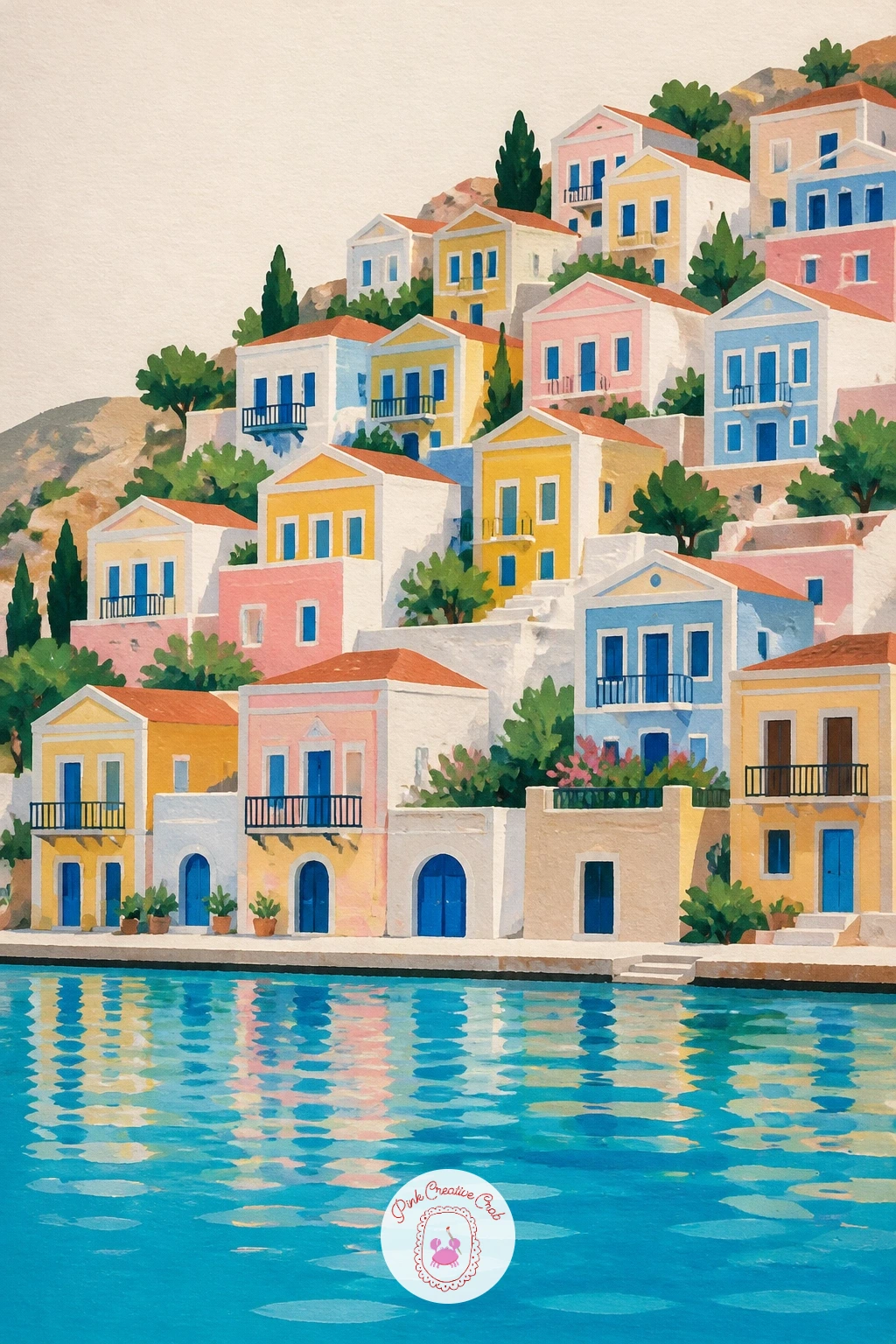
Palette: Soft Pink, Pale Yellow, Aegean Blue, Turquoise
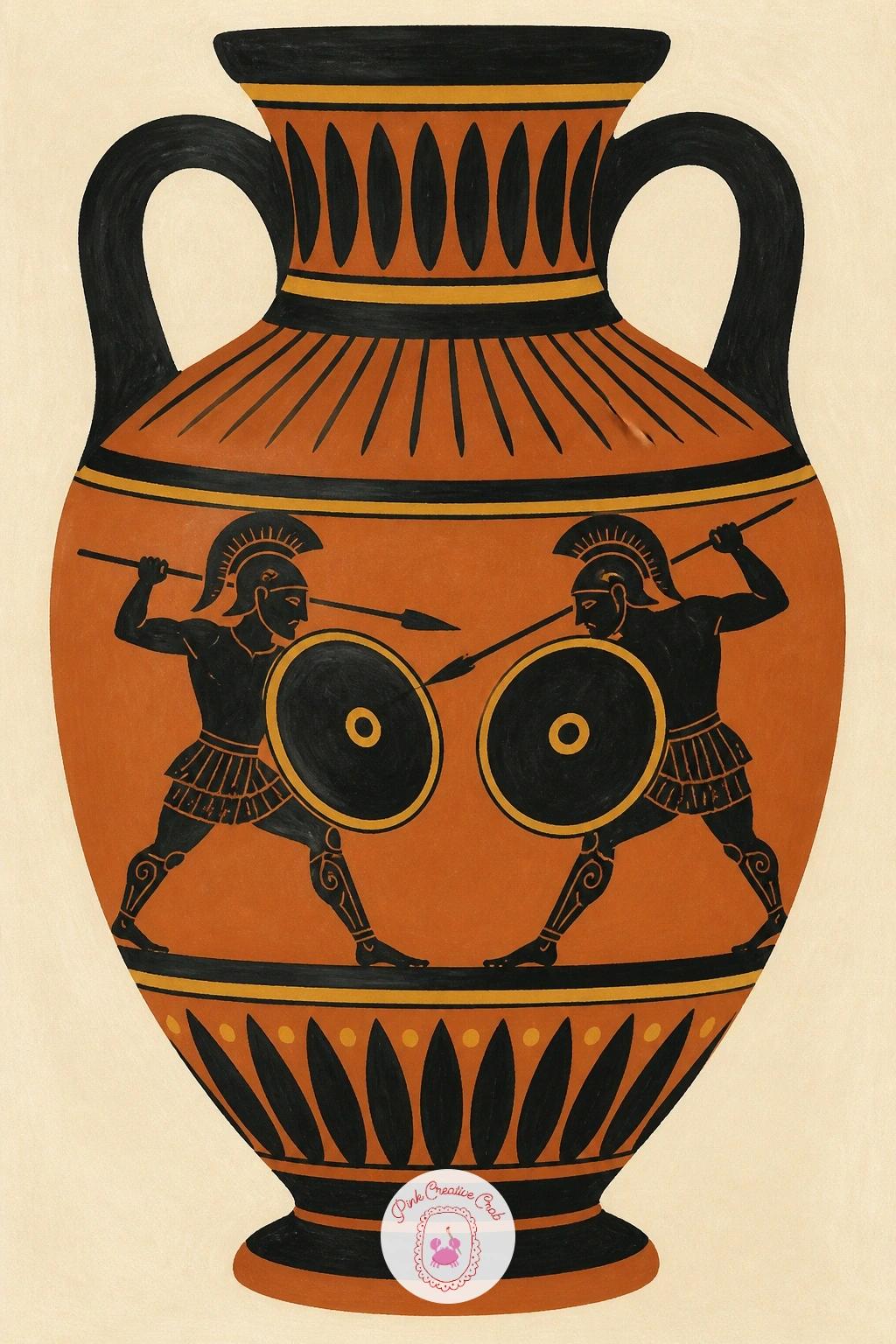
An ancient amphora with black figure decoration is a satisfying object study once you have a few scenes behind you. Pencil the vase shape first as one tall symmetrical silhouette, narrow neck, wide belly, narrow foot, using the vase’s own width as your measuring unit, roughly how many widths tall it stands, to keep the proportions believable before any color goes on.
Paint the terracotta body first in one flat warm orange, let it dry fully, then add the black figure band around the belly using a fine brush, simplified stick-like figures rather than detailed classical drawing, since from a short distance the pattern reads as decoration either way.
If your black band wobbles off the vase’s curve, paint it as a flat horizontal strip first and let the vase’s silhouette crop it rather than trying to bend the pattern around a curved surface freehand.
Finish with a thin white gel pen highlight down one side of the vase to suggest its curved, reflective surface.
You Will Need
- white gel pen
Palette: Terracotta, Black, Whitewash White, Aegean Blue
A striped beach umbrella and sun lounger on a white pebble beach makes an easy, breezy subject with strong graphic shapes. Pencil the umbrella as one large triangle or dome shape first, its pole running down to the lounger beside it, then keep the pebble beach as one flat pale shape beneath both.
Paint the umbrella in alternating stripes of terracotta and white, working around the curve of the dome rather than painting straight bands, then add the lounger in a simple flat shape with the umbrella’s shadow falling across part of it. The sea behind stays a flat turquoise band along the top of the page.
This is a natural ten-minute piece if you keep it to the umbrella and lounger alone. Given forty minutes, add a dropped sun hat, sandals or a book beside the lounger to suggest someone just stepped away.
Finish by dotting in a scatter of small grey pebble shapes along the bottom edge so the beach does not read as flat sand.
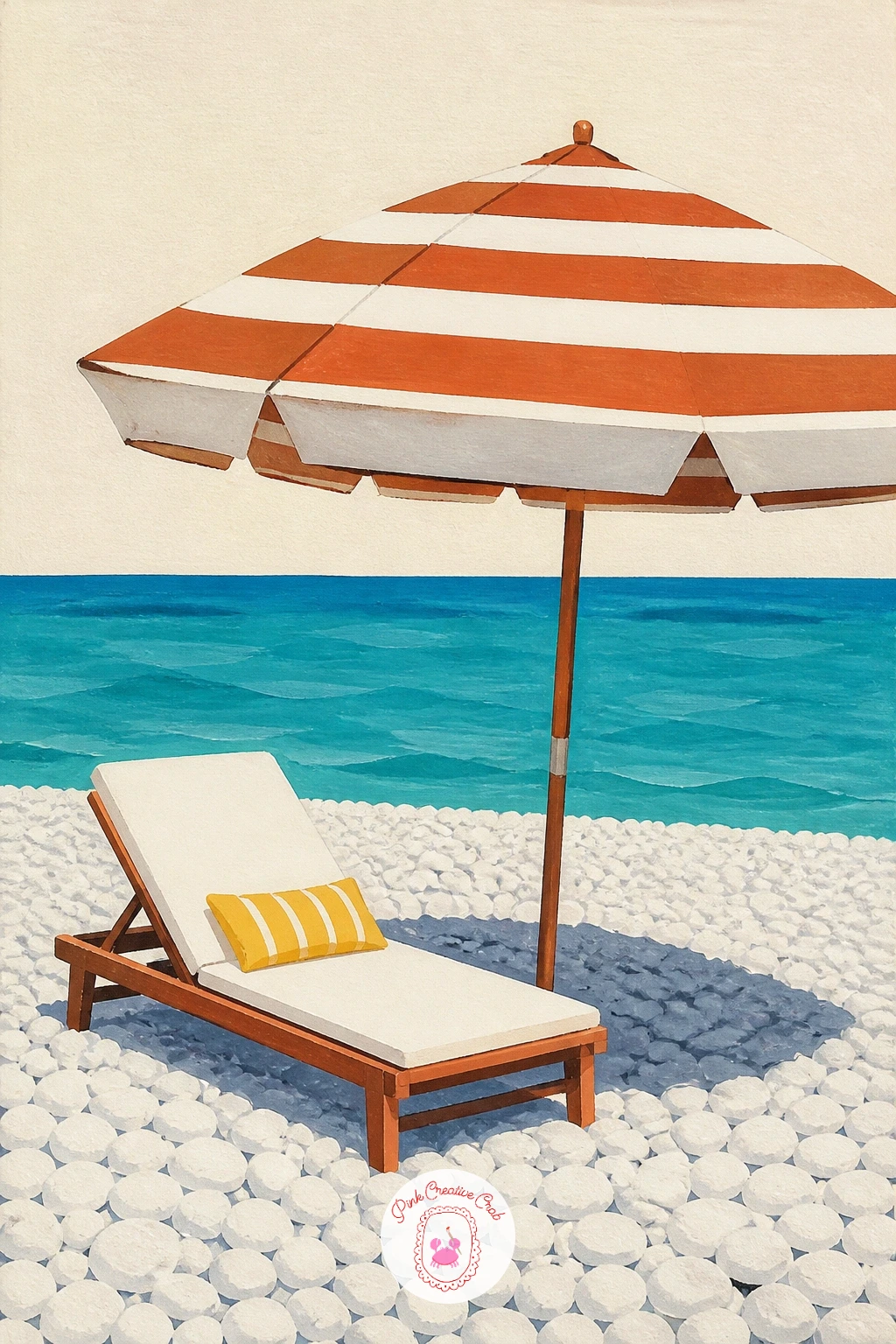
Palette: Terracotta, Whitewash White, Turquoise, Pebble Grey
The monasteries perched on rock pillars at Meteora ask you to think about scale before anything else. Set your eye level low, looking up from the base of the pillar, since this is what makes the monastery feel impossibly high and the rock feel genuinely massive rather than a small hill with a building on it.
Block the rock pillar first in warm greys and browns with rough, irregular edges, much rougher than any other shape in this collection, then add the monastery on top as a small, simple cluster of white and terracotta roofs, deliberately tiny against the scale of the rock beneath it.
If the rock pillar looks too smooth and gentle, drag a dry, scratchy brush loaded with a darker grey across its face in a few places to break up the surface and suggest its rough, weathered texture.
Keep the sky behind pale and quiet so all the visual weight and contrast stays down in the rock and the tiny building on top.
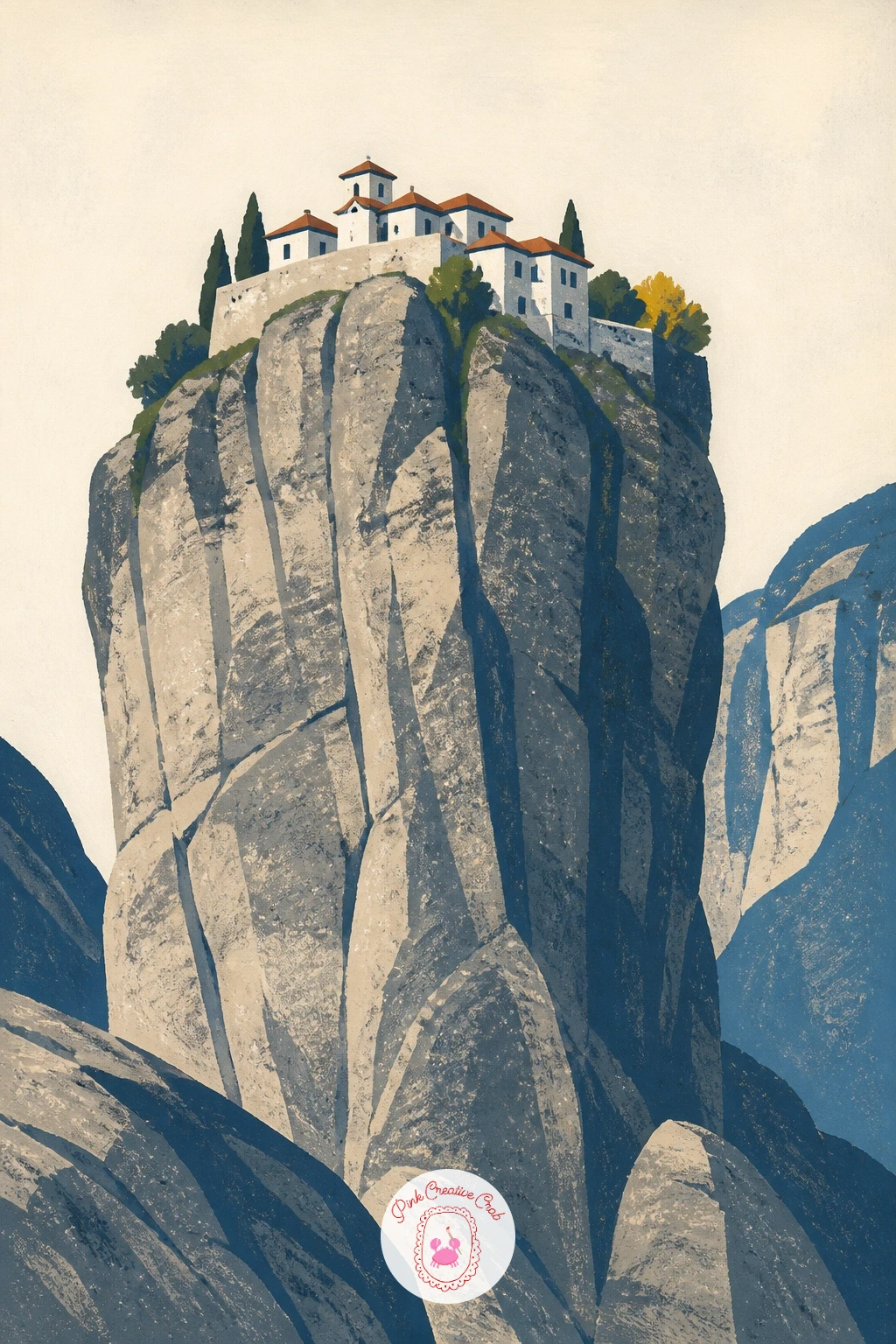
Palette: Rock Grey, Warm Brown, Whitewash White, Terracotta
A ferry arriving at a small island port brings movement and a sense of anticipation into the picture. Block the ferry’s hull first as one large white shape with a dark waterline, positioned slightly off-center so it feels like it is still approaching rather than already docked, then add the harbor buildings small along the shoreline behind it to establish distance.
Paint the water around the ferry with a few short white wake lines trailing behind the hull, since this single detail does more to suggest motion than almost anything else you could add to this scene. Keep the harbor buildings simple and small, flat white and terracotta shapes with no window detail, so they clearly read as farther away than the large ferry in front.
If the ferry looks like it is floating rather than sitting in the water, darken the waterline along its hull slightly and add one soft reflection shape directly beneath it.
Finish with a thin dark funnel and a wisp of grey smoke for character.
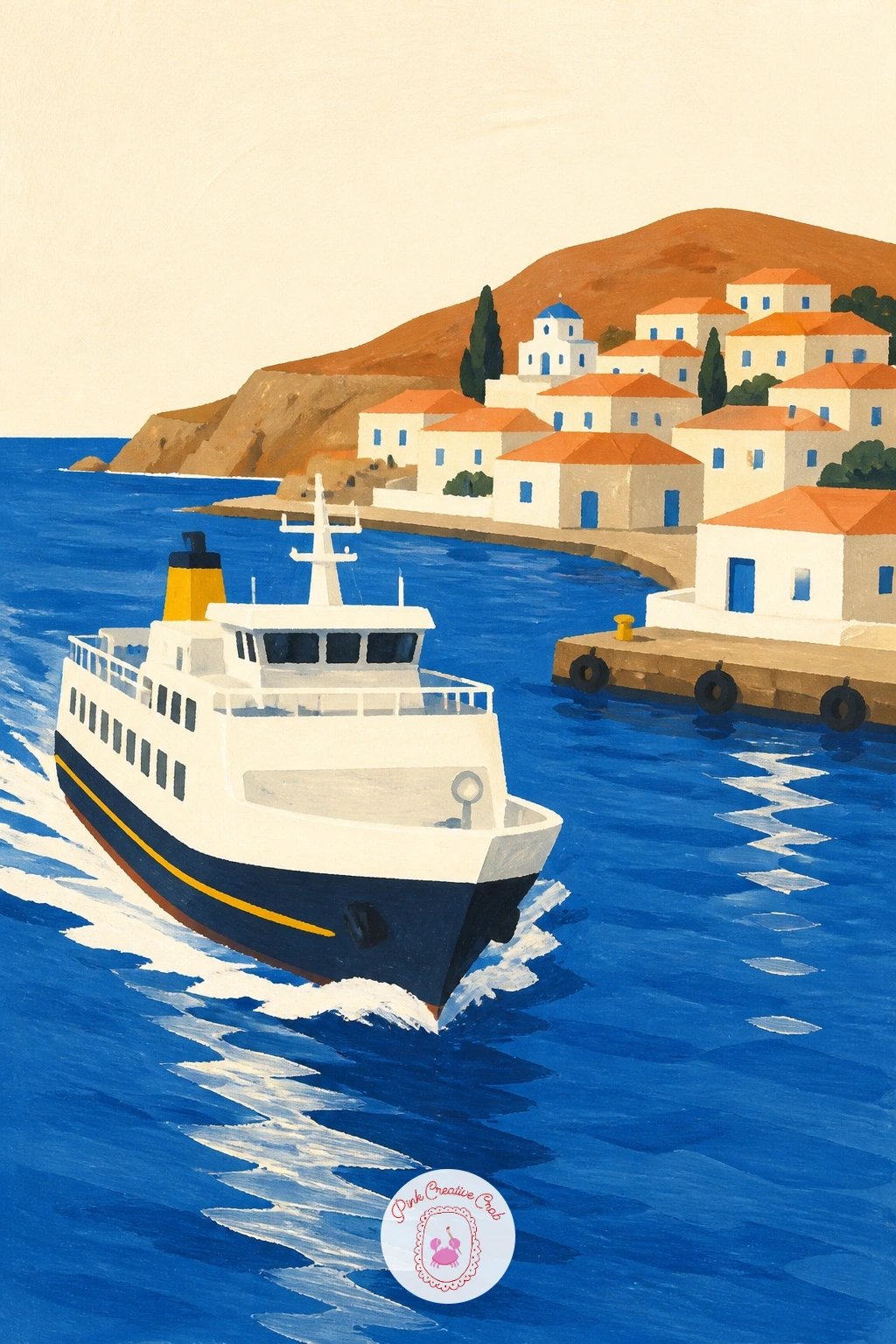
Palette: Whitewash White, Aegean Blue, Terracotta, Soft Grey
A breakfast tray of Greek yogurt, honey and walnuts makes a lovely close, quiet still life after all these wider scenes. Pencil the bowl as a simple round shape first, then the honey jar and a small scatter of walnuts beside it, keeping the whole arrangement tucked into roughly a third of the page so it does not feel lost.
Paint the yogurt in flat cream white with one soft grey shadow pooling at its base, then drizzle the honey on top using a fine brush loaded with thinned lemon yellow mixed with a touch of terracotta, letting the line wobble naturally rather than painting it perfectly straight.
If the honey drizzle looks too flat and opaque, go back once it is dry with a tiny highlight dot of pure white along its top edge to suggest the sheen of real honey catching light.
No walnuts in your palette reference, two or three simple brown oval shapes with one darker crack line each read perfectly well.
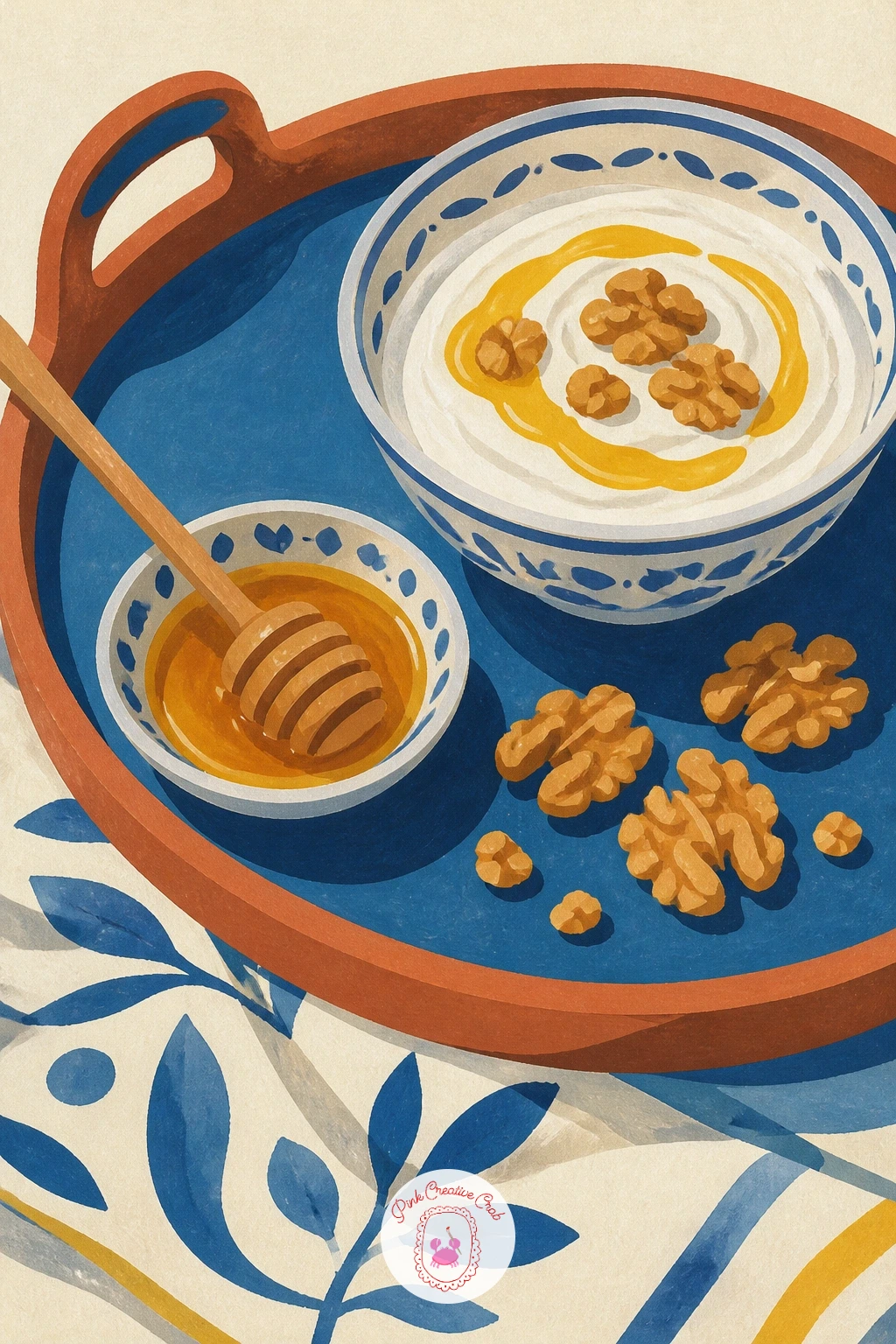
Palette: Cream White, Honey Gold, Walnut Brown, Soft Grey
A cat watching fishermen mend yellow nets on the dock combines an animal and a small human scene in one composition. Place the cat sitting upright in the foreground first, since it is your largest and most detailed shape, then sketch the fisherman and his pile of yellow net smaller and further back to establish depth.
Paint the net in flat lemon yellow with a few loose crossing lines suggested rather than every knot drawn in, then build the fisherman as simple flat shapes in muted clothing colors so he does not compete with the cat for attention. The cat stays the star, painted last in warm tones with sharp, alert ears.
If the yellow net looks like a flat yellow blob, scratch a few thin lines back out with the tip of a damp brush once it is dry, or add darker yellow crosshatch lines on top once fully set, either way suggests rope without painting every strand.
Keep the cat’s pose watchful, head turned slightly toward the net, to tell the small story clearly.
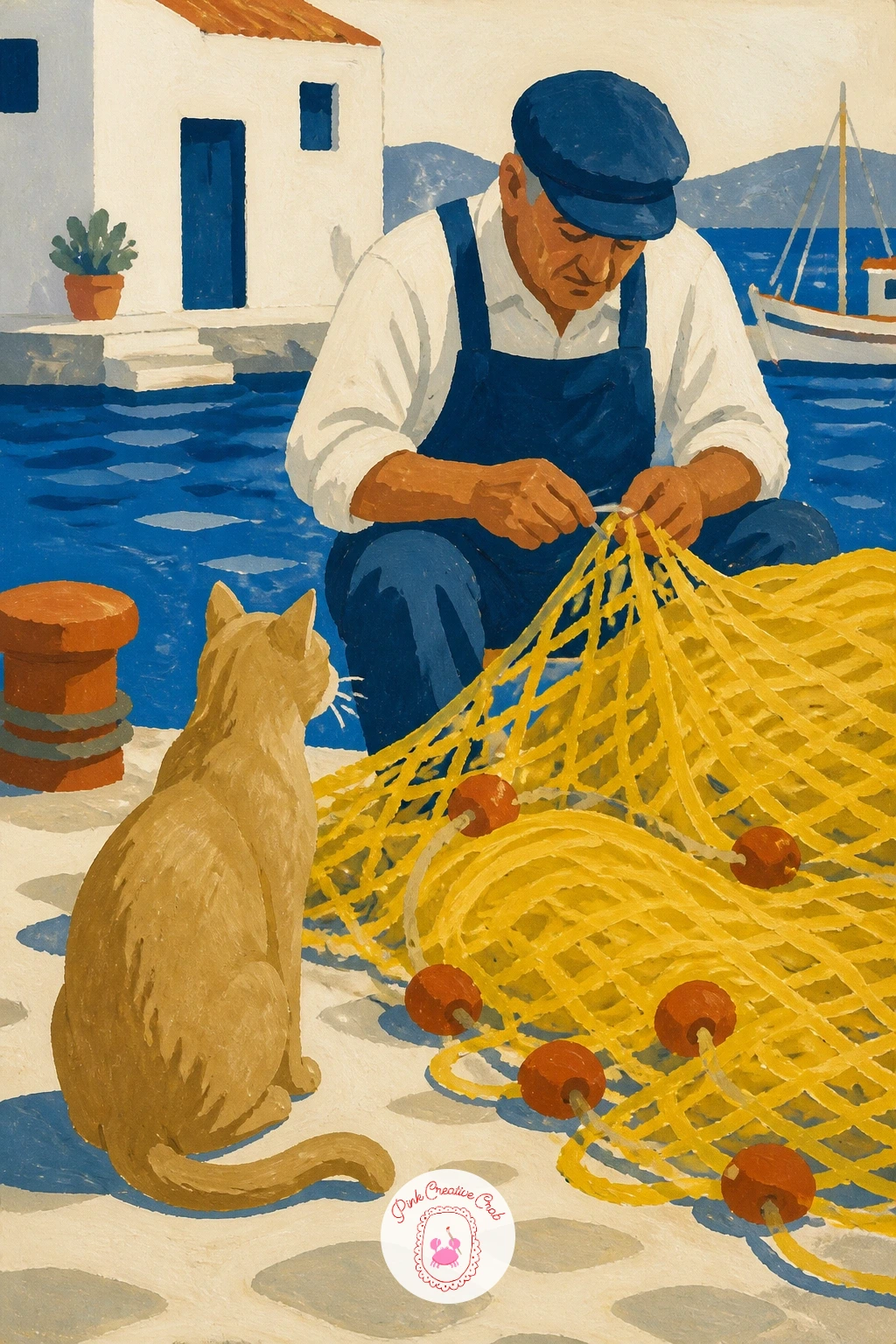
Palette: Lemon Yellow, Warm Tan, Soft Grey, Aegean Blue
A sunset terrace set with two glasses and a candle is all about mood, built from warm light against a cooling sky rather than any complex detail. Decide where the sun sits low on the horizon first, then let that warm glow dictate everything else, the table and glasses lit warm on one side, the terrace railing and sea beyond shifting cool and dark by comparison.
Paint the sky as a graded wash from warm terracotta near the horizon up into deeper Aegean blue overhead, then add the table, two simple glass shapes and a small candle flame once that sky is dry. Keep the glasses nearly transparent, just a thin outline and one small highlight stroke, rather than painting them as solid objects.
If the candle flame looks flat, surround it with a tiny halo of warm yellow blended softly into the surrounding color while still slightly damp, so the light appears to glow rather than sit as a hard shape.
Finish with the sea below rendered as one flat dark band catching a last streak of warm reflected light.
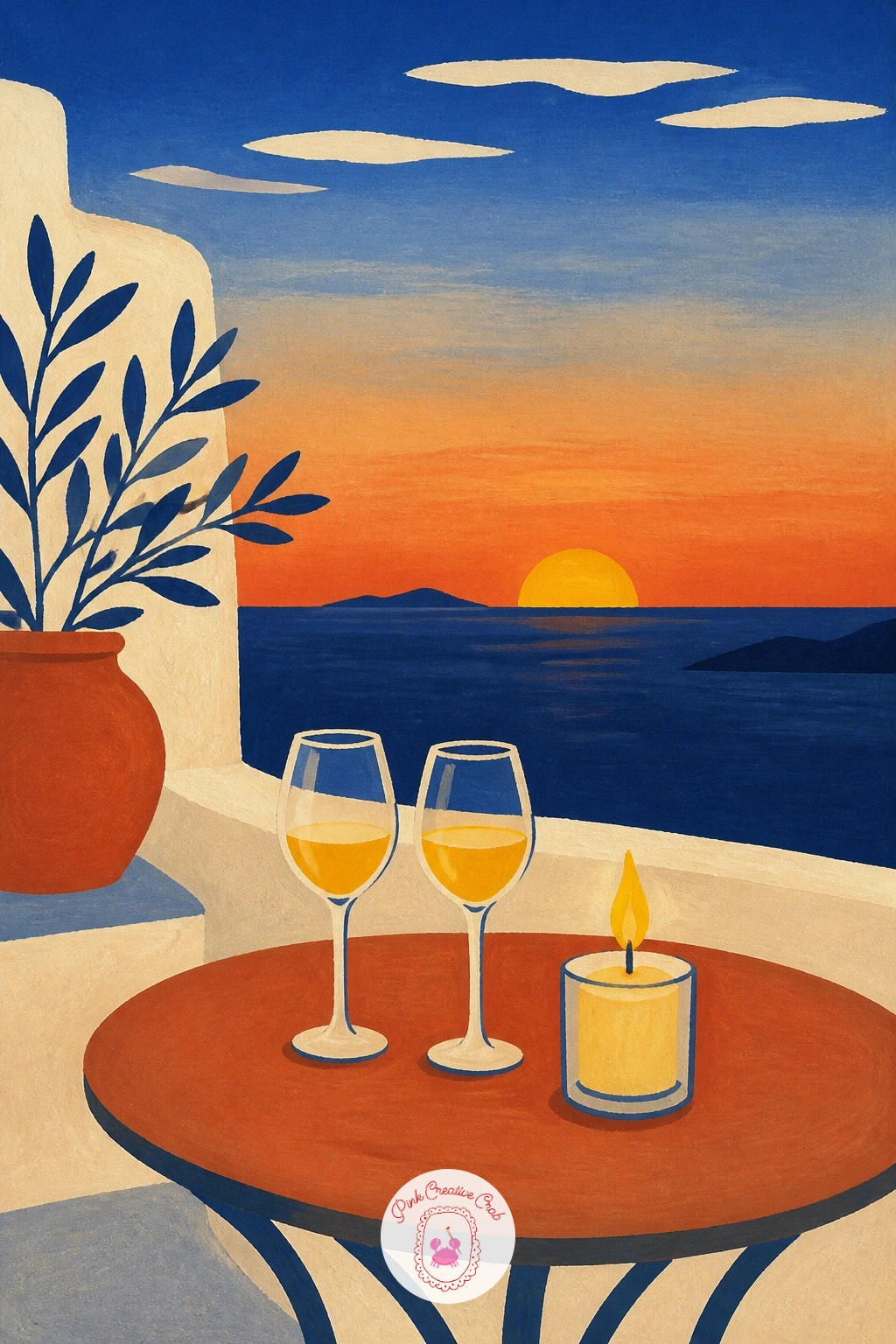
Palette: Terracotta, Aegean Blue, Lemon Yellow, Shadow Blue
Try this one at dusk from memory rather than a photo, the warm to cool gradient is easier to feel than to copy exactly, and a looser sky often glows more convincingly.
A sea cave pool carved into pale cliffs lets you paint clear water and rock texture together in one dramatic small scene. Block the cliff shapes first in pale cream and warm grey, keeping their edges rougher and more irregular than any architecture you have painted so far, then cut the dark cave opening in as one bold negative shape.
Paint the pool water inside and in front of the cave in layered blues, a deeper shade near the cave mouth lightening toward clear turquoise where sunlight reaches it, since showing that light gradient is what makes clear water actually read as clear rather than opaque.
If the rock looks too smooth and gentle, dry-brush a darker grey unevenly across the cliff face in a few patches once your base color is dry, this single texture trick does more than any amount of careful shading to suggest real stone.
Keep the cave’s interior shadow nearly black blue so the sunlit water in front reads as brilliantly clear by comparison.
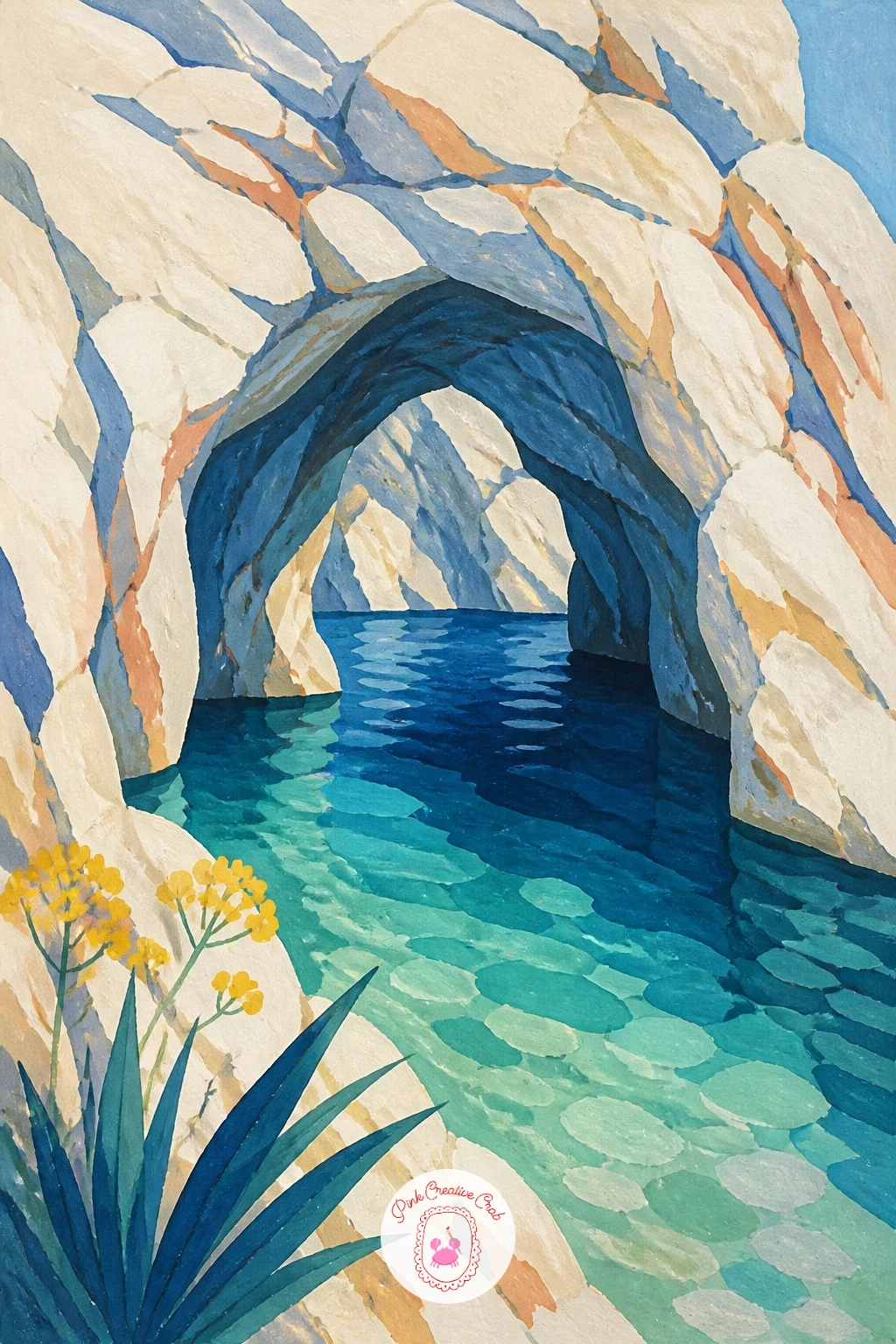
Palette: Pale Cliff Grey, Turquoise, Deep Blue, Shadow Blue
A fig tree shading a simple blue bench makes a calm, restful scene once you have painted a few busier ones. Pencil the bench first as a simple rectangle with thin blue legs, then build the fig tree’s canopy above and slightly behind it as a few large overlapping leaf-cluster shapes rather than individual leaves.
Paint the canopy in two greens, a darker shade in the shaded upper mass and a lighter, warmer green where sunlight breaks through near the edges, then drop in a few dark fig shapes hanging among the leaves last. The bench stays flat Aegean blue, painted after the canopy so its shadow shape, cast across the seat, reads clearly against the lighter blue beneath it.
If the canopy looks like one flat green cloud, break it into three or four distinct overlapping clumps with slightly different edges and values, this alone creates the sense of individual branches without drawing a single one.
Finish with dappled light spots scattered across the bench seat using small dabs of warm cream.
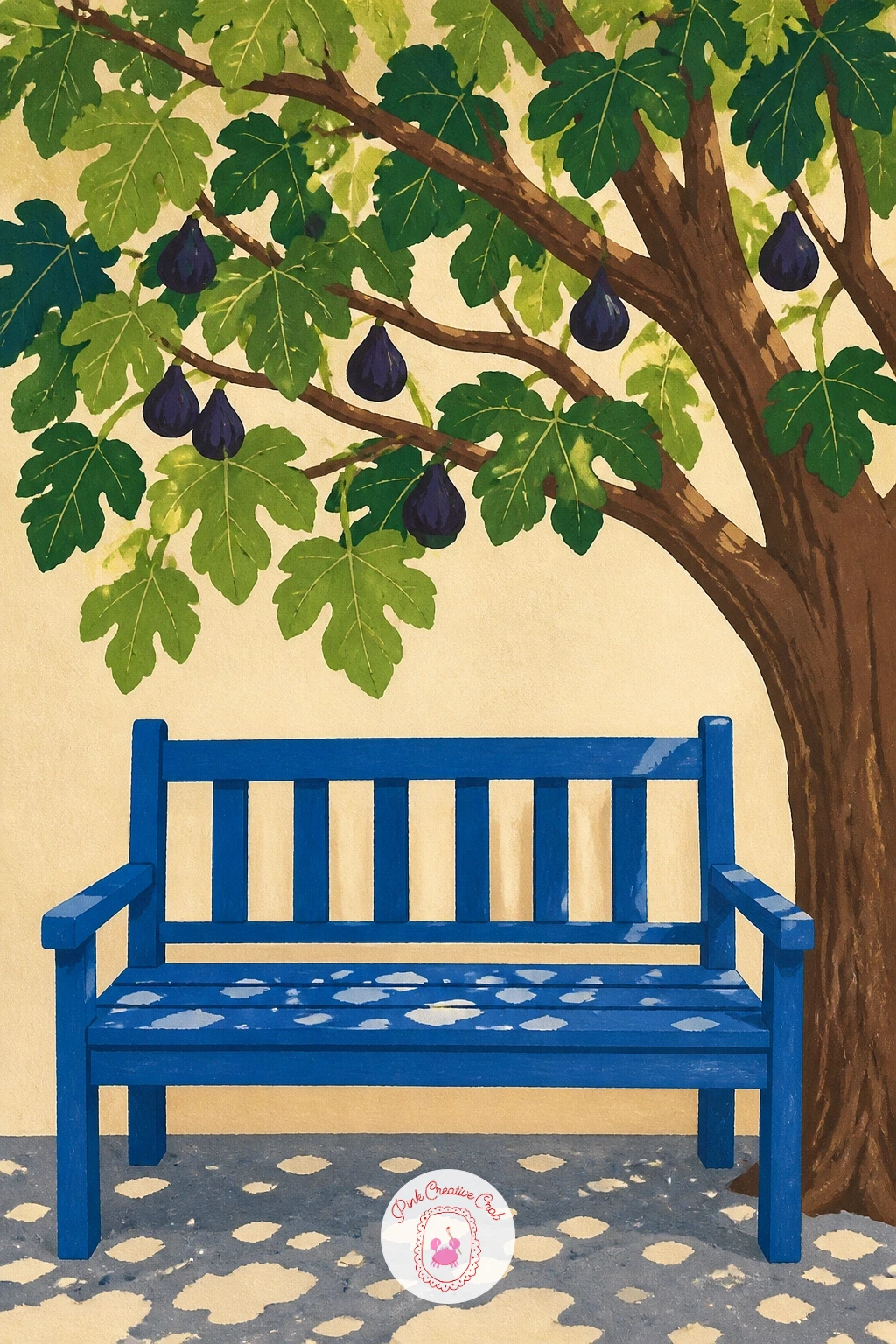
Palette: Leaf Green, Warm Green, Aegean Blue, Fig Purple
A stone path winding down to a hidden cove is a strong perspective exercise built on just a few receding shapes. Set your eye level fairly high, looking down the path toward the water below, since this viewpoint lets the path curve and narrow naturally as it drops toward the cove, doing most of the depth work for you.
Block the path first in warm stone tones, wider and more detailed near the bottom of the page, narrower and simpler as it climbs toward the top, then add scrubby hillside shapes to either side in muted greens and ochres. The cove and sea appear last as a glimpse of bright turquoise at the top of the path, kept small so it feels discovered rather than the main event.
If the path looks flat rather than winding downhill, add one or two curved shadow bands crossing it at intervals, this breaks the straight run and reads immediately as a slope with real elevation change.
Keep the turquoise glimpse at the top the brightest color in the whole piece so the eye travels straight to it.
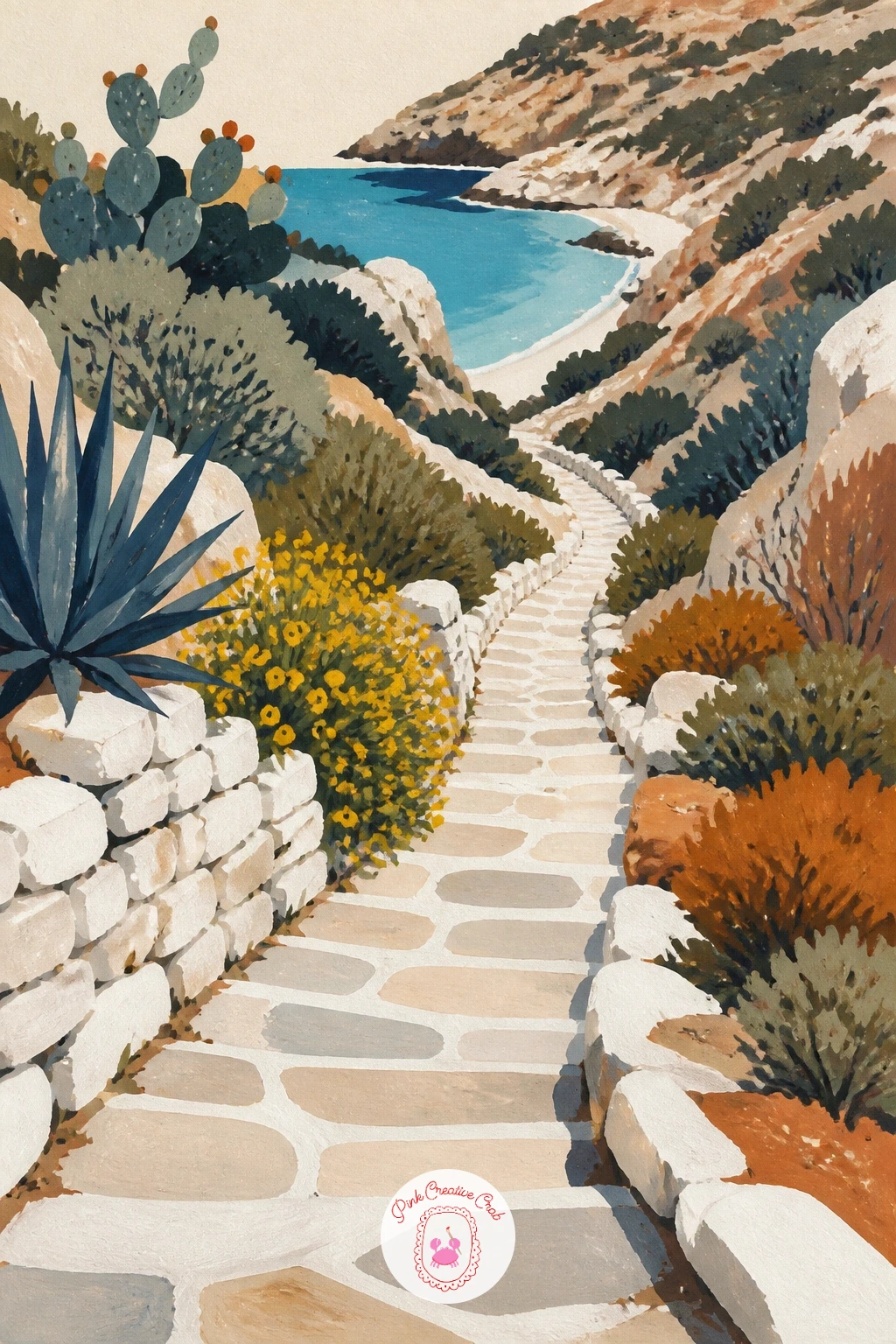
Palette: Stone Tan, Scrub Green, Turquoise, Ochre
A red and yellow wooden boat pulled up on the sand is a cheerful, graphic subject that pairs well with the lemon yellow accent in this whole palette. Block the boat’s hull shape first as one confident curved silhouette, painted in flat red along the top band and yellow along the lower hull, with a clean line dividing the two colors.
Paint the sand beneath in a warm pale tone with one soft shadow shape cast by the hull to seat the boat firmly rather than letting it float above the beach. A coil of rope or an oar leaning against the side, painted small and simple, adds a lived-in detail without much extra work.
If the red and yellow bands wobble out of alignment, paint the whole hull in yellow first, let it dry completely, then mask off a clean straight line with the edge of a scrap of paper held against the hull before brushing the red band on top.
Finish with a thin dark outline along the hull’s bottom edge to sharpen it against the pale sand.
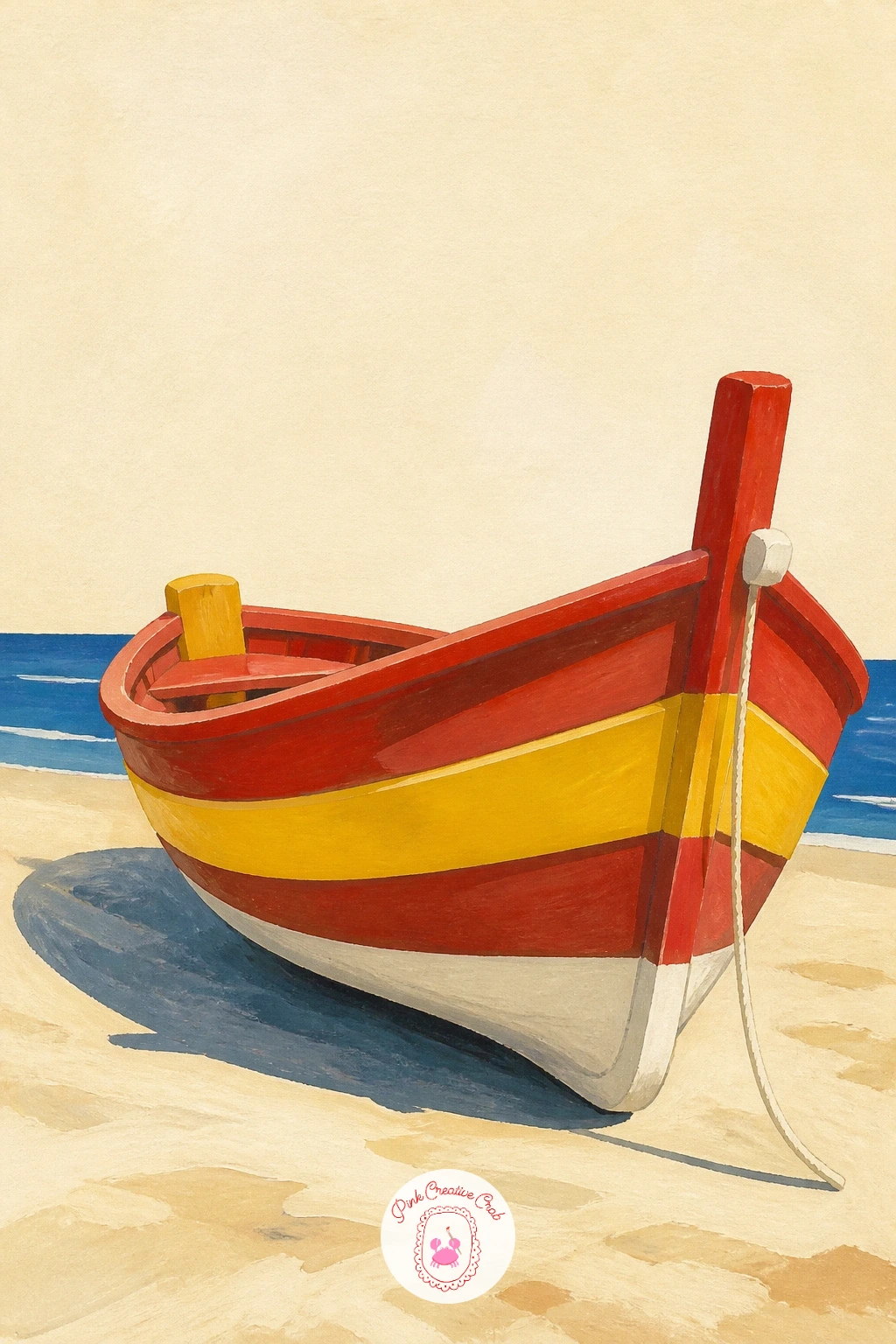
Palette: Boat Red, Lemon Yellow, Sand Tan, Shadow Grey
A market stall piled with olives, oil bottles and sea sponges is a fun, busy still life once you break it into clear groups rather than one jumble. Pencil three loose sections across the stall first, a tray of olives on one side, a row of oil bottles in the middle, a basket of pale sponges on the other, so each group reads clearly even before color goes on.
Paint the olives as a scatter of small dark green and black ovals packed closely in their tray, then the oil bottles as simple tall glass shapes with warm golden liquid inside, and the sponges last as irregular pale tan blobs with a few small dark holes dotted in for texture.
If the whole stall starts to feel cluttered, group each item type tightly together and leave a visible gap of table or cream background between each group, that breathing room keeps a busy subject readable rather than chaotic.
Finish with one or two labels or a scoop resting among the olives for a lived-in market feel.
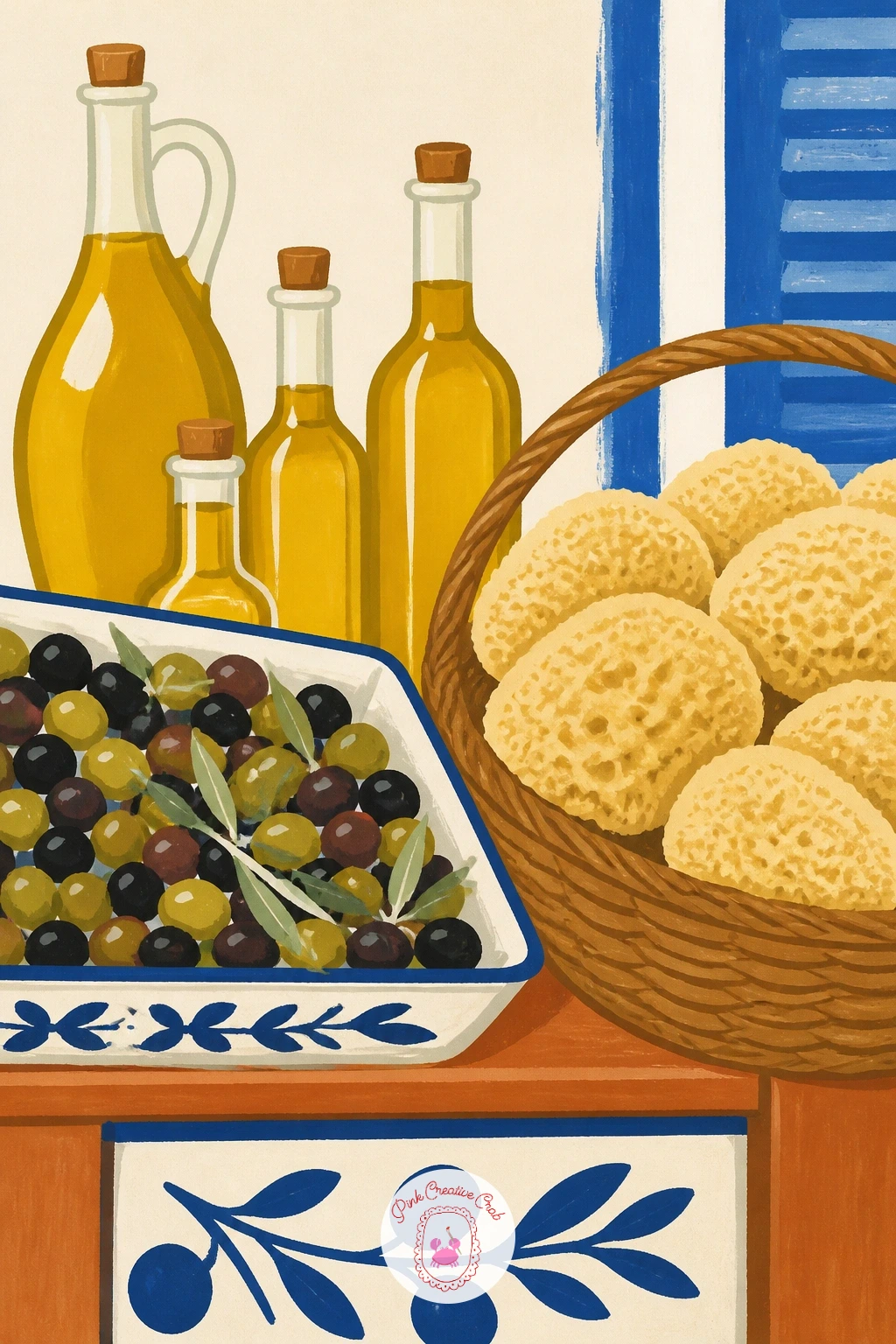
Palette: Olive Green, Golden Oil, Sponge Tan, Terracotta
An arched window framing the caldera view is one of the most recognizable Santorini images, and it works because the arch does all the composing for you. Pencil the arch shape first as a simple rounded doorway filling most of the page, then paint its whitewashed frame before touching the view glimpsed through it, so the frame’s edge stays perfectly crisp.
Once the white arch is dry, paint the caldera view inside it as a simplified layered landscape, pale distant cliffs, deep blue sea, maybe one tiny boat, kept much softer and smaller in detail than the bold white arch surrounding it. This contrast between the sharp near frame and the soft distant view is what gives the piece its depth.
If the view inside the arch looks too busy and competes with the frame, simplify it to just two or three flat color bands, cliff, sea, sky, nothing more.
Finish with a small potted plant or bell hanging just inside the arch’s edge for a lived-in detail.
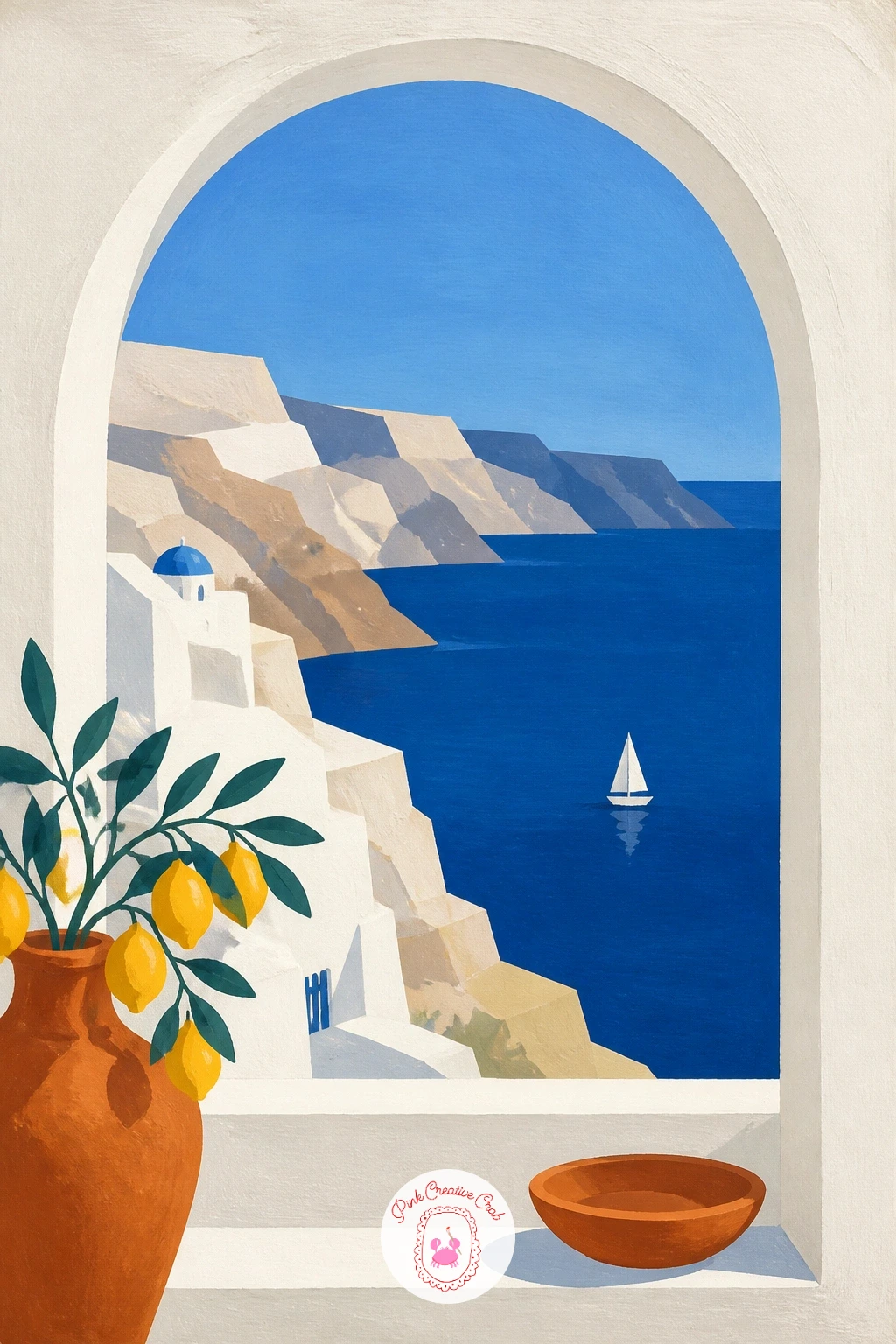
Palette: Whitewash White, Aegean Blue, Pale Cliff Grey, Terracotta
A girl riding a bicycle with a basket of oranges takes a little more planning since the bicycle itself has to look convincing in motion. Compare the wheel size to the frame’s height before you paint, both wheels should read as roughly the same size and the frame sitting clearly between them, since mismatched wheels are the fastest way to make a bicycle look wrong.
Paint the bicycle frame in a simple flat color first, then the girl’s dress and the basket of oranges last, keeping her pose simple, one leg extended toward a pedal, hair caught slightly by the breeze. The oranges spill slightly over the basket’s edge in small bright dots of color.
If the bicycle looks static rather than moving, angle it slightly and add two or three short motion lines trailing behind the back wheel, this small addition does a lot to suggest she is actually riding rather than standing still.
Keep the background simple, a hint of a sunny Cretan lane is enough, so the bicycle and its bright oranges stay the clear subject.
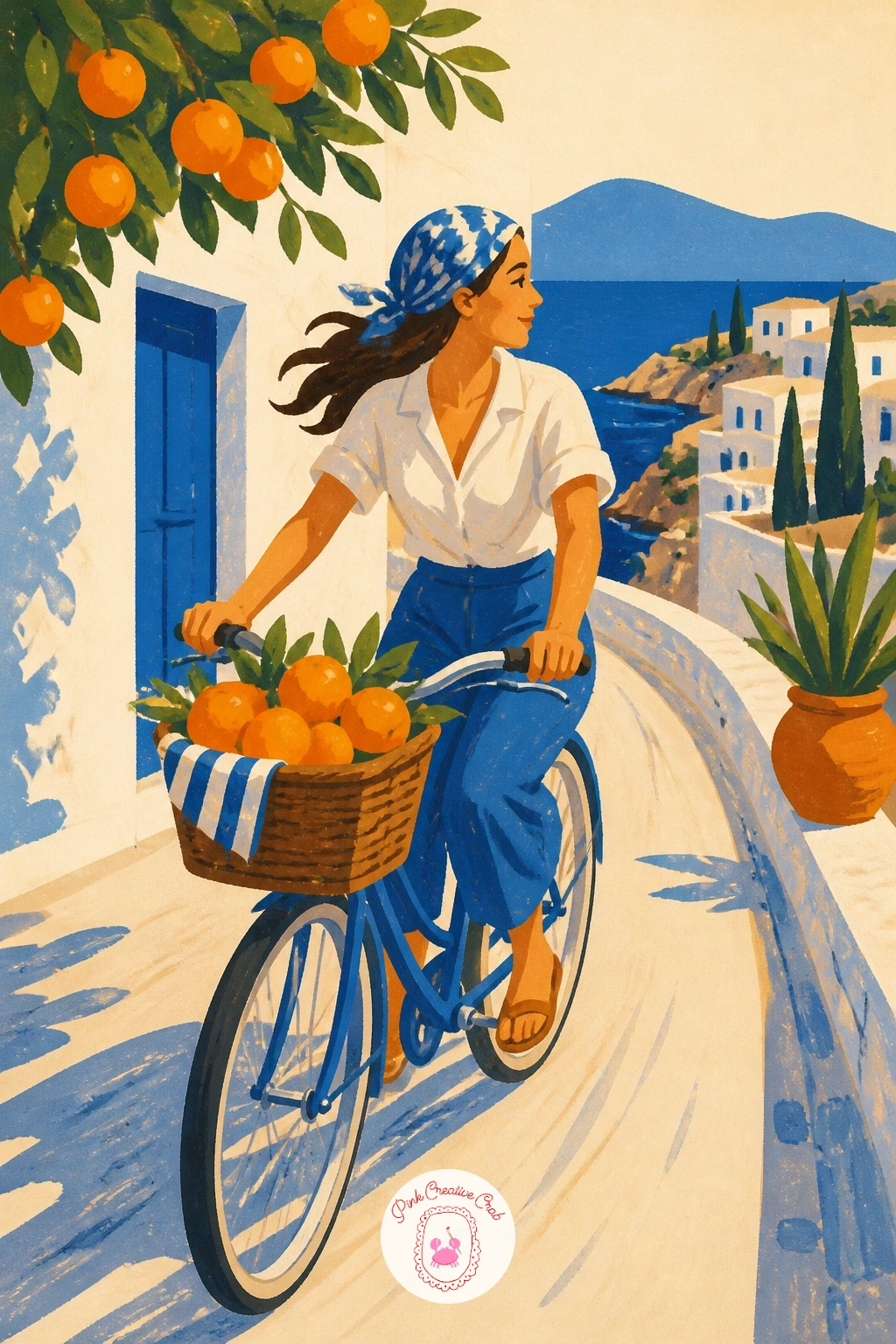
Palette: Orange, Whitewash White, Aegean Blue, Leaf Green
A swimmer floating in crystal clear water seen from above closes this collection with an unusual bird’s eye angle worth the extra care. Set your viewpoint directly overhead, since this top-down angle is what lets you paint the swimmer as one simple flattened shape, arms and legs spread, surrounded by rippling water rather than a side view with all the usual proportion challenges of a floating body.
Paint the water first in several layered blues, darker where it is deeper around the edges of the page, paler and more turquoise directly around the swimmer where sunlight penetrates, then add the swimmer last as a simple warm skin-toned shape with a swimsuit color breaking it up.
If the water looks static, add a few thin pale ripple lines radiating gently outward from around the swimmer’s limbs, suggesting the water’s surface moving slightly around the floating body.
For more ideas on rendering clear water convincingly in flat shapes, browse these gouache painting ideas for beginners for related water and light techniques.
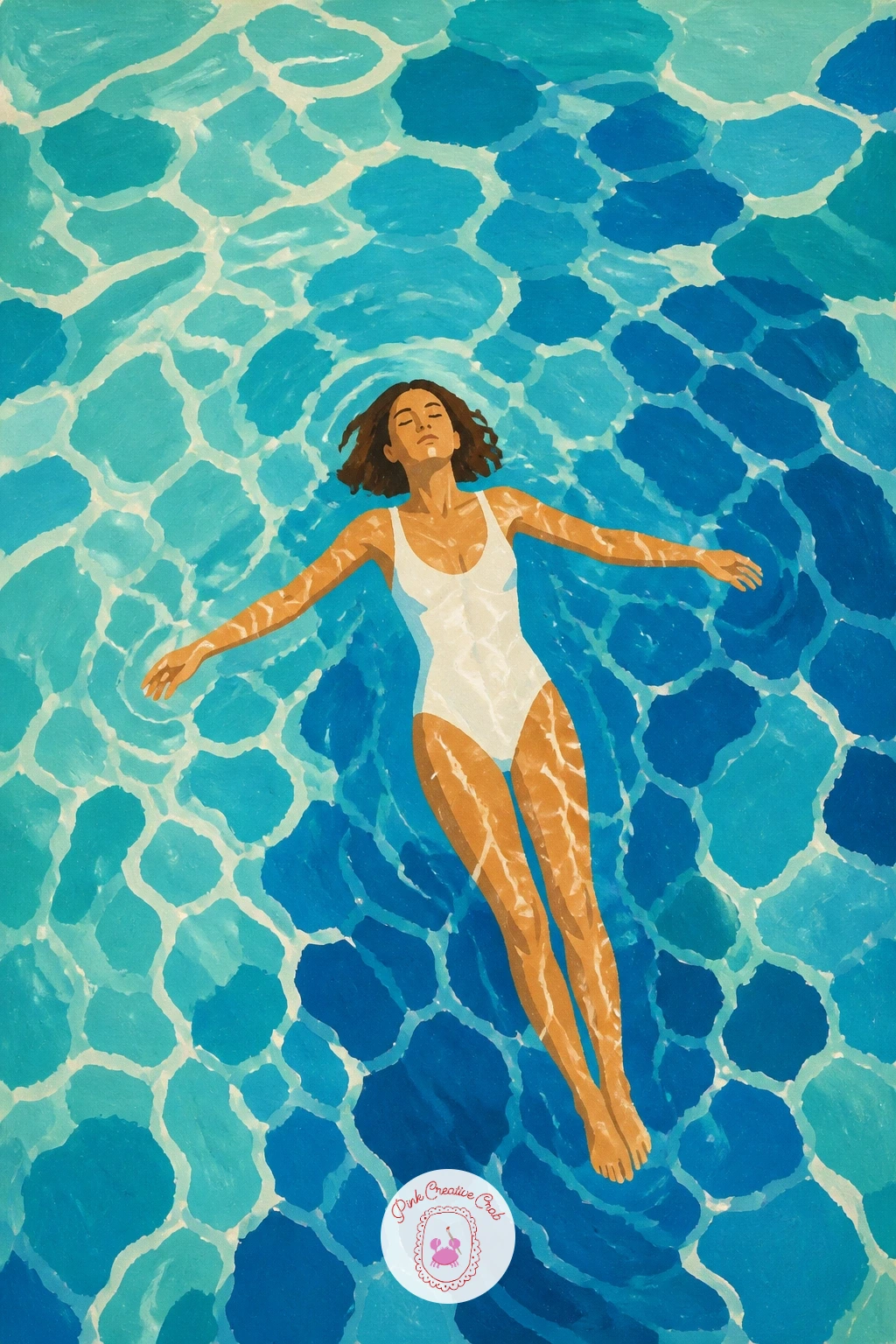
Palette: Turquoise, Deep Blue, Skin Tone, Whitewash White
What to Do Next
Pick whichever scene you are drawn to first, lay out your gouache on a palette, and start with its largest flat shape, the sea, the sky or the whitewashed wall, before any small detail. A small sheet of heavy watercolor paper and twenty unhurried minutes is all most of these take to finish.
Frequently Asked Questions
What gouache colors do you need for a Greece painting palette?
A basic set needs ultramarine or a true blue, white, a burnt orange or terracotta, lemon yellow and black. Mix your own Aegean blue from ultramarine, white and a touch of black rather than buying a specific named color.
What paper works best for gouache travel scenes?
Heavy cold press watercolor paper around 140lb handles gouache’s water content without buckling. A smooth illustration board also keeps those flat, crisp edges this style depends on, since too much texture breaks up flat color blocks.
How do you keep gouache edges crisp instead of soft and blended?
Let each color dry fully before painting the one beside it, then paint right up to that dry edge rather than working wet into wet. A small round brush with a sharp tip gives you the cleanest line along any edge.
How do you mix a convincing Aegean blue in gouache?
Start with ultramarine, add white until it lightens slightly, then mix in a very small amount of black to mute it toward that deep, slightly dusty island blue. Test it on scrap paper since gouache dries a touch lighter than it looks wet.
What is the easiest Greece scene to start with for a beginner?
The blue door with red geraniums or the sleeping cat on whitewashed steps are the simplest, since both rely on just two or three flat shapes and dry fully between layers. Both finish well within an hour.
Have any thoughts?
Share your reaction or leave a quick response — we’d love to hear what you think!
-
 0
-
0
-
0
-
0
-
0
-
0


