A watercolor illustration earns its keep when it tells a tiny story, and every scene below gives you a small moment of everyday life to paint: a splashy puddle, a bedtime story, a cat stealing fish at a market. These are the pictures that end up framed over a crib or tucked into a hallway gallery, soft and a little funny and full of small details to find.
Below you get 34 of them, ordered from the simplest poses to the busier scenes with more figures and props. Each one tells you how to build it in washes and fine ink line, where it tends to go wrong, and one tip to carry into the next painting.
Using these images: free for personal projects such as printing, coloring, cards, journals and gifts. Handmade items that include them may be sold up to 30 pieces per design. More than that is commercial use and is not permitted, and neither is selling or sharing the images themselves or passing them off as your own. Please ask before any other use.
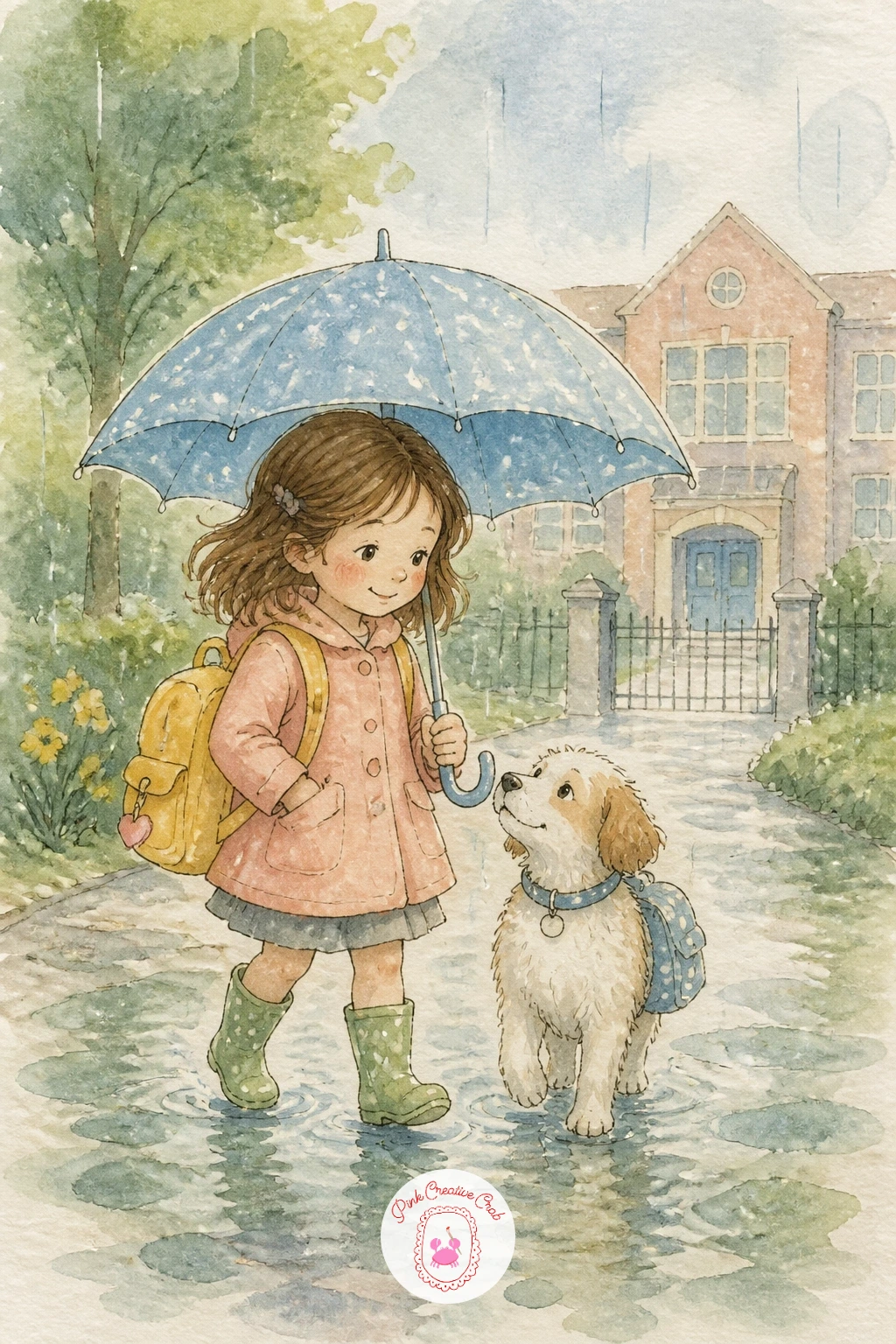
Start with the easiest scene in the set: a girl and her dog walking to school in the rain. Pencil in two simple shapes first, a small figure under an umbrella and a dog trotting beside her, keeping both low and close together on the page so the composition reads as one unit.
Paint the umbrella first in a flat wash of baby blue, leaving a thin white gap at the rim for shine, then drop in the coat and boots while the paper is still slightly damp so the colors blur softly at the edges. Let everything dry fully before you pick up the fine liner for the dog’s face, her hair and the puddle lines underfoot.
The common slip here is overworking the rain, which flattens the whole picture. Keep raindrops to a few short diagonal ink strokes rather than a dense pattern, and let the wet-in-wet background do the quiet work instead.
If you do not have an umbrella shape handy to trace, use a coin or a small lid for a clean curve. Try this one today on a quarter sheet so you can finish start to finish without the paint drying out mid-wash.
Palette: Baby Blue,Payne’s Grey,Blush Pink,Sap Green
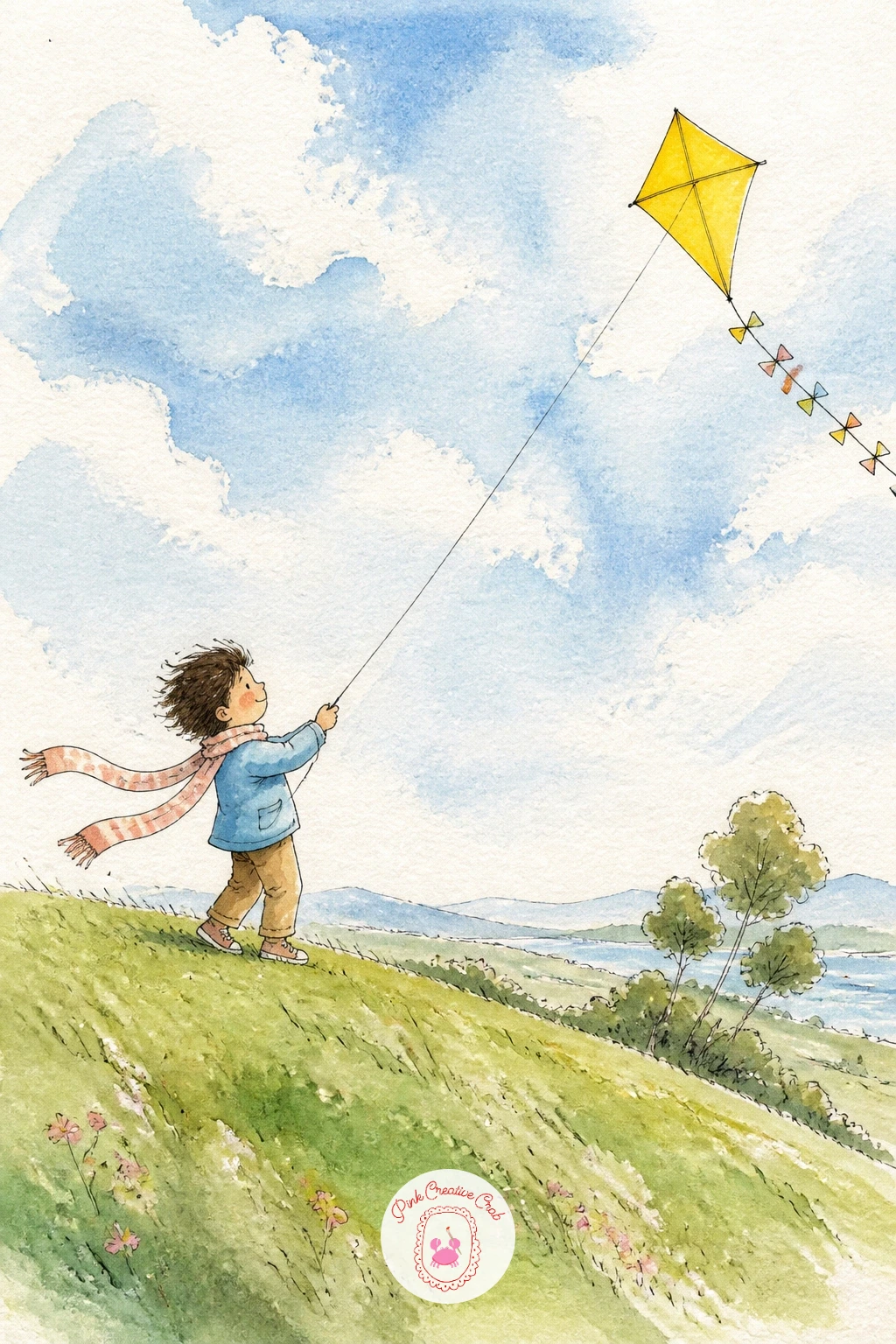
Move uphill for a boy flying a kite on a windy hill, a scene that leans on a good eye level instead of fussy detail. Set the horizon low, about a third up the page, so the sky takes most of the space and the kite has somewhere to soar.
Sketch the hill as one sweeping curve, place the boy small against it, then run the kite string up at a diagonal toward a bright butter yellow diamond kite near the top edge. Paint the sky first in a pale wash, let it dry, then add the hill in sage green with a slightly darker strip at the base for shadow.
Where this scene usually goes wrong is a kite that floats with no sense of wind. Angle the string and the boy’s scarf or hair in the same direction, and the whole painting reads as windy rather than still.
No yellow in your set works fine with a warm ochre instead. Once this version feels comfortable, try it again with the boy running rather than standing, which only changes his leg position and the angle of the string.
Palette: Butter Yellow,Sage Green,Baby Blue,Payne’s Grey
Bring the scene indoors with two sisters building a blanket fort, a cozy interior that works well as nursery art. Pencil a simple triangular fort shape draped over two chair backs, then tuck one sister peeking out and the other holding up a corner of blanket.
Paint the blanket in broad blush and sage stripes first while the paper is damp, so the colors feather into each other like soft fabric, then let it dry before adding the chairs and floor in a light wash. Save the fine liner for last: faces, stray hair, and the fort’s draped folds.
The edges of draped fabric are what sell this picture, so use a dry brush loaded with a little extra pigment to drag soft shadow lines along each fold rather than painting them as flat stripes. That one trick turns a flat triangle into fabric.
No proper fort shape at hand, two open books angled together make a fine stand-in while you sketch. Keep the lamp glow inside the fort warm and the room around it cooler, and the whole scene feels lit from within.
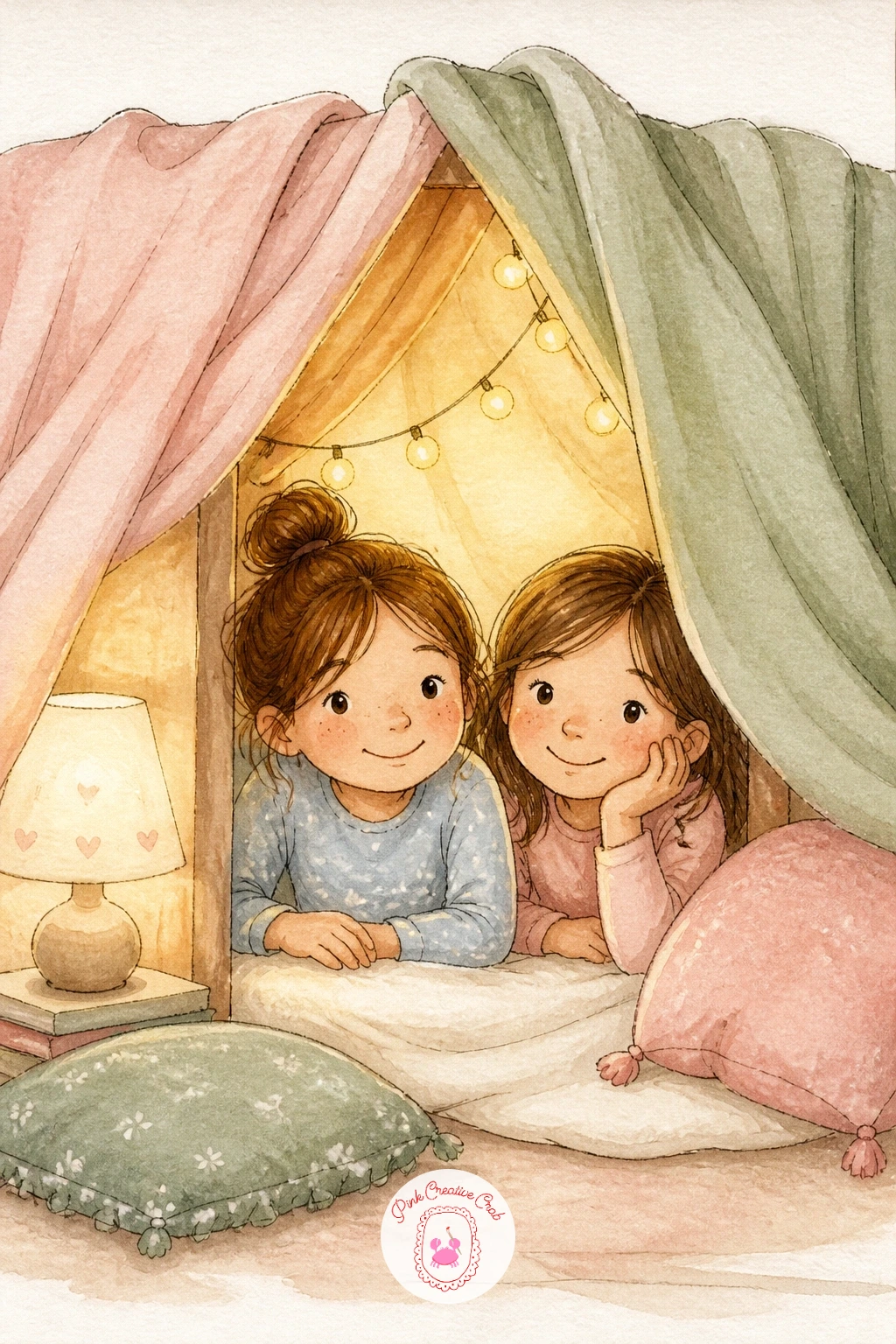
Palette: Blush Pink,Sage Green,Butter Yellow,Payne’s Grey
Add a little mischief with a cat stealing fish at a market, a scene with more going on but still built from a few simple shapes. Block in a stall table, a pile of fish shapes in loose ovals, and a sneaky cat mid-leap with the fish in its mouth.
Work background to foreground: paint the striped awning and stall in a quick flat wash first, then the fish in silvery grey-blue with a touch of blush at the gills, and the cat last in a warm grey so it sits clearly in front of everything else.
Here is where a market scene can get cluttered fast. Limit the background to three or four props, a crate, a sign, one more fish, and leave the rest as open paper so the eye goes straight to the cat’s leap.
Without a grey-blue on hand, mix blue and a touch of brown for a convincing fish scale color. Try the forty-minute version next by adding a startled stall owner reaching after the cat, which only adds one more simple figure.
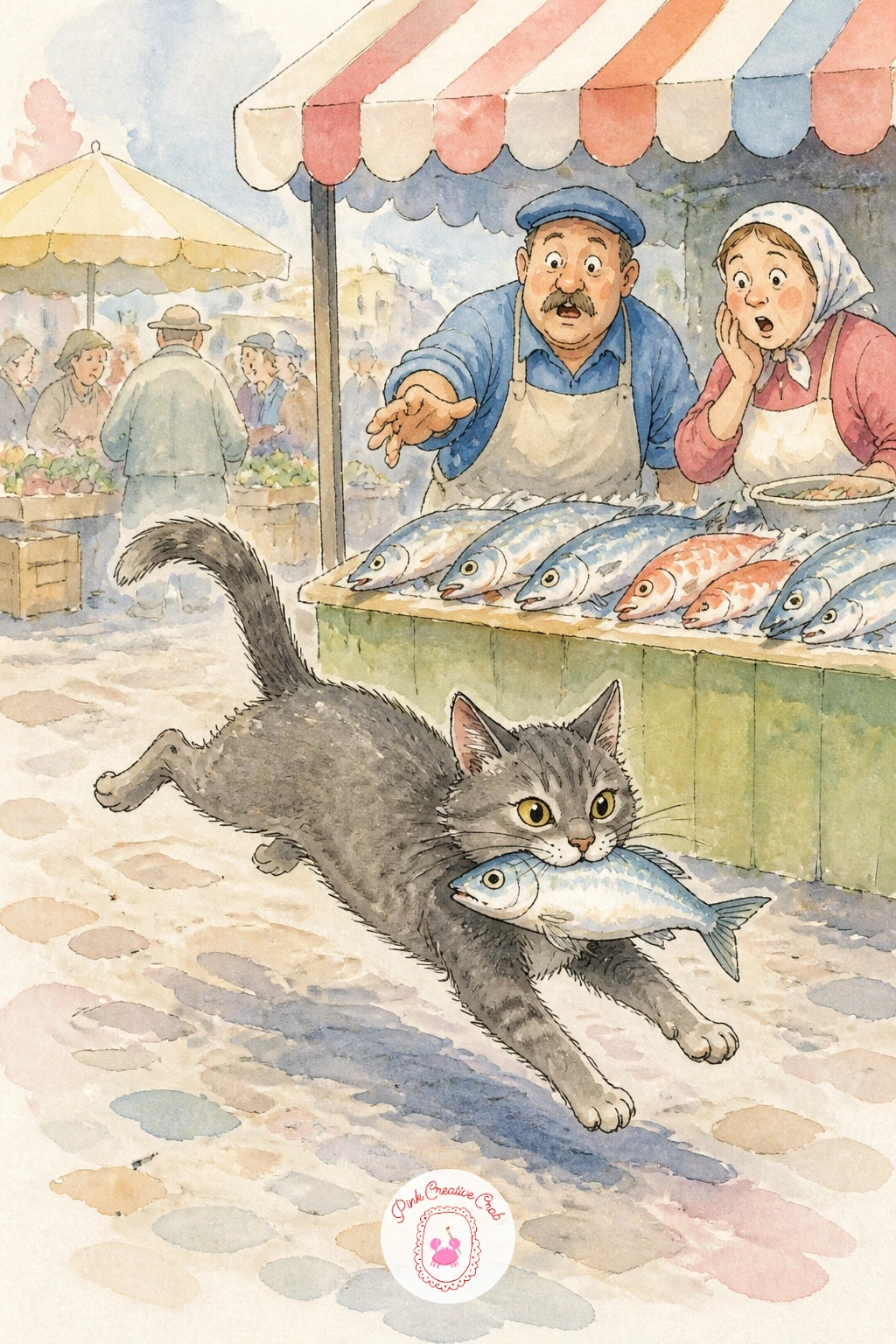
Palette: Payne’s Grey,Baby Blue,Blush Pink,Butter Yellow
Settle into a quieter mood with a grandmother reading a bedtime story, a close two-figure scene that rewards a soft light source over any fussy detail. Decide the lamp sits just off to one side, then let that side of both faces and the blanket stay warmer and brighter while the far side cools into shadow.
Pencil the grandmother in a rocking chair with the child tucked against her, an open book between them, then paint the lamp glow first as a pale yellow halo before adding the figures around it. Keep the room behind them a flat wash of dusty blue so the warm center pops forward.
Faces lit from one side are easy to get wrong by shading both cheeks equally. Pick a side and commit, adding just one soft shadow under the chin and along the far cheek with a damp brush rather than hard ink lines.
If a lamp feels fussy to include, a simple glowing window behind them gives the same warm-cool contrast. This scene pairs nicely with the quiet mood found in watercolor cozy library and bookshop illustrations if you want to paint a few more book-themed pieces.
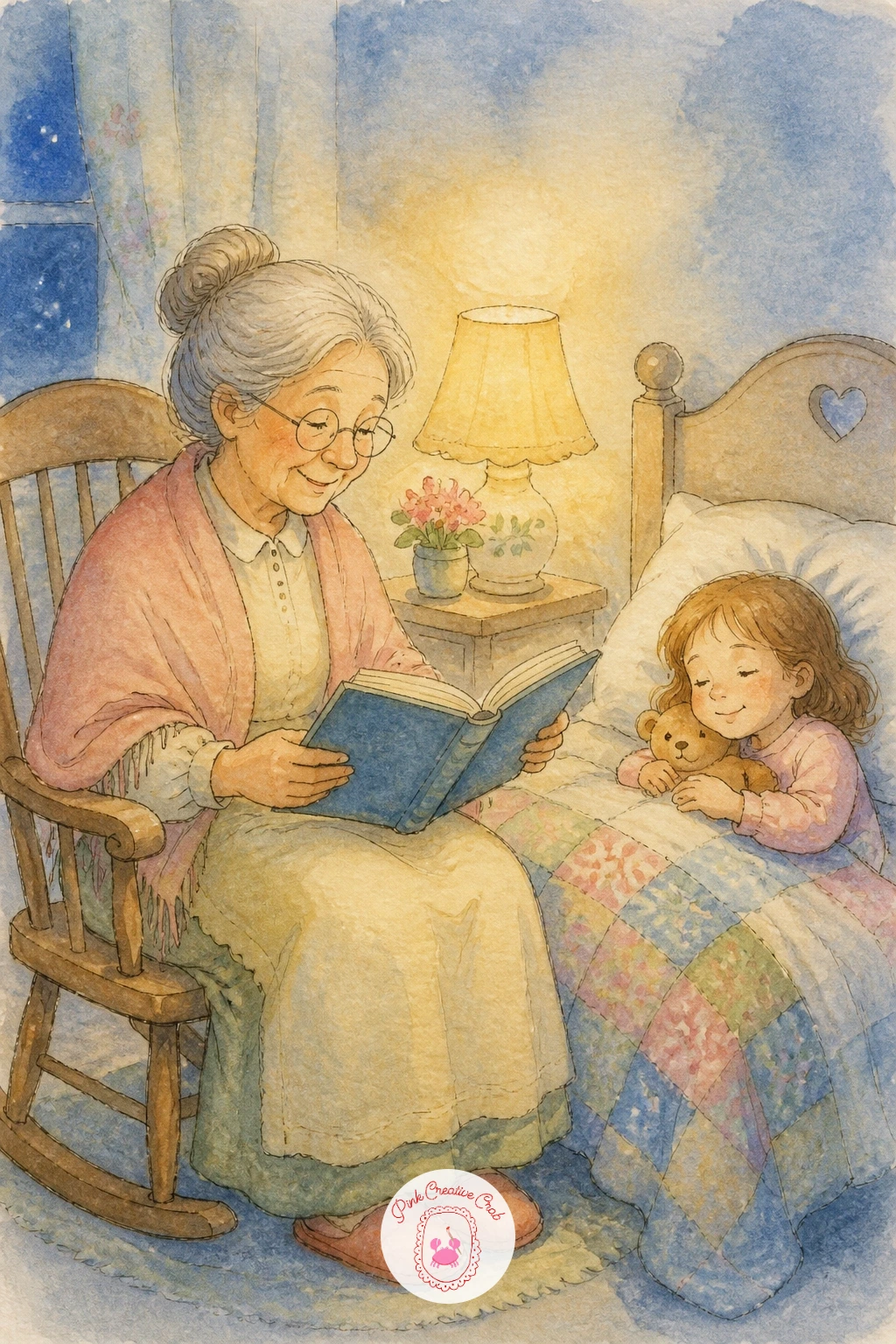
Palette: Butter Yellow,Payne’s Grey,Blush Pink,Baby Blue
Step outside for a child planting seeds with a watering can, a bright and simple spring scene. Sketch a small kneeling figure, a row of seed holes or tiny sprouts, and a watering can tipped at an angle with a thin stream falling from the spout.
Paint the sky and ground first in quick flat washes, sage below and pale blue above, then add the child’s dress or overalls and let the watering can sit in a warm yellow so it catches the eye against the green. The falling water is best left as a thin line of clear water on damp paper so it catches a faint blue tint rather than painting it as a solid white gap.
Overcrowding the ground with too many sprouts is the usual mistake. Three or four small green marks say “garden” just as well as a dozen and keep the scene readable at a glance.
No watering can reference nearby, any narrow jug with a spout works as a stand-in shape. For a quick ten-minute version, skip the background entirely and let the child and can float on white paper with just a strip of green underfoot.
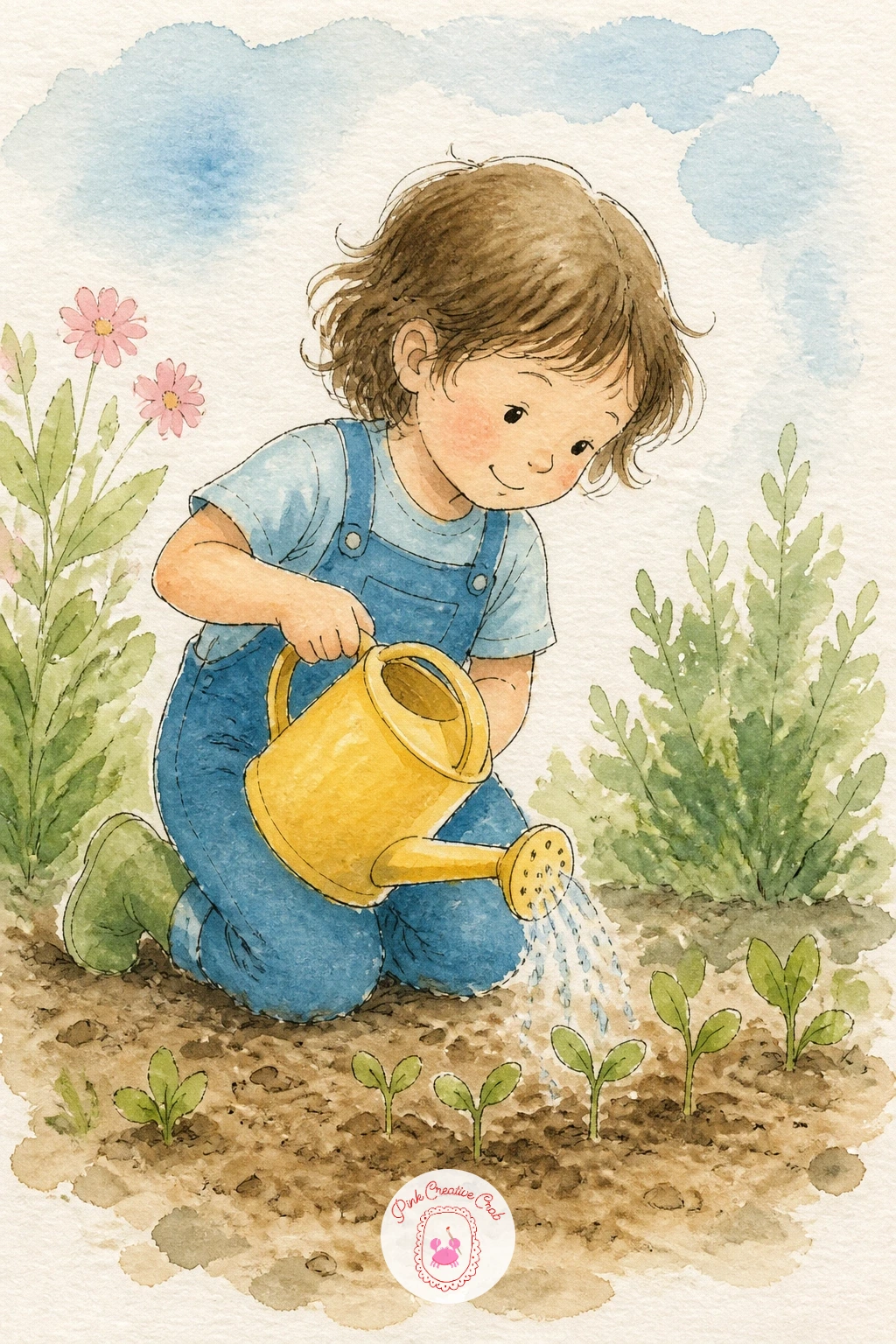
Palette: Sage Green,Butter Yellow,Baby Blue,Blush Pink
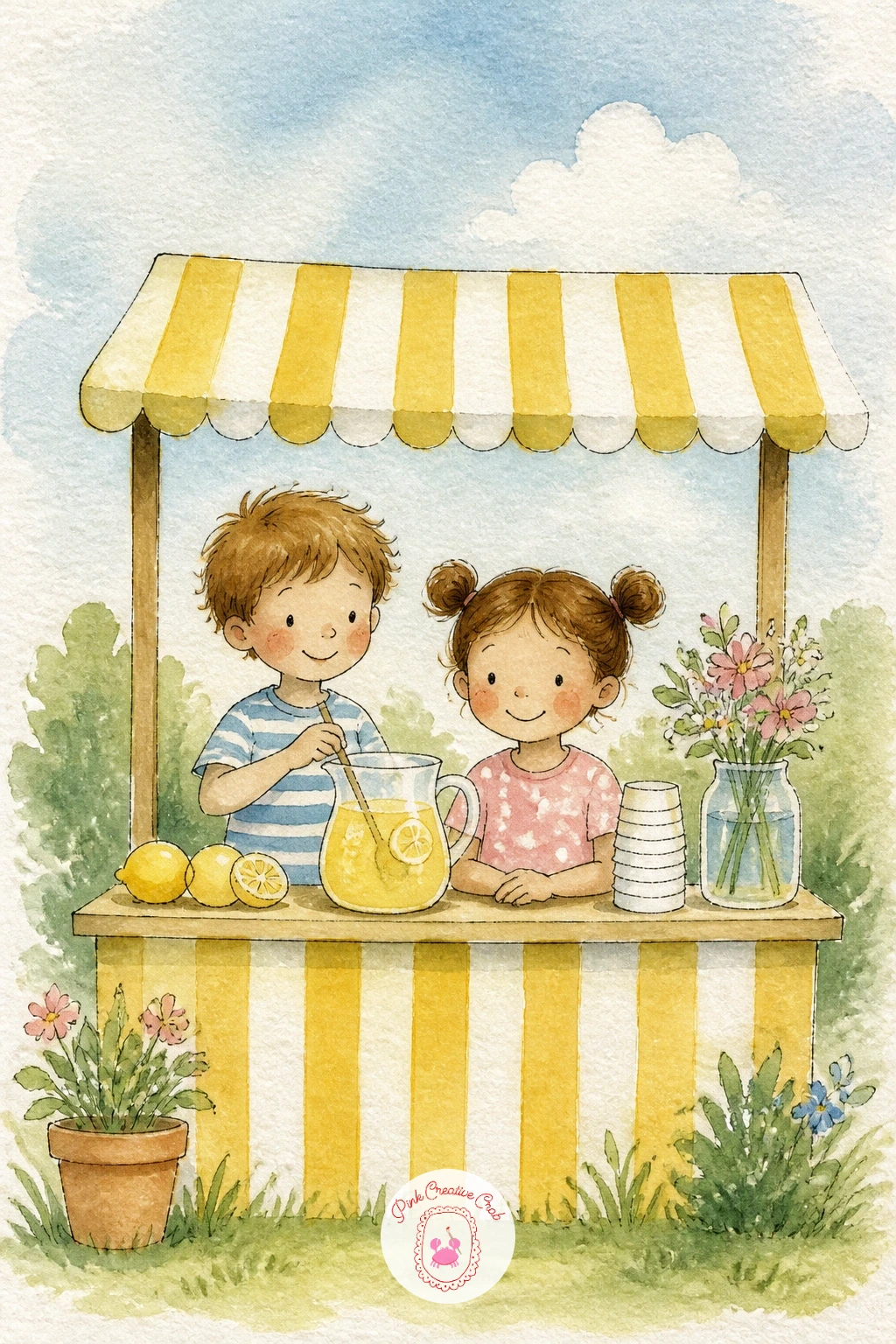
Pick up the pace with kids having a lemonade stand, a cheerful scene built around one bright focal color. Pencil a simple wooden stand with a striped front, a pitcher and a stack of cups, and two children behind it, one waving and one pouring.
Work the lemonade pitcher and cups first in a strong butter yellow so that color anchors the whole painting, then build the stand around it in blush and sage stripes, and finish the sky as a pale flat wash behind everything. Save the hand-painted sign lettering for the very last step so a shaky line does not get buried under later washes.
A lemonade stand painting falls flat when every element gets equal weight. Let the pitcher and cups stay the brightest, most saturated shapes on the page, and keep the children’s clothing a touch softer so the eye lands on the lemonade first.
Without a striped stand to reference, a simple table with a scalloped paper skirt along the front reads just as charmingly. Try this scene again later with a dog sitting hopefully beside the stand for a little more story.
Palette: Butter Yellow,Blush Pink,Sage Green,Baby Blue
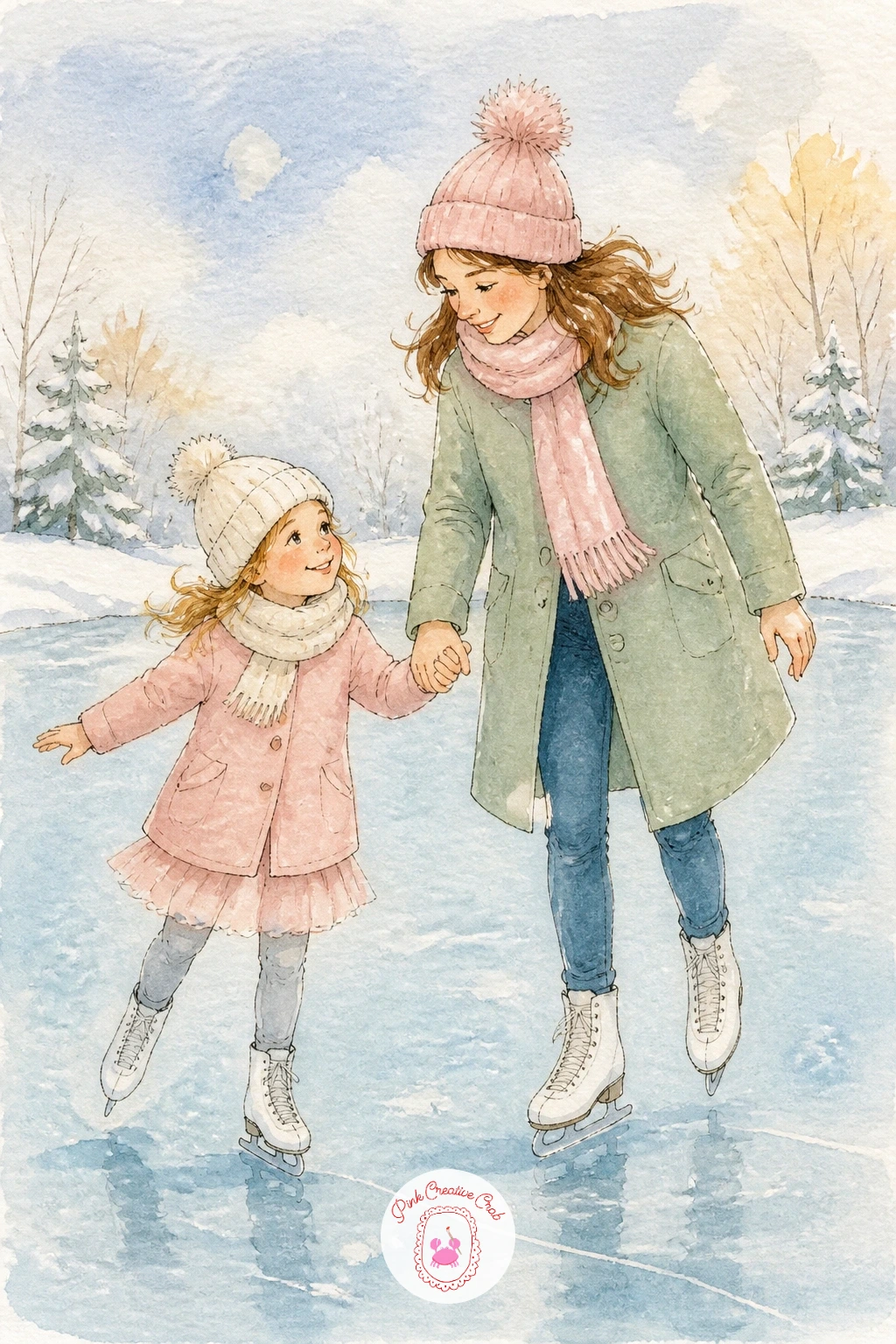
Shift into winter with a girl ice skating with her mom, a scene that leans on one proportion trick to keep the figures believable. Measure the mother’s head against the child’s: a young child’s head is roughly a quarter of her total height, noticeably larger in proportion than an adult’s, and getting that ratio right instantly makes the pair read as parent and child rather than two adults.
Sketch both figures mid-glide, arms linked, then paint the ice as a pale blue wash with a few dry-brushed white streaks left for shine. Add the coats in blush and sage once the ice layer is fully dry so the colors stay crisp against the cool background.
Wobbly ankles are the most common slip on skating figures. Keep the skate blades small and angled in the same direction as the lean of the body, and the pose reads as balanced motion rather than a fall.
If ice texture feels tricky, a kneaded eraser dabbed over a pencil-shaded patch before painting lifts soft highlight marks to paint around. Try the same pose next with a scarf trailing behind both figures for extra movement.
Palette: Baby Blue,Blush Pink,Sage Green,Payne’s Grey
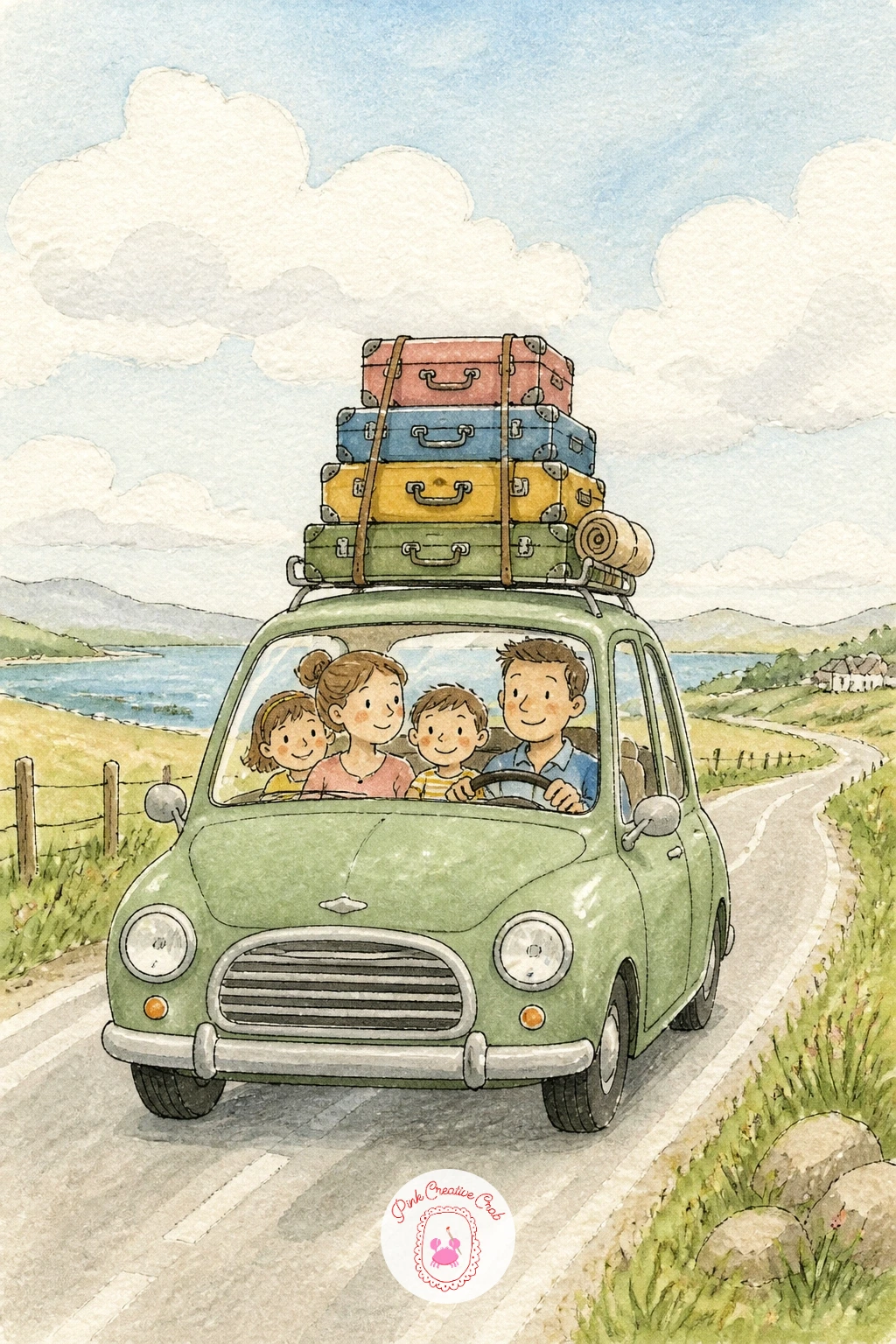
Zoom out for a family road trip with suitcases on the roof, a scene with more shapes to juggle but still simple blocks underneath. Draw the car as a rounded rectangle on four small wheels, stack two or three suitcase shapes on top tied with a loose line, and tuck small faces in the windows.
Paint the car body first in a single confident color, sage or baby blue work well, then let it dry completely before adding window glass as a pale grey-blue wash and the suitcases in contrasting blush and yellow. A thin road line and a flat horizon finish the background in under a minute.
Cars often end up looking flat and toy-like when every panel gets the same tone. Drop a slightly darker wash along the lower edge of the car body while the first layer is still a touch damp, which gives it a simple rounded form without any real shading work.
No real car to study, any toy car or delivery van on the street works as a stand-in shape. This is a nice one to revisit for easy watercolor landscapes practice, swapping in a new road and hills each time.
Palette: Sage Green,Blush Pink,Butter Yellow,Baby Blue
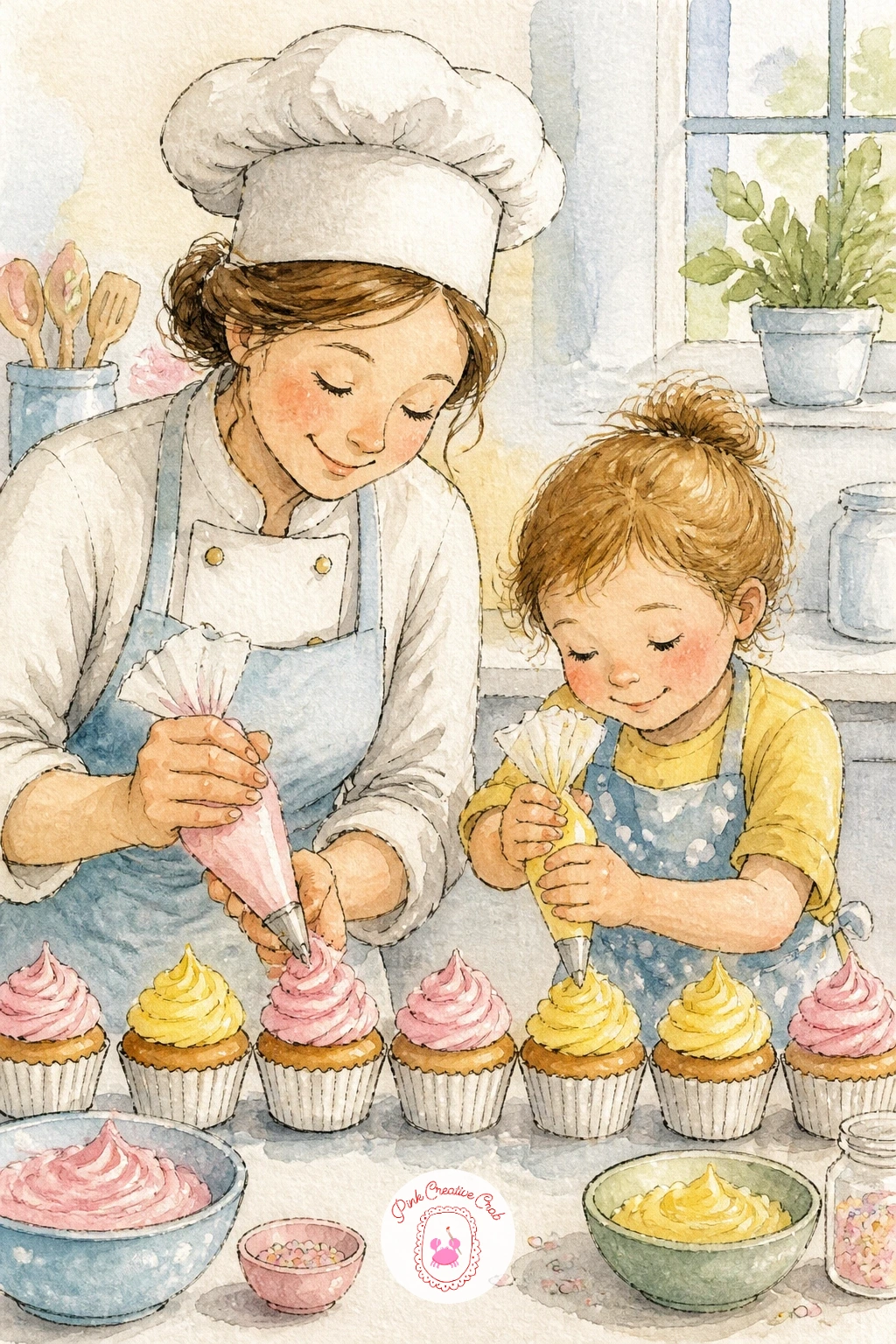
Warm things up with a baker and a child decorating cupcakes, a kitchen scene that leans on good texture work for the frosting. Sketch a counter with a row of cupcakes, the baker standing behind in an apron, and a small child reaching up with a spoon of frosting.
Paint the cupcake bases in a warm brown wash first, then once dry, load the brush with thick blush or butter yellow paint and dab rather than stroke it onto the tops so the frosting keeps a soft swirled texture instead of flattening into a solid shape. Add sprinkles last as tiny dots of ink or a contrasting color flicked lightly from a nearly dry brush.
Overly smooth frosting is the giveaway of a rushed cupcake painting. Let the paint pool slightly at the edges of each dab and leave a few small gaps of white paper showing through for sheen.
No real cupcakes nearby to reference, a muffin tin from a photo works just as well for the basic shape. If food scenes interest you further, easy watercolor food ideas has more of this kind of texture work to practice.
Palette: Blush Pink,Butter Yellow,Sage Green,Payne’s Grey
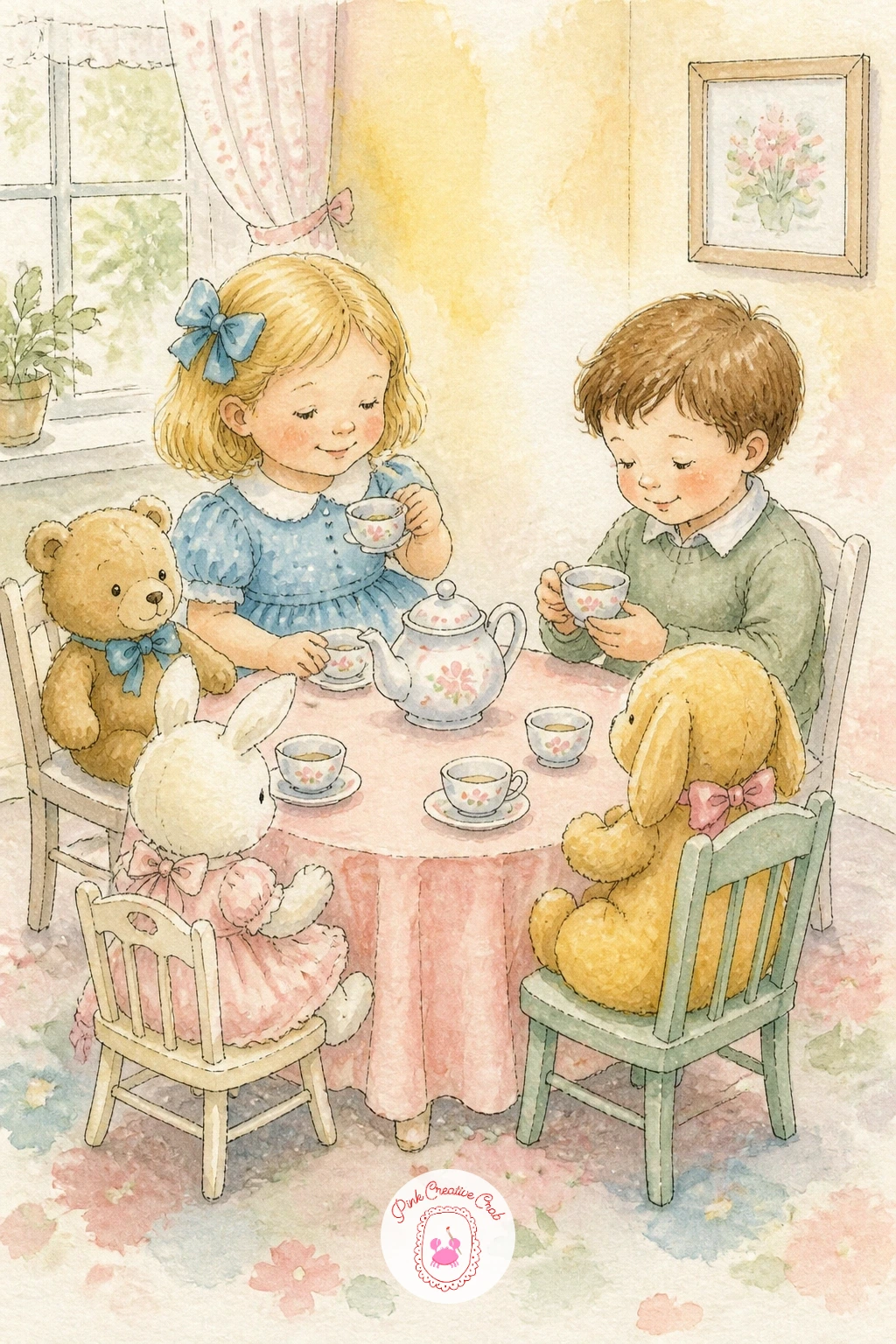
Gather everyone round for children at a tea party with toys, a scene full of small props arranged around a low table. Pencil a tiny table set with cups and a teapot, then circle it with two or three children and a stuffed toy or two propped up as guests.
Paint the tablecloth first in a soft blush wash so it reads as the anchor of the composition, then work outward to the children’s clothing in sage and butter yellow, keeping the teapot and cups as small bright accents painted last with a fine brush. A tiny dab of steam rising from the teapot spout, just a curl of pale grey, finishes the warmth of the scene.
Too many small props crowded onto the table is the easiest way to lose the scene’s charm. Three items on the table, cups, a teapot, one plate, say “tea party” clearly without turning into visual clutter.
Without toy references on hand, stuffed animals from a child’s room work perfectly, propped at odd little angles for personality. Try this again with an outdoor garden tea party next time for a change of setting.
Palette: Blush Pink,Sage Green,Butter Yellow,Payne’s Grey
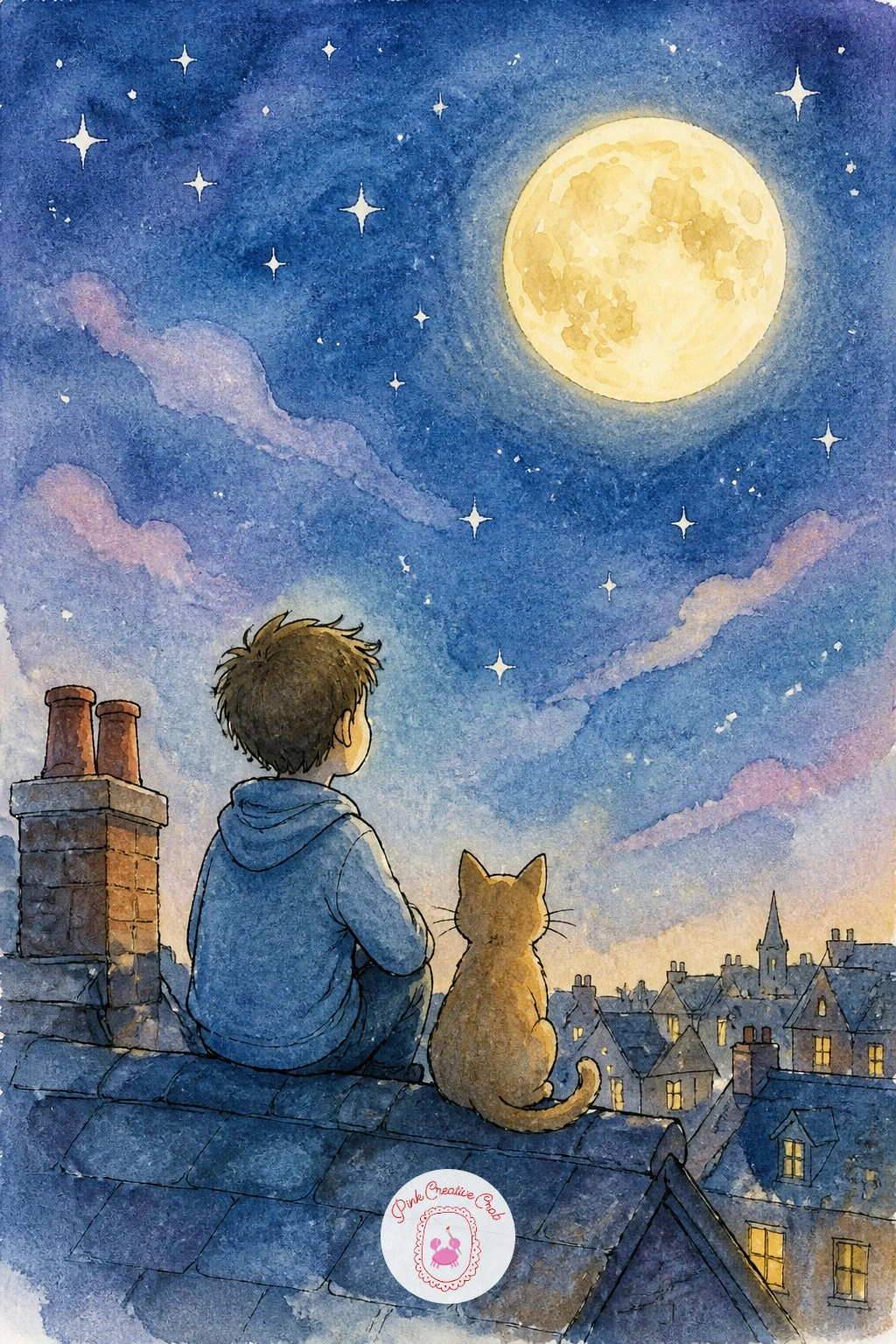
Take the scene up high with a boy and his cat on a rooftop at night, where the light source decides everything. Place the moon in one corner and let it be the single brightest point in the painting, with every other color, rooftops, the boy’s silhouette, the cat beside him, sitting a shade or two darker in comparison.
Paint the sky first in a deep wash of blue mixed with a touch of grey, working around a reserved circle of white paper for the moon, then once dry, add soft star dots with a white gel pen. Build the rooftop and chimney shapes in flat dark washes and let the boy and cat sit as simple near-silhouettes with just a thin rim of ink catching the moonlight on one edge.
Night scenes often go muddy when every color gets mixed too dark too fast. Keep your darkest wash reserved for the sky itself and let the rooftop stay one shade lighter so the painting keeps some depth instead of flattening into black.
No white gel pen in the kit, a thin dab of white gouache does the same job for stars. Try the quick version in ten minutes with just the moon, boy and cat, then add distant rooftops and chimney smoke for the fuller scene.
You Will Need
- white gel pen
Palette: Payne’s Grey,Baby Blue,Butter Yellow,Sage Green
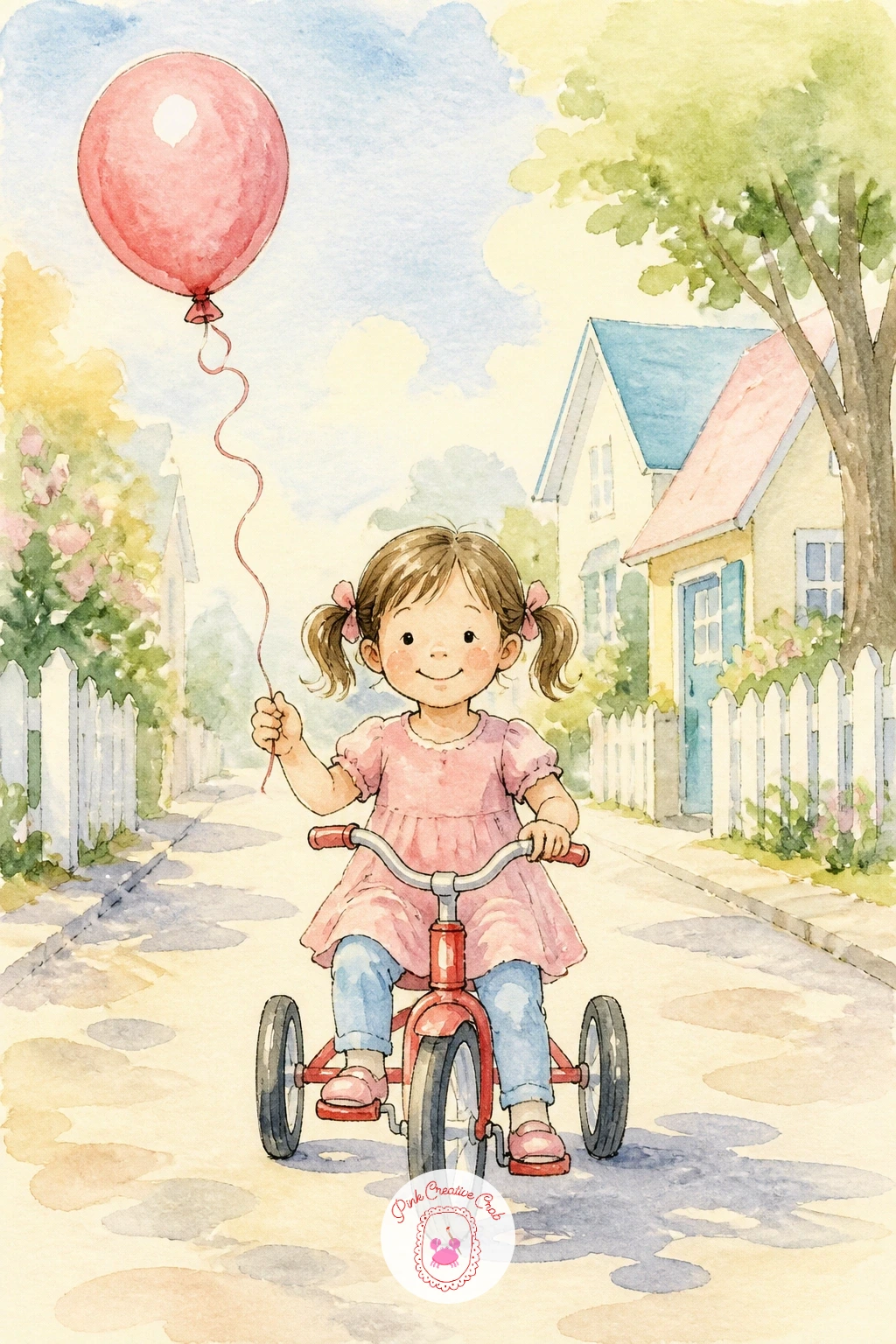
Pick the pace back up with a girl riding a tricycle with a balloon, a cheerful street scene built from circles. Draw the tricycle wheels as simple circles first since they set the scale for the whole figure, then build the girl and handlebar around them, and let a balloon on a long curling string trail up and off to one side.
Paint the balloon in a strong blush or butter yellow so it reads as the brightest point in the picture, then work down to the tricycle in sage or baby blue, finishing with the street as a pale flat wash beneath the wheels. Keep the balloon string as one loose ink curve rather than a straight line so it carries a sense of movement.
Tricycle wheels drawn without care often end up lopsided or uneven in size. Hold the pencil at arm’s length and compare the two wheel circles against each other before committing to ink, which catches the mismatch early.
No circle template handy, a bottle cap or coin traces a clean wheel shape in seconds. Try this scene again with a dog trotting alongside the tricycle for extra charm.
Palette: Blush Pink,Sage Green,Baby Blue,Butter Yellow
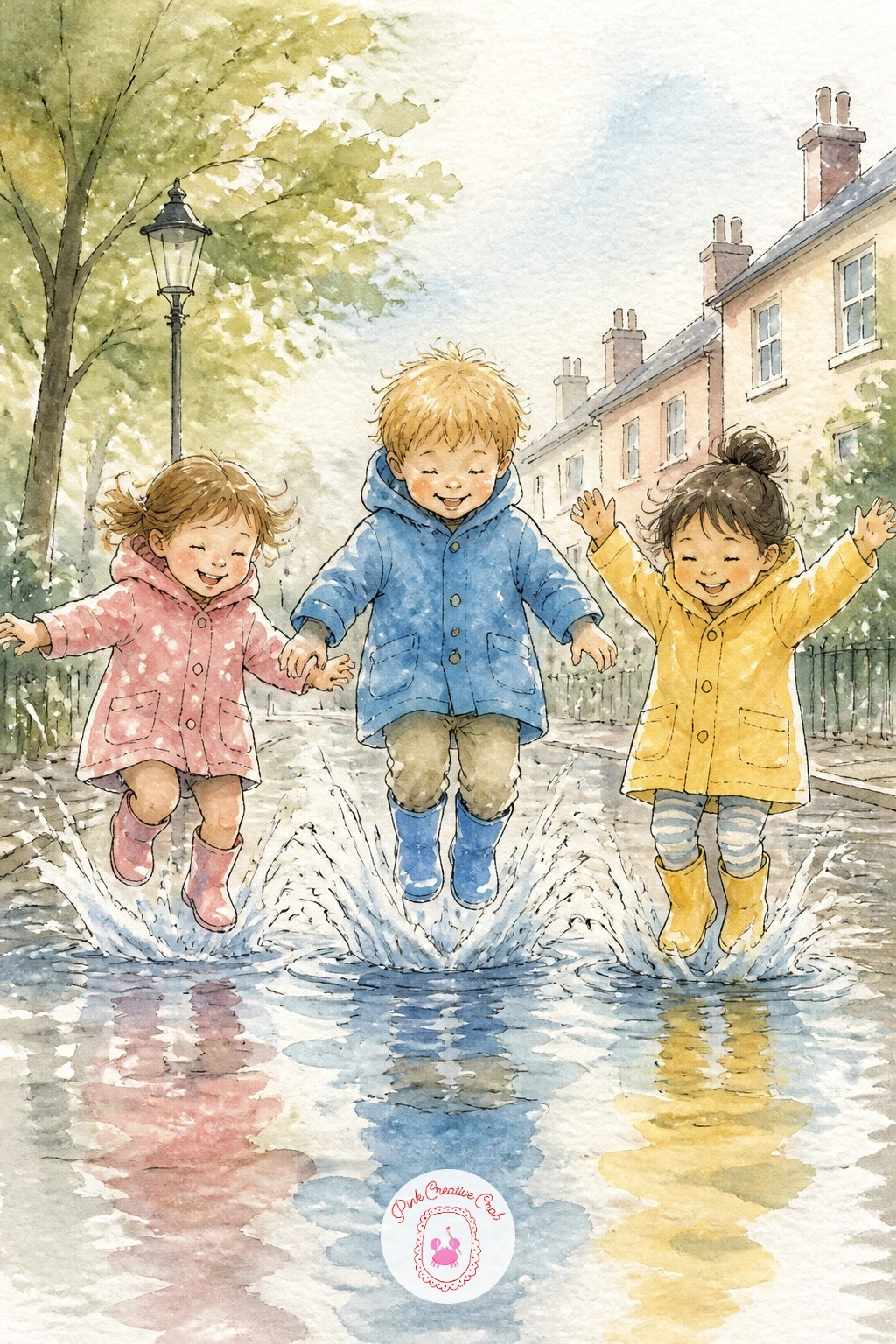
Keep the energy going with friends jumping in puddles, a scene that lives or dies on how the splash looks. Sketch two or three children mid-jump, knees bent, arms out for balance, each one landing in or near a round puddle shape on the ground.
Paint the puddles first as flat ovals of baby blue with a touch of grey reflection, then once fully dry, flick a loaded brush gently with your finger to spatter tiny droplets around each puddle for the splash. Add the children’s raincoats and boots last in blush and sage so they stand out clearly against the wet ground.
A splash with no energy is the usual problem, droplets painted too evenly in a neat ring. Flick the spatter at a few different angles and distances from each puddle so it looks like real movement rather than a pattern.
No brush splatter technique feels controlled enough, an old toothbrush dragged with your thumb gives a finer, more scattered spray. Keep a scrap paper test nearby before spattering onto the real painting.
You Will Need
- old toothbrush for splatter
Palette: Baby Blue,Blush Pink,Sage Green,Payne’s Grey
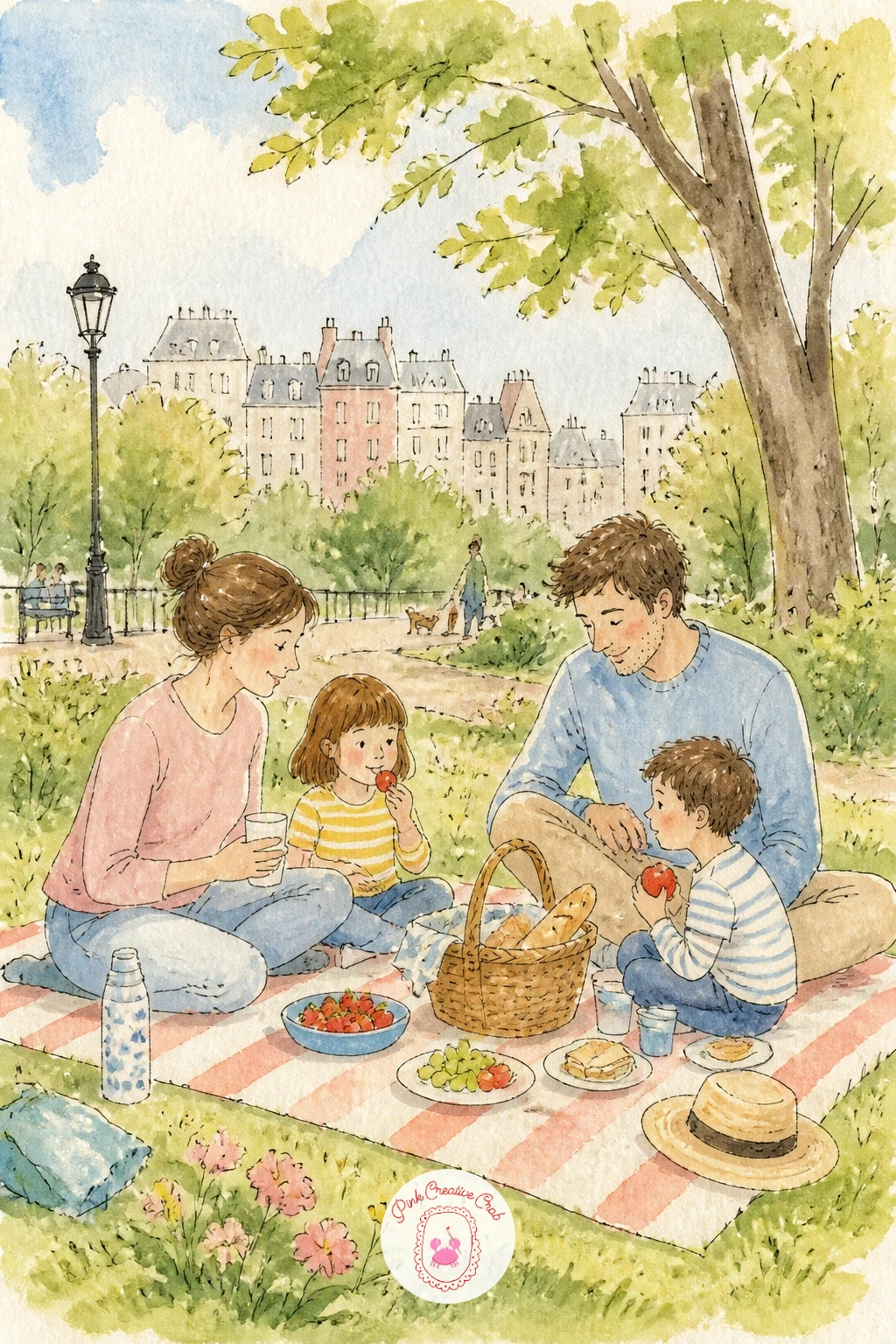
Settle down for a family picnic in a city park, a scene with several small elements working together under one calm eye level. Keep the horizon low and the picnic blanket close to the bottom third of the page, then let a few distant buildings or trees sit small along the skyline to suggest the city without needing much detail.
Paint the blanket first in blush and sage stripes, then add the small figures sitting or lying on it, and finish with a basket, a few scattered plates, and a tree or two framing the scene in soft green. Keep the background buildings as flat pale shapes with minimal ink so they stay behind the picnic rather than competing with it.
Too much detail in the distant skyline pulls focus from the family in front. Three simple rooftop shapes in a lighter wash than the foreground say “city” without demanding attention.
No park nearby to reference, any patch of grass with a tree works as a stand-in setting. For more outdoor scene practice, easy watercolor landscapes covers plenty of ways to simplify a background like this one.
Palette: Sage Green,Blush Pink,Butter Yellow,Baby Blue
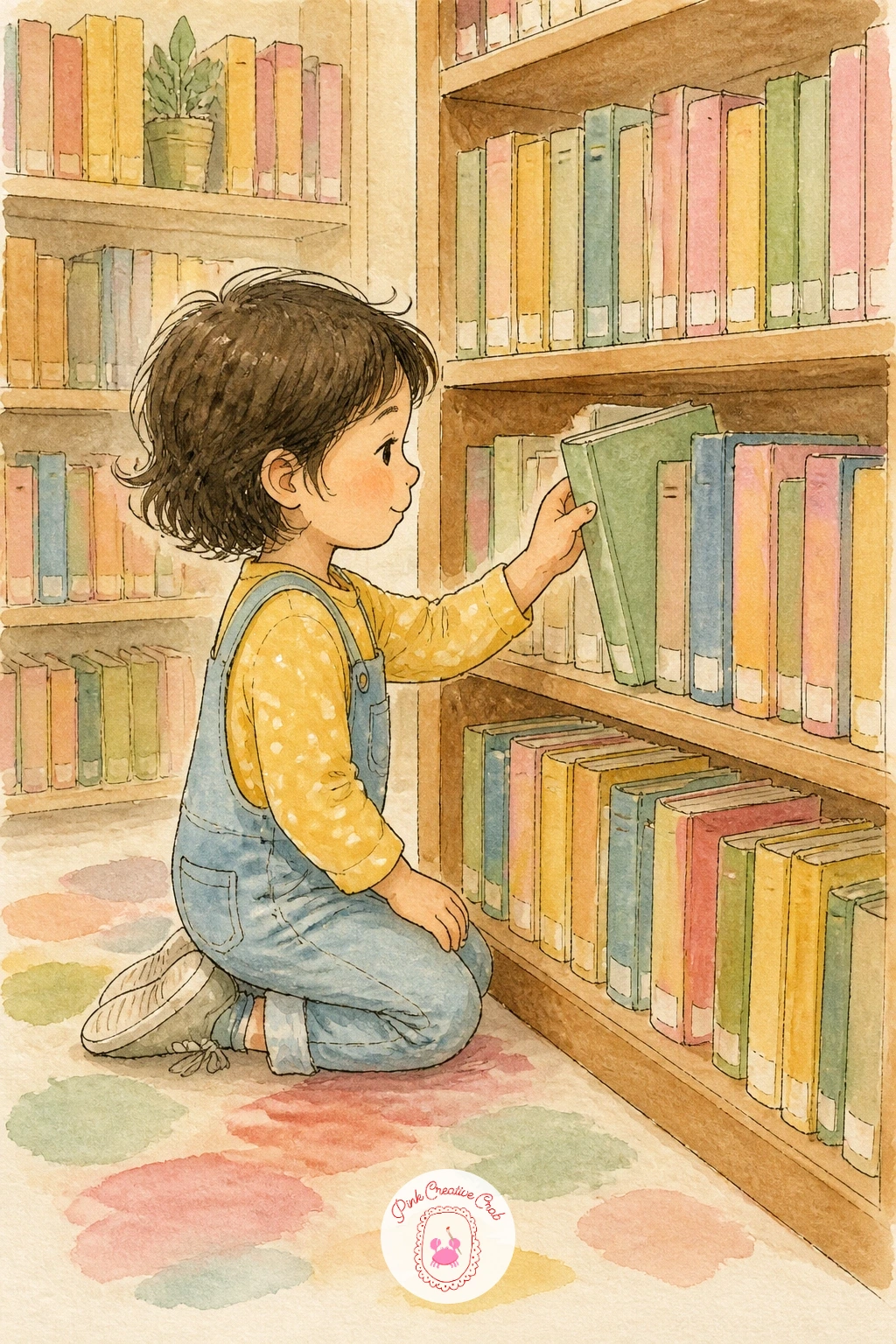
Move indoors for a child at the library choosing books, a quieter scene built around a wall of shelves. Sketch tall bookshelves as a simple grid of rectangles, then place a small child reaching up or kneeling with a stack of books already gathered at their feet.
Paint the shelves first in a warm wood-brown wash, letting the color pool slightly in the corners of each rectangle for a hint of shadow, then once dry, add rows of book spines in quick alternating strokes of blush, sage and butter yellow. Finish with the child in a soft neutral tone so they read clearly against the busier shelf behind them.
Book spines painted too uniformly in size and color flatten the whole shelf. Vary the width and height of each stroke slightly and mix in two or three different colors rather than one repeated pattern, which reads far more like a real shelf.
No shelf photo on hand, any bookshop interior photo online works as reference for spacing. This pairs naturally with watercolor cozy library and bookshop illustrations if shelf scenes appeal to you.
Palette: Sage Green,Blush Pink,Butter Yellow,Payne’s Grey
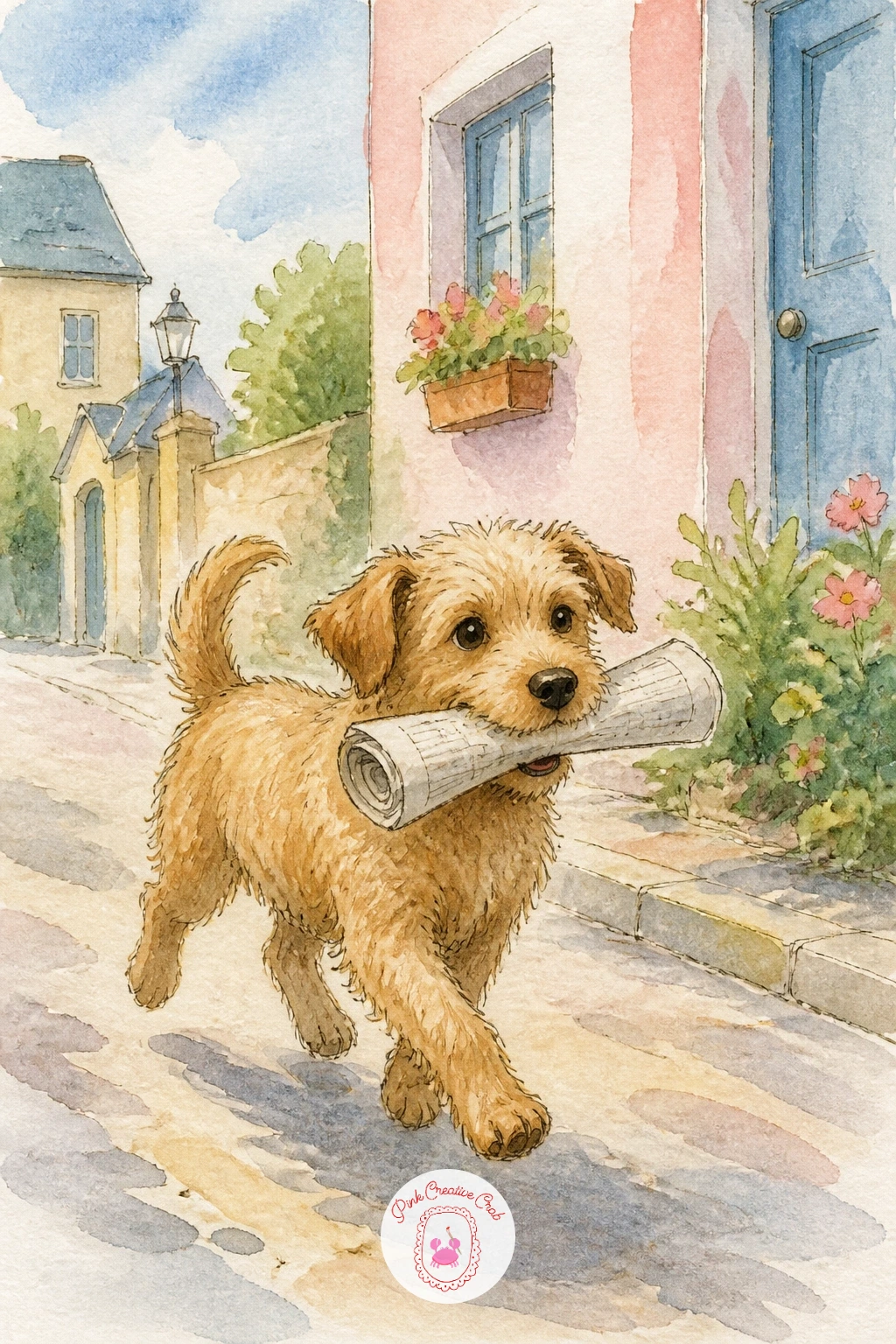
Give the street a little errand with a dog carrying a newspaper home, a simple single-subject scene good for practicing a confident animal pose. Sketch the dog mid-trot with a rolled newspaper held in its mouth, tail slightly raised, one front paw lifted to show motion.
Paint the dog’s body in one flat base wash first, sage brown or warm grey works well, then once dry, drop in a slightly darker wash along the back and legs while the paper is just a touch damp so the fur edges stay soft rather than hard-lined. Add the newspaper last in a crisp pale wash so it stands out clearly against the dog’s coat.
Stiff, flat-footed dog poses are the most common issue here. Angle all four legs slightly differently, two reaching forward and two pushing back, and the trot reads as real movement rather than a standing pose.
No dog nearby to study, any trotting dog photo online gives you the leg angles you need. If dogs are a favorite subject, dog themed junk journal pages has more cozy dog scenes worth a look.
Palette: Sage Green,Butter Yellow,Payne’s Grey,Blush Pink
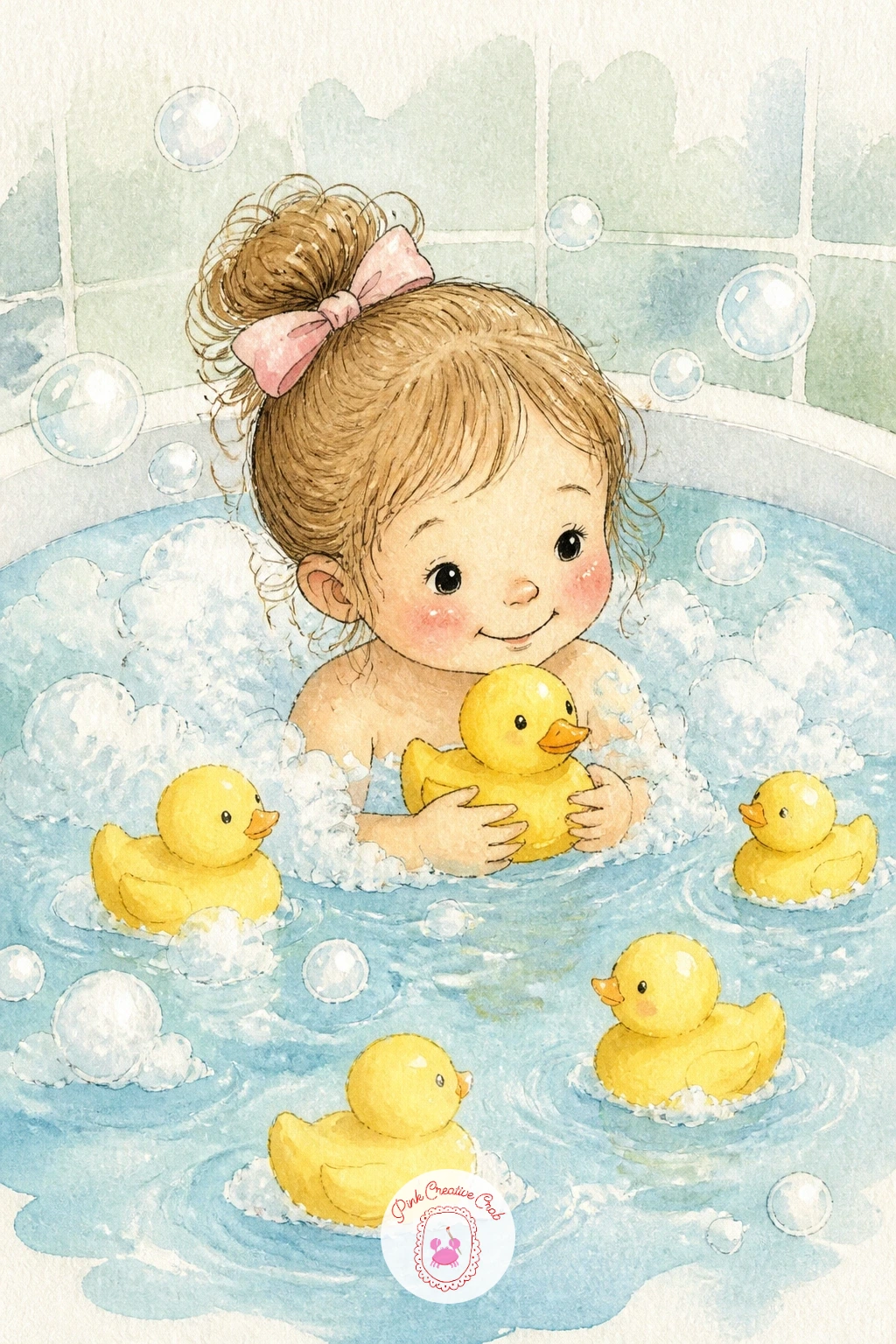
Move into a cozier scene with a girl in a bath with rubber ducks, which leans on soft lifting for the bubbly texture. Sketch the bathtub as a simple rounded rectangle, the girl’s head and shoulders peeking above a line of bubbles, and two or three small rubber ducks floating nearby.
Paint the bathwater first in a pale blue wash, then while it is still slightly damp, dab a clean damp brush or a folded tissue onto scattered spots to lift the color back to white paper, creating soft bubble shapes. Once dry, add the girl’s hair and face and the ducks in bright butter yellow so they pop against the pale water.
Bubbles painted on as solid white circles tend to look pasted on rather than part of the water. The lifting technique keeps soft, irregular edges that blend naturally into the wash instead.
No tissue on hand, a dry cotton swab lifts small bubble shapes just as well. Keep a few bubbles overlapping the edge of the tub for a playful, slightly messy bath-time feel.
Palette: Baby Blue,Butter Yellow,Blush Pink,Payne’s Grey
Try lifting bubbles with a crumpled piece of plastic wrap pressed into the wet wash instead of a tissue, for a slightly more textured, uneven bubble edge.
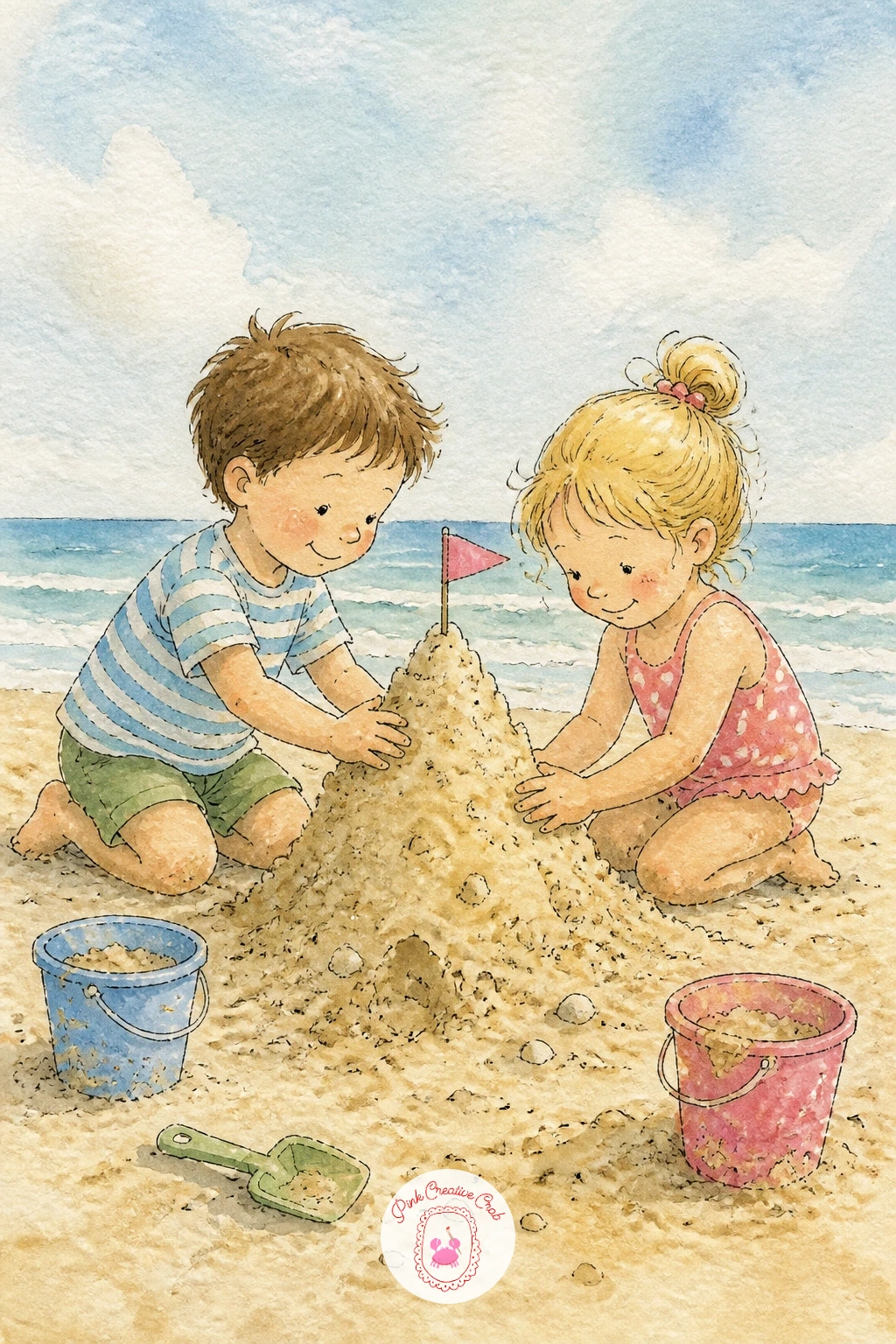
Head to the beach for kids building a sandcastle, a scene with a satisfying bit of dry brush texture for the sand. Sketch two children kneeling over a lumpy sandcastle shape with a small flag on top, buckets and shovels scattered nearby.
Paint the sand first in a warm butter yellow wash, then once it is dry, load a round brush with a little extra pigment, blot most of the water out on a paper towel, and drag it lightly sideways across the castle’s surface so the bristles separate and leave a grainy, textured mark. Add the children and buckets in blush and sage once the sand texture is in place.
Smooth, flat sand with no grain is the biggest tell that this scene was rushed. The dry brush pass only takes a few seconds but makes the whole castle feel granular rather than painted as a solid blob.
No proper round brush for dry work, an old flat brush with worn bristles does an even better job of this technique. For more coastal scene ideas, easy watercolor landscapes has a few beach-adjacent compositions worth browsing.
Palette: Butter Yellow,Baby Blue,Blush Pink,Sage Green
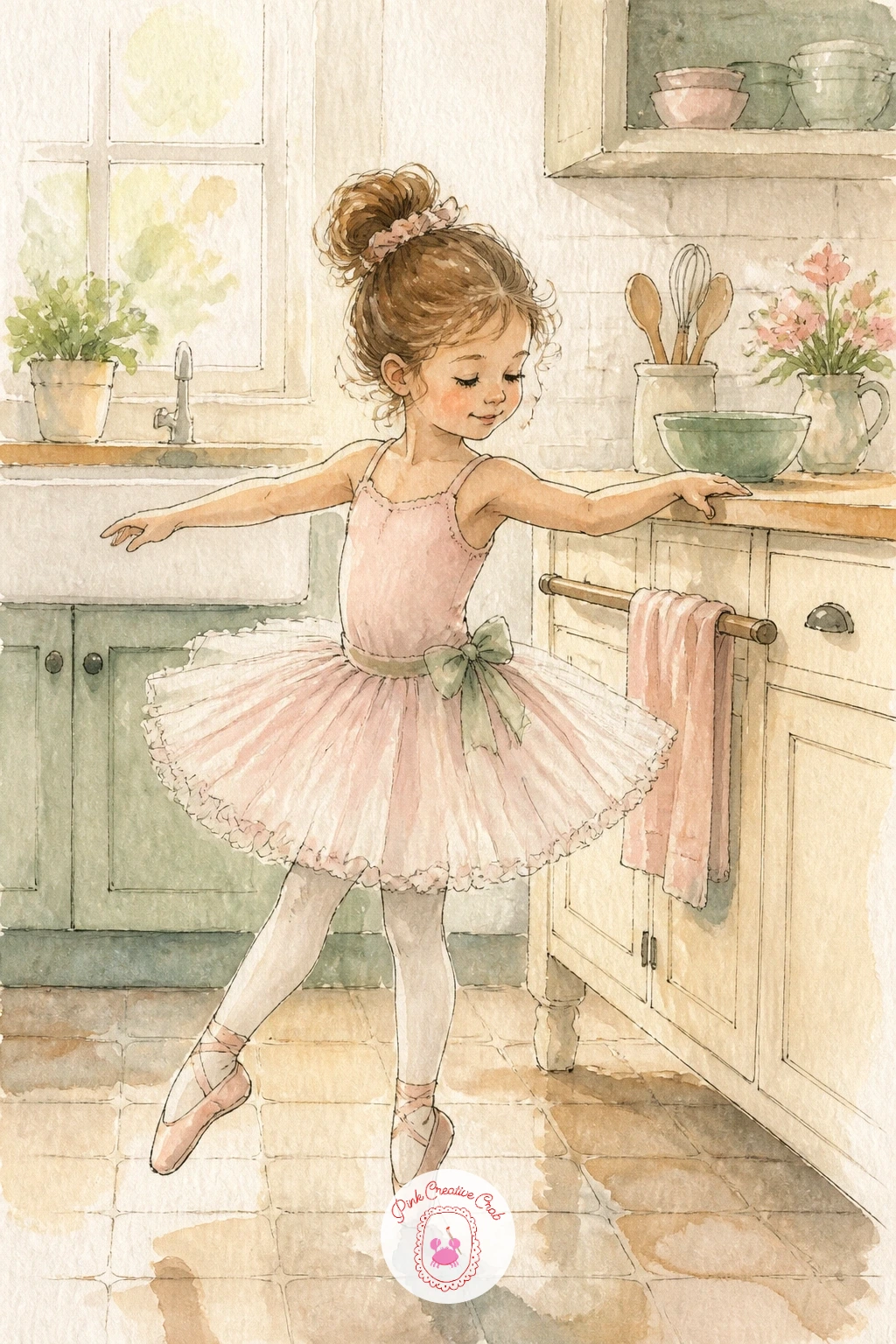
Bring the dance indoors with a little ballerina practicing in the kitchen, a pose that depends on getting one proportion detail right: a young child on pointe or tiptoe still has short, round limbs, so keep the arms and legs soft rather than long and elegant like an adult dancer’s.
Sketch the child mid-twirl beside a kitchen counter or chair used as a makeshift barre, tutu flaring out to one side, then paint the tutu first in a wash of blush and sage layered wet-in-wet so the colors blend softly at the hem. Add the kitchen counter and a few simple props, a mixing bowl, a window, once the tutu is dry so they do not bleed into the fabric.
Dancers drawn with adult proportions lose the charm of the scene entirely. Keep the head a little larger and the limbs a little shorter than feels natural, and the figure reads instantly as a small child rather than a miniature adult.
No tutu reference handy, any full skirt photo gives you the flare shape you need. Try this pose again later with the ballerina balanced on one leg for more movement.
Palette: Blush Pink,Sage Green,Butter Yellow,Baby Blue
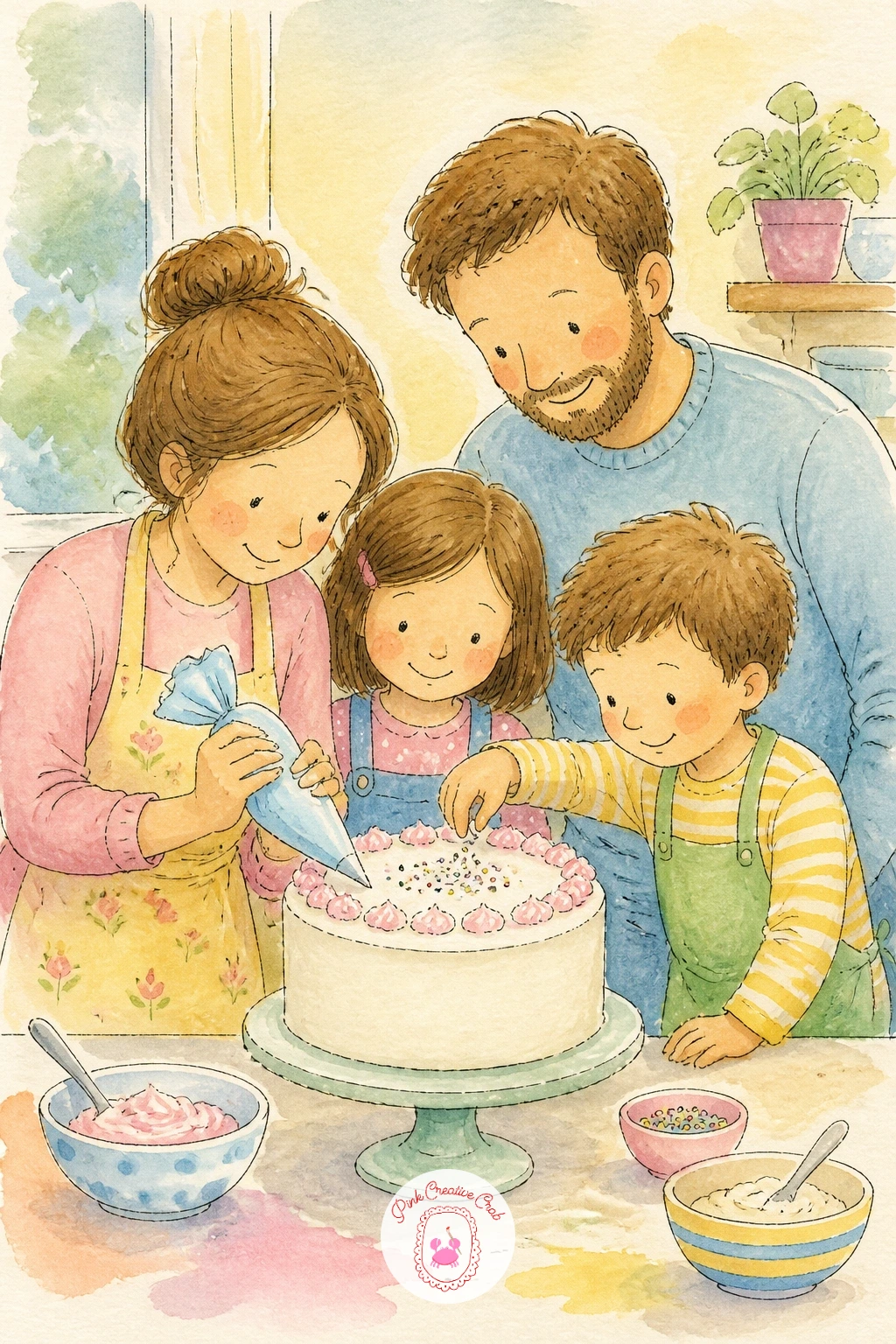
Return to the kitchen for a family decorating a cake, a scene with several figures gathered around one shared focal point. Sketch a round cake on a stand at the center, then arrange two or three family members around it, one piping frosting, one holding a bowl, one reaching for a sprinkle jar.
Paint the cake first in a flat wash of blush or butter yellow so it anchors the composition, then build the piped frosting details in small dabbed strokes once the base layer is dry. Work outward to the family members last, keeping their clothing a touch more muted than the cake so attention stays on the center of the table.
A crowded cake scene can lose its focal point fast if every figure and prop gets equal visual weight. Keep the cake the brightest, most detailed element on the page and let the people around it stay slightly simpler in color and line.
No real cake nearby, a layered dessert from any recipe photo gives a good basic shape to adapt. If you enjoy food-centered scenes, easy watercolor food ideas offers more like this to work through.
Palette: Blush Pink,Butter Yellow,Sage Green,Payne’s Grey
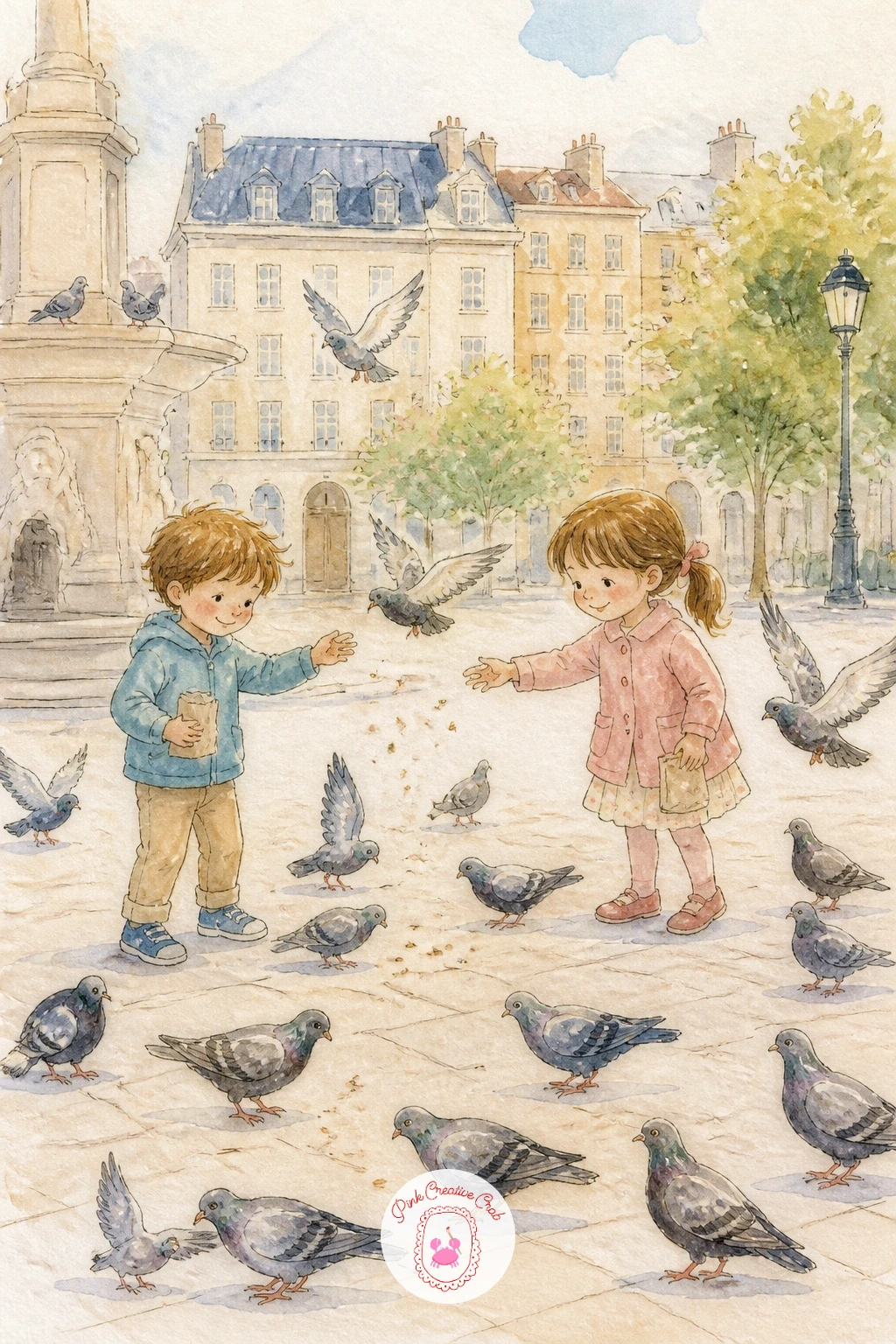
Step out to a city square for children feeding pigeons in a square, a scene with a flock of small birds to scatter around the figures. Sketch two children tossing crumbs from a small bag, then surround them with pigeons in a mix of standing, pecking and mid-flight poses so the flock feels lively rather than static.
Paint the ground first in a pale warm wash to suggest cobblestones, then add the children’s coats in blush and sage, and finish with the pigeons in soft grey with just a touch of blush at the chest. Keep a couple of birds mid-wingspread, painted with quick confident strokes, to break up the otherwise grounded flock.
A flock painted with every bird in the same pose looks more like a pattern than a scene. Vary the angle of each pigeon’s body and have at least one caught mid-flap for a sense of real movement.
No birds nearby to study, simple pigeon photos online give plenty of pose variety. Try this scene again later set in early morning light for a warmer, golden version.
Palette: Payne’s Grey,Blush Pink,Sage Green,Butter Yellow
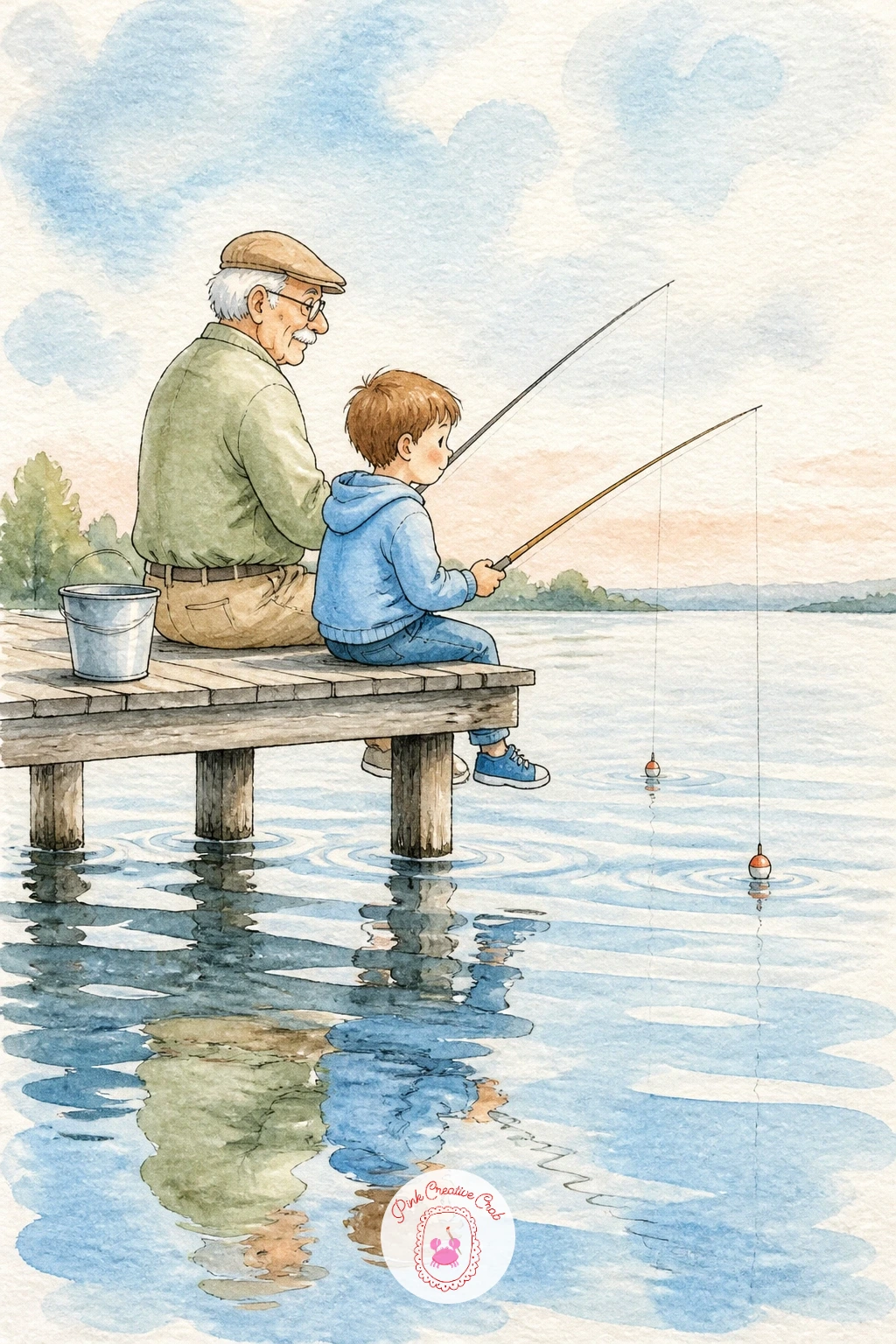
Head to the water for a boy and grandpa fishing from a pier, a scene where the reflection in the water does most of the storytelling. Sketch the pier as a simple horizontal plank structure with the pair seated at the edge, fishing rods angled out over the water.
Paint the sky and water in one continuous pale wash first, then once dry, drop in a loose mirrored reflection of the pier and figures directly below them using a slightly darker, more broken version of the same colors. Keep the reflection’s edges soft and a little wavy rather than a crisp mirror image, since moving water never reflects perfectly.
A reflection painted as a perfect upside-down copy looks stiff and unnatural. Breaking the reflection into a few horizontal streaks with a dry brush instead suggests gentle ripples and keeps the whole scene feeling like real water.
No pier reference handy, any dock or jetty photo gives a similar plank structure to adapt. This pairs well with the quiet mood in easy watercolor landscapes if calm water scenes appeal to you.
Palette: Baby Blue,Sage Green,Butter Yellow,Payne’s Grey
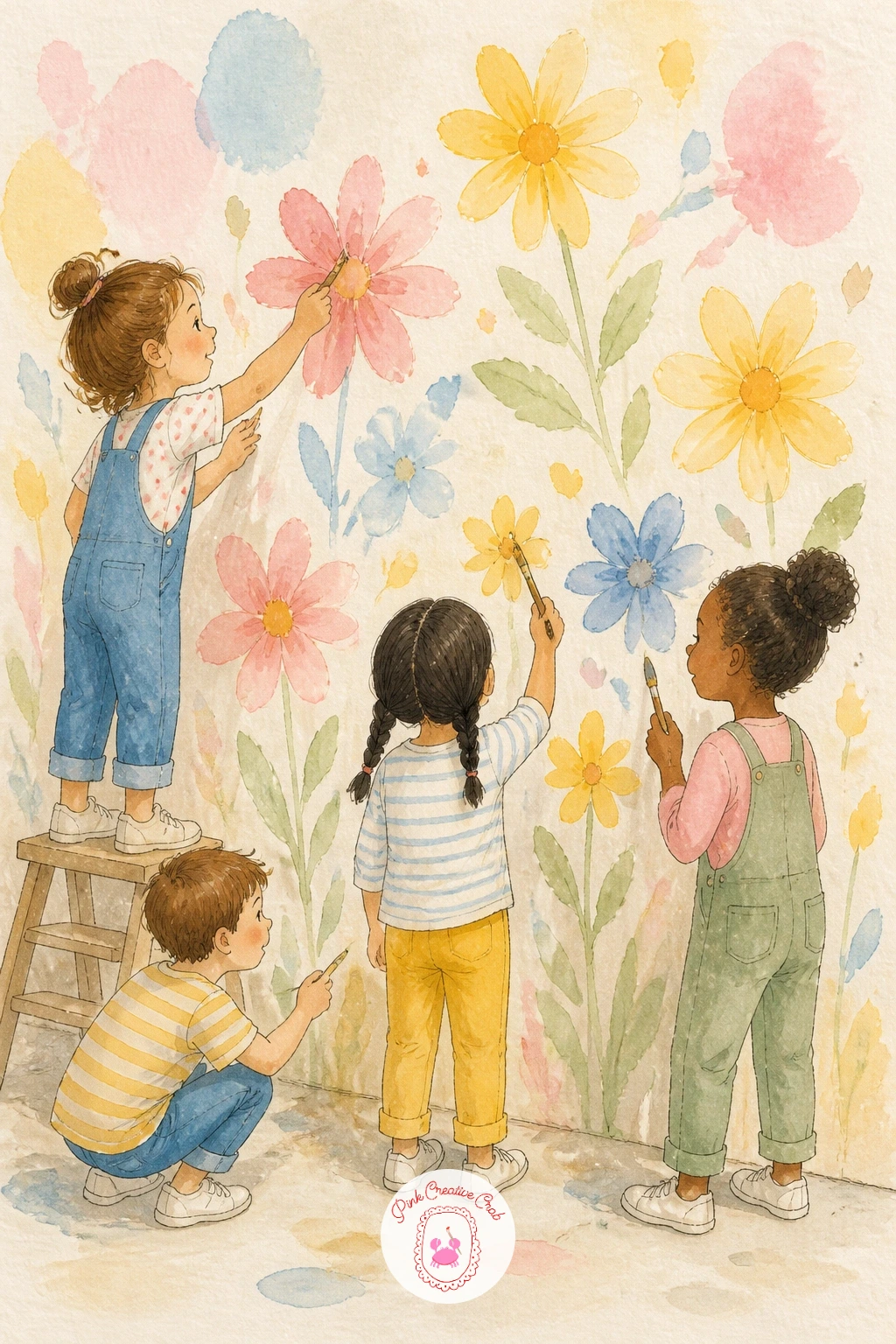
Celebrate making art itself with a girl painting a mural with friends, a scene bright with color against a plain wall. Sketch a group of children standing before a large blank wall, each holding a brush or roller, with a half-finished mural of flowers or a rainbow taking shape under their hands.
Paint the wall first in a flat neutral wash so it reads as a background surface, then build up the mural itself in bold patches of blush, sage, baby blue and butter yellow, letting the colors stay a little looser and more playful than the rest of the painting to suggest wet paint. Add the children in front last, keeping them slightly more defined than the mural so they read clearly as the foreground.
The mural can easily overpower the children if painted with the same crisp detail as the rest of the scene. Keep its edges looser and its colors a touch more saturated, which visually pushes it back as something still being painted rather than a finished backdrop.
No mural reference in mind, any simple flower or rainbow shape works well enough for the unfinished artwork. Try this scene again with a different mural pattern each time for variety.
Palette: Baby Blue,Blush Pink,Butter Yellow,Sage Green
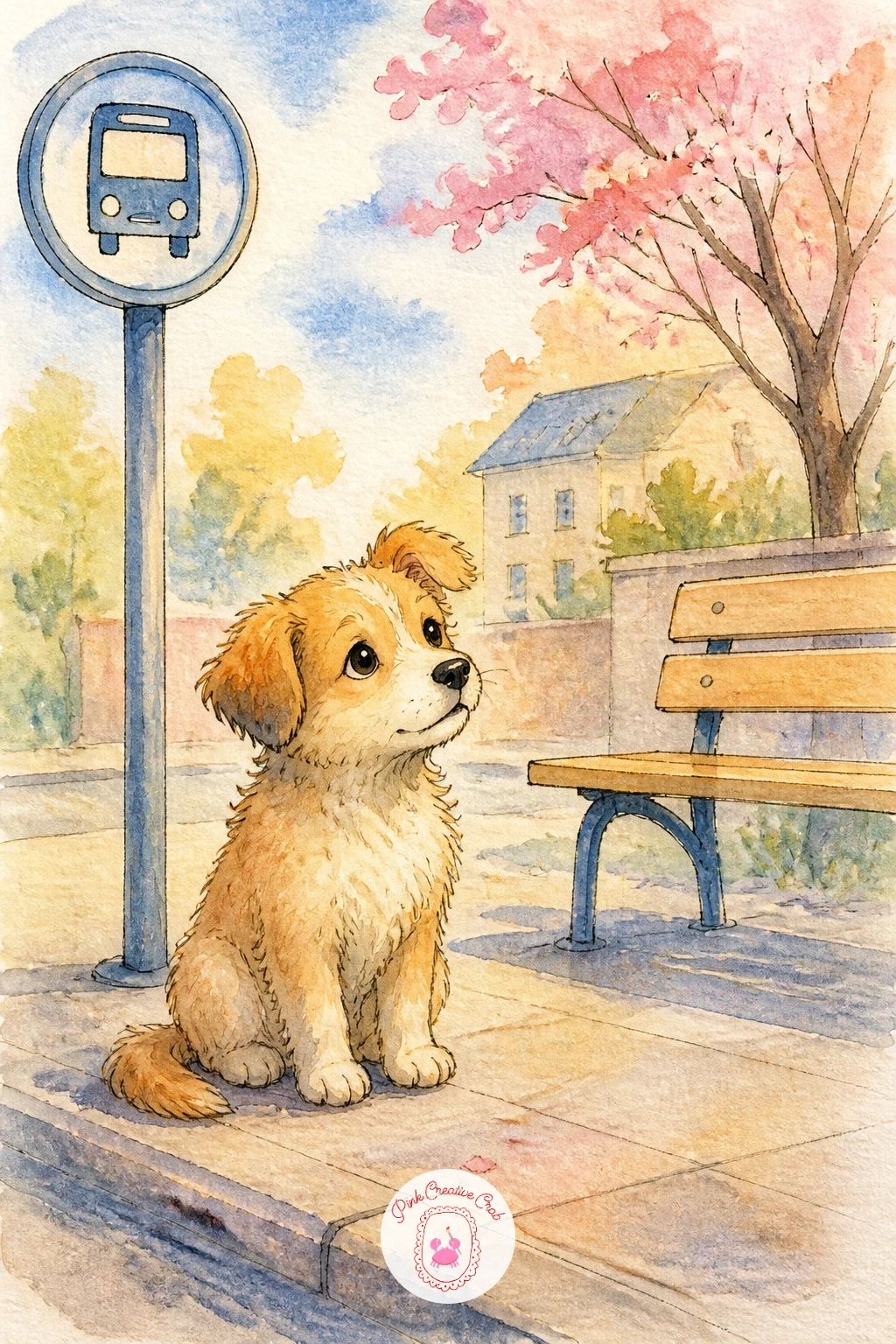
Bring in a little solo charm with a puppy waiting at a bus stop, a small and quick single-subject scene. Sketch a simple bus stop sign post and bench, with a small puppy sitting patiently beside it, ears perked and head tilted slightly as if listening for the bus.
Paint the puppy’s coat first in a warm soft wash, leaving the belly and paws a shade lighter, then once dry, add the bench and sign post in flat sage and grey. A single fallen leaf or small puddle nearby adds just enough context without turning this into a bigger scene.
An overly busy background is the easiest way to lose the charm of this simple subject. Keep the setting to just the bench, the sign and a hint of pavement, letting the puppy’s expression carry the whole picture.
No specific puppy breed in mind, any floppy-eared puppy photo online gives you a good starting pose. This is a fast one to finish today in ten minutes if you skip the bench and just paint the puppy and sign post.
Palette: Butter Yellow,Sage Green,Payne’s Grey,Blush Pink
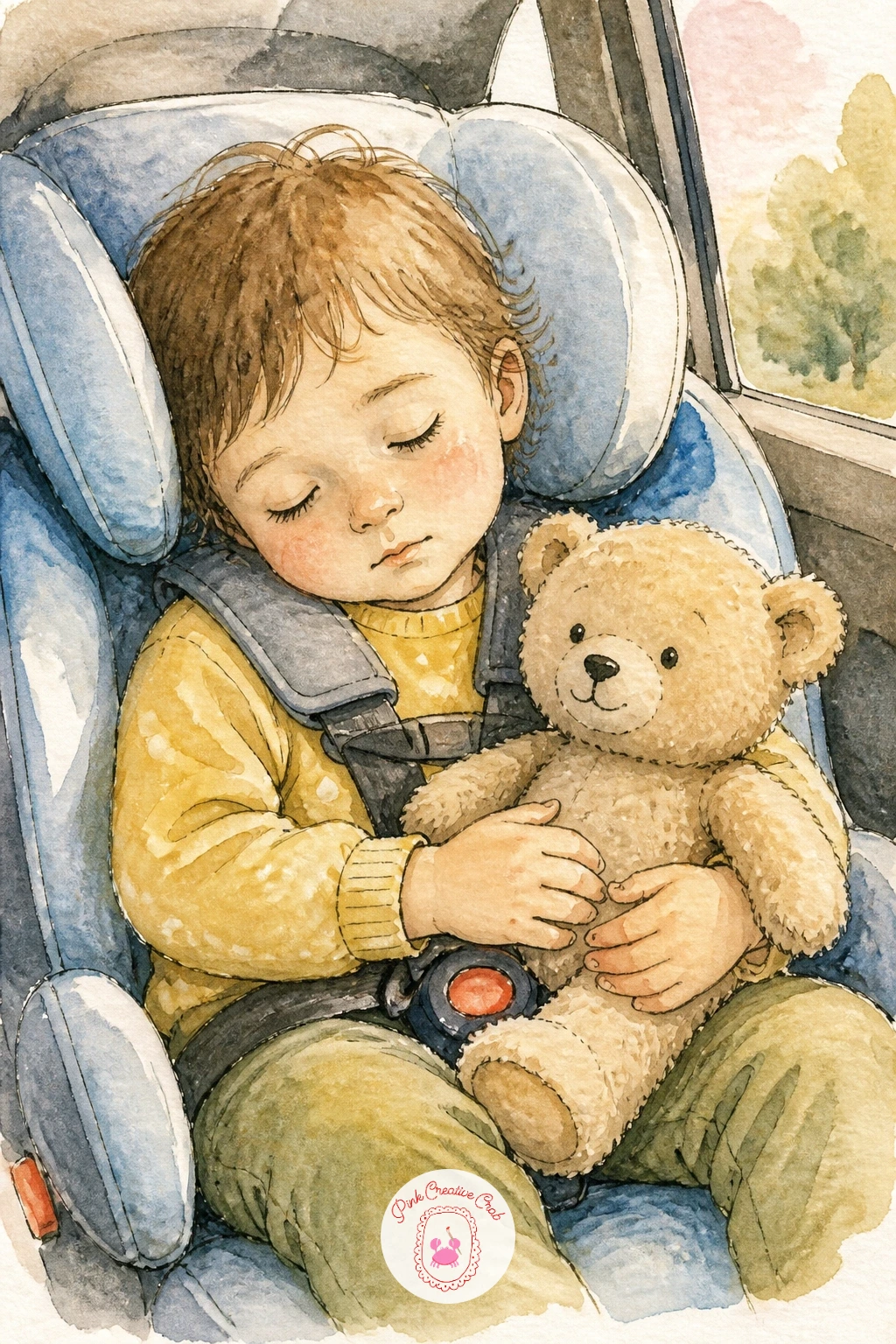
Slow the pace down with a child asleep in a car seat with a teddy, a tender close-up scene built from soft, rounded shapes. Sketch the car seat as a simple curved frame around a small sleeping figure, head tilted to one side, a teddy bear tucked under one arm.
Paint the child’s face and hands first in a pale warm wash, then build the car seat fabric around them in sage or blush, keeping the brushwork soft and the edges slightly blurred to suggest the softness of sleep. Add the teddy last in a warm brown so it sits clearly against the lighter seat fabric.
Sleeping faces drawn with too much detail tend to look awake or tense instead of relaxed. Keep the eyes as simple closed lines and the mouth soft and slightly open, and the whole expression reads as peaceful rather than posed.
No car seat reference nearby, any padded baby seat photo gives a similar curved shape to work from. Try this scene again later as a quick ten-minute sketch, just the sleeping face and teddy, no seat at all.
Palette: Blush Pink,Sage Green,Butter Yellow,Payne’s Grey
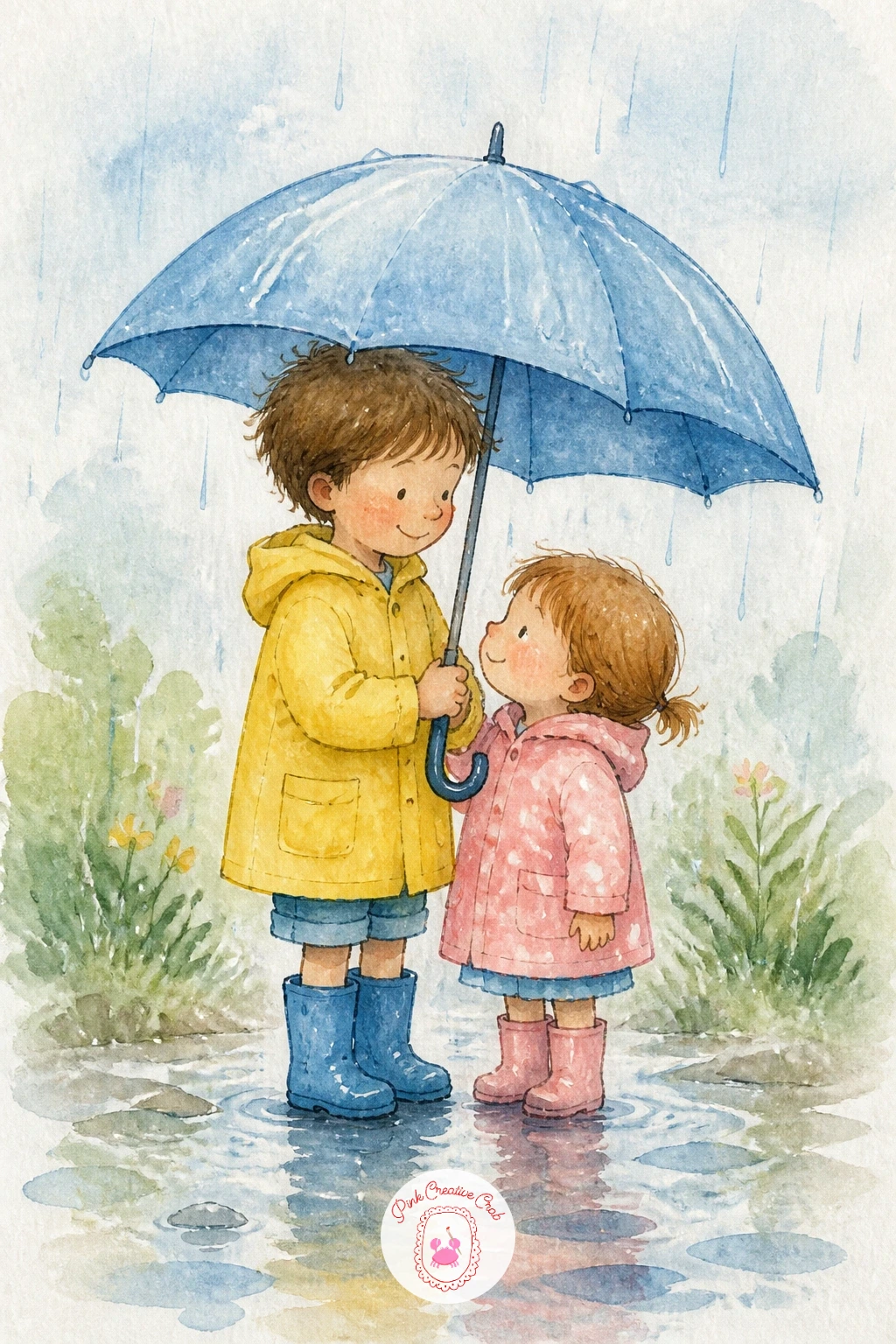
Return to the rain for siblings sharing an umbrella, a quieter companion to the very first scene in this list but worth its own version. Sketch two children close together under one umbrella, shoulders touching, one slightly taller so the umbrella tilts a little toward the smaller sibling.
Paint the umbrella first in a bold baby blue or blush wash, then work down to the children’s coats and boots once it is dry, keeping their colors a touch more muted than the umbrella so it stays the focal point. Finish with a few loose ink raindrops and small puddle shapes at their feet.
Siblings painted the same height lose the sense of relationship this scene relies on. Keep a visible size difference between the two figures, and tilt the umbrella slightly to show one sheltering the other.
No umbrella shape to trace, a small plate or bowl gives a clean curve for the canopy. Try this one again with the pair splashing through a puddle together for extra motion.
Palette: Baby Blue,Blush Pink,Sage Green,Payne’s Grey
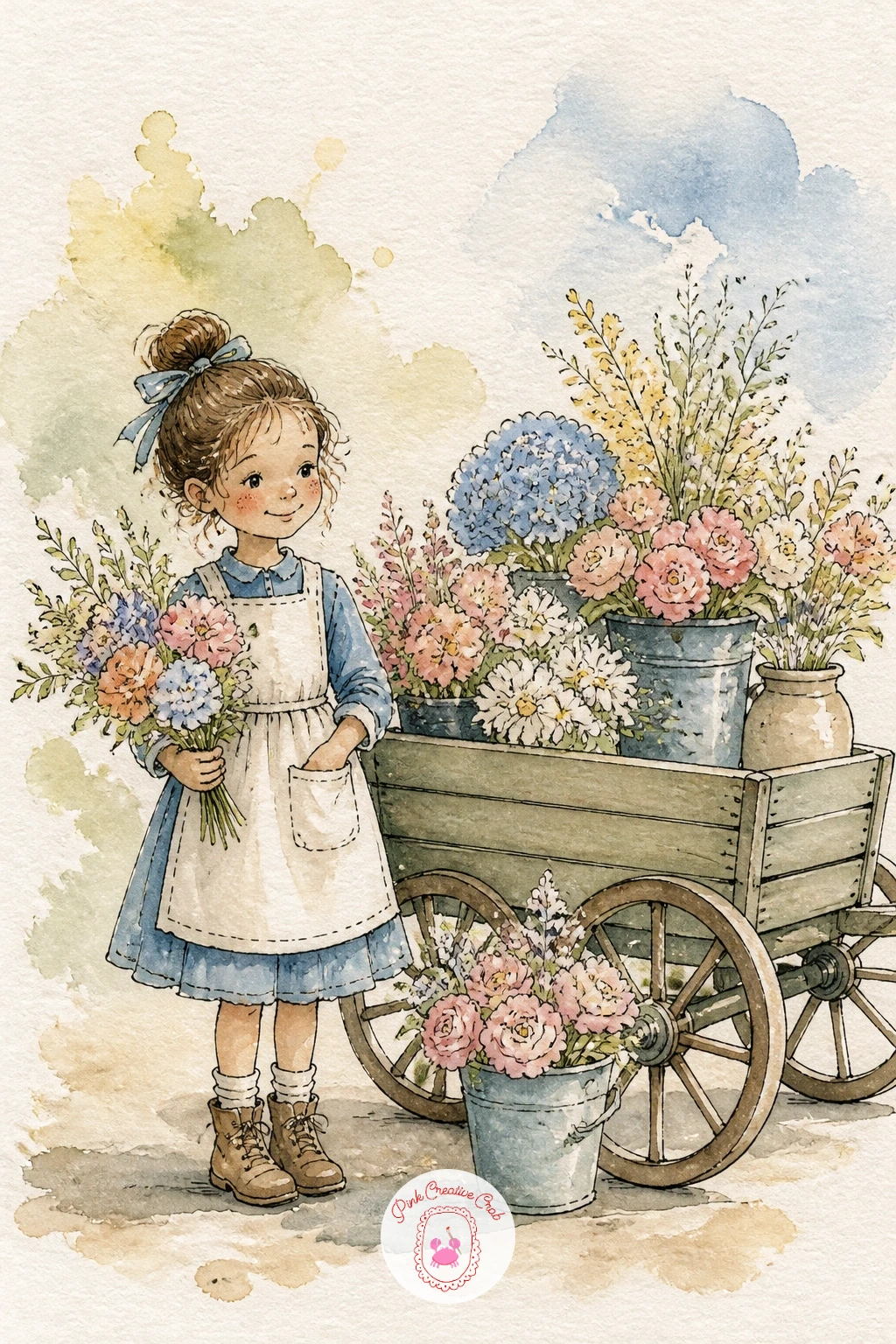
Add a splash of color with a girl selling flowers from a wagon, a scene built around a small cluster of bright blooms. Sketch a simple wooden wagon loaded with flower bunches, a girl standing beside it holding one bouquet out toward a passerby or simply on display.
Paint the flowers first in loose dabs of blush, baby blue and butter yellow, working wet-in-wet so the colors bleed softly into each other within each bunch, then once dry, add the wagon in a warm sage or brown wash around them. Finish with the girl’s dress and face last so she reads clearly in front of the colorful load.
Flowers painted with too much outline detail lose their softness fast. Keep the ink line minimal here, just a few stem lines and leaf shapes, and let the color dabs do most of the work describing each bloom.
No wagon reference on hand, a simple cart or basket on wheels works just as well as a stand-in shape. For more floral painting practice, simple watercolor flowers ideas covers plenty of loose bloom techniques worth trying.
Palette: Blush Pink,Baby Blue,Butter Yellow,Sage Green
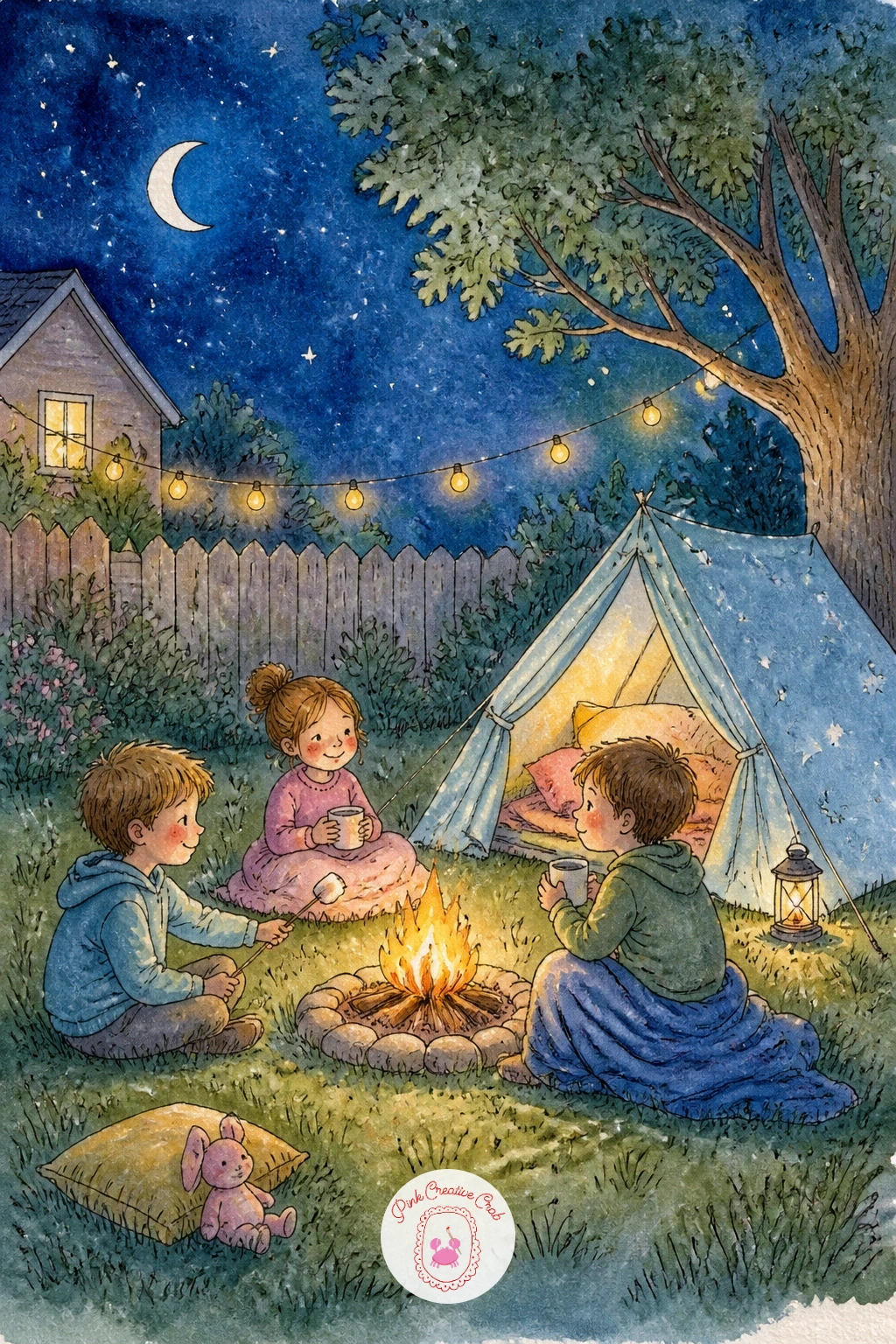
Take the adventure just outside the door with a camping night in the backyard, a scene built around one warm glowing point against a cool evening sky. Decide the campfire or lantern sits at the center, and let its glow be the single warmest, brightest color in the painting, with the tent, grass and sky all sitting progressively cooler the farther they sit from that light.
Paint the sky first in a deep blue wash, then the tent and grass in cooler sage and grey tones, and save the fire or lantern glow for last, painted in strong butter yellow with a soft halo of orange bleeding outward into the surrounding dark. Add one or two small figures, children in sleeping bags or roasting marshmallows, lit warmly on the side facing the fire.
A campfire glow that does not affect the colors around it looks pasted on rather than lighting the scene. Let a little of that warm yellow bleed faintly into the nearest edges of the tent and grass while everything is still slightly damp.
No firepit reference handy, any lantern or flashlight photo gives a similar single-point glow to study. Try the forty-minute version by adding a parent peeking out from the back door, watching over the adventure.
Palette: Payne’s Grey,Butter Yellow,Sage Green,Blush Pink
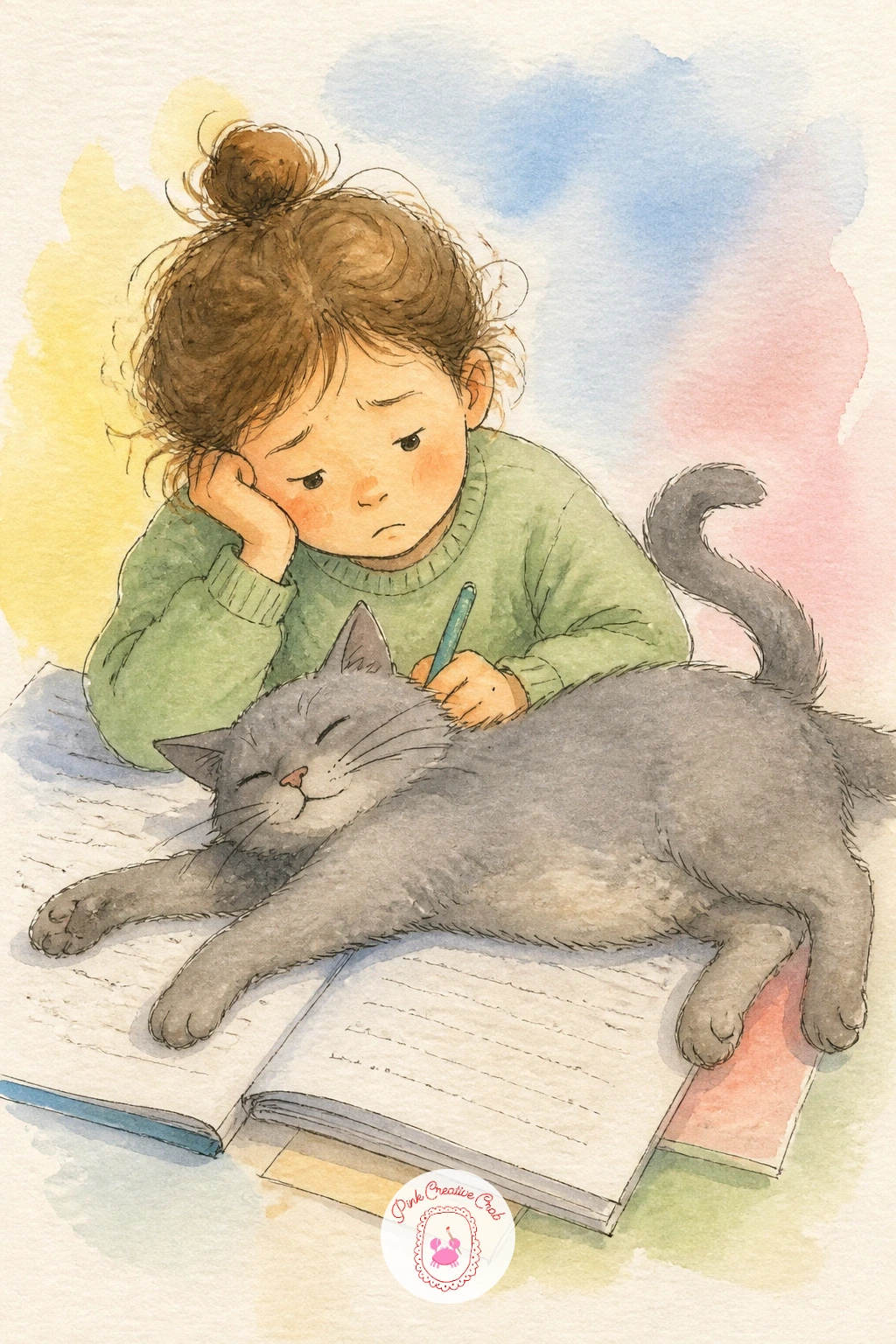
Bring a little comedy indoors with a cat helping with homework, a simple desk scene with just one character and one prop to focus on. Sketch a child at a desk with an open book or paper, and a cat perched right on top of the papers, tail curled, clearly unhelpful but adored anyway.
Paint the desk and papers first in a pale flat wash, then build the child’s figure around it in soft sage or blush, and finish with the cat last in a warm grey so it sits as the clear focal point sprawled across the work. Keep the cat’s pose loose and a little boneless, since cats rarely sit in neat, symmetrical shapes.
A cat drawn too stiffly loses the joke of this scene entirely. Let one leg dangle off the edge of the desk or a tail drape over a stack of papers, and the pose instantly reads as a cat being a cat.
No specific cat breed in mind, any tabby or solid-color cat photo online gives a good relaxed pose to copy. Try this scene again later with the cat knocking a pencil off the desk for extra mischief.
Palette: Payne’s Grey,Blush Pink,Sage Green,Butter Yellow
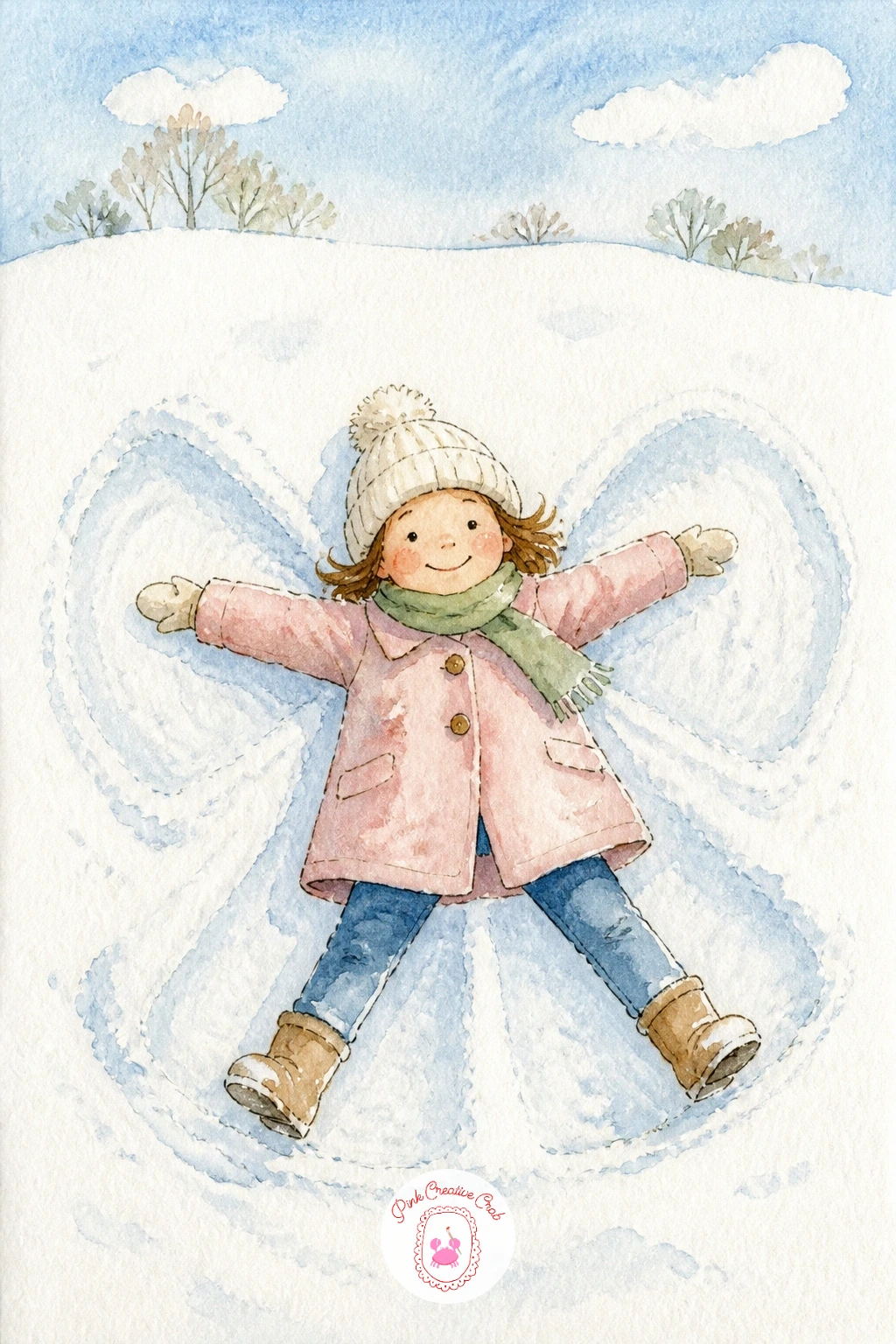
Head back outside for a kid making snow angels, a winter scene that relies on reserved white paper more than any paint at all. Sketch a child lying on their back in the snow, arms and legs spread mid-sweep, with the faint fan-shaped imprint already forming beneath them.
Paint the sky first in a pale baby blue wash, then the snow ground in the lightest possible grey-blue tint, leaving the child’s snow angel imprint and most of the surrounding ground as bare white paper. Add the child’s coat and mittens in blush and sage, the only strongly saturated colors in the whole scene, so they pop against all that white.
Painting the snow itself too heavily is the easiest way to lose the winter feeling. Trust the white paper to do the job of snow, and use just a thin grey-blue wash along the edges of footprints and the angel shape to suggest its form.
No blue-grey mix on hand, a touch of blue added to plain grey gives the same cool snow shadow tone. For more snowy scene ideas, winter scenery drawing ideas has plenty of ways to handle snow with restraint.
Palette: Baby Blue,Blush Pink,Sage Green,Payne’s Grey
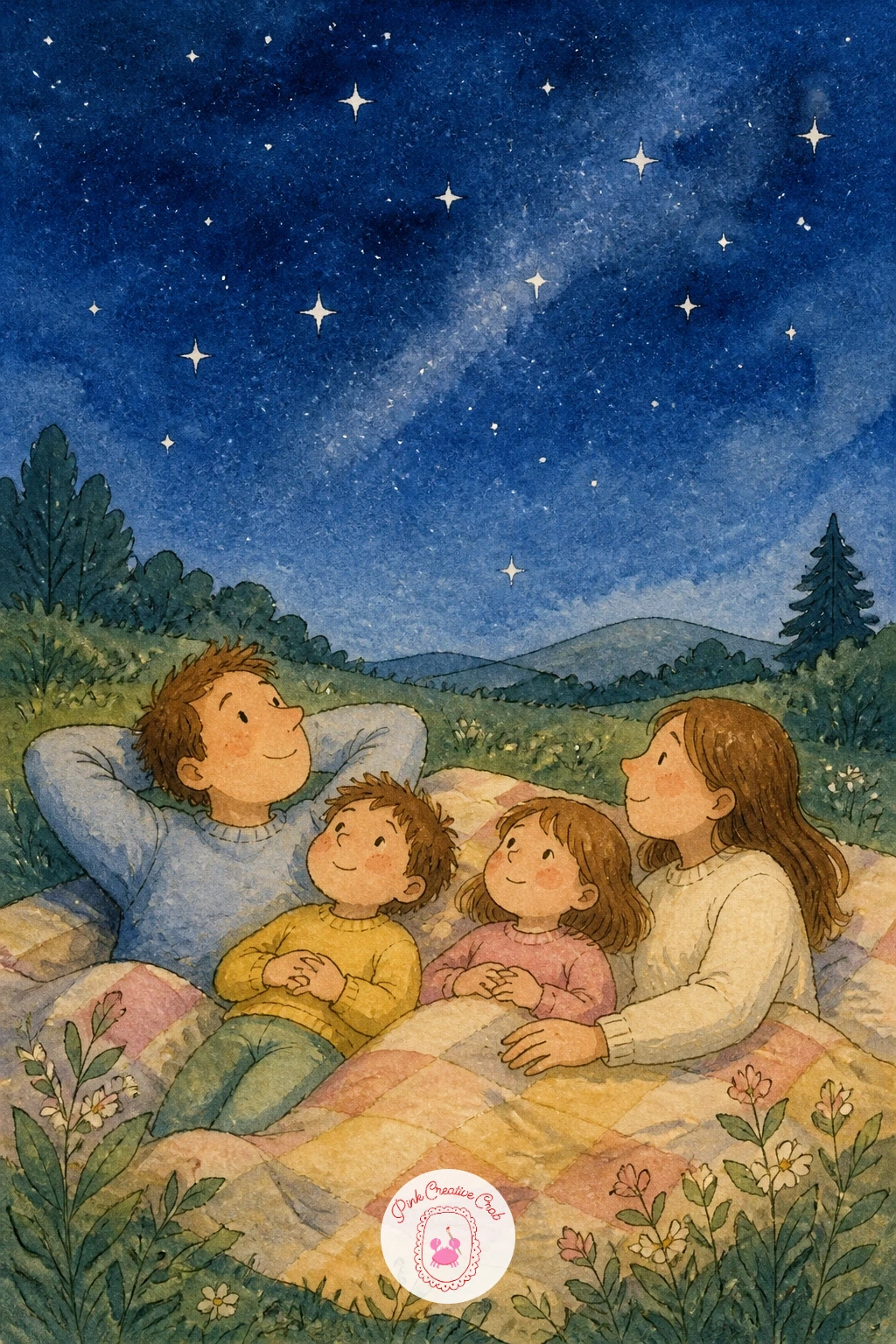
Slow back down with a family watching the stars on a blanket, a scene where the night sky does most of the emotional work. Sketch a blanket spread on the ground with two or three family members lying back on it, faces turned upward, arms sometimes pointing at the sky.
Paint the sky first in a deep wash of blue blended toward grey near the horizon, then once completely dry, flick tiny dots of white gel pen or white gouache across it for stars, clustering a few more densely to suggest a visible patch of the Milky Way. Add the family and blanket last in warm blush and sage so they sit cozy against the cool, vast sky above.
Stars scattered too evenly across the sky look more like a pattern than real sky. Cluster a few together, leave larger dark gaps elsewhere, and the sky reads as far more convincing and natural.
No gel pen on hand, a fine white colored pencil works nearly as well for scattered star dots. Try this scene again later from a higher angle looking down on the family from above.
You Will Need
- white gel pen
Palette: Payne’s Grey,Baby Blue,Blush Pink,Sage Green
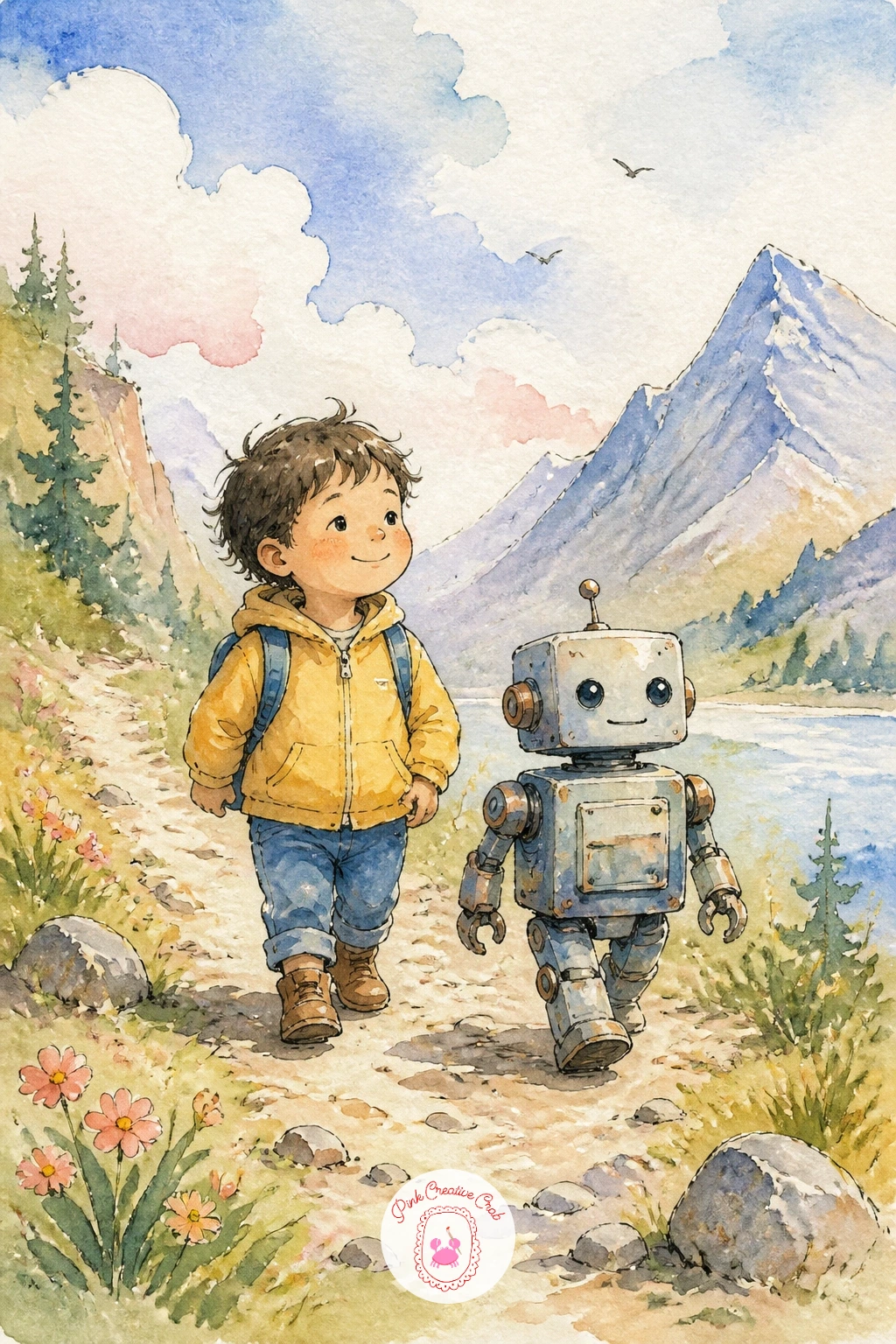
Bring in a little fantasy with a child and a robot toy on a big adventure, a scene that benefits from one hands-on trick for a convincing metallic surface. Sketch a simple boxy robot toy walking beside a child, both facing the same direction as if exploring somewhere new together, perhaps a cardboard-box rocket or a pretend moon landscape nearby.
Paint the robot’s body first in a flat baby blue or grey wash, then while still slightly damp, lift a few small patches of color with a dry clean brush or tissue to suggest shiny metal catching the light. Add the child’s clothing and face in blush and sage once the robot layer is dry, keeping their expression bright and curious.
A robot painted as one flat block of color loses all sense of being metal. Those few lifted highlight patches, placed where the light would naturally hit a rounded surface, do more work than any amount of fine detail.
No tissue on hand, a clean dry brush alone lifts color nearly as well with a gentle dabbing motion. Try the quick version in ten minutes with just the child and robot, then add a cardboard rocket or paper stars for the fuller forty-minute scene.
Palette: Baby Blue,Payne’s Grey,Blush Pink,Sage Green
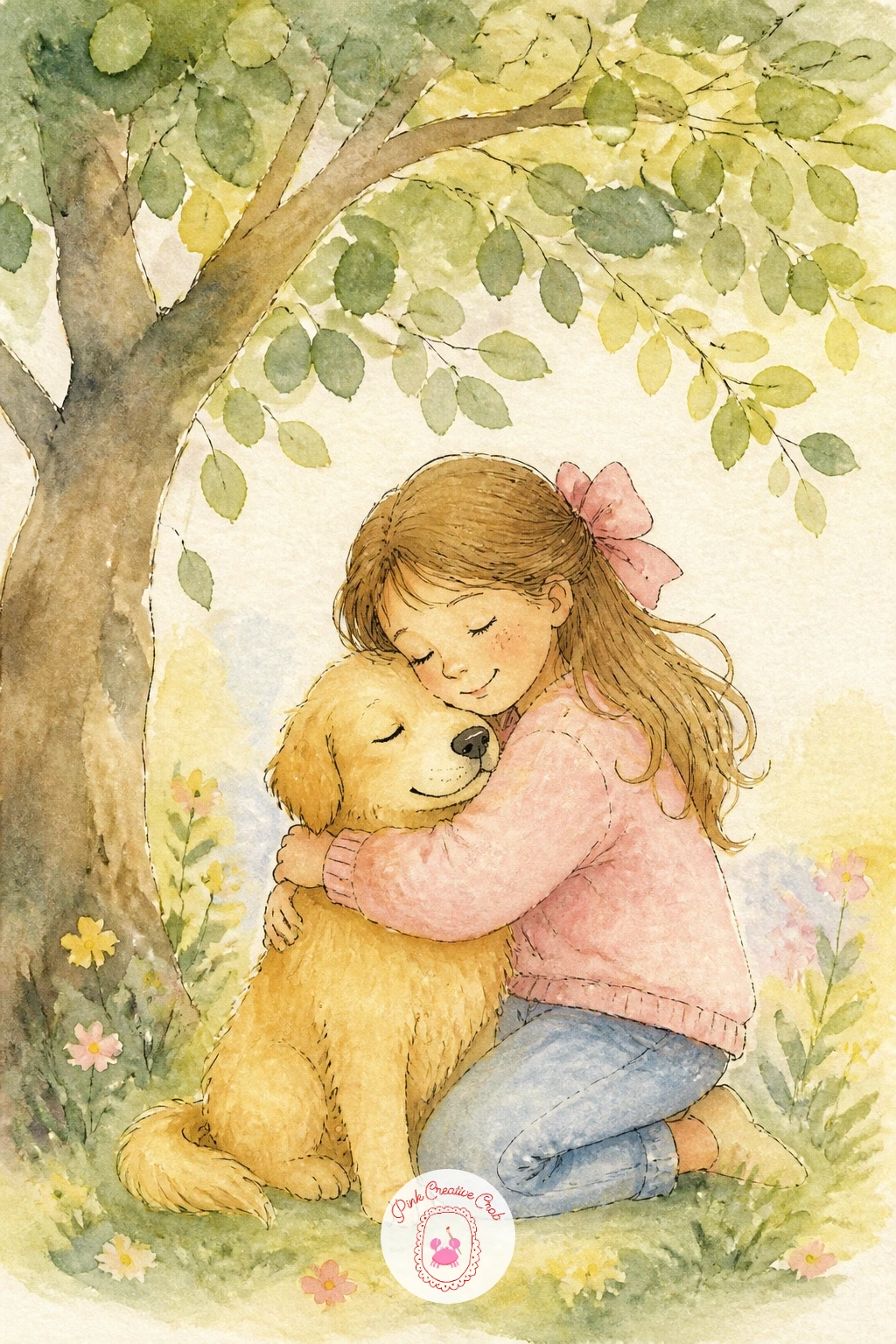
Close the list on a tender note with a girl hugging her dog under a tree, a simple, warm final scene that pulls together everything practiced along the way. Sketch a child kneeling with both arms wrapped around a sitting dog, a tree trunk and a few low branches framing them from above.
Paint the tree canopy first in a loose wash of sage with touches of butter yellow, letting the color pool unevenly for a natural leafy texture, then once dry, add the girl and dog together as one close, overlapping shape so their embrace reads as a single warm unit rather than two separate figures. Finish with a patch of grass beneath them in a slightly deeper green.
Figures hugging often end up looking like two separate bodies simply placed side by side. Overlap the girl’s arms clearly over the dog’s back and let one shape melt gently into the other at the point of contact, and the embrace reads as genuine.
No tree nearby to reference, any photo of a leafy branch overhead gives the canopy shape you need. This is a lovely one to revisit once the whole set feels comfortable, varying the season or the time of day each time.
Palette: Sage Green,Blush Pink,Butter Yellow,Payne’s Grey
What to Do Next
Pick one scene that matches the mood you want on the wall today, start with a light pencil sketch on a quarter sheet of cold press paper, and work background to foreground as each idea describes. Once it dries and the ink line goes in, you will have a finished picture book moment ready to frame.
Frequently Asked Questions
What paper works best for a watercolor illustration like these?
Cold press watercolor paper around 140 pound weight works best for these scenes. It holds enough water for soft wet-in-wet blends without buckling, and its slight texture helps dry brush details like sand or fur catch nicely.
Should the ink line go on before or after the paint?
Add fine ink line after the paint has fully dried, not before. Painting over fresh ink can smear it into the wash, while adding it last keeps faces, hands and small details crisp against the softer colors underneath.
How do I keep a watercolor illustration from looking too busy?
Limit each scene to three or four key props and let one color stay the brightest point. Backgrounds painted as flat, simple washes keep attention on the figures instead of competing for it.
What is the easiest way to paint children’s faces in this style?
Keep features minimal: two small dots or short lines for eyes, a simple curve for a mouth, and no heavy shading. Picture book faces rely on gesture and pose more than detailed features to read as expressive.
Can these watercolor illustration ideas work for a nursery gallery wall?
Yes, their shared soft palette and consistent style make them easy to group together. Painting three or four at the same size on matching paper gives a cohesive set ready to frame side by side.
Have any thoughts?
Share your reaction or leave a quick response — we’d love to hear what you think!
-
 0
-
0
-
0
-
0
-
0
-
0


