You’ve likely scrolled past those gorgeous watercolor crystals on Pinterest and thought, “I could NEVER paint that.” But here’s the thing — zentangle patterns make it almost impossible to mess up. Seriously! Those tiny dots, lines, and swirls? They hide every wobbly stroke and add this mesmerizing detail that makes even beginner crystals look magical. And when you combine soft watercolor washes with precise tangle work, something extraordinary happens.
What Do You Need for Watercolor Zentangle Crystal and Gemstone Painting?
Good news: you probably already have most of what you need sitting in your art supply stash right now!
These easy watercolor zentangle crystals for beginners don’t require fancy supplies. Just grab:
- Watercolor paints (pan sets work GREAT)
- Fine-tip black pens or markers
- Watercolor paper (trust me—regular paper gets soggy)
- Pencil for sketching
- Water and brushes
So start simple with your zentangle gemstone painting ideas. Pick ONE crystal shape. Paint it. Let it dry completely—this is where I always mess up and smudge everything! Then add your zentangle patterns.
And here’s the thing about watercolor crystal gemstone art: mistakes become happy accidents. That weird color blend? It’s now a “unique mineral variation.” GENIUS, right? Your imperfect lines add character. Embrace them!
Idea #1: Easy Watercolor Zentangle Crystal for Beginners – Raw Amethyst Cluster with Each Crystal Face Filled with a Simple Dot Grid
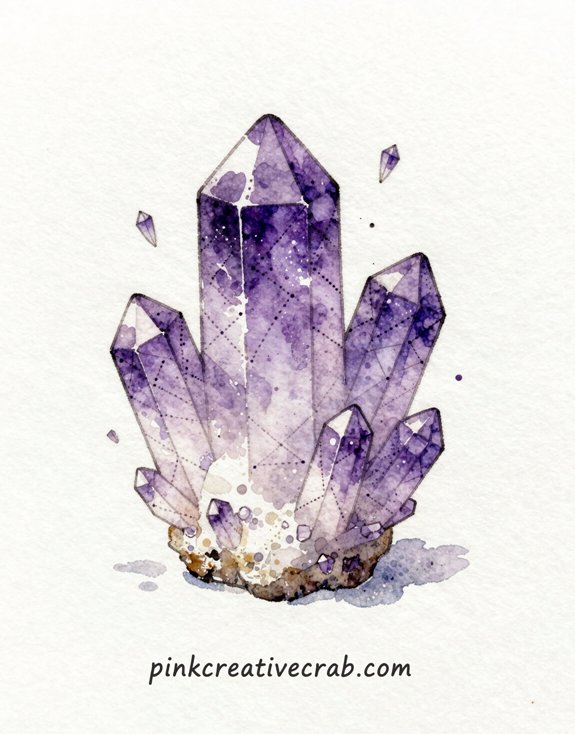
Ready to actually make something? Let’s start with raw amethyst—because those purple clusters are STUNNING and surprisingly forgiving for beginners.
First, paint loose watercolor shapes in purple and violet. Don’t stress about perfection! I once made mine look like grapes (awkward). Let it dry completely.
Now here’s where watercolor zentangle crystals get fun—divide each crystal face into geometric sections. Then fill each section with a simple dot grid. That’s it! Just dots. Evenly spaced. Meditative and calming.
This zentangle crystal painting technique creates incredible depth without complicated patterns. And the repetitive dots? Perfect for watercolor zentangle spiritual art because they naturally put you in that zen headspace.
Pro tip: Use a fine-tipped pen and start your dots from the center outward. Way easier than random placement!
Idea #2: Faceted Rose Quartz Gemstone with Each Facet a Different Zentangle Pattern in Blush Watercolor
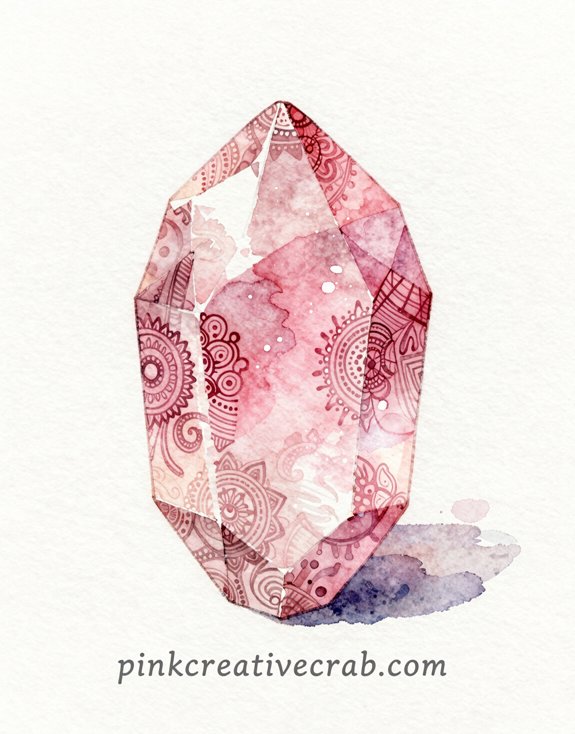
Why should amethyst get all the attention when rose quartz is literally the crystal of love and self-care? This gemstone zentangle watercolor project lets you create something STUNNING—and honestly, it’s more forgiving than you’d think.
Here’s the fun part: each facet gets its own pattern. One gets stippling (tiny dots). Another gets florals. Maybe waves or crosshatching on the third. The variety makes it pop!
Use diluted watercolor in soft pinks and peaches. Let it dry completely—I’ve smudged this SO many times by rushing. Then add your zentangle patterns with a fine-tip pen.
Pro tip? Start with lighter patterns on smaller facets. You’ll build confidence before tackling the big central ones. And the imperfections? They just add character!
Idea #3: Zentangle Crystal Watercolor Painting – Labradorite Cabochon Showing Flash in Iridescent Blue-Green with Fine Tangle Lines
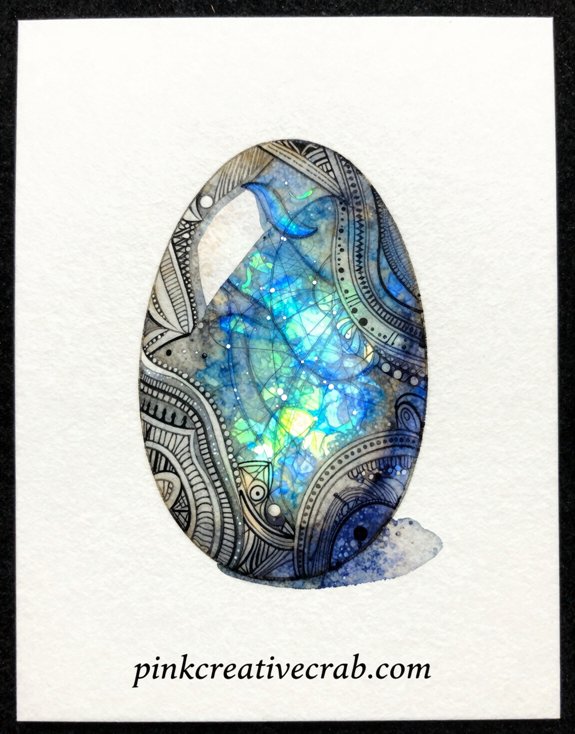
You don’t need a ruler to make crystal facets look realistic—just a basic understanding of how light hits geometric shapes. And here’s the thing: labradorite cabochons aren’t even faceted like diamonds, so you’re drawing smooth, flowing sections where the “flash” appears (those gorgeous blue-green streaks that shift when you move the stone).
Drawing Crystal Facets That Follow Real Geometry Without Needing a Ruler
How do you capture those crisp geometric edges on crystals when your hand shakes like you’ve had three espressos? Here’s the secret—you DON’T need perfect lines! Real crystals have subtle irregularities anyway. Start by sketching light guidelines with your pencil. Don’t stress about straightness (my first attempts looked like melted ice cubes). And here’s where it gets fun—those Zentangle patterns actually HIDE wobbly edges. Seriously!
Draw your facet planes first, then add tiny repeating patterns along each edge. The eye follows the pattern instead of nitpicking your line quality. But keep your facets angled consistently—even if they’re slightly curved, make them ALL curve the same direction. That’s what tricks your brain into seeing “crystal” instead of “blob.” Trust me on this one!
Idea #4: Raw Black Tourmaline Column with Vertical Striation Patterns as Natural Zentangle
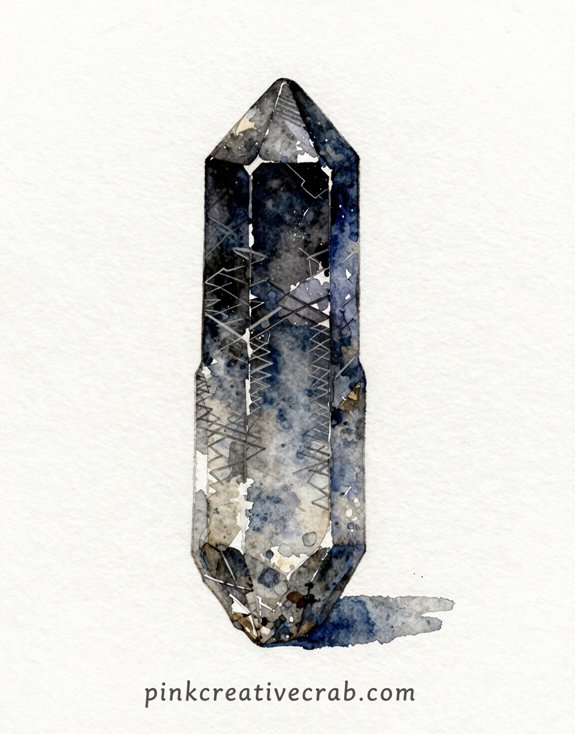
When you first pick up a piece of raw black tourmaline, you’ll notice something AMAZING—nature already did the zentangle work for you! Those vertical striations running down the column? Pure. Perfection.
Here’s what makes tourmaline so genius for watercolor zentangle: you literally just trace what’s there. And the best part? You can’t mess it up. I tried forcing horizontal patterns once—total disaster. The crystal looked confused!
Start with pale gray watercolor washes. Let it dry completely (patience, friend). Then use a fine black pen to draw parallel vertical lines following the natural grooves. Vary the thickness. Add tiny dots between striations for texture.
But here’s the SECRET: leave some white space. Those highlights make your tourmaline POP off the page!
Idea #5: Easy Quartz Point Zentangle Watercolor for Beginners – Clear Quartz Tower with Each Internal Plane Filled with Light Tangle
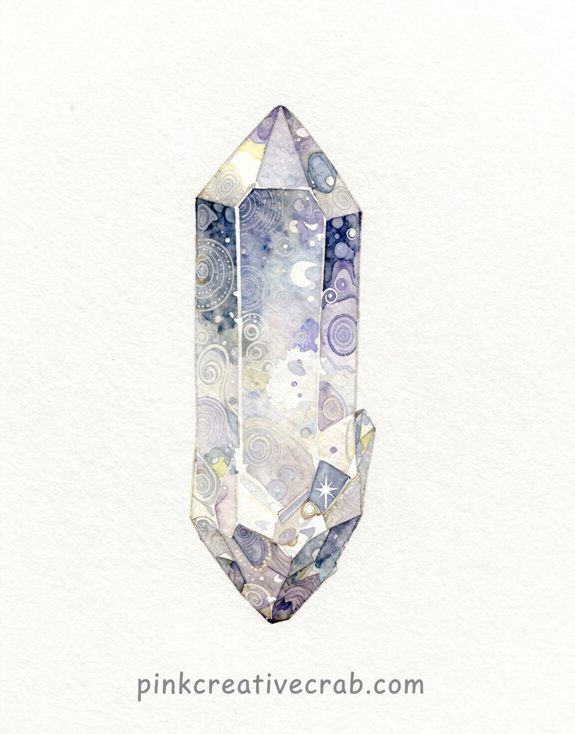
Black tourmaline taught us that nature’s patterns are perfect for zentangle, but clear quartz? It’s even EASIER! You’ll draw a simple tower shape—basically a rectangle with a pointed top. Done.
Now here’s where it gets fun: imagine the crystal’s interior as stacked panes of glass. Draw light horizontal lines dividing your tower into sections (I usually do five or six). Fill each section with the LIGHTEST zentangle patterns you know—dots, simple swirls, delicate crosshatching. Keep it minimal! And use pale watercolors—diluted yellows, pinks, and blues. The magic happens when those subtle patterns catch the light. Trust me, I overworked my first three attempts with dark tangles. Big mistake! Clear quartz needs breathing room.
Idea #6: Celestite Cluster in Pale Aqua Wash with Fine Line Tangle in Each Crystal Blade
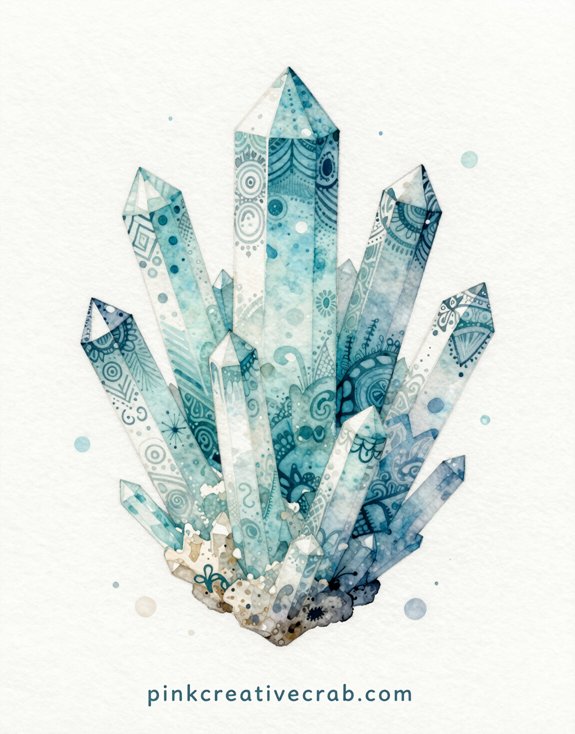
Here’s the thing about switching from quartz to celestite—the ENTIRE mood of your tangle shifts! When you work with these delicate blade-like formations (they’re thinner and more fragile-looking than chunky quartz points), you’ll need finer line patterns that don’t overwhelm the crystal’s gentle vibe.
How the Zentangle Pattern Changes Completely When You Vary the Crystal Type
Because celestite forms in these delicate, blade-like formations that look almost like frozen flower petals, it gives you the PERFECT excuse to go tiny with your tangling. And here’s where things get wild—the same pattern that looked bold and geometric on chunky amethyst suddenly becomes whisper-soft and ethereal on celestite!
I tried using thick lines once (rookie mistake) and totally lost that magical, crystalline vibe. The secret? Ultra-fine pens—we’re talking 005 or smaller. Each blade becomes its own miniature canvas. Think tiny crescents, delicate stippling (those little dots), or hair-thin parallel lines.
The pale aqua wash underneath? It’ll make those fine tangles SING. So experiment! The crystal’s shape literally transforms your pattern’s personality.
##
Getting started with watercolor zentangle crystals is WAY easier than you’d think—and I say that as someone who once turned a gorgeous amethyst into a muddy purple blob.
Here’s your essential supply breakdown:
| Supply | Why You Need It | Budget-Friendly Pick |
|---|---|---|
| Watercolor paints | Creates those dreamy crystal colors | Crayola watercolors work! |
| Fine-tip pen | Draws your zentangle patterns | Micron 01 or Sharpie pen |
| Watercolor paper | Prevents warping and bleeding | Canson XL (140 lb) |
| Round brush | Blends colors smoothly | Any size 6 synthetic |
| Water containers | One clean, one dirty | Recycled jars are PERFECT |
And honestly? You probably have half this stuff already. So stop overthinking it—just gather what you’ve got and START experimenting.
Idea #7: Easy Malachite Zentangle Watercolor – Banded Malachite Slice with Its Natural Concentric Bands Echoed in Tangle Patterns
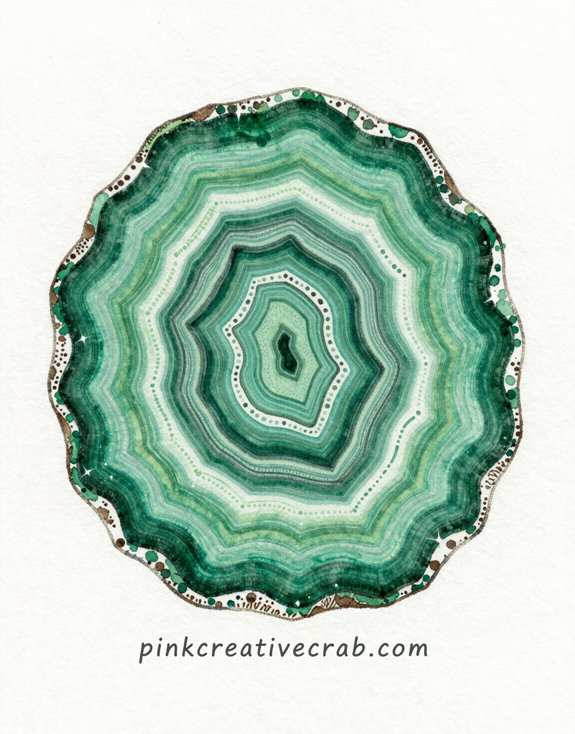
When you first look at malachite, those swooping green bands practically BEG to become zentangle art—trust me, this is the crystal that’ll make you look like a total pro even if you’re just starting out.
Here’s the game-changer: paint your malachite slice in layered green washes (light to dark), then add zentangle patterns that FOLLOW those natural bands. Circles within circles within circles!
I totally botched my first attempt by fighting against the flow—don’t make that mistake. Let the organic curves guide your pen.
Use simple repeating patterns like scallops, dots, or wavy lines. Each band gets its own personality while maintaining that gorgeous concentric rhythm.
And honestly? Malachite forgives EVERYTHING. Messy watercolor bleeds? They just add authenticity!
Idea #8: Sapphire in Deep Blue Ink with Each Facet Filled with Star-Pattern Zentangle
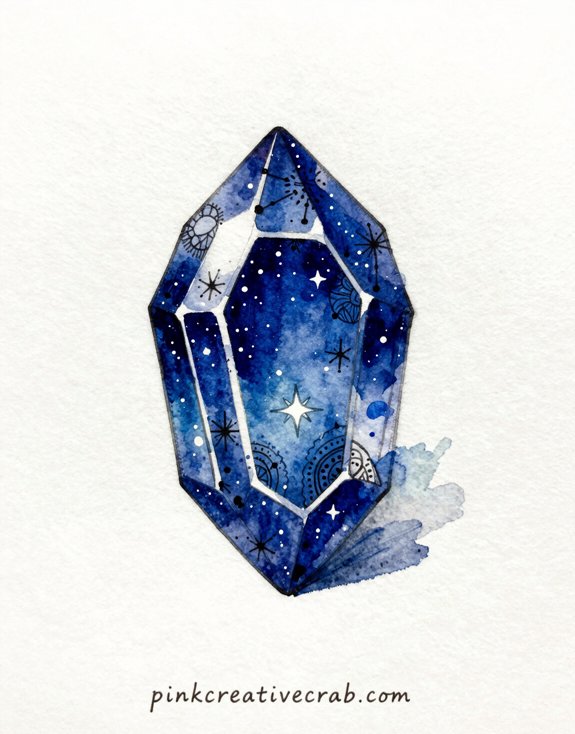
While malachite lets you play with curves, sapphires are all about those SHARP, geometric facets—and honestly, this is where zentangle patterns really shine (pun absolutely intended). Grab your darkest blue ink and sketch a classic faceted gem shape—think hexagon meets diamond.
Now here’s the fun part: each facet becomes its own tiny canvas for star patterns. Try simple four-point stars. Or get fancy with interlocking asterisks! The repetition creates this mesmerizing Effect that mimics how real sapphires catch light.
Pro tip? Don’t fill EVERY facet the same way—I learned that mistake the hard way when mine looked like boring wallpaper. Vary your star sizes and orientations. Creates movement. Creates magic.
And that deep blue? Chef’s kiss for spiritual vibes.
Idea #9: Crystal Grid — Several Gemstones Arranged in a Geometric Pattern, Each Stone Zentangled Differently
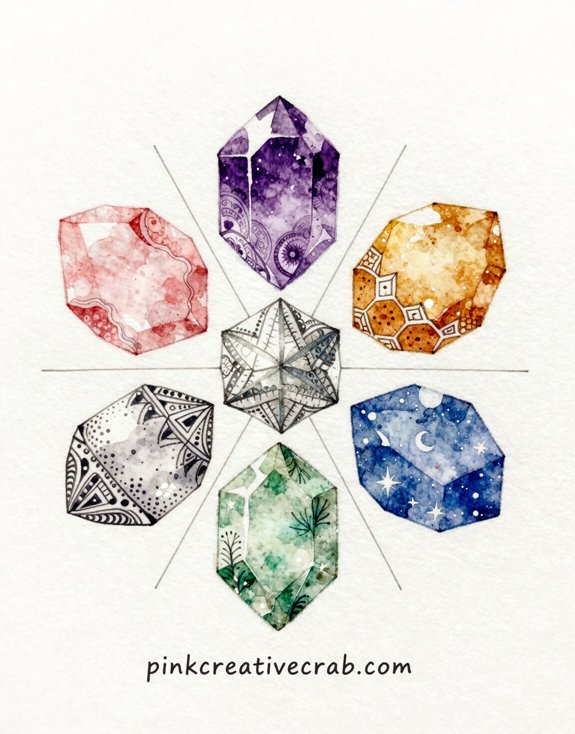
If you’ve been following along, you’ve created individual gemstones—but what happens when you combine them into one cohesive piece? Welcome to crystal grids!
Picture this: five or six gemstones arranged in a sacred geometry pattern—maybe a flower of life or simple circle. Each stone gets its OWN zentangle pattern. One amethyst filled with swirls, another quartz with checkerboards, a citrine bursting with dots.
The contrast? Chef’s kiss.
And here’s the thing—I once made all my stones identical (boring!) before I learned this lesson. Don’t be me.
Try arranging them first without committing. Move things around. Play! The geometric framework holds everything together while each stone SHINES individually.
It’s like conducting an orchestra where every instrument matters.
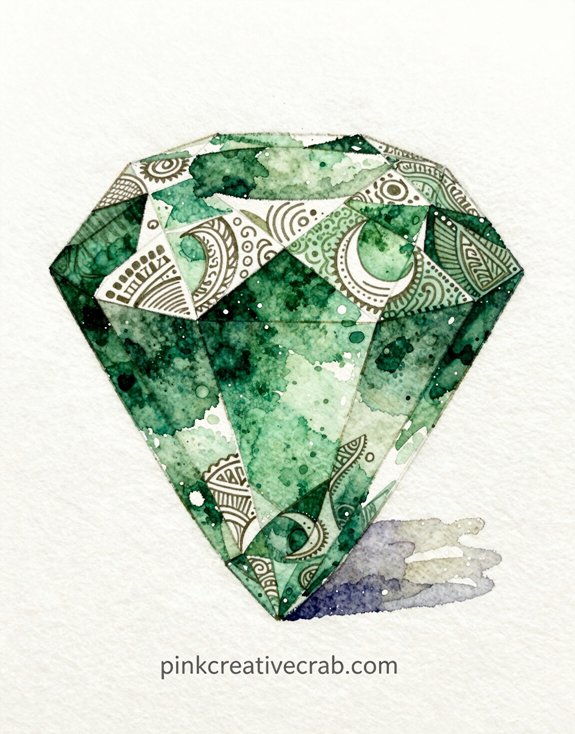
Idea #10: Zentangle Gemstone Painting Watercolor – Emerald Cut Diamond with Every Facet a Different Geometric Tangle in Deep Green
You know what makes these emerald-tinted zentangle gemstones even MORE magical? Framing them as part of your spiritual altar or gallery wall! Think about it—crystals already carry intention and energy, so why not surround yourself with their painted versions too?
I used to keep my artwork stuffed in a drawer (rookie mistake!), but once I hung my zentangled gems near my meditation space, they became daily reminders of focus and creativity.
Framing Crystal and Gemstone Art as Part of a Spiritual Altar Gallery Wall
Creating a spiritual altar gallery wall transforms your meditation space into something truly sacred—and that deep green emerald cut diamond painting? It’s the PERFECT centerpiece. Place it at eye level where morning light hits (trust me, I learned this after hanging mine in a dark corner—rookie mistake!).
Surround it with smaller crystal artworks, dried herbs, or actual gemstones. The geometric tangles inside each facet create natural focal points for contemplation. And here’s the thing—you don’t need fancy frames! Simple black or natural wood works beautifully.
Mix your watercolor pieces with three-dimensional objects like selenite towers or amethyst clusters. The varied textures create visual interest that keeps your gaze moving. So start small, build gradually, and watch your sacred space evolve organically!
Idea #11: Fluorite Octahedron in Layered Purple and Green Watercolor with Fine Grid Tangle Fill
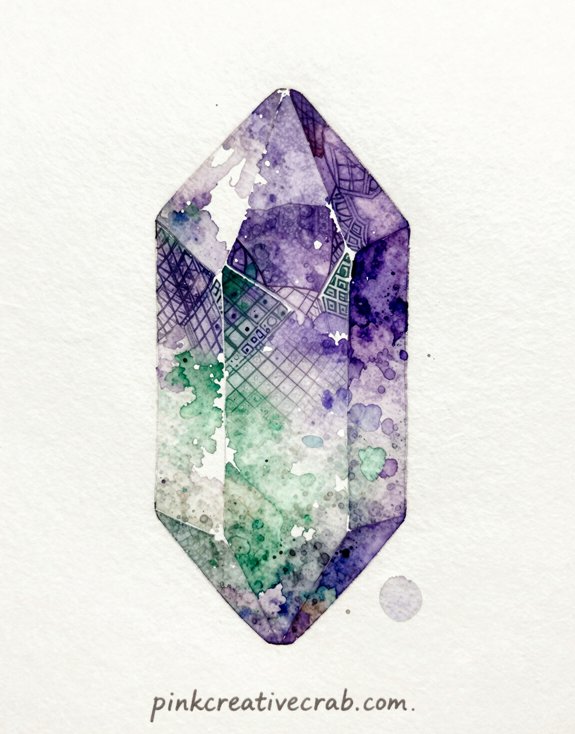
When fluorite decides to show off, it goes FULL drama with its signature color-banding—think layers of deep purple melting into vibrant green like a geological mood ring. Your octahedron shape (that’s just two pyramids stuck base-to-base—fancy!) becomes a COLOR playground.
Here’s the move: wet-on-wet for those dreamy gradients, then let it DRY completely. I once rushed this step and my grid pattern bled everywhere—total disaster!
For the tangle fill, use a fine-tip pen to create tiny cross-hatching or diamond grids within each color band. This mimics fluorite’s actual crystal structure (how cool is THAT?). The geometric precision plays beautifully against those soft watercolor washes.
Pro tip: Leave white highlights along the edges. Makes your octahedron POP off the page!
Idea #12: Easy Citrine Zentangle Watercolor Crystal – Raw Citrine Point in Warm Yellow-Gold with Zentangle Detail Catching the Inner Light
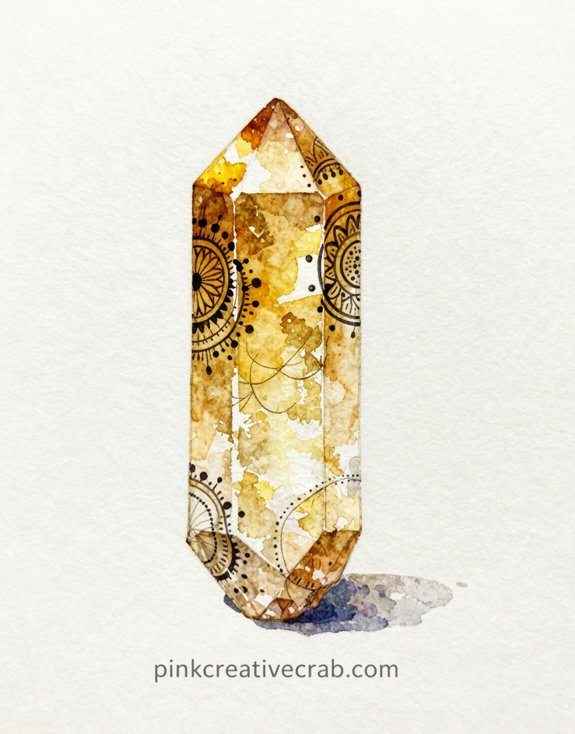
Citrine practically GLOWS with sunshine energy, making it the perfect beginner-friendly subject—no scary dark shadows to wrestle with here! You’ll layer warm yellows and golds, letting them bleed together naturally. The raw point shape? Super forgiving—wonky edges actually look MORE authentic (trust me, I’ve tried making them perfect and they looked plastic).
Here’s where zentangle patterns save the day. Add tiny triangles or dots radiating from the crystal’s center to capture that inner sparkle. These patterns create visual texture without complicated shading techniques. And honestly? You can’t mess this up. The brighter your watercolor, the more joyful your citrine becomes!
Pro tip: Leave white space at the tip—it mimics light catching the point. Your crystal will RADIATE happiness energy right off the page. Perfect for manifestation journaling!
Idea #13: Moonstone with Adularescence Suggested by Circular Tangle Patterns in Soft Silver-Blue
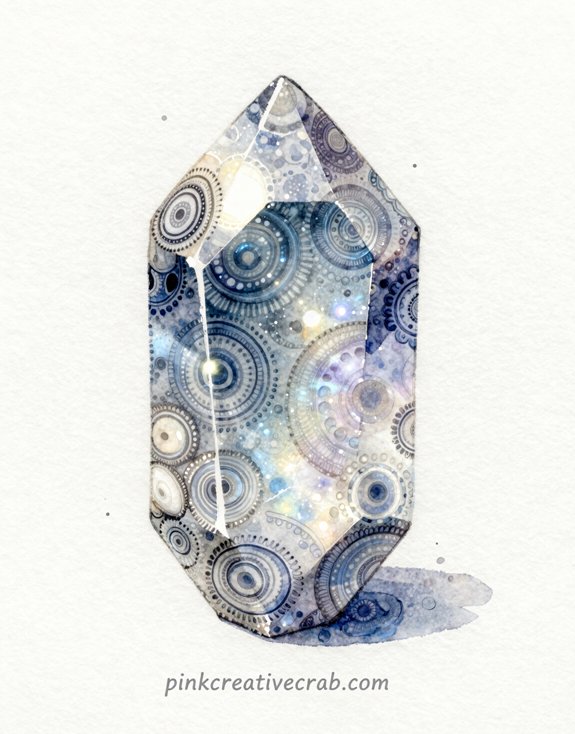
Want to turn your moonstone Zentangle into something REALLY special? Add the crystal’s meaning right onto the print—yep, words and art together! You can letter phrases like “intuition” or “new beginnings” around the edges (moonstone is all about fresh starts and inner wisdom), and suddenly your painting becomes a meaningful gift that friends will actually frame instead of shoving in a drawer.
Pairing Zentangle Crystal Art with Lettered Crystal Meanings for a Gift Print
Moonstone practically GLOWS with that otherworldly shimmer called adularescence—and you can totally capture that magic with circular Zentangle patterns in soft silver-blue watercolors! But here’s where it gets REALLY special: pair your finished artwork with hand-lettered meanings.
New Beginnings or Intuition right beside your glowing moonstone. (I once gifted one without the meaning and my friend thought it was just a pretty rock—lesson learned!)
This combo transforms your art into a thoughtful gift print. The recipient gets gorgeous wall art AND daily affirmation. So simple! Use a fine-tip pen for elegant script or playful block letters—your choice.
And honestly? The crystal meaning imprints your gift in the recipient’s mind. They’ll actually frame it instead of stuffing it in a drawer.
Idea #14: Full Crystal and Botanicals Composition — Zentangled Crystals Surrounded by Pressed Flower and Leaf Illustrations
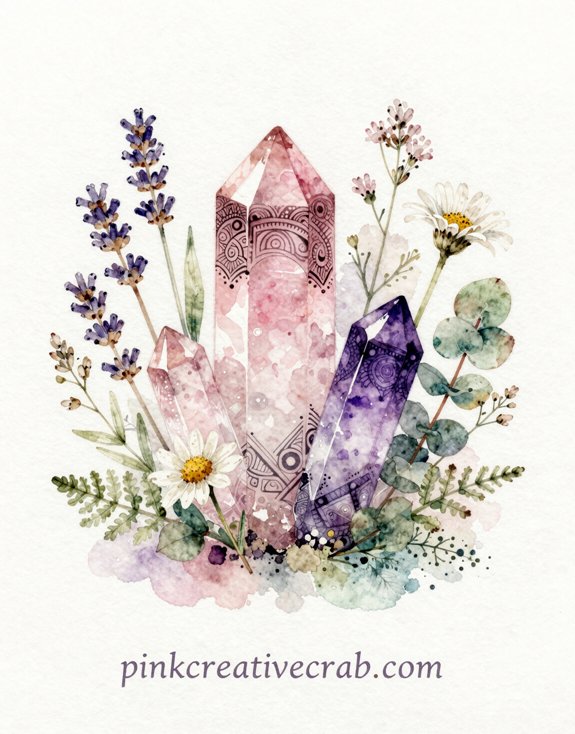
When you combine zentangled crystals with delicate botanical elements, you create something absolutely MAGICAL—a full composition that feels like you’ve captured a piece of an enchanted forest right on your page! Start by painting your zentangled gemstones first—trust me, I learned the hard way when watercolor bled into my finished flowers. Yikes!
Position your crystals off-center (it looks WAY more organic). Then sketch pressed flower silhouettes around them—think ferns, eucalyptus leaves, maybe some delicate wildflowers. Add light watercolor washes to the botanicals, keeping them SOFTER than your crystals so the gems stay the focal point.
The contrast between geometric zentangle patterns and flowing botanical shapes? Chef’s kiss! This composition makes an incredible gift print that screams “handmade with love.”
Which crystal calls to you most as a subject — something bold and geometric like a faceted gem, or something raw and organic like an amethyst cluster?
But maybe you’re more free-spirited? Raw clusters are YOUR jam. Amethyst geodes with their jagged edges and organic shapes? Pure artistic freedom.
And here’s what nobody tells you—raw crystals are actually MORE forgiving when you mess up! Those irregular surfaces hide wonky lines beautifully.
Frequently Asked Questions
Can I Combine Real Crystal Energy Work With My Zentangle Art Practice?
You’ll revolutionize your creative practice by placing crystals around your workspace, holding them while drawing, or using them as inspiration. This fusion transforms ordinary art-making into powerfully intentional, energetically-charged meditation sessions.
What Watercolor Brands Work Best for Achieving Luminous Gemstone Effects?
You’ll achieve stunning luminosity with Daniel Smith’s granulating colors, Schmincke Horadam’s transparency, or Winsor & Newton’s vibrant pigments. Layer these professional-grade watercolors strategically, then add metallic accents to capture that crystalline sparkle you’re pursuing.
How Do I Fix Mistakes in Watercolor Zentangle Crystal Paintings?
“Mistakes make the master”—you’ll lift pigment with a damp brush, embrace white gel pens for highlights, or layer opaque gouache strategically. Don’t overthink it; imperfections often create unexpected luminosity in your crystal work.
Can Zentangle Crystal Art Be Used for Meditation or Mindfulness Practices?
You’ll discover that creating zentangle crystal art naturally induces meditative states through repetitive pattern-making. The focused attention required for detailed linework quiets mental chatter, while watercolor’s flowing nature encourages mindful presence and creative exploration.
Where Can I Sell or Display My Finished Watercolor Zentangle Gemstone Artwork?
You’ll find enthusiastic collectors on Etsy, Instagram, and local metaphysical shops. Like a crystal catching light from different angles, your art reaches diverse audiences through online marketplaces, spiritual boutiques, galleries, and wellness centers seeking transformative pieces.
Have any thoughts?
Share your reaction or leave a quick response — we’d love to hear what you think!
-
 0
0
-
0
-
0
-
0
-
0
-
0


