
A gingerbread house drawing is the one holiday subject that lets you play with color, pattern and a tiny bit of storytelling all on one page. Swap the usual brown and red for pastel pink, mint and soft white icing, and suddenly a cookie cottage feels modern instead of nostalgic, the kind of page you would actually want to pin.
Below are 27 houses, cabins, cafes and tiny scenes, each one a complete picture you can start and finish today with watercolor, a fine ink pen and a little gouache for the icing. Work through them in order if you like, from simple shapes to busier scenes, or just pick the one that matches the mood you are in.
Using these images: free for personal projects such as printing, coloring, cards, journals and gifts. Handmade items that include them may be sold up to 30 pieces per design. More than that is commercial use and is not permitted, and neither is selling or sharing the images themselves or passing them off as your own. Please ask before any other use.
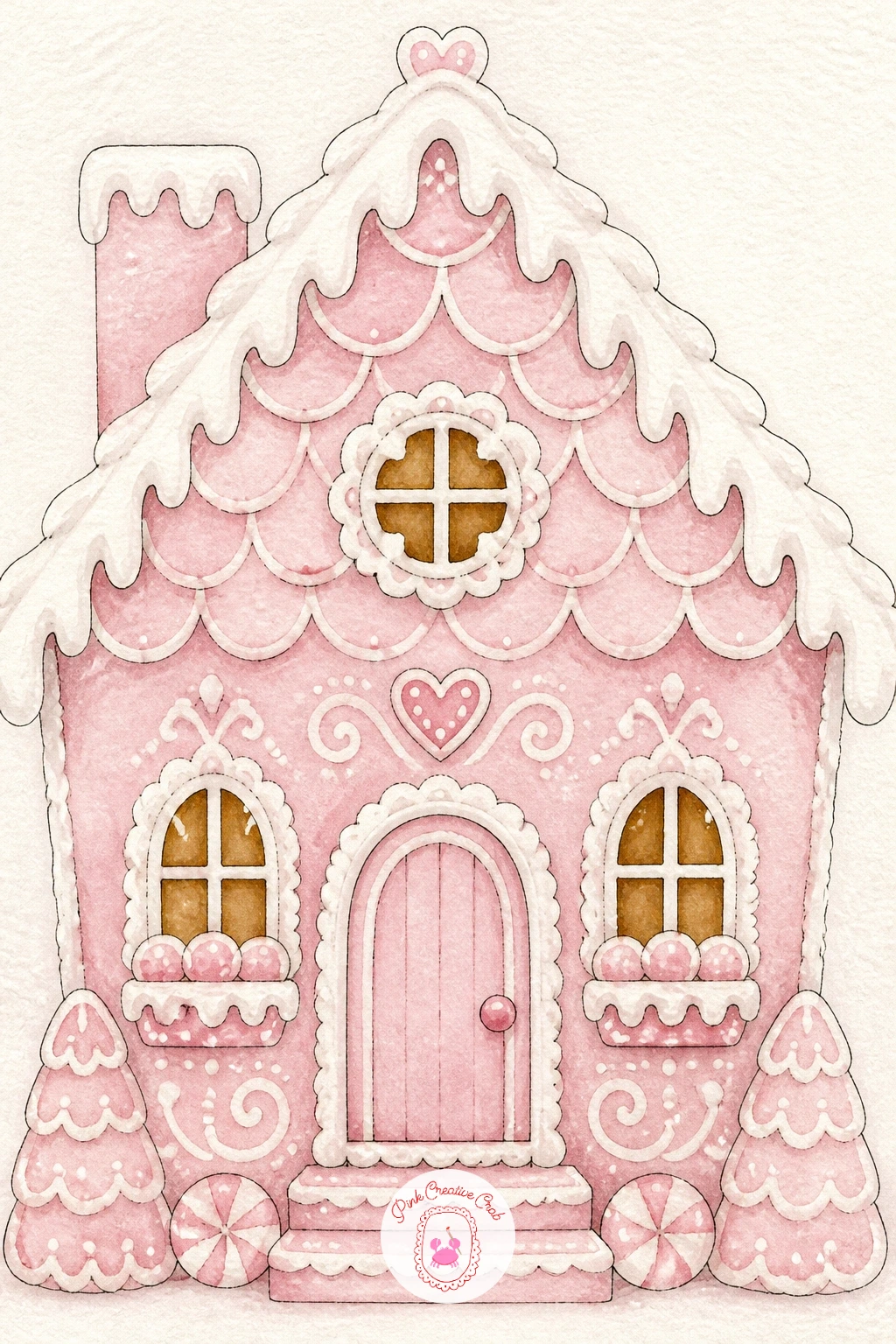
Start with the easiest house on the list: a pastel pink gingerbread house with white scalloped icing dripping along every roofline. Draw a simple square body and a triangle roof in pencil, then ink the outline with a fine liner, keeping the walls plain so the icing gets all the attention.
Measure the roof width before you paint and mark the house width directly against it with your pencil tip, a gingerbread roof usually overhangs the walls by about a finger’s width on each side. Wash the walls in a soft pastel pink watercolor, let it dry fully, then paint the roof in a slightly deeper pink.
Once everything is bone dry, load white gouache on a small round brush and paint scalloped icing along the roof edge, the doorframe and the windows, like piped buttercream. If the scallops wobble, thin the gouache slightly and go over them a second time, a slightly uneven line still reads as hand-piped icing.
Keep the icing bumps roughly the same size by eye before you commit to the final pass, it keeps the roofline looking intentional rather than messy.
You Will Need
- cold press watercolor paper
- fine ink liner pen
- pastel pink watercolor
- white gouache
- small round brush
Palette: Pastel Pink,Rose Pink,Titanium White,Caramel Brown
Try a white gel pen instead of gouache for the scallops if you want a crisper, more consistent line with less risk of smudging.
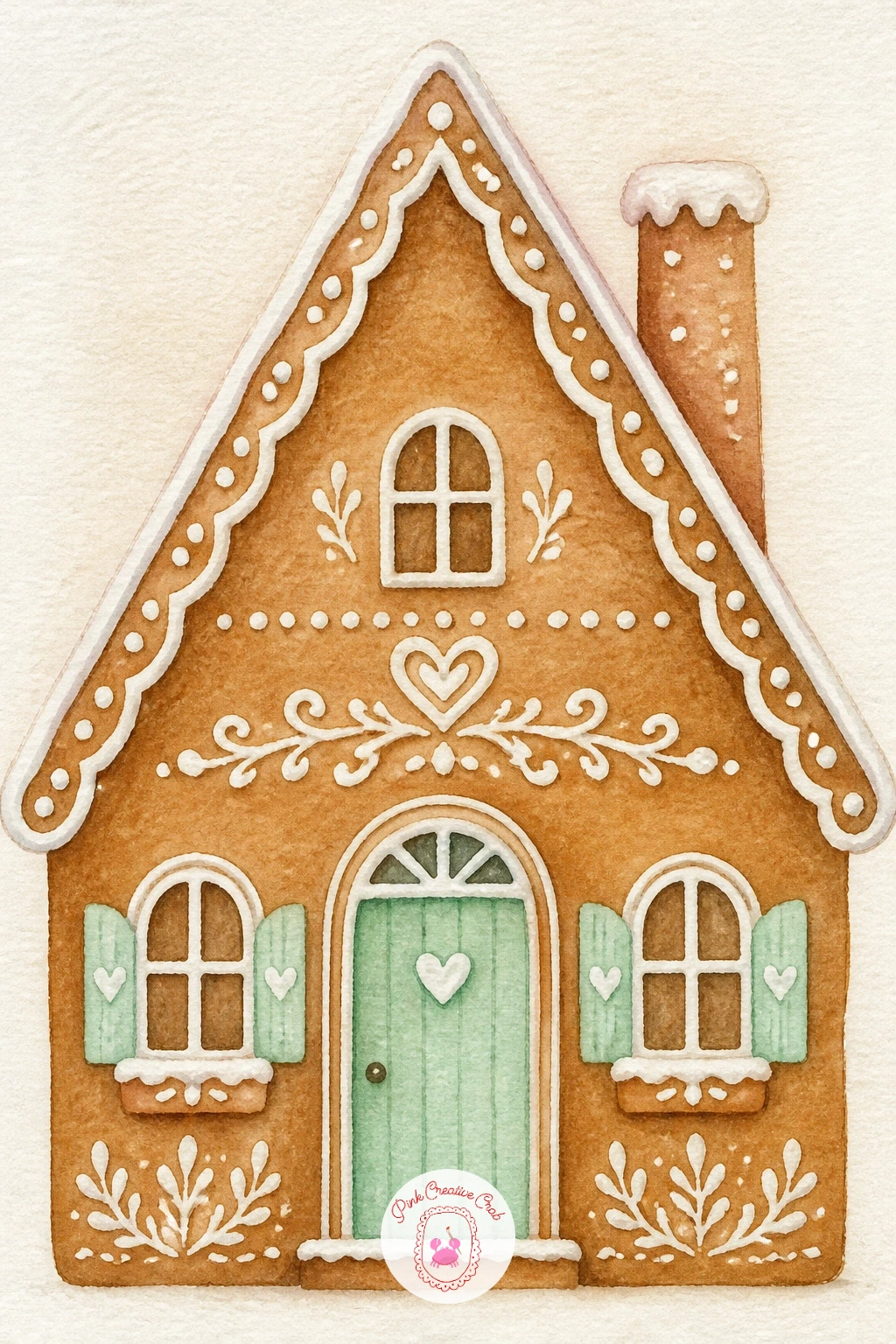
Following the pink house, try something quieter: a Scandi gingerbread cabin with simple white lines instead of heavy icing. Draw a plain rectangular cabin with a steep triangular roof, no dormers or extra bumps, this style leans on restraint rather than decoration.
Ink the outline with a fine liner using mostly straight lines, then wash the whole cabin in one warm caramel brown, letting the paint pool slightly darker at the base for a soft shadow. Once dry, add a mint green door and a few mint shutters for contrast.
The place this goes wrong is over-decorating out of habit, resist adding icing swirls everywhere. Instead, paint three or four plain white lines along the roof edge and one star shape on the gable with gouache or a white gel pen, and stop there.
If you do not have mint paint, a pale grey-blue watercolor gives the same clean Scandi feel against the brown.
You Will Need
- watercolor paper
- fine ink liner pen
- caramel brown watercolor
- mint green watercolor
- white gel pen
Palette: Caramel Brown,Mint Green,Soft Grey,Titanium White
Look at real Scandinavian gingerbread cookies online for reference, they rely on two or three colors and clean geometry instead of texture.
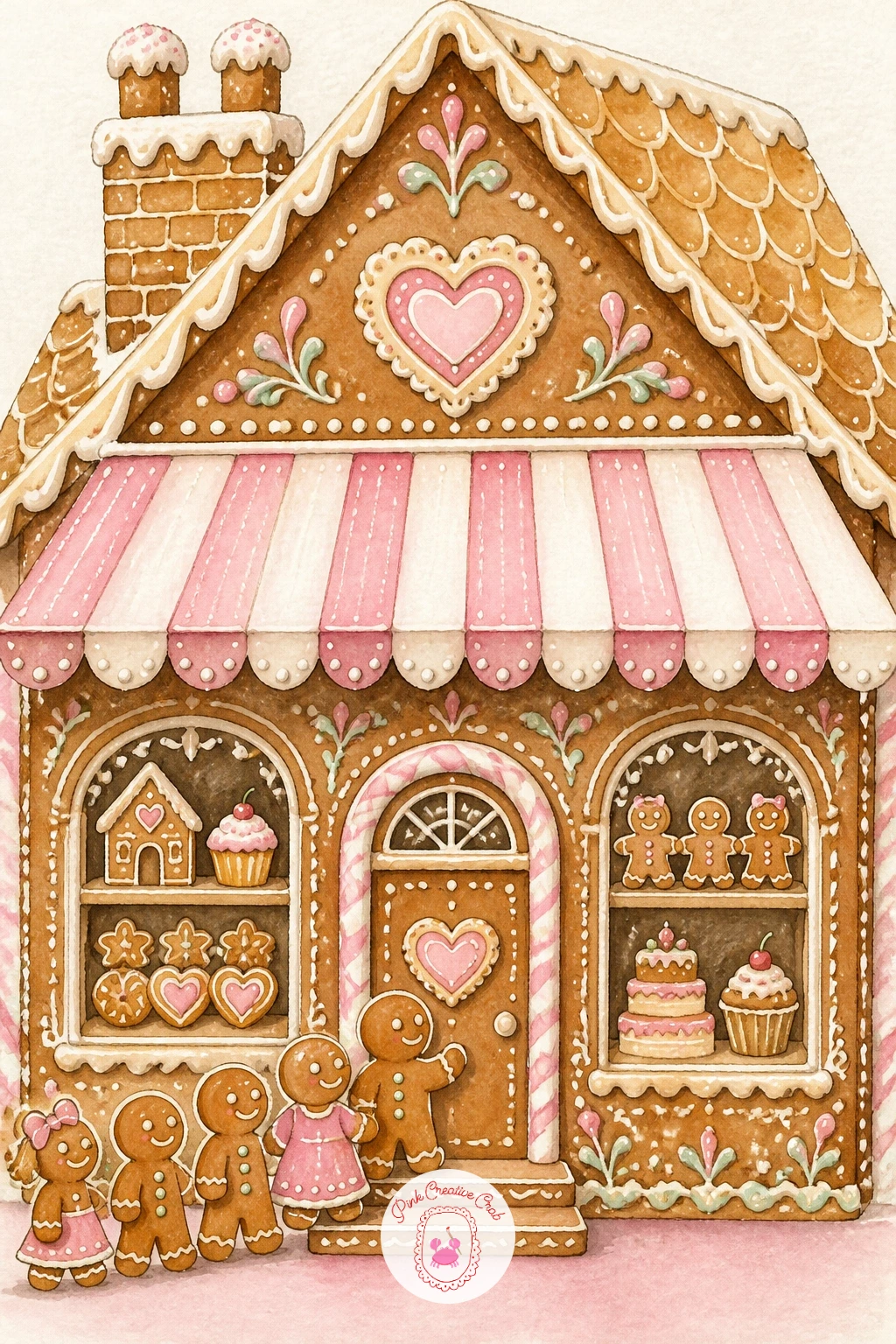
Give your page a little story with a gingerbread bakery with tiny cookie people queued outside, their little stance adding life beyond the house itself. Draw the bakery as a wider building with a shop window and an awning, then pencil three or four tiny cookie people standing in a line near the door, each just a rounded head and simple body.
Ink the bakery first, then the row of figures, keeping them small and loose so they read as charming rather than detailed. Paint the bakery walls in warm brown, the awning in pastel pink and mint stripes, and the cookie people in a lighter caramel with small white icing dots for buttons.
Crowded scenes like this often lose the house in the detail, so keep the figures simple silhouettes and let the bakery stay the largest, clearest shape on the page. A handy trick for a cozy winter building like this is in this village scene drawing guide, which covers keeping small buildings readable.
If figures feel tricky, swap the people for a row of simple paper bags lined up by the door instead.
You Will Need
- watercolor paper
- fine ink liner pen
- warm brown watercolor
- pastel pink watercolor
- mint green watercolor
- white gouache
Palette: Warm Brown,Pastel Pink,Mint Green,Cream
Give each cookie person a tiny different accessory, a scarf, a hat, a bag, so the line feels varied without adding real detail work.
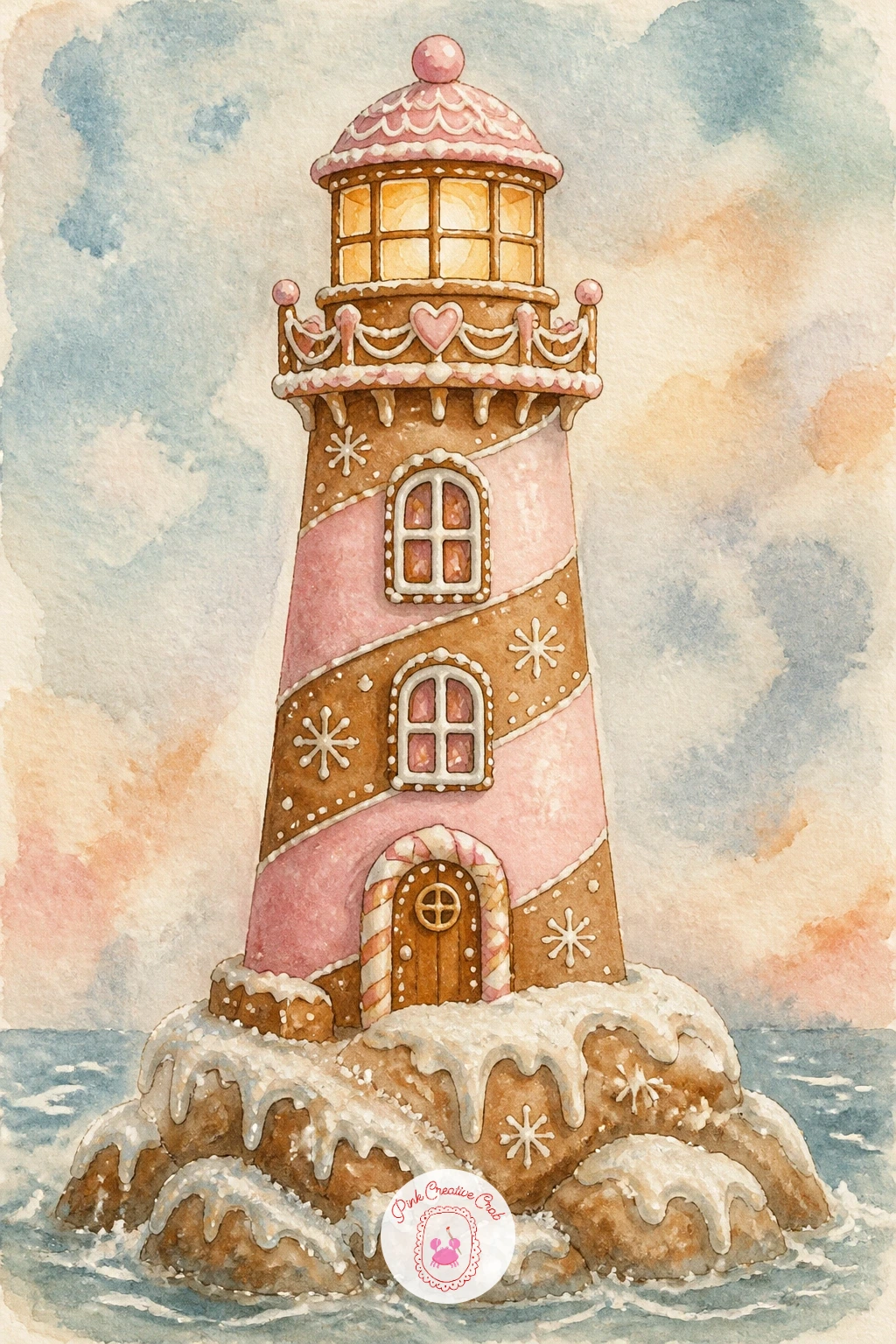
Move from a village building to something taller: a gingerbread lighthouse on a sugar rock, standing alone against the page. Draw a tall narrow cylinder shape in pencil, slightly wider at the base, with a small round lamp room on top, then sketch a bumpy little rock shape underneath for it to stand on.
Ink the lighthouse and rock, then paint the lighthouse in caramel brown with a wide pastel pink stripe around the middle, a classic lighthouse pattern that also doubles as icing. Paint the rock in icy white and pale blue-grey to read as sugar and snow rather than stone.
Tall thin shapes like this tip over visually if the base looks too narrow, so widen the bottom of the lighthouse slightly more than feels natural as you draw it. Finish the lamp room with a small yellow gouache glow at the window.
No pale blue-grey on hand, plain white watercolor mixed with a touch of your brown works fine for the rock shading.
You Will Need
- watercolor paper
- fine ink liner pen
- caramel brown watercolor
- pastel pink watercolor
- pale blue-grey watercolor
- yellow gouache
Palette: Caramel Brown,Pastel Pink,Icy Blue-Grey,Soft Yellow
Add a few small gull shapes as single curved ink lines in the sky above the lighthouse, it fills empty space without any extra painting.
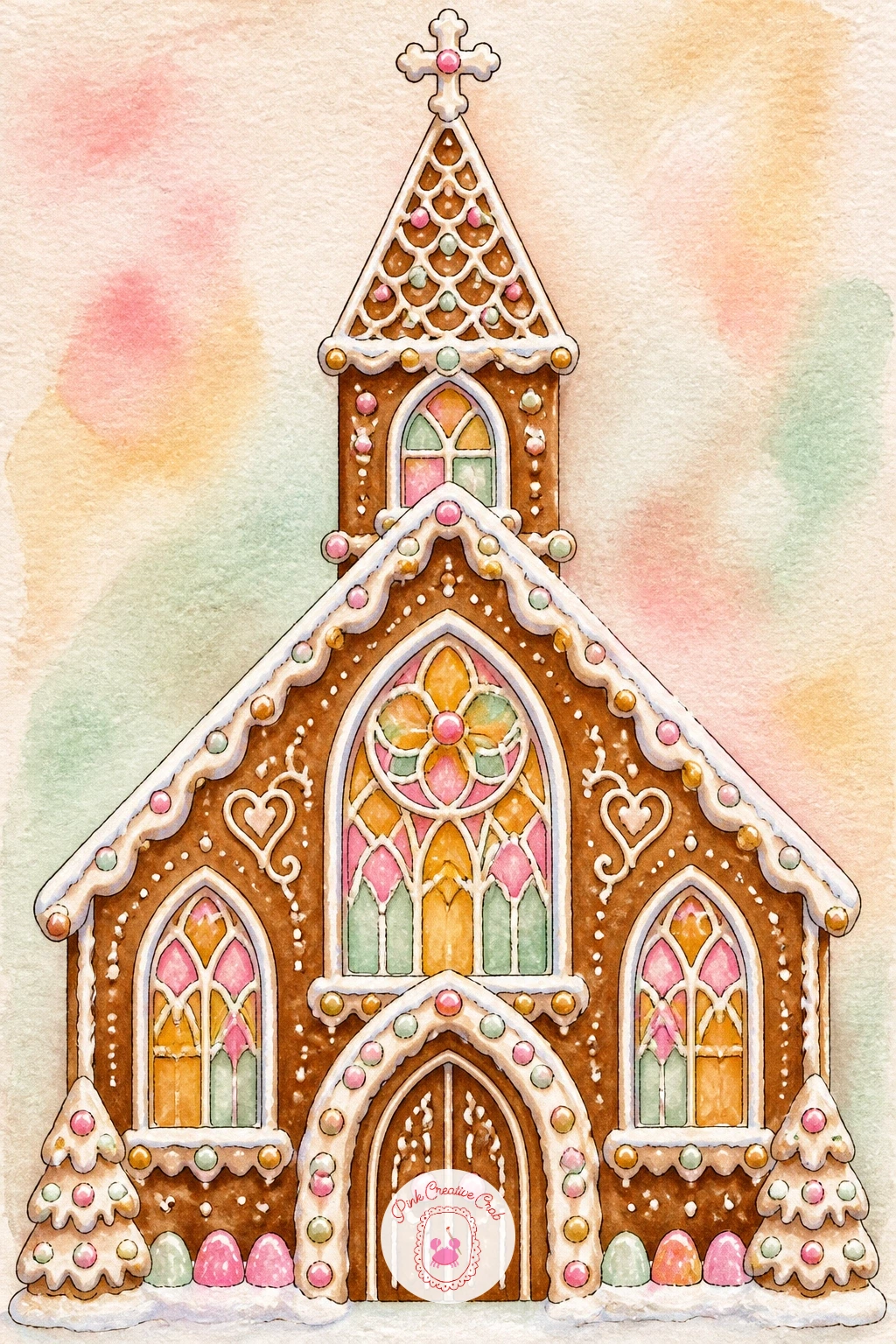
Where the lighthouse plays with scale, a gingerbread church with stained glass candy windows plays with light. Draw a simple church shape with a pointed roof and a small steeple, then pencil in two or three tall arched windows on the front wall.
Ink the whole church, including the window frames, then paint the walls in warm caramel brown. For the windows, this is where light matters most: paint each one in small patches of jewel-toned watercolor, pink, amber and mint side by side, so they glow like stained glass candy rather than reading as flat panes.
Keep the colors inside the window frames bright and a touch more saturated than the rest of the house, that contrast is what sells the glow. If the colors bleed into each other, let each patch dry before adding the one beside it.
A simpler swap for the windows is a single warm yellow wash behind thin white icing bars, which still reads as glowing glass with half the work.
You Will Need
- watercolor paper
- fine ink liner pen
- caramel brown watercolor
- pink mint and amber watercolor
- white gouache
Palette: Caramel Brown,Amber,Rose Pink,Mint Green
Hold the page up to a window once dry, real stained glass photos make a quick and useful reference for where bright color patches sit against dark frames.
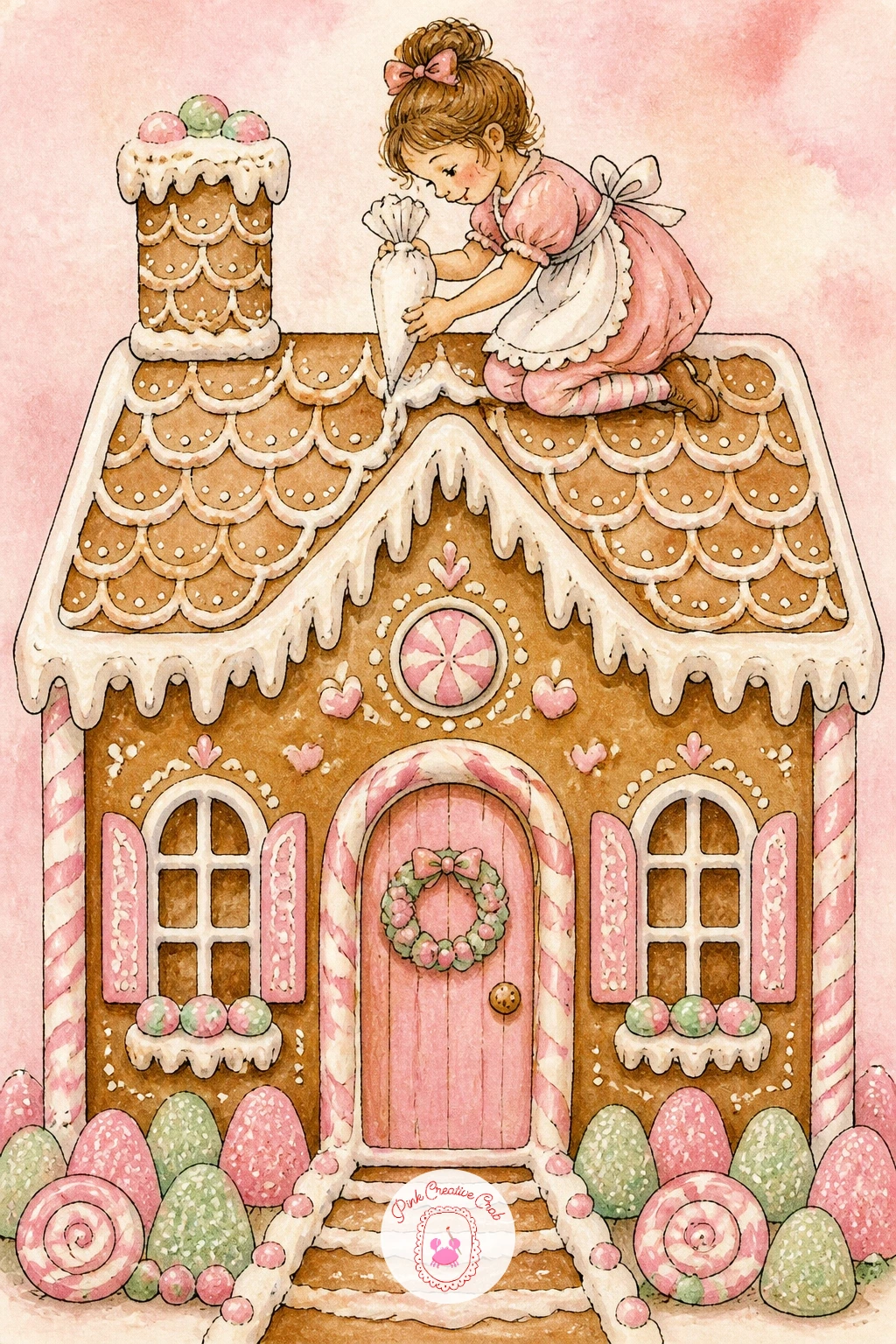
Bring a figure into the scene with a gingerbread house with a girl piping icing on the roof, caught mid-task with a piping bag in hand. Draw the house first as a simple square base and roof, then sketch a small figure sitting or kneeling on the roof, bag in both hands, before inking either.
Where this goes wrong is proportion between house and figure, keep her roughly one third the height of the whole house so she reads as perched on top rather than looming over it. Ink the house in full detail, then the figure with simpler, looser lines.
Paint the house in caramel brown and pastel pink, then paint the girl’s sweater in a matching mint or pink so she feels part of the same color story. Add a thin white gouache line trailing from her piping bag along the roof edge, as if the icing is still wet.
If a full figure feels like too much, just her hands and the piping bag entering the frame from one side is enough to suggest her.
You Will Need
- watercolor paper
- fine ink liner pen
- caramel brown watercolor
- pastel pink watercolor
- mint watercolor for figure
- white gouache
Palette: Caramel Brown,Pastel Pink,Mint Green,Soft Skin Tone
Sketch the figure in several quick thumbnail poses first, small and rough, before committing to one on the final page.
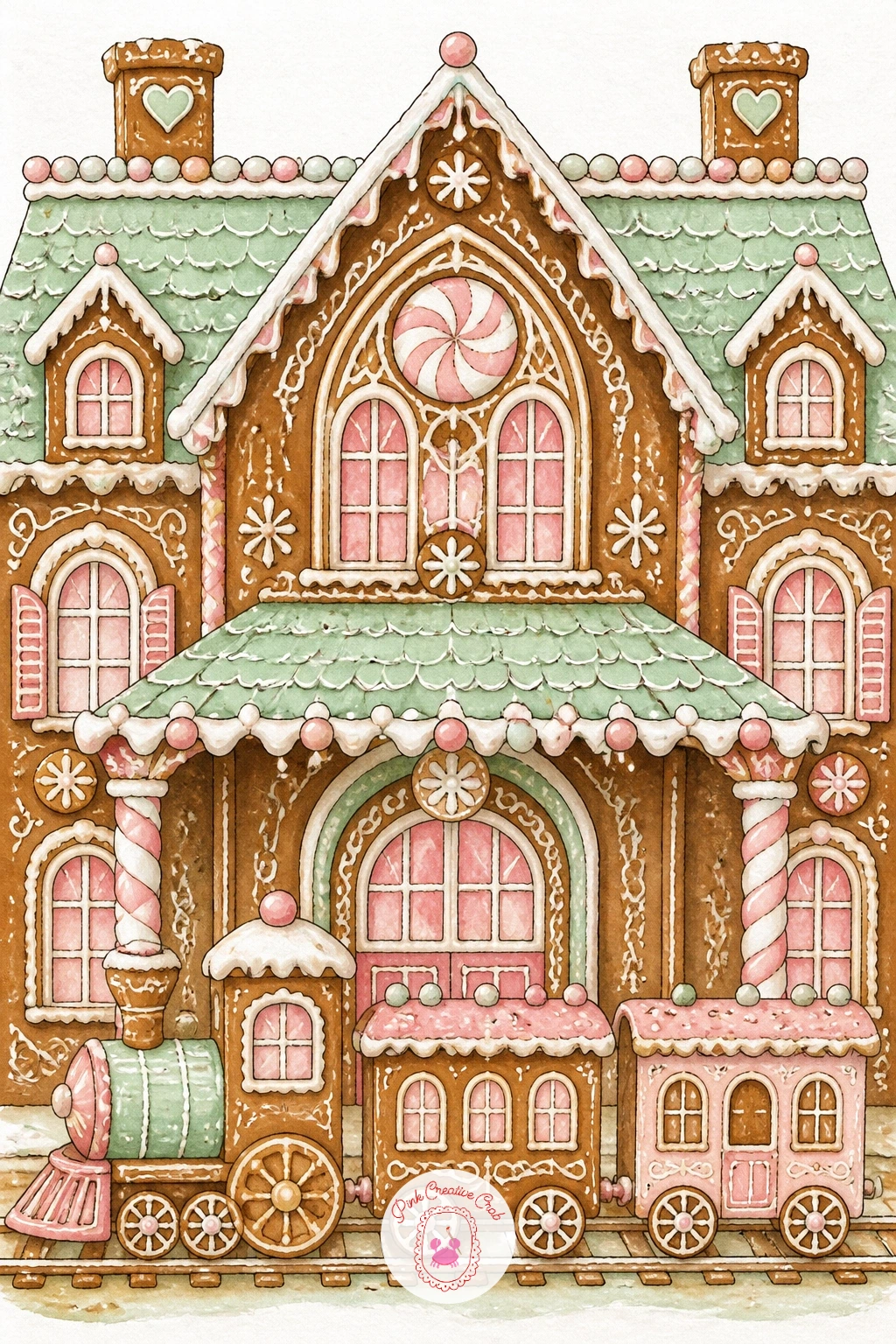
From a single house to a small scene: a gingerbread train station with a cookie train pulling in gives you two shapes to balance on one page. Draw the station as a low wide building with a platform roof, then sketch a simple train, a rounded engine and two or three boxy carriages, running along the bottom edge.
Ink the station first since it anchors the page, then the train, keeping both drawn with the same weight of line so they feel like one world. Paint the station in warm brown with a mint roof, and the train in alternating caramel and pastel pink carriages.
Two shapes this size can easily compete for attention, so keep the station slightly larger and higher in the frame, with the train lower and smaller to suggest distance. Puffs of white gouache steam from the engine finish the motion.
If the train feels fiddly, three simple rounded rectangles in a row read perfectly well as carriages.
You Will Need
- watercolor paper
- fine ink liner pen
- warm brown watercolor
- mint watercolor
- pastel pink watercolor
- white gouache
Palette: Warm Brown,Mint Green,Pastel Pink,Titanium White
Check out this collection of step by step Christmas drawing lessons if you want more practice building small buildings before tackling a full scene like this.
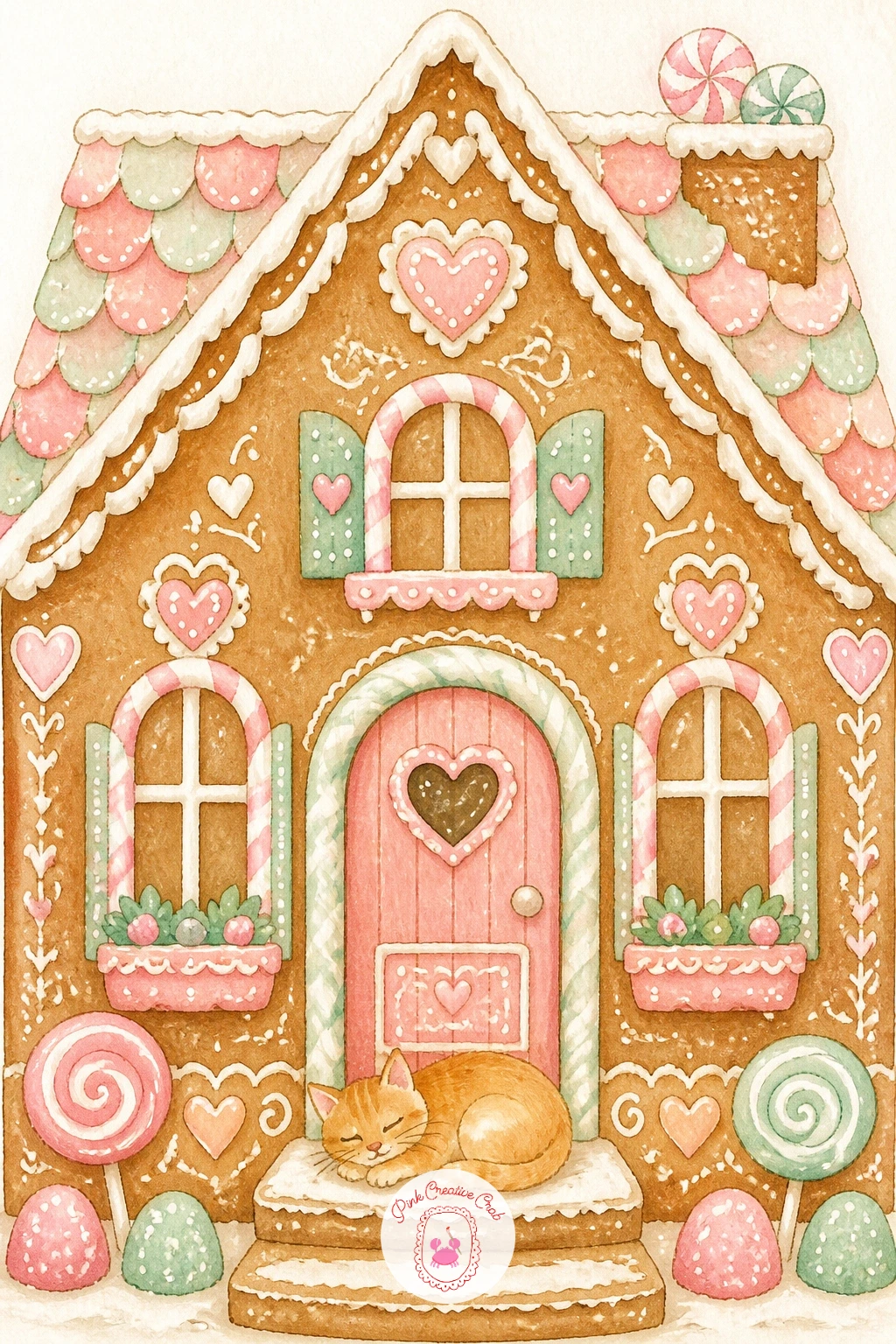
Slow the mood down with a gingerbread house with a sleeping cat on the doorstep, a small quiet detail that makes the whole page feel cozy. Draw the house as a simple cottage shape, then pencil a curled cat shape right at the base of the door, just an oval body with a tucked tail and small ears.
Ink the house with full detail, then the cat with soft, rounded lines, nothing sharp since she is asleep. Paint the house in your chosen pastel and brown, then paint the cat in a simple orange or grey watercolor, letting the fur color pool slightly darker along her back for a soft curve.
A sleeping shape goes wrong fastest when the proportions get too long and thin, keep the cat’s curled body roughly as wide as it is tall, a tight comma shape rather than a stretched oval. One fine white gouache whisker line on each side finishes her.
If cats are not your thing, a curled sleeping mouse at the same spot works just as sweetly.
You Will Need
- watercolor paper
- fine ink liner pen
- pastel house colors
- orange or grey watercolor for cat
- white gouache
Palette: Pastel Pink,Warm Orange,Soft Grey,Caramel Brown
Look at photos of sleeping cats curled into a tight circle, not stretched out, that tucked shape is what reads as peacefully asleep.
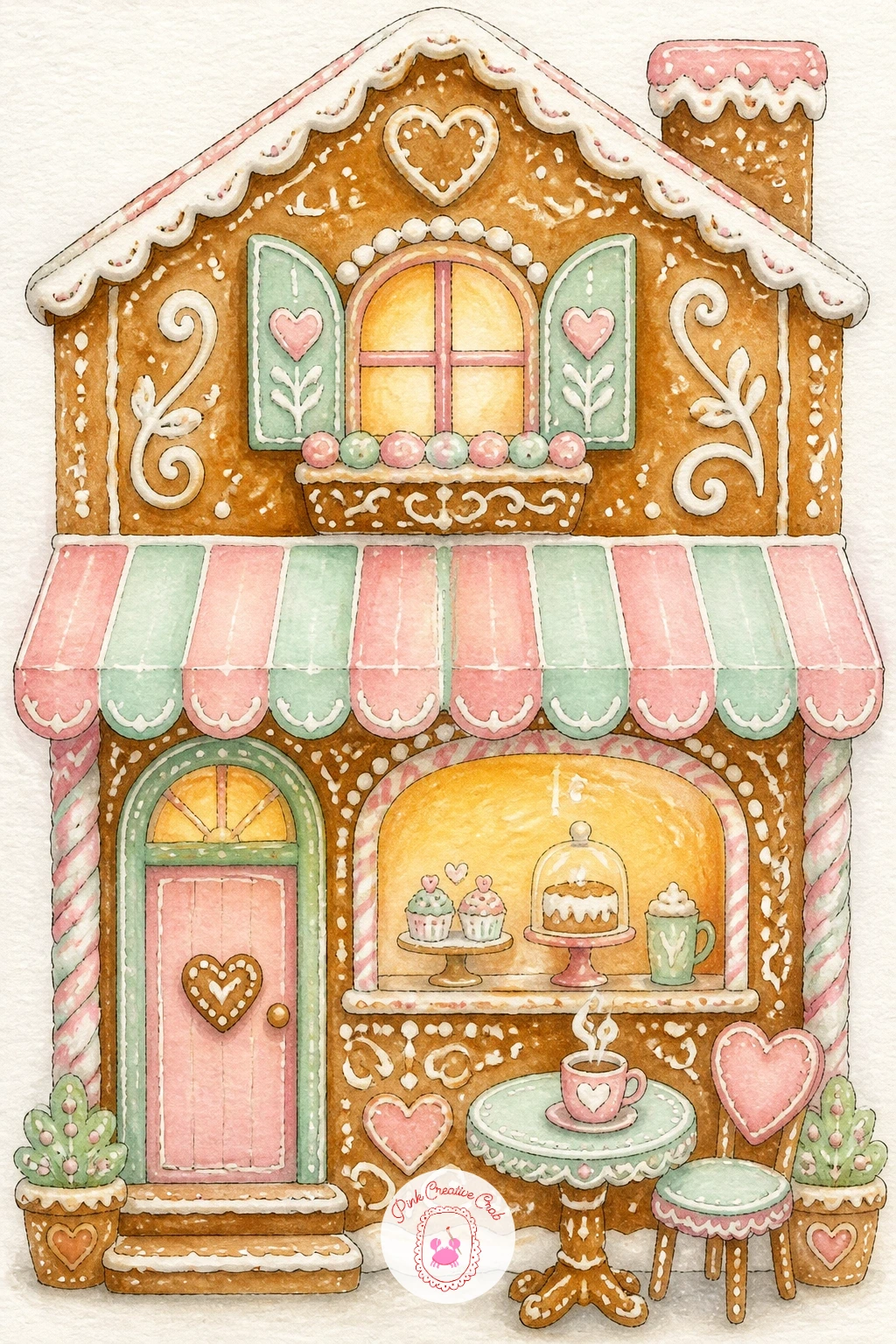
Keep the cozy feeling going with a gingerbread café with a striped awning stretched over a little outdoor table. Draw the café as a square building with a large front window, then add a curved or triangular awning jutting out over the door, plus a tiny round table and one chair below it.
Ink the building and awning first, then the small table setup, keeping the furniture simple shapes, a circle for the table and a few lines for the chair. Paint the awning in alternating pastel pink and mint stripes, the walls in warm caramel, and leave the window mostly white with a few gouache pastry shapes inside.
Stripes often go wrong when they curve unevenly across a rounded awning, so lightly pencil a few guide lines first before inking the stripe edges. A small steaming cup on the table, just an oval with a curl of white gouache steam, finishes the scene.
No pink and mint together, a classic red and white stripe works just as well for a café awning.
You Will Need
- watercolor paper
- fine ink liner pen
- pastel pink and mint watercolor
- caramel brown watercolor
- white gouache
Palette: Pastel Pink,Mint Green,Caramel Brown,Cream
Add a small chalkboard sign by the door with a tiny doodle instead of real words, it reads as a café detail without needing lettering.
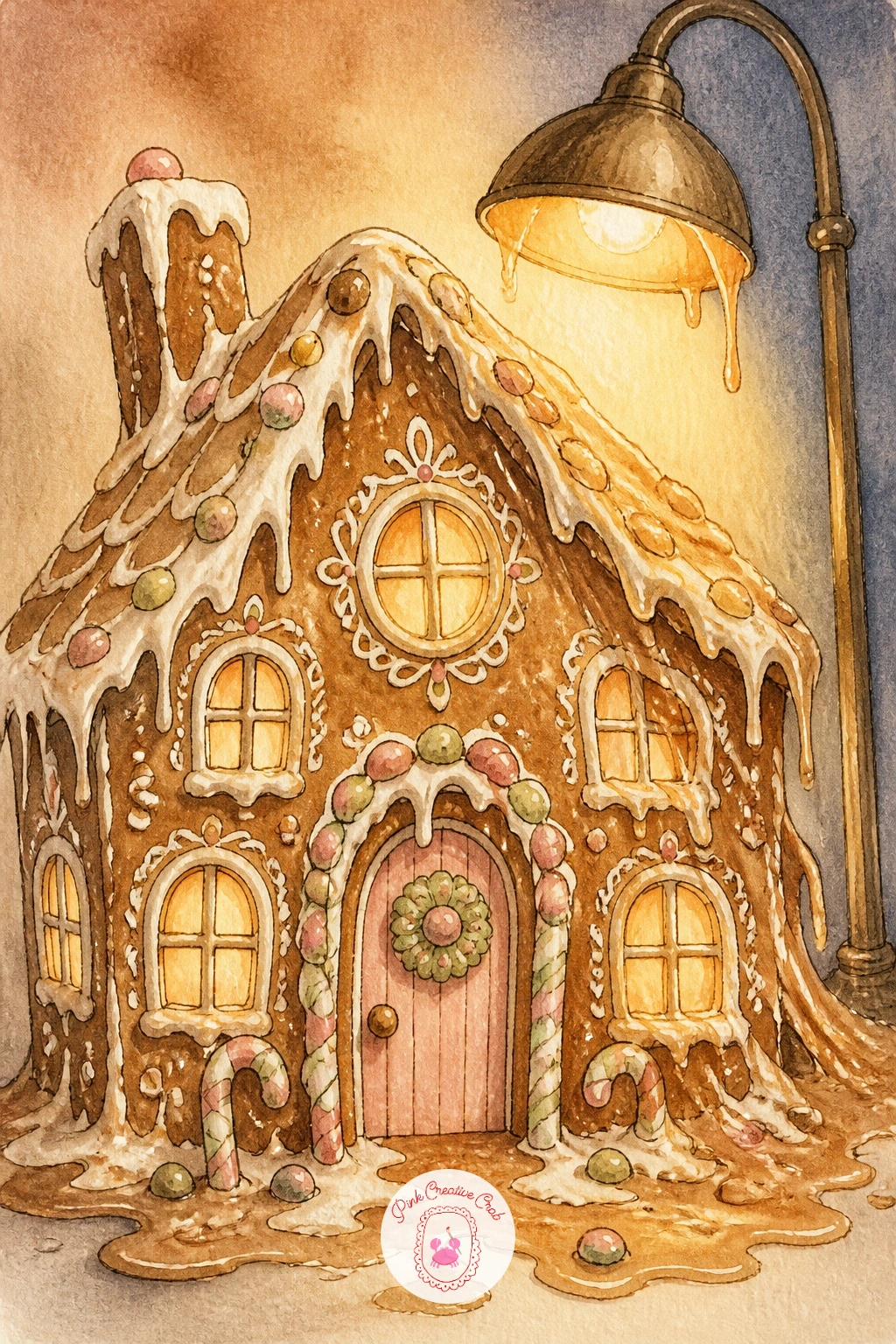
Have some fun with light on a gingerbread house melting slightly under a lamp, where one strong light source does all the storytelling. Draw the house as usual, then sketch a tall lamp or candle beside it with its glow reaching one side of the roof, and let that roofline droop and soften right where the light hits hardest.
Ink the house with its melted edge drawn as a soft, uneven line rather than straight, and ink the lamp separately. Paint the side away from the lamp in cooler, darker brown and the lit side in warm caramel and a touch of yellow, with the icing on the melting section painted as if it is sliding, thinner and dripping lower than the rest.
The easiest way to lose this effect is making the whole house glow evenly, so keep the far side noticeably cooler and dimmer than the near side. A soft yellow gouache halo around the lamp bulb finishes the warmth.
If gouache glow feels tricky, a light wash of yellow watercolor dabbed with a damp brush creates a similar soft glow with less control needed.
You Will Need
- watercolor paper
- fine ink liner pen
- warm and cool brown watercolor
- yellow watercolor or gouache
- white gouache
Palette: Warm Caramel,Cool Umber,Soft Yellow,Titanium White
Study a photo of a candle lit room for reference, notice how only the side facing the light stays warm while the rest cools toward grey and blue.
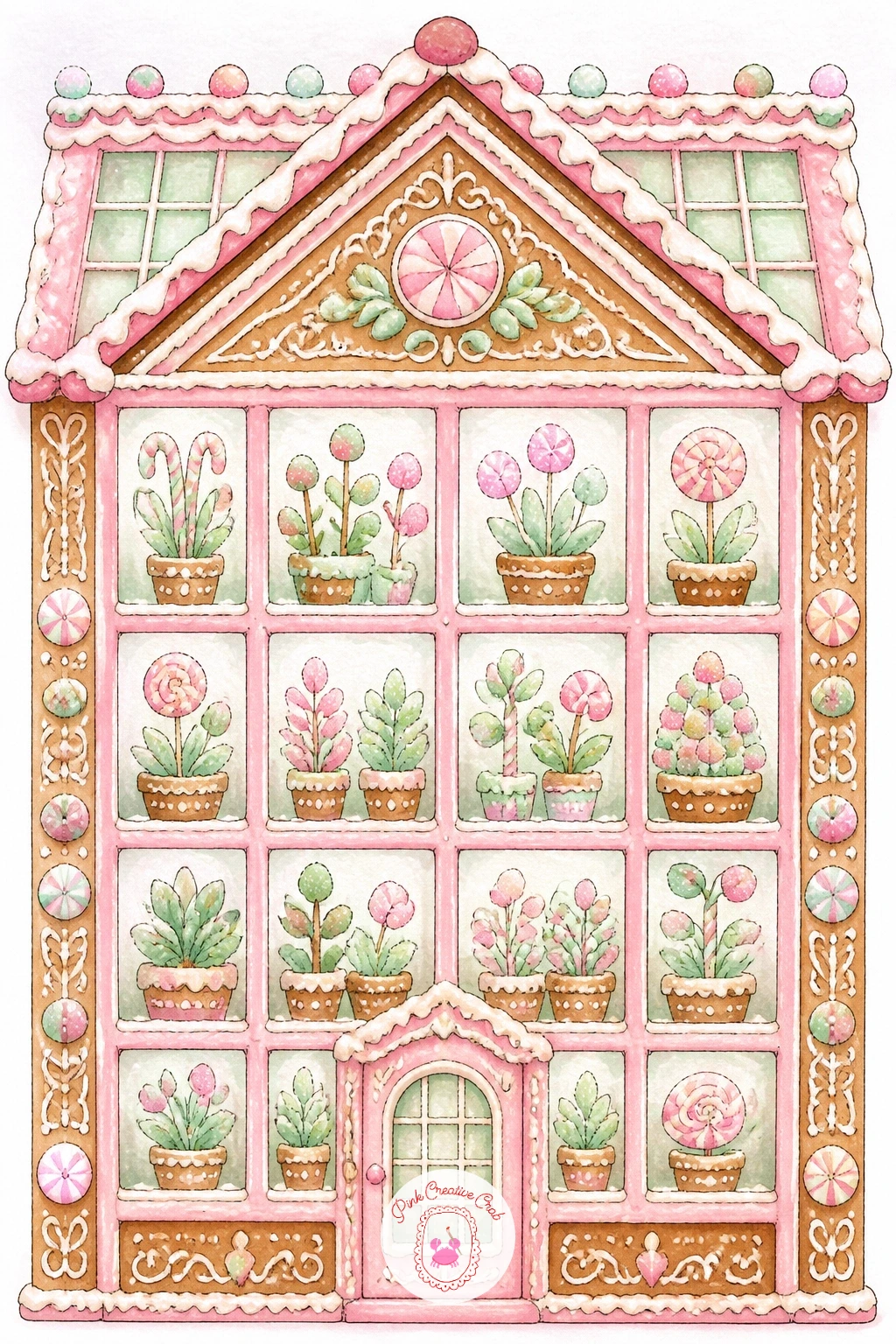
Turn to something leafier with a gingerbread greenhouse with candy plants growing inside its glass panels. Draw a simple A-frame greenhouse shape with a grid of small square windows, then sketch a few plant silhouettes visible through the glass, simple leaf and stem shapes made from candy colors.
Ink the greenhouse frame and window grid first, keeping the lines straight and even since this structure reads as orderly. Paint the frame in pastel pink or mint, then paint the plants inside each window pane in small bursts of green, pink and white, like candy sprouting from gingerbread soil.
Grid windows like this can look flat fast, so vary how full each pane looks, some packed with plants, some nearly empty, to keep the eye moving across the house. A row of tiny white gouache dots along the base suggests a border of sugar stones.
No mint on hand, a pale sage green watercolor gives the same fresh, garden feel against the caramel frame.
You Will Need
- watercolor paper
- fine ink liner pen
- pastel pink or mint watercolor
- green watercolor for plants
- white gouache
Palette: Mint Green,Sage Green,Pastel Pink,Caramel Brown
Try browsing botanical references from a flower guide for leaf shapes, the pencil colour flower drawing ideas page has plenty of simple ones worth borrowing.
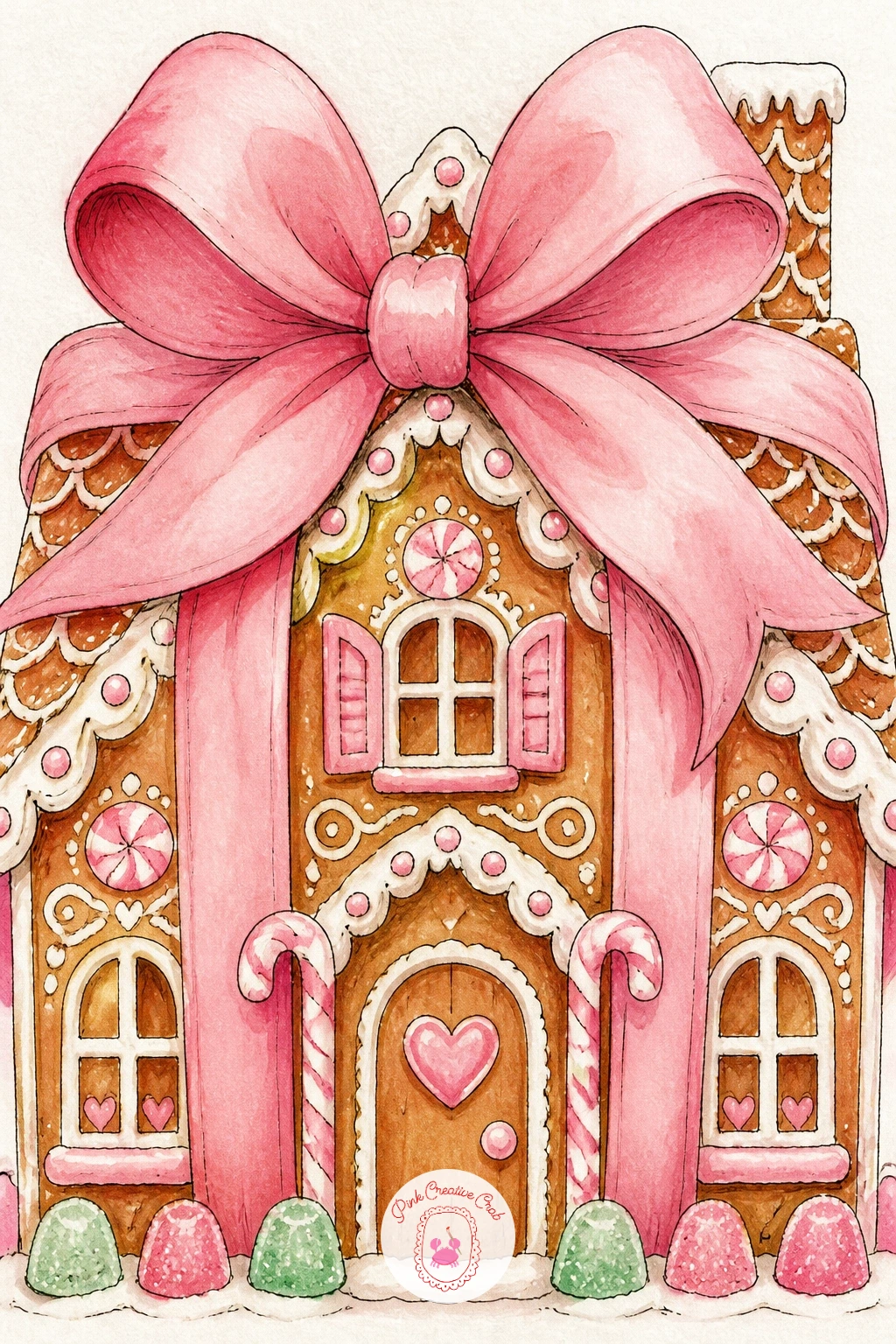
Simplify things again with a gingerbread house with a giant bow wrapped around it like a present, a quick and satisfying ten minute piece. Draw the house plainly, then sketch a wide ribbon looping over the roof and down both sides, with a large bow knot sitting right at the front.
Ink the house, then the ribbon, letting the ribbon lines curve and overlap naturally where the bow loops cross. Paint the house quickly in one or two colors, then spend most of your time on the ribbon, painting it in a rich pastel pink with a deeper pink shadow where it folds.
In ten minutes, stop here: a clean house with a bold bow is already a finished piece. Given forty minutes, add a thin gold or white gouache line along both ribbon edges and a few small holly leaves tucked into the bow knot.
If pink ribbon does not suit your palette, a soft gold watercolor ribbon reads just as festive against brown.
You Will Need
- watercolor paper
- fine ink liner pen
- house color watercolor
- pastel pink watercolor for ribbon
- white or gold gouache
Palette: Caramel Brown,Pastel Pink,Deep Rose,Soft Gold
Practice the bow loops separately on scrap paper first, a ribbon bow is really just a few overlapping teardrop shapes once you see it that way.
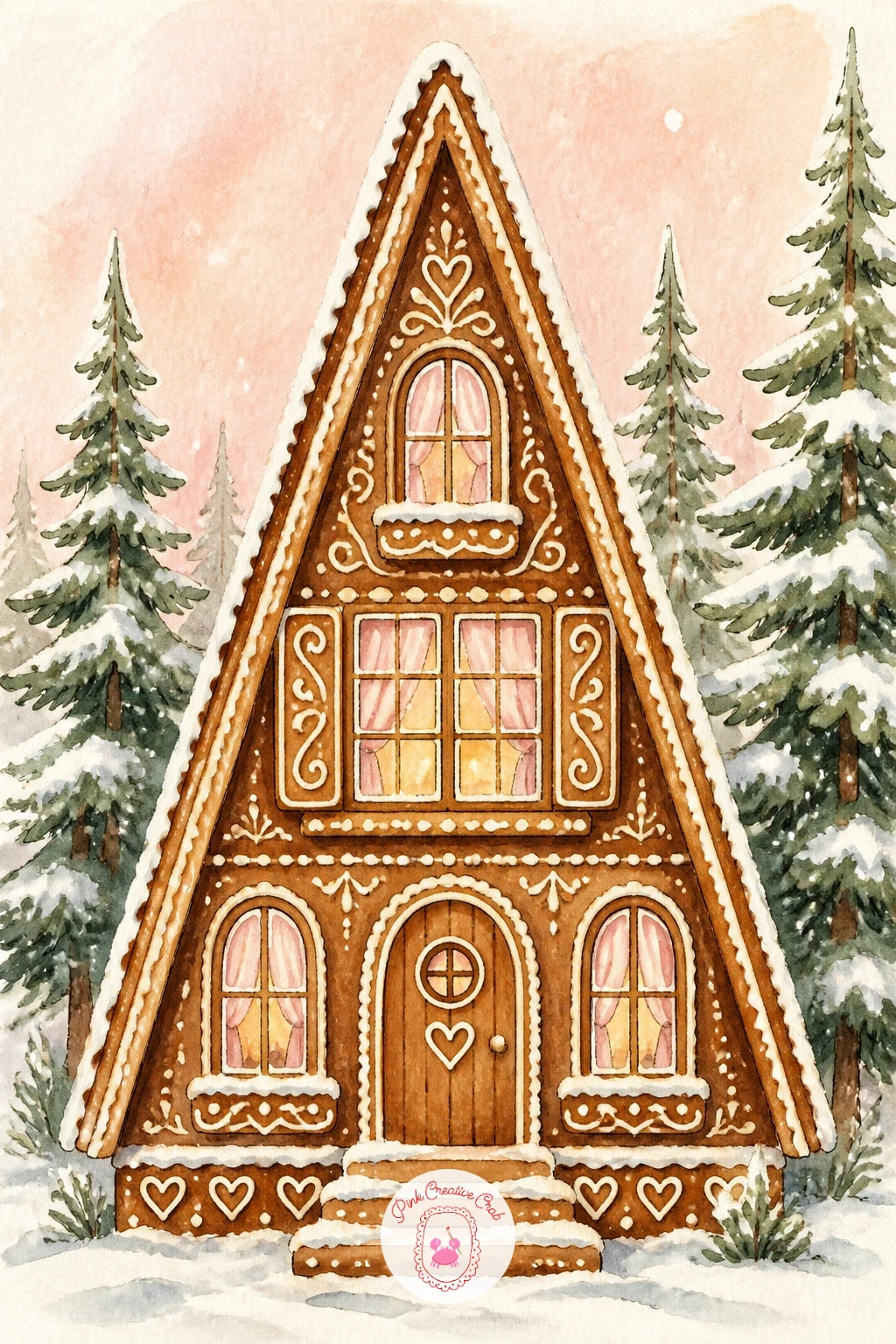
Head into the trees with a gingerbread A-frame cabin in the woods, a strong triangular silhouette surrounded by a few simple pines. Draw the cabin as one tall triangle shape with a small door and one round window near the peak, then sketch two or three simple triangular pine trees around its base.
Ink the cabin first, then the trees, keeping the trees looser and less detailed so the cabin stays the clear subject. Paint the cabin in deep caramel brown with white icing trim along the roof edge, then paint the pines in a muted green with a light dusting of white gouache snow on their branches.
The eye level here matters: place the horizon line low, near the base of the cabin, so you look slightly up at it, which makes the A-frame feel tall and impressive rather than squat. Keep the sky simple, a pale wash or plain white.
No muted green on hand, a grey-green mixed from blue and brown watercolor works just as well for distant pines.
You Will Need
- watercolor paper
- fine ink liner pen
- caramel brown watercolor
- muted green watercolor
- white gouache
Palette: Deep Caramel,Muted Pine Green,Titanium White,Pale Sky Blue
Try the same cabin silhouette from a slightly higher eye level too, looking down on it from above gives a cozy, tucked-in-the-woods feeling instead of a grand one.
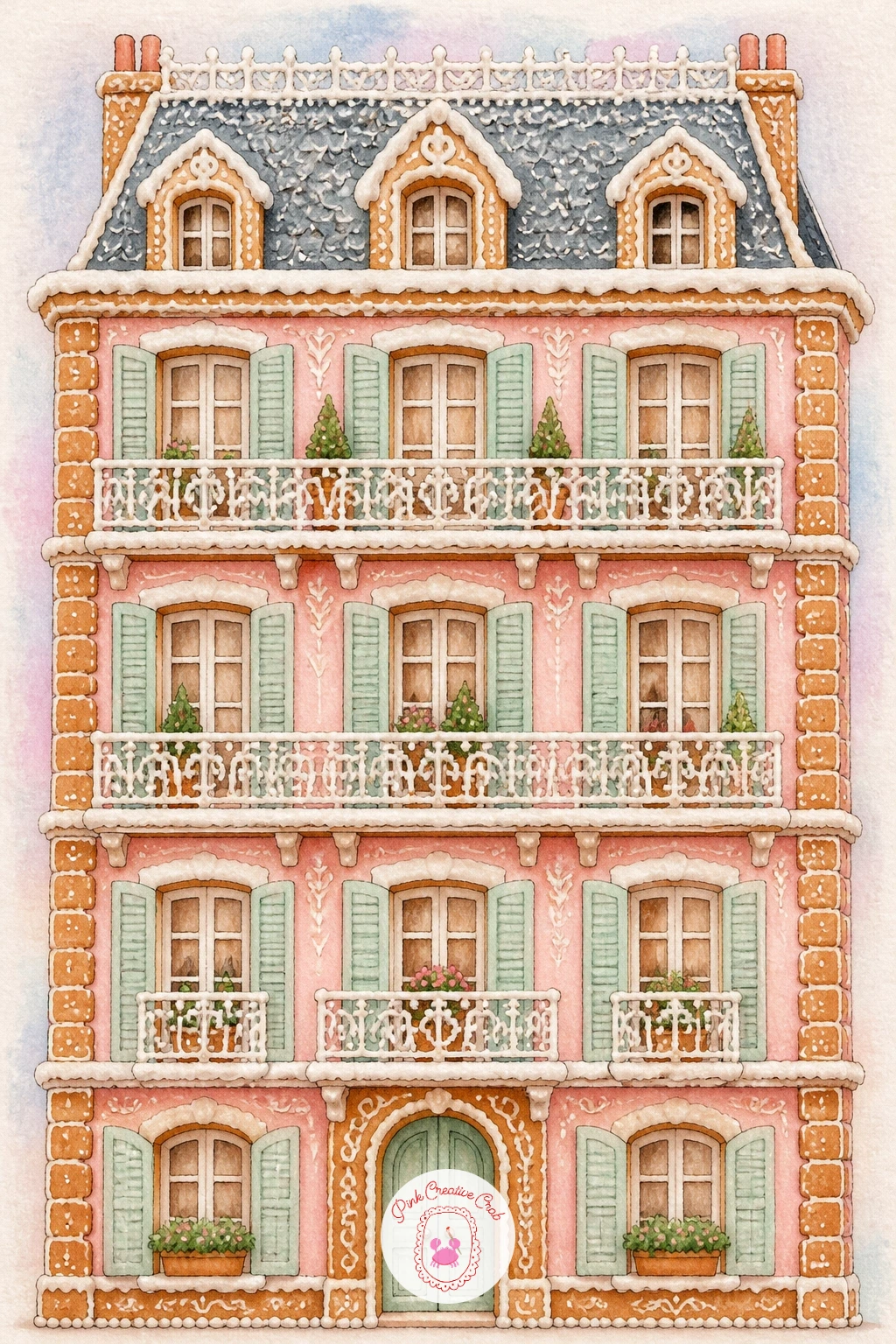
Bring some city charm in with a gingerbread Paris apartment with balconies, tall and narrow with ironwork railings piped in icing. Draw a tall rectangular building with two or three rows of small windows, then sketch a thin balcony railing jutting out from one or two of them, made from simple repeated curved lines.
Ink the building first with careful straight verticals, since a city building relies on clean proportion more than a cottage does. Compare the building’s height to its width before you commit, a Paris apartment reads taller and narrower than a typical gingerbread house, roughly twice as tall as it is wide.
Paint the walls in soft caramel or pale pink, then pick out each balcony railing in white gouache, piped as if icing, with a tiny potted plant on one ledge for warmth. Shutters in mint on alternating windows keep the facade from feeling flat.
If icing railings feel fiddly, a few straight white gel pen lines across each balcony front suggest the ironwork just as well.
You Will Need
- watercolor paper
- fine ink liner pen
- pale pink or caramel watercolor
- mint watercolor for shutters
- white gouache or gel pen
Palette: Pale Pink,Warm Caramel,Mint Green,Titanium White
Look at real Haussmann style balcony photos for the railing pattern, repeating simple curves close together reads as ironwork without any fine detail work.
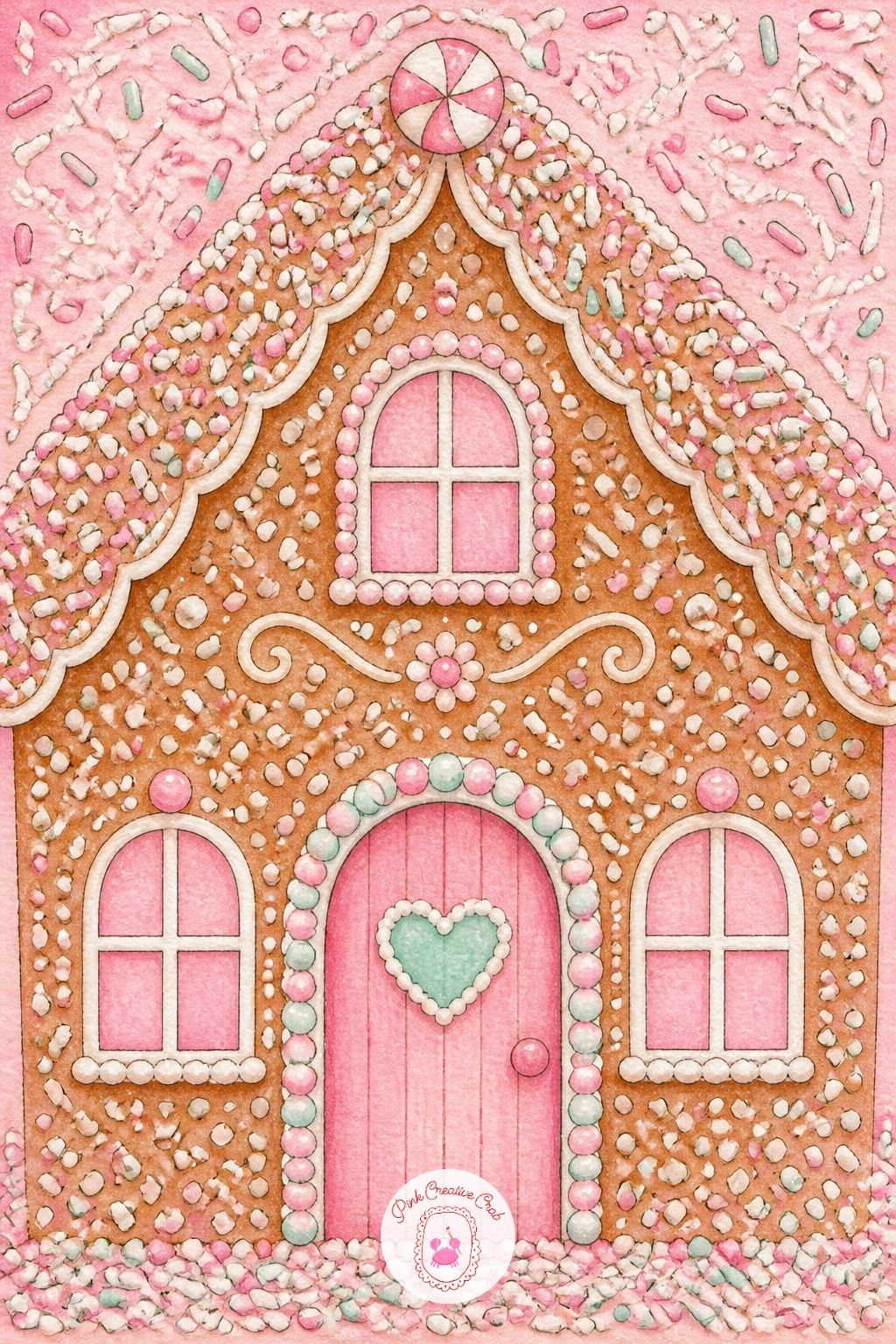
Go playful with a gingerbread house covered in sprinkles from roof to doorstep, a quick piece that rewards a loose hand. Draw the simplest house shape you can, since the sprinkles will carry all the visual interest, then ink only the essential outlines.
Paint the whole house in one soft pastel wash, pink or mint, and let it dry completely before adding a single sprinkle. Once dry, use a fine brush loaded with white, pink and mint gouache to dot and dash sprinkle shapes all over the roof and walls, small lines and dots scattered unevenly like the real thing.
Too many sprinkles in neat rows looks stiff and planted, so scatter them at random angles and let some areas feel more crowded than others, the way sprinkles actually fall. For a ten minute version, dots alone are enough, for forty minutes, add thin dash shapes too for variety.
If gouache dots feel slow, a white and colored gel pen does the same job directly onto the dry paint.
You Will Need
- watercolor paper
- fine ink liner pen
- pastel pink or mint watercolor
- white and colored gouache
- fine detail brush
Palette: Pastel Pink,Mint Green,Titanium White,Soft Lavender
Mix up dot sizes as you go, a few slightly larger sprinkle dashes among the small dots keeps the texture from feeling too uniform.
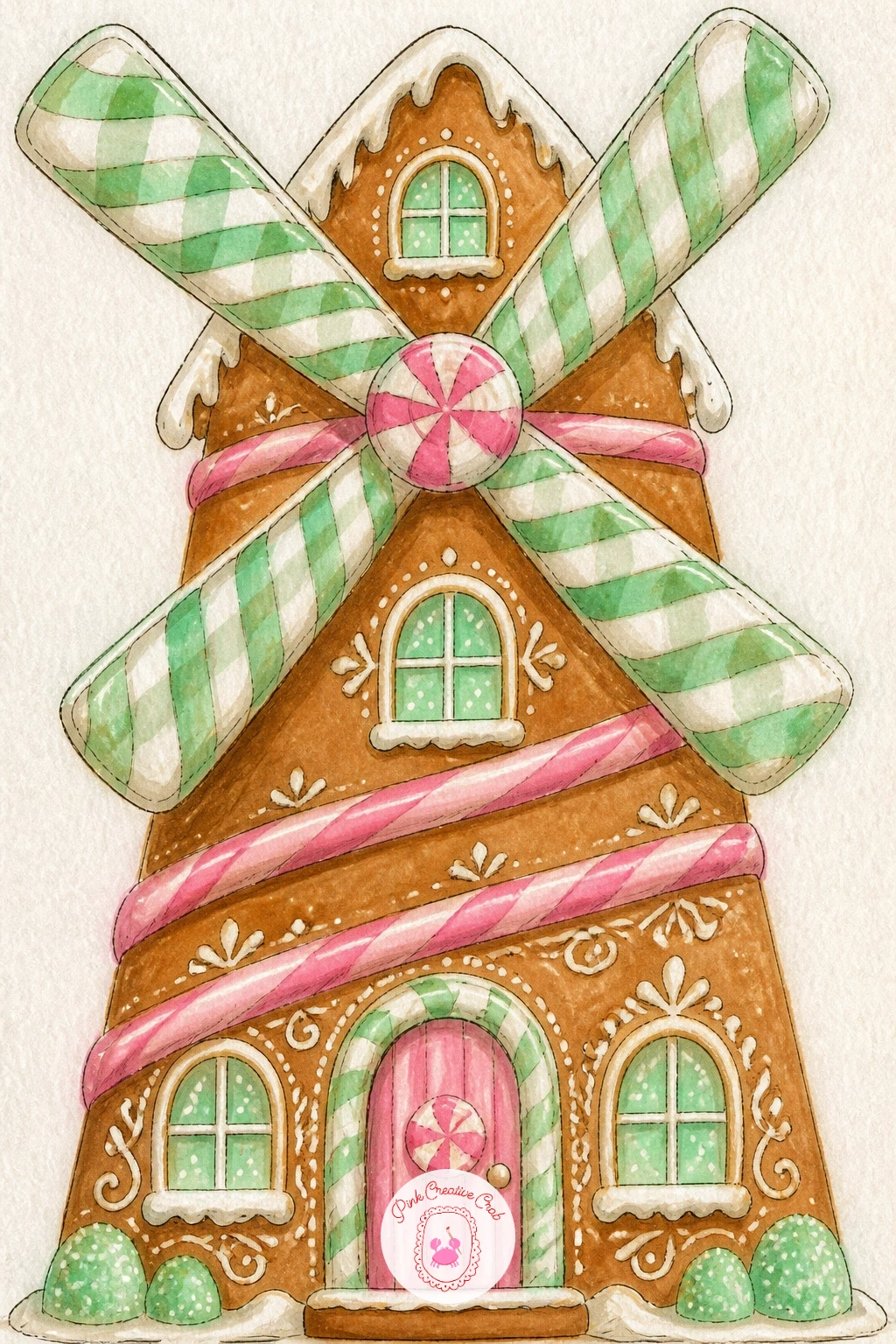
Try a rounder structure next with a gingerbread windmill with candy blades turning against the sky. Draw a tapered cylinder body, wider at the base and narrower near the top, then sketch four long blade shapes crossing at the center near the roof, angled slightly as if caught mid-turn.
Ink the body first, then the blades, drawing each blade with a slight curve rather than perfectly straight for a softer, candy look. Paint the body in warm caramel with a pastel pink stripe spiraling gently up it, and paint the blades in alternating mint and white.
Blades like this go wrong when all four look identical and flat, so paint one or two slightly darker as if they are turning away from the light, which adds depth without extra drawing. A small round window near the top finishes the structure.
If a precise angle feels tricky, lightly pencil a plus sign first as a guide for where the four blades should cross before inking them.
You Will Need
- watercolor paper
- fine ink liner pen
- caramel brown watercolor
- pastel pink watercolor
- mint watercolor
Palette: Caramel Brown,Pastel Pink,Mint Green,Titanium White
Rotate the paper slightly as you ink each blade so your hand always moves in the same comfortable direction, it keeps the curves consistent.
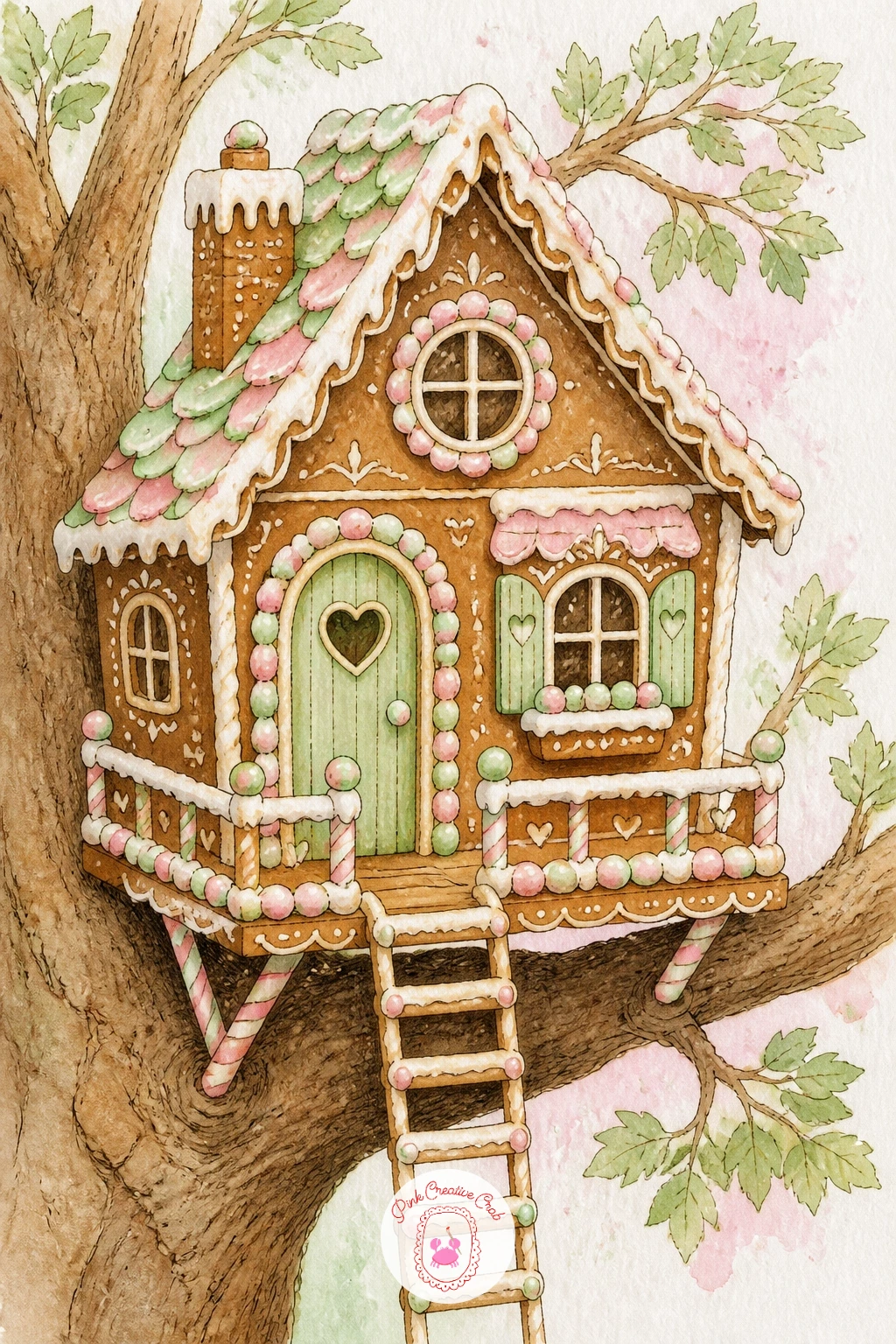
Lift the house off the ground with a gingerbread treehouse tucked into the branches, supported by a simple tree trunk below. Draw the tree trunk first as a thick wavy vertical shape with two or three branches reaching out, then sketch the small house sitting on top of one branch, slightly tilted for charm.
Ink the trunk and branches with a textured, slightly rough line to suggest bark, then ink the house with cleaner lines so it stands apart from the tree. Paint the trunk in deep brown with a dry brush dragged lightly over it, letting the bristles catch only the paper’s texture for a believable bark feel.
If the dry brush strokes come out too heavy, dab a little water onto the heaviest marks while still damp to soften them back. Paint the house in caramel and mint, with a small rope ladder, just a few parallel white gouache lines, hanging down from the door.
No proper dry brush available, a nearly empty brush wiped almost dry on a paper towel does the same job for the bark texture.
You Will Need
- watercolor paper
- fine ink liner pen
- dry brush or old flat brush
- deep brown watercolor
- caramel and mint watercolor
- white gouache
Palette: Deep Brown,Caramel Brown,Mint Green,Titanium White
Practice the dry brush bark stroke on scrap paper first, a nearly dry brush dragged sideways gives broken, textured marks instead of a smooth line.
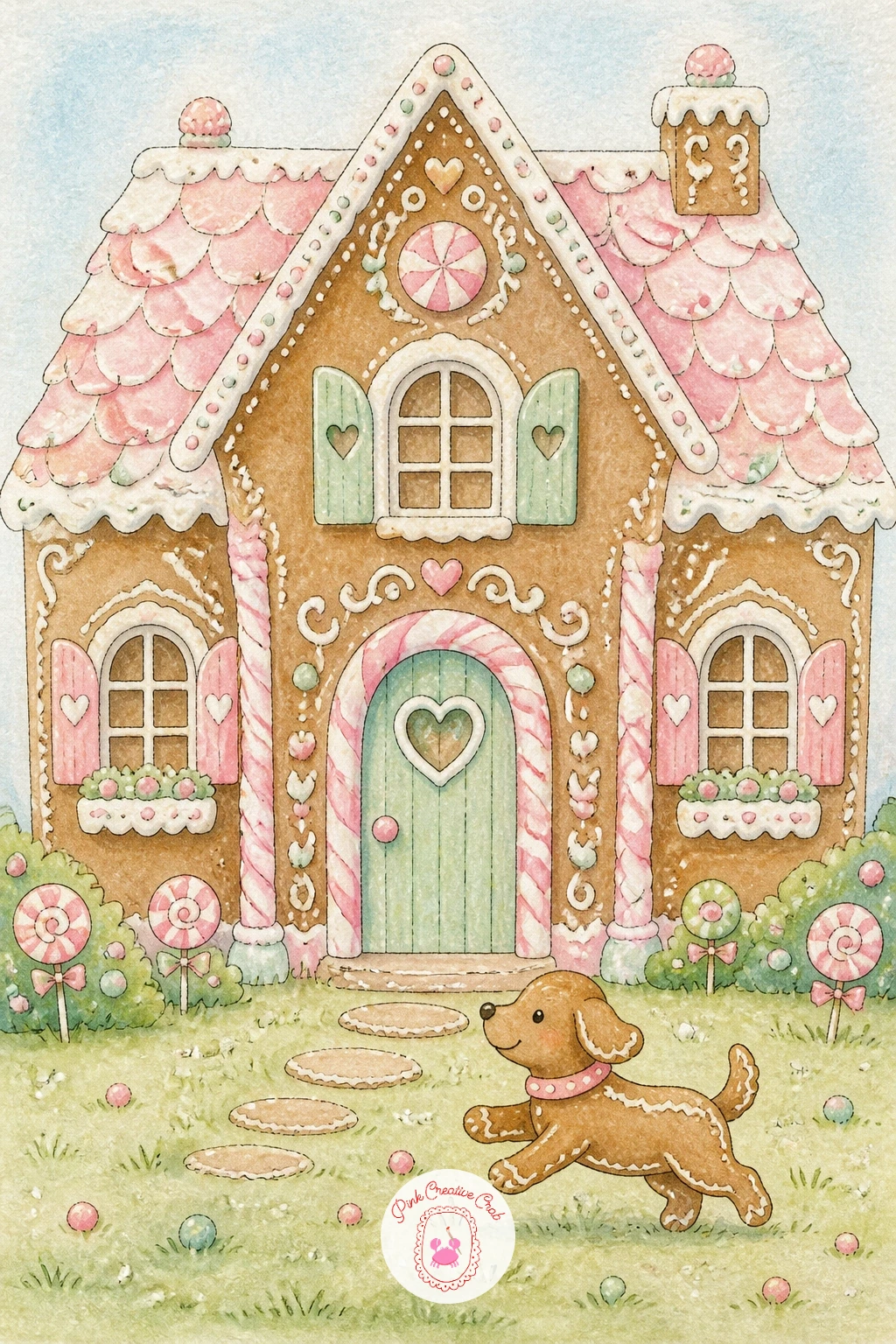
Add a companion with a gingerbread house with a dog made of cookie bounding across the icing lawn out front. Draw the house as a simple cottage shape, then sketch a small dog shape nearby, a rounded body, two triangle ears and a wagging tail caught mid-motion.
Ink the house in full detail, then the dog with a looser, bouncier line to suggest movement, maybe one paw lifted off the ground. Paint the house in your chosen pastel palette, then paint the dog in warm caramel with a white gouache icing collar and a few small dot details for a nose and eyes.
A static looking dog usually has four paws planted evenly, so lift one paw and angle the tail upward to suggest energy instead. A scattering of small white gouache dots around its paws suggests kicked up sugar snow.
If a full dog feels like too much, a simple sitting dog silhouette by the door tells the same sweet story with far less drawing.
You Will Need
- watercolor paper
- fine ink liner pen
- pastel house colors
- caramel brown watercolor for dog
- white gouache
Palette: Pastel Mint,Caramel Brown,Titanium White,Soft Pink
Look through the dog poses in this dog pencil drawing guide for simple running and sitting shapes you can adapt straight onto the lawn.
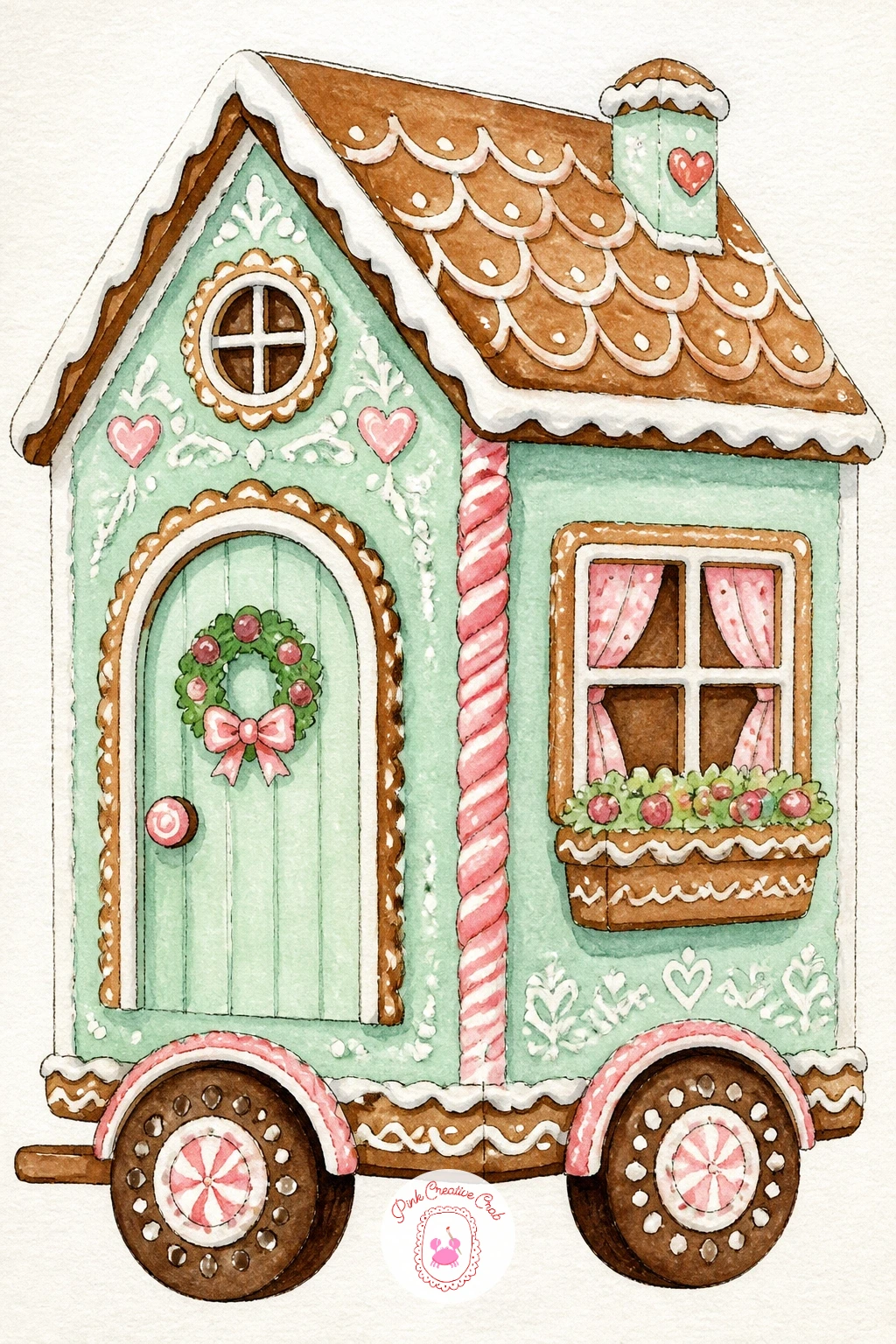
Give the house somewhere to go with a gingerbread tiny house on wheels, a cozy little camper shape instead of a fixed cottage. Draw a small rectangular house body with a slightly curved roof, then sketch two round wheels beneath it and a thin hitch bar extending from the front.
Ink the house and wheels, keeping the wheel circles even by tracing a small coin or bottle cap if freehand circles feel shaky. Paint the house in a soft pastel color with a contrasting curved roof, then paint the wheels in deep brown with a white gouache hubcap dot in the center of each.
Wheeled shapes often look like they are floating if the wheels sit too high, so make sure the bottom of the house body actually touches the top of each wheel. A tiny curl of white gouache smoke from a mini chimney adds a lived-in touch.
No coin to trace, a watch face or a lid from a jar works just as well for a clean circle.
You Will Need
- watercolor paper
- fine ink liner pen
- pastel watercolor for house
- deep brown watercolor for wheels
- white gouache
- round object to trace wheels
Palette: Pastel Mint,Deep Brown,Pastel Pink,Titanium White
Try tilting the whole house slightly on the page, as if caught mid-tow, it adds charm and movement to what is otherwise a simple boxy shape.
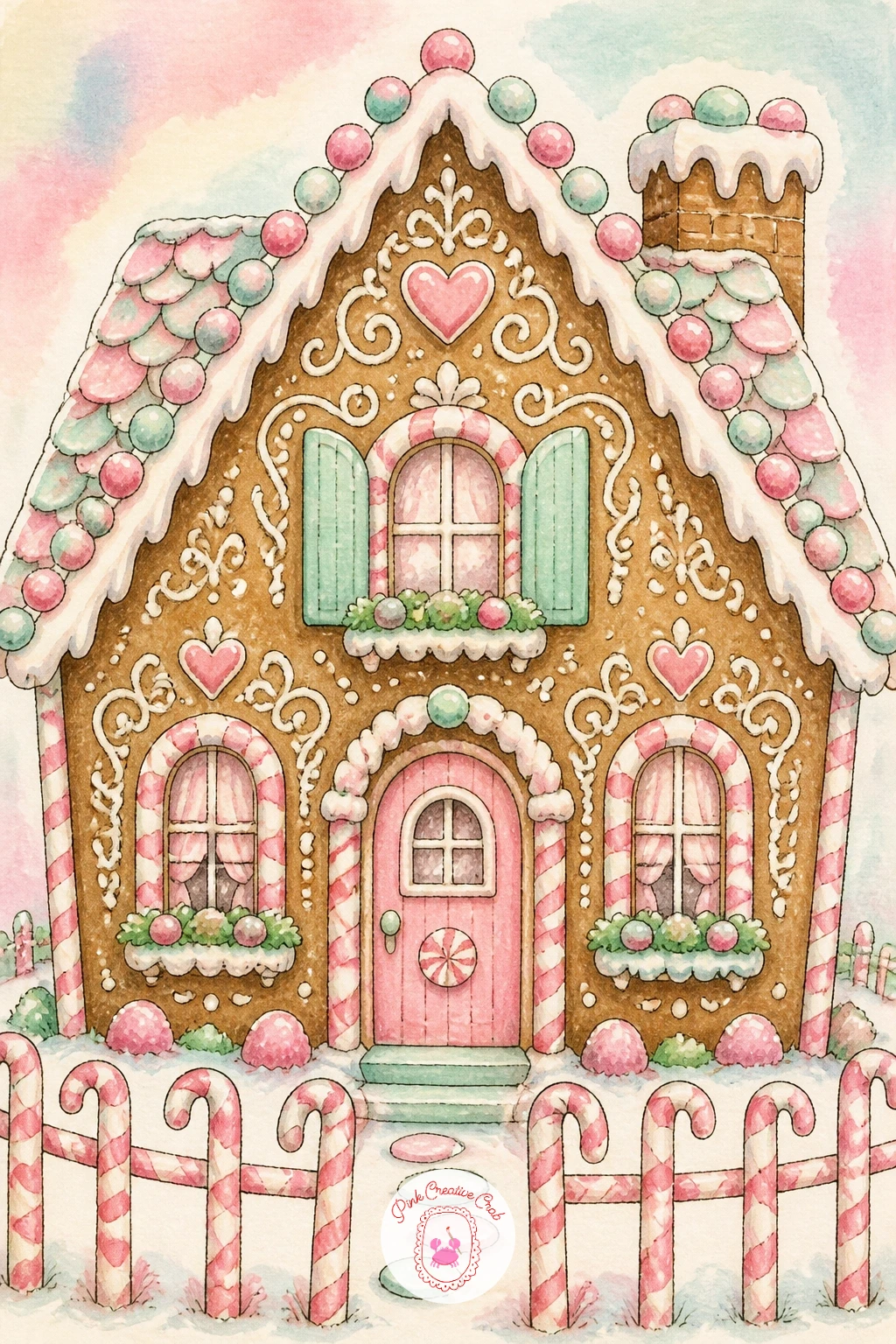
Frame the whole scene with a gingerbread house with a pink candy cane fence running along the front, a repeating detail that is simple once you get a rhythm going. Draw the house first, then sketch a row of small curved candy cane posts along the bottom edge of the page, evenly spaced like a picket fence.
Ink the house, then ink each candy cane post one at a time rather than all at once, it keeps the curve of each hook consistent. Paint the house in your chosen pastel colors, then paint each candy cane with alternating pink and white stripes, keeping the stripe width the same across every post for a tidy, repeating pattern.
Uneven stripe widths are the most common slip here, so lightly pencil two or three guide stripes on the first post and use it as a reference for the rest. A thin strip of white gouache snow along the fence base ties it to the ground.
If stripes feel fiddly, plain solid pink candy canes with a white gouache hook outline still read clearly as a fence.
You Will Need
- watercolor paper
- fine ink liner pen
- pastel house colors
- pink watercolor for candy canes
- white gouache
Palette: Pastel Pink,Candy Pink,Titanium White,Caramel Brown
Space the fence posts a little closer together near the front corners of the house, it helps the fence visually wrap around rather than float in front.
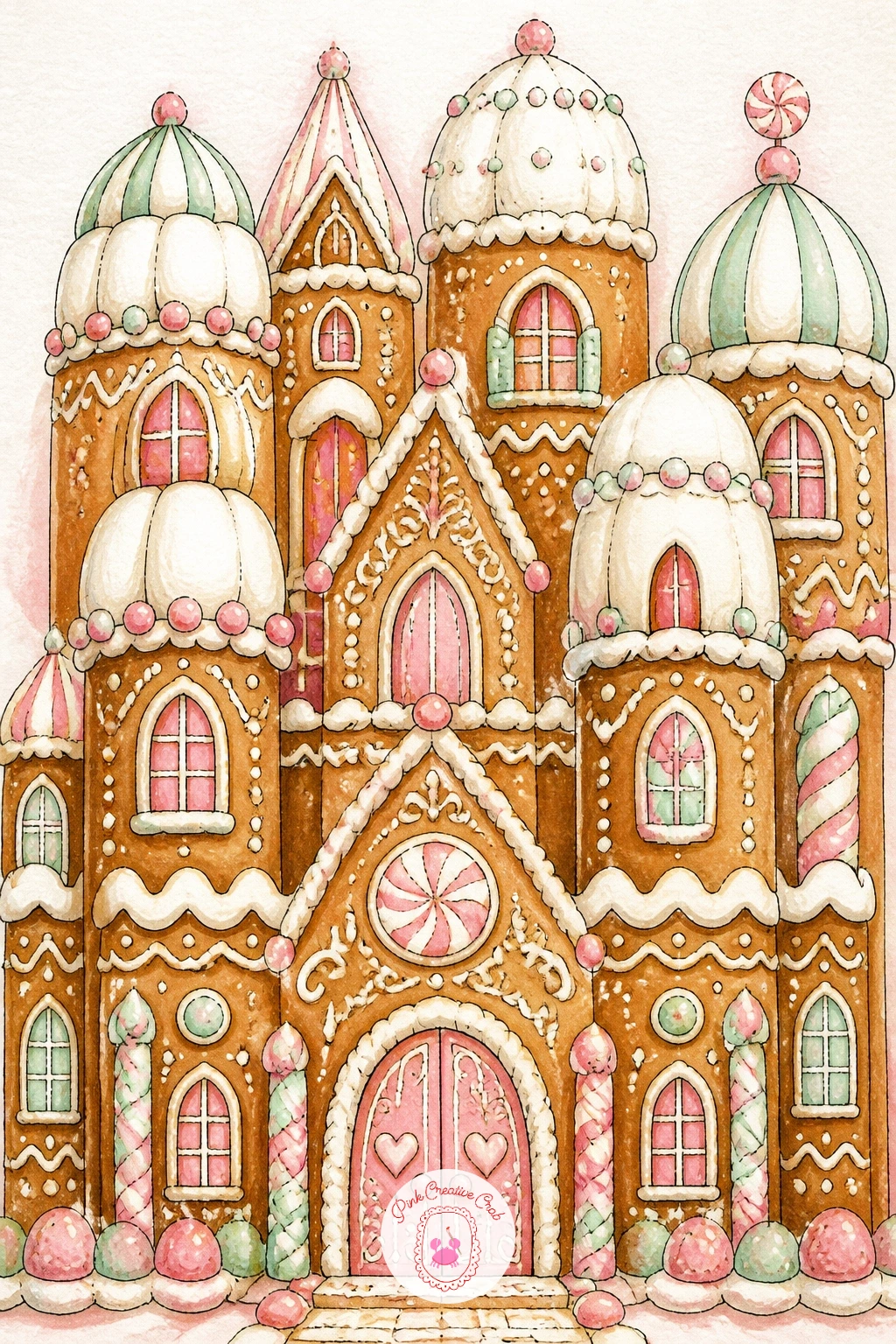
Scale things up with a gingerbread castle with marshmallow towers, the most involved structure on this list but still manageable in one sitting. Draw a wide central castle body first, then sketch three or four cylindrical towers at different heights along the top, each topped with a rounded marshmallow dome instead of a pointed roof.
Ink the central body first since it is the largest, clearest shape, then ink each tower working left to right so the proportions stay consistent across them. Compare each tower’s height against the central body as you go, no tower should be taller than the main structure, which keeps the silhouette readable as one castle rather than scattered shapes.
Paint the body in warm caramel brown, then paint the marshmallow domes in soft white with the faintest pink or mint tint on one side for roundness. A row of small white gouache icing dots along the base ties all the towers together as one building.
If four towers feels like a lot, two tall towers flanking a simple central block reads as a castle just as well.
You Will Need
- watercolor paper
- fine ink liner pen
- caramel brown watercolor
- soft white watercolor or gouache
- pastel pink or mint for shading
Palette: Caramel Brown,Soft White,Pastel Pink,Mint Green
Step back from the page and squint at it once the towers are inked, squinting hides detail and shows you quickly whether the silhouette still reads clearly as a castle.
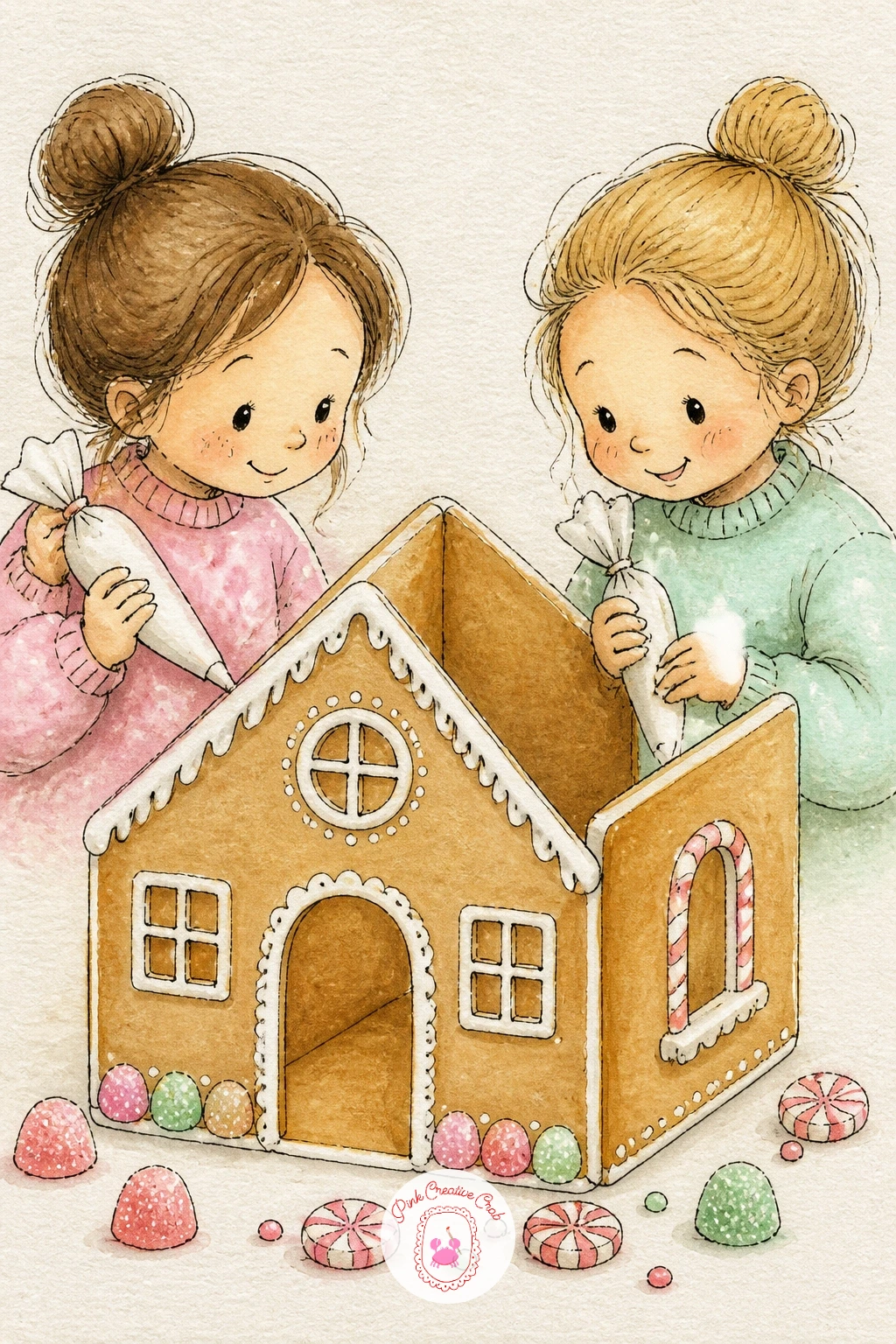
Bring in two figures with a gingerbread house being built by two friends at a table, caught mid-project with icing bags and candy pieces scattered around. Draw the house first, slightly unfinished looking with one wall section still plain, then sketch two simple seated figures on either side of it, each with a piping bag or candy piece in hand.
Ink the house, then each figure, keeping both drawn at a similar size and simplicity so neither pulls focus from the other, a scene with two figures needs that balance to feel calm rather than busy. Paint the house in your usual pastel palette, leaving the unfinished wall section a plain caramel brown to show the work in progress.
Paint the two friends in simple cozy sweaters, one pink, one mint, so they visually echo the house colors. A scattering of small loose candy shapes and a bowl of icing between them on the table finishes the scene.
If two full figures feels like a lot, just four hands entering the frame from either side, each holding a tool, tells the same story.
You Will Need
- watercolor paper
- fine ink liner pen
- caramel brown and pastel watercolor
- sweater colors for figures
- white gouache for icing bowl
Palette: Caramel Brown,Pastel Pink,Mint Green,Soft Skin Tone
Check the simple poses in this bff drawing ideas guide for ways to draw two figures sitting together without overcomplicating either one.
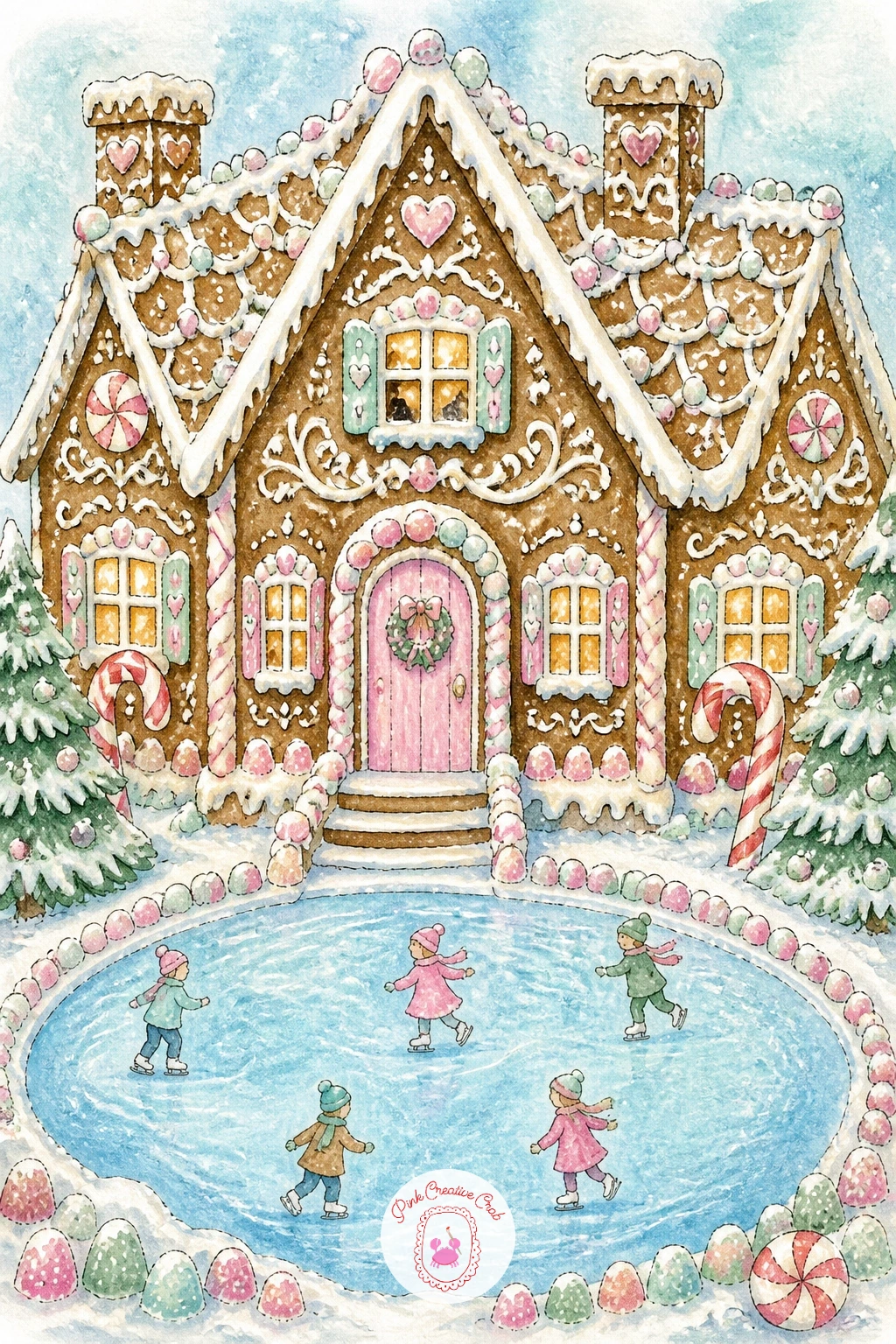
Add some gentle motion with a gingerbread house with a sugar skating pond out front, a small oval of ice with a figure or two gliding across it. Draw the house first, then sketch a wide oval pond shape at the base of the page, with one or two tiny skater figures drawn as simple stick shapes mid-glide.
Ink the house, then the pond outline, then the skaters last since they are the smallest and most delicate marks. Paint the house in your pastel palette, then paint the pond in pale icy blue, leaving streaks of untouched white paper across it to suggest the shine of ice.
Flat, evenly painted ice looks like a puddle rather than a pond, so lift a little wet paint off the pond surface with a dry tissue right after painting it, which leaves soft pale streaks that read as skate marks and light. Keep the skaters as simple dashes of a dark color with a tiny scarf flick for movement.
No tissue handy, a dry brush dragged once through the wet pond paint lifts a similar streak of light.
You Will Need
- watercolor paper
- fine ink liner pen
- pale icy blue watercolor
- house color watercolor
- dry tissue or dry brush
Palette: Icy Blue,Pastel Pink,Caramel Brown,Soft Grey
Add one tiny fallen skater sitting on the ice nearby, it is a small funny detail that makes the whole pond scene feel more alive.
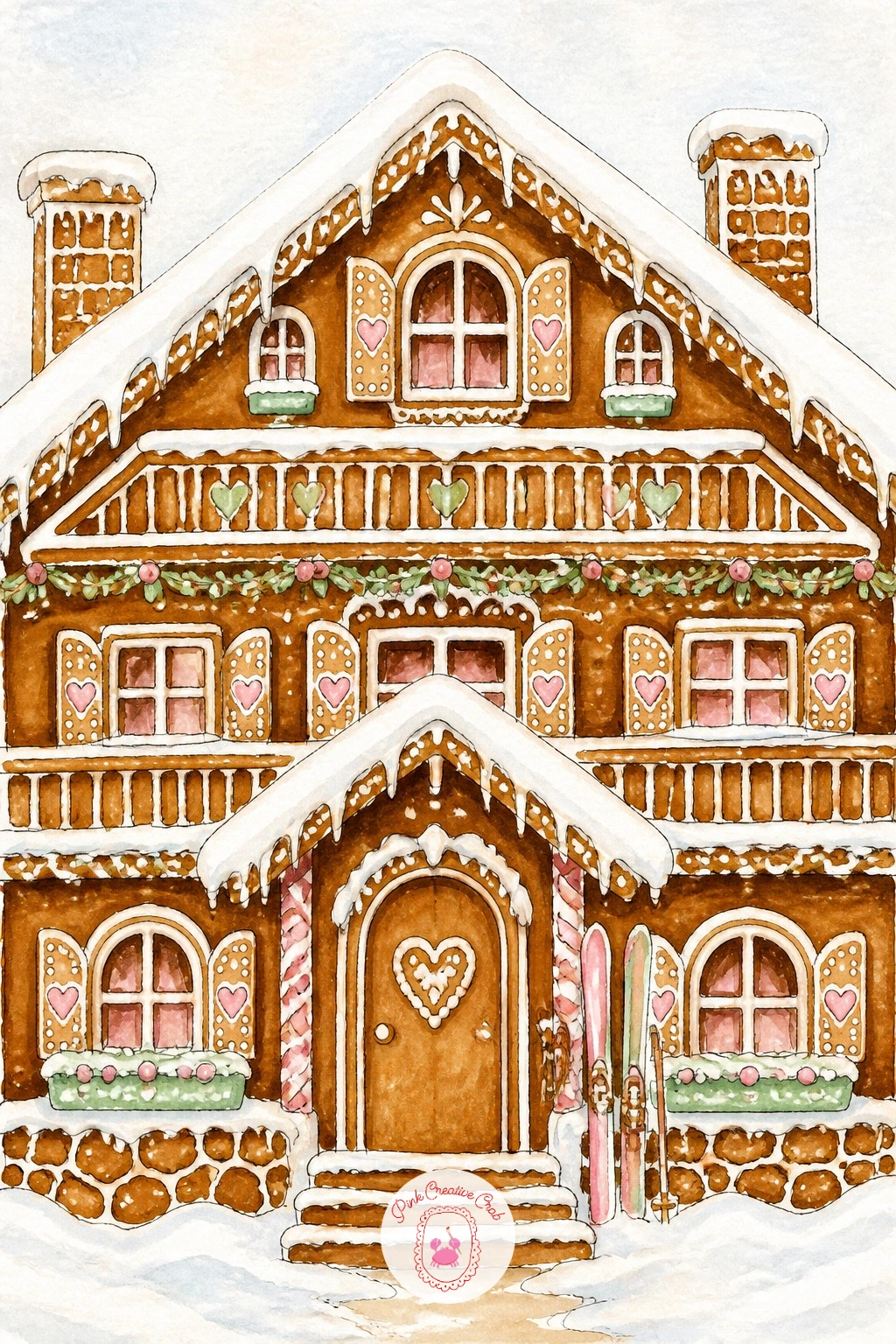
Head up the mountain with a gingerbread ski chalet, broad and low with a heavy snow covered roof and a pair of tiny skis leaning by the door. Draw a wide chalet shape with a steep overhanging roof, then sketch a small balcony along the front and two thin ski poles with skis leaning against the wall.
Ink the chalet with its roofline drawn thick and heavy to suggest deep snow weight, then ink the skis with much thinner, lighter lines so they contrast against the sturdy building. Paint the walls in deep caramel brown with mint shutters, then paint the roof in thick white gouache rather than watercolor, so it sits raised and textured like real snow.
A flat painted roof loses the cozy chalet feeling fast, so once the white gouache roof is dry, drag a dry brush loaded with a touch of pale blue-grey lightly across it for subtle snow shadow. A tiny string of warm yellow window lights finishes the mountain evening feel.
If gouache snow feels thick to control, thick white acrylic works the same way and dries with a similar raised texture.
You Will Need
- watercolor paper
- fine ink liner pen
- deep caramel watercolor
- mint watercolor for shutters
- thick white gouache for roof
- pale blue-grey watercolor
Palette: Deep Caramel,Mint Green,Titanium White,Pale Blue-Grey
Paint the sky behind the chalet in a soft dusk blue or lavender instead of plain white, it makes the warm window lights glow much more convincingly.
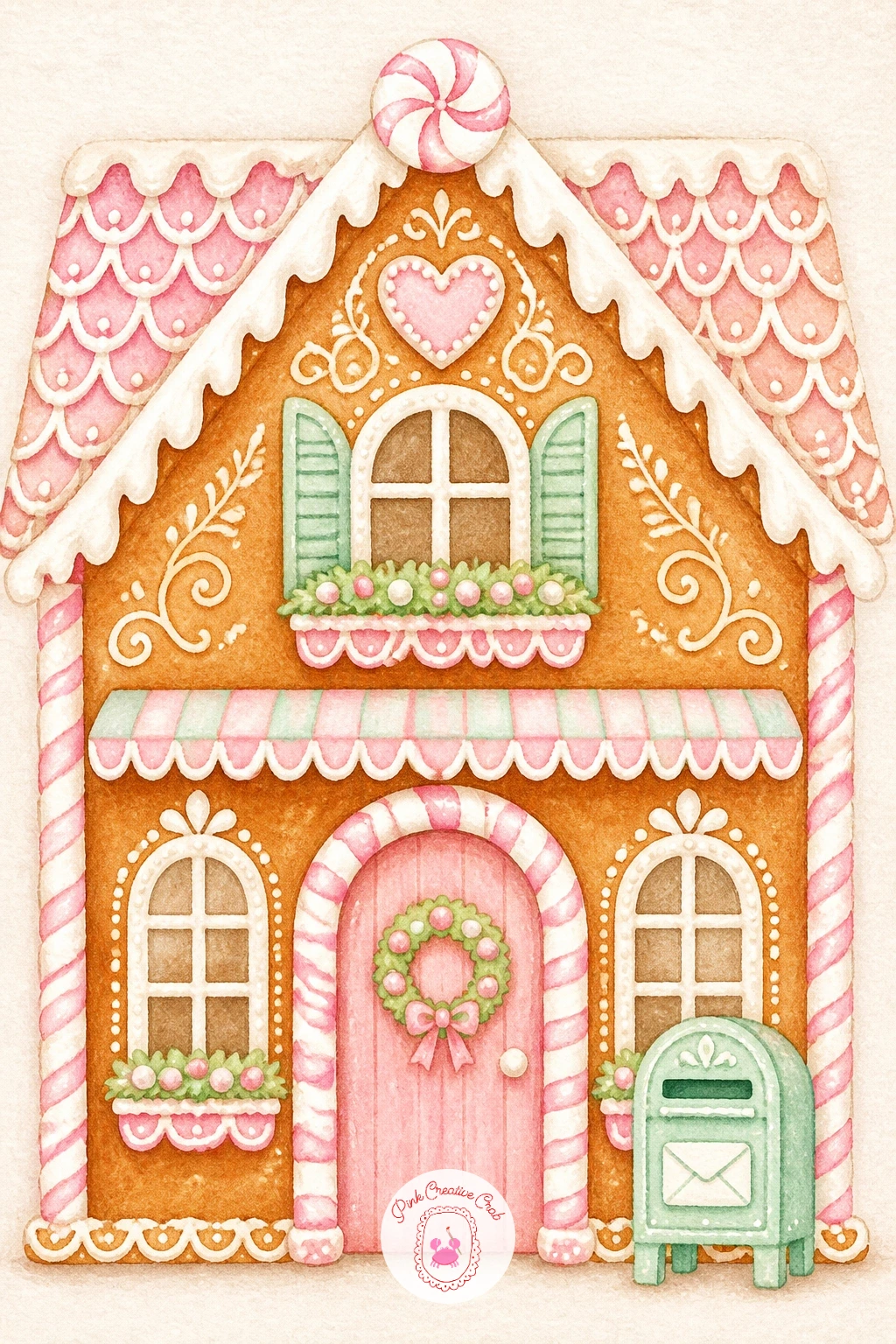
Settle back into the village with a gingerbread post office, a simple square building given character by its signage and a small mailbox out front. Draw a plain rectangular building with one large window and a door, then sketch a small round mailbox post standing just beside the entrance.
Ink the building first, then the mailbox, keeping the mailbox shape simple, a cylinder on a thin post with a small flag. Paint the building walls in warm caramel or pastel pink, then paint the mailbox in a contrasting mint or deep red watercolor so it stands out clearly against the wall behind it.
A plain gingerbread building can feel a little flat without one clear focal detail, so give the post office a single decorative touch, a wreath on the door or a string of small white gouache icing hearts along the window, rather than several competing details. A couple of tiny white gouache envelope shapes tucked by the mailbox base add a nice finishing touch.
If a mailbox feels fiddly, a stack of simple parcel shapes by the door tells the same story.
You Will Need
- watercolor paper
- fine ink liner pen
- caramel or pastel pink watercolor
- mint or red watercolor for mailbox
- white gouache
Palette: Pastel Pink,Caramel Brown,Mint Green,Deep Red
Keep this one deliberately plain and calm compared to busier ideas on this list, a quiet, simple building works well as a restful page between more detailed scenes.
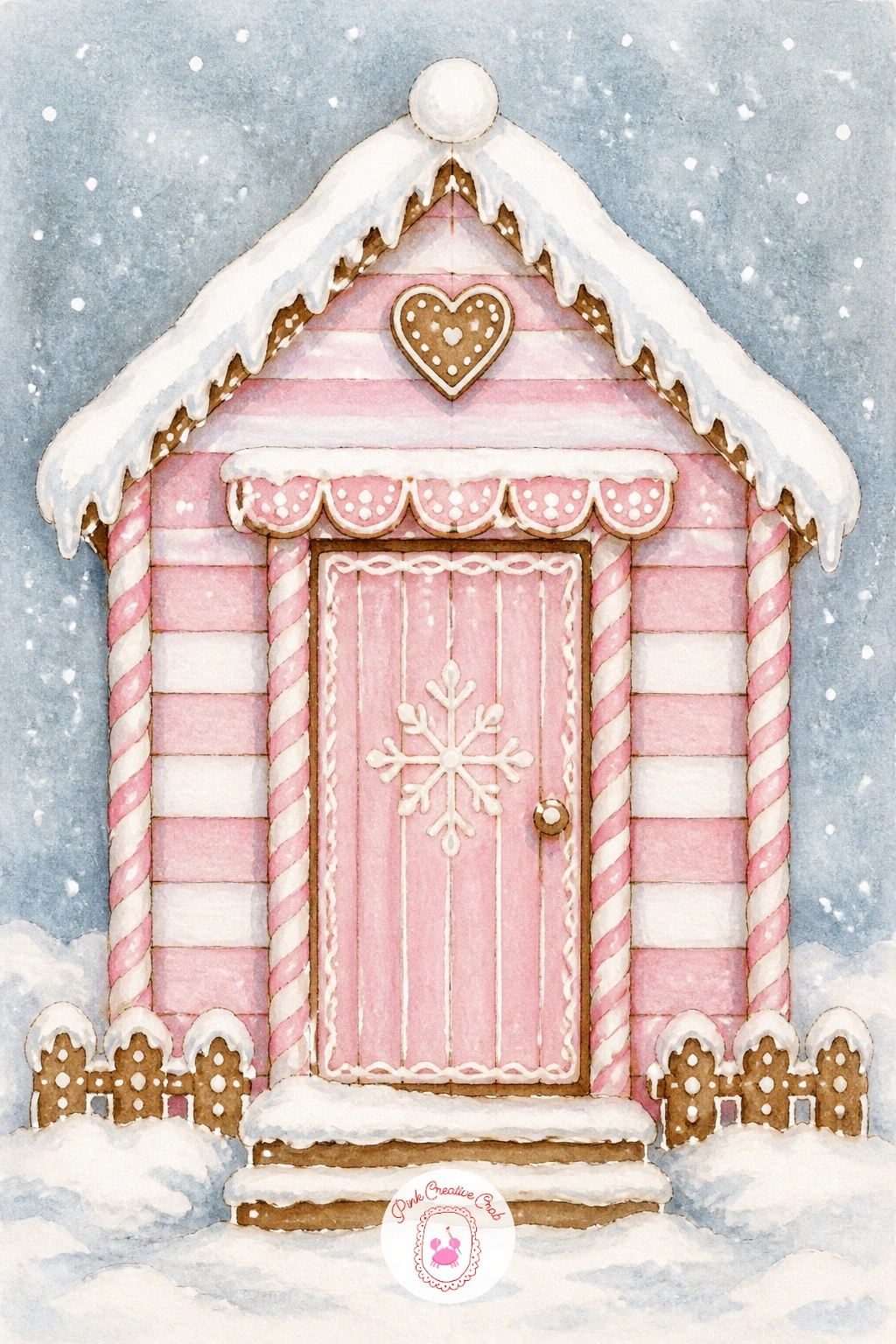
Mix seasons with a gingerbread beach hut in winter, a striped summer shape dusted unexpectedly with snow. Draw a small square hut with a pointed roof and vertical plank lines down the walls, then sketch a light scattering of snow along the roofline and a few snow patches on the ground around it.
Ink the hut with its plank lines drawn as simple evenly spaced verticals, then paint the walls in alternating pastel pink and white stripes like a classic beach hut. Once dry, dot thick white gouache snow along the roof edge and a few larger patches on the ground, letting it sit raised and textured rather than flat.
Mixing a summery hut with winter snow can look confused if you add both equally, so let the snow clearly dominate, more white gouache than stripe color showing, so the wintery mood wins over the beachy one. A single bare, leafless little bush beside the hut reinforces the season.
If plank stripes feel tedious, a plain solid colored hut with just a striped door still carries the beach hut charm.
You Will Need
- watercolor paper
- fine ink liner pen
- pastel pink watercolor
- white watercolor and gouache
- fine detail brush for snow dots
Palette: Pastel Pink,Titanium White,Soft Grey,Caramel Brown
Paint the sky in a pale winter grey-blue rather than leaving it white, it separates the snow on the roof from the background so both read clearly.
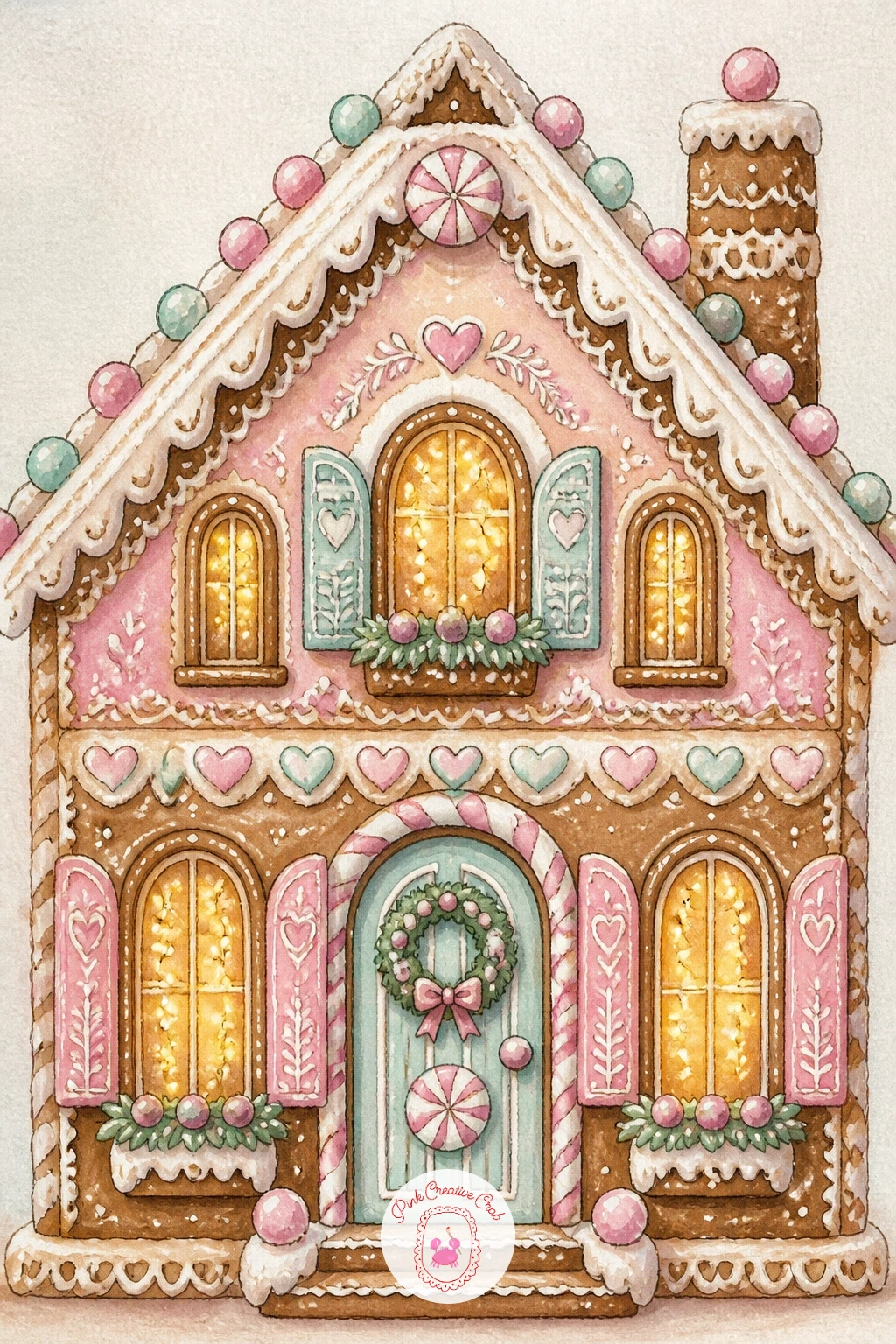
Close the list on a warm note with a gingerbread house with fairy lights inside, glowing softly through its windows at the end of a long drawing session. Draw the house as a simple cottage shape with two or three visible windows, then pencil a scattering of tiny dots inside each window to mark where the lights will sit.
Ink the house fully, then paint the walls in warm caramel or pastel pink as the evening light source, so the inside glow needs to read warmer and brighter than the walls around it. Paint each window first with a wash of warm yellow, then once dry, dot each pencil mark with a tiny bead of white or pale yellow gouache for the lights themselves.
Too many evenly sized light dots can look mechanical, so vary their size slightly and let a few sit closer together than others, the way a real string of lights bunches and spreads unevenly. A soft yellow glow painted just outside each window frame, blurred slightly with a damp brush, finishes the warmth.
If gouache dots feel fiddly, a fine metallic gold gel pen gives the same twinkling effect with one quick pass.
You Will Need
- watercolor paper
- fine ink liner pen
- warm caramel or pastel pink watercolor
- yellow watercolor for windows
- white or pale yellow gouache
Palette: Caramel Brown,Warm Yellow,Pastel Pink,Titanium White
Paint this one in the evening under lamp light if you can, it is easier to judge how warm and bright the window glow should feel against real low light.
What to Do Next
Pick one house from this list, the pastel pink cottage or the Scandi cabin are the easiest places to start, and set yourself up with watercolor paper, a fine ink liner and a little white gouache for the icing. Sketch it light, ink it clean, paint it warm, and let the icing go on last.
Frequently Asked Questions
What paper works best for a gingerbread house drawing in watercolor and ink?
Cold press watercolor paper works best, since it has enough texture to hold paint without buckling. A pad around nine by twelve inches gives plenty of room for the house to fill the page comfortably.
Should I ink the house before or after painting it?
Ink the house before painting it, using a waterproof fine liner so the lines will not smudge under the wash. Painting over dry ink gives you a cleaner, more finished look than painting first and inking after.
How do I make the icing details look crisp and bright?
Add white gouache or a white gel pen only after the watercolor underneath is completely dry. Painting icing onto wet or damp paint makes it spread and lose its crisp edge, so patience here matters most.
What if I do not have gouache for the icing?
A white gel pen is a good substitute for gouache and gives a similarly crisp, opaque line straight onto dry paint. It is especially handy for thin details like scallops, fence stripes or window light dots.
How do I keep a pastel gingerbread house from looking too sweet or flat?
Balance every pastel color with a warm caramel brown somewhere nearby, usually the house walls or roof, so the pastel reads as an accent rather than the whole palette. One deeper shadow color also keeps the piece from looking flat.
Have any thoughts?
Share your reaction or leave a quick response — we’d love to hear what you think!
-
 0
-
0
-
0
-
0
-
0
-
0


