A cat valentine card gives you the best excuse to draw something soft, funny and a little bit silly, and you only need a fineliner and two markers to pull it off. These ideas lean on cats because cats already do half the work for you: the curled tail, the squinted eyes, the way they flop into anything heart-shaped.
Below you will find 31 small scenes, from a kitten peeking out of a chocolate box to two cats sharing one strand of spaghetti, each one sized to finish in a single sitting. Grab your pen, pick whichever one makes you smile first, and start there.
Using these images: free for personal projects such as printing, coloring, cards, journals and gifts. Handmade items that include them may be sold up to 30 pieces per design. More than that is commercial use and is not permitted, and neither is selling or sharing the images themselves or passing them off as your own. Please ask before any other use.
Start with the easiest scene on this whole list: a kitten peeking out of a heart-shaped box of chocolates. Draw the heart outline first in fineliner, a wide symmetrical curve, then add the kitten’s head and two paws resting on the rim as if it just climbed in.
Fill the box edge with small scalloped lines to suggest a paper frill, then color the heart cherry red and leave a few chocolate shapes white or lilac for contrast. Keep the kitten’s face simple: two dot eyes, a small triangle nose, a closed smile.
If the heart comes out lopsided, fold your paper in half first and draw only one side, then trace it through to the other, the way a lot of these valentine gift tags handle the same shape.
Try this today: sketch the heart lightly in pencil first so you can fix the curve before you commit in pen.
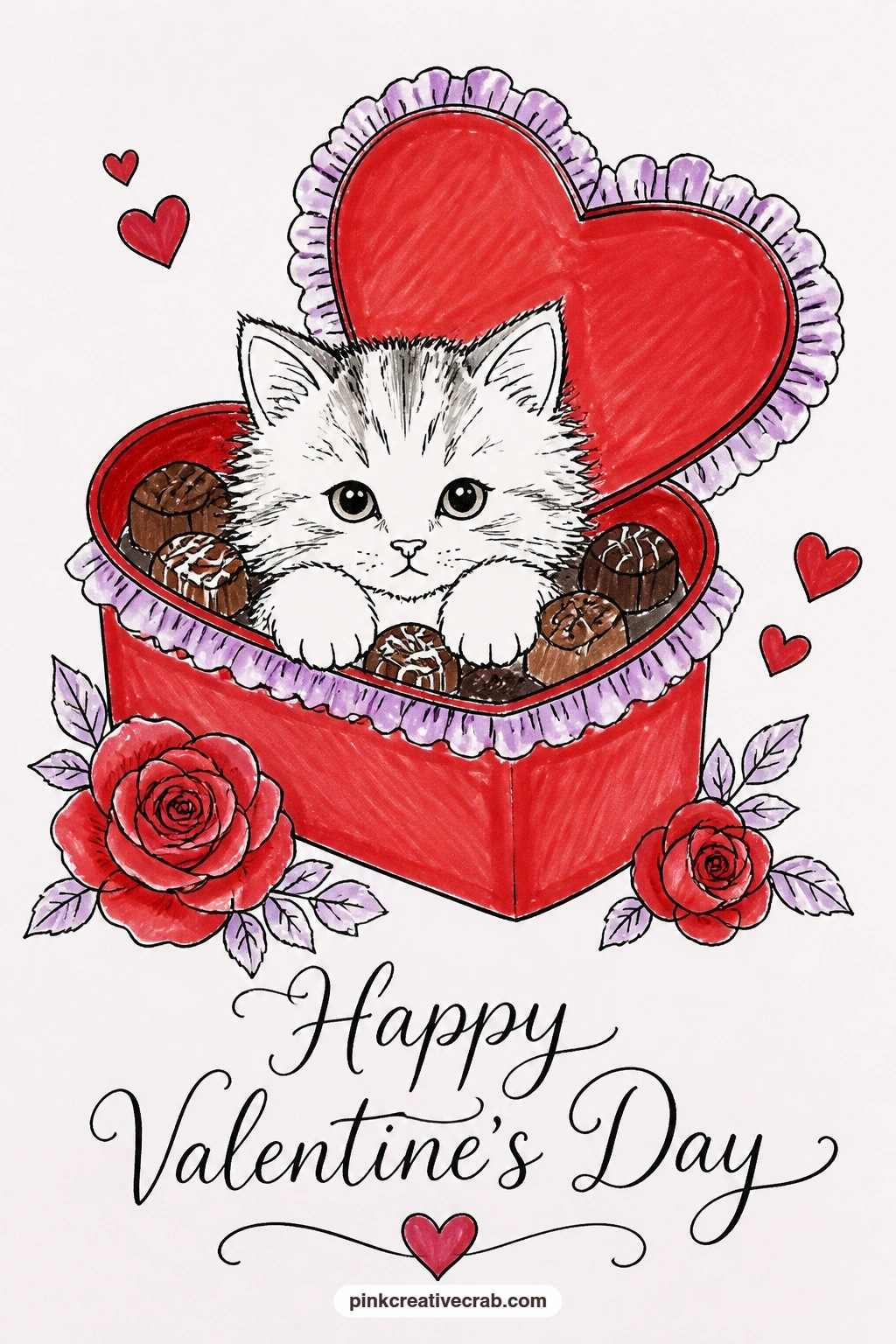
Palette: Cherry Red,Soft Lilac,Warm White
Move from the chocolate box to something even looser: a cat curled around a red yarn ball wound into a heart shape. Draw the cat’s body first as one soft oval with a tucked head, then loop the yarn around and through its paws in a rough heart.
The trick with yarn is to leave it messy. A perfect spiral looks stiff, so let a few strands trail loose at the edges and cross over themselves. Color the yarn cherry red and the cat whatever shade of grey or lilac shading you like for its fur.
If the heart shape gets tangled and unreadable, add two or three single red strokes radiating out from the center to read clearly as yarn without overworking the loops.
Measure the cat’s body against the heart before inking: the cat should be roughly twice the size of the yarn heart so it reads as curled around it, not dwarfed by it.
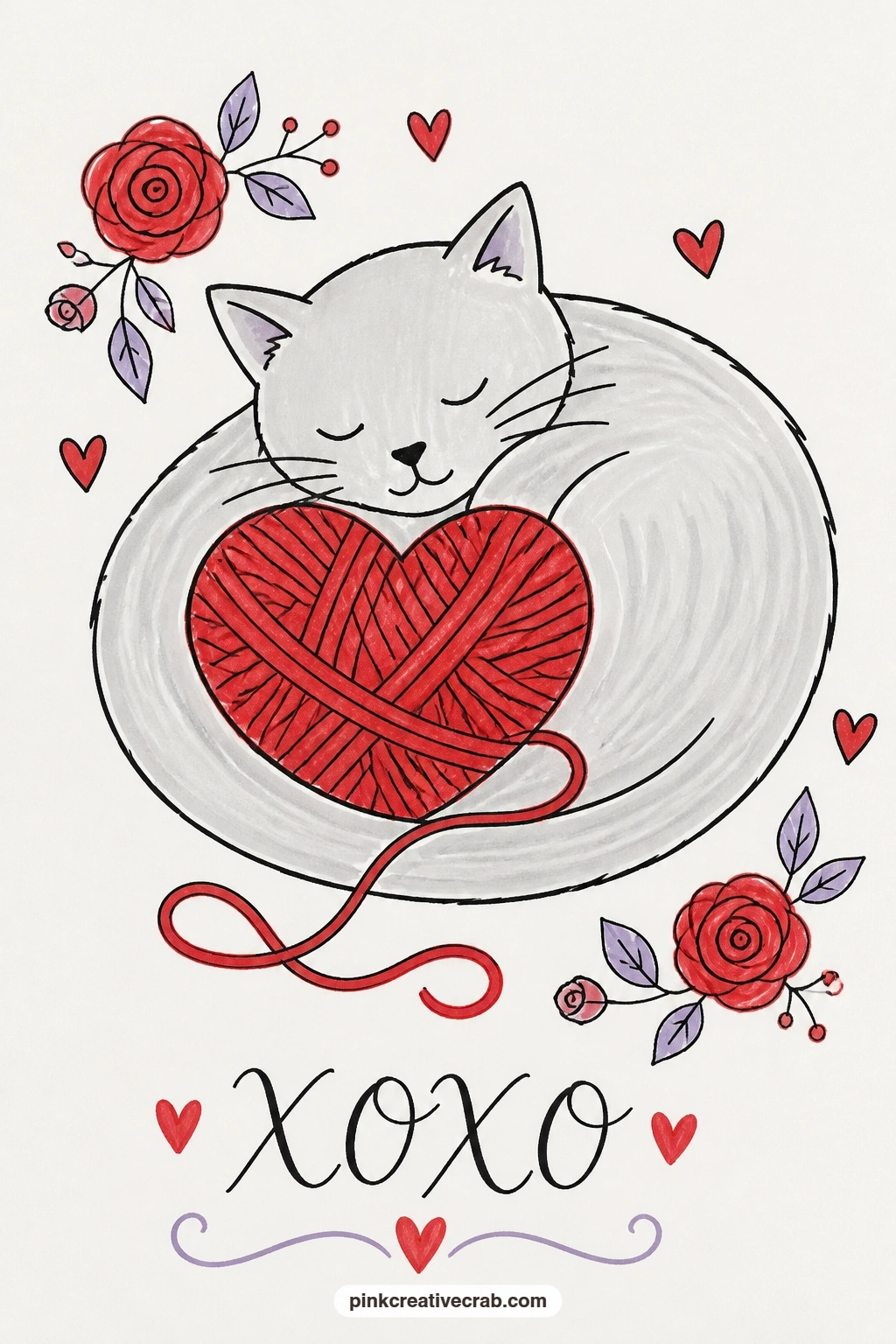
Palette: Cherry Red,Dove Grey,Soft Lilac
From a quiet curled-up cat to a noisier scene: one cat serenading another on a rooftop under a crescent moon. Block in the rooftop as a simple triangle or two angled lines first, then place both cats sitting upright, one with its head tipped back mid-song.
Eye level matters here. Draw the horizon low on the page so both cats sit above it, silhouetted against the sky, and put the crescent moon high and to one side so the light falls from above and behind them.
If the singing cat looks stiff, open its mouth into a small oval and tilt its chin up, that single change sells the whole gesture. Color the moon and a scatter of small hearts floating between the two cats in cherry red, leave the rooftop in plain black line.
No chimney needed if you are short on space: a single TV aerial drawn as three thin lines reads just as well and takes ten seconds.
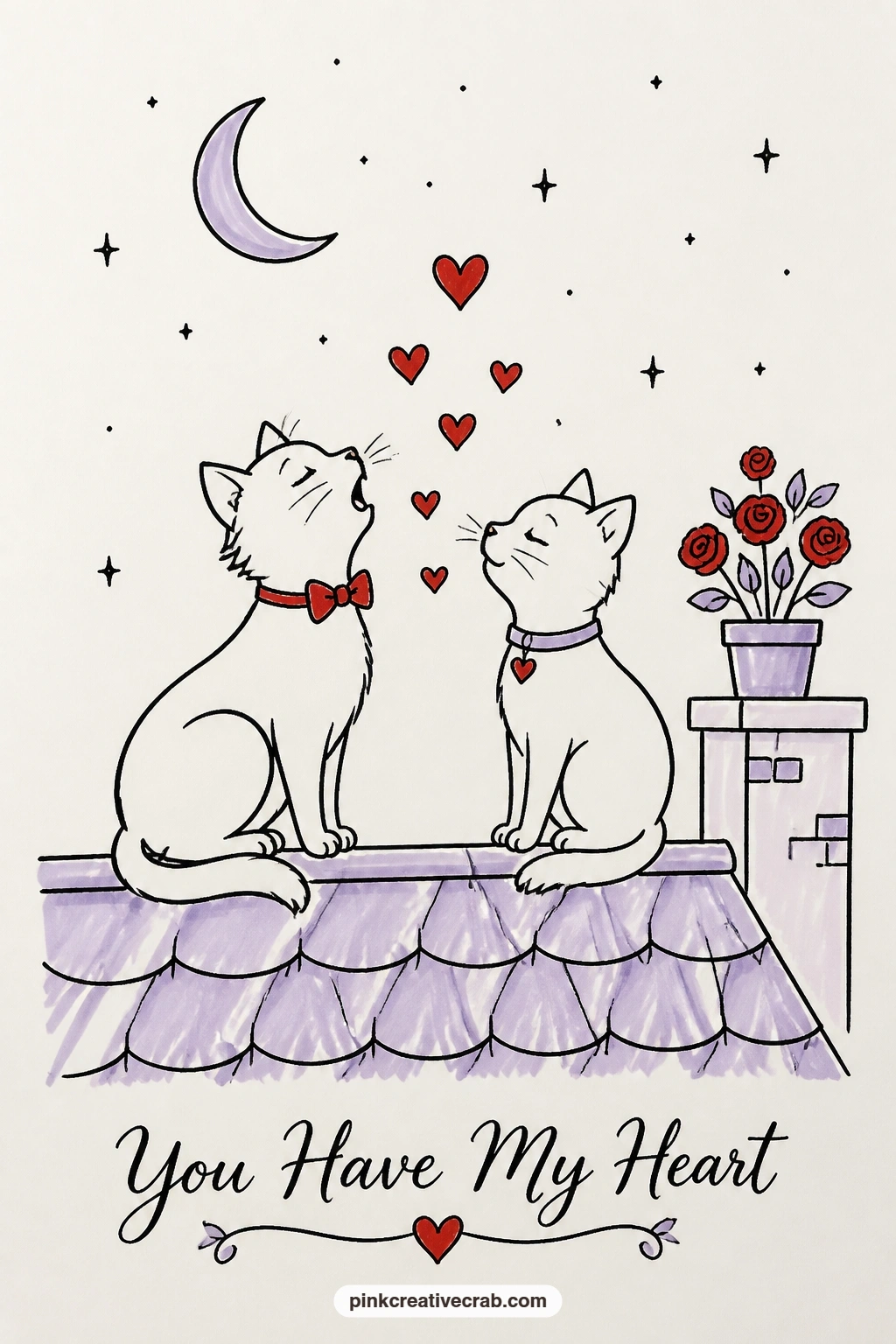
Palette: Charcoal Black,Cherry Red,Night Lilac
Give the next card a simpler pose: a fluffy cat carrying a single red rose in its mouth, walking toward the viewer. Draw the body in a gentle S curve so it looks mid-step, then place the rose stem diagonally across the face, held between the teeth.
Build the fluff with short overlapping fineliner strokes around the cheeks and chest rather than one smooth outline, that texture is what makes a cat read as fluffy instead of just round. Color the rose cherry red with a lilac shadow on one petal edge.
If the rose overwhelms the face, make it smaller than feels natural, a rose much bigger than the cat’s own head looks like a prop, not something it is gently carrying.
No red marker on hand? A red colored pencil layered twice gives the same depth without needing to blend.
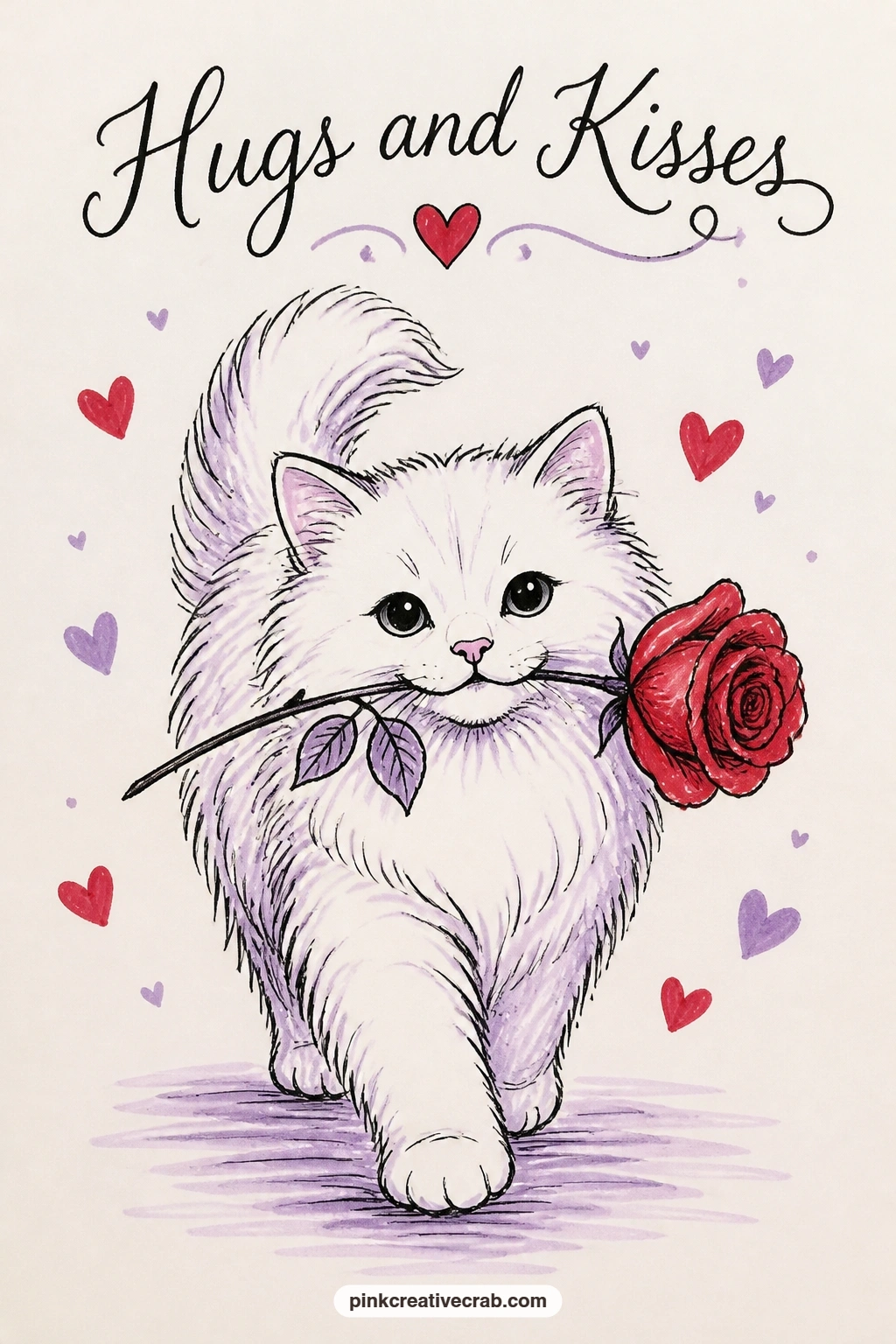
Palette: Cherry Red,Soft Lilac,Cream White
Scale right down for this one: two kittens asleep together inside one teacup, with steam curling up into a heart shape. Draw the teacup first as a simple rounded bowl with a small curved handle, then tuck both kittens inside, heads resting on each other.
The steam is the fun part. Draw two wavy lines rising from the cup rim that bend inward and meet at the top in a small heart outline, left open and uncolored so it reads as soft vapor rather than a solid shape.
If the kittens end up looking cramped, draw the cup a touch wider than feels right at first. A teacup drawn too small forces the kittens into stiff, unnatural curls.
For more cup shapes and steam tricks like this, the tea cup drawing ideas page is worth a look before you start.
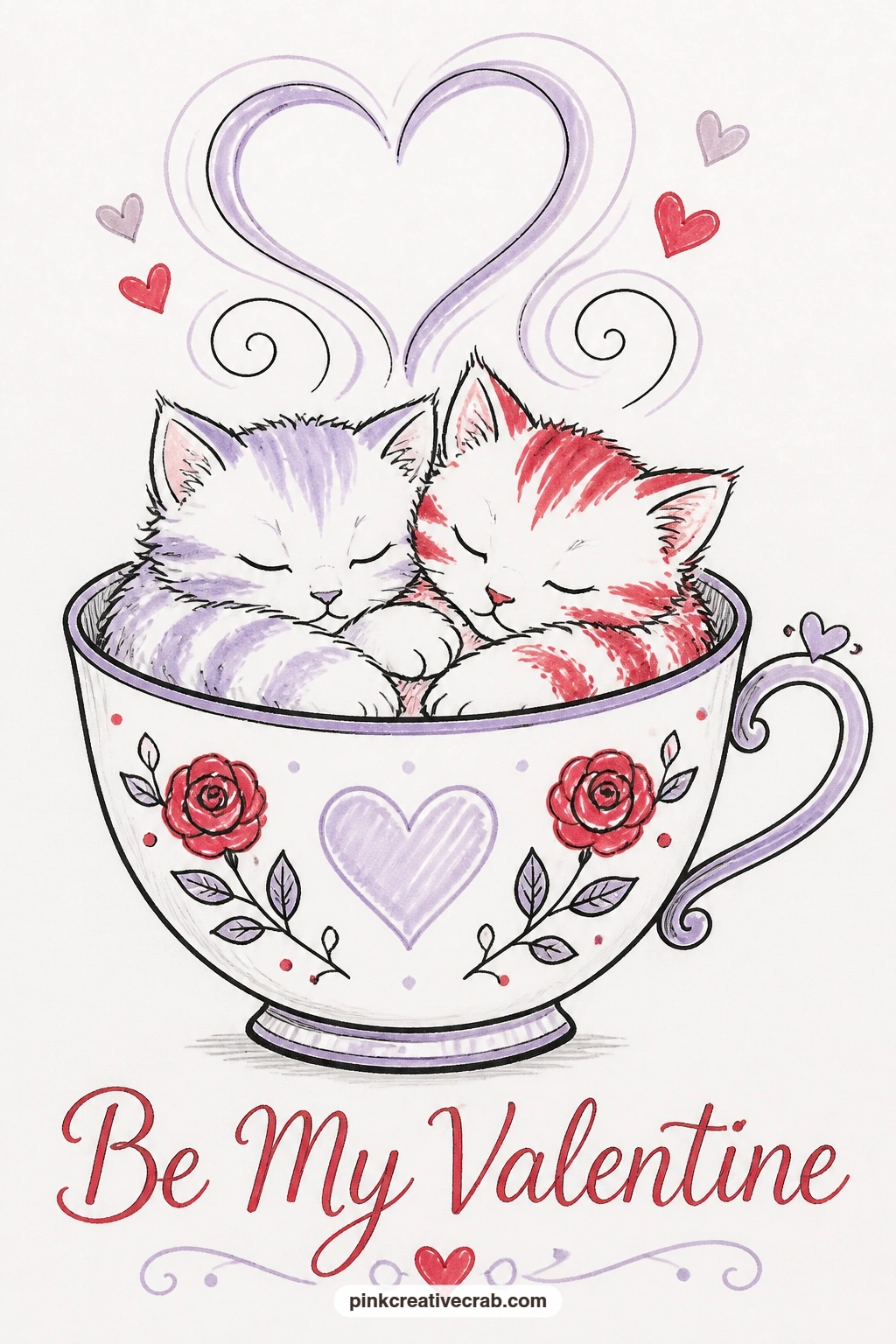
Palette: Cherry Red,Soft Lilac,Porcelain White
Add some motion with a cat batting at a heart-shaped balloon tied to its own collar. Draw the cat mid-leap, back legs stretched behind it and one front paw reaching up toward the balloon string.
Keep the balloon string loose and slightly curved rather than ruler-straight, a perfectly straight line kills the sense of movement the whole pose depends on. Color the balloon cherry red with a small lilac highlight near the top to suggest shine.
For a quick ten-minute version, draw the cat sitting still with the balloon simply floating beside it. Give yourself forty minutes and you can add a second balloon drifting past, a bit of motion-blur linework behind the reaching paw, and a shadow beneath the leaping cat.
Try this today: draw the leap first in pencil, check the paw actually reaches the balloon’s string before inking anything.
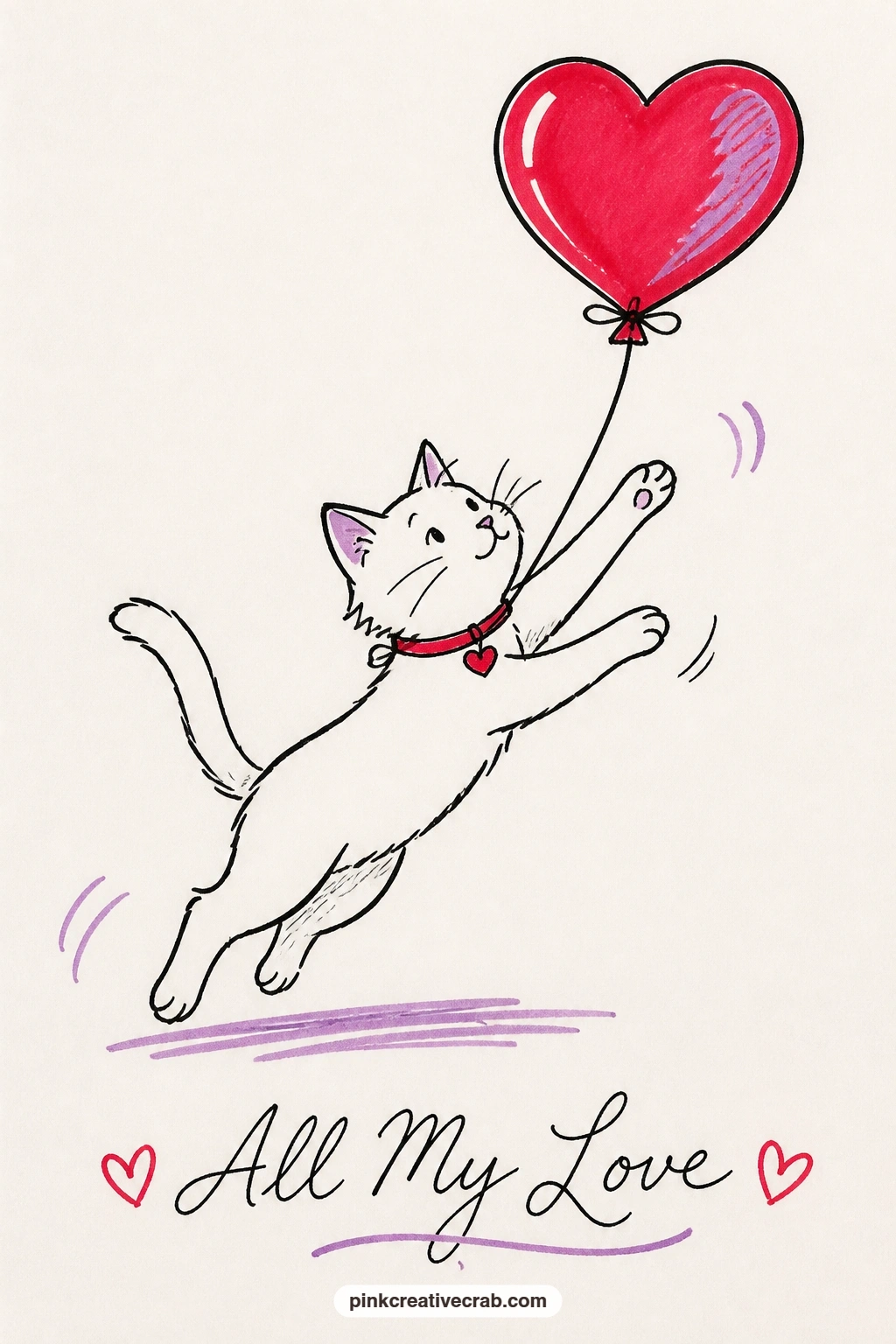
Palette: Cherry Red,Soft Lilac,Charcoal Black
Settle things down again with a cat stretched up on its hind legs to sniff a vase of tulips on a counter. Draw the vase and counter edge first as simple straight lines, then build the cat’s stretched body reaching up from below, front paws braced against the vase.
Light matters here: place a soft light source coming from one side so the tulip petals get a slightly darker edge on the shadowed side, which gives the bouquet some roundness without much extra work.
If the stretch looks awkward, check that the back legs stay bent and grounded while only the front half lifts, a cat fully airborne reads as jumping, not sniffing.
Color two or three tulips cherry red and the rest left white with a thin lilac outline for variety.
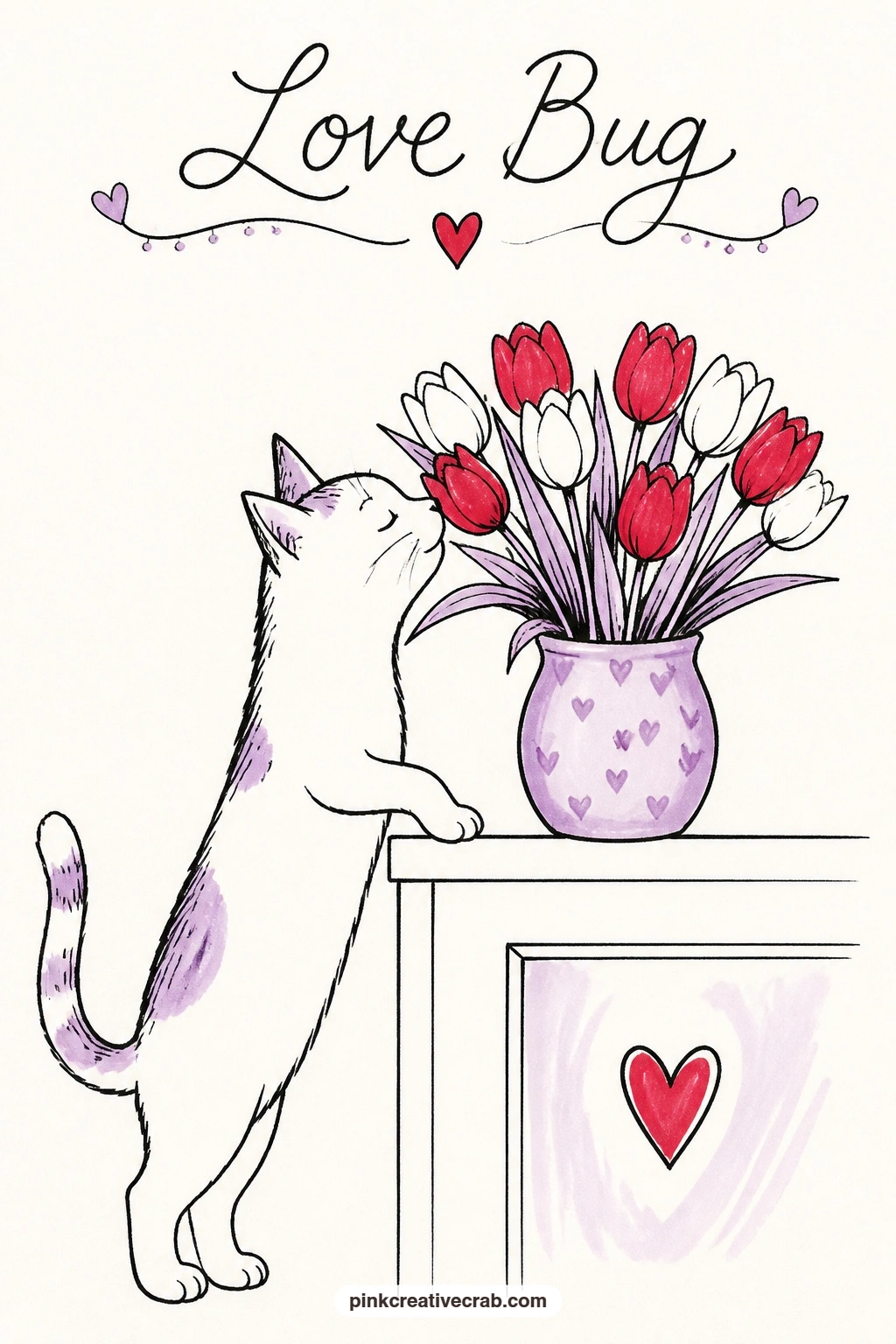
Palette: Cherry Red,Soft Lilac,Leaf Green
Bring in a second small character: a cat sharing a tiny heart balloon with a little mouse friend, each holding one side of the string. Draw the cat sitting first, larger and calm, then add the mouse standing on its hind legs beside it, much smaller in scale.
Keep the size difference clear and consistent: the mouse’s whole body should be about the size of the cat’s head, which is what sells the friendship-not-prey read of the scene.
If the two characters feel disconnected, angle both their heads slightly toward the balloon between them rather than toward each other, that shared focus point ties the composition together more naturally than eye contact would.
Color the balloon cherry red and give the mouse a small lilac ear lining for a soft finishing touch.
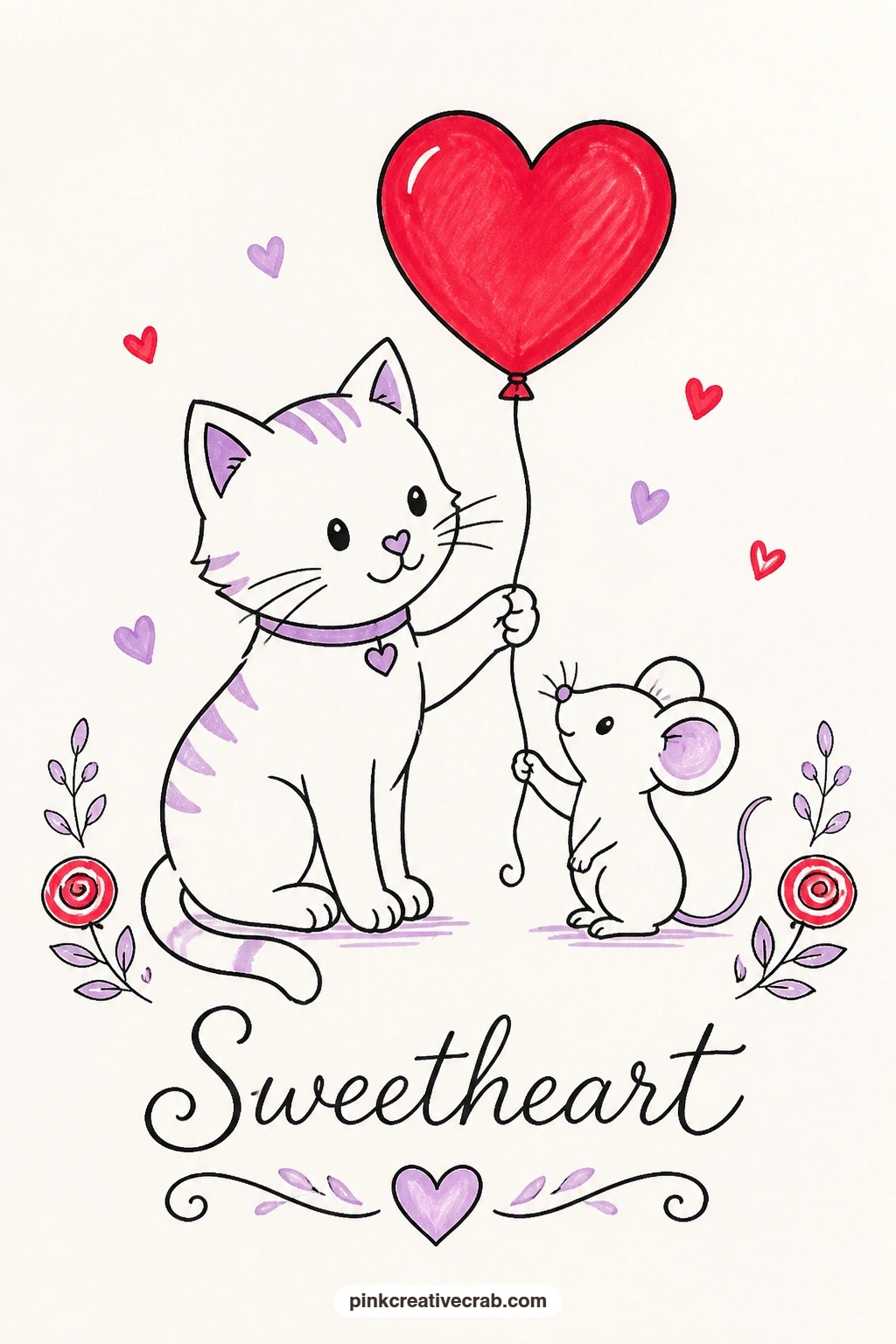
Palette: Cherry Red,Soft Lilac,Warm Grey
Reference a real mouse’s proportions if this feels off: the ears and tail are large relative to the body, and leaning into that makes the character instantly readable.
Flip the flower idea around: a cat sitting inside a flower pot stuffed full of pink tulips, as if it climbed in to nap among them. Draw the pot as a simple trapezoid first, then the cat’s rounded body filling most of the opening, with tulip stems and heads poking up around its shoulders.
Overlap is what sells this one. Let two or three tulip stems cross in front of the cat’s body rather than lining up neatly behind it, which makes the cat look properly tucked into the pot instead of pasted beside it.
If the pot looks too small once the cat is in, widen it before inking, a pot drawn to realistic cat-sized proportions almost always reads too cramped on paper.
Color most tulips in soft lilac with one or two picked out in cherry red so the eye has somewhere to land first.
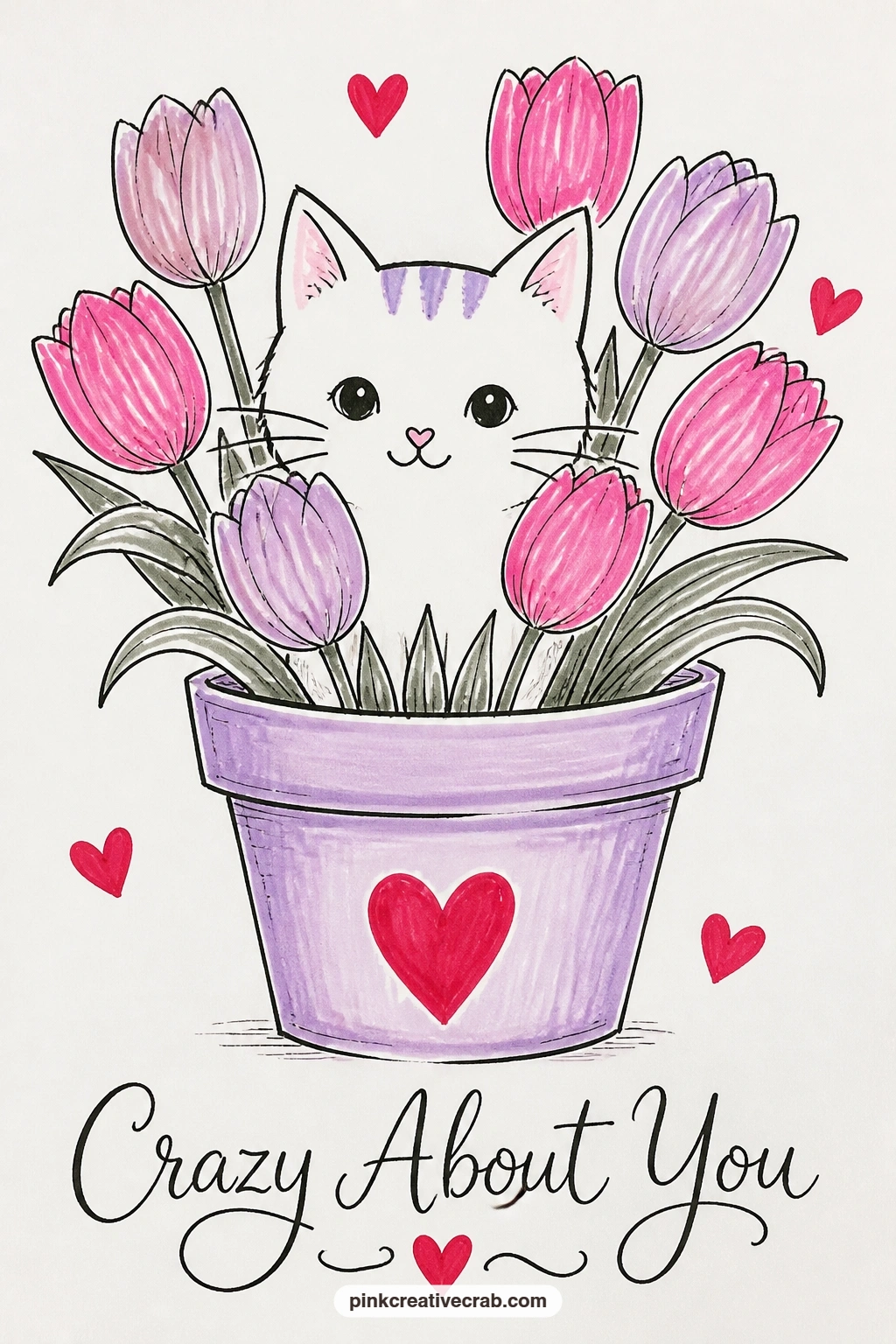
Palette: Soft Lilac,Cherry Red,Terracotta
Give yourself a break from drawing a full cat and focus on just its trail: paw prints that form a heart shape across a stretch of fresh snow, with the cat itself small and walking away at one end. Draw the cat first, tiny and simple at the top of the card, then trace a path of paw prints curving down and around into a heart before meeting back at the bottom.
Space the prints evenly along the curve rather than randomly, uneven spacing reads as a mistake rather than a deliberate trail.
If the heart shape gets lost among the prints, draw the heart outline faintly in pencil first and lay the paw prints directly on top of that guide line.
Leave the snow as plain white paper and use only a thin lilac shadow line under each print for depth, with the trail itself in cherry red.
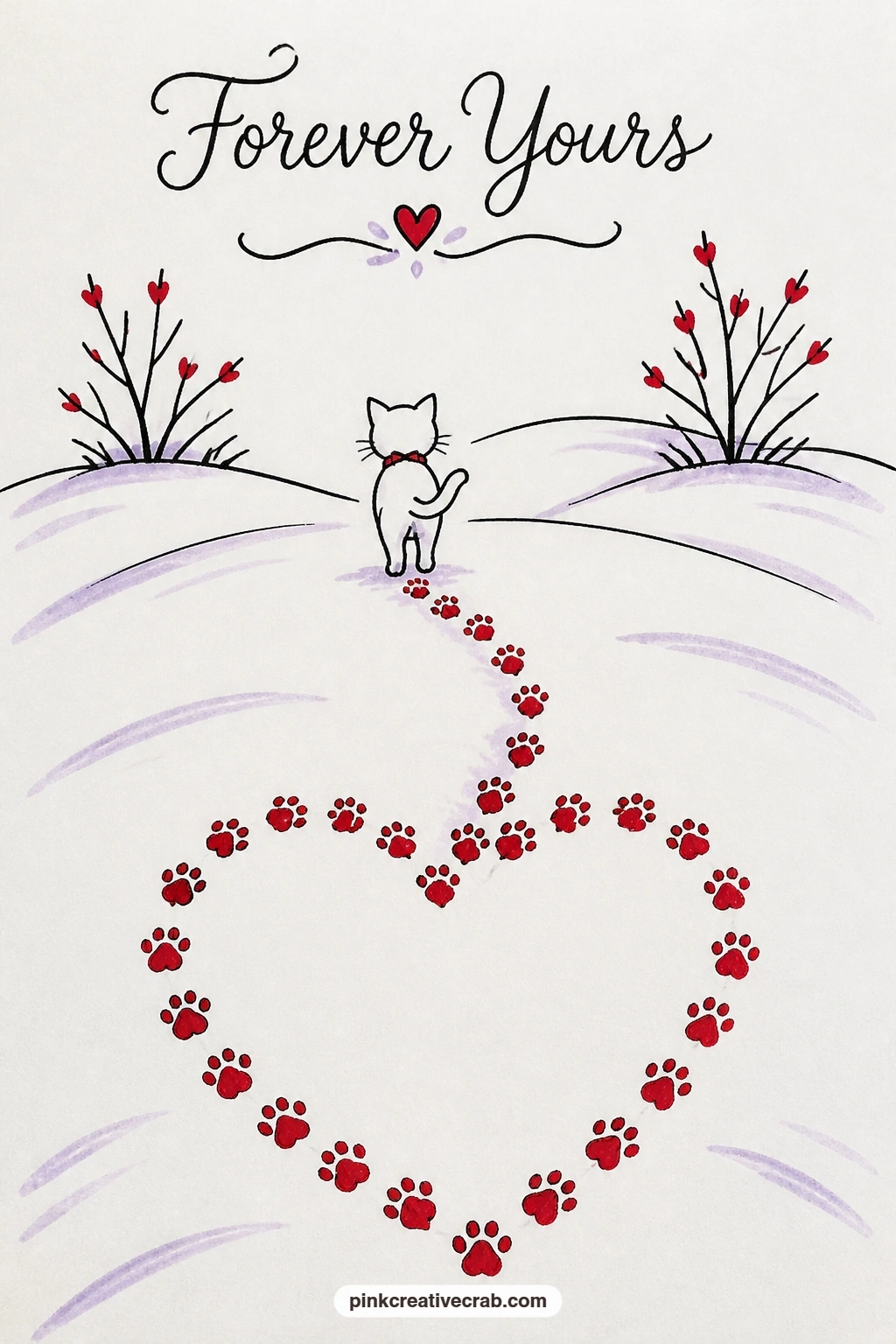
Palette: Cherry Red,Soft Lilac,Paper White
Build a small garden scene next: a cat peeking out from behind a pot of climbing roses trained up a trellis. Draw the trellis first as a simple crosshatch grid, then weave rose stems up through it before placing the cat’s face and one paw peeking around the side.
Perspective note: keep the trellis flat and frontal, facing the viewer directly, rather than at an angle, since an angled trellis is much harder to keep straight and the flat version still reads as a garden structure.
If the roses start looking like a tangled mess, limit yourself to five or six individual rose shapes rather than filling the whole trellis, fewer, clearer flowers read better than a crowd of scribbles.
Color most roses cherry red with one or two in soft lilac for variety, and leave the trellis in plain black line.
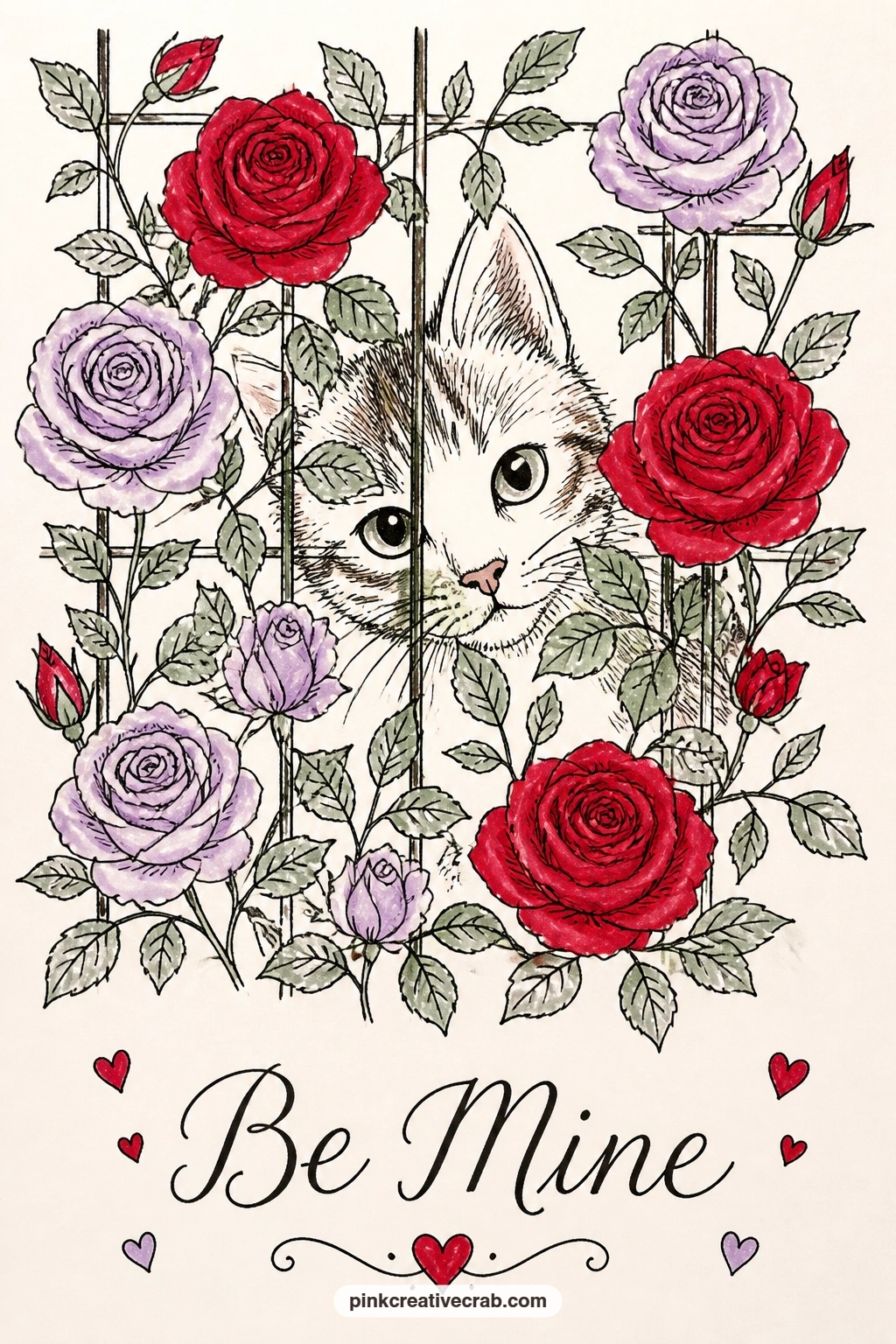
Palette: Cherry Red,Soft Lilac,Leaf Green
Slow the pace with a cozy one: a ginger cat hugging a heart-shaped cushion on a window seat. Draw the cushion first as a simple heart, slightly squashed and soft-edged rather than geometric, then wrap the cat’s front paws around it as if mid-hug.
Ginger fur reads best with a few confident stripes rather than an all-over color fill, so draw three or four curved tabby lines across the back and tail and leave the rest of the body a flat cherry-adjacent orange.
If the hug looks flat, overlap one paw in front of the cushion and tuck the other slightly behind it, that small depth cue is enough to make the pose feel three-dimensional.
Window seat too fiddly to draw today? A single diagonal line suggesting a windowsill edge is plenty of setting.
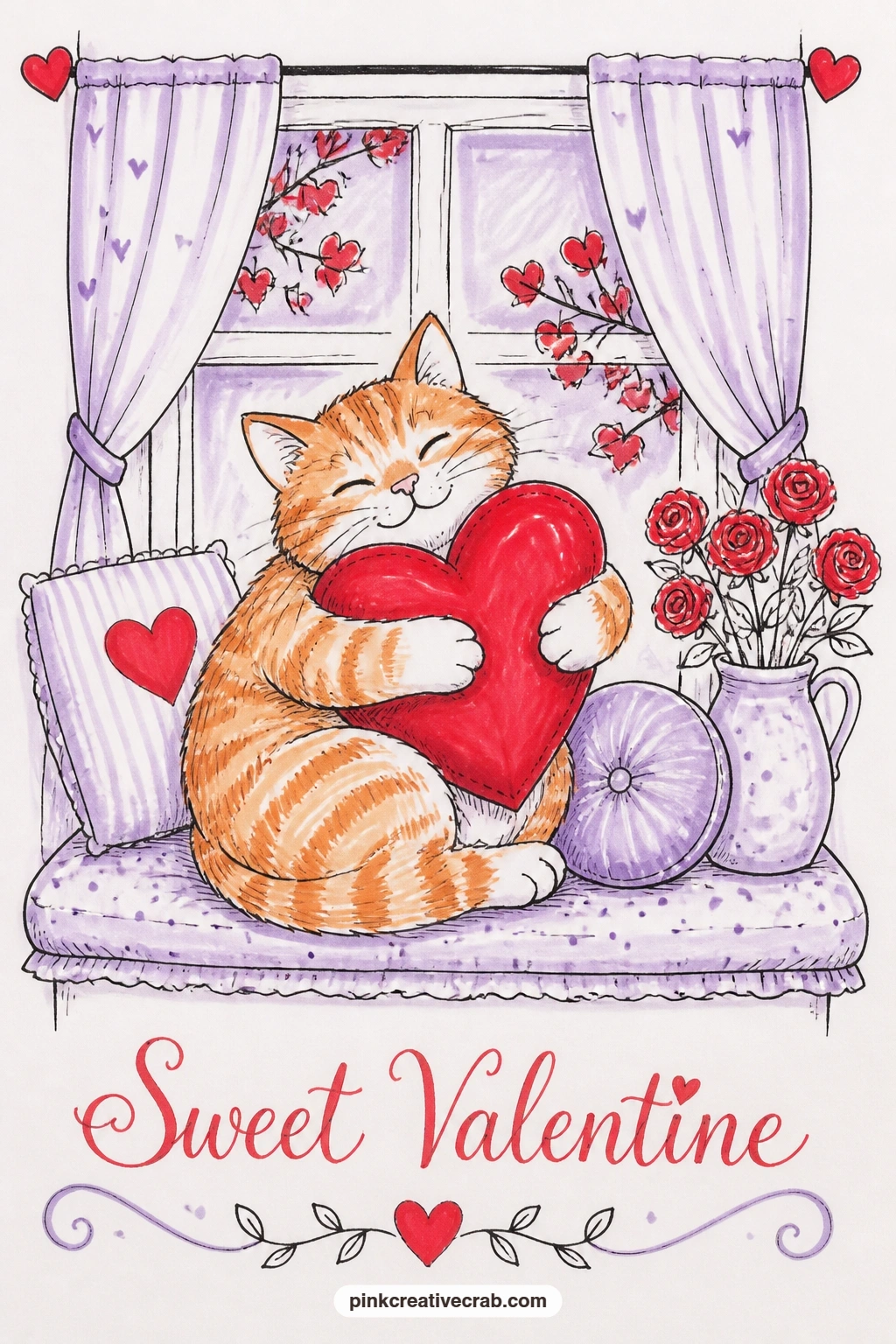
Palette: Cherry Red,Ginger Orange,Soft Lilac
Borrow the classic shared-noodle moment for two cats at a checkered table, each with one end of a single strand of spaghetti. Draw the table pattern first as a simple checkerboard, then place a plate between the two cats and the long curved spaghetti strand connecting their mouths.
The curve of the spaghetti is the whole joke, so let it dip low in the middle like a smile before rising up to each cat’s face, rather than drawing it as a straight taut line.
If the checkered table takes too long, draw only four or five squares near the plate and let the pattern fade off the edge of the card instead of filling the whole surface.
Color the spaghetti strand cherry red as a small sauce detail and keep the rest of the scene in plain black line for contrast.
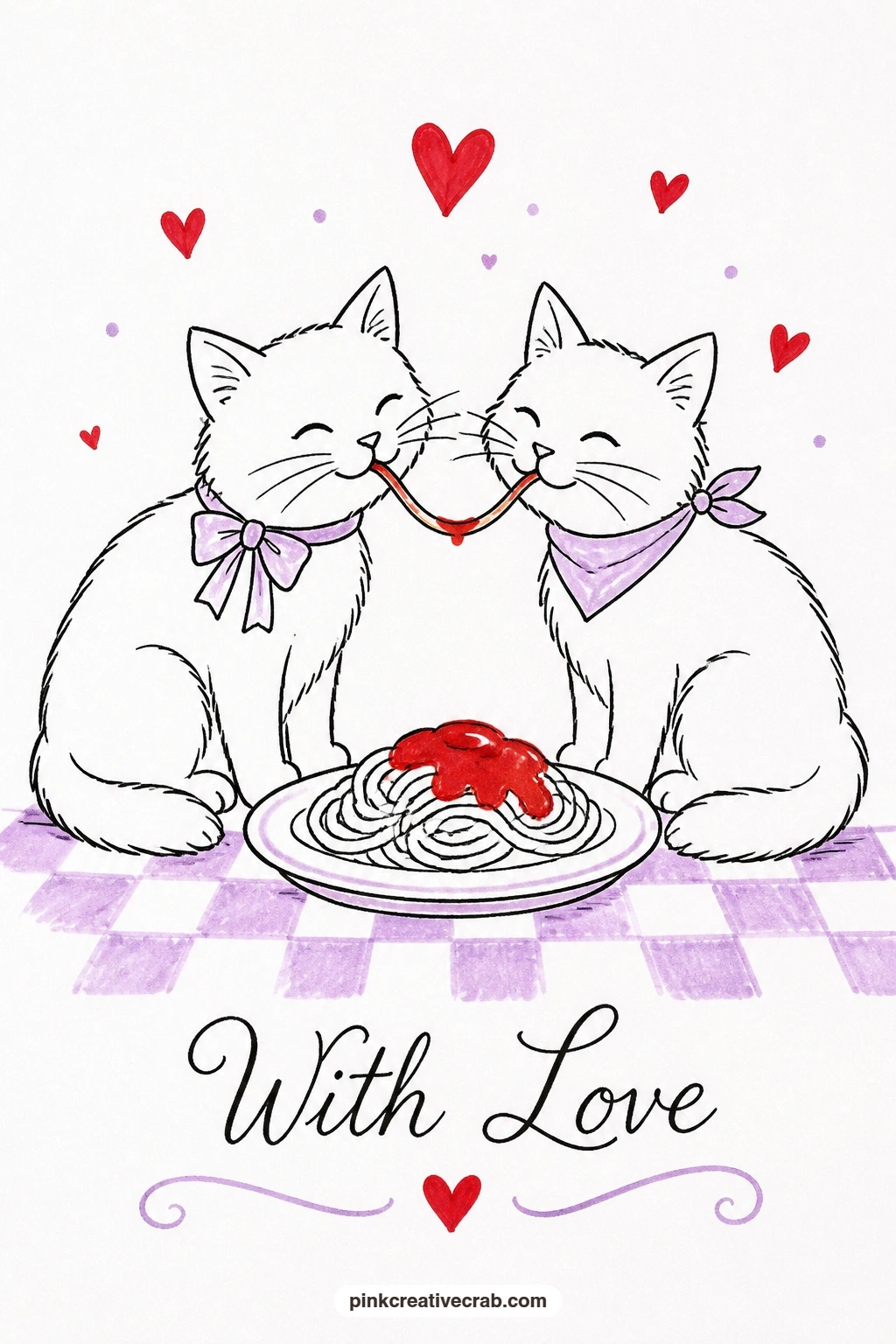
Palette: Cherry Red,Charcoal Black,Soft Lilac
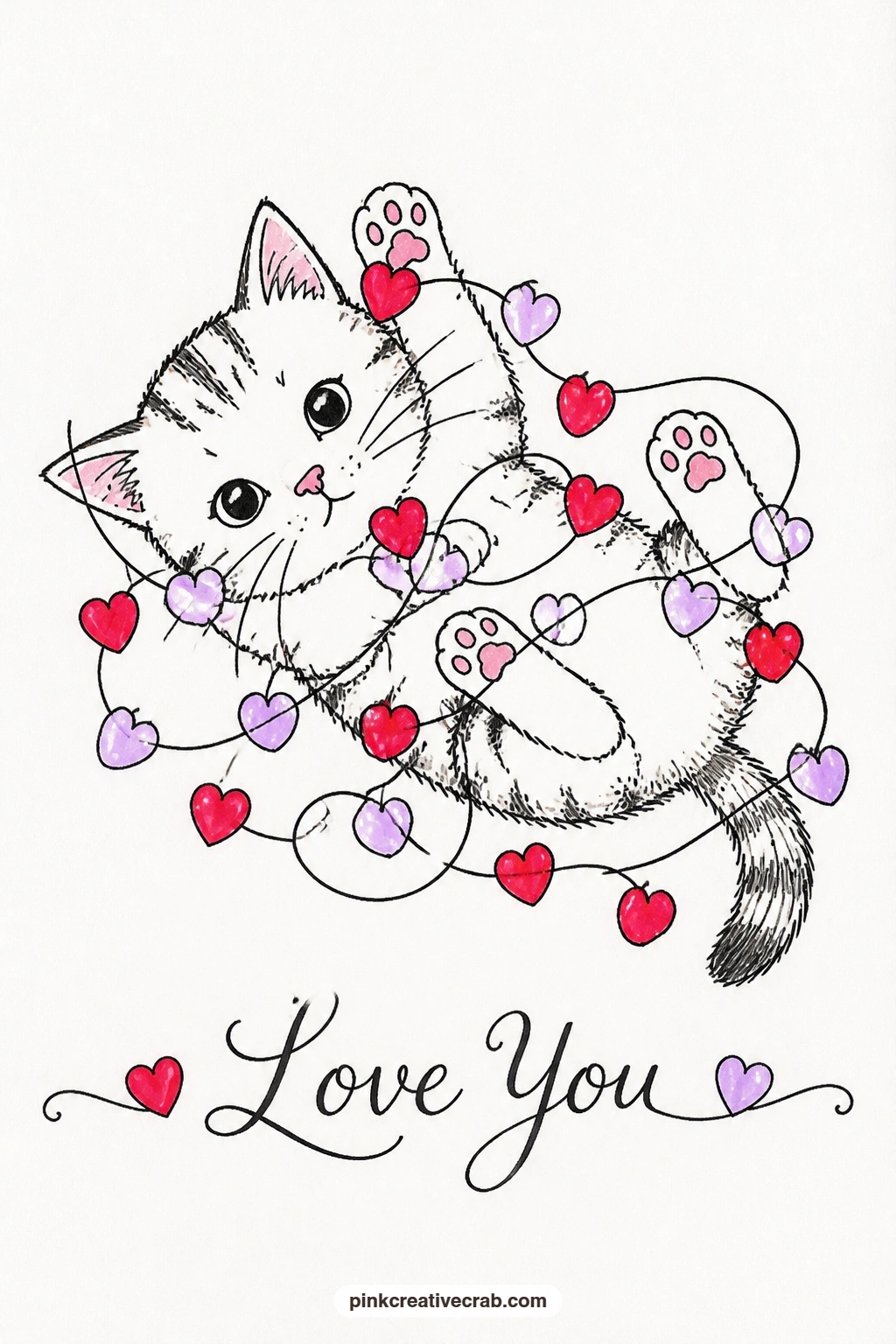
Let a kitten get playfully tangled in a string of small pink heart-shaped lights. Draw the kitten first in a tipped-over, mid-tumble pose, then loop the light string loosely around one leg and across its back, with small heart bulbs spaced along the wire.
Texture trick: use a kneaded eraser to lift a few soft highlight streaks through the kitten’s fur right where the string crosses it, that lifted light suggests the string sits slightly raised off the body instead of flat against it.
If the tangle looks too neat, add one extra loop that doubles back on itself near the kitten’s paw, real tangled string never follows a single clean path.
Color the heart bulbs alternating cherry red and soft lilac along the string.
You Will Need
- kneaded eraser
Palette: Cherry Red,Soft Lilac,Charcoal Black
Dress a cat for the occasion: a small red knit sweater with a heart on the back, drawn sitting upright and facing slightly away so the heart shows clearly. Draw the body first, then the sweater as a simple rounded shape over the torso with a scalloped hem at the bottom.
Knit texture comes from short, evenly spaced vertical dashes across the sweater rather than one solid fill, which reads as ribbed knitting without much extra effort.
If the sweater looks pasted on rather than worn, let the bottom hem dip slightly lower on one side and add a small fold line near the shoulder, fabric never sits perfectly symmetrical on a moving body.
Color the sweater cherry red with the heart on the back left in plain white or outlined in soft lilac.
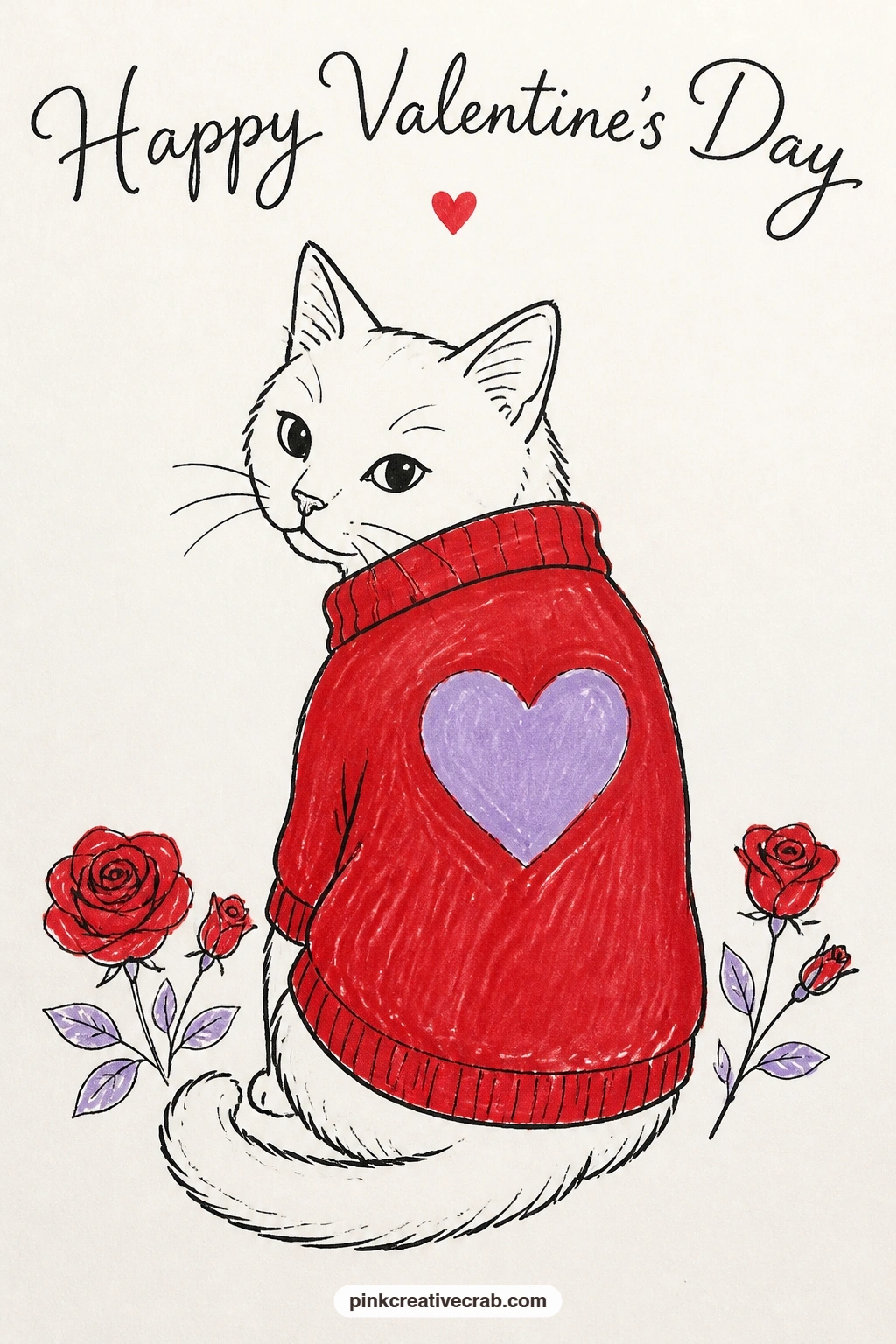
Palette: Cherry Red,Soft Lilac,Charcoal Black
Return to a quiet, drowsy mood with a cat dozing in a loose bouquet of peonies left on a kitchen table. Draw the cat’s curled sleeping shape first, low and compact, then build the peonies around and partly over it in large overlapping rounded petal clusters.
Peonies are forgiving flowers to draw because they are mostly made of soft overlapping curves rather than sharp petals, so keep every outline rounded and let two or three petal clusters overlap the cat’s back for a nestled look.
If the peonies end up flat and papery, add one small shadow curve at the base of each petal cluster where it meets the next one, that single dark line gives each bloom some roundness.
Color most peonies soft lilac with one or two in cherry red, and keep the sleeping cat in plain black line with minimal shading.
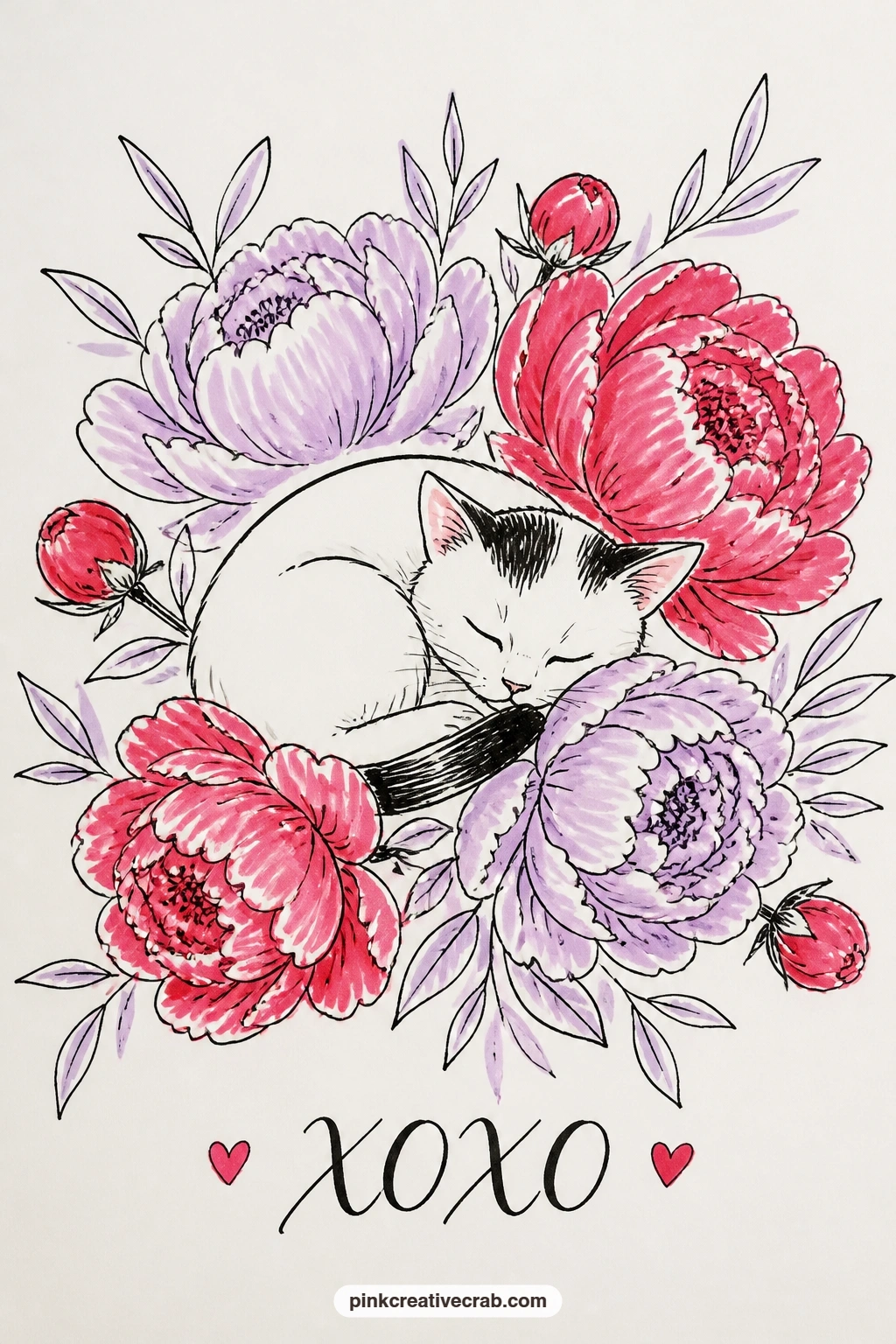
Palette: Soft Lilac,Cherry Red,Leaf Green
Send a cat up into the sky riding inside a heart-shaped hot air balloon basket over rolling hills. Draw the balloon envelope first as a large heart outline, then the small woven basket hanging beneath it with the cat peeking over the rim.
Perspective tip: draw the hills low on the page, as simple overlapping curved lines, and place the balloon high above them, that gap between balloon and horizon is what sells the sense of height.
If the basket looks too small to hold a cat, draw it a bit larger than feels realistic, a toy-sized basket flattens the whole scene and makes the cat look oversized rather than airborne.
Color the balloon envelope cherry red with a soft lilac band near the top, and leave the hills in plain black line or a light grey wash.
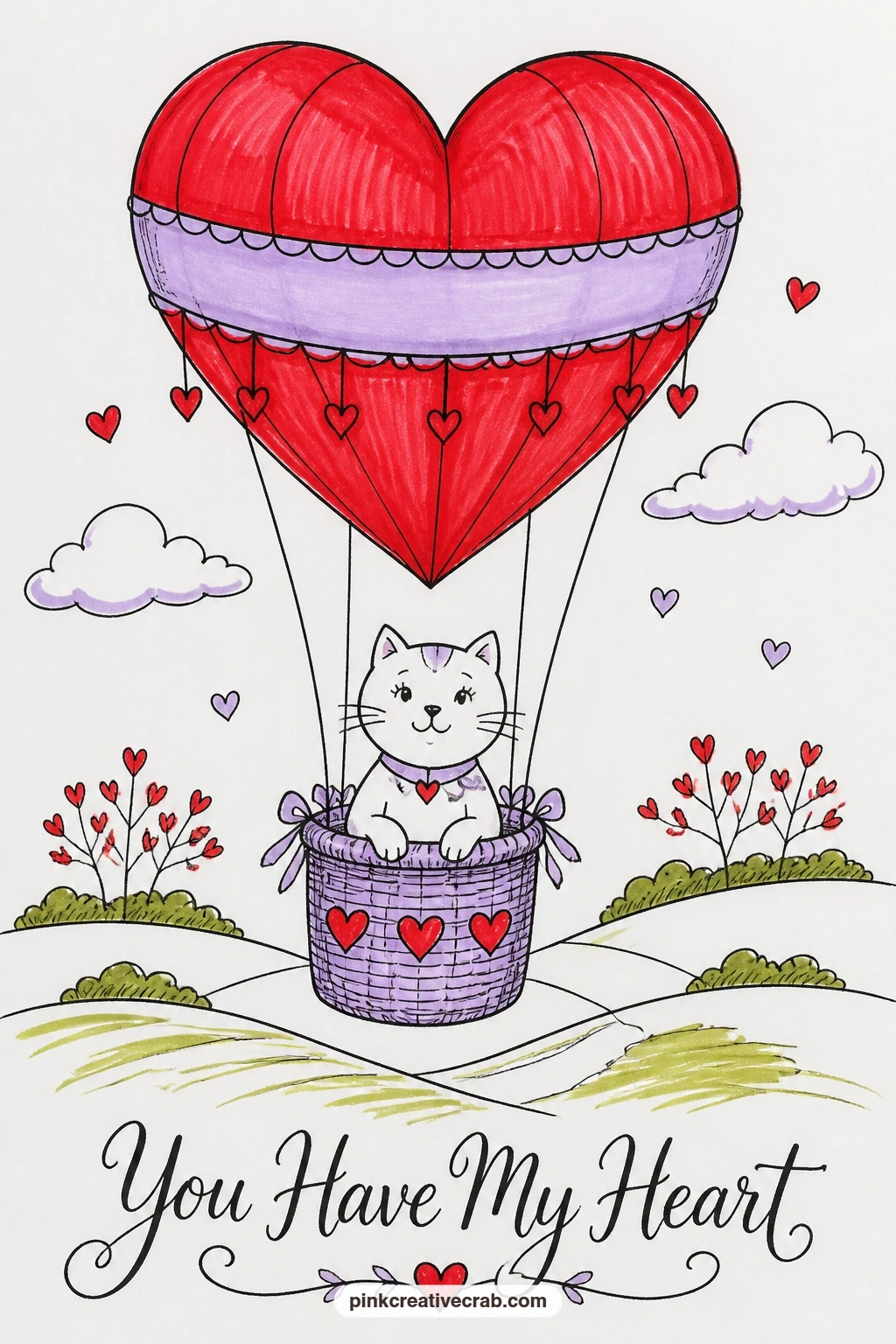
Palette: Cherry Red,Soft Lilac,Hill Green
Place a cat at the edge of a goldfish pond, one paw reaching in to fish out a floating heart shape from the water’s surface. Draw the pond first as a simple wide oval, then the cat crouched at its rim with one paw extended and dipping toward a small heart drawn floating among a few lily pads.
Keep the water’s surface implied rather than fully rendered: two or three gentle curved ripple lines radiating from where the paw touches the water are enough, more than that starts to clutter the scene.
If the reaching paw looks stiff, bend the cat’s whole spine slightly toward the water rather than keeping the back straight, the curve through the whole body is what makes the reach believable.
Color the heart cherry red and the lily pads soft lilac for a gentle, cohesive palette.
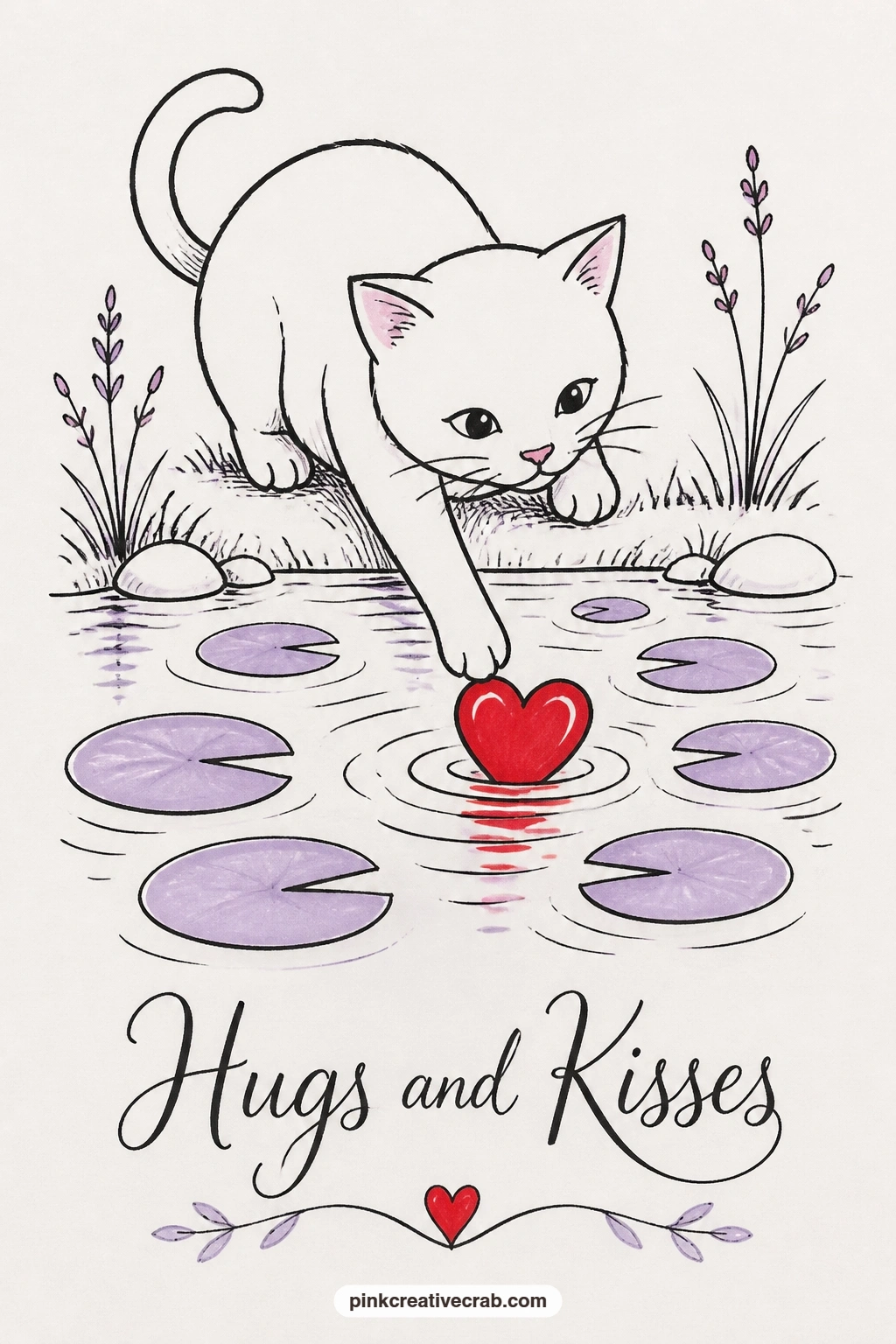
Palette: Cherry Red,Soft Lilac,Pond Green
Keep this one light and whimsical: a kitten sitting upright, blowing kisses as a handful of small hearts drift away from its mouth. Draw the kitten first in a simple seated pose, head tilted slightly up, with one paw raised near its face in a blowing gesture.
For the quick ten-minute version, send off just two or three hearts in a simple rising line. Given forty minutes, vary their sizes and let them drift at slightly different angles so the trail feels more like a breeze carried them than a stencil repeated upward.
If the kitten’s expression looks flat, add two small rounded cheeks with a tiny pucker shape for the mouth, that one detail does most of the emotional work.
Color the hearts cherry red, fading one or two to soft lilac as they drift further from the kitten.
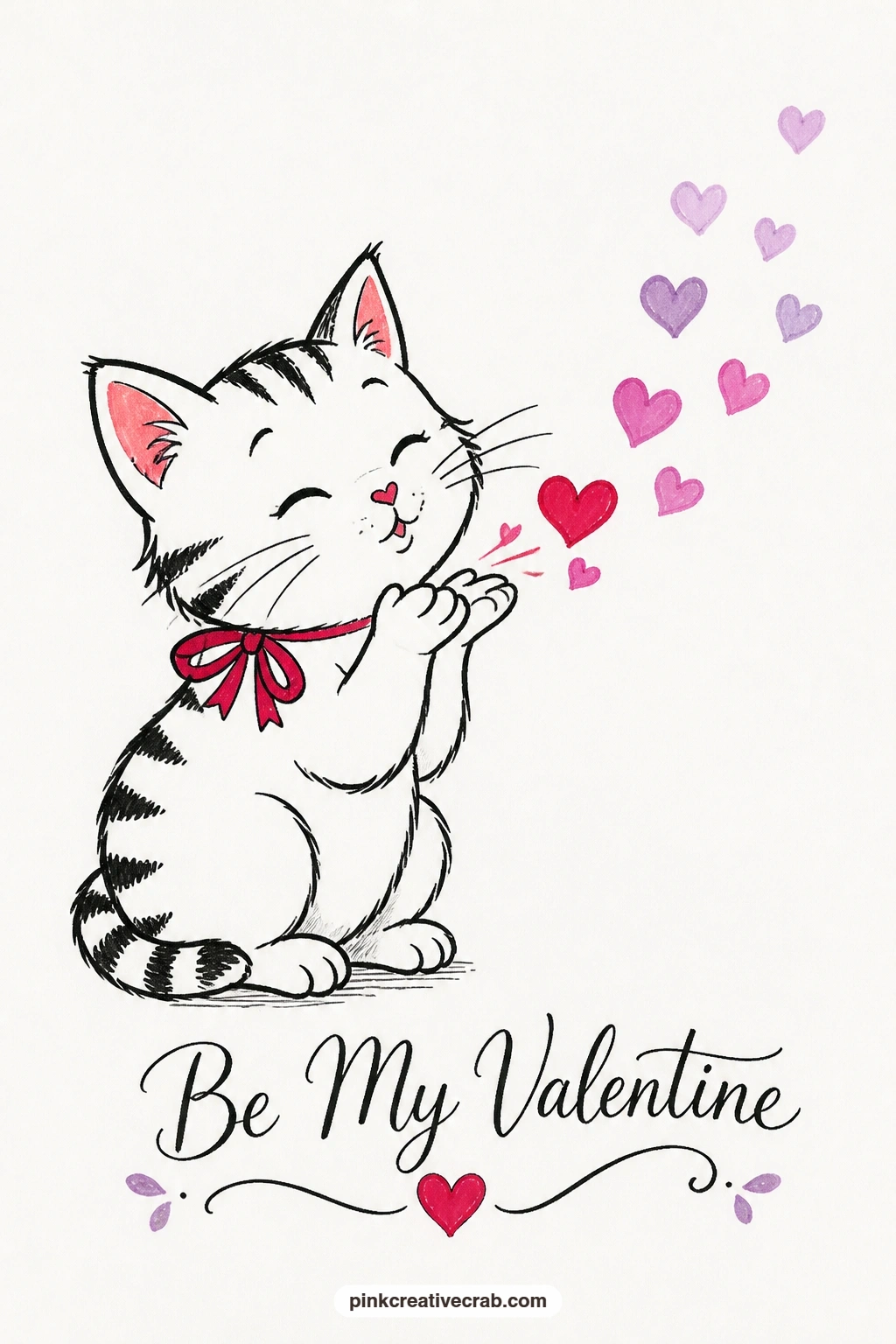
Palette: Cherry Red,Soft Lilac,Charcoal Black
Pair up contrast for this one: a black cat and a white cat sitting back to back on top of a garden wall. Draw the wall first as a simple horizontal strip of bricks, then place both cats symmetrically, tails curled toward each other to connect the composition.
Fill the black cat as a solid silhouette with only its eyes and a thin outline left white, and leave the white cat almost entirely unfilled, just an outline with a few short interior lines for shading, that strong value contrast is the whole point of the pairing.
If the two cats feel disconnected sitting back to back, overlap their tails slightly where they meet in the middle, a small touching point ties the pair together visually.
Add one small cherry red heart floating above the spot where their tails meet.
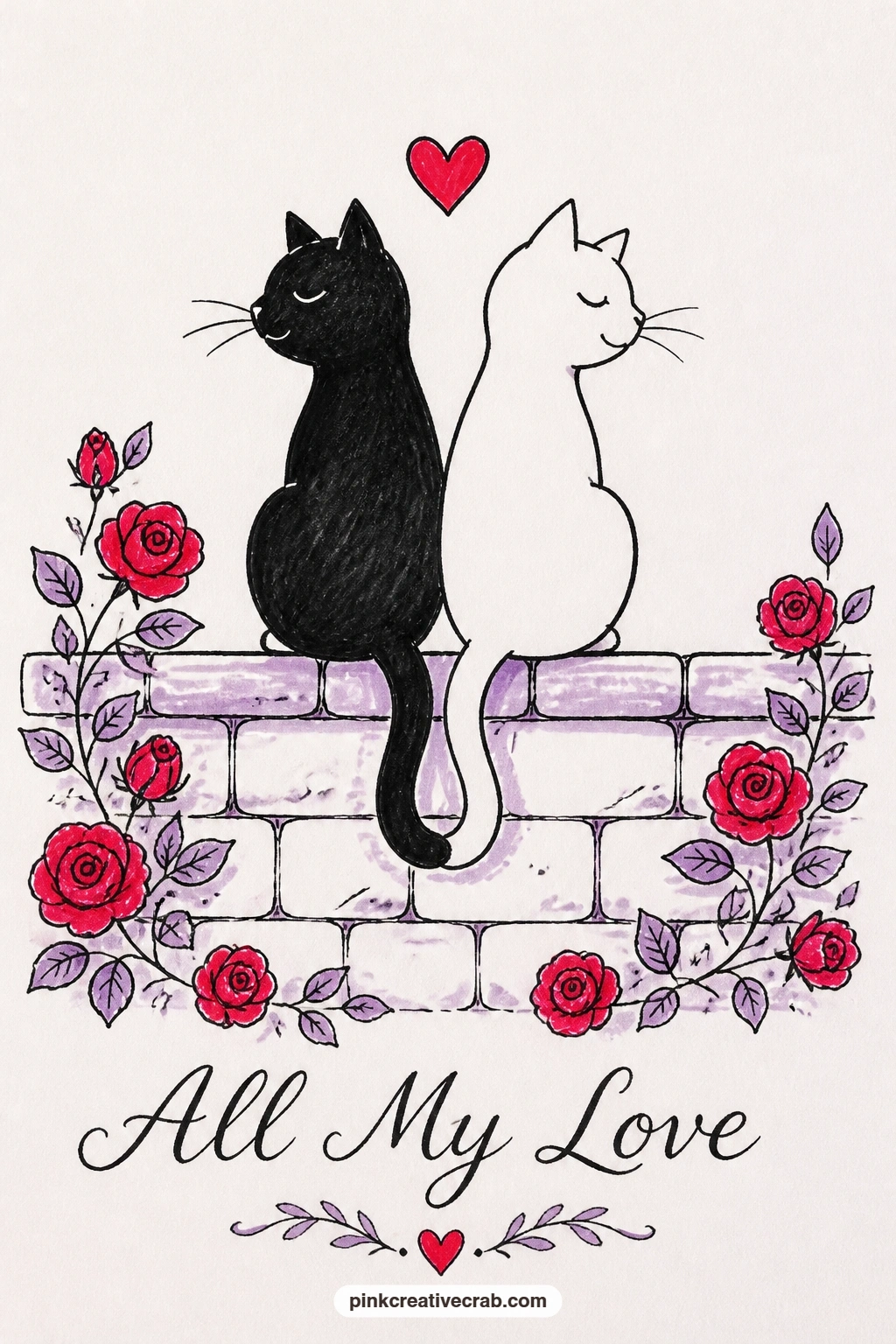
Palette: Charcoal Black,Paper White,Cherry Red
Bring the scene indoors to a cat sniffing a cupcake topped with a small pink sugar heart on a plate. Draw the cupcake first, a simple wrapper with a swirl of frosting on top, then the cat leaning in close with its nose almost touching the sugar heart.
Frosting swirls are easier than they look if you draw them in one continuous spiral line rather than several short strokes, start at the outer edge and wind inward without lifting the pen.
If the cat’s lean looks unnatural, drop its front half slightly lower than the back, a cat sniffing something always dips its head and shoulders rather than staying level.
Color the sugar heart cherry red and the frosting swirl soft lilac for a bakery-case feel.
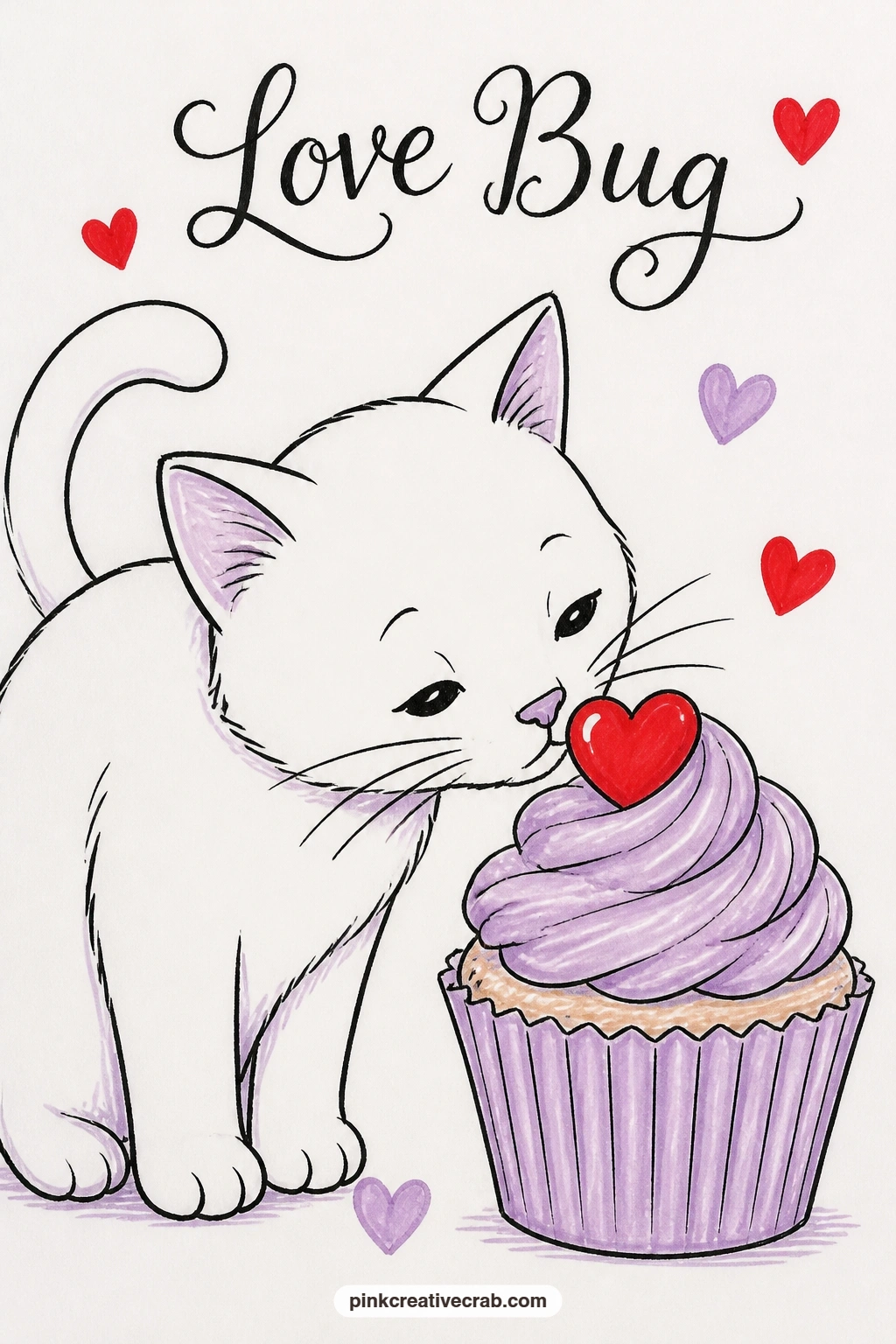
Palette: Cherry Red,Soft Lilac,Warm Tan
Take the scene outside into the cold: a cat curled up and napping inside a cherry red mailbox on a snowy lane. Draw the mailbox first as a simple rounded-top box shape with its flag raised, then tuck the cat’s curled body into the open front, tail hanging just over the edge.
Light source note: keep the snow bright and the mailbox interior a touch darker so the cat reads as tucked into shelter rather than floating in front of a flat shape, a few short diagonal shading lines inside the box opening are enough.
If the cat looks too large for the box, check the proportion against a real mailbox: the opening is roughly cat-head-and-shoulders wide, so most of the body should curl further back into shadow rather than spilling out the front.
Leave the snow as plain white paper and color only the mailbox cherry red.
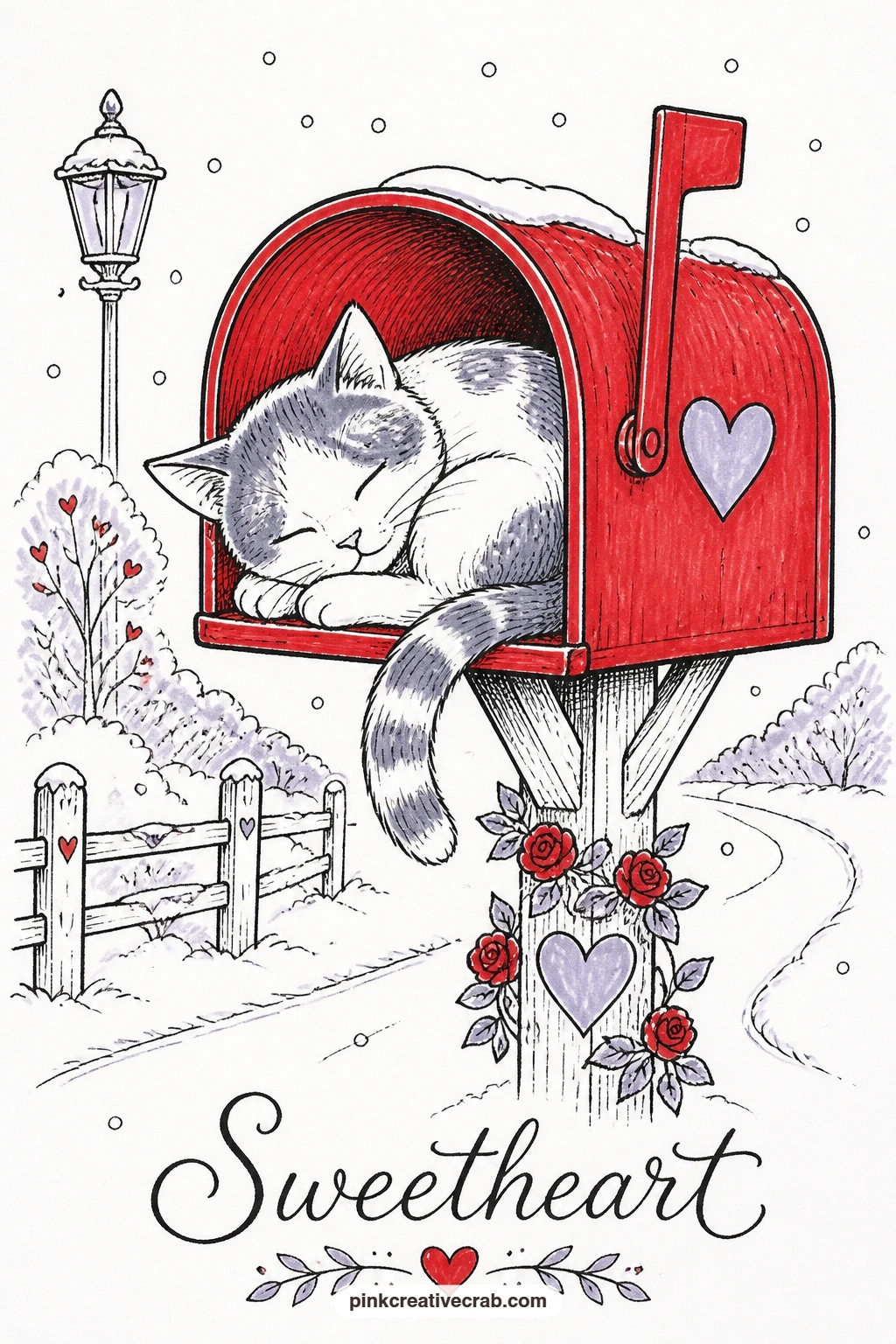
Palette: Cherry Red,Charcoal Black,Paper White
Give a cat a small moment of glamour: a crown of tiny roses resting on its head while it sits on a velvet pillow. Draw the cat’s head and upright posture first, then build the crown as a simple ring shape sitting just above the ears, with four or five small rose shapes attached around it.
Keep each rose small and simple, a tight spiral with two or three outer petal bumps, rather than trying to detail every petal, a crown works best as a repeating pattern of similar small shapes rather than one elaborate flower.
If the crown looks like it is floating, make sure it curves to follow the shape of the head rather than sitting as a flat straight band, a slight downward curve at each side anchors it visually.
Color the roses cherry red and the pillow beneath the cat soft lilac.
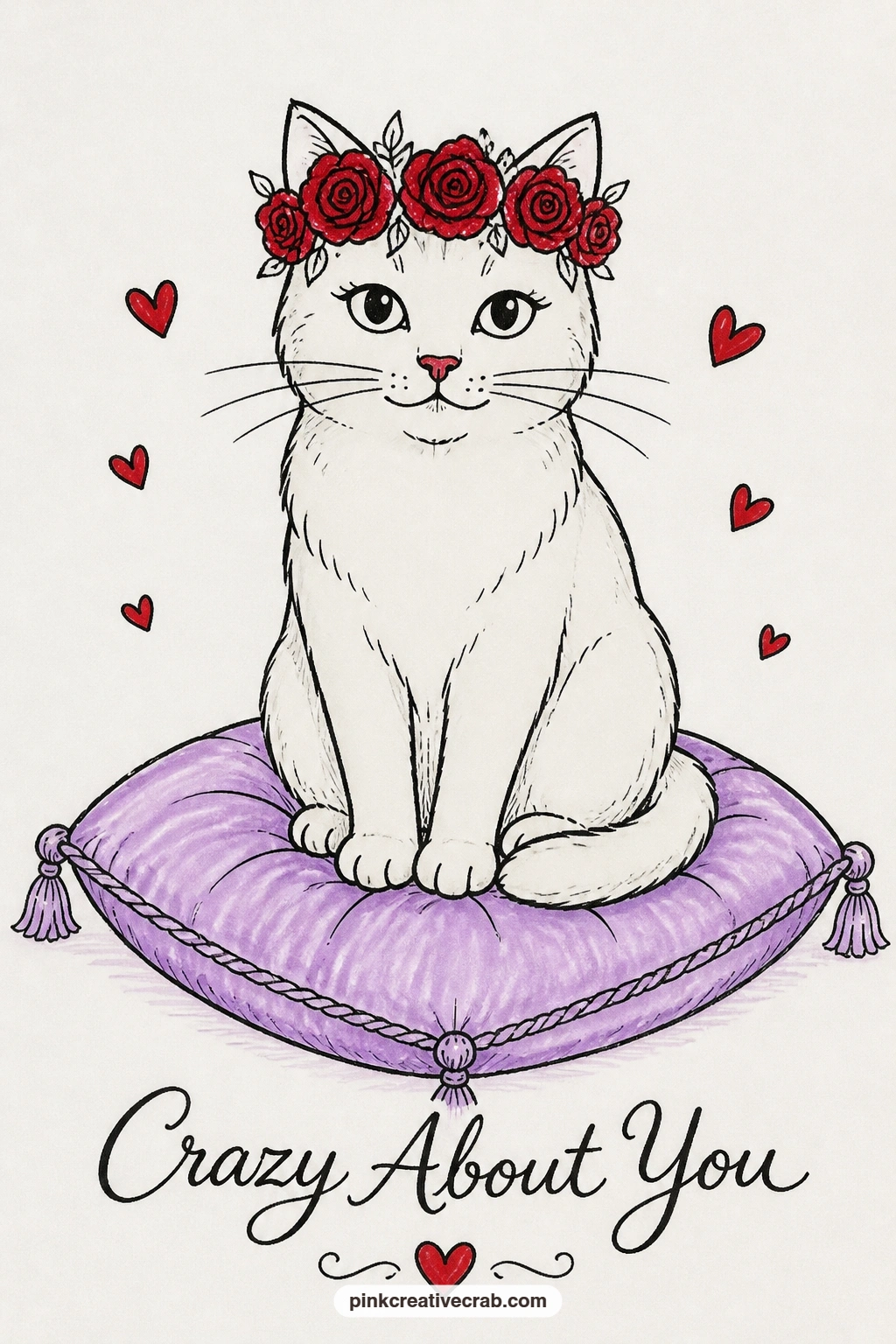
Palette: Cherry Red,Soft Lilac,Leaf Green
Bring in some energy with two kittens playing tug of war over a pink ribbon tied into a heart shape. Draw both kittens first in low, braced stances, back legs dug in and bodies leaning away from each other, then run the ribbon taut between their mouths with the heart knot in the middle.
The leaning angle of both bodies is what makes this scene work, so exaggerate it more than feels natural at first: a near-45-degree lean on each side reads clearly as a pulling contest rather than two kittens simply standing near a ribbon.
If the ribbon looks stiff, add one small wrinkle or twist partway along its length rather than drawing it as one flat straight band, real ribbon never pulls perfectly taut.
Color the ribbon soft lilac with the heart knot in cherry red as the visual anchor of the whole scene.
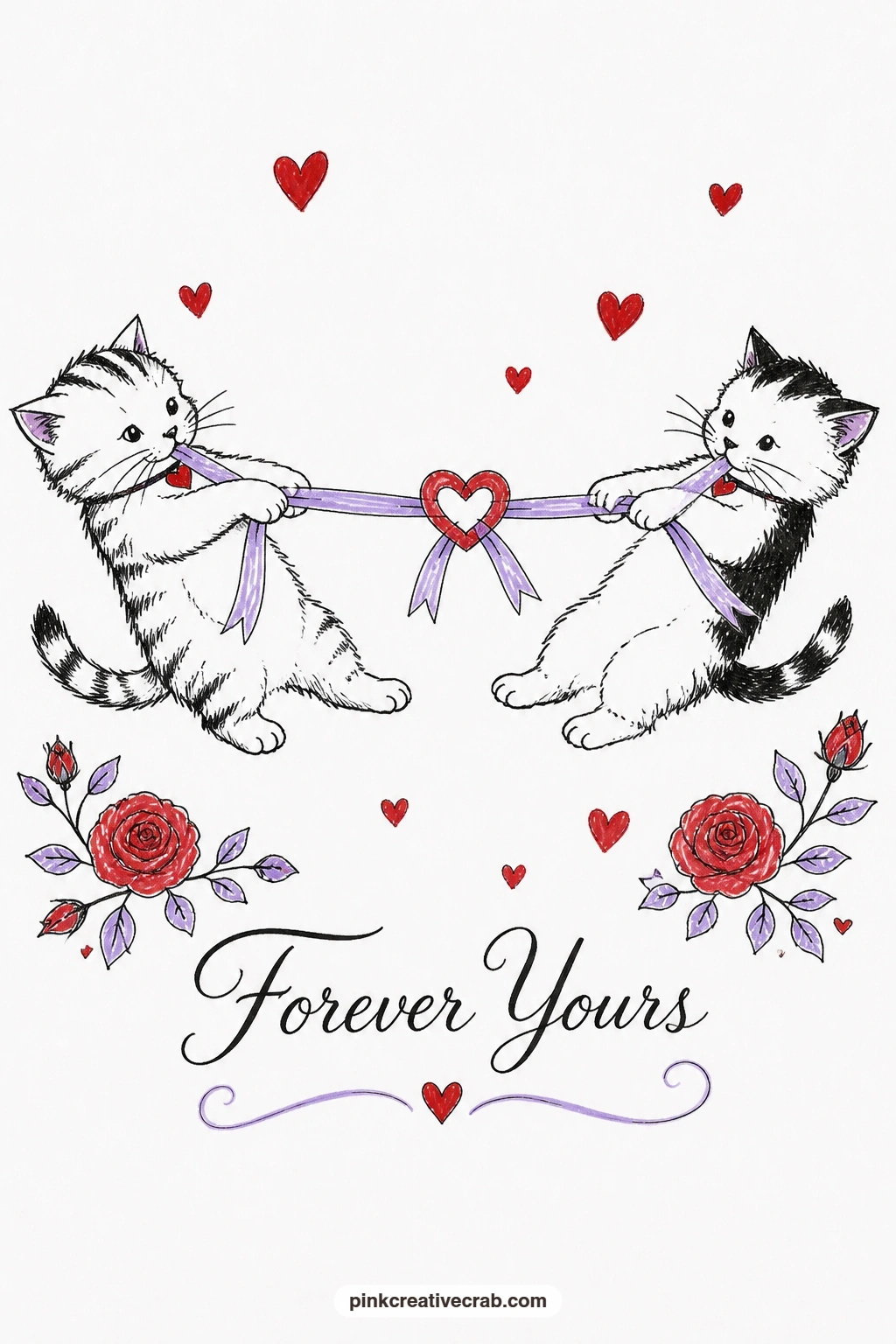
Palette: Soft Lilac,Cherry Red,Charcoal Black
Capture a classic bit of cat mischief: a cat pushing a heart-shaped macaron toward the edge of a table with one deliberate paw. Draw the table edge first as a simple horizontal line, then place the macaron near it with the cat’s paw already mid-push against its side.
For the quick version, draw just the paw and macaron close to the edge, implying the moment right before it falls. With more time, add a second macaron already lying cracked on the floor below to show what happens next, which turns one gesture into a tiny two-beat story.
If the paw placement looks unclear, draw a short motion line trailing behind it to show the direction of the push, that small addition does a lot to clarify the action.
Color the macaron shell cherry red with a soft lilac filling peeking out the side.
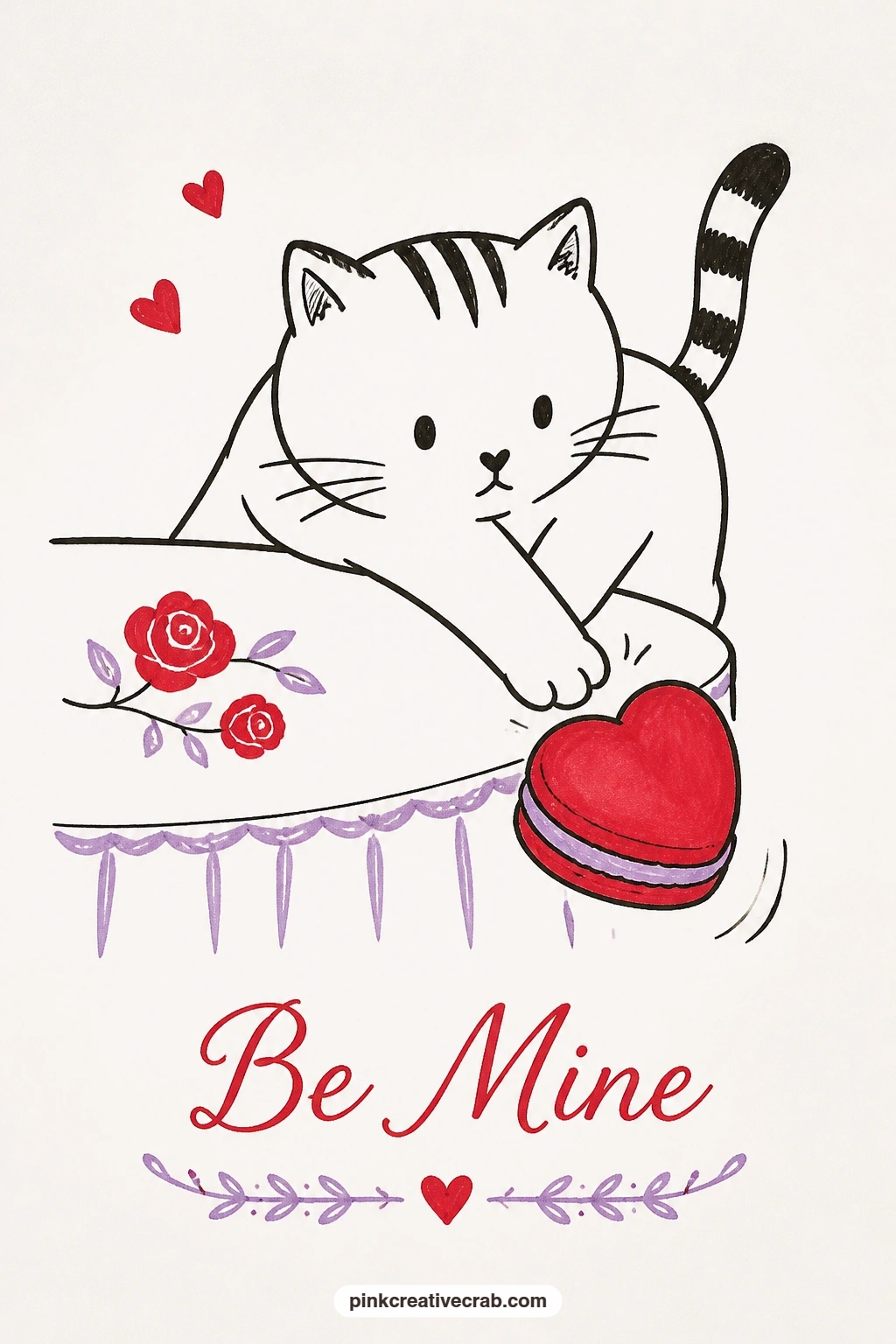
Palette: Cherry Red,Soft Lilac,Charcoal Black
Pair a cat with a small bird sharing one branch of cherry blossom, both perched peacefully rather than in any kind of chase. Draw the branch first as a single diagonal line across the card, then cluster small blossom shapes along it before placing the cat lying along the thicker part and the bird perched near the thinner tip.
Scale and weight matter here: keep the branch thick enough near the cat to look like it could plausibly hold the weight, and let it curve downward slightly under that load, a perfectly straight branch holding a cat looks unconvincing no matter how well the cat itself is drawn.
If the blossoms take too long individually, draw them as simple five-petal outlines repeated in clusters of three, with only a few fully detailed near the bird where the eye lands first.
Color most blossoms soft lilac with a few cherry red buds scattered among them.
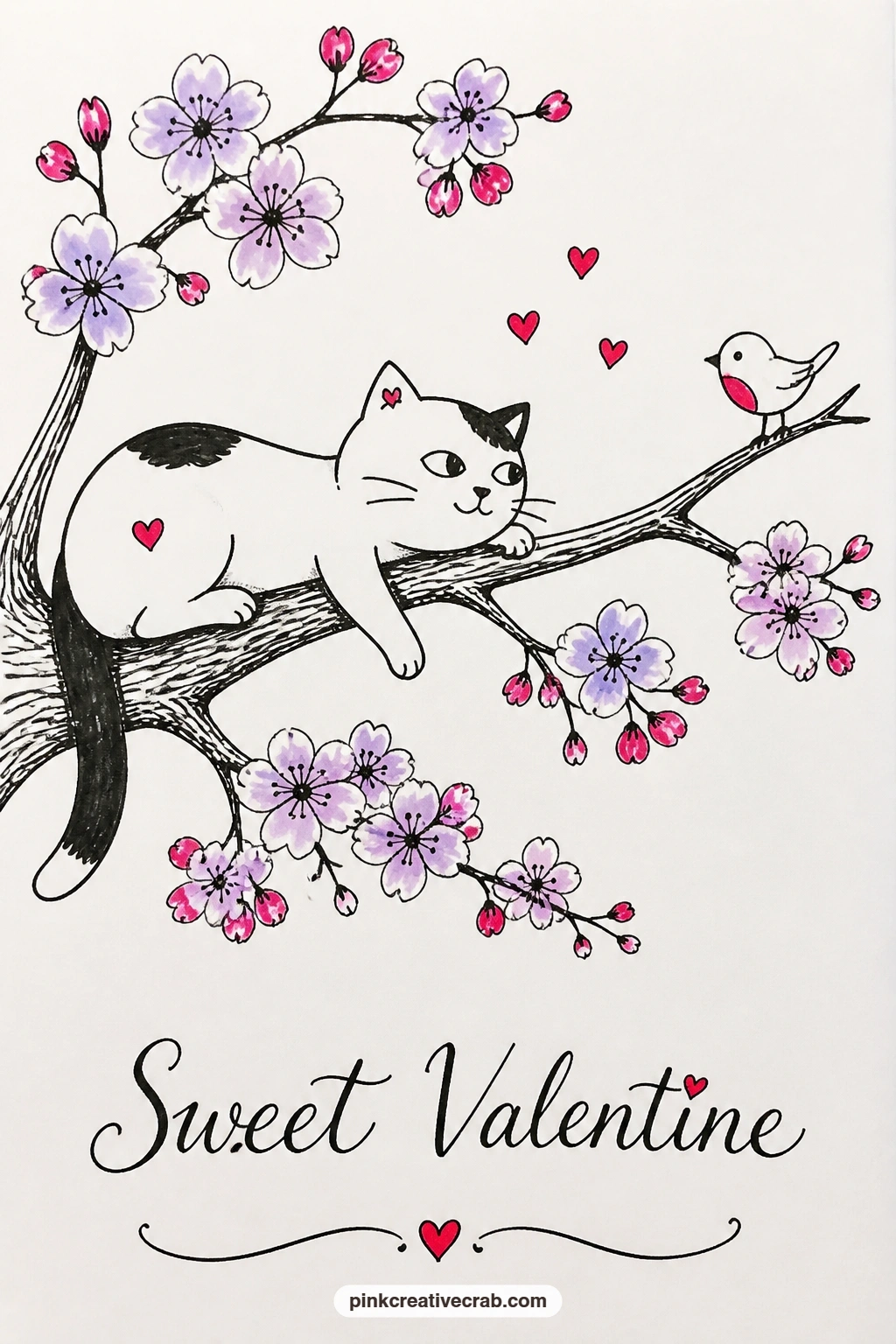
Palette: Soft Lilac,Cherry Red,Charcoal Black
Slow right down for a spa-day scene: a cat soaking in a clawfoot tub filled with water and scattered rose petals. Draw the tub first with its distinctive curved feet, then the cat’s head and shoulders peeking above the waterline, eyes half closed in contentment.
Edge trick for the water: leave the petals as simple unshaded outlines floating on the surface, then add just a few short curved lines around the cat’s shoulders to suggest the water’s edge without drawing the whole tub’s contents in detail.
If the tub feet look wrong, reference a simple ball-and-claw shape, just a small oval resting on three curved toe lines, rather than trying to render real hardware.
Color the scattered petals cherry red and soft lilac in equal measure for a balanced, relaxed palette.
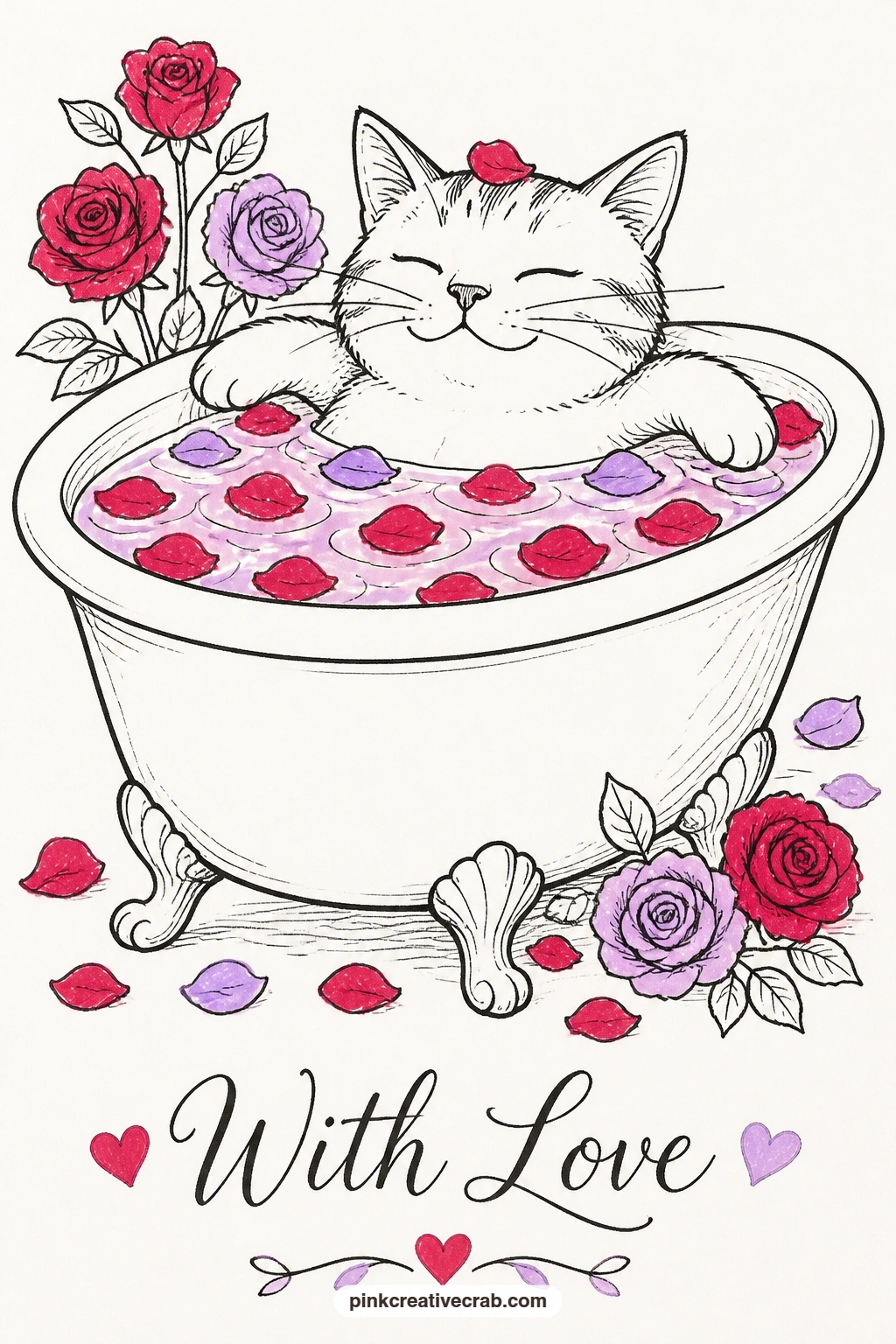
Palette: Cherry Red,Soft Lilac,Soft Blue
Move outdoors for a bright little errand scene: a cat carrying a small basket of strawberries by its handle, walking through tall grass. Draw the basket first as a simple woven oval with a curved handle, then place it hanging from the cat’s mouth as it walks, body slightly lowered to balance the weight.
Grass texture comes together fast with short upward fineliner flicks of varying height around the cat’s legs, cluster them more densely near the bottom of the card and thin them out higher up so the scene does not feel too busy.
If the basket swings oddly off the mouth, draw a short straight line from the cat’s jaw directly to the handle before curving the basket itself below it, that anchor line keeps the weight reading correctly.
Color the strawberries cherry red with small soft lilac leaf caps on top.
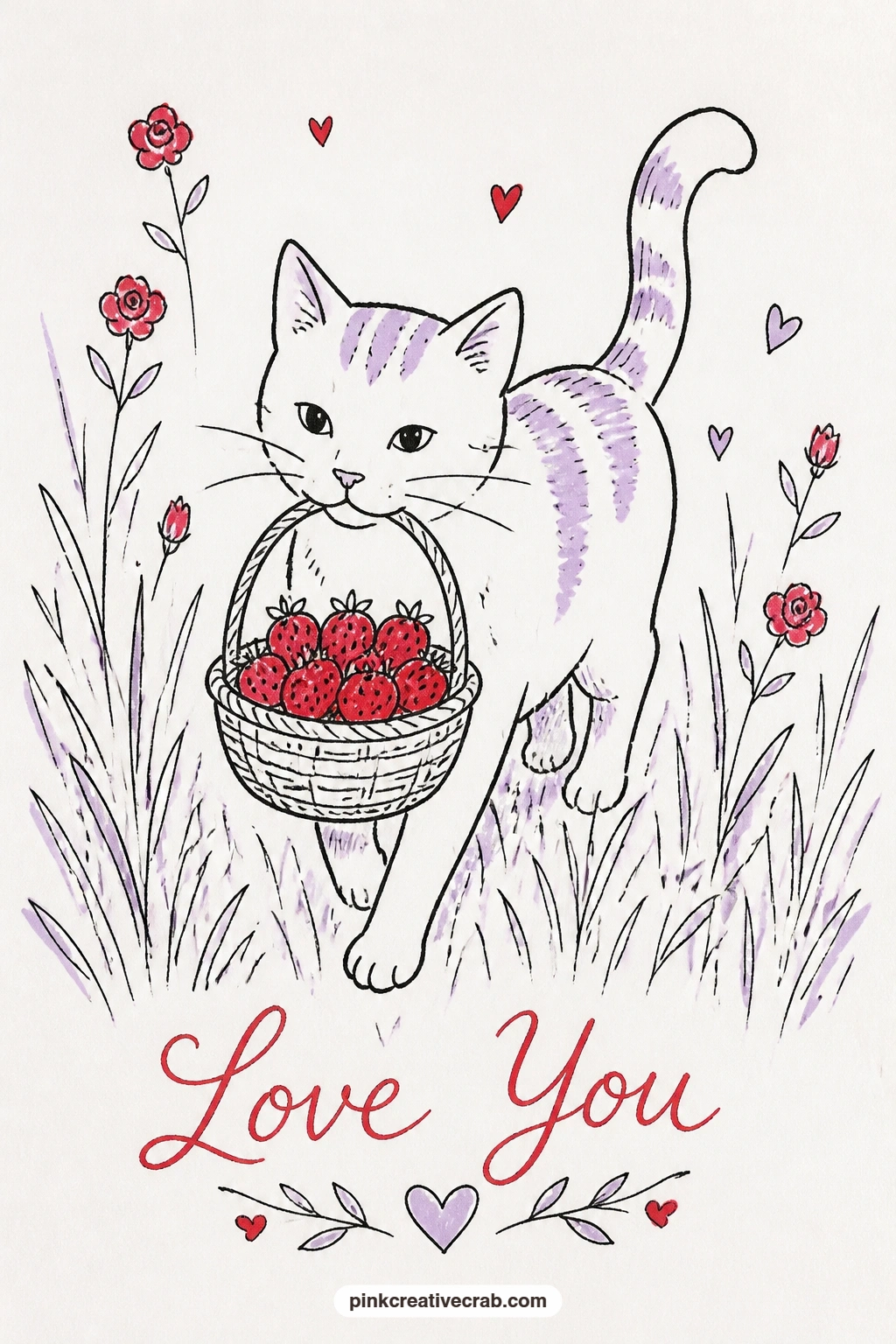
Palette: Cherry Red,Soft Lilac,Leaf Green
For a tender close, draw a mama cat cuddling her kitten together inside a heart-shaped bed. Draw the heart-shaped bed outline first, soft and slightly irregular rather than geometric, then nest the two cats inside it, the mother’s larger body curved protectively around the smaller kitten.
Proportion check: make the kitten’s head roughly two-thirds the size of the mother’s head and keep its limbs noticeably shorter and rounder, that scale difference is what reads instantly as parent and baby rather than two cats of similar age.
If the cuddle looks stiff, overlap the mother’s tail loosely across the kitten’s back rather than leaving a visible gap between their bodies, that small touch sells the closeness.
Color the bed’s interior soft lilac and add one small cherry red heart stitched or painted onto its outer edge.
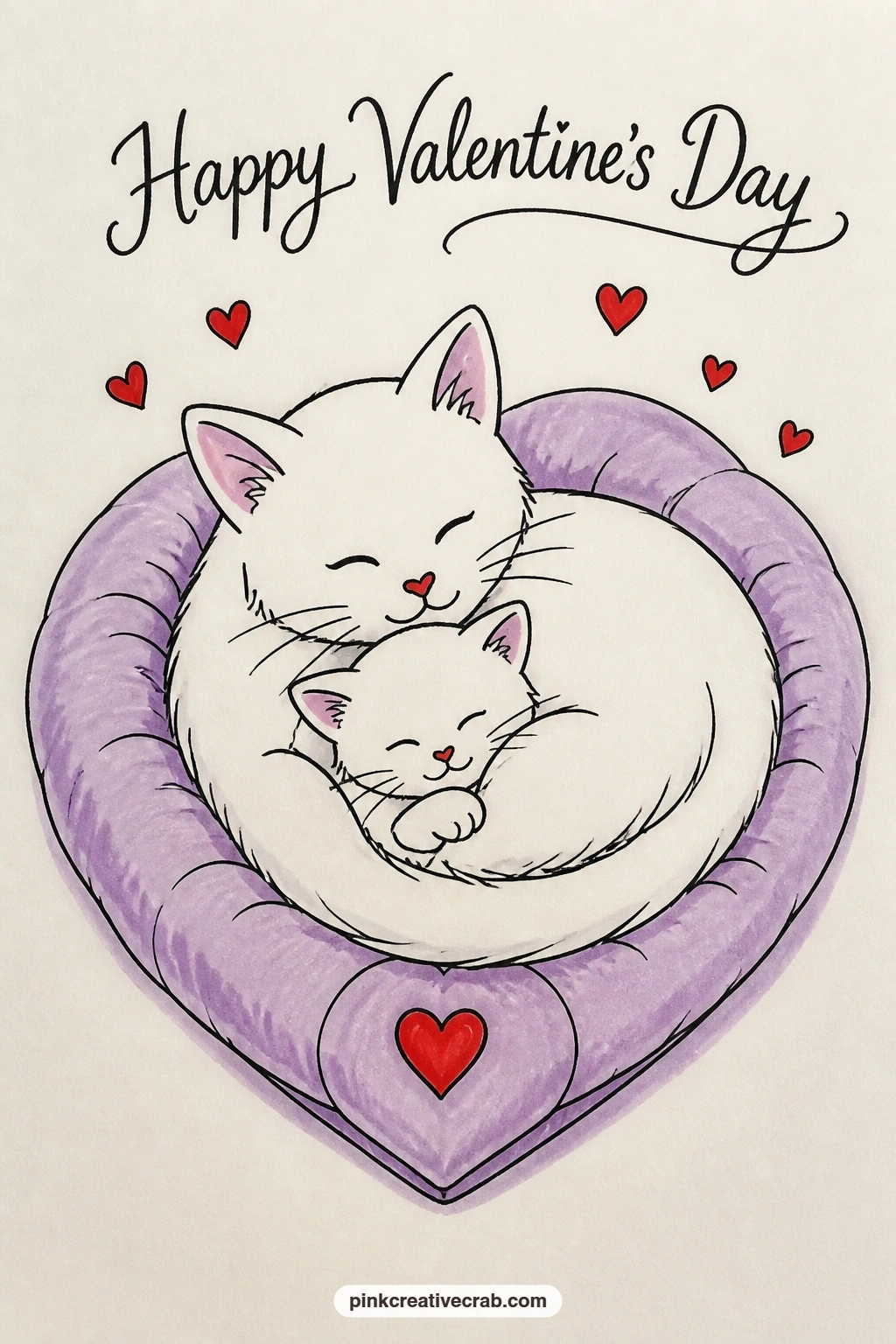
Palette: Soft Lilac,Cherry Red,Warm Grey
Add a dreamy touch with a cat watching a handful of hearts drift up from a bubble wand held just out of frame. Draw the cat first in a seated pose, head tilted up and ears forward in a watching posture, then scatter three or four heart-shaped bubbles rising above it at varied heights.
Vary the bubble sizes and give one or two a thin highlight crescent near the top edge, left unfilled, to suggest the shine of soap film without needing to render reflections in detail.
If the bubbles look too solid, keep their outlines thin and slightly wobbly rather than perfectly round, a bubble drawn too geometrically loses the floating, fragile feeling the whole idea depends on.
Color the bubble hearts a very light wash of soft lilac with a thin cherry red outline on just one, to draw the eye.
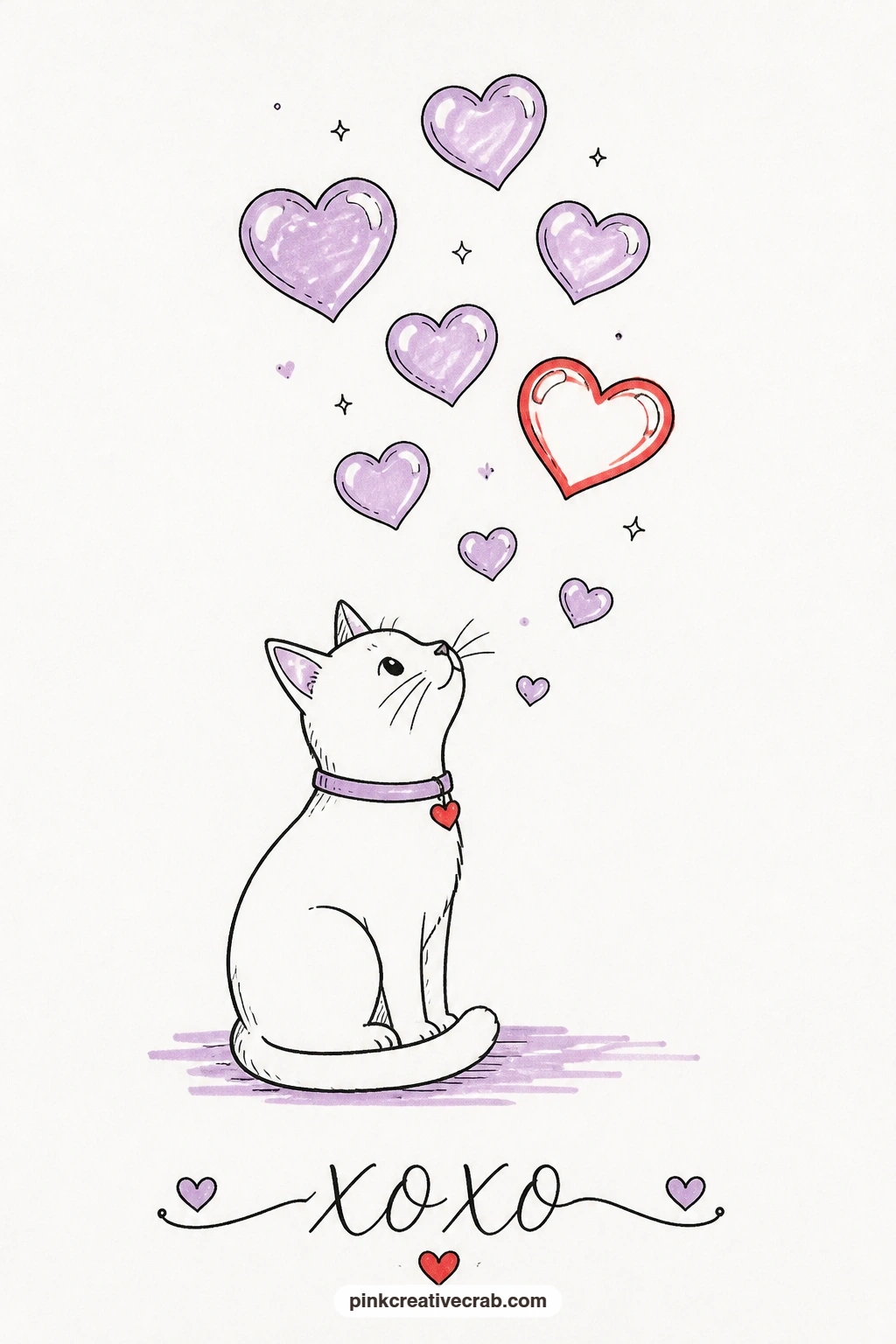
Palette: Soft Lilac,Cherry Red,Charcoal Black
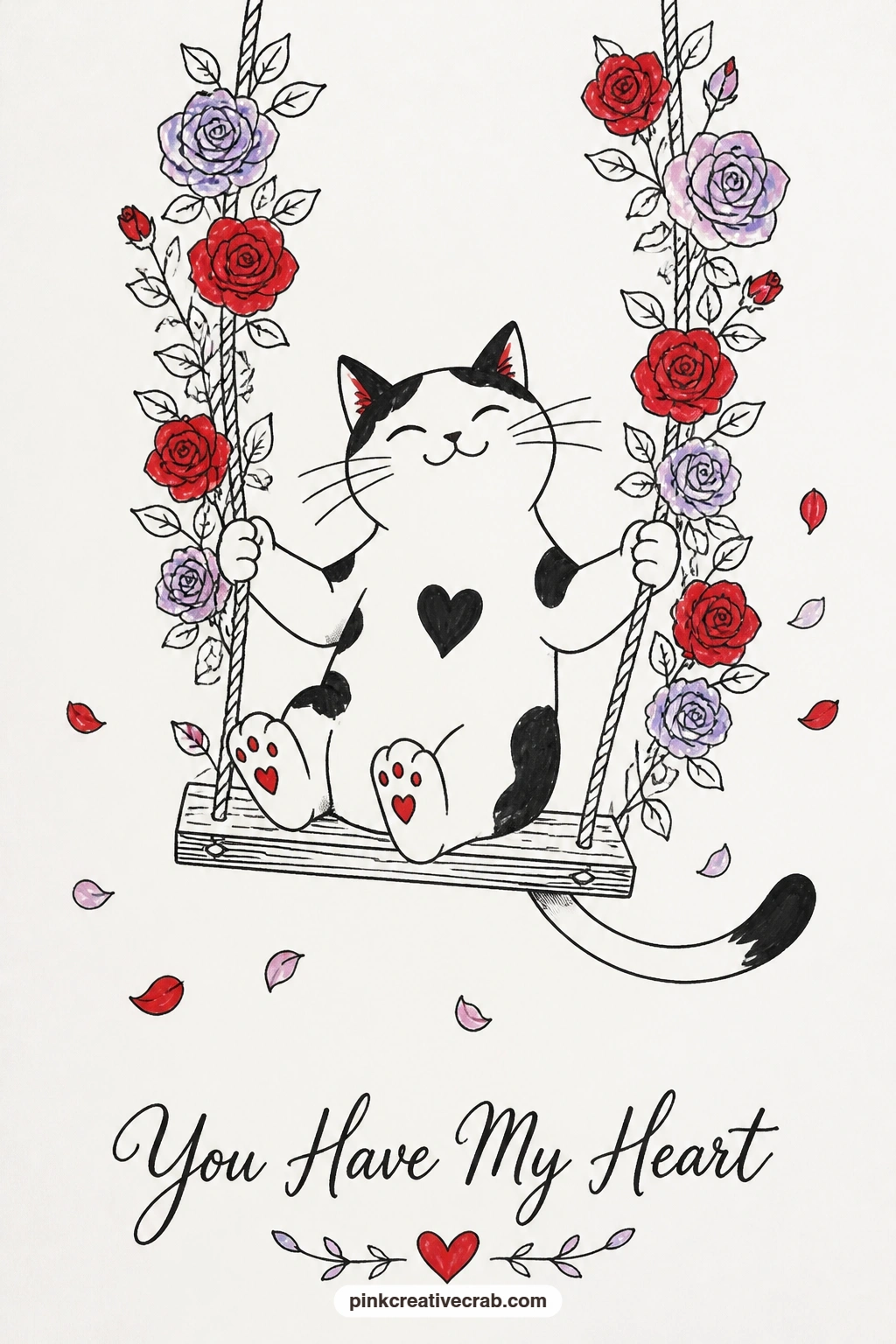
Close the set with the most involved scene: a cat swinging on a garden swing covered in climbing roses, caught mid-swing with its tail trailing behind. Draw the swing’s two ropes and seat first, angled slightly to suggest motion, then wind rose vines up each rope before placing the cat seated and leaning back into the swing’s arc.
For the quick version, keep the swing static and simply seated. Given more time, tilt the whole swing and cat a few degrees off vertical and add two or three small loose petals falling in the air beside it, which turns a still portrait into a moving one.
If the vines overwhelm the ropes, limit roses to small clusters near the top and bottom of each rope rather than wrapping the entire length.
Color the roses cherry red and soft lilac in alternating clusters for a full, celebratory finish to the set, a nice companion to the cat watercolor ideas if you want to try the same pose in paint next.
Palette: Cherry Red,Soft Lilac,Leaf Green
What to Do Next
Pick whichever idea made you smile first, sketch it lightly in pencil on plain paper or a blank card, then go over it in fineliner before adding the cherry red and lilac last. One finished card today is better than a perfect one next week.
Frequently Asked Questions
What is the easiest way to draw a cat for a valentine card if I am not confident with animals?
Start with simple rounded shapes: an oval body, a round head, and triangle ears, then add features last. Most of the ideas on this list keep the cat’s pose simple on purpose, so pick an early one in the list and trace your pencil lines lightly before inking.
Do I need special markers to get the cherry red and lilac look?
Any alcohol or water-based marker in those two shades works fine, and colored pencils layered twice give a similar effect if markers are not on hand. Consistency across the set matters more than the exact brand.
How do I keep a heart shape symmetrical when drawing cat valentine cards?
Fold the paper in half first and draw only one side of the heart, then trace that line through to the other half before opening it back up. This trick works for hearts of any size, from a whole card front to a tiny sugar decoration.
Can these cat valentine card ideas be turned into printed cards rather than one-off drawings?
Yes, scan or photograph the finished fineliner drawing and print it onto blank cardstock, or recreate a simplified version directly on a pre-folded card. Keep the color additions light so the scan stays clean and sharp.
What if I want more cat drawing practice before attempting a full valentine scene?
Practicing basic cat poses and expressions on their own first builds confidence, and resources like cat pencil drawing ideas for beginners or cute cat doodles for beginners are good warm-ups before tackling a full scene.
Have any thoughts?
Share your reaction or leave a quick response — we’d love to hear what you think!
-
 0
-
0
-
0
-
0
-
0
-
0


