There is something so satisfying about sketchbook drawings that tell a whole little story on one page, and fairy tales give you the best stories to borrow from. These are the old tales, not the shiny film versions: the woodcutter’s cottage, the spinning wheel, the wolf in the grandmother’s cap, all drawn the way the early storybook illustrators might have imagined them.
Below you will find 32 scenes to pick from, each one a complete little world you can finish in a single sitting. Grab your ink pen and your colored pencils and pick whichever tale is calling to you tonight.
Using these images: free for personal projects such as printing, coloring, cards, journals and gifts. Handmade items that include them may be sold up to 30 pieces per design. More than that is commercial use and is not permitted, and neither is selling or sharing the images themselves or passing them off as your own. Please ask before any other use.
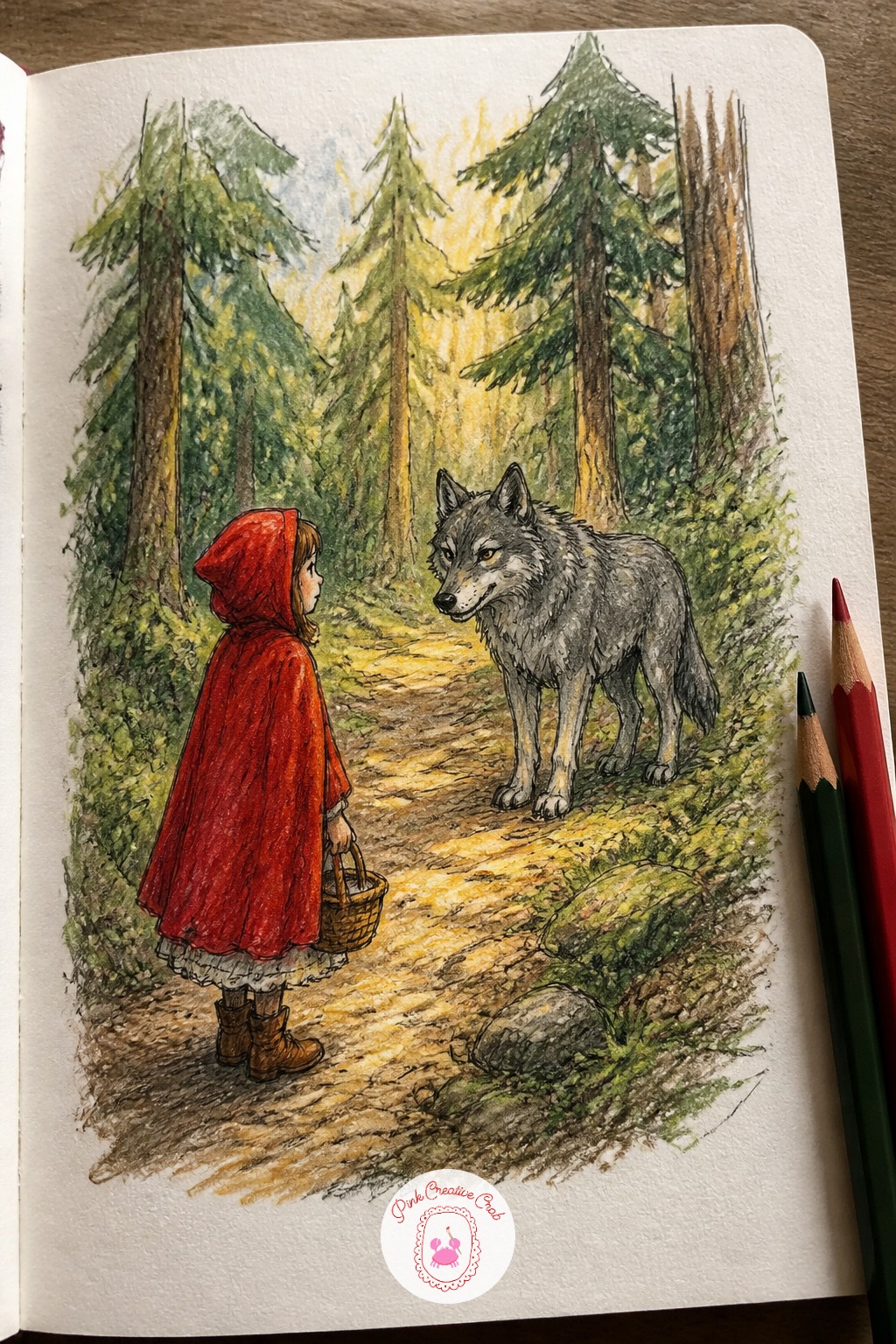
Red Riding Hood meeting the wolf on the forest path is the scene everyone pictures when they think of this tale, so it makes a friendly place to start. Use a fine liner for this one, because the path needs to wind believably between the trees and a thick nib will flatten that curve into a straight line.
Keep her basket round and simple, her cloak a single warm red shape, and let the wolf’s fur sit in loose grey scribbles rather than individual hairs. Pick a liner between 0.1 and 0.3 for the linework and save your boldest line for the wolf’s outline so he reads as the danger in the scene.
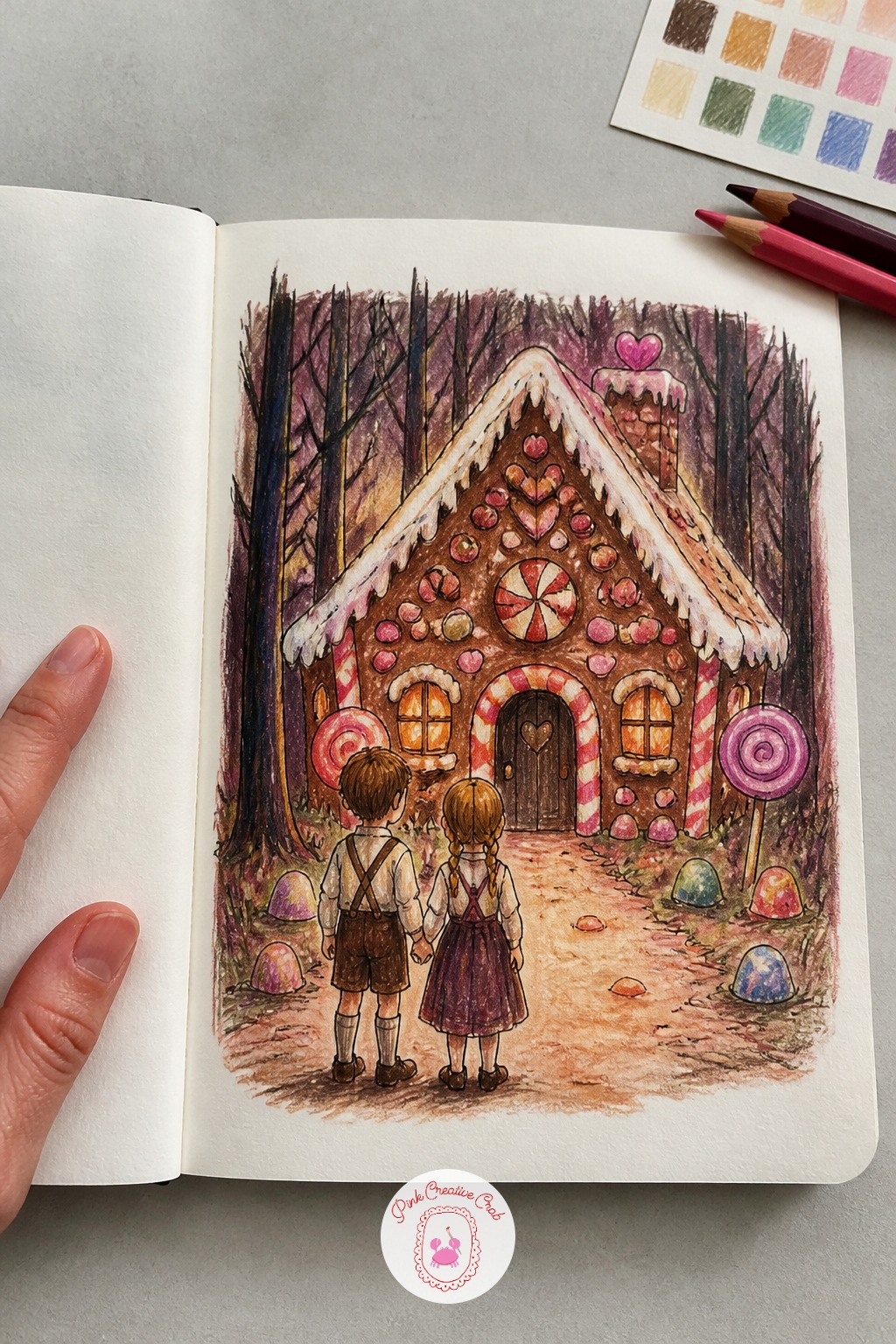
Hansel and Gretel finding the gingerbread house deserves the full page, because this is the moment the whole story turns. Start with three marks: the roofline first, then the two children standing small against it, then the path of pale pebbles leading up to the door, and leave every piece of candy trim for last.
That order keeps the house from swallowing the composition before the story element even lands on the page. Build the icing in white gel pen over warm brown colored pencil once the base coat is dry, so it sits up off the page the way real icing would.
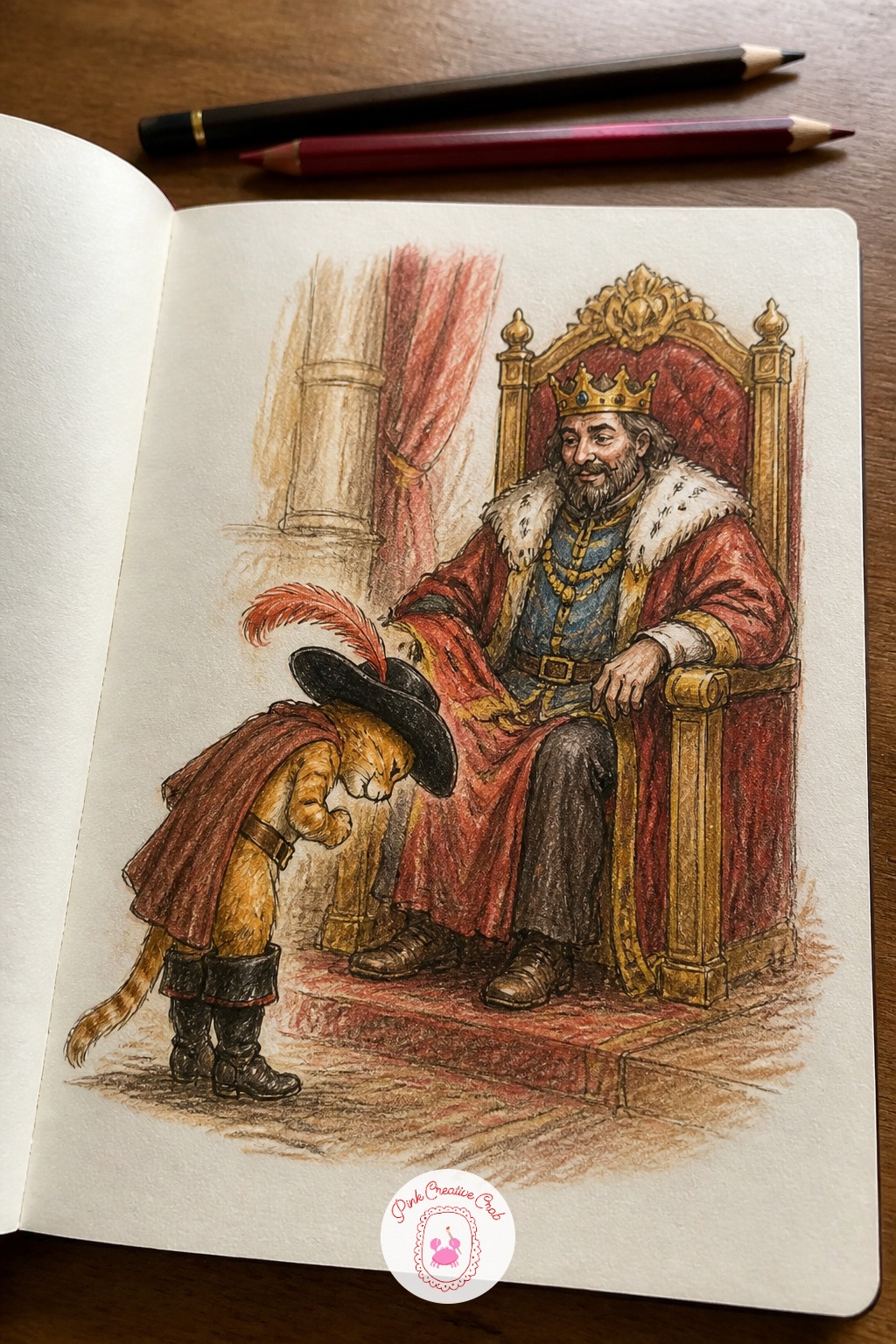
Puss in Boots bowing to the king is pure theatre, so give him a proper flourish: hat off, one boot forward, tail curled behind him in a confident swirl. Measure him against the king’s throne before you commit to ink, because a cat who reads as too large loses the joke of a clever animal outmanoeuvring royalty.
A good rule of thumb is to keep Puss about two thirds the height of the seated king from throne seat to crown. Once the proportions sit right, let his boots and feathered hat carry the richest color in the scene.
Try keeping the king’s robe a single flat red so Puss stays the star of the page.
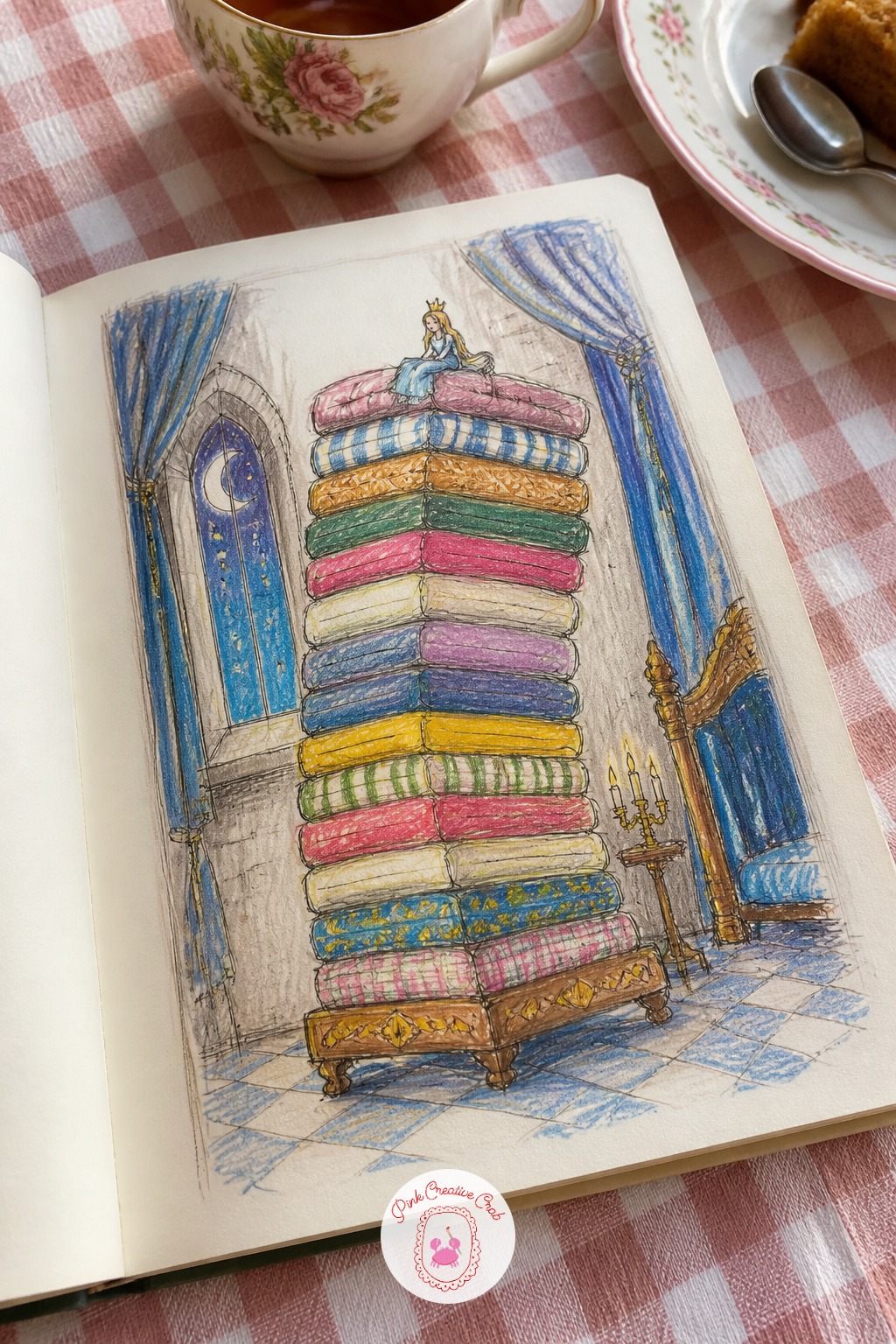
The princess and the pea on her tower of mattresses is a wonderful excuse to draw something slightly absurd, and absurd scenes are always fun in a sketchbook. The usual mistake here is stacking the mattresses too evenly, so the pile reads like a grid instead of something soft and leaning.
Fix it by giving each mattress a slightly different width and a gentle tilt, as if the whole stack might wobble. Tuck the princess in tiny at the very top with just her worried face peeking over the blanket, and let the mattresses get looser and more sketch like as they climb.
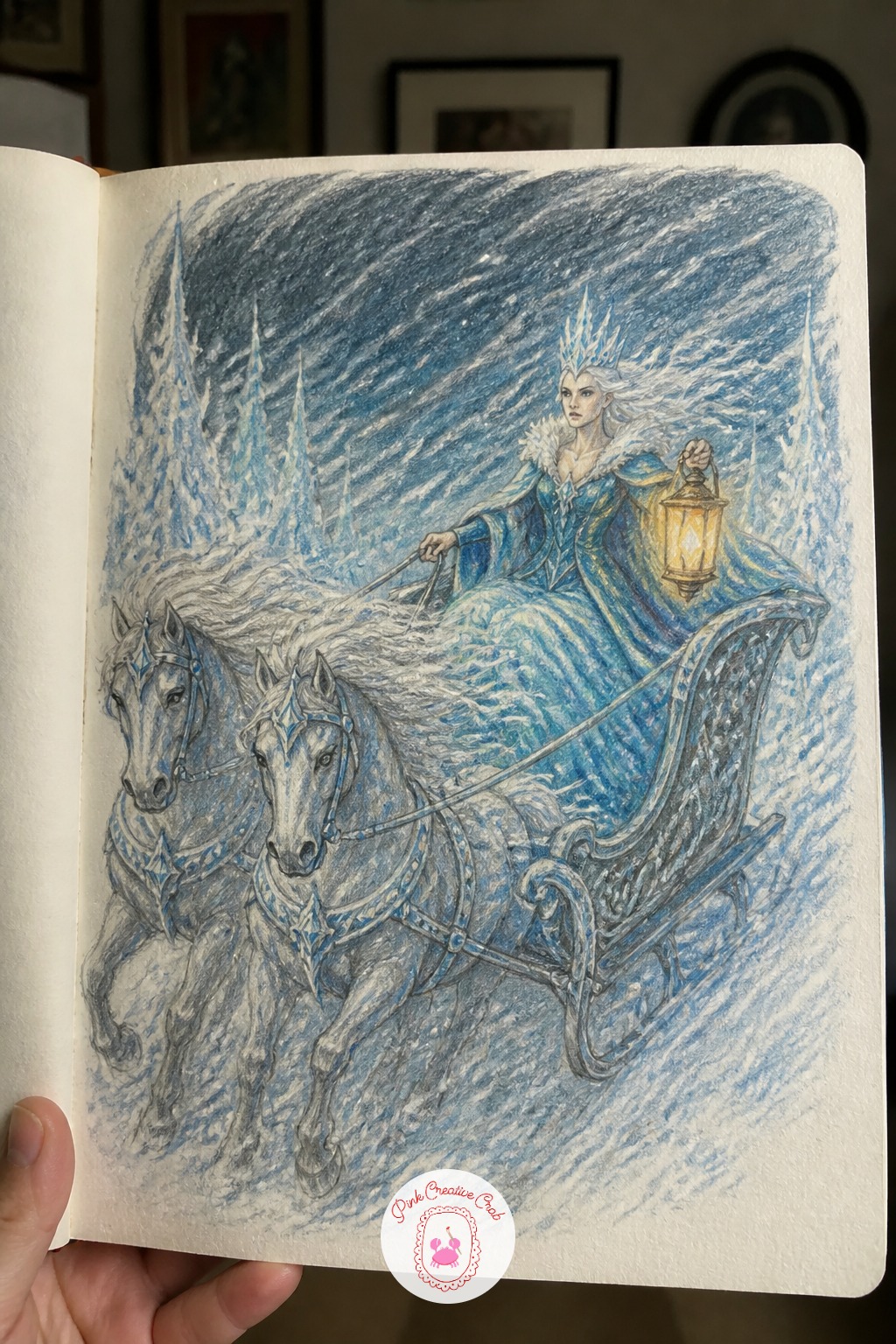
The Snow Queen’s sleigh in a storm asks for a different kind of attention: where is the light coming from, and what does that do to the snow. Put her lantern or her own pale glow as the single light source, low in the frame, so every snowflake and sleigh runner throws a soft shadow away from it.
That one choice gives the whole scene a sense of cold and movement without extra effort. Keep her gown and the sleigh in icy blues and silvers so the warm lantern glow has something to contrast against.
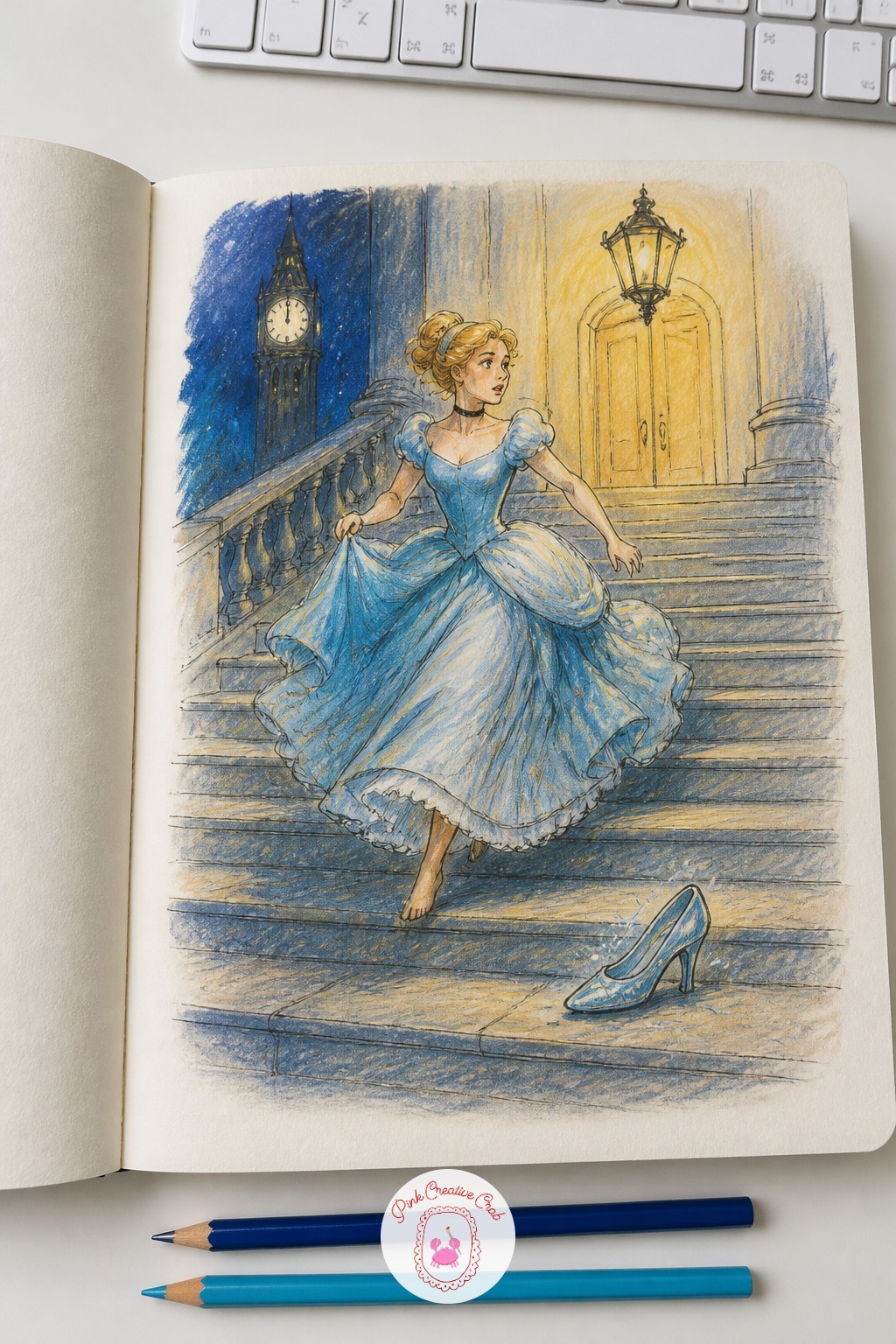
Cinderella losing her slipper on the steps carries the whole story in one small gesture, so let the slipper do the talking. Draw it first and largest in your mind’s eye even though it will be the smallest object on the page, because everything else, the running figure and the grand staircase, exists to point toward it.
Her skirt should blur slightly at the hem as if caught mid motion, which you can suggest with a looser, lighter line than the rest of the ink work. Finish with the glass slipper catching the most light of anything on the page.
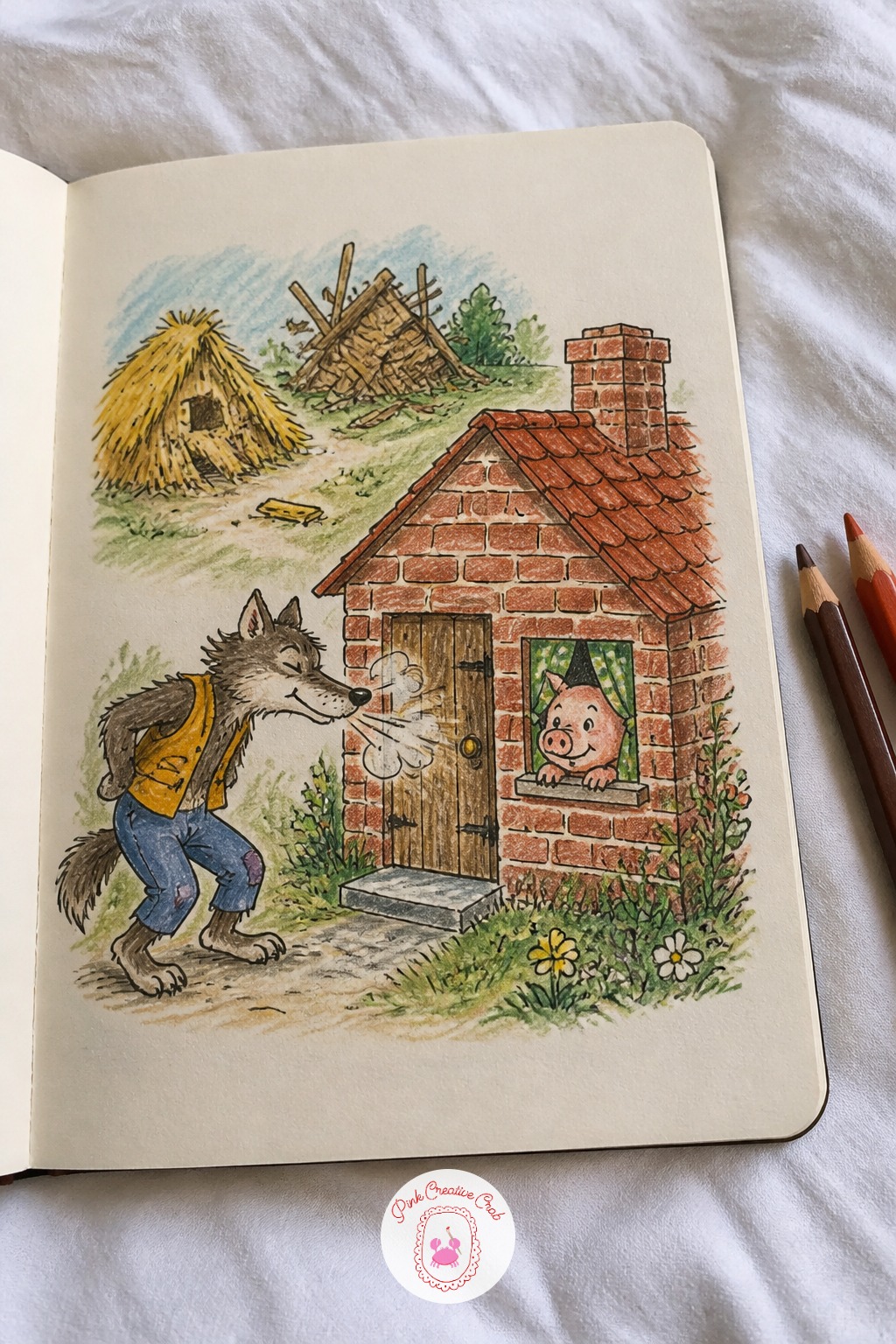
The three little pigs and the brick house works nicely as a ten minute sketch or a forty minute one, depending on how much of the story you want to tell. The quick version is just the sturdy brick house with the wolf huffing outside the door.
The longer version adds the straw and stick houses crumbling in the background, giving the whole page a sense of before and after. Either way, keep the bricks as simple rectangles rather than drawing each one with mortar lines, since that texture reads better suggested than labored over.
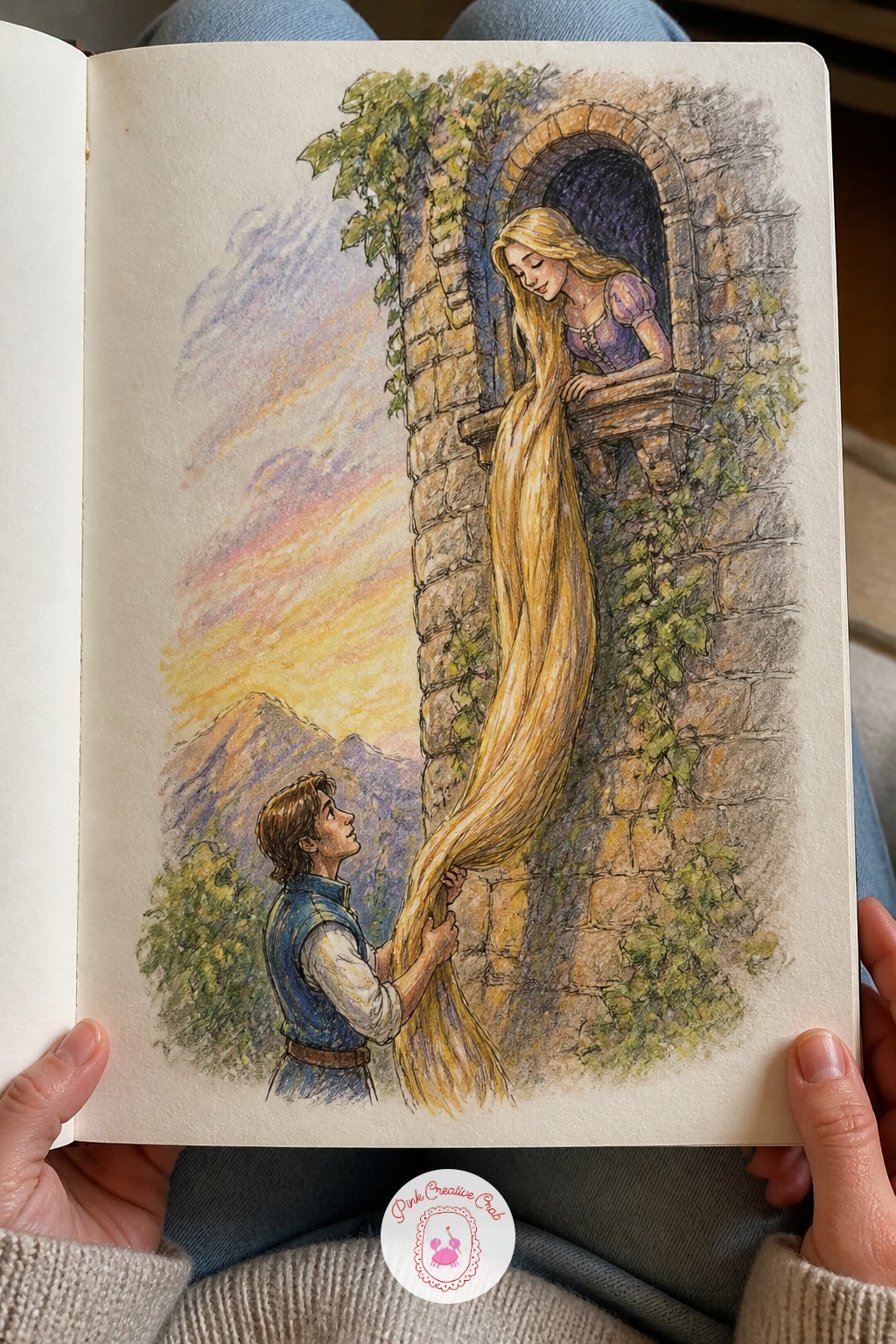
Rapunzel letting down her hair from the tower window is really an exercise in one long, confident line, so this is a good scene for practicing pressure control with your pencil. Start light at the top of the hair near the window and let the pencil press a little heavier as the braid falls, which naturally suggests weight and gravity.
Keep the tower itself simple, a narrow stone cylinder with one window, so the golden hair has room to be the hero of the composition. Add the prince looking up from the base for scale and story.
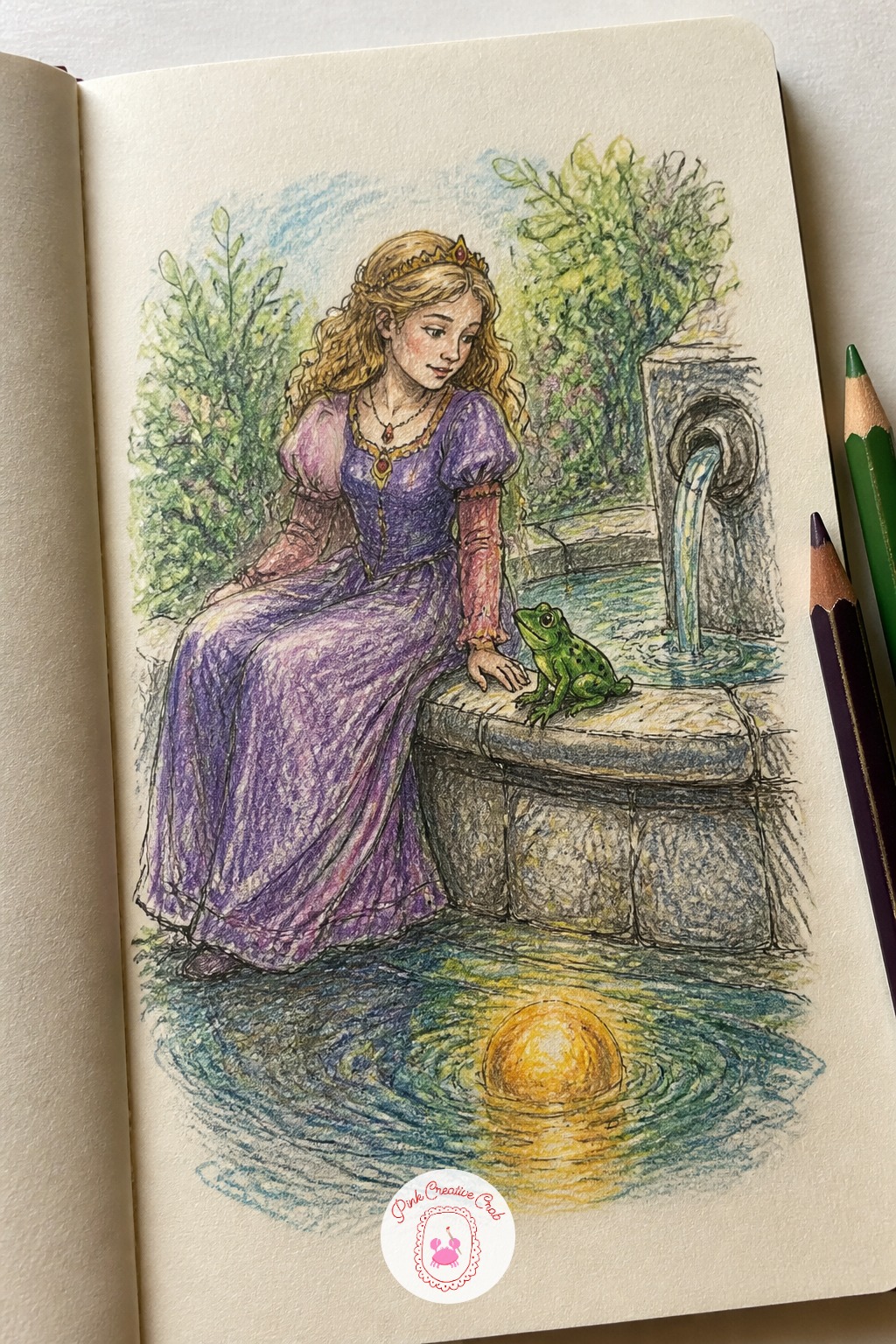
The frog prince by the golden ball fountain is a quieter moment than most of these tales offer, which makes it a nice change of pace in your sketchbook. Sit the princess at the edge of a stone fountain, her golden ball just visible beneath the water’s surface, and the frog perched politely on the rim beside her.
Use the side of your pencil lead rather than the tip to lay in the water’s ripples, since that broader stroke gives a much more convincing soft shimmer than hard pencil lines ever will. Keep the ball the brightest spot in the whole scene.
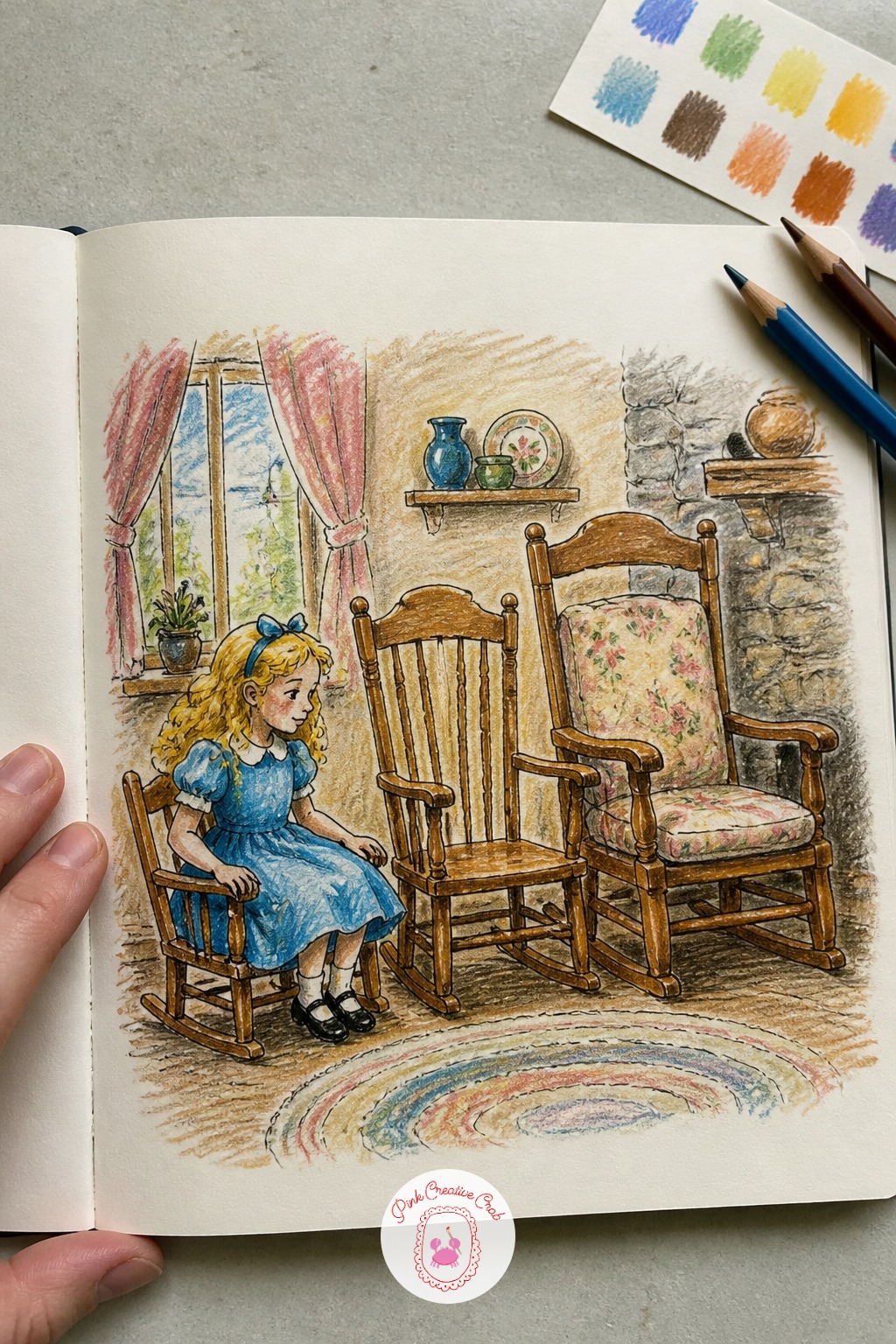
Goldilocks trying the three chairs gives you a built in rule of three, which is always a satisfying shape to compose around. Arrange the chairs in a gentle arc rather than a straight row, large on one side and small on the other, with Goldilocks mid motion between the middle and smallest seat.
Following on from fountains and towers, this scene stays entirely indoors, so let the cottage window behind her bring in a little daylight to balance the wooden furniture. Keep her dress the one warm color note in an otherwise woody, golden brown room.
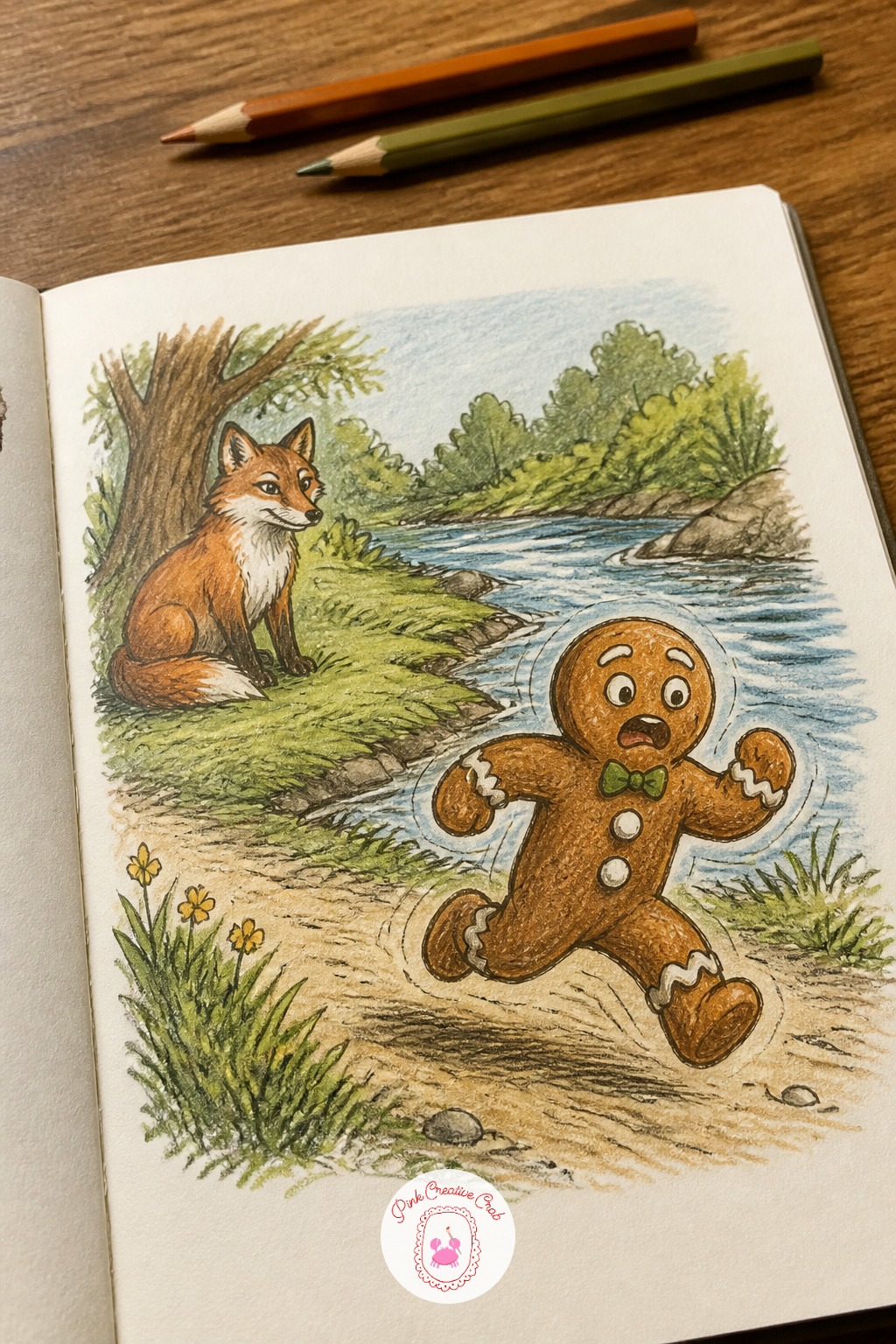
The gingerbread man running past the river needs motion in every line, so let his arms and legs splay out at odd, energetic angles rather than a neat running pose. A common mistake with this scene is drawing him too stiff and centered, which kills the joke of a cookie who refuses to stop.
Fix it halfway through by tilting his whole body forward and letting one arm fling backward, as if the page itself can barely contain him. The fox waiting by the riverbank should stay calm and still by contrast, which makes the gingerbread man’s panic read even stronger.
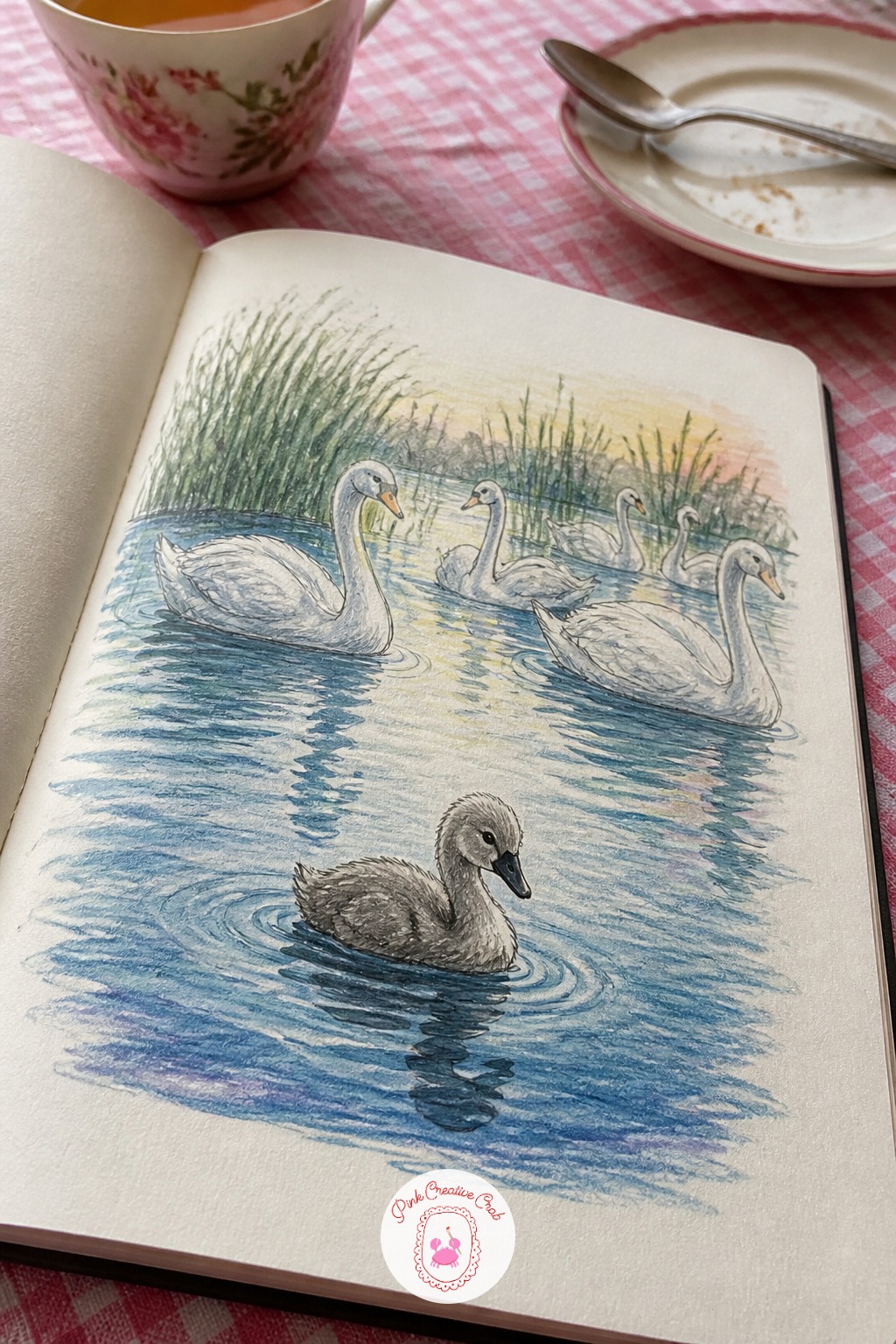
The ugly duckling among the swans is a lovely one for anyone who enjoys drawing animals with real feeling in their poses. Place the small grey duckling slightly apart from the gliding white swans, head low, while the swans drift past with their necks held high and proud.
That gap in body language tells the whole story before anyone reads a caption. Keep the pond water in soft cool blues and let a few white gel pen highlights catch the swans’ feathers and the water’s surface.
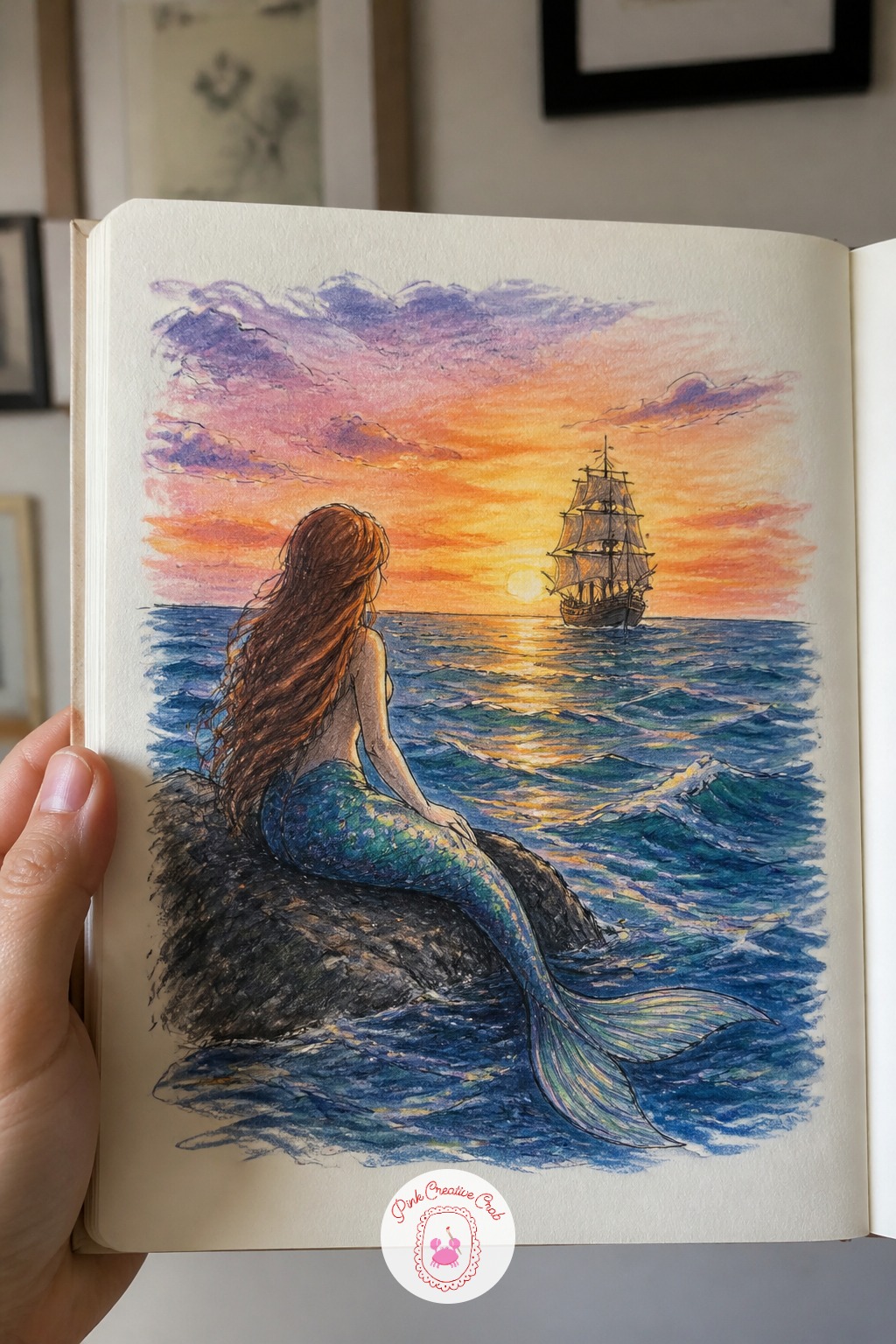
The little mermaid watching the ship from the waves calls for some thought about eye level, since most of this scene happens at the surface of the water. Put your horizon line low, near the bottom third of the page, so the ship towers dramatically above her and the sky gets most of the space to glow with sunset color.
Her tail should break the water in a gentle curve, half submerged, with ripples fanning out around her. Keep the ship mostly silhouette against the warm sky so her pale figure stands out clearly in the foreground water.
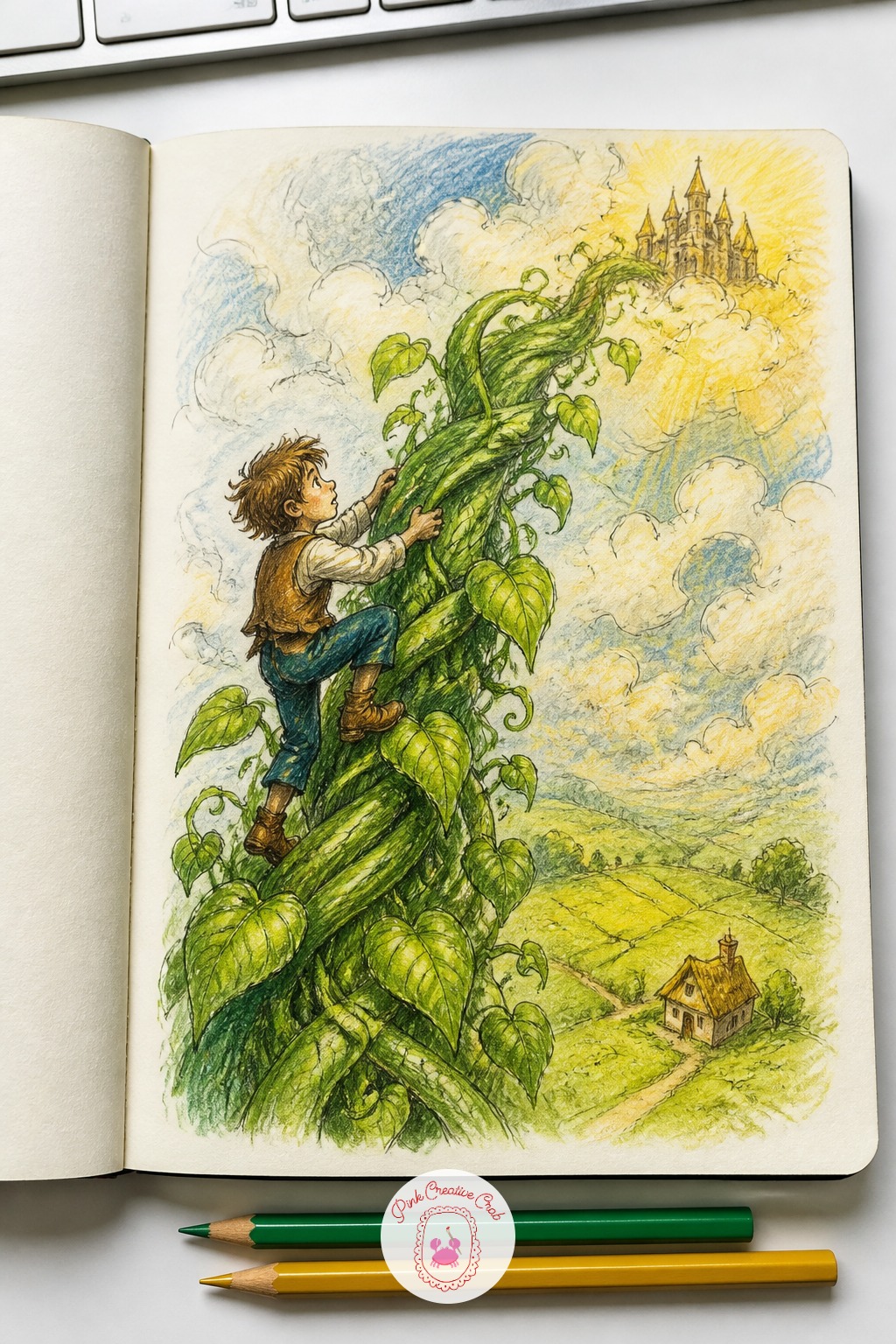
Jack climbing the beanstalk is really a lesson in proportion more than anything else, since the whole joke of the story is scale. Decide early how many times taller than Jack the beanstalk needs to feel, then keep every leaf and curl of vine consistent with that scale as you work your way up the page.
A good trick is to make Jack roughly the height of just one leaf near the top, which instantly sells the enormous height of the plant below him. Let the vine spiral rather than grow straight, since a spiral reads as both taller and more magical.
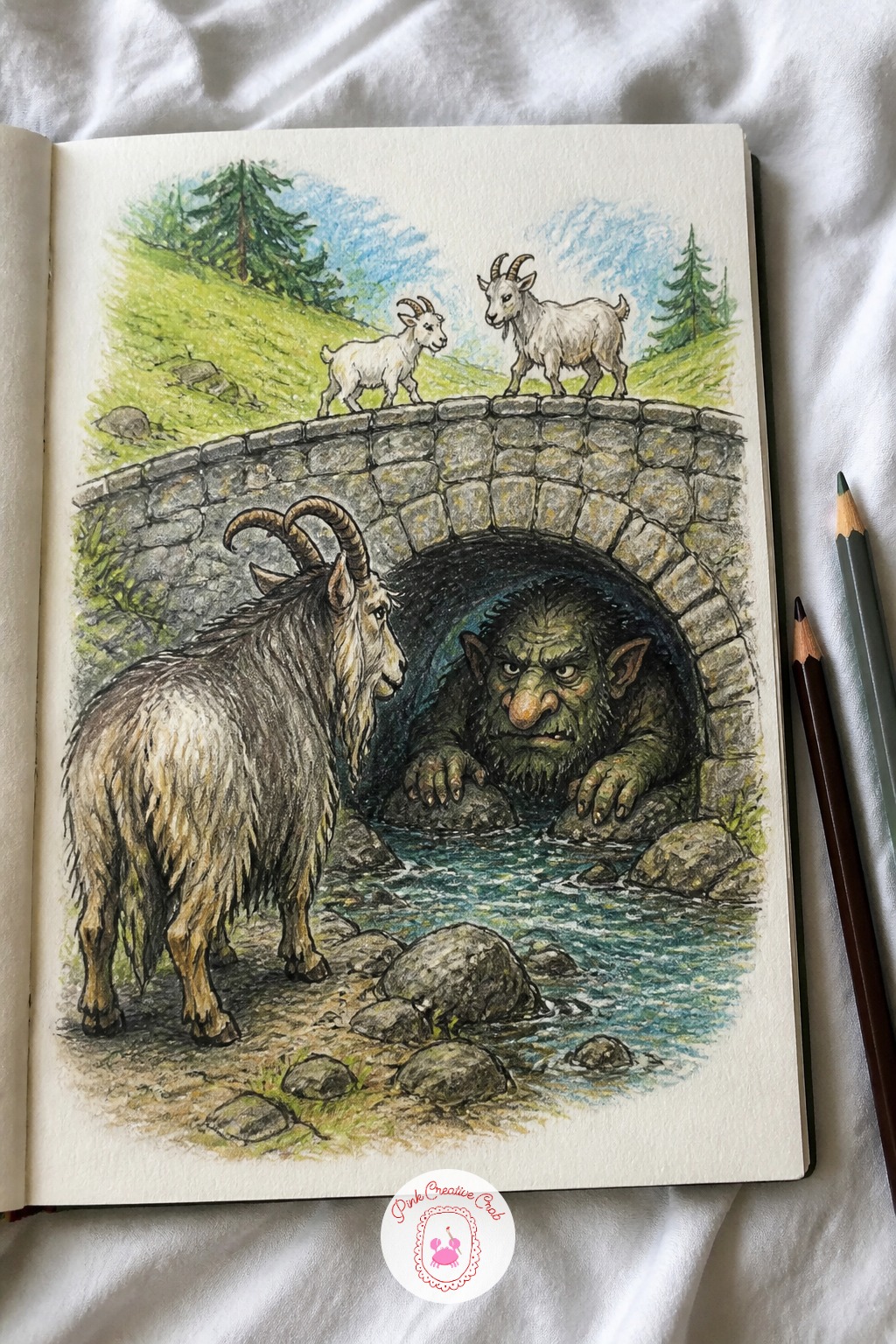
The three billy goats gruff and the troll under the bridge gives you a nice excuse to play with light coming from below, since the troll lurks in the shadow under the bridge while the goats trot across in daylight. That light source change means the troll’s face should carry deep upward shadows under the brow and chin, very different lighting from the goats above.
Keep the bridge arch simple stone, and let the biggest billy goat’s horns catch the brightest highlight as he faces the troll down. This contrast between sunny top and shadowy underneath is what makes the scene feel properly tense.
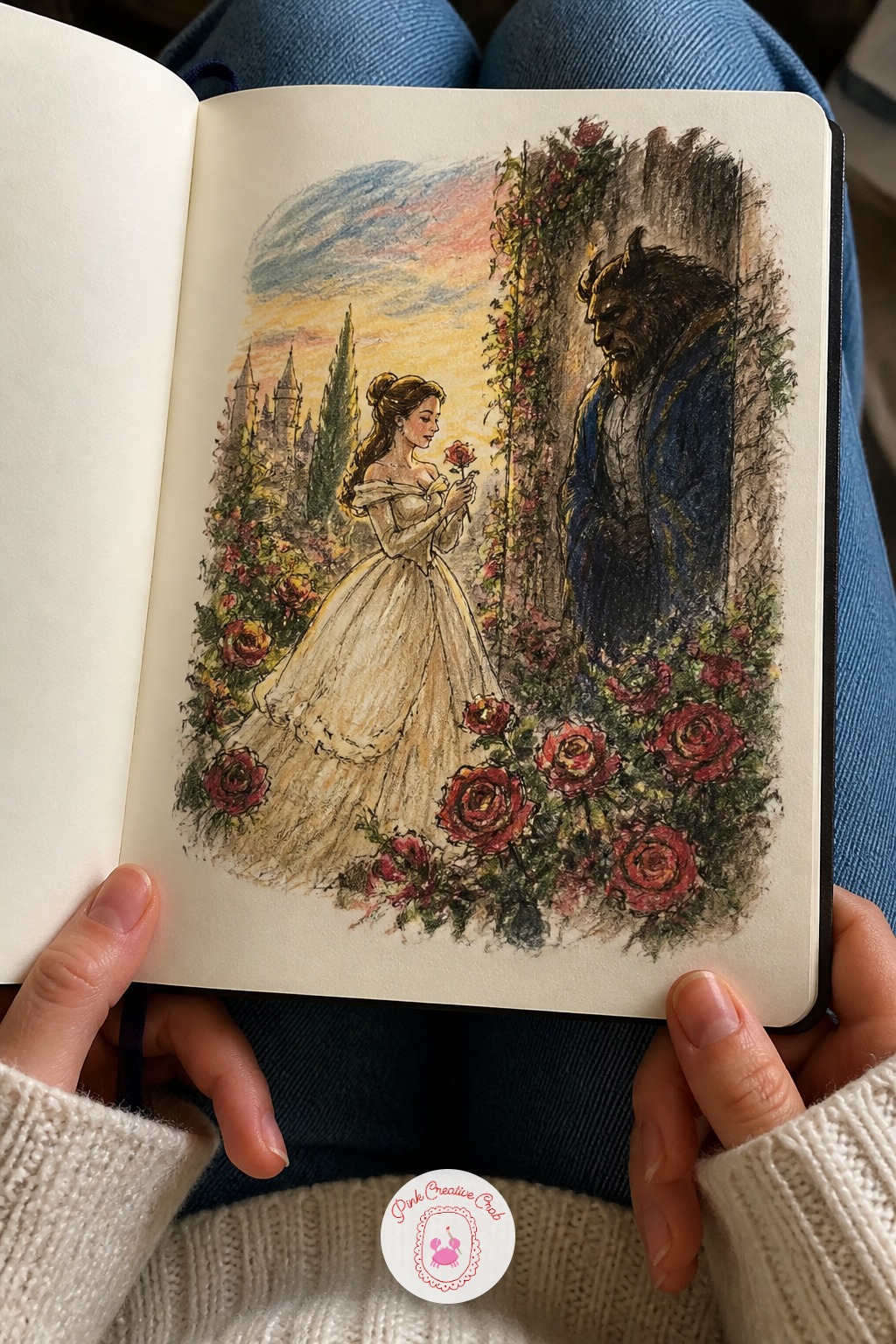
Beauty and the Beast in the rose garden, drawn from the old French tale rather than any later version, is a chance to slow down and really enjoy color. Give Belle a simple pale gown so the roses around her can carry all the richest reds in the scene, and let the Beast stand a little apart, half in shadow near the garden wall.
Vary this one next time by changing the season, a frosted winter rose garden instead of a blooming summer one, which shifts the whole mood of the same two figures. For today, keep the roses as the single boldest color note on the page.
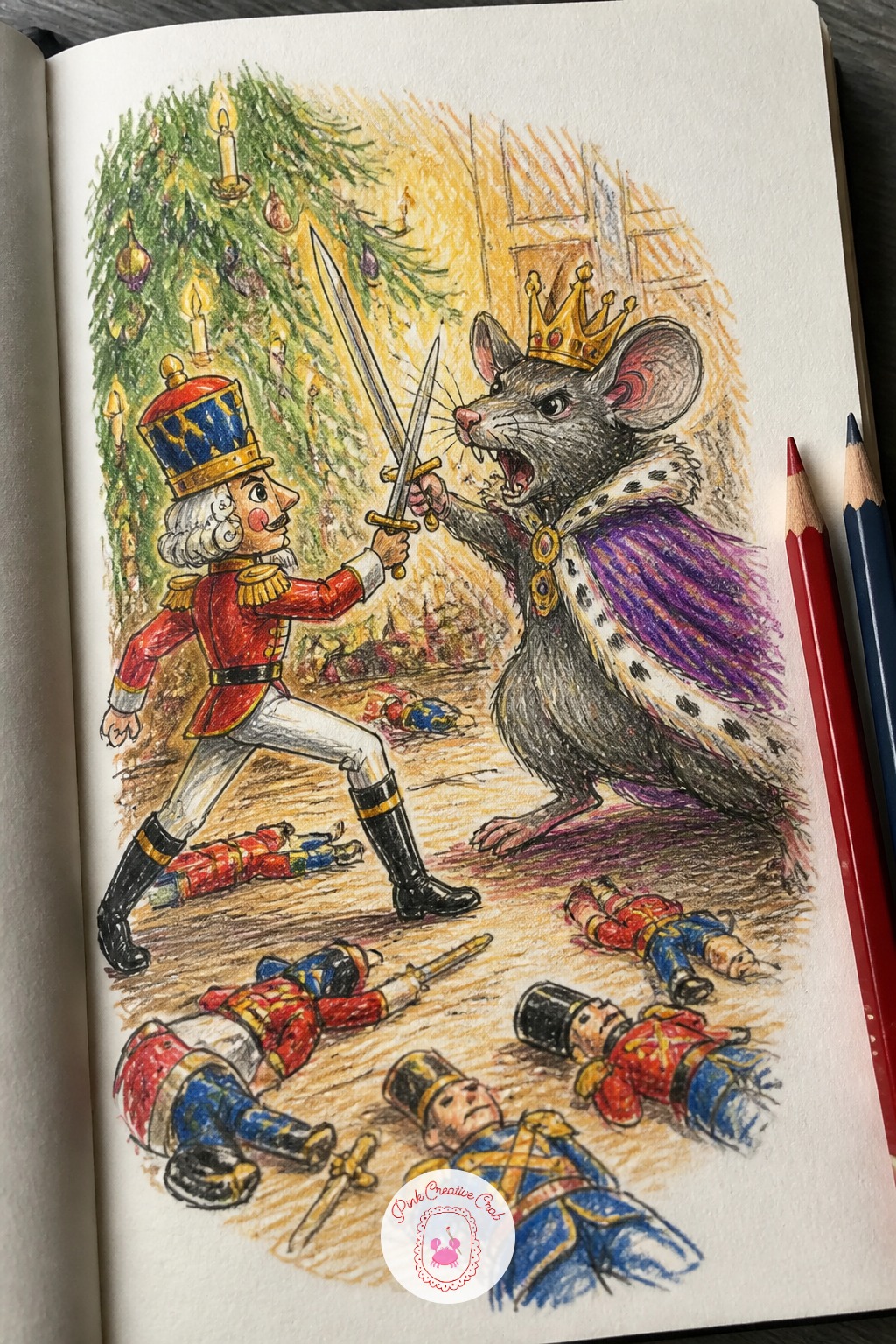
The nutcracker prince battling the mouse king is full of movement, so block in the action before any detail. First mark down the two figures’ rough positions facing each other, second the angle of the tiny sword between them, third the scattered toy soldiers watching from the floor, and leave the uniform buttons and mouse fur for the very last pass.
That order keeps the energy of the fight from getting lost under too much early detail. Rich reds and golds on the nutcracker’s uniform against the mouse king’s dull grey fur will carry the whole color story.
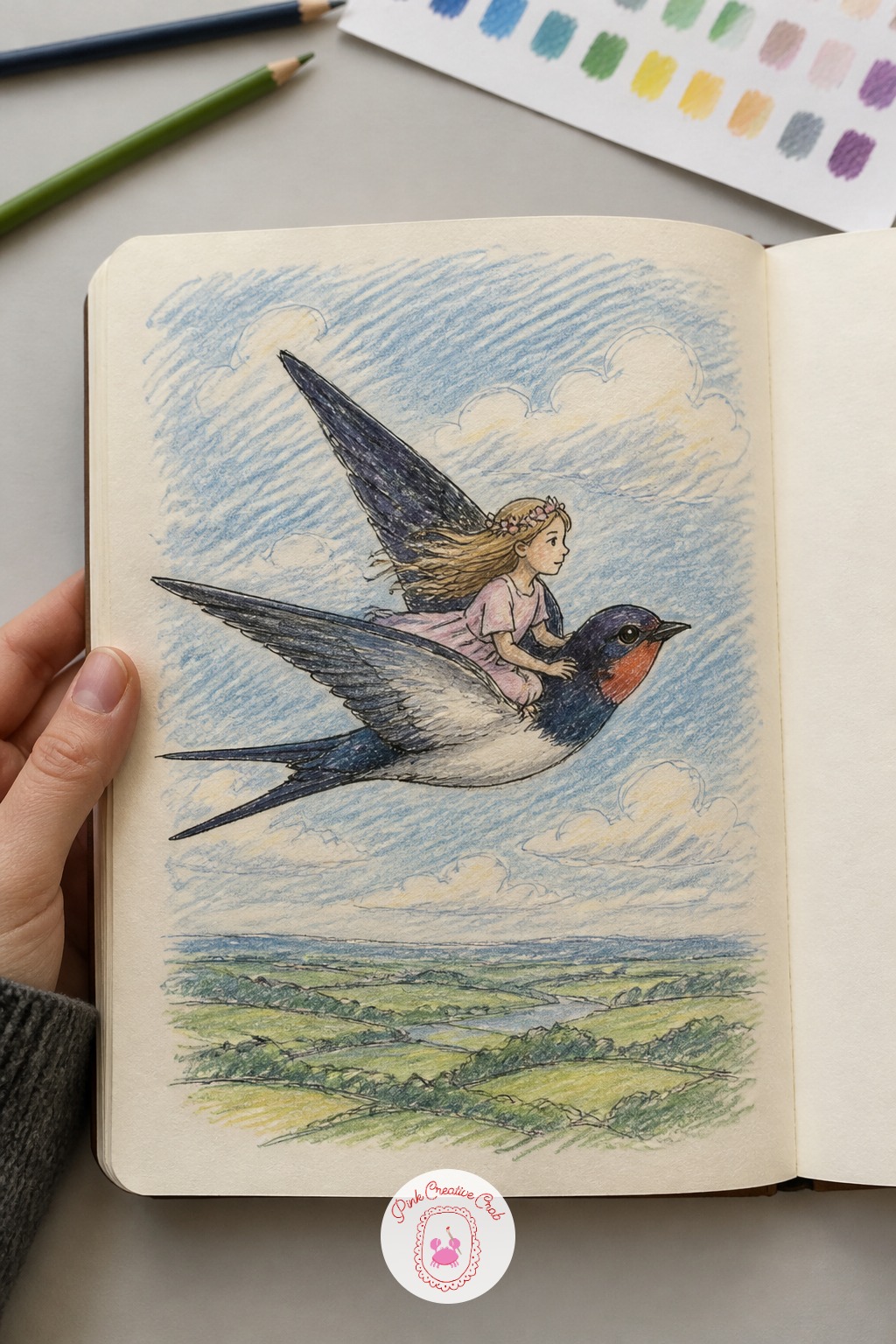
Thumbelina riding the swallow is a gentle scale exercise after the sword fight of the last scene, since she needs to feel genuinely tiny against the bird. Seat her snugly between the swallow’s wings, no larger than one feather in length, and let the bird’s wings stretch wide across most of the page.
Soft blues and whites for the sky keep the mood light and airborne. A quick ten minute version can simply be the bird in flight with Thumbelina as a tiny dot of color, while a longer sitting lets you add clouds and a distant landscape below.
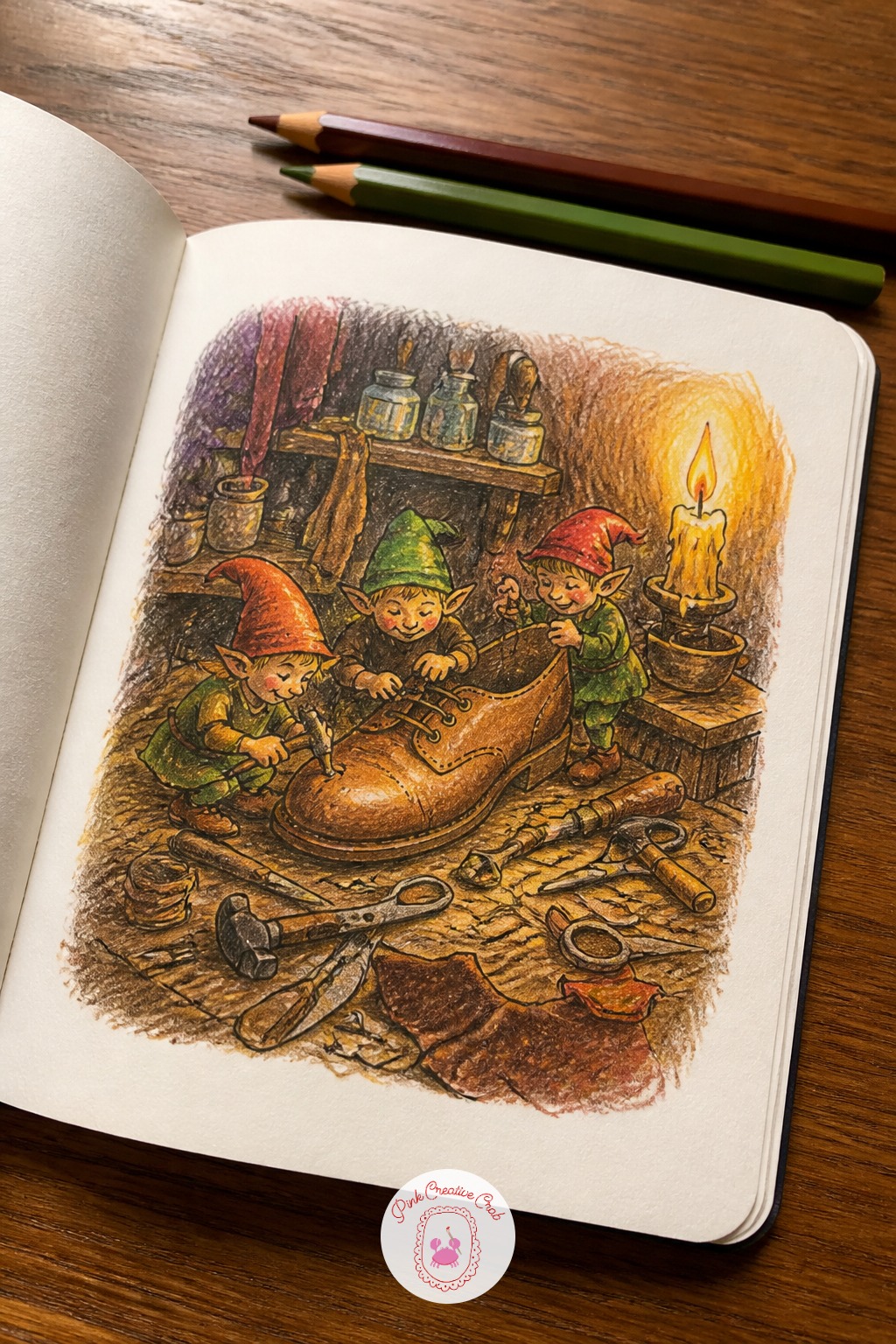
The shoemaker and the elves at the workbench is a cosy night scene, so think about where your single light source sits before you ink anything. A candle on the workbench throws warm light upward onto the elves’ busy little faces and leaves the corners of the room in soft shadow.
That lighting choice does most of the storytelling work for you. Readers who enjoyed cozy village scene drawing will likely enjoy this one too, since it shares that same warm, lamplit, indoor feeling.
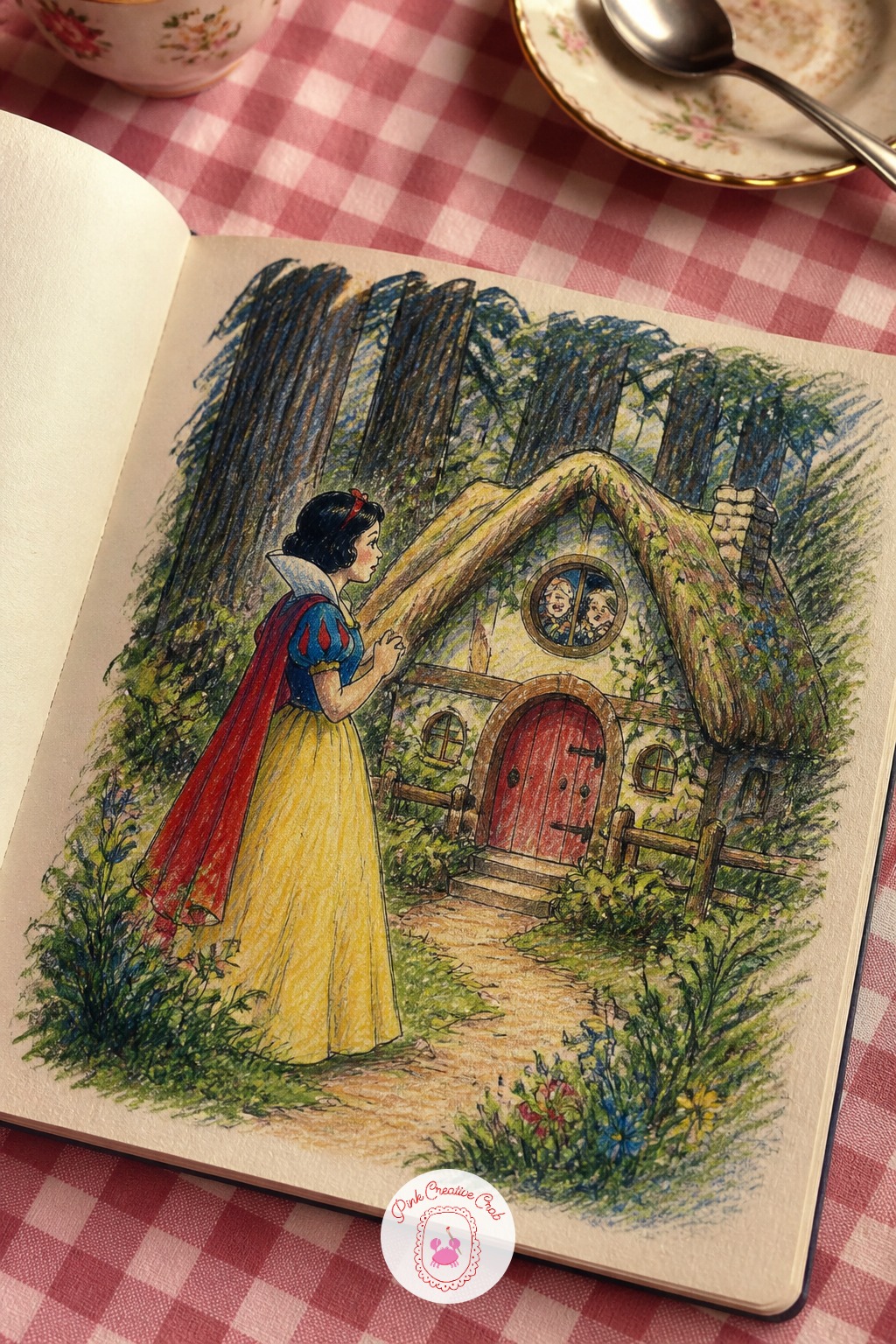
Snow White and the seven dwarfs’ cottage, taken from the old Brothers Grimm telling rather than any screen version, works best with a clear sense of scale between her and the little house. Measure the cottage door against her own height first, roughly two thirds her size, so the whole building reads as built for much smaller residents.
Let her stand just outside, mid knock or mid peek through the window, with the forest pressing close behind her. Keep the cottage roof mossy green and the door a cheerful red to match the classic storybook palette.
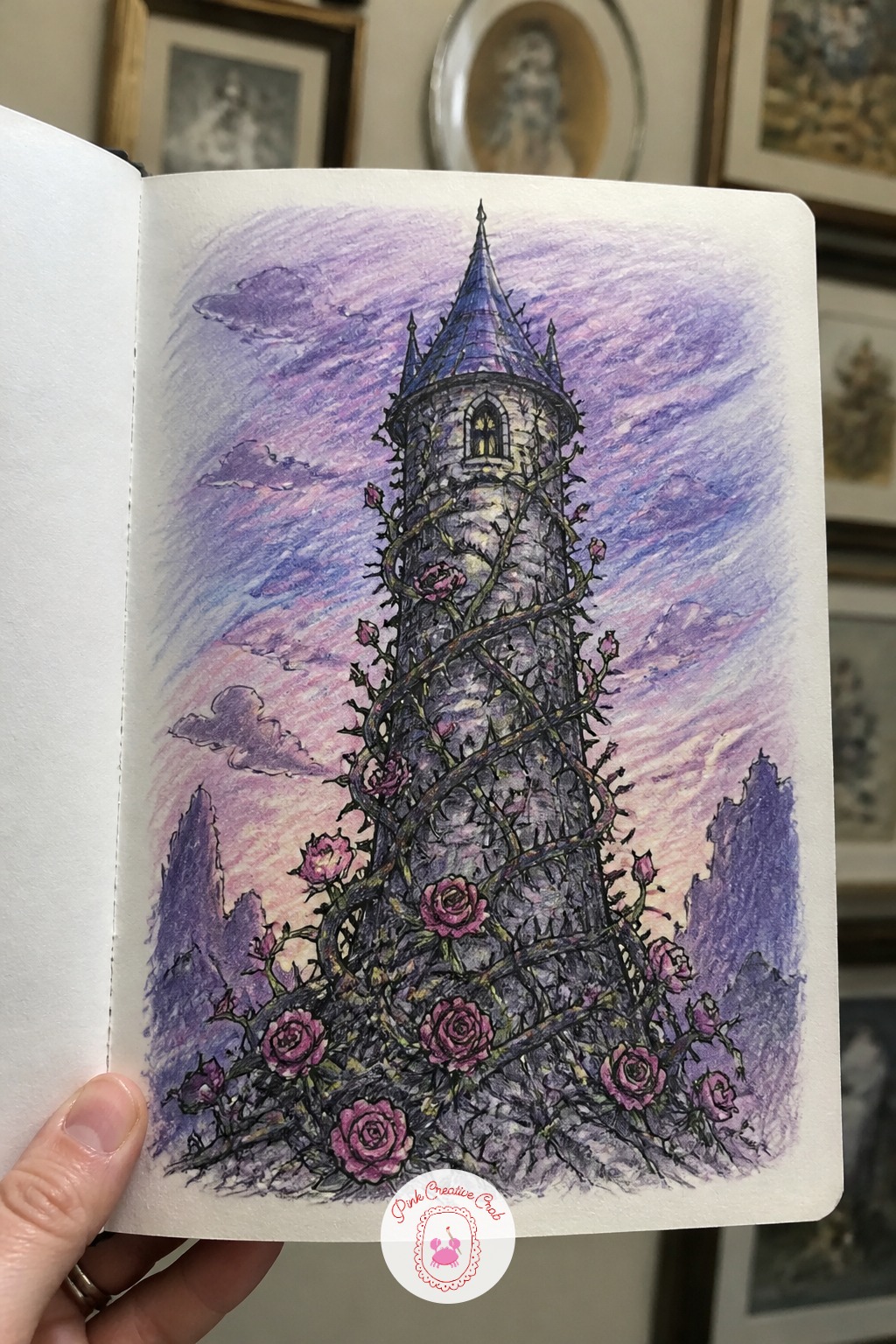
Sleeping Beauty’s tower of thorns, drawn from the old tale of the hundred year sleep, asks for careful edges more than anything else. A kneaded eraser is your best friend here: lay down the thorny vines in solid dark pencil first, then lift soft highlights out of them with the eraser to suggest where light catches each curling stem.
That lifting technique gives the thorns a much more tangled, three dimensional feel than trying to draw every highlight from scratch. Keep the tower itself pale stone so the dark thorny vines read clearly against it.
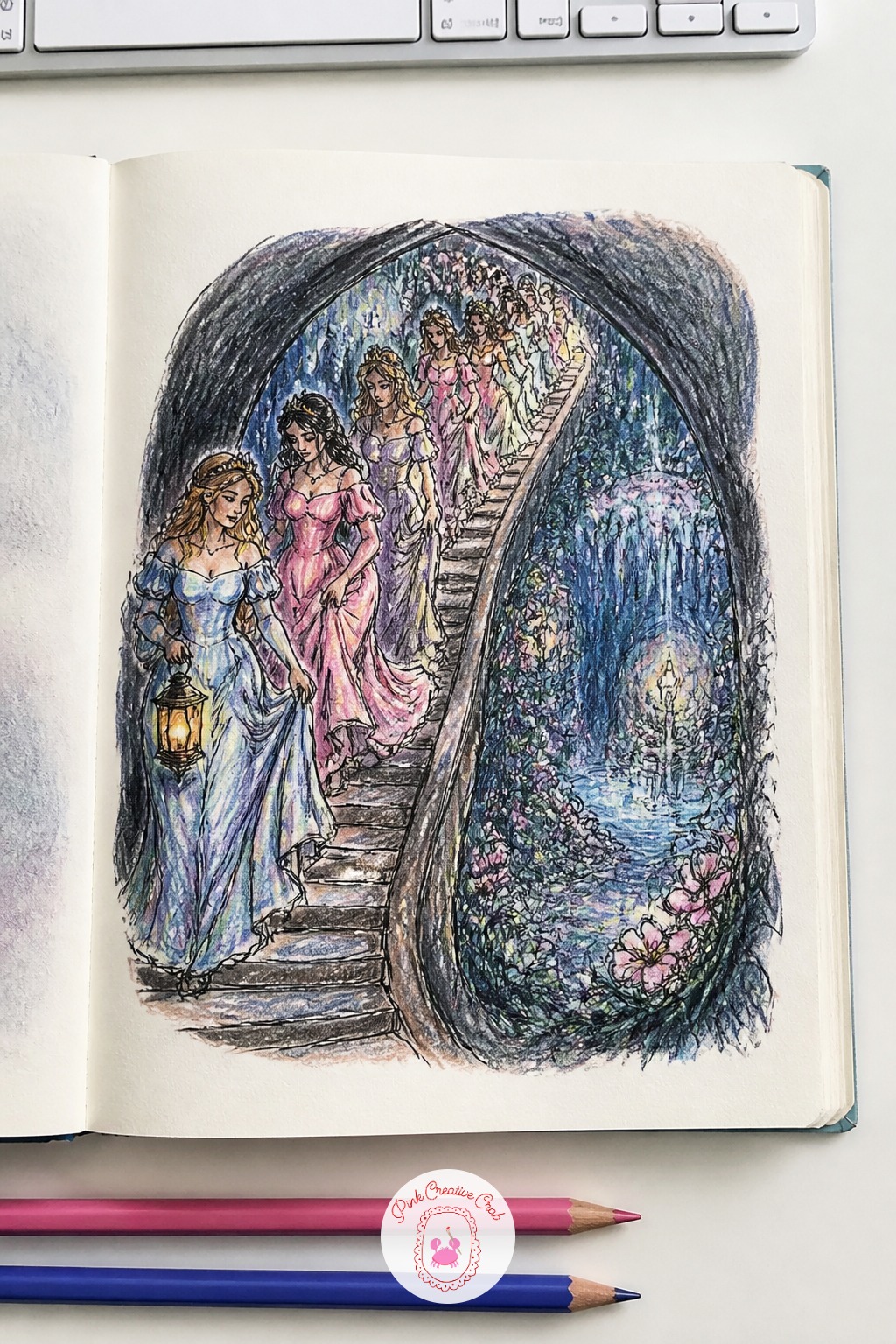
The twelve dancing princesses descending the secret stair is an ambitious one, so simplify before you panic about drawing twelve full figures. Suggest the back half of the line as soft silhouettes and only render the front two or three princesses in full color and detail, which keeps the scene readable instead of cluttered.
Following that same instinct for clarity, let the stairway itself curve gently downward into a glowing underground garden, so the eye has a clear path to follow from top to bottom of the page. Silvery blues and soft pinks suit this one beautifully.
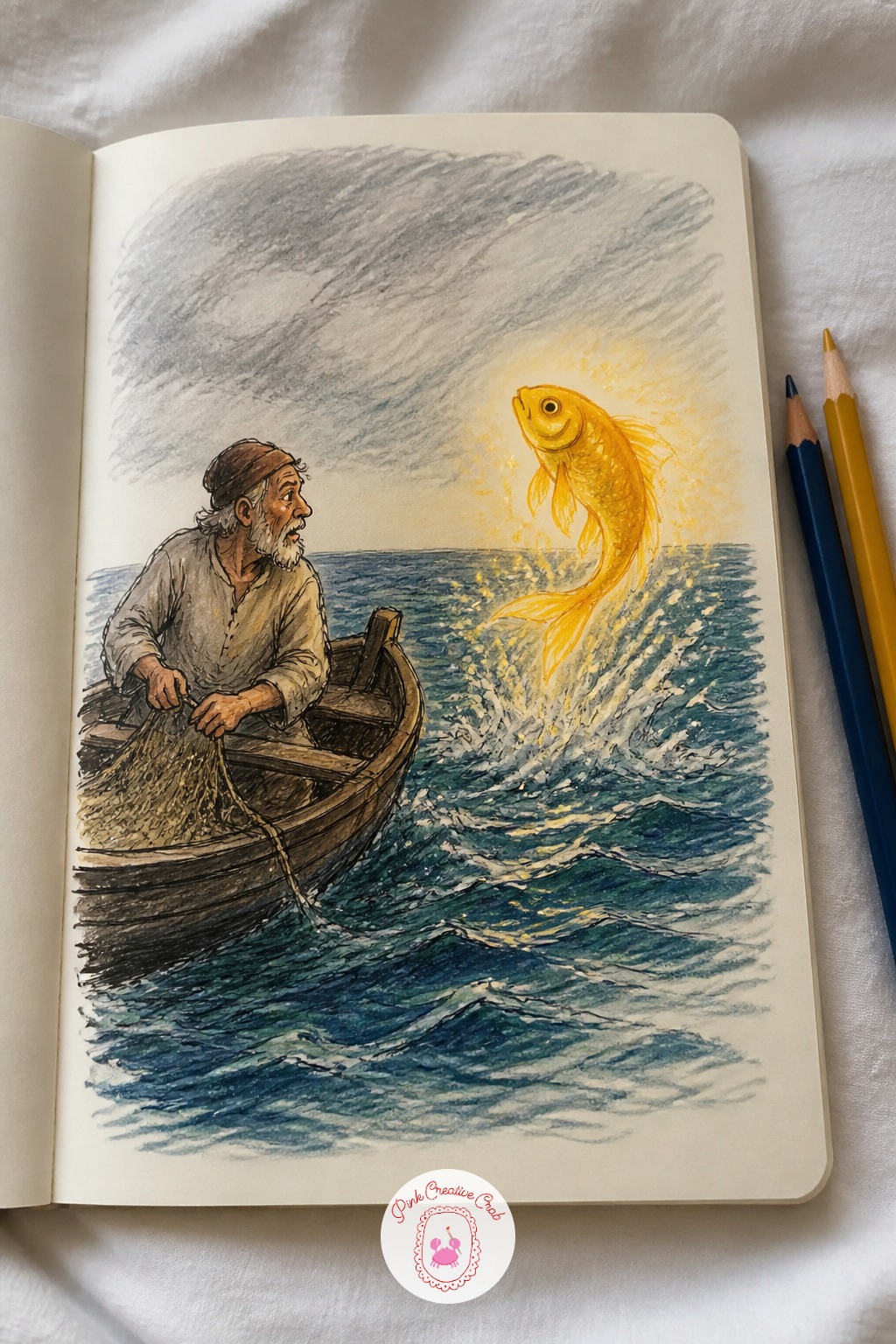
The fisherman and the golden fish rising from the sea to grant a wish is a scene about contrast between the ordinary and the magical. Keep the old fisherman and his simple wooden boat drawn plainly, with a slightly rough, sketchy ink line, while the golden fish gets a smoother, more polished line and the richest color on the page.
That difference in line quality alone tells the viewer which element is magic without needing any extra explanation. Let the fish’s scales catch the only true gold in your pencil set.
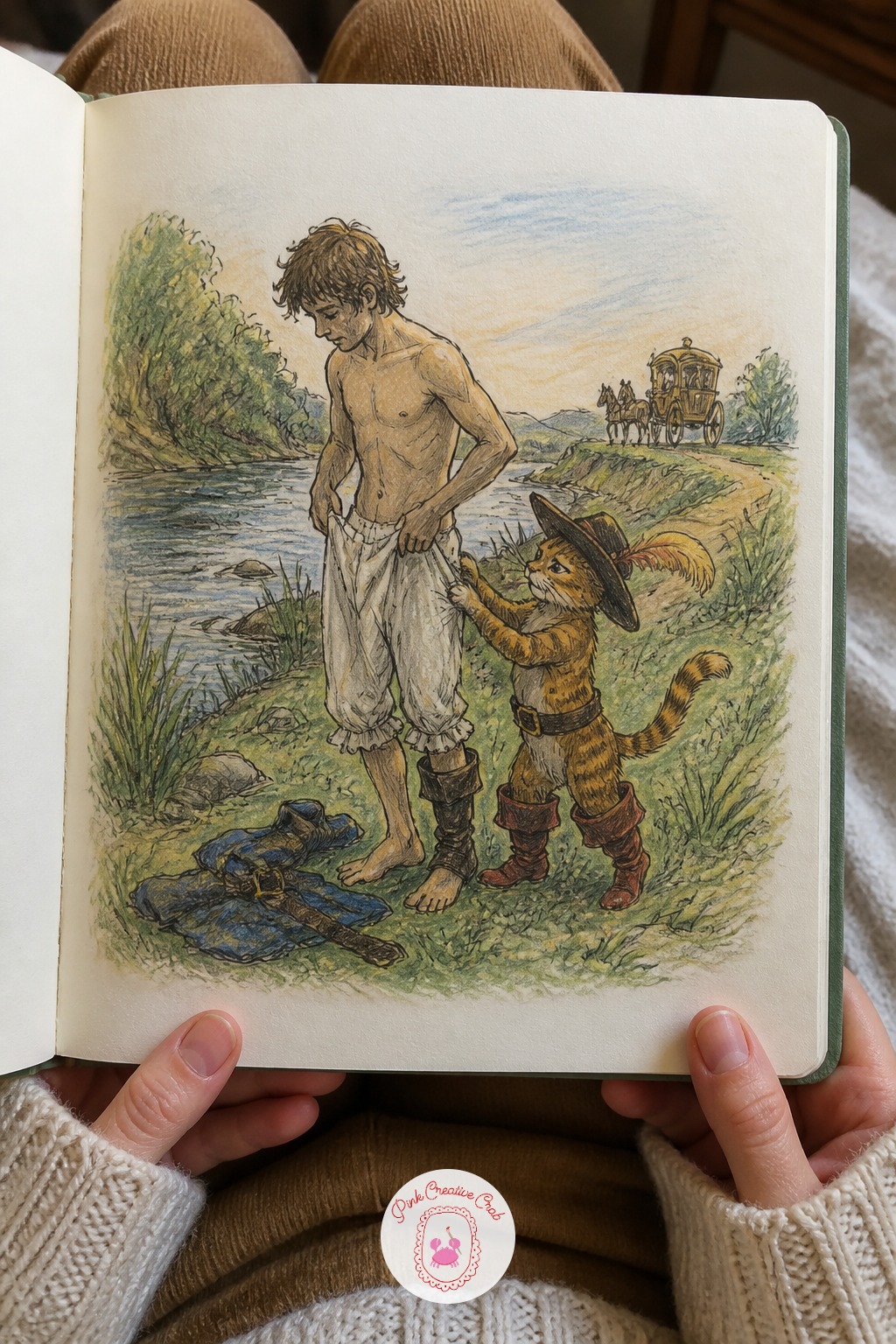
Puss in Boots and the miller’s son at the riverbank revisits our clever cat for a second, quieter scene, since one tale can easily fill more than one sketchbook page. Here Puss helps his master undress by the river before the king’s carriage arrives, so keep the mood playful rather than dramatic.
A loose, quick ten minute sketch can capture just the two figures and the water, while a fuller forty minute version adds the distant carriage and horses rounding the bend. Either way, let Puss’s boots stay the brightest detail in the scene.
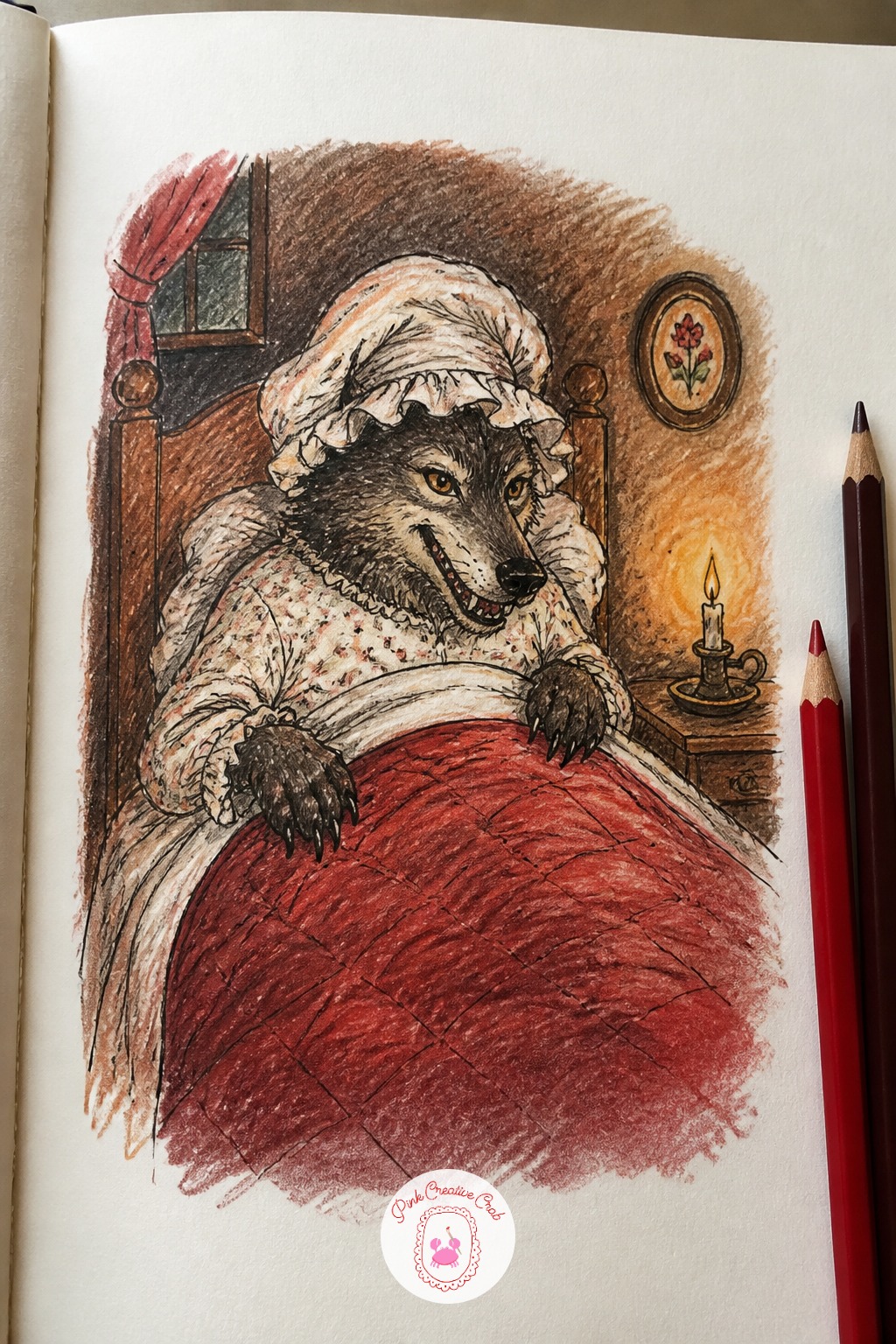
Little Red Riding Hood’s grandmother’s cottage, with the wolf already tucked into the bed wearing the grandmother’s cap, is the darker sequel to our very first scene, so it is fun to draw them as a pair. Keep the cottage room small and close, with heavy curtains and a low beamed ceiling pressing the drama into a tight space.
This time your single light source is a small bedside candle, throwing long shadows from the wolf’s ears up onto the ceiling for a touch of dread. Deep reds and browns suit the room’s mood far better than anything bright.
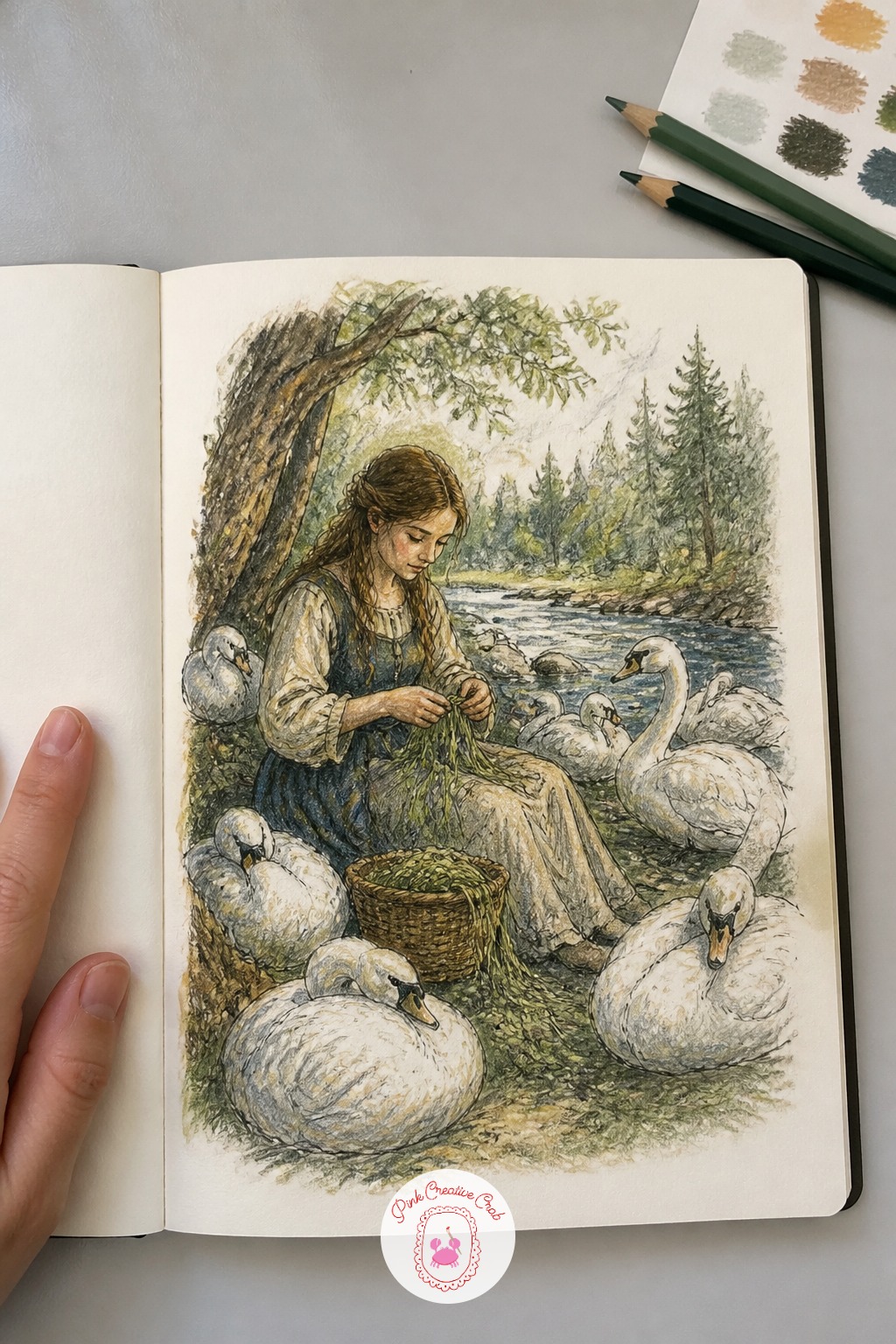
The wild swans and their sister weaving nettle shirts is a quieter, more domestic scene than most on this list, which makes a nice change of pace for your sketchbook. Show her seated at the edge of a riverbank or forest clearing, a pile of rough nettle fibre in her lap and a half finished shirt on her knee, with the eleven swans resting nearby.
Varying it next time, you could focus on just one swan mid transformation, half bird and half prince, for a more mysterious single image. For today, keep the full group scene and let the green nettles and white swan feathers balance each other in the color palette.
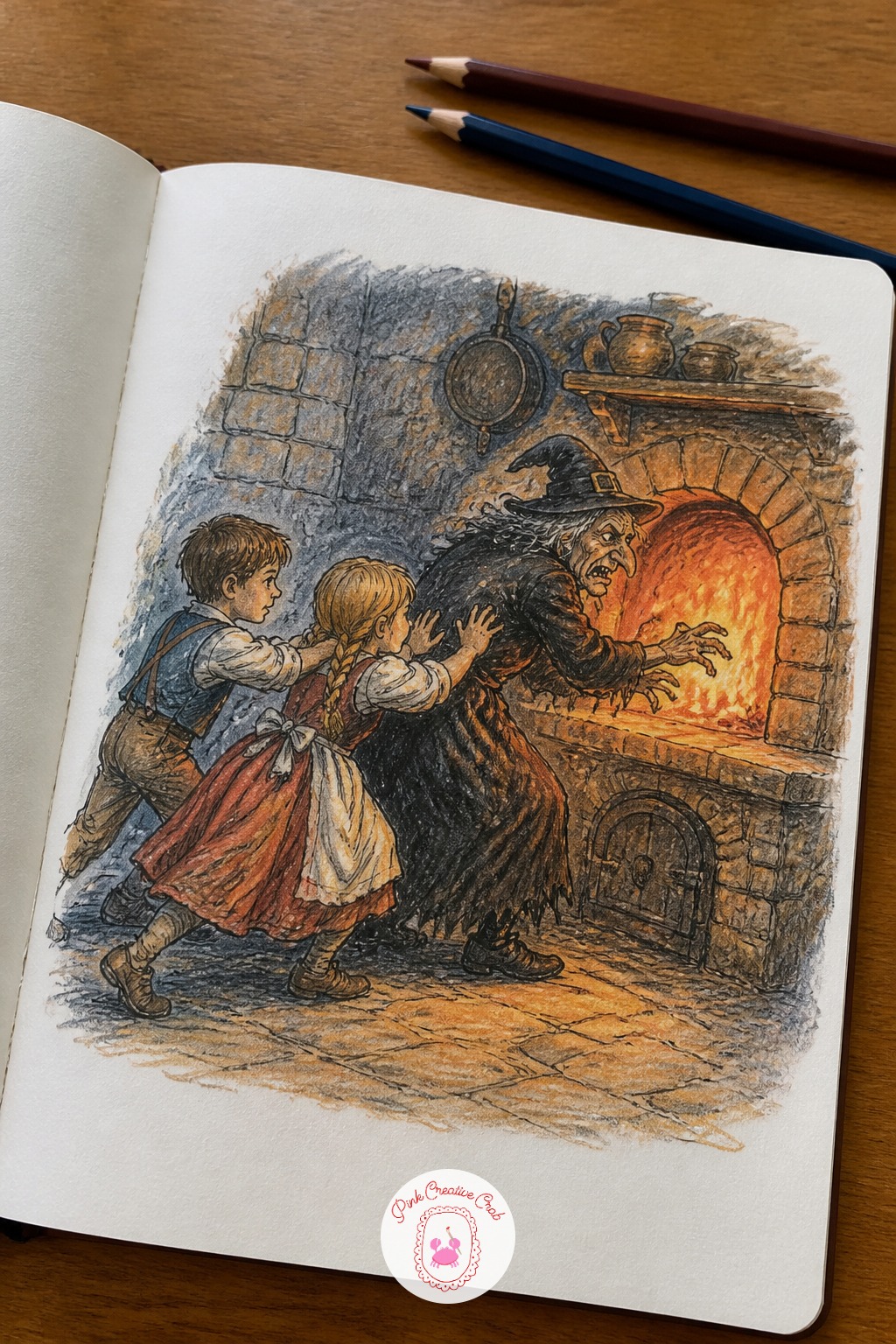
Hansel and Gretel pushing the witch into the oven is the dramatic turn of their story, and this scene rewards strong, confident ink lines over anything delicate. Press firmly for the children’s determined poses and the witch’s flailing arms, since a timid line will undercut the drama of the moment.
Keep the oven’s glowing interior as the one warm orange light source in an otherwise cool stone kitchen, which pulls the eye straight to the heart of the action. This pairs naturally with the earlier gingerbread house scene if you want to tell the whole story across two pages.
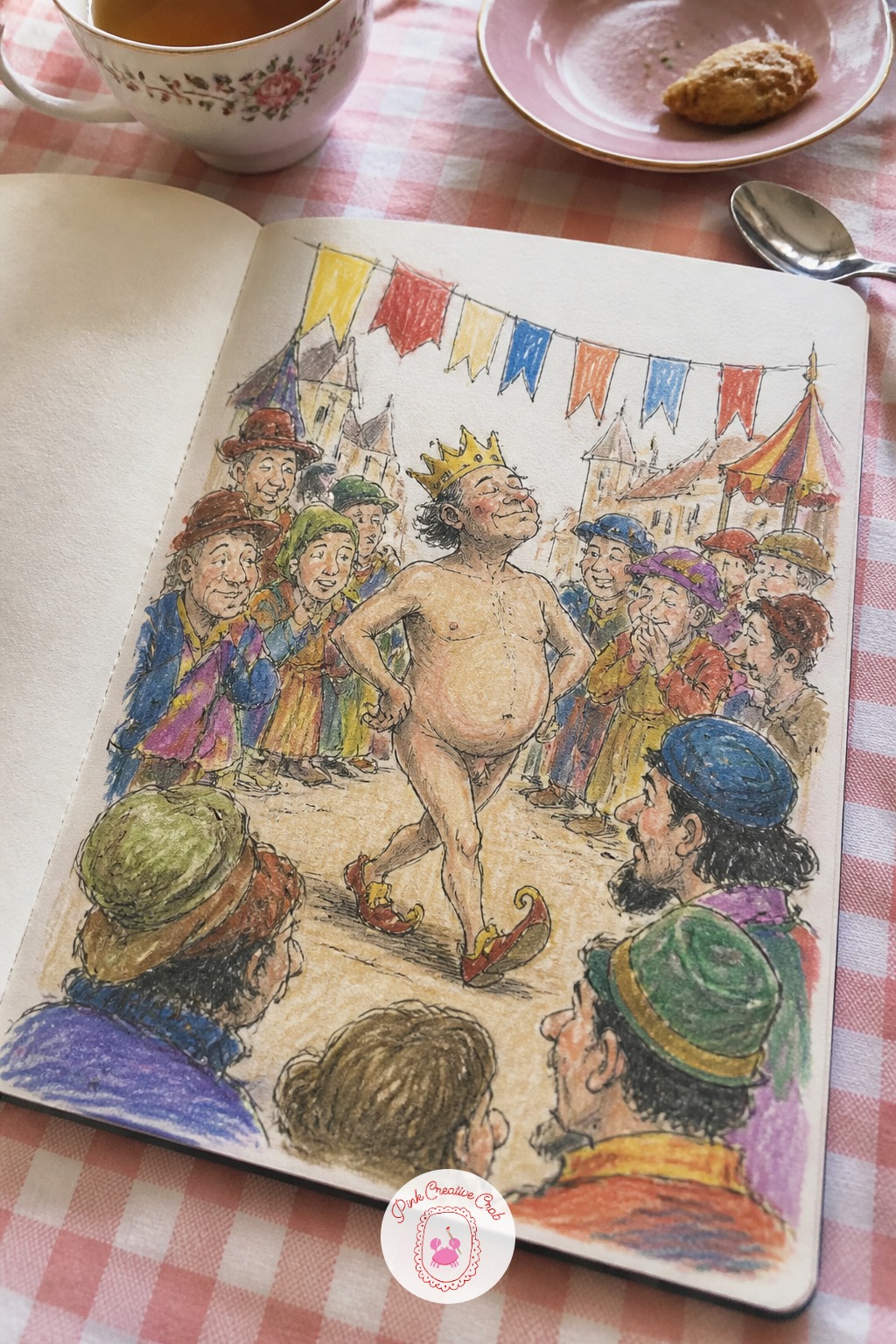
The emperor’s new clothes on parade is a comic scene, so let the emperor walk with real pride and confidence even though he wears nothing but his crown and shoes. The usual mistake is making him look embarrassed, which kills the joke entirely, since the whole point is that he believes he looks splendid.
Fix that by giving him a tall, proud posture and a pleased expression, while the crowd around him exchanges nervous, knowing glances. Keep the crowd’s clothing colorful and detailed so the emperor’s bare pink figure stands out by contrast rather than by any added color.
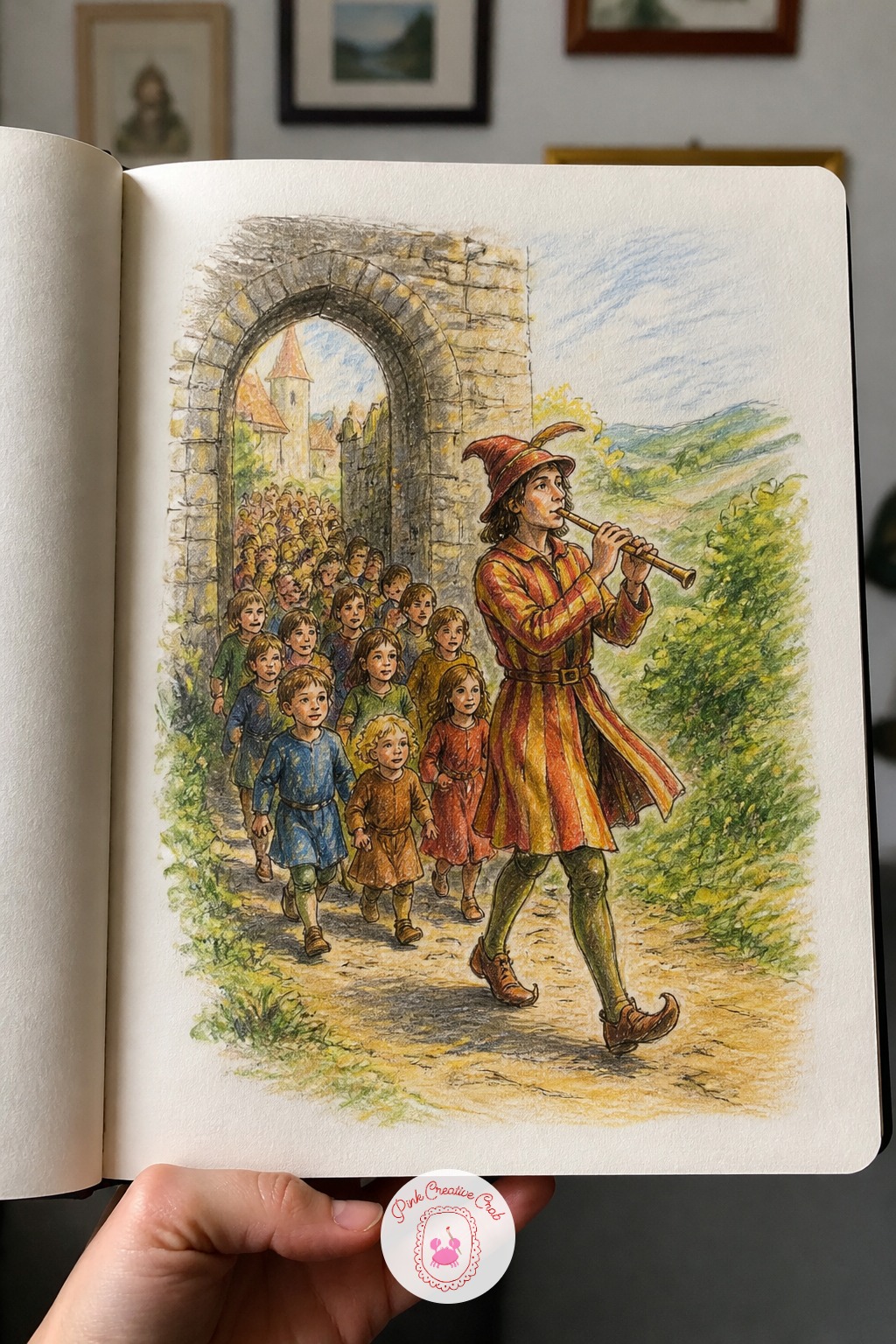
The pied piper leading the children from Hamelin out of town is a scene built around one long winding line of figures, so plan that path before you ink a single face. Sketch the piper first at the front in his striped coat, then lay down a loose curving line for where the children will follow, and only after that add each small figure along the path.
Working in that order keeps the procession feeling natural rather than stiffly spaced. Let the piper’s coat be the single brightest, most patterned part of the whole scene.
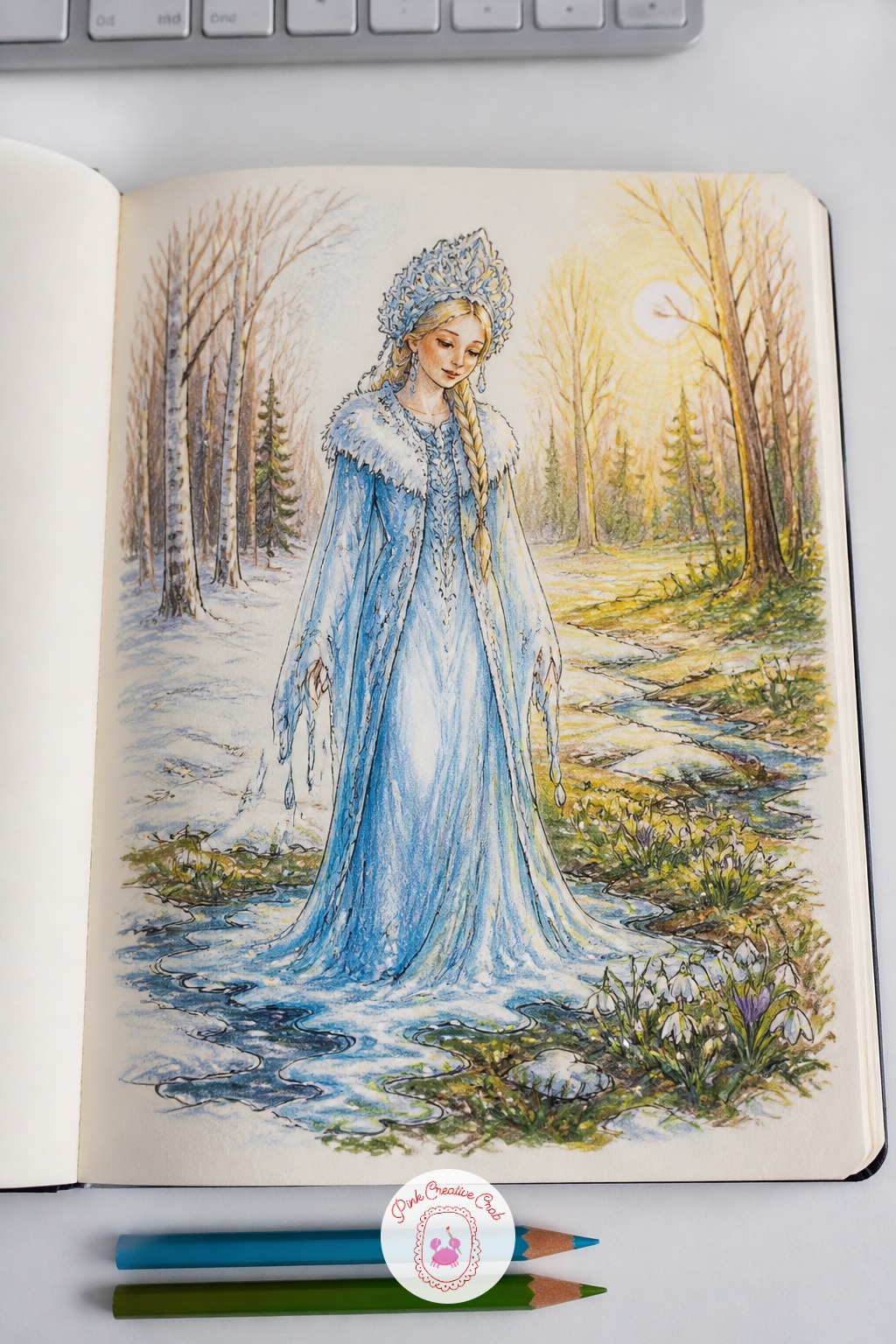
The Snow Maiden melting in the spring sunlight, from the old Russian folk tale, is a gentle, bittersweet scene to close out the winter side of this list. Place her at the edge of a forest clearing where snow still clings to the shadows but new green grass and early flowers push up in the sunlit patches around her.
That mix of melting snow and new spring growth in one small clearing tells the whole story without any other figures needed. Keep her dress pale icy blue so it reads clearly against the warmer greens and yellows of the thawing ground.
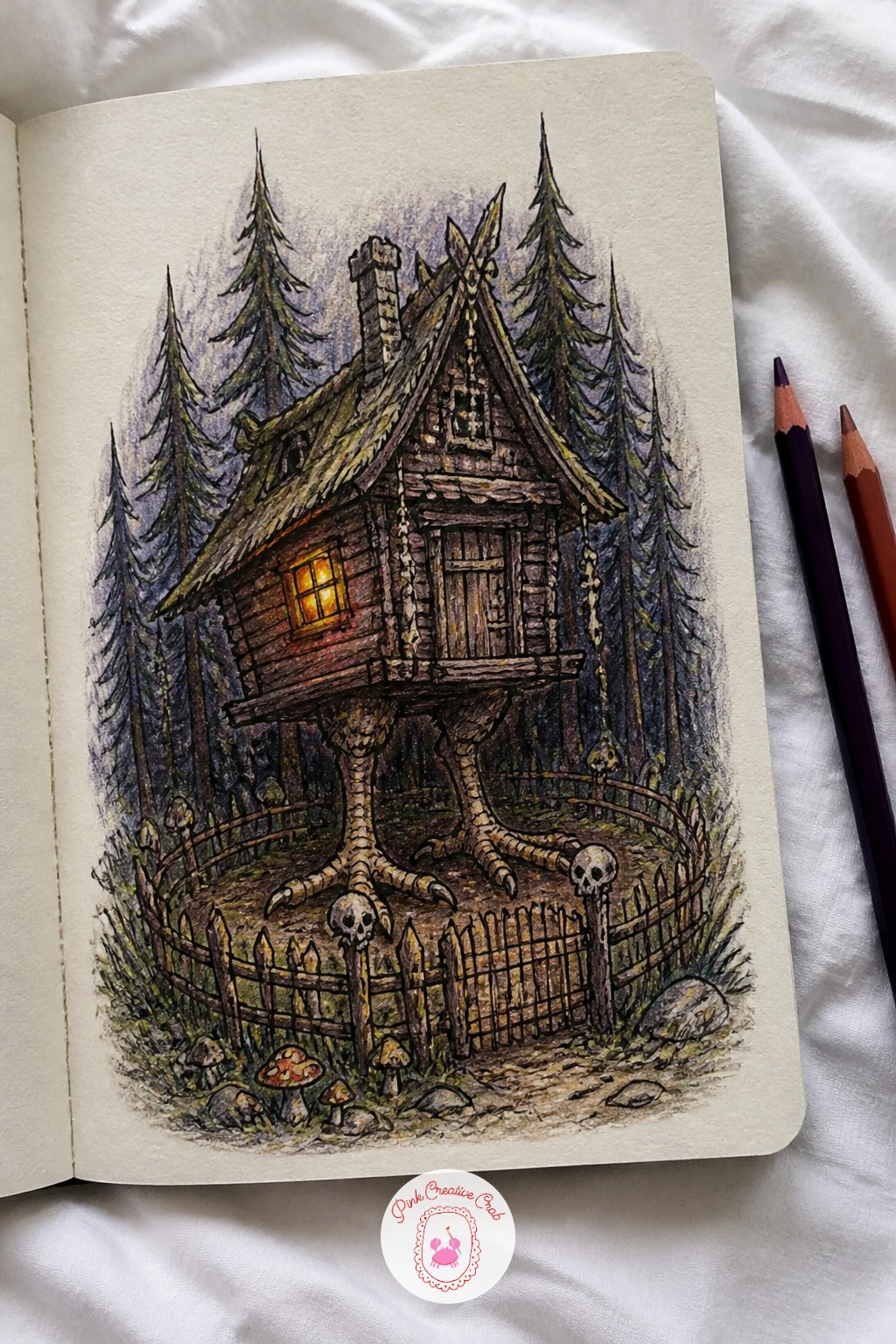
Baba Yaga’s hut on chicken legs deep in the forest is one of the strangest and most fun images in all the old tales, so do not be afraid to let the hut’s legs look genuinely odd and knobbly. Start this one with the legs themselves, since getting their awkward, bent stance right first makes the rest of the hut easier to balance on top.
Readers who enjoyed the autumn sketchbook scenes of muddy woodland walks will find this hut sits naturally in that same kind of tangled, leaf littered forest. Keep the fence of skulls around the hut subtle rather than gory for a storybook feel.
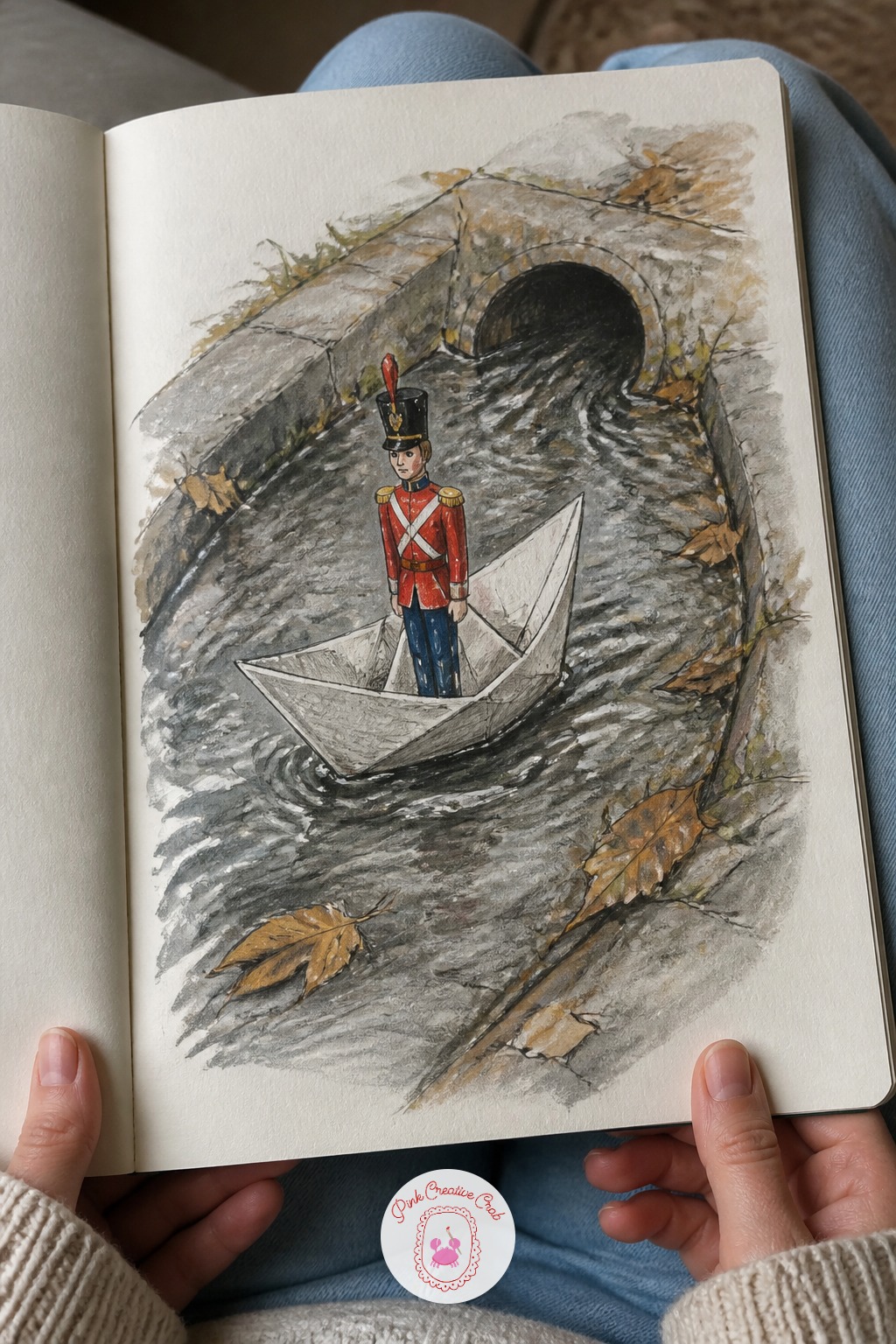
The steadfast tin soldier sailing a paper boat down the gutter stream is a small, brave scene that rewards close attention to scale. Keep the tin soldier stiffly upright even while afloat, since his unbending posture is the whole point of his character, and let the paper boat tilt and dip around him in the current.
A ten minute version can be just the boat and soldier on simple wavy water, while a forty minute version adds cobblestones, fallen leaves, and a distant drainpipe to suggest the gutter stream setting fully. Either way, keep his painted red uniform the one bold color against the grey water.
What to Do Next
Pick whichever tale is pulling at you most tonight, sketch it loosely in pencil first, then commit to ink and let the colored pencils bring the story home. A smooth mixed media sketchbook page is all you really need to get started.
Frequently Asked Questions
Do I need to ink every drawing before adding color?
It helps a lot for this style, since the ink line holds the scene together once color goes down. A fine liner first, left to dry fully, then colored pencil on top gives you crisp storybook edges that stay clean even under several layers of color.
What colored pencils work best over ink line drawings?
Wax based colored pencils blend smoothly over dried ink without smearing the lines underneath. Build color in light layers rather than pressing hard right away, since layering gives you richer, more storybook like color than one heavy pass ever will.
How do I keep these fairy tale scenes historically accurate to the old tales?
Read a short public domain version of the story before you draw, since the Brothers Grimm, Perrault and Andersen originals often differ quite a bit from modern retellings. Small details like clothing, castles and forests tend to feel more timeless when drawn from the old descriptions.
How do I fit a whole scene onto one sketchbook page?
Sketch your main figure and setting lightly in pencil first and check the balance before inking anything. Leaving a little breathing room around the edges, rather than cramming detail into every corner, keeps the page readable even when the scene has several elements.
Can I turn these into a themed sketchbook series?
Absolutely, and many artists work through a whole tale across several pages, one scene per page, almost like a picture book. Keeping your color palette and line weight consistent across pages is what makes a set feel like it belongs together.
Have any thoughts?
Share your reaction or leave a quick response — we’d love to hear what you think!
-
 0
-
0
-
0
-
0
-
0
-
0


