A sunset oil painting rewards you almost before you have finished mixing the first color, because the moment paint starts to glow against a dark silhouette, the whole canvas feels alive. That mix of soft sky and crisp dark shape is what makes this subject so satisfying to paint again and again, and so forgiving when you are short on time.
Below you will find 29 different skies to paint, from a calm pink sea to a city skyline with lit windows, a lavender field to a desert under deep red light. Pick the one that matches your mood tonight, keep your palette simple, and let the sky do most of the talking.
Using these images: free for personal projects such as printing, coloring, cards, journals and gifts. Handmade items that include them may be sold up to 30 pieces per design. More than that is commercial use and is not permitted, and neither is selling or sharing the images themselves or passing them off as your own. Please ask before any other use.
Start with the simplest sky of the whole list: a calm sea under pink and orange light, with nothing else competing for attention. Block in the sky first on a small canvas, laying pale yellow near the horizon, then pink and orange above it, blending the edges with a soft flat brush while the paint is still wet.
Drop the horizon line low, about a third up from the bottom, so the sky has room to glow. Paint the sea with the same colors turned slightly darker and cooler, using horizontal strokes that echo the sky without copying it exactly.
If the water looks muddy, you likely overworked it. Lay fewer strokes, let each one sit, and scrape back any gray patch with a palette knife before it dries. If you only have acrylic on hand tonight, this same layout works there too, just blend faster since it dries quicker.
Finish with one pale streak of light where sky meets sea to pull the whole painting together.
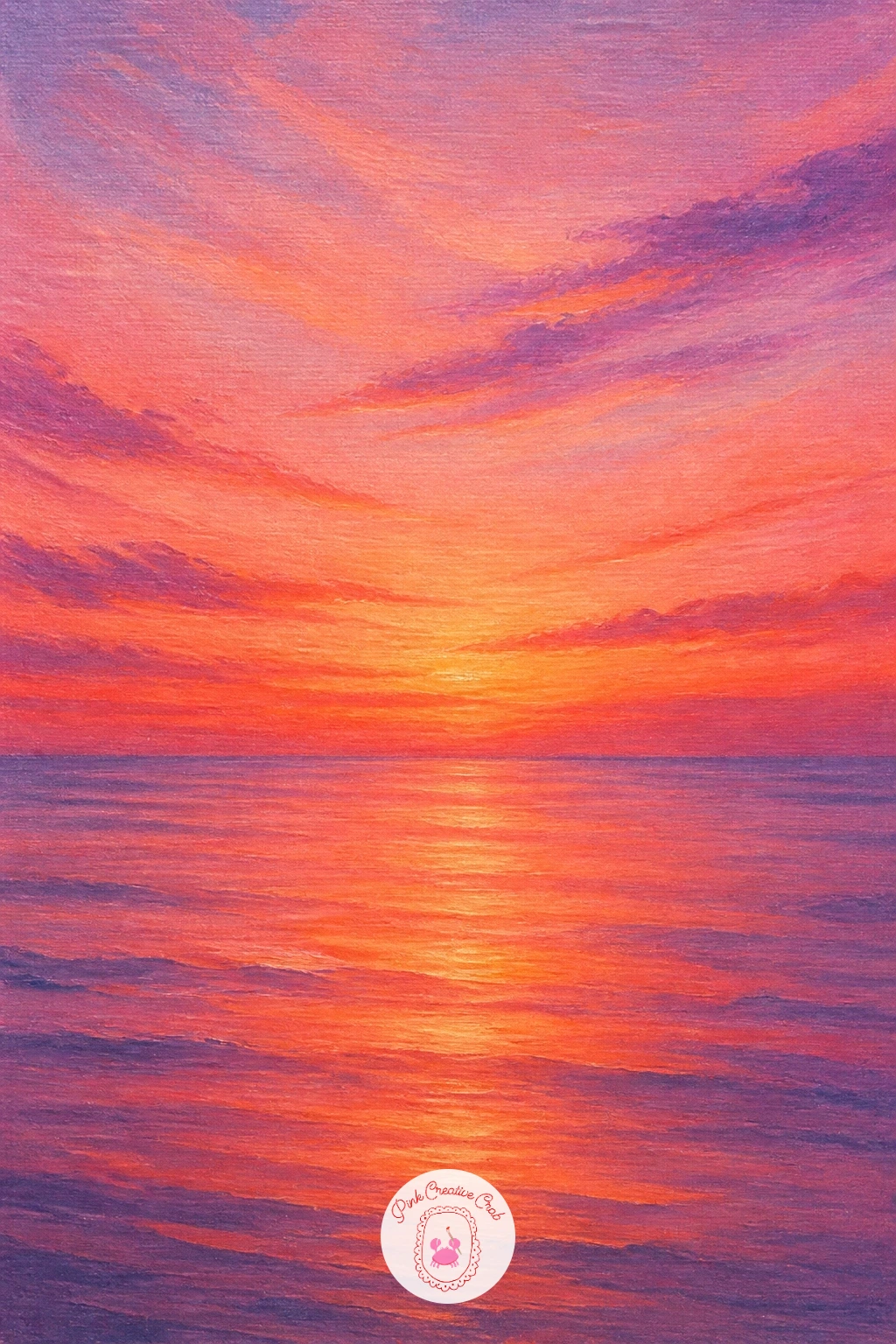
Palette: Cadmium Orange,Alizarin Crimson,Naples Yellow,Payne’s Grey
Once a plain sunset sea feels comfortable, add a sailboat silhouette to give the eye somewhere to land. Keep the sky loose and golden, then mix the darkest color on your palette, a near-black mix of indigo and burnt umber, for the boat shape alone.
Paint the boat last, in one or two confident strokes with a small flat brush, rather than outlining it first. Place it off-center, roughly a third of the way across the canvas, and use a straight edge or the handle of your brush to keep the mast perfectly vertical against the streaked gold sky.
The common mistake here is making the boat too large or too detailed, which flattens the sense of distance. Keep it small and simple, a hull and a single sail shape, nothing more.
If you want more drama, drag a dry brush loaded with dark paint lightly across the water under the boat for a soft reflection.
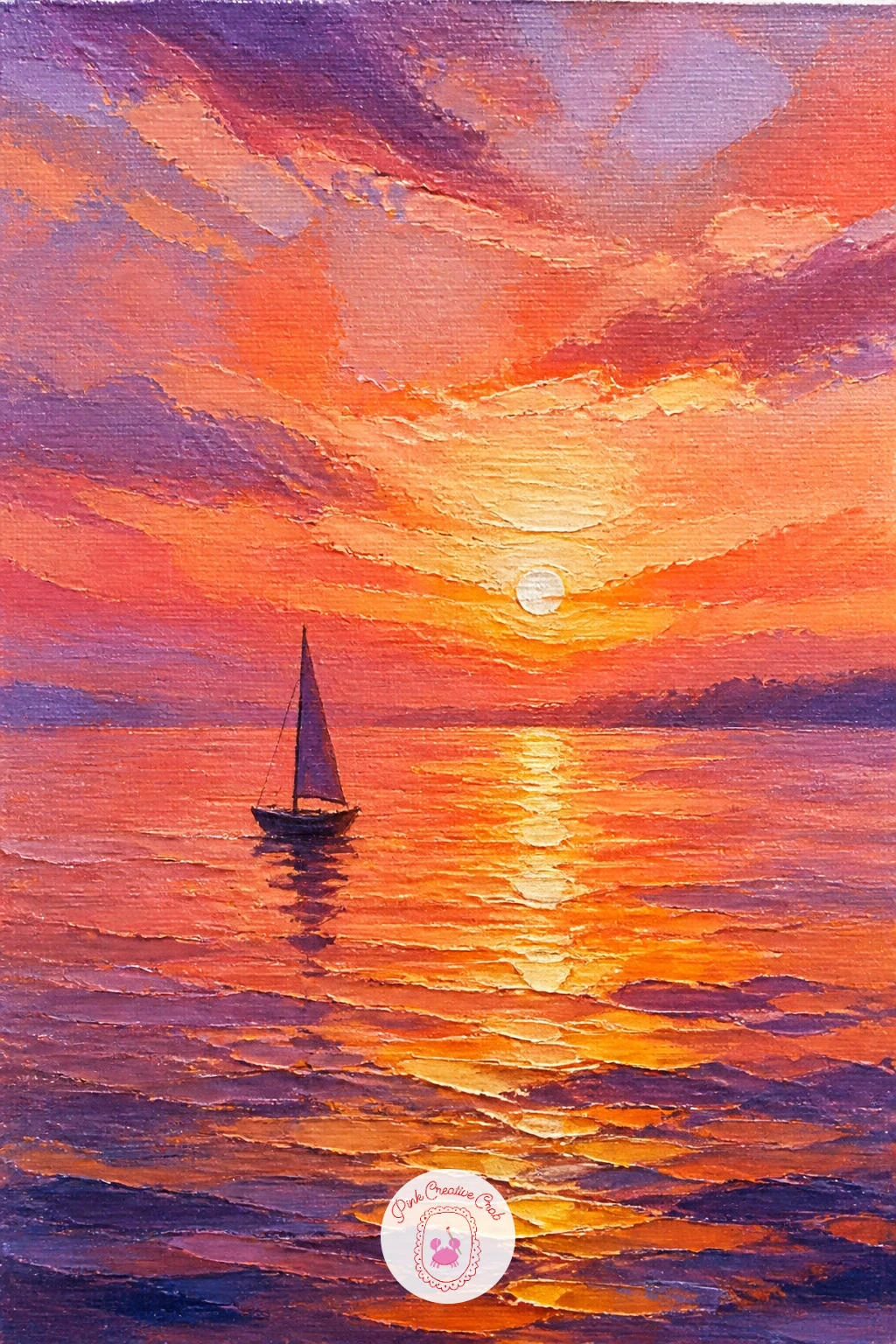
Palette: Indian Yellow,Burnt Sienna,Indigo,Titanium White
Move from water to land with a field of lavender rows catching the last peach light. Paint the sky first in soft peach and pale lilac, kept light and high across the top two-thirds of the canvas, then bring the horizon in low.
For the rows, load a small flat brush with violet and drag it in short diagonal strokes that get smaller as they near the horizon, which creates instant distance without any careful drawing. Alternate slightly cooler and warmer violets row by row so the field does not read as one flat block.
If the rows start looking like stripes rather than plants, break up a few strokes with short upward flicks to suggest individual stems. For a quicker version tonight, paint three or four rows only and let the rest dissolve into soft color; a fuller forty-minute version adds a single distant tree line and more row detail in the foreground.
This same approach to receding rows works beautifully if you also try the ideas in this lavender painting guide for more field compositions.
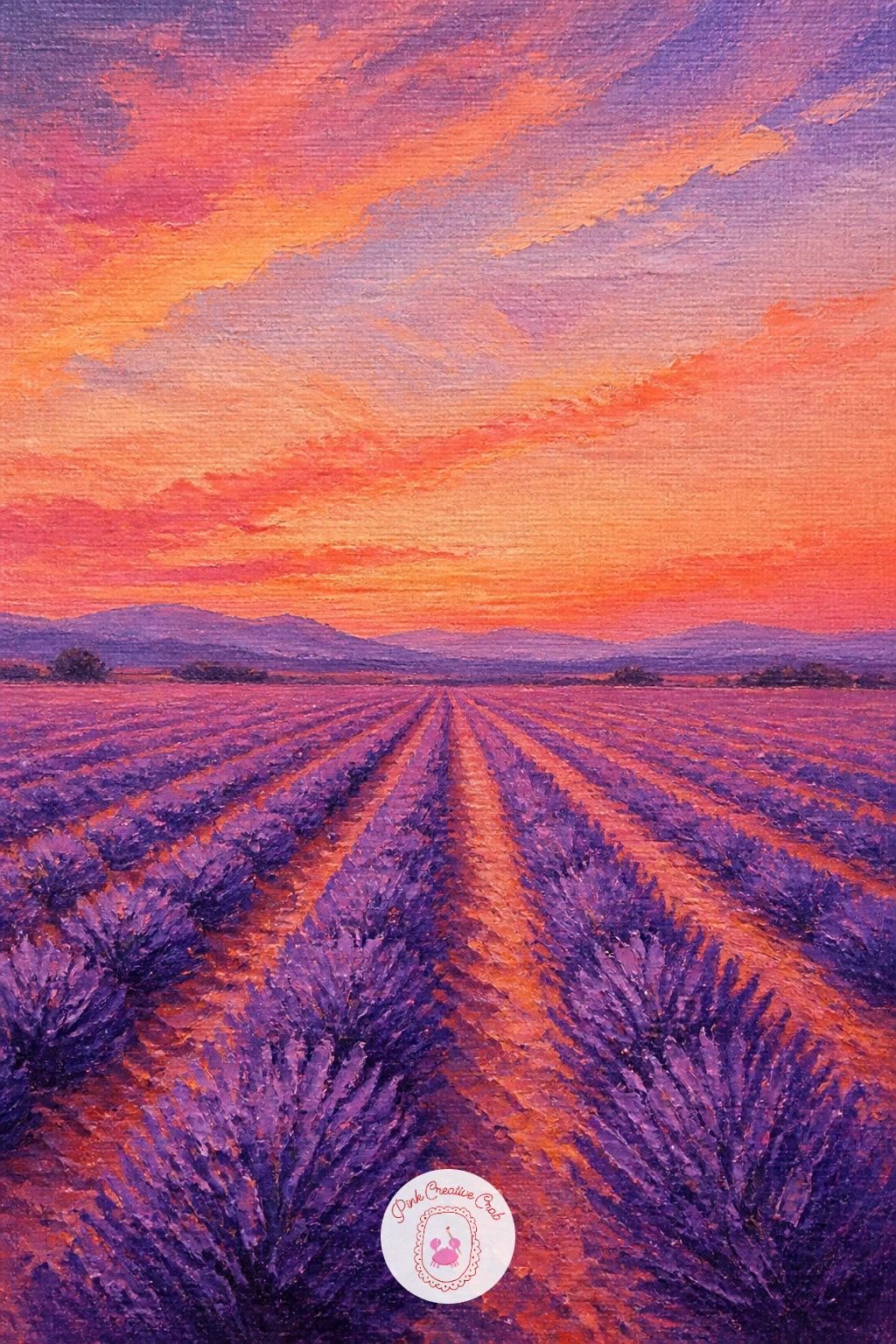
Palette: Peach,Dioxazine Violet,Lilac,Sap Green
Bring the sunset into an urban setting with a skyline of buildings catching the last light, their windows just beginning to glow. Block the sky in warm coral and deep rose, then paint the building shapes as one connected dark silhouette using a palette knife for crisp, flat edges.
Vary the roofline, some buildings tall and thin, others short and wide, so the skyline reads as real rather than a single block. Once the silhouette is dry to the touch, dot in windows with small strokes of warm yellow and white using the very tip of a small brush.
Too many identical windows can look busy and mechanical. Scatter them unevenly, leave whole sections dark, and make a few brighter than others as if closer to the viewer.
Standing the canvas back from you while adding windows helps you judge the spacing better than working close up.
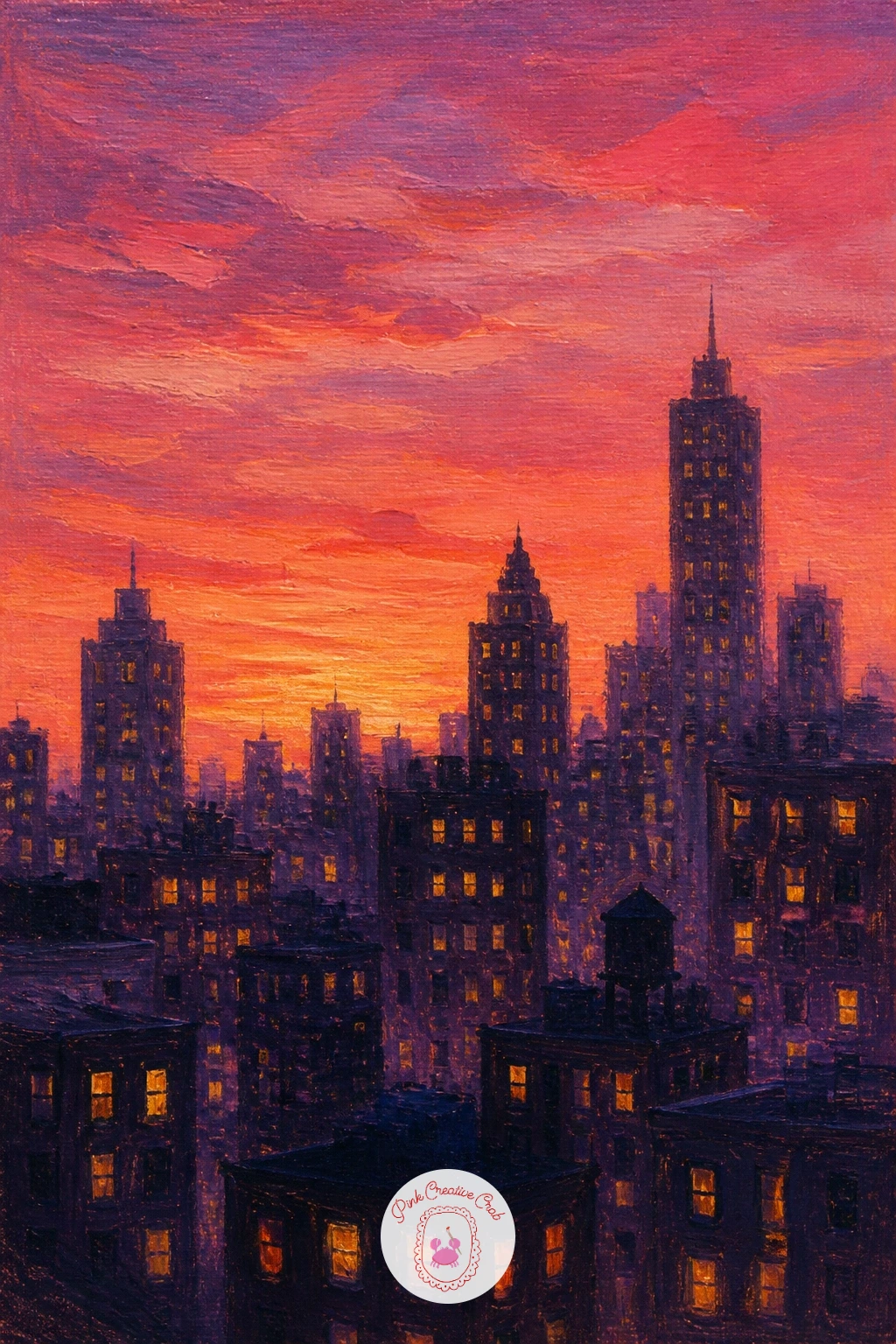
Palette: Rose Madder,Deep Coral,Mars Black,Cadmium Yellow Light
Try warming a couple of windows toward orange and leaving most pale yellow, it reads as real electric light rather than a pattern.
Give yourself a true symmetry exercise with a mountain lake that mirrors its sunset sky almost exactly. Paint the sky first across the top half of the canvas, then turn the canvas upside down in your mind and repeat nearly the same colors and shapes below the horizon line for the water.
The trick is in the word nearly: mute the reflection slightly with a touch more gray or blue so it reads as water, not a copy. Paint the mountain silhouette once, right at the horizon, then drag a few of its dark strokes straight down into the water with a dry brush for a soft broken reflection.
If your reflection ends up a mirror-perfect double, it can look flat and odd. Break the water’s surface with a couple of thin horizontal strokes, as if a breeze is just touching it.
No palette knife on hand for the mountain’s crisp edge, a small flat brush held on its side does nearly the same job.
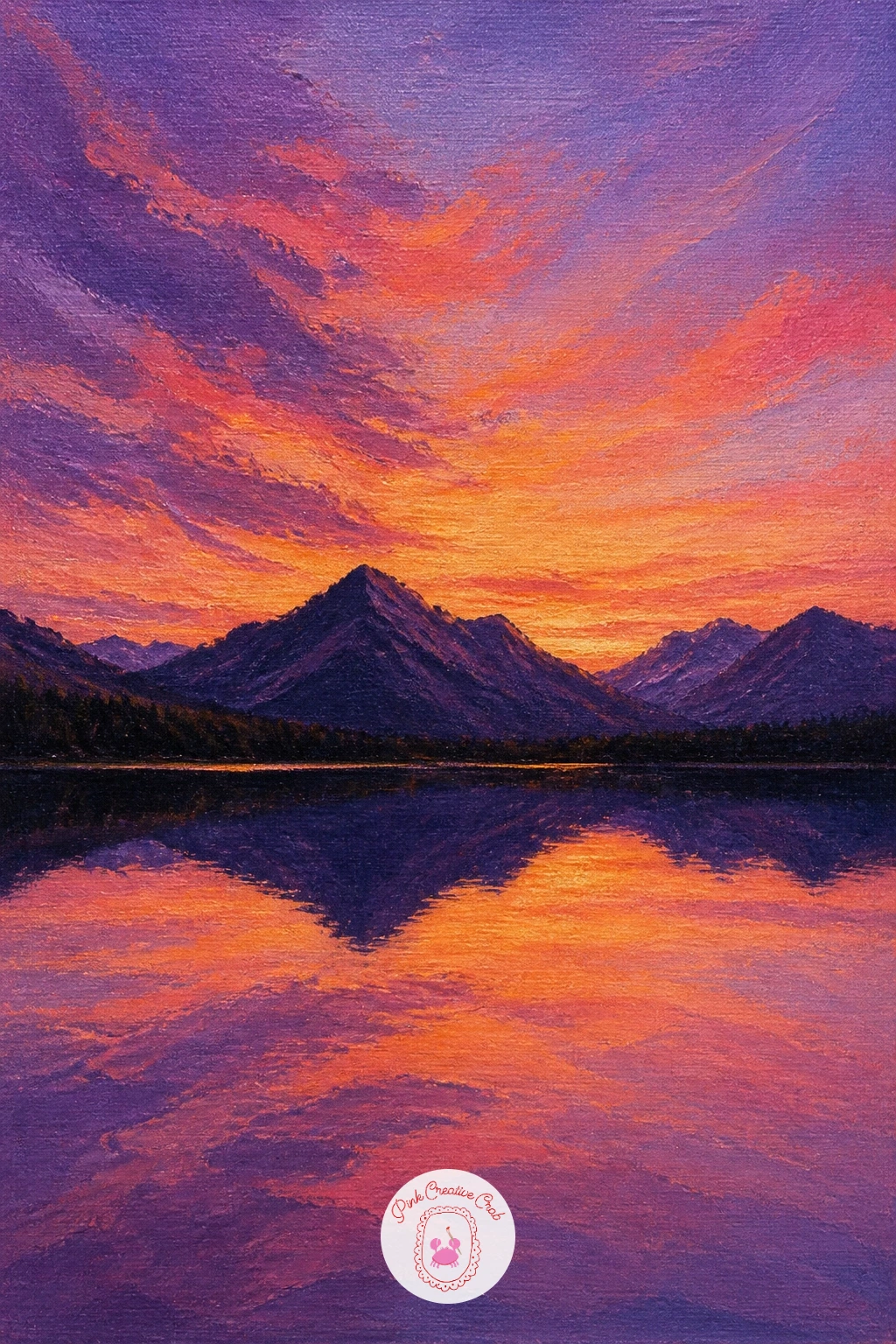
Palette: Dioxazine Violet,Cadmium Orange,Payne’s Grey,Titanium White
Palm trees give you a chance to practice confident, loose brushwork after the careful symmetry of a lake scene. Fill the sky with warm tangerine fading to soft yellow near the horizon, blending with broad sweeps of a flat brush while it stays wet.
For the trunks, load a round brush with dark paint and pull upward in one smooth stroke, letting it taper naturally rather than drawing a straight line and filling it in. Add the fronds with quick flicking strokes from a central point, three or four per tree, angled downward like a loose fan.
Overly neat, symmetrical fronds are the most common slip here, since real palms droop unevenly. Vary the length and angle of each frond stroke, and let a couple cross over each other.
If your round brush feels too stiff for the flick, a fan brush turned on its edge gives the same loose line with less effort.
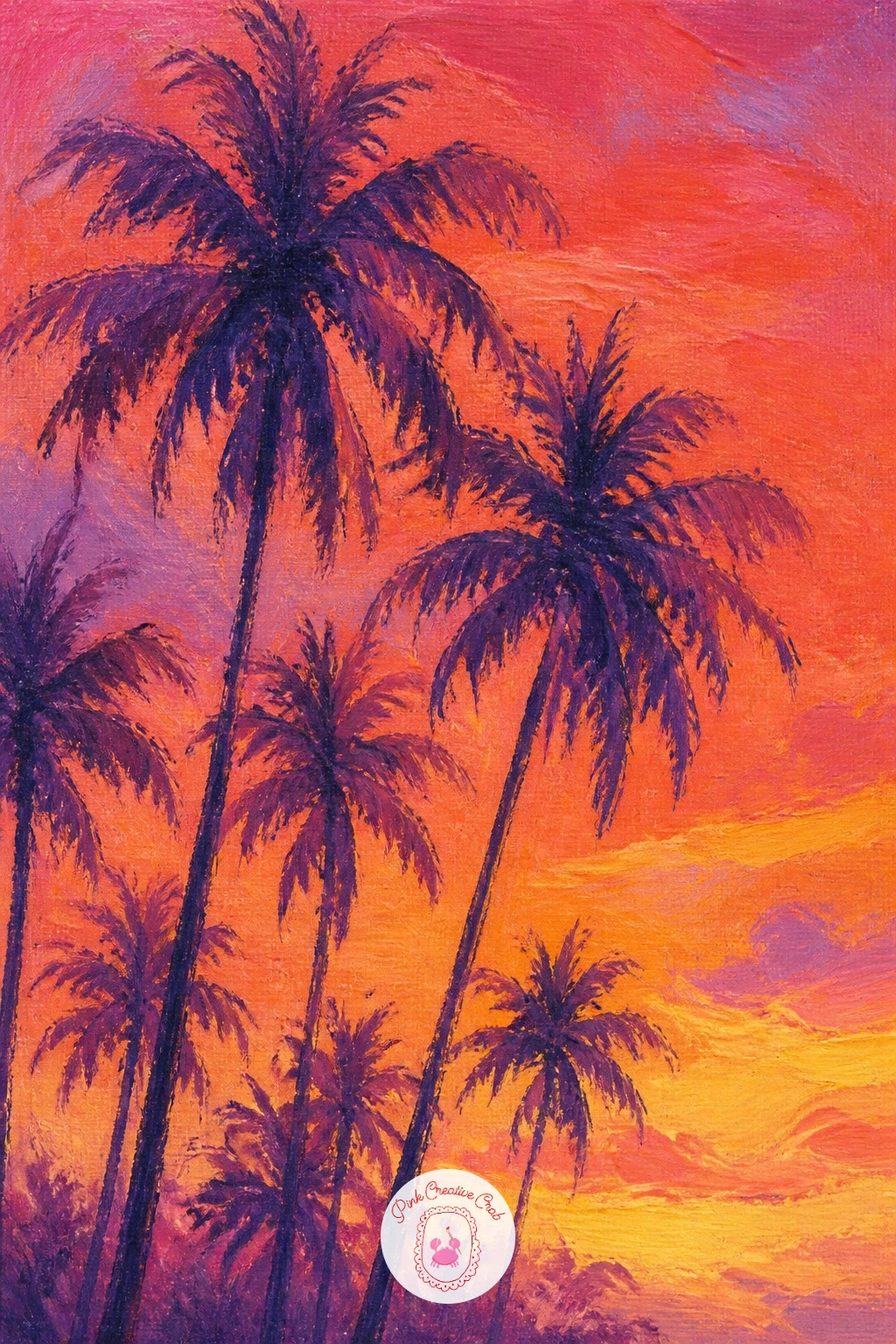
Palette: Tangerine,Cadmium Yellow Light,Burnt Umber,Mars Black
A single tree on a rolling hill against a fiery sky is one of the most direct ways to practice a strong focal point. Begin with the sky in hot reds and oranges near the horizon, cooling to deep rose higher up, blended loosely so no hard lines show.
Keep the hill as one simple curved shape in dark silhouette, then paint the tree last, trunk first with a thin round brush, canopy second as one soft irregular blob rather than individual leaves. Placing the tree slightly off-center, not dead in the middle, keeps the composition from feeling stiff.
If the canopy looks too round and balloon-like, dab at its edges with a dry, nearly paint-free brush to break up the outline. This dry dabbing trick works on almost any silhouette tree you paint from now on.
For a ten-minute version, skip the detailed canopy and use one quick dab; the forty-minute version adds a few bare branch lines breaking from the canopy’s edge.
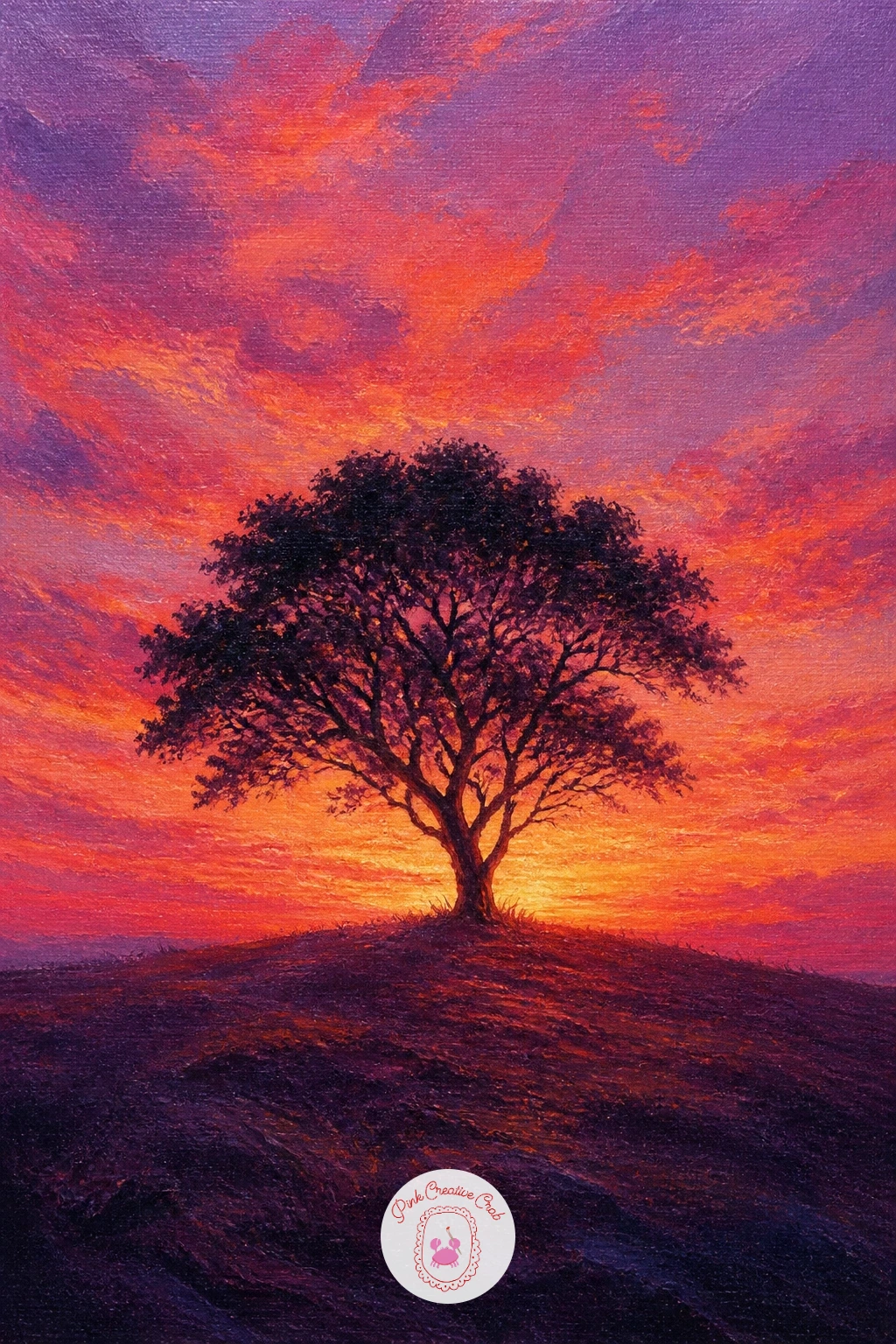
Palette: Alizarin Crimson,Cadmium Red,Deep Rose,Mars Black
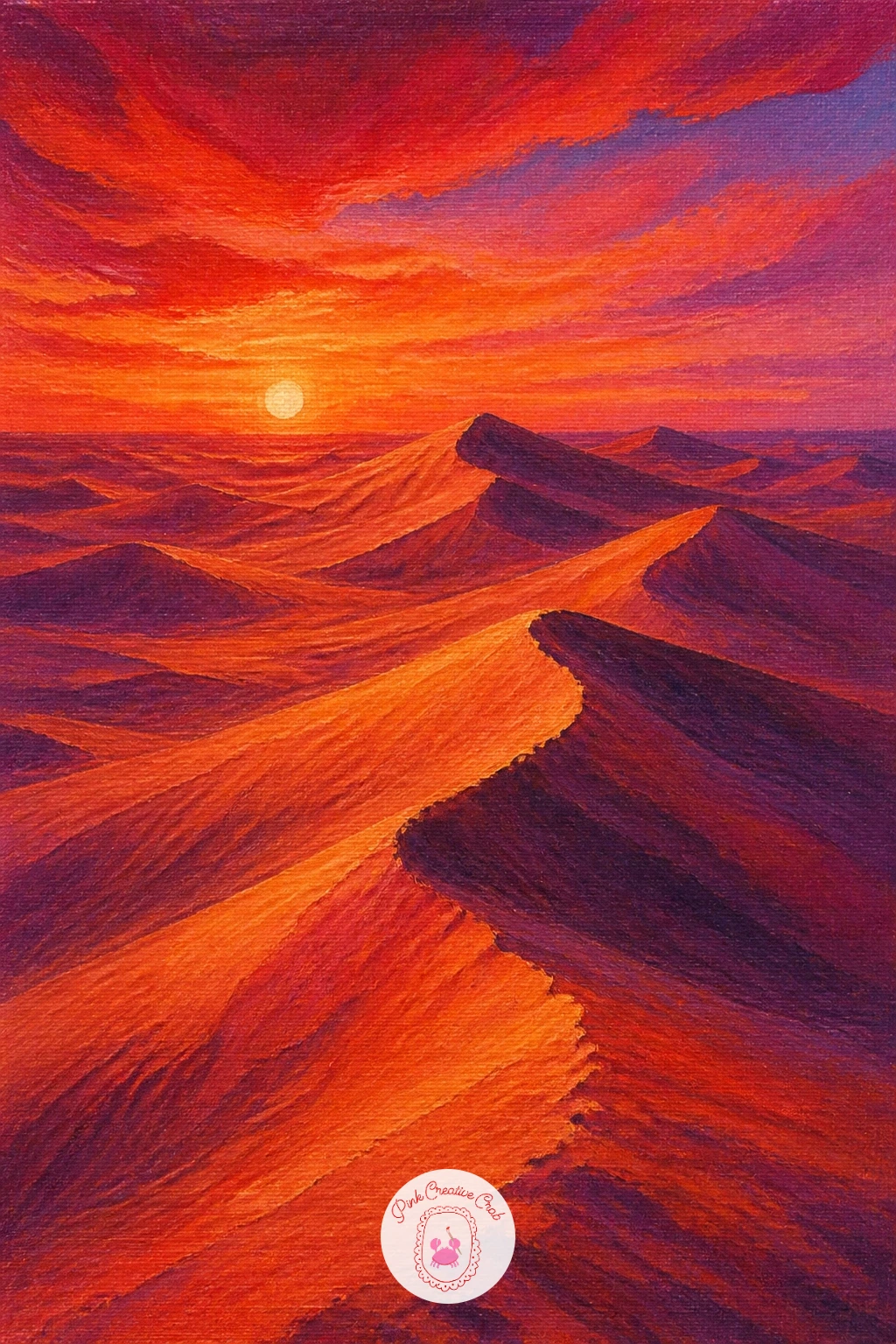
Desert dunes ask you to think about light direction more than almost any other scene on this list. Decide where the sun sits, usually low and just behind the farthest dune, then paint the sky in deep red and burnt orange radiating outward from that point.
Shape each dune with two values only, a warm lit side facing the sun and a cooler shadowed side turned away, using a palette knife to keep the ridge lines crisp and clean. Overlap three or four dunes of different sizes so the desert reads as rolling rather than one flat mound.
If the dunes look too soft and sky-like, you need a harder edge where lit side meets shadow side, scraped in with the knife’s flat edge. Keep that one line sharp even while the rest of the painting stays loose.
No palette knife yet, the edge of an old gift card works as a close substitute for this kind of crisp scraping.
You Will Need
- palette knife
Palette: Deep Red,Burnt Orange,Raw Sienna,Payne’s Grey
A small harbor lets you combine water, structure and silhouette in one busy but manageable scene. Paint the sky and water together first in soft pink and coral, keeping the water a touch cooler and more muted than the sky above it.
Add two or three fishing boats as simple dark shapes, varying their size so some feel closer and some farther along the harbor wall. Touch a little warm pink and white onto the boats facing the sun, since even silhouettes catch a rim of color at this hour.
Crowding in too many boats is the easiest way to lose this painting’s calm feeling. Three boats, clearly spaced, read far better than six crammed together.
If you enjoy painting boats and water together, the ideas in this ocean oil painting guide make a natural next session.
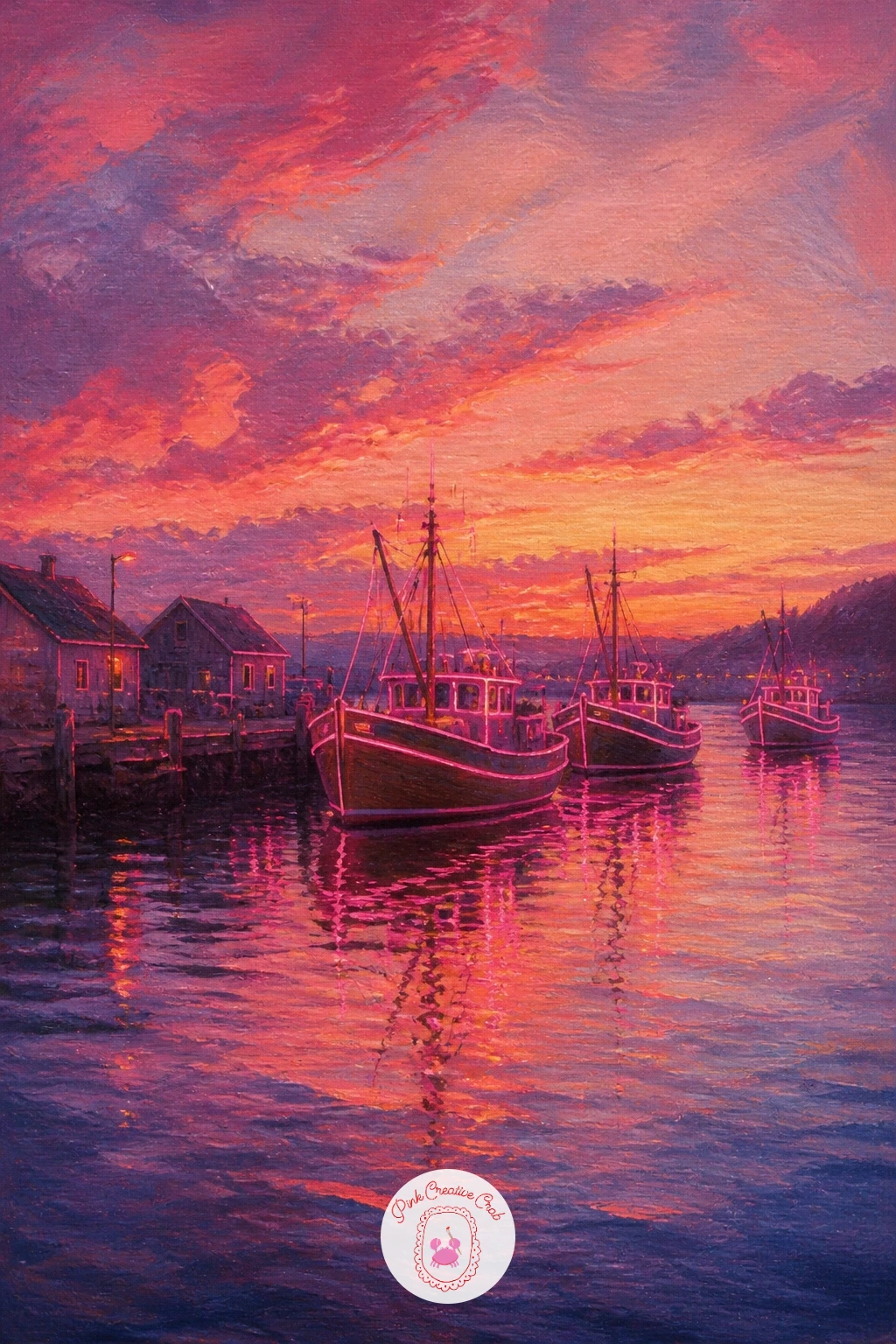
Palette: Rose Pink,Coral,Mars Black,Titanium White
A road leading straight into the sun is a quick lesson in perspective that pays off the moment you step back from the canvas. Find the horizon first, place the sun just above or on it, and let the road’s two edges meet at that exact point, even though they start wide apart at the bottom of the canvas.
Paint the sky in rings of warm color radiating from the sun, yellow closest, then orange, then rose further out, blended while wet. The road itself stays simple, a warm highlighted strip down its center and cooler shadow along both edges, with loose fields or low hedges in silhouette on either side.
If the road looks like it is floating rather than receding, check that both edges truly meet at one point on the horizon, not two different spots. A ruler held against the canvas for a moment is a fair trick even in a loose oil painting.
Keep the horizon itself slightly uneven rather than a perfectly straight line, it reads as more natural.
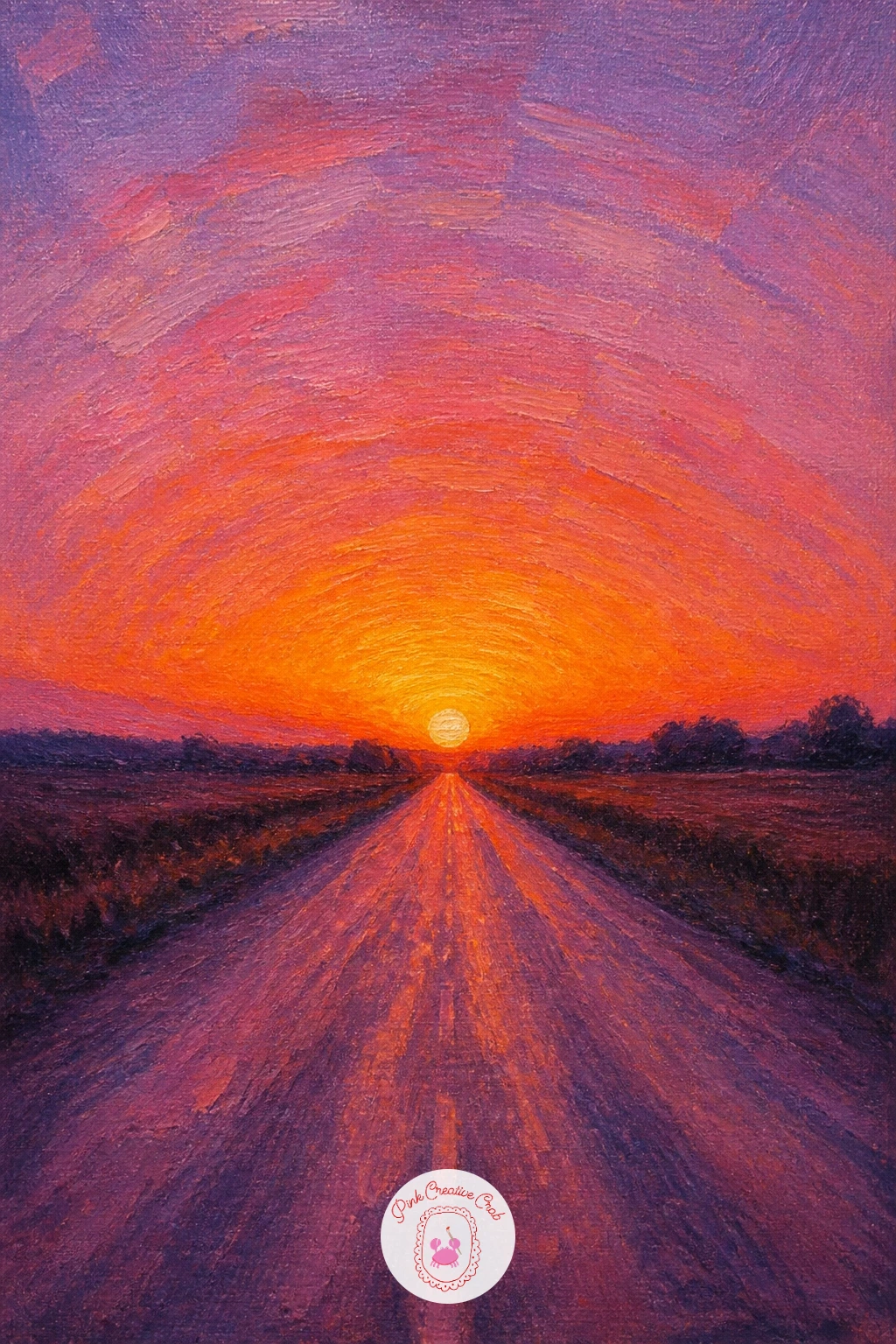
Palette: Cadmium Yellow Light,Cadmium Orange,Rose Madder,Burnt Umber
Figures add a story to a sunset scene, and two small silhouettes on a cliff are easier to paint well than most beginners expect. Lay in the sky and sea first across most of the canvas, then build the cliff as one dark, slightly jagged shape in the foreground using a palette knife for texture.
Paint the couple last with a small round brush, as two simple standing shapes close together, no faces or clothing detail needed since they sit in full silhouette. Keep them small against the big sky, maybe a tenth of the canvas height, so the scene reads as vast rather than crowded.
Figures that are too large or too detailed pull attention away from the sky, which should stay the real subject here. If yours feels off balance, simplify the shapes further rather than adding more detail.
Standing the figures close but not touching, with a small gap between them, reads naturally and avoids one blob-like silhouette.
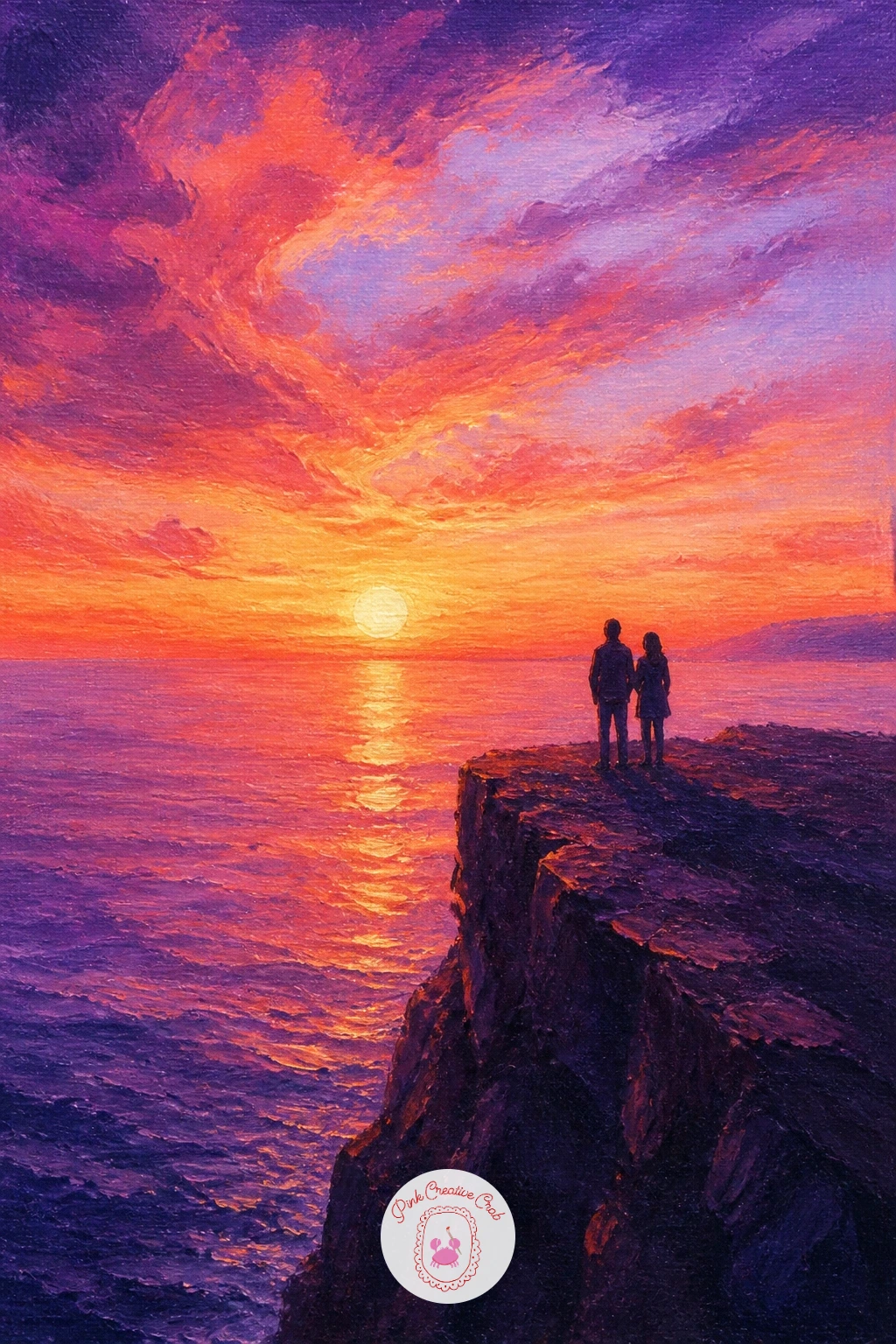
Palette: Lilac,Deep Rose,Mars Black,Naples Yellow
Flamingos bring a splash of real color into an otherwise silhouette-heavy list, since their pink bodies can stay partly lit rather than fully dark. Paint the lagoon and sky first in warm coral and soft gold, kept smooth and calm since still water suits this bird best.
Build each flamingo with simple curved strokes, a rounded body, a long curved neck, and thin dark legs added last with the tip of a small round brush. Leave the body mostly in warm pink and rose rather than pure silhouette, with just the legs and beak tip in near-black.
Stiff, straight-necked flamingos are the easiest way to lose the bird’s character. Curve the neck into a clear S shape and let one leg bend slightly, as if mid-step through the shallow water.
If you are short on time, paint two or three flamingos loosely rather than one with careful detail; the softer version often looks more convincing from a short distance.
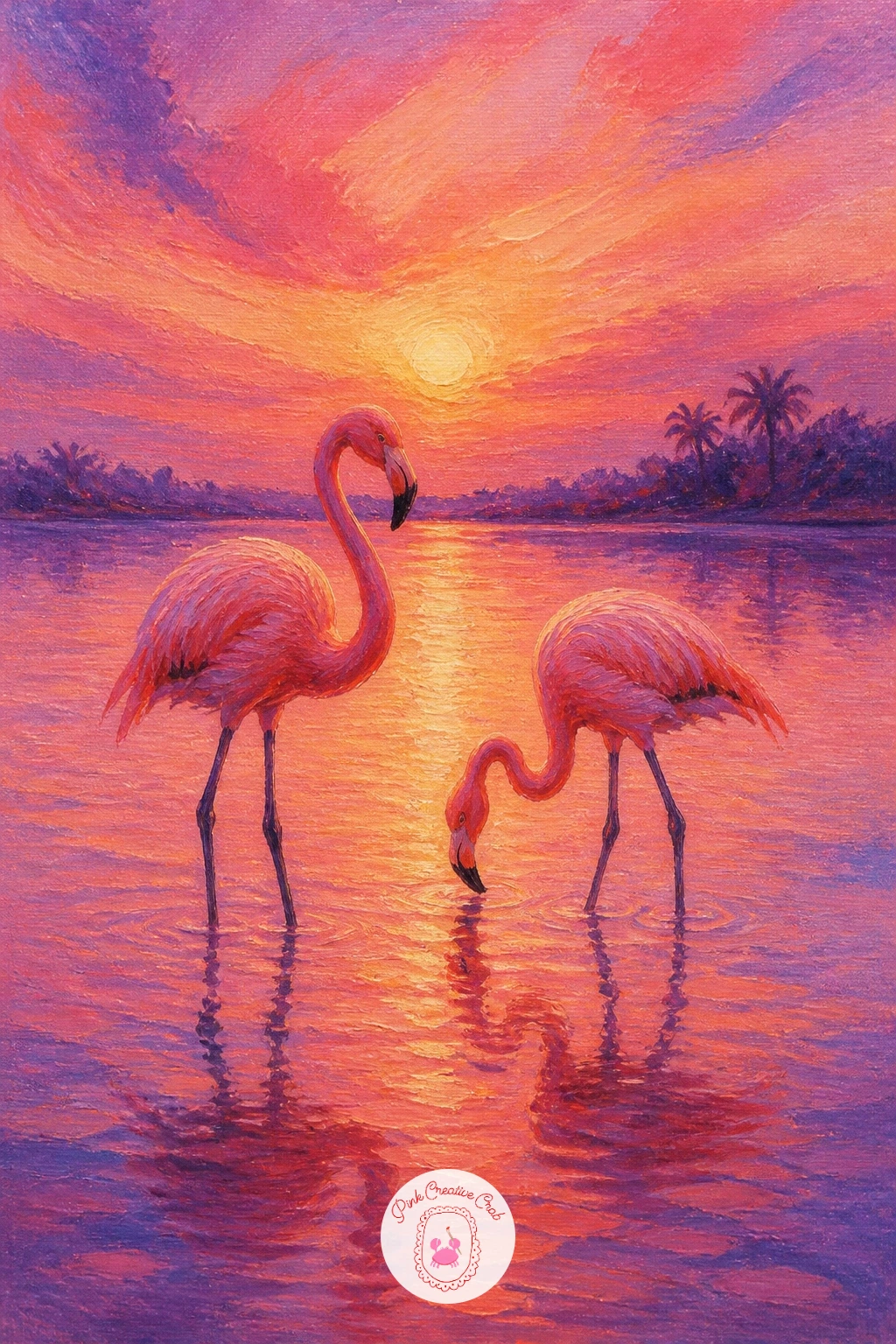
Palette: Flamingo Pink,Coral,Mars Black,Naples Yellow
A field of tall grasses is one of the most relaxing paintings on this list, built almost entirely from texture rather than careful shapes. Paint the sky first in warm gold fading to soft rose, then switch to a stiffer bristle brush or a fan brush for the grass itself.
Work from back to front, dragging shorter, paler strokes upward near the horizon and longer, warmer strokes as you move down the canvas, letting each one catch a little backlight from the setting sun. Twist the brush slightly on each upward stroke so the grass tips feel soft rather than cut straight across.
If the field looks like a flat green carpet, you have likely made every stroke the same length and color. Vary both constantly, and let a few taller stems break above the main mass of grass.
No fan brush at hand, an old stiff round brush pressed and dragged does a similar job.
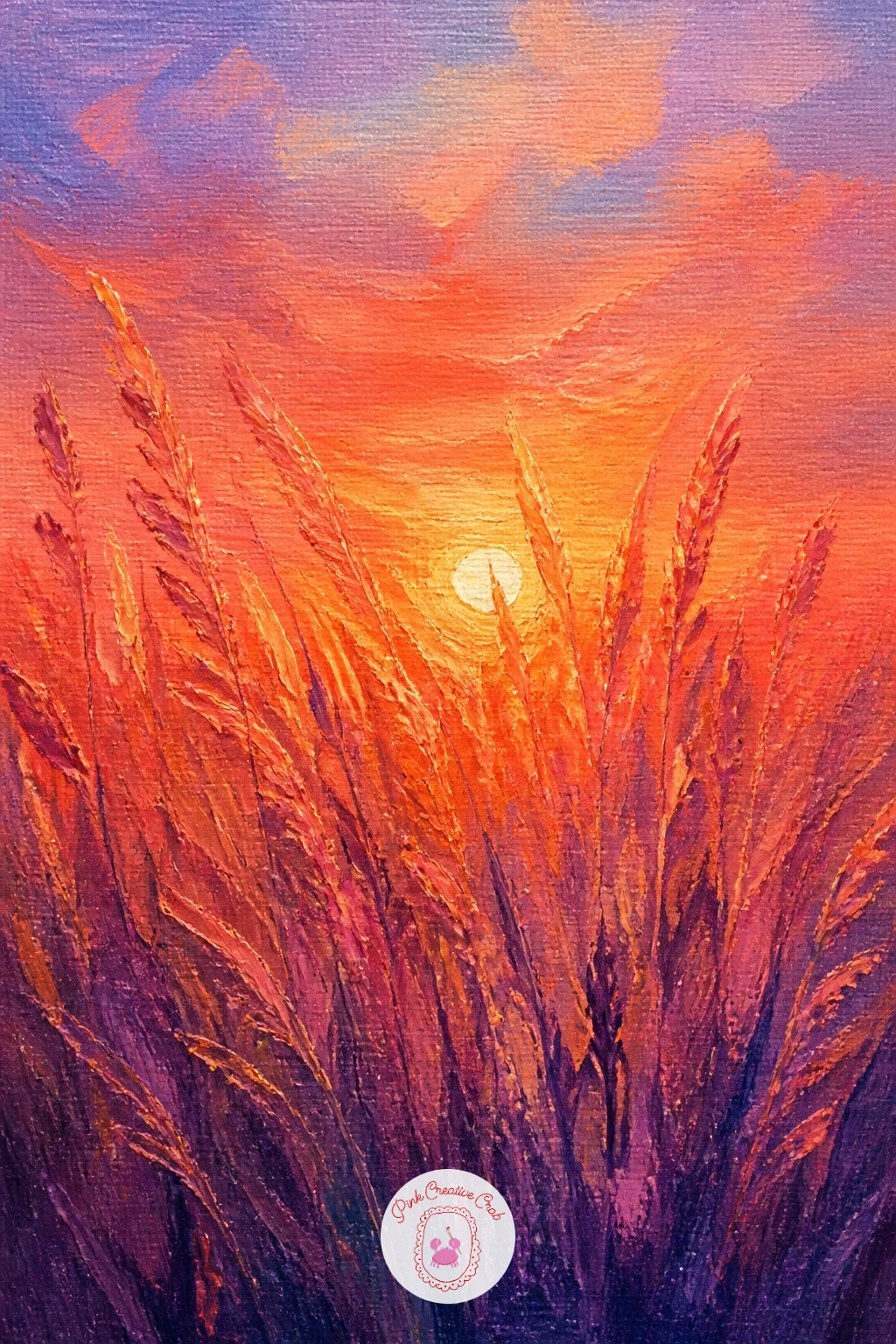
Palette: Gold Ochre,Rose Madder,Olive Green,Burnt Sienna
A lighthouse is a strong vertical shape that balances beautifully against a wide, colorful sky. Start with the sky in bands of coral low down rising into deep purple higher up, blending the transition so no hard line interrupts the gradient.
Paint the lighthouse as a simple tapered white or pale shape, slightly darker on its shadowed side, standing on a small rocky outcrop painted in near-black silhouette. Add the lantern room at the top with a small, deliberate dot of warm yellow, the single brightest point in the whole painting.
A lighthouse painted dead center can feel static. Shift it slightly to one side, left or right, and let the rocky base extend toward the nearer edge of the canvas for better balance.
If your yellow dot looks too flat, a tiny touch of white mixed in and dabbed on top gives it a believable glow.
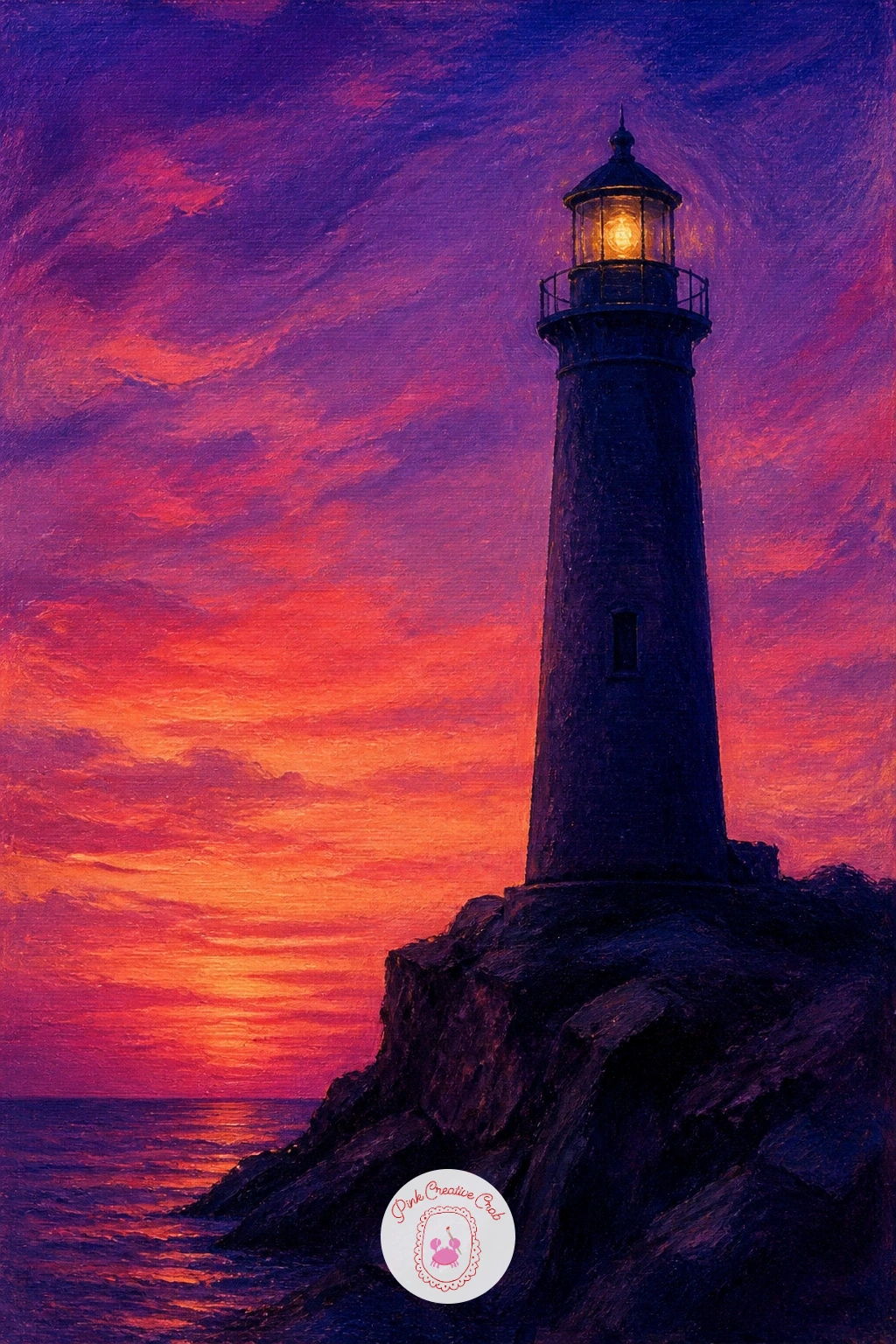
Palette: Coral,Deep Purple,Titanium White,Cadmium Yellow Light
A wooden pier gives you a clean perspective line that leads the eye straight into a glowing sea. Paint the sky and water first, keeping the water slightly darker and more muted than the sky, then find the pier’s vanishing point somewhere on the horizon before adding a single post.
Build the pier with a few confident posts, each one slightly smaller than the last as it recedes, connected by a simple deck line drawn with a straight brush stroke or the edge of a palette knife. Keep every post and plank in the same dark silhouette tone as the water’s reflections.
Posts that are evenly spaced all the way down can look mechanical and flat. Space the nearer ones further apart and the distant ones closer together, which actually strengthens the sense of distance.
Dragging a little pale color straight down from each post into the water below suggests a soft reflection without extra detail work.
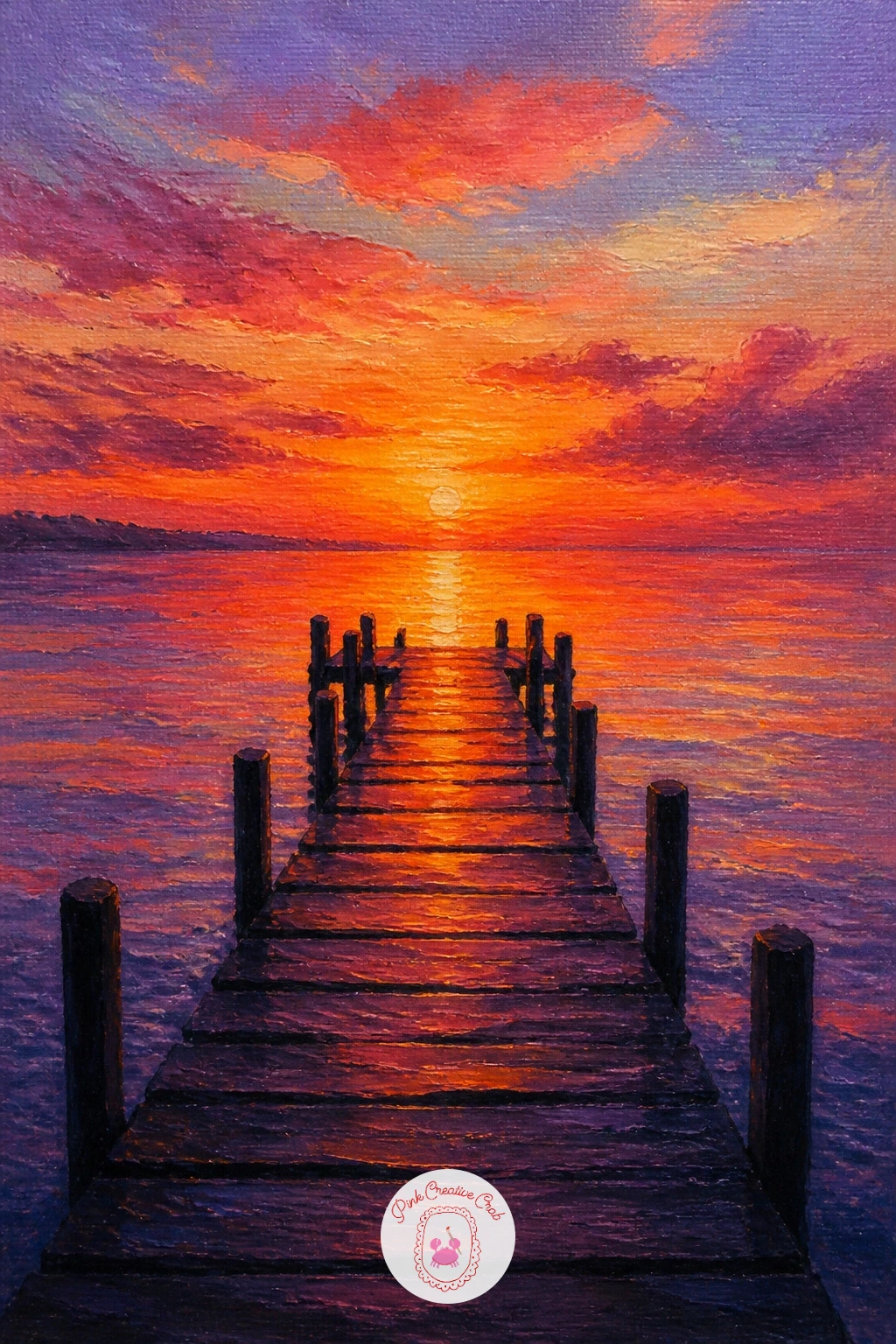
Palette: Tangerine,Rose Pink,Mars Black,Naples Yellow
Cows walking along a lane bring gentle movement and a bit of storytelling into a rural scene. Paint the sky and distant field first in warm orange and soft green-gold, then add the lane as a simple curving path leading from foreground to middle distance.
Build each cow from two or three simple strokes, a rounded body, a smaller head shape, and thin legs added last, all in dark silhouette since they sit against the bright sky. Place them in a loose line along the lane, slightly overlapping, with the lead cow a touch larger to suggest it is closest.
Cows that all face forward in a perfectly straight row look stiff. Turn one head slightly, stagger the spacing, and let the furthest cow shrink noticeably to sell the distance.
If legs feel fiddly with a round brush, the very edge of a small flat brush gives a thinner, steadier line.
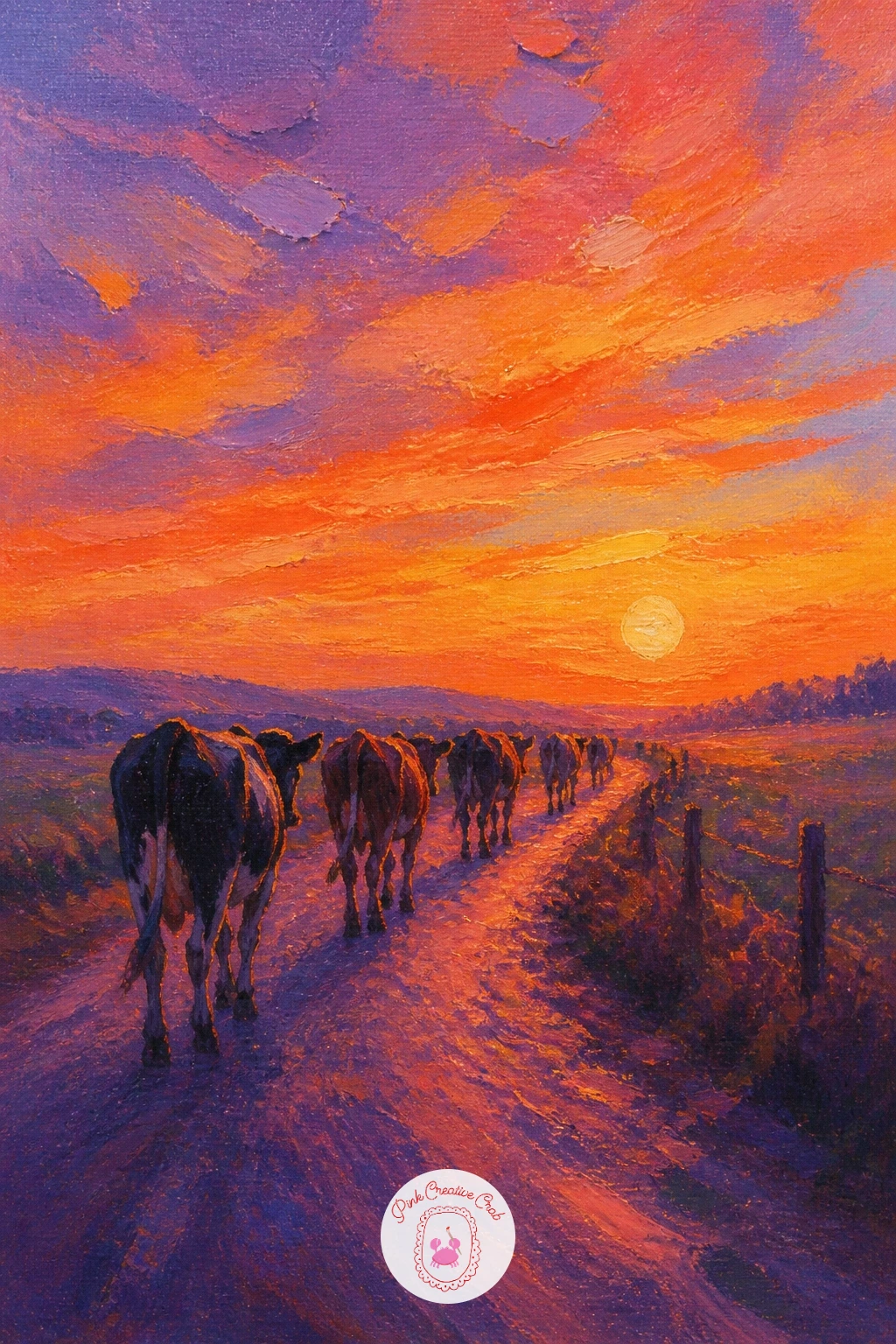
Palette: Cadmium Orange,Olive Green,Mars Black,Raw Sienna
A river bend lets you practice painting moving water that still catches a calm, mirrored light. Paint the sky in gold and soft amber, then carry the same warm tones down into the water, curving your brushstrokes to follow the river’s bend rather than painting straight horizontal lines.
Keep the riverbanks in simple dark silhouette, trees or low bushes reduced to soft irregular shapes rather than individual leaves. Where the river catches the most direct light, usually right where it bends toward you, leave the brightest, least blended strokes of yellow and white.
If the water looks static rather than flowing, add a few short broken strokes across the main direction of your long strokes, which reads as gentle current. This same broken-stroke trick works on nearly any moving water you paint from now on.
A quick ten-minute version skips the bend entirely and paints a straight stretch; the full session curves the river for a much stronger sense of place.
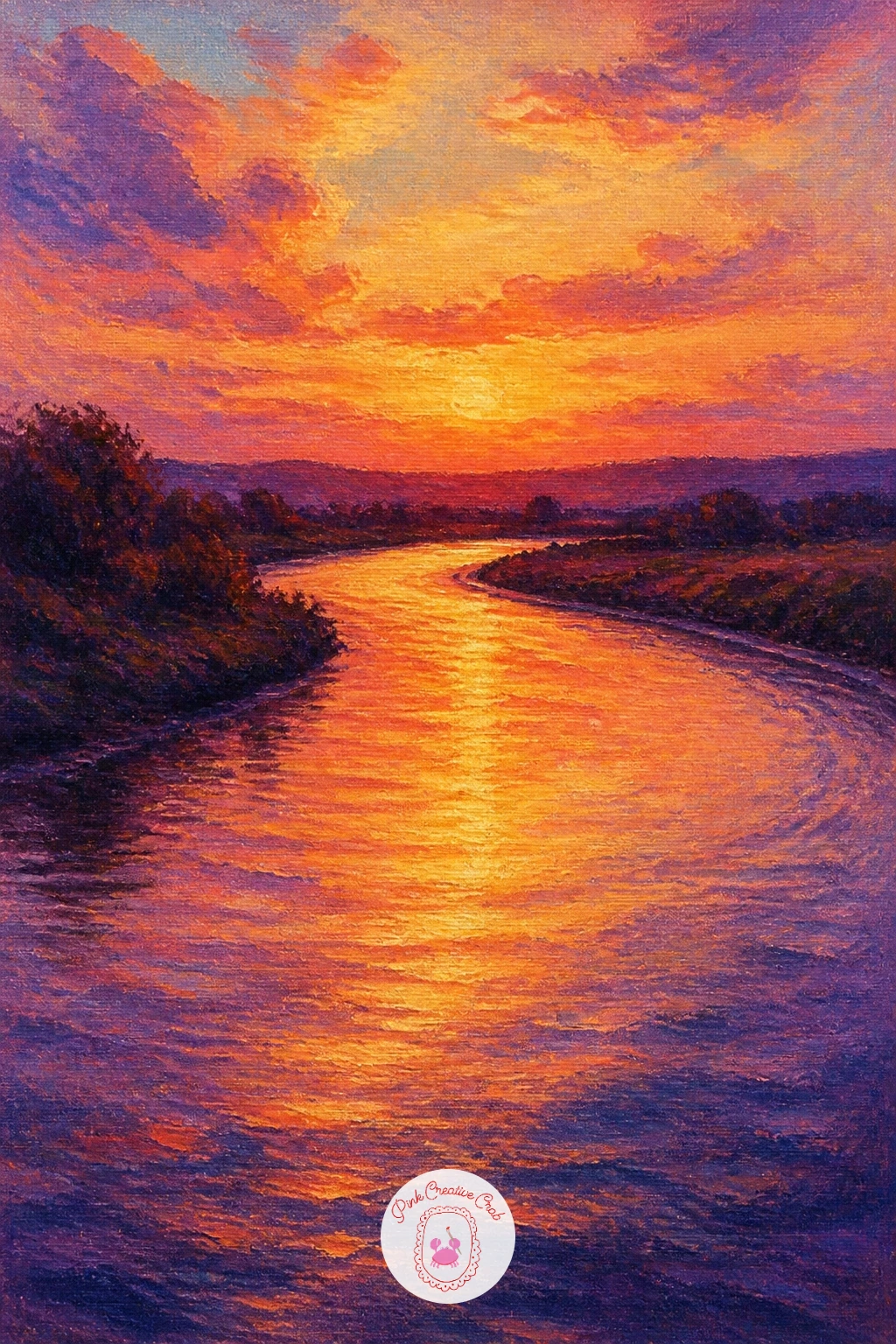
Palette: Gold Ochre,Amber,Mars Black,Titanium White
A hot air balloon gives the sky a single, clear focal point that is forgiving to paint even on a first attempt. Block in the sky first in soft bands of coral and lilac, then decide roughly where the balloon will float, somewhere off-center and a little above the halfway point of the canvas.
Paint the balloon as one rounded shape using a loaded round brush, leaving a visible seam line or two with a thin stroke of darker color to suggest its paneled fabric. Add the basket beneath as a tiny simple rectangle, connected to the balloon with thread-thin lines for the ropes.
A balloon painted too large can overwhelm the whole sky, so keep it modest, roughly a tenth of the canvas width. If the ropes look too stiff and ruler-straight, a slightly wavering line drawn freehand feels far more natural.
Leaving the balloon partly backlit, darker on its lower half, sells the sense that the sun sits behind it.
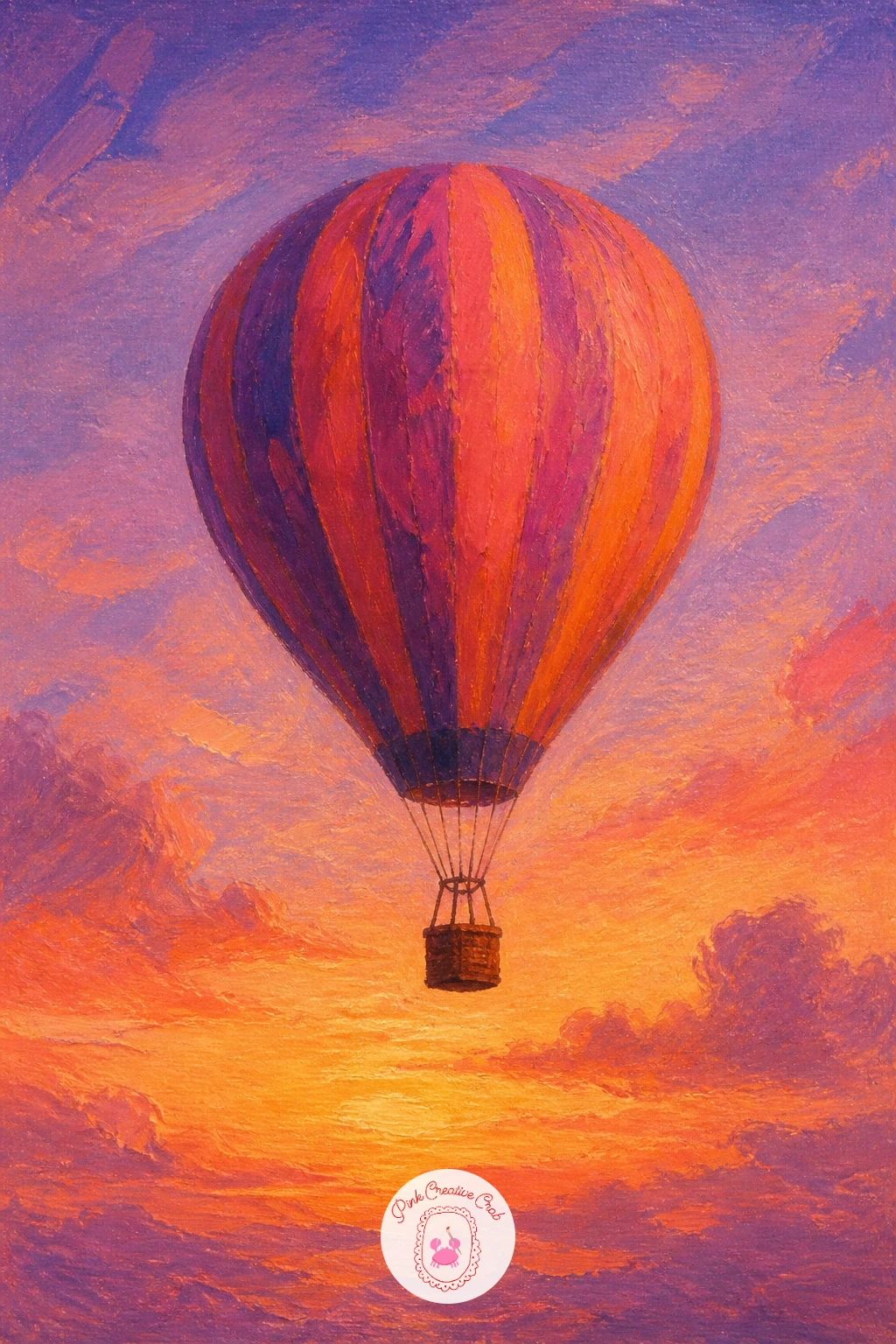
Palette: Coral,Lilac,Deep Rose,Mars Black
Rooftops and chimneys give you a chance to build an interesting, uneven skyline close up rather than far away. Paint the sky in warm rose and amber first, then build the roofline as one connected dark silhouette, varying the heights and angles of each roof so the row feels lived-in rather than uniform.
Add chimney pots as small simple rectangles and triangles poking above the roofline, placing a few off to one side rather than spacing them evenly along the top. One or two faint wisps of warm-toned smoke, dragged upward with a nearly dry brush, add life without extra work.
Perfectly matching rooftop angles is the easiest way to flatten this scene. Let some roofs pitch steeply and others sit low and wide, just as a real old town skyline would look.
These ideas pair naturally with the cosy rooftop and window scenes found in this bakery illustration collection if you want to keep painting small town scenes afterward.
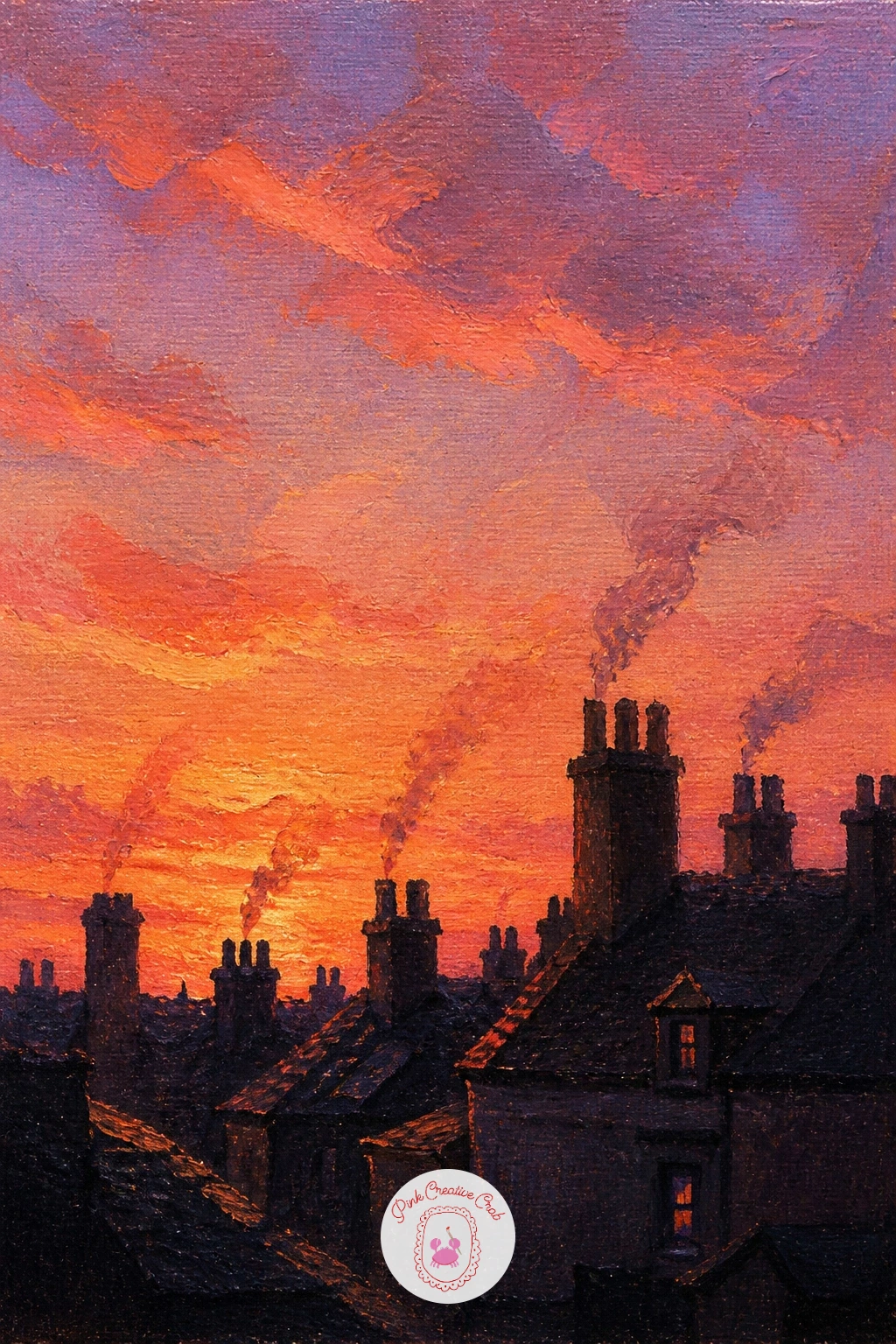
Palette: Rose Madder,Amber,Mars Black,Payne’s Grey
A girl on a swing is a quiet, nostalgic scene built from just a few careful shapes against a big soft sky. Paint the pink sky first across the whole canvas, keeping it smooth and even since it needs to read clearly behind a fairly detailed silhouette.
Build the swing’s frame first with two straight angled lines meeting at a point, then the ropes as two thin parallel lines, and the girl’s seated shape last, knees bent, hair lifting slightly as if she is mid-swing. A thin round brush or even the tip of a palette knife handle dragged through wet paint gives you a clean, controllable line for the ropes.
If the figure looks stiff or doll-like, round off the shoulders and tilt the head slightly forward rather than keeping everything perfectly upright. A small gap of sky color left between her hair and shoulder helps the shapes read clearly rather than merging into one blob.
Hair lifted gently to one side, as if caught by a breeze, instantly adds motion to the whole scene.
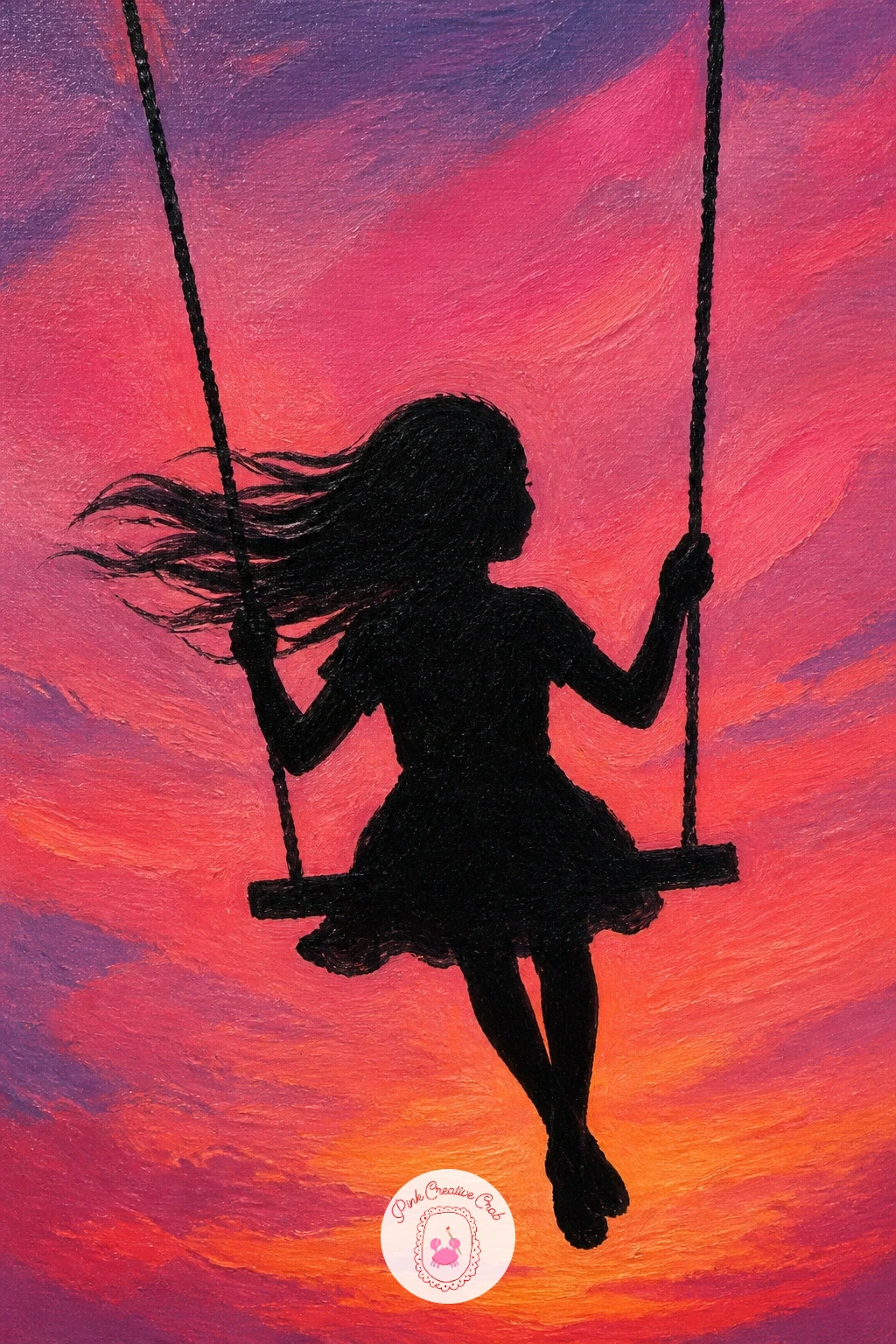
Palette: Rose Pink,Flamingo Pink,Mars Black,Naples Yellow
Storm clouds at sunset let you paint drama without needing a single hard edge anywhere on the canvas. Load a large brush with deep gray-blue and sweep in the heaviest cloud shapes first, leaving gaps of bare canvas or pale underpainting where the breaking light will show through.
While that is still wet, push warm orange and gold into the gaps and along the underside of each cloud, letting the two colors blend slightly at their edges rather than staying separate. Keep the land or sea below in near-black silhouette, simple and understated, since the sky carries the whole painting here.
If the clouds end up looking like a flat gray wall, you need more contrast between the lit edges and the shadowed cores. Push the shadows darker and the lit edges brighter than feels comfortable at first.
A palette knife dragged quickly through still-wet cloud color adds a jagged, storm-like edge that a brush alone cannot easily give you.
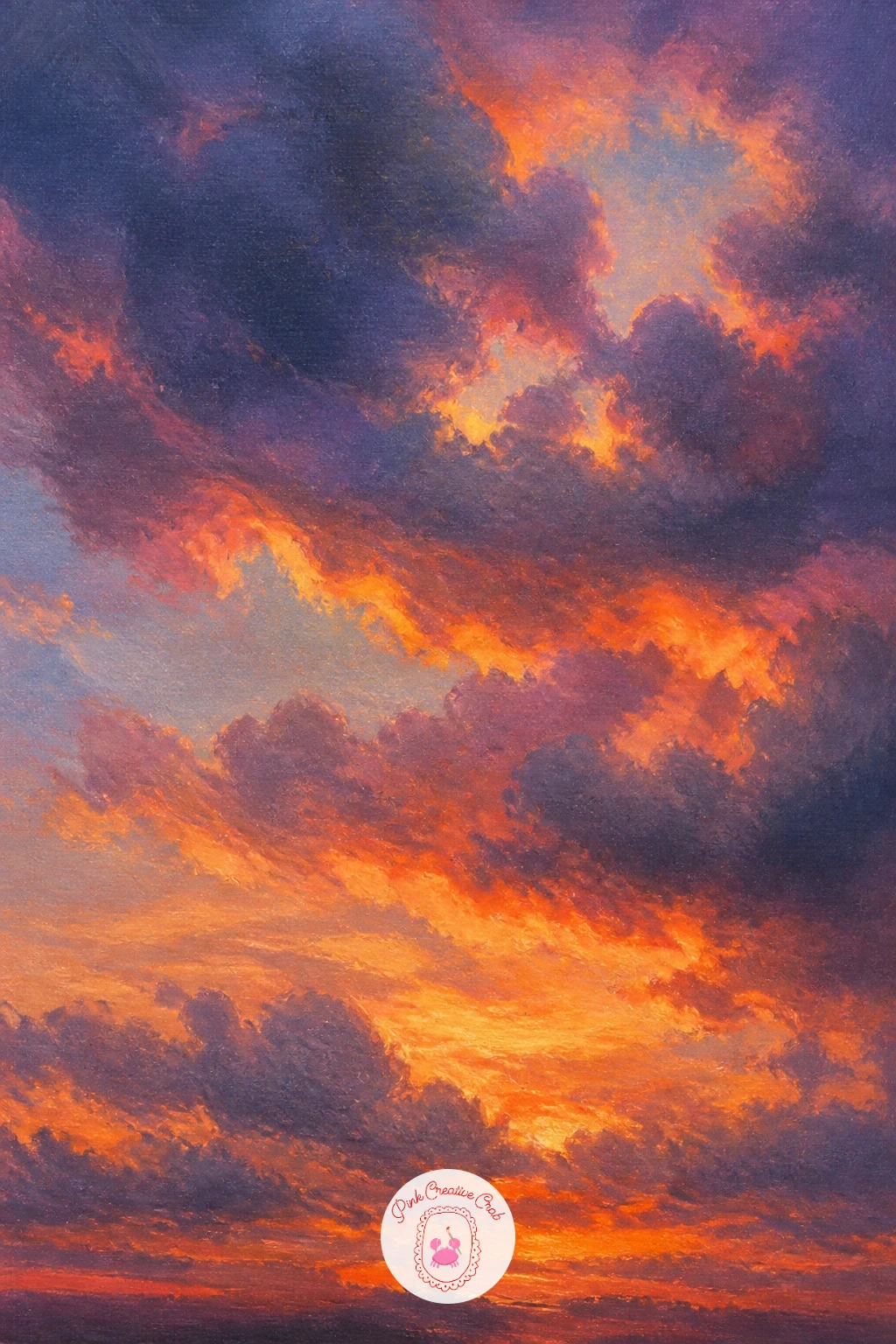
You Will Need
- palette knife
Palette: Payne’s Grey,Cadmium Orange,Gold Ochre,Mars Black
Wet sand on a wide beach gives you a second, slightly blurred sunset to paint beneath the sky, and it is far easier than it looks. Paint the sky and the thin strip of sea first, then bring those same colors down onto the sand in loose horizontal strokes, muting them slightly with a touch of gray or brown.
Drag a nearly dry brush across the wet sand reflection in one or two places to break up the color, since real wet sand always shows some texture rather than a perfect mirror. Keep any footprints or small rocks as tiny, simple dark marks, added last and used sparingly.
A reflection painted as bright and crisp as the sky above it tends to look like glass rather than sand. Softening it and letting the colors bleed slightly into one another keeps the illusion convincing.
If you enjoy this kind of layered beach light, the ocean oil painting ideas cover several more ways to paint water and shoreline together.
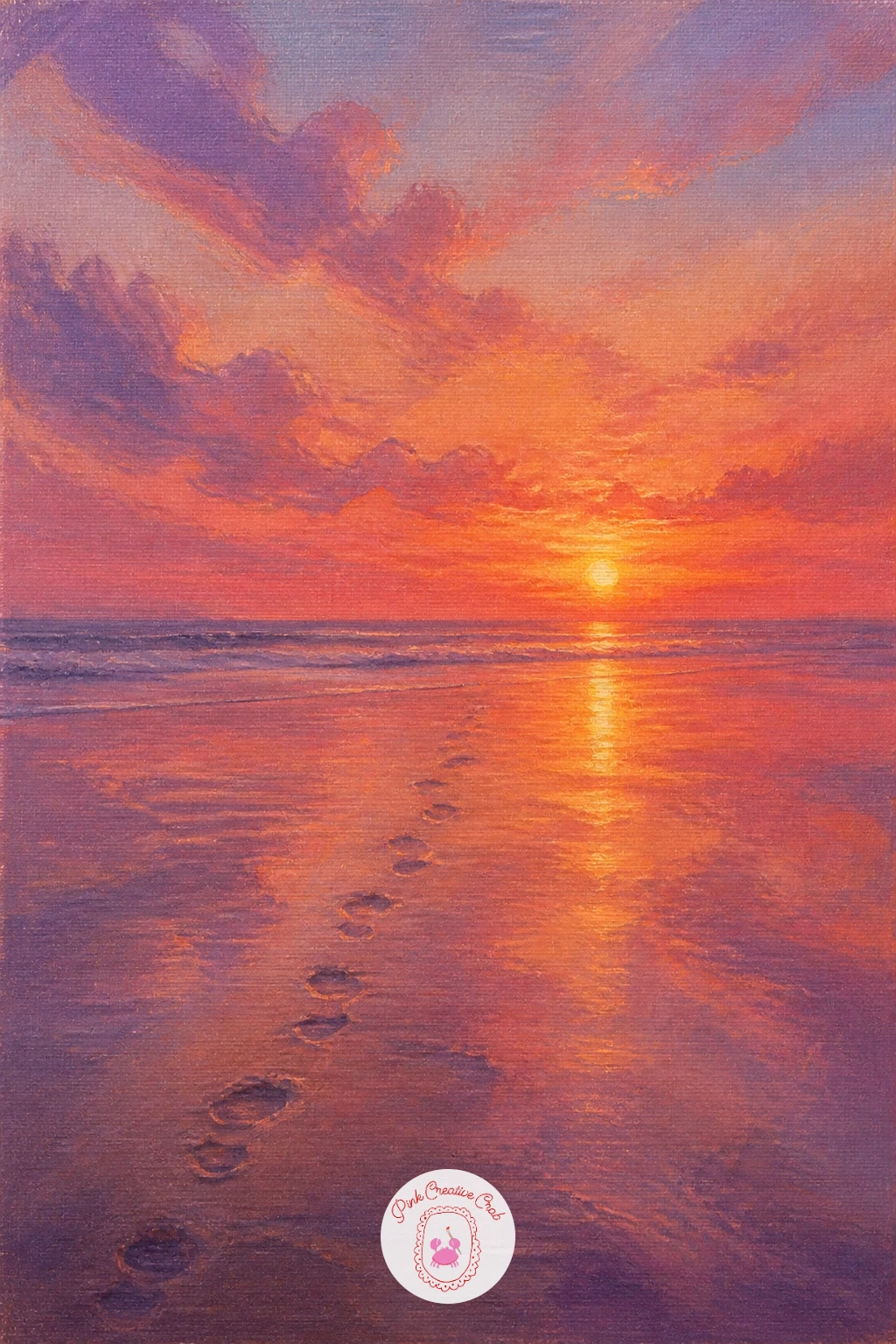
Palette: Coral,Lilac,Raw Umber,Titanium White
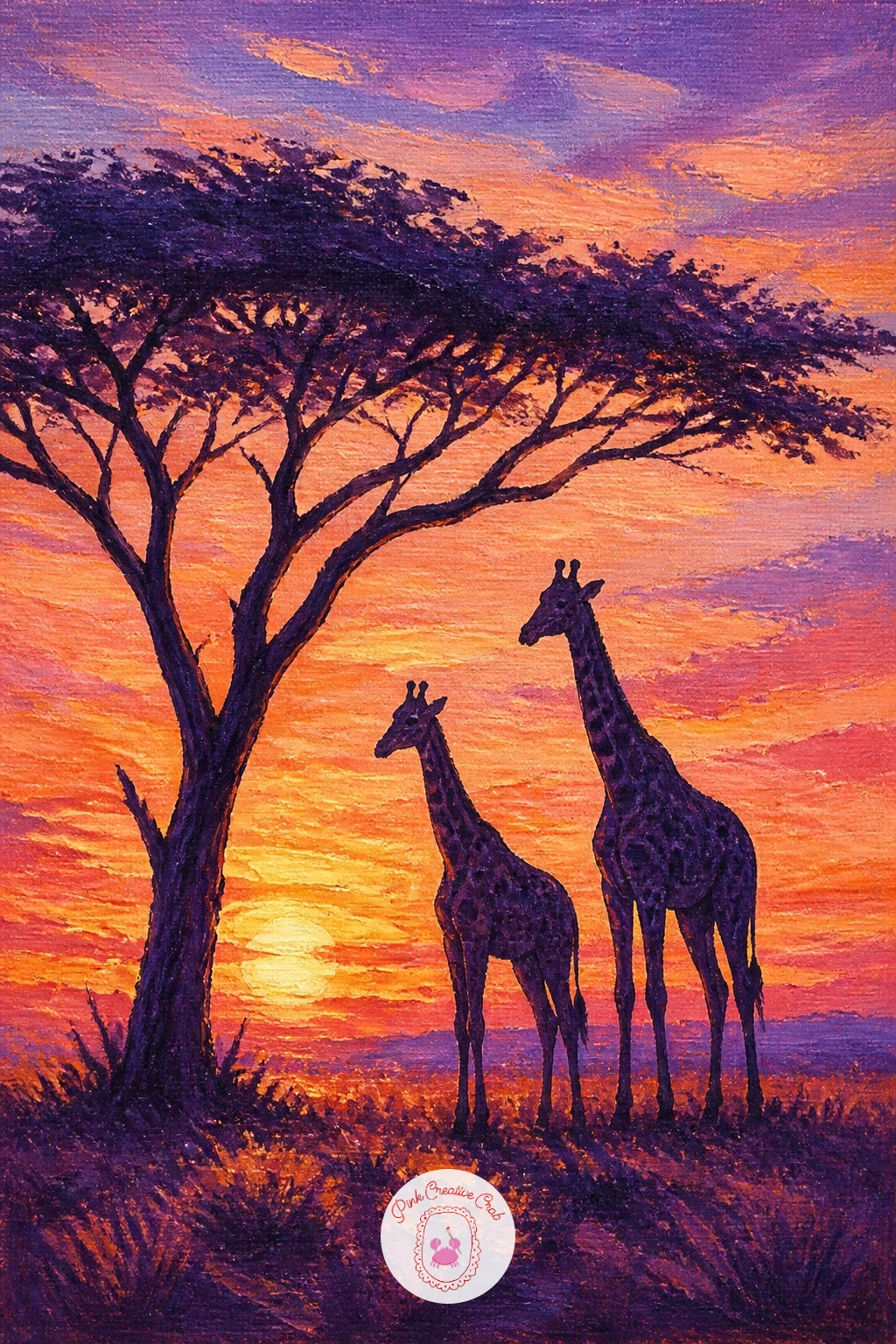
Giraffes beside a single flat-topped acacia tree bring a classic savanna silhouette into your sunset list. Paint the sky in warm gold and deep orange first, then build the acacia as one simple flattened canopy shape on a thin trunk, using a palette knife to keep its edges crisp against the glowing sky.
Paint one or two giraffes nearby with a thin round brush, starting with the long curved neck, then the body and legs, keeping every shape in full dark silhouette. Measuring the giraffe’s neck against its own body length as you paint, roughly as long as the legs combined, keeps the proportions believable even without a reference photo open.
A giraffe with a neck too short loses its character immediately, so err on the side of making it longer than feels natural at first. Standing one giraffe slightly behind the other, partly overlapping, adds depth without extra detail.
If a palette knife feels tricky for the acacia’s flat canopy, press a flat brush sideways and drag it in one motion instead.
You Will Need
- palette knife
Palette: Gold Ochre,Cadmium Orange,Mars Black,Burnt Sienna
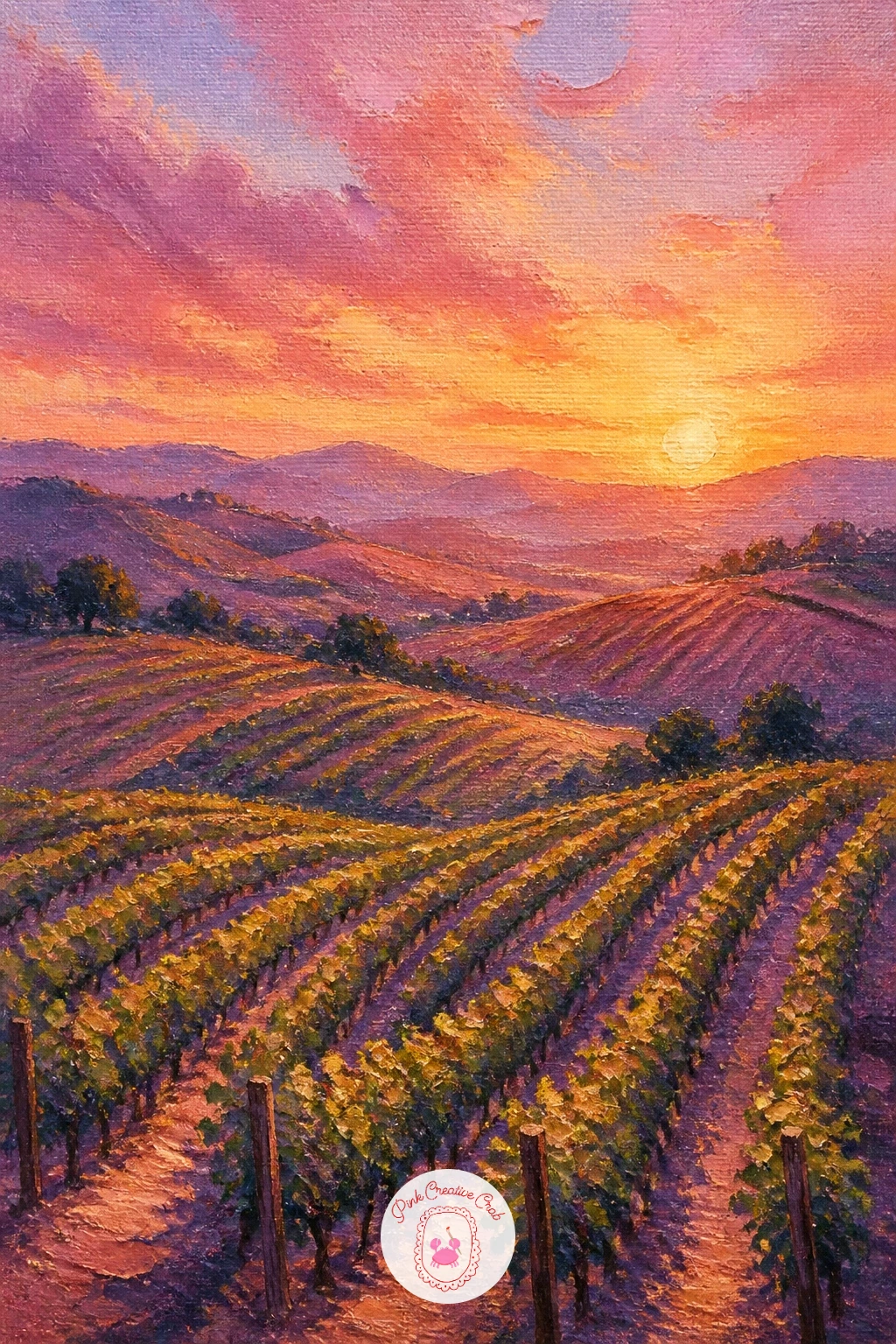
A vineyard on rolling hills lets you combine gentle perspective with repeating texture in one relaxed painting. Paint the sky first in soft rose fading into pale gold near the horizon, then shape the hills as two or three overlapping curved silhouettes, each one slightly lighter than the one behind it to suggest distance.
Add the vine rows with a small flat brush, short diagonal dashes following the curve of each hill, getting smaller and closer together as they climb into the distance. Keep the rows loose and slightly irregular rather than ruler-straight, since real vineyards rarely line up perfectly.
If the hills look flat rather than rolling, check that each one sits at a slightly different value, darkest closest to you and palest furthest away. This simple layering trick works for almost any rolling landscape you paint after this one.
A single small building or cypress tree tucked into the middle distance gives the eye a place to rest between the rows.
Palette: Rose Pink,Gold Ochre,Olive Green,Payne’s Grey
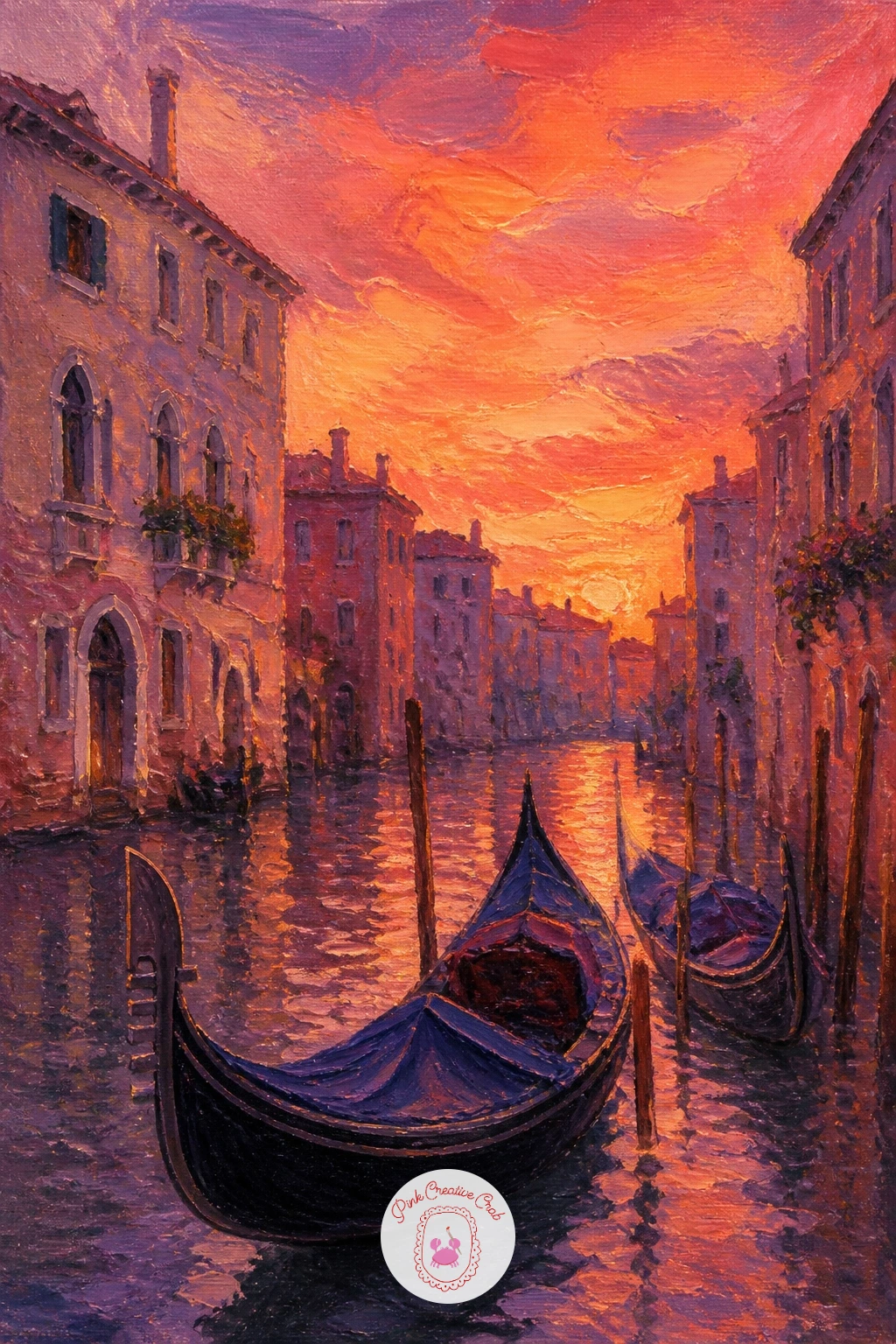
Gondolas resting quietly on a canal bring a touch of travel into your sunset series without needing any complicated boat anatomy. Paint the sky and water together first in warm rose and amber, keeping the canal narrow so buildings can rise close on either side.
Build two or three gondolas as simple curved dark shapes, pointed at both ends, tied loosely together along one edge of the canal with thin rope lines added with a fine brush. Keep the surrounding buildings as soft silhouettes, their reflections dragged straight down into the water in slightly broken vertical strokes.
Gondolas that look too straight and boxy lose their graceful curve immediately. Let the bow lift gently at both ends, more than feels natural, since that upward curve is what reads as a gondola rather than a plain rowboat.
If reflections feel fiddly, a dry brush dragged once, straight down from each dark shape, gives a convincing soft echo with very little effort.
Palette: Rose Madder,Amber,Mars Black,Payne’s Grey
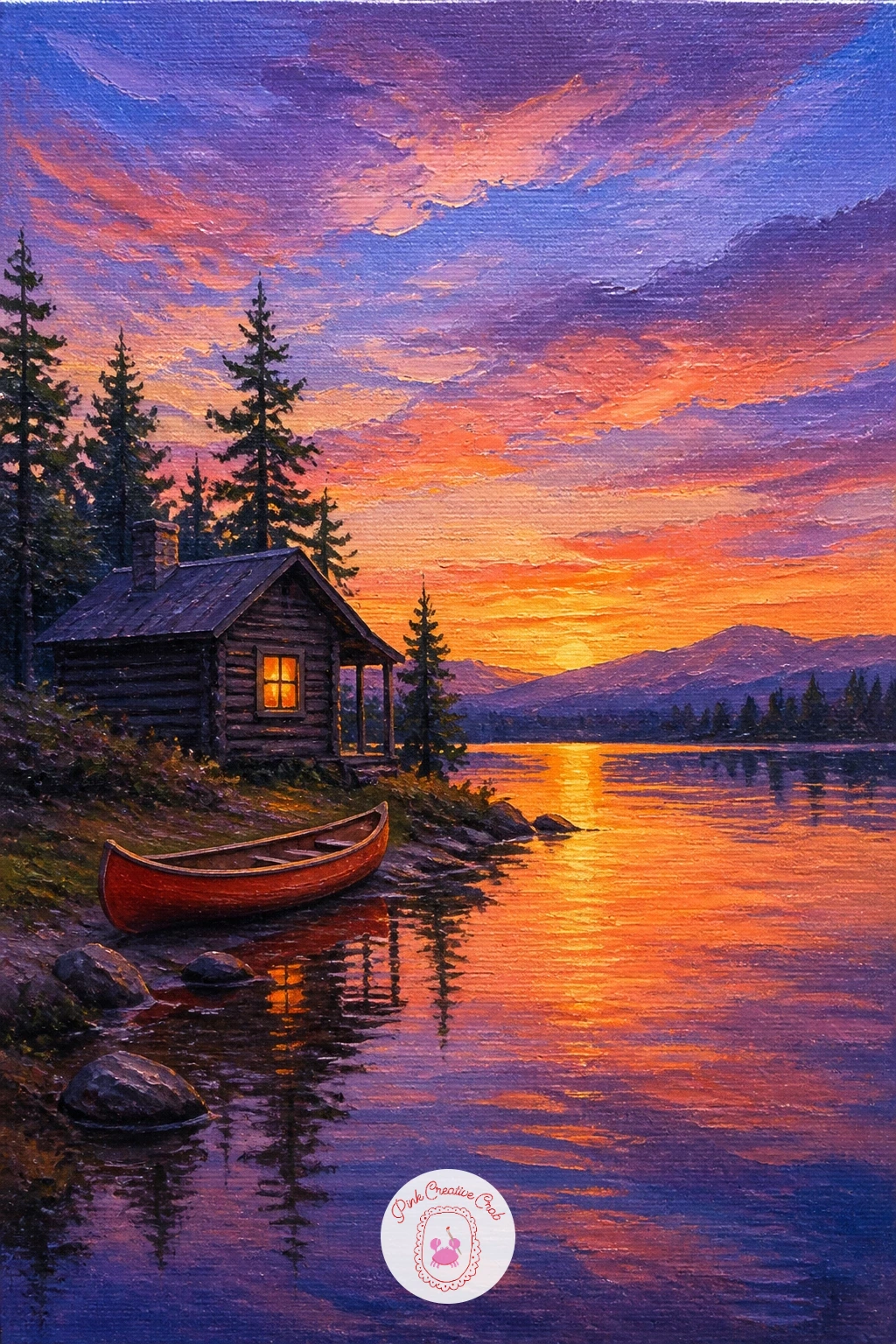
A lake cabin with a single canoe pulled up on the shore makes a cosy, quiet close to a long painting session. Paint the sky and lake first in muted gold and soft indigo, then add the cabin as one simple dark shape, a rectangle with a triangle roof, tucked near the shoreline rather than centered.
Warm one small window with a dab of yellow before the cabin’s silhouette fully dries, which gives the whole scene a lived-in feeling. Paint the canoe last on the shore nearby, a simple curved shape resting at a slight angle, smaller than the cabin so it reads as a detail rather than a second focal point.
If the cabin looks like it is floating, add a thin strip of darker shoreline directly beneath it to ground the shape. A reflection of the cabin’s lit window, just a short vertical dash of yellow in the water, finishes the quiet mood.
For a simpler ten-minute version, leave the canoe out entirely and let the cabin and its one warm window carry the painting alone.
Palette: Gold Ochre,Indigo,Mars Black,Cadmium Yellow Light
Seagulls flying across a blazing sunset add movement to a sky that might otherwise sit still. Paint the sky first in bold, hot color, deep red near the horizon rising into orange and rose, blended loosely so the color feels alive rather than flat.
Once that layer is touch-dry, or using a clean dry brush if working wet, paint each gull as a simple shallow V or M shape with a few quick flicks, never more than four or five birds scattered across the upper two-thirds of the canvas. Vary their size slightly, larger ones closer, smaller ones further into the distance, rather than keeping them identical.
Too many gulls crowded together can clutter a sky that should feel open and dramatic. Three or four, well spaced and at different heights, read as a flock without overwhelming the color beneath them.
If your flicks come out too heavy, thin the paint slightly with medium so the brush moves faster and lighter across the surface.
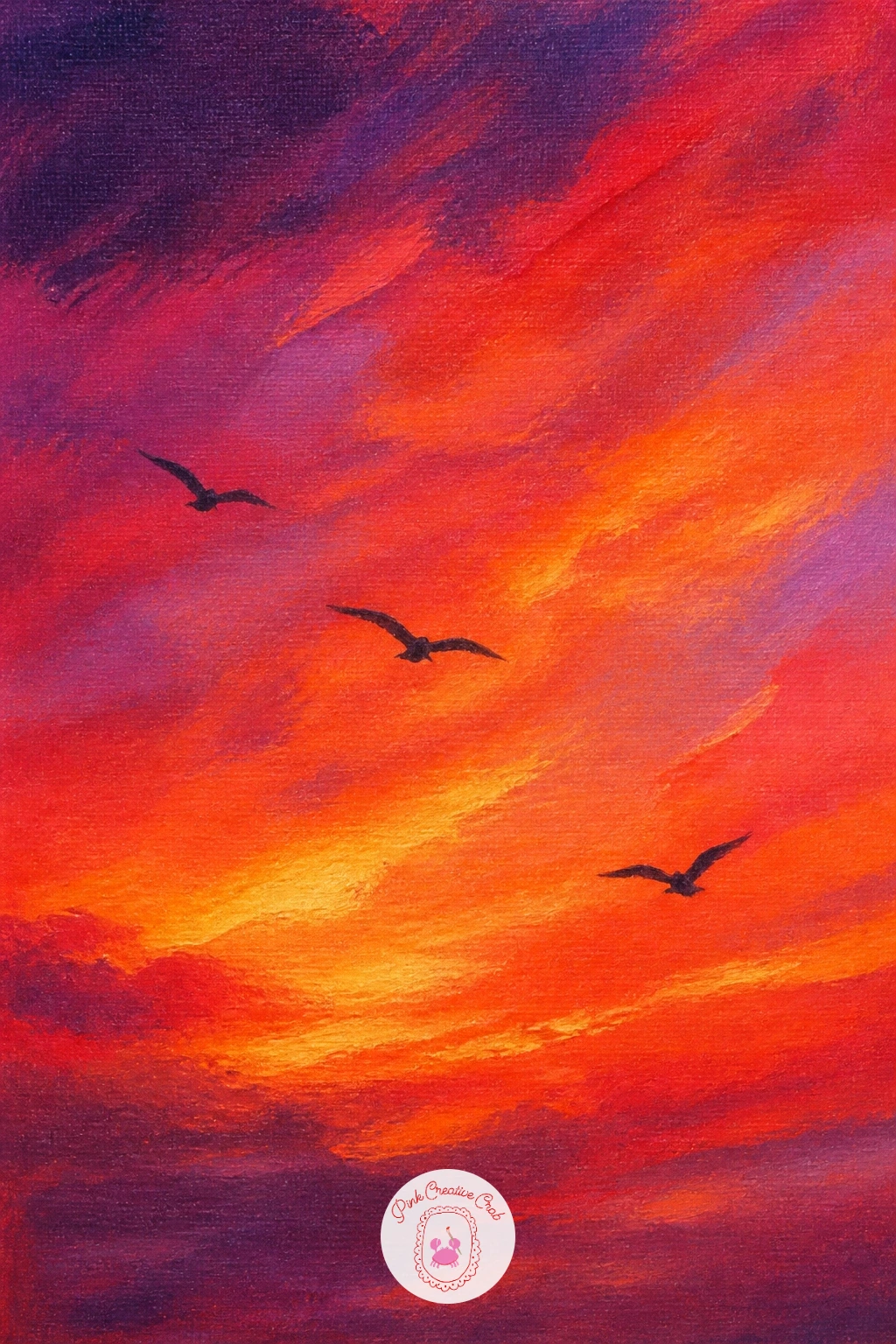
Palette: Deep Red,Cadmium Orange,Rose Madder,Mars Black
Sunflowers facing directly into a low sunset sun let you bring warm color into both the sky and the subject at once. Paint the glowing sky first in soft orange and gold behind the flowers’ eventual position, then build each sunflower head as a simple dark circle rimmed with short golden petal strokes radiating outward.
Keep the flower heads partly in silhouette rather than fully lit, since they are facing away from the viewer toward the sun, with just the petal edges catching warm rim light. Add the stems and a few large simple leaves last, in a darker green that reads almost black against the bright sky.
If the petals look too neat and evenly spaced, vary their length and angle slightly around each flower head, since real sunflower petals are never perfectly symmetrical. Overlapping two or three flower heads at slightly different heights avoids a flat, repeated row.
For more flower-focused sessions afterward, the ideas in this oil painting flowers guide build on the same petal and stem techniques.
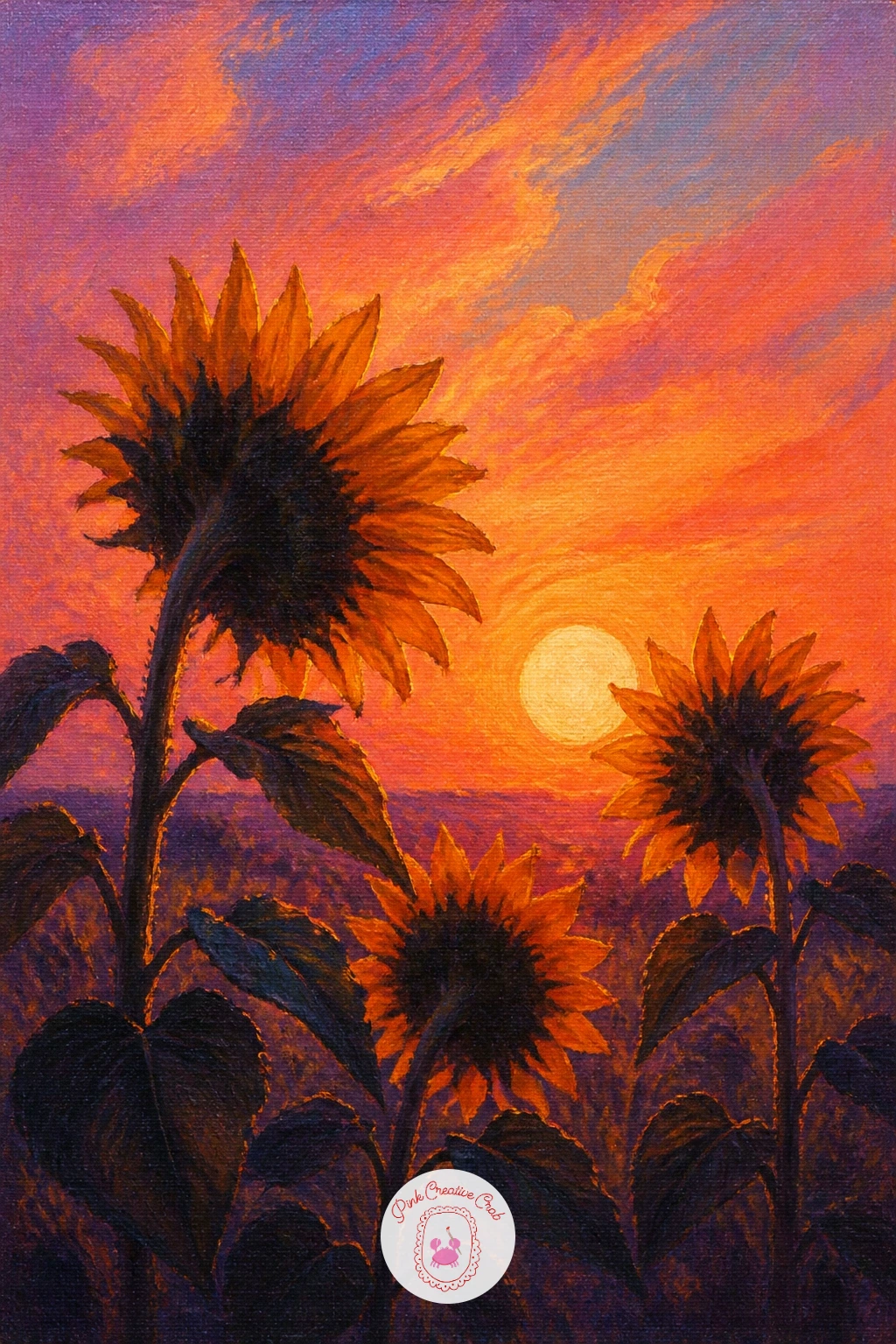
Palette: Cadmium Orange,Gold Ochre,Mars Black,Olive Green
Close your sunset series with a coastal road that curves along a cliff edge under a soft peach and lilac sky, a gentler echo of the straight country road from earlier. Paint the sky first in horizontal bands, peach low down softening into lilac higher up, blended while wet for a smooth gradient.
Shape the road as a curving ribbon rather than a straight line, narrowing as it bends away from you and disappears behind a headland, with the sea visible in glimpses beyond the cliff edge. Keep the cliffside and any scattered bushes in simple dark silhouette, added with a small flat brush in short, varied strokes.
A road that curves too evenly, like a perfect S, can look unnatural. Let it bend once, clearly, rather than winding back and forth repeatedly, which keeps the composition calm rather than busy.
A thin stroke of pale color along the road’s outer edge, where it catches the last light, finishes the sense of a real curving path.
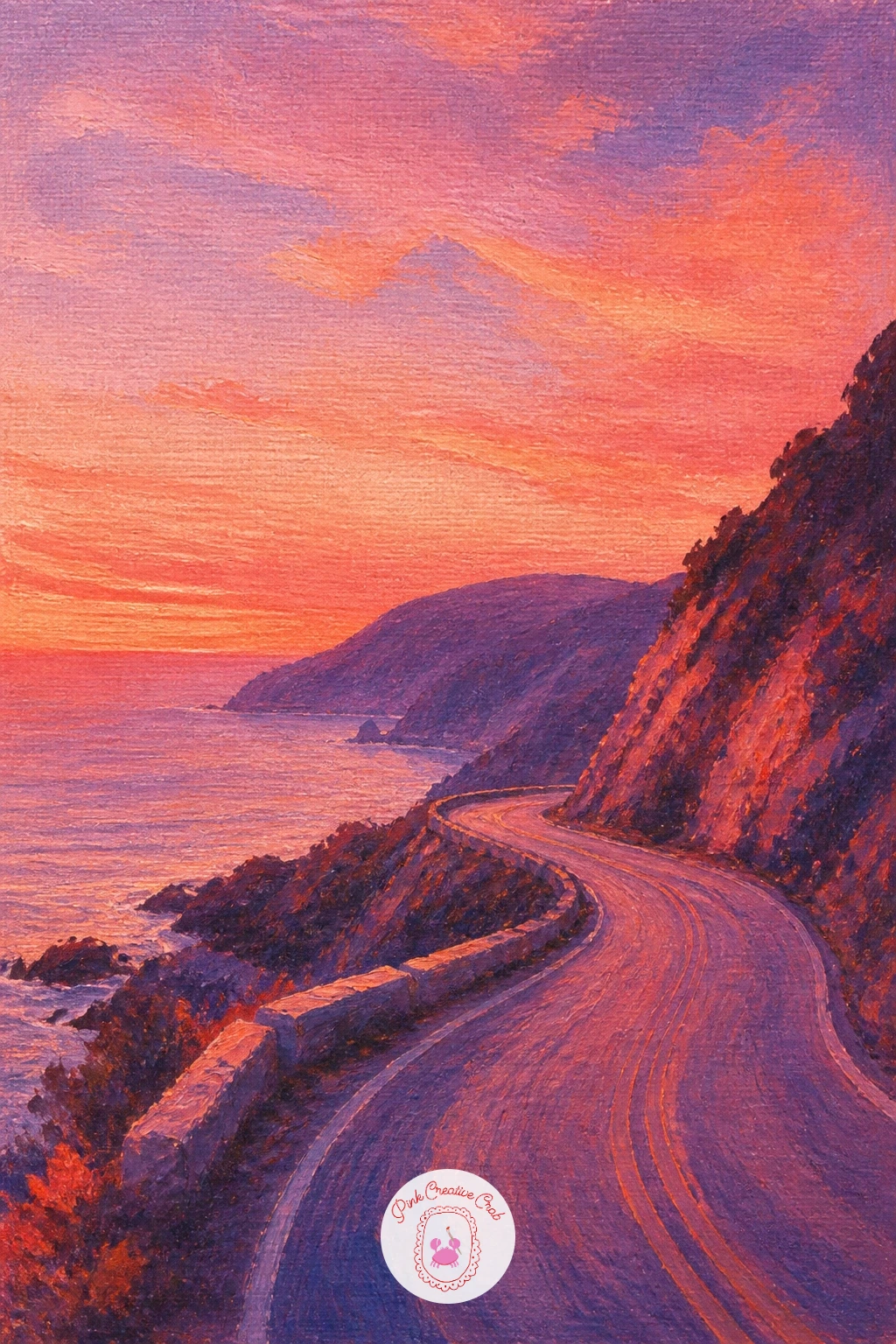
Palette: Peach,Lilac,Payne’s Grey,Titanium White
What to Do Next
Pick whichever sky is calling to you tonight, pull out a small canvas and your warm colors, and let the first wash of color set the mood before any silhouette goes in. One finished painting tends to lead straight into the next one on this list.
Frequently Asked Questions
What colors do you need for a sunset oil painting?
A warm set of cadmium orange, cadmium yellow, alizarin crimson, a violet or indigo and titanium white covers almost every sky on this list. Add Payne’s grey or Mars black for silhouettes and you rarely need more than six tubes.
How do you keep an oil sunset sky from looking muddy?
Work quickly while the paint is wet and limit how many times you blend each stroke, since overworking warm and cool colors together is what turns them gray. Mix fresh color on the palette rather than on the canvas whenever a passage looks dull.
Do I need to draw the scene before painting a sunset in oil?
A light pencil or thin paint line for the horizon and any major shapes is enough, since most of a sunset’s success comes from color and value, not outline. Silhouettes especially are easier painted directly than drawn first.
Can I finish a sunset oil painting in one sitting?
Yes, every idea on this list is sized for a small canvas and one sitting, usually ten to forty minutes depending on how much detail you add. Oil stays workable for hours, so you can keep blending the sky without it drying mid-session.
What size canvas works best for these sunset ideas?
A small canvas around eight by ten inches suits every idea here, keeping the sky and silhouette bold without demanding hours of detail work. Smaller panels also dry faster and cost less while you are still experimenting with color.
Have any thoughts?
Share your reaction or leave a quick response — we’d love to hear what you think!
-
 0
-
 0
-
 0
-
 0
-
 0
-
 0
